PNG egg
p. 15 · Read in the full issue
A few good bits in PNG egg
Despite international press coverage which could only be described as awful, the result of Papua New Guinea’s new, tough measures against hoodlumism and other crime in Port Moresby has more than satisfied the government and, indications are, a large part of the law-abiding citizenry.
In the first two weeks of the 10.30 am to dawn curfew, the improvement was little short of astonishing. Not one car theft occurred, in a city where five or six were stolen every day. Two houses were burgled, armed hold-ups were down to one, and there were no rapes.
“It’s so quiet it’s unbeliev able,” said one clearly much relieved expatriate.
How long this much to be desired situation will last is the subject of much debate in the loungerooms and bars of Port Moresby, but the government appears reasonably confident that a new era may have dawned ... even if it does mean, from now on, more expendi ture on policing, the employ-
ment of road blocks, peace officer patrols, and repatriation of miscreants to their own tribal areas, away from the tempta tions of the capital.
To outsiders, and particuarly some of those whom residents of Port Moresby tend to regard as do-gooders issuing advice from the serenity of foreign suburbs and academic institu tions, some of the measures adopted appear pretty Draco nian. Hanuabada village, on the outskirts of the city, from which many of the rascals are believed to swarm about their evil industry, is now virtually blockaded by 40 volunteer peace officers equipped with batons, badges and two-way radios to the police and the army, who check everyone moving in and out.
The use of volunteer police officers has been hailed as a great improvement. A London police superintendent who has charge of training these recruits is reported well pleased with the results and officials have ex tended the method to Lae and Mt Hagen. By the end of June he had trained 102 reserve policemen and was at work recruiting about 50 for Lae and 50 for Mt Hagen.
Word from Port Moresby is that the volunteers have im pressed many citizens with their efficiency. They are generally much better-educated than reg ular constables, and, by virtue of that education, have more confidence in their authority.
“When they check a car, it is properly checked. And they have a better manner with the public,” said one official.
“Some of the stuff seen on Australian television just after the state of emergency was declared was pretty dreadful,” he said. “They only interviewed those who had been hurt or menaced; there wasn’t much attempt to put it into focus across the community.
“But, I would say that, in ternally, this has been the big gest thing the government has achieved in a long time. And, as a result of that, the prime minister’s popularity is well up now. ”
This does not mean the cur few has been implemented without some criticism from within the community but the very broad body of both na tionals and expatriates seems to be totally behind the measure.
Mr Somare’s Pangu Pati held a fund-raising lunch in Port Moresby in the last week of June. Average attendance at one of these SOkina a plate affairs has been about 70. The June meeting attracted 200 applications for 180 seats.
The curfew has slowed the social activities of single pro fessional people, but has made little or no difference to families ... indeed, it seems to have improved their lives.
“Before the curfew we didn’t go out at night, anyway, be cause we wouldn’t leave the children unguarded,” said a businessman. “Or, if we did go out, we had to make arrange ments with other people to come in. So, in effect, we had our own curfew; all the pro fessional people, nationals and expats, did. The improvement now is that we sleep easier because the atmosphere is much less anxious ... we feel a lot more secure. Even the dogs seem quieter they aren’t constantly barking at the people moving around the streets, be cause the traffic stops at 10.30 pm.”
How far the police have so far gone in their campaign to arrest, jail (and keep in jail), the rascal gang leaders is open to debate. The government has taken two-page advertisements in Port Moresby newspapers to publish photographs and de scriptions of the country’s most wanted criminals and jail
escapees. They say they are catching “a few” but, at least, the pressure is increased on the fugitives.
Meantime, the society re mains deeply shaken by the dreadful pack rape of a New Zealand wife and her young daughter which was the final outrage leading to the declara tion of emergency. Several men have been on suspi cion of this crime, including one who is alleged to be suffering from psychological problems, and police are reported to be using all of their now consider able powers of investigation in pursuing the gang.
The curfew is to last three months, and is likely to be extended, perhaps with some minor relaxation, for a further three months.
It has brought a good deal of kudos to the Somare govern ment which, lately, has been under considerable pressure from the Opposition and from dissidents within its own coali tion. But, what will count at the next polls (or at the next, no doubt inevitable, vote of no confidence in the House), is whether, after the curfew is ended, the rascal problem has been brought within bounds.
The most popular remedy advanced by people in Port Moresby is based upon a strengthening of village-based law and discipline, which, many consider, means that some sort of “pass” system will have to be introduced to stem the urban drift and to turn back out of the cities those who have no jobs, or what, in this very genuine emergency, is seen to be insuffi cient reason for being away from the home territory. —
Staff Writer.
Patrolling police, and security guards for commercial firm, comparing methods.
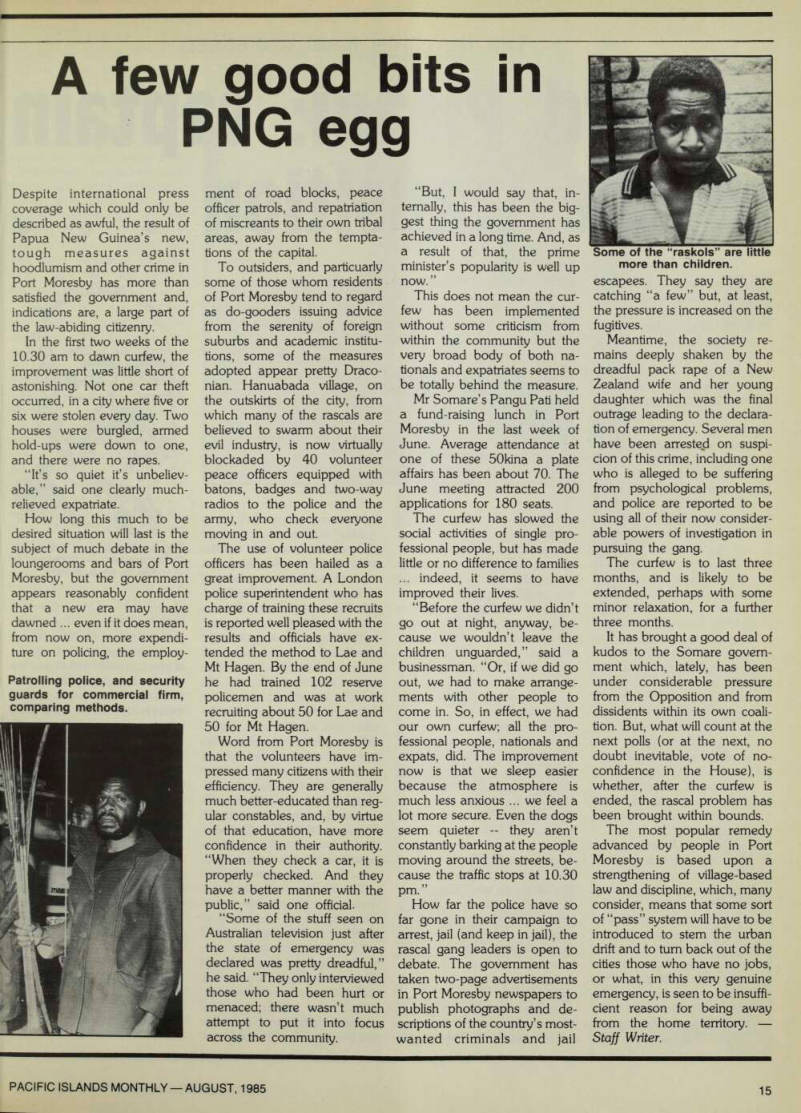
Some of the “raskols” are little more than children.