curfew's benefits
pp. 10-14 · Read in the full issue

Png’S Law And Order Crisis
Media mania blurs curfew's benefits
Papua New Guinea’s biggest crime in tackling the urban law and order crisis was to admit it to the world.
The strife, particularly in the national capital of Port Mores by, was certainly at a serious stage.
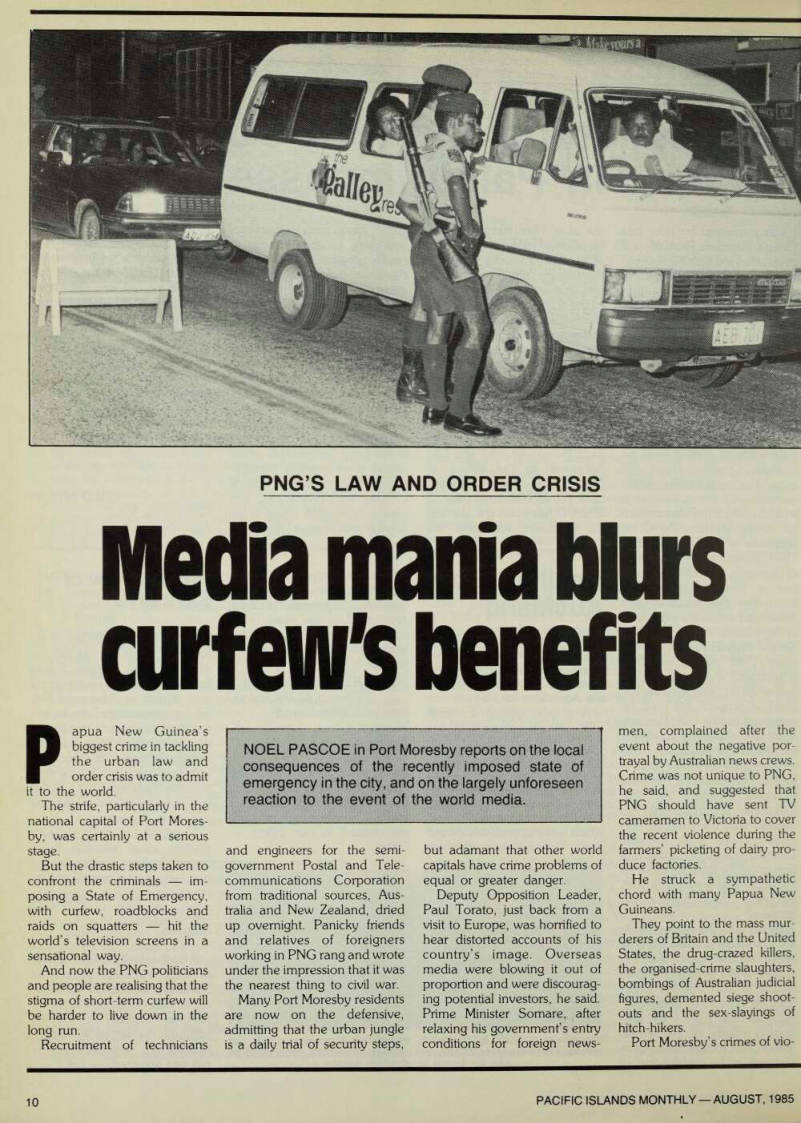
But the drastic steps taken to confront the criminals im posing a State of Emergency, with curfew, roadblocks and raids on squatters hit the world’s television screens in a sensational way.
And now the PNG politicians and people are realising that the stigma of short-term curfew will be harder to live down in the long run.
Recruitment of technicians
NOEL PASCOE in Port Moresby reports on the local consequences of the recently imposed state of emergency in the city, and on the largely unforeseen reaction to the event of the world media.
and engineers for the semi government Postal and Tele communications Corporation from traditional sources, Aus tralia and New Zealand, dried up overnight. Panicky friends and relatives of foreigners working in PNG rang and wrote under the impression that it was the nearest thing to civil war.
Many Port Moresby residents are now on the defensive, admitting that the urban jungle is a daily trial of security steps,
but adamant that other world capitals have crime problems of equal or greater danger.
Deputy Opposition Leader, Paul Torato, just back from a visit to Europe, was horrified to hear distorted accounts of his country’s image. Overseas media were blowing it out of proportion and were discourag ing potential investors, he said.
Prime Minister Somare, after relaxing his government’s entry conditions for foreign news
men, complained after the event about the negative por trayal by Australian news crews.
Crime was not unique to PNG, he said, and suggested that PNG should have sent TV cameramen to Victoria to cover the recent violence during the farmers’ picketing of dairy pro duce factories.
He struck a sympathetic chord with many Papua New Guineans.
They point to the mass mur derers of Britain and the United States, the drug-crazed killers, the organised-crime slaughters, bombings of Australian judicial figures, demented siege shoot outs and the sex-slayings of hitch-hikers.
Port Moresby’s crimes of vio-
lence are escalating, but still of comparative crudity in method and result. It’s the lack of modem detection methods, un skilled police prosecutors, and a dismally demoralised corps of jail warders that have combined to set back law enforement.
PM Somare’s critics say the emergency declaration is an other sample of Pangu “crisis management and ad hoc deci sion-making”.
There have been no denials of that, so far, but the govern ment remains firm that the measures were essential, and that, given time and bureaucra tic action, will prove worthwhile in the long run.
The State of Emergency had the twin aims of granting police extra temporary powers to grab the chief trouble-makers and to enable changes in legislation to provide long-lasting remedies.
In the first weeks of the curfew, the police and soldiers combined to nab people, main ly in illegal but tacitly accepted settlements, and to charge people they believed were re sponsible for much of the se rious crime.
Among the first hauled in were people identified from TV interviews by Australian media.
TV film showing young men claiming in simplistic terms that
they had committed crimes as it was their duty angered many residents, Some residents of the low income suburb, Morata, claimed Mike Willesee’s crew had honed in on a pre-arranged compensation meeting, when young men were worked up for a public “confession” to past crimes. The persistent question ing in an unfamiliar way had led to misleading statements, resi dents claimed. Right or wrong, the TV tapes were used by police to grab some people, The first weeks resulted in solemnly quiet nights in the city, Most people feared the com bination of police and army and headed home well before the 10.30 p.m. curfew deadline, Restaurants, hotels and street corner stalls reported a drama tic drop in trading and began laying off workers.
The theatres opened early, cut back to one movie a night, dropped admission fees, and drew only handfuls of custom ers. The discos opened around midday and closed early in the evening. One proprietor, Harry Hoerler, promised to keep his disco going all night with pat rons leaving after lifting of cur
continued on page 14
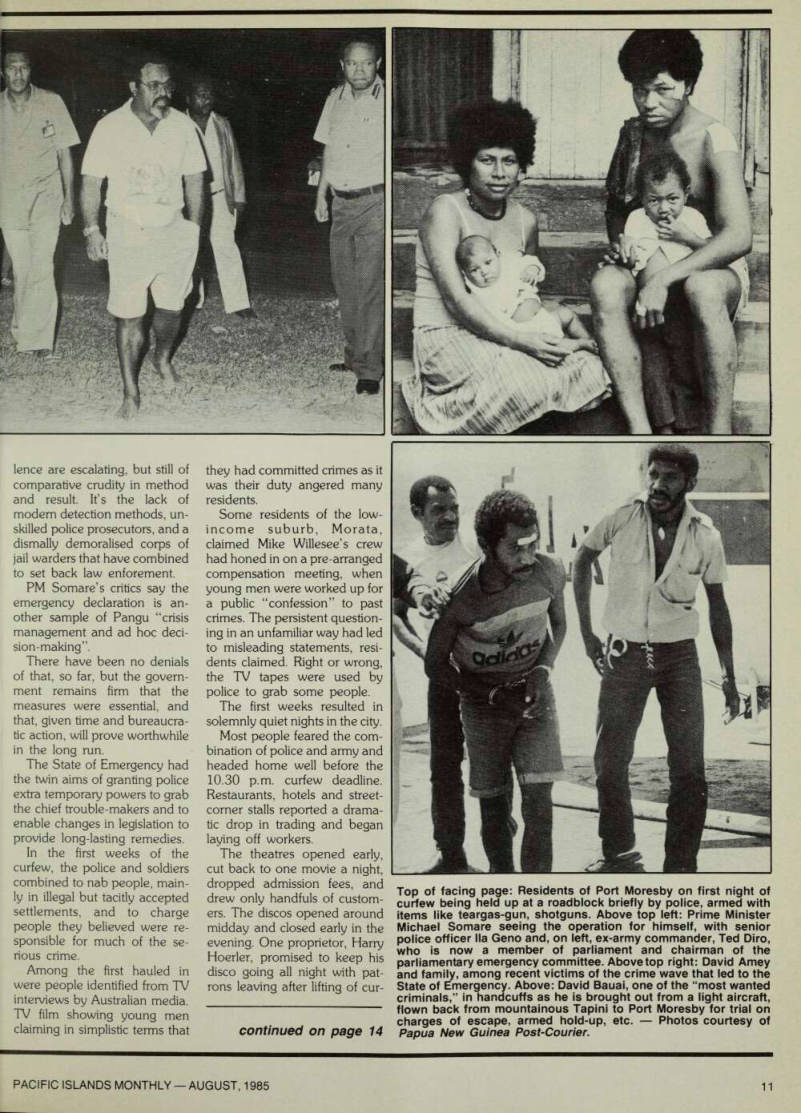
Top of facing page: Residents of Port Moresby on first night of curfew being held up at a roadblock briefly by police, armed with items like teargas-gun, shotguns. Above top left: Prime Minister Michael Somare seeing the operation for himself, with senior police officer Ha Geno and, on left, ex-army commander, Ted Diro, who is now a member of parliament and chairman of the parliamentary emergency committee. Above top right: David Amey and family, among recent victims of the crime wave that led to the State of Emergency. Above: David Bauai, one of the “most wanted criminals,” in handcuffs as he is brought out from a light aircraft, flown back from mountainous Tapini to Port Moresby for trial on charges of escape, armed hold-up, etc. Photos courtesy of Papua New Guinea Post-Courier.
few at 4 a.m. But the emergen cy controller, Police Commis sioner David Tasion, smartly jumped on that idea.
Mr Tasion was joined quickly on patrol at nights by former army commander, Brigadier- General Ted Diro, who is now M.P. for the Central Province and the chairman of a par liamentary committee set up to watch over the emergency.
Gen. Diro confessed to a feeling of nostalgia when he entered the police operations room with people, phones and weapons in sight.
He caused a mild stir with public comments on what he, as an individual, would like to see happen.
Democracy was not being handled well by people, he said, and cautioned that perhaps some rights needed to be taken away. He spoke in favor of ID (identity cards) and the possibilities for further use of the army to help out.
Then Police Minister Dennis Young foreshadowed a number of legislative moves planned for the August sitting of Parliament.
The existing Vagrancy Act would be strengthened to empower courts to repatriate long-term unemployed urban people and those known to associate with “criminal ele ments”. He conceded logistics were against a mass movement of every vagrant or “pasindia” (passenger) in the city and town. ID cards would be com pulsory for employed people, chemical mace would be sold by the police under control for residents’ use from their homes, and short-term prisoners would be sent to their home districts to serve their sentences.
The city’s jail at Bomana, long the leakiest of the coun try’s “sieves”, is being strengthened with higher walls, more watch-towers and provi sion for more top-security cells.
A long-mooted “island pris on” idea inched closer to acceptance, with Mr Somare mentioning an unnamed island off New Ireland as a possibility and then Mr Young citing “swampy, mosquito and croco dile infested” Ningerum as a
Prime Minister Michael So mare wants a new name for Papua New Guinea as befits an independent nation but the initial local reaction to his idea was little short of derisive.
Mr Somare let drop in late June that he thought the name, Papua New Guinea, smacked too much of the colonial era.
It was time for a more fitting name as the nation approached its 10th anniversary celebrations (set for September, when K 1.5 million will be spent to who op it up in patriotism).
Commentators in his own country betrayed a heavy touch of cynicism, perhaps reflecting popular senti ments about politicians in general.
SomariLand or Panguna, suggested the Post-Courier cartoonist Grass Roots.
“Maybe even Corruptany or United States of Hunemployment or silly nems like that,” continued the acerbic pen. Niugini Nius columnist Pama Anio offered Grasrutland, Saiso
land (after a current risque catch-cry) and Crimeland.
The formal name, Papua New Guinea, has never really caught on with other countries. Many in the Aus tralian media still refer to it as New Guinea, in a slight that offends many in PNG.
But the fact remains, some of the national politicians dislike the name on the grounds that it is an amalgamation which re minds all of the country's oddball beginnings, with the southern half under British and Australian auspices, and the northern sphere under the Germans.
Name-changing has been touted before and always dropped as being not worth the effort. Even if the gov ernment goes ahead and picks a new name in time for the September celebrations, you can imagine the possi bilities as sundry VIPs step to the dais for the occasion and stumble over “Citizens of Papua, er, Paradisea. . . or is it Greater Melanesia. . .” Noel Pascoe in Port Moresby.
likely site. Local MP Warren Dutton chortled, saying Ning erum was on a main road near the Ok Tedi mine townships and only a moderate hike from the Indonesian border.
Mr Young plans to have on-the-spot fines for minor off ences to lighten the load on courts and to use non-violent criminals on community service duties. That was a colonial era practice dropped in indepen dent PNG. People found to possess stolen property will be dealt with more severely, he said.
The authorities in Port Moresby and other centres made it plain they would watch for signs of an exodus of criminals from Moresby. First signs were that some of the gangsters eluded the net and picked up some holiday money. Lovely seaside Madang had a rash of hold-ups, attri buted to local prison escapees, and then the second-biggest centre, Lae, had several armed hold-ups in one week.
These were “flash-in-the pan” efforts and the authorities are confident that the scene is set for a real curtailment of serious crime.
As Mr Somare said defen sively, we will only know after the lifting of the emergency in September timed for just over a week before the celebra tions of the nation’s 10th year of independence.
Young criminals like this one pictured in hands of police are the sort striking fear into city residents ... they’re the ones able to squirm through holes and break into property with comparative ease.