letters
Questioning the IPSECO factor in Palau impasse
I was impressed by how little Palau’s President Remeliik said in his interview with Mr Rampell (PIM Apr. p. 19). His answers to the interviewer’s (leading) questions are difficult to take seriously in their simplicity, while the president’s responses to controversial issues are offered with no substantiation.
How for example will Palau remain “100 per cent nuclear free” under the Compact, given the fact that even U.S. Ambas sador Zeder admits the Com pact is still in conflict with the Palauan Constitution on this issue? The fact is that Remeliik’s assurances mean nothing, which is why the Palauan Sen ate, while affirming the Com pact vote of the September 4, 1984, plebiscite out of one side of its mouth, moved to reconsti tute a Compact negotiating team that the president had disbanded out of the other side of its mouth. As the Palauan Senate Special Report of Feb ruary 1985 stated, the OEK (Parliament) shares the percep tion of Zeder “that the May 23, 1984, Compact will not be approved by the U.S. Govern ment and, therefore, authorises the Status Commission ... to represent the people of Palau in further negotiations on the Compact.” Indeed, the U.S.
Congress is proceeding as warned with the Compact ex cluding Palau. Is Mr Remeliik blissfully oblivous to all this, and how could Mr Rampell allow his interviewee to get by with such patently meaningless re sponses?
As for what Mr Rampell calls the “probably scurrilous theory going around that IPSECO really is a plot to place Palau so deeply in debt that the Com pact will have to be accepted,”
Remeliik again gives no sub stantial rebuttal of this serious charge. Nor for that matter does Rampell in his highlighting of
the issue. There has in fact been no formal study published to refute the Inspector-General’s devastating critiques of the pro ject, and until evidence is given to the contrary we must suspect Remeliik’s (and IPSECO’s) assurances as a further cover up to an already smelly deal. Mr Rampell would be advised to read the I-G’s report itself, not just Associated Press releases about it, and consider the re cent notification of imminent default on the IPSECO loan from Morgan Grenfell and Co., delivered to the Office of Micronesian Status Negotia tions (OMSN) in early May. If IPSECO has nothing to do with the Compact, why does the
letter from the international financiers of the project so readily suggest to Zeder that Palau be bailed out by none other other than Compact monies? To quote the docu ment: “Compact funding for Palau, whilst not approved, has been estimated and will w'hen granted provide a substantially larger sum than Palau’s im mediate obligations. There seems to us to be a number of ways that the U.S. could assist in resolving this problem which would leave present arrange ments intact, preserve existing Lenders and Guarantors, and assure Palau of its future in the international financial markets. ”
Rampell needs to demons trate why this “scurrilous” theory is off the mark, given the fact that Palau is now in fact unable to service its debt with out Compact monies. I enclose herewith an investigative article I wrote on the subject while in Palau for six weeks in March and April, which raises ques tions neither interviewer nor interviewee begin to resolve. It is to be hoped that better coverage of issues which seriously jeopardise the future of a sovereign Palau will be given in PIM henceforth.
Ched Myers
Clifton Hill, Vic., Australia
Shellfire from
Auckland ...
I would like to refer to Dr W. G.
Coppell’s review of the book Shells: A Collectors Colour Guide by J. and R. Senders in the April issue of PIM.
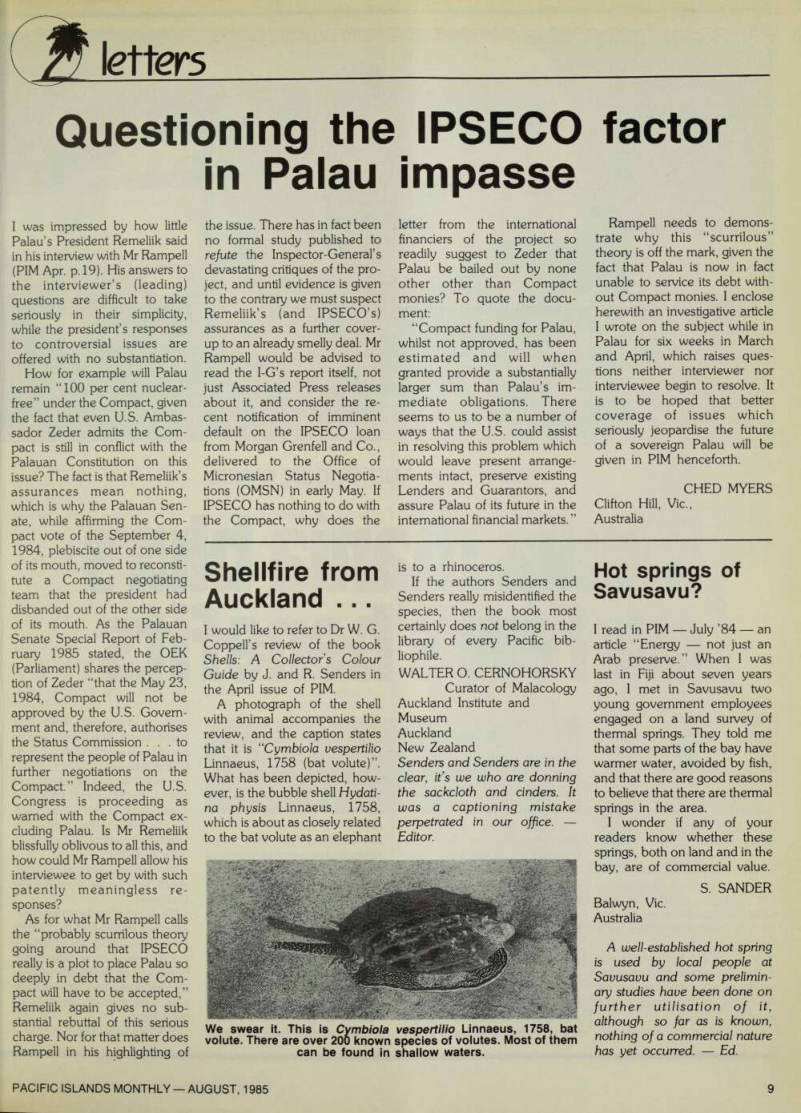
A photograph of the shell with animal accompanies the review, and the caption states that it is “ Cymbiola vespertilio Linnaeus, 1758 (bat volute)”.
What has been depicted, how ever, is the bubble shell Hydati na physis Linnaeus, 1758, which is about as closely related to the bat volute as an elephant
is to a rhinoceros.
If the authors Senders and Senders really misidentified the species, then the book most certainly does not belong in the library of every Pacific bib liophile.
Walter O. Cernohorsky
Curator of Malacology Auckland Institute and Museum Auckland New Zealand Senders and Senders are in the clear, it’s we who are donning the sackcloth and cinders. It was a captioning mistake perpetrated in our office.
Editor.
Hot springs of
Savusavu?
I read in PIM — July ’84 — an article “Energy — not just an Arab preserve.” When I was last in Fiji about seven years ago, I met in Savusavu two young government employees engaged on a land survey of thermal springs. They told me that some parts of the bay have warmer water, avoided by fish, and that there are good reasons to believe that there are thermal springs in the area.
I wonder if any of your readers know whether these springs, both on land and in the bay, are of commercial value.
S. Sander
Balwyn, Vic.
Australia A well-established hot spring is used by local people at Sauusauu and some prelimin ary studies have been done on further utilisation of it, although so far as is known, nothing of a commercial nature
has yet occurred.
Ed.
We swear it. This is Cymbiola vespertilio Linnaeus, 1758, bat volute. There are over 200 known species of volutes. Most of them can be found in shallow waters.