in Pago Pago
pp. 22-24 · Read in the full issue

Now 'action's' the word in Pago Pago
American Samoa’s new ly-elected governor, A.P.Lutali, has a brave new development program about to swing into operation. The new leader of the unincorporated island terri tory of the United States is 66 years old, has had a long career in education, and with the judiciary. He was Speaker of the Samoan House of Repre sentatives from 1965 and was American Samoa’s Washington representative from 1975 to 1979.
Lutali has chosen Eni Hunk in, Jr., as his lieutenant-gov ernor. Hunkin is only 42 and is full of enthusiasm. He has a background in law and has been involved in government since 1973.
When Lutali won the election at the end of 1984 he changed the heads of all government departments and called for un ited efforts to generate in creased economic deve lopment.
Gov. Lutali said government was very keen to work with the business sector. He said he felt the previous government, led by Peter Tali Coleman, had been too involved in activities which should more properly be part of the private sector. Lutali said he was keen to become much more involved in the South Pacific, rather than al ways looking towards the Un ited States. He added that he was anxious to discuss at the South Pacific Forum the issue of nuclear testing in the Pacific, which he strongly opposed. He is also concerned about the Russian attempt to obtain fishing rights in Kiribati.
Lutali said his favorite word is ’’action,” a word he says was not really known by the last government. Since his govern ment had been in office, he said, several self-help programs had been set up and were being
pushed through the local televi sion station. These included a clean-up campaign for the is land, a fitness program, and the development of a youth prog ram. Lutali believed, he said, that the country’s best asset was its young people, and recog nised the need to point them in the right direction. American Samoa needed a strong com munity spirit, he said.
Lutali is also keen to set up local and technical training programs, as most technicians in American Samoa come from Tonga and Western Samoa.
Out of 75,000 visitors to American Samoa in 1983 only 5000 were tourists. These fi gures lie at the basis of the recent offering for tender of the country’s only large hotel, the government-owned Rainmak er. Lutali said the government had very definite plans to deve lop the tourism sector.
With the purchase of the
Rainmaker Hotel will come a much-needed injection of funds into other facilities to attract the tourist. There is an efficient bus and taxi service but there is also a need to develop places of interest around the island. A down-town shopping area is almost non-existent, Lutali said the government planned to de velop the bay area, putting all government areas up for bid for private development. Tax in centives will be given. A deve loper will be able to get training subsidies for the local work force and up to 10 years tax holiday on his business.
The development program is due to start in October and will be controlled by design stan dards. This is, for American Samoa, a huge undertaking, but if it is successful it will give a large boost to the country’s tourist development.
Lutali said his government also recognised that tourists
coming to the Pacific usually wished to visit a number of island countries. Plans are afoot for annual triangular meetings between Tonga, Western and American Samoa to develop joint tourism programs.
Pete Galea’i, director of eco nomic development and plan ning, says that the country’s economy has a leakage factor.
Statistics for 1984 show US$2l2 million worth of ex ports, and $165 million worth of imports, with 98 per cent of exports produced by the tuna canneries in Pago Pago. The bulk of imports are fuel, food and cans for the canneries.
Galea’i feels that the tourist development will fill the dollar gap- Another of American Samoa’s economy boosters is the number of purse seine ships using the harbor as a base. At present 40 operate from Pago Pago harbor, each spending
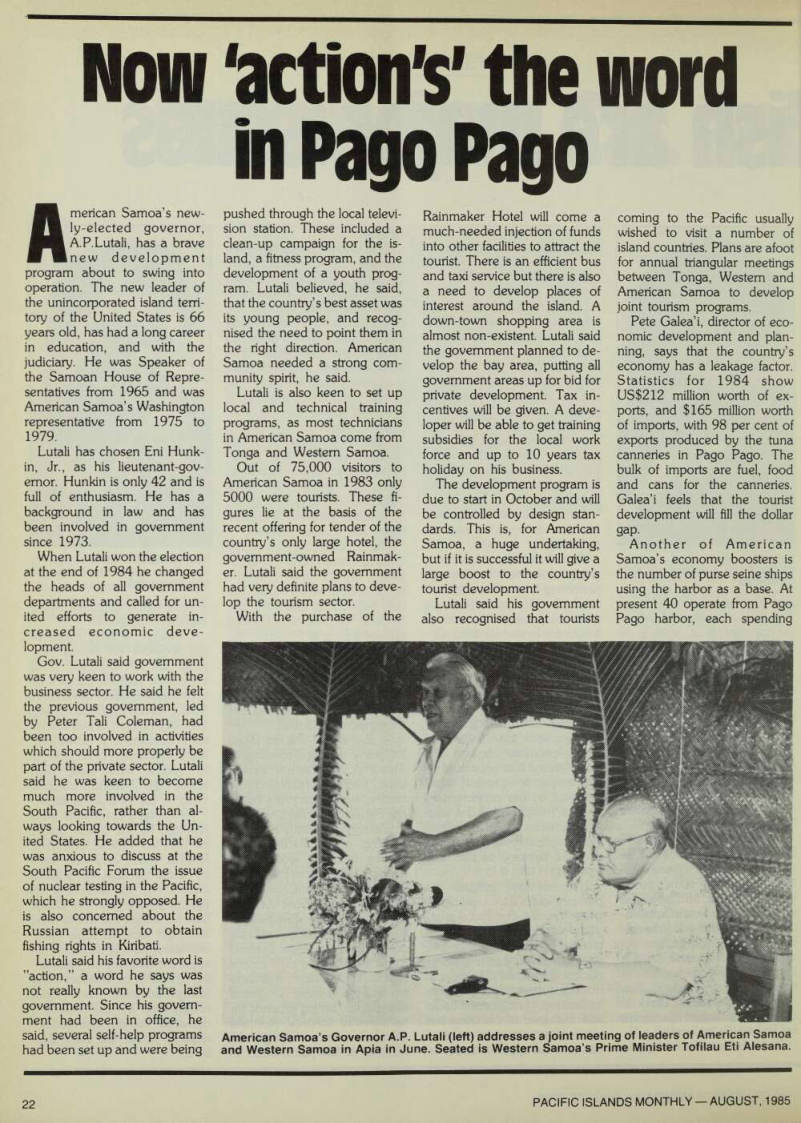
American Samoa’s Governor A.P. Lutali (left) addresses a joint meeting of leaders of American Samoa and Western Samoa in Apia in June. Seated is Western Samoa’s Prime Minister Tofilau Eti Alesana.
about US$l.2 million in the country each year. The number of ships is expected to increase to 60 by the end of 1985.
Galea’i admits his government is hoping to negotiate fishing rights with Tonga and Western Samoa as part of their triangu lar agreement. At present both Kiribati and Solomon Islands supply tuna to the American Samoan canneries and the gov ernment is anxious to head off any possible agreement be tween these two countries and the Russians.
Another attraction of Amer ican Samoa for Tonga and Solomon Islands is the daily flight service to the U.S., as well as export advantages through the territory’s U.S. status.
American Samoa can also pro vide concessions of 30 to 60 days’ free port storage for trans shipment to Pacific Islands, meaning a valuable saving in foreign exchange to importing island countries.
Lieut-Gov. Hunkin is a close adviser to the governor. He is currently paying great attention to the relationship between American Samoa and the U.S.
Hunkin says that an American Samoan under the present con stitution is a U.S. national, a
person who owes allegiance to the United States, but who is not a U.S. citizen. He says that certain fundamental provisions of the U.S. Constitution are not compatibile with the country’s efforts to protect its land and cultural heritage. He feels that as far as the federal constitution is concerned, American Samoa still does not know where it stands.
Hunkin criticised the U.S. saying that it should pay more attention to the South Pacific and start to consider the area as more than just ’’small chips.”
For years Russia had tried to open negotiations with Tonga and Western Samoa. As a result of this, Western Samoa now had a fully-fledged Chinese embassy, but the Americans would still not put an embassy there.
Trade delegations from Saudi Arabia had been looking at Tonga as a centre for a petro-chemical refinery, he said. New Zealand had an enormous amount of trade with Russia, and Australia and New Zealand were providing econo mic assistance for the South Pacific. ’’And yet America still waits like an ostrich with its head buried in the sand.”
Hunkin added that it was time the U.S. showed it was truly interested in the South Pacific.
Both Lutali and Hunkin said
they were interested in increas ing the role of American Samoa in the Pacific and were anxious for further dealings with Austra lia and New Zealand.
The Chamber of Commerce of American Samoa is pleased with the new administration.
Hans Langkilde, the chamber’s president, says the chamber is planning a trade show for Octo ber. They will be promoting north-bound cargo to U.S. mar kets and south-bound cargo, and combining forces with the regional countries to make the most of the advantages to be had in manufacturing products in American Samoa.
Joint ventures mean being able to take advantage of the U.S. flag situation in American Samoa, he said.
The Chamber of Commerce has about 65 members and hopes to see a good growth over the next five years as a result of the projected govern ment programs. Langkilde says the chamber is excited about the bay development program, but is determined to see that the program stays within the bounds of local culture. He believes that this is one of the responsibilities of the chamber.
The chamber also wants annual small business confer ences as a way to identify problems in business in Amer
ican Samoa.
Lee Anderson
in Pago Pago.