Miklouho-Maclay: Bringing
pp. 36-38 · Read in the full issue
the elusive Moon Man to life
The Moon Man. By E. M.
Webster. Published by Mel bourne University Press, Carl ton, 1984. ISBN 0 522 84293 3. Price SA33.
It is very likely that Nikolai Nikolaevich Miklouho-Maclay was the first white scientist to live among people who had not seen a white man before; his two sojourns, in 1871-72 and 1876-77, among the people of what is now called the Rai Coast of Papua New Guinea certainly made him the first scientist to do prolonged work in the South Pacific.
By the 1870 s, the days when exploration and science afforded gentlemen such as Sir Joseph Banks or Richard Bur ton opportunities to make their mark were ending. Maclay was one of the last of the breed.
Goverment-supported
geographical societies in the major European countries were by now despatching expedi tions.
Only 25, but with scientific fieldwork in Europe and the Middle East under his belt, Maclay arrived on the Russian warship Vityaz near Bongu in Astrolabe Bay on September 19, 1871. Charles Darwin’s theory of the origins of man was a major topic of discussion among scientists everywhere, and Maclay was looking for the anthropological relationship of New Guineans to other peoples such as the autochthonous in habitants of the Philippines and Malaya, and their dispersion in comparison with the rest of the “tribes” of the Pacific Ocean.
Maclay did most of his field work in the Rai Coast. He also worked among some of the peoples of (then) Dutch New Guinea, Micronesia, the Philip pines, Netherlands East Indies and Malaya. His many scientific papers, newspaper articles, let ters-to-the-editor and private correspondence reflect his wide-ranging scientific interests.
Ethnology, physiology, chemis
try, zoology, botany, geography and volcanology were among those interests. Although few of his findings made a lasting contribution, they stimulated research at the time.
Maclay established contacts, sometimes friendships, with rul ers such as the emperor of Russia, England’s prime minis ter, and the governor-general of the Netherlands East Indies; with renowned scientists such as Haeckel, Huxley, Wallace and Virchow; with great literary figures such as Monod, Turgenev, Tolstoy and Chekhov; and with others in the public eye, such as the missionary Chalmers, colonial administrator Sir Arthur Gor don and RN Commodore Wil son. But that did not help when it came to roubles, pounds, dollars and marks; it is clear from Maclay’s letters that creditors worried him even more than tropical diseases.
Most of Maclay’s scientific endeavors and very active poli
ticking on behalf of “his” people on the Rai Coast and Pacific Islanders in general was undertaken while he was in poor health. Tropical diseases, most of all the übiquitous malaria, were a greater hind rance to his fieldwork than the hostility or lack of co-operation from the peoples among whom he stayed. In The Moon Man, her biography of Maclay, Elsie Webster says: The gender of the Russian word for “fever” is feminine. But in English Maclay still thought of malaria as a merciless female. She was on the watch for him at dawn.
Her talons closed on him in the heat of noon and in the day’s last glimmer. Chill, stormy nights and soft, moonlit evenings were all the same to her, and precautions never saved him from her fury . . . She persecuted him with monstrous im ages and processions of sad visions that dissolved in a kaleidoscopic dance. She tricked his perceptions .. . Harpy, fury, vampire, she attacked him five and six days in a row, two or three times in a day, tearing his life to pieces, leaving him too weak to sit in his chair or hold a book.
I wonder whether much of Maclay’s seemingly irrational behavior, especially during his last years he died in 1888, aged 42 was caused by malaria.
Irrational behavior? Well, Webster gives instances of it in The Moon Man. Her book is certainly not as uncritical of Maclay as Frank Greenop’s Who Travels Alone (1944), D.
Tumarkin’s N. Miklouho-Mac lay, Travels to New Guinea: Diaries, Letters, Documents (1982), or B. N. Putilov’s N.
Miklouho-Maclay: Traveller,
Scientist and Humanist (1982).
Who Travels Alone was the
only English-language book
about Maclay when Charles Sentinella’s fine translation, Miklouho-Maclay: New Guinea Diaries 1871-1883, brought the scientist-explorer to our long overdue attention in 1975.
In her lengthy review of Sen tinella’s work (PIM, Dec. ’75), the perceptive Judy Tudor says: Although in the end, particularly on his second and third periods (in New Guinea), Maclay was to iden tify himself with the local people, even to the extent of trying to stop their wars and to worry about what would happen to them in the event of European annexation, the greater part of the diaries show only the scientist, nothing else. Most of his emotions arc submerged be-
neath the meticulously recorded observations of the new world around him and he emerges as a human being only occasionally . . .
Webster, having consulted many original and other sources unavailable to Greenop, fleshes out the New Guinea diaries, gives accounts of Maclay’s fieldwork and other travels in the South Pacific, Southeast Asia, Australia and Europe (with a particularly in teresting account of his final stay in Russia), and tells how and why some of Maclay’s illustrious contemporaries saw him in different ways. To New Guineans and other Pacific Islanders, Maclay’s fight against blackbirding and for New Gui neans’ political rights may be the best part of The Moon Man.
Although Webster states that she has no faith in her ability to psychoanalyse the dead, she has done more than “merely try to indicate without excessive emphasis some points that may be psychologically significant”.
By so doing, even though she has not been entirely satisfied with the breadth of her research and has ended up still finding Maclay “elusive”, she has pro duced a book which makes Maclay come to life. This is as it should be, because the scien
tist-explorer was a fascinatingly complex human being who, even if just on account of his humanitarian efforts on behalf of “his” New Guineans and other Pacific Islanders, deserves to be remembered. He has earned more than the small plaque on his former biological station near South Head, Sydney.
The Rai Coast people called Maclay karaam tamo (Moon Man) because that blue lantern he used at night was surely a piece of the planet and only a moon-dweller could “burn water” (alcohol) and have such a terrible weapon with which to kill pigs and birds. For many years, they remembered him as a deity. In places not visited by him, people saw him as Anut the first creator, or Kilibob the culture god. In 1977, for visitors from the USSR, villagers re enacted Maclay’s first meeting with their forebears as he had described it. “There was,” says Webster, “no more need for myth and legend, for the people possessed the story as told by Maclay. Instead of a god they have a white man worthy of a place in their history, the only one of his race who understood and appreciated them ...”
The Russians who erected a modest monument to Maclay at Garagassi in 1970 must have wondered whether Papua New Guineans will come to do their countryman the honor which Australians have not accorded him. Maclay has been a hero in the USSR ever since the 1920 s when his diaries and other writings began to be published there. Every schoolchild knows about him; a scientific institu tion, many places and streets bear his name; and a revised and enlarged edition of the five-volume collection of his writings will be published in 1988, the centenary of his death.
The Moon Man, this readable and scholarly book, will, I hope, cause Pacific Islanders to look at Nickolai Nikolaevich Mik louho-Maclay and write about him. Harry H.
Jackman.
Academic
whodunit
on a matter
of puppetry
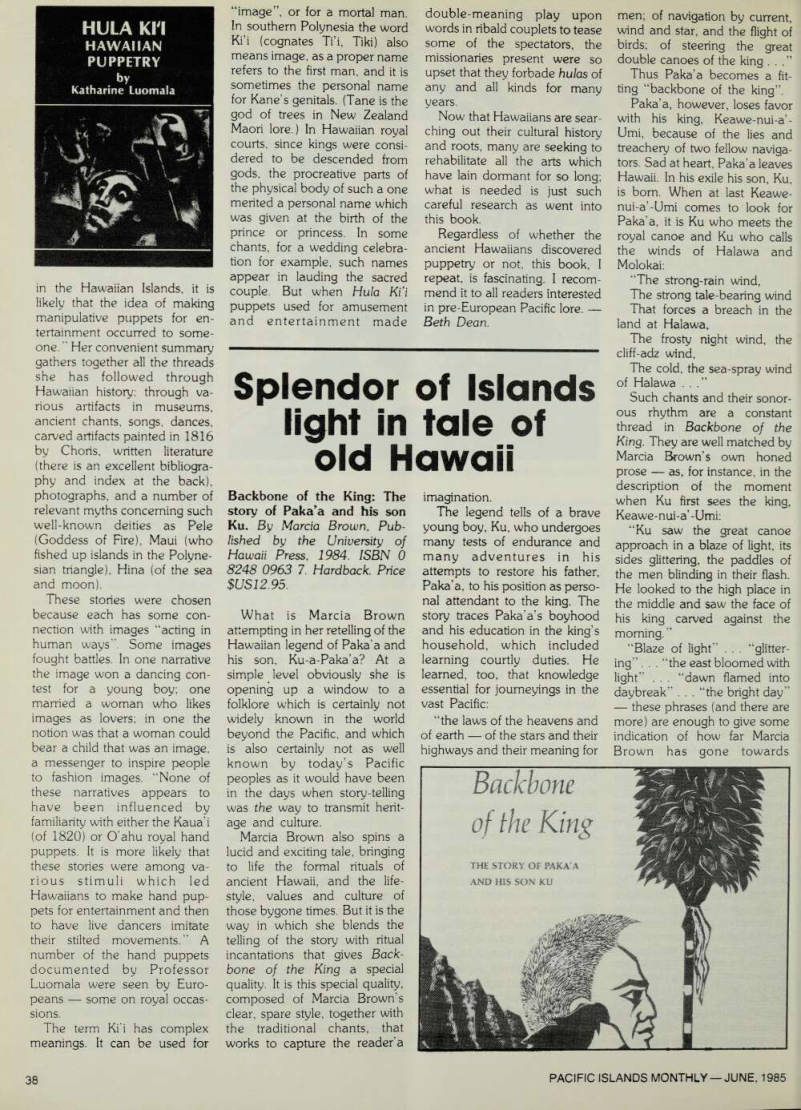
Hula Ki’i Hawaiian Puppet ry. By Katharine Luomala.
Published by the Institute for Polynesian Studies, Brigham Young University Hawaii Campus, 1984. XI, 185 pp.
ISBN 0 939154 30 7. Price $U529.95.
Fascinating is the only word for this book.
The author is professor emer itus of anthropology at the University of Hawaii. Her style is conversational, her research thorough, and the book reads as smoothly as a whodunit.
The book almost completely resolves in the affirmative the main question addressed by Professor Luomala: did the Hawaiians have puppetry be fore the men on the early ships of Europe introduced their own various forms of theatre? The author allows the reader plenty of scope to decide whether or not the points made lead to a “for” or “against” decision.
Professor Luomala’s own re sponse comes only on the last page of the text: “With so many notions of images present in reality and in fiction, especially
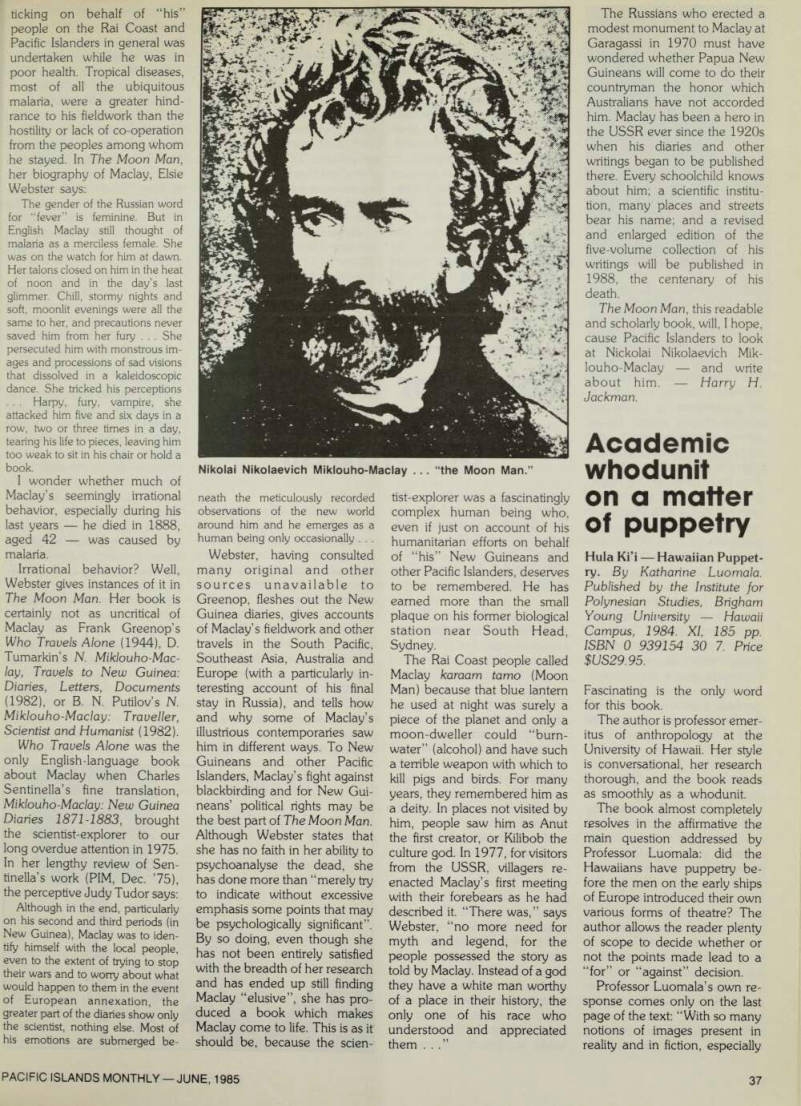
Nikolai Nikolaevich Miklouho-Maclay . . . “the Moon Man.”
in the Hawaiian Islands, it is likely that the idea of making manipulative puppets for en tertainment occurred to some one. ” Her convenient summary gathers together all the threads she has followed through Hawaiian history: through va rious artifacts in museums, ancient chants, songs, dances, carved artifacts painted in 1816 by Choris. written literature (there is an excellent bibliogra phy and index at the back), photographs, and a number of relevant myths concerning such well-known deities as Pele (Goddess of Fire). Maui (who fished up islands in the Polyne sian triangle). Hina (of the sea and moon).
These stories were chosen because each has some con nection with images “acting in human ways”. Some images fought battles. In one narrative the image won a dancing con test for a young boy; one married a woman who likes images as lovers; in one the notion was that a woman could bear a child that was an image, a messenger to inspire people to fashion images. “None of these narratives appears to have been influenced by familiarity with either the Kaua'i (of 1820) or O'ahu royal hand puppets. It is more likely that these stories were among va rious stimuli which led Hawaiians to make hand pup pets for entertainment and then to have live dancers imitate their stilted movements.” A number of the hand puppets documented by Professor Luomala were seen by Euro peans some on royal occas sions.
The term Ki'i has complex meanings. It can be used for
“image”, or for a mortal man.
In southern Polynesia the word Ki’i (cognates Ti’i, Tiki) also means image, as a proper name refers to the first man, and it is sometimes the personal name for Kane’s genitals. (Tane is the god of trees in New Zealand Maori lore.) In Hawaiian royal courts, since kings were consi dered to be descended from gods, the procreative parts of the physical body of such a one merited a personal name which was given at the birth of the prince or princess. In some chants, for a wedding celebra tion for example, such names appear in lauding the sacred couple. But when Hula Ki’i puppets used for amusement and entertainment made
double-meaning play upon words in ribald couplets to tease some of the spectators, the missionaries present were so upset that they forbade hulas of any and all kinds for many years.
Now that Hawaiians are sear ching out their cultural history and roots, many are seeking to rehabilitate all the arts which have lain dormant for so long; what is needed is just such careful research as went into this book.
Regardless of whether the ancient Hawaiians discovered puppetry or not, this book. I repeat, is fascinating. I recom mend it to all readers interested in pre-European Pacific lore.
Beth Dean.