Splendor of Islands
pp. 38-39 · Read in the full issue
light in tale of old Hawaii
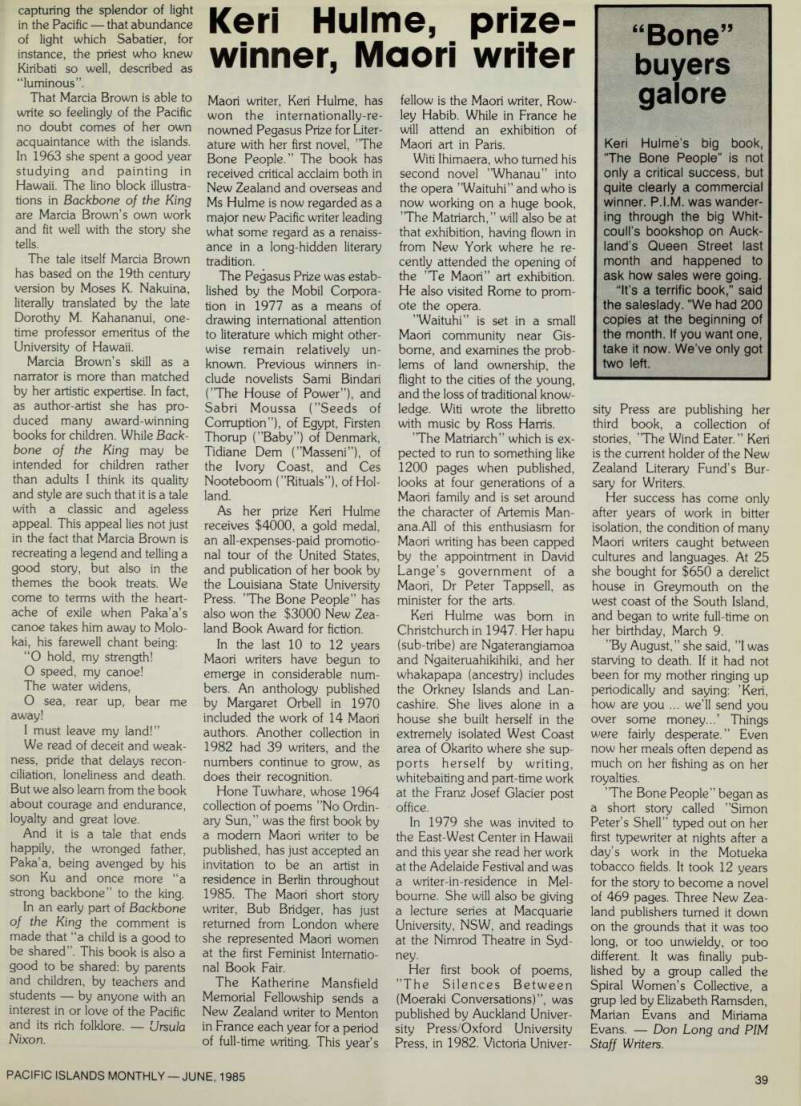
Backbone of the King: The story of Paka’a and his son Ku. By Marcia Brown . Pub lished by the University of Hawaii Press, 1984. ISBN 0 8248 0963 7. Hardback. Price 5U512.95.
What is Marcia Brown attempting in her retelling of the Hawaiian legend of Paka’a and his son, Ku-a-Paka'a? At a simple level obviously she is opening up a window to a folklore which is certainly not widely known in the world beyond the Pacific, and which is also certainly not as well known by today’s Pacific peoples as it would have been in the days when story-telling was the way to transmit herit age and culture.
Marcia Brown also spins a lucid and exciting tale, bringing to life the formal rituals of ancient Hawaii, and the life style, values and culture of those bygone times. But it is the way in which she blends the telling of the story with ritual incantations that gives Back bone of the King a special quality. It is this special quality, composed of Marcia Brown’s clear, spare style, together with the traditional chants, that works to capture the reader’a
imagination.
The legend tells of a brave young boy, Ku, who undergoes many tests of endurance and many adventures in his attempts to restore his father, Paka’a, to his position as perso nal attendant to the king. The story traces Paka’a’s boyhood and his education in the king’s household, which included learning courtly duties. He learned, too, that knowledge essential for journeyings in the vast Pacific: “the laws of the heavens and of earth of the stars and their highways and their meaning for
men; of navigation by current, wind and star, and the flight of birds; of steering the great double canoes of the king ...”
Thus Paka’a becomes a fit ting “backbone of the king”.
Paka’a, however, loses favor with his king, Keawe-nui-a’- Umi, because of the lies and treachery of two fellow naviga tors. Sad at heart, Paka’a leaves Hawaii. In his exile his son, Ku, is bom. When at last Keawe nui-a’-Umi comes to look for Paka’a, it is Ku who meets the royal canoe and Ku who calls the winds of Halawa and Molokai: “The strong-rain wind, The strong tale-bearing wind That forces a breach in the land at Halawa, The frosty night wind, the cliff-adz wind, The cold, the sea-spray wind of Halawa ...”
Such chants and their sonor ous rhythm are a constant thread in Backbone of the King. They are well matched by Marcia Brown’s own honed prose as. for instance, in the description of the moment when Ku first sees the king, Keawe-nui-a’-Umi: "Ku saw the great canoe approach in a blaze of light, its sides glittering, the paddles of the men blinding in their flash.
He looked to the high place in the middle and saw the face of his king carved against the morning. ”
“Blaze of light” . . . “glitter ing”. . . “the east bloomed with light” . . . “dawn flamed into daybreak” . . . “the bright day” these phrases (and there are more) are enough to give some indication of how far Marcia Brown has gone towards
capturing the splendor of light in the Pacific that abundance of light which Sabatier, for instance, the priest who knew Kiribati so well, described as “luminous”.
That Marcia Brown is able to write so feelingly of the Pacific no doubt comes of her own acquaintance with the islands.
In 1963 she spent a good year studying and painting in Hawaii. The lino block illustra tions in Backbone of the King are Marcia Brown’s own work and fit well with the story she tells.
The tale itself Marcia Brown has based on the 19th century version by Moses K. Nakuina, literally translated by the late Dorothy M. Kahananui, one time professor emeritus of the University of Hawaii.
Marcia Brown’s skill as a narrator is more than matched by her artistic expertise. In fact, as author-artist she has pro duced many award-winning books for children. While Back bone of the King may be intended for children rather than adults I think its quality and style are such that it is a tale with a classic and ageless appeal. This appeal lies not just in the fact that Marcia Brown is recreating a legend and telling a good story, but also in the themes the book treats. We come to terms with the heart ache of exile when Paka’a’s canoe takes him away to Molo kai, his farewell chant being: “O hold, my strength!
O speed, my canoe!
The water widens, 0 sea, rear up, bear me away! 1 must leave my land!”
We read of deceit and weak ness, pride that delays recon ciliation, loneliness and death.
But we also learn from the book about courage and endurance, loyalty and great love.
And it is a tale that ends happily, the wronged father, Paka’a, being avenged by his son Ku and once more “a strong backbone” to the king.
In an early part of Backbone of the King the comment is made that “a child is a good to be shared”. This book is also a good to be shared; by parents and children, by teachers and students by anyone with an interest in or love of the Pacific and its rich folklore. Ursula Nixon.