Islands

Pacific
Monthly
June, 19S5#
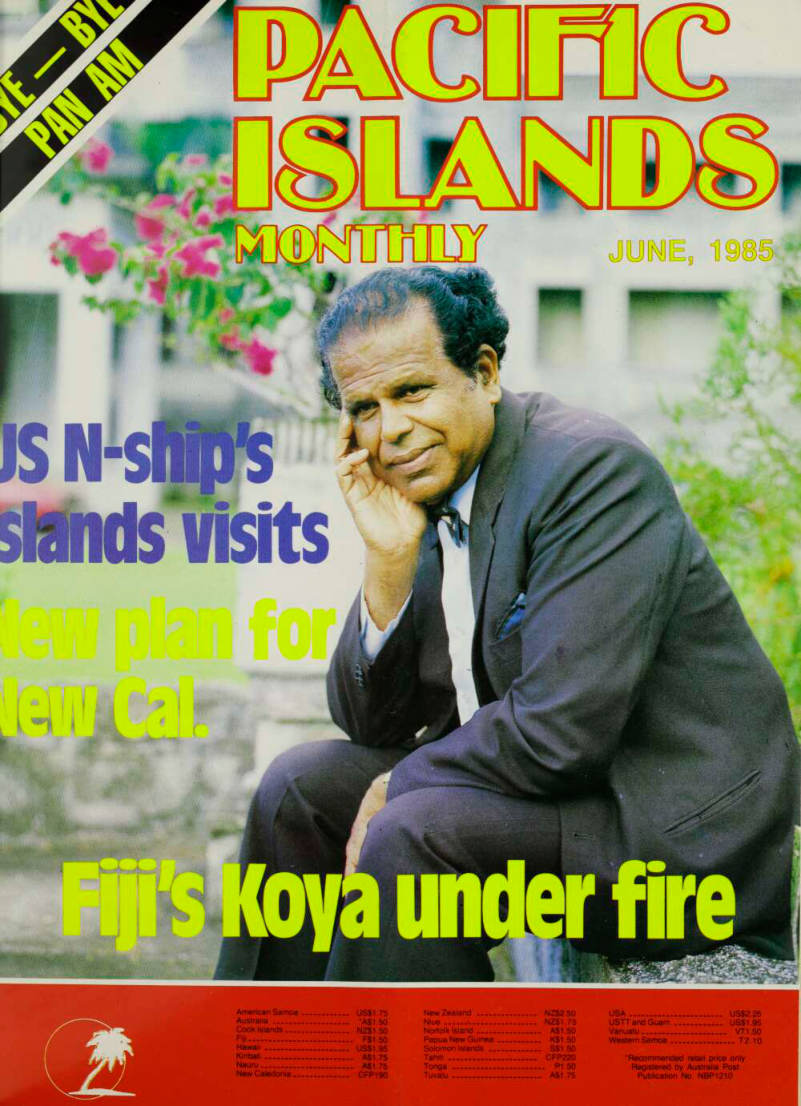
ISN-Snft slandsnsits
[?]ew plan for [?]ew Cal.
Ffiji's koya under fire
American Samoa US$l.75 Australia *A$l.5O Cook Islands NZ$l.5O Fiji F 51.50 Hawaii US$l.95 Kmbati asl .75 Nauru A 51.75 New Caledonia CFPI9O
New Zealand NZ$2,5O Niue NZ$l.75 Norfolk Island A 51.50 Papua New Guinea K 51.50 Solomon Islands 551.50 Tahiti CFP22O Tonga PI . 50 Tuvalu A 51.75
Usa U 552,25
USTT and Guam US$l.95 Vanuatu VT1,50 Western Samoa T 2.10 'Recommended retail price only Registered by Australia Post Publication No. NBPI2IO
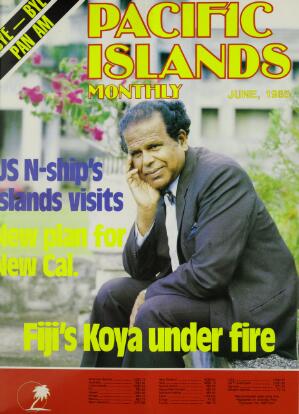
The Cover
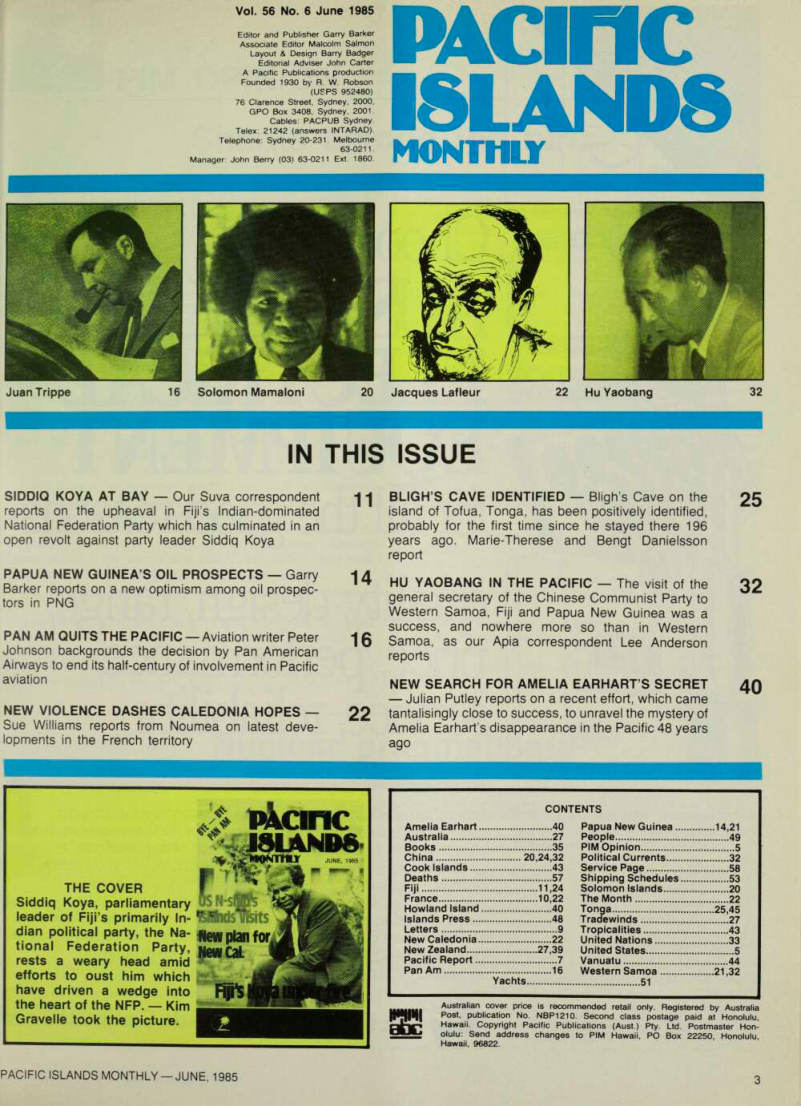
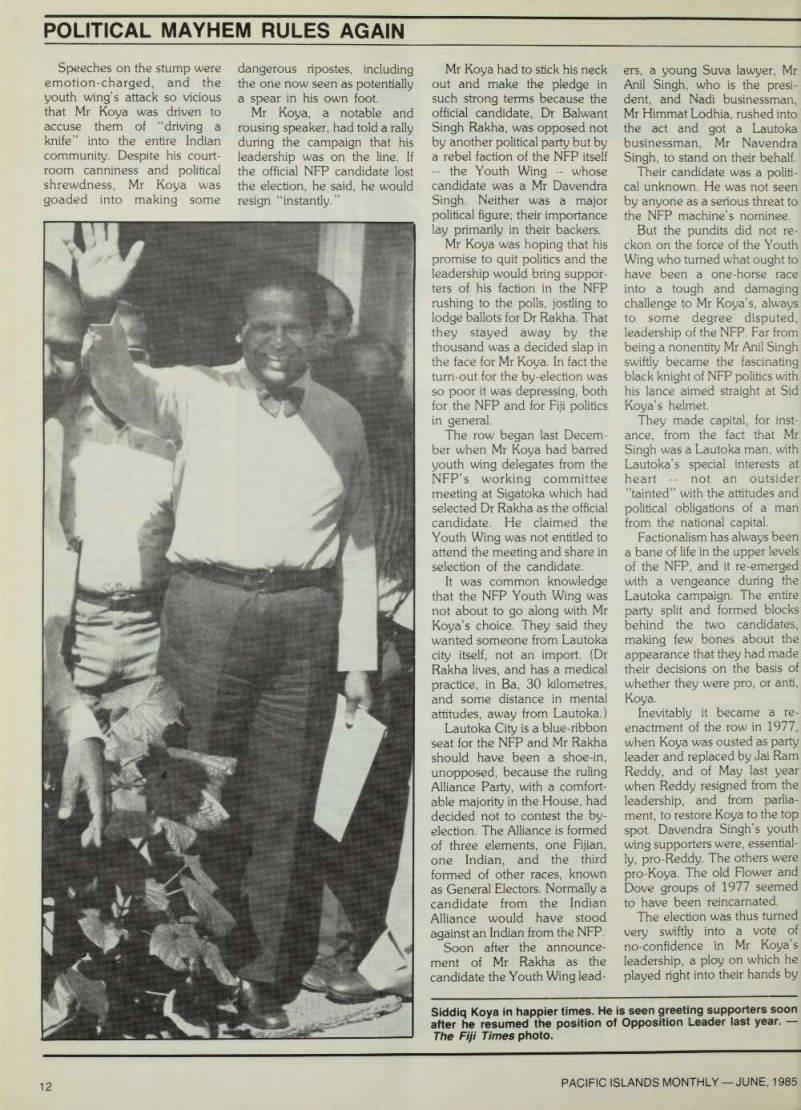
Siddiq Koya, parliamentary leader of Fiji’s primarily In dian political party, the Na tional Federation Party, rests a weary head amid efforts to oust him which have driven a wedge into the heart of the NFP. Kim Gravelle took the picture.
Advertisements & other items, pp. 2-3 (2 items)
I ll « ®‘i i Jb i i® i I
ills w ' V'l WWf iM V'J •M TO
■tef
I«w « 1 !» E» 911 V w wm B) V.Vrt M* lU \tv*> m Wl 5M M W Hi IWMM tofl ) ,>/ t 4/ « ‘MI ifc W' Hi *)< W* 'M I Mr fhm-f lf l w W tlWfK^
I % i f |PtoI
I i i« ' '■ V/i'«
I ll « ®‘i i Jb i i® i I 1 >'\ Y.. ifvn .Jv . .rWTO.«.JL I .W ...irLj. iMi ■M m m fti f ryin » ?. : rl!
H Mfefe 'i J ... .. " * ...
M r
HOP
H w m h\ /> // *
yrnt)
HRS2I
c
HR2I4
HR2I-5
Honda Designed. Honda Produced. And All You Ever Wanted InALawn Tractor.
Ever wished the grass wouldn’t grow? Haven't we all. At Honda, we couldn’t stop the growth but we’ve made cutting it quick, effortless and simple for all. The HT3BIO is packed with innovations.
It’s powered by a resilient, economical 4-stroke engine with MAT (Mechanical Autoclutch Transmission) for effortless shifting. And it cuts clean with dual cutting blades and a high-velocity discharge fan. The HT3BIO. Big brother in Honda’s innovative lawnmower series. Definitely a cut above the rest.
LAWN TRACTOR HT3BIO
AUSTRALIA: Honda Australia Pty., Ltd. Lot 95 Sharps Road. Tullamarine, Victoria 3043; Bennett Honda Pty., Ltd. 250 Victoria Road. Wetherill Park. NS W 2164 PAPUA NEW GUINEA: Steamships Trading Company Ltd.
PO Box 1. Port Moresby /TAHITI: Honda Distribution S.A.R.L. B.P 1665. Papeete / KIRIBATI: Atoll Motor & Marino Services PO Box 49, Bairiki Tarawa, Republic of Kiribati / U.S. TRUST TERRITORY: United Micronesia Development Association PO. Box 235. CHRB Saipan CM 96950 /COOK ISLANDS: Cook Islands Motor Centre Ltd. RO. Box 74, Rarotonga GUAM: Mark’s Motor Co., Inc. PO Box DV, Agana / WESTERN SAMOA: Motor Distributors (Samoa) Ltd. PO Box 576. Apia SOLOMON ISLANDS: Guadalcanal Garage Limited PO. Box 537. Honiara /NEW CALEDONIA; Est. Ballande BP 04, Noumea Cedex Noumea / NAURU: Nauru Cooperation Republic of Nauru /FIJI: Carpenters Motors Private Mall Bag Suva, Fiji /AMERICAN SAMOA: Holiday Motors: Parts and Service PO Box 968 Pago Pago. American Samoa 96799 Haleck’s Service Center Ltd. PO Box, 1138. Pago Pago, American Samoa 96799 /TONGA: Tonga Industrial Traders RO. Box 1035, Nukualofa. Tonga /VANUATSU: Honda Farm RO. Box 1031 Pori Villa
Islands
PACIFIC
MONTHLY
Vol. 56 No. 6 June 1985
Juan Trippe 16
Solomon Mamaloni 20
Jacques Lafleur 22
Hu Yaobang 32
In This Issue
SIDDIQ KOYA AT BAY Our Suva correspondent -| *| reports on the upheaval in Fiji’s Indian-dominated National Federation Party which has culminated in an open revolt against party leader Siddiq Koya PAPUA NEW GUINEA’S OIL PROSPECTS Garry -| 4 Barker reports on a new optimism among oil prospec tors in PNG PAN AM QUITS THE PACIFIC Aviation writer Peter *| g Johnson backgrounds the decision by Pan American Airways to end its half-century of involvement in Pacific aviation
New Violence Dashes Caledonia Hopes 22
Sue Williams reports from Noumea on latest deve lopments in the French territory
BLIGH’S CAVE IDENTIFIED Bligh’s Cave on the 25 island of Tofua, Tonga, has been positively identified, probably for the first time since he stayed there 196 years ago. Marie-Therese and Bengt Danielsson report HU YAOBANG IN THE PACIFIC The visit of the 32 general secretary of the Chinese Communist Party to Western Samoa, Fiji and Papua New Guinea was a success, and nowhere more so than in Western Samoa, as our Apia correspondent Lee Anderson reports NEW SEARCH FOR AMELIA EARHART’S SECRET 4Q Julian Putley reports on a recent effort, which came tantalisingly close to success, to unravel the mystery of Amelia Earhart’s disappearance in the Pacific 48 years ago
Contents
Amelia Earhart 40 Australia 27 Books 35 China 20,24,32 Cook Islands 43 Deaths 57 Fiji 11,24 France 10,22 Howland Island 40 Islands Press 48 Letters 9 New Caledonia 22 New Zealand 27,39 Pacific Report 7 Pan Am 16
Papua New Guinea 14,21 People 49 PIM Opinion 5 Political Currents 32 Service Page 58 Shipping Schedules 53 Solomon Islands 20 The Month 22 Tonoa 25,45 Tradewinds 27 Tropicalities 43 United Nations 33 United States 5 Vanuatu 44 Western Samoa 21,32
Yachts 51
Australian cover price is recommended retail only. Registered by Australia Post, publication No. NBP1210. Second class postage paid at Honolulu, Hawaii. Copyright Pacific Publications (Aust.) Pty. Ltd. Postmaster Hon olulu: Send address changes to PIM Hawaii. PO Box 22250, Honolulu.
Hawaii, 96822.
Advertisements & other items, pp. 3-4 (2 items)
Pacific Islands Monthly —June, 1985
3
Editor and Publisher Garry Barker Associate Editor Malcolm Salmon Layout & Design Barry Badger Editorial Adviser John Carter A Pacific Publications production Founded 1930 by R. W. Robson
(USPS 952480)
76 Clarence Street, Sydney, 2000, GPO Box 3408, Sydney, 2001 Cables: PACPUB Sydney Telex: 21242 (answers INTARAD) Telephone: Sydney 20-231. Melbourne 63-0211.
Manager: John Berry (03) 63-0211 Ext. 1860
Equipment
o m ti $ 9911 Ask the expert who knows Australia For details of suppliers phone or telex the Australian Trade Commissioner at: Fiji P.O. Box 1252, Suva.
Phone 312844. Telex FJ 2126.
New Caledonia P.O. Box 22, Noumea.
Phone 272414. Telex 087.
Papua New Guinea P.O. Box 9129, Hohola.
Phone 259333. Telex NE 22109.
Hawaii Australian Consulate, 1000 Bishop Street, Honolulu 96813.
Phone (808) 5245050. Telex 633128.
Choose
AUSTRALIAN
ELECTRICAL
EQUIPMENT
for all the good neasons-
quality design, range,
price, performance,
service, reliability
Australian electrical equipment is constantly asserting its superiority far and wide. Under some of the harshest conditions imaginable in Australia and in a variety of applications internationally. Australia's huge range can cover your needs.
Here are just some of the items available. Switchboards, Transformers. Coils. Circuit breakers. Switches. Cables.
Plugs. Junction boxes. Connectors. Crimps, lugs, links, clamps.
Motor control cubicles. Power conditioners. Service equipment.
Flood light and industrial fittings. Lightning protection.
Solar and electric hot water systems. Solar power systems. m
Ask the Australian Trade Commissioner
Sharks among the tuna
Pim Opinion
The Pacific fishing industry is on a dangerous course; it is at risk of falling into confusion with consequent serious loss to the Pacific Island nations for many of whom the fish in their waters is their only really commercial asset.
In all of this the Americans, who have given a great deal to the Pacific in very many ways, are seen as the primary culprits.
Western Samoa has played host to the U.S.S Texas and the American Tuna Boat Association, which has a long-established reputation for pugnacity and bullying, and which is acknowledged to have one of the most powerful lobbies in Washington, has introduced huge purse-seine vessels to the ocean with what would appear to be little or no regard for their effect upon an ecology upon which many people, in very small countries, depend for their meagre living.
There is justice in the contention that the islanders’ dislike of the American fishing companies led, more or less directly, to the flirtation which Kiribati is having with the Soviet Union, a matter which has upset the security of the region and given other countries, among them Japan, Australia and New Zealand, cause for anxiety.
Every time a ’’super-seiner” sporting the Stars and Stripes is seen powering its way through an island nation’s e.e.z., scooping up every fish in sight, the reputation of the U.S. goes down.
Solomon Islands was widely applauded among its Pacific neighbors for its capture of the poaching ’’super-seiner” Jeanette Diana for which the owners later paid US$7OO,OOO to buy back.
The United States immediately applied trade sanctions.
The Americans say, accurately enough, that they had no option but to invoke the Magnusson Act. It is mandatory in cases such as that involving the Jeanette Diana. At the same time, the small countries saw it all as a case of a super-power bullying a country so small that its total national budget barely equals the phone bill at the White House. Whatever the justice of that case, the fact would appear to remain that very little, if any, effort was made to see the
situation from the islanders’ viewpoint, or to guard against it happening again and again and yet again.
A practical solution to the whole sorry affair was proposed at a meeting in Nauru some years ago, and raised again at the last meeting of the South Pacific Forum. This, in broad terms, suggested a system of licensing, handled by a central body such as SPEC or the SPC.
All of the fishing nations -- Japan, South Korea, Taiwan, the USSR and the USA - could pay for rights to fish these waters, and might also provide a small levy, say 5 per cent, on the value of the catch. In total these fees might produce $2OO million or so which the small nations could share on some equitable basis of so much per head of population, or so much per square kilometre of water.
The Japanese, particularly, are disposed to be gloomy about the future of Pacific fisheries and have noticeably withdrawn their ships from what might be termed sensitive Pacific areas. Industry experts in Tokyo say that fish stocks are being depleted by the big purse-seine boats, that such as the American Tuna Boat Association’s members pay no regard to the ecological or political consequences of their style of fishing and that, as a result, enormous damage is being done to the industry as a whole and to the overall security of democratic and free-trading nations in the region.
There would appear to be pressing need, therefore, for much greater attention to be given, first in Washington, and then in the region as a whole, to reaching some mode of operation fair to all, which will avoid further upsets, both financial and political, and which will allow the island nations to derive reasonable income from their major asset.
It is, in the long term, far better, one might suggest, that the Pacific Islands earn their own support in this way than that they should be forced to live on hand-outs, or take risky gambles by trying to get into the high-capital fishing industry on their own account.
Nuclear pragmatism
The nuclear wrangle in the Pacific continues with Mr Lange sticking to his guns, the Americans showing some signs of learning to live with that piece of Antipodean domestic political reality, and the small island countries more or less leaving the New Zealand prime minister hung on his own hook.
Fiji, Tonga and some other island nations have all said that they will accept visits to their ports of American naval ships, and not ask whether they are nuclear powered, or carrying nuclear weapons.
Mr Michael Somare, prime minister of PNG, the biggest Pacific island nation, during his recent tour of Europe, expressed careful, slightly qualified, agreement with that line.
Reports of Mr Somare’s views drew a long and impassioned reaction from the deputy leader of the PNG Opposition, Mr Paul Torato, who accused the prime minister of all manner of sins, ranging from ’’seeking super-power popularity” to ’’betraying the security interests of PNG.”
But, that aside, the Pacific Islands generally acknowledge, and
accept, that they, as firmly-committed members of the broad western alliance are free because of the umbrella of American strength which holds the balance in the Pacific. The recent upsurge of interest by the Russians in the islands of the ocean has added sharpness to that point.
In other words, Mr Lange is free to hold his view, and take his line, because there is a balance, however heart-stopping, in the region and in the world. In the Pacific that balance depends upon the presence of American ships and other forces, with their nuclear weapons. If the Americans went home, as some seem to think they should, that would not reduce by one oar or dinghy, the strength of the Russian nuclear fleet, and air force, operating now out of Cam Ranh Bay in Vietnam, and on long-range sorties from the northern ocean. Rather it would strengthen it. In that event the opinions of Mr Torato and Mr Lange would cease to have much relevance.
But, it is part of the freedom we enjoy beneath that awful nuclear umbrella, that such views and arguments can exist.
Advertisements & other items, p. 6 (1 item)
Benson w Hedges
I r) * a m P 20 ES
WARNING-SMOKING IS A HEALTH HAZARD
H *
ONLY THE BEST WILL DO.
the Benson and Hedges Company Pty. Ltd. 1983 CC1426/83 JWT016.P351
The Largesse Of Hu Yaobang
During his April tour of the South Pacific (PIM, May p 7), Hu Yaobang, China’s Communist Party leader, promised a $U5240,000 cash grant to Western Samoa, to add to the $1.5 million unspent from the $4 million loan advanced in 1982 for the building of the sports stadium in Apia. Mr Hu told Prime Minister Tofilau Eti Alesana that China’s developing interest in the South Pacific would not upset traditional friendship among the region’s states. After Mr Hu had visited Fiji, acting Prime Minister Ratu David Toganivalu said China had undertaken to become a steady customer for Fiji’s sugar and had promised a cash grant of SUSBOO,OOO to be used for any development project decided on by the Fiji Government. At a meeting in Port Moresby between Mr Flu and acting Papua New Guinea Prime Minister Father John Momis, Mr Hu offered aid, both financial and technical, for agricultural projects and electrification in rural areas. He also gave Papua New Guinea more than $A500,000 to add to interest-free loans of nearly $5 million, granted earlier this year. Fr Momis promised to send a technical team to China to investigate other forms of assistance which China could offer.
Fisheries: U.S. “Depredations” Irk Japan
Managers of the Taiyo Fisheries Company, of Tokyo, operator of Japan’s biggest fishing fleet and partner with the Solomon Islands Government in Solomon Taiyo Ltd, operators of the fish canneries and fishing bases at Tulagi and Noro, have expressed “deep pessimism” about the future of their industry in the Pacific, primarily because of what they regard as the depredations of big American purse seine vessels, and the overall attitude of the American Tuna Boat Association. They say that the industry is out of control, and that fish stocks are being endangered because of the indiscriminate use of the “super-seiners” under the American flag. Indications that Russian fleets are also likely to increase their Pacific activities also give the Japanese cause for concern.
However, the Japanese point out, the Russians are, at least, careful to fish in areas of exclusive economic and fisheries zones only after reaching agreement with the nations involved which, they say, is a good deal more than the Americans do.
Violence in Noumea escalated towards the end of May with a series of four bomb explosions introducing a new and ominous aspect to the burgeoning crisis. Three bombs exploded in Noumea and one in a rural village. One Kanak was killed and a dozen or so injured in the explosions, bringing the death toll in the current crisis to 23.
The French president’s special envoy to New Caledonia, Mr Edgard Pisani, declared that the only way to deal with the situaion was to ’’paralyse the militant extremists. ” He did not go into details, but observers have noted the build-up of French forces in the territory. Pisani said that New Caledonians were slowly accepting the French plan for elections in August to replace the territorial assembly with a congress - seen as a first step towards a referendum, before 1987, on independence from France. Only two ’’radical minorities” opposed the plan, Pisani said. One was a Kanak minority which sought immediate independence, and the other composed of settlers who rejected independence on any terms. Each group now had to be ’’paralysed” if a peaceful choice was to be made.
A first step seemed to be taken a few days later when Pisani met with 40 Kanak chiefs to discuss land distribution and ”a return to traditional values.”
Record Entry In Oceania Boxing Fest
A record number of 96 entrants was received for the annual Oceania Amateur Boxing titles held in Melbourne from May 9 to 12. The Amateur Boxing Union of Australia commandeered the Dorset Gardens Motel complex in suburban Croydon to stage the tournament and accommodate the boxers coming from all over the Pacific area. Australia was represented by two complete teams,
while at least 72 boxers came from 10 Pacific nations. The largest overseas contingent, 16, was from Papua New Guinea, while New Zealand flew in a team of 12. American Samoa, traditionally part of the United States amateur boxing scene, was represented for the first time, with a seven-man squad. Other countries to send teams were Western Samoa (7), Taiwan (7), Fiji (6), Cook Islands (6), Vanuatu (6), New Caledonia (3) and Niue (2). Footnote: The Oceania Flyweight Title in 1983 was won by an 18-year-old Sydney boxer in his first international contest. Later he represented his country in the World Youth Cup and the Olympic Games, then turned professional. His name: Jeff Fenech, since the end of April IBF World Bantamweight Champion.
Fui To Open Washington Embassy
Fiji will establish an embassy in Washington DC and close its consulate-general office in Los Angeles. The office in Los Angeles was opened with a view to increasing the tourist flow to Fiji. A Fiji Government release said there was a need for a residential diplomatic representative in Washington to promote and protect more effectively Fiji’s interests in the United States. Hitherto, Fiji’s permanent representative at the United Nations has handled all diplomatic business with the United States. It is expected that Winston Thompson, secretary to the Fiji Public Service Commis sion, will be named as ambassador to the United States. Following the visit to Washington by its Prime Minister Ratu Sir Kamisese Mara, and President Reagan’s promise of aid, Fiji is moving to the U.S. power centre where all the lobbying is done.
Fui Bows Out Of Arts Festival
Fiji has decided not to take part in the South Pacific Festival of Arts due to be held in Tahiti from June 29. John Thoman, treasurer of the organising committee for the proposed group, said the decision had been made because of the lack of funds. The committee had been unable to raise even half the money required to send the 120-member group to Tahiti.
Lange In Britain: The Off-Record Story
David Lange, Prime Minister of New Zealand, well-known for his opposition to the bomb, dropped a bomb of his own on his visit to Britain early this year. When he set foot on British soil after the furore surrounding his visit to America, many Britishers held their breath in anticipation of some stormy days. “The Americans have so much trouble with their allies,” wrote The Times, “they must sometimes think the Russians quite easy to deal with. At least with the Russians they know where they are. ” In the event, the storm clouds never opened up to quite the predicted extent. Even Mr Lange’s meeting with British Prime Minister Margaret Thatcher, on the final day of his stay, was remarkably cordial. How was the fallout restricted? Probably there was a good bit of give and take on both sides. Some British commentators went to some lengths to warn the British Government off any tendency to bully its small ally. “How far is it sensible for the larger countries in the alliance to go on trying to bring the smaller ones into line?” asked Geoffrey Smith in The Times. “If private persuasion fails should public pressure be applied? The Western Alliance ... is an association of free peoples and independent governments, who cannot be corralled. For that reason its burdens are not borne equally and they never will be. It can be held together only by the larger members accepting that they will not be able to get all their own way. ” Mr Lange, for his part, moderated his remarks at the much publicised Oxford Union debate. The initial wording of the motion which Mr Lange was to debate with American Moral Majority man Jerry Falwell was: “The Western Nuclear Alliance is morally indefensible. ” But even Mr Lange found that a bit too strong only 48 hours before meeting Mrs Thatcher. The resolution was in fact reworded four times, in the end leaving the New Zealander free merely to debate the ethical issue without reference to the political setting. Mr Lange seized on the opportunity to deliver a heartfelt plea for his country, and the nations of the South Pacific, to be free to make their own decisions on whether or not to permit a nuclear presence in their part of the world. “There is only one thing as terrifying as the nuclear weapon pointed in your direction,” he
said, “and that is the nuclear weapon pointed in your enemy’s direction. The intention of those who for honorable motives use nuclear weapons to deter is to enhance security; they succeed only in enhancing insecurity. The machine has perverted the motive.”
“We in New Zealand,” he continued, “used to be able to think that we could sit comfortably while the rest of the world destroyed itself; now we know that if the nuclear winter comes we shall join all the rest of you. It makes no sense for a country that faces no threat to seek to surround itself with nuclear weapons. It makes no sense for a region which is the most stable in the world to allow itself to become a strategic arena for the nuclear powers ... In the South Pacific, it is not difficult to achieve the balance of force which allows you cheerfully to dispense with nuclear weapons. If you remove the weapons of your friends and allies you put all the nuclear powers on the same footing. In the South Pacific there is at this moment the chance to turn away from the inhuman logic of nuclear weapons. The government of New Zealand had excluded nuclear weapons from New Zealand; more than that, I hope that it and other governments in the South Pacific will shortly ask all the nuclear powers to honor a South Pacific Nuclear-free Zone . . . there is no humanity in the logic which holds that my country must be obliged to play host to nuclear weapons because others in the West are playing host to nuclear weapons ... To compel an ally to accept nuclear weapons against the wishes of that ally is to take the moral position of totalitarianism. Rejecting nuclear weapons is to assert what is human over the evil nature of the weapon; it is to restore to humanity the power of decision; it is to allow true moral force to reign supreme. ” The motion was eventually carried by 298 votes to 250. But in spite of this strong support, Mr Lange’s words did little to assuage the concern of those in government who wonder how to keep the alliance intact. Mrs Thatcher evidently gave Lange the benefit of the doubt, in pledging continued British support for New Zealand trade. Perhaps she, like many others, recognises the somewhat unique position in which the nations of the South Pacific find themselves. But the story, far from being over, has only just begun. Edward Peters in London.
COOKS: MINI GAMES AND A 20th ANNIVERSARY The 1985 Mini South Pacific Games will be held in Rarotonga, capital of the Cook Islands, from August 1 to 10. A new national stadium is being built at a cost of SNZI.4 million. On August 4 the Cook Islands will have completed 20 years as an internally self-governing state in free association with New Zealand.
Oz Dockers Delay Islands Cargoes
Ships carrying food and other supplies for Micronesia and Kiribati were delayed in Sydney in April by demands made by the Australian Ship Painters’ and Dockers’ Union for improved conditions for their crews. The ships were the Filipino-owned General Valdez, which was carrying containers and refrigerated goods for Micronesia, and the Japanese-owned Logistic Ace, which had a cargo of food destined for Tarawa. A spokesman for the agents for Logistic Ace said that Kiribati was almost entirely dependent on food supplied by the ship.
Sick Soz Hampers Fui Trade
Fiji manufacturers who took part in a recent four-day trade display at the International Trade Development Centre in Sydney found the ailing Australian dollar was an obstacle to trade. Although the exhibition resulted in negotiations for sales valued at about $F850,000 and the promise of substantial sales over the next 12 months, local importers looked askance at the rising prices, caused by the widening gap between the Fiji dollar and the Australian dollar. The latter, in relation to the Fiji dollar, has fallen by 20 per cent since the beginning of the year. Fiji’s trade commissioner in Sydney, Neville Smith, said; “Most of the participants in the trade display made excellent contacts and found that Fiji products, generally, now have a ready acceptance for quality, delivery and so on, but in many cases formal contracts were not completed owing to the volatile nature of the currency. ” The display was organised by the Economic Development Board of Fiji in co-operation with the trade development centre which has been established by the Australian Development Assistance Bureau.
Vanuatu’S Tax Haven Makes Money ...
The number of new companies incorporated in Vanuatu under the offshore banking scheme increased by 72 per cent in 1984 compared to the 1983 total. After allowing for companies voluntarily struck off or placed in liquidation, 1984 showed an
overall net increase of 12.4 per cent. Direct revenue from the incorporation of new companies, plus stamp duty and overseas ship registrations, amounted to about SAI.S million. . . . AND PUTS IT ON A U.S. LIST One of Australia’s leading political commentators, Maximilian Walsh, has pointed the finger at offshore banking systems in Vanuatu and Nauru as possible clearing houses for the vast sums of money flowing from the international drug traffic. Writing in the Sydney Morning Herald of April 4, on the links between banking and organised crime, Mr Walsh noted: “Interestingly, two recent additions to the U.S. drug enforcement administration’s list of hot money havens are Vanuatu and Nauru. In the U.S. and one suspects here the laundering of money is undertaken by a third party unconnected with the actual drug trafficking. This is in accordance with the hallmark of organised crime the plea of non-involvement, deniability of knowledge of the source of the funds.”
Bbc Documentary On Tongan Royalty
The British Boardcasting Corporation is making a 50-minute documentary film on Tongan royalty. Ms Merata Mita, the Maori producer/director of the New Zealand film Patu, which dealt with the controversial Springbok rugby tour of New Zealand in 1981, was chosen by the BBC to direct the film. Working with her is BBC TV reporter Michael Dean. It is believed to be the first time the BBC has commissioned an independent filmmaker to produce and direct a documentary for its services. The documentary will be screened as one of the series The World of Others, which was started by David Attenborough in the 19605.
Kiribati In Tourist Venture
Kiribati has established a link between Tarawa and the Marshall Islands, particularly Kwajalein Atoll, as the first move to create a tourist industry. The Ministry of Natural Resources, the Otintai Hotel on Bikenibeu and the Seamen’s Hostel have combined to organise extended weekend tours, mainly to the beaches which figured in Pacific War battles, and war relics.
Kanaky Cause Comes To Sydney
Supporters of a Kanak-style independence for New Caledonia staged an “International Day of Solidarity with Kanaky” on April 20 in major Australian cities. FLNKS representative Hnalaine Uregei was the focus of a public meeting in Adelaide; while in Melbourne, Canberra and Sydney Australian sympathisers domin ated the rallies. In Sydney pickets and posters were outside the premises of the New Caledonian Tourist office; symbolically apt, since the theme of that particular gathering was a boycott of tourism to the French territory, but somewhat limited in achievement, since the tourist office was closed. Well known Sydney-based activists Helen Jarvis, secretary of the Committee Against Repression in the Pacific and Asia (CAKPA), Denis Freney, long-time supporter of Vanuatu’s Vanuaaku Party and East Timor’s Fretilin, and Bob Green of the Aboriginal Land Rights movement, addressed the gathering, which was casually observed by four uniformed state police and one federal plainclothes policeman. There were few passers-by, fewer spectators and even fewer Kanaks present. A police spokesman said that no trouble had been anticipated and that their own presence was merely routine.
The only confrontation, albeit brief, occurred when an argument developed between the supporters of Kanaky and a member of the Communist Left who was distributing counter-literature claiming that Kanak independence would betray the ideals of working class internationalism and that the Kanaks’ claim to be the “indigenous Melanesians” was fraudulent. Norman Douglas.
Alleged Noumea Gun-Runners New Charges
In Brisbane, four Frenchmen released from jail after federal charges of gun-running were dropped, are now facing a total of 10 new charges in a civil action planned by Australian Customs. The earlier charges alleged that the four had planned to smuggle guns to New Caledonia aboard a private yacht. A customs spokesman said on May 1 that writs had now been issued alleging that the four possessed and conveyed prohibited exports. He said that weapons seized by federal police officers in March have now been impounded by the customs department. Lawyers for the four men Alan Grelier, Vu Viet Chaun, Jean Nicholas Bondaletoff and Paul Cu Ngo Ly threatened to take action against federal police officers for wrongful arrest.
letters
School marms were never like that
For once, I agree with many aspects of your PIM Opinion in the April, 1985, edition.
I heartily disagree with your use of “school marm” when discussing US interests in the Pacific region. For one the US is unlike any school teacher (female) I ever encountered except perhaps a male version I had as a newcomer to a Queensland city school many years ago. This man was even tually jailed for severe physical mistreatment of students one in particular he caned (pleasur ably) so much that the seven year-old boy almost died. The analogy between this sadist and the manner of “reprimanding”
Pacific nations (e.g. the “coax ing” of the Palau Republic to drop its anti-nuclear stance, and a blatant self-righteous accept
ance of US tuna fishing boats “bullying” Pacific nations to accept their poaching of fishing reserves) which the US Gov ernment believes is the only way to handle “wayward” small nations is certainly not too strong.
As you mention in your Opinion, there are many from the moral majority who believe that David Lange’s “strutting” is the only way to bring the US into line with smaller nations’ feelings on life sustaining issues. He has been mentioned as a candidiate for a Nobel Peace Prize, and, in my opinion, he is one of the few who really deserves one.
Diana Rickard
Murdoch WA Australia
history-by RWR
Some footnotes to history-by RWR
I have two lasting personal memories of the founder of PIM, R. W. Robson. First, many years ago I met Judy Tudor and “Robbie” at the old govern ment hotel on Rarotonga, and was able to yarn with them.
Secondly, I was one of those present and privileged to listen to a grand old man’s address that honored the magazine he founded. That occasion was PlM’s 50th anniversary dinner, August 16, 1980. “Robbie” left me with the lasting recollection of a vital personality, possessed of an incisive mind, able to articulate ideas in challenging and crystal-clear style.
A lasting monument to “Rob bie’s” work as a great Pacific Islands man of letters is the library of Pacific Islands books which is jealously guarded by PIM. The library had its founda tions in the books accumulated by “Robbie” as they came to
PIM to face the scrutiny of the reviewers.
The other day I happened to take from the shelves of this library a copy of Jack Hides’
Beyond The Kubea, and I was thrilled to find that it contained pencilled notes by “Robbie”.
His comments clearly indicate that he had a deep perception of the factors which determined the fate of Hides’ tragic expedi tion. Hides and his companion, David Lyall, in search of gold, went beyond the headwaters of the Strickland River, and into the Kubea Mountains of Cen tral New Guinea.
“Robbie” gives information not spelled out by Hides. He wrote: “Large section missing here. They remained in this place for many weeks and radioed they had found a vast, rich dredging area. I went to Port Moresby, sent a seaplane for them, met them in P.M., got
the lease (after much difficulty) and, in April, 1937, sent them back to Upper Strickland by seaplane, which was piloted by Aubrey Koch. Later (Aug.-Sep. 1937), Investors Ltd. sent ex pert to examine ‘dredging areas.’ He pronounced them
absolutely worthless.”
Hides’ leadership of the ex pedition did not impress “Rob bie.” Hides tells u‘s: “The wire less was working perfectly and we were in constant touch with Port Moresby. I comforted my self with the thought that once beyond the mountains I could call an aeroplane to our assist ance if necessary.” Robbie’s analysis of the situation paints a quite different picture. “This is where he should have warned his Sydney Co. of the possibil ity, so that they could have made some preparations for an urgent call. The use of an aeroplane for this unknown country cannot be managed quickly the insurance risk makes the charter terribly ex pensive ...”
The end paper of PlM’s copy of Beyond The Kubea carries “Robbie’s” postscript to Hides’ expedition. “That was the end of the disastrous expedition fin anced by the Sydney syndicate Investors Ltd. Hides came back to Sydney and tried his hand at two or three enterprises; but he was a sick man and died in Sydney soon afterwards.”
Bill Coppell
Waverton, NSW Australia
The latest on
‘Noel Buxton’
As I write I am a passenger on an ex-Papua New Guinea ves sel en route from Cairns to Thursday Island.
The vessel is the MV Noel Buxton , which former expatri ates and others will recall was the Australian Commonwealth Government lighthouse vessel operating Samarai to Wewak in the 1960s. Built by Walkers of Maryborough, it went into service in 1966 until, I believe, independence in 1975, when it was handed over as a gift to the new PNG Government.
For some reason its career as a lighthouse vessel after inde pendence was brief, and for some time it was tied up in Port Moresby harbor, where it was vandalised before being purch ased by a couple of Australians and sailed to Brisbane for refit and survey.
The new owners tried to use it in the Moreton Bay area, but could not generate enough traf fic. Later it operated Townsville — Caims, but the same prob lem occurred here.
At about the time it was on this run, the writer attempted to charter it for a return trip to the PNG battlefields for a group of Australian ex-servicemen. But as the vessel was only in state coastal survey, the Common wealth Department of Trans-
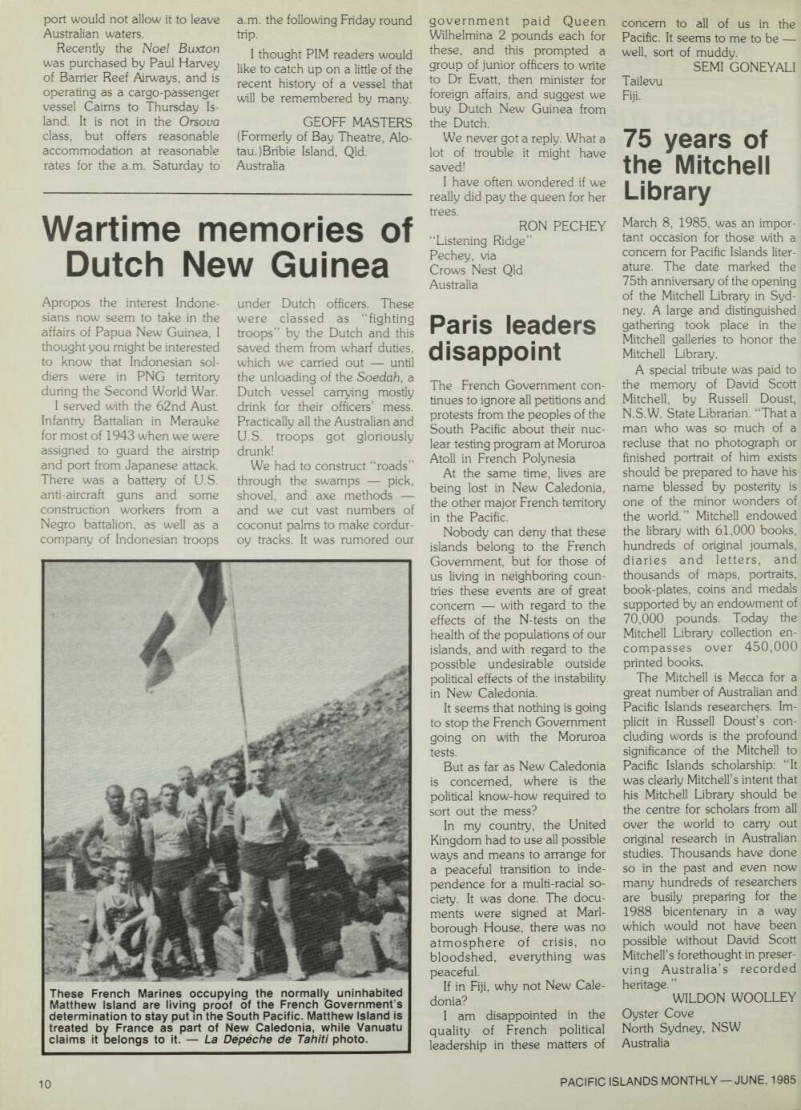
PIM’s founder R.W. Robson (right) with British diplomat Sir Harry Luke.
port would not allow it to leave Australian waters.
Recently the Noel Buxton was purchased by Paul Harvey of Earner Reef Airways, and is operating as a cargo-passenger vessel Cairns to Thursday Is land. It is not in the Orsoua class, but offers reasonable accommodation at reasonable rates for the a.m. Saturday to
a.m. the following Friday round trip. , thou ht PIM readers would uke t 0 catch on a Me of the recent hist of a uessel that be remembered b
Geoff Masters
(Formerly of Bay Theatre, Alo tau.)Bribie Island. Qld.
Australia
Dutch New Guinea
Wartime memories of Dutch New Guinea
Apropos the interest Indone sians now seem to take in the affairs of Papua New Guinea, I thought you might be interested to know that Indonesian sol diers were in PNG territory during the Second World War. 1 served with the 62nd Aust.
Infantry Battalian in Merauke for most of 1943 when we were assigned to guard the airstrip and port from Japanese attack.
There was a battery of U.S. anti-aircraft guns and some construction workers from a Negro battalion, as well as a company of Indonesian troops
under Dutch officers. These were classed as “fighting troops” by the Dutch and this saved them from wharf duties, which we carried out until the unloading of the Soedah, a Dutch vessel carrying mostly drink for their officers’ mess.
Practically all the Australian and U.S. troops got gloriously drunk!
We had to construct “roads” through the swamps pick, shovel, and axe methods and we cut vast numbers of coconut palms to make cordur oy tracks. It was rumored our
government paid Queen Wilhelmina 2 pounds each for these, and this prompted a group of junior officers to write to Dr Evatt, then minister for foreign affairs, and suggest we buy Dutch New Guinea from the Dutch.
We never got a reply. What a lot of trouble it might have saved!
I have often wondered if we really did pay the queen for her trees.
Ron Pechey
“Listening Ridge”
Pechey, via Crows Nest Qld Australia
Paris leaders
disappoint
The French Government con tinues to ignore all petitions and protests from the peoples of the South Pacific about their nuc lear testing program at Moruroa Atoll in French Polynesia At the same time, lives are being lost in New Caledonia, the other major French territory in the Pacific.
Nobody can deny that these islands belong to the French Government, but for those of us living in neighboring coun tries these events are of great concern with regard to the effects of the N-tests on the health of the populations of our islands, and with regard to the possible undesirable outside political effects of the instability in New Caledonia.
It seems that nothing is going to stop the French Government going on with the Moruroa tests.
But as far as New Caledonia is concerned, where is the political know-how required to sort out the mess?
In my country, the United Kingdom had to use all possible ways and means to arrange for a peaceful transition to inde pendence for a multi-racial so ciety. It was done. The docu ments were signed at Marl borough House, there was no atmosphere of crisis, no bloodshed, everything was peaceful.
If in Fiji, why not New Cale donia?
I am disappointed in the quality of French political leadership in these matters of
concern to all of us in the Pacific. It seems to me to be
well, sort of muddy.
Semi Goneyali
Tailevu Fiji.
75 years of
the Mitchell
Library
March 8, 1985, was an impor tant occasion for those with a concern for Pacific Islands liter ature. The date marked the 75th anniversary of the opening of the Mitchell Library in Syd ney. A large and distinguished gathering took place in the Mitchell galleries to honor the Mitchell Library.
A special tribute was paid to the memory of David Scott Mitchell, by Russell Doust, N.S. W. State Librarian. “That a man who was so much of a recluse that no photograph or finished portrait of him exists should be prepared to have his name blessed by posterity is one of the minor wonders of the world.” Mitchell endowed the library with 61,000 books, hundreds of original journals, diaries and letters, and thousands of maps, portraits, book-plates, coins and medals supported by an endowment of 70,000 pounds. Today the Mitchell Library collection en compasses over 450,000 printed books.
The Mitchell is Mecca for a great number of Australian and Pacific Islands researchers. Im plicit in Russell Doust’s con cluding words is the profound significance of the Mitchell to Pacific Islands scholarship: “It was clearly Mitchell’s intent that his Mitchell Library should be the centre for scholars from all over the world to carry out original research in Australian studies. Thousands have done so in the past and even now many hundreds of researchers are busily preparing for the 1988 bicentenary in a way which would not have been possible without David Scott Mitchell’s forethought in preser ving Australia’s recorded heritage.”
Wildon Woolley
Oyster Cove North Sydney, NSW Australia
These French Marines occupying the normally uninhabited Matthew Island are living proof of the French Government’s determination to stay put in the South Pacific. Matthew Island is treated by France as part of New Caledonia, while Vanuatu claims it belongs to it. -La Depeche de Tahiti photo.
rules again
Political mayhem rules again in Fiji'S NFP
In Fiji the leader of the Opposition, Mr Siddiq Koya, is now facing the biggest challenge of his political career. His party is split, its established leadership is under threat from a group of young militants, and Mr Koya is under pressure to make good his own threat to resign because of their opposition to him.
Mr Koya, 62, is one of the largest figures in Fiji politics, a maverick, a showman, and a trial lawyer who, on occasion, seems to have sprung straight from a Perry Mason film set. He has been leader of the almost entirely ethnic Indian, National Federation Party, the Fiji par liamentary opposition, since the resignation in 1984 of Jai Ram Reddy, who also underwent a series of challenges to his leadership from a variety of sources, including Mr Koya.
Mr Reddy stood down in angry circumstances after an emotional dispute with the Speaker, Mr Tomasi Vakatora, in May last year. The setting for the present upset, on which Mr Koya’s political fortunes seem to hang was, in fact, the by election for Reddy’s vacated Lautoka City seat.
Indian political leaders in Fiji
Once again the Indian politics of Fiji are in disarray with the National Federation Party, the parliament ary opposition, divided and publicly fighting with its leader, the aggressive and imperious Siddiq Koya.
Though Indians now form a majority group in Fiji, where politics are arranged, by the Constitution, on racial divisions, the NFP has not so far managed to offer itself as a credible alternative to the Alliance which, under Ratu Sir Kamisese Mara, has ruled Fiji since independence nearly 15 years ago.
The present row, essentially a continuation of a struggle for party leadership which goes back to 1977 when the NFP did win a general election but was unable to form a government, has done little to advance the chances of an Indian prime minister appearing in the multi-racial islands. Our Suva Correspondent reports from amidst the political smoke and flame.
are eternally embroiled in dis putes and faction fights, but the tempest hanging over Mr Koya this time is more serious than most. For the first time in its history the NFP political machine has, in effect, lost an Indian communal seat in an election.
Fiji politics are arranged under the Constitution on racially-divided lines. The parliament is made up of mem bers elected to Fijian communal seats, Indian communal seats, and a range of national seats through which a balance is held.
The campaign leading up to the by-election was particularly stormy, with the divisions in the NFP very evident.
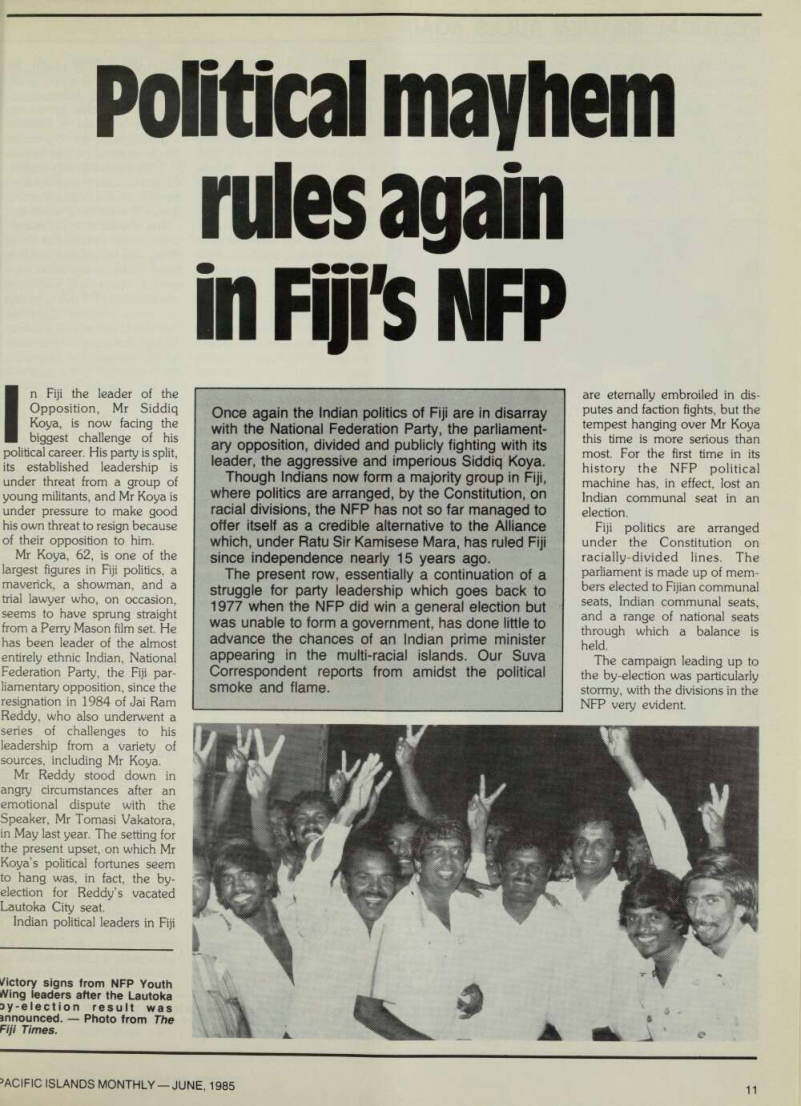
Victory signs from NFP Youth Wing leaders after the Lautoka [?]y-election result was announced. Photo from The Fiji Times.
Speeches on the stump were emotion-charged, and the youth wing’s attack so vicious that Mr Koya was driven to accuse them of “driving a knife” into the entire Indian community. Despite his courtroom canniness and political shrewdness, Mr Koya was goaded into making some
dangerous ripostes, including the one now seen as potentially a spear in his own foot, Mr Koya, a notable and rousing speaker, had told a rally during the campaign that his leadership was on the line. If the official NFP candidate lost the election, he said, he would resign “instantly.”
Mr Koya had to stick his neck out and make the pledge in such strong terms because the official candidate, Dr Balwant Singh Rakha, was opposed not by another political party but by a rebel faction of the NFP itself the Youth Wing - whose candidate was a Mr Davendra Singh. Neither was a major political figure; their importance lay primarily in their backers.
Mr Koya was hoping that his promise to quit politics and the leadership would bring suppor ters of his faction in the NFP rushing to the polls, jostling to lodge ballots for Dr Rakha. That they stayed away by the thousand was a decided slap in the face for Mr Koya. In fact the tum-out for the by-election was so poor it was depressing, both for the NFP and for Fiji politics in general.
The row began last Decem ber when Mr Koya had barred youth wing delegates from the NFP’s working committee meeting at Sigatoka which had selected Dr Rakha as the official candidate. He claimed the Youth Wing was not entitled to attend the meeting and share in selection of the candidate.
It was common knowledge that the NFP Youth Wing was not about to go along with Mr Koya’s choice. They said they wanted someone from Lautoka city itself, not an import. (Dr Rakha lives, and has a medical practice, in Ba, 30 kilometres, and some distance in mental attitudes, away from Lautoka.) Lautoka City is a blue-ribbon seat for the NFP and Mr Rakha should have been a shoe-in, unopposed, because the ruling Alliance Party, with a comfort able majority in the House, had decided not to contest the by election. The Alliance is formed of three elements, one Fijian, one Indian, and the third formed of other races, known as General Electors. Normally a candidate from the Indian Alliance would have stood against an Indian from the NFP.
Soon after the announce ment of Mr Rakha as the candidate the Youth Wing lead
ers, a young Suva lawyer, Mr Anil Singh, who is the presi dent, and Nadi businessman, Mr Himmat Lodhia, rushed into the act and got a Lautoka businessman, Mr Navendra Singh, to stand on their behalf.
Their candidate was a politi cal unknown. He was not seen by anyone as a serious threat to the NFP machine’s nominee.
But the pundits did not re ckon on the force of the Youth Wing who turned what ought to have been a one-horse race into a tough and damaging challenge to Mr Koya’s, always to some degree disputed, leadership of the NFP. Far from being a nonentity Mr Anil Singh swiftly became the fascinating black knight of NFP politics with his lance aimed straight at Sid Koya’s helmet.
They made capital, for inst ance, from the fact that Mr Singh was a Lautoka man, with Lautoka’s special interests at heart -- not an outsider ’’tainted” with the attitudes and political obligations of a man from the national capital.
Factionalism has always been a bane of life in the upper levels of the NFP, and it re-emerged with a vengeance during the Lautoka campaign. The entire party split and formed blocks behind the two candidates, making few bones about the appearance that they had made their decisions on the basis of whether they were pro, or anti, Koya.
Inevitably it became a re enactment of the row in 1977, when Koya was ousted as party leader and replaced by Jai Ram Reddy, and of May last year when Reddy resigned from the leadership, and from parlia ment, to restore Koya to the top spot. Davendra Singh’s youth wing supporters were, essential ly, pro-Reddy. The others were pro-Koya. The old Flower and Dove groups of 1977 seemed to have been reincarnated.
The election was thus turned very swiftly into a vote of no-confidence in Mr Koya’s leadership, a ploy on which he played right into their hands by
Siddiq Koya in happier times. He is seen greeting supporters soon after he resumed the position of Opposition Leader last year.- The Fiji Times photo.
hanging his future leadership on the electoral decision in Lautoka.
But, while the politics of it all were very damaging to Mr Koya, the results at the hustings were less categorical. Mr Davendra Singh was elected by a mere 13-vote majority in a poll which gave him 2209 votes against Dr Rakha’s 2196. It was a pitiful turnout of only 4421 from the 12,260 registered vo ters in the electorate.
As soon as the vote was announced Mr Koya sprang up to raise “legal objections”, claiming that 60 of the votes credited to Mr Davendra Singh should have been declared in formal. The issue is now before the courts.
But the Youth Wing im mediately demanded that Mr Koya honor his election prom ise and resign the leadership.
Mr Koya publicly ignored them.
However, the former presi dent of the party, Mr Ram Sami Gounder, a staunch Koya supporter and also a member of parliament, said he was “very grieved and surprised” that Mr Reddy did not support Dr Rakha. During the campaign the Youth Wing produced pamphlets, carrying Mr Reddy’s photograph, promoting their “rebel” candidate. Mr Reddy had not publicly dissociated himself from them.
Mr Gounder said that as former party leader Mr Reddy should have given his open and unqualified support to Dr Rakha. Mr Reddy responded tartly, describing Mr Gounder’s comments as “absolute rubb ish.” He said he wanted the party to have a completely free hand, had been in New Zea land at the time of the Sigatoka meeting and had taken no part in the selection of the candi date.
He said the Youth Wing, and Dr Rakha, had approached him several times, but he had “de cided to keep himself complete ly out of the controversy. ” The youth wing was an integral part of the NFF, he said. He did not wish to become involved, parti
cularly when his views had not been sought upon the choice of candidate.
The deputy leader of the NFF, Mrs Irene Jai Narayan, and NFF senior member, Sena tor Mumtaz Ali (who was the likely candidate favored by the youth wing for the by-election if they had been allowed to have their say in Sigatoka), called on Mr Koya to keep his promise, and resign. Mrs Narayan was involved in a particularly nasty inside fight with Mr Koya for the party leadership last May and Mr Koya’s autocratic style of leadership, has done nothing to remove internecine frictions since then.
Mumtaz Ali, a chartered ac countant admired by many Fiji citizens of all races for his urbanity and diplomacy, might have made an admirable com promise candidate for the Lautoka seat, had the party factions been able to agree. On the other hand he was not about to expose himself by taking one ticket or the other in the fight clearly seen to be developing.
The depth of the opposition to Mr Koya was increased when Satendra Nandan, a prominent Suva intellectual and NFF par liamentarian, resigned from Mr Koya’s shadow cabinet where he had been spokesman on education. He said it was no longer possible for him to re main an opposition spokesman if Mr Koya continued as party leader.
This sally was met by equally spirited demands from other prominent NFF members and MPs that Mr Koya not resign.
In short, the bickering and squabbles of the past have once again emerged to harass and hobble the NFF and render Fiji’s opposition party weak and fragmented. The youth wing, riding high, and basking in its electoral success, did nothing to help the image when it announced it had decided to prepare for the next general election.
They claimed the Alliance was planning to call a snap
election within the next six months. Because of this, they said, they would hold a youth wing national convention, sepa rate from the main body of the NFF, at Nadi in May. They said that if a snap election did eventuate they would field candidates to oppose Mr Koya and three of his staunchest supporters, Mr Sharda Nand, Mr Hari Sharma, and Mr Ram Sami Gounder.
Political observers in Suva say Mr Koya has bought badly needed time by taking the election protest to court while he works out how to remain in power. They do not, for a moment, see him surrendering before the youth wing, at least not without a very vigorous fight.
Yet the NFF is already seen to be badly damaged. The success of the youth wing, and its assertion that it will go its own way if it cannot have what it wants, shows clearly how badly the party is divided.
Its claim to be a credible alternative government to the Alliance which, under prime minister Ratu Sir Kamisese Mara, has ruled Fiji since inde pendence 14 years ago, is thereby seriously impeded.
Much now depends upon Mr Koya. He has shown previously how strong a survivor he can be. Further, and despite the success of the youth wing this time, no-one has risen to
actually challenge him for the leadership. Mrs Narayan has said she is not now keen.
The “joker” in the pack is the former Alliance cabinet minis ter, Sir Vijay R.Singh, who has indicated he may be interested in stepping in if a breach deve lops. Most people who know him believe he would greatly enjoy being Fiji’s first Indian prime minister, and he is an astute enough politician, and a large enough figure, to be able to do much to restore the NFP’s now tarnished public image.
Yet Sir Vijay’s attraction at the grassroots level remains in some question. The rank and file of Indian voters still remem ber his attacks upon the NFF while he was with the Alliance, and may not have forgiven him.
Sir Vijay is also tipped to be appointed chief executive of the Sugar Cane Growing Council, a post which would require him to resign from political activity.
The crux of the affair now sits squarely on what Sid Koya does if, or when, the court rules against his electoral protest. Will he then resign, thereby, in the eyes of many Indian voters, keeping his credibility?
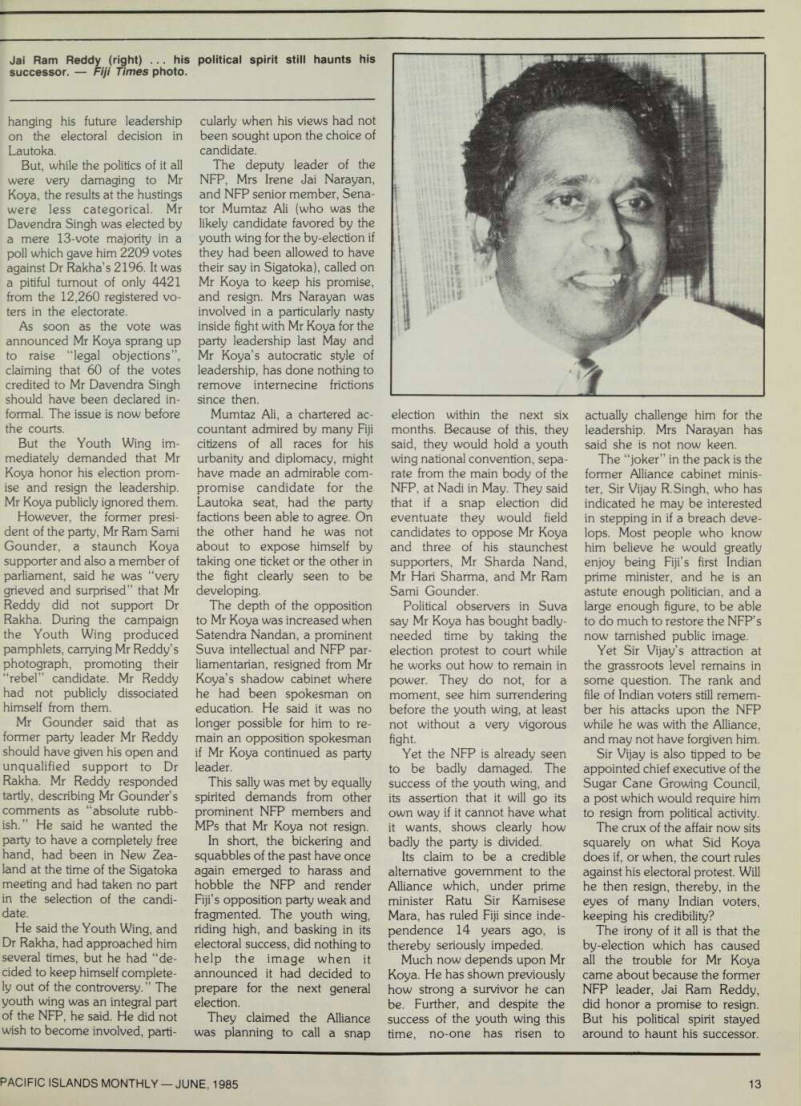
The irony of it all is that the by-election which has caused all the trouble for Mr Koya came about because the former NFF leader, Jai Ram Reddy, did honor a promise to resign.
But his political spirit stayed around to haunt his successor.
Jai Ram Reddy (right) ... his political spirit still haunts his successor. - Fiji Times photo.
Advertisements & other items, p. 13 (1 item)
13
ACIFIC ISLANDS MONTHLY —JUNE, 1985
Is oil the key to PNG’s
minerals wealth?
In the wake of the trouble over Ok Tedi gold and copper mine, and with the outlook for world metal prices less than promis ing, there might be an air of pessimism about the future of countries like Papua New Guinea which are very heavily dependent upon their mineral resources. However, geologists believe that PNG has a dark ace in the hole.
“The big possibilities for big money in PNG are in oil,” says Bill McGee, of Nord Resources, one of the exploration com panies deeply involved in the development of the country. ’’They are starting to find oil.
Lots of gas has been found already; it has been around for a long time. ’’But now, with this Juha field, and others, they are star ting to get on to oil and oil is worth a lot more money than gas. The PNG government is now calling for tenders for some prospects on the Papuan side and the possibilities look really good,” he said.
But PNG is not the only country in the Pacific Ocean where oil prospecting has been under way in recent years.
Fiji prospects
Fiji has been the scene of intermittent exploration since 1969 and in 1980-82 two shal low and five deep wells were drilled, all of which were re ported as dry, says a report recently published by the Fiji Ministry of Lands, Energy and Mineral Resources.
These early disappointments have not stopped further ex ploration and four licences, covering about 16,000 sq km, have been negotiated.
This represents about half the shallow-water area which geologists regard as having pos sible prospective worth. The government is also involved with three deep-water pros pects which are thought to have long-term potential and pos sible connections into shallow
marginal areas.
Fiji, and some of the other island nations, are all of similar geology and most of them, with the partial exception of Fiji, and the notable exclusion of PNG, have yet to have more than cursory examination by geolog ists.
“Didn’t see it"
As Bill McGee, an experi enced PNG field geologist, says: “It depends on what you are looking for. Ken Raeder (of Niugini Mining), found the Lihir gold deposit after a number of prospectors had gone over the ground without seeing the real ly big lode. Everyone knew gold was there, but they we ren’t looking for gold, they were out for copper, and they did not see that the gold was there in commercial quantities. ’’Peter McNab found the gold on Simberi (another island in the Tabar group, the general chain of which Lihir is so far the richest), after they farmed in on us at Tabar,” Bill said. ’’They started getting good gold there, and so they started prospecting down the other islands in the group. ’’All these things depend upon what you are looking for.
If you don’t find it, you go somewhere else. Then, some while later, someone else will come back to the area looking for another mineral, and have success. Tabar is the classic example of this. CRA was into the area in 1965; BHP in 1971.
They were both looking for copper. They walked all over the ground where the gold is, but they weren’t interested.
Back in those days gold was US$35 an ounce, and 5 gm/ tonne gold just doesn’t fly at that price. Now it is US$3OO an ounce and it’s a different story. ”
The other area fascinating to prospectors is West Irian but, given the difficult political situa tion there, it is likely to remain for some time the treasure
somewhere over the rainbow.
Some geological work was done there in the 19705, said Bill McGee. ’’The place is obviously prospective for gold and copper; it is a continuation of the same geology as PNG.
Nickel and cobalt deposits are known to be there. But, so far as I know, nobody is working there at the moment. Maybe the companies are reluctant to get into areas of very high political risk, or maybe the Indonesian government is not issuing work permits. ”A couple of years ago there were some BMR geologists working in the territory, and one of the Australians was kidnapped. So BMR pulled out.
They felt they could spend their money at less risk elsewhere. ’’Why go there when, if you are determined to go to Indone sia, you can go to Sulewesi, or Java, or Sumatra, and still have excellent prospects? ’’But West Irian is attractive to a lot of people,” he said, ”if only because there is a lot of blue sky there that nobody has looked at, and you could trip over the big one that every prospector dreams about. On the other hand, even an El Dorado isn’t much good if someone is going to shoot you.”
By contrast with West Irian, most exploration companies find the PNG government very good to deal with. Most of the mining companies dislike the additional profits tax recently slapped on them, not so much because of the impost, but because the concept of it rank les. The Ok Tedi affair probably made some investors more cau tious, but overall it does not seem to have damaged PNG’s international image as a host and partner to geological ex plorers.
As go
as Aust.
’’Overall,” said McGee, ”1 think none of us who work
there regard the political risks as any worse than Australia.”
What was left unsaid, but which is very much in the minds of Australian mining developers, is the political risk of aboriginal land rights which, some com panies maintain, has seriously damaged exploration in Austra lia.
Melanesian land ownership did provide problems in such areas as Bougainville, but this now seems to have changed and, in general, geologists say, the Pacific is realistic in both political and environmental terms. Solomon Islands has some hang-ups, they say,and West Irian is well out of bounds but otherwise the picture is good.’’Prospecting today com es down to the attitudes of the island governments,” McGee said. ”If the government is keen enough they can facilitate the bureaucratic processes and also influence the people to accept the explorers. ’’Today we have to go in with a government permit. It’s all lines on maps and we don’t get claim-jumping and things like that. Modern methods can cov er a lot of territory very quickly, so we need quite large areas which require government con cessions to justify the large investments involved. Also, ulti mately, all the minerals belong to ‘the crown’ or the state in these places ... even if you find them, you don’t own them. It is ultimately the government’s right to dispense them by way of leases. When the mineral is mined the state takes royalties, taxes, additional profits tax, company tax ... a whole string of things. They say that on average, around the world these days, governments take about 75 per cent of a miner’s proceeds. But the governments have to do it cooperatively. If it isn’t worthwhile to the miner, he is first not to go into a project. The miner needs to know that he is going to get his costs covered, and make the size of profit he needs.”
Garry Barker
Advertisements & other items, p. 15 (1 item)
•H Komatsu
/■ - • m ::P^. mm &>0 ms —iC* —<gr /
WIWSmS&k
>4. m rz Sy « Komatsu has the right pieces of equipment
to solve your construction problem
If you have a construction problem, we have an all-Komatsu solution.
That means we produce a full line and a wide range of machines to perfectly match job requirements from bulldozers, motor graders and motor scrapers, to dump trucks, wheel loaders and hydraulic excavators. It also means we’ll back up all Komatsu machines with our reliable worldwide network of service and sales. Keeping the customer fully satisfied is and always will be the primary concern at every level of our management...
Feedback from users and imaginative research and development based on our Total Quality Control system result in a full line of machines noteworthy for their excellent fuel economy, outstanding operator comfort and exceptional reliability...
The all-Komatsu solution. Make it a part of your construction picture.
THE QUALITY IS STANDARD
•H KOMATSU
After 50 years,
Juan Trippe, the man who founded Pan American Airways, planned his conquest of the Pacific in the New York public library in the 19205.
Mr Trippe, whose aviation business dreams were crystallis ing rapidly, picked out Wake Island as the key to island hopping across the Pacific.
He learned from clipper ship logs that Wake Island would provide the stepping-stone he was seeking to link the U.S. with Asia via Hawaii, Midway Island, and Guam.
In a letter dated October 3, 1934, Juan Trippe told the Secretary of the Navy that Pan American was ready to fly the Pacific.
This opened a chapter in aviation history which closed this year with news that Pan American is selling almost all its Pacific operations to the free world’s largest airline, United.
The deal is worth $U.5.750
Pan American... Juan Trippe... Harold Gatty...the names are carved deeply into the record of the development of commercial aviation in the Pacific.
Pan Am’s big blue and white aircraft seemed to be everywhere, commanded by neat, enormously com petent, men in dark blue uniforms with the airline’s golden globe badge on their white-topped caps. In their way they were pioneers, even until quite recent years. The original Clippers were flying boats. Then came the great machines of the piston-engined age, the DC-6s, DC-7Cs, and Stratocruisers, to be superseded by the jets, Boeing 707 s and DC-Bs, followed by today’s monarchs of the air, the Boeing 7475. But now Pan Am is to withdraw from the ocean it was instrumental in opening to airborne travellers, the victim of what seems to be endemic problems of cost, management, and uneconomic services. In its place comes United Airlines, the free world’s largest carrier, and a company noted for its success in a very hard business. As PIM aviation correspondent, PETER JOHNSON, details here, United’s arrival can only increase the already tough competition among airlines all over the Pacific Basin.
million, and under it, United gets Pan Am’s losing Pacific division as a going concern.
Pan Am is said to have lost $U.5.63 million on the Pacific run last year.
United will take over Pan Am operations to Australia, Japan, China, New Zealand, Hong kong, Singapore, Taiwan, Korea, Thailand and the Philip pines.
This is expected to provide even tougher competition on Pacific routes and could exert more pressure on already
There was no anchorage on Wake Island, and the supply ship had to stand to offshore while barges brought gear ashore in tumultuous seas (be low left). But within two years Pan Am passengers were over nighting on Wake Island in a modern hotel, as shown in the picture below taken in 1937 of a scene in the hotel lobby.
[?]ows out of Me Pacific
Me Pacific
heavily-discounted air fares.
Given Mr Trippe’s reliance on clipper ship logs to pick his way across the Pacific, it seems no coincidence that he named the airline’s first Martin M-130 flying boat, then America’s largest airliner, the China Clipper.
The plane was named after a sailing boat which carried the American flag and crossed the Pacific 100 years before.
And China Clipper made its mark- flying from San Francis co to the Philippines via Hon-
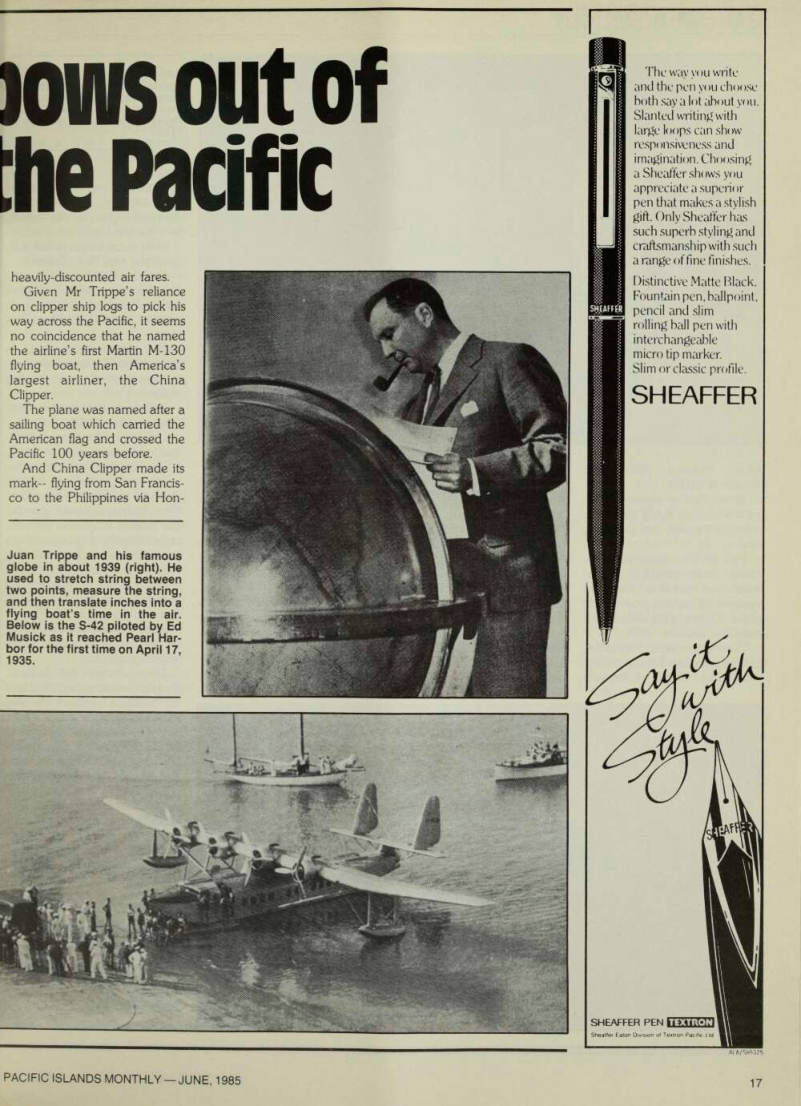
Juan Trippe and his famous globe in about 1939 (right). He used to stretch string between two points, measure the string, and then translate inches into a flying boat’s time in the air.
Below is the S-42 piloted by Ed Musick as it reached Pearl Har bor for the first time on April 17, 1935.
olulu, Midway, Wake, and Guam in 1935.
Now, half a century later, Pan American, flying the Pacific with giant jumbo jets, is pulling out.
The airline’s withdrawal has been understandably some what more subdued than the razzamatazz which greeted the China Clipper’s departure from San Francisco in 1935.
Twenty-two aerial bombs ex ploded over San Francisco Bay, heralding China Clipper’s
take off run.
Two of the bombs released American flags, which floated down by parachute.
Thirty planes swooped over head, car horns tooted, ship whistles sounded, and a fire boat spouted waterjets.
And the flying boat carried 1837 pounds of mail, in addi tion to a heavy fuel load.
Scheduled passenger service was pencilled in for October, 1936, but Juan Trippe organ ised his own flight for a week
earlier.
The clipper, comfortable and luxurious, contained a central lounge wider than a Pullman club car.
And as a special touch, four copies of Gone With the Wind, the latest bestseller, were on board.
The imperturbable Mr Trippe won traffic rights to Hongkong with the “falling apple” prin ciple.
He gained rights to Portu guese Macau, then sat back to
wait.
Pressure from British businessmen in Hongkong dropped rights to the colony into his lap.
Next came a wish to link with Australia and New Zealand.
But the British wanted unli mited landing rights in Hawaii before Pan Am would be given any in Australia or New Zea land.
The Americans decided to isolate New Zealand from Aus tralia in negotations for landing rights.
If the two Antipodean coun tries could be split, then they could be chipped away from the mother country.
Mr Trippe sent Australian navigator Harold Gatty to New Zealand with this argument: Pan American would give NZ the chance to be in at the start, rather than be a backwater in a South Pacific air service linking Hawaii and Australia.
New Zealand yielded full commercial traffic rights to Pan Am on March 11, 1937.
Juan Trippe’s plan was simi lar to the Hongkong “falling apple” principle.
Once serving New Zealand, Pan Am would sit back and wait for business pressure to drop Australia into his lap.
If this failed, he planned to hire a yacht and announce that the craft was ready to carry airmail and passengers from New Zealand to Australia.
The idea was to shame Aus tralia into complying.
Pan Am flew into NZ quite soon after winning traffic rights, and on the first flight by pilot Eddie Musick in a survey plane,
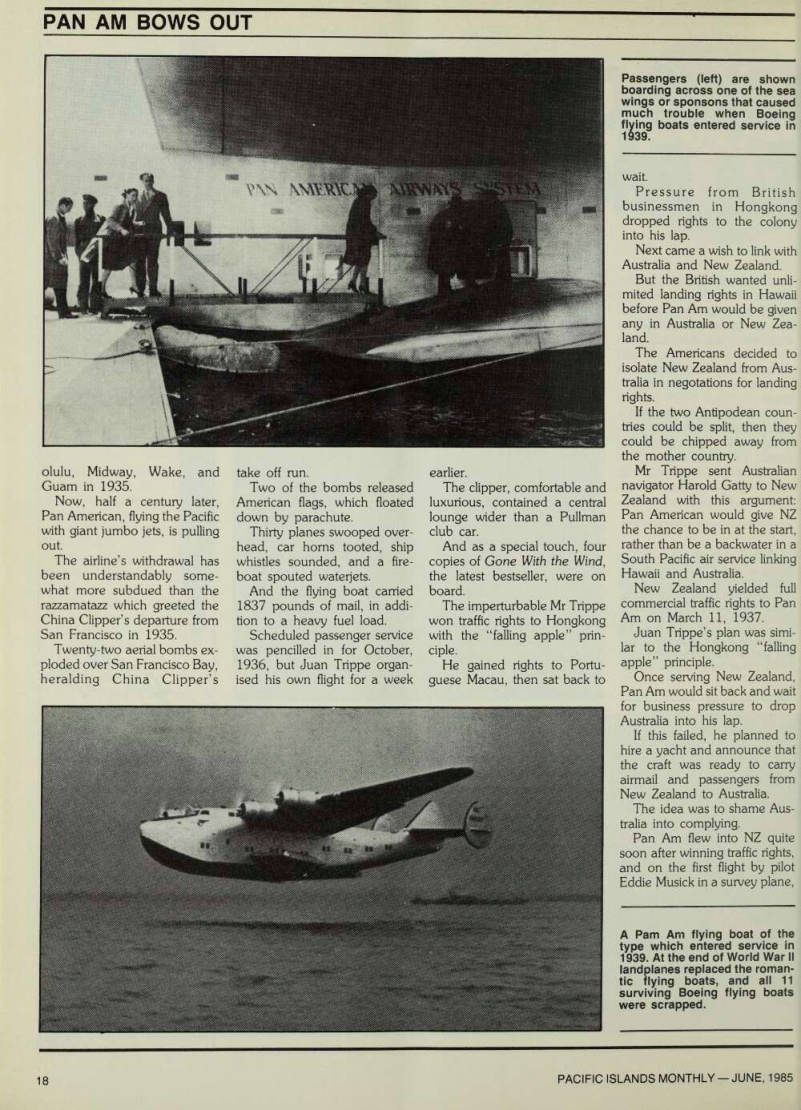
Passengers (left) are shown boarding across one of the sea wings or sponsons that caused much trouble when Boeing flying boats entered service in 1939.
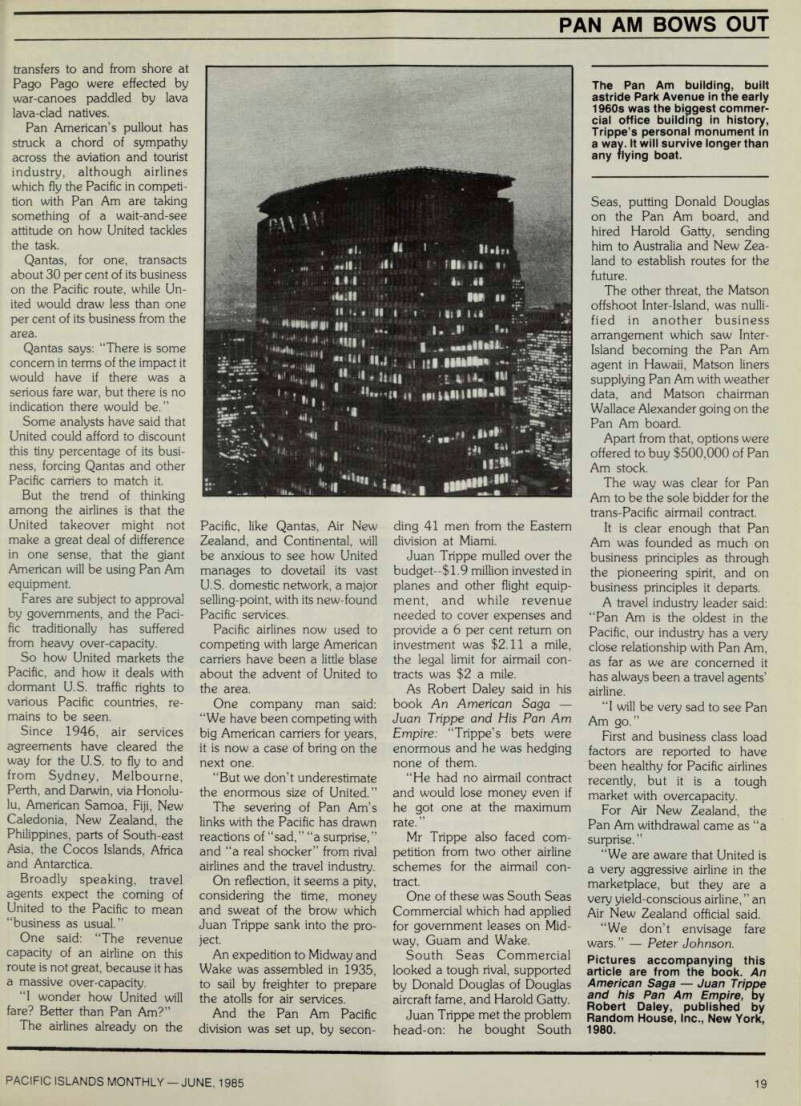
A Pam Am flying boat of the type which entered service in 1939. At the end of World War II landplanes replaced the roman tic flying boats, and all 11 surviving Boeing flying boats were scrapped.
transfcrs to and from shore at Pago Pago were effected by war-canoes paddled by lava lava-clad natives.
Pan American’s pullout has struck a chord of sympathy across the aviation and tourist industry, although airlines which fly the Pacific in competi tion with Pan Am are taking something of a wait-and-see attitude on how United tackles the task.
Qantas, for one, transacts about 30 per cent of its business on the Pacific route, while Un ited would draw less than one per cent of its business from the area.
Qantas says: “There is some concern in terms of the impact it would have if there was a serious fare war, but there is no indication there would be.”
Some analysts have said that United could afford to discount this tiny percentage of its busi ness, forcing Qantas and other Pacific carriers to match it.
But the trend of thinking among the airlines is that the United takeover might not make a great deal of difference in one sense, that the giant American will be using Pan Am equipment.
Fares are subject to approval by governments, and the Paci fic traditionally has suffered from heavy over-capacity.
So how United markets the Pacific, and how it deals with dormant U.S. traffic rights to various Pacific countries, re mains to be seen.
Since 1946, air services agreements have cleared the way for the U.S. to fly to and from Sydney, Melbourne, Perth, and Darwin, via Honolu lu, American Samoa, Fiji, New Caledonia, New Zealand, the Philippines, parts of South-east Asia, the Cocos Islands, Africa and Antarctica.
Broadly speaking, travel agents expect the coming of United to the Pacific to mean “business as usual.”
One said: “The revenue capacity of an airline on this route is not great, because it has a massive over-capacity.
“I wonder how United will fare? Better than Pan Am?”
The airlines already on the
Pacific, like Qantas, Air New Zealand, and Continental, will be anxious to see how United manages to dovetail its vast U.S. domestic network, a major selling-point, with its new-found Pacific services.
Pacific airlines now used to competing with large American carriers have been a little blase about the advent of United to the area.
One company man said: “We have been competing with big American carriers for years, it is now a case of bring on the next one.
“But we don’t underestimate the enormous size of United.”
The severing of Pan Am’s links with the Pacific has drawn reactions of “sad,” “a surprise,” and “a real shocker” from rival airlines and the travel industry.
On reflection, it seems a pity, considering the time, money and sweat of the brow which Juan Trippe sank into the pro ject.
An expedition to Midway and Wake was assembled in 1935, to sail by freighter to prepare the atolls for air services.
And the Pan Am Pacific division was set up, by secon
ding 41 men from the Eastern division at Miami.
Juan Trippe mulled over the budget—sl.9 million invested in planes and other flight equip ment, and while revenue needed to cover expenses and provide a 6 per cent return on investment was $2.11 a mile, the legal limit for airmail con tracts was $2 a mile.
As Robert Daley said in his book An American Saga Juan Trippe and His Pan Am Empire: “Trippe’s bets were enormous and he was hedging none of them.
“He had no airmail contract and would lose money even if he got one at the maximum rate.”
Mr Trippe also faced com petition from two other airline schemes for the airmail con tract.
One of these was South Seas Commercial which had applied for government leases on Mid way, Guam and Wake.
South Seas Commercial looked a tough rival, supported by Donald Douglas of Douglas aircraft fame, and Harold Gatty.
Juan Trippe met the problem head-on: he bought South
Seas, putting Donald Douglas on the Pan Am board, and hired Harold Gatty, sending him to Australia and New Zea land to establish routes for the future.
The other threat, the Matson offshoot Inter-Island, was nulli fied in another business arrangement which saw Inter- Island becoming the Pan Am agent in Hawaii, Matson liners supplying Pan Am with weather data, and Matson chairman Wallace Alexander going on the Pan Am board.
Apart from that, options were offered to buy $500,000 of Pan Am stock.
The way was clear for Pan Am to be the sole bidder for the trans-Pacific airmail contract.
It is clear enough that Pan Am was founded as much on business principles as through the pioneering spirit, and on business principles it departs.
A travel industry leader said; “Pan Am is the oldest in the Pacific, our industry has a very close relationship with Pan Am, as far as we are concerned it has always been a travel agents’ airline.
“I will be very sad to see Pan Am go.”
First and business class load factors are reported to have been healthy for Pacific airlines recently, but it is a tough market with overcapacity.
For Air New Zealand, the Pan Am withdrawal came as “a surprise. ”
“We are aware that United is a very aggressive airline in the marketplace, but they are a very yield-conscious airline,” an Air New Zealand official said.
“We don’t envisage fare
wars. ”
Peter Johnson.
Pictures accompanying this article are from the book. An American Saga Juan Trippe and his Pan Am Empire, by Robert Daley, published by Random House, Inc., New York, 1980.
The Pan Am building, built astride Park Avenue in the early
1960s was the biggest commer
cial office building in history, Trippe’s personal monument in a way. It will survive longer than any flying boat.
Advertisements & other items, p. 17 (1 item)
Sheaffer
The way you write and the pen you choose both say a lot about you.
Slanted writing with large loops can show responsiveness and imagination. Choosing a Sheaffer shows you appreciate a superior pen that makes a stylish gift. Only Sheaffer has such superb styling and craftsmanship with such a range of fine finishes.
Distinctive Matte Black.
Fountain pen. ballpoint, pencil and slim rolling ball pen with interchangeable micro tip marker.
Slim or classic profile.
SHEAFFER
i«
SHEAFFER PEN liMilM:!
Shea Mer Ealon Division of Textron Pacific Lid
Solomons row

Hu’s visit sparks Solomons row
The visit to the South Pacific of the Chinese communist party general secretary, Hu Yaobang, sparked a parliamentary row in Solomon Islands with prime
minister Sir Peter Kenilorea de fending himself against allega tions that his government was throwing itself into world power politics by inviting ties with
China.
Mr Hu did not visit Solomon Islands, because Peking has no diplomatic relations with Hon iara, but the Solomons Opposi tion criticised the Kenilorea government for recently esta lishing what was called ’’sister relations” with some Chinese provinces.
The irony of the upset is that when Opposition leader, Mr Solomon Mamaloni, was prime minister his government toyed with opening diplomatic rela tions not only with the People’s Republic of China, but also Taiwan.
In 1983 Mr Mamaloni and his foreign minister, Mr Denis Lulei, went to Taipei to discuss possible Taiwanese investment in Solomon Islands. The Taiwanese also, apparently, offered to help Mr Mamaloni establish a para-military force.
Concurrently, the Solomons finance minister, Mr Bart Ulu fa’alu, was in Peking heading a delegation for talks with the Chinese over aid, including fin ance for a new national parlia ment building in Honiara.
There was apparently some talk
about diplomatic relations, but nothing came of it immediately.
The Taiwanese, however, moved more quickly leading, six months later, to a spirited protest from Peking which ac cused the Mamaloni govern ment of ”an act of interference” in China’s internal policy, by establishing diplomatic relations with Taiwan at the consular level.
The situation showed no signs of improvement, and perhaps some decline in Taipei, after Mr Mamaloni said he was ’’fully aware” that Taiwan was a province of the People’s Re public of China, but saw as a fact that Taiwan was governed by its own constitution and was a sovereign entity. He said that if Peking was serious about relations, then it should ’’come out with a clear stand” by having serious discussions with his government.
Shortly thereafter Solomon Islands signed a technical cooperation agreement with Taiwan under which Taipei would send agricultural teams in to carry out pilot projects on cultivation of rice, vegetables and fruit.
Solomon Mamaloni
Advertisements & other items, p. 20 (1 item)
Wcific
CONSTRUCTION EQUIPMENT CO
introducing the Dynamic new Range of
Vibrating & Pneumatic Tyred Rollers
IFIC
THE RANGE
• Pacific Self-Propelled Vibrating Rollers • Single and Double Drum Types • 1.5 tonne to 16 tonne • Pacific Self-Propelled Pneumatic Type Compactors • 3 Models 16. 21. 38 tonne Ballast Weights • Pacific Landfill and Sanitary Landfill Compactors • Pacific Pneumatic Earth Borers • Pacific Road Brooms • Pacific Railway Maintenance Vehicles Construction Equipment Co.
DISTRIBUTORS REQUIRED
THROUGHOUT THE PACIFIC
SAL
bfLiTSSS 24 Salisbury Road, Hornsby NSW 2077, Australia. Phone (02) 476 2666
visits W. Samoa
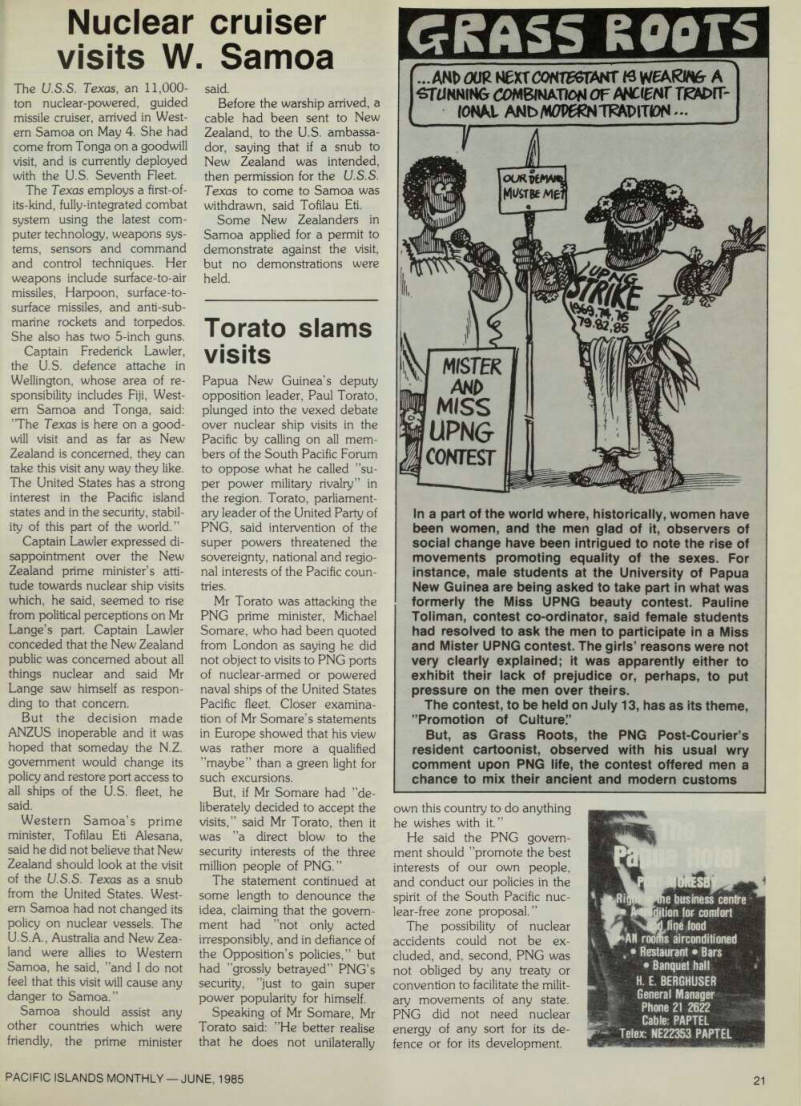
Nuclear cruiser visits W. Samoa
The U.S.S. Texas, an 11,000ton nuclear-powered, guided missile cruiser, arrived in West ern Samoa on May 4. She had come from Tonga on a goodwill visit, and is currently deployed with the U.S. Seventh Fleet.
The Texas employs a first-of its-kind, fully-integrated combat system using the latest com puter technology, weapons sys tems, sensors and command and control techniques. Her weapons include surface-to-air missiles, Harpoon, surface-to surface missiles, and anti-sub marine rockets and torpedos.
She also has two 5-inch guns.
Captain Frederick Lawler, the U.S. defence attache in Wellington, whose area of re sponsibility includes Fiji, West ern Samoa and Tonga, said: ’’The Texas is here on a good will visit and as far as New Zealand is concerned, they can take this visit any way they like.
The United States has a strong interest in the Pacific island states and in the security, stabil ity of this part of the world.”
Captain Lawler expressed di sappointment over the New Zealand prime minister’s atti tude towards nuclear ship visits which, he said, seemed to rise from political perceptions on Mr Lange’s part. Captain Lawler conceded that the New Zealand public was concerned about all things nuclear and said Mr Lange saw himself as respon ding to that concern.
But the decision made ANZUS inoperable and it was hoped that someday the N.Z. government would change its policy and restore port access to all ships of the U.S. fleet, he said.
Western Samoa’s prime minister, Tofilau Eti Alesana, said he did not believe that New Zealand should look at the visit of the U.S.S. Texas as a snub from the United States. West ern Samoa had not changed its policy on nuclear vessels. The U.S.A., Australia and New Zea land were allies to Western Samoa, he said, ’’and 1 do not feel that this visit will cause any danger to Samoa.”
Samoa should assist any other countries which were friendly, the prime minister
said.
Before the warship arrived, a cable had been sent to New Zealand, to the U.S. ambassa dor, saying that if a snub to New Zealand was intended, then permission for the U.S.S.
Texas to come to Samoa was withdrawn, said Tofilau Eti.
Some New Zealanders in Samoa applied for a permit to demonstrate against the visit, but no demonstrations were held.
Torato slams
visits
Papua New Guinea’s deputy opposition leader, Paul Torato, plunged into the vexed debate over nuclear ship visits in the Pacific by calling on all mem bers of the South Pacific Forum to oppose what he called ’’su per power military rivalry” in the region. Torato, parliament ary leader of the United Party of PNG, said intervention of the super powers threatened the sovereignty, national and regio nal interests of the Pacific coun tries.
Mr Torato was attacking the PNG prime minister, Michael Somare, who had been quoted from London as saying he did not object to visits to PNG ports of nuclear-armed or powered naval ships of the United States Pacific fleet. Closer examina tion of Mr Somare’s statements in Europe showed that his view was rather more a qualified ’’maybe” than a green light for such excursions.
But, if Mr Somare had ’’de liberately decided to accept the visits,” said Mr Torato, then it was ”a direct blow to the security interests of the three million people of PNG.”
The statement continued at some length to denounce the idea, claiming that the govern ment had ’’not only acted irresponsibly, and in defiance of the Opposition’s policies,” but had ’’grossly betrayed” PNG’s security, ’’just to gain super power popularity for himself.
Speaking of Mr Somare, Mr Torato said: ”He better realise that he does not unilaterally
own this country to do anything he wishes with it.”
He said the PNG govern ment should ’’promote the best interests of our own people, and conduct our policies in the spirit of the South Pacific nuc lear-free zone proposal.”
The possibility of nuclear accidents could not be ex cluded, and, second, PNG was not obliged by any treaty or convention to facilitate the milit ary movements of any state.
PNG did not need nuclear energy of any sort for its de fence or for its development.
Crass Roots
In a part of the world where, historically, women have been women, and the men glad of it, observers of social change have been intrigued to note the rise of movements promoting equality of the sexes. For instance, male students at the University of Papua New Guinea are being asked to take part in what was formerly the Miss UPNG beauty contest. Pauline Toliman, contest co-ordinator, said female students had resolved to ask the men to participate in a Miss and Mister UPNG contest. The girls’ reasons were not very clearly explained; it was apparently either to exhibit their lack of prejudice or, perhaps, to put pressure on the men over theirs.
The contest, to be held on July 13, has as its theme, ’’Promotion of Culture!’
But, as Grass Roots, the PNG Post-Courier’s resident cartoonist, observed with his usual wry comment upon PNG life, the contest offered men a chance to mix their ancient and modern customs
Advertisements & other items, p. 21 (1 item)
*
e business centre for comfort ne food rooms aircondltloned Restaurant • Bars • Banquet hall
H. E. BERGHUSER
General Manager Phone 21 2622 Cable: PAPTEL Telex: NE22353 PAPTEL
greets new French plan
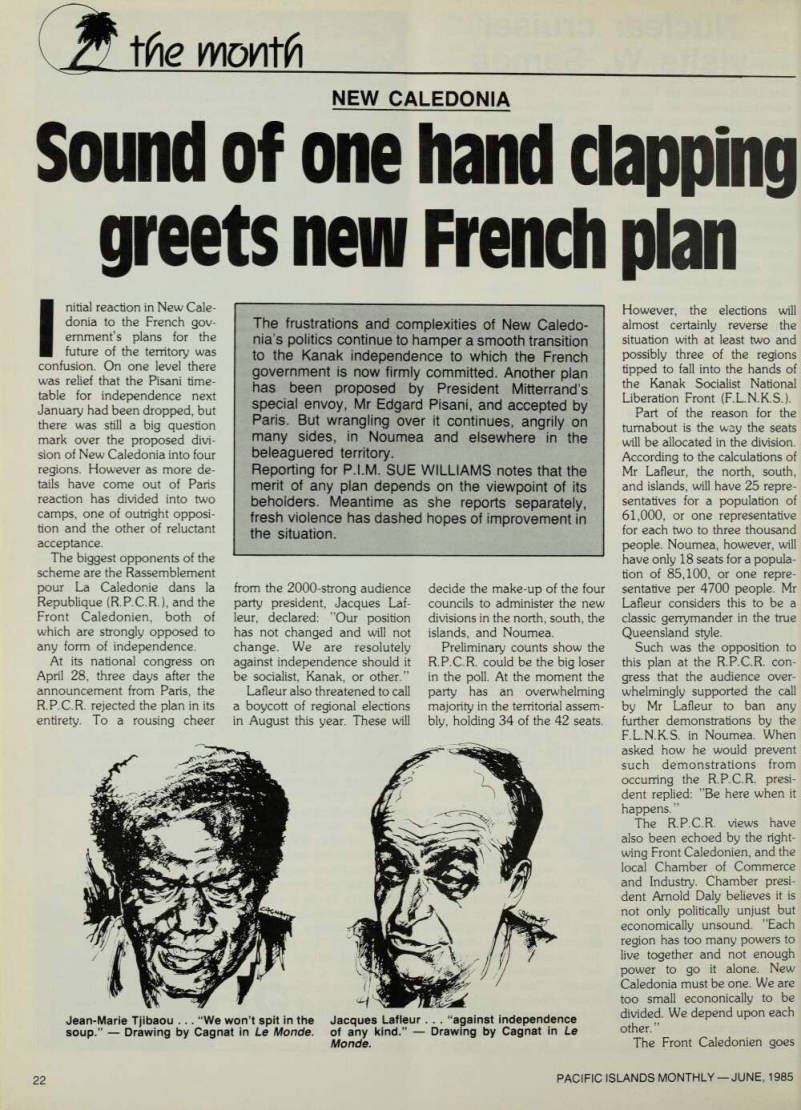
the month
New Caledonia
Sound of one hand dapping greets new French plan
Initial reaction in New Cale donia to the French gov ernment’s plans for the future of the territory was confusion. On one level there was relief that the Pisani time table for independence next January had been dropped, but there was still a big question mark over the proposed divi sion of New Caledonia into four regions. However as more de tails have come out of Paris reaction has divided into two camps, one of outright opposi tion and the other of reluctant acceptance.
The biggest opponents of the scheme are the Rassemblement pour La Caledonie dans la Republique (R.P.C.R.), and the Front Caledonien, both of which are strongly opposed to any form of independence.
At its national congress on April 28, three days after the announcement from Paris, the R.P.C.R. rejected the plan in its entirety. To a rousing cheer
The frustrations and complexities of New Caledo nia’s politics continue to hamper a smooth transition to the Kanak independence to which the French government is now firmly committed. Another plan has been proposed by President Mitterrand’s special envoy, Mr Edgard Pisani, and accepted by Paris. But wrangling over it continues, angrily on many sides, in Noumea and elsewhere in the beleaguered territory.
Reporting for P.I.M. SUE WILLIAMS notes that the merit of any plan depends on the viewpoint of its beholders. Meantime as she reports separately, fresh violence has dashed hopes of improvement in the situation.
from the 2000-strong audience party president, Jacques Laf leur, declared: ”Our position has not changed and will not change. We are resolutely against independence should it be socialist, Kanak, or other.”
Lafleur also threatened to call a boycott of regional elections in August this year. These will
decide the make-up of the four councils to administer the new divisions in the north, south, the islands, and Noumea.
Preliminary counts show the R.P.C.R. could be the big loser in the poll. At the moment the party has an overwhelming majority in the territorial assem bly, holding 34 of the 42 seats.
However, the elections will almost certainly reverse the situation with at least two and possibly three of the regions tipped to fall into the hands of the Kanak Socialist National Liberation Front (F.L.N.K.S.).
Part of the reason for the turnabout is the way the seats will be allocated in the division.
According to the calculations of Mr Lafleur, the north, south, and islands, will have 25 repre sentatives for a population of 61,000, or one representative for each two to three thousand people. Noumea, however, will have only 18 seats for a popula tion of 85,100, or one repre sentative per 4700 people. Mr Lafleur considers this to be a classic gerrymander in the true Queensland style.
Such was the opposition to this plan at the R.P.C.R. con gress that the audience over whelmingly supported the call by Mr Lafleur to ban any further demonstrations by the F.L.N.K.S. in Noumea. When asked how he would prevent such demonstrations from occurring the R.P.C.R. presi dent replied: ”Be here when it happens. ”
The R.P.C.R. views have also been echoed by the right wing Front Caledonien, and the local Chamber of Commerce and Industry. Chamber presi dent Arnold Daly believes it is not only politically unjust but economically unsound. ’’Each region has too many powers to live together and not enough power to go it alone. New Caledonia must be one. We are too small econonically to be divided. We depend upon each other. ”
The Front Caledonien goes
Jean-Marie Tjibaou . . . “We won’t spit in the Jacques Lafleur .. . “against independence soup.” - Drawing by Cagnat in Le Monde, of any kind.” - Drawing by Cagnat in Le Monde.
one step further, saying the plan is ’’not only anti-economic and anti-social, but is thorough ly racist. It reduces the electoral and democratic weight of the non-Melanesians and permits the by-passing of the Constitu tion which is based on one man, one vote.”
The views of the F.L.N.K.S. are not much more positive. ”We will not spit in the soup,” declared Kanak leader, Jean- Marie Tjibaou, in Paris shortly after the announcement of the plan by the French prime minis ter, Laurent Fabius. Mr Tjibaou would not be drawn much further at his first press confer ence, but a week later, in West Germany, he went on to de scribe the plan as ’’negative, because according to the first calculation, the anti-indepen dentists have a slight advantage and the F.L.N.K.S. have not been given a big enough majority. ”
He is also critical of the French government’s announcement of an upgraded military base for New Caledo nia and its decision over the exact timing of the referendum on the independence question.
The official reaction of the F.L.N.K.S. will be decided at its congress to be held on May 25 and 26 at Hienghene, in the far north of New Caledonia.
Mr Tjibaou has said that if that congress decides to sup port the plan and take part in the regional election, the F.L.N.K.S. will ask that the referendum be held before the French legislative elections in 1986. The independentists are concerned that these elections will see a change of power in the French parliament with the result that the question of New Caledonia’s independence will be pushed into the background.
This, of course, is exactly what the anti-independence forces in the territory are counting on.
The referendum was initially scheduled for July this year in the plan proposed in January by the French government’s special envoy, Edgard Pisani.
However, it soon became apparent that any referendum on the question of sovereignty for the territory would be lost if the non-Melanesian population was allowed to take part.
President Mitterrand has pre viously indicated that this sec tion of the community should
not be excluded, but he is also firmly committed to independ ence for New Caledonia. Con sequently the referendum was put back to September and now, under the Fabius plan, will be held ”no later than Decem ber 31, 1987.”
Probably the most positive reaction to the Fabius plan has come from the Kanak Socialist Liberation Movement (L.K.S.), led by Nidoish Naisseline.
The L.K.S. has indicated it is ready to go with the plan, which it sees as preparing the ground for independence. It has also applauded the regionalisation of New Caledonia as a way of opening up the bush and the islands for economic deve lopment in a fair and equitable manner, as opposed to the R.P.C.R.’s alternative plan of dividing the territory into two regions, the cast and west coasts, which the L.K.S. be lieves would have created an apartheid situation.
This optimistic outlook is also starting to ripple through to the tourist industry which has taken a particularly savage beating in the last seven months. While some sections of the F.L.N.K.S. have been annoyed by the delay in the referendum, most tourist industry leaders are hopeful it will provide the brea thing space necessary to get the territory’s economy back on its feet. They are already planning new promotions to start bring ing the holidaymakers back.
EDGARD PISANI, the man who has borne the brunt of the New Caledonian crisis, has been promoted to the new post of Minister for New Cale donia “as a reward for his achievements.” He will have a direct voice in the French Cabinet as the territory pre pares for regional elections in August. Pisani’s position as High Commissioner in Noumea will be taken by the veteran French diplomat, Fer nand Wibaux, 63, until recent ly ambassador to the Leba non. When the announcement was made Pisani was on his way to Paris to attend the May 29 National Assembly debate on the new French govern ment blueprint for New Cale donia’s future, based largely on his recommendations.
May 8, Noumea’s
day of violence
Violence burst in Noumea with a day-long riot on May 8 that left one dead, more than 70 injured, and the streets of the city fogged by tear gas, and echoing to the thump of stun grenades.
The riot was a bitter di sappointment to many businessmen and other an xious observers of the fragile scene who had begun to think, hopefully, that things might be getting better. The nightly curfew had been lifted on May 3, but now it was slammed back on, tougher than ever.
For the territory's tourist industry . groggy on the ropes as holidaymakers have stayed away in thousands, it was a particu larly bitter day - the cruise liner, Fairstar, enticed back after a three-months absence because of the troubles, sailed into Noumea harbor just as the violence broke out. Not a passenger was landed and the ship fled the scene after standing off the dock for about two hours.
The violence erupted in the centre of the city after the special commemorative service to mark the 40th anniversary of the end of World War II in Europe, but it had been brewing for months; all the ingredients were there for big trouble.
There were three ele ments to the angry affair: A strong group of militant anti independentists, attending the emotional memorial service for the dead of World War II ... squads of riot police and gendarmes on guard "just in case” ...a group of Kanak Socialist National Liberation Front (FLNKS) members conduc ting a demonstration which had not only been forbid den by the French govern ment's special envoy, and High Commissioner, Mr Edgard Pisani, but which had also been declared a provocation by the right wing anti-independence
party, RCPR, at its congress two weeks ago.
Tensions mounted when the two political groups faced each other, and then exploded into violence when one of the Kanaks hurled a rock at the opposi tion, seriously injuring one man.
The FLNKS then retre ated from the Place des Cocotiers, where they had held their demonstration, towards their headquarters, after being asked by the police to clear the streets.
The anti-independentists were not happy with the speed of the departure and some of the more upset of them began to chase the FLNKS Kanaks down to ”L Avenir” (”The Future”), as they call their party centre offices.
The enraged crowd of several hundred, after being held back by the riot police from making an all-out attack against the Kanaks, then attempted to storm the FLNKS headquarters in the northern end of Noumea.
They went armed with chains, metal bars, sticks and shields.
The riot police attempted to blockade the Kanak stronghold, and the crowd then turned its attention to the men in uniform, ignor ing the volleys of tear gas and stun grenades , con tinuing their charges at the blockade in an attempt to break through. The siege went on for more than five hours.
Late in the afternoon a group of Kanaks tried to escape to another suburb, Mont Ravel, and it was here that the shootings took place.
It is still not clear who opened fire, but the toll was considerable. One young Kanak was lolled and at least eight others were wounded by bullets. Ambu lances refused to go into Mont Ravel for some time, fearing attack, and it was
later revealed that the dead man had bled to death from his wounds.
Meantime, the police and military forces had managed to drive back the anti-inde pendence crowd which by then was starting to feel its own wounds, with more than 65 persons injured, overcome by tear gas, deafened by stun grenades, and hurt by police batons and the hail of stones hurled by the Kanaks.
Not until late in the even ing, almost 10 hours after it had erupted, were the last of the rioters persuaded to give
up the fight and clear the streets.
Mr Pisani wasted no time in blasting the RPCR for inciting the riot and in re installing the curfew, from 8 pm.
The RPCR has full re sponsibility for the riot. A communique issued by the party paid tribute to those Caledonians who took part in the street battle, saying “their courageous attitude has shown again their de termination to resist inde pendence. ”
While accepting re sponsibility the party
claimed the rioters were provoked into action by the presence of the group of FLNKS members conduc ting a demonstration which they had been warned would be seen as provoca tive.
The communique said that such a demonstration on the anniversary of the end of World War II in Europe was ”an intolerable abuse to the memory of those Caledonians of all ethnic backgrounds who sacrificed their lives for the defence of liberty and in tegrity in the territory.”
The party also demanded that Mr Pisani share some of the blame, along with ”the Socialist French govern ment/’ which, they said, continued to support ”a minority of agitators operat ing outside the law in New Caledonia. ”
The anger and frustration of the RPCR had been building for some months.
The announcement from Paris of the terms of the French government’s plan for the future of the territory (see main story), was seen as a final straw.
Sue Williams
Fijian honors for Chinese leader
Chinese leader
The highest-ranking Chinese official ever to visit Fiji, Mr Hu Yaobang, paid a state visit to the country at the end of April during a five-nation, 12-day tour. Mr Hu, the general secre tary of the Chinese communist party, was given full honors and red carpet treatment on his visits to Australia, New Zealand, Western Samoa, Papua New Guinea, and Fiji.
The Chinese government values greatly its links with the Pacific nations, and particularly the island states. Since the establishment of diplomatic re lations between Fiji and China, communication between the two countries, in trade, com merce and technical coopera tion, has grown considerably.
For example, China buys Fiji sugar, and has now indicated its willingness to increase its quota, a matter of absorbing interest to Fiji, given the parlous state of the world sugar market.
Observers say the leader of the most populous country in the world decided to visit the south-western Pacific, and Aus tralia and New Zealand, be cause Peking recognises the growing strategic importance of the region to the two super powers, the United States, and the Soviet Union. Japan and Australia also have economic interests in the area, and both those countries are also of interest to Peking.
China sees its role in the Pacific as being something of a counter-balance to the super power influences. China has traditional links in the region.
There is a large Chinese popu lation spread around the Pacific and, while the Chinese his torically have no real record of imperialism their ships have traded, and their people have roamed, around the ocean for centuries. In Fiji there has been inter-marriage of Chinese with in the community and a great deal of grassroots-level under standing between the peoples so that at no level is there any discomfort in the basic relation ship. About one per cent of the Fiji population (about 6000 people), are Chinese or part- Chinese. The visit of Mr Hu was to strengthen goodwill.
Observers say the Pacific Is land states are concerned about the growing Russian interest in the region, which gives them good reason to welcome Mr Hu’s goodwill visit. Additional ly, Chinese aid, particularly in agricultural projects, is wel comed, both for its practical aspects, and its lack of bally hoo or what the islands might see as “obligations.”
China set up an embassy in Suva in the mid-seventies and has had diplomatic relations also with Western Samoa and Papua New Guinea for about
as long. The Suva embassy is fairly large, but operates very quietly, concentrating on aid projects and cultural visits as well as, undoubtedly, other more strictly diplomatic tasks.
In 1982 China funded the construction of a sports com plex and gymnasium in Apia, so that Western Samoa could host the South Pacific Games of 1983. It also sent a group of Chinese experts to actually build the stadium. This has been one of Peking’s larger ventures in the islands; other aid efforts include quite small, but very useful, appropriate technology projects. Among these is a rice irrigation project at Navua, on Viti Levu, and a rattan and bamboo furniture making project in the villages of Vunidawa and Somosomo, Taveuni. Here Chinese experts, all skilled craftsmen, are work ing with Fijians, passing on their knowledge in a very practical way, and at a level particularly useful to the island rural areas.
Recently, Chinese com panies have also shown interest in bigger development projects.
One of China’s leading con struction companies has just put Fs6 million into the first stage of a $65 million tourist resort being developed at Vunaniu Bay, half way between Nadi and Suva on the Queen’s Highway.
During his visit to Fiji, Mr Hu was accorded full Fijian cere monies of welcome at the state guest house and a state recep tion. He went to Navua to inspect the rice project and called on the governor-general, Ratu Sir Penaia Ganilau. Prime
minister Ratu Sir Kamisese Mara was out of the country on medical leave, but Mr Hu spent some time in talks with the acting prime minister, Ratu David Toganivalu.
Speaking at the welcome ceremony Mr Hu said that China, as a neighbor of the South Pacific region, supported efforts by the island countries to strengthen regional coopera tion, and wished to see them prosper and develop in a peaceful manner.
China had no intention of competing with anyone in the region. Indeed, the Chinese government had declared on many occasions that neither it nor its people sought hege mony in the Asia-Pacific region, and was against other countries attempting such a course.
Mr Hu did not elaborate on the theme and listeners were left wondering whether he meant this as a warning to the Soviet Union, which has lately been seen to have raised its level of activity in the Pacific Basin - through its connection with Vietnam, by naval exer cises in the northern part of the ocean, and by approaching Kiribati, among other Pacific island nations, for rights to fishing in their exclusive econo mic zones.
The Chinese leader announced a cash grant of $450,000 to Fiji. He said he had been impressed by the progress of the Pacific coun tries, and by the way in which warmth and hospitality had been extended to him during his visits. From our Suva correspondent.
Bligh’s cave:
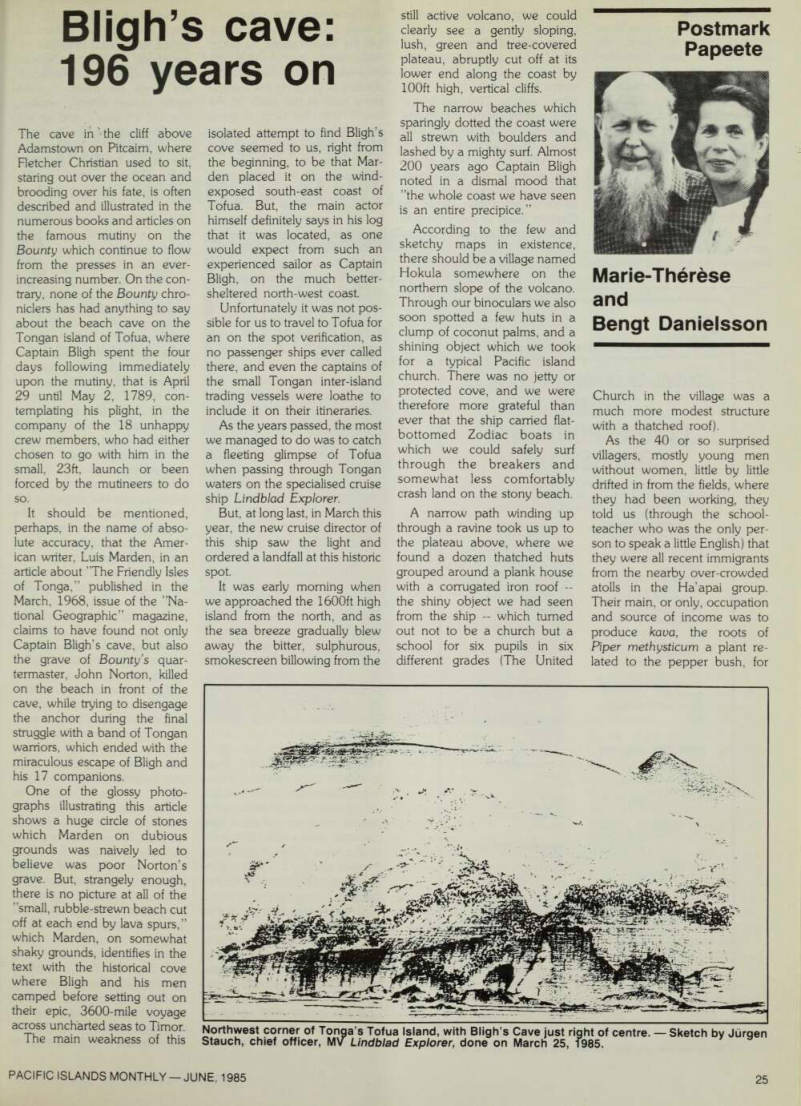
196 years on
The cave in' the cliff above Adamstown on Pitcairn, where Fletcher Christian used to sit, staring out over the ocean and brooding over his fate, is often described and illustrated in the numerous books and articles on the famous mutiny on the Bounty which continue to flow from the presses in an ever increasing number. On the con trary, none of the Bounty chro niclers has had anything to say about the beach cave on the Tongan island of Tofua, where Captain Bligh spent the four days following immediately upon the mutiny, that is April 29 until May 2, 1789, con templating his plight, in the company of the 18 unhappy crew members, who had either chosen to go with him in the small, 23ft, launch or been forced by the mutineers to do so.
It should be mentioned, perhaps, in the name of abso lute accuracy, that the Amer ican writer, Luis Marden, in an article about ’’The Friendly Isles of Tonga,” published in the March, 1968, issue of the ’’Na tional Geographic” magazine, claims to have found not only Captain Bligh’s cave, but also the grave of Bounty’s quar termaster, John Norton, killed on the beach in front of the cave, while trying to disengage the anchor during the final struggle with a band of Tongan warriors, which ended with the miraculous escape of Bligh and his 17 companions.
One of the glossy photo graphs illustrating this article shows a huge circle of stones which Marden on dubious grounds was naively led to believe was poor Norton’s grave. But, strangely enough, there is no picture at all of the ’’small, rubble-strewn beach cut off at each end by lava spurs,” which Marden, on somewhat shaky grounds, identifies in the text with the historical cove where Bligh and his men camped before setting out on their epic, 3600-mile voyage across uncharted seas to Timor.
The main weakness of this
isolated attempt to find Bligh’s cove seemed to us, right from the beginning, to be that Mar den placed it on the wind exposed south-east coast of Tofua. But, the main actor himself definitely says in his log that it was located, as one would expect from such an experienced sailor as Captain Bligh, on the much better sheltered north-west coast.
Unfortunately it was not pos sible for us to travel to Tofua for an on the spot verification, as no passenger ships ever called there, and even the captains of the small Tongan inter-island trading vessels were loathe to include it on their itineraries.
As the years passed, the most we managed to do was to catch a fleeting glimpse of Tofua when passing through Tongan waters on the specialised cruise ship Lindblad Explorer.
But, at long last, in March this year, the new cruise director of this ship saw the light and ordered a landfall at this historic spot.
It was early morning when we approached the 1600 ft high island from the north, and as the sea breeze gradually blew away the bitter, sulphurous, smokescreen billowing from the
still active volcano, we could clearly see a gently sloping, lush, green and tree-covered plateau, abruptly cut off at its lower end along the coast by 100 ft high, vertical cliffs.
The narrow beaches which sparingly dotted the coast were all strewn with boulders and lashed by a mighty surf. Almost 200 years ago Captain Bligh noted in a dismal mood that ’’the whole coast we have seen is an entire precipice.”
According to the few and sketchy maps in existence, there should be a village named Hokula somewhere on the northern slope of the volcano.
Through our binoculars we also soon spotted a few huts in a clump of coconut palms, and a shining object which we took for a typical Pacific island church. There was no jetty or protected cove, and we were therefore more grateful than ever that the ship carried flat bottomed Zodiac boats in which we could safely surf through the breakers and somewhat less comfortably crash land on the stony beach.
A narrow path winding up through a ravine took us up to the plateau above, where we found a dozen thatched huts grouped around a plank house with a corrugated iron roof the shiny object we had seen from the ship which turned out not to be a church but a school for six pupils in six different grades (The United
Postmark Papeete
Church in the village was a much more modest structure with a thatched roof).
As the 40 or so surprised villagers, mostly young men without women, little by little drifted in from the fields, where they had been working, they told us (through the school teacher who was the only per son to speak a little English) that they were all recent immigrants from the nearby over-crowded atolls in the Ha’apai group.
Their main, or only, occupation and source of income was to produce kaua, the roots of Piper methysticum a plant re lated to the pepper bush, for
Marie-Thérèse and Bengt Danielsson
Northwest corner of Tonga's Tofua Island, with Bligh’s Cave just right of centre. - Sketch by Jurgen Stauch, chief officer, MV Lindblad Explorer, done on March 25, 1985.
which they said there was a steady demand in Nuku’alofa.
Their problem was how to send the stuff to their customers across the turbulent waters and they all complained about the lack of ships.
There are, in fact, two more settlements of kava growers on Tofua, and the Tongan govern ment seems to encourage a migration there.
Being all relative newcomers, the only, not very useful, in formation the Hokula villagers could offer us, was that there were ’’quite a few” caves along the coast. As for the mutiny on
the Bounty they had, of course, never heard of it.
We offered them the usual gifts, which a long experience has taught us are the most appreciated; fish hooks and tobacco sticks. Then we set out on a bumpy zodiac ride up and down both the east and west coasts. Our conclusion was that only one cove, located at the north-west comer of the island, corresponded accurately to the detailed description made by Captain Bligh in the entries in his log which he made on the spot.
For instance, there is a 150
yard beach and in the back of it a cave 100 yards wide, which are the figures given by Bligh.
And, exactly as he writes, the only way to gain access to the plateau is to climb the vertical stone wall at the back of the beach with the help of vines growing in the interstices in the rock, as Bligh and his men did. (Bligh tells us that it was so exhausting he became dizzy).
The most decisive piece of evidence, however, is furnished by the position, as determined by Bligh with his sextant. It is 19deg 41 min. Considering the circumstances under which Bligh made this observation we did not expect it to be more than approximate. But, to our great surprise the captain of the Lindblad Explorer who had infinitely more sophisticated navigational equipment at his disposal, arrived at exactly the same figure. This, incidentally, constitutes still another tribute to Bligh’s splendid seamanship.
There can be, therefore, no doubt that we had found Bligh’s cove.
The Bounty men’s main problem during their four days in this cove was food, as the mutineers had given them in sufficient supplies for undertak ing a long sea voyage. No food plants were growing in the small cove, and it was a perilous and exhausting task to climb up to the plateau where, anyway, the few native huts and plantations were widely scattered.
To make their situation worse, Tongan warriors soon arrived by canoe and landed on the beach. Some of them had come all the way from Nomu ka, where they had been badly treated by Bligh a few days before the mutiny, and their intentions were clearly hostile.
From then on, Bligh and his unfortunate companions, who had no other arms than a few cutlasses, were virtual prisoners in the cave. How they finally escaped on May 2, 1789, is told by Captain Bligh in his entry for this day: ”1 had my log with me in the cave, writing up the occurr ences, and in sending it down (to the launch), it was nearly taken away, but for the timely assistance of the gunner. Every person who was now on shore with me boldly took up their proportion of things and car ried them to the boat. When the
(Tongan) chiefs asked me if I would not stay with them all night I said: ’No. / sleep out on my boat’... Macca-ackauow now got up and said: You will not sleep on shore - then matte (which directly implies, ’we will kill you’), and he left me. The onset was now prepar ing. Everyone kept knocking their stones together, and chief Eefow likewise quitted me. We had now all but two or three things in the boat. I then took chief Nageetee by the hand, and we walked down the beach, everyone in a silent kind of horror. ’’When we came down, Nageetee wanted me to speak to Eefow, bat I found he was encouraging them to attack, in which case,if it had begun, I determined to have killed him, and I ordered the carpenter to quit me, until the others were in the boat. Nageetee therefore finding I would not listen to him, quitted my hold and went off. We all got into the boat, except Norton, who, while I was getting on board, quitted the boat’s side and ran up the beach to cast the stem fast off, notwithstanding I heard the master and others calling to him to return, while they were hauling me out of the water. I was no sooner in the boat than the attack began by about 200 men. This unfortunate poor man was first knocked down, and the stones flew like a shower of shot. Many men got hold of the stem fast and were hauling us up on the shore, and would certainly have done so, if I had not had a knife in my pocket to cut it with ...in the course of this I saw five of the natives about poor Norton, whom they had killed, strug gling who should get his trous ers. ”Our grapnel was foul, but Providence here assisted us, as the fluke broke, and we got to our oars and pulled to sea.
They, however, could paddle around us, so that we were obliged to sustain the attack without being able to return it ... I therefore adopted the expe dient to throw over some cloths, which beguiled them, and they lost time in picking them up. By this means, and the night coming on, they at least quitted us to reflect on our unhappy situation.” Marie- Therese and Bengt Danielsson.
Advertisements & other items, p. 26 (1 item)
Correspondence
DARWIN INSTITUTE OF TECHNOLOGY
SCHOOL OF EXTENSION SERVICES
HOME
CORRESPONDENCE
COURSES 1985
These Courses are open to anyone Fees range from $30 to $95 Study at home at your own pace with no classes or examinations using self instructional materials. There are no entry requirements
ACCOUNTING. BUSINESS
□ Accounting 1&2 (Level ) [ 1 Accounting for Chanties □ A Guide to Marketing Techniques [ 1 Marketing and the Law 1 1 Sales Management I I Understanding Economics ! I Planning and Starting a Small Business
CHILDREN
Books and Children Child Development Educational Provisions for the Gifted The Young Handicapped Child
COMPUTING, STATISTICS
i I An Introduction to Computing I I Elementary Computer Programming I 1 Programming and Flowcharting ! 1 Applied Statistics I I Introductory Statistics
DRIVING
Advanced Driving
ENVIRONMENT,
TECHNOLOGY
□ Experimental Electronics f] Solar Energy 1 ! Digital Systems □ Natural Resources and Land Utilization ! I Mineralogy and Petrology I I Soil Conservation
HOBBY COURSES
1 I Hydroponics I The Wonderful World of Herbs
LANGUAGE COURSES
I I Indonesian Levels 1-4 (Level...)
PERSONAL. SOCIAL &
POLITICAL
1 I Stress & Personal Development i I Women in Australian Society i 1 Australian Political Systems I 1 Social and Political Themes in Modern Literature
RETURNING TO STUDY
I I Mathematics I 1 Practising Academic Skills Successfully (P A S S.) For more information on course fees and enrolment, tick the appropriate boxes, fill in your name and address, and send to:— The Co-ordinator, Home Correspondence, Darwin Institute of Technology, P.0 Box 40146, CASUARINA N T 5792 AUSTRALIA Name- Add ress- -Post code-
Major promotion in Oz, NZ, for
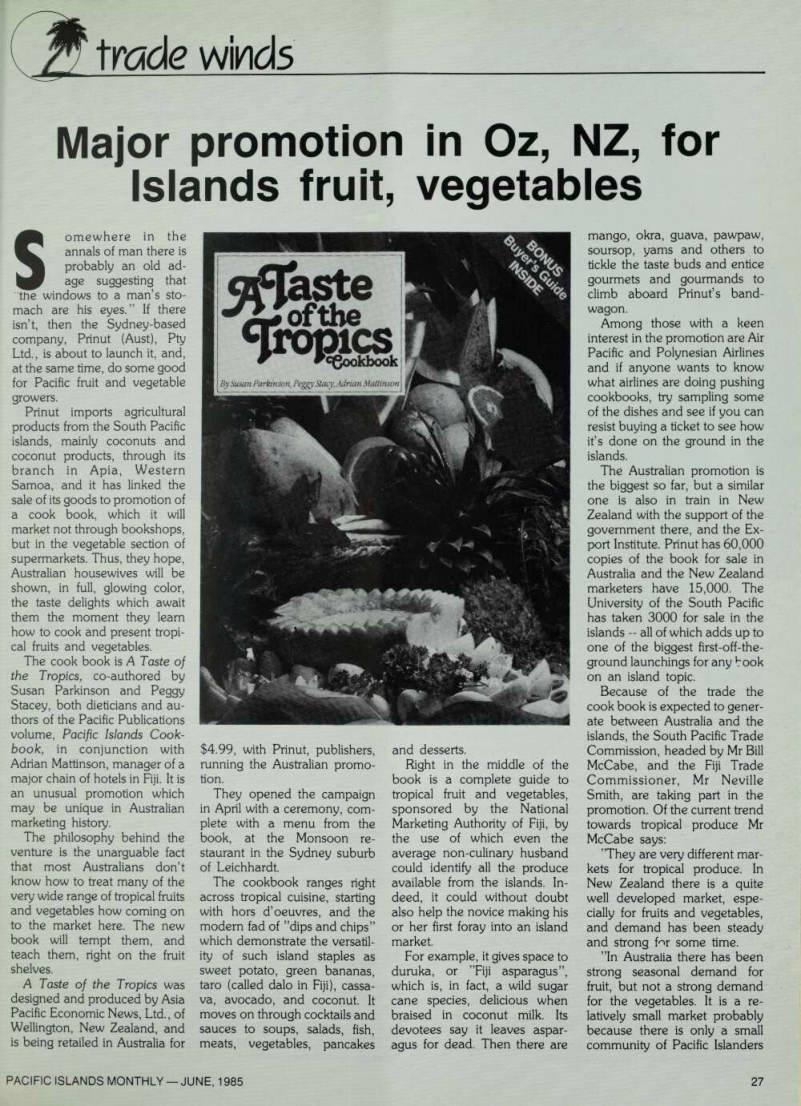

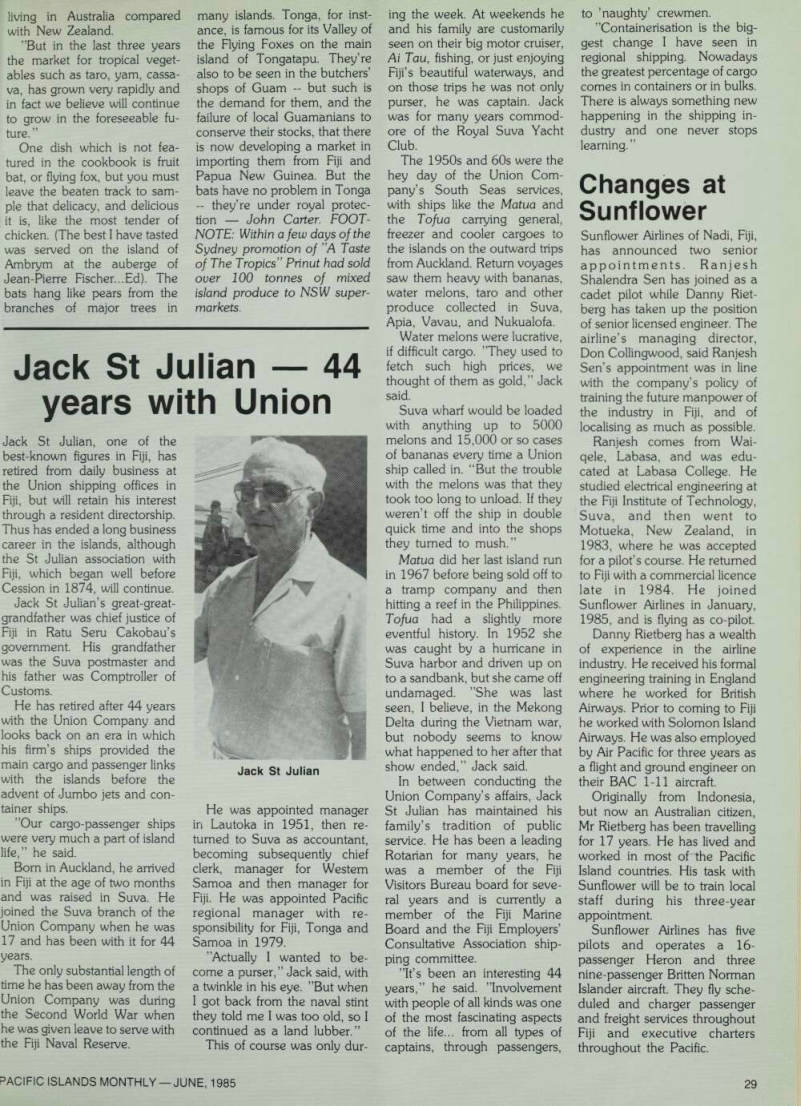
trade winds
Major promotion in Oz, NZ, for Islands fruit, vegetables
Somewhere in the annals of man there is probably an old ad age suggesting that the windows to a man’s sto mach are his eyes.” If there isn’t, then the Sydney-based company, Prinut (Aust), Pty Ltd., is about to launch it, and, at the same time, do some good for Pacific fruit and vegetable growers.
Prinut imports agricultural products from the South Pacific islands, mainly coconuts and coconut products, through its branch in Apia, Western Samoa, and it has linked the sale of its goods to promotion of a cook book, which it will market not through bookshops, but in the vegetable section of supermarkets. Thus, they hope, Australian housewives will be shown, in full, glowing color, the taste delights which await them the moment they leam how to cook and present tropi cal fruits and vegetables.
The cook book is A Taste of the Tropics, co-authored by Susan Parkinson and Peggy Stacey, both dieticians and au thors of the Pacific Publications volume, Pacific Islands Cook book, in conjunction with Adrian Mattinson, manager of a major chain of hotels in Fiji. It is an unusual promotion which may be unique in Australian marketing history.
The philosophy behind the venture is the unarguable fact that most Australians don’t know how to treat many of the very wide range of tropical fruits and vegetables how coming on to the market here. The new book will tempt them, and teach them, right on the fruit shelves.
A Taste of the Tropics was designed and produced by Asia Pacific Economic News, Ltd., of Wellington, New Zealand, and is being retailed in Australia for
$4.99, with Prinut, publishers, running the Australian promo tion.
They opened the campaign in April with a ceremony, com plete with a menu from the book, at the Monsoon re staurant in the Sydney suburb of Leichhardt.
The cookbook ranges right across tropical cuisine, starting with hors d’oeuvres, and the modern fad of ’’dips and chips” which demonstrate the versatil ity of such island staples as sweet potato, green bananas, taro (called dalo in Fiji), cassa va, avocado, and coconut. It moves on through cocktails and sauces to soups, salads, fish, meats, vegetables, pancakes
and desserts.
Right in the middle of the book is a complete guide to tropical fruit and vegetables, sponsored by the National Marketing Authority of Fiji, by the use of which even the average non-culinary husband could identify all the produce available from the islands. In deed, it could without doubt also help the novice making his or her first foray into an island market.
For example, it gives space to duruka, or ’’Fiji asparagus”, which is, in fact, a wild sugar cane species, delicious when braised in coconut milk. Its devotees say it leaves aspar agus for dead. Then there are
mango, okra, guava, pawpaw, soursop, yams and others to tickle the taste buds and entice gourmets and gourmands to climb aboard Prinut’s band wagon.
Among those with a keen interest in the promotion are Air Pacific and Polynesian Airlines and if anyone wants to know what airlines are doing pushing cookbooks, try sampling some of the dishes and see if you can resist buying a ticket to see how it’s done on the ground in the islands.
The Australian promotion is the biggest so far, but a similar one is also in train in New Zealand with the support of the government there, and the Ex port Institute. Prinut has 60,000 copies of the book for sale in Australia and the New Zealand marketers have 15,000. The University of the South Pacific has taken 3000 for sale in the islands - all of which adds up to one of the biggest first-off-the ground launchings for any book on an island topic.
Because of the trade the cook book is expected to gener ate between Australia and the islands, the South Pacific Trade Commission, headed by Mr Bill McCabe, and the Fiji Trade Commissioner, Mr Neville Smith, are taking part in the promotion. Of the current trend towards tropical produce Mr McCabe says; ’They are very different mar kets for tropical produce. In New Zealand there is a quite well developed market, espe cially for fruits and vegetables, and demand has been steady and strong for some time.
Tn Australia there has been strong seasonal demand for fruit, but not a strong demand for the vegetables. It is a re latively small market probably because there is only a small community of Pacific Islanders
living in Australia compared with New Zealand. ’’But in the last three years the market for tropical veget ables such as taro, yam, cassa va, has grown very rapidly and in fact we believe will continue to grow in the foreseeable fu ture.”
One dish which is not fea tured in the cookbook is fruit bat, or flying fox, but you must leave the beaten track to sam ple that delicacy, and delicious it is, like the most tender of chicken. (The best I have tasted was served on the island of Ambrym at the auberge of Jean-Pierre Fischer...Ed). The bats hang like pears from the branches of major trees in
many islands. Tonga, for inst ance, is famous for its Valley of the Flying Foxes on the main island of Tongatapu. They’re also to be seen in the butchers’ shops of Guam -- but such is the demand for them, and the failure of local Guamanians to conserve their stocks, that there is now developing a market in importing them from Fiji and Papua New Guinea. But the bats have no problem in Tonga they’re under royal protec tion John Carter. FOOT NOTE: Within a few days of the Sydney promotion of ”A Taste of The Tropics” Prinut had sold over 100 tonnes of mixed island produce to NSW super markets.
Advertisements & other items, p. 28 (1 item)
Hd Pioneer*
K
Shelf Component Systems
I ♦
n COMPACT
mm X-90C
DIGITAL AUDIO
Serious about sound? Get Personna
Speaking personally, don’t you prefer good sound over garble, clean design over clutter, easy control over confusion? If so, you’re the sort of person who takes sound (and sound systems) seriously—a PERSONNA sort of person.
Pioneer PERSONNA systems are crafted to suit your personal way of living. Sound quality is rich and clean so you won’t miss a single note or nuance. The compact size is ideal for your personal living space. And because they are designed by people who enjoy music as much as you do, program selection and control are as simple as can be.
At the top of the line is the handsome PERSONNA X-900—a real “black beauty” with a powerful musical output of 85 watts per channel. That’s more than enough to fill your largest listening room.
The X-900’s one-touch Auto Function and other simple controls give you immediate access to the turntable, tuner, the auto-reverse cassette deck and so on. With the wireless REMOTE CONTROLLER in hand, you can control just about every function the X-900 offers—including those of the optional, matching P-DX7OO Compact Disc Player, pictured above.
If the X-900 is a little too much “music machine” for you, give serious consideration to its “sister systems”—the X-700, X-500, X-300/300S, or X-100/100S. All have the high technology, sophisticated styling and professional craftsmanship that make Pioneer PERSONNA the personal choice of anyone really serious about sound.
HD PIONEER*
For further information, please contact: Australia: Pioneer Electronics Australia Pty. Ltd. (Incorporated in Victoria), P.O. Box 295, Mordialloc, Victoria, 3195 Tel: 580-9911 Fiji Islands: Brijlal & Company, G.P.O. Box No. 362, Suva, Fiji Islands Tel: 22258 New Zealand: Monaco Distributors Ltd., 2 Poland Road, Glenfield, Auckland, New Zealand Tel: (09) 444-9144 Norfolk Island: Burns Philp (Norfolk Island) Ltd., P.O. Box 21, Norfolk Island Vanuatu: Burns Philp (Vanuatu) Ltd., Vila, Vanuatu Nauru Island: Jacob Enterprises, P.O. Box No. 4, Republic of Nauru Tahiti: Tahiti Hi-Fi, P.O. Box 848, Papeete, Tahiti New Caledonia: Menard Pacifique Sari, B.P. 3899, Noumea, New Caledonia Tel: 27.62*23 American Samoa: Transpac Corporation, P.O. Box 1477, Pago Pago, American Samoa 96799 Tel: 633-5224 Rarotonga; South Seas International Ltd., P.O. Box 49, Rarotonga, Cook Islands Tel: 2327 Papua New Guinea: Bali Merchants Pty. Ltd., P.O. Box 6103, Boroko Tel: 254887
Jack St Julian - 44
years with Union
Jack St Julian, one of the best-known figures in Fiji, has retired from daily business at the Union shipping offices in Fiji, but will retain his interest through a resident directorship.
Thus has ended a long business career in the islands, although the St Julian association with Fiji, which began well before Cession in 1874, will continue.
Jack St Julian’s great-great grandfather was chief justice of Fiji in Ratu Seru Cakobau’s government. His grandfather was the Suva postmaster and his father was Comptroller of Customs.
He has retired after 44 years with the Union Company and looks back on an era in which his firm’s ships provided the main cargo and passenger links with the islands before the advent of Jumbo jets and con tainer ships. ”Our cargo-passenger ships were very much a part of island life,” he said.
Born in Auckland, he arrived in Fiji at the age of two months and was raised in Suva. He joined the Suva branch of the Union Company when he was 17 and has been with it for 44 years.
The only substantial length of time he has been away from the Union Company was during the Second World War when he was given leave to serve with the Fiji Naval Reserve.
He was appointed manager in Lautoka in 1951, then re turned to Suva as accountant,
becoming subsequently chief
clerk, manager for Western Samoa and then manager for Fiji. He was appointed Pacific regional manager with re sponsibility for Fiji, Tonga and Samoa in 1979. ’’Actually I wanted to be come a purser,” Jack said, with a twinkle in his eye. ’’But when I got back from the naval stint they told me I was too old, so I continued as a land lubber.”
This of course was only dur
ing the week. At weekends he and his family are customarily seen on their big motor cruiser, Ai Tau, fishing, or just enjoying Fiji’s beautiful waterways, and on those trips he was not only purser, he was captain. Jack was for many years commod ore of the Royal Suva Yacht Club.
The 1950 s and 60s were the hey day of the Union Com pany’s South Seas services, with ships like the Matua and the Tofua carrying general, freezer and cooler cargoes to the islands on the outward trips from Auckland. Return voyages saw them heavy with bananas, water melons, taro and other produce collected in Suva, Apia, Vavau, and Nukualofa.
Water melons were lucrative, if difficult cargo. ’’They used to fetch such high prices, we thought of them as gold,” Jack said.
Suva wharf would be loaded with anything up to 5000 melons and 15,000 or so cases of bananas every time a Union ship called in. “But the trouble with the melons was that they took too long to unload. If they weren’t off the ship in double quick time and into the shops they turned to mush.”
Matua did her last island run in 1967 before being sold off to a tramp company and then hitting a reef in the Philippines.
Tofua had a slightly more eventful history. In 1952 she was caught by a hurricane in Suva harbor and driven up on to a sandbank, but she came off undamaged. ’’She was last seen, I believe, in the Mekong Delta during the Vietnam war, but nobody seems to know what happened to her after that show ended,” Jack said.
In between conducting the Union Company’s affairs, Jack St Julian has maintained his family’s tradition of public service. He has been a leading Rotarian for many years, he was a member of the Fiji Visitors Bureau board for seve ral years and is currently a member of the Fiji Marine Board and the Fiji Employers’
Consultative Association ship ping committee. ”It’s been an interesting 44 years,” he said. ’’lnvolvement with people of all kinds was one of the most fascinating aspects of the life... from all types of captains, through passengers,
to ’naughty’ crewmen. ’’Containerisation is the big gest change I have seen in regional shipping. Nowadays the greatest percentage of cargo comes in containers or in bulks.
There is always something new happening in the shipping in dustry and one never stops learning. ”
Changes at
Sunflower
Sunflower Airlines of Nadi, Fiji, has announced two senior appointments. Ranjesh Shalendra Sen has joined as a cadet pilot while Danny Riet berg has taken up the position of senior licensed engineer. The airline’s managing director, Don Collingwood, said Ranjesh Sen’s appointment was in line with the company’s policy of training the future manpower of the industry in Fiji, and of localising as much as possible.
Ranjesh comes from Wai qele, Labasa, and was edu cated at Labasa College. He studied electrical engineering at the Fiji Institute of Technology, Suva, and then went to Motueka, New Zealand, in 1983, where he was accepted for a pilot’s course. He returned to Fiji with a commercial licence late in 1984. He joined Sunflower Airlines in January, 1985, and is flying as co-pilot.
Danny Rietberg has a wealth of experience in the airline industry. He received his formal engineering training in England where he worked for British Airways. Prior to coming to Fiji he worked with Solomon Island Airways. He was also employed by Air Pacific for three years as a flight and ground engineer on their BAC 1-11 aircraft.
Originally from Indonesia, but now an Australian citizen, Mr Rietberg has been travelling for 17 years. He has lived and worked in most of the Pacific Island countries. His task with Sunflower will be to train local staff during his three-year appointment.
Sunflower Airlines has five pilots and operates a 16passenger Heron and three nine-passenger Britten Norman Islander aircraft. They fly sche duled and charger passenger and freight services throughout Fiji and executive charters throughout the Pacific.
Jack St Julian
Advertisements & other items, pp. 30-31 (1 item)
Toyota
msi
QUALITY SERVICE
AMERICAN SAMOA: BURNS PHILP (SOUTH SEA) CO., LTD., P.O. Box 129, Pago Pago.
COOK ISLANDS: COOK ISLANDS TRADING
CORPORATION LTD., Private Bag, Rarotonga.
FIJI: AUTOMOTIVE SUPPLIES COMPANY, A Division of Burns Philp (South Sea) Co., Ltd., G.P.O. Box 355, Suva.
GUAM & MICRONESIA: ATKINS KROLL, INC., 443 South Marine Drive, Tamuning.
KIRIBATI: TARAWA MOTORS, P.O. Box 36, Bairiki, Tarawa.
NAURU: NAURU COOPERATIVE SOCIETY, Central
Pacific.
NEW CALEDONIA: SERVICE IMPORTATION
AUTOMOBILE DU PACIFIQUE, Rond-Point du Pacific (Station Total) B.P. 438, Noumea.
NORFOLK ISLAND: BORRYS LIMITED, P.O. Box 1 PAPUA NEW GUINEA: ELA MOTORS, A Division Burns Philp (PNG) Ltd., P.O. Box 75, Port Moresby.
SAIPAN: MICROL CORPORATION, P.O. Box 267, Saip
he tradition of power and ruggedness goes on. oyota’s new Land Cruiser has been entirely esigned from the road up. But it still Jins the traditional toughness luired from over thirty years oad experience. ; 5 But no matter how rough it gets a roomy new cabin with improved occupant comforts, easy instrumentation and an optional 4-speed automatic transmission add up to passenger car comfort with Land Cruiser ruggedness.
Pickup
More power in hand and fuel efficiency have been gained with a new brawny 4.0-litre gasoline engine.
And to control all that power a new rigid chassis assures stable driving performance and mobility over the roughest terrain. r And you can choose from a wide variety of models and an array of heavy-duty features.
Take the wheel and feel Toyota quality in Land Cruiser’s styling, power and comfort. A quality that stays with you on or off the road.
Step into a new generation of toughness today.
.OMON: SOLOMON ISLANDS INVESTMENTS LTD.,
0. Box 174, Honiara.
UTI: NIPPON AUTOMOTO, B.P. 342, Papeete.
IGA; BURNS PHILP (SOUTH SEA) CO., LTD., P.O. 55, Nuku’alofa. lUATU: VANUATU MOTORS, A Division of Burns p (Vanuatu) Ltd., P.O. Box 18, Port Vila.
STERN SAMOA: BURNS PHILP (SOUTH SEA) CO., P.O, Box 188, Apia.
I m ■
political currents
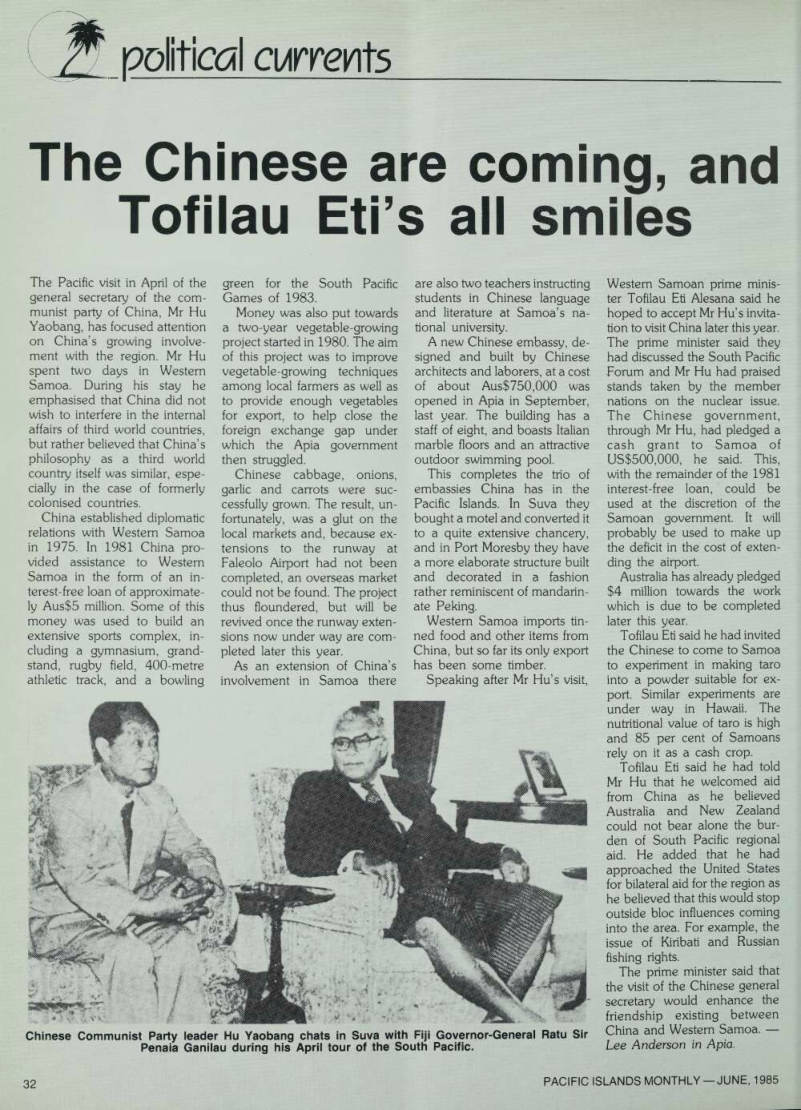
The Chinese are coming, and Tofilau Eti’s all smiles
The Pacific visit in April of the general secretary of the com munist party of China, Mr Hu Yaobang, has focused attention on China’s growing involve ment with the region. Mr Hu spent two days in Western Samoa. During his stay he emphasised that China did not wish to interfere in the internal affairs of third world countries, but rather believed that China’s philosophy as a third world country itself was similar, espe cially in the case of formerly colonised countries.
China established diplomatic relations with Western Samoa in 1975. In 1981 China pro vided assistance to Western Samoa in the form of an in terest-free loan of approximate ly Ausss million. Some of this money was used to build an extensive sports complex, in cluding a gymnasium, grand stand, rugby field, 400-metre athletic track, and a bowling
green for the South Pacific Games of 1983.
Money was also put towards a two-year vegetable-growing project started in 1980. The aim of this project was to improve vegetable-growing techniques among local farmers as well as to provide enough vegetables for export, to help close the foreign exchange gap under which the Apia government then struggled.
Chinese cabbage, onions, garlic and carrots were suc cessfully grown. The result, un fortunately, was a glut on the local markets and, because ex tensions to the runway at Faleolo Airport had not been completed, an overseas market could not be found. The project thus floundered, but will be revived once the runway exten sions now under way are com pleted later this year.
As an extension of China’s involvement in Samoa there
are also two teachers instructing students in Chinese language and literature at Samoa’s na tional university.
A new Chinese embassy, de signed and built by Chinese architects and laborers, at a cost of about Auss7so,ooo was opened in Apia in September, last year. The building has a staff of eight, and boasts Italian marble floors and an attractive outdoor swimming pool.
This completes the trio of embassies China has in the Pacific Islands. In Suva they bought a motel and converted it to a quite extensive chancery, and in Port Moresby they have a more elaborate structure built and decorated in a fashion rather reminiscent of mandarin ate Peking.
Western Samoa imports tin ned food and other items from China, but so far its only export has been some timber.
Speaking after Mr Hu’s visit,
Western Samoan prime minis ter Tofilau Eti Alesana said he hoped to accept Mr Hu’s invita tion to visit China later this year.
The prime minister said they had discussed the South Pacific Forum and Mr Hu had praised stands taken by the member nations on the nuclear issue.
The Chinese government, through Mr Hu, had pledged a cash grant to Samoa of US$5OO,OOO, he said. This, with the remainder of the 1981 interest-free loan, could be used at the discretion of the Samoan government. It will probably be used to make up the deficit in the cost of exten ding the airport.
Australia has already pledged $4 million towards the work which is due to be completed later this year.
Tofilau Eti said he had invited the Chinese to come to Samoa to experiment in making taro into a powder suitable for ex port. Similar experiments are under way in Hawaii. The nutritional value of taro is high and 85 per cent of Samoans rely on it as a cash crop.
Tofilau Eti said he had told Mr Hu that he welcomed aid from China as he believed Australia and New Zealand could not bear alone the bur den of South Pacific regional aid. He added that he had approached the United States for bilateral aid for the region as he believed that this would stop outside bloc influences coming into the area. For example, the issue of Kiribati and Russian fishing rights.
The prime minister said that the visit of the Chinese general secretary would enhance the friendship existing between China and Western Samoa.
Lee Anderson in Apia.
Chinese Communist Party leader Hu Yaobang chats in Suva with Fiji Governor-General Ratu Sir Penaia Ganilau during his April tour of the South Pacific.
meeting in Nairobi
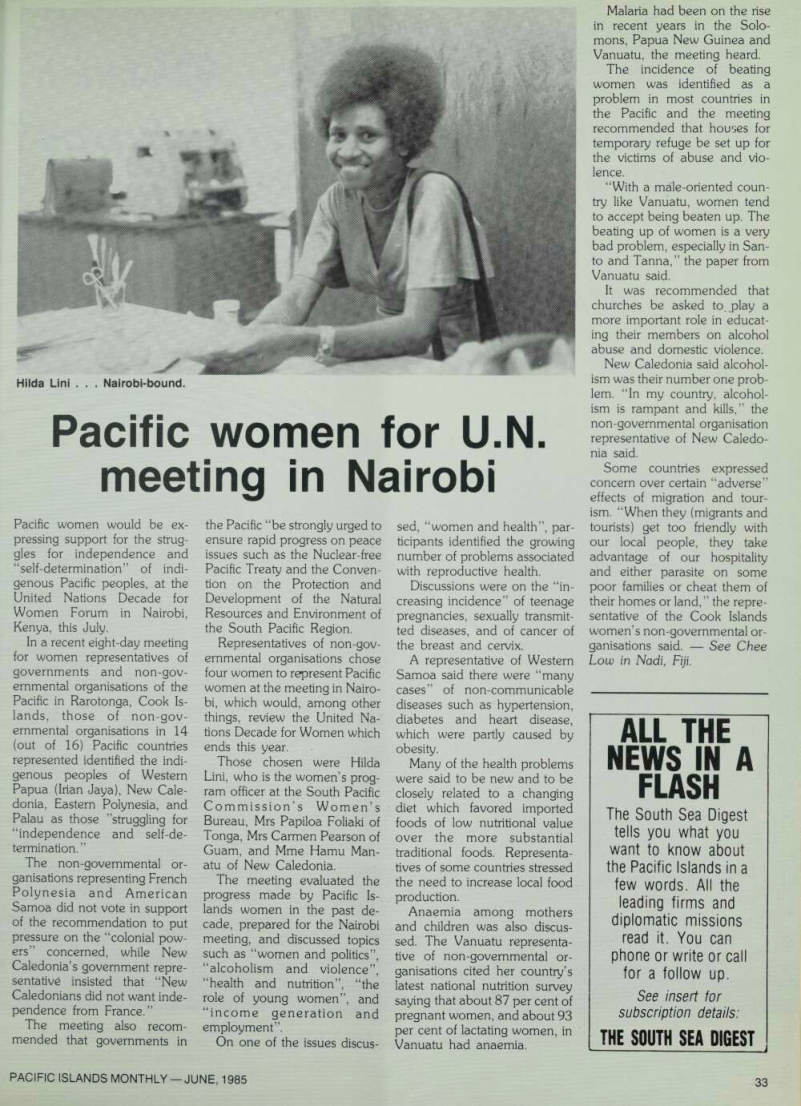
Pacific women for U.N. meeting in Nairobi
Pacific women would be ex pressing support for the strug gles for independence and “self-determination” of indi genous Pacific peoples, at the United Nations Decade for Women Forum in Nairobi, Kenya, this July.
In a recent eight-day meeting for women representatives of governments and non-gov ernmental organisations of the Pacific in Rarotonga, Cook Is lands, those of non-gov ernmental organisations in 14 (out of 16) Pacific countries represented identified the indi genous peoples of Western Papua (Irian Jaya), New Cale donia, Eastern Polynesia, and Palau as those ’’struggling for “independence and self-de termination. ”
The non-governmental or ganisations representing French Polynesia and American Samoa did not vote in support of the recommendation to put pressure on the “colonial pow ers” concerned, while New Caledonia’s government repre sentative insisted that “New Caledonians did not want inde pendence from France.”
The meeting also recom mended that governments in
the Pacific “be strongly urged to ensure rapid progress on peace issues such as the Nuclear-free Pacific Treaty and the Conven tion on the Protection and Development of the Natural Resources and Environment of the South Pacific Region.
Representatives of non-gov ernmental organisations chose four women to represent Pacific women at the meeting in Nairo bi, which would, among other things, review the United Na tions Decade for Women which ends this year.
Those chosen were Hilda Lini, who is the women’s prog ram officer at the South Pacific Commission’s Women’s Bureau, Mrs Papiloa Foliaki of Tonga, Mrs Carmen Pearson of Guam, and Mme Hamu Man atu of New Caledonia.
The meeting evaluated the progress made by Pacific Is lands women in the past de cade, prepared for the Nairobi meeting, and discussed topics such as “women and politics”, “alcoholism and violence”, “health and nutrition”, “the role of young women”, and “income generation and employment”.
On one of the issues discus
sed, “women and health”, par ticipants identified the growing number of problems associated with reproductive health.
Discussions were on the “in creasing incidence” of teenage pregnancies, sexually transmit ted diseases, and of cancer of the breast and cervix.
A representative of Western Samoa said there were “many cases” of non-communicable diseases such as hypertension, diabetes and heart disease, which were partly caused by obesity.
Many of the health problems were said to be new and to be closely related to a changing diet which favored imported foods of low nutritional value over the more substantial traditional foods. Representa tives of some countries stressed the need to increase local food production.
Anaemia among mothers and children was also discus sed. The Vanuatu representa tive of non-governmental or ganisations cited her country’s latest national nutrition survey saying that about 87 per cent of pregnant women, and about 93 per cent of lactating women, in Vanuatu had anaemia.
Malaria had been on the rise in recent years in the Solo mons, Papua New Guinea and Vanuatu, the meeting heard.
The incidence of beating women was identified as a problem in most countries in the Pacific and the meeting recommended that houses for temporary refuge be set up for the victims of abuse and vio lence.
“With a male-oriented coun try like Vanuatu, women tend to accept being beaten up. The beating up of women is a very bad problem, especially in San to and Tanna,” the paper from Vanuatu said.
It was recommended that churches be asked to_play a more important role in educat ing their members on alcohol abuse and domestic violence.
New Caledonia said alcohol ism was their number one prob lem. “In my country, alcohol ism is rampant and kills,” the non-governmental organisation representative of New Caledo nia said.
Some countries expressed concern over certain “adverse” effects of migration and tour ism. “When they (migrants and tourists) get too friendly with our local people, they take advantage of our hospitality and either parasite on some poor families or cheat them of their homes or land,” the repre sentative of the Cook Islands women’s non-governmental or ganisations said. See Chee Low in Nadi, Fiji.
Hilda Lini . . . Nairobi-bound.
Advertisements & other items, pp. 33-34 (1 item)
Flash
ALL THE
NEWS IN A
The South Sea Digest tells you what you want to know about the Pacific Islands in a few words. All the leading firms and diplomatic missions read it. You can phone or write or call for a follow up.
See insert for subscription details:
THE SOUTH SEA DIGEST
Its not the luck of a leprechaun but the craft of Clarion that will lead you to uncompromising stereo sound quality. Even in the compromising environment of a moving automobile. Clarions advanced electronics makes possible a wide spectrum of convenient, easy-to-use features The Clarion choice of models is positively dazzling. And our reliability is IPI f in ft no fairy tale. Come, listen to a Clarion Car Stereo. And drive happily ever after, I ILII THE TREASURE AT THE END OF THE RAINBOW % 18 ii : • If I mrh • a
I At D
—rrr Pi M i n r 11111 n » HU For further information Australia: Amalgamated Wireless (Australasia) Ltd, 554 Parramatta Road, Ashfield, N.S.W., 2131 / New Zealand: AWA New Zealand Limited, P.O. Box 50-248, Porirua / Fiji Islands; Bnjlal & Co., Ltd, G PO. Box 362, Suva Tahiti: HI FI., VAIRAATOA. Avenue Chef Vairaatoa B.P. 1128, Papeete / New Caledonia: Caldis, 8.P.M1, Noumea Cedex / Guam: Micropac Audio Inc., P.O. Box 3478, Agana, Guam 96910, U.S.A Tel: 472-8091, Cable Code HIFI AUDIO AGANA / Vanuatu: The Sound Centre, PO. Box 434, Vila / Cook Islands: South Seas International Ltd., PO. Box 49, Rarotonga / Papua New Guinea: Hagemeyer (P N G.) Pty Ltd, P.O. Box 1428, Boroko, Port Moresby,
Today’s Pacific: Heroic overview
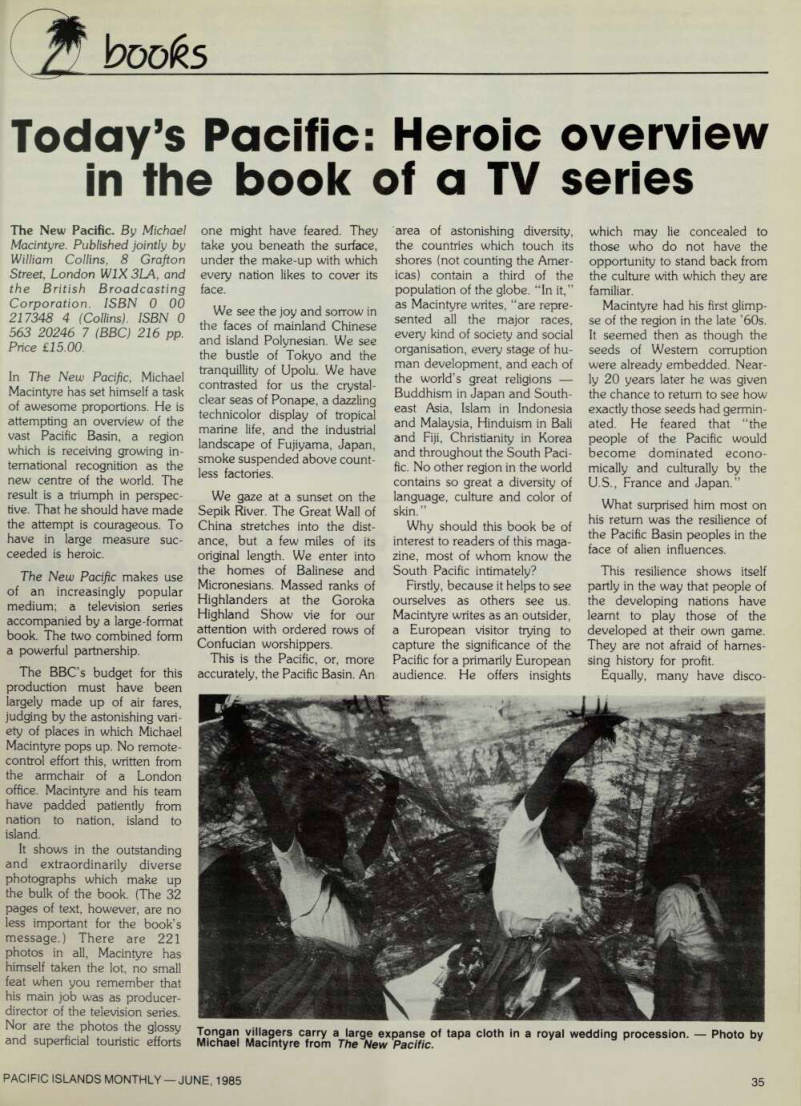
books
Today’s Pacific: Heroic overview in the book of a TV series
The New Pacific. By Michael Macintyre. Published jointly by William Collins, 8 Grafton Street, London WIX SLA, and the British Broadcasting Corporation. ISBN 0 00 217348 4 (Collins). ISBN 0 563 20246 7 (BBC) 216 pp.
Price £15.00.
In The New Pacific, Michael Macintyre has set himself a task of awesome proportions. He is attempting an overview of the vast Pacific Basin, a region which is receiving growing in ternational recognition as the new centre of the world. The result is a triumph in perspec tive. That he should have made the attempt is courageous. To have in large measure suc ceeded is heroic.
The New Pacific makes use of an increasingly popular medium; a television series accompanied by a large-format book. The two combined form a powerful partnership.
The BBC’s budget for this production must have been largely made up of air fares, judging by the astonishing vari ety of places in which Michael Macintyre pops up. No remote control effort this, written from the armchair of a London office. Macintyre and his team have padded patiently from nation to nation, island to island.
It shows in the outstanding and extraordinarily diverse photographs which make up the bulk of the book. (The 32 pages of text, however, are no less important for the book’s message.) There are 221 photos in all, Macintyre has himself taken the lot, no small feat when you remember that his main job was as producer director of the television series.
Nor are the photos the glossy and superficial touristic efforts
one might have feared. They take you beneath the surface, under the make-up with which every nation likes to cover its face.
We see the joy and sorrow in the faces of mainland Chinese and island Polynesian. We see the bustle of Tokyo and the tranquillity of Upolu. We have contrasted for us the crystal clear seas of Ponape, a dazzling technicolor display of tropical marine life, and the industrial landscape of Fujiyama, Japan, smoke suspended above count less factories.
We gaze at a sunset on the Sepik River. The Great Wall of China stretches into the dist ance, but a few miles of its original length. We enter into the homes of Balinese and Micronesians. Massed ranks of Highlanders at the Goroka Highland Show vie for our attention with ordered rows of Confucian worshippers.
This is the Pacific, or, more accurately, the Pacific Basin. An
area of astonishing diversity, the countries which touch its shores (not counting the Amer icas) contain a third of the population of the globe. “In it,” as Macintyre writes, “are repre sented all the major races, every kind of society and social organisation, every stage of hu man development, and each of the world’s great religions Buddhism in Japan and South east Asia, Islam in Indonesia and Malaysia, Hinduism in Bali and Fiji, Christianity in Korea and throughout the South Paci fic. No other region in the world contains so great a diversity of language, culture and color of skin.”
Why should this book be of interest to readers of this maga zine, most of whom know the South Pacific intimately?
Firstly, because it helps to see ourselves as others see us.
Macintyre writes as an outsider, a European visitor trying to capture the significance of the Pacific for a primarily European audience. He offers insights
which may lie concealed to those who do not have the opportunity to stand back from the culture with which they are familiar.
Macintyrc had his first glimp se of the region in the late ’6os.
It seemed then as though the seeds of Western corruption were already embedded. Near ly 20 years later he was given the chance to return to see how exactly those seeds had germin ated. He feared that “the people of the Pacific would become dominated econo mically and culturally by the U.S., France and Japan.”
What surprised him most on his return was the resilience of the Pacific Basin peoples in the face of alien influences.
This resilience shows itself partly in the way that people of the developing nations have leamt to play those of the developed at their own game.
They are not afraid of harnes sing history for profit.
Equally, many have disco-
Tongan villagers carry a large expanse of tapa cloth in a royal wedding procession. Photo by Michael Macintyre from The New Pacific.
vered how to take what is on offer from the West without being taken over by it.
All this is of great encourage ment to Macintyre. “I had ex pected to be depressed by what I saw. I thought that the little cultures would be swamped by the big ones. Instead they are . . . making a stand to pre serve their own cultures.”
A second reason for reading this book is that it challenges us to stretch our vision. It compels us to widen our perspective.
The South Pacific must see itself as part of a regional family, members of which may at first glance appear to have little in common, but who are in fact interdependent.
Take natural resources, for example. The nations on the west Pacific rim (excluding the Soviet Union and Vietnam) possess half the world’s iron, 59 per cent of its copper, 57 per cent of its nickel, and 74 per cent of its tin. The region has 61 per cent of world coal reserves and at least 20 per cent of its oil.
Yet the most dynamic industrial nation of the area, Japan, is forced to import 87 per cent of its fuel, 99 per cent of its iron ore and its entire supply of nickel and cadmium.
And just as Japan needs what the other Pacific nations have to offer (including their marine resources), who can doubt that her neighbors need the tech nological and industrial con tribution of Japan if the living standard of their people is to be adequate?
It is salutary, necessary, even exciting, to have our perception of the Pacific extended.
Macintyre’s text focuses on four issues which are shaping the destiny of the Pacific peoples.
The first is defence, a subject which goes some way towards explaining the interest of the superpowers in the region.
The second is communica tions, and the indiscriminate impact of the Western media on the cultures of the Pacific.
Third comes tourism, “prob ably the most powerful agent of change in the Pacific”.
And lastly, art and identity.
Running through all this and in a final chapter entitled “The Future: Made in Japan?” the special importance and role of Japan is highlighted.
Profound and helpful insights into the Japanese mind are offered, contributing much to our understanding of this re markable people whose be havior (especially on tourist trips!) often causes bafflement Take the following by way of example. “A Japanese at home belongs to a variety of groups his family, his former class mates, his work group and his immediate neighborhood being the most important of these.
When he travels he joins yet another group the tour group but usually leaves the other groups behind. He goes, in effect, as the representative, and this places social obliga tions on him . . .
“Providing he fulfils those obligations, the Japanese tour ist suddenly finds himself free of the usual social constraints the moment he leaves his home environment.
“Perhaps this goes some way towards explaining the atroci ties of the Pacific War commit ted by men far from home. The Japanese religions, Buddhism
and Shinto, do not burden their followers with the sense of guilt and conscience which are char acteristic of Christianity. As a result the Japanese are eminently pragmatic and adapt able people, but since their thought and actions are so powerfully dependent on the expectations of Japanese so ciety, their behavior may be quite unpredictable when they are separated from it.”
The importance of the Japanese, in the opinion of Michael Maclntyre, cannot be over-estimated. They believe that the world lies at their feet and they may be right. As one Japanese businessman said candidily: “We know how we want the future. We will use the U.S. as our grain bowl, and Australia as our mine. And Europe? Europe yes, that will be our boutique.”
Indeed, one has to look no further than the home of almost any Pacific family to recognise the impact made by Japan’s drive.
If this book lacks anything, it
is perhaps an adequate evalua tion of the role of religion in the lives of the people of the Pacific. The Christian faith of Pacific Islanders in particular receives little appreciation.
But, overall, The New Pacific is a splendid book. It informs. It entertains. And most of all it inspires. Of course it can do little more than paint the broad outlines of what is an immense picture. But it leaves us with powerful images, in picture and word. Images of the Pacific as it is. Images of the Pacific as it could be.
What lingers is the vision that is well expressed in the words of Japan’s Zenko Suzuki: “We are today standing at a historic crossroads, where the many civilisations encounter each other in this Pacific region. We are witnessing the birth of a civilisation which nurtures ideas and creativity precisely because it is so rich in diversity. This is the beginning of the Pacific Age, an age which will open the doors of the 21st century.”
Edward Peters.
Miklouho-Maclay: Bringing
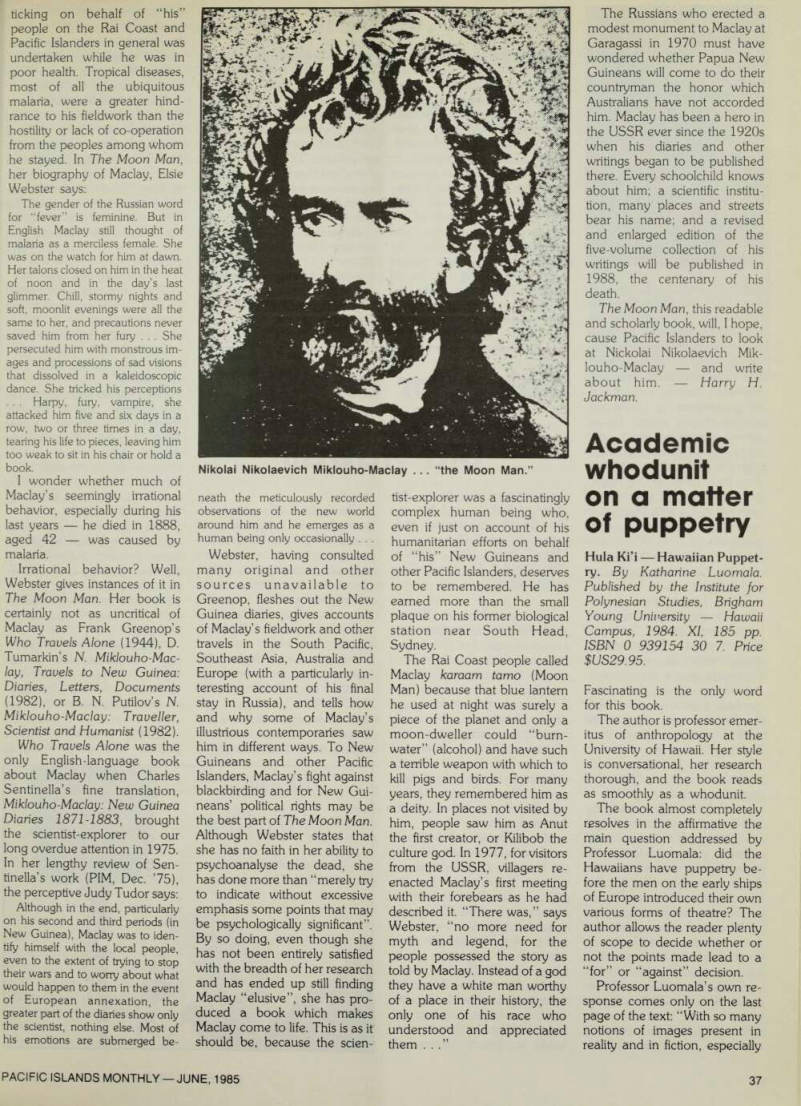
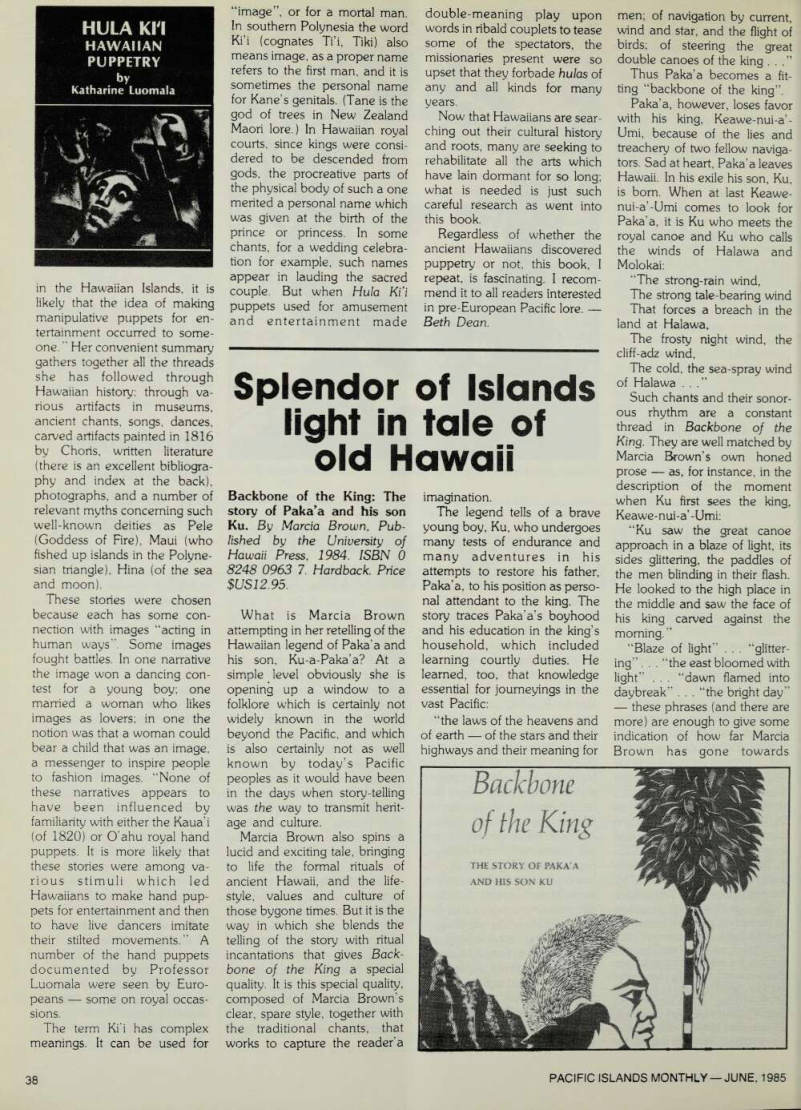
the elusive Moon Man to life
The Moon Man. By E. M.
Webster. Published by Mel bourne University Press, Carl ton, 1984. ISBN 0 522 84293 3. Price SA33.
It is very likely that Nikolai Nikolaevich Miklouho-Maclay was the first white scientist to live among people who had not seen a white man before; his two sojourns, in 1871-72 and 1876-77, among the people of what is now called the Rai Coast of Papua New Guinea certainly made him the first scientist to do prolonged work in the South Pacific.
By the 1870 s, the days when exploration and science afforded gentlemen such as Sir Joseph Banks or Richard Bur ton opportunities to make their mark were ending. Maclay was one of the last of the breed.
Goverment-supported
geographical societies in the major European countries were by now despatching expedi tions.
Only 25, but with scientific fieldwork in Europe and the Middle East under his belt, Maclay arrived on the Russian warship Vityaz near Bongu in Astrolabe Bay on September 19, 1871. Charles Darwin’s theory of the origins of man was a major topic of discussion among scientists everywhere, and Maclay was looking for the anthropological relationship of New Guineans to other peoples such as the autochthonous in habitants of the Philippines and Malaya, and their dispersion in comparison with the rest of the “tribes” of the Pacific Ocean.
Maclay did most of his field work in the Rai Coast. He also worked among some of the peoples of (then) Dutch New Guinea, Micronesia, the Philip pines, Netherlands East Indies and Malaya. His many scientific papers, newspaper articles, let ters-to-the-editor and private correspondence reflect his wide-ranging scientific interests.
Ethnology, physiology, chemis
try, zoology, botany, geography and volcanology were among those interests. Although few of his findings made a lasting contribution, they stimulated research at the time.
Maclay established contacts, sometimes friendships, with rul ers such as the emperor of Russia, England’s prime minis ter, and the governor-general of the Netherlands East Indies; with renowned scientists such as Haeckel, Huxley, Wallace and Virchow; with great literary figures such as Monod, Turgenev, Tolstoy and Chekhov; and with others in the public eye, such as the missionary Chalmers, colonial administrator Sir Arthur Gor don and RN Commodore Wil son. But that did not help when it came to roubles, pounds, dollars and marks; it is clear from Maclay’s letters that creditors worried him even more than tropical diseases.
Most of Maclay’s scientific endeavors and very active poli
ticking on behalf of “his” people on the Rai Coast and Pacific Islanders in general was undertaken while he was in poor health. Tropical diseases, most of all the übiquitous malaria, were a greater hind rance to his fieldwork than the hostility or lack of co-operation from the peoples among whom he stayed. In The Moon Man, her biography of Maclay, Elsie Webster says: The gender of the Russian word for “fever” is feminine. But in English Maclay still thought of malaria as a merciless female. She was on the watch for him at dawn.
Her talons closed on him in the heat of noon and in the day’s last glimmer. Chill, stormy nights and soft, moonlit evenings were all the same to her, and precautions never saved him from her fury . . . She persecuted him with monstrous im ages and processions of sad visions that dissolved in a kaleidoscopic dance. She tricked his perceptions .. . Harpy, fury, vampire, she attacked him five and six days in a row, two or three times in a day, tearing his life to pieces, leaving him too weak to sit in his chair or hold a book.
I wonder whether much of Maclay’s seemingly irrational behavior, especially during his last years he died in 1888, aged 42 was caused by malaria.
Irrational behavior? Well, Webster gives instances of it in The Moon Man. Her book is certainly not as uncritical of Maclay as Frank Greenop’s Who Travels Alone (1944), D.
Tumarkin’s N. Miklouho-Mac lay, Travels to New Guinea: Diaries, Letters, Documents (1982), or B. N. Putilov’s N.
Miklouho-Maclay: Traveller,
Scientist and Humanist (1982).
Who Travels Alone was the
only English-language book
about Maclay when Charles Sentinella’s fine translation, Miklouho-Maclay: New Guinea Diaries 1871-1883, brought the scientist-explorer to our long overdue attention in 1975.
In her lengthy review of Sen tinella’s work (PIM, Dec. ’75), the perceptive Judy Tudor says: Although in the end, particularly on his second and third periods (in New Guinea), Maclay was to iden tify himself with the local people, even to the extent of trying to stop their wars and to worry about what would happen to them in the event of European annexation, the greater part of the diaries show only the scientist, nothing else. Most of his emotions arc submerged be-
neath the meticulously recorded observations of the new world around him and he emerges as a human being only occasionally . . .
Webster, having consulted many original and other sources unavailable to Greenop, fleshes out the New Guinea diaries, gives accounts of Maclay’s fieldwork and other travels in the South Pacific, Southeast Asia, Australia and Europe (with a particularly in teresting account of his final stay in Russia), and tells how and why some of Maclay’s illustrious contemporaries saw him in different ways. To New Guineans and other Pacific Islanders, Maclay’s fight against blackbirding and for New Gui neans’ political rights may be the best part of The Moon Man.
Although Webster states that she has no faith in her ability to psychoanalyse the dead, she has done more than “merely try to indicate without excessive emphasis some points that may be psychologically significant”.
By so doing, even though she has not been entirely satisfied with the breadth of her research and has ended up still finding Maclay “elusive”, she has pro duced a book which makes Maclay come to life. This is as it should be, because the scien
tist-explorer was a fascinatingly complex human being who, even if just on account of his humanitarian efforts on behalf of “his” New Guineans and other Pacific Islanders, deserves to be remembered. He has earned more than the small plaque on his former biological station near South Head, Sydney.
The Rai Coast people called Maclay karaam tamo (Moon Man) because that blue lantern he used at night was surely a piece of the planet and only a moon-dweller could “burn water” (alcohol) and have such a terrible weapon with which to kill pigs and birds. For many years, they remembered him as a deity. In places not visited by him, people saw him as Anut the first creator, or Kilibob the culture god. In 1977, for visitors from the USSR, villagers re enacted Maclay’s first meeting with their forebears as he had described it. “There was,” says Webster, “no more need for myth and legend, for the people possessed the story as told by Maclay. Instead of a god they have a white man worthy of a place in their history, the only one of his race who understood and appreciated them ...”
The Russians who erected a modest monument to Maclay at Garagassi in 1970 must have wondered whether Papua New Guineans will come to do their countryman the honor which Australians have not accorded him. Maclay has been a hero in the USSR ever since the 1920 s when his diaries and other writings began to be published there. Every schoolchild knows about him; a scientific institu tion, many places and streets bear his name; and a revised and enlarged edition of the five-volume collection of his writings will be published in 1988, the centenary of his death.
The Moon Man, this readable and scholarly book, will, I hope, cause Pacific Islanders to look at Nickolai Nikolaevich Mik louho-Maclay and write about him. Harry H.
Jackman.
Academic
whodunit
on a matter
of puppetry
Hula Ki’i Hawaiian Puppet ry. By Katharine Luomala.
Published by the Institute for Polynesian Studies, Brigham Young University Hawaii Campus, 1984. XI, 185 pp.
ISBN 0 939154 30 7. Price $U529.95.
Fascinating is the only word for this book.
The author is professor emer itus of anthropology at the University of Hawaii. Her style is conversational, her research thorough, and the book reads as smoothly as a whodunit.
The book almost completely resolves in the affirmative the main question addressed by Professor Luomala: did the Hawaiians have puppetry be fore the men on the early ships of Europe introduced their own various forms of theatre? The author allows the reader plenty of scope to decide whether or not the points made lead to a “for” or “against” decision.
Professor Luomala’s own re sponse comes only on the last page of the text: “With so many notions of images present in reality and in fiction, especially
Nikolai Nikolaevich Miklouho-Maclay . . . “the Moon Man.”
in the Hawaiian Islands, it is likely that the idea of making manipulative puppets for en tertainment occurred to some one. ” Her convenient summary gathers together all the threads she has followed through Hawaiian history: through va rious artifacts in museums, ancient chants, songs, dances, carved artifacts painted in 1816 by Choris. written literature (there is an excellent bibliogra phy and index at the back), photographs, and a number of relevant myths concerning such well-known deities as Pele (Goddess of Fire). Maui (who fished up islands in the Polyne sian triangle). Hina (of the sea and moon).
These stories were chosen because each has some con nection with images “acting in human ways”. Some images fought battles. In one narrative the image won a dancing con test for a young boy; one married a woman who likes images as lovers; in one the notion was that a woman could bear a child that was an image, a messenger to inspire people to fashion images. “None of these narratives appears to have been influenced by familiarity with either the Kaua'i (of 1820) or O'ahu royal hand puppets. It is more likely that these stories were among va rious stimuli which led Hawaiians to make hand pup pets for entertainment and then to have live dancers imitate their stilted movements.” A number of the hand puppets documented by Professor Luomala were seen by Euro peans some on royal occas sions.
The term Ki'i has complex meanings. It can be used for
“image”, or for a mortal man.
In southern Polynesia the word Ki’i (cognates Ti’i, Tiki) also means image, as a proper name refers to the first man, and it is sometimes the personal name for Kane’s genitals. (Tane is the god of trees in New Zealand Maori lore.) In Hawaiian royal courts, since kings were consi dered to be descended from gods, the procreative parts of the physical body of such a one merited a personal name which was given at the birth of the prince or princess. In some chants, for a wedding celebra tion for example, such names appear in lauding the sacred couple. But when Hula Ki’i puppets used for amusement and entertainment made
double-meaning play upon words in ribald couplets to tease some of the spectators, the missionaries present were so upset that they forbade hulas of any and all kinds for many years.
Now that Hawaiians are sear ching out their cultural history and roots, many are seeking to rehabilitate all the arts which have lain dormant for so long; what is needed is just such careful research as went into this book.
Regardless of whether the ancient Hawaiians discovered puppetry or not, this book. I repeat, is fascinating. I recom mend it to all readers interested in pre-European Pacific lore.
Beth Dean.
Splendor of Islands
light in tale of old Hawaii
Backbone of the King: The story of Paka’a and his son Ku. By Marcia Brown . Pub lished by the University of Hawaii Press, 1984. ISBN 0 8248 0963 7. Hardback. Price 5U512.95.
What is Marcia Brown attempting in her retelling of the Hawaiian legend of Paka’a and his son, Ku-a-Paka'a? At a simple level obviously she is opening up a window to a folklore which is certainly not widely known in the world beyond the Pacific, and which is also certainly not as well known by today’s Pacific peoples as it would have been in the days when story-telling was the way to transmit herit age and culture.
Marcia Brown also spins a lucid and exciting tale, bringing to life the formal rituals of ancient Hawaii, and the life style, values and culture of those bygone times. But it is the way in which she blends the telling of the story with ritual incantations that gives Back bone of the King a special quality. It is this special quality, composed of Marcia Brown’s clear, spare style, together with the traditional chants, that works to capture the reader’a
imagination.
The legend tells of a brave young boy, Ku, who undergoes many tests of endurance and many adventures in his attempts to restore his father, Paka’a, to his position as perso nal attendant to the king. The story traces Paka’a’s boyhood and his education in the king’s household, which included learning courtly duties. He learned, too, that knowledge essential for journeyings in the vast Pacific: “the laws of the heavens and of earth of the stars and their highways and their meaning for
men; of navigation by current, wind and star, and the flight of birds; of steering the great double canoes of the king ...”
Thus Paka’a becomes a fit ting “backbone of the king”.
Paka’a, however, loses favor with his king, Keawe-nui-a’- Umi, because of the lies and treachery of two fellow naviga tors. Sad at heart, Paka’a leaves Hawaii. In his exile his son, Ku, is bom. When at last Keawe nui-a’-Umi comes to look for Paka’a, it is Ku who meets the royal canoe and Ku who calls the winds of Halawa and Molokai: “The strong-rain wind, The strong tale-bearing wind That forces a breach in the land at Halawa, The frosty night wind, the cliff-adz wind, The cold, the sea-spray wind of Halawa ...”
Such chants and their sonor ous rhythm are a constant thread in Backbone of the King. They are well matched by Marcia Brown’s own honed prose as. for instance, in the description of the moment when Ku first sees the king, Keawe-nui-a’-Umi: "Ku saw the great canoe approach in a blaze of light, its sides glittering, the paddles of the men blinding in their flash.
He looked to the high place in the middle and saw the face of his king carved against the morning. ”
“Blaze of light” . . . “glitter ing”. . . “the east bloomed with light” . . . “dawn flamed into daybreak” . . . “the bright day” these phrases (and there are more) are enough to give some indication of how far Marcia Brown has gone towards
capturing the splendor of light in the Pacific that abundance of light which Sabatier, for instance, the priest who knew Kiribati so well, described as “luminous”.
That Marcia Brown is able to write so feelingly of the Pacific no doubt comes of her own acquaintance with the islands.
In 1963 she spent a good year studying and painting in Hawaii. The lino block illustra tions in Backbone of the King are Marcia Brown’s own work and fit well with the story she tells.
The tale itself Marcia Brown has based on the 19th century version by Moses K. Nakuina, literally translated by the late Dorothy M. Kahananui, one time professor emeritus of the University of Hawaii.
Marcia Brown’s skill as a narrator is more than matched by her artistic expertise. In fact, as author-artist she has pro duced many award-winning books for children. While Back bone of the King may be intended for children rather than adults I think its quality and style are such that it is a tale with a classic and ageless appeal. This appeal lies not just in the fact that Marcia Brown is recreating a legend and telling a good story, but also in the themes the book treats. We come to terms with the heart ache of exile when Paka’a’s canoe takes him away to Molo kai, his farewell chant being: “O hold, my strength!
O speed, my canoe!
The water widens, 0 sea, rear up, bear me away! 1 must leave my land!”
We read of deceit and weak ness, pride that delays recon ciliation, loneliness and death.
But we also learn from the book about courage and endurance, loyalty and great love.
And it is a tale that ends happily, the wronged father, Paka’a, being avenged by his son Ku and once more “a strong backbone” to the king.
In an early part of Backbone of the King the comment is made that “a child is a good to be shared”. This book is also a good to be shared; by parents and children, by teachers and students by anyone with an interest in or love of the Pacific and its rich folklore. Ursula Nixon.
Keri Hulme, prize
winner, Maori writer
Maori writer, Keri Hulme, has won the internationally-re nowned Pegasus Prize for Liter ature with her first novel, ’’The Bone People.” The book has received critical acclaim both in New Zealand and overseas and Ms Hulme is now regarded as a major new Pacific writer leading what some regard as a renaiss ance in a long-hidden literary tradition.
The Pegasus Prize was estab lished by the Mobil Corpora tion in 1977 as a means of drawing international attention to literature which might other wise remain relatively un known. Previous winners in clude novelists Sami Bindari (’’The House of Power”), and Sabri Moussa (’’Seeds of Corruption”), of Egypt, Firsten Thorup (’’Baby”) of Denmark, Tidiane Dem (’’Masseni”), of the Ivory Coast, and Ces Nooteboom (’’Rituals”), of Hol land.
As her prize Keri Hulme receives $4OOO, a gold medal, an all-expenses-paid promotio nal tour of the United States, and publication of her book by the Louisiana State University Press. ’’The Bone People” has also won the $3OOO New Zea land Book Award for fiction.
In the last 10 to 12 years Maori writers have begun to emerge in considerable num bers. An anthology published by Margaret Orbell in 1970 included the work of 14 Maori authors. Another collection in 1982 had 39 writers, and the numbers continue to grow, as does their recognition.
Hone Tuwhare, whose 1964 collection of poems ”No Ordin ary Sun,” was the first book by a modern Maori writer to be published, has just accepted an invitation to be an artist in residence in Berlin throughout 1985. The Maori short story writer, Bub Bridger, has just returned from London where she represented Maori women at the first Feminist Internatio nal Book Fair.
The Katherine Mansfield Memorial Fellowship sends a New Zealand writer to Menton in France each year for a period of full-time writing. This year’s
fellow is the Maori writer, Row ley Habib. While in France he will attend an exhibition of Maori art in Paris.
Witi Ihimaera, who turned his second novel ’’Whanau” into the opera ’’Waituhi” and who is now working on a huge book, ’The Matriarch,” will also be at that exhibition, having flown in from New York where he re cently attended the opening of the ’Te Maori” art exhibition.
He also visited Rome to prom ote the opera. ’’Waituhi” is set in a small Maori community near Gis borne, and examines the prob lems of land ownership, the flight to the cities of the young, and the loss of traditional know ledge. Witi wrote the libretto with music by Ross Harris. ’The Matriarch” which is ex pected to run to something like 1200 pages when published, looks at four generations of a Maori family and is set around the character of Artemis Man ana. All of this enthusiasm for Maori writing has been capped by the appointment in David Lange’s government of a Maori, Dr Peter Tappsell, as minister for the arts.
Keri Hulme was bom in Christchurch in 1947. Her hapu (sub-tribe) are Ngaterangiamoa and Ngaiteruahikihiki, and her whakapapa (ancestry) includes the Orkney Islands and Lan cashire. She lives alone in a house she built herself in the extremely isolated West Coast area of Okarito where she sup ports herself by writing, whitebaiting and part-time work at the Franz Josef Glacier post office.
In 1979 she was invited to the East-West Center in Hawaii and this year she read her work at the Adelaide Festival and was a writer-in-residence in Mel bourne. She will also be giving a lecture series at Macquarie University, NSW, and readings at the Nimrod Theatre in Syd ney.
Her first book of poems, ’’The Silences Between (Moeraki Conversations)”, was published by Auckland Univer sity Press/Oxford University Press, in 1982. Victoria Univer
sity Press are publishing her third book, a collection of stories, ’The Wind Eater.” Keri is the current holder of the New Zealand Literary Fund’s Bur sary for Writers.
Her success has come only after years of work in bitter isolation, the condition of many Maori writers caught between cultures and languages. At 25 she bought for $650 a derelict house in Greymouth on the west coast of the South Island, and began to write full-time on her birthday, March 9. ”By August,” she said, ”1 was starving to death. If it had not been for my mother ringing up periodically and saying: ’Keri, how are you ... we’ll send you over some money...’ Things were fairly desperate.” Even now her meals often depend as much on her fishing as on her royalties. ’’The Bone People” began as a short story called ’’Simon Peter’s Shell” typed out on her first typewriter at nights after a day’s work in the Motueka tobacco fields. It took 12 years for the story to become a novel of 469 pages. Three New Zea land publishers turned it down on the grounds that it was too long, or too unwieldy, or too different. It was finally pub lished by a group called the Spiral Women’s Collective, a grup led by Elizabeth Ramsden, Marian Evans and Miriama Evans. Don Long and PIM Staff Writers.
galore
“Bone” buyers galore
Keri Hulme’s big book, ’The Bone People” is not only a critical success, but quite clearly a commercial winner. P.I.M. was wander ing through the big Whit coull’s bookshop on Auck land’s Queen Street last month and happened to ask how sales were going.
“It’s a terrific book,” said the saleslady. ”We had 200 copies at the beginning of the month. If you want one, take it now. We’ve only got two left.
secret of flying lady Earhart
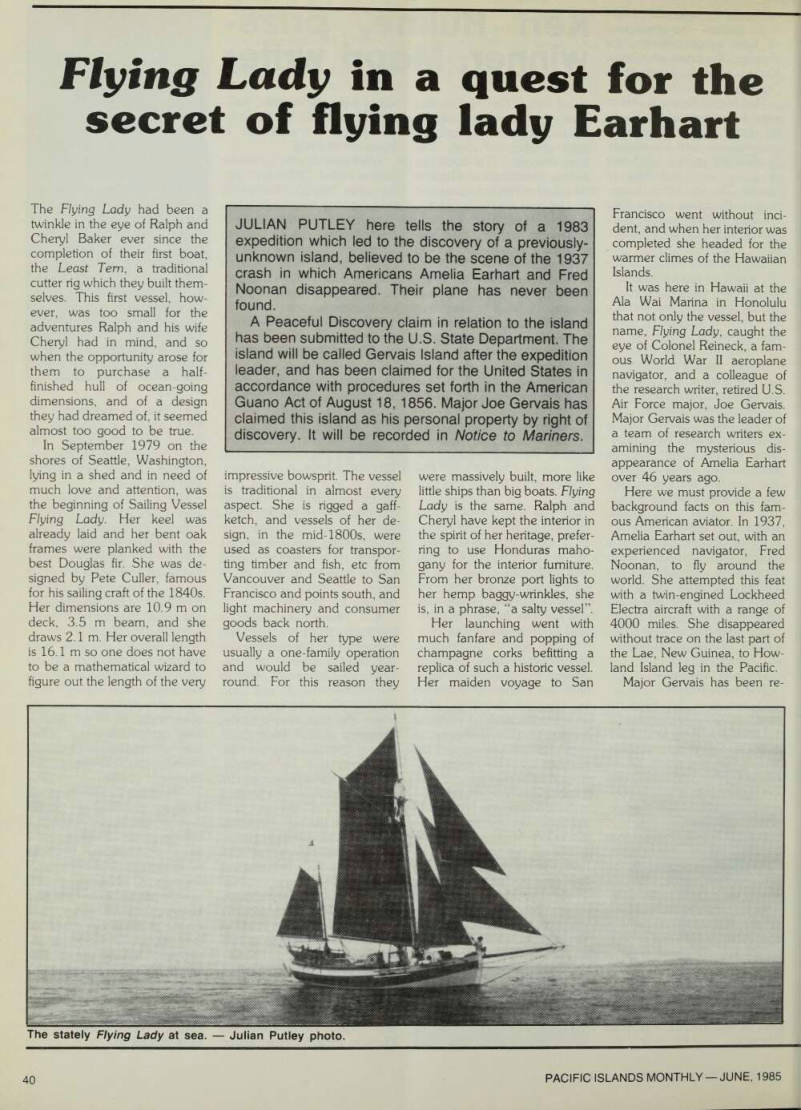
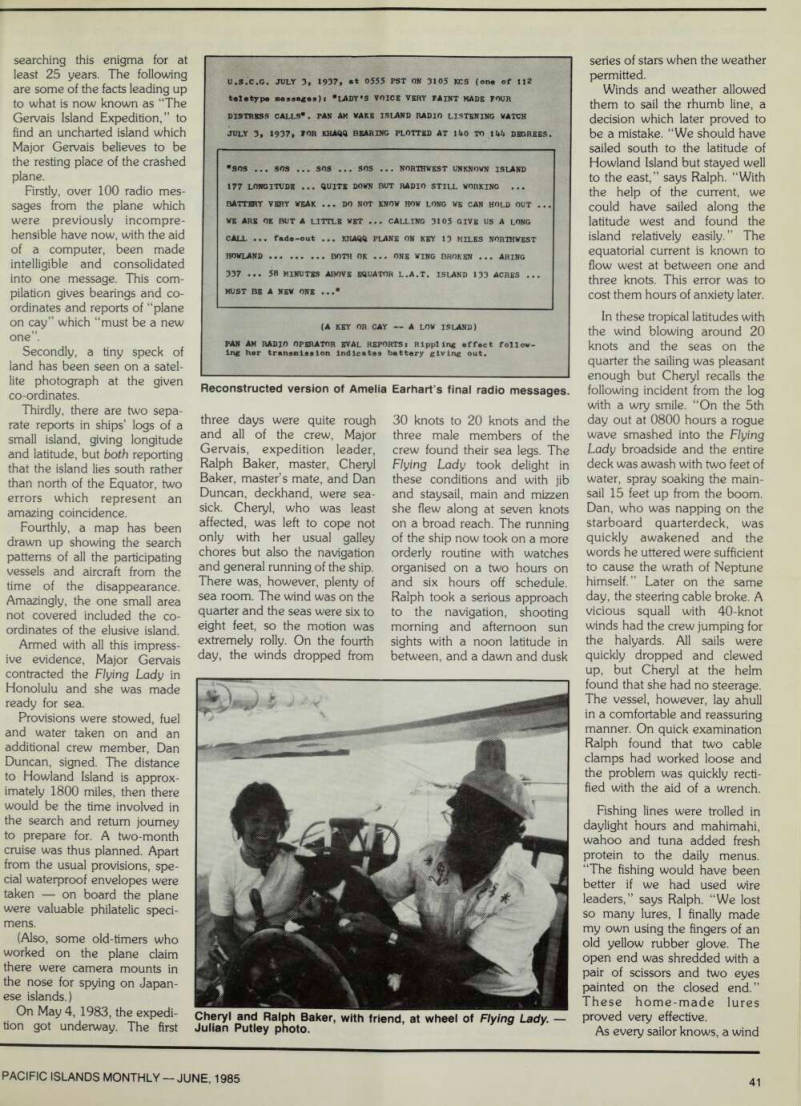
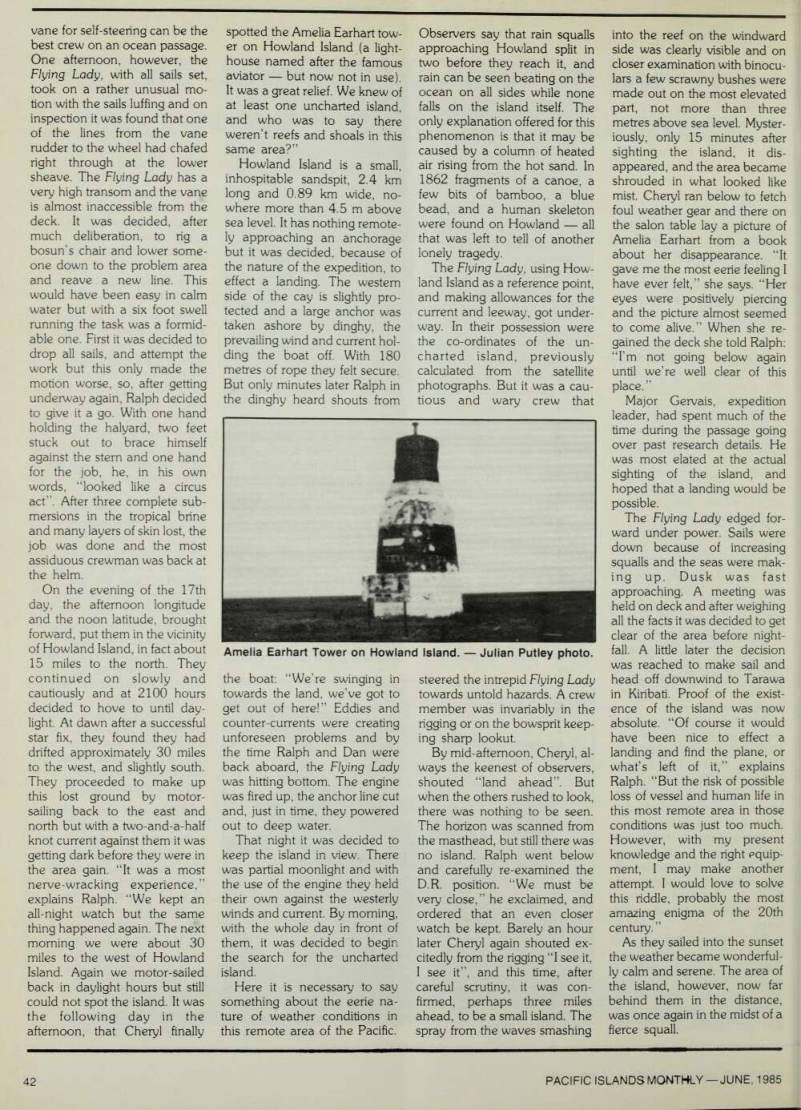
Flying Lady in a quest for the secret of flying lady Earhart
The Flying Lady had been a twinkle in the eye of Ralph and Cheryl Baker ever since the completion of their first boat, the Least Tern , a traditional cutter rig which they built them selves. This first vessel, how ever, was too small for the adventures Ralph and his wife Cheryl had in mind, and so when the opportunity arose for them to purchase a half finished hull of ocean-going dimensions, and of a design they had dreamed of, it seemed almost too good to be true.
In September 1979 on the shores of Seattle, Washington, lying in a shed and in need of much love and attention, was the beginning of Sailing Vessel Flying Lady. Her keel was already laid and her bent oak frames were planked with the best Douglas fir. She was de signed by Pete Culler, famous for his sailing craft of the 1840 s.
Her dimensions are 10.9 m on deck, 3.5 m beam, and she draws 2.1 m. Her overall length is 16.1 m so one does not have to be a mathematical wizard to figure out the length of the very
JULIAN PUTLEY here tells the story of a 1983 expedition which led to the discovery of a previously unknown island, believed to be the scene of the 1937 crash in which Americans Amelia Earhart and Fred Noonan disappeared. Their plane has never been found.
A Peaceful Discovery claim in relation to the island has been submitted to the U.S. State Department. The island will be called Gervais Island after the expedition leader, and has been claimed for the United States in accordance with procedures set forth in the American Guano Act of August 18, 1856. Major Joe Gervais has claimed this island as his personal property by right of discovery. It will be recorded in Notice to Mariners.
impressive bowsprit. The vessel is traditional in almost every aspect. She is rigged a gaff ketch, and vessels of her de sign, in the mid-1800s, were used as coasters for transpor ting timber and fish, etc from Vancouver and Seattle to San Francisco and points south, and light machinery and consumer goods back north.
Vessels of her type were usually a one-family operation and would be sailed year round. For this reason they
were massively built, more like little ships than big boats. Flying Lady is the same. Ralph and Cheryl have kept the interior in the spirit of her heritage, prefer ring to use Honduras maho gany for the interior furniture.
From her bronze port lights to her hemp baggy-wrinkles, she is, in a phrase, “a salty vessel”.
Her launching went with much fanfare and popping of champagne corks befitting a replica of such a historic vessel.
Her maiden voyage to San
Francisco went without inci dent, and when her interior was completed she headed for the warmer climes of the Hawaiian Islands.
It was here in Hawaii at the Ala Wai Marina in Honolulu that not only the vessel, but the name, Flying Lady, caught the eye of Colonel Reineck, a fam ous World War II aeroplane navigator, and a colleague of the research writer, retired U.S.
Air Force major, Joe Gervais.
Major Gervais was the leader of a team of research writers ex amining the mysterious dis appearance of Amelia Earhart over 46 years ago.
Here we must provide a few background facts on this fam ous American aviator. In 1937, Amelia Earhart set out, with an experienced navigator, Fred Noonan, to fly around the world. She attempted this feat with a twin-engined Lockheed Electra aircraft with a range of 4000 miles. She disappeared without trace on the last part of the Lae, New Guinea, to How land Island leg in the Pacific.
Major Gervais has been re-
The stately Flying Lady at sea. - Julian Putley photo.
searching this enigma for at least 25 years. The following are some of the facts leading up to what is now known as “The Gervais Island Expedition,” to find an uncharted island which Major Gervais believes to be the resting place of the crashed plane.
Firstly, over 100 radio mes sages from the plane which were previously incompre hensible have now, with the aid of a computer, been made intelligible and consolidated into one message. This com pilation gives bearings and co ordinates and reports of “plane on cay” which “must be a new one”.
Secondly, a tiny speck of land has been seen on a satel lite photograph at the given co-ordinates.
Thirdly, there are two sepa rate reports in ships’ logs of a small island, giving longitude and latitude, but both reporting that the island lies south rather than north of the Equator, two errors which represent an amazing coincidence.
Fourthly, a map has been drawn up showing the search patterns of all the participating vessels and aircraft from the time of the disappearance.
Amazingly, the one small area not covered included the co ordinates of the elusive island.
Armed with all this impress ive evidence, Major Gervais contracted the Flying Lady in Honolulu and she was made ready for sea.
Provisions were stowed, fuel and water taken on and an additional crew member, Dan Duncan, signed. The distance to Howland Island is approx imately 1800 miles, then there would be the time involved in the search and return journey to prepare for. A two-month cruise was thus planned. Apart from the usual provisions, spe cial waterproof envelopes were taken on board the plane were valuable philatelic speci mens. (Also, some old-timers who worked on the plane claim there were camera mounts in the nose for spying on Japan ese islands.) On May 4, 1983, the expedi tion got underway. The first
three days were quite rough and all of the crew, Major Gervais, expedition leader, Ralph Baker, master, Cheryl Baker, master’s mate, and Dan Duncan, deckhand, were sea sick. Cheryl, who was least affected, was left to cope not only with her usual galley chores but also the navigation and general running of the ship.
There was, however, plenty of sea room. The wind was on the quarter and the seas were six to eight feet, so the motion was extremely roily. On the fourth day, the winds dropped from
30 knots to 20 knots and the three male members of the crew found their sea legs. The Flying Lady took delight in these conditions and with jib and staysail, main and mizzen she flew along at seven knots on a broad reach. The running of the ship now took on a more orderly routine with watches organised on a two hours on and six hours off schedule.
Ralph took a serious approach to the navigation, shooting morning and afternoon sun sights with a noon latitude in between, and a dawn and dusk
series of stars when the weather permitted.
Winds and weather allowed them to sail the rhumb line, a decision which later proved to be a mistake. “We should have sailed south to the latitude of Howland Island but stayed well to the east,” says Ralph. “With the help of the current, we could have sailed along the latitude west and found the island relatively easily.” The equatorial current is known to flow west at between one and three knots. This error was to cost them hours of anxiety later.
In these tropical latitudes with the wind blowing around 20 knots and the seas on the quarter the sailing was pleasant enough but Cheryl recalls the following incident from the log with a wry smile. “On the sth day out at 0800 hours a rogue wave smashed into the Flying Lady broadside and the entire deck was awash with two feet of water, spray soaking the main sail 15 feet up from the boom.
Dan, who was napping on the starboard quarterdeck, was quickly awakened and the words he uttered were sufficient to cause the wrath of Neptune himself.” Later on the same day, the steering cable broke. A vicious squall with 40-knot winds had the crew jumping for the halyards. All sails were quickly dropped and clewed up, but Cheryl at the helm found that she had no steerage.
The vessel, however, lay ahull in a comfortable and reassuring manner. On quick examination Ralph found that two cable clamps had worked loose and the problem was quickly recti fied with the aid of a wrench.
Fishing lines were trolled in daylight hours and mahimahi, wahoo and tuna added fresh protein to the daily menus.
“The fishing would have been better if we had used wire leaders,” says Ralph. “We lost so many lures, I finally made my own using the fingers of an old yellow rubber glove. The open end was shredded with a pair of scissors and two eyes painted on the closed end.”
These home-made lures proved very effective.
As every sailor knows, a wind
Reconstructed version of Amelia Earhart’s final radio messages.
Cheryl and Ralph Baker, with friend, at wheel of Flying Lady.- Julian Putley photo.
vane for self-steering can be the best crew on an ocean passage.
One afternoon, however, the Flying Lady, with all sails set, took on a rather unusual mo tion with the sails luffing and on inspection it was found that one of the lines from the vane rudder to the wheel had chafed right through at the lower sheave. The Flying Lady has a very high transom and the vane is almost inaccessible from the deck. It was decided, after much deliberation, to rig a bosun’s chair and lower some one down to the problem area and reave a new line. This would have been easy in calm water but with a six foot swell running the task was a formid able one. First it was decided to drop all sails, and attempt the work but this only made the motion worse, so, after getting underway again, Ralph decided to give it a go. With one hand holding the halyard, two feet stuck out to brace himself against the stem and one hand for the job, he, in his own words, “looked like a circus act”. After three complete sub mersions in the tropical brine and many layers of skin lost, the job was done and the most assiduous crewman was back at the helm.
On the evening of the 17th day, the afternoon longitude and the noon latitude, brought forward, put them in the vicinity of Howland Island, in fact about 15 miles to the north. They continued on slowly and cautiously and at 2100 hours decided to hove to until day light. At dawn after a successful star fix, they found they had drifted approximately 30 miles to the west, and slightly south.
They proceeded to make up this lost ground by motor sailing back to the east and north but with a two-and-a-half knot current against them it was getting dark before they were in the area gain. “It was a most nerve-wracking experience,” explains Ralph. “We kept an all-night watch but the same thing happened again. The next morning we were about 30 miles to the west of Howland Island. Again we motor-sailed back in daylight hours but still could not spot the island. It was the following day in the afternoon, that Cheryl finally
spotted the Amelia Earhart tow er on Howland Island (a light house named after the famous aviator but now not in use).
It was a great relief. We knew of at least one uncharted island, and who was to say there weren’t reefs and shoals in this same area?”
Howland Island is a small, inhospitable sandspit, 2.4 km long and 0.89 km wide, no where more than 4.5 m above sea level. It has nothing remote ly approaching an anchorage but it was decided, because of the nature of the expedition, to effect a landing. The western side of the cay is slightly pro tected and a large anchor was taken ashore by dinghy, the prevailing wind and current hol ding the boat off. With 180 metres of rope they felt secure.
But only minutes later Ralph in the dinghy heard shouts from
the boat: “We’re swinging in towards the land, we’ve got to get out of here!” Eddies and counter-currents were creating unforeseen problems and by the time Ralph and Dan were back aboard, the Flying Lady was hitting bottom. The engine was fired up, the anchor line cut and, just in time, they powered out to deep water.
That night it was decided to keep the island in view. There was partial moonlight and with the use of the engine they held their own against the westerly winds and current. By morning, with the whole day in front of them, it was decided to begin the search for the uncharted island.
Here it is necessary to say something about the eerie na ture of weather conditions in this remote area of the Pacific.
Observers say that rain squalls approaching Howland split in two before they reach it, and rain can be seen beating on the ocean on all sides while none falls on the island itself. The only explanation offered for this phenomenon is that it may be caused by a column of heated air rising from the hot sand. In 1862 fragments of a canoe, a few bits of bamboo, a blue bead, and a human skeleton were found on Howland all that was left to tell of another lonely tragedy.
The Flying Lady, using How land Island as a reference point, and making allowances for the current and leeway, got under way. In their possession were the co-ordinates of the un charted island, previously calculated from the satellite photographs. But it was a cau tious and wary crew that
steered the intrepid Flying Lady towards untold hazards. A crew member was invariably in the rigging or on the bowsprit keep ing sharp lookut.
By mid-afternoon, Cheryl, al ways the keenest of observers, shouted “land ahead”. But when the others rushed to look, there was nothing to be seen.
The horizon was scanned from the masthead, but still there was no island. Ralph went below and carefully re-examined the D.R. position. “We must be very close,” he exclaimed, and ordered that an even closer watch be kept. Barely an hour later Cheryl again shouted ex citedly from the rigging “I see it, I see it”, and this time, after careful scrutiny, it was con firmed, perhaps three miles ahead, to be a small island. The spray from the waves smashing
into the reef on the windward side was clearly visible and on closer examination with binocu lars a few scrawny bushes were made out on the most elevated part, not more than three metres above sea level. Myster iously, only 15 minutes after sighting the island, it dis appeared, and the area became shrouded in what looked like mist. Cheryl ran below to fetch foul weather gear and there on the salon table lay a picture of Amelia Earhart from a book about her disappearance. “It gave me the most eerie feeling I have ever felt,” she says. “Her eyes were positively piercing and the picture almost seemed to come alive.” When she re gained the deck she told Ralph: “I’m not going below again until we’re well clear of this place.”
Major Gervais, expedition leader, had spent much of the time during the passage going over past research details. He was most elated at the actual sighting of the island, and hoped that a landing would be possible.
The Flying Lady edged for ward under power. Sails were down because of increasing squalls and the seas were mak ing up. Dusk was fast approaching. A meeting was held on deck and after weighing all the facts it was decided to get clear of the area before night fall. A little later the decision was reached to make sail and head off downwind to Tarawa in Kiribati. Proof of the exist ence of the island was now absolute. “Of course it would have been nice to effect a landing and find the plane, or what’s left of it,” explains Ralph. “But the risk of possible loss of vessel and human life in this most remote area in those conditions was just too much.
However, with my present knowledge and the right equip ment, I may make another attempt. I would love to solve this riddle, probably the most amazing enigma of the 20th century. ”
As they sailed into the sunset the weather became wonderful ly calm and serene. The area of the island, however, now far behind them in the distance, was once again in the midst of a fierce squall.
Amelia Earhart Tower on Howland Island. - Julian Putley photo.
Rarotonga Golf Club - all
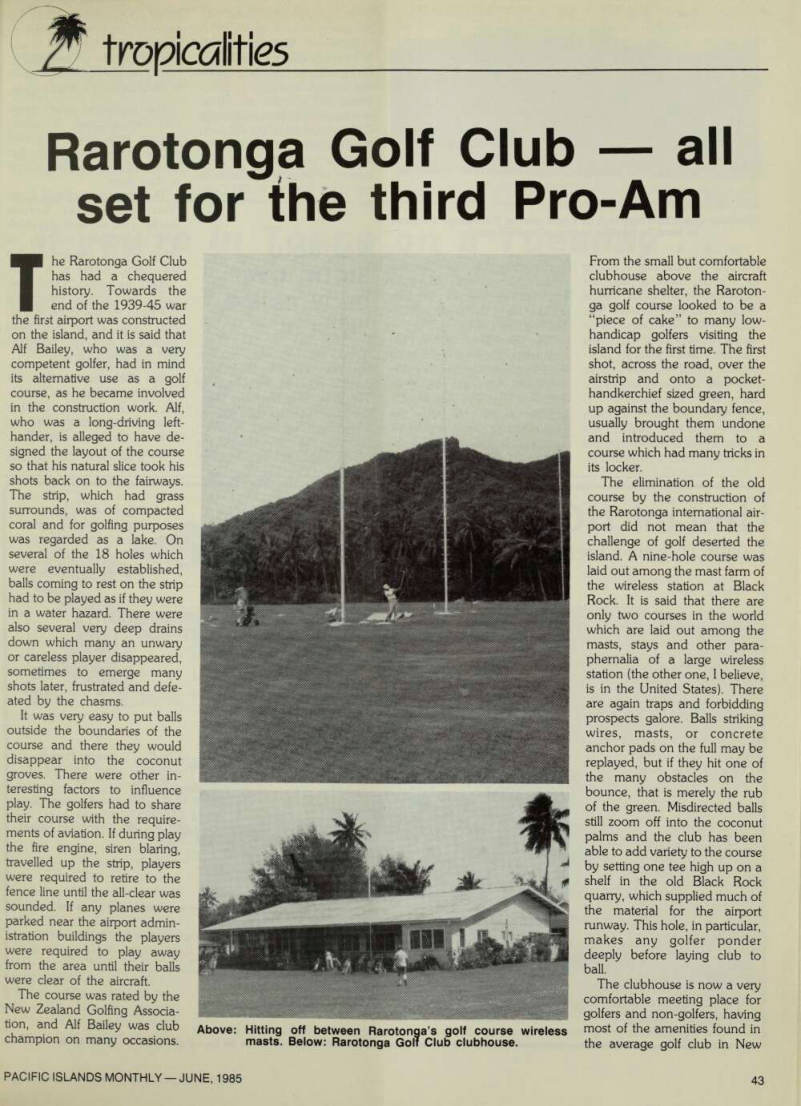
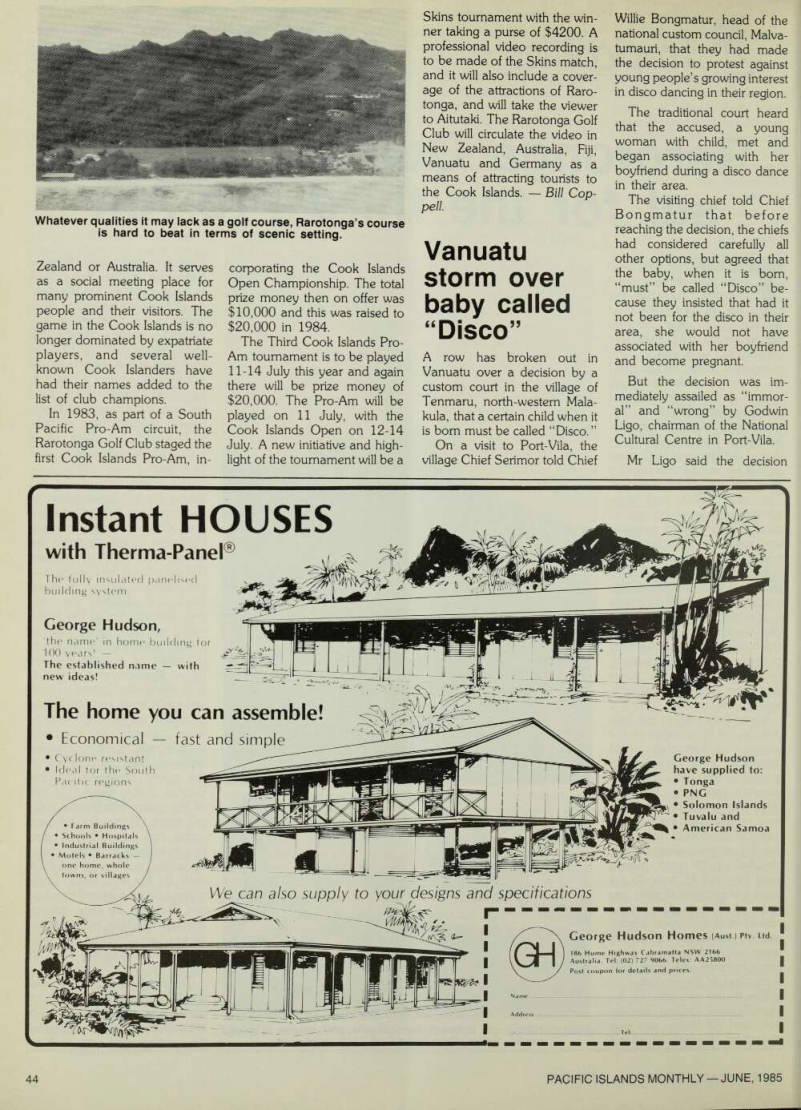
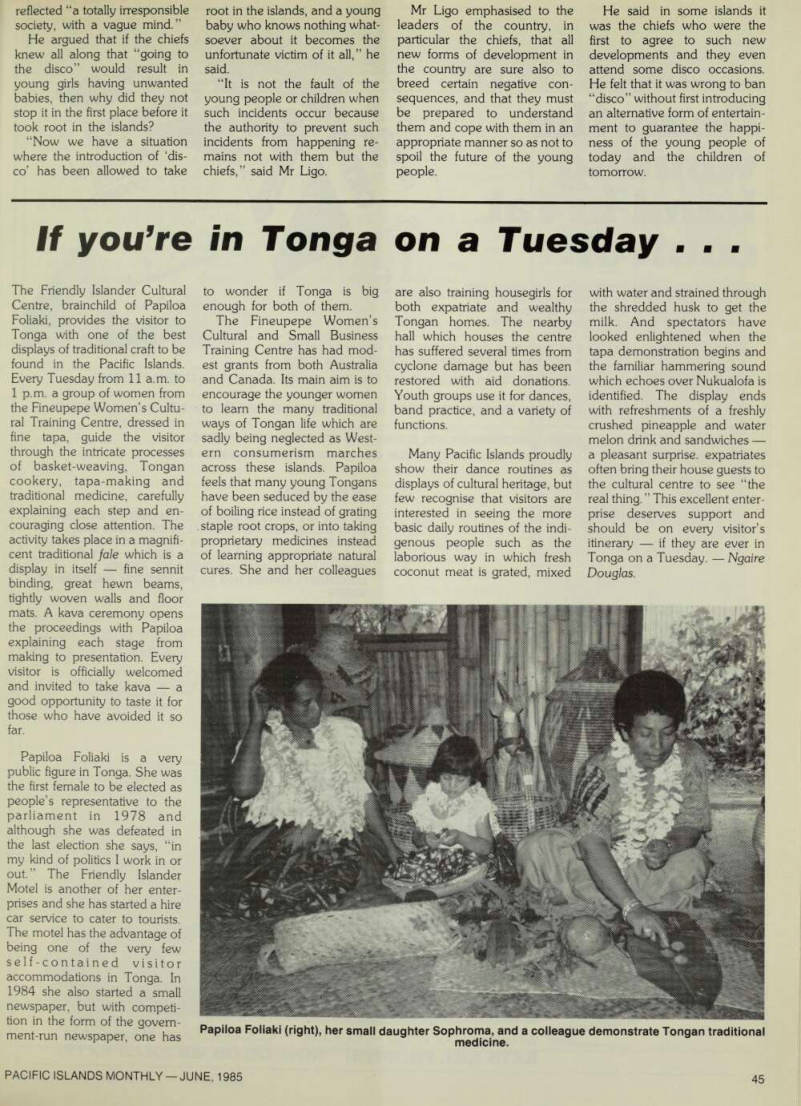
tropicalities
Rarotonga Golf Club - all set for the third Pro-Am
The Rarotonga Golf Club has had a chequered history. Towards the end of the 1939-45 war the first airport was constructed on the island, and it is said that Alf Bailey, who was a very competent golfer, had in mind its alternative use as a golf course, as he became involved in the construction work. Alf, who was a long-driving left hander, is alleged to have de signed the layout of the course so that his natural slice took his shots back on to the fairways.
The strip, which had grass surrounds, was of compacted coral and for golfing purposes was regarded as a lake. On several of the 18 holes which were eventually established, balls coming to rest on the strip had to be played as if they were in a water hazard. There were also several very deep drains down which many an unwary or careless player disappeared, sometimes to emerge many shots later, frustrated and defe ated by the chasms.
It was very easy to put balls outside the boundaries of the course and there they would disappear into the coconut groves. There were other in teresting factors to influence play. The golfers had to share their course with the require ments of aviation. If during play the fire engine, siren blaring, travelled up the strip, players were required to retire to the fence line until the all-clear was sounded. If any planes were parked near the airport admin istration buildings the players were required to play away from the area until their balls were clear of the aircraft.
The course was rated by the New Zealand Golfing Associa tion, and Alf Bailey was club champion on many occasions.
From the small but comfortable clubhouse above the aircraft hurricane shelter, the Raroton ga golf course looked to be a “piece of cake” to many low handicap golfers visiting the island for the first time. The first shot, across the road, over the airstrip and onto a pocket handkerchief sized green, hard up against the boundary fence, usually brought them undone and introduced them to a course which had many tricks in its locker.
The elimination of the old course by the construction of the Rarotonga international air port did not mean that the challenge of golf deserted the island. A nine-hole course was laid out among the mast farm of the wireless station at Black Rock. It is said that there are only two courses in the world which are laid out among the masts, stays and other para phernalia of a large wireless station (the other one, I believe, is in the United States). There are again traps and forbidding prospects galore. Balls striking wires, masts, or concrete anchor pads on the full may be replayed, but if they hit one of the many obstacles on the bounce, that is merely the rub of the green. Misdirected balls still zoom off into the coconut palms and the club has been able to add variety to the course by setting one tee high up on a shelf in the old Black Rock quarry, which supplied much of the material for the airport runway. This hole, in particular, makes any golfer ponder deeply before laying club to ball.
The clubhouse is now a very comfortable meeting place for golfers and non-golfers, having most of the amenities found in the average golf club in New
Above: Hitting off between Rarotonga’s golf course wireless masts. Below: Rarotonga Golf Club clubhouse.
Zealand or Australia. It serves as a social meeting place for many prominent Cook Islands people and their visitors. The game in the Cook Islands is no longer dominated by expatriate players, and several well known Cook Islanders have had their names added to the list of club champions.
In 1983, as part of a South Pacific Pro-Am circuit, the Rarotonga Golf Club staged the first Cook Islands Pro-Am, in
corporating the Cook Islands Open Championship. The total prize money then on offer was $lO,OOO and this was raised to $20,000 in 1984.
The Third Cook Islands Pro- Am tournament is to be played 11-14 July this year and again there will be prize money of $20,000. The Pro-Am will be played on 11 July, with the Cook Islands Open on 12-14 July. A new initiative and high light of the tournament will be a
Skins tournament with the win ner taking a purse of $4200. A professional video recording is to be made of the Skins match, and it will also include a cover age of the attractions of Raro tonga, and will take the viewer to Aitutaki. The Rarotonga Golf Club will circulate the video in New Zealand, Australia, Fiji, Vanuatu and Germany as a means of attracting tourists to the Cook Islands. Bill Cop pell.
Vanuatu
storm over
baby called
“Disco”
A row has broken out in Vanuatu over a decision by a custom court in the village of Tenmaru, north-western Mala kula, that a certain child when it is bom must be called “Disco.”
On a visit to Port-Vila, the village Chief Serimor told Chief
Willie Bongmatur, head of the national custom council, Malva tumauri, that they had made the decision to protest against young people’s growing interest in disco dancing in their region.
The traditional court heard that the accused, a young woman with child, met and began associating with her boyfriend during a disco dance in their area.
The visiting chief told Chief Bongmatur that before reaching the decision, the chiefs had considered carefully all other options, but agreed that the baby, when it is born, “must” be called “Disco” be cause they insisted that had it not been for the disco in their area, she would not have associated with her boyfriend and become pregnant.
But the decision was im mediately assailed as “immor al” and “wrong” by Godwin Ligo, chairman of the National Cultural Centre in Port-Vila.
Mr Ligo said the decision
Whatever qualities it may lack as a golf course, Rarotonga’s course is hard to beat in terms of scenic setting.
reflected “a totally irresponsible society, with a vague mind.”
He argued that if the chiefs knew all along that “going to the disco” would result in young girls having unwanted babies, then why did they not stop it in the first place before it took root in the islands?
“Now we have a situation where the introduction of ‘disco’ has been allowed to take
root in the islands, and a young baby who knows nothing what soever about it becomes the unfortunate victim of it all,” he said.
“It is not the fault of the young people or children when such incidents occur because the authority to prevent such incidents from happening re mains not with them but the chiefs,” said Mr Ligo.
Mr Ligo emphasised to the leaders of the country, in particular the chiefs, that all new forms of development in the country are sure also to breed certain negative consequences, and that they must be prepared to understand them and cope with them in an appropriate manner so as not to spoil the future of the young people.
He said in some islands it was the chiefs who were the first to agree to such new developments and they even attend some disco occasions, He felt that it was wrong to ban “disco” without first introducing an alternative form of entertain ment to guarantee the happi ness of the young people of today and the children of tomorrow.
Advertisements & other items, p. 44 (1 item)
Instant HOUSES
with Therma-Panel®
v|f /x The fully insulated panelised
building system
George Hudson,
the name' in home building for 100 years' - The established name with new ideas! • rla__ . 0
The home you can assemble!
• Economical fast and simple
Cyclone resistant Ideal for the South Pacific regions • Farm Buildings • Schools • Hospitals ■ Industrial Buildings Motels • Barracks one home, whole towns, or villages George Hudson have supplied to: • Tonga
• PNG
bi • Solomon Islands • Tuvalu and • American Samoa Wejzan also supply to your designs and specifications V • i A e Li George Hudson Homes (Aust.) Pty. Ltd. 186 Hume Highway Cabramalta NSW 2166 Australia. Tel; (02) 727 9066. Telex; AA25800 Post coupon for details and prices.
If you’re in Tonga on a Tuesday . . .
The Friendly Islander Cultural Centre, brainchild of Papiloa Foliaki, provides the visitor to Tonga with one of the best displays of traditional craft to be found in the Pacific Islands.
Every Tuesday from 11 a.m. to 1 p.m. a group of women from the Fineupepe Women’s Cultu ral Training Centre, dressed in fine tapa, guide the visitor through the intricate processes of basket-weaving, Tongan cookery, tapa-making and traditional medicine, carefully explaining each step and en couraging close attention. The activity takes place in a magnifi cent traditional fale which is a display in itself fine sennit binding, great hewn beams, tightly woven walls and floor mats. A kava ceremony opens the proceedings with Papiloa explaining each stage from making to presentation. Every visitor is officially welcomed and invited to take kava a good opportunity to taste it for those who have avoided it so far.
Papiloa Foliaki is a very public figure in Tonga. She was the first female to be elected as people’s representative to the parliament in 1978 and although she was defeated in the last election she says, “in my kind of politics I work in or out.” The Friendly Islander Motel is another of her enter prises and she has started a hire car service to cater to tourists.
The motel has the advantage of being one of the very few self-contained visitor accommodations in Tonga. In 1984 she also started a small newspaper, but with competi tion in the form of the govern ment-run newspaper, one has
to wonder if Tonga is big enough for both of them.
The Fineupepe Women’s Cultural and Small Business Training Centre has had mod est grants from both Australia and Canada. Its main aim is to encourage the younger women to learn the many traditional ways of Tongan life which are sadly being neglected as West ern consumerism marches across these islands. Papiloa feels that many young Tongans have been seduced by the ease of boiling rice instead of grating staple root crops, or into taking proprietary medicines instead of learning appropriate natural cures. She and her colleagues
are also training housegirls for both expatriate and wealthy Tongan homes. The nearby hall which houses the centre has suffered several times from cyclone damage but has been restored with aid donations.
Youth groups use it for dances, band practice, and a variety of functions.
Many Pacific Islands proudly show their dance routines as displays of cultural heritage, but few recognise that visitors are interested in seeing the more basic daily routines of the indi genous people such as the laborious way in which fresh coconut meat is grated, mixed
with water and strained through the shredded husk to get the milk. And spectators have looked enlightened when the tapa demonstration begins and the familiar hammering sound which echoes over Nukualofa is identified. The display ends with refreshments of a freshly crushed pineapple and water melon drink and sandwiches a pleasant surprise, expatriates often bring their house guests to the cultural centre to see “the real thing. ” This excellent enter prise deserves support and should be on every visitor’s itinerary if they are ever in Tonga on a Tuesday. Ngaire Douglas.
Papiloa Foliaki (right), her small daughter Sophroma, and a colleague demonstrate Tongan traditional medicine.
Advertisements & other items, p. 46 (1 item)
Tdon wb
Deals the
winning
hand in rat
control!
TALON WB Is a world breakthrough In killing rats and mice. Developed by ICI Tasman in New Zealand TALON WB Is a sure way to Increase profits by eliminating RAT DAMAGE TO CROPS! £ I 9
K/ Us
Ssg*.
Sr $ Q s 0-2 0) •a p s So, *>o SOLID BLOCKS Can be wired or nailed out of reach of children & animals. Easily handled - wontjDlow away.
WATERPROOF Safe Year round use - will not dissolve, resists mould for extended periods.
DEADLY
Kills even the toughest rats - Including those resistant to warfarin based poisons.
EFFECTIVE
POWERFUL
Highly attractive to rats & mice - no pre-baiting is required.
Kills more rats - a lethal dose can be consumed In a single feed. m '
WARNING
> ; / % / Do not lay baits In places accessible to children, \ pets and domestic animals, wash ha»ids and exposed skin before meals and after work. Do not store near food or feed. Bum or bury all rodent bodies and uneaten bait. Empty containers should not be re-used but disposed of 1 safely. ! ! /
Tdon wb
f\Cl\ A Product of ICI Tasman Limited P.O, Box 900, Auckland, New Zealand / \ Whatever your crops COCOA COCONUTS SUGARCANE.
RATS KILL PROFITS I NOW TALON WB KILLS RATS!
Pacific stamp box
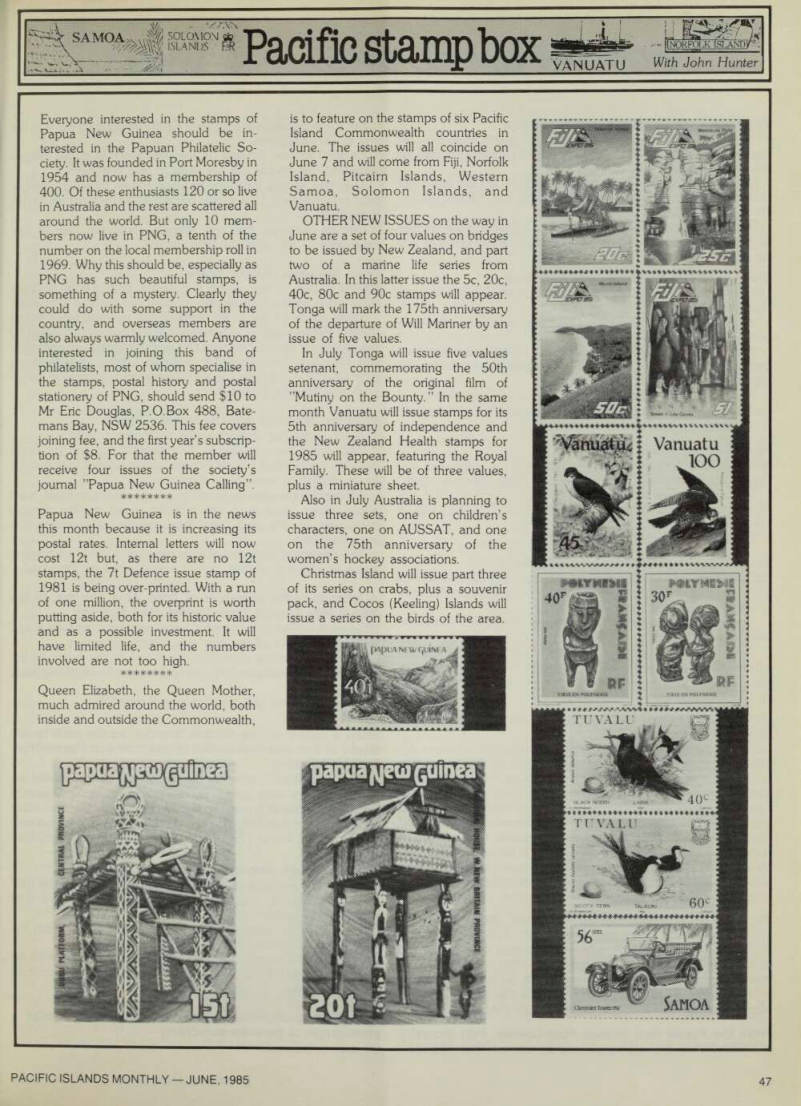
Everyone interested in the stamps of Papua New Guinea should be in terested in the Papuan Philatelic So ciety. It was founded in Port Moresby in 1954 and now has a membership of 400. Of these enthusiasts 120 or so live in Australia and the rest are scattered all around the world. But only 10 mem bers now live in PNG, a tenth of the number on the local membership roll in 1969. Why this should be, especially as PNG has such beautiful stamps, is something of a mystery. Clearly they could do with some support in the country, and overseas members are also always warmly welcomed. Anyone interested in joining this band of philatelists, most of whom specialise in the stamps, postal history and postal stationery of PNG, should send $lO to Mr Eric Douglas, P.0.80x 488, Bate mans Bay, NSW 2536. This fee covers joining fee, and the first year’s subscrip tion of $B. For that the member will receive four issues of the society’s journal ’’Papua New Guinea Calling”. $ i)c $ a): $ :{c:jc Papua New Guinea is in the news this month because it is increasing its postal rates. Internal letters will now cost 12t but, as there are no 12t stamps, the 7t Defence issue stamp of 1981 is being over-printed. With a run of one million, the overprint is worth putting aside, both for its historic value and as a possible investment. It will have limited life, and the numbers involved are not too high. * * * :jt * * j)C S)C Queen Elizabeth, the Queen Mother, much admired around the world, both inside and outside the Commonwealth,
is to feature on the stamps of six Pacific Island Commonwealth countries in June. The issues will all coincide on June 7 and will come from Fiji, Norfolk Island, Pitcairn Islands, Western Samoa, Solomon Islands, and Vanuatu.
OTHER NEW ISSUES on the way in June are a set of four values on bridges to be issued by New Zealand, and part two of a marine life series from Australia. In this latter issue the sc, 20c, 40c, 80c and 90c stamps will appear.
Tonga will mark the 175th anniversary of the departure of Will Mariner by an issue of five values.
In July Tonga will issue five values setenant, commemorating the 50th anniversary of the original film of ’’Mutiny on the Bounty.” In the same month Vanuatu will issue stamps for its sth anniversary of independence and the New Zealand Health stamps for 1985 will appear, featuring the Royal Family. These will be of three values, plus a miniature sheet.
Also in July Australia is planning to issue three sets, one on children’s characters, one on AUSSAT, and one on the 75th anniversary of the women’s hockey associations.
Christmas Island will issue part three of its series on crabs, plus a souvenir pack, and Cocos (Keeling) Islands will issue a series on the birds of the area.
from the islands press
From the Cook Islands News, Rarotonga THIRTEEN youths involved in a spate of graffiti vandalism on Rarotonga in November are faced with a May deadline to pay for the “wilful damage” they caused.
Chief Justice Sir Graham Speight gave the youths two and a half months to come up with the cost of the paint, about $5OO, used to cover up the graffiti.
Each of the youths will pay an amount equivalent to the number of offences they committed, ranging from $4 for one youth to $7O for another.
From the Cook Islands News, Rarotonga UP to Sunday afternoon (Feb. 17) police had absolutely nothing to report.
A spokesman said there hadn’t been any accidents, or assaults or even minor disturbances.
Patrolling policemen were reportedly pleasantly surprised through both Friday and Saturday by the quiet nature of the night club crowds and later night motorists.
Yesterday, with the Avarua office also in a lull, another patrol had been sent out just in case. But, otherwise, “it’s quite boring” commented the spokesman.
From The Fiji Times, Suva ABOUT 9000 vehicles running on Fiji roads are unlicensed and unregistered, according to a Department of Road Transport officer.
This meant a loss of $1,400,000 in Government revenue, the department’s enforcement officer, Mr Farouk Khan, told a Parliamentary Select Committee yesterday.
There are about 60,000 vehicles in Fiji.
From The Tonga Chronicle, Nuku’alofa MR MICHAEL DOSSOR, general manager of Fruit Distributors Ltd., said during a visit last week that the Tongan banana industry is clearly in the best shape in its history.
However, he emphasised that growers should not misunder stand his comments.
“The majority of the plantations are in good shape. There are others not as good, but exactly the reverse was true two or three years ago. There are also a couple of plantations that are as good as any in the world,” Dossor said. (From a letter signed by “Bee Gee” of Lae in the Papua New Guinea Post-Courier I DO not wish to criticise the Speaker of National Parliament, Mr Timothy Bonga, but I do see the need to speak out on his activities as a singer and band member of his rock group, the In Bongs. The past few weeks have been excitement, singing and dancing around Lae restaurants for Mr Bonga. One has every right to socialise and enjoy oneself, but not to the extent where the nation’s interest and dignity is being demoralised and misrepresented by a person, or persons, abusing their leadership privileges in the way Mr Bonga is.
Mr Bonga is obviously very interested in music, but the nation’s pride and dignity is degraded when the Speaker is trying to live in a bubble of childish fantasy while in high office.
From Scene n’ Heard in Tohi Tala Niue, Alofi NIUE’S only post office has had its fair share of break-ins.
Following the Christmas job, where parcels were ripped apart and contents taken, the latest was last week when nearly $5OOO of stamps were taken and some left or thrown on to the Post Office roof, probably when the culprits found out that you would look stupid trying to buy a couple of beers with mint stamps.
From the Papua New Guinea Post-Courier, Port Moresby NOMINATIONS in the Unggai-Bena by-election have opened.
But some villagers say they want KlOOO before they will vote for any of the candidates.
Electoral officers drawing up the common rolls in the villages were told that people did not want to give their names.
They had already voted for Mr Okuk and he should go straight back to Parliament. They should be paid KlOOO before they would vote again.
Officials reported that the villagers could tell that to the candidates and went on with the roll.
From Marianas Variety, Saipan NEARLY half of the junior and senior high school students surveyed in Saipan drink alcohol, smoke cigarettes and marijuana.
These are just a few of the startling facts revealed by results of the first Mental Health and Substance Abuse Survey conducted by the Division of Mental Health at Dr Torres Hospital in co-operation with Planning, Research and Information Centre, Department of Education, and the principals and counsellors at Hopwood Junior High and Marinas High School.
From the Marshall Islands Journal, Majuro TOILET paper and drinking water are Ebeye’s “gold”.
With water hours limited to 30 minutes a day and the Army charging the Marshall Islands Government thousands of dollars for water shipments, water is in short supply.
Although there appears to still be a large supply on hand, toilet paper prices have risen sky high in recent months, forcing consumers to dig deep into their pockets to purchase this expensive item . . .
The continuing high cost of toilet paper could be a contributing factor to why it is difficult to find a newspaper on the island.
A letter over the signature of Anna Ahia, Boroko, in the Papua New Guinea Post-Courier, Port Moresby MEN must realise their behavior has always been aggressive and brutal, irrespective of the way girls wear their clothes.
I see men walking about the street and at the beach in the briefest of shorts without shirts, but I have never heard of one being raped.
Is it because we girls have more self-control?
From a report in The Norfolk Islander on the visit to the island of Ben and Irma Christian and their son Dennis from Pitcairn Island WHILE with the Christians at the bank, they came out with the news that there were only 6 people left on Pitcairn!!! A gasp of amazement from all present brought forth the explanation that the other 45 residents had taken the island’s two launches and gone to Oeno Island (75 miles away) for a fortnight’s holiday!!
From the Cook Islands News, Rarotonga THE Animal Amendment Bill, quickly dubbed “The Monkey Bill” outside Parliament, was swung through its second and final readings on Monday.
The immediate purpose of the bill was to have allowed the importation of monkeys to Muri’s Marine Zoo . . .
Agriculture Minister Dr Terepai Macate explained the reasons for the amendment, adding that the monkeys would be an education for local children.
A caption in Bislama in the Vanuatu Weekly under a photograph of persons exercising Oli strejem baksaed
people
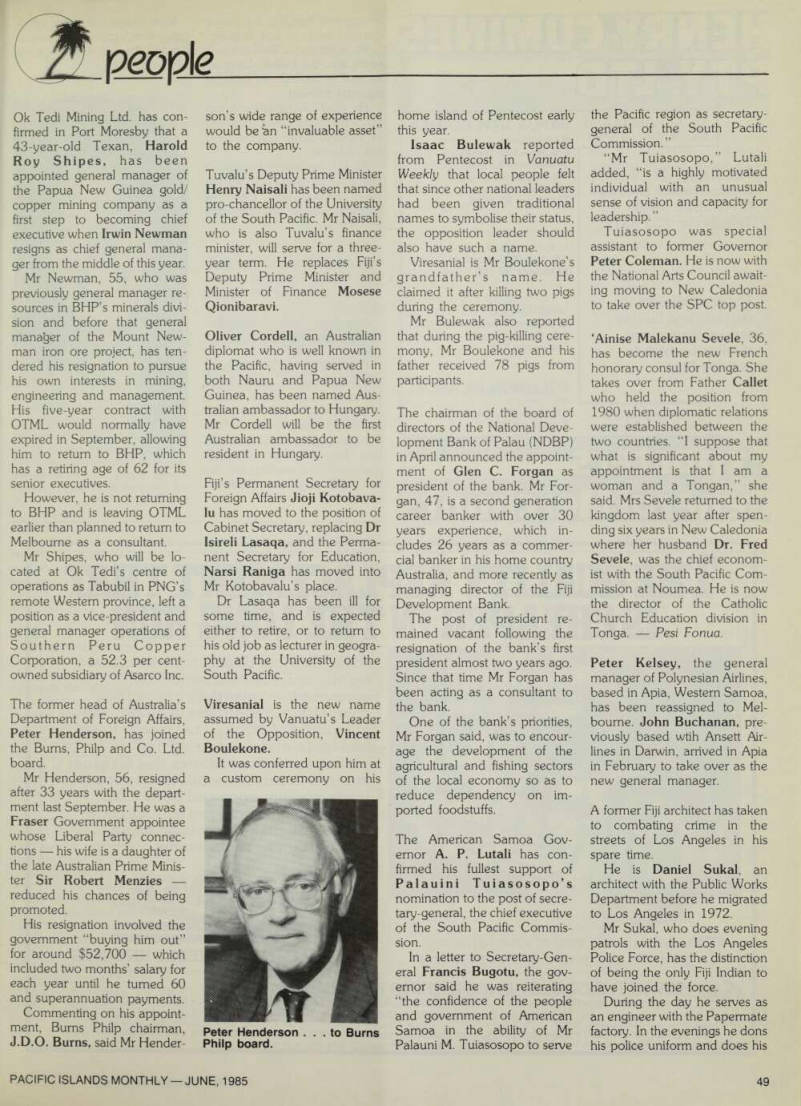
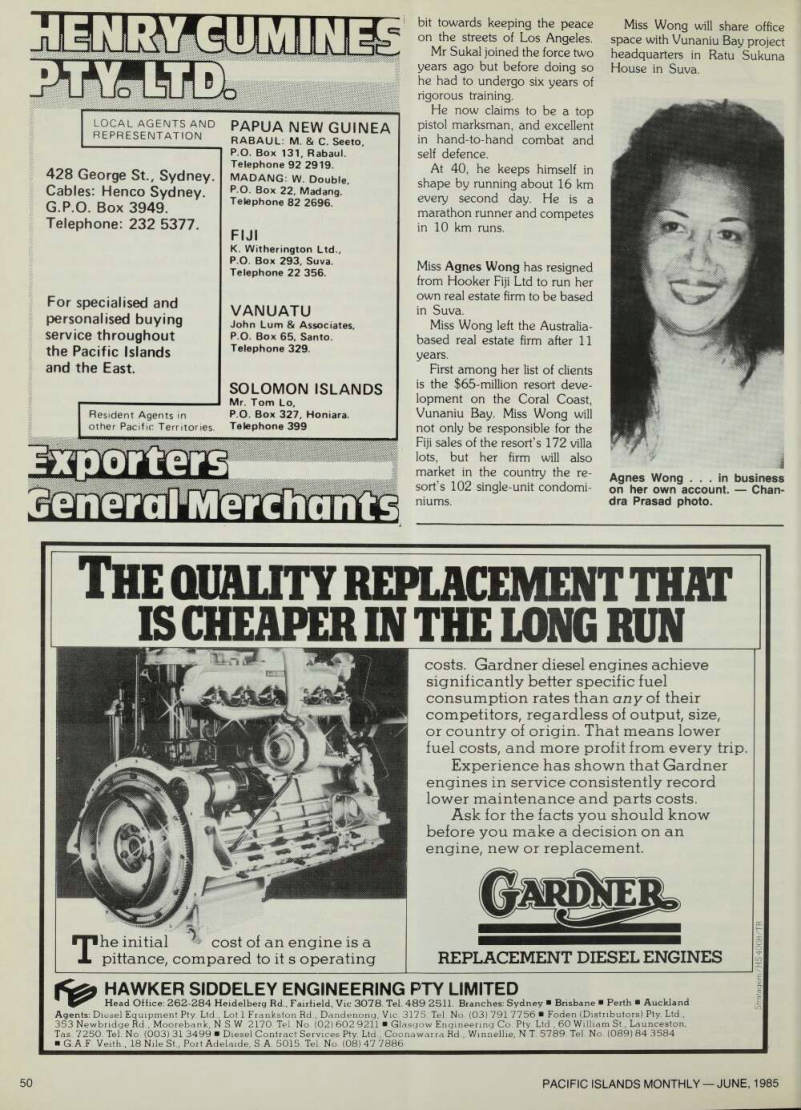
Ok Tedi Mining Ltd. has con firmed in Port Moresby that a 43-year-old Texan, Harold Roy Shipes, has been appointed general manager of the Papua New Guinea gold/ copper mining company as a first step to becoming chief executive when Irwin Newman resigns as chief general mana ger from the middle of this year.
Mr Newman, 55, who was previously general manager re sources in BHP’s minerals divi sion and before that general manager of the Mount New man iron ore project, has ten dered his resignation to pursue his own interests in mining, engineering and management.
His five-year contract with OTML would normally have expired in September, allowing him to return to BHP, which has a retiring age of 62 for its senior executives.
However, he is not returning to BHP and is leaving OTML earlier than planned to return to Melbourne as a consultant.
Mr Shipes, who will be lo cated at Ok Tedi’s centre of operations as Tabubil in PNG’s remote Western province, left a position as a vice-president and general manager operations of Southern Peru Copper Corporation, a 52.3 per cent owned subsidiary of Asarco Inc.
The former head of Australia’s Department of Foreign Affairs, Peter Henderson, has joined the Burns, Philp and Co. Ltd. board.
Mr Henderson, 56, resigned after 33 years with the depart ment last September. He was a Fraser Government appointee whose Liberal Party connec tions his wife is a daughter of the late Australian Prime Minis ter Sir Robert Menzies reduced his chances of being promoted.
His resignation involved the government “buying him out” for around $52,700 which included two months’ salary for each year until he turned 60 and superannuation payments.
Commenting on his appoint ment, Burns Philp chairman, J.D.O. Burns, said Mr Hender
son’s wide range of experience would be an “invaluable asset” to the company.
Tuvalu’s Deputy Prime Minister Henry Naisali has been named pro-chancellor of the University of the South Pacific. Mr Naisali, who is also Tuvalu’s finance minister, will serve for a three year term. He replaces Fiji’s Deputy Prime Minister and Minister of Finance Mosese Qionibaravi.
Oliver Cordell, an Australian diplomat who is well known in the Pacific, having served in both Nauru and Papua New Guinea, has been named Aus tralian ambassador to Hungary.
Mr Cordell will be the first Australian ambassador to be resident in Hungary.
Fiji’s Permanent Secretary for Foreign Affairs Jioji Kotobava lu has moved to the position of Cabinet Secretary, replacing Dr Isireli Lasaqa, and the Perma nent Secretary for Education, Narsi Raniga has moved into Mr Kotobavalu’s place.
Dr Lasaqa has been ill for some time, and is expected either to retire, or to return to his old job as lecturer in geogra phy at the University of the South Pacific.
Viresanial is the new name assumed by Vanuatu’s Leader of the Opposition, Vincent Boulekone.
It was conferred upon him at a custom ceremony on his
home island of Pentecost early this year.
Isaac Bulewak reported from Pentecost in Vanuatu Weekly that local people felt that since other national leaders had been given traditional names to symbolise their status, the opposition leader should also have such a name.
Viresanial is Mr Boulekone’s grandfather’s name. He claimed it after killing two pigs during the ceremony.
Mr Bulewak also reported that during the pig-killing cere mony, Mr Boulekone and his father received 78 pigs from participants.
The chairman of the board of directors of the National Deve lopment Bank of Palau (NDBP) in April announced the appoint ment of Glen C. Forgan as president of the bank. Mr For gan, 47, is a second generation career banker with over 30 years experience, which in cludes 26 years as a commer cial banker in his home country Australia, and more recently as managing director of the Fiji Development Bank.
The post of president re mained vacant following the resignation of the bank’s first president almost two years ago.
Since that time Mr Forgan has been acting as a consultant to the bank.
One of the bank’s priorities, Mr Forgan said, was to encour age the development of the agricultural and fishing sectors of the local economy so as to reduce dependency on im ported foodstuffs.
The American Samoa Gov ernor A. P. Lutali has con firmed his fullest support of Palauini Tuiasosopo’s nomination to the post of secre tary-general, the chief executive of the South Pacific Commis sion.
In a letter to Secretary-Gen eral Francis Bugotu, the gov ernor said he was reiterating “the confidence of the people and government of American Samoa in the ability of Mr Palauni M. Tuiasosopo to serve
the Pacific region as secretary general of the South Pacific Commission. ”
“Mr Tuiasosopo,” Lutali added, “is a highly motivated individual with an unusual sense of vision and capacity for leadership.”
Tuiasosopo was special assistant to former Governor Peter Coleman. He is now with the National Arts Council await ing moving to New Caledonia to take over the SPC top post. ‘Ainise Malekanu Sevele, 36, has become the new French honorary consul for Tonga. She takes over from Father Callet who held the position from 1980 when diplomatic relations were established between the two countries. “I suppose that what is significant about my appointment is that I am a woman and a Tongan,” she said. Mrs Sevele returned to the kingdom last year after spen ding six years in New Caledonia where her husband Dr. Fred Sevele, was the chief econom ist with the South Pacific Com mission at Noumea. He is now the director of the Catholic Church Education division in Tonga. Pesi Fonua.
Peter Kelsey, the general manager of Polynesian Airlines, based in Apia, Western Samoa, has been reassigned to Mel bourne. John Buchanan, pre viously based wtih Ansett Air lines in Darwin, arrived in Apia in February to take over as the new general manager.
A former Fiji architect has taken to combating crime in the streets of Los Angeles in his spare time.
He is Daniel Sukal. an architect with the Public Works Department before he migrated to Los Angeles in 1972.
Mr Sukal, who does evening patrols with the Los Angeles Police Force, has the distinction of being the only Fiji Indian to have joined the force.
During the day he serves as an engineer with the Papermate factory. In the evenings he dons his police uniform and does his
Peter Henderson ... to Burns Philp board.
bit towards keeping the peace on the streets of Los Angeles.
Mr Sukal joined the force two years ago but before doing so he had to undergo six years of rigorous training.
He now claims to be a top pistol marksman, and excellent in hand-to-hand combat and self defence.
At 40, he keeps himself in shape by running about 16 km every second day. He is a marathon runner and competes in 10 km runs.
Miss Agnes Wong has resigned from Hooker Fiji Ltd to run her own real estate firm to be based in Suva.
Miss Wong left the Australia based real estate firm after 11 years.
First among her list of clients is the $65-million resort deve lopment on the Coral Coast, Vunaniu Bay. Miss Wong will not only be responsible for the Fiji sales of the resort’s 172 villa lots, but her firm will also market in the country the re sort’s 102 single-unit condomi niums.
Miss Wong will share office space with Vunaniu Bay project headquarters in Ratu Sukuna House in Suva.
Agnes Wong ... in business on her own account. - Chan dra Prasad photo.
Advertisements & other items, p. 50 (1 item)
Jwcogi
LOCAL AGENTS AND
REPRESENTATION
PAPUA NEW GUINEA
RABAUL: M. & C. Seeto,
428 George St., Sydney.
Cables: Henco Sydney.
G.P.O. Box 3949.
P.O. Box 131, Rabaul.
Telephone 92 2919.
MADANG: W. Double, P.O. Box 22, Madang.
Telephone 82 2696.
Telephone: 232 5377.
FIJI
K. Witherington Ltd., P.O. Box 293, Suva.
Telephone 22 356.
For specialised and
personalised buying
service throughout
the Pacific Islands and the East.
Resident Agents in other Pacific Territories.
VANUATU
John Lum & Associates, P.O. Box 65, Santo.
Telephone 329.
SOLOMON ISLANDS
Mr. Tom Lo, P.O. Box 327. Honiara.
Telephone 399
xpdTtWs
The quality replacement that
IS CHEAPER IN THE LONG RUN
* 4 costs. Gardner diesel engines achieve significantly better specific fuel consumption rates than any of their competitors, regardless of output, size, or country of origin. That means lower fuel costs, and more profit from every trip.
Experience has shown that Gardner engines in service consistently record lower maintenance and parts costs.
Ask for the facts you should know before you make a decision on an engine, new or replacement.
Ihe initial cost of an engine is a pittance, compared to it s operating
REPLACEMENT DIESEL ENGINES
HAWKER SIDDELEY ENGINEERING PTY LIMITED
Head Office: 262-284 Heidelberg Rd., Fairfield, Vic 3078. Tel. 489 2511. Branches: Sydney ■ Brisbane ■ Perth ■ Auckland Agents: Diesel Equipment Pty. Ltd., Lot 1 Frankston Rd., Dandenong, Vic. 3175. Tel. No. (03) 791 7756 ■ Foden (Distributors) Pty. Ltd., 353 Newbridge Rd., Moorebank, N S W. 2170. Tel. No. (02) 602 9211 ■ Glasgow Engineering Co. Pty. Ltd., 60 William St., Launceston, Tas. 7250. Tel. No. (003) 31 3499 ■ Diesel Contract Services Pty. Ltd., Coonawarra Rd., Winnellie, N T. 5789. Tel. No. (089) 84 3584 ■ G.A.F. Veith, 18 Nile St., Port Adelaide, S.A. 5015. Tel. No. (08) 47 7886
yac hts
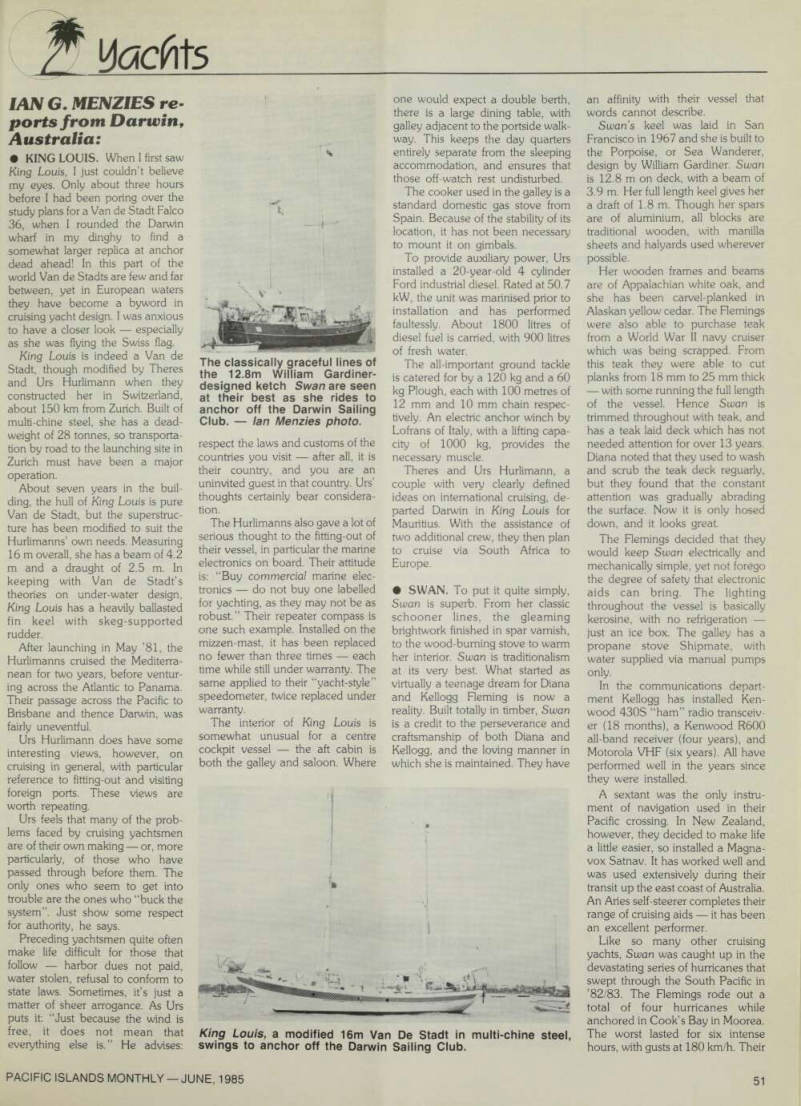
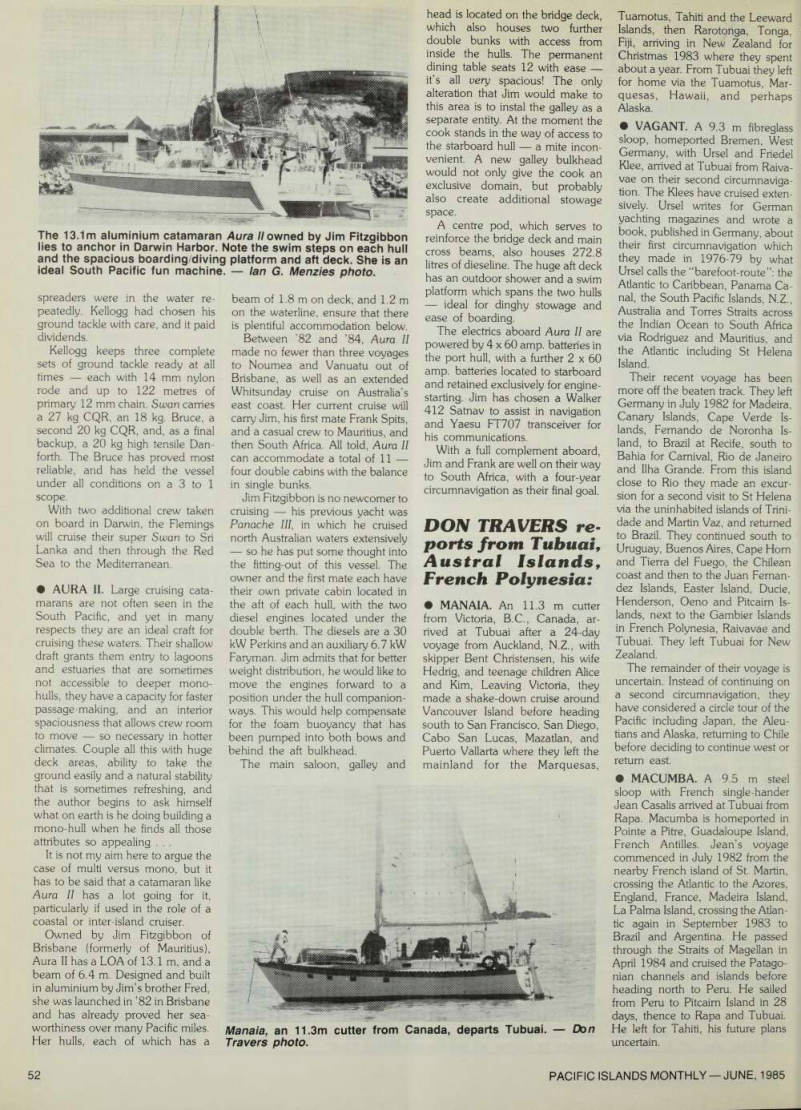
Lan G.Menzies Re
ports from Darwin ,
Australia:
• KING LOUIS. When I first saw King Louis, I just couldn’t believe my eyes. Only about three hours before I had been poring over the study plans for a Van de Stadt Falco 36, when I rounded the Darwin wharf in my dinghy to find a somewhat larger replica at anchor dead ahead! In this part of the world Van de Stadts are few and far between, yet in European waters they have become a byword in cruising yacht design. I was anxious to have a closer look especially as she was flying the Swiss flag.
King Louis is indeed a Van de Stadt, though modified by Theres and Urs Hurlimann when they constructed her in Switzerland, about 150 km from Zurich. Built of multi-chine steel, she has a dead weight of 28 tonnes, so transporta tion by road to the launching site in Zurich must have been a major operation.
About seven years in the buil ding, the hull of King Louis is pure Van de Stadt, but the superstruc ture has been modified to suit the Hurlimanns’ own needs. Measuring 16 m overall, she has a beam of 4.2 m and a draught of 2.5 m. In keeping with Van de Stadt’s theories on under-water design, King Louis has a heavily ballasted fin keel with skeg-supported rudder.
After launching in May ’Bl, the Hurlimanns cruised the Mediterra nean for two years, before ventur ing across the Atlantic to Panama.
Their passage across the Pacific to Brisbane and thence Darwin, was fairly uneventful.
Urs Hurlimann does have some interesting views, however, on cruising in general, with particular reference to fitting-out and visiting foreign ports. These views are worth repeating.
Urs feels that many of the prob lems faced by cruising yachtsmen are of their own making or, more particularly, of those who have passed through before them. The only ones who seem to get into trouble are the ones who “buck the system”. Just show some respect for authority, he says.
Preceding yachtsmen quite often make life difficult for those that follow harbor dues not paid, water stolen, refusal to conform to state laws. Sometimes, it’s just a matter of sheer arrogance. As Urs puts it: “Just because the wind is free, it does not mean that everything else is.” He advises:
respect the laws and customs of the countries you visit after all, it is their country, and you are an uninvited guest in that country. Urs’ thoughts certainly bear considera tion.
The Hurlimanns also gave a lot of serious thought to the fitting-out of their vessel, in particular the marine electronics on board. Their attitude is: “Buy commercial marine elec tronics do not buy one labelled for yachting, as they may not be as robust.” Their repeater compass is one such example. Installed on the mizzen-mast, it has been replaced no fewer than three times each time while still under warranty. The same applied to their “yacht-style” speedometer, twice replaced under warranty.
The interior of King Louis is somewhat unusual for a centre cockpit vessel the aft cabin is both the galley and saloon. Where
one would expect a double berth, there is a large dining table, with galley adjacent to the portside walk way. This keeps the day quarters entirely separate from the sleeping accommodation, and ensures that those off-watch rest undisturbed.
The cooker used in the galley is a standard domestic gas stove from Spain. Because of the stability of its location, it has not been necessary to mount it on gimbals.
To provide auxiliary power, Urs installed a 20-year-old 4 cylinder Ford industrial diesel. Rated at 50.7 kW, the unit was marinised prior to installation and has performed faultessly. About 1800 litres of diesel fuel is carried, with 900 litres of fresh water.
The all-important ground tackle is catered for by a 120 kg and a 60 kg Plough, each with 100 metres of 12 mm and 10 mm chain respec tively. An electric anchor winch by Lofrans of Italy, with a lifting capa city of 1000 kg, provides the necessary muscle.
Theres and Urs Hurlimann, a couple with very clearly defined ideas on international cruising, de parted Darwin in King Louis for Mauritius. With the assistance of two additional crew, they then plan to cruise via South Africa to Europe. • SWAN. To put it quite simply, Swan is superb. From her classic schooner lines, the gleaming brightwork finished in spar varnish, to the wood-burning stove to warm her interior. Swan is traditionalism at its very best. What started as virtually a teenage dream for Diana and Kellogg Fleming is now a reality. Built totally in timber, Swan is a credit to the perseverance and craftsmanship of both Diana and Kellogg, and the loving manner in which she is maintained. They have
an affinity with their vessel that words cannot describe.
Swan’s keel was laid in San Francisco in 1967 and she is built to the Porpoise, or Sea Wanderer, design by William Gardiner. Swan is 12.8 m on deck, with a beam of 3.9 m. Her full length keel gives her a draft of 1.8 m. Though her spars are of aluminium, all blocks are traditional wooden, with manilla sheets and halyards used wherever possible.
Her wooden frames and beams are of Appalachian white oak, and she has been carvel-planked in Alaskan yellow cedar. The Flemings were also able to purchase teak from a World War II navy cruiser which was being scrapped. From this teak they were able to cut planks from 18 mm to 25 mm thick with some running the full length of the vessel. Hence Swan is trimmed throughout with teak, and has a teak laid deck which has not needed attention for over 13 years.
Diana noted that they used to wash and scrub the teak deck reguarly, but they found that the constant attention was gradually abrading the surface. Now it is only hosed down, and it looks great.
The Flemings decided that they would keep Swan electrically and mechanically simple, yet not forego the degree of safety that electronic aids can bring. The lighting throughout the vessel is basically kerosine, with no refrigeration just an ice box. The galley has a propane stove Shipmate, with water supplied via manual pumps only.
In the communications depart ment Kellogg has installed Ken wood 430 S “ham” radio transceiv er (18 months), a Kenwood R6OO all-band receiver (four years), and Motorola VHF (six years). All have performed well in the years since they were installed.
A sextant was the only instru ment of navigation used in their Pacific crossing. In New Zealand, however, they decided to make life a little easier, so installed a Magna vox Satnav. It has worked well and was used extensively during their transit up the east coast of Australia.
An Aries self-steerer completes their range of cruising aids it has been an excellent performer.
Like so many other cruising yachts, Swan was caught up in the devastating series of hurricanes that swept through the South Pacific in ’B2/83. The Flemings rode out a total of four hurricanes while anchored in Cook’s Bay in Moorea.
The worst lasted for six intense hours, with gusts at 180 km/h. Their
King Louis, a modified 16m Van De Stadt in multi-chine steel, swings to anchor off the Darwin Sailing Club.
The classically graceful lines of the 12.8m William Gardiner designed ketch Swan are seen at their best as she rides to anchor off the Darwin Sailing Club. - Ian Menzies photo.
spreaders were in the water re peatedly. Kellogg had chosen his ground tackle with care, and it paid dividends.
Kellogg keeps three complete sets of ground tackle ready at all times each with 14 mm nylon rode and up to 122 metres of primary 12 mm chain. Swan carries a 27 kg CQR, an 18 kg. Bruce, a second 20 kg CQR, and, as a final backup, a 20 kg high tensile Dan forth. The Bruce has proved most reliable, and has held the vessel under all conditions on a 3 to 1 scope.
With two additional crew taken on board in Darwin, the Flemings will cruise their super Swan to Sri Lanka and then through the Red Sea to the Mediterranean. • AURA 11. Large cruising cata marans are not often seen in the South Pacific, and yet in many respects they are an ideal craft for cruising these waters. Their shallow draft grants them entry to lagoons and estuaries that are sometimes not accessible to deeper mono hulls, they have a capacity for faster passage-making, and an interior spaciousness that allows crew room to move so necessary in hotter climates. Couple all this with huge deck areas, ability to take the ground easily and a natural stability that is sometimes refreshing, and the author begins to ask himself what on earth is he doing building a mono-hull when he finds all those
attributes so appealing . . .
It is not my aim here to argue the case of multi versus mono, but it has to be said that a catamaran like Aura II has a lot going for it, particularly if used in the role of a coastal or inter-island cruiser.
Owned by Jim Fitzgibbon of Brisbane (formerly of Mauritius), Aura II has a LOA of 13.1 m, and a beam of 6.4 m. Designed and built in aluminium by Jim’s brother Fred, she was launched in ’B2 in Brisbane and has already proved her sea worthiness over many Pacific miles.
Her hulls, each of which has a
beam of 1.8 m on deck, and 1.2 m on the waterline, ensure that there is plentiful accommodation below.
Between ’B2 and ’B4, Aura II made no fewer than three voyages to Noumea and Vanuatu out of Brisbane, as well as an extended Whitsunday cruise on Australia’s east coast. Her current cruise will carry Jim, his first mate Frank Spits, and a casual crew to Mauritius, and then South Africa. All told, Aura II can accommodate a total of 11 four double cabins with the balance in single bunks.
Jim Fitzgibbon is no newcomer to cruising his previous yacht was Panache 111, in which he cruised north Australian waters extensively so he has put some thought into the fitting-out of this vessel. The owner and the first mate each have their own private cabin located in the aft of each hull, with the two diesel engines located under the double berth. The diesels are a 30 kW Perkins and an auxiliary 6.7 kW Faryman. Jim admits that for better weight distribution, he would like to move the engines forward to a position under the hull companion ways. This would help compensate for the foam buoyancy that has been pumped into both bows and behind the aft bulkhead.
The main saloon, galley and
head is located on the bridge deck, which also houses two further double bunks with access from inside the hulls. The permanent dining table seats 12 with ease it’s all very spacious! The only alteration that Jim would make to this area is to instal the galley as a separate entity. At the moment the cook stands in the way of access to the starboard hull a mite incon venient. A new galley bulkhead would not only give the cook an exclusive domain, but probably also create additional stowage space.
A centre pod, which serves to reinforce the bridge deck and main cross beams, also houses 272.8 litres of dieseline. The huge aft deck has an outdoor shower and a swim platform which spans the two hulls ideal for dinghy stowage and ease of boarding.
The electrics aboard Aura II are powered by 4 x 60 amp. batteries in the port hull, with a further 2 x 60 amp. batteries located to starboard and retained exclusively for engine starting. Jim has chosen a Walker 412 Satnav to assist in navigation and Yaesu FT7O7 transceiver for his communications.
With a full complement aboard, Jim and Frank are well on their way to South Africa, with a four-year circumnavigation as their final goal.
Don Travers Re
ports from Tubuai,
Austral islands,
French Polynesia:
• MANAIA. An 11.3 m cutter from Victoria, 8.C., Canada, ar rived at Tubuai after a 24-day voyage from Auckland, N.Z., with skipper Bent Christensen, his wife Hedrig, and teenage children Alice and Kim, Leaving Victoria, they made a shake-down cruise around Vancouver Island before heading south to San Francisco, San Diego, Cabo San Lucas, Mazatlan, and Puerto Vallarta where they left the mainland for the Marquesas,
Tuamotus, Tahiti and the Leeward Islands, then Rarotonga, Tonga, Fiji, arriving in New Zealand for Christmas 1983 where they spent about a year. From Tubuai they left for home via the Tuamotus, Mar quesas, Hawaii, and perhaps Alaska. • VACANT. A 9.3 m fibreglass sloop, homeported Bremen, West Germany, with Ursel and Friedel Klee, arrived at Tubuai from Raiva vae on their second circumnaviga tion. The Klees have cruised exten sively. Ursel writes for German yachting magazines and wrote a book, published in Germany, about their first circumnavigation which they made in 1976-79 by what Ursel calls the “barefoot-route”: the Atlantic to Caribbean, Panama Ca nal, the South Pacific Islands, N.Z., Australia and Torres Straits across the Indian Ocean to South Africa via Rodriguez and Mauritius, and the Atlantic including St Helena Island.
Their recent voyage has been more off the beaten track. They left Germany in July 1982 for Madeira, Canary Islands, Cape Verde Is lands, Fernando de Noronha Is land, to Brazil at Recife, south to Bahia for Carnival, Rio de Janeiro and Ilha Grande. From this island close to Rio they made an excur sion for a second visit to St Helena via the uninhabited islands of Trini dade and Martin Vaz, and returned to Brazil. They continued south to Uruguay, Buenos Aires, Cape Horn and Tierra del Fuego, the Chilean coast and then to the Juan Fernan dez Islands, Easter Island, Ducie, Henderson, Oeno and Pitcairn Is lands, next to the Gambier Islands in French Polynesia, Raivavae and Tubuai. They left Tubuai for New Zealand.
The remainder of their voyage is uncertain. Instead of continuing on a second circumnavigation, they have considered a circle tour of the Pacific including Japan, the Aleu tians and Alaska, returning to Chile before deciding to continue west or return east. • MACUMBA. A 9.5 m steel sloop with French single-hander Jean Casalis arrived at Tubuai from Rapa. Macumba is homeported in Pointe a Pitre, Guadaloupe Island, French Antilles. Jean’s voyage commenced in July 1982 from the nearby French island of St. Martin, crossing the Atlantic to the Azores, England, France, Madeira Island, La Palma Island, crossing the Atlan tic again in September 1983 to Brazil and Argentina. He passed through the Straits of Magellan in April 1984 and cruised the Patago nian channels and islands before heading north to Peru. He sailed from Peru to Pitcairn Island in 28 days, thence to Rapa and Tubuai.
He left for Tahiti, his future plans uncertain.
The 13.1m aluminium catamaran Aura II owned by Jim Fitzgibbon lies to anchor in Darwin Harbor. Note the swim steps on each hull and the spacious boarding/diving platform and aft deck. She is an ideal South Pacific fun machine. - Ian G. Menzies photo.
Manaia, an 11.3m cutter from Canada, departs Tubuai. - Don Travers photo.
shipping schedules
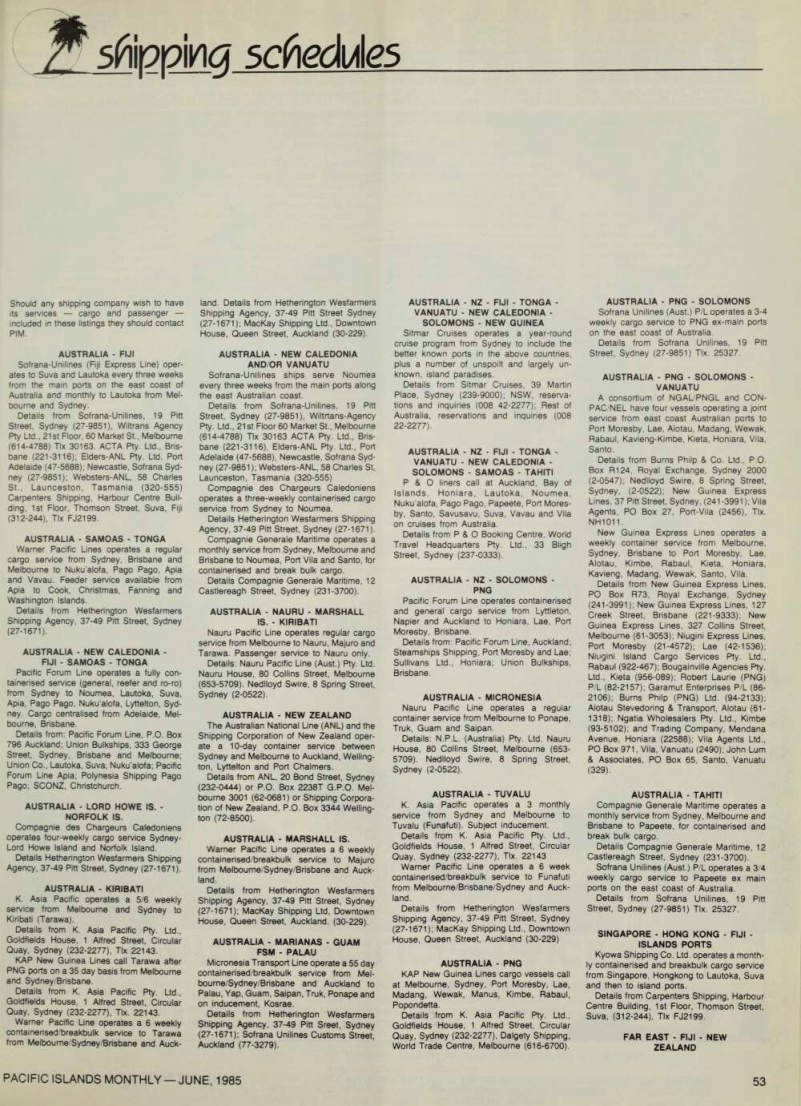
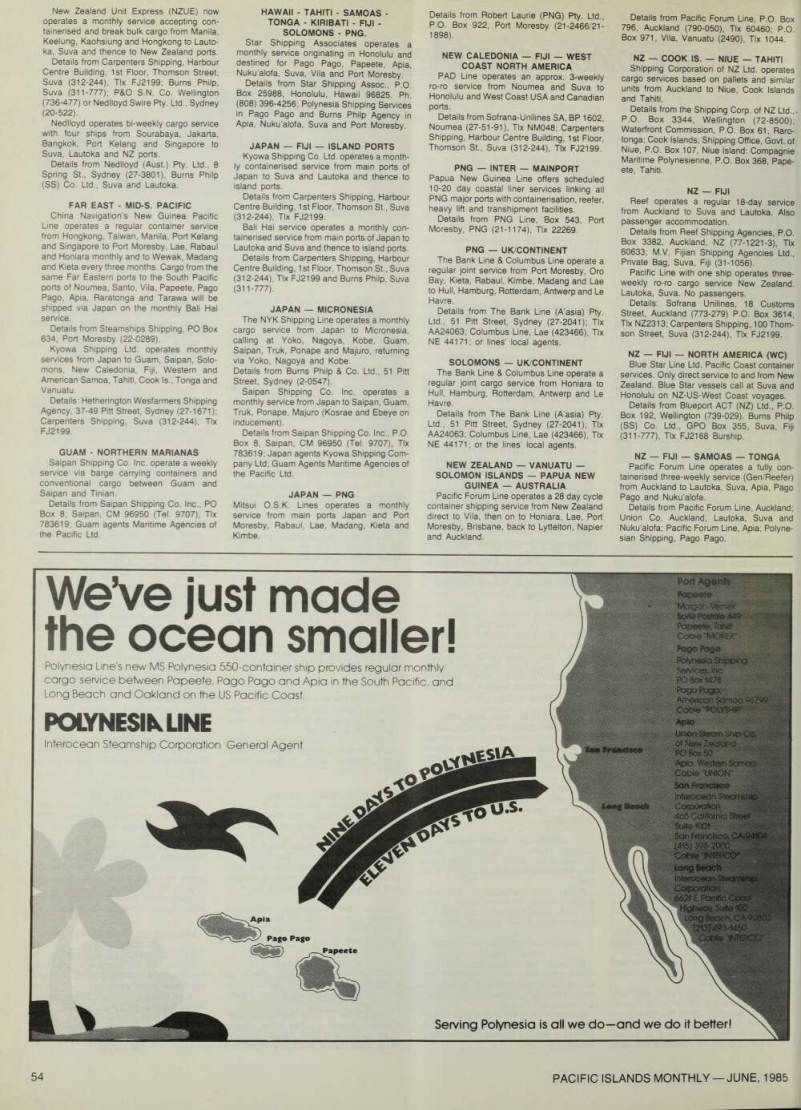
Should any shipping company wish to have its services cargo and passenger included in these listings they should contact
Pim.
Australia - Fiji
Sofrana-Unilines (Fiji Express Line) oper ates to Suva and Lautoka every three weeks from the main ports on the east coast of Australia and monthly to Lautoka from Mel bourne and Sydney.
Details from Sofrana-Unilines, 19 Pitt Street, Sydney (27-9851), Wiltrans Agency Pty Ltd., 21st Floor, 60 Market St., Melbourne (614-4788) Tlx 30163. ACTA Pty. Ltd., Bris bane (221-3116); Elders-ANL Pty. Ltd. Port Adelaide (47-5688); Newcastle, Sofrana Syd ney (27-9851); Websters-ANL, 58 Charles St., Launceston, Tasmania (320-555) Carpenters Shipping, Harbour Centre Buil ding, Ist Floor, Thomson Street, Suva, Fiji (312-244), Tlx FJ2199.
Australia - Samoas - Tonga
Warner Pacific Lines operates a regular cargo service from Sydney, Brisbane and Melbourne to Nukualofa, Pago Pago, Apia and Vavau. Feeder service available from Apia to Cook, Christmas, Fanning and Washington Islands.
Details from Hetherington Wesfarmers Shipping Agency, 37-49 Pitt Street, Sydney (27-1671).
Australia - New Caledonia -
Fiji - Samoas - Tonga
Pacific Forum Line operates a fully con tainerised service (general, reefer and ro-ro) from Sydney to Noumea, Lautoka, Suva, Apia, Pago Pago, Nuku’alofa. Lyttelton, Syd ney. Cargo centralised from Adelaide, Mel bourne, Brisbane.
Details from: Pacific Forum Line, P.O. Box 796 Auckland; Union Bulkships, 333 George Street, Sydney, Brisbane and Melbourne; Union Co., Lautoka, Suva, Nuku’alofa; Pacific Forum Line Apia; Polynesia Shipping Pago Pago; SCONZ, Christchurch.
Australia - Lord Howe Is. -
Norfolk Is.
Compagnie des Chargeurs Caledoniens operates four-weekly cargo service Sydney- Lord Howe Island and Norfolk Island.
Details Hetherington Wesfarmers Shipping Agency, 37-49 Pitt Street, Sydney (27-1671).
Australia - Kiribati
K. Asia Pacific operates a 5/6 weekly service from Melbourne and Sydney to Kiribati (Tarawa).
Details from K. Asia Pacific Pty, Ltd., Goldfields House, 1 Alfred Street, Circular Quay, Sydney (232-2277), Tlx 22143.
KAP New Guinea Lines call Tarawa after PNG ports on a 35 day basis from Melbourne
and Sydney/Brisbane.
Details from K. Asia Pacific Pty. Ltd., Goldfields House, 1 Alfred Street, Circular Quay, Sydney (232-2277), Tlx. 22143.
Warner Pacific Line operates a 6 weekly containerised breakbulk service to Tarawa from Melbourne/Sydney/Brisbane and Auck
land. Details from Hetherington Wesfarmers Shipping Agency, 37-49 Pitt Street Sydney (27-1671); Mac Kay Shipping Ltd., Downtown House, Queen Street, Auckland (30-229).
Australia - New Caledonia
And/Or Vanuatu
Sofrana-Unilines ships serve Noumea every three weeks from the main ports along the east Australian coast.
Details from Sofrana-Unilines, 19 Pitt Street, Sydney (27-9851), Wiltrtans-Agency Pty. Ltd., 21st Floor 60 Market St., Melbourne (614-4788) Tlx 30163 ACTA Pty. Ltd., Bris bane (221-3116), Elders-ANL Pty. Ltd., Port Adelaide (47-5688), Newcastle, Sofrana Syd ney (27-9851); Websters-ANL, 58 Charles St, Launceston, Tasmania (320-555) Compagnie des Chargeurs Caledonians operates a three-weekly containerised cargo service from Sydney to Noumea.
Details Hetherington Wesfarmers Shipping Agency, 37-49 Pitt Street, Sydney (27-1671).
Compagnie Generate Maritime operates a monthly service from Sydney, Melbourne and Brisbane to Noumea, Port Vila and Santo, for containerised and break bulk cargo.
Details Compagnie Generate Maritime, 12 Castlereagh Street, Sydney (231-3700).
Australia - Nauru - Marshall
Is. - Kiribati
Nauru Pacific Line operates regular cargo service from Melbourne to Nauru, Majuro and Tarawa. Passenger service to Nauru only.
Details; Nauru Pacific Line (Aust.) Pty. Ltd.
Nauru House, 80 Collins Street, Melbourne (653-5709). Nedlloyd Swire, 8 Spring Street, Sydney (2-0522).
Australia - New Zealand
The Australian National Line (ANL) and the Shipping Corporation of New Zealand oper ate a 10-day container service between Sydney and Melbourne to Auckland, Welling ton, Lyttelton and Port Chalmers.
Details from ANL, 20 Bond Street, Sydney (232-0444) or P.O. Box 2238 T G.P.O. Mel bourne 3001 (62-0681) or Shipping Corpora tion of New Zealand, P.O. Box 3344 Welling ton (72-8500).
Australia - Marshall Is.
Warner Pacific Line operates a 6 weekly containerised/breakbulk service to Majuro from Melbourne/Sydney/Brisbane and Auck land.
Details from Hetherington Wesfarmers Shipping Agency, 37-49 Pitt Street, Sydney (27-1671); Mac Kay Shipping Ltd, Downtown House, Queen Street, Auckland. (30-229).
Australia - Marianas - Guam
Fsm - Palau
Micronesia Transport Line operate a 55 day containerised/breakbulk service from Mel bourne/Sydney/Brisbane and Auckland to Palau, Yap, Guam, Saipan, Truk, Ponape and on inducement, Kosrae.
Details from Hetherington Wesfarmers Shipping Agency, 37-49 Pitt Sreet, Sydney (27-1671); Sofrana Unilines Customs Street, Auckland (77-3279).
AUSTRALIA - NZ - FIJI - TONGA -
Vanuatu - New Caledonia -
Solomons • New Guinea
Sitmar Cruises operates a year-round cruise program from Sydney to include the better known ports in the above countries, plus a number of unspoilt and largely un known, island paradises.
Details from Sitmar Cruises, 39 Martin Place, Sydney (239-9000); NSW, reserva tions and inquiries (008 42-2277); Rest of Australia, reservations and inquiries (008 22-2277).
AUSTRALIA - NZ - FIJI - TONGA -
Vanuatu - New Caledonia -
Solomons - Samoas - Tahiti
P & O liners call at Auckland, Bay of Islands, Honiara, Lautoka, Noumea, Nukualofa, Pago Pago, Papeete, Port Mores by, Santo. Savusavu, Suva, Vavau and Vila on cruises from Australia.
Details from P & O Booking Centre, World Travel Headquarters Pty. Ltd., 33 Bligh Street, Sydney (237-0333).
Australia - Nz - Solomons -
Png
Pacific Forum Line operates containerised and general cargo service from Lyttleton, Napier and Auckland to Honiara, Lae, Port Moresby, Brisbane.
Details from: Pacific Forum Line, Auckland; Steamships Shipping, Port Moresby and Lae; Sullivans Ltd., Honiara; Union Bulkships, Brisbane.
Australia - Micronesia
Nauru Pacific Line operates a regular container service from Melbourne to Ponape, Truk, Guam and Saipan.
Details: N.P.L. (Australia) Pty. Ltd. Nauru House, 80 Collins Street, Melbourne (653- 5709). Nedlloyd Swire, 8 Spring Street, Sydney (2-0522).
Australia - Tuvalu
K. Asia Pacific operates a 3 monthly service from Sydney and Melbourne to Tuvalu (Funafuti). Subject inducement.
Details from K. Asia Pacific Pty. Ltd., Goldfields House, 1 Alfred Street, Circular Quay, Sydney (232-2277), Tlx. 22143 Warner Pacific Line operates a 6 week containerised/breakbulk service to Funafuti from Melbourne/Brisbane/Sydney and Auck land.
Details from Hetherington Wesfarmers Shipping Agency, 37-49 Pitt Street, Sydney (27-1671); Mac Kay Shipping Ltd., Downtown House, Queen Street, Auckland (30-229)
Australia - Png
KAP New Guinea Lines cargo vessels call at Melbourne, Sydney, Port Moresby, Lae, Madang, Wewak, Manus, Kimbe, Rabaul, Popondetta.
Details from K. Asia Pacific Pty. Ltd., Goldfields House, 1 Alfred Street, Circular Quay, Sydney (232-2277), Dalgety Shipping, World Trade Centre, Melbourne (616-6700).
Australia - Png - Solomons
Sofrana Unilines (Aust.) P/L operates a 3-4 weekly cargo service to PNG ex-main ports on the east coast of Australia.
Details from Sofrana Unilines, 19 Pitt Street, Sydney (27-9851) Tlx. 25327.
Australia - Png - Solomons -
Vanuatu
A consortium of NGAL/PNGL and CON PAC/NEL have four vessels operating a joint service from east coast Australian ports to Port Moresby, Lae, Alotau, Madang, Wewak, Rabaul, Kavieng-Kimbe, Kieta, Honiara, Vila, Santo.
Details from Burns Philp & Co. Ltd., P.O.
Box R 124, Royal Exchange, Sydney 2000 (2-0547); Nedlloyd Swire, 8 Spring Street, Sydney, (2-0522); New Guinea Express Lines, 37 Pitt Street, Sydney, (241-3991): Vila Agents, PO Box 27, Port-Vila (2456), Tlx.
Nhioii.
New Guinea Express Lines operates a weekly container service from Melbourne, Sydney, Brisbane to Port Moresby, Lae, Alotau, Kimbe, Rabaul, Kieta, Honiara, Kavieng, Madang, Wewak. Santo, Vila.
Details from New Guinea Express Lines, PO Box R 73, Royal Exchange, Sydney (241-3991); New Guinea Express Lines, 127 Creek Street, Brisbane (221-9333); New Guinea Express Lines, 327 Collins Street, Melbourne (61-3053); Niugini Express Lines, Port Moresby (21-4572); Lae (42-1536); Niugini Island Cargo Services Pty. Ltd., Rabaul (922-467); Bougainville Agencies Pty.
Ltd., Kieta (956-089); Robert Laurie (PNG) P/L (82-2157); Garamut Enterprises P/L (86- 2106); Burns Philp (PNG) Ltd. (94-2133); Alotau Stevedoring & Transport, Alotau (61- 1318); Ngatia Wholesalers Pty. Ltd., Kimbe (93-5102); and Trading Company, Mendana Avenue, Honiara (22588); Vila Agents Ltd., PO Box 971, Vila, Vanuatu (2490); John Lum & Associates, PO Box 65, Santo, Vanuatu (329).
Australia - Tahiti
Compagnie Generate Maritime operates a monthly service from Sydney, Melbourne and Brisbane to Papeete, for containerised and break bulk cargo.
Details Compagnie Generate Maritime, 12
Castlereagh Street, Sydney (231-3700).
Sofrana Unilines (Aust.) P/L operates a 3/4 weekly cargo service to Papeete ex main ports on the east coast of Australia.
Details from Sofrana Unilines, 19 Pitt Street, Sydney (27-9851) Tlx. 25327.
SINGAPORE - HONG KONG - FIJI -
Islands Ports
Kyowa Shipping Co. Ltd. operates a month ly containerised and breakbulk cargo service from Singapore, Hongkong to Lautoka, Suva and then to island ports.
Details from Carpenters Shipping, Harbour Centre Building, Ist Floor, Thomson Street, Suva, (312-244), Tlx FJ2199.
Far East - Fiji - New
Zealand
New Zealand Unit Express (NZUE) now operates a monthly service accepting con tainerised and break bulk cargo from Manila, Keelung, Kaohsiung and Hongkong to Lauto ka, Suva and thence to New Zealand ports.
Details from Carpenters Shipping, Harbour Centre Building, Ist Floor, Thomson Street, Suva (312-244), Tlx FJ2199; Burns Philp, Suva (311-777); P&O S.N. Co. Wellington (736-477) or Nedlloyd Swire Pty. Ltd., Sydney (20-522).
Nedlloyd operates bi-weekly cargo service with four ships from Sourabaya, Jakarta, Bangkok, Port Kelang and Singapore to Suva, Lautoka and NZ ports.
Details from Nedlloyd (Aust.) Pty. Ltd., 8 Spring St., Sydney (27-3801), Burns Philp (SS) Co. Ltd., Suva and Lautoka.
Far East - Mid-S. Pacific
China Navigation’s New Guinea Pacific Line operates a regular container service from Hongkong, Taiwan, Manila, Port Kelang and Singapore to Port Moresby, Lae, Rabaul and Honiara monthly and to Wewak, Madang and Kieta every three months. Cargo from the same Far Eastern ports to the South Pacific ports of Noumea, Santo, Vila, Papeete, Pago Pago, Apia, Raratonga and Tarawa will be shipped via Japan on the monthly Bali Hai service.
Details from Steamships Shipping, PO Box 634, Port Moresby (22-0289).
Kyowa Shipping Ltd. operates monthly services from Japan to Guam, Saipan, Solo mons, New Caledonia, Fiji, Western and American Samoa, Tahiti, Cook Is., Tonga and Vanuatu.
Details: Hetherington Wesfarmers Shipping Agency, 37-49 Pitt Street, Sydney (27-1671); Carpenters Shipping, Suva (312-244), Tlx FJ2199.
Guam - Northern Marianas
Saipan Shipping Co. Inc. operate a weekly service via barge carrying containers and conventional cargo between Guam and Saipan and Tinian.
Details from Saipan Shipping Co. Inc., PO Box 8, Saipan, CM 96950 (Tel. 9707), Tlx 783619; Guam agents Maritime Agencies of the Pacific Ltd.
Hawaii - Tahiti - Samoas -
Tonga - Kiribati - Fiji -
Solomons - Png.
Star Shipping Associates operates a monthly service originating in Honolulu and destined for Pago Pago, Papeete, Apia, Nukualofa, Suva, Vila and Port Moresby.
Details from Star Shipping Assoc., P.O.
Box 25988, Honolulu, Hawaii 96825. Ph. (808) 396-4256; Polynesia Shipping Services in Pago Pago and Burns Philp Agency in Apia, Nukualofa, Suva and Port Moresby.
Japan Fiji Island Ports
Kyowa Shipping Co. Ltd. operates a month ly containerised service from main ports of Japan to Suva and Lautoka and thence to island ports.
Details from Carpenters Shipping, Harbour Centre Building, Ist Floor, Thomson St., Suva (312-244), Tlx FJ2199.
Bali Hai service operates a monthly con tainerised service from main ports of Japan to Lautoka and Suva and thence to island ports.
Details from Carpenters Shipping, Harbour Centre Building, Ist Floor, Thomson St., Suva (312-244), Tlx FJ2199 and Burns Philp, Suva (311-777).
Japan Micronesia
The NYK Shipping Line operates a monthly cargo service from Japan to Micronesia, calling at Yoko. Nagoya. Kobe, Guam, Saipan, Truk, Ponape and Majuro, returning via Yoko, Nagoya and Kobe.
Details from Burns Philp & Co. Ltd., 51 Pitt Street, Sydney (2-0547).
Saipan Shipping Co. Inc. operates a monthly service from Japan to Saipan, Guam, Truk, Ponape, Majuro (Kosrae and Ebeye on inducement).
Details from Saipan Shipping Co. Inc., P.O.
Box 8, Saipan, CM 96950 (Tel. 9707), Tlx 783619; Japan agents Kyowa Shipping Com pany Ltd; Guam Agents Maritime Agencies of the Pacific Ltd.
Japan Png
Mitsui O.S.K. Lines operates a monthly service from main ports Japan and Port Moresby, Rabaul, Lae, Madang, Kieta and Kimbe.
Details from Robert Laurie (PNG) Pty. Ltd., P.O. Box 922, Port Moresby (21-2466/21- 1898).
New Caledonia Fiji West
Coast North America
PAD Line operates an approx. 3-weekly ro-ro service from Noumea and Suva to Honolulu and West Coast USA and Canadian ports.
Details from Sofrana-Unilines SA, BP 1602, Noumea (27-51-91), Tlx NMO4B; Carpenters Shipping, Harbour Centre Building, Ist Floor, Thomson St., Suva (312-244), Tlx FJ2199.
Png Inter Mainport
Papua New Guinea Line offers scheduled 10-20 day coastal liner services linking all PNG major ports with containerisation, reefer, heavy lift and transhipment facilities.
Details from PNG Line, Box 543, Port Moresby, PNG (21-1174), Tlx 22269.
Png Ukcontinent
The Bank Line & Columbus Line operate a regular joint service from Port Moresby, Oro Bay, Kieta, Rabaul, Kimbe, Madang and Lae to Hull, Hamburg, Rotterdam, Antwerp and Le Havre.
Details from The Bank Line (A'asia) Pty.
Ltd., 51 Pitt Street, Sydney (27-2041); Tlx AA24063; Columbus Line, Lae (423466), Tlx NE 44171; or lines’ local agents.
Solomons Uk/Continent
The Bank Line & Columbus Line operate a regular joint cargo service from Honiara to Hull, Hamburg, Rotterdam, Antwerp and Le Havre.
Details from The Bank Line (A’asia) Pty.
Ltd., 51 Pitt Street, Sydney (27-2041); Tlx AA24063; Columbus Line, Lae (423466), Tlx NE 44171; or the lines' local agents.
New Zealand Vanuatu
Solomon Islands Papua New
Guinea Australia
Pacific Forum Line operates a 28 day cycle container shipping service from New Zealand direct to Vila, then on to Honiara, Lae, Port Moresby. Brisbane, back to Lyttelton, Napier and Auckland.
Details from Pacific Forum Line, P.O. Box 796, Auckland (790-050), Tlx 60460; P.O.
Box 971, Vila, Vanuatu (2490), Tlx 1044.
Nz Cook Is. Niue Tahiti
Shipping Corporation of NZ Ltd. operates cargo services based on pallets and similar units from Auckland to Niue, Cook Islands and Tahiti.
Details from the Shipping Corp. of NZ Ltd.,.
P.O. Box 3344, Wellington (72-8500); Waterfront Commission, P.O. Box 61, Raro tonga; Cook Islands; Shipping Office, Govt, of Niue, P.O. Box 107, Niue Island: Compagnie Maritime Polynesienne, P.O. Box 368, Pape ete, Tahiti.
Nz Fiji
Reef operates a regular 18-day service from Auckland to Suva and Lautoka. Also passenger accommodation.
Details from Reef Shipping Agencies, P.O.
Box 3382, Auckland, NZ (77-1221-3), Tlx 60633; M.V. Fijian Shipping Agencies Ltd., Private Bag, Suva, Fiji (31-1056).
Pacific Line with one ship operates three weekly ro-ro cargo service New Zealand.
Lautoka, Suva. No passengers.
Details: Sofrana Unilines, 18 Customs Street, Auckland (773-279) P.O. Box 3614, Tlx NZ2313; Carpenters Shipping, 100 Thom son Street, Suva (312-244), Tlx FJ2199.
Nz Fiji North America (Wc)
Blue Star Line Ltd. Pacific Coast container services. Only direct service to and from New Zealand. Blue Star vessels call at Suva and Honolulu on NZ-US-West Coast voyages.
Details from Blueport ACT (NZ) Ltd., P.O.
Box 192, Wellington (739-029). Burns Philp (SS) Co. Ltd., GPO Box 355. Suva, Fiji (311-777), Tlx FJ2168 Burship.
Nz Fiji Samoas Tonga
Pacific Forum Line operates a fully con tainerised three-weekly service (Gen/Reefer) from Auckland to Lautoka, Suva, Apia, Pago Pago and Nukualofa.
Details from Pacific Forum Line, Auckland; Union Co. Auckland, Lautoka, Suva and Nukualofa; Pacific Forum Line, Apia; Polyne sian Shipping, Pago Pago.
Nz N. Caledonia Vanuatu
Png Solomons
Sofrana Unilines with three ships operate to Vila and Santo, to Honiara and Papua New Guinea and to Norfolk Island and Noumea (No passengers).
Details from Sofrana Unilines, 18 Customs Street, Auckland (773-279), P.O. Box 3614, Tlx NZ2313.
Nz Tahiti
Compagnie Tahitienne Maritime SA (as CTM-Tahiti Line) operates one ship, MV Bounty 111, monthly Papeete New Zea land. (No passengers).
Details from Sofrana Unilines, P.O. Box 3614,18 Customs St., Auckland, Tlx NZ2313; Agence Maritime Cowan, P.O. Box 9012, Papeete (39042), Tlx Tahitlin 322 FP Tahiti.
Nz Tonga Samoas
Warner Pacific Line services Auckland, Nukualofa, Vavau, Apia, Pago Pago fort nightly carrying general and freezer cargoes.
Details from McKay Shipping Ltd., Down town House, 21 Queen St., Auckland, P.O Box 1372 (30-299). Cables MACSHIP, Telex NZ2554, Warner Pacific Line, Box 93, Nuku’alofa, Tonga; Mealelei (Western Samoa,) Ltd. Private Bag, Apia, Western Samoa, Kneubuhl Maritime Service, Box 39, Pago Pago, American Samoa, 96799.
Tahiti New Caledonia Vanuatu
Solomon Is.
New Zealand Png Singapore
Europe
Polish Ocean Lines operate in a semi container type vessel to the following ports, from Papeete, Noumea, Santo, Vila, Yandina, Honiara, Auckland, Rabaul, Lae, Singapore, Port Kelang, Penang then to Mediterranean ports and Europe via the Suez Canal. (Other New Zealand ports subject to inducement).
Details from Universal Shipping Agencies Ltd., 6th Floor, 38 Fort Street, Auckland 1, New Zealand (30931), Tlx 21517.
Europe Tahiti
New Caledonia
Compagnie Generate Maritime operates services from Europe and Mediterranean ports to Papeete and Noumea using three ro-ro and multi-purpose vessels thus ensuring a bi-monthly sailing to and from.
Details Compagnie Generate Maritime, 12 Castlereagh Street, Sydney (231-3700).
Europe Tahiti
New Caledonia New Zealand
Solomons Png Europe
Polish Ocean Lines offers regular monthly sailings for containerised and break bulk cargo and reefer space, conventional and in reefer containers, from Noumea to Vanuatu (Santo/Vila), Solomon Islands (Honiara), New Zealand (always Auckland, other ports sub ject to inducement), Lae, Rabaul, Singapore, Port Kelang, Penang then Mediterranean to Europe. Other ports in the South Pacific can be served with inducement.
Details from Sotama, BP 9170, Papeete (27805), Tlx 296 SATO; BP C 2, Noumea (272094), Tlx 163 NM SATO; Union Steam ship Co. of NZ, P.O Box 50, Apia, Tlx 25; Williams and Gosling, P.O Box 79, Suva (312633), Tlx 2163; Warner Pacific Line, P.O.
Box 93 Nuku’alofa (21089), Tlx 66219; Uni versal Shipping Agencies, 6th Floor, 38 Fort Street, Auckland 1, New Zealand (30930), Tlx 21517.
Europe Tahiti W. Samoa
Fiji N. Caledonia
Nedlloyd offers regular cargo services from Continental ports to Papeete, Apia, Fiji and New Caledonia.
Details Nedlloyd (Aust.) Pty. Ltd., 8 Spring Street, Sydney (27-3801); Carpenters Ship ping, Ist Floor, Harbour Centre Bldg., 100 Thomson St., Suva (312-244), Tlx 2199 FJ and Vetari Street, Lautoka (63988), Tlx 5215FJ.
Uk N. Continent W. Samoa
Tonga, Fiji
The Bank Line & Columbus Line operate a regular joint cargo service from Hull, Ham burg, Bremen, Antwerp, Rotterdam and Le Havre to Apia, Nuku’alofa, Suva and Lautoka.
Details from The Bank Line (A’asia) Pty.
Ltd., 51 Pitt Street, Sydney (27-2041), Tlx AA 24063; Columbus Line, Lae (423-466), Tlx NE 44171; or lines' local agents.
Uk N. Continent Png
Solomons
The Bank Line & Columbus Line operate a regular joint cargo service from Hull, Ham burg, Bremen, Antwerp, Rotterdam and Le Havre to Port Moresby, Lae, Madang, Kimbe, Rabaul, Kieta and Honiara and on induce ment to Yandina.
Details from The Bank Line (A’asia) Pty.
Ltd., 51 Pitt Street, Sydney (27-2041), Tlx AA 24063; Columbus Line, Lae (42-3466), Tlx NE 44171; or lines’ local agents.
Uk/N. Continent Tahiti
N. Caledonia Vanuatu
The Bank Line & Columbus Line operate a regular joint cargo service from Hull, Ham burg, Bremen, Antwerp, Rotterdam and Le Havre to Papeete, Noumea, Port-Vila and Santo.
Details from The Bank Line (A’asia) Pty.
Ltd., 51 Pitt Street, Sydney (27-2041), Tlx AA 24063; Columbus Line, Lae (42-3466), Tlx NE 44171; Ets. AM. Fare UTE, Papeete; Ets.
Ballande, Noumea and other local agents.
Us Hawaii Micronesia
E. Malaysia Brunei Papua New
Guinea Philippines
PM&O Lines operates three fully self-sus tained container vessels on a sailing frequen cy of every 21 days from the San Francisco Bay area, Los Angeles, and Honolulu to Majuro, Ebeye, Kosrae, Ponape, Truk, Saipan, Yap, Koror, Kota Kinabalu, Brunei, Lae, Kieta and Rabaul.
Service is also offered utilising the same vessels on the same 21-day frequency from the Philippine ports of Manila, Cebu, and Davao and General Santos and the Papua New Guinea ports of Rabaul, Lae and Kieta to Hawaii, San Francisco and Los Angeles.
Finally service is available from Davao, Cebu, Manila, Hong Kong, Keelung and Kaohsiung to Saipan, Guam, Honolulu, Lae, Rabaul and Kieta.
Details from PM&O Lines, 181 Fremont Street, San Francisco, California, 94105, U.S.A. (415) 543-7430, Tlx 278016; Cable PMONAV SFO; PM&O Owner’s representa tive, P.O. Box 803, Saipan, N.M.I. 96950.
Cable Commontime Saipan, Tlx
783605; Anscor Transport and Terminals Inc., P.O. Box 7023-5, Metro Manila, Philip pines (521-8074) Tlx 65021 ATTI PN.
Us Hawaii Nauru
Micronesia
Nauru Pacific Line operates regular con ventional and container services from San Francisco and Honolulu to Majuro, Ponape, Truk and Saipan. Cargo is accepted for Nauru and Kosrae with transhipment at Majuro and Ponape.
Details from N.P.O. (Australia) Pty. Ltd., Nauru House, 80 Collins Street, Melbourne (653-5709); Nauru Air and Shipping Agency, Suite 2803, 185 Berry Street, San Francisco, California 94107 (415-543-1737); Nauru Air and Shipping Agency, Suite 506, 841 Bishop St., Honolulu, HI 96813 (808-523-0441).
Us. Noumea Fiji
PAD Line operates an approx. 3-weekly ro-ro service from west coast USA and Canada to Noumea, Suva and Lautoka.
Details from Sofrana Unilines BP 1602, Noumea (27-51-91), Tlx NMO4B; Carpenters Shipping, Harbour Centre Building, Ist Floor, 100 Thomson Street, Suva (312-244), Tlx FJ2199; Trans-Austral Shipping Pty. Ltd., P.O. Box R 232, Royal Exchange, 2000 (231-8411), Tlx AA21204.
Us Tahiti Samoa
Pacific Islands Transport operates a five weekly cargo service from North America west coast ports to Papeete, Pago Pago, Apia.
Details from Polynesia Shipping Services Inc. P.O. Box 1478, Pago Pago 96799.
Polynesia Line operates container and general cargo service from US west coast ports to Papeete and Pago Pago.
Details from Polynesia Shipping Services Inc., P.O. Box 1478, Pago Pago 96799.
Advertisements & other items, pp. 54-56 (1 item)
We’ve just made
the ocean smaller!
Polynesia Line's new MS Polynesia 550-container ship provides regular monthly cargo service between Papeete, Pago Pago and Apia in the South Pacific, and Long Beach and Oakland on the US Pacific Coast.
POLYNESIA LINE
Interocean Steamship Corporation General Agent oOk u fk a* £ <5 449 HM Serving Polynesia is all we do—and we do it better!
POLISH OCEAN LINES
General Management, 10 Lutego 24,81-364 GDYNIA. POLAND, Phone: 20-19-01, Cables: POLOCEAN Telex: 054-231 & Q a sc ♦•{s' sil m i >v.or F>
SOUTH PACIFIC SERVICE W
mo S!^fl~ ie ®>?," n , d i r ?? : GDYNIA ' HAMBURG, ROTTERDAM, MIDDLESBOROUGH/IMMINGHAM, c^o9^c D u UNKIRK ' ROUEN ' PAPEETE (via PANAMA), NOUMEA, AUCKLAND, HONIARA, RABAUL, LAE, oiNbAPORE, by our multipurpose vessels carrying dry and reefer containers, reefer chambers, heavy lifts, breakbulk or palletized, bulk liquids.
Ai POLISH OCEAN LINES Representatives AUCKLAND T.B.A. Telex 21517 NZ “UNISHIP”. SYDNEY Mr Walenciak Telex 20428 AA “SLEIGH"
AGENcfES T LTn w7°nM,eE£.'. NM "SATO". AUCKLAND UNIVERSAL SHIPPING AGENCIES LTD., Telex 21517 NZ ‘UNISHIP”. SOLOMONS MELAN CHINE SHIPPING CO., LTD Telex 66335 HO “SYMECO” PNG STEAMSHIPS TRADING CO.. LTD Telex 42423 NE “STEAM”.
YOU’LL FIND IT.
WHERE THE SKY MEETS
THE SEA.
NEW CALEDONIA
SOLOMON ISLAND
KIRI B A T I
W. S A M 0 A
T a
JOINTLY OPERATED BY
v CNj The China Navigation Co., Ltd.
MltsulOt&K. LlnesXtd
NIPPON YUSEN KAISHA
deaths
Malcolm Sword Snr.
At Takuvaine, Rarotonga on April 6, aged 55.
Bom in Fiji, Mr Sword be came a prominent businessman in the Cook Islands, well known throughout the community.
He had extensive interests in road transport on Rarotonga, and a close connection with servicing shipping in the Cooks.
His death caused the post ponement of all Takuvaine net ball games on the weekend of April 6-7.
He is survived by his wife Noo, 10 children, and four grandchildren.
Dr Bill Coppell, a former deputy director of education in the Cook Islands, told PIM; “Malcolm Sword was one of the characters of the Cook Islands.
“In the 19505, when there was a keen demand for scrap metals, Malcolm and a friend carried out a diving operation to recover the bronze propeller blades from the wreck of the Union Steamship Company’s vessel, Maitai, which ran aground on the reef at Avarua on Christmas Eve, 1915.
“For a number of years Mal colm was pilot for overseas vessels coming on to the anchorage at Avarua.
“He was a great spinner of yams. I had many enjoyable sessions with him at the old Banana Court at Avarua, to gether with mates like Archie Pickering, Max Bergin, Henry Nicholas, and various seafarers, chuckling over reminiscences of events which gave spice to life in the Cooks.”
Arthur Brown In Sydney in April, aged 68.
A former Papua New Guinea hotelier, Mr Brown built Rabaul’s Ascot Hotel in 1950.
He lived in Rabaul for 30 years, and was also associated with the Wewak, Kieta and Arovo hotels.
He also had interests in plantations and other businesses.
Originally from Melbourne, Mr Brown served in the Royal Australian Air Force during World War II as a rear-gunner,
and in Stirling and Lancaster bombers in England while seconded to the Royal Air Force.
He was later a wireless oper ator, and at the end of the war in Europe, transferred to the South Pacific sector.
When the Pacific war ended he was officer-in-charge of Jackson’s Airport in Port Moresby holding the rank of flight-lieutenant.
Mr Brown is survived by his wife, Dawne, daughter Kerrie, and two grandchildren.
Nathalie Framhein On February 6, at Ngatipa, Rarotonga.
Mrs Framhein collapsed while attending a function for Waitangi Day at the New Zea land Representative’s residence at Ngatipa.
Despite attempts to revive her by doctors present, includ ing Prime Minister Sir Thomas Davis and Dr Teariki Matenga, she died about half an hour later.
The wife of Tupapa resident Tekeu Framhein, the late Mrs Framhein had worked as an accountant at what was former ly the United Islands Traders, now Foodland.
She is survived by her hus band and four sons, Henry, Karl, Robert and William. The last-named came from New Zealand for her funeral.
Her sister Henriette and brother-in-law Robert Wohler came from Tahiti and joined many hundreds of relatives and friends to pay their last respects to Mrs Framhein, who was laid to rest at the family burial ground at Kiikii, Rarotonga.
Her husband, Tekeu, is a member of the Framhein family of Mauke, and is well known as a former employee of the Un ion Steamship Company at Rarotonga, and more recently as manager of Union Travel.
Leslie Richmond Rex In New Zealand in December 1984, aged 80.
Leslie Rex started work for the Niue Government in 1923 as a school teacher, a calling he
capably followed until his retire ment in 1965.
In 1940 he became senior teacher at Mutalau’s Kofekofe school, after which he was appointed to work in schools administration.
In 1946 he went back to teaching, and for two years was head teacher at Alofi’s Tukufia school. In 1949 he went over seas for formal teacher training.
Before his retirement, Mr Rex was appointed Community De velopment Officer with the Ad ministration Department. Here he excelled, bringing together his experience in teaching and in direct contact with the public.
After his retirement, Mr Rex went on teaching, but as an organising teacher on a part time basis.
Mr Rex was noted for his competence as an interpreter and translator. Employing his wide knowledge of the Niuean language, he co-authored a dictionary of Niuean with Jock McEwen.
He was at one time a judge of the Niue High Court, and was a member of several government committees.
What was probably the crow ning experience of his life and work occurred in 1965, when he was awarded the MBE.
He is missed by his many friends, especially for his meti culous manners and ready smile.
Arvind Kumar At Poloa, American Samoa, on March 17, aged 24.
A Fiji Indian employed by John Holland Constructions, Mr Kumar drowned while swimming with five friends at Poloa.
When he disappeared, his friends, Poloa villagers, police and fire crews searched for him, but without success.
The Marine Resources vessel Sausauimoana was despatched the next day with divers from Marine Railway and Marine Re sources to continue the search.
The body was found in water 24 metres deep off Poloa.
Robert Gordon Coster At Utulei, American Samoa, on March 31.
A New Zealander employed by Transpac Corporation, Cos ter’s body was found by police at about 2 a.m. on March 31, at the back of a van parked outside Lee Auditorium. He had died of head injuries.
One suspect was found at the wheel of the van, and another was picked up later at the dock.
The two men were charged with first degree murder.
Lucy Javier In Lae on February 3.
A long-standing member of the part-time staff of the Papua New Guinea University of Technology at Lae, Mrs Javier will be much missed by the staff of the university’s department of applied physics.
Mrs Javier had been an em ployee of the university since 1976, working in the mathema tics department for one year as part-time lecturer, and later in the physics department as senior tutor, lecturer and de monstrator.
Her husband, Fred Javier, had served the university as senior technical officer in the physics department, and then as lecturer in the electrical en gineering department.
Lillian Menzies On Norfolk Island on January 9.
Lillian Menzies was a shy retiring lady who worked hard for her church and for the many other organisations with which she was connected. For many years she was the organist at the Methodist/Uniting Church.
Born and married on Norfolk Island, Lillian and her husband “Teeny” (Charles Menzies), al ways opened their home to visiting clergy from the Method ist/Uniting Church.
A special friend of theirs over the years was the Rev. Bob Wyndham, who, together with his wife Margaret, went over from Sydney for the funeral. Mr Wyndham gave the valedic tory at the Uniting Church, while Pastor Peter Arbon offici ated at the graveside.
Advertisements & other items, pp. 58-60 (1 item)
□Shaw®
SERVICE PAGE
ADVERTISING
Aggie Grey 58 Amatil 6 Bali Hal Service 56 Bank Line 59 Clarion 34 Columbus line 59 Darwin Institute of Technology 26 Dept, of Trade 4 Hawker Siddeley 50 Henry Cumines 50 Honda 2 Hudson Homes 44 ICI Tasman 46 Komatsu 15 Papua Hotel 21 Pioneer Electronics... 28 Polish Shipping 55 Polynesian Shipping Lines 54 Shaeffer Pen Textron . 17 Toyota Motor... 30, 31,60 Tutt Bryant 20 Zona Chainco 58
□SHAW®
jojrs^uDOffir
AUSTRALIA: Distribution: The Herald and Weekly Times Ltd., 44-74 Flinders St., Melbourne, Vic.. 3000. Advertising Rep* Brisbane D Wood, Anday Agency, CCA Centre, Dayboro Road, Closebum 4520; Box 1918, GPO Brisbane, 4001; telephone (07) 289-4128, Adelaide Hastwell Williamson Rouse Pty Ltd., PO Box 419. Norwood, SA, 5067; 59 Kensington Road, Norwood; telephone (08) 332-3322, telex 87113; Perth Allen & Associates, Suite 2, 284 Stirling St., Perth, WA, 6000, telephone (09) 328-9593 or (09) 328-9363 FUI: Distribution and subscriptions Desai Bookshops, P O Box 160, Suva, Fiji, telephone Suva 23036.
Advertising Fiji Times & Herald Ltd., 20 Gordon St., Suva, telephone 31-4111, telex FJ2124.
FRENCH POLYNESIA: Distribution Hachette Padfique, 10 Ave Bruat, Papeete, telephone 25610.
HAWAII. UNITED STATES: Distribution PIM, Hawaii, PO Box 22250, Honolulu, Hawaii, 96822 Advertising Brian C. Asgill, Apt. 1308, 1676 Ala Moana Blvd., Honolulu.
Hawaii, 96815, telephone (808) 955-9718 JAPAN: Advertising and subscriptions Universal Media Corporation, GPO Box 46. Tokyo, telephone 666- 3036, cables UNIMEDIA Tokyo, telex 2524665.
KOREA: Advertising and subscriptions - World Marketing, Inc, Box 4010, Seoul; phone 776-5291-3, telex K 23232.
MALAYSIA: Advertising and subscriptions Worldwide Media Services, 57-B Komplex Damai, Jin Dato Haji Eusoff, Kuala Lumpur, telephone 63-9340, cables WORLDMEDIA Kuala Lumpur, telex 31533.
VANUATU: Distribution Maropa Bookshop, HQ Box 210. Port Vila Advertising Bill Penthand, Norman Bros Bookshop, Port Vila, telephone 2232 NEW CALEDONIA; Distribution Depot Centre de Presse Michel Pentecost, CBP2, Noumea, telephone 27- 2434, 27-4729.
NEW ZEALAND: Distribution Gordon & Gotch, PO Box 584, 2 Carr Road, Mt. Roskill, Auckland 4 Advertising International Media Representatives Ltd., PO Box 10259, Balmoral, Auckland 4, telephone 605-909, 792-370, telex NZ21404.
PAPUA NEW GUINEA: Distribution Gordon & Gotch, PO Box 3395. Port Moresby, telephone 25-4551, 25-4855 Advertising Ken Head, PNG Post-Courier, PO Box 85, Port Moresby, telephone 21-2577, telex 22120 SOLOMON ISLANDS: Distribution and Advertising The Bookshop, (Norman Bros.) PO Box 503, Honiara.
PHILIPPINES: Advertising The GF Group. 12 San Ignacio St., Uroaneta Village, Makati, Metro Manila, telephone 817-7299, telex 45950 and 4233.
UNITED KINGDOM; The HerakJ & Weekly Times Ltd., No 1 Maltravers Street,London WC2R 3DZ, England, telephone 01 836 5162, telex London 21989 UNITED STATES MAINLAND: Advertising Joshua B Powers Jr, Powers International Inc., 551 Fifth Ave., New York, New York 10 017, telephone 867-9580, telex 236514.
Subscriptions PIM, Hawaii, PO Box 22250, Honolulu, Hawaii. 96822.
SUBSCRIPTIONS
American Samoa Australia Canada Cook Islands Fiji French Polynesia Guam Hawaii Japan Kiribati Micronesia Nauru New Caledonia New Zealand Niue Norfolk Island Northern Marianas Papua New Guinea Solomon Islands Tonga Tuvalu United Kingdom U. S. Mainland Vanuatu Western Samoa Elsewhere Payments by personal cheque are only acceptable in Australian (from a branch in Australia). U S. and New Zealand currency. For all other remittances please send an international bank draft in Australian dollars.
Published monthly by Pacific Publications (Aust.) Pty.
Ltd. and printed in Australia by Quadricolor Industries Pty. Ltd., Mulgrave, Vic.
.. SUS2I
AustslB
.. SUS 27
.. NZ$3O
Austsl9
SUS 22
SUS 23
SUS 23
. SUS 22
Austsl9
SUS 23
Austs2l
. SUS 22
, NZ$3O
. NZ$3O
AustslB
. SUS 23
Austs23 Austsl9 Austsl9 Austsl9 . Stgsls
. SUS 27
Austsl9 Austsl9 Austs2s
PACIFIC
ISLANDS
MERCHANT
Exporter of general merchandise, hardware and tools, building materials, garments, house appliances, slippers, sporting goods and toys, etc.
We accept small orders including mixed items in one shipment.
Contact; ZONA CHAINCO
INDUSTRIAL CO. LTD., P.O. Box
53-543, Taipei, TAIWAN ROC.
Tlx: 20471 Aroncorp Att. Zona.
CABLES: CHU CHAIN Taipei.
NOW AVAILABLE! 15th Edition
PACIFIC ISLANDS YEAR BOOK
Contains over 550 pages crammed with all the facts you want to know on all the island groups of the Pacific.
See insert for further details and price.
Stay at Aggie Grey’s . . . the South Pacific’s
legendary hotel.
Situated right in the heart of Western Samoa. Enjoy Polynesian style friendliness and service, in cool surroundings, superb entertainment and food.
Magnificent white sand beaches only a short drive away. Airconditioned rooms; swimming pool and full bar facilities.
Bookings through Union Steamship Company of NZ, Pan Am. Air New Zealand or direct to Aggie Grey’s, Apia, Western Samoa. Cables: ‘AGGIES’ Apia.
ALL THE NEWS IN A FLASH
The South Sea Digest tells you what you want to know about the Pacific Islands in a few words. All the leading firms and diplomatic missions read it. You can ’phone or write or call for a follow up.
See insert for subscription details:
THE SOUTH SEA DIGEST
BANK LINE and
COLUMBUS LINE
24 day service to
Europe.
Need we say more...
Ports of Service: Loading: Papeete, Apia, Suva, Lautoka, Noumea, Port Vila, Santo, Honiara, Port Moresby, Lae, Madang, Kimbe, Rabaul, Kieta, Darwin. For: Rotterdam, Antwerp, Hamburg, Hull, Dunkirk, Le Havre.
Additional ports on enquiry.
Please contact our regional offices for further information: The Bank Line (Australasia) Pty Ltd Columbus Line Reederei GmbH Suite 801, 51 Pitt St, P.O. Box 1 667, Lae/Papua New Guinea.
Sydney, NSW, Australia 2000 Phone: 423466/423487/AH. 422481 Phone 27 2041 Telex 24063 Telex: Colline NE 441 71 The South Pacific Specialists for over 75 years Ft The Joint Service Partners offer facilities for shipment of: Containers (FCL/LCL) and Break-bulk Cargo plus reefer space and deeptanks for carriage of vegetable oils and other liquid bulk cargo.
Carriers also accept heavy lifts, overlength and cumbersome parcels.
H
TOYOTA PRESENTS
THE “MORE” MACHINE
Toyota believe in giving you more for your money. And that’s just what our new three-wheeled electric forklift does. Look it over closely. Compare. You’ll see that no matter how you measure it, the new Toyota electric forklift challenges the very best of its class. And best of all, it offers you world-famous Toyota reliability. We build more quality in, so you get more value out. 1350
TOYOTAd
125 66 (all 48V models)
MORE LOAD HANDLING
POWER A powerful 6.6 kW load handling motor takes on the biggest jobs with ease something that can’t be said for most electrics. 320- (2FBEIO 48V model)
MORE EFFICIENCY -
QUICKER LIFT SPEED
Wasted time is wasted money. So Toyota help you get the job done.
Fast. Its 320 mm/sec. lift speed is among the quickest in this class. mm (minimum turning radius, 2FBEIO model)
MORE MANOEUVRABILITY
With a remarkably small 1350 mm turning radius, and rugged, compact body, this new Toyota is at home in cramped quarters.
THREE-WHEELER
2x27 (all 48V models) MORE DRIVE POWER Twin 2 7 kW drive motors deliver torque and power that rival even engine-powered forklifts. And overpower most other electrics in this class. (2FBEIO 48V model with cushion tyres)
MORE DRIVE SPEED
You can zip from one work area to another at a brisk 12.5 km/h top speed among the best in this class.
%(tan@)
(5-minute ratings, 2FBEIO 48V model)
MORE GRADEABILITY
With front-wheel drive traction and powerful twin drive motors, it can haul a full load up the steepest of inclines even up to 18% tano!
MORE OPERATING EASE
All controls, including power steering, are designed to help the operator do his job quickly and easily. • A Toyota forklift. See for yourself one day soon MORE ECONOMY Toyota build in the kind of reliability and durability that result in long-term economy.
Options and standard features differ according to region.
Specifications are subject to change without notice.
TOYOTA
AMERICAN SAMOA: BURNS PHILP (S.S.) CO., LTD. TEL: 633-4281 AUSTRALIA: THIESS TOYOTA PTY, LTD. TEL; 526-0333
FIJI: AUTOMOTIVE SUPPLIES CO.,
A DIVISION OF BURNS PHILP (S.S.) CO., LTD. TEL: 383444
GUAM: ATKINS, KROLL, INC. TEL: 646-1876
NEW CALEDONIA: SERVICE IMPORTATION AUTOMOBILE DU PACIFIQUE
TEL; 27-41-44
■ NEW ZEALAND: ANDREWS & BEAVEN INDUSTRIAL EQUIPMENT LTD. TEL: 2780940
■ PAPUA NEW GUINEA: ELA MOTORS,
BURNS PHILP (P.N.G.), LTD. AUTOMOTIVE DIVISION TEL: 217036 ■ VANUATU/VANUATU MOTORS, A DIVISION OF BURNS PHILP (VANUATU) LTD.
TEL: VILA 2341
■ WESTERN SAMOA: BURNS PHILP (S.S.) CO., LTD. TEL: 22611 And distributors around the world.