Pacific

Islands
Monthly
Jv \Ml 1985
finance crisis .
RMk lion at torn Fl™ <mwy
American Samoa US$l.75 Australia *A$l.5O Cook Islands NZ$l.5O Fiji F 51.50 Hawaii US$l.95 Kiribati A 51.75 Nauru A 51.75 New Caledonia CFPI9O
New Zealand NZ$2.5O Niue NZ$l.75 Norfolk Island A 51.50 Papua New Guinea K 51.50 Solomon Islands 551.50 Tahiti CFP22O Tonga Pi.so Tuvalu A 51.75
Usa U 552.25
USTT and Guam US$l.95 Vanuatu VT1.50 Western Samoa T 2.10 •Recommended retail price only Registered by Australia Post Publication No. NBPI2IO
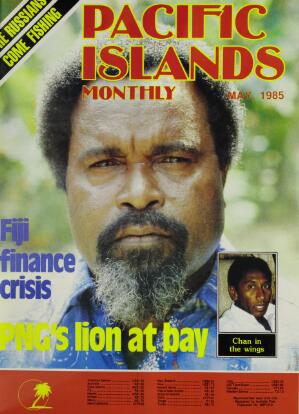
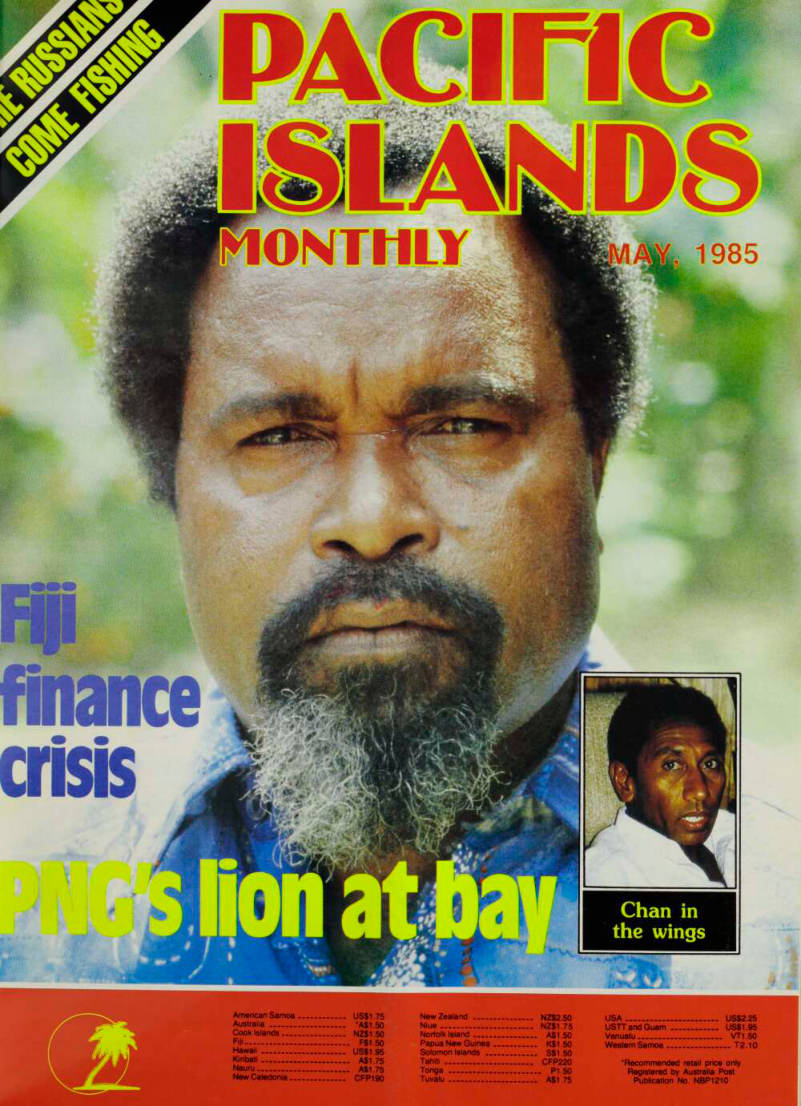
Chan in the wings
The Cover
Cover pictures by courtesy of The Bul letin, Sydney.
Advertisements & other items, pp. 2-3 (2 items)
0 Hitachi
VK-Cl5OO
One video
combination
that loves holidays.
I
VT-8E
Something very unusual happens to Hitachi’s VT-8E every time you take a trip.
It goes to pieces.
With a quick pull, the video tape recorder half separates from the tuner unit.
Hook it up to Hitachi’s VK-Cl5OO video camera, and you’re ready to shoot for up to an hour. Because the VK-Cl5OO is small enough to fit in the palm of your hand, it’s easy to carry and easy to use.
All this portability comes without sacrificing an ounce of quality. The VT-8E has 5 heads, stereo recording and playback, and special editing functions for that professional touch. The VK-Cl5OO features Hitachi’s exclusive MOS sensor. 100 times more durable than conventional picture tubes, it delivers crisp, sharp images with no bum-in or ghosts.
Together these units offer both the convenience of a portable and the performance of a console. It’s never been easier to make video a part of your life whether you’re making movies on the road or taping them at home.
The VT-8E and VK-Cl5OO are just two of more than 20,000 ways Hitachi is using technology to improve your home, your office and your community.
Not to mention your holiday.
0 HITACHI
m •>#p • p Electronic viewfinder MOS sensor Full auto white balance Instant review button F 1.2 6X power zoom lens with macro Camera jack AUDIO DUB button Frame advance button VTR auto-connection terminal Infrared remote control sensor Instant Recording Timer 7-programme/2-week timer Battery charge indicator • AUSTRALIA: Hitachi Sales Australia Pty., Ltd., 153 Keys Road, Moorabbin, Victoria 3189: Phone: (555) 8722 • NEW ZEALAND: AWA New Zealand Limited, Wi-neera Drive, P.O. Box 50- 248, Porirua; Phone: PRO 75-069 • PAPUA NEW GUINEA: S.O. Svensson (N.G.) Ltd., P.O. Box 705, Port Moresby; Phone: 21-2111 • FIJI ISLANDS: AWA New Zealand Limited, 47 Foster Road (P.O. Box 858), Suva, Fiji; Phone; 312070 • NEW CALEDONIA: Caldis, B.P. Ml, Noumea; Phone: 26. 23. 50 • TAHITI; Ets Chene Alain. P.O. Box 272, Papeete; Phone: 2. 88. 68 • SOLOMON ISLANDS: Technique Radios Centre Ltd., P.O. Box 465, Honiara; Phone: 416
Pacific
ISLANDS
MONTHLY
Vol. 56 No. 5 May 1985
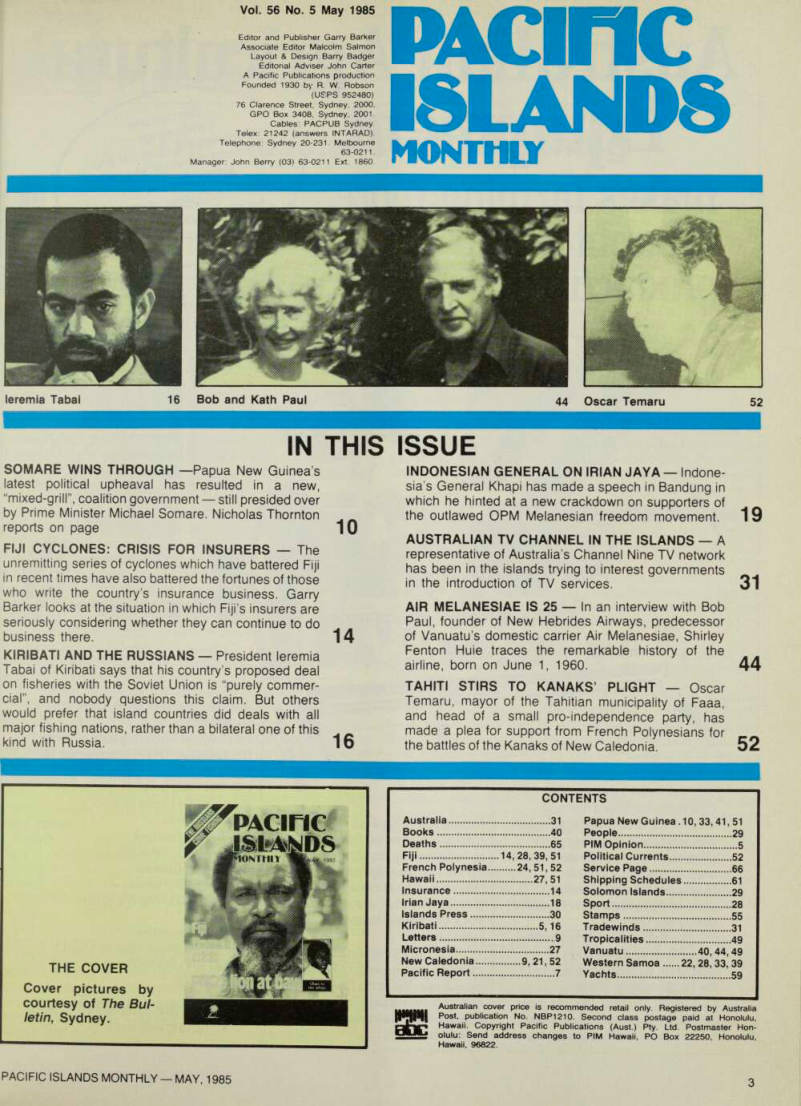
leremia Tabai 16
Bob and Kath Paul 44
Oscar Temaru 52
In This Issue
SOMARE WINS THROUGH —Papua New Guinea’s latest political upheaval has resulted in a new, “mixed-grill”, coalition government still presided over by Prime Minister Michael Somare. Nicholas Thornton reports on page 10
Fiji Cyclones: Crisis For Insurers The
unremitting series of cyclones which have battered Fiji in recent times have also battered the fortunes of those who write the country’s insurance business. Garry Barker looks at the situation in which Fiji’s insurers are seriously considering whether they can continue to do business there. 14 KIRIBATI AND THE RUSSIANS President leremia Tabai of Kiribati says that his country’s proposed deal on fisheries with the Soviet Union is “purely commer cial”, and nobody questions this claim. But others would prefer that island countries did deals with all major fishing nations, rather than a bilateral one of this kind with Russia. 16
Indonesian General On Irian Jaya Indone
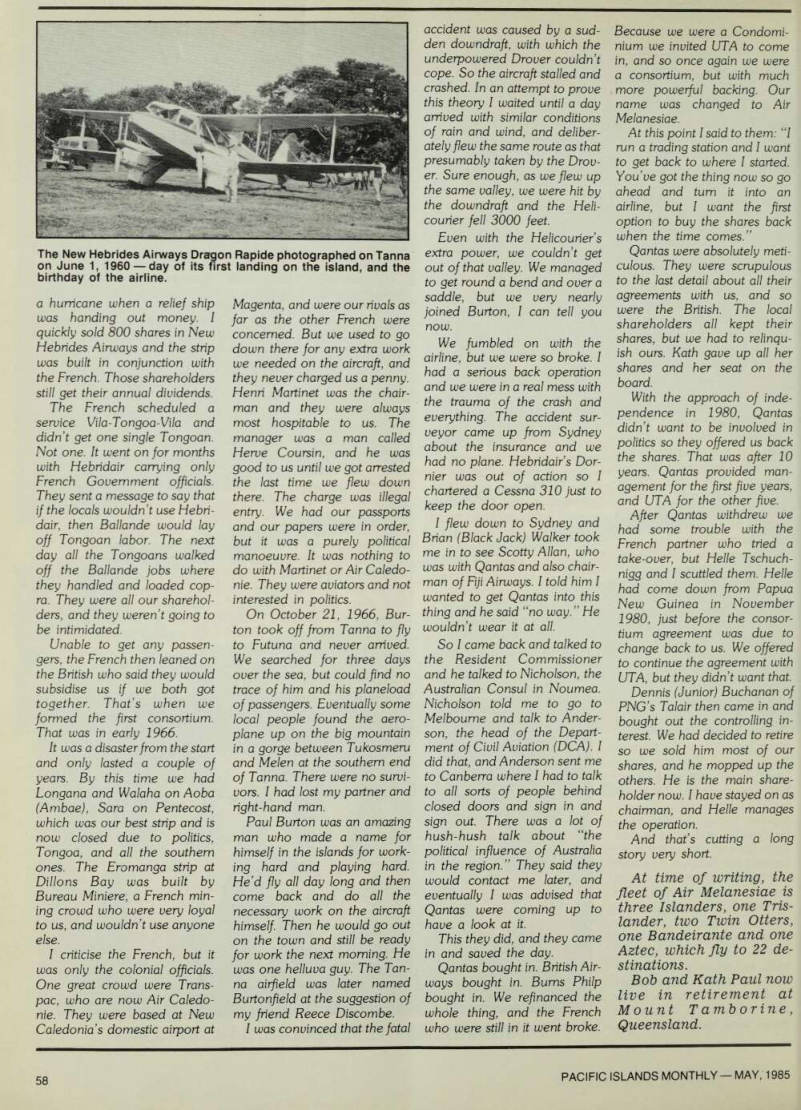
sia's General Khapi has made a speech in Bandung in which he hinted at a new crackdown on supporters of the outlawed OPM Melanesian freedom movement. 1 9 AUSTRALIAN TV CHANNEL IN THE ISLANDS A representative of Australia’s Channel Nine TV network has been in the islands trying to interest governments in the introduction of TV services. 31 AIR MELANESIAE IS 25 In an interview with Bob Paul, founder of New Hebrides Airways, predecessor of Vanuatu’s domestic carrier Air Melanesiae, Shirley Fenton Huie traces the remarkable history of the airline, born on June 1, 1960. 44
Tahiti Stirs To Kanaks’ Plight Oscar
Temaru, mayor of the Tahitian municipality of Faaa, and head of a small pro-independence party, has made a plea for support from French Polynesians for the battles of the Kanaks of New Caledonia. 52
Contents
Australia 31 Books 40 Deaths 65 Fiji 14,28,39,51 French Polynesia 24, 51,52 Hawaii 27,51 Insurance 14 Irian Jaya 18 Islands Press 30 Kiribati 5,16 Letters 9 Micronesia 27 New Caledonia 9, 21,52 Pacific Report 7
Papua New Guinea .10, 33,41,51 People 29 PIM Opinion 5 Political Currents 52 Service Page 66 Shipping Schedules 61 Solomon Islands 29 Sport 28 Stamps 55 Tradewinds 31 Tropicalities 49 Vanuatu 40,44,49 Western Samoa 22, 28, 33, 39 Yachts 59
Australian cover price is recommended retail only. Registered by Australia Post, publication No. NBP1210. Second class postage paid at Honolulu, Hawaii. Copyright Pacific Publications (Aust.) Pty. Ltd. Postmaster Hon olulu: Send address changes to PIM Hawaii, PO Box 22250, Honolulu, Hawaii, 96822.
Advertisements & other items, pp. 3-4 (2 items)
Pacific Islands Monthly May, 1985
3
Editor and Publisher Garry Barker Associate Editor Malcolm Salmon Layout & Design Barry Badger Editorial Adviser John Carter A Pacific Publications production Founded 1930 by R. W. Robson
(USPS 952480)
76 Clarence Street, Sydney, 2000.
GPO Box 3408, Sydney, 2001 Cables: PACPUB Sydney Telex: 21242 (answers INTARAD) Telephone. Sydney 20-231 Melbourne 63-0211.
Manager: John Berry (03) 63-0211 Ext. 1860
Australian Agricultural
Equipment ' '
makes farming more
efficient, more -
productive. ■
You can see wide
Aust
rar >9e r alian of Prod e^u 'Prn m s Porn
en *and
a ted at the
ULTU*
D
Myst
AL
Fi £lo
eryn
AVs
reek Ha 13 15 *Ulto J un 1985 Mm ■ 0 w Mn Innovative Australian agricultural equipment has helped Australia become one of the world’s major food producing countries. It has given efficient, reliable performance under some of Australia’s harshest conditions. It is also operating successfully in many other countries throughout the world.
Australian manufacturers have available an excellent range of equipment for farming situations in the Pacific Islands. Tractors.
Cultivators. Slashers. Ploughs. Rowcrop planters. Seeders. Agricultural trailers. Farm and stockyard gates and fencing. Cattle handling equipment.
Irrigation equipment. Pumps, including solar pumping units.
Agricultural seed. Agricultural chemicals. Rodenticides. Veterinary products. Prefabricated steel buildings and greenhouses. Welding equipment.
Lubricators.
You can also obtain advice and expertise from experienced Australian consultants. But in the first instance contact the Australian Trade Commissioner about your particular requirements.
Ask the expert who knows Australia For details of suppliers phone or telex the Australian Trade Commissioner at: Fiji P.O. Box 1252, Suva.
Phone 31 2844 Telex FJ 2126 New Caledonia P.O. Box 22, Noumea Phone 27 2414 Telex 087 Papua New Guinea P.O. Box 9129, Hohola Phone 25 9333 Telex NE 22109 Hawaii Australian Consulate 1000 Bishop Street, Honolulu 96813 Phone (808) 524 5050 Telex 63 3128 4% Ask the Australian Trade Commissioner
The Russians come fishing
Pim Opinion
As the Pacific becomes steadily more important in the conduct of world affairs, it behoves the small island nations to take even more care to avoid being used as pawns in the global power game.
Kiribati, quite innocently and sincerely, wishes to make the best of its main, indeed almost its only, real economic asset, the fish swarming through the immense area of ocean encompassed by its exclusive economic zone. With this in mind, Kiribati has been negotiating with the Soviet Union about a licensing agreement under which the Russian trawlers would have rights to harvest tuna and other species over some five million square kilometres of the Pacific.
There is nothing intrinsically wrong with such an arrangement, for the Russians are already one of the five major fishing nations working the Pacific grounds and tuna “highways. ” But it would be better by far if, instead of trotting off to make a bilateral deal with a superpower which quite obviously has all sorts of fish to fry in the Pacific, quite aside from the finny ones it can catch in its nets, Kiribati joined in the cry for what would mean, in effect, control of most of the Pacific’s richest fishing areas by the island countries, working together, through the South Pacific Forum.
Then licences could be issued to all the major fishing countries the U.S., Russia, Japan, Taiwan and South Korea on a proper commercial basis, and with much less chance of global political rivalries becoming involved.
Adequate fees could be charged for the licences, say about US$25 million a year, and this money could be used to fund, at least partly, the operation of an international surveillance system to which all the island countries could contribute what their economies, and their share of the fish cake, allowed. It would be easy enough, for example, to issue licence-holders with electronic transponders for the duration of their paid-up fishing season so that patrolling aircraft could readily identify those vessels legally in the area, and those which were not.
Income for the national economies of the island countries could then be derived by levying five or seven per cent of the sale price of each ship’s catch. That, too, should be easily enough policed.
But if the island countries allow themselves to be carved up by the bigger nations, then confusion will reign. Out of confusion will come rivalry and, possibly, disorder and disagreement. Out of disagreement might come the siding of one country against another, and the reaching for support from one of the bigger countries involved. And thus might the many lessons of history be again ignored.
Experts who have made a close study of Pacific fisheries say there is now pressing need for a universal treaty to control the industry, to make sure fish stocks are not wiped out by rapacious trawling, and to ensure that 200-mile zones are not violated and opportunities for income lost to small nations which badly need the money.
Last month representatives of 14 Pacific nations met in Port Moresby to tackle, specifically the United States, but also, by implication, all other involved nations on the frequently angry question of access to fishing grounds within the 200-mile exclusive economic zones claimed by each island nation. So little has come out of that meeting, laymen may be excused for wondering why it was held at all. More interested observers are wondering why the islands tarry it can only be to their disadvantage.
About the same time representatives of the Soviet Union were sitting around a table in Sydney with delegates from Kiribati, talking about fishing rights. No agreement was reached on how much the Russians should pay, nor how wide their rights should be. The parties agreed to consult with their respective head offices and talk further by telex. Unfortunately, as we write, electronic communication between Moscow and Tarawa had not been effected and, therefore, no final agreement had been reached.
Similarly, about the only visible result of the Fort Moresby talkfest seems to have been the lifting of the somewhat unfortunate mandatory American ban on Solomon Islands tuna products imposed after the U.S. purse seine boat Jeanette Diana was dramatically captured by a chartered patrol boat working out of Honiara. The Americans retrieved their boat by paying the Solomons about US$7OO,OOO for it.
The U.S. has thus paid a fine for being caught at something to which their trawlermen still insist on demanding right. Nothing else seems to have changed and, failing some proper international agreement, is unlikely to change, especially given the general attitude of the American Tuna Boat Association, which among some island folk, is rated in between Captain Henry Morgan and a bad case of eczema.
The Americans should not feel too badly about that description since very little warmer regard is felt in the Pacific for the activities of fishing vessels from the Soviet Union, Taiwan, Japan or South Korea. The Japanese have made some efforts to cooperate with the island countries by setting up the occasional joint venture in, for example, Fiji and Vanuatu, but, in general, control over fishing and fishing grounds has caused more argument than amity and probably will go on doing so until a workable agreement is reached.
A system is needed which provides income, on a proper and equitable basis, for the island countries. In other words a system by which they are not ripped off.
Machinery already exists by which the Pacific nations in general could come together on this important matter. The South Pacific Forum could give a lead by offering the services of its Fisheries Agency to all the countries. Australia and New Zealand could act as good neighbors by offering to help with surveillance of the vast areas of ocean across which the trawlers and the tuna boats range.
The bigger island countries, like Fiji and Papua New Guinea, could contribute their naval ships to the effort, and probably also helicopters for closer inshore patrols. In fact, the island navies could earn their keep, or at least part of it.
Experts in the field of Pacific fisheries say that it should not be too difficult to earn an aggregate income of at least $2OO million from the five major fishing nations by way of licence fees and levies. This, distributed among the island nations, would provide a very real input to their national economies, at very little cost to themselves.
But if each of the small countries tries to go its own way, confusion could develop and the return would likely be far less than it could be from one of the few major industrial assets the Pacific countries possess in common.
The need now is for Pacific leaders to reach agreement on this vital issue so that a uniform and united approach may be made to the big nations. As Gulliver discovered in Lilliput, singleness of purpose makes the small very strong.
Advertisements & other items, p. 6 (1 item)
Electricity Power
trnrn • House Lighting irom Refrigeration Sunlight • Water Pumping • Communications * Military Marine ***
SOLAREX
Pty. Limited 5 Bellona Ave., Regents Park 2143 N.S.W. Australia
(02)644 5055 T1xAA21975
Pacific Report
Wingti Heads New Png Party
A new political party, the People’s Democratic Movement, has emerged in Papua New Guinea. The party has been formed by 15 members of the national parliament expelled from the ruling Pangu Party a fortnight before by Prime Minister Michael Somare. Leader of the new party is the Opposition Leader Paias Wingti, who said it was aiming at firm and decisive leadership of the country. Mr Wingti claimed his group had pulled out of the Pangu Party because of lack of discipline and direction, which had led the people to continually beg their leaders for financial handouts. Mr Wingti said the People’s Democratic Movement would work closely with other opposition groups to win government. (See earlier reports, this issue.)
Chinese Communist Chief In South Pacific
The April tour of Australia and the Pacific by the Chinese Communist Party leader, Hu Yaobang, was to promote peace, stability and prosperity, according to Deputy Foreign Minister, Zhu Qizhen. He said that China wanted the Pacific to oecome a great ocean of peace and co-operation. Mr Zhu’s comments came in the latest edition of China’s World Affairs magazine and before Mr Hu’s tour of Australia, New Zealand, Western Samoa, Fiji and Papua New Guinea. The article called Australia and China two vast countries with rich resources, able to supply and learn from each other. Mr Zhu said the $1 billion trade between Australia and China was healthy and gratifying, but the Chinese ministry of trade noted the balance was heavily in Australia’s favor and that it would have to increase imports of Chinese goods by a large margin.
Pisani Surveys His Four Hectic Months
The special French envoy in New Caledonia, Edgard Pisani, after handing President Francois Mitterrand his plan for New Caledonia late in March, said he expected the islanders would vote in a referendum on their future “in September, give or take a week”.
Mr Pisani refused in a television interview to give any details of the plan for the territory he submitted to Mr Mitterrand after a four-month mission there. But he has said consistently that he sees a vote on “independence in association with France” as the only possible solution. And he has indicated that a basic aspect of the plan is land reform. Mr Pisani has criticised a scheme presented to the French Senate by the pro-French Territorial Government leader, Dick Ukeiwe. Mr Ukeiwe is proposing partition of New Caledonia. The western half would include the capital Noumea and the major European agricultural holdings, and its population, which is mainly European and anti-independence. The Kanaks are a large majority on the eastern side and offshore islands. Mr Pisani u. a *u r- 16 an was or u P ar titi° n half (the island) independent and half French, with the eastern side having 10 to 15 per cent of the island’s wealth, and Kanaks in the western side (held as) prisoners of a white majority”. Mr Pisani has publicly praised the self-control of Jean-Marie Tjibaou, leader of the Kanak Socialist National Liberation Front (FLNKS), two of whose brothers were killed in an early clash. The Kanaks are demanding that what they consider tribal land be returned to them, even when it has been long farmed by French settlers. Mr Pisani has said that there could be a lease-back arrangement, but that the Europeans were worried how their tenure would be guaranteed under such a scheme. The independence-association” plan announced some months ago by Mr Pisani would have France remain in control of internal and external security, foreign affairs and financial matters among other things. Noumea would be an autonomous region. Mr Mitterrand said on a visit to the island in January that its potential as a naval base should be developed. Asked to sum up his four months on the island, Mr Pisani, 66, a veteran French Cabinet Minister with extensive Third World experience, said; “24 hours out of 24 anxiety and tension; 15 hours out of 24, work”.
Nz Plans More Active Regional Role
The Royal New Zealand Air Force will increase its patrols over a large area of the central and south Pacific to gather military mtelhgence and police the exclusive economic and fisheries zones ot Fiji, lokelau, Kiribati, Tonga and Western Samoa. Prime
Minister David Lange told a press conference in Wellington in April that any military information obtained would be passed on to Australia and the United States under the terms of the ANZUS Treaty.
Pacific Historians To Meet In Suva
The University of the South Pacific (USP) in Suva will be the venue for the fifth conference of the Pacific History Association (PHA), an organisation whose members include academics, librarians, stu dents and other devotees of Islands history. Despite its name and interests, this will be the first time a PHA conference has been held outside Australia. Held in broad conjunction with the conference will be an advanced Pacific history course taught by a team of lecturers from the USP and other Island academics. The course will run from June 24 to July 20. Successful candidates will obtain academic credit. The conference itself is expected to be opened by Fiji’s Deputy Prime Minister David Toganivalu. Albert Wendt, professor of Pacific Literature at the USP, will deliver the keynote address. Topics discussed at the conference will include Regional ism and Pacific Rim Strategies, and History Teaching in the Pacific, in conjunction with such familiar areas as Early European Penetration, and Religious History. Conducting a symposium on the latter subject will be John Garrett, Suva-based historian of Pacific Christianity, and minister of the Uniting Church. Convening the event are David Routledge and Robbie Robertson of the USP’s School of Social and Economic Development. But the prime mover in organisational matters is the PHA’s current president Ron Crocombe, professor of Pacific Studies at the USP, and a relentless fighter for truth, justice and the Pacific Way. Norman Douglas.
Papeete Mayor In Tanker Protest
Mayor of Papeete Jean Juventin has threatened that the municipality might refuse to co-operate with organisers of the Fourth Pacific Festival of Arts which is due to be held in French Polynesia from June 29 (PIM Apr p 7) if the territorial administra tion of Gaston Flosse persists with a plan to station the oil tanker Le Tahitien in Papeete harbor. The vessel, which is 170 m long and displaces 25,000 t, would serve as a floating fuel tank to serve onshore needs. As long ago as last December, a petition with 9024 signatures protesting against the plan was presented to the territorial government. Mr Juventin said in a statement: “Papeete is the nerve centre of French Polynesia. All material reserves are here, the two hospitals, the two clinics, the telephone exchange, the inter-island vessels. If there was a disaster in Papeete, the whole of Polynesia would die for lack of supplies. Stationing such a dangerous source of possible fires and explosions here, in the most developed part of the territory, is an act of madness with incalculable consequences”.
France Occupies Matthew Island
A small detachment of French Marines is now permanently stationed on Matthew Island, 486 km southeast of New Caledonia.
The French claim to Matthew, an uninhabited outcrop of volcanic rock, and to Hunter Island, about 100 km further from New Caledonia, has been contested by Vanuatu. The reason for the French insistence on their claim to the islands was well expressed by the headline in the March 12 issue of the Tahiti newspaper La Depeche which reported the presence of the troops. It said “These soldiers at the end of the world . . . alone on Matthew, they are protecting France’s maritime zone ...”
Marianas N-Dump Protest Group In Japan
A 30-man delegation from the Northern Marianas has been to Japan to present an anti-nuclear dumping petition to the government. The petition, with 7523 signatures, was handed to Japan’s Foreign Minister, Mr Shintaro Abe, and Science and Technology Agency director, Mr Reichi Takeuchi. The delegation was told that Japan would dump nuclear waste, but only if safety was proved and there was regional consensus on the matter.
U.S. Territories Oppose Compacts
A United States Congressional inquiry into the impact on U.S.
territories of the Compact of Free Association between the United States and the Micronesian Trust Territories has revealed opposition to the Compact from the U.S. states of Alaska and Hawaii and the U.S. territories of Guam, American Samoa and the Northern Marianas. Fofo Sunia, American Samoa’s representative to Congress, and others appearing before the inquiry said that, although they supported self-government for the Territory, the Compact would give the Marshall Islands and the Federated States of Micronesia an unfair advantage as they could trade freely with the U.S. without having to abide by minimum wage or environmental protection laws.
Ok Tedi Reopens Official
The PNG Cabinet has officially authorised the re-opening of the Ok Tedi gold and copper mine in the Star Mountains on the border with Irian Jaya. The mine was closed on government orders because of the failure of Ok Tedi Mining Ltd to make firm plans for the second phase of the operation, the mining of the copper. An agreement has been reached between the government, which has a 20 per cent share, and the company providing for copper mining on the basis of an economic test to be applied early in 1987.
Malaysians In Png Timber Venture
Papua New Guinea’s East Sepik provincial government is going into partnership with the Malaysian Overseas Investment Corpora tion (MOIC) in a timber logging and plantation venture, with the government holding 70 per cent of the shares and the Malaysian corporation the 30 per cent balance. The corporation has also agreed to build an international class hotel in Port Moresby using profits from the timber logging and plantation to be established on 81.000 hectares of jungle in the East Sepik. The corporation is already in partnership with the Macuata Provincial Council on Fiji’s second largest island of Vanua Levu in a project to develop a sports stadium, shopping complex, hotel and bus station on Fijian-owned land at Labasa, and in partnership with the Fiji Government in a SFIS million hotel project in Suva.
Fui To Make “Wooden” Car
The Fiji Government has approved establishment of a factory in Fiji to manufacture and export the newly-invented Africar, a plywood car, invented in England by Tony Howarth. Five different models will be produced, including luxury cars and four-wheel drives. All metal parts, including the engine, will be imported and local plywood will be used for the body. The company, Africar International, will provide jobs for about 300 people. Mr Howarth said they were looking at Australia, New Zealand, Britain, the United States and the Pacific Islands as possible markets for the new vehicle. It is expected that Fiji will approach the Australian and New Zealand governments in an attempt to get the car included in the SPARTECA agreement schedule under which exports from the Islands enter Australia and New Zealand free of tariff.
Sydney-Hobart Race Report Points Finger
A report prepared by an Australian pleasure-boat insurance company on last December’s disastrous Sydney-Hobart yacht race is sharply critical of yacht designers, builders, and crews. One life was lost and only 45 of the 151 starters completed the race which started on Boxing Day. Winds gusting to 50 knots hammered the yachts for almost three days. The head of Australia’s largest pleasure boat insurance company, Marine Hull Insurance, Fred Wilson, blamed poor seamanship, design and hull construction for most of the withdrawals. Mr Wilson warned that if there were no change of attitude, pleasure-boat insurance companies would have to consider placing much heavier premiums on ocean racing yachts built from exotic materials. “Our report shows yacht designers and builders are using insurance companies to pay for their experi ments,” Mr Wilson said. “If their construction methods have been wrong and the hulls fail, the insurance companies are expected to pay not the designers and builders.” The report prepared by Marine Hull Insurance, is likely to have a world-wide impact on ocean yacht racing. The company initiated the investigation of the race. It had the majority of entries insured. The company’s national claims manager, Duncan Van Woerden, echoed Mr Wilson’s words, saying he was alarmed at the attitude of some of the sailors competing in the race. Mr Van Woerden, who has more than 100.000 ocean sailing miles to his credit, said some crews had adopted a totally cavalier and dangerous attitude to the race. “One yacht suffered what most yachtsmen would consider serious
rigging damage within a few hours of the start of the race,” he said.
“A good seaman would have realised there was no chance the yacht could have continued in the race without suffering more serious damage and posing a threat to the safety of the yacht and the crew. But this crew pressed on and turned what was initially SIOOO damage and little danger into SIOO,OOO damage.” Mr Van Woerden said the report showed that yachts built from composite construction techniques, using exotic materials such as carbon fibre, Kevlar and foam cores, were an enormous risk for insurance companies. While yachts built from these materials represented only 23.5 per cent of the fleet, they accounted for 32 per cent of the yachts forced out with serious structural damage. No exotic material, composite-construction yacht under three years old completed the course, Mr Van Woerden said.
Part-Maori Is New Nz G-G
The Anglican Archbishop of New Zealand, Archbishop Paul Reeves, has been named as New Zealand’s next Governor- General. Oxford-educated Archbishop Reeves, a 53-year-old part-Maori, will replace Sir David Beattie later this year. He will be the fourth New Zealand-bom man and the first of Maori blood to be appointed to the position.
Vanuatu Govt. In Housing Cutback
The Vanuatu Government in April announced further spending restraints in an economy-saving measure. In one of the moves, the housing committee has given civil servants living in government owned houses in Port-Vila three months to find new accommoda tion. Members of the police force will take over the government housing. The government has also decided that some civil servants will no longer qualify for a housing allowance. Earlier, the government had ordered government departments to cut their budget this year by up to 10 per cent. The savings are supplementary efforts to rebuild schools, hospitals, church homes and other houses and properties damaged during cyclone Nigel in January.
Thio Nickel Mine Starts Up Again
In New Caledonia, mining resumed in the first week of April for the first time for four months at the territory’s largest nickel mine in Thio. Seventy Melanesians returned to work in a “goodwill” gesture. Negotiations were to be held on Melanesian claims for a new balance between Melanesian and European personnel at the mine. The Melanesians also want more senior posts, along with wages for part of the period when disturbances halted work.
Meanwhile, in Paris, France’s President Mitterrand was studying proposals from his special envoy, Edgard Pisani, to give New Caledonia independence in association with France.
Fiji Senator Attacks Labor Party Plan
A Fiji Senator has strongly attacked the country’s trade unions, claiming they have too much power and should place the interests of the nation before their own. Senator Rakoto also said the Fiji Trades Union Congress was going too far in planning to establish a Labor Party. He said it would gain little support from the rural community. He said an attempt to form a national union of farmers had failed because most people in rural areas, from which Fiji’s two main political parties drew their support, were content with the present political set-up. The Acting Director of the Suva office of the International Labor Organisation (ILO), Ruben Dudley, has said the ILO will not support any move to form a Labor Party, as such support would run counter to the ILO’s role.
Niues Busy Post Office
The Niue branch of the New Zealand Post Office has reported that receipts for the last financial year totalled $NZ3,403,259 and payments $NZ3,928,342. Money orders received totalled $1,979,808. This is an indication of the financial support the island gets from Niueans living in New Zealand.
Self-Help Settlement For Moresby
The PNG Government has begun development of a K 138,000 ($A172,500) self-help settlement for under-privileged groups at Moitaka outside Port Moresby. The first of 200 families will move in about September. The settlement is planned to provide jobs and improve the social and economic standards of the inhabitants. To qualify for residence at the settlement, persons must have lived in Port Moresby for more than five years, be unemployed, not own land in the city and be able to engage in self-help projects.
letters
A week’s holiday in Noumea during “the emergency”
PIM reader DIANE AYOUB had a week’s holiday in Noumea during the first week of the state of emergency in January. Her verdict? It was “a holiday she would not have wanted to miss”, and some Australian journalists “were both misrepresen ting and over-reacting to the situation.”
The hour’s drive from Tontouta Airport to our hotels was a quiet one, interrupted only by the impromptu commentary of the guy behind me who was mak ing his third trip to Noumea.
The route by-passed the city where the rioting had occurred, sheltering us from what might have been a disturbing initial impression. As we drew near the hotels, what most struck me was the number of cars on the road and the purposefulness with which they were travelling.
And then the penny dropped.
In a little more than an hour the curfew would come into force on the island for the first time.
Impatient to stretch my legs, immediately after I’d checked in I took a stroll along the beach on to which my hotel faced.
Returning to change for a swim, I indicated my room number to the guy at the reception desk.
As he handed me my key, telephone pressed to his ear, he said with some surprise “This is for you, it’s your mother”.
Chance meetings and unex pected coincidences were to continue to be a special aspect of the week I spent in Noumea.
Having related the day’s events to Mum and allaying her fears for my safety, it was still with some despair that she asked: “But why did you go?”
From the anxiety she was ex periencing, it was clear that the press in Australia were giving a far more graphic picture of the situation than anything I had (or was to be) exposed to. This was to be further validated by phone calls from parents of fellow Australians, and was met with disapproval by many
people to whom I spoke, who felt that Australian journalists were both misrepresenting the facts and over-reacting to the situation.
In effect, being in Noumea for the first week of the emergency was a unique ex perience, and while it was far removed from what I had im agined a week previously, it was a holiday I would not have wanted to miss. I went equipped with a page full of shops, restaurants, discos, do’s and don’ts given me by a friend who had made several trips to Noumea. Owing to the circumstances, many of those suggestions were left unex plored, and with the limitations and restrictions within which one had to operate, there were some rewarding compensa tions. What was most cogent was the opportunity to be with people and share experiences in a manner not normally afforded in an overseas trip. It seemed that circumstances born out of one people’s separateness served to bring others closer together. So that, being “confined to quarters”, though at times frustrating, was for me an opportunity to feel a sense of belonging and to really enjoy the company of the people in my immediate en vironment.
In the choice of hotel I considered myself fortunate to have been staying at the Noumea Beach. Apart from being one of the few which did not have gendarmes resident, there was a camaraderie amongst the staff which affected and served its guests
well. Having to remain at the hotel until morning, once their shift was complete, they would join the tourists and we would occupy our evenings in talk and games, with the highlight being a night of song and dance in honor of two guests who were returning to Australia next day.
Ironically, it was the tourists
who paid most respect to the rules of the emergency while inhabitants seemed determined to defy them. Nowhere was this more obvious than at the wharf beside the road leading out of the city, where, each night, upwards of 100 people would park their cars and gather to protest silently against what they saw as the violation of their freedom.
Diane Ayoub
Moss Vale NSW Australia
Tongan
knighthoods - an artists appeal
I am somewhat of a “nut” on Tongan history, and also an amateur artist. I’m planning to do a portrait of Queen Salote of Tonga. Herein lies my problem.
I want to picture Tonga’s great queen wearing Tonga’s orders-of-knighthood . . . namely the “Royal Order of the Tongan Star.”
I have sought the help of
libraries and museums around the world, and could not find this information. I have even sought the help of the govern ment of Tonga. However, they couldn’t help either. It seems now that I won’t find this information anywhere.
If any of my fellow readers might have information regar ding Tonga’s orders-of-knight hood, please contact me. I will be glad to reimburse the postal costs.
Thanks in advance.
Randy Duff
3923 Arborcrest Drive Indianapolis Indiana
46226 Usa
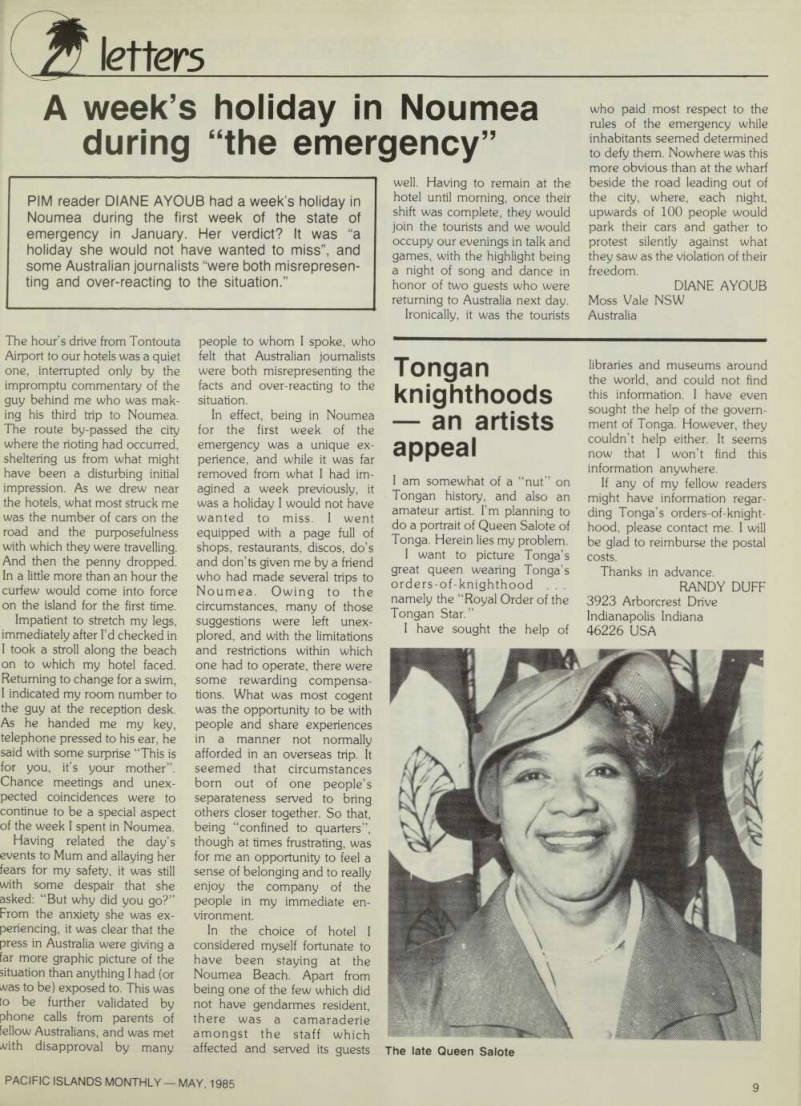
The late Queen Salote
in plenty
Parliamentary Turmoil In Png
Question marks in plenty over a Pangu victory
April 1 may not have been an entirely in appropriate day for the announcement of Papua New Guinea’s new coalition ministry.
The antics of the par liamentarians in the last two weeks of March, as they fran tically jostled for ministries, led many a disgusted Papua New Guinean into making deroga tory comments about their be havior.
Lawyer, Bernard Narokobi, said the people were fed-up with their leaders “fighting like a bunch of wild dogs.” The Times of Papua New Guinea said the process confirmed “the public in its already perilously low regard for parliamenta rians.”
When Mr Somare announced the new ministry to the house on April 1 and then promptly wound up the sitting four days early the PNG parlia ment had not got around to passing any of the govern ment’s legislative program.
Still on the notice paper are bills introduced more than 12 months ago.
Amongst these is the vital constitutional amendment to remove the independence of the Public Services Commis sion this is seen by many as an anachronistic hangover from Australian colonialism that has inhibited government efforts to
Somare Survives, but Pangu Hurt . . . The prime minister of Papua New Guinea, Mr Michael Somare, survived a vote of no-confidence in the parliament in Port Moresby, late in March, by the comfortable margin of 68 to 19. To do it, though, he had to form a new coalition government.
NICHOLAS THORNTON, our commentator on PNG affairs, reports on the new coalition and on the price Mr Somare has paid to remain on top, a price which may prove fairly high.
trim the country’s bloated Aus tralian-style public service.
Also on the notice paper are two other proposed constitutio nal amendments that, if ever they were passed, would go a long way towards ridding the PNG political system of the constant de-stabilising motions of no-confidence.
One of these amendments would force a by-election in any seat held by a member of parliament who switched his party affiliation after being elected.
The other would enable the prime minister to call a national election if he lost the confidence of the parliament.
At present successful votes of no-confidence just remove the prime minister and replace him with whoever has been nomin ated as his alternative. This is what happened in 1980 when Sir Julius Chan replaced Mr Somare as prime minister. Both
amendments would solidify the party situation in PNG because members never want to go to election. In the past 50 per cent have lost their seats in such excursions, and every member is painfully aware of the casual ty rate.
Mr Somare’s Pangu Pati had these two amendments as part of its election platform at the 1982 elections.
But they have never got to a first reading because Mr So mare gave in to backbench pressure not to proceed with them.
That Pangu backbench is looking decidedly thinner now that Pangu’s former deputy leader, Mr Paias Wingti, has defected leading 13 other Pan gu (or, rather ex-Pangu) mem bers into the Opposition.
Explaining his reasons for resigning and contesting the leadership of the country with Mr Somare,Mr Wingti said:
“The party I believed in from my school days the party that is supposed to represent the workers, students, villagers is no longer that party.
“The party’s concentration of power is in the hands of a few people and it is no longer the party of the masses.”
Ironically, the party which has been proclaiming itself as the real, new party of the masses, the Melanesian Alliance, decided that this was the time to join Mr Somare, not desert him.
The Melanesian Alliance leader, Father John Momis, be gan the March sitting as the leader of the Opposition, and emerged at the sitting’s end, on April 1, as deputy prime minis ter. Directly swapping positions, as it turned out, with Mr Wingti.
That these two men profess to hold almost similar political philosophy just indicates how little ideology has to do with real politics in PNG.
It is not an ideological game in Papua New Guinea. It is a numbers game (see box).
The fragility of the Pangu Pati was shown up most starkly when Mr Somare tried to sort out his new cabinet.
Having brought the Melane sian Alliance, and the National Party, over into his cabinet he had to share the spoils the ministries with them.
The Melanesian Alliance was
demanding two ministries, in cluding the deputy prime ministership, while the National Party wanted five.
Mr Somare did not have seven ministries to dispense.
He had only two.
On the weekend of March 30-31, Mr Somare decided to increase this to five by sacking three Pangu ministers. Two of them, Mr Bebes Korowaro, from the Eastern Highlands, and Mr Dennis Young, from Milne Bay, were strongly ru mored to be Wingti men, even though they did vote to defeat the vote of no-confidence.
Having made that decision, Mr Somare then told the Na tional Party it could have three ministers.
But, with further splits in Pangu threatening, the three sackings were called off. In stead, two of Mr Somare’s most loyal supporters, Sir Barry Holloway, and Mr Tony Siaguru, offered to resign.
Mr Somare accepted the res ignations and further cracks in Pangu were papered over.
With only four ministries to give, Mr Somare gave his two new coalition partners two each. While the Melanesian Alliance got what it hoped for, the National Party, understand ably, may be far from happy.
The continuing support of the 10 or so Nationals who missed out on the ministries must be open to question. Back in 1982, when Mr Somare was looking around for a small coalition partner to make dou bly sure of the numbers, he signed up the seven-strong Un ited Party.
Three were given ministries and it was not long before the other four met and voted one of their number the new party leader and went off into opposi tion.
Another aspect of having drawn the National Party into coalition is that Mr Somare will probably have to find another ministry for Mr lambakey Okuk.
The National Party strongman is expected to return to parlia ment in the next two months in a by-election.
He lost his seat in a court appeal late last year, but now he is qualified and is standing again.
Mr Somare unashamedly
used Mr Okuk to win over National waverers, even putting the government aircraft, Kumul One, at Mr Okuk’s disposal.
Sir Julius Chan found Mr Okuk to be an unpredictable and worrying number two. In the past Mr Okuk has often said that Mr Somare should be made Governor-General where he could play golf and leave the running of the country to “more decisive men” like him.
Many observers were very surprised that the Melanesian Alliance agreed so quickly to enter the government.
For the past six months the M.A. leader, Father Momis, has waged a relentless campaign, accusing the government and senior public servants of corruption.
Now he is in the government, Father Momis is in a position
Prime Minister Somare’s new Cabinet ministers, with their party affiliation shown in brackets, is as follows.
Justice, Tom Pais (Pangu); Culture and Tourism, Paul Kamod (Pangu); Industrial Development, Karl Stack (Pangu); Youth and Development, Tony Bais (Pangu); Labor and Employment, Toni lla (Pangu); Transport, Mathew Bendumb (Pangu); Environment and Conservation, Soso Tomu (Pangu); Foreign Affairs and Trade, John Giheno (Pangu); Lands, John Nilkare (Pangu); Minerals and Energy, Francis Pusal (Pangu); National Planning, Bebes Korowaro (Pangu); Civil Aviation, William Wi (National); Home Affairs, Kindi Lawi (Pangu); Health, Pundia Kange (United); Finance, Philip Bouraga (Pangu); Communications, Roy Evara (United); Defence, Stephen Tago (Na tional); Housing, Kala Swokin (Pangu); Provincial Affairs, Tony Farapo (Pangu); Police, Dennis Young (Pangu); Works and Supply, Jack Genia (Pangu); Deputy Prime Minister and Minister for Public Service, John Momis (Melanesian Alliance); Corrective Institu tions, Arnold Marsipal (Pangu); Forests, Lukas Waka (Pangu); Education, Sam Tulo (Melanesian Alliance); Primary Industry, Rabbie Namaliu (Pangu).
where theoretically he should be able to do something about this. As well as being deputy prime minister he is minister for the public service.
Some of the M.A.’s other policies, principally those deal ing with provincial government and PNG’s troubled border with Indonesia, also sit at odds with the present government’s actions.
Some of Mr Somare’s friends believe that had he not procrastinated about the con stitutional amendments had
he rammed them through in the first 12 months of this current parliament as he said he would then none of this latest upset, with its consequent threat to confidence in the future of the Somare govern ment, would have happened. It isn’t so long since members of the Somare government were saying that the amendments were not only essential, they were not negotiable. But, as many a politician has frequently observed, a week is a very long time in politics, and a year as
good as a lifetime.
And, in the end, has the surviving gladiator really won?
Perhaps Sir Julius Chan could be the man most satisfied with events of the March-April par liamentary sitting. Sir Julius, who moved the vote of no confidence in Mr Somare, nam ing Mr Wingti as alternative prime minister, may have dis posed of Mr Wingti as a poten tial prime minister, while at the same time seriously weakening Pangu.
With the announce ment of Mr Somare’s new cabinet on April 1, no fewer than 41 of Papua New Guinea’s MPs, are now, or have been, ministers, since the last election in 1982.
Of the new Cabinet Pangu has 19 of the 28 ministries, three are held by pro-Pangu in dependents, the Melanesian Alliance has two, the National Party has two, and what is left of the old United Party, still in the government, has two.
Supporting the gov ernment, the numbers (although one can never be specific about these things in PNG), appear to be: Pangu, 44; National Party, 10; Melanesian Alliance, 5; others, 9.
In the Opposition there is now Mr Wing ti’s group of about 16, the United Party, with three, others, four, and the Papua Party, three.
Still sitting on the cross benches is Sir Julius Chan’s People’s Progress Party with 12 mem bers Sir Julius has been the most successful of all in holding his numbers steady no matter what political winds have stormed through the parliament.
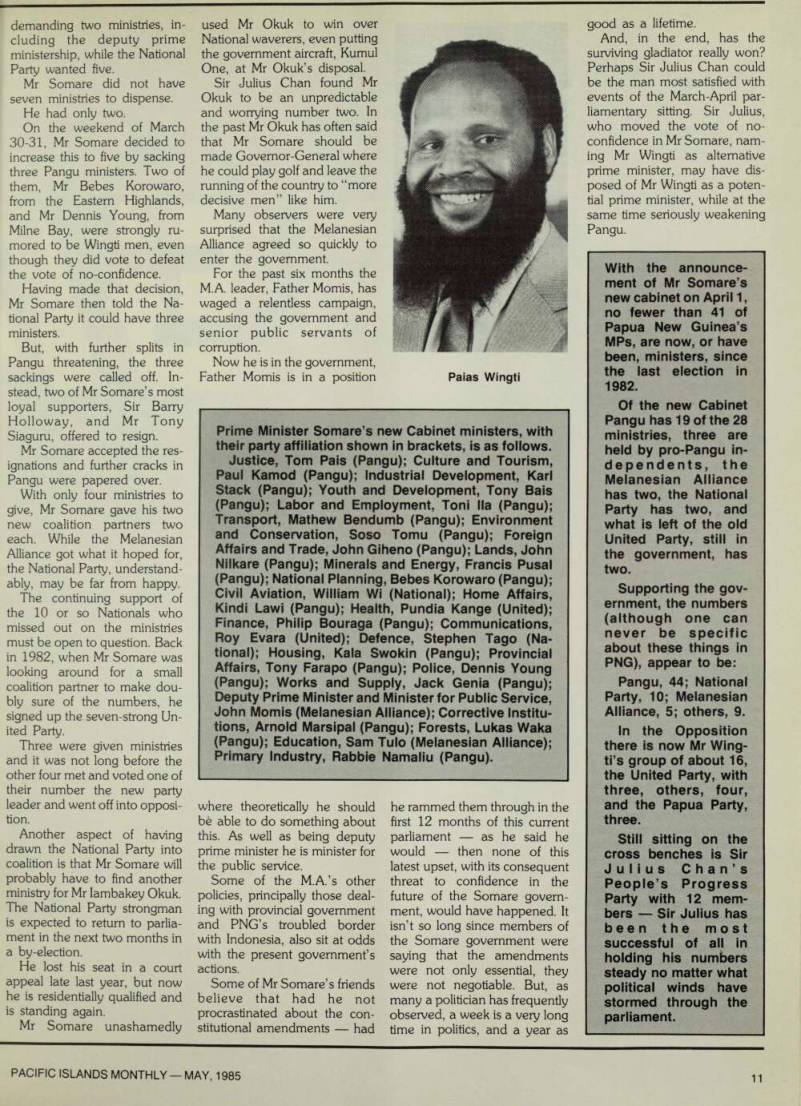
Paias Wingti
Advertisements & other items, pp. 12-13 (1 item)
Nissa
Ml r~ k
jjpipgi
% : J|
MWSwWaWS^sJ
r t K. *•'£ f ' '- r - Car of the future: N.
pwi
. ms - 0% '~ J . Discover a new dimension to the to respond to your needs quickly quality that made Datsun a trusted and efficiently. Our technology is 0.. name around the world. of the world’s most advanced, and At Nissan, the Datsun tradition is it’s backed by an attitude that alive and well and better than ever. welcomes challenges. Besides Our international manufacturing and find the same innovative tecf service network gives us the capacity car
latter—it sh~
ideas that turn into
security once the
A 1 . . .U. . .
NISSA
uality in
m ■ mmm *rwi ssgsmgm
iff*
M V. ■ ■ ■ ' ■ - ■ ~, >* - -S4. ■ tr? ' . „*.•• ■ , > ••*■ ... - - X--.. "- ■ ... |SsSNssa® ■ « 'A
■ sue
a ■
iiftiil
- - -■ ■a . - a - .V- ■/,-...
. fea :
r ... : “L>* • ■ ii i— mmm ' ’ : P tS . *:; v. .. mm
PHI
: - ■■ ; : m -- ■ • ; ' m - ; -V. -
immm
f W m iF i.V ■■’■•:) , *
SSfc* iiw
* ' ' 'W v ' J, • - v * .. , V H .. ... v ■ . ■.: 4 :-'A & ■i M .‘i
'■ ■ " VmvmSPJ
S<#
Fiji: A (recurring)
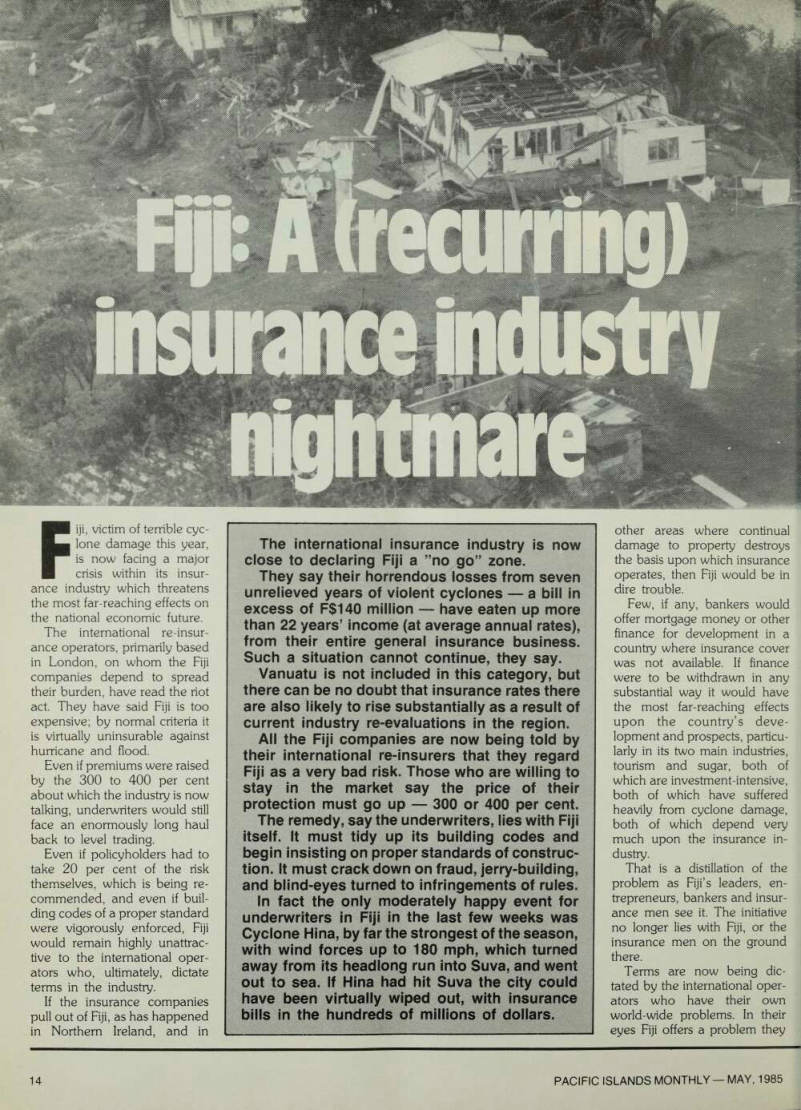
insurance industry nightmare
Fiji, victim of terrible cyc lone damage this year, is now facing a major crisis within its insur ance industry which threatens the most far-reaching effects on the national economic future.
The international reinsur ance operators, primarily based in London, on whom the Fiji companies depend to spread their burden, have read the riot act. They have said Fiji is too expensive; by normal criteria it is virtually uninsurable against hurricane and flood.
Even if premiums were raised by the 300 to 400 per cent about which the industry is now talking, underwriters would still face an enormously long haul back to level trading.
Even if policyholders had to take 20 per cent of the risk themselves, which is being re commended, and even if buil ding codes of a proper standard were vigorously enforced, Fiji would remain highly unattrac tive to the international oper ators who, ultimately, dictate terms in the industry.
If the insurance companies pull out of Fiji, as has happened in Northern Ireland, and in
The international insurance industry is now close to declaring Fiji a ”no go” zone.
They say their horrendous losses from seven unrelieved years of violent cyclones a bill in excess of Fsl4o million have eaten up more than 22 years’ income (at average annual rates), from their entire general insurance business.
Such a situation cannot continue, they say.
Vanuatu is not included in this category, but there can be no doubt that insurance rates there are also likely to rise substantially as a result of current industry re-evaluations in the region.
All the Fiji companies are now being told by their international re-insurers that they regard Fiji as a very bad risk. Those who are willing to stay in the market say the price of their protection must go up 300 or 400 per cent.
The remedy, say the underwriters, lies with Fiji itself. It must tidy up its building codes and begin insisting on proper standards of construc tion. It must crack down on fraud, jerry-building, and blind-eyes turned to infringements of rules.
In fact the only moderately happy event for underwriters in Fiji in the last few weeks was Cyclone Hina, by far the strongest of the season, with wind forces up to 180 mph, which turned away from its headlong run into Suva, and went out to sea. If Hina had hit Suva the city could have been virtually wiped out, with insurance bills in the hundreds of millions of dollars.
other areas where continual damage to property destroys the basis upon which insurance operates, then Fiji would be in dire trouble.
Few, if any, bankers would offer mortgage money or other finance for development in a country where insurance cover was not available. If finance were to be withdrawn in any substantial way it would have the most far-reaching effects upon the country’s deve lopment and prospects, particu larly in its two main industries, tourism and sugar, both of which are investment-intensive, both of which have suffered heavily from cyclone damage, both of which depend very much upon the insurance in dustry.
That is a distillation of the problem as Fiji’s leaders, en trepreneurs, bankers and insur ance men see it. The initiative no longer lies with Fiji, or the insurance men on the ground there.
Terms are now being dic tated by the international oper ators who have their own world-wide problems. In their eyes Fiji offers a problem they
are under only small constraint to continue handling unless conditions within the country show considerable change.
Whether the rank and file of politicians and small business men have yet hauled these unpleasant facts aboard, the insurance men seem to doubt.
So heavy have the losses become that some companies are now wondering, seriously, whether they can continue in the general insurance field in the Pacific.
Others, a little less gloomy, are forecasting rises in the price of premiums by perhaps 200 or 300 per cent, and of stringent new rules governing the exten sion of insurance cover to any one.
They want to see proper building codes laid down, and vigorously enforced. They want the insured to carry some of the risk through the introduction of deductibles . . . perhaps as high as 20 per cent of the loss ... to keep people somewhat more realistic about insurance . . . what most would call, more honest,and an incentive to low er the risk by strengthening the root attachment and by clean ing up potential debris.
They want public realisation that no insurance company can afford to stay in a business where losses run into tens of millions of dollars a year, seemingly every year.
In fact the problem has got worse over time because as Fiji has developed, factories have grown bigger and more numer ous, resort hotels more elabo rate, and private housing and furnishing more costly.
This has been reflected in a rise in premium income from F 54,314,000 in 1978, to F 58,939,400 in 1984. But los ses have outstripped income by a ratio of more than 300 per cent. (These figures are for all classes of property risk, not only cyclone damage).A decade or so ago a house could lose its roof and be repaired for a few hundred dollars. Today repairs might include replacement of a video and television, a hi-fi, and other expensive equipment.
Over the last five years nine major hurricanes have hit Fiji and have cost underwriters an estimated F 5140,000,000.
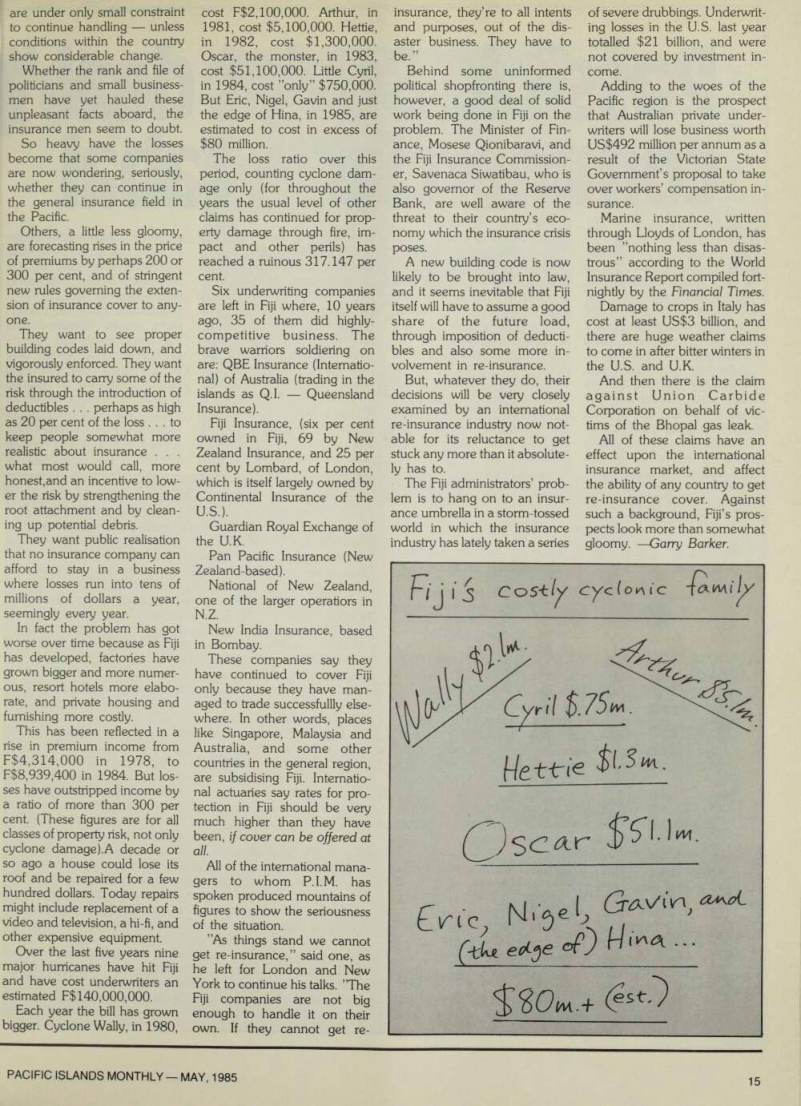
Each year the bill has grown bigger. Cyclone Wally, in 1980,
cost F 52,100,000. Arthur, in 1981, cost $5,100,000. Hettie, in 1982, cost $1,300,000.
Oscar, the monster, in 1983, cost $51,100,000. Little Cyril, in 1984, cost ’’only” $750,000.
But Eric, Nigel, Gavin and just the edge of Hina, in 1985, are estimated to cost in excess of $BO million.
The loss ratio over this period, counting cyclone dam age only (for throughout the years the usual level of other claims has continued for prop erty damage through fire, im pact and other perils) has reached a ruinous 317.147 per cent.
Six underwriting companies are left in Fiji where, 10 years ago, 35 of them did highly competitive business. The brave warriors soldiering on are: QBE Insurance (Internatio nal) of Australia (trading in the islands as Q.I. Queensland Insurance).
Fiji Insurance, (six per cent owned in Fiji, 69 by New Zealand Insurance, and 25 per cent by Lombard, of London, which is itself largely owned by Continental Insurance of the U.S.).
Guardian Royal Exchange of the U.K.
Fan Pacific Insurance (New Zealand-based).
National of New Zealand, one of the larger operatiors in N.Z.
New India Insurance, based in Bombay.
These companies say they have continued to cover Fiji only because they have man aged to trade successfully else where. In other words, places like Singapore, Malaysia and Australia, and some other countries in the general region, are subsidising Fiji. Internatio nal actuaries say rates for pro tection in Fiji should be very much higher than they have been, if cover can be offered at all All of the international mana gers to whom P.I.M. has spoken produced mountains of figures to show the seriousness of the situation. ”As things stand we cannot get re-insurance,” said one, as he left for London and New York to continue his talks. ’’The Fiji companies are not big enough to handle it on their own. If they cannot get re
insurance, they’re to all intents and purposes, out of the dis aster business. They have to be.”
Behind some uninformed political shopfronting there is, however, a good deal of solid work being done in Fiji on the problem. The Minister of Fin ance, Mosese Qionibaravi, and the Fiji Insurance Commission er, Savenaca Siwatibau, who is also governor of the Reserve Bank, are well aware of the threat to their country’s eco nomy which the insurance crisis poses.
A new building code is now likely to be brought into law, and it seems inevitable that Fiji itself will have to assume a good share of the future load, through imposition of deducti bles and also some more in volvement in re-insurance.
But, whatever they do, their decisions will be very closely examined by an international re-insurance industry now not able for its reluctance to get stuck any more than it absolute ly has to.
The Fiji administrators’ prob lem is to hang on to an insur ance umbrella in a storm-tossed world in which the insurance industry has lately taken a series
of severe drubbings. Underwrit ing losses in the U.S. last year totalled $2l billion, and were not covered by investment in come.
Adding to the woes of the Pacific region is the prospect that Australian private under writers will lose business worth US$492 million per annum as a result of the Victorian State Government’s proposal to take over workers’ compensation in surance.
Marine insurance, written through Lloyds of London, has been ’’nothing less than disas trous” according to the World Insurance Report compiled fort nightly by the Financial Times.
Damage to crops in Italy has cost at least US$3 billion, and there are huge weather claims to come in after bitter winters in the U.S. and U.K.
And then there is the claim against Union Carbide Corporation on behalf of vic tims of the Bhopal gas leak.
All of these claims have an effect upon the international insurance market, and affect the ability of any country to get re-insurance cover. Against such a background, Fiji’s pros pects look more than somewhat
gloomy.
Gany Barker.
commercial"-Tabai
Possible soviet deal “[?]rely commercial"-Tabai
Kiribati expects to reach agreement with the Soviet Union soon, giving Moscow fishing rights in a vast part of the south and central Pacific, according to Kiribati president leremia Tabai, who was recently in Wellington.
Tabai said negotiations were “very close to a conclusion” on a deal which would give the Russians rights to fish over an immense area of the Pacific.
“Kiribati, formerly the Gilbert islands, is made up of 33
islands, with a total land area of 719 square kilometres and a population of about 60,000.
But application of the 200-mile exclusive economic zone limits around the widely-spread is lands and atolls gives the coun try rights over more than five million square kilometres of the globe.
President Tabai, who was in New Zealand on a nine-day goodwill visit, claimed his coun try’s discussions with the U.S.S.R. were “simply a com mercial deal.”
However, New Zealand prime minister, David Lange, is reported to have counselled his guest against making what might be interpreted in any argument as an exclusive deal with the Russians. Mr Lange said that small island states were not able to protect their own interests against a super power.
A crucial point, in the view of Western nations, including several of the island nations, and particularly Fiji and Papua New Guinea, is whether the
agreement might lead to estab lishment of a Russian land base in Kiribati and, thus, the first permanent Soviet presence in the south-west Pacific.
President Tabai said the for mula so far discussed with Moscow’s agents did not in clude provision for a shore base or for a Russian staff on Kiribati territory. However, he declined to rule out the possibility of such occurring in any future expansion of the arrangement.
He told reporters in Welling ton that he had consulted Aus
tralia, New Zealand and the United States. “They don’t mis understand what we are doing,” he said. “We belong to the West, but we are the only ones who know finally what is in our national interest.”
The deal discussed, principal ly in Sydney in March, would allow “eight or nine” Soviet trawlers to work the tuna schools in the rich seas within the 200-mile zones around the sprawled-out atolls forming Kiribati. Most activity would be around Tarawa, and, to a lesser extent, around the Phoenix and Line Islands, which are also part of the republic.
President Tabai said that if the negotiations were successful the fees paid by Moscow would replace the US$l.O3 million Kiribati receives in aid from Britain, part of the decolonisa tion agreement.
His negotiations with Russia were not to be seen as an attempt to screw more aid out of the West, he said. The agreement should be seen in the same light as the United States selling grain to the Soviet Union, he said.
By early April, despite several efforts through a variety of intermediaries, Moscow still had not reached a conclusion with Tarawa. Indeed, due to the uncertain nature of telecom munications with Tarawa no body had been in touch with anybody able to make a final decision. At that point the Rus sians were still reported to be dickering about the price they would pay, and in what form.
Kiribati was believed to have demanded cash, in hard currency. The Russians would be able to pay this without much difficulty since tuna caught by their ships in the
Pacific is seldom freighted back to Russia but is more generally sold for U.S. dollars to canner ies in South America.
Diplomats working on Pacific affairs believe Kiribati would be unwise to conclude a bilateral agreement with the Soviet Un ion, particularly at a time when,
because of New Zealand’s posi tion on nuclear-powered or armed ships, and the conse quent upset to the ANZUS alliance, Western interests in the Pacific are particularly sensi tive. Wire-service despatches and Staff Writer (See also P.I.M. Opinion).
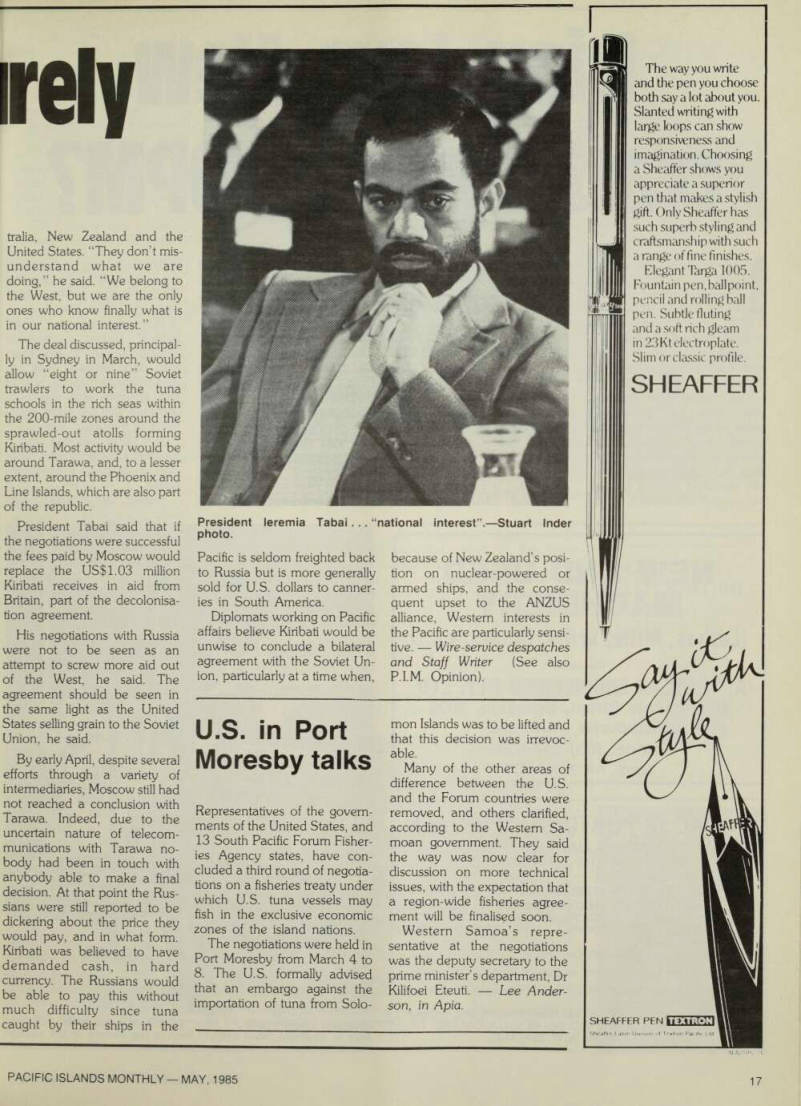
President leremia Tabai... “national interest”. —Stuart Inder photo.
Not the Russians
Fisheries
alone . . .
Only the most naive of citizens can harbor the slightest doubt that the enormous Russian fishing fleet, which penetrates every accessible sea ocean on the globe, is an integral part of the Soviet intelligence gathering system. Every trawler sprouts the most elaborate of antennae arrays. They appear in the most interesting of places, spreading their nets near naval exercises, around the splash-down zones of space probes, and wherever there are events of major political interest.
It now appears that Moscow has embarked upon a vigorous new campaign to use this Trojan seahorse in the Pacific, an area of fast-burgeoning political importance to the world.
In the last several months the Russians have approached Fiji, Tuvalu, Solomon Islands, and, it is reported, also Papua New Guinea, asking for fishing rights. It appears that Kiribati, which held negotia tions with Russian envoys In Sydney in March, has been the only country to at least sniff at the bait.
Australian and New Zealand diplomats, who have been delicately, but firmly, counselling the island countries against involvement with Russia alone, believe Moscow seeks to use relations formed through the fishing industry as the base from which
to counter U.S. influence. (The sum of Auss3 million a year, mentioned as a Russian licence fee, would be of enormous value to Kiribati’s small economy). They believe the Soviet offer to be part of a long-term strategy, but also see it as opportunism in the wake of the upset between America and New Zealand over nuclear-powered ship visits and ANZUS.
Russia has a legitimate and established interest in Pacific fishing. But the fear of the region is of development of land bases, and exclusive deals.
Kiribati has been insistent that no deal has yet been done with the Russians, and that, even if one were signed, it would not permit a Soviet land base of any kind. Tarawa suggests a fishing deal would be no more ominous than the Americans selling grain to Moscow. Opponents say the U.S. sells its wheat in Russia; it does not lease mid-Western grainlands to Russian farmers.
Though the Kiribati initiative is probably not a prime reason, it doubtlessly has spurred on New Zealand’s recent statements of support for the U.S. and announcement of greatly increased diplomatic, aid and defence activity in the Pacific Islands.
It was important, said a N.Z. Foreign Affairs statement, that Moscow “should not now reach the conclusion that circumstances have changed in its favor, thereby giving it an opportunity to make more determined efforts of penetration of the region.
Strategic denial of the South Pacific to the Soviet Union is not only in overall Western interests, it is very much in New Zealand’s security interest...”
Australia’s defence minister, Kim Beazley, lately in Wellington, has been similarly specific: “New Zea land’s greater activity was a practical way of discouraging undesirable outside involvement in this area by the Soviet Union.”
Moresby talks
U.S. in Port Moresby talks
Representatives of the govern ments of the United States, and 13 South Pacific Forum Fisher ies Agency states, have con cluded a third round of negotia tions on a fisheries treaty under which U.S. tuna vessels may fish in the exclusive economic zones of the island nations.
The negotiations were held in Port Moresby from March 4 to 8. The U.S. formally advised that an embargo against the importation of tuna from Solo
mon Islands was to be lifted and that this decision was irrevoc able.
Many of the other areas of difference between the U.S. and the Forum countries were removed, and others clarified, according to the Western Sa moan government. They said the way was now clear for discussion on more technical issues, with the expectation that a region-wide fisheries agree ment will be finalised soon.
Western Samoa’s repre sentative at the negotiations was the deputy secretary to the prime minister’s department, Dr Kilifoei Eteuti. Lee Ander son, in Apia.
Advertisements & other items, p. 17 (1 item)
Sheaffer
The way you write and the pen you choose both say a lot about you.
Slanted writing with large loops can show responsiveness and imagination. Choosing a Sheaffer shows you appreciate a superior pen that makes a stylish gift. Only Sheaffer has such superb styling and craftsmanship with such a range of fine finishes.
Elegant lOO5.
Fountain pen,ballpoint, pencil and rolling ball pen. Subtle fluting and a soft rich gleam in 23 Kt electroplate.
Slim or classic profile.
SHEAFFER
SHEAFFER PEN CHE
Irian Jaya: New
crackdown on OPM?
Indonesia may be embarking on a new political campaign against the Free West Papua Movement (OPM) whose members currently provide embarrassment in relations between Jakarta and the government in Port Moresby.
The military commander of Irian Jaya, the Indonesian name for the western half of the island, has recently been quoted as saying that the guerrillas ’’and their sympathisers” still cherished dreams of pan- Melanesian nationalism. *
Lieut-General Kahpi Suriadiredja made the assertion in Bandung in March when he spoke to a seminar on regional affairs.
He said that notions of a free West Papua and a ’’Greater Melanesia” lingered in the minds of some Irian Jayans.
The western half of New Guinea became Irian Jaya when the Netherlands lost a political battle in the United Nations to keep it separate from the rest of their western Pacific colonies. Indonesia’s then president, Soekarno, had
claimed it on grounds that it was part of the Dutch East Indies and, therefore, legally part of Indonesia, despite the clear racial difference of the people. The Melanesian Christ ians who make up the popula tion of Irian Jaya had opposed their handing over to control from Jakarta, but their objec tions were over-ridden by the United Nations.
General Kahpi said there was some sympathy in official circles in Irian Jaya for the OPM, which is now outlawed in the territory and freely hunted by
Indonesian Army units operat ing particularly on the long and difficult border between Irian Jaya and Papua New Guinea.
This reference to ’’official support” caused a minor stir among Jakarta’s diplomats who, upon reflection, took it to be a reference to the number of civil servants who fled from Jayapura after the abortive up rising of February, 1984.
The OPM had also won a foothold among ’’student drop outs” in Jayapura, the territorial capital.
Neither Jakarta, nor Port
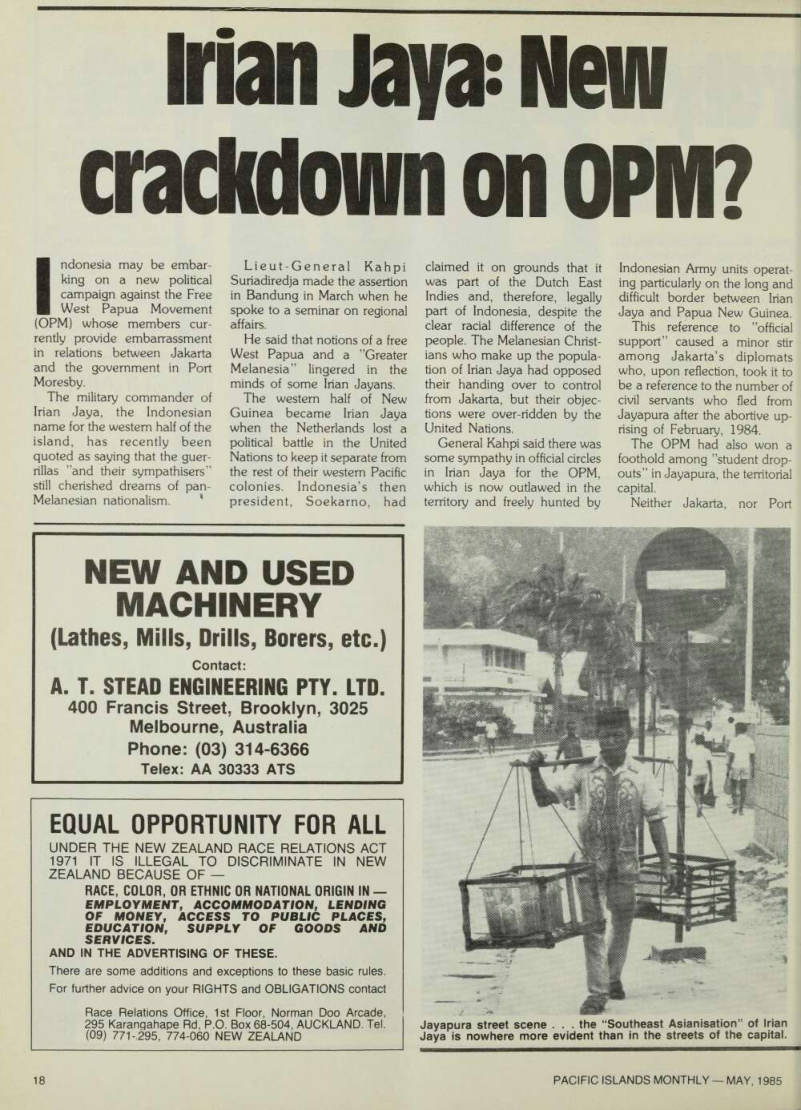
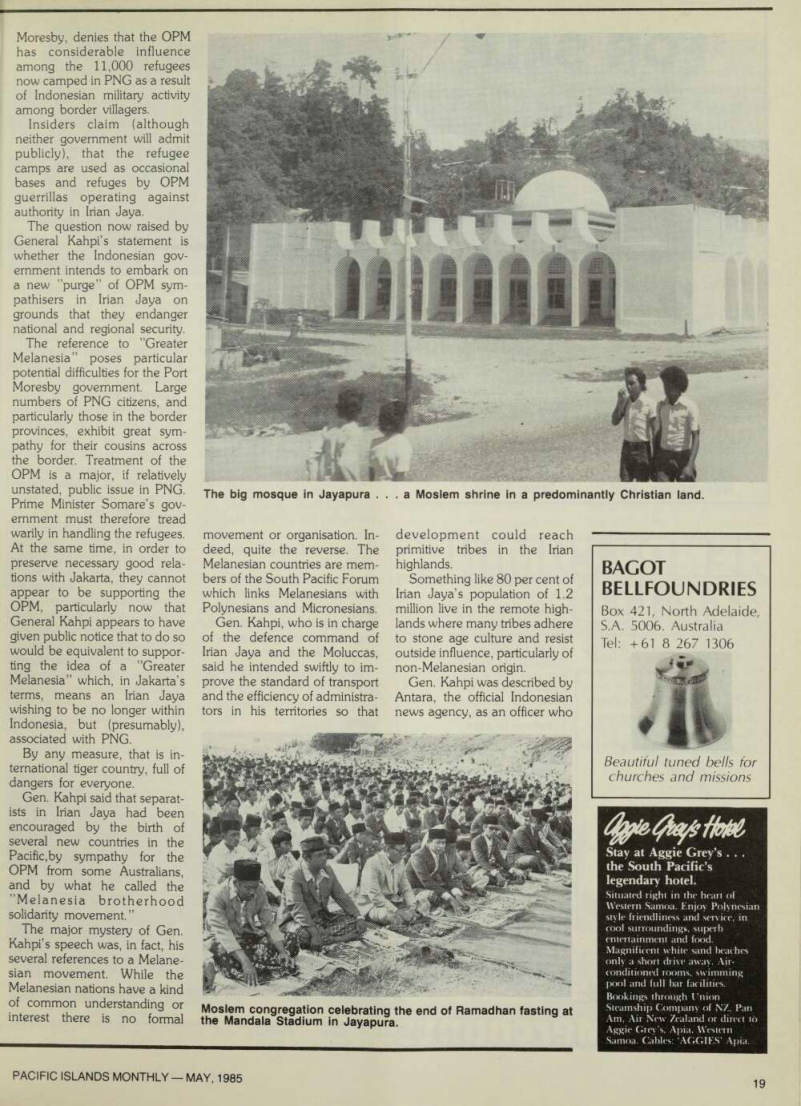
Jayapura street scene ... the “Southeast Asianisation” of Irian Jaya is nowhere more evident than in the streets of the capital.
Moresby, denies that the OFM has considerable influence among the 11,000 refugees now camped in PNG as a result of Indonesian military activity among border villagers.
Insiders claim (although neither government will admit publicly), that the refugee camps are used as occasional bases and refuges by OFM guerrillas operating against authority in Irian Jaya.
The question now raised by General Kahpi’s statement is whether the Indonesian gov ernment intends to embark on a new ’’purge” of OFM sym pathisers in Irian Jaya on grounds that they endanger national and regional security.
The reference to ’’Greater Melanesia” poses particular potential difficulties for the Port Moresby government. Large numbers of PNG citizens, and particularly those in the border provinces, exhibit great sym pathy for their cousins across the border. Treatment of the OFM is a major, if relatively unstated, public issue in PNG.
Prime Minister Somare’s gov ernment must therefore tread warily in handling the refugees.
At the same time, in order to preserve necessary good rela tions with Jakarta, they cannot appear to be supporting the OPM, particularly now that General Kahpi appears to have given public notice that to do so would be equivalent to suppor ting the idea of a ’’Greater Melanesia” which, in Jakarta’s terms, means an Irian Jaya wishing to be no longer within Indonesia, but (presumably), associated with PNG.
By any measure, that is in ternational tiger country, full of dangers for everyone.
Gen. Kahpi said that separat ists in Irian Jaya had been encouraged by the birth of several new countries in the Pacific,by sympathy for the OPM from some Australians, and by what he called the ’’Melanesia brotherhood solidarity movement.”
The major mystery of Gen.
Kahpi’s speech was, in fact, his several references to a Melane sian movement. While the Melanesian nations have a kind of common understanding or interest there is no formal
movement or organisation. In deed, quite the reverse. The Melanesian countries are mem bers of the South Pacific Forum which links Melanesians with Polynesians and Micronesians.
Gen. Kahpi, who is in charge of the defence command of Irian Jaya and the Moluccas, said he intended swiftly to im prove the standard of transport and the efficiency of administra tors in his territories so that
development could reach primitive tribes in the Irian highlands.
Something like 80 per cent of Irian Jaya’s population of 1.2 million live in the remote high lands where many tribes adhere to stone age culture and resist outside influence, particularly of non-Melanesian origin.
Gen. Kahpi was described by Antara, the official Indonesian news agency, as an officer who
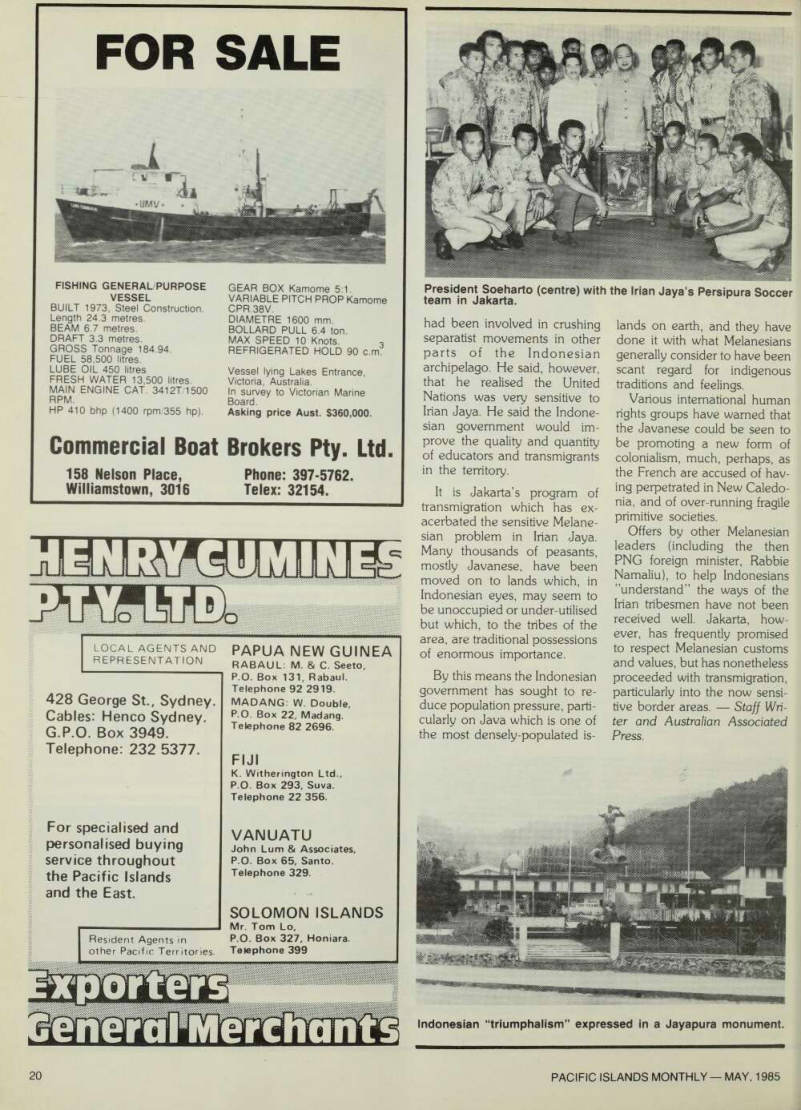
Moslem congregation celebrating the end of Ramadhan fasting at the Mandala Stadium in Jayapura.
The big mosque in Jayapura ... a Moslem shrine in a predominantly Christian land.
had been involved in crushing separatist movements in other parts of the Indonesian archipelago. He said, however, that he realised the United Nations was very sensitive to Irian Jaya. He said the Indonesian government would improve the quality and quantity of educators and transmigrants in the territory.
It is Jakarta’s program of transmigration which has exacerbated the sensitive Melanesian problem in Irian Jaya.
Many thousands of peasants, mostly Javanese, have been moved on to lands which, in Indonesian eyes, may seem to be unoccupied or under-utilised but which, to the tribes of the area, are traditional possessions of enormous importance.
By this means the Indonesian government has sought to reduce population pressure, particularly on Java which is one of the most densely-populated is-
lands on earth, and they have done it with what Melanesians generally consider to have been scant regard for indigenous traditions and feelings.
Various international human rights groups have warned that the Javanese could be seen to be promoting a new form of colonialism, much, perhaps, as the French are accused of hav- P er Petrated * n New Caledo nia’ and of over-running fragile societies, , ° ffers , otber Melanesian bnc l ubin S the then RNG °\ e '^ n ™ nis T ter ’ Rabbie Naroahu), to help Indonesians understand the ways of the nan tribesmen have not been received v f lL Jal^ arta ’ how : ever ’ has frequently promised to Y f s^ ect Melanesian customs and values, but has nonetheless proceeded with transmigration, particularly into the now sensi tive border areas. Staff Wri ter and Australian Associated Press.
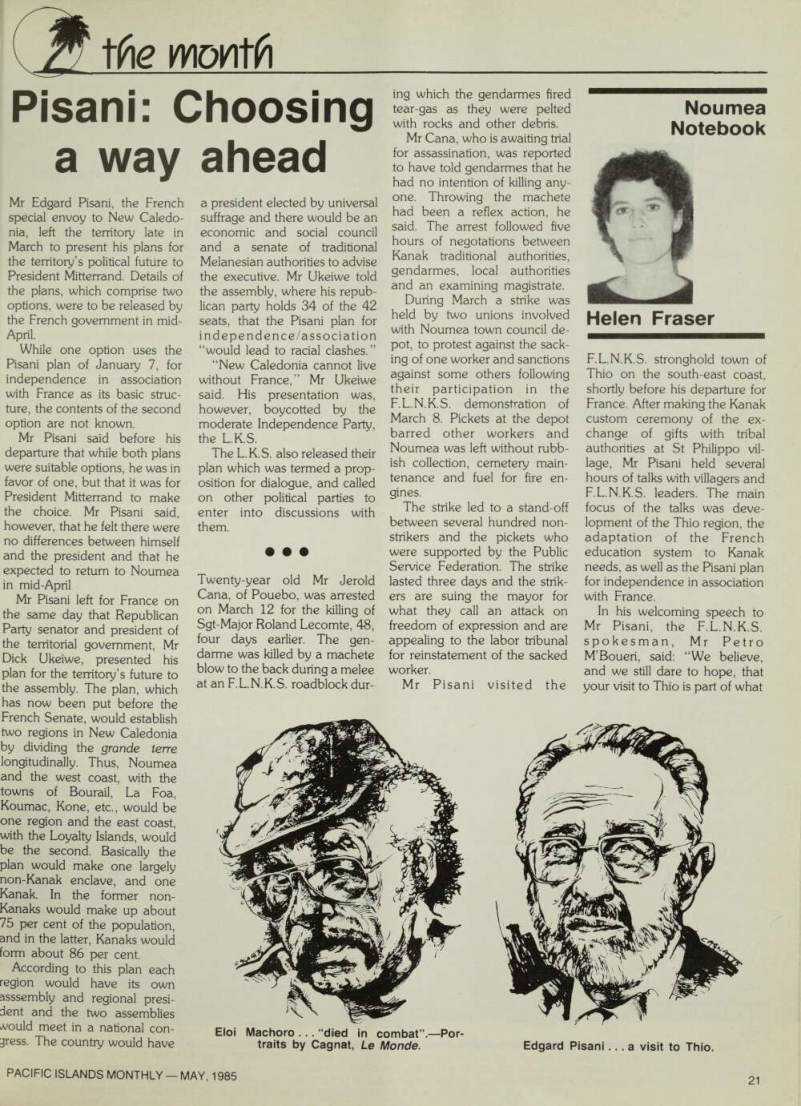
President Soeharto (centre) with the Irian Java’s Persipura Soccer team in Jakarta.
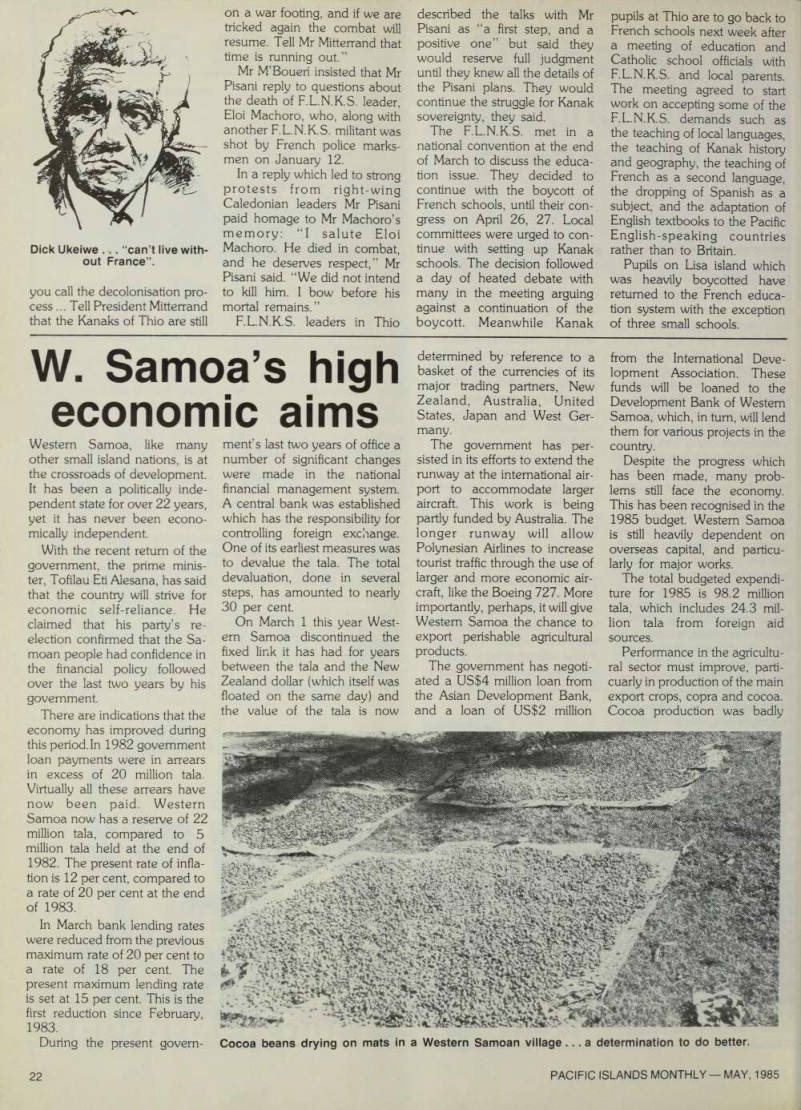
Indonesian “triumphalism" expressed in a Jayapura monument.
Advertisements & other items, pp. 18-20 (1 item)
Machinery
NEW AND USED
(Lathes, Mills, Drills, Borers, etc.)
Contact:
A. T. STEAD ENGINEERING PTY. LTD.
400 Francis Street, Brooklyn, 3025 Melbourne, Australia Phone: (03) 314-6366 Telex: AA 30333 ATS
EQUAL OPPORTUNITY FOR ALL
UNDER THE NEW ZEALAND RACE RELATIONS ACT 1971 IT IS ILLEGAL TO DISCRIMINATE IN NEW
ZEALAND BECAUSE OF —
RACE, COLOR, OR ETHNIC OR NATIONAL ORIGIN IN —
EMPLOYMENT, ACCOMMODATION, LENDING
OF MONEY, ACCESS TO PUBLIC PLACES,
EDUCATION, SUPPLY OF GOODS AND
SERVICES.
AND IN THE ADVERTISING OF THESE.
There are some additions and exceptions to these basic rules.
For further advice on your RIGHTS and OBLIGATIONS contact Race Relations Office, 1st Floor, Norman Doo Arcade, 295 Karangahape Rd, P.O. Box 68-504, AUCKLAND. Tel.
(09) 771-295, 774-060 NEW ZEALAND
BAGOT
BELLFOUNDRIES
Box 421, North Adelaide, S.A. 5006. Australia Tel: +6l 8 267 1306 Beautiful tuned bells for churches and missions
Stay at Aggie Grey’s . . . the South Pacific’s
legendary hotel.
Situated right in the heart of Western Samoa. Enjoy Polynesian style friendliness and service, in cool surroundings, superb entertainment and food.
Magnificent white sand beaches only a short drive away. Airconditioned rooms, swimming |xx)l and full bar facilities.
Bookings through I'nion Steamship Company of NZ, Pan Am. Air New Zealand or direc t to Aggie Grey's. Apia. Western Samoa. Cables; ‘AGGIES’ Apia.
FOR SALE
i ir r h l mf w r
FISHING GENERAL PURPOSE
VESSEL
BUILT 1973, Steel Construction.
Length 24.3 metres.
BEAM 6.7 metres.
DRAFT 3.3 metres.
GROSS Tonnage 184.94.
FUEL 58,500 litres.
LUBE OIL 450 litres FRESH WATER 13,500 litres.
MAIN ENGINE CAT. 3412T 1500
RPM.
HP 410 bhp (1400 rpm/355 hp).
GEAR BOX Kamome 5:1.
VARIABLE PITCH PROP Kamome
CPR.38V.
DIAMETRE 1600 mm.
BOLLARD PULL 6.4 ton.
MAX SPEED 10 Knots. o
REFRIGERATED HOLD 90 c.m
Vessel lying Lakes Entrance, Victoria, Australia.
In survey to Victorian Marine Board.
Asking price Aust. $360,000.
Commercial Boat Brokers Pty. Ltd.
158 Nelson Place, Phone: 397-5762.
Williamstown, 3016 Telex: 32154.
to
LOCAL AGENTS AND
REPRESENTATION
428 George St., Sydney.
Cables: Henco Sydney.
G.P.O. Box 3949.
Telephone: 232 5377.
For specialised and
personalised buying
service throughout
the Pacific Islands and the East.
Resident Agents in other Pacific Territories.
PAPUA NEW GUINEA
RABAUL: M. & C. Seeto, P.O. Box 131, Rabaul.
Telephone 92 2919.
MADANG: W. Double, P.O. Box 22, Madang.
Telephone 82 2696.
FIJI
K. Witherington Ltd., P.O. Box 293, Suva.
Telephone 22 356.
VANUATU
John Lum & Associates, P.O. Box 65, Santo.
Telephone 329.
SOLOMON ISLANDS
Mr. Tom Lo, P.O. Box 327, Honiara.
Telephone 399
Pisani: Choosing
the month
Pisani: Choosing a way ahead
Mr Edgard Pisani, the French special envoy to New Caledo nia, left the territory late in March to present his plans for the territory’s political future to President Mitterrand. Details of the plans, which comprise two options, were to be released by the French government in mid- April.
While one option uses the Pisani plan of January 7, for independence in association with France as its basic struc ture, the contents of the second option are not known.
Mr Pisani said before his departure that while both plans were suitable options, he was in favor of one, but that it was for President Mitterrand to make the choice. Mr Pisani said, however, that he felt there were no differences between himself and the president and that he expected to return to Noumea in mid-April Mr Pisani left for France on the same day that Republican Party senator and president of the territorial government, Mr Dick Ukeiwe, presented his plan for the territory’s future to the assembly. The plan, which has now been put before the French Senate, would establish two regions in New Caledonia by dividing the grande terre longitudinally. Thus, Noumea and the west coast, with the towns of Bourail, La Foa, Koumac, Kone, etc., would be one region and the east coast, with the Loyalty Islands, would be the second. Basically the plan would make one largely non-Kanak enclave, and one Kanak. In the former non- Kanaks would make up about 75 per cent of the population, and in the latter, Kanaks would form about 86 per cent.
According to this plan each region would have its own asssembly and regional presi dent and the two assemblies A/ould meet in a national con gress. The country would have
a president elected by universal suffrage and there would be an economic and social council and a senate of traditional Melanesian authorities to advise the executive. Mr Ukeiwe told the assembly, where his repub lican party holds 34 of the 42 seats, that the Pisani plan for independence/association “would lead to racial clashes.”
“New Caledonia cannot live without France,” Mr Ukeiwe said. His presentation was, however, boycotted by the moderate Independence Party, the L.K.S.
The L.K.S. also released their plan which was termed a prop osition for dialogue, and called on other political parties to enter into discussions with them. • • • Twenty-year old Mr Jerold Cana, of Pouebo, was arrested on March 12 for the killing of Sgt-Major Roland Lecomte, 48, four days earlier. The gen darme was killed by a machete blow to the back during a melee at an F.L.N.K.S. roadblock dur
ing which the gendarmes fired tear-gas as they were pelted with rocks and other debris.
Mr Cana, who is awaiting trial for assassination, was reported to have told gendarmes that he had no intention of killing any one. Throwing the machete had been a reflex action, he said. The arrest followed five hours of negotations between Kanak traditional authorities, gendarmes, local authorities and an examining magistrate.
During March a strike was held by two unions involved with Noumea town council de pot, to protest against the sack ing of one worker and sanctions against some others following their participation in the F.L.N.K.S. demonstration of March 8. Pickets at the depot barred other workers and Noumea was left without rubb ish collection, cemetery main tenance and fuel for fire en gines.
The strike led to a stand-off between several hundred non strikers and the pickets who were supported by the Public Service Federation. The strike lasted three days and the strik ers are suing the mayor for what they call an attack on freedom of expression and are appealing to the labor tribunal for reinstatement of the sacked worker.
Mr Pisani visited the
Noumea Notebook
F.L.N.K.S. stronghold town of Thio on the south-east coast, shortly before his departure for France. After making the Kanak custom ceremony of the ex change of gifts with tribal authorities at St Philippo vil lage, Mr Pisani held several hours of talks with villagers and F.L.N.K.S. leaders. The main focus of the talks was deve lopment of the Thio region, the adaptation of the French education system to Kanak needs, as well as the Pisani plan for independence in association with France.
In his welcoming speech to Mr Pisani, the F.L.N.K.S. spokesman, Mr Petro M’Boueri, said: “We believe, and we still dare to hope, that your visit to Thio is part of what
Helen Fraser
Eloi Machoro ... “died in combat”.—Por traits by Cagnat, Le Monde.
Edgard Pisani... a visit to Thio.
you call the decolonisation pro cess ... Tell President Mitterrand that the Kanaks of Thio are still
on a war footing, and if we are tricked again the combat will resume. Tell Mr Mitterrand that time is running out.”
Mr M’Boueri insisted that Mr Pisani reply to questions about the death of F.L.N.K.S. leader, Eloi Machoro, who, along with another F.L.N.K.S. militant was shot by French police marks men on January 12.
In a reply which led to strong protests from right-wing Caledonian leaders Mr Pisani paid homage to Mr Machoro’s memory; “I salute Eloi Machoro. He died in combat, and he deserves respect,” Mr Pisani said. “We did not intend to kill him. I bow before his mortal remains.”
F.L.N.K.S. leaders in Thio
described the talks with Mr Pisani as “a first step, and a positive one” but said they would reserve full judgment until they knew all the details of the Pisani plans. They would continue the struggle for Kanak sovereignty, they said.
The F.L.N.K.S. met in a national convention at the end of March to discuss the educa tion issue. They decided to continue with the boycott of French schools, until their con gress on April 26, 27. Local committees were urged to con tinue with setting up Kanak schools. The decision followed a day of heated debate with many in the meeting arguing against a continuation of the boycott. Meanwhile Kanak
pupils at Thio are to go back to French schools next week after a meeting of education and Catholic school officials with F.L.N.K.S. and local parents.
The meeting agreed to start work on accepting some of the F.L.N.K.S. demands such as the teaching of local languages, the teaching of Kanak history and geography, the teaching of French as a second language, the dropping of Spanish as a subject, and the adaptation of English textbooks to the Pacific
English-speaking countries
rather than to Britain.
Pupils on Lisa island which was heavily boycotted have returned to the French educa tion system with the exception of three small schools.
Dick Ukeiwe ... “can’t live with out France”.
W. Samoa’s high

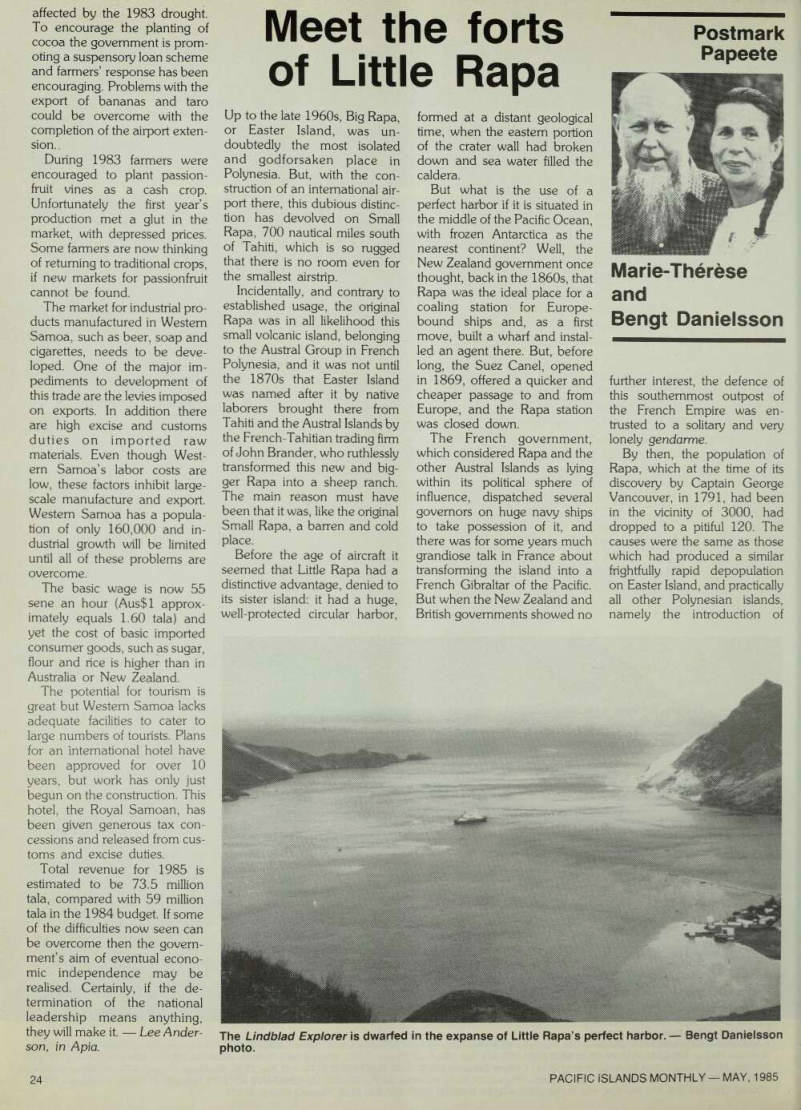
economic aims
Western Samoa, like many other small island nations, is at the crossroads of development.
It has been a politically inde pendent state for over 22 years, yet it has never been econo mically independent.
With the recent return of the government, the prime minis ter, Tofilau Eti Alesana, has said that the country will strive for economic self-reliance. He claimed that his party’s re election confirmed that the Sa moan people had confidence in the financial policy followed over the last two years by his government.
There are indications that the economy has improved during this period. In 1982 government loan payments were in arrears in excess of 20 million tala.
Virtually all these arrears have now been paid. Western Samoa now has a reserve of 22 million tala, compared to 5 million tala held at the end of 1982. The present rate of infla tion is 12 per cent, compared to a rate of 20 per cent at the end of 1983.
In March bank lending rates were reduced from the previous maximum rate of 20 per cent to a rate of 18 per cent. The present maximum lending rate is set at 15 per cent. This is the first reduction since February, 1983.
During the present govern
ment’s last two years of office a number of significant changes were made in the national financial management system.
A central bank was established which has the responsibility for controlling foreign exchange.
One of its earliest measures was to devalue the tala. The total devaluation, done in several steps, has amounted to nearly 30 per cent.
On March 1 this year West ern Samoa discontinued the fixed link it has had for years between the tala and the New Zealand dollar (which itself was floated on the same day) and the value of the tala is now
determined by reference to a basket of the currencies of its major trading partners, New Zealand, Australia, United States, Japan and West Ger many.
The government has per sisted in its efforts to extend the runway at the international air port to accommodate larger aircraft. This work is being partly funded by Australia. The longer runway will allow Polynesian Airlines to increase tourist traffic through the use of larger and more economic air craft, like the Boeing 727. More importantly, perhaps, it will give Western Samoa the chance to export perishable agricultural products.
The government has negoti ated a US$4 million loan from the Asian Development Bank, and a loan of US$2 million
from the International Deve lopment Association. These funds will be loaned to the Development Bank of Western Samoa, which, in turn, will lend them for various projects in the country, Despite the progress which has been made, many prob lems still face the economy, This has been recognised in the 1985 budget. Western Samoa is still heavily dependent on overseas capital, and particu larly for major works, The total budgeted expendi ture for 1985 is 98.2 million tala, which includes 24.3 mil lion tala from foreign aid sources, Performance in the agricultu ral sector must improve, parti cuarly in production of the main export crops, copra and cocoa.
Cocoa production was badly
Cocoa beans drying on mats in a Western Samoan village ... a determination to do better.
affected by the 1983 drought.
To encourage the planting of cocoa the government is prom oting a suspensory loan scheme and farmers’ response has been encouraging. Problems with the export of bananas and taro could be overcome with the completion of the airport exten sion. .
During 1983 farmers were encouraged to plant passion fruit vines as a cash crop.
Unfortunately the first year’s production met a glut in the market, with depressed prices.
Some farmers are now thinking of returning to traditional crops, if new markets for passionfruit cannot be found.
The market for industrial pro ducts manufactured in Western Samoa, such as beer, soap and cigarettes, needs to be deve loped. One of the major im pediments to development of this trade are the levies imposed on exports. In addition there are high excise and customs duties on imported raw materials. Even though West ern Samoa’s labor costs are low, these factors inhibit large scale manufacture and export.
Western Samoa has a popula tion of only 160,000 and in dustrial growth will be limited until all of these problems are overcome.
The basic wage is now 55 sene an hour (Aussl approx imately equals 1.60 tala) and yet the cost of basic imported consumer goods, such as sugar, flour and rice is higher than in Australia or New Zealand.
The potential for tourism is great but Western Samoa lacks adequate facilities to cater to large numbers of tourists. Plans for an International hotel have been approved for over 10 years, but work has only just begun on the construction. This hotel, the Royal Samoan, has been given generous tax con cessions and released from cus toms and excise duties.
Total revenue for 1985 is estimated to be 73.5 million tala, compared with 59 million tala in the 1984 budget. If some of the difficulties now seen can be overcome then the govern ment’s aim of eventual econo mic independence may be realised. Certainly, if the de termination of the national leadership means anything, they will make it. Lee Ander son, in Apia.
Advertisements & other items, p. 23 (1 item)
Nt€Lltg€N|
Oat of this world convenience. •
Sansai Intelligent Super Compo
with the Remote Compu-Equalizer.
Adjust each of 7 frequency batids to taste. Recall any of five equalizations (three preset, two created by you) or "'flat" response. Select and slay any input. Choose any AM or FM preset station*. Adjust the volume. All from anywhere'in the room by means of an invisible infrared beam.
And that's only the beginning.
New SansuHntelligent Super Compo
now offers a double auto-reverse cassette deck, an "auto-reverse" turntable that plays both sides of a record, a spectrum analyzer, and a host of other great
components and features..
See Sansui's new Intelligent Super
Compo systems featuring the amazing
Remote Compu-Equalizer today. And
experience out of this world convenience.
liliiii I
, « uj y y 33s
SUPCR COMPO
SYSTEM IS-UOOP
SANSUi ELECTRIC CO., LTD. 14-1, izumi 2-chome, Suginami-ku, Tokyo 168, Japan A-1100P Integrated DC- Servo Amplifier Music Power
(IHF); 1 SOW x 2
RG-900R
Remote Control Compu- Equalizer T-900 Quartz-PLL Synthesizer FM/AM Tuner
D-95WR
Double Auto- Reverse Cassette Deck
P-L9SR
Linear-Tracking "Auto-Reverse' Turntable * AT-700 Audio Program Timer (optional) 'V V
NT€LLtG€N|
-»-ir
IV I J
IB'-UD
GX-1000 Audio Cabinet % % /
CB-K7a
Cassette Case (optional) 0 Also available in silver finish.
SansruJ-
For further information please contact: • Australia: VAN FI (Aust.) PTY. LTD. 297, City Road, South Melbourne, Victoria 3205, Australia Phone: 690-6200/283 Alfred Place, North Sydney, N.S.W. 2060, Australia Phone: 929-0293 •Fiji: PRABHU BROTHERS LTD. P.O. Box 183, Nadi Phone: 71122 *Papua New Guinea: OCEANIA INDENT AGENCY (P.N.G.) PTY. LTD.
P.O. Box 5518, Boroko, Port Moresby Phone: 256411 »New Zealand: DAVID REID ELECTRONICS LTD. P.O. Box 2630, Auckland, Phone: 488-049 «New Caledonia: HI-FI VICTOIRE. ETS. M. MERCIER B.P. 1123, Noumea Phone: 27.59.11 Pacific: NAURU CO-OPERATIVE SOCIETY Republic of Nauru • Vanuatu: THE SOUND CENTRAL LTD. P.O. Box 434, Vila Phone: 2035 •Tahiti: DIMECO SIMEL B.P. Box 3338, Papeete Phone: 26979
of Little Rapa
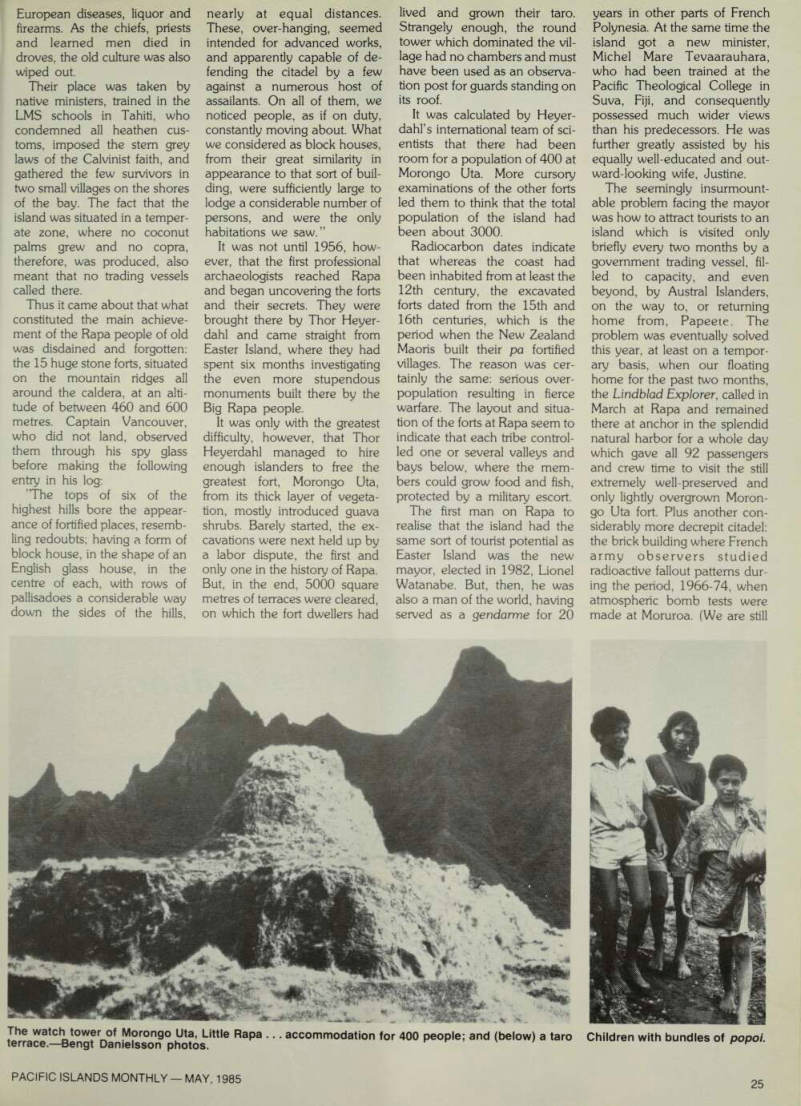
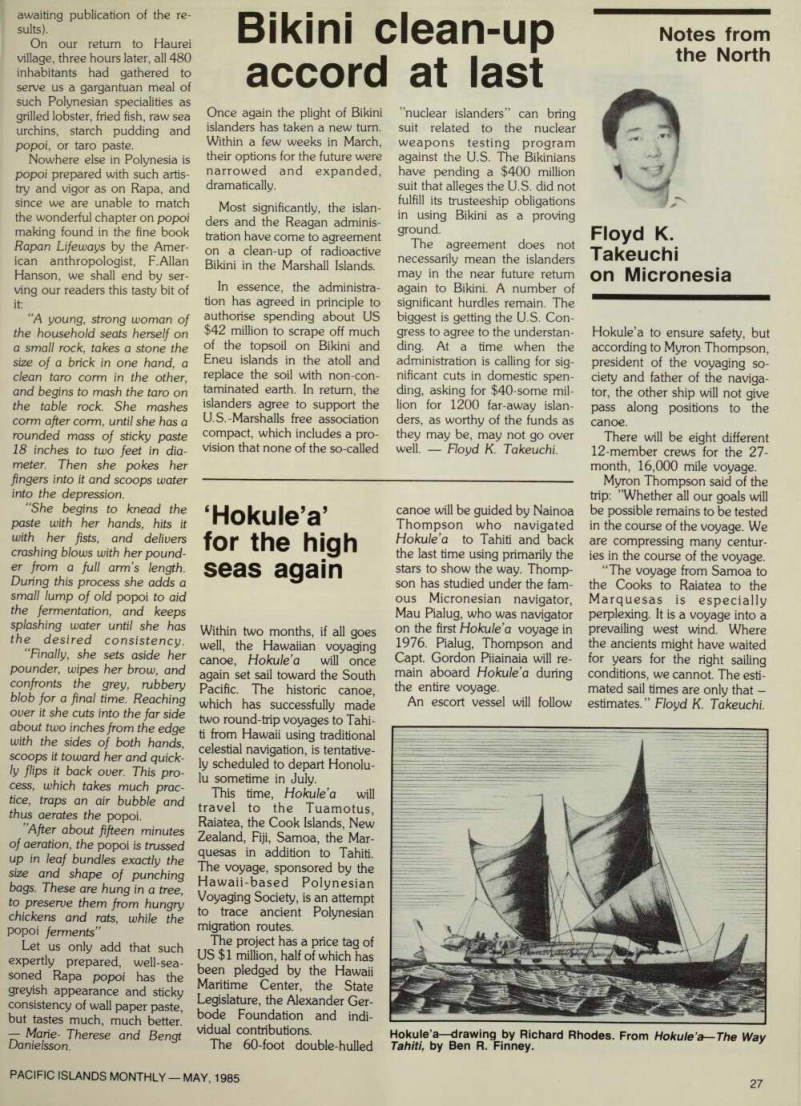
Meet the forts of Little Rapa
Up to the late 19605, Big Rapa, or Easter Island, was un doubtedly the most isolated and godforsaken place in Polynesia. But, with the con struction of an international air port there, this dubious distinc tion has devolved on Small Rapa, 700 nautical miles south of Tahiti, which is so rugged that there is no room even for the smallest airstrip.
Incidentally, and contrary to established usage, the original Rapa was in all likelihood this small volcanic island, belonging to the Austral Group in French Polynesia, and it was not until the 1870 s that Easter Island was named after it by native laborers brought there from Tahiti and the Austral Islands by the French-Tahitian trading firm of John Brander, who ruthlessly transformed this new and big ger Rapa into a sheep ranch.
The main reason must have been that it was, like the original Small Rapa, a barren and cold place.
Before the age of aircraft it seemed that Little Rapa had a distinctive advantage, denied to its sister island; it had a huge, well-protected circular harbor,
formed at a distant geological time, when the eastern portion of the crater wall had broken down and sea water filled the caldera.
But what is the use of a perfect harbor if it is situated in the middle of the Pacific Ocean, with frozen Antarctica as the nearest continent? Well, the New Zealand government once thought, back in the 1860 s, that Rapa was the ideal place for a coaling station for Europe bound ships and, as a first move, built a wharf and instal led an agent there. But, before long, the Suez Canel, opened in 1869, offered a quicker and cheaper passage to and from Europe, and the Rapa station was closed down.
The French government, which considered Rapa and the other Austral Islands as lying within its political sphere of influence, dispatched several governors on huge navy ships to take possession of it, and there was for some years much grandiose talk in France about transforming the island into a French Gibraltar of the Pacific.
But when the New Zealand and British governments showed no
Postmark Papeete
further interest, the defence of this southernmost outpost of the French Empire was en trusted to a solitary and very lonely gendarme.
By then, the population of Rapa, which at the time of its discovery by Captain George Vancouver, in 1791, had been in the vicinity of 3000, had dropped to a pitiful 120. The causes were the same as those which had produced a similar frightfully rapid depopulation on Easter Island, and practically all other Polynesian islands, namely the introduction of
Marie-Therese and Bengt Danielsson
The Lindblad Explorer is dwarfed in the expanse of Little Rapa’s perfect harbor.-Bengt Danielsson photo.
European diseases, liquor and firearms. As the chiefs, priests and learned men died in droves, the old culture was also wiped out.
Their place was taken by native ministers, trained in the LMS schools in Tahiti, who condemned all heathen cus toms, imposed the stem grey laws of the Calvinist faith, and gathered the few survivors in two small villages on the shores of the bay. The fact that the island was situated in a temper ate zone, where no coconut palms grew and no copra, therefore, was produced, also meant that no trading vessels called there.
Thus it came about that what constituted the main achieve ment of the Rapa people of old was disdained and forgotten: the 15 huge stone forts, situated on the mountain ridges all around the caldera, at an alti tude of between 460 and 600 metres. Captain Vancouver, who did not land, observed them through his spy glass before making the following entry in his log; ’The tops of six of the highest hills bore the appear ance of fortified places, resemb ling redoubts; having a form of block house, in the shape of an English glass house, in the centre of each, with rows of pallisadoes a considerable way down the sides of the hills,
nearly at equal distances.
These, over-hanging, seemed intended for advanced works, and apparently capable of de fending the citadel by a few against a numerous host of assailants. On all of them, we noticed people, as if on duty, constantly moving about. What we considered as block houses, from their great similarity in appearance to that sort of buil ding, were sufficiently large to lodge a considerable number of persons, and were the only habitations we saw.”
It was not until 1956, how ever, that the first professional archaeologists reached Rapa and began uncovering the forts and their secrets. They were brought there by Thor Heyer dahl and came straight from Easter Island, where they had spent six months investigating the even more stupendous monuments built there by the Big Rapa people.
It was only with the greatest difficulty, however, that Thor Heyerdahl managed to hire enough islanders to free the greatest fort, Morongo Uta, from its thick layer of vegeta tion, mostly introduced guava shrubs. Barely started, the ex cavations were next held up by a labor dispute, the first and only one in the history of Rapa.
But, in the end, 5000 square metres of terraces were cleared, on which the fort dwellers had
lived and grown their taro.
Strangely enough, the round tower which dominated the vil lage had no chambers and must have been used as an observa tion post for guards standing on its roof.
It was calculated by Heyer dahl’s international team of sci entists that there had been room for a population of 400 at Morongo Uta. More cursory examinations of the other forts led them to think that the total population of the island had been about 3000.
Radiocarbon dates indicate that whereas the coast had been inhabited from at least the 12th century, the excavated forts dated from the 15th and 16th centuries, which is the period when the New Zealand Maoris built their pa fortified villages. The reason was cer tainly the same: serious over population resulting in fierce warfare. The layout and situa tion of the forts at Rapa seem to indicate that each tribe control led one or several valleys and bays below, where the mem bers could grow food and fish, protected by a military escort.
The first man on Rapa to realise that the island had the same sort of tourist potential as Easter Island was the new mayor, elected in 1982, Lionel Watanabe. But, then, he was also a man of the world, having served as a gendarme for 20
years in other parts of French Polynesia. At the same time the island got a new minister, Michel Mare Tevaarauhara, who had been trained at the Pacific Theological College in Suva, Fiji, and consequently possessed much wider views than his predecessors. He was further greatly assisted by his equally well-educated and out ward-looking wife, Justine.
The seemingly insurmount able problem facing the mayor was how to attract tourists to an island which is visited only briefly every two months by a government trading vessel, fil led to capacity, and even beyond, by Austral Islanders, on the way to, or returning home from, Papeete. The problem was eventually solved this year, at least on a tempor ary basis, when our floating home for the past two months, the Lindblad Explorer , called in March at Rapa and remained there at anchor in the splendid natural harbor for a whole day which gave all 92 passengers and crew time to visit the still extremely well-preserved and only lightly overgrown Moron go Uta fort. Plus another con siderably more decrepit citadel: the brick building where French army observers studied radioactive fallout patterns dur ing the period, 1966-74, when atmospheric bomb tests were made at Moruroa. (We are still
The watch tower of Morongo Uta, Little Rapa ... accommodation for 400 people; and (below) a taro terrace.—Bengt Danielsson photos.
Children with bundles of popoi.
awaiting publication of the re sults).
On our return to Haurei village, three hours later, all 480 inhabitants had gathered to serve us a gargantuan meal of such Polynesian specialities as grilled lobster, fried fish, raw sea urchins, starch pudding and popoi, or taro paste.
Nowhere else in Polynesia is popoi prepared with such artis try and vigor as on Rapa, and since we are unable to match the wonderful chapter on popoi making found in the fine book Rapan Lifeways by the Amer ican anthropologist, F.Allan Hanson, we shall end by ser ving our readers this tasty bit of it; “A young, strong woman of the household seats herself on a small rock, takes a stone the size of a brick in one hand, a clean taro corm in the other, and begins to mash the taro on the table rock. She mashes corm after corm, until she has a rounded mass of sticky paste 18 inches to two feet in dia meter. Then she pokes her fingers into it and scoops water into the depression.
“She begins to knead the paste with her hands, hits it with her fists, and delivers crashing blows with her pound er from a full arm’s length.
During this process she adds a small lump of old popoi to aid the fermentation, and keeps splashing water until she has the desired consistency.
“Finally, she sets aside her pounder, wipes her brow, and confronts the grey, rubbery blob for a final time. Reaching over it she cuts into the far side about two inches from the edge with the sides of both hands, scoops it toward her and quick ly flips it back over. This pro cess, which takes much prac tice, traps an air bubble and thus aerates the popoi. ’’After about fifteen minutes of aeration, the popoi is trussed up in leaf bundles exactly the size and shape of punching bags. These are hung in a tree, to preserve them from hungry chickens and rats, while the popoi ferments”
Let us only add that such expertly prepared, well-sea soned Rapa popoi has the greyish appearance and sticky consistency of wall paper paste, but tastes much, much better.
Marie- Therese and Bengt Danielsson.
Advertisements & other items, p. 26 (1 item)
Bens on w Hedges
(\n h m TRADuIOnALLt the name
ASSOCIATED WITH PERFECTION
IN CIGARETTES
BENSON & HEDGES
20
Bens on w Hedges
WARNING-SMOKING 18 A HEALTH HAZARD
Bikini clean-up
accord at last
Once again the plight of Bikini islanders has taken anew turn.
Within a few weeks in March, their options for the future were narrowed and expanded, dramatically.
Most significantly, the islan ders and the Reagan adminis tration have come to agreement on a clean-up of radioactive Bikini in the Marshall Islands.
In essence, the administra tion has agreed in principle to authorise spending about US $42 million to scrape off much of the topsoil on Bikini and Eneu islands in the atoll and replace the soil with non-con taminated earth. In return, the islanders agree to support the U.S.-Marshalls free association compact, which includes a pro vision that none of the so-called
’’nuclear islanders” can bring suit related to the nuclear weapons testing program against the U.S. The Bikinians have pending a S4OO million suit that alleges the U.S. did not fulfill its trusteeship obligations in using Bikini as a proving ground.
The agreement does not necessarily mean the islanders may in the near future return again to Bikini. A number of significant hurdles remain. The biggest is getting the U.S. Con gress to agree to the understan ding. At a time when the administration is calling for sig nificant cuts in domestic spen ding, asking for S4O-some mil lion for 1200 far-away islan ders, as worthy of the funds as they may be, may not go over
well.
Floyd K. Takeuchi.
Notes from the North
Floyd K.
Takeuchi on Micronesia
seas again
'Hokule’a’ for the high seas again
Within two months, if all goes well, the Hawaiian voyaging canoe, Hokule’a will once again set sail toward the South Pacific. The historic canoe, which has successfully made two round-trip voyages to Tahi ti from Hawaii using traditional celestial navigation, is tentative ly scheduled to depart Honolu lu sometime in July.
This time, Hokule’a will travel to the Tuamotus, Raiatea, the Cook Islands, New Zealand, Fiji, Samoa, the Mar quesas in addition to Tahiti.
The voyage, sponsored by the Hawaii-based Polynesian Voyaging Society, is an attempt to trace ancient Polynesian migration routes.
The project has a price tag of US $1 million, half of which has been pledged by the Hawaii Maritime Center, the State Legislature, the Alexander Ger bode Foundation and indi vidual contributions.
The 60-foot double-hulled
canoe will be guided by Nainoa Thompson who navigated Hokule’a to Tahiti and back the last time using primarily the stars to show the way. Thompson has studied under the famous Micronesian navigator, Mau Pialug, who was navigator on the first Hokule’a voyage in 1976. Pialug, Thompson and Capt. Gordon Piiainaia will remain aboard Hokule’a during the entire voyage.
An escort vessel will follow
Hokule’a to ensure safety, but according to Myron Thompson, president of the voyaging so ciety and father of the naviga tor, the other ship will not give pass along positions to the canoe.
There will be eight different 12-member crews for the 27month, 16,000 mile voyage.
Myron Thompson said of the trip: ’’Whether all our goals will be possible remains to be tested in the course of the voyage. We are compressing many centur ies in the course of the voyage.
“The voyage from Samoa to the Cooks to Raiatea to the Marquesas is especially perplexing. It is a voyage into a prevailing west wind. Where the ancients might have waited for years for the right sailing conditions, we cannot. The esti mated sail times are only that estimates. ” Floyd K. Takeuchi.
Hokule’a—drawing by Richard Rhodes. From Hokule’a—The Way Tahiti, by Ben R. Finney.
Champions Fiji nipped
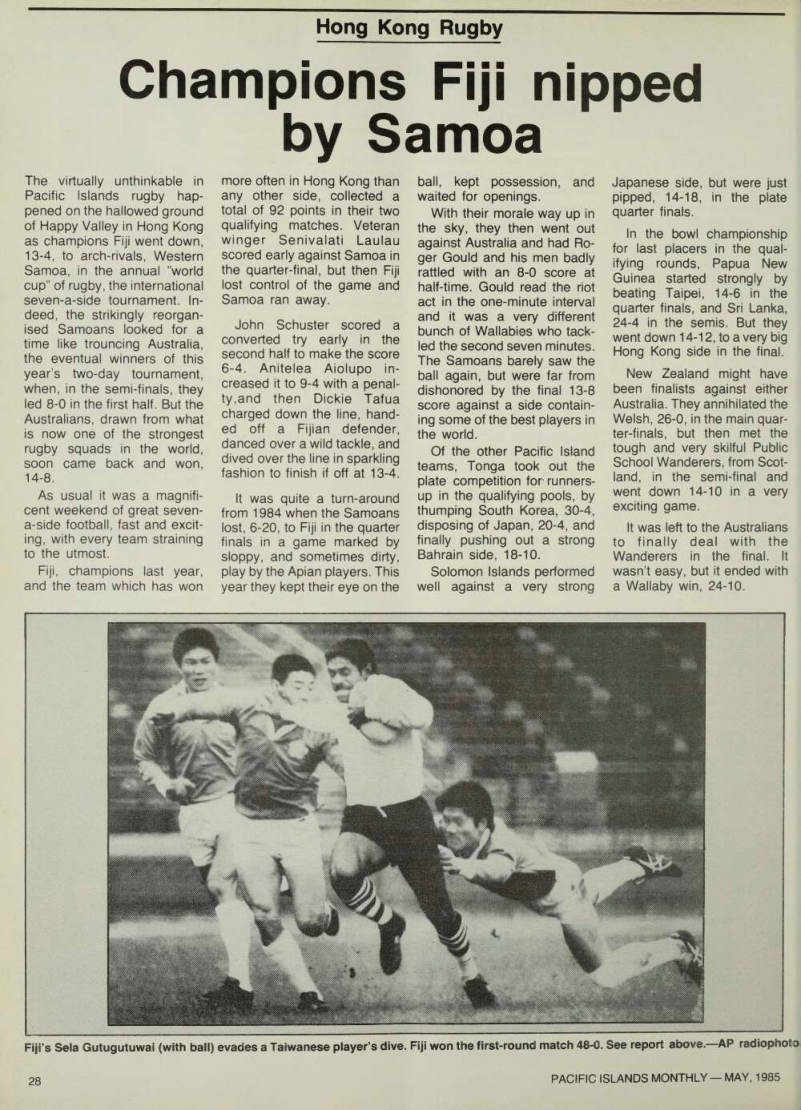
Hong Kong Rugby Champions Fiji nipped by Samoa
The virtually unthinkable in Pacific Islands rugby hap pened on the hallowed ground of Happy Valley in Hong Kong as champions Fiji went down, 13- to arch-rivals, Western Samoa, in the annual ’’world cup” of rugby, the international seven-a-side tournament. In deed, the strikingly reorgan ised Samoans looked for a time like trouncing Australia, the eventual winners of this year’s two-day tournament, when, in the semi-finals, they led 8-0 in the first half. But the Australians, drawn from what is now one of the strongest rugby squads in the world, soon came back and won, 14- As usual it was a magnifi cent weekend of great seven a-side football, fast and excit ing, with every team straining to the utmost.
Fiji, champions last year, and the team which has won
more often in Hong Kong than any other side, collected a total of 92 points in their two qualifying matches. Veteran winger Senivalati Laulau scored early against Samoa in the quarter-final, but then Fiji lost control of the game and Samoa ran away.
John Schuster scored a converted try early in the second half to make the score 6-4. Anitelea Aiolupo in creased it to 9-4 with a penal ty,and then Dickie Tafua charged down the line, hand ed off a Fijian defender, danced over a wild tackle, and dived over the line in sparkling fashion to finish if off at 13-4.
It was quite a turn-around from 1984 when the Samoans lost, 6-20, to Fiji in the quarter finals in a game marked by sloppy, and sometimes dirty, play by the Apian players. This year they kept their eye on the
ball, kept possession, and waited for openings.
With their morale way up in the sky, they then went out against Australia and had Ro ger Gould and his men badly rattled with an 8-0 score at half-time. Gould read the riot act in the one-minute interval and it was a very different bunch of Wallabies who tack led the second seven minutes.
The Samoans barely saw the ball again, but were far from dishonored by the final 13-8 score against a side contain ing some of the best players in the world.
Of the other Pacific Island teams, Tonga took out the plate competition for runners up in the qualifying pools, by thumping South Korea, 30-4, disposing of Japan, 20-4, and finally pushing out a strong Bahrain side, 18-10.
Solomon Islands performed well against a very strong
Japanese side, but were just pipped, 14-18, in the plate quarter finals.
In the bowl championship for last placers in the qual ifying rounds, Papua New Guinea started strongly by beating Taipei, 14-6 in the quarter finals, and Sri Lanka, 24-4 in the semis. But they went down 14-12, to a very big Hong Kong side in the final.
New Zealand might have been finalists against either Australia. They annihilated the Welsh, 26-0, in the main quar ter-finals, but then met the tough and very skilful Public School Wanderers, from Scot land, in the semi-final and went down 14-10 in a very exciting game.
It was left to the Australians to finally deal with the Wanderers in the final. It wasn’t easy, but it ended with a Wallaby win, 24-10.
Fiji’s Sela Gutugutuwai (with ball) evades a Taiwanese player’s dive. Fiji won the first-round match 48-0. See report above. —AP radiophoto.
people
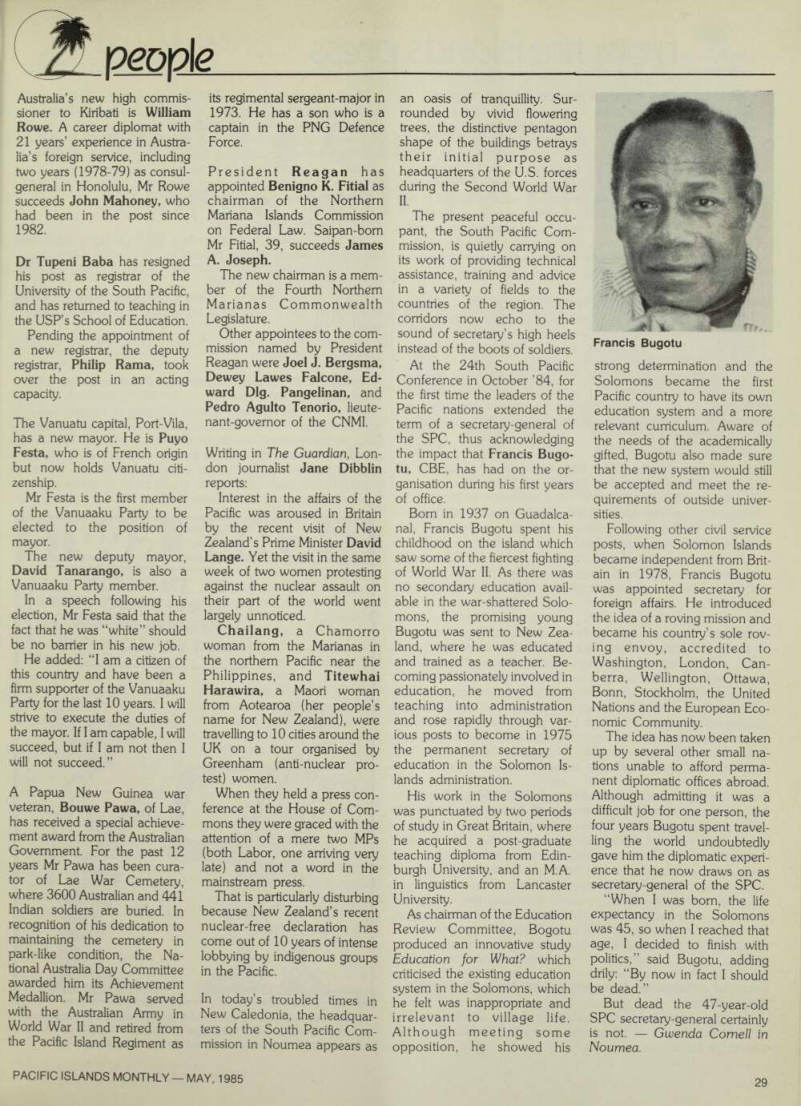
Australia’s new high commis sioner to Kiribati is William Rowe. A career diplomat with 21 years’ experience in Austra lia’s foreign service, including two years (1978-79) as consul general in Honolulu, Mr Rowe succeeds John Mahoney, who had been in the post since 1982.
Dr Tupeni Baba has resigned his post as registrar of the University of the South Pacific, and has returned to teaching in the USP’s School of Education.
Pending the appointment of a new registrar, the deputy registrar, Philip Rama, took over the post in an acting capacity.
The Vanuatu capital, Port-Vila, has a new mayor. He is Puyo Festa, who is of French origin but now holds Vanuatu citi zenship.
Mr Festa is the first member of the Vanuaaku Party to be elected to the position of mayor.
The new deputy mayor, David Tanarango, is also a Vanuaaku Party member.
In a speech following his election, Mr Festa said that the fact that he was “white” should be no barrier in his new job.
He added: “I am a citizen of this country and have been a firm supporter of the Vanuaaku Party for the last 10 years. I will strive to execute the duties of the mayor. If I am capable, I will succeed, but if I am not then I will not succeed.”
A Papua New Guinea war veteran, Bouwe Pawa, of Lae, has received a special achieve ment award from the Australian Government For the past 12 years Mr Pawa has been cura tor of Lae War Cemetery, where 3600 Australian and 441 Indian soldiers are buried. In recognition of his dedication to maintaining the cemetery in park-like condition, the Na tional Australia Day Committee awarded him its Achievement Medallion. Mr Pawa served with the Australian Army in World War II and retired from the Pacific Island Regiment as
its regimental sergeant-major in 1973. He has a son who is a captain in the PNG Defence Force.
President Reagan has appointed Benigno K. Filial as chairman of the Northern Mariana Islands Commission on Federal Law. Saipan-bom Mr Fitial, 39, succeeds James A. Joseph.
The new chairman is a mem ber of the Fourth Northern Marianas Commonwealth Legislature.
Other appointees to the com mission named by President Reagan were Joel J. Bergsma, Dewey Lawes Falcone, Ed ward Dig. Fangelinan, and Pedro Agulto Tenorio, lieute nant-governor of the CNMI.
Writing in The Guardian, Lon don journalist Jane Dibblin reports; Interest in the affairs of the Pacific was aroused in Britain by the recent visit of New Zealand’s Prime Minister David Lange. Yet the visit in the same week of two women protesting against the nuclear assault on their part of the world went largely unnoticed.
Chailang, a Chamorro woman from the Marianas in the northern Pacific near the Philippines, and Titewhai Harawira, a Maori woman from Aotearoa (her people’s name for New Zealand), were travelling to 10 cities around the UK on a tour organised by Greenham (anti-nuclear pro test) women.
When they held a press con ference at the House of Com mons they were graced with the attention of a mere two MPs (both Labor, one arriving very late) and not a word in the mainstream press.
That is particularly disturbing because New Zealand’s recent nuclear-free declaration has come out of 10 years of intense lobbying by indigenous groups in the Pacific.
In today’s troubled times in New Caledonia, the headquar ters of the South Pacific Com mission in Noumea appears as
an oasis of tranquillity. Sur rounded by vivid flowering trees, the distinctive pentagon shape of the buildings betrays their initial purpose as headquarters of the U.S. forces during the Second World War 11.
The present peaceful occu pant, the South Pacific Com mission, is quietly carrying on its work of providing technical assistance, training and advice in a variety of fields to the countries of the region. The corridors now echo to the sound of secretary’s high heels instead of the boots of soldiers.
At the 24th South Pacific Conference in October ’B4, for the first time the leaders of the Pacific nations extended the term of a secretary-general of the SPC, thus acknowledging the impact that Francis Bugo tu, CBE, has had on the or ganisation during his first years of office.
Born in 1937 on Guadalca nal, Francis Bugotu spent his childhood on the island which saw some of the fiercest fighting of World War 11. As there was no secondary education avail able in the war-shattered Solo mons, the promising young Bugotu was sent to New Zea land, where he was educated and trained as a teacher. Be coming passionately involved in education, he moved from teaching into administration and rose rapidly through var ious posts to become in 1975 the permanent secretary of education in the Solomon Is lands administration.
His work in the Solomons was punctuated by two periods of study in Great Britain, where he acquired a post-graduate teaching diploma from Edin burgh University, and an M.A. in linguistics from Lancaster University.
As chairman of the Education Review Committee, Bogotu produced an innovative study Education for What? which criticised the existing education system in the Solomons, which he felt was inappropriate and irrelevant to village life.
Although meeting some opposition, he showed his
strong determination and the Solomons became the first Pacific country to have its own education system and a more relevant curriculum. Aware of the needs of the academically gifted, Bugotu also made sure that the new system would still be accepted and meet the re quirements of outside univer sities.
Following other civil service posts, when Solomon Islands became independent from Brit ain in 1978, Francis Bugotu was appointed secretary for foreign affairs. He introduced the idea of a roving mission and became his country’s sole rov ing envoy, accredited to Washington, London, Can berra, Wellington, Ottawa, Bonn, Stockholm, the United Nations and the European Eco nomic Community.
The idea has now been taken up by several other small na tions unable to afford perma nent diplomatic offices abroad.
Although admitting it was a difficult job for one person, the four years Bugotu spent travel ling the world undoubtedly gave him the diplomatic experi ence that he now draws on as secretary-general of the SPC.
“When I was born, the life expectancy in the Solomons was 45, so when I reached that age, I decided to finish with politics,” said Bugotu, adding drily: “By now in fact I should be dead.”
But dead the 47-year-old SPC secretary-general certainly is not. Gwenda Cornell in Noumea.
Francis Bugotu
from the islands press
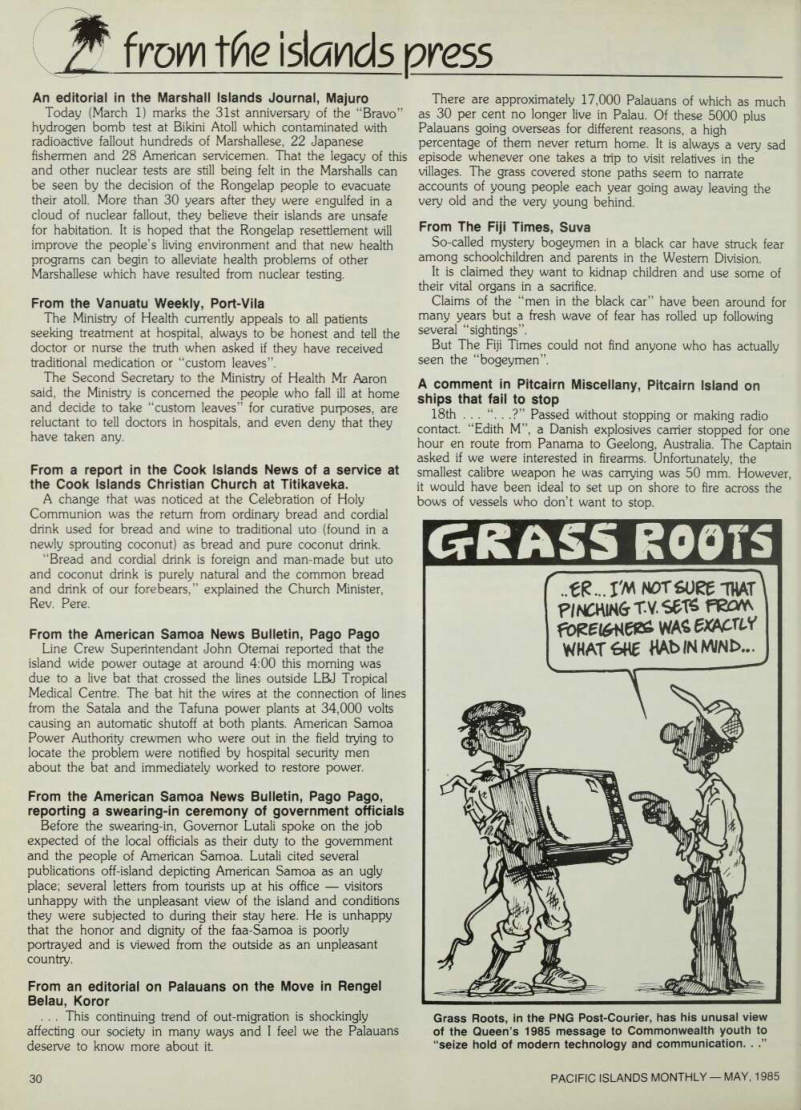
An editorial in the Marshall Islands Journal, Majuro Today (March 1) marks the 31st anniversary of the “Bravo” hydrogen bomb test at Bikini Atoll which contaminated with radioactive fallout hundreds of Marshallese, 22 Japanese fishermen and 28 American servicemen. That the legacy of this and other nuclear tests are still being felt in the Marshalls can be seen by the decision of the Rongelap people to evacuate their atoll. More than 30 years after they were engulfed in a cloud of nuclear fallout, they believe their islands are unsafe for habitation. It is hoped that the Rongelap resettlement will improve the people’s living environment and that new health programs can begin to alleviate health problems of other Marshallese which have resulted from nuclear testing.
From the Vanuatu Weekly, Port-Vila The Ministry of Health currently appeals to all patients seeking treatment at hospital, always to be honest and tell the doctor or nurse the truth when asked if they have received traditional medication or “custom leaves”.
The Second Secretary to the Ministry of Health Mr Aaron said, the Ministry is concerned the people who fall ill at home and decide to take “custom leaves” for curative purposes, are reluctant to tell doctors in hospitals, and even deny that they have taken any.
From a report in the Cook Islands News of a service at the Cook Islands Christian Church at Titikaveka.
A change that was noticed at the Celebration of Holy Communion was the return from ordinary bread and cordial drink used for bread and wine to traditional uto (found in a newly sprouting coconut) as bread and pure coconut drink.
“Bread and cordial drink is foreign and man-made but uto and coconut drink is purely natural and the common bread and drink of our forebears,” explained the Church Minister, Rev. Fere.
From the American Samoa News Bulletin, Pago Pago Line Crew Superintendent John Otemai reported that the island wide power outage at around 4:00 this morning was due to a live bat that crossed the lines outside LBJ Tropical Medical Centre. The bat hit the wires at the connection of lines from the Satala and the Tafuna power plants at 34,000 volts causing an automatic shutoff at both plants. American Samoa Power Authority crewmen who were out in the field trying to locate the problem were notified by hospital security men about the bat and immediately worked to restore power.
From the American Samoa News Bulletin, Pago Pago, reporting a swearing-in ceremony of government officials Before the swearing-in, Governor Lutali spoke on the job expected of the local officials as their duty to the government and the people of American Samoa. Lutali cited several publications off-island depicting American Samoa as an ugly place; several letters from tourists up at his office visitors unhappy with the unpleasant view of the island and conditions they were subjected to during their stay here. He is unhappy that the honor and dignity of the faa-Samoa is poorly portrayed and is viewed from the outside as an unpleasant country.
From an editorial on Palauans on the Move in Rengel Belau, Koror . . . This continuing trend of out-migration is shockingly affecting our society in many ways and I feel we the Palauans deserve to know more about it.
There are approximately 17,000 Palauans of which as much as 30 per cent no longer live in Palau. Of these 5000 plus Palauans going overseas for different reasons, a high percentage of them never return home. It is always a very sad episode whenever one takes a trip to visit relatives in the villages. The grass covered stone paths seem to narrate accounts of young people each year going away leaving the very old and the very young behind.
From The Fiji Times, Suva So-called mystery bogeymen in a black car have struck fear among schoolchildren and parents in the Western Division.
It is claimed they want to kidnap children and use some of their vital organs in a sacrifice.
Claims of the “men in the black car” have been around for many years but a fresh wave of fear has rolled up following several “sightings”.
But The Fiji Times could not find anyone who has actually seen the “bogeymen”.
A comment in Pitcairn Miscellany, Pitcairn Island on ships that faii to stop 18th ... “...?” Passed without stopping or making radio contact. “Edith M”, a Danish explosives carrier stopped for one hour en route from Panama to Geelong, Australia. The Captain asked if we were interested in firearms. Unfortunately, the smallest calibre weapon he was carrying was 50 mm. However, it would have been ideal to set up on shore to fire across the bows of vessels who don’t want to stop.
Grass Roots, in the PNG Post-Courier, has his unusal view of the Queen’s 1985 message to Commonwealth youth to “seize hold of modern technology and communication. . ."
Australia’s Channel 9 woos

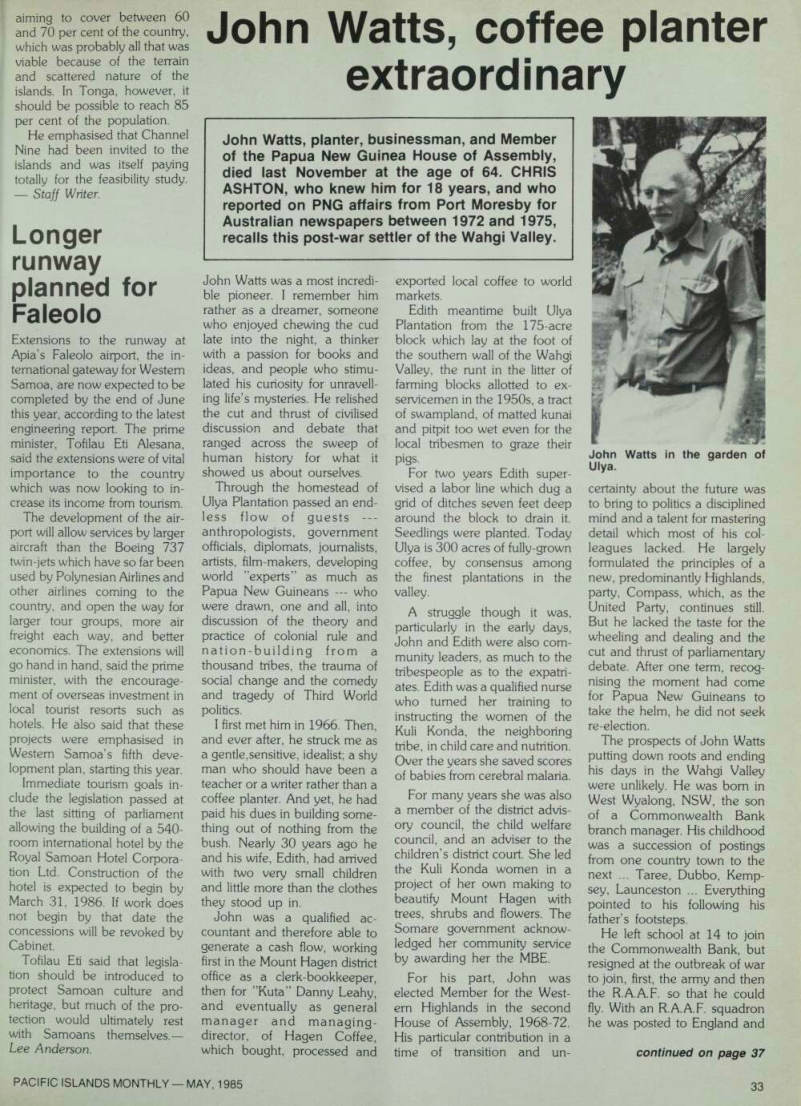
trade winds
Australia’s Channel 9 woos islands with TV offers
A major Australian tele vision network is wooing a number of Pacific island nations, seeking to weld them into an international broadcast network using a leased satellite to pro vide them with news, sports and entertainment in return for access to their advertising dol lars.
The Nine Network, operated by Publishing and Broadcas ting, Ltd., of Sydney has been invited by Fiji, Tonga and the Cook Islands, so far, to conduct feasibility studies into the intro duction of broadcast television to their territories, with particu lar reference to the rural areas.
Channel Nine suggests that by use of its satellite it could provide service of an internatio nal character at about one tenth the cost of other methods of transmission.
The offer is, in fact, a spin-off from the Nine Network’s ex isting full-time-leased satellite link from Los Angeles to Syd ney through which it feeds its Australian stations. The prog rams are going overhead of the Pacific, anyway. It would be easy, and relatively cheap, to install virtually automatic, off the-shelf, small earth stations to pull the signals down to the Pacific countries and re-trans mit them for local consumption.
Channel Nine executives say they would simply make the programs available in either recorded, or live, form. Local decisions could be taken on which were re-broadcast, and when.
Almost all Pacific islands now have plenty of television sets, all currently served by video recor ders and an elaborate system of cassette program renting. Prog rams are mostly pirated from
Australian, New Zealand and American broadcast television and rental rates are very low compared with, say, Australia.
In Fiji, where perhaps the most elaborate system has grown up, a three-hour cassette may be hired for as little as Fsoc per night.
The video epidemic has come under considerable critic ism from some quarters be cause many popular programs are regarded as too violent, too sexy, or otherwise unsuitable for island consumption.
Church groups in many is lands have criticised what they see as a cultural drug, set to destroy local traditions and values. Politicians have voiced similar worries, although they themselves have been accused of being more interested in local television for the chance it would give them to promote themselves before the voters.
So far, however, and with the notable exception of Papua New Guinea which has already announced establishment of lo cal broadcast television in association with a Newcastle, Australia, broadcaster, Pacific countries have avoided tempta tion, saying it is too expensive for them.
But, the fact is that television has arrived anyway, through video recorders and, in most cases, the most popular prog rams are culturally the worst.
Even quite remote villages now have their highly-prized video recorders run off small, port able, electrical generators.
Several governments, including Fiji’s, are now worried about the ill-effects of many of the shows. There is no real censor ing of tapes and the list of what is available in crime, violence, sex and stupidity, in the multi-
tude of mostly Indian-operated shops in Fiji, is pretty well endless.
Some governments, con sidering the Channel Nine offer, think that it would give them a chance to control television choice and consumption.
The other factor, less signifi cant, but still there, is that many of the pirated tapes carry news and documentary programs which have served mostly to reinforce islanders’ feeling that they are being left behind and isolated from the world’s in formation revolution. They would like to have international news and sports reporting as it happens, not a week or more later.
Channel Nine’s vice-presi dent and technical director, Mr Paget Blackburn, has travelled through the main Pacific islands carrying out field inspections and discussing funding and support for the proposed services. He says he has been well received everywhere.
Speaking in Suva, he said his study would be most compre hensive. Technical aspects examined would include re
quirements for studios, trans mitters, and antenna towers, as well as earth stations. He was also looking at funding arrange ments for both capital and operating costs, local program ming, staffing and training.
He said that as things looked currently Channel Nine was offering to take charge of the delivery of the programs, and participate in management of the stations. Individual govern ments would have overall con trol of program content and operate their own transmitters.
If all the island countries approached accepted the offer, then individual cost would be reduced because some services provided by the Australian company would be common to all.
Mr Blackburn said his report would be ready in June. If governments accept it, broad casting could probably begin in about a year from the date of acceptance.
Capital cost would vary from country to country, he said, because of the widely-different geographical make-up of the islands. In Fiji they would be
Logo of TCN Channel Nine Pty Ltd, Sydney. Selling to the Pacific.
aiming to cover between 60 and 70 per cent of the country, which was probably all that was viable because of the terrain and scattered nature of the islands. In Tonga, however, it should be possible to reach 85 per cent of the population.
He emphasised that Channel Nine had been invited to the islands and was itself paying totally for the feasibility study.
Staff Writer.
Longer
runway
planned for
Faleolo
Extensions to the runway at Apia’s Faleolo airport, the in ternational gateway for Western Samoa, are now expected to be completed by the end of June this year, according to the latest engineering report. The prime minister, Tofilau Eti Alesana, said the extensions were of vital importance to the country which was now looking to in crease its income from tourism.
The development of the air port will allow services by larger aircraft than the Boeing 737 twin-jets which have so far been used by Polynesian Airlines and other airlines coming to the country, and open the way for larger tour groups, more air freight each way, and better economics. The extensions will go hand in hand, said the prime minister, with the encourage ment of overseas investment in local tourist resorts such as hotels. He also said that these projects were emphasised in Western Samoa’s fifth deve lopment plan, starting this year.
Immediate tourism goals in clude the legislation passed at the last sitting of parliament allowing the building of a 540room international hotel by the Royal Samoan Hotel Corpora tion Ltd. Construction of the hotel is expected to begin by March 31, 1986. If work does not begin by that date the concessions will be revoked by Cabinet.
Tofilau Eti said that legisla tion should be introduced to protect Samoan culture and heritage, but much of the pro tection would ultimately rest with Samoans themselves.—
Lee Anderson.
Advertisements & other items, p. 32 (1 item)
Gd Pioneer
a N
Shelf Component Systems
X-900
n COMPACT
mm
DIGITAL AUDIO
Serious about sound? Get Personna
Speaking personally, don’t you prefer good sound over garble, clean design over clutter, easy control over confusion? If so, you’re the sort of person who takes sound (and sound systems) seriously—a PERSONNA sort of person.
Pioneer PERSONNA systems are crafted to suit your personal way of living. Sound quality is rich and clean so you won’t miss a single note or nuance. The compact size is ideal for your personal living space. And because they are designed by people who enjoy music as much as you do, program selection and control are as simple as can be.
At the top of the line is the handsome PERSONNA X-900—a real “black beauty” with a powerful musical output of 85 watts per channel. That’s more than enough to fill your largest listening room.
The X-900’s one-touch Auto Function and other simple controls give you immediate access to the turntable, tuner, the auto-reverse cassette deck and so on. With the wireless REMOTE CONTROLLER in hand, you can control just about every function the X-900 offers—including those of the optional, matching P-DX7OO Compact Disc Player, pictured above.
If the X-900 is a little too much “music machine” for you, give serious consideration to its “sister systems”—the X-700, X-500, X-300/300S, or X-100/100S. All have the high technology, sophisticated styling and professional craftsmanship that make Pioneer PERSONNA the personal choice of anyone really serious about sound.
GD PIONEER
For further information, please contact: Australia: Pioneer Electronics Australia Pty. Ltd. (Incorporated in Victoria), P.O. Box 295, Mordialloc, Victoria, 3195 Tel; 580-9911 Fiji Islands: Brijlal & Company, G.P.O. Box No. 362, Suva, Fiji Islands Tel: 22258 New Zealand: Monaco Distributors Ltd., 2 Poland Road, Glenfield, Auckland, New Zealand Tel: (09) 444-9144 Norfolk Island: Burns Philp (Norfolk Island) Ltd., P.O. Box 21, Norfolk Island Vanuatu: Burns Philp (Vanuatu) Ltd., Vila, Vanuatu Nauru Island: Jacob Enterprises, P.O. Box No. 4, Republic of Nauru Tahiti: Tahiti Hi-Fi, P.O. Box 848, Papeete, Tahiti New Caledonia: Menard Pacifique Sari, B.P. 3899, Noumea, New Caledonia Tel; 27.62*23 American Samoa: Transpac Corporation, P.O. Box 1477, Pago Pago, American Samoa 96799 Tel: 633-5224 Rarotonga: South Seas International Ltd., P.O. Box 49, Rarotonga, Cook Islands Tel: 2327 Papua New Guinea: Bali Merchants Pty. Ltd., P.O. Box 6103, Boroko Tel; 254887
extraordinary

John Watts, coffee planter extraordinary
John Watts, planter, businessman, and Member of the Papua New Guinea House of Assembly, died last November at the age of 64. CHRIS ASHTON, who knew him for 18 years, and who reported on PNG affairs from Port Moresby for Australian newspapers between 1972 and 1975, recalls this post-war settler of the Wahgi Valley.
John Watts was a most incredi ble pioneer. I remember him rather as a dreamer, someone who enjoyed chewing the cud late into the night, a thinker with a passion for books and ideas, and people who stimu lated his curiosity for unravell ing life’s mysteries. He relished the cut and thrust of civilised discussion and debate that ranged across the sweep of human history for what it showed us about ourselves.
Through the homestead of Ulya Plantation passed an end less flow of guests --anthropologists, government officials, diplomats, journalists, artists, film-makers, developing world ’’experts” as much as Papua New Guineans who were drawn, one and all, into discussion of the theory and practice of colonial rule and nation-building from a thousand tribes, the trauma of social change and the comedy and tragedy of Third World politics.
I first met him in 1966. Then, and ever after, he struck me as a gentle,sensitive, idealist; a shy man who should have been a teacher or a writer rather than a coffee planter. And yet, he had paid his dues in building some thing out of nothing from the bush. Nearly 30 years ago he and his wife, Edith, had arrived with two very small children and little more than the clothes they stood up in.
John was a qualified ac countant and therefore able to generate a cash flow, working first in the Mount Hagen district office as a clerk-bookkeeper, then for ”Kuta” Danny Leahy, and eventually as general manager and managing director, of Hagen Coffee, which bought, processed and
exported local coffee to world markets.
Edith meantime built Ulya Plantation from the 175-acre block which lay at the foot of the southern wall of the Wahgi Valley, the runt in the litter of farming blocks allotted to ex servicemen in the 19505, a tract of swampland, of matted kunai and pitpit too wet even for the local tribesmen to graze their pigs.
For two years Edith super vised a labor line which dug a grid of ditches seven feet deep around the block to drain it.
Seedlings were planted. Today Ulya is 300 acres of fully-grown coffee, by consensus among the finest plantations in the valley.
A struggle though it was, particularly in the early days, John and Edith were also com munity leaders, as much to the tribespeople as to the expatri ates. Edith was a qualified nurse who turned her training to instructing the women of the Kuli Konda, the neighboring tribe, in child care and nutrition.
Over the years she saved scores of babies from cerebral malaria.
For many years she was also a member of the district advis ory council, the child welfare council, and an adviser to the children’s district court. She led the Kuli Konda women in a project of her own making to beautify Mount Hagen with trees, shrubs and flowers. The Somare government acknow ledged her community service by awarding her the MBE.
For his part, John was elected Member for the West ern Highlands in the second House of Assembly, 1968-72.
His particular contribution in a time of transition and un-
certainty about the future was to bring to politics a disciplined mind and a talent for mastering detail which most of his col leagues lacked. He largely formulated the principles of a new, predominantly Highlands, party, Compass, which, as the United Party, continues still.
But he lacked the taste for the wheeling and dealing and the cut and thrust of parliamentary debate. After one term, recog nising the moment had come for Papua New Guineans to take the helm, he did not seek re-election.
The prospects of John Watts putting down roots and ending his days in the Wahgi Valley were unlikely. He was born in West Wyalong, NSW, the son of a Commonwealth Bank branch manager. His childhood was a succession of postings from one country town to the next ... Taree, Dubbo, Kemp sey, Launceston ... Everything pointed to his following his father’s footsteps.
He left school at 14 to join the Commonwealth Bank, but resigned at the outbreak of war to join, first, the army and then the R.A.A.F. so that he could fly. With an R.A.A.F. squadron he was posted to England and
continued on page 37
John Watts in the garden of Ulya.
for three years flew bombing sorties in Lancasters over Ger many.
I remember him once telling me of crews on the verge of mutiny at the prospect of bom bing Dresden, a beautiful city of no strategic value to the Allies.
By then, he said, the crews believed their enemies were the Russians, not the German people.
At the war’s end he was repatriated and demobbed. He married Edith, nee Ratcliff, and rejoined the Commonwealth Bank and the disciplines and routines of his pre-war career. It was in vain. The war had given him a hunger for something wider, something with an ele ment of risk which the bank could not satisfy. He stuck it for nine years, until he saw an article by Osmar White in The Age of Melbourne about the Wahgi Valley and the chance of farming blocks for ex-service men.
In 1955 he went there to see for himself. Edith stayed behind until he could give assurance of a job to get them started.
Several other better-paid jobs using his accountancy skills were offered in other parts of the country but he took the clerical post in Mount Hagen to be sure of getting the farming block. His family joined him the following year.
The way in which John was laid to rest, and those who came to pay their last respects, say much about the man. Pic ture the garden of Ulya Planta tion, two acres enclosed in a sea of coffee a setting as close to paradise as you could hope to find on earth; the sweep of lawn, the clumps of feathered bamboo, the stands of albizzia and swamp mahogany, the profusion of bougainvillea, aga panthus, and hibiscus, tropical and temperate climate flowers everywhere.
Picture at the edge of the garden the homestead, a sprawling thatched building, whose walls and floors and ceiling are fashioned from bam boo, split and woven, which creak as you move across it.
Against the protests of his fam ily, and everyone who ever visited Ulya, John longed to
pull it down and build a ’’prop er” house. Somehow he never got around to it.
Picture the flower-decked burial site in a clearing in the garden and the ministers of various local missions Luther ans, Seventh-day Adventists, Roman Catholics speaking over his grave of the friendship and respect he inspired, regard less of the fact he was no church-going Christian.
Picture the community lead ers of the Wahgi Valley -government officials, politi cians, planters and business men driving to Ulya to offer condolences to his widow and three children.
And picture the Kuli Konda, resplendent in traditional cos tume, trooping in to pay tribute to an icon of sorts, a pole they asked Edith to erect at the graveside, on which was hung a picture of John together with one of his shirts and a pair of trousers. For three days Edith sat there at a table and received them.
It would be idle to pretend that John Watts died in peace.
He died tormented *by un certainty and a sense of grie vance. Four years ago he de cided, reluctantly, that Ulya must be sold. Rising costs, he felt, particularly of labor, would eventually doom coffee planta tions to bankruptcy.
He found a buyer in a neighboring, British-owned, tea estate, but the Minister for Lands, without explanation,
would not approve the sale. He found a second buyer, a locally based Papua New Guinea busi ness group whose leaders themselves pressed the Minister for approval. Once more, the effort was in vain.
The stress of this limbo exist ence took its toll. There seemed no way out. He suffered one heart attack, and then, very
shortly afterwards, a second and fatal one.
Upon John’s death, prime minister Somare appointed Barry Holloway acting Minister for Lands and directed him to sort out the matter at once. Ten days after John Watts died the sale was approved.
Rest in peace, John. —
Chris
Ashton.
The Kuli Konda people pay their last tribute to John Watts.
Advertisements & other items, pp. 34-36 (1 item)
Toyota
QUALITY SERVICE
AMERICAN SAMOA: BURNS PHILP (SOUTH SEA) CO., LTD., P.O. Box 129, Pago Pago.
COOK ISLANDS: COOK ISLANDS TRADING
CORPORATION LTD., Private Bag, Rarotonga.
FIJI: AUTOMOTIVE SUPPLIES COMPANY, A Division of Burns Philp (South Sea) Co., Ltd., G.P.O. Box 355, Suva.
GUAM & MICRONESIA: ATKINS KROLL, INC., 443 South Marine Drive, Tamuning.
KIRIBATI: TARAWA MOTORS, P.O. Box 36, Bairiki, Tarawa.
NAURU: NAURU COOPERATIVE SOCIETY, Central
Pacific.
NEW CALEDONIA; SERVICE IMPORTATION
AUTOMOBILE DU PACIFIQUE, Rond-Point du Pacific (Station Total) B.P. 438, Noumea.
NORFOLK ISLAND: BORRYS LIMITED, P.O. Box 1 PAPUA NEW GUINEA: ELA MOTORS, A Division Burns Philp (PNG) Ltd., P.O. Box 75, Port Moresby.
SAIPAN: MICROL CORPORATION, P.O. Box267,Saip
fife" m i ■ r
'he tradition of power and ruggedness
on. foyota’s new Land Cruiser has been entirely designed from the road up. But it still ains the traditional toughness quired from over thirty years road experience.
But no matter how rough it gets a roomy new cabin with improved occupant comforts, easy instrumentation and an optional 4-speed automatic transmission add up to passenger car comfort with Land Cruiser ruggedness.
More power in hand and fuel efficiency have been gained with a new brawny 4.0-litre gasoline engine.
And to control all that power a new rigid chassis assures stable driving performance and mobility over the roughest terrain.
And you can choose from a wide variety of models and an array of heavy-duty features.
Take the wheel and feel Toyota quality in Land Cruiser’s styling, power and comfort. A quality that stays with you on or off the road.
Step into a new generation of toughness today.
LOMON: SOLOMON ISLANDS INVESTMENTS LTD.,
*.O. Box 174, Honiara.
HITI: NIPPON AUTOMOTO, B.P. 342, Papeete.
NGA: BURNS PHILP (SOUTH SEA) CO., LTD., P.O. x 55, Nukualofa.
NUATU: VANUATU MOTORS, A Division of Burns ilp (Vanuatu) Ltd., P.O. Box 18, Port Vila. ■STERN SAMOA: BURNS PHILP (SOUTH SEA) CO., D., P.O. Box 188, Apia.
TOYOTA
fm g t S'i * In 1966
Shaddock
discovered
Since 1966 Shaddock has gone from exploring a new market to being a major supplier of electrical appliances to the Pacific, Shaddock discovered the Pacific. And the Pacific discovered Shaddock, The Shaddock range of domestic and commercial appliances has established a reputation for depen-
dability and performance
throughout the region. Today Shaddock is still exploring. Exploring new ideas, new technology,new products. It is the type of exploration that keeps Fisher and Paykel, the New Zealand manufacturer of Shaddock, the southern hemisphere s largest exporter of major appliances.
e Pacific
„ m
SHACKLOCK
Breakthrough on solar power?
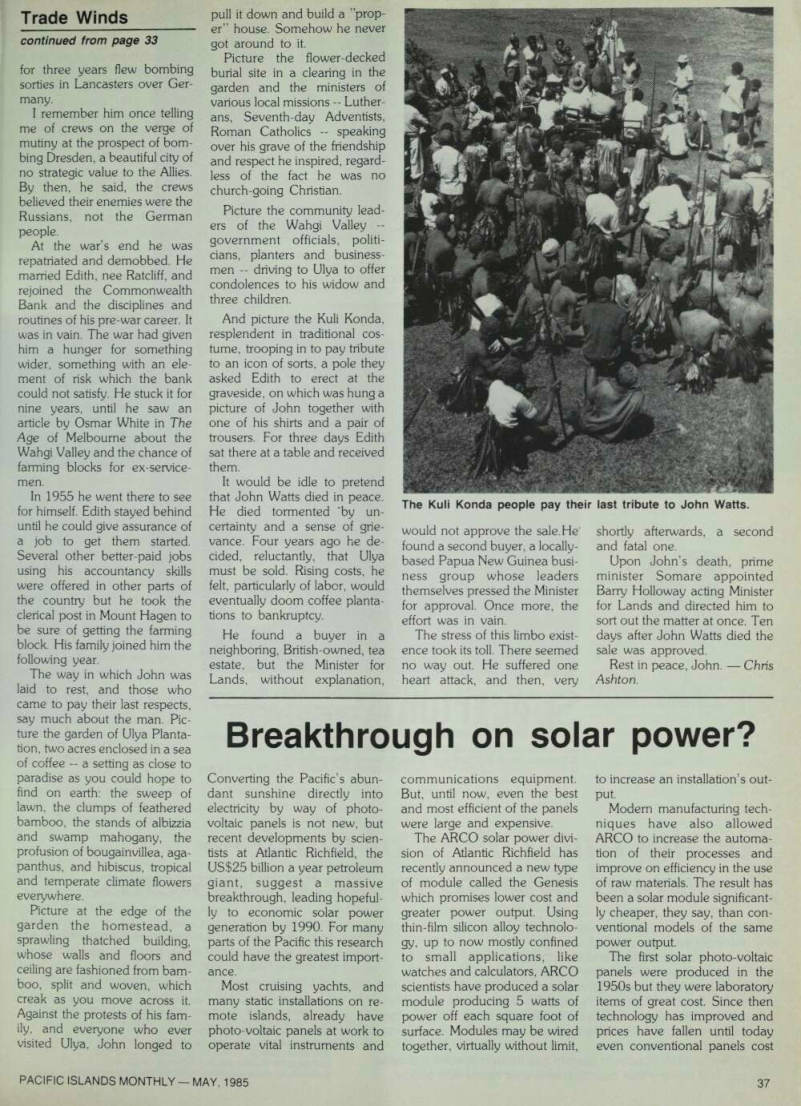

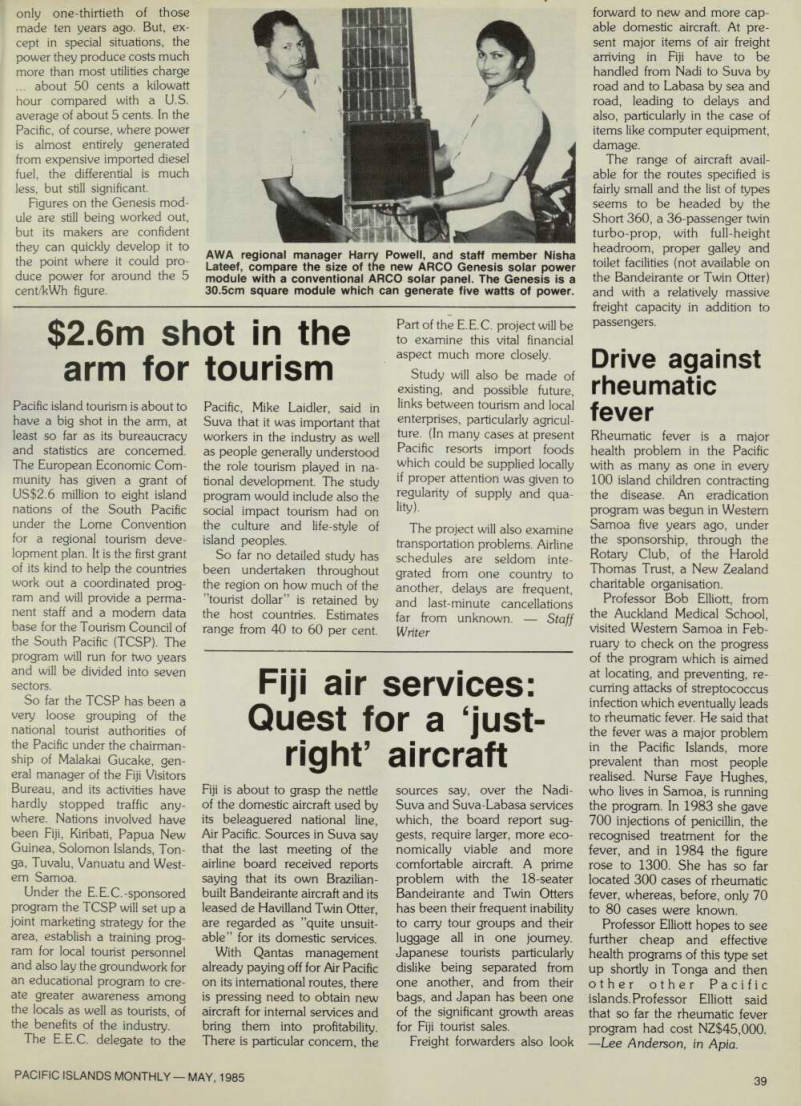
Converting the Pacific’s abun dant sunshine directly into electricity by way of photo voltaic panels is not new, but recent developments by scien tists at Atlantic Richfield, the US$25 billion a year petroleum giant, suggest a massive breakthrough, leading hopeful ly to economic solar power generation by 1990. For many parts of the Pacific this research could have the greatest import ance.
Most cruising yachts, and many static installations on re mote islands, already have photo-voltaic panels at work to operate vital instruments and
communications equipment.
But, until now, even the best and most efficient of the panels were large and expensive.
The ARCO solar power divi sion of Atlantic Richfield has recently announced a new type of module called the Genesis which promises lower cost and greater power output. Using thin-film silicon alloy technolo gy, up to now mostly confined to small applications, like watches and calculators, ARCO scientists have produced a solar module producing 5 watts of power off each square foot of surface. Modules may be wired together, virtually without limit,
to increase an installation’s out put.
Modem manufacturing tech niques have also allowed ARCO to increase the automa tion of their processes and improve on efficiency in the use of raw materials. The result has been a solar module significant ly cheaper, they say, than con ventional models of the same power output.
The first solar photo-voltaic panels were produced in the 1950 s but they were laboratory items of great cost. Since then technology has improved and prices have fallen until today even conventional panels cost
only one-thirtieth of those made ten years ago. But, ex cept in special situations, the power they produce costs much more than most utilities charge ... about 50 cents a kilowatt hour compared with a U.S. average of about 5 cents. In the Pacific, of course, where power is almost entirely generated from expensive imported diesel fuel, the differential is much less, but still significant.
Figures on the Genesis mod ule are still being worked out, but its makers are confident they can quickly develop it to the point where it could pro duce power for around the 5 cent/kWh figure.
AWA regional manager Harry Powell, and staff member Nisha Lateef, compare the size of the new ARCO Genesis solar power module with a conventional ARCO solar panel. The Genesis is a 30.5cm square module which can generate five watts of power.
Advertisements & other items, pp. 37-38 (2 items)
Trade Winds
37
PACIFIC ISLANDS MONTHLY MAY, 1985
Trade Winds continued from page 33
Kenwood
series Highlights of Spectrum 94W8 shown; ■ CD, video, 2 tape inputs ■ 125W/channel RMS (8 ohms, 20Hz-20kHz) 0.05% THD ■ Direct access synthesizer tuning ■ 10-station random preset memory ■ Double auto-reverse cassette deck ■ Double-speed dubbing ■ Continuous tape relay play ■ Programmable linear tracking turntable ■ Recording from turntable ■ Graphic equalizer (option) ■ CD player with Bch memory (option) ■ Audio timer (option) ■ 130 W bass reflex speaker system For the true colors of music —
Kenwood Spectrum stereo systems.
TRIO-KENWOOD CORPORATION
Shionogi Shibuya Building, 17-5, 2-chome Shibuya, Shibuya-ku, Tokyo 150, Japan TRIO-KENWOOD (AUSTRALIA) PTY. LTD. (incorporated in nswi 4E Woodcock Place, Lane Cove, N S W. 2066, Australia NEW ZEALAND JOHN GILBERT & CO, LTD. Auckland Tel. 0011-64-9-30839 FUJI PEPE'S DUTY FREE CENTRE LTD. Tel. 25496, 25497 PAPUA NEW GUINEA SO. SVENSSON (N.G.) LTD. Port Moresby Tel. 212158, 212111 SOLOMON ISLANDS TECHNIQUE RADIOS CENTRE LTD. Honiara Tel. 416 NEW CALEDONIA HI-FI VOX Noumea Tel 27-2466, 28-2931 VANUATU FUNG CHOI LUEN. Port-Vila Tel. 2556
TAHITI MAISON AURORE Papeete Tel. 29703
AMERICAN SAMOA ISLAND PACIFIC AGENCIES, INC. Pago Pago Tel. 633-4687
REPUBLIC OF NAURU NAURU CO-OPERATIVE SOCIETY
MARIANA ISLANDS J.C. TENORIO ENTERPRISES Saipan Tel. 6445 When you look at what Kenwood Spectrum stereo systems offer,
you’ll wonder why you delayed.
They have computerized and electronic functions to make operation easy for you. And they’re highly versatile, too.
But in these days of electronic wizardry, it’s easy to forget what hi-fi stereo is really all about: music reproduction, pure and simple.
You’ll find that Kenwood Spectrum systems, designed by some of the world’s most uncompromising audio specialists, are performers
of outstanding ability.
And, since each Spectrum system has its own special character, you can find the one that exactly meets your needs and budget.
$2.6m shot in the arm
arm for tourism
Pacific island tourism is about to have a big shot in the arm, at least so far as its bureaucracy and statistics are concerned.
The European Economic Com munity has given a grant of US$2.6 million to eight island nations of the South Pacific under the Lome Convention for a regional tourism deve lopment plan. It is the first grant of its kind to help the countries work out a coordinated prog ram and will provide a perma nent staff and a modem data base for the Tourism Council of the South Pacific (TCSP). The program will run for two years and will be divided into seven sectors.
So far the TCSP has been a very loose grouping of the national tourist authorities of the Pacific under the chairman ship of Malakai Gucake, gen eral manager of the Fiji Visitors Bureau, and its activities have hardly stopped traffic any where. Nations involved have been Fiji, Kiribati, Papua New Guinea, Solomon Islands, Ton ga, Tuvalu, Vanuatu and West ern Samoa.
Under the E.E.C.-sponsored program the TCSP will set up a joint marketing strategy for the area, establish a training prog ram for local tourist personnel and also lay the groundwork for an educational program to cre ate greater awareness among the locals as well as tourists, of the benefits of the industry.
The E.E.C. delegate to the
Pacific, Mike Laidler, said in Suva that it was important that workers in the industry as well as people generally understood the role tourism played in na tional development. The study program would include also the social impact tourism had on the culture and life-style of island peoples.
So far no detailed study has been undertaken throughout the region on how much of the ’’tourist dollar” is retained by the host countries. Estimates range from 40 to 60 per cent.
Part of the E.E.C. project will be to examine this vital financial aspect much more closely.
Study will also be made of existing, and possible future, links between tourism and local enterprises, particularly agricul ture. (In many cases at present Pacific resorts import foods which could be supplied locally if proper attention was given to regularity of supply and qua lity).
The project will also examine transportation problems. Airline schedules are seldom inte grated from one country to another, delays are frequent, and last-minute cancellations far from unknown. Staff Writer
right’ aircraft
Fiji air services: Quest for a ‘just right’ aircraft
Fiji is about to grasp the nettle of the domestic aircraft used by its beleaguered national line, Air Pacific. Sources in Suva say that the last meeting of the airline board received reports saying that its own Brazilian built Bandeirante aircraft and its leased de Havilland Twin Otter, are regarded as ’’quite unsuit able” for its domestic services.
With Qantas management already paying off for Air Pacific on its international routes, there is pressing need to obtain new aircraft for internal services and bring them into profitability.
There is particular concern, the
sources say, over the Nadi- Suva and Suva-Labasa services which, the board report sug gests, require larger, more eco nomically viable and more comfortable aircraft. A prime problem with the 18-seater Bandeirante and Twin Otters has been their frequent inability to carry tour groups and their luggage all in one journey.
Japanese tourists particularly dislike being separated from one another, and from their bags, and Japan has been one of the significant growth areas for Fiji tourist sales.
Freight forwarders also look
forward to new and more cap able domestic aircraft. At pre sent major items of air freight arriving in Fiji have to be handled from Nadi to Suva by road and to Labasa by sea and road, leading to delays and also, particularly in the case of items like computer equipment, damage.
The range of aircraft avail able for the routes specified is fairly small and the list of types seems to be headed by the Short 360, a 36-passenger twin turbo-prop, with full-height headroom, proper galley and toilet facilities (not available on the Bandeirante or Twin Otter) and with a relatively massive freight capacity in addition to passengers.
Drive against
rheumatic
fever
Rheumatic fever is a major health problem in the Pacific with as many as one in every 100 island children contracting the disease. An eradication program was begun in Western Samoa five years ago, under the sponsorship, through the Rotary Club, of the Harold Thomas Trust, a New Zealand charitable organisation.
Professor Bob Elliott, from the Auckland Medical School, visited Western Samoa in Feb ruary to check on the progress of the program which is aimed at locating, and preventing, re curring attacks of streptococcus infection which eventually leads to rheumatic fever. He said that the fever was a major problem in the Pacific Islands, more prevalent than most people realised. Nurse Faye Hughes, who lives in Samoa, is running the program. In 1983 she gave 700 injections of penicillin, the recognised treatment for the fever, and in 1984 the figure rose to 1300. She has so far located 300 cases of rheumatic fever, whereas, before, only 70 to 80 cases were known.
Professor Elliott hopes to see further cheap and effective health programs of this type set up shortly in Tonga and then other other Pacific islands. Professor Elliott said that so far the rheumatic fever program had cost NZ545,000. —Lee Anderson, in Apia.
Setting the record straight
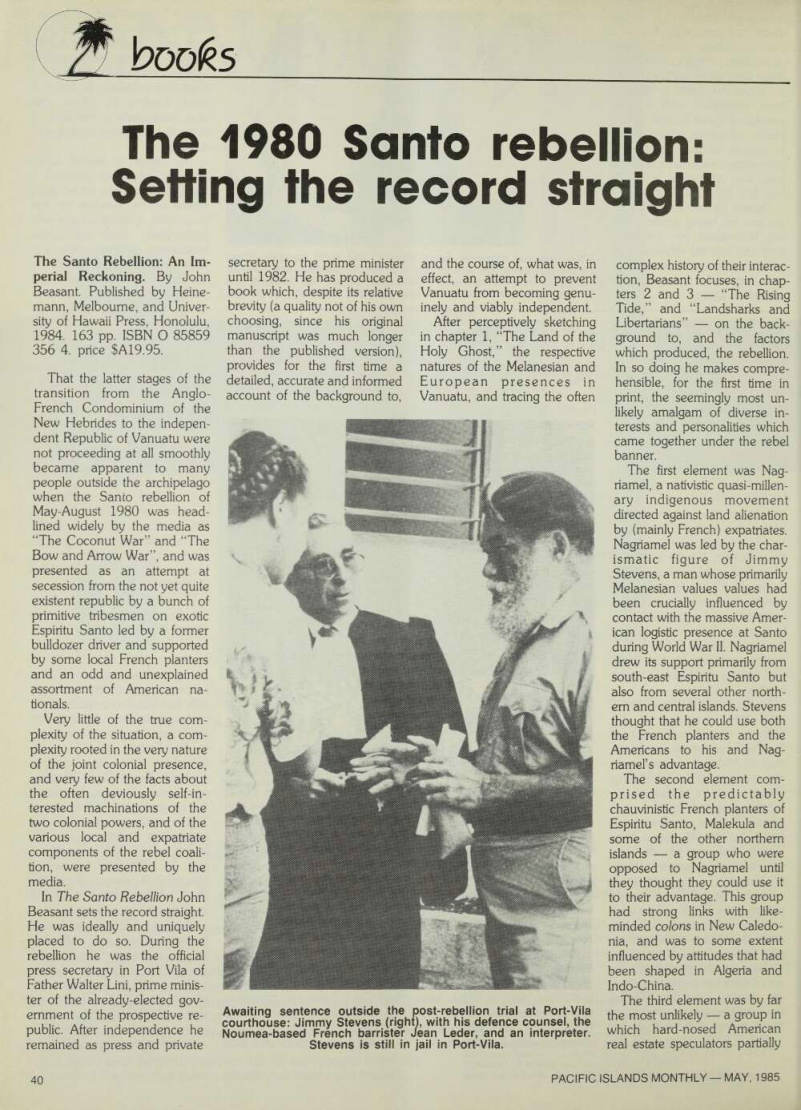
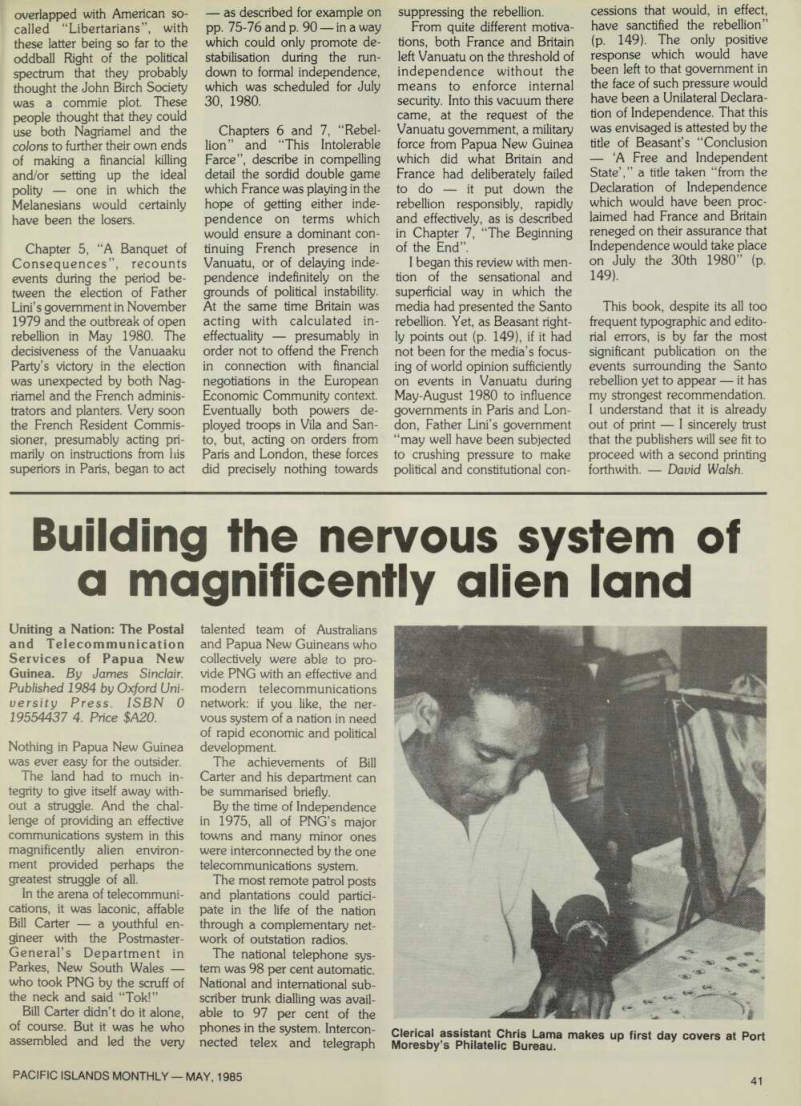
books
The 1980 Santo rebellion: Setting the record straight
The Santo Rebellion: An Im perial Reckoning. By John Beasant. Published by Heine mann, Melbourne, and Univer sity of Hawaii Press, Honolulu,
1984. 163 Pp. Isbn O 85859
356 4. price $A19.95.
That the latter stages of the transition from the Anglo- French Condominium of the New Hebrides to the indepen dent Republic of Vanuatu were not proceeding at all smoothly became apparent to many people outside the archipelago when the Santo rebellion of May-August 1980 was head lined widely by the media as “The Coconut War” and “The Bow and Arrow War”, and was presented as an attempt at secession from the not yet quite existent republic by a bunch of primitive tribesmen on exotic Espiritu Santo led by a former bulldozer driver and supported by some local French planters and an odd and unexplained assortment of American na tionals.
Very little of the true com plexity of the situation, a com plexity rooted in the very nature of the joint colonial presence, and very few of the facts about the often deviously self-in terested machinations of the two colonial powers, and of the various local and expatriate components of the rebel coali tion, were presented by the media.
In The Santo Rebellion John Beasant sets the record straight.
He was ideally and uniquely placed to do so. During the rebellion he was the official press secretary in Fort Vila of Father Walter Lini, prime minis ter of the already-elected gov ernment of the prospective re public. After independence he remained as press and private
secretary to the prime minister until 1982. He has produced a book which, despite its relative brevity (a quality not of his own choosing, since his original manuscript was much longer than the published version), provides for the first time a detailed, accurate and informed account of the background to,
and the course of, what was, in effect, an attempt to prevent Vanuatu from becoming genu inely and viably independent.
After perceptively sketching in chapter 1, “The Land of the Holy Ghost,” the respective natures of the Melanesian and European presences in Vanuatu, and tracing the often
complex history of their interac tion, Beasant focuses, in chap ters 2 and 3 “The Rising Tide,” and “Landsharks and Libertarians” on the back ground to, and the factors which produced, the rebellion.
In so doing he makes compre hensible, for the first time in print, the seemingly most un likely amalgam of diverse in terests and personalities which came together under the rebel banner.
The first element was Nag riamel, a nativistic quasi-millen ary indigenous movement directed against land alienation by (mainly French) expatriates.
Nagriamel was led by the char ismatic figure of Jimmy Stevens, a man whose primarily Melanesian values values had been crucially influenced by contact with the massive Amer ican logistic presence at Santo during World War 11. Nagriamel drew its support primarily from south-east Espiritu Santo but also from several other north ern and central islands. Stevens thought that he could use both the French planters and the Americans to his and Nag riamel’s advantage.
The second element com prised the predictably chauvinistic French planters of Espiritu Santo, Malekula and some of the other northern islands a group who were opposed to Nagriamel until they thought they could use it to their advantage. This group had strong links with like minded colons in New Caledo nia, and was to some extent influenced by attitudes that had been shaped in Algeria and Indo-China.
The third element was by far the most unlikely a group in which hard-nosed American real estate speculators partially
Awaiting sentence outside the post-rebellion trial at Port-Vila courthouse: Jimmy Stevens (right), with his defence counsel, the Noumea-based French barrister Jean Leder, and an interpreter.
Stevens is still in jail in Port-Vila.
overlapped with American so called “Libertarians”, with these latter being so far to the oddball Right of the political spectrum that they probably thought the John Birch Society was a commie plot. These people thought that they could use both Nagriamel and the colons to further their own ends of making a financial killing and/or setting up the ideal polity one in which the Melanesians would certainly have been the losers.
Chapter 5, “A Banquet of Consequences”, recounts events during the period be tween the election of Father Lini’s government in November 1979 and the outbreak of open rebellion in May 1980. The decisiveness of the Vanuaaku Party’s victory in the election was unexpected by both Nag riamel and the French adminis trators and planters. Very soon the French Resident Commis sioner, presumably acting pri marily on instructions from his superiors in Paris, began to act
— as described for example on pp. 75-76 and p. 90 in a way which could only promote de stabilisation during the run down to formal independence, which was scheduled for July 30, 1980.
Chapters 6 and 7, “Rebel lion” and “This Intolerable Farce”, describe in compelling detail the sordid double game which France was playing in the hope of getting either inde pendence on terms which would ensure a dominant con tinuing French presence in Vanuatu, or of delaying inde pendence indefinitely on the grounds of political instability.
At the same time Britain was acting with calculated in effectuality presumably in order not to offend the French in connection with financial negotiations in the European Economic Community context.
Eventually both powers de ployed troops in Vila and San to, but, acting on orders from Paris and London, these forces did precisely nothing towards
suppressing the rebellion.
From quite different motiva tions, both France and Britain left Vanuatu on the threshold of independence without the means to enforce internal security. Into this vacuum there came, at the request of the Vanuatu government, a military force from Papua New Guinea which did what Britain and France had deliberately failed to do it put down the rebellion responsibly, rapidly and effectively, as is described in Chapter 7, “The Beginning of the End”.
I began this review with men tion of the sensational and superficial way in which the media had presented the Santo rebellion. Yet, as Beasant right ly points out (p. 149), if it had not been for the media’s focus ing of world opinion sufficiently on events in Vanuatu during May-August 1980 to influence governments in Paris and Lon don, Father Lini’s government “may well have been subjected to crushing pressure to make political and constitutional con
cessions that would, in effect, have sanctified the rebellion” (p. 149). The only positive response which would have been left to that government in the face of such pressure would have been a Unilateral Declara tion of Independence. That this was envisaged is attested by the title of Beasant’s “Conclusion ‘A Free and Independent State’,” a title taken “from the Declaration of Independence which would have been proc laimed had France and Britain reneged on their assurance that Independence would take place on July the 30th 1980” (p. 149).
This book, despite its all too frequent typographic and edito rial errors, is by far the most significant publication on the events surrounding the Santo rebellion yet to appear it has my strongest recommendation.
I understand that it is already out of print I sincerely trust that the publishers will see fit to proceed with a second printing
forthwith.
David Walsh.
Building the nervous system of
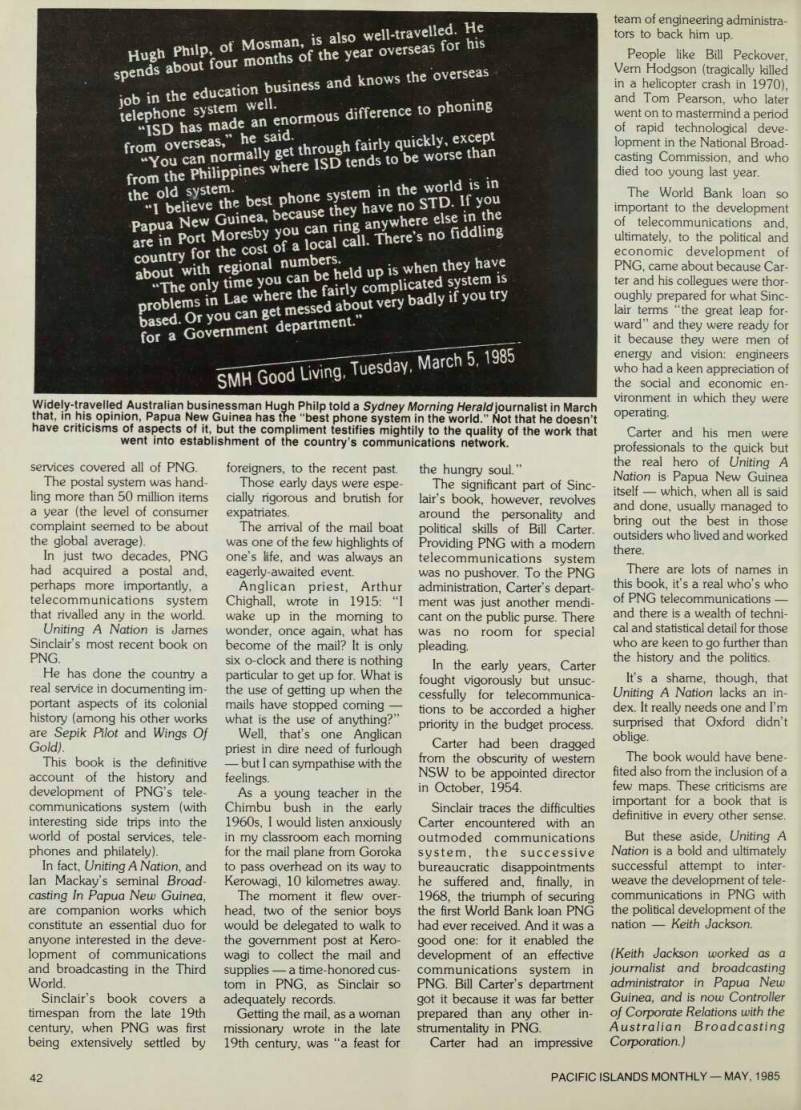
a magnificently alien land
Uniting a Nation: The Postal and Telecommunication Services of Papua New Guinea. By James Sinclair.
Published 1984 by Oxford Uni versity Press. ISBN 0 19554437 4. Price SA2O.
Nothing in Papua New Guinea was ever easy for the outsider.
The land had to much in tegrity to give itself away with out a struggle. And the chal lenge of providing an effective communications system in this magnificently alien environ ment provided perhaps the greatest struggle of all.
In the arena of telecommuni cations, it was laconic, affable Bill Carter a youthful en gineer with the Postmaster- General’s Department in Parkes, New South Wales who took PNG by the scruff of the neck and said “Tok!”
Bill Carter didn’t do it alone, of course. But it was he who assembled and led the very
talented team of Australians and Papua New Guineans who collectively were able to pro vide PNG with an effective and modern telecommunications network: if you like, the ner vous system of a nation in need of rapid economic and political development.
The achievements of Bill Carter and his department can be summarised briefly.
By the time of Independence in 1975, all of PNG’s major towns and many minor ones were interconnected by the one telecommunications system.
The most remote patrol posts and plantations could partici pate in the life of the nation through a complementary net work of outstation radios.
The national telephone sys tem was 98 per cent automatic.
National and international sub scriber trunk dialling was avail able to 97 per cent of the phones in the system. Intercon nected telex and telegraph
Clerical assistant Chris Lama makes up first day covers at Port Moresby’s Philatelic Bureau.
services covered all of PNG.
The postal system was hand ling more than 50 million items a year (the level of consumer complaint seemed to be about the global average).
In just two decades, PNG had acquired a postal and, perhaps more importantly, a telecommunications system that rivalled any in the world.
Uniting A Nation is James Sinclair’s most recent book on
Png.
He has done the country a real service in documenting im portant aspects of its colonial history (among his other works are Sepik Pilot and Wings Of Gold).
This book is the definitive account of the history and development of PNG’s tele communications system (with interesting side trips into the world of postal services, tele phones and philately).
In fact, Uniting A Nation, and lan Mackay’s seminal Broad casting In Papua New Guinea, are companion works which constitute an essential duo for anyone interested in the deve lopment of communications and broadcasting in the Third World.
Sinclair’s book covers a timespan from the late 19th century, when PNG was first being extensively settled by
foreigners, to the recent past.
Those early days were espe cially rigorous and brutish for expatriates.
The arrival of the mail boat was one of the few highlights of one’s life, and was always an eagerly-awaited event.
Anglican priest, Arthur Chighall, wrote in 1915: “I wake up in the morning to wonder, once again, what has become of the mail? It is only six ©-clock and there is nothing particular to get up for. What is the use of getting up when the mails have stopped coming what is the use of anything?”
Well, that’s one Anglican priest in dire need of furlough but I can sympathise with the feelings.
As a young teacher in the Chimbu bush in the early 19605, I would listen anxiously in my classroom each morning for the mail plane from Goroka to pass overhead on its way to Kerowagi, 10 kilometres away.
The moment it flew over head, two of the senior boys would be delegated to walk to the government post at Kero wagi to collect the mail and supplies a time-honored cus tom in PNG, as Sinclair so adequately records.
Getting the mail, as a woman missionary wrote in the late 19th century, was “a feast for
the hungry soul.”
The significant part of Sinc lair’s book, however, revolves around the personality and political skills of Bill Carter.
Providing PNG with a modem telecommunications system was no pushover. To the PNG administration, Carter’s depart ment was just another mendi cant on the public purse. There was no room for special pleading.
In the early years, Carter fought vigorously but unsuc cessfully for telecommunica tions to be accorded a higher priority in the budget process.
Carter had been dragged from the obscurity of western NSW to be appointed director in October, 1954.
Sinclair traces the difficulties Carter encountered with an outmoded communications system, the successive bureaucratic disappointments he suffered and, finally, in 1968, the triumph of securing the first World Bank loan PNG had ever received. And it was a good one: for it enabled the development of an effective communications system in PNG. Bill Carter’s department got it because it was far better prepared than any other in strumentality in PNG.
Carter had an impressive
team of engineering administra tors to back him up.
People like Bill Peckover, Vem Hodgson (tragically killed in a helicopter crash in 1970), and Tom Pearson, who later went on to mastermind a period of rapid technological deve lopment in the National Broad casting Commission, and who died too young last year.
The World Bank loan so important to the development of telecommunications and, ultimately, to the political and economic development of PNG, came about because Car ter and his collegues were thor oughly prepared for what Sinc lair terms “the great leap for ward” and they were ready for it because they were men of energy and vision: engineers who had a keen appreciation of the social and economic en vironment in which they were operating.
Carter and his men were professionals to the quick but the real hero of Uniting A Nation is Papua New Guinea itself which, when all is said and done, usually managed to bring out the best in those outsiders who lived and worked there.
There are lots of names in this book, it’s a real who’s who of PNG telecommunications and there is a wealth of techni cal and statistical detail for those who are keen to go further than the history and the politics.
It’s a shame, though, that Uniting A Nation lacks an in dex. It really needs one and I’m surprised that Oxford didn’t oblige.
The book would have bene fited also from the inclusion of a few maps. These criticisms are important for a book that is definitive in every other sense.
But these aside, Uniting A Nation is a bold and ultimately successful attempt to inter weave the development of tele communications in PNG with the political development of the nation Keith Jackson. (Keith Jackson worked as a journalist and broadcasting administrator in Papua New Guinea, and is now Controller of Corporate Relations with the Australian Broadcasting Corporation.)
Widely-travelled Australian businessman Hugh Philp told a Sydney Morning Herald journalist in March that, in his opinion, Papua New Guinea has the “best phone system in the world.” Not that he doesn’t have criticisms of aspects of it, but the compliment testifies mightily to the quality of the work that went into establishment of the country’s communications network.
Books Received

A Bibliography of Pacific Island Theses and Dissertations.
By W. G. Coppell and S. Stratigos.
Published 1983 by Research School of Pacific Studies, Australian National Uni versity. Distributed by University of Hawaii Press, 2840 Kolowalu Street, Honolulu, Hawaii 96822. ISBN 0 939154 33 1. No price provided.
An Illustrated Guide to Maori Art.
By Terence Barrow. Published 1984 by University of Hawaii Press, 2840 Kolowalu Street, Honolulu, Hawaii 96822. ISBN 0 8248 0979 3. Price $U515.95.
Red Brotherhood at War: Indochina Since the Fall of Saigon.
By Grant Evans and Kelvin Rowley.
Published 1984 by Pluto Press, P.O.
Box 199, Leichhardt, Australia 2040.
ISBN 0 86091 795 9. Price $14.95.
The Birds of the Wetlands.
By James Hancock. Published 1984 by Croom Helm Ltd, Provident House, Burrell Row, Beckenham, Kent BR3 lAT, England. ISBN 0 7099 1287 0.
Price £13.95.
The Role of the Entrepreneur in the Economic System.
By Israel M. Kirzner. Published 1984 by the Centre for Independent Studies, 575 Pacific Highway, St. Leonards, Australia 2065. ISBN 0 949769 19 3.
Price $3.00 Dropping Out from Community
Schools: The Extent, the Causes and Possible Remedies.
By Mark Bray. Published 1984 by the Educational Research Unit, University of PNG, Box 320, University P. 0., Papua New Guinea. ERU Report No. 49. Price K 1.40.
Review and Analysis of Educational “Needs” at the Secondary Level in Papua New Guinea.
By M, K. Bacchus and the Educational Research Unit. Published 1984 by Educational Research Unit, University of PNG, Box 320, University P. 0., Papua New Guinea. ERU Report No. 48. Price K 3.85.
Capital Xenophobia; Australia’s Controls of Foreign Investment.
By Wolfgang Kasper. Published 1984 by the Centre for Independent Studies, 575 Pacific Highway, St Leonards, Aus tralia 2065. ISBN 0 949769 21 5. Price $9.95.
Australia and Argentina: On Para llel Paths.
By Tim Duncan and John Fogarty.
Published 1984 by melboume Univer sity Press, P.O. Box 278, Carlton South, Australia. 3053. ISBN 0 522 84269 0.
Price $22.50.
Astronomical Objects for Southern Telescopes.
By E. J. Hartung. Published 1984 by Melboume University Press, P.O. Box 278, Carlton South, Australia 3053.
ISBN 0 522 84281 X. Price $13.50.
Ma’i Ho’oka’awale: The Separating Sickness.
By Ted Gugelyk and Milton Bloom baum. Published 1985 by Ma’i Ho’oka’
awale Foundation. Distributed by Uni versity of Hawaii Press, 2840 Kolowalu Street, Honolulu, Hawaii 96822. ISBN 0 8248 0989 0. Price SUS9.OO.
Amerika Samoa: An Anthropological Photo Essay.
By Frederic Koehler Sutter. Published 1985 by University of Hawaii Press, 2840 Kolowalu Street, Honolulu, Hawaii 96822. ISBN 0 8248 0990 4. Price 5U524.95.
Changes in the Air? Issues in Domes tic Aviation Policy.
By The Centre for Independent Stu dies, Policy Forum No. 3. Published by CIS, 575 Pacific Highway, St. Leonards, Australia. 2065. ISBN 0 949769 16 9.
Price $8.95.
The Maverick Guide to New Zealand. 1985-86 edition.
By Robert W. Bone. Published 1985 by Pelican Publishing Company, P.O.
Box 189, Gretna, Louisiana 70053.
USA ISBN 0 88289 470 6. Price
Sus 11.95.
The Maverick Guide to Hawaii. 1985 edition.
By Robert W. Bone. Published 1985 by Pelican Publishing Company, P.O.
Box 189, Gretna, Louisiana 70053, U.S.A. ISBN 0 88289 469 2. Price $U510.95.
Koori: A Will to Win.
By James Miller. Published 1985 by Angus & Robertson Publishers, P.O.
Box 290, North Ryde, Australia. 2113.
ISBN 0 207 15065 6. Price $14.95.
Exchange Rate and Macro-economic Policy in Independent Papua New
Guinea.
By Ross Gamaut and Paul Baxter.
Published 1984 by Development Stu dies Centre, Australian National Univer sity, GPO Box 4, Canberra, Australia. 2601. ISBN 0 86784 497 3. No price provided.
Orokaiva Production and Change.
By Janice Newton. Published 1985 by Development Studies Centre, Australian National University, GPO Box 4, Can berra, Australia. 2601. ISBN 0 86784 569 4. No price provided.
Advertisements & other items, p. 43 (1 item)
Longlife Products
ALL THE
NEWS IN A
FLASH
The South Sea Digest tells you what you want to know about the Pacific Islands in a few words. All the leading firms and diplomatic missions read it. You can phone or write or call for a follow up.
See insert for subscription details:
THE SOUTH SEA DIGEST
'll
LONGLIFE PRODUCTS
AND FRESH DAIRY FOODS,
QUALITY YOU CAN TRUST
QUF Industries Ltd. offers an export award winning range of Longlife products as well as a complete range of quality fresh dairy foods.
With 15 years’ experience in export markets, QUF has the product knowledge and expertise to provide you with outstanding service in the 1980’s. • Pauls Longlife UHT Milk is natural liquid cow's milk with no preservatives or additives and is available in the 250m1, 500 ml and 1 litre sizes. • Shake Longlife flavoured milk is offered in delicious Chocolate, Malted, Caramel and Strawberry flavours. • Pauls Longlife Thickened Cream is ideal for whipping or pouring. • Popper 100% Fruit Juice is available in seven flavours in a wide range of Longlife pack sizes. • Pauls fresh Dairy Products including Milk, Cream, Yoghurt and Cottage Cheese are available in an extensive range of flavours and sizes.
TRADE ENQUIRIES:
QUF Industries Ltd., P.O. Box 12, South Brisbane, Queensland, 4101 Australia Telephone: (07) 44-0151 Telex: AA 40614 x J drangi Hi li kened 6w
SEW
miiK
miiK -i-
-1 LITRE
4 *
mux
Making good
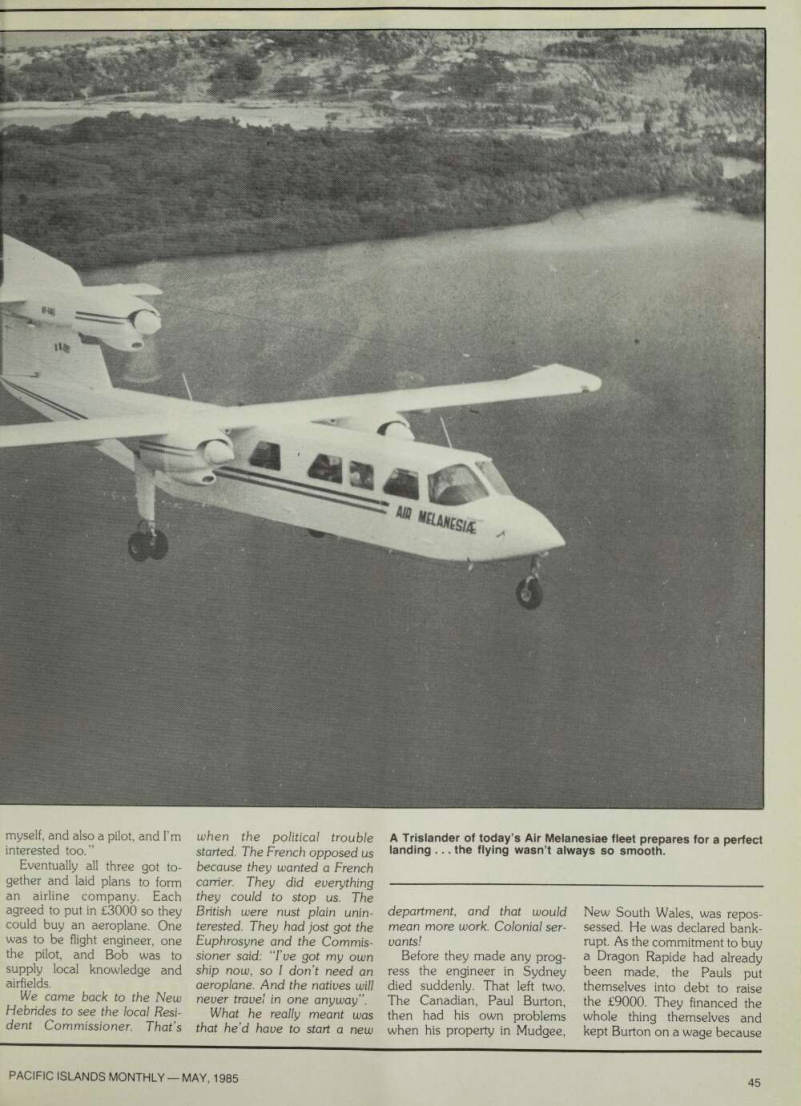
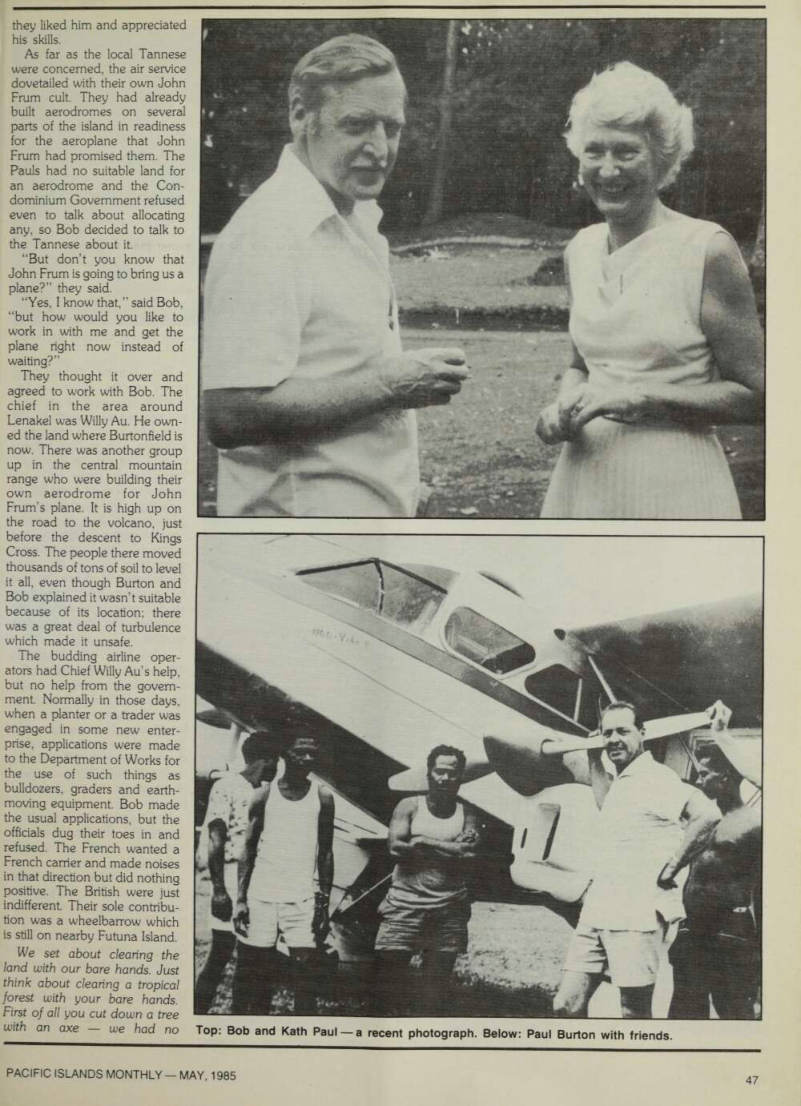
Air Melanesiae is 25: Making good a promise of John From
What started the whole thing was the problem we were hav ing with the kids. Medical facili ties were zero on Tanna. We didn’t have our own ship at the time, and passing ships were few and far between.
Td bought some cattle in Vila and had them loaded up on this 60-foot boat. We struck some weather on the way down and the cattle were drow ning all over the bloody boat.
They were sliding up and down the deck and wearing their hides out. I was sitting there with one of them, with its head in my lap. It had put its foot up through the skeg in the ship’s launch, which was tied down to he hatch. The propeller comes out there and it was sawing back and forth and slowly cutting the cow’s foot off. I had one of the kids with me and Td locked him in the little cabin.
One of the crew came up and said: ‘Your picaninny’s screaming in there.” So I drop ped the cow and went down.
As I opened the door he hit me with a chunder. First time I’ve ever been sick in my life. I just went wooooah and that was the end of me.
Kath was in Tanna, as only one of us could get away at a time. While I was off on my adventures she was always there picking up the pieces.
When I finally stepped
Vanuatu’s domestic airline, Air Melanesiae, is 25 years old on June 1.
As with many Pacific Island airlines, the story of Air Melanesiae is replete with color and incident.
Indeed, a fair enough claim could be made that, for a variety of reasons, not least the fact that it was established in the highly complex administrative situation of the Anglo-French Condominium of the New Hebrides, it has more color and incident than most such stories.
A second unique feature of Air Melanesiae is the extent to which Pacific Islanders in this case Tannese devotees of the John Frum cult were key actors in the airline’s development.
Here, in an interview with 808 PAUL, founding father of the airline, SHIRLEY FENTON HUIE provides an outline of its first quarter-century of existence.
Mr Paul’s direct comments appear in italic type, and Ms Fenton Huie’s connecting narrative in roman.
ashore at Lenakel I said: ‘ ‘That’s it. We’re going to buy an aeroplane.”
And we did.
Bob and Kath Paul met in Port-Vila at the end of World War II when she was working for the British Government and he was engineer and supercar go on a Burns Philp trading ship. The fell in love at Undine Bay, married and had five children on the island of Tanna in the southern New Hebrides,
then an Anglo-French con dominium. They founded an airline whose original name was New Hebrides Airways.
It began in the 19505. Bob says with a wink that the first name suggested for the fledg ling airline was Condom Air ways, with a windsock as a logo. But the Condominium refused to register it.
They went down to Sydney and were driving to Bankstown Airport where Bob was having
lessons towards his flying licence. They got into conversa tion with a service station atten dant in the suburb of Collaroy.
In the course of chatting about fuel and mileage, Bob ex plained his reasons for going to Bankstown. The attendant, who had a Canadian accent, showed great interest and said: “If you want to start an airline I know the chap you should meet out there. He’s an aircraft engineer. I’m an aero engineer
myself, and also a pilot, and I’m interested too.”
Eventually all three got together and laid plans to form an airline company. Each agreed to put in £3OOO so they could buy an aeroplane. One was to be flight engineer, one the pilot, and Bob was to supply local knowledge and airfields.
IVe came back to the New Hebrides to see the local Resident Commissioner. That’s
when the political trouble started. The French opposed us because they wanted a French carrier. They did everything they could to stop us. The British were nust plain unin terested. They had jost got the Euphrosyne and the Commis sioner said: “.Tue got my own ship now, so I don’t need an aeroplane. And the natives will never travel in one anyway”.
What he really meant was that he’d have to start a new
department, and that would mean more work. Colonial ser vants!
Before they made any prog ress the engineer in Sydney died suddenly. That left two.
The Canadian, Paul Burton, then had his own problems when his property in Mudgee,
New South Wales, was repos sessed. He was declared bank rupt. As the commitment to buy a Dragon Rapide had already been made, the Pauls put themselves into debt to raise the £9OOO. They financed the whole thing themselves and kept Burton on a wage because
A Trislander of today’s Air Melanesiae fleet prepares for a perfect landing ... the flying wasn’t always so smooth.
they liked him and appreciated his skills.
As far as the local Tannese were concerned, the air service dovetailed with their own John Frum cult. They had already built aerodromes on several parts of the island in readiness for the aeroplane that John Frum had promised them. The Pauls had no suitable land for an aerodrome and the Con dominium Government refused even to talk about allocating any, so Bob decided to talk to the Tannese about it.
“But don’t you know that John Frum is going to bring us a plane?” they said.
“Yes, I know that,” said Bob, “but how would you like to work in with me and get the plane right now instead of waiting?”
They thought it over and agreed to work with Bob. The chief in the area around Lenakel was Willy Au. He own ed the land where Burtonfield is now. There was another group up in the central mountain range who were building their own aerodrome for John Frum’s plane. It is high up on the road to the volcano, just before the descent to Kings Cross. The people there moved thousands of tons of soil to level it all, even though Burton and Bob explained it wasn’t suitable because of its location; there was a great deal of turbulence which made it unsafe.
The budding airline oper ators had Chief Willy Au’s help, but no help from the govern ment. Normally in those days, when a planter or a trader was engaged in some new enter prise, applications were made to the Department of Works for the use of such things as bulldozers, graders and earth moving equipment. Bob made the usual applications, but the officials dug their toes in and refused. The French wanted a French carrier and made noises in that direction but did nothing positive. The British were just indifferent. Their sole contribu tion was a wheelbarrow which is still on nearby Futuna Island.
We set about clearing the land with our bare hands. Just think about clearing a tropical forest with your bare hands.
First of all you cut down a tree with an axe we had no
Top: Bob and Kath Paul—a recent photograph. Below: Paul Burton with friends.
chainsaw. Now you’ve felled it, how are you going to move it?
They are enormous, these ba nyan trees. So we had to cut them up into pieces that we could move. We dragged them away using the jeep as a bulldozer. Then we had the stump to get rid of. Some of the stumps are as big as a room, and we had to get in and dig them out by hand. They are enormous and weigh many tons. We had people down in these holes digging away and cutting up the roots. Then, with a hundred or so men pushing, we rolled the stumps up a ramp on to level ground. Sometimes we only advanced a foot or so in a day.
Eventually, after eight months, they had a large cleared area covered with de bris and mud. This they man aged to more or less clear off by using an old truck chassis with a couple of sheets of steel welded on to it. They hooked this contraption on to the jeep and dragged it around using it as a grader.
When they had completed 300 yards Bob went off to Australia to pick up Burton and the aircraft, leaving Kath in charge of the operation. She carried on and got about 400 yards done. She supplied all those working with all the rice they could eat, and they organ ised their own dancing at night.
It rained a lot, which made it very difficult to harden up the strip. They struggled with the mud, patting and pummelling it every time the sun came out.
When the dry season finally came, Kath gave Bob the go ahead to bring in the plane.
They bought an old fabric covered, twin-engined De Havilland Dragon Rapide, which had formerly been used as an aerial ambulance in Cairns. Burton put in a new overhauled engine and prac tically rebuilt it. Bob says admir ingly: “Burton was a very clever man. ”
They took off from Caims for Horn Island on the tip of Cape York and then went on to Port Moresby. From there they flew to Milne Bay and Munda and finally landed at Honiara in the Solomon Islands.
And that’s where they stop-
ped us and wouldn’t let us go any further. My God, the British can be stupid. They wouldn’t register us. I asked to see the High Commissioner and they spent a week trying to find a reason why they wouldn’t re gister us. We were demanding registration under the Colonial Air Navigation Act which en titled us. Eventually we took things into our own hands and cleared off at 3 o’clock in the morning. Without registry. We didn’t have enough money to buy Avgas, so the Shell bloke gave us motor spirit. We took off with a tank full. And the jerry tanks full.
We lost one engine and the result was we damn near went into the water between Honiara and Santo. That was late May, 1960. This really set us back because we had to chuck everything that was loose out into the Coral Sea. All our spore ports went out, cylinder heads, everything. The Santo strip, the old one left over from World War 11, is 500 feet above sea level. They saw us roaring up and down the coast and thought we were having a good time, but we were just trying to bum off everything we could and get up to the strip on one engine. The poor old Rapide was shaking itself to death.
Eventually we made it and that was the aeroplane we started the airline with. And no spare parts.
They repaired the plane in Santo and flew down to Port
Vila, where they were refused permission to land. Furious at this latest obstruction, they de cided to beat up the main street from one end to the other at low altitude, until finally Radio Vila capitulated and gave them permission to land. Stories told later say that the French and British Resident Commission ers, having been disturbed dur ing the siesta, called each other on the phone and said: “What can we do to stop these mad people? Better let them land.
They’ll be on the ground soon, anyway. ”
There was a great crowd to meet the cheeky aviators out at Bauerfield. They emerged from their battered aeroplane, each holding a spanner in his hand.
They weren’t looking for the authorities, only making sure that no inexpert mechanic came near their plane.
After more adjustments and repairs they took off to the south for Tanna to a great welcome. The landing was per fect, but it was several weeks before they could take off, as the strip was too short. The necessary yardage was cleared and they were ready to go.
When the Rapide took off for the first time all the locals who had worked on preparing the field gathered round to watch.
As the plane was lifted by wind currents and inversion they all simultaneously made the huge ’’whooooh” sound as they do when they see a hawk rising.
The Rapide lasted only seven months. When we ar rived in Tanna with it we were not allowed to operate it. We were told we could on/y use it privately. This is how we got around that silly bit of regula tion. People came into our store and bought a packet of cigarettes. This cost them five pounds, but they also got a
”complimentary” flight on our
aeroplane. Passengers coming down from Vila did the same thing in reverse. When they got to Tanna they’d buy some item for five pounds on arrival. We operated like that for five months.
In late 1960, with the British still refusing registration, the Condominium received a visit from the British Parliamentary Under-Secretary of State, Ju lian Amery. He came down to Tanna on the government ship Euphrosyne. Bob requested an audience with him and was reluctantly granted a mere 10 minutes.
Three and a half hours later Amery said: “By God, that’s an interesting story. Leave this with me.”
Within a week they were registered in Fiji. They were legal. They were now required to fly the aircraft to Noumea to have it checked out by a New Zealand airframe surveyor.
When all recommendations were complied with it was flown
Continued on page 57
Wreckage of plane in which Paul Burton and his passengers died on Tanna, October 21, 1966.
Reproduced from New Hebrides Nakamal.
to Fiji to be certified by Fiji Airways. Unfortunately the undercarriage was slightly dam aged on take-off, but they con tinued on to Fiji. In spite of a cautious landing a strut broke leaving the undercarriage dang ling and there was a lot of drama on the tarmac. It didn’t collapse as they eased it in, but it had to be towed off the runway. This was not a good beginning for the new airline.
Bob says: “Next day they ripped all the fabric off the old ‘rag and bag’ and by the time they assessed it, it came to a total of 999 man hours required to fix it. That was the end of us.
We didn’t have the money.”
Undaunted, Bob went back to Tanna and talked to the Tannese who had bought 1300 shares in the company. Their spokesmen were Jack Naivo of lonanen, Willy Au, Philip, Kabarlu and Henry Kosiama.
All 1300 had paid a pound each for their share. In Port-Vila the Commissioner had said: “What are you goir to do about the Tannese now that you’ve got no aeroplane?”
According to Bob they were dead scared of the Tannese.
“I’m going to tell them the truth.”
This is what he did.
“The plane’s buggered-up.
No good. Finished.”
“OK,” they said. “We’ll put in more money to fix it.”
They put in more money.
Sister Heard from the hospital put in money. Mrs Fung Kwan Chee, Peter Allen and Nancy Robb put in money. The Pauls put in a lot too, and so they got together enough for Bob to go back to Fiji and make a deal with Qantas who were then running Fiji Airways. The deal was that they got a Drover from them on lease/purchase. The Drover MKII was suitable with its three engines, and was built like a tank for the Flying Doctor service. Only 21 were ever built, and although the Drover was not meant for passenger work it served the new airline well in the early days when things were rough and tough.
Official hostility, however, continued, and there was a complete lack of ground sup port. Fuel was carted in 44gallon drums and hand pumped into the aircraft. Car headlights were used for emergency night landings.
Radio links were unreliable and sometimes non-existent. Vila Airport closed down at 5 p.m., and did not operate at all on weekends.
When weather conditions were bad some sort of radio beacon was needed on Tanna, so Bob resorted to a World War II device known as a Gibson Girl. This primitive survival sys tem was a transmitter set on a fixed frequency signal and flown high on a child’s kite. It had saved the life of many a downed pilot during the war, but was illegal in peace time.
When wind was high, clouds low, and visibility nil, Bob would race off in his Landrover and fly his kite, thus guiding his plane in to a safe landing.
New Hebrides Airways was flying and the local support was tremendous. Not just financial support but physical support as well. When the plane landed the Tannese would get in, sweep it out, clean it and refuel it. Nobody worked for money.
For a while, when it was feared the French might do something silly, the Tannese would come down from the bush at night and sit around the plane, guar ding it. They would light their fires and sit there all night so it
wouldn’t be sabotaged. That’s how they felt about it. And nobody else was going to guard it. Plen blong mifala.
They were all John Frum people. Every one of them. It tied in with their cult. They were thrilled to bits with it. It’s still very important to them, John Frum tell im i gat plen.
Plen i gat. Plen blong mifala.
The Sulphur Bay crowd were not in it. If they can’t have the limelight they don’t want to be in it. They are not the real John Frum people over there, They’re a breakaway.
The airline’s annual general meetings were held in Bislama.
Later on, when Qantas and British Airways came in, the report would be sent over to London. They got a great kick out of it over there, and wrote back asking for a translation.
Eventually we had three Drovers and then the French decided to get into competition with us and bought a Domier 28 for their new airline, Hebridair. They were in association with Transpac, the French company SFNH, the Bank of Indochina, and Ballande. They had no involvement with the local people and arrived with the Domier and nowhere to go, as we had the airstrips. We said sorry, you can’t use ours. By this time we had extended Burtonfield at Lenakel, Tanna, and built another two at Aniwa and Futuna. Futuna was tricky as the island rises straight up from the sea and is flat on top.
This top area was covered with great coral outcrops so we lit fires on them and eventually reduced the coral to lime. We didn’t even have a pick, but the local support was terrific, We had started to build an airstrip on Aneityum but had run out of money so the French said they would finish it. Henri Martinet of Transpac asked if all these top French people like the head of Ballande, and the French Resident Commission er, could land at Tanna on their way to Aneityum. Considering how obstructionist they had been to us from the beginning, we agreed only reluctantly.
Martinet was embarrassed about it all and stayed with us while all these bigwigs flew off south to Aneityum. They tried to do a STOL landing and broke their plane in half. There is a lot of windshear there. We left them there overnight, in spite of their frantic radio calls, and got them out next day.
They were a miserable lot in the morning. They were dead keen to get into the business but they didn’t have any air fields and didn’t know how to get them. The Tannese and other locals used to roll 44gallon drums onto our airfields everytime we took off to make sure the French couldn’t land, Hebridair!
We then decided to go into Tongoa, up north of Vila. The French offered funds so that Hebridair could use the strip too, and I was up there just after
A group of New Hebrides Airways shareholders.
a hurricane when a relief ship was handing out money. I quickly sold 800 shares in New Hebrides Airways and the strip was built in conjunction with the French. Those shareholders still get their annual dividends.
The French scheduled a service Vila-Tongoa-Vila and didn’t get one single Tongoan.
Not one. It went on for months with Hebridair carrying only French Government officials.
They sent a message to say that if the locals wouldn’t use Hebri dair, then Ballande would lay off Tongoan labor. The next day all the Tongoans walked off the Ballande jobs where they handled and loaded cop ra. They were all our sharehol ders, and they weren’t going to be intimidated.
Unable to get any passen gers, the French then leaned on the British who said they would subsidise us if we both got together. That’s when we formed the first consortium.
That was in early 1966.
It was a disaster from the start and only lasted a couple of years. By this time we had Longana and Walaha on Aoba (Ambae), Sara on Pentecost, which was our best strip and is now closed due to politics, Tongoa, and all the southern ones. The Eromanga strip at Dillons Bay was built by Bureau Miniere; a French min ing crowd who were very loyal to us, and wouldn’t use anyone else.
I criticise the French, but it was only the colonial officials.
One great crowd were Trans pac, who are now Air Caledo nie. They were based at New Caledonia’s domestic airport at
Magenta, and were our rivals as far as the other French were concerned. But we used to go down there for any extra work we needed on the aircraft, and they never charged us a penny.
Henri Martinet was the chair man and they were always most hospitable to us. The manager was a man called Herve Coursin, and he was good to us until we got arrested the last time we flew down there. The charge was illegal entry. We had our passports and our papers were in order, but it was a purely political manoeuvre. It was nothing to do with Martinet or Air Caledo nie. They were aviators and not interested in politics.
On October 21, 1966, Bur ton took off from Tanna to fly to Futuna and never arrived.
We searched for three days over the sea, but could find no trace of him and his planeload of passengers. Eventually some local people found the aero plane up on the big mountain in a gorge between Tukosmeru and Melen at the southern end of Tanna. There were no survi vors. I had lost my partner and right-hand man.
Paul Burton was an amazing man who made a name for himself in the islands for work ing hard and playing hard.
He’d fly all day long and then come back and do all the necessary work on the aircraft himself. Then he would go out on the town and still be ready for work the next morning. He was one helluva guy. The Tan na airfield was later named Burtonfield at the suggestion of my friend Reece Discombe.
I was convinced that the fatal
accident was caused by a sud den downdraft, with which the underpowered Drover couldn’t cope. So the aircraft stalled and crashed. In an attempt to prove this theory I waited until a day arrived with similar conditions of rain and wind, and deliber ately flew the same route as that presumably taken by the Drov er. Sure enough, as we flew up the same valley, we were hit by the downdraft and the Heli courier fell 3000 feet.
Even with the Helicourier’s extra power, we couldn’t get out of that valley. We managed to get round a bend and over a saddle, but we very nearly joined Burton, I can tell you now.
We fumbled on with the airline, but we were so broke. I had a serious back operation and we were in a real mess with the trauma of the crash and everything. The accident sur veyor came up from Sydney about the insurance and we had no plane. Hebridair’s Dor nier was out of action so I chartered a Cessna 310 just to keep the door open.
I flew down to Sydney and Brian (Black Jack) Walker took me in to see Scotty Allan, who was with Qantas and also chair man of Fiji Airways. I told him I wanted to get Qantas into this thing and he said “no way.” He wouldn’t wear it at all.
So I came back and talked to the Resident Commissioner and he talked to Nicholson, the Australian Consul in Noumea.
Nicholson told me to go to Melbourne and talk to Ander son, the head of the Depart ment of Civil Aviation (DCA). I did that, and Anderson sent me to Canberra where I had to talk to all sorts of people behind closed doors and sign in and sign out. There was a lot of hush-hush talk about “the political influence of Australia in the region.” They said they would contact me later, and eventually I was advised that Qantas were coming up to have a look at it.
This they did, and they came in and saved the day.
Qantas bought in. British Air ways bought in. Bums Philp bought in. We refinanced the whole thing, and the French who were still in it went broke.
Because we were a Condomi nium we invited UTA to come in, and so once again we were a consortium, but with much . more powerful backing. Our name was changed to Air Melanesiae.
At this point I said to them: “I run a trading station and I want to get back to where I started.
You’ve got the thing now so go ahead and turn it into an airline, but I want the first option to buy the shares back when the time comes.”
Qantas were absolutely meti culous. They were scrupulous to the last detail about all their agreements with us, and so were the British. The local shareholders all kept their shares, but we had to relinqu ish ours. Kath gave up all her shares and her seat on the board.
With the approach of inde pendence in 1980, Qantas didn’t want to be involved in politics so they offered us back the shares. That was after 10 years. Qantas provided man agement for the first five years, and UTA for the other five.
After Qantas withdrew we had some trouble with the French partner who tried a take-over, but Helle Tschuch nigg and I scuttled them. Helle had come down from Papua New Guinea in November 1980, just before the consor tium agreement was due to change back to us. We offered to continue the agreement with UTA, but they didn’t wont that.
Dennis (Junior) Buchanan of PNG’s Talair then came in and bought out the controlling in terest. We had decided to retire so we sold him most of our shares, and he mopped up the others. He is the main share holder now. I have stayed on as chairman, and Helle manages the operation.
And that’s cutting a long story very short.
At time of writing, the fleet of Air Melanesiae is three Islanders, one Tris lander, two Twin Otters, one Bandeirante and one Aztec, which fly to 22 de stinations.
Boh and Kath Paul now live in retirement at Mount Tamborine, Queensland.
The New Hebrides Airways Dragon Rapide photographed on Tanna on June 1, 1960 — day of its first landing on the island, and the birthday of the airline.
Advertisements & other items, p. 46 (1 item)
A-Digl
EWAYTO
TH *
Multifunctionalism Is the
watchword for timepieces
In this information age.
Citizen technology meets
the chaHenge.with two
revolutionary teas in PC
watches, Sb. .. jl- "
* W f V % N \ / *
ATIA-0161
HTEMP
Citizen Quartz Ana-Digi Temp. 59.9° to 9.9°C temperature readout, one-touch Fahrenheit conversion. Analog/Digital time indication with automatic calendar and dual (one other time zone) time. 24-hour alarm, hourly chime. 1/1000-sec. accurate stopwatch.
Citizen Watches Australia Pty Ltd. 122 Old
AMA-0161
BamhoFl
Citizen Quartz Ana-Digi Combo FI.
Analog/Digital time indication with 1-sec. and 10-sec. increment LCD trackers. Permanently adjusted monthday-date calendar. 24-hour alarm, 12-hour countdown timer; hourly chime. Dual time. And a 1/100-sec. counter lap-timing stopwatch.
Pittwater Rd, Brookvale, NSW 2100. Telephone:
(CITIZEN
AHEAD OF THEIR TIME
939 7077. Cable: Citizen Sydney. Telex; AA26633.
Ambrym: Millionaires’ Salad
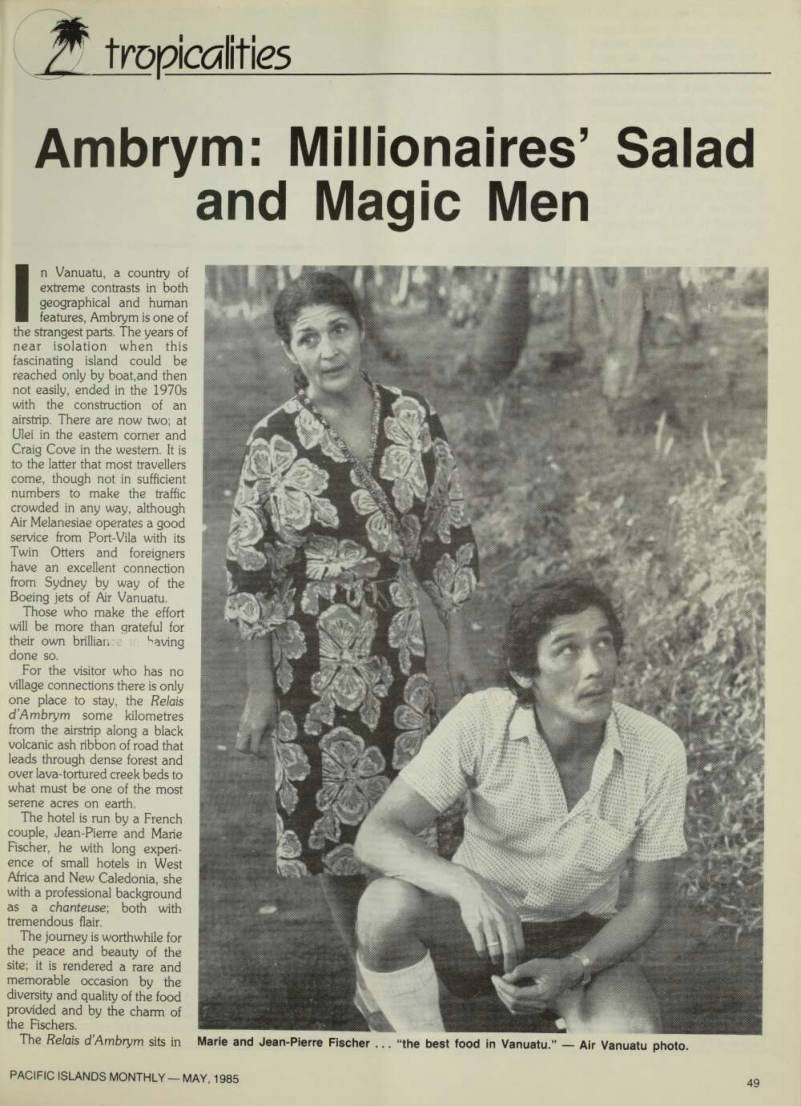
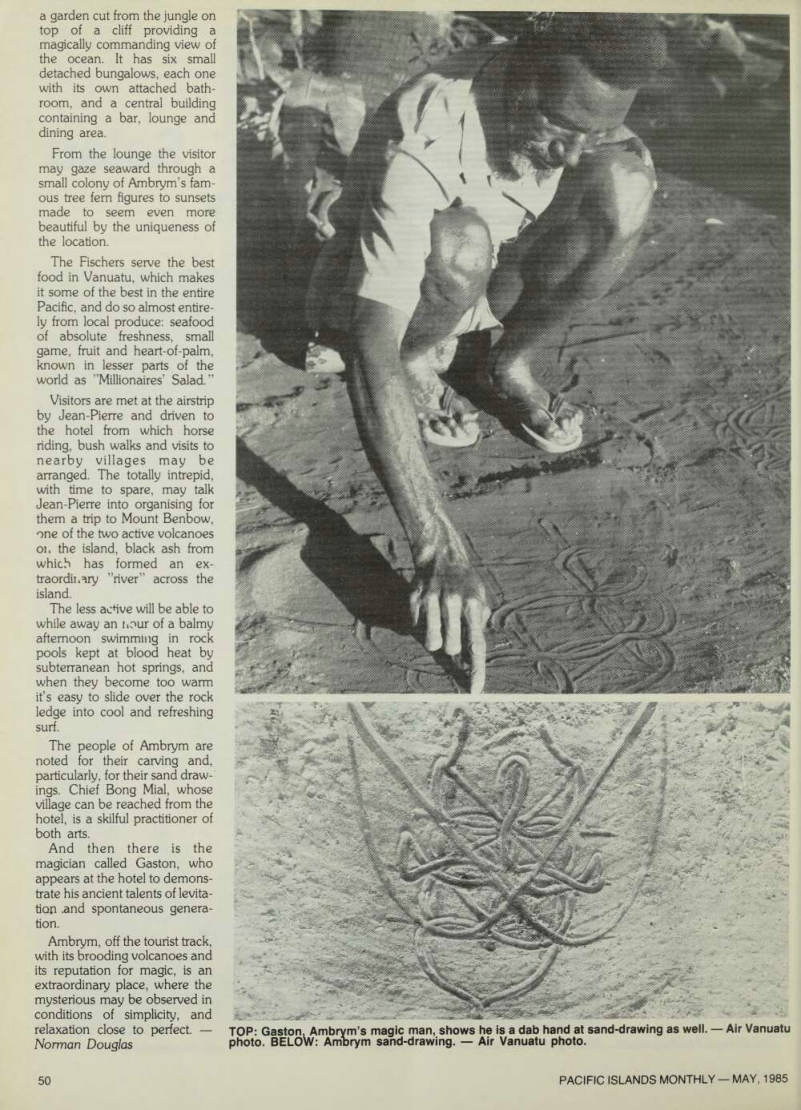
tropicalities
Ambrym: Millionaires’ Salad and Magic Men
In Vanuatu, a country of extreme contrasts in both geographical and human features, Ambrym is one of the strangest parts. The years of near isolation when this fascinating island could be reached only by boat, and then not easily, ended in the 1970 s with the construction of an airstrip. There are now two; at Ulei in the eastern corner and Craig Cove in the western. It is to the latter that most travellers come, though not in sufficient numbers to make the traffic crowded in any way, although Air Melanesiae operates a good service from Port-Vila with its Twin Otters and foreigners have an excellent connection from Sydney by way of the Boeing jets of Air Vanuatu.
Those who make the effort will be more than grateful for their own brillian e k aving done so.
For the visitor who has no village connections there is only one place to stay, the Relais d’Ambrym some kilometres from the airstrip along a black volcanic ash ribbon of road that leads through dense forest and over lava-tortured creek beds to what must be one of the most serene acres on earth.
The hotel is run by a French couple, Jean-Pierre and Marie Fischer, he with long experi ence of small hotels in West Africa and New Caledonia, she with a professional background as a chanteuse ; both with tremendous flair.
The journey is worthwhile for the peace and beauty of the site; it is rendered a rare and memorable occasion by the diversity and quality of the food provided and by the charm of the Fischers.
The Relais d’Ambrym sits in
Marie and Jean-Pierre Fischer ... “the best food in Vanuatu.”-Air Vanuatu photo.
a garden cut from the jungle on top of a cliff providing a magically commanding view of the ocean. It has six small detached bungalows, each one with its own attached bath room, and a central building containing a bar, lounge and dining area.
From the lounge the visitor may gaze seaward through a small colony of Ambrym’s fam ous tree fern figures to sunsets made to seem even more beautiful by the uniqueness of the location.
The Fischers serve the best food in Vanuatu, which makes it some of the best in the entire Pacific, and do so almost entire ly from local produce: seafood of absolute freshness, small game, fruit and heart-of-palm, known in lesser parts of the world as ’’Millionaires’ Salad.”
Visitors are met at the airstrip by Jean-Pierre and driven to the hotel from which horse riding, bush walks and visits to nearby villages may be arranged. The totally intrepid, with time to spare, may talk Jean-Pierre into organising for them a trip to Mount Benbow, one of the two active volcanoes oh the island, black ash from which has formed an ex traordinary ’’river” across the island.
The less achve will be able to while away an nour of a balmy afternoon swimming in rock pools kept at blood heat by subterranean hot springs, and when they become too warm it’s easy to slide over the rock ledge into cool and refreshing surf.
The people of Ambrym are noted for their carving and, particularly, for their sand draw ings. Chief Bong Mial, whose village can be reached from the hotel, is a skilful practitioner of both arts.
And then there is the magician called Gaston, who appears at the hotel to demons trate his ancient talents of levita tion .and spontaneous genera tion.
Ambrym, off the tourist track, with its brooding volcanoes and its reputation for magic, is an extraordinary place, where the mysterious may be observed in conditions of simplicity, and relaxation close to perfect.
Norman Douglas
TOP: Gaston. Ambrym’s magic man, shows he is a dab hand at sand-drawing as well.-Air Vanuatu photo. BELOW: Ambrym sand-drawing.-Air Vanuatu photo.
$15,000 reward for leads
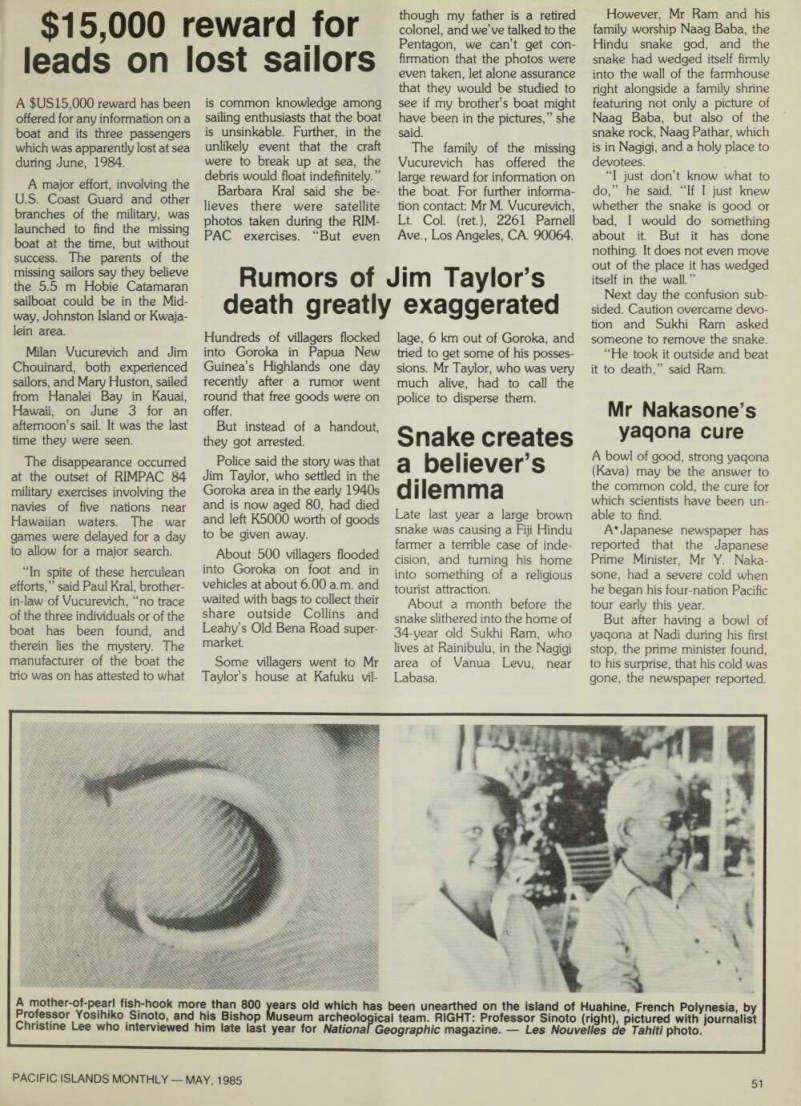
leads on lost sailors
A $ U 515,000 reward has been offered for any information on a boat and its three passengers which was apparently lost at sea during June, 1984.
A major effort, involving the U.S. Coast Guard and other branches of the military, was launched to find the missing boat at the time, but without success. The parents of the missing sailors say they believe the 5.5 m Hobie Catamaran sailboat could be in the Mid way, Johnston Island or Kwaja lein area.
Milan Vucurevich and Jim Chouinard, both experienced sailors, and Mary Huston, sailed from Hanalei Bay in Kauai, Hawaii, on June 3 for an afternoon’s sail. It was the last time they were seen.
The disappearance occurred at the outset of RIMPAC 84 military exercises involving the navies of five nations near Hawaiian waters. The war games were delayed for a day to allow for a major search.
“In spite of these herculean efforts, ” said Paul Krai, brother in-law of Vucurevich, “no trace of the three individuals or of the boat has been found, and therein lies the mystery. The manufacturer of the boat the trio was on has attested to what
is common knowledge among sailing enthusiasts that the boat is unsinkable. Further, in the unlikely event that the craft were to break up at sea, the debris would float indefinitely. ”
Barbara Krai said she be lieves there were satellite photos taken during the RIM PAC exercises. “But even
though my father is a retired colonel, and we’ve talked to the Pentagon, we can’t get con firmation that the photos were even taken, let alone assurance that they would be studied to see if my brother’s boat might have been in the pictures,” she said.
The family of the missing Vucurevich has offered the large reward for information on the boat. For further informa tion contact: Mr M. Vucurevich, Lt. Col. (ret), 2261 Parnell Ave., Los Angeles, CA. 90064.
Rumors of Jim Taylor’s death greatly exaggerated
Hundreds of villagers flocked into Goroka in Papua New Guinea’s Highlands one day recently after a rumor went round that free goods were on offer.
But instead of a handout, they got arrested.
Police said the story was that Jim Taylor, who settled in the Goroka area in the early 1940 s and is now aged 80, had died and left K5OOO worth of goods to be given away.
About 500 villagers flooded into Goroka on foot and in vehicles at about 6.00 a.m. and waited with bags to collect their share outside Collins and Leahy’s Old Bena Road super market.
Some villagers went to Mr Taylor’s house at Kafuku vil
lage, 6 km out of Goroka, and tried to get some of his posses sions. Mr Taylor, who was very much alive, had to call the police to disperse them.
Snake creates
a believer’s
dilemma
Late last year a large brown snake was causing a Fiji Hindu farmer a terrible case of inde cision, and turning his home into something of a religious tourist attraction.
About a month before the snake slithered into the home of 34-year old Sukhi Ram, who lives at Rainibulu, in the Nagigi area of Vanua Levu, near Labasa.
However, Mr Ram and his family worship Naag Baba, the Hindu snake god, and the snake had wedged itself firmly into the wall of the farmhouse right alongside a family shrine featuring not only a picture of Naag Baba, but also of the snake rock, Naag Pathar, which is in Nagigi, and a holy place to devotees.
“I just don’t know what to do,” he said. “If I just knew whether the snake is good or bad, I would do something about it But it has done nothing. It does not even move out of the place it has wedged itself in the wall.”
Next day the confusion sub sided. Caution overcame devo tion and Sukhi Ram asked someone to remove the snake.
“He took it outside and beat it to death,” said Ram.
Mr Nakasone’s
yaqona cure
A bowl of good, strong yaqona (Kava) may be the answer to the common cold, the cure for which scientists have been un able to find.
A* Japanese newspaper has reported that the Japanese Prime Minister, Mr Y. Naka sone, had a severe cold when he began his four-nation Pacific tour early this year.
But after having a bowl of yaqona at Nadi during his first stop, the prime minister found, to his surprise, that his cold was gone, the newspaper reported.
A mother-of-pearl fish-hook more than 800 years old which has been unearthed on the island of Huahine, French Polynesia, by Professor Yosihiko Sinoto, and his Bishop Museum archeological team. RIGHT: Professor Sinoto (right), pictured with journalist Christine Lee who interviewed him late last year for National Geographic magazine. -Les Nouvelles de Tahiti photo.
political currents
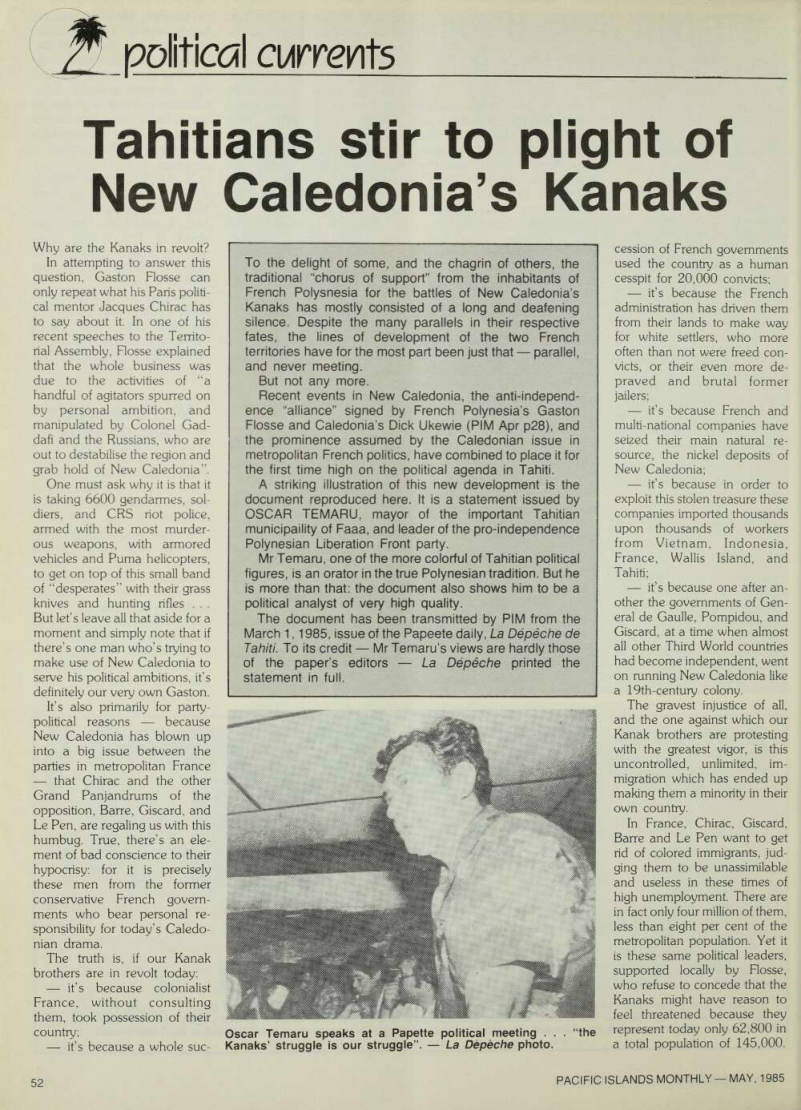
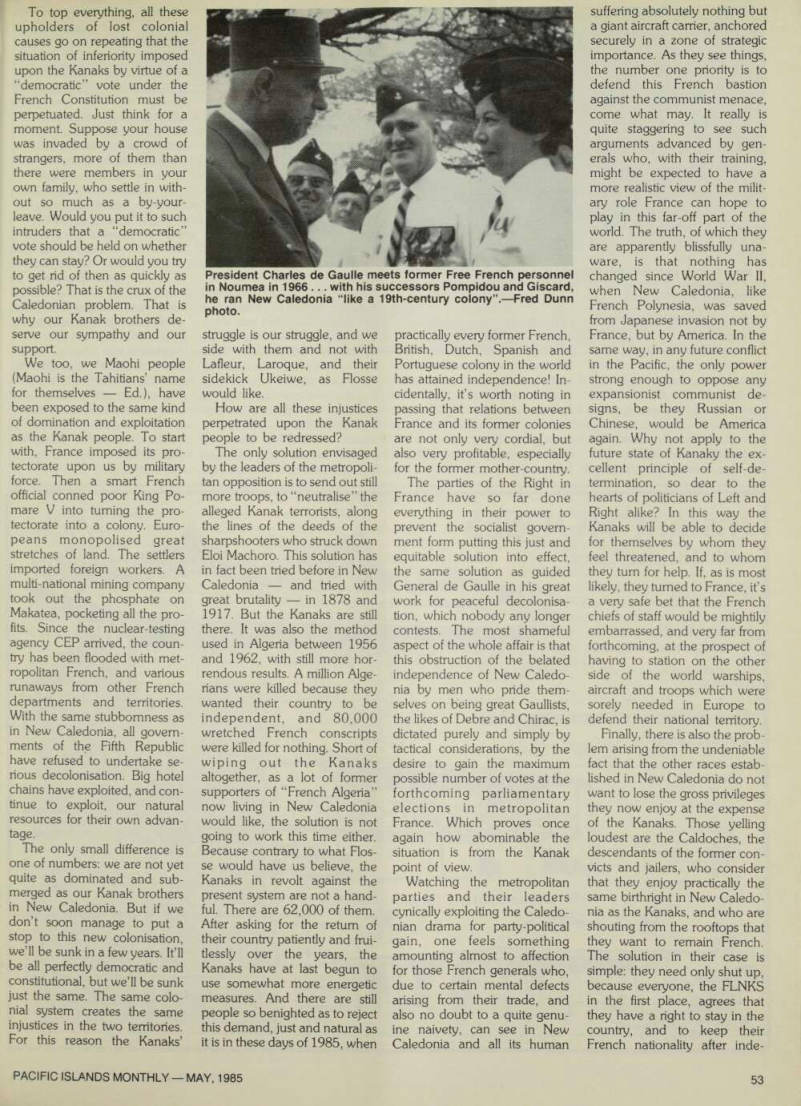
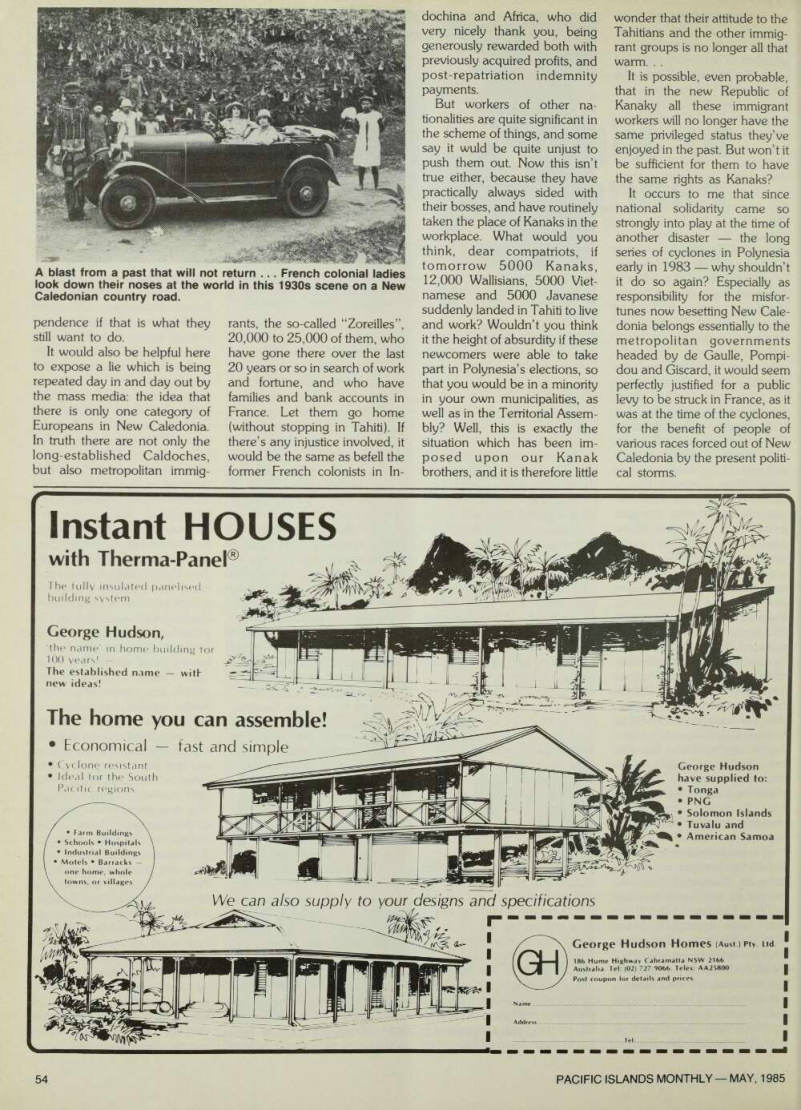
Tahitians stir to plight of New Caledonia’s Kanaks
Why are the Kanaks in revolt?
In attempting to answer this question, Gaston Flosse can only repeat what his Paris politi cal mentor Jacques Chirac has to say about it. In one of his recent speeches to the Territo rial Assembly, Flosse explained that the whole business was due to the activities of “a handful of agitators spurred on by personal ambition, and manipulated by Colonel Gad dafi and the Russians, who are out to destabilise the region and grab hold of New Caledonia”.
One must ask why it is that it is taking 6600 gendarmes, sol diers, and CRS riot police, armed with the most murder ous weapons, with armored vehicles and Puma helicopters, to get on top of this small band of “desperates” with their grass knives and hunting rifles . . .
But let’s leave all that aside for a moment and simply note that if there’s one man who’s trying to make use of New Caledonia to serve his political ambitions, it’s definitely our very own Gaston.
It’s also primarily for party political reasons because New Caledonia has blown up into a big issue between the parties in metropolitan France that Chirac and the other Grand Panjandrums of the opposition, Barre, Giscard, and Le Pen, are regaling us with this humbug. True, there’s an ele ment of bad conscience to their hypocrisy: for it is precisely these men from the former conservative French govern ments who bear personal re sponsibility for today’s Caledo nian drama.
The truth is, if our Kanak brothers are in revolt today: - it’s because colonialist France, without consulting them, took possession of their country; it’s because a whole sue-
To the delight of some, and the chagrin of others, the traditional “chorus of support” from the inhabitants of French Polysnesia for the battles of New Caledonia’s Kanaks has mostly consisted of a long and deafening silence. Despite the many parallels in their respective fates, the lines of development of the two French territories have for the most part been just that parallel, and never meeting.
But not any more.
Recent events in New Caledonia, the anti-independ ence “alliance” signed by French Polynesia’s Gaston Flosse and Caledonia’s Dick Ukewie (PIM Apr p2B), and the prominence assumed by the Caledonian issue in metropolitan French politics, have combined to place it for the first time high on the political agenda in Tahiti.
A striking illustration of this new development is the document reproduced here. It is a statement issued by OSCAR TEMARU, mayor of the important Tahitian municipaility of Faaa, and leader of the pro-independence Polynesian Liberation Front party.
Mr Temaru, one of the more colorful of Tahitian political figures, is an orator in the true Polynesian tradition. But he is more than that: the document also shows him to be a political analyst of very high quality.
The document has been transmitted by PIM from the March 1,1985, issue of the Papeete daily, La Depeche de Tahiti. To its credit Mr Temaru’s views are hardly those of the paper’s editors La Depeche printed the statement in full.
cession of French governments used the country as a human cesspit for 20,000 convicts; it’s because the French administration has driven them from their lands to make way for white settlers, who more often than not were freed con victs, or their even more de praved and brutal former jailers; it’s because French and multi-national companies have seized their main natural re source, the nickel deposits of New Caledonia; it’s because in order to exploit this stolen treasure these companies imported thousands upon thousands of workers from Vietnam, Indonesia, France, Wallis Island, and Tahiti; it’s because one after an other the governments of Gen eral de Gaulle, Pompidou, and Giscard, at a time when almost all other Third World countries had become independent, went on running New Caledonia like a 19th-century colony.
The gravest injustice of all, and the one against which our Kanak brothers are protesting with the greatest vigor, is this uncontrolled, unlimited, im migration which has ended up making them a minority in their own country.
In France, Chirac, Giscard, Barre and Le Pen want to get rid of colored immigrants, jud ging them to be unassimilable and useless in these times of high unemployment. There are in fact only four million of them, less than eight per cent of the metropolitan population. Yet it is these same political leaders, supported locally by Flosse, who refuse to concede that the Kanaks might have reason to feel threatened because they represent today only 62,800 in a total population of 145,000.
Oscar Temaru speaks at a Papette political meeting . . . “the Kanaks’ struggle is our struggle”. -La Dépêche photo.
To top everything, all these upholders of lost colonial causes go on repeating that the situation of inferiority imposed upon the Kanaks by virtue of a “democratic” vote under the French Constitution must be perpetuated. Just think for a moment. Suppose your house was invaded by a crowd of strangers, more of them than there were members in your own family, who settle in with out so much as a by-your leave. Would you put it to such intruders that a “democratic” vote should be held on whether they can stay? Or would you try to get rid of then as quickly as possible? That is the crux of the Caledonian problem. That is why our Kanak brothers de serve our sympathy and our support.
We too, we Maohi people (Maohi is the Tahitians’ name for themselves Ed.), have been exposed to the same kind of domination and exploitation as the Kanak people. To start with, France imposed its pro tectorate upon us by military force. Then a smart French official conned poor King Po mare V into turning the pro tectorate into a colony. Euro peans monopolised great stretches of land. The settlers imported foreign workers. A multi-national mining company took out the phosphate on Makatea, pocketing all the pro fits. Since the nuclear-testing agency CEP arrived, the coun try has been flooded with met ropolitan French, and various runaways from other French departments and territories.
With the same stubbornness as in New Caledonia, all govern ments of the Fifth Republic have refused to undertake se rious decolonisation. Big hotel chains have exploited, and con tinue to exploit, our natural resources for their own advan tage.
The only small difference is one of numbers; we are not yet quite as dominated and sub merged as our Kanak brothers in New Caledonia. But if we don’t soon manage to put a stop to this new colonisation, we’ll be sunk in a few years. It’ll be all perfectly democratic and constitutional, but we’ll be sunk just the same. The same colo nial system creates the same injustices in the two territories.
For this reason the Kanaks’
struggle is our struggle, and we side with them and not with Lafleur, Laroque, and their sidekick Ukeiwe, as Flosse would like.
How are all these injustices perpetrated upon the Kanak people to be redressed?
The only solution envisaged by the leaders of the metropoli tan opposition is to send out still more troops, to “neutralise” the alleged Kanak terrorists, along the lines of the deeds of the sharpshooters who struck down Eloi Machoro. This solution has in fact been tried before in New Caledonia and tried with great brutality in 1878 and 1917. But the Kanaks are still there. It was also the method used in Algeria between 1956 and 1962, with still more hor rendous results. A million Alge rians were killed because they wanted their country to be independent, and 80,000 wretched French conscripts were killed for nothing. Short of wiping out the Kanaks altogether, as a lot of former supporters of “French Algeria” now living in New Caledonia would like, the solution is not going to work this time either.
Because contrary to what Flos se would have us believe, the Kanaks in revolt against the present system are not a hand ful. There are 62,000 of them.
After asking for the return of their country patiently and frui tlessly over the years, the Kanaks have at last begun to use somewhat more energetic measures. And there are still people so benighted as to reject this demand, just and natural as it is in these days of 1985, when
practically every former French, British, Dutch, Spanish and Portuguese colony in the world has attained independence! In cidentally, it’s worth noting in passing that relations between France and its former colonies are not only very cordial, but also very profitable, especially for the former mother-country.
The parties of the Right in France have so far done everything in their power to prevent the socialist govern ment form putting this just and equitable solution into effect, the same solution as guided General de Gaulle in his great work for peaceful decolonisa tion, which nobody any longer contests. The most shameful aspect of the whole affair is that this obstruction of the belated independence of New Caledo nia by men who pride them selves on being great Gaullists, the likes of Debre and Chirac, is dictated purely and simply by tactical considerations, by the desire to gain the maximum possible number of votes at the forthcoming parliamentary elections in metropolitan France. Which proves once again how abominable the situation is from the Kanak point of view.
Watching the metropolitan parties and their leaders cynically exploiting the Caledo nian drama for party-political gain, one feels something amounting almost to affection for those French generals who, due to certain mental defects arising from their trade, and also no doubt to a quite genu ine naivety, can see in New Caledonia and all its human
suffering absolutely nothing but a giant aircraft carrier, anchored securely in a zone of strategic importance. As they see things, the number one priority is to defend this French bastion against the communist menace, come what may. It really is quite staggering to see such arguments advanced by gen erals who, with their training, might be expected to have a more realistic view of the milit ary role France can hope to play in this far-off part of the world. The truth, of which they are apparently blissfully una ware, is that nothing has changed since World War 11, when New Caledonia, like French Polynesia, was saved from Japanese invasion not by France, but by America. In the same way, in any future conflict in the Pacific, the only power strong enough to oppose any expansionist communist de signs, be they Russian or Chinese, would be America again. Why not apply to the future state of Kanaky the ex cellent principle of self-de termination, so dear to the hearts of politicians of Left and Right alike? In this way the Kanaks will be able to decide for themselves by whom they feel threatened, and to whom they turn for help. If, as is most likely, they turned to France, it’s a very safe bet that the French chiefs of staff would be mightily embarrassed, and very far from forthcoming, at the prospect of having to station on the other side of the world warships, aircraft and troops which were sorely needed in Europe to defend their national territory.
Finally, there is also the prob lem arising from the undeniable fact that the other races estab lished in New Caledonia do not want to lose the gross privileges they now enjoy at the expense of the Kanaks. Those yelling loudest are the Caldoches, the descendants of the former con victs and jailers, who consider that they enjoy practically the same birthright in New Caledo nia as the Kanaks, and who are shouting from the rooftops that they want to remain French.
The solution in their case is simple: they need only shut up, because everyone, the FLNKS in the first place, agrees that they have a right to stay in the country, and to keep their French nationality after inde-
President Charles de Gaulle meets former Free French personnel in Noumea in 1966 ... with his successors Pompidou and Giscard, he ran New Caledonia “like a 19th-century colony”. —Fred Dunn photo.
pendence if that is what they still want to do.
It would also be helpful here to expose a lie which is being repeated day in and day out by the mass media: the idea that there is only one category of Europeans in New Caledonia.
In truth there are not only the long-established Caldoches, but also metropolitan immig-
rants, the so-called “Zoreilles”, 20,000 to 25,000 of them, who have gone there over the last 20 years or so in search of work and fortune, and who have families and bank accounts in France. Let them go home (without stopping in Tahiti). If there’s any injustice involved, it would be the same as befell the former French colonists in In
dochina and Africa, who did very nicely thank you, being generously rewarded both with previously acquired profits, and post-repatriation indemnity payments.
But workers of other nationalities are quite significant in the scheme of things, and some say it wuld be quite unjust to push them out. Now this isn’t true either, because they have practically always sided with their bosses, and have routinely taken the place of Kanaks in the workplace. What would you think, dear compatriots, if tomorrow 5000 Kanaks, 12,000 Wallisians, 5000 Vietnamese and 5000 Javanese suddenly landed in Tahiti to live and work? Wouldn’t you think it the height of absurdity if these newcomers were able to take part in Polynesia’s elections, so that you would be in a minority in your own municipalities, as well as in the Territorial Assembly? Well, this is exactly the situation which has been imposed upon our Kanak brothers, and it is therefore little
wonder that their attitude to the Tahitians and the other immig rant groups is no longer all that warm. . .
It is possible, even probable, that in the new Republic of Kanaky all these immigrant workers will no longer have the same privileged status they’ve enjoyed in the past. But won’t it be sufficient for them to have the same rights as Kanaks?
It occurs to me that since national solidarity came so strongly into play at the time of another disaster the long series of cyclones in Polynesia early in 1983 why shouldn’t it do so again? Especially as responsibility for the misfor tunes now besetting New Cale donia belongs essentially to the metropolitan governments headed by de Gaulle, Pompi dou and Giscard, it would seem perfectly justified for a public levy to be struck in France, as it was at the time of the cyclones, for the benefit of people of various races forced out of New Caledonia by the present politi cal storms.
A blast from a past that will not return ... French colonial ladies look down their noses at the world in this 1930s scene on a New Caledonian country road.
Advertisements & other items, p. 54 (1 item)
Instant HOUSES
with Therma-Panel®
K The fully insulated panelised
building system
George Hudson,
the name' in home building for 100 years!
The established name with new ideas! ft LU_
The home you can assemble!
• Economical fast and simple
Cyclone resistant Ideal for the South Pacific regions 1 Farm Buildings • Schools • Hospitals * Industrial Buildings Motels • Barracks one home, whole towns, or villages George Hudson have supplied to: • Tonga
• PNG
• Solomon Islands • Tuvalu and • American Samoa We can also supply to your designs and specifications N I George Hudson Homes (Aust.) pty. Ltd. 186 Hume Highway Cabramatla NSW 2166 Australia Tel: (02) 727 9066 Telex: AA25800 Post coupon for details and prices.
Pacific stamp box
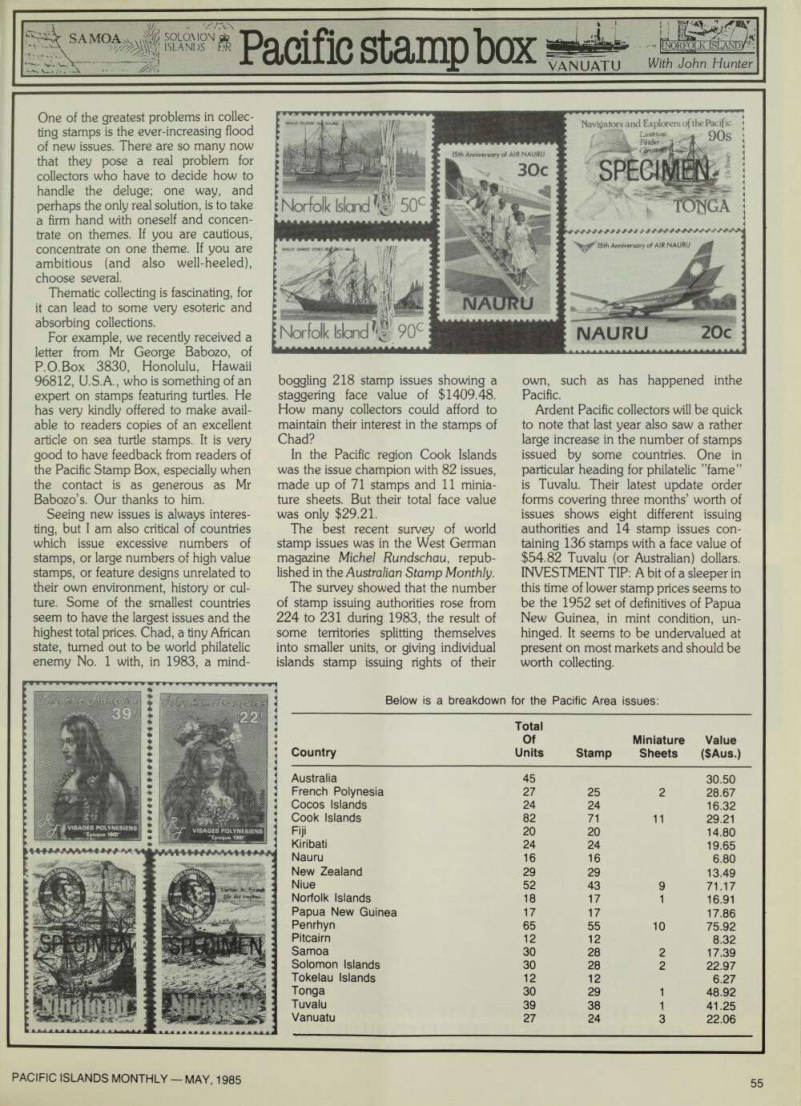
One of the greatest problems in collec ting stamps is the ever-increasing flood of new issues. There are so many now that they pose a real problem for collectors who have to decide how to handle the deluge; one way, and perhaps the only real solution, is to take a firm hand with oneself and concen trate on themes. If you are cautious, concentrate on one theme. If you are ambitious (and also well-heeled), choose several.
Thematic collecting is fascinating, for it can lead to some very esoteric and absorbing collections.
For example, we recently received a letter from Mr George Babozo, of P.0.80x 3830, Honolulu, Hawaii 96812, U.S.A., who is something of an expert on stamps featuring turtles. He has very kindly offered to make avail able to readers copies of an excellent article on sea turtle stamps. It is very good to have feedback from readers of the Pacific Stamp Box, especially when the contact is as generous as Mr Babozo’s. Our thanks to him.
Seeing new issues is always interes ting, but I am also critical of countries which issue excessive numbers of stamps, or large numbers of high value stamps, or feature designs unrelated to their own environment, history or cul ture. Some of the smallest countries seem to have the largest issues and the highest total prices. Chad, a tiny African state, turned out to be world philatelic enemy No. 1 with, in 1983, a mind-
boggling 218 stamp issues showing a staggering face value of $1409.48.
How many collectors could afford to maintain their interest in the stamps of Chad?
In the Pacific region Cook Islands was the issue champion with 82 issues, made up of 71 stamps and 11 minia ture sheets. But their total face value was only $29.21.
The best recent survey of world stamp issues was in the West German magazine Michel Rundschau, repub lished in the Australian Stamp Monthly.
The survey showed that the number of stamp issuing authorities rose from 224 to 231 during 1983, the result of some territories splitting themselves into smaller units, or giving individual islands stamp issuing rights of their
own, such as has happened inthe Pacific.
Ardent Pacific collectors will be quick to note that last year also saw a rather large increase in the number of stamps issued by some countries. One in particular heading for philatelic ’’fame” is Tuvalu. Their latest update order forms covering three months’ worth of issues shows eight different issuing authorities and 14 stamp issues con taining 136 stamps with a face value of $54.82 Tuvalu (or Australian) dollars.
INVESTMENT TIP: A bit of a sleeper in this time of lower stamp prices seems to be the 1952 set of definitives of Papua New Guinea, in mint condition, un hinged. It seems to be undervalued at present on most markets and should be worth collecting.
Below is a breakdown for the Pacific Area issues:
Country Total Of Units Stamp Miniature Sheets Value ($Aus.) Australia 45 30.50 French Polynesia 27 25 2 28.67 Cocos Islands 24 24 16.32 Cook Islands 82 71 11 29.21 Fiji 20 20 14.80 Kiribati 24 24 19.65 Nauru 16 16 6.80 New Zealand 29 29 13.49 Niue 52 43 9 71.17 Norfolk Islands 18 17 1 16.91 Papua New Guinea 17 17 17.86 Penrhyn 65 55 10 75.92 Pitcairn 12 12 8.32 Samoa 30 28 2 17.39 Solomon Islands 30 28 2 22.97 Tokelau Islands 12 12 6.27 Tonga 30 29 1 48.92 Tuvalu 39 38 1 41.25 Vanuatu 27 24 3 22.06
Advertisements & other items, pp. 56-57 (2 items)
Europe-South Pacific Joint Service
The South Pacific Specialists offer facilities for shipment of: Containers (FCL/LCL) and Breakbulk Cargo plus reefer space and deeptanks for carriage of vegetable oils and other liquid bulk cargo.
Carriers also accept heavy lifts, overlength and cumbersome parcels.
Ports of Service: Please contact our regional offices for Loading; Papeete, Apia, Suva, further information: Lautoka, Noumea, Port Vila, Santo, The Bank Line (Australasia) Pty. Ltd.
Honiara, Port Moresby, Lae, Madang, Suite 801,51 Pitt Street Kimbe, Rabaul, Kieta, Darwin. Sydney N.SW. 2000 For: Rotterdam, Antwerp, Phone: 272041 Telex: 24063 Hamburg, Hull, Dunkirk, Le Havre.
Additional ports on enquiry.
- ROUND THE WORLD SERVICE -
Columbus Line Reederei GmbH P.O. Box 1667 Lae/Papua New Guinea Phone: 42 3466/42 3287.5 A.H. 42 2481 Telex: Colline NE 44 171
I THE BANK LINE LTD LONDON
COLUMBUS LINE REEDEREI GMBH HAMBURG
C0L1433
Air Melanesiae
57
PACIFIC ISLANDS MONTHLY MAY, 1985
Air Melanesiae Continued from page 46
yach ts
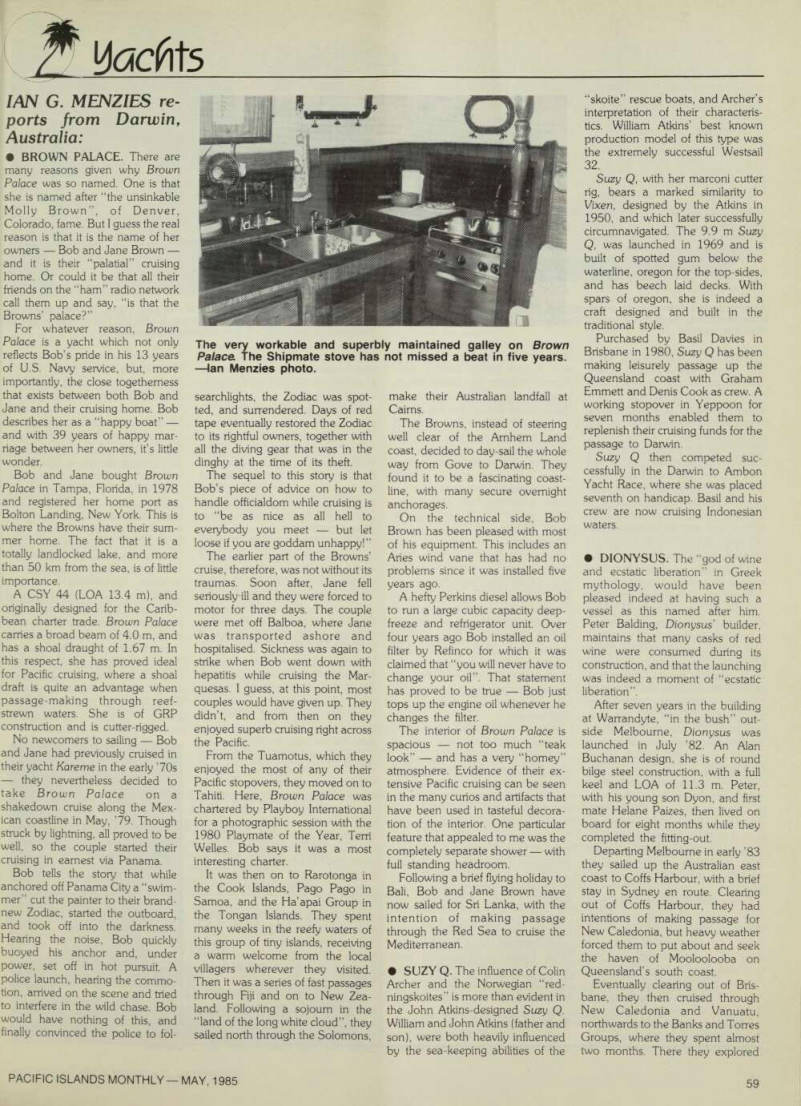
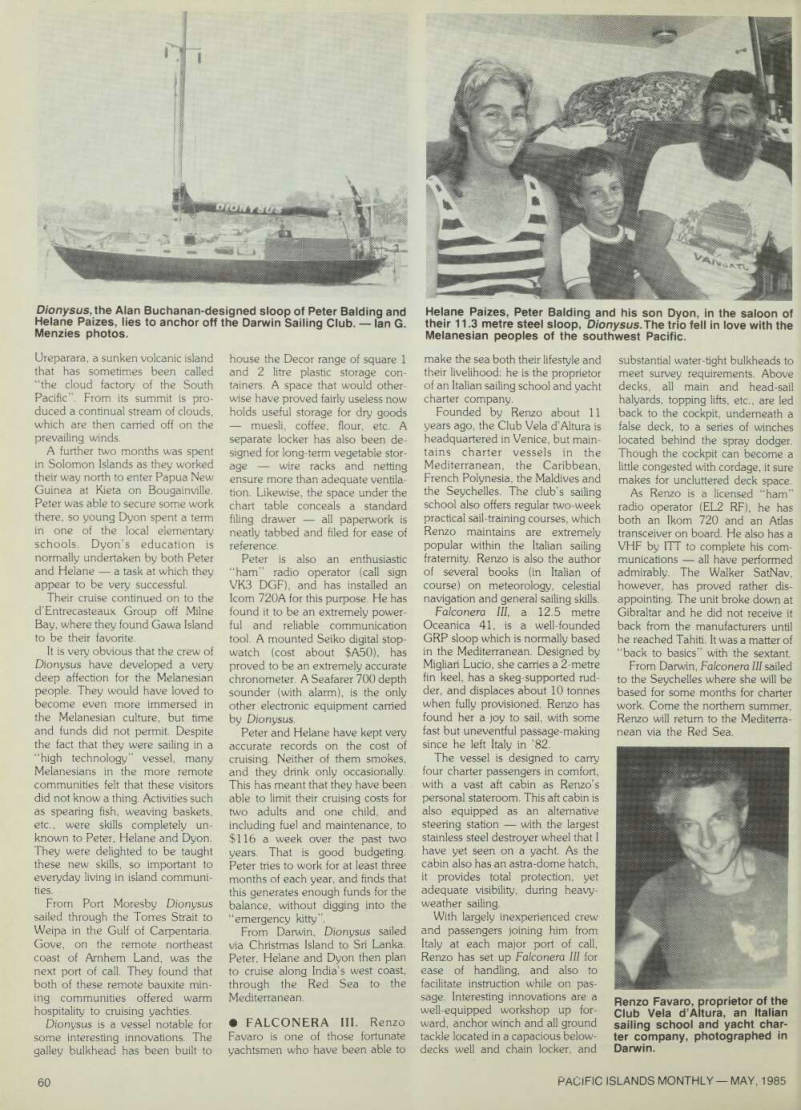
Lan G. Menzies Re
ports from Darwin,
Australia:
• BROWN PALACE. There are many reasons given why Brown Palace was so named. One is that she is named after “the unsinkable Molly Brown”, of Denver, Colorado, fame. But I guess the real reason is that it is the name of her owners Bob and Jane Brown and it is their “palatial” cruising home. Or could it be that all their friends on the “ham” radio network call them up and say, “is that the Browns’ palace?”
For whatever reason, Brown Palace is a yacht which not only reflects Bob’s pride in his 13 years of U.S. Navy service, but, more importantly, the close togetherness that exists between both Bob and Jane and their cruising home. Bob describes her as a “happy boat” and with 39 years of happy mar riage between her owners, it’s little wonder.
Bob and Jane bought Brown Palace in Tampa, Florida, in 1978 and registered her home port as Bolton Landing, New York. This is where the Browns have their sum mer home. The fact that it is a totally landlocked lake, and more than 50 km from the sea, is of little importance.
A CSY 44 (LOA 13.4 m), and originally designed for the Carib bean charter trade. Brown Palace carries a broad beam of 4.0 m, and has a shoal draught of 1.67 m. In this respect, she has proved ideal for Pacific cruising, where a shoal draft is quite an advantage when passage-making through reef strewn waters. She is of GRP construction and is cutter-rigged.
No newcomers to sailing Bob and Jane had previously cruised in their yacht Kareme in the early ’7os they nevertheless decided to take Brown Palace on a shakedown cruise along the Mex ican coastline in May, ’79. Though struck by lightning, all proved to be well, so the couple started their cruising in earnest via Panama.
Bob tells the story that while anchored off Panama City a “swim mer” cut the painter to their brand new Zodiac, started the outboard, and took off into the darkness.
Hearing the noise, Bob quickly buoyed his anchor and, under power, set off in hot pursuit. A police launch, hearing the commo tion, arrived on the scene and tried to interfere in the wild chase. Bob would have nothing of this, and finally convinced the police to fol-
searchlights, the Zodiac was spot ted, and surrendered. Days of red tape eventually restored the Zodiac to its rightful owners, together with all the diving gear that was in the dinghy at the time of its theft.
The sequel to this story is that Bob’s piece of advice on how to handle officialdom while cruising is to “be as nice as all hell to everybody you meet but let loose if you are goddam unhappy!”
The earlier part of the Browns’ cruise, therefore, was not without its traumas. Soon after, Jane fell seriously ill and they were forced to motor for three days. The couple were met off Balboa, where Jane was transported ashore and hospitalised. Sickness was again to strike when Bob went down with hepatitis while cruising the Mar quesas. I guess, at this point, most couples would have given up. They didn’t, and from then on they enjoyed superb cruising right across the Pacific.
From the Tuamotus, which they enjoyed the most of any of their Pacific stopovers, they moved on to Tahiti. Here, Brown Palace was chartered by Playboy International for a photographic session with the 1980 Playmate of the Year, Terri Welles. Bob says it was a most interesting charter.
It was then on to Rarotonga in the Cook Islands, Pago Pago in Samoa, and the Ha’apai Group in the Tongan Islands. They spent many weeks in the reefy waters of this group of tiny islands, receiving a warm welcome from the local villagers wherever they visited.
Then it was a series of fast passages through Fiji and on to New Zea land. Following a sojourn in the “land of the long white cloud”, they sailed north through the Solomons,
make their Australian landfall at Caims.
The Browns, instead of steering well clear of the Amhem Land coast, decided to day-sail the whole way from Gove to Darwin. They found it to be a fascinating coast line, with many secure overnight anchorages.
On the technical side, Bob Brown has been pleased with most of his equipment. This includes an Aries wind vane that has had no problems since it was installed five years ago.
A hefty Perkins diesel allows Bob to run a large cubic capacity deep freeze and refrigerator unit. Over four years ago Bob installed an oil filter by Refinco for which it was claimed that “you will never have to change your oil”. That statement has proved to be true Bob just tops up the engine oil whenever he changes the filter.
The interior of Brown Palace is spacious not too much “teak look” and has a very “homey” atmosphere. Evidence of their ex tensive Pacific cruising can be seen in the many curios and artifacts that have been used in tasteful decora tion of the interior. One particular feature that appealed to me was the completely separate shower with full standing headroom.
Following a brief flying holiday to Bali, Bob and Jane Brown have now sailed for Sri Lanka, with the intention of making passage through the Red Sea to cruise the Mediterranean. • SUZY Q. The influence of Colin Archer and the Norwegian “red ningskoites” is more than evident in the John Atkins-designed Suzy Q.
William and John Atkins (father and son), were both heavily influenced by the sea-keeping abilities of the
“skoite” rescue boats, and Archer’s interpretation of their characteris tics. William Atkins’ best known production model of this type was the extremely successful Westsail 32.
Suzy Q, with her marconi cutter rig, bears a marked similarity to Vixen, designed by the Atkins in 1950, and which later successfully circumnavigated. The 9.9 m Suzy Q, was launched in 1969 and is built of spotted gum below the waterline, Oregon for the top-sides, and has beech laid decks. With spars of Oregon, she is indeed a craft designed and built in the traditional style.
Purchased by Basil Davies in Brisbane in 1980, Suzy Q has been making leisurely passage up the Queensland coast with Graham Emmett and Denis Cook as crew. A working stopover in Yeppoon for seven months enabled them to replenish their cruising funds for the passage to Darwin.
Suzy Q then competed suc cessfully in the Darwin to Ambon Yacht Race, where she was placed seventh on handicap. Basil and his crew are now cruising Indonesian waters. • DIONYSUS. The “god of wine and ecstatic liberation” in Greek mythology, would have been pleased indeed at having such a vessel as this named after him.
Peter Balding, Dionysus’ builder, maintains that many casks of red wine were consumed during its construction, and that the launching was indeed a moment of “ecstatic liberation”.
After seven years in the building at Warrandyte, “in the bush” out side Melbourne, Dionysus was launched in July ’B2. An Alan Buchanan design, she is of round bilge steel construction, with a full keel and LOA of 11.3 m. Peter, with his young son Dyon, and first mate Helane Paizes, then lived on board for eight months while they completed the fitting-out.
Departing Melbourne in early ’B3 they sailed up the Australian east coast to Goffs Harbour, with a brief stay in Sydney en route. Clearing out of Goffs Harbour, they had intentions of making passage for New Caledonia, but heavy weather forced them to put about and seek the haven of Mooloolooba on Queensland’s south coast.
Eventually clearing out of Bris bane, they then cruised through New Caledonia and Vanuatu, northwards to the Banks and Torres Groups, where they spent almost two months. There they explored
The very workable and superbly maintained galley on Brown Palace. The Shipmate stove has not missed a beat in five years. —lan Menzies photo.
Ureparara, a sunken volcanic island that has sometimes been called “the cloud factory of the South Pacific”. From its summit is pro duced a continual stream of clouds, which are then carried off on the prevailing winds.
A further two months was spent in Solomon Islands as they worked their way north to enter Papua New Guinea at Kieta on Bougainville.
Peter was able to secure some work there, so young Dyon spent a term in one of the local elementary schools. Dyon’s education is normally undertaken by both Peter and Helane a task at which they appear to be very successful.
Their cruise continued on to the d’Entrecasteaux Group off Milne Bay, where they found Gawa Island to be their favorite.
It is very obvious that the crew of Dionysus have developed a very deep affection for the Melanesian people. They would have loved to become even more immersed in the Melanesian culture, but time and funds did not permit. Despite the fact that they were sailing in a “high technology” vessel, many Melanesians in the more remote communities felt that these visitors did not know a thing. Activities such as spearing fish, weaving baskets, etc., were skills completely un known to Peter, Helane and Dyon.
They were delighted to be taught these new skills, so important to everyday living in island communi ties.
From Port Moresby Dionysus sailed through the Torres Strait to Weipa in the Gulf of Carpentaria.
Gove, on the remote northeast coast of Arnhem Land, was the next port of call. They found that both of these remote bauxite min ing communities offered warm hospitality to cruising yachties.
Dionysus is a vessel notable for some interesting innovations. The galley bulkhead has been built to
house the Decor range of square 1 and 2 litre plastic storage con tainers. A space that would other wise have proved fairly useless now holds useful storage for dry goods muesli, coffee, flour, etc. A separate locker has also been de signed for long-term vegetable stor age wire racks and netting ensure more than adequate ventila tion. Likewise, the space under the chart table conceals a standard filing drawer all paperwork is neatly tabbed and filed for ease of reference.
Peter is also an enthusiastic “ham” radio operator (call sign VK3 DGF), and has installed an Icom 720 A for this purpose. He has found it to be an extremely power ful and reliable communication tool. A mounted Seiko digital stop watch (cost about SASO), has proved to be an extremely accurate chronometer. A Seafarer 700 depth sounder (with alarm), is the only other electronic equipment carried by Dionysus.
Peter and Helane have kept very accurate records on the cost of cruising. Neither of them smokes, and they drink only occasionally.
This has meant that they have been able to limit their cruising costs for two adults and one child, and including fuel and maintenance, to $ll6 a week over the past two years. That is good budgeting.
Peter tries to work for at least three months of each year, and finds that this generates enough funds for the balance, without digging into the “emergency kitty”.
From Darwin, Dionysus sailed via Christmas Island to Sri Lanka.
Peter, Helane and Dyon then plan to cruise along India’s west coast, through the Red Sea to the Mediterranean.
• Falconera 111. Renzo
Favaro is one of those fortunate yachtsmen who have been able to
make the sea both their lifestyle and their livelihood: he is the proprietor of an Italian sailing school and yacht charter company.
Founded by Renzo about 11 years ago, the Club Vela d’Altura is headquartered in Venice, but main tains charter vessels in the Mediterranean, the Caribbean, French Polynesia, the Maldives and the Seychelles. The club’s sailing school also offers regular two-week practical sail-training courses, which Renzo maintains are extremely popular within the Italian sailing fraternity. Renzo is also the author of several books (in Italian of course) on meteorology, celestial navigation and general sailing skills.
Falconera 111, a 12.5 metre Oceanica 41, is a well-founded GRP sloop which is normally based in the Mediterranean. Designed by Migliari Lucio, she carries a 2-metre fin keel, has a skeg-supported rud der, and displaces about 10 tonnes when fully provisioned. Renzo has found her a joy to sail, with some fast but uneventful passage-making since he left Italy in ’B2.
The vessel is designed to carry four charter passengers in comfort, with a vast aft cabin as Renzo’s personal stateroom. This aft cabin is also equipped as an alternative steering station with the largest stainless steel destroyer wheel that I have yet seen on a yacht. As the cabin also has an astra-dome hatch, it provides total protection, yet adequate visibility, during heavy weather sailing.
With largely inexperienced crew and passengers joining him from Italy at each major port of call, Renzo has set up Falconera 111 for ease of handling, and also to facilitate instruction while on pas sage. Interesting innovations are a well-equipped workshop up for ward, anchor winch and all ground tackle located in a capacious below decks well and chain locker, and
substantial water-tight bulkheads to meet survey requirements. Above decks, all main and head-sail halyards, topping lifts, etc., are led back to the cockpit, underneath a false deck, to a series of winches located behind the spray dodger.
Though the cockpit can become a little congested with cordage, it sure makes for uncluttered deck space.
As Renzo is a licensed “ham” radio operator (EL2 RF), he has both an Ikom 720 and an Atlas transceiver on board. He also has a VHF by ITT to complete his com munications all have performed admirably. The Walker SatNav, however, has proved rather dis appointing. The unit broke down at Gibraltar and he did not receive it back from the manufacturers until he reached Tahiti. It was a matter of “back to basics” with the sextant.
From Darwin, Falconera 111 sailed to the Seychelles where she will be based for some months for charter work. Come the northern summer, Renzo will return to the Mediterra nean via the Red Sea.
Dionysus, the Alan Buchanan-designed sloop of Peter Balding and Helane Paizes, lies to anchor off the Darwin Sailing Club.-lan G.
Menzies photos.
Helane Raizes, Peter Balding and his son Dyon, in the saloon of their 11.3 metre steel sloop, Dionysus. The trio fell in love with the Melanesian peoples of the southwest Pacific.
Renzo Favaro, proprietor of the Club Vela d’Altura, an Italian sailing school and yacht char ter company, photographed in Darwin.
shipping schedules
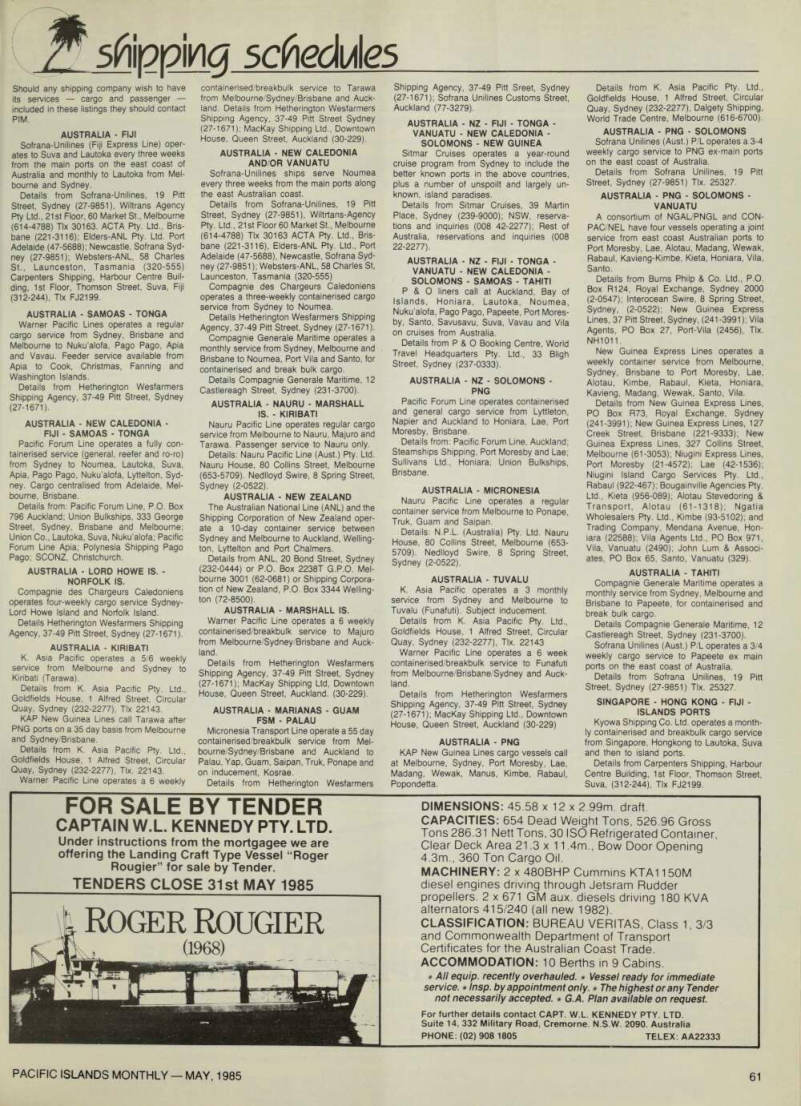
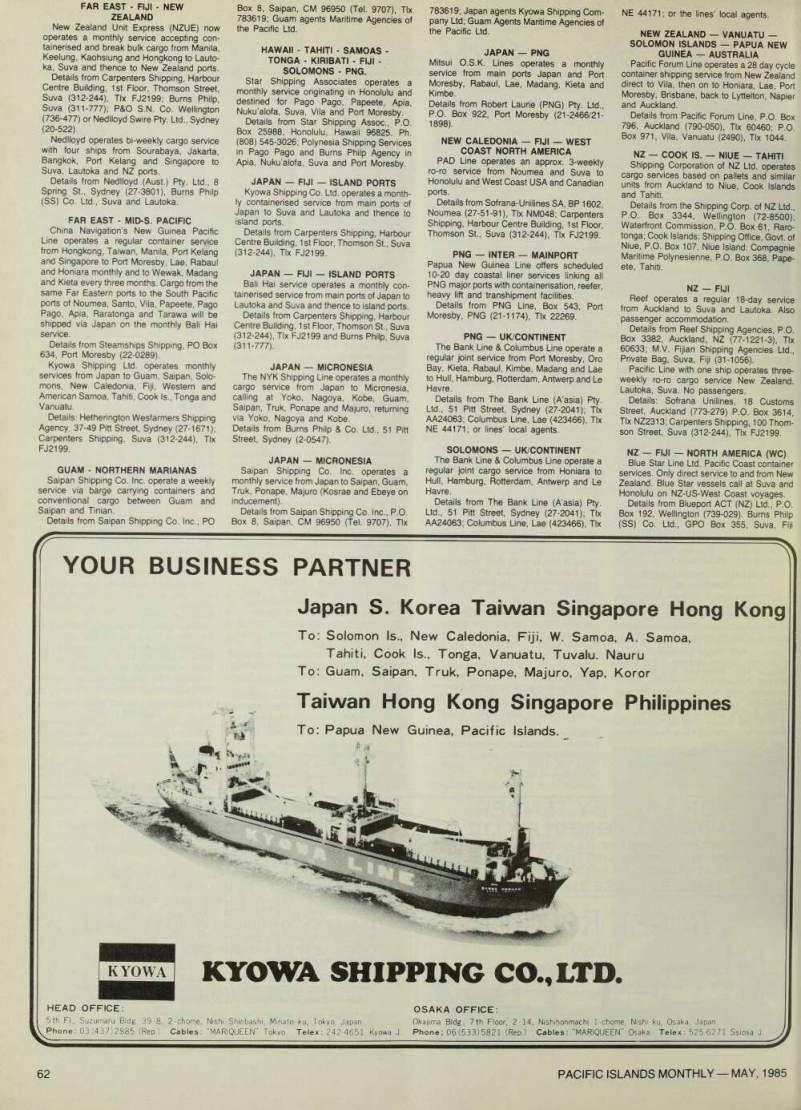
Should any shipping company wish to have its services cargo and passenger included in these listings they should contact
Pim.
Australia - Fiji
Sofrana-Unilines (Fiji Express Line) oper ates to Suva and Lautoka every three weeks from the main ports on the east coast of Australia and monthly to Lautoka from Mel bourne and Sydney.
Details from Sofrana-Unilines, 19 Pitt Street, Sydney (27-9851), Wiltrans Agency Pty Ltd., 21st Floor, 60 Market St., Melbourne (614-4788) Tlx 30163. ACTA Pty. Ltd., Bris bane (221-3116); Elders-ANL Pty. Ltd. Port Adelaide (47-5688); Newcastle, Sofrana Syd ney (27-9851); Websters-ANL, 58 Charles St., Launceston, Tasmania (320-555) Carpenters Shipping, Harbour Centre Buil ding, Ist Floor, Thomson Street, Suva, Fiji (312-244), Tlx FJ2199.
Australia - Samoas - Tonga
Warner Pacific Lines operates a regular cargo service from Sydney, Brisbane and Melbourne to Nukualofa, Pago Pago, Apia and Vavau. Feeder service available from Apia to Cook, Christmas, Fanning and Washington Islands.
Details from Hetherington Wesfarmers Shipping Agency, 37-49 Pitt Street, Sydney (27-1671).
Australia - New Caledonia -
Fiji - Samoas - Tonga
Pacific Forum Line operates a fully con tainerised service (general, reefer and ro-ro) from Sydney to Noumea, Lautoka, Suva, Apia, Pago Pago, Nukualofa, Lyttelton, Syd ney. Cargo centralised from Adelaide, Mel bourne, Brisbane.
Details from: Pacific Forum Line, P.O. Box 796 Auckland; Union Bulkships, 333 George Street, Sydney, Brisbane and Melbourne; Union Co., Lautoka, Suva, Nuku’alofa; Pacific Forum Line Apia; Polynesia Shipping Pago Pago; SCONZ, Christchurch.
Australia - Lord Howe Is. -
Norfolk Is.
Compagnie des Chargeurs Caledoniens
operates four-weekly cargo service Sydney- Lord Howe Island and Norfolk Island.
Details Hetherington Wesfarmers Shipping
Agency, 37-49 Pitt Street, Sydney (27-1671).
Australia - Kiribati
K. Asia Pacific operates a 5/6 weekly service from Melbourne and Sydney to Kiribati (Tarawa).
Details from K. Asia Pacific Pty. Ltd., Goldfields House, 1 Alfred Street, Circular Quay, Sydney (232-2277), Tlx 22143.
KAP New Guinea Lines call Tarawa after PNG ports on a 35 day basis from Melbourne
and Sydney/Brisbane.
Details from K. Asia Pacific Pty. Ltd., Goldfields House, 1 Alfred Street, Circular Quay, Sydney (232-2277), Tlx. 22143.
Warner Pacific Line operates a 6 weekly
containerised/breakbulk service to Tarawa from Melbourne/Sydney/Brisbane and Auck land. Details from Hetherington Wesfarmers Shipping Agency, 37-49 Pitt Street Sydney (27-1671); Mac Kay Shipping Ltd., Downtown House, Queen Street, Auckland (30-229).
Australia - New Caledonia
And/Or Vanuatu
Sofrana-Unilines ships serve Noumea every three weeks from the main ports along the east Australian coast.
Details from Sofrana-Unilines, 19 Pitt Street, Sydney (27-9851), Wiltrtans-Agency Pty. Ltd., 21st Floor 60 Market St., Melbourne (614-4788) Tlx 30163 ACTA Pty. Ltd., Bris bane (221-3116), Elders-ANL Pty. Ltd., Port Adelaide (47-5688), Newcastle, Sofrana Syd ney (27-9851); Websters-ANL, 58 Charles St, Launceston, Tasmania (320-555) Compagnie des Chargeurs Caledoniens operates a three-weekly containerised cargo service from Sydney to Noumea.
Details Hetherington Wesfarmers Shipping Agency, 37-49 Pitt Street, Sydney (27-1671).
Compagnie Generate Maritime operates a monthly service from Sydney, Melbourne and Brisbane to Noumea, Port Vila and Santo, for containerised and break bulk cargo.
Details Compagnie Generate Maritime, 12 Castlereagh Street, Sydney (231-3700).
Australia - Nauru - Marshall
Is. - Kiribati
Nauru Pacific Line operates regular cargo service from Melbourne to Nauru, Majuro and Tarawa. Passenger service to Nauru only.
Details: Nauru Pacific Line (Aust.) Pty. Ltd.
Nauru House, 80 Collins Street, Melbourne (653-5709). Nedlloyd Swire, 8 Spring Street,
Sydney (2-0522).
Australia - New Zealand
The Australian National Line (ANL) and the Shipping Corporation of New Zealand oper ate a 10-day container service between Sydney and Melbourne to Auckland, Welling ton, Lyttelton and Port Chalmers.
Details from ANL, 20 Bond Street, Sydney (232-0444) or P.O. Box 2238 T G.P.O. Mel bourne 3001 (62-0681) or Shipping Corpora tion of New Zealand, P.O. Box 3344 Welling
ton (72-8500).
Australia - Marshall Is.
Warner Pacific Line operates a 6 weekly containerised/breakbulk service to Majuro from Melbourne/Sydney/Brisbane and Auck land.
Details from Hetherington Wesfarmers Shipping Agency, 37-49 Pitt Street, Sydney (27-1671); Mac Kay Shipping Ltd, Downtown House, Queen Street, Auckland. (30-229).
Australia - Marianas - Guam
Fsm - Palau
Micronesia Transport Line operate a 55 day containerised/breakbulk service from Mel bourne/Sydney/Brisbane and Auckland to Palau. Yap, Guam, Saipan, Truk, Ponape and on inducement, Kosrae.
Details from Hetherington Wesfarmers
Shipping Agency, 37-49 Pitt Sreet, Sydney (27-1671); Sofrana Unilines Customs Street, Auckland (77-3279).
AUSTRALIA - NZ - FIJI - TONGA -
Vanuatu - New Caledonia -
Solomons - New Guinea
Sitmar Cruises operates a year-round cruise program from Sydney to include the better known ports in the above countries, plus a number of unspoilt and largely un known, island paradises.
Details from Sitmar Cruises, 39 Martin Place, Sydney (239-9000); NSW, reserva tions and inquiries (008 42-2277); Rest of Australia, reservations and inquiries (008 22-2277).
AUSTRALIA - NZ - FIJI - TONGA -
Vanuatu - New Caledonia -
Solomons - Samoas - Tahiti
P & O liners call at Auckland, Bay of Islands, Honiara, Lautoka, Noumea, Nukualofa, Pago Pago, Papeete, Port Mores by, Santo, Savusavu, Suva, Vavau and Vila on cruises from Australia.
Details from P & O Booking Centre, World Travel Headquarters Pty. Ltd., 33 Bligh Street, Sydney (237-0333).
Australia - Nz - Solomons -
Png
Pacific Forum Line operates containerised and general cargo service from Lyttleton, Napier and Auckland to Honiara, Lae, Port Moresby, Brisbane.
Details from: Pacific Forum Line, Auckland; Steamships Shipping, Port Moresby and Lae: Sullivans Ltd., Honiara; Union Bulkships, Brisbane.
Australia - Micronesia
Nauru Pacific Line operates a regular container service from Melbourne to Ponape, Truk, Guam and Saipan.
Details: N.P.L. (Australia) Pty. Ltd. Nauru House, 80 Collins Street, Melbourne (653- 5709). Nedlloyd Swire, 8 Spring Street,
Sydney (2-0522).
Australia - Tuvalu
K. Asia Pacific operates a 3 monthly service from Sydney and Melbourne to Tuvalu (Funafuti). Subject inducement.
Details from K. Asia Pacific Pty. Ltd., Goldfields House. 1 Alfred Street, Circular Quay, Sydney (232-2277), Tlx. 22143 Warner Pacific Line operates a 6 week containerised/breakbulk service to Funafuti from Melbourne/Brisbane/Sydney and Auck land.
Details from Hetherington Wesfarmers
Shipping Agency, 37-49 Pitt Street, Sydney
(27-1671); Mac Kay Shipping Ltd., Downtown House, Queen Street, Auckland (30-229)
Australia - Png
KAP New Guinea Lines cargo vessels call at Melbourne, Sydney, Port Moresby, Lae, Madang, Wewak, Manus, Kimbe, Rabaul, Popondetta.
Details from K. Asia Pacific Pty. Ltd., Goldfields House, 1 Alfred Street, Circular Quay, Sydney (232-2277), Dalgety Shipping, World Trade Centre, Melbourne (616-6700).
Australia - Png - Solomons
Sofrana Unilines (Aust.) P/L operates a 3-4 weekly cargo service to PNG ex-main ports on the east coast of Australia.
Details from Sofrana Unilines, 19 Pitt Street, Sydney (27-9851) Tlx. 25327.
Australia - Png - Solomons -
Vanuatu
A consortium of NGAL7PNGL and CON PAC/NEL have four vessels operating a joint service from east coast Australian ports to Port Moresby, Lae, Alotau, Madang, Wewak, Rabaul, Kavieng-Kimbe, Kieta, Honiara, Vila, Santo.
Details from Burns Philp & Co. Ltd., P.O.
Box R 124, Royal Exchange, Sydney 2000 (2-0547); Interocean Swire, 8 Spring Street, Sydney, (2-0522); New Guinea Express Lines, 37 Pitt Street, Sydney, (241-3991); Vila Agents, PO Box 27, Port-Vila (2456), Tlx.
Nhioii.
New Guinea Express Lines operates a weekly container service from Melbourne, Sydney, Brisbane to Port Moresby, Lae.
Alotau, Kimbe, Rabaul, Kieta, Honiara, Kavieng, Madang, Wewak, Santo, Vila.
Details from New Guinea Express Lines, PO Box R 73, Royal Exchange, Sydney (241-3991); New Guinea Express Lines, 127 Creek Street, Brisbane (221-9333); New Guinea Express Lines, 327 Collins Street, Melbourne (61-3053); Niugini Express Lines, Port Moresby (21-4572); Lae (42-1536); Niugini Island Cargo Services Pty. Ltd., Rabaul (922-467); Bougainville Agencies Pty.
Ltd., Kieta (956-089); Alotau Stevedoring & Transport, Alotau (61-1318); Ngatia Wholesalers Pty. Ltd., Kimbe (93-5102); and Trading Company, Mendana Avenue, Hon iara (22588); Vila Agents Ltd., PO Box 971, Vila, Vanuatu (2490); John Lum & Associ ates, PO Box 65, Santo, Vanuatu (329).
Australia - Tahiti
Compagnie Generate Maritime operates a monthly service from Sydney, Melbourne and Brisbane to Papeete, for containerised and break bulk cargo.
Details Compagnie Generate Maritime, 12 Castlereagh Street, Sydney (231-3700).
Sofrana Unilines (Aust.) P/L operates a 3/4 weekly cargo service to Papeete ex main ports on the east coast of Australia.
Details from Sofrana Unilines, 19 Pitt Street, Sydney (27-9851) Tlx. 25327.
SINGAPORE - HONG KONG - FIJI -
Islands Ports
Kyowa Shipping Co. Ltd. operates a month ly containerised and breakbulk cargo service from Singapore, Hongkong to Lautoka, Suva and then to island ports.
Details from Carpenters Shipping, Harbour Centre Building, Ist Floor, Thomson Street, Suva, (312-244), Tlx FJ2199.
Far East - Fiji - New
Zealand
New Zealand Unit Express (NZUE) now operates a monthly service accepting con tainerised and break bulk cargo from Manila, Keelung, Kaohsiung and Hongkong to Lauto ka, Suva and thence to New Zealand ports.
Details from Carpenters Shipping, Harbour Centre Building, Ist Floor, Thomson Street, Suva (312-244), Tlx FJ2199; Burns Philp.
Suva (311-777); P&O S.N. Co. Wellington (736-477) or Nedlloyd Swire Pty. Ltd., Sydney (20-522).
Nedlloyd operates bi-weekly cargo service with four ships from Sourabaya, Jakarta, Bangkok, Port Kelang and Singapore to Suva, Lautoka and NZ ports.
Details from Nedlloyd (Aust.) Pty. Ltd., 8 Spring St.. Sydney (27-3801), Burns Philp (SS) Co. Ltd., Suva and Lautoka.
Far East - Mid-S. Pacific
China Navigation’s New Guinea Pacific Line operates a regular container service from Hongkong, Taiwan, Manila, Port Kelang and Singapore to Port Moresby. Lae, Rabaul and Honiara monthly and to Wewak, Madang and Kieta every three months. Cargo from the same Far Eastern ports to the South Pacific ports of Noumea, Santo, Vila. Papeete, Pago Pago, Apia, Raratonga and Tarawa will be shipped via Japan on the monthly Bali Hai service.
Details from Steamships Shipping, PO Box 634, Port Moresby (22-0289).
Kyowa Shipping Ltd. operates monthly services from Japan to Guam, Saipan, Solo mons, New Caledonia, Fiji, Western and American Samoa, Tahiti, Cook Is., Tonga and Vanuatu.
Details: Hetherington Wesfarmers Shipping Agency, 37-49 Pitt Street, Sydney (27-1671); Carpenters Shipping, Suva (312-244), Tlx FJ2199.
Guam - Northern Marianas
Saipan Shipping Co. Inc. operate a weekly service via barge carrying containers and conventional cargo between Guam and Saipan and Tinian.
Details from Saipan Shipping Co. Inc., PO
Box 8, Saipan, CM 96950 (Tel. 9707), Tlx 783619; Guam agents Maritime Agencies of the Pacific Ltd.
Hawaii - Tahiti - Samoas -
Tonga - Kiribati - Fiji -
Solomons - Png.
Star Shipping Associates operates a monthly service originating in Honolulu and destined for Pago Pago, Papeete, Apia, Nuku’alofa, Suva, Vila and Port Moresby.
Details from Star Shipping Assoc., P.O.
Box 25988, Honolulu, Hawaii 96825. Ph. (808) 545-3026; Polynesia Shipping Services in Pago Pago and Burns Philp Agency in Apia, Nuku’alofa, Suva and Port Moresby.
Japan Fiji Island Ports
Kyowa Shipping Co. Ltd. operates a month ly containerised service from main ports of Japan to Suva and Lautoka and thence to island ports.
Details from Carpenters Shipping, Harbour Centre Building, Ist Floor, Thomson St., Suva (312-244), Tlx FJ2199.
Japan Fiji Island Ports
Bali Hai service operates a monthly con tainerised service from main ports of Japan to Lautoka and Suva and thence to island ports.
Details from Carpenters Shipping, Harbour Centre Building, Ist Floor, Thomson St., Suva (312-244), Tlx FJ2199 and Burns Philp, Suva (311-777).
Japan Micronesia
The NVK Shipping Line operates a monthly cargo service from Japan to Micronesia, calling at Yoko, Nagoya, Kobe, Guam, Saipan. Truk, Ponape and Majuro, returning via Yoko, Nagoya and Kobe.
Details from Burns Philp & Co. Ltd., 51 Pitt Street, Sydney (2-0547).
Japan Micronesia
Saipan Shipping Co. Inc. operates a monthly service from Japan to Saipan, Guam, Truk, Ponape. Majuro (Kosrae and Ebeye on inducement).
Details from Saipan Shipping Co. Inc., P.O.
Box 8, Saipan. CM 96950 (Tel. 9707), Tlx
783619; Japan agents Kyowa Shipping Com pany Ltd; Guam Agents Maritime Agencies of the Pacific Ltd.
Japan Png
Mitsui O.S.K. Lines operates a monthly service from main ports Japan and Port Moresby, Rabaul, Lae, Madang, Kieta and Kimbe.
Details from Robert Laurie (PNG) Pty. Ltd., P.O. Box 922, Port Moresby (21-2466/21- 1898).
New Caledonia Fiji West
Coast North America
PAD Line operates an approx. 3-weekly ro-ro service from Noumea and Suva to Honolulu and West Coast USA and Canadian ports.
Details from Sofrana-Unilines SA, BP 1602, Noumea (27-51-91), Tlx NMO4B; Carpenters Shipping, Harbour Centre Building, Ist Floor, Thomson St., Suva (312-244), Tlx FJ2199.
Png Inter Mainport
Papua New Guinea Line offers scheduled 10-20 day coastal liner services linking all PNG major ports with containerisation, reefer, heavy lift and transhipment facilities.
Details from PNG Line, Box 543, Port Moresby, PNG (21-1174), Tlx 22269.
Png Uk/Continent
The Bank Line & Columbus Line operate a regular joint service from Port Moresby, Oro Bay, Kieta, Rabaul, Kimbe, Madang and Lae to Hull, Hamburg, Rotterdam, Antwerp and Le Havre.
Details from The Bank Line (A’asia) Pty.
Ltd., 51 Pitt Street, Sydney (27-2041); Tlx AA24063; Columbus Line, Lae (423466), Tlx NE 44171; or lines’ local agents.
Solomons Uk/Continent
The Bank Line & Columbus Line operate a regular joint cargo service from Honiara to Hull, Hamburg, Rotterdam, Antwerp and Le Havre.
Details from The Bank Line (A’asia) Pty.
Ltd.. 51 Pitt Street, Sydney (27-2041); Tlx AA24063; Columbus Line, Lae (423466), Tlx
NE 44171; or the lines’ local agents.
New Zealand Vanuatu
Solomon Islands Papua New
Guinea Australia
Pacific Forum Line operates a 28 day cycle container shipping service from New Zealand direct to Vila, then on to Honiara, Lae, Port Moresby, Brisbane, back to Lyttelton, Napier and Auckland.
Details from Pacific Forum Line, P.O. Box 796, Auckland (790-050), Tlx 60460; P.O.
Box 971, Vila, Vanuatu (2490), Tlx 1044.
Nz Cook Is. Niue - Tahiti
Shipping Corporation of NZ Ltd. operates cargo services based on pallets and similar units from Auckland to Niue, Cook Islands and Tahiti.
Details from the Shipping Corp. of NZ Ltd., P.O. Box 3344, Wellington (72-8500); Waterfront Commission, P.O. Box 61, Raro tonga; Cook Islands; Shipping Office, Govt, of Niue, P.O. Box 107, Niue Island: Compagnie Maritime Polynesienne, P.O. Box 368, Pape ete, Tahiti.
Nz Fiji
Reef operates a regular 18-day service from Auckland to Suva and Lautoka. Also passenger accommodation.
Details from Reef Shipping Agencies, P.O.
Box 3382, Auckland, NZ (77-1221-3), Tlx 60633; M.V. Fijian Shipping Agencies Ltd., Private Bag, Suva, Fiji (31-1056).
Pacific Line with one ship operates three weekly ro-ro cargo service New Zealand.
Lautoka, Suva. No passengers.
Details: Sofrana Unilines, 18 Customs Street, Auckland (773-279) P.O. Box 3614, Tlx NZ2313; Carpenters Shipping, 100 Thom son Street, Suva (312-244), Tlx FJ2199.
Nz Fiji North America (Wc)
Blue Star Line Ltd. Pacific Coast container services. Only direct service to and from New Zealand. Blue Star vessels call at Suva and Honolulu on NZ-US-West Coast voyages.
Details from Blueport ACT (NZ) Ltd., P.O.
Box 192, Wellington (739-029). Burns Philp (SS) Co. Ltd., GPO Box 355, Suva, Fiji
(311-777), Tlx FJ2168 Burship.
Nz Fiji Samoas - Tonga
Pacific Forum Line operates a fully con tainerised three-weekly service (Gen/Reefer) from Auckland to Lautoka, Suva, Apia, Pago Pago and Nukualofa.
Details from Pacific Forum Line, Auckland; Union Co. Auckland, Lautoka, Suva and Nukualofa; Pacific Forum Line, Apia; Polyne sian Shipping, Pago Pago.
Nz N. Caledonia Vanuatu
Png Solomons
Sofrana Unilines with three ships operate to Vila and Santo, to Honiara and Papua New Guinea and to Norfolk Island and Noumea (No passengers).
Details from Sofrana Unilines, 18 Customs Street, Auckland (773-279), P.O. Box 3614, Tlx NZ2313.
Nz Tahiti
Compagnie Tahitienne Maritime SA (as CTM-Tahiti Line) operates one ship, MV Bounty 111, monthly Papeete New Zea land. (No passengers).
Details from Sofrana Unilines, P.O. Box 3614,18 Customs St., Auckland, Tlx NZ2313; Agence Maritime Cowan, P.O. Box 9012, Papeete (39042), Tlx Tahitlin 322 FP Tahiti.
Nz Tonga Samoas
Warner Pacific Line services Auckland, Nukualofa, Vavau, Apia, Pago Pago fort nightly carrying general and freezer cargoes.
Details from McKay Shipping Ltd., Down town House, 21 Queen St., Auckland. P.O Box 1372 (30-299). Cables MACSHIP, Telex NZ2554, Warner Pacific Line, Box 93, Nuku’alofa, Tonga; Mealelei (Western Samoa,) Ltd. Private Bag, Apia, Western Samoa, Kneubuhl Maritime Service, Box 39, Pago Pago, American Samoa, 96799.
Nz New Caledonia
CP Line operates a monthly cargo service from Auckland, Napier and Mt. Maunganui to Noumea.
Details from McKay Shipping Ltd., P.O Box 1372, Auckland (9-30229); Tlx 2554 NZ.
Tahiti New Caledonia Vanuatu
Solomon Is.
New Zealand Png Singapore
Europe
Polish Ocean Lines operate in a semi container type vessel to the following ports, from Papeete, Noumea, Santo, Vila, Yandina, Honiara, Auckland, Rabaul, Lae, Singapore, Port Kelang, Penang then to Mediterranean ports and Europe via the Suez Canal. (Other New Zealand ports subject to inducement).
Details from Universal Shipping Agencies Ltd., 6th Floor, 38 Fort Street, Auckland 1, New Zealand (30931), Tlx 21517.
Europe Tahiti
New Caledonia
Compagnie Generate Maritime operates services from Europe and Mediterranean ports to Papeete and Noumea using three ro-ro and multi-purpose vessels thus ensuring a bi-monthly sailing to and from.
Details Compagnie Generale Maritime, 12
Castlereagh Street, Sydney (231-3700).
Europe Tahiti
New Caledonia New Zealand
Solomons Png Europe
Polish Ocean Lines offers regular monthly sailings for containerised and break bulk cargo and reefer space, conventional and in reefer containers, from Noumea to Vanuatu (Santo/Vila), Solomon Islands (Honiara), New Zealand (always Auckland, other ports sub ject to inducement), Lae, Rabaul, Singapore, Port Kelang, Penang then Mediterranean to Europe. Other ports in the South Pacific can be served with inducement.
Details from Sotama, BP 9170, Papeete (27805), Tlx 296 SATO; BP C 2, Noumea (272094), Tlx 163 NM SATO; Union Steam ship Co. of NZ, P.O Box 50, Apia, Tlx 25; Williams and Gosling, P.O Box 79, Suva (312633), Tlx 2163; Warner Pacific Line, P.O.
Box 93 Nukualofa (21089), Tlx 66219; Uni versal Shipping Agencies, 6th Floor, 38 Fort Street, Auckland 1, New Zealand (30930), Tlx 21517.
Europe Tahiti W. Samoa
Fiji N. Caledonia
Nedlloyd offers regular cargo services from Continental ports to Papeete, Apia, Fiji and New Caledonia.
Details Nedlloyd (Aust.) Pty. Ltd., 8 Spring Street, Sydney (27-3801); Carpenters Ship ping, Ist Floor, Harbour Centre Bldg., 100 Thomson St., Suva (312-244), Tlx 2199 FJ
and Vetari Street, Lautoka (63988), Tlx 5215FJ.
UK N. CONTINENT - W. SAMOA -
Tonga, Fiji
The Bank Line & Columbus Line operate a regular joint cargo service from Hull, Ham burg, Bremen, Antwerp, Rotterdam and Le Havre to Apia, Nukualofa, Suva and Lautoka.
Details from The Bank Line (A’asia) Pty.
Ltd., 51 Pitt Street, Sydney (27-2041), Tlx AA 24063; Columbus Line, Lae (423-466), Tlx NE 44171; or lines’ local agents.
Uk N. Continent Png
Solomons
The Bank Line & Columbus Line operate a regular joint cargo service from Hull, Ham burg, Bremen, Antwerp, Rotterdam and Le Havre to Port Moresby, Lae, Madang, Kimbe, Rabaul, Kieta and Honiara and on induce ment to Yandina.
Details from The Bank Line (A’asia) Pty.
Ltd., 51 Pitt Street, Sydney (27-2041), Tlx AA 24063; Columbus Line, Lae (42-3466), Tlx NE 44171; or lines' local agents.
Uk/N. Continent Tahiti
N. Caledonia Vanuatu
The Bank Line & Columbus Line operate a regular joint cargo service from Hull, Ham burg, Bremen, Antwerp, Rotterdam and Le Havre to Papeete. Noumea, Port-Vila and Santo.
Details from The Bank Line (A'asia) Pty.
Ltd., 51 Pitt Street, Sydney (27-2041), Tlx AA 24063; Columbus Line, Lae (42-3466), Tlx NE 44171; Ets. A M. Fare UTE, Papeete; Ets.
Ballande, Noumea and other local agents.
Us Hawaii Micronesia
E. Malaysia Brunei Papua New
Guinea Philippines
PM&O Lines operates three fully self-sus tained container vessels on a sailing frequen cy of every 21 days from the San Francisco Bay area, Los Angeles, and Honolulu to Majuro, Ebeye, Kosrae, Ponape, Truk, Saipan, Yap, Koror, Kota Kinabalu, Brunei, Lae, Kieta and Rabaul.
Service is also offered utilising the same vessels on the same 21-day frequency from the Philippine ports of Manila, Cebu, and Davao and General Santos and the Papua New Guinea ports of Rabaul, Lae and Kieta to
Hawaii, San Francisco and Los Angeles.
Finally service is available from Davao, Cebu, Manila, Hong Kong, Keelung and Kaohsiung to Saipan, Guam, Honolulu, Lae, Rabaul and Kieta.
Details from PM&O Lines, 181 Fremont Street, San Francisco, California, 94105, U.S.A. (415) 543-7430, Tlx 278016; Cable PMONAV SFO; PM&O Owner’s representa tive, P.O. Box 803, Saipan, N.M.I. 96950.
Cable Commontime Saipan, Tlx
783605; Anscor Transport and Terminals Inc., P.O. Box 7023-5, Metro Manila, Philip pines (521-8074) Tlx 65021 ATTI PN.
Us Hawaii Nauru
Micronesia
Nauru Pacific Line operates regular con ventional and container services from San Francisco and Honolulu to Majuro, Ponape, Truk and Saipan. Cargo is accepted for Nauru and Kosrae with transhipment at Majuro and Ponape.
Details from N.P.O. (Australia) Pty. Ltd., Nauru House, 80 Collins Street, Melbourne (653-5709); Nauru Air and Shipping Agency, Suite 2803, 185 Berry Street, San Francisco, California 94107 (415-543-1737); Nauru Air and Shipping Agency, Suite 506, 841 Bishop St„ Honolulu, HI 96813 (808-523-0441).
Us. Noumea Fiji
PAD Line operates an approx. 3-weekly ro-ro service from west coast USA and Canada to Noumea, Suva and Lautoka.
Details from Sofrana Unilines BP 1602, Noumea (27-51-91), Tlx NMO4B; Carpenters Shipping, Harbour Centre Building, Ist Floor, 100 Thomson Street, Suva (312-244), Tlx FJ2199; Trans-Austral Shipping Pty. Ltd., P.O. Box R 232, Royal Exchange, 2000 (231-8411), Tlx AA21204.
Us Tahiti Samoa
Pacific Islands Transport operates a five weekly cargo service from North America west coast ports to Papeete, Pago Pago, Apia.
Details from Polynesia Shipping Services Inc. P.O. Box 1478, Pago Pago 96799.
Polynesia Line operates container and general cargo service from US west coast ports to Papeete and Pago Pago.
Details from Polynesia Shipping Services Inc., P.O. Box 1478, Pago Pago 96799.
Advertisements & other items, pp. 61-64 (1 item)
Roger Rougier
FOR SALE BY TENDER
CAPTAIN W.L. KENNEDY PTY. LTD.
Under instructions from the mortgagee we are offering the Landing Craft Type Vessel “Roger Rougier” for sale by Tender.
TENDERS CLOSE 31st MAY 1985
ROGER ROUGIER
1968) DIMENSIONS: 45.58 x 12 x 2.99 m. draft.
CAPACITIES: 654 Dead Weight Tons, 526.96 Gross Tons 286.31 Nett Tons, 30 ISO Refrigerated Container, Clear Deck Area 21.3 x 11,4 m., Bow Door Opening 4.3 m., 360 Ton Cargo Oil.
MACHINERY: 2 x 480BHP Cummins KTAIISOM
diesel engines driving through Jetsram Rudder propellers. 2 x 671 GM aux. diesels driving 180 KVA alternators 415/240 (all new 1982).
CLASSIFICATION: BUREAU VERITAS, Class 1,3/3
and Commonwealth Department of Transport Certificates for the Australian Coast Trade.
ACCOMMODATION: 10 Berths in 9 Cabins. * All equip, recently overhauled. * Vessel ready for immediate service. * Insp. by appointment only. * The highest or any Tender not necessarily accepted. * G.A. Plan available on request.
For further details contact CAPT. W.L. KENNEDY PTY. LTD.
Suite 14, 332 Military Road, Cremorne. N.S.W. 2090. Australia
PHONE; (02) 908 1805
TELEX: AA22333
YOUR BUSINESS PARTNER
Japan S. Korea Taiwan Singapore Hong Kong To: Solomon Is., New Caledonia, Fiji, W. Samoa, A. Samoa, Tahiti, Cook Is., Tonga, Vanuatu, Tuvalu. Nauru To: Guam, Saipan, Truk, Ponape, Majuro, Yap, Koror
Taiwan Hong Kong Singapore Philippines
To: Papua New Guinea, Pacific Islands. fk g iS r 4
KYOWA
KYOWA SHIPPING CO., LTD.
HEAD OFFICE; OSAKA OFFICE:
sth FI., Suzumaru Bldg. 39-8, 2-chome, Nishi-Shinbashi, Minato-ku, Tokyo, Japan. Okajima Bldg., 7th Floor, 2-14, Nishihonmachi 1-chome, Nishi-ku, Osaka, Japan 03(437)2885 (Rep.) Cables : “MARIQUEEN" Tokyo. Telex : 242-4651 Kyowa J Phone; 06(533)5821 (Rep.) Cables: "MARIQUEEN" Osaka Telex : 525-6271 Ssiosa J. y
POLISH OCEAN LINES
General Management, 10 Lutego 24,81-364 GDYNIA, POLAND, Phone: 20-19-01, Cables: POLOCEAN Telex: 054-231 © Q fir 3 & “fc ■V t'. *> fg. w.** 8 V* 1 / •?3
SOUTH PACIFIC SERVICE
We offer monthly service to and from: GDYNIA, HAMBURG, ROTTERDAM, MIDDLESBOROUGH/IMMINGHAM, ANTWERP, DUNKIRK, ROUEN, PAPEETE (via PANAMA), NOUMEA, AUCKLAND, HONIARA, RABAUL, LAE, SINGAPORE, by our multipurpose vessels carrying dry and reefer containers, reefer chambers, heavy lifts, breakbulk or palletized, bulk liquids.
POLISH OCEAN LINES Representatives AUCKLAND T.B.A. Telex 21517 NZ “UNISHIP”. SYDNEY Mr Walenciak Telex 20428 AA “SLEIGH"
TA urri POLISH OCEAN LINES Agents TAHITI SOTAM A Telex 296 FP “COUTIMEX". NEW CALEDONIA SATO Telex 163 NM “SATO”. AUCKLAND UNIVERSAL SHIPPING AGENCIES LTD., Telex 21517 NZ “UNISHIP”. SOLOMONS MELAN CHINE SHIPPING CO., LTD Telex 66335 HO “SYMECO”. PNG STFAMRHIP.Q TRAniMrs rn irn Taiav /10/oo mc »otcam"
We’ve just made
the ocean smaller!
Polynesia Line's new MS Polynesia 550-container ship provides regular monthly cargo service between Papeete, Pago Pago and Apia in the South Pacific, and Long Beach and Oakland on the US Pacific Coast.
POLYNESIA LINE
Interocean Steamship Corporation General Agent Apia Pago Pago
vrtfeSS A
te u Street a* vs onm, 90803 egg) r Papeete Serving Polynesia is all we do—and we do it better!
deaths
Ratu Tevita Matanikutu Naulivou In Suva on February 1.
Ratu Naulivou was the elder son of Ratu Popi Seniloli Cako bau, and the elder brother of the Vunivalu of Bau and former Governor-General of Fiji, Ratu Sir George Cakobau.
Ratu Naulivou went to the Methodist Mission School con ducted by R. A. Derrick at Davuilevu and later the Toorak Mission School in Suva.
He began his career as a trainee clerk at the Fijian Office in Suva.
He rose through the ranks and retired in 1968 as Commis sioner of Fishing Grounds (Turaga ni Veitarogi ni Qoli qoli) in the Native Lands Com mission.
Ratu Naulivou served most centres in the country. He was Roko Tui in the provinces of Ra, Rewa and Ba.
He served as Provincial Scribe at Lomaiviti, was sta tioned at Levuka, and at Naduri in Macuata.
During his time at Levuka he recruited Fijians from the vil lages in Lomaiviti for the infan try for action in the Solomons during World War 11.
He made arrangements for the United States Marine Corps to train at Koro Island.
Ratu Naulivou enlisted in the Fiji Battalion and as a young lieutenant, served in Solomon Islands on two drafts during World War 11.
He returned to Fiji and con tinued to work in the adminis tration until his retirement in 1968.
Ratu Naulivou played soccer, rugby and cricket.
He composed some popular Fijian songs and was a long serving member of the Great Council of Chiefs.
Ratu Naulivou was given an MBE in 1979 for his services as a leader, administrator, sports man and composer.
John Louis Gilmore At his home at Moana Park, Queensland Gold Coast, on February 12, aged 66.
Born in Sydney, John Gil more lived from infancy with his parents in New Britain, in pre
sent-day Papua New Guinea.
The elder Gilmores, John Senior and Flo, owned Put-put plantation on the Gazelle Peninsula south coast, and later the Rabaul Hotel, and later again the Madang Hotel.
John Gilmore Junior had the number NGX 12 in the Second Australian Imperial Force he was thus among the first dozen to enlist in the then territory.
After training in Australia he served in the Middle East with Australia’s Ninth Division. He was for a time personal driver to the divisional commander, General Sir Leslie Moreshead.
Returning to Australia in 1943, Gilmore, like a number of other pre-war New Guinea residents, was transferred to M Special Group Unit, assigned to coastwatching duties with Allied Intelligence Bureau. In Septem ber, 1943, with the rank of sergeant, he was in a group of coastwatchers landed at Cape Orford on the south coast of New Britain by the U.S. sub marine, Grouper.
Other New Guinea residents in the group included the late Alan Roberts, Charlie Bates, John Stokie, Malcolm English and Keith Johnson, as well as lan Skinner, Lou Searle and John Murphy. The reconnaiss ance party on shore to meet them included Malcolm Wright and Les Williams.
For his services in New Bri tain, especially in a skirmish with Japanese forces in the Open Bay area on the north coast, John Gilmore was awarded the Distinguished Conduct Medal (DCM). This was the highest award open only to army “other ranks, ” and was often rated as second in significance only to the Victoria Cross. The only other persons to win this award as coast watchers were the late Ben Hall and Carden Seton. John Gil more was later promoted to lieutenant.
He retired to the Gold Coast in 1973, and in time his war time experiences began to tell on his health. He is survived by his wife Fran, three daughters and two sons. A brother, Graeme Gilmore, is a former
member of the PNG Legislative Assembly.
His funeral service at St.
Vincent’s Catholic Church, Sur fers Paradise, and afterwards at Allambe Cemetery, was attended by former comrades from M Special and Z Special Units, some of whom had travelled long distances to be present. There were also repre sentatives of the Surfers Para dise Returned Services League, the Gold Coast TPDS Associa tion, and a large number of former PNG residents lan Skinner.
Ben Jannif In Suva on March 22, aged 76.
Mr Jannif was born in Suva and was educated at Marist Convent School, Levuka.
He was the managing director for the Caines Jannif group of companies.
He was a member of the board of Unit Trust of Fiji and a director of Central Manufactur ing Company Limited.
He held many public offices associated with transport, min ing and police activities.
Mr Jannif served as the Chief Scout Commissioner for six years and won the Marlow Trophy for the most outstan ding scout in Fiji for six con secutive years, and so retained the trophy.
He was the first Indian presi dent of the Suva Chamber of Commerce. Mr Jannif was a nominated member of the Legislative Council in 1952 and served for three years on the council.
Mr Jannif was made an MBE in 1958 and an OBE early this year.
James Montague Laing On Norfolk Island in February, aged 71.
The Norfolk Islander said in an obituary tribute: “When you think of Monty you think of farming and not just ordinary farming but far ming which made an impact on the island.
“He emerged as a leader in farm production here. A very dedicated farmer, he left his mark.
“His farm at Anson Bay was a showpiece, and he supplied many local needs with many a surplus left for export.
“Together with his wife, Bet ty, they entered many exhibits in the local A. & H. Show and achieved notable success.
“During the Second World War, Monty served in the Nor folk Island Infantry Detachment and was a member of the R.S.L. He had a keen sense of humor and will be warmly remembered for his great generosity.”
Hollins Scott Crompton On Stradbroke Island, Queens land, in February, aged 59.
Suva-born Mr Crompton was a grandson of both Sir Henry Scott and Robert Crompton, once leading figures in law and politics in Fiji.
Mr Crompton was educated in New Zealand at Wanganui Collegiate School.
After leaving school he work ed for a time for the Colonial Sugar Refining Company be fore joining the Royal Fiji Milit ary Forces and serving in Malaya during the Emergency.
He left Fiji in 1958 for Austra lia, where he bought a small resort on Stradbroke Island.
Keshavbhai Bhagubhai Patel In Suva on February 1.
K. B. Patel was a pioneer businessman in Fiji, and owner of RMK Supermarket.
He went to Fiji in 1928 and set up a small business in Labasa in 1934. It later became R. K. Patel and Co.
In 1972, Mr Patel with his sons formed RMK Fiji Ltd. He moved to Suva in 1973 and opened a supermarket in Nina Street.
Mr Patel was the brother of businessman R. B. Patel.
Advertisements & other items, pp. 65-68 (1 item)
All The News
IN A FLASH
THE SOUTH SEA DIGEST
See insert for Subscription details
SERVICE PAGE
ADVERTISING
Aggie Grey 19 Amatil 26 Bagot Bellfoundries 19 Bank Line & Columbus Line 56 Citizen Watches 46 Clarion 67 Commercial Boat Brokers 20 Dept, of Trade 4 Fisher & Paykel 36 Henry Cumines 20 Hitachi 2 Hudson Homes 54 David Hughes 66 Kyowa Shipping 62 Mailbox Club 66 Nissan 12,13 Papua Hotel 66 Paul’s Milk 43 Pioneer 32 Polish Shipping 63 Polynesian Shipping Lines 64 Position Wanted 66 Race Relations 18 Sansui 23 Sheaffer Pen 17 Solarex 6 AT. Stead 18 Toyota Motor 34,35,68 Trio-Kenwood 38 Zona Chainco 66
DUTO
[HLAW
wiMmmy
AUSTRALIA: Distribution: The Herald and Weekly Times Ltd., 44-74 Flinders St., Melbourne, Vic.. 3000. Advertising Reps — Brisbane — D. Wood. Anday Agency. CCA Centre, Dayboro Road, Closebum 4520; Box 1918, GPO Brisbane. 4001; telephone (07) 289-4128. Adelaide — Hastwell Williamson Rouse Pty. Ltd., PO Box 419. Norwood, SA, 5067; 59 Kensington Road, Norwood; telephone (08) 332-3322, telex 87113; Perth — Allen & Associates, Suite 2. 284 Stirling St.. Perth. WA, 6000, telephone (09) 328-9593 or (09) 328-9363, FVJI: Distribution snd subscriptions — Desai Bookshops, P.O. Box 160, Suva. Fiji, telephone Suva 23036.
Advertising — Fiji Times & Herald Ltd., 20 Gordon St., Suva, telephone 31-4111, telex FJ2124.
FRENCH POLYNESIA; Distribution — Hachette Padfique, 10 Ave Bruat, Papeete, telephone 25610.
HAWAII, UNITED STATES: Distribution — PIM, Hawaii.
PO Box 22250, Honolulu, Hawaii, 96822 Advertising — Brian C Asgill, Apt. 1308, 1676 Ala Moana Blvd., Honolulu.
Hawaii, 96815, telephone (808) 955-9718.
JAPAN: Advertising and subscriptions — Universal Media Corporation. GPO Box 46, Tokyo, telephone 666- 3036, cables UNIMEDIA Tokyo, telex 2524665.
KOREA: Advertising and subscriptions — World Marketing, Inc. Box 4010, Seoul; phone 776-5291-3, telex K23232 MALAYSIA: Advertising and subscriptions — Worldwide Media Services, 57-B Komplex Damai, Jin Dato Haji Eusoff, Kuala Lumpur, telephone 63-9340, cables WORLDMEDIA Kuala Lumpur, telex 31533 VANUATU: Distribution — Maropa Bookshop. HQ Box 210, Port Vila Advertising — Bill Penthand, Norman Bros Bookshop, Port Vila, telephone 2232 NEW CALEDONIA: Distribution — Depot Centre de Presse Michel Pentecost, CBP2, Noumea, telephone 27- 2434, 27-4729.
NEW ZEALAND: Distribution — Gordon & Gotch, PO Box 584, 2 Carr Road, Ml, Roskill, Auckland 4 Advertising — International Media Representatives Ltd., PO Box 10259, Balmoral, Auckland 4, telephone 605-909, 792-370, telex NZ21404.
PAPUA NEW GUINEA: Distribution — Gordon & Gotch.
PO Box 3395, Port Moresby, telephone 25-4651,25-4855.
Advertising — Ken Head, PNG Post-Courier, PO Box 85, Port Moresby, telephone 21-2577, telex 22120.
SOLOMON ISLANDS: Distribution and Advertising — The Bookshop, (Norman Bros.) PO Box 503, Honiara.
PHILIPPINES: Advertising — The GF Group, 12 San Ignacio St.. Uroaneta Village. Makati, Metro Manila, telephone 817-7299, telex 45950 and 4233.
UNITED KINGDOM: The Herald & Weekly Times Ltd., No 1 MaJtravers Street,London WC2R 3DZ, England, telephone 01 836 5162, telex London 21989.
UNITED STATES MAINLAND; Advertising — Joshua B.
Powers Jr., Powers International Inc., 551 Fifth Ave., New York, New York 10 017, telephone 867-9580, telex 236514.
Subscriptions — PIM, Hawaii, PO Box 22250, Honolulu.
Hawaii. 96822
SUBSCRIPTIONS
American Samoa Australia Canada Cook Islands Fiji French Polynesia Guam Hawaii Japan Kiribati Micronesia Nauru New Caledonia New Zealand Niue Norfolk Island Northern Marianas Papua New Guinea Solomon Islands Tonga Tuvalu United Kingdom U. S. Mainland Vanuatu Western Samoa Elsewhere ,. $US21 Aust$18 .. $US27 .. NZ$30 Aust$19
.. SUS22
.. $US23 .. $US23 ,. $US22 Aust$19 .. $US23 Aust$21 . $US22 . NZ$30 . NZ$30 Aust$18 . $US23 Aust$23 Aust$19 Aust$19 Aust$19 . Stg$15 . $US27 Aust$19 Aust$19 Aust$25 Payments by personal cheque are only acceptable in Australian (from a branch in Australia), U.S. and New Zealand currency. For all other remittances please send an international bank draft in Australian dollars.
Published monthly by Pacific Publications (Aust.) Pty.
Ltd. and printed in Australia by Quadricolor Industries Pty. Ltd., Mulgrave, Vic.
FRESH
WATER
FROM
SALT
Contact an energy specialist who has lived and worked in the islands:
DAVID HUGHES
Suite 204, 720 George Street,
SYDNEY 2000, AUSTRALIA
(02) 211-4759, AA70842
NOW AVAILABLE! 15th Edition
PACIFIC ISLANDS YEAR BOOK
Contains over 550 pages crammed with all the facts you want to know on all the island groups of the Pacific.
See insert for further details and price.
POSITION
WANTED
Mature single male, 10 years all round in airline and travel industry.
Have managed agency in Pacific Island group.
Will consider any proposition including partnership in travel/inter-island shipping, tourism etc. Reply: M. H. Advertiser, 8 Woronora Crescent,
COMO WEST, NSW 2226
AUSTRALIA
PACIFIC
ISLANDS
MERCHANT
Exporter of general merchandise, hardware and tools, building materials, garments, house appliances, slippers, sporting goods and toys, etc.
We accept small orders including mixed items in one shipment.
Contact: ZONA CHAINCO
INDUSTRIAL CO. LTD., P.O. Box
53-543, Taipei, TAIWAN ROC.
Tlx: 20471 Aroncorp Att. Zona.
CABLES: CHU CHAIN Taipei.
business centre for comfort Hub food iff roofs airconditioned Restaurant • Bars • Banquet bait
H. E. BERGHUSER
Genera) Manager Phone 21 2622 Cable: PAPTEL Telex: NE22353 PAPTEL -
FREE
Bible Correspondence Course.
Learn How to be Saved.
Send Name and Address to Mailbox Club P.O. Box 1248
ARAWA, N.S.P.
Papua New Guinea
It’s not the luck of a leprechaun but the craft of Clarion that will lead you to uncompromising stereo sound quality. Even in the compromising environment of a moving automobile. Clarion's advanced electronics makes possible a wide spectrum of convenient, easy-to-use fea- tures. The Clarion choice of models is positively dazzling. And our reliability is 10 fIO fl no fairy tale. Come, listen to a Clarion Car Stereo. And drive happily ever after. V THE TREASURE AT THE END OF THE RAINBOW
QN/VOL
-S-FADER
puli BAL 1 K 900 E fun m mil
LO APC £
A!U!
inno
iu I. J
’ mm i MS For further information Australia: Amalgamated Wireless (Australasia) Ltd, 554 Parramatta Road, Ashfield, NS W . 2131 / New Zealand: AWA New Zealand Limited, PO Box 50-248, Porirua / Fiji Islands: Brglal & Co, Ltd. GPO Box 362, Suva Tahiti: - : ( VAIRAATOA. Avenue Chef Vairaatoa BP. 1128, Papeete / New Caledonia: Caldis, B.PMI, Noumea Cedex / Guam: Micropac Audio Inc., PO Box 3478, Agana, Guam 96910, USA Tel 472-8091, Cable Code HlFl AUDIO AGANA / Vanuatu: Sound Centre, PO. Bo* 434, Vila /Cook Islands: South Seas International Ltd, PO Bo* 49, Rarotonga / Papua New Guinea; Hagemeyer (PNG.) Pty Ltd, PO. Bo* 1428, Boroko, Port Moresby
TOYOTA PRESENTS
THE “MORE” MACHINE
Toyota believe in giving you more for your money. And that’s just what our new three-wheeled electric forklift does. Look it over closely. Compare. You’ll see that no matter how you measure it, the new Toyota electric forklift challenges the very best of its class. And best of all, it offers you world-famous Toyota reliability. We build more quality in, so you get more value out. 1350 66 V-VkW (all 48V models)
MORE LOAD HANDLING
POWER A powerful 6.6 kW load handling motor takes on the biggest jobs with ease something that can’t be said for most electrics.
320 /sec -
(2FBEIO 48V model)
MORE EFFICIENCY -
QUICKER LIFT SPEED
Wasted fime is wasted money. So Toyota help you get the job done.
Fast. Its 320 mm/sec. lift speed is among the quickest in this class.
mm /set
TOYOTACI
mm (minimum turning radius, 2FBEIO model)
MORE MANOEUVRABILITY
With a remarkably small 1350 mm turning radius, and rugged, compact body, this new Toyota is at home in cramped quarters.
THREE-WHEELER
2*27 (all 48V models) MORE DRIVE POWER Twin 2 7 kW drive motors deliver torque and power that rival even engine-powered forklifts. And overpower most other electrics in this class. (2FBEIO 48V model with cushion tyres)
MORE DRIVE SPEED
You can zip from one work area to another at a brisk 12.5 km/h top speed among the best in this class.
%(tano)
(5-minute ratings, 2FBEIO 48V model)
MORE GRADEABILITY
With front-wheel drive traction and powerful twin drive motors, it can haul a full load up the steepest of inclines even up to 18% tano!
MORE OPERATING EASE
All controls, including power steering, are designed to help the operator do his job quickly and easily.
MORE ECONOMY Toyota build in the kind of reliability and durability that result in long-term economy. • A Toyota forklift. See for yourself one day soon. • Options and standard features differ according to region. • Specifications are subject to change without notice.
TOYOTA
■ AMERICAN SAMOA: BURNS PHILP (S.S.) CO., LTD. TEL: 633-4281 ■ AUSTRALIA: THIESS TOYOTA PTY, LTD. TEL: 526-0333
■ FIJI: AUTOMOTIVE SUPPLIES CO.,
A DIVISION OF BURNS PHILP (S.S.) CO., LTD. TEL: 383444 ■ GUAM: ATKINS, KROLL, INC. TEL: 646-1876 ■ NEW CALEDONIA: SERVICE IMPORTATION AUTOMOBILE DU PACIFIQUE
TEL; 27-41-44
■ NEW ZEALAND; ANDREWS & BEAVEN INDUSTRIAL EQUIPMENT LTD. TEL: 2780940
■ PAPUA NEW GUINEA: ELA MOTORS,
BURNS PHILP (P.N.G.), LTD. AUTOMOTIVE DIVISION TEL: 217036 ■ VANUATU/VANUATU MOTORS, A DIVISION OF BURNS PHILP (VANUATU) LTD.
TEL: VILA 2341
■ WESTERN SAMOA: BURNS PHILP (S.S.) CO., LTD. TEL: 22611 And distributors around the world.