Pacific


Islands
Monthly
April, 1985
r* ' i| j||
m * f i >1H|k I TTTTi Mii Jh * i4 I * I M I » 111 1 j 1 I 1 I I IB i K j a^iIbb i a udMik W
American Samoa US$l.75 Australia 'A$l.5O Cook Islands NZ$l.5O Fiji F 51.50 Hawaii US$l.95.
Kiribati A 51.75 Nauru A 51,75 New Caledonia CFPI9O
New Zealand NZ$2.5O Niue NZ$l.75 Norfolk Island A 51.50 Papua New Guinea K 51.50 Solomon Islands 551.50 Tahiti CFP22O Tonga Pi .50 ruvalu A 51.75
Usa U 552.25
USTT and Guam US$l.95 Vanuatu VT1.50 Western Samoa T 2.10 'Recommended retail price only Registered oy Australia Post Publication No. NBPI2IO
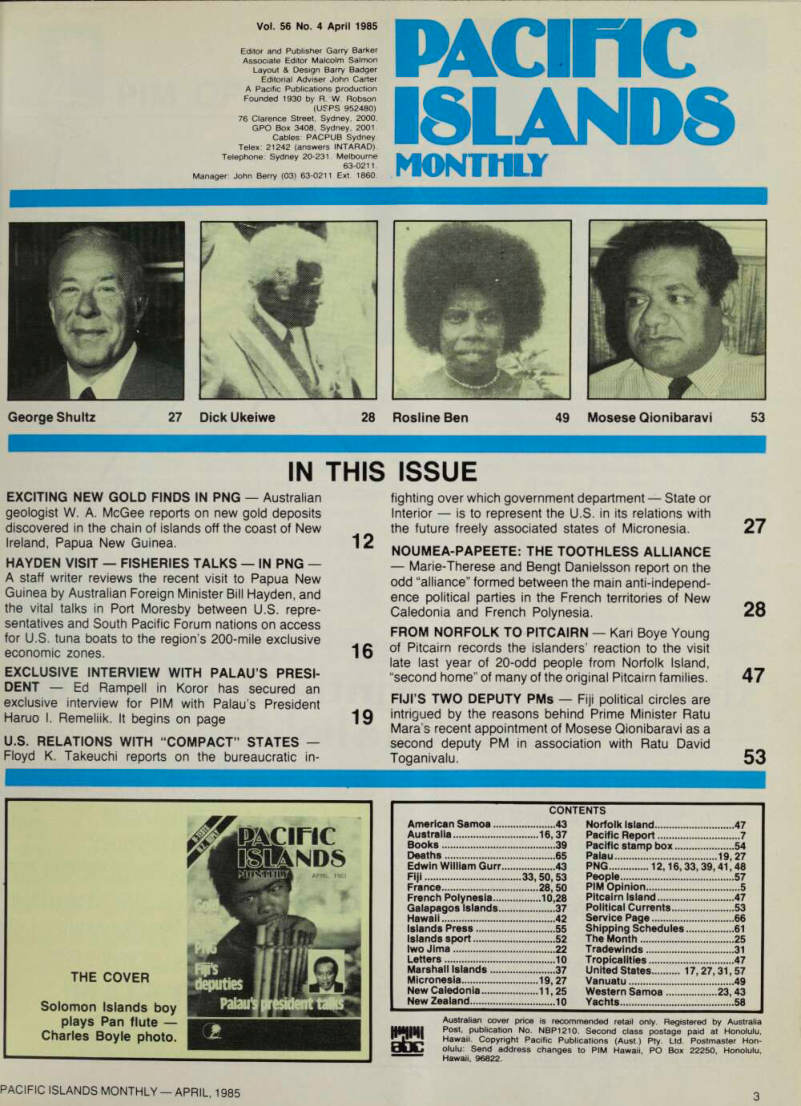
The Cover
Solomon Islands boy plays Pan flute Charles Boyle photo.
Advertisements & other items, pp. 2-3 (2 items)
AUSTRALIA: Honda Australia Pty., Ltd. Lot 95 Sharps Road, Tullamarine, Victoria 3043; Bennett Honda Pty., Ltd. 250 Victoria Road, Wetherill Park, N SW. 2164/
n\/i\ NEW ZEALAND: NZMC Limited Manners Plaza, 57-65 Manners St., Wellington/PAPUA NEW GUINEA: Toba Pty., Ltd. PO. Box 503, Port Moresby/TAr HONDA MOTOR CO., LTD. TOKYO. JAPAN Honda Distribution S.A.R.L. B.P 1665, Papeete/KIRIBAT : Atoll Motor & Marino Services PO. Box 49, Bairiki Tarawa, Republic of Kiribati/U S. TRUST TERRITORY: United Micronesia Development Association PO. Box 235, CHRB Saipan CM 96950/COOK ISLANDS: Cook Islands Motor Centre Ltd. PO. Box 74, Rarotonga/GUAM: Mark’s Motor Co., Inc. PO. Box DV, Agana/WESTERN SAMOA: Motor Distributors (Samoa) Ltd. PC Box 576, Apia/SOLOMON ISLANDS: Lee Kwok Kuen & Co., Ltd. PO. Box 537, Honiara/NEW CALEDONIA: Soci6t6 Du Chalandage 8, Rue de la somme-B.P 97, Noumea / NAUR : Nauru Cooperation Republic of Nauru IF : Coral Island Motors Ltd. Robertson Road, Suva, Fiji/AMERICAN SAMOA: Holiday Motors, Parts and Service PO Box 968, Pago Pago, American Samoa 96799; Heleck’s Service Center Ltd. PO. Box 1138, Pago Pago, American Samoa 96799/TDNGA; Tonga Industrial Traders PO. Box 1035, Nuku'alofa, Tonga/NORFOLK ISLAND:
Pacific
ISLANDS
MONTHLY
Vol. 56 No. 4 April 1985
George Shultz 27
Dick Ukeiwe 28
Rosline Ben 49
Mosese Qionibaravi 53
In This Issue
EXCITING NEW GOLD FINDS IN PNG Australian geologist W. A. McGee reports on new gold deposits discovered in the chain of islands off the coast of New Ireland, Papua New Guinea. 12
Hayden Visit Fisheries Talks In Png
A staff writer reviews the recent visit to Papua New Guinea by Australian Foreign Minister Bill Hayden, and the vital talks in Port Moresby between U.S. repre sentatives and South Pacific Forum nations on access for U.S. tuna boats to the region’s 200-mile exclusive economic zones. 16
Exclusive Interview With Palau’S Presi
DENT Ed Rampell in Koror has secured an exclusive interview for PIM with Palau’s President Haruo I. Remeliik. It begins on page 1 9
U.S. Relations With “Compact” States
Floyd K. Takeuchi reports on the bureaucratic in
fighting over which government department State or Interior is to represent the U.S. in its relations with the future freely associated states of Micronesia. 27
Noumea-Papeete: The Toothless Alliance
Marie-Therese and Bengt Danielsson report on the odd “alliance” formed between the main anti-independ ence political parties in the French territories of New Caledonia and French Polynesia. 28 FROM NORFOLK TO PITCAIRN Kari Boye Young of Pitcairn records the islanders’ reaction to the visit late last year of 20-odd people from Norfolk Island, “second home” of many of the original Pitcairn families. 47 FIJI’S TWO DEPUTY PMs Fiji political circles are intrigued by the reasons behind Prime Minister Ratu Mara's recent appointment of Mosese Qionibaravi as a second deputy PM in association with Ratu David
Toganivalu. 53
Contents
American Samoa 43 Australia 16,37 Books 39 Deaths 65 Edwin William Gurr 43
Fiji 33,50,53
France 28,50 French Polynesia 10,28 Galapagos Islands 37 Hawaii 42 Islands Press 55 Islands sport 52 Iwo Jima 22 Letters 10 Marshall Islands 37 Micronesia 19,27 New Caledonia 11,25 New Zealand 10
Norfolk Island 47 Pacific Report 7 Pacific stamp box 54 Palau 19, 27
Png 12,16, 33, 39,41,48
People 57 RIM Opinion 5 Pitcairn Island 47 Political Currents 53 Service Page 66 Shipping Schedules 61 The Month 25 Tradewinds 31 Tropicalities 47 United States 17,27,31,57 Vanuatu 49 Western Samoa 23,43 Yachts 58
Australian cover price is recommended retail only. Registered by Australia Post, publication No. NBPI2IO. Second class postage paid at Honolulu, Hawaii. Copyright Pacific Publications (Aust.) Pty. Ltd. Postmaster Hon olulu: Send address changes to PIM Hawaii, PO Box 22250, Honolulu, Hawaii, 96822.
Advertisements & other items, pp. 3-4 (2 items)
Pacific Islands Monthly —April, 1985
3
Editor and Publisher Garry Barker Associate Editor Malcolm Salmon Layout & Design Barry Badger Editorial Adviser John Carter A Pacific Publications production Founded 1930 by R. W Robson
(USPS 952480)
76 Clarence Street, Sydney, 2000, GPO Box 3408, Sydney, 2001 Cables: PACPUB Sydney.
Telex: 21242 (answers INTARAD).
Telephone: Sydney 20-231 Melbourne 63-0211.
Manager: John Berry (03) 63-0211 Ext. 1860
that businessmen inthe South Pacific
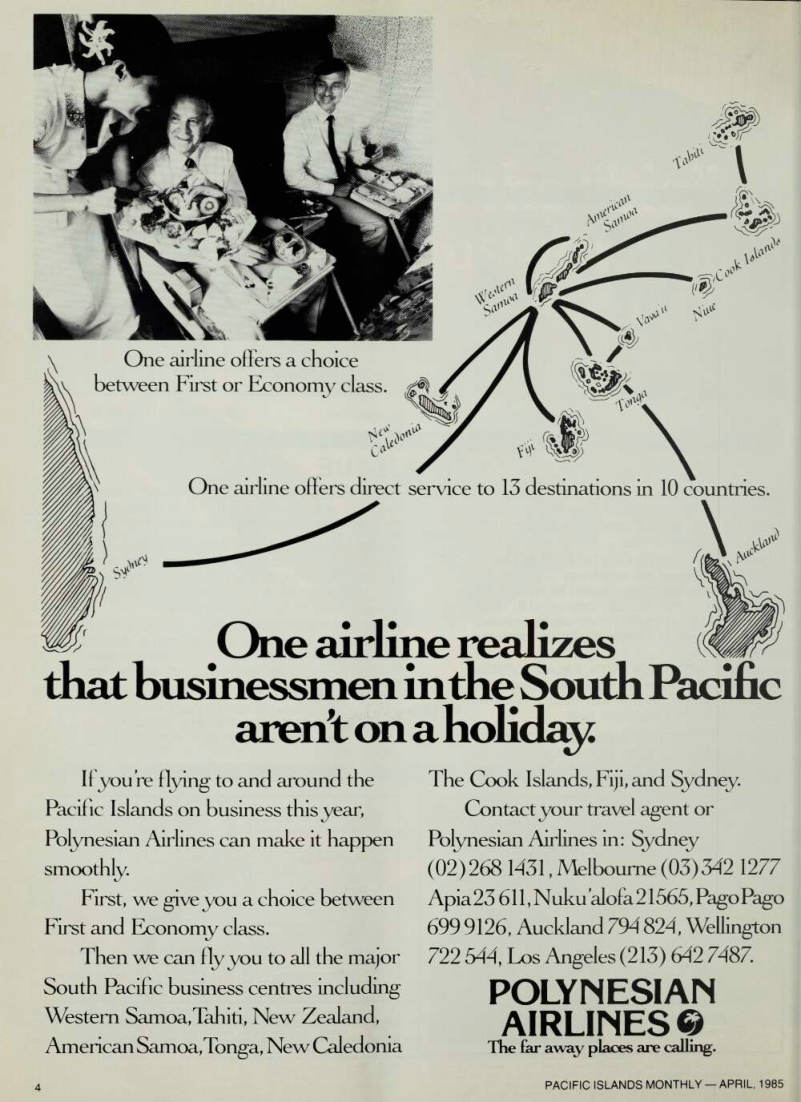
u jt ¥ \ One airline offers a choice between First or Economy class. . >. 049 A s -V> m A) m 6 I V-: 1 One airline oilers direct service to 13 destinations in 10 countries t* v v A A
One airline realizes (< <
aren’t on a holiday
11 you re dying to and around the Pacific Islands on business this year, Polynesian Airlines can make it happen
smoothly
First, we give you a choice between First and Economy class.
Then we can dyyou to all the major South Pacific business centres including Western Samoa,Tahiti, New Zealand, American Samoa,Tonga, New Caledonia The Cook Islands, Fiji, and Sydney.
Contact your travel agent or
Polynesian Airlines in: Sydney
(02)2681431, Melbourne (03)342 1277 Apia 23 611,Nuku’alofa21565,Pago Pago 699 9126, Auckland 794 824, Wellington 722 544, Los Angeles (213) 642 7487.
POLYNESIAN
AIRLINES ©
The far away places are calling.
School marms should smile, too
Pim Opinion
Anyone who has suffered the attention of a schoolyard bully knows that the true value of an alliance lies not in the quantity of damage done during an actual dust-up, but in the level of deterrence it poses to a potential enemy. The strength of the union is in the caution it generates in the beholder. Thus it was with ANZUS.
The chain of events over the last several months, since Mr David Lange became prime minister of New Zealand and rose on an unprecedented wave of public popularity to challenge the United States, was quite predictable. Here was a white, Anglo-Saxon Protestant mouse roaring its little head off in defiance of the greatest nation on earth where, not so incidentally, W.A.S.P. principles also held fair sway.
In return, the greatest nation on earth acted like a schoolmarm, cane in hand, sending New Zealand into the comer and threatening it with six of the best on the bottom of its trade figures.
At the neighboring desk sits Australia, vastly uncomfortable over the exchange of words, making its own errors over things like MX missiles, and unscheduled conversations with the arrogant North Vietnamese who (surprise, surprise), didn’t tell Foreign Minister Bill Hayden the truth about Kampuchea.
In short, it has been a very vigorous month for foreign affairs in this part of the world, not least of the events being Papua New Guinea’s sharp slap at the United States over its treatment of New Zealand. Foreign Minister Giheno accused Washington of being ’’insensitive, heavy-handed, and a bully” and of causing alarm among South Pacific Forum countries. ’’The Forum represents a region which is unquestionably pro-Western in its values and ideologies,” he said. ”It appears that this has been taken for granted or treated casually by the U.S. in its latest actions ... PNG believes the conduct of relations between the U.S. and individual countries of the Forum should continue to be based on mutual respect and equality.”
Part of that reaction seems to have been generated not so much by the ANZUS row as by the manner in which American interests (as possibly distinct from Washington’s executive), have concur rently dragged their feet over giving what the small nations regard as due recognition to their rights over the fish in their exclusive economic zones. In short, the Newtonian law of equal and opposite reactions seems to be working in the politics of the Pacific and the United States is getting a good bit of stick, both publicly and privately, for being too heavy-handed. Since nobody in the Pacific really expects to be menaced in the next day or two by a bunch of cement-faced Muscovites, it would be useful to the region generally if Washington now made some conciliatory noises which everyone could clearly hear.
Mr Lange has clearly enjoyed himself on the world stage and, to that extent, has done his country no real harm so far as publicity is concerned. Most democracies admire a battler; the smaller the warrior and the bigger the dragon, the louder the cheers. It is possibly also worth a few seconds of a Washington official’s time to think not so much about the size and importance of New Zealand in relation to the United States, but of its standing among Pacific nations.
New Zealand has had considerable influence in the region for many years; it has a fine reputation as a reliable friend of all the
small countries. Where the United States is seen, albeit in favorable light, as a somewhat remote and occasionally clumsy giant, New Zealand has been on the ground for more than a century, helping, educating, supporting and cooperating.As a representative of Western democracy, and a long-time good friend of the United States, New Zealand has done an excellent job, politically and as a practical hod-carrier. New Zealand might have to be careful of its relations with the U.S. but, equally, in the Pacific if nowhere else, the U.S. must be careful about the way it from now on treats New Zealand, for, by those straws in the wind will the Pacific countries gauge their own affairs.
All of this is obvious enough, and there has been, since the beginning of this upset, considerable speculation that in fact it is all a matter of political engineering. Mr Lange was stuck with the anti-nuclear policy because he needed the support of the left-wing of his New Zealand Labour Party. The United States was happy to ’’make an example” of him because it would smarten-up attitudes towards the Western alliance in much more crucial areas like Europe, Canada, Iceland, Bermuda and Puerto Rico. Mr Lange didn’t really mind the appearance of a drubbing from the schoolmarm because it helped him pull his country together while he worked through some very painful, and desperately necessary, economic surgery.
So Mr Lange has taken his caning, and his snubbing at the hands of the Americans. He has been ticked off by Mrs Thatcher, and he has strutted his stuff at the Oxford Union debate and in some arenas in the U.S. At home, in his tight little islands, he has won plaudits, but he has also been told to watch it, for while principles are good, New Zealand is in no way threatened by the visits of nuclear ships and countries must trade so that their people can eat.
There is also, still, the matter of ANZUS. Everyone, including New Zealand, still says it is the cornerstone of peace in the Pacific.
But, if New Zealand believes that, and, furthermore, accepts that the U.S. believes it, they cannot cry for too long about being smacked for upsetting the alliance. Also, ANZUS has allowed them to have their defence pretty cheaply - less than three per cent of gross domestic product. Now, because they must maintain their forces, and take their fair share in regional defence cooperation with Australia and other Pacific countries, things will be more expensive, and difficult. They have lost access to large quantities of ANZUS intelligence, for instance.
Mr Lange is now back in his Wellington beehive. It is time to begin repairing the damage, real and notional, which his government’s stoutly-defended anti-nuclear policies have caused, not only to the stability and unity of the Pacific and to New Zealand, but also to the interests of many other countries.
The United States can help by being less publicly miffed than it has so far professed to be. Mr Lange can stop strutting the world stage and holding largely meaningless debates with people like the Rev Jerry Falwell. Indeed, Mr Lange may have started on this course by recently expressing the hope that he and U.S.Secretary of State Shultz might meet to talk it through when they both are in Malaysia for the regional conference next July. It would be a pity if Mr Shultz sent another under-gardener to talk with a sovereign nation’s prime minister, however awkward and argumentative that prime minister might be.
Advertisements & other items, p. 6 (1 item)
Cnsmm
Double-cassette delivers
double the fun.
Only Pioneer’s new Carry Com™ portable component system gives you so much take-along musical
enjoyment, plus high-performance design.
Just imagine, a double cassette-deck
with synchro-start, high-speed dubbing,
continuous playback and soft-touch
controls. Fifty watts (that’s 50!)
peak music power output.
4-band tuner, custom-contoured sound via the 5-band graphic equalizer and detachable
2-way speaker systems.
Pioneer’s new CarryCom 1 Come on along, just for the fun of it. w s> m - $ 4 V • gk V y mmS
CK-W 5
Ko m
Cnsmm
TM Portable Component System
Cf) PIONEER
For further information, please contact: Australia: Pioneer Electronics Australia Pty. Ltd. (Incorporated in Victoria), P.O. Box 295, Mordialloc, Victoria, 3195 Tel: 580-9911 Fiji Islands: Brijlal & Company, G.P.O. Box No. 362, Suva, Fiji Islands Tel: 22258 New Zealand: Monaco Distributors Ltd., 2 Poland Road, Glenfield, Auckland, New Zealand Tel: (09) 444-9144 Norfolk Island: Burns Philp (Norfolk Island) Ltd., P.O. Box 21, Norfolk Island Vanuatu* Rums Philn (Vanuatu) I trl Vila Vanuatu Nauru Island: Jacob Enterprises, P.O. Box No. 4, Republic of Nauru Tahiti: Tahiti Hi-Fi, P.O. Box 848, Papeete, Tahiti New Caledonia: Menard Pacifique Sari, B.P. 3899, Noumea, New Caledonia Tel: 27.62*23 American Samoa: Transpac Corporation, P.O. Box 1477, Pago Pago, American Samoa 96799 Tel: 633-5224 T Rarotonga: South Seas International Ltd., P.O. Box 49, Rarotonga, Cook Islands Tel: 2327 Paoua New Guinea: Bali Merchants Pty. Ltd., P.O. Box 6103, Boroko Tel; 254887
Pacific Report
GOVT. PARTY HAS EASY WIN IN SAMOA POLL In Western Samoa’s February general election the government party, the Human Rights Protection Party, was returned with a majority of 15 scats. Polling closed at 3 p.m. on February 22 and by 5 p.m. the victory was clear. Of the 47 seats in the legislative assembly, 31 have been won by the H.R.P.P. and 15 new members have been elected to Western Samoa’s ninth parliament.
Only one former cabinet member, Lava Lio, minister for health, lost his seat. The prime minister, Tofilau Eti Alesana was returned with 328 votes, a record majority in this election. These results were provisional and must be confirmed within 45 days of the election. The government’s majority of 15 seats is equivalent to that held by the present Leader of the Opposition, Tupuola Efi, in the elections of 1976. Talking after the result was announced, the prime minister said from his home in Savaii he was grateful to his supporters and said his government would now consolidate its work of the past two years. He said he hoped the increased majority his party had won would give confidence to the countries that had been assisting Western Samoa in its development. Eti’s position as H.R.P.P. leader was reaffirmed on February 26, after a meeting of party faithful which lasted two days. He was thus put forward as the party’s official candidate for prime minister.
Parliament decides this by secret ballot at its first sitting after the election. Eti himself clearly enough has enjoyed the leadership of his country but, in various conversations over the past year, has indicated that he might not stand again. He is now over 60 but is still very fit and without doubt in command, a status the election has certainly confirmed. Lee Anderson in Apia. (see seperate report p. 23).
Brisbane: Anti-Kanak Gun-Running Charges
Four foreign nationals had conspired to smuggle more than $40,000 worth of firearms and ammunition to New Caledonia for use against Kanak rebels, the Brisbane Magistrates Court was told on March 6., Alan Grelier, 30, a teacher, Vu Viet Chaun, 30, unemployed, and Jean-Nicholas Bondaletoff, 38, yacht rigger and captain, were charged that between December 15, 1984 and March 5, 1985, they accumulated firearms and munitions to use in hostile activities against New Caledonia. Paul Ngoe Ly, 28, unemployed, was charged with giving money to Bondaletoff for the commission of the offence. No pleas were taken. The four men, from France and New Caledonia, were remanded in custody after the Public Prosecutions legal officer, lan Bates, said they were an unacceptable risk.
Soviets Ask Kiribati For Fishing Rights
Kiribati and Soviet delegations have met in Sydney for two days of talks on a Russian application for fishing rights in Kiribati’s 200-mile exclusive economic and fisheries zones, but no agreement was reached. It is believed that the Russian delegation, headed by Mr Guldibadimov, made certain proposals which the leader of the Kiribati delegation, Minister of Natural Resources and Deve lopment Babera Kirata, has conveyed to the Kiribati Government.
The meeting took place as the United States was considering a protest by Kiribati over the presence in its waters off Onotoa Island on January 21 of an American tuna boat Carol Linda, alleged to have been fishing without permission.
Palau Senate Approves Compact
The Senate of the Republic of Palau has approved the Compact of Free Association with the United States, after voting for rejection on two occasions, in August and November last year. The constitutional ban on the entry of nuclear substances into the republic was not a consideration in the Senate’s decision. When the referendum was held, the vote to remove the ban was below the required 75%, but the Senate now holds that approval needs only simple majority. Those who oppose this view may test it in the courts.
U.S. TO LIFT BAN ON SOLOMONS IMPORTS?
The United States is expected to lift its ban on fish imports from
Solomon Islands, which it imposed last year after Solomon Islands seized an American tuna boat, Jeanette Diana, for illegal fishing.
The boat was retrieved recently by the owners, C. & F. Fishing Company of San Diego, after paying about $U5770,000 for the boat, the boat’s fish-spotting helicopter and accessories. When Solomons Prime Minister Sir Peter Kenilorea returned from a visit to Washington, he complained that the U.S. Government was continuing its ban even though agreement had been reached with the owners. But the latest news is that the U.S. will lift the ban if the Solomons Government will enter into negotiations with the American Tuna Association for a bilateral fisheries agreement. Sir Peter has agreed to the proposal. Negotiations are continuing between member countries of the South Pacific Forum’s Fisheries Agency and the association over licences to fish in the various economic and fisheries zones in the region.
Arts Festival: Tahiti Bid Succeeds
The French Pacific territories appear determined to offer their hospitality to the Fourth Pacific Festival of the Arts which is now set down for celebration in Tahiti, starting on June 29. The original venue and date (Noumea, last December) became impossible because of the unrest at the time, and continuing, in New Caledonia and the festival was very reluctantly cancelled at the very last moment; some delegates, in fact, notable among them the governor of Easter Island, had already left on journeys designed to include the Noumea celebrations. The offer by Papeete to host the large and elaborate festival was made in the middle of February during a gathering of delegates from 20 Pacific independent nations and dependent territories. They debated the idea in private for several days, and many of them were reportedly reluctant to accept the invitation, not for any political reason, but because of the great added cost many of them will incur by having to travel to French Polynesia rather than to Noumea. Expenses in Tahiti are also considered to be somewhat higher than in New Caledonia.
Jacques Teheiura, minister for culture in the government of Gaston Flosse, agreed to pay the extra involved and, as was the case in Noumea, France will in fact pick up almost all of the CPF2OO million bill (about SAI.6 million). The local significance of June 29, the date set by the host delegation for the opening of the festival, may have escaped some of the delegates at the meeting, at least until an open letter, in French, English and Tahitian, appeared in the local newspapers, from the four biggest opposition political parties. June 29 was not, the letter passionately asserted, a great national holiday commemorating the free cession of the islands by King Pomare V on June 29,1880, but a “day of shame and sorrow for all Polynesians because of the fraudulent nature of the French take-over.” Premier Flosse tried to organise a local festival on the day last year but it was boycotted by the opposition parties and by Protestant and Catholic church leaders. The question now is whether local opposition will be less strong because the festival has an international dimension, and a large one at that. While the French government was apparently most eager to host the Pacific Arts Festival in Noumea last year, and very reluctant to cancel it, there is alleged to be some slightly different flavor about their approach to the Polynesian initiative, particularly since Premier Flosse’s treaty-signing business in Noumea. But, if he can pull it off the festival will undoubtedly increase his personal status in the region Bengt Danielsson and Staff Writer.
Thai Delegation Tours Islands
An eight-man delegation from Thailand led by Deputy Minister for Foreign Affairs Prapas Limpabhandhu has visited Fiji, Papua New Guinea, Solomon Islands and Vanuatu. Views were exchanged in each country on international and regional affairs and methods of promoting co-operation in trade, investment and technology.
New Hope For Ok Tedi
Papua New Guinea’s Minister for Minerals and Energy, Francis Pusal, has reported that the other partners in Ok Tedi Mining Ltd have agreed to a government proposal on future development of the gold and copper mine involving construction of a permanent tailings waste dam and a single copper processing unit.
Advertisements & other items, pp. 8-9 (1 item)
The Top Choice For The Bottom Line.
- v> ■Jr THE TOP CHOICE FOR THE BOTTOM LINE.
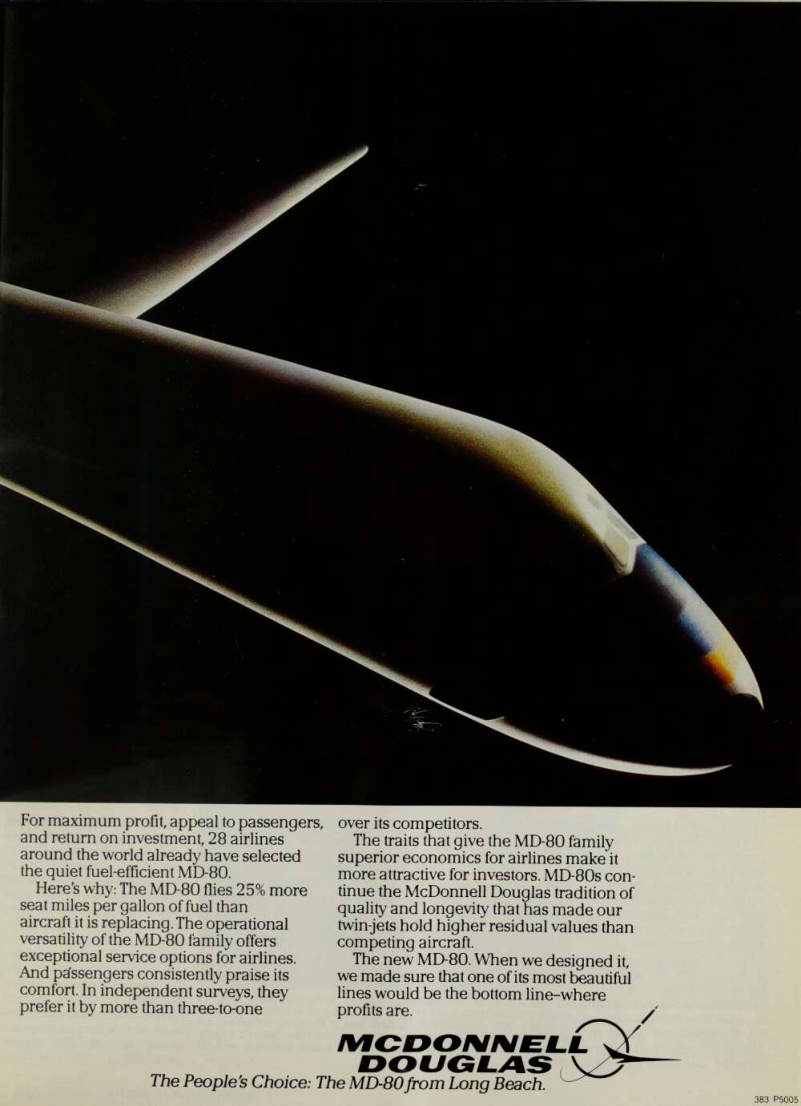
For maximum profit, appeal to passengers, over its competitors, and return on investment, 28 airlines The traits that give the MD-80 family around the world already have selected superior economics for airlines make it the quiet fuel-efficient MD-80. more attractive for investors. MD-80s con- Here's why: The MD-80 flies 25% more tinue the McDonnell Douglas tradition of seat miles per gallon of fuel than quality and longevity that has made our aircraft it is replacing. The operational twin-jets hold higher residual values than versatility of the MD-80 family offers competing aircraft, exceptional service options for airlines. The new MD-80. When we designed it, And passengers consistently praise its we made sure that one of its most beautiful comfort. In independent surveys, they lines would be the bottom line-where prefer it by more than three-to-one profits are.
DOUGLAS V7 1
The People's Choice ; The MD-80 from Long Beach. 383 P 5005
letters
NZ radiation lab chief replies to Moruroa report critics
The article of the Danielssons in the October 1984 issue of Paci fic Islands Monthly continues their efforts to undermine the conclusions of the scientific mis sion to Moruroa. A number of sweeping allegations are made in which they claim that the mission failed (a) to establish the effect of the French testing program on the health of French Polynesians, (b) to assess the extent and significance of possible venting and leaking of radioactive material, and (c) to assess the nature of the hazards presented by radioac tive wastes originally deposited on the north coast of the atoll.
In fact, all of these points are considered in some detail in the mission report. With regard to (a) the Danielssons appear to have overlooked or missed the whole significance of the con clusions of the report. A fun damental consideration is that if there is no significant radiation exposure there can be no radia tion-induced cancers. As the report records, the levels of radiation exposure in Tahiti during and immediately follow ing the period of French atmos pheric testing have been low in relation to natural levels of exposure.
Over the 11-year period 1964-1975 the mean radiation exposure (effective dose equivalent) of persons in Tahiti (where the greater proportion of the French Polynesian popu lation resides) was about 8 millisieverts (mSv) from natural radiation (from cosmic radia tion, terrestrial gamma emitters, and potassium-40 and other internal emitters), and only about 0.4 mSv from fallout radionuclides. For New Zealand the corresponding values are about 18 mSv from natural radiation and about 0.25 mSv
from fallout.
If the case of miners exposed to radon gas in relatively high concentrations underground is excluded, it has not been de monstrated that natural radia tion levels have any effect on cancer rates, even for areas of the world where background rates are very much higher (20-50 times) than in New Zealand. Clearly the contribu tion of fallout radionuclides to radiation exposure both in Tahiti and in New Zealand has been less than normal varia tions in natural radiation expo sure rates from place to place.
This is the basis for the conclusion in the report that radiation exposure levels in French Polynesia do not lead to the expectation of any detect able radiation-induced cancers.
Having established the levels of radiation exposure, examina tion of cancer statistics could be considered of lesser signi ficance. However, the statistics were examined and have been reported. Within the limitations of the data, most particularly the relatively small population base, there is no evidence of any increase in malignancy rates which might be attribu table to exposure to radioactive fallout.
The Danielssons imply that nothing was learned about radioactive leakage because no submarine inspection around the atoll was made and no detonation occurred during the time of the mission visit. They indicate leakage has “demon strably occurred” but offer no evidence. They appear to har bor the misconception that leakage would occur at the time of tests. In fact leakage of radioactivity would occur as a slow process over an extended period of time. The greater proportion of fission products
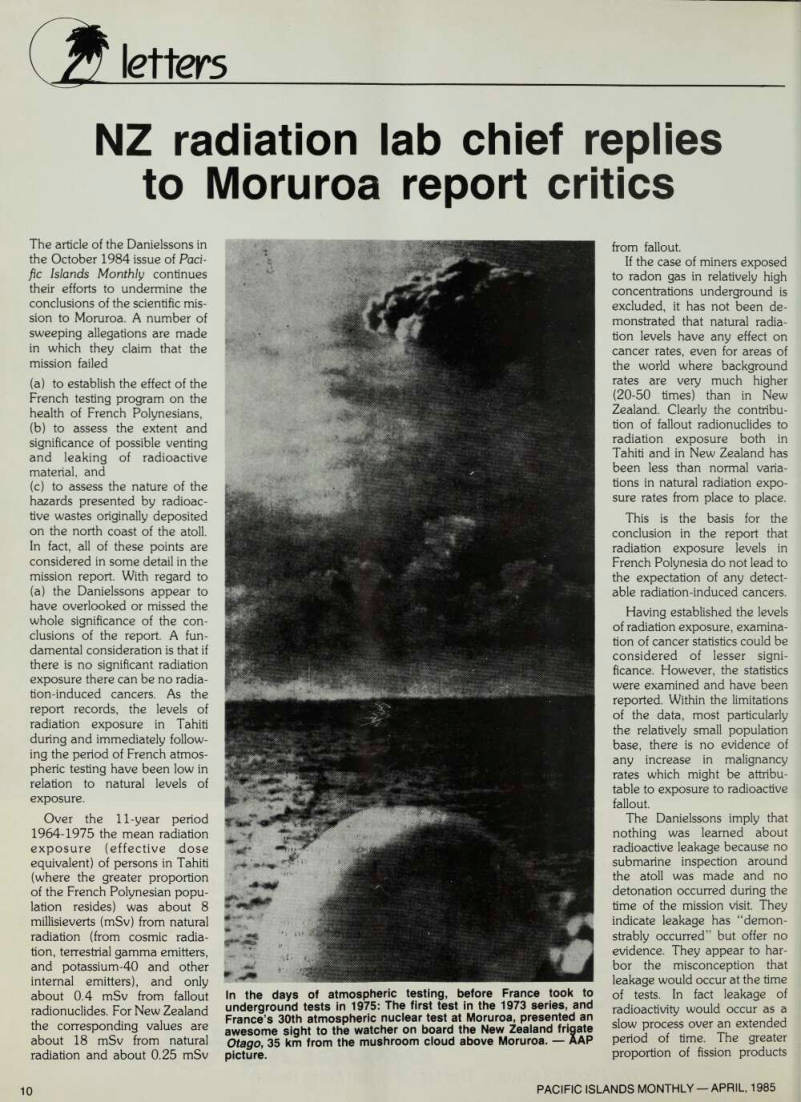
In the days of atmospheric testing, before France took to underground tests in 1975: The first test in the 1973 series, and France’s 30th atmospheric nuclear test at Moruroa, presented an awesome sight to the watcher on board the New Zealand frigate Otago, 35 km from the mushroom cloud above Moruroa. -AAP picture.
arising from the underground detonations is fused in rock and only available for water trans port at the leaching rate of the rock. Radioactive material in solution cannot be transported to the lagoon at a rate faster than that of the rate of move ment of water through the volcanic rock strata in which the detonations occur. It is to be noted also that if leakage were to be detected this is not neces sarily to be equated with the development of a local health risk. Apart from the fact that sea water contains considerable natural radioactivity, radioac tive materials commonly can be detected in concentrations many orders of magnitude be low those which might be consi dered to give rise to a possible long-term risk to health.
The Danielssons continue to raise the bogey of radioactive wastes dispersed in storms some years ago. The compara tively few persons at Moruroa who have been involved in waste-management practices have all been rigorously moni
tored, and the report notes that every reasonable effort is being made to clean up previously contaminated land areas. There is no evidence of unusual or excessive exposures of person nel. It is to be noted that the majority of the 3000 persons resident at Moruroa receive lower radiation exposures than persons living in almost all other parts of the world. This stems primarily from the fact that coral atolls have only very low con centrations of naturally-occur ring radionuclides. The average contribution of fallout radionuc lides in soil to human exposure at Moruroa is lower than in New Zealand, although for New Zea land, as in other countries, the soil concentrations of fallout radionuclides are much lower than those of naturally-occur ring radioactive materials.
A. C. Mcewan
Director, National Radiation Laboratory, Department of Health Christchurch New Zealand
Bishop’s interview a ‘breath
‘breath of fresh air’
I was greatly impressed by the interview with the former Bishop of Noumea Monsignor Pierre Martin (PIM Mar. p 24).
The calm tenor of Monsignor Martin’s remarks, and his ob vious experience and apprecia tion of both sides in the present wretched situation in New Cale donia, were a breath of fresh air after the fevered bombast which has characterised so much recent discusion of the problem, both in the territory itself and in the National Assembly in Paris.
I was particularly impressed with the former bishop’s refer ences to the experiences of Fiji and the Cook Islands, as poss ibly offering useful pointers to a political solution in New Cale donia. This reflects the man’s ability to adopt a wider perspec tive on Pacific Island affairs than the blinkered and embittered approaches which have done so much to bring the situation to the pass at which it now stands. After all, New Caledo nia is a Pacific Islands entity,
with a colonial past not so very dissimilar to many others.
There must surely be aspects of the post-colonial political arrangements in some of these other places which could be helpful to it, across the formid able, but in some respects irrelevant, “anglophone-fran cophone” barrier.
Finally, I was pleased to read his first-hand account of the priestly experience of FLNKS leader, Jean-Marie Tjibaou.
Perhaps the testimony of the prelate who ordained Mr Tjibaou, and later released him from his vows, will serve to shut up some of Tjibaou’s political opponents, who never seem to tire of trying to inject some sinister significance into his de parture from the priesthood.
But I suppose the recent history of New Caledonia would indicate that this is really too much to hope.
P. Warbeck
Sydney NSW Australia
deep
‘New friend’ hit by plastic menace of the deep
I was interested and disturbed to read your item “Plastic menace lurks in the deep” (“Pacific Report,” Mar., p 8).
I had no idea the threat to marine animal and bird life from our discarded plastic waste had reached such prop ortions.
It was only a day or so after I had been enlightened by this valuable item that I came across corroboration of it in another place altogether.
In one of my son’s surfing magazines the Queensland based Line-Up I read a story called “New Friend” by Lawrie Kavanagh.
Kavanagh wrote: “If it wasn’t for the hike in petrol and the halt in wages . . .
“If it wasn’t for airliners being shot out of the sky and lonely, lost bodies being turned over for political points scoring ... if it wasn’t for assassinations and murders and robberies and un employment and inflation and recessions and atomic bombs
and washing up, I’d probably be a happy man today.
“You see, I met a new friend in the surf last week, a dolphin, and that made me feel good . . .
“There followed 45 minutes of brilliance, with my new friend catching wave after wave, sometimes surfing so close you feared the fin may hit him.
“Most times when the new friend returned to the line-up out back he rocketed high over the incoming swells and break ers, sometimes twisting in the air and occasionally showing off.
“Between waves the dolphin swam about, sometimes on his back, and once, shortly before he went home, turned on his back with his head and flippers out of the water as if sunba thing.
“It was only on his last jump high over a breaking wave that I noticed the short piece of heavy nylon fishing line hanging from my new friend’s mouth.
“If it wasn’t for atomic bombs, rising prices and new friends with nylon fishing line dangling from their mouths, I’d probably be a happy man to day ...”
Arthur Blackstock
Aireys Inlet, Vic., Australia.
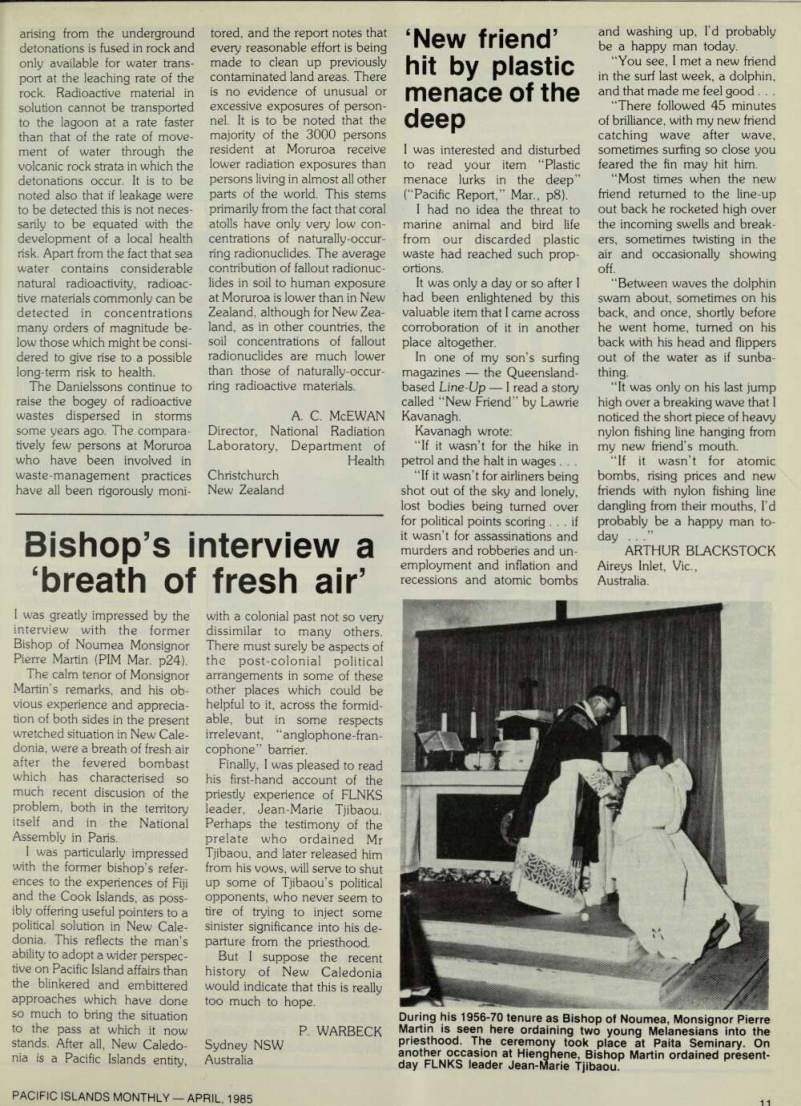
During his 1956-70 tenure as Bishop of Noumea, Monsignor Pierre Martin is seen here ordaining two young Melanesians into the priesthood. The ceremony took place at Paita Seminary. On another occasion at Hienghene, Bishop Martin ordained present day FLNKS leader Jean-Marie Tjibaou.
New Gold In Png
"The Midas alternative" to OK Tedi
The chain of islands off the east coast of New Ireland in Papua New Guinea is developing into a gold province of consequence. On Lihir, one of these islands, a joint venture between the major American company, Kennecott, and the junior Australian, Niugi ni Mining, has located a very large deposit.
Two large and closely posi tioned zones have been drilled and a resource of not less than 50 million tonnes, and probably much more, is indicated.
Grades encountered have been as high as 137 grams of gold per tonne, but are more typical ly in the one to five grams per tonne range.
These seemingly trivial amounts of gold can be very profitable to mine as the large tonnages available permit the application of highly efficient and economical extraction techniques.
With gold bringing about KinalO per gram, the deposit has an in-ground value of at least Kl5OO million (about Aussl.9 billion).
Gold is beginning to emerge as the principal metal of interest in Papua New Guinea, especial ly since the fortunes of Ok Tedi, for which so much had been hoped, have begun to falter.
Ok Tedi is, of course, a rich gold mine, with perhaps as much as 425 tonnes of the precious metal contained in the cap, and the first levels, of Mount Fubilan. But, in recent times, other major gold deposits have been found, particu larly in the chain of small islands off the east coast of New Ireland. Of these, Lihir is thought to be one of the most promising the centre of a modern, very technical, high-stakes, gold rush. Australian geologist W.A.McGee, who has been closely connected with PNG exploration over a number of years, was recently there and writes here of a site few outsiders have seen.
The drills have yet to define the limits of the mineralisation and towards this a K 5 million (Au 556,250,000) is to be undertaken this year.
Not surprisingly, since the first announcement of success, Niugini Mining shares have boomed on the Sydney stock market. Currently they are trad ing in the Ausslo to $ll range,
almost all of which reflects the valuation placed on the Lihir deposit by the market.
Unusual for modem dis coveries, the gold on Lihir is a new find, one that the old prospectors missed completely.
Some 40 miles to the north of Lihir, on the small island of Simeri in the Tabar Group, surface indications of extensive
gold mineralisation were found two years ago, but were not tested at depth until October, 1984. The first drill hole en countered a spectacular section which assayed 152 grams/ton ne gold, over a hole distance of 5 metres. At current prices a tonne of this material would contain gold worth about $1875 if there was a tonne of it.
Even though such bonanzas are not an indication of the overall tenor of a deposit, the hole did penetrate several other rich, but lesser grade, sections and was in low grade miner alisation throughout its 225 metre length. For a first hole into a prospect this was a most exciting result.
A second hole drilled 300 metres away, on what is thought to be a continuation of the zone, also encountered sub stantial gold mineralisation, giv ing hopes that this deposit, like that on Lihir, will prove to be very large. Further drilling on this zone is planned for 1985, and two other zones of surface gold indications remain to be
tested at depth, one having samples averaging a respect able 9 grams/tonne.
The Tabar prospects are being explored by a consortium which comprises the same two companies as are on Lihir, that is, Kennecott and Niugini Min ing, but here also including a group of American interests led by Nord Resources, an Amer ican public company with in ternational mining interests.
The Tanga Islands, the group to the south-east of the Lihir Islands,are being prospected by Newmont, another substantial American mining company, but no public comment on results has been made. That they are persisting there suggests that some favorable results are being obtained.
Esso, and a company with the somewhat improbable name of City and Suburban Properties, exploring in the Feni Islands, the most southerly group in the chain, have also found gold. Some good values have been obtained from out crops sufficient to encourage them to embark on a detailed assessment of the occurrence.
Like the Lihir partnership, this joint venture is also be tween a major American and a small Australian. City and Sub urban Properties was acquired by a group of Australian entrep reneurs in 1984 and the Feni and other interests injected into it. Funds for exploration were then realised from the public by a successful share issue.
But the Tabar to Feni chain is not the only area where dis coveries are being made. Else where in Papua New Guinea there have been important de velopments on both recognised and newly-found prospects.
At Porgera in the highland province of Enga, recent drill intersections have instilled new life into what was a languishing project. The best section re ported, 39 grams/tonne gold over 86 metres, is a stupendous result, and it is understood that for calculation of the average some assays were reduced from figures so high that they read more like copper grades than gold.
These intersections are from holes on a new zone of miner alisation, adjacent to that which
has been under exploration from many years without the establishment of a resource sufficient to permit a commitmcnt to mining. The defined ore body comprises 59 million tonnes grading 3.5 grams/tonne gold and 14.4 grams/tonne silver. The new mineralisation should substantially improve on this.
Three major international companies, Placer Deve-
require appreciable investment, Even so, Porgera could well be the next mining project to be brought into production, Conzinc Riotinto of Australia (CRA) are rumored to have made a discovery of some importance at a prospect called Wafi Creek, located 70 km south-west of Lae. They have drilled there but have not re leased any details of the results, The scuttlebutt puts a size of
lopment, Mount Isa Mines, and Renison Goldfields, are in partnership on this project.
Placer Development, well known in Papua New Guinea for its historic Bulolo dredging operation and its consistent ex ploration programs, has recent ly indicated its confidence in the project by exercising a K 1 mil lion (about Aussl.2s million) option to secure its position.
Because of its remote location, development of this deposit will
around 20 million tonnes at 2 or 3 grams/tonne gold on this find. This would be a substan tial, but low-grade, resource, but it is possible that further work will improve these figures.
The Esso - City and Sub urban Properties joint venture is exploring several areas as well as the Feni Islands, notably in the D’Entrecasteaux Islands where several gold prospects have been discovered. Some drilling has been carried out on
two of these - the Unagala and Wapolu prospects on Fergus son Island, and several intersec tions of modest gold grades have been obtained.
Good gold values are also turning up in rocks from creeks on adjacent Normanby Island.
In the Highlands and on New Britain, other prospects are being investigated and some very encouraging values have been found in surface samples.
The exploration program is being accelerated to assess these discoveries.
On the older goldfields there is also considerable activity.
In 1982 Renison Goldfields took over the old New Guinea Goldfields operation at Wau as a base for exploration. Since then substantial investments have been made, improving production and efficiency. Re venues are being directed to an aggressive exploration program both at Wau and elsewhere in Papua New Guinea.
Exploration of the Umuna prospect on Misima Island, in progress now since the late seventies, has defined a large zone of gold mineralisation.
The joint venturers here, Placer and CRA, have disclosed a resource of 43 million tonnes grading 1.3 gram/tonne gold and 16 gram/tonne silver. This quite low average grade is complicated by exceedingly irregular distribution of the gold and so a thorough knowledge of the deposit will be required to generate sufficient confi dence for development.
Misima, of course, is one of the historic goldfields of Papua New Guinea, and the lode system now under investigation supported highly profitable mines before the Second World War.
Altogether there are a dozen large companies exploring for gold in the country at present.
Many areas throughout Papua New Guinea are being pros pected and new showings of gold have been found. Some of these prospects can be ex pected to move to the drilling stage within the next year, and a proportion may well develop into mineable deposits. The expenditure on exploration is itself a useful input to the Papua New Guinea economy, particu
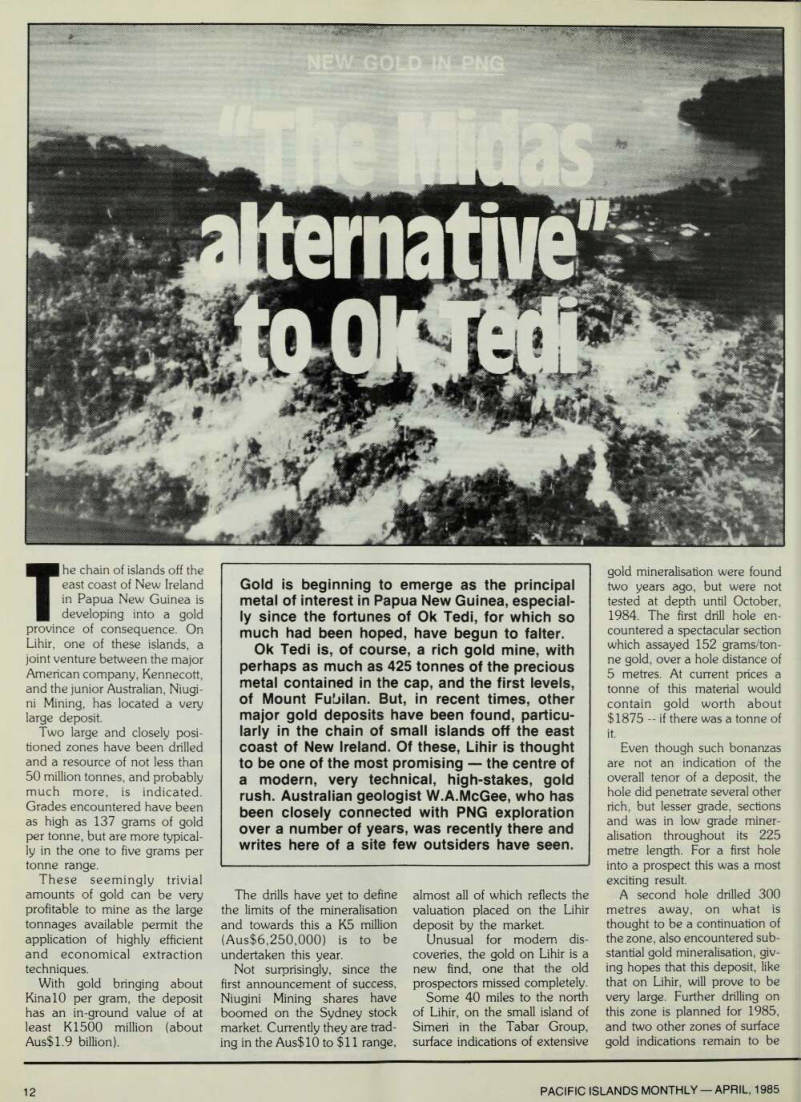
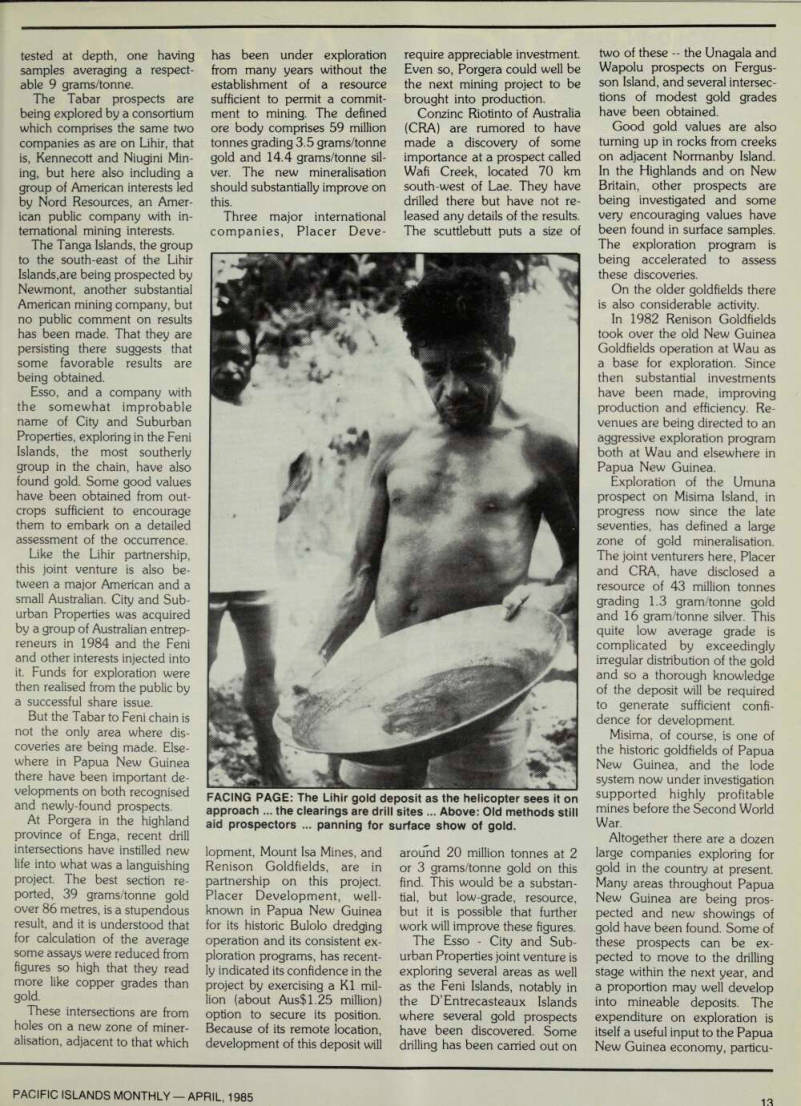
FACING PAGE: The Lihir gold deposit as the helicopter sees it on approach ... the clearings are drill sites ... Above: Old methods still aid prospectors ... panning for surface show of gold.
larly as much is directed to remote areas where there is little other opportunity for any cash income.
Also of importance is an airborne geophysical survey which has lately commenced on Bougainville Island. It is being carried out jointly by the West German government as an aid project, and the Papua New Guinea Geological Survey. Airborne geophysics is an indirect method of prospecting which is unlikely itself to result in immediate mineral discoveries, but the survey is expected to be able to suggest locations favorable for both gold and copper.
Bougainville Island was chosen for this survey because of the considerable interest in exploration there. Both the Bougainville Provincial government and the national government are very dependent on revenues generated by the Pan-
guna mine on Bougainville, but this has a limited life left and is already suffering from falling ore grades. Further, the mining company has a large invest ment in facilities, such as towns and the port, which it would like to see used beyond the exhaus tion of the Panguna reserves.
Because of opposition by the local people, arising from diffi culties in acquiring land for development of the Panguna mine, the island has been closed to exploration since the late sixties. In addition to the expected technical results, the initiation of this project is itself seen as a significant political breakthrough which could lead to opening of the island to general exploration. Bougain ville Island is viewed by geolog ists as one of the most promis ing areas in Papua New Guinea, if only because where there is one large ore body there are good chances of an-
other.
The gold discoveries come at a particularly favorable time for the Papua New Guinea govern ment. Other mining projects are not fulfilling expectations and much of the national planning has looked to future income from mining. Depressed metal prices and its lowered ore grades have reduced revenues from the Panguna mine which alone provides around a quar ter of the government’s funds.
The Ok Tedi project incurred large cost over-runs in construc tion and since commissioning has encountered several op erational difficulties. Gold is now being produced, but is not generating the revenues ex pected. The Papua New Guinea government, which took a 20 per cent equity share in the venture, has indicated it may not contribute further capi tal at this stage.
The operating company has also been forced to delay im plementation of further phases of the project, to introduce copper production, because at the prevailing low copper prices this would result in further losses. The gold zone now being mined has reserves for about three years only, by which time copper must be in production to sustain the pro ject.
During the protracted and complicated negotiations be tween the government and the Ok Tedi consortium, before and after the government’s order closing down operations, a large number of concessions and assurances were offered back and forth across the table.
The government and the min ing company moved positions considerably and several assur ances of further investment were given. But, at time of writing, Ok Tedi was still closed, mainly because the out look for copper prices re mained somewhere between terrible and mediocre... Ed.
It has become evident that, in the foreseeable future, there is little chance of establishing mines on either the Frieda or the Yanderra copper deposits, or on the Ramu nickel-cobalt deposit. Each of these projects had at some stage in the last
decade seemed close to deve lopment. Prices for the metals on which they would depend are exceedingly low and the markets show little prospect of recovery. Of all the common metals it is really only gold, a metal never in over-supply, which commands a sufficient market to attract investment in new projects.
Papua New Guinea at pre sent produces about two per cent of the world’s newly mined gold and ranks about eighth among the producers in the world, although much is exported in copper concen trates for recovery at overseas refineries.
Besides providing a sizeable boost to the domestic eco nomy, development of the new discoveries will improve the country’s trading position and significantly raise its standing as a source of gold for the in ternational market. The political aspects of the successes in gold exploration remain themselves to be explored.
The gold deposit on Lihir is the most significant mineral discovery in Papua New Guinea since Ok Tedi was found in the late sixties. Kenne cott, as is well known, also discovered Ok Tedi, but they failed to develop it due to disagreements with the Papua New Guinea government.
Perhaps, given Ok Tedi’s cur rent difficulties, Kennecott did not miss too much. The Lihir discovery was made within a year of Kennecott re-commen cing active exploration in Papua New Guinea after a 10-year absence. If nothing else, they have displayed an enviable skill as discoverers.
Geologists consider that all of the important gold deposits in Papua New Guinea have been formed by volcanic activity such as is characteristic of the Pacific rim. Similar deposits are pre sent in other Pacific countries - Japan and the Philippines parti cularly seem to be well en dowed, but not all of the region has been equally well pros pected. Notably, there are ex cellent opportunities for dis coveries in some of the little prospected countries of the south-western Pacific region.
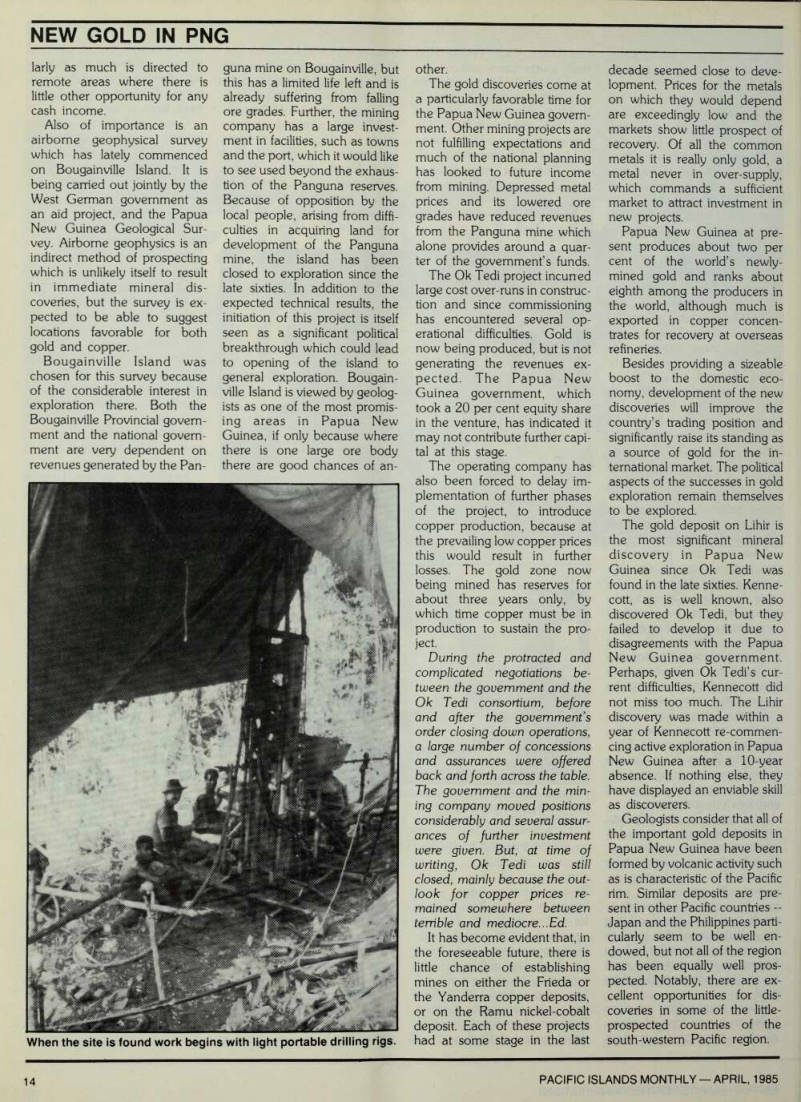
When the site is found work begins with light portable drilling rigs.
Advertisements & other items, p. 15 (1 item)
Ana-Digi
Multifunctlonallsm is the
watchword for timepieces
in this information age.
Citizen technology meets
the challenge with two
revolutionary
watches.
W' v Ml iW*.
"0 r < At r \ m' /
AflA-OIGI
TEMP
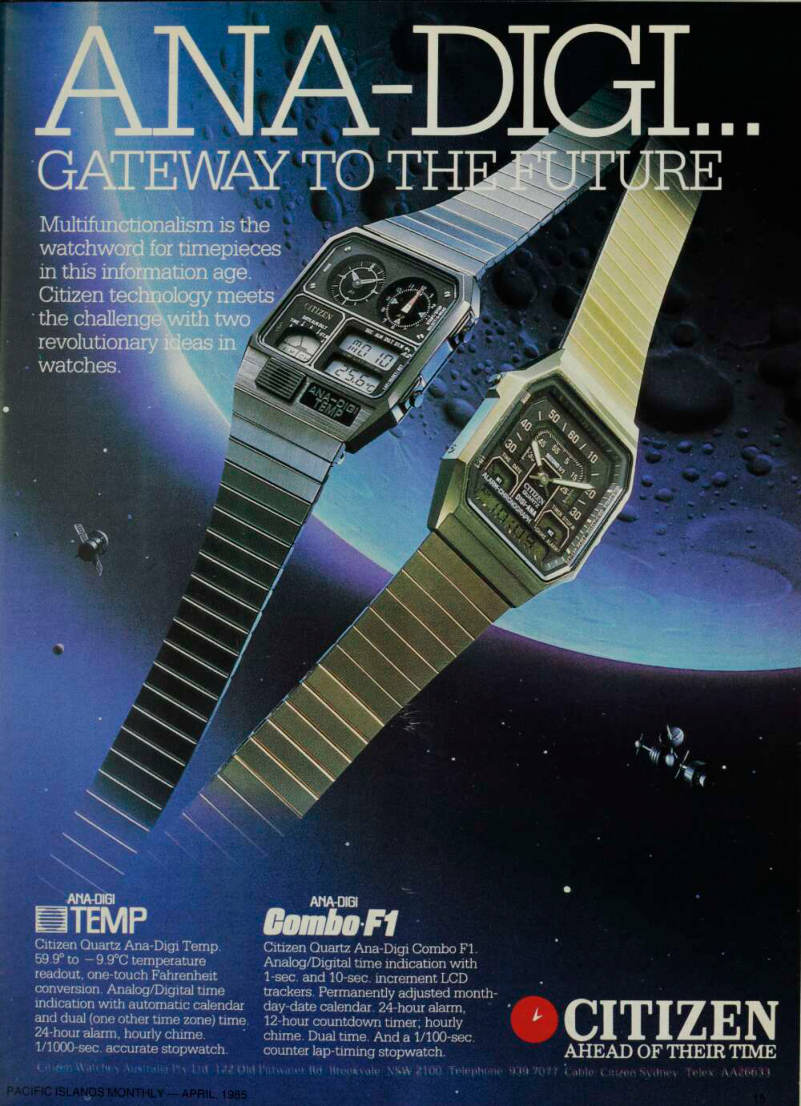
Citizen Quartz Ana-Digl Temp. 59.9° to - 9.9°C temperature readout, one-touch Fahrenheit conversion. Analog/Digital time indication with automatic calendar and dual (one other time zone) time. 24-hour alarm, hourly chime. 1/1000-sec. accurate stopwatch.
AMA-DIBI
Combo FI
Citizen Quartz Ana-Digi Combo FI.
Analog/Digital time indication with 1-sec. and 10-sec. increment LCD trackers. Permanently adjusted monthday-date calendar. 24-hour alarm, 12-hour countdown timer; hourly chime. Dual time. And a 1/100-sec. counter lap-timing stopwatch.
'\ 1 ' V\ t• *' * !\\'K V Q,\ &W \ Qt) i u
CITIZEN
AHEAD OF THEIR TIME
for Hayden
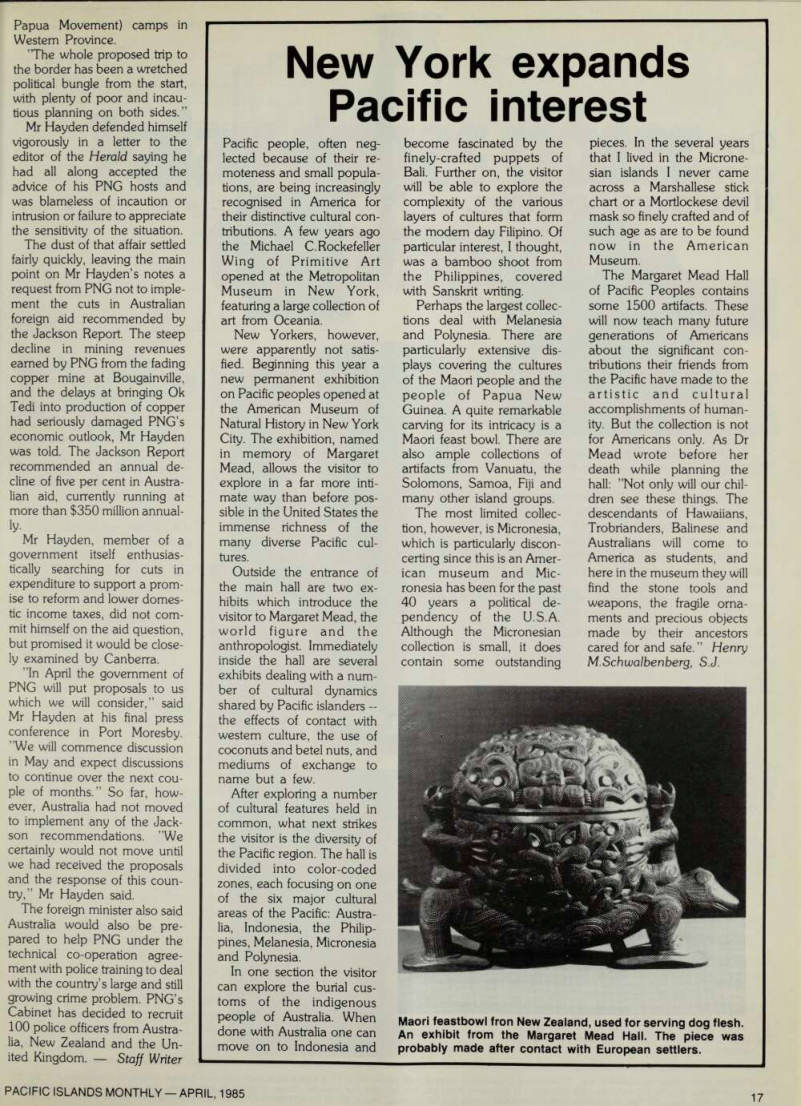
Png Regional Relations
Border-line welcome for Hayden
Australian aid, the West Irian border situation, and domestic crime rates were the domi nant subjects during the visit to Papua New Guinea mid-Febru ary of the Australian foreign minister, Mr Bill Hayden.
Through it all the Australians were at pains to be seen simply as very helpful friends and neighbors. ”It is important for Australia not to be seen as intrusive,” said Mr Hayden at the end of his four-day visit. ”If we domin ate your economy it could be misunderstood as neo-colonial ism. We want to avoid a long shadow of neo-colonialism in
this country.”
Hayden’s PNG opposite number, Mr Giheno, said the visit had reinforced the fact that Australia did not seek to inter fere. (Somewhat later, as if to reinforce PNG independence of thought and action, Mr Giheno delivered a sharp slap to the Americans for ’’bullying” New Zealand over the nuclear ship visit issue and ANZUS).
The most difficult aspect of the Hayden visit concerned the West Irian border. Mr Hayden had apparently expressed a de sire to visit a refugee camp along the border. Canberra offi cials suggested the visit, to Kungim camp, about 30 mi
nutes by air from Kiunga, would enable Mr Hayden to see for himself where Australian relief aid was being spent and perhaps also add to his perso nal knowledge of one of the most difficult political situations in the region.
The trip was cancelled by PNG foreign affairs secretary Paulias Matane, who expressed concern about Mr Hayden’s security.
Something of a furore deve loped over the cancellation, with Mr Hayden saying he wouldn’t do anything to embar rass PNG in any way, and people like former PNG De fence Force commander, Ted
Diro, now MP for Central, saying he would have made sure the visitors would have been safe.
A bigger storm broke in Aus tralia where Mr Hayden was sternly criticised by leading newspapers for having sought to go to the border and thereby risk his involvement, and thus the Australian government’s, in a sensitive matter between the Indonesians and PNG.
The Sydney Morning Herald said sharply in an editorial: ’There was no possible value to PNG, Australia or Indonesia in Mr Hayden being identified with what are OPM (Free West
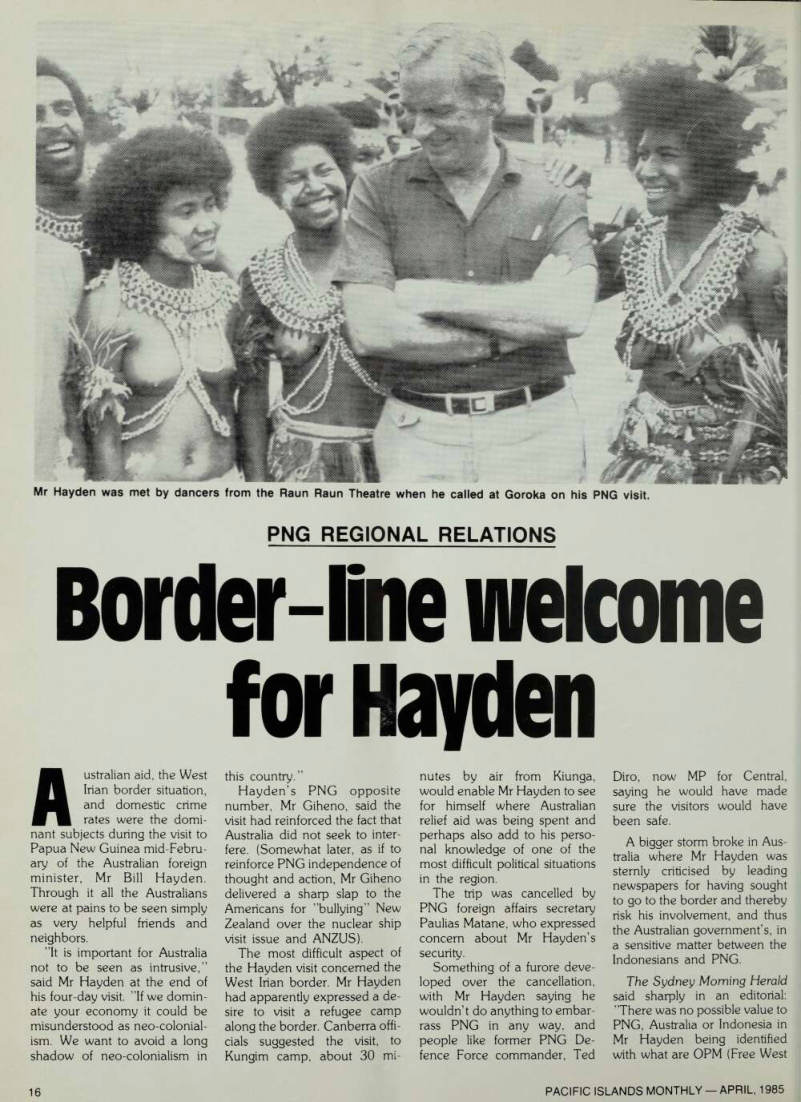
Mr Hayden was met by dancers from the Raun Raun Theatre when he called at Goroka on his PNG visit.
Papua Movement) camps in Western Province. ’The whole proposed trip to the border has been a wretched political bungle from the start, with plenty of poor and incau tious planning on both sides.”
Mr Hayden defended himself vigorously in a letter to the editor of the Herald saying he had all along accepted the advice of his PNG hosts and was blameless of incaution or intrusion or failure to appreciate the sensitivity of the situation.
The dust of that affair settled fairly quickly, leaving the main point on Mr Hayden’s notes a request from PNG not to imple ment the cuts in Australian foreign aid recommended by the Jackson Report. The steep decline in mining revenues earned by PNG from the fading copper mine at Bougainville, and the delays at bringing Ok Tedi into production of copper had seriously damaged PNG’s economic outlook, Mr Hayden was told. The Jackson Report recommended an annual de cline of five per cent in Austra lian aid, currently running at more than $350 million annual ly- Mr Hayden, member of a government itself enthusias tically searching for cuts in expenditure to support a prom ise to reform and lower domes tic income taxes, did not com mit himself on the aid question, but promised it would be close ly examined by Canberra. ”In April the government of PNG will put proposals to us which we will consider,” said Mr Hayden at his final press conference in Port Moresby. ”We will commence discussion in May and expect discussions to continue over the next cou ple of months.” So far, how ever, Australia had not moved to implement any of the Jack son recommendations. ”We certainly would not move until we had received the proposals and the response of this coun try,” Mr Hayden said.
The foreign minister also said Australia would also be pre pared to help PNG under the technical co-operation agree ment with police training to deal with the country’s large and still growing crime problem. PNG’s Cabinet has decided to recruit 100 police officers from Austra lia, New Zealand and the Un
ited Kingdom.
Staff Writer
New York expands
Pacific interest
Pacific people, often neg lected because of their re moteness and small popula tions, are being increasingly recognised in America for their distinctive cultural con tributions. A few years ago the Michael C. Rockefeller Wing of Primitive Art opened at the Metropolitan Museum in New York, featuring a large collection of art from Oceania.
New Yorkers, however, were apparently not satis fied. Beginning this year a new permanent exhibition on Pacific peoples opened at the American Museum of Natural History in New York City. The exhibition, named in memory of Margaret Mead, allows the visitor to explore in a far more inti mate way than before pos sible in the United States the immense richness of the many diverse Pacific cul tures.
Outside the entrance of the main hall are two ex hibits which introduce the visitor to Margaret Mead, the world figure and the anthropologist. Immediately inside the hall are several exhibits dealing with a num ber of cultural dynamics shared by Pacific islanders the effects of contact with western culture, the use of coconuts and betel nuts, and mediums of exchange to name but a few.
After exploring a number of cultural features held in common, what next strikes the visitor is the diversity of the Pacific region. The hall is divided into color-coded zones, each focusing on one of the six major cultural areas of the Pacific: Austra lia, Indonesia, the Philip pines, Melanesia, Micronesia and Polynesia.
In one section the visitor can explore the burial cus toms of the indigenous people of Australia. When done with Australia one can move on to Indonesia and
become fascinated by the finely-crafted puppets of Bali. Further on, the visitor will be able to explore the complexity of the various layers of cultures that form the modem day Filipino. Of particular interest, I thought, was a bamboo shoot from the Philippines, covered with Sanskrit writing.
Perhaps the largest collec tions deal with Melanesia and Polynesia. There are particularly extensive dis plays covering the cultures of the Maori people and the people of Papua New Guinea. A quite remarkable carving for its intricacy is a Maori feast bowl. There are also ample collections of artifacts from Vanuatu, the Solomons, Samoa, Fiji and many other island groups.
The most limited collec tion, however, is Micronesia, which is particularly discon certing since this is an Amer ican museum and Mic ronesia has been for the past 40 years a political de pendency of the U.S.A.
Although the Micronesian collection is small, it does contain some outstanding
pieces. In the several years that I lived in the Microne sian islands I never came across a Marshallese stick chart or a Mortlockese devil mask so finely crafted and of such age as are to be found now in the American Museum.
The Margaret Mead Hall of Pacific Peoples contains some 1500 artifacts. These will now teach many future generations of Americans about the significant con tributions their friends from the Pacific have made to the artistic and cultural accomplishments of human ity. But the collection is not for Americans only. As Dr Mead wrote before her death while planning the hall; ’’Not only will our chil dren see these things. The descendants of Hawaiians, Trobrianders, Balinese and Australians will come to America as students, and here in the museum they will find the stone tools and weapons, the fragile orna ments and precious objects made by their ancestors cared for and safe. ” Henry
M.Schwalbenberg,
S.J.
Maori feastbowl fron New Zealand, used for serving dog flesh.
An exhibit from the Margaret Mead Hall. The piece was probably made after contact with European settlers.
Advertisements & other items, p. 18 (1 item)
0 Hitachi
VK-Cl5OO
One video
combination
that loves holidays.
i
VT-8E
VHS
r ' Something very unusual happens to Hitachi’s VT-8E every time you take a trip.
It goes to pieces.
With a quick pull, the video tape recorder half separates from the tuner unit.
Hook it up to Hitachi’s VK-Cl5OO video camera, and you’re ready to shoot for up to an hour. Because the VK-Cl5OO is small enough to fit in the palm of your hand, it’s easy to carry 7 and easy to use.
All this portability comes without sacrificing an ounce of quality. The VT-8E has 5 heads, stereo recording and playback, and special editing functions for that professional touch. The VK-Cl5OO features Hitachi’s exclusive MOS sensor. 100 times more durable than conventional picture tubes, it delivers crisp, sharp images with no bum-in or ghosts.
Together these units offer both the convenience of a portable and the performance of a console. It’s never been easier to make video a part of your life whether you’re making movies on the road or taping them at home.
The VT-8E and VK-Cl5OO are just two of more than 20,000 ways Hitachi is using technology to improve your home, your office and your community.
Not to mention your holiday.
0 HITACHI
M Electronic viewfinder MOS sensor Full auto white balance Instant review button F 1.2 6X power zoom lens with macro - m I** «■»
i I il l
Camera jack AUDIO DUB button Frame advance button VTR auto-connection terminal Infrared remote control sensor Instant Recording Timer 7-programme/2-week timer Battery charge indicator • AUSTRALIA: Hitachi Sales Australia Pty., Ltd., 153 Keys Road. Moorabbin, Victoria 3189; Phone: (555) 8722 • NEW ZEALAND: AWA New Zealand Limited, Wi-neera Drive, P.O. Box 50- 248, Porirua; Phone: PRO 75-069 • PAPUA NEW GUINEA: S O, Svensson (N.G.) Ltd., P.O. Box 705, Port Moresby; Phone: 21-2111 • FIJI ISLANDS; AWA New Zealand Limited, 47 Foster Road (P.O. Box 858), Suva, Fiji; Phone: 312070 • NEW CALEDONIA: Caldis, B.P. Ml, Noumea; Phone; 26. 23. 50-*»TAHITI: Ets Chene Alain, P.O. Box 272, Papeete; Phone: 2. 88. 68
to compact
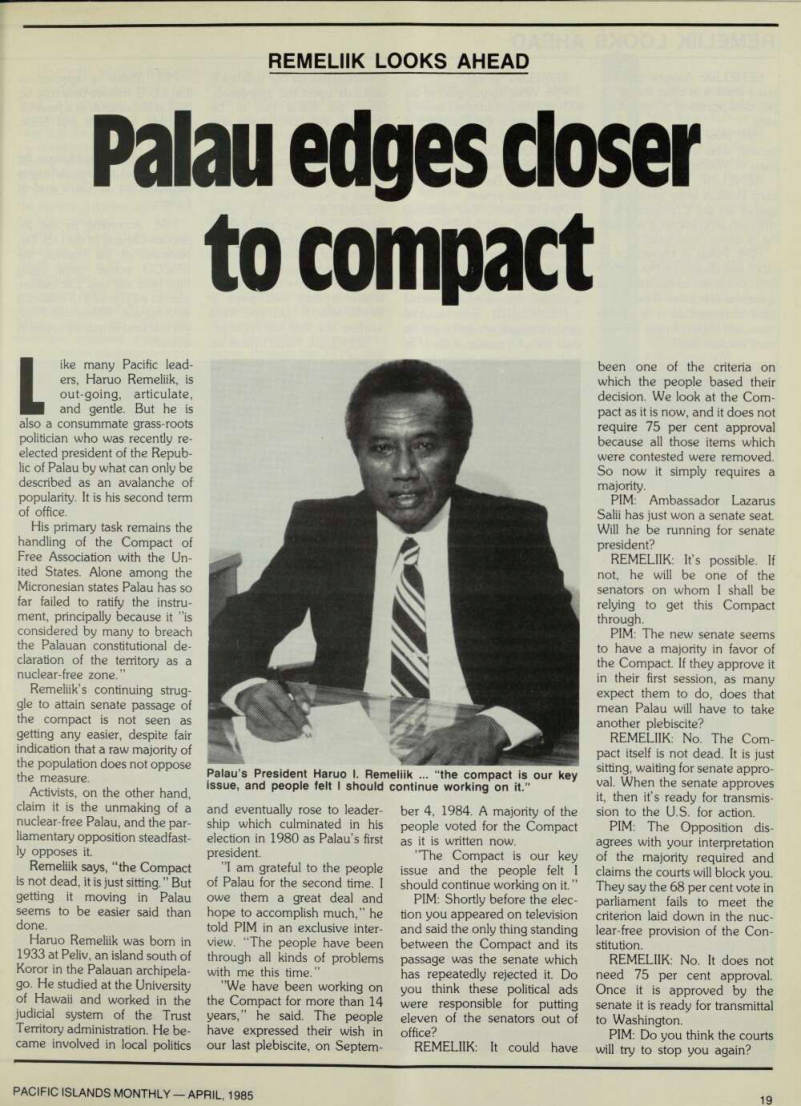
Remeliik Looks Ahead
Palau edges closer to compact
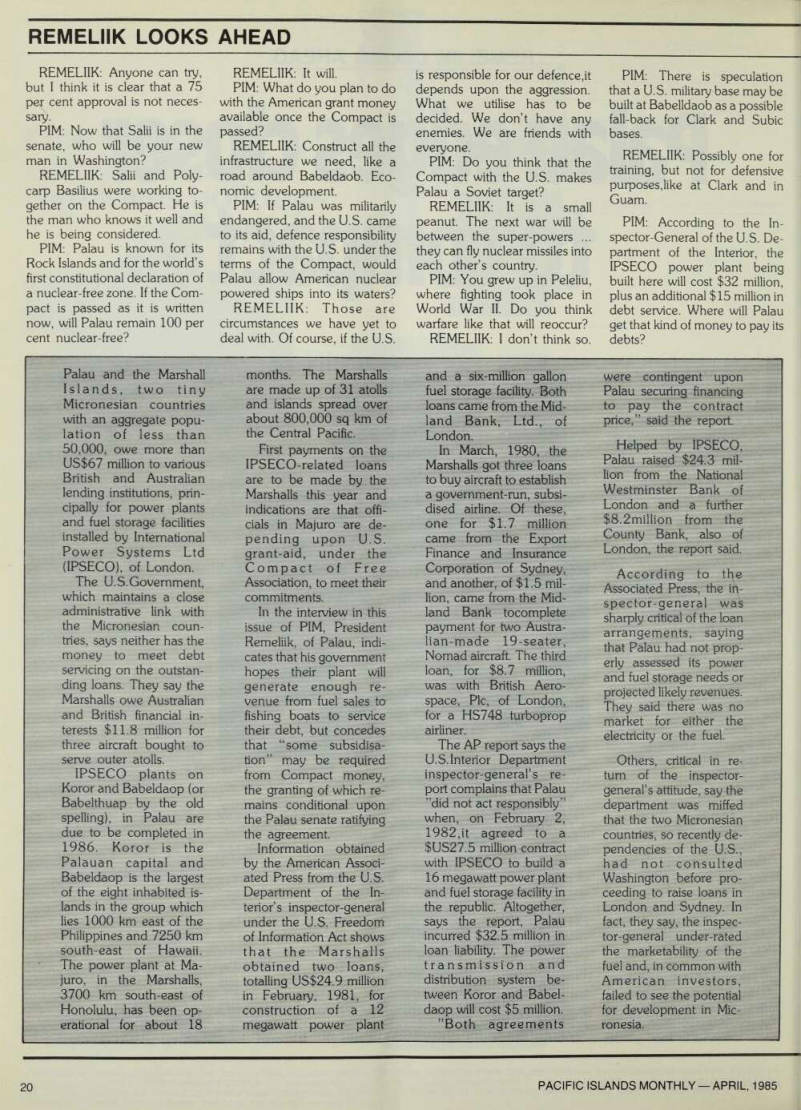
Like many Pacific lead ers, Haruo Remeliik, is out-going, articulate, and gentle. But he is also a consummate grass-roots politician who was recently re elected president of the Repub lic of Palau by what can only be described as an avalanche of popularity. It is his second term of office.
His primary task remains the handling of the Compact of Free Association with the Un ited States. Alone among the Micronesian states Palau has so far failed to ratify the instru ment, principally because it ”is considered by many to breach the Palauan constitutional de claration of the territory as a nuclear-free zone.”
Remeliik’s continuing strug gle to attain senate passage of the compact is not seen as getting any easier, despite fair indication that a raw majority of the population does not oppose the measure.
Activists, on the other hand, claim it is the unmaking of a nuclear-free Palau, and the par liamentary opposition steadfast ly opposes it.
Remeliik says, “the Compact is not dead, it is just sitting. ” But getting it moving in Palau seems to be easier said than done.
Haruo Remeliik was bom in 1933 at Peliv, an island south of Koror in the Palauan archipela go. He studied at the University of Hawaii and worked in the judicial system of the Trust Territory administration. He be came involved in local politics
and eventually rose to leader ship which culminated in his election in 1980 as Palau’s first president. ”1 am grateful to the people of Palau for the second time. I owe them a great deal and hope to accomplish much,” he told PIM in an exclusive inter view. “The people have been through all kinds of problems with me this time.” ”We have been working on the Compact for more than 14 years,” he said. The people have expressed their wish in our last plebiscite, on Septem
ber 4, 1984. A majority of the people voted for the Compact as it is written now. ’’The Compact is our key issue and the people felt I should continue working on it. ”
PIM: Shortly before the elec tion you appeared on television and said the only thing standing between the Compact and its passage was the senate which has repeatedly rejected it. Do you think these political ads were responsible for putting eleven of the senators out of office?
REMELIIK; It could have
been one of the criteria on which the people based their decision. We look at the Com pact as it is now, and it does not require 75 per cent approval because all those items which were contested were removed.
So now it simply requires a majority.
PIM: Ambassador Lazarus Salii has just won a senate seat.
Will he be running for senate president?
REMELIIK: It’s possible. If not, he will be one of the senators on whom I shall be relying to get this Compact through.
PIM: The new senate seems to have a majority in favor of the Compact. If they approve it in their first session, as many expect them to do, does that mean Palau will have to take another plebiscite?
REMELIIK: No. The Com pact itself is not dead. It is just sitting, waiting for senate appro val. When the senate approves it, then it’s ready for transmis sion to the U.S. for action.
PIM: The Opposition dis agrees with your interpretation of the majority required and claims the courts will block you.
They say the 68 per cent vote in parliament fails to meet the criterion laid down in the nuc lear-free provision of the Con stitution.
REMELIIK: No. It does not need 75 per cent approval.
Once it is approved by the senate it is ready for transmittal to Washington.
PIM: Do you think the courts will try to stop you again?
Palau’s President Haruo I. Remeliik ... “the compact is our key issue, and people felt I should continue working on it.”
REMELIIK: Anyone can try, but I think it is clear that a 75 per cent approval is not neces sary.
PIM: Now that Salii is in the senate, who will be your new man in Washington?
REMELIIK: Salii and Poly carp Basilius were working to gether on the Compact. He is the man who knows it well and he is being considered.
PIM; Palau is known for its Rock Islands and for the world’s first constitutional declaration of a nuclear-free zone. If the Com pact is passed as it is written now, will Palau remain 100 per cent nuclear-free?
REMELIIK: It will.
PIM; What do you plan to do with the American grant money available once the Compact is passed?
REMELIIK; Construct all the infrastructure we need, like a road around Babeldaob. Eco nomic development.
PIM: If Palau was militarily endangered, and the U.S. came to its aid, defence responsibility remains with the U.S. under the terms of the Compact, would Palau allow American nuclear powered ships into its waters?
REMELIIK; Those are circumstances we have yet to deal with. Of course, if the U.S.
is responsible for our defence,it depends upon the aggression.
What we utilise has to be decided. We don’t have any enemies. We are friends with everyone.
PIM: Do you think that the Compact with the U.S. makes Palau a Soviet target?
REMELIIK: It is a small peanut. The next war will be between the super-powers ... they can fly nuclear missiles into each other’s country.
PIM: You grew up in Peleliu, where fighting took place in World War 11. Do you think warfare like that will reoccur?
REMELIIK: I don’t think so.
PIM; There is speculation that a U.S. military base may be built at Babelldaob as a possible fail-back for Clark and Subic bases.
REMELIIK; Possibly one for training, but not for defensive purposes,like at Clark and in Guam.
PIM; According to the In spector-General of the U.S. De partment of the Interior, the IPSECO power plant being built here will cost $32 million, plus an additional $l5 million in debt service. Where will Palau get that kind of money to pay its debts?
Palau and the Marshall Islands, two tiny Micronesian countries with an aggregate popu lation of less than 50,000, owe more than US$67 million to various British and Australian lending institutions, prin cipally for power plants and fuel storage facilities installed by International Power Systems Ltd (IPSECO), of London.
The U.S.Government, which maintains a close administrative link with the Micronesian coun tries, says neither has the money to meet debt servicing on the outstan ding loans. They say the Marshalls owe Australian and British financial in terests $ll.B million for three aircraft bought to serve outer atolls.
IPSECO plants on Koror and Babeldaop (or Babelthuap by the old spelling), in Palau are due to be completed in 1986. Koror is the Palauan capital and Babeldaop is the largest of the eight inhabited is lands in the group which lies 1000 km east of the Philippines and 7250 km south-east of Hawaii.
The power plant at Ma juro, in the Marshalls, 3700 km south-east of Honolulu, has been op erational for about 18
months. The Marshalls are made up of 31 atolls and islands spread over about 800,000 sq km of the Central Pacific.
First payments on the IPSECO-related loans are to be made by the Marshalls this year and indications are that offi cials in Majuro are de pending upon U.S. grant-aid, under the Compact of Free Association, to meet their commitments.
In the interview in this issue of PIM, President Remeliik, of Palau, indi cates that his government hopes their plant will generate enough re venue from fuel sales to fishing boats to service their debt, but concedes that “some subsidisa tion” may be required from Compact money, the granting of which re mains conditional upon the Palau senate ratifying the agreement.
Information obtained by the American Associ ated Press from the U.S.
Department of the In terior’s inspector-general under the U.S. Freedom of Information Act shows that the Marshalls obtained two loans, totalling U 5524.9 million in February, 1981, for construction of a 12 megawatt power plant
and a six-million gallon fuel storage facility. Both loans came from the Mid land Bank, Ltd., of London.
In March, 1980, the Marshalls got three loans to buy aircraft to establish a government-run, subsi dised airline. Of these, one for $1.7 million came from the Export Finance and Insurance Corporation of Sydney, and another, of $1.5 mil lion, came from the Mid land Bank tocomplete payment for two Austra lian-made 19-seater, Nomad aircraft. The third loan, for $8.7 million, was with British Aero space, Pic, of London, for a HS74B turboprop airliner.
The AP report says the U.S.lnterior Department inspector-general’s re port complains that Palau ’’did not act responsibly” when, on February 2, 1982,it agreed to a $U527.5 million contract with IPSECO to build a 16 megawatt power plant and fuel storage facility in the republic. Altogether, says the report, Palau incurred $32.5 million in loan liability. The power transmission and distribution system be tween Koror and Babel daop will cost $5 million. ’’Both agreements
were contingent upon Palau securing financing to pay the contract price,” said the report.
Helped by IPSECO, Palau raised $24.3 mil lion from the National Westminster Bank of London and a further sB.2million from the County Bank, also of London, the report said.
According to the Associated Press, the in spector-general was sharply critical of the loan arrangements, saying that Palau had not prop erly assessed its power and fuel storage needs or projected likely revenues.
They said there was no market for either the electricity or the fuel.
Others, critical in re turn of the inspector general’s attitude, say the department was miffed that the two Micronesian countries, so recently de pendencies of the U.S., had not consulted Washington before pro ceeding to raise loans in London and Sydney. In fact, they say, the inspec tor-general under-rated the marketability of the fuel and, in common with American investors, failed to see the potential for development in Mic ronesia.
Remeliik: We Told Ipseco
right out that we don’t have that kind of money, and their economist came up with the idea that the plant will pay itself by constructing a fuel farm for storing fuel to be sold to fishing boats working around Palau.
IPSECO will pay for itself with the income it makes itself. It will be self-contained.
PIM: But wasn’t that concept based on the Van Camp plant which pulled out?
REMELIIK: We have an agreement with Japan Fishing Association. Over 400 boats are fishing within our 200 mile exclusive economic zone, and we can make arrangements for the boats to fuel here.
PIM: How many of those boats are Palauan?
REMELIIK: They are mostly Japanese and pay a fee for the fishing rights. It’s hard for Palauans to fish commercially because of the marketing prob lems. As for trade, we are still developing, so this is difficult.
We hope to attract some invest ments and businesses here with Compact money, so we can export, be duty-free, have in centives.
PIM: There is a probably scurrilous theory going around that IPSECO is really a plot to place Palau so deeply in debt that the Compact will have to be accepted. Then the military base will be built on Babeldaob where a power plant and fuell ing facility will be conveniently waiting for it. What do you think of that sort of rumor?
REMELIIK; That’s not our understanding at all. We have been short of power and we need a plant to meet our needs.
We might consider using Com pact money to subsidise it if necessary.
PIM: Is it true that Babeldaob has bauxite and phosphate?
REMELIIK: Yes. The owners of that land are looking into developing the resources, most ly negotiating with Japan for the mining.
PIM; What will be your poli cies for the next four years?
REMELIIK: We hope to have a better relationship with the national congress, so we can get more done. I hope this new congress will have a better
attitude toward things we are trying to develop. We would like to attract more investment for the construction industries and to develop our marine and economic resources.
PIM: What relations will Palau have with Japan in the next four years?
REMELIIK; We have a busi ness relationship between our businessmen and the Japanese, and we are also getting aid from Japan - about US$l.3 million.
This is not in actual cash, but mostly equipment for economic development. Our relationship is now friendly.
In September I travelled to Japan through the APPU with President Nakayama of the Federated States of Micronesia, and President Kabua of the Marshalls. It was an educational trip to make Japan more aware of the islands. We met with prime minister Nakasone, who said his government would con tinue to foster the relationship between Japan and Micronesia, economically and politically.
PIM: Having been brought up during the Japanese times, and the war, do you have any fears that the old “Greater East Asia Co-Prosperity Sphere” of Imperial Japan will try to take over Micronesia again?
REMELIIK: No. Japan is an economic giant and its interests now are mainly economic. This is something we welcome. The new luxury Palau Pacific Resort is a plus for our economy, for example.
Remeliik concedes that the Japanese developed Palau more than the Americans, but says their development in those (pre-war and wartime) days was for Japanese. America de veloped less, economically, but it was all for the Palauans. This was one of his reasons for supporting the Compact, he said.
PIM; Speaking of the Pacific Resort, how important is tour ism for Palau?
REMELIIK: It is one of the potentials we would like to develop. We see tourism as a major economic force in the islands.
PIM: With whom else, be sides the U.S. and Japan, would Palau like to develop a
close relationship?
REMELIIK: Taiwan, Hong kong and the Philippines have expressed interest in us, but our ties to the South Pacific are very important to us. Palau cooper ates fully with all Pacific Island nations. ‘ We are a new island nation and we are making every effort to impress our neighboring friends with our existence ant our willingness to cooperate in all areas of mutual interest.
Palau is not yet a member of either the Forum or of SPEC, because we have not yet attained Free Association status or independence, which are membership requirements. But we are very much members of the South Pacific Commission.
Palau has indeed received much technical assistance from SPC and it is through this association that we are making appreciable relationships with other member nations.
We feel through our active participation in the SPC that we are sending the message to our island friends that we are se rious and willing to work with our neighbors on mutually be neficial programs.
PIM: What is your view of the situation in New Caledonia?
REMELIIK: We were looking forward to the Festival of the Pacific Arts. It would have been our second participation. We feel defeated by its cancellation because the festival is some thing we need for our country, our culture, our identity. With out our culture we are not Palauan any more.
As for the political situation there now-I don’t know the details. The Kanaks want to claim their rights as natives of the islands. Things have been brewing for a long time and now it has surfaced. I think it is an internal matter between the Kanaks and the French New Caledonians.
PIM: What is your hope for the future?
REMELIIK: I would like to see Palau remain as Palau and become economically self-suffi cient and independent. But we have to build up Palau’s econo mic strength to achieve this
goal.
E.Rampell
Advertisements & other items, pp. 21-22 (1 item)
Sheaffer
ft The way you write and the pen you choose both say a lot about you.
Slanted writing with large loops can show responsiveness and imagination. Choosing a Sheaffer shows you appreciate a superior pen that makes a stylish gift. Only Sheaffer has such superb styling and craftsmanship with such a range of fine finishes.
Distinctive Matte Black.
Fountain pen. ballpoint, pencil and slim rolling ball pen with interchangeable micro tip marker.
Slim or classic profile.
SHEAFFER
SHEAFFER PEN
Sheallei Ealon Division ol Tendon Pacific Lid
«r J ri - « ,j * v , i r >%*■-■ « r : Xv - * - I ¥*' • ~v,*, -- --- *<> ’.'♦o >'♦'" ( <;? * v t *•'■> w ; ■ : ' < ' «* «»*» i ?»£ * ” f r?r %"5- x «$ • : 3f«r; 4Tf*, stn v % - s 5( * ? *<" ?<s. 15v* x ,V,[-
T**£ #ST;C <> ;* :
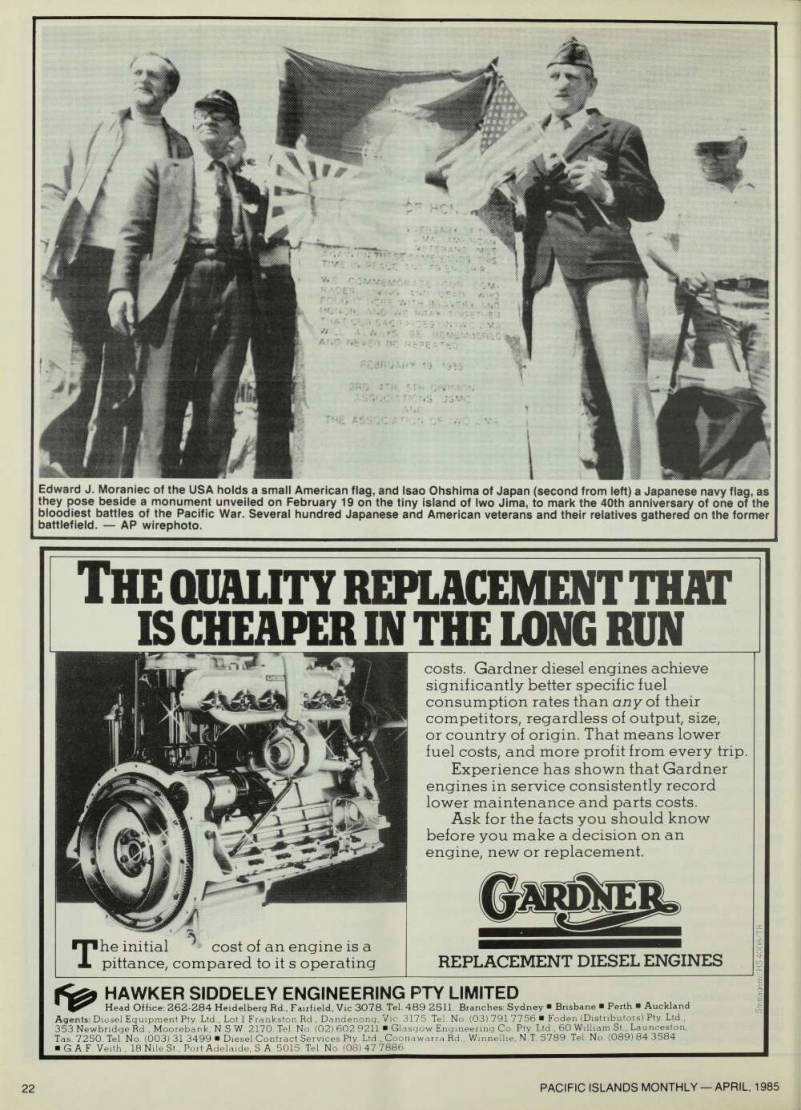
« Edward J. Moraniec of the USA holds a small American flag, and Isao Ohshima of Japan (second from left) a Japanese navy flag, as they pose beside a monument unveiled on February 19 on the tiny island of Iwo Jima, to mark the 40th anniversary of one of the bloodiest battles of the Pacific War. Several hundred Japanese and American veterans and their relatives gathered on the former battlefield. AP wirephoto.
The quality replacement that
IS CHEAPER IN THE LONG RUN
3? * X « costs. Gardner diesel engines achieve significantly better specific fuel consumption rates than any of their competitors, regardless of output, size, or country of origin. That means lower fuel costs, and more profit from every trip.
Experience has shown that Gardner engines in service consistently record lower maintenance and parts costs.
Ask for the facts you should know before you make a decision on an engine, new or replacement.
The initial - cost of an engine is a pittance, compared to it s operating
REPLACEMENT DIESEL ENGINES
HAWKER SIDDELEY ENGINEERING PTY LIMITED
* Head Office: 262-284 Heidelberg Rd., Fairfield, Vic 3078. Tel. 489 2511. Branches: Sydney ■ Bnsbane ■ Perth ■ Auckland Agents; Diesel Equipment Pty. Ltd., Lot 1 Fran kston Rd., Dandenong, Vic. 3175. Tel. No. (03) 791 7756 ■ Foden (Distributors) Pty. Ltd., 353 Newbridge Rd., Moorebank, N S W. 2170. Tel. No. (02) 602 9211 ■ Glasgow Engineering Co. Pty. Ltd,, 60 William St,, Launceston, Tas. 7250. Tel. No. (003) 31 3499 ■ Diesel Contract Services Pty. Ltd., Coonawarra Rd., Winnellie, N T. 5789. Tel. No. (089) 84 3584 ■ G.A.F. Veith., 18 Nile St., Port Adelaide, S.A. 5015. Tel. No. (08) 47 7886
Kolone resignation may
Western Samoa Leadership
Kolone resignation may upset Eti rule
On Thursday, March 7, at a meeting of the Human Rights Protec tion Party (H.R.P.P.) in Apia, one of the party’s most prominent members, Vaai Kolone, stunned party mem bers when he announced his resignation from the party.
Since the elections held on February 22, leadership of the party has been one of the main issues. Vaai Kolone has made several bids for leadership.
However the H.R.P.P. has de cided to give its support to Tofilau Eti Alesana, prime minister for the past two years.
In Vaai Kolone’s press state ment, issued on March 8, he said he had officially dissociated himself from the H.R.P.P. and claimed that he believed that the party is no longer conscious of its original ideals and objec tives. He added that he did not feel he could personally bring any effective influence to bear on the situation.
Tofilau Eti, interviewed the same day, said Kolone’s deci sion had come ”as a complete surprise.” The prime minister said he hoped to have another meeting with Kolone and try to bring him back into the party.
Vaai Kolone was one of the founders of the H.R.P.P. in 1976 and became prime minis ter for ten months in 1982. He lost his seat in September of that year through a court deci sion. Until then Tofilau Eti had been deputy prime minister and minister for finance, but at the fall of Vaai he became leader of the H.R.P.P. and prime minis ter.
The dissociation of Vaai Kolone from the H.R.P.P. under the leadership of Tofilau Eti is considered crucial in the coming election for prime minister to be held on March 19 when the legislative assembly will meet to hold a secret ballot for the country’s leadership. At present Vaai Kolone says he is
Not for the first time since their independence, the politics of Western Samoa are in a high state of flux. Despite his party’s clear election win, the leadership of Tofilau Eti fell into question because of movement among the engineers of influence within the legislative assembly. The catalyst was Vaai Kolone, one of the founders of the Human Rights Protection Party, now led by Tofilau Eti Alesana.
Kolone was prime minister for less than a year in 1982, but lost his seat after a court action. He remains a powerful figure in the land.
Western Samoa’s electoral system is unique in the Pacific for votes are not cast by the population generally but by the matai (clan and family leaders). In the previous election there were about 12,000 matai. This number was increased by appointment to about 16,000 for the most recent poll, a rise which has caused considerable debate in the country. Lee Anderson reports from Apia on the latest moves which appear to cast doubt on the future leadership of Tofilau Eti.
not affiliated with any party.
The H.R.P.P. in the elections on February 22 won with 31 seats to 16. The opposition, the Christian Democratic Party, would need to attract Vaai Kolone, his supporters, and possibly eight other members to its ranks before having any chance of holding a majority in the assembly.
It is possible that Vaai Kolone could become prime minister by working together with the Christian Democrats. If this
were the case the eight cabinet posts, including those of deputy prime minister and Speaker, could be split between repre-
sentatives of both groups.
The other major figure in this delicate political round, Tupuola Efi, said in an inter view after Kolone’s resignation that he did not rule out the possibility of a coalition govern ment. He said his policy now was to ’’fold my arms” and wait to see what happened.
Apia, and the rest of Western Samoa seethed with specula tion over the situation but Tupuola Efi said he had nothing positive to say; things were in flux.
Vaai Kolone
Couple
elected
For the second time in Samoan political history, a husband and wife team have been elected to the parliament in Apia. Le Tagaloa Pita was elected from Palauli (Le Falese) and his wife Aiono Fanaasi was elected from Aana Alofi Number One. The first couple to be elected simul taneously to parliament entered the house in the early seventies were Vaovasamanaia Filipo, now chief justice, and his wife, Taulapapa Faimaala Filipo.
Lee Anderson.
Stop Press
The prime minister of Western Samoa, Tofilau Eti Alesana, was re-elected unopposed on March 19 at the ninth meeting of the legislative assembly, This is only the second time in the history of Western Samoa’s parliament thal a prime minister has been elected unopposed. As expected, a motion was put that Vaai Kolone, a former prime minister, stand for election, bu Kolone declined before the motion could be seconded. It was expected that either Vaai Kolone or Tupuola Efi, leader of the Christian Demo-
cratic Party would oppose Tofilau Eti.
AXx After the vote, the P”me minister told me „ wa ® surprised he had been elected unanimously. In his f= ceptance s Pf ect ] »° ,he assembly the p "? e m, "' s ‘ ar ‘Le ed Tupuola Efi and his P ar V f° r their confi dance in him. He also thanked Vaai Kolone ,or . his withdrawal, sa V m 9 h that a , “n«m mous choice of leader would now serve to strengthen the coun try’
Nonumalo Sofara was re-elected Speaker of the house, Lee Anderson, in Apia.
Samoan airline
in service
Samoa Air, a new regional airline, carrying the national flag of American Samoa, opened services late in February with a flight from Pago Pago to Hon olulu.
Initially the airline will oper ate two flights a week on that route using a Boeing 707 airline bought from the charter oper ator, Aero Pilipinas.
The aircraft was delivered last September and since then has been fully refurbished and given new livery. It has 16 first class and 143 economy class seats. According to a spokes man for Samoa Air all neces sary international clearances have been obtained.
Yet to come is a US$2.2 million ’’hush kit” to bring the engines within current noise level limits. This is due to be fitted by Boeing Aircraft Com pany in Seattle, later this year.
Until then, the aircraft will oper ate under a noise level
dispensation from the U.S.
Federal Aviation Administra tion.
The president and chairman of the board of the new airline is Mr Ron Pritchard, an American Samoan national, who has banking and other financial and community interests in the terri tory.
Brian Asgill, vice-president for marketing and sales, based in Honolulu, has discussed in ter-line and marketing arrange ments for Samoa Air with TAA, Ansett and Qantas. He said Samoa Air would expand services to other regional Pacific destinations but, initially, would consolidate its position on the Hawaii-American Samoa route.
Two other airlines operate on this sector, Hawaiian Airlines and South Pacific Island Air ways. Each runs three services a week, also with Boeing 707 equipment.
Shipping service
suspended
Pacific Islands Transport Line has suspended its service between the Pacific Coast and the Pacific Islands of Tahiti, American Samoa and Western Samoa.
General Steamship Corporation, Ltd., agent for the line, and its owner, A/S Thor Dahl of Sandefjord, Norway, said that so far the line has been unable to find a suitable replacement for the chartered vessel ’’Sirius” which completed her last voyage for PITL on Febru ary 13, at Wilmington, Cali fornia.
The owners say they are continuing their search for a suitable substitute vessel to serve the trade.
This is the second recent withdrawal of a major ship from the island trade. Last year Burns Philp found themselves unable to find sufficient cargo to justify their very useful inter-island shipping service. They had received considerable verbal support from various gov ernments, but not enough actual cargo, despite the fact that such a service would clearly be of benefit to island economies.
Hi-tech comes
to P.I.M.
History was made by Floyd Takeuchi’s column in this month’s issue of P.I.M. With it our correspondents have en tered the high-technology age of computers talking to each other across vast distances.
Floyd, from his office in Hon olulu, transmitted his column to P.I.M. headquarters in Sydney in about 3 minutes, using, at his end, his portable Kaypro II computer to speak to P.l.M’s.
NEC terminal. At his end a Hayes modem connected him through the telephone lines of
Hawaii Bell Telephone to the overseas cable of Cable and Wireless and Australia’s O.T.C. and thus to Australian Tele com’s phone system and the Avtek multi-modem in P.l.M.’s offices. The file was edited and then transmitted, again by Aus tralian Telecom telephone lines to the central type-setting sys tem in Melbourne.
All of this happened with speed and accuracy, and en ables P.I.M. to serve its readers better, faster, and closer to the news of our region.
Advertisements & other items, p. 24 (1 item)
428 George St., Sydney.
LOCAL AGENTS AND PAPUA NEW GUINEA
REPRESENTATION RABAUL: M. & C. Seeto,
P.O. Box 131, Rabaul.
Telephone 92 2919.
MADANG: W. Double, P.O. Box 22, Madang.
Telephone 82 2696.
FIJI
K. Witherington Ltd., P.O. Box 293, Suva.
Telephone 22 356.
428 George St., Sydney.
Cables: Henco Sydney.
G.P.O. Box 3949.
Telephone: 232 5377.
For specialised and
personalised buying
service throughout
the Pacific Islands
and the East.
Resident Agents in other Pacific Territories.
VANUATU
John Lum & Associates, P.O. Box 65, Santo.
Telephone 329.
SOLOMON ISLANDS
Mr. Tom Lo, P.O. Box 327, Honiara.
Telephone 399 • I e
as strife continues
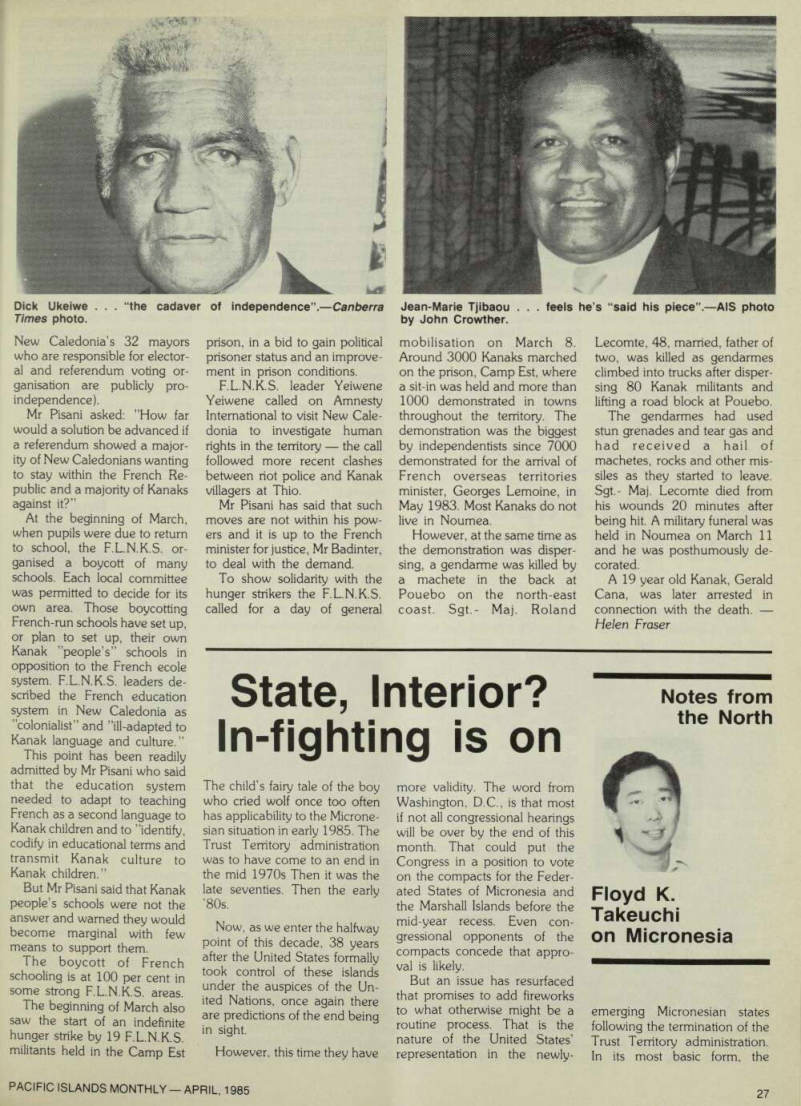
the month
‘No speaks’ the rule as strife continues
New Caledonia’s political situa tion did not show much evolu tion in February, with both major political leaders refusing dialogue on the one hand, or avoiding contact on the other, with President Mitterrand’s spe cial envoy, Mr Edgard Pisani.
Mr Dick Ukeiwe, Republican Party senator and president of the territorial government, has not held talks with Mr Pisani since the release of the latter’s plan for independence/associa tion in early January. Since then Mr Ukeiwe has refused contact with Mr Pisani, accusing him of having taken the pro independence side, and has said he cannot talk with him while the ’’cadaver” of inde pendence is between them. Mr Ukeiwe has several times de manded the recall to Paris of Mr Pisani.
Following the clashes be tween riot police and Kanak villagers at Thio on the south east coast (see below), Mr Jean- Marie Tjibaou has been staying in his home village of Tienda nite, near Hienghene on the north-east coast. Mr Tjibaou and other F.L.N.K.S. leaders feel they have said their piece to Mr Pisani and now await the final report he will submit to President Mitterrand at the end of March.
Mr Pisani had described as ’’criminal behavior” the or ganisation of a ’’picnic” in mid- February by the extreme right wing Caledonian Front. The picnic, to the F.L.N.K.S. stron ghold town of Thio, was to show solidarity with the inhabi tants, the organisers said. How ever the event was banned by Mr Pisani under the state of emergency laws still in force in New Caledonia and Republican Party leaders called on their supporters not to take part.
A total of 190 cars carrying more than 400 people set off
on the Sunday picnic but found themselves blocked by riot police halfway towards Thio.
After several hours of negotia tion police allowed 70 cars through with about 170 people aboard, including the Caledo nian Front leaders. As the police-protected convoy approached the Kanak village of St Philippo, local F.L.N.K.S. leaders protested to riot police.
Police then charged the villa gers, firing tear gas and stun grenades, to chase them back into the St Philippo tribe.
Kanaks threw rocks, sticks and other missiles at the police. The result was 11 Kanaks wounded, four of them seriously. One of the aspects of this confronta tion, and some others held recently has been the growing prominence of women on the barricades from both Kanak, and non-Kanak sides. In some recent demonstrations they have been much more militant than the men. (After the Thio incident Kanak women warned that they would ’’now take the front line” in any future clashes be tween riot police and villagers.
Both women and children were very active in the Thio clash, throwing rocks at gendarmes.
At the same time, on the extreme right-wing side of the non-Kanaks it is also now the women who are becoming more often hysterical and mili tant, inciting their men to take extreme action. Ed.) But de spite the troubles, and after considerable delays, the picnic was eventually held under police protection.
F.L.N.K.S. spokesman, Mr Yeiwene Yeiwene, described the clashes as ’’extremely se rious,” and said a return to normal life at Thio was hand icapped by the violence.
At a press conference several
days later Mr Leopold Joredie, minister for security in the Kanaky government, called on all F.L.N.K.S. militants to mobilise for self-defence and said they had lost confidence in Mr Pisani. Mr Joredie was elected by the Kanak’s self proclaimed government after the death of Eloi Machoro (see P.1.M., March ’B5).
The picnic had come after several weeks of tentative effort to re-establish normal life at Thio workers at the nickel mining centre had started a gradual return to work, shops had re-opened and people were in the streets. But follow ing the renewed clashes tension
Noumea Notebook
rose again, with daily incidents of rocks thrown at cars as they passed militant tribes and the burning down of at least a dozen houses of non-Kanaks.
Questioned following the vio lence, Mr Pisani said he that he had a plan, and it was soon revealed - the expulsion from the territory of four leaders of
Helen Fraser
the Caledonian Front and one sympathiser.
The five, whose banning orders came under the powers of the state of emergency, were
given several days to leave the territory. All went underground and announced to a news agency that they had no inten tion of quitting New Caledonia.
Eventually Mr Emile Lebar gy, Caledonian Front sym pathiser and president of the local branch of the Parachutists’
Association, made contact with Mr Pisani and was shown clemency. Mr Lebargy has a sick wife and is allowed to stay, although under a form of prob ation. However the police hunt for the four Caledonian Front leaders is continuing.
The expulsion orders given to the picnic organisers were denounced by Republican Party leader, Mr Jacques Laf leur, and Noumea’s Mayor Mr Roger Laroque. They called on French prime minister, Laurent Fabius, to intercede, but to no avail. A demonstration was held along with the closing of many shops and businesses in protest against the expulsions which Mr Lafleur termed ’’arbitrary and unjust. ”
The demonstration of around
15,000 (according to the police) and 35,000 (according to the organisers) was without incident and was accompanied by small demonstrations in the west coast towns of Bourail, La Foa, Koumac, and Kone. The demonstrations also resulted in the recall to France, to face an internal inquiry, of CaptSas sray, the gendarme officer in charge of the police road block near Thio at the time of the picnic.
Republican leaders, Dick Ukeiwe and Jacques Lafleur, warned that if France did not organise a referendum prompt ly, the territorial government would organise its own on the Ukeiwe autonomy plan, and hold it on April 15. However, Mr Pisani replied that this was not within the competence of the Ukeiwe government and that it was unlikely that all mayors would participate (18 of
Left: Jacques Lafleur. . . expulsion orders “arbitrary and unjust”.
New Caledonia’s 32 mayors who are responsible for elector al and referendum voting or ganisation are publicly pro independence).
Mr Pisani asked: ”How far would a solution be advanced if a referendum showed a major ity of New Caledonians wanting to stay within the French Re public and a majority of Kanaks against it?”
At the beginning of March, when pupils were due to return to school, the F.L.N.K.S. or ganised a boycott of many schools. Each local committee was permitted to decide for its own area. Those boycotting French-run schools have set up, or plan to set up, their own Kanak ’’people’s” schools in opposition to the French ecole system. F.L.N.K.S. leaders de scribed the French education system in New Caledonia as ’’colonialist” and ’’ill-adapted to Kanak language and culture.”
This point has been readily admitted by Mr Pisani who said that the education system needed to adapt to teaching French as a second language to Kanak children and to ’’identify, codify in educational terms and transmit Kanak culture to Kanak children.”
But Mr Pisani said that Kanak people’s schools were not the answer and warned they would become marginal with few means to support them.
The boycott of French schooling is at 100 per cent in some strong F.L.N.K.S. areas.
The beginning of March also saw the start of an indefinite hunger strike by 19 F.L.N.K.S. militants held in the Camp Est
prison, in a bid to gain political prisoner status and an improve ment in prison conditions.
F.L.N.K.S. leader Yeiwene Yeiwene called on Amnesty International to visit New Cale donia to investigate human rights in the territory the call followed more recent clashes between riot police and Kanak villagers at Thio.
Mr Pisani has said that such moves are not within his pow ers and it is up to the French minister for justice, Mr Badinter, to deal with the demand.
To show solidarity with the hunger strikers the F.L.N.K.S. called for a day of general
mobilisation on March 8.
Around 3000 Kanaks marched on the prison, Camp Est, where a sit-in was held and more than 1000 demonstrated in towns throughout the territory. The demonstration was the biggest by independentists since 7000 demonstrated for the arrival of French overseas territories minister, Georges Lemoine, in May 1983. Most Kanaks do not live in Noumea.
However, at the same time as the demonstration was disper sing, a gendarme was killed by a machete in the back at Pouebo on the north-east coast. Sgt.- Maj. Roland
Lecomte, 48, married, father of two, was killed as gendarmes climbed into trucks after disper sing 80 Kanak militants and lifting a road block at Pouebo.
The gendarmes had used stun grenades and tear gas and had received a hail of machetes, rocks and other mis siles as they started to leave.
Sgt.- Maj. Lecomte died from his wounds 20 minutes after being hit. A military funeral was held in Noumea on March 11 and he was posthumously de corated.
A 19 year old Kanak, Gerald Cana, was later arrested in connection with the death.
Helen Fraser
Dick Ukeiwe . . . “the cadaver of Independence’.—Canberra Times photo.
Jean-Marie Tjibaou . . . feels he’s “said his piece”.—AlS photo by John Crowther.
Advertisements & other items, pp. 25-26 (1 item)
Wanted To Buy
As one of Australia’s leading auction houses stamps and antiquities, we are ready to purchase any • Stamps of the World • Old Postcards • Old Letters and Documents • Old Photographs up to 1950 Please write to us in the first instance describing the items you hold, or ring us on the number below. Fair market prices assured.
Our reputation is your guarantee.
Charles Leski &
Associates Pty. Ltd.
1384 Malvern Road Malvern Victoria 3144 Australia Telephone (03) 20 5486
r v ’ WESTON/CL-
yy fy
Instant HOUSES
with Therma-Panel*
* r n-
George Hudson,
the name' in home building for 100 years l the established name with new ideas! 1! i
The home you can assemble!
• Economical fast and simple
George Hudson have supplied to: • Tonga
• PNG
• Solomon Islands • Tuvalu and • American Samoa We can also supply to your designs and specifications George Hudson Homes (Aust.) Ptv Ltd GH m •c
State, Interior?
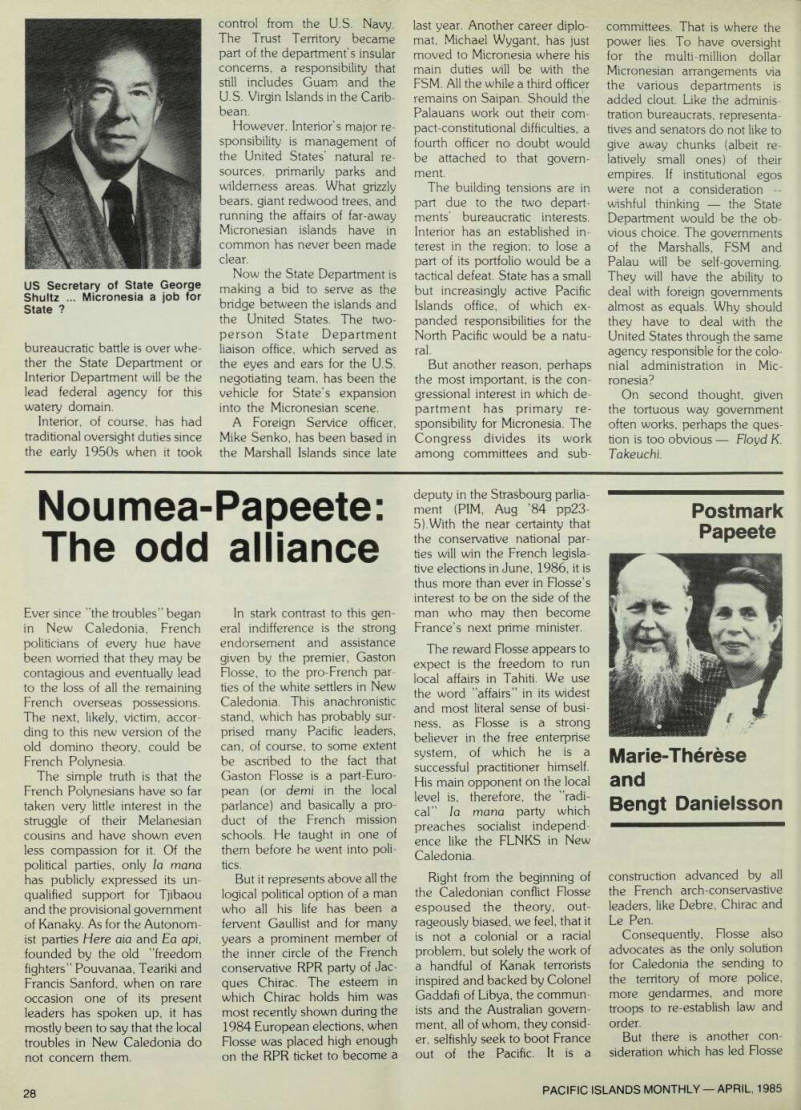
In-fighting is on
The child’s fairy tale of the boy who cried wolf once too often has applicability to the Microne sian situation in early 1985. The Trust Territory administration was to have come to an end in the mid 1970 s Then it was the late seventies. Then the early ’Bos.
Now, as we enter the halfway point of this decade, 38 years after the United States formally took control of these islands under the auspices of the Un ited Nations, once again there are predictions of the end being in sight.
However, this time they have
more validity. The word from Washington, D.C., is that most if not all congressional hearings will be over by the end of this month. That could put the Congress in a position to vote on the compacts for the Feder ated States of Micronesia and the Marshall Islands before the mid-year recess. Even con gressional opponents of the compacts concede that appro val is likely.
But an issue has resurfaced that promises to add fireworks to what otherwise might be a routine process. That is the nature of the United States’ representation in the newly-
Notes from the North
emerging Micronesian states following the termination of the Trust Territory administration, In its most basic form, the
Floyd K.
Takeuchi on Micronesia
bureaucratic battle is over whe ther the State Department or Interior Department will be the lead federal agency for this watery domain.
Interior, of course, has had traditional oversight duties since the early 1950 s when it took
control from the U.S. Navy.
The Trust Territory became part of the department’s insular concerns, a responsibility that still includes Guam and the U.S. Virgin Islands in the Carib bean.
However. Interior's major re sponsibility is management of the United States’ natural re sources, primarily parks and wilderness areas. What grizzly bears, giant redwood trees, and running the affairs of far-away Micronesian islands have in common has never been made clear.
Now the State Department is making a bid to serve as the bridge between the islands and the United States. The two person State Department liaison office, which served as the eyes and ears for the U.S. negotiating team, has been the vehicle for State’s expansion into the Micronesian scene.
A Foreign Service officer, Mike Senko, has been based in the Marshall Islands since late
last year. Another career diplo mat. Michael Wygant. has just moved to Micronesia where his main duties will be with the FSM. All the while a third officer remains on Saipan. Should the Palauans work out their com pact-constitutional difficulties, a fourth officer no doubt would be attached to that govern ment.
The building tensions are in part due to the two depart ments' bureaucratic interests.
Interior has an established in terest in the region; to lose a part of its portfolio would be a tactical defeat. State has a small but increasingly active Pacific Islands office, of which ex panded responsibilities for the North Pacific would be a natu ral.
But another reason, perhaps the most important, is the con gressional interest in which de partment has primary re sponsibility for Micronesia. The Congress divides its work among committees and sub
committees. That is where the power lies. To have oversight for the multi-million dollar Micronesian arrangements via the various departments is added clout. Like the adminis tration bureaucrats, representa tives and senators do not like to give away chunks (albeit re latively small ones) of their empires. If institutional egos were not a consideration wishful thinking the State Department would be the ob vious choice. The governments of the Marshalls, FSM and Palau will be self-governing.
They will have the ability to deal with foreign governments almost as equals. Why should they have to deal with the United States through the same agency responsible for the colo nial administration in Mic ronesia?
On second thought, given the tortuous way government often works, perhaps the ques
tion is too obvious
Floyd K.
Takeuchi.
US Secretary of State George Shultz ... Micronesia a job for State ?
Noumea-Papeete:
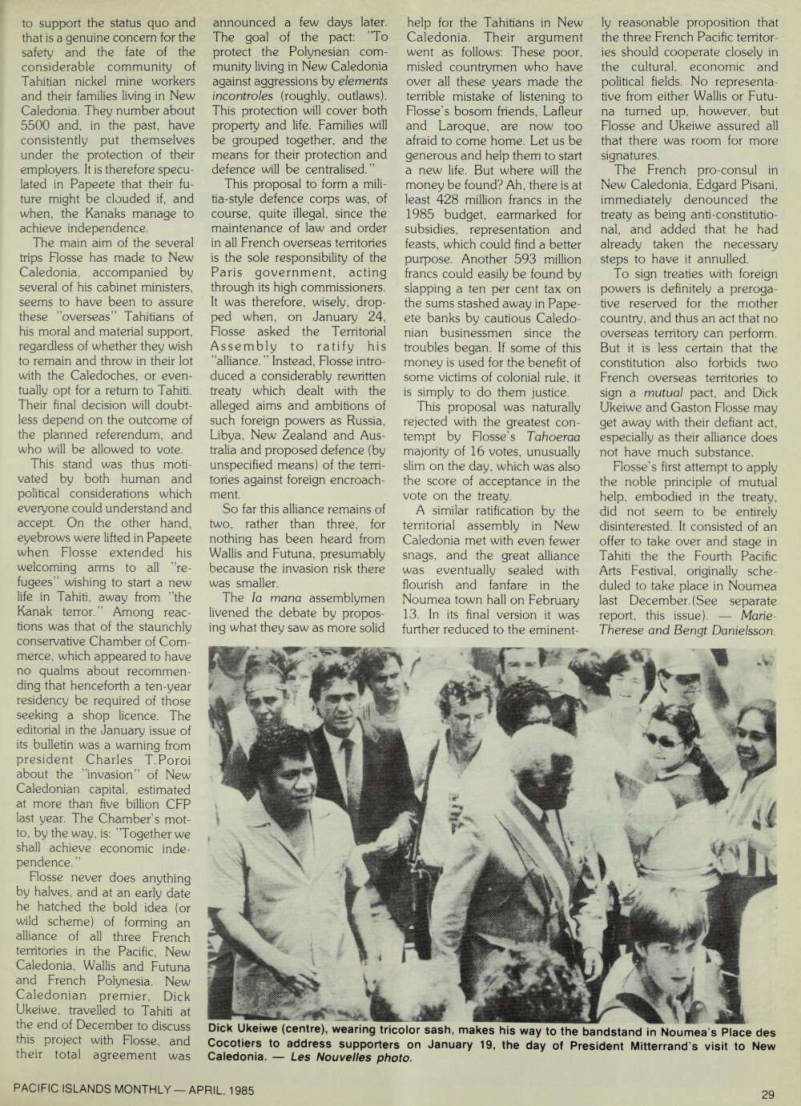
The odd alliance
Ever since ’’the troubles” began in New Caledonia, French politicians of every hue have been worried that they may be contagious and eventually lead to the loss of all the remaining French overseas possessions.
The next, likely, victim, accor ding to this new version of the old domino theory, could be French Polynesia.
The simple truth is that the French Polynesians have so far taken very little interest in the struggle of their Melanesian cousins and have shown even less compassion for it. Of the political parties, only la mana has publicly expressed its un qualified support for Tjibaou and the provisional government of Kanaky. As for the Autonom ist parties Here aio and Ea api, founded by the old ’’freedom fighters” Pouvanaa, Teariki and Francis Sanford, when on rare occasion one of its present leaders has spoken up, it has mostly been to say that the local troubles in New Caledonia do not concern them.
In stark contrast to this gen eral indifference is the strong endorsement and assistance given by the premier, Gaston Flosse, to the pro-French par ties of the white settlers in New Caledonia. This anachronistic stand, which has probably sur prised many Pacific leaders, can, of course, to some extent be ascribed to the fact that Gaston Flosse is a part-Euro pean (or demi in the local parlance) and basically a pro duct of the French mission schools. He taught in one of them before he went into poli tics.
But it represents above all the logical political option of a man who all his life has been a fervent Gaullist and for many years a prominent member of the inner circle of the French conservative RPR party of Jac ques Chirac. The esteem in which Chirac holds him was most recently shown during the 1984 European elections, when Flosse was placed high enough on the RPR ticket to become a
deputy in the Strasbourg parlia ment (PIM, Aug ’B4 pp 23s).With the near certainty that the conservative national par ties will win the French legisla tive elections in June, 1986, it is thus more than ever in Flosse’s interest to be on the side of the man who may then become France’s next prime minister.
The reward Flosse appears to expect is the freedom to run local affairs in Tahiti. We use the word ’’affairs” in its widest and most literal sense of busi ness, as Flosse is a strong believer in the free enterprise system, of which he is a successful practitioner himself.
His main opponent on the local level is, therefore, the ’’radi cal” la mono party which preaches socialist independ ence like the FLNKS in New Caledonia.
Right from the beginning of the Caledonian conflict Flosse espoused the theory, out rageously biased, we feel, that it is not a colonial or a racial problem, but solely the work of a handful of Kanak terrorists inspired and backed by Colonel Gaddafi of Libya, the commun ists and the Australian govern ment, all of whom, they consid er. selfishly seek to boot France out of the Pacific. It is a
Postmark Papeete
construction advanced by all the French arch-conservastive leaders, like Debre, Chirac and Le Pen.
Consequently, Flosse also advocates as the only solution for Caledonia the sending to the territory of more police, more gendarmes, and more troops to re-establish law and order.
But there is another con sideration which has led Flosse
Marie-Therese and Bengt Danielsson
to support the status quo and that is a genuine concern for the safety and the fate of the considerable community of Tahitian nickel mine workers and their families living in New Caledonia. They number about 5500 and, in the past, have consistently put themselves under the protection of their employers. It is therefore specu lated in Papeete that their fu ture might be clouded if, and when, the Kanaks manage to achieve independence.
The main aim of the several trips Flosse has made to New Caledonia, accompanied by several of his cabinet ministers, seems to have been to assure these ’’overseas” Tahitians of his moral and material support, regardless of whether they wish to remain and throw in their lot with the Caledoches, or even tually opt for a return to Tahiti.
Their final decision will doubt less depend on the outcome of the planned referendum, and who will be allowed to vote.
This stand was thus moti vated by both human and political considerations which everyone could understand and accept. On the other hand, eyebrows were lifted in Papeete when Flosse extended his welcoming arms to all ’’re fugees” wishing to start a new life in Tahiti, away from ’’the Kanak terror.” Among reac tions was that of the staunchly conservative Chamber of Com merce, which appeared to have no qualms about recommen ding that henceforth a ten-year residency be required of those seeking a shop licence. The editorial in the January issue of its bulletin was a warning from president Charles T.Poroi about the ’’invasion” of New Caledonian capital, estimated at more than five billion CFP last year. The Chamber’s mot to, by the way, is: ’’Together we shall achieve economic inde pendence.”
Flosse never does anything by halves, and at an early date he hatched the bold idea (or wild scheme) of forming an alliance of all three French territories in the Pacific, New Caledonia, Wallis and Futuna and French Polynesia. New Caledonian premier, Dick Ukeiwe, travelled to Tahiti at the end of December to discuss this project with Flosse, and their total agreement was
announced a few days later.
The goal of the pact: ”To protect the Polynesian com munity living in New Caledonia against aggressions by elements incontroles (roughly, outlaws).
This protection will cover both property and life. Families will be grouped together, and the means for their protection and defence will be centralised.”
This proposal to form a mili tia-style defence corps was, of course, quite illegal, since the maintenance of law and order in all French overseas territories is the sole responsibility of the Paris government, acting through its high commissioners.
It was therefore, wisely, drop ped when, on January 24, Flosse asked the Territorial Assembly to ratify his ’’alliance. ” Instead, Flosse intro duced a considerably rewritten treaty which dealt with the alleged aims and ambitions of such foreign powers as Russia, Libya, New Zealand and Aus tralia and proposed defence (by unspecified means) of the terri tories against foreign encroach ment.
So far this alliance remains of two, rather than three, for nothing has been heard from Wallis and Futuna, presumably because the invasion risk there was smaller.
The la mana assemblymen livened the debate by propos ing what they saw as more solid
help for the Tahitians in New Caledonia. Their argument went as follows: These poor, misled countrymen who have over all these years made the terrible mistake of listening to Flosse’s bosom friends, Lafleur and Laroque, are now too afraid to come home. Let us be generous and help them to start a new life. But where will the money be found? Ah, there is at least 428 million francs in the 1985 budget, earmarked for subsidies, representation and feasts, which could find a better purpose. Another 593 million francs could easily be found by slapping a ten per cent tax on the sums stashed away in Pape ete banks by cautious Caledo nian businessmen since the troubles began. If some of this money is used for the benefit of some victims of colonial rule, it is simply to do them justice.
This proposal was naturally rejected with the greatest con tempt by Flosse’s Tahoeraa majority of 16 votes, unusually slim on the day, which was also the score of acceptance in the vote on the treaty.
A similar ratification by the territorial assembly in New Caledonia met with even fewer snags, and the great alliance was eventually sealed with flourish and fanfare in the Noumea town hall on February 13. In its final version it was further reduced to the eminent
ly reasonable proposition that the three French Pacific territor ies should cooperate closely in the cultural, economic and political fields. No representa tive from either Wallis or Futu na turned up, however, but Flosse and Ukeiwe assured all that there was room for more signatures.
The French pro-consul in New Caledonia, Edgard Pisani, immediately denounced the treaty as being anti-constitutio nal, and added that he had already taken the necessary steps to have it annulled.
To sign treaties with foreign powers is definitely a preroga tive reserved for the mother country, and thus an act that no overseas territory can perform.
But it is less certain that the constitution also forbids two French overseas territories to sign a mutual pact, and Dick Ukeiwe and Gaston Flosse may get away with their defiant act, especially as their alliance does not have much substance.
Flosse’s first attempt to apply the noble principle of mutual help, embodied in the treaty, did not seem to be entirely disinterested. It consisted of an offer to take over and stage in Tahiti the the Fourth Pacific Arts Festival, originally sche duled to take place in Noumea last December. (See separate report, this issue). Marie- Therese and Bengt Danielsson.
Dick Ukeiwe (centre), wearing tricolor sash, makes his way to the bandstand in Noumea’s Place des Cocotiers to address supporters on January 19, the day of President Mitterrand’s visit to New Caledonia. Les Nouvelles photo.
Advertisements & other items, p. 30 (1 item)
Australian Hotel
RELIABLE.COM PtTTTTVF.I'ROFTTABLE.
& CATERING EQUIRVIENT.
Australia makes first class, reliable hotel and catering equipment for use in every situation - from self-serve or take-away food outlet to the plushest of international hotels. Australia’s products have proven competitive world-wide. They cover most requirements in food preparation and service, furniture, furnishings and fittings. You name it, most likely Australia can supply it. Commercial and domestic cookers.
Dishwashers. Glass-washing machines. Refrigeration. Cold Rooms. Icemakers. Mixers.
Fryers. Food warmers. Urns. Drink dispensers. Tableware. Plates and trays. Self-service merchandisers. Contract furniture. Mattresses. Carpet. Curtains. Towels. Sheets.
Blankets. Cleaning equipment. Bathroom and kitchen fittings. Find out how Australia can fulfil your requirements.
Hr-® / Ask the expert who knows Australia.
For details of Australian suppliers phone or telex the Australian Trade Commissioner at FIJI; PC. Box 1252, Suva.
Phone: 31 2844 Telex: FJ 2126
PAPUA NEW GUINEA:
PC. Box 9129, Hohola Phone; 25 9333 Telex: NE22109
NEW CALEDONIA;
PO. Box 22, Noumea Phone: 27 2414 Telex: 087 HAWAII: Australian Consulate 1000 Bishop St, Honolulu, 96813. USA.
Phone: (808) 524 5050 Telex; 633128 Ask the Australian
Trade Commissioner
: J 1 J -
LpLs:
T 1 a A A * %m
i ; tt
cooperative management?
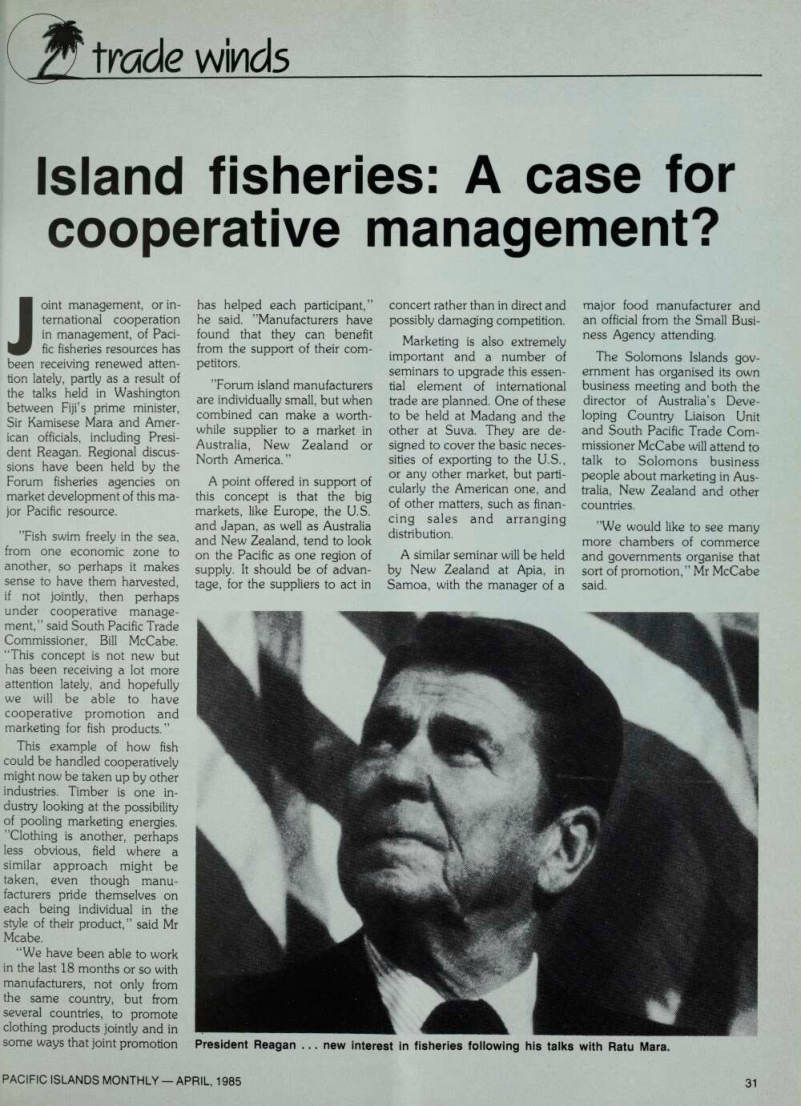
trade winds
Island fisheries: A case for cooperative management?
Joint management, or in ternational cooperation in management, of Paci fic fisheries resources has been receiving renewed atten tion lately, partly as a result of the talks held in Washington between Fiji’s prime minister, Sir Kamisese Mara and Amer ican officials, including Presi dent Reagan. Regional discus sions have been held by the Forum fisheries agencies on market development of this ma jor Pacific resource. ’’Fish swim freely in the sea, from one economic zone to another, so perhaps it makes sense to have them harvested, if not jointly, then perhaps under cooperative manage ment,” said South Pacific Trade Commissioner, Bill McCabe.
“This concept is not new but has been receiving a lot more attention lately, and hopefully we will be able to have cooperative promotion and marketing for fish products.”
This example of how fish could be handled cooperatively might now be taken up by other industries. Timber is one in dustry looking at the possibility of pooling marketing energies. ’’Clothing is another, perhaps less obvious, field where a similar approach might be taken, even though manu facturers pride themselves on each being individual in the style of their product,” said Mr Mcabe.
“We have been able to work in the last 18 months or so with manufacturers, not only from the same country, but from several countries, to promote clothing products jointly and in some ways that joint promotion
has helped each participant,” he said. ’’Manufacturers have found that they can benefit from the support of their com petitors. ’’Forum island manufacturers are individually small, but when combined can make a worth while supplier to a market in Australia, New Zealand or North America.”
A point offered in support of this concept is that the big markets, like Europe, the U.S. and Japan, as well as Australia and New Zealand, tend to look on the Pacific as one region of supply. It should be of advan tage, for the suppliers to act in
concert rather than in direct and possibly damaging competition.
Marketing is also extremely important and a number of seminars to upgrade this essen tial element of international trade are planned. One of these to be held at Madang and the other at Suva. They are de signed to cover the basic neces sities of exporting to the U.S., or any other market, but parti cularly the American one, and of other matters, such as finan cing sales and arranging distribution.
A similar seminar will be held by New Zealand at Apia, in Samoa, with the manager of a
major food manufacturer and an official from the Small Busi ness Agency attending.
The Solomons Islands gov ernment has organised its own business meeting and both the director of Australia’s Deve loping Country Liaison Unit and South Pacific Trade Com missioner McCabe will attend to talk to Solomons business people about marketing in Aus tralia, New Zealand and other countries. ”We would like to see many more chambers of commerce and governments organise that sort of promotion,” Mr McCabe said.
President Reagan ... new interest in fisheries following his talks with Ratu Mara.
Advertisements & other items, p. 32 (1 item)
Bens on w Hedges
n m 20
WARNING
SMOKING IS A HEALTH
HAZARD
ft
Summit attacks sluggish
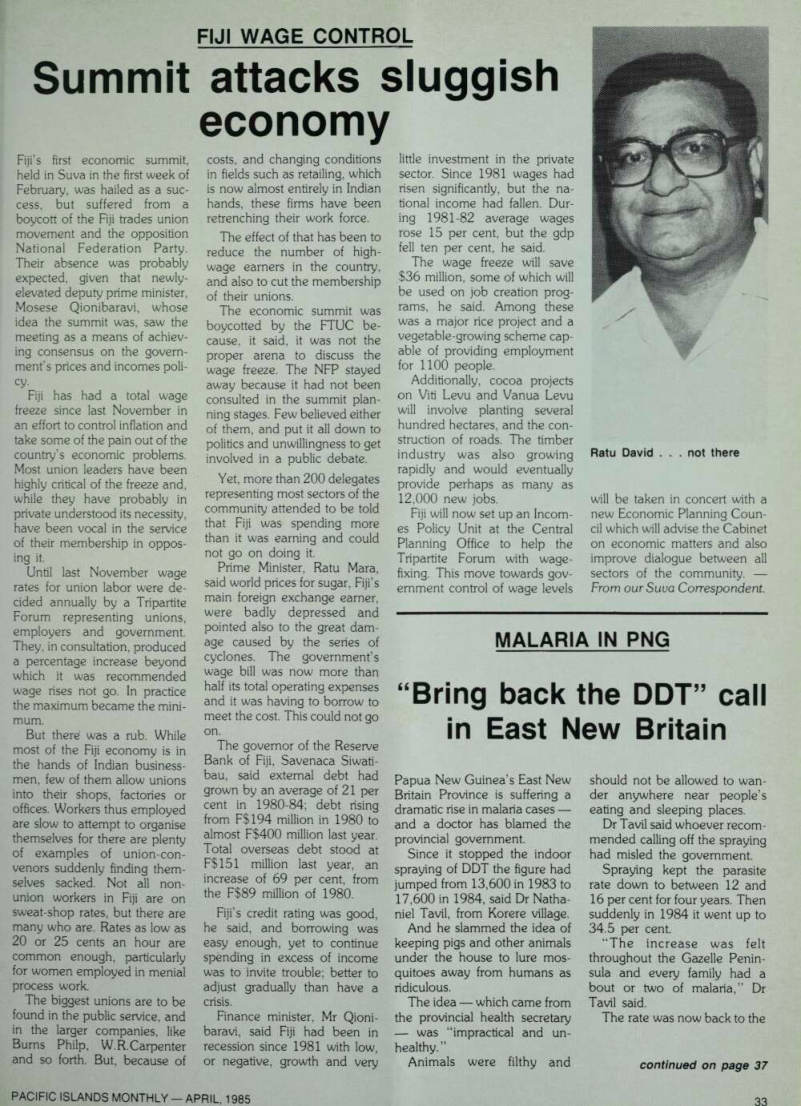
Fiji Wage Control
Summit attacks sluggish economy
Fiji’s first economic summit, held in Suva in the first week of February, was hailed as a suc cess, but suffered from a boycott of the Fiji trades union movement and the opposition National Federation Party.
Their absence was probably expected, given that newly elevated deputy prime minister, Mosese Qionibaravi, whose idea the summit was, saw the meeting as a means of achiev ing consensus on the govern ment’s prices and incomes poli cy.
Fiji has had a total wage freeze since last November in an effort to control inflation and take some of the pain out of the country’s economic problems.
Most union leaders have been highly critical of the freeze and, while they have probably in private understood its necessity, have been vocal in the service of their membership in oppos ing it.
Until last November wage rates for union labor were de cided annually by a Tripartite Forum representing unions, employers and government.
They, in consultation, produced a percentage increase beyond which it was recommended wage rises not go. In practice the maximum became the mini mum.
But there was a mb. While most of the Fiji economy is in the hands of Indian business men, few of them allow unions into their shops, factories or offices. Workers thus employed are slow to attempt to organise themselves for there are plenty of examples of union-con venors suddenly finding them selves sacked. Not all non union workers in Fiji are on sweat-shop rates, but there are many who are. Rates as low as 20 or 25 cents an hour are common enough, particularly for women employed in menial process work.
The biggest unions are to be found in the public service, and in the larger companies, like Burns Philp, W.R. Carpenter and so forth. But, because of
costs, and changing conditions in fields such as retailing, which is now almost entirely in Indian hands, these firms have been retrenching their work force.
The effect of that has been to reduce the number of high wage earners in the country, and also to cut the membership of their unions.
The economic summit was boycotted by the FTUC be cause, it said, it was not the proper arena to discuss the wage freeze. The NFP stayed away because it had not been consulted in the summit plan ning stages. Few believed either of them, and put it all down to politics and unwillingness to get involved in a public debate.
Yet, more than 200 delegates representing most sectors of the community attended to be told that Fiji was spending more than it was earning and could not go on doing it.
Prime Minister, Ratu Mara, said world prices for sugar, Fiji’s main foreign exchange earner, were badly depressed and pointed also to the great dam age caused by the series of cyclones. The government’s wage bill was now more than half its total operating expenses and it was having to borrow to meet the cost. This could not go on.
The governor of the Reserve Bank of Fiji, Savenaca Siwati bau, said external debt had grown by an average of 21 per cent in 1980-84; debt rising from Fsl94 million in 1980 to almost Fs4oo million last year.
Total overseas debt stood at Fslsl million last year, an increase of 69 per cent, from the FsB9 million of 1980.
Fiji’s credit rating was good, he said, and borrowing was easy enough, yet to continue spending in excess of income was to invite trouble; better to adjust gradually than have a crisis.
Finance minister, Mr Qioni baravi, said Fiji had been in recession since 1981 with low, or negative, growth and very
little investment in the private sector. Since 1981 wages had risen significantly, but the na tional income had fallen. Dur ing 1981-82 average wages rose 15 per cent, but the gdp fell ten per cent, he said.
The wage freeze will save $36 million, some of which will be used on job creation prog rams, he said. Among these was a major rice project and a vegetable-growing scheme cap able of providing employment for 1100 people.
Additionally, cocoa projects on Viti Levu and Vanua Levu will involve planting several hundred hectares, and the con struction of roads. The timber industry was also growing rapidly and would eventually provide perhaps as many as 12,000 new jobs.
Fiji will now set up an Incom es Policy Unit at the Central Planning Office to help the Tripartite Forum with wage fixing. This move towards gov ernment control of wage levels
will be taken in concert with a new Economic Planning Coun cil which will advise the Cabinet on economic matters and also improve dialogue between all sectors of the community.
From our Suva Correspondent.
Ratu David ... not there
“Bring back the DDT” call


Malaria In Png
“Bring back the DDT” call in East New Britain
Papua New Guinea’s East New Britain Province is suffering a dramatic rise in malaria cases and a doctor has blamed the provincial government.
Since it stopped the indoor spraying of DDT the figure had jumped from 13,600 in 1983 to 17,600 in 1984, said Dr Natha niel Tavil, from Korere village.
And he slammed the idea of keeping pigs and other animals under the house to lure mos quitoes away from humans as ridiculous.
The idea which came from the provincial health secretary was “impractical and un healthy.”
Animals were filthy and
should not be allowed to wan der anywhere near people’s eating and sleeping places.
Dr Tavil said whoever recom mended calling off the spraying had misled the government.
Spraying kept the parasite rate down to between 12 and 16 per cent for four years. Then suddenly in 1984 it went up to 34.5 per cent.
“The increase was felt throughout the Gazelle Penin sula and every family had a bout or two of malaria,” Dr Tavil said.
The rate was now back to the
continued on page 37
1960 level when there was no spraying. Despite DDT not totally eradicating the disease carrying mosquito, spraying was still an effective control which should be re-introduced.
In fact, until a new method or vaccine was invented, it was the only way of bringing any de gree of control.
Ecuador debt
vs. Galapagos
conservation
“The Galapagos Islands, Charles Darwin’s natural lab oratory for the investigation of the laws of nature, are them selves in the midst of a turbu lent evolution,” writes journalist Richard Lyons in The Sydney Morning Herald.
Just back from a visit to the islands, Lyons reports: A staggering foreign debt has forced Ecuador to cut drastical ly its spending on social prog rams, including environmental efforts.
The park’s budget has been cut by 75 per cent, the number of rangers from 75 to 50, and its patrol boat fleet from five to two. True, there is now less need for muscle in policing the 50 or so islands, only a few of which are inhabited.
For more than 200 years since their discovery in 1735, the islands were ravaged by pirates and whalers seeking, food, fuel and water. Some 100,000 of the tortoises that gave their name to the islands were carried off aboard ships.
Whalers and, more recently, fishermen deliberately stocked many of the islands with goats and pigs that have played havoc with the ecology. Goats have all but stripped some islands of the vegetation that is the tortoises’ nourishment.
Thus, the major problem has shifted from the deliberately rapacious early visitors to the animals they brought to the islands.
Packs of wild dogs roam some islands killing iguanas; house cats prey on the nests of the endangered Hawaiian Pet rel and rats attack flamingo and penguin chicks.
Advertisements & other items, pp. 34-36 (1 item)
'Dcruiser
I
TOYOTA
QUALITY SERVICE
AMERICAN SAMOA: BURNS PHILP (SOUTH SEA) CO., LTD., P.O. Box 129, Pago Pago.
COOK ISLANDS: COOK ISLANDS TRADING
CORPORATION LTD., Private Bag, Rarotonga.
FIJI: AUTOMOTIVE SUPPLIES COMPANY, A Division of Burns Philp (South Sea) Co., Ltd., G.P.O. Box 355, Suva.
GUAM & MICRONESIA: ATKINS KROLL, INC., 443 South Marine Drive, Tamuning.
KIRIBATI: TARAWA MOTORS, P.O. Box 36, Bairiki, Tarawa.
NAURU: NAURU COOPERATIVE SOCIETY, Central
Pacific.
NEW CALEDONIA: SERVICE IMPORTATION
AUTOMOBILE DU PACIFIQUE, Rond-Point du Pacifiqu (Station Total) B.P. 438, Noumea.
NORFOLK ISLAND: BORRYS LIMITED, P.O. Box 16!
PAPUA NEW GUINEA: ELA MOTORS, A Division c Burns Philp (PNG) Ltd., P.O. Box 75, Port Moresby.
SAIPAN: MICROL CORPORATION, P.O. Box 267, Saipai
r: * - * ' i ■ ■ K *
he tradition of power and ruggedness
oyota’s new Land Cruiser has been entirely esigned from the road up. But it still iins the traditional toughness uired from over thirty years oad experience. m But no matter how rough it gets a roomy new cabin with improved occupant comforts, easy instrumentation and an optional 4-speed automatic transmission add up to passenger car comfort with Land Cruiser ruggedness.
More power in hand and fuel efficiency have been gained with a new brawny 4.0-litre gasoline engine.
And to control all that power a new rigid chassis assures stable driving performance and mobility over the roughest terrain. on.
Pickup
u r B And you can choose from a wide variety of models and an array of heavy-duty features.
Take the wheel and feel Toyota quality in Land Cruiser’s styling, power and comfort. A quality that stays with you on or off the road.
Step into a new generation of toughness today.
OMON: SOLOMON ISLANDS INVESTMENTS LTD.,
D. Box 174, Honiara.
ITI: NIPPON AUTOMOTO, B.P. 342, Papeete.
IGA: BURNS PHILP (SOUTH SEA) CO., LTD., P.O. 55, Nukualofa.
IUATU: VANUATU MOTORS, A Division of Burns 3 (Vanuatu) Ltd., P.O. Box 18, Port Vila.
STERN SAMOA: BURNS PHILP (SOUTH SEA) CO., , P.O. Box 188, Apia.
■aroTA
Tackle
the toughest beards
withGll
o A IvC\ 7T*
CiVQo
:,-aa
r oA^.
b 0 N oJi a a £9 >ru a !<3 (V
n.A^.V
AA v* d: Gillette first ins system OH The numbe blade t w. v / sr^.
A t*T \R 4./-a The first blade shaves you close 2 The second blade even closer still Available throughout the Pacific from stores and supermarkets. my
Gillette G 1
Shaving system
e
DA473SPIM
Gillette GII, the world’s first and number one twin blade shaving system takes care of the toughest beards!
For a really close daily shave, insist on Gillette GII cartridges in either 5 or 10 packs.
over Oz Nomads
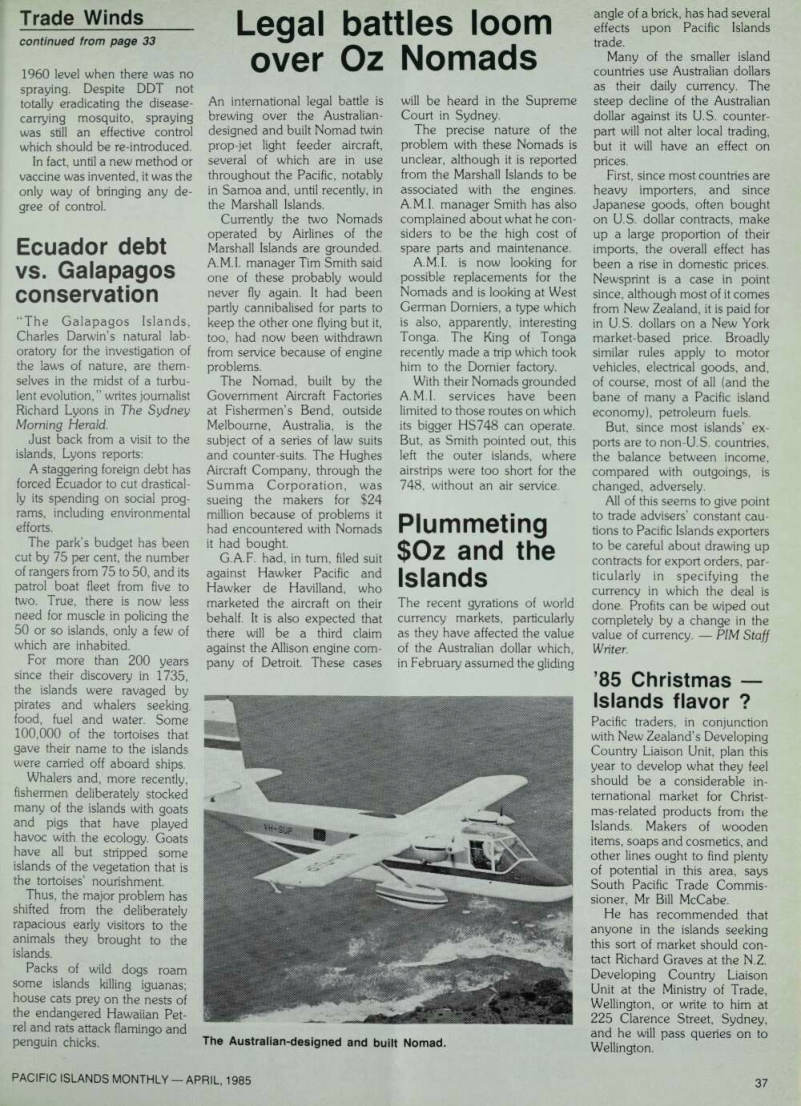
Legal battles loom over Oz Nomads
An international legal battle is brewing over the Australian designed and built Nomad twin prop-jet light feeder aircraft, several of which are in use throughout the Pacific, notably in Samoa and, until recently, in the Marshall Islands.
Currently the two Nomads operated by Airlines of the Marshall Islands are grounded.
A.M.I. manager Tim Smith said one of these probably would never fly again. It had been partly cannibalised for parts to keep the other one flying but it, too, had now been withdrawn from service because of engine problems.
The Nomad, built by the Government Aircraft Factories at Fishermen’s Bend, outside Melbourne, Australia, is the subject of a series of law suits and counter-suits. The Hughes Aircraft Company, through the Summa Corporation, was sueing the makers for $24 million because of problems it had encountered with Nomads it had bought.
G.A.F. had, in turn, filed suit against Hawker Pacific and Hawker de Havilland, who marketed the aircraft on their behalf. It is also expected that there will be a third claim against the Allison engine com pany of Detroit. These cases
will be heard in the Supreme Court in Sydney.
The precise nature of the problem with these Nomads is unclear, although it is reported from the Marshall Islands to be associated with the engines.
A.M.I. manager Smith has also complained about what he con siders to be the high cost of spare parts and maintenance.
A.M.I. is now looking for possible replacements for the Nomads and is looking at West German Dorniers, a type which is also, apparently, interesting Tonga. The King of Tonga recently made a trip which took him to the Dornier factory.
With their Nomads grounded A.M.I. services have been limited to those routes on which its bigger HS74B can operate.
But, as Smith pointed out, this left the outer islands, where airstrips were too short for the 748, without an air service.
Plummeting
sOz and the
Islands
The recent gyrations of world currency markets, particularly as they have affected the value of the Australian dollar which, in February assumed the gliding
angle of a brick, has had several effects upon Pacific Islands trade.
Many of the smaller island countries use Australian dollars as their daily currency. The steep decline of the Australian dollar against its U.S. counter part will not alter local trading, but it will have an effect on prices.
First, since most countries are heavy importers, and since Japanese goods, often bought on U.S. dollar contracts, make up a large proportion of their imports, the overall effect has been a rise in domestic prices.
Newsprint is a case in point since, although most of it comes from New Zealand, it is paid for in U.S. dollars on a New York market-based price. Broadly similar rules apply to motor vehicles, electrical goods, and, of course, most of all (and the bane of many a Pacific island economy), petroleum fuels.
But, since most islands’ ex ports are to non-U.S. countries, the balance between income, compared with outgoings, is changed, adversely.
All of this seems to give point to trade advisers’ constant cau tions to Pacific Islands exporters to be careful about drawing up contracts for export orders, par ticularly in specifying the currency in which the deal is done. Profits can be wiped out completely by a change in the value of currency. P/M Staff Writer.
’B5 Christmas
Islands flavor ?
Pacific traders, in conjunction with New Zealand’s Developing Country Liaison Unit, plan this year to develop what they feel should be a considerable in ternational market for Christ mas-related products from the Islands. Makers of wooden items, soaps and cosmetics, and other lines ought to find plenty of potential in this area, says South Pacific Trade Commis sioner, Mr Bill McCabe.
He has recommended that anyone in the islands seeking this sort of market should con tact Richard Graves at the N.Z.
Developing Country Liaison Unit at the Ministry of Trade, Wellington, or write to him at 225 Clarence Street, Sydney, and he will pass queries on to Wellington.
The Australian-designed and built Nomad.
Advertisements & other items, pp. 37-38 (2 items)
Trade Winds
37
PACIFIC ISLANDS MONTHLY —APRIL, 1985
Trade Winds continued from page 33
•H Komatsu
to solve your construction problem
If you have a construction problem, we have an all-Komatsu solution.
That means we produce a full line and a wide range of machines to perfectly match job requirements from bulldozers, motor graders and motor scrapers, to dump trucks, wheel loaders and hydraulic excavators. It also means we’ll back up all Komatsu machines with our reliable worldwide network of service and sales. Keeping the customer fully satisfied is and always will be the primary concern at every level of our management.
Feedback from users and imaginative research and development based on our Total Quality Control system result in a full line of machines noteworthy for their excellent fuel economy, outstanding operator comfort and exceptional reliability...
The all-Komatsu solution. Make it a part of your construction picture.
THE QUALITY IS STANDARD
•H KOMATSU
books

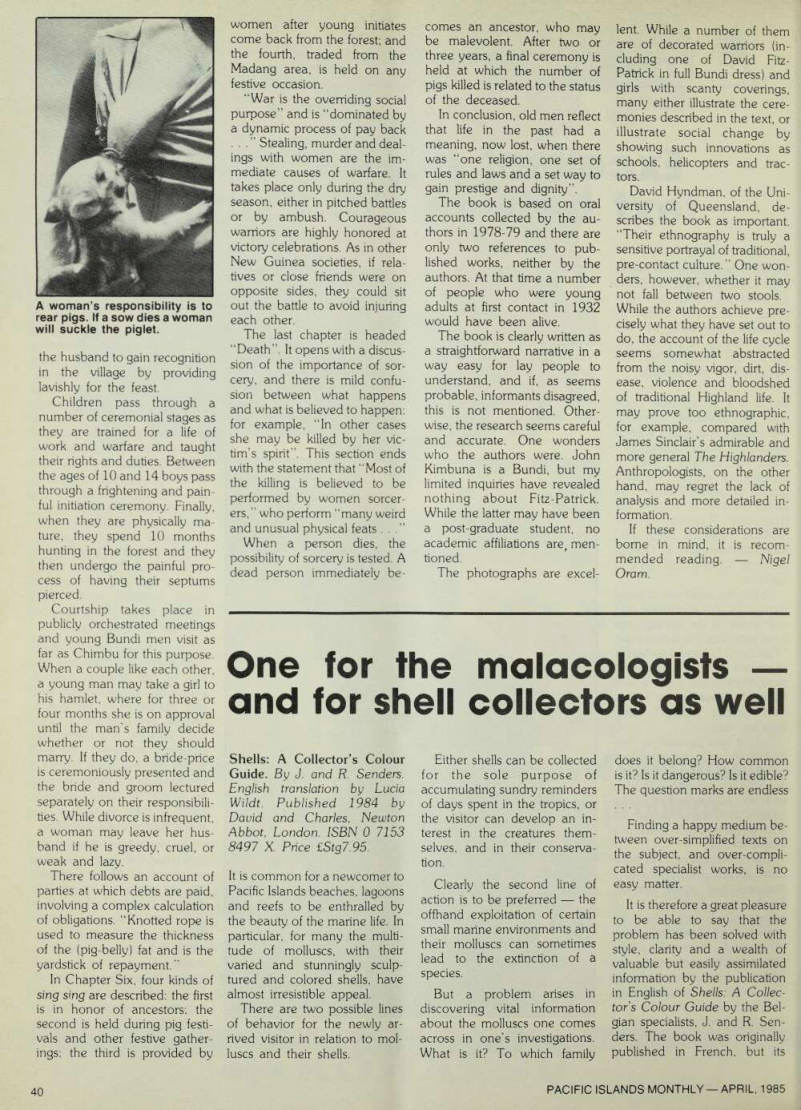
Excellent photos, and a text between two stools?
Bundi: The Culture of a Papua New Guinea People. By David G. Fitz-Patrick and John Kim buna. Published 1983 by Roebuck Publications, 61 Price Street, Nerang, 4211, Australia,
Pp. X, 166, Isbn 0 9591786
00. $A24.95 plus postage.
Bundi is a coffee table book with an extensive enthnog raphic text. It contains a large number of color photographs taken by Fitz-Patrick, and 10 earlier black and white photo graphs by Gerard Guthrie. The Bundi live on the fringe of the Bismarck Ranges in the Madang Province some 100 kilometres northeast of Goroka at levels between 500 m and 1500 m.
Noting the rapid rate of social change in the Highlands and that much of the heritage has been recorded, the authors say: “This book is also an endeavor to record in both written and pictures form the customs and traditional lifestyle of a Papua New Guinea society.” Later they say that; “. . . it was decided to deal exclusively with the traditional culture as the basis of the book, in particular to begin with birth and its accompanying cere monies and trace the rites of passage from birth to death in a simple format.”
The first chapter sets the Bundi in their environmental, historical and social context.
Staple root crops, under a system of shifting cultivation, are sweet potatoes, yams and taro, and these are sup plemented by game and fruits gathered from the rain forest.
The forest also supplies much of the materials used in daily life. Bundi society consists of nine tribes, within which there are clans and subclans. (A
detailed tribal map besides the hard-to-find location map would have been useful.) In the past, men lived mainly in men’s houses clustered in hamlets.
Women lived with their pigs in houses built near their scattered gardens. The Bundi now live in tribal villages, and men’s houses have been abandoned with nuclear-family households.
Catholic missionaries were the first Europeans to enter the area in 1932. A mission station was opened in 1934 and a wide variety of European fruits and vegetables were introduced. As a result of mission efforts, an airstrip was finished in 1958.
A mission school was estab lished in 1956, and in time Bundi people achieved high
positions in government and business. A Bundi was ordained a Roman Catholic priest in 1976.
The Bundi are experiencing the social changes occurring throughout Papua New Guinea. Many leave their vil lages to settle in towns where often they marry women from other groups. Traditional leadership based on personal skills and traditional wealth has been usurped by educated men, businessmen, councillors and cash income earners. Pig festivals now involve the purch ase of beer and food for cash.
In spite of these changes, the people in the villages largely maintain their traditional way of life, but this may be shattered when a major road linking Madang to the Highlands goes through the Bundi area.
Chapter Two begins the se rious business of the book. The use of the present tense is somewhat disconcerting until one realises it is the historic present, and reference is to the past. Religion and sorcery are extremely important aspects of Bundi life and there follows a catalogue of the different spirits in which the Bundi believe.
Belief in them is seen as “the major source of social control”.
The next three chapters are concerned with birth, courtship and marriage, Married couples are not expected to produce children for two or three years until their bride-price obliga tions are settled, and through out their lives opportunities for sexual intercourse or any other kind of association are limited.
As in many Papua New Guinea societies, intercourse is thought to weaken a man and make him unfit for battle. The celebration of a birth enables
Among the Bundi, as In many other societies, child-rearing is often the responsibility of other, older, children.
the husband to gain recognition in the village by providing lavishly for the feast.
Children pass through a number of ceremonial stages as they are trained for a life of work and warfare and taught their rights and duties. Between the ages of 10 and 14 boys pass through a frightening and pain ful initiation ceremony. Finally, when they are physically ma ture, they spend 10 months hunting in the forest and they then undergo the painful pro cess of having their septums pierced.
Courtship takes place in publicly orchestrated meetings and young Bundi men visit as far as Chimbu for this purpose.
When a couple like each other, a young man may take a girl to his hamlet, where for three or four months she is on approval until the man’s family decide whether or not they should marry. If they do, a bride-price is ceremoniously presented and the bride and groom lectured separately on their responsibili ties. While divorce is infrequent, a woman may leave her hus band if he is greedy, cruel, or weak and lazy.
There follows an account of parties at which debts are paid, involving a complex calculation of obligations. “Knotted rope is used to measure the thickness of the (pig-belly) fat and is the yardstick of repayment.”
In Chapter Six, four kinds of sing sing are described: the first is in honor of ancestors; the second is held during pig festi vals and other festive gather ings; the third is provided by
women after young initiates come back from the forest; and the fourth, traded from the Madang area, is held on any festive occasion.
“War is the overriding social purpose” and is “dominated by a dynamic process of pay back ...” Stealing, murder and deal ings with women are the im mediate causes of warfare. It takes place only during the dry season, either in pitched battles or by ambush. Courageous warriors are highly honored at victory celebrations. As in other New Guinea societies, if rela tives or close friends were on opposite sides, they could sit out the battle to avoid injuring each other.
The last chapter is headed “Death”. It opens with a discus sion of the importance of sor cery. and there is mild confu sion between what happens and what is believed to happen: for example, “In other cases she may be killed by her vic tim’s spirit”. This section ends with the statement that “Most of the killing is believed to be performed by women sorcer ers,” who perform “many weird and unusual physical feats When a person dies, the possibility of sorcery is tested. A dead person immediately be
comes an ancestor, who may be malevolent. After two or three years, a final ceremony is held at which the number of pigs killed is related to the status of the deceased.
In conclusion, old men reflect that life in the past had a meaning, now lost, when there was “one religion, one set of rules and laws and a set way to gain prestige and dignity”.
The book is based on oral accounts collected by the au thors in 1978-79 and there are only two references to pub lished works, neither by the authors. At that time a number of people who were young adults at first contact in 1932 would have been alive.
The book is clearly written as a straightforward narrative in a way easy for lay people to understand, and if, as seems probable, informants disagreed, this is not mentioned. Other wise, the research seems careful and accurate. One wonders who the authors were. John Kimbuna is a Bundi, but my limited inquiries have revealed nothing about Fitz-Patrick.
While the latter may have been a post-graduate student, no academic affiliations are, men tioned.
The photographs are excel
lent. While a number of them are of decorated warriors (in cluding one of David Fitz- Patrick in full Bundi dress) and girls with scanty coverings, many either illustrate the cere monies described in the text, or illustrate social change by showing such innovations as schools, helicopters and trac tors.
David Hyndman, of the Uni versity of Queensland, de scribes the book as important.
“Their ethnography is truly a sensitive portrayal of traditional, pre-contact culture. ” One won ders, however, whether it may not fall between two stools.
While the authors achieve pre cisely what they have set out to do, the account of the life cycle seems somewhat abstracted from the noisy vigor, dirt, dis ease, violence and bloodshed of traditional Highland life. It may prove too ethnographic, for example, compared with James Sinclair’s admirable and more general The Highlanders.
Anthropologists, on the other hand, may regret the lack of analysis and more detailed in formation.
If these considerations are borne in mind, it is recom
mended reading.
Nigel
Oram.
A woman’s responsibility is to rear pigs. If a sow dies a woman will suckle the piglet.
One for the malocologists
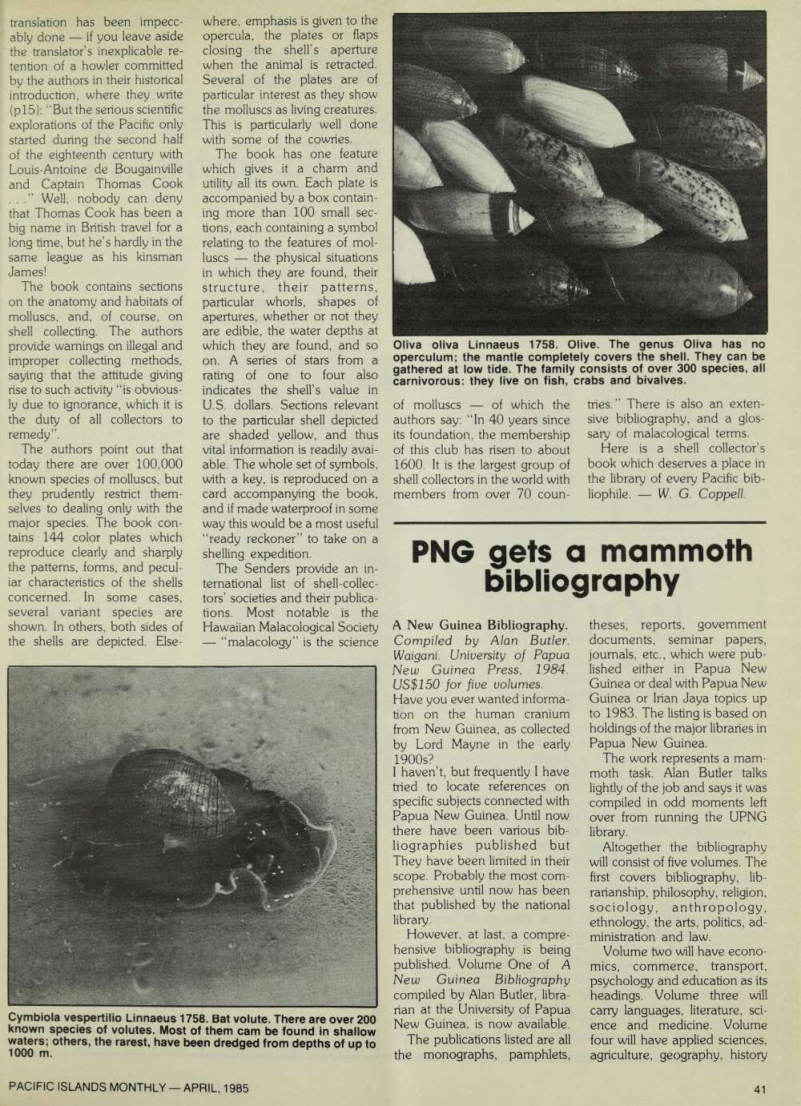
and for shell collectors as well
Shells: A Collector’s Colour Guide. By J. and R. Senders.
English translation by Lucia Wildt. Published 1984 by David and Charles . Newton Abbot London. ISBN 0 7153 8497 X. Price £Stg7.9s.
It is common for a newcomer to Pacific Islands beaches, lagoons and reefs to be enthralled by the beauty of the marine life. In particular, for many the multi tude of molluscs, with their varied and stunningly sculp tured and colored shells, have almost irresistible appeal.
There are two possible lines of behavior for the newly ar rived visitor in relation to mol luscs and their shells.
Either shells can be collected for the sole purpose of accumulating sundry reminders of days spent in the tropics, or the visitor can develop an in terest in the creatures them selves. and in their conserva tion.
Clearly the second line of action is to be preferred the offhand exploitation of certain small marine environments and their molluscs can sometimes lead to the extinction of a species.
But a problem arises in discovering vital information about the molluscs one comes across in one’s investigations.
What is it? To which family
does it belong? How common is it? Is it dangerous? Is it edible?
The question marks are endless Finding a happy medium be tween over-simplified texts on the subject, and over-compli cated specialist works, is no easy matter.
It is therefore a great pleasure to be able to say that the problem has been solved with style, clarity and a wealth of valuable but easily assimilated information by the publication in English of Shells: A Collec tor's Colour Guide by the Bel gian specialists, J. and R. Sen ders. The book was originally published in French, but its
translation has been impeccably done if you leave aside the translator’s inexplicable retention of a howler committed by the authors in their historical introduction, where they write (pl 5): “But the serious scientific explorations of the Pacific only started during the second half of the eighteenth century with Louis-Antoine de Bougainville and Captain Thomas Cook ..." Well, nobody can deny that Thomas Cook has been a big name in British travel for a long time, but he’s hardly in the same league as his kinsman James!
The book contains sections on the anatomy and habitats of molluscs, and, of course, on shell collecting. The authors provide warnings on illegal and improper collecting methods, saying that the attitude giving rise to such activity “is obviously due to ignorance, which it is the duty of all collectors to remedy”.
The authors point out that today there are over 100,000 known species of molluscs, but they prudently restrict themselves to dealing only with the major species. The book contains 144 color plates which reproduce clearly and sharply the patterns, forms, and peculiar characteristics of the shells concerned. In some cases, several variant species are shown. In others, both sides of the shells are depicted. Else-
where, emphasis is given to the opercula, the plates or flaps closing the shell’s aperture when the animal is retracted, Several of the plates are of particular interest as they show the molluscs as living creatures, This is particularly well done with some of the cowries, The book has one feature which gives it a charm and utility all its own. Each plate is accompanied by a box contain ing more than 100 small sec tions, each containing a symbol relating to the features of mol luscs the physical situations in which they are found, their structure, their patterns, particular whorls, shapes of apertures, whether or not they are edible, the water depths at which they are found, and so on. A series of stars from a rating of one to four also indicates the shell’s value in U.S. dollars. Sections relevant to the particular shell depicted are shaded yellow, and thus vital information is readily avai able. The whole set of symbols, with a key, is reproduced on a card accompanying the book, and if made waterproof in some way this would be a most useful “ready reckoner” to take on a shelling expedition, The Senders provide an in ternational list of shell-collec tors’ societies and their publica tions. Most notable is the Hawaiian Malacological Society “malacology” is the science
of molluscs of which the authors say; “In 40 years since its foundation, the membership of this club has risen to about 1600. It is the largest group of shell collectors in the world with members from over 70 coun-
tries.” There is also an exten sive bibliography, and a glos sary of malacological terms, Here is a shell collector’s book which deserves a place in the library of every Pacific bib
liophile.
W. G. Coppell.
Cymbiola vespertilio Linnaeus 1758. Bat volute. There are over 200 known species of volutes. Most of them cam be found in shallow waters; others, the rarest, have been dredged from depths of up to 1000 m.
Oliva oliva Linnaeus 1758. Olive. The genus Oliva has no operculum; the mantle completely covers the shell. They can be gathered at low tide. The family consists of over 300 species, all carnivorous: they live on fish, crabs and bivalves.
bibliography
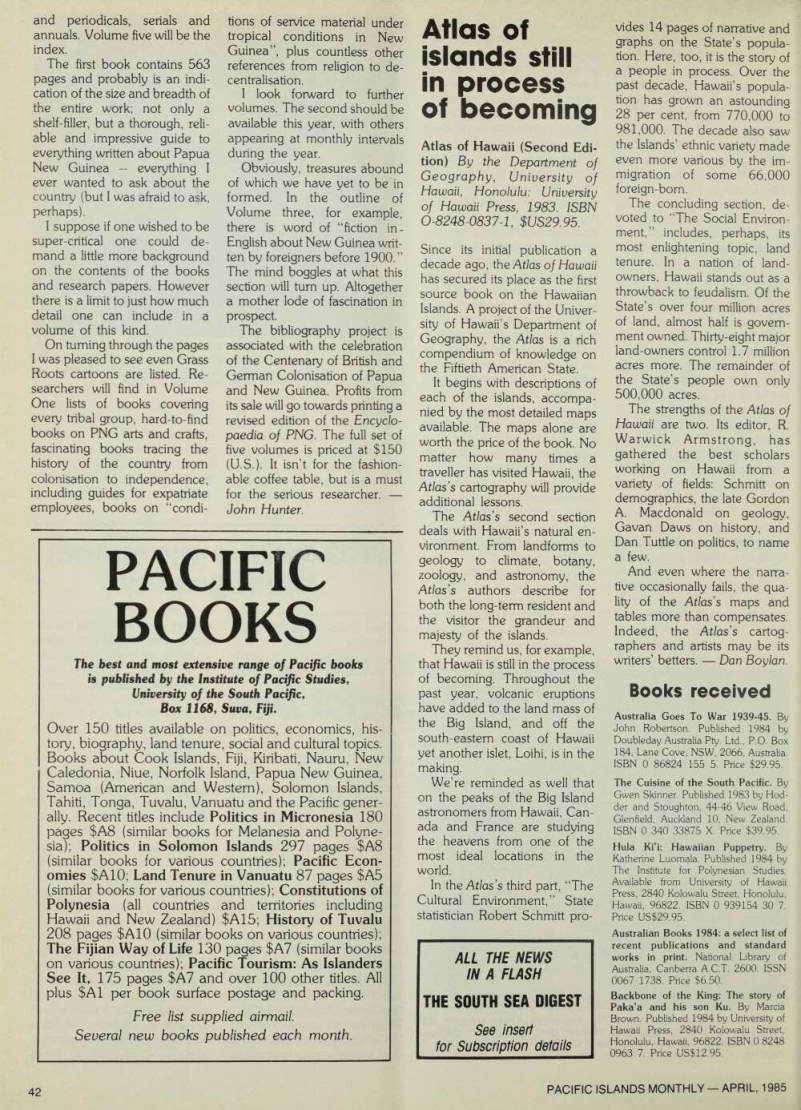
PNG gets a mammoth bibliography
A New Guinea Bibliography.
Compiled by Alan Butler.
Waigani. University of Papua New Guinea Press, 1984.
US$l5O for five volumes.
Have you ever wanted informa tion on the human cranium from New Guinea, as collected by Lord Mayne in the early 1900 s?
I haven’t, but frequently I have tried to locate references on specific subjects connected with Papua New Guinea. Until now there have been various bib liographies published but They have been limited in their scope. Probably the most com prehensive until now has been that published by the national library.
However, at last, a compre hensive bibliography is being published. Volume One of A New Guinea Bibliography compiled by Alan Butler, libra rian at the University of Papua New Guinea, is now available.
The publications listed are all the monographs, pamphlets,
theses, reports, government documents, seminar papers, journals, etc., which were pub lished either in Papua New Guinea or deal with Papua New Guinea or Irian Jaya topics up to 1983. The listing is based on holdings of the major libraries in Papua New Guinea.
The work represents a mam moth task. Alan Butler talks lightly of the job and says it was compiled in odd moments left over from running the UPNG library.
Altogether the bibliography will consist of five volumes. The first covers bibliography, lib rarianship, philosophy, religion, sociology, anthropology, ethnology, the arts, politics, ad ministration and law.
Volume two will have econo mics, commerce, transport, psychology and education as its headings. Volume three will carry languages, literature, sci ence and medicine. Volume four will have applied sciences, agriculture, geography, history
and periodicals, serials and annuals. Volume five will be the index.
The first book contains 563 pages and probably is an indi cation of the size and breadth of the entire work; not only a shelf-filler, but a thorough, reli able and impressive guide to everything written about Papua New Guinea - everything I ever wanted to ask about the country (but I was afraid to ask, perhaps).
I suppose if one wished to be super-critical one could de mand a little more background on the contents of the books and research papers. However there is a limit to just how much detail one can include in a volume of this kind.
On turning through the pages I was pleased to see even Grass Roots cartoons are listed. Re searchers will find in Volume One lists of books covering every tribal group, hard-to-find books on PNG arts and crafts, fascinating books tracing the history of the country from colonisation to independence, including guides for expatriate employees, books on “condi
tions of service material under tropical conditions in New Guinea”, plus countless other references from religion to de centralisation.
I look forward to further volumes. The second should be available this year, with others appearing at monthly intervals during the year.
Obviously, treasures abound of which we have yet to be in formed. In the outline of Volume three, for example, there is word of “fiction in- English about New Guinea writ ten by foreigners before 1900.”
The mind boggles at what this section will turn up. Altogether a mother lode of fascination in prospect.
The bibliography project is associated with the celebration of the Centenary of British and German Colonisation of Papua and New Guinea. Profits from its sale will go towards printing a revised edition of the Encyclo paedia of PNG. The full set of five volumes is priced at $l5O (U.S.). It isn’t for the fashion able coffee table, but is a must for the serious researcher.
John Hunter.
of becoming
Atlas of islands still in process of becoming
Atlas of Hawaii (Second Edi tion) By the Department of Geography, University of Hawaii, Honolulu: University of Hawaii Press, 1983. ISBN 0-8248-0837-1, $U529.95.
Since its initial publication a decade ago, the Atlas of Hawaii has secured its place as the first source book on the Hawaiian Islands. A project of the Univer sity of Hawaii’s Department of Geography, the Atlas is a rich compendium of knowledge on the Fiftieth American State.
It begins with descriptions of each of the islands, accompa nied by the most detailed maps available. The maps alone are worth the price of the book. No matter how many times a traveller has visited Hawaii, the Atlas’s cartography will provide additional lessons.
The Atlas’s second section deals with Hawaii’s natural en vironment. From landforms to geology to climate, botany, zoology, and astronomy, the Atlas’s authors describe for both the long-term resident and the visitor the grandeur and majesty of the islands.
They remind us, for example, that Hawaii is still in the process of becoming. Throughout the past year, volcanic eruptions have added to the land mass of the Big Island, and off the south-eastern coast of Hawaii yet another islet, Loihi, is in the making.
We’re reminded as well that on the peaks of the Big Island astronomers from Hawaii, Can ada and France are studying the heavens from one of the most ideal locations in the world.
In the Atlas’s third part, “The Cultural Environment,” State statistician Robert Schmitt pro
vides 14 pages of narrative and graphs on the State’s popula tion. Here, too, it is the story of a people in process. Over the past decade, Hawaii’s popula tion has grown an astounding 28 per cent, from 770,000 to 981,000. The decade also saw the Islands’ ethnic variety made even more various by the im migration of some 66,000 foreign-born.
The concluding section, de voted to “The Social Environ ment,” includes, perhaps, its most enlightening topic, land tenure. In a nation of land owners, Hawaii stands out as a throwback to feudalism. Of the State’s over four million acres of land, almost half is govern ment owned. Thirty-eight major land-owners control 1.7 million acres more. The remainder of the State’s people own only 500,000 acres.
The strengths of the Atlas of Hawaii are two. Its editor, R.
Warwick Armstrong, has gathered the best scholars working on Hawaii from a variety of fields: Schmitt on demographics, the late Gordon A. Macdonald on geology, Gavan Daws on history, and Dan Tuttle on politics, to name a few.
And even where the narra tive occasionally fails, the qua lity of the Atlas’s maps and tables more than compensates.
Indeed, the Atlas’s cartog raphers and artists may be its writers’ betters. Dan Boy lan.
Books received
Australia Goes To War 1939-45. By John Robertson. Published 1984 by Doubleday Australia Pty. Ltd., P.O. Box 184, Lane Cove, NSW, 2066, Australia.
ISBN 0 86824 155 5. Price $29.95.
The Cuisine of the South Pacific. By Gwen Skinner. Published 1983 by Hod der and Stoughton, 44-46 View Road, Glenfield, Auckland 10, New Zealand.
ISBN 0 340 33875 X. Price $39.95.
Hula Ki’i: Hawaiian Puppetry. By Katherine Luomala. Published 1984 by The Institute for Polynesian Studies.
Available from University of Hawaii Press, 2840 Kolowalu Street. Honolulu, Hawaii, 96822. ISBN 0 939154 30 7.
Price U 5529.95.
Australian Books 1984: a select list of recent publications and standard works in print. National Library of Australia, Canberra A.C.T. 2600. ISSN 0067 1738. Price $6.50.
Backbone of the King: The story of Paka’a and his son Ku. By Marcia Brown. Published 1984 by University of Hawaii Press, 2840 Kolowalu Street, Honolulu, Hawaii, 96822. ISBN 0 8248 0963 7. Price U 5512.95.
Advertisements & other items, p. 42 (2 items)
Pacific
BOOKS
The best and most extensive range of Pacific books is published by the Institute of Pacific Studies, University of the South Pacific, Box 1168, Suva, Fiji.
Over 150 titles available on politics, economics, history, biography, land tenure, social and cultural topics.
Books about Cook Islands, Fiji, Kiribati, Nauru, New Caledonia, Niue, Norfolk Island, Papua New Guinea, Samoa (American and Western), Solomon Islands, Tahiti, Tonga, Tuvalu, Vanuatu and the Pacific generally. Recent titles include Politics in Micronesia 180 pages SAB (similar books for Melanesia and Polynesia); Politics in Solomon Islands 297 pages SAB (similar books for various countries); Pacific Economies $A10; Land Tenure in Vanuatu 87 pages SAS (similar books for various countries); Constitutions of Polynesia (all countries and territories including Hawaii and New Zealand) SAIS; History of Tuvalu 208 pages SAIO (similar books on various countries); The Fijian Way of Life 130 pages SA7 (similar books on various countries); Pacific Tourism: As Islanders See It, 175 pages SA7 and over 100 other titles. All plus SAI per book surface postage and packing.
Free list supplied airmail.
Several new books published each month.
All The News
IN A FLASH
THE SOUTH SEA DIGEST
See insert for Subscription details
chief judge to Mau political exile
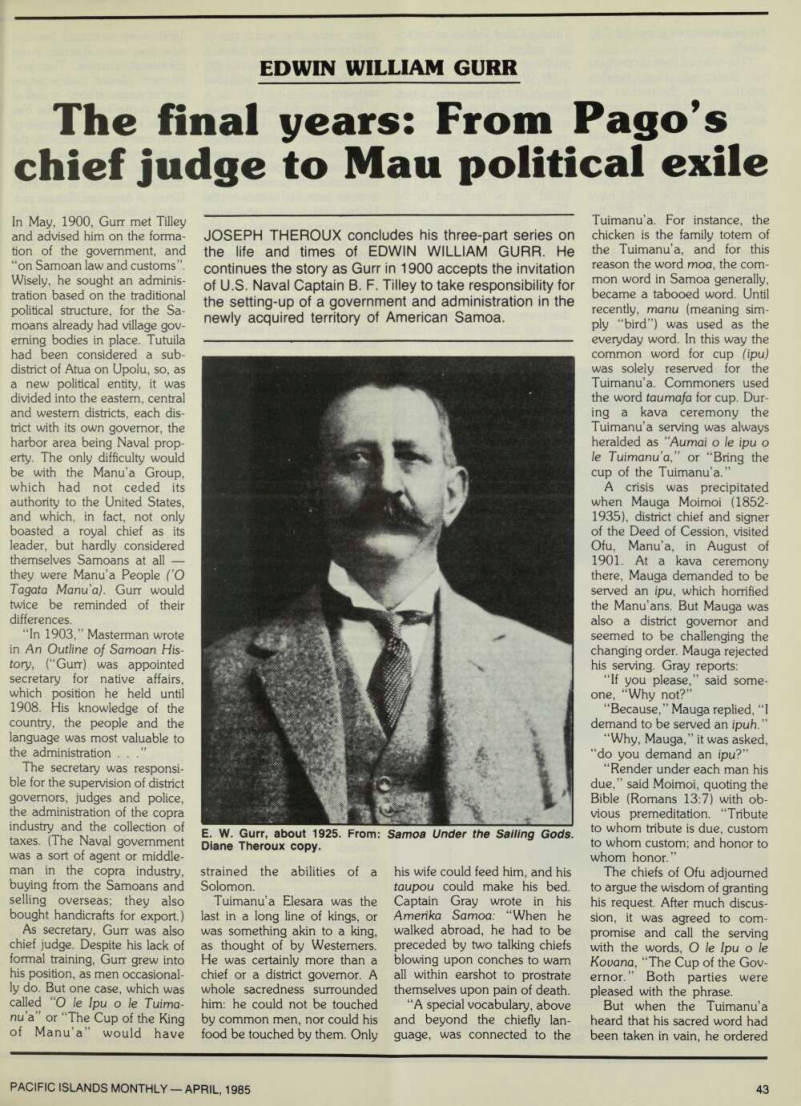
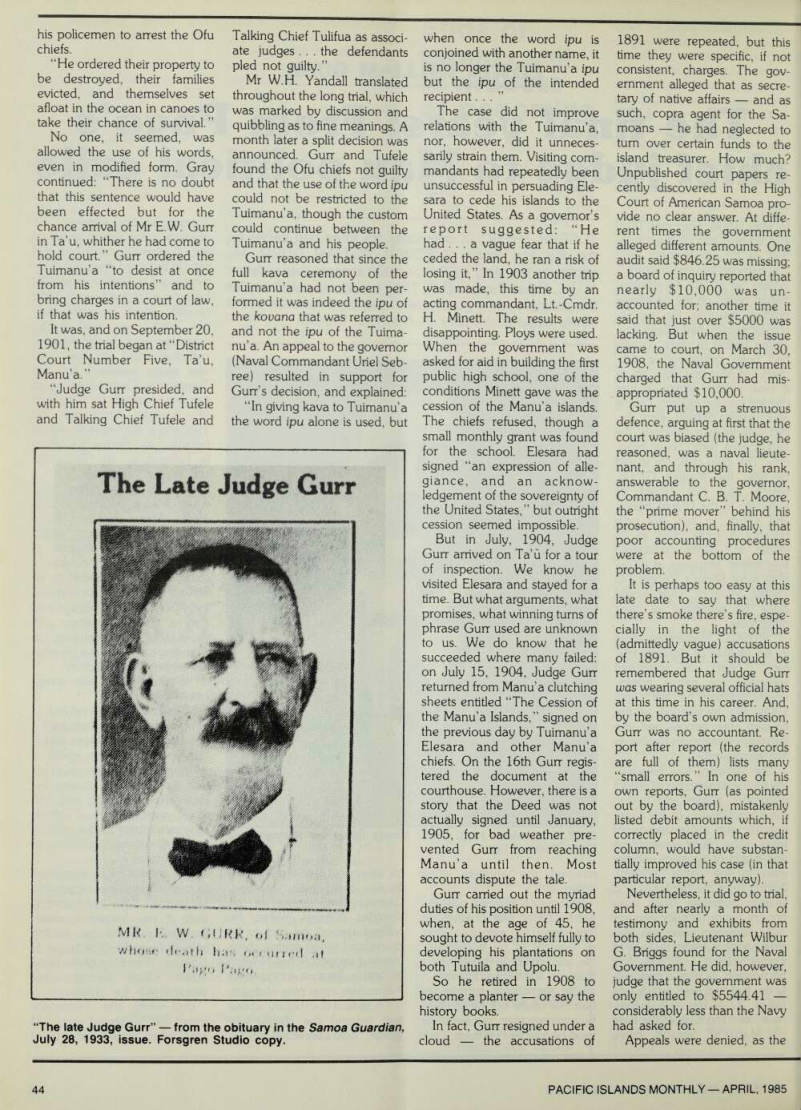
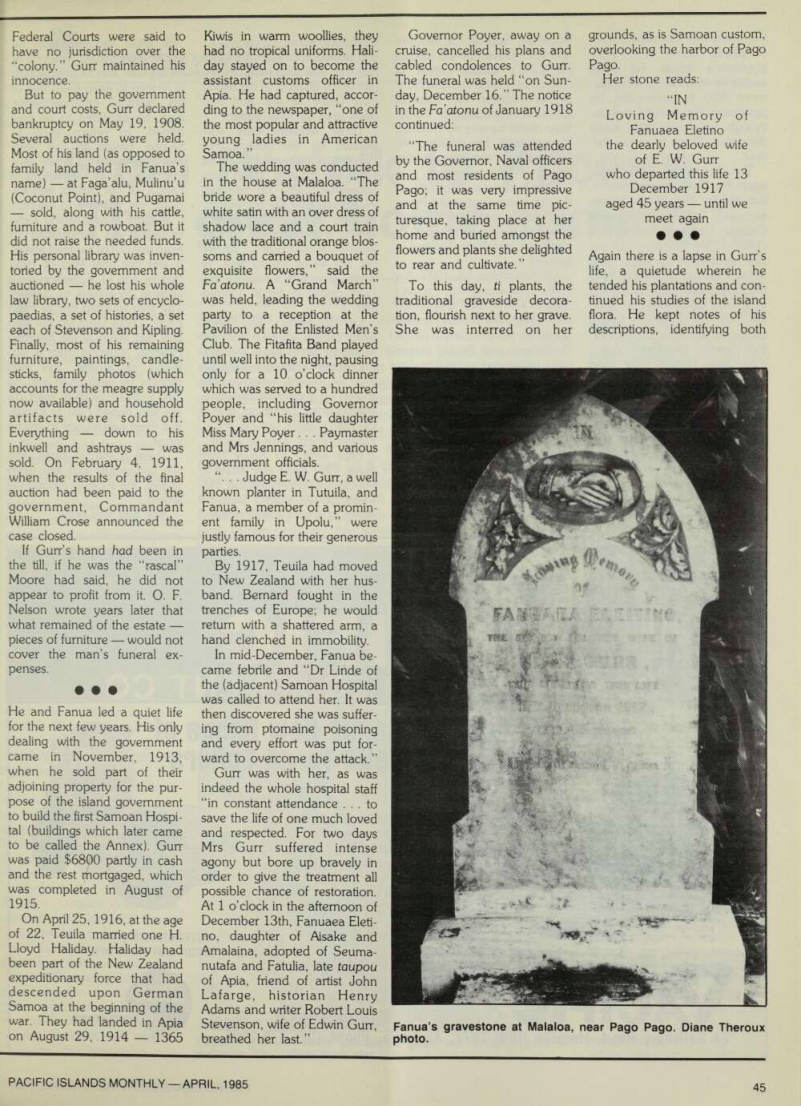

Edwin William Gurr
The final years: From Pago’s chief judge to Mau political exile
In May, 1900, Gurr met Tilley and advised him on the forma tion of the government, and “on Samoan law and customs”.
Wisely, he sought an adminis tration based on the traditional political structure, for the Sa moans already had village gov erning bodies in place. Tutuila had been considered a sub district of Atua on Upolu, so, as a new political entity, it was divided into the eastern, central and western districts, each dis trict with its own governor, the harbor area being Naval prop erty. The only difficulty would be with the Manu’a Group, which had not ceded its authority to the United States, and which, in fact, not only boasted a royal chief as its leader, but hardly considered themselves Samoans at all they were Manu’a People (’O Tagata Manu’a). Gurr would twice be reminded of their differences.
“In 1903,” Masterman wrote in An Outline of Samoan His tory, (“Gurr) was appointed secretary for native affairs, which position he held until 1908. His knowledge of the country, the people and the language was most valuable to the administration ...”
The secretary was responsi ble for the supervision of district governors, judges and police, the administration of the copra industry and the collection of taxes. (The Naval government was a sort of agent or middle man in the copra industry, buying from the Samoans and selling overseas; they also bought handicrafts for export.) As secretary, Gurr was also chief judge. Despite his lack of formal training, Gurr grew into his position, as men occasional ly do. But one case, which was called “O le Ipu o le Tuima nu’a” or “The Cup of the King of Manu’a” would have
JOSEPH THEROUX concludes his three-part series on the life and times of EDWIN WILLIAM GURR. He continues the story as Gurr in 1900 accepts the invitation of U.S. Naval Captain B. F. Tilley to take responsibility for the setting-up of a government and administration in the newly acquired territory of American Samoa.
strained the abilities of a Solomon.
Tuimanu’a Elesara was the last in a long line of kings, or was something akin to a king, as thought of by Westerners.
He was certainly more than a chief or a district governor. A whole sacredness surrounded him: he could not be touched by common men, nor could his food be touched by them. Only
his wife could feed him, and his taupou could make his bed.
Captain Gray wrote in his A merika Samoa: “When he walked abroad, he had to be preceded by two talking chiefs blowing upon conches to warn all within earshot to prostrate themselves upon pain of death.
“A special vocabulary, above and beyond the chiefly lan guage, was connected to the
Tuimanu’a. For instance, the chicken is the family totem of the Tuimanu’a, and for this reason the word moa , the com mon word in Samoa generally, became a tabooed word. Until recently, manu (meaning sim ply “bird”) was used as the everyday word. In this way the common word for cup (ipu) was solely reserved for the Tuimanu’a. Commoners used the word taumafa for cup. Dur ing a kava ceremony the Tuimanu’a serving was always heralded as “Aumai o le ipu o le Tuimanu’a or “Bring the cup of the Tuimanu’a.”
A crisis was precipitated when Mauga Moimoi (1852- 1935), district chief and signer of the Deed of Cession, visited Ofu, Manu’a, in August of 1901. At a kava ceremony there, Mauga demanded to be served an ipu, which horrified the Manu’ans. But Mauga was also a district governor and seemed to be challenging the changing order. Mauga rejected his serving. Gray reports: “If you please,” said some one, “Why not?”
“Because,” Mauga replied, “I demand to be served an ipuh. ”
“Why, Mauga,” it was asked, “do you demand an ipu?”
“Render under each man his due,” said Moimoi, quoting the Bible (Romans 13:7) with ob vious premeditation. “Tribute to whom tribute is due, custom to whom custom; and honor to whom honor.”
The chiefs of Ofu adjourned to argue the wisdom of granting his request. After much discus sion, it was agreed to com promise and call the serving with the words, O le Ipu o le Kouana, “The Cup of the Gov ernor. ” Both parties were pleased with the phrase.
But when the Tuimanu’a heard that his sacred word had been taken in vain, he ordered
E. W. Gurr, about 1925. From: Samoa Under the Sailing Gods.
Diane Theroux copy.
his policemen to arrest the Ofu chiefs.
“He ordered their property to be destroyed, their families evicted, and themselves set afloat in the ocean in canoes to take their chance of survival.”
No one, it seemed, was allowed the use of his words, even in modified form. Gray continued: “There is no doubt that this sentence would have been effected but for the chance arrival of Mr E.W. Gurr in Ta’u, whither he had come to hold court.” Gurr ordered the Tuimanu’a “to desist at once from his intentions” and to bring charges in a court of law, if that was his intention.
It was, and on September 20, 1901, the trial began at “District Court Number Five, Ta’u, Manu’a. ”
“Judge Gurr presided, and with him sat High Chief Tufele and Talking Chief Tufele and
Talking Chief Tulifua as associ ate judges... the defendants pled not guilty.”
Mr W.H. Yandall translated throughout the long trial, which was marked by discussion and quibbling as to fine meanings. A month later a split decision was announced. Gurr and Tufele found the Ofu chiefs not guilty and that the use of the word ipu could not be restricted to the Tuimanu’a, though the custom could continue between the Tuimanu’a and his people.
Gurr reasoned that since the full kava ceremony of the Tuimanu’a had not been per formed it was indeed the ipu of the kovana that was referred to and not the ipu of the Tuima nu’a. An appeal to the governor (Naval Commandant Uriel Seb ree) resulted in support for Gurr’s decision, and explained: “In giving kava to Tuimanu’a the word ipu alone is used, but
“The late Judge Gurr” from the obituary in the Samoa Guardian, July 28, 1933, issue. Forsgren Studio copy.
when once the word ipu is conjoined with another name, it is no longer the Tuimanu’a ipu but the ipu of the intended recipient...”
The case did not improve relations with the Tuimanu’a, nor, however, did it unneces sarily strain them. Visiting com mandants had repeatedly been unsuccessful in persuading Ele sara to cede his islands to the United States. As a governor’s report suggested: “He had ... a vague fear that if he ceded the land, he ran a risk of losing it,” In 1903 another trip was made, this time by an acting commandant, Lt.-Cmdr.
H. Minett. The results were disappointing. Ploys were used.
When the government was asked for aid in building the first public high school, one of the conditions Minett gave was the cession of the Manu’a islands.
The chiefs refused, though a small monthly grant was found for the school. Elesara had signed “an expression of alle giance, and an acknow ledgement of the sovereignty of the United States,” but outright cession seemed impossible.
But in July, 1904, Judge Gurr arrived on Ta’u for a tour of inspection. We know he visited Elesara and stayed for a time. But what arguments, what promises, what winning turns of phrase Gurr used are unknown to us. We do know that he succeeded where many failed: on July 15, 1904, Judge Gurr returned from Manu’a clutching sheets entitled “The Cession of the Manu’a Islands,” signed on the previous day by Tuimanu’a Elesara and other Manu’a chiefs. On the 16th Gurr regis tered the document at the courthouse. However, there is a story that the Deed was not actually signed until January, 1905, for bad weather pre vented Gurr from reaching Manu’a until then. Most accounts dispute the tale.
Gurr carried out the myriad duties of his position until 1908, when, at the age of 45, he sought to devote himself fully to developing his plantations on both Tutuila and Upolu.
So he retired in 1908 to become a planter or say the history books.
In fact, Gurr resigned under a cloud the accusations of
1891 were repeated, but this time they were specific, if not consistent, charges. The gov ernment alleged that as secre tary of native affairs and as such, copra agent for the Sa moans he had neglected to turn over certain funds to the island treasurer. How much?
Unpublished court papers re cently discovered in the High Court of American Samoa pro vide no clear answer. At diffe rent times the government alleged different amounts. One audit said $846.25 was missing; a board of inquiry reported that nearly $lO,OOO was un accounted for; another time it said that just over $5OOO was lacking. But when the issue came to court, on March 30, 1908, the Naval Government charged that Gurr had mis appropriated $lO,OOO.
Gurr put up a strenuous defence, arguing at first that the court was biased (the judge, he reasoned, was a naval lieute nant, and through his rank, answerable to the governor, Commandant C. B. T. Moore, the “prime mover” behind his prosecution), and, finally, that poor accounting procedures were at the bottom of the problem.
It is perhaps too easy at this late date to say that where there’s smoke there’s fire, espe cially in the light of the (admittedly vague) accusations of 1891. But it should be remembered that Judge Gurr was wearing several official hats at this time in his career. And, by the board’s own admission, Gurr was no accountant. Re port after report (the records are full of them) lists many “small errors.” In one of his own reports, Gurr (as pointed out by the board), mistakenly listed debit amounts which, if correctly placed in the credit column, would have substan tially improved his case (in that particular report, anyway).
Nevertheless, it did go to trial, and after nearly a month of testimony and exhibits from both sides, Lieutenant Wilbur G. Briggs found for the Naval Government. He did, however, judge that the government was only entitled to $5544.41 considerably less than the Navy had asked for.
Appeals were denied, as the
Federal Courts were said to have no jurisdiction over the “colony.” Gurr maintained his innocence.
But to pay the government and court costs, Gurr declared bankruptcy on May 19, 1908.
Several auctions were held.
Most of his land (as opposed to family land held in Fanua’s name) at Faga’alu, Mulinu’u (Coconut Point), and Pugamai sold, along with his cattle, furniture and a rowboat. But it did not raise the needed funds.
His personal library was inven toried by the government and auctioned he lost his whole law library, two sets of encyclo paedias, a set of histories, a set each of Stevenson and Kipling.
Finally, most of his remaining furniture, paintings, candle sticks, family photos (which accounts for the meagre supply now available) and household artifacts were sold off.
Everything down to his inkwell and ashtrays was sold. On February 4, 1911, when the results of the final auction had been paid to the government, Commandant William Crose announced the case closed.
If Gurr’s hand had been in the till, if he was the “rascal”
Moore had said, he did not appear to profit from it. O. F.
Nelson wrote years later that what remained of the estate pieces of furniture would not cover the man’s funeral ex penses. • • • He and Fanua led a quiet life for the next few years. His only dealing with the government came in November, 1913, when he sold part of their adjoining property for the pur pose of the island government to build the first Samoan Hospi tal (buildings which later came to be called the Annex). Gurr was paid $6BOO partly in cash and the rest mortgaged, which was completed in August of 1915.
On April 25, 1916, at the age of 22, Teuila married one H.
Lloyd Haliday. Haliday had been part of the New Zealand expeditionary force that had descended upon German Samoa at the beginning of the war. They had landed in Apia on August 29, 1914 1365
Kiwis in warm woollies, they had no tropical uniforms. Hali day stayed on to become the assistant customs officer in Apia. He had captured, accor ding to the newspaper, “one of the most popular and attractive young ladies in American Samoa. ”
The wedding was conducted in the house at Malaloa. “The bride wore a beautiful dress of white satin with an over dress of shadow lace and a court train with the traditional orange blos soms and carried a bouquet of exquisite flowers,” said the Fa’atonu. A “Grand March” was held, leading the wedding party to a reception at the Pavilion of the Enlisted Men’s Club. The Fitafita Band played until well into the night, pausing only for a 10 o’clock dinner which was served to a hundred people, including Governor Poyer and “his little daughter Miss Mary Poyer. . . Paymaster and Mrs Jennings, and various government officials.
“. . . Judge E. W. Gurr, a well known planter in Tutuila, and Fanua, a member of a promin ent family in Upolu,” were justly famous for their generous parties.
By 1917, Teuila had moved to New Zealand with her hus band. Bernard fought in the trenches of Europe; he would return with a shattered arm, a hand clenched in immobility.
In mid-December, Fanua be came febrile and “Dr Linde of the (adjacent) Samoan Hospital was called to attend her. It was then discovered she was suffer ing from ptomaine poisoning and every effort was put for ward to overcome the attack.”
Gurr was with her, as was indeed the whole hospital staff “in constant attendance ... to save the life of one much loved and respected. For two days Mrs Gurr suffered intense agony but bore up bravely in order to give the treatment all possible chance of restoration.
At 1 o’clock in the afternoon of December 13th, Fanuaea Eleti no, daughter of Aisake and Amalaina, adopted of Seuma nutafa and Fatulia, late taupou of Apia, friend of artist John Lafarge, historian Henry Adams and writer Robert Louis Stevenson, wife of Edwin Gurr, breathed her last.”
Governor Poyer, away on a cruise, cancelled his plans and cabled condolences to Gurr.
The funeral was held “on Sun day, December 16.” The notice in the Fa’atonu of January 1918 continued; “The funeral was attended by the Governor, Naval officers and most residents of Pago Pago; it was very impressive and at the same time pic turesque, taking place at her home and buried amongst the flowers and plants she delighted to rear and cultivate.”
To this day, ti plants, the traditional graveside decora tion, flourish next to her grave.
She was interred on her
grounds, as is Samoan custom, overlooking the harbor of Pago Pago.
Her stone reads; “IN Loving Memory of Fanuaea Eletino the dearly beloved wife of E. W. Gurr who departed this life 13 December 1917 aged 45 years until we meet again • • • Again there is a lapse in Gurr’s life, a quietude wherein he tended his plantations and con tinued his studies of the island flora. He kept notes of his descriptions, identifying both
Fanua’s gravestone at Malaloa, near Pago Pago. Diane Theroux photo.
the Latin and Samoan names of plants. Later, in a 1927 governor’s report, his notes would be included as a supple ment. Also, at some point, he remarried. Her name was Sasa, though we know little more than that. There were no chil dren.
The chronology of Gurr’s life again becomes documented in the middle ’2os. He had been accused by Major-General George Spafford Richardson (1868-1938) of being “an ac tive member of the Mau,” and indeed began attending Mau meetings with regularity. By this time Gurr had moved to Apia.
On May 26, 1927, he began editing a pro-Mau newspaper, the Samoa Guardian. Again there were rumors Gurr “had fled” the administration though this time the American adminis tration was meant. In August of the same year, the Fa’atonu officially denied that Gurr was “a prohibited immigrant to American Samoa” or “that his record in American Samoa (had) been officially communi cated by the Governor of
American Samoa.” It did say that the “Governor did discuss Mr Gurr’s official career in American Samoa with the Hon orable Minister for External Affairs of New Zealand. ” Sadly, they found he was no criminal.
Nevertheless, the minister, W.
Nosworthy, condemned the efforts of Mau supporters.
Gurr became a contributor to the American Associated Press, and documented the oppres sive policies of Richardson in particular and New Zealand in general.
On December 15, 1927, the 10th anniversary of Fanua’s death, Gurr was threatened with arrest. The threats became reality on the 17th, when he, O.
F. Nelson and A. G. Smyth were sentenced without trial to be deported to New Zealand.
Gurr and Nelson got five years; Smyth, two. The Samoa Guar dian was banned. Before Gurr was exiled on December 25, he wrote a long dispatch to the Associated Press. George Westbrook wrote to Nelson Rowe on February 20, 1928: “Last month a letter of Gurr’s
containing about 12 pages . . . and posted in time for the Lady Roberts, was discovered in the pan of the lavatory at the (Apia) Post Office all wet and had been used as toilet paper.”
Three workers were sus pended for the offence, but Westbrook believed that to be “the last of it.” The issue apparently came up between Westbrook and the pro-admin istration editor of the Samoa Times, a man named Brown.
Westbrook told Rowe: “Brown did not come up to time, re what I gave him for saying that Gurr ought to be in Vaimea Jail.”
On December 28, 1929, when Smyth returned from de portation, there was a welcom ing parade. There was a scuffle, and recent research has shown a planned assassina tion occurred. Tamasese, one of the Mau leaders, was cut down.
Eleven others were wounded.
Gurr wrote to Rowe from Suva, Fiji: “Send any letters to me care of GPO Auckland, NZ.
I cannot tell what I shall be doing or where I shall reside. ”
In other circumstances, he would have stayed with one of his children, but he undoubted ly wished to keep them free of his political entanglements.
Also, he expected to be par doned, to return early to Samoa, before his five years was completed. His lonely exile must have made him mindful of Fanua, of her politics and ex ploits. He yearned to return.
But the New Zealand Gov ernment was determined to keep him out of Samoan affairs.
It was not until May of 1933 that he and 0. F. Nelson were allowed to return to Samoa.
The ship touched first at Pago Pago. There Gurr left the ship and was taken to the Samoan Hospital suffering from a sto mach carcinoma. For two months he languished and on July 1, 1933, he died, aged 70.
He was buried next to Fanua.
But there was no one to erect a stone.
There is still no stone, and the graves are wild and over grown, the ti plants among the weeds.
Misi Kea was gone.
Advertisements & other items, pp. 44-46 (2 items)
The Late Judge Gurr
MR. E. W. GURR, of Samoa, whose death has occurred at Pago Pago.
Vacific
CONSTRUCTION EQUIPMENT CO
introducing the Dynamic Hew Range of
Vibrating 8 Pneumatic Tyred Rollers
THE RANGE
• Pacific Self-Propelled Vibrating Rollers • Single and Double Drum Types • 1.5 tonne to 16 tonne • Pacific Self-Propelled Pneumatic Type Compactors • 3 Models 16. 21. 38 tonne Ballast Weights • Pacific Landfill and Sanitary Landfill Compactors • Pacific Pneumatic Earth Borers • Pacific Road Brooms • Pacific Railway Maintenance Vehicles Construction Equipment Co.
IFIC
DISTRIBUTORS REQUIRED
THROUGHOUT THE PACIFIC
SAL
24 Salisbury Road, Hornsby NSW 2077, Australia. Phone (02) 476 2666
The great home-coming
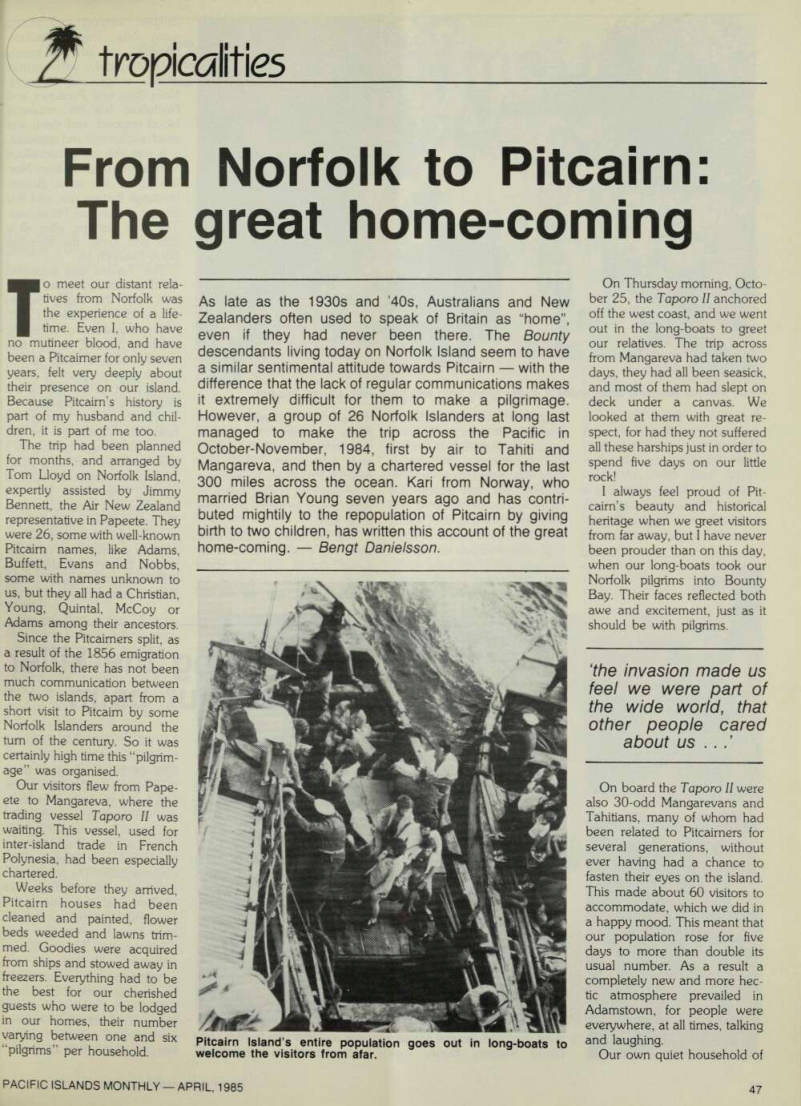
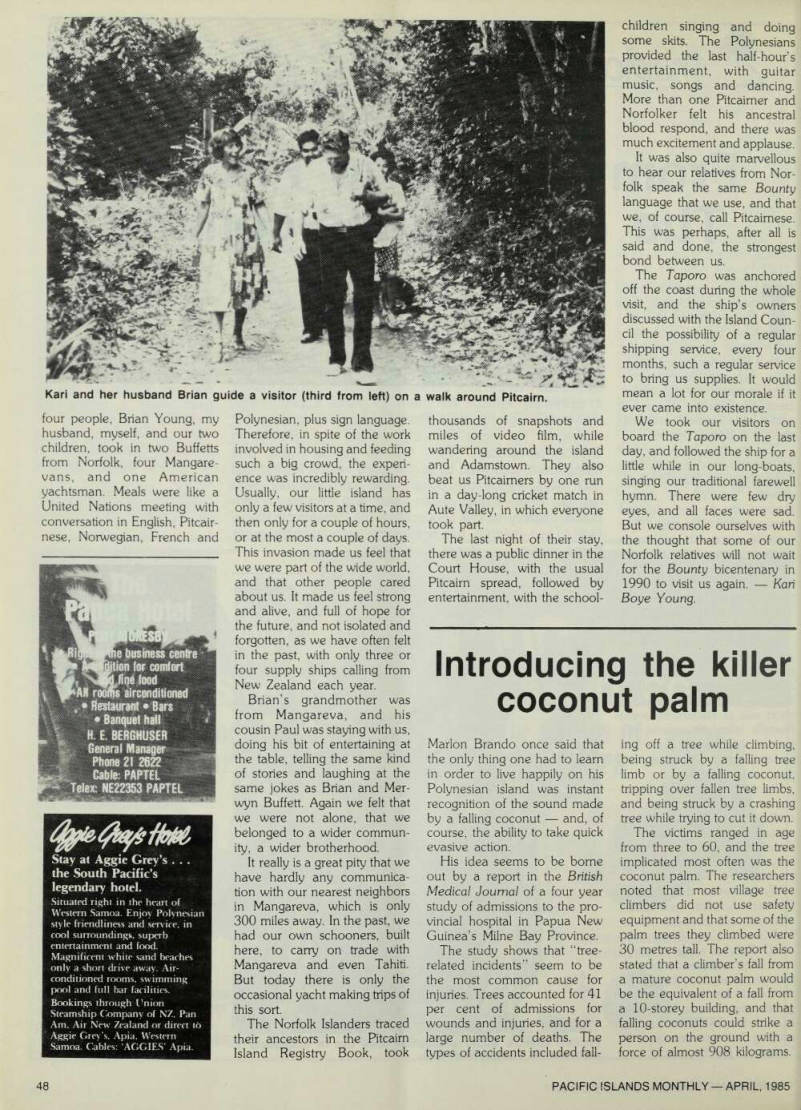
tropicalitigs
From Norfolk to Pitcairn: The great home-coming
To meet our distant rela tives from Norfolk was the experience of a life time. Even I, who have no mutineer blood, and have been a Pitcairner for only seven years, felt very deeply about their presence on our island.
Because Pitcairn’s history is part of my husband and chil dren, it is part of me too.
The trip had been planned for months, and arranged by Tom Lloyd on Norfolk Island, expertly assisted by Jimmy Bennett, the Air New Zealand representative in Papeete. They were 26, some with well-known Pitcairn names, like Adams, Buffett, Evans and Nobbs, some with names unknown to us, but they all had a Christian, Young, Quintal, McCoy or Adams among their ancestors.
Since the Pitcairners split, as a result of the 1856 emigration to Norfolk, there has not been much communication between the two islands, apart from a short visit to Pitcairn by some Norfolk Islanders around the turn of the century. So it was certainly high time this “pilgrim age” was organised.
Our visitors flew from Pape ete to Mangareva, where the trading vessel Taporo II was waiting. This vessel, used for inter-island trade in French Polynesia, had been especially chartered.
Weeks before they arrived, Pitcairn houses had been cleaned and painted, flower beds weeded and lawns trim med. Goodies were acquired from ships and stowed away in freezers. Everything had to be the best for our cherished guests who were to be lodged in our homes, their number varying between one and six “pilgrims” per household.
As late as the 1930 s and '4os, Australians and New Zealanders often used to speak of Britain as “home”, even if they had never been there. The Bounty descendants living today on Norfolk Island seem to have a similar sentimental attitude towards Pitcairn with the difference that the lack of regular communications makes it extremely difficult for them to make a pilgrimage.
However, a group of 26 Norfolk Islanders at long last managed to make the trip across the Pacific in October-November, 1984, first by air to Tahiti and Mangareva, and then by a chartered vessel for the last 300 miles across the ocean. Kari from Norway, who married Brian Young seven years ago and has contri buted mightily to the repopulation of Pitcairn by giving birth to two children, has written this account of the great home-coming. Bengt Danielsson.
On Thursday morning, Octo ber 25, the Taporo II anchored off the west coast, and we went out in the long-boats to greet our relatives. The trip across from Mangareva had taken two days, they had all been seasick, and most of them had slept on deck under a canvas. We looked at them with great re spect, for had they not suffered all these harships just in order to spend five days on our little rock!
I always feel proud of Pit cairn’s beauty and historical heritage when we greet visitors from far away, but I have never been prouder than on this day, when our long-boats took our Norfolk pilgrims into Bounty Bay. Their faces reflected both awe and excitement, just as it should be with pilgrims.
‘the invasion made us feel we were part of the wide world, that other people cared about us ..
On board the Taporo II were also 30-odd Mangarevans and Tahitians, many of whom had been related to Pitcairners for several generations, without ever having had a chance to fasten their eyes on the island.
This made about 60 visitors to accommodate, which we did in a happy mood. This meant that our population rose for five days to more than double its usual number. As a result a completely new and more hec tic atmosphere prevailed in Adamstown, for people were everywhere, at all times, talking and laughing.
Our own quiet household of
Pitcairn Island’s entire population goes out in long-boats to welcome the visitors from afar.
four people, Brian Young, my husband, myself, and our two children, took in two Buffetts from Norfolk, four Mangare vans, and one American yachtsman. Meals were like a United Nations meeting with conversation in English, Pitcair nese, Norwegian, French and
Polynesian, plus sign language.
Therefore, in spite of the work involved in housing and feeding such a big crowd, the experi ence was incredibly rewarding.
Usually, our little island has only a few visitors at a time, and then only for a couple of hours, or at the most a couple of days.
This invasion made us feel that we were part of the wide world, and that other people cared about us. It made us feel strong and alive, and full of hope for the future, and not isolated and forgotten, as we have often felt in the past, with only three or four supply ships calling from New Zealand each year.
Brian’s grandmother was from Mangareva, and his cousin Paul was staying with us, doing his bit of entertaining at the table, telling the same kind of stories and laughing at the same jokes as Brian and Mer wyn Buffett. Again we felt that we were not alone, that we belonged to a wider commun ity, a wider brotherhood.
It really is a great pity that we have hardly any communica tion with our nearest neighbors in Mangareva, which is only 300 miles away. In the past, we had our own schooners, built here, to carry on trade with Mangareva and even Tahiti.
But today there is only the occasional yacht making trips of this sort.
The Norfolk Islanders traced their ancestors in the Pitcairn Island Registry Book, took
thousands of snapshots and miles of video film, while wandering around the island and Adamstown. They also beat us Pitcairners by one run in a day-long cricket match in Aute Valley, in which everyone took part.
The last night of their stay, there was a public dinner in the Court House, with the usual Pitcairn spread, followed by entertainment, with the school
children singing and doing some skits. The Polynesians provided the last half-hour’s entertainment, with guitar music, songs and dancing.
More than one Pitcairner and Norfolker felt his ancestral blood respond, and there was much excitement and applause.
It was also quite marvellous to hear our relatives from Nor folk speak the same Bounty language that we use, and that we, of course, call Pitcaimese.
This was perhaps, after all is said and done, the strongest bond between us.
The Taporo was anchored off the coast during the whole visit, and the ship’s owners discussed with the Island Coun cil the possibility of a regular shipping service, every four months, such a regular service to bring us supplies. It would mean a lot for our morale if it ever came into existence.
We took our visitors on board the Taporo on the last day, and followed the ship for a little while in our long-boats, singing our traditional farewell hymn. There were few dry eyes, and all faces were sad.
But we console ourselves with the thought that some of our Norfolk relatives will not wait for the Bounty bicentenary in 1990 to visit us again. Kari Boye Young.
Kari and her husband Brian guide a visitor (third from left) on a walk around Pitcairn.
coconut palm
Introducing the killer coconut palm
Marlon Brando once said that the only thing one had to learn in order to live happily on his Polynesian island was instant recognition of the sound made by a falling coconut and, of course, the ability to take quick evasive action.
His idea seems to be borne out by a report in the British Medical Journal of a four year study of admissions to the pro vincial hospital in Papua New Guinea’s Milne Bay Province.
The study shows that “tree related incidents” seem to be the most common cause for injuries. Trees accounted for 41 per cent of admissions for wounds and injuries, and for a large number of deaths. The types of accidents included fall
ing off a tree while climbing, being struck by a falling tree limb or by a falling coconut, tripping over fallen tree limbs, and being struck by a crashing tree while trying to cut it down.
The victims ranged in age from three to 60, and the tree implicated most often was the coconut palm. The researchers noted that most village tree climbers did not use safety equipment and that some of the palm trees they climbed were 30 metres tall. The report also stated that a climber’s fall from a mature coconut palm would be the equivalent of a fall from a 10-storey building, and that falling coconuts could strike a person on the ground with a force of almost 908 kilograms.
Advertisements & other items, p. 48 (1 item)
business cenfre
Jllan far comfort ne load H roofs aircondilioned Restaurant • Bars • Banquet halt
H. t BERGHUSER
General Manager Phone 21 2622 Cable: PAPTEL Telex: NE22353 PAPTEL Stay at Aggie Grey’s . . . the South Pacific’s legendary hotel.
Situated right in the heart of Western Samoa. Enjoy Polynesian style friendliness and service, in cool surroundings, superb entertainment and food.
Magnificent white sand beaches only a short drive away. Airconditioned rooms, swimming pool and full bar facilities.
Bookings through Union Steamship Company of NZ. Pan Am, Air New Zealand or direct to Aggie Grey’s, Apia, Western Samoa. Cables: AGGIES’ Apia.
my rescue”
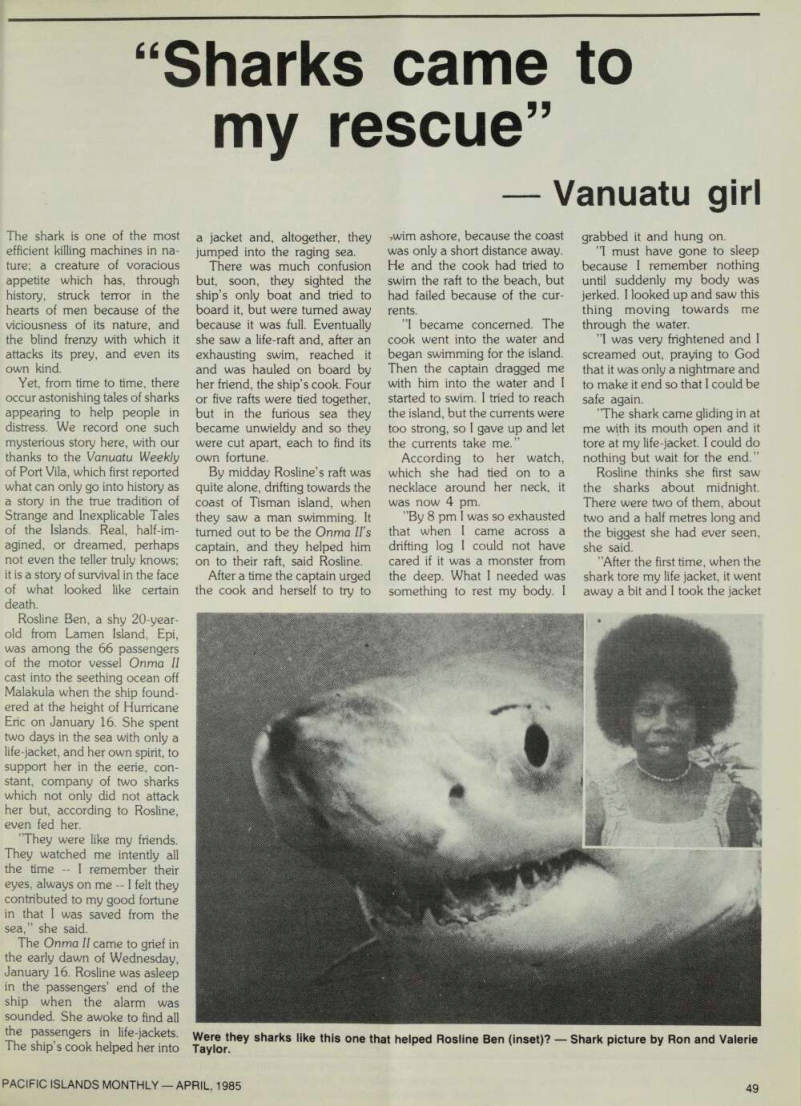
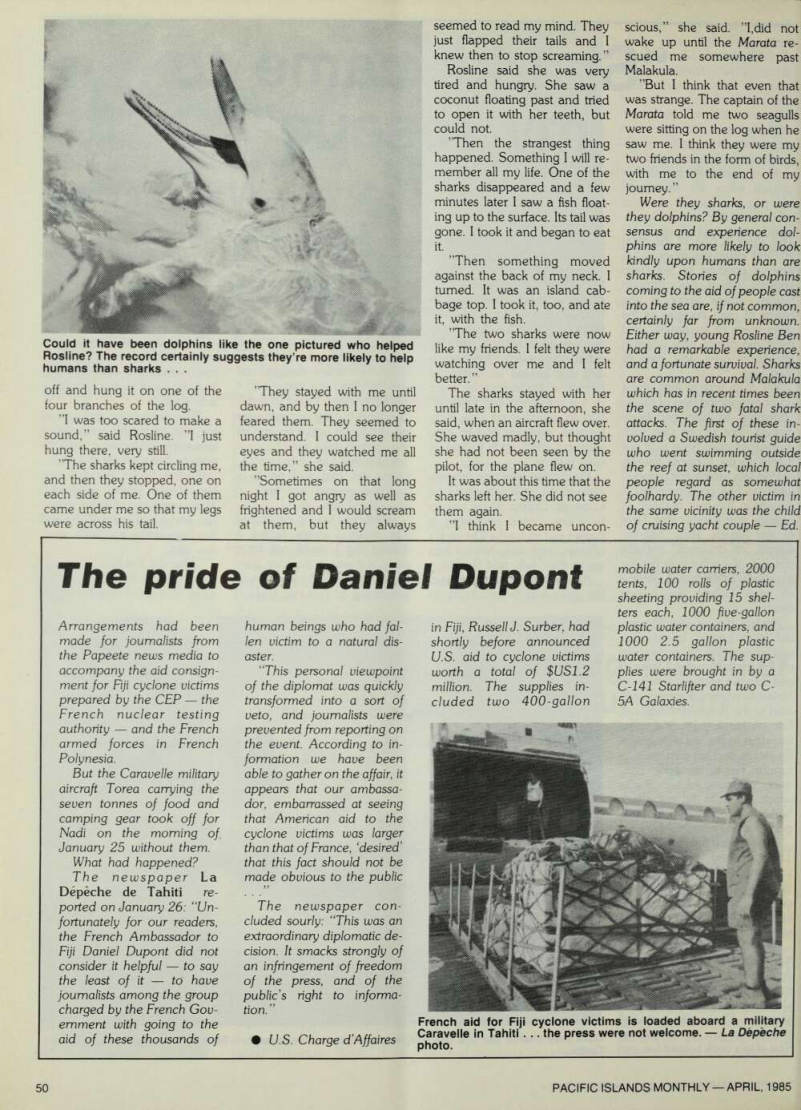
“Sharks came to my rescue”
Vanuatu girl
The shark is one of the most efficient killing machines in na ture; a creature of voracious appetite which has, through history, struck terror in the hearts of men because of the viciousness of its nature, and the blind frenzy with which it attacks its prey, and even its own kind.
Yet, from time to time, there occur astonishing tales of sharks appearing to help people in distress. We record one such mysterious story here, with our thanks to the Vanuatu Weekly of Port Vila, which first reported what can only go into history as a story in the true tradition of Strange and Inexplicable Tales of the Islands. Real, half-im agined, or dreamed, perhaps not even the teller truly knows; it is a story of survival in the face of what looked like certain death.
Rosline Ben, a shy 20-year old from Lamen Island, Epi, was among the 66 passengers of the motor vessel Onma II cast into the seething ocean off Malakula when the ship found ered at the height of Hurricane Eric on January 16. She spent two days in the sea with only a life-jacket, and her own spirit, to support her in the eerie, con stant, company of two sharks which not only did not attack her but, according to Rosline, even fed her. ’’They were like my friends.
They watched me intently all the time I remember their eyes, always on me - I felt they contributed to my good fortune in that I was saved from the sea,” she said.
The Onma II came to grief in the early dawn of Wednesday, January 16. Rosline was asleep in the passengers’ end of the ship when the alarm was sounded. She awoke to find all the passengers in life-jackets.
The ship’s cook helped her into
a jacket and, altogether, they jumped into the raging sea.
There was much confusion but, soon, they sighted the ship’s only boat and tried to board it, but were turned away because it was full. Eventually she saw a life-raft and, after an exhausting swim, reached it and was hauled on board by her friend, the ship’s cook. Four or five rafts were tied together, but in the furious sea they became unwieldy and so they were cut apart, each to find its own fortune.
By midday Rosline’s raft was quite alone, drifting towards the coast of Tisman island, when they saw a man swimming. It turned out to be the Onma ll’s captain, and they helped him on to their raft, said Rosline.
After a time the captain urged the cook and herself to try to
ashore, because the coast was only a short distance away.
He and the cook had tried to swim the raft to the beach, but had failed because of the cur rents. ”1 became concerned. The cook went into the water and began swimming for the island.
Then the captain dragged me with him into the water and I started to swim. I tried to reach the island, but the currents were too strong, so I gave up and let the currents take me.”
According to her watch, which she had tied on to a necklace around her neck, it was now 4 pm. ”By 8 pm I was so exhausted that when I came across a drifting log I could not have cared if it was a monster from the deep. What I needed was something to rest my body. I
grabbed it and hung on. ”1 must have gone to sleep because I remember nothing until suddenly my body was jerked. I looked up and saw this thing moving towards me through the water. ”1 was very frightened and I screamed out, praying to God that it was only a nightmare and to make it end so that I could be safe again. ’The shark came gliding in at me with its mouth open and it tore at my life-jacket. I could do nothing but wait for the end.”
Rosline thinks she first saw the sharks about midnight.
There were two of them, about two and a half metres long and the biggest she had ever seen, she said. ’’After the first time, when the shark tore my life jacket, it went away a bit and I took the jacket
Were they sharks like this one that helped Rosline Ben (inset)? Shark picture by Ron and Valerie Taylor.
off and hung it on one of the four branches of the log. ”1 was too scared to make a sound,” said Rosline. ”1 just hung there, very still. ’The sharks kept circling me, and then they stopped, one on each side of me. One of them came under me so that my legs were across his tail.
’They stayed with me until dawn, and by then I no longer feared them. They seemed to understand. I could see their eyes and they watched me all the time.” she said, ’’Sometimes on that long night I got angry as well as frightened and I would scream at them, but they always
seemed to read my mind. They just flapped their tails and I knew then to stop screaming. ”
Rosline said she was very tired and hungry. She saw a coconut floating past and tried to open it with her teeth, but could not. ’Then the strangest thing happened. Something I will re member all my life. One of the sharks disappeared and a few minutes later I saw a fish float ing up to the surface. Its tail was gone. I took it and began to eat it. ’’Then something moved against the back of my neck. I turned. It was an island cab bage top. I took it, too, and ate it, with the fish. ’The two sharks were now like my friends. I felt they were watching over me and I felt better.”
The sharks stayed with her until late in the afternoon, she said, when an aircraft flew over.
She waved madly, but thought she had not been seen by the pilot, for the plane flew on.
It was about this time that the sharks left her. She did not see them again. ”1 think I became uncon
scious,” she said. ”I,did not wake up until the Marata re scued me somewhere past Malakula. ’’But I think that even that was strange. The captain of the Marata told me two seagulls were sitting on the log when he saw me. 1 think they were my two friends in the form of birds, with me to the end of my journey. ”
Were they sharks, or were they dolphins? By general con sensus and experience dol phins are more likely to look kindly upon humans than are sharks. Stories of dolphins coming to the aid of people cast into the sea are, if not common, certainly far from unknown.
Either way, young Rosline Ben had a remarkable experience, and a fortunate survival. Sharks are common around Malakula which has in recent times been the scene of two fatal shark attacks. The first of these in volved a Swedish tourist guide who went swimming outside the reef at sunset, which local people regard as somewhat foolhardy. The other victim in the same vicinity was the child
of cruising yacht couple —
Ed.
Could it have been dolphins like the one pictured who helped Rosline? The record certainly suggests they’re more likely to help humans than sharks . . .
The pride of Daniel Dupont
Arrangements had been made for journalists from the Papeete news media to accompany the aid consign ment for Fiji cyclone victims prepared by the CEP the French nuclear testing authority and the French armed forces in French Polynesia.
But the Caravelle military aircraft Torea carrying the seven tonnes of food and camping gear took off for Nadi on the morning of.
January 25 without them.
What had happened?
The newspaper La Depeche de Tahiti re ported on January 26: “Un fortunately for our readers, the French Ambassador to Fiji Daniel Dupont did not consider it helpful to say the least of it to have journalists among the group charged by the French Gov ernment with going to the aid of these thousands of
human beings who had fal len victim to a natural dis aster.
“This personal viewpoint of the diplomat was quickly transformed into a sort of veto, and journalists were prevented from reporting on the event. According to in formation we have been able to gather on the affair, it appears that our ambassa dor, embarrassed at seeing that American aid to the cyclone victims was larger than that of France, ‘desired’ that this fact should not be made obvious to the public The newspaper con cluded sourly: “This was an extraordinary diplomatic de cision. It smacks strongly of an infringement of freedom of the press, and of the public’s right to informa tion. ” • U.S. Charge d’Affaires
in Fiji, Russell J. Surber, had shortly before announced U.S. aid to cyclone victims worth a total of SUSI. 2 million. The supplies in cluded two 400-gallon
mobile water carriers, 2000 tents, 100 rolls of plastic sheeting providing 15 shel ters each, 1000 five-gallon plastic water containers, and 1000 2.5 gallon plastic water containers. The sup plies were brought in by a C-141 Starlifter and two C -5A Galaxies.
French aid for Fiji cyclone victims is loaded aboard a military Caravelle in Tahiti ... the press were not welcome. La Depeche photo.
Advertisements & other items, pp. 51-52 (1 item)
Aiwa
System control is
in your hands
- % Wireless remote control is one of the many reasons why the V-1100 is AlWA’s most sophisitcated system yet. From the comfort of your chair you can control the turntable, cassette deck, tuner as well as select any source component and adjust the volume. AIWA puts total system control right in your own hands.
Along with this convenience comes programmable disc playback and recording, separate power amp and preamp with 7-band graphic equalizer, a quartz-synthesizer tuner/timer, and an auto-reverse cassette deck. The special system rack makes component connection quick and simple. Going digital? Go for the V-1100 because its ready now for the connection of a CD player.
AIWA
AIWA Australia Pty., Ltd 14 Gertrude St., Arncliffe, N.S.W. Australia 2205 AUSTRALIA PHONE; (597) 2388/Oceania Indent Agency (P.N.G.) Pty., Ltd Ago St., Gordon Box 5518, Boroko, Papua New Guinea PHONE; 256411/The Sound Centre Ltd P.O. Box 434 Port Vila, Vanuatu PHONE; 2035/P. Hargovind Bros 190 Renwick Road P.O. Box 490 Suva Fiji PHONE; 24350/Makanjee & Sons Limited P.O. Box 91 Sigatoka Fiji PHONE; 50158/Milaw Trading Co., Ltd 36 Airedale St. Auckland, New Zealand PHONE; (09) 399175/hifivox 79, rue de Sebastopol, Noumea, New Caledonia PHONE; 27.24.66/Harvest Pacific Limited P.O. Box 517, Honiara, Solomon Islands PHONE; 131/Fare Hi-Fi Stereo Rue du Marechal Foch, Papeete, Tahiti PHONE; 2-4814/Micropac Audio, Inc. Agana, Guam 96910 PHONE; 472-8091/Cook Island Trading Corp Ltd P.O. Box 92, Rarotonga, Cook Island/Nauru Co-Operative Society Republic of Nauru
V y ' *
bowlers
■ i ti ' ?
In what sport have players of the South Pacific most excelled? Rugby? Swimming?
No. The surprising answer is lawn bowls. And ladies’ bowls at that. If you had been in Melbourne for the sth World Bowls titles, along with the girls from Papua New Guinea, Fiji, and Western Samoa, you would have had to drastically change your impressions of lawn bowls being for little old ladies.
The tournament was held at the Reservoir Bowling Club, Melbourne, from February 13 to March 2, with 36 games played over 18 days.
The South Pacific was well represented, where PNG, Fiji and Western Samoa took part for the first time, together. PNG had a fully indigenous team for the first time and acquitted themselves well, but it was left to Fiji to carry the game to the rest of the world by taking out two silver medals. Maraia Lum On, of the Rewa Bowling Club, Fiji, took the silver medal in the singles, and Maraia, with Willow Fong, also of Rewa, won the silver medal in the pairs.
Of the 19 countries participating, PNG was one of the few having competed at all five tournaments. Fiji took part in the first meet in Sydney in 1969, but withdrew in 1973 (N.Z.) and 1977 (England). For Western Samoa it was their first attempt at world bowls. They withdrew from the 1981 titles in Canada.
The spectators at this year’s tournament were treated to entertaining bowls from the Samoans, especially Pativane Ainu, of the Apia club, with their less inhibited South Seas style which won everyone’s hearts. The South Pacific ladies have now won medals in all five world tournaments, a remarkable achievement considering that the best bowlers in the world compete in these events. Most countries have considerably more clubs and bowlers than the island nations.
The 6th tournament will be held in New Zealand in 1988. Marion and Bill Bramwell.
J
intrigue Fiji
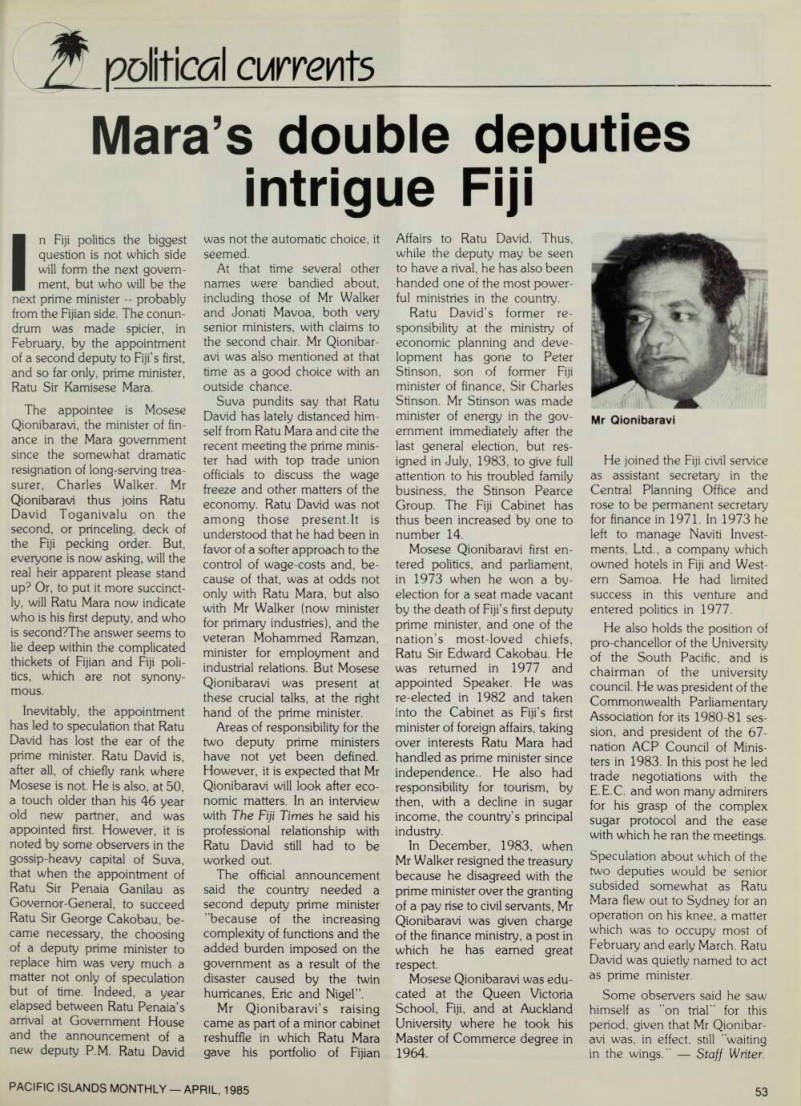
political currents
Mara’s double deputies intrigue Fiji
In Fiji politics the biggest question is not which side will form the next govern ment, but who will be the next prime minister - probably from the Fijian side. The conun drum was made spicier, in February, by the appointment of a second deputy to Fiji’s first, and so far only, prime minister, Ratu Sir Kamisese Mara.
The appointee is Mosese Qionibaravi, the minister of fin ance in the Mara government since the somewhat dramatic resignation of long-serving trea surer, Charles Walker. Mr Qionibaravi thus joins Ratu David Toganivalu on the second, or princeling, deck of the Fiji pecking order. But, everyone is now asking, will the real heir apparent please stand up? Or, to put it more succinct ly, will Ratu Mara now indicate who is his first deputy, and who is second? The answer seems to lie deep within the complicated thickets of Fijian and Fiji poli tics, which are not synony mous.
Inevitably, the appointment has led to speculation that Ratu David has lost the ear of the prime minister. Ratu David is, after all, of chiefly rank where Mosese is not. He is also, at 50, a touch older than his 46 year old new partner, and was appointed first. However, it is noted by some observers in the gossip-heavy capital of Suva, that when the appointment of Ratu Sir Penaia Ganilau as Governor-General, to succeed Ratu Sir George Cakobau, be came necessary, the choosing of a deputy prime minister to replace him was very much a matter not only of speculation but of time. Indeed, a year elapsed between Ratu Penaia’s arrival at Government House and the announcement of a new deputy P.M. Ratu David
was not the automatic choice, it seemed.
At that time several other names were bandied about, including those of Mr Walker and Jonati Mavoa, both very senior ministers, with claims to the second chair. Mr Qionibar avi was also mentioned at that time as a good choice with an outside chance.
Suva pundits say that Ratu David has lately distanced him self from Ratu Mara and cite the recent meeting the prime minis ter had with top trade union officials to discuss the wage freeze and other matters of the economy. Ratu David was not among those present.lt is understood that he had been in favor of a softer approach to the control of wage-costs and, be cause of that, was at odds not only with Ratu Mara, but also with Mr Walker (now minister for primary industries), and the veteran Mohammed Ramzan, minister for employment and industrial relations. But Mosese Qionibaravi was present at these crucial talks, at the right hand of the prime minister.
Areas of responsibility for the two deputy prime ministers have not yet been defined.
However, it is expected that Mr Qionibaravi will look after eco nomic matters. In an interview with The Fiji Times he said his professional relationship with Ratu David still had to be worked out.
The official announcement said the country needed a second deputy prime minister ’’because of the increasing complexity of functions and the added burden imposed on the government as a result of the disaster caused by the twin hurricanes, Eric and Nigel”.
Mr Qionibaravi’s raising came as part of a minor cabinet reshuffle in which Ratu Mara gave his portfolio of Fijian
Affairs to Ratu David. Thus, while the deputy may be seen to have a rival, he has also been handed one of the most power ful ministries in the country.
Ratu David’s former re sponsibility at the ministry of economic planning and deve lopment has gone to Peter Stinson, son of former Fiji minister of finance, Sir Charles Stinson. Mr Stinson was made minister of energy in the gov ernment immediately after the last general election, but res igned in July, 1983, to give full attention to his troubled family business, the Stinson Pearce Group. The Fiji Cabinet has thus been increased by one to number 14.
Mosese Qionibaravi first en tered politics, and parliament, in 1973 when he won a by election for a seat made vacant by the death of Fiji’s first deputy prime minister, and one of the nation’s most-loved chiefs, Ratu Sir Edward Cakobau. He was returned in 1977 and appointed Speaker. He was re-elected in 1982 and taken into the Cabinet as Fiji’s first minister of foreign affairs, taking over interests Ratu Mara had handled as prime minister since independence.. He also had responsibility for tourism, by then, with a decline in sugar income, the country’s principal industry.
In December, 1983, when Mr Walker resigned the treasury because he disagreed with the prime minister over the granting of a pay rise to civil servants, Mr Qionibaravi was given charge of the finance ministry, a post in which he has earned great respect.
Mosese Qionibaravi was edu cated at the Queen Victoria School, Fiji, and at Auckland University where he took his Master of Commerce degree in 1964.
He joined the Fiji civil service as assistant secretary in the Central Planning Office and rose to be permanent secretary for finance in 1971. In 1973 he left to manage Naviti Invest ments, Ltd., a company which owned hotels in Fiji and West ern Samoa. He had limited success in this venture and entered politics in 1977.
He also holds the position of pro-chancellor of the University of the South Pacific, and is chairman of the university council. He was president of the
Commonwealth Parliamentary
Association for its 1980-81 ses sion, and president of the 67nation ACP Council of Minis ters in 1983. In this post he led trade negotiations with the E.E.C. and won many admirers for his grasp of the complex sugar protocol and the ease with which he ran the meetings.
Speculation about which of the two deputies would be senior subsided somewhat as Ratu Mara flew out to Sydney for an operation on his knee, a matter which was to occupy most of February and early March. Ratu David was quietly named to act as prime minister.
Some observers said he saw himself as ”on trial” for this period, given that Mr Qionibar avi was. in effect, still "waiting in the wings.” Staff Writer.
Mr Qionibaravi
Pacific stamp box
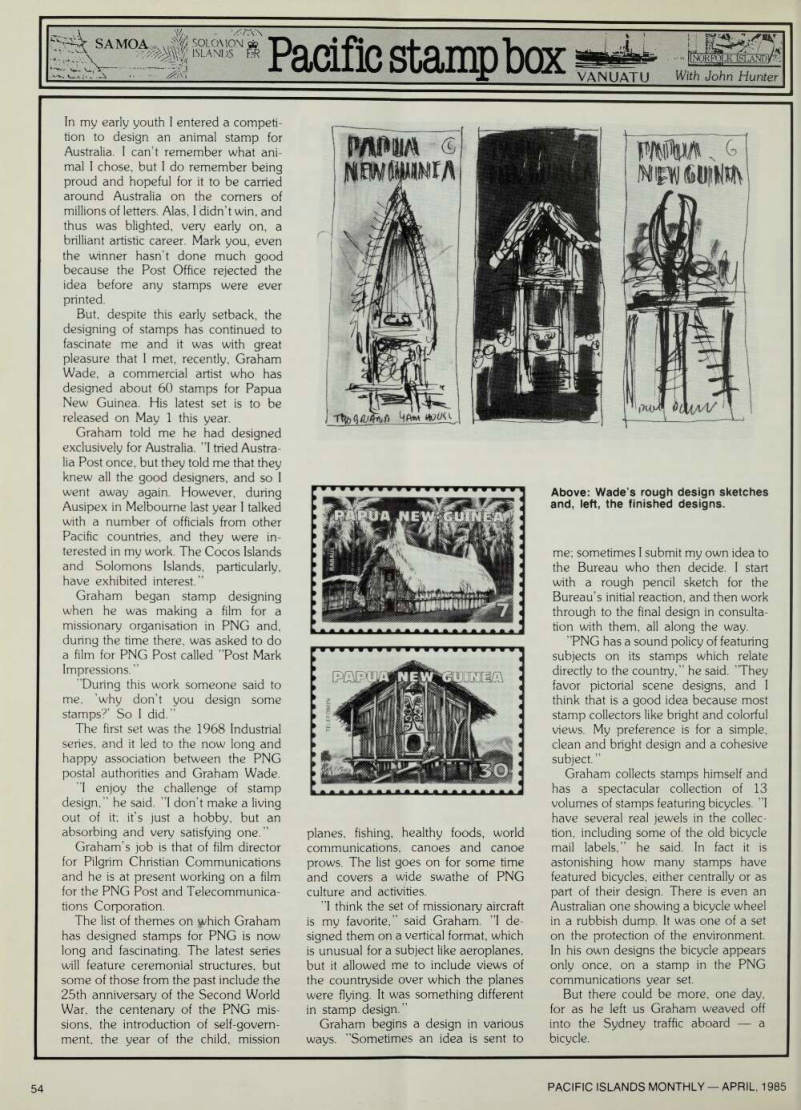
In my early youth I entered a competi tion to design an animal stamp for Australia. I can’t remember what ani mal I chose, but I do remember being proud and hopeful for it to be carried around Australia on the comers of millions of letters. Alas, I didn’t win, and thus was blighted, very early on, a brilliant artistic career. Mark you, even the winner hasn't done much good because the Post Office rejected the idea before any stamps were ever printed.
But, despite this early setback, the designing of stamps has continued to fascinate me and it was with great pleasure that I met, recently, Graham Wade, a commercial artist who has designed about 60 stamps for Papua New Guinea. His latest set is to be released on May 1 this year.
Graham told me he had designed exclusively for Australia. ”1 tried Austra lia Post once, but they told me that they knew all the good designers, and so I went away again. However, during Ausipex in Melbourne last year I talked with a number of officials from other Pacific countries, and they were in terested in my work. The Cocos Islands and Solomons Islands, particularly, have exhibited interest.”
Graham began stamp designing when he was making a film for a missionary organisation in PNG and, during the time there, was asked to do a film for PNG Post called ’’Post Mark Impressions.”
"During this work someone said to me, ’why don’t you design some stamps?’ So I did.”
The first set was the 1968 Industrial series, and it led to the now long and happy association between the PNG postal authorities and Graham Wade. ”1 enjoy the challenge of stamp design,” he said. ”1 don’t make a living out of it; it’s just a hobby, but an absorbing and very satisfying one.”
Graham’s job is that of film director for Pilgrim Christian Communications and he is at present working on a film for the PNG Post and Telecommunica tions Corporation.
The list of themes on ydiich Graham has designed stamps for PNG is now long and fascinating. The latest series will feature ceremonial structures, but some of those from the past include the 25th anniversary of the Second World War, the centenary of the PNG mis sions, the introduction of self-govern ment, the year of the child, mission
planes, fishing, healthy foods, world communications, canoes and canoe prows. The list goes on for some time and covers a wide swathe of PNG culture and activities. ”1 think the set of missionary aircraft is my favorite,” said Graham. ”1 de signed them on a vertical format, which is unusual for a subject like aeroplanes, but it allowed me to include views of the countryside over which the planes were flying. It was something different in stamp design.”
Graham begins a design in various ways. ’’Sometimes an idea is sent to
me; sometimes I submit my own idea to the Bureau who then decide. I start with a rough pencil sketch for the Bureau’s initial reaction, and then work through to the final design in consulta tion with them, all along the way. ”FNG has a sound policy of featuring subjects on its stamps which relate directly to the country,” he said. ’They favor pictorial scene designs, and 1 think that is a good idea because most stamp collectors like bright and colorful views. My preference is for a simple, clean and bright design and a cohesive subject. ”
Graham collects stamps himself and has a spectacular collection of 13 volumes of stamps featuring bicycles. ”1 have several real jewels in the collec tion, including some of the old bicycle mail labels,” he said. In fact it is astonishing how many stamps have featured bicycles, either centrally or as part of their design. There is even an Australian one showing a bicycle wheel in a rubbish dump. It was one of a set on the protection of the environment.
In his own designs the bicycle appears only once, on a stamp in the PNG communications year set.
But there could be more, one day, for as he left us Graham weaved off into the Sydney traffic aboard a bicycle.
Above; Wade’s rough design sketches and, left, the finished designs.
from the islands press
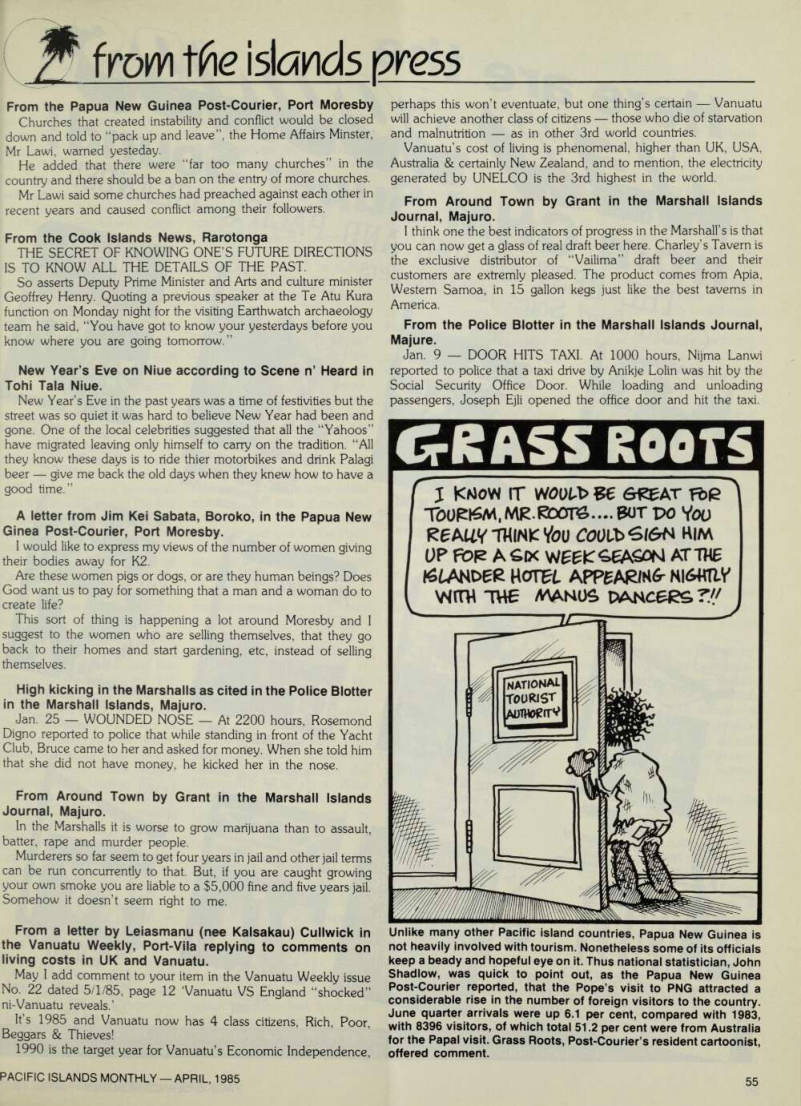
From the Papua New Guinea Post-Courier, Port Moresby Churches that created instability and conflict would be closed down and told to “pack up and leave”, the Home Affairs Minster, Mr Lawi, warned yesteday.
He added that there were “far too many churches” in the country and there should be a ban on the entry of more churches.
Mr Lawi said some churches had preached against each other in recent years and caused conflict among their followers.
From the Cook Islands News, Rarotonga THE SECRET OF KNOWING ONE’S FUTURE DIRECTIONS IS TO KNOW ALL THE DETAILS OF THE PAST.
So asserts Deputy Prime Minister and Arts and culture minister Geoffrey Henry. Quoting a previous speaker at the Te Atu Kura function on Monday night for the visiting Earthwatch archaeology team he said, “You have got to know your yesterdays before you know where you are going tomorrow.”
New Year’s Eve on Niue according to Scene n’ Heard in Tohi Tala Niue.
New Year’s Eve in the past years was a time of festivities but the street was so quiet it was hard to believe New Year had been and gone. One of the local celebrities suggested that all the “Yahoos” have migrated leaving only himself to carry on the tradition. “All they know these days is to ride thier motorbikes and drink Palagi beer give me back the old days when they knew how to have a good time.”
A letter from Jim Kei Sabata, Boroko, in the Papua New Ginea Post-Courier, Port Moresby.
I would like to express my views of the number of women giving their bodies away for K 2.
Are these women pigs or dogs, or are they human beings? Does God want us to pay for something that a man and a woman do to create life?
This sort of thing is happening a lot around Moresby and I suggest to the women who are selling themselves, that they go back to their homes and start gardening, etc, instead of selling themselves.
High kicking in the Marshalls as cited in the Police Blotter in the Marshall Islands, Majuro.
Jan. 25 WOUNDED NOSE At 2200 hours, Rosemond Digno reported to police that while standing in front of the Yacht Club, Bruce came to her and asked for money. When she told him that she did not have money, he kicked her in the nose.
From Around Town by Grant in the Marshall Islands Journal, Majuro.
In the Marshalls it is worse to grow marijuana than to assault, batter, rape and murder people.
Murderers so far seem to get four years in jail and other jail terms can be run concurrently to that. But, if you are caught growing your own smoke you are liable to a $5,000 fine and five years jail.
Somehow it doesn’t seem right to me.
From a letter by Leiasmanu (nee Kalsakau) Cullwick in the Vanuatu Weekly, Port-Vila replying to comments on living costs in UK and Vanuatu.
May I add comment to your item in the Vanuatu Weekly issue No. 22 dated 5/1/85, page 12 ‘Vanuatu VS England “shocked” ni-Vanuatu reveals.’
It’s 1985 and Vanuatu now has 4 class citizens, Rich, Poor, Beggars & Thieves! 1990 is the target year for Vanuatu’s Economic Independence,
perhaps this won’t eventuate, but one thing’s certain Vanuatu will achieve another class of citizens those who die of starvation and malnutrition as in other 3rd world countries.
Vanuatu’s cost of living is phenomenal, higher than UK, USA, Australia & certainly New Zealand, and to mention, the electricity generated by UNELCO is the 3rd highest in the world.
From Around Town by Grant in the Marshall Islands Journal, Majuro.
I think one the best indicators of progress in the Marshall’s is that you can now get a glass of real draft beer here. Charley’s Tavern is the exclusive distributor of “Vailima” draft beer and their customers are extremly pleased. The product comes from Apia, Western Samoa, in 15 gallon kegs just like the best taverns in America.
From the Police Blotter in the Marshall Islands Journal, Majure.
Jan. 9 DOOR HITS TAXI. At 1000 hours, Nijma Lanwi reported to police that a taxi drive by Anikje Lolin was hit by the Social Security Office Door. While loading and unloading passengers, Joseph Ejli opened the office door and hit the taxi.
Advertisements & other items, pp. 55-56 (1 item)
Or Ass Roots
J KMow IT WOODT> SC 6PEAT R>R
po Voo
KEAUV THINK VoU COOlb HIM
UP FOP A SIX WFFKSgASOM AT THE
£6ANDEfc HarpE APPEARING NI6HTIY
WITH THE /VAANOS DANCERS
national
TOURIST
autwritv Unlike many other Pacific island countries, Papua New Guinea is not heavily involved with tourism. Nonetheless some of its officials keep a beady and hopeful eye on it. Thus national statistician, John Shadlow, was quick to point out, as the Papua New Guinea Post-Courier reported, that the Pope’s visit to PNG attracted a considerable rise in the number of foreign visitors to the country.
June quarter arrivals were up 6.1 per cent, compared with 1983, with 8396 visitors, of which total 51.2 per cent were from Australia for the Papal visit. Grass Roots, Post-Courier’s resident cartoonist, offered comment.
H er >A jjZ
/ i
Sou#!
,r ®^siiV B -t ,e *p
r^®S.^r
3uar ante . r ■* ' x ‘ \ iUt>< " .-sag No* fo G r ear^ lec^ionS dWerf pN G G re music '° r ot everyone-
l|SS
Ji » w,»R! - ** Live m ™ a|edo ma.
A real everyone.
Appe^
•ssC
at S °lfnresented. m"
Jj.’SV'””*'
fa* n\ Bros thp llau V and their o* n
‘‘composite-
featuring
iMf&r releases
•k; first
presentsfloioAlPunr.
Itt^fSdu
The evet POP u ' a as b een what r" for
I" ÜBS?**
□s} S waiting 4 for Album great leasure Another listening your Sl«! £ o h . - x
W H\BP TTme NK
f
POBa
wot BO* ?0 The Firs' NeW **%* WE HAVE OVER 100 CASSETTE TITLES OF PNG MUSIC FROM ROCK TO STRINGBANDS.
ANY RADIO STATION INTERESTED IN PLAYING PNG MUSIC, PLEASE CONTACT OUR ADDRESS.
people
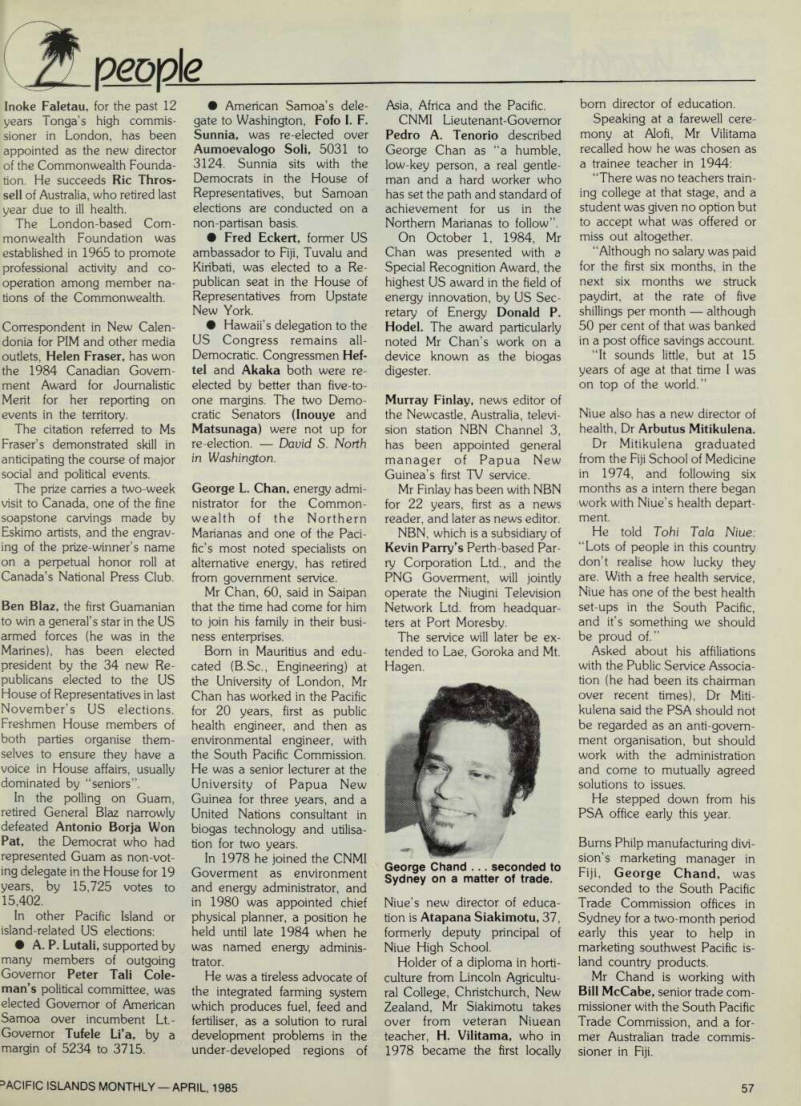
Inoke Faletau, for the past 12 years Tonga’s high commis sioner in London, has been appointed as the new director of the Commonwealth Founda tion. He succeeds Ric Thros sell of Australia, who retired last year due to ill health.
The London-based Com monwealth Foundation was established in 1965 to promote professional activity and co operation among member na tions of the Commonwealth.
Correspondent in New Calen donia for PIM and other media outlets, Helen Fraser, has won the 1984 Canadian Govern ment Award for Journalistic Merit for her reporting on events in the territory.
The citation referred to Ms Fraser’s demonstrated skill in anticipating the course of major social and political events.
The prize carries a two-week visit to Canada, one of the fine soapstone carvings made by Eskimo artists, and the engrav ing of the prize-winner’s name on a perpetual honor roll at Canada’s National Press Club.
Ben Blaz, the first Guamanian to win a general’s star in the US armed forces (he was in the Marines), has been elected president by the 34 new Re publicans elected to the US House of Representatives in last November’s US elections.
Freshmen House members of both parties organise them selves to ensure they have a voice in House affairs, usually dominated by “seniors”.
In the polling on Guam, retired General Blaz narrowly defeated Antonio Borja Won Fat, the Democrat who had represented Guam as non-vot ing delegate in the House for 19 years, by 15,725 votes to 15,402.
In other Pacific Island or island-related US elections: • A. P. Lutali, supported by many members of outgoing Governor Peter Tali Cole man’s political committee, was elected Governor of American Samoa over incumbent Lt- Governor Tufele Li’a, by a margin of 5234 to 3715.
• American Samoa’s dele gate to Washington, Fofo I. F.
Sunnia, was re-elected over Aumoevalogo Soli, 5031 to 3124. Sunnia sits with the Democrats in the House of Representatives, but Samoan elections are conducted on a non-partisan basis. • Fred Eckert, former US ambassador to Fiji, Tuvalu and Kiribati, was elected to a Re publican seat in the House of Representatives from Upstate New York. • Hawaii’s delegation to the US Congress remains all- Democratic. Congressmen Hef tel and Akaka both were re elected by better than five-to one margins. The two Demo cratic Senators (Inouye and Matsunaga) were not up for re-election. David S. North in Washington.
George L. Chan, energy admi nistrator for the Common wealth of the Northern Marianas and one of the Paci fic’s most noted specialists on alternative energy, has retired from government service.
Mr Chan, 60, said in Saipan that the time had come for him to join his family in their busi ness enterprises.
Born in Mauritius and edu cated (B.Sc., Engineering) at the University of London, Mr Chan has worked in the Pacific for 20 years, first as public health engineer, and then as environmental engineer, with the South Pacific Commission.
He was a senior lecturer at the University of Papua New Guinea for three years, and a United Nations consultant in biogas technology and utilisa tion for two years.
In 1978 he joined the CNMI Goverment as environment and energy administrator, and in 1980 was appointed chief physical planner, a position he held until late 1984 when he was named energy adminis trator.
He was a tireless advocate of the integrated farming system which produces fuel, feed and fertiliser, as a solution to rural development problems in the under-developed regions of
Asia, Africa and the Pacific.
CNMI Lieutenant-Governor Pedro A. Tenorio described George Chan as “a humble, low-key person, a real gentle man and a hard worker who has set the path and standard of achievement for us in the Northern Marianas to follow”.
On October 1, 1984, Mr Chan was presented with a Special Recognition Award, the highest US award in the field of energy innovation, by US Sec retary of Energy Donald P.
Hodel. The award particularly noted Mr Chan’s work on a device known as the biogas digester.
Murray Finlay, news editor of the Newcastle, Australia, televi sion station NBN Channel 3, has been appointed general manager of Papua New Guinea’s first TV service.
Mr Finlay has been with NBN for 22 years, first as a news reader, and later as news editor.
NBN, which is a subsidiary of Kevin Parry’s Perth-based Par ry Corporation Ltd., and the PNG Goverment, will jointly operate the Niugini Television Network Ltd. from headquar ters at Port Moresby.
The service will later be ex tended to Lae, Goroka and Mt.
Hagen.
Niue’s new director of educa tion is Atapana Siakimotu, 37, formerly deputy principal of Niue High School.
Holder of a diploma in horti culture from Lincoln Agricultu ral College, Christchurch, New Zealand, Mr Siakimotu takes over from veteran Niuean teacher, H. Vilitama, who in 1978 became the first locally
born director of education.
Speaking at a farewell cere mony at Alofi, Mr Vilitama recalled how he was chosen as a trainee teacher in 1944: “There was no teachers train ing college at that stage, and a student was given no option but to accept what was offered or miss out altogether.
“Although no salary was paid for the first six months, in the next six months we struck paydirt, at the rate of five shillings per month although 50 per cent of that was banked in a post office savings account.
“It sounds little, but at 15 years of age at that time I was on top of the world.”
Niue also has a new director of health, Dr Arbutus Mitikulena.
Dr Mitikulena graduated from the Fiji School of Medicine in 1974, and following six months as a intern there began work with Niue’s health depart ment.
He told Tohi Tala Niue: “Lots of people in this country don’t realise how lucky they are. With a free health service, Niue has one of the best health set-ups in the South Pacific, and it’s something we should be proud of.”
Asked about his affiliations with the Public Service Associa tion (he had been its chairman over recent times), Dr Miti kulena said the PSA should not be regarded as an anti-govern ment organisation, but should work with the administration and come to mutually agreed solutions to issues.
He stepped down from his PSA office early this year.
Burns Philp manufacturing divi sion’s marketing manager in Fiji, George Chand, was seconded to the South Pacific Trade Commission offices in Sydney for a two-month period early this year to help in marketing southwest Pacific is land country products.
Mr Chand is working with Bill McCabe. senior trade com missioner with the South Pacific Trade Commission, and a for mer Australian trade commis sioner in Fiji.
George Chand .. . seconded to Sydney on a matter of trade.
yachts
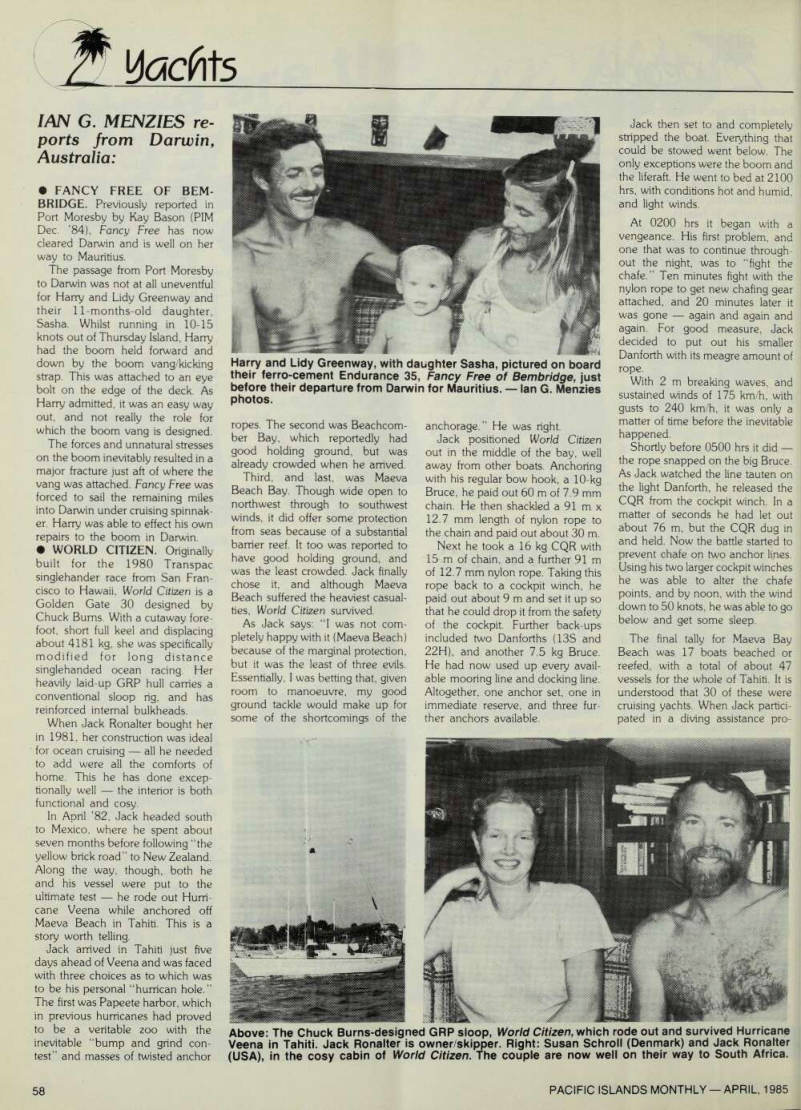
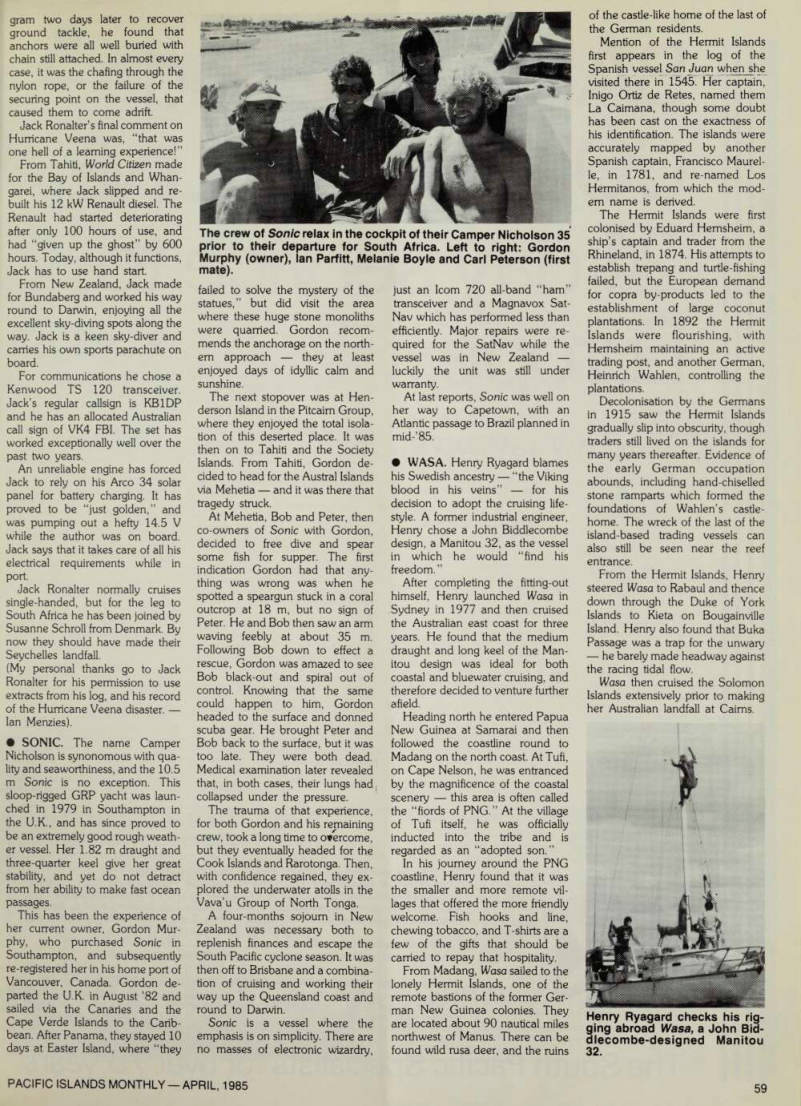
Lan G. Menzies Re
ports from Darwin ,
Australia:
• Fancy Free Of Bem
BRIDGE. Previously reported in Port Moresby by Kay Bason (PIM Dec. ’B4), Fancy Free has now cleared Darwin and is well on her way to Mauritius.
The passage from Port Moresby to Darwin was not at all uneventful for Harry and Lidy Greenway and their 11-months-old daughter, Sasha. Whilst running in 10-15 knots out of Thursday Island, Harry had the boom held forward and down by the boom vang/kicking strap. This was attached to an eye bolt on the edge of the deck. As Harry admitted, it was an easy way out, and not really the role for which the boom vang is designed.
The forces and unnatural stresses on the boom inevitably resulted in a major fracture just aft of where the vang was attached. Fancy Free was forced to sail the remaining miles into Darwin under cruising spinnak er. Harry was able to effect his own repairs to the boom in Darwin. • WORLD CITIZEN. Originally built for the 1980 Transpac singlehander race from San Fran cisco to Hawaii, World Citizen is a Golden Gate 30 designed by Chuck Burns. With a cutaway fore foot, short full keel and displacing about 4181 kg, she was specifically modified for long distance singlehanded ocean racing. Her heavily laid-up GRP hull carries a conventional sloop rig, and has reinforced internal bulkheads.
When Jack Ronalter bought her in 1981, her construction was ideal for ocean cruising all he needed to add were all the comforts of home. This he has done excep tionally well the interior is both functional and cosy.
In April ’B2, Jack headed south to Mexico, where he spent about seven months before following “the yellow brick road” to New Zealand.
Along the way, though, both he and his vessel were put to the ultimate test he rode out Hurri cane Veena while anchored off Maeva Beach in Tahiti. This is a story worth telling.
Jack arrived in Tahiti just five days ahead of Veena and was faced with three choices as to which was to be his personal “hurrican hole.”
The first was Papeete harbor, which in previous hurricanes had proved to be a veritable zoo with the inevitable “bump and grind con test” and masses of twisted anchor
ropes. The second was Beachcom ber Bay, which reportedly had good holding ground, but was already crowded when he arrived.
Third, and last, was Maeva Beach Bay. Though wide open to northwest through to southwest winds, it did offer some protection from seas because of a substantial barrier reef. It too was reported to have good holding ground, and was the least crowded. Jack finally chose it. and although Maeva Beach suffered the heaviest casual ties, World Citizen survived.
As Jack says: “I was not com pletely happy with it (Maeva Beach) because of the marginal protection, but it was the least of three evils.
Essentially, I was betting that, given room to manoeuvre, my good ground tackle would make up for some of the shortcomings of the
anchorage.” He was right.
Jack positioned World Citizen out in the middle of the bay, well away from other boats. Anchoring with his regular bow hook, a 10-kg Bruce, he paid out 60 m of 7.9 mm chain. He then shackled a 91 m x 12.7 mm length of nylon rope to the chain and paid out about 30 m.
Next he took a 16 kg CQR with 15 m of chain, and a further 91 m of 12.7 mm nylon rope. Taking this rope back to a cockpit winch, he paid out about 9 m and set it up so that he could drop it from the safety of the cockpit. Further back-ups included two Danforths (13S and 22H), and another 7.5 kg Bruce.
He had now used up every avail able mooring line and docking line.
Altogether, one anchor set, one in immediate reserve, and three fur ther anchors available.
Jack then set to and completely stripped the boat. Everything that could be stowed went below. The only exceptions were the boom and the liferaft. He went to bed at 2100 hrs, with conditions hot and humid, and light winds.
At 0200 hrs it began with a vengeance. His first problem, and one that was to continue through out the night, was to “fight the chafe.” Ten minutes fight with the nylon rope to get new chafing gear attached, and 20 minutes later it was gone again and again and again. For good measure, Jack decided to put out his smaller Danforth with its meagre amount of rope.
With 2 m breaking waves, and sustained winds of 175 km/h, with gusts to 240 km/h, it was only a matter of time before the inevitable happened.
Shortly before 0500 hrs it did the rope snapped on the big Bruce.
As Jack watched the line tauten on the light Danforth, he released the CQR from the cockpit winch. In a matter of seconds he had let out about 76 m, but the CQR dug in and held. Now the battle started to prevent chafe on two anchor lines.
Using his two larger cockpit winches he was able to alter the chafe points, and by noon, with the wind down to 50 knots, he was able to go below and get some sleep.
The final tally for Maeva Bay Beach was 17 boats beached or reefed, with a total of about 47 vessels for the whole of Tahiti. It is understood that 30 of these were cruising yachts. When Jack partici pated in a diving assistance pro-
Above: The Chuck Burns-designed GRP sloop, World Citizen, which rode out and survived Hurricane Veena in Tahiti. Jack Ronalter is owner/skipper. Right; Susan Schroll (Denmark) and Jack Ronalter (USA), in the cosy cabin of World Citizen. The couple are now well on their way to South Africa.
Harry and Lidy Greenway, with daughter Sasha, pictured on board their ferro-cement Endurance 35, Fancy Free of Bembridge, just before their departure from Darwin for Mauritius.-lan G. Menzies photos.
gram two days later to recover ground tackle, he found that anchors were all well buried with chain still attached. In almost every case, it was the chafing through the nylon rope, or the failure of the securing point on the vessel, that caused them to come adrift.
Jack Ronalter’s final comment on Hurricane Veena was, “that was one hell of a learning experience!”
From Tahiti, World Citizen made for the Bay of Islands and Whan garei, where Jack slipped and re built his 12 kW Renault diesel. The Renault had started deteriorating after only 100 hours of use, and had “given up the ghost” by 600 hours. Today, although it functions, Jack has to use hand start.
From New Zealand, Jack made for Bundaberg and worked his way round to Darwin, enjoying all the excellent sky-diving spots along the way. Jack is a keen sky-diver and carries his own sports parachute on board.
For communications he chose a Kenwood TS 120 transceiver.
Jack’s regular callsign is KBIDP and he has an allocated Australian call sign of VK4 FBI. The set has worked exceptionally well over the past two years.
An unreliable engine has forced Jack to rely on his Arco 34 solar panel for battery charging. It has proved to be “just golden,” and was pumping out a hefty 14.5 V while the author was on board.
Jack says that it takes care of all his electrical requirements while in port.
Jack Ronalter normally cruises single-handed, but for the leg to South Africa he has been joined by Susanne Schroll from Denmark. By now they should have made their Seychelles landfall. (My personal thanks go to Jack Ronalter for his permission to use extracts from his log, and his record of the Hurricane Veena disaster. lan Menzies). • SONIC. The name Camper Nicholson is synonomous with qua lity and seaworthiness, and the 10.5 m Sonic is no exception. This sloop-rigged GRP yacht was laun ched in 1979 in Southampton in the U.K., and has since proved to be an extremely good rough weath er vessel. Her 1.82 m draught and three-quarter keel give her great stability, and yet do not detract from her ability to make fast ocean passages.
This has been the experience of her current owner, Gordon Mur phy, who purchased Sonic in Southampton, and subsequently re-registered her in his home port of Vancouver, Canada. Gordon de parted the U.K. in August ’B2 and sailed via the Canaries and the Cape Verde Islands to the Carib bean. After Panama, they stayed 10 days at Easter Island, where “they
failed to solve the mystery of the statues,” but did visit the area where these huge stone monoliths were quarried. Gordon recom mends the anchorage on the north ern approach they at least enjoyed days of idyllic calm and sunshine.
The next stopover was at Hen derson Island in the Pitcairn Group, where they enjoyed the total isola tion of this deserted place. It was then on to Tahiti and the Society Islands. From Tahiti, Gordon de cided to head for the Austral Islands via Mehetia and it was there that tragedy struck.
At Mehetia, Bob and Peter, then co-owners of Sonic with Gordon, decided to free dive and spear some fish for supper. The first indication Gordon had that any thing was wrong was when he spotted a speargun stuck in a coral outcrop at 18 m, but no sign of Peter. He and Bob then saw an arm waving feebly at about 35 m.
Following Bob down to effect a rescue, Gordon was amazed to see Bob black-out and spiral out of control. Knowing that the same could happen to him, Gordon headed to the surface and donned scuba gear. He brought Peter and Bob back to the surface, but it was too late. They were both dead.
Medical examination later revealed that, in both cases, their lungs had. collapsed under the pressure.
The trauma of that experience, for both Gordon and his remaining crew, took a long time to overcome, but they eventually headed for the Cook Islands and Rarotonga. Then, with confidence regained, they ex plored the underwater atolls in the Vava’u Group of North Tonga.
A four-months sojourn in New Zealand was necessary both to replenish finances and escape the South Pacific cyclone season. It was then off to Brisbane and a combina tion of cruising and working their way up the Queensland coast and round to Darwin.
Sonic is a vessel where the emphasis is on simplicity. There are no masses of electronic wizardry,
just an Icom 720 all-band “ham” transceiver and a Magnavox Sat- Nav which has performed less than efficiently. Major repairs were re quired for the SatNav while the vessel was in New Zealand luckily the unit was still under warranty.
At last reports, Sonic was well on her way to Capetown, with an Atlantic passage to Brazil planned in mid-’B5. • WASA. Henry Ryagard blames his Swedish ancestry “the Viking blood in his veins” for his decision to adopt the cruising life style. A former industrial engineer, Henry chose a John Biddlecombe design, a Manitou 32, as the vessel in which he would “find his freedom. ”
After completing the fitting-out himself, Henry launched Wasa in Sydney in 1977 and then cruised the Australian east coast for three years. He found that the medium draught and long keel of the Man itou design was ideal for both coastal and bluewater cruising, and therefore decided to venture further afield.
Heading north he entered Papua New Guinea at Samarai and then followed the coastline round to Madang on the north coast. At Tufi, on Cape Nelson, he was entranced by the magnificence of the coastal scenery this area is often called the “fiords of PNG.” At the village of Tufi itself, he was officially inducted into the tribe and is regarded as an “adopted son.”
In his journey around the PNG coastline, Henry found that it was the smaller and more remote vil lages that offered the more friendly welcome. Fish hooks and line, chewing tobacco, and T-shirts are a few of the gifts that should be carried to repay that hospitality.
From Madang, Wasa sailed to the lonely Hermit Islands, one of the remote bastions of the former Ger man New Guinea colonies. They are located about 90 nautical miles northwest of Manus. There can be found wild rusa deer, and the ruins
of the castle-like home of the last of the German residents.
Mention of the Hermit Islands first appears in the log of the Spanish vesse[ San Juan when she visited there in 1545. Her captain, Inigo Ortiz de Retes, named them La Caimana, though some doubt has been cast on the exactness of his identification. The islands were accurately mapped by another Spanish captain, Francisco Maurel le, in 1781, and re-named Los Hermitanos, from which the mod em name is derived.
The Hermit Islands were first colonised by Eduard Hemsheim, a ship’s captain and trader from the Rhineland, in 1874. His attempts to establish trepang and turtle-fishing failed, but the European demand for copra by-products led to the establishment of large coconut plantations. In 1892 the Hermit Islands were flourishing, with Hemsheim maintaining an active trading post, and another German, Heinrich Wahlen, controlling the plantations.
Decolonisation by the Germans in 1915 saw the Hermit Islands gradually slip into obscurity, though traders still lived on the islands for many years thereafter. Evidence of the early German occupation abounds, including hand-chiselled stone ramparts which formed the foundations of Wahlen’s castle home. The wreck of the last of the island-based trading vessels can also still be seen near the reef entrance.
From the Hermit Islands, Henry steered IVasa to Rabaul and thence down through the Duke of York Islands to Kieta on Bougainville Island. Henry also found that Buka Passage was a trap for the unwary he barely made headway against the racing tidal flow.
Wasa then cruised the Solomon Islands extensively prior to making her Australian landfall at Cairns.
The crew of Sonic relax in the cockpit of their Camper Nicholson 35 prior to their departure for South Africa. Left to right: Gordon Murphy (owner), lan Parfitt, Melanie Boyle and Carl Peterson (first mate).
Henry Ryagard checks his rig ging abroad Wasa, a John Bid dlecombe-designed Manitou 32.
Advertisements & other items, p. 60 (1 item)
Europe.
BANK LINE and
COLUMBUS LINE
24 day service to
Europe.
Need we say more...
D G The Joint Service Partners offer facilities for shipment of: Containers (FCL/LCL) and Break-bulk Cargo plus reefer space and deeptanks for carriage of vegetable oils and other liquid bulk cargo.
Carriers also accept heavy lifts, overlength and cumbersome parcels.
Ports of Service: Loading; Papeete, Apia, Suva, Lautoka, Noumea, Port Vila, Santo, Honiara, Port Moresby, Lae, Madang, Kimbe, Rabaul, Kieta, Darwin. For: Rotterdam, Antwerp, Hamburg, Hull, Dunkirk, Le Havre.
Additional ports on enquiry.
Please contact our regional offices for further information: The Bank Line (Australasia) Pty Ltd Columbus Line Reederei GmbH Suite 801, 51 Pitt St, P.O. Box 1 667, Lae/Papua New Guinea.
Sydney, NSW, Australia 2000 Phone: 423466/423487/AH. 422481 Phone 27 2041 Telex 24063 Telex; Colline NE 441 71 The South Pacific Specialists for over 75 years
shipping schedules
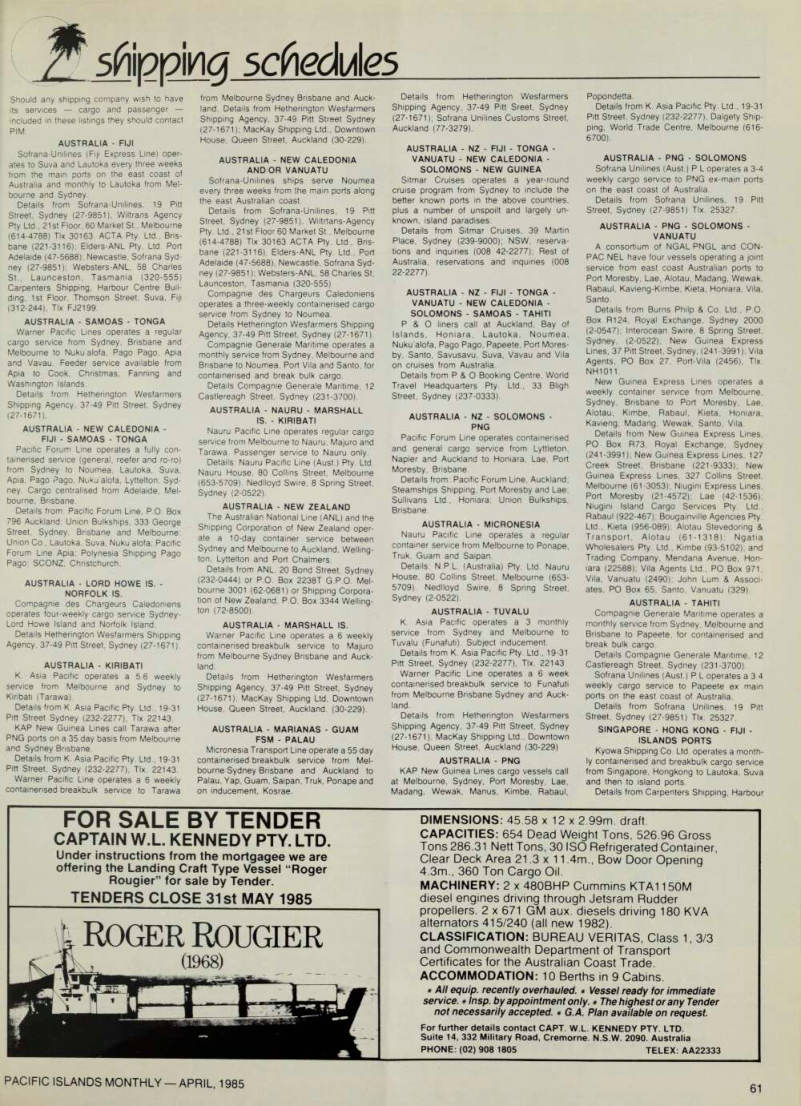
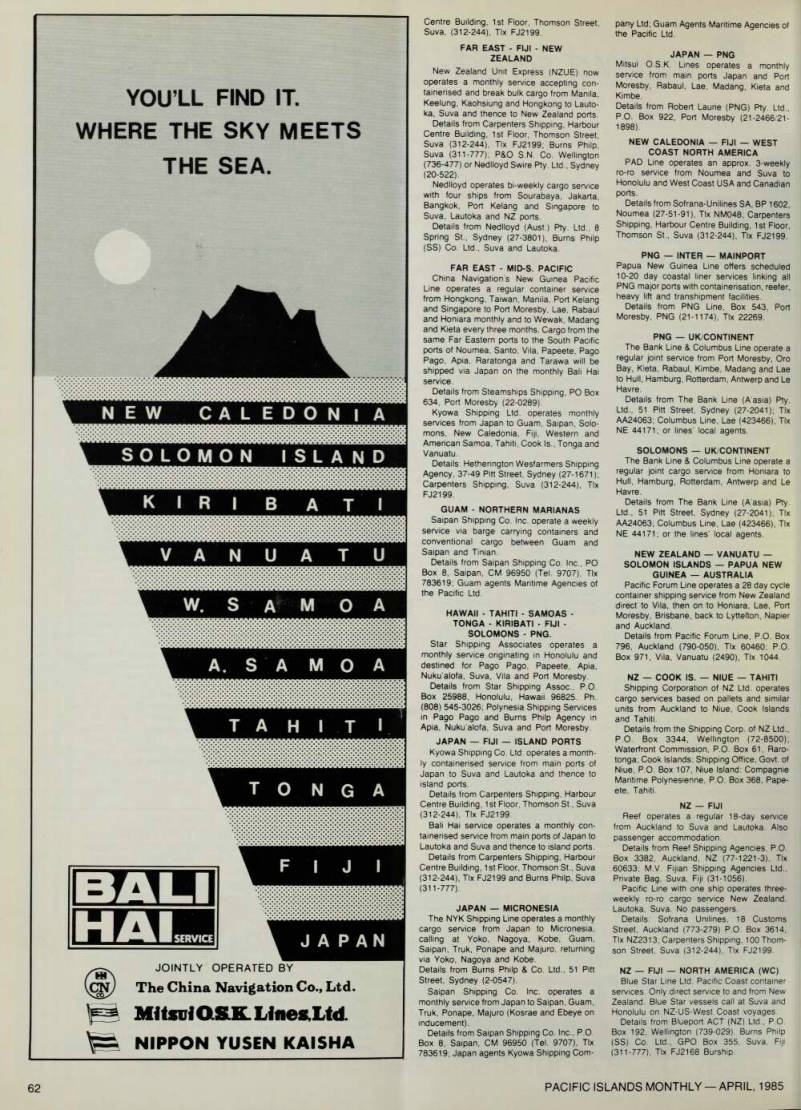
Should any shipping company wish to have its services cargo and passenger included in these listings they should contact
Pim.
Australia - Fiji
Sofrana-Unilines (Fiji Express Line) oper ates to Suva and Lautoka every three weeks from the main ports on the east coast of Australia and monthly to Lautoka from Mel bourne and Sydney.
Details from Sofrana-Unilines, 19 Pitt Street, Sydney (27-9851), Wiltrans Agency Pty Ltd., 21st Floor, 60 Market St., Melbourne (614-4788) Tlx 30163. ACTA Pty. Ltd.. Bris bane (221-3116); Elders-ANL Pty. Ltd. Port Adelaide (47-5688); Newcastle, Sofrana Syd ney (27-9851); Websters-ANL, 58 Charles St., Launceston, Tasmania (320-555) Carpenters Shipping, Harbour Centre Buil ding, Ist Floor, Thomson Street, Suva, Fiji (312-244), Tlx FJ2199.
Australia - Samoas - Tonga
Warner Pacific Lines operates a regular cargo service from Sydney, Brisbane and Melbourne to Nukualofa, Pago Pago, Apia and Vavau. Feeder service available from Apia to Cook, Christmas, Fanning and Washington Islands.
Details from Hetherington Wesfarmers Shipping Agency. 37-49 Pitt Street, Sydney (27-1671).
Australia - New Caledonia -
Fiji - Samoas - Tonga
Pacific Forum Line operates a fully con tainerised service (general, reefer and ro-ro) from Sydney to Noumea, Lautoka, Suva, Apia, Pago Pago, Nukualofa, Lyttelton, Syd ney. Cargo centralised from Adelaide, Mel bourne, Brisbane.
Details from: Pacific Forum Line, P.O. Box 796 Auckland; Union Bulkships, 333 George Street, Sydney, Brisbane and Melbourne: Union Co., Lautoka, Suva, Nukualofa; Pacific Forum Line Apia: Polynesia Shipping Pago Pago; SCONZ, Christchurch,
Australia - Lord Howe Is. -
Norfolk Is.
Compagnie des Chargeurs Caledoniens operates four-weekly cargo service Sydney- Lord Howe Island and Norfolk Island.
Details Hetherington Wesfarmers Shipping Agency, 37-49 Pitt Street, Sydney (27-1671).
Australia - Kiribati
K. Asia Pacific operates a 5 6 weekly service from Melbourne and Sydney to Kiribati (Tarawa).
Details from K. Asia Pacific Pty. Ltd., 19-31 Pitt Street Sydney (232-2277), Tlx 22143.
KAP New Guinea Lines call Tarawa after PNG ports on a 35 day basis from Melbourne and Sydney Brisbane.
Details from K. Asia Pacific Pty. Ltd., 19-31 Pitt Street, Sydney (232-2277), Tlx. 22143.
Warner Pacific Line operates a 6 weekly containerised breakbulk service to Tarawa
from Melbourne Sydney Brisbane and Auck land. Details from Hetherington Wesfarmers Shipping Agency, 37-49 Pitt Street Sydney (27-1671); Mac Kay Shipping Ltd., Downtown House, Queen Street, Auckland (30-229).
Australia - New Caledonia
And Or Vanuatu
Sofrana-Unilines ships serve Noumea every three weeks from the main ports along the east Australian coast.
Details from Sofrana-Unilines, 19 Pitt Street, Sydney (27-9851), Wiltrtans-Agency Pty. Ltd., 21st Floor 60 Market St., Melbourne (614-4788) Tlx 30163 ACTA Pty. Ltd., Bris bane (221-3116), Elders-ANL Pty Ltd . Port Adelaide (47-5688), Newcastle, Sofrana Syd ney (27-9851): Websters-ANL. 58 Charles St, Launceston, Tasmania (320-555) Compagnie des Chargeurs Caledoniens operates a three-weekly containerised cargo service from Sydney to Noumea.
Details Hetherington Wesfarmers Shipping Agency, 37-49 Pitt Street, Sydney (27-1671).
Compagnie Generale Maritime operates a monthly service from Sydney, Melbourne and Brisbane to Noumea, Port Vila and Santo, for containerised and break bulk cargo.
Details Compagnie Generale Maritime. 12 Castlereagh Street, Sydney (231-3700).
Australia - Nauru - Marshall
Is. - Kiribati
Nauru Pacific Line operates regular cargo service from Melbourne to Nauru. Majuro and Tarawa. Passenger service to Nauru only.
Details: Nauru Pacific Line (Aust.) Pty. Ltd.
Nauru House, 80 Collins Street, Melbourne (653-5709). Nedlloyd Swire, 8 Spring Street.
Sydney (2-0522),
Australia - New Zealand
The Australian National Line (ANL) and the Shipping Corporation of New Zealand oper ate a 10-day container service between Sydney and Melbourne to Auckland, Welling ton, Lyttelton and Port Chalmers.
Details from ANL. 20 Bond Street. Sydney (232-0444) or P.O. Box 2238 T G.P.O. Mel bourne 3001 (62-0681) or Shipping Corpora tion of New Zealand, P.O. Box 3344 Welling ton (72-8500).
Australia - Marshall Is.
Warner Pacific Line operates a 6 weekly containerised breakbulk service to Majuro from Melbourne Sydney Brisbane and Auck land.
Details from Hetherington Wesfarmers Shipping Agency, 37-49 Pitt Street, Sydney (27-1671); Mac Kay Shipping Ltd, Downtown House, Queen Street, Auckland. (30-229).
Australia - Marianas - Guam
Fsm - Palau
Micronesia Transport Line operate a 55 day containerised breakbulk service from Mel bourne Sydney Brisbane and Auckland to Palau, Yap, Guam, Saipan, Truk, Ponape and on inducement, Kosrae.
Details from Hetherington Wesfarmers Shipping Agency, 37-49 Pitt Sreet, Sydney (27-1671); Sofrana Unilines Customs Street, Auckland (77-3279).
AUSTRALIA - NZ - FIJI - TONGA -
Vanuatu - New Caledonia -
Solomons - New Guinea
Sitmar Cruises operates a year-round cruise program from Sydney to include the better known ports in the above countries, plus a number of unspoilt and largely un known, island paradises.
Details from Sitmar Cruises, 39 Martin Place, Sydney (239-9000); NSW, reserva tions and inquiries (008 42-2277); Rest of Australia, reservations and inquiries (008 22-2277).
AUSTRALIA - NZ - FIJI - TONGA -
Vanuatu - New Caledonia -
Solomons - Samoas - Tahiti
P & O liners call at Auckland, Bay of Islands, Honiara. Lautoka, Noumea, Nukualofa, Pago Pago, Papeete, Port Mores by, Santo, Savusavu, Suva, Vavau and Vila on cruises from Australia.
Details from P & O Booking Centre, World Travel Headquarters Pty. Ltd., 33 Bligh Street. Sydney (237-0333).
Australia - Nz - Solomons -
Png
Pacific Forum Line operates containerised and general cargo service from Lyttleton, Napier and Auckland to Honiara, Lae, Port Moresby, Brisbane.
Details from: Pacific Forum Line, Auckland; Steamships Shipping, Port Moresby and Lae; Sullivans Ltd., Honiara; Union Bulkships, Brisbane.
Australia - Micronesia
Nauru Pacific Line operates a regular container service from Melbourne to Ponape, Truk, Guam and Saipan.
Details: N.P.L. (Australia) Pty. Ltd. Nauru House, 80 Collins Street, Melbourne (653- 5709). Nedlloyd Swire, 8 Spring Street, Sydney (2-0522).
Australia - Tuvalu
K Asia Pacific operates a 3 monthly service from Sydney and Melbourne to Tuvalu (Funafuti). Subject inducement.
Details from K. Asia Pacific Pty. Ltd., 19-31 Pitt Street, Sydney (232-2277), Tlx. 22143 Warner Pacific Line operates a 6 week containerised breakbulk service to Funafuti from Melbourne Brisbane Sydney and Auck land.
Details from Hetherington Wesfarmers Shipping Agency, 37-49 Pitt Street, Sydney (27-1671); Mac Kay Shipping Ltd., Downtown House, Queen Street, Auckland (30-229)
Australia - Png
KAP New Guinea Lines cargo vessels call at Melbourne, Sydney, Port Moresby, Lae, Madang, Wewak, Manus, Kimbe, Rabaul,
Popondetta.
Details from K. Asia Pacific Pty. Ltd., 19-31 Pitt Street, Sydney (232-2277), Dalgety Ship ping, World Trade Centre, Melbourne (616- 6700).
Australia - Png - Solomons
Sofrana Unilines (Aust.) P L operates a 3-4 weekly cargo service to PNG ex-main ports on the east coast of Australia.
Details from Sofrana Unilines, 19 Pitt Street, Sydney (27-9851) Tlx. 25327,
Australia - Png - Solomons -
Vanuatu
A consortium of NGAL PNGL and CON PAC NEL have four vessels operating a joint service from east coast Australian ports to Port Moresby, Lae, Alotau, Madang, Wewak, Rabaul, Kavieng-Kimbe, Kieta, Honiara, Vila.
Santo.
Details from Burns Philp & Co. Ltd., P.O.
Box R 124, Royal Exchange. Sydney 2000 (2-0547); Interocean Swire. 8 Spring Street, Sydney. (2-0522); New Guinea Express Lines, 37 Pitt Street, Sydney, (241-3991), Vila Agents, PO Box 27, Port-Vila (2456), Tlx.
Nhioii.
New Guinea Express Lines operates a weekly container service from Melbourne, Sydney, Brisbane to Port Moresby, Lae, Alotau, Kimbe, Rabaul, Kieta, Honiara, Kavieng, Madang, Wewak, Santo, Vila.
Details from New Guinea Express Lines, PO Box R 73, Royal Exchange, Sydney (241-3991); New Guinea Express Lines, 127 Creek Street, Brisbane (221-9333); New Guinea Express Lines, 327 Collins Street.
Melbourne (61-3053); Niugini Express Lines, Port Moresby (21-4572), Lae (42-1536), Niugini Island Cargo Services Pty Ltd., Rabaul (922-467); Bougainville Agencies Pty Ltd., Kieta (956-089). Alotau Stevedoring & Transport, Alotau (61-1318); Ngatia Wholesalers Pty Ltd., Kimbe (93-5102); and Trading Company, Mendana Avenue, Hon iara (22588): Vila Agents Ltd., PO Box 971, Vila, Vanuatu (2490); John Lum & Associ ates, PO Box 65, Santo. Vanuatu (329).
Australia - Tahiti
Compagnie Generale Maritime operates a monthly service from Sydney, Melbourne and Brisbane to Papeete, for containerised and break bulk cargo.
Details Compagnie Generale Maritime, 12 Castlereagh Street, Sydney (231-3700).
Sofrana Unilines (Aust.) P L operates a 3 4 weekly cargo service to Papeete ex main ports on the east coast of Australia.
Details from Sofrana Unilines, 19 Pitt Street, Sydney (27-9851) Tlx. 25327.
SINGAPORE - HONG KONG - FIJI -
Islands Ports
Kyowa Shipping Co. Ltd. operates a month ly containerised and breakbulk cargo service from Singapore. Hongkong to Lautoka, Suva and then to island ports.
Details from Carpenters Shipping, Harbour
Centre Building, Ist Floor, Thomson Street, Suva, (312-244), Tlx FJ2199.
Far East - Fiji - New
Zealand
New Zealand Unit Express (NZUE) now operates a monthly service accepting con tainerised and break bulk cargo from Manila, Keelung. Kaohsiung and Hongkong to Lauto ka, Suva and thence to New Zealand ports.
Details from Carpenters Shipping, Harbour Centre Building. Ist Floor, Thomson Street, Suva (312-244), Tlx FJ2199; Burns Philp, Suva (311-777); P&O S.N. Co. Wellington (736-477) or Nedlloyd Swire Pty. Ltd., Sydney (20-522).
Nedlloyd operates bi-weekly cargo service with four ships from Sourabaya, Jakarta, Bangkok, Port Kelang and Singapore to Suva, Lautoka and NZ ports.
Details from Nedlloyd (Aust.) Pty. Ltd., 8 Spring St., Sydney (27-3801), Burns Philp (SS) Co. Ltd., Suva and Lautoka.
Far East - Mid-S. Pacific
China Navigation's New Guinea Pacific Line operates a regular container service from Hongkong, Taiwan. Manila, Port Kelang and Singapore to Port Moresby, Lae, Rabaul and Honiara monthly and to Wewak, Madang and Kieta every three months. Cargo from the same Far Eastern ports to the South Pacific ports of Noumea, Santo. Vila. Papeete, Pago Pago, Apia, Raratonga and Tarawa will be shipped via Japan on the monthly Bali Hai service.
Details from Steamships Shipping, PO Box 634, Port Moresby (22-0289).
Kyowa Shipping Ltd. operates monthly services from Japan to Guam, Saipan, Solo mons. New Caledonia, Fiji, Western and American Samoa, Tahiti, Cook Is.. Tonga and Vanuatu.
Details: Hetherington Wesfarmers Shipping Agency, 37-49 Pitt Street, Sydney (27-1671); Carpenters Shipping, Suva (312-244), Tlx FJ2199.
Guam - Northern Marianas
Saipan Shipping Co. Inc. operate a weekly service via barge carrying containers and conventional cargo between Guam and Saipan and Tinian.
Details from Saipan Shipping Co. Inc., PO Box 8, Saipan, CM 96950 (Tel. 9707), Tlx 783619; Guam agents Maritime Agencies of the Pacific Ltd.
Hawaii - Tahiti - Samoas -
Tonga - Kiribati - Fiji -
Solomons - Png.
Star Shipping Associates operates a monthly service originating in Honolulu and destined for Pago Pago, Papeete, Apia, Nukualofa, Suva, Vila and Port Moresby.
Details from Star Shipping Assoc., P.O.
Box 25988, Honolulu. Hawaii 96825. Ph. (808) 545-3026; Polynesia Shipping Services in Pago Pago and Burns Philp Agency in Apia, Nukualofa, Suva and Port Moresby.
Japan Fiji Island Ports
Kyowa Shipping Co. Ltd. operates a month ly containerised service from main ports of Japan to Suva and Lautoka and thence to island ports.
Details from Carpenters Shipping, Harbour Centre Building, Ist Floor, Thomson St., Suva (312-244), Tlx FJ2199.
Bali Hai service operates a monthly con tainerised service from main ports of Japan to Lautoka and Suva and thence to island ports.
Details from Carpenters Shipping, Harbour Centre Building, Ist Floor, Thomson St., Suva (312-244), Tlx FJ2199 and Burns Philp, Suva (311-777).
Japan Micronesia
The NYK Shipping Line operates a monthly cargo service from Japan to Micronesia, calling at Voko, Nagoya, Kobe, Guam, Saipan, Truk, Ponape and Majuro, returning via Yoko, Nagoya and Kobe.
Details from Burns Philp & Co. Ltd., 51 Pitt Street, Sydney (2-0547).
Saipan Shipping Co. Inc. operates a monthly service from Japan to Saipan, Guam, Truk, Ponape, Majuro (Kosrae and Ebeye on inducement).
Details from Saipan Shipping Co. Inc., P.O.
Box 8, Saipan, CM 96950 (Tel. 9707), Tlx 783619; Japan agents Kyowa Shipping Com
pany Ltd; Guam Agents Maritime Agencies of the Pacific Ltd.
Japan Png
Mitsui O.S.K. Lines operates a monthly service from main ports Japan and Port Moresby, Rabaul, Lae, Madang, Kieta and Kimbe.
Details from Robert Laurie (PNG) Pty. Ltd., P.O. Box 922, Port Moresby (21-2466/21- 1898).
New Caledonia Fiji West
Coast North America
PAD Line operates an approx. 3-weekly ro-ro service from Noumea and Suva to Honolulu and West Coast USA and Canadian ports.
Details from Sofrana-Unilines SA, BP 1602, Noumea (27-51-91), Tlx NMO4B; Carpenters Shipping, Harbour Centre Building, Ist Floor, Thomson St., Suva (312-244), Tlx FJ2199.
Png Inter Mainport
Papua New Guinea Line offers scheduled 10-20 day coastal liner services linking all PNG major ports with containerisation, reefer, heavy lift and transhipment facilities.
Details from PNG Line, Box 543. Port Moresby, PNG (21-1174), Tlx 22269.
Png Uk.Continent
The Bank Line & Columbus Line operate a regular joint service from Port Moresby, Oro Bay, Kieta, Rabaul, Kimbe, Madang and Lae to Hull, Hamburg, Rotterdam, Antwerp and Le Havre.
Details from The Bank Line (A'asia) Pty, Ltd., 51 Pitt Street, Sydney (27-2041); Tlx AA24063; Columbus Line, Lae (423466), Tlx NE 44171; or lines' local agents.
Solomons Uk/Continent
The Bank Line & Columbus Line operate a regular joint cargo service from Honiara to Hull, Hamburg, Rotterdam, Antwerp and Le Havre.
Details from The Bank Line (A'asia) Pty.
Ltd., 51 Pitt Street, Sydney (27-2041); Tlx AA24063; Columbus Line, Lae (423466), Tlx NE 44171; or the lines’ local agents.
New Zealand Vanuatu
Solomon Islands Papua New
Guinea Australia
Pacific Forum Line operates a 28 day cycle container shipping service from New Zealand direct to Vila, then on to Honiara, Lae, Port Moresby, Brisbane, back to Lyttelton, Napier and Auckland.
Details from Pacific Forum Line. P.O. Box 796, Auckland (790-050), Tlx 60460: P.O.
Box 971, Vila, Vanuatu (2490), Tlx 1044
Nz Cook Is. Niue Tahiti
Shipping Corporation of NZ Ltd, operates cargo services based on pallets and similar units from Auckland to Niue, Cook Islands and Tahiti.
Details from the Shipping Corp. of NZ Ltd., P.O. Box 3344, Wellington (72-8500); Waterfront Commission, P.O. Box 61, Raro tonga: Cook Islands; Shipping Office, Govt, of Niue, P.O. Box 107, Niue Island: Compagnie Maritime Polynesienne, P.O. Box 368, Pape ete. Tahiti.
Nz Fiji
Reef operates a regular 18-day service from Auckland to Suva and Lautoka. Also passenger accommodation.
Details from Reef Shipping Agencies, P.O.
Box 3382, Auckland, NZ (77-1221-3), Tlx 60633; M.V. Fijian Shipping Agencies Ltd., Private Bag, Suva, Fiji (31-1056).
Pacific Line with one ship operates three weekly ro-ro cargo service New Zealand.
Lautoka, Suva. No passengers.
Details: Sofrana Unilines, 18 Customs Street, Auckland (773-279) P.O. Box 3614, Tlx NZ2313; Carpenters Shipping, 100 Thom son Street, Suva (312-244), Tlx FJ2199.
Nz Fiji North America (Wc)
Blue Star Line Ltd. Pacific Coast container services. Only direct service to and from New Zealand. Blue Star vessels call at Suva and Honolulu on NZ-US-West Coast voyages.
Details from Blueport ACT (NZ) Ltd., P.O.
Box 192, Wellington (739-029). Burns Philp (SS) Co. Ltd., GPO Box 355, Suva, Fiji (311-777), Tlx FJ2168 Burship.
Nz Fiji Samoas Tonga
Pacific Forum Line operates a fully con tainerised three-weekly service (Gen Reefer) from Auckland to Lautoka, Suva, Apia, Pago Pago and Nukualofa.
Details from Pacific Forum Line, Auckland: Union Co. Auckland, Lautoka, Suva and Nukualofa; Pacific Forum Line. Apia: Polyne sian Shipping, Pago Pago.
Nz N. Caledonia Vanuatu
Png Solomons
Sofrana Unilines with three ships operate to Vila and Santo, to Honiara and Papua New Guinea and to Norfolk Island and Noumea (No passengers).
Details from Sofrana Unilines, 18 Customs Street, Auckland (773-279), P.O. Box 3614, Tlx NZ2313.
Nz Tahiti
Compagnie Tahttienne Maritime SA (as CTM-Tahiti Line) operates one ship, MV Bounty 111, monthly Papeete New Zea land. (No passengers).
Details from Sofrana Unilines, P.O Box 3614, 18 Customs St.. Auckland, Tlx NZ2313; Agence Mantime Cowan, P.O. Box 9012, Papeete (39042), Tlx Tahitlin 322 FP Tahiti
Nz Tonga Samoas
Warner Pacific Line services Auckland, Nukualofa, Vavau, Apia, Pago Pago fort nightly carrying general and freezer cargoes.
Details from McKay Shipping Ltd., Down town House, 21 Queen St., Auckland, P.O Box 1372 (30-299) Cables MACSHIP, Telex NZ2554, Warner Pacific Line, Box 93, Nukualofa. Tonga Mealelei (Western Samoa,) Ltd. Private Bag. Apia. Western Samoa, Kneubuhl Maritime Service, Box 39, Pago Pago, American Samoa, 96799
Nz New Caledonia
CP Line operates a monthly cargo service from Auckland. Napier and Ml Maunganui to Noumea.
Details from McKay Shipping Ltd.. P O Box 1372, Auckland (9-30229); Tlx 2554 NZ
Tahiti New Caledonia Vanuatu
Solomon Is.
New Zealand Png Singapore
Europe
Polish Ocean Lines operate in a semi container type vessel to the following ports, from Papeete, Noumea, Santo, Vila, Yandina, Honiara, Auckland, Rabaul, Lae, Singapore, Port Kelang, Penang then to Mediterranean ports and Europe via the Suez Canal. (Other New Zealand ports subject to inducement).
Details from Universal Shipping Agencies Ltd., 6th Floor, 38 Fort Street. Auckland 1, New Zealand (30931), Tlx 21517,
Europe Tahiti
New Caledonia
Compagnie Generate Maritime operates services from Europe and Mediterranean ports to Papeete and Noumea using three ro-ro and multi-purpose vessels thus ensuring a bi-monthly sailing to and from.
Details Compagnie Generate Maritime, 12 Castlereagh Street, Sydney (231-3700).
Europe Tahiti
New Caledonia New Zealand
Solomons Png Europe
Polish Ocean Lines offers regular monthly sailings for containerised and break bulk cargo and reefer space, conventional and in reefer containers, from Noumea to Vanuatu (Santo Vila), Solomon Islands (Honiara), New Zealand (always Auckland, other ports sub ject to inducement). Lae. Rabaul, Singapore, Port Kelang, Penang then Mediterranean to Europe. Other ports in the South Pacific can be served with inducement.
Details from Sotama, BP 9170, Papeete (27805), Tlx 296 SATO. BP C 2. Noumea (272094), Tlx 163 NM SATO, Union Steam ship Co. of NZ, P.O Box 50. Apia. Tlx 25; Williams and Gosling. P.O Box 79, Suva (312633), Tlx 2163; Warner Pacific Line, P.O.
Box 93 Nukualofa (21089), Tlx 66219; Uni versal Shipping Agencies. 6th Floor, 38 Fort Street. Auckland 1. New Zealand (30930), Tlx 21517.
Europe Tahiti W. Samoa
Fiji N. Caledonia
Nedlloyd offers regular cargo services from Continental ports to Papeete. Apia, Fiji and New Caledonia.
Details Nedlloyd (Aust.) Pty. Ltd., 8 Spring Street, Sydney (27-3801); Carpenters Ship ping, Ist Floor. Harbour Centre Bldg., 100 Thomson St.. Suva (312-244). Tlx 2199 FJ
and Vetari Street, Lautoka (63988), Tlx 5215FJ.
Uk N. Continent W. Samoa
Tonga, Fiji
The Bank Line & Columbus Line operate a regular joint cargo service from Hull, Ham burg, Bremen, Antwerp, Rotterdam and Le Havre to Apia, Nukualofa, Suva and Lautoka.
Details from The Bank Line (A'asia) Pty.
Ltd., 51 Pitt Street, Sydney (27-2041), Tlx AA 24063: Columbus Line, Lae (423-466), Tlx NE 44171; or lines’ local agents.
Uk N. Continent Png
Solomons
The Bank Line & Columbus Line operate a regular joint cargo service from Hull, Ham burg, Bremen, Antwerp, Rotterdam and Le Havre to Port Moresby, Lae, Madang, Kimbe.
Rabaul, Kieta and Honiara and on induce ment to Yandina.
Details from The Bank Line (A'asia) Pty.
Ltd., 51 Pitt Street, Sydney (27-2041), Tlx AA 24063; Columbus Line. Lae (42-3466), Tlx NE 44171; or lines' local agents.
Uk N. Continent Tahiti
N. Caledonia Vanuatu
The Bank Line & Columbus Line operate a regular joint cargo service from Hull, Ham burg, Bremen, Antwerp, Rotterdam and Le Havre to Papeete, Noumea, Port-Vila and Santo.
Details from The Bank Line (A'asia) Pty, Ltd., 51 Pitt Street, Sydney (27-2041), Tlx AA 24063; Columbus Line, Lae (42-3466), Tlx NE 44171; Ets. A M. Fare UTE, Papeete; Ets.
Ballande, Noumea and other local agents.
Us Hawaii Micronesia
E. Malaysia Brunei Papua New
Guinea Philippines
PM&O Lines operates three fully self-sus tained container vessels on a sailing frequen cy of every 21 days from the San Francisco Bay area, Los Angeles, and Honolulu to Majuro, Ebeye, Kosrae, Ponape, Truk, Saipan, Yap, Koror, Kota Kinabalu, Brunei, Lae, Kieta and Rabaul.
Service is also offered utilising the same vessels on the same 21-day frequency from the Philippine ports of Manila, Cebu, Cagayan
de Oro, Davao and General Santos and the Papua New Guinea ports of Rabaul, Lae and Kieta to Hawaii. San Francisco Bay area and Los Angeles.
Details from PM&O Lines, 181 Fremont Street, San Francisco. California, 94105, U.S.A. (415) 543-7430, Tlx 278016; Cable PMONAV SFO; PM&O Owner s representa tive, P.O. Box 803, Saipan, N.M.I. 96950.
Cable Commontime Saipan, Tlx
783605; Anscor Transport and Terminals Inc., P.O. Box 7023-5, Metro Manila, Philip pines (521-8074) Tlx 65021 ATTI PN.
Us Hawaii Nauru
Micronesia
Nauru Pacific Line operates regular con ventional and container services from San Francisco and Honolulu to Majuro. Ponape, Truk and Saipan. Cargo is accepted for Nauru and Kosrae with transhipment at Majuro and Ponape.
Details from N.P.O. (Australia) Pty. Ltd., Nauru House, 80 Collins Street, Melbourne (653-5709): Nauru Air and Shipping Agency, Suite 2803, 185 Berry Street, San Francisco, California 94107 (415-543-1737); Nauru Air and Shipping Agency. Suite 506, 841 Bishop St., Honolulu, HI 96813 (808-523-0441),
Us. Noumea Fiji
PAD Line operates an approx, 3-weekly ro-ro service from west coast USA and Canada to Noumea, Suva and Lautoka.
Details from Sofrana Unilines BP 1602, Noumea (27-51-91), Tlx NMO4B: Carpenters Shipping, Harbour Centre Building, Ist Floor, 100 Thomson Street, Suva (312-244), Tlx FJ2199; Trans-Austral Shipping Pty. Ltd., P.O. Box R 232, Royal Exchange, 2000 (231-8411), Tlx AA21204.
Us Tahiti Samoa
Pacific Islands Transport operates a five weekly cargo service from North America west coast ports to Papeete. Pago Pago, Apia.
Details from Polynesia Shipping Services Inc. P.O. Box 1478, Pago Pago 96799.
Polynesia Line operates container and general cargo service from US west coast ports to Papeete and Pago Pago.
Details from Polynesia Shipping Services Inc., P.O. Box 1478, Pago Pago 96799.
Advertisements & other items, pp. 61-64 (1 item)
T Roger Rougier
FOR SALE BY TENDER
CAPTAIN W.L. KENNEDY PTY. LTD.
Under instructions from the mortgagee we are offering the Landing Craft Type Vessel “Roger Rougier” for sale by Tender.
TENDERS CLOSE 31st MAY 1985
t ROGER ROUGIER
(1968) DIMENSIONS: 45 58 x 12 x 2 99m draft CAPACITIES; 654 Dead Weight Tons, 526.96 Gross Tons 286.31 Nett Tons, 30 ISO Refrigerated Container, Clear Deck Area 21.3 xll 4m., Bow Door Opening 4.3 m., 360 Ton Cargo Oil.
MACHINERY: 2 x 480BHP Cummins KTAII SOM diesel engines driving through Jetsram Rudder propellers. 2 x 671 GM aux. diesels driving 180 KVA alternators 415/240 (all new 1982).
CLASSIFICATION: BUREAU VERITAS, Class 1,3/3
and Commonwealth Department of Transport Certificates for the Australian Coast Trade.
ACCOMMODATION: 10 Berths in 9 Cabins. * All equip, recently overhauled. * Vessel ready for immediate service. * Insp. by appointment only. * The highest or any Tender not necessarily accepted. * G.A. Plan available on request.
For further details contact CAPT. W.L. KENNEDY PTY. LTD.
Suite 14, 332 Military Road, Cremorne. N S W. 2090. Australia
PHONE: (02) 908 1805 TELEX; AA22333
YOU’LL FIND IT.
WHERE THE SKY MEETS
THE SEA.
NEW CALEDONIA
SOLOMON ISLAND
VANUATU
W. S A M O A
1
A. S A MO A
TAHITI
- T A
JOINTLY OPERATED BY
The China Navigation Co., Ltd.
MltsulOt&K. LlnesXtd
NIPPON YUSEN KAISHA
POUSH OCEAN LINES
General Management, 10 Lutego 24,81-364 GDYNIA. POLAND, Phone: 20-19-01, Cables: POLOCEAN Telex: 054-231 © Q 1 8 Ti % --T , s <v*... 4 ‘ ; '»•; . i I:*' •*. %
P'iV ■'
v : : • * • .. : v .v * : •• il r vw*v *2
k-v:vtS
' trb&dk
SOUTH PACIFIC SERVICE 1!
We offer monthly service to and from; GDYNIA, HAMBURG, ROTTERDAM, MIDDLESBOROUGH/IMMINGHAM, ANTWERP, DUNKIRK, ROUEN, PAPEETE (via PANAMA), NOUMEA, AUCKLAND, HONIARA, RABAUL, LAE, SINGAPORE, by our multipurpose vessels carrying dry and reefer containers, reefer chambers, heavy lifts, breakbulk or
palletized, bulk liquids.
POLISH OCEAN LINES Representatives AUCKLAND T.B.A. Telex 21517 NZ “UNISHIP". SYDNEY Mr Walenciak Telex 20428 AA “SLEIGH” a i iiti . POLISH OCEAN LINES Agents JAHm SOTAMA Telex 296 FP “COUTIMEX”. NEW CALEDONIA SATO Telex 163 NM “SATO”. AUCKLAND UNIVERSAL SHIPPING AGENCIES LTD.. Telex 21517 NZ “UNISHIP” SOI DMONQ mpi am rwiMP swiPPiMn r.n irn Toiov un “CVMPrw dmc
We’ve just made
the ocean smaller!
Polynesia Line's new MS Polynesia 550-container ship provides regular monthly cargo service between Papeete, Pago Pago and Apia in the South Pacific, and Long Beach and Oakland on the US Pacific Coast.
POLYNESIA LINE
Interocean Steamship Corporation General Agent
oOk
& K .S U v>. to fk 3* £ * * & ,v ■V Pago Pago MojgarvVfenex 8o»e Postal 449 Papeete, Tah» CabteTVIORBC' *590 Pago Pofyneste Shaping inc. 80*1478 Pcgo Pago, MieficonSomoar' Cabte'KXVSHIP- Steam Ship* Western Samoa Port Agents Corporation fiancjsco. CA.94^34 Long Beach Snterocean Steamship Serving Polynesia is all we do—and we do it better!
deaths
Faiz Mohammed Sherani In Sydney on February 9, aged 65.
Mr Sherani was until shortly before his death Fiji’s high commissioner to Australia, Singapore and Malaysia, based in Canberra.
A lawyer by profession, Mr Sherani was warmly praised by Fiji’s Chief Justice Sir Timoci Tuivaga, who described him as “a gentleman to the last”, who had “left behind a memory of a life dedicated to the proper administration of justice and the welfare of the country.”
Sir Timoci added that Mr Sherani’s legal training and ex perience had served him well in his diplomatic role.
Aselemo Fatiaki In Suva on January 18, aged 59.
The director or the Housing and Relief Trust Fund (HART), Mr Fatiaki died of a heart attack after a day of strenuous work following Cyclone Eric.
Because of the extensive damage caused by the cyclone at its peak on January 17, Mr Fatiaki was out checking HART homes early the following mor ning.
He returned home in the afternoon and worked at clear ing debris from his own home in Nailuva Road.
He collapsed shortly after 7 p.m., and died at the Suva Colonial War Memorial Hospi tal later in the evening.
Morris Sterling Warren On Pitcairn Island on Septem ber 5, 1984, aged 78.
Born on Pitcairn, Mr Warren or Mento as he was known spent his whole life on the island, apart from visits to neighboring Oeno and Hender son Islands.
In a tribute published in Pitcairn Miscellany, Irma Christ ian wrote; “Morris was known for his kind nature, his willingness to help, his reliability and his physical strength.
“He was part of the group who almost met with death by starvation on Oeno Island in December 1931. Because of
unfavorable weather, food sup plies ran low, as the group waited their opportunity to re turn home. After being a month on the island, it was decided to risk an attempt to leave. Morris was on the boat Twilight, skip pered by Parkin Christian.
“Unfortunately the boat was in poor condition and while passing through the passage in the reef at Oeno, heavy seas caused her to founder and sink.
Fortunately, two other nearby sailing boats came to the aid of those on Twilight. Morris was no swimmer, yet he managed to survive the incident, still clutching Parkin’s hurricane lantern which he had been holding before Twilight sank.
“On Pitcairn, throughout his life, he was always willing to run errands for anyone and he enjoyed delivering telegrams.
He liked to walk up to the Radio Station during sched time and would busy himself at other times topping up the main generators. He served as Flag man until his death, and had also been the Church Bell Rin ger. Even at the age of 60, he could still climb a coconut tree to knock down a few coconuts for whoever wanted them. One story tells how, in his younger days, he carried a complete bundle of six foot roofing iron on his back, from the Edge to Terry’s place.
“Since his passing, there are many reminders for everyone of the work he did until his death. Things people perhaps took for granted. We are re minded by lights left on late in the Square, by windows left open in the Courthouse, and by other things that he always attended to, that Mento is no longer with us.”
Leslie Raymond Pearson In Sydney on January 16, aged 73.
Les Pearson migrated from Australia to Fiji in 1932. He worked for Burns Philp (SS) Ltd. and the Emperor Gold Mining Company Ltd. at Vatu koula, and managed a number of Fiji tourist resorts with distinc tion.
After about 45 years in the
Islands Fiji, the Cooks and the two Samoas Les retired to Australia, where his widow Mary now lives at 6/50 Shirley Road. Wollstonecraft, 2065.
Palene Hnaloane In Port-Vila on January 27. aged 44.
Born on the island of Mare.
New Caledonia. Palene Hna loane was among the first Kanaks to come to the then New Hebrides in 1963. He was employed as a French teacher.
After independence in 1980, Mr Hnaloane resigned from teaching and worked in private business.
He is remembered by his friends in Port-Vila and on the islands on which he taught as a generous and open person, who had a “big heart’’.
For some years his voice was well known throughout the country for his contribution to Radio Vanuatu’s one-time “Open Heart’’ program.
Ema Daniel In Rarotonga on January 26, aged 39.
The deputy program officer on Radio Cook Islands, Ema Daniel was one of the most popular personalities in the Cook Islands Broadcasting and Newspaper Corporation.
Ema was employed as a technician at the CIBNC in 1974, and later became a radio announcer.
As an announcer, he special ised in country music and sports programs.
Brother Lambert Delehanty In Suva on February 7, aged 82.
New Zealand-born Brother Lambert was the first principal of the Marist Brothers High School established in Suva in 1937.
In 1955 he became the founding director and principal of St. Paul’s College, Auckland, where he remained until 1960 when he returned to Fiji to serve a further term as director and principal of the high school.
In 1963. after a total of 21 years as principal, Brother
Lambert handed over the re sponsibility to another brother, while remaining an active mem ber of the staff.
Paniatua Ngakaara Kora In Rarotonga in January, age unknown.
Mama Pamu. as she was known, was born and educated in Aitutaki. She went to Raro tonga. married and settled in Matavera.
According to her son. Motu.
Pamu’s mother Levigi had Sa moan blood.
Mama Pamu was a strong religious supporter of the Cook Islands Christian Church, and she walked to church even in her old age.
She read the Bible without using reading glasses up until she passed away.
Two of Mama Pamu’s chil dren hold the Kiriparu Mataiapo and Mokare Mataiapo titles under Pa Tepaeru Ariki of Takitumu.
Last year Mama Pama flew to New Zealand where she celebrated her last birthday. But the sad story is that nobody knows how old she was when she died.
Was she 90? 100?
Misael H. Ogo On Rota, Commonwealth of the Northern Marianas, on De cember 23, in his late 40s.
Ogo began his public service career in 1969 when he was appointed by former Rota council municipal chairman Antonio C. Atalig as a council member. Twice he served as vice-speaker of that body dur ing his eight-year term.
At the inception of the CNMI Government, he was elected to the first Commonwealth legisla ture. During the third legisla ture, he served as vice-speaker as well as chairman of the House Committee on Health, Education and Welfare.
His other major accomplish ments included sponsoring of legislation to establish the Northern Marianas College, and the Land Commission.
Governor Pedro P. Tenorio ordered a state funeral for Mis ael H. Ogo.
Advertisements & other items, pp. 66-68 (1 item)
[Pa(£Ofd(S
SERVICE PAGE
ADVERTISING
Afro Hair 66 Aggie Grey 48
AIWA 51
Amatil 32 Bali Hai 62 Bank Line 60 Charles Leski 25 Citizen 15 Dept, of Trade 30 Gillette 36 Hawker Siddeley 22 Henry Cumines 24 Hitachi 18 Honda 2 Hudson Homes 26 David Hughes 66 Capt. Kennedy 61 Komatsu 38 McDonnell Douglas 8,9 Chin H. Meen 56 Pacific Books 42 Papua Hotel 48 Pioneer 6 Polish Shipping 63 Polynesian Airlines 4 Polynesian Lines 64 Sansui 68 Sheaffer Pen Textron 21 Stamps 26 Toyota 34,35,67 Tutt Bryant 46 Williams 66 Zona Chainco 66
[PA(£OFD(S
DmiMD©
KMmjiEir
AUSTRALIA: Distribution; The Herald and Weekly Times Ltd., 44-74 Flinders St., Melbourne, Vic., 3000. Advertising Reps — Brisbane — D. Wood. Anday Agency. CCA Centre, Dayboro Road. Closebum 4520; Box 1918, GPO Brisbane. 4001; telephone (07) 289-4128. Adelaide — Hastwell Williamson Rouse Pty. Ltd., PO Box 419, Norwood. SA, 5067; 59 Kensington Road. Norwood: telephone (08) 332-3322. telex 87113; Perth — Allen & Associates, Suite 2, 284 Stirling St.. Perth. WA, 6000, telephone (09) 328-9593 or (09) 328-9363.
FUJI: Distribution snd subscriptions — Desai Bookshops. P.O. Box 160, Suva. Fiji, telephone Suva 23036.
Advertising — Fiji Times & Herald Ltd.. 20 Gordon St., Suva, telephone 31-4111, telex FJ2124.
FRENCH POLYNESIA: Distribution — Hachette Padfique. 10 Ave Bruat, Papeete, telephone 25610.
HAWAII, UNITED STATES: Distribution — PIM, Hawaii.
PO Box 22250, Honolulu, Hawaii. 96822 Advertising — Brian C. Asgill, Apt. 1308, 1676 Ala Moana Blvd., Honolulu, Hawaii. 96815, telephone (808) 955-9718.
JAPAN: Advertising and subscriptions — Universal Media Corporation, GPO Box 46, Tokyo, telephone 666- 3036, cables UNIMEDIA Tokyo, telex 2524665.
KOREA: Advertising and subscriptions — World Marketing, Inc, Box 4010, Seoul; phone 776-5291-3, telex K23232.
MALAYSIA: Advertising and subscriptions — Worldwide Media Services, 57-B Komplex Damai, Jin Dato Haji Eusoff, Kuala Lumpur, telephone 63-9340, cables WORLDMEDIA Kuala Lumpur, telex 31533.
VANUATU: Distribution — Maropa Bookshop, HQ Box 210, Pori Vila Advertising — Bill Penthand, Norman Bros Bookshop, Port Vila, telephone 2232 NEW CALEDONIA; Distribution — Depot Centre de Presse Michel Pentecost, CBP2, Noumea, telephone 27- 2434, 27-4729.
NEW ZEALAND: Distribution — Gordon & Gotch, PO Box 584, 2 Carr Road, Mt. Roskill, Auckland 4 Advertising — International Media Representatives Ltd., PO Box 10259, Balmoral, Auckland 4, telephone 605-909, 792-370, telex NZ21404.
PAPUA NEW GUINEA: Distribution — Gordon & Gotch, PO Box 3395, Port Moresby, telephone 25-4551.25-4855 Advertising — Ken Head, PNG Post-Courier, P0 Box 85.
Port Moresby, telephone 21-2577, telex 22120.
SOLOMON ISLANDS: Distribution and Advertising - The Bookshop, (Norman Bros.) PO Box 503, Honiara.
PHILIPPINES: Advertising — The GF Group, 12 San Ignacio St., Uroaneta Village, Makati, Metro Manila, telephone 817-7299. telex 45950 and 4233.
UNITED KINGDOM: The Herald & Weekly Times Ltd., No 1 Maltravers Street,London WC2R 3DZ, England, telephone 01 836 5162. telex London 21989.
UNITED STATES MAINLAND: Advertising — Joshua B.
Powers Jr.. Powers International Inc., 551 Fifth Ave., New York, New York 10 017, telephone 867-9580, telex 236514.
Subscriptions — PIM, Hawaii, PO Box 22250, Honolulu, Hawaii, 96822.
SUBSCRIPTIONS
American Samoa $US21 Australia Aust$18 Canada $US27 Cook Islands NZ$30
Fiji Aust$19
French Polynesia $US22 Guam $US23 Hawaii $US23
Japan $US22
Kiribati Aust$19 Micronesia $US23 Nauru Aust$21 New Caledonia $US22 New Zealand NZ$30 Niue NZ$30 Norfolk Island Aust$18 Northern Marianas $US23 Papua New Guinea Aust$23 Solomon Islands Aust$19
Tonga Aust$19
Tuvalu Aust$19
United Kingdom Stg$15
U. S. Mainland $QS27 Vanuatu Aust$19 Western Samoa Aust$19 Elsewhere Aust$25 Payments by personal cheque are only acceptable in Australian (from a branch in Australia). U S. and New Zealand currency. For all other remittances please send an international bank draft in Australian dollars.
Published monthly by Pacific Publications (Aust.) Pty.
Ltd. and printed in Australia by Quadricolor Industries Pty. Ltd., Mulgrave, Vic.
FRESH
WATER
FROM
SALT
Contact an energy specialist who has lived and worked in the islands;
DAVID HUGHES
Suite 204, 720 George Street,
SYDNEY 2000, AUSTRALIA
(02) 211-4759, AA70842
NOW AVAILABLE! Edition
PACIFIC ISLANDS YEAR BOOK
Contains over 550 pages crammed with all the facts you want to know on all the island groups of the Pacific.
See insert for further details and price.
EARN UP TO
US$4OO PER WEEK
TAKING SNAPSHOTS
IN YOUR AREA
PART OR FULL TIME
USA firm needs amateur photographers, no experience, no selling required.
Write to our Asia/Pacific representative by air mail at the following address;
B. R. WILLIAMS
P.O. BOX 1235
WELLINGTON 6000
NEW ZEALAND
PACIFIC
ISLANDS
MERCHANT
Exporter of general merchandise, hardware and tools, building materials, garments, house appliances, slippers, sporting goods and toys, etc.
We accept small orders including mixed items in one shipment.
Contact; ZONA CHAINCO
INDUSTRIAL CO. LTD., P.O. Box
53-543, Taipei, TAIWAN ROC.
Tlx: 20471 Aroncorp Att. Zona.
CABLES: CHU CHAIN Taipei.
AFRO HAIR CARE
Importers and Distributors of
BLACK HAIR CARE PRODUCTS
in Australia and the South Pacific Specialised products for all Afro-type hair • Shampoos • Conditioners • Hairdressings • Curl Products (including Curl Kits)
MAIL ORDER CONVENIENCE
Retail or wholesale contact us for price list and brochures
AFRO HAIR CARE
3 Wedge Court, Glen Waverley, Victoria, Australia 3150 Telephone (03) 2332642
TOYOTA PRESENTS
THE “MORE” MACHINE.
Toyota believe in giving you more for your money. And that’s just what our new three-wheeled electric forklift does. Look it over closely. Compare. You’ll see that no matter how you measure it, the new Toyota electric forklift challenges the very best of its class. And best of all, it offers you world-famous Toyota reliability. We build more quality in, so you get more value out. 66 (all 48V models)
MORE LOAD HANDLING
POWER A powerful 6.6 kW load handling motor takes on the biggest jobs with ease something that can’t be said for most electrics. 320 ec (2FBEIO 48V model)
MORE EFFICIENCY -
QUICKER LIFT SPEED
Wasted time is wasted money. So Toyota help you get the job done.
Fast. Its 320 mm/sec. lift speed is among the quickest in this class.
mm /s
TOVOTA
TOYOTACI
2x27 48V models) MORE DRIVE POWER Twin 2 7 kW drive motors deliver torque and power that rival even engine-powered forklifts. And overpower most other electrics in this class. 1350 m (minimum turning radius, 2FBEIO model)
MORE MANOEUVRABILITY
With a remarkably small 1350 mm turning radius, and rugged, compact body, this new Toyota is at home in cramped quarters.
THREE-WHEELER
(2FBEIO 48V model with cushion tyres)
MORE DRIVE SPEED
You can zip from one work area to another at a brisk 12.5 km/h top speed - among the best in this class.
lil%(tano)
(5-minute ratings, 2FBEIO 48V model)
MORE GRADEABILITY
With front-wheel drive traction and powerful twin drive motors, it can haul a full load up the steepest of inclines even up to 18% tano!
MORE OPERATING EASE
All controls, including power steering, are designed to help the operator do his job quickly and easily. • A Toyota forklift. See for yourself one day soon.
MORE ECONOMY Toyota build in the kind of reliability and durability that result in long-term economy. • Options and standard features differ according to region. • Specifications are subject to change without notice.
TOYOTA
■ AMERICAN SAMOA; BURNS PHILP (S.S.) CO., LTD. TEL: 633-4281 ■ AUSTRALIA: THIESS TOYOTA PTY, LTD. TEL: 526-0333
■ FIJI: AUTOMOTIVE SUPPLIES CO.,
A DIVISION OF BURNS PHILP (S.S.) CO., LTD. TEL: 383444 ■ GUAM: ATKINS, KROLL, INC. TEL: 646-1876 ■ NEW CALEDONIA: SERVICE IMPORTATION AUTOMOBILE DU PACIFIQUE
TEL: 27-41-44
■ NEW ZEALAND: ANDREWS & BEAVEN INDUSTRIAL EQUIPMENT LTD. TEL: 2780940
■ PAPUA NEW GUINEA: ELA MOTORS,
BURNS PHILP (P.N.G.), LTD. AUTOMOTIVE DIVISION TEL: 217036 ■ VANUATU/VANUATU MOTORS, A DIVISION OF BURNS PHILP (VANUATU) LTD.
TEL: VILA 2341
■ WESTERN SAMOA: BURNS PHILP (S.S.) CO., LTD. TEL: 22611 And distributors around the world.
For Those Perfect Times
When it’s been a perfect day and it’s time to move on again, keep the mood alive with music. Music played on the most perfect car audio components ever designed.
Sansui car audio. Our many years of leadership in home audio give us a unique advantage. The ability to design car audio that sounds great and is easy to use.
For total convenience we include new features like 24 station memory, auto seek, preset scan, auto-reverse plus Dolby* noise reduction, a choice of versions to fit just about any car, easy system expansion and upgrading (thanks to preamp outputs), and even selectable illumination color orange or green with auto dimmer.
Sansui car audio it may cost a little more, but perfect times deserve the best.
"Dolby" is a trademark of Dolby Laboratories Licensing Corporation.
RX-710 Auto-Reverse Cassette Receiver DIN chassis •20 watts maximum power per channel (into 4 ohms) •Low 0.05% distortion at 5-watt output •24 presets (6x3 FM. 6 x 1 AM) •Preset Scan to sample preset stations •Manual and automatic seek tuning •Local/DX switch for superb reception •AMPS to locate selections on tape quickly •Dolby B noise reduction • Intoutput terminals for graphic EQ •Preamp output •Greenferange panel illumination color
• VOLUME Push BAL
D FADER
AUTO « »
■ a ’ i
BASS TREBLE I m
Vi/ \±J
j— FM—| ME DtSP AM FM
SANSUI CAR AUDIO
SonsuJL
SANSUI ELECTRIC CO., LTD. 14-1, Izumi 2-chome, Suginami-ku, Tokyo 163 Japan For further information please contact: •Australia VANFI (Aust.) PTY. LTD. 297, City Road, South Melbourne, Victoria 3205, Australia Phone: 690-6200/283 Alfred Place, North Sydney, N.S.W. 2060, Australia Phone: 929-0293 •Fiji PRABHU BROTHERS LTD. P.O. Box 183, Nadi Phone: 71122 ®Papua New Guinea OCEANIA INDENT AGENCY (P.N.G.) PTY. LTD. P.O. Box 5518, Boroko, Port Moresby Phone: 256411 «New Zealand DAVID REID ELECTRONICS LTD. P.O. Box 2630, Auckland, Phone: 488-049 »New Caledonia HI-FI VICTOIRE, ETS. M. MERCIER B.R 1123, Noumea Phone: 27.59.11 •Central Pacific NAURU CO-OPERATIVE SOCIETY Republic of Nauru • Vanuatu THE SOUND CENTRE LTD. P.O. Box 434, Vila Phone; 2035 •Tahiti DIMECO SIMEL B.P Box 3338 Papeete Phone; 26979