Monthly
Pacific
Islands
mm
Bishop tafeson Caledonia
ok Ted! shut
Nakasone's target
American Samoa US$l.75 Australia 'A$l.5O Cook Islands NZ$l.5O Fiji F 51.50 Hawaii US$l.95 Kiribati A 51.75 Nauru A 51.75 New Caledonia CFPI9O
New Zealand NZ$2.5O Niue NZ$l.75 Norfolk Island * A 51.50 Papua New Guinea K 51.50 Solomon Islands 551.50 Tahiti CFP22O Tonga PI .50 Tuvalu A 51.75
Usa U 552.25
USTT and Guam 1 US$l.95 Vanuatu VT1.50 Western Samoa ... T 2.10 'Recommended retail price only Registered by Australia Post Publication No. NBPI2IO
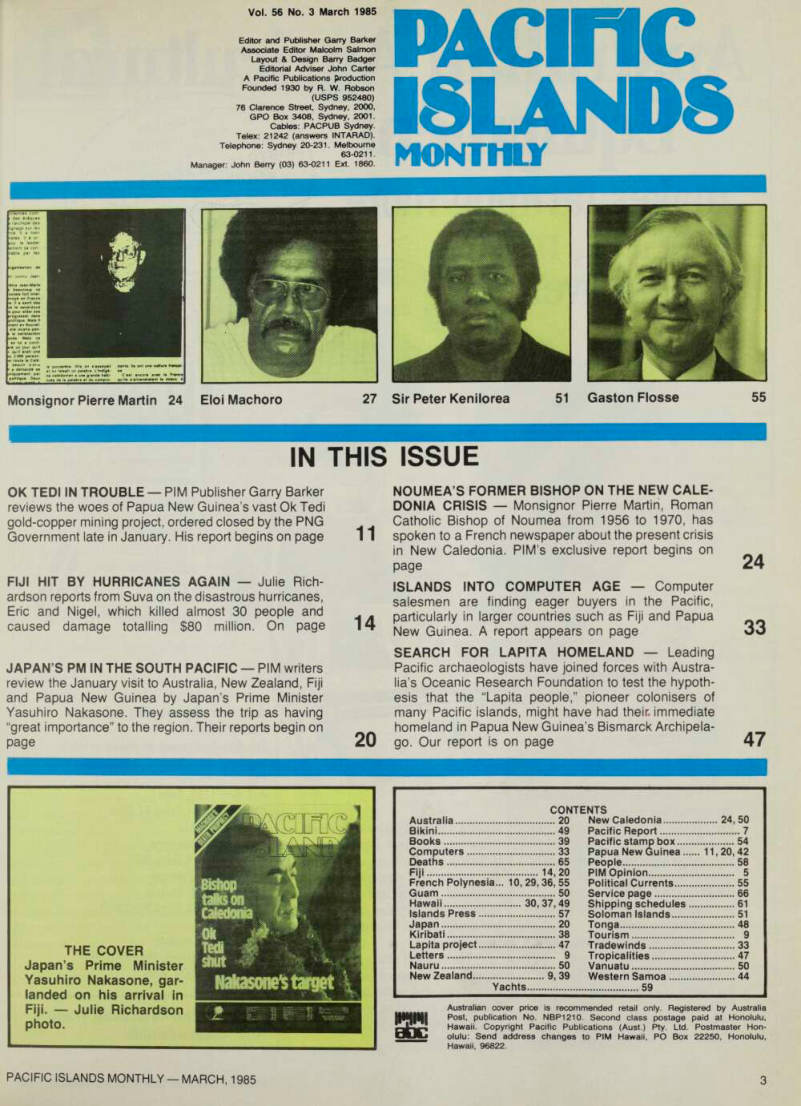
The Cover
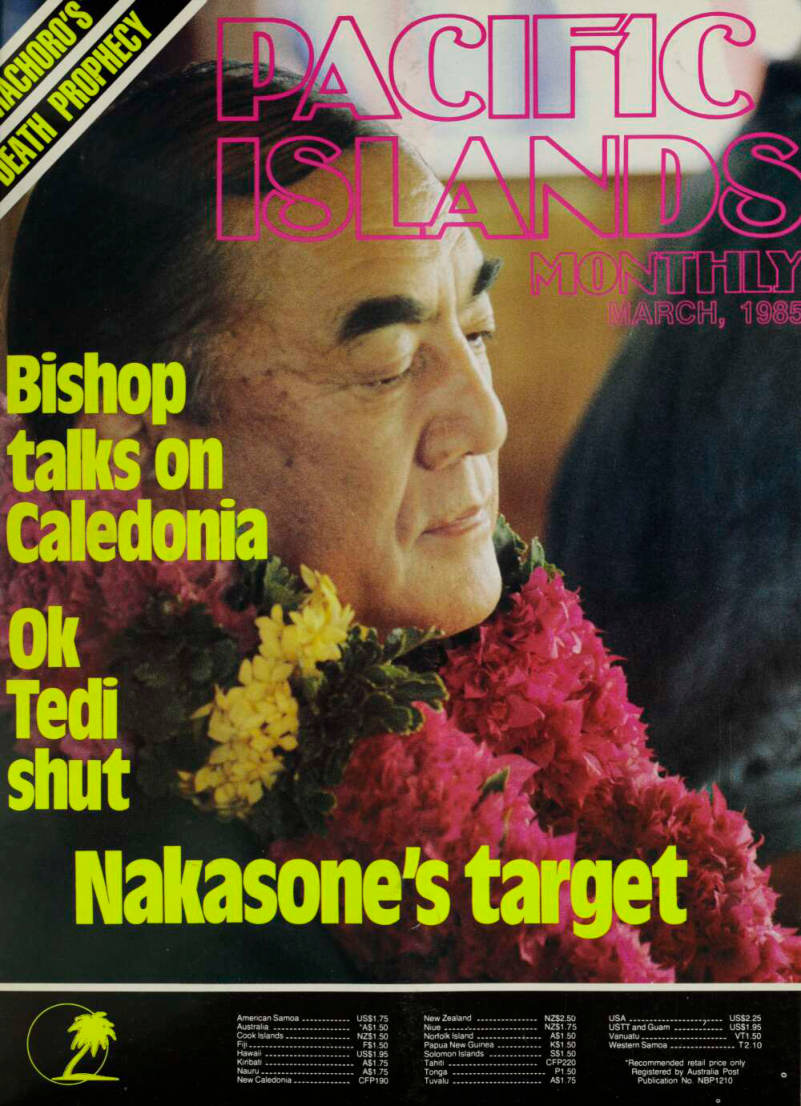
Japan’s Prime Minister Yasuhiro Nakasone, gar landed on his arrival in Fiji. Julie Richardson photo.
Advertisements & other items, pp. 2-3 (2 items)
0 Hitachi
Electronic viewfinder
One video
combination
that loves holidays
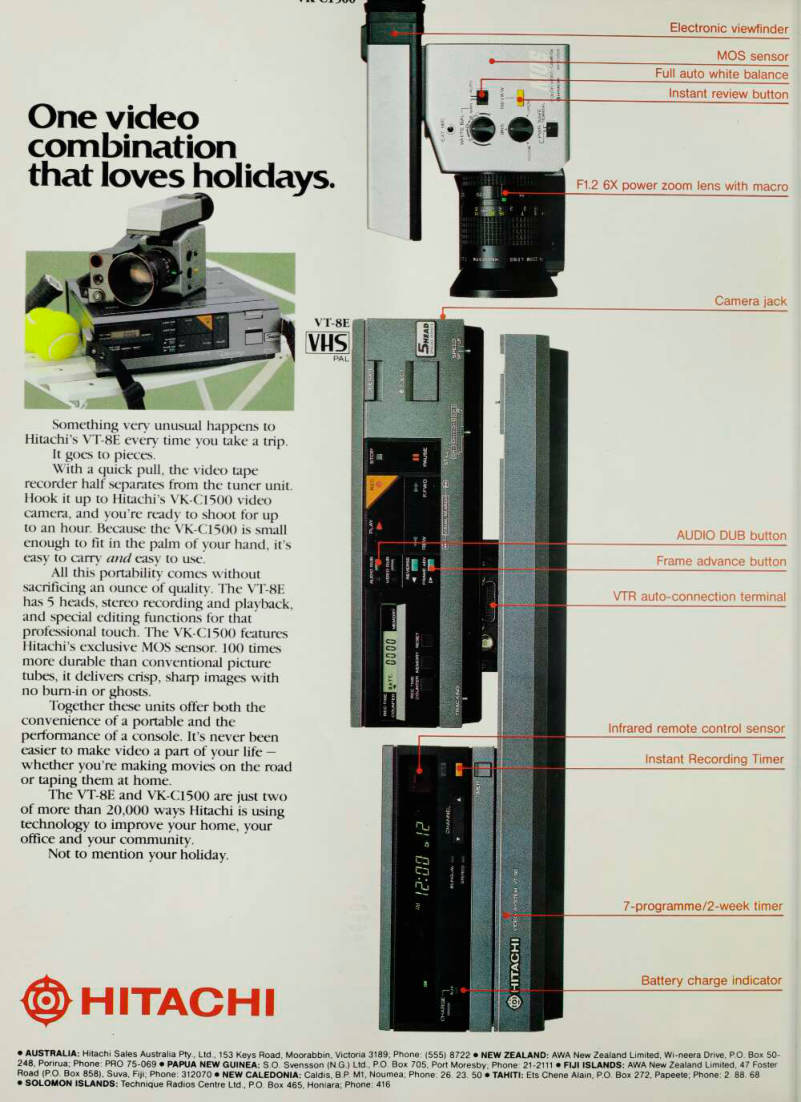
m Something very unusual happens to Hitachi’s VT-8E every time you take a trip.
It goes to pieces.
With a quick pull, the video tape recorder half separates from the tuner unit.
Hook it up to Hitachi’s VK-Cl5OO video camera, and you’re ready to shoot for up to an hour. Because the VK-Cl5OO is small enough to fit in the palm of your hand, it’s easy to carry and easy to use.
All this portability comes without sacrificing an ounce of quality. The VT-8E has 5 heads, stereo recording and playback, and special editing functions for that professional touch. The VK-Cl5OO features Hitachi’s exclusive MOS sensor. 100 times more durable than conventional picture tubes, it delivers crisp, sharp images with no bum-in or ghosts.
Together these units offer both the convenience of a portable and the performance of a console. It’s never been easier to make video a part of your life whether you’re making movies on the road or taping them at home.
The VT-8E and VK-Cl5OO are just two of more than 20,000 ways Hitachi is using technology to improve your home, your office and your community.
Not to mention your holiday.
0 HITACHI
MOS sensor Full auto white balance a PK Instant review button P F 1.2 6X power zoom lens with macro Camera jack
VT-8E
VHS
i AUDIO DUB button Frame advance button VTR auto-connection terminal Ml mm Infrared remote control sensor Instant Recording Timer 7-programme/2-week timer Battery charge indicator • AUSTRALIA: Hitachi Sales Australia Pty„ Ltd., 153 Keys Road, Moorabbin, Victoria 3189; Phone: (555) 8722 • NEW ZEALAND: AWA New Zealand Limited, Wi-neera Drive, P.O. Box 50- 248, Porirua; Phone: PRO 75-069 • PAPUA NEW GUINEA: S O, Svensson (N.G.) Ltd., P.O. Box 705, Port Moresby; Phone: 21-2111 • FIJI ISLANDS: AWA New Zealand Limited, 47 Foster Road (P.O. Box 858), Suva. Fiji; Phone: 312070 • NEW CALEDONIA: Caldis, B.P Ml, Noumea; Phone: 26. 23. 50 • TAHITI: Ets Chene Alain, P.O. Box 272, Papeete; Phone: 2. 88. 68 • SOLOMON ISLANDS: Technique Radios Centre Ltd., P.O. Box 465. Honiara; Phone: 416
Pacific
ISLANDS
MONTHLY
Vol. 56 No. 3 March 1985
Monsignor Pierre Martin 24
Eloi Machoro 27
Sir Peter Kenilorea 51
Gaston Flosse 55
In This Issue
OK TEDI IN TROUBLE PIM Publisher Garry Barker reviews the woes of Papua New Guinea’s vast Ok Tedi gold-copper mining project, ordered closed by the PNG Government late in January. His report begins on page 1 ■ FIJI HIT BY HURRICANES AGAIN Julie Rich ardson reports from Suva on the disastrous hurricanes, Eric and Nigel, which killed almost 30 people and caused damage totalling $BO million. On page 14 JAPAN’S PM IN THE SOUTH PACIFIC PIM writers review the January visit to Australia, New Zealand, Fiji and Papua New Guinea by Japan’s Prime Minister Yasuhiro Nakasone. They assess the trip as having “great importance” to the region. Their reports begin on
page 20
NOUMEA’S FORMER BISHOP ON THE NEW CALE DONIA CRISIS Monsignor Pierre Martin, Roman Catholic Bishop of Noumea from 1956 to 1970, has spoken to a French newspaper about the present crisis in New Caledonia. PlM’s exclusive report begins on
page 24
Islands Into Computer Age Computer
salesmen are finding eager buyers in the Pacific, particularly in larger countries such as Fiji and Papua New Guinea. A report appears on page 33
Search For Lapita Homeland Leading
Pacific archaeologists have joined forces with Austra lia’s Oceanic Research Foundation to test the hypoth esis that the “Lapita people,” pioneer colonisers of many Pacific islands, might have had their, immediate homeland in Papua New Guinea’s Bismarck Archipela go. Our report is on page 47
Contents
Australia 20 Bikini 49 Books 39 Computers 33 Deaths 65
Fiji 14,20
French Polynesia... 10,29,36,55 Guam 50 Hawaii 30,37,49 Islands Press 57 Japan 20 Kiribati 38 Lapita project 47 Letters 9 Nauru 50 New Zealand 9, 39
New Caledonia 24, 50 Pacific Report 7 Pacific stamp box 54 Papua New Guinea 11,20,42 People 58 PIM Opinion 5 Political Currents 55 Service page 66 Shipping schedules 61 Soloman Islands 51 Tonga 48 Tourism 9 Tradewinds 33 Tropicalities 47 Vanuatu 50 Western Samoa 44
Yachts 59
Australian cover price is recommended retail only. Registered by Australia Post, publication No. NBPI2IO. Second class postage paid at Honolulu, Hawaii. Copyright Pacific Publications (Aust.) Pty. Ltd. Postmaster Hon olulu: Send address changes to PIM Hawaii, PO Box 22250, Honolulu, Hawaii, 96822.
Advertisements & other items, pp. 3-4 (2 items)
Pacific Islands Monthly March, 1985
3
Editor and Publisher Garry Barker Associate Editor Malcolm Salmon Layout & Design Barry Badger Editorial Adviser John Carter A Pacific Publications production Founded 1930 by R. W. Robson
(USPS 952480)
76 Clarence Street, Sydney, 2000, GPO Box 3408, Sydney, 2001.
Cables: PACPUB Sydney.
Telex: 21242 (answers INTARAD).
Telephone: Sydney 20-231. Melbourne 63-0211.
Manager: John Berry (03) 63-0211 Ext. 1860.
Australian Agricultural
Equipment " "
makes farming more
efficient, more
productive.
*LIAN
at
*Quip
*9*ic the
“ L TUp
’>zsr*i
Ai Lae Lon 9e 4th Str Lae eet
P/Vq
9 m * —I 7 Innovative Australian agricultural equipment has helped Australia become one of the world’s major food producing countries. It has given efficient, reliable performance under some of Australia’s harshest conditions. It is also operating successfully in many other countries throughout the world.
Australian manufacturers have available an excellent range of equipment for farming situations in the Pacific Islands. Tractors.
Cultivators. Slashers. Ploughs. Rowcrop planters. Seeders. Agricultural trailers. Farm and stockyard gates and fencing. Cattle handling equipment.
Irrigation equipment. Pumps, including solar pumping units.
Agricultural seed. Agricultural chemicals. Rodenticides. Veterinary products. Prefabricated steel buildings and greenhouses. Welding equipment.
Lubricators.
You can also obtain advice and expertise from experienced Australian consultants. But in the first instance contact the Australian Trade Commissioner about your particular requirements.
Ask the expert who knows Australia For details of suppliers phone or telex the Australian Trade Commissioner at: Fiji P.O. Box 1252, Suva.
Phone 31 2844 Telex FJ 2126 New Caledonia P.O. Box 22, Noumea Phone 27 2414 Telex 087 Papua New Guinea P.O. Box 9129, Hohola Phone 25 9333 Telex NE 22109 Hawaii Australian Consulate 1000 Bishop Street, Honolulu 96813 Phone (808) 524 5050 Telex 63 3128 Ask the Australian Trade Commissioner
Pim Opinion
Despite the shock of it all the closing of Ok Tedi gold and copper mine looks to have been a throw, albeit a telling one, in a very tough game of high stakes chicken between the government of Papua New Guinea and the mining consortium.
That the mine should be closed for good is unthinkable, and impossible. Too much of PNG’s future is tied up in that enormous complex established at such huge cost so far away in the Star Mountains, close to the West Irian border.
Nor is PNG likely to expropriate the mine, as some of the wilder minds in the Australian press corps seemed to think the closure order indicated. Any government, be it in the Third, or any other sort of, World, which tried to make off with anything so big and expensive as Ok Tedi would do itself vast and irreparable damage among international investors. And the government of PNG is far too knowledgeable and responsible to think of anything like that.
But, they have been understandably concerned about the rate of progress made by the mining consortium in development of the mine’s vital second stage the construction of a hydro-electric works, a permanent tailings dam to handle the considerable waste from the ore treatment plant, and the beginning of copper extraction.
At the same time the consortium has had its problems. Ok Tedi is in some of the wildest and most remote country in the world. Everything, from giant conduits and huge crushing rollers to cans of beans and bottles of beer, has to be laboriously barged in, or air-freighted. Costs are astronomical.
There have been mishaps and accidents. A giant landslide of about 50 million tonnes of mud wiped out the original site of the tailings dam and set the program back months. There was a drought which made the Ok Ma river too shallow for freight barges. There was a leakage of cyanide, and a barge carrying hundreds of drums of the stuff capsized in deep water off the mouth of the Fly River.
But, worst of all, the bottom fell out of the world copper market as Zaire and Zambia, particularly, desperate for cash, flogged their supplies on a sluggish market for prices as low as 50 cents (U.S.) a pound. Even the official price went down to 60 cents. And Ok Tedi’s economics were based on a copper price no lower than about 85 cents, and hopefully
as high as a dollar.
The other factor, more difficult to precisely identify, seems to be that the consortium feels it may have signed a contract which, in the frosty light of a tightened world economy, looks a bit too generous. Hence, they seem to think, haste towards further development should be made slowly.
There are some other factors, too, among them some corporate changes inside Amoco Minerals Ltd., the Amer ican partner, which is part of Standard Oil of Indiana, who appear to have had enough of mining and seek to hive off that side of their business into a separate company. Amoco officials in Australia say this will not affect Ok Tedi, because of contractual committments, but it gives point to the observation that of all those involved in the enormously expensive business of exploiting the fabulously rich Ok Tedi deposits only Australia’s BHP is a true mining company, with a full understanding of the long-haul, hill-and-dale, nature of the business.
The caution of the mining consortium, and the fact that development of stage two, due to cost another $1 billion or so, is now more than a year behind schedule, does not enthuse the government of Papua New Guinea, which has its own immutable timetable. This is dictated by two main factors. First, Bougainville Copper, which has been a great prop to the PNG economy, is now beginning to run down.
Second, under the independence agreement with Can berra, aid from Australia, currently running at more than $3OO million a year, is being cut back by five per cent per annum and, probably, will become more and more tied to specific projects and direct purchasing from Australia. PNG needs Ok Tedi, and perhaps some other similar deve lopments, to bolster its budget.
That Ok Tedi should be mothballed for any length of time is unthinkable. That the consortium would leave nearly $1.5 billion dollars to rust away in the jungles is beyond imagination.
The dispute is, in fact, a straight-forward, but high-stakes commercial tough-out, and, as such, will be solved.
Ok Tedi will go on. It must go on for the good of Papua New Guinea and the stability of the region which, one must carefully point out, has more than its share of ill omens and opportunists hanging about. And the sooner the parties come to a mutually-acceptable arrangement the better for the whole of the southern Pacific.
Advertisements & other items, pp. 6-8 (2 items)
BWSONmdffEDGeS
TRADITIONALLY THE NAME
ASSOCIATED WITH PERFECTION
IN CIGARETTES
BENSON & HEDGES
20
BWSONmdffEDGeS
•WMS-am* is a health hazard m ■ i ~, i 1 r in
sdgsgs
JAPANESE P.M. IN FIJI, PNG.
The January visit to Fiji by the Japanese Prime Minister, Yasuhiro Nakasone, was “all too brief,” commented The Fiji Times editorially, “but, from Fiji’s point of view it was a great success”.
And Papua New Guinea, also on Mr Nakasone’s calling list during his tour of the South Pacific, will certainly echo that opinion. The prime minister promised expansion of Japan’s aid programs to the two countries and a strengthening of ties. Promised aid to Fiji included construction of a $F750,000 fisheries terminal at Lautoka, $700,000-worth of aid to the University of the South Pacific for training programs, a mobile library and equipment, and technical aid for an $B-million nursing school which Japan has already promised. More important, perhaps, was the prime minister’s offer to rectify a very large trade imbalance with Fiji by lowering tariff rates on agricultural imports from Fiji. A realistic move in that direction would be a long-term contract for Fiji’s sugar. Aid promised by Mr Nakasone to PNG will include loans for major development projects, one project being identified by the prime minister as a new highway between Port Moresby, the capital, and the city of Lae. Mr Nakasone pleased everyone in the South Pacific by saying that Japan had decided not to dump or store nuclear waste in the Pacific Ocean, so long as regional countries opposed such a move. (See full report elsewhere this issue).
CYCLONES RAVAGE FUI, VANUATU
Almost 30 people were killed in Fiji and six drowned in Vanuatu when two cyclones, named Eric and Nigel, struck over four days from January 17. There was heavy property damage in Fiji, mainly in northwest Viti Levu, and in Vanuatu. An estimated 6000 were left homeless in Fiji. Crop damage in Fiji was relatively slight, the sugar cane harvest having been completed. About 30 per cent of Vanuatu’s coconut palms were badly damaged, and nearly 70 per cent of Tonga’s banana crop in the northern islands was destroyed.
The six who lost their lives in Vanuatu were passengers in the Vanua Navigation’s ship Onma II which sank while on a voyage from Port-Vila to Malakula Island. Sixty people were rescued.
FRENCH POLL FAVORS KANAK INDEPENDENCE
Thirty-seven per cent of the population of metropolitan France supports independence for New Caledonia, as against 19 per cent opposed, and 44 per cent with no opinion, according to a Louis Harris poll reported in the French weekly magazine, La Vie. The poll, conducted on January 2-3 before the “Pisani Plan” was made public indicates that a majority of supporters of independence 53 per cent based their position of the “legitimacy” of the Kanaks’ demand for independence, while 66 per cent of those opposed to independence said it would be “bad for the interests of France. ” The weekly reported that voters for the main opposition parties, RPR and UDF, are much more divided on the issue than are the leaders of the parties. Thirty-one per cent of RPR voters are for independence to 36 per cent against, while UDF voters were divided exactly equally, with 32 per cent for independence and 32 per cent against. The survey was based on a representative sample of 1000 people.
KWAJALEIN SULT SLAMMED IN MARSHALLS
The Kwajalein Atoll Corporation (KAC) and two individual Kwajalein landowners have filed suit against the Government of the United States charging the U.S. with violations of the U.N.
Trustee Agreement and the Interim Use Agreement concerning land use by the U.S. in Kwajalein Atoll. The suit was filed in the U.S. District Court in Washington D.C. by KAC attorneys Steve Shukman and George Allen. KAC is an unincorporated association which claims to have more than 5000 Kwajalein landowners as members. The two individual plaintiffs are Laji Taft and Aini Betwel. The Government of the Republic of the Marshall Islands has attacked the action of the KAC, saying in an official statement: “This lawsuit is an apparent attempt to impede passage of the Compact of Free Association, an understandable goal in view of the fact that when implemented, the Compact will settle the land dispute on Kwajalein and put KAC attorneys out of a job. It is time for the citizens of the Republic on Kwajalein to realise their good
money is being wasted on detrimental law suits which serve only to enrich foreign lawyers at the expense of our country.”
SYDNEY’S INTERNATIONAL MARINAS MEETING
Macquarie University, Sydney, is to be the venue for Australia’s first international marinas conference to be held from May 6-10, 1985. The University’s Centre for Environmental and Urban Studies is organising the conference in conjunction with Nordanz Pty. Ltd., a New South Wales company involved in many aspects of marina development. Speakers from U.S.A., Canada and New Zealand have accepted invitations to take part, as well as representatives from government authorities, universities and commercial organisations from around Australia. Among key speakers will be Associate Professor Bruce Adee from the University of Washington who is expert on breakwaters, and a U.S.
Government consultant on maritime accidents; Jim Cole, who is manager of the 5000-berth Marina Del Reay owned and operated by the County of Los Angeles; U.S Sea Grant scholar Neil Ross from the University of Rhode Island; Mr C. Thomas Beaulieu a Canadian Government Regional Engineer who is responsible for the operation and maintenance of almost 400 marina installations; and Ed Dougherty from Cataumet Marina, Massachusetts, who will be introducing a new computerised marina management system suitable for all sizes of marina. Topics to be discussed range from government policy and environmental concerns, to marina design and maritime and occupational safety. It is hoped to establish through the conference some guidelines for a more cohesive national approach to the development of Australia’s waterways and the problems being faced today by authorities and developers alike in the face of growing interest in all aspects of water-based leisure pursuits.
AUSTRALIA’S NEW HICOM IN PORT-VILA
Australia’s Minister for Foreign Affairs Bill Hayden has announced that Greg Urwin is to replace Miss Joan Norwood as the country’s high commissioner in Vanuatu. Miss Norwood has been in the post since 1983.
TAHITI: FARMERS COME BACK TO ATIMAONO
A huge combined tourism-agriculture project will soon get under way in Tahiti at Atimaono, on the south coast, about 40 km from Papeete. Involving an investment of CFP2O billion (about SAI42 million), the project when completed is expected to create 100 new jobs, and attract an additional 80,000 tourists a year, almost doubling the territory’s present visitor rate. An international golf course already covers 50 ha of the 1550 ha site, which comprises 47 ha of seafront, 117 ha of plains area (containing the golf course), 268 ha of nearby valley land, and 1100 ha of valley and plateau land further inland. Atimaono was once used for the cultivation of cotton and sugar-cane, and agriculture is to be revived by making land available in lots to young landless farmers.
The immediate market for their produce will be the tourists in the mini-hotels and condominiums to be built around the golf course.
A marina, heliport, sports grounds and bushwalking tracks will also be put in.
FROG RIDES SNAIL IN PORT-VILA
French restaurateurs in Port-Vila, Vanuatu’s capital, have formed an Association of French Restaurants. The association’s sign, displayed on all association establishments, shows a frog riding on a snail’s back.
PNG: A STIFF WARNING TO CHURCHES
Papua New Guinea’s Home Affairs Minister Mr Lawi has warned the religious denominations that any church creating instability and conflict would be closed down and told to “pack up and leave. ” Mr Lawi, a new minister, said there were too many churches in the country, and advocated a ban on the entry of more churches. “I won’t entertain any church that works against another church,” he said. “They are serving one God but their congregations are arguing about baptism and communion and so on.”
SAMOA UNI PARLIAMENT GIVES NOD
The Western Samoa Parliament has passed a bill creating a national university. Under the bill, the Land Board can compulsori ly acquire land as the site for the university and Prime Minister Tofilau Eti has not ruled out the possibility of a take-over of the University of the South Pacific campus at Alafua on the main island of Upolu.
NORFOLK'S RECORD DECEMBER
Norfolk Island’s visitor total of 2484 for last December is the largest the island has ever had in a December, and an increase of 42 over the previous record figure of 2442 in December, 1980.
VISA-FREE VISITS TO GUAM
Under a new US federal law, visitors to Guam from outside US territory will be allowed to enter Guam without a visa for a stay not exceeding 15 days.
SOLOMONS YOUNGSTERS SHINE IN GAMES
Twenty-five young athletes from Solomon Islands did well in the track and field competition at the Second Pacific School Games held in Australia in January. The athletes won eight medals, two silver and six bronze, in the athletics events at the games which were held in Melbourne as part of the state of Victoria’s 150th anniversary celebrations. More than 200 school children from the Pacific region, Southeast Asia and Australia, took part in track, field and swimming events. Teams came from Papua New Guinea, Solomon Islands, Malaysia, New Zealand and Singapore. The games provided competitors, aged from 10 to 19, with an opportunity to raise their sporting prowess as well as taking part in a social, cultural and educational program during their stay in Melbourne. Physically and visually disabled children also took part in swimming, wheelchair races, running and long-jump events. The first Pacific School Games were held in Brisbane before the Commonwealth Games in 1982.
TONGA'S POPULATION UP
Tonga’s population has risen by just over seven per cent during the past eight years. A census carried out in December showed a population of about 96,500, or about 6500 more than when the last census was held in 1976. The census showed considerable internal migration, with the population in the outer islands actually falling, and that of the main island, Tongatapu, rising by 30 per cent. The census also showed there were slightly more females in Tonga than males.
PNG TO PUT $4 MILLION QUESTION
It has been estimated that a referendum to be held in Papua New Guinea to decide the future of provincial governments in the country will cost about $4 million. The referendum plan has been adopted by the national government as the best means to ascertain the people’s views on the present system (in which there are 19 provincial governments), and if there was a need for change. It is expected that public discussion on the matter will continue for about a year before the referendum is held.
ESCAP: THEY LIVE LONGER IN FUI . . .
A United Nations study has revealed that citizens of Fiji have an average life expectancy of at least 70 years. The study, conducted by the UN’s Economic and Social Commision for Asia and the Pacific (ESCAP), which is based in Bangkok, shows that life expectancy in Fiji is comparable with that of developed nations in the Pacific region such as Australia, New Zealand, Singapore and Japan. The survey reveals that the population of Samoa has a life expectancy of at least 60. Countries with lower life expectancy rates were Solomon Islands (between 50 and 60), and Kiribati and Papua New Guinea (less than 50).The study showed that the Japanese have the highest life expectancy 77 years. . . . AND THEY'VE BEEN MORE PROLIFIC Fiji’s unusually high birthrate over the past 40 years has been singled out as a major contributing factor to the current unemployment problem. Reserve Bank Governor Savenaca Siwatibau, speaking at celebrations to mark National Rice Week in January, said the birthrate had remained above the three per cent mark for the past four decades. This was why Fiji had a relatively young population looking for jobs. Mr Siwatibau said Fiji was now
able to reduce population growth, but its effects on the labor market would not be felt for at least 15 to 20 years.
PLASTIC MENACE LURKS IN THE DEEP
The world s oceans, already polluted with toxic chemicals, oil and radioactive waste, are being fouled by a new and insidious form of pollution plastic waste. This plastic pollution is killing millions of birds, fish, whales, seals and sea turtles, marine scientists report.
Their research has shown the animals die after becoming entangled with discarded or broken plastic fish nets, straps, trawls and snares. They also die after eating pieces of plastic dumped into the sea. The problem has become so serious that 150 marine wildlife researchers from 10 countries met recently at the University of Hawaii in Honolulu for the first international conference on the issue. The National Academy of Sciences in the US estimates that commercial fishing fleets each year dump more than 115 million kilograms of plastic packaging material and lose more than 660 million kilograms of plastic fishing gear. The Entanglement Network, a Washington-based consortium of 14 wildlife conserva tive groups, told the conference that between one and two million sea birds die each year after becoming entangled in plastic nets or from eating bits of floating, discarded plastic. More than 100,000 sea mammals, including whales, dolphins, seals and manatees meet similar deaths. In a recent report to the World Wildlife Fund, Michael Donoghue, a New Zealand marine biologist, said the problem has become critical largely because of the development of a multitude of plastic products, particularly monofilament fishing nets. Donoghue said single filament net is cheaper to produce and far less visible than the traditional multifilament nets made of twine or other biodegradable materials. It is also more difficult for the fish to detect acoustically. Sea mammals rely on echolocation to navigate, and often become entangled in the nets and drown.
Others, forced to drag the nets as they swim, die from exhaustion or from cuts caused by the netting. Young seals may have plastic netting around their necks that chokes them as they grow.
MARSHALLS BAN GAMBLING MACHINES
Parliament in the Marshall Islands has voted to ban mechanical gambling machines in the country. The decision reversed a vote taken in August, 1984, to repeal the 1975 anti-gambling law. The new legislation, which came into effect on January 1, does not prohibit other forms of gambling. Observers in Majuro say that pressure from the churches and the community brought about the reversal of the earlier vote.
RIGHT ROYAL ROW OVER ROYAL SAMOAN
The Royal Samoan Hotel Corporation Ltd. which plans to build the Royal Samoan Hotel on reclaimed land at Taumeasina on the main island of Upolu, has been offered a generous parcel of incentives by the government to build and operate the hotel. The package includes importation free of customs duty and excise tax of all construction materials and. machinery to the value of SUS2S million; a 10-year tax holiday; the right to write off against taxable income all capital costs over 20 years after the tax-free period; tax-free interest on money lent to the corporation and exemption from tax on dividends up to twice the value of the paid-up capital on shares for the 10 years tax-free period. The company will also be able to write off against profits the estimated SUSS million spent on reclaiming the site as well as SUS4OO,OOO in architectural, legal and other fees. Generosity of these terms aroused a storm in Western Samoa’s parliament. Several Opposition MPs and at least two members of the governing Human Rights Protection Party (HRPP) strongly criticised the government’s proposals for the hotel. In a flurry of mixed images the Bill was variously described as “the tail twisting the dog”, “a man-eating crocodile”, “a blank cheque”, “an ant-tramping elephant” and even as a “camel”. Mrs Aggie Grey, founder of the world-famous Aggie Grey’s Hotel, “The Legend of the South Seas”, wrote a three-page letter to all members of parliament to protest against the proposed incentives.
According to the letter, Aggie brings in $1.5 million foreign exchange every year, pays taxes worth $230,000, $250,000 customes duties, a $134,000 power bill, and $24,000 to the National Provident Fund (NPF) and the Accident Compensation Board (ACB), quite apart from the $350,000 that the hotel pays out for goods and services from local farmers and other businesses.
Mrs Grey, who has spent most of her 80-odd years in the tourist industry, asserts, with due respect, that “we will all be dead before one tax payment is made by this company, to which the government is going to give these numerous in-incentives.”
letters
The travel industry strikes back
With reference to Jack Ovit’s letter (PIM Dec ’B4 p6O), I take exception to his critical view of travel agents as “pimply faced adolescents” whose understan ding of the world is limited to I.A.T.A. ticket writing, regularly invading the South Seas in self-protecting groups, and seeing the South Pacific from the air-conditioned sterility of a Travelodge, etc.
As a tour wholesaler who not only believes in the value of agents’ educational, or as he calls them “familiarisations”, I can produce factual evidence of their worth not only to the carrier, the hotel, and in my case this company, but also to those whom it is intended to help, the Pacific Islanders.
Whenever my company or ganises an educational, we send out a questionnaire asking for comments or views already held about the destination they are about to visit, and whether or not they have sold the country in the past.
Once we have received a reply, we evaluate the real worth in sending that particular person as part of the group. To follow up, they then receive a brief on the “dos and don’ts”, plus an itinerary (which I might add is always flexible) to allow them to find their own way around the local environs with out a push from a very biased operator, “me”.
Both I and my company take great pride in the Australian travel agents. Those that sell our product do so because they see we take a real interest in the South Pacific. They also know we have no intention of spoiling the islands, indeed we have been known to advise an agent that a certain client may be undesirable, if only for the reason their expectations may not be matched by the realities the islands have to offer.
I for one do not, and will not, encourage the “T-shirt and
thong brigade”. They can go elsewhere as our goodwill is worth a lot more than a few short-term dollars, and our agents and journalists are of the same opinion. Quite frankly, Mr Ovit, if it was not for those “pimply faced” agents, you, I and many others may not be employed today.
As for your attack on PIM, the travel journalists and Polynesian Airlines, I’m sure they could not give two hoots about your thoughts. As will be obvious to all except you, these particular individuals have pro duced excellent articles in Aus tralia’s national press pity you failed to see and read them. They actually understood what paradise was about, and they were written in such a way as to encourage only those who would want to preserve a way of life that could disappear in a few years time.
I often wonder who the real users are, or as you so nicely put it in your letter, “creeps”.
Indeed there are a number of expatriates from New Zealand, Australia and a number of other countries that would fit your
description perfectly; it is they that rip the islanders off. In fact if one hears a racist comment it in most instances comes from them. However, in the main the majority of the expats appreci ate their adopted culture and country.
To cap off, I think perhaps Mr Ovit may be a little jealous. He obviously does not have the opportunities that we have. As for Aggie, she does appreciate the value the travel agents and writers have provided by way of their visits.
Indeed, ask Allen Grey, or Robin Poole for that matter, or anyone in Samoa involved in tourism and economic deve lopment. Orient Pacific and other wholesalers who arrived there back in 1982, kept their promise to ensure that the destination would be marketed and sold in an orderly fashion, and we could only do this with the help of those you sought to condemn.
Fiji may be a different kettle of fish, I have no idea as we do not run famils to Fiji as yet. We have several planned for 1985.
If you care to drop me a line I will arrange for you to meet a cross section of the “pimply faced”, you could be pleasantly surprised. However, this I leave to you.
Colin Willett
Managing Director Orient Pacific Holidays Pty. Ltd.
South Melbourne,Vic.
Australia.
In error on
New Zealand
Your January 1985 issue con tained two articles on New Zealand which were notable for the errors they contained.
Arthur Blackstock’s review headed “Samoans as citizens NZ, U.S.-style” got off to a poor start by misspelling the name of the woman who was the central figure in the Privy Council case.
She was Falema’i Lesa not Falemi’l as the Law Lords cal led her.
The reviewer states that Sa moans have favored status by virtue of an “historical accident and does not relate to organ ised Samoan advocacy. ” This is nonsense. The case was taken to London by a well organised and very dedicated group of Wellington Samoans who raised over $30,000 to fund the matter. They recognised the validity of the legal argument long before the court system did. And once the Privy Council decision came out and the New Zealand Government reacted
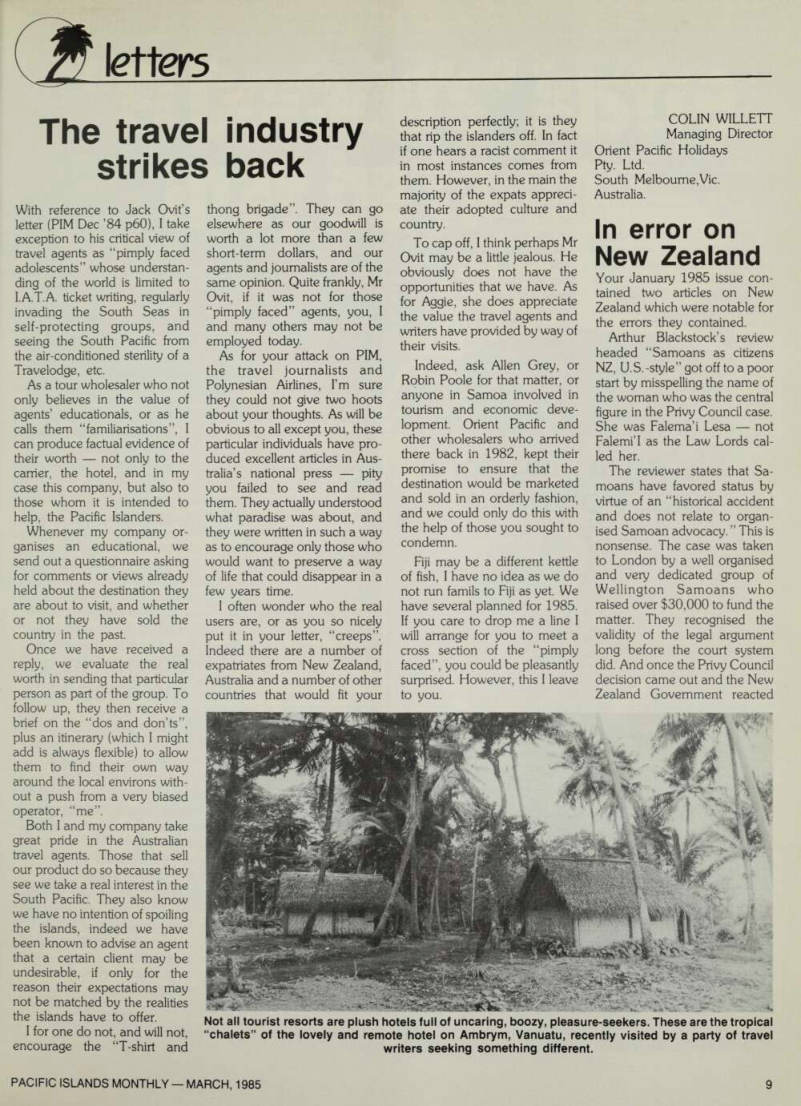
Not all tourist resorts are plush hotels full of uncaring, boozy, pleasure-seekers. These are the tropical “chalets” of the lovely and remote hotel on Ambrym, Vanuatu, recently visited by a party of travel writers seeking something different.
sharply to it, the same group of Samoans were particularly ac tive on the political front to retain their status. It wasn’t an accident it was an object lesson in democratic participa tion.
Your reviewer is wrong to say Falema’i Lesa “hired a re sourceful lawyer.” Resourceful he was, but he and the Samoan committee found her after their case with another overstayer foundered on another aspect of the law.
Then Mr Blackstock engages in some silliness by saying the London decision related to an interpretation of statute not an interpretation of the Con stitution. Seeing New Zealand doesn’t have a constitution this is surely self-evident?
He also falls for the racist white argument that Samoans are “flocking to accept” citi zenship. They are not because despite what Mr Blackstock
says there are no substantial differences in the benefits available to permanent residents and citizens. Indeed they are the same.
The fact is that overall in the last five years Samoan immigration has remained static, and at times produced a net outflow, What confuses many is the fact that nearly 50 per cent of the so-called Pacific Island population of New Zealand was actually born in New Zealand They
gained citizenship by birthright,
not via the Law Lords.
In another article in the same issue, “A call for a turn away from the ‘diet of death’ " it was stated that New Zealand did not have a single ethnic restaurant for over 330,000 Polynesians.
Nr>t , , , * , Not true - Indeed PIM published an article I wrote in February 1981 recording the opening of the Le Penina in Wellington. This delightful establishment run by Paivao
and Lydia Vitale can be found in Lower Cuba Street and is worth a visit... or several. And last year a Maori food re staurant was opened in Christ church. Admittedly this is hard ly a lot when compared with Chinese restaurants here, but give credit where it is due.
Michael J. Field
Auckland New Zealand Mr Field cannot be accused of “silliness” in his selective quota tion from the Blackstock re view. Over-eagerness to score points would rather seem to be the problem in his remark on the statute/constitution issue.
What Blackstock actually wrote was; “The London decision, however, related to an in terpretation of a statute, and statutes can be changed; it was not, as many U.S. Supreme Court decisions are, an in terpretation of the Constitu tion.” Editor.
Flying a flag for East Polynesia
East Polynesia
More East Polynesia news please!
I enjoy your magazine very much, and am glad I sub scribed. There are a few people at work that I pass it around to every month, and they like it too.
But what I am concerned about is the fate of Eastern Polynesia, the parts that are still controlled by France.
When Marie-Therese and Bengt Danielsson get down to business they cover an impor
tant Tahitian topic very well.
But I find that they are doing too many “beating around the bush” topics. I very much en joyed the insights on King Po mare, I used to admire him before I knew the facts.
But I want to know if there are other John Tearikis coming on South Pacific Martin Luther Kings if you will, be cause God knows the Polyne sians can certainly use an abundance of them.
We are terribly worried that
the Tahitian people will lose all their identity, becoming no more than brown-skinned French, a fate worse than death. Some Tahitian children are already talking French to each other outside of school a fatal first step. We would like to see the Tahitian people edu cate themselves more than any one, and become a prosperous little independent nation. I heard somewhere that there is a place where a sort of “technical Tahitian” is being evolved for perhaps a future Tahitian scien tific community. It would thrill us if at some future date we could buy an electronic product here in America and turn it over to find “assembled” or “made” in Tahiti. This would reduce the dependence on tourism, and boost Tahitian pride no end.
These are the things we want to hear about. The bad must be reported. But you must also give some good news to give people reason to hope.
For God’s sake and ours please refer to Eastern Polynesia by its correct name. It galls us to see you referring to French Polynesia. It was “east” long before it was French, and will be for ever after.
IVAN v. McKinney Jr.
President, Friends of Polynesia. 200 W. Columbine N0.3A8 Santa Ana Calif,
Usa
A family
centenary
March 11, 1985, marks the centenary of my grandfather’s arrival in Fiji from Aberdeen, Scotland, to take up a position with CSR at Nausori.
His wife, Isabella Clark, was to arrive later with their four small children, my father being the youngest. The graves of James and Isabella are to be found in the Ba cemetery, Fiji.
Isabella died in 1912, James in 1919. James is believed to be the first man to grow sugar cane from seed commercially, and “Clark’s seedlings” were named after him.
One of James Clark’s sons who came out from Scotland became manager of the Bun daberg sugar mill, Queensland, and three of James’s grandsons became chief engineers of sugar mills in Queensland.
I never met my grandparents as I was born a year after James died. But I am sure that if James and Isabella were alive today they would be very proud of the achievements of their grandchildren and great grandchildren, who have made their marks in this part of the world in the arts, the church, theatre, etc.
Betty Clark
Woonona, NSW Australia
Soccer in
the islands
I am trying to compile a book on soccer in the Pacific and would be interested to hear from any readers of PIM who would be able to assist me with information about soccer in their country: final league tables, past competition win ners, etc.
I especially need details from American Samoa, Cook Is lands, Guam, Hawaii, Kiribati, Marshall Islands, Nauru, Niue, Solomon Islands, Tuvalu, Vanuatu and Western Samoa.
If you have any relevant information please write to me so that I can help to put Pacific soccer on the world map.
Peter Burns
4/389 Barkly St Elwood 3184 Australia
Advertisements & other items, p. 10 (1 item)
legendary hotel.
Stay at Aggie Grey’s . . . the South Pacific’s
Situated right in the heart of Western Samoa. Enjoy Polynesian style friendliness and service, in cool surroundings, superb entertainment and food.
Magnificent while sand beaches only a short drive away. Airconditioned rooms, swimming pool and full bar facilities.
Bookings through Union Steamship Company of NZ, Pan Am, Air New Zealand or direct to Aggie Grey’s. Apia, Western Samoa. Cables: ‘AGGIES’ Apia.
ft e easiness centre jlion for comfort .5 i
may be fading
Ok Tedi Doubts
"EI Dorado's" Iustre may be fading
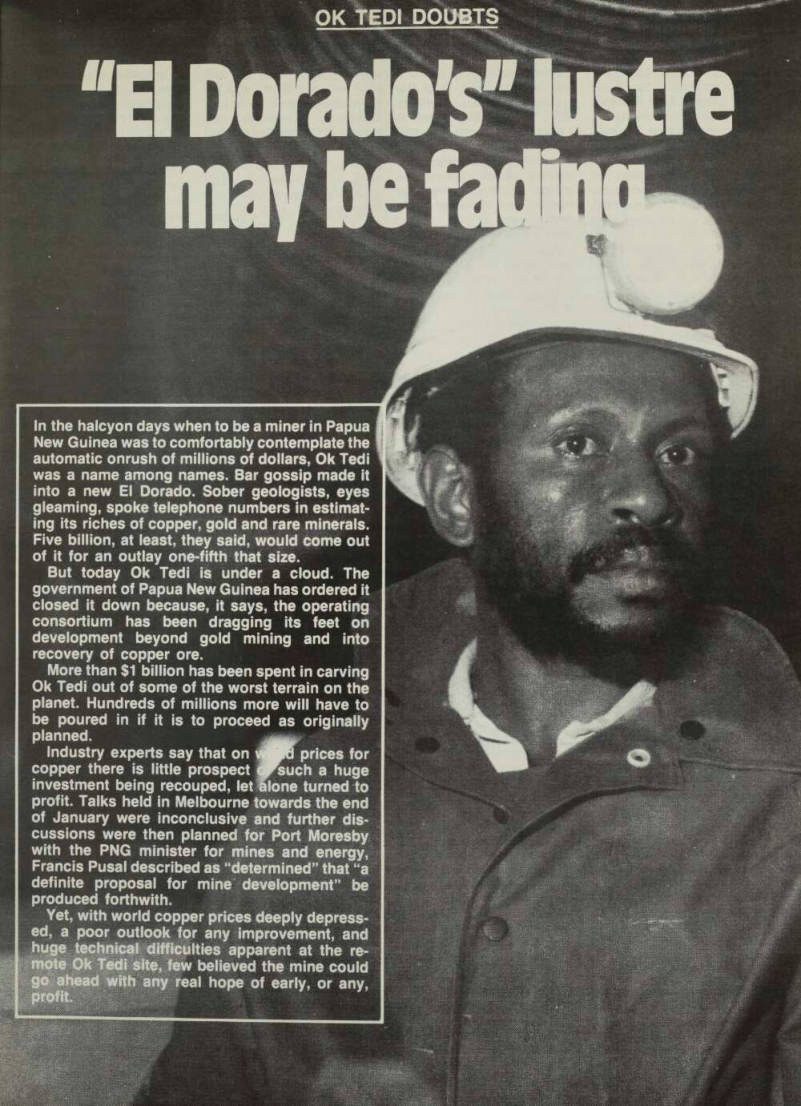
In the halcyon days when to be a miner in Papua New Guinea was to comfortably contemplate the automatic onrush of millions of dollars, Ok Tedi was a name among names. Bar gossip made it into a new El Dorado. Sober geologists, eyes gleaming, spoke telephone numbers in estimat ing its riches of copper, gold and rare minerals.
Five billion, at least, they said, would come out of it for an outlay one-fifth that size.
But today Ok Tedi is under a cloud. The government of Papua New Guinea has ordered it closed it down because, it says, the operating consortium has been dragging its feet on development beyond gold mining and into recovery of copper ore.
More than $1 billion has been spent in carving Ok Tedi out of some of the worst terrain on the planet. Hundreds of millions more will have to be poured in if it is to proceed as originally planned.
Industry experts say that on dHT prices for copper there is little prospect Vsuch a huge investment being recouped, let alone turned to profit. Talks held in Melbourne towards the end of January were inconclusive and further dis cussions were then planned for Port Moresby with the PNG minister for mines and energy, Francis Pusal described as “determined” that “a definite proposal for mine development” be produced forthwith.
Yet, with world copper prices deeply depress ed, a poor outlook for any improvement, and huge technical difficulties apparent at the re mote Ok Tedi site, few believed the mine could go ahead with any real hope of early, or any,
Developing Ok Tedi, originally feted as Papua New Guinea’s most promising mine, is beginning to look like buil ding the Panama Canal, only worse. Almost from the begin ning, problem has piled on problem; Ok Tedi seems to have developed into a monster, menacing everyone who comes in contact with it.
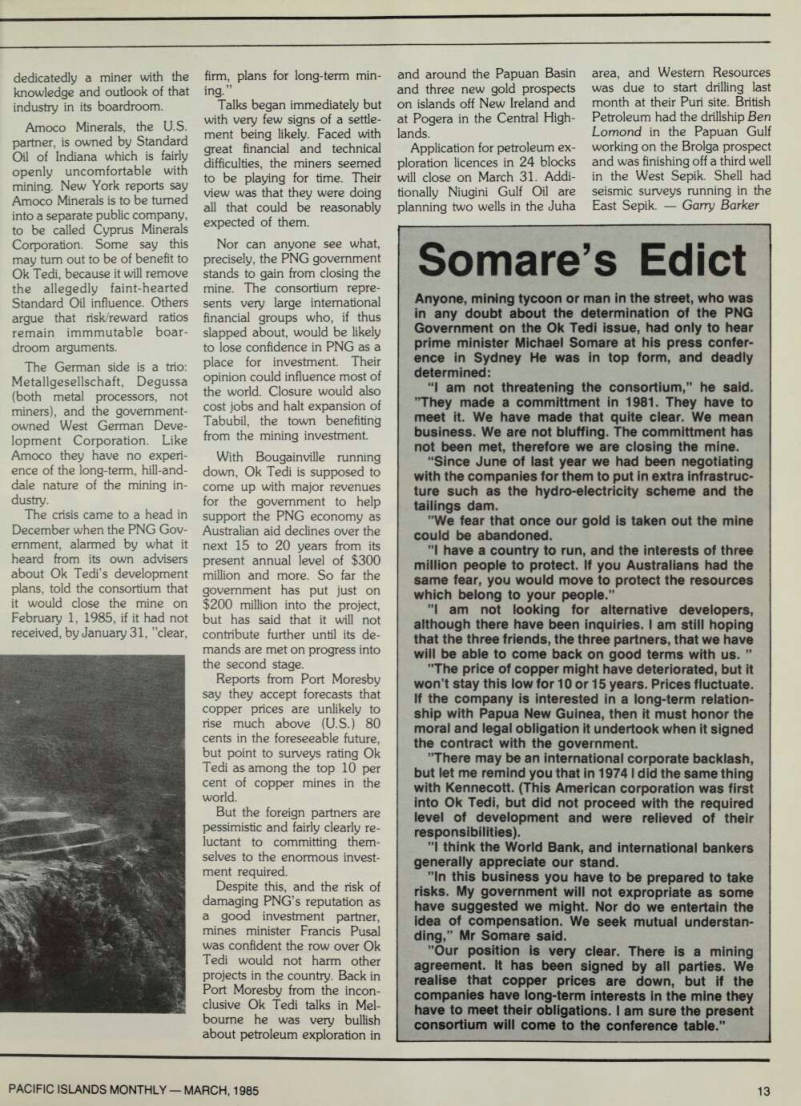
The site, at Mt Fubilan on the Fly River, deep in the remote and savage Star Mountains in the far south-west of the coun try, near the Irian Jaya border, is regarded as one of the richest copper deposits discovered in recent years. Mt Fubilan is, in mining terms, ’’made” of cop per ore which is rich with gold and other rare metals. All of this sits under a cap of gold ore which has to be removed be fore the copper can be mined.
The first (gold only) stage was to run from 1984 to 1986, then gold and copper were to be mined together for three years. After that copper only would be extracted for until about the end of the first decade of the 21st Century.
Revenue from the first stage was to pay for development to support the second and third stages. Because of this, PNG itself was to get very little return from the gold.
The gold-mining began ahead of schedule in May, 1984, using temporary genera tion and tailings disposal sys tems (the latter of a type which drew criticism from en vironmentalists). The PNG gov ernment did not like this, but approved it, partly because the miners really had no option if they were to get the project started at all. But, they felt they had to have the permanent tailings dam, and the hydro works as surety that the com pany would not just scrape off the gold and then leave the mine (by then much less viable) for development when (and if) the copper price improved.
Whether or not the govern ment’s fears were well-founded is open to debate, but, whatev er the financial conundrum, the Ok Tedi site itself seems to have proved more difficult than even
the darkest pessimists forecast.
In January, 1984, there was a massive landslide, a kilometre wide, of at least 50 million tonnes of mud, on the east bank of the Ok Ma river. No lives or equipment were lost, but the planned site of the tailings handling system, an essential part of the long-term development of the copper mine, was rendered impossible.
That one event is estimated to have raised the development cost at least $2OO million.
Then a barge carrying hun dreds of drums of cyanide over-turned in the mouth of the Fly River. There was also at least one leakage of cyanide from the gold treatment plant.
A drought in the Fly made it too shallow for navigation by freight barges at the port town of Kiunga, 800 km up river.
Equipment and supplies had to be flown in.
These were bad problems, adding perhaps $3OO million to the cost of the first stage deve lopment, but they were not at the heart of the consortium’s deepest concern. This was the state of world copper prices, down to 60 cents a pound (U.S.), with some countries, notably Zaire, Zambia and Chile, making sales as low as 50 cents. The bottom was out of
world copper prices, the gold price was also down, and the shareholders could not con fidently see a return on their money. El Dorado had stopped shining.
By January of this year the project was running more than 12 months behind time.
In June of 1984 the govern ment of Papua New Guinea wrote to the company asking that it provide, by the following September, an outline of its plans to develop the copper mine. The company asked for, and was given, an extension to the end of the year. A plan was produced, but the govern ment’s advisers considered it to be unsatisfactory. They gave another month as the deadline but were making little effort to hide their alarm and their fear that the company would not honor its agreement. An ultima tum was issued that the com pany get cracking or have the mine shut down.
Talks were then held in Port Moresby and Melbourne, aimed at finding a settlement.
These were generally unhappy and inconclusive, with the con sortium’s initial proposals de scribed, from Port Moresby, as having been ’’rejected.” There was talk of ”a compromise” but
no indication of what it might involve.
Further investment, of at least $550 million, and possibly $1 billion, is required to enter the copper mining stage.
PNG’s extreme interest in the copper arises from the fact that they get little out of the gold recovery program, but expect to have substantial and con tinuing revenues from the cop per, starting in 1988, which is when the Bougainville deposits, already fading, will be fairly much played out. But now, because of the engineering problems ahead, the size of the investment needed, and the gloomy outlook for world metal prices, the government fears that the consortium will skim off the gold and then lose com pletely whatever residual in terest it retains in the copper venture.
One of the curiosities of the situation is that the PNG Gov ernment is a full equity share holder in the mine with 20 per cent of the action. West Ger many’s Metalgesellschaft (also 20 per cent), Amoco Minerals of the U.S. (30 per cent), and Australia’s BMP (30 per cent), make up the rest of the consor tium.
Of them all, only BMP is
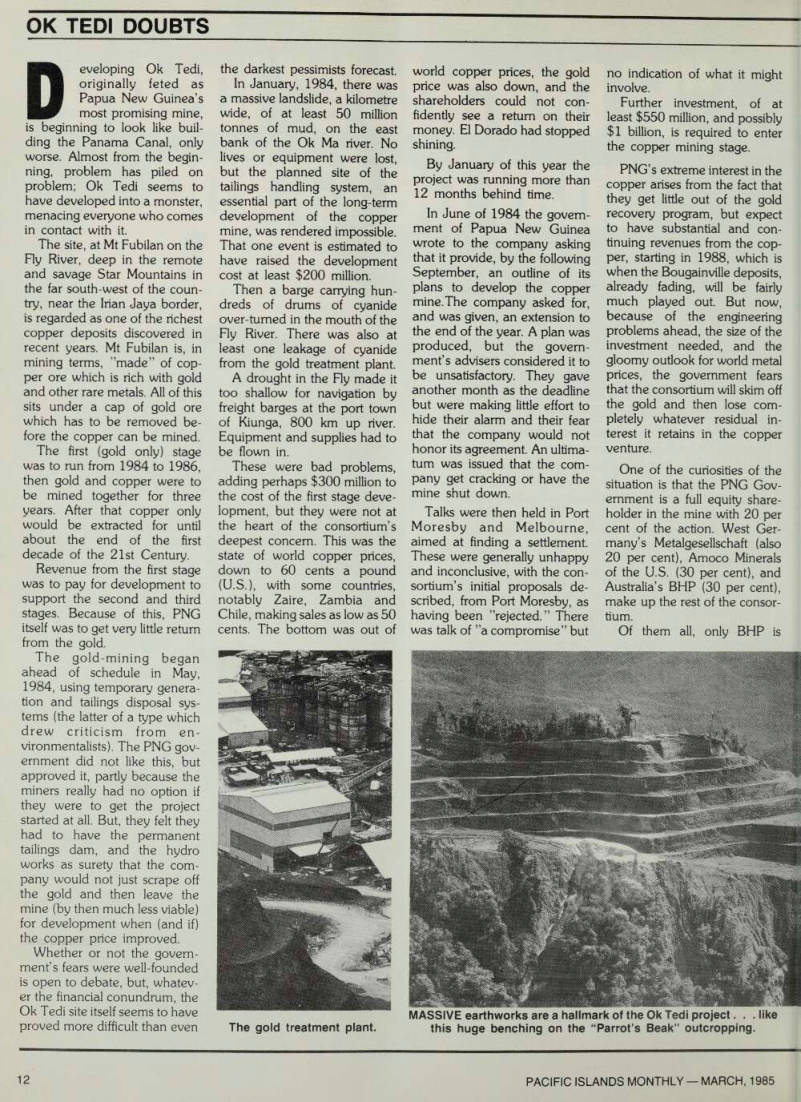
The gold treatment plant.
MASSIVE earthworks area hallmark of the Ok Tedi project. . .like this huge benching on the “Parrot’s Beak” outcropping.
dedicatedly a miner with the knowledge and outlook of that industry in its boardroom.
Amoco Minerals, the U.S. partner, is owned by Standard Oil of Indiana which is fairly openly uncomfortable with mining. New York reports say Amoco Minerals is to be turned into a separate public company, to be called Cyprus Minerals Corporation. Some say this may turn out to be of benefit to Ok Tedi, because it will remove the allegedly faint-hearted Standard Oil influence. Others argue that risk/reward ratios remain immmutable boar droom arguments.
The German side is a trio: Metallgesellschaft, Degussa (both metal processors, not miners), and the government owned West German Deve lopment Corporation. Like Amoco they have no experi ence of the long-term, hill-and dale nature of the mining in dustry.
The crisis came to a head in December when the PNG Gov ernment, alarmed by what it heard from its own advisers about Ok Tedi’s development plans, told the consortium that it would close the mine on February 1, 1985, if it had not received, by January 31, ’’clear,
firm, plans for long-term min ing.”
Talks began immediately but with very few signs of a settle ment being likely. Faced with great financial and technical difficulties, the miners seemed to be playing for time. Their view was that they were doing all that could be reasonably expected of them.
Nor can anyone see what, precisely, the PNG government stands to gain from closing the mine. The consortium repre sents very large international financial groups who, if thus slapped about, would be likely to lose confidence in PNG as a place for investment. Their opinion could influence most of the world. Closure would also cost jobs and halt expansion of Tabubil, the town benefiting from the mining investment.
With Bougainville running down, Ok Tedi is supposed to come up with major revenues for the government to help support the PNG economy as Australian aid declines over the next 15 to 20 years from its present annual level of $3OO million and more. So far the government has put just on $2OO million into the project, but has said that it will not contribute further until its de mands are met on progress into the second stage.
Reports from Port Moresby say they accept forecasts that copper prices are unlikely to rise much above (U.S.) 80 cents in the foreseeable future, but point to surveys rating Ok Tedi as among the top 10 per cent of copper mines in the world.
But the foreign partners are pessimistic and fairly clearly re luctant to committing them selves to the enormous invest ment required.
Despite this, and the risk of damaging PNG’s reputation as a good investment partner, mines minister Francis Pusal was confident the row over Ok Tedi would not harm other projects in the country. Back in Port Moresby from the incon clusive Ok Tedi talks in Mel bourne he was very bullish about petroleum exploration in
and around the Papuan Basin and three new gold prospects on islands off New Ireland and at Pogera in the Central High lands.
Application for petroleum ex ploration licences in 24 blocks will close on March 31. Addi tionally Niugini Gulf Oil are planning two wells in the Juha
area, and Western Resources was due to start drilling last month at their Puri site. British Petroleum had the drillship Ben Lomond in the Papuan Gulf working on the Brolga prospect and was finishing off a third well in the West Sepik. Shell had seismic surveys running in the
East Sepik.
Garry Barker
Somare’s Edict
Anyone, mining tycoon or man in the street, who was in any doubt about the determination of the PNG Government on the Ok Tedi issue, had only to hear prime minister Michael Somare at his press confer ence in Sydney He was in top form, and deadly determined: “I am not threatening the consortium,” he said. ’They made a committment in 1981. They have to meet it. We have made that quite clear. We mean business. We are not bluffing. The committment has not been met, therefore we are closing the mine.
“Since June of last year we had been negotiating with the companies for them to put in extra infrastruc ture such as the hydro-electricity scheme and the tailings dam. ”We fear that once our gold is taken out the mine could be abandoned. ”1 have a country to run, and the interests of three million people to protect. If you Australians had the same fear, you would move to protect the resources which belong to your people.” ”1 am not looking for alternative developers, although there have been inquiries. I am still hoping that the three friends, the three partners, that we have will be able to come back on good terms with us. ” ’The price of copper might have deteriorated, but it won’t stay this low for 10 or 15 years. Prices fluctuate.
If the company is interested in a long-term relation ship with Papua New Guinea, then it must honor the moral and legal obligation it undertook when it signed the contract with the government. ’’There may be an international corporate backlash, but let me remind you that in 19741 did the same thing with Kennecott. (This American corporation was first into Ok Tedi, but did not proceed with the required level of development and were relieved of their responsibilities). ”l think the World Bank, and international bankers generally appreciate our stand. ”ln this business you have to be prepared to take risks. My government will not expropriate as some have suggested we might. Nor do we entertain the idea of compensation. We seek mutual understan ding,” Mr Somare said. ”Our position is very clear. There is a mining agreement. It has been signed by all parties. We realise that copper prices are down, but if the companies have long-term interests in the mine they have to meet their obligations. I am sure the present consortium will come to the conference table.”
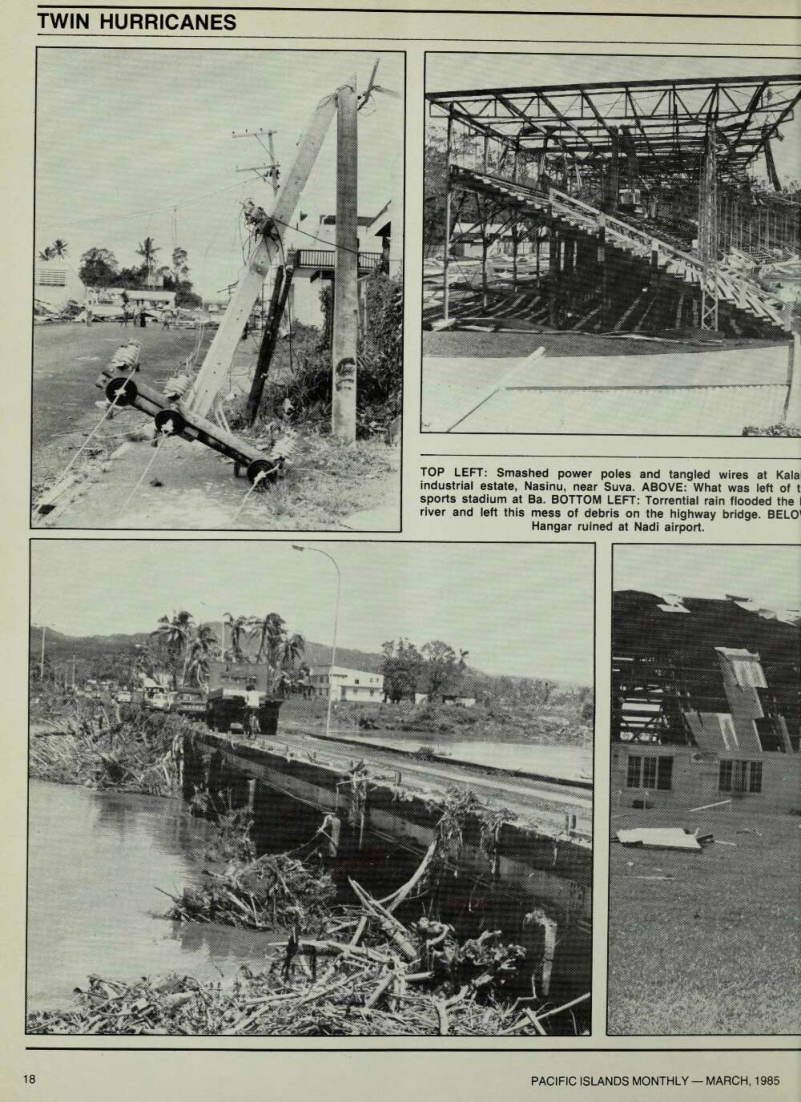
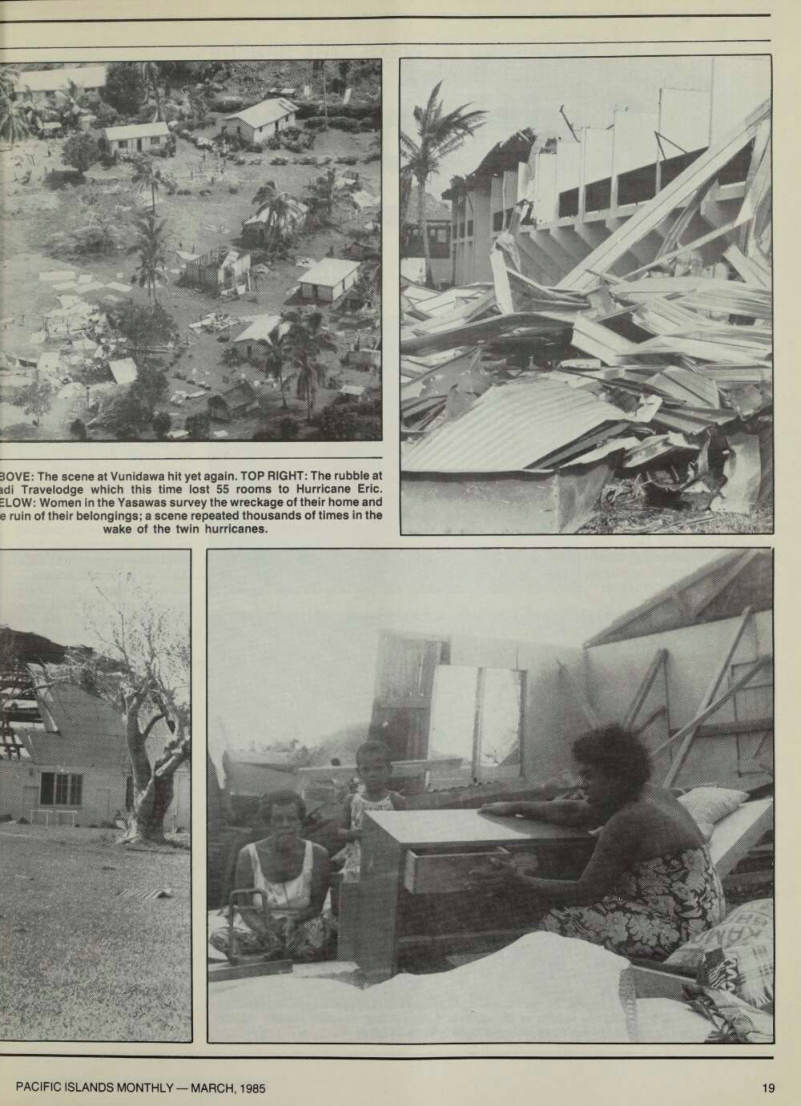
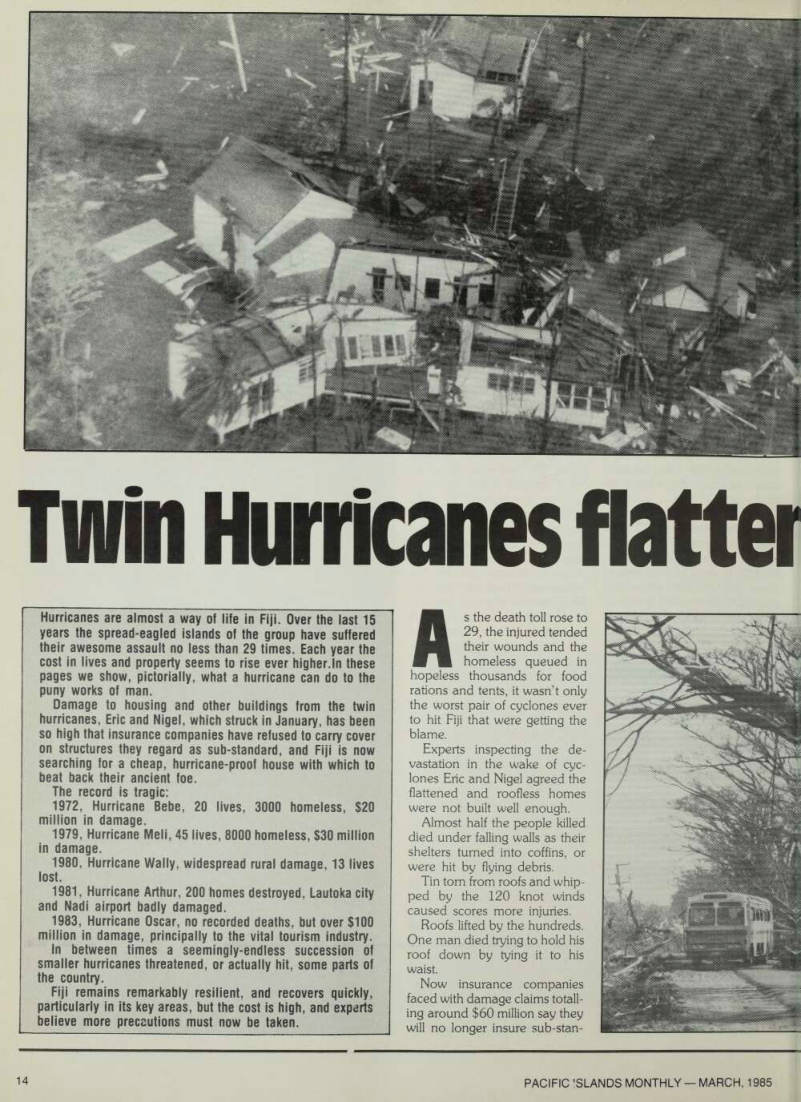
Hurricanes are almost a way of life in Fiji. Over the last 15 years the spread-eagled islands of the group have suffered their awesome assault no less than 29 times. Each year the cost in lives and property seems to rise ever higher.In these pages we show, pictorially, what a hurricane can do to the puny works of man.
Damage to housing and other buildings from the twin hurricanes, Eric and Nigel, which struck in January, has been so high that insurance companies have refused to carry cover on structures they regard as sub-standard, and Fiji is now searching for a cheap, hurricane-proof house with which to beat back their ancient foe.
The record is tragic: 1972, Hurricane Bebe, 20 lives, 3000 homeless, $20 million in damage. 1979, Hurricane Meli, 45 lives, 8000 homeless, $30 million in damage. 1980, Hurricane Wally, widespread rural damage, 13 lives lost. 1981, Hurricane Arthur, 200 homes destroyed, Lautoka city and Nadi airport badly damaged. 1983, Hurricane Oscar, no recorded deaths, but over $100 million in damage, principally to the vital tourism industry.
In between times a seemingly-endless succession of smaller hurricanes threatened, or actually hit, some parts of the country.
Fiji remains remarkably resilient, and recovers quickly, particularly in its key areas, but the cost is high, and experts believe more precautions must now be taken.
Twin Hurricanes flatter

As the death toll rose to 29, the injured tended their wounds and the homeless queued in hopeless thousands for food rations and tents, it wasn’t only the worst pair of cyclones ever to hit Fiji that were getting the blame.
Experts inspecting the de vastation in the wake of cyc lones Eric and Nigel agreed the flattened and roofless homes were not built well enough.
Almost half the people killed died under falling walls as their shelters turned into coffins, or were hit by flying debris.
Tin tom from roofs and whip ped by the 120 knot winds caused scores more injuries.
Roofs lifted by the hundreds.
One man died trying to hold his roof down by tying it to his waist.
Now insurance companies faced with damage claims totall ing around $6O million say they will no longer insure sub-stan-
dard houses against cyclones and Fiji is now searching de sperately for a hurricane-proof house design that will shelter its people rather than kill them.
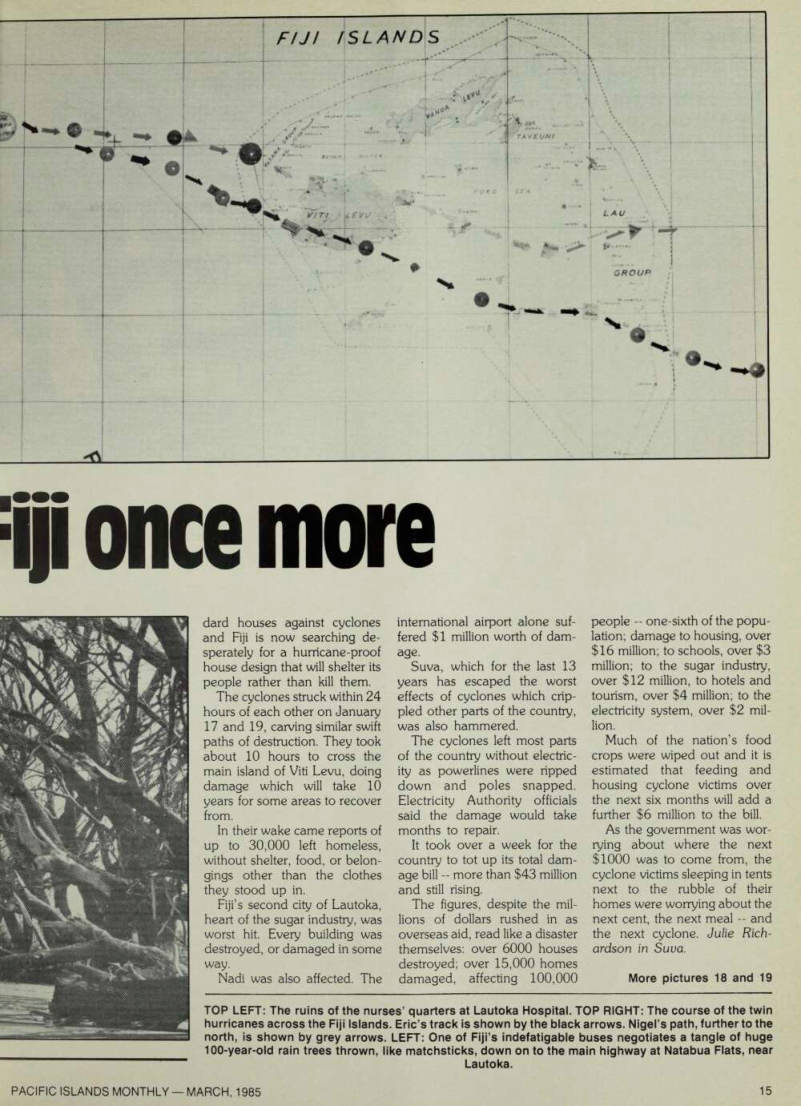
The cyclones struck within 24 hours of each other on January 17 and 19, carving similar swift paths of destruction. They took about 10 hours to cross the main island of Viti Levu, doing damage which will take 10 years for some areas to recover from.
In their wake came reports of up to 30,000 left homeless, without shelter, food, or belon gings other than the clothes they stood up in.
Fiji’s second city of Lautoka, heart of the sugar industry, was worst hit. Every building was destroyed, or damaged in some way.
Nadi was also affected. The
international airport alone suf fered $1 million worth of dam age.
Suva, which for the last 13 years has escaped the worst effects of cyclones which crip pled other parts of the country, was also hammered.
The cyclones left most parts of the country without electric ity as powerlines were ripped down and poles snapped.
Electricity Authority officials said the damage would take months to repair.
It took over a week for the country to tot up its total dam age bill more than $43 million and still rising.
The figures, despite the mil lions of dollars rushed in as overseas aid, read like a disaster themselves: over 6000 houses destroyed; over 15,000 homes damaged, affecting 100,000
people one-sixth of the popu lation; damage to housing, over $l6 million; to schools, over $3 million; to the sugar industry, over $l2 million, to hotels and tourism, over $4 million; to the electricity system, over $2 mil lion.
Much of the nation’s food crops were wiped out and it is estimated that feeding and housing cyclone victims over the next six months will add a further $6 million to the bill.
As the government was wor rying about where the next $lOOO was to come from, the cyclone victims sleeping in tents next to the rubble of their homes were worrying about the next cent, the next meal and the next cyclone. Julie Rich ardson in Suva.
More pictures 18 and 19
Fiji Islands
TOP LEFT: The ruins of the nurses’ quarters at Lautoka Hospital. TOP RIGHT: The course of the twin hurricanes across the Fiji Islands. Eric’s track is shown by the black arrows. Nigel’s path, further to the north, is shown by grey arrows. LEFT: One of Fiji’s indefatigable buses negotiates a tangle of huge 100-year-old rain trees thrown, like matchsticks, down on to the main highway at Natabua Flats, near Lautoka.
TOP LEFT: Smashed power poles and tangled wires at Kalal[?] industrial estate, Nasinu, near Suva. ABOVE: What was left of t[?] sports stadium at Ba. BOTTOM LEFT: Torrential rain flooded the[?] river and left this mess of debris on the highway bridge. BELOW Hangar ruined at Nadi airport.
[?]BOVE: The scene at Vunidawa hit yet again. TOP RIGHT: The rubble at [?]adi Travelodge which this time lost 55 rooms to Hurricane Eric.
BELOW: Women in the Yasawas survey the wreckage of their home and [?]ruin of their belongings; a scene repeated thousands of times in the wake of the twin hurricanes.
Advertisements & other items, pp. 14-18 (4 items)
14
PACIFIC 'SLANDS MONTHLY —MARCH, 1985
1 once more
Nissan
■ ws n mm I HM SPfi K 1 J - I ri ■■ u fcip m . ■ - ■ m « - Discover a new dimension to the to quality that made Datsun a trusted and efficiently name around the world. of the world’s At Nissan, the Datsun tradition fs it s backec alive and well and better than ever. welcomes Our international manufacturing and find the same service network gives us the capac : *‘ * JJ r - ■ ■ am m ■ ■■- - r. 558KV* ■■ -
' ' ***=« --.-TV ■ *TV
Hi#i
Stesi jgjj£g ■ ---■
msSi
S 3 m ■ vWffa ■
sSSh
w M *£■ SM
HWI
- '* 4 ' -: ; . «s mam
: : "v:.. ft* \ ■ t-J vn **r *r’ -w ■ 'W V ":V .k'- : ■ ••• ■ •■■ ■; '• 4 no Mi «, 'I •■%»? ,
X*J: ts
WM i 13'. ,*%: -V f * « k * ’ W# 1 ' » f ■ %: ,k»' A t *Hi* ■ v *# «i|l '4\%
apf®
mm--
■ wmiSx' ■
’ tSW'*>k,
■ 4 ■'■ ■ v 4 <|. ■ s^l^Sb^ 4 ' - / i_ H i ~4S*; Mil
Twin Hurricanes
importance
Nakasone Surveys “The Sphere”
A visit of great importance
The Nakasone odyssey was of immense im portance, particularly to Australia, for Japan is that country’s biggest customer, and biggest supplier. Also, if the trends of last year continue, Japan will be the biggest foreign investor in Australia, a country which now needs overseas funds to warm up an economy made sluggish by high costs, low productivity and depressed commodity prices.
Australian leaders and offi cials were therefore anxious that this commercial partner ship should be further
Japan’s prime minister, Yasuhiro Nakasone, has clearly signalled his country’s deep, and in creasing, interest in the Pacific by making state visits to Fiji and Papua New Guinea on his way to Australia and New Zealand.
In the islands he announced increased aid, but was reticent about the chances of easing in any real way the steadily growing imbalance in import-export payments.
Nor was he able to make life easier for Australia’s prime minister, Bob Hawke who, ringed about as he was at the time with rail strikes, public service strikes, doctors’ strikes, bush fires and a nervous economy, doubtlessly hoped for something better than in the end he got.
cemented, in fact as well as appearance. At the same time prime minister Bob Hawke was at pains to take a Pacific regio nal view.
Mr Hawke expressed support for Mr Nakasone’s plan to de velop a new round of multilate ral trade negotiations, saying that matters of regional concern should also be included on such an agenda. He made specific public mention of the topic in his speech at the state dinner: “A new round of multi-lateral trade negotiations based on a genuine committment to trade liberalisation would address a number of flaws in the current trading system that have been particularly damaging to the trading interests of countries in our region,” he said.
The visit was colorful and a public event. While 72 Japan ese flags, matched by 72 Aus tralian flags, were run up poles all over Canberra, in honor of the Japanese leader and his phalanx of high-level atten dants, newspapers were heavy with speculation.
Mr Nakasone would “talk trade, but tread softly on poli tics,” said one. The two prime ministers were tipped to “dis cuss banking reciprocity,” said another. ’’Australian concern over Japanese market - tough talk on trade wanted from Hawke,” said another.
In the event Mr Nakasone appears to have been sober sides indeed and delivered what could really only be de scribed as a slightly sharp lec ture to Australians at large that if they could not, or did not, deliver, then Japan would find
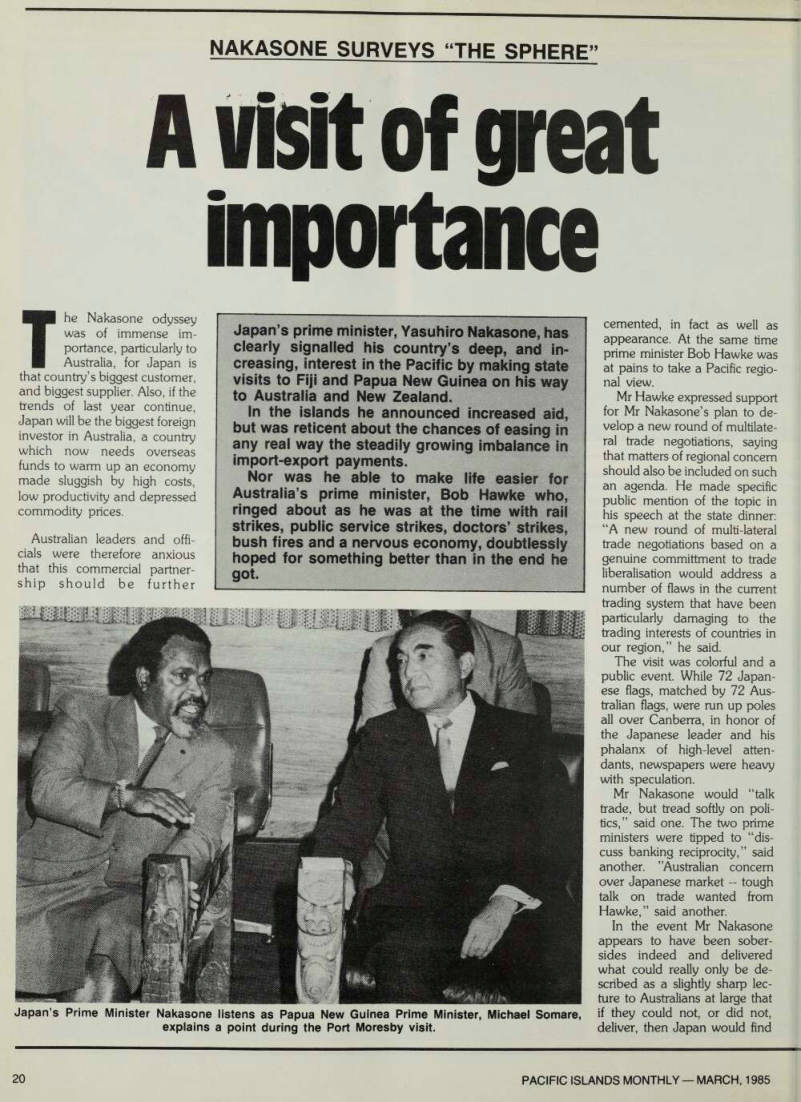
Japan’s Prime Minister Nakasone listens as Papua New Guinea Prime Minister, Michael Somare, explains a point during the Port Moresby visit.
other suppliers.
The admonition, couched, of course, in elaborate, chrysan themum-fringed courtesy, came in the wake of bitter reaction locally to the activities of Hunter Valley train drivers whose industrial action, had bulk coal ships sailing away empty from Newcastle for fore ign ports where stocks lay ready to fill Japanese steel mill bunk ers normally supplied from Aus tralia.
With that much of the situa tion more or less clear (and pundits dolefully chanting to a still largely deaf Australian public that Asia was passing it, and that even little Brunei had a higher per capita income now), it remained very difficult to discover exactly what Mr Hawke and Mr Nakasone did finally consider to be firmly agreed.
As far as they could, the Australians pushed for clear reiteration of Mr Nakasone’s undertaking, made in Tokyo in 1984, during Mr Hawke’s visit, that Japan would not allow third countries to influence their demand for Australian com modities, particularly coal.
Mr Nakasone said he would
do his “level best” to see Australia’s market share main tained in four vital categories beef and other meat, bauxite, aluminium and related raw materials, iron ore and coal.
Enthusiasts in the Department of Trade interpreted this to mean percentage share, but the Japanese declined to be drawn into an iron-clad guarantee.
Japan’s problem is obvious enough. They are under con siderable pressure from the U.S., their biggest customer, to buy more American products, in particular beef and coal. Last year Australia lost a good prop ortion of its beef market in Japan to U.S. producers.
Mr Nakasone did his best to soothe and said he would stick to the principle that Australia’s access to Japanese markets would not be impeded for thd benefit of others. But, he was very firm that Australia had to deliver; had to be competitive and reliable as a supplier.
One important plus from the visit has been the setting up of a high level committee of officials from both Japan and Australia to monitor energy trade and to “anticipate and avoid” future
problems.
Garry Barker
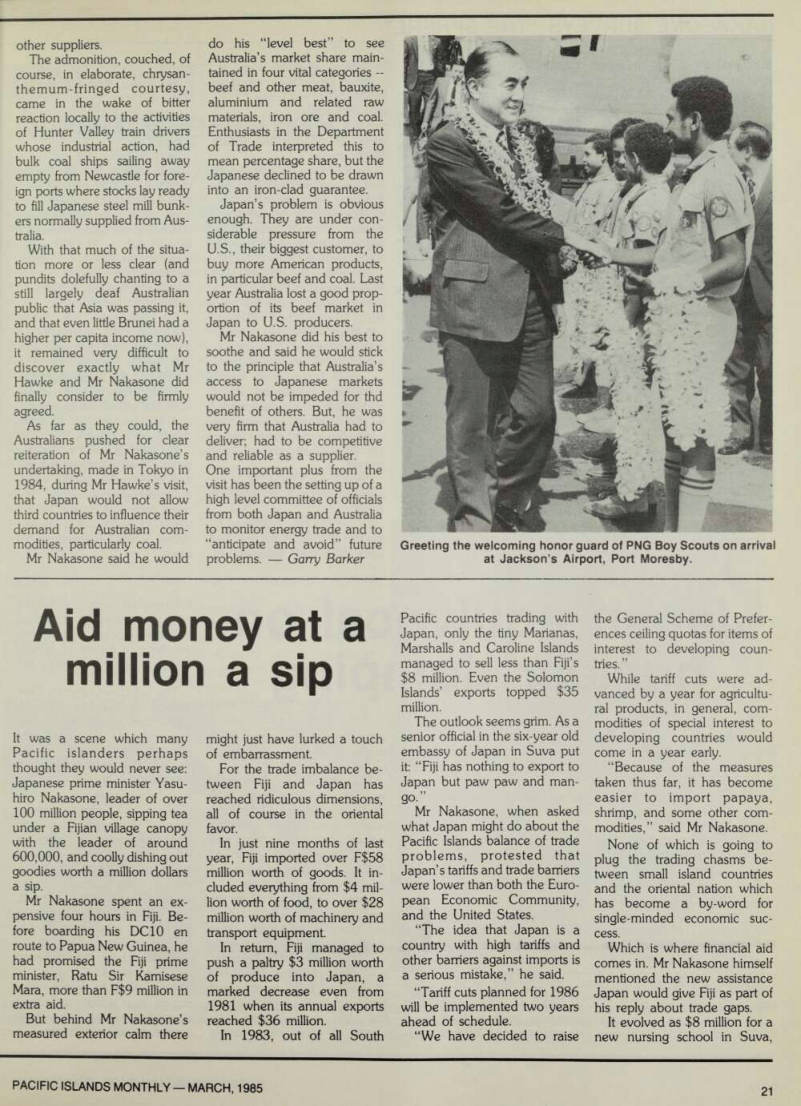
Greeting the welcoming honor guard of PNG Boy Scouts on arrival at Jackson’s Airport, Port Moresby.
$750,000 for a new fisheries terminal at the second city of Lautoka, a possible $120,000 for a rural mobile library service, and $700,000 for the
University of the South Pacific, This is extra to aid of around US$3 million mark received under normal circumstances and makes Japan second only
to Australia as chief donor.
Japan is a relative newcomer to the major aid scene for Fiji and its neighbors.
Six years ago its donations were around the half million dollars mark.
Japan’s reasons for the sudden splurge are complex. The Japanese are eager to continue to expand their industrial and consumer goods sales in the region, although not by producing them here.
According to Hiroshi Miki, second secretary at the Japanese embassy in Suva, Fiji is not about to attract the investmentconscious Japanese businessman pampered by a mass consumer market second to none, “Fiji is not a good investment. The population of just 600,000 is a very small market for the Japanese businessman, and in the Pacific islands generally there is also a very small market.
“And I don’t think Fiji or the other islands can do anything about it.”
His words are underlined by the fact that there are only two companies with Japanese in-
vestment in Fiji: the recently cyclone-struck Mana Island re sort, and the Pacific Fishing Company (PAFCO), which cans fish in Levuka, Fiji’s old capital.
And PAFCO, set up by a Tokyo trading and investment company as a 50-50 joint ven ture with the Fiji government, may soon lose its Japanese investor as the world market for canned fish - and fish con sumption in Japan - decline.
Japanese businessmen are not noted for hanging around to make great losses.
Mr Nakasone has made tremendous efforts to strengthen ties, not only with the South Pacific, but with China and the Asian countries.
He believes that only if na tions are economically prosper ous can the war which Japan dreads be averted.
By helping them along that route, Japan is keeping its trade and its economic wealth intact, and steering what he calls, “the most promising region in the world” towards even greater riches. Julie Richardson in Suva
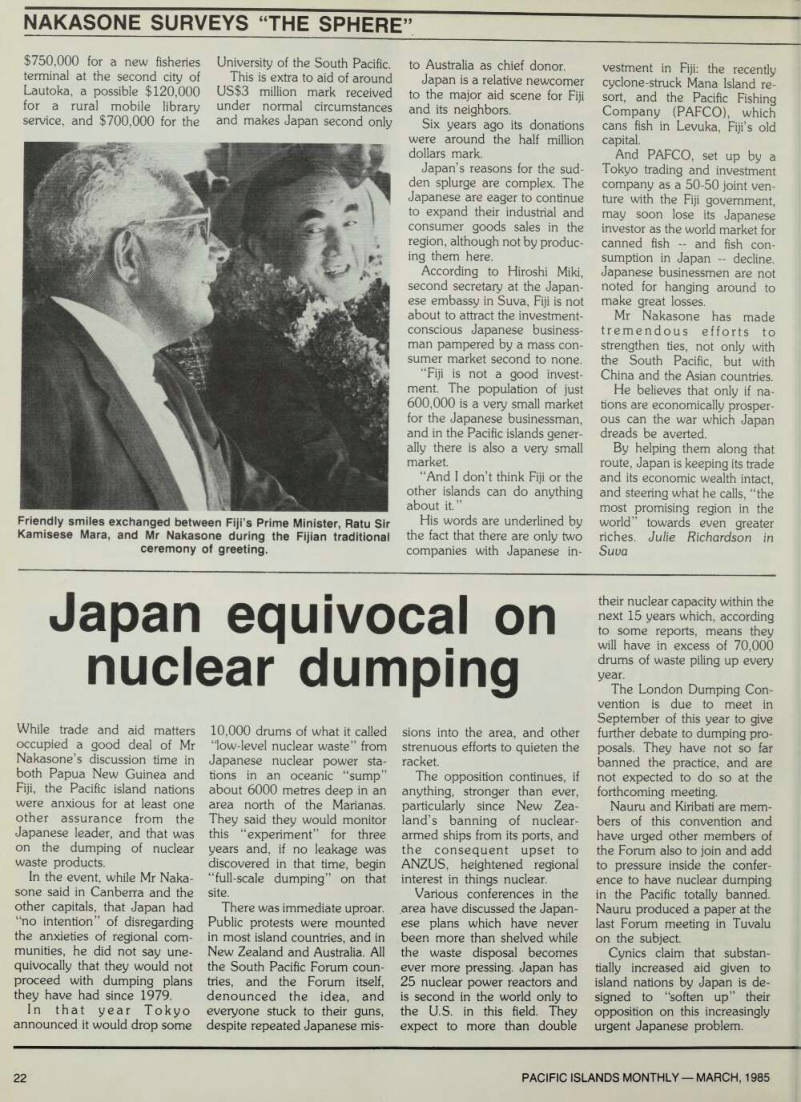
Friendly smiles exchanged between Fiji’s Prime Minister, Ratu Sir Kamisese Mara, and Mr Nakasone during the Fijian traditional ceremony of greeting.
million a sip
Aid money at a million a sip
It was a scene which many Pacific islanders perhaps thought they would never see; Japanese prime minister Yasu hiro Nakasone, leader of over 100 million people, sipping tea under a Fijian village canopy with the leader of around 600,000, and coolly dishing out goodies worth a million dollars a sip.
Mr Nakasone spent an ex pensive four hours in Fiji. Be fore boarding his DC 10 en route to Papua New Guinea, he had promised the Fiji prime minister, Ratu Sir Kamisese Mara, more than Fs9 million in extra aid.
But behind Mr Nakasone’s measured exterior calm there
might just have lurked a touch of embarrassment.
For the trade imbalance be tween Fiji and Japan has reached ridiculous dimensions, all of course in the oriental favor.
In just nine months of last year, Fiji imported over FssB million worth of goods. It in cluded everything from $4 mil lion worth of food, to over $2B million worth of machinery and transport equipment.
In return, Fiji managed to push a paltry $3 million worth of produce into Japan, a marked decrease even from 1981 when its annual exports reached $36 million.
In 1983, out of all South
Pacific countries trading with Japan, only the tiny Marianas, Marshalls and Caroline Islands managed to sell less than Fiji’s $8 million. Even the Solomon Islands’ exports topped $35 million.
The outlook seems grim. As a senior official in the six-year old embassy of Japan in Suva put it: “Fiji has nothing to export to Japan but paw paw and man go.”
Mr Nakasone, when asked what Japan might do about the Pacific Islands balance of trade problems, protested that Japan’s tariffs and trade barriers were lower than both the Euro pean Economic Community, and the United States.
“The idea that Japan is a country with high tariffs and other barriers against imports is a serious mistake,” he said.
“Tariff cuts planned for 1986 will be implemented two years ahead of schedule.
“We have decided to raise
the General Scheme of Prefer ences ceiling quotas for items of interest to developing coun tries. ”
While tariff cuts were ad vanced by a year for agricultu ral products, in general, com modities of special interest to developing countries would come in a year early.
“Because of the measures taken thus far, it has become easier to import papaya, shrimp, and some other com modities,” said Mr Nakasone.
None of which is going to plug the trading chasms be tween small island countries and the oriental nation which has become a by-word for single-minded economic suc cess.
Which is where financial aid comes in. Mr Nakasone himself mentioned the new assistance Japan would give Fiji as part of his reply about trade gaps.
It evolved as $8 million for a new nursing school in Suva,
nuclear dumping
Japan equivocal on nuclear dumping
While trade and aid matters occupied a good deal of Mr Nakasone’s discussion time in both Papua New Guinea and Fiji, the Pacific island nations were anxious for at least one other assurance from the Japanese leader, and that was on the dumping of nuclear waste products.
In the event, while Mr Naka sone said in Canberra and the other capitals, that Japan had “no intention” of disregarding the anxieties of regional com munities, he did not say une quivocally that they would not proceed with dumping plans they have had since 1979.
In that year Tokyo announced it would drop some
10,000 drums of what it called “low-level nuclear waste” from Japanese nuclear power sta tions in an oceanic “sump” about 6000 metres deep in an area north of the Marianas.
They said they would monitor this “experiment” for three years and, if no leakage was discovered in that time, begin “full-scale dumping” on that site.
There was immediate uproar.
Public protests were mounted in most island countries, and in New Zealand and Australia. All the South Pacific Forum coun tries, and the Forum itself, denounced the idea, and everyone stuck to their guns, despite repeated Japanese mis
sions into the area, and other strenuous efforts to quieten the racket.
The opposition continues, if anything, stronger than ever, particularly since New Zea land’s banning of nuclear armed ships from its ports, and the consequent upset to ANZUS, heightened regional interest in things nuclear.
Various conferences in the area have discussed the Japan ese plans which have never been more than shelved while the waste disposal becomes ever more pressing. Japan has 25 nuclear power reactors and is second in the world only to the U.S. in this field. They expect to more than double
their nuclear capacity within the next 15 years which, according to some reports, means they will have in excess of 70,000 drums of waste piling up every year.
The London Dumping Con vention is due to meet in September of this year to give further debate to dumping pro posals. They have not so far banned the practice, and are not expected to do so at the forthcoming meeting.
Nauru and Kiribati are mem bers of this convention and have urged other members of the Forum also to join and add to pressure inside the confer ence to have nuclear dumping in the Pacific totally banned.
Nauru produced a paper at the last Forum meeting in Tuvalu on the subject.
Cynics claim that substan tially increased aid given to island nations by Japan is de signed to “soften up” their opposition on this increasingly urgent Japanese problem.
More aid to PNG
seems assured
Papua New Guinea will approach Japan later this year for increased foreign aid, and, after Mr Nakasone’s flying visit to Port Moresby, is likely to find a ready ear.
While no formal announce ments were made Mr Nakasone is understood to have indicated strong support, and willingness to assist.
Prime among the projects discussed was the building of the long-planned trans-island highway linking Port Moresby and Lae, an engineering task of herculean proportions. Reports from PNG say the Japanese government aid agency is now virtually committed to funding a feasibility study on the road.
According to Mr Nakasone Japan does not propose to grant-aid the construction but rather to offer PNG soft yen loans to handle the major out lay involved. ”It is my hope that this highway linking your capital and your second-largest city will not only contribute to PNG’s social and economic deve lopment, but will also be a bridge between the people of Japan and the people of PNG.
They are wantoks,” he said. ’’Let us therefore join hands as we move together toward the coming era of Pacific co operation. ”
Other projects discussed be tween Mr Nakasone and PNG prime minister, Michael So mare, his ministers and officials, included technical assistance in rice estate development, im provement of communications services (mainly radio stations) and upgrading of the Yonki hydro-electric power scheme. ”PNG has gained a lot from the Japanese prime minister’s visit,” said Mr Somare. ’The visit will foster relations with Japan and that pleases me.” ”PNG has many of the re sources that Japan needs,” said Mr Somare. ’’Japan has the skills, industrial capacity and technology that PNG needs.”
Mr Somare accepted Mr Nakasone’s invitation to make a state visit to Japan in July. ”We want to see our present pre dominantly trade-based re lationship expanded to a partnership based on greater economic and technical cooperation,” he said.
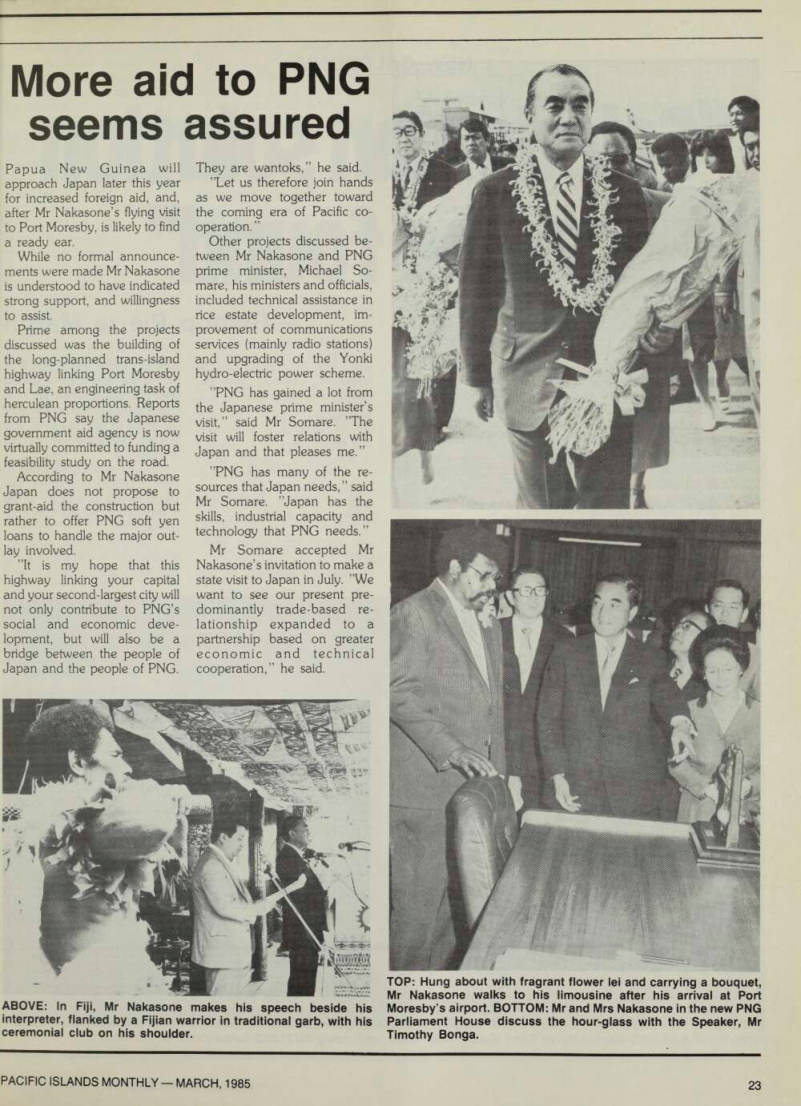
ABOVE: In Fiji, Mr Nakasone makes his speech beside his interpreter, flanked by a Fijian warrior in traditional garb, with his ceremonial club on his shoulder.
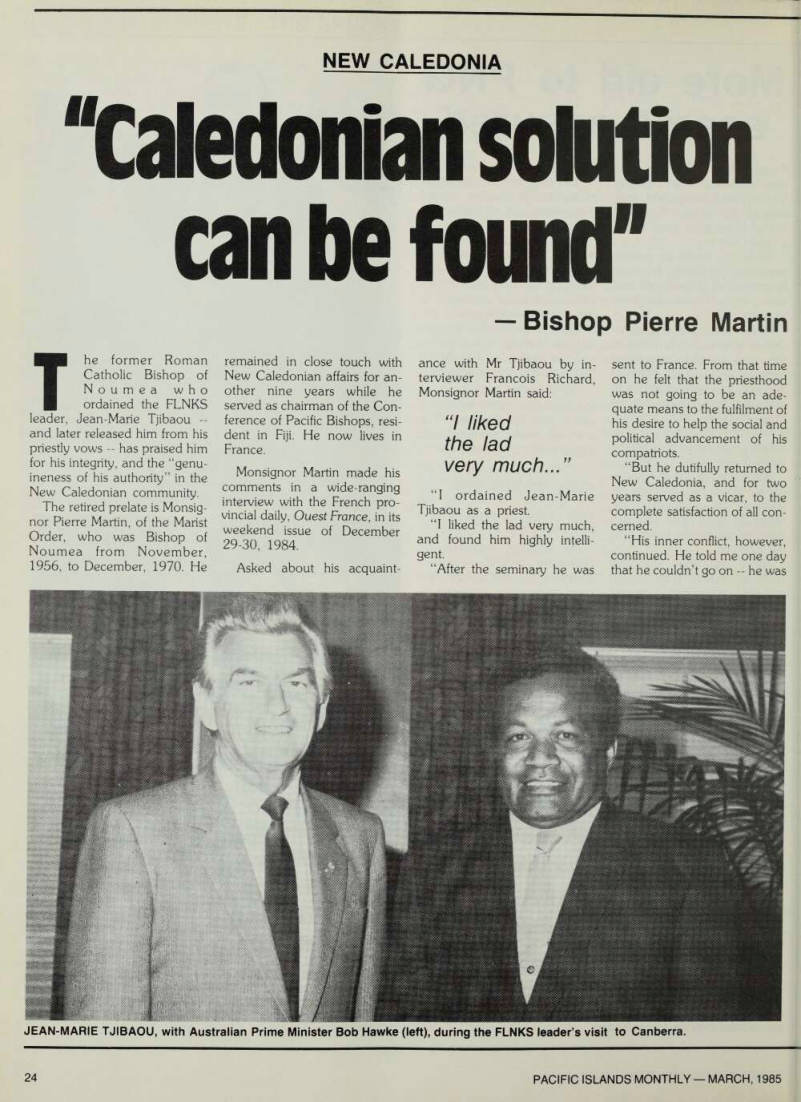
TOP: Hung about with fragrant flower lei and carrying a bouquet, Mr Nakasone walks to his limousine after his arrival at Port Moresby’s airport. BOTTOM: Mr and Mrs Nakasone in the new PNG Parliament House discuss the hour-glass with the Speaker, Mr Timothy Bonga.
"Caledonian solution
New Caledonia
"Caledonian solution can be found"
Bishop Pierre Martin
The former Roman Catholic Bishop of Noumea who ordained the FLNKS leader, Jean-Marie Tjibaou -and later released him from his priestly vows has praised him for his integrity, and the “genu ineness of his authority” in the New Caledonian community.
The retired prelate is Monsig nor Pierre Martin, of the Marist Order, who was Bishop of Noumea from November, 1956, to December, 1970. He
remained in close touch with New Caledonian affairs for an other nine years while he served as chairman of the Con ference of Pacific Bishops, resi dent in Fiji. He now lives in France.
Monsignor Martin made his comments in a wide-ranging interview with the French pro vincial daily, Quest France, in its weekend issue of December 29-30, 1984.
Asked about his acquaint
ance with Mr Tjibaou by in terviewer Francois Richard, Monsignor Martin said:
“Iliked
the lad
very much...”
“I ordained Jean-Marie Tjibaou as a priest.
“I liked the lad very much, and found him highly intelli gent.
“After the seminary he was
sent to France. From that time on he felt that the priesthood was not going to be an ade quate means to the fulfilment of his desire to help the social and political advancement of his compatriots.
“But he dutifully returned to New Caledonia, and for two years served as a vicar, to the complete satisfaction of all con cerned.
“His inner conflict, however, continued. He told me one day that he couldn’t go on he was
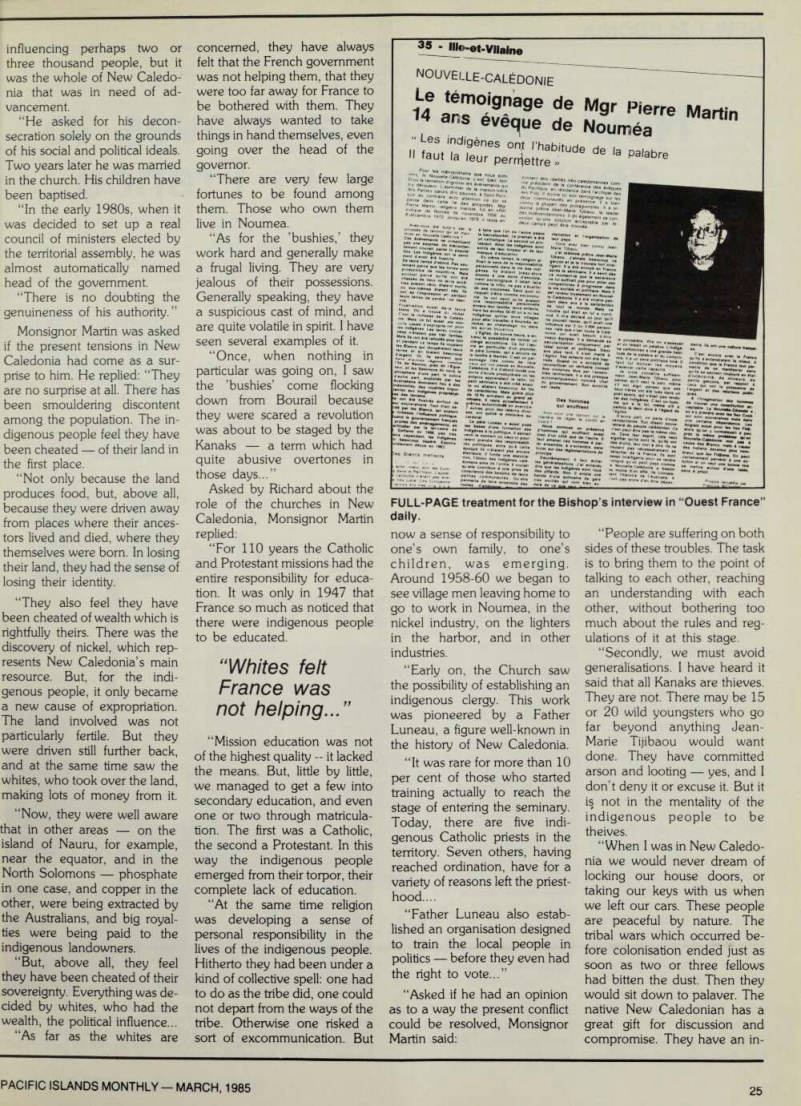
JEAN-MARIE TJIBAOU, with Australian Prime Minister Bob Hawke (left), during the FLNKS leader’s visit to Canberra.
influencing perhaps two or three thousand people, but it was the whole of New Caledo nia that was in need of ad vancement.
“He asked for his decon secration solely on the grounds of his social and political ideals.
Two years later he was married in the church. His children have been baptised.
“In the early 1980 s, when it was decided to set up a real council of ministers elected by the territorial assembly, he was almost automatically named head of the government.
“There is no doubting the genuineness of his authority.”
Monsignor Martin was asked if the present tensions in New Caledonia had come as a sur prise to him. He replied: “They are no surprise at all. There has been smouldering discontent among the population. The in digenous people feel they have been cheated of their land in the first place.
“Not only because the land produces food, but, above all, because they were driven away from places where their ances tors lived and died, where they themselves were born. In losing their land, they had the sense of losing their identity.
“They also feel they have been cheated of wealth which is rightfully theirs. There was the discovery of nickel, which rep resents New Caledonia’s main resource. But, for the indi genous people, it only became a new cause of expropriation.
The land involved was not particularly fertile. But they were driven still further back, and at the same time saw the whites, who took over the land, making lots of money from it.
“Now, they were well aware that in other areas on the island of Nauru, for example, near the equator, and in the North Solomons phosphate in one case, and copper in the other, were being extracted by the Australians, and big royal ties were being paid to the indigenous landowners.
“But, above all, they feel they have been cheated of their sovereignty. Everything was de cided by whites, who had the wealth, the political influence...
“As far as the whites are
concerned, they have always felt that the French government was not helping them, that they were too far away for France to be bothered with them. They have always wanted to take things in hand themselves, even going over the head of the governor.
“There are very few large fortunes to be found among them. Those who own them live in Noumea.
“As for the ’bushies,’ they work hard and generally make a frugal living. They are very jealous of their possessions.
Generally speaking, they have a suspicious cast of mind, and are quite volatile in spirit. I have seen several examples of it.
“Once, when nothing in particular was going on, I saw the ’bushies’ come flocking down from Bourail because they were scared a revolution was about to be staged by the Kanaks a term which had quite abusive overtones in those days...”
Asked by Richard about the role of the churches in New Caledonia, Monsignor Martin replied: “For 110 years the Catholic and Protestant missions had the entire responsibility for educa tion. It was only in 1947 that France so much as noticed that there were indigenous people to be educated.
“Whites felt
France was
not helping...”
“Mission education was not of the highest quality it lacked the means. But, little by little, we managed to get a few into secondary education, and even one or two through matricula tion. The first was a Catholic, the second a Protestant. In this way the indigenous people emerged from their torpor, their complete lack of education.
“At the same time religion was developing a sense of personal responsibility in the lives of the indigenous people.
Hitherto they had been under a kind of collective spell: one had to do as the tribe did, one could not depart from the ways of the tribe. Otherwise one risked a sort of excommunication. But
now a sense of responsibility to one’s own family, to one’s children, was emerging.
Around 1958-60 we began to see village men leaving home to go to work in Noumea, in the nickel industry, on the lighters in the harbor, and in other industries.
“Early on, the Church saw the possibility of establishing an indigenous clergy. This work was pioneered by a Father Luneau, a figure well-known in the history of New Caledonia.
“It was rare for more than 10 per cent of those who started training actually to reach the stage of entering the seminary.
Today, there are five indi genous Catholic priests in the territory. Seven others, having reached ordination, have for a variety of reasons left the priest hood. ...
“Father Luneau also estab lished an organisation designed to train the local people in politics before they even had the right to vote...”
“Asked if he had an opinion as to a way the present conflict could be resolved, Monsignor Martin said;
“People are suffering on both sides of these troubles. The task is to bring them to the point of talking to each other, reaching an understanding with each other, without bothering too much about the rules and reg ulations of it at this stage.
“Secondly, we must avoid generalisations. I have heard it said that all Kanaks are thieves.
They are not. There may be 15 or 20 wild youngsters who go far beyond anything Jean- Marie Tijibaou would want done. They have committed arson and looting yes, and I don’t deny it or excuse it. But it is not in the mentality of the indigenous people to be theives.
“When I was in New Caledo nia we would never dream of locking our house doors, or taking our keys with us when we left our cars. These people arc peaceful by nature. The tribal wars which occurred be fore colonisation ended just as soon as two or three fellows had bitten the dust. Then they would sit down to palaver. The native New Caledonian has a great gift for discussion and compromise. They have an in-
FULL-PAGE treatment for the Bishop’s Interview in “Quest France” daily.
Caledonian Solution
nate political sense. They must be given the means to exercise these capacities.
“I think I know Jean-Marie Tjibaou well enough to say that he wants peace, even if he is bitter after all, his two brothers were killed in an ambush, and it was not an ambush mounted by indi genous people. He is a man of the faith, even if he sometimes has harsh words for the Church.
“There is talk of independen tists. But they themselves speak of the sovereignty of the New Caledonian people. They are not necessarily the same thing.
To their mind, what they are saying is that they’re there, they have rights, and they want to be able to say their piece. They don’t necessarily want to de tach themselves from France.
They are intelligent enough to realise that a little country like New Caledonia needs at least to have an ally. They know the history of Australia, and have no desire to be dependent upon it. They have a French education.
“It’s still with France that they can have the best understan
ding. So long as France allows them to present themselves without their always having the sense of being in a state of inferiority, being minors, little boys, in relation to those with the power of money and politi cal connections.
“A solution
can be
found...”
“It’s up to people’s imagina tion to come up with an accept able constitutional arrange ment. New Zealand knew how to tackle the problem in its relationship with the Cook Is lands, which are sovereign, but in a certain state of depend ence. The English, too, in Fiji, were able to work it out when they faced almost the same problem as exists in New Cale donia not, it is true, in relation to whites, but to the Indians, who had come to outnumber the Fijians.
“A solution can certainly be found, if just for once people are prepared to sit down around a table and talk, without preconceptions, without pre judice/ 4
A large demonstration in Noumea by opponents of independence marked the January 19 visit by French President Mitterrand. One demonstrator (above right) painted a suitcase in the French colors and carried it on a pole above his head with the slogan “Just like in Algeria.” Les Nouvelles photo.
centre-stage in France
New Caledonia moves to centre-stage in France
By early February, the action in New Caledonia’s long-running crisis had largely moved to Paris, where the issue of the territory’s future was looming as a dominant issue in the French parliamentary elections to be held next year.
Following a lightning 10-hour visit by President Mitterrand to the territory on January 19, during which he announced that ’’dialogue was continuing” on the independence issue, and that his government planned a
strengthened French military presence in the territory (mainly an upgrading of Noumea’s role as a French naval base), former President Giscard d’Estaing im mediately announced that he, too, would soon be taking the New Caledonia trail. Voicing firm opposition to the govern ment’s plans for the territory a referendum on independence in July, which, if successful, would be followed by the proclamation of an indepen dent state in association with
France on January 1, 1986 Mr Giscard said he would visit the territory before the planned referendum date. He said, with out elaborating, that he sup ported a ’’French solution” to New Caledonia’s problems.
In the parliament, debate raged over the government’s plan to extend to June 30, the state of emergency proclaimed on January 12 by President Mitterrand’s delegate in Noumea, Special High Com
missioner Edgard Pisani. The government used its absolute majority in the National Assem bly to push through a bill renewing the emergency after the Opposition-controlled Sen ate tried to limit the extension to a month. The Constitutional Council, which vets all legisla tion, later approved the govern ment’s stand.
The emergency had been proclaimed by Mr Pisani follow ing a weekend of rioting in
Noumea, mainly by anti-inde pendence whites, after the fatal shooting on January 11, by persons unknown, of 17-year old Yves Tual, son of a French settler farming family. On the same weekend at La Foa, on the west coast, FLNKS leader, Eloi Machoro, ’’minister of security” in the provisional gov ernment of Kanaky proclaimed by the FLNKS last December 1, was shot dead, together with an aide, in a confrontation with French security forces (see separate report this issue).
Despite the return of relative calm following President Mitter rand’s visit, acts of sabotage continued in the territory, most notably at the important nickel mining centre of Thio on the east coast, where millions of dollars worth of mining equip ment is reported to have been damaged. Pro- and anti-inde
pendence spokesmen traded charges over the sabotage, with the latter claiming that FLNKS militants were responsible, and the former accusing the far Right of staging provocations in order to make the FLNKS look like the villains.
Whatever the truth of the matter, the effects of such activ ity were in no doubt at all: the territory was in the grip of a severe economic crisis. Territo rial officials said at the end of January that New Caledonia’s two main industries, nickel min ing and tourism, were virtually at a standstill. The head of the local tourist bureau said tourist bookings were down by 50 per cent, with mass cancellations by intending Australian tourists.
The sabotage at Thio, and other nickel-mining areas, had halted production of the terri tory’s biggest money-earner.
The territory’s Chamber of Commerce secretary said that activity in the car and building sectors had also virtually stop ped.
Mr Pisani, who was about to leave for Paris to present his final report to President Mitter rand, had his own word to say on some more fundamental aspects of New Caledonia’s economy when he wrote in a January 31 article in the Noumea daily, Les Nouvelles Caledoniennes,: “For me the ’generosity’ of France does not consist of an open-ended com mitment to provide ill-used and poorly-shared financial manna; an economy which is based for 35 per cent on transfers from metropolitan France is a per verse economy.”
France was not guilty of ’’colonialist tyranny” in New Caledonia, but of making the
territory excessively dependent, he added.
Mr Pisani rejected fears that an independent New Caledonia would be able to renounce a treaty of association linking it to France. ”To refuse this path to independence, to draw back before this inevitable leap, is a suicidal attitude which can lead only to confrontation and hatred,” he wrote.
On the day Mr Pisani’s article was published in Noumea, Aus tralia’s foreign minister, Bill Hayden, was speaking to French journalists in Canberra.
Mr Hayden told them that in his view Mr Pisani’s plan was ’’the last and best hope” for New Caledonia. ”1 would be sad dened if it is not supported,” he said. ’’There seems to be no alternative, except the status quo and that is unaccept able.”
from a leftist
Sign of a Solution?
Machoro: last words from a leftist
People may die before this is over. We have a determination and are prepared to die for independence, said Eloi Machoro in prophetic words, spoken only weeks before his own death in the gunfire and confusion of a farmhouse siege out in the countryside of New Caledonia.
“Yes, people may die in the violence which is inevitable if the elections are to be dis rupted. But where is the vio lence? With us, or with them?
“We are not interested in the question of violence. The main target is to disrupt the elections, and we don’t care what kind of actions we have to take,”
Machoro said.
I asked him: If you do not contest the elections will you not lose the resources that come from having some mem bers elected?
MACHORO: If we took part we would gain some seats, but
In the tragic turmoil of New Caledonia at least 19 people have died since last November, among them the brothers of FLNKS leader, Jean-Marie Tjibaou, and the Kanak leader, Eloi Machoro, who was shot, allegedly by French security forces, during a melee around a besieged farmhouse on January 12. Killed with Machoro was his deputy, Marcel Nonaro.
Twelve weeks earlier, as militant Kanaks prepared to disrupt territorial elections and force a confronta tion over the simmering independence row, Machoro, who was Minister for Security, in the self-proclaimed Kanaky government, spoke with reporter Peter Wil son. This is an edited text of the interview which was conducted through an interpreter.
it is obvious we would be in the minority. To take part would be to accept the statute and the aim of the statute is to destroy the Kanak people in their own country.
WILSON: Is the determina tion of the leaders backed by the Kanak people?
MACHORO: Yes. The peo
pie are prepared to fight. If there are armed attacks from the right-wing, that’s their re sponsibility, and we will take our own action to defend ourselves.
That’s why we went to the last Pacific Forum in Tuvalu and we are calling on the United Nations Assembly, be
cause we are quite sure there are going to be problems.
Whatever happens, it is up to France to maintain order.
WILSON: But are you going to break French law?
MACHORO; Since the new statute we are outside the French law. We are the people of New Caledonia, but there is a foreign government in our country. Ours will be the legal government.
WILSON: What about Libya’s involvement?
MACHORO: I do not want to talk about it. The question is that we can get help from some countries for our new strategy.
You must ask why did the Kanak people go to Libya, on the other side of the world?
That is the question. Many times we went to Pacific coun tries; then we knocked on the door in each country in the world.
WILSON: Are you con
cerned that your Libyan links may cut you off from Australia and New Zealand?
MACHORO; The question is, do we have real links with the Australian and New Zealand governments, anyway? They have taken the French position against us. We cannot say whe ther there will be some relations in the future with Australia and New Zealand.
Gaddafi has a reputation for destabilisation, but what he is fighting is capitalism and im perialism. The image of Gadda fi is distorted by the capitalist media.
Two words frighten our peo ple imperialism and capital ism. Gaddafi is one of the leaders in the world against both.
We do not want to be com munist, but we have to choose which countries are the best to set up good links with socialism.
That’s why we have links with Libya. France, Australia and New Zealand are also socialist, but of a type that protects
colonialism and capitalism.
We are seeking the facts about socialism and now we know that the French, Austra lian and New Zealand forms are against people and for colonial ism and capitalism.
We are not firmly aligned yet with Libya. We will see.
WILSON: You are not fixed into any relationship with Libya?
MACHORO; No. We want to set up a form of socialism on the experience of others and the reality of our own country.
Australia must be worried about the future of New Cale donia, about our relations, be cause we will probably get some assistance after independ ence from those countries that we have got links with now, countries like Libya.
Those countries that are hel ping us will be the best coun tries for future relationships.
We want future close ties with our neighbors, but if they won’t help us in our struggle, what will they do in the future?
France is outside the Pacific and one day we will leave them. That’s for sure. The question that Australians must face is, are they going to help us now or not?
WILSON: Can New Caledo nia survive independence, in terms of economics?
MACHORO: No other Paci fic country has the same assets.
But what we are seeing is exploitation of our country. The wealth is going to the French and economic development is in the hands of foreigners.
For three examples, there are agricultural potential, our nickel mines and many other mineral resources which are being ex ploited by France, not by us.
WILSON; But can the Kanak people manage their country without foreign aid?
MACHORO: The Australian government says we don’t have any competent people to run the country. That’s the re sponsibility of the French. It is not our fault we are colonised by France. They have not faced their responsibility to instruct us to eventually run our own affairs.
The main problem is we don’t have any political power.
Economics is later, a secondary problem. We have no control, strangers in our own country, that is the motivation for our struggle.
We are not racist. We want control with people who want to live with us in our own country.
WILSON: But, once again, do you feel that before you can achieve that, bloodshed is in evitable?
MACHORO: Yes, but it would not be necessary if other Pacific countries had helped us.
You ask me why we went to Africa for support. Well, why did Australia support France against us, when France is 20,000 km away? EDITOR’S NOTE: As readers will doubt less appreciate, Australia’s poli cy has not been to support France in all aspects, but rather to counsel patience on the Kanak side while the French found a solution which, inevit ably, Canberra (and most others) felt would take far more time than men like Machoro, however understandably, felt willing to give.
Machoro ‘born
with his beliefs’
Eloi Machoro was seen by anti-independentists in New Caledonia as an arch terrorist, more or less directly responsible for much of the violence which has stained the country over the last few months.
To others he was a quiet, pensive, man who took upon himself much of the hard work of the independence campaign.
He was bom in January, 1949, at Nakety, near Canala, and worked as a clerk, as a farm worker, a mine laborer, and a primary school teacher. In 1977 he was elected assistant general secretary of the Union Caledo nienne, largest of the pro independence parties and in 1981, after the assassination of Pierre Declercq, took over as general secretary.
He was elected to the territo rial assembly of New Caledonia in 1977, and re-elected in 1979 on the Independence Front ticket.
Asked shortly before his death when he had begun his political career, he replied: ’’There is no point at which I took up independence politics I inherited it with my birth. ”
The Noumea newspaper, Les Nouuelles carried in Febru ary of 1984 a number of quotations from him which show something of his turn of mind: ’’What is New Caledonian
society, that Its transformation should be one of the aims of Kanak Socialist Independence?
Tor some it is a house, built 130 years ago, and comfortable enough. For the Independence Front it is a colonial house with out-buildings and a garden planted with trees. If the master of the house sometimes allows his laborers, that he calls his friends to better use them, and whom he houses in the outbuil dings, to come to the verandah and have a drink and receive orders concerning the mass of people amongst the trees, he never allows anyone to come and dirty the inside of the house which is the master’s private domain. ’The Kanak people, after having realised that history and evolution had allotted them the trees in the garden as shelter from the sun and rain, took the decision to change this situa tion. ’’The question for non- Kanaks and, above all, for those opposed to any change, is to know whether they are placed in the colonial house, or the outbuildings whether through racism or lack of fore sight, or through pride, or being blinded by short-term interests, people don’t see that what the Kanaks propose is the setting up by all of the future society
for Kanak country.”
Helen
Fraser
Advertisements & other items, p. 28 (1 item)
Antique Maps
AND PRINTS
OF PACIFIC
ISLANDS
Send for my new illustrated catalogue listing over 100 items from a large stock.
All islands represented together with items from Australia and New Zealand.
All items are genuine and date from 1772 to the beginning of this century.
Efficient postal service.
COLIN
HINCHCLIFFE
12 QUEENS STAITH MEWS
YORK YOIIHH
UNITED KINGDOM
Seduction: New
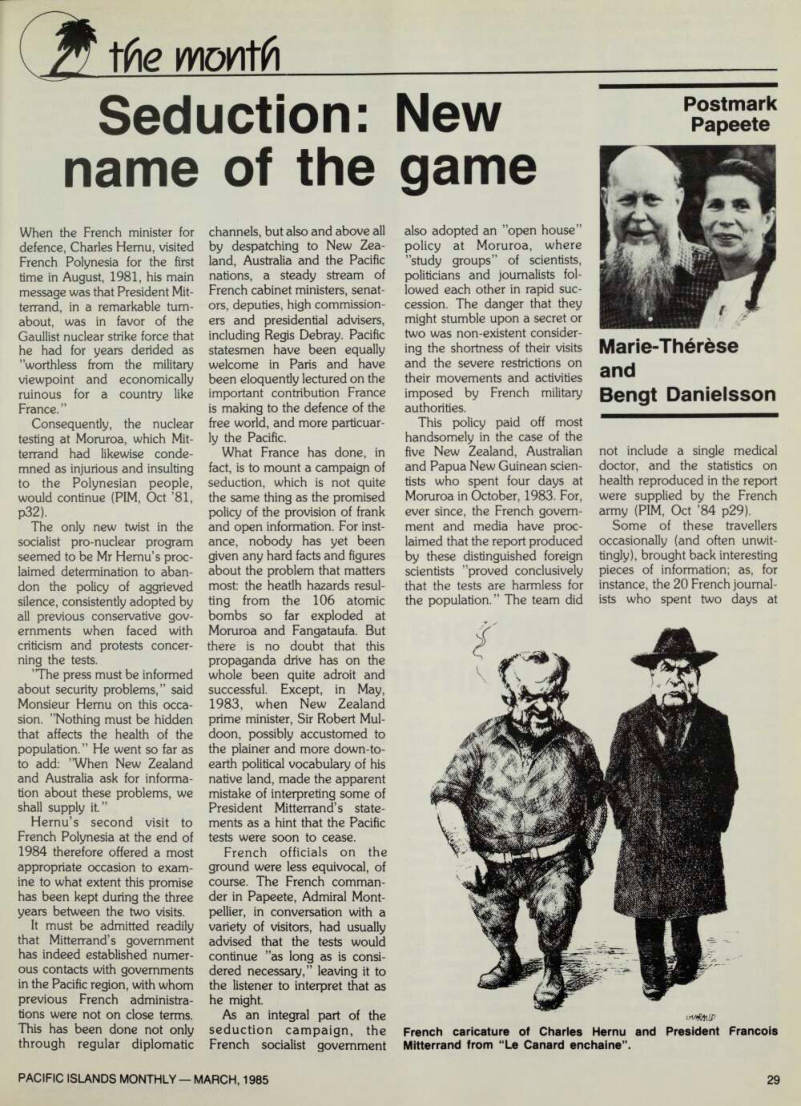
the month
Seduction: New name of the game
When the French minister for defence, Charles Hemu, visited French Polynesia for the first time in August, 1981, his main message was that President Mit terrand, in a remarkable turn about, was in favor of the Gaullist nuclear strike force that he had for years derided as ’’worthless from the military viewpoint and economically ruinous for a country like France. ”
Consequently, the nuclear testing at Moruroa, which Mit terrand had likewise conde mned as injurious and insulting to the Polynesian people, would continue (PIM, Oct ’Bl, p 32).
The only new twist in the socialist pro-nuclear program seemed to be Mr Hemu’s proc laimed determination to aban don the policy of aggrieved silence, consistently adopted by all previous conservative gov ernments when faced with criticism and protests concer ning the tests. ’The press must be informed about security problems,” said Monsieur Hemu on this occa sion. ’’Nothing must be hidden that affects the health of the population. ” He went so far as to add: ’’When New Zealand and Australia ask for informa tion about these problems, we shall supply it.”
Hernu’s second visit to French Polynesia at the end of 1984 therefore offered a most appropriate occasion to exam ine to what extent this promise has been kept during the three years between the two visits.
It must be admitted readily that Mitterrand’s government has indeed established numer ous contacts with governments in the Pacific region, with whom previous French administra tions were not on close terms.
This has been done not only through regular diplomatic
channels, but also and above all by despatching to New Zea land, Australia and the Pacific nations, a steady stream of French cabinet ministers, senat ors, deputies, high commission ers and presidential advisers, including Regis Debray. Pacific statesmen have been equally welcome in Paris and have been eloquently lectured on the important contribution France is making to the defence of the free world, and more particuar ly the Pacific.
What France has done, in fact, is to mount a campaign of seduction, which is not quite the same thing as the promised policy of the provision of frank and open information. For inst ance, nobody has yet been given any hard facts and figures about the problem that matters most: the heatlh hazards resul ting from the 106 atomic bombs so far exploded at Moruroa and Fangataufa. But there is no doubt that this propaganda drive has on the whole been quite adroit and successful. Except, in May, 1983, when New Zealand prime minister, Sir Robert Mul doon, possibly accustomed to the plainer and more down-to earth political vocabulary of his native land, made the apparent mistake of interpreting some of President Mitterrand’s state ments as a hint that the Pacific tests were soon to cease.
French officials on the ground were less equivocal, of course. The French comman der in Papeete, Admiral Mont pellier, in conversation with a variety of visitors, had usually advised that the tests would continue ”as long as is consi dered necessary,” leaving it to the listener to interpret that as he might.
As an integral part of the seduction campaign, the French socialist government
also adopted an ’’open house” policy at Moruroa, where ’’study groups” of scientists, politicians and journalists fol lowed each other in rapid suc cession. The danger that they might stumble upon a secret or two was non-existent consider ing the shortness of their visits and the severe restrictions on their movements and activities imposed by French military authorities.
This policy paid off most handsomely in the case of the five New Zealand, Australian and Papua New Guinean scien tists who spent four days at Moruroa in October, 1983. For, ever since, the French govern ment and media have proc laimed that the report produced by these distinguished foreign scientists ’’proved conclusively that the tests are harmless for the population.” The team did
Postmark Papeete
not include a single medical doctor, and the statistics on health reproduced in the report were supplied by the French army (PIM, Oct ’B4 p 29).
Some of these travellers occasionally (and often unwit tingly), brought back interesting pieces of information; as, for instance, the 20 French journal ists who spent two days at
Marie-Therese and Bengt Danielsson
French caricature of Charles Hernu and President Francois Mitterrand from “Le Canard enchaine”.
Moruroa at the end of Septem ber, 1984, and published photographs of the four-metre high concrete seawall which is at present being built to protect Moruroa’s installations and per sonnel against future cyclones.
Although 1000 foreign legion naires and Polynesian work men have been mixing 500 cubic metres of concrete per week since 1982, this Pacific Maginot Line still only runs along 10 kilometres of coast line. Comparison with the ill fated Maginot Line is the more justified as Moruroa has a four kilometre wide passage through which hurricane-lashed waves could easily enter and attack the army’s fortress from the rear, exactly as the German troops did when they invaded France in 1940.
Other pictures show for the first time what happens during the explosion of a medium sized atom bomb at a depth of 1000 metres in the base of the atoll.
Due to the tremendous pressure of the blast geysers of sea water shoot 20 metres into the air, from the surface of both the lagoon and the surrounding ocean. The conclusion to be drawn is that the underground combustion chamber hollowed out by the bomb explosion is not as tightly sealed as the test engineers have always main tained.
On the local level, the social ist campaign of seduction has been consierably less success ful. The territorial assemblymen. have steadfastly refused all in vitations to make further flying visits to Moruroa under army guidance. They also have kept insisting vigorously that a re ferendum should be held in French Polynesia to decide whether the tests should con tinue or not. This stand is supported by the Evangelical Church to which the majority of Polynesians belong.
Monsieur Hernu tried to break this deadlock shortly be fore he came out last year for his second tour of inspection.
He sent one of the few French admirals who happens to be a Protestant, Yves Leenhardt, who, during his previous two year term of duty in Tahiti, had been an assiduous church-goer.
At Admiral Leenhardt’s invita tion, half a dozen dignitaries of the local Evangelical Church
eventually consented to take part in a jaunt to Moruroa. The scheme back-fired, for when the army issued a statement saying that ’’the anxiety hitherto felt by the church leaders about the nuclear tests had now been laid to rest,” the Church coun tered with its own statement saying that it was still ’’totally opposed to the nuclear tests at Moruroa, and that it had already written three times to President Mitterrand asking him to stop them.”
To judge from the beaming face of Mr Hemu on his arrival he must have been pleased by the ’’commando raid” on the Evangelical Church. He was still in exuberant mood upon his return three days later from watching a 40-kilotonne blast at Moruroa, inspecting the mari time Maginot Line, and making a swing through the Marquesas.
Only for a brief moment did this sunniness fade and that was in Papeete, during a military ceremony at the monument to the dead of World Wars I and 11, when demonstrators, identified as descendants of King Pomare V, began shouting pro-inde pendence slogans. The offen ders were seized by squads of
plain clothes police and drag ged off to the local lock-up where, according to one of the local newspapers, ’’they were made to confess their crime.”
This seemed to be no more than heckling the minister.
Later the same day, during interviews with representatives of the government-owned tv and radio stations and the French press, Hemu was flip pant in answering some of the serious questions. For instance: Question: What is your answer to Premier Gaston Flos se’s request that a referendum be held for or against nuclear testing?
Answer: I have had only a private lunch with Mr Flosse, at which our wives were present, and therefore we did not dis cuss this matter. But we shall certainly find another occasion to do so.
Q: Why are the tests not carried out in France?
A: Polynesia is French, so the tests are carried out in France.
The only exchange which produced a firm policy state ment concerned the future tes ting program: Q: Can we take it that your visit to the Marquesas was not purely made as a tourist, but
that you also plan to develop some military activities there?
A; To some extent I was a tourist. I visited the splendid Catholic Cathedral at Taiohae, in the company of Bishop Cleach, as well as the graves of Gauguin and Jacques Brel at Atuona. But I was also there to inspect the islands, officially, by helicopter which enabled me to observe, by the way, how greatly the islanders appreciate the French gendarmes and their wives. But if you imagine that the main reason for my trip was to see whether the Marquesas could be used for nuclear tes ting, the answer is no. We own Moruroa and intend to continue our testing there, despite all foreign protests, which, inci dentally, are very feeble. In addition, we shall certainly also one day start using the nearby atoll of Fangataufa again for our nuclear program.
When Hemu boarded his plane to fly back to France, he had still not found time to answer the demands by the elected representatives of the Polynesian people for a re ferendum, a health survey, and an end to the nuclear tests.
Marie-Therese and Bengt Danielsson
signifying little
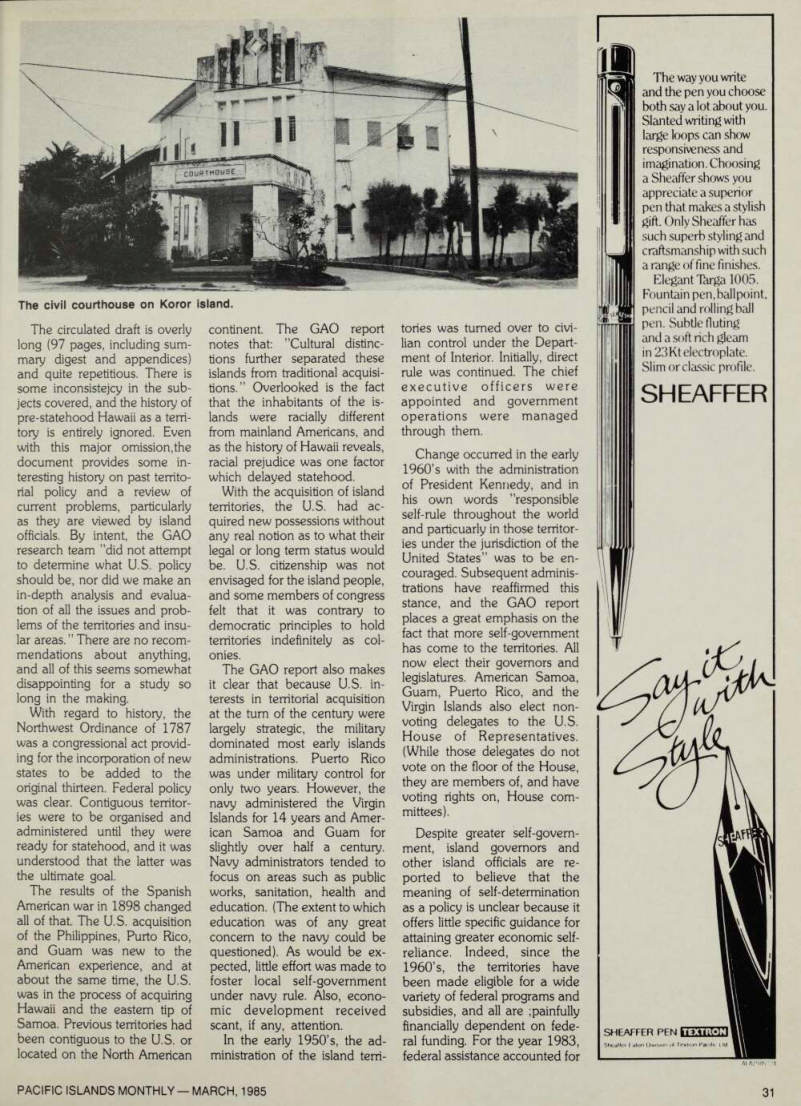
U.S. policies study
Plethora of paper signifying little
It was reported earlier in this column (PIM, December, 1983, pl 4), that U.S.Senator James A.McClure (Republican, Ida ho), had requested the U.S.General Accounting Office (GAO), to conduct a compre hensive study of federal policies for U.S. territories and insular possessions. Senator McClure chairs important congressional committees which review legislation pertaining to the ter ritories, and he felt that a major review of U.S. policy was ne cessary for future planning. The study was first requested by McClure in March, 1983, when he expressed the concern that present methods for handling territorial affairs inhibited ’’the ability of Congress to properly discharge its responsibilities.”
The GAO research was actually conducted from June, 1983, to April, 1984. It in volved a literature search on past and present territorial poli cy and interviews with a wide range of government officials in Washington, D.C., and U.S. territories in the Caribbean as well as the Pacific. The results, Issues Affecting U.S. Territory and Insular Policy were circu lated as a confidential ’’draft of a proposed report” in October of last year. The draft was for the purpose of obtaining feed back from officials with respon sibilities concerning the topics discussed in it. Presumably, these would include many of those who were interviewed by the GAO staff. In a December article, Guam’s Pacific Daily
A View from Honolulu
News quoted Governor Ricar do J.Bordallo to the effect that the draft contained no surprises and reflected much that he had told GAO interviewers. Revi sions may occur before the final version is released for public consumption, but as of early February, the document had not surfaced, at least in Honolu lu.
Robert C. Kiste looks at the Pacific
The circulated draft is overly long (97 pages, including sum mary digest and appendices) and quite repetitious. There is some inconsistejcy in the sub jects covered, and the history of pre-statehood Hawaii as a terri tory is entirely ignored. Even with this major omission,the document provides some in teresting history on past territo rial policy and a review of current problems, particularly as they are viewed by island officials. By intent, the GAO research team ’’did not attempt to determine what U.S. policy should be, nor did we make an in-depth analysis and evalua tion of all the issues and prob lems of the territories and insu lar areas. ” There are no recom mendations about anything, and all of this seems somewhat disappointing for a study so long in the making.
With regard to history, the Northwest Ordinance of 1787 was a congressional act provid ing for the incorporation of new states to be added to the original thirteen. Federal policy was clear. Contiguous territor ies were to be organised and administered until they were ready for statehood, and it was understood that the latter was the ultimate goal.
The results of the Spanish American war in 1898 changed all of that. The U.S. acquisition of the Philippines, Purto Rico, and Guam was new to the American experience, and at about the same time, the U.S. was in the process of acquiring Hawaii and the eastern tip of Samoa. Previous territories had been contiguous to the U.S. or located on the North American
continent. The GAO report notes that: ’’Cultural distinc tions further separated these islands from traditional acquisi tions.” Overlooked is the fact that the inhabitants of the is lands were racially different from mainland Americans, and as the history of Hawaii reveals, racial prejudice was one factor which delayed statehood.
With the acquisition of island territories, the U.S. had ac quired new possessions without any real notion as to what their legal or long term status would be. U.S. citizenship was not envisaged for the island people, and some members of congress felt that it was contrary to democratic principles to hold territories indefinitely as col onies.
The GAO report also makes it clear that because U.S. in terests in territorial acquisition at the turn of the century were largely strategic, the military dominated most early islands administrations. Puerto Rico was under military control for only two years. However, the navy administered the Virgin Islands for 14 years and Amer ican Samoa and Guam for slightly over half a century.
Navy administrators tended to focus on areas such as public works, sanitation, health and education. (The extent to which education was of any great concern to the navy could be questioned). As would be ex pected, little effort was made to foster local self-government under navy rule. Also, econo mic development received scant, if any, attention.
In the early 1950’5, the ad ministration of the island terri
tones was turned over to civi lian control under the Depart ment of Interior. Initially, direct rule was continued. The chief executive officers were appointed and government operations were managed through them.
Change occurred in the early 1960’s with the administration of President Kennedy, and in his own words ’’responsible self-rule throughout the world and particuarly in those territor ies under the jurisdiction of the United States” was to be en couraged. Subsequent adminis trations have reaffirmed this stance, and the GAO report places a great emphasis on the fact that more self-government has come to the territories. All now elect their governors and legislatures. American Samoa, Guam, Puerto Rico, and the Virgin Islands also elect non voting delegates to the U.S.
House of Representatives. (While those delegates do not vote on the floor of the House, they are members of, and have voting rights on, House com mittees).
Despite greater self-govern ment, island governors and other island officials are re ported to believe that the meaning of self-determination as a policy is unclear because it offers little specific guidance for attaining greater economic self reliance. Indeed, since the 1960’5, the territories have been made eligible for a wide variety of federal programs and subsidies, and all are ;painfully financially dependent on fede ral funding. For the year 1983, federal assistance accounted for
The civil courthouse on Koror island.
92 per cent, of American Samoa’s budget, 74 per cent of Guam’s, 85 per cent of the Commonwealth of the North ern Marianas, and 85 per cent of the Trust Territory’s. In the Caribbean, the figures for Puer to Rico and the Virgin Islands are in the same range.
The Department of the In terior has shifted from its role of direct administration to that of a facilitator to help the territorial governments in dealing with federal agencies. Territorial offi cials do not believe that Interior is effective in this new role.
Apparently they note that In terior’s main areas of interest land management, national for ests and parks, and minerals are not relevant for the territor ies. All territories want a greater voice at the national level, but there is no agreement as to how this should be done. Guam’s Bordalloi calls for a ’’Depart ment of Overseas Territories at a cabinet level with a secretary and everything.”
Island officials also report on
difficulties in dealing with va rious federal agencies and laws.
In 1983, at least 15 separate agencies provided direct finan cial assistance to the territories, and there was no coordination among those efforts.
There is also no overall policy to guide how territories should be treated in framing and enfor cing laws, and some laws apply to some territories, but not to others. As one example, Guam officials object to the Merchant Marine Act of 1920 (the Jones Act). It hampers Guam’s ability to develop a tuna transship ment industry because foreign vessels cannot be used to move cargo, in this case tuna, be tween two points in the U.S.
The Jones Act also prohibits the off-loading of tuna by foreign vessels. Guam officials believe the Act should not apply to Guam because of its great distance from the U.S. and because both American Samoa and the neighboring Common wealth of the Northern Marianas are exempt.
Perhaps one overall concern that comes through in the re port is that both island officials and some Washington obser vers feel keenly that there has been no comprehensive effort to establish a clear and consis tent policy for the territories.
Federal action is viewed as often haphazard. Greater eco nomic development is needed, and the ultimate status of terri tories other than the Trust Terri tory remains ambiguous.
That ambiguousness and de velopments in the Trust Terri tory are causing some reflection in the islands as to what future political status might be desir able for them. The people of Guam are comparing their own territorial status to the Com monwealth arrangement that the Northern Marianas have negotiated, and there is some sentiment that perhaps their northern neighbors struck a better deal with Uncle Sam.
As Belau, the Federated States of Micronesia, and the Marshalls move toward free
association, they will be able to handle a substantial amount of their own external relations, seek assistance from other na tions, establish their own im migration policies, and so on, and they will be receiving large financial subsidies from the U.S. For obvious reasons, the other island territories are close ly monitoring the unfolding of the new arrangement between the Micronesians and the U.S.
The GAO report clearly re flects that the prevailing opinion in the nation’s capital, as well as in the islands, is that the territor ies have not been administered well and that the lack of policy causes problems and discontent for those who would wish to do well. In a sense, the GAO effort is very American in character.
There is a sense that a problem exists, and the response is to spend a good deal of money to study it. Somehow there is faith that all of this will help resolve the problem but one cannot be hopeful in this case. Robert Kiste.
Advertisements & other items, pp. 31-32 (1 item)
Sheaffer
The way you write and the pen you choose both say a lot about you.
Slanted writing with large loops can show responsiveness and imagination. Choosing a Sheaffer shows you appreciate a superior pen that makes a stylish gift. Only Sheaffer has such superb styling and craftsmanship with such a range of fine finishes.
Elegant Thrga 1005.
Fountain pen,ballpoint, pencil and rolling ball pen. Subtle fluting and a soft rich gleam in 23 Kt electroplate.
Slim or classic profile.
SHEAFFER
SHEAFFER PEN liTil
Instant HOUSES
with Therma-Panel®
The fully insulated panelised building system
George Hudson,
the name' in home building tor 100 years' The established name with A new ideas!
The home you can assemble!
Economical fast and simple
Cyclone resistant Ideal for the South Pacific regions GH IT George Hudson have supplied to: • Tonga
• PNG
• Solomon islands • Tuvalu and • American Samoa George Hudson Homes (Aust.) Rty. Ltd. 186 Hume Highway Cabramatla NSW 2166 Australia Tel: (02) 727 9066. Telex: AA25800 Post coupon for details and prices.
they’re looking
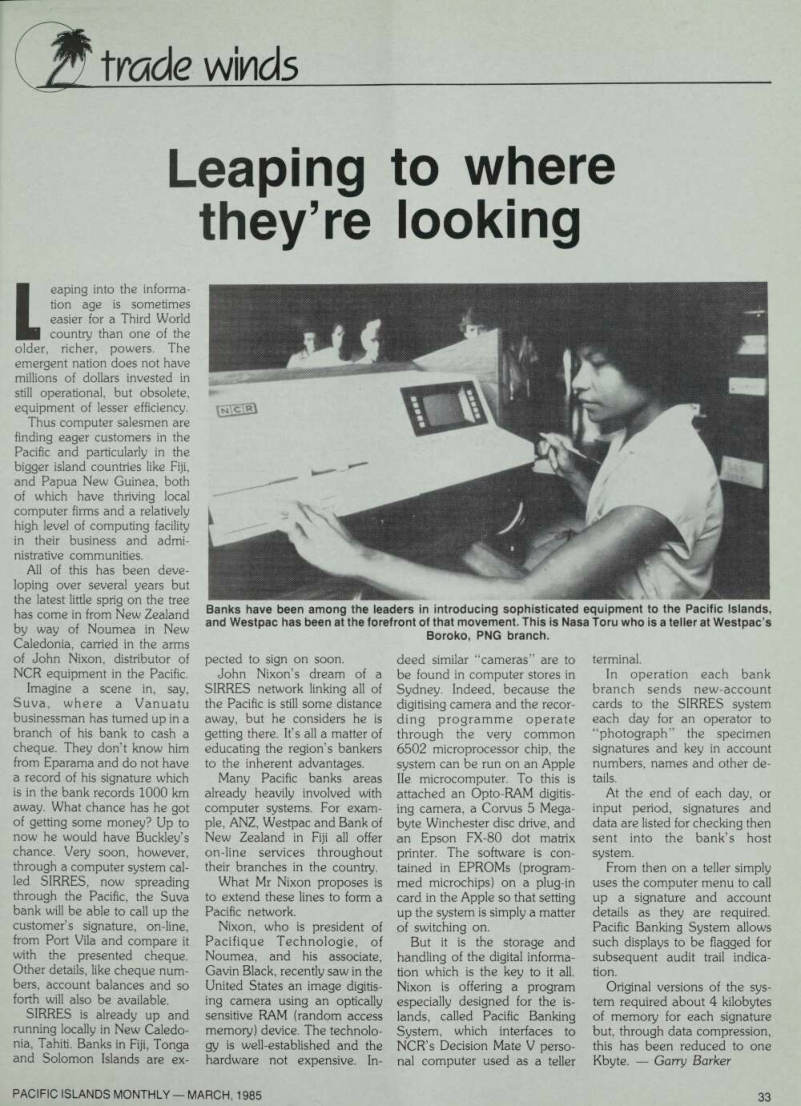
trade winds
Leaping to where they’re looking
Leaping into the informa tion age is sometimes easier for a Third World country than one of the older, richer, powers. The emergent nation does not have millions of dollars invested in still operational, but obsolete, equipment of lesser efficiency.
Thus computer salesmen are finding eager customers in the Pacific and particularly in the bigger island countries like Fiji, and Papua New Guinea, both of which have thriving local computer firms and a relatively high level of computing facility in their business and admi nistrative communities.
All of this has been deve loping over several years but the latest little sprig on the tree has come in from New Zealand by way of Noumea in New Caledonia, carried in the arms of John Nixon, distributor of NCR equipment in the Pacific.
Imagine a scene in, say, Suva, where a Vanuatu businessman has turned up in a branch of his bank to cash a cheque. They don’t know him from Eparama and do not have a record of his signature which is in the bank records 1000 km away. What chance has he got of getting some money? Up to now he would have Buckley’s chance. Very soon, however, through a computer system cal led SIRRES, now spreading through the Pacific, the Suva bank will be able to call up the customer’s signature, on-line, from Port Vila and compare it with the presented cheque.
Other details, like cheque num bers, account balances and so forth will also be available.
SIRRES is already up and running locally in New Caledo nia, Tahiti. Banks in Fiji, Tonga and Solomon Islands are ex-
pected to sign on soon.
John Nixon’s dream of a SIRRES network linking all of the Pacific is still some distance away, but he considers he is getting there. It’s all a matter of educating the region’s bankers to the inherent advantages.
Many Pacific banks areas already heavily involved with computer systems. For exam ple, ANZ, Westpac and Bank of New Zealand in Fiji all offer on-line services throughout their branches in the country.
What Mr Nixon proposes is to extend these lines to form a Pacific network.
Nixon, who is president of Pacifique Technologic, of Noumea, and his associate, Gavin Black, recently saw in the United States an image digitis ing camera using an optically sensitive RAM (random access memory) device. The technolo gy is well-established and the hardware not expensive. In
deed similar “cameras” are to be found in computer stores in Sydney. Indeed, because the digitising camera and the recor ding programme operate through the very common 6502 microprocessor chip, the system can be run on an Apple lie microcomputer. To this is attached an Opto-RAM digitis ing camera, a Corvus 5 Mega byte Winchester disc drive, and an Epson FX-80 dot matrix printer. The software is con tained in EPROMs (program med microchips) on a plug-in card in the Apple so that setting up the system is simply a matter of switching on.
But it is the storage and handling of the digital informa tion which is the key to it all.
Nixon is offering a program especially designed for the is lands, called Pacific Banking System, which interfaces to NCR’s Decision Mate V perso nal computer used as a teller
terminal.
In operation each bank branch sends new-account cards to the SIRRES system each day for an operator to “photograph” the specimen signatures and key in account numbers, names and other de tails.
At the end of each day, or input period, signatures and data are listed for checking then sent into the bank’s host system.
From then on a teller simply uses the computer menu to call up a signature and account details as they are required.
Pacific Banking System allows such displays to be flagged for subsequent audit trail indica tion.
Original versions of the sys tem required about 4 kilobytes of memory for each signature but, through data compression, this has been reduced to one
Kbyte.
Garry Barker
Banks have been among the leaders in introducing sophisticated equipment to the Pacific Islands, and Westpac has been at the forefront of that movement. This is Nasa Tom who is a teller at Westpac’s Boroko, PNG branch.
Advertisements & other items, pp. 34-35 (1 item)
Toyota
QUALITY SERVICE
AMERICAN SAMOA: BURNS PHILP (SOUTH SEA) CO., LTD., P.O. Box 129, Pago Pago.
COOK ISLANDS: COOK ISLANDS TRADING
CORPORATION LTD., Private Bag, Rarotonga.
FIJI: AUTOMOTIVE SUPPLIES COMPANY, A Division of Burns Philp (South Sea) Co., Ltd., G.P.O. Box 355, Suva.
GUAM & MICRONESIA: ATKINS KROLL, INC., 443 South Marine Drive, Tamuning.
KIRIBATI: TARAWA MOTORS, P.O. Box 36, Bairiki, Tarawa.
NAURU: NAURU COOPERATIVE SOCIETY, Central
Pacific.
NEW CALEDONIA: SERVICE IMPORTATION
AUTOMOBILE DU PACIFIQUE, Rond-Point du Pacifique « (Station Total) B.P. 438, Noumea.
NORFOLK ISLAND: BORRYS LIMITED, P.O. Box 169.
PAPUA NEW GUINEA: ELA MOTORS, A Division oft Burns Philp (PNG) Ltd., P.O. Box 75, Port Moresby.
SAIPAN: MICROL CORPORATION, P.O. Box 267, Saipan.
he tradition of power and ruggedness goes on.
Pickup
tyota’s new Land Cruiser has been entirely “signed from the road up. But it still ins the traditional toughness <g| uired from over thirty years sad experience.
But no matter how rough it gets a roomy new cabin with improved occupant comforts, easy instrumentation and an optional 4-speed automatic transmission add up to passenger car comfort with Land Cruiser ruggedness.
More power in hand and fuel efficiency have been gained with a new brawny 4.0-litre gasoline engine.
And to control all that power a new rigid chassis assures stable driving performance and mobility over the roughest terrain.
And you can choose from a wide variety of models and an array of heavy-duty features.
Take the wheel and feel Toyota quality in Land Cruiser’s styling, power and comfort. A quality that stays with you on or off the road.
Step into a new generation of toughness today.
.OMON: SOLOMON ISLANDS INVESTMENTS LTD.,
D. Box 174, Honiara.
IITI: NIPPON AUTOMOTO, B.P. 342, Papeete.
IGA: BURNS PHILP (SOUTH SEA) CO., LTD., P.O. 55, Nuku’alofa. lUATU: VANUATU MOTORS, A Division of Burns p (Vanuatu) Ltd., P.O. Box 18, Port Vila.
STERN SAMOA: BURNS PHILP (SOUTH SEA) CO., P.O. Box 188, Apia.
TOYOTA
off in Tahiti
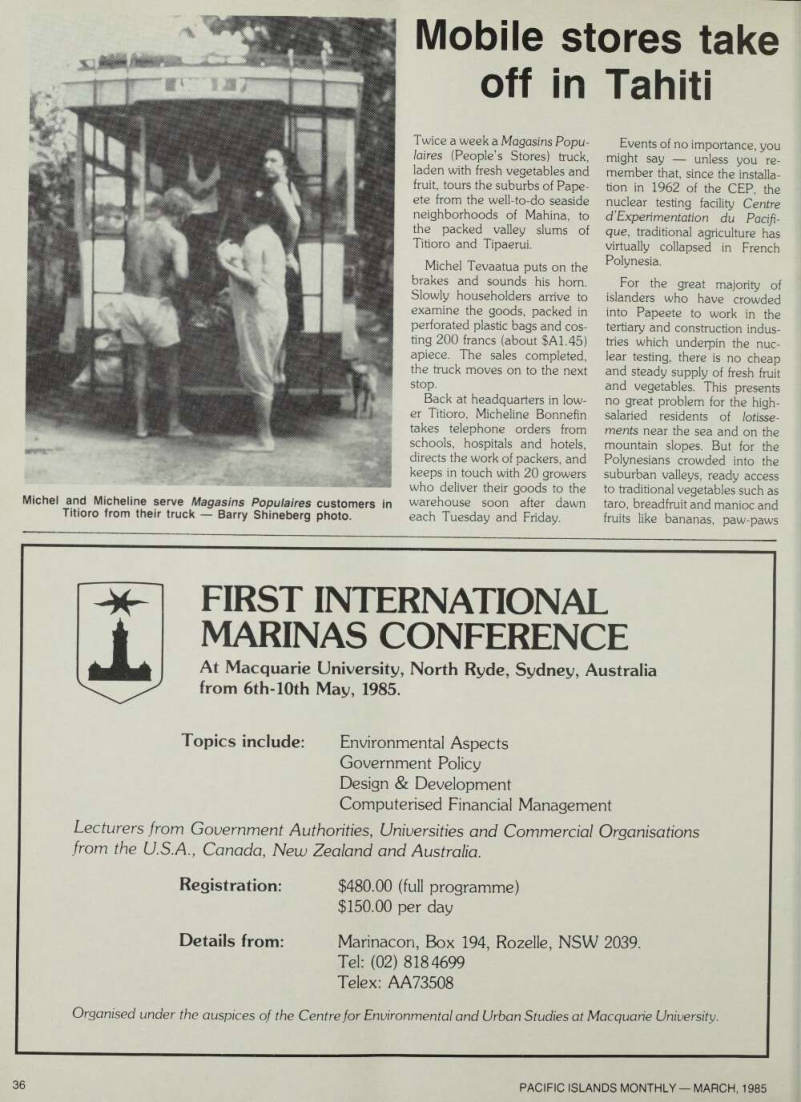
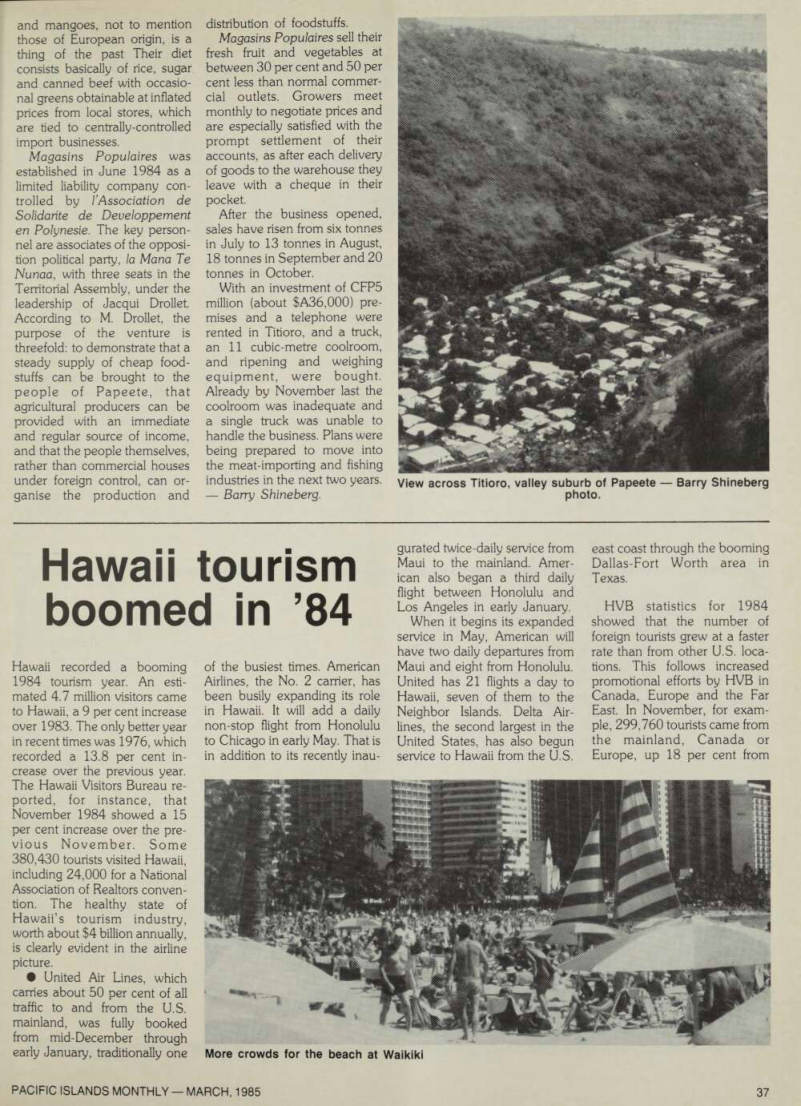
Mobile stores take off in Tahiti
Twice a week a Magasins Popu lates (People’s Stores) truck, laden with fresh vegetables and fruit, tours the suburbs of Pape ete from the well-to-do seaside neighborhoods of Mahina, to the packed valley slums of Titioro and Tipaerui.
Michel Tevaatua puts on the brakes and sounds his horn.
Slowly householders arrive to examine the goods, packed in perforated plastic bags and cos ting 200 francs (about $A1.45) apiece. The sales completed, the truck moves on to the next stop.
Back at headquarters in low er Titioro, Micheline Bonnefin takes telephone orders from schools, hospitals and hotels, directs the work of packers, and keeps in touch with 20 growers who deliver their goods to the warehouse soon after dawn each Tuesday and Friday.
Events of no importance, you might say unless you re member that, since the installa tion in 1962 of the CEP, the nuclear testing facility Centre d’Experimentation du Pacifi que, traditional agriculture has virtually collapsed in French Polynesia.
For the great majority of islanders who have crowded into Papeete to work in the tertiary and construction indus tries which underpin the nuc lear testing, there is no cheap and steady supply of fresh fruit and vegetables. This presents no great problem for the high salaried residents of lotisse ments near the sea and on the mountain slopes. But for the Polynesians crowded into the suburban valleys, ready access to traditional vegetables such as taro, breadfruit and manioc and fruits like bananas, paw-paws
Michel and Micheline serve Magasins Populaires customers in Titioro from their truck Barry Shineberg photo.
and mangoes, not to mention those of European origin, is a thing of the past Their diet consists basically of rice, sugar and canned beef with occasio nal greens obtainable at inflated prices from local stores, which are tied to centrally-controlled import businesses.
Magasins Populaires was established in June 1984 as a limited liability company con trolled by I’Association de Solidarite de Developpement en Polynesia. The key person nel are associates of the opposi tion political party, la Mana Te Nunaa, with three seats in the Territorial Assembly, under the leadership of Jacqui Drollet.
According to M. Drollet, the purpose of the venture is threefold: to demonstrate that a steady supply of cheap food stuffs can be brought to the people of Papeete, that agricultural producers can be provided with an immediate and regular source of income, and that the people themselves, rather than commercial houses under foreign control, can or ganise the production and
distribution of foodstuffs.
Magasins Populaires sell their fresh fruit and vegetables at between 30 per cent and 50 per cent less than normal commer cial outlets. Growers meet monthly to negotiate prices and are especially satisfied with the prompt settlement of their accounts, as after each delivery of goods to the warehouse they leave with a cheque in their pocket.
After the business opened, sales have risen from six tonnes in July to 13 tonnes in August, 18 tonnes in September and 20 tonnes in October.
With an investment of CFPS million (about $A36,000) pre mises and a telephone were rented in Titioro, and a truck, an 11 cubic-metre coolroom, and ripening and weighing equipment, were bought.
Already by November last the coolroom was inadequate and a single truck was unable to handle the business. Plans were being prepared to move into the meat-importing and fishing industries in the next two years.
Barry Shineberg.
View across Titioro, valley suburb of Papeete Barry Shineberg photo.
Advertisements & other items, p. 36 (1 item)
Marinas Conference
FIRST INTERNATIONAL
At Macquarie University, North Ryde, Sydney, Australia from 6th-10th May, 1985.
Topics include: Environmental Aspects Government Policy Design & Development Computerised Financial Management Lecturers from Government Authorities, Universities and Commercial Organisations from the U.S.A., Canada, New Zealand and Australia.
Registration: $480.00 (full programme) $150.00 per day Details from: Marinacon, Box 194, Rozelle, NSW 2039.
Tel: (02) 8184699 Telex: AA73508 Organised under the auspices of the Centre for Environmental and Urban Studies at Macquarie University.
Hawaii tourism
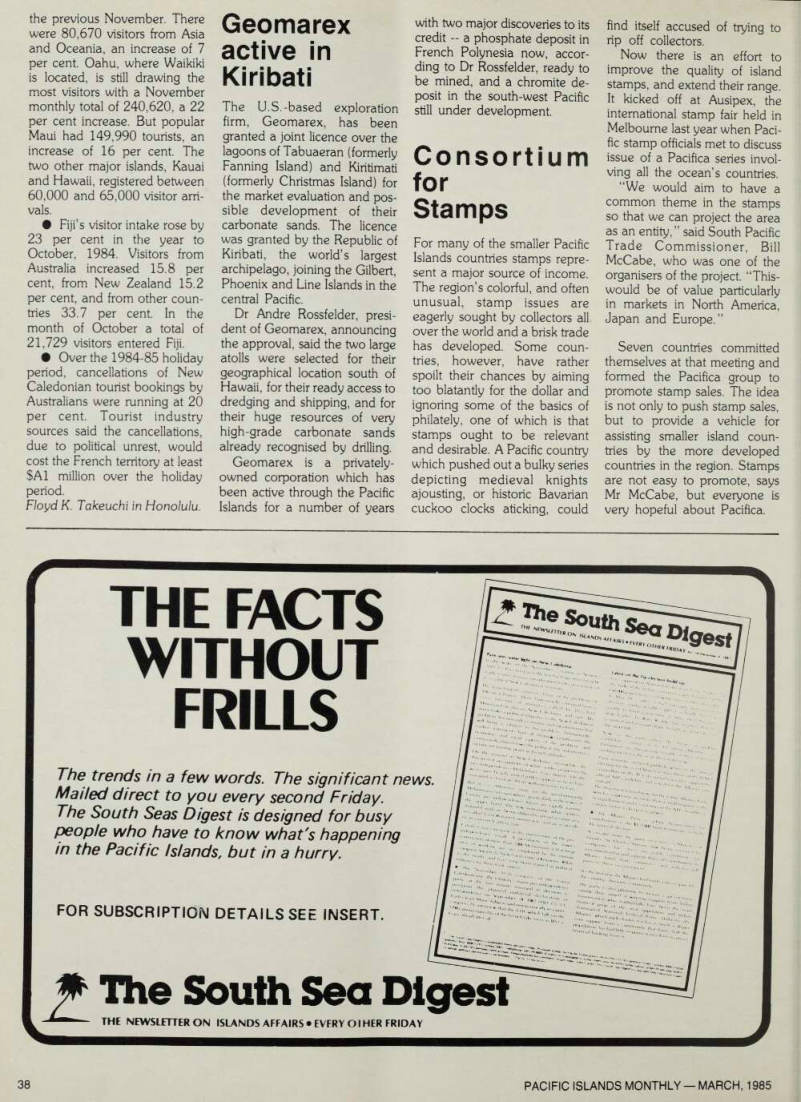
boomed in ’84
Hawaii recorded a booming 1984 tourism year. An esti mated 4.7 million visitors came to Hawaii, a 9 per cent increase over 1983. The only better year in recent times was 1976, which recorded a 13.8 per cent in crease over the previous year.
The Hawaii Visitors Bureau re ported, for instance, that November 1984 showed a 15 per cent increase over the pre vious November. Some 380,430 tourists visited Hawaii, including 24,000 for a National Association of Realtors conven tion. The healthy state of Hawaii’s tourism industry, worth about $4 billion annually, is clearly evident in the airline picture. • United Air Lines, which carries about 50 per cent of all traffic to and from the U.S. mainland, was fully booked from mid-December through early January, traditionally one
of the busiest times. American Airlines, the No. 2 carrier, has been busily expanding its role in Hawaii. It will add a daily non-stop flight from Honolulu to Chicago in early May. That is in addition to its recently inau
gurated twice-daily service from Maui to the mainland. Amer ican also began a third daily flight between Honolulu and Los Angeles in early January.
When it begins its expanded service in May, American will have two daily departures from Maui and eight from Honolulu.
United has 21 flights a day to Hawaii, seven of them to the Neighbor Islands. Delta Air lines, the second largest in the United States, has also begun service to Hawaii from the U.S.
east coast through the booming Dallas-Fort Worth area in Texas.
HVB statistics for 1984 showed that the number of foreign tourists grew at a faster rate than from other U.S. loca tions. This follows increased promotional efforts by HVB in Canada, Europe and the Far East. In November, for exam ple, 299,760 tourists came from the mainland, Canada or Europe, up 18 per cent from
More crowds for the beach at Waikiki
the previous November. There were 80,670 visitors from Asia and Oceania, an increase of 7 per cent. Oahu, where Waikiki is located, is still drawing the most visitors with a November monthly total of 240,620, a 22 per cent increase. But popular Maui had 149,990 tourists, an increase of 16 per cent. The two other major islands, Kauai and Hawaii, registered between 60,000 and 65,000 visitor arri vals. • Fiji’s visitor intake rose by 23 per cent in the year to October, 1984. Visitors from Australia increased 15.8 per cent, from New Zealand 15.2 per cent, and from other coun tries 33.7 per cent. In the month of October a total of 21,729 visitors entered Fiji. • Over the 1984-85 holiday period, cancellations of New Caledonian tourist bookings by Australians were running at 20 per cent. Tourist industry sources said the cancellations, due to political unrest, would cost the French territory at least SAI million over the holiday period.
F/oyd K. Takeuchi in Honolulu.
Geomarex
active in
Kiribati
The U.S. -based exploration firm, Geomarex, has been granted a joint licence over the lagoons of Tabuaeran (formerly Fanning Island) and Kiritimati (formerly Christmas Island) for the market evaluation and pos sible development of their carbonate sands. The licence was granted by the Republic of Kiribati, the world’s largest archipelago, joining the Gilbert, Phoenix and Line Islands in the central Pacific.
Dr Andre Rossfelder, presi dent of Geomarex, announcing the approval, said the two large atolls were selected for their geographical location south of Hawaii, for their ready access to dredging and shipping, and for their huge resources of very high-grade carbonate sands already recognised by drilling.
Geomarex is a privately owned corporation which has been active through the Pacific Islands for a number of years
with two major discoveries to its credit - a phosphate deposit in French Polynesia now, accor ding to Dr Rossfelder, ready to be mined, and a chromite de posit in the south-west Pacific still under development.
Consortium
for
Stamps
For many of the smaller Pacific Islands countries stamps repre sent a major source of income.
The region’s colorful, and often unusual, stamp issues are eagerly sought by collectors all over the world and a brisk trade has developed. Some coun tries, however, have rather spoilt their chances by aiming too blatantly for the dollar and ignoring some of the basics of philately, one of which is that stamps ought to be relevant and desirable. A Pacific country which pushed out a bulky series depicting medieval knights ajousting, or historic Bavarian cuckoo clocks aticking, could
find itself accused of trying to rip off collectors.
Now there is an effort to improve the quality of island stamps, and extend their range.
It kicked off at Ausipex, the international stamp fair held in Melbourne last year when Paci fic stamp officials met to discuss issue of a Pacifica series invol ving all the ocean’s countries.
“We would aim to have a common theme in the stamps so that we can project the area as an entity,” said South Pacific Trade Commissioner, Bill McCabe, who was one of the organisers of the project. “This would be of value particularly in markets in North America, Japan and Europe.”
Seven countries committed themselves at that meeting and formed the Pacifica group to promote stamp sales. The idea is not only to push stamp sales, but to provide a vehicle for assisting smaller island coun tries by the more developed countries in the region. Stamps are not easy to promote, says Mr McCabe, but everyone is very hopeful about Pacifica.
Advertisements & other items, p. 38 (1 item)
The Facts
WITHOUT
FRILLS
The trends in a few words. The significant news Mailed direct to you every second Friday.
The South Seas Digest is designed for busy people who have to know what's happening m the Pacific Islands, but in a hurry.
FOR SUBSCRIPTION DETAILS SEE INSERT.
w The South Sea Digest
THE NEWSLETTER ON ISLANDS AFFAIRS* EVERY OI HER FRIDAY file So uth Sea Di Orest
backyard vegetable patch
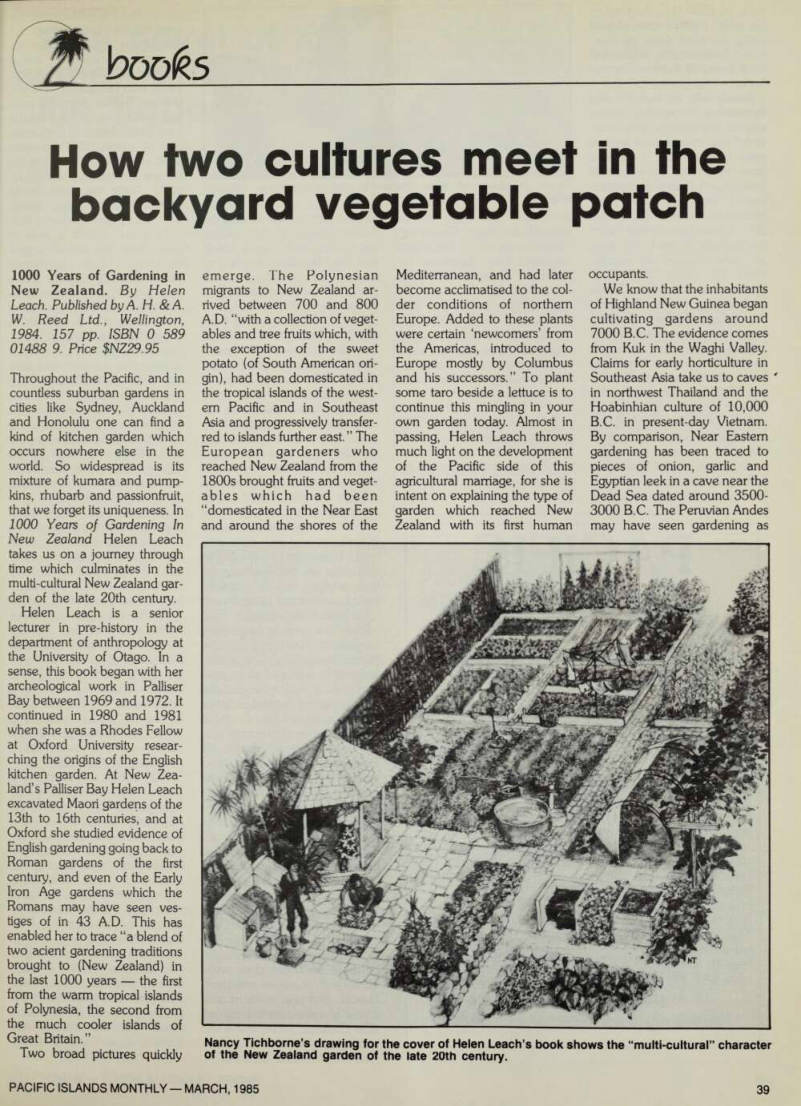
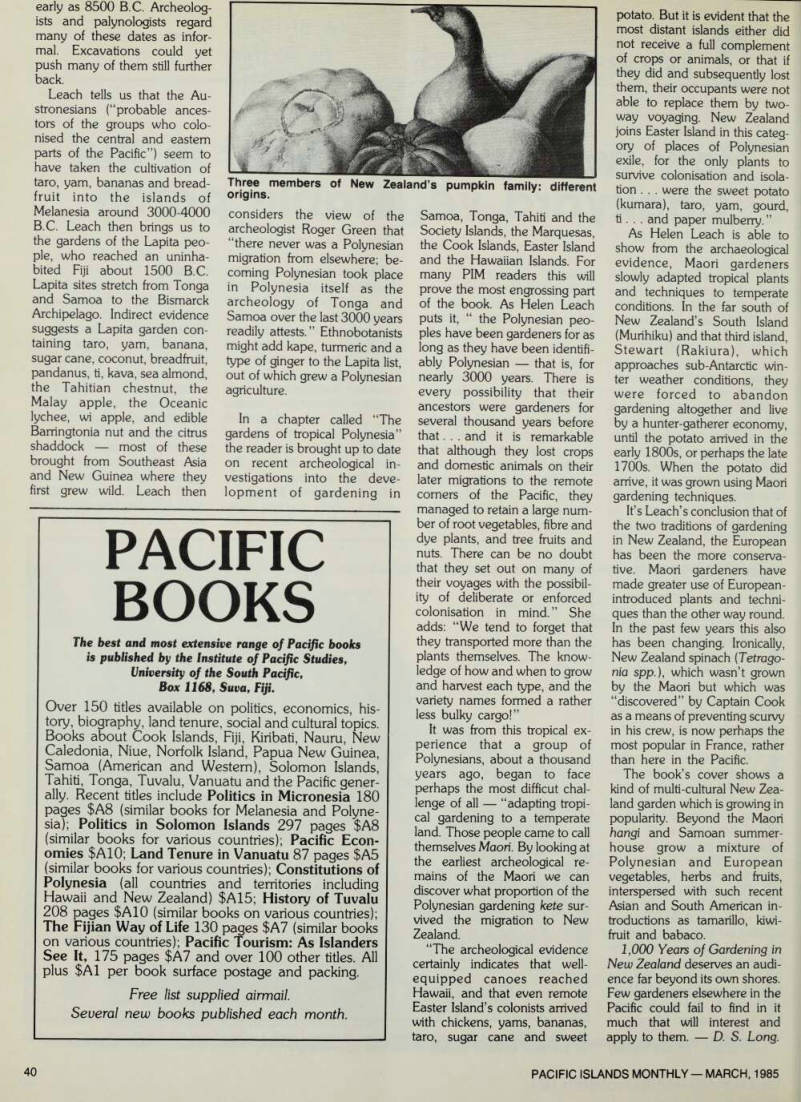
books
How two cultures meet in the backyard vegetable patch
1000 Years of Gardening in New Zealand. By Helen Leach. Published by A. H. &A.
IV. Reed Ltd., Wellington, 1984. 157 pp. ISBN 0 589 01488 9. Price $NZ29.95 Throughout the Pacific, and in countless suburban gardens in cities like Sydney, Auckland and Honolulu one can find a kind of kitchen garden which occurs nowhere else in the world. So widespread is its mixture of kumara and pump kins, rhubarb and passionfruit, that we forget its uniqueness. In 1000 Years of Gardening In New Zealand Helen Leach takes us on a journey through time which culminates in the multi-cultural New Zealand gar den of the late 20th century.
Helen Leach is a senior lecturer in pre-history in the department of anthropology at the University of Otago. In a sense, this book began with her archeological work in Palliser Bay between 1969 and 1972. It continued in 1980 and 1981 when she was a Rhodes Fellow at Oxford University resear ching the origins of the English kitchen garden. At New Zea land’s Palliser Bay Helen Leach excavated Maori gardens of the 13th to 16th centuries, and at Oxford she studied evidence of English gardening going back to Roman gardens of the first century, and even of the Early Iron Age gardens which the Romans may have seen ves tiges of in 43 A.D. This has enabled her to trace “a blend of two acient gardening traditions brought to (New Zealand) in the last 1000 years the first from the warm tropical islands of Polynesia, the second from the much cooler islands of Great Britain.”
Two broad pictures quickly
emerge. The Polynesian migrants to New Zealand ar rived between 700 and 800 A.D. “with a collection of veget ables and tree fruits which, with the exception of the sweet potato (of South American ori gin), had been domesticated in the tropical islands of the west ern Pacific and in Southeast Asia and progressively transfer red to islands further east. ” The European gardeners who reached New Zealand from the 1800 s brought fruits and veget ables which had been “domesticated in the Near East and around the shores of the
Mediterranean, and had later become acclimatised to the col der conditions of northern Europe. Added to these plants were certain ‘newcomers’ from the Americas, introduced to Europe mostly by Columbus and his successors.” To plant some taro beside a lettuce is to continue this mingling in your own garden today. Almost in passing, Helen Leach throws much light on the development of the Pacific side of this agricultural marriage, for she is intent on explaining the type of garden which reached New Zealand with its first human
occupants.
We know that the inhabitants of Highland New Guinea began cultivating gardens around 7000 B.C. The evidence comes from Kuk in the Waghi Valley.
Claims for early horticulture in Southeast Asia take us to caves in northwest Thailand and the Hoabinhian culture of 10,000 B.C. in present-day Vietnam.
By comparison, Near Eastern gardening has been traced to pieces of onion, garlic and Egyptian leek in a cave near the Dead Sea dated around 3500- 3000 B.C. The Peruvian Andes may have seen gardening as
Nancy Tichborne’s drawing for the cover of Helen Leach’s book shows the “multi-cultural” character of the New Zealand garden of the late 20th century.
early as 8500 B.C. Archeolog ists and palynologists regard many of these dates as infor mal. Excavations could yet push many of them still further back.
Leach tells us that the Au stronesians (“probable ances tors of the groups who colo nised the central and eastern parts of the Pacific”) seem to have taken the cultivation of taro, yam, bananas and bread fruit into the islands of Melanesia around 3000-4000 B.C. Leach then brings us to the gardens of the Lapita peo ple, who reached an uninha bited Fiji about 1500 B.C.
Lapita sites stretch from Tonga and Samoa to the Bismarck Archipelago. Indirect evidence suggests a Lapita garden con taining taro, yam, banana, sugar cane, coconut, breadfruit, pandanus, ti, kava, sea almond, the Tahitian chestnut, the Malay apple, the Oceanic lychee, wi apple, and edible Barringtonia nut and the citrus shaddock most of these brought from Southeast Asia and New Guinea where they first grew wild. Leach then
considers the view of the archeologist Roger Green that “there never was a Polynesian migration from elsewhere; be coming Polynesian took place in Polynesia itself as the archeology of Tonga and Samoa over the last 3000 years readily attests.” Ethnobotanists might add kape, turmeric and a type of ginger to the Lapita list, out of which grew a Polynesian agriculture.
In a chapter called “The gardens of tropical Polynesia” the reader is brought up to date on recent archeological in vestigations into the deve lopment of gardening in
Samoa, Tonga, Tahiti and the Society Islands, the Marquesas, the Cook Islands, Easter Island and the Hawaiian Islands. For many PIM readers this will prove the most engrossing part of the book. As Helen Leach puts it, “ the Polynesian peo ples have been gardeners for as long as they have been identifi ably Polynesian that is, for nearly 3000 years. There is every possibility that their ancestors were gardeners for several thousand years before that. . . and it is remarkable that although they lost crops and domestic animals on their later migrations to the remote comers of the Pacific, they managed to retain a large num ber of root vegetables, fibre and dye plants, and tree fruits and nuts. There can be no doubt that they set out on many of their voyages with the possibil ity of deliberate or enforced colonisation in mind.” She adds: “We tend to forget that they transported more than the plants themselves. The know ledge of how and when to grow and harvest each type, and the variety names formed a rather less bulky cargo!”
It was from this tropical ex perience that a group of Polynesians, about a thousand years ago, began to face perhaps the most difficut chal lenge of all “adapting tropi cal gardening to a temperate land. Those people came to call themselves Maori. By looking at the earliest archeological re mains of the Maori we can discover what proportion of the Polynesian gardening kete sur vived the migration to New Zealand.
“The archeological evidence certainly indicates that well equipped canoes reached Hawaii, and that even remote Easter Island’s colonists arrived with chickens, yams, bananas, taro, sugar cane and sweet
potato. But it is evident that the most distant islands either did not receive a full complement of crops or animals, or that if they did and subsequently lost them, their occupants were not able to replace them by two way voyaging. New Zealand joins Easter Island in this categ ory of places of Polynesian exile, for the only plants to survive colonisation and isola tion . . . were the sweet potato (kumara), taro, yam, gourd, ti. . . and paper mulberry. ”
As Helen Leach is able to show from the archaeological evidence, Maori gardeners slowly adapted tropical plants and techniques to temperate conditions. In the far south of New Zealand’s South Island (Murihiku) and that third island, Stewart (Rakiura), which approaches sub-Antarctic win ter weather conditions, they were forced to abandon gardening altogether and live by a hunter-gatherer economy, until the potato arrived in the early 1800 s, or perhaps the late 1700 s. When the potato did arrive, it was grown using Maori gardening techniques.
It’s Leach’s conclusion that of the two traditions of gardening in New Zealand, the European has been the more conserva tive. Maori gardeners have made greater use of European introduced plants and techni ques than the other way round.
In the past few years this also has been changing. Ironically, New Zealand spinach (Tetrago nia spp.), which wasn’t grown by the Maori but which was “discovered” by Captain Cook as a means of preventing scurvy in his crew, is now perhaps the most popular in France, rather than here in the Pacific.
The book’s cover shows a kind of multi-cultural New Zea land garden which is growing in popularity. Beyond the Maori hangi and Samoan summer house grow a mixture of Polynesian and European vegetables, herbs and fruits, interspersed with such recent Asian and South American in troductions as tamarillo, kiwi fruit and babaco. 1,000 Years of Gardening in New Zealand deserves an audi ence far beyond its own shores.
Few gardeners elsewhere in the Pacific could fail to find in it much that will interest and
apply to them.
D. S. Long.
Three members of New Zealand’s pumpkin family: different origins.
Advertisements & other items, p. 40 (1 item)
Pacific
BOOKS
The best and most extensive range of Pacific books is published by the Institute of Pacific Studies, University of the South Pacific, Box 1168, Suva, Fiji.
Over 150 titles available on politics, economics, history, biography, land tenure, social and cultural topics.
Books about Cook Islands, Fiji, Kiribati, Nauru, New Caledonia, Niue, Norfolk Island, Papua New Guinea, Samoa (American and Western), Solomon Islands, Tahiti, Tonga, Tuvalu, Vanuatu and the Pacific generally. Recent titles include Politics in Micronesia 180 pages SAB (similar books for Melanesia and Polynesia); Politics in Solomon Islands 297 pages SAB (similar books for various countries); Pacific Economies $A10; Land Tenure in Vanuatu 87 pages SAS (similar books for various countries); Constitutions of Polynesia (all countries and territories including Hawaii and New Zealand) SAIS; History of Tuvalu 208 pages SAIO (similar books on various countries); The Fijian Way of Life 130 pages SA7 (similar books on various countries); Pacific Tourism: As Islanders See It, 175 pages SA7 and over 100 other titles. All plus SAI per book surface postage and packing.
Free list supplied airmail.
Several new books published each month.
Fine novel of the human aftermath
human aftermath of the “labor trade”
Welou, My Brother. By Faith Bandler. Published by Wild & Wooley, Glebe, NSW, 1984.
ISNB 0 909331 73 1. Price $A4.95.
Welou, My Brother, is a sequel to Wacvie, the biographical novel based on Faith Bandler’s father’s life, published several years ago (reviewed PIM Nov. 77, P 52).
The author is a prominent champion of Aborigines and Islanders in Australia, and an active feminist. Her father was one of the Kanakas, Melanesian men whom the “labor trade” brought from the New Hebrides to Queensland plantations dur ing the second half of the last century. Her maternal grand father was an Indian and his wife a Scot. It is important to know this because, as Guy Morrison says in the forward to this book, Faith Bandler “has been the crucible which fused the two cultures of Welou’s boyhood”.
Welou, My Brother begins with the death of Welou’s father, Wacvie Massingkon, when the boy is 12, and it then takes us back through Welou’s childhood. Wacvie, like some other Pacific Islanders who have worked on Queensland plantations, has settled in north ern New South Wales, and is a small farmer. He is a church elder; his family are honest, hard-working, and live in har mony with their white neigh bors. The misery of plantation toil is behind Wacvie; he already finds it hard to sing hymns in Ambrymese, because he has used only English for many years.
Wacvie and Ivy, his wife, agree with Ivy’s mother that Welou and their other children need a good Australian educa tion to become successful citi zens. Even so, some Melane sian ties remain. Wacvie and the old Ambrymese and Tan nese who live near the Massing kons often tell the children about the white winged ships in search of men, and recall
Melanesian ways. Billy Bong, an old man who still uses Bislama, is against educating Welou after the white man’s fashion “No want to make boy he grow up like woman.
Man, he must work outside the house” and teaches Welou to roast fish “like the people from Biap”.
Wacvie and Ivy, finding it hard to feed, clothe and edu cate their children, gladly accept Mrs Dunne’s offer to look after Welou for a while. At the Dunnes, an Irish family “with a chicken in every pot”, he is treated as one of the family and paid for helping with the milking. Welou now has a “real” bed, with wire under its mattress, and someone else makes the beds and washes the dishes. Best of all, he rides a fine horse to school and any where else he chooses.
Welou often visits the old, tradition-proud Vanuatu men.
When Willy Mully becomes seriously ill, the kind-hearted Mrs Dunne lets Welou stay there overnight. Willy dies and Welou wants to look after the others throughout the winter.
Ivy is against it because it would interrupt his education. Did he always want to need someone to write and read his letters? To speak Pidgin English and be made fun of? But Wacvie, not far off death, tells her: “Our children do not belong to us. They belong to them selves. Education is good, but other people need help and comfort. Just like you give to me. White men robbed and stole us away from our islands.
They sold us to slave for them in this country that was strange and without friends. They have told us some good things not to steal, not to tell lies for us to read and write. But their education has not made them better people than us.”
Ivy remembers Willy Mully’s death, feels ashamed of her thoughtlessness, and replies, “I had forgotten our people.”
They allow Welou to stay with the old men during the winter.
The book ends there. We are not told whether Welou, christ ened Warwick after an insensi tive white clerk at the Registry had told Ivy, “We speak English here,” went back to school and how he fared later on. Has he “disappeared” into Australia’s white population, like almost all of the descendants of the Kana kas have done? Is he leading a contented life?
A novel, so the Oxford Dictionary tells us, is a fictitious prose narrative of volume length portraying characters
and actions representative of real life in continuous plot.
Welou, My Brother, this novel by a sensitive writer who uses simple language, gives us a better look at the consequences of the “labor trade,” a shameful episode in Australia’s history, than does many an academic treatise. Someone has observed that there are too many people, but few human beings. “Human beings” fitting ly describes the Massingkons, including the author of this
book.
Harry H. Jackman.
Advertisements & other items, p. 41 (1 item)
Monographs
MU, THE LOST ORACLE • is a unique book (with illustrations and photographs). It is the work of eight years research and investigations about the sunken scientific Mu continent 12,000 years ago at the Pacific Ocean. Fortunately there were Mu survivors (ancestors of the present Pacific Islanders) that carried through the surpassed science down for the next 11,000 years. The mysterious and powerful people of Mu colonised the ancient world and were surpassed in science than we of today. This magnificent and extraordinary true occult pre-historic insight work involves ancient 69 Mu scrolls (22,050 8.C.). myths, legends, culture, customs, ceremonies, sacred grounds and finding total New discoveries of a lost past among the Pacific Islanders, Australian aborigines, Maories, Maya, India, Asia, North America, ancient Egypt and the Greeks. order now! saust.ls.oo posted surface mail (please allow suitable time for receipt). For remittances, please obtain a Bank Draft or Money Order in Australian currency. From: VAN MOOK (William C.) author, 60 Stroud Street, MAIL ADDRESS: P.O. BOX 253, ALBERTON,
SOUTH AUSTRALIA 5014.
Pacific Research
Monographs
NO 10 Exchange Rate and Macro-economic Policy in independent Papua New Guinea by Ross carnaut and Paul Baxter in association with Anne 0 Krueger. 174 + xii. A 512.00 Analyses macro-economic policies in performance in Papua New Guinea in the first seven years of independence, its main focus being on exchange rate and monetary policy.
No 11 Orokaiva Production and Change by Janice Newton. 272 + xiv. A 512.00 Identifies the basic structures of economic organization in an Orokaivan village m Papua New Guinea and demonstrates their relationship with the outside capitalist economy.
This series is published by the Development Studies Centre, the Australian National University The books are available from Bibliotech, CPO Box 4, Canberra, ACT. Australia, 2601. Packaging and postage is A 53.00 on No. 10 and A 54.40 on No. 11. information on other publications by the Centre is available on request.
convoluted plot
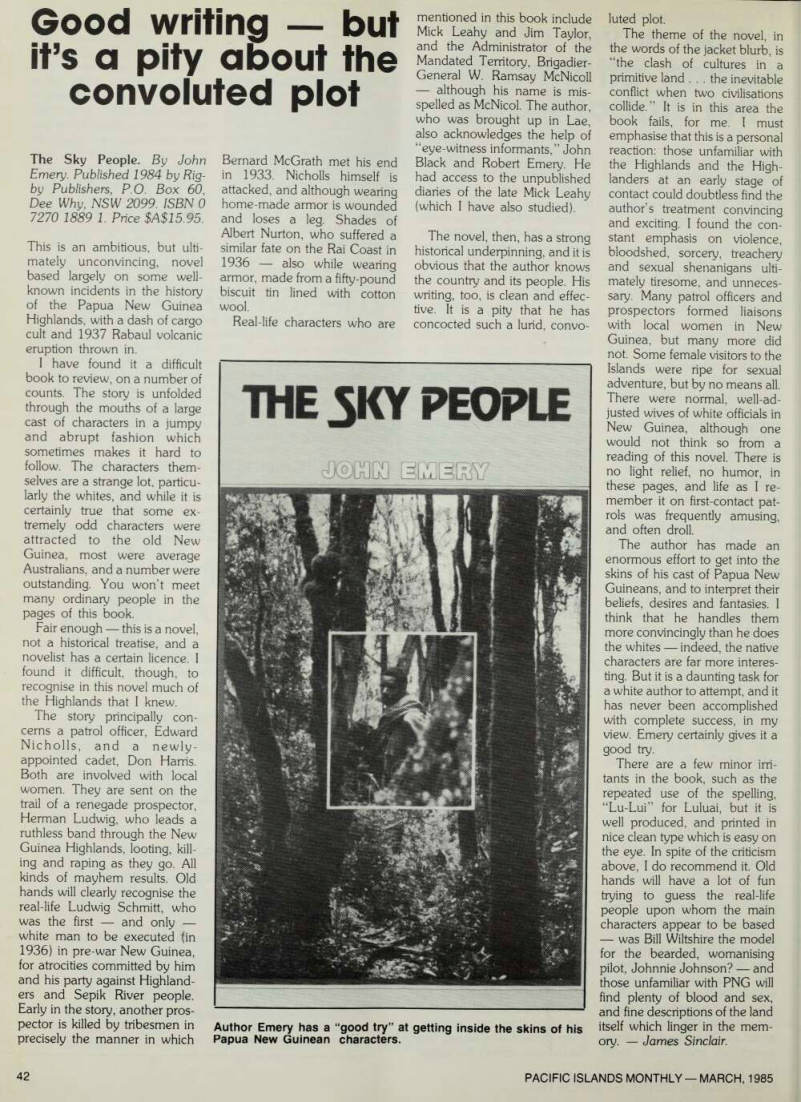
Good writing but it’s a pity about the convoluted plot
The Sky People. By John Emery. Published 1984 by Rig by Publishers, P.O. Box 60, Dee Why, NSW 2099. ISBN 0 7270 1889 1. Price $A515.95.
This is an ambitious, but ulti mately unconvincing, novel based largely on some well known incidents in the history of the Papua New Guinea Highlands, with a dash of cargo cult and 1937 Rabaul volcanic eruption thrown in.
I have found it a difficult book to review, on a number of counts. The story is unfolded through the mouths of a large cast of characters in a jumpy and abrupt fashion which sometimes makes it hard to follow. The characters them selves are a strange lot, particu larly the whites, and while it is certainly true that some ex tremely odd characters were attracted to the old New Guinea, most were average Australians, and a number were outstanding. You won’t meet many ordinary people in the pages of this book.
Fair enough this is a novel, not a historical treatise, and a novelist has a certain licence. I found it difficult, though, to recognise in this novel much of the Highlands that I knew.
The story principally con cerns a patrol officer, Edward Nicholls, and a newly appointed cadet, Don Harris.
Both are involved with local women. They are sent on the trail of a renegade prospector, Herman Ludwig, who leads a ruthless band through the New Guinea Highlands, looting, kill ing and raping as they go. All kinds of mayhem results. Old hands will clearly recognise the real-life Ludwig Schmitt, who was the first and only white man to be executed tin 1936) in pre-war New Guinea, for atrocities committed by him and his party against Highland ers and Sepik River people.
Early in the story, another pros pector is killed by tribesmen in precisely the manner in which
Bernard McGrath met his end in 1933. Nicholls himself is attacked, and although wearing home-made armor is wounded and loses a leg. Shades of Albert Nurton, who suffered a similar fate on the Rai Coast in 1936 also while wearing armor, made from a fifty-pound biscuit tin lined with cotton wool.
Real-life characters who are
mentioned in this book include Mick Leahy and Jim Taylor, and the Administrator of the Mandated Territory, Brigadier- General W. Ramsay McNicoll although his name is mis spelled as McNicol. The author, who was brought up in Lae, also acknowledges the help of “eye-witness informants,” John Black and Robert Emery. He had access to the unpublished diaries of the late Mick Leahy (which I have also studied).
The novel, then, has a strong historical underpinning, and it is obvious that the author knows the country and its people. His writing, too, is clean and effec tive. It is a pity that he has concocted such a lurid, convo
luted plot.
The theme of the novel, in the words of the jacket blurb, is “the clash of cultures in a primitive land ... the inevitable conflict when two civilisations collide.” It is in this area the book fails, for me. I must emphasise that this is a personal reaction; those unfamiliar with the Highlands and the High landers at an early stage of contact could doubtless find the author’s treatment convincing and exciting. I found the con stant emphasis on violence, bloodshed, sorcery, treachery and sexual shenanigans ulti mately tiresome, and unneces sary. Many patrol officers and prospectors formed liaisons with local women in New Guinea, but many more did not. Some female visitors to the Islands were ripe for sexual adventure, but by no means all.
There were normal, well-ad justed wives of white officials in New Guinea, although one would not think so from a reading of this novel. There is no light relief, no humor, in these pages, and life as I re member it on first-contact pat rols was frequently amusing, and often droll.
The author has made an enormous effort to get into the skins of his cast of Papua New Guineans, and to interpret their beliefs, desires and fantasies. I think that he handles them more convincingly than he does the whites — indeed, the native characters are far more interes ting. But it is a daunting task for a white author to attempt, and it has never been accomplished with complete success, in my view. Emery certainly gives it a good try.
There are a few minor irri tants in the book, such as the repeated use of the spelling, “Lu-Lui” for Luluai, but it is well produced, and printed in nice clean type which is easy on the eye. In spite of the criticism above, I do recommend it. Old hands will have a lot of fun trying to guess the real-life people upon whom the main characters appear to be based — was Bill Wiltshire the model for the bearded, womanising pilot, Johnnie Johnson? — and those unfamiliar with PNG will find plenty of blood and sex, and fine descriptions of the land itself which linger in the mem
ory.
James Sinclair.
Advertisements & other items, p. 42 (1 item)
The Sky People
JONE EMERY
Author Emery has a “good try” at getting inside the skins of his Papua New Guinean characters.
constitutions
The symbolism of constitutions
Pacific Constitutions. Edited by Peter Sack. 1982. Published by the Law Department, Re search School of Social Scien ces, Australian National Uni versity. ISBN 0 86784 164 8. $A15.00 Constitutionalism is the trust which people repose in the power of words engrossed on paper to keep a government in order. Part of the decolonising process in the insular Pacific is the almost übiquitous ritual of creating and adopting constitu tions based upon European or American models. Attendant on such auspicious occasions is a plethora of commentaries which seek to analyse, com pare, ruminate upon or even eulogise the product, process or consequences of independence constitutions. Pacific Constitu tions is the final product of the Sixth Canberra Law Workshop conducted in 1982 at the Aus tralian National University. This volume includes the experi ences, observations and predic tions of the workshop partici pants, collected in 24 essays.
The cultural message of con stitutionalism is a “sense of inevitability” that the emerg ence from colonialism must mean the creation of nation states which must have con stitutions of one sort or another.
For many of the Pacific islands, the political legitimacy pro duced by constitutions is directly correlated to the legi timacy which produces them, and permits the colonial authority to withdraw with some sense of dignity. This allows the successor govern ment to assume power in a spirit of continuity.
Traditionally constitutional ism meant the “legal domestication of government. ”
It was the result and not the cause of modern rational gov ernment. As a system of pro cedural and substantive rules, the process of drafting a con stitution is also an opportunity to restate the ideals by which a society is to be governed.
The traditional areas of Melanesia were inclined to re
gard constitutions in this latter sense. As legitimating devices, restatements of traditional values, or recognition of them, served as identity references which had often been repudi ated by colonial administra tions, as well as to assure traditional leaders of some rec ognition in the constitutional framework of government.
Whether such sentiment is a demonstration of commitment to tradition, or just wishful thinking, is still an open ques tion.
Interested observers, how ever, have acknowledged that Papua New Guinea is having a difficult time implementing cus tom as the underlying law of the country. This is attributed in part to the fact that expatriates sit on the Supreme and Na tional courts and that the local bar has few native members.
The end result is that the professionals on the bench or at the bar are more inclined to resist the introduction of customary evidence, or the pleading of customary con siderations, in the court of litiga tion.
In Vanuatu, however, the colonial land tenure system was constitutionally discarded in favor of customary ownership, and this represents a singular example of revolutionary change. Only in Tonga and Western Somoa could the traditional leadership “rely on the constitutional structure to play a clearly dominant role at the national level. ” The applica tion of customary practices to the dispute resolution process at the national level is “seriously disadvantaged in public com petition with the serious status of the written word and with the courts trained to apply common law and equity.” The virtual absence of traditional leader ship participation in the drafting of Pacific constitutions is mute testimony to the argument that traditional authority and mod ern constitutionalism as insti tuted by new elite groups are institutionally incompatible.
Though the Tongan and West ern Samoan examples are cases to the contrary, it may be
forthrightly argued that the traditional elites merely permit ted an institutional coexistence, with both custom and constitu tionalism functioning as inde pendent systems. Stated in alternative terms, “the constitu tions of traditional societies in the Pacific . . . were defined by ideals and processes rather than by rules and institutions.
Traditional societies were held together by a network of perso nal relations rather than by a framework of institutionalised structures. It is no wonder, therefore, that the traditional forces in the Pacific do not assert themselves by offering alternative rules and institu tions, but by trying either to manipulate or to ignore the imported Western products.”
The process of drafting con stitutions is rarely a purely auto chthonous procedure. The in fluence of foreign expertise in the drafting of documents has been on many occasions “im perative for constitutional suc cess. ” Such expertise, however, “guides the final document into a shape which is the product of the will of the people con cerned.” The participation of such consultants as J. W.
Davidson in Western Samoa, Nauru, and to some extent in Micronesia, are clear examples of responsible and professional “sensitivity to Pacific societies.”
Indeed, the history of expatriate consultants and advisers in the creation of Pacific constitutions began in earnest with the 1840 constitution of the Hawaiian kingdom, and later with the 1875 constitution of Tonga.
The role of the consultant today has not been confined to the constitutional product alone, but has related also to the process which shapes and formulates the final document.
Whether the process of con stitution-making is one consis ting of examining and reshap ing the drafts, or merely aggregating separately ratified provisions, the consultant has been made critically aware of his “cultural competence” in serving in such a role.
The popular acceptance of constitutions is a critically im portant issue. Perhaps the cen tral factor in this particular re gard is that no group of signifi cant size in the Pacific islands has “felt itself to be fully excluded from the possibility of
gaining government or from having some representatives of its interest in power.” Only in Fiji and Vanuatu do conditions exist for the development of an “out group” since political alle giances are generally deter mined by identification with ethnic groups. It is this latter feature which would be “the most likely threat to the con tinuance of constitutional suc cession. ”
Academic anthologies of parochial subject matter are often the most difficult to read and sometimes almost impossi ble to review. The lack of clearly defined objectives or themes, but more often the lack of discipline among contribu tors in maintaining continuity or cohesion are often the un fortunate causes. Editor Peter Sack and the other experts mobilised for this important workshop have been able to manage this difficult feat.
Almost as important is that the affordability of this volume makes its dissemination in the
Pacific possible.
William
Tagupa.
Books received
Time of Rain.By John Stafford. Pub lished 1984 by Rigby Books, 176 South Creek Road, Dee Why, NSW, 2099, Australia. ISBN 0 7270 2035 8. Price $9.95.
Ella, Ella, Ella. By Bret Harris. Pub lished 1984 by Little Hills Press, P.O.
Box 60, St. Peters, NSW, 2044, Austra lia. ISBN 0 949773 07 7. Price $19.95.
Dangerous Words: Language and Poli tics in the Pacific. Edited by Donald L.
Brenneis and Fred R. Myers. Published 1984 by New York University Press, distributed by Columbia University Press, 562 West 113th Street, New York, NY, 10025, USA.
ISBN 0 8147 1051 4. Price $U545.50 cloth, $U521.50 paper.
The Moon Man: A Biography of Niko lai Miklouho-Maclay. By E. M. Webs ter. Published 1984 by Melbourne Uni versity Press, P.O. Box 278, Carlton South, Vic., 3053, Australia.
ISBN 0 522 84293 3. Price $33.
Shells; A Collector’s Color Guide. By J. & R. Senders. Published 1984 by David & Charles (Publishers) Limited, Brunei House, Newton Abbot, Devon, England. ISBN 0 7153 8497 X. Price $22.50.
Mysteries On The High Seas. By Philip Macdougall. Published 1984 by David & Charles (Publishers) Limited, Brunei House, Newton Abbot, Devon, England.
ISBN 0 7153 8422 8. Price $19.95.
Bread And Roses. By Sonja Davies.
Published 1984 by Australia & New Zealand Book Co. Pty. Ltd., 2/10 Col way Place, Glenfield, Auckland 10, New Zealand. ISBN 0 98620 08 X. Price $16.95.
Times of strife, times of peace
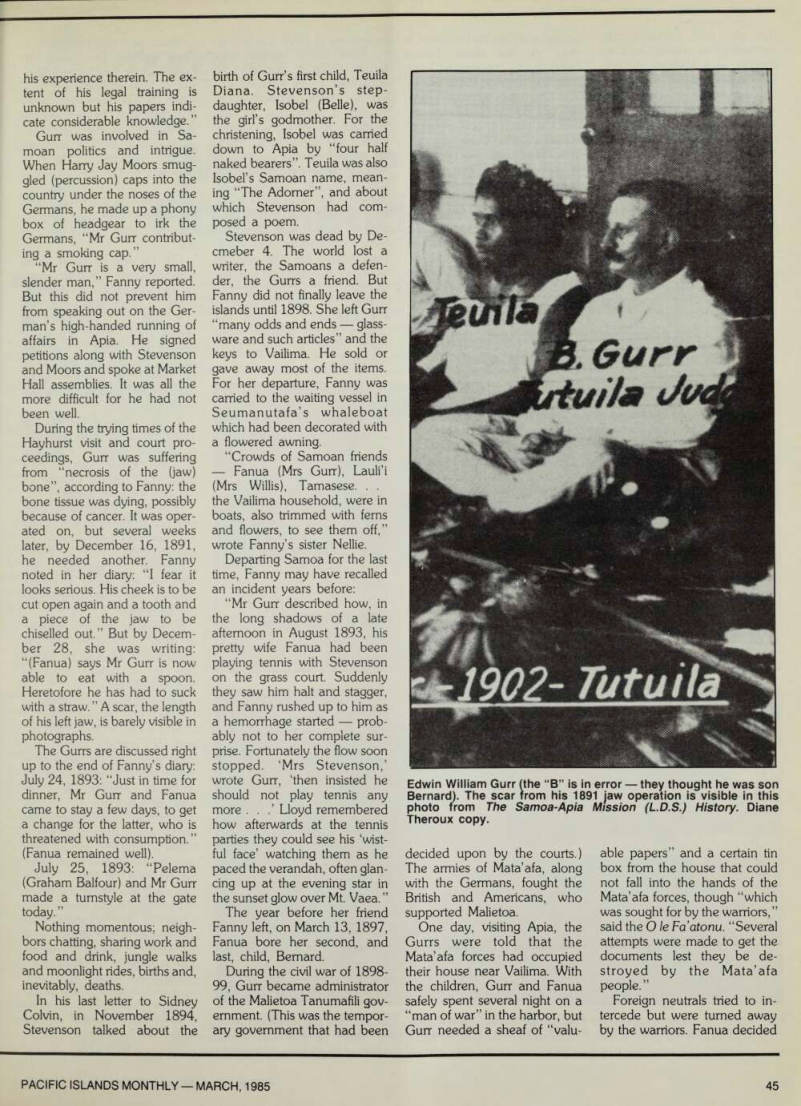
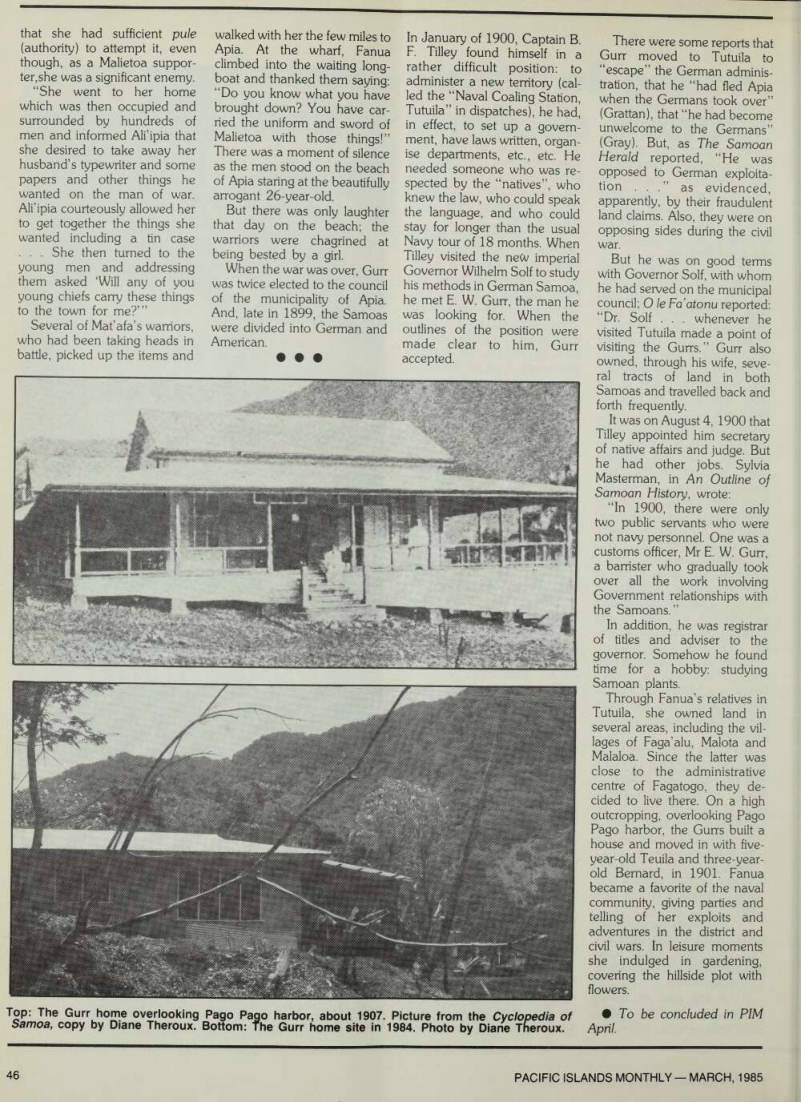
and then a move to Pago
The Gurrs’ relations with the Stevensons were close and cor dial. Fanny often had them to dinner. They exchanged Christ mas gifts.
“Today Louis and Lloyd rode down to town, coming back in time for dinner. Lloyd came ahead of Louis, fetching Fanua with him. I had sent her Christmas box by her boy, who brought a note for Belle an embroidered white gown, a very pretty one indeed; I gave her the best I had.”
In a letter to Sidney Colvin, Louis wrote; “. . . we sat down to dinner at the Chinaman’s . . . Gurr and lat each end as hosts; Gurr’s wife, Fanua, late maid of the village; her (adopted) father and mother Seumanu and Faatulua (sic), Fanny, Belle, Lloyd, Austin and Henry Simele ...” (Henry was a sort of foreman at Vailima and a cousin of Fanua’s).
In another letter, he wrote: “A little way back along Muli ni’u (peninsula), Mrs Gurr met us with her husband’s horse; and he and she and Lloyd and I rode back in a heavenly moon light.”
Belle, writing years later in her autobiography, This Life Tue Loved, remembered their first visit. She noted that Fanua was “squeezed into tight corsets.” Fanua, in turn, noticed Fanny and Belle wore the loose-fitting Hawaiian hola ku. She told Belle later: “It was nice to see you and Tamaitai (Fanny) in your pretty white holakus. You looked so cool and comfortable. I told Edwini, ‘Never never will I put on those bad corsets again. The missionaries and traders wives can wear them, but now I know how high chief ladies dress and I will stick to my holaku. ,, ' Belle commented: “It made a great difference in her looks for in the soft flowing lines of that garment she was lovely.”
They were close neighbors
JOSEPH THEROUX contributes the second part of his three-part study of the life and times of EDWIN WILLIAM GURR, a prominent figure in Samoa around the turn of the century.
and visits were back and forth between the large hall of Vaili ma and “the little Gurr cot tage”, in Fanny’s phrase. Once, a fancy dress ball was held in honor of the birthday of the Prince of Wales. “Mr Gurr and Miss Gurr (Edwin’s sister Ethel) are going to take Belle ...”
Fanny wrote. Mrs Thomas Stevenson, Louis’ mother, wrote: “Fanny designed a cos tume for Mrs Gurr (a pretty Samoan girl) as Zenobia, Empress of the East. She wore a Greek dress, made in part of cotton stuff with a gold pattern stamped on it; over this a crimson chuddah (the shawl part of a sari) was correctly draped, with a gold belt, many beads, and an elaborate gold crown. ”
Gurr and Stevenson had a mutual friend and business adviser in Harry Moors, the American who shared their taste for political intrigue. But when Gurr aligned himself with Malietoa years later, he and Moors would have a falling out.
Moors would refer to him as a “rascal”. But in 1891, there were other rascals around.
Years afterwards The Sa moan Herald would report in Gurr’s obituary: “He was (also) connected with the late Mr J. T.
M. Hayhurst in banking and general business.”
Well, about November of 1891, while still lawyering with Carruthers, Gurr was asked to become manager of an Apia bank (which boasted accounts of, among others, RLS and his mother). The owners, a Mr Hayhurst (“I thought him coarse and common,” said Fanny) and a Mr Aspinall (“a black-a-vised vulgarian, with
long white carnivorous teeth,” said Fanny), paid Gurr a visit after he had been at the job for some time. These “ruffians”, according to Fanny, “suspected Gurr of dishonest practices and had thus fallen upon him suddenly that he should have no time for preparation”.
Fanny, in her hectic way, does not explain what the “dishonest practices” were, though embezzlement suggests itself. However, she so insists on the brutality of the owners and the docility of Gurr, their insulting manner and Gurr’s gentlemanliness, that there seems to be no question about where the criminality lay. Fanny wrote that “. . . it would re quire a great deal of proof to make me believe that Gurr had ever been more than unwise. ”
She added that Carruthers had stuck by Gurr throughout it all and had “behaved very gener ously in the matter”.
Gurr evidently had very little money from his supposed theft; for his sister Ethel’s passage home, he had to borrow seven pounds from Stevenson. He returned to work with Car ruthers and severed relations with Hayhurst and Aspinall and Fanny added not a word to the story. Relations between the two families remained strong.
Gurr’s public reputation was not harmed; the following year he was appointed Natives’
Advocate, a post by which he would receive so many suc cesses.
Since about 1860, outland ers (mostly German), had been buying up huge tracts of land, often fraudulently. The Treaty
of Berlin, coming on the heels, or rather the stern, of the hurricane v of 1889, established the Samoan International Land Commission which would arbi trate claims and counter-claims.
However, the first natives’ advocate failed miserably and threw doubt upon the integrity of the commission itself.
Stevenson wrote in A Foot note to History that this man “was succeeded pro tempore by a young New Zealander (sic), E. W. Gurr, not much more versed in law than himself and very much less so in Samoan. Whether by more skill or better fortune, Gurr has been able in the course of a few weeks to recover for the natives several important tracts of land; and the prejudice against the commission seems to be abat ing as fast as it arose.”
How far Gurr succeeded can be judged by statements in the Cyclopedia of Samoa: “He made a record on the commis sion. Out of over a million acres of land claimed by foreigners he succeeded in gaining back for the Samoans over 800,000 acres. . .”
On July 13, 1894, according to an American Samoa Gov ernors report chronology (1927): “Municipal President Schmidt, in a financial state ment to the consuls, said that the continued expense of the salary of the native advocate, Mr E. W. Gurr. . . was a great burden. Mr Gurr, far from giv ing him comfort, threatened to sue the Government for dam ages for non-fulfilment of con tract. The Faipule had reduced his salary to $l5O a month after increasing it to $200.”
Stevenson’s doubts about Gurr’s training in law were echoed in Captain Gray’s Amerika Samoa: “(Gurr) was deeply and sympathetically in terested in the fa a Samoa and there could be no question as to
his experience therein. The ex tent of his legal training is unknown but his papers indi cate considerable knowledge.”
Gurr was involved in Sa moan politics and intrigue.
When Harry Jay Moors smug gled (percussion) caps into the country under the noses of the Germans, he made up a phony box of headgear to irk the Germans, “Mr Gurr contribut ing a smoking cap.”
“Mr Gurr is a very small, slender man,” Fanny reported.
But this did not prevent him from speaking out on the Ger man’s high-handed running of affairs in Apia. He signed petitions along with Stevenson and Moors and spoke at Market Hall assemblies. It was all the more difficult for he had not been well.
During the trying times of the Hayhurst visit and court pro ceedings, Gurr was suffering from “necrosis of the (jaw) bone”, according to Fanny: the bone tissue was dying, possibly because of cancer. It was oper ated on, but several weeks later, by December 16, 1891, he needed another. Fanny noted in her diary: “I fear it looks serious. His cheek is to be cut open again and a tooth and a piece of the jaw to be chiselled out.” But by Decem ber 28, she was writing; “(Fanua) says Mr Gurr is now able to eat with a spoon.
Heretofore he has had to suck with a straw. ” A scar, the length of his left jaw, is barely visible in photographs.
The Gurrs are discussed right up to the end of Fanny’s diary: July 24, 1893: “Just in time for dinner, Mr Gurr and Fanua came to stay a few days, to get a change for the latter, who is threatened with consumption.” (Fanua remained well).
July 25, 1893; “Pelema (Graham Balfour) and Mr Gurr made a tumstyle at the gate today. ”
Nothing momentous; neigh bors chatting, sharing work and food and drink, jungle walks and moonlight rides, births and, inevitably, deaths.
In his last letter to Sidney Colvin, in November 1894, Stevenson talked about the
birth of Gurr’s first child, Teuila Diana. Stevenson’s step daughter, Isobel (Belle), was the girl’s godmother. For the christening, Isobel was carried down to Apia by “four half naked bearers”. Teuila was also Isobel’s Samoan name, mean ing “The Adorner”, and about which Stevenson had com posed a poem.
Stevenson was dead by De cmeber 4. The world lost a writer, the Samoans a defen der, the Gurrs a friend. But Fanny did not finally leave the islands until 1898. She left Gurr “many odds and ends glass ware and such articles” and the keys to Vailima. He sold or gave away most of the items.
For her departure, Fanny was carried to the waiting vessel in Seumanutafa’s whaleboat which had been decorated with a flowered awning.
“Crowds of Samoan friends Fanua (Mrs Gurr), Lauli’i (Mrs Willis), Tamasese. . . the Vailima household, were in boats, also trimmed with ferns and flowers, to see them off,” wrote Fanny’s sister Nellie.
Departing Samoa for the last time, Fanny may have recalled an incident years before: “Mr Gurr described how, in the long shadows of a late afternoon in August 1893, his pretty wife Fanua had been playing tennis with Stevenson on the grass court. Suddenly they saw him halt and stagger, and Fanny rushed up to him as a hemorrhage started prob ably not to her complete sur prise. Fortunately the flow soon stopped. ‘Mrs Stevenson,’ wrote Gurr, ‘then insisted he should not play tennis any more . . .’ Lloyd remembered how afterwards at the tennis parties they could see his ‘wist ful face’ watching them as he paced the verandah, often glan cing up at the evening star in the sunset glow over Mt. Vaea. ”
The year before her friend Fanny left, on March 13, 1897, Fanua bore her second, and last, child, Bernard.
During the civil war of 1898- 99, Gurr became administrator of the Malietoa Tanumafili gov ernment. (This was the tempor ary government that had been
decided upon by the courts.) The armies of Mata’afa, along with the Germans, fought the British and Americans, who supported Malietoa.
One day, visiting Apia, the Gurrs were told that the Mata’afa forces had occupied their house near Vailima. With the children, Gurr and Fanua safely spent several night on a “man of war” in the harbor, but Gurr needed a sheaf of “valu
able papers” and a certain tin box from the house that could not fall into the hands of the Mata’afa forces, though “which was sought for by the warriors, ” said the O \e Fa’atonu. “Several attempts were made to get the documents lest they be de stroyed by the Mata’afa people.”
Foreign neutrals tried to in tercede but were turned away by the warriors. Fanua decided
Edwin William Gurr (the “B” is in error-they thought he was son Bernard). The scar from his 1891 jaw operation is visible in this photo from The Samoa-Apia Mission (L.D.S.) History. Diane Theroux copy.
that she had sufficient pule (authority) to attempt it, even though, as a Malietoa suppor ter,she was a significant enemy.
“She went to her home which was then occupied and surrounded by hundreds of men and informed Ali’ipia that she desired to take away her husband’s typewriter and some papers and other things he wanted on the man of war.
Ali’ipia courteously allowed her to get together the things she wanted including a tin case . . . She then turned to the young men and addressing them asked ‘Will any of you young chiefs carry these things to the town for me?”’
Several of Mat’afa’s warriors, who had been taking heads in battle, picked up the items and
walked with her the few miles to Apia. At the wharf, Fanua climbed into the waiting longboat and thanked them saying: “Do you know what you have brought down? You have carried the uniform and sword of Malietoa with those things!”
There was a moment of silence as the men stood on the beach of Apia staring at the beautifully arrogant 26-year-old.
But there was only laughter that day on the beach; the warriors were chagrined at being bested by a girl.
When the war was over, Gurr was twice elected to the council of the municipality of Apia, And, late in 1899, the Samoas were divided into German and American.
In January of 1900 Captain B F. Tilley found himself in a rather difficult position: to administer a new territory (cal led the “Naval Coaling Station Tutuila” in dispatches), he had,’ in effect, to set up a’ govern ment, have laws written, organ ise departments, etc., etc. He needed someone who was re spected by the “natives” who knew the law, who could speak the language, and who could stay for longer than the usual Navy tour of 18 months. When Tilley visited the new imperial Governor Wilhelm Solf to study his methods in German Samoa he met E. W. Gurr, the man he was looking for. When the outlines of the position were made clear to him, Gurr accepted.
There were some reports that Gurr moved to Tutuila to “escape” the German adminis tration, that he “had fled Apia when the Germans took over” (Grattan), that “he had become unwelcome to the Germans” (Gray). But, as The Samoan Herald reported, “He was opposed to German exploita tion ...” as evidenced, apparently, by their fraudulent land claims. Also, they were on opposing sides during the civil war.
But he was on good terms with Governor Solf, with whom he had served on the municipal council; O leFa’atonu reported: “Dr. Solf . . . whenever he visited Tutuila made a point of visiting the Gurrs.” Gurr also owned, through his wife, seve ral tracts of land in both Samoas and travelled back and forth frequently.
It was on August 4, 1900 that Tilley appointed him secretary of native affairs and judge. But he had other jobs. Sylvia Masterman, in An Outline of Samoan History, wrote: “In 1900, there were only two public servants who were not navy personnel. One was a customs officer, Mr E. W. Gurr, a barrister who gradually took over all the work involving Government relationships with the Samoans.”
In addition, he was registrar of titles and adviser to the governor. Somehow he found time for a hobby: studying Samoan plants.
Through Fanua’s relatives in Tutuila, she owned land in several areas, including the vil lages of Faga’alu, Malota and Malaloa. Since the latter was close to the administrative centre of Fagatogo, they de cided to live there. On a high outcropping, overlooking Pago Pago harbor, the Gurrs built a house and moved in with five year-old Teuila and three-year old Bernard, in 1901. Fanua became a favorite of the naval community, giving parties and telling of her exploits and adventures in the district and civil wars. In leisure moments she indulged in gardening, covering the hillside plot with flowers. • To be concluded in PIM April.
Top: The Gurr home overlooking Pago Pago harbor, about 1907. Picture from the Cyclopedia of Samoa, copy by Diane Theroux. Bottom: me Gurr home site in 1984. Photo by Diane Tneroux.
Homeland Project
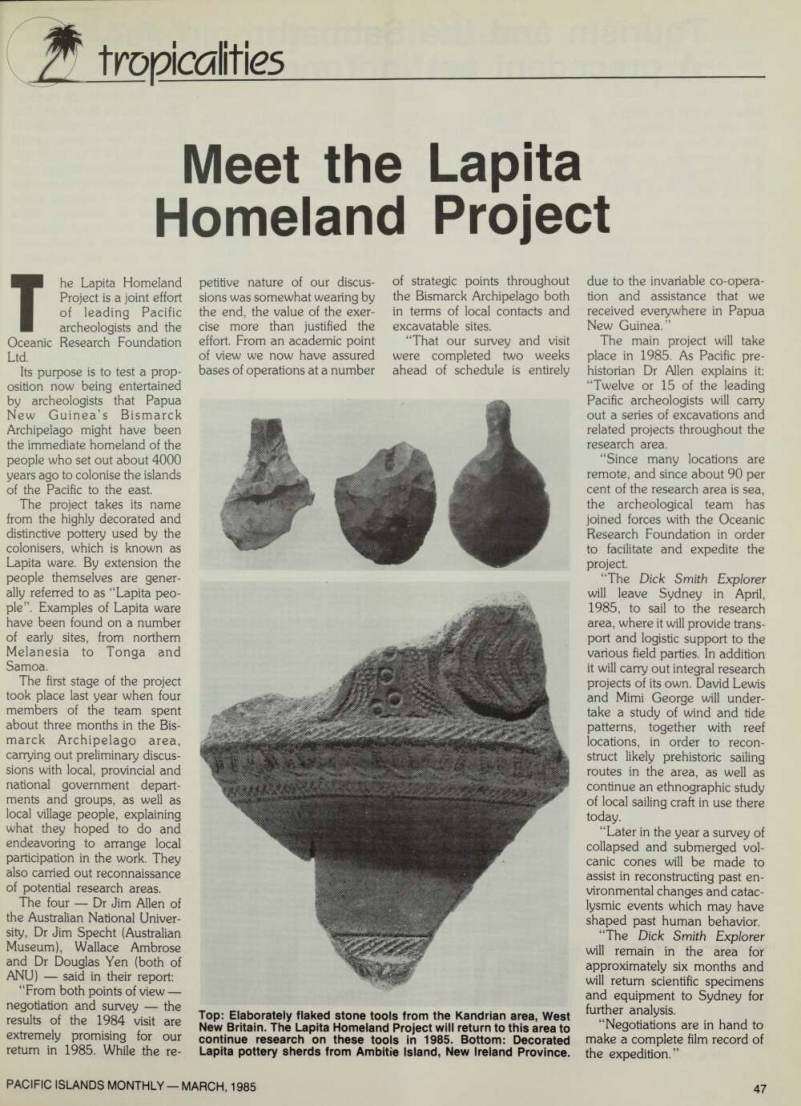
tropicalities
Meet the Lapita Homeland Project
The Lapita Homeland Project is a joint effort of leading Pacific archeologists and the Oceanic Research Foundation Ltd.
Its purpose is to test a prop osition now being entertained by archeologists that Papua New Guinea’s Bismarck Archipelago might have been the immediate homeland of the people who set out about 4000 years ago to colonise the islands of the Pacific to the east.
The project takes its name from the highly decorated and distinctive pottery used by the colonisers, which is known as Lapita ware. By extension the people themselves are gener ally referred to as “Lapita peo ple”. Examples of Lapita ware have been found on a number of early sites, from northern Melanesia to Tonga and Samoa.
The first stage of the project took place last year when four members of the team spent about three months in the Bis marck Archipelago area, carrying out preliminary discus sions with local, provincial and national government depart ments and groups, as well as local village people, explaining what they hoped to do and endeavoring to arrange local participation in the work. They also carried out reconnaissance of potential research areas.
The four Dr Jim Allen of the Australian National Univer sity, Dr Jim Specht (Australian Museum), Wallace Ambrose and Dr Douglas Yen (both of ANU) said in their report: “From both points of view negotiation and survey the results of the 1984 visit are extremely promising for our return in 1985. While the re
petitive nature of our discus sions was somewhat wearing by the end, the value of the exer cise more than justified the effort. From an academic point of view we now have assured bases of operations at a number
of strategic points throughout the Bismarck Archipelago both in terms of local contacts and excavatable sites.
“That our survey and visit were completed two weeks ahead of schedule is entirely
due to the invariable co-opera tion and assistance that we received everywhere in Papua New Guinea.”
The main project will take place in 1985. As Pacific pre historian Dr Allen explains it: “Twelve or 15 of the leading Pacific archeologists will carry out a series of excavations and related projects throughout the research area.
“Since many locations are remote, and since about 90 per cent of the research area is sea, the archeological team has joined forces with the Oceanic Research Foundation in order to facilitate and expedite the project.
“The Dick Smith Explorer will leave Sydney in April, 1985, to sail to the research area, where it will provide trans port and logistic support to the various field parties. In addition it will carry out integral research projects of its own. David Lewis and Mimi George will under take a study of wind and tide patterns, together with reef locations, in order to recon struct likely prehistoric sailing routes in the area, as well as continue an ethnographic study of local sailing craft in use there today.
“Later in the year a survey of collapsed and submerged vol canic cones will be made to assist in reconstructing past en vironmental changes and catac lysmic events which may have shaped past human behavior.
“The Dick Smith Explorer will remain in the area for approximately six months and will return scientific specimens and equipment to Sydney for further analysis.
“Negotiations are in hand to make a complete film record of the expedition.”
Top: Elaborately flaked stone tools from the Kandrian area, West New Britain. The Lapita Homeland Project will return to this area to continue research on these tools in 1985. Bottom: Decorated Lapita pottery sherds from Ambitie Island, New Ireland Province.
Tourism and the Sabbath:
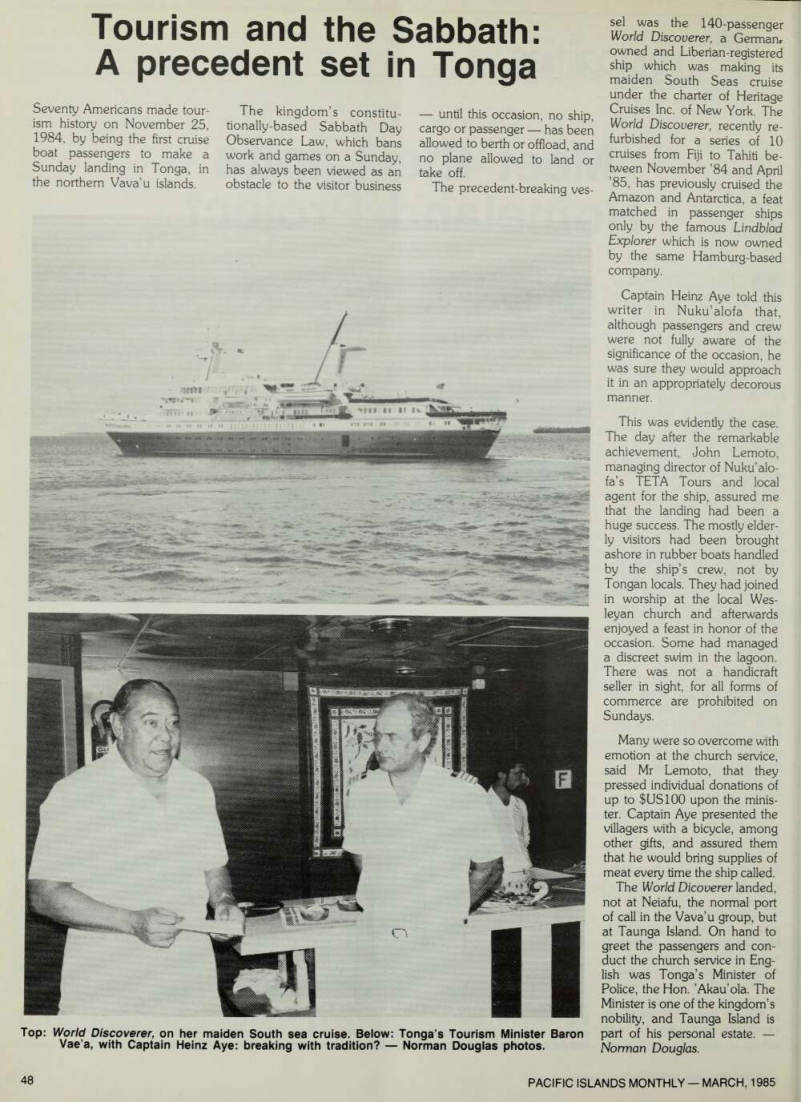
A precedent set in Tonga
Seventy Americans made tour ism history on November 25, 1984, by being the first cruise boat passengers to make a Sunday landing in Tonga, in the northern Vava’u islands.
The kingdom’s constitu tionally-based Sabbath Day Observance Law, which bans work and games on a Sunday, has always been viewed as an obstacle to the visitor business
until this occasion, no ship, cargo or passenger has been allowed to berth or offload, and no plane allowed to land or take off.
The precedent-breaking ves-
sel was the 140-passenger World Discoverer, a German.owned and Liberian-registered ship which was making its maiden South Seas cruise under the charter of Heritage Cruises Inc. of New York. The World Discoverer, recently re furbished for a series of 10 cruises from Fiji to Tahiti be tween November ’84 and April ’85, has previously cruised the Amazon and Antarctica, a feat matched in passenger ships only by the famous Lindblad Explorer which is now owned by the same Hamburg-based company.
Captain Heinz Aye told this writer in Nukualofa that, although passengers and crew were not fully aware of the significance of the occasion, he was sure they would approach it in an appropriately decorous manner.
This was evidently the case.
The day after the remarkable achievement, John Lemoto, managing director of Nukualo fa’s TETA Tours and local agent for the ship, assured me that the landing had been a huge success. The mostly elder ly visitors had been brought ashore in rubber boats handled by the ship’s crew, not by Tongan locals. They had joined in worship at the local Wes leyan church and afterwards enjoyed a feast in honor of the occasion. Some had managed a discreet swim in the lagoon.
There was not a handicraft seller in sight, for all forms of commerce are prohibited on Sundays.
Many were so overcome with emotion at the church service, said Mr Lemoto, that they pressed individual donations of up to $US100 upon the minis ter. Captain Aye presented the villagers with a bicycle, among other gifts, and assured them that he would bring supplies of meat every time the ship called.
The World Dicoverer landed, not at Neiafu, the normal port of call in the Vava’u group, but at Taunga Island. On hand to greet the passengers and con duct the church service in Eng lish was Tonga’s Minister of Police, the Hon. ’Akau’ola. The Minister is one of the kingdom’s nobility, and Taunga Island is part of his personal estate. — Norman Douglas.
Top: World Discoverer, on her maiden South sea cruise. Below: Tonga’s Tourism Minister Baron Vae’a, with Captain Heinz Aye: breaking with tradition? Norman Douglas photos.
Outlook gloomy for Bikinians’
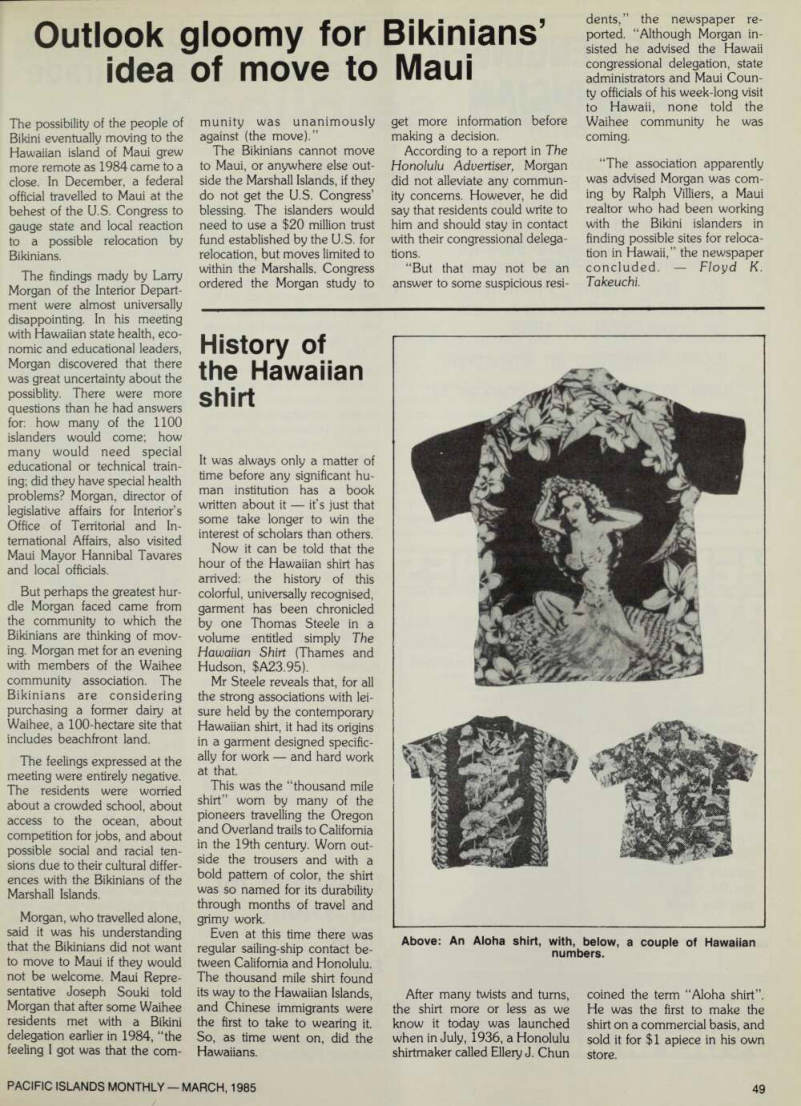
idea of move to Maui
The possibility of the people of Bikini eventually moving to the Hawaiian island of Maui grew more remote as 1984 came to a close. In December, a federal official travelled to Maui at the behest of the U.S. Congress to gauge state and local reaction to a possible relocation by Bikinians.
The findings mady by Larry Morgan of the Interior Depart ment were almost universally disappointing. In his meeting with Hawaiian state health, eco nomic and educational leaders, Morgan discovered that there was great uncertainty about the possiblity. There were more questions than he had answers for: how many of the 1100 islanders would come; how many would need special educational or technical train ing; did they have special health problems? Morgan, director of legislative affairs for Interior’s Office of Territorial and In ternational Affairs, also visited Maui Mayor Hannibal Tavares and local officials.
But perhaps the greatest hur dle Morgan faced came from the community to which the Bikinians are thinking of mov ing. Morgan met for an evening with members of the Waihee community association. The Bikinians are considering purchasing a former dairy at Waihee, a 100-hectare site that includes beachfront land.
The feelings expressed at the meeting were entirely negative.
The residents were worried about a crowded school, about access to the ocean, about competition for jobs, and about possible social and racial ten sions due to their cultural differ ences with the Bikinians of the Marshall Islands.
Morgan, who travelled alone, said it was his understanding that the Bikinians did not want to move to Maui if they would not be welcome. Maui Repre sentative Joseph Souki told Morgan that after some Waihee residents met with a Bikini delegation earlier in 1984, “the feeling I got was that the com
munity was unanimously against (the move).”
The Bikinians cannot move to Maui, or anywhere else out side the Marshall Islands, if they do not get the U.S. Congress’ blessing. The islanders would need to use a $2O million trust fund established by the U.S. for relocation, but moves limited to within the Marshalls. Congress ordered the Morgan study to
get more information before making a decision.
According to a report in The Honolulu Advertiser, Morgan did not alleviate any commun ity concerns. However, he did say that residents could write to him and should stay in contact with their congressional delega tions.
“But that may not be an answer to some suspicious resi
dents,” the newspaper re ported. “Although Morgan in sisted he advised the Hawaii congressional delegation, state administrators and Maui Coun ty officials of his week-long visit to Hawaii, none told the Waihee community he was coming.
“The association apparently was advised Morgan was com ing by Ralph Villiers, a Maui realtor who had been working with the Bikini islanders in finding possible sites for reloca tion in Hawaii,” the newspaper concluded. Floyd K.
Takeuchi.
History of
the Hawaiian shirt
It was always only a matter of time before any significant hu man institution has a book written about it it’s just that some take longer to win the interest of scholars than others.
Now it can be told that the hour of the Hawaiian shirt has arrived: the history of this colorful, universally recognised, garment has been chronicled by one Thomas Steele in a volume entitled simply The Hawaiian Shirt (Thames and Hudson, $A23.95).
Mr Steele reveals that, for all the strong associations with lei sure held by the contemporary Hawaiian shirt, it had its origins in a garment designed specific ally for work and hard work at that.
This was the “thousand mile shirt” worn by many of the pioneers travelling the Oregon and Overland trails to California in the 19th century. Worn out side the trousers and with a bold pattern of color, the shirt was so named for its durability through months of travel and grimy work.
Even at this time there was regular sailing-ship contact be tween California and Honolulu.
The thousand mile shirt found its way to the Hawaiian Islands, and Chinese immigrants were the first to take to wearing it.
So, as time went on, did the Hawaiians.
After many twists and turns, the shirt more or less as we know it today was launched when in July, 1936, a Honolulu shirtmaker called Ellery J. Chun
coined the term “Aloha shirt”.
He was the first to make the shirt on a commercial basis, and sold it for $1 apiece in his own store.
Above: An Aloha shirt, with, below, a couple of Hawaiian numbers.
The New Hebrides-New
Caledonia labor trade
More than 10,000 Ni-Vanuatu, men, women and children went to New Caledonia between 1865 and 1918, according to Dorothy Shineberg, reader in history at the Australian Na tional University in Canberra.
The peak period was between 1865 and 1912.
Ms Shineberg told the Port- Vila Vanuatu Weekly that she had come to the country to arrange for her research on the “New Caledonia recruitment era” for a book which is soon to be published.
She said: “The story of peo ple from Vanuatu going to Queensland and Fiji to work in the last century is very well known, but not so many people seem to know much about the people who went to New Cale donia.”
Ms Shineberg has already completed her research in lib raries in France, and is going back to New Caledonia for further work there.
According to information re leased, those Ni-Vanuatu were employed by the French Gov ernment to work as prison guards over the convict crews on government boats, and em ployed by the private sector to work in coffee and sugar cane plantations. Women worked as domestic servants.
Most of the people were eventually repatriated, but many died in an epidemic in 1875.
This will be Ms Shineberg’s second book. Her first, They Came for Sandalwood, based on sandalwood trading by early traders in the southwest Pacific, was published in 1967.
Go-ahead for
Su.S.4Om
libel
suit
The Supreme Court of the United States in January cleared the way for the start of a libel suit brought by Nauru’s President Hammer Deßoburt
against the Gannett Company, a leading U.S. newspaper pub lisher.
The claim refers to two 1978 articles alleging that President Deßoburt made a secret loan to a separatist group in the neighboring Marshall Islands.
The Nauruan president has filed a SU.S.4O million claim alleging libel against The Pacific Daily News, published on Guam and owned by the Gan nett organisation.
‘Best little
marathon’
for Guam
How about timing a visit to Guam so you can take part in the Best Little Marathon in the Pacific”? The 14th Guam Seiko Marathon will be run on March 30, 1985.
As in past years, about 100 runners from Guam, neighbor ing islands, Japan and else where are expected to com pete. It is a well-organised race, renowned for its numerous and friendly aid stations.
The 26.2 mile point-to-point course gains in elevation gra dually, starting at 200 ft above sea level and topping off at Mile 14 at 620 ft elevation. It then slopes downward to the finish at one of Guam’s most popular beaches, Ypao Beach Park.
The entire course is run on asphalt roads, but stays away from the busy streets.
At the awards ceremony every finisher is recognised, and all receive at least a T-shirt, surely one of the rarer such badges of achievement.
The 1984 winners were Peter Witherell, who covered the course in 2hr 44 min 34 sec.
But if you wish to beat the course records you will have to shoot for Dave Collins’ 1981 mark of 2:32:57, or Betty Bop part’s women’s record of 3:10:33, set in 1978.
The entry fee is $lO. For more information and entry forms, write to race director Allen A.Pickens, P.0.80x P, Agana, Guam 96910, U.S.A.
Advertisements & other items, p. 50 (1 item)
Skipper/Engineer-
ELECTRICIAN
(or both)
required to take charge of
DICK SMITH EXPLORER’,
the Oceanic Research Foundation’s Research Vessel, Sydney/Bismarck
Archipelago (PNG)/Sydney
for the Lapita Homeland Project Expedition from April or June-October, 1985.
Local knowledge an advantage.
Apply in writing with references to: Robin Miller 1/13 Cross Street, WAVERLEY, 2024 Australia Phone: (02) 387-6182 (AH) or (02) 810-5643 (A’noon) Dr David Taylor
LOCAL AGENTS AND
REPRESENTATION
428 George St., Sydney.
Cables: Henco Sydney.
G.P.O. Box 3949.
Telephone: 232 5377.
PAPUA NEW GUINEA
RABAUL: M. & C. Seeto, P.O. Box 131, Rabaul.
Telephone 92 2919.
MADANG: W. Double, P.O. Box 22, Madang.
Telephone 82 2696.
FIJI
K. Witherington Ltd., P.O. Box 293, Suva.
Telephone 22 356.
For specialised and
personalised buying
service throughout
the Pacific Islands and the East.
VANUATU
John Lum & Associates, P.O. Box 65, Santo.
Telephone 329.
SOLOMON ISLANDS
Mr. Tom Lo, Resident Agents in P.O. Box 327, Honiara, other Pacific Territories. Telephone 399
Kenilorea looks
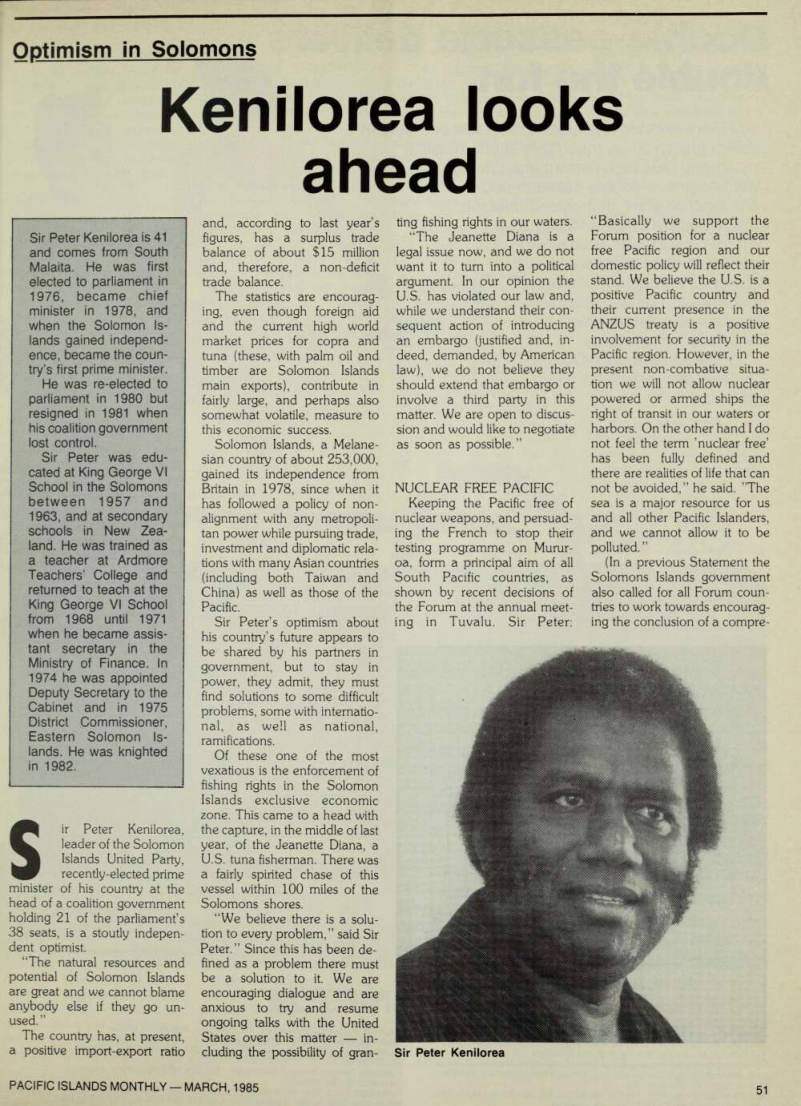

Optimism in Solomons
Kenilorea looks ahead
Sir Peter Kenilorea is 41 and comes from South Malaita. He was first elected to parliament in 1976, became chief minister in 1978, and when the Solomon Is lands gained independ ence, became the coun try’s first prime minister.
He was re-elected to parliament in 1980 but resigned in 1981 when his coalition government lost control.
Sir Peter was edu cated at King George VI School in the Solomons between 1957 and 1963, and at secondary schools in New Zea land. He was trained as a teacher at Ardmore Teachers’ College and returned to teach at the King George VI School from 1968 until 1971 when he became assis tant secretary in the Ministry of Finance. In 1974 he was appointed Deputy Secretary to the Cabinet and in 1975 District Commissioner, Eastern Solomon Is lands. He was knighted in 1982.
Sir Peter Kenilorea, leader of the Solomon Islands United Party, recently-elected prime minister of his country at the head of a coalition government holding 21 of the parliament’s 38 seats, is a stoudy indepen dent optimist.
“The natural resources and potential of Solomon Islands are great and we cannot blame anybody else if they go un used.”
The country has, at present, a positive import-export ratio
and, according to last year’s figures, has a surplus trade balance of about $l5 million and, therefore, a non-deficit trade balance.
The statistics are encourag ing, even though foreign aid and the current high world market prices for copra and tuna (these, with palm oil and timber are Solomon Islands main exports), contribute in fairly large, and perhaps also somewhat volatile, measure to this economic success.
Solomon Islands, a Melane sian country of about 253,000, gained its independence from Britain in 1978, since when it has followed a policy of non alignment with any metropoli tan power while pursuing trade, investment and diplomatic rela tions with many Asian countries (including both Taiwan and China) as well as those of the Pacific.
Sir Peter’s optimism about his country’s future appears to be shared by his partners in government, but to stay in power, they admit, they must find solutions to some difficult problems, some with internatio nal, as well as national, ramifications.
Of these one of the most vexatious is the enforcement of fishing rights in the Solomon Islands exclusive economic zone. This came to a head with the capture, in the middle of last year, of the Jeanette Diana, a U.S. tuna fisherman. There was a fairly spirited chase of this vessel within 100 miles of the Solomons shores.
“We believe there is a solu tion to every problem,” said Sir Peter.” Since this has been de fined as a problem there must be a solution to it. We are encouraging dialogue and are anxious to try and resume ongoing talks with the United States over this matter in cluding the possibility of gran
ting fishing rights in our waters.
“The Jeanette Diana is a legal issue now, and we do not want it to turn into a political argument. In our opinion the U.S. has violated our law and, while we understand their con sequent action of introducing an embargo (justified and, in deed, demanded, by American law), we do not believe they should extend that embargo or involve a third party in this matter. We are open to discus sion and would like to negotiate as soon as possible.”
Nuclear Free Pacific
Keeping the Pacific free of nuclear weapons, and persuad ing the French to stop their testing programme on Murur oa, form a principal aim of all South Pacific countries, as shown by recent decisions of the Forum at the annual meet ing in Tuvalu. Sir Peter:
“Basically we support the Forum position for a nuclear free Pacific region and our domestic policy will reflect their stand. We believe the U.S. is a positive Pacific country and their current presence in the ANZUS treaty is a positive involvement for security in the Pacific region. However, in the present non-combative situa tion we will not allow nuclear powered or armed ships the right of transit in our waters or harbors. On the other hand I do not feel the term ’nuclear free’ has been fully defined and there are realities of life that can not be avoided,” he said. ’’The sea is a major resource for us and all other Pacific Islanders, and we cannot allow it to be polluted. ” (In a previous Statement the Solomons Islands government also called for all Forum coun tries to work towards encourag ing the conclusion of a compre-
Sir Peter Kenilorea
hensive test ban treaty that would legally stop the dumping of radio-active wastes and other forms of nuclear waste de trimental to the growth and survival of marine resources in the island countries. This com munication also expressed strong opposition to pollution caused by testing of nuclear devices in the Pacific region).
Economic
Development
Sir Peter concedes that the Solomons economy is delicate and that it continues to depend upon foreign aid to balance the books. “We need foreign aid to help us help ourselves,” he said. While we have benefited this year by others’ misfortunes (the cyclones in the Philippines which damaged their copra crop resulting in high prices being paid to the remaining suppliers), we are very con scious of being an island coun try whose primary products (copra, tuna and palm oil), are at the mercy of world market prices.
“The waters around the Solomons are very rich fishing grounds and we have our own canneries, one in Tulagi in conjunction with a Japanese company, and another one just being built in the Western Pro vince. That is one more reason why we want to resolve the situation with the Jeanette Diana and utilise this natural resource to its best advantage.
“Approximately 85 per cent of the Solomon Islanders still live in villages and 92 per cent of the land is owned by custom ary practice. This could be a hindrance in some ways be cause it is very time-consuming to negotiate title to these lands for development purposes. But we are open and encourage free markets and welcome out side investors that meet our criteria and requirements.”
Sir Peter is quite firm about the criteria. Recently he halted a plan to establish a brewery in Honiara saying that the manu facture of beer was “not real development. ”
While, at the moment, the Solomon Islands enjoys a favorable balance of trade, Sir Peter is well aware of the possibility of cash profits from exports going primarily for the purchase of imported goods and is trying to introduce import
substitution in a number of areas.
Traditional Culture
Like many emergent coun tries, Solomon Islands has tribal or regional divisions. Of these perhaps the most difficult is that involving the Kwaio people of Malaita who have a strong traditional culture and who re cently refused to participate in the national elections. To emphasise their secessionist feelings they destroyed ballot boxes and forced the closure of a Seventh-day Adventist Hospital in the area (PIM, Jan. 1985). Sir Peter, who is himself from Malaita, although not the Kwaio area, puts a very high priority on achievement of national unity.
“Maintenance of traditional culture is an important aspect for orderly development. We must use past values for a foundation and basis for prog ress but we cannot live in today’s world with yesterday’s practices.
“As for the Kwaio; I think both parties are to blame. Also, outside parties, intentionally or not, created an unhealthy situa tion by encouraging the Kwaio people to think they can live in the past. Consequently they find it hard to go along with progress. The Solomon Islands must maintain its cultural identi ty but we cannot live in the past and this message must be put across to people from outside.”
Recently Sir Peter’s govern ment paid the Kwaio Fadanga $lOOO, described as compensa tion for a variety of problems raised by the election and the situation appears to be some what easier.
Melanesian Alliance
Some moves have been made in the region to have a more or less informal grouping of Melanesian nations through which common problems and interests could be discussed and acted upon. The idea is yet very tentative and is not expected to get very far, if only because the individual Melanesian nations themselves are made up of proudly distinct ethnic groups.
“I do not have details of the concept,” said Sir Peter. “In general, however, we do not believe in conclaves of ethnic groupings in the Pacific. This is counter to our stand on regio
nal cohesiveness and co-opera tion.”
New Caledonia
“We support the Forum stance, to do away with col onialism as soon as possible. I do not feel France is sincerely encouraging genuine political development and we encour age France to make arrange ments to administer the govern ment in the best interests of the New Caledonian people,” Sir Peter said.
“We support the move to place New Caledonia on the United Nations agenda for non self-goveming territories. ”
Vanuatu’s prime minister, Father Walter Lini, floated such an idea at the last Forum meeting in Funafuti, but could not get sufficient support. The feeling then appeared to be that the delicacy of the New Caledo nian situation would not be helped by what might turn out to be very clumsy United Na tions intervention, always assuming, they felt, that the Pacific countries were able to carry their proposal undam aged past the very efficient French diplomatic machine in the UN.
Sir Peter: “While we do not intend to interfere in the inter nal affairs of any state, I would be glad to do what I could to help; I was previously a mem ber of the Forum group set up to help New Caledonia negoti ate with France.”
General Policy
In general Sir Peter’s govern ment intends to maintain Solo mon Islands’ position as a full fledged member of the Pacific community. “We are particu larly concerned with the solidar ity of the Pacific, especially the South Pacific,” he said, “and we will take a firm stand to work towards the consolidation of those relationships.”
He said he would welcome “a more permanent presence” of American interests and was “very open-minded and avail able for discussions with all nations. ”We are small, but we value our traditions and our sovereignty. We do not wish to be fragmented or caught in any arguments of the big powers.
“I think the Solomon Islands have a bright future which only we, ourselves, can spoil.”
Advertisements & other items, pp. 52-53 (1 item)
usrwSm
Double-cassette delivers
double the fun.
Only Pioneer’s new Carry Com™ portable component system gives you so much take-along musical enjoyment, plus high-performance design.
Just imagine, a double cassette-deck with synchro-start, high-speed dubbing, continuous playback and soft-touch controls. Fifty watts (that’s 50!' peak music power output. 4-band tuner, custom-contoured sound via the 5-band graphic equalizer and detachable 2-way speaker systems.
Pioneer’s new CarryCom™.
Come on along, just for the fun of it. m i- V o 4 1
CK-W 5
usrwSm
Portable Component System
PIONEER
For further information, please contact: Australia: Pioneer Electronics Australia Pty. Ltd. (Incorporated in Victoria), P.O. Box 295, Mordialloc, Victoria, 3195 Tel: 580-9911 Fiji Islands: Brijlal & Company, G.P.O. Box No. 362, Suva, Fiji Islands Tel: 22258 New Zealand: Monaco Distributors Ltd., 2 Poland Road, Glenfield, Auckland, New Zealand Tel: (09) 444-9144 Norfolk Island: Burns Philp (Norfolk Island) Ltd., P.O. Box 21, Norfolk Island Vanuatu: Burns Philp (Vanuatu) Ltd., Vila, Vanuatu Nauru Island: Jacob Enterprises, P.O. Box No. 4, Republic of Nauru Tahiti: Tahiti Hi-Fi, P.O. Box 848, Papeete, Tahiti New Caledonia; Menard Pacifique Sari, B.P. 3899, Noumea, New Caledonia Tel: 27-62.23 American Samoa: Transpac Corporation, P.O. Box 1477, Pago Pago, American Samoa 96799 Tel; 633-5224 Rarotonga: South Seas International Ltd., P.O. Box 49, Rarotonga, Cook Islands Tel; 2327 Papua New Guinea: Bali Merchants Pty. Ltd., P.O. Box 6103, Boroko Tel: 254887
r J /* * The l aw Association for Asia and the Western Pacific
PROSPECTS FOR THE ESTABLISHMENT
OF A SOUTH PACIFIC INTER GOVERNMENTAL
HUMAN RIGHTS COMMISSION
SEMINAR. FIJI. 12th-14th APRIL. 1985
The Human Rights Standing Committee of LAWASIA, the Law Association for Asia and the Western Pacific, is to conduct a regional seminar in Fiji on 12th-14th April, 1985.
The purpose of the Seminar is to bring together persons in the South Pacific who are concerned with human rights issues to discuss constructively actions which could be taken to enhance the protection of human rights within the South Pacific, including the possibility of the establishment of an inter-governmental human rights Commission The following topics will be dealt with at the Seminar — 1 Background on regional Human Rights Commissions the wav they were established; the treaty arrangements: the European, Inter- American and African Commissions. 2. Background on the present treaty arrangements in the South Pacific region 3. Regional structures in the South Pacific region 4 The situation regarding human rights in the South Pacific regicn. 5. National Human Rights Commissions and other national Human Rights bodies. 6. Report on UN moves to establish structures to protect human rights in the Asian region. 7. Proposals for a South Pacific Human Rights Commission.
The Fijian Minister for Justice and Attorney-General, the Hon. Q. Bale, will open the Seminar.
Persons interested in participating in or submitting papers to the Organising Committee should contact: Ms Patricia Hyndman. Secretary.
LAWASIA Human Rights Standing Committee, 170 Phillip Street, Sydney, N.S.W. 2000 Cables • LAWASIA”. Telex AAIOIOI Attn LAWASIA.
Tel. (02) 235 2538 or 221 2970
Pacific stamp box
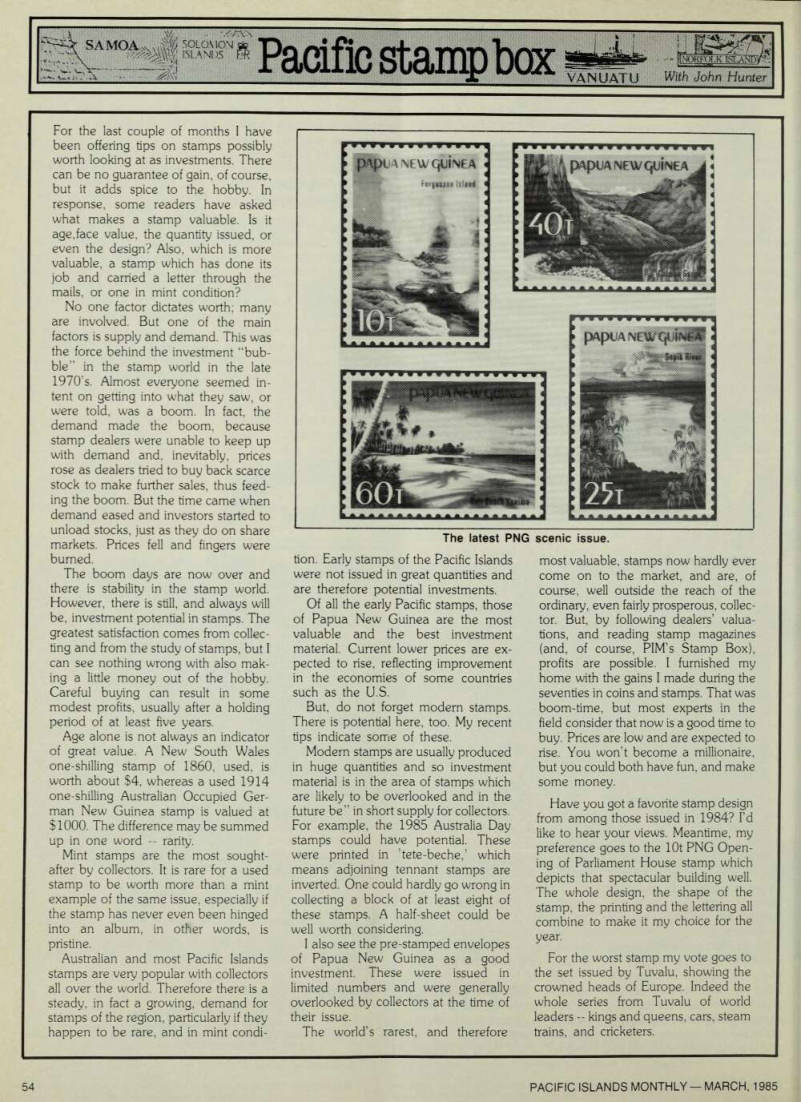
For the last couple of months I have been offering tips on stamps possibly worth looking at as investments. There can be no guarantee of gain, of course, but it adds spice to the hobby. In response, some readers have asked what makes a stamp valuable. Is it age,face value, the quantity issued, or even the design? Also, which is more valuable, a stamp which has done its job and carried a letter through the mails, or one in mint condition?
No one factor dictates worth; many are involved. But one of the main factors is supply and demand. This was the force behind the investment “bub ble” in the stamp world in the late 1970’5. Almost everyone seemed in tent on getting into what they saw, or were told, was a boom. In fact, the demand made the boom, because stamp dealers were unable to keep up with demand and, inevitably, prices rose as dealers tried to buy back scarce stock to make further sales, thus feed ing the boom. But the time came when demand eased and investors started to unload stocks, just as they do on share markets. Prices fell and fingers were burned.
The boom days are now over and there is stability in the stamp world.
However, there is still, and always will be, investment potential in stamps. The greatest satisfaction comes from collec ting and from the study of stamps, but I can see nothing wrong with also mak ing a little money out of the hobby.
Careful buying can result in some modest profits, usually after a holding period of at least five years.
Age alone is not always an indicator of great value. A New South Wales one-shilling stamp of 1860, used, is worth about $4, whereas a used 1914 one-shilling Australian Occupied Ger man New Guinea stamp is valued at $lOOO. The difference may be summed up in one word - rarity.
Mint stamps are the most sought after by collectors. It is rare for a used stamp to be worth more than a mint example of the same issue, especially if the stamp has never even been hinged into an album, in other words, is pristine.
Australian and most Pacific Islands stamps are very popular with collectors all over the world. Therefore there is a steady, in fact a growing, demand for stamps of the region, particularly if they happen to be rare, and in mint condi-
tion. Early stamps of the Pacific Islands were not issued in great quantities and are therefore potential investments.
Of all the early Pacific stamps, those of Papua New Guinea are the most valuable and the best investment material. Current lower prices are ex pected to rise, reflecting improvement in the economies of some countries such as the U.S.
But, do not forget modern stamps.
There is potential here, too. My recent tips indicate some of these.
Modem stamps are usually produced in huge quantities and so investment material is in the area of stamps which are likely to be overlooked and in the future be” in short supply for collectors.
For example, the 1985 Australia Day stamps could have potential. These were printed in ’tete-beche,’ which means adjoining tennant stamps are inverted. One could hardly go wrong in collecting a block of at least eight of these stamps. A half-sheet could be well worth considering.
I also see the pre-stamped envelopes of Papua New Guinea as a good investment. These were issued in limited numbers and were generally overlooked by collectors at the time of their issue.
The world’s rarest, and therefore
most valuable, stamps now hardly ever come on to the market, and are, of course, well outside the reach of the ordinary, even fairly prosperous, collec tor. But, by following dealers’ valua tions, and reading stamp magazines (and, of course, PlM’s Stamp Box), profits are possible. I furnished my home with the gains I made during the seventies in coins and stamps. That was boom-time, but most experts in the field consider that now is a good time to buy. Prices are low and are expected to rise. You won’t become a millionaire, but you could both have fun, and make some money.
Have you got a favorite stamp design from among those issued in 1984? I’d like to hear your views. Meantime, my preference goes to the lOt PNG Open ing of Parliament House stamp which depicts that spectacular building well.
The whole design, the shape of the stamp, the printing and the lettering all combine to make it my choice for the year.
For the worst stamp my vote goes to the set issued by Tuvalu, showing the crowned heads of Europe. Indeed the whole series from Tuvalu of world leaders - kings and queens, cars, steam trains, and cricketers.
The latest PNG scenic issue.
political currents
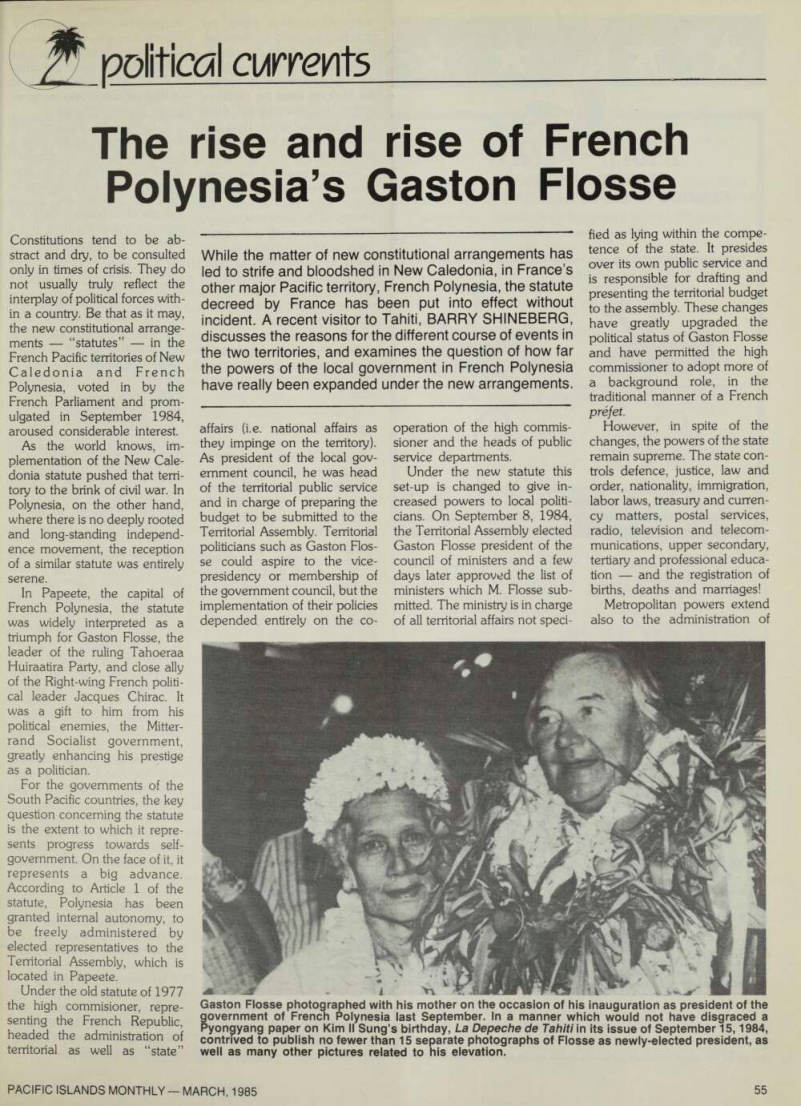
The rise and rise of French Polynesia’s Gaston Flosse
Constitutions tend to be ab stract and dry, to be consulted only in times of crisis. They do not usually truly reflect the interplay of political forces with in a country. Be that as it may, the new constitutional arrange ments “statutes” in the French Pacific territories of New Caledonia and French Polynesia, voted in by the French Parliament and prom ulgated in September 1984, aroused considerable interest.
As the world knows, im plementation of the New Cale donia statute pushed that terri tory to the brink of civil war. In Polynesia, on the other hand, where there is no deeply rooted and long-standing independ ence movement, the reception of a similar statute was entirely serene.
In Papeete, the capital of French Polynesia, the statute was widely interpreted as a triumph for Gaston Flosse, the leader of the ruling Tahoeraa Huiraatira Party, and close ally of the Right-wing French politi cal leader Jacques Chirac. It was a gift to him from his political enemies, the Mitter rand Socialist government, greatly enhancing his prestige as a politician.
For the governments of the South Pacific countries, the key question concerning the statute is the extent to which it repre sents progress towards self government. On the face of it, it represents a big advance.
According to Article 1 of the statute, Polynesia has been granted internal autonomy, to be freely administered by elected representatives to the Territorial Assembly, which is located in Papeete.
Under the old statute of 1977 the high commisioner, repre senting the French Republic, headed the administration of territorial as well as “state”
While the matter of new constitutional arrangements has led to strife and bloodshed in New Caledonia, in France’s other major Pacific territory, French Polynesia, the statute decreed by France has been put into effect without incident. A recent visitor to Tahiti, BARRY SHINEBERG, discusses the reasons for the different course of events in the two territories, and examines the question of how far the powers of the local government in French Polynesia have really been expanded under the new arrangements.
affairs (i.e. national affairs as they impinge on the territory).
As president of the local gov ernment council, he was head of the territorial public service and in charge of preparing the budget to be submitted to the Territorial Assembly. Territorial politicians such as Gaston Flos se could aspire to the vice presidency or membership of the government council, but the implementation of their policies depended entirely on the co
operation of the high commis sioner and the heads of public service departments.
Under the new statute this set-up is changed to give in creased powers to local politi cians. On September 8, 1984, the Territorial Assembly elected Gaston Flosse president of the council of ministers and a few days later approved the list of ministers which M. Flosse sub mitted. The ministry is in charge of all territorial affairs not speci
fied as lying within the compe tence of the state. It presides over its own public service and is responsible for drafting and presenting the territorial budget to the assembly. These changes have greatly upgraded the political status of Gaston Flosse and have permitted the high commissioner to adopt more of a background role, in the traditional manner of a French prefet.
However, in spite of the changes, the powers of the state remain supreme. The state con trols defence, justice, law and order, nationality, immigration, labor laws, treasury and curren cy matters, postal services, radio, television and telecom munications, upper secondary, tertiary and professional educa tion and the registration of births, deaths and marriages!
Metropolitan powers extend also to the administration of
Gaston Flosse photographed with his mother on the occasion of his inauguration as president of the government of French Polynesia last September. In a manner which would not have disgraced a Pyongyang paper on Kim II Sung’s birthday, La Depeche de Tahiti in its issue of September 15,1984, contrived to publish no fewer than 15 separate photographs of Flosse as newly-elected president, as well as many other pictures related to his elevation.
municipal councils, which are closely supervised by the sous prefets or chefs-de-subdiui sions, who are responsible to the high commissioner. Munici pal budgets must be prepared under the guidance of these functionaries before they can be presented to local councils for debate.
Sandwiched in between these two areas of government under strict state control, the powers of the territorial govern ment are scarcely advanced.
They cover the territory budget, transport within the territory, the regulation of local com merce, tourism, health, social services, primary and lower secondary education. Special ised aspects of territory affairs, e.g. the implementation of labor laws, may be taken over from the metropolitan govern ment.
Moreover, the power of the high commissioner will still be great. His control over territory affairs will change from prior to retrospective control, as he may ask ministers and the Territorial Assembly to reconsider de cisions, and refer procedure and decisions with which he disagrees to an administrative tribunal especially set up for this purpose. It will be his function to ensure that the decisions of the Territorial Assembly are ar rived at by correct procedures, and he may dismiss the Territo rial Assembly and call a new election, after having gained approval from Paris, if he con siders the assembly to be un workable.
The limitations which the sta tute places on the powers of the territorial government are freely admitted by M. Flosse. He insists, however, on its “evolu tive” nature, as is stated in Article 1, the possibility being that the powers can be in creased at a later date. At the moment the president is happy that the territory can adopt “distinctive emblems of its re gional identity” a flag and an anthem, for example, which can be exhibited or played alongside the Tricolor and the Marseillaise on official occa sions.
An important aspect of the statute for him is that it permits the projection of M. Flosse as the chief political personality of the territory a result not
unwelcome to the French ad ministration who will be able to share responsibility with the president in the event of a crisis.
What can be said of the form of internal autonomy being set up in French Polynesia?
It cannot be equated with self-government as the term is usually applied in English speaking countries, as the gov ernment is entirely lacking in sovereign powers and cannot impose its authority without the co-operation of the state. In the absence of support from the French Government, the territorial government would be entirely impotent.
There is evidence that a lack of sovereignty encourages irres ponsible behavior in the territo rial government, at least to wards the assembly, if not to wards the electorate which put it into office.
No firm times appear to be set or at least observed for sessions of the assembly.
Opposition members just wait around in the chamber, some times for up to an hour, before the majority members appear, accompanied by assembly president Jacky Teuira.
Gaston Flosse, in spite of his being an elected officer of the assembly, is said to rarely attend sittings. I can testify to the truth of this after attending four sittings of the assembly during the 1984 budget session Flosse did not put in an appearance in all that time.
Consequently, questions con cerning government policy must be put to ministers in charge of particular portfolios rather than to the president.
If it never had any intention of introducing self-government, why has the French Govern ment brought in statutes of this kind? Georges Lemoine, minis ter responsible for overseas de partments and territories, ex plains that they are applications of the decentralisation legisla tion recently implemented throughout the departments of metropolitan France.
Commenting on the initial controversy aroused by the legislation, Mr Lemoine said: “Those who were least in favor of decentralisation would not today be willing for it to be taken away from them.”
President Gaston Flosse of French Polynesia must certainly be one of this number.
Advertisements & other items, p. 56 (1 item)
★ ★n, ★ ★
hx*.
Ulli/LL LLUI r r
GO WITH THE MOST
FAMOUS NAME IN ALL OF FISHING...
Complete Line of Sport and Commercial Fish Hooks AMERICAN MADE QUALITY FISH HOOKS . . . “HOOK AND HOLD’ f V o 4245 E. 46th Avenue, Denver, Colorado 80216 U.S.A.
"AMAZING"
"INCREDIBLE"
"FANTASTIC . . "
Just some of the words used to describe the Argo at demonstations.
Replace your trail bike, utility and some tractor jobs with this one versatile unit that can also swim. 3 \ X 6 or 8 wheel model available r 1 Please send me brochure □ Advise my nearest dealer □ Ring me to arrange demoD ■ For further information tick appropriate square and mail coupon ■ to: ARGO ALL TERRAIN VEHICLES, 1860 SANDGATE ROAD, I VIRGINIA Q, AUSTRALIA 4014. Telephone (07) 265 2366. I ■ Name • ■ Address a
from the islands press
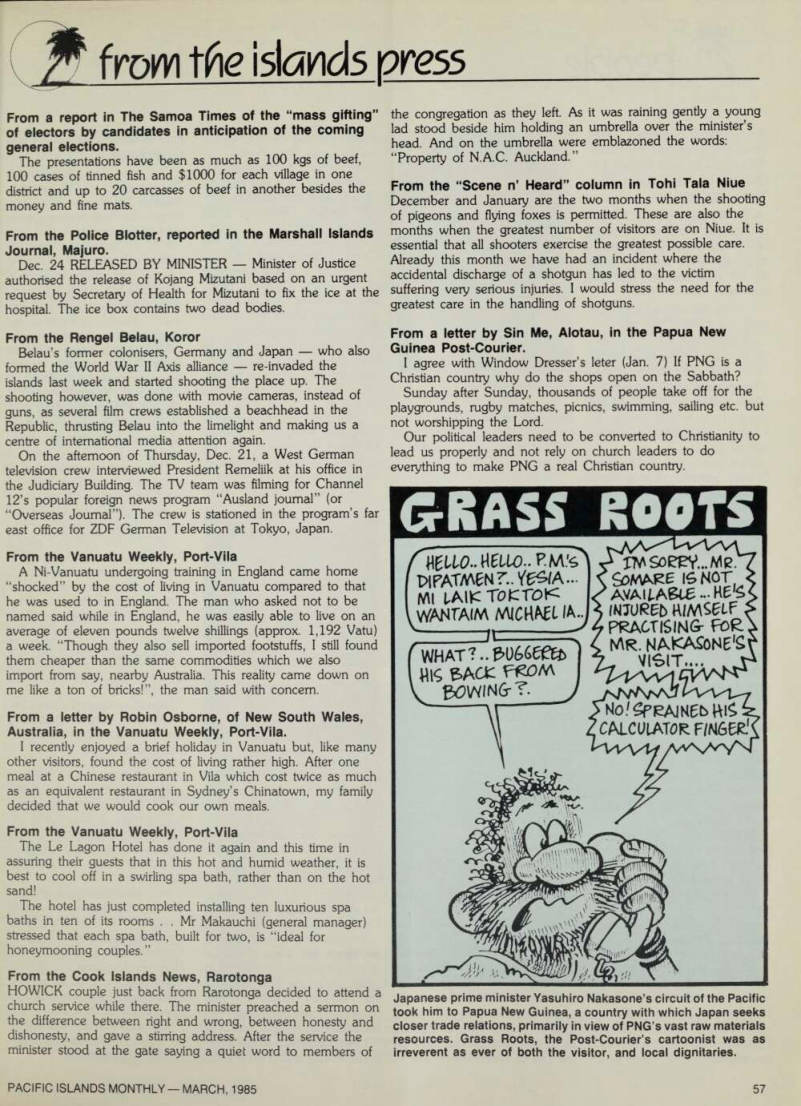
From a report in The Samoa Times of the “mass gifting” of electors by candidates in anticipation of the coming general elections.
The presentations have been as much as 100 kgs of beef, 100 cases of tinned fish and $lOOO for each village in one district and up to 20 carcasses of beef in another besides the money and fine mats.
From the Police Blotter, reported in the Marshall Islands Journal, Majuro.
Dec. 24 RELEASED BY MINISTER Minister of Justice authorised the release of Kojang Mizutani based on an urgent request by Secretary of Health for Mizutani to fix the ice at the hospital. The ice box contains two dead bodies.
From the Rengel Belau, Koror Belau’s former colonisers, Germany and Japan who also formed the World War II Axis alliance re-invaded the islands last week and started shooting the place up. The shooting however, was done with movie cameras, instead of guns, as several film crews established a beachhead in the Republic, thrusting Belau into the limelight and making us a centre of international media attention again.
On the afternoon of Thursday, Dec. 21, a West German television crew interviewed President Remeliik at his office in the Judiciary Building. The TV team was filming for Channel 12’s popular foreign news program “Ausland journal” (or “Overseas Journal”). The crew is stationed in the program’s far east office for ZDF German Television at Tokyo, Japan.
From the Vanuatu Weekly, Port-Vila A Ni-Vanuatu undergoing training in England came home “shocked” by the cost of living in Vanuatu compared to that he was used to in England. The man who asked not to be named said while in England, he was easily able to live on an average of eleven pounds twelve shillings (approx. 1,192 Vatu) a week. “Though they also sell imported footstuffs, I still found them cheaper than the same commodities which we also import from say, nearby Australia. This reality came down on me like a ton of bricks!”, the man said with concern.
From a letter by Robin Osborne, of New South Wales, Australia, in the Vanuatu Weekly, Port-Vila.
I recently enjoyed a brief holiday in Vanuatu but, like many other visitors, found the cost of living rather high. After one meal at a Chinese restaurant in Vila which cost twice as much as an equivalent restaurant in Sydney’s Chinatown, my family decided that we would cook our own meals.
From the Vanuatu Weekly, Port-Vila The Le Lagon Hotel has done it again and this time in assuring their guests that in this hot and humid weather, it is best to cool off in a swirling spa bath, rather than on the hot sand!
The hotel has just completed installing ten luxurious spa baths in ten of its rooms . . Mr Makauchi (general manager) stressed that each spa bath, built for two, is “ideal for honeymooning couples.”
From the Cook Islands News, Rarotonga HOWICK couple just back from Rarotonga decided to attend a church service while there. The minister preached a sermon on the difference between right and wrong, between honesty and dishonesty, and gave a stirring address. After the service the minister stood at the gate saying a quiet word to members of
the congregation as they left. As it was raining gently a young lad stood beside him holding an umbrella over the minister’s head. And on the umbrella were emblazoned the words: “Property of N.A.C. Auckland.”
From the “Scene n’ Heard” column in Tohi Tala Niue December and January are the two months when the shooting of pigeons and flying foxes is permitted. These are also the months when the greatest number of visitors are on Niue. It is essential that all shooters exercise the greatest possible care.
Already this month we have had an incident where the accidental discharge of a shotgun has led to the victim suffering very serious injuries. 1 would stress the need for the greatest care in the handling of shotguns.
From a letter by Sin Me, Alotau, in the Papua New Guinea Post-Courier.
I agree with Window Dresser’s leter (Jan. 7) If PNG is a Christian country why do the shops open on the Sabbath?
Sunday after Sunday, thousands of people take off for the playgrounds, rugby matches, picnics, swimming, sailing etc. but not worshipping the Lord.
Our political leaders need to be converted to Christianity to lead us properly and not rely on church leaders to do everything to make PNG a real Christian country.
Japanese prime minister Yasuhiro Nakasone’s circuit of the Pacific took him to Papua New Guinea, a country with which Japan seeks closer trade relations, primarily in view of PNG’s vast raw materials resources. Grass Roots, the Post-Courier’s cartoonist was as irreverent as ever of both the visitor, and local dignitaries.
people
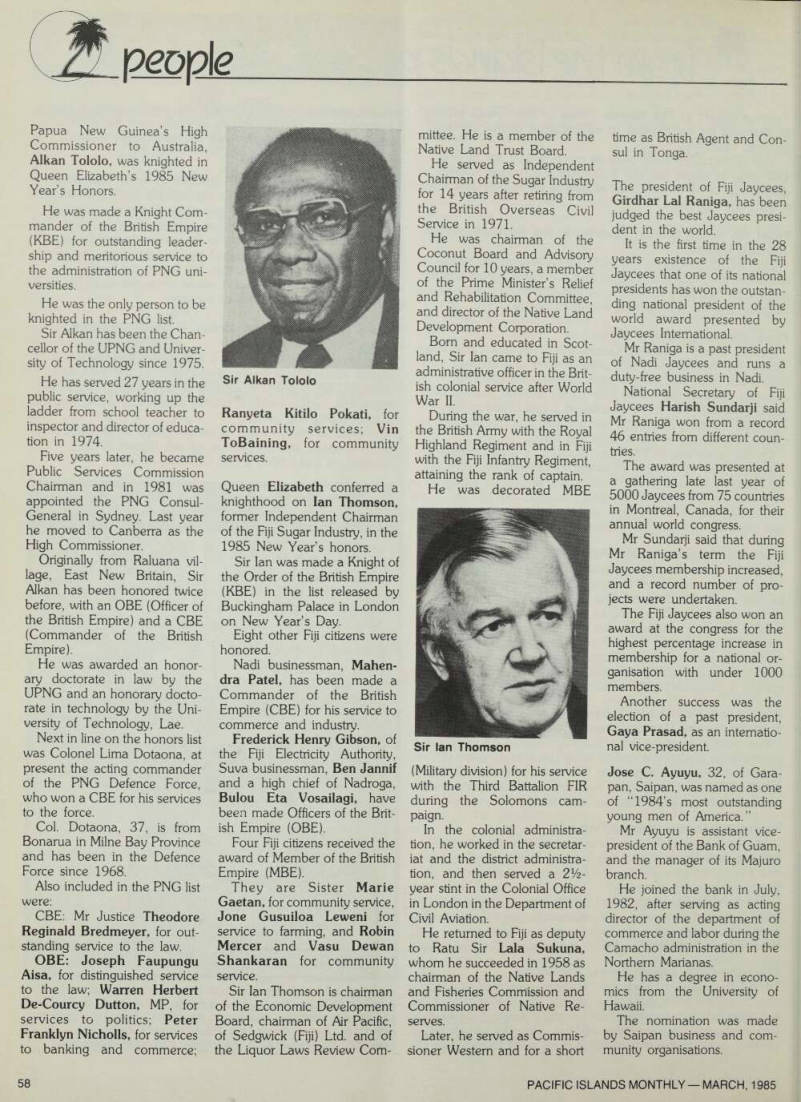
Papua New Guinea’s High Commissioner to Australia, Alkan Tololo, was knighted in Queen Elizabeth’s 1985 New Year’s Honors.
He was made a Knight Com mander of the British Empire (KBE) for outstanding leader ship and meritorious service to the administration of PNG uni versities.
He was the only person to be knighted in the PNG list.
Sir Alkan has been the Chan cellor of the UPNG and Univer sity of Technology since 1975.
He has served 27 years in the public service, working up the ladder from school teacher to inspector and director of educa tion in 1974.
Five years later, he became Public Services Commission Chairman and in 1981 was appointed the PNG Consul- General in Sydney. Last year he moved to Canberra as the High Commissioner.
Originally from Raluana vil lage, East New Britain, Sir Alkan has been honored twice before, with an OBE (Officer of the British Empire) and a CBE (Commander of the British Empire).
He was awarded an honor ary doctorate in law by the UPNG and an honorary docto rate in technology by the Uni versity of Technology, Lae.
Next in line on the honors list was Colonel Lima Dotaona, at present the acting commander of the PNG Defence Force, who won a CBE for his services to the force.
Col. Dotaona, 37, is from Bonarua in Milne Bay Province and has been in the Defence Force since 1968.
Also included in the PNG list were; CBE: Mr Justice Theodore Reginald Bredmeyer, for out standing service to the law.
OBE: Joseph Faupungu Aisa, for distinguished service to the law; Warren Herbert De-Courcy Dutton, MP, for services to politics; Peter Franklyn Nicholls, for services to banking and commerce;
Ranyeta Kitilo Pokati, for community services; Vin Toßaining, for community services.
Queen Elizabeth conferred a knighthood on lan Thomson, former Independent Chairman of the Fiji Sugar Industry, in the 1985 New Year’s honors.
Sir lan was made a Knight of the Order of the British Empire (KBE) in the list released by Buckingham Palace in London on New Year’s Day.
Eight other Fiji citizens were honored.
Nadi businessman, Mahen dra Patel, has been made a Commander of the British Empire (CBE) for his service to commerce and industry.
Frederick Henry Gibson, of the Fiji Electricity Authority, Suva businessman, Ben Jannif and a high chief of Nadroga, Bulou Eta Vosailagi, have been made Officers of the Brit ish Empire (OBE).
Four Fiji citizens received the award of Member of the British Empire (MBE).
They are Sister Marie Gaetan, for community service, Jone Gusuiloa Leweni for service to farming, and Robin Mercer and Vasu Dewan Shankaran for community service.
Sir lan Thomson is chairman of the Economic Development Board, chairman of Air Pacific, of Sedgwick (Fiji) Ltd. and of the Liquor Laws Review Corn
mittee. He is a member of the Native Land Trust Board.
He served as Independent Chairman of the Sugar Industry for 14 years after retiring from the British Overseas Civil Service in 1971.
He was chairman of the Coconut Board and Advisory Council for 10 years, a member of the Prime Minister’s Relief and Rehabilitation Committee, and director of the Native Land
Development Corporation.
Born and educated in Scot land, Sir lan came to Fiji as an administrative officer in the Brit ish colonial service after World War 11.
During the war, he served in the British Army with the Royal Highland Regiment and in Fiji with the Fiji Infantry Regiment, attaining the rank of captain.
He was decorated MBE
(Military division) for his service with the Third Battalion FIR during the Solomons cam paign.
In the colonial administra tion, he worked in the secretar iat and the district administra tion, and then served a 2Vz year stint in the Colonial Office in London in the Department of Civil Aviation.
He returned to Fiji as deputy to Ratu Sir Lala Sukuna, whom he succeeded in 1958 as chairman of the Native Lands and Fisheries Commission and Commissioner of Native Re serves.
Later, he served as Commis sioner Western and for a short
time as British Agent and Con sul in Tonga.
The president of Fiji Jaycees, Girdhar Lai Raniga, has been judged the best Jaycees presi dent in the world.
It is the first time in the 28 years existence of the Fiji Jaycees that one of its national presidents has won the outstan ding national president of the world award presented by Jaycees International.
Mr Raniga is a past president of Nadi Jaycees and runs a duty-free business in Nadi.
National Secretary of Fiji Jaycees Harish Sundarji said Mr Raniga won from a record 46 entries from different coun tries.
The award was presented at a gathering late last year of 5000 Jaycees from 75 countries in Montreal, Canada, for their annual world congress.
Mr Sundarji said that during Mr Raniga’s term the Fiji Jaycees membership increased, and a record number of pro jects were undertaken.
The Fiji Jaycees also won an award at the congress for the highest percentage increase in membership for a national or ganisation with under 1000 members.
Another success was the election of a past president, Gaya Prasad, as an internatio nal vice-president.
Jose C. Ayuyu, 32, of Gara pan, Saipan, was named as one of “1984’s most outstanding young men of America.”
Mr Ayuyu is assistant vice president of the Bank of Guam, and the manager of its Majuro branch.
He joined the bank in July, 1982, after serving as acting director of the department of commerce and labor during the Camacho administration in the Northern Marianas.
He has a degree in econo mics from the University of Hawaii.
The nomination was made by Saipan business and com munity organisations.
Sir Alkan Tololo
Sir lan Thomson
yachts
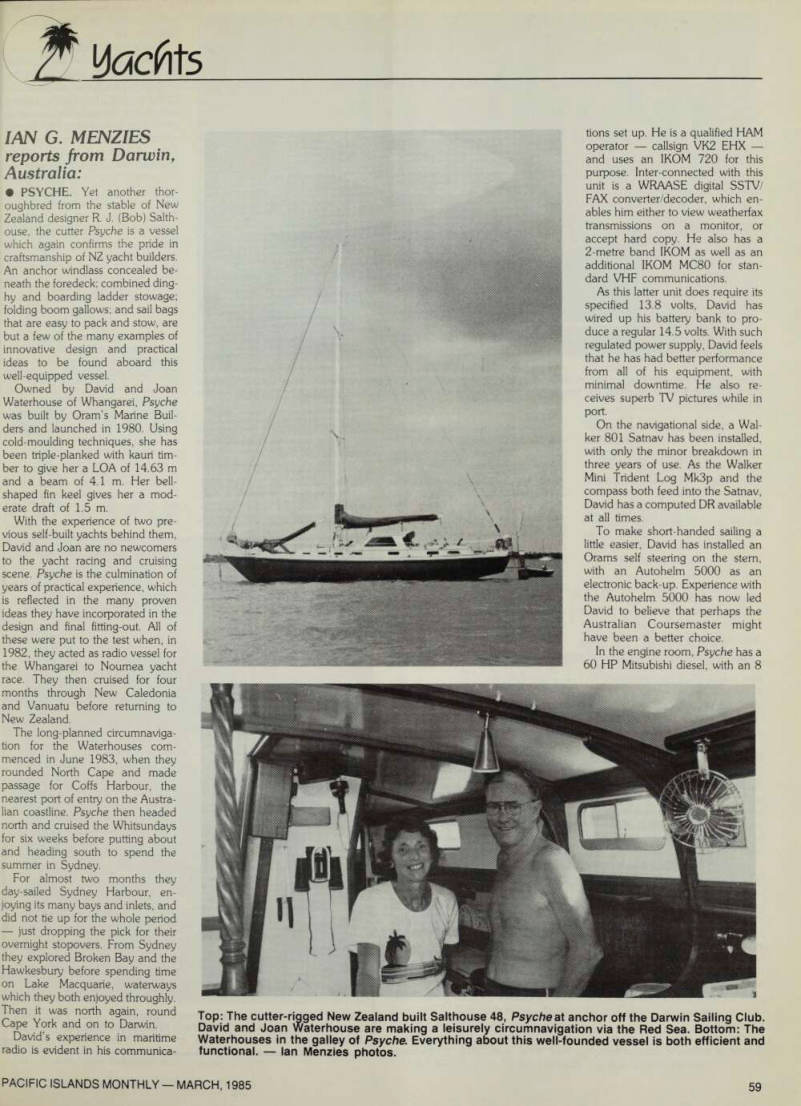
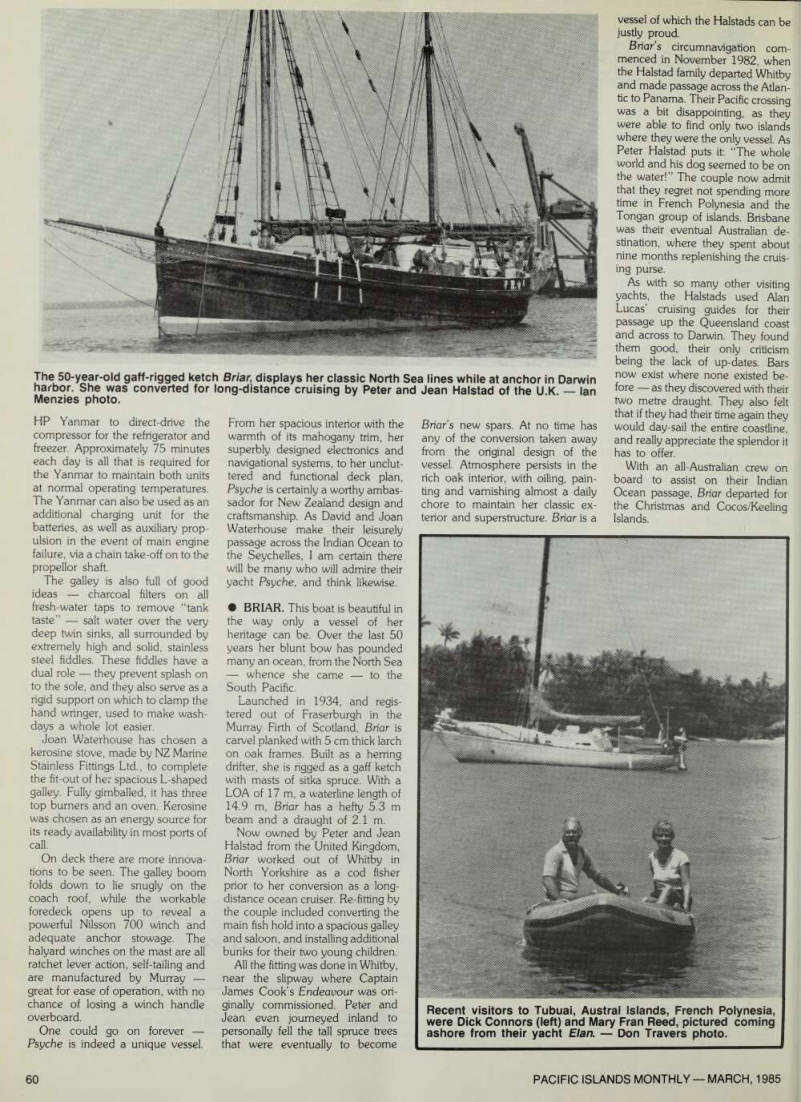
Lan G. Menzies
reports from Darwin,
Australia:
• PSYCHE. Yet another thor oughbred from the stable of New Zealand designer R. J. (Bob) Salth ouse, the cutter Psyche is a vessel which again confirms the pride in craftsmanship of NZ yacht builders.
An anchor windlass concealed be neath the foredeck; combined ding hy and boarding ladder stowage; folding boom gallows; and sail bags that are easy to pack and stow, are but a few of the many examples of innovative design and practical ideas to be found aboard this well-equipped vessel.
Owned by David and Joan Waterhouse of Whangarei, Psyche was built by Oram’s Marine Buil ders and launched in 1980. Using cold-moulding techniques, she has been triple-planked with kauri tim ber to give her a LOA of 14.63 m and a beam of 4.1 m. Her bell shaped fin keel gives her a mod erate draft of 1.5 m.
With the experience of two pre vious self-built yachts behind them, David and Joan are no newcomers to the yacht racing and cruising scene. Psyche is the culmination of years of practical experience, which is reflected in the many proven ideas they have incorporated in the design and final fitting-out. All of these were put to the test when, in 1982, they acted as radio vessel for the Whangarei to Noumea yacht race. They then cruised for four months through New Caledonia and Vanuatu before returning to New Zealand.
The long-planned circumnaviga tion for the Waterhouses com menced in June 1983, when they rounded North Cape and made passage for Coffs Harbour, the nearest port of entry on the Austra lian coastline. Psyche then headed north and cruised the Whitsundays for six weeks before putting about and heading south to spend the summer in Sydney.
For almost two months they day-sailed Sydney Harbour, en joying its many bays and inlets, and did not tie up for the whole period just dropping the pick for their overnight stopovers. From Sydney they explored Broken Bay and the Hawkesbury before spending time on Lake Macquarie, waterways which they both enjoyed throughly.
Then it was north again, round Cape York and on to Darwin.
David’s experience in maritime radio is evident in his communica-
tions set up. He is a qualified HAM operator callsign VK2 EHX and uses an IKOM 720 for this purpose. Inter-connected with this unit is a WRAASE digital SSTV/ FAX converter/decoder, which en ables him either to view weatherfax transmissions on a monitor, or accept hard copy. He also has a 2-metre band IKOM as well as an additional IKOM MCBO for stan dard VHF communications.
As this latter unit does require its specified 13.8 volts, David has wired up his battery bank to pro duce a regular 14.5 volts. With such regulated power supply, David feels that he has had better performance from all of his equipment, with minimal downtime. He also re ceives superb TV pictures while in port.
On the navigational side, a Wal ker 801 Satnav has been installed, with only the minor breakdown in three years of use. As the Walker Mini Trident Log Mk3p and the compass both feed into the Satnav, David has a computed DR available at all times.
To make short-handed sailing a little easier, David has installed an Orams self steering on the stem, with an Autohelm 5000 as an electronic back-up. Experience with the Autohelm 5000 has now led David to believe that perhaps the Australian Coursemaster might have been a better choice.
In the engine room, Psyche has a 60 HP Mitsubishi diesel, with an 8
Top: The cutter-riqged New Zealand built Salthouse 48, Psyche at anchor off the Darwin Sailing Club.
David and Joan Waterhouse are making a leisurely circumnavigation via the Red Sea. Bottom: The Waterhouses in the galley of Psyche. Everything about this well-founded vessel is both efficient and functional. lan Menzies photos.
HP Yanmar to direct-drive the compressor for the refrigerator and freezer. Approximately 75 minutes each day is all that is required for the Yanmar to maintain both units at normal operating temperatures.
The Yanmar can also be used as an additional charging unit for the batteries, as well as auxiliary prop ulsion in the event of main engine failure, via a chain take-off on to the propeller shaft.
The galley is also full of good ideas charcoal filters on all fresh-water taps to remove “tank taste” salt water over the very deep twin sinks, all surrounded by extremely high and solid, stainless steel fiddles. These fiddles have a dual role they prevent splash on to the sole, and they also serve as a rigid support on which to clamp the hand wringer, used to make wash days a whole lot easier.
Joan Waterhouse has chosen a kerosine stove, made by NZ Marine Stainless Fittings Ltd., to complete the fit-out of her spacious L-shaped galley. Fully gimballed, it has three top burners and an oven. Kerosine was chosen as an energy source for its ready availability in most ports of call.
On deck there are more innova tions to be seen. The galley boom folds down to lie snugly on the coach roof, while the workable foredeck opens up to reveal a powerful Nilsson 700 winch and adequate anchor stowage. The halyard winches on the mast are all ratchet lever action, self-tailing and are manufactured by Murray great for ease of operation, with no chance of losing a winch handle overboard.
One could go on forever Psyche is indeed a unique vessel.
From her spacious interior with the warmth of its mahogany trim, her superbly designed electronics and navigational systems, to her unclut tered and functional deck plan, Psyche is certainly a worthy ambas sador for New Zealand design and craftsmanship. As David and Joan Waterhouse make their leisurely passage across the Indian Ocean to the Seychelles, I am certain there will be many who will admire their yacht Psyche, and think likewise. • BRIAR. This boat is beautiful in the way only a vessel of her heritage can be. Over the last 50 years her blunt bow has pounded many an ocean, from the North Sea whence she came to the South Pacific.
Launched in 1934, and regis tered out of Fraserburgh in the Murray Firth of Scotland, Briar is carvel planked with 5 cm thick larch on oak frames. Built as a herring drifter, she is rigged as a gaff ketch with masts of sitka spruce. With a LOA of 17 m, a waterline length of 14.9 m, Briar has a hefty 5.3 m beam and a draught of 2.1 m.
Now owned by Peter and Jean Halstad from the United Kingdom, Briar worked out of Whitby in North Yorkshire as a cod fisher prior to her conversion as a long distance ocean cruiser. Re-fitting by the couple included converting the main fish hold into a spacious galley and saloon, and installing additional bunks for their two young children.
All the fitting was done in Whitby, near the slipway where Captain James Cook’s Endeavour was ori ginally commissioned. Peter and Jean even journeyed inland to personally fell the tall spruce trees that were eventually to become
Briar’s new spars. At no time has any of the conversion taken away from the original design of the vessel. Atmosphere persists in the rich oak interior, with oiling, pain ting and varnishing almost a daily chore to maintain her classic ex terior and superstructure. Briar is a
vessel of which the Halstads can be justly proud.
Briar’s circumnavigation com menced in November 1982, when the Halstad family departed Whitby and made passage across the Atlan tic to Panama. Their Pacific crossing was a bit disappointing, as they were able to find only two islands where they were the only vessel. As Peter Halstad puts it; “The whole world and his dog seemed to be on the water!” The couple now admit that they regret not spending more time in French Polynesia and the Tongan group of islands. Brisbane was their eventual Australian de stination, where they spent about nine months replenishing the cruis ing purse.
As with so many other visiting yachts, the Halstads used Alan Lucas’ cruising guides for their passage up the Queensland coast and across to Darwin. They found them good, their only criticism being the lack of up-dates. Bars now exist where none existed be fore as they discovered with their two metre draught. They also felt that if they had their time again they would day-sail the entire coastline, and really appreciate the splendor it has to offer.
With an all-Australian crew on board to assist on their Indian Ocean passage, Briar departed for the Christmas and Cocos/Keeling Islands.
The 50-year-old gaff-rigged ketch Briar, displays her classic North Sea lines while at anchor in Darwin harbor. She was converted for long-distance cruising by Peter and Jean Halstad of the U.K. lan Menzies photo.
Recent visitors to Tubuai, Austral Islands, French Polynesia, were Dick Connors (left) and Mary Fran Reed, pictured coming ashore from their yacht Elan. Don Travers photo.
Shipping schedules
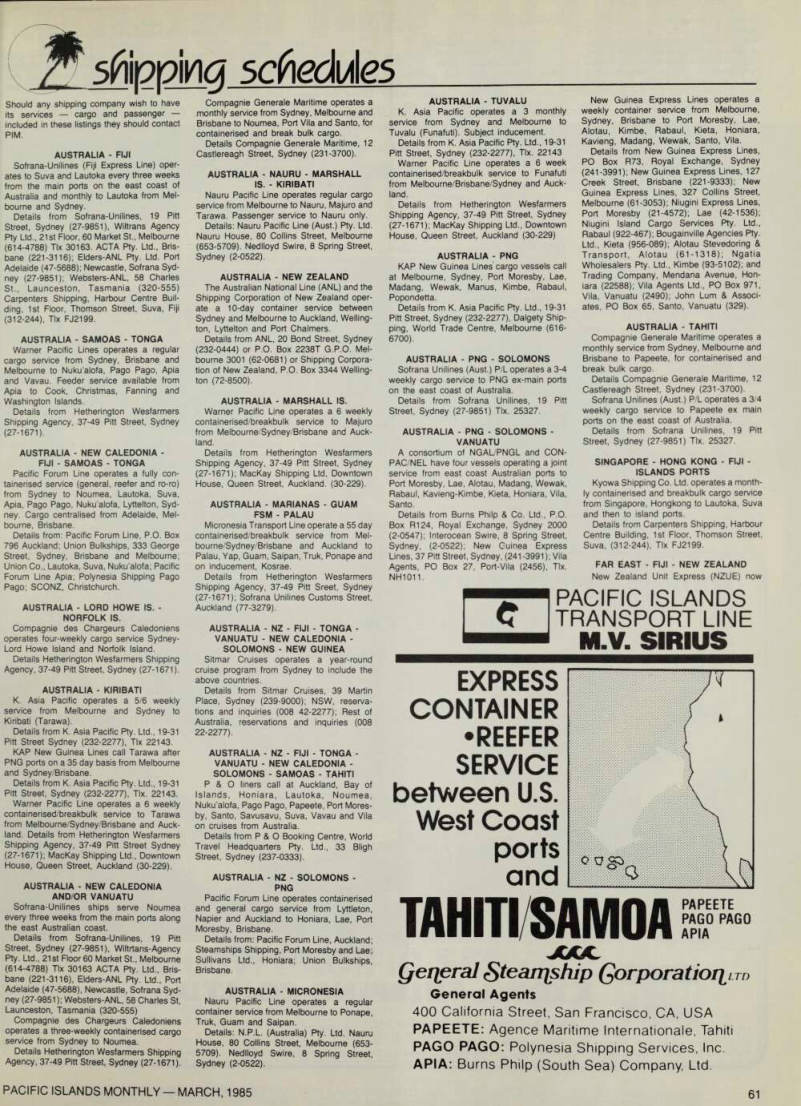
Should any shipping company wish to have its services cargo and passenger included in these listings they should contact
Pim.
Australia - Fiji
Sofrana-Unilines (Fiji Express Line) oper ates to Suva and Lautoka every three weeks from the main ports on the east coast of Australia and monthly to Lautoka from Mel bourne and Sydney.
Details from Sofrana-Unilines, 19 Pitt Street, Sydney (27-9851), Wiltrans Agency Pty Ltd., 21st Floor, 60 Market St., Melbourne (614-4788) Tlx 30163. ACTA Pty. Ltd., Bris bane (221-3116); Elders-ANL Pty. Ltd. Port Adelaide (47-5688); Newcastle, Sofrana Syd ney (27-9851); Websters-ANL, 58 Charles St., Launceston, Tasmania (320-555) Carpenters Shipping, Harbour Centre Buil ding, Ist Floor, Thomson Street, Suva, Fiji (312-244), Tlx FJ2199.
Australia - Samoas - Tonga
Warner Pacific Lines operates a regular cargo service from Sydney, Brisbane and Melbourne to Nukualofa, Pago Pago, Apia and Vavau. Feeder service available from Apia to Cook, Christmas, Fanning and Washington Islands.
Details from Hetherington Wesfarmers Shipping Agency, 37-49 Pitt Street, Sydney (27-1671).
Australia - New Caledonia -
Fiji - Samoas - Tonga
Pacific Forum Line operates a fully con tainerised service (general, reefer and ro-ro) from Sydney to Noumea, Lautoka, Suva, Apia, Pago Pago, Nukualofa, Lyttelton, Syd ney. Cargo centralised from Adelaide, Mel bourne, Brisbane.
Details from: Pacific Forum Line, P.O. Box 796 Auckland; Union Bulkships, 333 George Street, Sydney, Brisbane and Melbourne; Union Co., Lautoka, Suva, Nukualofa; Pacific Forum Line Apia; Polynesia Shipping Pago Pago; SCONZ, Christchurch.
Australia - Lord Howe Is. -
Norfolk Is.
Compagnie des Chargeurs Caledoniens operates four-weekly cargo service Sydney- Lord Howe Island and Norfolk Island.
Details Hetherington Wesfarmers Shipping Agency, 37-49 Pitt Street, Sydney (27-1671).
Australia - Kiribati
K. Asia Pacific operates a 5/6 weekly service from Melbourne and Sydney to Kiribati (Tarawa).
Details from K. Asia Pacific Pty. Ltd., 19-31 Pitt Street Sydney (232-2277), Tlx 22143.
KAP New Guinea Lines call Tarawa after PNG ports on a 35 day basis from Melbourne and Sydney/Brisbane.
Details from K. Asia Pacific Pty. Ltd., 19-31 Pitt Street. Sydney (232-2277), Tlx. 22143.
Warner Pacific Line operates a 6 weekly containerised/breakbulk service to Tarawa from Melbourne/Sydney/Brisbane and Auck land. Details from Hetherington Wesfarmers Shipping Agency, 37-49 Pitt Street Sydney (27-1671); Mac Kay Shipping Ltd., Downtown House, Queen Street, Auckland (30-229).
Australia - New Caledonia
And/Or Vanuatu
Sofrana-Unilines ships serve Noumea every three weeks from the main ports along the east Australian coast.
Details from Sofrana-Unilines, 19 Pitt Street, Sydney (27-9851), Wiltrtans-Agency Pty. Ltd., 21st Floor 60 Market St., Melbourne (614-4788) Tlx 30163 ACTA Pty. Ltd.. Bris bane (221-3116), Elders-ANL Pty. Ltd., Port Adelaide (47-5688), Newcastle, Sofrana Syd ney (27-9851); Websters-ANL, 58 Charles St, Launceston, Tasmania (320-555)
Compagnie des Chargeurs Caledoniens
operates a three-weekly containerised cargo service from Sydney to Noumea.
Details Hetherington Wesfarmers Shipping
Agency, 37-49 Pitt Street. Sydney (27-1671).
Compagnie Generate Maritime operates a monthly service from Sydney, Melbourne and Brisbane to Noumea, Port Vila and Santo, for containerised and break bulk cargo.
Details Compagnie Generate Maritime, 12 Castlereagh Street, Sydney (231-3700).
Australia - Nauru - Marshall
Is. - Kiribati
Nauru Pacific Line operates regular cargo service from Melbourne to Nauru, Majuro and Tarawa. Passenger service to Nauru only.
Details; Nauru Pacific Line (Aust.) Pty. Ltd.
Nauru House, 80 Collins Street, Melbourne (653-5709). Nedlloyd Swire, 8 Spring Street, Sydney (2-0522).
Australia - New Zealand
The Australian National Line (ANL) and the Shipping Corporation of New Zealand oper ate a 10-day container service between Sydney and Melbourne to Auckland, Welling ton, Lyttelton and Port Chalmers.
Details from ANL, 20 Bond Street, Sydney (232-0444) or P C. Box 2238 T G.P.O. Mel bourne 3001 (62-0681) or Shipping Corpora tion of New Zealand, P.O. Box 3344 Welling ton (72-8500).
Australia - Marshall Is.
Warner Pacific Line operates a 6 weekly containerised/breakbulk service to Majuro from Melbourne/Sydney/Brisbane and Auck land.
Details from Hetherington Wesfarmers Shipping Agency, 37-49 Pitt Street, Sydney (27-1671); Mac Kay Shipping Ltd, Downtown House, Queen Street, Auckland. (30-229).
Australia - Marianas - Guam
Fsm - Palau
Micronesia Transport Line operate a 55 day containerised/breakbulk service from Mel bourne/Sydney/Brisbane and Auckland to Palau, Yap, Guam, Saipan, Truk, Ponape and on inducement, Kosrae.
Details from Hetherington Wesfarmers Shipping Agency, 37-49 Pitt Sreet, Sydney (27-1671); Sofrana Unilines Customs Street, Auckland (77-3279).
AUSTRALIA - NZ - FIJI - TONGA -
Vanuatu - New Caledonia -
Solomons - New Guinea
Sitmar Cruises operates a year-round cruise program from Sydney to include the above countries.
Details from Sitmar Cruises, 39 Martin Place, Sydney (239-9000); NSW, reserva tions and inquiries (008 42-2277); Rest of Australia, reservations and inquiries (008 22-2277).
AUSTRALIA - NZ - FIJI - TONGA -
Vanuatu - New Caledonia -
Solomons - Samoas - Tahiti
P & O liners call at Auckland, Bay of Islands, Honiara, Lautoka, Noumea, Nukualofa, Pago Pago, Papeete, Port Mores by, Santo, Savusavu, Suva, Vavau and Vila on cruises from Australia.
Details from P & O Booking Centre, World Travel Headquarters Pty. Ltd., 33 Bligh Street, Sydney (237-0333).
Australia - Nz - Solomons -
Png
Pacific Forum Line operates containerised and general cargo service from Lyttleton, Napier and Auckland to Honiara, Lae, Port Moresby, Brisbane.
Details from; Pacific Forum Line, Auckland: Steamships Shipping, Port Moresby and Lae; Sullivans Ltd., Honiara: Union Bulkships, Brisbane.
Australia - Micronesia
Nauru Pacific Line operates a regular container service from Melbourne to Ponape, Truk, Guam and Saipan.
Details: N.P.L. (Australia) Pty. Ltd. Nauru House, 80 Collins Street, Melbourne (653- 5709). Nedlloyd Swire, 8 Spring Street, Sydney (2-0522).
Australia - Tuvalu
K. Asia Pacific operates a 3 monthly service from Sydney and Melbourne to Tuvalu (Funafuti). Subject inducement.
Details from K. Asia Pacific Pty. Ltd., 19-31 Pitt Street, Sydney (232-2277), Tlx. 22143 Warner Pacific Line operates a 6 week containerised/breakbulk service to Funafuti from Melbourne/Brisbane/Sydney and Auck land.
Details from Hetherington Wesfarmers Shipping Agency, 37-49 Pitt Street, Sydney (27-1671); Mac Kay Shipping Ltd., Downtown House, Queen Street, Auckland (30-229)
Australia - Png
KAP New Guinea Lines' cargo vessels call at Melbourne, Sydney, Pori Moresby, Lae, Madang, Wewak, Manus, Kimbe, Rabaul, Popondetta.
Details from K. Asia Pacific Pty. Ltd., 19-31 Pitt Street, Sydney (232-2277), Dalgety Ship ping, World Trade Centre, Melbourne (616- 6700).
Australia - Png - Solomons
Sofrana Unilines (Aust.) P/L operates a 3-4 weekly cargo service to PNG ex-main ports on the east coast of Australia.
Details from Sofrana Unilines, 19 Pitt Street, Sydney (27-9851) Tlx. 25327.
Australia - Png - Solomons -
Vanuatu
A consortium of NGAL/PNGL and CON PAC/NEL have four vessels operating a joint service from east coast Australian ports to Port Moresby, Lae, Alotau, Madang, Wewak, Rabaul, Kavieng-Kimbe, Kieta, Honiara, Vila, Santo.
Details from Burns Philp & Co. Ltd., P.O.
Box R 124, Royal Exchange, Sydney 2000 (2-0547); Interocean Swire, 8 Spring Street, Sydney, (2-0522); New Guinea Express Lines, 37 Pitt Street, Sydney, (241-3991); Vila Agents, PO Box 27, Port-Vila (2456), Tlx.
Nhioii.
New Guinea Express Lines operates a weekly container service from Melbourne, Sydney, Brisbane to Port Moresby, Lae, Alotau, Kimbe, Rabaul, Kieta, Honiara, Kavieng, Madang, Wewak, Santo, Vila.
Details from New Guinea Express Lines, PO Box R 73, Royal Exchange, Sydney (241-3991); New Guinea Express Lines, 127 Creek Street, Brisbane (221-9333); New Guinea Express Lines, 327 Collins Street, Melbourne (61-3053); Niugini Express Lines, Port Moresby (21-4572); Lae (42-1536); Niugini Island Cargo Services Pty. Ltd., Rabaul (922-467); Bougainville Agencies Pty.
Ltd., Kieta (956-089); Alotau Stevedoring & Transport, Alotau (61-1318); Ngatia Wholesalers Pty. Ltd., Kimbe (93-5102); and Trading Company, Mendana Avenue, Hon iara (22588); Vila Agents Ltd., PO Box 971, Vila, Vanuatu (2490); John Lum & Associ ates, PO Box 65, Santo, Vanuatu (329).
Australia - Tahiti
Compagnie Generate Maritime operates a monthly service from Sydney, Melbourne and Brisbane to Papeete, for containerised and break bulk cargo.
Details Compagnie Generate Maritime, 12 Castlereagh Street, Sydney (231-3700).
Sofrana Unilines (Aust.) P/L operates a 3/4 weekly cargo service to Papeete ex main ports on the east coast of Australia.
Details from Sofrana Unilines. 19 Pitt Street, Sydney (27-9851) Tlx. 25327.
SINGAPORE - HONG KONG - FIJI -
Islands Ports
Kyowa Shipping Co. Ltd. operates a month ly containerised and breakbulk cargo service from Singapore, Hongkong to Lautoka, Suva and then to island ports.
Details from Carpenters Shipping, Harbour Centre Building, Ist Floor, Thomson Street, Suva, (312-244), Tlx FJ2199.
FAR EAST - FIJI - NEW ZEALAND New Zealand Unit Express (NZUE) now
operates a monthly service accepting con tainerised and break bulk cargo from Manila, Keelung, Kaohsiung and Hongkong to Lauto ka, Suva and thence to New Zealand ports.
Details from Carpenters Shipping, Harbour Centre Building, Ist Floor, Thomson Street, Suva (312-244), Tlx FJ2199; Burns Philp, Suva (311-777); P&O S.N. Co. Wellington (736-477) or Nedlloyd Swire Pty. Ltd., Sydney (20-522).
Nedlloyd operates bi-weekly cargo service with four ships from Sourabaya, Jakarta, Bangkok, Port Kelang and Singapore to Suva, Lautoka and NZ ports.
Details from Nedlloyd (Aust.) Pty. Ltd., 8 Spring St., Sydney (27-3801). Burns Philp (SS) Co. Ltd., Suva and Lautoka.
Far East - Mid-S. Pacific
China Navigation's New Guinea Pacific Line operates a regular container service from Hongkong, Taiwan, Manila, Port Kelang and Singapore to Port Moresby, Lae, Rabaul and Honiara monthly and to Wewak, Madang and Kieta every three months. Cargo from the same Far Eastern ports to the South Pacific ports of Noumea, Santo, Vila. Papeete, Pago Pago, Apia, Raratonga and Tarawa will be shipped via Japan on the monthly Bali Hai service.
Details from Steamships Shipping, PO Box 634, Port Moresby (22-0289).
Kyowa Shipping Ltd. operates monthly services from Japan to Guam, Saipan, Solo mons, New Caledonia, Fiji, Western and American Samoa, Tahiti. Cook Is., Tonga and Vanuatu.
Details: Hetherington Wesfarmers Shipping Agency, 37-49 Pitt Street, Sydney (27-1671); Carpenters Shipping, Suva (312-244), Tlx FJ2199.
Guam - Northern Marianas
Saipan Shipping Co. Inc. operate a weekly service via barge carrying containers and conventional cargo between Guam and Saipan and Tinian.
Details from Saipan Shipping Co. Inc., PO Box 8, Saipan, CM 96950 (Tel. 9707), Tlx 783619; Guam agents Maritime Agencies of
the Pacific Ltd.
Hawaii - Tahiti - Samoas -
Tonga - Kiribati - Fiji -
Solomons - Png.
Star Shipping Associates operates a monthly service originating in Honolulu and destined for Pago Pago, Papeete, Apia, Nukualofa, Suva, Vila and Port Moresby.
Details from Star Shipping Assoc., P.O.
Box 25988, Honolulu, Hawaii 96825. Ph. (808) 545-3026; Polynesia Shipping Services in Pago Pago and Burns Philp Agency in Apia, Nukualofa, Suva and Port Moresby.
Japan Fiji Island Ports
Kyowa Shipping Co. Ltd. operates a month ly containerised service from main ports of Japan to Suva and Lautoka and thence to island ports.
Details from Carpenters Shipping, Harbour Centre Building, Ist Floor, Thomson St., Suva (312-244), Tlx FJ2199.
Bali Hai service operates a monthly con tainerised service from main ports of Japan to Lautoka and Suva and thence to island ports.
Details from Carpenters Shipping, Harbour Centre Building, Ist Floor, Thomson St., Suva (312-244), Tlx FJ2199 and Burns Philp, Suva (311-777).
Japan Micronesia
The NYK Shipping Line operates a monthly cargo service from Japan to Micronesia, calling at Yoko, Nagoya, Kobe, Guam, Saipan, Truk, Ponape and Majuro, returning via Yoko, Nagoya and Kobe.
Details from Burns Philp & Co. Ltd., 51 Pitt Street, Sydney (2-0547).
Japan Micronesia
Saipan Shipping Co. Inc. operates a monthly service from Japan to Saipan, Guam, Truk, Ponape, Majuro (Kosrae and Ebeye on inducement).
Details from Saipan Shipping Co. Inc., P.O.
Box 8. Saipan, CM 96950 (Tel. 9707), Tlx 783619; Japan agents Kyowa Shipping Com pany Ltd; Guam Agents Maritime Agencies of
the Pacific Ltd.
Japan Png
Mitsui O.S.K. Lines operates a monthly service from main ports Japan and Port Moresby, Rabaul, Lae, Madang, Kieta and Kimbe.
Details from Robert Laurie (PNG) Pty. Ltd., P.O. Box 922, Port Moresby (21-2466/21- 1898).
New Caledonia Fiji West
Coast North America
PAD Line operates an approx. 3-weekly ro-ro service from Noumea and Suva to Honolulu and West Coast USA and Canadian ports.
Details from Sofrana-Unilines SA, BP 1602, Noumea (27-51-91), Tlx NMO4B; Carpenters Shipping, Harbour Centre Building, Ist Floor, Thomson St., Suva (312-244), Tlx FJ2199.
Png Inter Mainport
Papua New Guinea Line offers scheduled 10-20 day coastal liner services linking all PNG major ports with containerisation, reefer, heavy lift and transhipment facilities.
Details from PNG Line, Box 543, Port Moresby, PNG (21-1174), Tlx 22269.
Png Uk/Continent
The Bank Line & Columbus Line operate a regular joint service from Port Moresby, Oro Bay, Kieta, Rabaul, Kimbe, Madang and Lae to Hull, Hamburg, Rotterdam, Antwerp and Le Havre.
Details from The Bank Line (A’asia) Pty.
Ltd., 51 Pitt Street, Sydney (27-2041); Tlx AA24063; Columbus Line, Lae (423466), Tlx NE 44171; or lines’ local agents.
Solomons Uk/Continent
The Bank Line & Columbus Line operate a regular joint cargo service from Honiara to Hull, Hamburg, Rotterdam, Antwerp and Le Havre.
Details from The Bank Line (A'asia) Pty.
Ltd., 51 Pitt Street, Sydney (27-2041); Tlx AA24063; Columbus Line, Lae (423466), Tlx NE 44171; or the lines’ local agents.
New Zealand Vanuatu
Solomon Islands Papua New
Guinea Australia
Pacific Forum Line operates a 28 day cycle container shipping service from New Zealand direct to Vila, then on to Honiara, Lae, Port Moresby, Brisbane, back to Lyttelton, Napier and Auckland.
Details from Pacific Forum Line, P.O. Box 796, Auckland (790-050), Tlx 60460; P.O.
Box 971, Vila, Vanuatu (2490), Tlx 1044.
Nz Cook Is. Niue Tahiti
Shipping Corporation of NZ Ltd. operates cargo services based on pallets and similar units from Auckland to Niue, Cook Islands and Tahiti.
Details from the Shipping Corp. of NZ Ltd., P.O. Box 3344, Wellington (72-8500); Waterfront Commission, P.O. Box 61, Raro tonga; Cook Islands: Shipping Office, Govt, of Niue, P.O. Box 107, Niue Island: Compagnie Maritime Polynesienne, P.O. Box 368, Pape ete, Tahiti.
Nz Fiji
Reef operates a regular 18-day service from Auckland to Suva and Lautoka. Also passenger accommodation.
Details from Reef Shipping Agencies, P.O.
Box 3382, Auckland, NZ (77-1221-3), Tlx 60633; M.V. Fijian Shipping Agencies Ltd., Private Bag, Suva, Fiji (31-1056).
Pacific Line with one ship operates three weekly ro-ro cargo service New Zealand.
Lautoka, Suva. No passengers.
Details: Sofrana Unilines, 18 Customs Street, Auckland (773-279) P.O. Box 3614, Tlx NZ2313; Carpenters Shipping, 100 Thom son Street, Suva (312-244), Tlx FJ2199.
Nz Fiji North America (Wc)
Blue Star Line Ltd. Pacific Coast container services. Only direct service to and from New Zealand. Blue Star vessels call at Suva and Honolulu on NZ-US-West Coast voyages.
Details from Blueport ACT (NZ) Ltd., P.O.
Box 192, Wellington (739-029). Burns Philp (SS) Co. Ltd., GPO Box 355, Suva, Fiji (311-777), Tlx FJ2168 Burship.
Nz Fiji Samoas Tonga
Pacific Forum Line operates a fully con tainerised three-weekly service (Gen/Reefer) from Auckland to Lautoka, Suva, Apia, Pago Pago and Nukualofa.
Details from Pacific Forum Line, Auckland; Union Co. Auckland, Lautoka, Suva and Nukualofa; Pacific Forum Line, Apia; Polyne sian Shipping, Pago Pago.
Nz N. Caledonia Vanuatu
Png Solomons
Sofrana Unilines with three ships operate to Vila and Santo, to Honiara and Papua New Guinea and to Norfolk Island and Noumea (No passengers).
Details from Sofrana Unilines, 18 Customs Street, Auckland (773-279), P.O, Box 3614, Tlx NZ2313.
Nz Tahiti
Compagnie Tahitienne Maritime SA (as CTM-Tahiti Line) operates one ship, MV Bounty 111, monthly Papeete New Zea land. (No passengers).
Details from Sofrana Unilines, P.O. Box 3614, 18 Customs St., Auckland, Tlx NZ2313; Agence Maritime Cowan, P.O. Box 9012, Papeete (39042), Tlx Tahitlin 322 FP Tahiti.
Nz Tonga Samoas
Warner Pacific Line services Auckland, Nukualofa, Vavau, Apia, Pago Pago fort nightly carrying general and freezer cargoes.
Details from McKay Shipping Ltd., Down town House, 21 Queen St., Auckland, P.O Box 1372 (30-299). Cables MACSHIP, Telex NZ2554, Warner Pacific Line, Box 93, Nukualofa, Tonga; Mealelei (Western Samoa,) Ltd. Private Bag, Apia, Western Samoa, Kneubuhl Maritime Service, Box 39, Pago Pago, American Samoa. 96799.
Nz New Caledonia
CP Line operates a monthly cargo service from Auckland, Napier and Mt. Maunganui to Noumea.
Details from McKay Shipping Ltd., P.O Box 1372, Auckland (9-30229); Tlx 2554 NZ.
Tahiti New Caledonia Vanuatu
Solomon Is.
New Zealand Png Singapore
Europe
Polish Ocean Lines operate in a semi container type vessel to the following ports, from Papeete, Noumea, Santo, Vila, Yandina, Honiara, Auckland, Rabaul, Lae, Singapore then to Mediterranean ports and Europe via the Suez Canal. (Other New Zealand ports subject to inducement).
Details from Universal Shipping Agencies Ltd., 6th Floor, 38 Fort Street, Auckland 1, New Zealand (30931), Tlx 21517
Europe Tahiti
New Caledonia
Compagnie Generate Maritime operates services from Europe and Mediterranean ports to Papeete and Noumea using three ro-ro and multi-purpose vessels thus ensuring a bi-monthly sailing to and from.
Details Compagnie Generate Maritime, 12 Castlereagh Street, Sydney (231-3700).
Europe Tahiti
New Caledonia New Zealand
Solomons Png Europe
Polish Ocean Lines offers regular monthly sailings for containerised and break bulk cargo and reefer space, conventional and in reefer containers, from Noumea to Vanuatu (Santo/Vila), Solomon Islands (Honiara), New Zealand (always Auckland, other ports sub ject to inducement), Lae, Rabaul, Singapore, then Mediterranean to Europe. Other ports in the South Pacific can be served with induce ment.
Details from Sotama, BP 9170, Papeete (27805), Tlx 296 SATO; BP C 2, Noumea (272094), Tlx 163 NM SATO; Union Steam ship Co. of NZ, P.O Box 50, Apia, Tlx 25; Williams and Gosling, P.O Box 79, Suva (312633), Tlx 2163; Warner Pacific Line, P.O.
Box 93 Nukualofa (21089), Tlx 66219; Uni versal Shipping Agencies, 6th Floor, 38 Fort Street, Auckland 1, New Zealand (30930), Tlx 21517.
Europe Tahiti W. Samoa
Fiji N. Caledonia
Nedlloyd offers regular cargo services from Continental ports to Papeete, Apia, Fiji and New Caledonia.
Details Nedlloyd (Aust.) Pty. Ltd., 8 Spring Street, Sydney (27-3801); Carpenters Ship ping, Ist Floor, Harbour Centre Bldg., 100 Thomson St.. Suva (312-244), Tlx 2199 FJ
and Vetari Street, Lautoka (63988), Tlx 5215FJ.
Uk N. Continent W. Samoa
Tonga, Fiji
The Bank Line & Columbus Line operate a regular joint cargo service from Hull, Ham burg, Bremen, Antwerp, Rotterdam and Le Havre to Apia, Nukualofa, Suva and Lautoka.
Details from The Bank Line (A’asia) Pty.
Ltd., 51 Pitt Street, Sydney (27-2041), Tlx AA 24063; Columbus Line, Lae (423-466), Tlx NE 44171; or lines' local agents.
Uk N. Continent Png
Solomons
The Bank Line & Columbus Line operate a regular joint cargo service from Hull, Ham burg, Bremen, Antwerp, Rotterdam and Le Havre to Port Moresby, Lae, Madang, Kimbe, Rabaul, Kieta and Honiara and on induce ment to Yandina.
Details from The Bank Line (A’asia) Ply.
Ltd., 51 Pitt Street, Sydney (27-2041), Tlx AA 24063; Columbus Line, Lae (42-3466), Tlx NE 44171; or lines’ local agents.
Uk/N. Continent Tahiti
N. Caledonia Vanuatu
The Bank Line & Columbus Line operate a regular joint cargo service from Hull, Ham burg, Bremen, Antwerp, Rotterdam and Le Havre to Papeete, Noumea, Port-Vila and Santo.
Details from The Bank Line (A’asia) Pty.
Ltd., 51 Pitt Street, Sydney (27-2041), Tlx AA 24063; Columbus Line, Lae (42-3466), Tlx NE 44171; Ets. A M. Fare UTE, Papeete; Ets.
Ballande, Noumea and other local agents.
Us Hawaii Micronesia
E. Malaysia Brunei Papua New
Guinea Philippines
PM&O Lines operates three fully self-sus tained container vessels on a sailing frequen cy of every 21 days from the San Francisco Bay area, Los Angeles, and Honolulu to Majuro, Ebeye, Kosrae, Ponape, Truk, Saipan, Yap, Koror, Kota Kinabalu, Brunei, Lae, Kieta and Rabaul.
Service is also offered utilising the same vessels on the same 21-day frequency from the Philippine ports of Manila, Cebu, Cagayan
de Oro, Davao and General Santos and the Papua New Guinea ports of Rabaul, Lae and Kieta to Hawaii, San Francisco Bay area and Los Angeles.
Details from PM&O Lines, 181 Fremont Street, San Francisco, California, 94105, U SA (415) 543-7430, Tlx 278016; Cable PMONAV SFO; PM&O Owner’s representa tive, P.O. Box 803, Saipan, N.M.I. 96950.
Cable Commontime Saipan. Tlx
783605; Anscor Transport and Terminals Inc., P.O. Box 7023-5, Metro Manila, Philip pines (521-8074) Tlx 65021 ATTI PN.
Us Hawaii Nauru
Micronesia
Nauru Pacific Line operates regular con ventional and container services from San Francisco and Honolulu to Majuro, Ponape, Truk and Saipan. Cargo is accepted for Nauru and Kosrae with transhipment at Majuro and Ponape.
Details from N.P.O. (Australia) Pty. Ltd., Nauru House, 80 Collins Street, Melbourne (653-5709); Nauru Air and Shipping Agency, Suite 2803, 185 Berry Street, San Francisco, California 94107 (415-543-1737); Nauru Air and Shipping Agency, Suite 506, 841 Bishop St., Honolulu, HI 96813 (808-523-0441).
Us. Noumea Fiji
PAD Line operates an approx. 3-weekly ro-ro service from west coast USA and Canada to Noumea, Suva and Lautoka.
Details from Sofrana Unilines BP 1602, Noumea (27-51-91), Tlx NMO4B; Carpenters Shipping, Harbour Centre Building, Ist Floor, 100 Thomson Street, Suva (312-244), Tlx FJ2199; Trans-Austral Shipping Pty. Ltd., P.O. Box R 232, Royal Exchange, 2000 (231-8411), Tlx AA21204.
Us Tahiti Samoa
Pacific Islands Transport operates a five weekly cargo service from North America west coast ports to Papeete, Pago Pago, Apia.
Details from Polynesia Shipping Services Inc. P.O. Box 1478, Pago Pago 96799.
Polynesia Line operates container and general cargo service from US west coast ports to Papeete and Pago Pago.
Details from Polynesia Shipping Services Inc., P.O. Box 1478, Pago Pago 96799.
Advertisements & other items, pp. 61-64 (1 item)
dsgdfgs
YOUR BUSINESS PARTNER
Japan S. Korea Taiwan Singapore Hong Kong To: Solomon Is., New Caledonia, Fiji, W. Samoa, A. Samoa, Tahiti, Cook Is., Tonga, Vanuatu, Tuvalu. Nauru To: Guam, Saipan, Truk, Ponape, Majuro, Yap, Koror
Taiwan Hong Kong Singapore Philippines
To: Papua New Guinea, Pacific Islands. i * r-A r
KYOWA
KYOWA SHIPPING CO., LTD.
HEAD OFFICE; OSAKA OFFICE:
sth FI., Suzumaru Bldg. 39-8, 2-chome, Nishi-Shinbashi, Minato-ku, Tokyo, Japan. Okajima Bldg., 7th Floor, 2-14, Nishihonmachi 1-chome, Nishi-ku, Osaka, Japan Phone: 03(437)2885 (Rep.) Cables: "MARIQUEEN” Tokyo. Telex: 242-4651 Kyowa J. Phone; 06(533)5821 (Rep.) Cables; "MARIQUEEN" Osaka Telex; 525-6271 Ssiosa J. J A
POLISH OCEAN LINES
General Management, 10 Lutego 24,81-364 GDYNIA, POLAND, Phone: 20-19-01, Cables: POLOCEAN Telex: 054-231 Q >7 wtm $ •A SS& S* N* i r.»l* tr sft fV* ■VC'
SOUTH PACIFIC SERVICE «
nonth| y service to and from: GDYNIA, HAMBURG, ROTTERDAM, MIDDLESBOROUGH/IMMINGHAM, o^!s. f H^ D u UNKIRK - ROUEN - PAPEETE (via PANAMA), NOUMEA, AUCKLAND, HONIARA. RABAUL. LAE, SINGAPORE, by our multipurpose vessels carrying diy and reefer containers, reefer chambers, heavy lifts, breakbulk or
palletized, bulk liquids.
POLISH OCEAN LINES Representatives AUCKLAND T.B.A. Telex 21517 NZ “UNISHIP”. SYDNEY Mr Walenciak Telex 20428 AA “SLEIGH”
TAHITI SOTAMA
AGENCIES LTD.
POLISH OCEAN LINES Agents
Telex 296 FP “COUTIMEX". NEW CALEDONIA SATO Telex 163 NM “SATO”. AUCKLAND UNIVERSAL SHIPPING , Telex 21517 N 2 “UNISHIP”. SOLOMONS MELAN CHINE SHIPPING CO.. LTD Telex 66335 HO “SYMPCO” PNO
We’ve just made
the ocean smaller!
Polynesia Line's new MS Polynesia 550-container ship provides regular monthly cargo service between Papeete, Pago Pago and Apia in the South Pacific, and Long Beach and Oakland on the US Pacific Coast.
POLYNESIA LINE
Interocean Steamship Corporation General Agent x & & u o. 3* £ VS 5* v * Apia Pago Pago /S^ peete Serving Polynesia is all we do—and we do it better!
deaths
The Rev A. Harry Voyce In Auckland on December 28, aged 85.
Harry Voyce was for over 30 years a noted figure as a pioneer missionary in Bougain ville, army chaplain in the Paci fic War, and founder of church communities in the North Solo mons.
Harry was born in Hobart, Tasmania. When he was nine years old his family moved to New Zealand where he grew up in the central North Island. A strong, vigorous young man, he felt a call to the work of the mission field. Accepted for the Methodist ministry, he was trained at Dunholme College in Auckland.
On March 17, 1926, he married Miss Beryl Haliday, and the young couple left for service with the old Solomon Islands Methodist District. Harry was appointed to Bougainville and assigned to the inland Siwai area. Up till this time, most missionary work had been confined to the coastal regions of the island, though some Melanesian teachers were sta tioned inland.
When the Voyces reached their appointed place at Tonu they found they were isolated from the coast by many miles of bush tracks and turbulent riv ers. In the years that followed, Harry and Beryl Voyce ex plored much of inland Bougain ville on foot, contacting village people throughout the area.
Harry earned a name as a prodigious and swift walker the “great Hurry-Up” as the locals called him. Beryl was recognised for her compassion and concern for the women and children.
In 1936 they shifted to Buin on the coast and established Kihili, a mission station that was a botanist’s delight with an immense variety of plants particularly hibiscus and bana nas (33 varieties!).
When war came in 1942, the Voyces were on leave in New
Zealand. Harry was immediate
ly in demand from the Allied forces for information. He also joined the 3rd New Zealand
Division as chaplain. In this capacity he returned to the Solomons. On Vella Lavella he not only fulfilled his ministry to the troops, but also contacted the mission teachers and village leaders.
When war ended the church obtained permission for Harry to make a brief visit to Toroki na. That brief visit extended to four years before he took leave.
With his usual energy and quickness to see and seize opportunities, he helped to re establish links between the scat tered congregations of the church, and out of the chaos of wartime junk he acquired the material to rebuild the mission stations and get schools and hospitals functioning again.
Under his guidance and with the help of the Commonwealth Reconstruction Training Scheme, the work was ex tended into teacher, agricultural and mechanical training, and home science courses were started for girls.
He served on the district advisory council and helped the local Returned Services League branch.
He finally retired at the end of 1958 after 33 years remark able service. A keen observer of native customs and arts and crafts, and a noted stamp col lector, Harry Voyce provided the material for an issue of Papua New Guinea stamps on Bougainville art. It was issued on March 17, 1976 Beryl’s and Harry’s 50th wedding anniversary.
Essentially a modest, rather shy, person for all his rugged strength, Harry Voyce was al ways quicker to point to others’ achievements than to draw attention to his own. But he will be remembered with respect and affection by many people who lived in the North Solo mons Province missionaries, traders, government officers and most of all by the Siwai and Buin people. He is survived by his wife Beryl, four children, 14 grandchildren and three great grandchildren. George G.
Carter in Auckland.
Michael Ala On Ambae, Vanuatu, on Janu ary 4, aged 62.
Mr Ala was very prominent in local affairs on Ambae, serving as president of the local council for a total of 13 years. He was also prominent at a national level in Vanuatu, having for 12 years been a member of the Advisory Council established by the Condominium powers in the old New Hebrides. He remained on the council until it was abolished in 1975.
He was made an MBE in 1971.
Vanuatu’s Ministry of Home Affairs described his death as “a loss not only to the people of Ambae but to the whole of Vanuatu. ”
C. L. (Tony) Anthony In Sydney on December 11, aged 83.
Tony Anthony first went to New Guinea as a young sur veyor in the Lands Department at Rabaul in 1927. He travelled in the old S.S. Marsina, together with two other famous Territo rians, J.K. McCarthy and Home (now Sir Home) Niall.
Tony was one of the founder members of the New Guinea Volunteer Rifles and subse quently served throughout World War 11 in ANGAU.
He was substantially re sponsible for producing the town plan for Lae before the war when it was to become the administrative capital of New Guinea, the proposal being shelved with the arrival of the Japanese.
Tony was the brother-in-law of another old identity, the late Paul “Karkar“ Scmidt, who ori ginally planted Karkar Island before moving on to develop Palmalmal Plantation on Jac quinot Bay.
Tony is survived by his wife Mona, son Quentin, a former assistant district officer, and daughter Julienne (Mrs Clu nies-Ross). Quentin Anthony.
Stanley Wenty In a car accident on Guam on December 6, aged 27.
Stanley Wenty was a well known guitarist in Palau, where he played regularly at the Pele liu Club before he “hit it big“ and was picked up by a local producer to cut an album in the Philippines. The cassette tape Bela-Yukl, which came out in 1983, became a craze in Koror.
Wenty graduated at the Palau Mission School, then went on to Portland University Oregon.
But music was really his calling and he kept on with his guitar playing.
Late last November, he was playing in Guam for the vice presidential campaign of John Tarkong, the producer of the Bela-Yukl group. He stayed over in Agana playing in va rious places, until he met his fate.
A funeral service was held on Guam, and he was buried in Koror on December 12.
Captain Michael Sandell On Betio, Kiribati, on Decem ber 16, aged 45.
A Grade 1 marine officer at the Marine Training School of Kiribati, Captain Sandell was found dead in his bedroom at Betio on Monday morning, De cember 17.
Police had to break into the house to get to Mr Sandell because the room was locked.
“I was surprised to see the house locked when I reported for work that morning,” said housemaid Mariamine.
Neighbors said an alarm bell in the house was heard late on Sunday evening, but it had rung only for a short time.
A hand-written note was found on the floor in the bed room.
He was buried at the BTC’s cemetery. About 500 people, including top government offi cials, MTS students, officers and other Imatangs attended the funeral.
Captain Sandell, an Eng lishman, is well remembered in Kiribati for his bravery in sailing the training vessel Nitro from Mobile, USA, to Kiribati.
Tibwere Bobo in Te Uekera.
Advertisements & other items, pp. 66-68 (1 item)
Fresh
SERVICE PAGE
ADVERTISING
Aggie Grey 10 Agro Terrain 56 Amatil 6 Argas Alloys 38 Australian National
University 41
Bagot Bellfoundries 66 Henry Cumines 50 Dept, of Trade 4 Colin Hinchcliffe 28 General Steamships 61 Hitachi 2 David Hughes 66 Hudson Homes 32 Kyowa 62 Lawasia 53 Marinacon 36 Nissan 16,17 Oceanic Research 50 Pacific Books 40 Papua Hotel 10 Pioneer 52 Polish Shipping Lines 63 Polynesian Lines 64 Position Wanted 66 Sheaffer Pen Textron 31 Solarex 68 Toyota 34,35 Trio-Kenwood 67 Van Mook 41 Wright & McGill 56
mim
AUSTRALIA: Distribution: The Herald and Weekly Times Ltd., 44-74 Flinders St., Melbourne, Vic., 3000. Advertising Reps Brisbane D. Wood, Anday Agency, CCA Centre, Dayboro Road, Closebum 4520; Box 1918, GPO Brisbane, 4001; telephone (07) 289-4128. Adelaide Haslwell Williamson Rouse Pty. Ltd., PO Box 419, Norwood, SA, 5067; 59 Kensington Road, Norwood; telephone (08) 332-3322, telex 87113; Perth Allen & Associates.
Suite 2, 284 Stirling St., Perth. WA. 6000, telephone (09) 328-9593 or (09) 328-9363.
FUI: Distribution and subscriptions Desai Bookshops, P.O. Box 160, Suva. Fiji, telephone Suva 23036.
Advertising Fiji Times & Herald Ltd., 20 Gordon St., Suva, telephone 31-4111, telex FJ2124.
FRENCH POLYNESIA: Distribution Hachette Pacifique, 10 Ave Bruat. Papeete, telephone 25610.
HAWAII, UNITED STATES: Distribution PIM, Hawaii, PO Box 22250, Honolulu. Hawaii, 96822 Advertising Brian C. Asgill, Apt. 1308, 1676 Ala Moana Blvd . Honolulu.
Hawaii, 96815, telephone (808) 955-9718.
JAPAN: Advertising and subscriptions Universal Media Corporation, GPO Box 46, Tokyo, telephone 666- 3036, cables UNIMEDIA Tokyo, telex 2524665 KOREA; Advertising and subscriptions World Marketing. Inc. Box 4010, Seoul; phone 776-5291-3, telex K 23232.
MALAYSIA; Advertising and subscriptions Worldwide Media Services, 57-B Komplex Damai, Jin Dato Haji Eusoff, Kuala Lumpur, telephone 63-9340, cables WORLDMEDIA Kuala Lumpur, telex 31533.
VANUATU: Distribution Maropa Bookshop, HQ Box 210, Port Vila Advertising Bill Penthand, Norman Bros Bookshop, Port Vila, telephone 2232 NEW CALEDONIA: Distribution Depot Centre de Presse Michel Pentecost, CBP2, Noumea, telephone 27- 2434, 27-4729.
NEW ZEALAND; Distribution Gordon & Gotch. PO Box 584, 2 Carr Road, Mt. Roskill, Auckland 4 Advertising International Media Representatives Ltd., PO Box 10259, Balmoral, Auckland 4, telephone 605-909, 792-370, telex NZ21404.
PAPUA NEW GUINEA: Distribution Gordon & Gotch.
PO Box 3395, Port Moresby, telephone 25-4561,25-4855 Advertising Ken Head, PNG Post-Courier, PO Box 85, Port Moresby, telephone 21-2577, telex 22120.
SOLOMON ISLANDS: Distribution and Advertising The Bookshop, (Norman Bros.) PO Box 503, Honiara.
PHILIPPINES: Advertising The GF Group, 12 San Ignacio St.. Uroaneta Village, Makati, Metro Manila, telephone 817-7299, telex 45950 and 4233.
UNITED KINGDOM: The Herald & Weekly Times Ltd., No 1 Maftravers Street,London WC2R 3DZ, England, telephone 01 836 5162, telex London 21989.
UNITED STATES MAINLAND: Advertising Joshua B.
Powers Jr, Powers International Inc., 551 Fifth Ave., New York, New York 10 017, telephone 867-9580, telex 236514.
Subscriptions PIM, Hawaii, PO Box 22250, Honolulu, Hawaii. 96822.
SUBSCRIPTIONS
American Samoa Australia Canada Cook Islands
Fiji :::
French Polynesia Guam Hawaii Japan Kiribati Micronesia Nauru New Caledonia New Zealand Niue Norfolk Island Northern Marianas Papua New Guinea Solomon Islands Tonga Tuvalu United Kingdom U. S. Mainland Vanuatu Western Samoa Elsewhere
.. SUS2I
AustslB
.. SUS 27
.. NZ$3O
Austsl9
.. SUS 22
.. SUS 23
.. SUS 23
.. SUS 22
Austsl9
.. SUS 23
Austs2l
.. SUS 22
.. NZ$3O
.. NZ$3O
AustslB
.. SUS 23
Austs23 Austsl9 Austsl9 Austsl9
.. Stgsls
.. SUS 27
Austsl9 Austsl9 Austs2s Payments by personal cheque are only acceptable in Australian (from a branch in Australia), U.S. and New Zealand currency. For all other remittances please send an international bank draft in Australian dollars.
Published monthly by Pacific Publications (Aust.) Pty.
Ltd. and printed in Australia by Quadricolor Industries Pty. Ltd., Mulgrave, Vic.
POSITION WANTED
Farmer exp. all facets tropical cattle breeding, programme development, office management, etc. requires position pref. in pacific, reply;
F.K. ADVERTISER,
P.O. SEAFORTH. 4741. OLD. AUST.
BAGOT
BELLFOUNDRIES
Box 421, North Adelaide, S.A. 5006. Australia Tel: +6l 8 267 1306 Beautiful tuned bells for churches and missions
NOW AVAILABLE! 1 sth Edition
PACIFIC ISLANDS YEAR BOOK
Contains over 550 pages crammed with all the facts you want to know on all the island groups of the Pacific.
See insert for further details and price.
FRESH
WATER
FROM
SALT
Contact an energy specialist who has lived and worked in the islands:
DAVID HUGHES
Suite 204, 720 George Street,
SYDNEY 2000, AUSTRALIA
(02) 211-4759, AA70842
ALL THE NEWS IN A FLASH
The South Sea Digest tells you what you want to know about the Pacific Islands in a few words. All the leading firms and diplomatic missions read it. You can ’phone or write or call for a follow up.
See insert for subscription details:
THE SOUTH SEA DIGEST
KENWOOD
> um senes Highlights of Spectrum 94W8 shown; ■ CD, video, 2 tape inputs ■ 125W/channel RMS (8 ohms, 20Hz—20kHz) 0.05% THD ■ Direct access synthesizer tuning P 10-station random preset memory ■ Double auto-reverse cassette deck ■ Double-speed idubbing ■ Continuous tape relay play ■ Programmable linear tracking turntable p Recording from turntable ■ Graphic equalizer (option) ■CD player with Bch memory (option) ■ Audio timer (option) ■ 130 W bass reflex speaker system For the true colors of music —
Kenwood Spectrum stereo systems.
TRIO-KENWOOD CORPORATION
Shionogi Shibuya Building, 17-5, 2-chome Shibuya, Shibuya-ku, Tokyo 150, Japan TRIO-KENWOOD (AUSTRALIA) PTY, LTD. (incorporated in n.s.w) 4E Woodcock Place, Lane Cove, N S W 2066, Australia NEW ZEALAND JOHN GILBERT & CO., LTD. Auckland Tel. 0011-64-9-30839 FUJI PEPE'S DUTY FREE CENTRE LTD Tel 25496, 25497 PAPUA NEW GUINEA SO. SVENSSON (N.G.) LTD Port Moresby Tel. 212158, 212111 SOLOMON ISLANDS TECHNIQUE RADIOS CENTRE LTD. Honiara Tel. 416 NEW CALEDONIA HI-FI VOX Noumea Tel. 27-2466, 28-2931 VANUATU FUNG CHOI LUEN. Pbrt-Vila Tel. 2556
TAHITI MAISON AURORE Papeete Tel. 29703
AMERICAN SAMOA ISLAND PACIFIC AGENCIES, INC. Pago Pago Tel. 633-4687
REPUBLIC OF NAURU NAURU CO-OPERATIVE SOCIETY
MARIANA ISLANDS J.C. TENORIO ENTERPRISES Saipan Tel. 6445 When you look at what Kenwood Spectrum stereo systems offer,
you’ll wonder why you delayed.
They have computerized and electronic functions to make operation easy for you. And they’re highly versatile, too.
But In these days of electronic wizardry, it’s easy to forget what hi-fi stereo is really all about: music reproduction, pure and simple.
You’ll find that Kenwood Spectrum systems, designed by some of the world’s most uncompromising audio specialists, are performers
of outstanding ability.
And, since each Spectrum system has its own special character, you can find the one that exactly meets your needs and budget.
t\s >
ELECTRICITY FROM SUNLIGHT
VILLAGE POWER
HOUSE LIGHTING
REFRIGERATION
WATER PUMPING
COMMUNICATIONS
MILITARY
MARINE
SOLAREX
Pty Limited 5 Bellona Ave., Regents Park 2143 N.S.W., Australia
(02) 644 5055 TLX AA21975
AUSTRAL*