Islands

Pacific
Mo Nthly
(February, 1985
Png
border drama
Eye-bpener on Easter Island ‘
New Caledonia Paris rethinks
American Samoa US$l.75 Australia ’ASI.SO Cook Islands NZ$l,5O Fiji F 51.50 Hawaii US$l.95 Kiribati A 51.75 Nauru Asl 75 New Caledonia CFPI9O
New Zealand NZ$2.5O Niue NZ$l.75 Norfolk Island A 51.50 Papua New Guinea K 51.50 Solomon Islands Ssl 50 Tahiti CFP22O Tonga P 1.50 Tuvalu A 51.75
Usa U 552.25
USTT and Guam US$l.95 Vanuatu VT1.50 Western Samoa T 2.10 •Recommended retail price only Registered by Australia Post Publication No. NBPI2IO
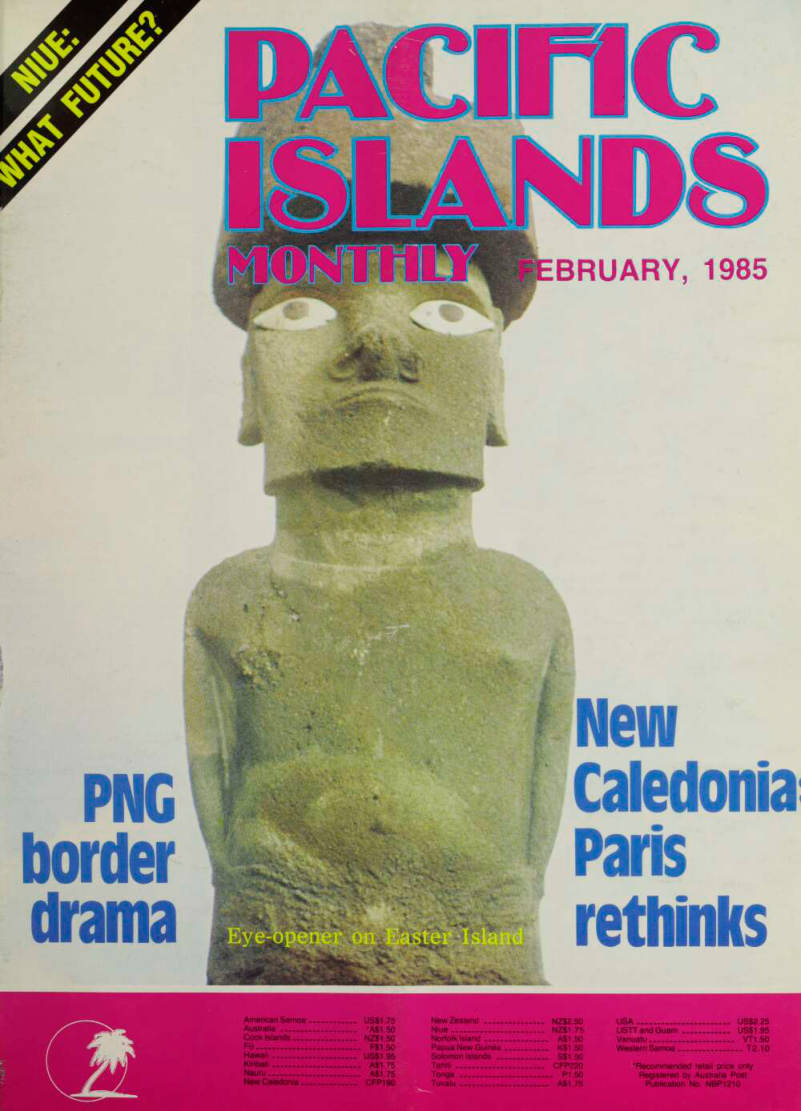
The Cover
Easter Island eyes “see”.
Story page 20 Easter Island Museum photo.
Advertisements & other items, p. 2 (1 item)
0 Hitachi
VT-88E
VMS
PAL
Our finest tape
deck now comes
with a free video
deck.
Hitachi’s new VT-88 boasts sound that’s nothing short of incredible. A dynamic range of 80dB better than open reel. 0.005% wow and flutter. And 8-hour audio recording with a single tape.
It’s all possible thanks to an extraordinary recording system pioneered by Hitachi.
First, audio signals are converted to FM signals and recorded below the surface of the tape. Then audio heads moving across the surface at 150 times normal speed trace the signals, and deliver sound
reproduction that surpasses practically
every audio deck on the market today.
So why are we giving away the free video?
Actually, we don’t have much choice.
It’s built in.
You see, the VT-88 is a Hi-Fi stereo video cassette recorder, and it combines audiophile sound with the superb picture Hitachi VTRs are famous for.
So get the most out of music videos, concerts, simulcasts, stereo broadcasts, movies and more. With a VT-88 Hi-Fi stereo from Hitachi.
0 HITACHI
◄ O.S Cu u uv zc li II .. ii lo!
II r CjCa I tats -
Sir I
'"'B o Recording level controls BILINGUAL indicator STEREO indicator Peak level indicator Hi-Fi indicator Hi-Fi/Normal/ALC select switch Dolby is a registered trademark of Dolby Laboratories Licensing Corp. • AUSTRALIA: Hitachi Sales Australia Pty., Ltd., 153 Keys Road, Moorabbin, Victoria 3189; Phone: (555) 8722 • NEW ZEALAND: AWA New Zealand Limited, Wi-neera Drive, P.O. Box 50- 248, Porirua; Phone: PRO 75-069 • PAPUA NEW GUINEA: S O. Svensspn (N.G.) Ltd., P.O. Box 705, Port Moresby; Phone: 21-2111 • FIJI ISLANDS: AWA New Zealand Limited. 47 Foster Road (P.O. Box 858), Suva. Fiji; Phone: 312070 • NEW CALEDONIA: Caldis, B.P. Ml, Noumea; Phone: 26. 23. 50 • TAHITI: Ets Chene Alain. P.O. Box 272, Papeete; Phone: 2. 88. 68
Pacific
Islands
Monthly
Vol. 56 No. 2 February 1985
EdgardPisani 16
Haruo I. Remeliik 27
Alofi 43
Ratu Mara 46
PNG-IRIAN JAVA BORDER Australian jurists late “| 4 last year visited the troubled border area between Papua New Guinea and Irian Jaya with its ramshackle camps housing on present estimates 9000 refugees from the Indonesian province. PIM reviews their findings on page NEW CALEDONIA Since the November 18 “active *| Q boycott” of territorial elections by the newly formed Kanak National Socialist Liberation Front (FLNSK) the situation in the French territory has evolved rapidly with important consequences in many areas, including French domestic politics, and Franco-Australian rela tions. A survey of developments begins on page QANTAS WINS AIR PACIFIC BATTLE AGAIN -| Q Julie Richardson in Suva reviews the extraordinary tale of Fiji’s on-again off-again agreement with the Austra lian national carrier Qantas on the management of its Fiji counterpart Air Pacific. Her report begins on page
Easter Island’S Governor In Australia 20
Grant McCall describes the historic visit to Australia in December 1984 of Governor Sergio Rapu, first Polynesian governor of Easter Island (Rapanui). He also discusses Governor Rapu’s discoveries in his capacity as archaeologist relating to the “eyes” of Rapanui’s famed statues. On page THE MONTH Floyd K. Takeuchi reports on the 25 success of President Haruo I. Remeliik in Palau’s presidential election, and Marie-Therese and Bengt Danielsson review French Polynesia’s 1985 budget.
On page EDWIN WILLIAM GURR Joseph Theroux begins a 39 three-part series on this Australian-born resident of Western Samoa who lived from 1863 to 1933. Gurr’s story is also the story of colonial intrigues and communal strife in the Western Samoan society of the day. On page
Contents
Anzus 11
Australia 35 Books 35 Chatterton, Sir Percy 23 Deaths 57 Easter Island 20 Fiji 18,32, 38, 46 French Polynesia 25 Gurr, Edwin William 39 Indonesia 5,14 Islands Press 49 Japan 35 Letters 9 New Caledonia 16,50 New Zealand 43 Niue 43 Northern Marianas 50 Pacific Report 7
Palau 27 Papua New Guinea 14 People 50 PIM Opinion 5 Political Currents 46 Service Page 58 Shipping Schedules 53 Solomon Islands 9
Stamps 33
The Month 25 Tonga 32 Tradewinds 29
Tropicalities 43
Tuvalu 29 United States 35,46 Vanuatu 11 Western Samoa 39 Yachts 51
Australian cover price is recommended retail only. Registered by Australia Post, publication No. NBPI2IO. Second class postage paid at Honolulu, Hawaii. Copyright Pacific Publications (Aust.) Pty. Ltd. Postmaster Hon olulu: Send address changes to PIM Hawaii, PO Box 22250, Honolulu, Hawaii, 96822.
Advertisements & other items, pp. 3-4 (2 items)
Pacific Islands Monthly February, 1985
3
Founded 1930 by R. W. Robson
(USPS 952480)
Editor and Publisher Garry Barker Associate Editor Malcolm Salmon Layout & Design Barry Badger Editorial Adviser John Carter A Pacific Publications production 76 Clarence Street, Sydney, 2000, GPO Box 3408, Sydney, 2001.
Cables: PACPUB Sydney.
Telex: 21242 (answers INTARAD).
Telephone: Sydney 20-231. Melbourne 63-0211.
Manager: John Berry (03) 63-0211 Ext. 1860.
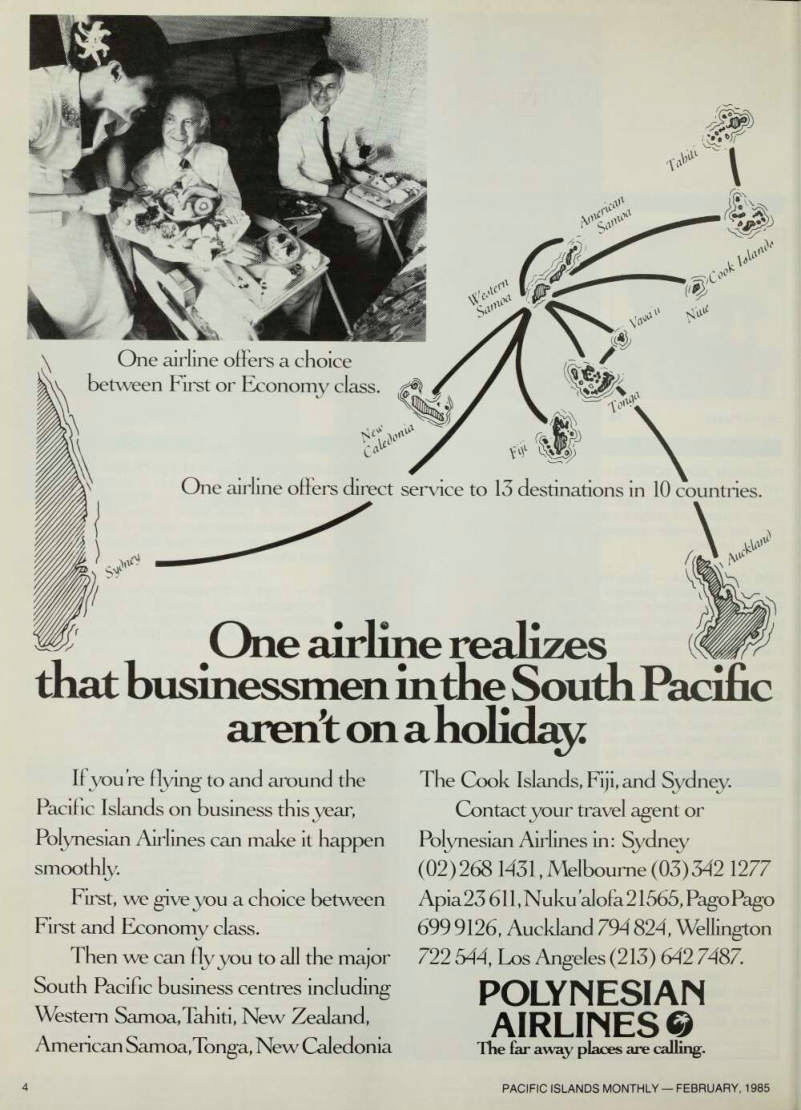
One airline realizes C<,
r \ One airline offers a choice between First or Economy class. i>• *;/ \ V Mm IriT^ A* ■S) c* One airline offers direct service to 13 destinations in 10 countries. fa*\ t* v v A
that businessmen inthe South Pacific
aren’t on a holiday.
II you re flying to and around the Pacific Islands on business this year, Polynesian Airlines can make it happen smoothly.
First, we give you a choice between First and Economy class.
Then we can fly you to ail the major South Pacific busmess centres including Western Samoa,Tahiti, New Zealand, American Samoa,Tonga, New Caledonia The Cook Islands, Fiji, and Sydney.
Contact your travel agent or Polynesian Airlines in; Sydney (02)2681431, Melbourne (03)342 1277 Apia 23 611, Nuku a10fa21565, Pago Pago 699 9126, Auckland 794 824, Wellington 722 544, Los Angeles (213) 642 7487.
POLYNESIAN
AIRLINES©
The Ear away places are calling.
Pim Opinion
While most of the Pacific focuses its attention upon the inexorable, if somewhat unsteady, march of the New Caledonian Kanaks towards an inevitable independence from France, a much more complex and difficult war of nerves is in progress across the mountainous, remote, border between Indonesia’s Irian Jaya, and the sovereign and indepen dent nation of Papua New Guinea.
It is the only major land border in the Pacific Islands area, but it cuts through far more than jungle-clad real estate. The problems it poses will haunt the region for many years to come. They have the potential to involve the attention, and anxieties, of nations within, and far outside, this part of the world.
The border is, simply, and ominously, a security threat which, somehow, must be defused with the greatest despatch and the least possible inconvenience and upset to the victims. Prospects for achievement of that devoutly to be desired goal are not good, and appear to be receding.
On both sides of the border national pride and sensitivities are exposed.
In the view of many Pacific people, the Indonesians have no right to be in control of Irian Jaya. They are, they say, simply new colonial masters moving in on native lands and cultures, heedless of local values and interests, concerned only with their own ambitions. They are accused of treating Irianese in an elitist and racist way.
In the United Nations their inheritance of the Dutch colonial mantle was argued before a forum with sad lack of knowledge and understanding, by delegations who demonstrated little real interest in facts or justice.
Sukarno was on a great wave of domestic adulation. He was playing with great world issues, wooed by the Soviet Union and the West, driven by his megalomania, trying to hold his position and his balance on the knife-edge of the inevitable disaster.
The Indonesians were sealing their anti-colonial victory over Holland. The Dutch knew that predominantly Christian, Melane sian West Irian would sit very uncomfortably under Muslim Indonesia and foresaw the trouble which is now upon everyone.
Their rather belated efforts to achieve a separate independence for “West New Guinea” foundered in face of President Sukarno’s threats, and American ambassador Elsworth Bunker’s belief, backed by the White House, and somewhat reluctantly supported by Canberra and other capitals, that lasting regional stability could be achieved by acceding to Sukarno’s demands.
Sukarno made a triumphal entry to Hollandia which was promptly renamed Sukamapura, and the problem went under ground while the Indonesians proceeded with their ’’lndorsation” of the territory, moving in with their language, their customs and to some extent their religion. Had it been a European power embarked on such a course there would have been an international uproar.
In the end Sukarno was eaten by his own ambitions, President Suharto took over with a government which, particularly in Irian Jaya, was predominantly military in flavor if not in total concept, and life went on.
But Melanesians fumed in private and “resistance” groups formed, many of them around people like Arnold Ap who was primarily interested in the preservation of Melanesian language and
culture. Indonesian response to this was stern, even brutal, as the death of Ap betrays.
But it was transmigration, the quite astonishingly large program devised by Indonesia to relieve the population pressures on its other islands, principally Java, which caused the real upset. Some estimates say that 150,000 Javanese have so far moved to Irian Jaya seeking land and a future. In the next three years that figure may double.
In doing this Jakarta’s administrators are accused of taking no more (and perhaps much less) notice of Melanesian land customs and rights than European colonisers of the 18th and 19th centuries. And land is a Melanesian’s most precious birthright.
The border itself divides traditional gardens from the villagers who work them, a point which has been observed in various agreements between PNG and Indonesia about border-crossing rights.
But, since the uprising on February 13, when some members of the Free West Papua Movement (OPM) tried, bravely but rather naively, to gain attention for their cause by raising their flag at the parliament house in Jayapura, the Indonesian Army has been fairly vigorously chasing down dissidents.
This has produced a flood-tide of 11,000 refugees across the border into Papua New Guinea, brought international attention to the situation, and embroiled Papua New Guinea in an extremely difficult confrontation not only with Indonesia, but also with elements inside Papua New Guinea who cannot understand why something is not done to punish those who are affronting and dispossessing their Melanesian cousins and brothers.
PNG’s Michael Somare is therefore in difficulties whatever he does. And the more Jakarta’s hard-eyed envoys tell him of how Indonesia sees itself in a “terrible position,” the tighter the screw turns.
Indonesia is likely to maintain this pressure upon PNG in a primary effort to make life more difficult for the OPM ... to raise the price to PNG of giving them, however involuntarily, a home. But, some factions within the Indonesian government must be tempted by the prospect of rattling the government in Port Moresby to the ultimate extent of producing some subservience to Indonesia.
In Sukarno’s day the office of the Indonesian president had a vast map upon its wall showing, accidentally or not, all of New Guinea encompassed by the Bung’s empire.
One does not propose that Indonesia intends deliberately to foment a revolt within PNG, but pessimistic observers of the border situation see in it some disturbing portents. These are based upon views current with some analysts in the Jakarta administration that PNG is Indonesia’s “soft flank” wherein factional disputes, leading to political instability, may demand some sort of intervention.
Yet, it is very difficult to see Indonesia handling such a problem by direct military action. If Vietnam was a military and political rat trap for the United States, Indonesia would be snared like a moth in a spider net in the jungles of the PNG border area. Nor, in fact, could Indonesia easily defend such a move in international political arenas.
In short, the border situation is ringed about with suspicion, soaked in sensitivity and fraught with danger. It must be treated with the utmost care and understanding by all.
Advertisements & other items, p. 6 (1 item)
Bens on w Hedges
20
WARNING- SMOKING IS A HEALTH HAZARD
Pacific Report

Major Reshuffle For Png Cabinet
The Papua New Guinea Foreign Affairs Minister, Rabbie Namaliu, has been moved from his portfolio in the first major Cabinet reshuffle since the Somare government was formed in 1982. Eight ministers have been dropped, three voluntarily, and nine backbenchers given ministries. The Prime Minister, Mr Somare, told a news conference in late December that while he had been generally happy with the previous Cabinet’s record, the perform ance of the ministers was “beginning to slip.” It is understood that Mr Namaliu had expressed a desire for a ministry which would allow him more time with his young family. Mr Namaliu has spearheaded negotiations with Indonesia on the Irian Jaya border issue. He has also developed a close working relationship with Canberra. He has been moved to the Primary Industry portfolio.
His replacement is the former Police Minister, John Giheno, 33, from the eastern islands. He has been a pro-Somare Independent and in the ministry since his election to Parliament in 1982. Mr Somare told reporters he didn’t think the change in the foreign affairs portfolio would set back sensitive negotiations with Indonesia on the border issue. Another keynote of the reshuffle centres on the return to the ministry, in an upgraded Youth portfolio, of Tony Siaguru. Mr Siaguru resigned as Public Service Minister in November after bitter brawling with the Deputy Prime Minister, Paias Wingti. Mr Wingti has been demanding that Mr Siaguru be dropped as part of a wider reshuffle. In turn, some old party hands had demanded that Mr Wingti be sacked for disloyalty.
But in the event, Mr Wingti has remained in the ministry and retained the Deputy Prime Ministership. At the news conference, Mr Somare said Mr Wingti would be the new Education Minister, replacing Sir Barry Holloway who becomes Minister for National Planning. Mr Somare pointed out that education had the highest budget allocation and was equivalent to the National Planning Ministry. Mr Somare said that there had also been a need to upgrade some portfolios, in particular Youth, Tourism and Civil Aviation. Among the senior ministers who stepped aside were Sir Pita Lus, Pato Kakarya and Martin To Vadek. The prime minister said he did not think the changes would herald defections.
Palau: It's Still President Remeliik
Palau’s President Haruo I. Remeliik had an easy win in the country’s presidential elections in late November. He polled 4050 votes to 2482 for Airai state Governor Roman Tmetuchl, and 1418 for Koror Mayor Ibedul Yutaka Gibbons. Lieutenant-Governor Alfonso Oiterong, who ran separately from Remeliik, was also comfortably re-elected. The results, as well as those of legislative elections held at the same time, were seen by observers as indicating that most Palauans want rapid progress towards the conclusion of the Compact of Free Association with the United States. (See full report by Floyd K. Takeuchi in this issue).
Japan To Drop N-Waste Plan?
On the eve of his planned January 13-20 visit to the South Pacific, Japanese Prime Minister Nakasone said his government was “putting on hold” plans to dump nuclear waste at a point about 1000 kilometres north of the Northern Marianas. The plan had aroused strong opposition from countries in the region. A spokesman for the Science and Technology Agency, which runs the waste disposal program, said he was unaware of a change in dumping plans, although the prime minister’s office later confirmed Mr Nakasone’s decision. Japanese newspapers quoted some agency officials as saying that the dumping would take place on Japanese soil rather than in the South Pacific. Japan’s 24 nuclear power stations have produced about 320,000 drums of nuclear waste, and the government says the number will reach 1.8 million by the year 2000.
France Makes It 67 Underground Tests
France was reported to have detonated two nuclear devices in the first week of December. 1984. New Zealand Prime Minister David Lange said the second blast, estimated to be of about 70 kilotonnes. was the eighth recorded by New Zealand scientists in
the course of the year. Mr Lange said he deplored France's disregard for the protests against its nuclear testing by New Zealand and other countries. The two December blasts brought to 67 the number of tests carried out by France since it began underground testing at Moruroa Atoll in 1975.
Niue's Population Down To 2900
Provisional results from the recent census in Niue have shown a continuing decline in population caused by migration to New Zealand. The figures show a population of 2900, nearly 400 fewer than at the previous census in 1981. The population of some villages fell by as much as 35 per cent, and a population increase was recorded in only one village. However. Niue government officials say the census disproved claims that the island is inhabited only by the very old and the very young. They point out that the census showed the Niuean population to be young and active, with half in the employable age category of 15 to 59.
Alp, Nzlp Now Flp?
A leading trade unionist in Fiji has said the time has come for workers in the country to form their own political party, along the lines of the Australian and New Zealand Labor Parties. The general secretary of the Fiji Trade Union Congress, Mr Raman, told a rally in Lautoka that the Alliance and National Federation parties represented vested interests opposed to workers, and that it was time the workers had their own political party. Mahendra Chaudhary, national secretary of Fiji’s largest union, the Public Service Association, told the rally his association “fully backed” the call for a workers’ political party.
Lome Three Is Signed
The European Economic Community and more than 60 developing countries have formally signed a new trade and aid agreement worth more than $6 billion. Reuters newsagency quoted sources in Lome, capital of the West African nation of Togo, as saying the signing brought to an end long and often acrimonious negotiations. Under the agreement, known as Lome Three, the EEC countries will provide trade incentives and aid to African. Caribbean and Pacific countries worth $6200 million. The agreement with the ACP countries provides for the first time for contributions from Spain and Portugal, who are expected to join the EEC in 1986. Reuters said ACP delegates had expressed disappointment at the size of the aid package, and its lack of concessions on access for their exports to the EEC.
Nauru's Mammoth Honolulu Project
The Nauru Phosphate Royalties Trust in late 1984 received approval to proceed with a mammoth residential-commercial industrial project next to Hawaii's famed Ala Moana Shopping Center. Construction on the half-billion-dollar development spread over 7 hectares on two adjoining parcels of land is expected to begin in 1986. The project, called 404 Piikoi Street for its location, will be one of the largest in Honolulu. Plans call for four high-rise towers and a mid-rise structure which will vary in height from 50 to 130 metres. There will be 1759 residential units built in high-rises and townhouses. The price range will be aimed primarily at middle- and upper-income groups, although state requirements also call for lower-income housing as well. The price range of residential units is expected to go from a low of about $90,000 to a high of $500,000. Within the park-like development, which will be just west of the shopping centre, there will also be a high-rise office tower, commercial and light industrial space, and 3800 parking stalls located below a 15-metre deck, the top of which will be heavily landscaped. There will be about 17.500 square metres of retail space. 22.000 square metres for industrial customers, and a 17-story office tower with 20.000 square metres. The trust will use Architects Hawaii Ltd. and other local consultants to prepare the final plans for 404 Piikoi. According to a Honolulu newspaper account. Theodore Moses, chairman of the Melbourne-based Nauru trust, issued the following statement on the project; "We are proud of (the plan) and believe it will meet a real need in Honolulu, especially a housing need, but also light industrial, retail and office
requirements in a revitalised Kakaako (the district where the project is located). The large investment by the trust, I believe demonstrates our faith in Hawaii’s long-term future economic growth and political stability. Our primary goal is to make investments which will result in continuing income for Nauru’s people. With this is our determination to ensure that our developments are in accord with the needs of people where we invest . . Alex Weinstein, a director of Architects Hawaii; “What we ve designed is a little city. There will be a variety of housing small apartments, large apartments, small townhouse units and large townhouse homes . . . We’ll have tennis courts and swimming pools, health spas and quiet, park-like areas. ” 404 Piikoi will be across the street from Ala Moana Beach Park, one of Honolulu s most popular parks, particularly for residents. The firms working with Architects Hawaii are Woolsey, Miyabara & Associates, landscape architects; Richard Sato & Associates, civil pnd structural engineers; ECS Inc., mechanical engineer; Douglas V. MacMahan Ltd., electrical engineer; Parsons Brinckerhoff Quade & Douglas, traffic study; and Engineers-Surveyors Hawaii Inc., surveyors. Floyd K. Takeuchi in Honolulu.
Vanuatu Reps’ Rough Times In Noumea
The Vanuatu Government has protested strongly to the French Government over the treatment of its officials visiting New Caledonia, Vanuatu says that its officials are thoroughly searched at Noumea airport on arrival, and in a recent incident one of its diplomats was maltreated by New Caledonian immigration officers Prime Minister Lini has told the French ambassador in Port-Vila that if such incidents recur his government would be forced to reconsider visa exemptions for French passport-holders visiting Vanuatu. He also told the ambassador his government was deeply disappointed over allegations reported to be circulating in New York from the French mission to the United Nations. The allegations accuse Vanuatu of helping to provoke violence in New Caledonia.
Pon Ape Has Leprosy Epidemic
Parts of Micronesia are experiencing an epidemic of leprosy, a congressional subcommittee was told last December. During the last four or five years, “it has been pretty well determined . . . there is what could be considered an epidemic of Hansen’s Disease, particularly in Ponape state,” said Dr John R. Trautman, director of the National Hansen’s Disease Medical Programs for the Department of Health and Human Services. (Hansen’s Disease is leprosy.) “This is not to say this so-called epidemic is out of hand, ” he added, “. . . there has been at least a handle gained.” Dr Trautman testified before the House of Representatives Interior Committee’s Subcommittee on Public Lands and National Parks. It held the hearing on health care in Micronesia in connection with the Compact of Free Association, which will give the U.S. Trust Territory limited independence, if Congress approves. Dr Traut man said there now are more than 1000 leprosy patients on several islands of the Federated States of Micronesia (FSM), which has a total population of 78,000. This number might eventually rise to 2000, he said. On one small island, Kapingamarangi, 40 per cent of the population of 1000 could develop the disease, he said.
“If that happens, and it could, it would be considered the most significant epidemic, percentage-wise, in the history of the world,”
Dr Trautman said. Testifying before the subcommittee, Richard T.
Montoya, Assistant Secretary for the Interior for Territorial and International Affairs, said the cholera epidemic in the FSM’s state of Truk appeared to be over. No new cases had been reported since April, 1984, he said.
Reforms Urged In Png Bureaucracy
An Australian academic has recommended sweeping changes to Papua New Guinea’s government and public service structures.
Professor Helen Hughes said the reforms were urgent, because the government and public service systems were too complicated and expensive. She said that part of the reason for this was that the systems were inherited by PNG from the Australian colonial era, and were out of date. Professor Hughes also criticised PNG’s 19 provincial governments, saying that they often duplicated national government functions. Professor Hughes, who recently completed a study on industrialisation, growth and development in PNG, also said that the country’s education system as it stands is incapable of adequately training the engineers, accountants and other pro fessional people needed by PNG for continued development.
Advertisements & other items, p. 8 (1 item)
Heating & cooking
Four ways to Better
with
Reliability & Savings
r SOLAR ENERGY SYSTEMS
ALL PURPOSE BOILERS
DOMESTIC STOVES
COMMERCIAL STOVES
Improve your current heating and cooking facilities now, and save on fuel costs almost immediately.
At Water Wheel Exports, we're pleased to introduce an exciting range of alternative heating, cooking and solar energy products to suit all domestic, commercial and industrial market requirements.
Naturally, the key advantage of installing a solid fuel stove, boiler or solar energy hot water system, is the fact that you'll never again be totally dependent on gas or electricity for all your heating or cooking requirements.
And, when you consider you're also investing in long-term reliability, it means you'll make substantial savings year after year, after year...
For complete details on our export range of 'Fuel Efficient Money Saving', heating and cooking products, please, fill in the coupon below.
Water Wheel Exports Pty, Ltd,... Exporters of a large and diverse range of products to the Pacific region.
WATER WHEEL EXPORTS PTY. LID.,
53-57 Market Street, South Melbourne, 3205. Victoria, Australia. Telephone: 6991722, Telex: AA32165.
Telegraphic Address: "Watermill", Melbourne
NAME.
ADDRESS;
COUNTRY: TELEPHONE:
PLEASE SUPPLY INFORMATION ON.
DOMESTIC □ INDUSTRIAL □ COMMERCIAL □
APPLICATIONS OF:
STOVES □ BOILERS □ SOLAR ENERGY SYSTEMS □
letters
A long, long road for Solomon Islands women
Regarding Sandra Rennie’s ex cellent review of the proceed ings of the Women, Aid and Development Workshop (PIM Nov. ’B4, p 48): I presented two brief, chatty, informal addresses at this workshop which, like those by other speakers, aimed to elicit discussion by raising issues and examples of devel opment problems faced by women. Few speakers present ed papers; the proceedings were transcribed from tape re cordings.
Perhaps the major weakness of Melville’s book of the pro ceedings is that it does not convey the context of the work shop, the length and vigor of the discussion following each speaker, or further comments by the speakers themselves.
I was a bit alarmed by the headline of the review: “Learn ing From a Solomons Water Project”. If in my discussion I conveyed the impression that the Solomon Islands Rural Water Supply and Sanitation Project (RWSSP) was failing because women were cutting pipes with their bush knives, then I must correct that impression.
Most Solomon Islands women regard accessible clean fresh water as a labor-saving blessing. Many also recognise the potential of the project to reduce disease in their com munities.
Furthermore, on technical grounds, the RWSSP has been one of the most successful current projects in the devel oping world in relation to the World Health Organisation goal of “Water and Sanitation for All by the Year 2000”.
The problem of RWSSP has been one of human response to technical innovation. For exam ple, once installed, the water supplies were often poorly
maintained. Puddles of water created breeding grounds for mosquitoes. Latrines, if built at all, were often not used. The motivating requirement of the RWSSP project (that the com munity themselves raise part of the cost of installation) was often undermined when non government aid agencies sup plied these local costs.
The most socially and tech nically successful water and sanitation programs elsewhere in the South Pacific have been those in which women, as the major users and beneficiaries, have been involved in the plan ning, fund-raising and devel opment of the projects. Yet hardly any Solomons women are involved at any stage of the RWSSP at any level, from village, to province, to govern ment agency.
My associate, Judi Fisher, and 1 visited Solomon Islands on behalf of the Australian Women and Development Net work in 1982, and we discussed this problem with a number of Solomon Islands women. We read the proceedings of a RWSSP workshop at which there had been only one woman present (a senior health official) which spelt out the gap between the technical success and the human “failure”.
So we recommended to the Australian Overseas Service Bureau, the Australian Free dom From Hunger Campaign, and the Australian Devel opment Assistance Bureau’s Committee for Development Co-operation that the Solomon Islands Development Trust (SIDT) be funded to carry out a development education pro gram in support of the RWSSP.
In recommending this, we understood that SIDT would work out a strategy to involve women as active participants,
rather than as passive recip ients; that water, sanitation and primary health care would be the major concern; and that SIDT would work closely and co-operatively with the existing program. As a result of our efforts to link SIDT with Austra lian agencies, SIDT received a very considerable amount of Australian aid.
“Learning From a Solomons Water Project” is an apt head line for what happened, even before I gave my optimistic little talk at the WADNA workshop.
In April this year I was deeply disappointed to learn that what ever it is that SIDT has been doing, their project involves very few women and is not working with or in support of the RWSSP. It does, however, contribute funds to the RWSSP for technical purposes, which are received from the Australian Freedom From Hunger Cam paign.
The final irony is that the Solomon Islands National Council of Women’s Nius Blong Mere (No. 3, October 1984, p 5) contains an article criticising the absence of women participants at the fourth RWSS workshop in Honiara in August this year.
The article quotes the director of the workshop as saying “they would have liked to invite women representatives but their funding had been very limited”. Even after over a hundred thousand dollars had been given to SIDT from Aus tralia, which happened directly as a result of our concern over the lack of women participants at the RWSS workshop in 1982 , a few hundred dollars to sponsor women participants still could not be found.
(Dr) Penelope Schoeffel
Suva Fiji
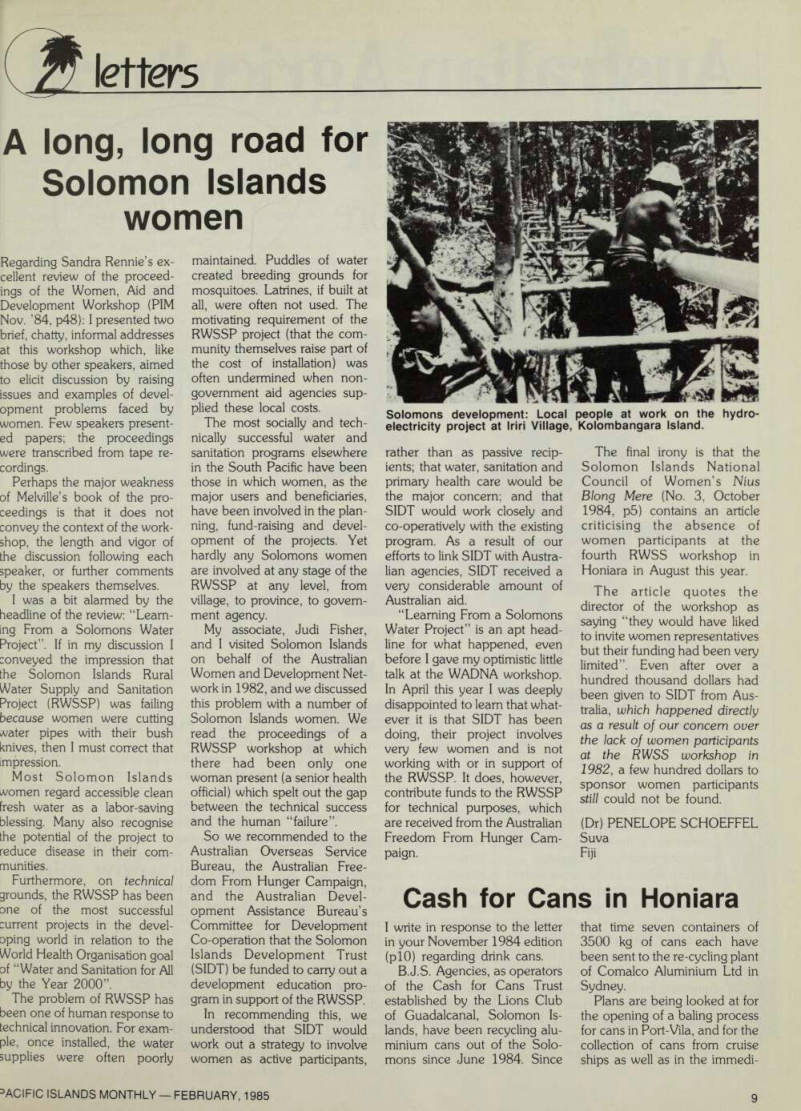
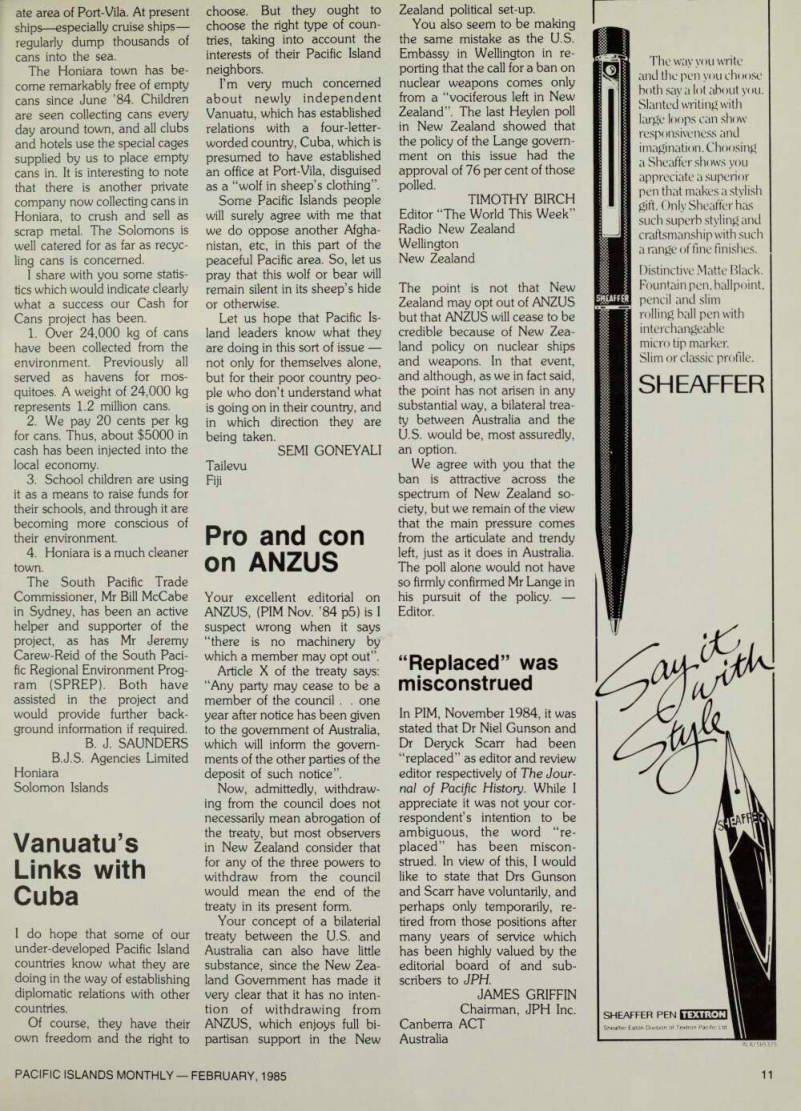
Solomons development: Local people at work on the hydro electricity project at Iriri Village, Kolombangara Island.
Cash for Cans in Honiara

I write in response to the letter in your November 1984 edition (plO) regarding drink cans.
B.J.S. Agencies, as operators of the Cash for Cans Trust established by the Lions Club of Guadalcanal, Solomon Is lands, have been recycling alu minium cans out of the Solo mons since June 1984. Since
that time seven containers of 3500 kg of cans each have been sent to the re-cycling plant of Comalco Aluminium Ltd in Sydney.
Plans are being looked at for the opening of a baling process for cans in Port-Vila, and for the collection of cans from cruise ships as well as in the immedi
ate area of Port-Vila. At present ships—especially cruise ships— regularly dump thousands of cans into the sea.
The Honiara town has be come remarkably free of empty cans since June ’B4. Children are seen collecting cans every day around town, and all clubs and hotels use the special cages supplied by us to place empty cans in. It is interesting to note that there is another private company now collecting cans in Honiara, to crush and sell as scrap metal. The Solomons is well catered for as far as recyc ling cans is concerned.
I share with you some statis tics which would indicate clearly what a success our Cash for Cans project has been. 1. Over 24,000 kg of cans have been collected from the environment. Previously all served as havens for mos quitoes. A weight of 24,000 kg represents 1.2 million cans. 2. We pay 20 cents per kg for cans. Thus, about $5OOO in cash has been injected into the local economy. 3. School children are using it as a means to raise funds for their schools, and through it are becoming more conscious of their environment. 4. Honiara is a much cleaner town.
The South Pacific Trade Commissioner, Mr Bill McCabe in Sydney, has been an active helper and supporter of the project, as has Mr Jeremy Carew-Reid of the South Paci fic Regional Environment Prog ram (SPREP). Both have assisted in the project and would provide further back ground information if required.
B. J. Saunders
B.J.S. Agencies Limited Honiara Solomon Islands
Vanuatu’s
Links with
Cuba
I do hope that some of our under-developed Pacific Island countries know what they are doing in the way of establishing diplomatic relations with other countries.
Of course, they have their own freedom and the right to
choose. But they ought to choose the right type of coun tries, taking into account the interests of their Pacific Island neighbors.
I’m very much concerned about newly independent Vanuatu, which has established relations with a four-letter worded country, Cuba, which is presumed to have established an office at Port-Vila, disguised as a “wolf in sheep’s clothing”.
Some Pacific Islands people will surely agree with me that we do oppose another Afgha nistan, etc, in this part of the peaceful Pacific area. So, let us pray that this wolf or bear will remain silent in its sheep’s hide or otherwise.
Let us hope that Pacific Is land leaders know what they are doing in this sort of issue not only for themselves alone, but for their poor country peo ple who don’t understand what is going on in their country, and in which direction they are being taken.
Semi Goneyali
Tailevu Fiji
Pro and con
On Anzus
Your excellent editorial on ANZUS, (PIM Nov. ’B4 p 5) is I suspect wrong when it says “there is no machinery by which a member may opt out”.
Article X of the treaty says: “Any party may cease to be a member of the council . . one year after notice has been given to the government of Australia, which will inform the govern ments of the other parties of the deposit of such notice”.
Now, admittedly, withdraw ing from the council does not necessarily mean abrogation of the treaty, but most observers in New Zealand consider that for any of the three powers to withdraw from the council would mean the end of the treaty in its present form.
Your concept of a Material treaty between the U.S. and Australia can also have little substance, since the New Zea land Government has made it very clear that it has no inten tion of withdrawing from ANZUS, which enjoys full bi partisan support in the New
Zealand political set-up.
You also seem to be making the same mistake as the U.S.
Embassy in Wellington in re porting that the call for a ban on nuclear weapons comes only from a “vociferous left in New Zealand”. The last Heylen poll in New Zealand showed that the policy of the Lange govern ment on this issue had the approval of 76 per cent of those polled.
Timothy Birch
Editor “The World This Week”
Radio New Zealand Wellington New Zealand The point is not that New Zealand may opt out of ANZUS but that ANZUS will cease to be credible because of New Zea land policy on nuclear ships and weapons. In that event, and although, as we in fact said, the point has not arisen in any substantial way, a bilateral trea ty between Australia and the U.S. would be, most assuredly, an option.
We agree with you that the ban is attractive across the spectrum of New Zealand so ciety, but we remain of the view that the main pressure comes from the articulate and trendy left, just as it does in Australia.
The poll alone would not have so firmly confirmed Mr Lange in his pursuit of the policy.
Editor.
“Replaced” was
misconstrued
In PIM, November 1984, it was stated that Dr Niel Gunson and Dr Deryck Scarr had been “replaced” as editor and review editor respectively of The Jour nal of Pacific History. While I appreciate it was not your cor respondent’s intention to be ambiguous, the word “re placed” has been miscon strued. In view of this, I would like to state that Drs Gunson and Scarr have voluntarily, and perhaps only temporarily, re tired from those positions after many years of service which has been highly valued by the editorial board of and sub scribers to JPH.
James Griffin
Chairman, JPH Inc.
Canberra ACT Australia
Advertisements & other items, pp. 9-13 (2 items)
9
'ACIFIC ISLANDS MONTHLY —FEBRUARY, 1985
Australian Agricultural
Equipment "
makes farming more
efficient, more
productive.
at the *9*lo
to UIP
Urt
VENT
?i *arch Play ’
al Lae Lod 9e 4th Stn Lae Qet * m ft. w I A' *f » Innovative Australian agricultural equipment has helped Australia become one of the world’s major food producing countries. It has given efficient, reliable performance under some of Australia’s harshest conditions. It is also operating successfully in many other countries throughout the world.
Australian manufacturers have available an excellent range of equipment for farming situations in the Pacific Islands. Tractors.
Cultivators. Slashers. Ploughs. Rowcrop planters. Seeders. Agricultural trailers. Farm and stockyard gates and fencing. Cattle handling equipment.
Irrigation equipment. Pumps, including solar pumping units.
Agricultural seed. Agricultural chemicals. Rodenticides. Veterinary products. Prefabricated steel buildings and greenhouses. Welding equipment.
Lubricators.
You can also obtain advice and expertise from experienced Australian consultants. But in the first instance contact the Australian Trade Commissioner about your particular requirements.
Ask the expert who knows Australia For details of suppliers phone or telex the Australian Trade Commissioner at: Fiji P.O. Box 1252, Suva.
Phone 31 2844 Telex FJ 2126 New Caledonia P.O. Box 22, Noumea Phone 27 2414 Telex 087 Papua New Guinea P.O. Box 9129, Hohola Phone 25 9333 Telex NE 22109 Hawaii Australian Consulate 1000 Bishop Street, Honolulu 96813 Phone (808) 524 5050 Telex 63 3128 m Ask the Australian Trade Commissioner
r q The way you write and the pen you choose both say a lot about you.
Slanted writing with large loops can show responsiveness and imagination. Choosing a Sheaffer shows you appreciate a superior pen that makes a stylish gift. Only Sheaffer has such superb styling and craftsmanship with such a range of fine finishes.
Distinctive Matte Black.
Fountain pen, ballpoint, pencil and slim rolling ball pen with interchangeable micro tip marker.
Slim or classic profile.
SHEAFFER
k
SHEAFFER PEN
Sheaffer Eaton Division of Textron Pacific Ltd
m ■ Hi 1
1 i IT
ft 1 I I : ;.^saSfe^S^3W
sSiS$ i$ a«r Mbsss&
Car of the future: N',.
HBHMHnpnHH
agassii V SI . ’■■ *: i '.- - T
IMISSA
wm L ■ ' -• -"I ,- x ■ nT"
mmmm
. ■ ms ■■ /
sms
m ms -.. sm ■»'L ..
Ili
,> .4^ , *v>- ■■sv.. : ; m ■' - V, - : ' v -f- -- ; •"■ < . ■;w am mm -»V ••• *w* m S*s& •.a# 5 ••-' ■ ■ >■ Sr -. . *; ’ su -*• P! ■>> »3 is ' <a MS ■ , ..
'msm
?■ m m ...
' m ~- -, m ■
m* m. s - * *.- ■ . ~* ■ :.jfe> ,*~?r r ' ■'■ :■ W- *
SSH *.-^''«.“' '-
-r 3ft/ a; ps ■s ? **■ . :r *^T SR , ■ : - ■ ■ .-. ■■ . . -.■■■-■ ... ■■
What jurists saw
The Png-Irian Java Border
What jurists saw and what they say
An international com mission should be set up to investigate the situation of the 11,000 refugees from West Irian now harbored in Papua New Guinea as the result of sweeps against Melaneisan villagers by units of the Indone sian Army, says the legal mis sion which visited the border area last September.
Clearly, a serious situation existed in Irian Jaya, and there was need for international attention to be focused on it, they said.
This is one of the principal recommendations of the party from the Australian, and Netherlands sections of the In ternational Commission of Jur ists who went to Papua New Guinea in September to exam ine the plight of the refugees.
The group was led by John Dowd, MP, of the New South Wales parliament, president of the Australian section of the I.C.J. With him were Judge Trevor Martin, QC, Professor Garth Nettheim, professor of law at the University of NSW, Daniel Rowland, a solicitor and faculty member at the Univer sity of Wollongong, Mr David Bitel, another NSW lawyer, and Father L. van der Berg, of Megen, Holland, a member of the Netherlands Institute of Hu man Rights, formerly a mission ary in Irian Jaya, and attending at the invitation of the Nether lands section of the ICJ.
The group spent about eight days in Papua New Guinea, visiting refugee camps and con ducting interviews in Port Moresby, Vanimo, Kiunga, Green River, Kamberatoro, Komopkin, and Rumginae. The government of Papua New
More than 9000 Melanesian refugees now live in varying degrees of deprivation and discomfort at makeshift camps along the remote and difficult border between Indonesia’s West Irfan and the sovereign and independent state of Papua New Guinea. The number is down from a peak of more than 11,000 last September due to the voluntary return of some Irianese to West Irian in the past few months. But the problem remains massive. As a human situation it is one of the most tragic in the Pacific. They have left their homelands because, they say, the Indone sian Army, ostensibly hunting down dissidents, has made their lives untenable. They say the Indonesian policy of transmigration, under which Islamic people from the over-crowded island of Java have been literally trucked into Irian Jaya by the thousand and settled there without regard for Melanesian tribal interests and right, has deprived them of their most precious possession their land.
The Indonesians say they are working for the greatest good for the greatest number and that the border villages have been harboring rebels some of whom have taken arms against the government. Jakarta says law-abiding Melane sian irianese have nothing to fear.
It is an exceedingly sensitive and awkward issue for eveiyone, not least the government of Australia which has been at pains to avoid public involvement in a row which cannot possibly profit it.
But, Australia entered the affair when the Australian Section of the Executive Committee of the International Commission of Jurists sent a delegation to examine the treatment and situation of the refugees in their border camps.
Some controversy developed over their report, with the Indonesian government clearly irritated by it.
Guinea gave them permission to visit the border areas but the report concedes that the gov ernment developed reserva tions about the mission which, by then, had excited interest in
Jakarta.
“There was a degree of obfuscation on the part of cer tain government officials,” the jurists said. “There was also a natural reticence on the part of
local officials to make state ments which might place them in some difficulty with their superiors; notwithstanding this, we encountered a remarkable degree of frankness. One ex ample was the disclosure of a hitherto unannounced large camp in the Western Province. ”
The report, filling 68 type written pages, chronicles the observations of the mission members, and some of the statements taken from among refugees, and others dealing with the situation on the PNG side.
For example: “To get to Komopkin camp required a 50 minute drive from Kiunga to Memingiri, three hours’ walk through the jungle to Ok Tedi river, and a 40 minute canoe trip down the river to Komopkin.
“The camp houses over 2000 refugees,” the report said.
PNG had stationed a kiap, a health officer and a policeman permanently at the village.
“The people ... had suffered serious malnutrition and over 100 had died. About 100 had been sent to the mission hospi tal at Rumginae...
“We were told that about 165 refugees had returned across the border saying they planned to join the OPM. Most were men, some women, most aged 18 to 30. We were told that the only weapons of the OPM were bows and arrows.
There were no firearms.”
The report said the refugees had come from nine villages in the Mindiptana district. All vil lages were Christian, two Pro testant, seven Catholic.
“They had started to cross the border in April and the last group had arrived in August...
some had spent three months in the bush,” the report said.
The jurists were told that some villages of 700 or more had emptied of inhabitants following shootings by Indone sian soldiers. Villagers spoke of rumors that Javanese transmig rants were to be moved into the emptied villages.
“In one reported instance a village church had been shot up by Indonesian soldiers who had broken the host and destroyed vestments. This was corrobo rated by the Bishop of Kiunga who reported that villagers had gathered the desecrated items and brought them to him,” said the report.
“We were given details of the deaths of 10 people on the way to Komopkin,” said the jurists.
“A girl aged one, two girls aged three, a boy aged five, a girl of seven, a woman of 37, and four men aged between 40 and 60.
“All the people questioned denied that the OPM or anyone associated with it had told them to leave,” they said. “All de clared that they would not go home until the Indonesians had left Irian Jaya.
“Further questions about the OPM produced varied re sponses. One old man seemed fearful when asked about it, looked around, and did not wish to discuss it.
“Another said; ’OPM is not an organisation, it is just a feeling that everyone has for their own fate.’
“Still another said; ‘We are All OPM.”
That the jurists felt deep anxiety about the methods used by Indonesian forces against people who might, in other countries or different circumstances, be seen as civil rights activists, or seekers after democratic freedoms, is shown by their reference to the killing of Arnold Ap, a gentle Melane sian traditionalist and academic.
As well as urging internatio nal attention on the situation they recommend an indepen dent and internationally-super vised inquiry into the death of Arnold Ap, curator of a small museum in Irian Jaya who was taken for questioning by In donesian authorities about the time of the February uprising, and who was later found brutal ly murdered.
Statements made to them by people claiming to be eye witnesses were “clearly incon sistent with the statements made by Indonesian officials that he was shot escaping,” the report says.
The mission makes a total of 17 recommendations, first of which is a blunt assertion that “no one should be returned, involuntarily, to Indonesia” for “there is clear evidence of hu man rights violations in the area of Irian Jaya nearest to PNG by the Indonesian authorities against local villagers.”
They suggest that the UN High Commissioner for Re fugees should be given “full authority and responsibility,” in conjunction with the govern-
ment of PNG, to provide assist ance for the refugees, pending a durable solution.
Nations, and international aid agencies should be urged to help the government of PNG both in caring for the refugees and in finding a workable, and durable solution to their plight.
The jurists demanded that the Indonesian government “make clear both the precise nature of criminal charges that individual refugees will attract on their return to Irian Jaya, and the appropriate authority, civil or military,” which would deal with them.
Indonesia should provide assurances, subject to UN monitoring, that voluntary re turnees would face “no other punishment or penalty.”
Meantime, they urged, the refugees should be given permissive residence status within PNG.
While the contents of the report have not been specifical ly attacked by the Indonesians, they have through their ambas sador in Canberra, displayed irritation with the jurists and have challenged their authority.
Observers in Australia have not doubted the accuracy of the report’s observations.
The Papua New Guinea gov ernment has maintained a low profile on the report, but clearly is vastly troubled by the dilem ma it faces between its powerful and awkward neighbor, and its own Melanesian voters many of whom hold strong anti-Indone sian feelings over the border incidents.
The majority of the refugees
in PNG now considered them selves to be indefinitely, or even permanently, displaced from Irian Jaya, the jurists said in their report. Most of these peo ple came from communities with traditional border-crossing rights under the Border Agree ment between PNG and In donesia. There was a further, smaller, group of urbanised people, mainly from the Jayapura area where the Free West Irian movement uprising occurred in February, 1984, and set off the Indonesian reac tion.
The jurists said they consi dered the 11,000 in the border camps were refugees within the terms of the 1951 Convention, and the 1967 Protocol Relating to the Status of Refugees. With the exception of the very small number now prepared to return voluntarily to Irian Jaya, all
came within the mandate of the United Nations High Commis sioner for Refugees.
The report said that because most of the refugees came from the immediate border area, with clan and language affilia tions with people on the PNG side, “there is little evidence that the taking of this number of refugees will open a flood-gate for refugees from other parts of Irian Jaya.”
But, they said, “the displace ment of this large number of persons is an indication of se rious problems within Irian Jaya.”
The jurists were obviously anxious about the likelihood of reprisals by the Indonesians against returning Melanesians, a fear obviously shared by the refugees themselves.
Thus, the jurists urged in their report that individuals who had actively participated in political action, (they were mainly those sheltered in the Blackwater camp, near Vanimo), be given refugee status and settled within PNG or, “if necessary, in other countries within the region.”
The remainder, they said, “should be located where pos sible in their own clan/language groupings within PNG, but at some reasonable distance from the border to prevern them from constituting a continuing problem for PNG-Indonesian relations. ”
While the jurists paid con siderable attention to what they saw as the need to protect the refugees from Indonesian reac tion, they also urged that the PNG government should not discriminate against them in decisions on the granting of citizenship.
Also, they said, “Australia has a special role to play in the future of the Irian Jaya re fugees, as the most appropriate independent nation in the re gion. In particular Australia should be willing to accept some of the refugees for whom third country resettlement is
deemed necessary.”
Finally, they recommended that both Indonesia and Papua New Guinea ratify the In ternational Covenant on Civil and Political Rights, and the Convention and Protocol on the status of refugees. Garry Barker.
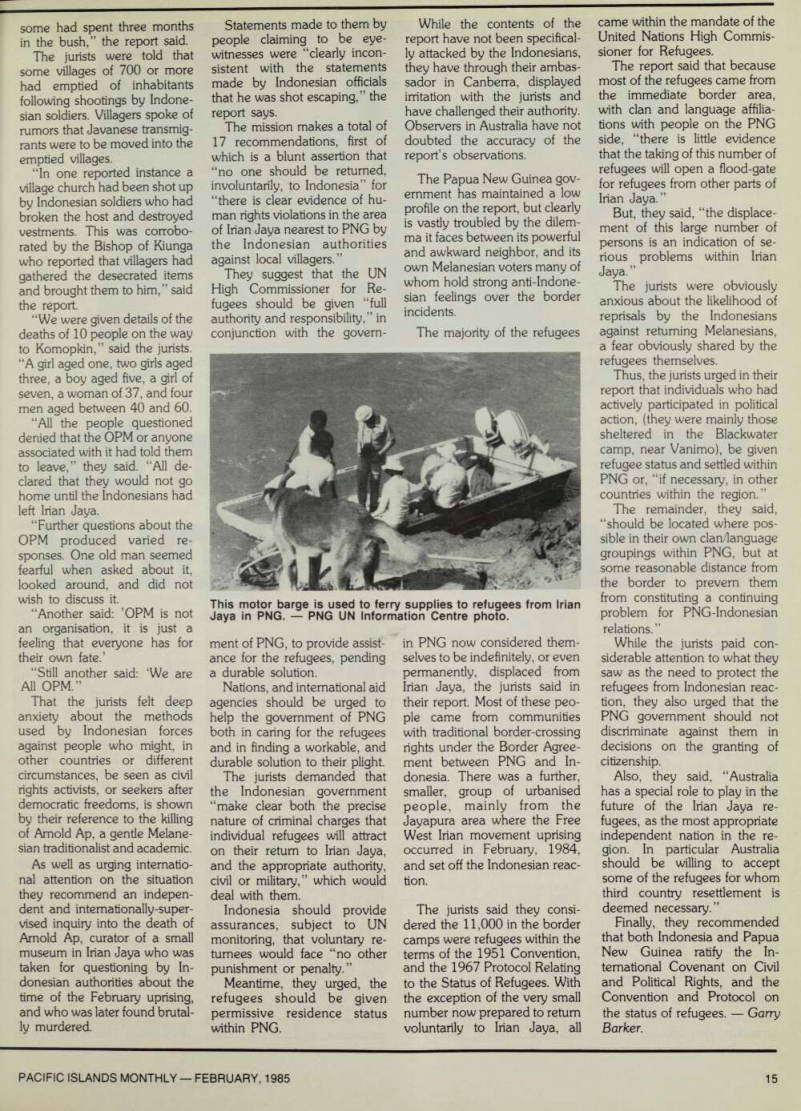
This motor barge is used to ferry supplies to refugees from Irian Jaya in PNG.-PNG UN Information Centre photo.
New Caledonia in the aftermath
aftermath of NOV. 18
Like a rock hurled into a lake, the “active boycott” of the November 18 elec tions in New Caledonia by the newly formed Kanak National Socialist Liberation Front (FLNKS) and the subse quent events (PIM Jan., p. 14), have given rise to ever-wide ning rings of consequences and the process is far from over yet.
First of all, the French Gov ernment has been shaken out of the illusion that pro-inde pendence Kanak political forces could be prevailed upon to wait patiently for five years until 1989 for a referendum on independence five years during which, on all present political indications, the Social ists would lose their majority in the National Assembly (par liamentary elections are due in 1986) and the resurgent con servative parties in French poli tics would throw out the re ferendum idea anyway.
PIM Associate Editor MALCOLM SALMON pulls together the main strands of the turbulent story of New Caledonia as the territory entered a new and perhaps fateful year.
In a mid-December interview with the Paris daily Liberation, President Mitterrand’s nego tiator and new high commis sioner in New Caledonia, Edgard Pisani, noted that the Kanaks wanted sovereignty, but had not demanded a total break with France. He added: “The referendum on independ ence originally scheduled for 1989 should, however, take place within months, not years.”
In line with this development, New Caledonia has been pushed forward as an issue in French domestic politics in a manner never before known, The Opposition parties have mounted scathing attacks on
the government of President Mitterrand, accusing it of being prepared to sell out Frenchsettler interests in the territory in order to appease an allegedly tiny minority of pro-independence Melanesians.
In a major move, former r-) . i , n . , ~c , .
President Giscard d Estamg ..i c u joined with six former French * . ... . , , pnme ministers in late Decernber to sign a statement warning against allowing debate on the future of New Caledonia to become embroiled in elector al manipulation. They declared that “all French citizens in the territory must be allowed to vote”, and that “stressing independence as the only solution is tantamount to depriving French
citizens of the right to choose. ”
The statement represented a counter-blast to Kanak de mands that limitations be placed on participation in the referendum, and a warning to the government not to give any ground on the issue.
As well as making New Cale donia a big issue in French national politics, recent events have caused it to become an international political issue for the French as well not least in their relations with Australia.
In a television interview in Paris on December 16, Presi dent Mitterrand said he found Australia’s interest in New Cale donia “quite surprising.”
“If the problem of the native people does not exist any more in Australia in fact if there are still some Aborigines, it is be cause they have not been killed.
“That’s not the way France does things. That is why France
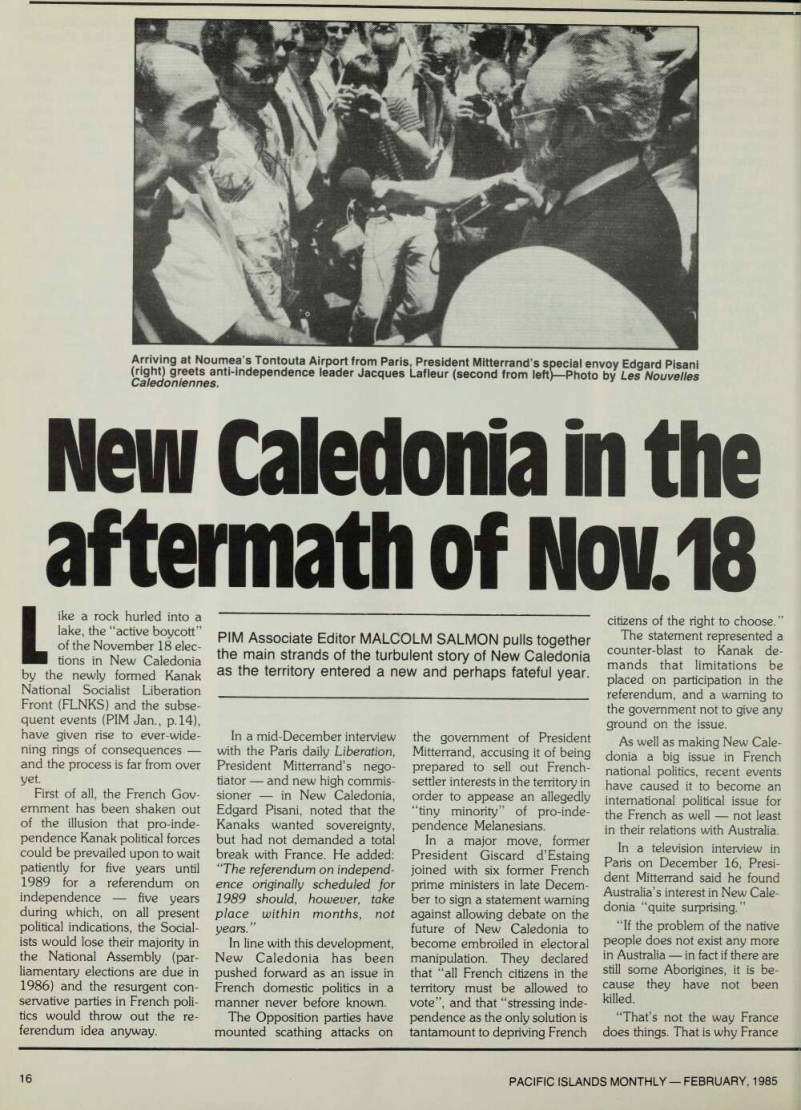
Arriving at Noumea’s Tontouta Airport from Paris, President Mitterrand’s special envoy Edgard Pisani (right) greets anti-independence leader Jacques Lafleur (second from left) Photo by Les Nouvelles Caledoniennes.
is so highly regarded and re spected in her former colonies. ”
Australia’s Foreign Affairs Department was quick to tell France’s Ambassador, Jean Bernard Merimee, that the Aus tralian Government viewed with “disapproval and con cern”, and found “offensive and irrelevant”, President Mit terrand’s statement about Aborigines.
The Sydney Morning Herald editorialised on December 19: “. . . (the statement) is offensive because while Austra lia can justly be accused of something close to genocide in respect of its Aborigines a cen tury ago, in the last 20 years it has made increasing and genu ine efforts to redress the ba lance. It is offensive because France last century succeeded in halving New Caledonia’s Kanak population through a contemptuous disregard for Kanak health, culture and land rights which more than para lleled Australia’s for its Abor igines.
“It is irrelevant because how Australia treated its Aborigines has little to do, except as an unrelated debating point, with New Caledonia’s present situa tion, which is one entirely of France’s own making. Nothing that the President says disguises the fact that present Kanak anger and frustration stem from past land alienation and denial of development and education, both grievance areas which France now seeks earnestly to remedy. ”
PIM Tahiti correspondent Bengt Danielsson had another angle on the affair. He said in a January telephone interview with PIM: “What you seem to have missed in Australia is that what Mitterrand and a great number of other French political leaders are accusing Australia of is harboring expansionist ambi tions in the Pacific. The Austra lian Government has for years been accused of supporting in dependence movements in the French colonies and opposing the Moruroa tests in a thor oughly hypocritical manner, since its real intention all along has been to push the French out of the Pacific maybe not by taking over the French terri
tories politically, but certainly by taking them over econo mically.
“What is crucial in Mitter rand’s statement is therefore not his charge that you Austra lians have killed your natives (whereas we French, etc . . .), but the exchange which took place between him and a journalist at his press confer ence in which they agreed that New Caledonia is threatened by appetite exterieurs “out side appetites” the main one being Australia's appetite which can be satisfied, of course, only by swallowing up this French territory ...”
In the Pacific, the New Caledonian developments have led Vanuatu’s Prime Minister Father Walter Lini to dissociate himself publicly from the Aus tralian Government’s position that the Kanak population are not ready to cope with full independence.
Bill Mellor reported from Port-Vila in Sydney’s Sun- Herald on December 16: “. . . Father Lini made it plain he was opposed to Aus tralia’s policy of supporting only a gradual move towards inde pendence in New Caledonia.
“Other countries consider decolonisation as a process that
could take years to arrive at.
But it’s not a process, it’s a right of the people,” he said.
“One does not have to mea sure whether they have enough educated people or economic base it is their right. If people want it right away, they should have it.”
On the other side of the Islands political fence, leaders of the parties opposed to inde pendence in New Caledonia and French Polynesia have formed “an alliance of French Pacific territories to defend their common interests and promote joint action in political, admin istrative, economic, cultural and social matters.”
The agreement was signed in Papeete by Senator Dick Ukeiwe of New Caledonia’s RPCR party, and Gaston Flossc of the like-minded ruling party in French Polynesia.
In the territory itself, the death toll from politics-related violence rose to 16 on Decem ber 20 with the death of a third person from bums sustained in an arson attack on a store in the west coast town of Bourail.
Twenty-two Kanaks were arrested after the fire, and four have been charged with arson.
Later, anti-independence set tlers set up roadblocks at Bourail “to keep the tribesmen out of town and prevent them buying supplies.” Gendarmes later dismantled the roadblocks without incident.
On the east coast, the impor tant nickel centre of Thio, seized by FLNKS militants in November but later relin quished to the authorities, was described as “a ghost town” in a January press report. A local Frenchman said only about 30 of the town’s former 100-plus European residents remained.
Although French authority had largely been restored by the turn of the year, there was still more than a grain of truth in the sweeping December sum ming-up by Melbourne Age reporter Damien Murphy: “New Caledonia is now effec tively three countries: the French Government controls Noumea, the Kanaks have the east coast, and the locally-born French have a shaky hold on the west coast.”
Pisani plan
Edgard Pisani, French President Mitterrand’s Special High Commissioner in New Caledonia, made his keenly awaited announcement of French policy on the future of the territory in Noumea on January 7.
An official summary of his speech said in part: “It is certain that the present situation, founded in history and in imbalances which have developed between races, cannot continue without putting gravely at risk the security and progress of part of the populations concerned. The first objective must be, through a pact concluded between the communities, to ensure respect of everybody’s interests, after having recognised the prime rights of the Melanesian people.”
To this end, Mr Pisani proposed: • A poll on self-determination to be held on July 1, 1985. • If the vote is favorable, New Caledonia will be “raised to the dignity of sovereign state” on January 1, 1986. “It will be a democratic and multi-racial state, entitled to join international organisations, among others of the South Pacific.” • Every individual will have his/her rights guaranteed by that state, whether the nationality of the new state or French nationality is chosen. • On land rights, conditions of the right of establish ment on the land “will be determined by contract”. • A special long-term regime will be set up for Noumea. • “The whole project cannot possibly be viable without the presence of France. Therefore, a treaty of association, in conformity with Article 88 of the French Constitution, will define the institutions common to both France and the new state, the distribution of powers, and the role of the French Delegate, representative of the President of the Republic . . .”
“Beyond the respect of internal guarantees, partic ularly as far as defence and security are concerned, the association will have to contribute to a national program of development based on natural resources and educa tion. Thus, Caledonia will, with the help of France, secure employment for its youth and firmly establish its regional role in the South Pacific.”
Mr Pisani was to spend the three weeks following his announcement in discussions with the different New Caledonian political groups, before reporting to Presi dent Mitterrand in Paris this month on the outcome.
Amazing scenes as Qantas
wins Air Pacific battle-again
Fiji’s credibility as a straight-dealing nation has been brought into doubt by a last-mi nute government reversal of a gentleman’s agreement with the Australian airline Qantas.
It seemed that Qantas had already won the four-airline battle to run Fiji’s Air Pacific for the next three years, underwrite its $35 million total debt, and guarantee it wouldn’t lose any more.
On October 11, 1984, Prime Minister Ratu Sir Kamisese Mara accepted the Qantas pro posals against those of Ansett of Australia, Air New Zealand, and America’s Continental.
A month later, Cabinet changed its mind. It refused to sign anything unless Ansett was given another chance.
At this amazing revelation, chaos broke out. The deadline for proposals was long past, and Ansett’s claim that it had been treated unfairly was barely plausible.
And as the Air Pacific board obeyed instructions and studied the Ansett Plan Mark 11, Ansett jets began to zoom overseas laden with whisky, executives and Fiji parliamentarians, and Ansett executives wined and dined as many more as they could get hold of, none of which did anything for the reputation of Ansett, the par liamentarians concerned, or in fact the country itself.
Concern was expressed that the government had made Fiji look like a banana republic, and Deputy Opposition Leader, Mrs Irene Jai Narayan, voiced the opinion of many when she told parliament of her fears about the international image and credibility of Fiji.
The Air Pacific board even tually returned the same answer as before: Qantas was still the best.
So, on December 13, two
JULIE RICHARDSON in Suva backgrounds the remark able chain of events which finally saw the Australian airline Qantas confirmed in the position of interim manager of the affairs of Fiji’s airline, Air Pacific.
months after Qantas had first won the contract, it won it again.
The government’s myste rious decision favoring Ansett endeared it to no one but Ansett.
No one seems quite sure why it happened. One theory is that bad feeling still lingers among some Cabinet ministers from the troubled times when Qantas ran ground services at Nadi Airport.
Another is that political press ure may have been brought to bear through links between Ansett chief executive Sir Peter Abeles and Australian Prime Minister Bob Hawke, who re portedly discussed Ansett with Ratu Sir Kamisese in August.
Ratu Sir Kamisese is known to have favored Ansett.
One thing is certain; Air Paci fic board chairman lan Thom son felt strongly enough that the Qantas deal was best that he would have resigned had the government rejected it.
“I waited for the government to make its decision. It was the right decision,” he said. “We signed the agreements with Qantas on Tuesday (December 18). Everything’s set now for a quick return to profitability. I’m very happy about the way things are now.”
Another man who’s happy is Air Pacific’s acting chief execu tive Captain Neil Ganley. “The way I see it we’re still Air Pacific and we’re still running our own show, with Big Brother giving the little chap rather a lot of a helping hand.”
The question of whether this particular Big Brother is an Orwellian dictator ready to
dominate Air Pacific, or a chari table institution, or something in between, has been some what obscured by the recent chaos and has still to be answered.
But few who have witnessed the debacle of Air Pacific’s last few years could fail to be relieved that at last something is going to be done by someone who knows how to do it.
So what is Qantas getting out of this ostensible philanthropy?
“Not a hell of a lot,” said Ganley, “they’ve taken on a pretty difficult task.”
The Qantas task is to reverse a series of mismanagements and mistakes that culminated in the launch in 1983 of three flights to Honolulu each week in a leased DC 10.
Air Pacific bosses admit pri vately that Project America was a disaster. Only Lewis Carroll could have derived any satisfac tion from the crazy situation: at a time when the airline was already losing millions, it laun ched an international venture against giant competitors, guaranteed to lose money for its first two years.
Project America signalled dis aster, and as it spiralled down wards, its slipstream was filled with internal dogfights, resigna tions, rows and sackings.
By September 1 the whole board of 10 had resigned under pressure and been replaced.
Ratu Sir Kamisese organised meetings with Ansett and Qan tas, and the battle to become Air Pacific’s savior was on.
Ansett, which already ran Air Vanuatu and Western Samoa’s Polynesian Airlines, had high hopes of a takeover. Fiji’s
bilateral rights into Hawaii, continental USA, Canada, Japan, Singapore and Korea, as well as New Zealand and Australia, would not have come amiss in their bid to beat Qantas on the international circuit.
They first offered an on going contract that meant a virtual takeover. Their second offer added a guarantee of no financial loss to Air Pacific, as had Qantas.
But the extra punch that Qantas was able to pull was a near-guarantee to boost tour ism to Fiji from America. Even Ansett’s second proposal only offered to explore the possibility of doing so.
How will Qantas work its miracles? Said Ganley: “They’re looking at every prob lem. It’s possible the fleet may be changed drastically. They’ve said there’ll be no redundan cies, for the time being.
“If I looked into the crystal ball, I’d see Air Pacific firmly entrenched in the 747 opera tion into Sydney. It would have an important regional service and have a second 737.
“By setting the Sydney service it will generate tremendous revenue and profit.
This will be used to service the debts and loans we have.”
Ganley believes too that Air- Pacific will get back onto the American run, with the help of Qantas.
“Fiji doesn’t have the rights into Los Angeles now. Qantas has. We haven’t opened any doors for Qantas. They’re not riding on our backs: We’re riding on theirs.” Hopes in Air Pacific hearts now are that thumbing a lift will prove a swift flight into financial security.
Hopes in Fiji hearts are that the government will in future stand by its word, and redeem its hitherto untarnished reputa tion for honesty.
Advertisements & other items, p. 19 (1 item)
Aiwa
r.nv/.i
in your hands
* 4 % % Wireless remote control is one of the many reasons why the V-1100 is AlWA’s most sophisitcated system yet. From the comfort of your chair you can control the turntable, cassette deck, tuner as well as select any source component and adjust the volume. AIWA puts total system control right in your own hands.
Along with this convenience comes programmable disc playback and recording, separate power amp and preamp with 7-band graphic equalizer, a quartz-synthesizer tuner/timer, and an auto-reverse cassette deck. The special system rack makes component connection quick and simple. Going digital? Go for the V-1100 because its ready now for the connection of a CD player.
AIWA
AIWA Australia Pty., Ltd 14 Gertrude St., Arncliffe, N.S.W. Australia 2205 AUSTRALIA PHONE; (597) 2388/Oceania Indent Agency (P.N.G.) Pty., Ltd Ago St., Gordon Box 5518, Boroko, Papua New Guinea PHONE; 256411/The Sound Centre Ltd P.O. Box 434 Port Vila, Vanuatu PHONE; 2035/P. Hargovlnd Bros 190 Renwick Road P.O. Box 490 Suva Fiji PHONE; 24350/Makanjee & Sons Limited P.O. Box 91 Sigatoka Fiji PHONE; 50158/Milaw Trading Co., Ltd 36 Airedale St. Auckland, New Zealand PHONE; (09) 399175/hifivox 79, rue de Sebastopol, Noumea, New Caledonia PHONE; 27.24.66/Harvest Pacific Limited P.O. Box 517, Honiara, Solomon Islands PHONE; 131/Fare Hi-Fi Stereo Rue du Marechal Foch, Papeete, Tahiti PHONE; 2-4814/Micropac Audio, Inc. Agana, Guam 96910 PHONE; 472-8091/Cook Island Trading Corp Ltd P.O. Box 92, Rarotonga, Cook Island/Nauru Co-Operative Society Republic of Nauru
Rapanui eyes are opened
“Eyes that look to the sky” has been one of the names by which Easter Island has been known to Europeans since the last century. Some have thought this referred to the extinct volcanic cones located at the comers of the triangular island, while others, more fanci ful, have imagined that the phrase refers to the Islanders searching the skies for the re turn of their interplanetary ancestors.
Few considered that the term, mata kite rangi, in the local language, might refer to the hollow sockets of the mega lithic stone figures (moai) that are scattered over the land scape, many of them once proudly erected on huge stone altars (ahu).
In all, there are about 800 of the figures around the island with, perhaps, another 200 yet to be located.
While Rapanui is one of the best known of the Polynesian islands, archaeology there is fairly recent, beginning with the Heyerdahl expedition in the mid-19505. Due to the island’s remoteness, travel to Rapanui in the past was expensive and time-consuming. For much of the last three decades what archaeology was done was de dicated to restoration, Professor William Mulloy of the University of Wyoming being the most prominent fieldworker on Rapanui until his death in 1978.
Two things have changed in recent years. Firstly, there are up to four flights per week (in summer) to the island between Chile and Tahiti, and, there is now a Rapanui archaeologist, trained in the United States, who can conduct his own re search.
Sergio Rapu is that archaeologist and as well as being the curator of the Easter Island Museum, is (since Febru ary 1984) the governor of the province of Easter Island (see PIM May 1984).
Rapu’s most notable field work took place in 1979 when he led a team excavating Ahu
Nau Nau, located at Anakena Beach, on the northeast coast of the island, some kilometres distant over rough roads from the main town.
Anakena is the island’s largest white sand beach, but it is also the landing place of legend of the founding hero of the Rapanui, Hotu Matu’a.
That same white sand had oozed over the ceremonial centre (ahu) and its toppled figures (moai), hiding them not
only from investigation but also from wind and water erosion.
Moreover, unlike other such sites, much of the decorative stone was intact for study.
In the course of Rapu’s in vestigations, he found that the ahu was more highly decorated than had been supposed.
Subtle elevations gave the structure a slight lift at either end, making their association with up-turned canoes more pronounced than had generally
been thought. Decorative stones around the main plat form were in place for their size, as well as their color and shape.
There seems to be evidence that the figures themselves may have been painted, and had inlaid ear plugs.
The large red scoria top knots, or “hats”, at Anakena were of a more varied style as well.
The most startling finding, though, was that the figures had
inlaid coral and rock eyes!
For some time, archaeolog ists had found pieces of con cave coral slabs at ahu sites, but no one could figure out their purpose. Some had thought that they were fragments of decorations, possibly placed on the top knots or nearby around the altars. Their purpose was unknown.
Through a combination of luck and skill on a well-pre served site, Rapu found enough of the fragments to start him thinking. As he fitted the puzzle together, the general outline of an eye appeared.
The effect of placing this
assemblage into the usually empty moai eye sockets was devastating.
Mata kite rangi they were the eyes that looked at the sky.
Though only enough frag ments for a couple of the original eyes were found at Ahu Nau Nau, Rapu directed a temporary restoration of eyes for the other figures on the restored platform.
The Islanders, accustomed to their sightless ancestors, shiv ered with the thought that they may still be watching. Though trained in a rational, scientific tradition himself, even the archaeologist-governor finds
their fully restored aspect distur bing, even threatening.
The hard work of carefully sifting through previous archaeological reports now goes on. Patricia Vargas and Claudio Cristino, of the Univer sity of Chile’s research centre, are carrying on the methodical detailed work of survey at the moment and, already, they have discovered village sites, where none were thought to exist, and house types that were not well known in previous work. Other researchers, such as Britain’s John Flenley, have evidence of exotic vegetation, while Australia’s Johann Kam
minga is working on the en gineering problems of moai movement.
Slowly, the mysteries of Eas ter Island the theme of so many books and articles are being made understandable. In the case of the current work, what is found only enhances the wonder the casual visitor and resident Islander feel for Rapanui’s complex past.
The Island is a monument to human achievement; an open air museum showing how peo ple on a sparse and remote island, with relatively small population, can survive and,
even, flourish.
Grant McCall.
Sergio Rapu, Rapanui’s
emissary in Australia
Rapanui (Easter Island) is a long way from anywhere; souvenirs sold there proc laim it to be u the most remote island in the world”.
But in early December of 1984, the first citizen of that tiny Chilean province, came to Australia.
Sergio Rapu is the first Islander to hold the position of governor of his island, and he was appointed to that post in early 1984; he is also the first non-military governor the place has had since the early part of this century.
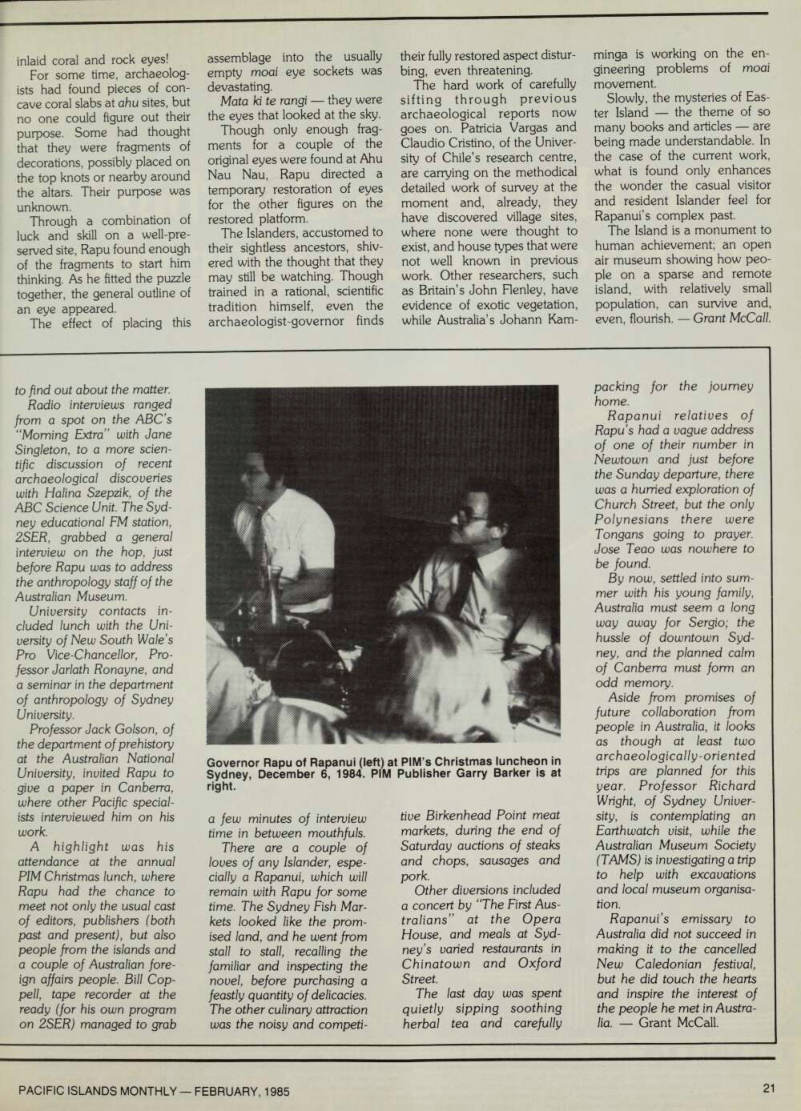
Rapu is large in the Polynesian fashion, with a full smile and broad face, not at all like the angular moai figures for which Rapanui is best known. He is more than an appointed official, serving as well as host for visitors to his land, and able to converse with them in either Spanish or English.
The facility with English came about due to Rapu’s association with Professor William Mu Hoy, the archaeologist who worked longest on the Island. It was Mulloy who sponsored Rapu to go to the University
of Wyoming, where the Rapanui acquired not only a degree in Anthropology, but also Yankee-accented Eng lish, and his wife, Cindy.
Rapu is currently enrolled in the PhD program at the East-West Center, from which he received a mas ter’s degree a few years ago.
It is an irony of modem Chilean life that his Amer ican degrees are not recog nised by the Chilean univer sities, a fact which cost him in salary during the time when he was curator of the local museum.
The possibility of a visit by Rapu to Australia was first mooted during the First International Congress on Easter Island and Eastern Polynesia, which was held on the island in September of 1984. (See PIM, October 1984.) At that time, there was a plan to send a Rapa nui folklore team to the Festival of Pacific Arts, in Noumea. Given that he was to cross most of the Pacific to reach New Caledonia, a side visit to Australia seemed like a good idea.
Many other people thought so as well and when
media, as well as scholarly, organisations heard about the visit, they were quick to fill up his brief eight-day stay.
Aside from making con tacts with various museum and university people, he wished also to find out about sources of informa tion on tropical agriculture for his island. In particular, he was seeking details on Australia’s famous nut, the macadamia, and crop in formation on a kind of white maize which used to be used as pig feed by the English company, William son Balfour, in the first half of this century, when they ran the island as a large sheep ranch.
The first quest resulted in three macadamia plants carefully packed in a beer carton, for transport as hand luggage an unusual souvenir. The Macadamia Nursery in Sydney kindly threw in a handful of raw nuts they happened to have on hand to boost the fledg ling crop.
Pig feed remained a mys tery, but various persons in Australia have undertaken
to find out about the matter.
Radio interviews ranged from a spot on the ABC’s “Morning Extra” with Jane Singleton, to a more scien tific discussion of recent archaeological discoveries with Halina Szepzik, of the ABC Science Unit. The Syd ney educational FM station, 2SER, grabbed a general interview on the hop, just before Rapu was to address the anthropology staff of the Australian Museum.
University contacts in cluded lunch with the Uni versity of New South Wale’s Pro Vice-Chancellor, Pro fessor Jarloth Ronayne, and a seminar in the department of anthropology of Sydney University.
Professor Jack Colson, of the department of prehistory at the Australian National University, invited Rapu to give a paper in Canberra, where other Pacific special ists interviewed him on his work.
A highlight was his attendance at the annual PIM Christmas lunch, where Rapu had the chance to meet not only the usual cast of editors, publishers (both past and present), but also people from the islands and a couple of Australian fore ign affairs people. Bill Cop pell, tape recorder at the ready (for his own program on 2SER) managed to grab
a few minutes of interview time in between mouthfuls.
There are a couple of loves of any Islander, espe cially a Rapanui, which will remain with Rapu for some time. The Sydney Fish Mar kets looked like the prom ised land, and he went from stall to stall, recalling the familiar and inspecting the novel, before purchasing a leasilyIeasily quantity of delicacies.
The other culinary attraction was the noisy and competi
tive Birkenhead Point meat markets, during the end of Saturday auctions of steaks and chops, sausages and pork.
Other diversions included a concert by “The First Aus tralians” at the Opera House, and meals at Syd ney’s varied restaurants in Chinatown and Oxford Street.
The last day was spent quietly sipping soothing herbal tea and carefully
packing for the journey home.
Rapanui relatives of Rapu’s had a vague address of one of their number in Newtown and just before the Sunday departure, there was a hurried exploration of Church Street, but the only Polynesians there were Tongans going to prayer.
Jose Teao was nowhere to be found.
By now, settled into sum mer with his young family, Australia must seem a long way away for Sergio; the hussle of downtown Syd ney, and the planned calm of Canberra must form an odd memory.
Aside from promises of future collaboration from people in Australia, it looks as though at least two archaeologically-oriented trips are planned for this year. Professor Richard Wright, of Sydney Univer sity, is contemplating an Earth watch visit, while the Australian Museum Society (TAMS) is investigating a trip to help with excavations and local museum organisa tion.
Rapanui’s emissary to Australia did not succeed in making it to the cancelled New Caledonian festival, but he did touch the hearts and inspire the interest of the people he met in Austra lia. Grant McCall.
Governor Rapu of Rapanui (left) at PIM’s Christmas luncheon in Sydney, December 6, 1984. PIM Publisher Garry Barker is at right.
Advertisements & other items, p. 22 (1 item)
compact car...just for you
f
Honda creates the “big”
111—t-^r V' r~ .i m
KSS-:-
Siii bS/ i ■
Jill
;V- ’l AUSTRALIA; Honda Australia Pty., Ltd. Lot 95 Sharps Road, Tullamarine, Victoria 3043; Bennett Honda Pty., Ltd. 250 Victoria Road, Wetherill Park, NSW. 2164/ NEW ZEALAND: NZMC Limited Manners Plaza, 57-65 Manners St., Wellington/PAPUA NEW GUINEA: Toba Pty., Ltd. PO. Box 503, Port Moresby/TAHITI: HONDA MOTOR CO.. LTD. TOKYO, JAPAN Honda Distribution S.A.R.L. B.P 1665, Papeete/KIR I BAT : Atoll Motor & Marino Services PO. Box 49, Bairiki Tarawa, Republic of Kiribati / US. TRUST TERRITORY: United Micronesia Development Association PO. Box 235, CHRB Saipan CM 96950/COOK ISLANDS: Cook Islands Motor Centre Ltd. PO. Box 74, Rarotonga/GUAM: Mark’s Motor Co., Inc. PO. Box DV, Agana/WESTERN SAMOA: Motor Distributors (Samoa) Ltd. PO Box 576, Apia/SOLOMON ISLANDS: Lee Kwok Kuen & Co.. Ltd. PO Box 537, Honiara/NEW CALEDONIA: Soci6t6 Du Chalandage 8, Rue de la somme-B.P 97, Noumda/NAURU: Nauru Cooperation Republic of Nauru/FIJ : Coral Island Motors Ltd. Robertson Road, Suva, Fiji/AMERICAN SAMOA: Holiday Motors, Parts and Service PO Box 968, Pago Pago, American Samoa 96799; Heleck’s Service Center Ltd. PO. Box 1138, Pago Pago, American Samoa 96799/TONGA: Tonga Industrial Traders PO. Box 1035, Nuku’alofa, Tonga/NORFOLK ISLAND:
Percy Chatterton: A life
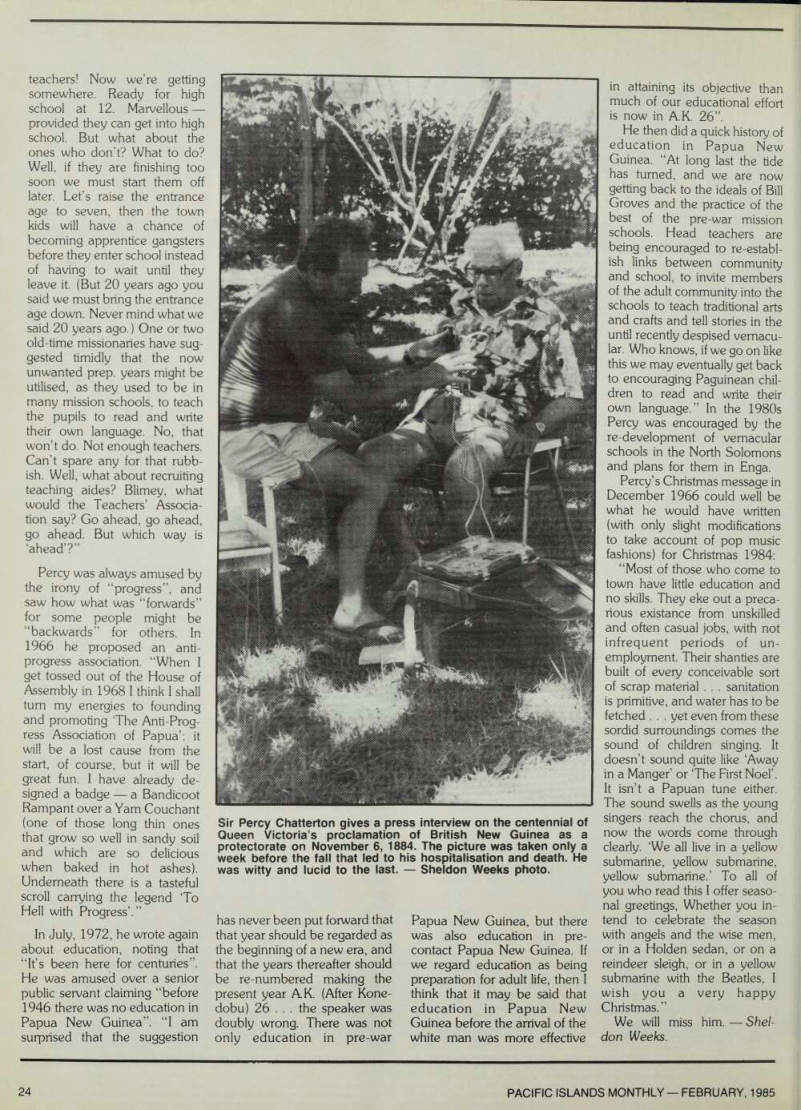
that was loved
Percy came to Papua New Guinea as a teacher. He re mained a teacher all his life.
He had taught for three years before coming here in a school run by the Society of Friends (Quakers). He embraced and lived Quaker values. In the 1970 s he added to his commit ments an involvement in a small Quaker Meeting in Port Moresby. The pomp and circumstance of a military fune ral would have been appreci ated by him with irony and laughter. During World War 1 he had carried stretchers rather than fight. Quakers are noted for their addiction to non violence.
When Percy retired 20 years ago he turned to politics and writing. Perhaps he “taught” more through his columns, his speeches in the House, and his radio interviews than he had to his thousands of pupils at Hanuabada and Delena be tween 1924 and 1954 the 30 years he was formally a teacher (both primary and teacher-training).
Percy’s first column in PIM appeared in October, 1966. It was called “To the Point”. It was titled “Five Books for a Pacific Journey on a Raft”. He meandered over many of his concerns. It reflects both his wit and wisdom, his fundamental bias for the underdog, and his energetic support of mother tongue instruction. In 1966 in the House he was a regular challenger of the authorities on what was happening to “border crossers” from Irian Jaya something he was still doing with concern and zest in 1984.
It was his conviction that led to an Ombudsman Commission and a National Capital District.
His belief that “Paguineans” could run their own affairs led him to back the establishment of their own church as early as
Papua New Guinea educationist SHELDON WEEKS, a friend of the late Sir PERCY CHATTERTON, here pays tribute to him, with special regard to his ideas concerning the education of young Papua New Guineans. The tribute captures much of the savor of an outstanding personality, and an outstanding human being.
1950. But he also saw the other side of the coin in 1972 he wrote: “One of the greatest of the many perils threatening this embryo nation may be that of the leaders getting so far ahead of the led that they disappear from sight.”
Percy was a strong supporter of Papua. He was also a cham pion of the urban villager and the unemployed. He wrote fre quently about the problems of those youth who were “pushed out” by the educational system.
In October, 1967, he wrote: “The gang, with engaging frankness, called itself The Ras cals’. Their speciality was petty thieving from parked cars.
When they were finally round ed up by the police their ages were found to range from eight to 13.” He went on to propose a special school for delin quents— “Such a school should have a flexible program unhampered by red tape, and an entrance standard that rec ognised no qualification but human need. Syllabuses pre scribed by Konedobu would be taboo. Percentiles too ... to carry out such a scheme will cost a lot of money, but at least some of these young people will become assets to the coun try’s economy. To do nothing about it will cost a lot of money, too, in 10 or 15 years’ time.
And it will be money poured down the drain; because it will be money spent in maintaining habitual criminals in our jails. ”
Or in 1985, on our “law and
order” budget.
In Percy’s old school at Hanuabada the children attended only four days a week.
This was because parents wanted time to teach them to hunt, fish and garden. “By basing our curriculum on the vernacular and teaching the rudiments of English as a sub ject we produced no BA’s, but we also produced no misfits.”
In the early 1970 s Percy changed the name of his col umn in PIM to “Footnotes”. In 1972 Percy was concerned about how selection into high school by boards of manage ment would work (it didn’t, and was abandoned). He went on: “We have abolished failure. We have substituted for it the E Pass. As 1972 draws to a close there will be a fresh crop of E Pass holders wondering why their pieces of paper are not getting them anywhere .. .
From 1921 to 1941 Papua harbored a system of payment by results schooling invented in Victorian England. Once a year a pupil (not merely in the top standard but in all standards) was examined by an external examiner generally a retired Queensland school inspector.
The pupils who scored 50 per cent or over had the letter “P” entered against their names and earned a grant for their mission ranging from 5/- a head for Standard 1 passes to 25/- a head for Standard 5 passes.
How we cherished those poten tial 25 bobsworth in Standard 5
during the weeks preceding the examination. Those who scored less than 50 per cent had (I hate to confess) the letter “F” entered against their names and earned nothing but opprobrium. The chief differ ence between our pre-war bob a-nob and the post-war Stan dard 6 examination appears to be that in the latter case the prize has gone to the pupil instead of the school, and has taken the form of a place in high school instead of a cash grant. ”
In his “Footnotes” column of March, 1972, Percy asks: “Is backwards the way ahead for Paguineans?” He notes that in the ’6os the Education Depart ment was pushing for younger children to enter school: “The fiat went forth. Pupils must be enrolled at an earlier age and pushed relentlessly through the two preparatory classes and the six standards of the eight-year primary course. Missionaries who had used the two prepara tory years to teach their pupils to read the mother tongue while acquiring a basic know ledge of spoken English were told that whatever the educatio nal arguments in favor of such a plan might be, there just wasn’t time to spare for it. English, English all the way. Only so could the pupils acquire enough knowledge of the magic language to enable them to profit by a secondary educa tion. The fact that this meant that those who didn’t win through to a place in high school left their primary school not effectively literate in any language was conveniently ignored. Excelsior! No time for two prep, classes. Cut one out, and settle for a seven-year course. Faster yet faster. Why have a prep, class at all? Cut it out and settle for a six-year course. Think of the saving in
teachers! Now we’re getting somewhere. Ready for high school at 12. Marvellous provided they can get into high school. But what about the ones who don’t? What to do?
Well, if they are finishing too soon we must start them off later. Let’s raise the entrance age to seven, then the town kids will have a chance of becoming apprentice gangsters before they enter school instead of having to wait until they leave it. (But 20 years ago you said we must bring the entrance age down. Never mind what we said 20 years ago.) One or two old-time missionaries have sug gested timidly that the now unwanted prep, years might be utilised, as they used to be in many mission schools, to teach the pupils to read and write their own language. No, that won’t do. Not enough teachers.
Can’t spare any for that rubb ish. Well, what about recruiting teaching aides? Blimey, what would the Teachers’ Associa tion say? Go ahead, go ahead, go ahead. But which way is ‘ahead’?”
Percy was always amused by the irony of “progress”, and saw how what was “forwards” for some people might be “backwards” for others. In 1966 he proposed an anti progress association. “When I get tossed out of the House of Assembly in 1968 I think I shall turn my energies to founding and promoting ‘The Anti-Prog ress Association of Papua’: it will be a lost cause from the start, of course, but it will be great fun. I have already de signed a badge a Bandicoot Rampant over a Yam Couchant (one of those long thin ones that grow so well in sandy soil and which are so delicious when baked in hot ashes).
Underneath there is a tasteful scroll carrying the legend ‘To Hell with Progress’.”
In July, 1972, he wrote again about education, noting that “It’s been here for centuries”.
He was amused over a senior public servant claiming “before 1946 there was no education in Papua New Guinea”. “I am surprised that the suggestion
has never been put forward that that year should be regarded as the beginning of a new era, and that the years thereafter should be re-numbered making the present year AK. (After Konedobu) 26 . . . the speaker was doubly wrong. There was not only education in pre-war
Papua New Guinea, but there was also education in pre contact Papua New Guinea. If we regard education as being preparation for adult life, then I think that it may be said that education in Papua New Guinea before the arrival of the white man was more effective
in attaining its objective than much of our educational effort is now in A.K. 26”.
He then did a quick history of education in Papua New Guinea. “At long last the tide has turned, and we are now getting back to the ideals of Bill Groves and the practice of the best of the pre-war mission schools. Head teachers are being encouraged to re-establ ish links between community and school, to invite members of the adult community into the schools to teach traditional arts and crafts and tell stories in the until recently despised vernacu lar. Who knows, if we go on like this we may eventually get back to encouraging Paguinean chil dren to read and write their own language.” In the 1980 s Percy was encouraged by the re-development of vernacular schools in the North Solomons and plans for them in Enga.
Percy’s Christmas message in December 1966 could well be what he would have written (with only slight modifications to take account of pop music fashions) for Christmas 1984: “Most of those who come to town have little education and no skills. They eke out a preca rious existence from unskilled and often casual jobs, with not infrequent periods of un employment. Their shanties are built of every conceivable sort of scrap material . . . sanitation is primitive, and water has to be fetched ... yet even from these sordid surroundings comes the sound of children singing. It doesn’t sound quite like ‘Away in a Manger’ or The First Noel’.
It isn’t a Papuan tune either.
The sound swells as the young singers reach the chorus, and now the words come through clearly. ‘We all live in a yellow submarine, yellow submarine, yellow submarine.’ To all of you who read this I offer seaso nal greetings, Whether you in tend to celebrate the season with angels and the wise men, or in a Holden sedan, or on a reindeer sleigh, or in a yellow submarine with the Beatles, I wish you a very happy Christmas.”
We will miss him. Shel don Weeks.
Sir Percy Chatterton gives a press interview on the centennial of Queen Victoria’s proclamation of British New Guinea as a protectorate on November 6, 1884. The picture was taken only a week before the fall that led to his hospitalisation and death. He was witty and lucid to the last. Sheldon Weeks photo.
politics
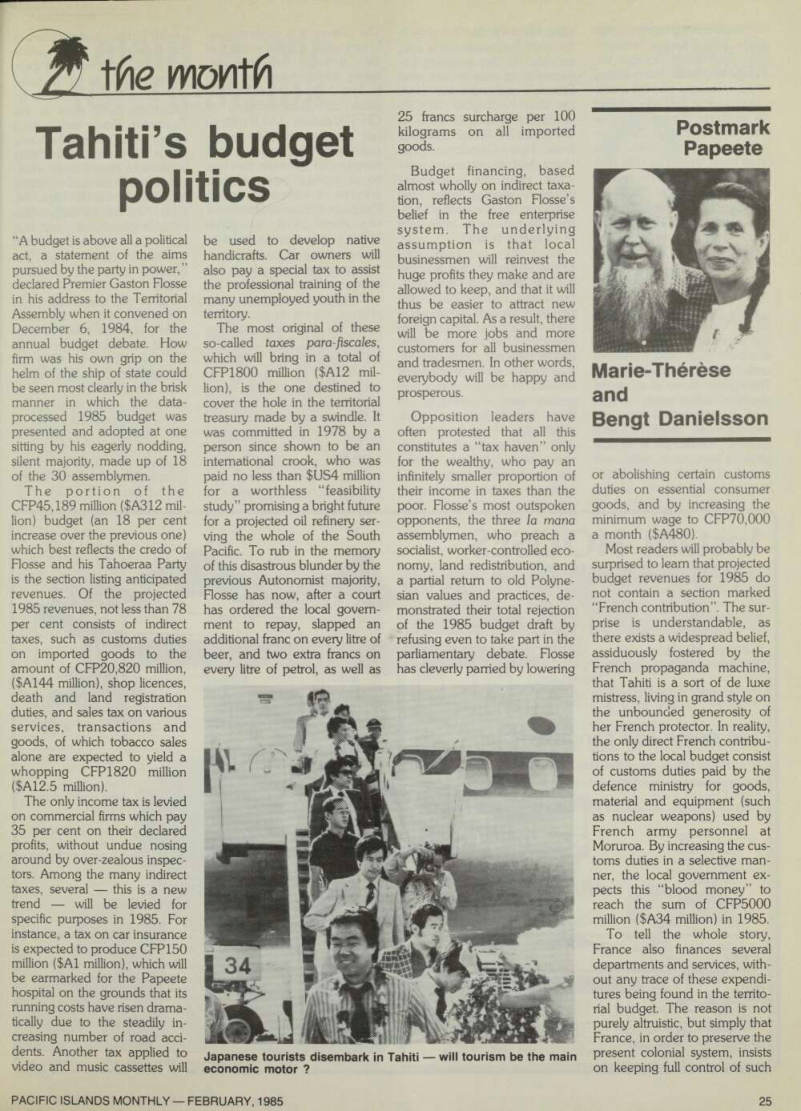

the month
Tahiti’s budget politics
“A budget is above all a political act, a statement of the aims pursued by the party in power, ” declared Premier Gaston Flosse in his address to the Territorial Assembly when it convened on December 6, 1984, for the annual budget debate. How firm was his own grip on the helm of the ship of state could be seen most clearly in the brisk manner in which the data processed 1985 budget was presented and adopted at one sitting by his eagerly nodding, silent majority, made up of 18 of the 30 assemblymen.
The portion of the CFP45,189 million (SA3I2 mil lion) budget (an 18 per cent increase over the previous one) which best reflects the credo of Flosse and his Tahoeraa Party is the section listing anticipated revenues. Of the projected 1985 revenues, not less than 78 per cent consists of indirect taxes, such as customs duties on imported goods to the amount of CFP20,820 million, (SAI44 million), shop licences, death and land registration duties, and sales tax on various services, transactions and goods, of which tobacco sales alone are expected to yield a whopping CFPIB2O million (5A12.5 million).
The only income tax is levied on commercial firms which pay 35 per cent on their declared profits, without undue nosing around by over-zealous inspec tors. Among the many indirect taxes, several this is a new trend will be levied for specific purposes in 1985. For instance, a tax on car insurance is expected to produce CFPISO million (SAI million), which will be earmarked for the Papeete hospital on the grounds that its running costs have risen drama tically due to the steadily in creasing number of road acci dents. Another tax applied to video and music cassettes will
be used to develop native handicrafts. Car owners will also pay a special tax to assist the professional training of the many unemployed youth in the territory.
The most original of these so-called taxes para-fiscales, which will bring in a total of CFPIBOO million (SAI2 mil lion), is the one destined to cover the hole in the territorial treasury made by a swindle. It was committed in 1978 by a person since shown to be an international crook, who was paid no less than SUS 4 million for a worthless “feasibility study” promising a bright future for a projected oil refinery ser ving the whole of the South Pacific. To rub in the memory of this disastrous blunder by the previous Autonomist majority, Flosse has now, after a court has ordered the local govern ment to repay, slapped an additional franc on every litre of beer, and two extra francs on every litre of petrol, as well as
25 francs surcharge per 100 kilograms on all imported goods.
Budget financing, based almost wholly on indirect taxa tion, reflects Gaston Flosse’s belief in the free enterprise system. The underlying assumption is that local businessmen will reinvest the huge profits they make and are allowed to keep, and that it will thus be easier to attract new foreign capital. As a result, there will be more jobs and more customers for all businessmen and tradesmen. In other words, everybody will be happy and prosperous.
Opposition leaders have often protested that all this constitutes a “tax haven” only for the wealthy, who pay an infinitely smaller proportion of their income in taxes than the poor. Flosse’s most outspoken opponents, the three la mono assemblymen, who preach a socialist, worker-controlled eco nomy, land redistribution, and a partial return to old Polyne sian values and practices, de monstrated their total rejection of the 1985 budget draft by refusing even to take part in the parliamentary debate. Flosse has cleverly parried by lowering
Postmark Papeete
or abolishing certain customs duties on essential consumer goods, and by increasing the minimum wage to CFP7O,OOO a month (SA4BO).
Most readers will probably be surprised to learn that projected budget revenues for 1985 do not contain a section marked “French contribution”. The sur prise is understandable, as there exists a widespread belief, assiduously fostered by the French propaganda machine, that Tahiti is a sort of de luxe mistress, living in grand style on the unbounded generosity of her French protector. In reality, the only direct French contribu tions to the local budget consist of customs duties paid by the defence ministry for goods, material and equipment (such as nuclear weapons) used by French army personnel at Moruroa. By increasing the cus toms duties in a selective man ner, the local government ex pects this “blood money” to reach the sum of CFFSOOO million (SA34 million) in 1985.
To tell the whole story, France also finances several departments and services, with out any trace of these expendi tures being found in the territo rial budget. The reason is not purely altruistic, but simply that France, in order to preserve the present colonial system, insists on keeping full control of such
Japanese tourists disembark in Tahiti will tourism be the main economic motor?
Marie-Therese and Bengt Danielsson
vital sectors as defence, foreign affairs, police, justice, immigra tion, information, foreign ex change and trade, international communications and the exclu sive economic 200-mile zone of the territory. France also pro vides free of charge 2200 ex patriate “experts”, who have often been known to take over or at least to infiltrate heavily many branches of the sup posedly local administration.
More useful to the local govern ment are undoubtedly the occasional French contributions of a few hundred million francs for specific projects, such as a new road or sports stadium.
If we now look at the other side of the coin, showing plan ned expenditures, it is possible, and even quite easy, to discern underlying government policy.
The figures above all show the all-round effort made by the local government to meet the educational, medical and material needs of a rapidly growing population, which will pass the 170,000 mark in 1985.
The rapid growth in budget
expenditures is due not only to the high Polynesian birth rate, but also to the on-going im migration of new settlers from France still more than 1000 per year coupled with the predictable influx in 1985 of thousands of French refugees from New Caledonia. The sharp budget increases since 1984 along the whole line therefore simply reflect the willingness of the local govern ment to pursue an open-door immigration policy.
Incidentally, the government offices in Papeete are also be coming more and more over populated, and the budget ex penditure for staff salaries will in 1985 reach the astronomical figure of CFPII,OOO million (SA76 million). Consequently, the item called investments consists in most instances of money spent on putting up still more unprepossessing office buildings.
The big question is whether there are among these numer ous sumptuous outlays also some productive investments.
The answer is a qualified yes.
For instance, a closer scrutiny of the 18 huge, data-processed reams which form the 1985 budget draft, indicates that the quite considerable sum of CFP7OO million (SA4.B million) has been set aside for tourist promotion. The urgency and necessity of this item can best be gauged from the fact that the number of visitors to French Polynesia has remained station ary since 1978, at about 100,000 per year. In another, perhaps more decisive manner, the government has for some time tried to stimulate the growth of the tourist industry by offering private investors gen erous tax deductions and low interest loans. As a first visible result, several new hotels are a-building, and total accommodation capacity in the territory is expected to rise to 3000 rooms at the end of 1985.
An almost equally important budget item is the allocation of CFPS9O million (SA4 million) for the exploration and ex ploitation of the enormous
wealth hidden in the ocean in the form of fish, shells, pearls and metal nodules (PIM Dec. ’Bl pplB-19). As for the valu able phosphate deposits to be found on some atolls in the Tuamotus, Flosse had nothing to say in his inaugural address about the international mining consortium Raro Moana which last year was accused of robber tactics at Mataiva (PIM Apr. ’B4, p 23). Nor did the responsible minister give the slightest clue as to how the territory will eventually benefit from the planned extraction of phos phate.
All in all, the budget thus seems to confirm that Flosse means business when he pro claims in season and out that his basic aim is to make the territory economically indepen dent. On this point at least, he can count on the warm appro val of all opposition parties the strongest support, of course, coming from those who likewise are in favor of political independence. Marie-Theri'se and Bengt Danielsson.
Advertisements & other items, p. 26 (1 item)
Instant HOUSES
with Therma-Panel®
The fully insulated panelisecl building system
George Hudson,
the name in home building for 100 years!
The established name with —•— new ideas!
The home you can assemble!
• Economical fast and simple
Cyclone resistant Ideal for the South Pacific regions George Hudson have supplied to: • Tonga
• PNG
• Solomon Islands • Tuvalu and • American Samoa Mb Wa • Farm Buildings Schools • Hospitals Industrial Buildings Motels • Barracks one home, whole towns, or villages m We can also supply to your designs and specifications George Hudson Homes (Aust.) Rt v . Ltd 4- GH 186 Hume Highway Cabramatta NSW 2166 Australia Tel: (02) 727 9066 Telex: AA25800 Post coupon for details and prices 1
for Remeliik
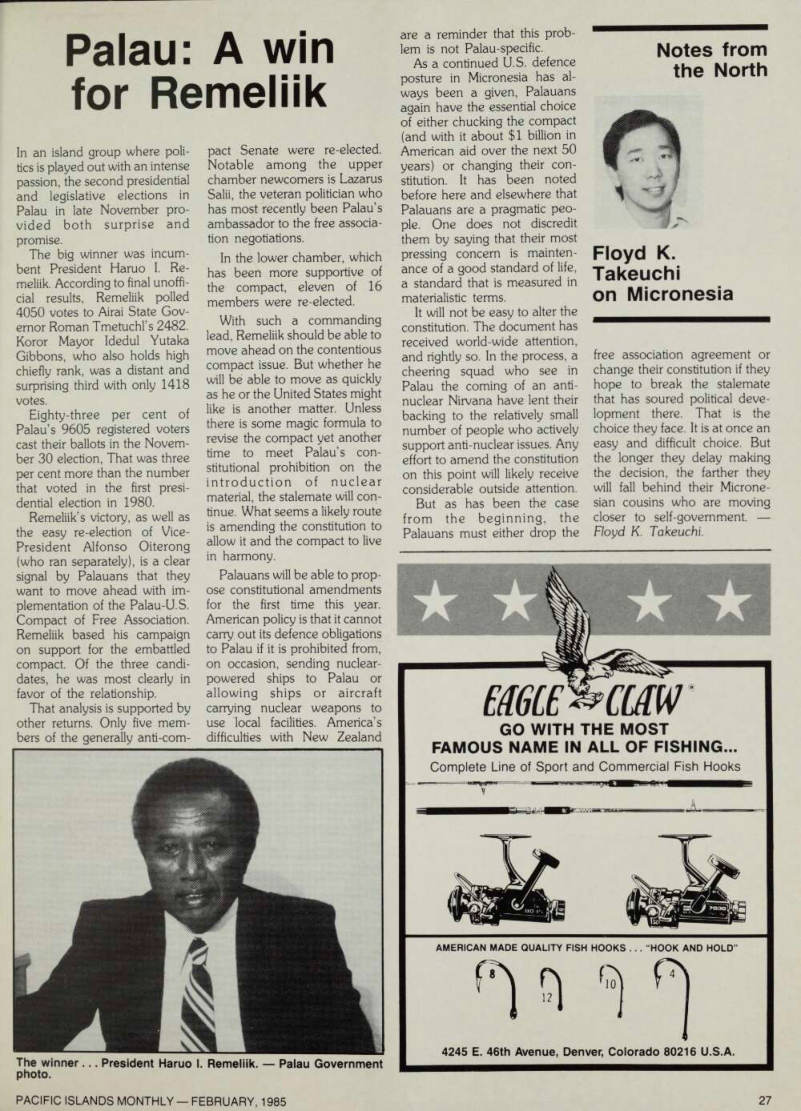
Palau: A win for Remeliik
In an island group where poli tics is played out with an intense passion, the second presidential and legislative elections in Palau in late November pro vided both surprise and promise.
The big winner was incum bent President Haruo I. Re meliik. According to final unoffi cial results, Remeliik polled 4050 votes to Airai State Gov ernor Roman Tmetuchl’s 2482.
Koror Mayor Idedul Yutaka Gibbons, who also holds high chiefly rank, was a distant and surprising third with only 1418 votes.
Eighty-three per cent of Palau’s 9605 registered voters cast their ballots in the Novem ber 30 election, That was three per cent more than the number that voted in the first presi dential election in 1980.
Remeliik’s victory, as well as the easy re-election of Vice- President Alfonso Oiterong (who ran separately), is a clear signal by Palauans that they want to move ahead with im plementation of the Palau-U.S.
Compact of Free Association.
Remeliik based his campaign on support for the embattled compact. Of the three candi dates, he was most clearly in favor of the relationship.
That analysis is supported by other returns. Only five mem bers of the generally anti-corn
pact Senate were re-elected.
Notable among the upper chamber newcomers is Lazarus Salii, the veteran politician who has most recently been Palau’s ambassador to the free associa tion negotiations.
In the lower chamber, which has been more supportive of the compact, eleven of 16 members were re-elected.
With such a commanding lead, Remeliik should be able to move ahead on the contentious compact issue. But whether he will be able to move as quickly as he or the United States might like is another matter. Unless there is some magic formula to revise the compact yet another time to meet Palau’s con stitutional prohibition on the introduction of nuclear material, the stalemate will con tinue. What seems a likely route is amending the constitution to allow it and the compact to live in harmony.
Palauans will be able to prop ose constitutional amendments for the first time this year.
American policy is that it cannot carry out its defence obligations to Palau if it is prohibited from, on occasion, sending nuclear powered ships to Palau or allowing ships or aircraft carrying nuclear weapons to use local facilities. America’s difficulties with New Zealand
are a reminder that this prob lem is not Palau-specific.
As a continued U.S. defence posture in Micronesia has al ways been a given, Palauans again have the essential choice of either chucking the compact (and with it about $1 billion in American aid over the next 50 years) or changing their con stitution. It has been noted before here and elsewhere that Palauans are a pragmatic peo ple. One does not discredit them by saying that their most pressing concern is mainten ance of a good standard of life, a standard that is measured in materialistic terms.
It will not be easy to alter the constitution. The document has received world-wide attention, and rightly so. In the process, a cheering squad who see in Palau the coming of an anti nuclear Nirvana have lent their backing to the relatively small number of people who actively support anti-nuclear issues. Any effort to amend the constitution on this point will likely receive considerable outside attention.
But as has been the case from the beginning, the Palauans must either drop the
Notes from the North
free association agreement or change their constitution if they hope to break the stalemate that has soured political deve lopment there. That is the choice they face. It is at once an easy and difficult choice. But the longer they delay making the decision, the farther they will fall behind their Microne sian cousins who are moving closer to self-government.
K. Takeuchi.
The winner... President Haruo I. Remeliik.-Palau Government photo.
Floyd K.
Takeuchi on Micronesia
Advertisements & other items, pp. 27-28 (1 item)
Eme&Cm
★ ★lk ★ ★
GO WITH THE MOST
FAMOUS NAME IN ALL OF FISHING...
Complete Line of Sport and Commercial Fish Hooks A.
AMERICAN MADE QUALITY FISH HOOKS . . . “HOOK AND HOLD’
Pi 4245 E. 46th Avenue, Denver, Colorado 80216 U.S.A.
In 1966
Shaddock
discovered
the Pacific
Since 1966 Shaddock has gone from exploring a new market to being a major supplier of electrical appliances to the Pacific, Shaddock discovered the Pacific, And the Pacific discovered Shaddock. The Shaddock range of domestic and commercial appliances has established a reputation for dependability and performance throughout the region. Today Shaddock is still exploring. Exploring new ideas, new technology, new products. It is the type of exploration that keeps Fisher and Paykel, the New Zealand manufacturer of Shaddock, the southern hemisphere's largest exporter of major appliances.
equipment in Tuvalu
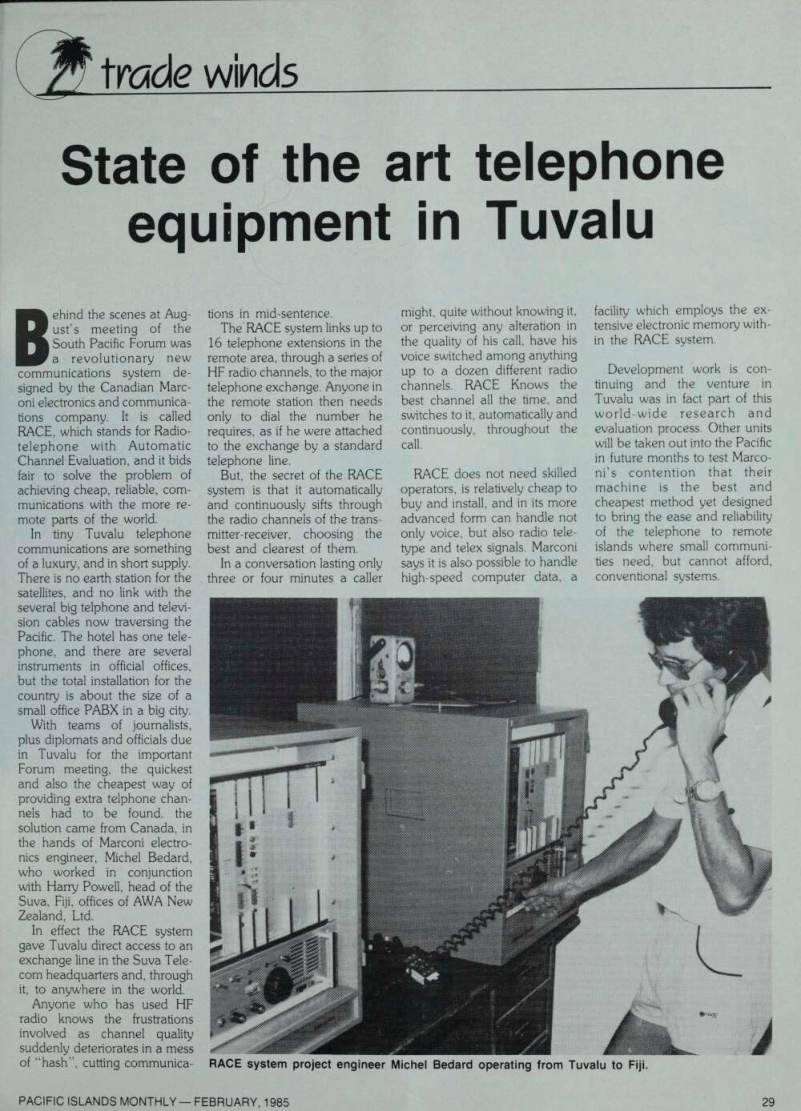
trade winds
State of the art telephone equipment in Tuvalu
Behind the scenes at Aug ust’s meeting of the South Pacific Forum was a revolutionary new communications system de signed by the Canadian Marc oni electronics and communica tions company. It is called RACE, which stands for Radio telephone with Automatic Channel Evaluation, and it bids fair to solve the problem of achieving cheap, reliable, com munications with the more re mote parts of the world.
In tiny Tuvalu telephone communications are something of a luxury, and in short supply.
There is no earth station for the satellites, and no link with the several big telphone and televi sion cables now traversing the Pacific. The hotel has one tele phone, and there are several instruments in official offices, but the total installation for the country is about the size of a small office PABX in a big city.
With teams of journalists, plus diplomats and officials due in Tuvalu for the important Forum meeting, the quickest and also the cheapest way of providing extra telphone chan nels had to be found, the solution came from Canada, in the hands of Marconi electro nics engineer, Michel Bedard, who worked in conjunction with Harry Powell, head of the Suva, Fiji, offices of AWA New Zealand, Ltd.
In effect the RACE system gave Tuvalu direct access to an exchange line in the Suva Tele com headquarters and, through it, to anywhere in the world.
Anyone who has used HF radio knows the frustrations involved as channel quality suddenly deteriorates in a mess of “hash”, cutting communica
tions in mid-sentence.
The RACE system links up to 16 telephone extensions in the remote area, through a series of HE radio channels, to the major telephone exchange. Anyone in the remote station then needs only to dial the number he requires, as if he were attached to the exchange by a standard telephone line.
But, the secret of the RACE system is that it automatically and continuously sifts through the radio channels of the trans mitter-receiver, choosing the best and clearest of them.
In a conversation lasting only three or four minutes a caller
might, quite without knowing it, or perceiving any alteration in the quality of his call, have his voice switched among anything up to a dozen different radio channels. RACE Knows the best channel all the time, and switches to it, automatically and continuously, throughout the call.
RACE does not need skilled operators, is relatively cheap to buy and install, and in its more advanced form can handle not only voice, but also radio tele type and telex signals. Marconi says it is also possible to handle high-speed computer data, a
facility which employs the ex tensive electronic memory with in the RACE system.
Development work is con tinuing and the venture in Tuvalu was in fact part of this world-wide research and evaluation process. Other units will be taken out into the Pacific in future months to test Marco ni’s contention that their machine is the best and cheapest method yet designed to bring the ease and reliability of the telephone to remote islands where small communi ties need, but cannot afford, conventional systems.
RACE system project engineer Michel Bedard operating from Tuvalu to Fiji.
Advertisements & other items, pp. 30-31 (1 item)
Introducing Perfoi
NEW’B4 TOYOTA HUN
Performance p comfort.
Performance plus durability.
Performance plus variety.
Advanced, powerful new engines put you in command with higher torque, better efficiency. Inside, more driving comfort than ever before with a roomier cabin, bigger windscreens, and lean, clean instrumentation. Newly designed suspension gives you big carrying capability, yet carries you in comfort. HILUX is one tough truck with a suspension you can count on. Choose from a wide variety, including 4WD regular or double cab - and two new additions - 2WD extra cab and flatdeck. The all-new Toyota HILUX. Add it all up, and you have performance plus! r ■ K-
TOYOTA
QUALITY SERVICE
AMERICAN SAMOA: BURNS PHILP (SOUTH SEA)
CO., LTD., P.O. Box 129, Pago Pago.
COOK ISLANDS: COOK ISLANDS TRADING
CORPORATION LTD., Private Bag, Rarotonga.
FIJI: AUTOMOTIVE SUPPLIES COMPANY, G.P.O.
Box 355, Suva.
GUAM & MICRONESIA: ATKINS. KROLL (GUAM) LTD. 443 South Marine Drive, Tamuning.
KIRIBATI: TARAWA MOTORS, P.O. Box 36, Bairiki, Tarawa, Kiribati.
NAURU: NAURU COOPERATIVE SOCIETY.
NEW CALEDONIA: SERVICE IMPORTATION
AUTOMOBILE DU PACIFIQUE, Rond-Point du Pacifiqu* (Station Total) B.P. 438. Noumea.
NANCE PLUS!
4WD Double Cab ORFOLK ISLAND: SORRY’S LIMITED, P.O. Box 169.
APUA NEW GUINEA: ELA MOTORS, A Division of jrns Philp (PNG) Ltd., P.O. Box 75, Port Moresby.
AIPAN: MICROL CORPORATION, P.O. Box 267,
aipan.
OLOMON: MENDANA ENTERPRISES (5.1.) LTD.,
P.O Bov 17d Honiara TAHITI: NIPPON AUTOMOTO, P.O. Box 342, Papeete.
TONGA: BURNS PHILP (SOUTH SEA) CO., LTD., P.O. Box 55, Nukualofa.
VANUATU: VANUATU MOTORS, P.O. Box 18,
Port Vila.
TOYOTA
WESTERN SAMOA: BURNS PHILP (SOUTH SEA)
OA I TA n A D«w 400 A-:.
Fiji hot bread shops

spread like wildfire
A 100 per cent Fiji-owned company is changing the pat tern of Fiji’s diet. From one shop in Suva at the beginning of 1982, The Hot Bread Kit chen has swelled its numbers to nine, with the newest outlet opening in Lami in July, 1984.
Six are company sites and three are franchised. Applica tions for franchises are currently being considered from Western Samoa, American Samoa, Ton ga and the Solomons.
According to Tony Phillips, director, the most interesting application to date has come from a group of Fijian women in Lomaloma village, Vanuava lavu Island, in the Lau group.
The problems to be overcome include “lack of manpower” and “scarcity of resources.”
Assistance to solve the latter problem will certainly come from the recent establishment of a coconut oil mill in the area which has electricity. The com pany was organising a scaled
down version of kitchen com plete with “mini-equipment.”
The kitchens are open seven days a week and offer a list of 47 varieties and styles of breads and buns although not all simultaneously. Prakash Lai, manager of the Labasa kitchen which has been open for less than a year, said that wholemeal breads were by far the most popular including a very grainy loaf called Swiss Rye. The Suva shops con firmed this trend. Cream buns must come a close second judging by the number of small children seen about the streets with their noses buried in one.
The experimental kitchen in Lami has also come up with cassava bread and coconut bread, both light and delicious.
Mr Phillips said that the com pany intended to sell only breads and was resisting the temptation to stock pastries, etc.
Each shop employs about 16
people eight bakers and eight assistants, working on a morning or afternoon roster.
The sales figure for the first three quarters of 1984 was $2% million and that’s a lot of bread. 10 million items in fact. If the queues filing through each shop are another indica tion, this enterprise is certainly a success. Ngaire Douglas in Suva.
for Tongan
EEC help for Tongan airport
Funding from the European Economic Community will be put into upgrading to internatio nal standard the Lupepau’u Airport in Tonga’s northern Vava’u islands. Plans are to develop the strip to the stan dard required for Boeing 737 operation, like the main Fua’amotu Airport on Tongata pu.
Mr Michael Laidler, EEC de legate based in Suva, said there was just over Tsl million left
unspent from the current five year program from Tonga which runs through to 1985.
This, together with money available at the regional level, could be used to finance the first stage of the Vava’u airport proposal, details of which have yet to be finalised. A Lufthansa study mission commissioned by the EEC last year said the upgrading could cost up to T 52.2 million.
The Tongans are now pre paring a project dossier which will go to Brussels for the financing proposal which must precede final approval which in turn will allow tenders to be called.
Mr Laidler and the EEC Pacific desk officer from Brus sels, Mr Steffen Stenberg, dis cussed the airport proposal while in Tonga recently for the opening of an educational EEC exhibition which has now been seen by more than 18,000 people in five Pacific states. ’’Most people are astonished at the level of EEC finance put into the Pacific in the last decade,” said Mr Laidler. ”It now amounts to more than $3OO million.”
Advertisements & other items, p. 32 (1 item)
Longlife Products
11'
BUI
AND FRESH DAIRY FOODS,
QUALITY YOU CAN TRUST
QUF Industries Ltd. offers an export award winning range of Longlife products as well as a complete range of quality fresh dairy foods.
With 15 years' experience in export markets, QUF has the product knowledge and expertise to provide you with outstanding service in the 1980's. • Pauls Longlife UHT Milk is natural liquid cow's milk with no preservatives or additives and is available in the 250m1, 500 ml and 1 litre sizes. • Shake Longlife flavoured milk is offered in delicious Chocolate, Malted, Caramel and Strawberry flavours. • Pauls Longlife Thickened Cream is ideal for whipping or pouring. • Popper 100% Fruit Juice is available in seven flavours in a wide range of Longlife pack sizes. • Pauls fresh Dairy Products including Milk, Cream, Yoghurt and Cottage Cheese are available in an extensive range of flavours and sizes.
TRADE ENQUIRIES:
QUF Industries Ltd., P.O. Box 12, South Brisbane, Queensland, 4101 Australia Telephone: (07) 44-0151 Telex: AA 40614 J -J J
ORANGE
h iduncd (Tt-am
Bw m
MEW
shiik
miiK
LITRE
miiK
Pacific stamp box
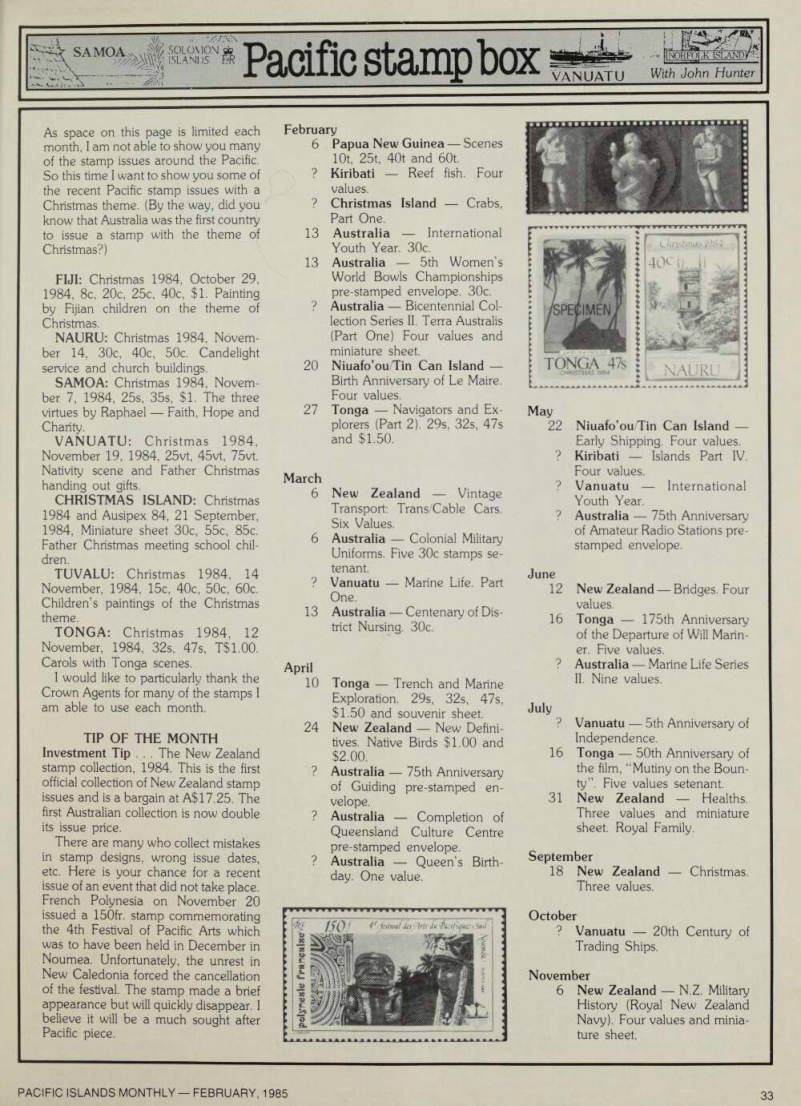
As space on this page is limited each month, I am not able to show you many of the stamp issues around the Pacific.
So this time I want to show you some of the recent Pacific stamp issues with a Christmas theme. (By the way, did you know that Australia was the first country to issue a stamp with the theme of Christmas?) FIJI: Christmas 1984, October 29, 1984, Bc, 20c, 25c, 40c, $l. Painting by Fijian children on the theme of Christmas.
NAURU: Christmas 1984, Novem ber 14, 30c, 40c, 50c. Candelight service and church buildings.
SAMOA: Christmas 1984, Novem ber 7, 1984, 255, 355, $l. The three virtues by Raphael Faith, Hope and Charity.
VANUATU: Christmas 1984, November 19, 1984, 25vt, 45vt, 75vt.
Nativity scene and Father Christmas handing out gifts.
CHRISTMAS ISLAND: Christmas 1984 and Ausipex 84, 21 September, 1984, Miniature sheet 30c, 55c, 85c.
Father Christmas meeting school chil dren.
TUVALU: Christmas 1984, 14 November, 1984, 15c, 40c, 50c, 60c.
Children’s paintings of the Christmas theme.
TONGA: Christmas 1984, 12 November, 1984, 325, 475, Tsl.oo.
Carols with Tonga scenes.
I would like to particularly thank the Crown Agents for many of the stamps I am able to use each month.
Tip Of The Month
Investment Tip . . . The New Zealand stamp collection, 1984. This is the first official collection of New Zealand stamp issues and is a bargain at A 517.25. The first Australian collection is now double its issue price.
There are many who collect mistakes in stamp designs, wrong issue dates, etc. Here is your chance for a recent issue of an event that did not take place.
French Polynesia on November 20 issued a 150 fr. stamp commemorating the 4th Festival of Pacific Arts which was to have been held in December in Noumea. Unfortunately, the unrest in New Caledonia forced the cancellation of the festival. The stamp made a brief appearance but will quickly disappear. I believe it will be a much sought after Pacific piece.
February 6 Papua New Guinea Scenes lOt, 25t, 40t and 60t. ? Kiribati Reef fish. Four values. ? Christmas Island Crabs, Part One. 13 Australia International Youth Year. 30c. 13 Australia sth Women’s World Bowls Championships pre-stamped envelope. 30c. ? Australia Bicentennial Col lection Series 11. Terra Australis (Part One) Four values and miniature sheet. 20 Niuafo’ou/Tin Can Island Birth Anniversary of Le Maire.
Four values. 27 Tonga Navigators and Ex plorers (Part 2). 295, 325, 47s and $1.50.
March 6 New Zealand Vintage Transport; Trans/Cable Cars.
Six Values. 6 Australia Colonial Military Uniforms. Five 30c stamps se tenant. ? Vanuatu Marine Life. Part One. 13 Australia Centenary of Dis trict Nursing. 30c.
April 10 Tonga Trench and Marine Exploration. 295, 325, 475, $1.50 and souvenir sheet. 24 New Zealand New Defini tives. Native Birds $l.OO and $2.00. ? Australia 75th Anniversary of Guiding pre-stamped en velope. ? Australia Completion of Queensland Culture Centre pre-stamped envelope. ? Australia Queen’s Birth day. One value.
May 22 Niuafo’ou/Tin Can Island Early Shipping. Four values. ? Kiribati Islands Part IV.
Four values. ? Vanuatu International Youth Year. ? Australia 75th Anniversary of Amateur Radio Stations pre stamped envelope.
June 12 New Zealand Bridges. Four values. 16 Tonga 175th Anniversary of the Departure of Will Marin er. Five values. ? Australia Marine Life Series 11. Nine values.
July ? Vanuatu sth Anniversary of Independence. 16 Tonga 50th Anniversary of the film, “Mutiny on the Boun ty”. Five values setenant. 31 New Zealand Healths.
Three values and miniature sheet. Royal Family.
September 18 New Zealand Christmas.
Three values.
October ? Vanuatu 20th Century of Trading Ships.
November 6 New Zealand N.Z. Military History (Royal New Zealand Navy). Four values and minia ture sheet.
Advertisements & other items, p. 34 (1 item)
/VcifteAPDX
.. .the magic of elegant sound.
Avante component systems and the magic of Pioneer technology.
Together they bring you the miracle of your favourite music re-created with all the bewitching excitement and natural dynamism of the original performance. The secret of the Avante A9DX lies in the basic concept of the Avante series... advanced components created together to perform together.
The amplifier alone is amazing Dynamic Power Non-Switching*, plus 265 watts/channel of music power! Other components include a Quartz-PLL FM/AM tuner, fully automatic turntable and a double cassette deck, plus 4-way speaker systems.
No mere trick, the new Avante A9DX is the product of elegant design and audio expertise. That’s Pioneer’s unique brand of magic.
Options shown; graphic equalizer and digital timer.
0 PIONEER'
* Non-Switching is a trademark of Pioneer.
For further information, please contact: ■ Australia: Pioneer Electronics Australia Pty. Ltd. (Incorporated in Victoria), PO. Box 295, Mordialloc,Victoria, 3195 Tel: 580-9911 ■ Fiji Islands: Brijlal & Company. G.P.O. Box No. 362, Suva, Fiji Islands Tel: 22258 ■ New Zealand: Monaco Distributors Ltd., 2 Poland Road, Glenfield, Auckland, New Zealand Tel: (09) 444-9144 ■ Norfolk Island: Burns Philp (Norfolk Island) Ltd , PC Box 21, Norfolk Island ■ Vanuatu: Burns Philp (Vanuatu) Ltd , Vila, Vanuatu ■ Nauru Island: Jacob Enterprises, P.O. Box No. 4, Republic of Nauru ■ Tahiti: Tahiti Hi-Fi, P.O. Box 848, Papeete, Tahiti ■ New Caledonia: Menard Pacifique Sari, B.P. 3899, Noumea, New Caledonia Tel: 27*62*23 ■ American Samoa: Transpac Corporation, P.O. Box 1477, Pago Pago, American Samoa
boo ks
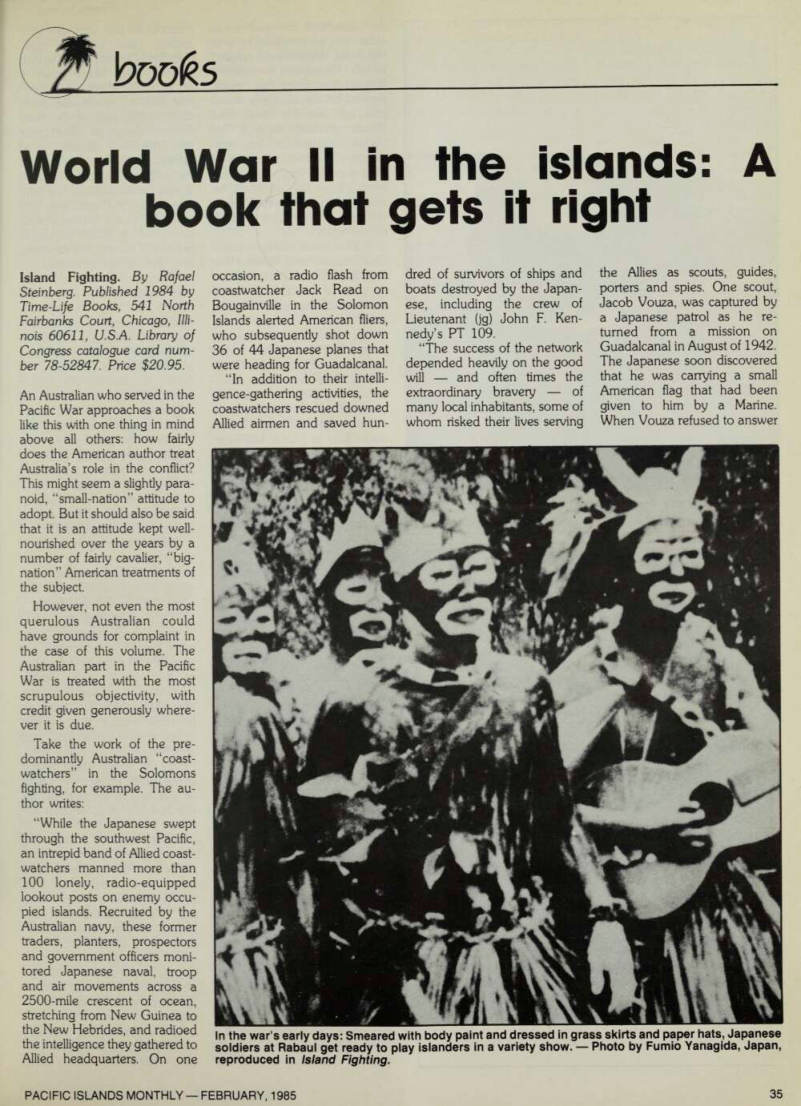
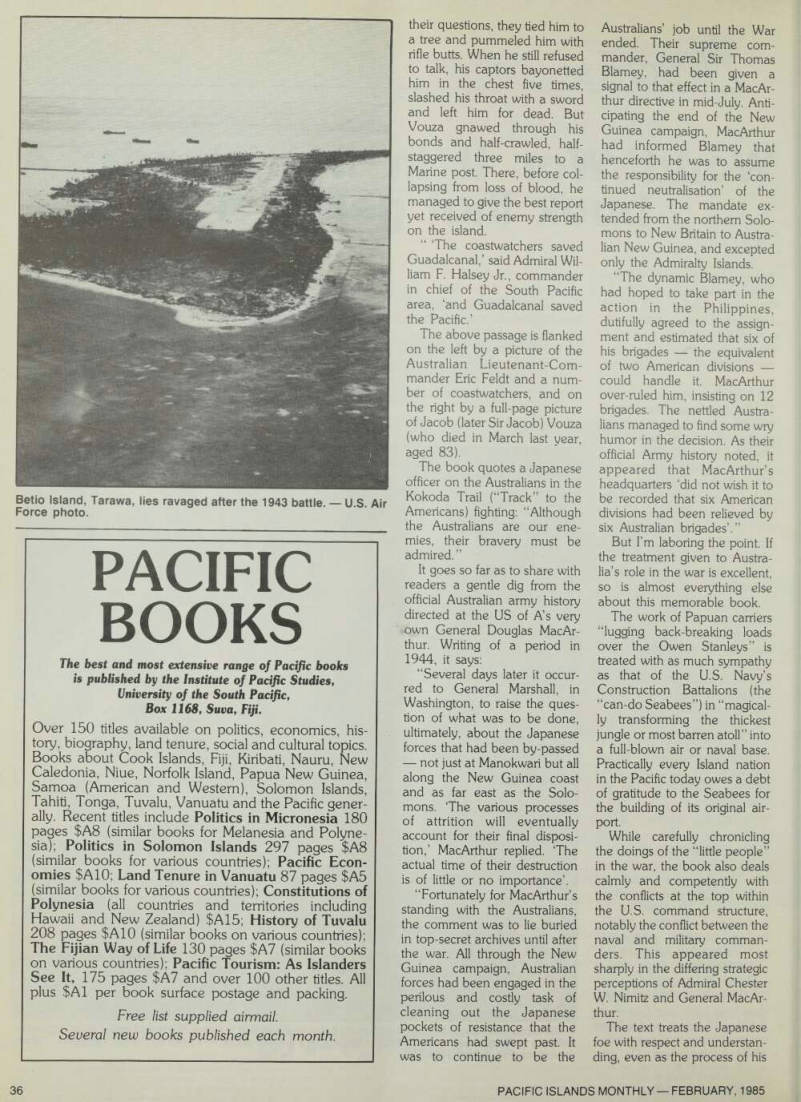
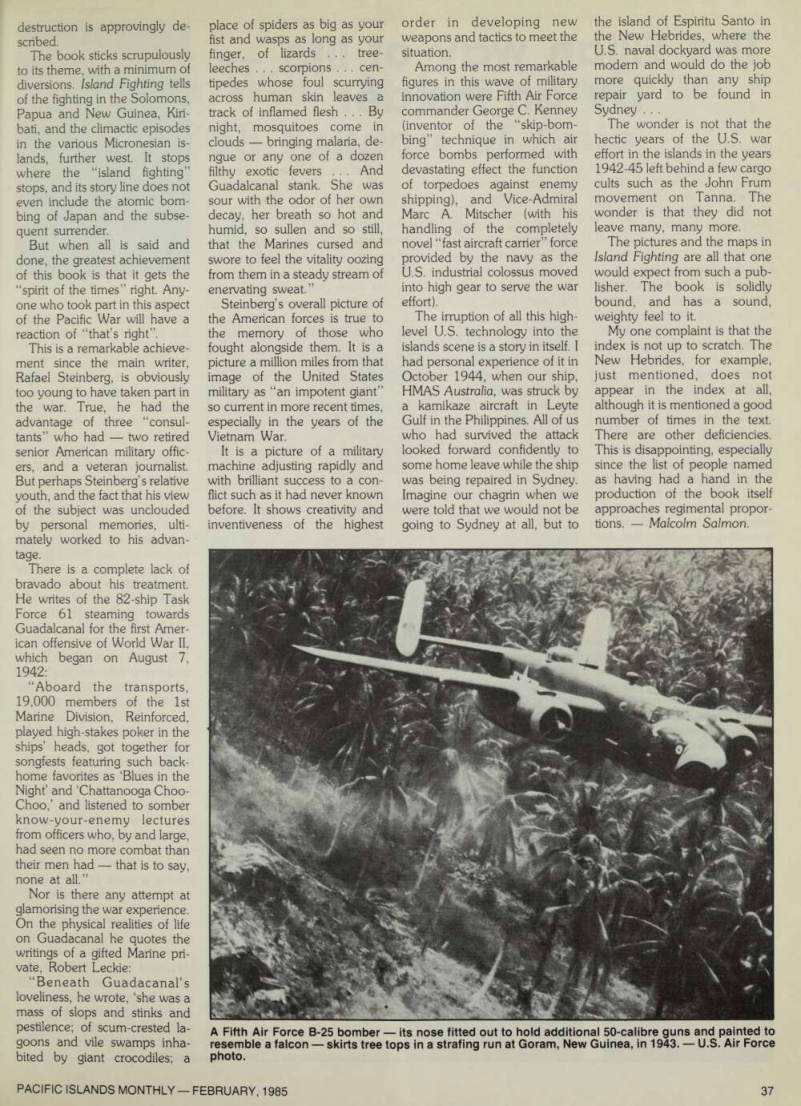
World War II in the islands: A book that gets It right
Island Fighting. By Rafael Steinberg. Published 1984 by Time-Life Books, 541 North Fairbanks Court, Chicago, Illi nois 60611, U.SA. Libraiy of Congress catalogue card num ber 78-52847. Price $20.95.
An Australian who served in the Pacific War approaches a book like this with one thing in mind above all others: how fairly does the American author treat Australia’s role in the conflict?
This might seem a slightly para noid, “small-nation” attitude to adopt. But it should also be said that it is an attitude kept well nourished over the years by a number of fairly cavalier, “big nation” American treatments of the subject.
However, not even the most querulous Australian could have grounds for complaint in the case of this volume. The Australian part in the Pacific War is treated with the most scrupulous objectivity, with credit given generously where ver it is due.
Take the work of the pre dominantly Australian “coast watchers” in the Solomons fighting, for example. The au thor writes; “While the Japanese swept through the southwest Pacific, an intrepid band of Allied coast watchers manned more than 100 lonely, radio-equipped lookout posts on enemy occu pied islands. Recruited by the Australian navy, these former traders, planters, prospectors and government officers moni tored Japanese naval, troop and air movements across a 2500-mile crescent of ocean, stretching from New Guinea to the New Hebrides, and radioed the intelligence they gathered to Allied headquarters. On one
occasion, a radio flash from coastwatcher Jack Read on Bougainville in the Solomon Islands alerted American fliers, who subsequently shot down 36 of 44 Japanese planes that were heading for Guadalcanal.
“In addition to their intelli gence-gathering activities, the coastwatchers rescued downed Allied airmen and saved hun
dred of survivors of ships and boats destroyed by the Japan ese, including the crew of Lieutenant (jg) John F. Ken nedy’s FT 109.
“The success of the network depended heavily on the good will and often times the extraordinary bravery of many local inhabitants, some of whom risked their lives serving
the Allies as scouts, guides, porters and spies. One scout, Jacob Vouza, was captured by a Japanese patrol as he re turned from a mission on Guadalcanal in August of 1942.
The Japanese soon discovered that he was carrying a small American flag that had been given to him by a Marine, When Vouza refused to answer
In the war’s early days: Smeared with body paint and dressed in grass skirts and paper hats, Japanese soldiers at Rabaul get ready to play islanders in a variety show. Photo by Fumio Yanagida, Japan, reproduced in Island Fighting.
their questions, they tied him to a tree and pummeled him with rifle butts. When he still refused to talk, his captors bayonetted him in the chest five times, slashed his throat with a sword and left him for dead. But Vouza gnawed through his bonds and half-crawled, half staggered three miles to a Marine post. There, before col lapsing from loss of blood, he managed to give the best report yet received of enemy strength on the island.
“ ‘The coastwatchers saved Guadalcanal,’ said Admiral Wil liam F. Halsey Jr., commander in chief of the South Pacific area, ‘and Guadalcanal saved the Pacific.’
The above passage is flanked on the left by a picture of the Australian Lieutenant-Com mander Eric Feldt and a num ber of coastwatchers, and on the right by a full-page picture of Jacob (later Sir Jacob) Vouza (who died in March last year, aged 83).
The book quotes a Japanese officer on the Australians in the Kokoda Trail (“Track” to the Americans) fighting: “Although the Australians are our ene mies, their bravery must be admired. ”
It goes so far as to share with readers a gentle dig from the official Australian army history directed at the US of As very own General Douglas MacAr thur. Writing of a period in 1944, it says: “Several days later it occur red to General Marshall, in Washington, to raise the ques tion of what was to be done, ultimately, about the Japanese forces that had been by-passed not just at Manokwari but all along the New Guinea coast and as far east as the Solo mons. ‘The various processes of attrition will eventually account for their final disposi tion,’ MacArthur replied. ‘The actual time of their destruction is of little or no importance’.
“Fortunately for MacArthur’s standing with the Australians, the comment was to lie buried in top-secret archives until after the war. All through the New Guinea campaign, Australian forces had been engaged in the perilous and costly task of cleaning out the Japanese pockets of resistance that the Americans had swept past. It was to continue to be the
Australians’ job until the War ended. Their supreme com mander, General Sir Thomas Blarney, had been given a signal to that effect in a MacAr thur directive in mid-July. Anti cipating the end of the New Guinea campaign, MacArthur had informed Blarney that henceforth he was to assume the responsibility for the ‘con tinued neutralisation’ of the Japanese. The mandate ex tended from the northern Solo mons to New Britain to Austra lian New Guinea, and excepted only the Admiralty Islands.
“The dynamic Blarney, who had hoped to take part in the action in the Philippines, dutifully agreed to the assign ment and estimated that six of his brigades the equivalent of two American divisions could handle it. MacArthur over-ruled him, insisting on 12 brigades. The nettled Austra lians managed to find some wry humor in the decision. As their official Army history noted, it appeared that MacArthur’s headquarters ‘did not wish it to be recorded that six American divisions had been relieved by six Australian brigades’.”
But I’m laboring the point. If the treatment given to Austra lia’s role in the war is excellent, so is almost everything else about this memorable book.
The work of Papuan carriers “lugging back-breaking loads over the Owen Stanleys” is treated with as much sympathy as that of the U.S. Navy’s Construction Battalions (the “can-do Seabees”) in “magical ly transforming the thickest jungle or most barren atoll” into a full-blown air or naval base.
Practically every Island nation in the Pacific today owes a debt of gratitude to the Seabees for the building of its original air port.
While carefully chronicling the doings of the “little people” in the war, the book also deals calmly and competently with the conflicts at the top within the U.S. command structure, notably the conflict between the naval and military comman ders. This appeared most sharply in the differing strategic perceptions of Admiral Chester W. Nimitz and General MacAr thur.
The text treats the Japanese foe with respect and understan ding, even as the process of his
Betio Island, Tarawa, lies ravaged after the 1943 battle.-U.S. Air Force photo.
destruction is approvingly de scribed.
The book sticks scrupulously to its theme, with a minimum of diversions. Island Fighting tells of the fighting in the Solomons, Papua and New Guinea, Kiri bati, and the climactic episodes in the various Micronesian is lands, further west. It stops where the “island fighting” stops, and its story line does not even include the atomic bom bing of Japan and the subse quent surrender.
But when all is said and done, the greatest achievement of this book is that it gets the “spirit of the times” right. Any one who took part in this aspect of the Pacific War will have a reaction of “that’s right”.
This is a remarkable achieve ment since the main writer, Rafael Steinberg, is obviously too young to have taken part in the war. True, he had the advantage of three “consul tants” who had two retired senior American military offic ers, and a veteran journalist.
But perhaps Steinberg’s relative youth, and the fact that his view of the subject was unclouded by personal memories, ulti mately worked to his advan tage.
There is a complete lack of bravado about his treatment.
He writes of the 82-ship Task Force 61 steaming towards Guadalcanal for the first Amer ican offensive of World War 11, which began on August 7, 1942; “Aboard the transports, 19,000 members of the Ist Marine Division, Reinforced, played high-stakes poker in the ships’ heads, got together for songfests featuring such back home favorites as ‘Blues in the Night’ and ‘Chattanooga Choo- Choo,’ and listened to somber
know-your-enemy lectures
from officers who, by and large, had seen no more combat than their men had that is to say, none at all.”
Nor is there any attempt at glamorising the war experience.
On the physical realities of life on Guadacanal he quotes the writings of a gifted Marine pri vate, Robert Leckie: “Beneath Guadacanal’s loveliness, he wrote, ‘she was a mass of slops and stinks and pestilence; of scum-crested la goons and vile swamps inha bited by giant crocodiles; a
place of spiders as big as your fist and wasps as long as your finger, of lizards .. . tree leeches . . . scorpions . . . cen tipedes whose foul scurrying across human skin leaves a track of inflamed flesh ... By night, mosquitoes come in clouds bringing malaria, de ngue or any one of a dozen filthy exotic fevers . . . And Guadalcanal stank. She was sour with the odor of her own decay, her breath so hot and humid, so sullen and so still, that the Marines cursed and swore to feel the vitality oozing from them in a steady stream of enervating sweat.”
Steinberg’s overall picture of the American forces is true to the memory of those who fought alongside them. It is a picture a million miles from that image of the United States military as “an impotent giant” so current in more recent times, especially in the years of the Vietnam War.
It is a picture of a military machine adjusting rapidly and with brilliant success to a con flict such as it had never known before. It shows creativity and inventiveness of the highest
order in developing new weapons and tactics to meet the situation.
Among the most remarkable figures in this wave of military innovation were Fifth Air Force commander George C. Kenney (inventor of the “skip-bom bing” technique in which air force bombs performed with devastating effect the function of torpedoes against enemy shipping), and Vice-Admiral Marc A. Mitscher (with his handling of the completely novel “fast aircraft carrier” force provided by the navy as the U.S. industrial colossus moved into high gear to serve the war effort).
The irruption of all this high level U.S. technology into the islands scene is a story in itself. I had personal experience of it in October 1944, when our ship, HMAS Australia, was struck by a kamikaze aircraft in Leyte Gulf in the Philippines. All of us who had survived the attack looked forward confidently to some home leave while the ship was being repaired in Sydney.
Imagine our chagrin when we were told that we would not be going to Sydney at all, but to
the island of Espiritu Santo in the New Hebrides, where the U.S. naval dockyard was more modern and would do the job more quickly than any ship repair yard to be found in Sydney . . .
The wonder is not that the hectic years of the U.S. war effort in the islands in the years 1942-45 left behind a few cargo cults such as the John Frum movement on Tanna. The wonder is that they did not leave many, many more.
The pictures and the maps in Island Fighting are all that one would expect from such a pub lisher. The book is solidly bound, and has a sound, weighty feel to it.
My one complaint is that the index is not up to scratch. The New Hebrides, for example, just mentioned, does not appear in the index at all, although it is mentioned a good number of times in the text.
There are other deficiencies.
This is disappointing, especially since the list of people named as having had a hand in the production of the book itself approaches regimental propor
tions.
Malcolm Salmon.
A Fifth Air Force B-25 bomber its nose fitted out to hold additional 50-calibre guns and painted to resemble a falcon skirts tree tops in a strafing run at Goram, New Guinea, in 1943. U.S. Air Force
photo.
Advertisements & other items, p. 36 (1 item)
Books
PACIFIC
The best and most extensive range of Pacific books is published by the Institute of Pacific Studies, University of the South Pacific, Box 1168, Suva, Fiji.
Over 150 titles available on politics, economics, history, biography, land tenure, social and cultural topics.
Books about Cook Islands, Fiji, Kiribati, Nauru, New Caledonia, Niue, Norfolk Island, Papua New Guinea, Samoa (American and Western), Solomon Islands, Tahiti, Tonga, Tuvalu, Vanuatu and the Pacific generally. Recent titles include Politics in Micronesia 180 pages SAB (similar books for Melanesia and Polynesia); Politics in Solomon Islands 297 pages SAB (similar books for various countries); Pacific Economies $A10; Land Tenure in Vanuatu 87 pages SAS (similar books for various countries); Constitutions of Polynesia (all countries and territories including Hawaii and New Zealand) SAIS; History of Tuvalu 208 pages SAIO (similar books on various countries); The Fijian Way of Life 130 pages SA7 (similar books on various countries); Pacific Tourism: As Islanders See It, 175 pages SA7 and over 100 other titles. All plus SAI per book surface postage and packing.
Free list supplied airmail.
Several new books published each month.
by an insider
The Fijian way of life by an insider
Vaka i Taukei: The Fijian Way of Life. By Asesela Ravuvu.
Published 1983 by the Institute of Pacific Studies, University of the South Pacific Pp V, 130. No ISBN, price provided.
Outside observers, particularly those of a conservative disposi tion, have often been attracted by the Fijian way of life. The ordered and communal en vironment of Fijian society seems to provide a security no longer possible in the indi vidualistic, dog-eat-dog world of Western society, where com munal values and institutions are thought to be fast dis appearing. Fijians, however, while conscious of their way of life and its distinctiveness, have rarely attempted to analyse the values that sustain it. Asesela Ravuvu’s book is therefore something of a first. For the outsider it provides a simple, readable introduction to Fijian society; for Fijians, it provides the first extended analysis of their fundamental values to be written by a insider.
Ravuvu begins with an analy sis of the key principles of Fijian social organisation, which are based on kinship, sex, age and reciprocity. He makes no apol ogy for the subordinate position of women in traditional Fijian social organisation, arguing that within their subordinate role
women were (or is it “are”) able to achieve social recognition and personal satisfaction. Prin ciples involving kinship and age are equally prescriptive, and again Ravuvu is straightforward and matter of fact, though less explicitly unapologetic.
The next two chapters are devoted to houses and food the two basic requisites of material life and two fun damental focal points of social organisation. Possession of house site (yavu) was tradi tionally the source of identity and legitimacy in a village, and the construction of a house on that site gave expression to the on-going co-operation of the owner’s kin group. Ravuvu notes, however, the many changes that are taking place in the sphere of housing the appearance of locks on doors, or the desire to fill houses with factory-made furniture, deve lopments which reveal a grow ing trend to emphasise personal and individual household affairs a great deal more than commu nal ones (p. 20). Even Ravuvu seems to fall naturally into the individualism/communalism dichotomy, although he does not make the mistake of seeing individualism as about to dis place communalism. The evi dence to the contrary is simply too obvious (although this has done nothing to prevent out side observers, over more than
a century, from detecting indi vidualism creeping in, inevit ably, throughout the length and breadth of Fijian society).
It is clear to Ravuvu, as indeed it is to anyone willing to accept the evidence of their eyes, that communal institu tions and values are still strong in Fijian society, despite the increased importance and privacy associated with the indi vidual household. The fact is that individualism does not necessarily have to take place at the expense of communalism.
In the second last chapter Ravuvu’s most general ideas are brought out in a discussion of the “Fijian personality and values”. Here he puts into words many of the fun damental, largely unspoken rules of Fijian culture. The concept of uakaturaga, which Ravuvu defines in his glossary as “of chiefly quality and stan dard”, is the cornerstone of Fijian values. “It denotes firstly that one’s actions befit the presence of a chief. It includes ueidokai (respect), vakarokor oko (deference), uakarorogo (attentive and complying), ya/o malua (humble).” The indi vidual who conforms to this standard knows his place and his actions “are focused on service to others.” Ravuvu de velops his account of Fijian values by analysing them as abstract conceptions rather than as customs to be explained by reference to social structure, the more familiar, anthropologi cal approach.
In addition to the concepts for which there are Fijian words, there are other values which are not normally spoken of, which Ravuvu, perhaps for the first time, puts into words.
For example: “Fijians often feel uncomfortable being too close to people whom they do not know, particularly if they are of the opposite sex.” This he explains is part of general atti tudes regarding sex, status and avoidance. It is related to the more familiar practices of brother/sister respect. These are
interesting ideas and it is a pity that he does not develop them further.
Ravuvu sums up the Fijian personality as “slow to anger and soon appeased.” Anger, which is “ruinous to the indi vidual and subversive to group living and solidarity” is frowned upon and when it erupts is suppressed by spectators.
Should violence occur and somebody receive an injury, the aggressor will be expected to present an i soro or i bulubulu (object of appease ment) in order to restore peace.
The injured party is then under social pressure to forget the incident. “It is bad taste to continue one’s anger after an act of appeasement is ex ecuted. ”
Ravuvu’s personal values in trude very little into his book.
One is left wondering whether this is a result only of the fact that the book is intended to be a primer for the outsider, or whether it is not also, at least partly, the result of a desire to sidestep controversy. In relation to the status of women Ravuvu seems obliged to say some thing, though even here he does not make a stand but what of ascriptive status in general? Does he see it as having a place in the modern world, bearing in mind its ob vious resilience in Fijian so ciety? It would have been in teresting to see more of the author’s own views, although there can be no doubting that this book provides a useful introduction to those outside the Fijian community who wish to know something of the
values that sustain it.
Nation.
John
Advertisements & other items, p. 38 (1 item)
Stay at Aggie Grey’s . . .
the South Pacific’s
legendary hotel.
Situated right in the heart of Western Samoa. Enjoy Polynesian style friendliness and service, in cool surroundings, superb entertainment and food.
Magnificent white sand beaches only a short drive away. Airconditioned rooms, swimming |xx)l and full bar facilities.
Bookings through I’nion Steamship Company of NZ, Pan Am. Air New Zealand or direct to Aggie Grey’s. Apia. Western Samoa. Cables: ‘AGGIES’ Apia.
centre ytlon for comfort Joe food roois alrconetitioned Restaurant • Bars • Banquet hall
H. E. BER6HUSER
General Manager Phone 21 2622 Cable: PAPTEL Telex: NE22353 PAPTEL
1888 taupou of Apia
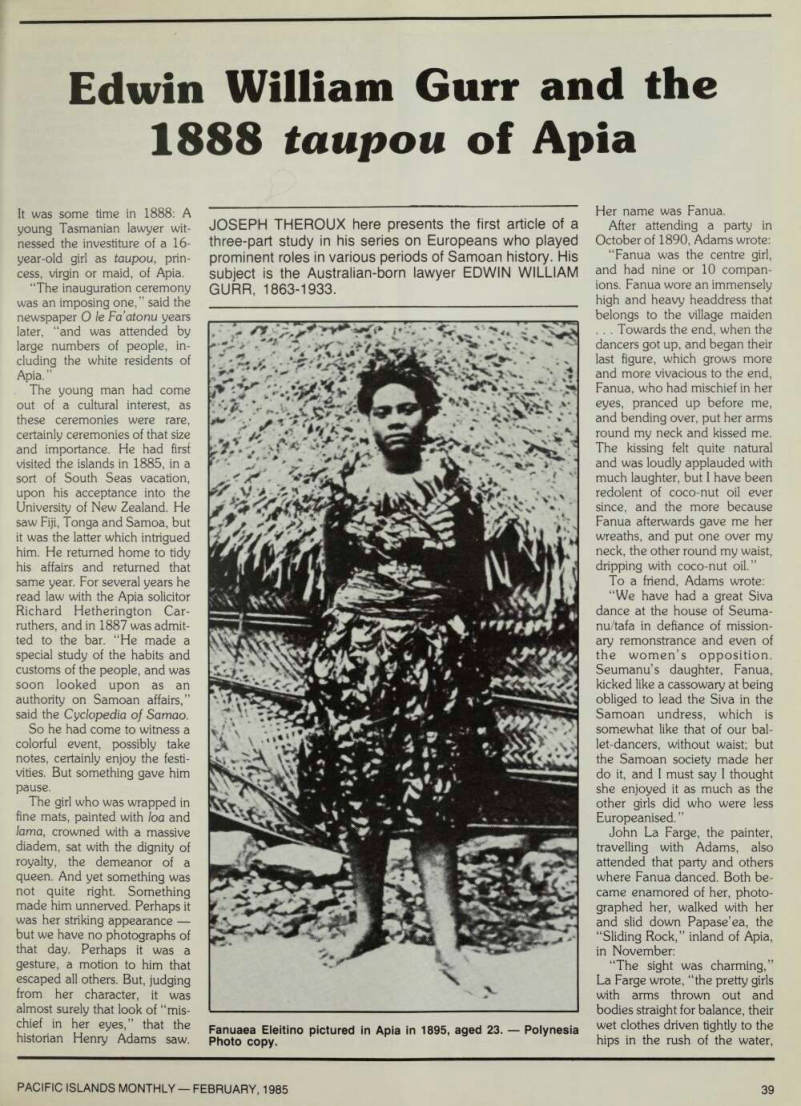
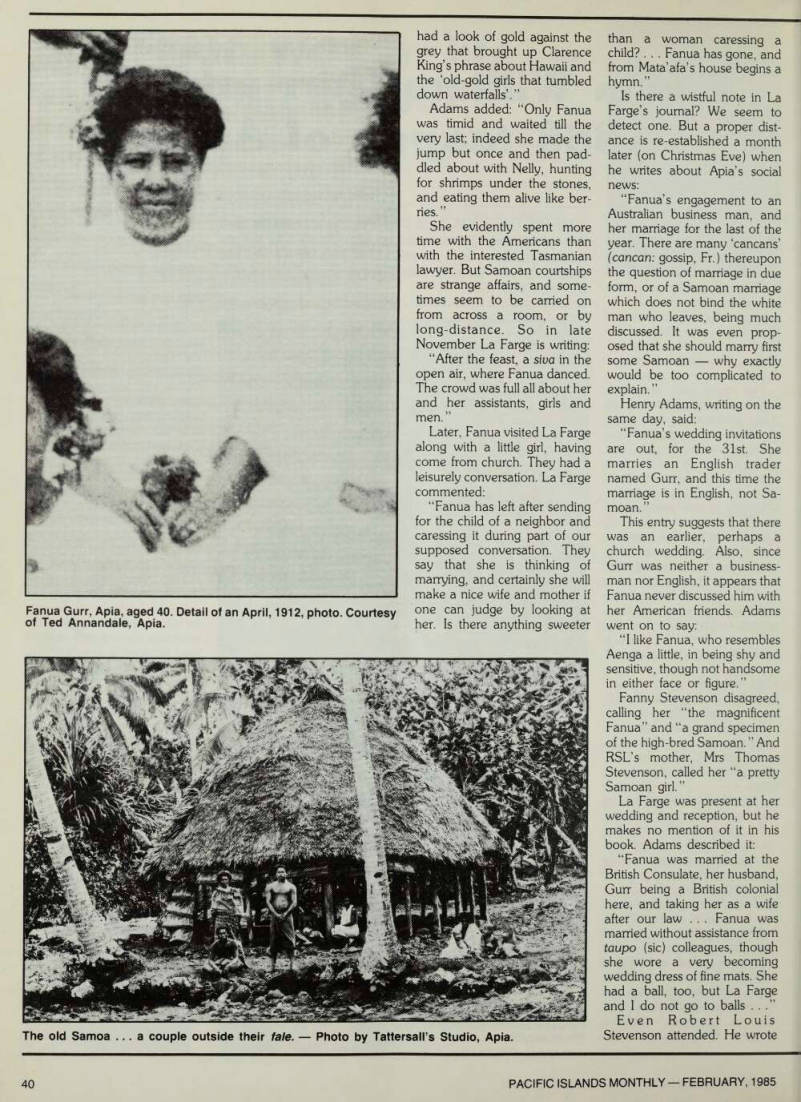
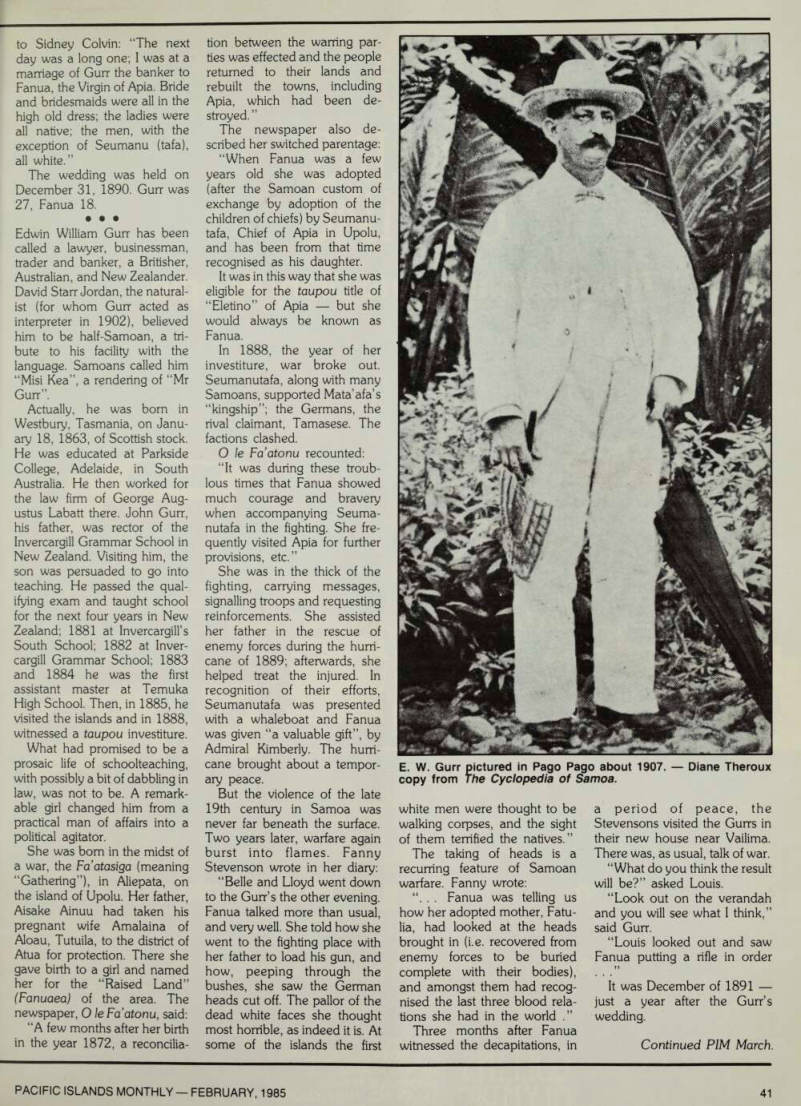
Edwin William Gurr and the 1888 taupou of Apia
It was some time in 1888: A young Tasmanian lawyer wit nessed the investiture of a 16year-old girl as taupou, prin cess, virgin or maid, of Apia.
“The inauguration ceremony was an imposing one,” said the newspaper O le Fa’atonu years later, “and was attended by large numbers of people, in cluding the white residents of Apia.”
The young man had come out of a cultural interest, as these ceremonies were rare, certainly ceremonies of that size and importance. He had firsf visited the islands in 1885, in a sort of South Seas vacation, upon his acceptance into the University of New Zealand. He saw Fiji, Tonga and Samoa, but it was the latter which intrigued him. He returned home to tidy his affairs and returned that same year. For several years he read law with the Apia solicitor Richard Hetherington Car ruthers, and in 1887 was admit ted to the bar. “He made a special study of the habits and customs of the people, and was soon looked upon as an authority on Samoan affairs,” said the Cyclopedia of Samao.
So he had come to witness a colorful event, possibly take notes, certainly enjoy the festi vities. But something gave him pause.
The girl who was wrapped in fine mats, painted with loa and lama, crowned with a massive diadem, sat with the dignity of royalty, the demeanor of a queen. And yet something was not quite right. Something made him unnerved. Perhaps it was her striking appearance but we have no photographs of that day. Perhaps it was a gesture, a motion to him that escaped all others. But, judging from her character, it was almost surely that look of “mis chief in her eyes,” that the historian Henry Adams saw.
JOSEPH THEROUX here presents the first article of a three-part study in his series on Europeans who played prominent roles in various periods of Samoan history. His subject is the Australian-born lawyer EDWIN WILLIAM
Gurr, 1863-1933.
Her name was Fanua.
After attending a party in October of 1890, Adams wrote: “Fanua was the centre girl, and had nine or 10 compan ions. Fanua wore an immensely high and heavy headdress that belongs to the village maiden . . . Towards the end, when the dancers got up, and began their last figure, which grows more and more vivacious to the end, Fanua, who had mischief in her eyes, pranced up before me, and bending over, put her arms round my neck and kissed me.
The kissing felt quite natural and was loudly applauded with much laughter, but I have been redolent of coco-nut oil ever since, and the more because Fanua afterwards gave me her wreaths, and put one over my neck, the other round my waist, dripping with coco-nut oil.”
To a friend, Adams wrote: “We have had a great Siva dance at the house of Seuma nu/tafa in defiance of mission ary remonstrance and even of the women’s opposition.
Seumanu’s daughter, Fanua, kicked like a cassowary at being obliged to lead the Siva in the Samoan undress, which is somewhat like that of our bal let-dancers, without waist; but the Samoan society made her do it, and I must say I thought she enjoyed it as much as the other girls did who were less Europeanised. ”
John La Farge, the painter, travelling with Adams, also attended that party and others where Fanua danced. Both be came enamored of her, photo graphed her, walked with her and slid down Papase’ea, the “Sliding Rock,” inland of Apia, in November; “The sight was charming,”
La Farge wrote, “the pretty girls with arms thrown out and bodies straight for balance, their wet clothes driven tightly to the hips in the rush of the water,
Fanuaea Eleitino pictured in Apia in 1895, aged 23.-Polynesia Photo copy.
had a look of gold against the grey that brought up Clarence King’s phrase about Hawaii and the ‘old-gold girls that tumbled down waterfalls’.”
Adams added: “Only Fanua was timid and waited till the very last; indeed she made the jump but once and then pad died about with Nelly, hunting for shrimps under the stones, and eating them alive like ber ries.”
She evidently spent more time with the Americans than with the interested Tasmanian lawyer. But Samoan courtships are strange affairs, and some times seem to be carried on from across a room, or by long-distance. So in late November La Farge is writing: “After the feast, a siua in the open air, where Fanua danced.
The crowd was full all about her and her assistants, girls and men.”
Later, Fanua visited La Farge along with a little girl, having come from church. They had a leisurely conversation. La Farge commented: “Fanua has left after sending for the child of a neighbor and caressing it during part of our supposed conversation. They say that she is thinking of marrying, and certainly she will make a nice wife and mother if one can judge by looking at her. Is there anything sweeter
than a woman caressing a child? . . . Fanua has gone, and from Mata’afa’s house begins a hymn.”
Is there a wistful note in La Farge’s journal? We seem to detect one. But a proper dist ance is re-established a month later (on Christmas Eve) when he writes about Apia’s social news: “Fanua’s engagement to an Australian business man, and her marriage for the last of the year. There are many ‘cancans’ (cancan: gossip, Fr.) thereupon the question of marriage in due form, or of a Samoan marriage which does not bind the white man who leaves, being much discussed. It was even prop osed that she should marry first some Samoan why exactly would be too complicated to explain.”
Henry Adams, writing on the same day, said: “Fanua’s wedding invitations are out, for the 31st. She marries an English trader named Gurr, and this time the marriage is in English, not Sa moan.”
This entry suggests that there was an earlier, perhaps a church wedding. Also, since Gurr was neither a business man nor English, it appears that Fanua never discussed him with her American friends. Adams went on to say: “I like Fanua, who resembles Aenga a little, in being shy and sensitive, though not handsome in either face or figure.”
Fanny Stevenson disagreed, calling her “the magnificent Fanua” and “a grand specimen of the high-bred Samoan. ” And RSL’s mother, Mrs Thomas Stevenson, called her “a pretty Samoan girl.”
La Farge was present at her wedding and reception, but he makes no mention of it in his book. Adams described it: “Fanua was married at the British Consulate, her husband, Gurr being a British colonial here, and taking her as a wife after our law . . . Fanua was married without assistance from taupo (sic) colleagues, though she wore a very becoming wedding dress of fine mats. She had a ball, too, but La Farge and I do not go to balls ...”
Even Robert Louis Stevenson attended. He wrote
Fanua Gurr, Apia, aged 40. Detail of an April, 1912, photo. Courtesy of Ted Annandale, Apia.
The old Samoa... a couple outside their fate. Photo by Tattersall’s Studio, Apia.
to Sidney Colvin: “The next day was a long one; I was at a marriage of Gurr the banker to Fanua, the Virgin of Apia. Bride and bridesmaids were all in the high old dress; the ladies were all native; the men, with the exception of Seumanu (tafa), all white.”
The wedding was held on December 31, 1890. Gurr was 27, Fanua 18. • • • Edwin William Gurr has been called a lawyer, businessman, trader and banker, a Britisher, Australian, and New Zealander.
David Starr Jordan, the natural ist (for whom Gurr acted as interpreter in 1902), believed him to be half-Samoan, a tri bute to his facility with the language. Samoans called him “Misi Kea”, a rendering of “Mr Gurr”.
Actually, he was born in Westbury, Tasmania, on Janu ary 18, 1863, of Scottish stock.
He was educated at Parkside College, Adelaide, in South Australia. He then worked for the law firm of George Aug ustus Labatt there. John Gurr, his father, was rector of the Invercargill Grammar School in New Zealand. Visiting him, the son was persuaded to go into teaching. He passed the qual ifying exam and taught school for the next four years in New Zealand; 1881 at Invercargill’s South School; 1882 at Inver cargill Grammar School; 1883 and 1884 he was the first assistant master at Temuka High School. Then, in 1885, he visited the islands and in 1888, witnessed a taupou investiture.
What had promised to be a prosaic life of schoolteaching, with possibly a bit of dabbling in law, was not to be. A remark able girl changed him from a practical man of affairs into a political agitator.
She was bom in the midst of a war, the Fa’atasiga (meaning “Gathering”), in Aliepata, on the island of Upolu. Her father, Aisake Ainuu had taken his pregnant wife Amalaina of Aloau, Tutuila, to the district of Atua for protection. There she gave birth to a girl and named her for the “Raised Land” (Fanuaea) of the area. The newspaper, O le Faatonu, said: “A few months after her birth in the year 1872, a reconcilia
tion between the warring par ties was effected and the people returned to their lands and rebuilt the towns, including Apia, which had been de stroyed.”
The newspaper also de scribed her switched parentage; “When Fanua was a few years old she was adopted (after the Samoan custom of exchange by adoption of the children of chiefs) by Seumanu tafa, Chief of Apia in Upolu, and has been from that time recognised as his daughter.
It was in this way that she was eligible for the taupou title of “Eletino” of Apia but she would always be known as Fanua.
In 1888, the year of her investiture, war broke out.
Seumanutafa, along with many Samoans, supported Mata’afa’s “kingship”; the Germans, the rival claimant, Tamasese. The factions clashed.
O le Faatonu recounted: “It was during these troub lous times that Fanua showed much courage and bravery when accompanying Seuma nutafa in the fighting. She fre quently visited Apia for further provisions, etc.”
She was in the thick of the fighting, carrying messages, signalling troops and requesting reinforcements. She assisted her father in the rescue of enemy forces during the hurri cane of 1889; afterwards, she helped treat the injured. In recognition of their efforts, Seumanutafa was presented with a whaleboat and Fanua was given “a valuable gift”, by Admiral Kimberly. The hurri cane brought about a tempor ary peace.
But the violence of the late 19th century in Samoa was never far beneath the surface.
Two years later, warfare again burst into flames. Fanny Stevenson wrote in her diary; “Belle and Lloyd went down to the Gurr’s the other evening.
Fanua talked more than usual, and very well. She told how she went to the fighting place with her father to load his gun, and how, peeping through the bushes, she saw the German heads cut off. The pallor of the dead white faces she thought most horrible, as indeed it is. At some of the islands the first
white men were thought to be walking corpses, and the sight of them terrified the natives.”
The taking of heads is a recurring feature of Samoan warfare. Fanny wrote: . . Fanua was telling us how her adopted mother, Fatu lia, had looked at the heads brought in (i.e. recovered from enemy forces to be buried complete with their bodies), and amongst them had recog nised the last three blood rela tions she had in the world .”
Three months after Fanua witnessed the decapitations, in
a period of peace, the Stevensons visited the Gurrs in their new house near Vailima.
There was, as usual, talk of war.
“What do you think the result will be?” asked Louis.
“Look out on the verandah and you will see what I think,” said Gurr.
“Louis looked out and saw Fanua putting a rifle in order 11 It was December of 1891 just a year after the Gurr’s wedding.
Continued PIM March.
E. W. Gurr pictured in Pago Pago about 1907.-Diane Theroux copy from The Cyclopedia of Samoa.
Advertisements & other items, p. 42 (1 item)
COllfflS
6
OLYTIPIC
The Stationery and Diary People.
SYSTEM
Account Form.
CARDS
trls 4 Kf
Commercial, School, Household
Stationery and Diaries.
Fast and efficient export service.
COLLINS OLYMPIC LIMITED
r*n T TIN C PO. BOX 476, AUCKLAND, 1
ll||l I 11 \ NEW ZEALAND.
AMfwiNT'i PHONE: (9) 484-009 (IT Y Dll TELEX: NZ - 21293 (EDUNLOP)
tropicalities
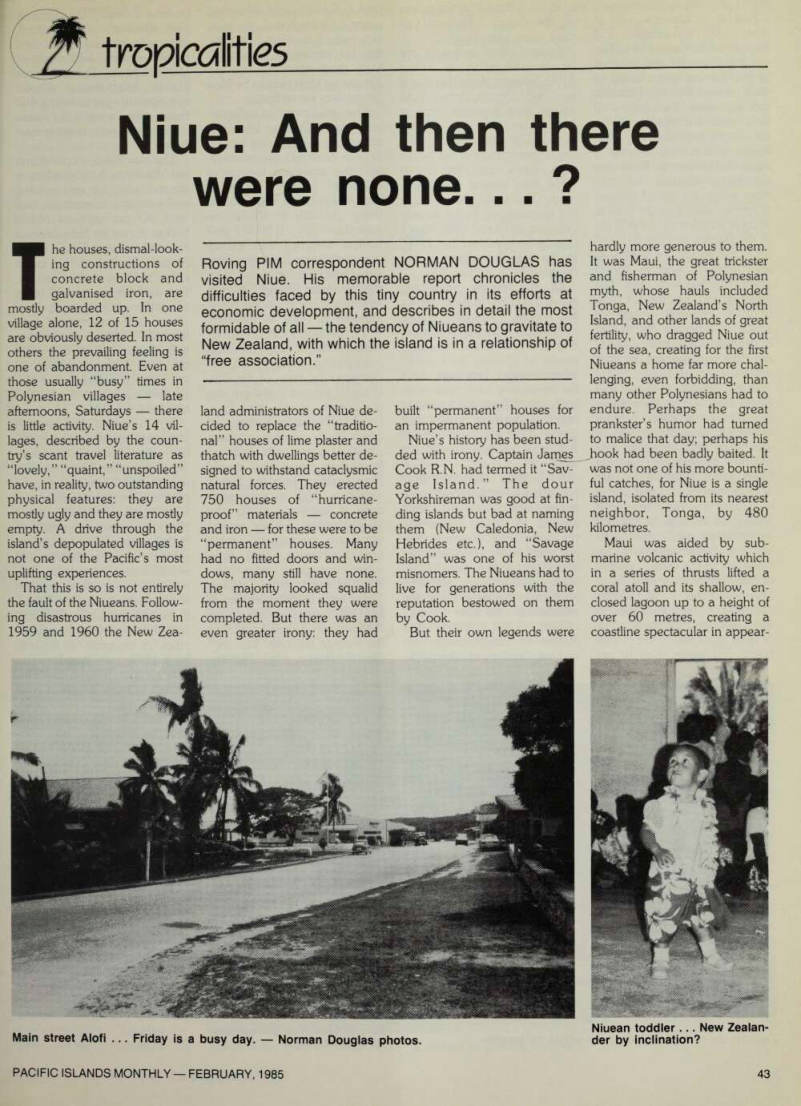
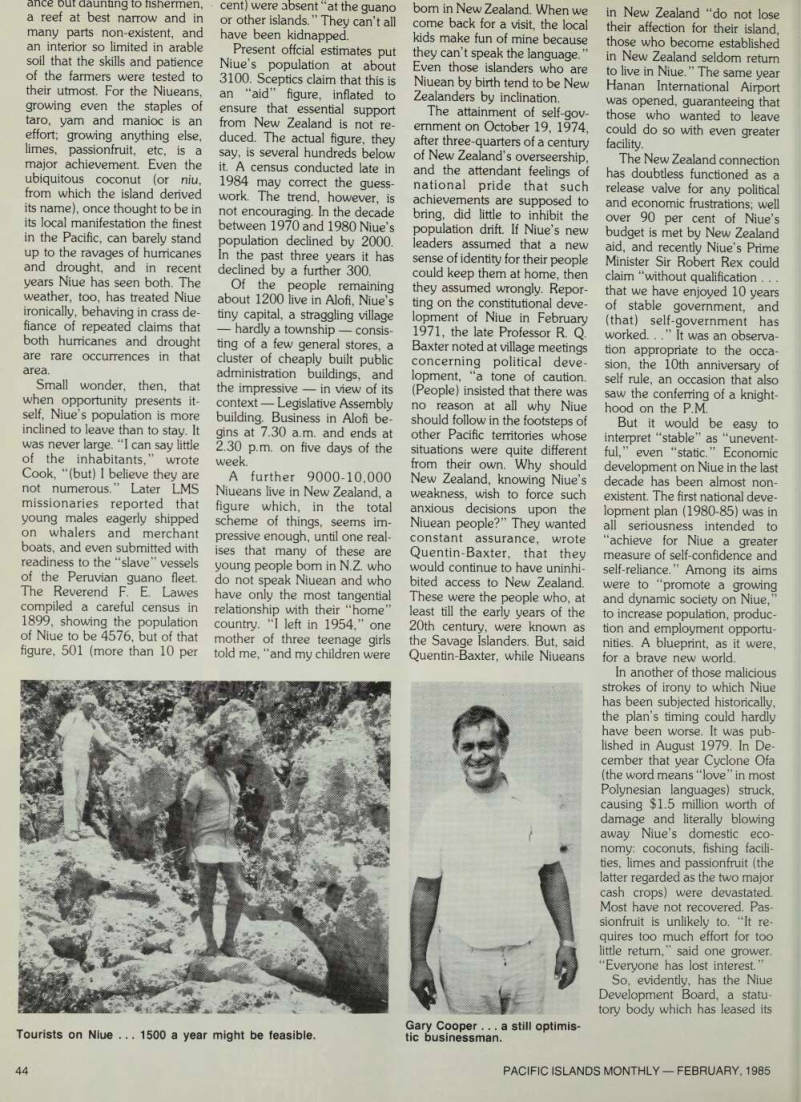
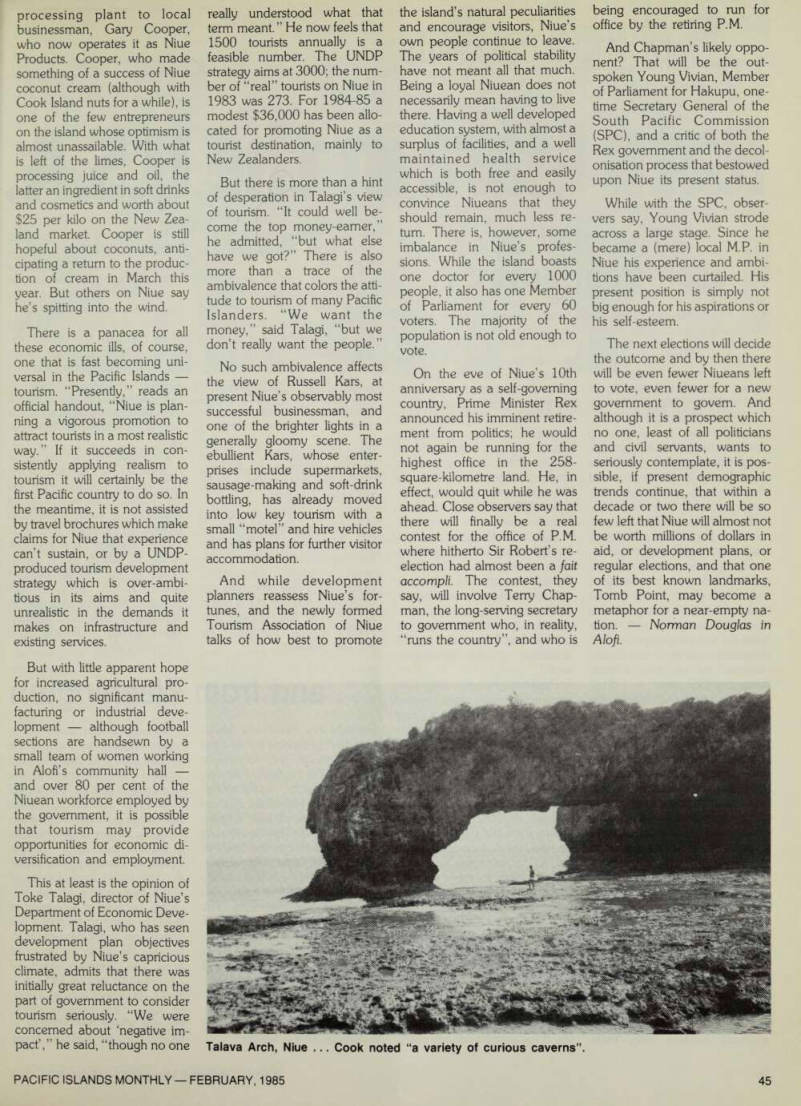
Niue: And then there were none...?
The houses, dismal-look ing constructions of concrete block and galvanised iron, are mostly boarded up. In one village alone, 12 of 15 houses are obviously deserted. In most others the prevailing feeling is one of abandonment. Even at those usually “busy” times in Polynesian villages late afternoons, Saturdays there is little activity. Niue’s 14 vil lages, described by the coun try’s scant travel literature as “lovely,” “quaint,” “unspoiled” have, in reality, two outstanding physical features: they are mostly ugly and they are mostly empty. A drive through the island’s depopulated villages is not one of the Pacific’s most uplifting experiences.
That this is so is not entirely the fault of the Niueans. Follow ing disastrous hurricanes in 1959 and 1960 the New Zea-
Roving RIM correspondent NORMAN DOUGLAS has visited Niue. His memorable report chronicles the difficulties faced by this tiny country in its efforts at economic development, and describes in detail the most formidable of all the tendency of Niueans to gravitate to N Zea and w j t j-, w hich the island is in a relationship of J . ’
“free association.
land administrators of Niue de cided to replace the “traditio nal” houses of lime plaster and thatch with dwellings better de signed to withstand cataclysmic natural forces. They erected 750 houses of “hurricane proof” materials concrete and iron for these were to be “permanent” houses. Many had no fitted doors and win dows, many still have none.
The majority looked squalid from the moment they were completed. But there was an even greater irony: they had
built “permanent” houses for an impermanent population.
Niue’s history has been stud ded with irony. Captain James Cook R.N. had termed it “Sav age Island.” The dour Yorkshireman was good at fin ding islands but bad at naming them (New Caledonia, New Hebrides etc.), and “Savage Island” was one of his worst misnomers. The Niueans had to live for generations with the reputation bestowed on them by Cook.
But their own legends were
hardly more generous to them.
It was Maui, the great trickster and fisherman of Polynesian myth, whose hauls included Tonga, New Zealand’s North Island, and other lands of great fertility, who dragged Niue out of the sea, creating for the first Niueans a home far more chal lenging, even forbidding, than many other Polynesians had to endure. Perhaps the great prankster’s humor had turned to malice that day; perhaps his hook had been badly baited. It was not one of his more bounti ful catches, for Niue is a single island, isolated from its nearest neighbor, Tonga, by 480 kilometres.
Maui was aided by sub marine volcanic activity which in a series of thrusts lifted a coral atoll and its shallow, en closed lagoon up to a height of over 60 metres, creating a coastline spectacular in appear-
Main street Alofi... Friday is a busy day.-Norman Douglas photos.
Niuean toddler... New Zealan der by inclination?
ance out aaunnng to nsnermen, a reef at best narrow and in many parts non-existent, and an interior so limited in arable soil that the skills and patience of the farmers were tested to their utmost. For the Niueans, growing even the staples of taro, yam and manioc is an effort; growing anything else, limes, passionfruit, etc, is a major achievement. Even the übiquitous coconut (or niu, from which the island derived its name), once thought to be in its local manifestation the finest in the Pacific, can barely stand up to the ravages of hurricanes and drought, and in recent years Niue has seen both. The weather, too, has treated Niue ironically, behaving in crass de fiance of repeated claims that both hurricanes and drought are rare occurrences in that area.
Small wonder, then, that when opportunity presents it self, Niue’s population is more inclined to leave than to stay. It was never large. “I can say little of the inhabitants,” wrote Cook, “(but) I believe they are not numerous. ” Later LMS missionaries reported that young males eagerly shipped on whalers and merchant boats, and even submitted with readiness to the “slave” vessels of the Peruvian guano fleet.
The Reverend F. E. Lawes compiled a careful census in 1899, showing the population of Niue to be 4576, but of that figure, 501 (more than 10 per
cent) were absent “at the guano or other islands.” They can’t all have been kidnapped.
Present offcial estimates put Niue’s population at about 3100. Sceptics claim that this is an “aid” figure, inflated to ensure that essential support from New Zealand is not re duced. The actual figure, they say, is several hundreds below it. A census conducted late in 1984 may correct the guess work. The trend, however, is not encouraging. In the decade between 1970 and 1980 Niue’s population declined by 2000.
In the past three years it has declined by a further 300.
Of the people remaining about 1200 live in Alofi, Niue’s tiny capital, a straggling village hardly a township consis ting of a few general stores, a cluster of cheaply built public administration buildings, and the impressive in view of its context Legislative Assembly building. Business in Alofi be gins at 7.30 a.m. and ends at 2.30 p.m. on five days of the week.
A further 9000-10,000 Niueans live in New Zealand, a figure which, in the total scheme of things, seems im pressive enough, until one real ises that many of these are young people bom in N.Z. who do not speak Niuean and who have only the most tangential relationship with their “home” country. “I left in 1954,” one mother of three teenage girls told me, “and my children were
bom in New Zealand. When we come back for a visit, the local kids make fun of mine because they can’t speak the language. ”
Even those islanders who are Niuean by birth tend to be New Zealanders by inclination.
The attainment of self-gov ernment on October 19, 1974, after three-quarters of a century of New Zealand’s overseership, and the attendant feelings of national pride that such achievements are supposed to bring, did little to inhibit the population drift. If Niue’s new leaders assumed that a new sense of identity for their people could keep them at home, then they assumed wrongly. Repor ting on the constitutional deve lopment of Niue in February 1971, the late Professor R. Q.
Baxter noted at village meetings concerning political deve lopment, “a tone of caution. (People) insisted that there was no reason at all why Niue should follow in the footsteps of other Pacific territories whose situations were quite different from their own. Why should New Zealand, knowing Niue’s weakness, wish to force such anxious decisions upon the Niuean people?” They wanted constant assurance, wrote Quentin-Baxter, that they would continue to have uninhi bited access to New Zealand.
These were the people who, at least till the early years of the 20th century, were known as the Savage Islanders. But, said Quentin-Baxter, while Niueans
in New Zealand “do not lose their affection for their island, those who become established in New Zealand seldom return to live in Niue. ” The same year Hanan International Airport was opened, guaranteeing that those who wanted to leave could do so with even greater facility.
The New Zealand connection has doubtless functioned as a release valve for any political and economic frustrations; well over 90 per cent of Niue’s budget is met by New Zealand aid, and recently Niue’s Prime Minister Sir Robert Rex could
claim “without qualification . . .
that we have enjoyed 10 years of stable government, and (that) self-government has worked. . . ” It was an observa tion appropriate to the occa sion, the 10th anniversary of self rule, an occasion that also saw the conferring of a knight hood on the P.M.
But it would be easy to interpret “stable” as “unevent ful,” even “static.” Economic development on Niue in the last decade has been almost non existent. The first national deve lopment plan (1980-85) was in all seriousness intended to “achieve for Niue a greater measure of self-confidence and self-reliance.” Among its aims were to “promote a growing and dynamic society on Niue,” to increase population, produc tion and employment opportu nities. A blueprint, as it were, for a brave new world.
In another of those malicious strokes of irony to which Niue has been subjected historically, the plan’s timing could hardly have been worse. It was pub lished in August 1979. In De cember that year Cyclone Ofa (the word means “love” in most Polynesian languages) struck, causing $1.5 million worth of damage and literally blowing away Niue’s domestic eco nomy: coconuts, fishing facili ties, limes and passionfruit (the latter regarded as the two major cash crops) were devastated.
Most have not recovered. Pas sionfruit is unlikely to. “It re quires too much effort for too little return,” said one grower.
“Everyone has lost interest.”
So, evidently, has the Niue Development Board, a statu tory body which has leased its
Tourists on Niue... 1500 a year might be feasible.
Gary Cooper... a still optimis tic businessman.
processing plant to local businessman, Gary Cooper, who now operates it as Niue Products. Cooper, who made something of a success of Niue coconut cream (although with Cook Island nuts for a while), is one of the few entrepreneurs on the island whose optimism is almost unassailable. With what is left of the limes, Cooper is processing juice and oil, the latter an ingredient in soft drinks and cosmetics and worth about $25 per kilo on the New Zea land market. Cooper is still hopeful about coconuts, anti cipating a return to the produc tion of cream in March this year. But others on Niue say he’s spitting into the wind.
There is a panacea for all these economic ills, of course, one that is fast becoming uni versal in the Pacific Islands tourism. “Presently,” reads an official handout, “Niue is plan ning a vigorous promotion to attract tourists in a most realistic way.” If it succeeds in con sistently applying realism to tourism it will certainly be the first Pacific country to do so. In the meantime, it is not assisted by travel brochures which make claims for Niue that experience can’t sustain, or by a UNDP produced tourism development strategy which is over-ambi tious in its aims and quite unrealistic in the demands it makes on infrastructure and existing services.
But with little apparent hope for increased agricultural pro duction, no significant manu facturing or industrial deve lopment although football sections are handsewn by a small team of women working in Alofi’s community hall and over 80 per cent of the Niuean workforce employed by the government, it is possible that tourism may provide opportunities for economic di versification and employment.
This at least is the opinion of Toke Talagi, director of Niue’s Department of Economic Deve lopment. Talagi, who has seen development plan objectives frustrated by Niue’s capricious climate, admits that there was initially great reluctance on the part of government to consider tourism seriously. “We were concerned about ‘negative im pact’,” he said, “though no one
really understood what that term meant. ” He now feels that 1500 tourists annually is a feasible number. The UNDP strategy aims at 3000; the num ber of “real” tourists on Niue in 1983 was 273. For 1984-85 a modest $36,000 has been allo cated for promoting Niue as a tourist destination, mainly to New Zealanders.
But there is more than a hint of desperation in Talagi’s view of tourism. “It could well be come the top money-earner,” he admitted, “but what else have we got?” There is also more than a trace of the ambivalence that colors the atti tude to tourism of many Pacific Islanders. “We want the money,” said Talagi, “but we don’t really want the people.”
No such ambivalence affects the view of Russell Kars, at present Niue’s observably most successful businessman, and one of the brighter lights in a generally gloomy scene. The ebullient Kars, whose enter prises include supermarkets, sausage-making and soft-drink bottling, has already moved into low key tourism with a small “motel” and hire vehicles and has plans for further visitor accommodation.
And while development planners reassess Niue’s for tunes, and the newly formed Tourism Association of Niue talks of how best to promote
the island’s natural peculiarities and encourage visitors, Niue’s own people continue to leave.
The years of political stability have not meant all that much.
Being a loyal Niuean does not necessarily mean having to live there. Having a well developed education system, with almost a surplus of facilities, and a well maintained health service which is both free and easily accessible, is not enough to convince Niueans that they should remain, much less re turn. There is, however, some imbalance in Niue’s profes sions. While the island boasts one doctor for every 1000 people, it also has one Member of Parliament for every 60 voters. The majority of the population is not old enough to vote.
On the eve of Niue’s 10th anniversary as a self-governing country, Prime Minister Rex announced his imminent retire ment from politics; he would not again be running for the highest office in the 258square-kilometre land. He, in effect, would quit while he was ahead. Close observers say that there will finally be a real contest for the office of P.M. where hitherto Sir Robert’s re election had almost been a fait accompli. The contest, they say, will involve Terry Chap man, the long-serving secretary to government who, in reality, “runs the country”, and who is
being encouraged to run for office by the retiring P.M.
And Chapman’s likely oppo nent? That will be the out spoken Young Vivian, Member of Parliament for Hakupu, one time Secretary General of the South Pacific Commission (SPC), and a critic of both the Rex government and the decol onisation process that bestowed upon Niue its present status.
While with the SPC, obser vers say, Young Vivian strode across a large stage. Since he became a (mere) local M.P. in Niue his experience and ambi tions have been curtailed. His present position is simply not big enough for his aspirations or his self-esteem.
The next elections will decide the outcome and by then there will be even fewer Niueans left to vote, even fewer for a new government to govern. And although it is a prospect which no one, least of all politicians and civil servants, wants to seriously contemplate, it is pos sible, if present demographic trends continue, that within a decade or two there will be so few left that Niue will almost not be worth millions of dollars in aid, or development plans, or regular elections, and that one of its best known landmarks, Tomb Point, may become a metaphor for a near-empty na tion. Norman Douglas in Aloft.
Talava Arch, Niue... Cook noted “a variety of curious caverns”.
Ratu Mara in the U.S.A.
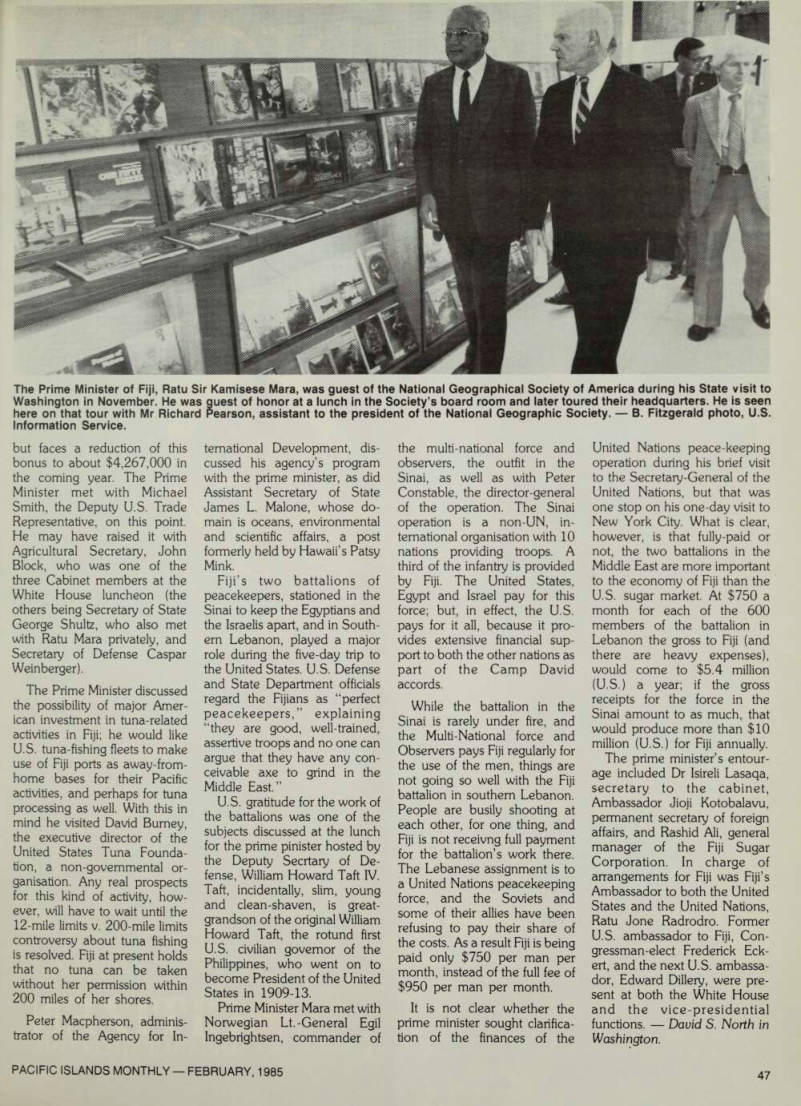
political currents
The visit as seen from Suva...
Fiji’s Prime Minister, Ratu Sir Kamisese Mara, made history late in November when he became the first head of state from the South Pacific to re ceive a personal invitation to visit the White House. He was accorded full honors by Presi dent Reagan in a meeting which is seen in Suva as mar king the acceptance of Fiji’s importance in the region and further noting America’s in terest in it.
Ratu Mara did not win any concrete benefits, in particular a new or larger sugar quota, (although the question was dis cussed), but he was assured that a proposal would be put before the U.S. Congress that the 1986 budget provide for a bilateral aid programme to Fiji.
No other country in the Pacific receives aid on such a basis from the U.S.
Other economic issues dis cussed between the two leaders included fishing rights in Fiji waters, and landing rights for Air Pacific, Fiji’s national airline on the mainland of America, preferably at Los Angeles. No decisions were taken on these points.
But the U.S. agreed under its defence corporation program with Fiji to immediately fund a $300,000 weapons stan dardisation program for the Royal Fiji Military Forces.
On the question of military relations between the two countries, American officials said they were not looking for military bases in Fiji and neither were they looking at Fiji as a substitute for New Zealand, should that country’s attitude towards nuclear ship visits
finally impede further ANZUS arrangements.
In his farewell statement after the official meeting at the White House, President Reagan said Ratu Mara had demonstrated “a high degree of political cour age” when having weighed his legitimate concern over nuclear issues against the defence needs of his country and the Oceania region”, in 1983, the Prime Minister decided to re open Fiji’s ports to all American naval vessels.
President Reagan said the United States wished to ’’work more closely with the people of Fiji and Oceania” to help them achieve prosperity and peace.
He described Fiji as a “model of democracy and freedom. A tremendous example for all countries of the developing world.”
President Reagan said Fiji’s accomplishments had earned “the deepest respect and admiration” of the American people. Ratu Mara had taught him the meaning of doing things in ’’the Pacific Way,” he said. ’’Vinaka,” said President Reagan. And then, amid broad smiles from the Fiji delegation, he bid them farewell with a perfect ”ni sa moce.”
Ratu Mara in reply said his visit to the U.S. signalled ’’the warm ties of friendship” be tween Fiji and the United States. There was now much greater understanding and appreciation of each other’s views and aspirations. Both na tions were committed to “jus tice, freedom and fair play,” he said. Like the United States, Fiji stood for peace and was ready
to play its part in order to demonstrate that belief, Ratu Mara said.
However, Fiji was small, and like other democratic communi ties in the South Pacific and elsewhere, looked to America, and its president,” for support and guidance in many of our endeavours. ”
After his official engagements in Washington the Fijian leader travelled to New York where he accepted the ’’Pacific Man of the Year” award from the Foundation for the Peoples of the South Pacific at a ceremony held in New York’s Metropoli tan Museum of Art.
Ratu Mara, 64, is the second regional personality to have the honor bestowed upon him by the foundation which is a pri vate voluntary organisation which funds and promotes de velopment projects in the island nations. The first recipient was PNG’s Prime Minister, Mr Michael Somare.
The $lO,OOO award in Ratu Mara’s name will be used to open a centre in Fiji for youths who move into the urban centres from the rural areas to help them adjust to city life.
After that ceremony, Ratu Mara met with the United Na tions secretary-general, Javier Perez de Cuellar and extended to him a personal invitation to make a visit to Fiji, which he will undertake in February on his way to Australia and New Zea land.
Mr Perez thanked the prime minister for Fiji’s support for the U.N. peace-keeping effort in the Middle East where a Fiji battalion has been attached to UNIFIL in Southern Lebanon for some years. Fiji is also one of the 10 nations which contri butes to the United Nations multi-national force which monitors the Sinai peninsula in accordance with the Egyptian- Israeli accord. By our Suva Correspondent.
... and from Washington
Perhaps the Fiji Prime Minis ter’s best prospects for an early breakthrough on economic issues was in the field of landing rights. Air Pacific, the Fiji airline, now lands at Honolulu; it would like to fly on to Los Angeles airport (LAX). This desire runs directly counter to the interests of at least one US airline, Continental, which has weekly direct flights to Fiji from both LAX and San Francisco. The Prime Minister raised the LAX access issue in a meeting with the Assistant Secretary of State for Economic Affairs, Richard McCormack, and Assistant Sec retary of Transportation for In ternational Affairs, Mathew Scocozza. But there was no resolution of the matter.
Virtually every nation in the world wants to sell sugar to the United States at the artificially inflated price set to meet the demands of politically powerful U.S. sugar producers. Quotas for foreign sales are worked out carefully to spread the benefits of the U.S. price level which nets at 12 cents a pound above the free world market price of about five cents a pound. Re cently, because of a decision of the U.S. government that it will import less sugar this year than last, the Fiji quota was reduced from the previous level of 21,294 short tons (in 1983-84), to 17,780 short tons in 1984- 85. Given this price structure, Fiji got about $5,110,000 in bonuses for its 1983-84 sugar
but faces a reduction of this bonus to about $4,267,000 in the coming year. The Prime Minister met with Michael Smith, the Deputy U.S. Trade Representative, on this point.
He may have raised it with Agricultural Secretary, John Block, who was one of the three Cabinet members at the White House luncheon (the others being Secretary of State George Shultz, who also met with Ratu Mara privately, and Secretary of Defense Caspar Weinberger).
The Prime Minister discussed the possibility of major Amer ican investment in tuna-related activities in Fiji; he would like U.S. tuna-fishing fleets to make use of Fiji ports as away-from home bases for their Pacific activities, and perhaps for tuna processing as well. With this in mind he visited David Burney, the executive director of the United States Tuna Founda tion, a non-governmental or ganisation. Any real prospects for this kind of activity, how ever, will have to wait until the 12-mile limits v. 200-mile limits controversy about tuna fishing is resolved. Fiji at present holds that no tuna can be taken without her permission within 200 miles of her shores.
Peter Macpherson, adminis trator of the Agency for In
ternational Development, dis cussed his agency’s program with the prime minister, as did Assistant Secretary of State James L. Malone, whose do main is oceans, environmental and scientific affairs, a post formerly held by Hawaii’s Patsy Mink.
Fiji’s two battalions of peacekeepers, stationed in the Sinai to keep the Egyptians and the Israelis apart, and in South ern Lebanon, played a major role during the five-day trip to the United States. U.S. Defense and State Department officials regard the Fijians as “perfect peacekeepers,” explaining “they are good, well-trained, assertive troops and no one can argue that they have any con ceivable axe to grind in the Middle East.”
U.S. gratitude for the work of the battalions was one of the subjects discussed at the lunch for the prime pinister hosted by the Deputy Secrtary of De fense, William Howard Taft IV.
Taft, incidentally, slim, young and clean-shaven, is great grandson of the original William Howard Taft, the rotund first U.S. civilian governor of the Philippines, who went on to become President of the United States in 1909-13.
Prime Minister Mara met with Norwegian Lt.-General Egil Ingebrightsen, commander of
the multi-national force and observers, the outfit in the Sinai, as well as with Peter Constable, the director-general of the operation. The Sinai operation is a non-UN, in ternational organisation with 10 nations providing troops. A third of the infantry is provided by Fiji. The United States, Egypt and Israel pay for this force; but, in effect, the U.S. pays for it all, because it pro vides extensive financial sup port to both the other nations as part of the Camp David accords.
While the battalion in the Sinai is rarely under fire, and the Multi-National force and Observers pays Fiji regularly for the use of the men, things are not going so well with the Fiji battalion in southern Lebanon.
People are busily shooting at each other, for one thing, and Fiji is not receivng full payment for the battalion’s work there.
The Lebanese assignment is to a United Nations peacekeeping force, and the Soviets and some of their allies have been refusing to pay their share of the costs. As a result Fiji is being paid only $750 per man per month, instead of the full fee of $950 per man per month.
It is not clear whether the prime minister sought clarifica tion of the finances of the
United Nations peace-keeping operation during his brief visit to the Secretary-General of the United Nations, but that was one stop on his one-day visit to New York City. What is clear, however, is that fully-paid or not, the two battalions in the Middle East are more important to the economy of Fiji than the U.S. sugar market. At $750 a month for each of the 600 members of the battalion in Lebanon the gross to Fiji (and there are heavy expenses), would come to $5.4 million (U.S.) a year; if the gross receipts for the force in the Sinai amount to as much, that would produce more than $lO million (U.S.) for Fiji annually.
The prime minister’s entour age included Dr Isireli Lasaqa, secretary to the cabinet, Ambassador Jioji Kotobalavu, permanent secretary of foreign affairs, and Rashid Ali, general manager of the Fiji Sugar Corporation. In charge of arrangements for Fiji was Fiji’s Ambassador to both the United States and the United Nations, Ratu done Radrodro. Former U.S. ambassador to Fiji, Con gressman-elect Frederick Eck ert, and the next U.S. ambassa dor, Edward Dillery, were pre sent at both the White House and the vice-presidential functions. David S. North in Washington.
The Prime Minister of Fiji, Ratu Sir Kamisese Mara, was guest of the National Geographical Society of America during his State visit to Washington in November. He was guest of honor at a lunch in the Society’s board room and later toured their headquarters. He is seen here on that tour with Mr Richard Pearson, assistant to the president of the National Geographic Society.-B. Fitzgerald photo, U.S.
Information Service.
Advertisements & other items, p. 48 (1 item)
Citizen
CMTEWAY TO TH
Multifunctionalism is the
watchword for timepieces
in this information age.
Citizen technology meets
the challengewith two
revolutionary Meas in
watches.
W 'V. .. ' €iM l )S V % S > / * ■I
AMA-DI6I
■TEMP
Citizen Quartz Ana-Digi Temp. 59.9° to 9.9°C temperature readout, one-touch Fahrenheit conversion. Analog/Digital time indication with automatic calendar and dual (one other time zone) time. 24-hour alarm, hourly chime. 1/1000-sec. accurate stopwatch.
AMA-DIGI
GomhoFl
Citizen Quartz Ana-Digi Combo FI.
Analog/Digital time indication with 1-sec. and 10-sec. increment LCD trackers. Permanently adjusted monthday-date calendar, 24-hour alarm, 12-hour countdown timer; hourly chime. Dual time. And a 1/100-sec, counter lap-timing stopwatch.
CITIZEN
AHEAD OF THEIR TIME
from the islands press
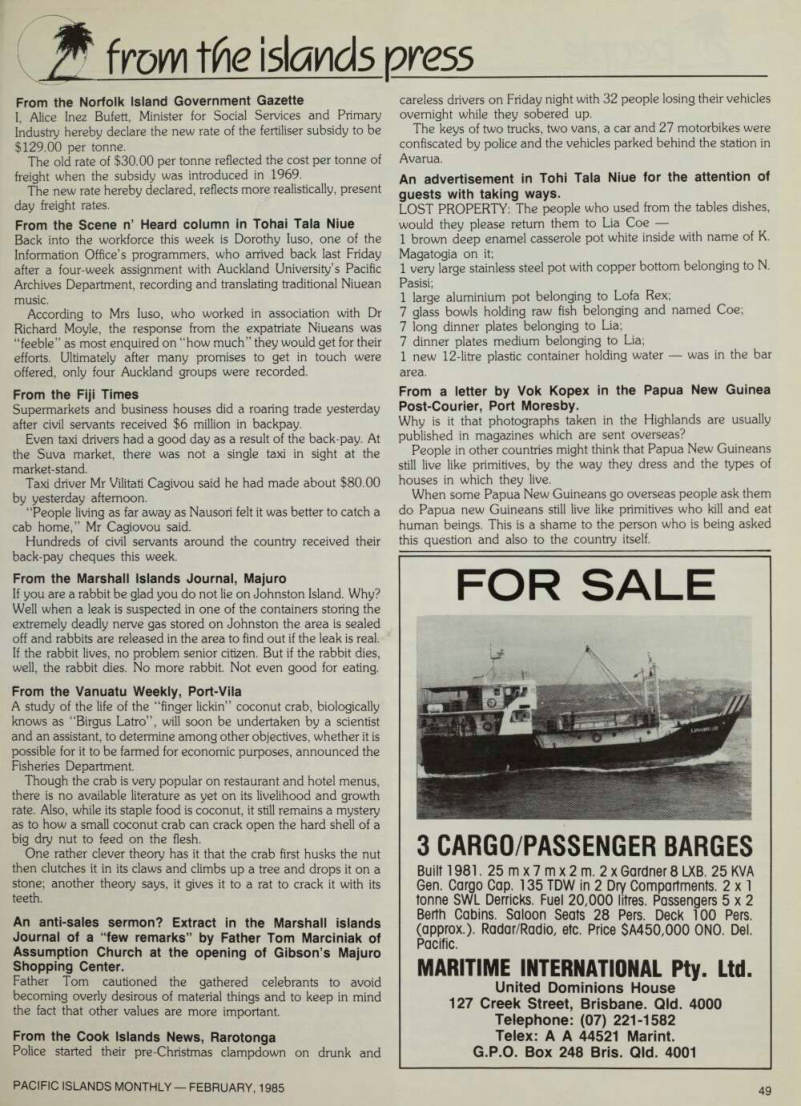
From the Norfolk Island Government Gazette I, Alice Inez Bufett, Minister for Social Services and Primary Industry hereby declare the new rate of the fertiliser subsidy to be $129.00 per tonne.
The old rate of $30.00 per tonne reflected the cost per tonne of freight when the subsidy was introduced in 1969.
The new rate hereby declared, reflects more realistically, present day freight rates.
From the Scene n’ Heard column in Tohai Tala Niue Back into the workforce this week is Dorothy luso, one of the Information Office’s programmers, who arrived back last Friday after a four-week assignment with Auckland University’s Pacific Archives Department, recording and translating traditional Niuean music.
According to Mrs luso, who worked in association with Dr Richard Moyle, the response from the expatriate Niueans was “feeble” as most enquired on “how much” they would get for their efforts. Ultimately after many promises to get in touch were offered, only four Auckland groups were recorded.
From the Fiji Times Supermarkets and business houses did a roaring trade yesterday after civil servants received $6 million in backpay.
Even taxi drivers had a good day as a result of the back-pay. At the Suva market, there was not a single taxi in sight at the market-stand.
Taxi driver Mr Vilitati Cagivou said he had made about $BO.OO by yesterday afternoon.
“People living as far away as Nausori felt it was better to catch a cab home,” Mr Cagiovou said.
Hundreds of civil servants around the country received their back-pay cheques this week.
From the Marshall Islands Journal, Majuro If you are a rabbit be glad you do not lie on Johnston Island. Why?
Well when a leak is suspected in one of the containers storing the extremely deadly nerve gas stored on Johnston the area is sealed off and rabbits are released in the area to find out if the leak is real.
If the rabbit lives, no problem senior citizen. But if the rabbit dies, well, the rabbit dies. No more rabbit. Not even good for eating.
From the Vanuatu Weekly, Port-Vila A study of the life of the “finger lickin’’ coconut crab, biologically knows as “Birgus Latro”, will soon be undertaken by a scientist and an assistant, to determine among other objectives, whether it is possible for it to be farmed for economic purposes, announced the Fisheries Department.
Though the crab is very popular on restaurant and hotel menus, there is no available literature as yet on its livelihood and growth rate. Also, while its staple food is coconut, it still remains a mystery as to how a small coconut crab can crack open the hard shell of a big dry nut to feed on the flesh.
One rather clever theory has it that the crab first husks the nut then clutches it in its claws and climbs up a tree and drops it on a stone; another theory says, it gives it to a rat to crack it with its teeth.
An anti-sales sermon? Extract in the Marshall islands Journal of a “few remarks” by Father Tom Marciniak of Assumption Church at the opening of Gibson’s Majuro Shopping Center.
Father Tom cautioned the gathered celebrants to avoid becoming overly desirous of material things and to keep in mind the fact that other values are more important.
From the Cook Islands News, Rarotonga Police started their pre-Christmas clampdown on drunk and
careless drivers on Friday night with 32 people losing their vehicles overnight while they sobered up.
The keys of two trucks, two vans, a car and 27 motorbikes were confiscated by police and the vehicles parked behind the station in Avarua.
An advertisement in Tohi Tala Niue for the attention of guests with taking ways.
LOST PROPERTY: The people who used from the tables dishes, would they please return them to Lia Coe 1 brown deep enamel casserole pot white inside with name of K.
Magatogia on it; 1 very large stainless steel pot with copper bottom belonging to N.
Pasisi; 1 large aluminium pot belonging to Lofa Rex; 7 glass bowls holding raw fish belonging and named Coe; 7 long dinner plates belonging to Lia; 7 dinner plates medium belonging to Lia; 1 new 12-litre plastic container holding water was in the bar area.
From a letter by Vok Kopex in the Papua New Guinea Post-Courier, Port Moresby.
Why is it that photographs taken in the Highlands are usually published in magazines which are sent overseas?
People in other countries might think that Papua New Guineans still live like primitives, by the way they dress and the types of houses in which they live.
When some Papua New Guineans go overseas people ask them do Papua new Guineans still live like primitives who kill and eat human beings. This is a shame to the person who is being asked this question and also to the country itself.
Advertisements & other items, p. 49 (1 item)
For Sale
m
3 CARGO/PASSENGER BARGES
Built 1981. 25 m x 7 m x 2 m. 2 x Gardner 8 LXB. 25 KVA Gen. Cargo Cap. 135 TDW in 2 Dry Compartments. 2 x 1 tonne SWL Derricks. Fuel 20,000 litres. Passengers 5x2 Berth Cabins. Saloon Seats 28 Pers. Deck 100 Pers. (approx.). Radar/Radio, etc. Price $A450,000 ONO. Del.
Pacific.
MARITIME INTERNATIONAL Pty. Ltd.
United Dominions House 127 Creek Street, Brisbane. Qld. 4000 Telephone: (07) 221-1582 Telex: A A 44521 Marint.
G.P.O. Box 248 Bris. Qld. 4001
people
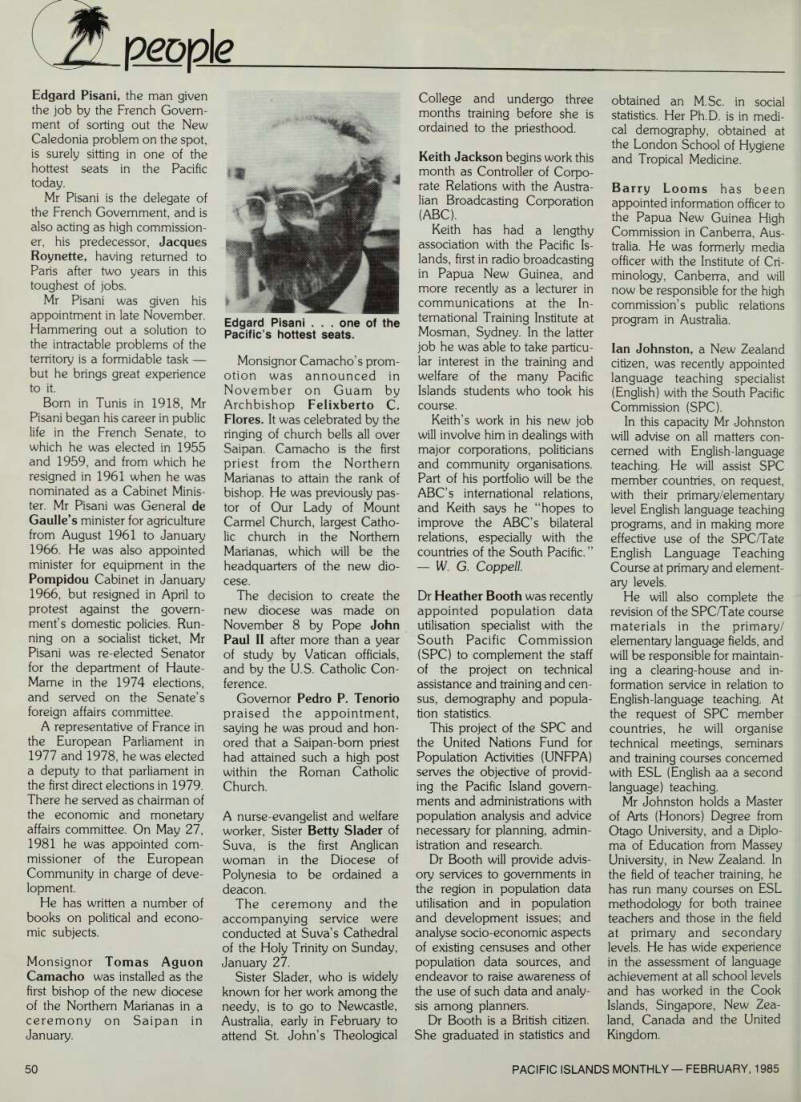
Edgard Pisani, the man given the job by the French Govern ment of sorting out the New Caledonia problem on the spot, is surely sitting in one of the hottest seats in the Pacific today.
Mr Pisani is the delegate of the French Government, and is also acting as high commission er, his predecessor, Jacques Roynette, having returned to Paris after two years in this toughest of jobs.
Mr Pisani was given his appointment in late November.
Hammering out a solution to the intractable problems of the territory is a formidable task but he brings great experience to it.
Born in Tunis in 1918, Mr Pisani began his career in public life in the French Senate, to which he was elected in 1955 and 1959, and from which he resigned in 1961 when he was nominated as a Cabinet Minis ter. Mr Pisani was General de Gaulle’s minister for agriculture from August 1961 to January 1966. He was also appointed minister for equipment in the Pompidou Cabinet in January 1966, but resigned in April to protest against the govern ment’s domestic policies. Run ning on a socialist ticket, Mr Pisani was re-elected Senator for the department of Haute- Mame in the 1974 elections, and served on the Senate’s foreign affairs committee.
A representative of France in the European Parliament in 1977 and 1978, he was elected a deputy to that parliament in the first direct elections in 1979.
There he served as chairman of the economic and monetary affairs committee. On May 27, 1981 he was appointed com missioner of the European Community in charge of deve lopment.
He has written a number of books on political and econo mic subjects.
Monsignor Tomas Aguon Camacho was installed as the first bishop of the new diocese of the Northern Marianas in a ceremony on Saipan in January.
Monsignor Camacho’s prom otion was announced in November on Guam by Archbishop Felixberto C.
Flores. It was celebrated by the ringing of church bells all over Saipan. Camacho is the first priest from the Northern Marianas to attain the rank of bishop. He was previously pas tor of Our Lady of Mount Carmel Church, largest Catho lic church in the Northern Marianas, which will be the headquarters of the new dio cese.
The decision to create the new diocese was made on November 8 by Pope John Paul II after more than a year of study by Vatican officials, and by the U.S. Catholic Con ference.
Governor Pedro P. Tenorio praised the appointment, saying he was proud and hon ored that a Saipan-born priest had attained such a high post within the Roman Catholic Church.
A nurse-evangelist and welfare worker, Sister Betty Slader of Suva, is the first Anglican woman in the Diocese of Polynesia to be ordained a deacon.
The ceremony and the accompanying service were conducted at Suva’s Cathedral of the Holy Trinity on Sunday, January 27.
Sister Slader, who is widely known for her work among the needy, is to go to Newcastle, Australia, early in February to attend St. John’s Theological
College and undergo three months training before she is ordained to the priesthood.
Keith Jackson begins work this month as Controller of Corpo rate Relations with the Austra lian Broadcasting Corporation
(Abc).
Keith has had a lengthy association with the Pacific Is lands, first in radio broadcasting in Papua New Guinea, and more recently as a lecturer in communications at the In ternational Training Institute at Mosman, Sydney. In the latter job he was able to take particu lar interest in the training and welfare of the many Pacific Islands students who took his course.
Keith’s work in his new job will involve him in dealings with major corporations, politicians and community organisations.
Part of his portfolio will be the ABC’s international relations, and Keith says he “hopes to improve the ABC’s bilateral relations, especially with the countries of the South Pacific.” - W. G. Coppell.
Dr Heather Booth was recently appointed population data utilisation specialist with the South Pacific Commission (SPC) to complement the staff of the project on technical assistance and training and cen sus, demography and popula tion statistics.
This project of the SPC and the United Nations Fund for Population Activities (UNFPA) serves the objective of provid ing the Pacific Island govern ments and administrations with population analysis and advice necessary for planning, admin istration and research.
Dr Booth will provide advis ory services to governments in the region in population data utilisation and in population and development issues; and analyse socio-economic aspects of existing censuses and other population data sources, and endeavor to raise awareness of the use of such data and analy sis among planners.
Dr Booth is a British citizen.
She graduated in statistics and
obtained an M.Sc. in social statistics. Her Ph.D. is in medi cal demography, obtained at the London School of Hygiene and Tropical Medicine.
Barry Looms has been appointed information officer to the Papua New Guinea High Commission in Canberra, Aus tralia. He was formerly media officer with the Institute of Cri minology, Canberra, and will now be responsible for the high commission’s public relations program in Australia. lan Johnston, a New Zealand citizen, was recently appointed language teaching specialist (English) with the South Pacific Commission (SPC).
In this capacity Mr Johnston will advise on all matters con cerned with English-language teaching. He will assist SPC member countries, on request, with their primary/elementary level English language teaching programs, and in making more effective use of the SPC/Tate English Language Teaching Course at primary and element ary levels.
He will also complete the revision of the SPC/Tate course materials in the primary/ elementary language fields, and will be responsible for maintain ing a clearing-house and in formation service in relation to English-language teaching. At the request of SPC member countries, he will organise technical meetings, seminars and training courses concerned with ESL (English aa a second language) teaching.
Mr Johnston holds a Master of Arts (Honors) Degree from Otago University, and a Diplo ma of Education from Massey University, in New Zealand. In the field of teacher training, he has run many courses on ESL methodology for both trainee teachers and those in the field at primary and secondary levels. He has wide experience in the assessment of language achievement at all school levels and has worked in the Cook Islands, Singapore, New Zea land, Canada and the United Kingdom.
Edgard Pisani... one of the Pacific’s hottest seats.
yachts
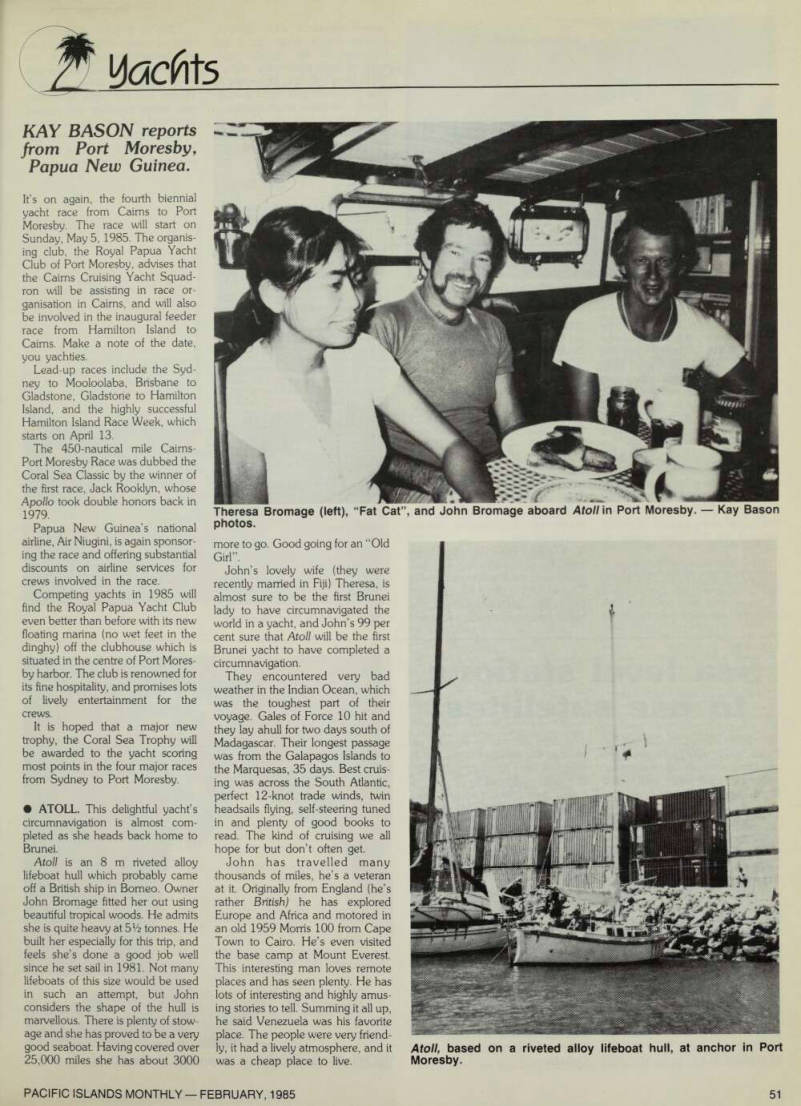
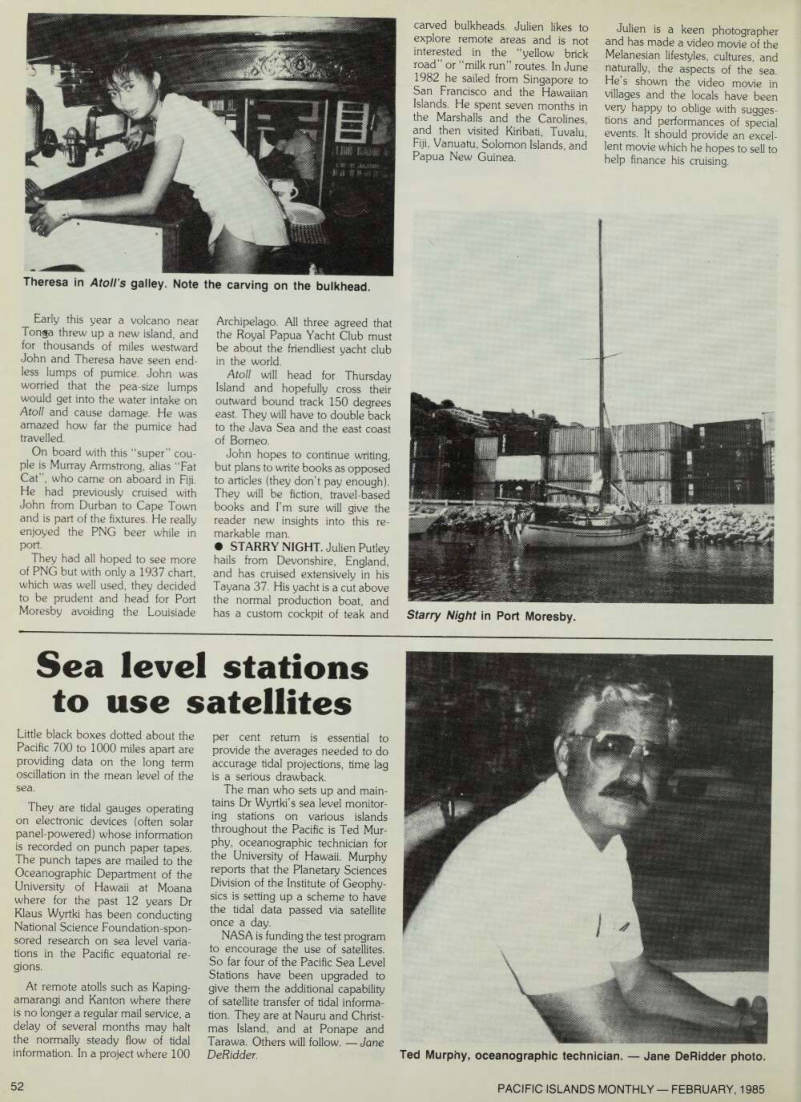
KAY BASON reports from Port Moresby , Papua New Guinea .
It’s on again, the fourth biennial yacht race from Cairns to Port Moresby. The race will start on Sunday, May 5, 1985. The organis ing club, the Royal Papua Yacht Club of Port Moresby, advises that the Cairns Cruising Yacht Squad ron will be assisting in race or ganisation in Caims, and will also be involved in the inaugural feeder race from Hamilton Island to Caims. Make a note of the date, you yachties.
Lead-up races include the Syd ney to Mooloolaba, Brisbane to Gladstone, Gladstone to Hamilton Island, and the highly successful Hamilton Island Race Week, which starts on April 13.
The 450-nautical mile Cairns- Port Moresby Race was dubbed the Coral Sea Classic by the winner of the first race, Jack Rooklyn, whose Apollo took double honors back in 1979.
Papua New Guinea’s national airline, Air Niugini, is again sponsor ing the race and offering substantial discounts on airline services for crews involved in the race.
Competing yachts in 1985 will find the Royal Papua Yacht Club even better than before with its new floating marina (no wet feet in the dinghy) off the clubhouse which is situated in the centre of Port Mores by harbor. The club is renowned for its fine hospitality, and promises lots of lively entertainment for the crews.
It is hoped that a major new trophy, the Coral Sea Trophy will be awarded to the yacht scoring most points in the four major races from Sydney to Port Moresby. • ATOLL. This delightful yacht’s circumnavigation is almost com pleted as she heads back home to Brunei.
Atoll is an 8 m riveted alloy lifeboat hull which probably came off a British ship in Borneo. Owner John Bromage fitted her out using beautiful tropical woods. He admits she is quite heavy at 5Vz tonnes. He built her especially for this trip, and feels she’s done a good job well since he set sail in 1981. Not many lifeboats of this size would be used in such an attempt, but John considers the shape of the hull is marvellous. There is plenty of stow age and she has proved to be a very good seaboat. Having covered over 25,000 miles she has about 3000
more to go. Good going for an “Old Girl”.
John’s lovely wife (they were recently married in Fiji) Theresa, is almost sure to be the first Brunei lady to have circumnavigated the world in a yacht, and John’s 99 per cent sure that Atoll will be the first Brunei yacht to have completed a circumnavigation.
They encountered very bad weather in the Indian Ocean, which was the toughest part of their voyage. Gales of Force 10 hit and they lay ahull for two days south of Madagascar. Their longest passage was from the Galapagos Islands to the Marquesas, 35 days. Best cruis ing was across the South Atlantic, perfect 12-knot trade winds, twin headsails flying, self-steering tuned in and plenty of good books to read. The kind of cruising we all hope for but don’t often get.
John has travelled many thousands of miles, he’s a veteran at it. Originally from England (he’s rather British) he has explored Europe and Africa and motored in an old 1959 Morris 100 from Cape Town to Cairo. He’s even visited the base camp at Mount Everest.
This interesting man loves remote places and has seen plenty. He has lots of interesting and highly amus ing stories to tell. Summing it all up, he said Venezuela was his favorite place. The people were very friend ly, it had a lively atmosphere, and it was a cheap place to live.
Theresa Bromage (left), “Fat Cat”, and John Bromage aboard Atoll in Port Moresby.-Kay Bason photos.
Atoll, based on a riveted alloy lifeboat hull, at anchor in Port Moresby.
Early this year a volcano near Tonga threw up a new island, and for thousands of miles westward John and Theresa have seen end less lumps of pumice. John was worried that the pea-size lumps would get into the water intake on Atoll and cause damage. He was amazed how far the pumice had travelled.
On board with this “super” cou ple is Murray Armstrong, alias “Fat Cat”, who came on aboard in Fiji.
He had previously cruised with John from Durban to Cape Town and is part of the fixtures. He really enjoyed the PNG beer while in port.
They had all hoped to see more of PNG but with only a 1937 chart, which was well used, they decided to be prudent and head for Port Moresby avoiding the Louisiade
Archipelago. All three agreed that the Royal Papua Yacht Club must be about the friendliest yacht club in the world.
Atoll will head for Thursday Island and hopefully cross their outward bound track 150 degrees east. They will have to double back to the Java Sea and the east coast of Borneo.
John hopes to continue writing, but plans to write books as opposed to articles (they don’t pay enough).
They will be fiction, travel-based books and I’m sure will give the reader new insights into this re markable man. • STARRY NIGHT. Julien Putley hails from Devonshire, England, and has cruised extensively in his Tayana 37. His yacht is a cut above the normal production boat, and has a custom cockpit of teak and
carved bulkheads. Julien likes to explore remote areas and is not interested in the “yellow brick road” or “milk run” routes. In June 1982 he sailed from Singapore to San Francisco and the Hawaiian Islands. He spent seven months in the Marshalls and the Carolines, and then visited Kiribati, Tuvalu, Fiji, Vanuatu, Solomon Islands, and Papua New Guinea.
Julien is a keen photographer and has made a video movie of the Melanesian lifestyles, cultures, and naturally, the aspects of the sea.
He s shown the video movie in villages and the locals have been very happy to oblige with sugges tions and performances of special events. It should provide an excel lent movie which he hopes to sell to help finance his cruising.
Theresa in Atoll’s galley. Note the carving on the bulkhead.
Starry Night in Port Moresby.
Sea level stations
to use satellites
Little black boxes dotted about the Pacific 700 to 1000 miles apart are providing data on the long term oscillation in the mean level of the sea.
They are tidal gauges operating on electronic devices (often solar panel-powered) whose information is recorded on punch paper tapes.
The punch tapes are mailed to the Oceanographic Department of the University of Hawaii at Moana where for the past 12 years Dr Klaus Wyrtki has been conducting National Science Foundation-spon sored research on sea level varia tions in the Pacific equatorial re gions.
At remote atolls such as Kaping amarangi and Kanton where there is no longer a regular mail service, a delay of several months may halt the normally steady flow of tidal information. In a project where 100
per cent return is essential to provide the averages needed to do accurage tidal projections, time lag is a serious drawback.
The man who sets up and main tains Dr Wyrtki’s sea level monitor ing stations on various islands throughout the Pacific is Ted Mur phy, oceanographic technician for the University of Hawaii. Murphy reports that the Planetary Sciences Division of the Institute of Geophy sics is setting up a scheme to have the tidal data passed via satellite once a day.
NASA is funding the test program to encourage the use of satellites.
So far four of the Pacific Sea Level Stations have been upgraded to give them the additional capability of satellite transfer of tidal informa tion. They are at Nauru and Christ mas Island, and at Ponape and Tarawa. Others will follow. —Jane Deßidder.
Ted Murphy, oceanographic technician.-Jane DeRidder photo.
shipping schedules
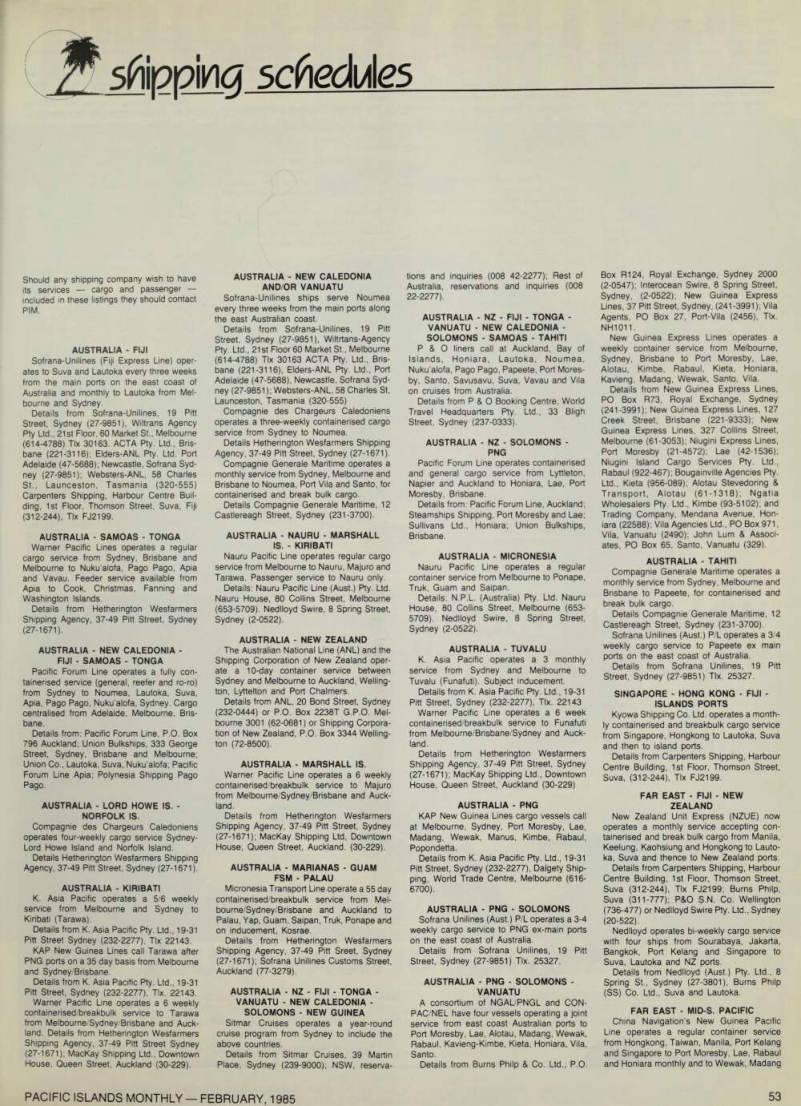
Should any shipping company wish to have its services cargo and passenger included in these listings they should contact
Pim.
Australia - Fiji
Sofrana-Unilines (Fiji Express Line) oper ates to Suva and Lautoka every three weeks from the main ports on the east coast of Australia and monthly to Lautoka from Mel bourne and Sydney.
Details from Sofrana-Unilines, 19 Pitt Street, Sydney (27-9851), Wiltrans Agency Pty Ltd., 21st Floor, 60 Market St., Melbourne (614-4788) Tlx 30163. ACTA Pty. Ltd., Bris bane (221-3116); Elders-ANL Pty. Ltd. Port Adelaide (47-5688); Newcastle, Sofrana Syd ney (27-9851); Websters-ANL, 58 Charles St., Launceston, Tasmania (320-555) Carpenters Shipping, Harbour Centre Buil ding, Ist Floor, Thomson Street, Suva, Fiji (312-244), Tlx FJ2199.
Australia - Samoas - Tonga
Warner Pacific Lines operates a regular cargo service from Sydney, Brisbane and Melbourne to Nukualofa, Pago Pago, Apia and Vavau. Feeder service available from Apia to Cook, Christmas, Fanning and Washington Islands.
Details from Hetherington Wesfarmers Shipping Agency, 37-49 Pitt Street, Sydney (27-1671).
Australia - New Caledonia -
Fiji - Samoas - Tonga
Pacific Forum Line operates a fully con tainerised service (general, reefer and ro-ro) from Sydney to Noumea, Lautoka, Suva, Apia, Pago Pago, Nukualofa, Sydney. Cargo centralised from Adelaide, Melbourne, Bris bane.
Details from: Pacific Forum Line, P.O. Box 796 Auckland; Union Bulkships, 333 George Street, Sydney, Brisbane and Melbourne; Union Co., Lautoka, Suva, Nukualofa; Pacific Forum Line Apia; Polynesia Shipping Pago
Pago.
Australia - Lord Howe Is. -
Norfolk Is.
Compagnie des Chargeurs Caledoniens operates four-weekly cargo service Sydney- Lord Howe Island and Norfolk Island.
Details Hetherington Wesfarmers Shipping Agency, 37-49 Pitt Street, Sydney (27-1671).
Australia - Kiribati
K. Asia Pacific operates a 5/6 weekly service from Melbourne and Sydney to Kiribati (Tarawa).
Details from K. Asia Pacific Pty. Ltd., 19-31 Pitt Street Sydney (232-2277), Tlx 22143.
KAP New Guinea Lines call Tarawa after PNG ports on a 35 day basis from Melbourne and Sydney/Brisbane.
Details from K. Asia Pacific Pty. Ltd., 19-31 Pitt Street, Sydney (232-2277), Tlx. 22143.
Warner Pacific Line operates a 6 weekly containerised/breakbulk service to Tarawa from Melbourne/Sydney/Brisbane and Auck land. Details from Hetherington Wesfarmers Shipping Agency, 37-49 Pitt Street Sydney (27-1671); Mac Kay Shipping Ltd., Downtown House, Queen Street, Auckland (30-229).
Australia - New Caledonia
And/Or Vanuatu
Sofrana-Unilines ships serve Noumea every three weeks from the main ports along the east Australian coast.
Details from Sofrana-Unilines, 19 Pitt Street, Sydney (27-9851), Wiltrtans-Agency Pty. Ltd., 21st Floor 60 Market St., Melbourne (614-4788) Tlx 30163 ACTA Pty. Ltd., Bris bane (221-3116), Elders-ANL Pty, Ltd., Port Adelaide (47-5688), Newcastle, Sofrana Syd ney (27-9851); Websters-ANL, 58 Charles St, Launceston, Tasmania (320-555) Compagnie des Chargeurs Caledoniens operates a three-weekly containerised cargo service from Sydney to Noumea.
Details Hetherington Wesfarmers Shipping Agency, 37-49 Pitt Street, Sydney (27-1671).
Compagnie Generale Maritime operates a monthly service from Sydney, Melbourne and Brisbane to Noumea, Port Vila and Santo, for containerised and break bulk cargo.
Details Compagnie Generale Maritime, 12 Castlereagh Street, Sydney (231-3700).
Australia - Nauru - Marshall
Is. - Kiribati
Nauru Pacific Line operates regular cargo service from Melbourne to Nauru, Majuro and Tarawa. Passenger service to Nauru only.
Details: Nauru Pacific Line (Aust.) Pty. Ltd.
Nauru House, 80 Collins Street, Melbourne (653-5709). Nedlloyd Swire, 8 Spring Street, Sydney (2-0522).
Australia - New Zealand
The Australian National Line (ANL) and the Shipping Corporation of New Zealand oper ate a 10-day container service between Sydney and Melbourne to Auckland, Welling ton, Lyttelton and Port Chalmers.
Details from ANL, 20 Bond Street, Sydney (232-0444) or P.O. Box 2238 T G.P.O. Mel bourne 3001 (62-0681) or Shipping Corpora tion of New Zealand, P.O. Box 3344 Welling ton (72-8500).
Australia - Marshall Is.
Warner Pacific Line operates a 6 weekly containerised/breakbulk service to Majuro from Melbourne/Sydney/Brisbane and Auck land.
Details from Hetherington Wesfarmers Shipping Agency, 37-49 Pitt Street, Sydney (27-1671); Mac Kay Shipping Ltd, Downtown House, Queen Street, Auckland. (30-229).
Australia - Marianas - Guam
Fsm - Palau
Micronesia Transport Line operate a 55 day containerised/breakbulk service from Mel bourne/Sydney/Brisbane and Auckland to Palau, Yap, Guam, Saipan, Truk, Ponape and on inducement, Kosrae.
Details from Hetherington Wesfarmers Shipping Agency, 37-49 Pitt Sreet, Sydney (27-1671); Sofrana Unilines Customs Street, Auckland (77-3279).
AUSTRALIA - NZ - FIJI - TONGA -
Vanuatu - New Caledonia -
Solomons - New Guinea
Sitmar Cruises operates a year-round cruise program from Sydney to include the above countries.
Details from Sitmar Cruises, 39 Martin Place, Sydney (239-9000); NSW, reserva
lions and inquiries (008 42-2277); Rest of Australia, reservations and inquiries (008 22-2277).
AUSTRALIA - NZ - FIJI - TONGA -
Vanuatu - New Caledonia -
Solomons - Samoas - Tahiti
P&O liners call at Auckland, Bay of Islands, Honiara, Lautoka, Noumea.
Nukualofa, Pago Pago, Papeete, Port Mores by, Santo, Savusavu, Suva, Vavau and Vila on cruises from Australia.
Details from P&O Booking Centre, World Travel Headquarters Pty. Ltd., 33 Bligh Street. Sydney (237-0333).
Australia - Nz - Solomons -
Png
Pacific Forum Line operates containerised and general cargo service from Lyttleton, Napier and Auckland to Honiara, Lae, Port Moresby, Brisbane.
Details from: Pacific Forum Line. Auckland; Steamships Shipping, Port Moresby and Lae; Sullivans Ltd., Honiara; Union Bulkships, Brisbane.
Australia - Micronesia
Nauru Pacific Line operates a regular container service from Melbourne to Ponape, Truk, Guam and Saipan.
Details: N.P.L. (Australia) Pty. Ltd. Nauru House, 80 Collins Street, Melbourne (653- 5709). Nedlloyd Swire, 8 Spring Street, Sydney (2-0522).
Australia - Tuvalu
K. Asia Pacific operates a 3 monthly service from Sydney and Melbourne to Tuvalu (Funafuti). Subject inducement.
Details from K. Asia Pacific Pty. Ltd., 19-31 Pitt Street, Sydney (232-2277), Tlx. 22143 Warner Pacific Line operates a 6 week containerised/breakbulk service to Funafuti from Melbourne/Brisbane/Sydney and Auck land.
Details from Hetherington Wesfarmers Shipping Agency, 37-49 Pitt Street, Sydney (27-1671); Mac Kay Shipping Ltd., Downtown House, Queen Street, Auckland (30-229)
Australia - Png
KAP New Guinea Lines cargo vessels call at Melbourne, Sydney, Port Moresby, Lae, Madang. Wewak, Manus, Kimbe, Rabaul, Popondetta.
Details from K. Asia Pacific Pty. Ltd., 19-31 Pitt Street, Sydney (232-2277), Dalgety Ship ping, World Trade Centre, Melbourne (616- 6700).
Australia - Png - Solomons
Sofrana Unilines (Aust.) P/L operates a 3-4 weekly cargo service to PNG ex-main ports on the east coast of Australia.
Details from Sofrana Unilines, 19 Pitt Street. Sydney (27-9851) Tlx. 25327.
Australia - Png - Solomons -
Vanuatu
A consortium of NGAL/PNGL and CON PAC/NEL have four vessels operating a joint service from east coast Australian ports to Port Moresby. Lae, Alotau, Madang, Wewak, Rabaul, Kavieng-Kimbe, Kieta, Honiara, Vila, Santo.
Details from Burns Philp & Co. Ltd., P.O.
Box R 124, Royal Exchange, Sydney 2000 (2-0547); Interocean Swire, 8 Spring Street, Sydney. (2-0522); New Guinea Express Lines, 37 Pitt Street, Sydney, (241-3991); Vila Agents, PO Box 27, Port-Vila (2456), Tlx.
Nhioii.
New Guinea Express Lines operates a weekly container service from Melbourne, Sydney, Brisbane to Port Moresby, Lae, Alotau, Kimbe, Rabaul, Kieta, Honiara.
Kavieng, Madang, Wewak, Santo, Vila.
Details from New Guinea Express Lines, PO Box R 73, Royal Exchange, Sydney (241-3991); New Guinea Express Lines, 127 Creek Street, Brisbane (221-9333); New Guinea Express Lines, 327 Collins Street, Melbourne (61-3053); Niugini Express Lines, Port Moresby (21-4572); Lae (42-1536); Niugini Island Cargo Services Pty. Ltd., Rabaul (922-467); Bougainville Agencies Pty.
Ltd., Kieta (956-089); Alotau Stevedoring & Transport, Alotau (61-1318); Ngatia Wholesalers Pty. Ltd., Kimbe (93-5102); and Trading Company, Mendana Avenue, Hon iara (22588); Vila Agencies Ltd., PO Box 971, Vila, Vanuatu (2490); John Lum & Associ ates, PO Box 65, Santo, Vanuatu (329).
Australia - Tahiti
Compagnie Generale Maritime operates a monthly service from Sydney, Melbourne and Brisbane to Papeete, for containerised and break bulk cargo.
Details Compagnie Generale Maritime, 12 Castlereagh Street, Sydney (231-3700).
Sofrana Unilines (Aust.) P/L operates a 3/4 weekly cargo service to Papeete ex main ports on the east coast of Australia.
Details from Sofrana Unilines, 19 Pitt Street, Sydney (27-9851) Tlx. 25327.
SINGAPORE - HONG KONG - FIJI -
Islands Ports
Kyowa Shipping Co. Ltd. operates a month ly containerised and breakbulk cargo service from Singapore, Hongkong to Lautoka, Suva and then to island ports.
Details from Carpenters Shipping, Harbour Centre Building, Ist Floor, Thomson Street, Suva, (312-244), Tlx FJ2199.
Far East - Fiji - New
Zealand
New Zealand Unit Express (NZUE) now operates a monthly service accepting con tainerised and break bulk cargo from Manila, Keelung, Kaohsiung and Hongkong to Lauto ka, Suva and thence to New Zealand ports.
Details from Carpenters Shipping, Harbour Centre Building, Ist Floor, Thomson Street, Suva (312-244), Tlx FJ2199; Burns Philp, Suva (311-777); P&O S.N. Co. Wellington (736-477) or Nedlloyd Swire Pty. Ltd., Sydney (20-522).
Nedlloyd operates bi-weekly cargo service with four ships from Sourabaya, Jakarta, Bangkok, Port Kelang and Singapore to Suva, Lautoka and NZ ports.
Details from Nedlloyd (Aust.) Pty. Ltd., 8 Spring St., Sydney (27-3801), Burns Philp (SS) Co. Ltd., Suva and Lautoka.
Far East - Mid-S. Pacific
China Navigation’s New Guinea Pacific Line operates a regular container service from Hongkong, Taiwan, Manila, Port Kelang and Singapore to Port Moresby, Lae, Rabaul and Honiara monthly and to Wewak. Madang
and Kieta every three months. Cargo from the same Far Eastern ports to the South Pacific ports of Noumea, Santo, Vila, Papeete. Pago Pago, Apia, Raratonga and Tarawa will be shipped via Japan on the monthly Bali Hai service.
Details from Steamships Shipping. PO Box 634, Port Moresby (22-0289).
Kyowa Shipping Ltd. operates monthly services from Japan to Guam, Saipan, Solo mons. New Caledonia, Fiji, Western and American Samoa, Tahiti, Cook Is., Tonga and Vanuatu.
Details: Hetherington Wesfarmers Shipping
Agency, 37-49 Pitt Street. Sydney (27-1671); Carpenters Shipping, Suva (312-244), Tlx FJ2199.
Guam - Northern Marianas
Saipan Shipping Co. Inc. operate a weekly service via barge carrying containers and conventional cargo between Guam and Saipan and Tinian.
Details from Saipan Shipping Co. Inc., PO Box 8, Saipan, CM 96950 (Tel 9707), Tlx 783619; Guam agents Maritime Agencies of the Pacific Ltd.
Hawaii - Tahiti - Samoas -
Tonga - Kiribati - Fiji -
Solomons - Png.
Star Shipping Associates operates a monthly service originating in Honolulu and destined for Pago Pago, Papeete. Apia, Nukualofa, Suva. Vila and Port Moresby.
Details from Star Shipping Assoc., P.O.
Box 25988, Honolulu, Hawaii 96825. Ph. (808) 545-3026; Polynesia Shipping Services in Pago Pago and Burns Philp Agency in Apia, Nukualofa, Suva and Port Moresby.
Japan Fiji Island Ports
Kyowa Shipping Co. Ltd. operates a month ly service from mam ports of Japan to Suva and Lautoka and thence to island ports.
Details from Carpenters Shipping. Harbour Centre Building, Ist Floor. Thomson St. Suva (312-244), Tlx FJ2199.
Japan Fiji Island Ports
Bah Hai service operates a monthly service from main ports of Japan to Lautoka and
Suva and thence to island ports.
Details from Carpenters Shipping, Harbour Centre Building, Ist Floor, Thomson St,, Suva (312-244), Tlx FJ2199 and Burns Philp Suva (311-777).
Japan Micronesia
The NYK Shipping Line operates a monthly cargo service from Japan to Micronesia, calling at Yoko, Nagoya, Kobe, Guam, Saipan, Truk, Ponape and Majuro, returning via Yoko, Nagoya and Kobe.
Details from Burns Philp & Co. Ltd., 51 Pitt Street, Sydney (2-0547).
Japan Micronesia
Saipan Shipping Co. Inc. operates a monthly service from Japan to Saipan, Guam, Truk, Ponape, Majuro (Kosrae and Ebeye on inducement).
Details from Saipan Shipping Co. Inc., P.O.
Box 8. Saipan, CM 96950 (Tel. 9707), Tlx 783619; Japan agents Kyowa Shipping Com pany Ltd; Guam Agents Maritime Agencies of the Pacific Ltd. japan PNG Mitsui O.S.K. Lines operates a monthly service from main ports Japan and Port Moresby, Rabaul, Lae, Madang. Kieta and Kimbe.
Details from Robert Laurie (PNG) Pty. Ltd., P.O. Box 922, Port Moresby (21-2466 21- 1898)
New Caledonia Fiji West
Coast North America
PAD Line operates an approx. 3-weekly ro-ro service from Noumea and Suva to Honolulu and West Coast USA and Canadian ports.
Details from Sofrana-Unilines SA. BP 1602.
Noumea (27-51-91), Tlx NMO4B; Carpenters Shipping, Harbour Centre Building, Ist Floor, Thomson St., Suva (312-244), Tlx FJ2199.
Png Inter Mainport
Papua New Guinea Line offers scheduled 10-20 day coastal liner services linking all PNG major ports with containerisation, reefer, heavy lift and transhipment facilities.
Details from PNG Line. Box 543. Port
Moresby, PNG (21-1174), Tlx 22269.
Png Uk Continent
The Bank Line & Columbus Line operate a regular joint service from Port Moresby, Oro Bay, Kieta, Rabaul, Kimbe, Madang and Lae to Hull, Hamburg, Rotterdam, Antwerp and Le Havre.
Details from The Bank Line (Aasia) Pty.
Ltd., 51 Pitt Street, Sydney (27-2041); Tlx AA24063: Columbus Line, Lae (423466), Tlx NE 44171; or lines' local agents.
Solomons Uk Continent
The Bank Line & Columbus Line operate a regular joint cargo service from Honiara to Hull, Hamburg, Rotterdam, Antwerp and Le Havre.
Details from The Bank Line (Aasia) Pty.
Ltd., 51 Pitt Street, Sydney (27-2041); Tlx AA24063; Columbus Line, Lae (423466). Tlx NE 44171; or the lines local agents.
New Zealand Vanuatu
Solomon Islands Papua New
Guinea Australia
Pacific Forum Line operates a 28 day cycle container shipping service from New Zealand direct to Vila, then on to Honiara, Lae, Port Moresby, Brisbane, back to Lyttelton, Napier and Auckland.
Details from Pacific Forum Line, P.O. Box 796, Auckland (790-050), Tlx 60460; P.O.
Box 971, Vila, Vanuatu (2490), Tlx 1044.
Nz Cook Is. Niue Tahiti
Shipping Corporation of NZ Ltd. operates cargo services based on pallets and similar units from Auckland to Niue, Cook Islands and Tahiti.
Details from the Shipping Corp. of NZ Ltd., P.O. Box 3344, Wellington (72-8500): Waterfront Commission, P.O. Box 61, Raro tonga; Cook Islands; Shipping Office, Govt, of Niue, P.O. Box 107, Niue Island; Compagnie Maritime Polynesienne, P.O. Box 368, Pape ete, Tahiti.
Nz Fiji
Reef operates a regular 18-day service from Auckland to Suva and Lautoka. Also passenger accommodation.
Details from Reef Shipping Agencies, P.O.
Box 3382, Auckland, NZ (77-1221-3), Tlx 60633: M.V. Fijian Shipping Agencies Ltd., Private Bag, Suva, Fiji (31-1056).
Pacific Line with one ship operates three weekly ro-ro cargo service New Zealand.
Lautoka, Suva. No passengers.
Details: Sofrana Unilines, 18 Customs Street, Auckland (773-279) P.O. Box 3614, Tlx NZ2313: Carpenters Shipping, 100 Thom son Street, Suva (312-244), Tlx FJ2199.
Nz Fiji North America (Wc)
Blue Star Line Ltd. Pacific Coast container services. Only direct service to and from New Zealand. Blue Star vessels call at Suva and Honolulu on NZ-US-West Coast voyages.
Details from Blueport ACT (NZ) Ltd., P.O.
Box 192, Wellington (739-029). Burns Philp (SS) Co. Ltd., GPO Box 355, Suva, Fiji (311-777), Tlx FJ2168 Burship.
Nz Fiji Samoas Tonga
Pacific Forum Line operates a fully con tainerised three-weekly service (Gen Reefer) from Auckland to Lautoka, Suva, Apia, Pago Pago and Nukualofa.
Details from Pacific Forum Line, Auckland; Union Co. Auckland, Lautoka, Suva and Nukualofa; Pacific Forum Line, Apia; Polyne sian Shipping, Pago Pago.
Nz N. Caledonia Vanuatu
Png Solomons
Sofrana Unilines with three ships operate to Vila and Santo, to Honiara and Papua New Guinea and to Norfolk Island and Noumea (No passengers).
Details from Sofrana Unilines, 18 Customs Street, Auckland (773-279), P.O. Box 3614, Tlx NZ2313.
Nz Tahiti
Compagnie Tahitienne Maritime SA (as CTM-Tahiti Line) operates one ship, MV Bounty 111, monthly Papeete New Zea land. (No passengers).
Details from Sofrana Unilines, P.O. Box 3614, 18 Customs St., Auckland, Tlx NZ2313: Agence Maritime Cowan, P.O. Box 9012, Papeete (39042), Tlx Tahitlin 322 FP Tahiti,
Nz Tonga Samoas
Warner Pacific Line services Auckland, Nukualofa, Vavau, Apia, Pago Pago fort nightly carrying general and freezer cargoes.
Details from McKay Shipping Ltd., Down town House, 21 Queen St., Auckland. P.O Box 1372 (30-299). Cables MACSHIP, Telex NZ2554, Warner Pacific Line, Box 93, Nukualofa, Tonga; Mealelei (Western Samoa,) Ltd. Private Bag, Apia, Western Samoa, Kneubuhl Maritime Service, Box 39, Pago Pago, American Samoa, 96799.
Nz New Caledonia
CP Line operates a monthly cargo service from Auckland, Napier and Mt. Maunganui to Noumea.
Details from McKay Shipping Ltd., P.O Box 1372, Auckland (9-30229); Tlx 2554 NZ.
Tahiti New Caledonia Vanuatu
Solomon Is.
New Zealand Png Singapore
Europe
Polish Ocean Lines operate in a semi container type vessel to the following ports, from Papeete, Noumea, Santo, Vila, Yandina, Honiara, Auckland, Rabaul, Lae, Singapore then to Mediterranean ports and Europe via the Suez Canal. (Other New Zealand ports subject to inducement).
Details from Universal Shipping Agencies Ltd., 6th Floor, 38 Fort Street, Auckland 1, New Zealand (30931), Tlx 21517.
Europe Tahiti
New Caledonia
Compagnie Generate Maritime operates services from Europe and Mediterranean ports to Papeete and Noumea using three ro-ro and multi-purpose vessels thus ensuring a bi-monthly sailing to and from.
Details Compagnie Generate Maritime, 12
Castlereagh Street, Sydney (231-3700).
Europe Tahiti
New Caledonia New Zealand
Solomons Png Europe
Polish Ocean Lines offers regular monthly sailings for containerised and break bulk cargo and reefer space, conventional and in reefer containers, from Noumea to Vanuatu (Santo/Vila), Solomon Islands (Honiara), New Zealand (always Auckland, other ports sub ject to inducement), Lae, Rabaul, Singapore, then Mediterranean to Europe. Other ports in the South Pacific can be served with induce ment.
Details from Sotama, BP 9170, Papeete (27805), Tlx 296 SATO; BP C 2, Noumea (272094), Tlx 163 NM SATO; Union Steam ship Co. of NZ, P.O Box 50, Apia, Tlx 25; Williams and Gosling, P.O Box 79, Suva (312633), Tlx 2163; Warner Pacific Line, P.O.
Box 93 Nukualofa (21089), Tlx 66219; Uni versal Shipping Agencies, 6th Floor, 38 Fort Street, Auckland 1, New Zealand (30930), Tlx 21517.
Europe Tahiti W. Samoa
Fiji N. Caledonia
Nedlloyd offers regular cargo services from Continental ports to Papeete, Apia, Fiji and New Caledonia.
Details Nedlloyd (Aust.) Pty. Ltd., 8 Spring Street, Sydney (27-3801); Carpenters Ship ping, 100 Thomson St., Suva (312-244), Tlx 2199 FJ and Vetari Street, Lautoka (63988), Tlx 5215FJ.
Uk N. Continent W. Samoa
Tonga, Fiji
The Bank Line & Columbus Line operate a regular joint cargo service from Hull, Ham burg, Bremen, Antwerp, Rotterdam and Le Havre to Apia, Nukualofa, Suva and Lautoka.
Details from The Bank Line (A’asia) Pty.
Ltd., 51 Pitt Street. Sydney (27-2041), Tlx AA 24063; Columbus Line, Lae (423-466), Tlx NE 44171; or lines’ local agents.
Uk N. Continent Png
Solomons
The Bank Line & Columbus Line operate a regular joint cargo service from Hull, Ham burg, Bremen, Antwerp, Rotterdam and Le Havre to Port Moresby, Lae, Madang, Kimbe, Rabaul, Kieta and Honiara and on induce ment to Yandina.
Details from The Bank Line (A’asia) Pty.
Ltd., 51 Pitt Street, Sydney (27-2041), Tlx AA 24063; Columbus Line, Lae (42-3466), Tlx NE 44171; or lines' local agents.
Uk/N. Continent Tahiti
N. Caledonia Vanuatu
The Bank Line & Columbus Line operate a regular joint cargo service from Hull, Ham burg, Bremen, Antwerp, Rotterdam and Le Havre to Papeete, Noumea, Port-Vila and Santo.
Details from The Bank Line (A’asia) Pty.
Ltd., 51 Pitt Street, Sydney (27-2041), Tlx AA 24063; Columbus Line, Lae (42-3466), Tlx NE 44171; Ets. AM. Fare UTE, Papeete; Ets.
Ballande, Noumea and other local agents.
Us Fiji Tahiti Nz
Australia
The Bank Savill Line Ltd. operates regular cargo services from U.S. Gulf ports to Australia and N.Z. Calls at Suva, Lautoka and Papeete on demand.
Details from The Bank and Savill Line Ltd., 51 Pitt Street, Sydney (27-2041) or Orient Shipping Services, 32 Bridge Street, Sydney (241-2753)
Us Hawaii Micronesia
E. Malaysia Brunei Papua New
Guinea Philippines
PM&O Lines operates three fully self-sus tained container vessels on a sailing frequen cy of every 21 days from the San Francisco Bay area, Los Angeles, and Honolulu to Majuro, Ebeye, Kosrae, Ponape, Truk, Saipan, Yap, Koror, Kota Kinabalu, Brunei, Lae, Kieta and Rabaul.
Service is also offered utilising the same vessels on the same 21-day frequency from the Philippine ports of Manila, Cebu, Cagayan de Oro, Davao and General Santos and the Papua New Guinea ports of Rabaul, Lae and Kieta to Hawaii, San Francisco Bay area and Los Angeles.
Details from PM&O Lines, 181 Fremont Street, San Francisco, California, 94105, U.S.A. (415) 543-7430, Tlx 278016; Cable PMONAV SFO; PM&O Owner's representa tive, P.O. Box 803, Saipan, N.M.I. 96950.
Cable Commontime Saipan, Tlx
783605; Soriamont Steamship Agencies Inc., Soriamont House, 801 United Nations Ave nue, Manila, Philippines. Tel 50-1831 and
50-1851, Tlx 40138. Anship Pn.
Us Hawaii Nauru
Micronesia
Nauru Pacific Line operates regular con ventional and container services from San Francisco and Honolulu to Majuro, Ponape, Truk and Saipan. Cargo is accepted for Nauru and Kosrae with transhipment at Majuro and Ponape.
Details from N.P.O. (Australia) Pty. Ltd., Nauru House, 80 Collins Street, Melbourne (653-5709); Nauru Air and Shipping Agency, Suite 2803, 185 Berry Street, San Francisco, California 94107 (415-543-1737); Nauru Air and Shipping Agency, Suite 506, 841 Bishop St., Honolulu, HI 96813 (808-523-0441).
Us. Noumea Fiji
PAD Line operates an approx. 3-weekly ro-ro service from west coast USA and Canada to Noumea, Suva and Lautoka.
Details from Sofrana Unilines BP 1602, Noumea (27-51-91), Tlx NMO4B; Carpenters Shipping, Harbour Centre Building, Ist Floor, 100 Thomson Street, Suva (312-244), Tlx FJ2199; Trans-Austral Shipping Pty. Ltd., P.O. Box R 232, Royal Exchange, 2000 (231-8411), Tlx AA21204.
Us Tahiti Samoa
Pacific Islands Transport operates a five weekly cargo service from North America west coast ports to Papeete, Pago Pago, Apia.
Details from Polynesia Shipping Services Inc. P.O. Box 1478, Pago Pago 96799.
Polynesia Line operates container and general cargo service from US west coast ports to Papeete and Pago Pago.
Details from Polynesia Shipping Services Inc., P.O. Box 1478, Pago Pago 96799.
Advertisements & other items, pp. 54-56 (1 item)
We’ve just made
the ocean smaller!
Polynesia Line's new MS Polynesia 550-container ship provides regular monthly cargo service between Papeete, Pago Pago and Apia in the South Pacific, and Long Beach and Oakland on the US Pacific Coast.
POLYNESIA LINE
Interocean Steamship Corporation General Agent
„>i£SlA.
oOk
& K Si 3* £ VS & & v mm Steam Sh& Co. c#New2ecidr*J
PQBmSQ
Apia Western Samoa Cobte''WOr San Francisco inl©?oc©an Steamship Cofporatton , SutelOCl x '' San Francisco, CAj94io4 (445)396-2000 Cable’lNlißCO'' long Beach mlefdcean Steamship Ccsporotion *• 6623 E.‘Pacific Coast hfighway, SuSeKX) \ long Beoch.CA 9080
s ’SiSco-
Serving Polynesia is all we do—and we do it better!
POLISH OCEAN LINES!
General Management, 10 Lutego 24,81-364 GDYNIA. POLAND, Phone: 20-19-01, Cables: POLOCEAN Telex: 054-231 © o k. * $ 7T i & '.‘v?
I V’*'! 1
SOUTH PACIFIC SERVICE
We offer monthly service to and from: GDYNIA, HAMBURG, ROTTERDAM, MIDDLESBOROUGH/IMMINGHAM, ANTWERP, DUNKIRK, ROUEN, PAPEETE (via PANAMA), NOUMEA, AUCKLAND, HONIARA, RABAUL, LAE, SINGAPORE, by our multipurpose vessels carrying dry and reefer containers, reefer chambers, heavy lifts, breakbulk or palletized, bulk liquids.
POLISH OCEAN LINES Representatives AUCKLAND T.B.A. Telex 21517 NZ “UNISHIP”. SYDNEY Mr Walenciak Telex 20428 AA “SLEIGH”
POLISH OCEAN LINES Agents
TAHITI SOTAMA Telex 296 FP “COUTIMEX”. NEW CALEDONIA SATO Telex 163 NM “SATO”. AUCKLAND UNIVERSAL SHIPPING AGENCIES LTD., Telex 21517 NZ “UNISHIP”. SOLOMONS MELAN CHINE SHIPPING CO., LTD Telex 66335 HO “SYMECO”. PNG
YOU’LL FIND IT.
WHERE THE SKY MEETS
THE SEA.
NEW CALEDONIA
SOLOMON ISLAND
KIRI B ATI
VANUATU
W. S A M 0 A
A. S A M O A
iiiiiii
TAHITI
TONGA
■ T*
SERVICE
JOINTLY OPERATED BY
The China Navigation Co., Ltd.
MUsuiO&K Lines,Ltd.
\==. NIPPON YUSEN KAISHA
deaths
Tomiteau Finau At Vaiola Hospital, Nukualofa, on October 28, aged 59.
A prominent legislator, re spected churchman and com munity leader, Mr Finau at the time of his death was serving on the Royal Land Commission, to which he had been appointed by Tonga’s King Taufa’ahau Tupou IV on April 22, 1983.
Mr Finau was a member of the Legislative Assembly from 1971-74, and again from 1979- 80, filling out the term of his elder brother, Lupeti Finau, who died on March 11, 1979.
He had also served as a peo ple’s representative to the Ton ga Water Board and to the Commodities Board, the latter from January 1980 to Decem ber 1982. He was also a legal adviser for the Free Wesleyan Church of Tonga, and a mem ber of the church main trust and many sub-committees.
He was educated at Nukunu ku Free Wesleyan Primary School, and at Tupou College where, in 1943, he attained a maamaloa, a certificate as an outstanding student of the year.
He completed his formal education at Auckland Univer sity.
On July 1, 1954, Mr Finau began working for His Majesty’s Government as a senior clerk in the Audit Department. He be came a first class clerk at the Ministry of Works on July 1, 1956. He left the Civil Service on September 17, 1959.
Afterwards he practised as an attorney, both in private prac tice and with the Free Wesleyan Church. He also served as an adviser to the Nukunuku Secondary School, established on February 8, 1975, where he stressed the importance of stu dent discipline and the need for technical skills.
His approach resulted in the school’s construction of an in dustrial arts complex. A home economics building, at present under construction with U.S.
Peace Corps and Australian assistance, is also part of that legacy.
Mr Finau’s father, Molitoni F.
Finau, was the kingdom’s longest-serving parliamentarian
from 1919 until his death 47 years later.
Funeral services were held at Nukunuku on October 29.
They were attended by a num ber of nobles of the realm, members of the Legislative Assembly, heads of govern ment departments, and over 3000 other mourners.
Audrey Ashley In Suva in October.
Audrey Ashley was a much loved, long-time resident of Levuka.
She worked for many years as secretary to the Commission ers Eastern in the administra tion offices for the Province of Lomaiviti in Levuka. The two most recent of these commis sioners were James Makasiale and Nelson Delailomaloma.
Mrs Ashley fulfilled her duties with skill and with a great deal of humanity and concern for all the citizens of the area. She gave help to the needy and to all worthy causes. She was highly esteemed by all, and will be sadly missed.
Former prominent Levuka resident Victor Carell told PIM: “Audrey Ashley was a great supporter in the efforts to create the Levuka Community Centre. She extended sym pathy when there were difficul ties, gave good advice on the next moves, and worked tirelessly to help in every pos sible way.
“This included the drudgery of typing and copying endless letters, articles and publicity items. She never turned down a request for help, and was al ways supportive and encourag ing. A graceful, lovely lady whose charming presence illuminated life in Levuka, with out her help, the splendid com munity centre now existing in that town could not have been achieved.”
Fida Mohammed In Suva on November 14, aged 66.
A retired senior education officer, Mr Mohammed’s fune ral at Nasinu Muslim Cemetery on November 15 was attended by a guard of honor formed by
students from Muslim schools in Suva.
Mr Mohammed began teaching in 1937, and became a senior education officer in 1971. He retired in 1979 after 42 years of service.
The first school Mr Moham med taught at was Koronubu Indian School at Ba, and his last school was Samabula Govern ment School.
Mr Mohammed was the chairman of the Urdu Curricu lum Working Group, a life member of the Charman’s All Races Club and manager of the Suva Muslim primary and high schools.
Christopher John Harvey-Hall In a plane crash in Papua New Guinea, on December 4.
A prominent Lae business man, Mr Harvey-Hall was de scribed by Morobe Premier Utula Samana as “one of Lae’s most outstanding personali ties. ”
Mr Samana said his death was a great blow to the people who admired the Harvey-Hall family for their involvement in community development.
“Mr and Mrs Harvey-Hall have always had the time to assist in charity organisations’ fund-raising activities, led by example in community-orien tated projects, and assisted en terprising Papua New Guinean businessmen to establish their business,” Mr Samana said.
“Mrs Harvey-Hall’s father, Mr Jack Amesbury, former head master of Bugandi High School, also contributed in his way to produce some of the province’s and the country’s outspoken leaders, which we proudly acknowledge.”
The late Mr Harvey-Hall and his adopted son, Joshua, also a victim of the crash, were buried in Lae following a funeral service on December 8.
About 300 friends, relatives and businessmen in Lae attended.
Iva Louise Langdon In Canberra on December 15, after a long illness.
Mrs Langdon was the wife of
Robert Langdon, executive officer of the Pacific Manu scripts Bureau, Australian Na tional University, Canberra. Mr Langdon is the author of seve ral books on the Pacific, and a former assistant editor of PIM.
Marguerita Edith Mathews In Sydney on November 19, aged 64.
A Fiji resident from 1950 to 1974, Mrs Mathews was born in Melbourne, the only child of the late RAAF Wing-Commander and Mrs W. F. Brotherton.
She served for several years in the WRAAF before going to Fiji, where she became private secretary to the late Sir Maynard Hedstrom, general manager of Morris Hedstrom Ltd.
Her husband, Peter Mathews, who served in the RNZAF at the Laucala Bay base, died in the early 19605.
Sailasa Koro In Suva on November 14, following a 10-metre fall from a breadfruit tree, aged 18.
A trainee teacher at Fulton College in Korovou, Sailasa Koro, of Yabia, Tailevu, had just completed a four-year pri mary level teaching course, and was to have graduated on November 25.
Koro slipped and fell from a breadfruit tree at the college on November 13.
He fell headlong and landed on a concrete pavement.
Koro was rushed to the Colo nial War Memorial Hospital where surgeons operated on him immediately in a bid to save his life.
Koro suffered multiple head injuries and a broken shoulder in the fall.
Koro’s aunt, Mrs Verenaisi Vaqewa, also a school teacher, told The Fiji Times they were told of her nephew’s death just two hours after they returned from the hospital on the even ing of November 14.
Koro went into a coma after the fall and died without regain ing consciousness.
He was an only child brought up by his grandmother in Yabia Village, Wainibula, in Tailevu.
Advertisements & other items, pp. 58-60 (1 item)
Kami©
SERVICE PAGE
ADVERTISING
Aggie Grey 38
AIWA 19
Amatil 6 Bali Hai Service 56 Bank Line 59 Citizen 48 Collins Olympic 42 Columbus Line 59 Dept, of Trade 10 Fisher & Paykel 28 Hitachi 2 Honda 22 Hudson Homes 26 David Hughes 58 Maritime International 49 Nissan 12,13 Papua Hotel 38 Pauls Milk 32 Pioneer 34 Polish Shipping Lines 55 Polynesian Airlines 4 Polynesian Lines 54 Remy Martin 60 Sheaffer 11 Sonar Ship Brokerage 58 Toyota Motor 30,31 University of the South Pacific 36 Water Wheel 8 Wright & McGill 27
STEEL BARGES
BA2B. 25.6 M. 65 DWT. $210,000
8A32. 37 M. 276 DWT. $775,000
8A33. 35 M. 200 DWT. $BOO,OOO
8A34. 44 M. 450 DWT. $900,000
8A35. 29.85 M. 82.6 DWT. $125,000
For full particulars contact:
Jack Ball SONAR SHIPS
BROKERAGE
Box 1811, Cairns Ph: (070) 51-1212
ISO (6170) Telex: SONMAR AA4BOIO
FAX; VOCAOEX 1100. No. 511212
Kami©
WMmany
AUSTRALIA: Distribution: The Herald and Weekly Times Ltd., 44-74 Flinders St.. Melbourne, Vic., 3000. Advertising Reps — Brisbane — D. Wood, Anday Agency. CCA Centre. Dayboro Road, Closebum 4520; Box 1918, GPO Brisbane, 4001; telephone (07) 289-4128. Adelaide — Hastwell Williamson Rouse Pty. Ltd., PO Box 419, Norwood. SA, 5067; 59 Kensington Road, Norwood; telephone (08) 332-3322, telex 87113; Perth — Allen & Associates, Suite 2, 284 Stirling St., Perth, WA. 6000, telephone (09) 328-9593 or (09) 328-9363.
FUI: Distribution and subscriptions — Desai Bookshops, P.O. Box 160, Suva, Fiji, telephone Suva 23036.
Advertising — Fiji Times & Herald Ltd., 20 Gordon St., Suva, telephone 31-4111, telex FJ2124.
FRENCH POLYNESIA: Distribution — Hachette Padfique, 10 Ave Bruat. Papeete, telephone 25610.
HAWAII, UNITED STATES: Distribution — PIM, Hawaii, PO Box 22250. Honolulu. Hawaii. 96822 Advertising — Brian C. Asgill, Apt. 1308, 1676 Ala Moana Blvd., Honolulu, Hawaii, 96815. telephone (808) 955-9718.
JAPAN: Advertising and subscriptions — Universal Media Corporation, GPO Box 46, Tokyo, telephone 666- 3036, cables UNIMEDIA Tokyo, telex 2524665 KOREA: Advertising and subscrlptlona — World Marketing, Inc, Box 4010, Seoul; phone 776-5291-3, telex K23232.
MALAYSIA: Advertising and subscriptions — Worldwide Media Services, 57-B Komplex Damai, Jin Dato Haji Eusoff, Kuala Lumpur, telephone 63-9340, cables WORLDMEDIA Kuala Lumpur, telex 31533.
VANUATU: Distribution — Maropa Bookshop, HQ Box 210, Port Vila Advertising — Bill Penthand, Norman Bros Bookshop, Port Vila, telephone 2232, NEW CALEDONIA: Distribution — Depot Centre de Presse Michel Pentecost, CBP2, Noumea, telephone 27- 2434, 27-4729.
NEW ZEALAND: Distribution — Gordon & Gotch, PO Box 584, 2 Carr Road. Mt. Roskill, Auckland 4 Advertising — International Media Representatives Ltd., PO Box 10259, Balmoral, Auckland 4, telephone 605-909, 792-370, telex NZ21404.
PAPUA NEW GUINEA: Distribution — Gordon & Gotch.
PO Box 3395, Port Moresby, telephone 25-4551.25-4855.
Advertising — Ken Head. PNG Post-Courier, PO Box 85, Port Moresby, telephone 21-2577. telex 22120.
SOLOMON ISLANDS: Distribution and Advertising — The Bookshop, (Norman Bros.) PO Box 503, Honiara.
PHILIPPINES: Advertising — The GF Group, 12 San Ignacio St., Uroaneta Village. Makati. Metro Manila, telephone 817-7299, telex 45950 and 4233.
UNITED KINGDOM: The Herald & Weekly Times Ltd., No 1 Mattravers Street,London WC2R 3DZ, England, telephone 01 836 5162, telex London 21989 UNITED STATES MAINLAND: Advertising — Joshua B.
Powers Jr, Powers International Inc., 551 Fifth Ave., New York, New York 10 017, telephone 867-9580, telex 236514.
Subscriptions — PIM, Hawaii, PO Box 22250. Honolulu, Hawaii, 96822.
SUBSCRIPTIONS
American Samoa Australia Canada Cook Islands Fiji French Polynesia Guam Hawaii Japan Kiribati Micronesia Nauru New Caledonia New Zealand Niue Norfolk Island Northern Marianas Papua New Guinea Solomon Islands Tonga Tuvalu United Kingdom U. S. Mainland Vanuatu Western Samoa Elsewhere .. $US21 Aust$18 .. $US27 .. NZ$30 Aust$19 .. $US22 .. $US23
.. SUS23
.. $US22 Aust$19 .. $US23 Aust$21
.. SUS22
.. NZ$30 .. NZ$30 Aust$18 .. $US23 Aust$23 Aust$19 Aust$19 Aust$19 .. Stg$15 .. $US27 Aust$19 Aust$19 Aust$25 Payments by personal cheque are only acceptable in Australian (from a branch in Australia), U.S. and New Zealand currency. For all other remittances please send an international bank draft in Australian dollars.
Published monthly by Pacific Publications (Aust.) Pty.
Ltd. and printed in Australia by Quadricolor Industries Pty. Ltd., Mulgrave, Vic.
NOW AVAILABLE! 15 th Edition
PACIFIC ISLANDS YEAR BOOK
Contains over 550 pages crammed with all the facts you want to know on all the island groups of the Pacific.
See insert for further details and price.
FRESH
WATER
FROM
SALT
Contact an energy specialist who has lived and worked in the islands:
DAVID HUGHES
Suite 204, 720 George Street,
SYDNEY 2000, AUSTRALIA
(02) 211-4759, AA70842
ALL THE NEWS IN A FLASH
The South Sea Digest tells you what you want to know about the Pacific Islands in a few words. All the leading firms and diplomatic missions read it. You can ’phone or write or call for a follow up.
See insert for subscription details:
THE SOUTH SEA DIGEST
BANK LINE and
COLUMBUS LINE
24 day service to
Europe.
Need we say more...
D G The Joint Service Partners offer facilities for shipment of: Containers (FCL/LCL) and Break-bulk Cargo plus reefer space and deeptanks for carriage of vegetable oils and other liquid bulk cargo.
Carriers also accept heavy lifts, overlength and cumbersome parcels.
Ports of Service: Loading; Papeete, Apia. Suva, Lautoka, Noumea, Port Vila, Santo, Honiara, Port Moresby, Lae, Madang, Kimbe, Rabaul, Kieta, Darwin. For: Rotterdam, Antwerp, Hamburg, Hull, Dunkirk, Le Havre.
Additional ports on enquiry.
Please contact our regional offices for further information: The Bank Line (Australasia) Pty Ltd Columbus Line Reederei GmbH Suite 801,51 Pitt St, p.O. Box 1 667, Lae/Papua New Guinea.
Sydney, NSW, Australia 2000 Phone: 423466/423487/AH. 422481 Phone 27 2041 Telex 24063 Telex: Colline NE 441 71 The South Pacific Specialists for over 75 years
The Ultimate XO
f c «Ci I
FAU»i
KO m * V rrv ' \ Kr-v: I Centaure XO
REMY MARTIN
■ ■; I I f - '
COGNAC
REMY MARTIN
FINE CHAMPAGNE COGNAC, SINCE 1724.
REMY MARTIN CENTAURE XO