Pacific

Ishands
Monthly
JAftUAWV^lii
GW
Caledonia
« • •*“' ■V M^m TOhl M
American Samoa US$l.75 Australia ’A$l.5O Cook Islands NZ$l.5O Fiji F 51.50 Hawaii US$l.95 Kiribati A 51.75 Nauru A 51.75 New Caledonia CFPI9O
New Zealand NZ$2.5O Niue NZ$l.75 Norfolk Island A 51.50 Papua New Guinea K 51.50 Solomon Islands 551.50 Tahiti CFP22O Tonga PI .50 Tuvalu A 51.75
Usa U 552.25
USTT and Guam US$l.95 Vanuatu VT1.50 Western Samoa 12.10 ’Recommended retail price only Registered by Australia Post Publication No. NBPI2IO
Air Niugini’s newest
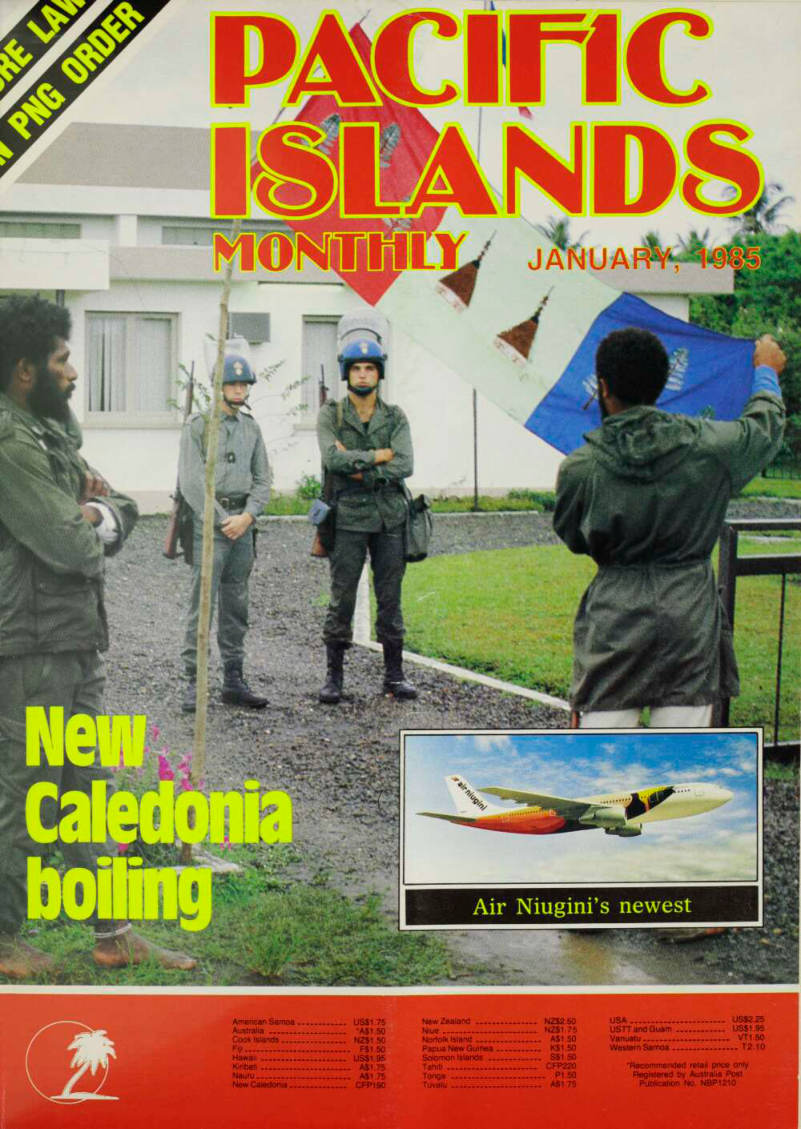
The Cover
Confrontation on elec tion day, November 18, 1984, at Kone, on New Caledonia’s north-west coast. Pro-independence FLNKS militants face rep resentatives of French power.
Advertisements & other items, p. 2 (1 item)
0 Hitachi
Electronic viewfinder
One video
combination
that loves holidays.
V I Something very unusual happens to Hitachi’s VT-8E every time you take a trip.
It goes to pieces.
With a quick pull, the video tape recorder half separates from the tuner unit.
Hook it up to Hitachi’s VK-Cl5OO video camera, and you’re ready to shoot for up to an hour. Because the VK-Cl5OO is small enough to fit in the palm of your hand, it’s easy to carry and easy to use.
All this portability comes without sacrificing an ounce of quality. The VT-8E has 5 heads, stereo recording and playback, and special editing functions for that professional touch. The VK-Cl5OO features Hitachi’s exclusive MOS sensor. 100 times more durable than conventional picture tubes, it delivers crisp, sharp images with no bum-in or ghosts.
Together these units offer both the convenience of a portable and the performance of a console. It’s never been easier to make video a part of your life whether you’re making movies on the road or taping them at home.
The VT-8E and VK-Cl5OO are just two of more than 20,000 ways Hitachi is using technology to improve your home, your office and your community.
Not to mention your holiday.
0 HITACHI
II MOS sensor Full auto white balance I Instant review button rl 9 9 F 1.2 6X power zoom lens with macro Camera jack AUDIO DUB button Frame advance button VTR auto-connection terminal Infrared remote control sensor Instant Recording Timer 7-programme/2-week timer Battery charge indicator • AUSTRALIA: Hitachi Sales Australia Pty., Ltd., 153 Keys Road, Moorabbin, Victoria 3189; Phone: (555) 8722 • NEW ZEALAND; AWA New Zealand Limited, Wi-neera Drive, P.O. Box 50- 248, Porirua; Phone: PRO 75-069 • PAPUA NEW GUINEA: S O. Svensson (N.G.) Ltd., P.O. Box 705, Port Moresby; Phone: 21-2111 • FIJI ISLANDS: AWA New Zealand Limited, 47 Foster Road (P.O. Box 858), Suva, Fiji; Phone: 312070 • NEW CALEDONIA: Caldis, B.P Ml, Noumea; Phone: 26. 23. 50 • TAHITI: Ets Chene Alain. P.O. Box 272, Papeete; Phone: 2. 88. 68 • SOLOMON ISLANDS: Technique Radios Centre Ltd., P.O. Box 465, Honiara; Phone: 416
Islands
Pacific
Monthly
Vol. 56 No. 1 January 1985
Founded 1930 by R. W. Robson
(Usps 952480)
Editor and Publisher Garry Barker Associate Editor Malcolm Salmon Layout & Design Barry Badger Editorial Adviser John Carter A Pacific Publications production 76 Clarence Street, Sydney. 2000, GPO Box 3408, Sydney. 2001.
Cables: PACPUB Sydney.
Telex: 21242 (answers INTARAD).
Telephone: Sydney 20-231. Melbourne 63-0211.
Manager: John Berry (03) 63-0211 Ext. 1860.
Jean-Marie Tjibaou 14
Sir Percy Chatterton 30
Dr Ahmed Ali 53
Sanpoi, yacht with a story 58
In This Issue
NEW CALEDONIA ON THE BOIL. The troubled -| 4 French territory will never be the same again following the November 18 elections to the Territorial Assembly, which were the target of an “active boycott” by pro-independence Kanaks. A report from PlM’s Noumea correspondent, Helen Fraser, and other sources, begins on page .
PAPUA NEW GUINEA’S LAW AND ORDER PROB- -| Q LEM. The government of Michael Somare grapples manfully with the problems of urban crime, but Noel Pascoe reports that an early solution is not in prospect.
SOLOMON ISLANDS’ NEW PM FACES SEPARAT- 22 IST PROBLEM. Sir Peter Kenilorea faces a secession problem on his native Malaita Island.
Nicholas Thornton reports.
AIR PACIFIC. In-fighting was continuing at PlM’s 25 press time over which of the two Australian airlines, Qantas and Ansett, would take on the job of bailing out Fiji’s national carrier.
HOW MUTLI-RACIAL HAWAII GREW UP. A new 39 book traces the origins of today’s multi-racial Hawaiian society to the reign of King Sugar in the latter part of the 19th century and the early part of the 20th.
PLANNED FIJIAN “GALLEON”. Fijian historian 44 Manoa Rasigatale has a dream; to build a great twin-hulled drua such as his ancestors used in their warlike expeditions.
“DE-SEGREGATING” FIJI’S SCHOOL. A plan to 53 integrate Fiji’s school system has met opposition from teachers and others on both the Fijian and Indian sides of the country’s big racial and cultural divide.
Contents
American Samoa 42 Australia 41,42 Books 39 Deaths 65 Fiji 25,30, 37, 44,47, 53 Hawaii 39 Islands diet 51 Islands Press 57 Letters 10 Micronesia 24,31 Mosquito control 33 New Caledonia 14 New Zealand 42 Pacific Report 7
Papua New Guinea .18, 26, 30, 36 People 56 PIM Opinion 5 Political Currents 53 Service Page 66 Shipping Schedules 61 Solomon Islands 22 Stamps 55 Tourism 47 Tradewinds 31 Tropicalities 47 United States 42 Vanuatu 49 Western Samoa 42,43
Yachts 58
Australian cover price is recommended retail only. Registered by Australia Post. publication No. NBPI2IO. Second class postage paid at Honolulu, Hawaii. Copyright Pacific Publications (Aust.) Pty. Ltd. Postmaster Hon oiulu; Send address changes to PIM Hawaii, PO Box 22250, Honolulu.
Hawaii. 96822.
Advertisements & other items, p. 4 (1 item)
Australian
DESIGN & CRAFTSMANSHIP
17.
Sf 3 <3t» 3 : 9 #• t »* 9) % < r* r.
V 33 *• » SI % Contemporary or traditional, Australian furnishings and fittings sell on their high standards of design and craftsmanship. Add reliability and durability and then you’ll realise just how competitive these Australian products are.
And there’s such a wide range available for use in homes, offices, apartments.
Lounge, dining and bedroom furniture. Fabrics and drapes.
Carpets. Wall hangings. Cushions. Light fittings. Bathroom and kitchen fittings. White goods such as refrigerators, freezers, cookers. Air coolers. Solar water heaters. Window tints.
Housewares of all kinds. Door hardware. Builders’ hardware. Stainless steel sinks. And many others.
Ask the Australian Trade Commissioner.
Ask the expert who knows Australia.
For details of suppliers, phone or telex the Australian Trade Commissioner;
HONOLULU
Phone (808) 524 5050 telex 633128.
PORT MORESBY
Phone 25 9333 telex NE 22109.
SUVA
Phone 31 2844 telex FJ 2126.
NOUMEA
Phone 27 2414 telex 087.
Isolation feeds fears
Pim Opinion
Killings, burnings, bashings, and other forms of violence now occurring in New Caledonia over the long-running independence issue have served only to make more difficult the finding of a workable, and equitable, solution to a problem which everyone has seen coming, and too few have done anything about. As has occurred in other parts of the world, in situations not too dissimilar, violence has served only to polarise attitudes and turn minds away from reason, at just the moment when calmness, compassion, understanding, fairness, and all the other qualities one hopes to see, and seldom does, are most needed.
The French administration in France does, however, at last, seem to be moving towards accommodating Kanak wishes for an end to their long colonialism, and full say in their own destiny. But they are doing so at a time when the white settlers who, with third-party racial groups, like the Wallisians, now outnumber the Kanaks, feel at their most threatened.
Because of the past, the future is dark, and there is now no guarantee that whatever hopeful proposal is put together in the next two months by President Mitterrand’s special representative, Mr Edgard Pisani, will soothe breasts in either Kanak, or European, camp.
While the rest of the world sees the scene in terms of black and white, left and right, rich settlers and poor natives, the reality is much more complicated.
The Kanak case cannot be argued against in today’s world. It is their country, and was before the white man came. But many of the settlers know no other home. What they have today they have grubbed from the earth and, being people of that background, they feel they should fight for what they regard as their own. Of course, in Noumea, it is somewhat different, but the cry remains: “This is our home; where shall we go if we cannot stay here?”
Will the Kanaks be good landlords? For that, surely, must be one of the many questions upon which the future will depend. Equally, will the master make a good tenant?
There are many factions on each side; rage and reason vary as each stratum is tested. About the only common factors are growing fear and uncertainty.
The country is split in two. In the countryside French farmers load their shotguns and barricade their homesteads against groups they see as Melanesian marauders. This fortress attitude has been heightened by the play some Kanak elements have made of ’’support and training” they have received from Col. Gaddafi and his Libyan terrorists. So far, however, and despite some wild talk in Noumea, the settlers have not gone out to attack the Kanaks, nor does there yet appear any serious move to start such a backlash.
On the Kanak side the more reasonable leaders, including Jean-Marie Tjibaou, who heads the provisional government set up
in the wake of the Kanak boycott of the territorial elections, are under growing pressure to be tough, demanding and uncomprom ising. Some Kanaks feel they have the French on the run, and must maintain the pressure if they are to succeed.
But Tjibaou has said he will talk with M.Fisani, as soon as “certain obstacles” are removed. For, doubtless he, like the more moderate (less fearful?) Caldoche, knows that jaw is better than war from which no-one will profit.
Meantime, if the French settlers behind their sandbags feel a growing sense of isolation and rejection by their homeland government, much the same emotion must touch the minds of the Kanaks when they consider the support, or the lack of it, which they have received from around the Pacific.
Some store had been set by the Kanaks on, particularly, Papua New Guinea, and Solomon Islands, exerting their influence, but they did not. Nor, indeed, did Fiji. To be fair to them, however, their colonial history was much different, and their attitudes perhaps, therefore, more conciliatory.
Of all the Melanesian nations only Vanuatu, which itself had some fairly bitter experiences in the final days of reaching independence, has been at all outspoken. Indeed, Vanuatu prime minister, Father Walter Lini, was specific in saying that Pacific countries, as a group, had failed to help New Caledonia. This, he said, had contributed to the difficulty of the present situation, and was a factor in persuading some Kanaks to turn to Libya for assistance and “military training.”
But, even Vanuatu will not raise the question with the United Nations committee on decolonisation, although, at the Forum meeting in Tuvalu in August, Father Lini said he was very much considering it, and would certainly report to the General Assembly on what he saw as the “real situation.” This, he indicated, was that New Caledonia was “out of control” and deteriorating rapidly.
Unfortunately for the Kanaks, Father Lini’s decision is politically sensible, and probably also a commentary upon the current state of the United Nations where the French lobby, particularly among black African countries, is very strong.
Yet the real tragedy of New Caledonia is not political but, as always, human.
The Kanaks need the settlers, and, at least for the foreseeable future, they need the French and the vast amount of money they pour into New Caledonia’s economy. The recent violence may have demonstrated Kanak power by turning tourists away by the thousand, but it also cost the country dearly.
The real friends of New Caledonia, who do not include Col.
Gaddafi, and any adventurers who might turn up from the Soviet bloc, should now be counselling patience, understanding, and accommodation of the inevitable Kanak independence. Mr Pisani has the hopes of much more than just the Kanaks pinned on his search for a peace plan.
Advertisements & other items, p. 6 (1 item)
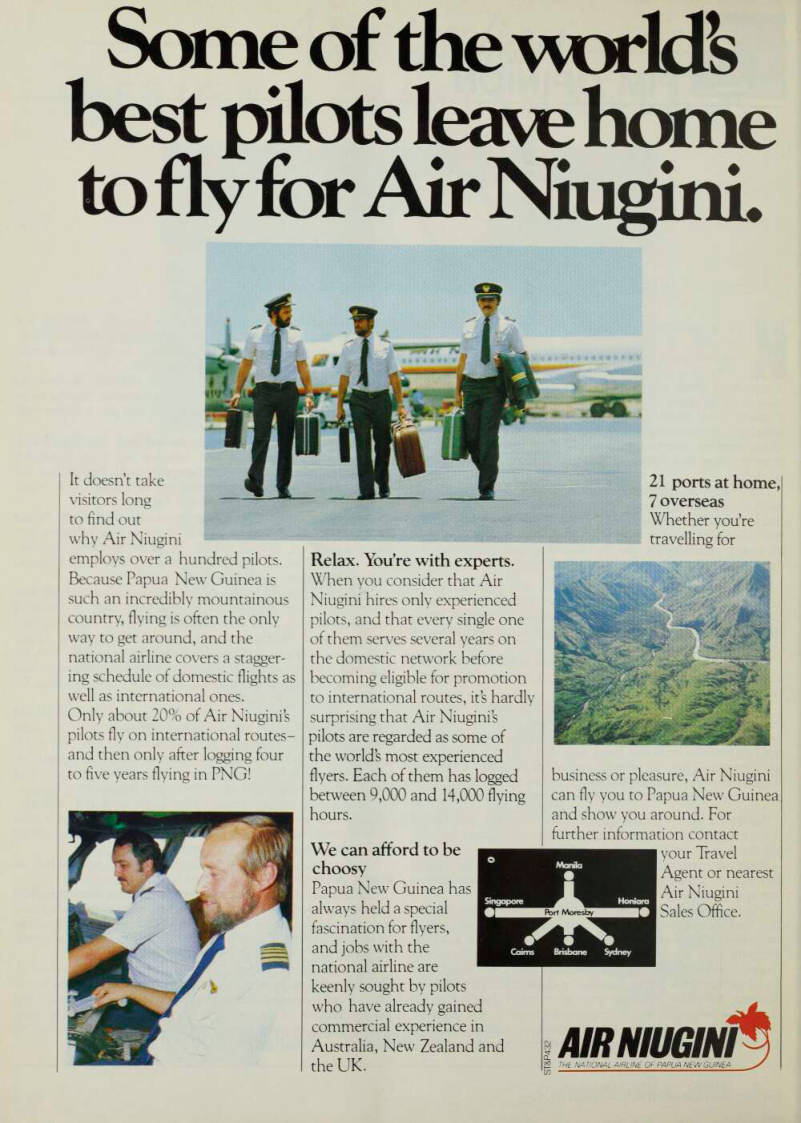
best pilots leave home
Some of the world’s
to fly for Air NiuginL
It doesn’t take visitors long to find out why Air Niugini employs over a hundred pilots.
Because Papua New Guinea is such an incredibly mountainous country, flying is often the only way to get around, and the national airline covers a stagger' ing schedule of domestic flights as well as international ones.
Only about 20% of Air Niugini’s pilots fly on international routesand then only after logging four to five years flying in PNG! * iiJ . f Sk p Relax. You’re with experts.
When you consider that Air Niugini hires only experienced pilots, and that every single one of them serves several years on the domestic network before becoming eligible for promotion to international routes, it’s hardly surprising that Air Niugini’s pilots are regarded as some of the world’s most experienced flyers. Each of them has logged between 9,000 and 14,000 flying hours.
We can afford to be choosy Papua New Guinea has always held a special fascination for flyers, and jobs with the national airline are keenly sought by pilots who have already gained commercial experience in Australia, New Zealand and the UK. 21 ports at home, 7 overseas Whether you’re travelling for M business or pleasure, Air Niugini can fly you to Papua New Guinea and show you around. For further information contact your Travel Agent or nearest Air Niugini Sales Office. n Moresby Horf
AIR NIUGINI
THE NA TIONAL AIRLINE OF PAPUA NEW GUINEA
Pacific Report
Kenilorea Is Solomons Pm.
Solomon Islands has a new prime minister, Sir Peter Kenilorea, who was opposition leader until the November vote of the 37 members of parliament. The new parliament, elected on October 24, met to hold a secret ballot on who should be prime minister.
The outgoing leader, Solomon Mamaloni, attracted only 13 votes 12 from his own People’s Alliance Party and one from the New Democratic Party. Sir Peter Kenilorea gained 21 votes, 13 from his United Party, four from the new SAS Party, and four indepen dents. Three members of parliament abstained. At a press conference after the vote, Sir Peter said one of his main priorities would be to resolve the dispute with the United States over the Solomons’ seizure of an American tuna boat in July. Sir Peter said he would also return the Home Affairs Ministry to the control of the Central Government, rather than leave those powers with the provinces. He said he would scrap a plan by the former government to set up a brewery in the capital, Honiara, and would attend to a demand by public servants for higher pay.
PNG: TROOPS MAY BE USED TO COMBAT CRIME Police in Papua New Guinea have been given the power to call in troops to help fight crime. Prime Minister Michael Somare said the police commissioner would be given the power to call out and control the troops to assist police in maintaining law and order. He said the use of the defence force was part of the government’s package to control crime. The PNG government said it would introduce the package after mass public protests over a series of rapes. Mr Somare said serious crimes had increased dramatically since PNG gained independence from Australia in 1975. This had created serious effects on public confidence in law enforcement, and diminished business confidence. The prime minister said one of the most serious problems facing the police was a lack of manpower.
A.DB. CALLS FOR SHAKE-UP IN W. SAMOA A report by an Asian Development Bank mission of inquiry into the economy of Western Samoa has recommended a massive shake-up in existing structures if the country is to achieve agricultural development. The six-volume report recommends the formation of a national planning committee, replacement of the existing cocoa and copra boards with one export development board, and the putting of the Western Samoa Trust Estates Corporation (WSTEC) “above politics.” The mission saw “an overwhelming need for a national body to develop a common policy perspective for agriculture,” and said the proposed national planning committee could fill this role.
FRANCE SAYS “NO” TO JOINT VISIT PLAN France turned down a planned joint visit late last year to New Caledonia by the leaders of five South Pacific nations. Port Moresby authorities said that although the French Government cancelled the joint trip, it advised the five prime ministers concerned to make separate trips if they want to gain a better understanding of the different political groups in New Caledonia.
The last South Pacific Forum meeting in Tuvalu appointed a team comprising the prime ministers of Papua New Guinea, New Zealand, western Samoa, Fiji and Vanuatu to meet political leaders in New Caledonia to discuss the colony’s future.
New Caledonia “Out Of Control” Lini
The Prime Minister of Vanuatu, Father Walter Lini, is reported to have warned of further violence in New Caledonia if France does not move quickly to grant independence to the territory. In an interview with the American news agency Associated Press, Father Lini claimed the situation in New Caledonia was out of control following the November 18 election for a Territorial Assembly. He said France’s socialist government was now in a difficult position, as it had to deal with the conservative Republican Party which won most of the seats in the assembly. Father Lini said Vanuatu would not raise the question of New Caledonia with the United Nations
committee on decolonisation. However, he said it would not hesitate to report to the U.N. on what he termed “the real situation” there. Asked why Kanaks had sought Libyan assistance and military training, Father Lini said this was because neighboring Pacific countries as a group had failed to help them.
Fui: Koya Names New Shadow Cabinet
Fiji’s Opposition Leader, Siddiq Koya, has named a new shadow cabinet. Mr Koya retains responsibility for foreign affairs, and the line-up includes a former attorney-general, Sir Vijay Singh, as shadow minister for finance, and the Deputy Opposition Leader, Mrs Irene Jai Narayan, as shadow minister for health and social welfare. The opposition coalition comprises the wholly Fijian Western United Front and the Indian-dominated National Federa tion Party. The front has endorsed Mr Koya as leader. Two of its leaders, Katu Osea Gavidi and Ratu Napolioni Dawai, are included in the shadow cabinet The announcing of the shadow cabinet is part of a streamlining of opposition machinery, and designed to show that the opposition is ready and able to form a government.
Tonga: The Rope For Drug Traffickers
Tonga plans to extend the death penalty to include traffickers of hara drugs. Speaking in Melbourne, Tonga’s Police Minister, Mr ’Akau’ola, said he was working on a law that would make death by hanging an option for Tongan courts when sentencing a person convicted of selling hard drugs. He said his government simply would not tolerate people taking drugs into the kingdom and distributing them among the people. Tonga’s parliament voted last year to retain the death penalty for brutal murders after three men were hanged for killing a man with an axe, a spade and a cane knife.
Fui To Vet Imported Entertainers
Promoters in Fiji will now have to obtain a government permit before they can bring professional entertainers into the country.
They will also have to undergo questioning by immigration officials and work closely with the consumer council when arranging shows. The promoters will also be required to fill in a special questionnaire, giving details such as work experience, financial backing, number of shows, venues and ticket prices. The new guidelines were drawn up by the government following complaints from the public and local entertainers about the standard or some previous shows and the high admission charges.
Rabaul Volcanic Alert Is Eased
Government officials in Papua New Guinea confirmed in December that they have relaxed the level of the alert for the expected eruption of the Rabaul volcano. The alert is now at what is known as a stage one, which means the eruption is expected within months or years. However, the East New Britain provincial disaster committee is maintaining disaster plans in case the volcano erupts within weeks or months. The chairman of the committee, Mr Paulias, said the volcano would definitely erupt, but it was impossible to predict exactly when.
N-Free Zone Declaration In The Drafting
A seven-country committee has been appointed to prepare the South Pacific Forum’s declaration of a nuclear-free zone in the South Pacific. The committee is made up of representatives from Fiji, Australia, New Zealand, the Cook Islands, Nauru, Papua New Guinea and Vanuatu. The committee should have its first draft ready by the end of January.
Mr Zeder Talks Up Micronesia Prospects
Fred M. Zeder 11, President Reagan’s ambassador to the Micronesian status negotiations, was in Australia and New Zealand in November talking to business organisations about the invest ment prospects opening up in Micronesia as the Compacts of Free Association with the U.S. come into force. The Federated States of Micronesia and the Marshall Islands Republic have already
approved the compacts, and Palau is expected to do so at some time this year. Mr Zeder told the meetings that under the compacts the United States is committed to providing hundreds of millions of dollars in support funds in the years ahead. He urged them to interest themselves in the needs of the three new states in the building of their economic infrastructures and other fields, and in general to become “part of the action” in the area. He said one problem encountered in trying to interest U.S. businessmen in the future of Micronesia was that r ‘many of them don’t know where it is”. (See separate report, this issue).
Vanuatu Cancels French Minister’S Visit
The government of Vanuatu cancelled a planned December visit there by the French Minister for Co-operation and Development, Christian Nucci. He was to be in Vanuatu for a few days from December 17. In a press release, the Vanuatu Government said it had made its decision because the French Government continued to ignore its earlier undertaking to contribute a one-third share of compensation for damages caused during the pre-independence rebellion in Vanuatu in 1980. Vanuatu also said it was not happy about the French Government’s handling of the situation in New Caledonia.
TV: PNG SAYS YES, FUI SAYS MAYBE The independent Newcastle (Australia) television station NBN has won the Papua New Guinea Government’s contract to establish a television system in PNG to be called the National Television Network, operating out of Port Moresby, Lae, Mount Hagen and Goroka and providing educational, health and agricultural programs. Announcing the award of the contract to NBiN, Prime Minister Michael Somare said it would be for three years and there would be low emphasis on advertising. NBN would train 12 Papua New Guineans in camera work, studio and editing skills. Mr Somare said the government would own 15% of the service, private citizens just under 50% and the NBN just over 35%. When NBN made its offer last February, it was reported that the government would establish equity by handing over about SAI million-worth of television studio equipment already in store.
NTN’s authorised capital will be KlO million ($A12.5 million) and the chairman of the board is expected to be Sir Ebia Olewale, a former PNG deputy prime minister. Meanwhile, the Fiji Cabinet has accepted an offer by Australian television broadcasting company, Publishing and Broadcasting Ltd., at the company’s expense, to make a feasibility study on the possibility of a television service in Fiji.
New Trans Pacific Cable Inaugurated
A new Pacific telephone cable linking Australia and New Zealand with Canada was officially opened in November by Queen Elizabeth. The ANZCAN cable is aimed at coping with the enormous growth in telephone traffic across the Pacific, and is expected to cut the cost and the connection time of overseas phone calls. ANZCAN stetches 15,000 kilometres from Sydney to Vancouver via Norfolk Island, Fiji and Hawaii, with a secondary link to Auckland. The Queen declared the system open over a live video link from London, viewed by gatherings in the four countries involved. There were inaugural phone calls between the prime ministers of New Zealand and Fiji, David Lange and Ratu Sir Kamisese Mara, and between Australia’s Minister for Communica tions, Mr Duffy, and the Canadian Minister of Science and Technology, Dr Siddon. The ANZCAN system, which cost about $350 million, is owned by 22 organisations in 14 countries. It replaces the first trans-Pacific cable COMPAC in service since 1963 and has 17 times the capacity of the old system. A special cable repair ship based in Fiji will maintain ANZCAN, which has a guaranteed life of 25 years.
Kiribati Ties With France, Israel
France’s new Ambassador to Kiribati, Daniel Dupont, has promised to maintain his country’s financial assistance to agencies from which Kiribati benefits. The main one is the European Economic Community, through which France provides technicians who are at present building the ground station for Kiribati’s communications satellite. Mr Dupont was speaking after diplomatic relations were established between France and Kiribati in November. Israel has also established diplomatic relations with Kiribati. Its ambassador, Yishakhar Benacco, said Israel could help
Kiribati in fisheries and agriculture. Meanwhile a Kiribati man, Tony Moy Tauniu, has been named honorary consul for South Korea.
Mr Moy is the first i-Kiribati appointed to such a post
Norway’S Grants To Tonga, F.S.M.
Tonga and the Federated States of Micronesia have each been given a grant of $lOO,OOO to help improve their drinking water.
The grants were made under a Norwegian fund aimed at improving water supplies in a number of Pacific Island countries. In Micronesia, the money will be used to build and install water tanks and pumps in Truk, Ponape, Kosrae and Yap. The Tonga project will involve the building of cement water tanks in the Haapai group of islands.
V.I.P. Cars: Sir Tom’S Nifty Notion
The Cook Islands will be host this year to the South Pacific Mini Games, the South Pacific Forum and the 25th South Pacific Conference, which creates a transport problem. There are not enough suitable cars. Between 30 and 40 new cars will be needed.
Prime Minister Sir Thomas Davis has submitted a scheme to the Cabinet “one which came to me as an inspiration,” he said which would solve the problem with little cost to government. He has suggested that the cars be imported free of duty and import levy, used “carefully” as transport for VIPs, and then handed over to local car dealers who would be able to sell them as (almost) brand-new cars at a much lower than normal price. Apart from loss of normal duty and import levy, there would be no cost to the government. Sir Thomas was asked how important was VIP transport for these occasions. He replied: “VIP transportation is a standard government responsibility throughout the world. If we do not give the highest possible service we possibly could give we’re the same as any Banana Republic. We do things in style if we can. This is one way we can.”
Fuians Told “Indians Your Brothers”
A Fiji government minister, Militoni Leweniquila, has called on indigenous Fijians to regard Indians as their brothers. He also urged them to emulate what he described as the Indians’ enterprising ways. Speaking at the opening of a provincial council meeting, the minister said Indians in Fiji were in the country to stay.
Mr Leweniquila said the days when Fijians could rely on their “kere kere” a local borrowing system were gone, and society now revolved around a money-based system. He said that without money, Fijians had only a slim chance of surviving in what had become a highly money-oriented society. Indians make up just over 50 per cent of Fiji’s population and control most of the country’s business and commerce sector.
U.S. SUGAR QUOTAS: PNG GAINS, FUI LOSES Papua New Guinea was a big winner, and Fiji a loser, when the United States allocations of sugar purchases went into effect in October. PNG came out about SUS 3 million ahead, while Fiji lost about $843,360. Sugar prices in the United States are about four times as high as they are on the world’s open market, a price paid by American consumers to guarantee high incomes for American growers of sugar beet and sugar cane. Some part of that bounty rubs off on countries, such as Fiji and PNG, that ship excess sugar to the States. Every year the Inter-Agency Task Force on Sugar, chaired by the U.S. Department of Agriculture, decides how much sugar the States should import to meet the shortfall between U.S. production and consumption. The total for the 1983-1984 year had been 3,175,000 short tons but the total for the current (1984-1985) period was cut back to 2,677,000 short tons, a reduction of about 15 per cent. Once this decision is made another U.S. Government agency, the U.S. Trade Representative, figures out how much each exporting nation gets; these figures are expressed in percentages of the total import needs of the States, and these percentages, based on historic trends, vary little from year to year. The declining U.S. need for sugar when combined with Fiji’s historic percentage led that nation’s quota fo fall from 21,294 short tons in 1983-1984 to 17,780 short tons in the current period. The net bonus to Fiji, and other nations, for selling a pound of sugar in the U.S., as opposed to selling it on the world market, is about 12 cents (U.S.). The U.S. price is about 21 cents, and it takes about four cents worth of transport and tariff duties to get a pound of sugar into the U.S.: the world price, meanwhile, is about five cents. Given that price structure Fiji’s 1983-1984 U.S. allocation
was worth about $5,110,560 and its 1984-85 allocation will be worth about $4,267,200 in bonuses, a difference of $843,360.
PNG meanwhile, joins the U.S. sugar gravy train for the first time in the 1984-85 season. Following the PNG decision to join the International Sugar Agreement the nation received its first ever allocation, of 12,500 short tons. The U.S. subsidy for this amount of sugar, at 12 cents a pound, produces a bonus for PNG of $3 million. Australia, Indonesia and the Philippines all have substan tially larger quotas than Fiji and PNG, and sugar growers in Hawaii profit from the domestic side of the U.S. sugar policy. But other Pacific Island sugar growers are not covered by the program.
David S. North in Washington.
46 Buy Tonga’S Passport Specials
The sale by the Tonga Government of special Tongan passports to 46 foreigners described as “Tongan protected persons has earned $T380,000 for the government, the Minister of Police and Principal Immigration Officer, Mr ’Akau’ola, has told the Legislative Assembly. A Privy Council ordinance of March 6. 1981, gave approval to the scheme to sell special passports for $lO,OOO each to foreigners who would be described as “Tongan protected Cersons’, but the fee of $lO,OOO was changed to a “fee prescribed y His Majesty-in-Council”. The passports are valid for five years, and can be extended for a further five years on payment of another fee. But the scheme hit a snag. The minister told the assembly that he had faced problems in selling the passports as some nations had refused to recognise them. These countries included Australia, New Zealand, the United States and Papua New Guinea. Japan has yet to reveal its government’s decision.
Islands Artifacts A Sell-Out In Uk.
The United Kingdom promises to be a lucrative market for South Pacific Islands artifacts. Nine island countries were represented at an artifacts stand at the recent 10th Chelsea International Crafts Fair in London and their wares, marketed by the South Pacific Forum’s Trade Commission, were almost sold out on the first day.
The Trade Commissioner, Bill McCabe, bought artifacts worth about $A20,000 from forum member countries for the stand.
Organiser of the fair, Lady Philippa Powell, said; “Although this is the first time we have had South Pacific islanders’ work at the show, it will certainly not be the last.”
A Case Of Some Misplaced Islands
Some islands in the South Pacific are several kilometres away from their present map locations. This was revealed in a report by a combined team of the Royal Australian Survey Corps and the Fiji Naval Division. The two organisations recently conducted a five-months aerial survey of Tonga, Tuvalu, and some islands in Kiribati. As an example of map location error, the report said that Nukufetau Island in Tuvalu was found to be three kilometres in error. A second survey by the two teams will be conducted this year in the Line and Phoenix Islands, Kiribati.
CENTENARY OF DEATH OF GEORGE HUNN NOBBS Norfolk Islanders on November 5 observed the centenary of the death of the island’s greatest son, the Rev. George Hunn Nobbs, on November 5, 1884. It is largely thanks to Nobbs, who led the big emigration from Pitcairn to Norfolk in 1856, that descendants of the Bounty mutineers have their present home. The Anglican Archbishop of Sydney, the Most Rev. Donald Robinson, who was on Norfolk for the commemorative service, described Nobbs as “a parson in the old, comprehensive sense of teacher, doctor, almoner (but not magistrate) as well as pastor and liturgical leader”. Archbishop Robinson preached at the centenary com memorative service in the historic All Saints’ Church in Kingston’s Quality Row. Alan Gill of The Sydney Morning Herald , who was present, describes the scene: “The service was emotional, with a drama peculiar to Norfolk. It began as usual, with “God Save the Queen”. Men with names like Christian, Quintal and Adams whose ancestors were considered mutineers and traitors sang this and the lilting Pitcairn hymns with a fervor and flair which left few in the congregation dry-eyed.” George Hunn Nobbs arrived on Pitcairn in 1828 (coincidentally on November 5, the date of his death 56 years later). Though technically an outsider, he quickly made up for lost time. Less than a year after his arrival, he married a grand-daughter of Fletcher Christian. The couple produced 12 children, nine of whom married people with the family names of Christian or Quintal. Four months after Nobbs’ arrival on Pitcairn,
John Adams, the last of the original mutineers, died. The leadership fell to Nobbs, who negotiated with the British the move to Norfolk 28 years later.
Emperor Plans Expansion
The Emperor Gold Mining Company and Western Mining Corporation of Australia, partners in the Fiji gold mine at Vatukoula on Viti Levu, have embarked on a new development program with special mining leases and hope to increase production this year to an export value of SF23 million, $1 million more than in 1984.
NEW HQ, BETTER FIGURES, FOR N.C. NICKEL The opening of a new headquarters building for New Caledonia’s Department of Mines and Energy has coincided with some good news rare in recent years about the performance of the French territory’s nickel industry. The new building, described by the Noumea radio station FRO as “worthy of the prime role played by New Caledonia’s mining and metallurgical industry’, cost CFPIIS million (about SAI million), and contains 1300 square metres of office, laboratory, and exhibition space. The radio said the building was “attractive and modem”. On the production front, there was a substantial increase in the territory’s metal production in the first nine months of 1984. Production was almost 24,000 tonnes, compared with 19,500 tonnes in the same period in 1983.
Nickel ore production in September was 280,000 tonnes (225,000 in September, 1983). In addition, 4600 tonnes of metallurgical products and 70,000 tonnes of nickel ore were exported during September.
Ccop/Sopac Urged To Drill
At the 13th annual meeting in Western Samoa of the Committee for Co-ordination of Joint Prospecting for Mineral Resources in South Pacific Offshore Areas (&COP/SOPAC) the 11 member countries supported proposals for two drilling programs, one to obtain more information about the strata beneath the region’s islands and coastal seabeds, and the other, a deep-sea drilling program to obtain geological information about adjacent land areas. A Norwegian scientist, Dr Knut Bonke, told the conference that, through aerial reconnaissance, he had found suitable sites in Western Samoa’s Savaii Island for wave energy power stations.
Fui Company Lands Big Pago Order
A Fiji-based company manufacturing solid fibre cartons has won a half-million dollar order from an American Samoan tuna processing company. Golden Manufacturers will supply half the carton requirements of Star-Kist Samoa, one of the largest tuna processing plants in the world. The order resulted from a Fiji trade mission which visited Pago Pago last year. Golden Manufacturers is also actively promoting its export drive in Western Samoa, Tonga and Papua New Guinea.
Vietnam-Vanuatu Ties
Vietnam has established diplomatic relations with Vanuatu. As first Ambassador Extraordinary of Vietnam to Vanuatu, Huang Bao Son, who is resident in Canberra, presented his letters of credence to Vanuatu President Ati George Sokomanu.
“Guard Marine Resources” Fui G-G
Fiji’s Governor-General has described the proper management and use of marine resources as one of the biggest issues facing the island nations of the South Pacific. Ratu Sir Penaia Ganilau was opening a seminar in Suva organised by the Commonwealth Association of Surveying and Land Economy. He said the vast marine resources around the islands had to be tapped for the benefit or regional countries, which needed to take care that their shoals of tuna were not wiped out by foreign countries. Their marine resources were the basis of their economic survival. The seminar on the land and sea resources of the South Pacific also looked at the problems faced by the island nations in mapping their coastline.
Anglican Minister For Sydney’S Maoris
The first Anglican Church leader to minister specifically to Sydney’s Maori community took up his appointment in November.
Archdeacon Kingi Ihaka arrived from New Zealand to be commissioned in his ministry at Saint Andrew’s Cathedral. He said he wanted to tackle problems such as a current industrial dispute between Australian and New Zealand shearers.
letters
Too late for a recycling monopoly
We read with interest David S.
North’s article (PIM August 1984) regarding the bonanza awaiting entrepreneurs willing to sail the Pacific collecting used aluminium cans.
Whilst the dream of being first in on a monopoly may come true in some Pacific coun tries, the dreamer is too late in American Samoa, Western Samoa, Fiji, Vanuatu, Solomon Islands, Papua New Guinea, Kiribati, Guam and Truk, to name some countries where organised recycling of used alu minium cans has been in exist ence for some years.
Simsmetal serves the Pacific from Tonga and Tahiti to Tara wa, Nauru and New Guinea to Noumea and points between and beyond. We purchase cans and other non-ferrous metals from numerous government, service club and private or ganisations in many Pacific countries.
All metal markets, including aluminium, are subject to world forces which dictate the price for scrap from time to time. We believe the price paid for used cans by U.S.A. mills is now around 25c per pound we certainly pay more here in
Brisbane.
Mr North is correct in stres sing the importance of recycling of these cans. Apart from the obvious clean-up of the en vironment, the energy saving of 95 per cent by recycling against manufacturing aluminium me tal from bauxite is a major contributor to the saving of oil and coal.
Also, considerable cash is generated and circulated amongst the ordinary people who, in some areas, have no other access to cash from sale of labor or goods.
R.L. Walters
Operations Manager, Qld.
Simsmetal Ltd.
South Brisbane, Qld.
Australia
Tribute to
R.W. Robson
My family and I knew “Robbie”
Robson over 50 years in Papua New Guinea and later in Syd ney and London.
Because of his sincere in terest in the South Pacific and its peoples he will be sadly missed in many places. His profound knowledge of Pacific
affairs made him eminently suit able to be proprietor of PIM and other regional publications.
R.G. (“Bob”) Clark
Strathfield NSW Australia
Widen N-free
zone project
The South Pacific Forum deci sion on a nuclear-free zone in the Pacific will do little to challenge key aspects of nuc lear activity in the region.
The zone is being presented as a major part of the Australian Government’s campaign for arms control. But the govern ment is trying to impose a discriminatory nuclear-free zone on the region: one aimed at discouraging French nuclear activities, but leaving American, Russian and Australian activities unscathed.
The current Australian plan will not limit uranium mining or export, the presence of nuclear related bases in the region, nor the transit and port visits of nuclear armed warships. As the U.S. navy is currently arming its Pacific fleet with cruise missiles, strategic nuclear weapons will be introduced into our harbors for the first time.
The Australian prime minis ter, in advancing the zone prop osal, suggests that there is an increasing Soviet naval build up in the region. But in spite of increases in the region (eg. 60 per cent of American nuclear submarines are on station at any one time, compared to only 15 per cent of Soviet sub marines; the three American Trident submarines based in the Pacific are each armed with 192 nuclear warheads; and the homeports of the Soviet Pacific fleet are icebound for three months of the year, unlike American facilities in Hawaii, the Philippines, Australia and the South Pacific!).
It is vital that we challenge nuclear activity by any nuclear power in the region. But in promoting the current proposal, the Australian prime minister
and foreign minister are under mining the efforts of other Paci fic governments (New Zealand, Papua New Guinea and Vanuatu) aimed at achieving a comprehensive nuclear-free zone one that would limit all nuclear activity in the region, be it French, American or Russian.
Michael Hamel-Green,
Nic Maclellan
Nuclear Free and Independent Pacific Campaign Fitzroy, Vic, Australia.
So many
Pacifies ...
Every month I read PIM with great interest. In the September ’B4 edition. I paid special atten tion to the interview with the French Minister of External Affairs, Claude Cheysson, re garding the role of France in the Pacific.
The minister distinguishes between the North Pacific and the South Pacific. In the first he speaks of Japan, Canada and the United States, leaving Mic ronesia to the side, meaning to say the “North Pacific Rim”.
When he refers to the South Pacific however, he points to the “South Pacific Islands”, in addition to Australia and New Zealand, pertaining rather to the “South Pacific Rim”, but forgetting to mention Chile, Peru, Colombia and Ecuador.
It seems to me this proves the need for a new terminology in discussion of the Pacific region.
I would like to suggest the “Pacific Basin” as a whole, wherein you can distinguish the “Pacific Rim” and the “Pacific Islands” and also, the “North Pacific” and the “South Paci fic”, considering in each case the rim as well as the islands.
Therefore, we could speak of the “North Pacific Rim” (from Indonesia to the Soviet Union and from Alaska and Canada to Panama); “South Pacific Rim” (from New Zealand to Australia and from Colombia to Chile and Antartica); “North Pacific Islands” (from Palau to
Hawaii); and “South Pacific Islands” (from Papua New Guinea to Easter Island).
You could also talk about the “West Pacific” or “Asian Paci fic”, distinguishing within it the “Northwest Pacific,” the “ASEAN Pacific” and the “Au stralasian Pacific”. Lastly, it would be possible to speak about the “East Pacific” or “American Pacific”, differentiat ing within it the “North Amer ican Pacific”, the “Central American Pacific”, and the “South American Pacific” or, finally, the “Anglo-American Pacific” and the “Latin-Amer ican Pacific”.
Absalon M. Menares
Makati Metro Manila Philippines
Yacht fees in
Kiribati
Another island nation has suc cumbed to the temptation to levy high fees on visiting over seas yachts. The government of Kiribati has recently imposed a fee of $3 per day on yachts anchoring in the Fanning Island lagoon. Perhaps they will re consider this decision when re minded of the fact that often in the past foreign yachts have willingly and freely helped to provide essential services such as inter-island transportation, communication, emergency medical aid and technical ex pertise which the government of Kiribati itself was unable to supply to these remote islands.
Charles A. Ciszek
Line Islands Kiribati
What about
Mick Leahy?
I was mildly surprised to read your reviewer’s comment that the film First Contact was “in spired” by the making of an other film concerning the Papua New Guinean Angels of World War 2 (PIM October
1984, p. 49).
Certainly the same producer, Andrew Pike, was involved in each project, but the films were made during the same period, and First Contact would have appeared anyway had the other film not been put together. First Contact mixes old footage with interviews of survivors most effectively, but this is not a new technique and has been used many times earlier. I under stand that the two films were essentially independent of each other as Peter Munster, involved in First Contact’s early stages, and Robin Anderson, one of the two people responsi ble for the film, have each attested.
Surely, if credit is due for inspiring First Contact it should properly go to the makers of the film and to the late Michael Leahy.
David Wetherell
School of Social Sciences Deakin University Waurn Ponds, Vic.
Australia
“Distressed”
at TV plan
I was very distressed to hear today on a Suva radion station part of an interview with a Mr Taylor, an executive of Kerry Packer’s Australian media group, concerning Packer’s plans to introduce television services to three Pacific Island nations, Fiji, Tonga and West ern Samoa. 1 can think of no single event since the arrival of Europeans in the Pacific that has had a more devastating effect on the culture and lifestyle of Pacific Islanders than this proposal potentially would have.
Together with the Fairfax, Murdoch and Herald and Weekly Times groups in Austra lia, the Packer group dictates 75 per cent of all TV programming in Australia, as well as dominat ing a staggering 99 per cent of our supposedly “free” press.
The result, in terms of television alone, is a banal fare of soap
operas and imported produc tions interspersed with so-called “current affairs” programs hav ing a sensationalist, misleading and politically biased content.
Truth and accountability in Australian commercial televi sion are subordinated to the needs of the advertisers, who in turn are directed by a closed cartel of trans-national corpora tions and local vested interests.
A television “service” con trolled by Packer in any of the above-named Pacific Islands countries would introduce to the homes of their peoples this same culturally debilitating hash of schmalz, arrant rubbish and senseless depiction of violence which characterises Western commercial television, together with its advertising content urging viewers to buy an array of needless consumer goods.
Any local content would be cunningly directed to subver ting the influence of concerned and progressive local politicians and community leaders whose objectives were at variance with these vested interests.
I urge all persons in the three targeted countries who are an xious to avoid a repetition of Australia’s television folly to strongly lobby your respective governments to block this alien incursion into your societies.
These latter-day blackbirders are coming to abduct your unique culture and lifestyle.
Michael Mcauley
Trinity Beach, Qld.
Australia
Self-inflicted
injury?
I wonder what PlM’s opinion is on self-inflicted injury. The Danielssons (PIM September 1984 pi 1), in a letter “Jousting with French Nuclear Admiral”, mention “the extent to which the civilian population as a whole has been contaminated” . . . and they have, of their own free will, remained there . . . subject to this horrible (so they feel) contamination.
Jacques A. Salzani
Sydney NSW Australia
Micronesia
penpal wanted
I am a student of Japanese high-school. Since I have read a book concerning to Micronesia some days ago, I have been interesting your islands. It is very difficult to know and to get information for me how Micronesian students, like those who are same age as I am, think and do their life.
So, I want to have penpal.
Please write me and let’s ex change different culture each other.
(Miss) Chika Hattori
2-D Apt. Miraku 2-10-14 Shin Kitano, Yodo gawa-ku Osaka-shi Japan 532
Japanese schoolgirl Chika Hattori sent this picture of photogenic Iga Ueno Castle, near her home city of Osaka.
RWR lived in his own
home
All the tributes to PlM’s founder, R. W. Robson, in this magazine and elsewhere, seem to me to infer that he lived in a nursing home. Not so he lived in his own home at Avoca Beach, north of Sydney.
In October he had gone, through a special dispensa tion, into a local private hospital for two weeks so that I could have a holiday. His death was therefore completely unexpected, though being 99 is precarious enough in itself, and over the past year he had become increasingly fed up with the infirmities and limitations that go with
that age.
Avoca Beach, NSW Australia
Judy Tudor
Advertisements & other items, pp. 12-13 (2 items)
Nissan gives new meaning to reliabilit
Car of the future: NX.
Discover a new dimension to the
quality that made Datsun a trusted
name around the world.
At Nissan, the Datsun tradition is
alive and well and better than ever.
Our international manufacturing and
service network gives us the capacity
Because for us a car is never
a coldly technical matter—it shoul
be alive with ideas that turn into to respond to your needs quickly the utmost security once the car ii and efficiently. Our technology is one in your hands. And that’s why you Cc of the world’s most advanced, and take any Nissan vehicle anywhere, it’s backed by an attitude that And depend on it. Completely.
welcomes challenges. Besides, you’ll
find the same innovative technology Jt It I and quality in every car we make. InissanJ |%l l\! - V.' -:' ... ■ m - ,-v ; £ - ■ - i ■■■ * ■ m - .. em m ‘ m m ■ m " mm mm l ■ m m
l*»s
sms
/C for computerized cars ■ ■ i -■ : ■■ ■: , • * •*.. - . ' , >• " . ■ ■ '■ : i-i. iW 6 , Mi * ... s : '-
wim
r- - ■ : . g &
S^ : of
*>, £to~ ■
head off crisis
Implacable Meets Immovarie
French scramble to head off crisis
New Caledonia
On the eve of the arrival from Paris, on November 27, of Mr Charles Barbeau, spe cial envoy of Minister Georges Lemoine. the President of the Kanak Provisional Govern ment, Jean-Marie Tjibaou, announced he was "ready to meet all people who have deci sion-making powers sent by the government"
"All our actions have been to obtain discussions with the gov ernment," he told Helen Fraser in an exclusive interview at a heavily-protected meeting place.
"We’ve heard on the radio that France proposes to bring forward self-determination but for us this is not the question the question is self-determina tion for the Kanak people alone and if everyone is going to have a say on the destiny of the Kanak people, we will boycott such referendums."
Referring to the future politi cal rights of other ethnic groups in New Caledonia, where the .
Kanak people have become a minority (43 per cent) Mr Tjibaou said: “Our position hall never changed. We claim inde pendence for our people, which ■ concerns just the Kanaks. For the rest, that is the political status of Europeans, of colons I (established settlers), that con- j cerns the French Government and Georges Lemoine, the. minister for overseas territor ies. " c L”
He said the FLNKS could not consider rights of other groups within New Caledonia "while we don’t have political power. ”
"For the moment it is up to
New Caledonia has had a place in world news headlines since the November 18 elections for a new Territorial Assembly.
The elections were the target of an ’’active boycott” by the newly-formed Kanak Socialist National Liberation Front (FLNKS), made up of four of the five parties of the former Independ ence Front.
The boycott led to the burning down of several town halls, houses and shops in the country side, and clashes between FLNKS demonstra tors and gendarmes.
In electoral terms the boycott cut voter participation from 75 per cent in the last assembly elections in 1979, to 50.12 per cent.
The anti-independence Rassemblement pour la Caiedonie dans la Republique (RPCR) party was a clear victor in the election, winning 34 of the 42 seats.
With the FLNKS campaign of disruption continuing in the days following the poll, Its proclamation of a ’’provisional government,” and the New Caledonia Issue at last beginning to make political waves In Paris, the French Government seemed set to change course: first, a special envoy of Minister Georges Lemolne, Charles Barbeau, arrived on November 27; then former French Government minister, Edgard Pisanl, was despatched to the territory on December 3. He was to take over administrative control of New Caledonia with a two-months deadline to work out a plan for self-government Australia was vocal In expressing concern at developments, and, although Its stand was generally In support of French Government I proposing a slow, but steady, progre wards Independence, Its statements lowing article has been compiled from iled by PlM’s Noumea correspondent, aser, newsagency bulletins and other Ed.
the government and we can only start discussions as leaders when self-determination is or ganised or sovereignty given back to the Kanak people.
Then the Kanaks can start to welcome people who accept the Kanak nationality and con stitution.”
As he spoke, the FLNKS campaign of destabilisation was continuing. A gendarme station was occupied in the north-east, a French Administrator was being held hostage on Lifou Island, and six road-blocks were still in place. But, Mr Tjibaou said: "We envisage cal p ming the situation. our determination for our claim for self-determination and to obtain discussions with the gov* ernment.”
Mr said the unrest; was a consequence of "colonial relations (New Caledonians) have had with each other, that of dominator and of domin ated. It is a consequence of that "Now we are trying to man find odrselves and to endure until the government opens dls- On JthJ attitude of Sou* Pacific Forum countries, Mr Tjibaou said: "Our Relations with countries of the region are zero for the moment With no s support except that of Vanuatu, which is an unconditional sup port whic| has alwayl been there. The relations with other countries are at a deal point - I think they’re afraid of suppor ting ’terrorists/ Thafs their poli
cy; we’re working for the mo ment with Vanuatu, to obtain discussions with the French Government.” • •• It is estimated that only about 15 per cent of eligible Kanak voters took part in the Novem ber 18 poll.
Police used stun grenades and tear gas as rock-throwing Kanak extremists attacked poll ing stations in several towns, destroying ballot papers and intimidating voters, police said.
In one of the most violent clashes, about 200 Kanaks stormed the polling station at Canalaf 100 km north-east of Noumea, and tore up ballot papers.
Police threw up roadblocks to stop tie mob from reaching other polling stations.
Some reports claimed dozens of people around the island had been injured, including some gendarmes. One woman lost a hand in an explosion during the violence.
On the east coast island of Lifou officials confiscated ballot boxes to ease the tension be tween rival groups. Gendarmes had earlier moved in to clear road blocks around six of the Lifou’s mayor, Edouard *** , , Wapae, was one of several local officials arrested on public dis order charges, police said.
But the troubles did not end with polling day. |bn November 20. about 200 Kanak militants seized the French gendarme station lat Thio on the south-east coast and raised the Kanak indie-, FLNKS militants policemen hostage for five hours before surrendering.
Police, armed with tear gas hostages were freed. No arrests were made. takeover at Thio, 150 km west of Noumea, said the action was intended to (put further
’ pressurljj : on
te At°Nenghene on the
east' coasif of'gen
darmes was ambushed on the
The massacre of 10 FLNKS militants by white settlers at Hlenghene on December 5 turned the screws still tighter on the tension now gripping New Caledonia.
Two of the dead were brothers of Jean-Marie TJlbaou, president of the self-styled provisional government of Kanaky set up shortly before. Indicating the gravity of the situation as seen by the French government, President Mitterrand wrote a personal letter of condolence to Mr Tjlbaou.
The tension was Immediately obvious to Australian visitors arriving on Qantas flights in mid-December when they found Noumea’sTontouta airport guarded by French riot police armed with automatic weapons.
At press time, the FLNKS still held control of the Important east coast mining town of Thlo which they ‘ liberated’’ to the wake of the November elections. ’’
Several thousand anti-Independence Europeans, gathered on December 7 at the airport to welcome home from Paris Senator Dick Ukeiwe, waved ban ners demanding French Intervention in Thlo to restore the authority of Paris.
Despite everything, the way was being cleared for talks on December 15 between new High Commis sioner, Edgard Plsanl, and representatives of all political groups. As preconditions, 17 FLNKS mili tants arrested in the November disturbances were released, and throughout the territory - with the exception for the time being at least of Thlo - FLNKS barricades were dismantled.
night of November 19 by FLNKS groups, with exchanges of rocks, bottles and tear.gas taking place. One gendarme was slightly injured.
' At Oundjo, on the north-west coast, roadblocks set up by militants were removed by the gendarmes after a reported clash. However, the roadblocks were quickly reinstalled by the FLNKS. Further south, at Voh.
Europeans set up protection for business equipment.
A leader of the independence movement claimed the group’s violent disruption of the elec tions was only a first step in its campaign to end French rule.
Yeiwene Yeiwene told repor ters the boycott of the election
been completelyuccessful.
28, the Foreign Affairs Depart ment warned Australian tourists safe enough.
"While the situation in
H Iik
Noumea remains calm, this could change.** the department said. "Care should be taken to avoid demonstrations or disturbances."
The Australian Government had urged the French Govern to negotiate a peacefd settle- Caledonia after the failure of the election to attract majority The Foreign Minister, Mr ; , , '' , , , twcHmc rA m fKo region.
He said Australia believed
y 1/4 a tl vw-il’H j 4 «'.:•* ♦ ♦ * -i . wimm 3 snorter tinie scsle ' lit t «♦ * tr l ♦} // , i 4k |ii I Uli v between the indigenous Kanak However, white the mam ly Australia's unhappiness about the elections and said France would have to take the FLNKS into account as "a significant political force" in fu ture dialogue.
Mr Hayden's reference to "colonialism” in his statement led to a "please explain” sum mons from the French foreign ministry in Paris ambassador, Peter Curtis, To this, obviously with, the concurrence of Mr Hayden, Mr Curtis is reported to have made ”a robust response." However, the precise terms of the Austra lian reply have not been made The issue also Intruded slight ly into the Australian election campaign when the Liberal accused Mr Hayden of r> l|s « , . , , in trying to soothe the situation. ' Ik fL ... f■ ■ J„ . 1 t i Earlier, Mr Hayden had de of the problems which would Speaking in Hobart on resort to viotenc? by Kanak . . , < .1 1
ground in an independent New Caledonia.
He described the events of November 18 as ”a fairly sub stantial demonstration of di saffection on behalf of the Kanak movement.”
He also said Australia was advising the French to speed up self-determination, planned to culminate in a 1989 referen dum on independence. ’Very few Kanak people are trained, qualified, or experi enced in key fields like public or private administration,” he said. ’’That means, very simply, that they will have to depend on others come independence. ”If there were to be a savage or nasty eruption coming to independence it could easily be that they will lose ground rather than gain it. ”Our view is that, while we have enormous sympathy for the independence claims of the Kanaks, they have got to realise it is a multi-racial society and a settlement must accommodate a multi-racial community. ”We have also been counselling the French, how ever, that there is a need to expedite the processes towards self-determination. ”
On the question of Australia recognising the provisional gov ernment, Mr Hayden said ”No” and added: ”1 reckon that would under mine our capacity to have a productive contribution to make with the French in respect of the future of New Cale donia.”
Mr Hayden said that if the French quit New Caledonia that
would pose ’’very serious eco nomic problems” for the terri tory. France gave a great deal of aid to New Caledonia, he said.
This is reported to be of the order of US$3OO million equivalent in French francs.
Some is given directly, but the bulk goes to pay for virtually the entire infrastructure of New Caledonia its education sys tem, its roads, communications, health services, and so on.
But Mr Hayden’s was not the only Australian-accented voice pronouncing on the New Caledonian situation The president of the Austra lian Council of Trade Unions (ACTU), Cliff Dolan, said in Melbourne on November 28 that the union movement had already sent ’’messages of sup port to the Kanak Liberation Front. ”
In Noumea the Pacific Trade Union Forum, representing un ions of 14 countries and terri tories, in a message of support to the president of the Kanak
provisional government, Mr Tjibaou, called for ”an immedi ate end to French occupation” in New Caledonia.
The PTUF telegram, sent by convener, Bill Richardson, assistant-secretary of the ACTU, reaffirmed the 14 mem bers’ ’’support for the struggle of the Kanak people towards the exercise of their innate and active right to independence and expresses solidarity with the new provisional govern ment. ”
The PTUF sent its ’’total and unreserved support for the FLNKS and demanded an im mediate end to French occupa tion of Kanaky (the FLNKS name for New Caledonia) through socialist Kanak inde pendence.”
Meanwhile, adding further tingles to the tale, the Australian government was reported on November 28 to be looking into press reports that a Soviet freighter, believed to be a spy ship, had been cruising near New Caledonia’s territorial
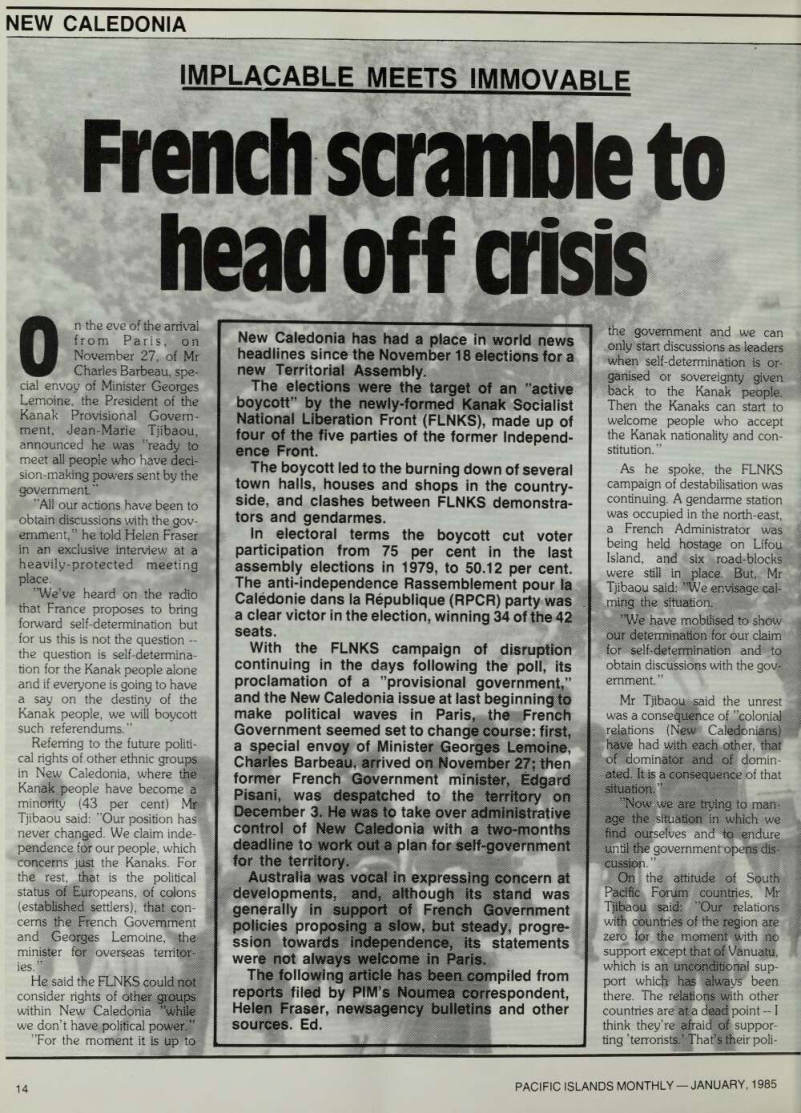
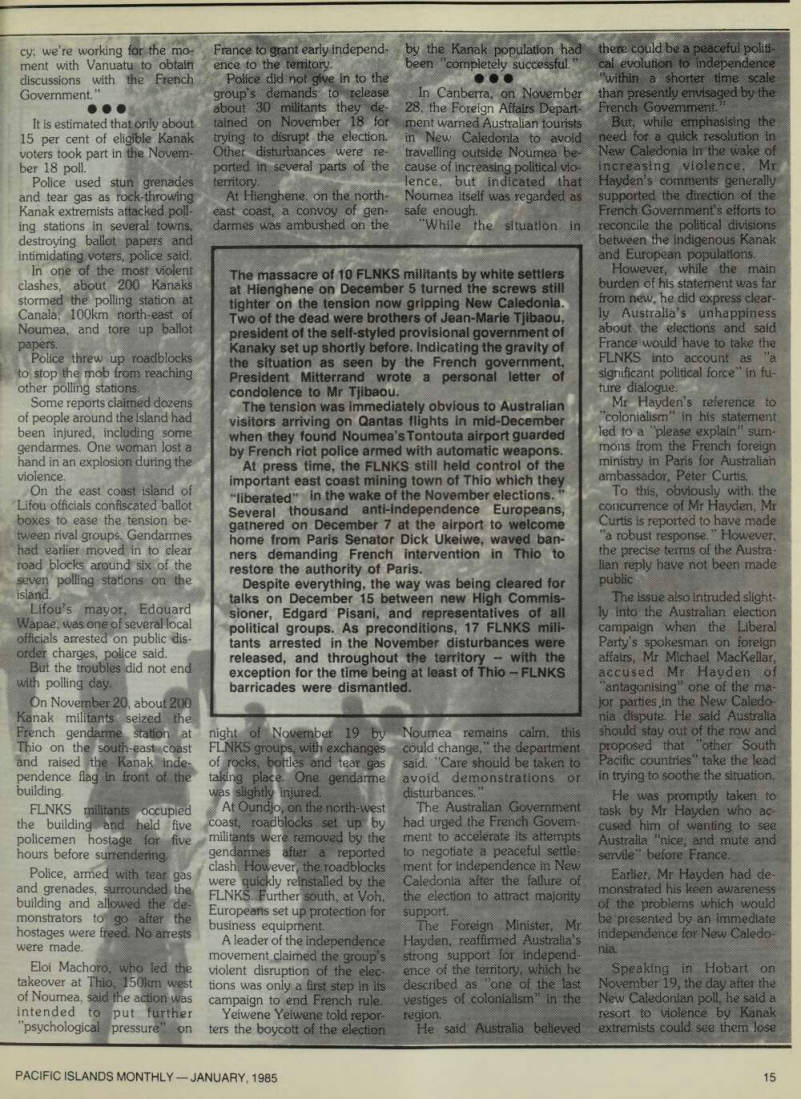
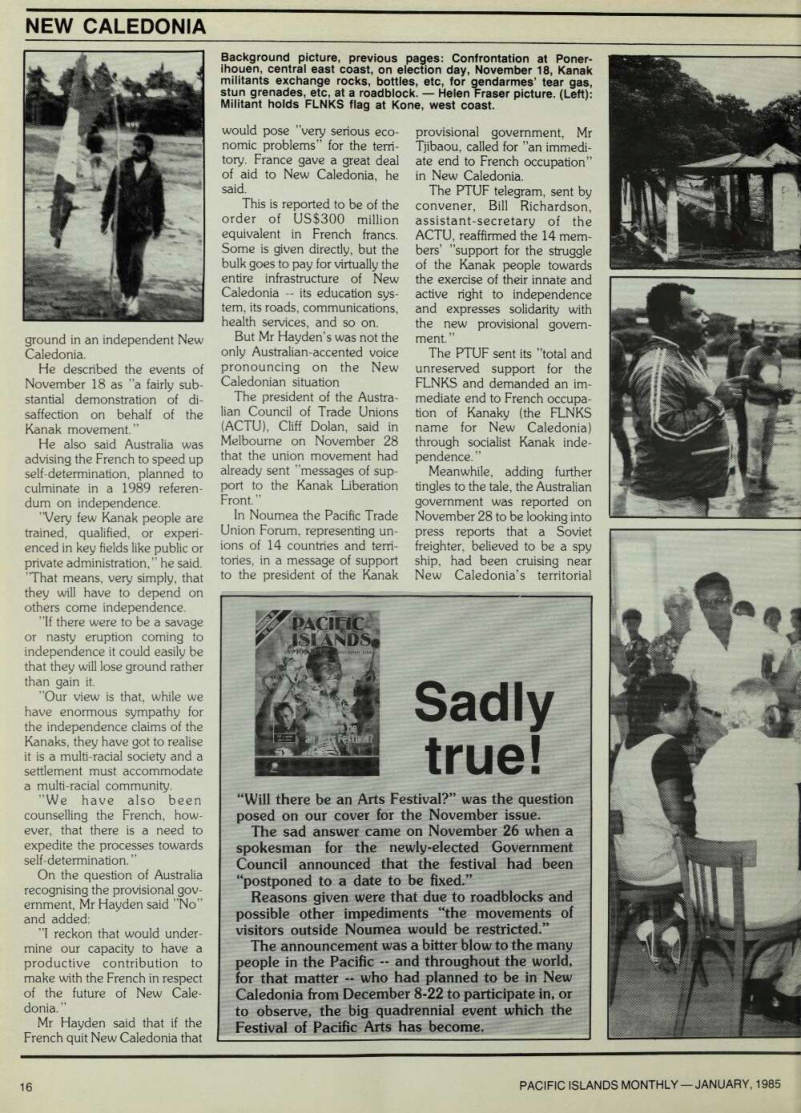
Background picture, previous pages: Confrontation at Poner ihouen, central east coast, on election day, November 18, Kanak militants exchange rocks, bottles, etc, for gendarmes’ tear gas, stun grenades, etc, at a roadblock. Helen Fraser picture. (Left): Militant holds FLNKS flag at Kone, west coast.
Sadly
true!
“Will there be an Arts Festival?” was the question posed on our cover for the November issue.
The sad answer came on November 26 when a spokesman for the newly-elected Government Council announced that the festival had been “postponed to a date to be fixed.”
Reasons given were that due to roadblocks and possible other impediments “the movements of visitors outside Noumea would be restricted.”
The announcement was a bitter blow to the many people in the Pacific -- and throughout the world, for that matter - who had planned to be in New Caledonia from December 8-22 to participate in, or to observe, the big quadrennial event which the Festival of Pacific Arts has become.
waters over the previous few
days. Given Russia’s increasing maritime activity in the Pacific, this, if true, would surprise few. • • • The recent turn of events in New Caledonia has abruptly ended a period of effectively bipartisan policy towards the territory in the National Assem bly in Paris.
It coincided with a series of embarrassments to the govern ment over its policies towards the African country, Chad.
The former French president, Valery Giscard d’Estaing, used his first speech in the assembly since his recent election as a deputy to attack the govern ment of President Mitterrand over its handling of the New Caledonia issue.
He claimed that French resi dents of the territory were being denied their democratic rights while the government sought to negotiate with Kanak militants.
Mr Lemoine responded that the only possible road forward was that of discussions among all the parties to determine ’’the paths of evolution of the terri tory. ”
He said the government must ’’act quickly to find solutions to a new situation in a way that will guarantee the destiny of New Caledonia in liaison with France and ensuring the de fence of French interests.”
He blamed the troubles in the territory on the actions of the previous conservative gov ernment which, he said, had encouraged the development of the independence move ment.
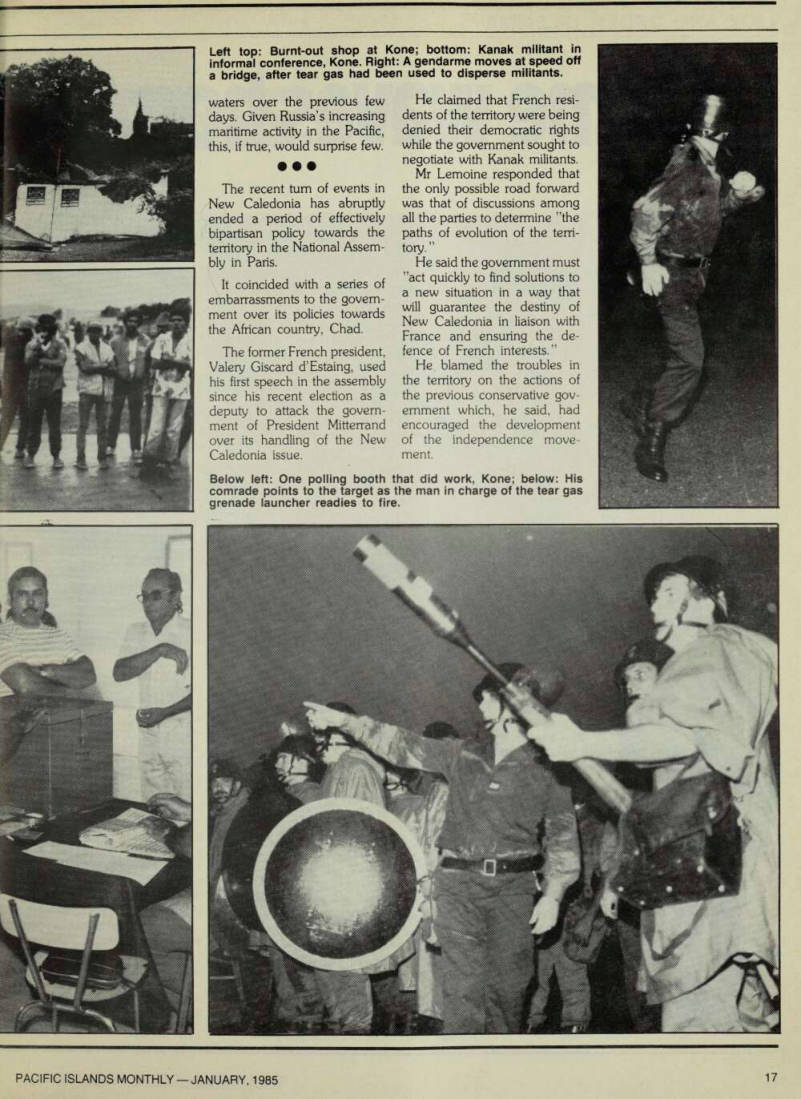
Left top: Burnt-out shop at Kone; bottom: Kanak militant in informal conference, Kone. Right: A gendarme moves at speed off a bridge, after tear gas had been used to disperse militants.
Below left: One polling booth that did work, Kone; below: His comrade points to the target as the man in charge of the tear gas grenade launcher readies to fire.
Crime waves bog PNC Progress
Law And Order Dilemma
Papua New Guinea is impaled firmly on the horns of a dreadful dilemma: the desire to ’’develop” and the task of cop ing with the crime spin-off of that program.
Both elements are on a para llel course, and accelerating.
The government of Michael Somare has taken urgent action to quell the law-and-order problems, but nobody is predic ting that the rash of crimes of violence will disappear over night.
Crime was a nagging worry to residents of the capital, Port Moresby, but took over the public consciousness with a vengeance in September when
A violent pack rape of a group of women, including a nine-year-old schoolgirl, brought to an outraged head the growing public disquiet in Papua New Guinea over the spread of lawless ness within the community.
For years now residents of the bigger towns, and‘particularly Port Moresby, have fenced themselves into their houses against marauding groups of bush lads attracted by the bright lights of modern living. Advertisements seeking expatriate, and local, executives have come to include guard dogs, ”Stalag lights” and high barbed-wire fences as inducements ranked alongside school fees and generous leave.
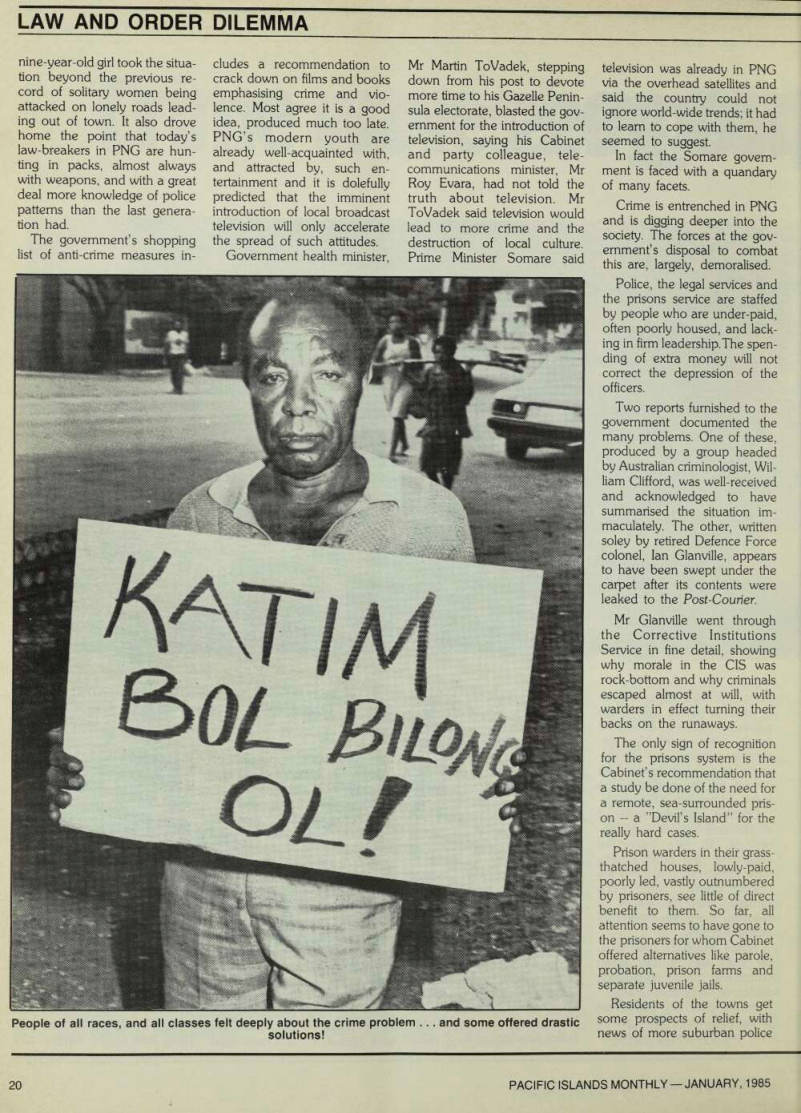
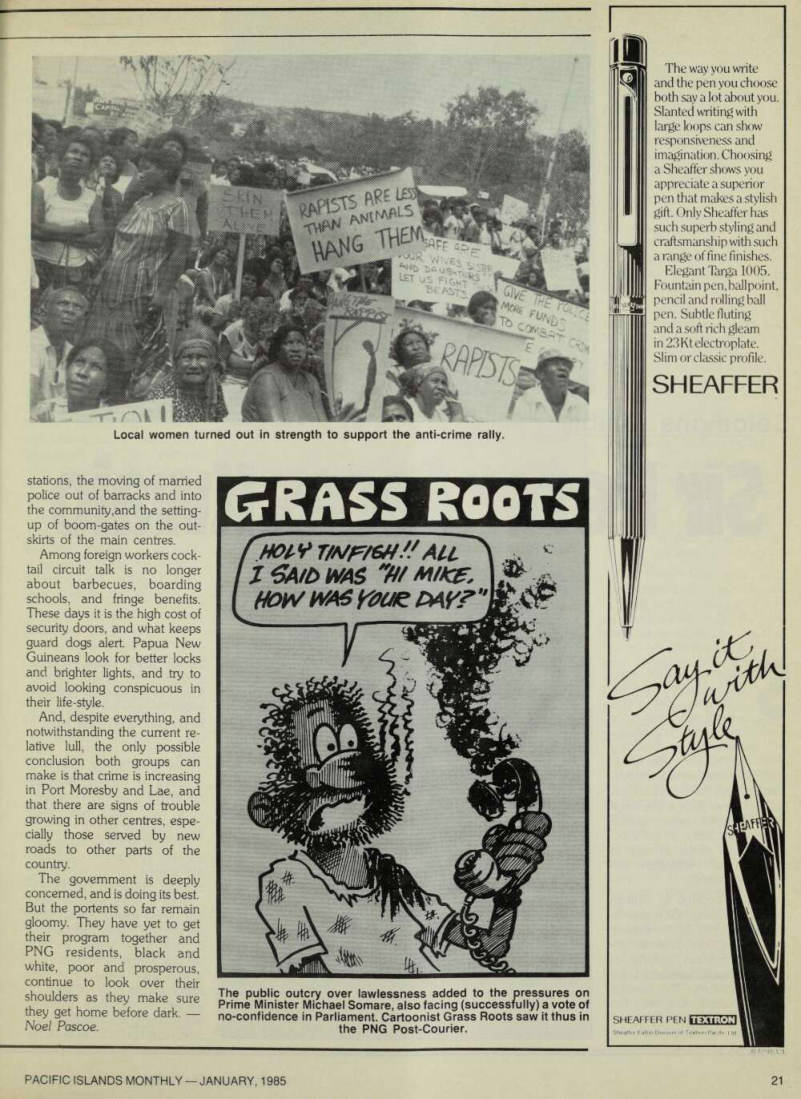
The rape produced one of the largest public demonstrations thus far seen in Port Moresby, with citizens of all races parading with signs demanding castration for rapists and reintroduction of the death penalty.
The government responded swiftly but, as this report from Noel Pascoe, supplemented with material by PIM staff writers, shows, Prime Minister Somare, his Cabinet and his law enforcement officers have a huge, continuing task ahead of them.
a pack of youths slipped past security guards, over a wire fence, past neighbors, and into a house where they terrorised two women and a girl.
The victims were raped re peatedly, including the girl who was of only primary school age.
A Pack rapes of that descrip- Hon are not unknown in W the big cities of Western T countries, where the jungles B are made of concrete and the W animals stalk prey of their own species. But they are very much a jolt in PNG. The nation rose up in anger and indignation. The Pnme Minister himself joined the outcry,
speaking of the alarm felt about leaving a wife and children alone in such surroundings.
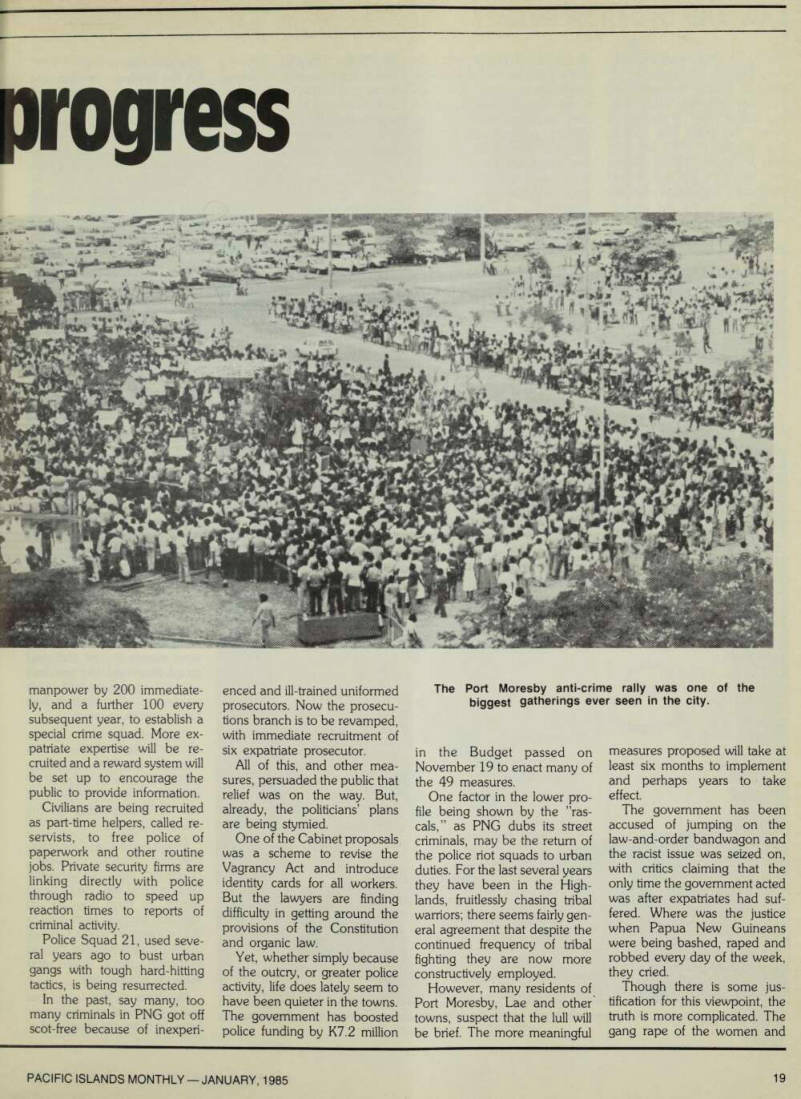
Waves of protest rolled through Fort Moresby society, crossing racial and economic strata. A crowd estimated at up to 25,000 people marched to the seat of PNG’s government, at Waigani, and angrily called on Mr Somare and the govern ment to do something about the society that had created such criminals.
Mr Somare told the crowd he favored hanging for pack rap ists. Clearly moved by the public outrage, the level of which had not previously been seen in Port Moresby, the prime minister called into action a committee of top public ser vants and leaders of business and community groups to give him an emergency plan.
After working day and night they produced a list of 23 measures to put before Cabi net. The Cabinet met, approved some, ignored others, and added their own to come up with a law-and-order campaign of 49 steps.
Hanging, much-favored by some sections of the commun ity, was not among them, although it was listed as a possibility if the 49 steps did not produce the desired effect.
But convicted rapists, and other violent criminals, will be flogged, in public, as happens in Tonga. Defence Force sol diers will be called out to help police if they are needed, and the importation of guns will be banned.
To catch the criminals Cabi net decided on boosting police
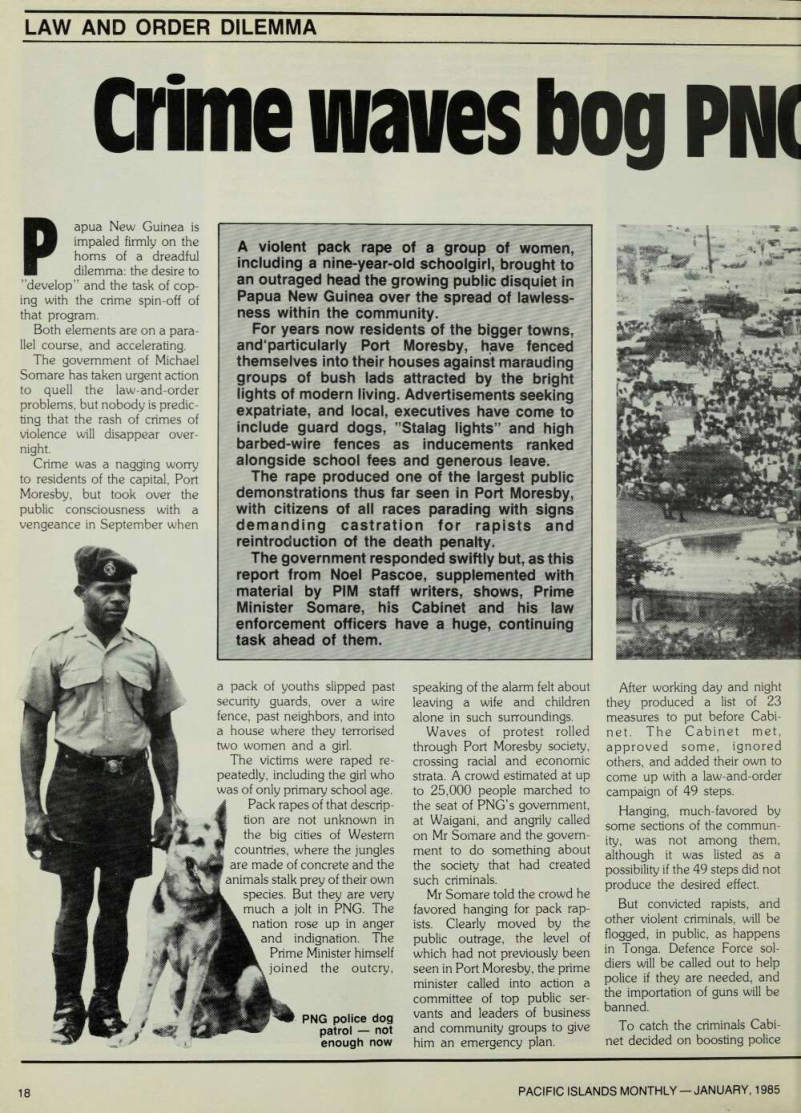
PNG police dog patrol not enough now
manpower by 200 immediate ly, and a further 100 every subsequent year, to establish a special crime squad. More ex patriate expertise will be re cruited and a reward system will be set up to encourage the public to provide information.
Civilians are being recruited as part-time helpers, called re servists, to free police of paperwork and other routine jobs. Private security firms are linking directly with police through radio to speed up reaction times to reports of criminal activity.
Police Squad 21, used seve ral years ago to bust urban gangs with tough hard-hitting tactics, is being resurrected.
In the past, say many, too many criminals in PNG got off scot-free because of inexpert
enced and ill-trained uniformed prosecutors. Now the prosecu tions branch is to be revamped, with immediate recruitment of six expatriate prosecutor.
All of this, and other mea sures, persuaded the public that relief was on the way. But, already, the politicians’ plans are being stymied.
One of the Cabinet proposals was a scheme to revise the Vagrancy Act and introduce identity cards for all workers.
But the lawyers are finding difficulty in getting around the provisions of the Constitution and organic law.
Yet, whether simply because of the outcry, or greater police activity, life does lately seem to have been quieter in the towns.
The government has boosted police funding by K 7.2 million
in the Budget passed on November 19 to enact many of the 49 measures.
One factor in the lower pro file being shown by the ’’ras cals,” as PNG dubs its street criminals, may be the return of the police riot squads to urban duties. For the last several years they have been in the High lands, fruitlessly chasing tribal warriors; there seems fairly gen eral agreement that despite the continued frequency of tribal fighting they are now more constructively employed.
However, many residents of Port Moresby, Lae and other towns, suspect that the lull will be brief. The more meaningful
measures proposed will take at least six months to implement and perhaps years to take effect.
The government has been accused of jumping on the law-and-order bandwagon and the racist issue was seized on, with critics claiming that the only time the government acted was after expatriates had suf fered. Where was the justice when Papua New Guineans were being bashed, raped and robbed every day of the week, they cried.
Though there is some jus tification for this viewpoint, the truth is more complicated. The gang rape of the women and
The Port Moresby anti-crime rally was one of the biggest gatherings ever seen in the city.
nine-year-old girl took the situa-
nine-year-old girl took the situation beyond the previous record of solitary women being attacked on lonely roads leading out of town. It also drove home the point that today’s law-breakers in PNG are hunting in packs, almost always with weapons, and with a great deal more knowledge of police patterns than the last generation had.
The government’s shopping list of anti-crime measures in-
eludes a recommendation to crack down on films and books emphasising crime and vio lence. Most agree it is a good idea, produced much too late.
PNG’s modern youth are already well-acquainted with, and attracted by, such en tertainment and it is dolefully predicted that the imminent introduction of local broadcast television will only accelerate the spread of such attitudes.
Government health minister,
Mr Martin ToVadek, stepping down from his post to devote more time to his Gazelle Penin sula electorate, blasted the gov ernment for the introduction of television, saying his Cabinet and party colleague, tele communications minister, Mr Roy Evara, had not told the truth about television. Mr ToVadek said television would lead to more crime and the destruction of local culture.
Prime Minister Somare said
television was already in PNG via the overhead satellites and said the country could not ignore world-wide trends; it had to learn to cope with them, he seemed to suggest.
In fact the Somare govern ment is faced with a quandary of many facets.
Crime is entrenched in PNG and is digging deeper into the society. The forces at the gov ernment’s disposal to combat this are, largely, demoralised.
Police, the legal services and the prisons service are staffed by people who are under-paid, often poorly housed, and lack ing in firm leadership. The spen ding of extra money will not correct the depression of the officers.
Two reports furnished to the government documented the many problems. One of these, produced by a group headed by Australian criminologist, Wil liam Clifford, was well-received and acknowledged to have summarised the situation im maculately. The other, written soley by retired Defence Force colonel, lan Glanville, appears to have been swept under the carpet after its contents were leaked to the Post-Courier.
Mr Glanville went through the Corrective Institutions Service in fine detail, showing why morale in the CIS was rock-bottom and why criminals escaped almost at will, with warders in effect turning their backs on the runaways.
The only sign of recognition for the prisons system is the Cabinet’s recommendation that a study be done of the need for a remote, sea-surrounded pris on - a ’’Devil’s Island” for the really hard cases.
Prison warders in their grass thatched houses, lowly-paid, poorly led, vastly outnumbered by prisoners, see little of direct benefit to them. So far, all attention seems to have gone to the prisoners for whom Cabinet offered alternatives like parole, probation, prison farms and separate juvenile jails.
Residents of the towns get some prospects of relief, with news of more suburban police
People of all races, and all classes felt deeply about the crime problem ... and some offered drastic solutions!
stations, the moving of married police out of barracks and into the community,and the setting up of boom-gates on the out skirts of the main centres.
Among foreign workers cock tail circuit talk is no longer about barbecues, boarding schools, and fringe benefits.
These days it is the high cost of security doors, and what keeps guard dogs alert. Papua New Guineans look for better locks and brighter lights, and try to avoid looking conspicuous in their life-style.
And, despite everything, and notwithstanding the current re lative lull, the only possible conclusion both groups can make is that crime is increasing in Port Moresby and Lae, and that there are signs of trouble growing in other centres, espe cially those served by new roads to other parts of the country.
The government is deeply concerned, and is doing its best.
But the portents so far remain gloomy. They have yet to get their program together and PNG residents, black and white, poor and prosperous, continue to look over their shoulders as they make sure they get home before dark.
Noel Pascoe.
Local women turned out in strength to support the anti-crime rally
The public outcry over lawlessness added to the pressures on Prime Minister Michael Somare, also facing (successfully) a vote of no-confidence in Parliament. Cartoonist Grass Roots saw it thus in the PNG Post-Courier.
Advertisements & other items, p. 21 (1 item)
Sheaffer
1 The way you write and the pen you choose both say a lot about you.
Slanted writing with large loops can show responsiveness and imagination. Choosing a Sheaffer shows you appreciate a superior pen that makes a stylish gift. Only Sheaffer has such superb styling and craftsmanship with such a range of fine finishes.
Elegant Thrga 1005.
Fountain pen, ballpoint, pencil and rolling ball pen. Subtle fluting and a soft rich gleam in 23 Kt electroplate.
Slim or classic profile.
SHEAFFER
SHEAFFER PEN ki+Aiil
challenge
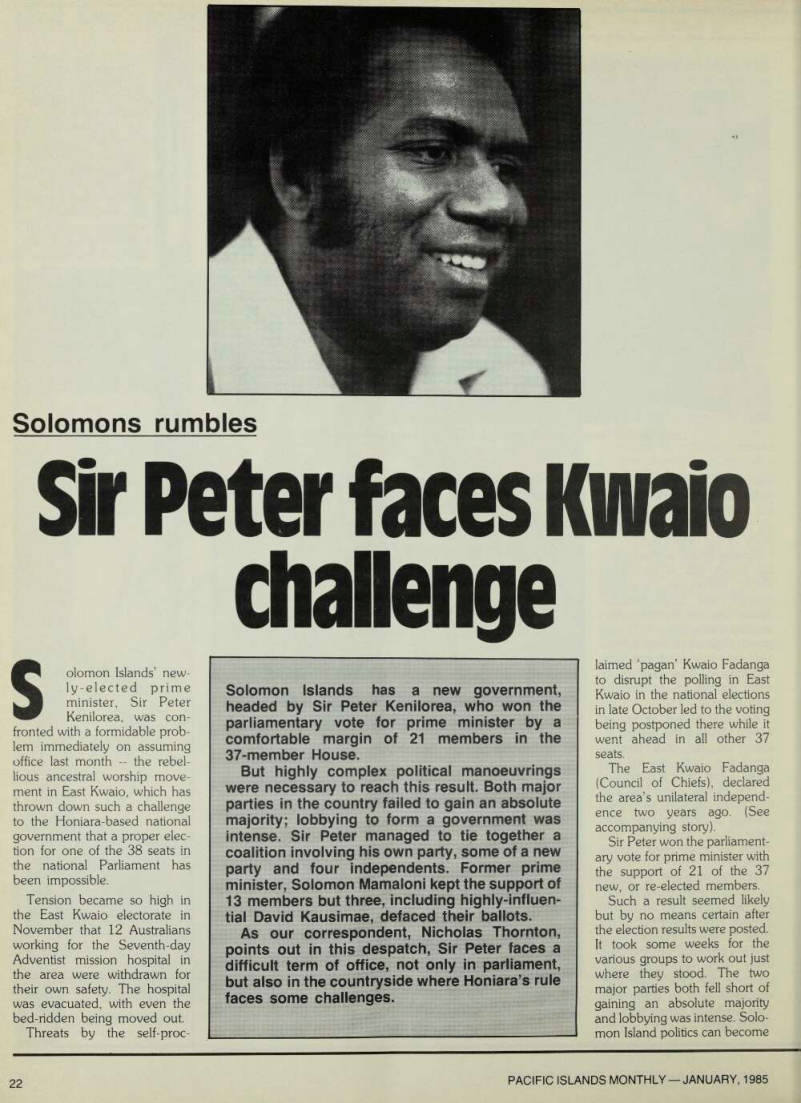
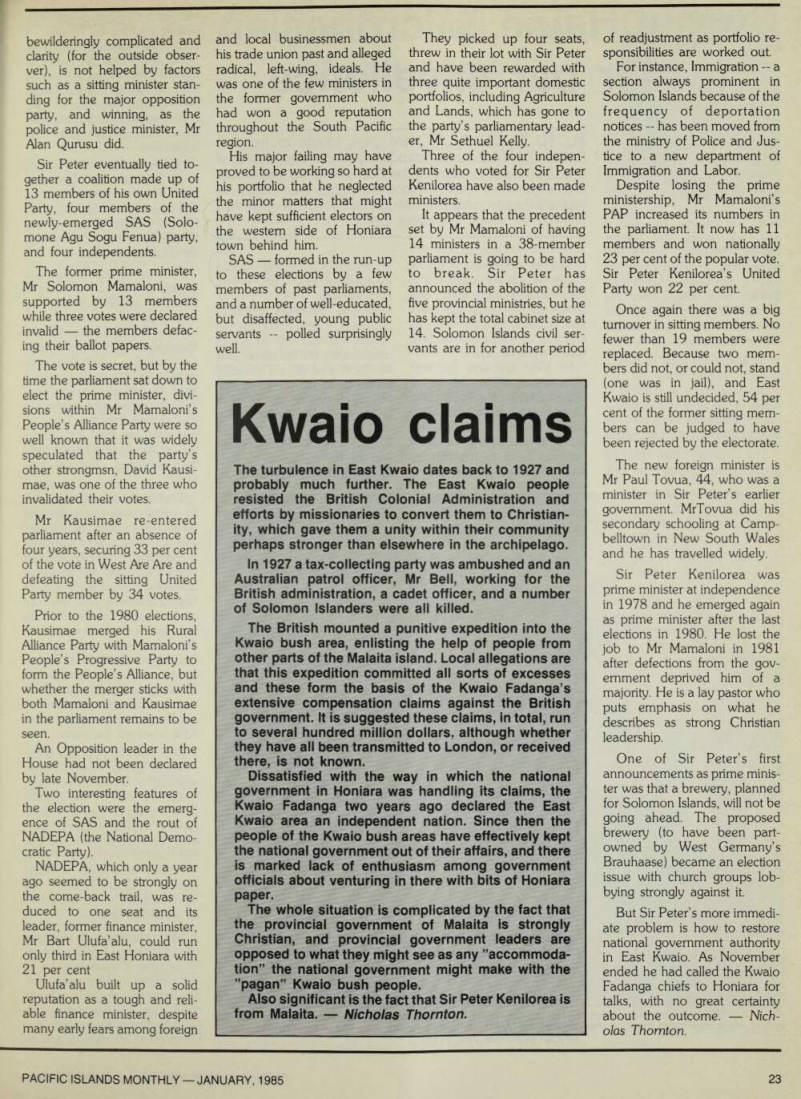
Solomons rumbles
Sir Peter faces Kwaio challenge
Solomon Islands’ new ly-elected prime minister, Sir Peter Kenilorea, was con fronted with a formidable prob lem immediately on assuming office last month -- the rebel lious ancestral worship move ment in East Kwaio, which has thrown down such a challenge to the Honiara-based national government that a proper elec tion for one of the 38 seats in the national Parliament has been impossible.
Tension became so high in the East Kwaio electorate in November that 12 Australians working for the Seventh-day Adventist mission hospital in the area were withdrawn for their own safety. The hospital was evacuated, with even the bed-ridden being moved out.
Threats by the self-proc-
Solomon Islands has a new government, headed by Sir Peter Kenilorea, who won the parliamentary vote for prime minister by a comfortable margin of 21 members in the 37-member House.
But highly complex political manoeuvrings were necessary to reach this result. Both major parties in the country failed to gain an absolute majority; lobbying to form a government was intense. Sir Peter managed to tie together a coalition involving his own party, some of a new party and four independents. Former prime minister, Solomon Mamaloni kept the support of 13 members but three, including hlghly-influen tial David Kausimae, defaced their ballots.
As our correspondent, Nicholas Thornton, points out in this despatch, Sir Peter faces a difficult term of office, not only in parliament, but also in the countryside where Honiara’s rule faces some challenges.
laimed ‘pagan’ Kwaio Fadanga to disrupt the polling in East Kwaio in the national elections in late October led to the voting being postponed there while it went ahead in all other 37 seats.
The East Kwaio Fadanga (Council of Chiefs), declared the area’s unilateral independ ence two years ago. (See accompanying story).
Sir Peter won the parliament ary vote for prime minister with the support of 21 of the 37 new, or re-elected members.
Such a result seemed likely but by no means certain after the election results were posted.
It took some weeks for the various groups to work out just where they stood. The two major parties both fell short of gaining an absolute majority and lobbying was intense. Solo mon Island politics can become
bewilderingly complicated and clarity (for the outside obser ver), is not helped by factors such as a sitting minister stan ding for the major opposition party, and winning, as the police and justice minister, Mr Alan Qurusu did.
Sir Peter eventually tied to gether a coalition made up of 13 members of his own United Party, four members of the newly-emerged SAS (Solo mone Agu Sogu Fenua) party, and four independents.
The former prime minister, Mr Solomon Mamaloni, was supported by 13 members while three votes were declared invalid the members defac ing their ballot papers.
The vote is secret, but by the time the parliament sat down to elect the prime minister, divi sions within Mr Mamaloni’s People’s Alliance Party were so well known that it was widely speculated that the party’s other strongmsn, David Kausi mae, was one of the three who invalidated their votes.
Mr Kausimae re-entered parliament after an absence of four years, securing 33 per cent of the vote in West Are Are and defeating the sitting United Party member by 34 votes.
Prior to the 1980 elections, Kausimae merged his Rural Alliance Party with Mamaloni’s People’s Progressive Party to form the People’s Alliance, but whether the merger sticks with both Mamaloni and Kausimae in the parliament remains to be seen.
An Opposition leader in the House had not been declared by late November.
Two interesting features of the election were the emerg ence of SAS and the rout of NADEPA (the National Demo cratic Party).
NADEPA, which only a year ago seemed to be strongly on the come-back trail, was re duced to one seat and its leader, former finance minister, Mr Bart Ulufa’alu, could run only third in East Honiara with 21 per cent Ulufa’alu built up a solid reputation as a tough and reli able finance minister, despite many early fears among foreign
and local businessmen about his trade union past and alleged radical, left-wing, ideals. He was one of the few ministers in the former government who had won a good reputation throughout the South Pacific region.
His major failing may have proved to be working so hard at his portfolio that he neglected the minor matters that might have kept sufficient electors on the western side of Honiara town behind him.
SAS formed in the run-up to these elections by a few members of past parliaments, and a number of well-educated, but disaffected, young public servants - polled surprisingly well.
They picked up four seats, threw in their lot with Sir Peter and have been rewarded with three quite important domestic portfolios, including Agriculture and Lands, which has gone to the party’s parliamentary lead er, Mr Sethuel Kelly.
Three of the four indepen dents who voted for Sir Peter Kenilorea have also been made ministers.
It appears that the precedent set by Mr Mamaloni of having 14 ministers in a 38-member parliament is going to be hard to break. Sir Peter has announced the abolition of the five provincial ministries, but he has kept the total cabinet size at 14. Solomon Islands civil ser vants are in for another period
of readjustment as portfolio re sponsibilities are worked out.
For instance, Immigration a section always prominent in Solomon Islands because of the frequency of deportation notices - has been moved from the ministry of Police and Jus tice to a new department of Immigration and Labor.
Despite losing the prime ministership, Mr Mamaloni’s PAP increased its numbers in the parliament. It now has 11 members and won nationally 23 per cent of the popular vote.
Sir Peter Kenilorea’s United Party won 22 per cent.
Once again there was a big turnover in sitting members. No fewer than 19 members were replaced. Because two mem bers did not, or could not, stand (one was in jail), and East Kwaio is still undecided, 54 per cent of the former sitting mem bers can be judged to have been rejected by the electorate.
The new foreign minister is Mr Paul Tovua, 44, who was a minister in Sir Peter’s earlier government. MrTovua did his secondary schooling at Camp belltown in New South Wales and he has travelled widely.
Sir Peter Kenilorea was prime minister at independence in 1978 and he emerged again as prime minister after the last elections in 1980. He lost the job to Mr Mamaloni in 1981 after defections from the gov ernment deprived him of a majority. He is a lay pastor who puts emphasis on what he describes as strong Christian leadership.
One of Sir Peter’s first announcements as prime minis ter was that a brewery, planned for Solomon Islands, will not be going ahead. The proposed brewery (to have been part owned by West Germany’s Brauhaase) became an election issue with church groups lob bying strongly against it.
But Sir Peter’s more immedi ate problem is how to restore national government authority in East Kwaio. As November ended he had called the Kwaio Fadanga chiefs to Honiara for talks, with no great certainty
about the outcome.
Nich
olas Thornton.
Kwaio claims
The turbulence in East Kwaio dates back to 1927 and probably much further. The East Kwaio people resisted the British Colonial Administration and efforts by missionaries to convert them to Christian ity, which gave them a unity within their community perhaps stronger than elsewhere in the archipelago.
In 1927 a tax-collecting party was ambushed and an Australian patrol officer, Mr Bell, working for the British administration, a cadet officer, and a number of Solomon Islanders were all killed.
The British mounted a punitive expedition into the Kwaio bush area, enlisting the help of people from other parts of the Malaita island. Local allegations are that this expedition committed all sorts of excesses and these form the basis of the Kwaio Fadanga’s extensive compensation claims against the British government. It is suggested these claims, in total, run to several hundred million dollars, although whether they have all been transmitted to London, or received there, is not known.
Dissatisfied with the way in which the national government in Honiara was handling its claims, the Kwaio Fadanga two years ago declared the East Kwaio area an independent nation. Since then the people of the Kwaio bush areas have effectively kept the national government out of their affairs, and there is marked lack of enthusiasm among government officials about venturing in there with bits of Honiara paper.
The whole situation is complicated by the fact that the provincial government of Malaita is strongly Christian, and provincial government leaders are opposed to what they might see as any ’’accommoda tion” the national government might make with the ’’pagan” Kwaio bush people.
Also significant is the fact that Sir Peter Kenilorea is
from Malaita.
Nicholas Thornton.
Dwight Heine, Micronesian
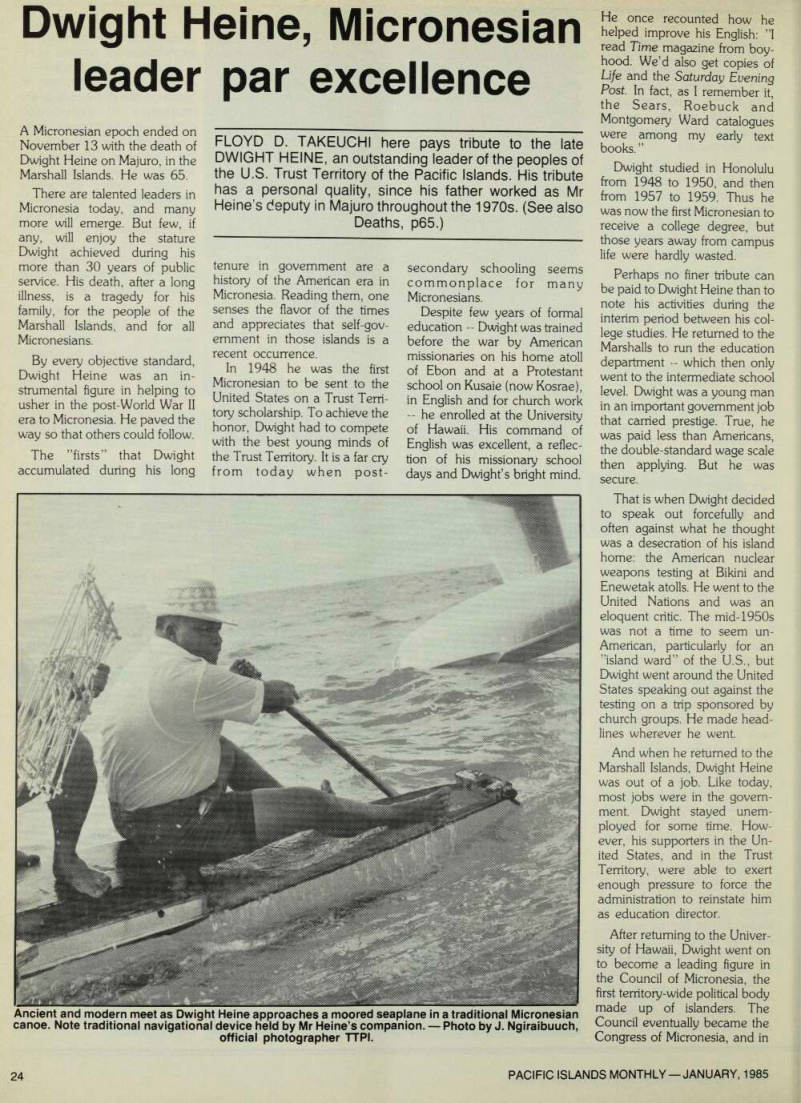
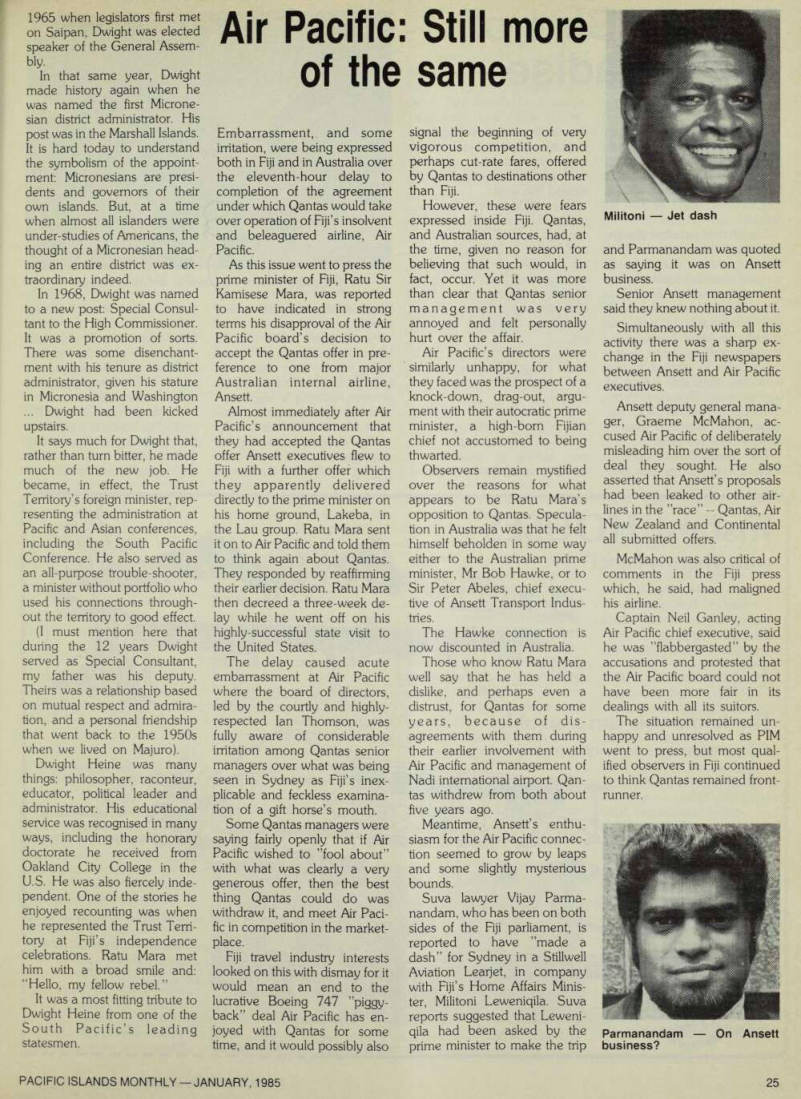
leader par excellence
A Micronesian epoch ended on November 13 with the death of Dwight Heine on Majuro, in the Marshall Islands. He was 65.
There are talented leaders in Micronesia today, and many more will emerge. But few, if any, will enjoy the stature Dwight achieved during his more than 30 years of public service. His death, after a long illness, is a tragedy for his family, for the people of the Marshall Islands, and for all Micronesians.
By every objective standard, Dwight Heine was an in strumental figure in helping to usher in the post-World War II era to Micronesia. He paved the way so that others could follow.
The ’’firsts” that Dwight accumulated during his long
FLOYD D. TAKEUCHI here pays tribute to the late DWIGHT HEINE, an outstanding leader of the peoples of the U.S. Trust Territory of the Pacific Islands. His tribute has a personal quality, since his father worked as Mr Heine’s deputy in Majuro throughout the 19705. (See also Deaths, p 65.)
tenure in government are a history of the American era in Micronesia. Reading them, one senses the flavor of the times and appreciates that self-gov ernment in those islands is a recent occurrence.
In 1948 he was the first Micronesian to be sent to the United States on a Trust Terri tory scholarship. To achieve the honor, Dwight had to compete with the best young minds of the Trust Territory. It is a far cry from today when post
secondary schooling seems commonplace for many Micronesians.
Despite few years of formal education - Dwight was trained before the war by American missionaries on his home atoll of Ebon and at a Protestant school on Kusaie (now Kosrae), in English and for church work - he enrolled at the University of Hawaii. His command of English was excellent, a reflec tion of his missionary school days and Dwight’s bright mind.
He once recounted how he helped improve his English: ”1 read Time magazine from boy hood. We’d also get copies of Life and the Saturday Evening Post. In fact, as I remember it, the Sears, Roebuck and Montgomery Ward catalogues were among my early text books. ”
Dwight studied in Honolulu from 1948 to 1950, and then from 1957 to 1959. Thus he was now the first Micronesian to receive a college degree, but those years away from campus life were hardly wasted.
Perhaps no finer tribute can be paid to Dwight Heine than to note his activities during the interim period between his col lege studies. He returned to the Marshalls to run the education department which then only went to the intermediate school level. Dwight was a young man in an important government job that carried prestige. True, he was paid less than Americans, the double-standard wage scale then applying. But he was secure.
That is when Dwight decided to speak out forcefully and often against what he thought was a desecration of his island home: the American nuclear weapons testing at Bikini and Enewetak atolls. He went to the United Nations and was an eloquent critic. The mid-1950s was not a time to seem un- American, particularly for an ’’island ward” of the U.S., but Dwight went around the United States speaking out against the testing on a trip sponsored by church groups. He made head lines wherever he went.
And when he returned to the Marshall Islands, Dwight Heine was out of a job. Like today, most jobs were in the govern ment. Dwight stayed unem ployed for some time. How ever, his supporters in the Un ited States, and in the Trust Territory, were able to exert enough pressure to force the administration to reinstate him as education director.
After returning to the Univer sity of Hawaii, Dwight went on to become a leading figure in the Council of Micronesia, the first territory-wide political body made up of islanders. The Council eventually became the Congress of Micronesia, and in
Ancient and modern meet as Dwight Heine approaches a moored seaplane in a traditional Micronesian canoe. Note traditional navigational device held by Mr Heine’s companion. Photo by J. Ngiraibuuch, official photographer TIPI.
1965 when legislators first met on Saipan, Dwight was elected speaker of the General Assem bly.
In that same year, Dwight made history again when he was named the first Microne sian district administrator. His post was in the Marshall Islands.
It is hard today to understand the symbolism of the appoint ment: Micronesians are presi dents and governors of their own islands. But, at a time when almost all islanders were under-studies of Americans, the thought of a Micronesian head ing an entire district was ex traordinary indeed.
In 1968, Dwight was named to a new post: Special Consul tant to the High Commissioner.
It was a promotion of sorts.
There was some disenchant ment with his tenure as district administrator, given his stature in Micronesia and Washington ... Dwight had been kicked upstairs.
It says much for Dwight that, rather than turn bitter, he made much of the new job. He became, in effect, the Trust Territory’s foreign minister, rep resenting the administration at Pacific and Asian conferences, including the South Pacific Conference. He also served as an all-purpose trouble-shooter, a minister without portfolio who used his connections through out the territory to good effect. (I must mention here that during the 12 years Dwight served as Special Consultant, my father was his deputy.
Theirs was a relationship based on mutual respect and admira tion, and a personal friendship that went back to the 1950 s when we lived on Majuro).
Dwight Heine was many things: philosopher, raconteur, educator, political leader and administrator. His educational service was recognised in many ways, including the honorary doctorate he received from Oakland City College in the U.S. He was also fiercely inde pendent. One of the stories he enjoyed recounting was when he represented the Trust Terri tory at Fiji’s independence celebrations. Ratu Mara met him with a broad smile and: “Hello, my fellow rebel.”
It was a most fitting tribute to Dwight Heine from one of the South Pacific’s leading statesmen.
Air Pacific: Still more
of the same
Embarrassment, and some irritation, were being expressed both in Fiji and in Australia over the eleventh-hour delay to completion of the agreement under which Qantas would take over operation of Fiji’s insolvent and beleaguered airline, Air Pacific.
As this issue went to press the prime minister of Fiji, Ratu Sir Kamisese Mara, was reported to have indicated in strong terms his disapproval of the Air Pacific board’s decision to accept the Qantas offer in pre ference to one from major Australian internal airline, Ansett.
Almost immediately after Air Pacific’s announcement that they had accepted the Qantas offer Ansett executives flew to Fiji with a further offer which they apparently delivered directly to the prime minister on his home ground, Lakeba, in the Lau group. Ratu Mara sent it on to Air Pacific and told them to think again about Qantas.
They responded by reaffirming their earlier decision. Ratu Mara then decreed a three-week de lay while he went off on his highly-successful state visit to the United States.
The delay caused acute embarrassment at Air Pacific where the board of directors, led by the courtly and highly respected lan Thomson, was fully aware of considerable irritation among Qantas senior managers over what was being seen in Sydney as Fiji’s inex plicable and feckless examina tion of a gift horse’s mouth.
Some Qantas managers were saying fairly openly that if Air Pacific wished to ’’fool about” with what was clearly a very generous offer, then the best thing Qantas could do was withdraw it, and meet Air Paci fic in competition in the market place.
Fiji travel industry interests looked on this with dismay for it would mean an end to the lucrative Boeing 747 ’’piggy back” deal Air Pacific has en joyed with Qantas for some time, and it would possibly also
signal the beginning of very vigorous competition, and perhaps cut-rate fares, offered by Qantas to destinations other than Fiji.
However, these were fears expressed inside Fiji. Qantas, and Australian sources, had, at the time, given no reason for believing that such would, in fact, occur. Yet it was more than clear that Qantas senior management was very annoyed and felt personally hurt over the affair.
Air Pacific’s directors were similarly unhappy, for what they faced was the prospect of a knock-down, drag-out, argu ment with their autocratic prime minister, a high-born Fijian chief not accustomed to being thwarted.
Observers remain mystified over the reasons for what appears to be Ratu Mara’s opposition to Qantas. Specula tion in Australia was that he felt himself beholden in some way either to the Australian prime minister, Mr Bob Hawke, or to Sir Peter Abeles, chief execu tive of Ansett Transport Indus tries.
The Hawke connection is now discounted in Australia.
Those who know Ratu Mara well say that he has held a dislike, and perhaps even a distrust, for Qantas for some years, because of dis agreements with them during their earlier involvement with Air Pacific and management of Nadi international airport. Qan tas withdrew from both about five years ago.
Meantime, Ansett’s enthu siasm for the Air Pacific connec tion seemed to grow by leaps and some slightly mysterious bounds.
Suva lawyer Vijay Parma nandam, who has been on both sides of the Fiji parliament, is reported to have ’’made a dash” for Sydney in a Stillwell Aviation Learjet, in company with Fiji’s Home Affairs Minis ter, Militoni Leweniqila. Suva reports suggested that Leweni qila had been asked by the prime minister to make the trip
and Parmanandam was quoted as saying it was on Ansett business.
Senior Ansett management said they knew nothing about it.
Simultaneously with all this activity there was a sharp ex change in the Fiji newspapers between Ansett and Air Pacific executives.
Ansett deputy general mana ger, Graeme McMahon, ac cused Air Pacific of deliberately misleading him over the sort of deal they sought. He also asserted that Ansett’s proposals had been leaked to other air lines in the ’’race” Qantas, Air New Zealand and Continental all submitted offers.
McMahon was also critical of comments in the Fiji press which, he said, had maligned his airline.
Captain Neil Ganley, acting Air Pacific chief executive, said he was ’’flabbergasted” by the accusations and protested that the Air Pacific board could not have been more fair in its dealings with all its suitors.
The situation remained un happy and unresolved as PIM went to press, but most qual ified observers in Fiji continued to think Qantas remained front runner.
Militoni - Jet dash
Parmanandam On Ansett business?
Paradise

New Bird of Paradise
The brighter colors, and lavish design now very much identified with the Pacific are being seen now on the major airports of the region, identifying Air Niugini’s big new Airbus jet airliner.
The bird of paradise design, symbolic both of the airline, and Papua New Guinea itself, spreads over the forward area of the big new jet’s fuselage.
Air Niugini’s executives say that introduction of the new aircraft, on lease from Trans- Australia Airlines, ’’gave us the opportunity to display to the world the spirit and feeling of our services. This new livery conveys to passengers, we hope, the friendly, relaxed cabin service we offer.”
The design on the aircraft features a colorful, graphic rep-
resentation of a male Raggiana bird of paradise, one of the most spectacular of this uniquely PNG species, famous around the world.
The A3OO Airbus has re placed the former Boeing 707 services to PNG from Sydney and Brisbane. The flights oper ate to PNG on Wednesdays and Saturdays, at 9.15 am on both days. Return services from Port Moresby operate on Tues days and Thursdays, at 3.30 pm.
No changes have been made to the Fokker F2B jet services to and from Caims and Port Moresby, On Saturdays the service to Port Moresby continues direct to Singapore, arriving at 8.20 pm, aiming to provide the growing numbers of regional
businessmen with a convenient routing.
Air Niugini’s A3OO has 30 business class seats on every flight, more than many in ternational Boeing 747 services, offering a high stan dard of service for very little more than economy class fares.
Air Niugini’s marketing managers say they are now paying, and will continue to
pay, great attention to business traffic. As trade in the region, from Australia and from Asia, continues to grow the numbers of businessmen travelling the routes to PNG is expected to increase markedly.
Air Niugini plans to make this area of its business a particular target, offering in all areas high quality service and schedules responsive to new needs.
Raggiana Bird of Paradise adorning Airbus
Advertisements & other items, p. 26 (1 item)
Instant HOUSES
with Therma-Panel®
The fully insulated panelisecl building system
George Hudson,
the name' in home building tor 100 years' The established name with new ideas!
The home you can assemble!
Economical fast and simple
Cyclone resistant Ideal tor the South Pacific regions r GH George Hudson have supplied to: • Tonga
• PNG
• Solomon Islands • Tuvalu and • American Samoa George Hudson Homes (Aust.) pty 186 Hume Highway Cabramatta NSW 2166 Australia Tel: (02) 727 9066 Telex: AA25800 Post coupon for details and prices.
of Norfolk
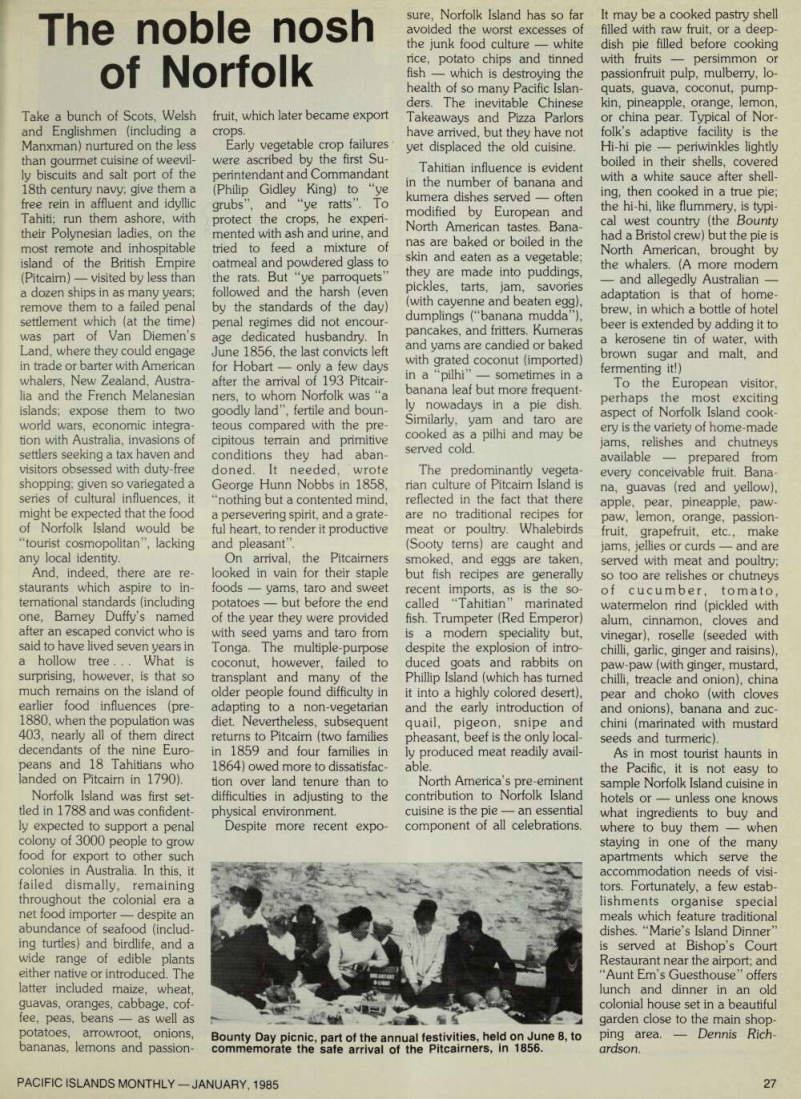
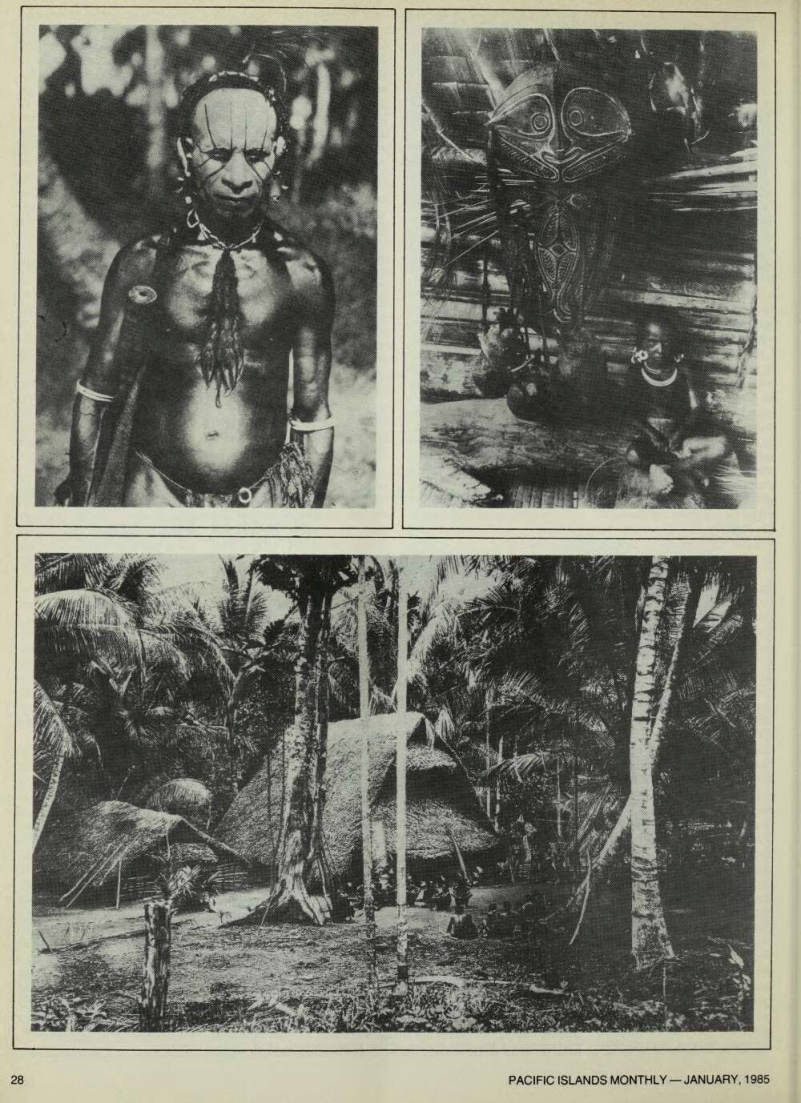
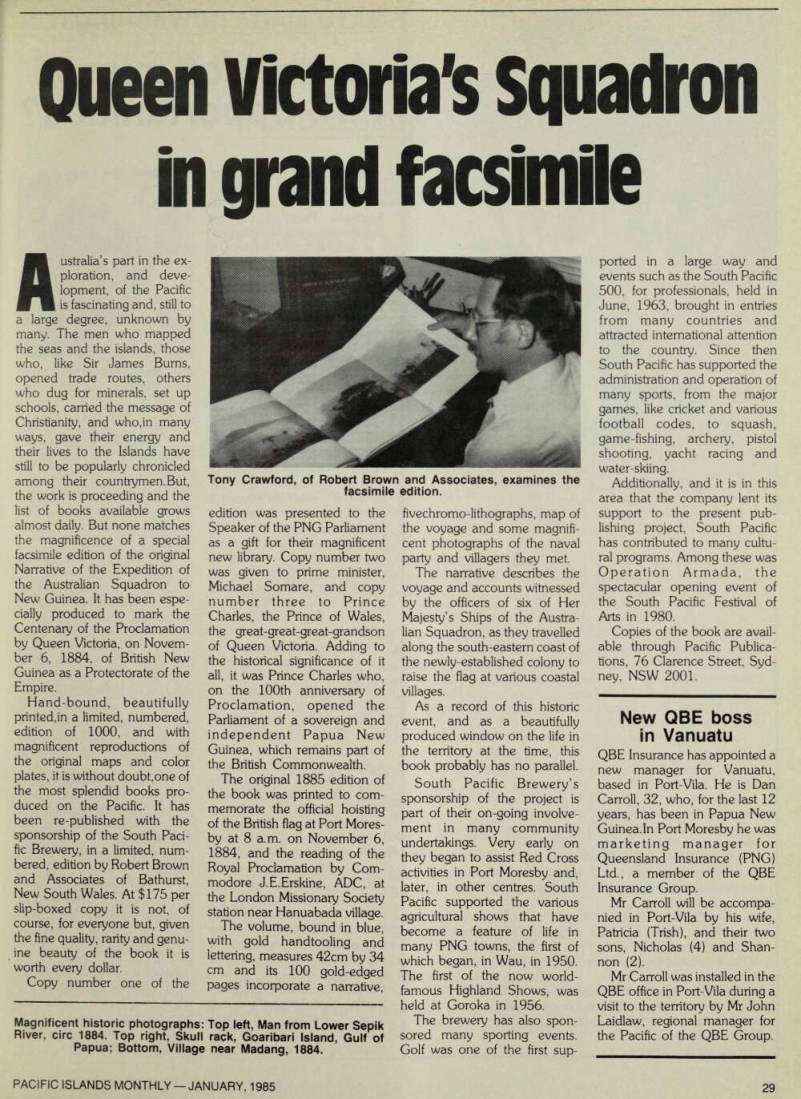
The noble nosh of Norfolk
Take a bunch of Scots, Welsh and Englishmen (including a Manxman) nurtured on the less than gourmet cuisine of weevil ly biscuits and salt port of the 18th century navy; give them a free rein in affluent and idyllic Tahiti; run them ashore, with their Polynesian ladies, on the most remote and inhospitable island of the British Empire (Pitcairn) visited by less than a dozen ships in as many years; remove them to a failed penal settlement which (at the time) was part of Van Diemen’s Land, where they could engage in trade or barter with American whalers, New Zealand, Austra lia and the French Melanesian islands; expose them to two world wars, economic integra tion with Australia, invasions of settlers seeking a tax haven and visitors obsessed with duty-free shopping; given so variegated a series of cultural influences, it might be expected that the food of Norfolk Island would be “tourist cosmopolitan”, lacking any local identity.
And, indeed, there are re staurants which aspire to in ternational standards (including one, Barney Duffy’s named after an escaped convict who is said to have lived seven years in a hollow tree. . . What is surprising, however, is that so much remains on the island of earlier food influences (pre -1880, when the population was 403, nearly all of them direct decendants of the nine Euro peans and 18 Tahitians who landed on Pitcairn in 1790).
Norfolk Island was first set tled in 1788 and was confident ly expected to support a penal colony of 3000 people to grow food for export to other such colonies in Australia. In this, it failed dismally, remaining throughout the colonial era a net food importer despite an abundance of seafood (includ ing turtles) and birdlife, and a wide range of edible plants either native or introduced. The latter included maize, wheat, guavas, oranges, cabbage, cof fee, peas, beans as well as potatoes, arrowroot, onions, bananas, lemons and passion
fruit, which later became export crops.
Early vegetable crop failures were ascribed by the first Su perintendent and Commandant (Philip Gidley King) to “ye grubs”, and “ye ratts”. To protect the crops, he experi mented with ash and urine, and tried to feed a mixture of oatmeal and powdered glass to the rats. But “ye parroquets” followed and the harsh (even by the standards of the day) penal regimes did not encour age dedicated husbandry. In June 1856, the last convicts left for Hobart only a few days after the arrival of 193 Pitcair ners, to whom Norfolk was “a goodly land”, fertile and boun teous compared with the pre cipitous terrain and primitive conditions they had aban doned. It needed, wrote George Hunn Nobbs in 1858, “nothing but a contented mind, a persevering spirit, and a grate ful heart, to render it productive and pleasant”.
On arrival, the Pitcairners looked in vain for their staple foods yams, taro and sweet potatoes but before the end of the year they were provided with seed yams and taro from Tonga. The multiple-purpose coconut, however, failed to transplant and many of the older people found difficulty in adapting to a non-vegetarian diet. Nevertheless, subsequent returns to Pitcairn (two families in 1859 and four families in 1864) owed more to dissatisfac tion over land tenure than to difficulties in adjusting to the physical environment.
Despite more recent expo
sure, Norfolk Island has so far avoided the worst excesses of the junk food culture white rice, potato chips and tinned fish which is destroying the health of so many Pacific Islan ders. The inevitable Chinese Takeaways and Pizza Parlors have arrived, but they have not yet displaced the old cuisine.
Tahitian influence is evident in the number of banana and kumera dishes served often modified by European and North American tastes. Bana nas are baked or boiled in the skin and eaten as a vegetable; they are made into puddings, pickles, tarts, jam, savories (with cayenne and beaten egg), dumplings (“banana mudda”), pancakes, and fritters. Kumeras and yams are candied or baked with grated coconut (imported) in a “pilhi” sometimes in a banana leaf but more frequent ly nowadays in a pie dish.
Similarly, yam and taro are cooked as a pilhi and may be served cold.
The predominantly vegeta rian culture of Pitcairn Island is reflected in the fact that there are no traditional recipes for meat or poultry. Whalebirds (Sooty terns) are caught and smoked, and eggs are taken, but fish recipes are generally recent imports, as is the so called “Tahitian” marinated fish. Trumpeter (Red Emperor) is a modem speciality but, despite the explosion of intro duced goats and rabbits on Phillip Island (which has turned it into a highly colored desert), and the early introduction of quail, pigeon, snipe and pheasant, beef is the only local ly produced meat readily avail able.
North America’s pre-eminent contribution to Norfolk Island cuisine is the pie an essential component of all celebrations.
It may be a cooked pastry shell filled with raw fruit, or a deep dish pie filled before cooking with fruits persimmon or passionfruit pulp, mulberry, lo quats, guava, coconut, pump kin, pineapple, orange, lemon, or china pear. Typical of Nor folk’s adaptive facility is the Hi-hi pie periwinkles lightly boiled in their shells, covered with a white sauce after shell ing, then cooked in a true pie; the hi-hi, like flummery, is typi cal west country (the Bounty had a Bristol crew) but the pie is North American, brought by the whalers. (A more modern and allegedly Australian adaptation is that of home brew, in which a bottle of hotel beer is extended by adding it to a kerosene tin of water, with brown sugar and malt, and fermenting it!) To the European visitor, perhaps the most exciting aspect of Norfolk Island cook ery is the variety of home-made jams, relishes and chutneys available prepared from every conceivable fruit. Bana na, guavas (red and yellow), apple, pear, pineapple, paw paw, lemon, orange, passion fruit, grapefruit, etc., make jams, jellies or curds and are served with meat and poultry; so too are relishes or chutneys of cucumber, tomato, watermelon rind (pickled with alum, cinnamon, cloves and vinegar), roselle (seeded with chilli, garlic, ginger and raisins), paw-paw (with ginger, mustard, chilli, treacle and onion), china pear and choko (with cloves and onions), banana and zuc chini (marinated with mustard seeds and turmeric).
As in most tourist haunts in the Pacific, it is not easy to sample Norfolk Island cuisine in hotels or unless one knows what ingredients to buy and where to buy them when staying in one of the many apartments which serve the accommodation needs of visi tors. Fortunately, a few estab lishments organise special meals which feature traditional dishes. “Marie’s Island Dinner” is served at Bishop’s Court Restaurant near the airport; and “Aunt Em’s Guesthouse” offers lunch and dinner in an old colonial house set in a beautiful garden close to the main shop
ping area.
Dennis Rich-
ardson.
Bounty Day picnic, part of the annual festivities, held on June 8, to commemorate the safe arrival of the Pitcairners, in 1856.
Magnificent historic photographs: Top left, Man from Lower Sepik River, circ 1884. Top right, Skull rack, Goaribari Island, Gulf of Papua; Bottom, Village near Madang, 1884.
Queen Victoria’s Squadron
in grand facsimile
Australia’s part in the ex ploration, and deve lopment, of the Pacific is fascinating and, still to a large degree, unknown by many. The men who mapped the seas and the islands, those who, like Sir James Bums, opened trade routes, others who dug for minerals, set up schools, carried the message of Christianity, and who,in many ways, gave their energy and their lives to the Islands have still to be popularly chronicled among their countrymen. But, the work is proceeding and the list of books available grows almost daily. But none matches the magnificence of a special facsimile edition of the original Narrative of the Expedition of the Australian Squadron to New Guinea. It has been espe cially produced to mark the Centenary of the Proclamation by Queen Victoria, on Novem ber 6, 1884, of British New Guinea as a Protectorate of the Empire.
Hand-bound, beautifully printed,in a limited, numbered, edition of 1000, and with magnificent reproductions of the original maps and color plates, it is without doubt,one of the most splendid books pro duced on the Pacific. It has been re-published with the sponsorship of the South Paci fic Brewery, in a limited, num bered, edition by Robert Brown and Associates of Bathurst, New South Wales. At $175 per slip-boxed copy it is not, of course, for everyone but, given the fine quality, rarity and genu ine beauty of the book it is worth every dollar.
Copy number one of the
edition was presented to the Speaker of the PNG Parliament as a gift for their magnificent new library. Copy number two was given to prime minister, Michael Somare, and copy number three to Prince Charles, the Prince of Wales, the great-great-great-grandson of Queen Victoria. Adding to the historical significance of it all, it was Prince Charles who, on the 100th anniversary of Proclamation, opened the Parliament of a sovereign and independent Papua New Guinea, which remains part of the British Commonwealth.
The original 1885 edition of the book was printed to com memorate the official hoisting of the British flag at Port Mores by at 8 a.m. on November 6, 1884, and the reading of the Royal Proclamation by Com modore J.E.Erskine, ADC, at the London Missionary Society station near Hanuabada village.
The volume, bound in blue, with gold handtooling and lettering, measures 42cm by 34 cm and its 100 gold-edged pages incorporate a narrative,
fivechromo-lithographs, map of the voyage and some magnifi cent photographs of the naval party and villagers they met.
The narrative describes the voyage and accounts witnessed by the officers of six of Her Majesty’s Ships of the Austra lian Squadron, as they travelled along the south-eastern coast of the newly-established colony to raise the flag at various coastal villages.
As a record of this historic event, and as a beautifully produced window on the life in the territory at the time, this book probably has no parallel.
South Pacific Brewery’s sponsorship of the project is part of their on-going involve ment in many community undertakings. Very early on they began to assist Red Cross activities in Port Moresby and, later, in other centres. South Pacific supported the various agricultural shows that have become a feature of life in many PNG towns, the first of which began, in Wau, in 1950.
The first of the now world famous Highland Shows, was held at Goroka in 1956.
The brewery has also spon sored many sporting events.
Golf was one of the first sup
ported in a large way and events such as the South Pacific 500, for professionals, held in June, 1963, brought in entries from many countries and attracted international attention to the country. Since then South Pacific has supported the administration and operation of many sports, from the major games, like cricket and various football codes, to squash, game-fishing, archery, pistol shooting, yacht racing and water-skiing.
Additionally, and it is in this area that the company lent its support to the present pub lishing project, South Pacific has contributed to many cultu ral programs. Among these was Operation Armada, the spectacular opening event of the South Pacific Festival of Arts in 1980.
Copies of the book are avail able through Pacific Publica tions, 76 Clarence Street, Syd ney, NSW 2001.
Tony Crawford, of Robert Brown and Associates, examines the facsimile edition.
New QBE boss
in Vanuatu
QBE Insurance has appointed a new manager for Vanuatu, based in Port-Vila. He is Dan Carroll, 32, who, for the last 12 years, has been in Papua New Guinea. In Port Moresby he was marketing manager for Queensland Insurance (PNG) Ltd., a member of the QBE Insurance Group.
Mr Carroll will be accompa nied in Port-Vila by his wife, Patricia (Irish), and their two sons, Nicholas (4) and Shan non (2).
Mr Carroll was installed in the QBE office in Port-Vila during a visit to the territory by Mr John Laidlaw, regional manager for the Pacific of the QBE Group.
Percy Chatterton
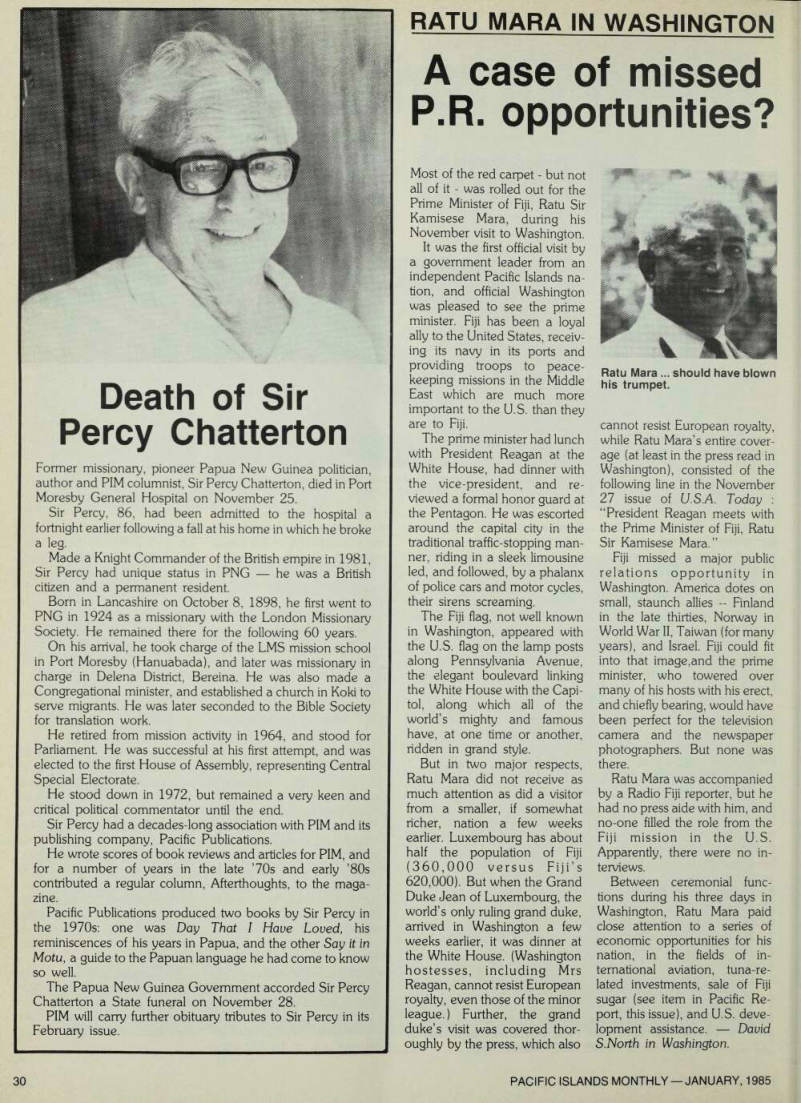
Death of Sir Percy Chatterton
Former missionary, pioneer Papua New Guinea politician, author and PIM columnist, Sir Percy Chatterton, died in Port Moresby General Hospital on November 25.
Sir Percy, 86, had been admitted to the hospital a fortnight earlier following a fall at his home in which he broke a leg.
Made a Knight Commander of the British empire in 1981, Sir Percy had unique status in PNG he was a British citizen and a permanent resident.
Born in Lancashire on October 8, 1898, he first went to PNG in 1924 as a missionary with the London Missionary Society. He remained there for the following 60 years.
On his arrival, he took charge of the LMS mission school in Port Moresby (Hanuabada), and later was missionary in charge in Delena District, Bereina. He was also made a Congregational minister, and established a church in Koki to serve migrants. He was later seconded to the Bible Society for translation work.
He retired from mission activity in 1964, and stood for Parliament. He was successful at his first attempt, and was elected to the first House of Assembly, representing Central Special Electorate.
He stood down in 1972, but remained a very keen and critical political commentator until the end.
Sir Percy had a decades-long association with PIM and its publishing company, Pacific Publications.
He wrote scores of book reviews and articles for PIM, and for a number of years in the late ’7os and early ’Bos contributed a regular column, Afterthoughts, to the maga zine.
Pacific Publications produced two books by Sir Percy in the 19705: one was Day That I Have Loved, his reminiscences of his years in Papua, and the other Say it in Motu, a guide to the Papuan language he had come to know so well.
The Papua New Guinea Government accorded Sir Percy Chatterton a State funeral on November 28.
PIM will carry further obituary tributes to Sir Percy in its February issue.
P.R. opportunities?
Ratu Mara In Washington
A case of missed P.R. opportunities?
Most of the red carpet - but not all of it - was rolled out for the Prime Minister of Fiji, Ratu Sir Kamisese Mara, during his November visit to Washington.
It was the first official visit by a government leader from an independent Pacific Islands na tion, and official Washington was pleased to see the prime minister. Fiji has been a loyal ally to the United States, receiv ing its navy in its ports and providing troops to peace keeping missions in the Middle East which are much more important to the U.S. than they are to Fiji.
The prime minister had lunch with President Reagan at the White House, had dinner with the vice-president, and re viewed a formal honor guard at the Pentagon. He was escorted around the capital city in the traditional traffic-stopping man ner, riding in a sleek limousine led, and followed, by a phalanx of police cars and motor cycles, their sirens screaming.
The Fiji flag, not well known in Washington, appeared with the U.S. flag on the lamp posts along Pennsylvania Avenue, the elegant boulevard linking the White House with the Capi tol, along which all of the world’s mighty and famous have, at one time or another, ridden in grand style.
But in two major respects, Ratu Mara did not receive as much attention as did a visitor from a smaller, if somewhat richer, nation a few weeks earlier. Luxembourg has about half the population of Fiji (360,000 versus Fiji’s 620,000). But when the Grand Duke Jean of Luxembourg, the world’s only ruling grand duke, arrived in Washington a few weeks earlier, it was dinner at the White House. (Washington hostesses, including Mrs Reagan, cannot resist European royalty, even those of the minor league.) Further, the grand duke’s visit was covered thor oughly by the press, which also
cannot resist European royalty, while Ratu Mara’s entire cover age (at least in the press read in Washington), consisted of the following line in the November 27 issue of U.SA. Today : “President Reagan meets with the Prime Minister of Fiji, Ratu Sir Kamisese Mara.”
Fiji missed a major public relations opportunity in Washington. America dotes on small, staunch allies Finland in the late thirties, Norway in World War 11, Taiwan (for many years), and Israel. Fiji could fit into that image,and the prime minister, who towered over many of his hosts with his erect, and chiefly bearing, would have been perfect for the television camera and the newspaper photographers. But none was there.
Ratu Mara was accompanied by a Radio Fiji reporter, but he had no press aide with him, and no-one filled the role from the Fiji mission in the U.S.
Apparently, there were no in terviews.
Between ceremonial func tions during his three days in Washington, Ratu Mara paid close attention to a series of economic opportunities for his nation, in the fields of in ternational aviation, tuna-re lated investments, sale of Fiji sugar (see item in Pacific Re port, this issue), and U.S. deve
lopment assistance.
David
S.North in Washington.
Ratu Mara ... should have blown his trumpet.
Zeder: “Keep out the
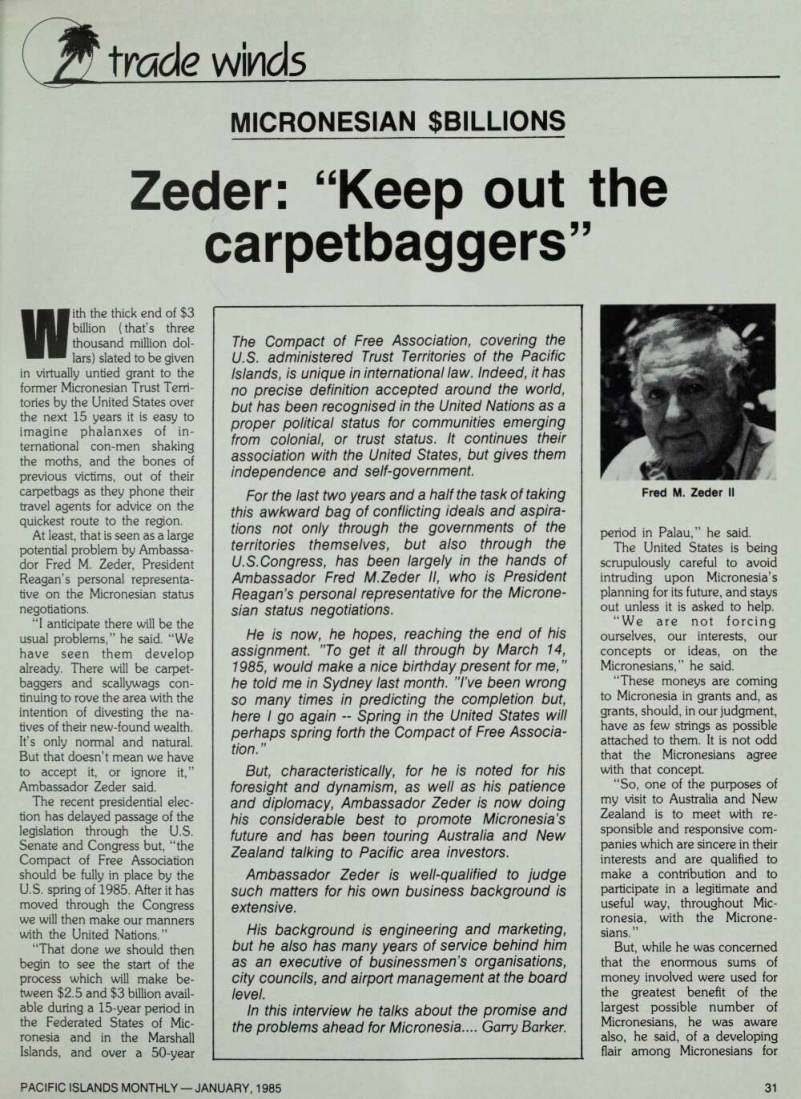
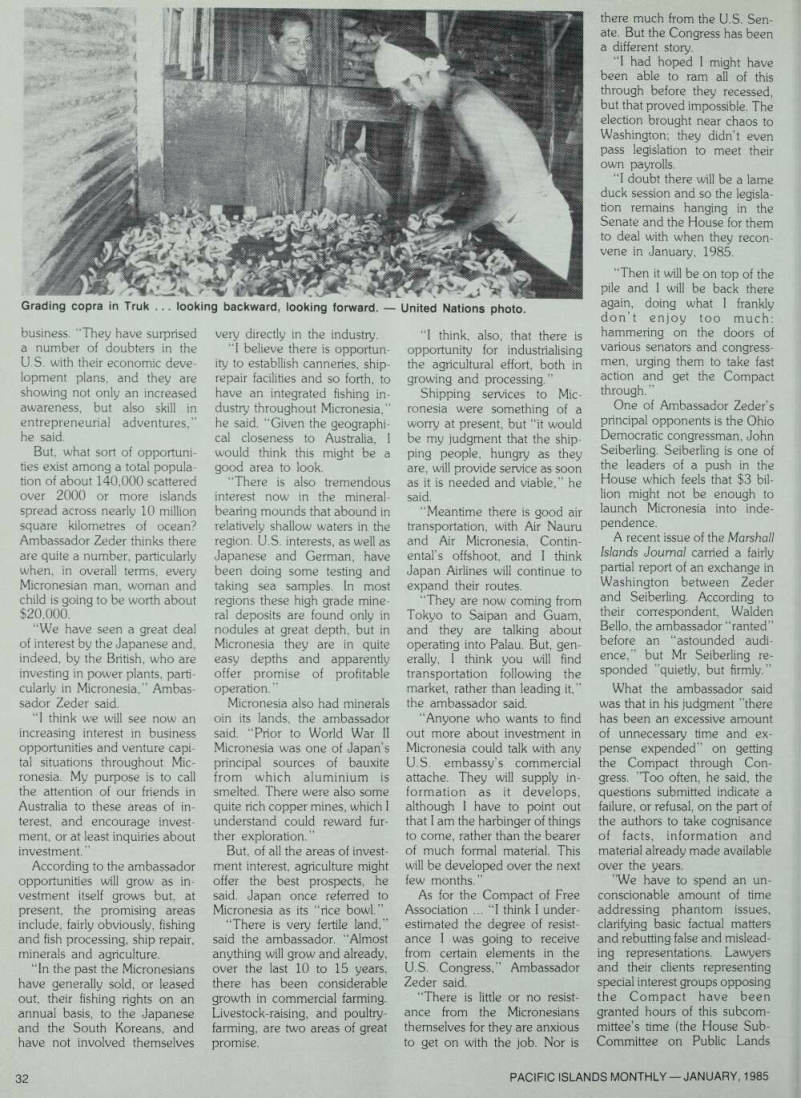
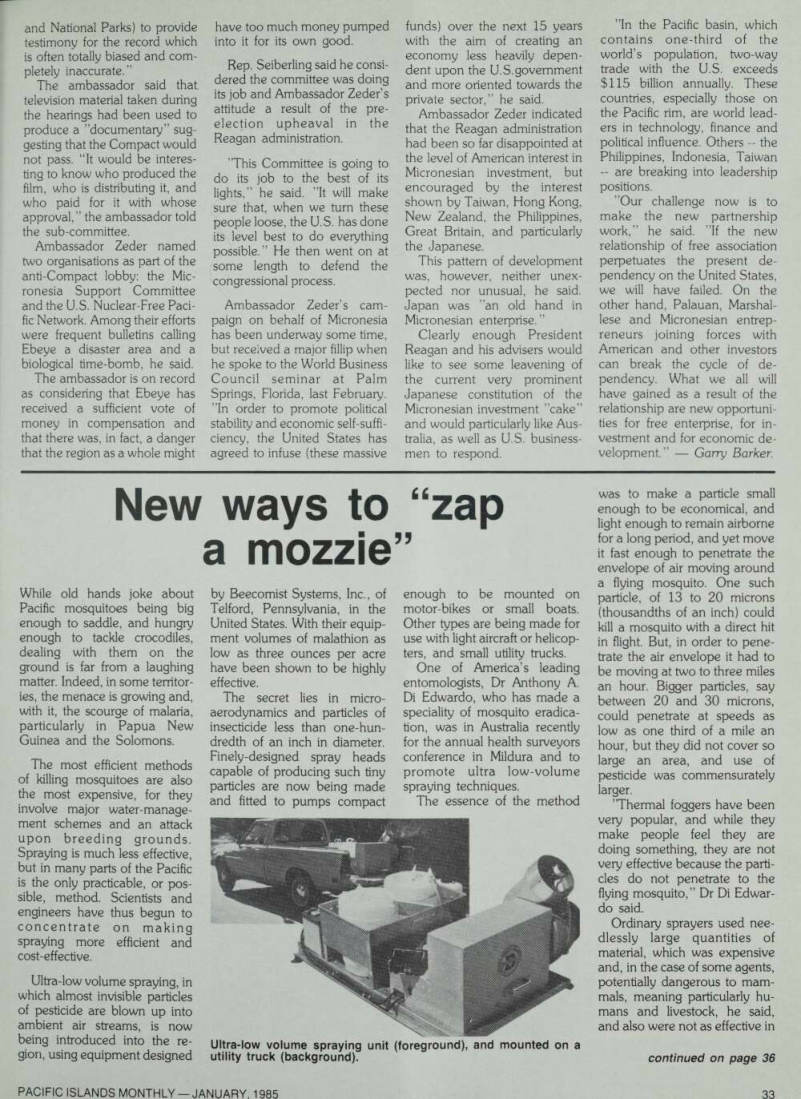
trade winds
Micronesian Sbillions
Zeder: “Keep out the carpetbaggers”
With the thick end of $3 billion (that’s three thousand million dol lars) slated to be given in virtually untied grant to the former Micronesian Trust Terri tories by the United States over the next 15 years it is easy to imagine phalanxes of in ternational con-men shaking the moths, and the bones of previous victims, out of their carpetbags as they phone their travel agents for advice on the quickest route to the region.
At least, that is seen as a large potential problem by Ambassa dor Fred M. Zeder, President Reagan’s personal representa tive on the Micronesian status negotiations.
“I anticipate there will be the usual problems,” he said. “We have seen them develop already. There will be carpet baggers and scallywags con tinuing to rove the area with the intention of divesting the na tives of their new-found wealth.
It’s only normal and natural.
But that doesn’t mean we have to accept it, or ignore it,”
Ambassador Zeder said.
The recent presidential elec tion has delayed passage of the legislation through the U.S.
Senate and Congress but, “the Compact of Free Association should be fully in place by the U.S. spring of 1985. After it has moved through the Congress we will then make our manners with the United Nations.”
“That done we should then begin to see the start of the process which will make be tween $2.5 and $3 billion avail able during a 15-year period in the Federated States of Mic ronesia and in the Marshall Islands, and over a 50-year
The Compact of Free Association, covering the U.S. administered Trust Territories of the Pacific Islands, is unique in international law. Indeed, it has no precise definition accepted around the world, but has been recognised in the United Nations as a proper political status for communities emerging from colonial, or trust status. It continues their association with the United States, but gives them independence and self-government.
For the last two years and a half the task of taking this awkward bag of conflicting ideals and aspira tions not only through the governments of the territories themselves, but also through the U.S.Congress, has been largely in the hands of Ambassador Fred M.Zeder 11, who is President Reagan's personal representative for the Microne sian status negotiations.
Fie is now, he hopes, reaching the end of his assignment. "To get it all through by March 14, 1985, would make a nice birthday present for me," he told me in Sydney last month. "Tve been wrong so many times in predicting the completion but, here I go again - Spring in the United States will perhaps spring forth the Compact of Free Associa tion."
But, characteristically, for he is noted for his foresight and dynamism, as well as his patience and diplomacy, Ambassador Zeder is now doing his considerable best to promote Micronesia's future and has been touring Australia and New Zealand talking to Pacific area investors.
Ambassador Zeder is well-qualified to judge such matters for his own business background is extensive.
His background is engineering and marketing, but he also has many years of sen/ice behind him as an executive of businessmen’s organisations, city councils, and airport management at the board level.
In this interview he talks about the promise and the problems ahead for Micronesia... Gany Barker.
period in Palau,” he said.
The United States is being scrupulously careful to avoid intruding upon Micronesia’s planning for its future, and stays out unless it is asked to help.
“We are not forcing ourselves, our interests, our concepts or ideas, on the Micronesians, ” he said.
“These moneys are coming to Micronesia in grants and, as grants, should, in our judgment, have as few strings as possible attached to them. It is not odd that the Micronesians agree with that concept.
“So, one of the purposes of my visit to Australia and New Zealand is to meet with re sponsible and responsive com panies which are sincere in their interests and are qualified to make a contribution and to participate in a legitimate and useful way, throughout Mic ronesia, with the Microne sians. ”
But, while he was concerned that the enormous sums of money involved were used for the greatest benefit of the largest possible number of Micronesians, he was aware also, he said, of a developing flair among Micronesians for
Fred M. Zeder II
business. “They have surprised a number of doubters in the U.S. with their economic deve lopment plans, and they are showing not only an increased awareness, but also skill in entrepreneurial adventures,” he said.
But, what sort of opportuni ties exist among a total popula tion of about 140,000 scattered over 2000 or more islands spread across nearly 10 million square kilometres of ocean?
Ambassador Zeder thinks there are quite a number, particularly when, in overall terms, every Micronesian man, woman and child is going to be worth about $20,000.
“We have seen a great deal of interest by the Japanese and, indeed, by the British, who are investing in power plants, parti cularly in Micronesia,” Ambas sador Zeder said.
“I think we will see now an increasing interest in business opportunities and venture capi tal situations throughout Mic ronesia. My purpose is to call the attention of our friends in Australia to these areas of in terest, and encourage invest ment, or at least inquiries about investment.”
According to the ambassador opportunities will grow as in vestment itself grows but, at present, the promising areas include, fairly obviously, fishing and fish processing, ship repair, minerals and agriculture.
“In the past the Micronesians have generally sold, or leased out, their fishing rights on an annual basis, to the Japanese and the South Koreans, and have not involved themselves
very directly in the industry.
“I believe there is opportun ity to establlish canneries, ship repair facilities and so forth, to have an integrated fishing in dustry throughout Micronesia,” he said. “Given the geographi cal closeness to Australia, I would think this might be a good area to look.
“There is also tremendous interest now in the mineral bearing mounds that abound in relatively shallow waters in the region. U.S. interests, as well as Japanese and German, have been doing some testing and taking sea samples. In most regions these high grade mine ral deposits are found only in nodules at great depth, but in Micronesia they are in quite easy depths and apparently offer promise of profitable operation.”
Micronesia also had minerals oin its lands, the ambassador said. “Prior to World War II Micronesia was one of Japan’s principal sources of bauxite from which aluminium is smelted. There were also some quite rich copper mines, which I understand could reward fur ther exploration.”
But, of all the areas of invest ment interest, agriculture might offer the best prospects, he said. Japan once referred to Micronesia as its “rice bowl.”
“There is very fertile land,” said the ambassador. “Almost anything will grow and already, over the last 10 to 15 years, there has been considerable growth in commercial farming.
Livestock-raising, and poultry farming, are two areas of great promise.
“I think, also, that there is opportunity for industrialising the agricultural effort, both in growing and processing.”
Shipping services to Mic ronesia were something of a worry at present, but “it would be my judgment that the ship ping people, hungry as they are, will provide service as soon as it is needed and viable,” he said.
“Meantime there is good air transportation, with Air Nauru and Air Micronesia, Contin ental’s offshoot, and I think Japan Airlines will continue to expand their routes.
“They are now coming from Tokyo to Saipan and Guam, and they are talking about operating into Palau. But, gen erally, I think you will find transportation following the market, rather than leading it,” the ambassador said.
“Anyone who wants to find out more about investment in Micronesia could talk with any U.S. embassy’s commercial attache. They will supply in formation as it develops, although I have to point out that I am the harbinger of things to come, rather than the bearer of much formal material. This will be developed over the next few months.”
As for the Compact of Free Association ... “I think I under estimated the degree of resist ance I was going to receive from certain elements in the U.S. Congress,” Ambassador Zeder said.
“There is little or no resist ance from the Micronesians themselves for they are anxious to get on with the job. Nor is
there much from the U.S. Sen ate. But the Congress has been a different story.
“I had hoped I might have been able to ram all of this through before they recessed, but that proved impossible. The election brought near chaos to Washington; they didn’t even pass legislation to meet their own payrolls.
“I doubt there will be a lame duck session and so the legisla tion remains hanging in the Senate and the House for them to deal with when they recon vene in January, 1985.
“Then it will be on top of the pile and I will be back there again, doing what I frankly don’t enjoy too much: hammering on the doors of various senators and congress men, urging them to take fast action and get the Compact through.’’
One of Ambassador Zeder’s principal opponents is the Ohio Democratic congressman, John Seiberling. Seiberling is one of the leaders of a push in the House which feels that $3 bil lion might not be enough to launch Micronesia into inde pendence.
A recent issue of the Marshall Islands Journal carried a fairly partial report of an exchange in Washington between Zeder and Seiberling. According to their correspondent, Walden Bello, the ambassador “ranted” before an “astounded audi ence,” but Mr Seiberling re sponded ’’quietly, but firmly.”
What the ambassador said was that in his judgment ’’there has been an excessive amount of unnecessary time and ex pense expended” on getting the Compact through Con gress. ’’Too often, he said, the questions submitted indicate a failure, or refusal, on the part of the authors to take cognisance of facts, information and material already made available over the years. ”We have to spend an un conscionable amount of time addressing phantom issues, clarifying basic factual matters and rebutting false and mislead ing representations. Lawyers and their clients representing special interest groups opposing the Compact have been granted hours of this subcom mittee’s time (the House Sub- Committee on Public Lands
Grading copra in Truk ... looking backward, looking forward. United Nations photo.
and National Parks) to provide testimony for the record which is often totally biased and com pletely inaccurate.”
The ambassador said that, television material taken during the hearings had been used to produce a ’’documentary” sug gesting that the Compact would not pass. “It would be interes ting to know who produced the film, who is distributing it, and who paid for it with whose approval,” the ambassador told the sub-committee.
Ambassador Zeder named two organisations as part of the anti-Compact lobby: the Mic ronesia Support Committee and the U.S. Nuclear-Free Paci fic Network. Among their efforts were frequent bulletins calling Ebeye a disaster area and a biological time-bomb, he said.
The ambassador is on record as considering that Ebeye has received a sufficient vote of money in compensation and that there was, in fact, a danger that the region as a whole might
have too much money pumped into it for its own good.
Rep. Seiberling said he consi dered the committee was doing its job and Ambassador Zeder’s attitude a result of the pre election upheaval in the Reagan administration. ’’This Committee is going to do its job to the best of its lights,” he said. ”It will make sure that, when we turn these people loose, the U.S. has done its level best to do everything possible.” He then went on at some length to defend the congressional process.
Ambassador Zeder’s cam paign on behalf of Micronesia has been underway some time, but received a major fillip when he spoke to the World Business Council seminar at Palm Springs, Florida, last February. ”In order to promote political stability and economic self-suffi ciency, the United States has agreed to infuse (these massive
funds) over the next 15 years with the aim of creating an economy less heavily depen dent upon the U.S.government and more oriented towards the private sector,” he said.
Ambassador Zeder indicated that the Reagan administration had been so far disappointed at the level of American interest in Micronesian investment, but encouraged by the interest shown by Taiwan, Hong Kong, New Zealand, the Philippines, Great Britain, and particularly the Japanese.
This pattern of development was, however, neither unex pected nor unusual, he said.
Japan was ”an old hand in Micronesian enterprise.”
Clearly enough President Reagan and his advisers would like to see some leavening of the current very prominent Japanese constitution of the Micronesian investment ’’cake” and would particularly like Aus tralia, as well as U.S. business men to respond.
”In the Pacific basin, which contains one-third of the world’s population, two-way trade with the U.S. exceeds $ll5 billion annually. These countries, especially those on the Pacific rim, are world lead ers in technology, finance and political influence. Others - the Philippines, Indonesia, Taiwan are breaking into leadership positions. ”Our challenge now is to make the new partnership work,” he said. ”If the new relationship of free association perpetuates the present de pendency on the United States, we will have failed. On the other hand, Palauan, Marshal lese and Micronesian entrep reneurs joining forces with American and other investors can break the cycle of de pendency. What we all will have gained as a result of the relationship are new opportuni ties for free enterprise, for in vestment and for economic de
velopment. ”
Gany Barker.
New ways to “zap


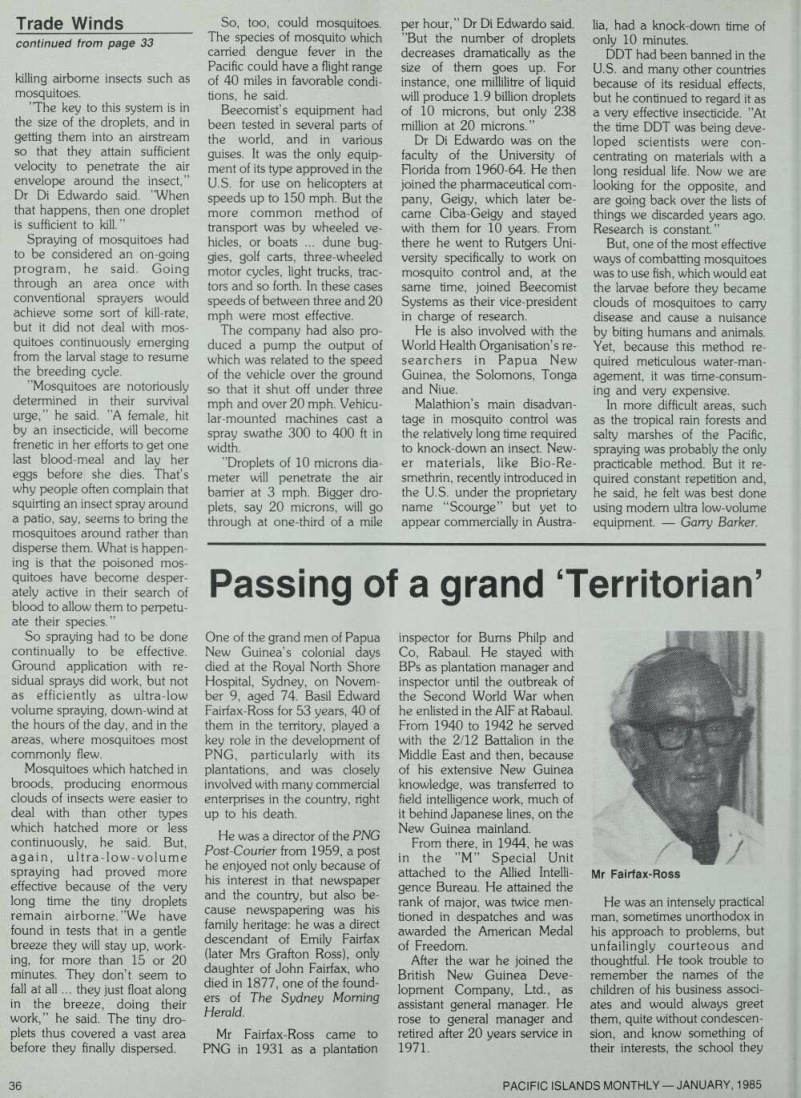
a mozzie”
While old hands joke about Pacific mosquitoes being big enough to saddle, and hungry enough to tackle crocodiles, dealing with them on the ground is far from a laughing matter. Indeed, in some territor ies, the menace is growing and, with it, the scourge of malaria, particularly in Papua New Guinea and the Solomons.
The most efficient methods of killing mosquitoes are also the most expensive, for they involve major water-manage ment schemes and an attack upon breeding grounds.
Spraying is much less effective, but in many parts of the Pacific is the only practicable, or pos sible, method. Scientists and engineers have thus begun to concentrate on making spraying more efficient and cost-effective.
Ultra-low volume spraying, in which almost invisible particles of pesticide are blown up into ambient air streams, is now being introduced into the re gion, using equipment designed
by Beecomist Systems, Inc., of Telford, Pennsylvania, in the United States. With their equip ment volumes of malathion as low as three ounces per acre have been shown to be highly effective.
The secret lies in micro aerodynamics and particles of insecticide less than one-hun dredth of an inch in diameter.
Finely-designed spray heads capable of producing such tiny particles are now being made and fitted to pumps compact
enough to be mounted on motor-bikes or small boats.
Other types are being made for use with light aircraft or helicop ters, and small utility trucks.
One of America’s leading entomologists, Dr Anthony A.
Di Edwardo, who has made a speciality of mosquito eradica tion, was in Australia recently for the annual health surveyors conference in Mildura and to promote ultra low-volume spraying techniques.
The essence of the method
was to make a particle small enough to be economical, and light enough to remain airborne for a long period, and yet move it fast enough to penetrate the envelope of air moving around a flying mosquito. One such particle, of 13 to 20 microns (thousandths of an inch) could kill a mosquito with a direct hit in flight. But, in order to pene trate the air envelope it had to be moving at two to three miles an hour. Bigger particles, say between 20 and 30 microns, could penetrate at speeds as low as one third of a mile an hour, but they did not cover so large an area, and use of pesticide was commensurately larger. ’Thermal foggers have been very popular, and while they make people feel they are doing something, they are not very effective because the parti cles do not penetrate to the flying mosquito,” Dr Di Ed war do said.
Ordinary sprayers used nee dlessly large quantities of material, which was expensive and, in the case of some agents, potentially dangerous to mam mals, meaning particularly hu mans and livestock, he said, and also were not as effective in
continued on page 36
Ultra-low volume spraying unit (foreground), and mounted on a utility truck (background).
killing airborne insects such as mosquitoes. ’’The key to this system is in the size of the droplets, and in getting them into an airstream so that they attain sufficient velocity to penetrate the air envelope around the insect,”
Dr Di Edwardo said. ’’When that happens, then one droplet is sufficient to kill.”
Spraying of mosquitoes had to be considered an on-going program, he said. Going through an area once with conventional sprayers would achieve some sort of kill-rate, but it did not deal with mos quitoes continuously emerging from the larval stage to resume the breeding cycle. ’’Mosquitoes are notoriously determined in their survival urge,” he said. ”A female, hit by an insecticide, will become frenetic in her efforts to get one last blood-meal and lay her eggs before she dies. That’s why people often complain that squirting an insect spray around a patio, say, seems to bring the mosquitoes around rather than disperse them. What is happen ing is that the poisoned mos quitoes have become desper ately active in their search of blood to allow them to perpetu ate their species.”
So spraying had to be done continually to be effective.
Ground application with re sidual sprays did work, but not as efficiently as ultra-low volume spraying, down-wind at the hours of the day, and in the areas, where mosquitoes most commonly flew.
Mosquitoes which hatched in broods, producing enormous clouds of insects were easier to deal with than other types which hatched more or less continuously, he said. But, again, ultra-low-volume spraying had proved more effective because of the very long time the tiny droplets remain airborne. ”We have found in tests that in a gentle breeze they will stay up, work ing, for more than 15 or 20 minutes. They don’t seem to fall at a 11... they just float along in the breeze, doing their work,” he said. The tiny dro plets thus covered a vast area before they finally dispersed.
So, too, could mosquitoes.
The species of mosquito which carried dengue fever in the Pacific could have a flight range of 40 miles in favorable condi tions, he said.
Beecomist’s equipment had been tested in several parts of the world, and in various guises. It was the only equip ment of its type approved in the U.S. for use on helicopters at speeds up to 150 mph. But the more common method of transport was by wheeled ve hicles, or boats ... dune bug gies, golf carts, three-wheeled motor cycles, light trucks, trac tors and so forth. In these cases speeds of between three and 20 mph were most effective.
The company had also pro duced a pump the output of which was related to the speed of the vehicle over the ground so that it shut off under three mph and over 20 mph. Vehicu lar-mounted machines cast a spray swathe 300 to 400 ft in width. ’’Droplets of 10 microns dia meter will penetrate the air barrier at 3 mph. Bigger dro plets, say 20 microns, will go through at one-third of a mile
per hour,” Dr Di Edwardo said. ’’But the number of droplets decreases dramatically as the size of them goes up. For instance, one millilitre of liquid will produce 1.9 billion droplets of 10 microns, but only 238 million at 20 microns.”
Dr Di Edwardo was on the faculty of the University of Florida from 1960-64. He then joined the pharmaceutical com pany, Geigy, which later be came Ciba-Geigy and stayed with them for 10 years. From there he went to Rutgers Uni versity specifically to work on mosquito control and, at the same time, joined Beecomist Systems as their vice-president in charge of research.
He is also involved with the World Health Organisation’s re searchers in Papua New Guinea, the Solomons, Tonga and Niue.
Malathion’s main disadvan tage in mosquito control was the relatively long time required to knock-down an insect. New er materials, like Bio-Re smethrin, recently introduced in the U.S. under the proprietary name “Scourge” but yet to appear commercially in Austra
lia, had a knock-down time of only 10 minutes.
DDT had been banned in the U.S. and many other countries because of its residual effects, but he continued to regard it as a very effective insecticide. ”At the time DDT was being deve loped scientists were con centrating on materials with a long residual life. Now we are looking for the opposite, and are going back over the lists of things we discarded years ago.
Research is constant.”
But, one of the most effective ways of combatting mosquitoes was to use fish, which would eat the larvae before they became clouds of mosquitoes to carry disease and cause a nuisance by biting humans and animals.
Yet, because this method re quired meticulous water-man agement, it was time-consum ing and very expensive.
In more difficult areas, such as the tropical rain forests and salty marshes of the Pacific, spraying was probably the only practicable method. But it re quired constant repetition and, he said, he felt was best done using modem ultra low-volume
equipment.
— Garry Barker.
Advertisements & other items, pp. 34-37 (3 items)
.1 *Jk
Passing of a grand ‘Territorian’
One of the grand men of Papua New Guinea’s colonial days died at the Royal North Shore Hospital, Sydney, on Novem ber 9, aged 74. Basil Edward Fairfax-Ross for 53 years, 40 of them in the territory, played a key role in the development of PNG, particularly with its plantations, and was closely involved with many commercial enterprises in the country, right up to his death.
He was a director of the PNG Post-Courier from 1959, a post he enjoyed not only because of his interest in that newspaper and the country, but also be cause newspapering was his family heritage: he was a direct descendant of Emily Fairfax (later Mrs Grafton Ross), only daughter of John Fairfax, who died in 1877, one of the found ers of The Sydney Morning Herald.
Mr Fairfax-Ross came to PNG in 1931 as a plantation
inspector for Bums Philp and Co, Rabaul. He stayed with BPs as plantation manager and inspector until the outbreak of the Second World War when he enlisted in the AIF at Rabaul.
From 1940 to 1942 he served with the 2/12 Battalion in the Middle East and then, because of his extensive New Guinea knowledge, was transferred to field intelligence work, much of it behind Japanese lines, on the New Guinea mainland.
From there, in 1944, he was in the ”M” Special Unit attached to the Allied Intelli gence Bureau. He attained the rank of major, was twice men tioned in despatches and was awarded the American Medal of Freedom.
After the war he joined the British New Guinea Deve lopment Company, Ltd., as assistant general manager. He rose to general manager and retired after 20 years service in 1971.
He was an intensely practical man, sometimes unorthodox in his approach to problems, but unfailingly courteous and thoughtful. He took trouble to remember the names of the children of his business associ ates and would always greet them, quite without condescen sion, and know something of their interests, the school they
Mr Fairfax-Ross
attended or their progress.
Asked once what advice he would give young men fresh off the boat and heading for assignment in remote, lonely, plantations, he remarked that they all felt they had to make changes in the previous mana ger’s methods. This, he said, always had disastrous results on productivity and, after six months, the new broom was put away and all went back to original systems. ”So after a while I developed a rule,” he said. ’’When the young fellow came in I would tell him; ’l’m sending you to Wuvulu, or wherever. If you change anything in the first six months, I’ll sack you.’”
Mr Fairfax-Ross was a close friend and confidant of Briga dier Sir Donald Cleland, Admi nistrator of what was then the Territory of PNG in the fifties and sixties. Throughout his life in PNG he maintained a friend ly link with the defence forces and one of the mourners at his funeral was Jim Nome, former commander of the force.
Others at the funeral, at the Northern Suburbs, Sydney, Crematorium, included former PNG Administrator, Mr Les Johnson, the chairman of the South Pacific Post, Mr R.H.Sampson, and the general manager of the Post-Courier, Mr Wayne Grant.
Mr Fairfax-Ross was a nominated member of the Legislative Council of Papua New Guinea from 1951 to 1963, during which years he was also president of the Papua Planters’ Association. He was a member of the Administrator’s Council of PNG from 1961 to 1963, chairman of the PNG Copra Marketing Board from 1970 to 1973, having been a member since 1951. He was also chairman of the Copra Stabilisation Fund from 1956 to 1974 and a member of the Council of the University of PNG, from 1968 to 1971.
Aside from his directorship of the Post-Courier company he was a director of Kanosia Estates, Pty Ltd., of Bums Philp Co Ltd., and Bougainville Cop per, Ltd. He was awarded the CBE in 1964 for services to the development of industry in
PNG.
He is survived by his wife, Mollie and two daughters, Robyn and Gillian.
Introducing Perfof
NEW ’B4 TOYOTA HLU>
Performance p comfort.
Performance plus durability.
Performance plus variety.
Advanced, powerful new engines put you in command with higher torque, better efficiency. Inside, more driving comfort than ever before with a roomier cabin, bigger windscreens, and lean, clean instrumentation. Newly designed suspension gives you big carrying capability, yet carries you in comfort. HILUX is one tough truck with a suspension you can count on. Choose from a wide variety, including 4WD regular or double cab and two new additions 2WD extra cab and flatdeck. The all-new Toyota HILUX. Add it all up, and you have performance plus!
TOYOTA
QUALITY SERVICE
AMERICAN SAMOA; BURNS PHILP (SOUTH SEA)
CO., LTD., P.O. Box 129, Pago Pago.
COOK ISLANDS: COOK ISLANDS TRADING
CORPORATION LTD., Private Bag, Rarotonga.
FIJI: AUTOMOTIVE SUPPLIES COMPANY, G.P.O.
Box 355, Suva.
GUAM & MICRONESIA: ATKINS, KROLL (GUAM) LTD., 443 South Marine Drive, Tamuning.
KIRIBATI: TARAWA MOTORS, P.O. Box 36, Bairiki, Tarawa, Kiribati.
NAURU: NAURU COOPERATIVE SOCIETY.
NEW CALEDONIA: SERVICE IMPORTATION
AUTOMOBILE DU PACIFIQUE, Rond-Point du Pacifique* (Station Total) B.P. 438, Noumea.
MANGE PLUS!
$ 4WD Double Cat lORFOLK ISLAND: SORRY’S LIMITED, P.O. Box 169. •APUA NEW GUINEA: ELA MOTORS, A Division of (urns Philp (PNG) Ltd., P.O. Box 75, Port Moresby.
(AIPAN: MICROL CORPORATION, P.O. Box 267,
iaipan.
(OLOMOM: MENDANA ENTERPRISES (5.1.) LTD.,
•■P.O. Box 174, Honiara.
TAHITI: NIPPON AUTOMOTO, P.O. Box 342, Papeete.
TONGA: BURNS PHILP (SOUTH SEA) CO., LTD., P.O. Box 55, Nukualofa.
VANUATU: VANUATU MOTORS, P.O. Box 18,
Port Vila.
WESTERN SAMOA: BURNS PHILP (SOUTH SEA)
CO.. LTD.. P.O Bo* Iftß Ania
TOYOTA
Trade Winds
36
PACIFIC ISLANDS MONTHLY —JANUARY, 1985
continued from page 33
Trade Winds
Commercial radio
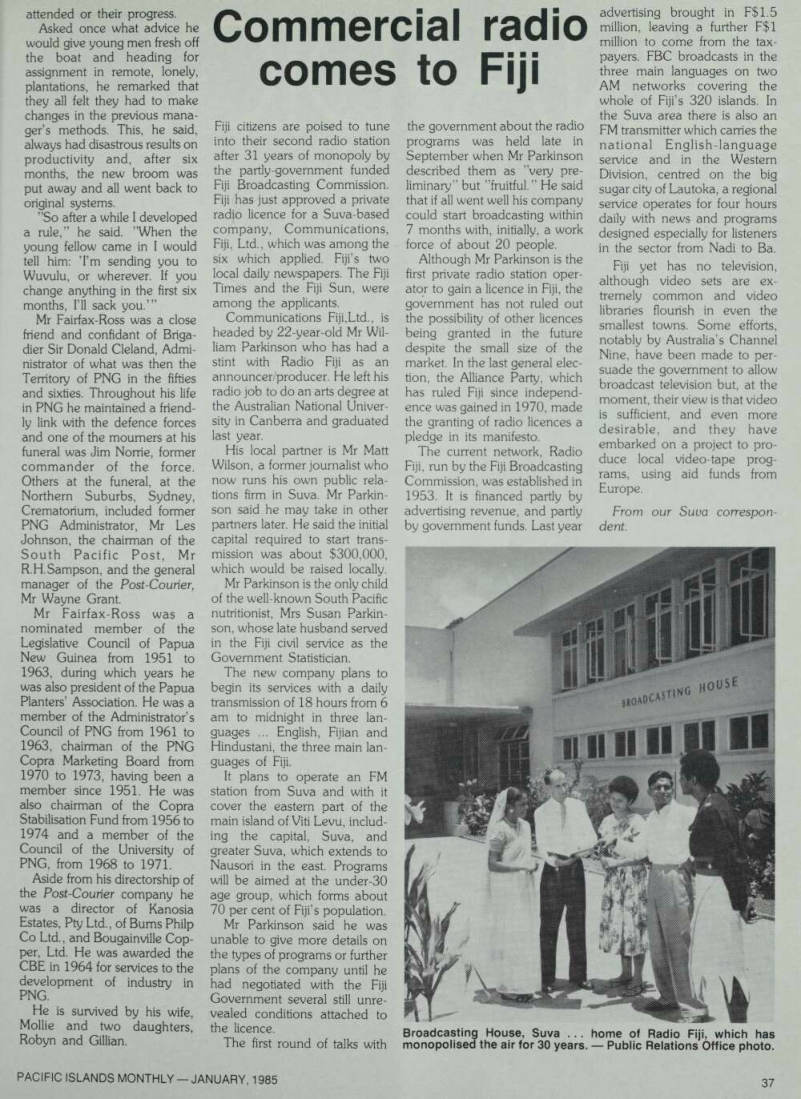
comes to Fiji
Fiji citizens are poised to tune into their second radio station after 31 years of monopoly by the partly-government funded Fiji Broadcasting Commission.
Fiji has just approved a private radio licence for a Suva-based company, Communications, Fiji, Ltd., which was among the six which applied. Fiji’s two local daily newspapers. The Fiji Times and the Fiji Sun, were among the applicants.
Communications Fiji,Ltd., is headed by 22-year-old Mr Wil liam Parkinson who has had a stint with Radio Fiji as an announcer/producer. He left his radio job to do an arts degree at the Australian National Univer sity in Canberra and graduated last year.
His local partner is Mr Matt Wilson, a former journalist who now runs his own public rela tions firm in Suva. Mr Parkin son said he may take in other partners later. He said the initial capital required to start trans mission was about $300,000, which would be raised locally.
Mr Parkinson is the only child of the well-known South Pacific nutritionist, Mrs Susan Parkin son, whose late husband served in the Fiji civil service as the Government Statistician.
The new company plans to begin its services with a daily transmission of 18 hours from 6 am to midnight in three lan guages ... English, Fijian and Hindustani, the three main lan guages of Fiji.
It plans to operate an FM station from Suva and with it cover the eastern part of the main island of Viti Levu, includ ing the capital, Suva, and greater Suva, which extends to Nausori in the east. Programs will be aimed at the under-30 age group, which forms about 70 per cent of Fiji’s population.
Mr Parkinson said he was unable to give more details on the types of programs or further plans of the company until he had negotiated with the Fiji Government several still unre vealed conditions attached to the licence.
The first round of talks with
the government about the radio programs was held late in September when Mr Parkinson described them as ’’very pre liminary” but ’’fruitful.” He said that if all went well his company could start broadcasting within 7 months with, initially, a work force of about 20 people.
Although Mr Parkinson is the first private radio station oper ator to gain a licence in Fiji, the government has not ruled out the possibility of other licences being granted in the future despite the small size of the market. In the last general elec tion, the Alliance Party, which has ruled Fiji since independ ence was gained in 1970, made the granting of radio licences a pledge in its manifesto.
The current network, Radio Fiji, run by the Fiji Broadcasting Commission, was established in 1953. It is financed partly by advertising revenue, and partly by government funds. Last year
advertising brought in Fsl.s million, leaving a further Fsl million to come from the tax payers. FBC broadcasts in the three main languages on two AM networks covering the whole of Fiji’s 320 islands. In the Suva area there is also an FM transmitter which carries the national English-language service and in the Western Division, centred on the big sugar city of Lautoka, a regional service operates for four hours daily with news and programs designed especially for listeners in the sector from Nadi to Ba.
Fiji yet has no television, although video sets are ex tremely common and video libraries flourish in even the smallest towns. Some efforts, notably by Australia’s Channel Nine, have been made to per suade the government to allow broadcast television but, at the moment, their view is that video is sufficient, and even more desirable, and they have embarked on a project to pro duce local video-tape prog rams, using aid funds from Europe.
From our Suva correspon dent.
Broadcasting House, Suva ... home of Radio Fiji, which has monopolised the air for 30 years. Public Relations Office photo.
Advertisements & other items, p. 38 (1 item)
Citizen
TH Multifuncd watchworc In this infoi Citizen tec the chaflen revolutiona watches. lismisthe timepieces ion age. ogy meets rith two / % €i 1 % % A I m V % / ...NJ
ANA-OMS
TEMP
Citizen Quartz Ana-Digi Temp, 59,9® to - 9.9°C temperature readout, one-touch Fahrenheit conversion, Analog/Digital time Indication with automatic calendar and dual (one other time zone) time, 24-hour■alarm, hourly chime.
VIOOOsea accurate stopwatch.
AMA-0161
Combo FI
Citizen Quartz Ana-Digl Combo Ft Analog/Digital time indication with 1-sec. and 10-sec, increment LCD trackers. Permanently adjusted monthday-date calendar, 24-hour alarm, 12-hour countdown timer; hourly chime. Dual time. And a 1/100-sec, counter lap-timing stopwatch.
CITIZEN
AHEAD OF THEIR TIME
in the reign of King Sugar
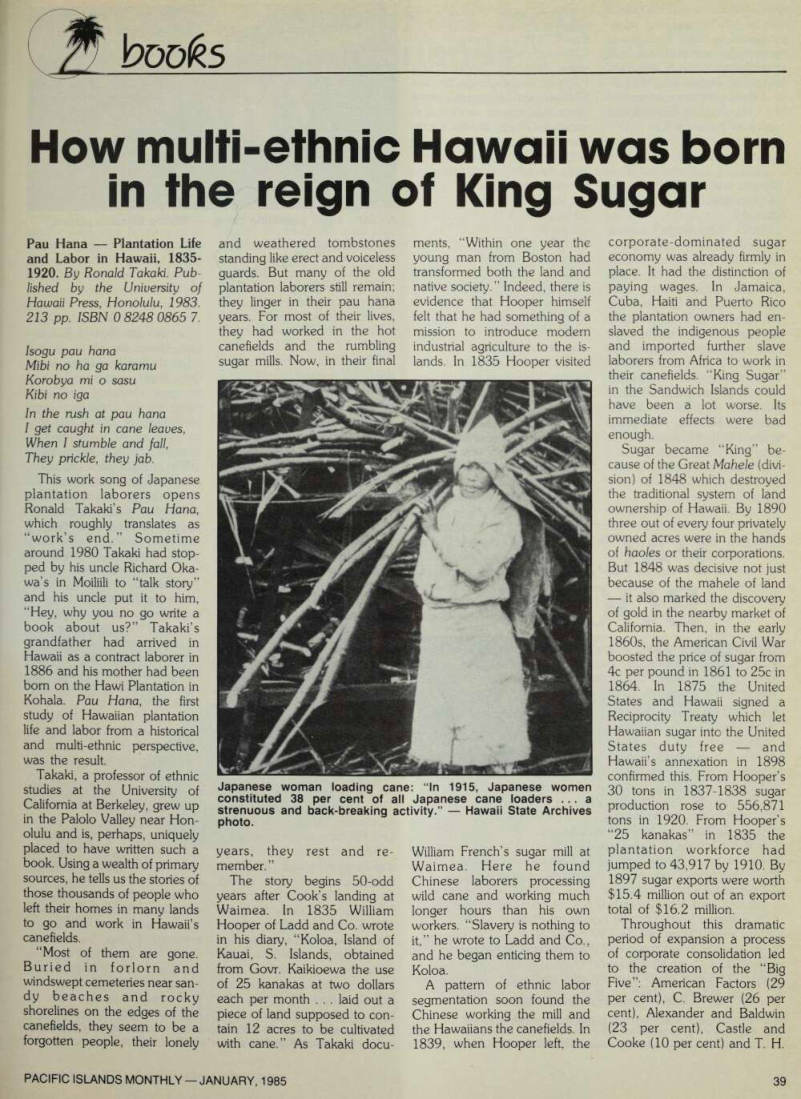
books
How multi-ethnic Hawaii was born in the reign of King Sugar
Pau Hana Plantation Life and Labor in Hawaii, 1835- 1920. By Ronald Takaki. Pub lished by the University of Hawaii Press, Honolulu, 1983. 213 pp. ISBN 0 8248 0865 7.
and weathered tombstones standing like erect and voiceless guards. But many of the old plantation laborers still remain; they linger in their pau hana years. For most of their lives, they had worked in the hot canefields and the rumbling sugar mills. Now, in their final
Isogu pau hana Mibi no ha ga karamu Korobya mi o sasu Kibi no iga In the rush at pau hana I get caught in cane leaves, When I stumble and fall, They prickle, they jab.
This work song of Japanese plantation laborers opens Ronald Takaki’s Pau Hana, which roughly translates as “work’s end.” Sometime around 1980 Takaki had stop ped by his uncle Richard Oka wa’s in Moiliili to “talk story” and his uncle put it to him, “Hey, why you no go write a book about us?” Takaki’s grandfather had arrived in Hawaii as a contract laborer in 1886 and his mother had been bom on the Hawi Plantation in Kohala. Pau Hana, the first study of Hawaiian plantation life and labor from a historical and multi-ethnic perspective, was the result.
Takaki, a professor of ethnic studies at the University of California at Berkeley, grew up in the Palolo Valley near Hon olulu and is, perhaps, uniquely placed to have written such a book. Using a wealth of primary sources, he tells us the stories of those thousands of people who left their homes in many lands to go and work in Hawaii’s canefields.
“Most of them are gone.
Buried in forlorn and windswept cemeteries near san dy beaches and rocky shorelines on the edges of the canefields, they seem to be a forgotten people, their lonely
years, they rest and re member. ”
The story begins 50-odd years after Cook’s landing at Waimea. In 1835 William Hooper of Ladd and Co. wrote in his diary, “Koloa, Island of Kauai, S. Islands, obtained from Govr. Kaikioewa the use of 25 kanakas at two dollars each per month . . . laid out a piece of land supposed to con tain 12 acres to be cultivated with cane.” As Takaki docu
ments, “Within one year the young man from Boston had transformed both the land and native society.” Indeed, there is evidence that Hooper himself felt that he had something of a mission to introduce modern industrial agriculture to the is lands. In 1835 Hooper visited
William French’s sugar mill at Waimea. Here he found Chinese laborers processing wild cane and working much longer hours than his own workers. “Slavery is nothing to it,” he wrote to Ladd and Co., and he began enticing them to Koloa.
A pattern of ethnic labor segmentation soon found the Chinese working the mill and the Hawaiians the canefields. In 1839, when Hooper left, the
corporate-dominated sugar economy was already firmly in place. It had the distinction of paying wages. In Jamaica, Cuba, Haiti and Puerto Rico the plantation owners had en slaved the indigenous people and imported further slave laborers from Africa to work in their canefields. “King Sugar” in the Sandwich Islands could have been a lot worse. Its immediate effects were bad enough.
Sugar became “King” be cause of the Great Mahele (divi sion) of 1848 which destroyed the traditional system of land ownership of Hawaii. By 1890 three out of every four privately owned acres were in the hands of haoles or their corporations.
But 1848 was decisive not just because of the mahele of land it also marked the discovery of gold in the nearby market of California. Then, in the early 1860 s, the American Civil War boosted the price of sugar from 4c per pound in 1861 to 25c in 1864. In 1875 the United States and Hawaii signed a Reciprocity Treaty which let Hawaiian sugar into the United States duty free and Hawaii’s annexation in 1898 confirmed this. From Hooper’s 30 tons in 1837-1838 sugar production rose to 556,871 tons in 1920. From Hooper’s “25 kanakas” in 1835 the plantation workforce had jumped to 43,917 by 1910. By 1897 sugar exports were worth $15.4 million out of an export total of $16.2 million.
Throughout this dramatic period of expansion a process of corporate consolidation led to the creation of the “Big Five”: American Factors (29 per cent), C. Brewer (26 per cent), Alexander and Baldwin (23 per cent), Castle and Cooke (10 per cent) and T. H.
Japanese woman loading cane: “In 1915, Japanese women constituted 38 per cent of all Japanese cane loaders ... a strenuous and back-breaking activity.” Hawaii State Archives photo.
Davies (6 per cent). The figures
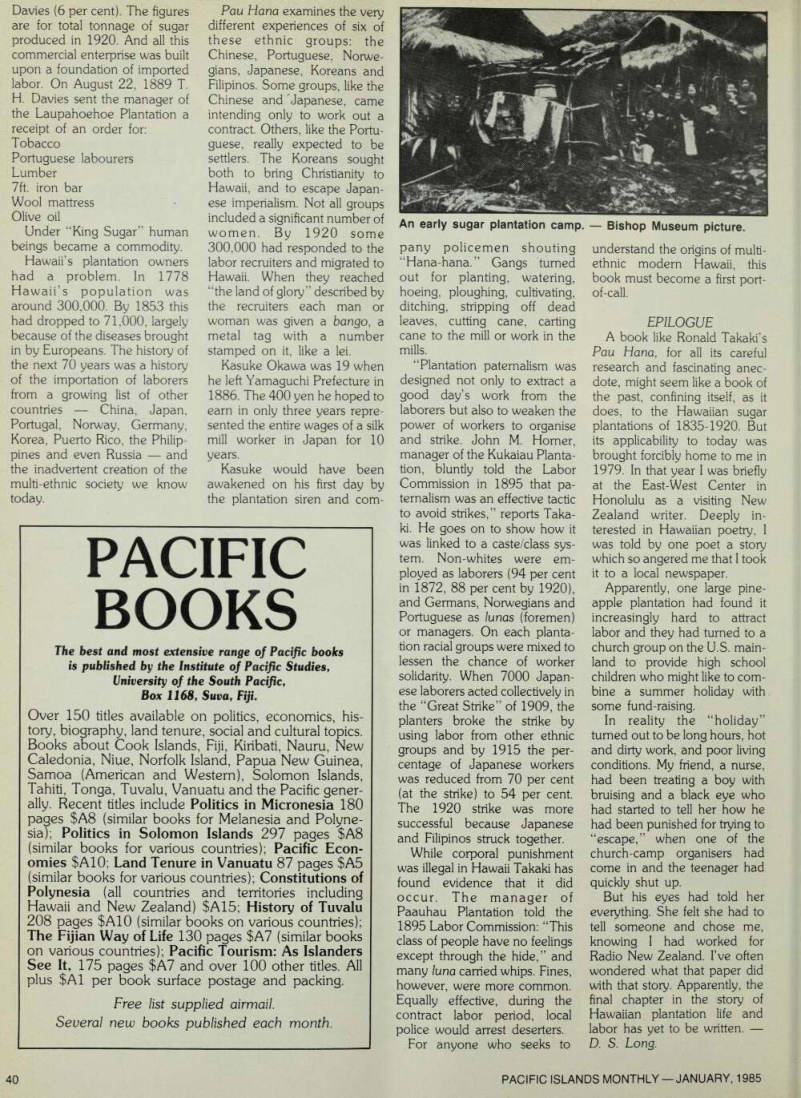
are for total tonnage of sugar produced in 1920. And all this commercial enterprise was built upon a foundation of imported labor. On August 22, 1889 T.
H. Davies sent the manager of the Laupahoehoe Plantation a receipt of an order for; Tobacco Portuguese labourers Lumber 7ft. iron bar Wool mattress Olive oil Under “King Sugar” human beings became a commodity.
Hawaii’s plantation owners had a problem. In 1778 Hawaii’s population was around 300,000. By 1853 this had dropped to 71,000, largely because of the diseases brought in by Europeans. The history of the next 70 years was a history of the importation of laborers from a growing list of other countries China, Japan, Portugal, Norway, Germany, Korea, Puerto Rico, the Philip pines and even Russia and the inadvertent creation of the multi-ethnic society we know today.
Pau Hana examines the very different experiences of six of these ethnic groups; the Chinese, Portuguese, Norwe gians, Japanese, Koreans and Filipinos. Some groups, like the Chinese and 'Japanese, came intending only to work out a contract. Others, like the Portu guese, really expected to be settlers. The Koreans sought both to bring Christianity to Hawaii, and to escape Japan ese imperialism. Not all groups included a significant number of women. By 1920 some 300,000 had responded to the labor recruiters and migrated to Hawaii. When they reached “the land of glory” described by the recruiters each man or woman was given a bango , a metal tag with a number stamped on it, like a lei.
Kasuke Okawa was 19 when he left Yamaguchi Prefecture in 1886. The 400 yen he hoped to earn in only three years repre sented the entire wages of a silk mill worker in Japan for 10 years.
Kasuke would have been awakened on his first day by the plantation siren and com-
pany policemen shouting “Hana-hana.” Gangs turned out for planting, watering, hoeing, ploughing, cultivating, ditching, stripping off dead leaves, cutting cane, carting cane to the mill or work in the mills.
“Plantation paternalism was designed not only to extract a good day’s work from the laborers but also to weaken the power of workers to organise and strike. John M. Horner, manager of the Kukaiau Planta tion, bluntly told the Labor Commission in 1895 that pa ternalism was an effective tactic to avoid strikes,” reports Taka ki. He goes on to show how it was linked to a caste/class sys tem. Non-whites were em ployed as laborers (94 per cent in 1872, 88 per cent by 1920), and Germans, Norwegians and Portuguese as tunas (foremen) or managers. On each planta tion racial groups were mixed to lessen the chance of worker solidarity. When 7000 Japan ese laborers acted collectively in the “Great Strike” of 1909, the planters broke the strike by using labor from other ethnic groups and by 1915 the per centage of Japanese workers was reduced from 70 per cent (at the strike) to 54 per cent.
The 1920 strike was more successful because Japanese and Filipinos struck together.
While corporal punishment was illegal in Hawaii Takaki has found evidence that it did occur. The manager of Paauhau Plantation told the 1895 Labor Commission: “This class of people have no feelings except through the hide,” and many tuna carried whips. Fines, however, were more common.
Equally effective, during the contract labor period, local police would arrest deserters.
For anyone who seeks to
understand the origins of multi ethnic modern Hawaii, this book must become a first port of-call.
Epilogue
A book like Ronald Takaki’s Pau Hana, for all its careful research and fascinating anec dote, might seem like a book of the past, confining itself, as it does, to the Hawaiian sugar plantations of 1835-1920. But its applicability to today was brought forcibly home to me in 1979. In that year I was briefly at the East-West Center in Honolulu as a visiting New Zealand writer. Deeply in terested in Hawaiian poetry, I was told by one poet a story which so angered me that I took it to a local newspaper.
Apparently, one large pine apple plantation had found it increasingly hard to attract labor and they had turned to a church group on the U.S. main land to provide high school children who might like to com bine a summer holiday with some fund-raising.
In reality the “holiday” turned out to be long hours, hot and dirty work, and poor living conditions. My friend, a nurse, had been treating a boy with bruising and a black eye who had started to tell her how he had been punished for trying to “escape,” when one of the church-camp organisers had come in and the teenager had quickly shut up.
But his eyes had told her everything. She felt she had to tell someone and chose me, knowing I had worked for Radio New Zealand. I’ve often wondered what that paper did with that story. Apparently, the final chapter in the story of Hawaiian plantation life and labor has yet to be written.
D. S. Long.
An early sugar plantation camp. Bishop Museum picture.
Advertisements & other items, p. 40 (1 item)
Books
PACIFIC
The best and most extensive range of Pacific books is published by the Institute of Pacific Studies, University of the South Pacific, Box 1168, Suva, Fiji.
Over 150 titles available on politics, economics, history, biography, land tenure, social and cultural topics.
Books about Cook Islands, Fiji, Kiribati, Nauru, New Caledonia, Niue, Norfolk Island, Papua New Guinea, Samoa (American and Western), Solomon Islands, Tahiti, Tonga, Tuvalu, Vanuatu and the Pacific generally. Recent titles include Politics in Micronesia 180 pages SAB (similar books for Melanesia and Polynesia); Politics in Solomon Islands 297 pages SAB (similar books for various countries); Pacific Economies $A10; Land Tenure in Vanuatu 87 pages SAS (similar books for various countries); Constitutions of Polynesia (all countries and territories including Hawaii and New Zealand) SAIS; History of Tuvalu 208 pages SAIO (similar books on various countries); The Fijian Way of Life 130 pages SA7 (similar books on various countries); Pacific Tourism: As Islanders See It, 175 pages SA7 and over 100 other titles. All plus SAI per book surface postage and packing.
Free list supplied airmail.
Several new books published each month.
Australia’s birdwatchers map
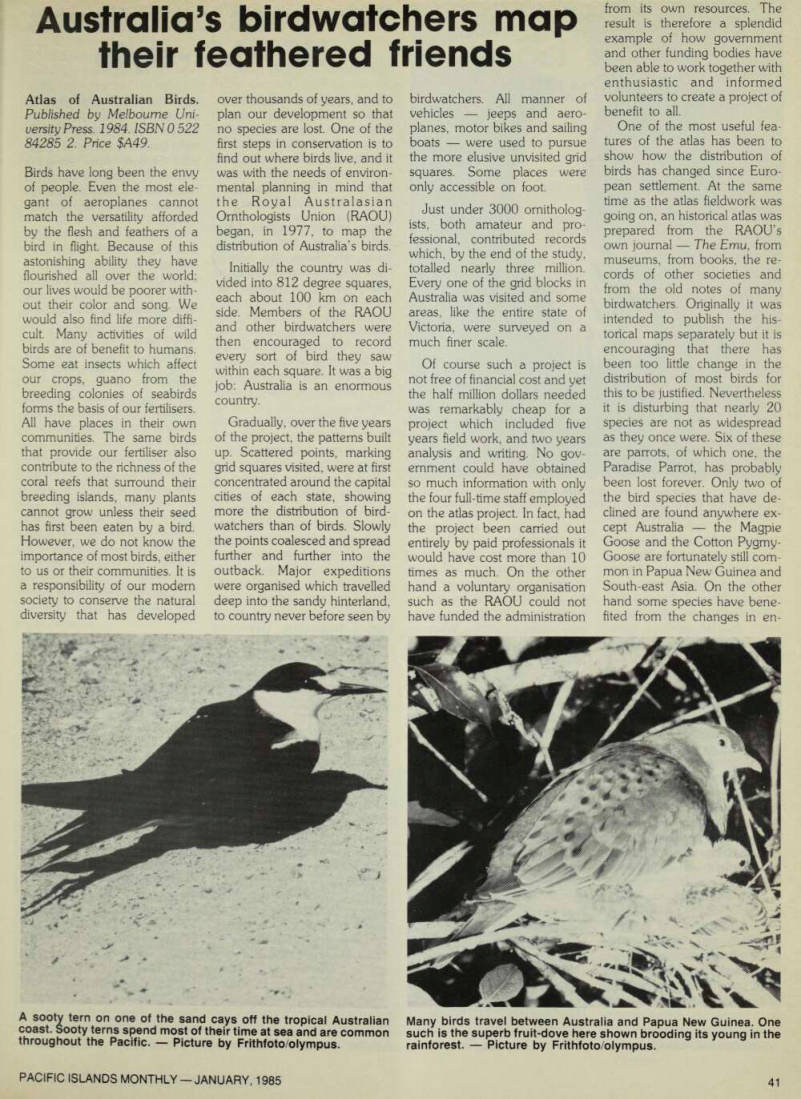
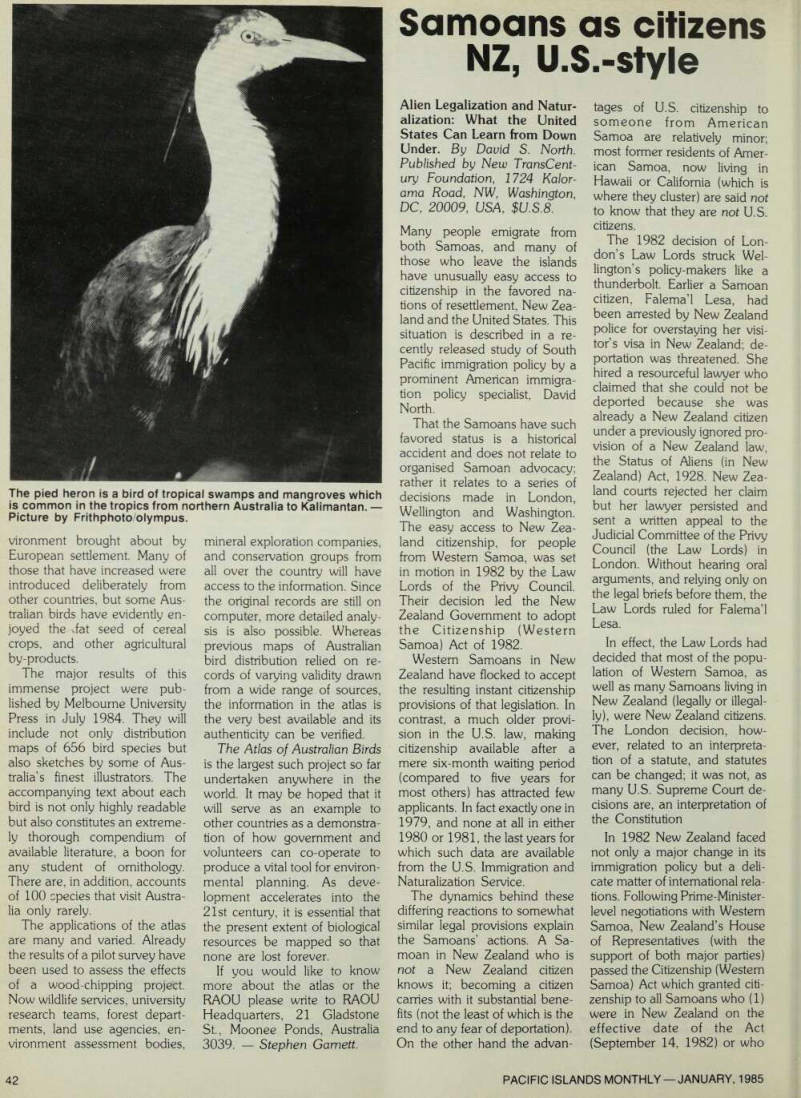
their feathered friends
Atlas of Australian Birds.
Published by Melbourne Uni versity Press. 1984. ISBN 0 522 84285 2. Price SA49.
Birds have long been the envy of people. Even the most ele gant of aeroplanes cannot match the versatility afforded by the flesh and feathers of a bird in flight. Because of this astonishing ability they have flourished all over the world; our lives would be poorer with out their color and song. We would also find life more diffi cult. Many activities of wild birds are of benefit to humans.
Some eat insects which affect our crops, guano from the breeding colonies of seabirds forms the basis of our fertilisers.
All have places in their own communities. The same birds that provide our fertiliser also contribute to the richness of the coral reefs that surround their breeding islands, many plants cannot grow unless their seed has first been eaten by a bird.
However, we do not know the importance of most birds, either to us or their communities. It is a responsibility of our modern society to conserve the natural diversity that has developed
over thousands of years, and to plan our development so that no species are lost. One of the first steps in conservation is to find out where birds live, and it was with the needs of environ mental planning in mind that the Royal Australasian Ornthologists Union (RAOU) began, in 1977, to map the distribution of Australia’s birds.
Initially the country was di vided into 812 degree squares, each about 100 km on each side. Members of the RAOU and other birdwatchers were then encouraged to record every sort of bird they saw within each square. It was a big job: Australia is an enormous country.
Gradually, over the five years of the project, the patterns built up. Scattered points, marking grid squares visited, were at first concentrated around the capital cities of each state, showing more the distribution of bird watchers than of birds. Slowly the points coalesced and spread further and further into the outback. Major expeditions were organised which travelled deep into the sandy hinterland, to country never before seen by
birdwatchers. All manner of vehicles jeeps and aero planes, motor bikes and sailing boats were used to pursue the more elusive unvisited grid squares. Some places were only accessible on foot.
Just under 3000 ornitholog ists, both amateur and pro fessional, contributed records which, by the end of the study, totalled nearly three million.
Every one of the grid blocks in Australia was visited and some areas, like the entire state of Victoria, were surveyed on a much finer scale.
Of course such a project is not free of financial cost and yet the half million dollars needed was remarkably cheap for a project which included five years field work, and two years analysis and writing. No gov ernment could have obtained so much information with only the four full-time staff employed on the atlas project. In fact, had the project been carried out entirely by paid professionals it would have cost more than 10 times as much. On the other hand a voluntary organisation such as the RAOU could not have funded the administration
from its own resources. The result is therefore a splendid example of how government and other funding bodies have been able to work together with enthusiastic and informed volunteers to create a project of benefit to all.
One of the most useful fea tures of the atlas has been to show how the distribution of birds has changed since Euro pean settlement. At the same time as the atlas fieldwork was going on, an historical atlas was prepared from the RAOU’s own journal The Emu, from museums, from books, the re cords of other societies and from the old notes of many birdwatchers. Originally it was intended to publish the his torical maps separately but it is encouraging that there has been too little change in the distribution of most birds for this to be justified. Nevertheless it is disturbing that nearly 20 species are not as widespread as they once were. Six of these are parrots, of which one, the Paradise Parrot, has probably been lost forever. Only two of the bird species that have de clined are found anywhere ex cept Australia the Magpie Goose and the Cotton Pygmy- Goose are fortunately still com mon in Papua New Guinea and South-east Asia. On the other hand some species have bene fited from the changes in en-
A sooty tern on one of the sand cays off the tropical Australian coast. Sooty terns spend most of their time at sea and are common
throughout the Pacific. Picture by Frithfoto/olympus.
Many birds travel between Australia and Papua New Guinea. One such is the superb fruit-dove here shown brooding its young in the rainforest. Picture by Frithfoto/olympus.
vironment brought about by European settlement. Many of those that have increased were introduced deliberately from other countries, but some Aus tralian birds have evidently en joyed the dat seed of cereal crops, and other agricultural by-products.
The major results of this immense project were pub lished by Melbourne University Press in July 1984. They will include not only distribution maps of 656 bird species but also sketches by some of Aus tralia’s finest illustrators. The accompanying text about each bird is not only highly readable but also constitutes an extreme ly thorough compendium of available literature, a boon for any student of ornithology.
There are, in addition, accounts of 100 species that visit Austra lia only rarely.
The applications of the atlas are many and varied. Already the results of a pilot survey have been used to assess the effects of a wood-chipping project.
Now wildlife services, university research teams, forest depart ments, land use agencies, en vironment assessment bodies,
mineral exploration companies, and conservation groups from all over the country will have access to the information. Since the original records are still on computer, more detailed analy sis is also possible. Whereas previous maps of Australian bird distribution relied on re cords of varying validity drawn from a wide range of sources, the information in the atlas is the very best available and its authenticity can be verified.
The Atlas of Australian Birds is the largest such project so far undertaken anywhere in the world. It may be hoped that it will serve as an example to other countries as a demonstra tion of how government and volunteers can co-operate to produce a vital tool for environ mental planning. As deve lopment accelerates into the 21st century, it is essential that the present extent of biological resources be mapped so that none are lost forever.
If you would like to know more about the atlas or the RAOU please write to RAOU Headquarters, 21 Gladstone St., Moonee Ponds, Australia
3039.
Stephen Garnett.
The pied heron is a bird of tropical swamps and mangroves which is common in the tropics from northern Australia to Kalimantan.
Picture by Frithphoto Olympus.
NZ, U.S.-style
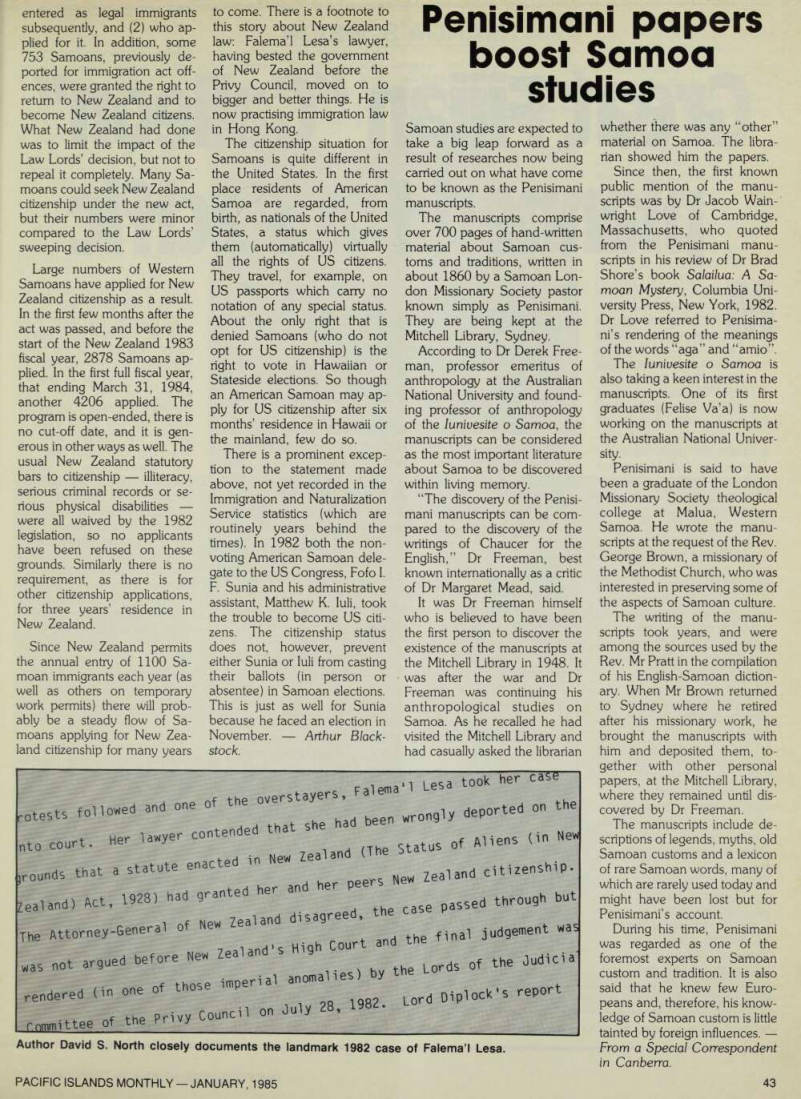
Samoans as citizens NZ, U.S.-style
Alien Legalization and Natur alization: What the United States Can Learn from Down Under. By David S. North.
Published by New Trans Cen tury Foundation, 1724 Kalor ama Road, NW, Washington,
Dc, 20009, Usa, Su.S.B.
Many people emigrate from both Samoas, and many of those who leave the islands have unusually easy access to citizenship in the favored na tions of resettlement, New Zea land and the United States. This situation is described in a re cently released study of South Pacific immigration policy by a prominent American immigra tion policy specialist, David North.
That the Samoans have such favored status is a historical accident and does not relate to organised Samoan advocacy; rather it relates to a series of decisions made in London, Wellington and Washington.
The easy access to New Zea land citizenship, for people from Western Samoa, was set in motion in 1982 by the Law Lords of the Privy Council.
Their decision led the New Zealand Government to adopt the Citizenship (Western Samoa) Act of 1982.
Western Samoans in New Zealand have flocked to accept the resulting instant citizenship provisions of that legislation. In contrast, a much older provi sion in the U.S. law, making citizenship available after a mere six-month waiting period (compared to five years for most others) has attracted few applicants. In fact exactly one in 1979, and none at all in either 1980 or 1981, the last years for which such data are available from the U.S. Immigration and Naturalization Service.
The dynamics behind these differing reactions to somewhat similar legal provisions explain the Samoans’ actions. A Sa moan in New Zealand who is not a New Zealand citizen knows it; becoming a citizen carries with it substantial bene fits (not the least of which is the end to any fear of deportation).
On the other hand the advan
tages of U.S. citizenship to someone from American Samoa are relatively minor; most former residents of Amer ican Samoa, now living in Hawaii or California (which is where they cluster) are said not to know that they are not U.S. citizens.
The 1982 decision of Lon don’s Law Lords struck Wel lington’s policy-makers like a thunderbolt. Earlier a Samoan citizen, Falema’l Lesa, had been arrested by New Zealand police for overstaying her visi tor’s visa in New Zealand; de portation was threatened. She hired a resourceful lawyer who claimed that she could not be deported because she was already a New Zealand citizen under a previously ignored pro vision of a New Zealand law, the Status of Aliens (in New Zealand) Act, 1928. New Zea land courts rejected her claim but her lawyer persisted and sent a written appeal to the Judicial Committee of the Privy Council (the Law Lords) in London. Without hearing oral arguments, and relying only on the legal briefs before them, the Law Lords ruled for Falema’l Lesa.
In effect, the Law Lords had decided that most of the popu lation of Western Samoa, as well as many Samoans living in New Zealand (legally or illegal ly), were New Zealand citizens.
The London decision, how ever, related to an interpreta tion of a statute, and statutes can be changed; it was not, as many U.S. Supreme Court de cisions are, an interpretation of the Constitution In 1982 New Zealand faced not only a major change in its immigration policy but a deli cate matter of international rela tions. Following Prime-Minister level negotiations with Western Samoa, New Zealand’s House of Representatives (with the support of both major parties) passed the Citizenship (Western Samoa) Act which granted citi zenship to all Samoans who (1) were in New Zealand on the effective date of the Act (September 14, 1982) or who
entered as legal immigrants subsequently, and (2) who ap plied for it. In addition, some 753 Samoans, previously de ported for immigration act off ences, were granted the right to return to New Zealand and to become New Zealand citizens.
What New Zealand had done was to limit the impact of the Law Lords’ decision, but not to repeal it completely. Many Sa moans could seek New Zealand citizenship under the new act, but their numbers were minor compared to the Law Lords’ sweeping decision.
Large numbers of Western Samoans have applied for New Zealand citizenship as a result.
In the first few months after the act was passed, and before the start of the New Zealand 1983 fiscal year, 2878 Samoans ap plied. In the first full fiscal year, that ending March 31, 1984, another 4206 applied. The program is open-ended, there is no cut-off date, and it is gen erous in other ways as well. The usual New Zealand statutory bars to citizenship illiteracy, serious criminal records or se rious physical disabilities were all waived by the 1982 legislation, so no applicants have been refused on these grounds. Similarly there is no requirement, as there is for other citizenship applications, for three years’ residence in New Zealand.
Since New Zealand permits the annual entry of 1100 Sa moan immigrants each year (as well as others on temporary work permits) there will prob ably be a steady flow of Sa moans applying for New Zea land citizenship for many years
to come. There is a footnote to this story about New Zealand law: Falema’l Lesa’s lawyer, having bested the government of New Zealand before the Privy Council, moved on to bigger and better things. He is now practising immigration law in Hong Kong.
The citizenship situation for Samoans is quite different in the United States. In the first place residents of American Samoa are regarded, from birth, as nationals of the United States, a status which gives them (automatically) virtually all the rights of US citizens.
They travel, for example, on US passports which carry no notation of any special status.
About the only right that is denied Samoans (who do not opt for US citizenship) is the right to vote in Hawaiian or Stateside elections. So though an American Samoan may ap ply for US citizenship after six months’ residence in Hawaii or the mainland, few do so.
There is a prominent excep tion to the statement made above, not yet recorded in the Immigration and Naturalization Service statistics (which are routinely years behind the times). In 1982 both the non voting American Samoan dele gate to the US Congress, Fofo I.
F. Sunia and his administrative assistant, Matthew K. luli, took the trouble to become US citi zens. The citizenship status does not, however, prevent either Sunia or luli from casting their ballots (in person or absentee) in Samoan elections.
This is just as well for Sunia because he faced an election in
November.
Arthur Black-
stock.
Author David S. North closely documents the landmark 1982 case of Falema’l Lesa.
Penisimani papers
boost Samoa studies
Samoan studies are expected to take a big leap forward as a result of researches now being carried out on what have come to be known as the Penisimani manuscripts.
The manuscripts comprise over 700 pages of hand-written material about Samoan cus toms and traditions, written in about 1860 by a Samoan Lon don Missionary Society pastor known simply as Penisimani.
They are being kept at the Mitchell Library, Sydney.
According to Dr Derek Free man, professor emeritus of anthropology at the Australian National University and found ing professor of anthropology of the luniuesite o Samoa, the manuscripts can be considered as the most important literature about Samoa to be discovered within living memory.
“The discovery of the Penisi mani manuscripts can be com pared to the discovery of the writings of Chaucer for the English,” Dr Freeman, best known internationally as a critic of Dr Margaret Mead, said.
It was Dr Freeman himself who is believed to have been the first person to discover the existence of the manuscripts at the Mitchell Library in 1948. It was after the war and Dr Freeman was continuing his anthropological studies on Samoa. As he recalled he had visited the Mitchell Library and had casually asked the librarian
whether there was any “other” material on Samoa. The libra rian showed him the papers.
Since then, the first known public mention of the manu scripts was by Dr Jacob Wain wright Love of Cambridge, Massachusetts, who quoted from the Penisimani manu scripts in his review of Dr Brad Shore’s book Salailua: A Sa moan Mystery , Columbia Uni versity Press, New York, 1982.
Dr Love referred to Penisima ni’s rendering of the meanings of the words “aga” and “amio”
The luniuesite o Samoa is also taking a keen interest in the manuscripts. One of its first graduates (Felise Va’a) is now working on the manuscripts at the Australian National Univer sity.
Penisimani is said to have been a graduate of the London Missionary Society theological college at Malua, Western Samoa. He wrote the manu scripts at the request of the Rev.
George Brown, a missionary of the Methodist Church, who was interested in preserving some of the aspects of Samoan culture.
The writing of the manu scripts took years, and were among the sources used by the Rev. Mr Pratt in the compilation of his English-Samoan diction ary. When Mr Brown returned to Sydney where he retired after his missionary work, he brought the manuscripts with him and deposited them, to gether with other personal papers, at the Mitchell Library, where they remained until dis covered by Dr Freeman.
The manuscripts include de scriptions of legends, myths, old Samoan customs and a lexicon of rare Samoan words, many of which are rarely used today and might have been lost but for Penisimani’s account.
During his time, Penisimani was regarded as one of the foremost experts on Samoan custom and tradition. It is also said that he knew few Euro peans and, therefore, his know ledge of Samoan custom is little tainted by foreign influences.
From a Special Correspondent in Canberra.
Great Fijian “Galleon"
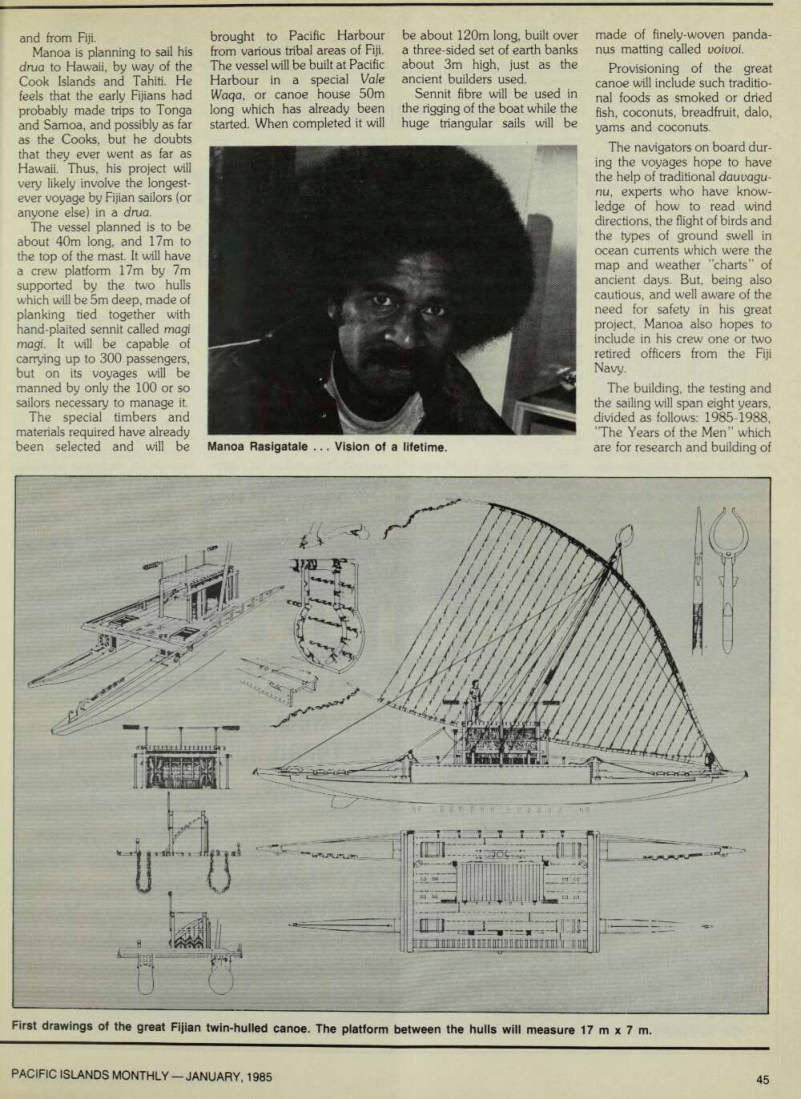

Manoa’S Vision
Great Fijian “Galleon" planned for Pacific
Manoa Rasigatale is acclaimed for his ex pert knowledge of ancient Fijian lore. At the Pacific Harbor complex near Suva it is his imaginative recreations of the past and his Fiji Dance Theatre productions with their realism, authenticity and sheer professionalism that intrigue and delight every visi tor. Over the years since the complex was built,Manoa has developed a cultural oasis that shows the most significant areas of ancient Fijian art and cus toms.
On an island site kept tabu to all non-Fijians, traditional Fijian culture is kept sacred. To tour around it in a canoe is to take a journey back into the past a journey that recognises the ability of the Fijian artist and craftsman to live in harmonious concert with nature. Through his skills, using them in a dignified yet exciting manner, he illustrates the arts of creating mats, masi (tapa cloth), and canoe carving.
The many ways of utilising products of the coconut tree, wood-carvings, pottery and even food processing in the ancient manner, is seen within a series of craft bures (Fijian houses) spaced around the waterway surrounding the is land.
However, the main interest and a principal purpose of the island are the nightly showings of ancient traditional dancing, the hunting chants and the dramatic re-enactment of legend stories of the Fijian peoples. Manoa did not do it all alone, but to a very great extent the quality and faithfulness of the productions are very much
To the Pacific Islander, the sea is life itself. Its waters provide the fish which make his meat.
The winds across its surface bring the rain which waters his crops and gives him drink. He hasOsailed its surface, survived its rages and enjoyed its gifts. It is a part of him, for by it he had his beginnings.
Manoa Rasigatale is one of the most en thusiastic, and knowledgeable of Fijian his torians, who feels, deep within his being, the magic of his ancestors and who has made it his business to recreate, in dance and mime, some of the legends, and much of the culture which is the Fijian heritage. Manoa leads the Fiji Dance Theatre, a group known ail over the world for the excellence of their performances, and the faith ful way in which they have kept alive so much of Fijian lore.
Now Manoa has begun to put together another dream ... to build a great ocean-going Fijian canoe, a twin-hulled drua such as the first Fijians used to sail the ocean on their war-like expeditions and which was their equivalent of the galleons of Spain, the men-o-war of Nelson, the quinqueremes of Nineveah.
Victor Carell, who has been associated with Manoa since the first South Pacific Festival of Arts in Suva, and who has, himself, done much to preserve the history of Fiji, here writes about Manoa’s undertaking.
his work and have made a visit to this unique theatre a high point on any South Pacific tour.
Now Manoa has come up with another bold, exciting and original project - to build again one of the most splendid of the Pacific’s legendary craft, a giant, twin-hulled drua.
The ambitious plan is to build not a scaled-down replica, but to go a stage further and build one of the biggest, if not the
biggest, vessel ever to come out of tribal Fiji.
The drua (the name means double-hulled canoe) will be manned by a Fijian crew who will use traditional navigational methods on a series of voyages, at first in Fiji waters, then to Tonga and Samoa and, finally, culmination of the great scheme, from Fiji to Hawaii and back. The boat builders and crewmen will be picked from
areas of Fiji historically noted for their sea-faring skills.
In building the great boat they will follow ancient proce dures, observing all the tabu, adopting ancient modes of dress, using, as far as practic able, the old tools and materials. On their voyages the same rules will apply, even to having the ancient style of sea-going louo earth oven on the cross-decking in which traditional foods will be pre pared. ”We probably will have radio for safety,” said Manoa, ’’but we won’t have refrigerators.”
No full-sized drua has been built this century, but records in Fiji and elsewhere show that some craft observed during the 19th Century were up to 100 or more feet long and could easily carry 200 warriors in full pillag ing and plundering rig. The most recent model was a small replica built in Kabara in the Lau group and sailed to Suva as part of the South Pacific Festival of Arts of 1972.
Tribal wars were common in old Fiji and the big double hulled war canoes carried armed warriors between the various islands of Fiji on their way to battles of revenge or of conquest. So superior were these big boats in their size, strength and speed, that the Tongans adopted them and sent skilled craftsmen to the Lau islands to use the better timbers there and to follow the Fijian designs and methods.
Tongan crews sailed such vessels on many long, arduous and dangerous exploring ex peditions probably as far east as New Caledonia, and certainly on their continuing forays to
and from Fiji.
Manoa is planning to sail his drua to Hawaii, by way of the Cook Islands and Tahiti. He feels that the early Fijians had probably made trips to Tonga and Samoa, and possibly as far as the Cooks, but he doubts that they ever went as far as Hawaii. Thus, his project will very likely involve the longest ever voyage by Fijian sailors (or anyone else) in a drua.
The vessel planned is to be about 40m long, and 17m to the top of the mast. It will have a crew platform 17m by 7m supported by the two hulls which will be 5m deep, made of planking tied together with hand-plaited sennit called magi magi. It will be capable of carrying up to 300 passengers, but on its voyages will be manned by only the 100 or so sailors necessary to manage it.
The special timbers and materials required have already been selected and will be
brought to Pacific Harbour from various tribal areas of Fiji.
The vessel will be built at Pacific Harbour in a special Vale Waqa, or canoe house 50m long which has already been started. When completed it will
be about 120 m long, built over a three-sided set of earth banks about 3m high, just as the ancient builders used.
Sennit fibre will be used in the rigging of the boat while the huge triangular sails will be
made of finely-woven panda nus matting called voiuoi.
Provisioning of the great canoe will include such traditio nal foods as smoked or dried fish, coconuts, breadfruit, dalo, yams and coconuts.
The navigators on board dur ing the voyages hope to have the help of traditional dauuagu nu, experts who have know ledge of how to read wind directions, the flight of birds and the types of ground swell in ocean currents which were the map and weather ’’charts” of ancient days. But, being also cautious, and well aware of the need for safety in his great project, Manoa also hopes to include in his crew one or two retired officers from the Fiji Navy.
The building, the testing and the sailing will span eight years, divided as follows: 1985-1988, ’The Years of the Men” which are for research and building of
Manoa Rasigatale ... Vision of a lifetime.
First drawings of the great Fijian twin-hulled canoe. The platform between the hulls will measure 17 m x 7 m.
the canoe. 1988-89, ’’The Year of the Canoe,” in which sea trials will be held and training done. 1990-1992, ’’The Years of the Voyage,” in which the canoe will be sailed, first to Tonga, then to Samoa and, finally, the long voyage from Fiji through the Cooks and Tahiti, to Hawaii, and then back. ”1 don’t know how long the voyages will take,” Manoa said. ”It may be that we will have to wait months in some islands until the weather is right, or our people ready. I don’t know. But we will do it.”
The canoe house in which the drua will be built, is a major project in itself. It must be very solid to protect the workmen and their canoe, possibly even from hurricanes, during the three or four years which will be needed for the construction.
With funds given by the Pacific Harbour consortium this part of the work is already well under way.
Manoa has resolved that he
will not use any steel, screws, nails, modern ropes, glues, caulking or blocks and tackle.
Everything, he says, must be authentic. Fortunately, the needed skills of clever joinery and tying of sennit are still known in Fiji, largely because of the vigorous handicrafts in dustry promoted by the govern ment and the tourist industry.
Although the early European navigators, like Captains Cook and Bligh, felt that Fijians ’’did not make bold sailors” and 19th Century records seems to indicate they kept within their own island waters, Manoa be lieves otherwise. ’’Fijians sailed their twin-hul led canoes over thousands of miles, making landfall among their cousins inhabiting distant islands,” he said. ’’That they did this, and returned home to relate their adventures is re counted in epic poems handed down through many genera tions.”
Records at the Fiji Museum, one of the best institutions of its kind in the Pacific, show that a
big drua could attain at least 14 knots, Manoa talks of them as ’’moving easily between 18 and 20 knots,” a speed which is quite remarkable for a big sail ing canoe, although far from unknown in such modern cata maran-style yachts as the Hobie-Cat and its kind.
If Manoa’s dream comes true this voyage by a Fijian drua will go into history as one of the great modern adventures.
It will not be without its hazards. No living person has sailed such a giant canoe on even a short voyage, let alone what is, in fact, a traverse of the frequently far from pacific Paci fic. Much attention will be needed to training and handling the great canoe in difficult water and adverse winds.
Will half a dozen men be able to hold the sweep-oar that will be the rudder? Will the panda nus sail withstand the Pacific’s winds? Will the lashings hold?
Will the bailers be able to keep up with the inflow of water during a sudden storm?
Manoa knows by now a very
great deal about training athletes, for to a very great extent his Fiji Dance Company players are athletes at the peak of condition. And he will have to instil in his sailors not only boating skills, but also dedica tion to their traditions, and courage in a great and hazard ous undertaking.
The other problem is finance.
The project will cost many thousands of dollars. He has not yet come up with any formal sponsorship scheme, although he and his friends are considering various options. ”1 have already been prom ised enough to get it under way, but I will need much more before we can set out on the big voyage,” he said. ”If anyone feels like helping, with any sum of money, I would be very grateful to hear from them.”
Those who know Manoa and his work, and everyone who is interested in Pacific and Fijian culture could hardly fail to wish success for such a wonderfully imaginative and splendid undertaking.
Advertisements & other items, p. 46 (1 item)
Wcific
CONSTRUCTION EQUIPMENT CO
introducing the Dynamic New Range of
Vibrating s Pneumatic Tyred Rollers
THE RANGE
• Pacific Self-Propelled Vibrating Rollers • Single and Double Drum Types • 1.5 tonne to 16 tonne • Pacific Self-Propelled Pneumatic Type Compactors • 3 Models 16. 21. 38 tonne Ballast Weights • Pacific Landfill and Sanitary Landfill Compactors • Pacific Pneumatic Earth Borers • Pacific Road Brooms • Pacific Railway Maintenance Vehicles Construction Equipment Co.
DISTRIBUTORS REQUIRED
THROUGHOUT THE PACIFIC
24 Salisbury Road, Hornsby NSW 2077, Australia. Phone (02) 476 2666
SAL
&g*L:TS3£
up the river?
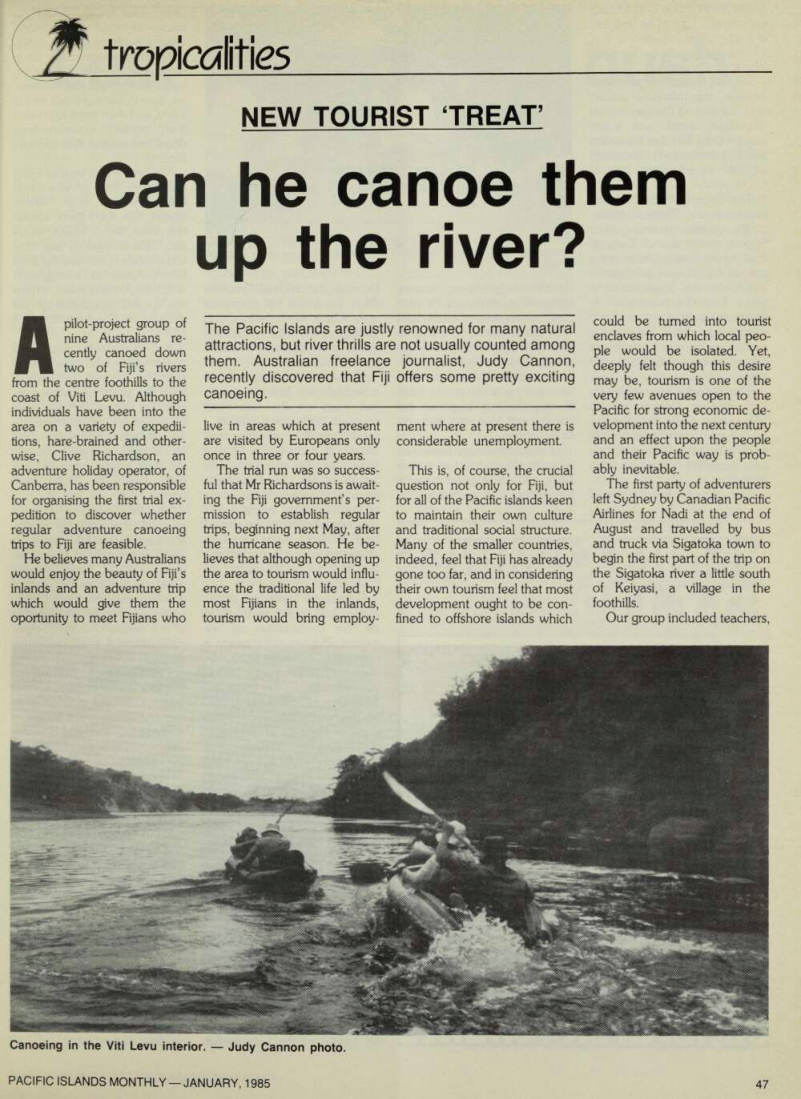
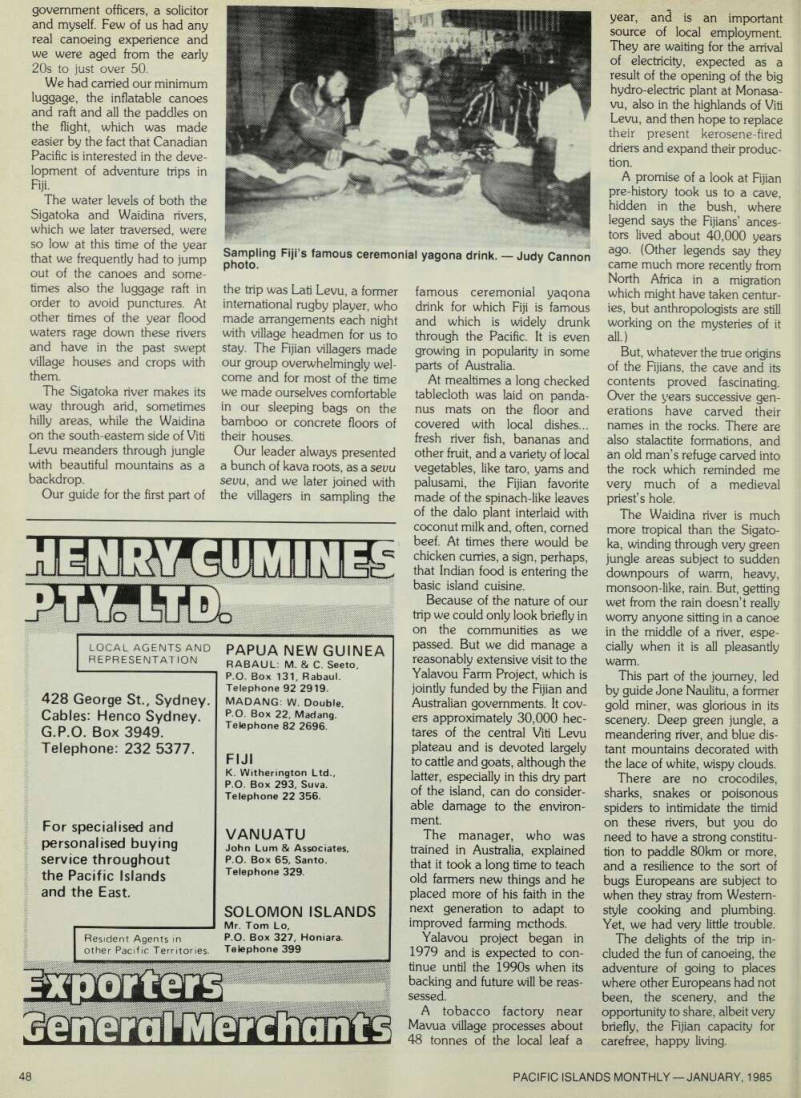
tropioalitigs
New Tourist Treat
Can he canoe them up the river?
A pilot-project group of nine Australians re cently canoed down two of Fiji’s rivers from the centre foothills to the coast of Viti Levu. Although individuals have been into the area on a variety of expedii tions, hare-brained and other wise, Clive Richardson, an adventure holiday operator, of Canberra, has been responsible for organising the first trial ex pedition to discover whether regular adventure canoeing trips to Fiji are feasible.
He believes many Australians would enjoy the beauty of Fiji’s inlands and an adventure trip which would give them the oportunity to meet Fijians who
The Pacific Islands are justly renowned for many natural attractions, but river thrills are not usually counted among them. Australian freelance journalist, Judy Cannon, recently discovered that Fiji offers some pretty exciting canoeing.
live in areas which at present are visited by Europeans only once in three or four years.
The trial run was so success ful that Mr Richardsons is await ing the Fiji government’s per mission to establish regular trips, beginning next May, after the hurricane season. He be lieves that although opening up the area to tourism would influ ence the traditional life led by most Fijians in the inlands, tourism would bring employ
ment where at present there is considerable unemployment.
This is, of course, the crucial question not only for Fiji, but for all of the Pacific islands keen to maintain their own culture and traditional social structure.
Many of the smaller countries, indeed, feel that Fiji has already gone too far, and in considering their own tourism feel that most development ought to be con fined to offshore islands which
could be turned into tourist enclaves from which local peo ple would be isolated. Yet, deeply felt though this desire may be, tourism is one of the very few avenues open to the Pacific for strong economic de velopment into the next century and an effect upon the people and their Pacific way is prob
ably inevitable.
The first party of adventurers left Sydney by Canadian Pacific Airlines for Nadi at the end of August and travelled by bus and truck via Sigatoka town to begin the first part of the trip on the Sigatoka river a little south of Keiyasi, a village in the foothills.
Our group included teachers,
Canoeing in the Viti Levu interior. - Judy Cannon photo.
government officers, a solicitor and myself. Few of us had any real canoeing experience and we were aged from the early 20s to just over 50.
We had carried our minimum luggage, the inflatable canoes and raft and all the paddles on the flight, which was made easier by the fact that Canadian Pacific is interested in the deve lopment of adventure trips in Fiji.
The water levels of both the Sigatoka and Waidina rivers, which we later traversed, were so low at this time of the year that we frequently had to jump out of the canoes and some times also the luggage raft in order to avoid punctures. At other times of the year flood waters rage down these rivers and have in the past swept village houses and crops with them.
The Sigatoka river makes its way through arid, sometimes hilly areas, while the Waidina on the south-eastern side of Viti Levu meanders through jungle with beautiful mountains as a backdrop.
Our guide for the first part of
the trip was Lati Levu, a former international rugby player, who made arrangements each night with village headmen for us to stay. The Fijian villagers made our group overwhelmingly wel come and for most of the time we made ourselves comfortable in our sleeping bags on the bamboo or concrete floors of their houses.
Our leader always presented a bunch of kava roots, as a sevu seuu, and we later joined with the villagers in sampling the
famous ceremonial yaqona drink for which Fiji is famous and which is widely drunk through the Pacific. It is even growing in popularity in some parts of Australia.
At mealtimes a long checked tablecloth was laid on panda nus mats on the floor and covered with local dishes... fresh river fish, bananas and other fruit, and a variety of local vegetables, like taro, yams and palusami, the Fijian favorite made of the spinach-like leaves of the dalo plant interlaid with coconut milk and, often, corned beef. At times there would be chicken curries, a sign, perhaps, that Indian food is entering the basic island cuisine.
Because of the nature of our trip we could only look briefly in on the communities as we passed. But we did manage a reasonably extensive visit to the Yalavou Farm Project, which is jointly funded by the Fijian and Australian governments. It cov ers approximately 30,000 hec tares of the central Viti Levu plateau and is devoted largely to cattle and goats, although the latter, especially in this dry part of the island, can do consider able damage to the environ ment.
The manager, who was trained in Australia, explained that it took a long time to teach old farmers new things and he placed more of his faith in the next generation to adapt to improved farming methods.
Yalavou project began in 1979 and is expected to con tinue until the 1990 s when its backing and future will be reas sessed.
A tobacco factory near Mavua village processes about 48 tonnes of the local leaf a
year, and is an important source of local employment.
They are waiting for the arrival of electricity, expected as a result of the opening of the big hydro-electric plant at Monasa vu, also in the highlands of Viti Levu, and then hope to replace their present kerosene-fired driers and expand their produc tion.
A promise of a look at Fijian pre-history took us to a cave, hidden in the bush, where legend says the Fijians’ ances tors lived about 40,000 years ago. (Other legends say they came much more recently from North Africa in a migration which might have taken centur ies, but anthropologists are still working on the mysteries of it all.) But, whatever the true origins of the Fijians, the cave and its contents proved fascinating.
Over the years successive gen erations have carved their names in the rocks. There are also stalactite formations, and an old man’s refuge carved into the rock which reminded me very much of a medieval priest’s hole.
The Waidina river is much more tropical than the Sigato ka, winding through very green jungle areas subject to sudden downpours of warm, heavy, monsoon-like, rain. But, getting wet from the rain doesn’t really worry anyone sitting in a canoe in the middle of a river, espe cially when it is all pleasantly warm.
This part of the journey, led by guide Jone Naulitu, a former gold miner, was glorious in its scenery. Deep green jungle, a meandering river, and blue dis tant mountains decorated with the lace of white, wispy clouds.
There are no crocodiles, sharks, snakes or poisonous spiders to intimidate the timid on these rivers, but you do need to have a strong constitu tion to paddle 80km or more, and a resilience to the sort of bugs Europeans are subject to when they stray from Western style cooking and plumbing.
Yet, we had very little trouble.
The delights of the trip in cluded the fun of canoeing, the adventure of going to places where other Europeans had not been, the scenery, and the opportunity to share, albeit very briefly, the Fijian capacity for carefree, happy living.
Sampling Fiji’s famous ceremonial yagona drink. - Judy Cannon photo.
Advertisements & other items, p. 48 (1 item)
service throughout
m
LOCAL AGENTS AND
REPRESENTATION
428 George St., Sydney.
Cables: Henco Sydney.
G.P.O. Box 3949.
Telephone: 232 5377.
PAPUA NEW GUINEA
RABAUL: M. & C. Seeto, P.O. Box 131, Rabaul.
Telephone 92 2919.
MADANG: W. Double, P.O. Box 22, Madang.
Telephone 82 2696.
FIJI
K. Witherington Ltd., P.O. Box 293, Suva.
Telephone 22 356.
For specialised and
personalised buying
service throughout
the Pacific Islands
and the East.
VANUATU
John Lum & Associates, P.O. Box 65, Santo.
Telephone 329.
SOLOMON ISLANDS
—i—Mr. Tom Lo, Resident Agents in P.O. Box 327, Honiara. other Pacific Territories. Telephone 399
Lost in the Efate bush
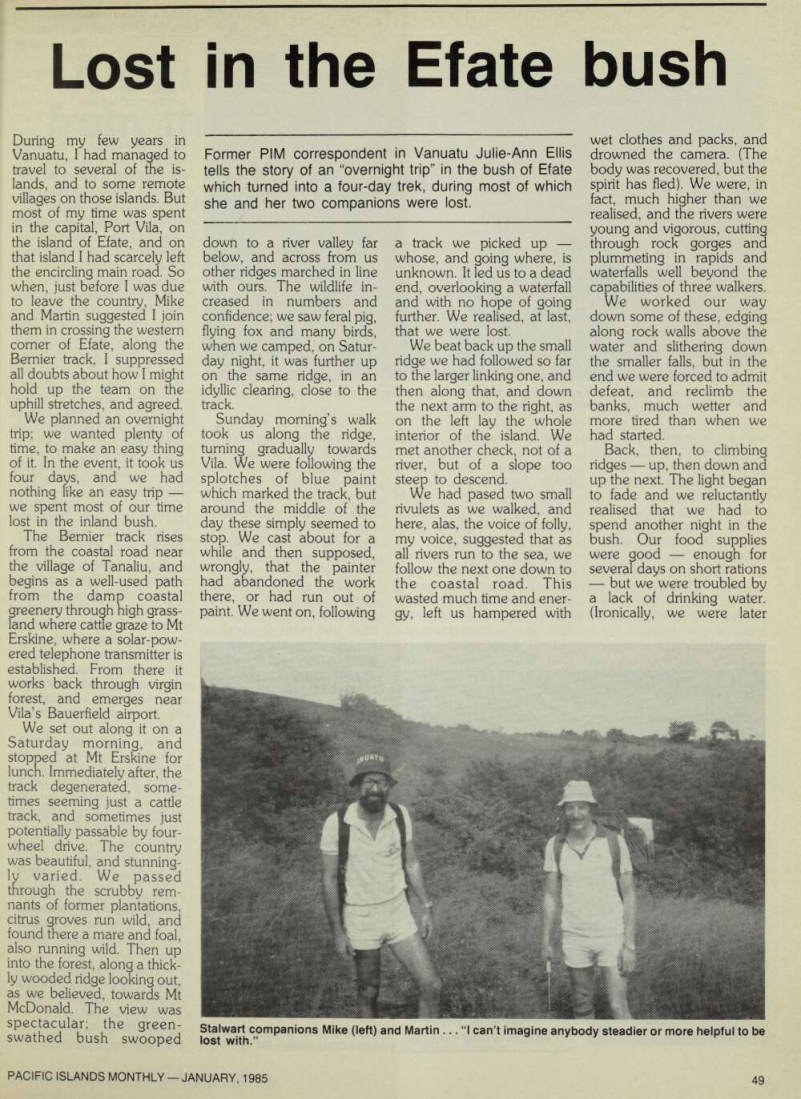
During my few years in Vanuatu, I had managed to travel to several of the is lands, and to some remote villages on those islands. But most of my time was spent in the capital, Port Vila, on the island of Efate, and on that island I had scarcely left the encircling main road. So when, just before I was due to leave the country, Mike and Martin suggested I join them in crossing the western corner of Efate, along the Bernier track, I suppressed all doubts about how I might hold up the team on the uphill stretches, and agreed.
We planned an overnight trip; we wanted plenty of time, to make an easy thing of it. In the event, it took us four days, and we had nothing like an easy trip we spent most of our time lost in the inland bush.
The Bernier track rises from the coastal road near the village of Tanaliu, and begins as a well-used path from the damp coastal greenery through high grass land where cattle graze to Mt Erskine, where a solar-pow ered telephone transmitter is established. From there it works back through virgin forest, and emerges near Vila’s Bauerfield airport.
We set out along it on a Saturday morning, and stopped at Mt Erskine for lunch. Immediately after, the track degenerated, some times seeming just a cattle track, and sometimes just potentially passable by four wheel drive. The country was beautiful, and stunning ly varied. We passed
through the scrubby rem
nants of former plantations, citrus groves run wild, and found there a mare and foal, also running wild. Then up into the forest, along a thick ly wooded ridge looking out, as we believed, towards Mt McDonald. The view was spectacular; the green swathed bush swooped
Former RIM correspondent in Vanuatu Julie-Ann Ellis tells the story of an “overnight trip” in the bush of Efate which turned into a four-day trek, during most of which she and her two companions were lost.
down to a river valley far below, and across from us other ridges marched in line with ours. The wildlife in creased in numbers and confidence; we saw feral pig, flying fox and many birds, when we camped, on Satur day night, it was further up on the same ridge, in an idyllic clearing, close to the track.
Sunday morning’s walk took us along the ridge, turning gradually towards Vila. We were following the splotches of blue paint which marked the track, but around the middle of the day these simply seemed to stop. We cast about for a while and then supposed, wrongly, that the painter had abandoned the work there, or had run out of paint. We went on, following
a track we picked up whose, and going where, is unknown. It led us to a dead end, overlooking a waterfall and with no hope of going further. We realised, at last, that we were lost.
We beat back up the small ridge we had followed so far to the larger linking one, and then along that, and down the next arm to the right, as on the left lay the whole interior of the island. We met another check, not of a river, but of a slope too steep to descend.
We had pased two small rivulets as we walked, and here, alas, the voice of folly, my voice, suggested that as all rivers run to the sea, we follow the next one down to the coastal road. This wasted much time and ener gy, left us hampered with
wet clothes and packs, and drowned the camera. (The body was recovered, but the spirit has fled). We were, in fact, much higher than we realised, and the rivers were young and vigorous, cutting through rock gorges and plummeting in rapids and waterfalls well beyond the capabilities of three walkers.
We worked our way down some of these, edging along rock walls above the water and slithering down the smaller falls, but in the end we were forced to admit defeat, and reclimb the banks, much wetter and more tired than when we had started.
Back, then, to climbing ridges up, then down and up the next. The light began to fade and we reluctantly realised that we had to spend another night in the bush. Our food supplies were good enough for several days on short rations but we were troubled by a lack of drinking water. (Ironically, we were later
Stalwart companions Mike (left) and Martin ... “I can’t imagine anybody steadier or more helpful to be lost with.”
also to be troubled by too
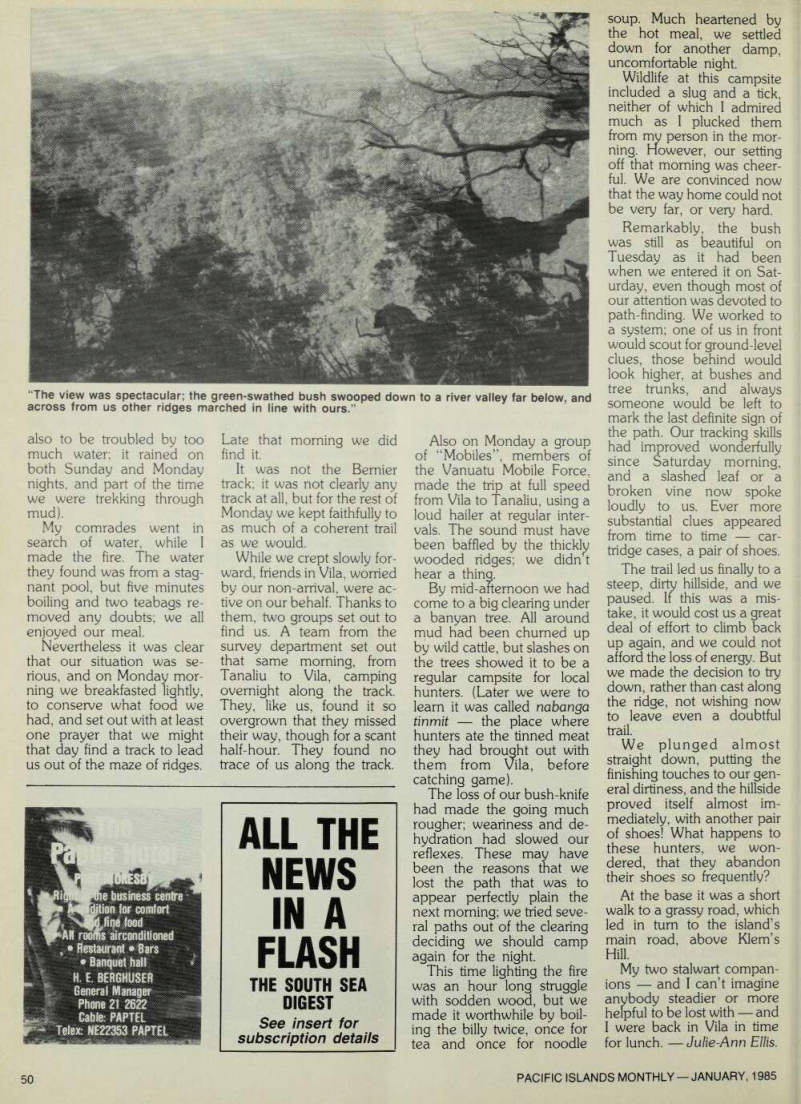
much water; it rained on both Sunday and Monday nights, and part of the time we were trekking through mud).
My comrades went in search of water, while I made the fire. The water they found was from a stag nant pool, but five minutes boiling and two teabags re moved any doubts; we all enjoyed our meal.
Nevertheless it was clear that our situation was se rious, and on Monday mor ning we breakfasted lightly, to conserve what food we had, and set out with at least one prayer that we might that day find a track to lead us out of the maze of ridges.
Late that morning we did find it.
It was not the Bernier track; it was not clearly any track at all, but for the rest of Monday we kept faithfully to as much of a coherent trail as we would.
While we crept slowly for ward, friends in Vila, worried by our non-arrival, were ac tive on our behalf. Thanks to them, two groups set out to find us. A team from the survey department set out that same morning, from Tanaliu to Vila, camping overnight along the track.
They, like us, found it so overgrown that they missed their way, though for a scant half-hour. They found no trace of us along the track.
Also on Monday a group of “Mobiles”, members of the Vanuatu Mobile Force, made the trip at full speed from Vila to Tanaliu, using a loud hailer at regular inter vals. The sound must have been baffled by the thickly wooded ridges; we didn t hear a thing.
By mid-afternoon we had come to a big clearing under a banyan tree. All around mud had been churned up by wild cattle, but slashes on the trees showed it to be a regular campsite for local hunters. (Later we were to learn it was called nabanga tinmit the place where hunters ate the tinned meat they had brought out with them from Vila, before catching game).
The loss of our bush-knife had made the going much rougher; weariness and de hydration had slowed our reflexes. These may have been the reasons that we lost the path that was to appear perfectly plain the next morning; we tried seve ral paths out of the clearing deciding we should camp again for the night.
This time lighting the fire was an hour long struggle with sodden wood, but we made it worthwhile by boil ing the billy twice, once for tea and once for noodle
soup. Much heartened by the hot meal, we settled down for another damp, uncomfortable night.
Wildlife at this campsite included a slug and a tick, neither of which I admired much as I plucked them from my person in the mor ning. However, our setting off that morning was cheer ful. We are convinced now that the way home could not be very far, or very hard.
Remarkably, the bush was still as beautiful on Tuesday as it had been when we entered it on Sat urday, even though most of our attention was devoted to path-finding. We worked to a system; one of us in front would scout for ground-level clues, those behind would look higher, at bushes and tree trunks, and always someone would be left to mark the last definite sign of the path. Our tracking skills had improved wonderfully since Saturday morning, and a slashed leaf or a broken vine now spoke loudly to us. Ever more substantial clues appeared from time to time car tridge cases, a pair of shoes.
The trail led us finally to a steep, dirty hillside, and we paused. If this was a mis take, it would cost us a great deal of effort to climb back up again, and we could not afford the loss of energy. But we made the decision to try down, rather than cast along the ridge, not wishing now to leave even a doubtful trail.
We plunged almost straight down, putting the finishing touches to our gen eral dirtiness, and the hillside proved itself almost im mediately, with another pair of shoes! What happens to these hunters, we won dered, that they abandon their shoes so frequently?
At the base it was a short walk to a grassy road, which led in turn to the island’s main road, above Klem’s Hill.
My two stalwart compan ions and I can’t imagine anybody steadier or more helpful to be lost with and I were back in Vila in time
for lunch.
Julie-Ann Ellis.
“The view was spectacular; the green-swathed bush swooped down to a river valley far below, and across from us other ridges marched in line with ours.”
Advertisements & other items, p. 50 (1 item)
News
ft m
ALL THE
IN A
FLASH
THE SOUTH SEA
DIGEST
See insert for subscription details
A call for a turn away
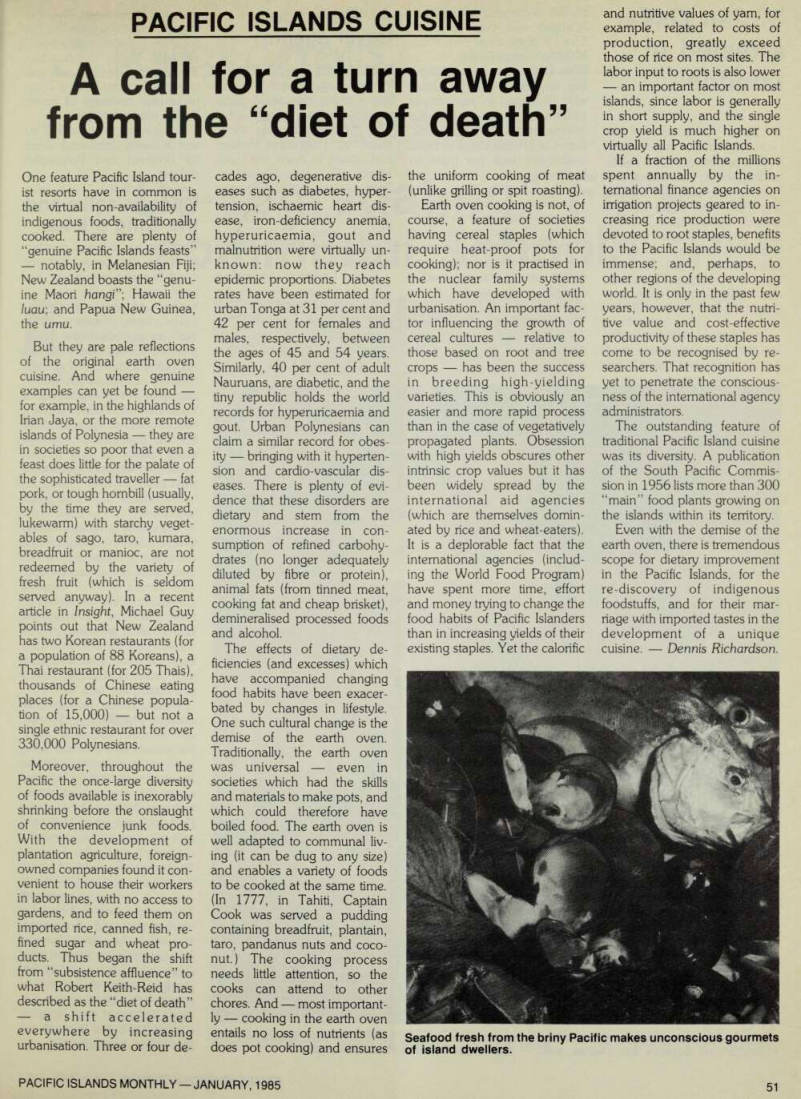
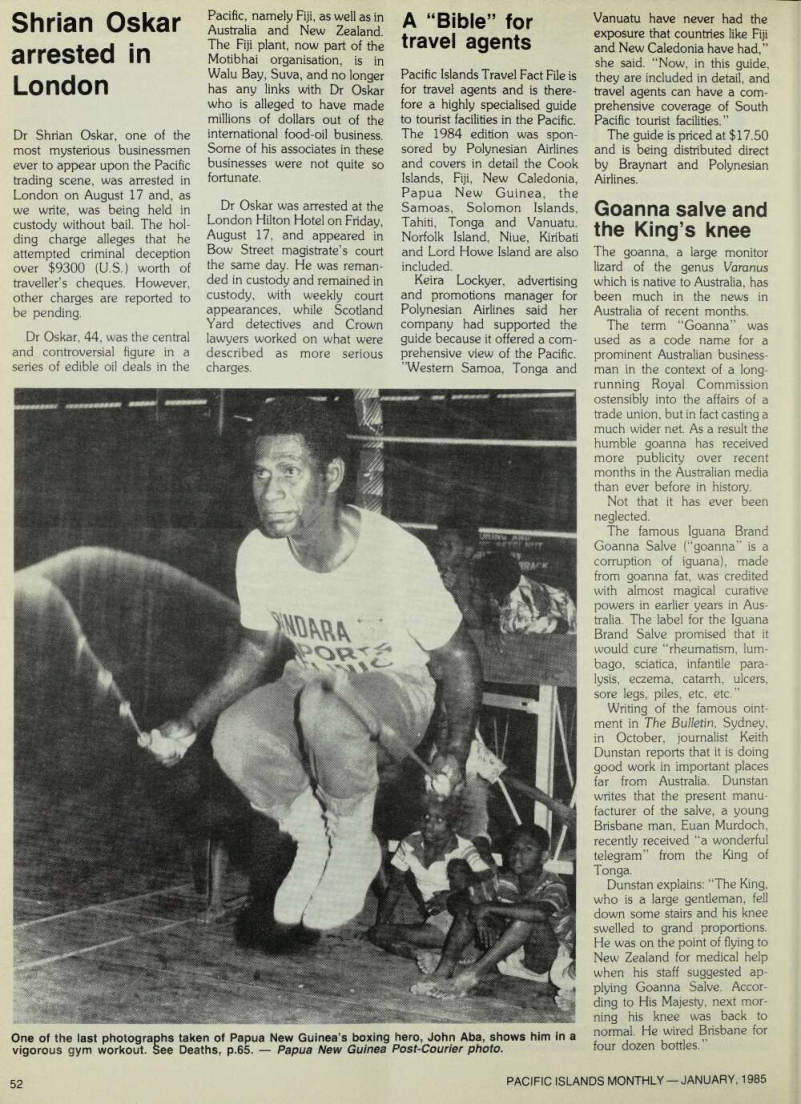
Pacific Islands Cuisine
A call for a turn away from the "diet of death"
One feature Pacific Island tour ist resorts have in common is the virtual non-availability of indigenous foods, traditionally cooked. There are plenty of “genuine Pacific Islands feasts” notably, in Melanesian Fiji; New Zealand boasts the “genu ine Maori hangi”; Hawaii the luau; and Papua New Guinea, the umu.
But they are pale reflections of the original earth oven cuisine. And where genuine examples can yet be found for example, in the highlands of Irian Jaya, or the more remote islands of Polynesia they are in societies so poor that even a feast does little for the palate of the sophisticated traveller fat pork, or tough hombill (usually, by the time they are served, lukewarm) with starchy veget ables of sago, taro, kumara, breadfruit or manioc, are not redeemed by the variety of fresh fruit (which is seldom served anyway). In a recent article in Insight, Michael Guy points out that New Zealand has two Korean restaurants (for a population of 88 Koreans), a Thai restaurant (for 205 Thais), thousands of Chinese eating places (for a Chinese popula tion of 15,000) but not a single ethnic restaurant for over 330,000 Polynesians.
Moreover, throughout the Pacific the once-large diversity of foods available is inexorably shrinking before the onslaught of convenience junk foods.
With the development of plantation agriculture, foreign owned companies found it con venient to house their workers in labor lines, with no access to gardens, and to feed them on imported rice, canned fish, re fined sugar and wheat pro ducts. Thus began the shift from “subsistence affluence” to what Robert Keith-Reid has described as the “diet of death” a shift accelerated everywhere by increasing urbanisation. Three or four de
cades ago, degenerative dis eases such as diabetes, hyper tension, ischaemic heart dis ease, iron-deficiency anemia, hyperuricaemia, gout and malnutrition were virtually un known: now they reach epidemic proportions. Diabetes rates have been estimated for urban Tonga at 31 per cent and 42 per cent for females and males, respectively, between the ages of 45 and 54 years.
Similarly, 40 per cent of adult Nauruans, are diabetic, and the tiny republic holds the world records for hyperuricaemia and gout. Urban Polynesians can claim a similar record for obes ity bringing with it hyperten sion and cardio-vascular dis eases. There is plenty of evi dence that these disorders are dietary and stem from the enormous increase in con sumption of refined carbohy drates (no longer adequately diluted by fibre or protein), animal fats (from tinned meat, cooking fat and cheap brisket), demineralised processed foods and alcohol.
The effects of dietary de ficiencies (and excesses) which have accompanied changing food habits have been exacer bated by changes in lifestyle.
One such cultural change is the demise of the earth oven.
Traditionally, the earth oven was universal even in societies which had the skills and materials to make pots, and which could therefore have boiled food. The earth oven is well adapted to communal liv ing (it can be dug to any size) and enables a variety of foods to be cooked at the same time. (In 1777, in Tahiti, Captain Cook was served a pudding containing breadfruit, plantain, taro, pandanus nuts and coco nut. ) The cooking process needs little attention, so the cooks can attend to other chores. And most important ly cooking in the earth oven entails no loss of nutrients (as does pot cooking) and ensures
the uniform cooking of meat (unlike grilling or spit roasting).
Earth oven cooking is not, of course, a feature of societies having cereal staples (which require heat-proof pots for cooking); nor is it practised in the nuclear family systems which have developed with urbanisation. An important fac tor influencing the growth of cereal cultures relative to those based on root and tree crops has been the success in breeding high-yielding varieties. This is obviously an easier and more rapid process than in the case of vegetatively propagated plants. Obsession with high yields obscures other intrinsic crop values but it has been widely spread by the international aid agencies (which are themselves domin ated by rice and wheat-eaters).
It is a deplorable fact that the international agencies (includ ing the World Food Program) have spent more time, effort and money trying to change the food habits of Pacific Islanders than in increasing yields of their existing staples. Yet the calorific
and nutritive values of yam, for example, related to costs of production, greatly exceed those of rice on most sites. The labor input to roots is also lower an important factor on most islands, since labor is generally in short supply, and the single crop yield is much higher on virtually all Pacific Islands.
If a fraction of the millions spent annually by the in ternational finance agencies on irrigation projects geared to in creasing rice production were devoted to root staples, benefits to the Pacific Islands would be immense; and, perhaps, to other regions of the developing world. It is only in the past few years, however, that the nutri tive value and cost-effective productivity of these staples has come to be recognised by re searchers. That recognition has yet to penetrate the conscious ness of the international agency administrators.
The outstanding feature of traditional Pacific Island cuisine was its diversity. A publication of the South Pacific Commis sion in 1956 lists more than 300 “main” food plants growing on the islands within its territory.
Even with the demise of the earth oven, there is tremendous scope for dietary improvement in the Pacific Islands, for the re-discovery of indigenous foodstuffs, and for their mar riage with imported tastes in the development of a unique
cuisine.
Dennis Richardson.
Seafood fresh from the briny Pacific makes unconscious gourmets of island dwellers.
Shrian Oskar
arrested in
London
Dr Shrian Oskar, one of the most mysterious businessmen ever to appear upon the Pacific trading scene, was arrested in London on August 17 and, as we write, was being held in custody without bail. The hol ding charge alleges that he attempted criminal deception over $9300 (U.S.) worth of traveller’s cheques. However, other charges are reported to be pending.
Dr Oskar, 44, was the central and controversial figure in a series of edible oil deals in the
Pacific, namely Fiji, as well as in Australia and New Zealand.
The Fiji plant, now part of the Motibhai organisation, is in Walu Bay, Suva, and no longer has any links with Dr Oskar who is alleged to have made millions of dollars out of the international food-oil business.
Some of his associates in these businesses were not quite so fortunate.
Dr Oskar was arrested at the London Hilton Hotel on Friday, August 17, and appeared in Bow Street magistrate’s court the same day. He was reman ded in custody and remained in custody, with weekly court appearances, while Scotland Yard detectives and Crown lawyers worked on what were described as more serious charges.
A “Bible” for
travel agents
Pacific Islands Travel Fact File is for travel agents and is there fore a highly specialised guide to tourist facilities in the Pacific.
The 1984 edition was spon sored by Polynesian Airlines and covers in detail the Cook Islands, Fiji, New Caledonia, Papua New Guinea, the Samoas, Solomon Islands, Tahiti, Tonga and Vanuatu.
Norfolk Island, Niue, Kiribati and Lord Howe Island are also included.
Keira Lockyer, advertising and promotions manager for Polynesian Airlines said her company had supported the guide because it offered a com prehensive view of the Pacific. ’’Western Samoa, Tonga and
Vanuatu have never had the exposure that countries like Fiji and New Caledonia have had,” she said. “Now, in this guide, they are included in detail, and travel agents can have a com prehensive coverage of South Pacific tourist facilities.”
The guide is priced at $17.50 and is being distributed direct by Braynart and Polynesian Airlines.
Goanna salve and
the King’s knee
The goanna, a large monitor lizard of the genus Varanus which is native to Australia, has been much in the news in Australia of recent months.
The term “Goanna” was used as a code name for a prominent Australian business man in the context of a long running Royal Commission ostensibly into the affairs of a trade union, but in fact casting a much wider net. As a result the humble goanna has received more publicity over recent months in the Australian media than ever before in history.
Not that it has ever been neglected.
The famous Iguana Brand Goanna Salve (“goanna” is a corruption of iguana), made from goanna fat, was credited with almost magical curative powers in earlier years in Aus tralia. The label for the Iguana Brand Salve promised that it would cure “rheumatism, lum bago, sciatica, infantile para lysis, eczema, catarrh, ulcers, sore legs, piles, etc, etc.”
Writing of the famous oint ment in The Bulletin , Sydney, in October, journalist Keith Dunstan reports that it is doing good work in important places far from Australia. Dunstan writes that the present manu facturer of the salve, a young Brisbane man, Euan Murdoch, recently received “a wonderful telegram” from the King of Tonga.
Dunstan explains: “The King, who is a large gentleman, fell down some stairs and his knee swelled to grand proportions.
He was on the point of flying to New Zealand for medical help when his staff suggested ap plying Goanna Salve. Accor ding to His Majesty, next mor ning his knee was back to normal. He wired Brisbane for four dozen bottles.”
One of the last photographs taken of Papua New Guinea’s boxing hero, John Aba, shows him in a vigorous gym workout. See Deaths, p.65. - Papua New Guinea Post-Courier photo.
“De-segregating” Fiji’s
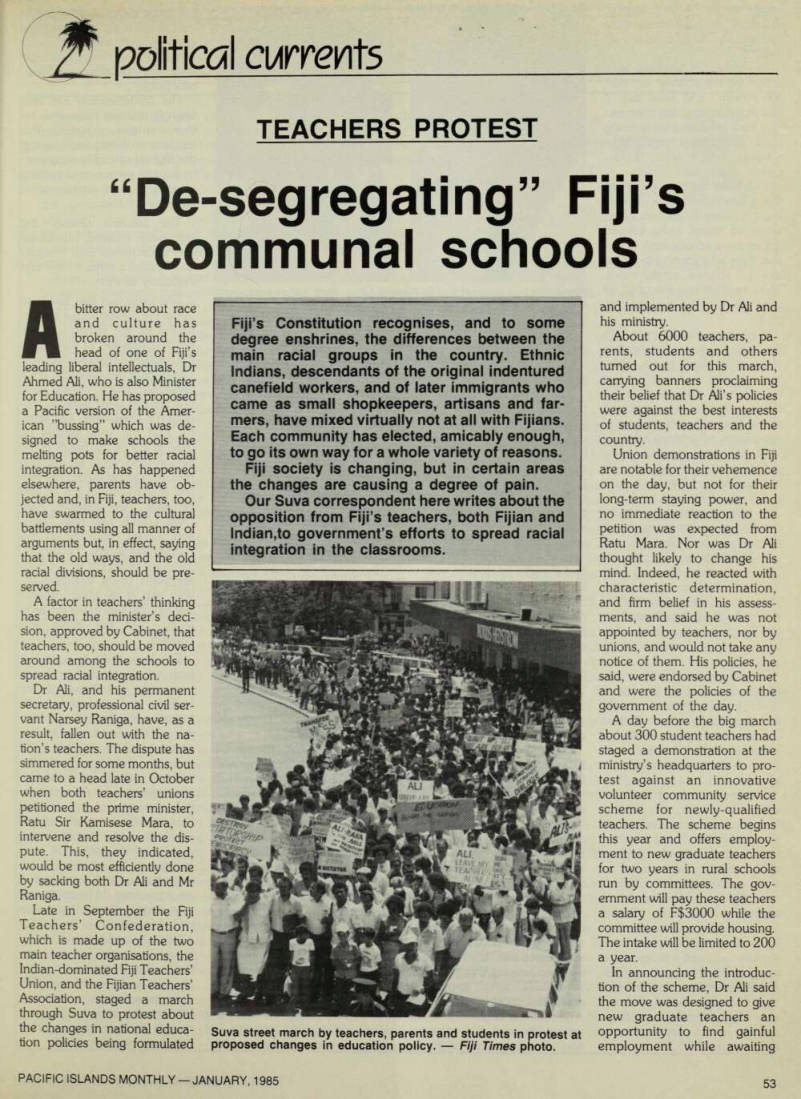
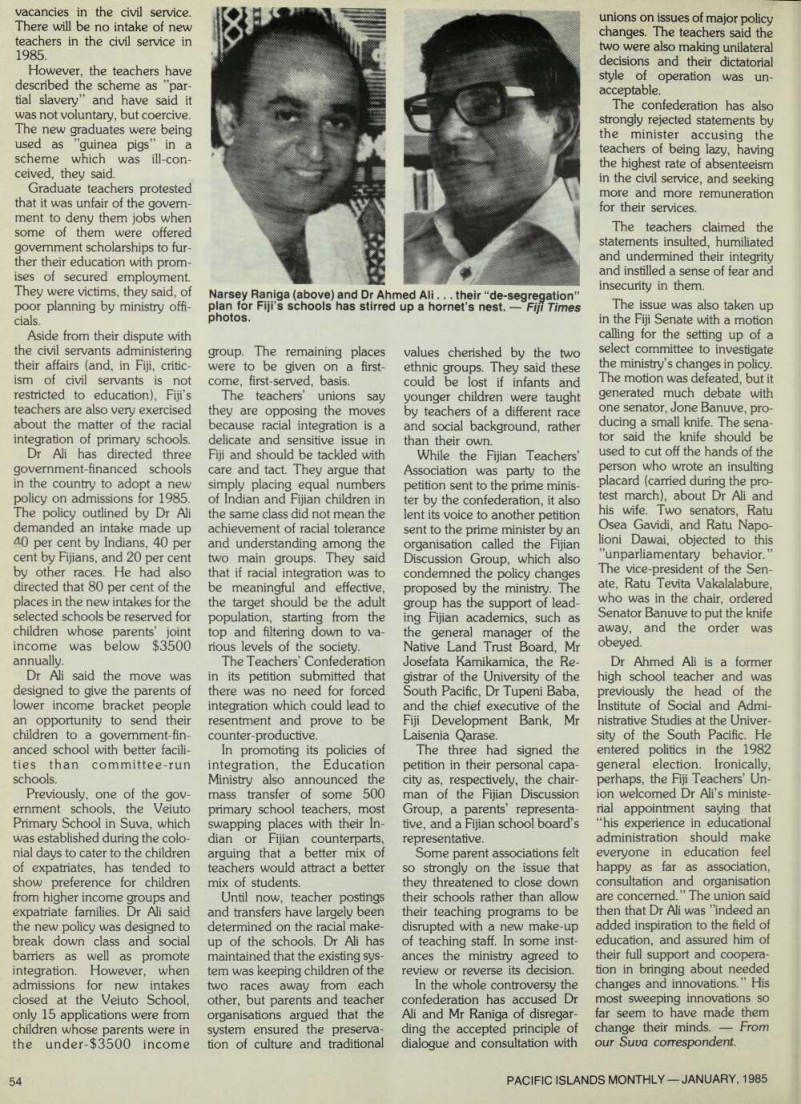
political currents
Teachers Protest
“De-segregating” Fiji’s communal schools
A bitter row about race and culture has broken around the head of one of Fiji’s leading liberal intellectuals, Dr Ahmed Ali, who is also Minister for Education. He has proposed a Pacific version of the Amer ican ’’bussing” which was de signed to make schools the melting pots for better racial integration. As has happened elsewhere, parents have ob jected and, in Fiji, teachers, too, have swarmed to the cultural battlements using all manner of arguments but, in effect, saying that the old ways, and the old racial divisions, should be pre served.
A factor in teachers’ thinking has been the minister’s deci sion, approved by Cabinet, that teachers, too, should be moved around among the schools to spread racial integration.
Dr Ali, and his permanent secretary, professional civil ser vant Narsey Raniga, have, as a result, fallen out with the na tion’s teachers. The dispute has simmered for some months, but came to a head late in October when both teachers’ unions petitioned the prime minister, Ratu Sir Kamisese Mara, to intervene and resolve the dis pute. This, they indicated, would be most efficiently done by sacking both Dr Ali and Mr Raniga.
Late in September the Fiji Teachers’ Confederation, which is made up of the two main teacher organisations, the Indian-dominated Fiji Teachers’
Union, and the Fijian Teachers’
Association, staged a march through Suva to protest about the changes in national educa tion policies being formulated
Fiji’s Constitution recognises, and to some degree enshrines, the differences between the main racial groups in the country. Ethnic Indians, descendants of the original indentured canefield workers, and of later immigrants who came as small shopkeepers, artisans and far mers, have mixed virtually not at all with Fijians.
Each community has elected, amicably enough, to go its own way for a whole variety of reasons.
Fiji society is changing, but in certain areas the changes are causing a degree of pain.
Our Suva correspondent here writes about the opposition from Fiji’s teachers, both Fijian and Indian,to government’s efforts to spread racial integration in the classrooms.
and implemented by Dr Ali and his ministry.
About 6000 teachers, pa rents, students and others turned out for this march, carrying banners proclaiming their belief that Dr Ali’s policies were against the best interests of students, teachers and the country.
Union demonstrations in Fiji are notable for their vehemence on the day, but not for their long-term staying power, and no immediate reaction to the petition was expected from Ratu Mara. Nor was Dr Ali thought likely to change his mind. Indeed, he reacted with characteristic determination, and firm belief in his assess ments, and said he was not appointed by teachers, nor by unions, and would not take any notice of them. His policies, he said, were endorsed by Cabinet and were the policies of the government of the day.
A day before the big march about 300 student teachers had staged a demonstration at the ministry’s headquarters to pro test against an innovative volunteer community service scheme for newly-qualified teachers. The scheme begins this year and offers employ ment to new graduate teachers for two years in rural schools run by committees. The gov ernment will pay these teachers a salary of Fs3ooo while the committee will provide housing.
The intake will be limited to 200 a year.
In announcing the introduc tion of the scheme, Dr Ali said the move was designed to give new graduate teachers an opportunity to find gainful employment while awaiting
Suva street march by teachers, parents and students in protest at proposed changes in education policy. Fiji Times photo.
vacancies in the civil service.
There will be no intake of new teachers in the civil service in 1985.
However, the teachers have described the scheme as ’’par tial slavery” and have said it was not voluntary, but coercive.
The new graduates were being used as ’’guinea pigs” in a scheme which was ill-con ceived, they said.
Graduate teachers protested that it was unfair of the govern ment to deny them jobs when some of them were offered government scholarships to fur ther their education with prom ises of secured employment.
They were victims, they said, of poor planning by ministry offi cials.
Aside from their dispute with the civil servants administering their affairs (and, in Fiji, critic ism of civil servants is not restricted to education), Fiji’s teachers are also very exercised about the matter of the racial integration of primary schools.
Dr Ali has directed three government-financed schools in the country to adopt a new policy on admissions for 1985.
The policy outlined by Dr Ali demanded an intake made up 40 per cent by Indians, 40 per cent by Fijians, and 20 per cent by other races. He had also directed that 80 per cent of the places in the new intakes for the selected schools be reserved for children whose parents’ joint income was below $3500 annually.
Dr Ali said the move was designed to give the parents of lower income bracket people an opportunity to send their children to a government-fin anced school with better facili ties than committee-run schools.
Previously, one of the gov ernment schools, the Veiuto Primary School in Suva, which was established during the colo nial days to cater to the children of expatriates, has tended to show preference for children from higher income groups and expatriate families. Dr Ali said the new policy was designed to break down class and social barriers as well as promote integration. However, when admissions for new intakes closed at the Veiuto School, only 15 applications were from children whose parents were in the under-$3500 income
group. The remaining places were to be given on a first come, first-served, basis.
The teachers’ unions say they are opposing the moves because racial integration is a delicate and sensitive issue in Fiji and should be tackled with care and tact. They argue that simply placing equal numbers of Indian and Fijian children in the same class did not mean the achievement of racial tolerance and understanding among the two main groups. They said that if racial integration was to be meaningful and effective, the target should be the adult population, starting from the top and filtering down to va rious levels of the society.
The Teachers’ Confederation in its petition submitted that there was no need for forced integration which could lead to resentment and prove to be counter-productive.
In promoting its policies of integration, the Education Ministry also announced the mass transfer of some 500 primary school teachers, most swapping places with their In dian or Fijian counterparts, arguing that a better mix of teachers would attract a better mix of students.
Until now, teacher postings and transfers have largely been determined on the racial make up of the schools. Dr Ali has maintained that the existing sys tem was keeping children of the two races away from each other, but parents and teacher organisations argued that the system ensured the preserva tion of culture and traditional
values cherished by the two ethnic groups. They said these could be lost if infants and younger children were taught by teachers of a different race and social background, rather than their own.
While the Fijian Teachers’
Association was party to the petition sent to the prime minis ter by the confederation, it also lent its voice to another petition sent to the prime minister by an organisation called the Fijian Discussion Group, which also condemned the policy changes proposed by the ministry. The group has the support of lead ing Fijian academics, such as the general manager of the Native Land Trust Board, Mr Josefata Kamikamica, the Re gistrar of the University of the South Pacific, Dr Tupeni Baba, and the chief executive of the Fiji Development Bank, Mr Laisenia Qarase.
The three had signed the petition in their personal capa city as, respectively, the chair man of the Fijian Discussion Group, a parents’ representa tive, and a Fijian school board’s representative.
Some parent associations felt so strongly on the issue that they threatened to close down their schools rather than allow their teaching programs to be disrupted with a new make-up of teaching staff. In some inst ances the ministry agreed to review or reverse its decision.
In the whole controversy the confederation has accused Dr Ali and Mr Raniga of disregar ding the accepted principle of dialogue and consultation with
unions on issues or major policy changes. The teachers said the two were also making unilateral decisions and their dictatorial style of operation was un acceptable.
The confederation has also strongly rejected statements by the minister accusing the teachers of being lazy, having the highest rate of absenteeism in the civil service, and seeking more and more remuneration for their services.
The teachers claimed the statements insulted, humiliated and undermined their integrity and instilled a sense of fear and insecurity in them.
The issue was also taken up in the Fiji Senate with a motion calling for the setting up of a select committee to investigate the ministry’s changes in policy.
The motion was defeated, but it generated much debate with one senator, Jone Banuve, pro ducing a small knife. The sena tor said the knife should be used to cut off the hands of the person who wrote an insulting placard (carried during the pro test march), about Dr Ali and his wife. Two senators, Ratu Osea Gavidi, and Ratu Napo lioni Dawai, objected to this ’’unparliamentary behavior. ”
The vice-president of the Sen ate, Ratu Tevita Vakalalabure, who was in the chair, ordered Senator Banuve to put the knife away, and the order was obeyed.
Dr Ahmed Ali is a former high school teacher and was previously the head of the Institute of Social and Admi nistrative Studies at the Univer sity of the South Pacific. He entered politics in the 1982 general election. Ironically, perhaps, the Fiji Teachers’ Un ion welcomed Dr Ali’s ministe rial appointment saying that “his experience in educational administration should make everyone in education feel happy as far as association, consultation and organisation are concerned.” The union said then that Dr Ali was ’’indeed an added inspiration to the field of education, and assured him of their full support and coopera tion in bringing about needed changes and innovations.” His most sweeping innovations so far seem to have made them change their minds. From our Suva correspondent.
Narsey Raniga (above) and Dr Ahmed Ali... their “de-segregation” plan for Fiji’s schools has stirred up a hornet’s nest. Fiji Times photos.
Pacific stamp box
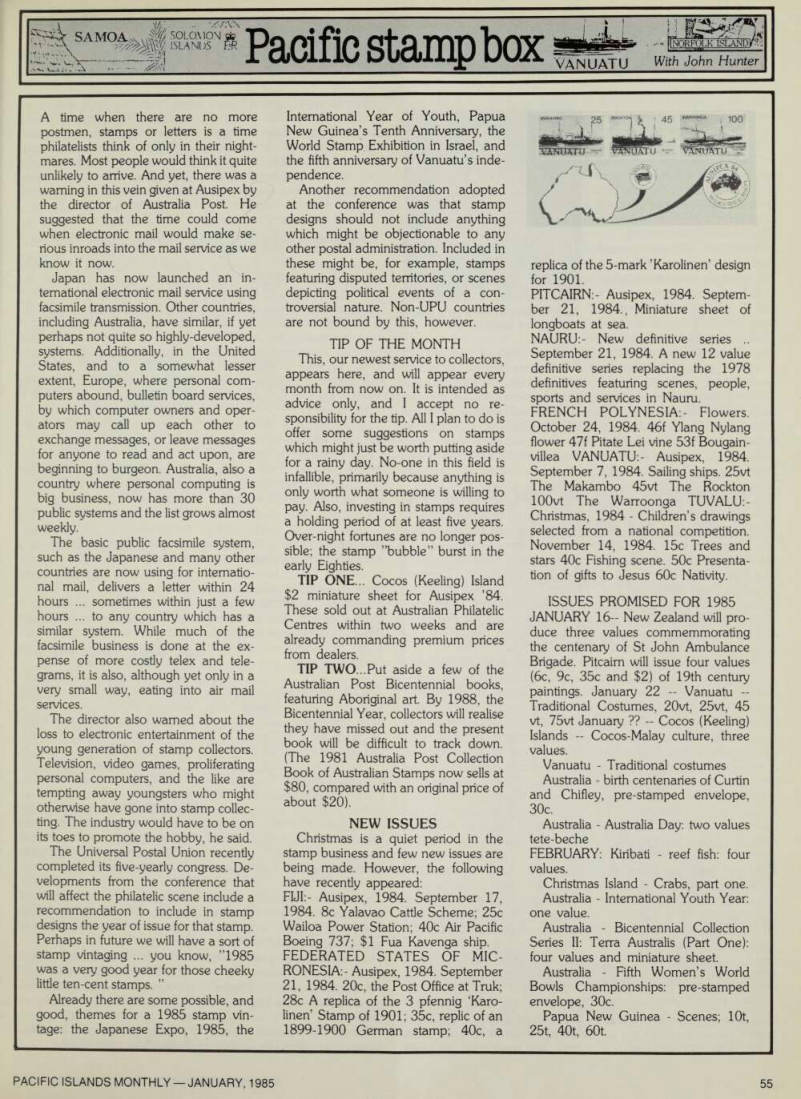
A time when there are no more postmen, stamps or letters is a time philatelists think of only in their night mares. Most people would think it quite unlikely to arrive. And yet, there was a warning in this vein given at Ausipex by the director of Australia Post. He suggested that the time could come when electronic mail would make se rious inroads into the mail service as we know it now.
Japan has now launched an in ternational electronic mail service using facsimile transmission. Other countries, including Australia, have similar, if yet perhaps not quite so highly-developed, systems. Additionally, in the United States, and to a somewhat lesser extent, Europe, where personal com puters abound, bulletin board services, by which computer owners and oper ators may call up each other to exchange messages, or leave messages for anyone to read and act upon, are beginning to burgeon. Australia, also a country where personal computing is big business, now has more than 30 public systems and the list grows almost weekly.
The basic public facsimile system, such as the Japanese and many other countries are now using for internatio nal mail, delivers a letter within 24 hours ... sometimes within just a few hours ... to any country which has a similar system. While much of the facsimile business is done at the ex pense of more costly telex and tele grams, it is also, although yet only in a very small way, eating into air mail services.
The director also warned about the loss to electronic entertainment of the young generation of stamp collectors.
Television, video games, proliferating personal computers, and the like are tempting away youngsters who might otherwise have gone into stamp collec ting. The industry would have to be on its toes to promote the hobby, he said.
The Universal Postal Union recently completed its five-yearly congress. De velopments from the conference that will affect the philatelic scene include a recommendation to include in stamp designs the year of issue for that stamp.
Perhaps in future we will have a sort of stamp vintaging ... you know, ”1985 was a very good year for those cheeky little ten-cent stamps. ”
Already there are some possible, and good, themes for a 1985 stamp vin tage; the Japanese Expo, 1985, the
International Year of Youth, Papua New Guinea’s Tenth Anniversary, the World Stamp Exhibition in Israel, and the fifth anniversary of Vanuatu’s inde pendence.
Another recommendation adopted at the conference was that stamp designs should not include anything which might be objectionable to any other postal administration. Included in these might be, for example, stamps featuring disputed territories, or scenes depicting political events of a con troversial nature. Non-UPU countries are not bound by this, however.
Tip Of The Month
This, our newest service to collectors, appears here, and will appear every month from now on. It is intended as advice only, and I accept no re sponsibility for the tip. All I plan to do is offer some suggestions on stamps which might just be worth putting aside for a rainy day. No-one in this field is infallible, primarily because anything is only worth what someone is willing to pay. Also, investing in stamps requires a holding period of at least five years.
Over-night fortunes are no longer pos sible; the stamp ’’bubble” burst in the early Eighties.
TIP ONE... Cocos (Keeling) Island $2 miniature sheet for Ausipex ’B4.
These sold out at Australian Philatelic Centres within two weeks and are already commanding premium prices from dealers.
TIP TWO...Put aside a few of the Australian Post Bicentennial books, featuring Aboriginal art. By 1988, the Bicentennial Year, collectors will realise they have missed out and the present book will be difficult to track down. (The 1981 Australia Post Collection Book of Australian Stamps now sells at $BO, compared with an original price of about $2O).
New Issues
Christmas is a quiet period in the stamp business and few new issues are being made. However, the following have recently appeared; FIJI:- Ausipex, 1984. September 17, 1984. 8c Yalavao Cattle Scheme; 25c Wailoa Power Station; 40c Air Pacific Boeing 737; $1 Fua Kavenga ship.
Federated States Of Mic
RONESIA:- Ausipex, 1984. September 21, 1984. 20c, the Post Office at Truk; 28c A replica of the 3 pfennig ‘Karo linen’ Stamp of 1901; 35c, replic of an 1899-1900 German stamp; 40c, a
replica of the 5-mark ’Karolinen’ design for 1901.
PITCAIRN;- Ausipex, 1984. Septem ber 21, 1984., Miniature sheet of longboats at sea.
NAURU;- New definitive series ..
September 21, 1984. A new 12 value definitive series replacing the 1978 definitives featuring scenes, people, sports and services in Nauru.
French Polynesia;- Flowers.
October 24, 1984. 46f Ylang Nylang flower 47f Pitate Lei vine 53f Bougain villea VANUATU;- Ausipex, 1984.
September 7, 1984. Sailing ships. 25vt The Makambo 45vt The Rockton lOOvt The Warroonga TUVALU:- Christmas, 1984 - Children’s drawings selected from a national competition.
November 14, 1984. 15c Trees and stars 40c Fishing scene. 50c Presenta tion of gifts to Jesus 60c Nativity.
Issues Promised For 1985
JANUARY 16- New Zealand will pro duce three values commemmorating the centenary of St John Ambulance Brigade. Pitcairn will issue four values (6c, 9c, 35c and $2) of 19th century paintings. January 22 - Vanuatu - Traditional Costumes, 20vt, 25vt, 45 vt, 75vt January ?? - Cocos (Keeling) Islands - Cocos-Malay culture, three values.
Vanuatu - Traditional costumes Australia - birth centenaries of Curtin and Chifley, pre-stamped envelope, 30c.
Australia - Australia Day: two values tete-beche FEBRUARY: Kiribati - reef fish: four values.
Christmas Island - Crabs, part one.
Australia - International Youth Year: one value.
Australia - Bicentennial Collection Series II: Terra Australis (Part One): four values and miniature sheet.
Australia - Fifth Women’s World Bowls Championships: pre-stamped envelope, 30c.
Papua New Guinea - Scenes; lOt, 25t, 40t, 60t.
People
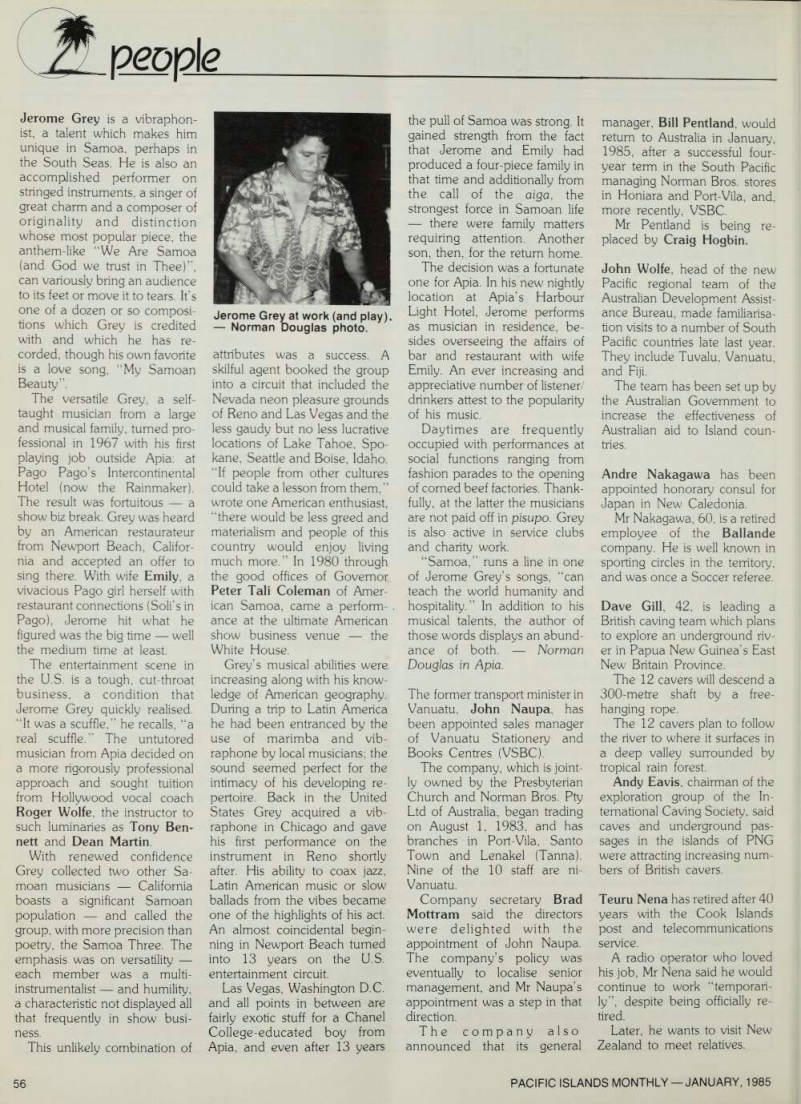
Jerome Grey is a vibraphon ist, a talent which makes him unique in Samoa, perhaps in the South Seas. He is also an accomplished performer on stringed instruments, a singer of great charm and a composer of originality and distinction whose most popular piece, the anthem-like “We Are Samoa (and God we trust in Thee)”, can variously bring an audience to its feet or move it to tears. It’s one of a dozen or so composi tions which Grey is credited with and which he has re corded, though his own favorite is a love song, “My Samoan
Beauty”.
The versatile Grey, a self taught musician from a large and musical family, turned pro fessional in 1967 with his first playing job outside Apia: at Pago Pago’s Intercontinental Hotel (now the Rainmaker).
The result was fortuitous a show biz break. Grey was heard by an American restaurateur from Newport Beach, Califor nia and accepted an offer to sing there. With wife Emily, a vivacious Pago girl herself with restaurant connections (Soli’s in Pago), Jerome hit what he figured was the big time well the medium time at least.
The entertainment scene in the U.S. is a tough, cut-throat business, a condition that Jerome Grey quickly realised.
“It was a scuffle,” he recalls, “a real scuffle.” The untutored musician from Apia decided on a more rigorously professional approach and sought tuition from Hollywood vocal coach Roger Wolfe, the instructor to such luminaries as Tony Ben nett and Dean Martin.
With renewed confidence Grey collected two other Sa moan musicians California boasts a significant Samoan population and called the group, with more precision than poetry, the Samoa Three. The emphasis was on versatility each member was a multi instrumentalist and humility, a characteristic not displayed all that frequently in show busi ness.
This unlikely combination of
attributes was a success. A skilful agent booked the group into a circuit that included the Nevada neon pleasure grounds of Reno and Las Vegas and the less gaudy but no less lucrative locations of Lake Tahoe, Spo kane, Seattle and Boise, Idaho.
“If people from other cultures could take a lesson from them,” wrote one American enthusiast, “there would be less greed and materialism and people of this country would enjoy living much more.” In 1980 through the good offices of Governor Peter Tali Coleman of Amer ican Samoa, came a perform- . ance at the ultimate American show business venue the White House.
Grey’s musical abilities were increasing along with his know ledge of American geography.
During a trip to Latin America he had been entranced by the use of marimba and vib raphone by local musicians; the sound seemed perfect for the intimacy of his developing re pertoire. Back in the United States Grey acquired a vib raphone in Chicago and gave his first performance on the instrument in Reno shortly after. His ability to coax jazz, Latin American music or slow ballads from the vibes became one of the highlights of his act.
An almost coincidental begin ning in Newport Beach turned into 13 years on the U.S. entertainment circuit.
Las Vegas, Washington D.C. and all points in between are fairly exotic stuff for a Chanel College-educated boy from Apia, and even after 13 years
the pull of Samoa was strong. It gained strength from the fact that Jerome and Emily had produced a four-piece family in that time and additionally from the call of the aiga, the strongest force in Samoan life there were family matters requiring attention. Another son, then, for the return home.
The decision was a fortunate one for Apia. In his new nightly location at Apia’s Harbour Light Hotel, Jerome performs as musician in residence, be sides overseeing the affairs of bar and restaurant with wife Emily. An ever increasing and appreciative number of listener drinkers attest to the popularity of his music.
Daytimes are frequently occupied with performances at social functions ranging from fashion parades to the opening of corned beef factories. Thank fully, at the latter the musicians are not paid off in pisupo. Grey is also active in service clubs and charity work.
“Samoa,” runs a line in one of Jerome Grey’s songs, “can teach the world humanity and hospitality.” In addition to his musical talents, the author of those words displays an abund ance of both. Norman Douglas in Apia.
The former transport minister in Vanuatu. John Naupa. has been appointed sales manager of Vanuatu Stationery and Books Centres (VSBC).
The company, which is joint ly owned by the Presbyterian Church and Norman Bros. Pty Ltd of Australia, began trading on August 1, 1983, and has branches in Port-Vila, Santo Town and Lenakel (Tanna).
Nine of the 10 staff are ni- Vanuatu.
Company secretary Brad Mottram said the directors were delighted with the appointment of John Naupa.
The company’s policy was eventually to localise senior management, and Mr Naupa’s appointment was a step in that direction.
The company also announced that its general
manager. Bill Pentland. would return to Australia in January, 1985. after a successful four year term in the South Pacific managing Norman Bros, stores in Honiara and Port-Vila, and, more recently, VSBC.
Mr Pentland is being re placed by Craig Hogbin.
John Wolfe, head of the new Pacific regional team of the Australian Development Assist ance Bureau, made familiarisa tion visits to a number of South Pacific countries late last year.
They include Tuvalu, Vanuatu, and Fiji.
The team has been set up by the Australian Government to increase the effectiveness of Australian aid to Island coun tries.
Andre Nakagawa has been appointed honorary consul for Japan in New Caledonia.
Mr Nakagawa, 60, is a retired employee of the Ballande company. He is well known in sporting circles in the territory, and was once a Soccer referee.
Dave Gill, 42, is leading a British caving team which plans to explore an underground riv er in Papua New Guinea’s East New Britain Province.
The 12 cavers will descend a 300-metre shaft by a free hanging rope.
The 12 cavers plan to follow the river to where it surfaces in a deep valley surrounded by tropical rain forest.
Andy Eavis, chairman of the exploration group of the In ternational Caving Society, said caves and underground pas sages in the islands of PNG were attracting increasing num bers of British cavers.
Teuru Nena has retired after 40 years with the Cook Islands post and telecommunications service.
A radio operator who loved his job. Mr Nena said he would continue to work “temporari ly”, despite being officially re tired.
Later, he wants to visit New Zealand to meet relatives.
Jerome Grey at work (and play).
Norman Douglas photo.
from ting islands press
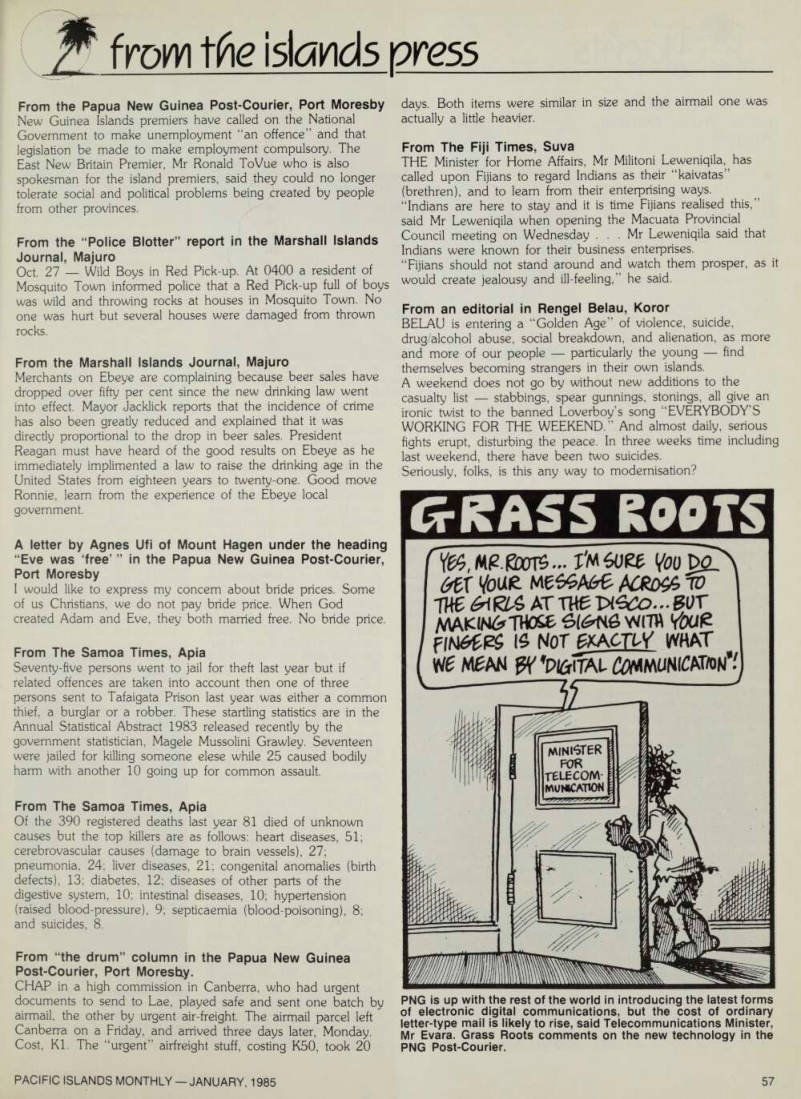
From the Papua New Guinea Post-Courier, Port Moresby New Guinea Islands premiers have called on the National Government to make unemployment “an offence” and that legislation be made to make employment compulsory. The East New Britain Premier, Mr Ronald ToVue who is also spokesman for the island premiers, said they could no longer tolerate social and political problems being created by people from other provinces.
From the “Police Blotter” report in the Marshall Islands Journal, Majuro Oct. 27 Wild Boys in Red Pick-up. At 0400 a resident of Mosquito Town informed police that a Red Pick-up full of boys was wild and throwing rocks at houses in Mosquito Town. No one was hurt but several houses were damaged from thrown rocks.
From the Marshall Islands Journal, Majuro Merchants on Ebeye are complaining because beer sales have dropped over fifty per cent since the new drinking law went into effect. Mayor Jacklick reports that the incidence of crime has also been greatly reduced and explained that it was directly proportional to the drop in beer sales. President Reagan must have heard of the good results on Ebeye as he immediately implimented a law to raise the drinking age in the United States from eighteen years to twenty-one. Good move Ronnie, learn from the experience of the Ebeye local government.
A letter by Agnes Ufi of Mount Hagen under the heading “Eve was free’ ” in the Papua New Guinea Post-Courier, Port Moresby I would like to express my concern about bride prices. Some of us Christians, we do not pay bride price. When God created Adam and Eve, they both married free. No bride price.
From The Samoa Times, Apia Seventy-five persons went to jail for theft last year but if related offences are taken into account then one of three persons sent to Tafaigata Prison last year was either a common thief, a burglar or a robber. These startling statistics are in the Annual Statistical Abstract 1983 released recently by the government statistician, Magele Mussolini Grawley. Seventeen were jailed for killing someone elese while 25 caused bodily harm with another 10 going up for common assault.
From The Samoa Times, Apia Of the 390 registered deaths last year 81 died of unknown causes but the top killers are as follows: heart diseases, 51; cerebrovascular causes (damage to brain vessels), 27; pneumonia, 24; liver diseases, 21; congenital anomalies (birth defects), 13; diabetes, 12; diseases of other parts of the digestive system, 10; intestinal diseases, 10; hypertension (raised blood-pressure), 9; septicaemia (blood-poisoning), 8; and suicides, 8.
From “the drum” column in the Papua New Guinea Post-Courier, Port Moresby.
CHAP in a high commission in Canberra, who had urgent documents to send to Lae, played safe and sent one batch by airmail, the other by urgent air-freight. The airmail parcel left Canberra on a Friday, and arrived three days later, Monday.
Cost, Kl. The “urgent” airfreight stuff, costing K5O, took 20
days. Both items were similar in size and the airmail one was actually a little heavier.
From The Fiji Times, Suva THE Minister for Home Affairs, Mr Militoni Leweniqila, has called upon Fijians to regard Indians as their “kaivatas” (brethren), and to leam from their enterprising ways.
“Indians are here to stay and it is time Fijians realised this,” said Mr Leweniqila when opening the Macuata Provincial Council meeting on Wednesday ... Mr Leweniqila said that Indians were known for their business enterprises.
“Fijians should not stand around and watch them prosper, as it would create jealousy and ill-feeling,” he said.
From an editorial in Rengel Belau, Koror BELAU is entering a “Golden Age” of violence, suicide, drug/alcohol abuse, social breakdown, and alienation, as more and more of our people particularly the young find themselves becoming strangers in their own islands.
A weekend does not go by without new additions to the casualty list stabbings, spear gunnings, stonings, all give an ironic twist to the banned Loverboy’s song “EVERYBODY’S WORKING FOR THE WEEKEND.” And almost daily, serious fights erupt, disturbing the peace. In three weeks time including last weekend, there have been two suicides.
Seriously, folks, is this any way to modernisation?
PNG is up with the rest of the world in introducing the latest forms of electronic digital communications, but the cost of ordinary letter-type mail is likely to rise, said Telecommunications Minister, Mr Evara. Grass Roots comments on the new technology in the PNG Post-Courier.
yachts
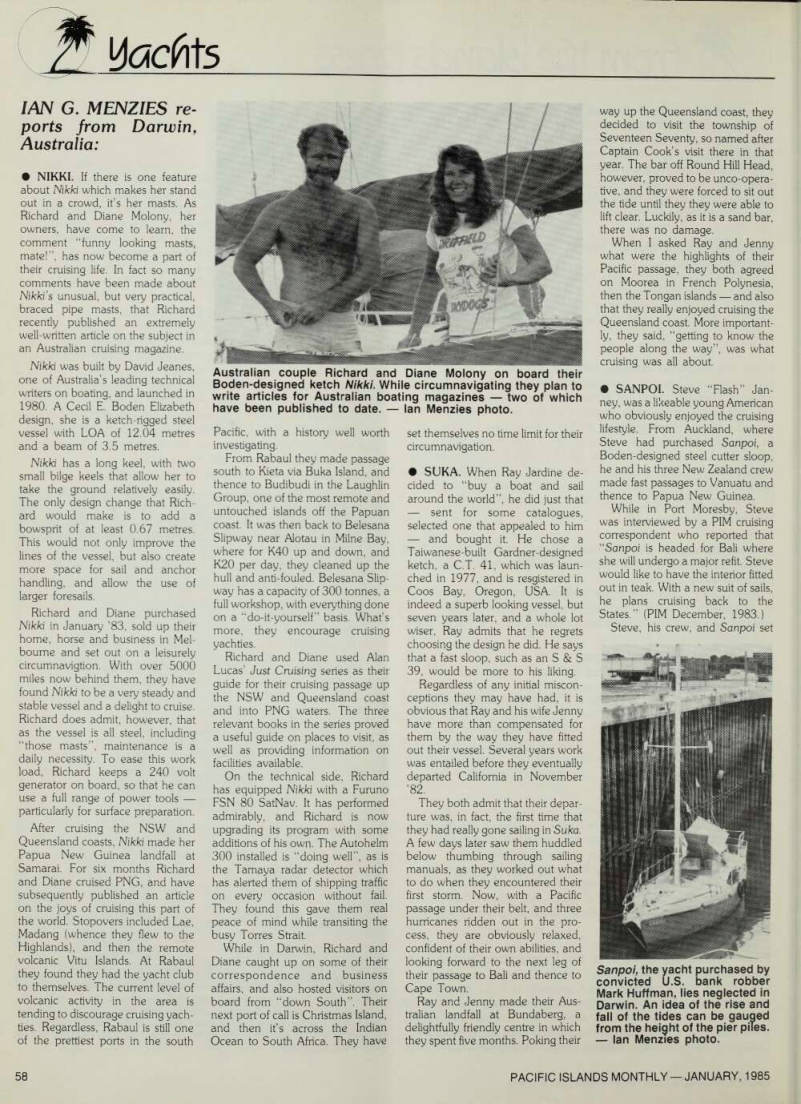
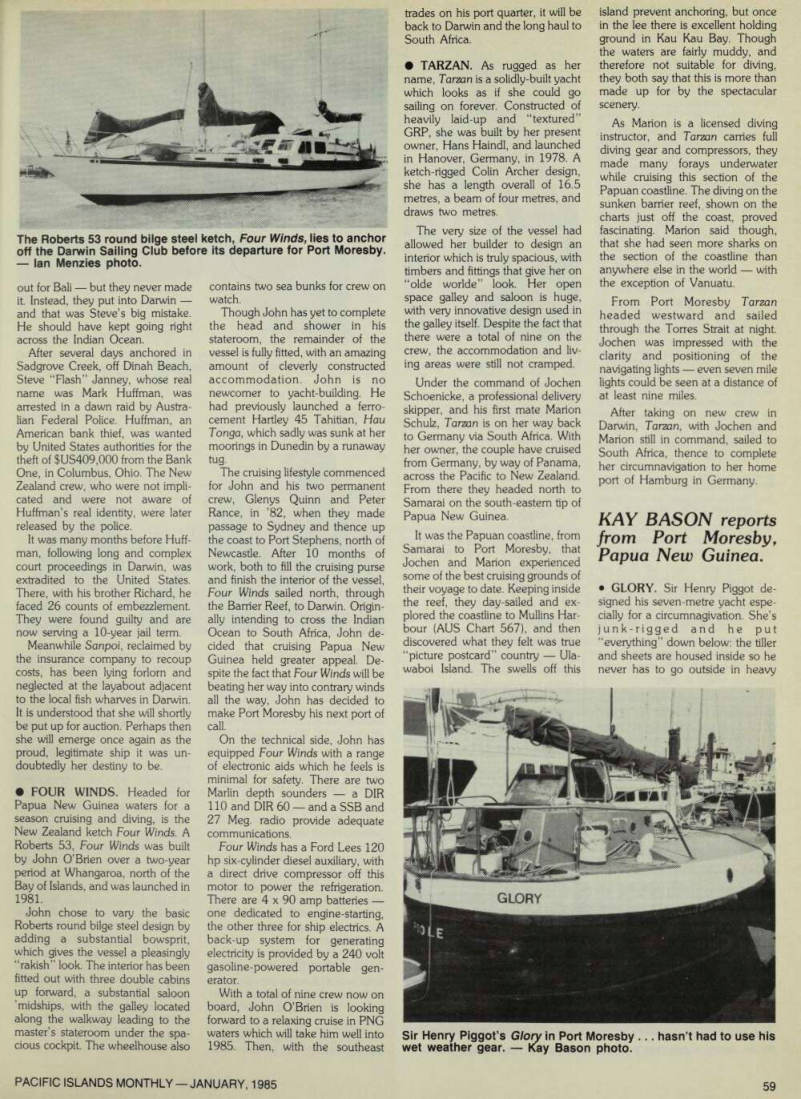
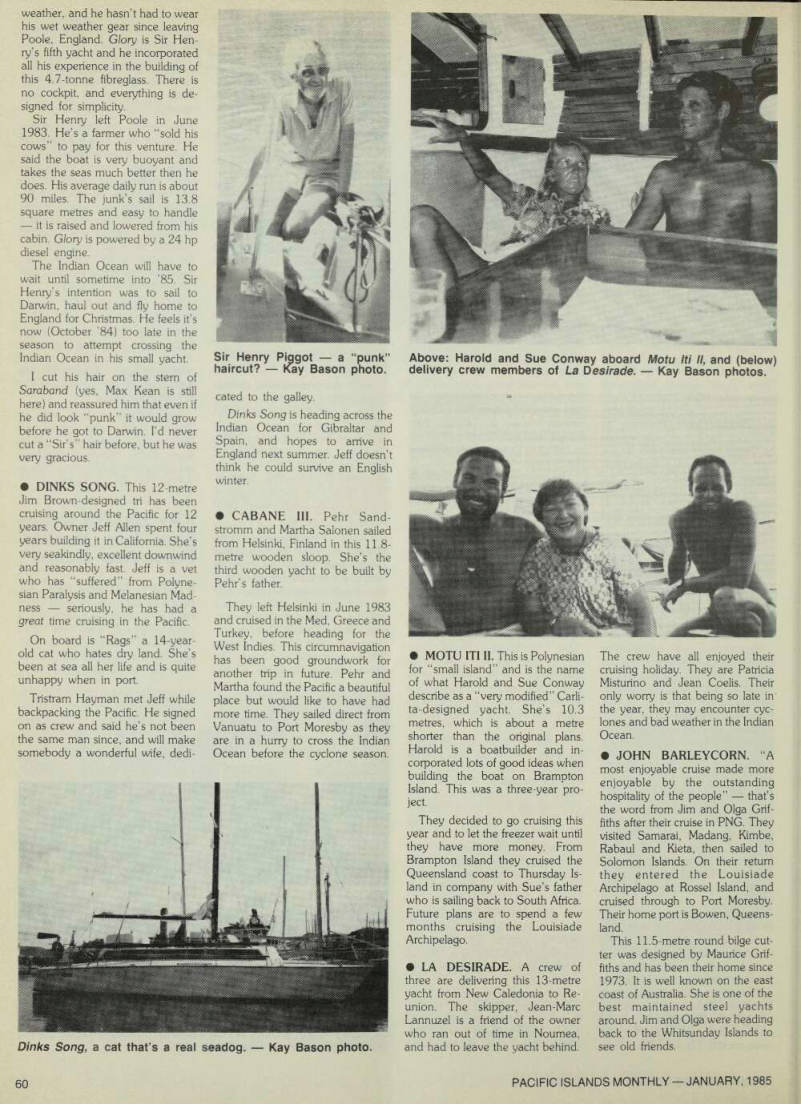
Ian G. Menzies Re
ports from Darwin, Australia:
• NIKKI. If there is one feature about Nikki which makes her stand out in a crowd, it’s her masts. As Richard and Diane Molony, her owners, have come to learn, the comment “funny looking masts, mate!”, has now become a part of their cruising life. In fact so many comments have been made about Nikki’s unusual, but very practical, braced pipe masts, that Richard recently published an extremely well-written article on the subject in an Australian cruising magazine.
Nikki was built by David Jeanes, one of Australia’s leading technical writers on boating, and launched in 1980. A Cecil E. Boden Elizabeth design, she is a ketch-rigged steel vessel with LOA of 12.04 metres and a beam of 3.5 metres.
Nikki has a long keel, with two small bilge keels that allow her to take the ground relatively easily.
The only design change that Rich ard would make is to add a bowsprit of at least 0.67 metres.
This would not only improve the lines of the vessel, but also create more space for sail and anchor handling, and allow the use of larger foresails.
Richard and Diane purchased Nikki in January ’B3, sold up their home, horse and business in Mel bourne and set out on a leisurely circumnavigtion. With over 5000 miles now behind them, they have found Nikki to be a very steady and stable vessel and a delight to cruise.
Richard does admit, however, that as the vessel is all steel, including “those masts”, maintenance is a daily necessity. To ease this work load, Richard keeps a 240 volt generator on board, so that he can use a full range of power tools particularly for surface preparation.
After cruising the NSW and Queensland coasts, Nikki made her Papua New Guinea landfall at Samarai. For six months Richard and Diane cruised PNG, and have subsequently published an article on the joys of cruising this part of the world. Stopovers included Lae, Madang (whence they flew to the Highlands), and then the remote volcanic Vitu Islands. At Rabaul they found they had the yacht club to themselves. The current level of volcanic activity in the area is tending to discourage cruising yach ties. Regardless, Rabaul is still one of the prettiest ports in the south
Pacific, with a history well worth investigating.
From Rabaul they made passage south to Kieta via Buka Island, and thence to Budibudi in the Laughlin Group, one of the most remote and untouched islands off the Papuan coast. It was then back to Belesana Slipway near Alotau in Milne Bay. where for K4O up and down, and K2O per day, they cleaned up the hull and anti-fouled. Belesana Slip way has a capacity of 300 tonnes, a full workshop, with everything done on a “do-it-yourself” basis. What’s more, they encourage cruising yachties.
Richard and Diane used Alan Lucas’ Just Cmising series as their guide for their cruising passage up the NSW and Queensland coast and into PNG waters. The three relevant books in the series proved a useful guide on places to visit, as well as providing information on facilities available.
On the technical side, Richard has equipped Nikki with a Furuno FSN 80 SatNav. It has performed admirably, and Richard is now upgrading its program with some additions of his own. The Autohelm 300 installed is “doing well”, as is the Tamaya radar detector which has alerted them of shipping traffic on every occasion without fail.
They found this gave them real peace of mind while transiting the busy Torres Strait.
While in Darwin, Richard and Diane caught up on some of their correspondence and business affairs, and also hosted visitors on board from “down South”. Their next port of call is Christmas Island, and then it’s across the Indian Ocean to South Africa. They have
set themselves no time limit for their circumnavigation. • SUKA. When Ray Jardine de cided to “buy a boat and sail around the world”, he did just that sent for some catalogues, selected one that appealed to him and bought it. He chose a Taiwanese-built Gardner-designed ketch, a C.T. 41, which was laun ched in 1977, and is resgistered in Coos Bay, Oregon, USA. It is indeed a superb looking vessel, but seven years later, and a whole lot wiser, Ray admits that he regrets choosing the design he did. He says that a fast sloop, such as an S & S 39, would be more to his liking.
Regardless of any initial miscon ceptions they may have had, it is obvious that Ray and his wife Jenny have more than compensated for them by the way they have fitted out their vessel. Several years work was entailed before they eventually departed California in November ’B2.
They both admit that their depar ture was, in fact, the first time that they had really gone sailing in Suka.
A few days later saw them huddled below thumbing through sailing manuals, as they worked out what to do when they encountered their first storm. Now, with a Pacific passage under their belt, and three hurricanes ridden out in the pro cess, they are obviously relaxed, confident of their own abilities, and looking forward to the next leg of their passage to Bali and thence to Cape Town.
Ray and Jenny made their Aus tralian landfall at Bundaberg, a delightfully friendly centre in which they spent five months. Poking their
way up the Queensland coast, they decided to visit the township of Seventeen Seventy, so named after Captain Cook’s visit there in that year. The bar off Round Hill Head, however, proved to be unco-opera tive, and they were forced to sit out the tide until they they were able to lift clear. Luckily, as it is a sand bar, there was no damage.
When I asked Ray and Jenny what were the highlights of their Pacific passage, they both agreed on Moorea in French Polynesia, then the Tongan islands and also that they really enjoyed cruising the Queensland coast. More important ly, they said, “getting to know the people along the way”, was what cruising was all about. • SANPOI. Steve “Flash” Jan ney, was a likeable young American who obviously enjoyed the cruising lifestyle. From Auckland, where Steve had purchased Sanpoi, a Boden-designed steel cutter sloop, he and his three New Zealand crew made fast passages to Vanuatu and thence to Papua New Guinea.
While in Port Moresby, Steve was interviewed by a PIM cruising correspondent who reported that “Sanpoi is headed for Bali where she will undergo a major refit. Steve would like to have the interior fitted out in teak. With a new suit of sails, he plans cruising back to the States.” (PIM December, 1983.) Steve, his crew, and Sanpoi set
Australian couple Richard and Diane Molony on board their Boden-designed ketch Nikki. While circumnavigating they plan to write articles for Australian boating magazines two of which have been published to date. lan Menzies photo.
Sanpoi, the yacht purchased by
convicted U.S. bank robber Mark Huffman, lies neglected in Darwin. An idea of the rise and fall of the tides can be gauged from the height of the pier piles. -lan Menzies photo.
out for Bali but they never made it. Instead, they put into Darwin and that was Steve’s big mistake.
He should have kept going right across the Indian Ocean.
After several days anchored in Sadgrove Creek, off Dinah Beach, Steve “Flash” Janney, whose real name was Mark Huffman, was arrested in a dawn raid by Austra lian Federal Police. Huffman, an American bank thief, was wanted by United States authorities for the theft of $U5409,000 from the Bank One, in Columbus, Ohio. The New Zealand crew, who were not impli cated and were not aware of Huffman’s real identity, were later released by the police.
It was many months before Huff man, following long and complex court proceedings in Darwin, was extradited to the United States.
There, with his brother Richard, he faced 26 counts of embezzlement.
They were found guilty and are now serving a 10-year jail term.
Meanwhile Sanpoi, reclaimed by the insurance company to recoup costs, has been lying forlorn and neglected at the layabout adjacent to the local fish wharves in Darwin.
It is understood that she will shortly be put up for auction. Perhaps then she will emerge once again as the proud, legitimate ship it was un doubtedly her destiny to be. • FOUR WINDS. Headed for Papua New Guinea waters for a season cruising and diving, is the New Zealand ketch Four Winds. A Roberts 53, Four Winds was built by John O’Brien over a two-year period at Whangaroa, north of the Bay of Islands, and was launched in 1981.
John chose to vary the basic Roberts round bilge steel design by adding a substantial bowsprit, which gives the vessel a pleasingly “rakish” look. The interior has been fitted out with three double cabins up forward, a substantial saloon ’midships, with the galley located along the walkway leading to the master’s stateroom under the spa cious cockpit. The wheelhouse also
contains two sea bunks for crew on watch.
Though John has yet to complete the head and shower in his stateroom, the remainder of the vessel is fully fitted, with an amazing amount of cleverly constructed accommodation. John is no newcomer to yacht-building. He had previously launched a ferro cement Hartley 45 Tahitian, Hau Tonga, which sadly was sunk at her moorings in Dunedin by a runaway tug.
The cruising lifestyle commenced for John and his two permanent crew, Glenys Quinn and Peter Ranee, in ’B2, when they made passage to Sydney and thence up the coast to Port Stephens, north of Newcastle. After 10 months of work, both to fill the cruising purse and finish the interior of the vessel, Four Winds sailed north, through the Barrier Reef, to Darwin. Origin ally intending to cross the Indian Ocean to South Africa, John de cided that cruising Papua New Guinea held greater appeal. De spite the fact that Four Winds will be beating her way into contrary winds all the way, John has decided to make Port Moresby his next port of call.
On the technical side, John has equipped Four Winds with a range of electronic aids which he feels is minimal for safety. There are two Marlin depth sounders a DIR 110 and DIR 60 and a SSB and 27 Meg. radio provide adequate communications.
Four Winds has a Ford Lees 120 hp six-cylinder diesel auxiliary, with a direct drive compressor off this motor to power the refrigeration.
There are 4 x 90 amp batteries one dedicated to engine-starting, the other three for ship electrics. A back-up system for generating electricity is provided by a 240 volt gasoline-powered portable gen erator.
With a total of nine crew now on board, John O’Brien is looking forward to a relaxing cruise in PNG waters which will take him well into 1985. Then, with the southeast
trades on his port quarter, it will be back to Darwin and the long haul to South Africa. • TARZAN. As rugged as her name, Tarzan is a solidly-built yacht which looks as if she could go sailing on forever. Constructed of heavily laid-up and “textured”
GRP, she was built by her present owner, Hans Haindl, and launched in Hanover, Germany, in 1978. A ketch-rigged Colin Archer design, she has a length overall of 16.5 metres, a beam of four metres, and draws two metres.
The very size of the vessel had allowed her builder to design an interior which is truly spacious, with timbers and fittings that give her on “olde worlde” look. Her open space galley and saloon is huge, with very innovative design used in the galley itself. Despite the fact that there were a total of nine on the crew, the accommodation and liv ing areas were still not cramped.
Under the command of Jochen Schoenicke, a professional delivery skipper, and his first mate Marion Schulz, Tarzan is on her way back to Germany via South Africa. With her owner, the couple have cruised from Germany, by way of Panama, across the Pacific to New Zealand.
From there they headed north to Samarai on the south-eastern tip of Papua New Guinea.
It was the Papuan coastline, from Samarai to Port Moresby, that Jochen and Marion experienced some of the best cruising grounds of their voyage to date. Keeping inside the reef, they day-sailed and ex plored the coastline to Mullins Har bour (AUS Chart 567), and then discovered what they felt was true “picture postcard” country Ula waboi Island. The swells off this
island prevent anchoring, but once in the lee there is excellent holding ground in Kau Kau Bay. Though the waters are fairly muddy, and therefore not suitable for diving, they both say that this is more than made up for by the spectacular scenery.
As Marion is a licensed diving instructor, and Tarzan carries full diving gear and compressors, they made many forays underwater while cruising this section of the Papuan coastline. The diving on the sunken barrier reef, shown on the charts just off the coast, proved fascinating. Marion said though, that she had seen more sharks on the section of the coastline than anywhere else in the world with the exception of Vanuatu.
From Port Moresby Tarzan headed westward and sailed through the Torres Strait at night.
Jochen was impressed with the clarity and positioning of the navigating lights even seven mile lights could be seen at a distance of at least nine miles.
After taking on new crew in Darwin, Tarzan, with Jochen and Marion still in command, sailed to South Africa, thence to complete her circumnavigation to her home port of Hamburg in Germany.
KAY BASON reports
from Port Moresby,
Papua New Guinea .
• GLORY. Sir Henry Piggot de signed his seven-metre yacht espe cially for a circumnagivation. She’s junk-rigged and he put “everything” down below: the tiller and sheets are housed inside so he never has to go outside in heavy
The Roberts 53 round bilge steel ketch, Four Winds, lies to anchor off the Darwin Sailing Club before its departure for Port Moresby. -lan Menzies photo.
Sir Henry Piggot’s Glory In Port Moresby ... hasn’t had to use his wet weather gear. Kay Bason photo.
weather, and he hasn’t had to wear his wet weather gear since leaving Poole, England. G/ory is Sir Hen ry’s fifth yacht and he incorporated all his experience in the building of this 4.7-tonne fibreglass. There is no cockpit, and everything is de signed for simplicity.
Sir Henry left Poole in June 1983. He’s a farmer who “sold his cows” to pay for this venture. He said the boat is very buoyant and takes the seas much better then he does. His average daily run is about 90 miles. The junk’s sail is 13.8 square metres and easy to handle it is raised and lowered from his cabin. Gloiy is powered by a 24 hp diesel engine.
The Indian Ocean will have to wait until sometime into ’B5. Sir Henry’s intention was to sail to Darwin, haul out and fly home to England for Christmas. He feels it’s now (October ’B4) too late in the season to attempt crossing the Indian Ocean in his small yacht.
I cut his hair on the stem of Saraband (yes, Max Kean is still here) and reassured him that even if he did look “punk” it would grow before he got to Darwin. I’d never cut a “Sir’s” hair before, but he was very gracious. • DINKS SONG. This 12-metre Jim Brown-designed tri has been cruising around the Pacific for 12 years. Owner Jeff Allen spent four years building it in California. She’s very seakindly, excellent downwind and reasonably fast. Jeff is a vet who has “suffered” from Polyne sian Paralysis and Melanesian Mad ness seriously, he has had a great time cruising in the Pacific.
On board is “Rags” a 14-year old cat who hates dry land. She’s been at sea all her life and is quite unhappy when in port.
Tristram Hayman met Jeff while backpacking the Pacific. He signed on as crew and said he’s not been the same man since, and will make somebody a wonderful wife, dedi-
cated to the galley.
Dinks Song is heading across the Indian Ocean for Gibraltar and Spain, and hopes to arrive in England next summer. Jeff doesn’t think he could survive an English winter. • CABANE 111. Pehr Sand stromm and Martha Salonen sailed from Helsinki, Finland in this 11.8metre wooden sloop. She’s the third wooden yacht to be built by Pehr’s father.
They left Helsinki in June 1983 and cruised in the Med, Greece and Turkey, before heading for the West Indies. This circumnavigation has been good groundwork for another trip in future. Pehr and Martha found the Pacific a beautiful place but would like to have had more time. They sailed direct from Vanuatu to Port Moresby as they are in a hurry to cross the Indian Ocean before the cyclone season.
• MOTU ITIII. This is Polynesian for “small island” and is the name of what Harold and Sue Conway describe as a “very modified” Carli ta-designed yacht. She’s 10.3 metres, which is about a metre shorter than the original plans.
Harold is a boatbuilder and in corporated lots of good ideas when building the boat on Brampton Island. This was a three-year pro ject.
They decided to go cruising this year and to let the freezer wait until they have more money. From Brampton Island they cruised the Queensland coast to Thursday Is land in company with Sue’s father who is sailing back to South Africa.
Future plans are to spend a few months cruising the Louisiade Archipelago. • LA DESIRADE. A crew of three are delivering this 13-metre yacht from New Caledonia to Re union. The skipper, Jean-Marc Lannuzel is a friend of the owner who ran out of time in Noumea, and had to leave the yacht behind.
The crew have all enjoyed their cruising holiday. They are Patricia Misturino and Jean Coelis. Their only worry is that being so late in' the year, they may encounter cyc lones and bad weather in the Indian Ocean.
• John Barleycorn. “A
most enjoyable cruise made more enjoyable by the outstanding hospitality of the people” that’s the word from Jim and Olga Grif fiths after their cruise in PNG. They visited Samarai, Madang, Kimbe, Rabaul and Kieta, then sailed to Solomon Islands. On their return they entered the Louisiade Archipelago at Rossel Island, and cruised through to Port Moresby.
Their home port is Bowen, Queens land.
This 11.5-metre round bilge cut ter was designed by Maurice Grif fiths and has been their home since 1973. It is well known on the east coast of Australia. She is one of the best maintained steel yachts around. Jim and Olga were heading back to the Whitsunday Islands to see old friends.
Dinks Song, a cat that’s a real seadog. Kay Bason photo.
Sir Henry Piqgot a “punk” haircut? Kay Bason photo.
Above: Harold and Sue Conway aboard Motu lti ll, and (below) delivery crew members of La D esirade. Kay Bason photos.
shipping schedules
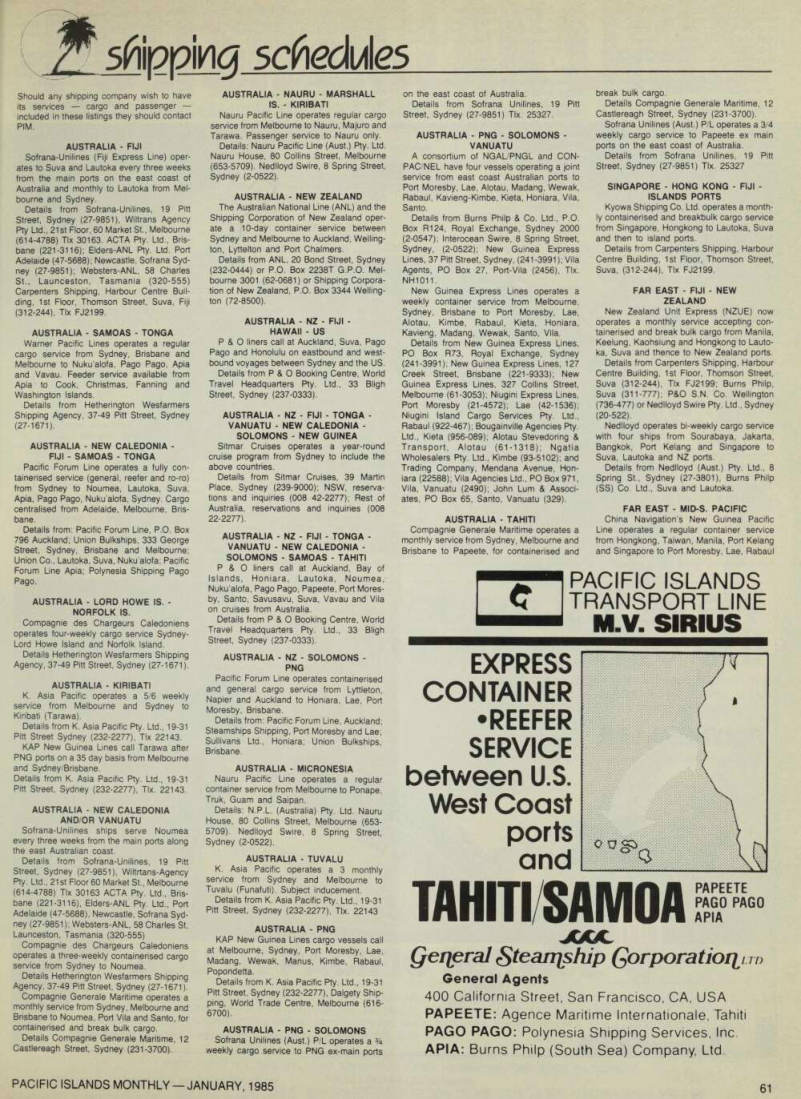
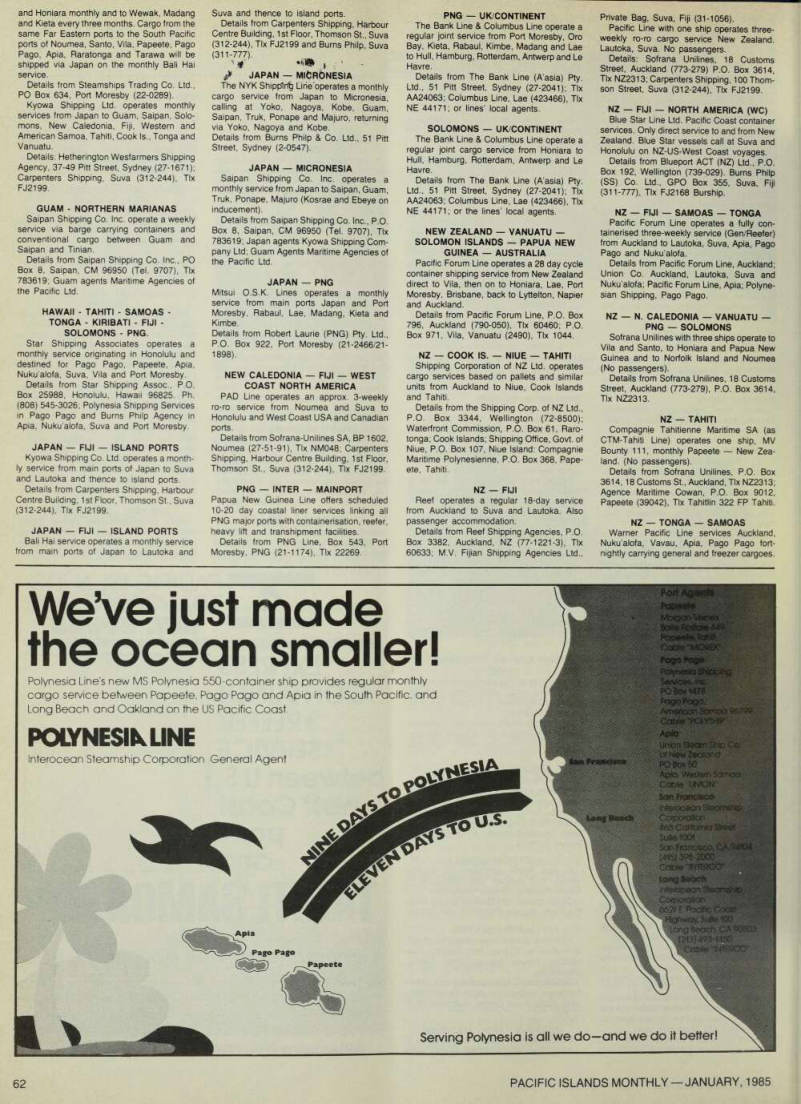
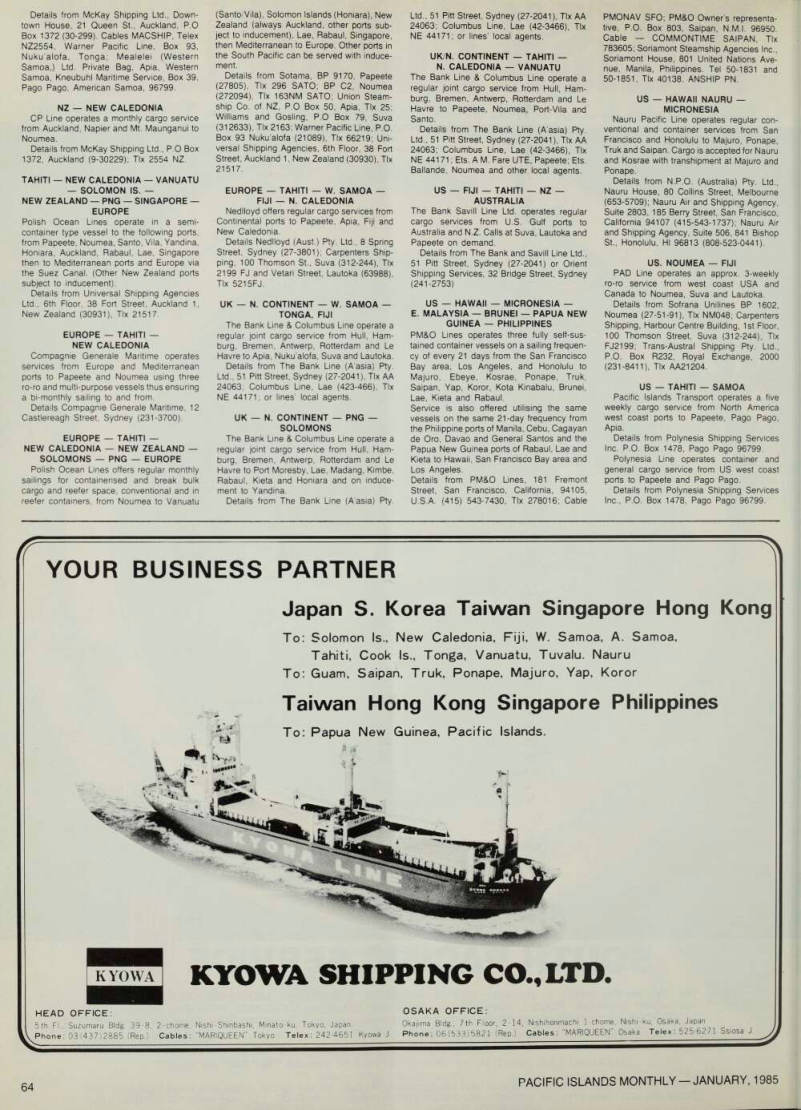
Should any shipping company wish to have its services cargo and passenger included in these listings they should contact
Pim.
Australia - Fiji
Sofrana-Unilines (Fiji Express Line) oper ates to Suva and Lautoka every three weeks from the main ports on the east coast of Australia and monthly to Lautoka from Mel bourne and Sydney.
Details from Sofrana-Unilines, 19 Pitt Street, Sydney (27-9851), Wiltrans Agency Pty Ltd., 21st Floor, 60 Market St., Melbourne (614-4788) Tlx 30163. ACTA Pty. Ltd., Bris bane (221-3116); Elders-ANL Pty. Ltd. Port Adelaide (47-5688); Newcastle, Sofrana Syd ney (27-9851); Websters-ANL, 58 Charles St., Launceston, Tasmania (320-555) Carpenters Shipping, Harbour Centre Buil ding, Ist Floor, Thomson Street, Suva, Fiji (312-244), Tlx FJ2199.
Australia - Samoas - Tonga
Warner Pacific Lines operates a regular cargo service from Sydney, Brisbane and Melbourne to Nukualofa, Pago Pago, Apia and Vavau. Feeder service available from Apia to Cook, Christmas, Fanning and Washington Islands.
Details from Hetherington Wesfarmers Shipping Agency, 37-49 Pitt Street, Sydney (27-1671).
Australia - New Caledonia -
Fiji - Samoas - Tonga
Pacific Forum Line operates a fully con tainerised service (general, reefer and ro-ro) from Sydney to Noumea, Lautoka, Suva, Apia, Pago Pago, Nukualofa, Sydney. Cargo centralised from Adelaide, Melbourne, Bris bane.
Details from: Pacific Forum Line, P.O. Box 796 Auckland; Union Bulkships, 333 George Street. Sydney, Brisbane and Melbourne: Union Co., Lautoka, Suva, Nukualofa; Pacific Forum Line Apia; Polynesia Shipping Pago Pago.
Australia - Lord Howe Is. -
Norfolk Is.
Compagnie des Chargeurs Caledoniens
operates four-weekly cargo service Sydney- Lord Howe Island and Norfolk Island.
Details Hetherington Wesfarmers Shipping Agency, 37-49 Pitt Street, Sydney (27-1671).
Australia - Kiribati
K. Asia Pacific operates a 5/6 weekly service from Melbourne and Sydney to Kiribati (Tarawa).
Details from K. Asia Pacific Pty. Ltd., 19-31 Pitt Street Sydney (232-2277), Tlx 22143.
KAP New Guinea Lines call Tarawa after PNG ports on a 35 day basis from Melbourne
and Sydney/Brisbane.
Details from K. Asia Pacific Pty. Ltd., 19-31 Pitt Street. Sydney (232-2277), Tlx. 22143.
Australia - New Caledonia
And/Or Vanuatu
Sofrana-Unilines ships serve Noumea every three weeks from the main ports along the east Australian coast.
Details from Sofrana-Unilines, 19 Pitt Street, Sydney (27-9851), Wiltrtans-Agency Pty. Ltd., 21st Floor 60 Market St., Melbourne (614-4788) Tlx 30163 ACTA Pty. Ltd., Bris bane (221-3116), Elders-ANL Pty. Ltd., Port Adelaide (47-5688), Newcastle, Sofrana Syd ney (27-9851); Websters-ANL, 58 Charles St, Launceston, Tasmania (320-555)
Compagnie des Chargeurs Caledoniens
operates a three-weekly containerised cargo service from Sydney to Noumea.
Details Hetherington Wesfarmers Shipping Agency, 37-49 Pitt Street, Sydney (27-1671).
Compagnie Generate Maritime operates a monthly service from Sydney, Melbourne and Brisbane to Noumea, Port Vila and Santo, for containerised and break bulk cargo.
Details Compagnie Generate Maritime, 12 Castlereagh Street, Sydney (231-3700).
Australia - Nauru - Marshall
Is. - Kiribati
Nauru Pacific Line operates regular cargo service from Melbourne to Nauru, Majuro and Tarawa. Passenger service to Nauru only.
Details: Nauru Pacific Line (Aust.) Pty. Ltd.
Nauru House, 80 Collins Street, Melbourne (653-5709). Nedlloyd Swire, 8 Spring Street, Sydney (2-0522).
Australia - New Zealand
The Australian National Line (ANL) and the Shipping Corporation of New Zealand oper ate a 10-day container service between Sydney and Melbourne to Auckland, Welling ton, Lyttelton and Port Chalmers.
Details from ANL, 20 Bond Street, Sydney (232-0444) or P.O. Box 2238 T G.P.O, Mel bourne 3001 (62-0681) or Shipping Corpora tion of New Zealand, P.O. Box 3344 Welling ton (72-8500).
Australia - Nz - Fiji -
Hawaii - Us
P&O liners call at Auckland. Suva, Pago Pago and Honolulu on eastbound and west bound voyages between Sydney and the US.
Details from P&O Booking Centre, World Travel Headquarters Pty. Ltd., 33 Bligh Street, Sydney (237-0333).
AUSTRALIA - NZ - FIJI - TONGA -
Vanuatu - New Caledonia -
Solomons - New Guinea
Sitmar Cruises operates a year-round cruise program from Sydney to include the above countries.
Details from Sitmar Cruises, 39 Martin Place, Sydney (239-9000); NSW, reserva tions and inquiries (008 42-2277); Rest of Australia, reservations and inquiries (008 22-2277).
AUSTRALIA - NZ - FIJI - TONGA -
Vanuatu - New Caledonia -
Solomons - Samoas - Tahiti
P&O liners call at Auckland, Bay of Islands, Honiara. Lautoka, Noumea, Nukualofa, Pago Pago, Papeete, Port Mores by, Santo, Savusavu, Suva, Vavau and Vila on cruises from Australia.
Details from P&O Booking Centre, World Travel Headquarters Pty. Ltd., 33 Bligh Street, Sydney (237-0333).
Australia - Nz - Solomons -
Png
Pacific Forum Line operates containerised and general cargo service from Lyttleton, Napier and Auckland to Honiara. Lae, Port Moresby, Brisbane.
Details from: Pacific Forum Line, Auckland; Steamships Shipping, Port Moresby and Lae; Sullivans Ltd., Honiara; Union Bulkships, Brisbane.
Australia - Micronesia
Nauru Pacific Line operates a regular container service from Melbourne to Ponape, Truk, Guam and Saipan.
Details: N.P.L. (Australia) Pty. Ltd. Nauru House, 80 Collins Street, Melbourne (653- 5709). Nedlloyd Swire, 8 Spring Street, Sydney (2-0522).
Australia - Tuvalu
K. Asia Pacific operates a 3 monthly service from Sydney and Melbourne to Tuvalu (Funafuti). Subject inducement.
Details from K. Asia Pacific Pty. Ltd., 19-31 Pitt Street, Sydney (232-2277), Tlx. 22143
Australia - Png
KAP New Guinea Lines cargo vessels call at Melbourne, Sydney, Port Moresby, Lae, Madang, Wewak, Manus, Kimbe, Rabaul, Popondetta.
Details from K. Asia Pacific Pty. Ltd., 19-31 Pitt Street, Sydney (232-2277), Dalgety Ship ping, World Trade Centre, Melbourne (616- 6700).
Australia - Png - Solomons
Sofrana Unilines (Aust.) P/L operates a % weekly cargo service to PNG ex-main ports
on the east coast of Australia.
Details from Sofrana Unilines, 19 Pitt Street, Sydney (27-9851) Tlx. 25327.
Australia - Png - Solomons -
Vanuatu
A consortium of NGAOPNGL and CON PAC/NEL have four vessels operating a joint service from east coast Australian ports to Port Moresby, Lae, Alotau, Madang, Wewak, Rabaul, Kavieng-Kimbe, Kieta, Honiara, Vila, Santo.
Details from Burns Philp & Co. Ltd., P.O.
Box R 124, Royal Exchange, Sydney 2000 (2-0547); Interocean Swire, 8 Spring Street, Sydney, (2-0522); New Guinea Express Lines, 37 Pitt Street. Sydney. (241-3991); Vila Agents, PO Box 27, Port-Vila (2456), Tlx.
Nhioii.
New Guinea Express Lines operates a weekly container service from Melbourne, Sydney, Brisbane to Port Moresby, Lae, Alotau, Kimbe, Rabaul, Kieta, Honiara, Kavieng, Madang, Wewak, Santo. Vila.
Details from New Guinea Express Lines, PO Box R 73, Royal Exchange, Sydney (241-3991); New Guinea Express Lines, 127 Creek Street, Brisbane (221-9333); New Guinea Express Lines, 327 Collins Street, Melbourne (61-3053); Niugini Express Lines, Port Moresby (21-4572); Lae (42-1536); Niugini Island Cargo Services Pty. Ltd., Rabaul (922-467); Bougainville Agencies Pty.
Ltd., Kieta (956-089); Alotau Stevedoring & Transport, Alotau (61-1318); Ngatia Wholesalers Pty. Ltd., Kimbe (93-5102); and Trading Company, Mendana Avenue. Hon iara (22588); Vila Agencies Ltd., PO Box 971, Vila, Vanuatu (2490); John Lum & Associ ates, PO Box 65, Santo, Vanuatu (329).
Australia - Tahiti
Compagnie Generate Maritime operates a monthly service from Sydney, Melbourne and Brisbane to Papeete, for containerised and
break bulk cargo.
Details Compagnie Generate Maritime, 12 Castlereagh Street, Sydney (231-3700).
Sofrana Unilines (Aust.) P/L operates a 3/4 weekly cargo service to Papeete ex main ports on the east coast of Australia.
Details from Sofrana Unilines, 19 Pitt Street, Sydney (27-9851) Tlx. 25327 SINGAPORE - HONG KONG - FIJI -
Islands Ports
Kyowa Shipping Co. Ltd. operates a month ly containerised and breakbulk cargo service from Singapore, Hongkong to Lautoka, Suva and then to island ports.
Details from Carpenters Shipping, Harbour Centre Building, Ist Floor, Thomson Street, Suva, (312-244), Tlx FJ2199.
Far East - Fiji - New
Zealand
New Zealand Unit Express (NZUE) now operates a monthly service accepting con tainerised and break bulk cargo from Manila, Keelung, Kaohsiung and Hongkong to Lauto ka, Suva and thence to New Zealand ports.
Details from Carpenters Shipping, Harbour Centre Building, Ist Floor, Thomson Street, Suva (312-244), Tlx FJ2199; Burns Philp, Suva (311-777); P&O S.N. Co. Wellington (736-477) or Nedlloyd Swire Pty. Ltd., Sydney (20-522).
Nedlloyd operates bi-weekly cargo service with four ships from Sourabaya, Jakarta, Bangkok, Port Kelang and Singapore to Suva, Lautoka and NZ ports.
Details from Nedlloyd (Aust.) Pty. Ltd,, 8 Spring St.. Sydney (27-3801), Burns Philp (SS) Co. Ltd., Suva and Lautoka.
Far East - Mid-S. Pacific
China Navigation's New Guinea Pacific Line operates a regular container service from Hongkong, Taiwan, Manila, Port Kelang and Singapore to Port Moresby, Lae, Rabaul
and Honiara monthly and to Wewak, Madang and Kieta every three months. Cargo from the same Far Eastern ports to the South Pacific ports of Noumea, Santo, Vila, Papeete, Pago Pago, Apia, Raratonga and Tarawa will be shipped via Japan on the monthly Bali Hai service.
Details from Steamships Trading Co. Ltd., PO Box 634, Port Moresby (22-0289).
Kyowa Shipping Ltd. operates monthly services from Japan to Guam, Saipan, Solo mons, New Caledonia, Fiji, Western and American Samoa, Tahiti, Cook Is., Tonga and Vanuatu.
Details; Hetherington Wesfarmers Shipping Agency, 37-49 Pitt Street, Sydney (27-1671); Carpenters Shipping, Suva (312-244), Tlx FJ2199.
Guam - Northern Marianas
Saipan Shipping Co. Inc. operate a weekly service via barge carrying containers and conventional cargo between Guam and Saipan and Tinian.
Details from Saipan Shipping Co. Inc., PO Box 8, Saipan, CM 96950 (Tel. 9707), Tlx 783619; Guam agents Maritime Agencies of the Pacific Ltd.
Hawaii - Tahiti - Samoas -
Tonga - Kiribati - Fiji -
Solomons - Png.
Star Shipping Associates operates a monthly service originating in Honolulu and destined for Pago Pago, Papeete, Apia, Nukualofa, Suva, Vila and Port Moresby.
Details from Star Shipping Assoc., P.O.
Box 25988, Honolulu, Hawaii 96825. Ph. (808) 545-3026; Polynesia Shipping Services in Pago Pago and Burns Philp Agency in Apia, Nukualofa, Suva and Port Moresby.
Japan Fiji Island Ports
Kyowa Shipping Co. Ltd. operates a month ly service from main ports of Japan to Suva and Lautoka and thence to island ports.
Details from Carpenters Shipping, Harbour Centre Building, Ist Floor, Thomson St., Suva (312-244), Tlx FJ2199.
Japan Fiji Island Ports
Bali Hai service operates a monthly service from main ports of Japan to Lautoka and
Suva and thence to island ports.
Details from Carpenters Shipping, Harbour Centre Building, Ist Floor, Thomson St., Suva (312-244), Tlx FJ2199 and Burns Philp, Suva (311-777). \* ’
Japan Micronesia
The NYK Shipplrf§ Lirie operates a monthly cargo service from Japan to Micronesia, calling at Yoko, Nagoya, Kobe, Guam, Saipan, Truk, Ponape and Majuro, returning via Yoko, Nagoya and Kobe.
Details from Burns Philp & Co. Ltd., 51 Pitt Street, Sydney (2-0547).
Japan Micronesia
Saipan Shipping Co. Inc. operates a monthly service from Japan to Saipan, Guam, Truk, Ponape, Majuro (Kosrae and Ebeye on inducement).
Details from Saipan Shipping Co. Inc., P.O.
Box 8, Saipan, CM 96950 (Tel. 9707), Tlx 783619; Japan agents Kyowa Shipping Com pany Ltd; Guam Agents Maritime Agencies of the Pacific Ltd.
Japan Png
Mitsui O.S.K. Lines operates a monthly service from main ports Japan and Port Moresby, Rabaul, Lae, Madang, Kieta and Kimbe.
Details from Robert Laurie (PNG) Pty. Ltd., P.O. Box 922, Port Moresby (21-2466/21- 1898).
New Caledonia Fiji West
Coast North America
PAD Line operates an approx, 3-weekly ro-ro service from Noumea and Suva to Honolulu and West Coast USA and Canadian ports.
Details from Sofrana-Unilines SA, BP 1602, Noumea (27-51-91), Tlx NMO4B; Carpenters Shipping, Harbour Centre Building, Ist Floor, Thomson St.. Suva (312-244), Tlx FJ2199.
Png Inter Mainport
Papua New Guinea Line offers scheduled 10-20 day coastal liner services linking all PNG major ports with containerisation, reefer, heavy lift and transhipment facilities.
Details from PNG Line, Box 543, Port Moresby, PNG (21-1174), Tlx 22269.
Png Uk/Continent
The Bank Line & Columbus Line operate a regular joint service from Port Moresby, Oro Bay, Kieta, Rabaul, Kimbe, Madang and Lae to Hull, Hamburg, Rotterdam, Antwerp and Le Havre.
Details from The Bank Line (A'asia) Pty.
Ltd., 51 Pitt Street, Sydney (27-2041); Tlx AA24063; Columbus Line, Lae (423466), Tlx NE 44171; or lines' local agents,
Solomons U Incontinent
The Bank Line & Columbus Line operate a regular joint cargo service from Honiara to Hull, Hamburg, Rotterdam, Antwerp and Le Havre.
Details from The Bank Line (A’asia) Pty.
Ltd., 51 Pitt Street, Sydney (27-2041); Tlx AA24063; Columbus Line, Lae (423466), Tlx NE 44171; or the lines’ local agents.
New Zealand Vanuatu
Solomon Islands Papua New
Guinea Australia
Pacific Forum Line operates a 28 day cycle container shipping service from New Zealand direct to Vila, then on to Honiara, Lae, Port Moresby, Brisbane, back to Lyttelton, Napier and Auckland.
Details from Pacific Forum Line, P.O. Box 796, Auckland (790-050), Tlx 60460; P.O.
Box 971, Vila, Vanuatu (2490), Tlx 1044.
Nz Cook Is. Niue Tahiti
Shipping Corporation of NZ Ltd. operates cargo services based on pallets and similar units from Auckland to Niue, Cook Islands and Tahiti.
Details from the Shipping Corp. of NZ Ltd., P.O. Box 3344, Wellington (72-8500); Waterfront Commission, P.O. Box 61, Raro tonga; Cook Islands; Shipping Office, Govt, of Niue, P.O. Box 107, Niue Island: Compagnie Maritime Polynesienne, P.O. Box 368, Pape ete, Tahiti.
Nz Fiji
Reef operates a regular 18-day service from Auckland to Suva and Lautoka. Also passenger accommodation.
Details from Reef Shipping Agencies, P.O.
Box 3382, Auckland, NZ (77-1221-3), Tlx 60633; M.V. Fijian Shipping Agencies Ltd.,
Private Bag, Suva, Fiji (31-1056).
Pacific Line with one ship operates three weekly ro-ro cargo service New Zealand, Lautoka, Suva. No passengers.
Details: Sofrana Unilines, 18 Customs Street, Auckland (773-279) P.O. Box 3614, Tlx NZ2313; Carpenters Shipping, 100 Thom son Street, Suva (312-244), Tlx FJ2199.
Nz Fiji North America (Wc)
Blue Star Line Ltd. Pacific Coast container services. Only direct service to and from New Zealand. Blue Star vessels call at Suva and Honolulu on NZ-US-West Coast voyages.
Details from Blueport ACT (NZ) Ltd., P.O.
Box 192, Wellington (739-029). Burns Philp (SS) Co. Ltd., GPO Box 355, Suva, Fiji (311-777), Tlx FJ2168 Burship.
Nz Fiji Samoas Tonga
Pacific Forum Line operates a fully con tainerised three-weekly service (Gen/Reefer) from Auckland to Lautoka, Suva, Apia, Pago Pago and Nukualofa.
Details from Pacific Forum Line, Auckland; Union Co. Auckland, Lautoka, Suva and Nukualofa; Pacific Forum Line, Apia; Polyne sian Shipping, Pago Pago.
Nz N. Caledonia Vanuatu
Png Solomons
Sofrana Unilines with three ships operate to Vila and Santo, to Honiara and Papua New Guinea and to Norfolk Island and Noumea (No passengers).
Details from Sofrana Unilines, 18 Customs Street, Auckland (773-279), P.O. Box 3614, Tlx NZ2313.
Nz Tahiti
Compagnie Tahitienne Maritime SA (as CTM-Tahiti Line) operates one ship, MV Bounty 111, monthly Papeete New Zea land. (No passengers).
Details from Sofrana Unilines, P.O. Box 3614,18 Customs St., Auckland, Tlx NZ2313; Agence Maritime Cowan, P.O. Box 9012, Papeete (39042), Tlx Tahitlin 322 FP Tahiti.
Nz Tonga Samoas
Warner Pacific Line services Auckland, Nukualofa, Vavau, Apia, Pago Pago fort nightly carrying general and freezer cargoes.
Details from McKay Shipping Ltd., Down town House, 21 Queen St., Auckland, P.O Box 1372 (30-299). Cables MACSHIP, Telex NZ2554, Warner Pacific Line, Box 93, Nukualofa, Tonga; Mealelei (Western Samoa,) Ltd. Private Bag, Apia, Western Samoa, Kneubuhl Maritime Service, Box 39, Pago Pago, American Samoa, 96799.
Nz New Caledonia
CP Line operates a monthly cargo service from Auckland, Napier and Mt. Maunganui to Noumea.
Details from McKay Shipping Ltd., P.O Box 1372, Auckland (9-30229); Tlx 2554 NZ.
Tahiti New Caledonia Vanuatu
Solomon Is.
New Zealand Png Singapore
Europe
Polish Ocean Lines operate in a semi container type vessel to the following ports, from Papeete, Noumea, Santo, Vila, Yandina, Honiara, Auckland, Rabaul, Lae, Singapore then to Mediterranean ports and Europe via the Suez Canal. (Other New Zealand ports subject to inducement).
Details from Universal Shipping Agencies Ltd., 6th Floor, 38 Fort Street, Auckland 1, New Zealand (30931), Tlx 21517.
Europe Tahiti
New Caledonia
Compagnie Generate Maritime operates services from Europe and Mediterranean ports to Papeete and Noumea using three ro-ro and multi-purpose vessels thus ensuring a bi-monthly sailing to and from.
Details Compagnie Generate Maritime. 12 Castlereagh Street, Sydney (231-3700).
Europe Tahiti
New Caledonia New Zealand
Solomons Png Europe
Polish Ocean Lines offers regular monthly sailings for containerised and break bulk cargo and reefer space, conventional and in reefer containers, from Noumea to Vanuatu
(Santo/Vila), Solomon Islands (Honiara), New Zealand (always Auckland, other ports sub ject to inducement), Lae, Rabaul, Singapore, then Mediterranean to Europe. Other ports in the South Pacific can be served with induce ment.
Details from Sotama, BP 9170, Papeete (27805), Tlx 296 SATO; BP C 2, Noumea (272094), Tlx 163 NM SATO; Union Steam ship Co. of NZ, P.O Box 50, Apia, Tlx 25; Williams and Gosling, P.O Box 79, Suva (312633), Tlx 2163; Warner Pacific Line, P.O.
Box 93 Nukualofa (21089), Tlx 66219; Uni versal Shipping Agencies, 6th Floor, 38 Fort Street, Auckland 1, New Zealand (30930), Tlx 21517.
Europe Tahiti W. Samoa
Fiji N. Caledonia
Nedlloyd offers regular cargo services from Continental ports to Papeete, Apia, Fiji and New Caledonia.
Details Nedlloyd (Aust.) Pty. Ltd., 8 Spring Street, Sydney (27-3801); Carpenters Ship ping, 100 Thomson St., Suva (312-244), Tlx 2199 FJ and Vetari Street, Lautoka (63988), Tlx 5215FJ.
Uk N. Continent W. Samoa
Tonga, Fiji
The Bank Line & Columbus Line operate a regular joint cargo service from Hull, Ham burg, Bremen, Antwerp, Rotterdam and Le Havre to Apia, Nukualofa, Suva and Lautoka.
Details from The Bank Line (A'asia) Pty.
Ltd., 51 Pitt Street, Sydney (27-2041), Tlx AA 24063; Columbus Line, Lae (423-466), Tlx NE 44171; or lines' local agents.
Uk N. Continent Png
Solomons
The Bank Line & Columbus Line operate a regular joint cargo service from Hull, Ham burg, Bremen, Antwerp, Rotterdam and Le Havre to Port Moresby, Lae, Madang, Kimbe, Rabaul, Kieta and Honiara and on induce ment to Yandina.
Details from The Bank Line (A'asia) Pty.
Ltd., 51 Pitt Street, Sydney (27-2041), Tlx AA 24063; Columbus Line, Lae (42-3466), Tlx NE 44171; or lines' local agents.
Uk/N. Continent Tahiti
N. Caledonia Vanuatu
The Bank Line & Columbus Line operate a regular joint cargo service from Hull, Ham burg, Bremen, Antwerp. Rotterdam and Le Havre to Papeete, Noumea, Port-Vila and Santo.
Details from The Bank Line (A’asia) Pty.
Ltd., 51 Pitt Street, Sydney (27-2041), Tlx AA 24063; Columbus Line, Lae (42-3466), Tlx NE 44171; Ets. A M. Fare UTE, Papeete: Ets.
Ballande, Noumea and other local agents.
Us Fiji Tahiti Nz
Australia
The Bank Savill Line Ltd. operates regular cargo services from U.S. Gulf ports to Australia and N.Z. Calls at Suva, Lautoka and Papeete on demand.
Details from The Bank and Savill Line Ltd., 51 Pitt Street, Sydney (27-2041) or Orient Shipping Services, 32 Bridge Street, Sydney (241-2753)
Us Hawaii Micronesia
E. Malaysia Brunei Papua New
Guinea Philippines
PM&O Lines operates three fully self-sus tained container vessels on a sailing frequen cy of every 21 days from the San Francisco Bay area, Los Angeles, and Honolulu to Majuro, Ebeye, Kosrae, Ponape, Truk, Saipan, Yap, Koror, Kota Kinabalu, Brunei, Lae, Kieta and Rabaul.
Service is also offered utilising the same vessels on the same 21-day frequency from the Philippine ports of Manila, Cebu, Cagayan de Oro, Davao and General Santos and the Papua New Guinea ports of Rabaul, Lae and Kieta to Hawaii, San Francisco Bay area and Los Angeles.
Details from PM&O Lines, 181 Fremont Street, San Francisco, California, 94105, U.S.A. (415) 543-7430, Tlx 278016; Cable
PMONAV SFO; PM&O Owner’s representa tive, P.O. Box 803, Saipan, N.M.I. 96950.
Cable Commontime Saipan. Tlx
783605; Soriamont Steamship Agencies Inc., Soriamont House, 801 United Nations Ave nue, Manila, Philippines. Tel 50-1831 and
50-1851, Tlx 40138. Anship Pn.
Us Hawaii Nauru
Micronesia
Nauru Pacific Line operates regular con ventional and container services from San Francisco and Honolulu to Majuro, Ponape, Truk and Saipan. Cargo is accepted for Nauru and Kosrae with transhipment at Majuro and Ponape.
Details from N.P.O. (Australia) Pty. Ltd., Nauru House, 80 Collins Street, Melbourne (653-5709); Nauru Air and Shipping Agency, Suite 2803, 185 Berry Street, San Francisco, California 94107 (415-543-1737); Nauru Air and Shipping Agency, Suite 506, 841 Bishop St., Honolulu, HI 96813 (808-523-0441).
Us. Noumea Fiji
PAD Line operates an approx. 3-weekly ro-ro service from west coast USA and Canada to Noumea, Suva and Lautoka.
Details from Sofrana Unilines BP 1602, Noumea (27-51-91), Tlx NMO4B; Carpenters Shipping, Harbour Centre Building, Ist Floor, 100 Thomson Street, Suva (312-244), Tlx FJ2199; Trans-Austral Shipping Pty. Ltd., P.O. Box R 232, Royal Exchange, 2000 (231-8411), Tlx AA21204.
Us Tahiti Samoa
Pacific Islands Transport operates a five weekly cargo service from North America west coast ports to Papeete, Pago Pago, Apia.
Details from Polynesia Shipping Services Inc. P.O. Box 1478, Pago Pago 96799.
Polynesia Line operates container and general cargo service from US west coast ports to Papeete and Pago Pago.
Details from Polynesia Shipping Services Inc., P.O. Box 1478, Pago Pago 96799.
Advertisements & other items, pp. 61-64 (1 item)
Tahiti Samoa
PACIFIC ISLANDS
TRANSPORT LINE
M.V. SIRIUS
and I VCI
TAHITI SAMOA
XGC
Qeqeral Steamship Qorpora tioti ; m General Agents 400 California Street, San Francisco, CA. USA PAPEETE: Agence Maritime Internationale, Tahiti PAGO PAGO: Polynesia Shipping Services, Inc.
APIA: Burns Philp (South Sea) Company, Ltd.
We’ve just made
the ocean smaller!
Polynesia Line's new MS Polynesia 550-container ship provides regular monthly cargo service between Papeete, Pago Pago and Apia in the South Pacific, and Long Beach and Oakland on the US Pacific Coast.
POLYNESIA LINE
Interocean Steamship Corporation General Agent ftyiThtfurifil rupvcw vW» 5 Vw>/ 5am0a96799 Steam snip Co i Zealand Box 60 Western Samoa
i'VNKM'
oOk
*9 u Q TO 466Caii«w*)S»® Suite «» sS F*jndscaCA.-fcHM 3 (4151398-2000 CabteTNIHK-Cr 5* TpSc Coast' >*• V suite 100 C A 90803 Apia Pago Pago P r mt Serving Polynesia is all we do—and we do it better!
POLISH OCEAN LINES
General Management, 10 Lutego 24,81-364 GDYNIA, POLAND, Phone: 20-19-01, Cables: POLOCEAN Telex: 054-231 © ■m 7a (r hx y wA ** *TT i \-v** j ..» • • V’- < •. ‘<«lV i • * • .. ;• s • i'" f. £:vv-.w! i - :*■ s.v w* •* 5Ad •>; -.Vi-: * v
V.ViS
.V, - s : A
SOUTH PACIFIC SERVICE V
e TS^p m °Sl^o^ iC^? lc a r. d i r ?!T- GDVM |A , HAMBURG. ROTTERDAM, MIDDLESBOROUGH/IMMINGHAM, S E pnRF D h UNK RK ’it ROUEN ’ PAPEETE (via PANAMA), NOUMEA, AUCKLAND, HONIARA, RABAUL, LAE, SINGAPORE, by our multipurpose vessels carrying dry and reefer containers, reefer chambers, heavy lifts, breakbulk or pall~" : —* L " !j palletized, bulk liquids.
POLISH OCEAN LINES Representatives AUCKLAND T.B.A. Telex 21517 NZ “UNISHIP”. SYDNEY Mr Walenciak Telex 20428 AA “SLEIGH”
TAu.-n , POLISH OCEAN LINES Agents
NEW CALEDONjA SATO Telex 163 NM “SATO”. AUCKLAND UNIVERSAL SHIPPING
YOUR BUSINESS PARTNER
Japan S. Korea Taiwan Singapore Hong Kong To: Solomon Is., New Caledonia, Fiji, W. Samoa, A. Samoa, Tahiti, Cook Is., Tonga, Vanuatu, Tuvalu. Nauru To: Guam, Saipan, Truk, Ponape, Majuro, Yap, Koror
Taiwan Hong Kong Singapore Philippines
To: Papua New Guinea, Pacific Islands. . r “■ £
KYOWA
KYOWA SHIPPING CO., LTD.
HEAD OFFICE: OSAKA OFFICE:
sth FI., Suzumaru Bldg. 39-8, 2-chome, Nishi-Shinbashi, Mmato-ku, Tokyo, Japan. Okajima Bldg., 7th Floor, 2-14, Nishihonmachi 1-chome, Nishi-ku, Osaka, Japan Phone; 03 (437)2885 (Rep) Cables: "MARIQUEEN” Tokyo. Telex: 242-4651 Kyowa J. Phone: 06(533)5821 (Rep.) Cables: “MARIQUEEN” Osaka Telex: 525-6271 Ssiosa J.
deaths
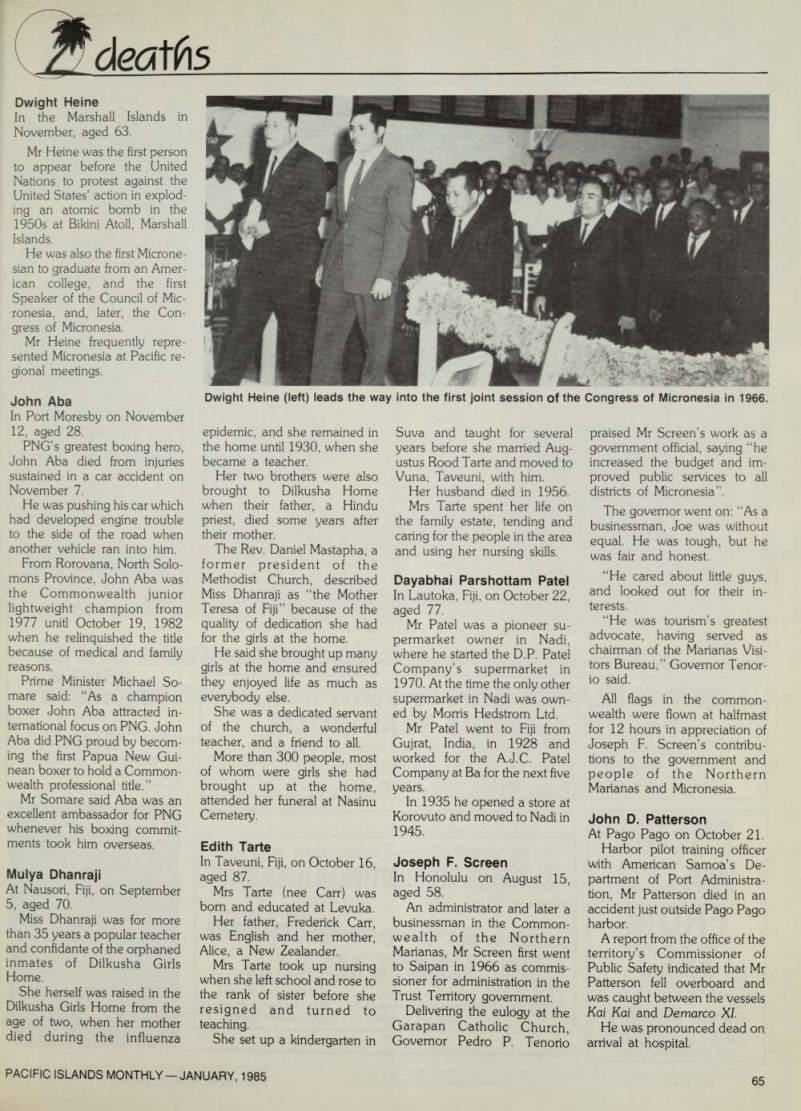
Dwight Heine In the Marshall Islands in November, aged 63.
Mr Heine was the first person to appear before the United Nations to protest against the United States’ action in explod ing an atomic bomb in the 1950 s at Bikini Atoll, Marshall Islands.
He was also the first Microne sian to graduate from an Amer ican college, and the first Speaker of the Council of Mic ronesia, and, later, the Con gress of Micronesia.
Mr Heine frequently repre sented Micronesia at Pacific re gional meetings.
John Aba In Port Moresby on November 12, aged 28.
PNG’s greatest boxing hero, John Aba died from injuries sustained in a car accident on November 7.
He was pushing his car which had developed engine trouble to the side of the road when another vehicle ran into him.
From Rorovana, North Solo mons Province, John Aba was the Commonwealth junior lightweight champion from 1977 unitl October 19, 1982 when he relinquished the title because of medical and family reasons.
Prime Minister Michael So mare said: “As a champion boxer John Aba attracted in ternational focus on PNG. John Aba did PNG proud by becom ing the first Papua New Gui nean boxer to hold a Common wealth professional title.”
Mr Somare said Aba was an excellent ambassador for PNG whenever his boxing commit ments took him overseas.
Mulya Dhanraji At Nausori, Fiji, on September 5, aged 70.
Miss Dhanraji was for more than 35 years a popular teacher and confidante of the orphaned inmates of Dilkusha Girls Home.
She herself was raised in the Dilkusha Girls Home from the age of two, when her mother died during the influenza
epidemic, and she remained in the home until 1930, when she became a teacher.
Her two brothers were also brought to Dilkusha Home when their father, a Hindu priest, died some years after their mother.
The Rev. Daniel Mastapha, a former president of the Methodist Church, described Miss Dhanraji as “the Mother Teresa of Fiji” because of the quality of dedication she had for the girls at the home.
He said she brought up many girls at the home and ensured they enjoyed life as much as everybody else.
She was a dedicated servant of the church, a wonderful teacher, and a friend to all.
More than 300 people, most of whom were girls she had brought up at the home, attended her funeral at Nasinu Cemetery.
Edith Tarte In Taveuni, Fiji, on October 16, aged 87.
Mrs Tarte (nee Carr) was born and educated at Levuka.
Her father, Frederick Carr, was English and her mother, Alice, a New Zealander.
Mrs Tarte took up nursing when she left school and rose to the rank of sister before she resigned and turned to teaching.
She set up a kindergarten in
Suva and taught for several years before she married Aug ustus Rood Tarte and moved to Vuna, Taveuni, with him.
Her husband died in 1956.
Mrs Tarte spent her life on the family estate, tending and caring for the people in the area and using her nursing skills.
Dayabhai Parshottam Patel In Lautoka, Fiji, on October 22, aged 77.
Mr Patel was a pioneer su permarket owner in Nadi, where he started the D.P. Patel Company’s supermarket in 1970. At the time the only other supermarket in Nadi was own ed by Morris Hedstrom Ltd.
Mr Patel went to Fiji from Gujrat, India, in 1928 and worked for the A.J.C. Patel Company at Ba for the next five years.
In 1935 he opened a store at Korovuto and moved to Nadi in 1945.
Joseph F. Screen In Honolulu on August 15, aged 58.
An administrator and later a businessman in the Common wealth of the Northern Marianas, Mr Screen first went to Saipan in 1966 as commis sioner for administration in the Trust Territory government.
Delivering the eulogy at the Garapan Catholic Church, Governor Pedro P. Tenorio
praised Mr Screen’s work as a government official, saying “he increased the budget and im proved public services to all districts of Micronesia”.
The governor went on: “As a businessman, Joe was without equal. He was tough, but he was fair and honest.
“He cared about little guys, and looked out for their in terests.
“He was tourism’s greatest advocate, having served as chairman of the Marianas Visi tors Bureau,” Governor Tenor io said.
All flags in the common wealth were flown at halfmast for 12 hours in appreciation of Joseph F. Screen’s contribu tions to the government and people of the Northern Marianas and Micronesia.
John D. Patterson At Pago Pago on October 21.
Harbor pilot training officer with American Samoa’s De partment of Port Administra tion, Mr Patterson died in an accident just outside Pago Pago harbor.
A report from the office of the territory’s Commissioner of Public Safety indicated that Mr Patterson fell overboard and was caught between the vessels Kai Kai and Demarco XI.
He was pronounced dead on arrival at hospital.
Dwight Heine (left) leads the way into the first joint session of the Congress of Micronesia in 1966.
Advertisements & other items, pp. 66-68 (1 item)
DmiMD
SERVICE PAGE
AUSTRALIA: Distribution: The Herald and Weekly Times Ltd., 44-74 Flinders St., Melbourne, Vic.. 3000. Advertising Reps — Brisbane — D. Wood, Anday Agency, CCA Centre. Dayboro Road. Closebum 4520, Box 1918, GPO Brisbane, 4001; telephone (07) 289-4128. Adelaide — Hastwell Williamson Rouse Pty. Ltd., PO Box 419, Norwood, SA, 5067; 59 Kensington Road. Norwood; telephone (08) 332-3322, telex 87113; Perth — Allen & Associates.
Suite 2, 284 Stirling St., Perth, WA, 6000, telephone (09) 328-9593 or (09) 328-9363.
FUI: Distribution and subscriptions — Desai Bookshops, P.O. Box 160, Suva, Fiji, telephone Suva 23036.
Advertising — Fiji Times & Herald Ltd., 20 Gordon St., Suva, telephone 31-4111, telex FJ2124.
FRENCH POLYNESIA: Distribution — Hachette Padfique, 10 Ave Bruat, Papeete, telephone 25610.
HAWAII, UNITED STATES: Distribution — PIM, Hawaii.
PO Box 22250, Honolulu, Hawaii, 96822 Advertising — Brian C. Asgill, Apt. 1308, 1676 Ala Moana Blvd., Honolulu, Hawaii, 96815, telephone (808) 955-9718.
JAPAN: Advertising and subscriptions — Universal Media Corporation, GPO Box 46, Tokyo, telephone 666- 3036, cables UNIMEDIA Tokyo, telex 2524665.
KOREA: Advertising and subscriptions — World Marketing, Inc. Box 4010, Seoul; phone 776-5291-3, telex K23232.
MALAYSIA: Advertising and subscriptions — Worldwide Media Services, 57-B Komplex Damai, Jin Dato Haji Eusoff, Kuala Lumpur, telephone 63-9340, cables WORLDMEDIA Kuala Lumpur, telex 31533.
VANUATU: Distribution — Maropa Bookshop, HQ Box 210, Port Vila Advertising — Bill Penthand. Norman Bros Bookshop, Port Vila, telephone 2232.
NEW CALEDONIA: Distribution — Depot Centre de Presse Michel Pentecost, CBP2, Noumea, telephone 27- 2434, 27-4729.
NEW ZEALAND: Distribution — Gordon & Gotch, PO Box 584, 2 Carr Road, Mt. Roskill, Auckland 4 Advertising — International Media Representatives Ltd., PO Box 10259, Balmoral, Auckland 4, telephone 605-909, 792-370, telex NZ21404.
PAPUA NEW GUINEA; Dtotrtbutlon — Gordon & Qotch.
PO Box 3395, Port Moresby, telephone 25-4551, 25-4855.
Advertising — Ken Head, PNG Post-Courier, PO Box 85, Port Moresby, telephone 21-2577, telex 22120.
SOLOMON ISLANDS; Distribution and Advertising — The Bookshop, (Norman Bros.) PO Box 503, Honiara.
PHILIPPINES: Advertising — The GF Group, 12 San Ignacio St., Uroaneta Village, Makati, Metro Manila, telephone 817-7299, telex 45950 and 4233.
UNITED KINGDOM: The Herald & Weekly Times Ltd., No 1 Maitravers Street,London WC2R 3DZ, England, telephone 01 836 5162, telex London 21989.
UNITED STATES MAINLAND: Advertising — Joshua B.
Powers Jr., Powers International Inc., 551 Fifth Ave., New York. New York 10 017, telephone 867-9580, telex 236514.
Subscriptions — PIM, Hawaii, PO Box 22250, Honolulu, Hawaii, 96822.
SUBSCRIPTIONS
Payments by personal cheque are only acceptable in Australian (from a branch in Australia), U.S. and New Zealand currency. For all other remittances please send an international bank draft in Australian dollars.
Published monthly by Pacific Publications (Aust.) Pty.
Ltd. and printed in Australia by Quadricolor Industries Pty. Ltd., Mulgrave, Vic.
ADVERTISING
Air Niuqini 6 Aggie Grey 66 Citizen 38 Henry Cumines 48 Dept, of Trade 4 General Steamships 61 Hitachi 2 Intercontinental 66 Hudson Homes 26 David Hughes 66 Jensen Machinery 66 Kyowa Line 64 Nissan 12,13 Pacific Books 40 Papua Hotel 50 Pioneer 67 Polish Shipping Lines 63 Polynesian Lines 62 Sheaffer 21 Solarex 68 Toyota 34,35 Tutt Bryant 46
ALL THE NEWS
IN A FLASH
THE SOUTH SEA DIGEST
See insert for Subscription details
GENERATORS
2 KVA 1500 KVA
Sets Ex Stock or Built to Spec from
JENSEN
MACHINERY
25 HOPE ST.,
BRISBANE, 4101,
AUSTRALIA
PHONE: BUS. (07) 44-4511
A.H.: (07) 207-8165
NOW AVAILABLE! 15th Edition
PACIFIC ISLANDS YEAR BOOK
Contains over 550 pages crammed with all the facts you want to know on all the island groups of the Pacific.
See insert for further details and price.
Stay at Aggie Grey’s . . . the South Pacific’s
legendary hoteh
Situated right in the heart of Western Samoa. Enjoy Polynesian-stylc friendliness and service, in cool surroundings, superb entertainment and food.
Magnificent white sand -beaches only a short drive away. Airconditioned rooms, swimming pool and full bar facilities.
Bookings through Union Steamship Company of NZ, Pan Am, Air New Zealand or .direct to Aggie Grey’s, Apia, Western Sampa. Cables: ‘AGGIES’Apia.
FRESH
WATER
FROM
SALT
Contact an energy specialist whc has lived and worked in the islands:
DAVID HUGHES
Suite 204, 720 George Street,
SYDNEY 2000, AUSTRALIA
(02) 211-4759, AA70842
TOYOTA DATSUN MITSUBISHI MAZDA HONDA ISUZU HINO
JAPANESE RECONDITIONED USED CARS
We Export «»a» A ... Please contact to:
ouickDL Inter Continental ltd.
wuiurv ucnvciy P.0.80X 194 NAKA TELEPHONE: 052-21 1-5125 Economical Price 2-16-i 3 sakae naka-ku telex? 0442.4880 incont j
NAGOYA 460 JAPAN CABLE: INCONT NAGOYA
m A I . m / * t >v *■ •• mm rm-ge::: Bring along, sing along and play along.
The greatest partner your party ever had.
Portable fun in the sun.
DISCO ROBO is your multi-talented, go-anywhere partner for sing-alongs, dance parties, guitar playing, or just great listening. It has a builtin FM tuner, a cassette player and mixer with inputs for mikes and guitar. And it’s portable, so it can always be where the action is.
Play with the super stars.
Mix up to five kinds of sound —Mike 1, Mike 2 (or guitar), FM (or a wireless mike), cassette tape and a line input (such as a keyboard instrument or rhythm box). Then, add echo if you like and play or sing along with your favourite music.
Disco time any time.
Any music from tape or played on a connected keyboard can be turned into exciting pulsating disco music. Big sound, hi-fi sound, the four highly efficient full-range speakers in DISCO ROBO pump out dynamic sound at disco decibels.
DISCO ROBO is all you need for a perfect party.
C.D PIONEER
For further information, please contact: Australia: Pioneer Electronics Australia Pty. Ltd. (Incorporated in Victoria), RO. Box 295, Mordialloc, Victoria, 3195 Tel: 580-9911 Piji Islands: Brijlal & Company, G.P.O. Box No 362, Suva, Fiji Islands Tel: 22258 New Zealand: Monaco Distributors Ltd., 2 Poland Road, Glenfield, Auckland, New Zealand Tel: (09) 444-9144 Norfolk Island; Burns Philp (Norfolk Island) Ltd., PO Box 21, Norfolk Island Vanuatu: Burns Philp (Vanuatu) Ltd., Vila, Vanuatu Nauru Island: Jacob Enterprises, PO. Box No 4, Republic of Nauru Tahiti: Tahiti Hi-Fi, PO. Box 848, Papeete, Tahiti New Caledonia: Menard Pacifique Sari, B P 3899, Noumea, New Caledonia Tel: 27.62*23 American Samoa; Transpac Corporation, PO Box 1477, Pago Pago, American Samoa 96799 Tel: 633-5224 Rarotonga: South Seas International Ltd., PO. Box 49, Rarotonga, Cook Islands Tel: 2327 Papua New Guinea: Bali Merchants Pty. Ltd., PO. Box 6103, Boroko Tel: 254887
ELECTRICITY FROM SUNLIGHT
SOLAREX
Pty Limited 5 Bellona Ave., Regents Park 2143 N.S.W., Australia
(02) 644 5055 TLX AA21975
• VILLAGE POWER
• HOUSE LIGHTING
• REFRIGERATION
• WATER PUMPING
• COMMUNICATIONS
• MILITARY
• MARINE
c
kUSTKAU