Advertisements & other items, pp. 1-3 (3 items)
sdfh
PACIFIC
ISLANDS
MONTHLY
t
US admiral
on ANZUS
Wild Beauty of PNG
sdfh
American Samoa US$l.75 Australia 'A$l.5O Cook Islands NZ$l.5O Fiji F 51.50 Hawaii US$l.95 Kiribati A 51.75 Nauru A 51.75 New Caledonia CFPI9O
New Zealand NZ$2 50 Niue NZ$l.75 Norfolk Island A 51.50 Papua New Guinea K 51.50 Solomon Islands 551.50 Tahiti CFP22O Tonga PI .50 Tuvalu A 51,75
USA US$2.25
USTT and Guam US$1.95 Vanuatu VT1.50 Western Samoa T2.10 ■Recommended retail price only Registered by Australia Post Publication No. NBP1210
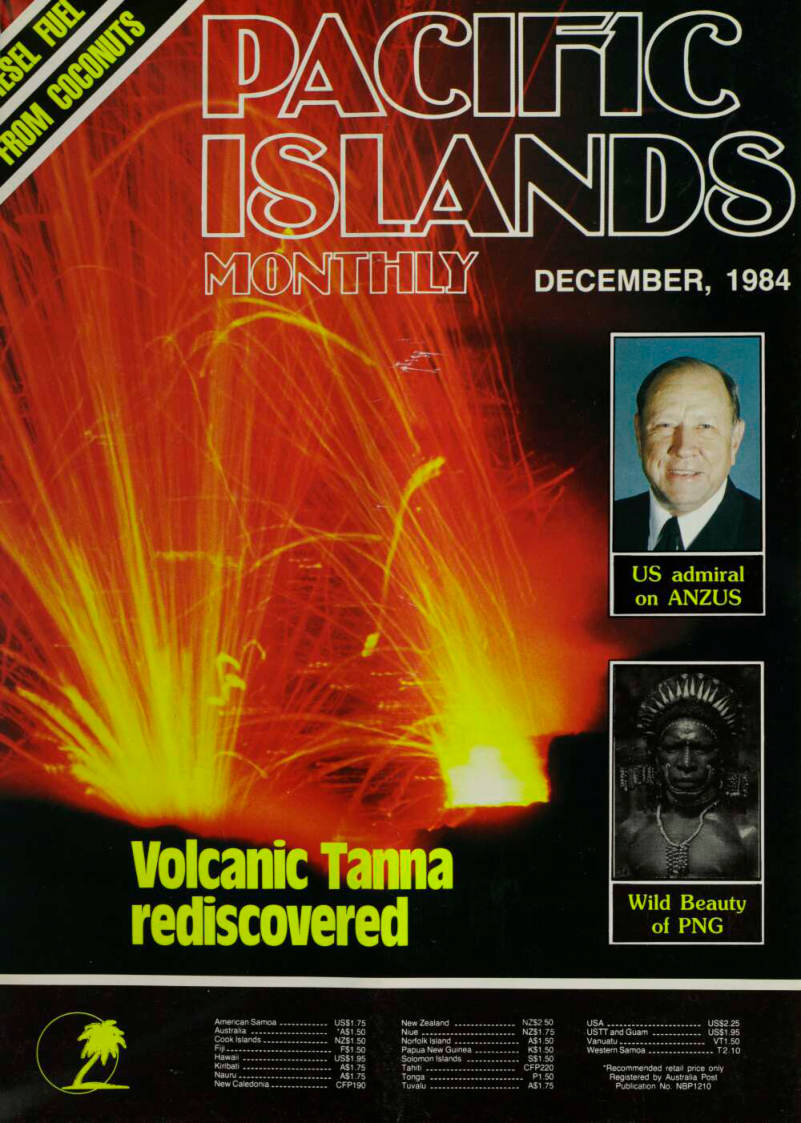
THE COVER
lasur Volcano, Tanna, Vanuatu, erupts. It is in the shadow of lasur that the Pettini brothers, Mar co and Roberto, con clude their long Melane sian journey (p. 47) Polynesian Airlines photo.
J.Is
I J.
L Ever wished the grass wouldn’t grow? Haven’t we all. At Honda, we couldn’t stop the growth but we’ve made cutting it quick, effortless and simple for all. The HT3BIO is packed with innovations.
It’s powered by a resilient, economical 4-stroke engine with MAT (Mechanical Autoclutch Transmission) for effortless shifting. And it cuts clean with dual cutting blades and a high-velocity discharge fan. The HT3BIO. Big brother in Honda’s innovative lawnmower series. Definitely a cut above the rest.
LAWN TRACTOR
O AUSTRALIA: Honda Australia Pty., Ltd. Lot 95 Sharps Road, Tullamarine, Victoria 3043: Bennett Honda Pfy., Ltd. 250 Victoria Road, Wetherill Park, NSW 2164/PAPUA NEW GUINEA: Steamships Trading Company Ltd.
PO. Box 1, Port Moresby /TAHITI: Honda Distribution S.A.R.L. B.P 1665, Papeete / KIRIBATI: Atoll Motor & Marino Services PO Box 49, Bairiki Tarawa, Republic of Kiribati / U.S. TRUST TERRITORY: United Micronesia Development Association PO. Box 235, CHRB Saipan CM 96950/COOK ISLANDS: Cook Islands Motor Centre Ltd. PO. Box 74, Rarotonga / GUAM: Mark’s Motor Co., Inc. PO Box DV, Agana/ WESTERN SAMOA: Motor Distributors (Samoa) Ltd. PO Box 576, Apia /SOLOMON ISLANDS: Guadalcanal Garage Limited PO Box 537, Honiara /NEW CALEDONIA: Est. Ballande 8.P.C4, Noumea Cedex Noumea /NAURU: Nauru Cooperation Republic of Nauru/FIJI: Carpenters Motors Private Mail Bag, Suva, Fiji/AMERICAN SAMOA: Holiday Motors: Parts and Service PO Box 968 Pago Pago, American Samoa 96799: Haleck’s Service Center Ltd. PO. Box, 1138, Pago Pago, American Samoa 96799/TONGA: Tonga Industrial Traders PO. Box 1035, Nuku’alofa, Tonga /VAN U ATS U: Honda Farm PO. Box 1031 Port Villa
Islands
PACIFIC
MONTHLY
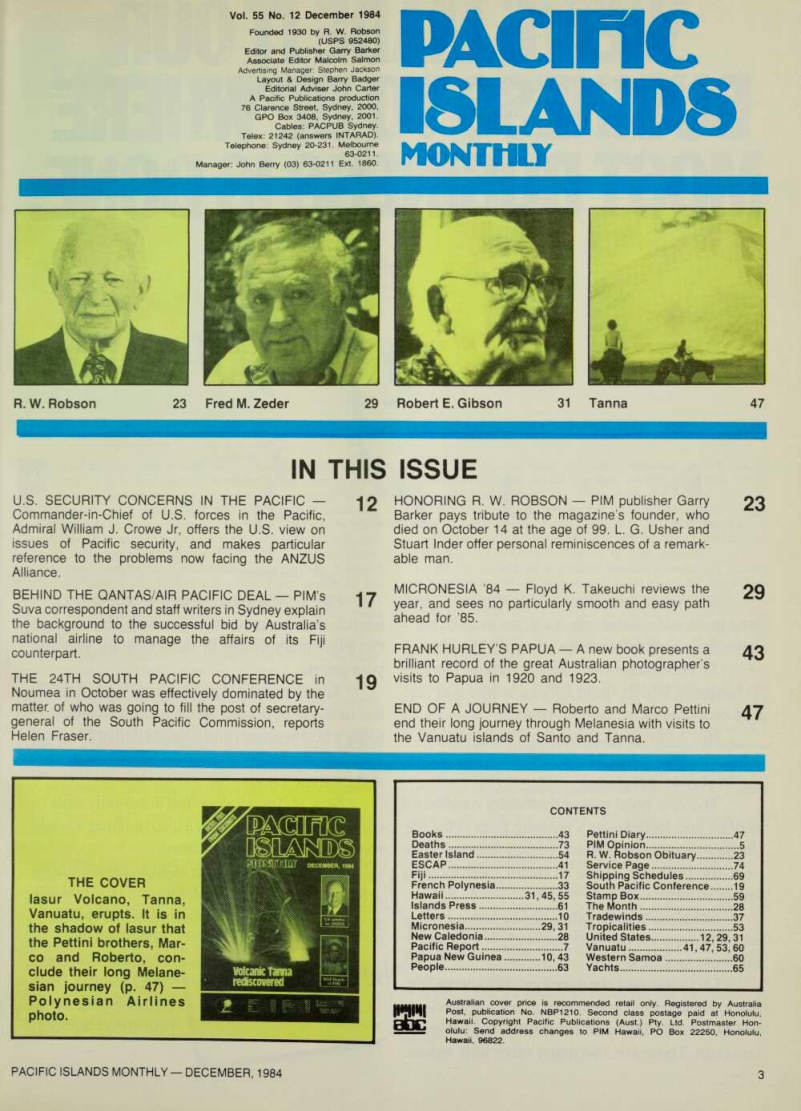
Vol. 55 No. 12 December 1984
R. W. Robson 23
Fred M. Zeder 29
Robert E. Gibson 31
Tanna 47
In This Issue
U.S. SECURITY CONCERNS IN THE PACIFIC -| 2 Commander-in-Chief of U.S. forces in the Pacific, Admiral William J. Crowe Jr, offers the U.S. view on issues of Pacific security, and makes particular reference to the problems now facing the ANZUS Alliance.
BEHIND THE QANTAS/AIR PACIFIC DEAL PlM’s -I 7 Suva correspondent and staff writers in Sydney explain the background to the successful bid by Australia’s national airline to manage the affairs of its Fiji counterpart.
THE 24TH SOUTH PACIFIC CONFERENCE in -| 0 Noumea in October was effectively dominated by the matter, of who was going to fill the post of secretary general of the South Pacific Commission, reports Helen Fraser.
HONORING R. W. ROBSON PIM publisher Garry 23 Barker pays tribute to the magazine’s founder, who died on October 14 at the age of 99. L. G. Usher and Stuart Inder offer personal reminiscences of a remark able man.
MICRONESIA ’B4 Floyd K. Takeuchi reviews the 29 year, and sees no particularly smooth and easy path ahead for ’B5.
FRANK HURLEY’S PAPUA A new book presents a 43 brilliant record of the great Australian photographer’s visits to Papua in 1920 and 1923.
END OF A JOURNEY Roberto and Marco Pettini 47 end their long journey through Melanesia with visits to the Vanuatu islands of Santo and Tanna.
Contents
Books 43 Deaths 73 Easter Island 54
Escap 41
Fiji 17
French Polynesia 33 Hawaii 31,45, 55 Islands Press 61 Letters 10 Micronesia 29, 31 New Caledonia 28 Pacific Report 7 Papua New Guinea 10, 43 People 63
Pettini Diary 47 PIM Opinion 5 R. W. Robson Obituary 23 Service Page 74 Shipping Schedules 69 South Pacific Conference 19 Stamp Box 59 The Month 28 Tradewinds 37 Tropicalities 53 United States 12, 29, 31 Vanuatu 41,47,53,60 Western Samoa 60 Yachts 65
Australian cover price is recommended retail only. Registered by Australia Post, publication No. NBPI2IO. Second class postage paid at Honolulu, Hawaii. Copyright Pacific Publications (Aust.) Pty. Ltd. Postmaster Hon olulu: Send address changes to PIM Hawaii, PO Box 22250. Honolulu, Hawaii, 96822.
Advertisements & other items, pp. 3-4 (2 items)
Pacific Islands Monthly December, 1984
3
Founded 1930 by R. W. Robson
(USPS 952480)
Editor and Publisher Garry Barker Associate Editor Malcolm Salmon Advertising Manager: Stephen Jackson Layout & Design Barry Badger Editorial Adviser John Carter A Pacific Publications production 76 Clarence Street, Sydney, 2000, GPO Box 3408, Sydney, 2001 Cables: PACPUB Sydney.
Telex: 21242 (answers INTARAD).
Telephone: Sydney 20-231. Melbourne 63-0211.
Manager; John Berry (03) 63-0211 Ext. 1860.
Business To Be Where
WE’VE MADE HOUR
MOST BUSINESS IS DONE.
PERTH
DARWIN
NDELAIDE ■
I J
RABAUL
PORT MORESBY
SUVA
J
TAHITI
CHRISTCHURCH
QUEENSTOWN
No matter how comfortable a hotel is and how good its facilities are, it’s to no avail if that same hotel isn’t near where you want it to be.
At Travelodge our aim is to attract people in business, which, quite simply, is why you can find us in so many business centres.
Not surprisingly, more and more people, particularly with business to transact, are choosing to stay at Travelodge.
The one hotel group that offers excellent service and facilities at a realistic price. Plus the distinct advantage of being ideally located in or near the business centre of major metropolitan and provincial cities.
Since your hotel often has to serve as an office too, we provide you with first class business facilities.
Dictation and transcription, photocopying, telex, national and international courier services, business breakfasts and rooms for large or small meetings. There are also many other little extras.
Like a newspaper every morning and fresh fruit in your room on arrival. There’s also complimentary coffee in the lobby for you and your guests.
Another thing that won’t go unnoticed is the millions of dollars spent on the facilities today’s businessmen and women demand. Large, tastefully decorated rooms, excellent restaurants and intimate bars.
Stay at Travelodge. You’ll not only find us conveniently located, you’ll also find that a warm reception is just the beginning.
For reservations world-wide please phone Sydney (02) 267 2144. Melbourne (03) 690 6111.
Brisbane (07) 2218586.
Adelaide (08)
223 6288. Canberra (062) 491424. Perth (09) 3253811. Or your travel agent.
CLASS
Pim Opinion
For all that the press sometimes may be found lacking, or in error, a free and responsible press is the most precious attribute any nation may possess. Governments, unless they are more enlightened than most, are not notable for their defence of that valuable truth, despite the fact that in many cases their own credibility before the public which supports them is as much defended by a free press as it is by their own efforts.
A free press must be truly free. It must be independent. It cannot court the powerful, and it must not pillory them, purely for the pleasure of it. To a free and responsible press, truth, objectivity and honesty are sacrosanct, and thus is a democratic society made stronger. And while adherence to these rules may make the press unpopular with those who consider their hides and their dignity of more than common value, it is important that the press be given proper access to facts and events of genuine public interest.
The Pacific is far from over-burdened by free and independent newspapers or radio networks. In the whole of the island region, north and south, only a handful of countries could be said to enjoy truly free newspapers. Even fewer have radio networks untram melled by government interference. At the same time the local press, and those few international journals which do follow Pacific affairs, tend to avoid sensationalism and be careful and knowledgeable in their coverage. There are a few transgressors, but they are well-enough known.
We therefore find it quite extraordinary that the South Pacific Conference should decide, as they did last month, to exclude the press from some of its deliberations in Noumea. If the subject for discussion had been a matter of high security upon which the fate of nations, or lives, depended, secrecy could be understood and accepted.
But the question denied to the rude gaze of the press was an application by the the secretary-general of the SPC, Mr Francis Bugotu, for another full three-year term in office, which, apparently, is not exactly permitted by the rules.
At best, chucking out the press, and some other observers, was pompous, and quite unnecessary. At worst it was an attempt by a bunch of bureaucrats and politicians to hide their activities from the public whose interests they are supposed to serve, and whose money not only took them to Noumea, but made sure they were comfortable, and well fed and watered, while they were there.
There already had been a closed committee session on the matter at which, one would suppose, all the gritty little bits of debate had been shaken out. Why, then, the further secrecy?
We gather that the gag was applied because the discussion might “cause embarrassment.” But is it proper to hide a matter of public interest simply because some officials might be shy, or feel less than confident about public examination of their activities?
To impose secrecy on a national meeting is one thing, but this was an international conference, and so far as we are aware there was not the slightest need or justification for excluding the press from it. The public of the Pacific are, in a sense, shareholders in the South Pacific Commission, and should be treated as such. The conference has always been open. That is the Pacific way, and it should be maintained.
We find it further surprising that Mr Jonati Mavoa, of Fiji, who has every reason to understand the workings of a free and responsible press, for Fiji does possess that, was one of the leaders of the move to shut the meeting. And, even more remarkable, the British High Commissioner to Fiji, Mr Barltrop, supported him.
The modern world groans under the dead-weight of politicians and official’s so filled with their own self-importance that they feel they can with impunity deny public over-sight of their actions. The proliferation of international organisations has tended to increase that problem rather than diminish it.
One of the offenders has been SPEC which, for reasons quite unexplained, refuses to make public the papers presented to its annual conference by member governments, despite the fact that, frequently, the relevant governments would quite like a bit of publicity.
There is an extraordinary, and disquieting, view in the hierarchy of SPEC that its documents are of such enormous value and sensitivity that not only should they be locked away from the eyes of the press and ordinary people like taxpayers and others who ought to be benefiting from the activities of the Bureau, but also that the press should not be briefed on them.
It is a most distasteful ban which does nothing for the reputation of SPEC, or for the spread of knowledge and progress in the region. We believe that in most cases SPEC and their ministrations would be a great deal improved by a cleansing draft of public accountability.
Advertisements & other items, p. 6 (1 item)
The Ultimate XO
& faUM XQ 'if. rr i ■ I m I ,W
Centaure XO
REMY MARTIN
nf.r •• w:
COGNAC
FINE CHAMPAGNE COGNAC. SINCE 1724.
■I
REMY MARTIN CENTAURE XO
m
Pacific Report

IRIAN JAYA f PNG, TO EXCHANGE CONSULS?
Papua New Guinea and Indonesia in October signed a revised border agreement. The new agreement covers plans for the repatriation of about 10,000 Irian Jayan refugees in PNG, and other important issues regarding the common border. It replaces a previous agreement drawn up in 1979. The signing of the revised agreement in Port Moresby by PNG Foreign Affairs Minister, Rabbie Namaliu, and his Indonesian counterpart, Dr Mochtar, followed six months of talks. The first batch of Irianese to be repatriated were from the refugee camps in the southern border areas of PNG’s Western Province. Their repatriation was to be followed by that of refugees in the northern border province of West Sepik. In discussions following the signing ceremonies Dr Mochtar suggested that PNG should establish a consulate in Jayapura. He is reported to have told Mr Namaliu: “We have nothing to hide, so why don’t you open a consulate instead of listening to this (rebel) nonsense. Have the consul verily these things on the spot. ” Noting that the idea has been floated before but never acted on, Sydney Morning Herald Foreign Editor Peter Hastings wrote; “The most likely reason for not following through on the Indonesian suggestion is that PNG would have to accept an Indonesian consul in Wewak. The last thing that some in Port Moresby want is an Indonesian presence in the sensitive border area. But this cuts both ways. Some in Jakarta would not welcome the notion of a Papua New Guinean becoming a possible rallying Coint in a Melanesian town like Jayapura, which is also near the order. The best argument lies with the Indonesians. A PNG consul in Jayapura would be able to prove to his own satisfaction, and Port Moresby’s, the wild nature of many of the OPM’s claims. ”
Eight Ministers Out In Solomons Poll
Solomon Islands’ new single-chamber National Parliament, elected on October 24, was to meet on November 14 to elect a prime minister. The favorite was outgoing prime minister Solomon Mamaloni, but it was generally believed that a former prime minister, Sir Peter Kenilorea, could possibly attract the necessary support. Mr Mamaloni lost eight of his cabinet in the elections which resulted in 18 sitting members losing their seats, and his coalition partner, the National Democratic Party, was reduced to a single member. Independents supported Mr Mamaloni in the last parliament, but only two of these retained their seats, and the five new independent members were an unknown quantity. Sir Peter’s United Party won 13 seats against Mr Mamaloni’s Alliance Party’s 12. A new party, Solomon Agu Fenua, formed shortly before the elections by disaffected young public servants, won four seats, and, as they blamed the Mamaloni regime for their troubles, they were thought likely to vote against Mr Mamaloni. There are 38 seats in the National Parliament but one seat has not been filled, that of East Kwaio (Malaita), where dissidents refused to hold an election because the government had failed to obtain payment for them of compensation claimed from Britain for loss of life and damage caused by a punitive expedition of volunteer special constables sent by the British Protectorate Government in October, 1927, to Malaita to avenge the murder of District Officer W. R. Bell.
Twenty-seven islanders were reported killed in the incident.
Three In Palau Presidential Race
Palau President Haruo I. Remeliik has announced his intention of seeking a second term of office in the elections due on November 30. Other candidates were Airai State Governor Roman Tmetuchl and Ibedul (High Chief) Yutaka Gibbons. Tmetuchl, one of the first Palauan senators elected to the Congress of Micronesia and a former chairman of the Palau Political Status Commission, commenting on the negotiations with the United States for the Compact of Free Association, said he would prefer an agreement with less U.S. control and one which respected the Palau constitution as it is (the constitution bans nuclear substances from entry). Without an ideal agreement, he said, Palau should remain under trusteeship until the establishment of a secure economic base. Ibedul Gibbons is also critical of the proposed compact but incumbent President Remeliik said he would vigorously pursue implementation of it.
N.C.: FRANCE “ON RIGHT TRACK ff LEMOINE France’s Secretary of State for Overseas Departments and Territories, Georges Lemoine, believes his government is “on the right track” in New Caledonia. Asked in an interview in Le Monde by journalist Alain Rollat, if the government’s plan was not just an “empty shell” since it had been rejected by all the major political forces in the territory, Mr Lemoine replied: ‘Tm tempted to say that rejection of the draft statute by the two main political forces the RPCR and the Independence Front in New Caledonia, forces who are no longer talking to each other, is an indication to us that we are on the right track. Just think of the evil we’d be suspected of by one side if the other had given a noisy welcome to our plan!”
Another view of French policy in New Caledonia is given by French sociologist Alban Bensa in an article in the Canberra-based Journal of Pacific History (V 01.19, No. 1). Bensa wrote: “Since May, 1981, the French Government has succeeded in putting the independents into power, without at any stage promising them independence; it has undertaken a large-scale land reform program, without actually decolonising the country; it has proclaimed the necessary recognition of Kanak cultural identity, while at the same time leaving in place a system of schooling which effectively negates this identity, and perpetuates the under schooling of Melanesians. Halfway through the life of the present French Government, its policy towards New Caledonia remains burdened with many ambiguities.”
Png Rejects Pack Rape Death Penalty
The Papua New Guinea Cabinet has rejected moves to make “pack rape” a specific crime carrying a mandatory death penalty.
Instead, Prime Minister Michael Somare said in a broadcast, flogging will be introduced if the country’s constitution allows it.
The increasing incidence of rape has brought out large crowds of demonstrators demanding extreme penalties. (PIM Nov., p 7).
Single Hander Bill Dunlop Feared Lost
Reported on and pictured by PIM (Aug., p 67) leaving Papeete on June 8 bound for Australia, American single-handed yachtsman Bill Dunlop is feared lost. Mr Dunlop, sailing his tiny 2. / m yacht, Wind’s Will, was due in Brisbane on August 10 after a planned 50-day crossing from the Cook Islands. He had still not arrived by early November. There was a flurry of publicity about his case in October when a note was found in a margarine container on a beach near Mackay in northern Queensland. The note said: “Shipwrecked on island. No food. Little water. Time running out.
Oct. 6, ’84.” But when Australian handwriting experts compared the writing with examples of Mr Dunlop’s own which were flown from the U.S., they ruled out the possibility that the note could be from him. It was also noted that the brand of margarine concerned was not on sale in Rarotonga at the time of his visit. Dunlop’s wife, Pam, flew out to Brisbane in October, and, with friends, organised a fruitless aerial search. Mr Dunlop was aiming to establish a record for smallest-ever boat sailed single-handed around the world.
Naval Exercise In Nz Waters
Destroyers, frigates, patrol craft and war planes from Australia, Canada and New Zealand are taking part in a naval exercise in New Zealand waters. Called Tasmanex, the exercise in conventio nal sea warfare is running from November 26 to December 8. The ships met in the Tasman Sea for the first phase of the exercise, then sailed through Cook Strait and up the east coast of New Zealand’s north island. Surface ships are calling at Wellington from November 30 to December 3, while the submarine Ox/ey is to visit Nelson over the same period. The exercise ends with the fleet’s arrival in Auckland on December 8.
Malaria: Good News From Chicago
A major Chicago-based foundation has announced a SA2O million research program which it said could help wipe out malaria and other parasitic diseases. The MacArthur Foundation said the effort will pull together research already in progress in developed countries and turn it on a problem that affects the people,
economies and even the politics of many third world nations. “All of us in the biomedical science community . . . have the highest expectations for this program,” James Hirsch, who will head the program’s panel of scientific advisers, said. “The payoff may be several years down the road. This is not something that can be accomplished overnight. But all the signs are positive. It will succeed. ” Money for the five-year program will be divided among research institutions in the United States, Israel, Australia and Mexico.
“LEADERS SHOULD BE WITH THEIR OWN” UNI Vanuatu Prime Minister Father Walter Lini has told an interviewer that success in any political struggle is best served if those leading the struggle remain with their own people. He was replying to a question from New Zealand journalist David Robie, who had asked him if Vanuatu would be prepared to play host to any provisional government set up by pro-independence forces in New Caledonia.
W. SAMOA LAND ROW HALTS HYDRO WORKS Work on a hydro development project in Western Samoa by the Western Samoa Electric Power Corporation has been held up because of a dispute over ownership of some of the land taken over by the corporation. The Land and Titles Court was scheduled to open legal proceedings on November 29. Meanwhile, the cost to the corporation of the stoppage was growing at the rate of between SWSIO,OOO and $12,000 a day.
New World Of Sir Pita Lus
The Papua New Guinea-based Kawas Express Corporation, of which Parliamentary Services Minister Sir Pita Lus is chairman, plans to build a K 1.2 million (SAI.S million) shopping centre on the Hubert Murray Highway at Erima. Construction is by Homibrook Construction Pty Ltd of Port Moresby. The complex, called the New World shopping centre, will have a supermarket, service station, snack bar, 11 shops and car park.
Air Guam Buys Indonesian Aircraft
The domestic airline Air Guam has signed a basic purchase agreement with Indonesia’s Nurtanio Aircraft Industry Ltd to buy two of the company’s NC-212 series 200 aircraft. Air Guam’s President Peter Shih has also expressed interest in buying a CN-235 aircraft produced by Nurtanio.
Success Of Aqua City
The Japanese freighter Aqua City (PIM Oct. p 37) successfully sailed across the North Pacific recently with two computerised sails mounted on the forecastle. The ship is a conventional 31,000 tonne diesel-driven bulk carrier to which the Nippon Kokan Company (NKK) added sails. Ordinarily it uses about 21 tonnes of heavy oil for this voyage. But with the addition of the sails and exceptionally favorable winds, fuel consumption dropped to only 13.4 tonnes. Over the long run, the ship is expected to save 10 per cent in fuel costs under normal conditions.
Somare Sends Troops To Border
The PNG government on November 9 sent detachments of troops to the border with West Irian in the area of Wutung village, south of Vanimo. The move was in response to what prime minister, Michael Somare described as “limited and contradictory” reports of clashes between Indonesian troops and OPM rebels on the PNG side of the border. It was clear, he said “that a potentially serious situation” could be developing in the area “involving the safety and security of Papua New Guineans and the security of our nation. ”
The troops will take over from police units which until now PNG has used for border patrols, partly in an effort to keep the situation on a lower political plane. Their job, said Somare, would be to prevent unauthorised border crossings.
Probing Private Uves Of Coconut Crabs
Australian scientists are to conduct a three-year study into the breeding habits in the South Pacific of the world’s largest land crab, the coconut crab. The project will be conducted in Vanuatu, on the island of Espiritu Santo. One of the project supervisors, Dr lan Brown, of the Queensland Department of Primary Industry, says the coconut crab is used regularly as part of the subsistence diet of
many people in the South Pacific. Dr Brown says catches of the crabs in Vanuatu have dwindled significantly in recent years, and there is concern that they are being over-exploited. He says the results of the study might lead to commercial breeding, particularly in outlying islands where income-generating possibilities are very limited. Dr Brown says the results will also be made available to other island countries in the South Pacific and the Indian Ocean in which the coconut crab is an important food. The study, to cost more than $300,000, is to be funded by the Australian Government through its Centre for International Agricultural Research.
Fijians Urged To Reassess Traditions
Leaders of Fiji’s indigenous community have been urged to take a critical look at their traditional customs to bring them into line with modem-day living. The call was made by Chief Justice, Sir Timoci Tuivaga when opening Pacific Week at tne University of the South Pacific in Suva in October. Sir Timoci suggested a reassessment to see whether what he called certain “socially retrogressive” practices in Fijian culture could be modified for the common good.
He said that clinging to old customs might be one reason for Fijians finding themselves at a disadvantage in competing for social progress in Fiji’s multi-racial community.
Carlton Buys Carpenter Brewery Share
Carlton United Breweries of Australia has bought out W. R.
Carpenter’s shareholding in the Carlton Brewery, Fiji. A senior executive of Carpenter Holdings, Jack Graham, said in Suva that just over 930,000 shares had been sold. This represented a 46.5 per cent share holding in the brewery. Mr Graham said Carpenter’s which is based in Sydney had not been in a position to sell the shareholding to any other company because of a pre-emptive rights agreement with Carlton in Australia. He said the decision to sell was in line with the policy of the Griffin Group, which bought Carpenter’s a year ago. Group policy was to function as operators of businesses rather than as minority investors.
Indonesians Damaged In Png Punch Up
Plans to begin repatriating the estimated 11,000 Melanesian refugees now on Papua New Guinea territory as a result of Indonesian Army patrolling against OPM guerrillas in West Irian suffered a major setback last month when, in an angry incident at the Black Waters camp in the province of West Sepik, in north-west PNG, a survey mission of seven Indonesian officials was attacked with sticks, stones and fists. Several Indonesians, and one or two PNG officials, received minor injuries before police managed to beat back the rioting refugees. Later, refugee spokesmen said the incident clearly showed how strongly their people feared being returned to West Irian and the arm of the Indonesian Army which, they said, treated Melanesians inhumane ly. They said they had been demoralised by the take-over of their lands, and the destruction of their homes. They wanted United Nations intervention to stop trans-migration, and the forcing of the Islamic religion on Christian Melanesians, they said, and internatio nal examination of their claim for recognition as an independent nation. Meanwhile, a fairly shrill protest has been sent from Jakarta to Port Moresby, complaining about what they called lack of proper protection for the visiting Indonesian officials.
Major Rice Project For Viti Levu
The Fiji Government is to set up a major rice project in the central division of the main island, Viti Levu, with the help of the Asian Development Bank. The money will be given to the Fiji Development Bank, which will then lend it to people interested in setting up rice farms. The ADB will provide more than $5 million in loans. The balance will be provided by the Fiji Development Company, and the Fiji Development Bank. The project will help farmers grow root crops, vegetables and maize as well as rice. At present, 30 per cent of Fiji’s rice requirements are imported. Rice is the staple diet of Fiji’s Indian community.
THEY RE SHOOTING CATS ON CHRISTMAS IS.
Wildlife wardens on Christmas Island, Kiribati, have expressed concern at the increasing number of wild cats on the island. A study has shown that the wild cats have caused havoc in the wild bird sanctuary on the island. The sanctuary’s wildlife wardens have begun shooting the cats in an attempt to curb their numbers. The agricultural division in Tarawa has sent an officer to Christmas Island to help in the eradication campaign.
Advertisements & other items, p. 8 (1 item)
National VTR:
Vm . - . a» * ' . ; l■■„ * * :, *V ./ >*■- - ■ * -y N ■ • •••': * ‘W -^.w; a _j «sJ LrJ .
MS' ". ■«
Still the Best Picture inVideo.
Timeless beauty. Perfect balance. Colour and clarity as real as life itself. That’s the kind of picture you’ve come to expect from National VTR.
And like an Old Master, National VTR gets better year after year. Our new model NV-450 is an outstanding ex-
ample of high performance from
basic features. Its three-videohead system can freeze the action in a beautiful still picture without jitter or noise. In fact, still is so crisp and clear, we call it Super Still.
Of course, as good as our Super Still is, our moving playback is even better. And with a 27-mode wireless infra-red remote control,
programmable One-Touch Timer Recording,
and a compact design only 9.9 cm high, the NV-450 is as practical as r national « m&na • gjkona it is artistic. §p National VTR. Still- * IgQ = IgQ or moving—it’s the best picture in video.
VMS
Your attention is d published or broadcast material
National
National, Panasoniq and Technics are the brandnames of Matsushita Electric
Rabaul: A provincial
letters
Rabaul: A provincial minister erupts
I am writing to you at a time when Papua New Guinea is going through a particular type of experience based on the results of the recent elections, and the style of leadership which immediately followed, or at least until recently.
Such a situation has been characterised by a lot of un favorable government actions and decisions which do not stand up to the tests of reason, responsibility, respect for the people, and sincerity of pur pose.
Instead things have taken on an aura of devilish government values, irrationalism, emo tionalism, “blame-others”, dictatorship, selfishness and hypocrisy. We have a govern ment that is fast becoming a failure. Its policy of “MI SAVE ROT” has not only won itself a place amongst liars but it has undergone a conversion pro cess from a state of “I Know the Way” to a state of incompe tence and “I Don’t Know the Way”.
As an elected representative of my people I have become deeply concerned about their future and the manner in which the Somare government is leading us. Its recent actions for example on: 1. Manus Provincial Gov ernment Suspension.
The auditor-general’s re port has become a divine direction to the government on how to administer the affairs of the nation. The report, which comes out two years after the actions with which it is con cerned, has not only become above the government in its decision-making, but any puni tive action that results from it is against any human principle of corrective measures and punishment. 2. Australia’s Aid to Papua New Guinea
The Prime Minister’s re cent trip to Australia to get help from that country to get man agement of provincial govern ments on a proper footing is a big insult to his own leadership.
Commonsense tells us that when the top is inefficient, the bottom will also be inefficient.
On this alone, we know, and Australia knows, and everyone else knows, that starting from the prime minister’s office where Mr Somare is, inefficien cy of the highest order breeds.
From these it filters down to his ministers, then to national de partments, then to provincial governments.
This obvious fact of adminis tration has led Mr Somare to spotlight his government’s im competence on the internatio nal screen for viewing by all.
This is a process which is putting the majority of Papua New Guineans to shame and disgust.
Mr Somare should tell the Australians the truth. In this case the truth is that he has serious deficiencies in his approach to administration and development. These are characterised by selfish, political motives, and an inability to provide administrative answers instead of politics to administrative problems.
One and a half years ago, the premiers of the New Guinea islands region started calling for more training of their managers in the area of accounting and other areas. Instead of doing this, Mr Somare closed the Islands Regional Training Centre, at Vunadidir, East New Britain, a most irresponsible action for a government to take.
Now, he is turning to the Australians to come and bail him out but using a strategy that only promises more problems and undermines our sovereignty.
-pi j. , The national governments negative answers are highly suspect, particularly when pro vinces are asking for money for development Yet he, without any effort, builds bars in the Knm V a " d ™ ?** KlOOO each to all MP s for Independence Day celebra tons. When concern was ex pressed, the prime minister re plied that it was “surplus money”. Is there any surplus in government spending? In my knowledge of government accounting there can only be deficits, but never a surplus.
I rate Mr Somare’s govern
ment high on irresponsibility to the people of Papua New Guiinea. I ask “Is this what Pangu promised us all when it told us that “MI SAVE ROT”?
I beg all thinking Papua New Guineans to speak out against this evil which has worked its way into the government.
God Help Papua New
GUINEA for its people are being led by men who will be judged against God’s word which is written in the Holy Bible, “When evil men are in power, crime increases. But the righteous will live to see the downfall of such men” (Prov. 29.16).
Sinai Brown
Minister for Finance and Plan ning, East New Britain Provin cial Government Rabaul Papua New Guinea
Malaria memories

are stirred
The article dealing with malaria in the September PIM will bring back memories to those of us who lived pre-war in New Guinea and the Solomons, and perhaps some degree of wonderment among those who live in non-malarial islands of the Pacific and elsewhere.
My experience of the scourge relates mainly to the 1920 s and ’3os in the Morobe district of mainland New Guinea, and in particular when people from Australia flocked in to try their luck on the Edie Creek gold fields and adjacent areas.
In general they as dear skins became infected as soon as they arrived by ship at Salamaua and their first dose of malaria was not helped by their subsequent rough living, grog, poor food and ignorance of precautions and treatment.
Luckily most of the infection was of the benign variety but when the more malignant strains claimed a victim it gener
ally ended in blackwater fever or cerebral malaria and a one way trip to the local cemetery.
In contrast to the many pro phylactic and suppressant drugs now available we had only quinine. On most dining tables stood a tin of Hallams 5 gr. capsules, and it was ritualistic to start the evening meal by swig ging down a capsule. Two of them would make the ears ring and produce slight deafness.
It was a way of life for most people in coastal areas to go down with an attack periodical ly, and the usual treatment was to leave the sufferer alone in a darkened room with a jug of lemon drink and a bottle of aspirin at the bedside, tiptoe away and leave him or her to literally sweat it out for a couple of days.
If medical attention was avail-
Continued on page 60
able it was common for a severe case to be treated by injection of liquid quinine in the buttock, this often resulted in a quinine ulcer and subsequent sloughing.
Late in the 1930 s a German synthetic named “Plasmoquin” came on the scene but was accompanied by a warning that it was to be treated with caution as a dangerous drug. The war brought atebrin and yellow pigmented skins, and later we heard of paludrin but it was reported to be still under test.
The PIM article tells of the campaign, and the large num bers of people employed in anti-anopheles measures. At Salamaua, adjacent to a man grove swamp teeming with mosquitoes, the team consisted of four natives who moved
around putting a cup of kerosene in water tanks, over turning abandoned canoes, and attempting the hopeless task of emptying the water from thousands of empty bully beef tins and half coconuts. Almost nightly rains kept them full of water.
A dose of malaria usually was followed by a feeling of well being; our only tonic was called “Easton’s Syrup,” a strychnine based potion.
There were always argu ments as to how long the wog remained dormant in the sys tem; men who served in the Australian Light Horse in Pales tine in World War I claimed to have recurrent attacks years later; in my experience I had a few mild attacks after leaving New Guinea after the war, usually brought on by taking a cold shower.
Bert E. Weston
Wollstonecraft, NSW Australia.
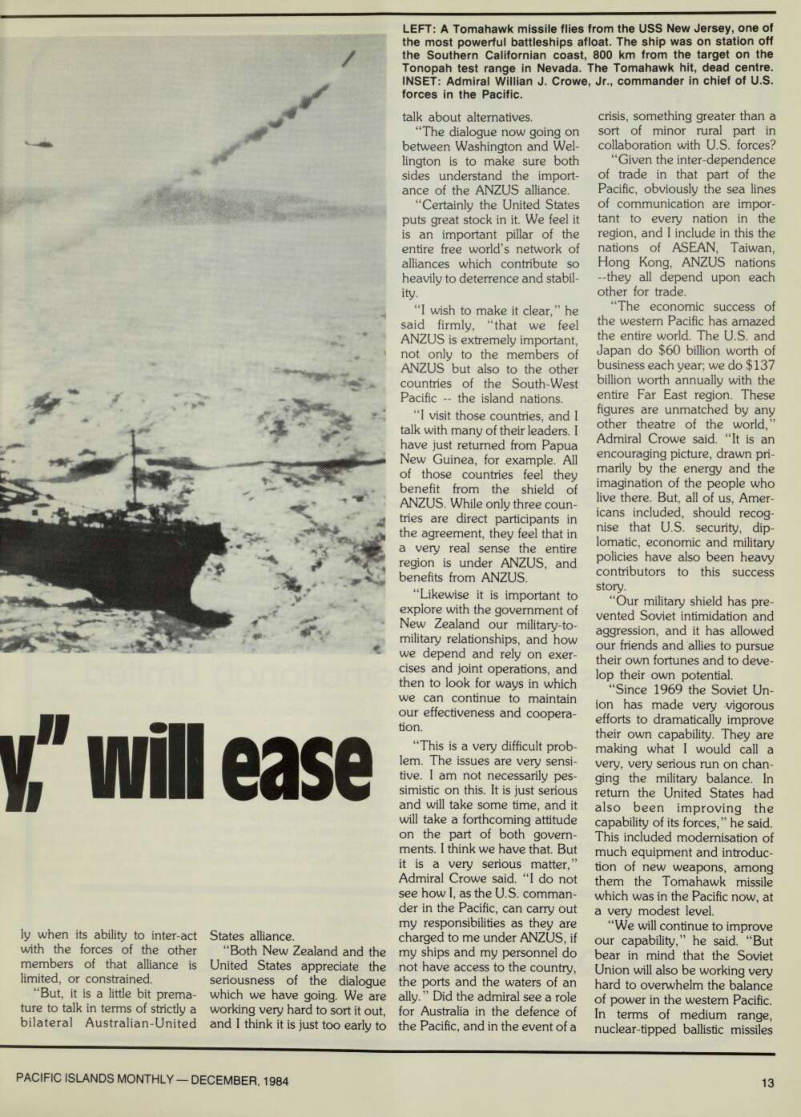
Three who stayed, malaria or not. This picture taken in the mid-60s shows the last three expatriates to live in the goldfields settlement of Edie Creek. From left they are George Sutherland (known as “Scotty”) who arrived there in 1926, and Stella and Ned Partridge (1933). The pre-war gold rush population was more than 350.
Advertisements & other items, p. 11 (1 item)
Kenwood
Here’s one way to improve the qua of your life. Listen just once to some familiar music from a Spectrum stereo system You’ll hear rich, dynamic and like you’ve never heard at home before!
Spectrum systems also offer a whole array of helpful functions—electronic and
computerized. Plus plenty of fingertip-ready
operating convenience.
Spectrum stereo component systems.
Engineered for you by world-leading
audio specialists.
r A m $
“pure” music
Top Features of Spectrum 72 Shown ■ 290 W Dynamic Power Output (4 ohms) ■ Advanced parametric tone controls ■Computer-guided tuning and 10-station random memory ■ Double cassette deck with doubles P eed dubbing ■Computerized tape music search/ -—— repeat system BB no
KENWOOD
TRIO-KENWOOD CORPORATION
Shionogi Shibuya Building, 17-5, 2-chome Shibuya, Shibuya-ku, Tokyo 150, Japan TRIO-KENWOOD (AUSTRALIA) PTY. LTD. (INCORPORATED IN N S W.) 4E Woodcock Place, Lane Cove, N.S.W. 2066, Australia. Tel: 428-1455 NEW ZEALAND JOHN GILBERT & CO., LTD. Auckland Tel. 0011-64-9-30839 FIJI PEPE’S DUTY FREE CENTRE LTD, Tel. 25496, 25497 PAPUA NEW GUINEA S.O. SVENSSON (N.G.) LTD. Port Moresby Tel. 212158, 212111 SOLOMON ISLANDS TECHNIQUE RADIOS CENTRE LTD. Honiara Tel. 416 NEW CALEDONIA HI-FI VOX Noumea Tel. 27-2466, 28-2931 VANUATU FUNG CHOI LUEN. Port-Vila Tel. 2556
TAHITI MAISON AURORE Papeete Tel. 29703
AMERICAN SAMOA ISLAND PACIFIC AGENCIES, INC. Pago Pago Tel. 633-4687
REPUBLIC OF NAURU NAURU CO-OPERATIVE SOCIETY
MARIANA ISLANDS J.C. TENORIO ENTERPRISES Saipan Tel. 6445
"Softly, softly"Will ease ANZUS crisis

U.S. Admiral Talks On Cris
ANZUS may be less at risk than has been popularly supposed, and New Zealand and the United States may not be quite so diametrically opposed on the question of nuclear ship visits as has appeared since N.Z. prime minister David Lange took office last July.
For one thing, not totally to the point, but relevant, New Zealand stoutly maintains support for the alliance in conventional forces and this month will have her ships and air force busy in Tasmanex, cooperating with units from the U.S., Australia, and Canada, and giving them access to her waters and ports.
But the question remains very delicate; a case of political dynamite in New Zealand, and a reason for deep disappointment in Washington with a Pacific country supposed to be a solid gold ally.
In Honolulu last month the U.S.Commander in Chief for the Pacific (CINCPAC) Admiral William J.Crowe, was carefully optimistic about the out come when he was questioned by the media. But, he was also very clear about the problems the New Zealand policy posed, and the risks it invoked.
Admiral Crowe assumed his present post in 1980, but has had wide experience of Pacific defence and political affairs throughout his many years in the U.S.Navy. He regards the Pacific as “the unsung success story of U.S.foreign policy.”
When the U.S. withdrew from Vietnam, he said, he estimated it would take 25 years for the United States to rebuild its relationships with the area and to restore confidence in the U.S. “Fortunately, I was wrong. As I visit the countries of the region I am led to believe that our bonds today are tighter than they have been for very many years. The area has progressed a great deal politically in the last 30 years. We see maturity, stability and responsible participation in international councils,” the admiral said.
New Zealand’s adamant stand against giving ac cess to her ports for nuclear armed or po wered naval ships, even to the point of risking the future of ANZUS, could change the milit ary balance in the Pacific and certainly has embarrassed Aus tralia and the United States. It has given comfort to political groups which use widespread public concern about nuclear weapons as an anti-U.S. cam paign, ignoring the fact that the Russians also maintain nuclear ships and submarines in the Pacific. But, Mr Lange has continued to talk with the Un ited States, expressing firm gen eral support for the western alliance and it does appear that both sides are both patient and trying hard to find a solution.
The expectation now is that
there will be gradual movement of positions in both Washington and Wellington, and that a solution will be found. Admiral Crowe, who holds the hot seat for American defence commit ments in the Pacific, made no secret of the difficulties New Zealand had given him, but seemed calmly optimistic about the final outcome.
How deeply was he con cerned about New Zealand’s attitude on access of nuclear ships to its ports? What options lay open? Bearing in mind the way France and Pakistan just quietly slipped out of the Manila Pact many years ago, could not ANZUS operate with just Aus tralia and the United States until New Zealand eventually had a change of heart and resumed a full role in the treaty relation ship?
“I am well aware of the dispute within ANZUS; I am very concerned about it,” he said. “The policy which the current government of New Zealand is promulgating is one that would make it difficult for
me as a commander with my responsibilities in the Pacific under ANZUS to carry out those responsibilities.
“It is hard for me to see how the United States can support a security alliance whole-hearted
ly when its ability to inter-act with the forces of the other members of that alliance is limited, or constrained.
“But, it is a little bit prema ture to talk in terms of strictly a bilateral Australian-United
States alliance.
“Both New Zealand and the United States appreciate the seriousness of the dialogue which we have going. We are working very hard to sort it out, and I think it is just too early to
talk about alternatives.
“The dialogue now going on between Washington and Wel lington is to make sure both sides understand the import ance of the ANZUS alliance.
“Certainly the United States puts great stock in it. We feel it is an important pillar of the entire free world’s network of alliances which contribute so heavily to deterrence and stabil ity.
“I wish to make it clear,” he said firmly, “that we feel ANZUS is extremely important, not only to the members of ANZUS but also to the other countries of the South-West Pacific the island nations.
“I visit those countries, and I talk with many of their leaders. I have just returned from Papua New Guinea, for example. All of those countries feel they benefit from the shield of ANZUS. While only three coun tries are direct participants in the agreement, they feel that in a very real sense the entire region is under ANZUS, and benefits from ANZUS.
“Likewise it is important to explore with the government of New Zealand our military-to military relationships, and how we depend and rely on exer cises and joint operations, and then to look for ways in which we can continue to maintain our effectiveness and coopera tion.
“This is a very difficult prob lem. The issues are very sensi tive. I am not necessarily pes simistic on this. It is just serious and will take some time, and it will take a forthcoming attitude on the part of both govern ments. I think we have that. But it is a very serious matter,”
Admiral Crowe said. “I do not see how I, as the U.S. comman der in the Pacific, can carry out my responsibilities as they are charged to me under ANZUS, if my ships and my personnel do not have access to the country, the ports and the waters of an ally. ” Did the admiral see a role for Australia in the defence of the Pacific, and in the event of a
crisis, something greater than a sort of minor rural part in collaboration with U.S. forces?
“Given the inter-dependence of trade in that part of the Pacific, obviously the sea lines of communication are impor tant to every nation in the region, and I include in this the nations of ASEAN, Taiwan, Hong Kong, ANZUS nations -they all depend upon each other for trade.
“The economic success of the western Pacific has amazed the entire world. The U.S. and Japan do $6O billion worth of business each year; we do $137 billion worth annually with the entire Far East region. These figures are unmatched by any other theatre of the world,”
Admiral Crowe said. “It is an encouraging picture, drawn pri marily by the energy and the imagination of the people who live there. But, all of us, Amer icans included, should recog nise that U.S. security, dip lomatic, economic and military policies have also been heavy contributors to this success story.
“Our military shield has pre vented Soviet intimidation and aggression, and it has allowed our friends and allies to pursue their own fortunes and to deve lop their own potential.
“Since 1969 the Soviet Un ion has made very vigorous efforts to dramatically improve their own capability. They are making what I would call a very, very serious run on chan ging the military balance. In return the United States had also been improving the capability of its forces,” he said.
This included modernisation of much equipment and introduc tion of new weapons, among them the Tomahawk missile which was in the Pacific now, at a very modest level.
“We will continue to improve our capability,” he said. “But bear in mind that the Soviet Union will also be working very hard to overwhelm the balance of power in the western Pacific.
In terms of medium range, nuclear-tipped ballistic missiles
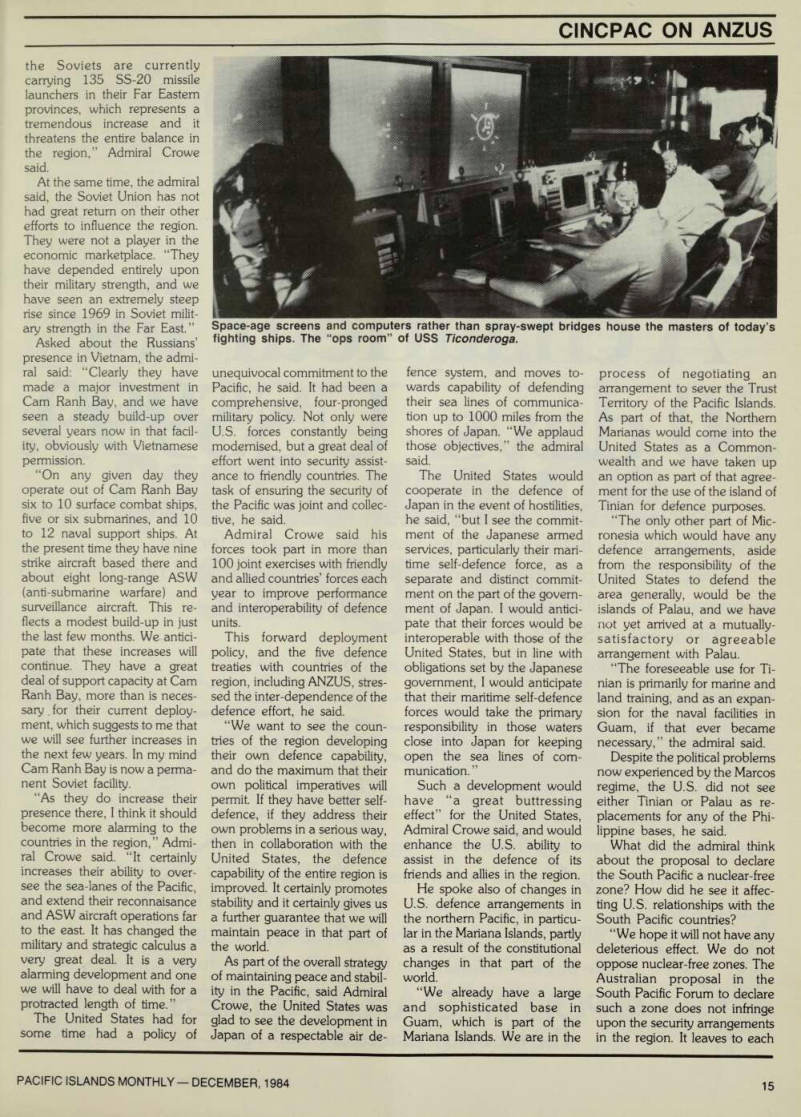
LEFT: A Tomahawk missile flies from the USS New Jersey, one of the most powerful battleships afloat. The ship was on station off the Southern Californian coast, 800 km from the target on the Tonopah test range in Nevada. The Tomahawk hit, dead centre.
INSET: Admiral Willian J. Crowe, Jr., commander in chief of U.S. forces in the Pacific.
the Soviets are currently carrying 135 SS-20 missile launchers in their Far Eastern provinces, which represents a tremendous increase and it threatens the entire balance in the region,” Admiral Crowe said.
At the same time, the admiral said, the Soviet Union has not had great return on their other efforts to influence the region.
They were not a player in the economic marketplace. “They have depended entirely upon their military strength, and we have seen an extremely steep rise since 1969 in Soviet milit ary strength in the Far East.”
Asked about the Russians’ presence in Vietnam, the admi ral said: “Clearly they have made a major investment in Cam Ranh Bay, and we have seen a steady build-up over several years now in that facil ity, obviously with Vietnamese permission.
“On any given day they operate out of Cam Ranh Bay six to 10 surface combat ships, five or six submarines, and 10 to 12 naval support ships. At the present time they have nine strike aircraft based there and about eight long-range ASW (anti-submarine warfare) and surveillance aircraft. This re flects a modest build-up in just the last few months. We antici pate that these increases will continue. They have a great deal of support capacity at Cam Ranh Bay, more than is neces sary . for their current deploy ment, which suggests to me that we will see further increases in the next few years. In my mind Cam Ranh Bay is now a perma nent Soviet facility.
“As they do increase their presence there, I think it should become more alarming to the countries in the region,” Admi ral Crowe said. “It certainly increases their ability to over see the sea-lanes of the Pacific, and extend their reconnaisance and ASW aircraft operations far to the east. It has changed the military and strategic calculus a very great deal. It is a very alarming development and one we will have to deal with for a protracted length of time.”
The United States had for some time had a policy of
unequivocal commitment to the Pacific, he said. It had been a comprehensive, four-pronged military policy. Not only were U.S. forces constantly being modernised, but a great deal of effort went into security assist ance to friendly countries. The task of ensuring the security of the Pacific was joint and collec tive, he said.
Admiral Crowe said his forces took part in more than 100 joint exercises with friendly and allied countries’ forces each year to improve performance and interoperability of defence units.
This forward deployment policy, and the five defence treaties with countries of the region, including ANZUS, stres sed the inter-dependence of the defence effort, he said.
“We want to see the coun tries of the region developing their own defence capability, and do the maximum that their own political imperatives will permit. If they have better self defence, if they address their own problems in a serious way, then in collaboration with the United States, the defence capability of the entire region is improved. It certainly promotes stability and it certainly gives us a further guarantee that we will maintain peace in that part of the world.
As part of the overall strategy of maintaining peace and stabil ity in the Pacific, said Admiral Crowe, the United States was glad to see the development in Japan of a respectable air de
fence system, and moves to wards capability of defending their sea lines of communica tion up to 1000 miles from the shores of Japan. “We applaud those objectives,” the admiral said.
The United States would cooperate in the defence of Japan in the event of hostilities, he said, “but I see the commit ment of the Japanese armed services, particularly their mari time self-defence force, as a separate and distinct commit ment on the part of the govern ment of Japan. I would antici pate that their forces would be interoperable with those of the United States, but in line with obligations set by the Japanese government, I would anticipate that their maritime self-defence forces would take the primary responsibility in those waters close into Japan for keeping open the sea lines of com munication. ”
Such a development would have “a great buttressing effect” for the United States, Admiral Crowe said, and would enhance the U.S. ability to assist in the defence of its friends and allies in the region.
He spoke also of changes in U.S. defence arrangements in the northern Pacific, in particu lar in the Mariana Islands, partly as a result of the constitutional changes in that part of the world.
“We already have a large and sophisticated base in Guam, which is part of the Mariana Islands. We are in the
process of negotiating an arrangement to sever the Trust Territory of the Pacific Islands.
As part of that, the Northern Marianas would come into the United States as a Common wealth and we have taken up an option as part of that agree ment for the use of the island of Tinian for defence purposes.
“The only other part of Mic ronesia which would have any defence arrangements, aside from the responsibility of the United States to defend the area generally, would be the islands of Palau, and we have not yet arrived at a mutually satisfactory or agreeable arrangement with Palau.
“The foreseeable use for Ti nian is primarily for marine and land training, and as an expan sion for the naval facilities in Guam, if that ever became necessary,” the admiral said.
Despite the political problems now experienced by the Marcos regime, the U.S. did not see either Tinian or Palau as re placements for any of the Phi lippine bases, he said.
What did the admiral think about the proposal to declare the South Pacific a nuclear-free zone? How did he see it affec ting U.S. relationships with the South Pacific countries?
“We hope it will not have any deleterious effect. We do not oppose nuclear-free zones. The Australian proposal in the South Pacific Forum to declare such a zone does not infringe upon the security arrangements in the region. It leaves to each
Space-age screens and computers rather than spray-swept bridges house the masters of today’s fighting ships. The “ops room” of USS Ticonderoga.
country to decide for itself whe ther ships could transit its waters, or enter its ports, and it does not infringe upon rights protected by international law.
Those meet our criteria and I do not think the U.S. would have great trouble with that. We have lived very comfortably with the nuclear-free zone in South America. We ask that these zones, if they want U.S. support, do a number of things that the initiative come from the nations in the zone, that all states who participate accept that they should not possess, produce, or store nuclear weapons on their soil, and that they should respect any security treaties which affect the area
and also the requirements of international law. On that basis the U.S. would not object at all to creation of a Pacific nuclear free zone.”
In general, said the admiral, the United States found the Pacific becoming more and more important to its interests.
“What goes on in this part of the world is impacting upon the quality of life of every Amer ican. We are looking to the Pacific more and more. Those are the basic reasons why the United States has made it une quivocally clear that it intends to remain an influential power in the Pacific. It intends to support its friends and allies in the Pacific.
“The centre of gravity of American foreign policy is slowly shifting westward,” he said, “The next 100 years will be the century of the Pacific. Amer- .cans are becoming very much more aware of these new facts ° 1 e ’
“My forces are forward deployed partially for the purpose of making sure those lines of communciation are kept open, that trade can go on and our lives will remain thriving,” he said. “But the nature of the Soviet challenge is such that the U.S. cannot do all of that alone, We have made that clear for many years now. We have always encouraged our friends
and allies to do more for their own defence and more to pro tect their sea lines of com munication. . The u s wi „ al be but we need M and we anticipate that our and allies would be major players in
at e^ort
“One of the functions I think ANZUS can perform: in any crisis the sea lanes will be of vital importance to the free world effort. Anything the ANZUS powers can do to assist in the protection of those sea lanes will be very important to the overall effort. I do see a very, very important role for those powers.”
Advertisements & other items, pp. 14-16 (2 items)
Expert
Insurance Service
throughout the islands
Queensland Insurance (Fiji) Limited
Head Office: Queensland Insurance Centre, Victoria Parade SUVA. General Manager: R. Jackson.
Assistant Manager: Vijay Lai. Phone 31 5455 LAUTOKA OFFICE: Burns Philp Bldg., Naviti St. District Manager: R. Sharma. Phone 60 642 LABASA OFFICE: Burns Philp Bldg. Phone; 8 2139
Queensland Insurance (PNG) Limited
PAPUA NEW GUINEA
Head Office. B N.G Building, Musgrave St .PORT MORESBY. General Manager T. H, Sarti Ph0ne:212144 LAE 4th St & Coronation Drive. District Manager: R. Street Phone: 423873.
MOUNT HAGEN: Hagen Drive District Manager: FT She!bourn Phone: 521002.
ARAWA: Chebu St., District Manager; B. Bowers Phone: 95 1555 MADANG: Kasagten St., District Manager:R. McManus Phone: 82 2020 RABAUL Wirraway St. District Manager B. Bowers Phone. 921014.
QBE Insurance (International) Limited
VANUATU . PORT VILA: Rue de Paris, Suite 19, Oceania Bldg Manager: D. Carroll Phone: 2299.
SANTO: Burns Philp ( Vanuatu) Ltd. Phone: 230.
PACIFIC AGENCIES
NEW CALEDONIA Ste, W A. Johnston. S.A.R.L. 5 Rue Anatole France, NOUMEA Phone: 272083.
TAHITI: Arthur Chung. Immeuble BIS.. Front de Mer, PAPEETE Phone: 2.86.19 NIUE Burns Philp (South Sea) Company Ltd.
NORFOLK ISLAND: Burns Philp ('N I ) Company Ltd. Phone: 2191 SAMOA APIA, Burns Philp (South Sea) Company Ltd. Phone: 22611 TONGA Burns Philp (South Sea) Company Ltd. NUKU'ALOFA Phone 21500 HAAPAI, VAVAU
MEMBERS OF THE
INSURANCE GROUP UMITED
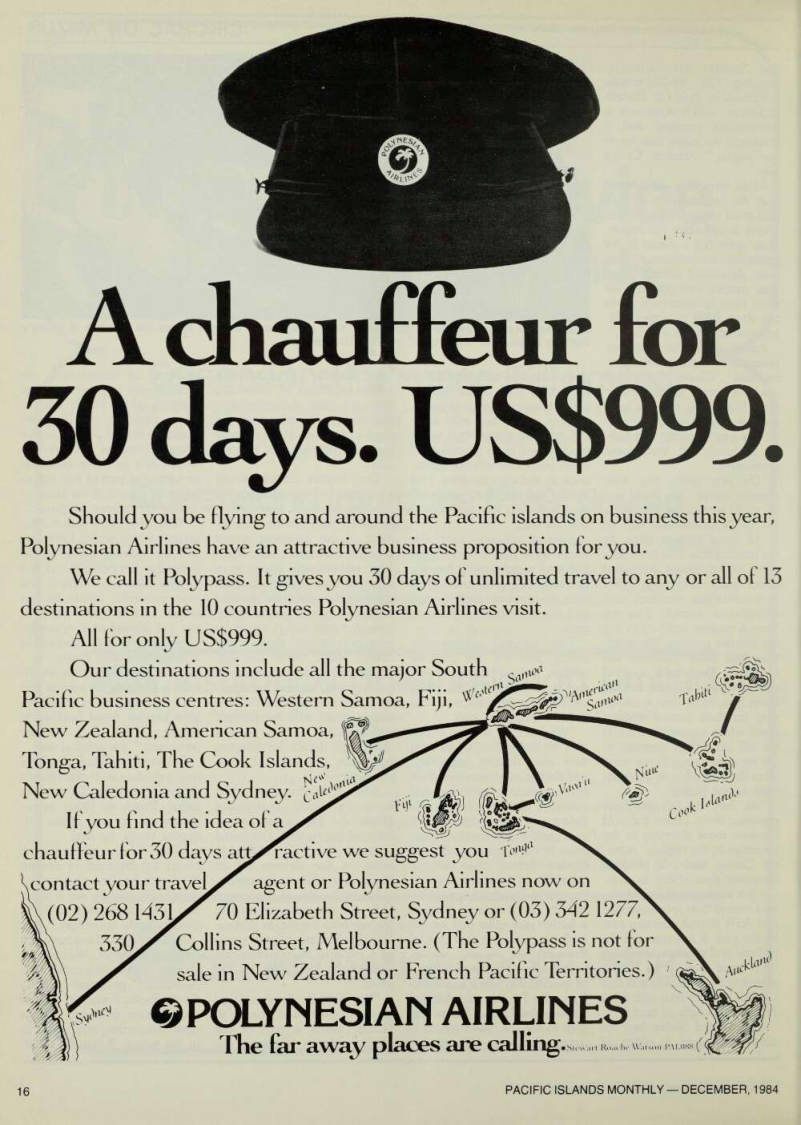
A chauffeur for
30 days. US$999.
Should you be flying to and around the Pacific islands on business this year, Polynesian Airlines have an attractive business proposition lor you.
We call it Polyp ass. It gives you 30 days ol unlimited travel to any or all ol 13 destinations in the 10 countries Polynesian Airlines visit.
All For only US$999.
Our destinations include all the major South Pacific business centres: Western Samoa, Fiji, New Zealand, American Samoa, f| Tonga, Tahiti, The Cook Islands, C/ll* 1 ' 16 . c&ris T> a ‘ New Caledonia and Sydney. y-Ai' ‘ V' l ) 1 s H 5 II you find the idea ol chaufleuiTor3o days attractive we suggest you T^ lt contact your traveler agent or Polynesian Airlines now on (02) 268 1430^^30 Elizabeth Street, Sydney or (03) 342 1277, 330 S Collins Street, Melbourne. (The Polypass is not For sale in New Zealand or French Pacific Territories.)
- © POLYNESIAN AIRLINES
,k The far away places are calling.
Stewart Roadu-Watson I‘ALOW F W' U An*-
Cincpac On Anzus
salvage job
Air Pacific’S Future
Qantas wins the salvage job
Australia’s only in ternational airline, Qan tas, won, if that be the term, the contest to step in and help Air Pacific out of the financial and managerial mire into which it had fallen.
At the depth of the crisis the airline was technically insolvent, has accumulated losses of $26 million and was reportedly con tinuing to lose money at the rate of $500,000 a month, and had to find some hope of a way out - in the shape of a finan cing angel - before the end of October, or close down for want of funds to meet the payroll and other continuing expenses.
Because of Fiji’s strategic (to the international airline busi ness) position at the hub of the South West Pacific, and be cause of the many tempting bilateral airline landing rights held by Air Pacific Australia,
New Zealand, the U.S.A., Japan, Canada, and the island nations of the region, as well as Singapore, Korea and India -there was no shortage of appli cants for the angel’s task, de spite gloomy forecasts by some of Fiji’s better pessimists that getting things sorted out was going to make Hercules’ job over at the Augean stables look like a Sunday afternoon saus age sizzle.
Ansett Transport Industries of Australia was very keen, and despatched phalanxes of en thusiastic experts to Suva, led by their company’s chairman Sir Peter Abeles, to woo Ratu Mara with a variety of pro posals.
Among these was a guaran tee of no losses burden upon Fiji, a 50/50 seat-sharing scheme on international routes, and an Ansett Boeing 767 flying in Air Pacific colors on the
Sydney-Melbourne-Nadi routes, and further if, or when, they developed.
Air New Zealand’s Norman Geary, with the turnaround to profit of his company to en hance his case, was also quickly on the scene. Then came Con tinental Airlines of the U.S. which recently restructured it
self on regional lines, with a good Pacific story to tell. Qan tas was slower to move, but obviously persuasive when it did.
Having missed Air Pacific, Ansett is expected to redouble its efforts to develop its present overseas links, and perhaps find others.
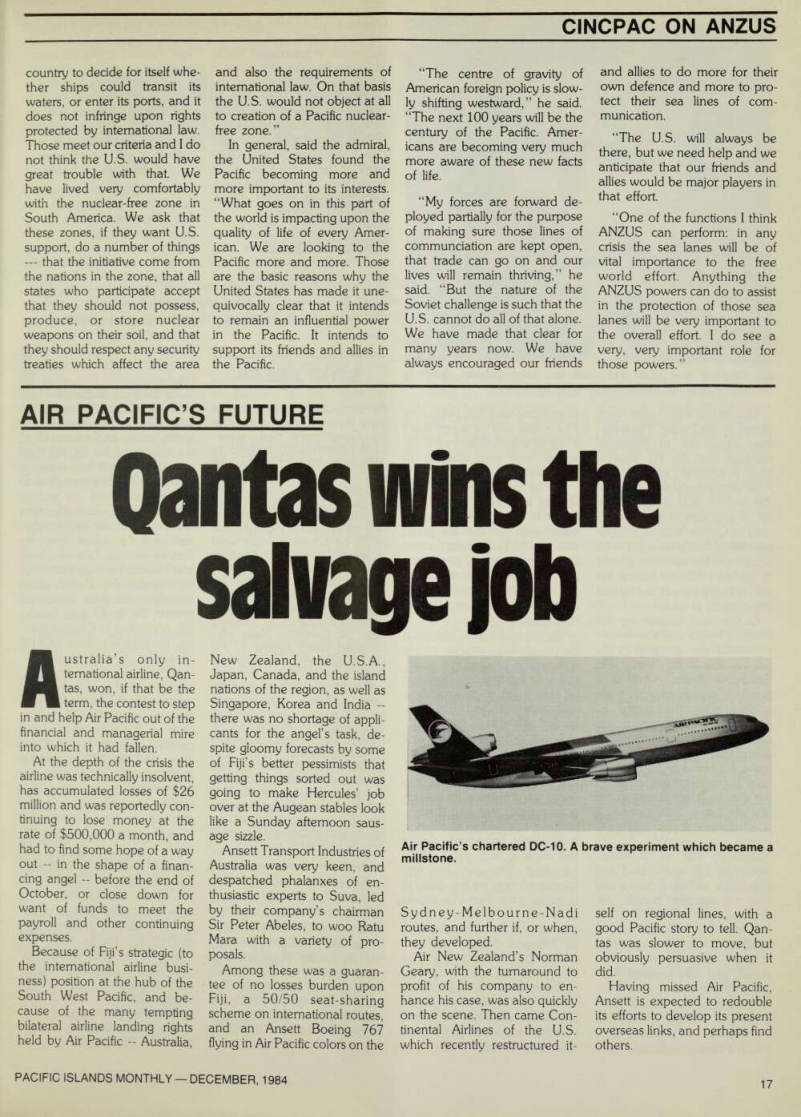
Air Pacific’s chartered DC-10. A brave experiment which became a millstone.
Qantas has three years’ work ahead on Air Pacific. The tenta tive agreement in principle, reached with the Fiji govern ment in October, gives the big Australian complete control for this period, and a formidable set of promises to fulfil. Accor ding to Qantas sources in Syd ney, some details have yet to be ironed out between the boards of the two airlines before the deal is finally signed, but no real impediment is seen.
Qantas was chosen by Air» Pacific’s board and the recom mendation was accepted by the prime minister, Ratu Sir Kamisese Mara, who took personal charge of Air Pacific affairs, after the board of directors resigned en masse while the then chairman, Mr John Hill, was overseas on leave. Mr Hill, a highly success ful Fiji businessman, took on the Air Pacific leadership about two years ago. Initially he had a good deal of support, and Air Pacific was notable for its optimism, but as problems worsened this evaporated and difficulties, including differences with management people, de veloped. Air Pacific’s main problem was that it was just too small to do what it sought to do in a sky full of highly-experi enced, and also business-hun gry, competitors.
For Qantas the irony is that it is now back in Fiji, involved in Air Pacific, a position from which it took considerable pains
to extricate itself five years ago.
The airline was for many years a major shareholder in the Fiji airline, and also operator of Nadi airport.
An Air Pacific statement said Qantas had been chosen be cause it “best satisfies the re quirements of the company, with regard to financing, man agement assistance, staff train ing, employment, regulatory and technical issues, the con tribution to tourism, and control of the company.”
Qantas said it was “delighted to be chosen against strong competition.” “Qantas’s objec tive is to establish Air Pacific in its own right as a profitable, well-managed, and highly-re garded airline in its own right. ”
Ansett, which made a major effort to win the race, is re portedly very disappointed by the decision. They had put a series of proposals to the Fiji government, and had guaran teed no further loss to them in their airline operations. Ansett has done a very good job in boosting Vanuatu tourism, hampered only by the delay in upgrading the Port-Vila airport to Boeing 727 standard. Their operation of Polynesian Airlines for Western Samoa has also won praise. They might have integrated the three services and provided the Pacific with the kind of viable regional air line about which the tourist and transport industries have been talking for years. At the same
time they would have achieved the level of growth they need, but which is impossible inside Australia. And they would have become Australia’s second in ternational airline, with a good network of routes linking Aus tralia and New Zealand with the Pacific Islands, the United States, and possibly also Can ada and Japan. All of this would have given them needed work for their still under-utilised Boeing 767 aircraft.
Suva reports say that under the deal with Qantas the Aus tralians will underwrite Air Paci fic’s accumulated losses and have guaranteed a ”no loss” operation to the government during the period of the con tract.
Services to Australia, New Zealand, and (if it is main tained) to Honolulu, are ex pected to be handled in future by Qantas 747 flights, probably with Air Pacific ’’piggy-backing” much as they already do into Sydney and Melbourne. This would cause no problems into Australia, but might present some difficulties on the Nadi- Auckland route. In that event a
previous discussion about Air Pacific buying seats from Air New Zealand could be reacti vated.
Industry sources say that a major reconstruction job lies ahead of Mr Schaap and the new team of seconded-Qantas, and locally-recruited staff, and nobody is yet sure how any thing is going to be handled.
Qantas have undertaken to train a new chief executive so that a Fiji person will be able to take over the airline at the expiry of the three-year agree ment. The Australians have also said they will apply themselves to all problems involving fin ance, information, and man agement systems, staffing and technical matters. They have undertaken to increase the numbers of tourists coming to Fiji.
Air Pacific’s ill-starred Hon olulu service, run in conjunction with Western Airlines, will end at the expiry on January 10 of the charter of the DC-10 they used. Qantas will then reinstate its Boeing 747 link from Nadi to Hawaii on some ex-Sydney services which, currently, turn around in Fiji. Air Pacific cabin staff will be taken into the Qantas services between Nadi and Hawaii, aiming, ultimately, to increase Air Pacific cabin attendant numbers from the present 26 to 49 and, finally, 62. According to Captain Gan ley, the plan is to have four Fiji personnel on each Qantas air craft flying from Sydney, through Nadi to Hawaii, and return. He said the present plan was to have one Qantas air craft, in the third year of the contract, painted in Air Pacific livery, and with 100 per cent Fiji cabin crew. It is presumed this will be one of the Boeing 767 s due to be delivered to Qantas during the next two years.
The four Fiji pilots flying the DC-10 service at present will also be converted to 747 s and, possibly, later to 7675.
Captain Ganley said the agreement with Qantas prom ised no further redundancies among Air Pacific staff, but those who had opted for voluntary retirement would have to proceed with it. Some senior executives are among those retiring or resigning.
From our Suva correspon dent and PIM staff writers.
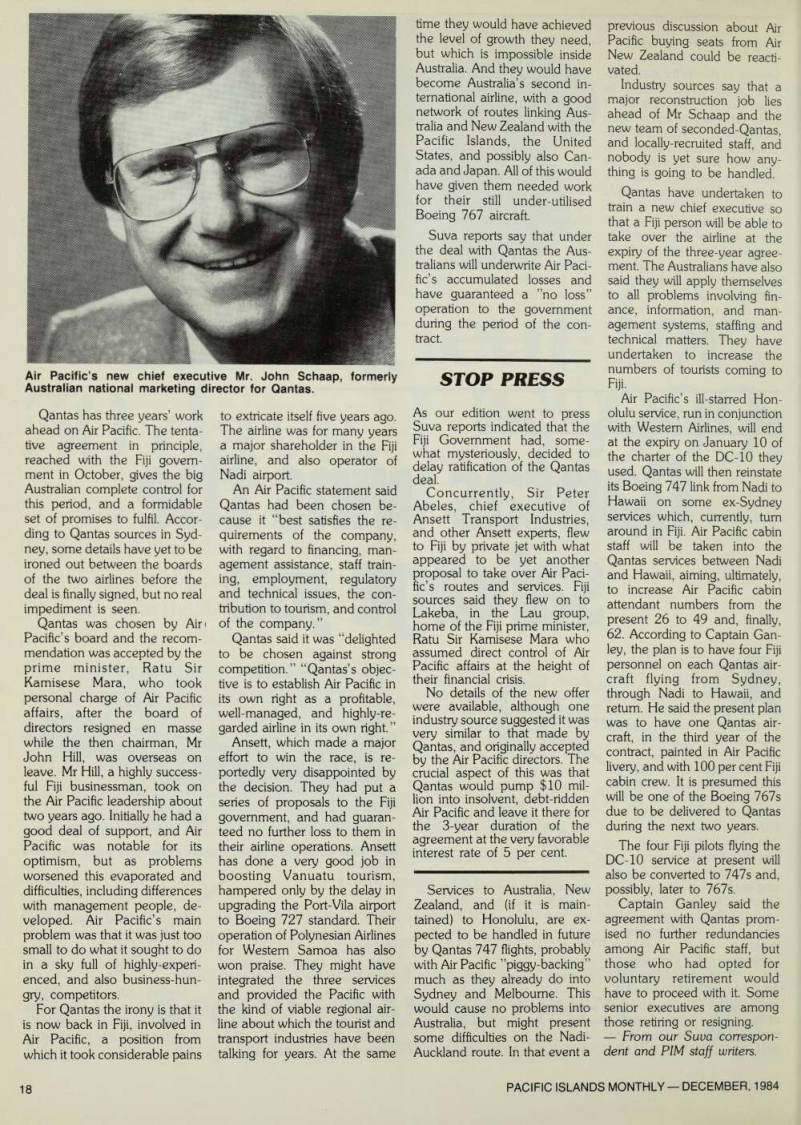
Air Pacific’s new chief executive Mr. John Schaap, formerly Australian national marketing director for Qantas.
Stop Press
As our edition went to press Suva reports indicated that the Fiji Government had, some what mysteriously, decided to delay ratification of the Qantas deal.
Concurrently, Sir Peter Abeles, chief executive of Ansett Transport Industries, and other Ansett experts, flew to Fiji by private jet with what appeared to be yet another proposal to take over Air Paci fic’s routes and services. Fiji sources said they flew on to Lakeba, in the Lau group, home of the Fiji prime minister, Ratu Sir Kamisese Mara who assumed direct control of Air Pacific affairs at the height of their financial crisis.
No details of the new offer were available, although one industry source suggested it was very similar to that made by Qantas, and originally accepted by the Air Pacific directors. The crucial aspect of this was that Qantas would pump $lO mil lion into insolvent, debt-ridden Air Pacific and leave it there for the 3-year duration of the agreement at the very favorable interest rate of 5 per cent.
Only the verbiage


1984 Spc Conference
Only the verbiage was lush
A plethora of politics, conducted over an agenda of less than riveting interest, left observers of the 24th South Pacific Conference, held in Noumea in October hoping for better luck next year. Yet, within the tropically lush verbiage, some major matters lay hidden, as PIM correspondent, Helen Fraser, here reports.
It is a commentary on the 24th South Pacific Confer ence, held in Noumea for a week in October, that of all the subjects discussed, the most time-consuming and the most intense was a matter of whether the SPC’s secretary-general should have his appointment extended when it finishes in July.
The conference had two hits at the subject, first at the session of the Committee of Repre sentatives of Governments and Administrations (CRGA) which immediately preceded the full conference, and then again at the full conference.
The CRGA session argued about it for two days, and the conference went over most of the same ground when it de voted another half day to it.
All -of this seems to indicate three things (a) that as this meeting was the first confer ence in which all states and territories had equal voting rights, the smaller territories were determined to take advan tage of their new equality by expressing opinions at length, (b) there is a lot of politics played at the conference, and (c) there were not any real issues to discuss at this confer ence.
Most delegates with long ex perience of these conferences certainly agreed that there was a lack of interesting subjects for discussion. They found it a bit of a grind, and a bore.
They suggested that the con ferences might temporarily have run out of steam following
the victory in the battle for equality, which was won at the 23rd conference held last year in Saipan, in the Northern Marianas, and that they will come good again.
We will know next year, after the 25th conference to be held in Honiara. (In an unusual development, the conference also received nominations from French Polynesia for the 1986 confer ence in Papeete, the Cook Islands for the 1987 conference in Rarotonga, and “noted” them. The conference is not empowered to accept nomina tions so far ahead and thus couldn’t approve them formal ly, but the feeling certainly was that both nominations should be accepted, with both hands.) The issue of the secretary general came up because the present S-G, Francis Bugotu, asked the conference to extend his term so that he could finish a program, already begun, of reorganising the commission. It was best, he suggested, that the same man be allowed to do the job he had embarked upon. He asked for another full three year term.
Some delegates at the CRGA session (notably the Amer icans), were opposed to either a new term, or an extension of the present one, but the main argument finally revolved around just how long an exten sion should be. It was agreed that Bugotu’s term should be extended to the close of the 26th conference (presumably in Papeete, in October, 1986),
which would give him another 15 or 16 months from the end of his term next July.
Should the 26th conference not have been concluded by the end of October, the term of office of Bugotu would certainly not extend beyond December 31, 1986, the committee re commended.
The committee also agreed that all subsequent terms of office for an S-G should be limited to a single three-year term without the possibility of reappointment for a new term or extension of the existing one.
Further, when Bugotu’s term ended, Mr Palauni Tuiasosopo, of American Samoa, should, in the committee’s view, be appointed to succeed him. The committee called upon mem bers of CRGA, who will meet just before next year’s Honiara conference, to reaffirm this re commendation about the suc cessor.
“Brownie” Tuiasosopo, assistant to Governor Peter Coleman, of American Samoa, has been the American Sa moan representative to SPC meetings for many years. He was nominated for the S-G’s post when it was last discussed at the Port Moresby conference in 1981, but stood down in favor of Francis Bugotu.
It was felt then, among other things, that as the previous S-G, Young Vivian, of Niue, was a Polynesian, it was time for a Melanesian to be appointed rather than another Polynesian.
This question of Polynesians versus Melanesians (and versus
Micronesians, for that matter) was one of the arguments used in the debate about whether Bugotu should get his extension or not. But there was also some strong opinion expressed in opposition to secretaries-gen eral, or anybody else, being selected on regional grounds, the view being that it surely should be the best man for the job, irrespective of what island region he came from.
The full extent of opinions was not made public, because the CRGA sessions are held in camera and, in an unusual development, the debate on the question by the full confer ence was also closed to obser vers—including, of course, the press, but, surprisingly, also the SRC staff.
One or two of the more distinguished of the overseas observers were less than pleased at being ejected with out notice, without any idea of when they might be allowed in again. As it happened they were out for a full morning, which they could better have used elsewhere in Noumea.
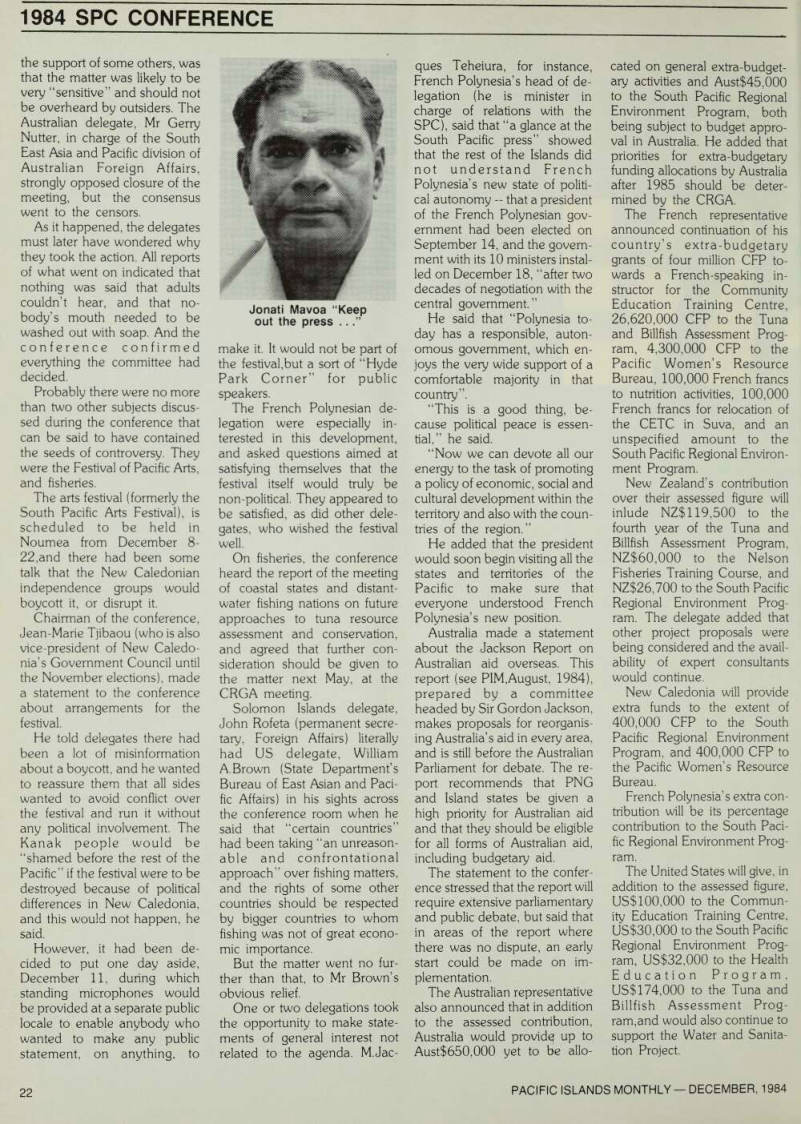
A move to ban the presence of observers during the S-G debate had been made the previous afternoon, but had been rejected. But, just before the debate was due to begin the next morning, the matter was brought up again by Fiji foreign minister, Jonati Mavoa, promptly, and strongly, sup ported by the UK High Com missioner for Fiji Mr R.A.R.
Barltrop.
Their argument, which got
the support of some others, was that the matter was likely to be very “sensitive” and should not be overheard by outsiders. The Australian delegate, Mr Gerry Nutter, in charge of the South East Asia and Pacific division of Australian Foreign Affairs, strongly opposed closure of the meeting, but the consensus went to the censors.
As it happened, the delegates must later have wondered why they took the action. All reports of what went on indicated that nothing was said that adults couldn’t hear, and that no body’s mouth needed to be washed out with soap. And the conference confirmed everything the committee had decided.
Probably there were no more than two other subjects discus sed during the conference that can be said to have contained the seeds of controversy. They were the Festival of Pacific Arts, and fisheries.
The arts festival (formerly the South Pacific Arts Festival), is scheduled to be held in Noumea from December 8- 22,and there had been some talk that the New Caledonian independence groups would boycott it, or disrupt it.
Chairman of the conference, Jean-Marie Tjibaou (who is also vice-president of New Caledo nia’s Government Council until the November elections), made a statement to the conference about arrangements for the festival.
He told delegates there had been a lot of misinformation about a boycott, and he wanted to reassure them that all sides wanted to avoid conflict over the festival and run it without any political involvement. The Kanak people would be “shamed before the rest of the Pacific” if the festival were to be destroyed because of political differences in New Caledonia, and this would not happen, he said.
However, it had been de cided to put one day aside, December 11, during which standing microphones would be provided at a separate public locale to enable anybody who wanted to make any public statement, on anything, to
make it. It would not be part of the festival,but a sort of “Hyde Park Corner” for public speakers.
The French Polynesian de legation were especially in terested in this development, and asked questions aimed at satisfying themselves that the festival itself would truly be non-political. They appeared to be satisfied, as did other dele gates, who wished the festival well.
On fisheries, the conference heard the report of the meeting of coastal states and distant water fishing nations on future approaches to tuna resource assessment and conservation, and agreed that further con sideration should be given to the matter next May, at the CRGA meeting.
Solomon Islands delegate, John Rofeta (permanent secre tary, Foreign Affairs) literally had US delegate, William A.Brown (State Department’s Bureau of East Asian and Paci fic Affairs) in his sights across the conference room when he said that “certain countries” had been taking “an unreason able and confrontational approach” over fishing matters, and the rights of some other countries should be respected by bigger countries to whom fishing was not of great econo mic importance.
But the matter went no fur ther than that, to Mr Brown’s obvious relief.
One or two delegations took the opportunity to make state ments of general interest not related to the agenda. M.Jac
ques Teheiura, for instance, French Polynesia’s head of de legation (he is minister in charge of relations with the SPC), said that “a glance at the South Pacific press” showed that the rest of the Islands did not understand French Polynesia’s new state of politi cal autonomy - that a president of the French Polynesian gov ernment had been elected on September 14, and the govern ment with its 10 ministers instal led on December 18, “after two decades of negotiation with the central government.”
He said that “Polynesia to day has a responsible, auton omous government, which en joys the very wide support of a comfortable majority in that country”.
“This is a good thing, be cause political peace is essen tial,” he said.
“Now we can devote all our energy to the task of promoting a policy of economic, social and cultural development within the territory and also with the coun tries of the region.”
He added that the president would soon begin visiting all the states and territories of the Pacific to make sure that everyone understood French Polynesia’s new position.
Australia made a statement about the Jackson Report on Australian aid overseas. This report (see PlM,August, 1984), prepared by a committee headed by Sir Gordon Jackson, makes proposals for reorganis ing Australia’s aid in every area, and is still before the Australian Parliament for debate. The re port recommends that PNG and Island states be given a high priority for Australian aid and that they should be eligible for all forms of Australian aid, including budgetary aid.
The statement to the confer ence stressed that the report will require extensive parliamentary and public debate, but said that in areas of the report where there was no dispute, an early start could be made on im plementation.
The Australian representative also announced that in addition to the assessed contribution, Australia would provide up to Austs6so,ooo yet to be allo
cated on general extra-budget ary activities and Austs4s,ooo to the South Pacific Regional Environment Program, both being subject to budget appro val in Australia. He added that priorities for extra-budgetary funding allocations by Australia after 1985 should be deter mined by the CRGA.
The French representative announced continuation of his country’s extra-budgetary grants of four million CFP to wards a French-speaking in structor for the Community Education Training Centre, 26.620.000 CFP to the Tuna and Billfish Assessment Prog ram, 4,300,000 CFP to the Pacific Women’s Resource Bureau, 100,000 French francs to nutrition activities, 100,000 French francs for relocation of the CETC in Suva, and an unspecified amount to the South Pacific Regional Environ ment Program.
New Zealand’s contribution over their assessed figure will inlude NZ5119,500 to the fourth year of the Tuna and Billfish Assessment Program, NZ$6O,OOO to the Nelson Fisheries Training Course, and NZ526,700 to the South Pacific Regional Environment Prog ram. The delegate added that other project proposals were being considered and the avail ability of expert consultants would continue.
New Caledonia will provide extra funds to the extent of 400.000 CFP to the South Pacific Regional Environment Program, and 400,000 CFP to the Pacific Women’s Resource Bureau.
French Polynesia’s extra con tribution will be its percentage contribution to the South Paci fic Regional Environment Prog ram.
The United States will give, in addition to the assessed figure, US$lOO,OOO to the Commun ity Education Training Centre, US$3O,OOO to the South Pacific Regional Environment Prog ram, U 5532,000 to the Health Education Program, U 55174,000 to the Tuna and Billfish Assessment Prog ram,and would also continue to support the Water and Sanita tion Project.
Jonati Mavoa “Keep out the press ..."
Advertisements & other items, pp. 20-21 (1 item)
1M155 Aim
*ai a * MS
SSI
SM i '■ m m r r ■■ Car of the future: N'.
«VMSW»i
fm ;■ 1111111 Sib . mtm. & . a:. |p»l I as •■• ■ m ■~.j& m
Because for us
r
1M155 AIM
m
wrim
Until mmsi m ■ i :*** m a - MB - ■•s' •>ir v- . ■ r-vt
Hpl
i KlMi r ! ai* Bh >€- ' ■: r*i
■ : ■ ;:; ••!?:'. ‘y.vtfAfc&tefc ■ ■'■■ :••■■ *;•. •.;.•• ■.■.; . ■■ r,:.v- -: • ’ .■■; •
lapte®®
|lMpi*lii|iiteiiK:
Mwlpp^M^ ■ Mii
|||ll 4-T ir'■?•'”'• ,'i ‘: : S:k *?■■ ’i‘'i%w ?™ ;. 1 ,’*» -'V (/eh %'. lb ■ ?v:: ; I f* V-, *A *u ■ !
I *> *3l A '■l I "# f
■: s.l . skS
a^M - ■»%:» * -I-F#:| ;.p»R t «>
made his
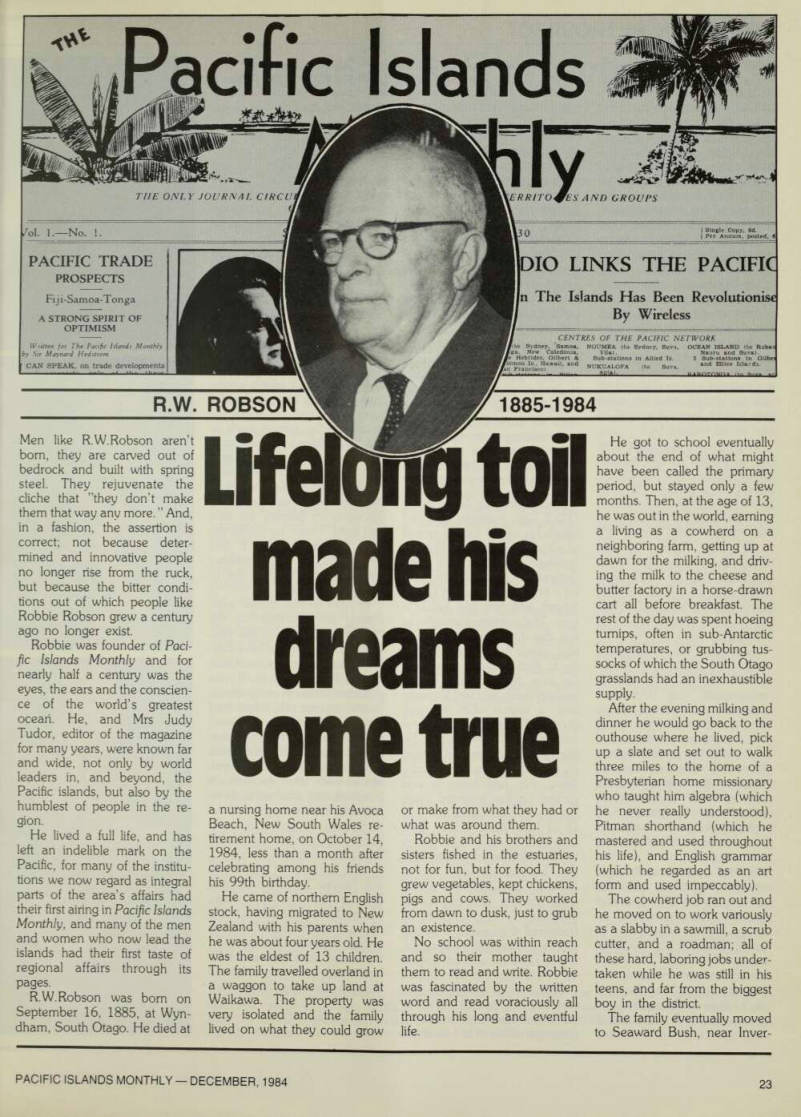
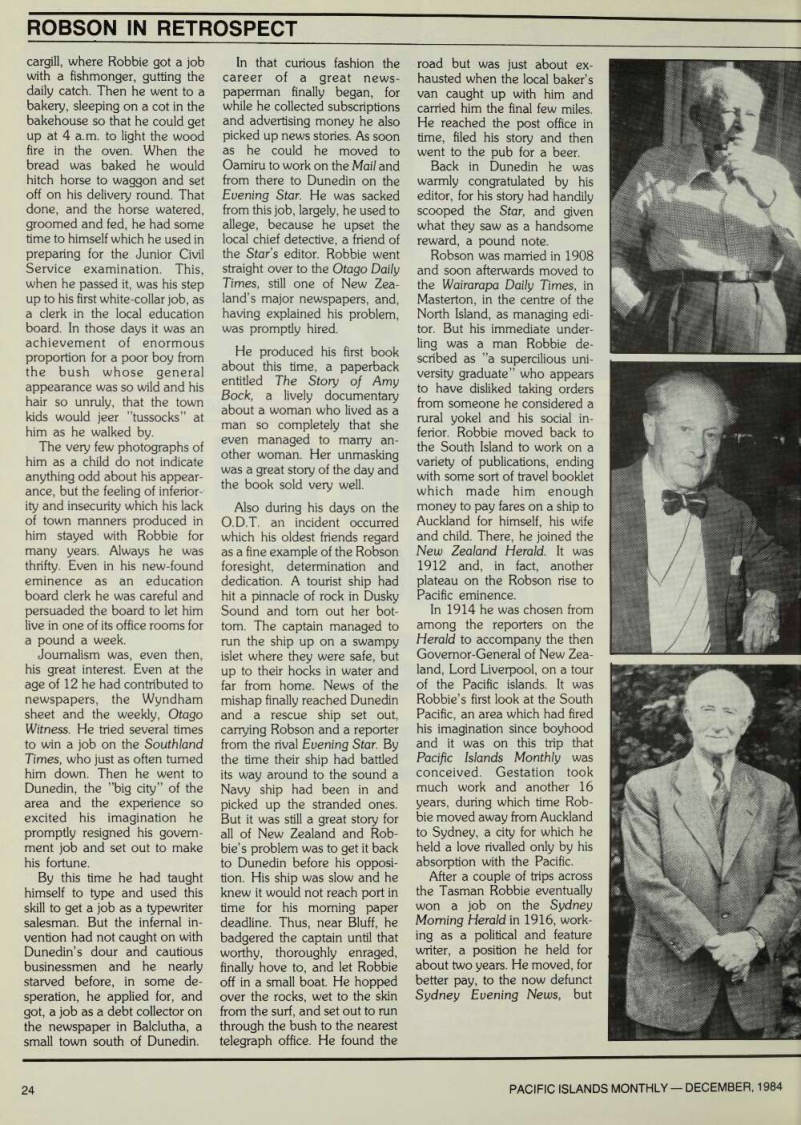
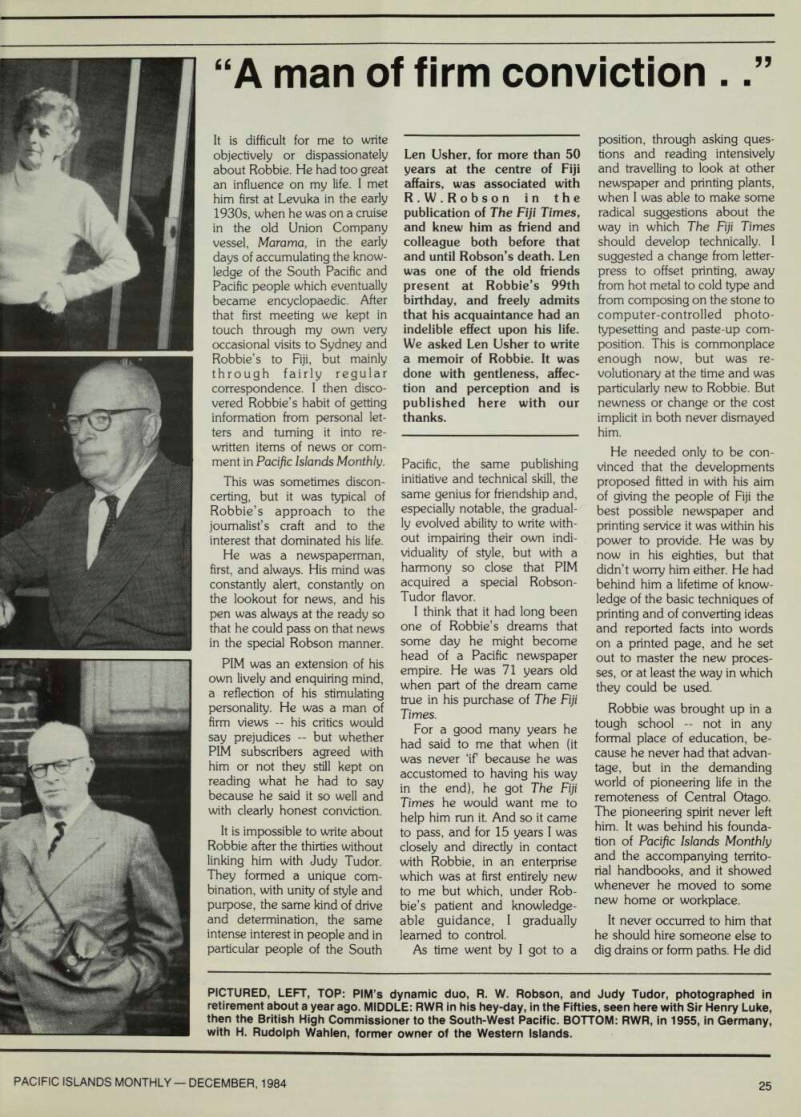
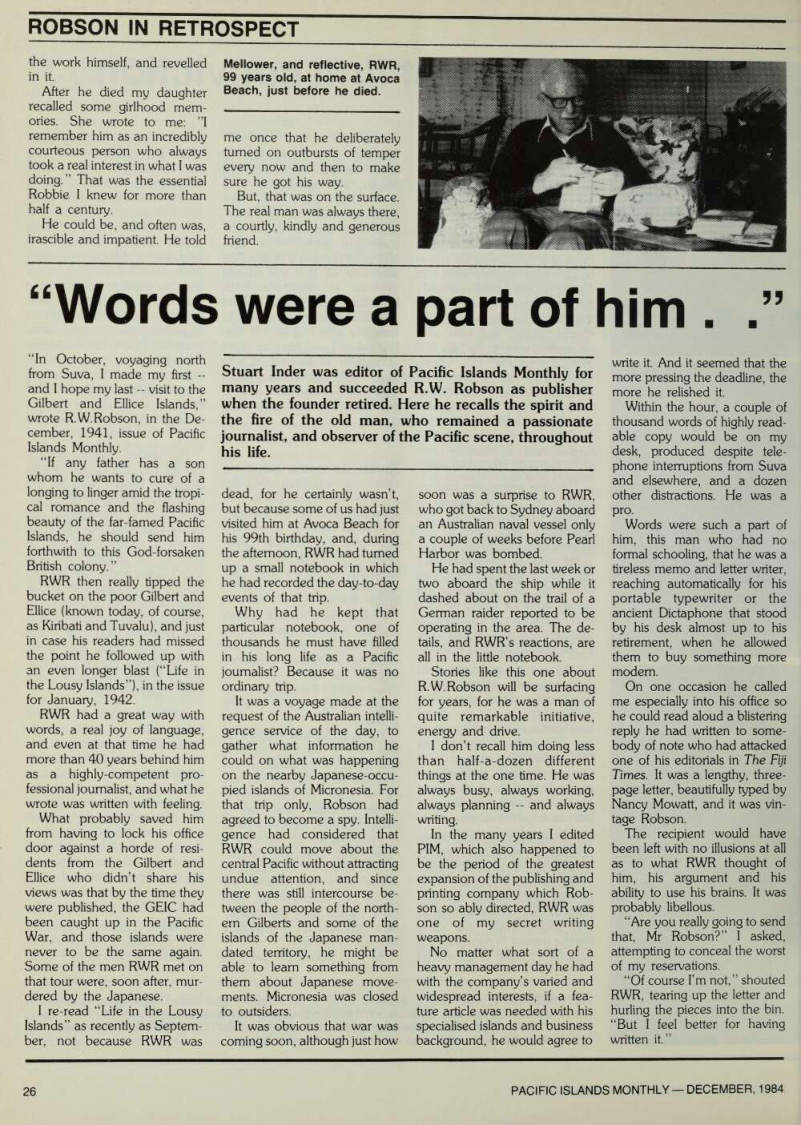
Lifelong toil made his dreams come true
R.W. Robson
1885-1984
Men like R.W.Robson aren’t bom, they are carved out of bedrock and built with spring steel. They rejuvenate the cliche that ’’they don’t make them that way any more. ” And, in a fashion, the assertion is correct; not because deter mined and innovative people no longer rise from the ruck, but because the bitter condi tions out of which people like Robbie Robson grew a century ago no longer exist.
Robbie was founder of Paci fic Islands Monthly and for nearly half a century was the eyes, the ears and the conscien ce of the world’s greatest ocean. He, and Mrs Judy Tudor, editor of the magazine for many years, were known far and wide, not only by world leaders in, and beyond, the Pacific islands, but also by the humblest of people in the re gion.
He lived a full life, and has left an indelible mark on the Pacific, for many of the institu tions we now regard as integral parts of the area’s affairs had their first airing in Pacific Islands Monthly, and many of the men and women who now lead the islands had their first taste of regional affairs through its pages.
R.W.Robson was bom on September 16, 1885, at Wyn dham, South Otago. He died at
a nursing home near his Avoca Beach, New South Wales re tirement home, on October 14, 1984, less than a month after celebrating among his friends his 99th birthday, He came of northern English stock, having migrated to New Zealand with his parents when he was about four years old. He was the eldest of 13 children, The family travelled overland in a waggon to take up land at Waikawa. The property was very isolated and the family lived on what they could grow
or make from what they had or what was around them.
Robbie and his brothers and sisters fished in the estuaries, not for fun, but for food. They grew vegetables, kept chickens, pigs and cows. They worked from dawn to dusk, just to grub an existence.
No school was within reach and so their mother taught them to read and write. Robbie was fascinated by the written word and read voraciously all through his long and eventful life.
He got to school eventually about the end of what might have been called the primary period, but stayed only a few months. Then, at the age of 13, he was out in the world, earning a living as a cowherd on a neighboring farm, getting up at dawn for the milking, and driv ing the milk to the cheese and butter factory in a horse-drawn cart all before breakfast. The rest of the day was spent hoeing turnips, often in sub-Antarctic temperatures, or grubbing tus socks of which the South Otago grasslands had an inexhaustible supply.
After the evening milking and dinner he would go back to the outhouse where he lived, pick up a slate and set out to walk three miles to the home of a Presbyterian home missionary who taught him algebra (which he never really understood), Pitman shorthand (which he mastered and used throughout his life), and English grammar (which he regarded as an art form and used impeccably).
The cowherd job ran out and he moved on to work variously as a slabby in a sawmill, a scrub cutter, and a roadman; all of these hard, laboring jobs under taken while he was still in his teens, and far from the biggest boy in the district.
The family eventually moved to Seaward Bush, near Inver
cargill, where Robbie got a job with a fishmonger, gutting the daily catch. Then he went to a bakery, sleeping on a cot in the bakehouse so that he could get up at 4 a.m. to light the wood fire in the oven. When the bread was baked he would hitch horse to waggon and set off on his delivery round. That done, and the horse watered, groomed and fed, he had some time to himself which he used in preparing for the Junior Civil Service examination. This, when he passed it, was his step up to his first white-collar job, as a clerk in the local education board. In those days it was an achievement of enormous proportion for a poor boy from the bush whose general appearance was so wild and his hair so unruly, that the town kids would jeer ’’tussocks” at him as he walked by.
The very few photographs of him as a child do not indicate anything odd about his appear ance, but the feeling of inferior ity and insecurity which his lack of town manners produced in him stayed with Robbie for many years. Always he was thrifty. Even in his new-found eminence as an education board clerk he was careful and persuaded the board to let him live in one of its office rooms for a pound a week.
Journalism was, even then, his great interest. Even at the age of 12 he had contributed to newspapers, the Wyndham sheet and the weekly, Otago Witness. He tried several times to win a job on the Southland Times, who just as often turned him down. Then he went to Dunedin, the ’’big city” of the area and the experience so excited his imagination he promptly resigned his govern ment job and set out to make his fortune.
By this time he had taught himself to type and used this skill to get a job as a typewriter salesman. But the infernal in vention had not caught on with Dunedin’s dour and cautious businessmen and he nearly starved before, in some de speration, he applied for, and got, a job as a debt collector on the newspaper in Balclutha, a small town south of Dunedin.
In that curious fashion the career of a great news paperman finally began, for while he collected subscriptions and advertising money he also picked up news stories. As soon as he could he moved to Oamiru to work on the Mail and from there to Dunedin on the Evening Star. He was sacked from this job, largely, he used to allege, because he upset the local chief detective, a friend of the Stars editor. Robbie went straight over to the Otago Daily Times, still one of New Zea land’s major newspapers, and, having explained his problem, was promptly hired.
He produced his first book about this time, a paperback entitled The Story of Amy Bock, a lively documentary about a woman who lived as a man so completely that she even managed to marry an other woman. Her unmasking was a great story of the day and the book sold very well.
Also during his days on the O.D.T. an incident occurred which his oldest friends regard as a fine example of the Robson foresight, determination and dedication. A tourist ship had hit a pinnacle of rock in Dusky Sound and tom out her bot tom. The captain managed to run the ship up on a swampy islet where they were safe, but up to their hocks in water and far from home. News of the mishap finally reached Dunedin and a rescue ship set out, carrying Robson and a reporter from the rival Evening Star. By the time their ship had battled its way around to the sound a Navy ship had been in and picked up the stranded ones.
But it was still a great story for all of New Zealand and Rob bie’s problem was to get it back to Dunedin before his opposi tion. His ship was slow and he knew it would not reach port in time for his morning paper deadline. Thus, near Bluff, he badgered the captain until that worthy, thoroughly enraged, finally hove to, and let Robbie off in a small boat. He hopped over the rocks, wet to the skin from the surf, and set out to run through the bush to the nearest telegraph office. He found the
road but was just about ex hausted when the local baker’s van caught up with him and carried him the final few miles.
He reached the post office in time, filed his story and then went to the pub for a beer.
Back in Dunedin he was warmly congratulated by his editor, for his story had handily scooped the Star, and given what they saw as a handsome reward, a pound note.
Robson was married in 1908 and soon afterwards moved to the Wairarapa Daily Times, in Masterton, in the centre of the North Island, as managing edi tor. But his immediate under ling was a man Robbie de scribed as ”a supercilious uni versity graduate” who appears to have disliked taking orders from someone he considered a rural yokel and his social in ferior. Robbie moved back to the South Island to work on a variety of publications, ending with some sort of travel booklet which made him enough money to pay fares on a ship to Auckland for himself, his wife and child. There, he joined the New Zealand Herald. It was 1912 and, in fact, another plateau on the Robson rise to Pacific eminence.
In 1914 he was chosen from among the reporters on the Herald to accompany the then Governor-General of New Zea land, Lord Liverpool, on a tour of the Pacific islands. It was Robbie’s first look at the South Pacific, an area which had fired his imagination since boyhood and it was on this trip that Pacific Islands Monthly was conceived. Gestation took much work and another 16 years, during which time Rob bie moved away from Auckland to Sydney, a city for which he held a love rivalled only by his absorption with the Pacific.
After a couple of trips across the Tasman Robbie eventually won a job on the Sydney Morning Herald in 1916, work ing as a political and feature writer, a position he held for about two years. He moved, for better pay, to the now defunct Sydney Evening News, but
PICTURED, LEFT, TOP: PlM’s dynamic duo, R. W. Robson, and Judy Tudor, photographed in retirement about a year ago. MIDDLE: RWR in his hey-day, in the Fifties, seen here with Sir Henry Luke, then the British High Commissioner to the South-West Pacific. BOTTOM: RWR, in 1955, in Germany, with H. Rudolph Wahlen, former owner of the Western Islands.
didn’t like afternoon news papering and left that to spend a year looking after the trade journals run by the Sydney and Melbourne Publishing Com pany while its proprietor went overseas, an expedition of ma jor proportions in those days of steamships.
From there he went to the Daily Telegraph as assistant general manager under Watkin Wynn. Wynn had opposed the appointment, did not like Rob bie, made no secret of the fact, and banished him to the news room where he spent his time writing political news and com mentaries. But, within a few months, Wynn dropped dead and Robbie became general manager which, he often said, resulted in three and a half years of almost total frustration.
In those days the youngest director on the Telegraph was 69 and the ages of the five men who ran the newspaper with total autocracy ranged up to 91.
One of these decisions was to appoint to the editor’s chair one Dudley Disraeli Brougham, formerly leader writer on the Times of London. Robson was incensed. Brougham, he fumed, was devoid of ideas, knew nothing of Australia, and was quite unsatisfactory. Rob bie spent most of his time trying to get rid of him. When that task was accomplished the board appointed W. Farmer White as editor which, Robbie said acid ly, was even worse. Thus bested, Robbie took a post as London representative of the Daily Telegraph , the Mel bourne Age and some other newspapers. It was 1923. He endured Fleet Street and the London climate for two years before he returned to Sydney.
As near as one can gather of Robson’s activities in this period he spent some time doing odd jobs for the Sydney Morning Herald and then, for a couple of years, was public relations officer for the National Party, forerunners of today’s Liberals.
In 1928 he met, by chance, David Yaffa, of Yaffa Syndicate fame, and agreed to launch a newspaper news magazine for
him, provided that when it was successfully launched Yaffa would, in turn, help Robbie get the long-planned Pacific Islands Monthly under way. News paper News was such a success that Yaffa lost interest in the PIM idea. Seeing this, Robbie determined to go it alone and, in 1930, quit Yaffa, and pub lished the first issue of Pacific Islands Monthly.
That done, Robbie went to London to organise a service known as Ocean News, which was set up by the leading newspapers and Reuters to supply the passenger liners with news bulletins. It lasted until the radio blackout was introduced at the beginning of the Second World War.
Pacific Islands Monthly con tinued to make gains and, to wards the end of the 1930 s Robson bought the Sydney and Melbourne Publishing Com pany in order to get a printing plant. Mauri Brothers and Thomson, now part of the Burns Philp Group, were share holders, too.
The war was hard on Pacific Publications as the Japanese intruded further and further into the Pacific. Communications were difficult, markets shrank, advertisers diminished, and subscribers either fled to safety, or were made prisoners. Yet, for many in the great ocean PIM remained their most reli able source of news about the conflict and even today, visitors to the offices in Sydney, talk of the eagerness with which they waited for chance copies of the magazine they regarded as their regional bible.
Robson, Judy Tudor and the others kept PIM together de spite the war’s difficulties and, when hostilities were over, were able to begin expanding again.
They bought out the other shareholders in the Sydney and Melbourne Publishing Com pany and then, in 1956, Rob son finally persuaded Sir Alport Barker to sell him the Fiji Times and Herald, Ltd., a property Robbie had sought for years.
He ran it, and Pacific Publica tions, until 1976 when the group was bought by the Herald and Weekly Times, Ltd., of Melbourne.
Advertisements & other items, p. 24 (1 item)
Robson In Retrospect
“A man of firm conviction .."
It is difficult for me to write objectively or dispassionately about Robbie. He had too great an influence on my life. I met him first at Levuka in the early 19305, when he was on a cruise in the old Union Company vessel, Marama, in the early days of accumulating the know ledge of the South Pacific and Pacific people which eventually became encyclopaedic. After that first meeting we kept in touch through my own very occasional visits to Sydney and Robbie’s to Fiji, but mainly through fairly regular correspondence. I then disco vered Robbie’s habit of getting information from personal let ters and turning it into re written items of news or com ment in Pacific Islands Monthly.
This was sometimes discon certing, but it was typical of Robbie’s approach to the journalist’s craft and to the interest that dominated his life.
He was a newspaperman, first, and always. His mind was constantly alert, constantly on the lookout for news, and his pen was always at the ready so that he could pass on that news in the special Robson manner.
PIM was an extension of his own lively and enquiring mind, a reflection of his stimulating personality. He was a man of firm views his critics would say prejudices but whether PIM subscribers agreed with him or not they still kept on reading what he had to say because he said it so well and with clearly honest conviction.
It is impossible to write about Robbie after the thirties without linking him with Judy Tudor.
They formed a unique com bination, with unity of style and purpose, the same kind of drive and determination, the same intense interest in people and in particular people of the South
Len Usher, for more than 50 years at the centre of Fiji affairs, was associated with R.W.Robson in the publication of The Fiji Times , and knew him as friend and colleague both before that and until Robson’s death. Len was one of the old friends present at Robbie’s 99th birthday, and freely admits that his acquaintance had an indelible effect upon his life.
We asked Len Usher to write a memoir of Robbie. It was done with gentleness, affec tion and perception and is published here with our thanks.
Pacific, the same publishing initiative and technical skill, the same genius for friendship and, especially notable, the gradual ly evolved ability to write with out impairing their own indi viduality of style, but with a harmony so close that PIM acquired a special Robson- Tudor flavor.
I think that it had long been one of Robbie’s dreams that some day he might become head of a Pacific newspaper empire. He was 71 years old when part of the dream came true in his purchase of The Fiji Times.
For a good many years he had said to me that when (it was never ‘if because he was accustomed to having his way in the end), he got The Fiji Times he would want me to help him run it. And so it came to pass, and for 15 years I was closely and directly in contact with Robbie, in an enterprise which was at first entirely new to me but which, under Rob bie’s patient and knowledge able guidance, I gradually learned to control.
As time went by I got to a
position, through asking ques tions and reading intensively and travelling to look at other newspaper and printing plants, when I was able to make some radical suggestions about the way in which The Fiji Times should develop technically. I suggested a change from letter press to offset printing, away from hot metal to cold type and from composing on the stone to computer-controlled photo typesetting and paste-up com position. This is commonplace enough now, but was re volutionary at the time and was particularly new to Robbie. But newness or change or the cost implicit in both never dismayed him.
He needed only to be con vinced that the developments proposed fitted in with his aim of giving the people of Fiji the best possible newspaper and printing service it was within his power to provide. He was by now in his eighties, but that didn’t worry him either. He had behind him a lifetime of know ledge of the basic techniques of printing and of converting ideas and reported facts into words on a printed page, and he set out to master the new proces ses, or at least the way in which they could be used.
Robbie was brought up in a tough school not in any formal place of education, be cause he never had that advan tage, but in the demanding world of pioneering life in the remoteness of Central Otago.
The pioneering spirit never left him. It was behind his founda tion of Pacific Islands Monthly and the accompanying territo rial handbooks, and it showed whenever he moved to some new home or workplace.
It never occurred to him that he should hire someone else to dig drains or form paths. He did
the work himself, and revelled in it.
After he died my daughter recalled some girlhood mem ories. She wrote to me: ”1 remember him as an incredibly courteous person who always took a real interest in what I was doing.” That was the essential Robbie I knew for more than half a century.
He could be, and often was, irascible and impatient. He told
me once that he deliberately turned on outbursts of temper every now and then to make sure he got his way.
But, that was on the surface.
The real man was always there, a courtly, kindly and generous friend.
Mellower, and reflective, RWR, 99 years old, at home at Avoca Beach, just before he died.
“Words were a part of him .."
Stuart Inder was editor of Pacific Islands Monthly for many years and succeeded R.W. Robson as publisher when the founder retired. Here he recalls the spirit and the fire of the old man, who remained a passionate journalist, and observer of the Pacific scene, throughout his life.
“In October, voyaging north from Suva, I made my first and I hope my last - visit to the Gilbert and Ellice Islands,” wrote R.W.Robson, in the De cember, 1941, issue of Pacific Islands Monthly.
“If any father has a son whom he wants to cure of a longing to linger amid the tropi cal romance and the flashing beauty of the far-famed Pacific Islands, he should send him forthwith to this God-forsaken British colony.”
RWR then really tipped the bucket on the poor Gilbert and Ellice (known today, of course, as Kiribati and Tuvalu), and just in case his readers had missed the point he followed up with an even longer blast (“Life in the Lousy Islands”), in the issue for January, 1942.
RWR had a great way with words, a real joy of language, and even at that time he had more than 40 years behind him as a highly-competent pro fessional journalist, and what he wrote was written with feeling.
What probably saved him from having to lock his office door against a horde of resi dents from the Gilbert and Ellice who didn’t share his views was that by the time they were published, the GEIC had been caught up in the Pacific War, and those islands were never to be the same again.
Some of the men RWR met on that tour were, soon after, mur dered by the Japanese.
I re-read “Life in the Lousy Islands” as recently as Septem ber, not because RWR was
dead, for he certainly wasn’t, but because some of us had just visited him at Avoca Beach for his 99th birthday, and, during the afternoon, RWR had turned up a small notebook in which he had recorded the day-to-day events of that trip.
Why had he kept that particular notebook, one of thousands he must have filled in his long life as a Pacific journalist? Because it was no ordinary trip.
It was a voyage made at the request of the Australian intelli gence service of the day, to gather what information he could on what was happening on the nearby Japanese-occu pied islands of Micronesia. For that trip only, Robson had agreed to become a spy. Intelli gence had considered that RWR could move about the central Pacific without attracting undue attention, and since there was still intercourse be tween the people of the north ern Gilberts and some of the islands of the Japanese man dated territory, he might be able to learn something from them about Japanese move ments. Micronesia was closed to outsiders.
It was obvious that war was coming soon, although just how
soon was a surprise to RWR, who got back to Sydney aboard an Australian naval vessel only a couple of weeks before Pearl Harbor was bombed.
He had spent the last week or two aboard the ship while it dashed about on the trail of a German raider reported to be operating in the area. The de tails, and RWR’s reactions, are all in the little notebook.
Stories like this one about R.W. Robson will be surfacing for years, for he was a man of quite remarkable initiative, energy and drive.
I don’t recall him doing less than half-a-dozen different things at the one time. He was always busy, always working, always planning and always writing.
In the many years I edited PIM, which also happened to be the period of the greatest expansion of the publishing and printing company which Rob son so ably directed, RWR was one of my secret writing weapons.
No matter what sort of a heavy management day he had with the company’s varied and widespread interests, if a fea ture article was needed with his specialised islands and business background, he would agree to
write it. And it seemed that the more pressing the deadline, the more he relished it.
Within the hour, a couple of thousand words of highly read able copy would be on my desk, produced despite tele phone interruptions from Suva and elsewhere, and a dozen other distractions. He was a pro.
Words were such a part of him, this man who had no formal schooling, that he was a tireless memo and letter writer, reaching automatically for his portable typewriter or the ancient Dictaphone that stood by his desk almost up to his retirement, when he allowed them to buy something more modem.
On one occasion he called me especially into his office so he could read aloud a blistering reply he had written to some body of note who had attacked one of his editorials in The Fiji Times. It was a lengthy, three page letter, beautifully typed by Nancy Mowatt, and it was vin tage Robson.
The recipient would have been left with no illusions at all as to what RWR thought of him, his argument and his ability to use his brains. It was probably libellous.
“Are you really going to send that, Mr Robson?” I asked, attempting to conceal the worst of my reservations.
“Of course I’m not,” shouted RWR, tearing up the letter and hurling the pieces into the bin.
“But I feel better for having written it.”
Advertisements & other items, p. 27 (1 item)
The 2-Sided Miracle!
'Urr,,
r M Now you’ll never have to get up and turn over records anymore! Sansui’s technological expertise gives you instant access to both record sides. You can program up to 16 selections on either side in any order. No other turntable in the world offers so much freedom and flexibility.
In fact, this entire system gives you the freedom o flexibility. High-speed dubbing with the double cassette deck Compu Edit,-a Sansui exclusive for flawless record-to-tape editing! High power amplifier (100 W x 2 music power) with built-in 5-band graphic equalizer! And an advanced quartz PLL synthesizer FM/AM tuner completes the Midi System M9OOB the miraculous system for the highest quality with the greatest ease!
AT-F 1 Programmable Audio Timer (optional). mm = r 7^J . L iZI m •: i : ■ ® — ■ ■ — ...
Midi System
SANSUI ELECTRIC CO., LTD. 14-1 , Izumi 2-chome, Suginami-ku, Tokyo 168 Japan For further information please contact; • Australia VANFI (Aust.) PTY. LTD . 297, City Road, South Melbourne, Victoria 3205, Australia Phone: 690-6200/283 Alfred Place, North Sydney, N S W. 2060, Australia Phone: 929-0293• Fiji PRABHU BROTHERS LTD. P.O. Box 183, Nadi Phone; 71122*Papua New Guinea OCEANIA INDENT AGENCY (P N G.) PTY LTD. P.O. Box 5518, Boroko, Port Moresby Phone; 256411 • New Zealand DAVID REID ELECTRONICS LTD. P.O. Box 2630, Auckland, Phone: 488-049* New Caledonia HI-FI VICTOIRE, ETS. M. MERCIER B.P. 1123, Noumea Phone; 27.59.11 •Central Pacific NAURU CO-OPERATIVE SOCIETY Republic of Nauru • Vanuatu THE SOUND CENTRE LTD. P.O. Box 434, Vila Phone; 2035*Tahiti DIMECO SIMEL B.P. Box 3338 Papeete Phone 26979
SajtsuL
Independentists
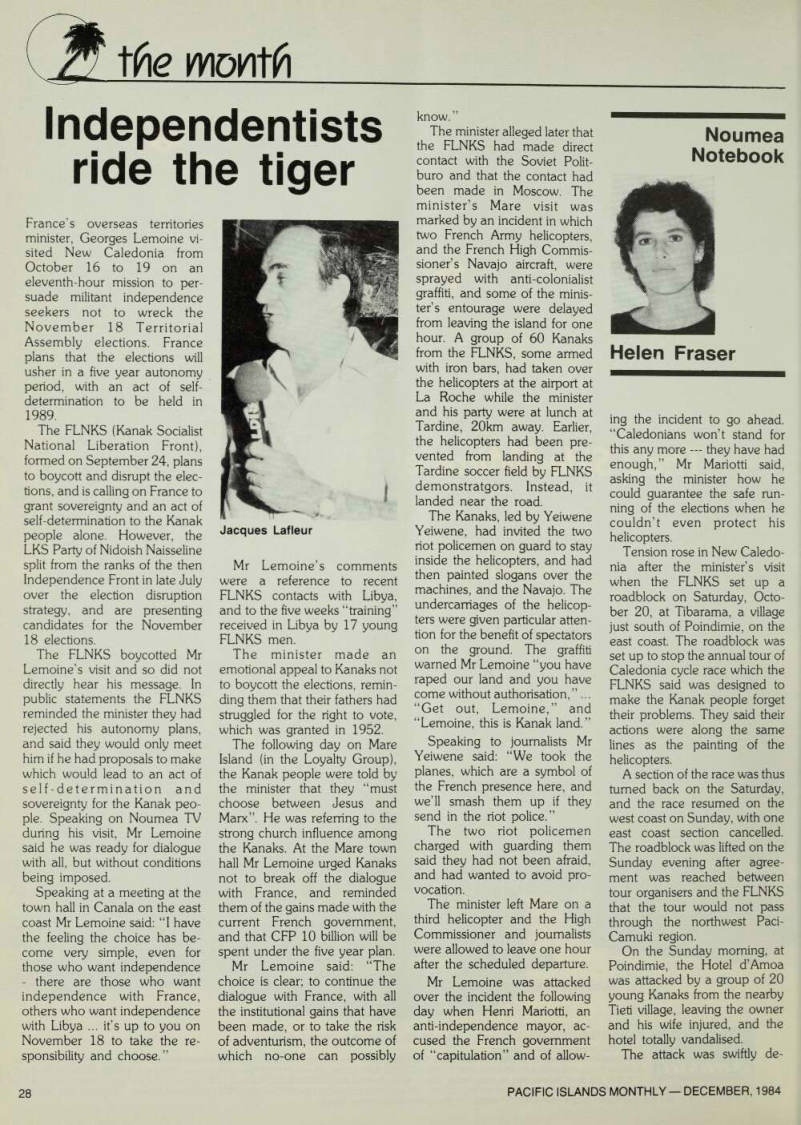
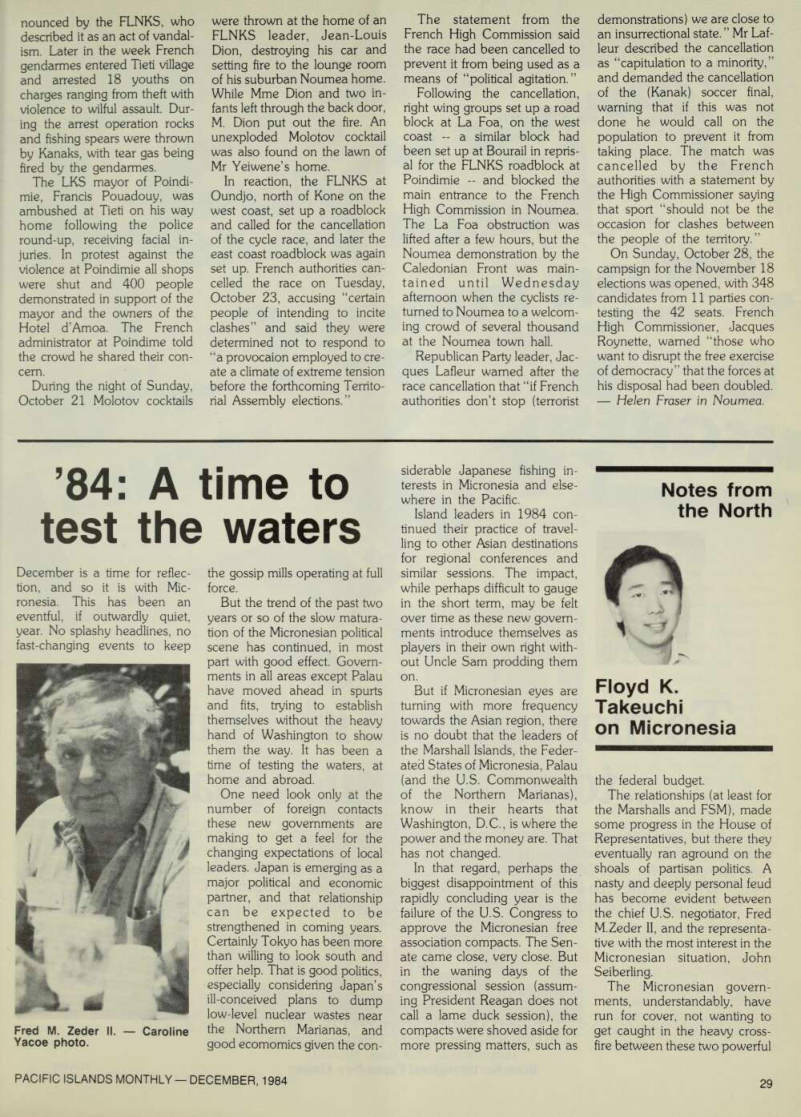
the month
Independentists ride the tiger
France’s overseas territories minister, Georges Lemoine vi sited New Caledonia from October 16 to 19 on an eleventh-hour mission to per suade militant independence seekers not to wreck the November 18 Territorial Assembly elections. France plans that the elections will usher in a five year autonomy period, with an act of self determination to be held in 1989.
The FLNKS (Kanak Socialist National Liberation Front), formed on September 24, plans to boycott and disrupt the elec tions, and is calling on France to grant sovereignty and an act of self-determination to the Kanak people alone. However, the LKS Party of Nidoish Naisseline split from the ranks of the then Independence Front in late July over the election disruption strategy, and are presenting candidates for the November 18 elections.
The FLNKS boycotted Mr Lemoine’s visit and so did not directly hear his message. In public statements the FLNKS reminded the minister they had rejected his autonomy plans, and said they would only meet him if he had proposals to make which would lead to an act of self-determination and sovereignty for the Kanak peo ple. Speaking on Noumea TV during his visit, Mr Lemoine said he was ready for dialogue with all, but without conditions being imposed.
Speaking at a meeting at the town hall in Canala on the east coast Mr Lemoine said: “I have the feeling the choice has be come very simple, even for those who want independence - there are those who want independence with France, others who want independence with Libya ... it’s up to you on November 18 to take the re sponsibility and choose.”
Mr Lemoine’s comments were a reference to recent FLNKS contacts with Libya, and to the five weeks “training” received in Libya by 17 young FLNKS men.
The minister made an emotional appeal to Kanaks not to boycott the elections, remin ding them that their fathers had struggled for the right to vote, which was granted in 1952.
The following day on Mare Island (in the Loyalty Group), the Kanak people were told by the minister that they “must choose between Jesus and Marx”. He was referring to the strong church influence among the Kanaks. At the Mare town hall Mr Lemoine urged Kanaks not to break off the dialogue with France, and reminded them of the gains made with the current French government, and that CFP 10 billion will be spent under the five year plan.
Mr Lemoine said: “The choice is clear; to continue the dialogue with France, with all the institutional gains that have been made, or to take the risk of adventurism, the outcome of which no-one can possibly
know. ”
The minister alleged later that the FLNKS had made direct contact with the Soviet Polit buro and that the contact had been made in Moscow. The minister’s Mare visit was marked by an incident in which two French Army helicopters, and the French High Commis sioner’s Navajo aircraft, were sprayed with anti-colonialist graffiti, and some of the minis ter’s entourage were delayed from leaving the island for one hour. A group of 60 Kanaks from the FLNKS, some armed with iron bars, had taken over the helicopters at the airport at La Roche while the minister and his party were at lunch at Tardine, 20km away. Earlier, the helicopters had been pre vented from landing at the Tardine soccer field by FLNKS demonstratgors. Instead, it landed near the road.
The Kanaks, led by Yeiwene Yeiwene, had invited the two riot policemen on guard to stay inside the helicopters, and had then painted slogans over the machines, and the Navajo. The undercarriages of the helicop ters were given particular atten tion for the benefit of spectators on the ground. The graffiti warned Mr Lemoine “you have raped our land and you have come without authorisation,”...
“Get out, Lemoine,” and “Lemoine, this is Kanak land.”
Speaking to journalists Mr Yeiwene said: “We took the planes, which are a symbol of the French presence here, and we’ll smash them up if they send in the riot police.”
The two riot policemen charged with guarding them said they had not been afraid, and had wanted to avoid pro vocation.
The minister left Mare on a third helicopter and the High Commissioner and journalists were allowed to leave one hour after the scheduled departure.
Mr Lemoine was attacked over the incident the following day when Henri Mariotti, an anti-independence mayor, ac cused the French government of “capitulation” and of allow-
ing the incident to go ahead.
“Caledonians won’t stand for this any more they have had enough,” Mr Mariotti said, asking the minister how he could guarantee the safe run ning of the elections when he couldn’t even protect his helicopters.
Tension rose in New Caledo nia after the minister’s visit when the FLNKS set up a roadblock on Saturday, Octo ber 20, at Tibarama, a village just south of Poindimie, on the east coast. The roadblock was set up to stop the annual tour of Caledonia cycle race which the FLNKS said was designed to make the Kanak people forget their problems. They said their actions were along the same lines as the painting of the helicopters.
A section of the race was thus turned back on the Saturday, and the race resumed on the west coast on Sunday, with one east coast section cancelled.
The roadblock was lifted on the Sunday evening after agree ment was reached between tour organisers and the FLNKS that the tour would not pass through the northwest Paci- Camuki region.
On the Sunday morning, at Poindimie, the Hotel d’Amoa was attacked by a group of 20 young Kanaks from the nearby Tieti village, leaving the owner and his wife injured, and the hotel totally vandalised.
The attack was swiftly de
Jacques Lafleur
Noumea Notebook
Helen Fraser
nounced by the FLNKS, who described it as an act of vandal ism. Later in the week French gendarmes entered Tieti village and arrested 18 youths on charges ranging from theft with violence to wilful assault. Dur ing the arrest operation rocks and fishing spears were thrown by Kanaks, with tear gas being fired by the gendarmes.
The LKS mayor of Poindi mie, Francis Pouadouy, was ambushed at Tieti on his way home following the police round-up, receiving facial in juries. In protest against the violence at Poindimie all shops were shut and 400 people demonstrated in support of the mayor and the owners of the Hotel d’Amoa. The French administrator at Poindime told the crowd he shared their con cern.
During the night of Sunday, October 21 Molotov cocktails
were thrown at the home of an FLNKS leader, Jean-Louis Dion, destroying his car and setting fire to the lounge room of his suburban Noumea home.
While Mme Dion and two in fants left through the back door, M. Dion put out the fire. An unexploded Molotov cocktail was also found on the lawn of Mr Yeiwene’s home.
In reaction, the FLNKS at Oundjo, north of Kone on the west coast, set up a roadblock and called for the cancellation of the cycle race, and later the east coast roadblock was again set up. French authorities can celled the race on Tuesday, October 23, accusing “certain people of intending to incite clashes” and said they were determined not to respond to “a provocaion employed to cre ate a climate of extreme tension before the forthcoming Territo rial Assembly elections.”
The statement from the French High Commission said the race had been cancelled to prevent it from being used as a means of “political agitation. ”
Following the cancellation, right wing groups set up a road block at La Foa, on the west coast - a similar block had been set up at Bourail in reprisal for the FLNKS roadblock at Poindimie - and blocked the main entrance to the French High Commission in Noumea, The La Foa obstruction was lifted after a few hours, but the Noumea demonstration by the Caledonian Front was maintained until Wednesday afternoon when the cyclists returned to Noumea to a welcoming crowd of several thousand at the Noumea town hall.
Republican Party leader, Jacques Lafleur warned after the race cancellation that “if French authorities don’t stop (terrorist
demonstrations) we are close to an insurrectional state.” Mr Laf leur described the cancellation as “capitulation to a minority,” and demanded the cancellation of the (Kanak) soccer final, warning that if this was not done he would call on the population to prevent it from taking place. The match was cancelled by the French authorities with a statement by the High Commissioner saying that sport “should not be the occasion for clashes between the people of the territory.”
On Sunday, October 28, the campsign for the November 18 elections was opened, with 348 candidates from 11 parties con testing the 42 seats. French High Commissioner, Jacques Roynette, warned “those who want to disrupt the free exercise of democracy” that the forces at his disposal had been doubled.
Helen Fraser in Noumea.
'84: A time to test

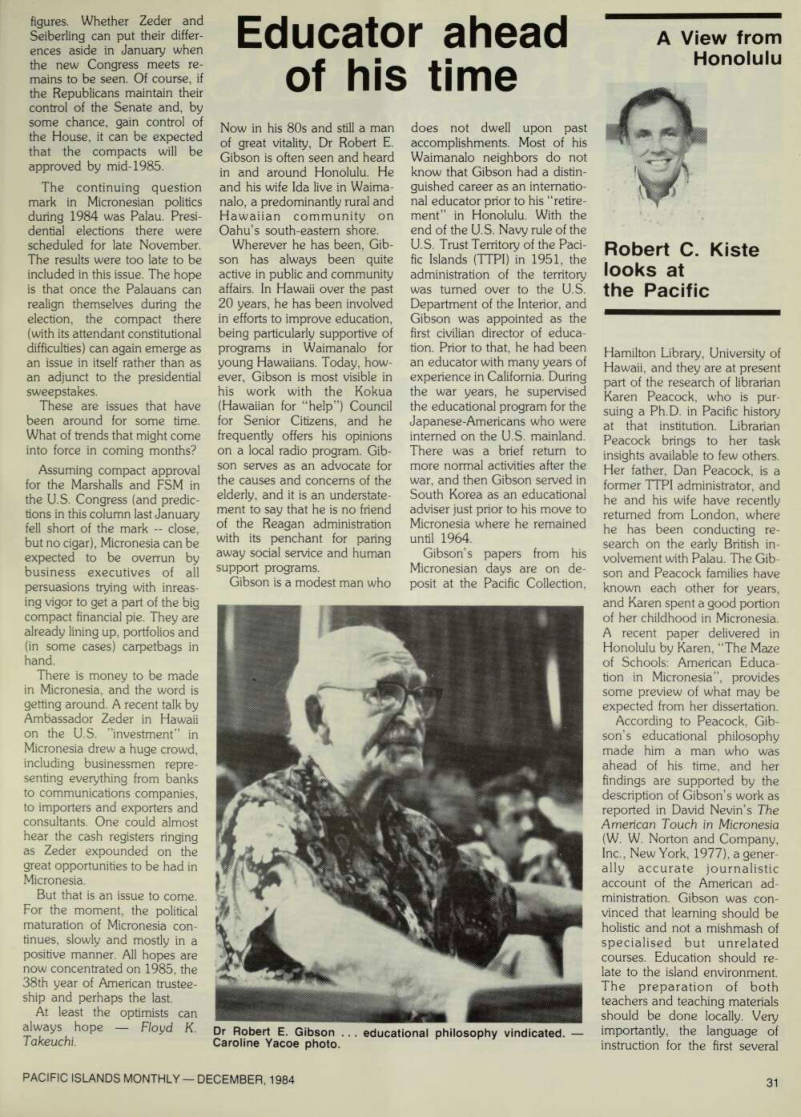
test the waters
December is a time for reflection, and so it is with Micronesia. This has been an eventful, if outwardly quiet, year. No splashy headlines, no fast-changing events to keep
the gossip mills operating at full force.
But the trend of the past two years or so of the slow matura tion of the Micronesian political scene has continued, in most part with good effect. Govern ments in all areas except Palau have moved ahead in spurts and fits, trying to establish themselves without the heavy hand of Washington to show them the way. It has been a time of testing the waters, at home and abroad.
One need look only at the number of foreign contacts these new governments are making to get a feel for the changing expectations of local leaders. Japan is emerging as a major political and economic partner, and that relationship can be expected to be strengthened in coming years.
Certainly Tokyo has been more than willing to look south and offer help. That is good politics, especially considering Japan’s ill-conceived plans to dump low-level nuclear wastes near the Northern Marianas, and good ecomomics given the con
siderable Japanese fishing in terests in Micronesia and else where in the Pacific.
Island leaders in 1984 con tinued their practice of travel ling to other Asian destinations for regional conferences and similar sessions. The impact, while perhaps difficult to gauge in the short term, may be felt over time as these new govern ments introduce themselves as players in their own right with out Uncle Sam prodding them on.
But if Micronesian eyes are turning with more frequency towards the Asian region, there is no doubt that the leaders of the Marshall Islands, the Feder ated States of Micronesia, Palau (and the U.S. Commonwealth of the Northern Marianas), know in their hearts that Washington, D.C., is where the power and the money are. That has not changed.
In that regard, perhaps the biggest disappointment of this rapidly concluding year is the failure of the U.S. Congress to approve the Micronesian free association compacts. The Sen ate came close, very close. But in the waning days of the congressional session (assum ing President Reagan does not call a lame duck session), the compacts were shoved aside for more pressing matters, such as
the federal budget.
The relationships (at least for the Marshalls and FSM), made some progress in the House of Representatives, but there they eventually ran aground on the shoals of partisan politics. A nasty and deeply personal feud has become evident between the chief U.S. negotiator, Fred M.Zeder 11, and the representa tive with the most interest in the Micronesian situation, John Seiberling.
The Micronesian govern ments, understandably, have run for cover, not wanting to get caught in the heavy cross fire between these two powerful
Fred M. Zeder 11. Caroline Yacoe photo.
Notes from the North
Floyd K.
Takeuchi on Micronesia
figures. Whether Zeder and Seiberling can put their differ ences aside in January when the new Congress meets re mains to be seen. Of course, if the Republicans maintain their control of the Senate and, by some chance, gain control of the House, it can be expected that the compacts will be approved by mid-1985.
The continuing question mark in Micronesian politics during 1984 was Palau. Presi dential elections there were scheduled for late November.
The results were too late to be included in this issue. The hope is that once the Palauans can realign themselves during the election, the compact there (with its attendant constitutional difficulties) can again emerge as an issue in itself rather than as an adjunct to the presidential sweepstakes.
These are issues that have been around for some time.
What of trends that might come into force in coming months?
Assuming compact approval for the Marshalls and FSM in the U.S. Congress (and predic tions in this column last January fell short of the mark — close, but no cigar), Micronesia can be expected to be overrun by business executives of all persuasions trying with inreas ing vigor to get a part of the big compact financial pie. They are already lining up, portfolios and (in some cases) carpetbags in hand.
There is money to be made in Micronesia, and the word is getting around. A recent talk by Ambassador Zeder in Hawaii on the U.S. ’’investment” in Micronesia drew a huge crowd, including businessmen repre senting everything from banks to communications companies, to importers and exporters and consultants. One could almost hear the cash registers ringing as Zeder expounded on the great opportunities to be had in Micronesia.
But that is an issue to come.
For the moment, the political maturation of Micronesia con tinues, slowly and mostly in a positive manner. All hopes are now concentrated on 1985, the 38th year of American trustee ship and perhaps the last.
At least the optimists can
always hope
Floyd K.
Takeuchi.
Advertisements & other items, p. 30 (1 item)
To most people it’s a puzzle
■V* H G
... to us it’s childs play.
Stowage factor, tween decks, union purchase, McGregor hatches — confusing language unless you really know the shipping and stevedoring industry. We have been operating as ships agents and stevedores for over 20 years throughout Papua New Guinea and have offices in all major ports.
Whatever the type of vessel or cargo, from container ships to tankers, LCT’s to barges, coffee to copra, rice to rubber, we welcome the opportunity to be of service.
PIC
Robert Laurie-Carpenters Pty. Ltd.
PO Box 922, Port Moresby, Papua New Guinea Telephone: 21 7324 Telex: NE22107 Branches throughout Papua New Guinea TCA459
Educator ahead
of his time
Now in his 80s and still a man of great vitality, Dr Robert E.
Gibson is often seen and heard in and around Honolulu. He and his wife Ida live in Waima nalo, a predominantly rural and Hawaiian community on Oahu’s south-eastern shore.
Wherever he has been, Gib son has always been quite active in public and community affairs. In Hawaii over the past 20 years, he has been involved in efforts to improve education, being particularly supportive of programs in Waimanalo for young Hawaiians. Today, how ever, Gibson is most visible in his work with the Kokua (Hawaiian for “help”) Council for Senior Citizens, and he frequently offers his opinions on a local radio program. Gib son serves as an advocate for the causes and concerns of the elderly, and it is an understate ment to say that he is no friend of the Reagan administration with its penchant for paring away social service and human support programs.
Gibson is a modest man who
does not dwell upon past accomplishments. Most of his Waimanalo neighbors do not know that Gibson had a distin guished career as an internatio nal educator prior to his “retire ment” in Honolulu. With the end of the U.S. Navy rule of the U.S. Trust Territory of the Paci fic Islands (TTPI) in 1951, the administration of the territory was turned over to the U.S.
Department of the Interior, and Gibson was appointed as the first civilian director of educa tion. Prior to that, he had been an educator with many years of experience in California. During the war years, he supervised the educational program for the Japanese-Americans who were interned on the U.S. mainland.
There was a brief return to more normal activities after the war, and then Gibson served in South Korea as an educational adviser just prior to his move to Micronesia where he remained until 1964.
Gibson’s papers from his Micronesian days are on de posit at the Pacific Collection,
Hamilton Library, University of Hawaii, and they are at present part of the research of librarian Karen Peacock, who is pur suing a Ph.D. in Pacific history at that institution. Librarian Peacock brings to her task insights available to few others.
Her father, Dan Peacock, is a former TTPI administrator, and he and his wife have recently returned from London, where he has been conducting re search on the early British in volvement with Palau. The Gib son and Peacock families have known each other for years, and Karen spent a good portion of her childhood in Micronesia.
A recent paper delivered in Honolulu by Karen, “The Maze of Schools: American Educa tion in Micronesia”, provides some preview of what may be expected from her dissertation.
According to Peacock, Gib son’s educational philosophy made him a man who was ahead of his time, and her findings are supported by the description of Gibson’s work as reported in David Nevin’s The American Touch in Micronesia (W. W. Norton and Company, Inc., New York, 1977), a gener ally accurate journalistic account of the American ad ministration. Gibson was con vinced that learning should be holistic and not a mishmash of specialised but unrelated courses. Education should re late to the island environment.
The preparation of both teachers and teaching materials should be done locally. Very importantly, the language of instruction for the first several
Dr Robert E. Gibson ... educational philosophy vindicated.- Caroline Yacoe photo.
A View from Honolulu
Robert C. Kiste looks at the Pacific
years should relate to the island environment. The preparation of both teachers and teaching materials should be done local ly. Very importantly, the lan guage of instruction for the first several years should be the vernacular. Lastly, there should be strong indigenous participa tion by means of village meet ings and school boards, and there should be local support for elementary shcools through taxation.
In the 19505, there was almost universal education at the elementary level (grades one through six); the salaries of teachers and the provision of school buildings (often thatched shelters) were the responsibili ties of local communities. With one exception, each admi nistrative district in the TTPI had a government supported intermediate boarding school (grades seven, eight and nine).
For the elite few who were selected, there was one govern ment supported high school (through grade 12) in the terri tory. A few mission schools supplemented the system of public education.
At the elementary level, a core curriculum concentrated first on the familiar and pro ceeded to the unfamiliar. In the area of social studies, for exam ple, the family and local village were studied first. Next came an examination of the districts of the TTPI and the territory itself, and eventually students went on to look at the larger Pacific and the rest of the world. The vernacular language was the language of instruction during the first four years, and English was introduced as a second language in the fifth and sixth years. The intermediate schools stressed the teaching of English, and it was the only language of instruction at the single high school.
The philosphy behind Gib son’s approach is that students learn best, achieve most, and develop a confidence in their learning abilities when they are first taught in their own lan guage. It is believed that teaching new subjects and reading in the local language facilitates early learning. A skill such as reading is transferable when English is introduced as a second language, and as more instruction begins to occur in English.
In the late 19505, changes began to occur which were not to Gibson’s liking. The High Commissioner of the TTPI in sisted on a more traditional American curriculum at the high school level. In the early 1960 s and with the beginning of the Kennedy administration, the period of large budgets and many special programs for the territory began. Outside experts denied the value of the use of local languages, and American teachers were recruited to intro duce the English language to the entire educational system.
In the face of criticism from the United Nations that very little had been accomplished during the first decade and a half of American rule, officialdom in Washington, D.C., wanted im mediate results and there was a great sense of urgency, so much so that Gibson began to refer to the “hurry-up boys” from the nation’s capital. By 1964, Gibson had had enough, and he retired from the TTPI but not from an active life.
The view of educators who believed in an accelerated Eng lish instruction program had won the day. Also, like peoples elsewhere in the Pacific, it has to be recognised that Microne
sians wanted their children to acquire a greater command of the English language. A good knowledge of English and Western-style education in gen eral were seen as tickets to jobs and high status.
The use of English at the expense of or to the exclusion of the local tongues did not work as well as anticipated, however, and by 1967 a re valuation occured. The vernaculars were once again used as the intial languages of instruction and children were first taught to read in their own languages. English was again taught as a second language.
The Peace Corps trained its many volunteers in this method, and with federal fun ding, Micronesians and linguists at the University of Hawaii collaborated to develop orthog raphies, dictionaries, and gram mars.
Thus educational programs and philosophies in the TTPI had almost come full circle.
There was grudging recognition that the Gibson model had its merits and that attempts to replace indigenous tongues in the classroom are unwarranted for a number of reasons. The latter strategy did not prove
viable in the TTPI, and it is extremely ethnocentric to pre sume that English should be the only language of instruction.
What is one to make of all of this? As has been observed earlier in this column (PIM Oct. ’B3), from the end of World War II until the early 19605, the United States had no overall policy about what future course should be charted for the TTPI.
The American military was con tent as long as other powers were denied access to the is lands. Most others, especially officialdom in Washington D.C., were content to let the TTPI drift along with low budgets and no real sense of direction. This cannot be said of education under Gibson’s ad ministration within the territory.
He was attempting to imple ment an educational program which incorporated a respect for indigenous languages and cultures and which embodied a language policy which appears to have been pedagogically sound. In Karen Peacock’s opinion: “. . . The years from 1951-1961 saw some of the most innovative and creative thinking yet applied to educa
tion in Micronesia.”
Robert
C. Kiste.
Advertisements & other items, p. 32 (1 item)
Work Overseas
EARN UP TO $lOO,OOO A YEAR OR MORE This is a special announcement that could change your life and provide you with financial independance plus a chance to visit other countries in the world, meet new friends and see places you may otherwise never get to experience.
You can start making several times the amount of money you are earning now regardless of age. sex, nationality or job experience Whether you are an unskilled laborer or skilled tradesman, clerical worker, truck driver, salesperson, etc , there are thousands of job openings waiting to be filled in many major industries such as oil, construction, gas pipe-lme and others with eager employers often paying the round trip fare A large number of prospective employers are looking for many kinds or workers willing to tern poranly re-locate to the regions of Alaska, the Arctic and the North West Territories Workers possessing certain technical and medical qualifications can re-locate to the US A and Canada on a permanent basis
iS&k
Other workers and students can re-locate to these two countries on a temporary basis and can also take advantage of this opportunity by working overseas in oil rich countries such as Kuwait. Saudi Arabia, Indonesia, Gabon and many others, where their skills and talent can be utilized Some large US. conglomerates such as Aramco in Saudi Arabia have created such large operations overseas that they resemble some small towns in North America, complete with their own schools, hospitals, shopping centers, etc.,
Constmction
Companies
Second to oil, the largest commercial involvement overseas is probably the field of heavy construction and engineering. Technical know how in this field has long been in demand around the world and shows no sign of
faltering, ,T^j|
l^s •It Most companies will require you to work for at least 6 months and the particular company involved in hiring will make arrangements with respect to travelling expenses, meals, accommodations. etc., depending on a location of the job site Regardless of what country you choose, opportunities exist in nearly every occupation with earnings of up to 58.500 per month and more depending on your skills and occupation.
Some of the most wanted occupations are as follows:
Oil
Companies'
The oil industry offers the best prospects for securing employment overseas of any segment of commerce The exploration production and transportation of oil m its raw state, from the oil fields to the refineries, requires the skill and energy of whole legions of workers \ Dams, irrigation systems, tunnels, "railroads, highways, mining projects, hotels and public buildings are among the overseas projects undertaken by North American contractors. The oil industry overseas, is also one of the primary customers for North American contractors.
Refineries, pipe-lines, oil rigs and housing are just some of the construction projects to be undertaken.
Various personnel are also needed for offshore oil drilling explorations throughout the world including the Arctic and the North Sea Accountonrs Advertising Personnel Agriculture! Speciolists Architects Aviation Personnel Bonkers Bonk Personnel Boiler Makers Bookkeepers Bricklayers Bulldozer Operators Comp Managers Chauffeurs Chemists Clerical Workers Cooks Crane Operators Dentists Designers Diesel Operators Doctors Draftsmen Economists Electricians E D P Personnel Engineers Equipment Operators Estimators Executives Foremen Geologists Hospital Personnel Hotel Workers Iron Workers Laborers Lob Technicians Librarians Mechanists Maintenance Men Managers Marketing Personnel Mechanics Medical Technicians Metallurgists Millwrights Newspaper Personnel Nurses Oil Drillers Painters Photographers Pipe Fitters Pipe Coverers Plumbers Project Managers Roofers Sales Personnel Scientists Secretaries Sheet Metal Workers Shovel Operators Social Workers Stenographers Supervisors Teachers T echnicians Truck Drivers T vpists Warehousemen Surveyors Welders Who gets these high paying jobs 7 People who know who the hiring contractors and com pames are and how to apply in the best way possible m order to obtain employment These facts will put you ahead of countless thousands of workers Provide a solid financial base for yourself and your family End your dilemma of debts and financial insecurity The FOREIGN EMPLOYMENT INFORMATION GUIDE contains a step by step detailing of all the vital phases of obtaining jobs overseas It will furnish you with all the facts and procedures necessary to obtain a high paying job information that otherwise might be obtained only through years of painstaking research >1 Our sole function is to provide you with up-to-date facts enabling you to obtain overseas employment without paying huge employment agency fees We collect no fees for any job you obtain through assistance of the FOREIGN EMPLOYMENT INFORMATION GUIDE and your future earnings are entirely yours.
Your copy of the FOREIGN EMPLOYMENT INFORMATION GUIDE will put you in direct contact with a large number of select employers. Simply detach and fill out the attached order form, place it in the envelope together with an international money order as indicated on the order form, and mail immediately to assure prompt delivery.
This may be the best investment you will ever make EXCERPTS OF SOME LETTERS WE HAVE RECEIVED “Your Foreign Employment Guide has really turned my life around A year ago I was flat broke and out of a /ob I am now working for a construction company in Kuwait, making as much money as many doctors and lawyers back home Not bad for a guy with a grade 9 education Once again, thanks "
Jim Ariat. Jacktonvilla. Fla “I'm very pleased with your Foreign Employment Information Guide which I purchased from you last year Jama s Duignam. Cork. Iraland “As pipe-line coverer working in Saudi Arabia. I make as much money in one week as I did back home in a month Raymond Lavilla. Sapt lias. Qua “A good friend of mine who worked with me in the field years ago gave me your address He is actually working in Australia and told me he got his actual job thanks to your help."
Edgar Paraira. Santa Cruz. Boliva l ordered your F E I Guide I was very pleased when, after two weeks of sending out applications for employment I received two offers from American companies engaged in oil testing fields in Gabon.
Erik Guttafsson. Malmo. Swadan “Even though it took three months for me to get a job with the help of your guide, the wait was well worth it I'm working and am able to save money top The Foreign Employment Guide was a terrific envestment Maria Pont illat Manila. Philippinat “Because of the Guide. I was able to secure employment m the hospitality industry I’m presently contracted by a large hotel chain in Bahamas Thank you for showing me how to find a job in a professional way "
Patar C. Norman. Aukland. Nam “Your publication not only provided me with an engineering position, but it gave me the chance to see a bit more of the w0r1d...”
Nikos Kallit. At bans. Graaca.
WORLD WIDE OPPORTUNITIES
Dept. 37. 701 Washington St..
Buffalo N.Y. U.S.A. 14205
Please rush my FOREIGN EMPLOYMENT INFORMATION
GUIDE so I can finally start making the money I deserve. Enclosed is a 525 INTERNATIONAL MONEY ORDER payable to your company in U S. dollars
NAME
ADDRESS
CITY
COUNTRY ZIP/P. CODE
AGE OCCUPATION
NOTE: Payment must accompany your order Money Orders or Bank Drafts payable in U.S. funds are easily obtainable from most banks in the Country where you reside
The FOREIGN EMPLOYMENT INFORMATION GUIDE covers
areas of employment in the Middle East, Far East. Arctic, Africa, South America, North America. North Sea and others.
ship is the star

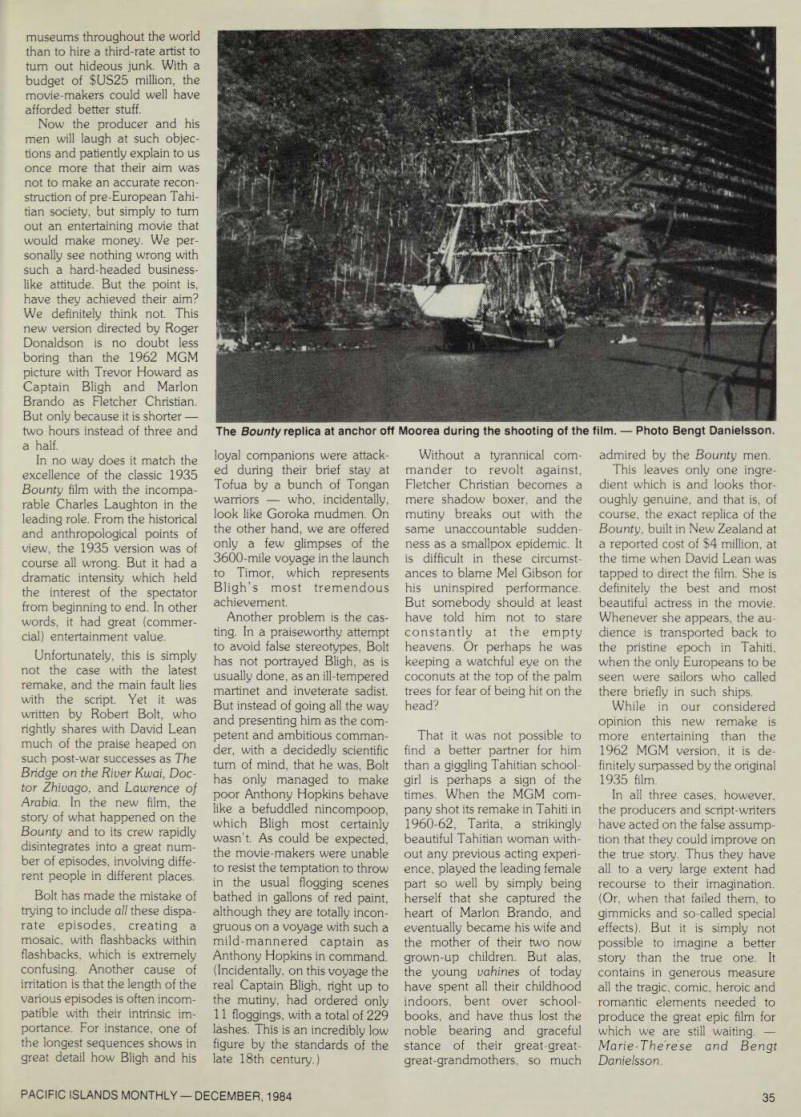
“Bounty” film: A ship is the star
Dino de Laurentiis’s super-col ossal (one is almost tempted to say dinosaurian) remake of the Bounty saga reached Papeete in early October, and is still playing to packed houses. This does not mean that it has met with universal approval, but simply that local people, under standably enough, are very cu rious about a picture shot in such familiar surroundings as Moorea, and often with them selves or their friends as extras.
In addition, the leading lady is a local vahine. This propensity for seeing the picture through Tahitian lenses also applies to us, your PIM chroniclers.
What we are most inclined to criticise from our geographical and anthropological vantage
point is the film’s rather disdain ful use of everything Tahitian solely to create an exotic back ground and atmosphere for the dramatis personae, all of whom are Europeans. Most regret table is the relegation of the leading Tahitian chief at the time of Bligh’s visit, “King” Tu (or Pomare I), to the minor role of master of ceremonies. In any case, the film’s Tahitian ele ments are of very dubious authenticity.
For example, the great “orgy,” which is supposed to epitomise the lasciviousness and sexual freedom for which Tahiti quickly achieved renown, is more like a modern Waikiki floor show than anything else.
And why couldn’t they have
used more authentic and taste ful props? It should have cost no more to copy a few of the many beautiful and often quite spectacular Tahitian art objects found in anthropological
Postmark Papeete
Marie-Therese and Bengt Danielsson
museums throughout the world than to hire a third-rate artist to turn out hideous junk. With a budget of S(JS2S million, the movie-makers could well have afforded better stuff.
Now the producer and his men will laugh at such objec tions and patiently explain to us once more that their aim was not to make an accurate recon struction of pre-European Tahi tian society, but simply to turn out an entertaining movie that would make money. We per sonally see nothing wrong with such a hard-headed business like attitude. But the point is, have they achieved their aim?
We definitely think not. This new version directed by Roger Donaldson is no doubt less boring than the 1962 MGM picture with Trevor Howard as Captain Bligh and Marlon Brando as Fletcher Christian.
But only because it is shorter two hours instead of three and a half.
In no way does it match the excellence of the classic 1935 Bounty film with the incompa rable Charles Laughton in the leading role. From the historical and anthropological points of view, the 1935 version was of course all wrong. But it had a dramatic intensity which held the interest of the spectator from beginning to end. In other words, it had great (commer cial) entertainment value.
Unfortunately, this is simply not the case with the latest remake, and the main fault lies with the script. Yet it was written by Robert Bolt, who rightly shares with David Lean much of the praise heaped on such post-war successes as The Bridge on the River Kwai, Doc tor Zhivago, and Lawrence of Arabia. In the new film, the story of what happened on the Bounty and to its crew rapidly disintegrates into a great num ber of episodes, involving diffe rent people in different places.
Bolt has made the mistake of trying to include all these dispa rate episodes, creating a mosaic, with flashbacks within flashbacks, which is extremely confusing. Another cause of irritation is that the length of the various episodes is often incom patible with their intrinsic im portance. For instance, one of the longest sequences shows in great detail how Bligh and his
loyal companions were attack ed during their brief stay at Tofua by a bunch of Tongan warriors who, incidentally, look like Goroka mudmen. On the other hand, we are offered only a few glimpses of the 3600-mile voyage in the launch to Timor, which represents Bligh’s most tremendous achievement.
Another problem is the cas ting. In a praiseworthy attempt to avoid false stereotypes, Bolt has not portrayed Bligh, as is usually done, as an ill-tempered martinet and inveterate sadist.
But instead of going all the way and presenting him as the com petent and ambitious comman der, with a decidedly scientific turn of mind, that he was, Bolt has only managed to make poor Anthony Hopkins behave like a befuddled nincompoop, which Bligh most certainly wasn’t. As could be expected, the movie-makers were unable to resist the temptation to throw in the usual flogging scenes bathed in gallons of red paint, although they are totally incon gruous on a voyage with such a mild-mannered captain as Anthony Hopkins in command. (Incidentally, on this voyage the real Captain Bligh, right up to the mutiny, had ordered only 11 floggings, with a total of 229 lashes. This is an incredibly low figure by the standards of the late 18th century.)
Without a tyrannical com mander to revolt against, Fletcher Christian becomes a mere shadow boxer, and the mutiny breaks out with the same unaccountable sudden ness as a smallpox epidemic. It is difficult in these circumst ances to blame Mel Gibson for his uninspired performance.
But somebody should at least have told him not to stare constantly at the empty heavens. Or perhaps he was keeping a watchful eye on the coconuts at the top of the palm trees for fear of being hit on the head?
That it was not possible to find a better partner for him than a giggling Tahitian school girl is perhaps a sign of the times. When the MGM com pany shot its remake in Tahiti in 1960-62, Tarita, a strikingly beautiful Tahitian woman with out any previous acting experi ence, played the leading female part so well by simply being herself that she captured the heart of Marlon Brando, and eventually became his wife and the mother of their two now grown-up children. But alas, the young uahines of today have spent all their childhood indoors, bent over school books, and have thus lost the noble bearing and graceful stance of their great-great great-grandmothers. so much
admired by the Bounty men.
This leaves only one ingre dient which is and looks thor oughly genuine, and that is, of course, the exact replica of the Bounty, built in New Zealand at a reported cost of $4 million, at the time when David Lean was tapped to direct the film. She is definitely the best and most beautiful actress in the movie.
Whenever she appears, the au dience is transported back to the pristine epoch in Tahiti, when the only Europeans to be seen were sailors who called there briefly in such ships.
While in our considered opinion this new remake is more entertaining than the 1962 MGM version, it is de finitely surpassed by the original 1935 film.
In all three cases, however, the producers and script-writers have acted on the false assump tion that they could improve on the true story. Thus they have all to a very large extent had recourse to their imagination. (Or, when that failed them, to gimmicks and so-called special effects). But it is simply not possible to imagine a better story than the true one. It contains in generous measure all the tragic, comic, heroic and romantic elements needed to produce the great epic film for which we are still waiting.
Mahe-There'se and Bengt Danielsson.
The Bounty replica at anchor off Moorea during the shooting of the film.-Photo Bengt Danielsson.
Advertisements & other items, pp. 34-36 (1 item)
Protect
with Australian Safety and Security Equipment
Workforce, property, valuables, environment. wide range of functions are readily available They all need protection, from injury, damage, Protective clothing. Helmets. Gloves Eye and theft, fire. You can rely on Australian Safety ear protectors. Dust and air masks. Life jackets and Security Equipment to protect efficiently and rafts. Fire fighting equipment. Respirators, and effectively. That’s because Australian Warning and detection systems Security equipment is made to standards rated among devices. Locks and safes. Emergency lighting the strictest in the world. Products that cover a systems. Check to see how Australia can fulfil your requirements. rr For more information
Ask the Australian Trade Commissioner
Suva: Phone 31 2844 Telex FJ2126. Port Moresby: Phone 25 9333 Telex NE22109.
Honolulu: Phone (808) 524 5050 Telex 633128. Noumea: Phone 27 2414 Telex 087.
VT-88E
M
PAL
Our finest tape
deck now comes
with a free video
deck.
Hitachi's new VT-88 boasts sound that’s nothing short of incredible. A dynamic range of 80dB better than open reel. 0.005% wow and flutter. And 8-hour audio recording with a single tape.
It’s all possible thanks to an extraordinary
recording system pioneered by Hitachi.
First, audio signals are converted to FM signals and recorded below the surface of the tape. Then audio heads moving across the surface at 150 times normal speed trace the signals, and deliver sound
reproduction that surpasses practically
every audio deck on the market today.
So why are we giving away the free video?
Actually, we don’t have much choice.
It’s built in.
You see, the VT-88 is a Hi-Fi stereo video cassette recorder, and it combines audiophile sound with the superb picture Hitachi VTRs are famous for.
So get the most out of music videos, concerts, simulcasts, stereo broadcasts, movies and more. With a VT-88 Hi-Fi stereo from Hitachi.
0 HITACHI
r us C-J cn • . »Tj 15 I I I I I I I I !:■ !S II ii
IIiMSiS
: * - . *> r © ..m *1 B 2 I " triCri m 2 1L 0 O 1 «t 0:1 Recording level controls BILINGUAL indicator STEREO indicator Peak level indicator Hi-Fi indicator Hi-Fi/Normal/ALC select switch Dolby is a registered trademark of Dolby Laboratories Licensing Corp. • AUSTRALIA: Hitachi Sales Australia Pty., Ltd., 153 Keys Road, Moorabbin, Victoria 3189; Phone: (555) 8722 • NEW ZEALAND; AWA New Zealand Limited, Wi-neera Drive, P.O. Box 50- 248, Porirua; Phone: PRO 75-069 • PAPUA NEW GUINEA; S.O. Svensson (N.G.) Ltd., P.O. Box 705, Port Moresby; Phone: 21-2111 • FIJI ISLANDS: AWA New Zealand Limited, 47 Foster Road (P.O. Box 858), Suva, Fiji; Phone: 312070 • NEW CALEDONIA: Caldis, B.P. Ml, Noumea; Phone: 26. 23. 50 • TAHITI: Ets Chene Alain, P.O. Box 272, Papeete; Phone: 2. 88. 68 • SOLOMON ISLANDS: Technique Radios Centre Ltd,, P.O. Box 465, Honiara; Phone: 416
The new alchemy: Diesel
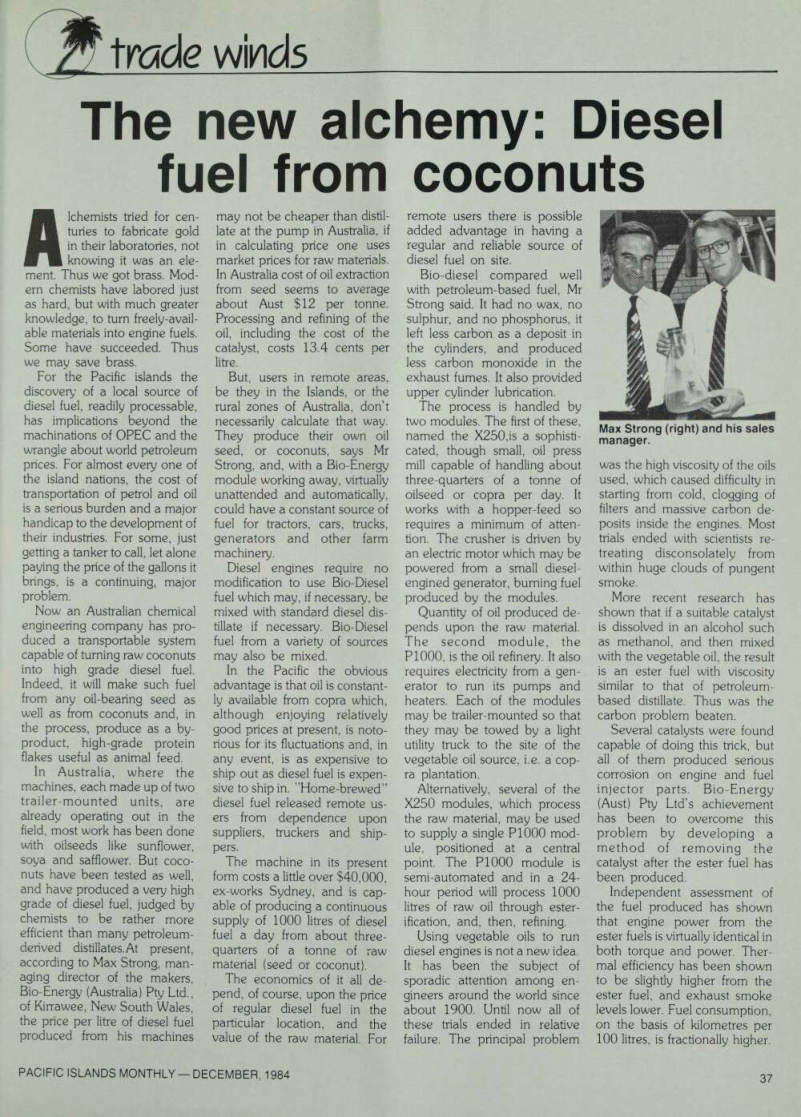
trade winds
The new alchemy: Diesel fuel from coconuts
Alchemists tried for cen turies to fabricate gold in their laboratories, not knowing it was an ele ment. Thus we got brass. Mod ern chemists have labored just as hard, but with much greater knowledge, to turn freely-avail able materials into engine fuels.
Some have succeeded. Thus we may save brass.
For the Pacific islands the discovery of a local source of diesel fuel, readily processable, has implications beyond the machinations of OPEC and the wrangle about world petroleum prices. For almost every one of the island nations, the cost of transportation of petrol and oil is a serious burden and a major handicap to the development of their industries. For some, just getting a tanker to call, let alone paying the price of the gallons it brings, is a continuing, major problem.
Now an Australian chemical engineering company has pro duced a transportable system capable of turning raw coconuts into high grade diesel fuel.
Indeed, it will make such fuel from any oil-bearing seed as well as from coconuts and, in the process, produce as a by product, high-grade protein flakes useful as animal feed.
In Australia, where the machines, each made up of two trailer-mounted units, are already operating out in the field, most work has been done with oilseeds like sunflower, soya and safflower. But coco nuts have been tested as well, and have produced a very high grade of diesel fuel, judged by chemists to be rather more efficient than many petroleum derived distillates.At present, according to Max Strong, man aging director of the makers, Bio-Energy (Australia) Pty Ltd., of Kirrawee, New South Wales, the price per litre of diesel fuel produced from his machines
may not be cheaper than distil late at the pump in Australia, if in calculating price one uses market prices for raw materials.
In Australia cost of oil extraction from seed seems to average about Aust $l2 per tonne.
Processing and refining of the oil, including the cost of the catalyst, costs 13.4 cents per litre.
But, users in remote areas, be they in the Islands, or the rural zones of Australia, don’t necessarily calculate that way.
They produce their own oil seed, or coconuts, says Mr Strong, and, with a Bio-Energy module working away, virtually unattended and automatically, could have a constant source of fuel for tractors, cars, trucks, generators and other farm machinery.
Diesel engines require no modification to use Bio-Diesel fuel which may, if necessary, be mixed with standard diesel dis tillate if necessary. Bio-Diesel fuel from a variety of sources may also be mixed.
In the Pacific the obvious advantage is that oil is constant ly available from copra which, although enjoying relatively good prices at present, is noto rious for its fluctuations and, in any event, is as expensive to ship out as diesel fuel is expen sive to ship in. ’’Home-brewed” diesel fuel released remote us ers from dependence upon suppliers, truckers and ship pers.
The machine in its present form costs a little over $40,000, ex-works Sydney, and is cap able of producing a continuous supply of 1000 litres of diesel fuel a day from about three quarters of a tonne of raw material (seed or coconut).
The economics of it all de pend, of course, upon the price of regular diesel fuel in the particular location, and the value of the raw material. For
remote users there is possible added advantage in having a regular and reliable source of diesel fuel on site.
Bio-diesel compared well with petroleum-based fuel, Mr Strong said. It had no wax, no sulphur, and no phosphorus, it left less carbon as a deposit in the cylinders, and produced less carbon monoxide in the exhaust fumes. It also provided upper cylinder lubrication.
The process is handled by two modules. The first of these, named the X2so,is a sophisti cated, though small, oil press mill capable of handling about three-quarters of a tonne of oilseed or copra per day. It works with a hopper-feed so requires a minimum of atten tion. The crusher is driven by an electric motor which may be powered from a small diesel engined generator, burning fuel produced by the modules.
Quantity of oil produced de pends upon the raw material.
The second module, the PlOOO, is the oil refinery. It also requires electricity from a gen erator to run its pumps and heaters. Each of the modules may be trailer-mounted so that they may be towed by a light utility truck to the site of the vegetable oil source, i.e. a cop ra plantation.
Alternatively, several of the X 250 modules, which process the raw material, may be used to supply a single PIOOO mod ule, positioned at a central point. The PIOOO module is semi-automated and in a 24hour period will process 1000 litres of raw oil through ester ification, and, then, refining.
Using vegetable oils to run diesel engines is not a new idea.
It has been the subject of sporadic attention among en gineers around the world since about 1900. Until now all of these trials ended in relative failure. The principal problem
was the high viscosity of the oils used, which caused difficulty in starting from cold, clogging of filters and massive carbon de posits inside the engines. Most trials ended with scientists re treating disconsolately from within huge clouds of pungent smoke.
More recent research has shown that if a suitable catalyst is dissolved in an alcohol such as methanol, and then mixed with the vegetable oil, the result is an ester fuel with viscosity similar to that of petroleum based distillate. Thus was the carbon problem beaten.
Several catalysts were found capable of doing this trick, but all of them produced serious corrosion on engine and fuel injector parts. Bio-Energy (Aust) Pty Ltd’s achievement has been to overcome this problem by developing a method of removing the catalyst after the ester fuel has been produced.
Independent assessment of the fuel produced has shown that engine power from the ester fuels is virtually identical in both torque and power. Ther mal efficiency has been shown to be slightly higher from the ester fuel, and exhaust smoke levels lower. Fuel consumption, on the basis of kilometres per 100 litres, is fractionally higher.
Max Strong (right) and his sales manager.
Advertisements & other items, pp. 38-40 (1 item)
Introducing Perfo
NEW ’B4 TOYOTA HUJUI
Performance p comfort.
Performance plus durability.
Performance plus variety.
Advanced, powerful new engines put you in command with higher torque, better efficiency. Inside, more driving comfort than ever before with a roomier cabin, bigger windscreens, and lean, clean instrumentation. Newly designed suspension gives you big carrying capability, yet carries you in comfort. HILUX is one tough truck with a suspension you can count on. Choose from a wide variety, including 4WD regular or double cab and two new additions 2WD extra cab and fiatdeck. The all-new Toyota HILUX. Add it all up, and you have performance plus!
LJ
TOYOTA
QUALITY SERVICE
AMERICAN SAMOA: BURNS PHILP (SOUTH SEA)
CO., LTD., P.O. Box 129, Pago Pago.
COOK ISLANDS: COOK ISLANDS TRADING
CORPORATION LTD., Private Bag, Rarotonga.
FIJI: AUTOMOTIVE SUPPLIES COMPANY, G.P.O.
Box 355, Suva.
GUAM & MICRONESIA: ATKINS, KROLL (GUAM) LTD., 443 South Marine Drive, Tamuning.
KIRIBATI: TARAWA MOTORS, P.O. Box 36, Bairiki, Tarawa, Kiribati.
NAURU: NAURU COOPERATIVE SOCIETY.
NEW CALEDONIA: SERVICE IMPORTATION
AUTOMOBILE DU PACIFIQUE, Rond-Point du Pacifiqu* (Station Total) B.P. 438, Noumea.
NANCE PLUS!
mamms i ' 4WD Double Cab ORFOLK ISLAND: SORRY’S LIMITED, P.O. Box 169.
APUA NEW GUINEA: ELA MOTORS, A Division of urns Philp (PNG) Ltd., P.O. Box 75, Port Moresby.
AIPAN: MICROL CORPORATION, P.O. Box 267,
aipan.
OLOMON: MENDANA ENTERPRISES (5.1.) LTD.,
.P.O. Box 174, Honiara.
TAHITI: NIPPON AUTOMOTO, P.O. Box 342, Papeete.
TONGA: BURNS PHILP (SOUTH SEA) CO., LTD., P.O. Box 55, Nuku’alofa.
VANUATU: VANUATU MOTORS, P.O. Box 18,
Port Vila.
WESTERN SAMOA: BURNS PHILP (SOUTH SEA)
CO., LTD., P.O. Box 188, Apia.
TOYOTA
Komatsu has the right pieces of equipment
to solve your construction problem
If you have a construction problem, we have an all-Komatsu solution.
That means we produce a full line and a wide range of machines to perfectly match job requirements from bulldozers, motor graders and motor scrapers, to dump trucks, wheel loaders and hydraulic excavators. It also means we’ll back up all Komatsu machines with our reliable worldwide network of service and sales. Keeping the customer fully satisfied is and always will be the primary concern at every level of our management.
Feedback from users and imaginative research and development based on our Total Quality Control system result in a full line of machines noteworthy for their excellent fuel economy, outstanding operator comfort and exceptional reliability...
The all-Komatsu solution. Make it a part of your construction picture.
THE QUALITY IS STANDARD
•t* KOMATSU
Pacific development
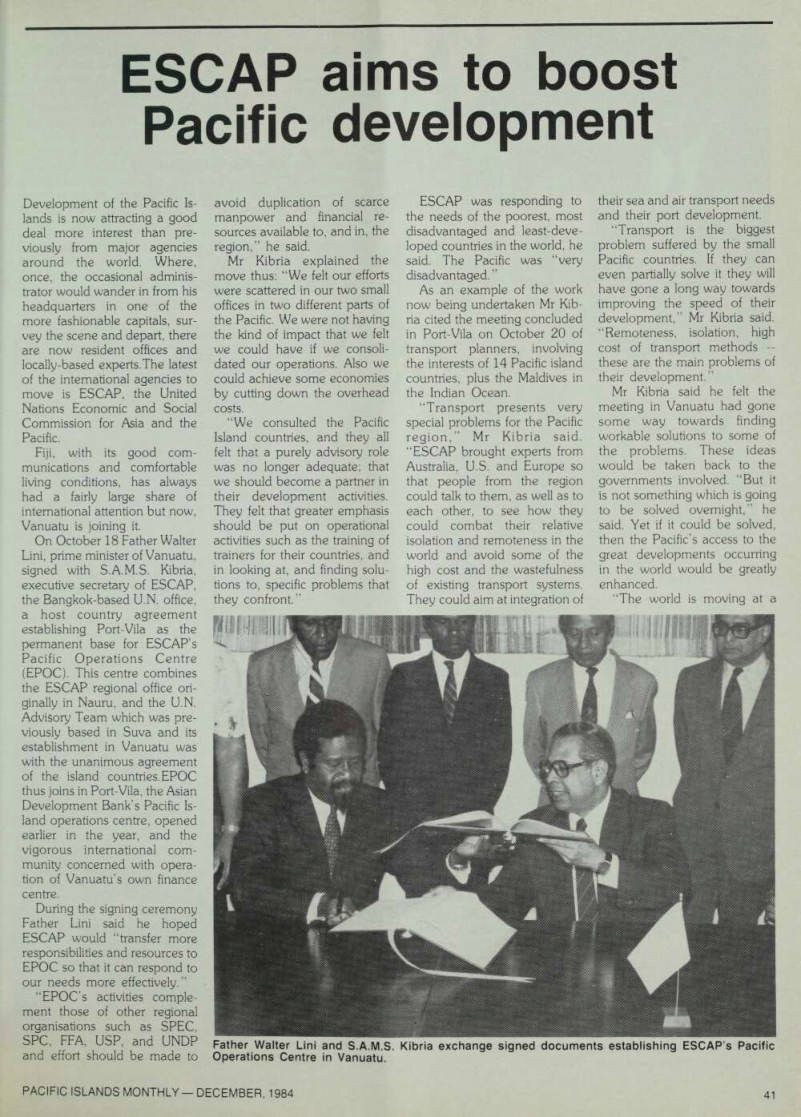
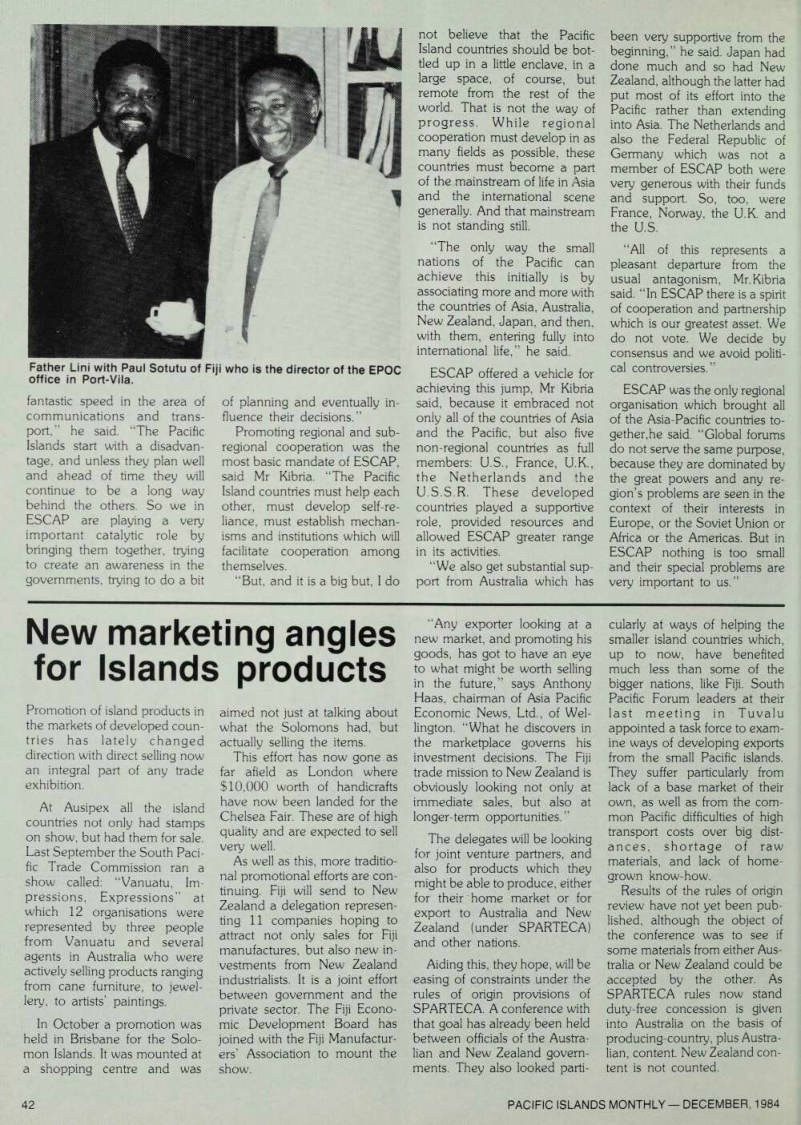
ESCAP aims to boost Pacific development
Development of the Pacific Is lands is now attracting a good deal more interest than pre viously from major agencies around the world. Where, once, the occasional adminis trator would wander in from his headquarters in one of the more fashionable capitals, sur vey the scene and depart, there are now resident offices and locally-based experts. The latest of the international agencies to move is ESCAP, the United Nations Economic and Social Commission for Asia and the Pacific.
Fiji, with its good com munications and comfortable living conditions, has always had a fairly large share of international attention but now, Vanuatu is joining it.
On October 18 Father Walter Lini, prime minister of Vanuatu, signed with S.A.M.S. Kibria, executive secretary of ESCAP, the Bangkok-based U.N. office, a host country agreement establishing Port-Vila as the permanent base for ESCAP’s Pacific Operations Centre (EPOC). This centre combines the ESCAP regional office ori ginally in Nauru, and the U.N.
Advisory Team which was pre viously based in Suva and its establishment in Vanuatu was with the unanimous agreement of the island countries. EPOC thus joins in Port-Vila, the Asian Development Bank’s Pacific Is land operations centre, opened earlier in the year, and the vigorous international com munity concerned with opera tion of Vanuatu’s own finance centre.
During the signing ceremony Father Lini said he hoped ESCAP would “transfer more responsibilities and resources to EPOC so that it can respond to our needs more effectively.”
“EPOC’s activities comple ment those of other regional organisations such as SPEC,
Spc, Ffa, Usp, And Undp
and effort should be made to
avoid duplication of scarce manpower and financial re sources available to, and in, the region,” he said.
Mr Kibria explained the move thus: “We felt our efforts were scattered in our two small offices in two different parts of the Pacific. We were not having the kind of impact that we felt we could have if we consoli dated our operations. Also we could achieve some economies by cutting down the overhead costs.
“We consulted the Pacific Island countries, and they all felt that a purely advisory role was no longer adequate; that we should become a partner in their development activities.
They felt that greater emphasis should be put on operational activities such as the training of trainers for their countries, and in looking at, and finding solu tions to, specific problems that they confront.”
ESCAP was responding to the needs of the poorest, most disadvantaged and least-deve loped countries in the world, he said. The Pacific was “very disadvantaged.”
As an example of the work now being undertaken Mr Kib ria cited the meeting concluded in Port-Vila on October 20 of transport planners, involving the interests of 14 Pacific island countries, plus the Maldives in the Indian Ocean.
“Transport presents very special problems for the Pacific region,” Mr Kibria said.
“ESCAP brought experts from Australia, U.S. and Europe so that people from the region could talk to them, as well as to each other, to see how they could combat their relative isolation and remoteness in the world and avoid some of the high cost and the wastefulness of existing transport systems.
They could aim at integration of
their sea and air transport needs and their port development.
“Transport is the biggest problem suffered by the small Pacific countries. If they can even partially solve it they will have gone a long way towards improving the speed of their development,” Mr Kibria said.
“Remoteness, isolation, high cost of transport methods these are the main problems of their development.”
Mr Kibria said he felt the meeting in Vanuatu had gone some way towards finding workable solutions to some of the problems. These ideas would be taken back to the governments involved. “But it is not something which is going to be solved overnight,” he said. Yet if it could be solved, then the Pacific’s access to the great developments occurring in the world would be greatly enhanced.
“The world is moving at a
Father Walter Lini and S.A.M.S. Kibria exchange signed documents establishing ESCAP’s Pacific Operations Centre in Vanuatu.
fantastic speed in the area of communications and transport,” he said. “The Pacific islands start with a disadvantage. and unless they plan well and ahead of time they will continue to be a long way behind the others. So we in ESCAP are playing a very important catalytic role by bringing them together, trying to create an awareness in the governments, trying to do a bit
of planning and eventually in fluence their decisions.”
Promoting regional and sub regional cooperation was the most basic mandate of ESCAP, said Mr Kibria. “The Pacific Island countries must help each other, must develop self-re liance, must establish mechan isms and institutions which will facilitate cooperation among themselves, “But, and it is a big but, I do
not believe that the Pacific Island countries should be bot tled up in a little enclave, in a large space, of course, but remote from the rest of the world. That is not the way of progress. While regional cooperation must develop in as many fields as possible, these countries must become a part of the mainstream of life in Asia and the international scene generally. And that mainstream is not standing still.
“The only way the small nations of the Pacific can achieve this initially is by associating more and more with the countries of Asia, Australia, New Zealand, Japan, and then, with them, entering fully into international life,” he said.
ESCAP offered a vehicle for achieving this jump, Mr Kibria said, because it embraced not only all of the countries of Asia and the Pacific, but also five non-regional countries as full members; U.S., France, U.K., the Netherlands and the U.S.S.R. These developed countries played a supportive role, provided resources and allowed ESCAP greater range in its activities.
“We also get substantial sup port from Australia which has
been very supportive from the beginning,” he said. Japan had done much and so had New Zealand, although the latter had put most of its effort into the Pacific rather than extending into Asia. The Netherlands and also the Federal Republic of Germany which was not a member of ESCAP both were very generous with their funds and support. So, too, were France, Norway, the U.K. and the U.S.
“All of this represents a pleasant departure from the usual antagonism, Mr.Kibria said. “In ESCAP there is a spirit of cooperation and partnership which is our greatest asset. We do not vote. We decide by consensus and we avoid politi cal controversies.”
ESCAP was the only regional organisation which brought all of the Asia-Pacific countries to gether, he said. “Global forums do not serve the same purpose, because they are dominated by the great powers and any re gion’s problems are seen in the context of their interests in Europe, or the Soviet Union or Africa or the Americas. But in ESCAP nothing is too small and their special problems are very important to us.”
Father Lini with Paul Sotutu of Fiji who is the director of the EPOC office in Port-Vila.
New marketing angles
for Islands products
Promotion of island products in the markets of developed coun tries has lately changed direction with direct selling now an integral part of any trade exhibition.
At Ausipex all the island countries not only had stamps on show, but had them for sale.
Last September the South Paci fic Trade Commission ran a show called; “Vanuatu, Im pressions, Expressions” at which 12 organisations were represented by three people from Vanuatu and several agents in Australia who were actively selling products ranging from cane furniture, to jewel lery, to artists’ paintings.
In October a promotion was held in Brisbane for the Solo mon Islands. It was mounted at a shopping centre and was
aimed not just at talking about what the Solomons had, but actually selling the items.
This effort has now gone as far afield as London where $lO,OOO worth of handicrafts have now been landed for the Chelsea Fair. These are of high quality and are expected to sell very well.
As well as this, more traditio nal promotional efforts are con tinuing. Fiji will send to New Zealand a delegation represen ting 11 companies hoping to attract not only sales for Fiji manufactures, but also new in vestments from New Zealand industrialists. It is a joint effort between government and the private sector. The Fiji Econo mic Development Board has joined with the Fiji Manufactur ers’ Association to mount the show.
“Any exporter looking at a new market, and promoting his goods, has got to have an eye to what might be worth selling in the future,” says Anthony Haas, chairman of Asia Pacific Economic News, Ltd., of Wel lington. “What he discovers in the marketplace governs his investment decisions. The Fiji trade mission to New Zealand is obviously looking not only at immediate sales, but also at longer-term opportunities.”
The delegates will be looking for joint venture partners, and also for products which they might be able to produce, either for their home market or for export to Australia and New Zealand (under SPARTECA) and other nations.
Aiding this, they hope, will be easing of constraints under the rules of origin provisions of SPARTECA. A conference with that goal has already been held between officials of the Austra lian and New Zealand govern ments. They also looked parti
cularly at ways of helping the smaller island countries which, up to now, have benefited much less than some of the bigger nations, like Fiji. South Pacific Forum leaders at their last meeting in Tuvalu appointed a task force to exam ine ways of developing exports from the small Pacific islands.
They suffer particularly from lack of a base market of their own, as well as from the com mon Pacific difficulties of high transport costs over big dist ances, shortage of raw materials, and lack of home grown know-how.
Results of the rules of origin review have not yet been pub lished, although the object of the conference was to see if some materials from either Aus tralia or New Zealand could be accepted by the other. As SPARTECA rules now stand duty-free concession is given into Australia on the basis of producing-country, plus Austra lian, content. New Zealand con tent is not counted.
Savage; splendid: A
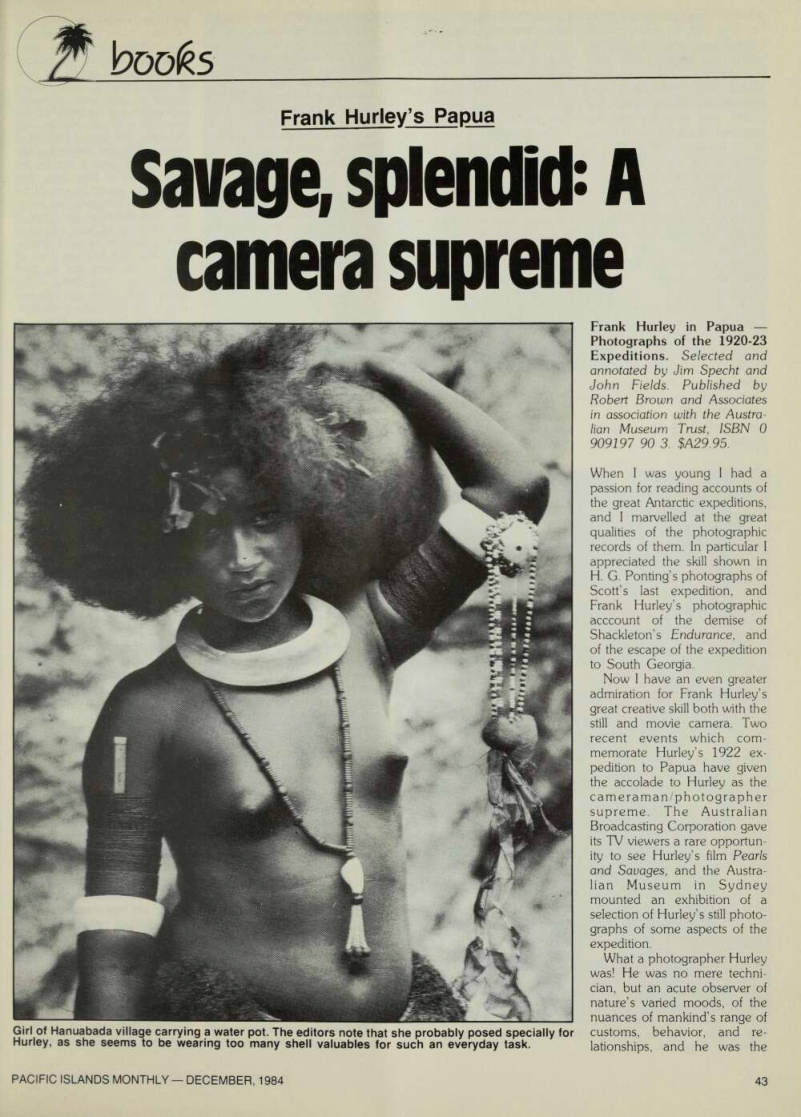
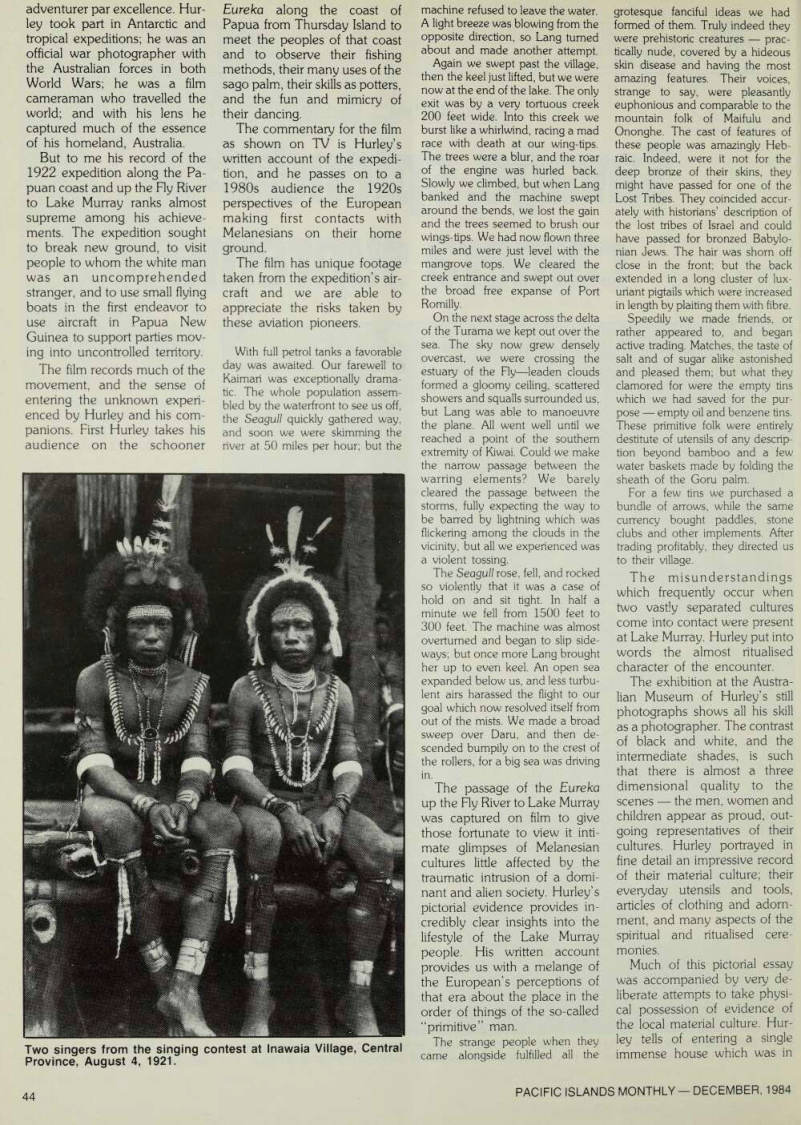
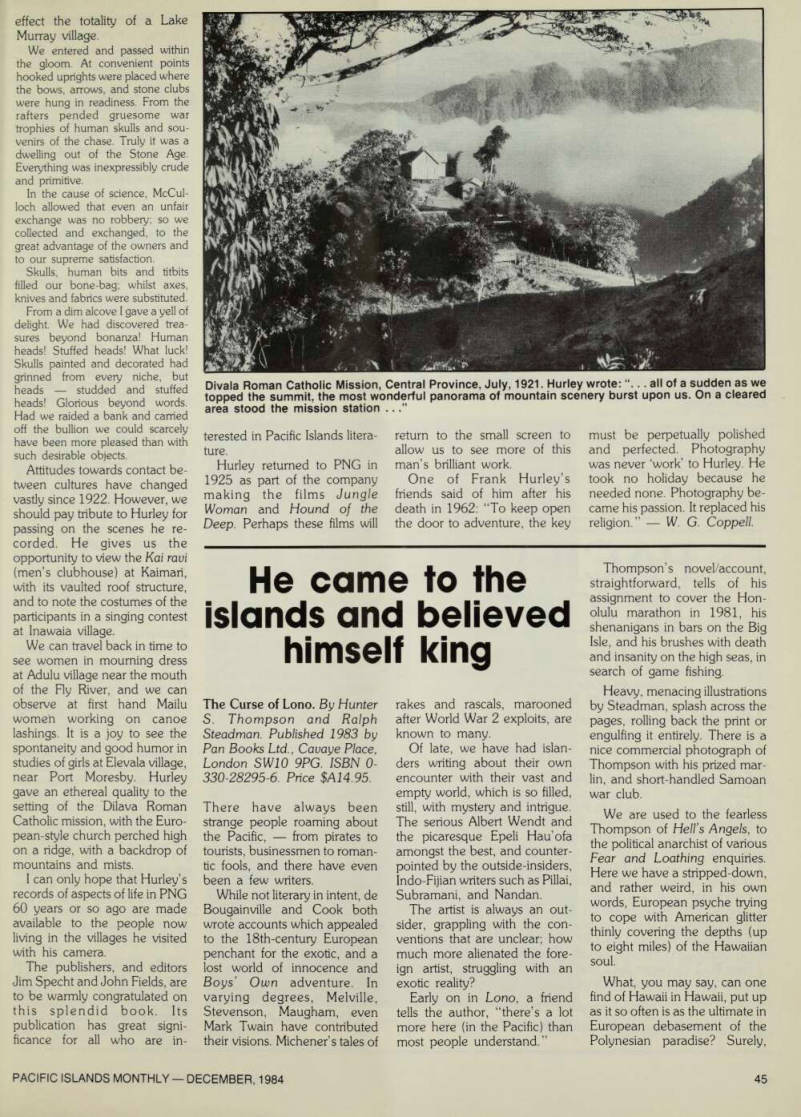
books
Frank Hurley’s Papua Savage; splendid: A camera supreme
Frank Hurley in Papua Photographs of the 1920-23 Expeditions. Selected and annotated by Jim Specht and John Fields. Published by Robert Brown and Associates in association with the Austra lian Museum Trust, ISBN 0 909197 90 3. $A29.95.
When I was young I had a passion for reading accounts of the great Antarctic expeditions, and I marvelled at the great qualities of the photographic records of them. In particular I appreciated the skill shown in H. G. Ponting’s photographs of Scott’s last expedition, and Frank Hurley’s photographic acccount of the demise of Shackleton’s Endurance, and of the escape of the expedition to South Georgia.
Now I have an even greater admiration for Frank Hurley’s great creative skill both with the still and movie camera. Two recent events which com memorate Hurley’s 1922 ex pedition to Papua have given the accolade to Hurley as the cameraman/photographer supreme. The Australian Broadcasting Corporation gave its TV viewers a rare opportun ity to see Hurley’s film Pearls and Savages, and the Austra lian Museum in Sydney mounted an exhibition of a selection of Hurley’s still photo graphs of some aspects of the expedition.
What a photographer Hurley was! He was no mere techni cian, but an acute observer of nature’s varied moods, of the nuances of mankind’s range of customs, behavior, and re lationships, and he was the
Girl of Hanuabada village carrying a water pot. The editors note that she probably posed specially for Hurley, as she seems to be wearing too many shell valuables for such an everyday task.
adventurer par excellence. Hur ley took part in Antarctic and tropical expeditions; he was an official war photographer with the Australian forces in both World Wars; he was a film cameraman who travelled the world; and with his lens he captured much of the essence of his homeland, Australia.
But to me his record of the 1922 expedition along the Pa puan coast and up the Fly River to Lake Murray ranks almost supreme among his achieve ments. The expedition sought to break new ground, to visit people to whom the white man was an uncomprehended stranger, and to use small flying boats in the first endeavor to use aircraft in Papua New Guinea to support parties mov ing into uncontrolled territory.
The film records much of the movement, and the sense of entering the unknown experi enced by Hurley and his com panions. First Hurley takes his audience on the schooner
Eureka along the coast of Papua from Thursday Island to meet the peoples of that coast and to observe their fishing methods, their many uses of the sago palm, their skills as potters, and the fun and mimicry of their dancing.
The commentary for the film as shown on TV is Hurley’s written account of the expedi tion, and he passes on to a 1980 s audience the 1920 s perspectives of the European making first contacts with Melanesians on their home ground.
The film has unique footage taken from the expedition’s air craft and we are able to appreciate the risks taken by these aviation pioneers.
With full petrol tanks a favorable day was awaited. Our farewell to Kaimari was exceptionally drama tic. The whole population assem bled by the waterfront to see us off, the Seagull quickly gathered way, and soon we were skimming the river at 50 miles per hour; but the
machine refused to leave the water.
A light breeze was blowing from the opposite direction, so Lang turned about and made another attempt.
Again we swept past the village, then the keel just lifted, but we were now at the end of the lake. The only exit was by a very tortuous creek 200 feet wide. Into this creek we burst like a whirlwind, racing a mad race with death at our wing-tips.
The trees were a blur, and the roar of the engine was hurled back.
Slowly we climbed, but when Lang banked and the machine swept around the bends, we lost the gain and the trees seemed to brush our wings-tips. We had now flown three miles and were just level with the mangrove tops. We cleared the creek entrance and swept out over the broad free expanse of Port Romilly.
On the next stage across the delta of the Turama we kept out over the sea. The sky now grew densely overcast, we were crossing the estuary of the Fly—leaden clouds formed a gloomy ceiling, scattered showers and squalls surrounded us, but Lang was able to manoeuvre the plane. All went well until we reached a point of the southern extremity of Kiwai. Could we make the narrow passage between the warring elements? We barely cleared the passage between the storms, fully expecting the way to be barred by lightning which was flickering among the clouds in the vicinity, but all we experienced was a violent tossing.
The Seagull rose, fell, and rocked so violently that it was a case of hold on and sit tight. In half a minute we fell from 1500 feet to 300 feet. The machine was almost overturned and began to slip side ways; but once more Lang brought her up to even keel. An open sea expanded below us, and less turbu lent airs harassed the flight to our goal which now resolved itself from out of the mists. We made a broad sweep over Dam, and then de scended bumpily on to the crest of the rollers, for a big sea was driving in.
The passage of the Eureka up the Fly River to Lake Murray was captured on film to give those fortunate to view it inti mate glimpses of Melanesian cultures little affected by the traumatic intrusion of a domi nant and alien society. Hurley’s
pictorial evidence provides in
credibly clear insights into the lifestyle of the Lake Murray people. His written account provides us with a melange of the European’s perceptions of that era about the place in the order of things of the so-called
“primitive” man.
The strange people when they came alongside fulfilled all the
grotesque fanciful ideas we had formed of them. Tmly indeed they were prehistoric creatures prac tically nude, covered by a hideous skin disease and having the most amazing features. Their voices, strange to say, were pleasantly euphonious and comparable to the mountain folk of Maifulu and Ononghe. The cast of features of these people was amazingly Heb raic. Indeed, were it not for the deep bronze of their skins, they might have passed for one of the Lost Tribes. They coincided accur ately with historians’ description of the lost tribes of Israel and could have passed for bronzed Babylo nian Jews. The hair was shorn off close in the front; but the back extended in a long cluster of lux uriant pigtails which were increased in length by plaiting them with fibre.
Speedily we made friends, or rather appeared to, and began active trading. Matches, the taste of salt and of sugar alike astonished and pleased them; but what they clamored for were the empty tins which we had saved for the pur pose empty oil and benzene tins.
These primitive folk were entirely destitute of utensils of any descrip tion beyond bamboo and a few water baskets made by folding the sheath of the Goru palm.
For a few tins we purchased a bundle of arrows, while the same currency bought paddles, stone clubs and other implements. After trading profitably, they directed us to their village.
The misunderstandings
which frequently occur when two vastly separated cultures come into contact were present at Lake Murray. Hurley put into words the almost ritualised character of the encounter.
The exhibition at the Austra lian Museum of Hurley’s still photographs shows all his skill as a photographer. The contrast of black and white, and the intermediate shades, is such that there is almost a three dimensional quality to the scenes the men, women and children appear as proud, out going representatives of their cultures. Hurley portrayed in fine detail an impressive record of their material culture; their everyday utensils and tools, articles of clothing and adorn ment, and many aspects of the spiritual and ritualised cere monies.
Much of this pictorial essay was accompanied by very de liberate attempts to take physi cal possession of evidence of the local material culture. Hur ley tells of entering a single immense house which was in
Two singers from the singing contest at Inawaia Village, Central Province, August 4, 1921.
effect the totality of a Lake Murray village.
We entered and passed within the gloom. At convenient points hooked uprights were placed where the bows, arrows, and stone clubs were hung in readiness. From the rafters pended gruesome war trophies of human skulls and sou venirs of the chase. Truly it was a dwelling out of the Stone Age.
Everything was inexpressibly crude and primitive.
In the cause of science, McCul loch allowed that even an unfair exchange was no robbery; so we collected and exchanged, to the great advantage of the owners and to our supreme satisfaction.
Skulls, human bits and titbits filled our bone-bag; whilst axes, knives and fabrics were substituted.
From a dim alcove I gave a yell of delight. We had discovered trea sures beyond bonanza! Human heads! Stuffed heads! What luck!
Skulls painted and decorated had grinned from every niche, but heads studded and stuffed heads! Glorious beyond words.
Had we raided a bank and carried off the bullion we could scarcely have been more pleased than with such desirable objects.
Attitudes towards contact be tween cultures have changed vastly since 1922. However, we should pay tribute to Hurley for passing on the scenes he re corded. He gives us the opportunity to view the Kai raui (men’s clubhouse) at Kaimari, with its vaulted roof structure, and to note the costumes of the participants in a singing contest at Inawaia village.
We can travel back in time to see women in mourning dress at Adulu village near the mouth of the Fly River, and we can observe at first hand Mailu women working on canoe lashings. It is a joy to see the spontaneity and good humor in studies of girls at Elevala village, near Port Moresby. Hurley gave an ethereal quality to the setting of the Dilava Roman Catholic mission, with the Euro pean-style church perched high on a ridge, with a backdrop of mountains and mists.
I can only hope that Hurley’s records of aspects of life in PNG 60 years or so ago are made available to the people now living in the villages he visited with his camera.
The publishers, and editors Jim Specht and John Fields, are to be warmly congratulated on this splendid book. Its publication has great signi ficance for all who are in-
terested in Pacific Islands litera ture.
Hurley returned to PNG in 1925 as part of the company making the films Jungle Woman and Hound of the Deep. Perhaps these films will
return to the small screen to allow us to see more of this man’s brilliant work.
One of Frank Hurley’s friends said of him after his death in 1962: “To keep open the door to adventure, the key
must be perpetually polished and perfected. Photography was never work’ to Hurley. He took no holiday because he needed none. Photography be came his passion. It replaced his
religion.”
W. G. Coppell.
Divala Roman Catholic Mission, Central Province, July, 1921. Hurley wrote:"... all of a sudden as we topped the summit, the most wonderful panorama of mountain scenery burst upon us. On a cleared area stood the mission station..."
himself king
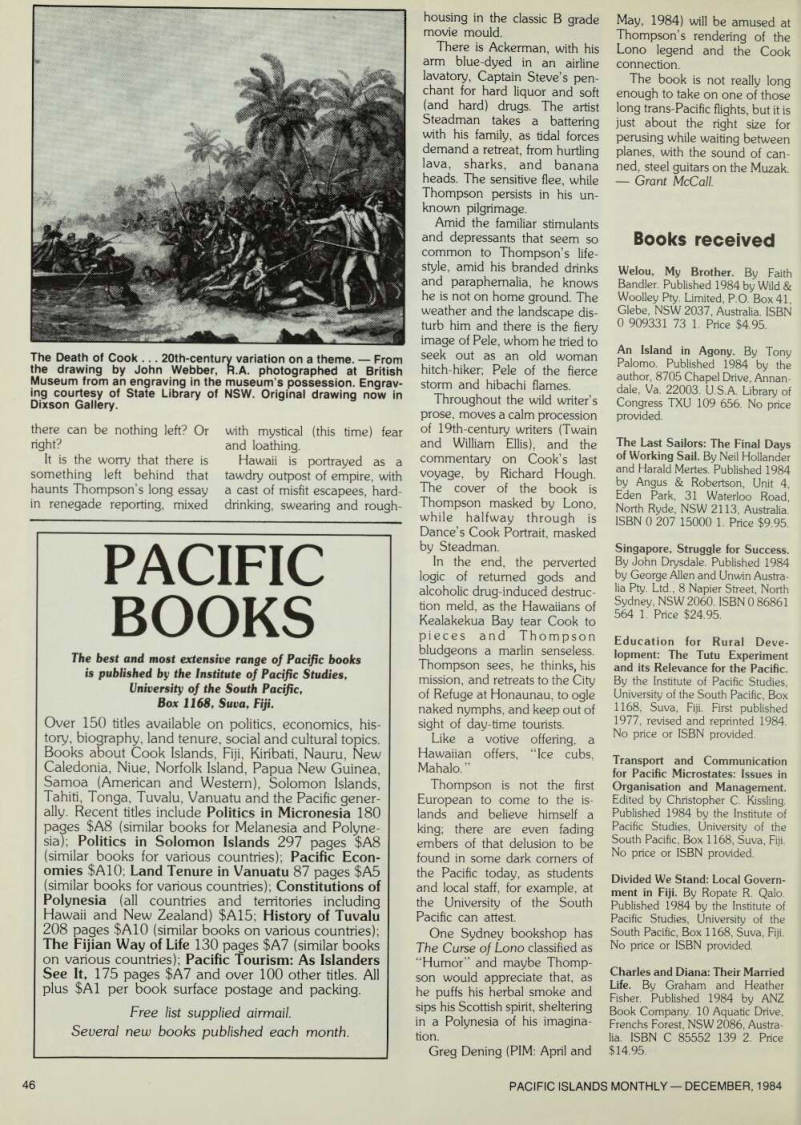
He came to the islands and believed himself king
The Curse of Lono. By Hunter S. Thompson and Ralph Steadman. Published 1983 by Pan Books Ltd., Cauaye Place, London SWIO 9PG. ISBN 0- 330-28295-6. Price $A14.95.
There have always been strange people roaming about the Pacific, from pirates to tourists, businessmen to roman tic fools, and there have even been a few writers.
While not literary in intent, de Bougainville and Cook both wrote accounts which appealed to the 18th-century European penchant for the exotic, and a lost world of innocence and Boys’ Own adventure. In varying degrees, Melville, Stevenson, Maugham, even Mark Twain have contributed their visions. Michener’s tales of
rakes and rascals, marooned after World War 2 exploits, are known to many.
Of late, we have had islan ders writing about their own encounter with their vast and empty world, which is so filled, still, with mystery and intrigue.
The serious Albert Wendt and the picaresque Epeli Hau’ofa amongst the best, and counter pointed by the outside-insiders, Indo-Fijian writers such as Pillai, Subramani, and Nandan.
The artist is always an out sider, grappling with the con ventions that are unclear; how much more alienated the fore ign artist, struggling with an exotic reality?
Early on in Lono, a friend tells the author, “there’s a lot more here (in the Pacific) than most people understand.”
Thompson’s novel/account, straightforward, tells of his assignment to cover the Hon olulu marathon in 1981, his shenanigans in bars on the Big Isle, and his brushes with death and insanity on the high seas, in search of game fishing.
Heavy, menacing illustrations by Steadman, splash across the pages, rolling back the print or engulfing it entirely. There is a nice commercial photograph of Thompson with his prized mar lin, and short-handled Samoan war club.
We are used to the fearless Thompson of Hell’s Angels, to the political anarchist of various Fear and Loathing enquiries.
Here we have a stripped-down, and rather weird, in his own words, European psyche trying to cope with American glitter thinly covering the depths (up to eight miles) of the Hawaiian soul.
What, you may say, can one find of Hawaii in Hawaii, put up as it so often is as the ultimate in European debasement of the Polynesian paradise? Surely,
there can be nothing left? Or right?
It is the worry that there is something left behind that haunts Thompson’s long essay in renegade reporting, mixed
with mystical (this time) fear and loathing.
Hawaii is portrayed as a tawdry outpost of empire, with a cast of misfit escapees, hard drinking, swearing and rough
housing in the classic B grade movie mould.
There is Ackerman, with his arm blue-dyed in an airline lavatory, Captain Steve’s pen chant for hard liquor and soft (and hard) drugs. The artist Steadman takes a battering with his family, as tidal forces demand a retreat, from hurtling lava, sharks, and banana heads. The sensitive flee, while Thompson persists in his un known pilgrimage.
Amid the familiar stimulants and depressants that seem so common to Thompson’s life style, amid his branded drinks and paraphernalia, he knows he is not on home ground. The weather and the landscape dis turb him and there is the fiery image of Pele, whom he tried to seek out as an old woman hitch-hiker; Pele of the fierce storm and hibachi flames.
Throughout the wild writer’s prose, moves a calm procession of 19th-century writers (Twain and William Ellis), and the commentary on Cook’s last voyage, by Richard Hough.
The cover of the book is Thompson masked by Lono, while halfway through is Dance’s Cook Portrait, masked by Steadman.
In the end, the perverted logic of returned gods and alcoholic drug-induced destruc tion meld, as the Hawaiians of Kealakekua Bay tear Cook to pieces and Thompson bludgeons a marlin senseless.
Thompson sees, he thinks, his mission, and retreats to the City of Refuge at Honaunau, to ogle naked nymphs, and keep out of sight of day-time tourists.
Like a votive offering, a Hawaiian offers, “Ice cubs, Mahalo. ”
Thompson is not the first European to come to the is lands and believe himself a king; there are even fading embers of that delusion to be found in some dark corners of the Pacific today, as students and local staff, for example, at the University of the South Pacific can attest.
One Sydney bookshop has The Curse of Lono classified as “Humor” and maybe Thomp son would appreciate that, as he puffs his herbal smoke and sips his Scottish spirit, sheltering in a Polynesia of his imagina tion.
Greg Dening (PIM: April and
May, 1984) will be amused at Thompson’s rendering of the Lono legend and the Cook connection.
The book is not really long enough to take on one of those long trans-Pacific flights, but it is just about the right size for perusing while waiting between planes, with the sound of can ned, steel guitars on the Muzak.
Grant McCall.
The Death of Cook ... 20th-century variation on a theme. From the drawing by John Webber, R.A. photographed at British Museum from an engraving in the museum’s possession. Engrav ing courtesy of State Library of NSW. Original drawing now in Dixson Gallery.
Books received
Welou, My Brother. By Faith Bandler. Published 1984 by Wild & Woolley Pty. Limited, P.O. Box 41 Glebe, NSW 2037, Australia. ISBN 0 909331 73 1. Price $4.95.
An Island in Agony. By Tony Palomo. Published 1984 by the author, 8705 Chapel Drive, Annan dale, Va. 22003. U.S.A. Library of Congress TXU 109 656. No price provided.
The Last Sailors: The Final Days of Working Sail. By Neil Hollander and Harald Mertes. Published 1984 by Angus & Robertson, Unit 4, Eden Park, 31 Waterloo Road, North Ryde, NSW 2113, Australia.
ISBN 0 207 15000 1. Price $9.95.
Singapore, Struggle for Success.
By John Drysdale. Published 1984 by George Allen and Unwin Austra lia Pty. Ltd., 8 Napier Street, North Sydney, NSW 2060. ISBN 0 86861 564 1. Price $24.95.
Education for Rural Deve lopment: The Tutu Experiment and its Relevance for the Pacific.
By the Institute of Pacific Studies, University of the South Pacific, Box 1168, Suva, Fiji. First published 1977, revised and reprinted 1984.
No price or ISBN provided.
Transport and Communication for Pacific Microstates: Issues in Organisation and Management.
Edited by Christopher C. Kissling.
Published 1984 by the Institute of Pacific Studies, University of the South Pacific, Box 1168, Suva, Fiji.
No price or ISBN provided.
Divided We Stand: Local Govern ment in Fiji. By Ropate R. Qalo.
Published 1984 by the Institute of Pacific Studies, University of the South Pacific, Box 1168, Suva, Fiji.
No price or ISBN provided.
Charles and Diana: Their Married Life. By Graham and Heather Fisher. Published 1984 by ANZ Book Company. 10 Aquatic Drive, Frenchs Forest, NSW 2086, Austra lia. ISBN C 85552 139 2. Price $14.95.
Advertisements & other items, p. 46 (1 item)
Books
PACIFIC
The best and most extensive range of Pacific books is published by the Institute of Pacific Studies, University of the South Pacific, Box 1168, Suva, Fiji.
Over 150 titles available on politics, economics, history, biography, land tenure, social and cultural topics.
Books about Cook Islands, Fiji, Kiribati, Nauru, New Caledonia, Niue, Norfolk Island, Papua New Guinea, Samoa (American and Western), Solomon Islands, Tahiti, Tonga, Tuvalu, Vanuatu and the Pacific generally. Recent titles include Politics in Micronesia 180 pages SAB (similar books for Melanesia and Polynesia); Politics in Solomon Islands 297 pages SAB (similar books for various countries); Pacific Economies $A10; Land Tenure in Vanuatu 87 pages SAS (similar books for various countries); Constitutions of Polynesia (all countries and territories including Hawaii and New Zealand) SAIS; History of Tuvalu 208 pages SAIO (similar books on various countries); The Fijian Way of Life 130 pages SA7 (similar books on various countries); Pacific Tourism: As Islanders See It, 175 pages SA7 and over 100 other titles. All plus SAI per book surface postage and packing.
Free list supplied airmail.
Several new books published each month.
riding bareback on Tanna
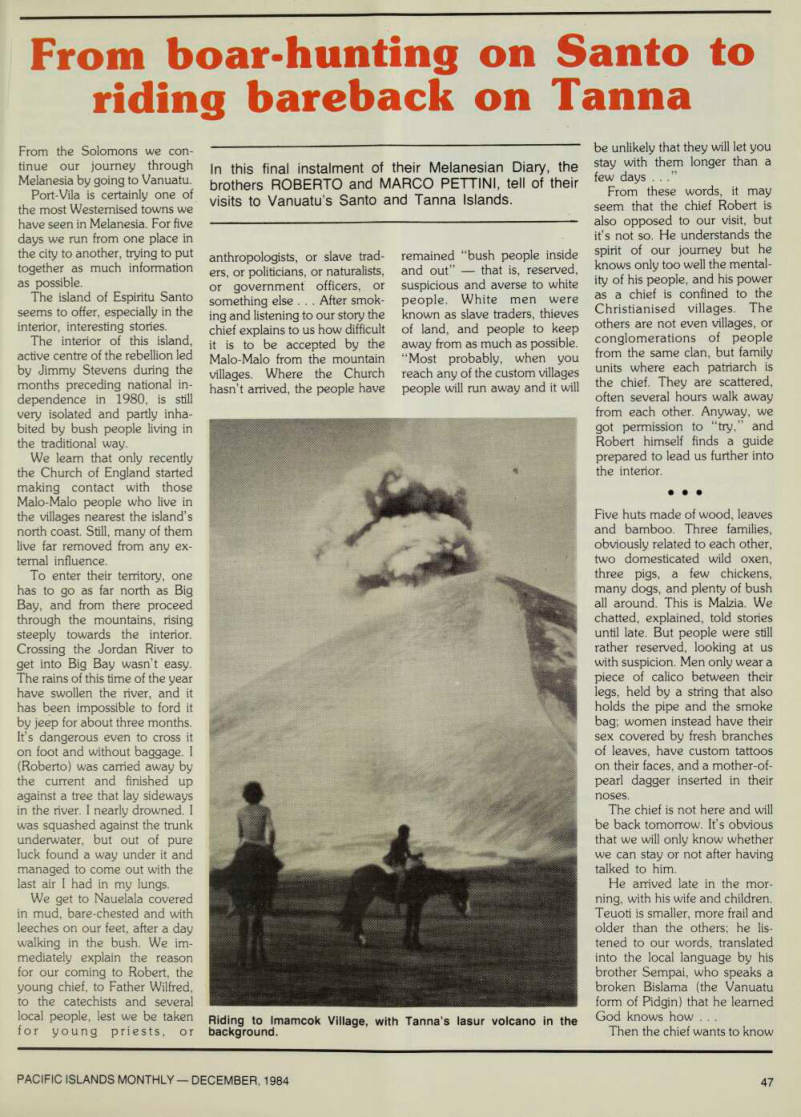

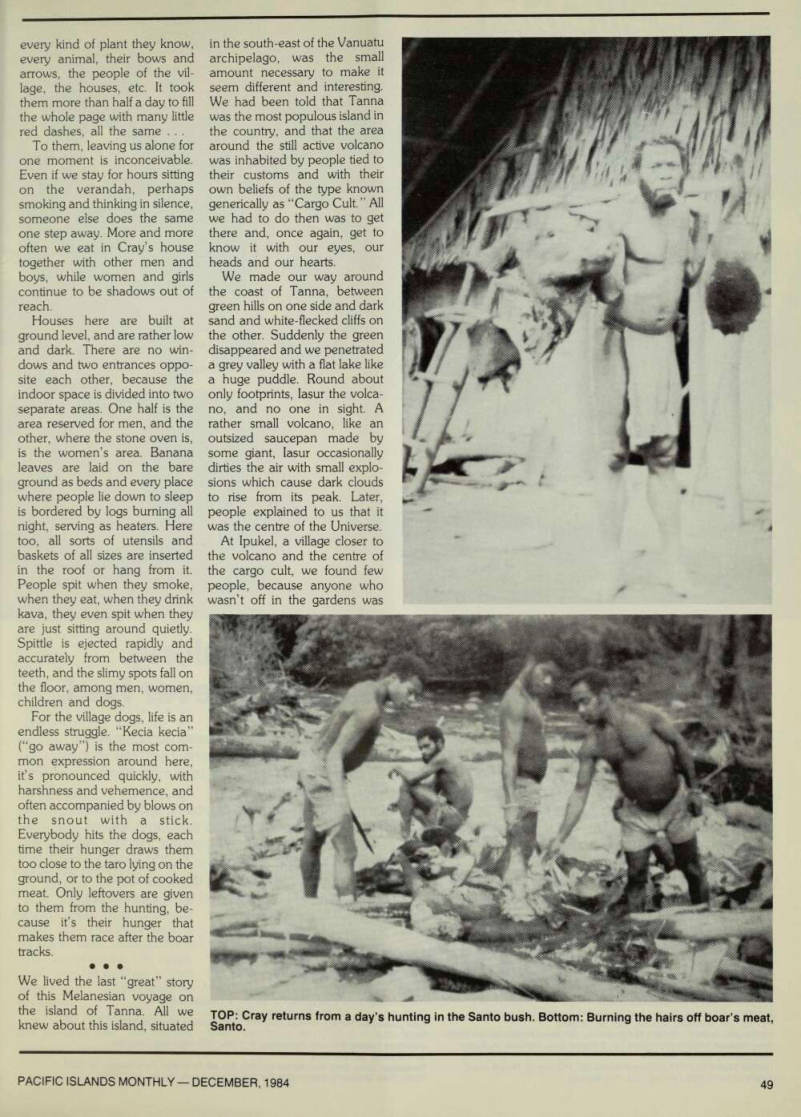

From boar-hunting on Santo to riding bareback on Tanna
From the Solomons we con tinue our journey through Melanesia by going to Vanuatu.
Port-Vila is certainly one of the most Westernised towns we have seen in Melanesia. For five days we run from one place in the city to another, trying to put together as much information as possible.
The island of Espiritu Santo seems to offer, especially in the interior, interesting stories.
The interior of this island, active centre of the rebellion led by Jimmy Stevens during the months preceding national in dependence in 1980, is still very isolated and partly inha bited by bush people living in the traditional way.
We learn that only recently the Church of England started making contact with those Malo-Malo people who live in the villages nearest the island’s north coast. Still, many of them live far removed from any ex ternal influence.
To enter their territory, one has to go as far north as Big Bay, and from there proceed through the mountains, rising steeply towards the interior.
Crossing the Jordan River to get into Big Bay wasn’t easy.
The rains of this time of the year have swollen the river, and it has been impossible to ford it by jeep for about three months.
It’s dangerous even to cross it on foot and without baggage. I (Roberto) was carried away by the current and finished up against a tree that lay sideways in the river. I nearly drowned. I was squashed against the trunk underwater, but out of pure luck found a way under it and managed to come out with the last air I had in my lungs.
We get to Nauelala covered in mud, bare-chested and with leeches on our feet, after a day walking in the bush. We im mediately explain the reason for our coming to Robert, the young chief, to Father Wilfred, to the catechists and several local people, lest we be taken for young priests, or
In this final instalment of their Melanesian Diary, the brothers ROBERTO and MARCO PETTINI, tell of their visits to Vanuatu’s Santo and Tanna Islands.
anthropologists, or slave trad ers, or politicians, or naturalists, or government officers, or something else . . . After smok ing and listening to our story the chief explains to us how difficult it is to be accepted by the Malo-Malo from the mountain villages. Where the Church hasn’t arrived, the people have
remained “bush people inside and out” that is, reserved, suspicious and averse to white people. White men were known as slave traders, thieves of land, and people to keep away from as much as possible.
“Most probably, when you reach any of the custom villages people will run away and it will
be unlikely that they will let you stay with them longer than a few days ...”
From these words, it may seem that the chief Robert is also opposed to our visit, but it’s not so. He understands the spirit of our journey but he knows only too well the mental ity of his people, and his power as a chief is confined to the Christianised villages. The others are not even villages, or conglomerations of people from the same clan, but family units where each patriarch is the chief. They are scattered, often several hours walk away from each other. Anyway, we got permission to “try,” and Robert himself finds a guide prepared to lead us further into the interior. • • • Five huts made of wood, leaves and bamboo. Three families, obviously related to each other, two domesticated wild oxen, three pigs, a few chickens, many dogs, and plenty of bush all around. This is Malzia. We chatted, explained, told stories until late. But people were still rather reserved, looking at us with suspicion. Men only wear a piece of calico between their legs, held by a string that also holds the pipe and the smoke bag; women instead have their sex covered by fresh branches of leaves, have custom tattoos on their faces, and a mother-of pearl dagger inserted in their noses.
The chief is not here and will be back tomorrow. It’s obvious that we will only know whether we can stay or not after having talked to him.
He arrived late in the mor ning, with his wife and children.
Teuoti is smaller, more frail and older than the others; he lis tened to our words, translated into the local language by his brother Sempai, who speaks a broken Bislama (the Vanuatu form of Pidgin) that he learned God knows how . . .
Then the chief wants to know
Riding to Imamcok Village, with Tanna’s lasur volcano in the background.
precisely how many and what are the presents we have in our bags. How big the pipes are, how long are the bush-knives, how the sharpening stones are made. He then solemnly announces that we may stay, but only on condition that we respect his authority and the custom of the place, emphasis ing that we must not dig the soil or photograph the women.
Teuoti’s verbal consent has the effect of a favorable verdict in a court. As soon as he’s finished talking we see the people of Malzia relax and their expressions are immediately more friendly. Then someone runs to get a few pieces of kava and someone else has already arrived with bamboo canes fil led with water.
Here the juice of kava roots is the custom drink, and the means of social entertainment most appreciated by men. The Malo-Malo each chew a piece of root, then they all spit it in the same bag and filter it with a little water, until a whole bowl is filled. One person at a time drinks the kava, trying to swal low at one gulp the whole contents of the only mug, which each time is filled to the brim. It tastes like muddy water and its effect if you drink a lot of it and if it’s filtered with little water is definitely more potent than betel nut. Tonight we’ve been drinking it for hours; be tween mugs we talk, joke and smoke, go for a piss, and return to drink more, until the bowl is empty and we can hardly walk. • • • Hunting, to the Malo-Malo, is a matter of everyday existence.
The sun is still behind the mountains but Cray is already up and from the top of the hill he looks around him in silence.
While he’s up there “smelling the weather,” the other men and boys of Malzia sharpen the blades of their spears and bush knives. Soon we are all walking in single file, walking fast along the track leading to the river and on the other side zigzags up the mountain to the next valley, hunting ground of the local people.
Along the way we don’t talk or take rests, we run up and downhill after the dogs who continue to bark excitedly. At
the bottom of the valley we split: Ansen and his dogs go in one direction, Sampai and two boys in another, while Cray, Marco and I walk some distance upstream along the stony river and enter the bush. Cray’s dogs smell the prey immediately and from then on it’s only an exhausting race in the thick greenery until we catch up with a pair of boars already trailed by the dogs. Cray pierces them in the throat with precision, one at a time, then with extreme calm guts them, cuts them in halves and hangs them on the ends of two short poles. When we return to the bottom of the valley nobody is back yet. So it’s for us to light the fire and bum the hair away from the pieces we have just caught.
Then, as soon as some embers are formed, we roast a few strips of meat and have break fast.
Between bites, Cray tells us that this bush is full of boars and wild oxen. “There is as much meat as you want here, as much as you can take home ...” He also says that boars rarely move around alone, and that it’s often possible to catch a whole family on only one hunt.
Hunting however isn’t always such an easy matter because boars, when they are big, must be pierced several times before they die and between hits they chase their attackers quite fast.
It’s up to the hunter’s reflexes and agility to grab the first tree branch within reach, and from there to hit the beast again as it continues infuriated to run around the tree. “Once a boy from Buria, a big, tall fellow at least your size, didn’t have time to climb out of the way and the boar struck him between the legs, made him fall, and then charged him again, killing him. ”
At some stage, we see the others coming back. Some have one, some two boars already gutted Sampai even has three . . . • • • Cicadas and birds here are heard all day and the huts are the only trees without leaves.
We got out paper and colored felt pens and today, for the first time in their lives, Sampai and Cray made a draw ing. They put everything in it:
every kind of plant they know, every animal, their bows and arrows, the people of the vil lage, the houses, etc. It took them more than half a day to fill the whole page with many little red dashes, all the same . . .
To them, leaving us alone for one moment is inconceivable.
Even if we stay for hours sitting on the verandah, perhaps smoking and thinking in silence, someone else does the same one step away. More and more often we eat in Cray’s house together with other men and boys, while women and girls continue to be shadows out of reach.
Houses here are built at ground level, and are rather low and dark. There are no win dows and two entrances oppo site each other, because the indoor space is divided into two separate areas. One half is the area reserved for men, and the other, where the stone oven is, is the women’s area. Banana leaves are laid on the bare ground as beds and every place where people lie down to sleep is bordered by logs burning all night, serving as heaters. Here too, all sorts of utensils and baskets of all sizes are inserted in the roof or hang from it.
People spit when they smoke, when they eat, when they drink kava, they even spit when they are just sitting around quietly.
Spittle is ejected rapidly and accurately from between the teeth, and the slimy spots fall on the floor, among men, women, children and dogs.
For the village dogs, life is an endless struggle. “Kecia kecia” (“go away”) is the most com mon expression around here, it’s pronounced quickly, with harshness and vehemence, and often accompanied by blows on the snout with a stick.
Everybody hits the dogs, each time their hunger draws them too close to the taro lying on the ground, or to the pot of cooked meat. Only leftovers are given to them from the hunting, be cause it’s their hunger that makes them race after the boar tracks. • • • We lived the last “great” story of this Melanesian voyage on the island of Tanna. All we knew about this island, situated
in the south-east of the Vanuatu archipelago, was the small amount necessary to make it seem different and interesting.
We had been told that Tanna was the most populous island in the country, and that the area around the still active volcano was inhabited by people tied to their customs and with their own beliefs of the type known generically as “Cargo Cult.” All we had to do then was to get there and, once again, get to know it with our eyes, our heads and our hearts.
We made our way around the coast of Tanna, between green hills on one side and dark sand and white-flecked cliffs on the other. Suddenly the green disappeared and we penetrated a grey valley with a flat lake like a huge puddle. Round about only footprints, lasur the volca no, and no one in sight. A rather small volcano, like an outsized saucepan made by some giant, lasur occasionally dirties the air with small explo sions which cause dark clouds to rise from its peak. Later, people explained to us that it was the centre of the Universe.
At Ipukel, a village closer to the volcano and the centre of the cargo cult, we found few people, because anyone who wasn’t off in the gardens was
TOP: Cray returns from a day’s hunting in the Santo bush. Bottom: Burning the hairs off boar’s meat, Santo.
attending a “custom congress” at a nearby village. Chief Mellis was also at the meeting which will end tomorrow after a night of traditional dances.
It is a real pleasure to sit with the local “meri” because they look you in the eye and speak to you with amazing sincerity and openness. They seem just like our mothers and sisters . . .
Maybe this is just the right time for us to try to move a little closer to their dimension as women.
Ipukel is in a small bay called Sulphur Bay. The square shaped village is a line of huts along the inner edge of a long palisade, like a picture frame made of vertical stakes firmly planted in the earth. If you clamber over the palisade by the sea you find yourself on the beach of dark sand; on either side, the mountains which form the valley rise steeply; but if you go out the front, through the gate, you cross a stretch of bush full of orange, mandarine and lemon trees and arrive right at the foot of the volcano. It is in the thicker parts of this bush that you find, well hidde from the eyes of the women, the Nakamals, huts reserved for certain special rites where every evening at sunset the men gather to drink kava. At Ipukel there are six of them, in six different locations. For some weeks, one of them has housed a pair of boys who will come back to live in the village tomorrow. We were told that since the day of their circumci sion they have had to live on their own and wait for the wounds of the operation to heal. Tomorrow the end of the isolation period will be cele brated.
Chief Mellis, a tall thin man with white hair and beard, went away again as soon as he had heard us. He will send us his final answer as to whether or not we can stay tomorrow. Why not straight away? Because Mellis looks and listens but doesn’t speak his mind straight away. When he goes back to his hut he lies down and thinks over the words he has heard.
That way he can tell if they were true or not,” explained his nephew.
The two boys ran to wash in the sea and then, still hidden,
they were smeared with coco nut oil, their faces were painted and they were dressed in two new pieces of calico. After their return to the village the celebra tion proper took the form of a slow and calm sharing out of the pile of yams, kava, pork and colored straw skirts amongst the members of the boys’ clans.
The fun started in the evening, after drinking kava, when the dancing got going just outside the gate. Each dance was very similar, a continuous stamping of feet and jumping, full of shouts and enjoyment. But we were told repeatedly that when the “full custom” is followed that is when the boy has been circumcised with a piece of bamboo the celebrations are unforgettable. • • • Who was John Frum, the tall young man dressed in white who arrived one day in 1942 in the same bay where James Cook had landed? Here in Sulphur Bay they tell us that he was a good and just man, a white man who spoke “streit.”
He told his “Melanesian brothers” that soon would come the day when they too would be able to build the big boats, the radios and the other things the white man has but that they would lose “the power of their customs” if they didn’t do all they could to preserve them. Then John Frum taught them how to pray in a simpler way, singing with flowers in their hands in front of a red
painted cross, and he promised to return with a cargo of all God’s gifts. But he never came back.
There are 26 “John Frum” villages around the volcano (as well as a few more in other parts of the island), and once a week they come together for a celebration. Each village has its own group of musicians and while these alternate through the night all the participants enjoy themselves dancing.
How? The men close together over on one side as if they were on their own in a night club, and the women on the other swinging their hips and moving along as if in a fashion parade. • • • Marco is as white as death, his face is twisted and all he does is scrape his tongue with his teeth.
For three days he has had the “cold-cold” (malaria) back, and for three days there have been going around “all sorts of pos sible reasons” for his condition, and “all sorts of possible advice” for curing him.
Benjamin, the chief s young est brother and our next door neighbor, tried to cure him this evening by spraying kava spit in his face. Marco was drinking just at that moment and very nearly responded in kind. • • • We went to look for flying foxes in the bush; me, Marco, four boys and a rifle. During the day the flying foxes hang from the branches of the highest and leafiest trees and sleep head
down wrapped in their large wings like black sheets. When you see them at sunset flying in search of fruit they remind you immediately of vampires, but today, when I saw them up close for the first time, I felt a fondness for them. But this is the time of the year when they are nice and fat and have not yet started making pikininis.
One shot brought down eight of them. Five were roasted for dinner with bananas, and three ended up in the village cooking pots.
We’ve been here for 10 days now, yet every morning when I get down to the beach I find something new to marvel at.
Either the tide is out and the evaporation of the water from the hot springs which empty into the sea makes the place look magical; or the tide is in and the waves seem to wash the beach with their white foam; or because you get a composite picture of someone paddling off in a canoe, a group of children drawing in the sand with their toes, and a group of women dressed in rags carrying other rags to be washed.
You bathe, do your washing and draw water from amongst the volcanic boulders at the end of the beach. That’s where the biggest springs are and one of these is so hot you can cook in it.
How many Nakamals would there be here on Tanna? Today we found out that some of the ones around the island are
John Frum believers pray in front of the red cross, Tanna Island, Vanuatu.
reserved for “special func tions.” Some are for “yams nomoa” (only yams), some for taro, or bananas, or cut-nuts, or flying foxes, or kava, or, we were told, for all the other different sorts of kai-kai (food), animal or vegetable, which are to be found on the island.
There are even some for “con trolling” the weather and the sea.
This is because everything, as well as every living being, has its own spirit here on Tanna. It is said that a long time ago lavei, the strong, hairy man down there who makes the volcano explode, came out to help the people of Tanna to live more comfortably. To the males of each clan he gave a magic stone connected to a special spirit and he showed them the correct way of using it.
Thus, at certain times of the year, during sowing or in a dry period, the magic stones are unearthed and used by the direct descendants of the men who received them from lavei.
Even today these stones co vered with custom leaves and kava spit are taken as the
explanation for the arrival of propitious rain or an abundant harvest, and, more generally, for the fertility of the volcanic soil of this island.
On the island there is a place full of wild horses. Whoever wants one goes there, chooses one, and takes it. Here at Sulphur Bay there are only six or seven which wander freely about, and every now and then the children mount them for fun. Today we went for a great ride with Kannowi (the flying fox hunter) as far as the house of the man who can talk with lavei, on the other side of the volcano. We didn’t find him there, but everybody we saw on the way had a good laugh when they saw iis hanging on to the necks of the horses, imagining, I suppose, what our backsides would feel like after the bareback ride.
Today there was a double “swap” of people at Enumakel, one of the villages just beyond Sulphur Bay. Two members of the same family, a brother and a sister, got married and, as is the custom on Tanna, their father had to give a daughter to
the family from which the son took his wife and at the same time he received a new girl from the family into which his daugh ter married. On this island every female who leaves the clan must be replaced by another, and there is no bride price which could be considered of equivalent value.
'... a marvellous voyage, lived intensely...'
We should mention kava again. As time goes on, we become more and more aware of the importance of kava in the lives of these people. Kava has been drunk on Tanna “since always” and is the method used for getting in touch with that world of forces from which help may be obtained. This means help in the most general sense of the word: from the recovery of a lost piglet which has wan dered into the bush to saving the life of a dying man; from the smallest and most personal de sires to the most collective. This contact is called “temafa” and is manifested after having drunk a whole coconut shell full of kava in one draught, while spitting out the last bit. There are a mass of rules concerning the preparation, drinking and spit ting of kava. For example, the chewn part of the root may be touched only by circumcised boys who have not yet begun to grow whiskers, because it is only in that arc of time that their hands do not come into contact with the hands of women dir tied by menstrual b100d... As soon as the drinking has begun you must stop talking, and if you must say something you say it in a whisper so as not to disturb the others who are “listening to the kava”.
Women may not even glance in the direction of the Nakamal when they pass nearby. If they do they are immediately chased by the men and struck on the head with a kava root. Why?
Because the plant was bom from a woman and the men would never allow a woman to watch while they cut it, chew it, spit it and drink it.
We went with Kannowi to the top of the volcano. What a place! You look around you and you see an expanse of green which stretches as far as the sea; you look down and you see a motionless lake amid dark sand; look into the dist ance and you see more islands and more sea; look directly down and you see a cone which ends in five holes shoot ing out fire and smoke. The explosions are sudden jets of incandescent lava which roll, stretch and break into pieces before falling back in. Kannowi described it as he watched fascinated for the umpteenth time: “Look, look at that piece of fire coming out. It moves like a piece of paper, like the wings of the flying foxes, but when it falls it has already become a rock”. The mouths alternate jets of smoke and jets of fire; today while one was exploding, another was giving off white smoke, another black smoke and two seemed extinct. God only knows how the people of Tanna can believe that inside there there are a man and two women who make puddings The farewells this time were particularly painful. For three whole days we were invited to lunches and dinners in our honor, and we were made aware that our close friends were really sorry that we were leaving.
“We won’t wash the mats you slept on so that they will keep your smell,” Margaret said.
“Plant these kava roots in my garden with your own hands and when they are ready we will drink it and think of you,” was Isaac’s comment. “But why don’t you stay?” asked Lesbit with surprise, “you could get married here, have your own piece of garden, your own house, and we would all be happy to have you here with us.”
For our part we wanted to say goodbye to Ipukel in the most “custom” way possible: offering kava and drinking it with the villagers in the Naka mal near the gate.
The last temafa made a few hours before our departure was the simplest of all: we thanked the spirits for having helped us to live this marvellous voyage so intensely.
Advertisements & other items, pp. 48-52 (1 item)
Heating & Cooking
Four Ways to Better
Reliability ft savings
W/// / / / P SOLAR ENERGY SYSTEMS j ALL PURPOSE jOILERS // / / ©
DOMESTIC STOVES
COMMERCIAL STOVES
Improve your current heating and cooking facilities now, and save on fuel costs almost immediately.
At Water Wheel Exports, we're pleased to introduce an exciting range of alternative heating, cooking and solar energy products to suit all domestic, commercial and industrial market requirements.
Naturally, the key advantage of installing a solid fuel stove, boiler or solar energy hot water system, is the fact that you'll never again be totally dependent on gas or electricity for all your heating or cooking requirements.
And, when you consider you're also investing in long-term reliability, it means you'll make substantial savings year after year, after year...
For complete details on our export range of 'Fuel Efficient Money Saving', heating and cooking products, please, fill in the coupon below.
Water Wheel Exports Pty. Ltd... Exporters of a large and diverse range of products to the Pacific region.
WATER WHEEL EXPORTS PTY. LTD.,
53-57 Market Street, South Melbourne, 3205. Victoria, Australia. Telephone; 699 1722, Telex: AA32165.
Telegraphic Address: "Watermill", Melbourne
NAME:
ADDRESS:
COUNTRY:
TELEPHONE:
PLEASE SUPPLY INFORMATION ON:
DOMESTIC □ INDUSTRIAL □ COMMERCIAL □
APPLICATIONS OF:
STOVES □ BOILERS □ SOLAR ENERGY SYSTEMS □
f m * M -f ■ *V ; ' *jbiriWrSv Bring along, sing along and play along.
The greatest partner your party ever had.
Portable fun in the sun.
DISCO ROBO is your multi-talented, go-anywhere partner for sing-alongs, dance parties, guitar playing, or just great listening. It has a builtin FM tuner, a cassette player and mixer with inputs for mikes and guitar. And it’s portable, so it can always be where the action is.
Play with the super stars.
Mix up to five kinds of sound —Mike 1, Mike 2 (or guitar), FM (or a wireless mike), cassette tape and a line input (such as a keyboard instrument or rhythm box). Then, add echo if you like and play or sing along with your favourite music.
Disco time any time.
Any music from tape or played on a connected keyboard can be turned into exciting pulsating disco music. Big sound, hi-fi sound, the four highly efficient full-range speakers in DISCO ROBO pump out dynamic sound at disco decibels.
DISCO ROBO is all you need for a perfect party.
AD PIONEER
For further information, please contact; Australia: Pioneer Electronics Australia Pty. Ltd. (Incorporated in Victoria), P.O. Box 295, Mordialloc, Victoria. 3195 Tel: 580-9911 Fiji Islands: Brijlal & Company, G.P.O Box No. 362, Suva, Fiji Islands Tel: 22258 New Zealand: Monaco Distributors Ltd., 2 Poland Road, Glenfield, Auckland, New Zealand Tel: (09) 444-9144 Norfolk Island: Burns Philp (Norfolk Island) Ltd., P.O. Box 21, Norfolk Island Vanuatu; Burns Philp (Vanuatu) Ltd., Vila, Vanuatu Nauru Island: Jacob Enterprises, P.O. Box No. 4, Republic of Nauru Tahiti: Tahiti Hi-Fi, P.O. Box 848, Papeete, Tahiti New Caledonia: Menard Pacifique Sari, B.P. 3899, Noumea, New Caledonia Tel: 27.62*23 American Samoa; Transpac Corporation, P.O. Box 1477, Pago Pago, American Samoa 96799 Tel: 633-5224 Rarotonga: South Seas International Ltd., PO Box 49, Rarotonga, Cook Islands Tel: 2327 Papua New Guinea: Bali Merchants Pty. Ltd., P.O. Box 6103, Boroko Tel: 254887
MSTANT
HOUSES’
and Commercial Buildings with Therma-Panel, R the
fully insulated inter-locking
Building System
Cyclone rated George Hudson Homes (Aust.) pty. Ltd. 186 Hume Highway Cabramatta NSW 2166 Australia. Tel: (02) 727 9066. Telex: AA25800 Post coupon for details and prices.
Tel:.
tropicditigs
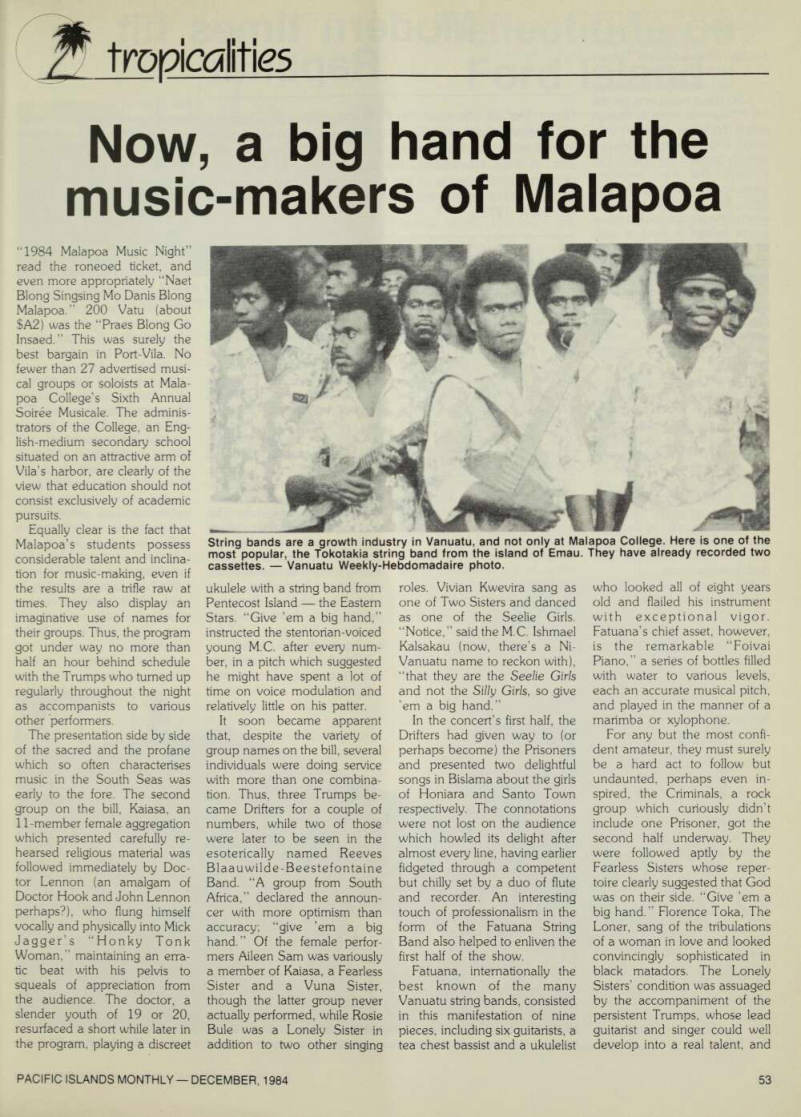
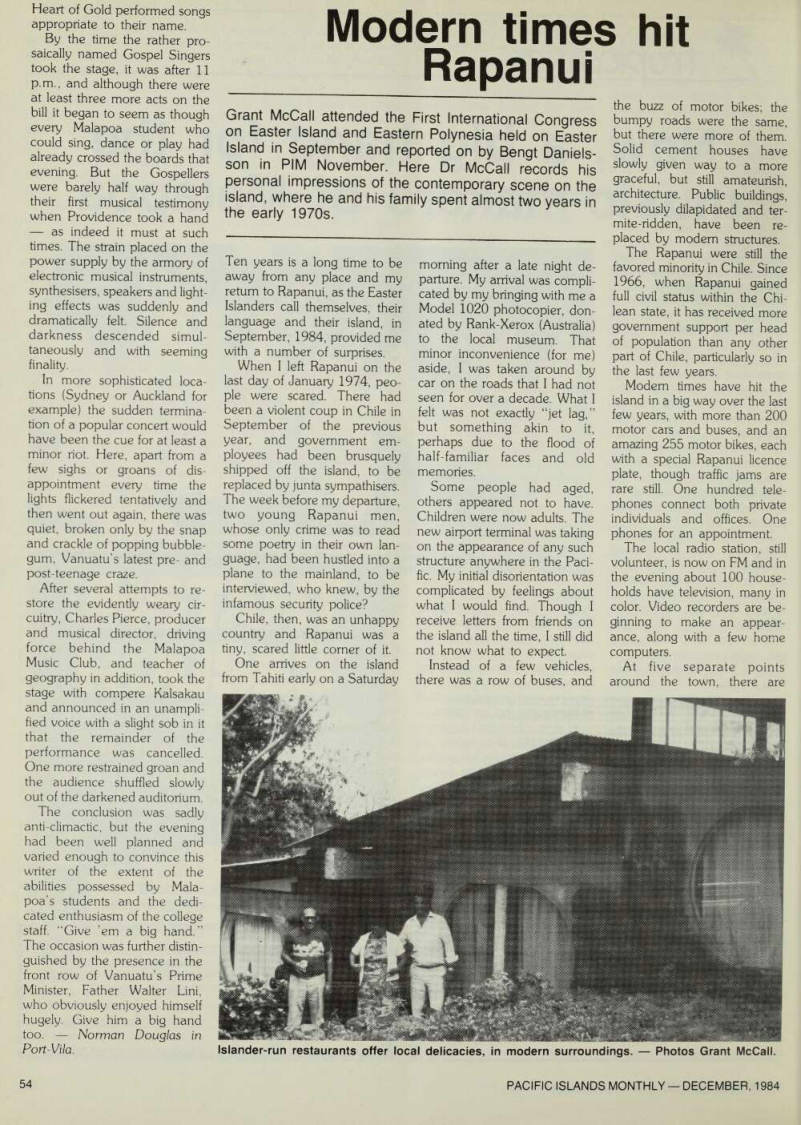
Now, a big hand for the music-makers of Malapoa
“1984 Malapoa Music Night” read the roneoed ticket, and even more appropriately “Naet Blong Singsing Mo Danis Blong Malapoa.” 200 Vatu (about SA2) was the “Praes Blong Go Insaed. ” This was surely the best bargain in Port-Vila. No fewer than 27 advertised musi cal groups or soloists at Mala poa College’s Sixth Annual Soiree Musicale. The adminis trators of the College, an Eng lish-medium secondary school situated on an attractive arm of Vila’s harbor, are clearly of the view that education should not consist exclusively of academic pursuits.
Equally clear is the fact that Malapoa’s students possess considerable talent and inclina tion for music-making, even if the results are a trifle raw at times. They also display an imaginative use of names for their groups. Thus, the program got under way no more than half an hour behind schedule with the Trumps who turned up regularly throughout the night as accompanists to various other performers.
The presentation side by side of the sacred and the profane which so often characterises music in the South Seas was early to the fore. The second group on the bill, Kaiasa, an 11-member female aggregation which presented carefully re hearsed religious material was followed immediately by Doc tor Lennon (an amalgam of Doctor Hook and John Lennon perhaps?), who flung himself vocally and physically into Mick dagger’s “Honky Tonk Woman,” maintaining an erra tic beat with his pelvis to squeals of appreciation from the audience. The doctor, a slender youth of 19 or 20, resurfaced a short while later in the program, playing a discreet
ukulele with a string band from Pentecost Island the Eastern Stars. “Give ’em a big hand,” instructed the stentorian-voiced young M.C. after every num ber, in a pitch which suggested he might have spent a lot of time on voice modulation and relatively little on his patter.
It soon became apparent that, despite the variety of group names on the bill, several individuals were doing service with more than one combina tion. Thus, three Trumps be came Drifters for a couple of numbers, while two of those were later to be seen in the esoterically named Reeves Blaauwilde-Beestefontaine Band. “A group from South Africa,” declared the announ cer with more optimism than accuracy; “give ’em a big hand.” Of the female perfor mers Aileen Sam was variously a member of Kaiasa, a Fearless Sister and a Vuna Sister, though the latter group never actually performed, while Rosie Buie was a Lonely Sister in addition to two other singing
roles. Vivian Kwevira sang as one of Two Sisters and danced as one of the Seelie Girls.
“Notice,” said the M.C. Ishmael Kalsakau (now, there’s a Ni- Vanuatu name to reckon with), “that they are the Seelie Girls and not the Si//y Girls, so give ’em a big hand.”
In the concert’s first half, the Drifters had given way to (or perhaps become) the Prisoners and presented two delightful songs in Bislama about the girls of Honiara and Santo Town respectively. The connotations were not lost on the audience which howled its delight after almost every line, having earlier fidgeted through a competent but chilly set by a duo of flute and recorder. An interesting touch of professionalism in the form of the Fatuana String Band also helped to enliven the first half of the show.
Fatuana, internationally the best known of the many Vanuatu string bands, consisted in this manifestation of nine pieces, including six guitarists, a tea chest bassist and a ukulelist
who looked all of eight years old and flailed his instrument with exceptional vigor.
Fatuana’s chief asset, however, is the remarkable “Foivai Piano,” a series of bottles filled with water to various levels, each an accurate musical pitch, and played in the manner of a marimba or xylophone.
For any but the most confi dent amateur, they must surely be a hard act to follow but undaunted, perhaps even in spired, the Criminals, a rock group which curiously didn’t include one Prisoner, got the second half underway. They were followed aptly by the Fearless Sisters whose reper toire clearly suggested that God was on their side. “Give ’em a big hand.” Florence Toka, The Loner, sang of the tribulations of a woman in love and looked convincingly sophisticated in black matadors. The Lonely Sisters’ condition was assuaged by the accompaniment of the persistent Trumps, whose lead guitarist and singer could well develop into a real talent, and
String bands are a growth industry in Vanuatu, and not only at Malapoa College. Here is one of the most popular, the Tokotakia string band from the island of Emau. They have already recorded two cassettes.-Vanuatu Weekly-Hebdomadaire photo.
Heart of Gold performed songs appropriate to their name.
By the time the rather pro saically named Gospel Singers took the stage, it was after 11 p.m., and although there were at least three more acts on the bill it began to seem as though every Malapoa student who could sing, dance or play had already crossed the boards that evening. But the Gospellers were barely half way through their first musical testimony when Providence took a hand as indeed it must at such times. The strain placed on the power supply by the armory of electronic musical instruments, synthesisers, speakers and light ing effects was suddenly and dramatically felt. Silence and darkness descended simul taneously and with seeming finality.
In more sophisticated loca tions (Sydney or Auckland for example) the sudden termina tion of a popular concert would have been the cue for at least a minor riot. Here, apart from a few sighs or groans of dis appointment every time the lights flickered tentatively and then went out again, there was quiet, broken only by the snap and crackle of popping bubble gum, Vanuatu’s latest pre- and post-teenage craze.
After several attempts to re store the evidently weary cir cuitry, Charles Pierce, producer and musical director, driving force behind the Malapoa Music Club, and teacher of geography in addition, took the stage with compere Kalsakau and announced in an unampli fied voice with a slight sob in it that the remainder of the performance was cancelled.
One more restrained groan and the audience shuffled slowly out of the darkened auditorium.
The conclusion was sadly anti-climactic, but the evening had been well planned and varied enough to convince this writer of the extent of the abilities possessed by Mala poa’s students and the dedi cated enthusiasm of the college staff. “Give ’em a big hand.”
The occasion was further distin guished by the presence in the front row of Vanuatu’s Prime Minister, Father Walter Lini, who obviously enjoyed himself hugely. Give him a big hand
too.
Norman Douglas in
Port-Vila.
Rapanui
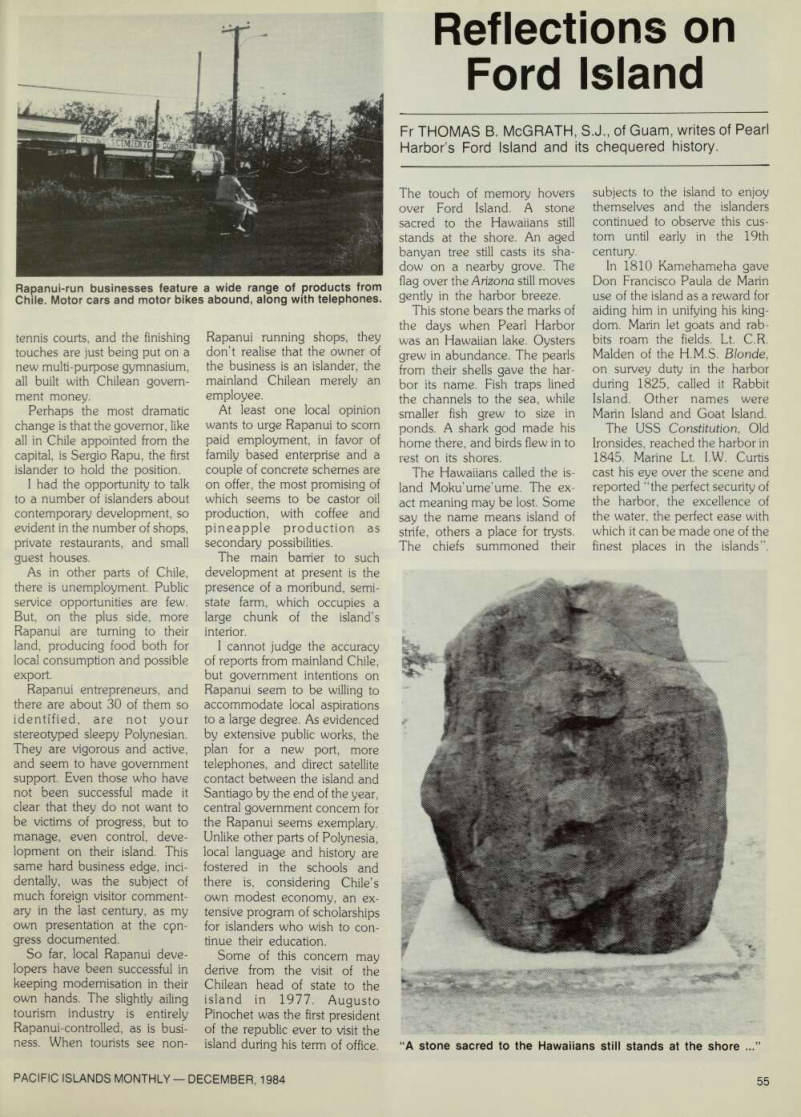
Modern times hit Rapanui
Grant McCall attended the First International Congress on Easter Island and Eastern Polynesia held on Easter Island in September and reported on by Bengt Daniels son in PIM November. Here Dr McCall records his personal impressions of the contemporary scene on the island, where he and his family spent almost two years in the early 19705.
Ten years is a long time to be away from any place and my return to Rapanui, as the Easter Islanders call themselves, their language and their island, in September, 1984, provided me with a number of surprises.
When I left Rapanui on the last day of January 1974, peo ple were scared. There had been a violent coup in Chile in September of the previous year, and government em ployees had been brusquely shipped off the island, to be replaced by junta sympathisers.
The week before my departure, two young Rapanui men, whose only crime was to read some poetry in their own lan guage, had been hustled into a plane to the mainland, to be interviewed, who knew, by the infamous security police?
Chile, then, was an unhappy country and Rapanui was a tiny, scared little corner of it.
One arrives on the island from Tahiti early on a Saturday
morning after a late night de parture. My arrival was compli cated by my bringing with me a Model 1020 photocopier, don ated by Rank-Xerox (Australia) to the local museum. That minor inconvenience (for me) aside, I was taken around by car on the roads that I had not seen for over a decade. What I felt was not exactly “jet lag,” but something akin to it, perhaps due to the flood of half-familiar faces and old memories.
Some people had aged, others appeared not to have.
Children were now adults. The new airport terminal was taking on the appearance of any such structure anywhere in the Paci fic. My initial disorientation was complicated by feelings about what I would find. Though I receive letters from friends on the island all the time, I still did not know what to expect.
Instead of a few vehicles, there was a row of buses, and
the buzz of motor bikes; the bumpy roads were the same, but there were more of them.
Solid cement houses have slowly given way to a more graceful, but still amateurish, architecture. Public buildings, previously dilapidated and ter mite-ridden, have been re placed by modern structures.
The Rapanui were still the favored minority in Chile. Since 1966, when Rapanui gained full civil status within the Chi lean state, it has received more government support per head of population than any other part of Chile, particularly so in the last few years.
Modem times have hit the island in a big way over the last few years, with more than 200 motor cars and buses, and an amazing 255 motor bikes, each with a special Rapanui licence plate, though traffic jams are rare still. One hundred tele phones connect both private individuals and offices. One phones for an appointment.
The local radio station, still volunteer, is now on FM and in the evening about 100 house holds have television, many in color. Video recorders are be ginning to make an appear ance, along with a few home computers.
At five separate points around the town, there are
Islander-run restaurants offer local delicacies, in modern surroundings.-Photos Grant McCall.
tennis courts, and the finishing touches are just being put on a new multi-purpose gymnasium, all built with Chilean govern ment money.
Perhaps the most dramatic change is that the governor, like all in Chile appointed from the capital, is Sergio Rapu, the first islander to hold the position.
I had the opportunity to talk to a number of islanders about contemporary development, so evident in the number of shops, private restaurants, and small guest houses.
As in other parts of Chile, there is unemployment. Public service opportunities are few.
But, on the plus side, more Rapanui are turning to their land, producing food both for local consumption and possible export.
Rapanui entrepreneurs, and there are about 30 of them so identified, are not your stereotyped sleepy Polynesian.
They are vigorous and active, and seem to have government support. Even those who have not been successful made it clear that they do not want to be victims of progress, but to manage, even control, deve lopment on their island. This same hard business edge, inci dentally, was the subject of much foreign visitor comment ary in the last century, as my own presentation at the cpn gress documented.
So far, local Rapanui deve lopers have been successful in keeping modernisation in their own hands. The slightly ailing tourism industry is entirely Rapanui-controlled, as is busi ness. When tourists see non-
Rapanui running shops, they don’t realise that the owner of the business is an islander, the mainland Chilean merely an employee.
At least one local opinion wants to urge Rapanui to scorn paid employment, in favor of family based enterprise and a couple of concrete schemes are on offer, the most promising of which seems to be castor oil production, with coffee and pineapple production as secondary possibilities.
The main barrier to such development at present is the presence of a moribund, semi state farm, which occupies a large chunk of the island’s interior.
I cannot judge the accuracy of reports from mainland Chile, but government intentions on Rapanui seem to be willing to accommodate local aspirations to a large degree. As evidenced by extensive public works, the plan for a new port, more telephones, and direct satellite contact between the island and Santiago by the end of the year, central government concern for the Rapanui seems exemplary.
Unlike other parts of Polynesia, local language and history are fostered in the schools and there is, considering Chile’s own modest economy, an ex tensive program of scholarships for islanders who wish to con tinue their education.
Some of this concern may derive from the visit of the Chilean head of state to the island in 1977. Augusto Pinochet was the first president of the republic ever to visit the island during his term of office.
Rapanui-run businesses feature a wide range of products from Chile. Motor cars and motor bikes abound, along with telephones.
Reflections on Ford Island

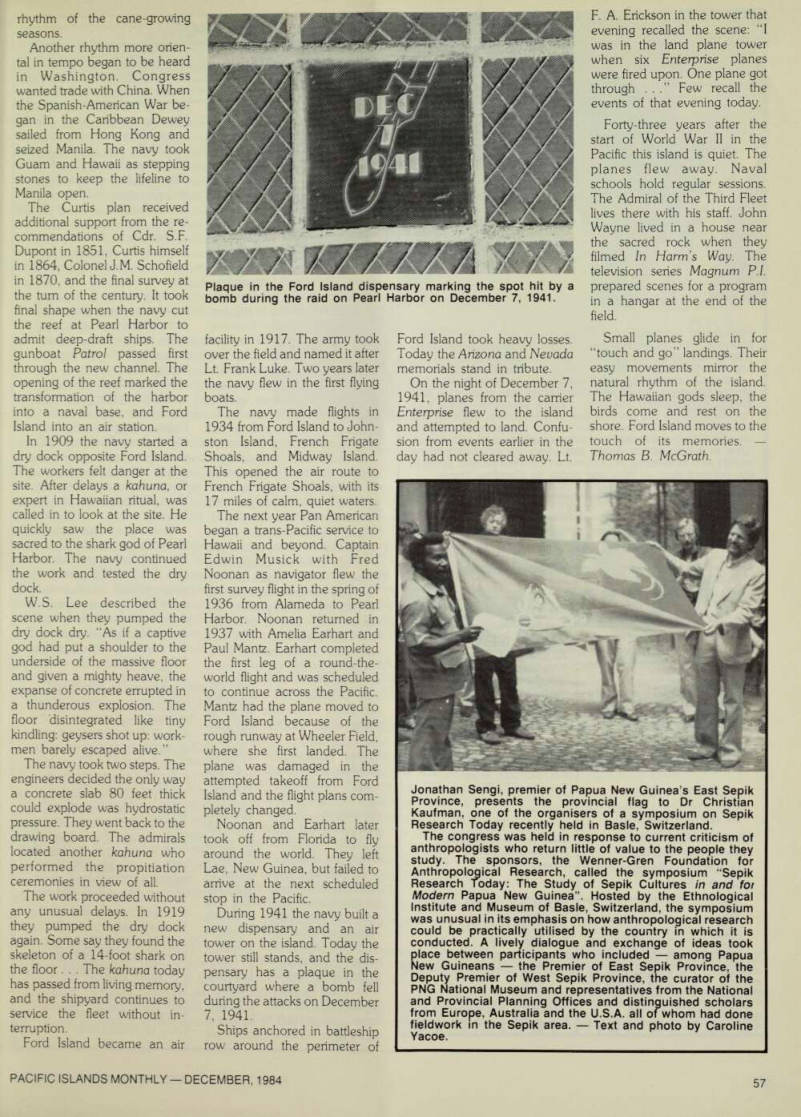
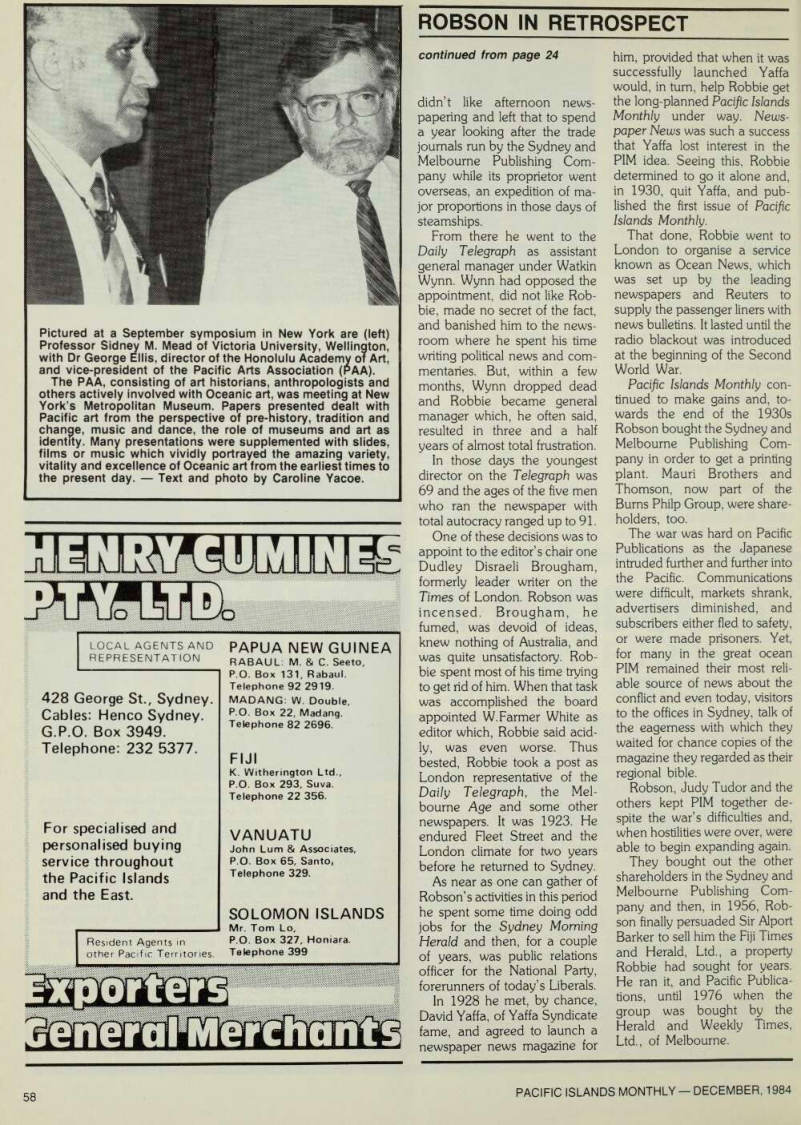
Ford Island
Fr THOMAS B. McGRATH, S.J., of Guam, writes of Pearl Harbor's Ford Island and its chequered history.
The touch of memory hovers over Ford Island. A stone sacred to the Hawaiians still stands at the shore. An aged banyan tree still casts its sha dow on a nearby grove. The flag over the Arizona still moves gently in the harbor breeze.
This stone bears the marks of the days when Pearl Harbor was an Hawaiian lake. Oysters grew in abundance. The pearls from their shells gave the har bor its name. Fish traps lined the channels to the sea, while smaller fish grew to size in ponds. A shark god made his home there, and birds flew in to rest on its shores.
The Hawaiians called the is land Moku’ume’ume. The ex act meaning may be lost. Some say the name means island of strife, others a place for trysts.
The chiefs summoned their
subjects to the island to enjoy themselves and the islanders continued to observe this cus tom until early in the 19th century.
In 1810 Kamehameha gave Don Francisco Paula de Marin use of the island as a reward for aiding him in unifying his king dom. Marin let goats and rab bits roam the fields. Lt. C.R.
Malden of the H.M.S. Blonde, on survey duty in the harbor during 1825, called it Rabbit Island. Other names were Marin Island and Goat Island.
The USS Constitution, Old Ironsides, reached the harbor in 1845. Marine Lt. I.W. Curtis cast his eye over the scene and reported “the perfect security of the harbor, the excellence of the water, the perfect ease with which it can be made one of the finest places in the islands”.
“A stone sacred to the Hawaiians still stands at the shore ..."
Everything pointed to a future naval base. Curtis drew up the plans and passed them up the chain of command to the admi rals of his day. In the next century other admirals read them, grasped Curtis’s vision, and carried it out to the letter.
In 1865 James I. Dorsett bought the island at public auction for $lO4O. He owned it for three months, and then sold it to a recently widowed woman with a tiny son. Dr Seth Porter Ford, Sr. a physician at the naval hospital in Honolulu, the father of the boy, died in 1866.
He left his wife Caroline and Seth, Jr., without support.
Dorsett left the island to the mother in trust for the boy.
Dr Ford had arrived from Boston aboard the R.B. Forbes in 1851 and took up his duties in Honolulu. During his second year he went out to inspect the Charles Mallory, which arrived from the west coast flying a yellow flag. He confirmed the suspicions of the harbor pilot
and the crew that smallpox was aboard. The city received the news with great alarm, while the medical community took what steps it could to ward off an epidemic. Ford was assigned to Kalihi Hospital. He served there and wherever needed during the crisis. After the dis ease subsided he continued to work without reserve in Hon olulu until his untimely death at the age of 48.
The Hawaiians, after his death, called the island, Poka Ailina. Poka may be derived from Ford’s middle name Por ter rather than from the usual meaning of “bullet” or “can nonball”. Ailina is a translitera tion from English into Hawaiian of the word island. Still others call it Ford Island, which is the name that survives today, In 1891 the son sold his island to C.A. Brown, owner of the Hawaiian Plantation. He grew sugar cane on it and kept a small plot of land for his home. Life flowed to the
Left: The landing tower, airfield, Ford Island.
rhythm of the cane-growing seasons.
Another rhythm more orien tal in tempo began to be heard in Washington. Congress wanted trade with China. When the Spanish-American War be gan in the Caribbean Dewey sailed from Hong Kong and seized Manila. The navy took Guam and Hawaii as stepping stones to keep the lifeline to Manila open.
The Curtis plan received additional support from the re commendations of Cdr. S.F.
Dupont in 1851, Curtis himself in 1864, Colonel J.M. Schofield in 1870, and the final survey at the turn of the century. It took final shape when the navy cut the reef at Pearl Harbor to admit deep-draft ships. The gunboat Patrol passed first through the new channel. The opening of the reef marked the transformation of the harbor into a naval base, and Ford Island into an air station.
In 1909 the navy started a dry dock opposite Ford Island.
The workers felt danger at the site. After delays a kahuna, or expert in Hawaiian ritual, was called in to look at the site. He quickly saw the place was sacred to the shark god of Pearl Harbor. The navy continued the work and tested the dry dock.
W.S. Lee described the scene when they pumped the dry dock dry. “As if a captive god had put a shoulder to the underside of the massive floor and given a mighty heave, the expanse of concrete errupted in a thunderous explosion. The floor disintegrated like tiny kindling; geysers shot up: work men barely escaped alive.”
The navy took two steps. The engineers decided the only way a concrete slab 80 feet thick could explode was hydrostatic pressure. They went back to the drawing board. The admirals located another kahuna who performed the propitiation ceremonies in view of all.
The work proceeded without any unusual delays. In 1919 they pumped the dry dock again. Some say they found the skeleton of a 14-foot shark on the floor . . . The kahuna today has passed from living memory, and the shipyard continues to service the fleet without in terruption.
Ford Island became an air
facility in 1917. The army took over the field and named it after Lt. Frank Luke. Two years later the navy flew in the first flying boats.
The navy made flights in 1934 from Ford Island to John ston Island, French Frigate Shoals, and Midway Island.
This opened the air route to French Frigate Shoals, with its 17 miles of calm, quiet waters.
The next year Pan American began a trans-Pacific service to Hawaii and beyond. Captain Edwin Musick with Fred Noonan as navigator flew the first survey flight in the spring of 1936 from Alameda to Pearl Harbor. Noonan returned in 1937 with Amelia Earhart and Paul Mantz. Earhart completed the first leg of a round-the world flight and was scheduled to continue across the Pacific.
Mantz had the plane moved to Ford Island because of the rough runway at Wheeler Field, where she first landed. The plane was damaged in the attempted takeoff from Ford Island and the flight plans com pletely changed.
Noonan and Earhart later took off from Florida to fly around the world. They left Lae, New Guinea, but failed to arrive at the next scheduled stop in the Pacific.
During 1941 the navy built a new dispensary and an air tower on the island. Today the tower still stands, and the dis pensary has a plaque in the courtyard where a bomb fell during the attacks on December 7, 1941.
Ships anchored in battleship row around the perimeter of
Ford Island took heavy losses.
Today the Arizona and Nevada memorials stand in tribute.
On the night of December 7, 1941, planes from the carrier Enterprise flew to the island and attempted to land. Confu sion from events earlier in the day had not cleared away. Lt.
F. A. Erickson in the tower that evening recalled the scene: “I was in the land plane tower when six Enterprise planes were fired upon. One plane got through ...” Few recall the events of that evening today.
Forty-three years after the start of World War II in the Pacific this island is quiet. The planes flew away. Naval schools hold regular sessions.
The Admiral of the Third Fleet lives there with his staff. John Wayne lived in a house near the sacred rock when they filmed In Harm’s IVay. The television series Magnum P.I. prepared scenes for a program in a hangar at the end of the field.
Small planes glide in for “touch and go” landings. Their easy movements mirror the natural rhythm of the island.
The Hawaiian gods sleep, the birds come and rest on the shore. Ford Island moves to the touch of its memories.
Thomas B. McGrath.
Plaque in the Ford Island dispensary marking the spot hit by a bomb during the raid on Pearl Harbor on December 7, 1941.
Jonathan Sengi, premier of Papua New Guinea’s East Sepik Province, presents the provincial flag to Dr Christian Kaufman, one of the organisers of a symposium on Sepik Research Today recently held in Basle, Switzerland.
The congress was held in response to current criticism of anthropologists who return little of value to the people they study. The sponsors, the Wenner-Gren Foundation for Anthropological Research, called the symposium “Sepik Research Today: The Study of Sepik Cultures in and for Modern Papua New Guinea Hosted by the Ethnological Institute and Museum of Basle, Switzerland, the symposium was unusual in its emphasis on how anthropological research could be practically utilised by the country in which it is conducted. A lively dialogue and exchange of ideas took Rlace between participants who included among Papua ew Guineans the Premier of East Sepik Province, the Deputy Premier of West Sepik Province, the curator of the PNG National Museum and representatives from the National and Provincial Planning Offices and distinguished scholars from Europe, Australia and the U.S.A. all of whom had done fieldwork in the Sepik area. Text and photo by Caroline Yacoe.
Pictured at a September symposium in New York are (left) Professor Sidney M. Mead of Victoria University, Wellington, with Dr George Ellis, director of the Honolulu Academy of Art, and vice-president of the Pacific Arts Association (PAA).
The PAA, consisting of art historians, anthropologists and others actively involved with Oceanic art, was meeting at New York’s Metropolitan Museum. Papers presented dealt with Pacific art from the perspective of pre-nistory, tradition and change, music and dance, the role of museums and art as identity. Many presentations were supplemented with slides, films or music which vividly portrayed the amazing variety, vitality and excellence of Oceanic art from the earliest times to the present day. Text and photo by Caroline Yacoe.
Advertisements & other items, pp. 56-58 (2 items)
Longlife Products
■ r
MtMIIIUf/
AND FRESH DAIRY FOODS,
QUALITY YOU CAN TRUST
QUF Industries Ltd. offers an export award winning range of Longlife products as well as a complete range of quality fresh dairy foods.
With 15 years' experience in export markets, QUF has the product knowledge and expertise to provide you with outstanding service in the 1980's. • Pauls Longlife UHT Milk is natural liquid cow's milk with no preservatives or additives and is available in the 250m1, 500 ml and 1 litre sizes. • Shake Longlife flavoured milk is offered in delicious Chocolate, Malted, Caramel and Strawberry flavours. • Pauls Longlife Thickened Cream is ideal for whipping or pouring. • Popper 100% Fruit Juice is available in seven flavours in a wide range of Longlife pack sizes. • Pauls fresh Dairy Products including Milk, Cream, Yoghurt and Cottage Cheese are available in an extensive range of flavours and sizes.
TRADE ENQUIRIES:
QUF Industries Ltd., P.O. Box 12, South Brisbane, Queensland, 4101 Australia Telephone: (07) 44-0151 Telex: AA 40614 LT 7) J (hKkinfd
NEW
M
miiK
mux
I LITRE
miiK
LOCAL AGENTS AND
REPRESENTATION
428 George St., Sydney.
Cables: Henco Sydney.
G.P.O. Box 3949.
Telephone: 232 5377.
For specialised and
personalised buying
service throughout
the Pacific Islands
and the East.
Resident Agents in other Pacific Territories.
PAPUA NEW GUINEA
RABAUL: M. & C. Seeto, P.O. Box 131, Rabaul.
Telephone 92 2919.
MADANG: W. Double, P.O. Box 22, Madang.
Telephone 82 2696.
FIJI
K. Witherington Ltd., P.O. Box 293, Suva.
Telephone 22 356.
VANUATU
John Lum & Associates, P.O. Box 65, Santo, Telephone 329.
SOLOMON ISLANDS
Mr. Tom Lo, P.O. Box 327, Honiara.
Telephone 399 I I 0
Robson In Retrospect
58
PACIFIC ISLANDS MONTHLY DECEMBER, 1984
continued from page 24
Pacific stamp box
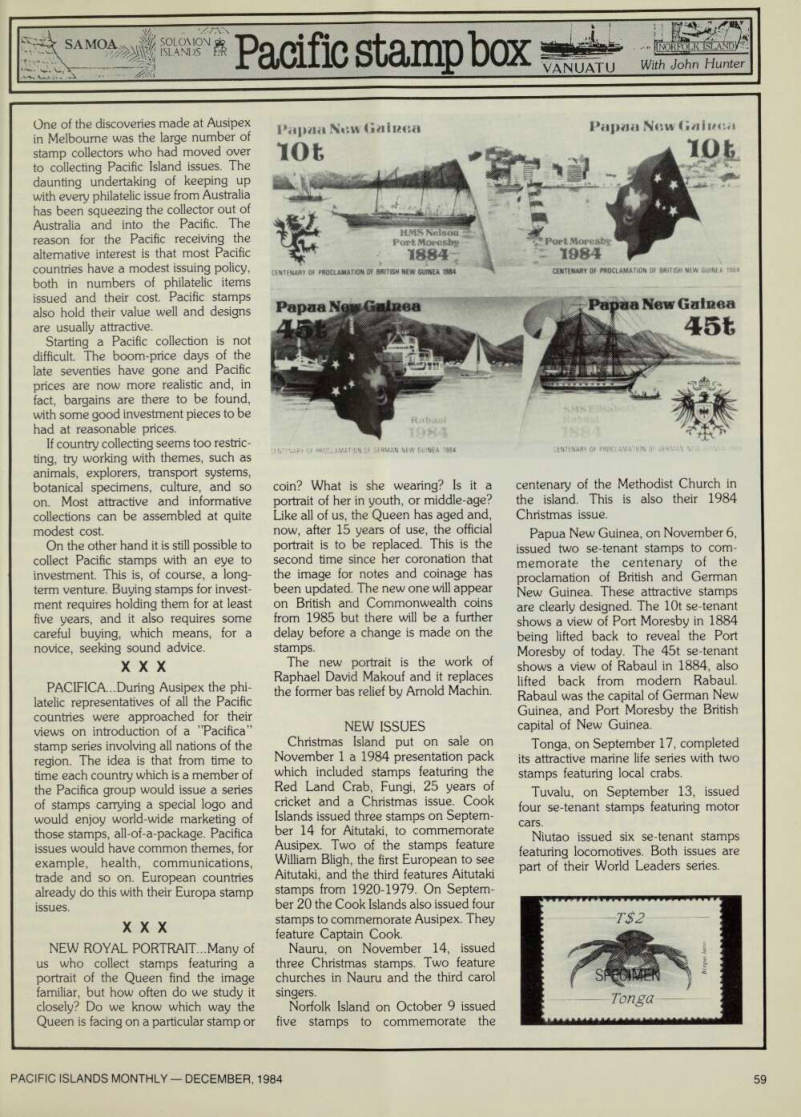
One of the discoveries made at Ausipex in Melbourne was the large number of stamp collectors who had moved over to collecting Pacific Island issues. The daunting undertaking of keeping up with every philatelic issue from Australia has been squeezing the collector out of Australia and into the Pacific. The reason for the Pacific receiving the alternative interest is that most Pacific countries have a modest issuing policy, both in numbers of philatelic items issued and their cost. Pacific stamps also hold their value well and designs are usually attractive.
Starting a Pacific collection is not difficult. The boom-price days of the late seventies have gone and Pacific prices are now more realistic and, in fact, bargains are there to be found, with some good investment pieces to be had at reasonable prices.
If country collecting seems too restric ting, try working with themes, such as animals, explorers, transport systems, botanical specimens, culture, and so on. Most attractive and informative collections can be assembled at quite modest cost.
On the other hand it is still possible to collect Pacific stamps with an eye to investment. This is, of course, a long term venture. Buying stamps for invest ment requires holding them for at least five years, and it also requires some careful buying, which means, for a novice, seeking sound advice.
Xxx
PACIFICA...During Ausipex the phi latelic representatives of all the Pacific countries were approached for their views on introduction of a ’’Pacifica” stamp series involving all nations of the region. The idea is that from time to time each country which is a member of the Pacifica group would issue a series of stamps carrying a special logo and would enjoy world-wide marketing of those stamps, all-of-a-package. Pacifica issues would have common themes, for example, health, communications, trade and so on. European countries already do this with their Europa stamp issues.
Xxx
New Royal Portrait...Many Of
us who collect stamps featuring a portrait of the Queen find the image familiar, but how often do we study it closely? Do we know which way the Queen is facing on a particular stamp or
coin? What is she wearing? Is it a portrait of her in youth, or middle-age?
Like all of us, the Queen has aged and, now, after 15 years of use, the official portrait is to be replaced. This is the second time since her coronation that the image for notes and coinage has been updated. The new one will appear on British and Commonwealth coins from 1985 but there will be a further delay before a change is made on the stamps.
The new portrait is the work of Raphael David Makouf and it replaces the former bas relief by Arnold Machin.
New Issues
Christmas Island put on sale on November 1 a 1984 presentation pack which included stamps featuring the Red Land Crab, Fungi, 25 years of cricket and a Christmas issue. Cook Islands issued three stamps on Septem ber 14 for Aitutaki, to commemorate Ausipex. Two of the stamps feature William Bligh, the first European to see Aitutaki, and the third features Aitutaki stamps from 1920-1979. On Septem ber 20 the Cook Islands also issued four stamps to commemorate Ausipex. They feature Captain Cook.
Nauru, on November 14, issued three Christmas stamps. Two feature churches in Nauru and the third carol singers.
Norfolk Island on October 9 issued five stamps to commemorate the
centenary of the Methodist Church in the island. This is also their 1984 Christmas issue.
Papua New Guinea, on November 6, issued two se-tenant stamps to com memorate the centenary of the proclamation of British and German New Guinea. These attractive stamps are clearly designed. The lOt se-tenant shows a view of Port Moresby in 1884 being lifted back to reveal the Port Moresby of today. The 45t se-tenant shows a view of Rabaul in 1884, also lifted back from modern Rabaul.
Rabaul was the capital of German New Guinea, and Port Moresby the British capital of New Guinea.
Tonga, on September 17, completed its attractive marine life series with two stamps featuring local crabs.
Tuvalu, on September 13, issued four se-tenant stamps featuring motor cars.
Niutao issued six se-tenant stamps featuring locomotives. Both issues are part of their World Leaders series.
A plague on both
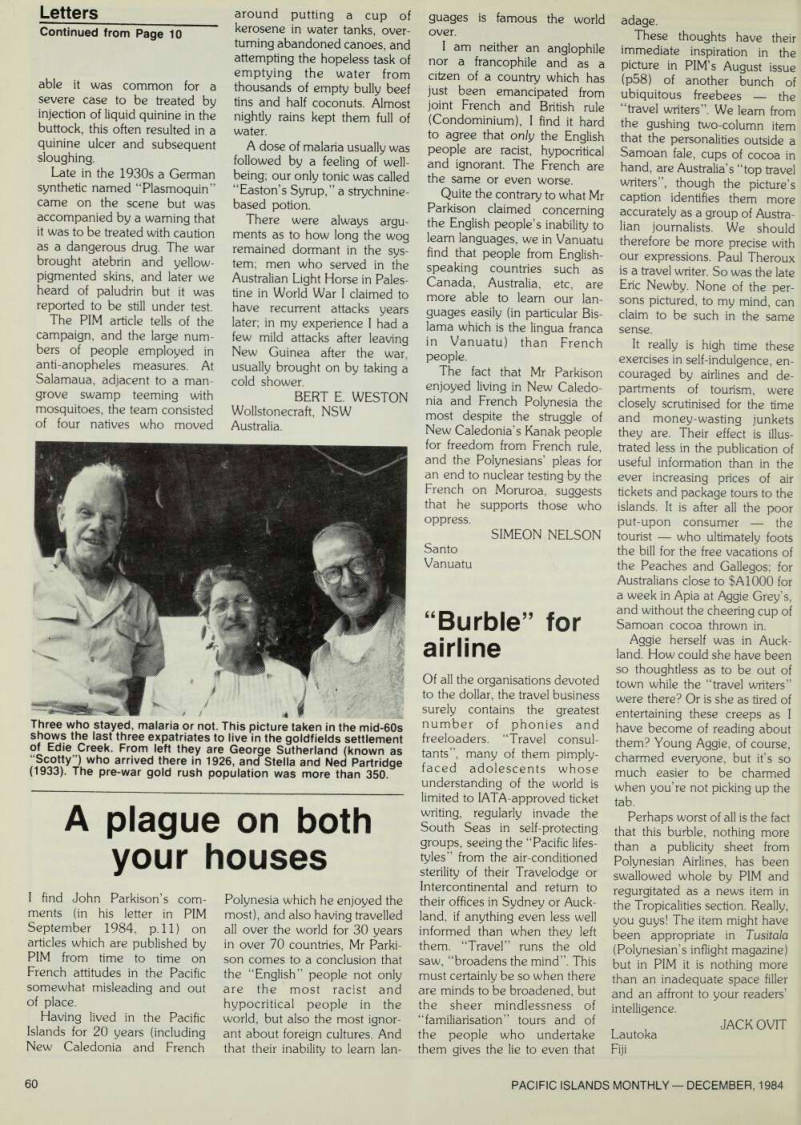
your houses
I find John Parkison’s com ments (in his letter in PIM September 1984, p.ll) on articles which are published by PIM from time to time on French attitudes in the Pacific somewhat misleading and out of place.
Having lived in the Pacific Islands for 20 years (including New Caledonia and French
Polynesia which he enjoyed the most), and also having travelled all over the world for 30 years in over 70 countries, Mr Parki son comes to a conclusion that the “English” people not only are the most racist and hypocritical people in the world, but also the most ignor ant about foreign cultures. And that their inability to learn lan
guages is famous the world over.
I am neither an anglophile nor a francophile and as a citzen of a country which has just been emancipated from joint French and British rule (Condominium), I find it hard to agree that only the English people are racist, hypocritical and ignorant. The French are the same or even worse.
Quite the contrary to what Mr Parkison claimed concerning the English people’s inability to learn languages, we in Vanuatu find that people from English speaking countries such as Canada, Australia, etc, are more able to learn our lan guages easily (in particular Bis lama which is the lingua franca in Vanuatu) than French people.
The fact that Mr Parkison enjoyed living in New Caledo nia and French Polynesia the most despite the struggle of New Caledonia’s Kanak people for freedom from French rule, and the Polynesians’ pleas for an end to nuclear testing by the French on Moruroa, suggests that he supports those who oppress.
Simeon Nelson
Santo Vanuatu
“Burble” for airline
airline
Of all the organisations devoted to the dollar, the travel business surely contains the greatest number of phonies and freeloaders. “Travel consul tants”, many of them pimply faced adolescents whose understanding of the world is limited to IATA-approved ticket writing, regularly invade the South Seas in self-protecting groups, seeing the “Pacific lifes tyles” from the air-conditioned sterility of their Travelodge or Intercontinental and return to their offices in Sydney or Auck land, if anything even less well informed than when they left them. “Travel” runs the old saw, “broadens the mind”. This must certainly be so when there are minds to be broadened, but the sheer mindlessness of “familiarisation” tours and of the people who undertake them gives the lie to even that
adage.
These thoughts have their immediate inspiration in the picture in PlM’s August issue (p5B) of another bunch of übiquitous freebees the “travel writers”. We learn from the gushing two-column item that the personalities outside a Samoan fale, cups of cocoa in hand, are Australia’s “top travel writers”, though the picture’s caption identifies them more accurately as a group of Austra lian journalists. We should therefore be more precise with our expressions. Paul Theroux is a travel writer. So was the late Eric Newby. None of the per sons pictured, to my mind, can claim to be such in the same sense.
It really is high time these exercises in self-indulgence, en couraged by airlines and de partments of tourism, were closely scrutinised for the time and money-wasting junkets they are. Their effect is illus trated less in the publication of useful information than in the ever increasing prices of air tickets and package tours to the islands. It is after all the poor put-upon consumer the tourist who ultimately foots the bill for the free vacations of the Peaches and Gallegos; for Australians close to SAIOOO for a week in Apia at Aggie Grey’s, and without the cheering cup of Samoan cocoa thrown in.
Aggie herself was in Auck land. How could she have been so thoughtless as to be out of town while the “travel writers” were there? Or is she as tired of entertaining these creeps as I have become of reading about them? Young Aggie, of course, charmed everyone, but it’s so much easier to be charmed when you’re not picking up the tab.
Perhaps worst of all is the fact that this burble, nothing more than a publicity sheet from Polynesian Airlines, has been swallowed whole by PIM and regurgitated as a news item in the Tropicalities section. Really, you guys! The item might have been appropriate in Tusitala (Polynesian’s inflight magazine) but in PIM it is nothing more than an inadequate space filler and an affront to your readers’ intelligence.
Lautoka Fiji
Jackovit
Advertisements & other items, p. 60 (1 item)
Letters
60
PACIFIC ISLANDS MONTHLY —DECEMBER, 1984
Letters Continued from Page 10
from the islands press
An advertisement in the Tonga Chronicle, Nukualofa A reward of $lOOO is offered to the person or persons who can give any information that will lead to the arrest and conviction of the person or persons who have stolen fuel from the Paradise International Hotel Airplane whilst stationed at Lupepau’u Airport, Vava’u.
A list in Tohi Tala Niue of VIPs expected to attend the island’s celebration of its 10th anniversary of self-government.
At the present moment, the organising committee are expecting at least 40 guests ranging from Prime Ministers, Sir Sirs, Presidents, a Governor-General, Naval ratings, sailors and the latest addition to New Zealand’s Navy, the HMNZS Southland to attend the celebrations.
From the Papua New Guinea Post-Courier, Port Moresby The Prime Minister, Mr Michael Somare, will be the guest of honor at a luncheon of the Adelaide Commonwealth Club and the International Institute of national affairs on September 27.
This follows the decision to retain Senior Inspector Buckley larume in Chimbu and make him a police station commander in Kundiawa.
From the Marshall Islands Journal, Majuro Here’s something to think about: a five gallon box of wine costs $2O to land in Majuro (five gallons equals about 125 glasses). Import tax is a whopping $75. Cost of glass of wine before tax is 16 cents, which means you gotta knock it up 500% to recover taxes, never mind making a profit. Beer is taxed at $2.68 per gallon, and soft drinks at $1.07/gal. I don’t know why the tax guys are so hard on wine especially since the Bible has so many nice things to say about the stuff.
We need cheaper wine to christen our boats.
From the From Around Town column in the Marshall Islands Journal, Majuro Majuro is kind of unique in the fact that we have no addresses or street names or numbers. Turn right at the hole in the road, past the second pandanus after the 17 mile marker, or; the next house after the Ajeltake school. You know the pink house across from Bigler’s on the lagoon side or some such good information. Trying to give someone directions first you have to know how long they have lived on the island. Everyone knows Mrs Bing’s Restaurant but try to tell a newcomer where it is, there’s no sign except for you know between 7°N and the Chinese bank.
An advertisement in the Vanuata Weekly, Port-Vila Auto-Musculation, a knowledge in the use of facial muscle to delay the aging process. Course on this subject is being prepared for Nov. 84.
From a letter by “An Ovserver, Port-Vila” in Vanuatu Weekly, Port-Vila Tourists coming to Vanuatu are mostly middle class people, i.e., average people with average incomes. Not the very rich types to squander at first sight or do fancy things like going “into the bush” etc., etc.
From the Papua New Guinea Post-Courier, Port Moresby A Papua New Guinean living in New Zealand has sent in a clipping from a Christchurch paper. The Page One article, headed “Fear forces NZ couple to flee PNG,” is mostly
accurate. But one sentence is a beauty. It says: But whites did not buy meat from the stalls at this market (presumably Koki) because one of the stalls had been caught selling human flesh.”
From Te Uekera, Bairiki, Kiribati The Kiribati Philatelic Bureau offers for sale by public sealed tender the following property; A; 16 foot Aluminium Boat Watermark II equipped with two Yamaha motors (85 hp and 9.9 hp), CB radio and trailer.
Prospective purchasers please note that a recent survey indicated: 1. There is a leak in the hull believed to be a crack in a seam right under the bolted floor board. 2. The 85 hp engine has been submerged twice in seawater and does not develop full power. 3. The 9.9 hp engine does not run.
From The Norfolk Islander DRUGS . . . Police are well aware that marijuana is being used on the island and that it is being grown. Police are continually being approached and asked why are they doing nothing about it. This is rubbish as Police are as concerned about the growth and use of Marijuana on the island as is any other sane thinking person. To say that it is in epidemic proportions is to stretch the point considerably. However, it is being used by a number of young people and adults.
A letter signed by Caysime Rato, University, in the Papua New Guinea Post-Courier, Port Moresby I was very annoyed to see three policeman picking up three girls about 6.15 p.m. on June 3 at Waigani bust stop.
They should not be riding around picking up girls. They should be enforcing law and order.
These street girls should be left alone for playboys and girlie girlies. The blue boys are not pleasing the public, but annoying us.
From the Pitcairn Miscellany School News; This month Tania Christian began school bringing the roll to 14 the highest it has been for many years. A big welcome to you Tania. The older children have been enjoying experimenting with leather work. Several highly tooled wallets and belts have been made and the standard has been very high for beginners.
From the Marianas Variety News & Views “Editor’s Desk”
Labor Day here was a complete flop, so far as I can tell. I need to ask the governor this week why we follow U.S. holidays so closely, instead of really celebrating some local occasion. Why not have an annual FISH DAY, when we could promote the eating of fish in the Commonwealth? We could honor the fishers of the sea, have a fishing derby, hold outrigger canoe races, even have a fish-throwing contest . . .
From Vanuatu Weekly, Port-Vila While the Director of Public Works says, work on the first Government road construction ever on Emau Island, is delayed by a breakdown involving the bulldozer, a report from the island says otherwise. The island report maintains that the breakdown is a deliberate act of sabotage by angry spirits who prefer their peace and solitude to the roaring bulldozer.
Advertisements & other items, p. 62 (1 item)
No Operator.
NO MICROPHONE.
NO CHANNEL SELECTION.
Introducing a major breakthrough, RACE* a new automated HF radio system with telephone interconnect.
RACE replaces the conventional radio- -1 i ( n s RACE system project engineer Michel Bedard operating from Tuvalu to Fiji. telephone microphone and loudspeaker with a simple telephone. DTMF or Dial. So now people living or working in remote areas can dial direct to any telephone in the country or around the world Without any operator assistance.
In addition to making the call easier, RACE also makes it clearer. RACE has Automatic Channel Evaluation that selects a clear radio frequency for each call. The result is a high-
quality radio-telephone circuit.
Yet, for all its quality, RACE has relatively low initial cost. And is further enhanced by the system being self-contained and not requiring circuit rental fees as in most expensive satellite communications systems.
The RACE terminal consists of the CHISOS HF/SSB synthesized solid-state transreceiver and the SE-151 microprocessor-based controller/interface unit. The SEISI is packaged in a plug-in card frame for easy maintenance.
To further reduce cost, RACE has been designed to work with an inexpensive broadband dipole antenna.
RACE. Now HF radio-telephone service for isolated communities is as easy as no operator, no microphone, no channel selection.
For further information contact:
AWA
■BiDB
■ A DIVISION OF AWA NEW ZEALAND LIMITED
AWA New Zealand Limited
PO Box 858, Suva, Fiji 47 Foster Road, Walu Bay Phone: 31 2744. Telex: FJ2347 Fax No. (679) 31 4379
people
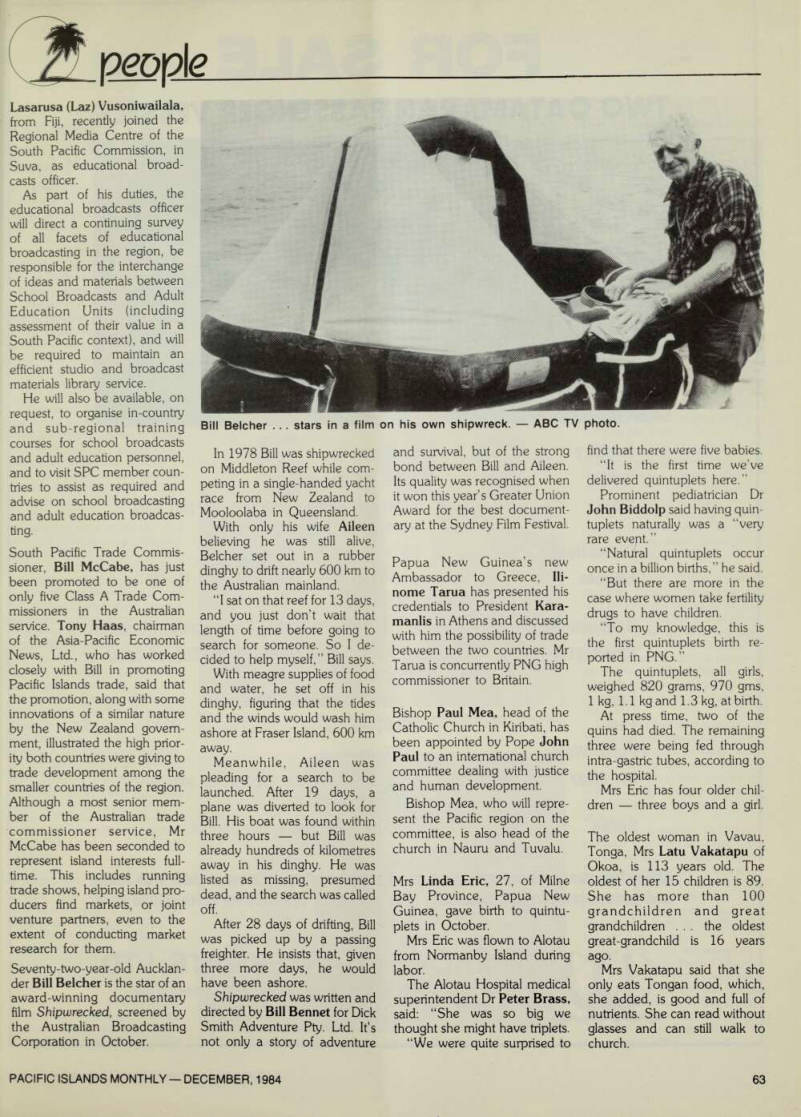
Lasarusa (Laz) Vusoniwailala, from Fiji, recently joined the Regional Media Centre of the South Pacific Commission, in Suva, as educational broad casts officer.
As part of his duties, the educational broadcasts officer will direct a continuing survey of all facets of educational broadcasting in the region, be responsible for the interchange of ideas and materials between School Broadcasts and Adult Education Units (including assessment of their value in a South Pacific context), and will be required to maintain an efficient studio and broadcast materials library service.
He will also be available, on request, to organise in-country and sub-regional training courses for school broadcasts and adult education personnel, and to visit SPC member coun tries to assist as required and advise on school broadcasting and adult education broadcas ting.
South Pacific Trade Commis sioner, Bill McCabe, has just been promoted to be one of only five Class A Trade Com missioners in the Australian service. Tony Haas, chairman of the Asia-Pacific Economic News, Ltd., who has worked closely with Bill in promoting Pacific Islands trade, said that the promotion, along with some innovations of a similar nature by the New Zealand govern ment, illustrated the high prior ity both countries were giving to trade development among the smaller countries of the region.
Although a most senior mem ber of the Australian trade commissioner service, Mr McCabe has been seconded to represent island interests full time. This includes running trade shows, helping island pro ducers find markets, or joint venture partners, even to the extent of conducting market research for them.
Seventy-two-year-old Aucklan der Bill Belcher is the star of an award-winning documentary film Shipwrecked, screened by the Australian Broadcasting Corporation in October.
In 1978 Bill was shipwrecked on Middleton Reef while com peting in a single-handed yacht race from New Zealand to Mooloolaba in Queensland.
With only his wife Aileen believing he was still alive, Belcher set out in a rubber dinghy to drift nearly 600 km to the Australian mainland.
“I sat on that reef for 13 days, and you just don’t wait that length of time before going to search for someone. So I de cided to help myself,” Bill says.
With meagre supplies of food and water, he set off in his dinghy, figuring that the tides and the winds would wash him ashore at Fraser Island, 600 km away.
Meanwhile, Aileen was pleading for a search to be launched. After 19 days, a plane was diverted to look for Bill. His boat was found within three hours but Bill was already hundreds of kilometres away in his dinghy. He was listed as missing, presumed dead, and the search was called off.
After 28 days of drifting, Bill was picked up by a passing freighter. He insists that, given three more days, he would have been ashore.
Shipwrecked was written and directed by Bill Bennet for Dick Smith Adventure Pty. Ltd. It’s not only a story of adventure
and survival, but of the strong bond between Bill and Aileen.
Its quality was recognised when it won this year’s Greater Union Award for the best document ary at the Sydney Film Festival.
Papua New Guinea’s new Ambassador to Greece, Ili nome Tarua has presented his credentials to President Kara manlis in Athens and discussed with him the possibility of trade between the two countries. Mr Tarua is concurrently PNG high commissioner to Britain.
Bishop Paul Mea, head of the Catholic Church in Kiribati, has been appointed by Pope John Paul to an international church committee dealing with justice and human development.
Bishop Mea, who will repre sent the Pacific region on the committee, is also head of the church in Nauru and Tuvalu.
Mrs Linda Eric, 27, of Milne Bay Province, Papua New Guinea, gave birth to quintu plets in October.
Mrs Eric was flown to Alotau from Normanby Island during labor.
The Alotau Hospital medical superintendent Dr Peter Brass, said: “She was so big we thought she might have triplets.
“We were quite surprised to
find that there were five babies.
“It is the first time we’ve delivered quintuplets here.”
Prominent pediatrician Dr John Biddolp said having quin tuplets naturally was a “very rare event.”
“Natural quintuplets occur once in a billion births,” he said.
“But there are more in the case where women take fertility drugs to have children.
“To my knowledge, this is the first quintuplets birth re ported in PNG.”
The quintuplets, all girls, weighed 820 grams, 970 gms, 1 kg, 1.1 kg and 1.3 kg, at birth.
At press time, two of the quins had died. The remaining three were being fed through intra-gastric tubes, according to the hospital.
Mrs Eric has four older chil dren three boys and a girl.
The oldest woman in Vavau, Tonga, Mrs Latu Vakatapu of Okoa, is 113 years old. The oldest of her 15 children is 89.
She has more than 100 grandchildren and great grandchildren ... the oldest great-grandchild is 16 years ago.
Mrs Vakatapu said that she only eats Tongan food, which, she added, is good and full of nutrients. She can read without glasses and can still walk to church.
Bill Belcher ... stars in a film on his own shipwreck. ABC TV photo.
Advertisements & other items, p. 64 (1 item)
For Sale
TWO CATAMARAN PASSENGER VESSELS
"v;■ mm % V. m Above two vessels have very good sea-keeping ability. In view of their high speed and passenger-carrying capacity, they are ideal vehicles for inter-island runs. d©
OFFSHORE CHARTERS PTE. LTD.
140 ROBINSON ROAD, #O4-04 CHOW HOUSE, SINGAPORE 0106.
TEL: 2222696, 2239144 TELEX: RS 26599 "OFSHOR"
Yachts
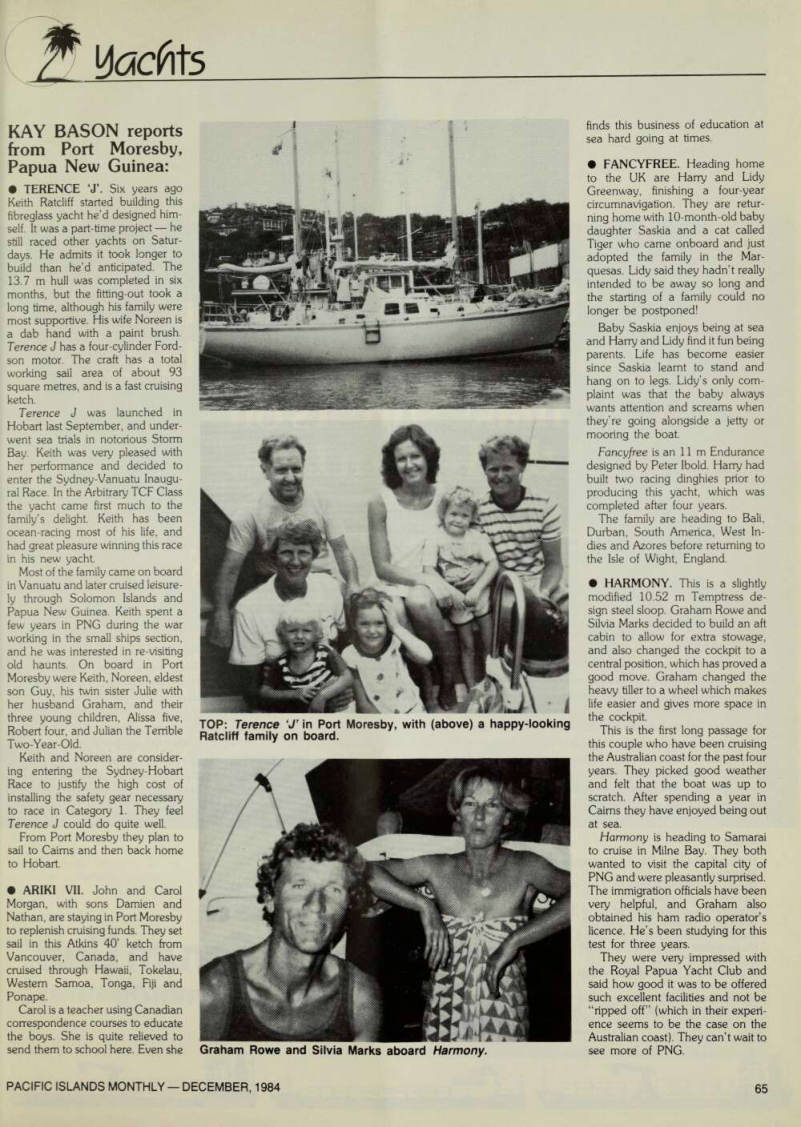
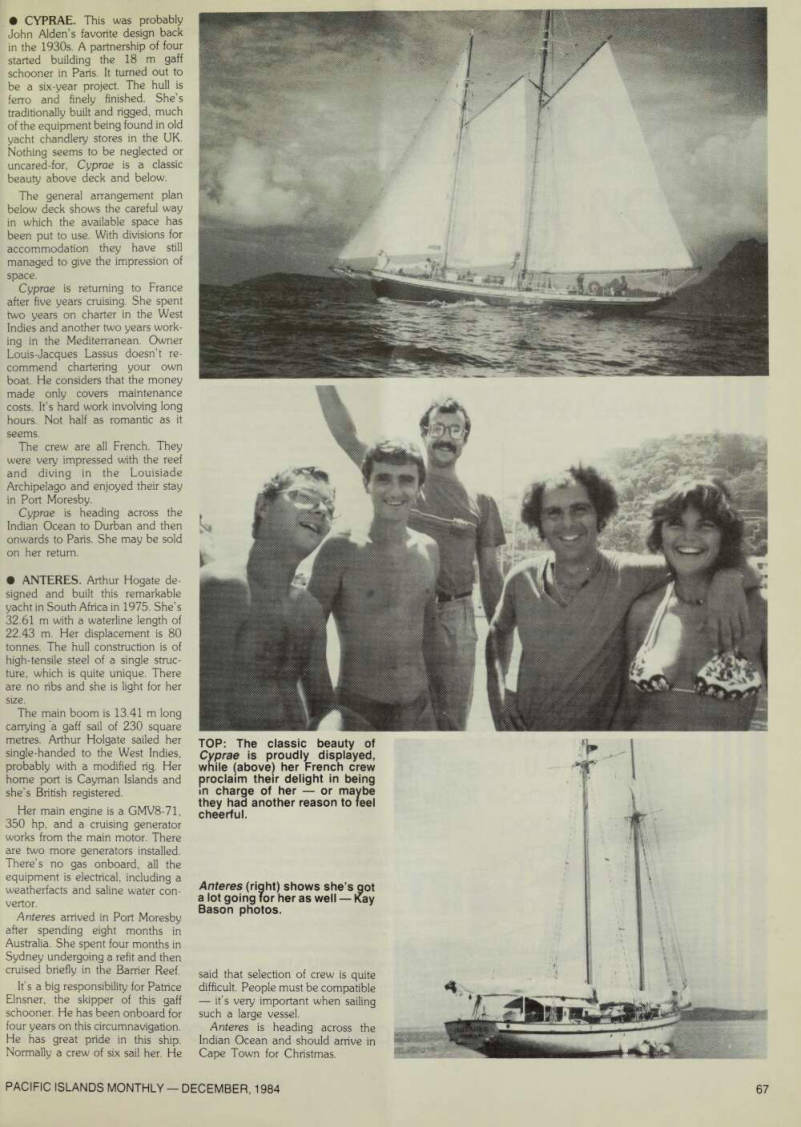
KAY BASON reports
from Port Moresby,
Papua New Guinea:
• TERENCE ‘J’. Six years ago Keith Ratcliff started building this fibreglass yacht he’d designed him self. It was a part-time project — he still raced other yachts on Satur days. He admits it took longer to build than he’d anticipated. The 13.7 m hull was completed in six months, but the fitting-out took a long time, although his family were most supportive. His wife Noreen is a dab hand with a paint brush.
Terence J has a four-cylinder Ford son motor. The craft has a total working sail area of about 93 square metres, and is a fast cruising ketch.
Terence J was launched in Hobart last September, and under went sea trials in notorious Storm Bay. Keith was very pleased with her performance and decided to enter the Sydney-Vanuatu Inaugu ral Race. In the Arbitrary TCF Class the yacht came first much to the family’s delight. Keith has been ocean-racing most of his life, and had great pleasure winning this race in his new yacht.
Most of the family came on board in Vanuatu and later cruised leisure ly through Solomon Islands and Papua New Guinea. Keith spent a few years in PNG during the war working in the small ships section, and he was interested in re-visiting old haunts. On board in Port Moresby were Keith, Noreen, eldest son Guy, his twin sister Julie with her husband Graham, and their three young children, Alissa five, Robert four, and Julian the Terrible Two-Year-Old.
Keith and Noreen are consider ing entering the Sydney-Hobart Race to justify the high cost of installing the safety gear necessary to race in Category 1. They feel Terence J could do quite well.
From Port Moresby they plan to sail to Caims and then back home to Hobart. • ARIKI VII. John and Carol Morgan, with sons Damien and Nathan, are staying in Port Moresby to replenish cruising funds. They set sail in this Atkins 40’ ketch from Vancouver, Canada, and have cruised through Hawaii, Tokelau, Western Samoa, Tonga, Fiji and Ponape.
Carol is a teacher using Canadian correspondence courses to educate the boys. She is quite relieved to send them to school here. Even she
finds this business of education at sea hard going at times. • FANCYFREE. Heading home to the UK are Harry and Lidy Greenway, finishing a four-year circumnavigation. They are retur ning home with 10-month-old baby daughter Saskia and a cat called Tiger who came onboard and just adopted the family in the Mar quesas. Lidy said they hadn’t really intended to be away so long and the starting of a family could no longer be postponed!
Baby Saskia enjoys being at sea and Harry and Lidy find it fun being parents. Life has become easier since Saskia learnt to stand and hang on to legs. Lidy’s only com plaint was that the baby always wants attention and screams when they’re going alongside a jetty or mooring the boat.
Fancyfree is an 11 m Endurance designed by Peter Ibold. Harry had built two racing dinghies prior to producing this yacht, which was completed after four years.
The family are heading to Bali, Durban, South America, West In dies and Azores before returning to the Isle of Wight, England. • HARMONY. This is a slightly modified 10.52 m Temptress de sign steel sloop. Graham Rowe and Silvia Marks decided to build an aft cabin to allow for extra stowage, and also changed the cockpit to a central position, which has proved a good move. Graham changed the heavy tiller to a wheel which makes life easier and gives more space in the cockpit.
This is the first long passage for this couple who have been cruising the Australian coast for the past four years. They picked good weather and felt that the boat was up to scratch. After spending a year in Caims they have enjoyed being out at sea.
Harmony is heading to Samarai to cruise in Milne Bay. They both wanted to visit the capital city of PNG and were pleasantly surprised.
The immigration officials have been very helpful, and Graham also obtained his ham radio operator’s licence. He’s been studying for this test for three years.
They were very impressed with the Royal Papua Yacht Club and said how good it was to be offered such excellent facilities and not be “ripped off” (which in their experi ence seems to be the case on the Australian coast). They can’t wait to see more of PNG.
TOP: Terence ‘J’ in Port Moresby, with (above) a happy-looking Ratcliff family on board.
Graham Rowe and Silvia Marks aboard Harmony.
• CYPRAE. This was probably John Alden’s favorite design back in the 19305. A partnership of four started building the 18 m gaff schooner in Paris. It turned out to be a six-year project. The hull is ferro and finely finished. She’s traditionally built and rigged, much of the equipment being found in old yacht chandlery stores in the UK.
Nothing seems to be neglected or uncared-for, Cyprae is a classic beauty above deck and below.
The general arrangement plan below deck shows the careful way in which the available space has been put to use. With divisions for accommodation they have still managed to give the impression of space.
Cyprae is returning to France after five years cruising. She spent two years on charter in the West Indies and another two years work ing in the Mediterranean. Owner Louis-Jacques Lassus doesn’t re commend chartering your own boat. He considers that the money made only covers maintenance costs. It’s hard work involving long hours. Not half as romantic as it seems.
The crew are all French. They were very impressed with the reef and diving in the Louisiade Archipelago and enjoyed their stay in Port Moresby.
Cyprae is heading across the Indian Ocean to Durban and then onwards to Paris. She may be sold on her return. • ANTERES. Arthur Hogate de signed and built this remarkable yacht in South Africa in 1975. She’s 32.61 m with a waterline length of 22.43 m. Her displacement is 80 tonnes. The hull construction is of high-tensile steel of a single struc ture, which is quite unique. There are no ribs and she is light for her size.
The main boom is 13.41 m long carrying a gaff sail of 230 square metres. Arthur Holgate sailed her single-handed to the West Indies, probably with a modified rig. Her home port is Cayman Islands and she’s British registered.
Her main engine is a GMVB-71, 350 hp, and a cruising generator works from the main motor. There are two more generators installed.
There’s no gas onboard, all the equipment is electrical, including a weatherfacts and saline water con vertor.
Anteres arrived in Port Moresby after spending eight months in Australia. She spent four months in Sydney undergoing a refit and then cruised briefly in the Barrier Reef.
It’s a big responsibility for Patrice Elnsner, the skipper of this gaff schooner. He has been onboard for four years on this circumnavigation.
He has great pride in this ship.
Normally a crew of six sail her. He
said that selection of crew is quite difficult. People must be compatible it’s very important when sailing such a large vessel.
Anteres is heading across the Indian Ocean and should arrive in Cape Town for Christmas.
TOP: The classic beauty of Cyprae is proudly displayed, while (above) her French crew proclaim their delight in being in charge of her or maybe they had another reason to feel cheerful.
Anteres (right) shows she’s got a lot going for her as well Kay Bason photos.
Advertisements & other items, pp. 66-68 (1 item)
exportedis on the line,
rr-*"i A • •» i w •% • %S»W • *Ai - . • * f . - .; v itij if
% ZJw *«• e on rr ♦ 1 ■ - ■
“The Professionals.
At Pacific Forum Line we offer the professional shipping service to the South Pacific. And that means your reputation for reliability is in professional hands. We offer efficient containerisation to more ports, more often, with fast turnaround. With our knowledge of the Pacific, we can even help you develop export markets. So if you’re shipping to the South Pacific, protect your reputation with
the professionals.
Pacific Forum Line operates three self-sustaining vessels - “Fua Kavenga” servicing Sydney, Noumea, Lautoka, Suva, Apia, Pago Pago and Nukualofa.
“Forum New Zealand” servicing Auckland, Vila, Honiara, Lae, Port Moresby, Brisbane, Lyttelton and Napier.
“Forum Samoa” servicing Auckland, Lautoka, Suva, Apia, Pago Pago and Nukualofa.
Note: MOANA RAOI’
operates a monthly feeder service from Fiji to Tuvalu and Kiribati.
AGENTS
Union Bulkships Pty Ltd, Sydney, Brisbane and Melbourne Union Maritime Services Ltd, Auckland, Tonga, Lautoka and Suva Shipping Corporation of New Zealand Ltd, Auckland, Napier and Lyttelton Pacific Forum Line Agencies Ltd, Apia Polynesian Shipping Services Inc, Pago Pago 5.A.T.0., Noumea Steamships Trading Company Ltd, Lae and Port Moresby Sullivans Ltd, Honiara Vila Agents Ltd, Vila
Pacific Forum Line
The South Pacific Shipping
FORUM LINE
A
BANK LINE and
COLUMBUS LINE
24 day service to
Europe.
Need we say more...
The Joint Service Partners offer facilities for shipment of: Containers (FCL/LCL) and Break-bulk Cargo plus reefer space and deeptanks for carriage of vegetable oils and other liquid bulk cargo Carriers also accept heavy lifts, overlength and cumbersome parcels.
Please contact our regional offices for further information: The Bank Line (Australasia) Pty Ltd Columbus Line Reederei GmbH Suite 801, 51 Pitt St, P.O. Box 1 667, Lae/Papua New Guinea.
Sydney, NSW, Australia 2000 Phone: 423466/423487/A.H. 422481 Phone 27 2041 Telex 24063 Telex: Colline NE 441 71 The South Pacific Specialists for over 75 years D G Ports of Service: Loading: Papeete, Apia, Suva, Lautoka, Noumea, Port Vila, Santo, Honiara, Port Moresby, Lae, Madang, Kimbe, Rabaul, Kieta, Darwin. For: Rotterdam, Antwerp, Hamburg, Hull, Dunkirk, Le Havre.
Additional ports on enquiry.
shipping schedules
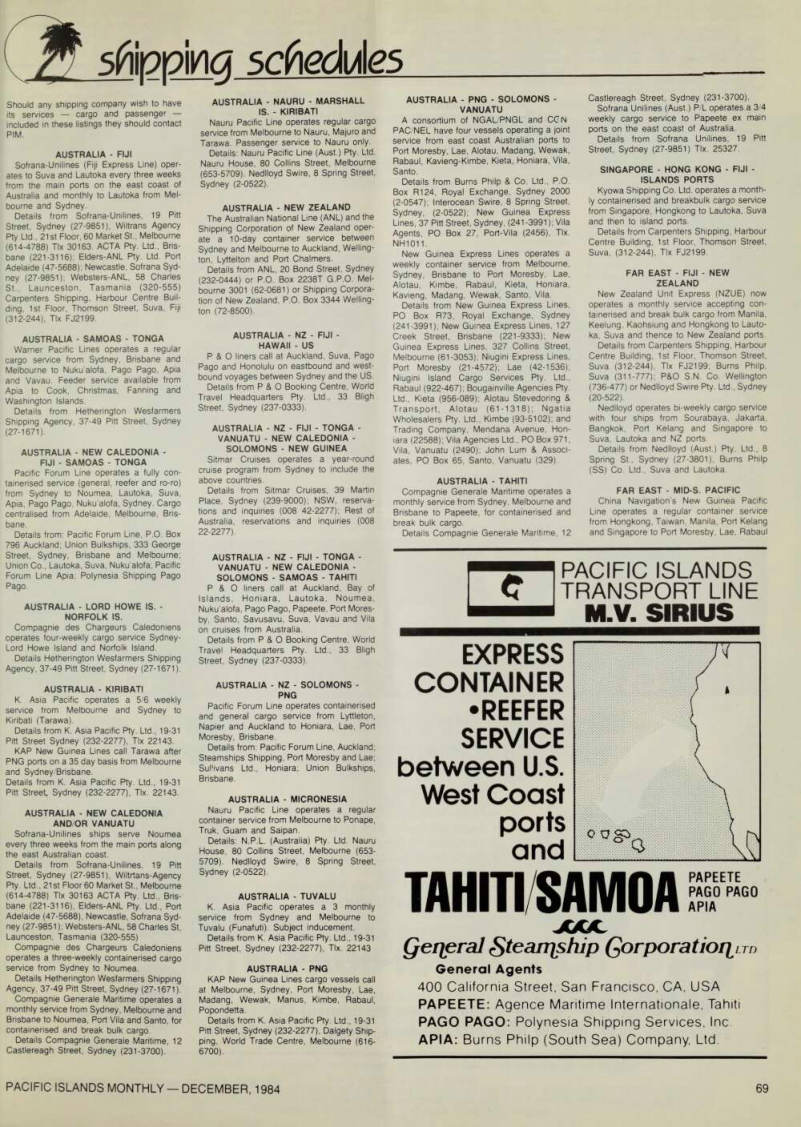

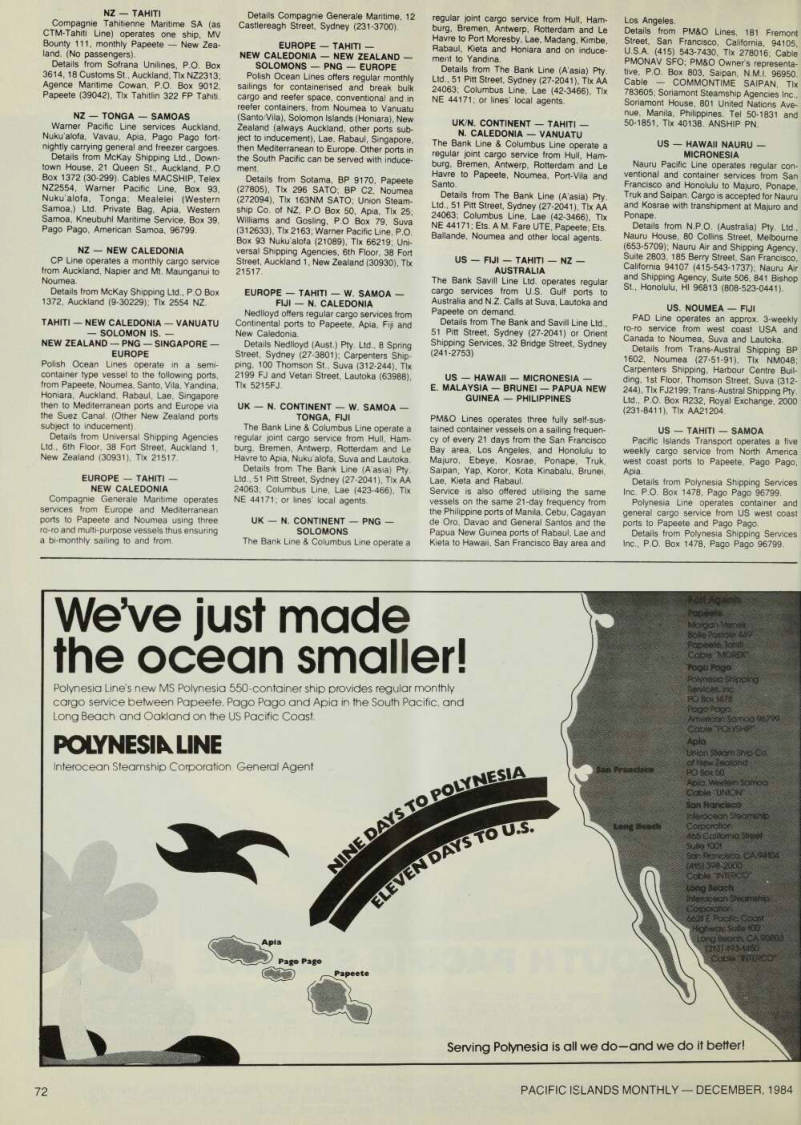
Should any shipping company wish to have its services cargo and passenger included in these listings they should contact
Pim.
Australia - Fiji
Sofrana-Unilines (Fiji Express Line) oper ates to Suva and Lautoka every three weeks from the main ports on the east coast of Australia and monthly to Lautoka from Mel bourne and Sydney.
Details from Sofrana-Unilines, 19 Pitt Street, Sydney (27-9851), Wiltrans Agency Pty Ltd,, 21st Floor, 60 Market St., Melbourne (614-4788) Tlx 30163. ACTA Pty. Ltd., Bris bane (221-3116); Elders-ANL Pty. Ltd. Port Adelaide (47-5688): Newcastle, Sofrana Syd ney (27-9851); Websters-ANL, 58 Charles St., Launceston, Tasmania (320-555) Carpenters Shipping, Harbour Centre Buil ding, Ist Floor, Thomson Street, Suva, Fiji (312-244), Tlx FJ2199.
Australia - Samoas - Tonga
Warner Pacific Lines operates a regular cargo service from Sydney, Brisbane and Melbourne to Nukualofa, Pago Pago, Apia and Vavau. Feeder service available from Apia to Cook, Christmas, Fanning and Washington Islands.
Details from Hetherington Wesfarmers Shipping Agency, 37-49 Pitt Street, Sydney (27-1671).
Australia - New Caledonia -
Fiji - Samoas - Tonga
Pacific Forum Line operates a fully con tainerised service (general, reefer and ro-ro) from Sydney to Noumea, Lautoka, Suva, Apia, Pago Pago, Nukualofa, Sydney. Cargo centralised from Adelaide, Melbourne, Bris bane.
Details from: Pacific Forum Line, P.O. Box 796 Auckland; Union Bulkships, 333 George Street, Sydney, Brisbane and Melbourne; Union Co., Lautoka, Suva, Nukualofa; Pacific Forum Line Apia; Polynesia Shipping Pago Pago.
Australia - Lord Howe Is. -
Norfolk Is.
Compagnie des Chargeurs Caledonians operates four-weekly cargo service Sydney- Lord Howe Island and Norfolk Island.
Details Hetherington Wesfarmers Shipping Agency, 37-49 Pitt Street, Sydney (27-1671).
Australia - Kiribati
K. Asia Pacific operates a 5/6 weekly service from Melbourne and Sydney to Kiribati (Tarawa).
Details from K. Asia Pacific Pty. Ltd., 19-31 Pitt Street Sydney (232-2277), Tlx 22143.
KAP New Guinea Lines call Tarawa after PNG ports on a 35 day basis from Melbourne
and Sydney/Brisbane.
Details from K. Asia Pacific Pty. Ltd., 19-31 Pitt Street Sydney (232-2277), Tlx. 22143.
Australia - New Caledonia
And/Or Vanuatu
Sofrana-Unilines ships serve Noumea every three weeks from the main ports along the east Australian coast.
Details from Sofrana-Unilines, 19 Pitt Street, Sydney (27-9851), Wiltrtans-Agency Pty. Ltd., 21st Floor 60 Market St., Melbourne (614-4788) Tlx 30163 ACTA Pty. Ltd., Bris bane (221-3116), Elders-ANL Pty, Ltd,, Port Adelaide (47-5688), Newcastle, Sofrana Syd ney (27-9851); Websters-ANL, 58 Charles St, Launceston, Tasmania (320-555) Compagnie des Chargeurs Caledoniens operates a three-weekly containerised cargo service from Sydney to Noumea.
Details Hetherington Wesfarmers Shipping Agency, 37-49 Pitt Street, Sydney (27-1671).
Compagnie Generale Maritime operates a monthly service from Sydney, Melbourne and Brisbane to Noumea, Port Vila and Santo, for containerised and break bulk cargo.
Details Compagnie Generale Maritime, 12 Castlereagh Street, Sydney (231-3700).
Australia - Nauru - Marshall
Is. - Kiribati
Nauru Pacific Line operates regular cargo service from Melbourne to Nauru, Majuro and Tarawa. Passenger service to Nauru only.
Details: Nauru Pacific Line (Aust.) Pty. Ltd.
Nauru House, 80 Collins Street, Melbourne (653-5709). Nedlloyd Swire, 8 Spring Street, Sydney (2-0522).
Australia - New Zealand
The Australian National Line (ANL) and the Shipping Corporation of New Zealand oper ate a 10-day container service between Sydney and Melbourne to Auckland, Welling ton, Lyttelton and Port Chalmers.
Details from ANL, 20 Bond Street, Sydney (232-0444) or P.O, Box 2238 T G.P.O. Mel bourne 3001 (62-0681) or Shipping Corpora tion of New Zealand, P.O. Box 3344 Welling ton (72-8500).
Australia - Nz - Fiji -
Hawaii - Us
P&O liners call at Auckland, Suva, Pago Pago and Honolulu on eastbound and west bound voyages between Sydney and the US.
Details from P&O Booking Centre, World Travel Headquarters Pty. Ltd., 33 Bligh Street, Sydney (237-0333).
AUSTRALIA - NZ - FIJI - TONGA -
Vanuatu - New Caledonia -
Solomons - New Guinea
Sitmar Cruises operates a year-round cruise program from Sydney to include the above countries.
Details from Sitmar Cruises, 39 Martin Place, Sydney (239-9000); NSW, reserva tions and inquiries (008 42-2277); Rest of Australia, reservations and inquiries (008 22-2277).
AUSTRALIA - NZ - FIJI - TONGA -
Vanuatu - New Caledonia -
Solomons - Samoas - Tahiti
P&O liners call at Auckland, Bay of Islands, Honiara, Lautoka, Noumea, Nukualofa, Pago Pago, Papeete, Port Mores by, Santo, Savusavu, Suva, Vavau and Vila on cruises from Australia.
Details from P&O Booking Centre, World Travel Headquarters Pty. Ltd., 33 Bligh Street, Sydney (237-0333).
Australia - Nz - Solomons -
Png
Pacific Forum Line operates containerised and general cargo service from Lyttleton, Napier and Auckland to Honiara, Lae, Port Moresby, Brisbane.
Details from: Pacific Forum Line, Auckland; Steamships Shipping, Port Moresby and Lae; Sul'ivans Ltd., Honiara; Union Bulkships, Brisbane.
Australia - Micronesia
Nauru Pacific Line operates a regular container service from Melbourne to Ponape, Truk, Guam and Saipan.
Details: N.P.L. (Australia) Pty. Ltd. Nauru House, 80 Collins Street, Melbourne (653- 5709). Nedlloyd Swire, 8 Spring Street,
Sydney (2-0522).
Australia - Tuvalu
K. Asia Pacific operates a 3 monthly service from Sydney and Melbourne to Tuvalu (Funafuti). Subject inducement.
Details from K. Asia Pacific Pty. Ltd., 19-31 Pitt Street, Sydney (232-2277), Tlx. 22143
Australia - Png
KAP New Guinea Lines cargo vessels call at Melbourne, Sydney, Port Moresby, Lae, Madang, Wewak, Manus, Kimbe, Rabaul, Popondetta.
Details from K. Asia Pacific Pty. Ltd., 19-31 Pitt Street, Sydney (232-2277), Dalgety Ship ping, World Trade Centre, Melbourne (616- 6700).
Australia - Png - Solomons -
Vanuatu
A consortium of NGAL/PNGL and CGN PAC/NEL have four vessels operating a joint service from east coast Australian ports to Port Moresby, Lae, Alotau, Madang, Wewak, Rabaul, Kavieng-Kimbe, Kieta, Honiara, Vila, Santo.
Details from Burns Philp & Co. Ltd., P.O.
Box R 124, Royal Exchange, Sydney 2000 (2-0547); Interocean Swire, 8 Spring Street, Sydney, (2-0522); New Guinea Express Lines, 37 Pitt Street, Sydney, (241-3991); Vila Agents, PO Box 27, Port-Vila (2456), Tlx.
Nhioii.
New Guinea Express Lines operates a weekly container service from Melbourne, Sydney, Brisbane to Port Moresby, Lae, Alotau, Kimbe, Rabaul, Kieta, Honiara, Kavieng, Madang, Wewak, Santo, Vila.
Details from New Guinea Express Lines, PO Box R 73, Royal Exchange, Sydney (241-3991); New Guinea Express Lines, 127 Creek Street, Brisbane (221-9333); New Guinea Express Lines, 327 Collins Street, Melbourne (61-3053); Niugini Express Lines, Port Moresby (21-4572); Lae (42-1536); Niugini Island Cargo Services Pty. Ltd., Rabaul (922-467); Bougainville Agencies Pty.
Ltd., Kieta (956-089); Alotau Stevedoring & Transport, Alotau (61-1318); Ngatia Wholesalers Pty. Ltd., Kimbe (93-5102); and Trading Company, Mendana Avenue, Hon iara (22588); Vila Agencies Ltd., PO Box 971, Vila, Vanuatu (2490); John Lum & Associ ates, PO Box 65, Santo, Vanuatu (329).
Australia - Tahiti
Compagnie Generale Maritime operates a monthly service from Sydney, Melbourne and Brisbane to Papeete, for containerised and break bulk cargo.
Details Compagnie Generale Maritime, 12
Castlereagh Street, Sydney (231-3700).
Sofrana Unilines (Aust.) P/L operates a 3/4 weekly cargo service to Papeete ex main ports on the east coast of Australia.
Details from Sofrana Unilines, 19 Pitt Street, Sydney (27-9851) Tlx. 25327, SINGAPORE - HONG KONG - FIJI -
Islands Ports
Kyowa Shipping Co. Ltd. operates a month ly containerised and breakbulk cargo service from Singapore, Hongkong to Lautoka, Suva and then to island ports.
Details from Carpenters Shipping, Harbour Centre Building. Ist Floor, Thomson Street, Suva, (312-244), Tlx FJ2199.
Far East - Fiji - New
Zealand
New Zealand Unit Express (NZUE) now operates a monthly service accepting con tainerised and break bulk cargo from Manila, Keelung, Kaohsiung and Hongkong to Lauto ka, Suva and thence to New Zealand ports.
Details from Carpenters Shipping, Harbour Centre Building, Ist Floor, Thomson Street, Suva (312-244), Tlx FJ2199; Burns Philp, Suva (311-777); P&O S.N. Co. Wellington (736-477) or Nedlloyd Swire Pty. Ltd., Sydney (20-522).
Nedlloyd operates bi-weekly cargo service with four ships from Sourabaya, Jakarta, Bangkok, Port Kelang and Singapore to Suva, Lautoka and NZ ports.
Details from Nedlloyd (Aust.) Pty. Ltd., 8 Spring St., Sydney (27-3801), Burns Philp (SS) Co. Ltd., Suva and Lautoka.
Far East - Mid-S. Pacific
China Navigation's New Guinea Pacific Line operates a regular container service from Hongkong, Taiwan, Manila, Port Kelang and Singapore to Port Moresby, Lae, Rabaul
and Honiara monthly and to Wewak, Madang and Kieta every three months. Cargo from the same Far Eastern ports to the South Pacific ports of Noumea, Santo, Vila, Papeete, Pago Pago, Apia, Raratonga and Tarawa will be shipped via Japan on the monthly Bali Hai service.
Details from Steamships Trading Co. Ltd., PO Box 634, Port Moresby (22-0289).
Kyowa Shipping Ltd. operates monthly services from Japan to Guam, Saipan, Solo mons, New Caledonia, Fiji, Western and American Samoa, Tahiti, Cook Is., Tonga and Vanuatu.
Details: Hetherington Wesfarmers Shipping Agency, 37-49 Pitt Street, Sydney (27-1671); Carpenters Shipping, Suva (312-244), Tlx FJ2199.
Guam - Northern Marianas
Saipan Shipping Co. Inc. operate a weekly service via barge carrying containers and conventional cargo between Guam and Saipan and Tinian.
Details from Saipan Shipping Co. Inc., PO Box 8, Saipan, CM 96950 (Tel. 9707), Tlx 783619; Guam agents Maritime Agencies of the Pacific Ltd.
Hawaii - Tahiti - Samoas -
Tonga - Kiribati - Fiji -
Solomons - Png.
Star Shipping Associates operates a monthly service originating in Honolulu and destined for Pago Pago, Papeete, Apia, Nukualofa, Suva, Vila and Port Moresby.
Details from Star Shipping Assoc., P.O.
Box 25988, Honolulu, Hawaii 96825. Ph. (808) 545-3026; Polynesia Shipping Services in Pago Pago and Burns Philp Agency in Apia. Nukualofa, Suva and Port Moresby.
Japan Fiji Island Ports
Kyowa Shipping Co. Ltd. operates a month ly service from main ports of Japan to Suva and Lautoka and thence to island ports.
Details from Carpenters Shipping, Harbour Centre Building, Ist Floor, Thomson St., Suva (312-244), Tlx FJ2199.
Japan Fiji Island Ports
Bali Hai service operates a monthly service from main ports of Japan to Lautoka and Suva and thence to island ports.
Details from Carpenters Shipping, Harbour Centre Building, Ist Floor, Thomson St., Suva (312-244), Tlx FJ2199 and Burns Philp, Suva (311-777).
Japan Micronesia
The NYK Shipping Line operates a monthly cargo service from Japan to Micronesia, calling at Yoko, Nagoya, Kobe, Guam, Saipan, Truk, Ponape and Majuro, returning via Yoko, Nagoya and Kobe.
Details from Burns Philp & Co. Ltd., 51 Pitt Street. Sydney (2-0547).
Japan Micronesia
Saipan Shipping Co. Inc. operates a monthly service from Japan to Saipan, Guam, Truk, Ponape, Majuro (Kosrae and Ebeye on inducement).
Details from Saipan Shipping Co. Inc., P.O.
Box 8, Saipan, CM 96950 (Tel. 9707), Tlx 783619; Japan agents Kyowa Shipping Com pany Ltd; Guam Agents Maritime Agencies of the Pacific Ltd.
Japan Png
Mitsui O.S.K. Lines operates a monthly service from main ports Japan and Port Moresby, Rabaul, Lae, Madang, Kieta and Kimbe.
Details from Robert Laurie (PNG) Pty. Ltd., P.O. Box 922, Port Moresby (21-2466/21- 1898).
New Caledonia Fiji West
Coast North America
PAD Line operates an approx. 3-weekly ro-ro service from Noumea and Suva to Honolulu and West Coast USA and Canadian ports.
Details from Sofrana-Unilines SA, BP 1602, Noumea (27-51-91), Tlx NMO4B; Carpenters Shipping, Harbour Centre Building, Ist Floor, Thomson St., Suva (312-244), Tlx FJ2199.
Png Inter Mainport
Papua New Guinea Line offers scheduled 10-20 day coastal liner services linking all PNG major ports with containerisation, reefer, heavy lift and transhipment facilities.
Details from PNG Line, Box 543, Port Moresby, PNG (21-1174), Tlx 22269.
Png Uk/Continent
The Bank Line & Columbus Line operate a regular joint service from Port Moresby, Oro Bay, Kieta, Rabaul, Kimbe, Madang and Lae to Hull, Hamburg, Rotterdam, Antwerp and Le Havre.
Details from The Bank Line (A’asia) Pty.
Ltd., 51 Pitt Street, Sydney (27-2041); Tlx AA24063; Columbus Line, Lae (423466), Tlx NE 44171; or lines’ local agents.
Solomons Uk/Continent
The Bank Line & Columbus Line operate a regular joint cargo service from Honiara to Hull, Hamburg, Rotterdam, Antwerp and Le Havre.
Details from The Bank Line (A’asia) Pty.
Ltd., 51 Pitt Street, Sydney (27-2041); Tlx AA24063; Columbus Line, Lae (423466), Tlx NE 44171; or the lines’ local agents.
New Zealand Vanuatu
Solomon Islands Papua New
Guinea Australia
Pacific Forum Line operates a 28 day cycle container shipping service from New Zealand direct to Vila, then on to Honiara, Lae, Port Moresby, Brisbane, back to Lyttelton, Napier and Auckland.
Details from Pacific Forum Line, P.O. Box 796, Auckland (790-050), Tlx 60460; P.O.
Box 971, Vila, Vanuatu (2490), Tlx 1044.
Nz Cook Is. Niue Tahiti
Shipping Corporation of NZ Ltd. operates cargo services based on pallets and similar units from Auckland to Niue, Cook Islands and Tahiti.
Details from the Shipping Corp. of NZ Ltd., P.O. Box 3344, Wellington (72-8500); Waterfront Commission, P.O. Box 61, Raro
tonga; Cook Islands; Niue Govt. Offices, Niue Island Compagnie Maritime Polynesienne, BP 368, Papeete, Tahiti.
Nz Fiji
Reef operates a regular 18-day service from Auckland to Suva and Lautoka. Also passenger accommodation.
Details from Reef Shipping Agencies, P.O.
Box 3382, Auckland, NZ (77-1221-3), Tlx 60633; M.V. Fijian Shipping Agencies Ltd., Private Bag, Suva, Fiji (31-1056).
Pacific Line with one ship operates three weekly ro-ro cargo service New Zealand.
Lautoka, Suva. No passengers.
Details; Sofrana Unilines, 18 Customs Street, Auckland (773-279) P.O. Box 3614, Tlx NZ2313; Carpenters Shipping, 100 Thom son Street, Suva (312-244), Tlx FJ2199.
Nz Fiji North America (Wc)
Blue Star Line Ltd. Pacific Coast container services. Only direct service to and from New Zealand. Blue Star vessels call at Suva and Honolulu on NZ-US-West Coast voyages.
Details from Blueport ACT (NZ) Ltd., P.O.
Box 192, Wellington (739-029). Burns Philp (SS) Co. Ltd., GPO Box 355, Suva, Fiji (311-777), Tlx FJ2168 Burship.
Nz Fiji Samoas Tonga
Pacific Forum Line operates a fully con tainerised three-weekly service (Gen/Reefer) from Auckland to Lautoka, Suva, Apia, Pago Pago and Nukualofa.
Details from Pacific Forum Line, Auckland; Union Co. Auckland, Lautoka, Suva and Nukualofa; Pacific Forum Line, Apia; Polyne sian Shipping, Pago Pago.
Nz N. Caledonia Vanuatu
Png Solomons
Sofrana Unilines with three ships operate to Vila and Santo, to Honiara and Papua New Guinea and to Norfolk Island and Noumea (No passengers).
Details from Sofrana Unilines, 18 Customs Street, Auckland (773-279), P.O. Box 3614, Tlx NZ2313.
Nz Tahiti
Compagnie Tahitienne Maritime SA (as CTM-Tahiti Line) operates one ship, MV Bounty 111, monthly Papeete New Zea land. (No passengers).
Details from Sofrana Unilines, P.O. Box 3614,18 Customs St., Auckland, Tlx NZ2313; Agence Maritime Cowan, P.O. Box 9012, Papeete (39042), Tlx Tahitlin 322 FP Tahiti.
Nz Tonga Samoas
Warner Pacific Line services Auckland, Nukualofa, Vavau, Apia, Pago Pago fort nightly carrying general and freezer cargoes.
Details from McKay Shipping Ltd., Down town House, 21 Queen St., Auckland, P.O Box 1372 (30-299). Cables MACSHIP, Telex NZ2554, Warner Pacific Line, Box 93, Nukualofa, Tonga; Mealelei (Western Samoa,) Ltd. Private Bag, Apia, Western Samoa, Kneubuhl Maritime Service, Box 39, Pago Pago, American Samoa. 96799.
Nz New Caledonia
CP Line operates a monthly cargo service from Auckland, Napier and Mt. Maunganui to Noumea.
Details from McKay Shipping Ltd., P.O Box 1372, Auckland (9-30229); Tlx 2554 NZ.
Tahiti New Caledonia Vanuatu
Solomon Is.
New Zealand - Png Singapore
Europe
Polish Ocean Lines operate in a semi container type vessel to the following ports, from Papeete, Noumea, Santo, Vila, Yandina, Honiara, Auckland, Rabaul, Lae, Singapore then to Mediterranean ports and Europe via the Suez Canal. (Other New Zealand ports subject to inducement).
Details from Universal Shipping Agencies Ltd., 6th Floor, 38 Fort Street, Auckland 1.
New Zealand (30931), Tlx 21517.
Europe Tahiti
New Caledonia
Compagnie Generate Maritime operates services from Europe and Mediterranean ports to Papeete and Noumea using three ro-ro and multi-purpose vessels thus ensuring a bi-monthly sailing to and from.
Details Compagnie Generate Maritime, 12
Castlereagh Street, Sydney (231-3700).
Europe Tahiti
New Caledonia New Zealand
Solomons Png Europe
Polish Ocean Lines offers regular monthly sailings for containerised and break bulk cargo and reefer space, conventional and in reefer containers, from Noumea to Vanuatu (Santo/Vila), Solomon Islands (Honiara), New Zealand (always Auckland, other ports sub ject to inducement), Lae, Rabaul, Singapore, then Mediterranean to Europe. Other ports in the South Pacific can be served with induce ment.
Details from Sotama, BP 9170, Papeete (27805), Tlx 296 SATO; BP C 2, Noumea (272094), Tlx 163 NM SATO; Union Steam ship Co. of NZ, P.O Box 50. Apia, Tlx 25; Williams and Gosling, P.O Box 79, Suva (312633), Tlx 2163; Warner Pacific Line, P.O.
Box 93 Nukualofa (21089), Tlx 66219; Uni versal Shipping Agencies, 6th Floor, 38 Fort Street, Auckland 1, New Zealand (30930), Tlx 21517.
Europe Tahiti W. Samoa
Fiji N. Caledonia
Nedlloyd offers regular cargo services from Continental ports to Papeete. Apia, Fiji and New Caledonia.
Details Nedlloyd (Aust.) Pty. Ltd., 8 Spring Street, Sydney (27-3801); Carpenters Ship ping, 100 Thomson St.. Suva (312-244), Tlx 2199 FJ and Vetari Street, Lautoka (63988), Tlx 5215FJ.
Uk N. Continent W. Samoa
Tonga, Fiji
The Bank Line & Columbus Line operate a regular joint cargo service from Hull, Ham burg, Bremen, Antwerp, Rotterdam and Le Havre to Apia, Nukualofa, Suva and Lautoka.
Details from The Bank Line (A'asia) Pty.
Ltd., 51 Pitt Street, Sydney (27-2041). Tlx AA 24063; Columbus Line, Lae (423-466), Tlx NE 44171; or lines' local agents.
Uk N. Continent Png
Solomons
The Bank Line & Columbus Line operate a
regular joint cargo service from Hull, Ham burg, Bremen, Antwerp, Rotterdam and Le Havre to Port Moresby, Lae, Madang, Kimbe, Rabaul, Kieta and Honiara and on induce ment to Vandina.
Details from The Bank Line (A'asia) Pty.
Ltd., 51 Pitt Street, Sydney (27-2041). Tlx AA 24063; Columbus Line, Lae (42-3466), Tlx NE 44171; or lines' local agents.
Uk/N. Continent Tahiti
N. Caledonia Vanuatu
The Bank Line & Columbus Line operate a regular joint cargo service from Hull, Ham burg, Bremen, Antwerp, Rotterdam and Le Havre to Papeete, Noumea, Porl-Vila and Santo.
Details from The Bank Line (A’asia) Pty.
Ltd., 51 Pitt Street, Sydney (27-2041), Tlx AA 24063; Columbus Line, Lae (42-3466), Tlx NE 44171; Ets. A M. Fare UTE, Papeete; Ets.
Ballande, Noumea and other local agents.
Us Fiji Tahiti Nz
Australia
The Bank Savill Line Ltd. operates regular cargo services from U.S. Gulf ports to Australia and N.Z. Calls at Suva, Lautoka and Papeete on demand.
Details from The Bank and Savill Line Ltd., 51 Pitt Street, Sydney (27-2041) or Orient Shipping Services, 32 Bridge Street, Sydney (241-2753)
Us Hawaii Micronesia
E. Malaysia Brunei Papua New
Guinea Philippines
PM&O Lines operates three fully self-sus tained container vessels on a sailing frequen cy of every 21 days from the San Francisco Bay area, Los Angeles, and Honolulu to Majuro, Ebeye, Kosrae, Ponape, Truk, Saipan, Yap, Koror, Kota Kinabalu, Brunei, Lae, Kieta and Rabaul.
Service is also offered utilising the same vessels on the same 21-day frequency from the Philippine ports of Manila, Cebu, Cagayan de Oro, Davao and General Santos and the Papua New Guinea ports of Rabaul, Lae and Kieta to Hawaii, San Francisco Bay area and
Los Angeles.
Details from PM&O Lines, 181 Fremont Street, San Francisco, California, 94105 U.S.A. (415) 543-7430, Tlx 278016; Cable PMONAV SFO; PM&O Owner’s representa tive, P.O. Box 803, Saipan, N.M.I. 96950.
Cable Commontime Saipan, Tlx
783605; Soriamont Steamship Agencies Inc., Soriamont House, 801 United Nations Ave nue, Manila, Philippines. Tel 50-1831 and
50-1851, Tlx 40138. Anship Pn.
Us Hawaii Nauru
Micronesia
Nauru Pacific Line operates regular con ventional and container services from San Francisco and Honolulu to Majuro, Ponape, Truk and Saipan. Cargo is accepted for Nauru and Kosrae with transhipment at Majuro and Ponape.
Details from N.P.O. (Australia) Pty. Ltd., Nauru House, 80 Collins Street, Melbourne (653-5709); Nauru Air and Shipping Agency, Suite 2803, 185 Berry Street, San Francisco, California 94107 (415-543-1737); Nauru Air and Shipping Agency, Suite 506, 841 Bishop St., Honolulu, HI 96813 (808-523-0441).
Us. Noumea Fiji
PAD Line operates an approx. 3-weekly ro-ro service from west coast USA and Canada to Noumea, Suva and Lautoka.
Details from Trans-Austral Shipping BP 1602, Noumea (27-51-91), Tlx NMO4B; Carpenters Shipping, Harbour Centre Buil ding, Ist Floor, Thomson Street, Suva (312- 244), Tlx FJ2199; Trans-Austral Shipping Pty.
Ltd., P.O. Box R 232, Royal Exchange, 2000 (231-8411). Tlx AA21204.
Us Tahiti Samoa
Pacific Islands Transport operates a five weekly cargo service from North America west coast ports to Papeete, Pago Pago, Apia.
Details from Polynesia Shipping Services Inc. P.O. Box 1478, Pago Pago 96799.
Polynesia Line operates container and general cargo service from US west coast ports to Papeete and Pago Pago.
Details from Polynesia Shipping Services Inc., P.O. Box 1478, Pago Pago 96799.
Advertisements & other items, pp. 69-72 (1 item)
Tammsamoa ~~
PACIFIC ISLANDS
TRANSPORT LINE
M.V. SIRIUS
TAMmSAMOA
XX
Qeqeral Steanjship (Corporation, m
General Agents 400 California Street, San Francisco, CA, USA PAPEETE: Agence Maritime Internationale, Tahiti PAGO PAGO; Polynesia Shipping Services, Inc.
APIA: Burns Philp (South Sea) Company, Ltd.
ACIFIC
CONSTRUCTION EQUIPMENT CO
Introducing the Dynamic New Range el
vibrating S Pneumatic Tyred Rollers
THE RANGE
• Pacific Self-Propelled Vibrating Rollers • Single and Double Drum Types • 1.5 tonne to 16 tonne • Pacific Self-Propelled Pneumatic Type Compactors • 3 Models 16. 21. 38 tonne Ballast Weights • Pacific Landfill and Sanitary Landfill Compactors • Pacific Pneumatic Earth Borers • Pacific Road Brooms • Pacific Railway Maintenance Vehicles Construction Equipment Co.
DISTRIBUTORS REQUIRED
THROUGHOUT THE PACIFIC
SAL
tl-LiTSSE 24 Salisbury Road, Hornsby NSW 2077, Australia. Phone (02) 476 2666
POLISH OCEAN LINES
General Management, 10 Lutego 24,81-364 GDYNIA, POLAND, Phone: 20-19-01, Cables. POLOCEAN Telex. OJ4-231 P © * I % m vw. i •Vft - SB
VIS-'V
sft
P
SOUTH PACIFIC SERVICE I!
We offer monthly service to and from: GDYNIA, HAMBURG, ROTTERDAM, MIDDLESBOROUGH/IMMINGHAM, ANTWERP, DUNKIRK, ROUEN, PAPEETE (via PANAMA), NOUMEA, AUCKLAND, HONIARA, RABAUL, LAE, SINGAPORE, by our multipurpose vessels carrying dry and reefer containers, reefer chambers, heavy lifts, breakbulk or palletized, bulk liquids.
POLISH OCEAN LINES Representatives AUCKLAND T.B.A. Telex 21517 NZ “UNISHIP”. SYDNEY Mr Walenciak Telex 20428 AA “SLEIGH”
T4UITI POLISH OCEAN LINES Agents
SOTAMA Telex 296 FP “COUTIMEX”. NEW CALEDONIA SATO Telex 163 NM “SATO”. AUCKLAND UNIVERSAL SHIPPING AGENCIES LTD., Telex 21517 NZ “UNISHIP”. SOLOMONS MELAN CHINE SHIPPING CO., LTD Telex 66335 HO “SYMECO". PNG STEAMSHIPS TRADING CO., LTD Telex 42423 NE “STEAM”.
We’ve just made
the ocean smaller!
Polynesia Line's new MS Polynesia 550-container ship provides regular monthly cargo service between Papeete, Pago Pago and Apia in the South Pacific, and Long Beach and Oakland on the US Pacific Coast.
POLYNESIA LINE
Interocean Steamship Corporation General Agent
HESIA
ST I V 9 u 5* v V Apia Pago Pago Papeete * MoigorvV^nex V ■ SNppmo Page
IrSS
96799 ■ . Union - |( f •: - ■ Long Prra tit San ■ 90803 CQ- Mi Serving Polynesia is all we do—and we do it better!
deaths
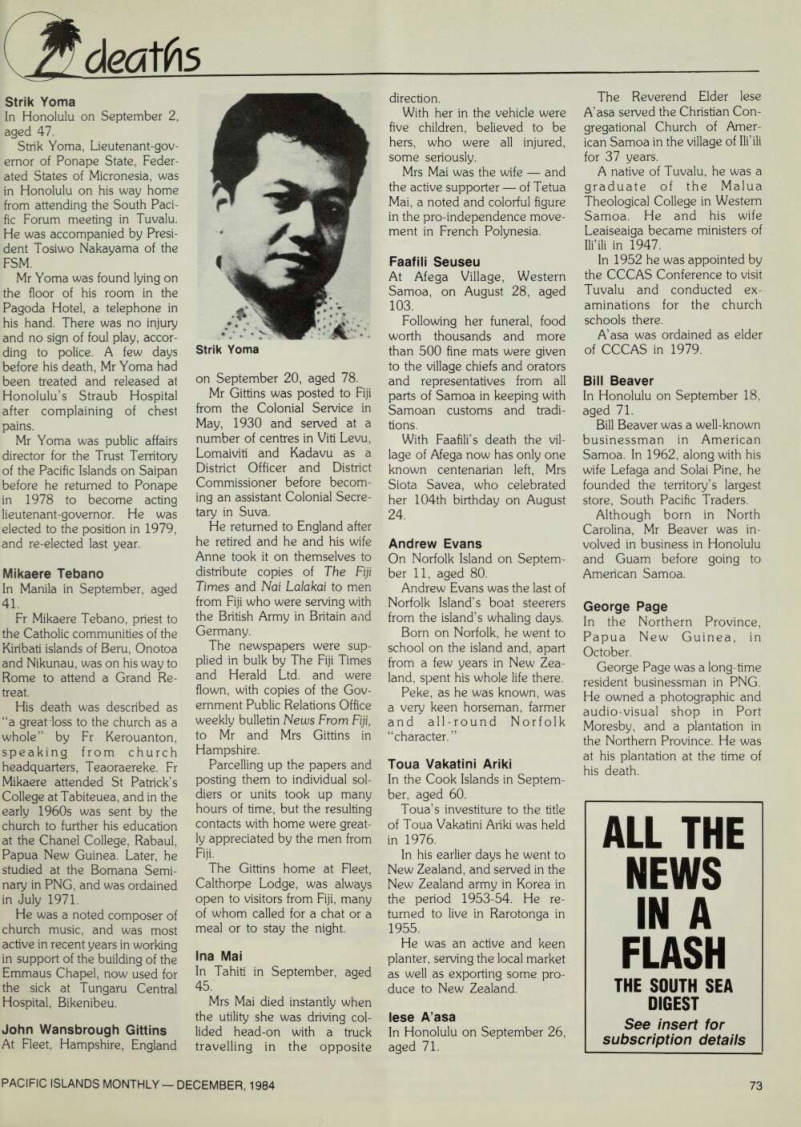
Strik Yoma In Honolulu on September 2, aged 47.
Strik Yoma, Lieutenant-gov ernor of Ponape State, Feder ated States of Micronesia, was in Honolulu on his way home from attending the South Paci fic Forum meeting in Tuvalu.
He was accompanied by Presi dent Tosiwo Nakayama of the
Fsm.
Mr Yoma was found lying on the floor of his room in the Pagoda Hotel, a telephone in his hand. There was no injury and no sign of foul play, accor ding to police. A few days before his death, Mr Yoma had been treated and released at Honolulu’s Straub Hospital after complaining of chest pains.
Mr Yoma was public affairs director for the Trust Territory of the Pacific Islands on Saipan before he returned to Ponape in 1978 to become acting lieutenant-governor. He was elected to the position in 1979, and re-elected last year.
Mikaere Tebano In Manila in September, aged 41.
Fr Mikaere Tebano, priest to the Catholic communities of the Kiribati islands of Bern, Onotoa and Nikunau, was on his way to Rome to attend a Grand Re treat.
His death was described as “a great loss to the church as a whole” by Fr Kerouanton, speaking from church headquarters, Teaoraereke. Fr Mikaere attended St Patrick’s College at Tabiteuea, and in the early 1960 s was sent by the church to further his education at the Chanel College, Rabaul, Papua New Guinea. Later, he studied at the Bomana Semi nary in PNG, and was ordained in July 1971.
He was a noted composer of church music, and was most active in recent years in working in support of the building of the Emmaus Chapel, now used for the sick at Tungaru Central Hospital, Bikenibeu.
John Wansbrough Gittins At Fleet, Hampshire, England
Strik Yoma on September 20, aged 78.
Mr Gittins was posted to Fiji from the Colonial Service in May, 1930 and served at a number of centres in Viti Levu, Lomaiviti and Kadavu as a District Officer and District Commissioner before becom ing an assistant Colonial Secre tary in Suva.
He returned to England after he retired and he and his wife Anne took it on themselves to distribute copies of The Fiji Times and Nai Lalakai to men from Fiji who were serving with the British Army in Britain and Germany.
The newspapers were sup plied in bulk by The Fiji Times and Herald Ltd. and were flown, with copies of the Gov ernment Public Relations Office weekly bulletin News From Fiji, to Mr and Mrs Gittins in Hampshire.
Parcelling up the papers and posting them to individual sol diers or units took up many hours of time, but the resulting contacts with home were great ly appreciated by the men from Fiji.
The Gittins home at Fleet, Calthorpe Lodge, was always open to visitors from Fiji, many of whom called for a chat or a meal or to stay the night.
Ina Mai In Tahiti in September, aged 45.
Mrs Mai died instantly when the utility she was driving col lided head-on with a truck travelling in the opposite
direction.
With her in the vehicle were five children, believed to be hers, who were all injured, some seriously.
Mrs Mai was the wife and the active supporter of Tetua Mai, a noted and colorful figure in the pro-independence move ment in French Polynesia.
Faafili Seuseu At Afega Village, Western Samoa, on August 28, aged 103.
Following her funeral, food worth thousands and more than 500 fine mats were given to the village chiefs and orators and representatives from all parts of Samoa in keeping with Samoan customs and tradi tions.
With Faafili’s death the vil lage of Afega now has only one known centenarian left, Mrs Siota Savea, who celebrated her 104th birthday on August 24.
Andrew Evans On Norfolk Island on Septem ber 11, aged 80.
Andrew Evans was the last of Norfolk Island’s boat steerers from the island’s whaling days.
Born on Norfolk, he went to school on the island and, apart from a few years in New Zea land, spent his whole life there.
Feke, as he was known, was a very keen horseman, farmer and all-round Norfolk “character.”
Toua Vakatini Ariki In the Cook Islands in Septem ber, aged 60.
Toua’s investiture to the title of Toua Vakatini Ariki was held in 1976.
In his earlier days he went to New Zealand, and served in the New Zealand army in Korea in the period 1953-54. He re turned to live in Rarotonga in 1955.
He was an active and keen planter, serving the local market as well as exporting some pro duce to New Zealand. lese A’asa In Honolulu on September 26, aged 71.
The Reverend Elder lese A’asa served the Christian Con gregational Church of Amer ican Samoa in the village of lli’ili for 37 years.
A native of Tuvalu, he was a graduate of the Malua Theological College in Western Samoa. He and his wife Leaiseaiga became ministers of lli’ili in 1947.
In 1952 he was appointed by the CCCAS Conference to visit Tuvalu and conducted ex aminations for the church schools there.
A’asa was ordained as elder of CCCAS in 1979.
Bill Beaver In Honolulu on September 18, aged 71.
Bill Beaver was a well-known businessman in American Samoa. In 1962, along with his wife Lefaga and Solai Pine, he founded the territory’s largest store, South Pacific Traders.
Although born in North Carolina, Mr Beaver was in volved in business in Honolulu and Guam before going to American Samoa.
George Page In the Northern Province, Papua New Guinea, in October.
George Page was a long-time resident businessman in PNG.
He owned a photographic and audio-visual shop in Port Moresby, and a plantation in the Northern Province. He was at his plantation at the time of his death.
Advertisements & other items, pp. 73-74 (1 item)
News
ALL THE
IN A
FLASH
THE SOUTH SEA
DIGEST
See insert for subscription details
SERVICE PAGE
DgdiMD
PffMFDiW
AUSTRALIA: Distribution: The Herald and Weekly Times Ltd., 44-74 Flinders St., Melbourne, Vic., 3000. Advertising Repe Brisbane D. Wood, Anday Agency, CCA Centre. Dayboro Road, Closebum 4520; Box 1910, GPO Brisbane, 4001; telephone (07) 289-4128. Adelaide Hastwell Williamson Rouse Ply. Ltd., PO Box 419, Norwood, SA. 5067; 59 Kensington Road, Norwood; telephone (08) 332-3322, telex 87113; Perth Allen & Associates, Suite 2. 284 Stirling St., Perth, WA. 6000, telephone (09) 328-9593 or (09) 328-9363.
FUJI; Distribution and subscriptions Desai Bookshops. P.O. Box 160, Suva, Fiji, telephone Suva 23036.
Advertising Fiji Times & Herald Ltd., 20 Gordon St., Suva, telephone 31-4111, telex FJ2124.
FRENCH POLYNESIA: Distribution Hachette Pacifique, 10 Ave Bruat, Papeete, telephone 25610.
HAWAII, UNITED STATES: Distribution PIM, Hawaii, PO Box 22250, Honolulu. Hawaii, 96822 Advertising Brian C. Asgill. Apt. 1308, 1676 Ala Moana Blvd., Honolulu, Hawaii. 96815, telephone (808) 955-9718.
JAPAN; Advertising snd subscriptions Universal Media Corporation, GPO Box 46, Tokyo, telephone 666- 3036, cables UNIMEDIA Tokyo, telex 2524665.
KOREA: Advertising and subscriptions World Marketing, Inc. Box 4010, Seoul; phone 776-5291-3, telex K 23232.
MALAYSIA: Advertising and subscriptions Worldwide Media Services, 57-B Komplex Damai, Jin Dato Haji Eusoff, Kuala Lumpur, telephone 63-9340, cables WORLDMEDIA Kuala Lumpur, telex 31533.
VANUATU: Distribution Maropa Bookshop, HQ Box 210, Port Vila Advertising Bill Penthand, Norman Bros Bookshop, Port Vila, telephone 2232.
NEW CALEDONIA: Distribution Depot Centre de Presse Michel Pentecost, CBP2, Noumea, telephone 27- 2434, 27-4729.
NEW ZEALAND: Distribution Gordon & Gotch, PO Box 584, 2 Carr Road, Mt. Roskill, Auckland 4 Advertising International Media Representatives Ltd., PO Box 10259, Balmoral, Auckland 4, telephone 605-909, 792-370, telex NZ21404
PAPUA NEW GUINEA: Distribution Gordon & Qotch, PO Box 3395, Port Moresby, telephone 25-4551. 25-4855.
Advertising Ken Head, PNG Post-Courier, PO Box 85, Port Moresby, telephone 21-2577, telex 22120.
SOLOMON ISLANDS: Distribution and Advertising The Bookshop, (Norman Bros.) PO Box 503, Honiara.
PHILIPPINES: Advertising The GF Group, 12 San Ignacio St., Uroaneta Village, Makati, Metro Manila, telephone 817-7299, telex 45950 and 4233.
UNITED KINGDOM: The Herald & Weekly Times Ltd., No 1 Maltravers Street,London WC2R 3D2, England, telephone 01 836 5162, telex London 21989.
UNTIED STATES MAINLAND: Advertising Joshua B Powers Jr., Powers International Inc., 551 Fifth Ave., New York, New York 10 017, telephone 867-9580, telex 236514.
Subscriptions PIM, Hawaii. PO Box 22250, Honolulu.
Hawaii. 96822.
SUBSCRIPTIONS
Payments by personal cheque are only acceptable in Australian (from a branch in Australia), U.S. and New Zealand currency. For all other remittances please send an international bank draft in Australian dollars.
Published monthly by Pacific Publications (Aust.) Pty.
Ltd. and printed in Australia by Quadricolor Industries Pty. Ltd., Mukjrave, Vic.
NOW AVAILABLE! 15th Edition
PACIFIC ISLANDS YEAR BOOK
Contains over 550 pages crammed with all the facts you want to know on all the island groups of the Pacific.
See insert for further details and price.
% Telex: NE22353 PAPTEL
TOYOTA DATSUN MITSUBISHI MAZDA HONDA ISUZU HINO
JAPANESE RECONDITIONED USED CARS
We Export A ... Please contact to:
ScSd L Inter Continental ltd.
vxuiwrx u* nvciy p.0.80X 194 NAKA TELEPHONE: 052-211-5125 Economical Price 2-16-1 3 SAKAE NAKA-KU TELEX: 0442-4880 INCONT J
NAGOYA 460 JAPAN CABLE: INCONT NAGOYA
Advertising
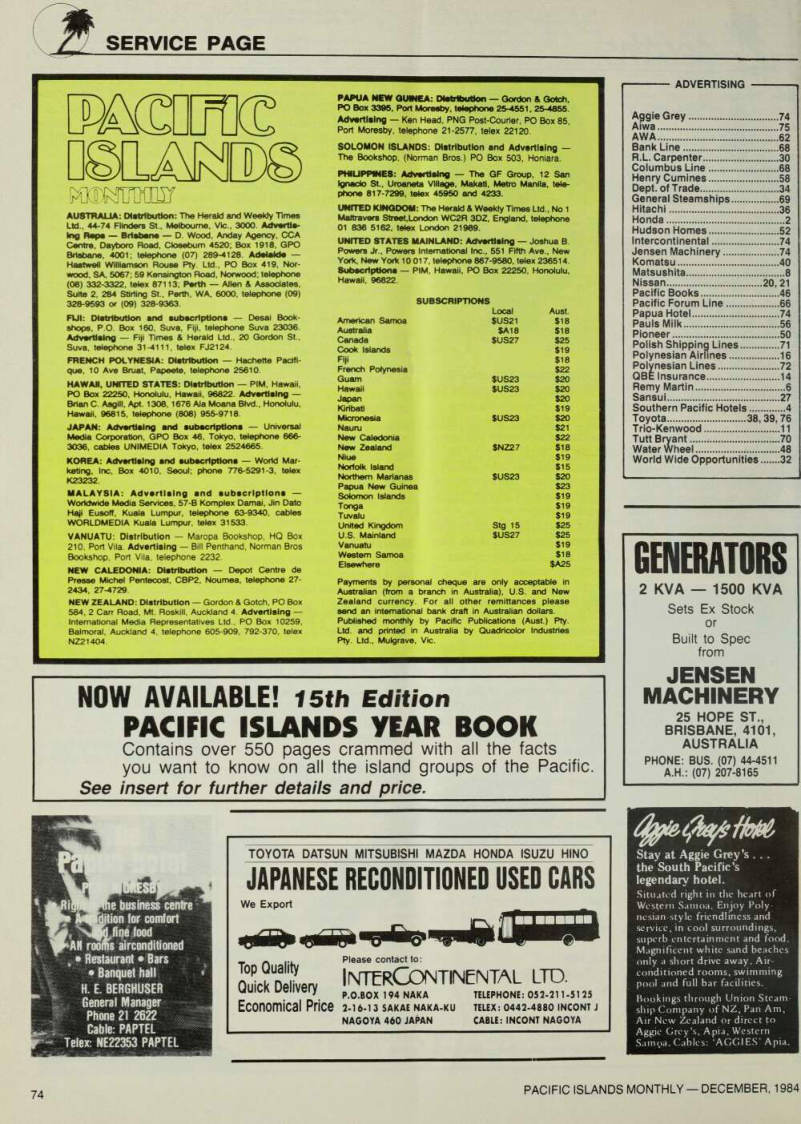
Aggie Grey 74 Aiwa 75
Aw A 62
Bank Line 68 R.L. Carpenter 30 Columbus Line 68 Henry Cumines 58 Dept, of Trade 34 General Steamships 69 Hitachi 36 Honda 2 Hudson Homes 52 Intercontinental 74 Jensen Machinery 74 Komatsu 40 Matsushita 8 Nissan 20, 21 Pacific Books 46 Pacific Forum Line 66 Papua Hotel 74 Pauls Milk 56 Pioneer 50 Polish Shipping Lines 71 Polynesian Airlines 16 Polynesian Lines 72 QBE Insurance 14 Remy Martin 6 Sansui 27 Southern Pacific Hotels 4
Toyota 38,39,76
Trio-Kenwood 11 Tutt Bryant 70 Waterwheel 48 World Wide Opportunities 32
Advertisements & other items, pp. 74-76 (1 item)
Generators
2 KVA 1500 KVA
Sets Ex Stock or Built to Spec from
JENSEN
MACHINERY
25 HOPE ST.,
BRISBANE, 4101,
AUSTRALIA
PHONE: BUS. (07) 44-4511
A.H.: (07) 207-8165
Stay at Aggie Grey’s . . . the South Pacific’s
legendary hotel.
Situated right in the heart of Western Samoa. Enjoy Polynesian-style friendliness and service, in cool surroundings, superb entertainment and food.
Magnificent white sand beaches only a short drive away. Airconditioned rooms, swimming pool and full bar facilities.
Bookings through Union Steamship Company ofNZ,Pan Am, Air New Zealand or direct to Aggie Grey’s, Apia, Western Samoa. Cables: ‘AGGIES' Apia.
»** ' ; — ■ m i O O o X r.nv/.i SL % *
System control is
in your hands
Wireless remote control is one of the many reasons why the V-1100 is AlWA’s most sophisitcated system yet. From the comfort of your chair you can control the turntable, cassette deck, tuner as well as select any source component and adjust the volume. AIWA puts total system control right in your own hands.
Along with this convenience comes programmable disc playback and recording, separate power amp and preamp with 7-band graphic equalizer, a quartz-synthesizer tuner/timer, and an auto-reverse cassette deck. The special system rack makes component connection quick and simple. Going digital? Go for the V-1100 because its ready now for the connection of a CD player.
AIWA
AIWA Australia Pty., Ltd 14 Gertrude St., Arncliffe, N.S.W. Australia 2205 AUSTRALIA PHONE; (597) 2388/Oceania Indent Agency (P.N.G.) Pty., Ltd Ago St., Gordon Box 5518, Boroko, Papua New Guinea PHONE; 256411/The Sound Centre Ltd P.O. Box 434 Port Vila, Vanuatu PHONE; 2035/P. Hargovind Bros 190 Renwick Road P.O. Box 490 Suva Fiji PHONE; 24350/Makanjee & Sons Limited P.O. Box 91 Sigatoka Fiji PHONE; 50158/Milaw Trading Co., Ltd 36 Airedale St. Auckland, New Zealand PHONE; (09) 399175/hifivox 79, rue de Sebastopol, Noumea, New Caledonia PHONE; 27.24.66/Harvest Pacific Limited P.O. Box 517, Honiara, Solomon Islands PHONE; 131/Fare Hi-Fi Stereo Rue du Marechal Foch, Papeete, Tahiti PHONE; 2-4814/Micropac Audio, Inc. Agana, Guam 96910 PHONE; 472-8091/Cook Island Trading Corp Ltd P.O. Box 92, Rarotonga, Cook Island/Nauru Co-Operative Society Republic of Nauru
ENGINEERED TO BE BEST
TOYOT/2
FORKLIFT
US i.
V Vv TECHNOLOGY Toyota Forklifts are built to last over the long haul, utilizing a Central Hydraulic Power System (C.H.P.! that not only speeds maintenance but also increases operator efficiency through power assistance. Only Toyota offers C.H.P 1 in the 13 ton range HUMAN ENGINEERING Down the road, Toyotas stay as reliable as ever because they're built solid. A standard reinforced Wide Visible mast for both durability and safe l ; is just one example. Toyota's design thinks beyond the machine itself to the operator for more comfort with a lower noise level, assist grips and bucket seai THE CHOICE We also take your individual business into account with a wide selection of models, options and attachments to suit you best.
This kind of thinking has made Toyota forklifts the choice of more business* around the world than any other forklift. Because, if you're thinking ahead,
you're thinking Toyota.
1 W r i
" L
TOYOTA
Take the lead with
1,000-3,000 kg SERIES PNEUMATIC-TYRED/ENGINE-POWERED
TOYOTA
AMERICAN SAMOA; BURNS PHILP (S.S.) CO., LTD. TEL; 633-4281 AUSTRALIA: THIESS TOYOTA PTY, LTD. TEL: 526-0333
FIJI: AUTOMOTIVE SUPPLIES CO.,
A DIVISION OF BURNS PHILP (S.S.) CO., LTD. TEL: 383444 GUAM; ATKINS, KROLL (GUAM) LTD. TEL: 646-1876 NEW CALEDONIA: SERVICE IMPORTATION AUTOMOBILE DU PACIFIQUE
TEL: 27-41-44
NEW ZEALAND: ANDREWS & BEAVEN INDUSTRIAL EQUIPMENT LTD. TEL: 2780:
PAPUA NEW GUINEA: ELA MOTORS,
A DIVISION OF BURNS PHILP (P.N.G.), LTD. TEL: 217036 VANUATU: VANUATU MOTORS, A DIVISION OF BURNS PHILP (VANUATU) LTD:
TEL: VILA 2341
WESTERN SAMOA: BURNS PHILP (S.S.) CO., LTD. TEL; 22611 And distributors around the world.