Pacific

Islands
Monthly
Hovember 1984
JjP I i fr
American Samoa US$l.75 Australia ‘A$l.5O Cook Islands NZ$l.5O Rj' F 51.50 Hawaii US$l.95 Kiribati A 51.75 Nauru A 51.75 New Caledonia CFPI9O
New Zealand NZ$2.5O Niue NZ$l.75 Norfolk Island A 51.50 Papua New Guinea K 51.50 Solomon Islands 551.50 Tahiti CFP22O Tonga PI .50 Tuvalu A 51.75
Usa U 552.25
USTT and Guam US$l.95 Vanuatu VT1.50 Western Samoa T 2.10 •Recommended retail price only Registered by Australia Post Publication No. NBPI2IO
The Cover
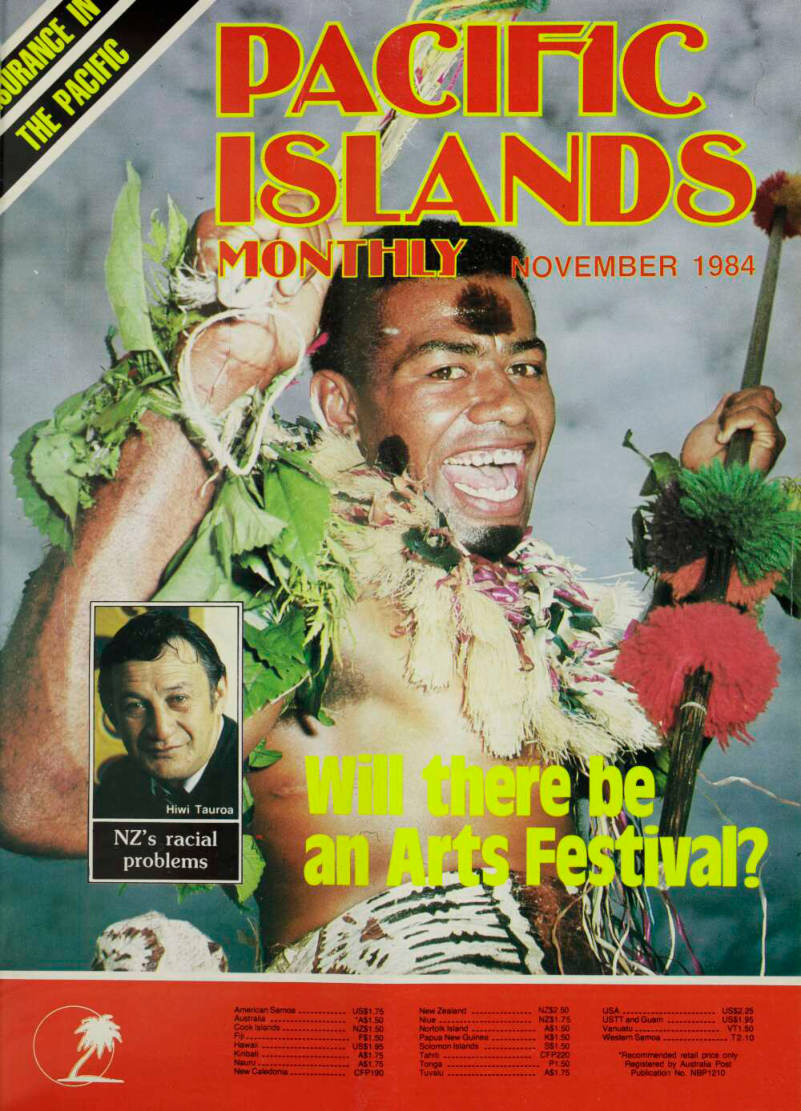
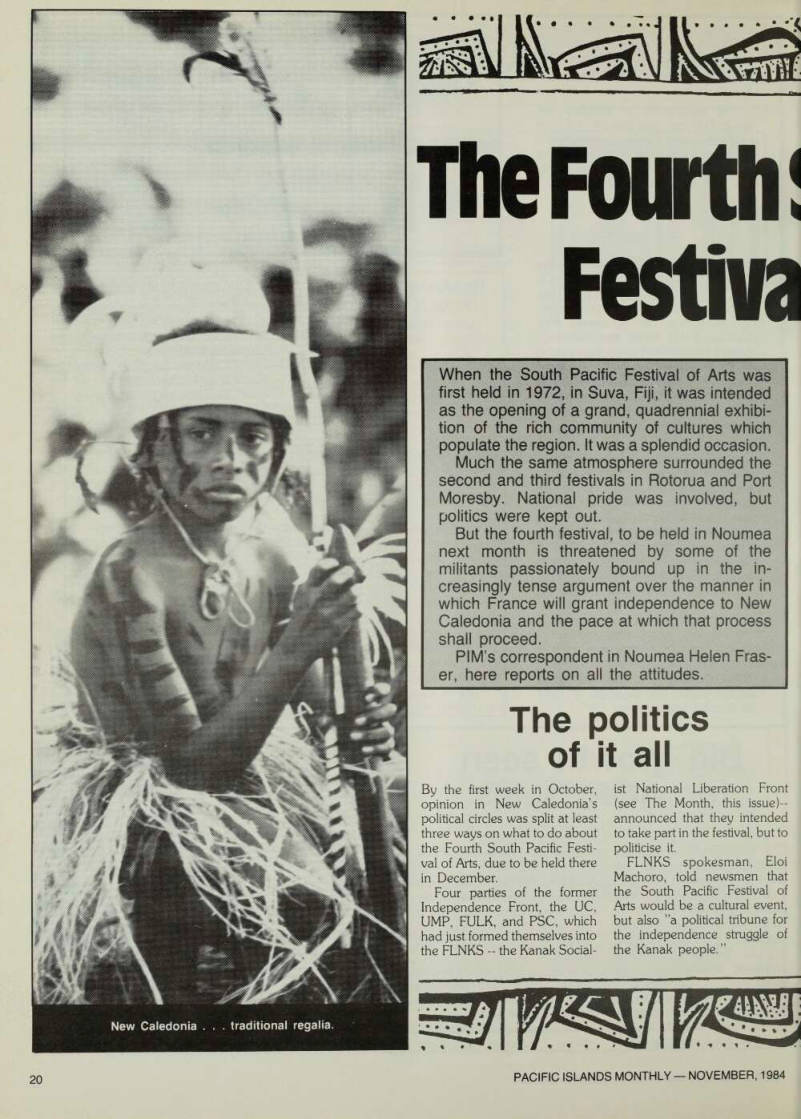
The great spirit of the Is lands shines out of the eyes of our Melanesian warrior-dancer, many of whom will perform at the South Pacific Festival of Arts in Noumea next month.
Advertisements & other items, pp. 2-3 (2 items)
0 Hitachi
Our finest tape
deck now comes
with a free video
deck.
Hitachi’s new VT-88 boasts sound that’s nothing short of incredible. A dynamic range of 80dB better than open reel. 0.005% wow and flutter. And 8-hour audio recording with a single tape.
It’s all possible thanks to an extraordinary recording system pioneered by Hitachi.
First, audio signals are converted to FM signals and recorded below the surface of the tape. Then audio heads moving across the surface at 150 times normal speed trace the signals, and deliver sound
reproduction that surpasses practically
every audio deck on the market today.
So why are we giving away the free video?
Actually, we don’t have much choice.
It’s built in.
You see, the VT-88 is a Hi-Fi stereo video cassette recorder, and it combines audiophile sound with the superb picture Hitachi VTRs are famous for.
So get the most out of music videos, concerts, simulcasts, stereo broadcasts, movies and more. With a VT-88 Hi-Fi stereo from Hitachi.
0 HITACHI
U 5 r U —r- ■sn 3 1(5- I I I I i i I!
M
ill
V T T i| I ,
HWIiW
B
CTi Q
j '-J Cl-L* ; rr Wb o Recording level controls BILINGUAL indicator STEREO indicator Peak level indicator Hi-Fi indicator Hi-Fi/Normal/ALC select switch Dolby is a registered trademark of Dolby Laboratories Licensing Corp. • AUSTRALIA; Hitachi Sales Australia Pty., Ltd., 153 Keys Road. Moorabbin, Victoria 3189; Phone; (555) 8722 • NEW ZEALAND: AWA New Zealand Limited, Wi-neera Drive P.O. B °*J so ' 248, Porirua; Phone; PRO 75-069 • PAPUA NEW GUINEA; S O. Svensson (N.G.) Ltd., P.O. Box 705, Port Moresby; Phone: 21-2111 • FIJI ISLANDS: AWA New Zea.and Limited 47 Foster Road (P.O. Box 858), Suva, Fiji; Phone: 312070 • NEW CALEDONIA: Caldis, B.P. Ml. Noumea; Phone: 26. 23. 50 • TAHITI: Ets Chene Alain. P.O. Box 272, Papeete; Phone: 2. 88. 68 • SOLOMON ISLANDS: Technique Radios Centre Ltd., P.O. Box 465, Honiara; Phone: 416
Pacific
ISLANDS
MONTHLY
Vol. 55 No. 11 November 1984
HiwiTauroa 12
Eloi Machoro 21
Thor Heyerdahl 29
Andrew Turnbull 35
In This Issue
HIWI TAUROA, New Zealand’s race relations con- 1 O ciliator represents “a breath of fresh air and sanity” in 1 * the often-vexed field of his work. An exclusive PIM interview opens on Page HELEN FRASER, PlM’s Noumea correspondent, 21 reports on the South Pacific Festival of Arts due to be held in that city in December, and on the way local politics is impinging on it.
NATIONAL FEDERATION PARTY factionalism flared 2fi again at the September annual meeting of Fiji’s parliamentary opposition party in Lautoka.
HAWAII: A QUESTION OF HISTORY Robert C. QO Kiste looks at the long battle to have Uncle Sam U acknowledge that his record in dealing with the native Hawaiians just might not come up “all roses."
PALAU REFERENDUM Floyd K. Takeuchi reports 33 on yet another inconclusive vote as Palau treads its tortuous path out of the U.S. trusteeship.
ANDREW TURNBULL, Burns Philp’s new chief execu- oc tive, speaks of a “leaner, tougher” company, ready to face the challenges of 1985 and beyond.
People 60
Contents
Bikini 43 Books 43 Burns Philp 35 Deaths 73 Easter Island 29
Fiji 26
Hawaii 32, 45 Insurance 24 Islands Press 59 Letters 10 Micronesia 33 New Caledonia 21,28 New Zealand 10,12 Niue 41 Pacific Forum Line 37 Pacific Report 7 Pacific Stamp Box 18 Palau 33
Papua New Guinea 18
People 60
Pettmi Diary 51 PIM Index 45-’55 46 PIM Opinion 5 Political Currents 26 Service Page 74 Shipping Schedules 69 Solomon Islands 48 South Pacific Arts Festival 21
Sparteca 40
The Month 28 Tonaa 57, 58 Tradewinds 35 Tropicalities 51 Vanuatu 41,51 Video 19 Yachts 61
Australian cover price is recommended retail only. Registered by Australia Post, publication No. NBPI2IO. Second class postage paid at Honolulu HawaH. Copyright Pacific Publications (Aust.) Pty. Ltd. Postmaster Hon olulu. Send address changes to PIM Hawaii, PO Box 22250, Honolulu, nBWBJi, 96822.
Advertisements & other items, pp. 3-4 (2 items)
Pacific Islands Monthly —November, 1984
3
Founded 1930 by R. W. Robson
(USPS 952480)
Editor and Publisher Garry Barker Associate Editor Malcolm Salmon Layout & Design Barry Badger Editorial Adviser John Carter A Pacific Publications production 76 Clarence Street, Sydney, 2000, GPO Box 3408, Sydney, 2001.
Cables: PACPUB Sydney.
Telex: 21242 (answers INTARAD).
Telephone: Sydney 20-231. Melbourne 63-0211.
Manager; John Berry (03) 63-0211 Ext. 1860.
The buyer profits...
The seller profits...
from Australian Office
furniture and Equipment
m
ODD
DBB
000 D i I O o O he buyer gets a high quality product.
One that’s attractively designed, efficient, reliable, made to last. Whilst the importer and agent find these are the reasons that make Australian office furniture and equipment so competitive, such good sellers. It’s worth your while to look into the wide range available.
Office chairs, tables, desks. Computer furniture. Cabinets. Storage shelving. Filing systems. Stationery. Charting systems. Carpet.
Lighting. Audio visual equipment. Microcomputers. Computer accounting software.
Data communication equipment. Floppy disks.
Computer forms. Word processing supplies.
Storage and computer labels. And most other equipment for the modern office.
Ask the expert who knows Australia For details of suppliers phone or telex the Australian Trade Commissioner at: There’s an Australian office supplier who can meet your requirements in both product and price. You can check it out quickly and easily.
Just contact the Australian Trade Commissioner.
Suva: Phone 31 2844 Telex FJ2126.
Port Moresby: Phone 25 9333 Telex NE22109.
Honolulu: Phone (808) 524 5050 Telex 633128.
Noumea: Phone 27 2414 Telex 087.
Ask the Australian Ifade Commissioner
Pim Opinion
Whatever the final outcome of the delicate manoeuvring between New Zealand and America over the ANZUS treaty, and there is some reason to think that Mr Lange may be temporising his stand slightly, the entire crisis points up the changes which have occurred in outlook between New Zealand and Australia.
The spirit of ANZAC was forged on the ghastly slopes of Gallipoli during the First World War, and tempered through such places of desperate combat as the Pacific theatre of the Second World War, Malaya, Korea, Malaysia and, finally, Vietnam. In each place the assumption was pretty well automatic that where Australia went, New Zealand went, too. That was as it had been since the days of the first settlers; since the rough-riders of the Boer War, and onwards through the decades.
For, while there might have been family rivalries, and perhaps, growing, a feeling by New Zealanders that Australians were getting a bit big for their boots, and by Australians that their Tasman neighbors were a shade too prickly, both communities shared an Anglo-Saxon heritage, a similar outlook and background, and common interests. Indeed, so far as the Pacific Islands are concerned, New Zealand in some respects showed greater responsibility and did a better job by those for whom it held duty, than did Australia. New Zealand looked outward in its neighbor hood.
In the wake of the Second World War, while Asia churned and rumbled, ANZUS was formed; an alliance, essentially, of two small powers sheltered by the umbrella of their giant, and culturally similar, friend, the United States. It was in effect recognition that ’’mother” Britain not only no longer had an empire, but had other fish to fry, not in the Pacific. ANZUS has lasted 30 years and, technically, cannot be tom asunder, for there is no machinery by which a member may opt out. This latter point is, of course, not really substantial, for if the Americans are sufficiently miffed by Mr Lange’s ban upon their nuclear ships (always assuming Mr Lange remains as adamant as he has sounded through the various talks so far), then ANZUS must cease to have much validity whether it exists on paper or not. The point has not been reached (and Australian politics might be quite interesting if it were), when a bilateral treaty, in effect superceding ANZUS, can be firmly proposed.
Whatever the ultimate wisdom of the New Zealand policy on
nuclear forces, (and it must be said that it has a quite large degree of support among the trendy left in Australia, too), it has shown clearly the gap that has grown, between these two very similar peoples.
Australia now has no option but to be a member of the western nuclear alliance. Her size, her minerals, her place in the region, her world-wide interests, demand it. Where once it was part of an empire governed on the far side of the world, it is now a small-medium power, with a major position in the Pacific, possessing massive supplies of raw materials, including a significant share of the world’s uranium, which, in the perhaps not too distant future, may become of vital necessity to all sorts of nations.
In short, Australia is a ’’target” whether she likes it or not. Many of her leaders and people may like the nuclear aspects of modern-day defence systems no better than Mr Lange or the left-wing of his party which so vociferously demands of him adherence to the ships ban. And, as Australian Foreign Minister, Bill Hayden, has made clear, they are not about to ’’heavy” the New Zealanders on behalf of ANZUS. But Australia cannot now escape involvement in the hard stuff of world affairs. The same urgency does not intrude upon New Zealand’s thoughts. If one sits amidst the beautiful serenity and greenness of the New Zealand countryside, gazing upon the stately alps, or strolling through their pretty towns, it is more than possible to understand this point of view.
At the same time, as Mr Lange has made clear, they need a defence system. They have proposed that they can remain full members of ANZUS without having to become involved with nuclear weapons, or nuclear power. They want the benefits. They don’t want the warts.
But in today’s world, is such an attitude possible? Can a nation be seen to be imposing so upon the goodwill of a bigger friend?
More importantly for the balance of power in our Ocean, will the Americans put up with it?
The New Zealand ban has altered that balance, at a time when the Soviet Union is rapidly building the strength of its naval forces in the Pacific, because it is seen as limiting the movement and facilities of the Americans. Therefore, far from improving the security of our neighborhood, the ban has tended to upset it.
Advertisements & other items, p. 6 (1 item)
Listen to a Dream
Close your eyes and listen. You’ll hear music that is rich, full, and luxurious as a lazy morning— music like you’ve never heard before from a compact stereo radio cassette recorder. You’re not dreaming, you’re listening to National’s RX-F4F.
The RX-F4F features a preset equalizer that lets you color your own sound of music at the press of a button with low, middle, and high-frequency boosts and a high-frequency cut. Combine any or all four settings any way you like to bring out the best in cassette tapes or FM/MW/SWI/SW2 broadcasts.
A two-way, four-speaker system that handles 16W of power (P.M.P.0.) can provide some very wide-awake volume levels without distortion, while Ambience Stereo envelopes you in enhanced stereo imaging. There’s even a built-in AC transformer to keep things compact and tidy.
The RX-F4F. You couldn't dream of a more beautiful sound.
33 National
National, Panasonic and Technics are the brandnames of Matsushita Electric
Pacific Report
Lange S Ambitious Anti-N-Tests Move
New Zealand Prime Minister David Lange has foreshadowed moves at the United Nations to have a ban imposed on all forms of nuclear weapons testing. Speaking in Wellington on October 8, Mr Lange said the approach would probably be made within a month or so. He added that New Zealand, Australia, Japan, Sweden and several other countries had already agreed to co-sponsor the resolution, which would seek a blanket ban on all underground and atmospheric tests. Mr Lange said that during his recent visit to the United Nations he had reviewed work and confirmed support for the initiative. He said it was vital to lobby for this support because it would again be needed for the nuclear non-proliferation treaty review conference next year. On the ANZUS defence treaty, Mr Lange said he was confident it would remain intact despite his government’s ban on visits by American nuclear powered or armed warships. He said there was every indication that New Zealand’s partners Australia and the United States wanted to talk and not to confront. Mr Lange added that he did not see a future without New Zealand, Australia and the United States closely associated with each other in defence matters.
Frank Talking At Oz-Png Conference
Frank talking about aspects of Australia’s aid program, and some sharp criticism by Papua New Guinean speakers of their government’s handling of the Irian Jaya refugee issue, characte rised a conference on PNG-Australia relations in Canberra in September. It was organised by the Australian National Univer sity’s Centre for Continuing Education, and the Australian Foundation for the Peoples of the South Pacific (AFSP). Summing up the conference, Canon Rex Davis, Australia-born Honorary Secretary of the United Kingdom FSP, said: “Let us be frank and recognise that all aid is today part of the policy pattern of any government and exists, at the end of the day, for that government’s self-interest. Australian aid to Papua New Guinea is not altruistic. It is part of larger policies which may, indeed, have elements of guilt, but is surely much more connected with the more significant elements of the Australian economic and political hegemonic interest in the South Pacific ... I suppose all this must be accepted as part of the aid conspiracy which dominates the Western world (today). We may lament this but it has to be accepted as part of the reality though, I hope, not uncritically.” On the Irian Jaya issue, Canon Davis said: “I recall Premier Ultula Samana’s eloquent plea on the refugee issue. And I deeply hope that Papua New Guinea’s leadership can come to see that its acceptance of its greater sovereignty relates not to how it copes with Australian aid inspectors, but how it manages now today and tomorrow its responsibility for its Melanesian brothers an d sisters in the refugee challenge of these weeks and months. That leadership did not fail during the crisis in Vanuatu shortly after its independence.”
Progress At U.S. Islands Fishing Talks
rive days of talks in Suva in September between member countries of the South Pacific Forum and the United States on Amencan fishing rights in the Forum countries’ 200-mile fisheries zones ended in preliminary agreement on the basis for negotiating a treaty to give the American fishing industry access to tuna in the zUO-mtie zones-It is hoped to reach an agreement permitting individual countnes in the region to negotiate their own licensing tees and terms with American companies under the protection of the mam treaty. No mention was made, at least publicly of the confroversy over seizure by Solomon Islands of the American tuna boat Jeanette Diana for illegal fishing in Solomon waters (PIM Oct p/). Solomon Islands Government offered the boat for sale but there were no takers. The U.S. Government advertised extensively a warning that it would not recognise any sale or the transfer of title Latest r , e P orts fr , om 1 Honiara suggest that the Solomon Islands Government has asked the Jeanette Dianas owners C and F. Fishing Co., of San Diego, to make a bid for purchase.’
When the Papua New Guinea Government ordered the confisca tion of the American superseiner Danica for illegal fishing, it settled, finally, for payment of $A250,000 and released the ship.
Solomons Islands’ Central Tender Board originally put a reserve price on the Jeanette Diana of $53.9 million. Also on tender were the vessel’s helicopter and various accessories. The Suva talks were set up by the Forum’s South Pacific Fisheries Agency, headquartered in Honiara.
Street Protest Ojv Moresby Pack Rape
The pack rape in early October of a nine-year-old New Zealand girl, her mother and another woman has brought to the streets cries for a crackdown on crime in Port Moresby. At the same time police launched raids on squatter settlements, trying to flush out the gang of up to 20 which held the girl, women and their husbands at knife point. Minister, John Giheno, said those responsible should have “one part” of their body cut off. “These rapists should be flogged publicly,” he told a news conference. “They are animals.”
About 200 people, both expatriates and locals, protested outside the main police station on October 4 demanding protection for their families. The New Zealand couple, their daughter, and another couple were sitting in the living room of a house in a Port Moresby suburb on the night of October 2 with the front door open. They felt safe because the house is part of a group surrounded by a barbed wire fence with a gate patrolled by security guards. The gang apparently got in by throwing rocks at the security guards while others got over the fence at the back of the compound.
Ex-Soldier Arrested On Irian Arms Charge
A former Australian soldier, Gary Scott, was arrested by the country’s Federal Police in October on charges of seeking to supply weapons to OPM (Free Papua Movement) guerrillas in Irian Jaya.
Scott was detained on October 2 following a search of his Sydney flat. Scott is reported to have served with Australian forces in the then Territory of Papua New Guinea in the 19605, during President Sukarno’s “confrontation” period. Shortly before his arrest he told the Sydney-based weekly The National Times that he had crossed into Irian Jaya with other Australians and engaged in combat with Indonesian troops.
Qantas Will Operate Air Pacific
The Fiji Government announced on October 12 that it had selected Australia’s national airline Qantas to operate the Fiji airline Air Pacific for the next three years, with an option for renewal for another two years. Qantas has said that it will operate Air Pacific with a “no loss” situation. Among other provisions, it will supply the chief executive, and the head of the finance. Other contenders for the hotly contested prize were Air New Zealand, Ansett Airlines of Australia, and Continental Airlines.
Namalw S Ujv. Swipe At Indonesia
Papua New Guinea says it is not satisfied with most of the replies it has received from Indonesia about alleged violations of its sovereignty. The reservations were voiced by PNG Foreign Minister, Rabbie Namaliu, during an address to the United Nations General Assembly in October. Mr Namaliu said PNG had protested on several occasions in recent years about what it believed were violations of its territorial integrity. They included intrusions by military aircraft, and the destruction of a village near its border with Irian Jaya. Mr Namaliu said that in only one case did the Indonesian government admit a mistake had been made, that it had been unintentional, and had publicly apologised. Exercising his right of reply in the assembly, Indonesian Ambassador Ali Alatas said: “We were painfully surprised ... to hear the Foreign Minister of Papua New Guinea accuse us of having violated his country’s territorial sovereignty.” Mr Alatas said Mr Namaliu had spoken of events “which we thought had long been resolved and clarified” between the two governments. He said Indonesia had shown great restraint.
Somare Rejects Report On Refugees
Papua New Guinea has rejected a report by an Australian human rights group that Irian Jayan refugees should be allowed to stay in PNG at least temporarily. The Prime Minister, Michael Somare, said the Australian branch of the International Commission of Jurists did not run PNG. “It’s like me going to New South Wales and telling Premier Wran that he should accept some of the refugees,” Mr Somare said. The jurists, led by the NSW shadow Attorney-General, John Dowd, inspected refugee camps in the West Sepik and Western provinces. Mr Somare said the government had been informed by the Geneva-based Secretary- General of the ICJ, Niall McDermot, that the delegation led by Mr Dowd was not sponsored or supported in any way by the parent body of the ICJ. “In other words, it has little standing or authority.
The PNG Government does not want the refugee camps to be treated like tourist attractions. But since we have nothing to hide, we allowed Mr Dowd and his group to visit the camps.”
Fiji Widens Hongkong Lure
The Fiji Government’s offer of special residential permits of five years duration to Hongkong citizens, who will invest at least SFIOO,OOO in Fiji, particularly if the investment generates employment and exports, has been extended to citizens of other countries. A big response from prospective investors in India could meet with opposition from Fijians, who are already outnumbered by Indians in Fiji, and from Fiji-born Indians who might face unwelcome competition.
Mara On 14Th Independence Anniversary
“Despite the serious setbacks suffered by our people last year in the wake of the natural disasters, our economic performance has been satisfactory this year, and is expected to recover considerably in 1985.” Fiji Prime Minister Ratu Sir Kamisese Mara offered this appraisal in his Fiji Day message on the occasion of the 14th anniversary of independence on October 10. Ratu Mara added: “We moved into independence in a happy and peaceful way with a united and multi-cultural society. We have always been deeply conscious of this and undoubtedly it has remained a source of humble pride and inspiration to our people . . . This is a time of rapid and dynamic change in Fiji. However, the enduring values of goodwill, tolerance, mutual respect and loyalty will undoubtedly help us to face the challenge in the years ahead with determination and success.”
TONGA S PIRATE TV STATION IN ACTION “While everybody else is just talking we have done it,” said Fakate Tupouniua, manager of Tonga’s new pirate television station ASTL-V3. Reporting this in the daily newspaper The Australian, on October 8, David Robie writes from Nukualofa that the station “has cashed in on the video boom in the kingdom and started broadcasting, beating a major Australian network to the punch”
The chief executive of Australia’s Channel Nine, Lynton Taylor, met broadcasting officials from Fiji and Tonga in Suva earlier this year to discuss his network’s proposals, which also include offers to Papua New Guinea, Solomon Islands, Vanuatu and Western Samoa. Channel Nine is offering to hook up the six countries to satellite transmissions, relaying 50 top-quality international prog rams a day from a collecting station in Los Angeles to Sydney. The pirate TV station, set up with the assistance of Honolulu-based U.S. technical consultants, has upset the Tonga Broadcasting Commission, which has a government mandate to launch a national television service. The TBC, writes Robie, had agreed to a four-month feasibility study by Channel Nine. Robie writes: “Mr Takafai Brown, editor of the new independent Tongan Times newspaper, warned that television might have a negative impact on longan culture Television could hit Tonga financially and culturally. It would be too sudden a development for our society,’ he said. I believe Fiji has the right idea about not wanting Fiji until the whole country has electricity’.”
A Step Further For Marshalls Compact
James McClure s Committee on Energy in the U.S. Senate has the U.S. and Marshall Islands Compact of Free Association and compact funding. This completes all committee action in the Senate on the compact, and the only remaining steo is hp V a°Hnnc y h the Senate - The House of Representatives committee heanngs have been resumed and the Foreign Affairs CommittPP has said that it plans to continue the hearings into next year.
However, the Reagan administration has said that it is still pressing for final House approval before the end of this year.
Cooks Minister Goes “Foreign”
Under a new bill approved by the Cook Islands Parliament, the title of the Minister of External Affairs will be changed to Minister of Foreign Affairs and policies connected with foreign affairs will be directed by the Cabinet. There will be no alteration in relations with New Zealand which will continue, along with the Cook Islands Government, to be responsible for external affairs and defence.
Two Tributes To Frank Hurley
The Australian Museum, Sydney, in September, staged an exhibition of still photographs taken by Australian cameraman and adventurer, Frank Hurley, on an expedition to Papua in 1922.
Earlier, the Australian Broadcasting Corporation screened Pearls and Savages, a motion picture made by Hurley during the expedition.
Now It S President Gaston Flosse
With much pomp and circumstance in mid-September, French Polynesia moved into the new period of its “internal autonomy” status. Press coverage featured heavily the fact that under the new arrangements, the elected leader of the local government in this case, Gaston Flosse takes the title of president, rather than vice-president as in the past, of the territorial government. French Polynesia, unlike New Caledonia, accepted the proposals of Paris for its future political status.
A Solomons Repubuc?
In the second general elections in Solomon Islands since independence in 1978, due to be held on October 24, 230 candidates were set to contest the 38 seats in its single-chamber National Parliament. Solomon Islands is a constitutional monarchy with the British Monarch as its head, but, if outgoing Prime Minister Solomon Mamaloni and his People’s Alliance Party are returned to power, a change to a republic may follow.
Coleman Loses Third Term Fight
The U.S. Department of the Interior has informed Governor of American Samoa Peter Tali Coleman that it will not interfere with a ruling by the Territory’s High Court barring Governor Coleman from running for a third term this month. At issue is a law limiting governors to two terms. The department said there was “an overriding public interest” in maintaining the integrity of the judiciary.
Pjv.G. War Veterans Bitter On Pensions
A meeting of war veterans in Melbourne has been told that men from Papua New Guinea who fought for Australia in World War II were “bitterly disappointed” that they did not receive a war pension. The president of the PNG branch of the Returned Servicemen’s League, Norm Osborn, told the Australian 1984 annual meeting of the RSL that he had been trying for 25 years to convince the PNG and Australian Governments to make grants available to the war veterans, but with little success. Mr Osborn said there were more than 7000 men from PNG who had been members of the Australian fighting forces. About 4000 of these were still alive, and, apart from a very small number who received a medical pension, they had not been compensated in any way for their service. The real problem, he said, was that the men were dying off rapidly, and, for many of them, any assistance would come too late.
Fijfs Cm. Raps Easy Prison Releases
Fiji’s Chief Magistrate, Gordon Ward, has criticised prison authorities for a decision to release prisoners from jail to serve their sentences. Mr Ward said he was horrified at the number of offences being committed by such prisoners. He said the time had come to review the system which allowed prisoners to serve sentences outside jail walls. The chief magistrate’s criticism follows a case in which an extra-mural prisoner was charged with the murder of a female shopkeeper. Mr Ward said he believed the public in Fiji must be angry at the apparent ease with which violent and dangerous men were released back into the community by the authorities ... as he put it . . . to “continue their crimes.
Advertisements & other items, p. 8 (1 item)
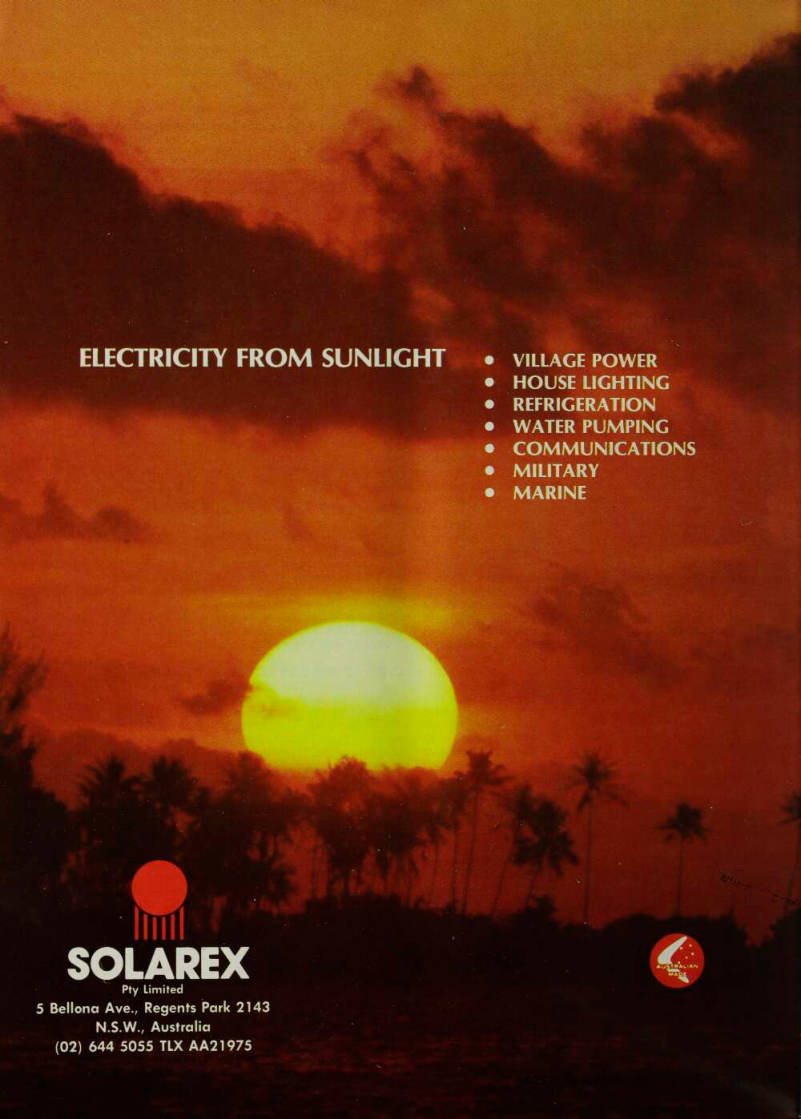
Solarex
ELECTRICITY FROM SUNLIGHT
VILLAGE POWER
HOUSE LIGHTING
REFRIGERATION
WATER PUMPING
COMMUNICATIONS
MILITARY
MARINE
SOLAREX
Pty Limited 5 Bellona Ave., Regents Park 2143 N.S.W., Australia
(02) 644 5055 TLX AA21975
AUSTRAU/
■v
letters
The ‘Catch 22’ of nuclear deterrence
It is a long time since I read a more biased, ill-presented set of distortions and illogical argu ments as the PIM “Opinion” for August.
Sure, Mr Lange “virtually in his first breath as prime minis ter” announced the ban on nuclear ships. It was, however, a major plank of his election strategy and can have come as no surprise to even the most casual political observer. It was the clearly expressed wish of the New Zealand people, and far from the capricious whim of political opportunism. In any case the whole deterrence argu ment of nuclear weapons is based on a paradox worthy of Joseph Heller’s Catch 22. You won’t invade because I’ve got atomic weapons, which if I use will result in my destruction as well as yours, so in fact I’ll never use them, so you can invade, but if you do I’ll use my atomic weapons which will result in my own destruction as well so you won’t invade Does PlM’s editorial writer really believe he’s going to wake up one morning with the Russian navy looming un announced out of the morning mist? And even if we suspend reality to accept such a ridicu lous assumption, would the car rier of “the major burden of everyone’s security” im mediately plunge the world into the nightmare of nuclear war?
Of course not.
Nuclear weapons are offen sive (in both meanings), not defensive, and America’s sole purpose in offering them as a defence to their allies is to spread the attack potential as widely as they can, in order to make a pre-emptive strike which will disable (and distri bute as widely as possible) a Russian counter.
It may not be possible to have the strawberries without the pips, but if the first bite is
likely to blow your head off, you’re probably better off with home-grown fruit.
Imperialism whether in Afghanistan, Lebanon or Cen tral America is rightly conde mned by all, but is certainly not restricted to any one political system, nor is it solely practised by nuclear powers on non nuclear ones. In the absence of nuclear systems in the South Pacific region it is hard to imagine any foreign power targeting their own weapons of
mass destruction on such a harmless target. Equally the maintenance of a strong and co-ordinated conventional de fence force will provide a far better guarantee of long term freedom (and life) than the nuclear alternative. As a recent arrival to the South Pacific I applaud New Zealand’s brave stance, just as I once applauded a similar Australian action in the days before their prime minister turned from a dove into a Hawke. May this the latest attempt to halt the relentless march towards mass destruc tion suffer a kinder fate.
Tim Mason
Port Vila, Vanuatu.
Refundable deposits:
Recycling Drink Cans
Refundable deposits: Adelaide’s experience
David North’s proposal for the recycling of drink cans (PIM Aug) is most welcome. Most Pacific Island communities have readily adopted the practice of buying drink and food sealed in
“convenience packaging”, but few have taken steps to solve the resulting litter problem.
The amount of litter to be seen in some island towns is now at a disgusting level.
David North’s article pro vides one solution — to encour age people to make profitable businesses out of collecting and returning drink cans.
I suggest that both the manu facturers and purchasers have major parts to play too. In South Australia (as in Oregon and some other U.S. states) the system of adding a refundable deposit to the retail price of each beer and soft drink can and bottle has had a remark able success in reducing litter.
For a large city, Adelaide is now amazingly clean, and drink container litter is rarely to be seen. Over 85 per cent of beer bottles are returned for washing and refilling, and the proportion of drink cans returned for re processing has risen from less than 10 per cent in 1975 to over 60 per cent in 1982.
Non-refillable throw-away bot tles are now illegal, and the return rate of soft drink bottles is in excess of 90 per cent.
Depots for receiving empty cans have been established throughout the state. Soft drinks are usually returned to the place of purchase for the refund, and beer bottles are usually returned via the gar bage collection system.
This arrangement works well, despite the earlier fears and protests of manufacturers who said that sales would fall and that employees would be laid off.
Transportation costs im mediately spring to mind as an obstacle to introducing such a system to Pacific islands. But of course it is a consideration in a big state like South Australia too. Flattened drink cans are light and compact and can be carried on return journeys at low cost. But such a system will only work if both consumers and manufacturers play their part.
(Dr) Christopher Nance
Senior Project Officer Department of Environment and Planning Adelaide, S.A.
Australia
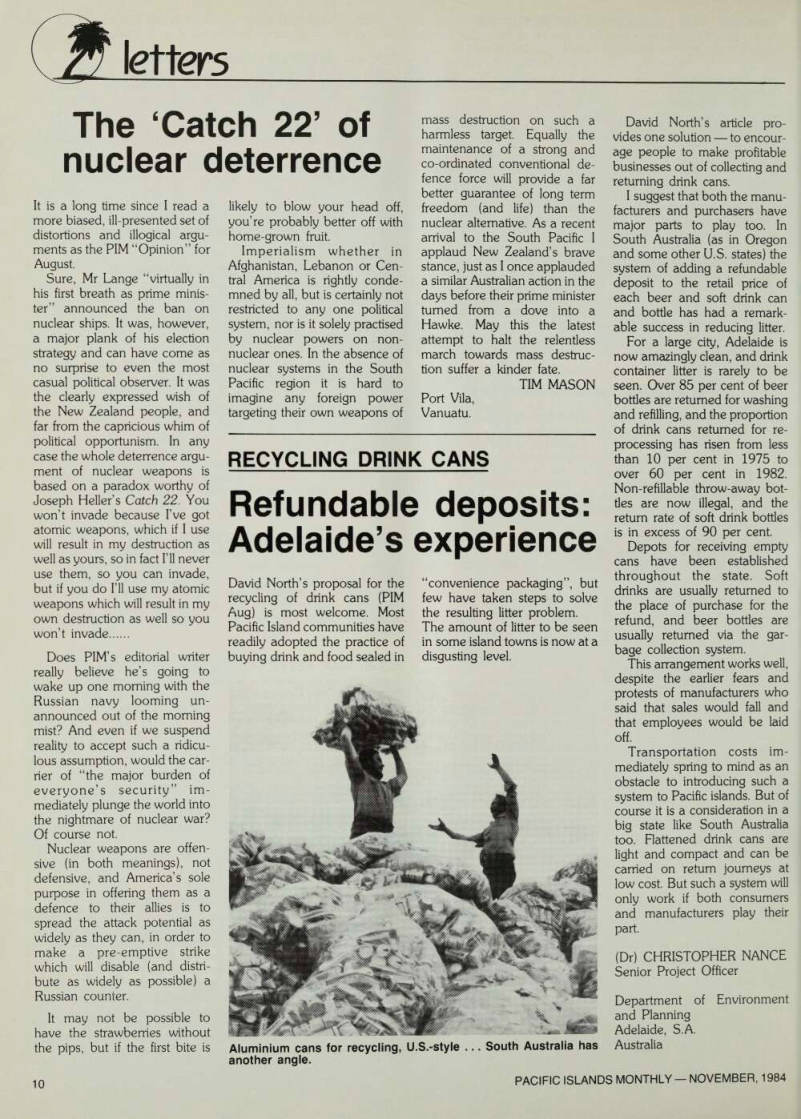
Aluminium cans for recycling, U.S.-style . . . South Australia has another angle.
Advertisements & other items, p. 11 (1 item)
C.D Pioneer
.. .the magic of elegant sound.
Avante component systems and the magic of Pioneer technology.
Together they bring you the miracle of your favourite music re-created with all the bewitching excitement and natural dynamism of the original performance. The secret of the Avante A9DX lies in the basic concept of the Avante series.., advanced components created together to perform together.
The amplifier alone is amazing—Dynamic Power Non-Switching*, plus 265 watts/channel of music power! Other components include a Quartz-PLL FM/AM tuner, fully automatic turntable and a double cassette deck, plus 4-way speaker systems.
No mere trick, the new Avante A9DX is the product of elegant design and audio expertise. That’s Pioneer’s unique brand of magic.
C.D PIONEER
Options shown: graphic equalizer and digital timer. ‘Non-Switching is a trademark of Pioneer. rnmnprl? r Mn K * aC ■ Australia: Pioneer Electronics Australia Pty. Ltd. (Incorporated in Victoria), P.O. Box 295, Mordialloc,Victoria, 3195 Tel: 580-9911 ■ Fiji Islands: Bnjlal & 7.h p! f'll, f f l *? I®', 22258 ■ New Zealand: Monaco Distributors Ltd., 2 Poland Road, Glenfield, Auckland, New Zealand Tel: (09) 444-9144 ■ Norfolk Island: Burns Philp Panpoto Tah,ti’ ■ ? Vanua,u: Burn s Philp (Vanuatu) Ltd., Vila, Vanuatu ■ Nauru Island: Jacob Enterprises. P.O. Box No 4, Republic of Nauru ■ Tahiti: Tahiti Hi-Fi, P.O, Box p acifique SarL B p 3899 ' Noumea, New Caledonia Tel: 27.62-23 ■ American Samoa: Transpac Corporation, P.O. Box 1477, Pago Pago, American Samoa ■ arotonga. South Seas International Ltd., P.O. Box 49, Rarotonga, Cook Islands Tel: 2327 ■ Papua New Guinea: Bali Merchants Pty Ltd„ P.O. Box 6103 Boroko Tel: 254887
if cool reason can word

Race Relations In N.Z.
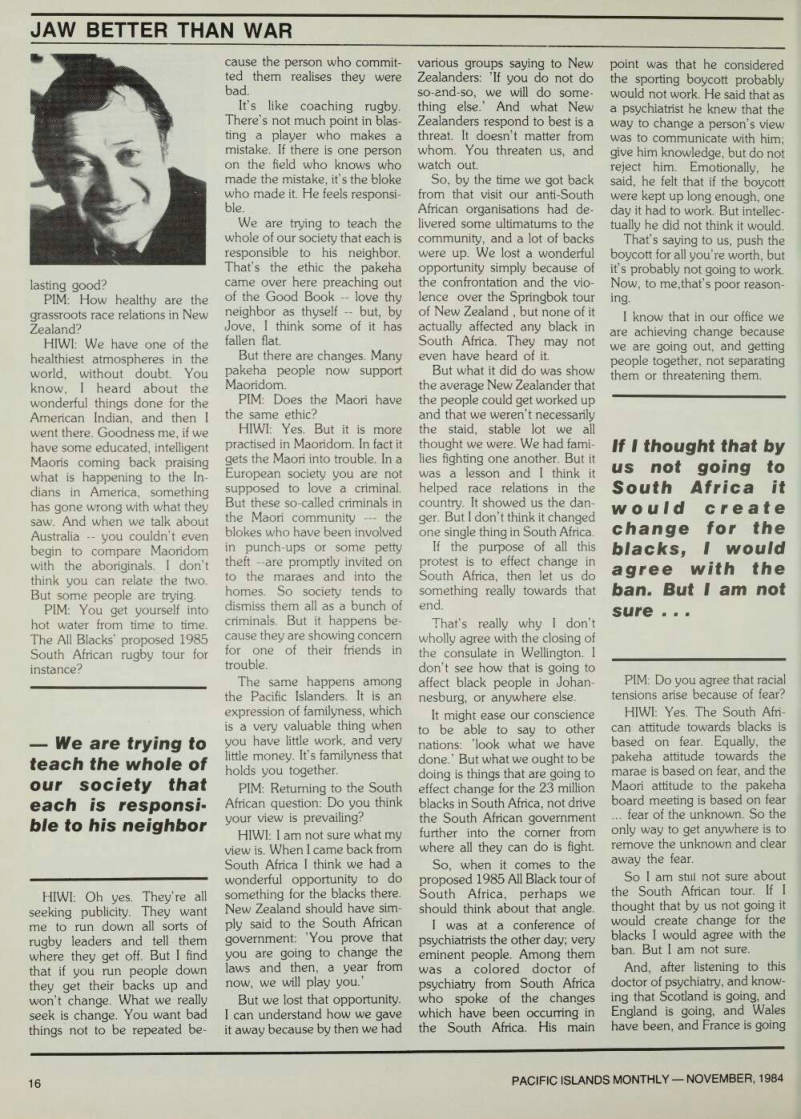
In a world over-populated with pressure groups, multitudes of militants, and power-hungry politi cians, New Zealand’s race relations conciliator, Hiwi Tauroa, is a breath of fresh air and sanity. He has what many people consider to be a no-win job. He deals with issues which are often of great sensitivity, even in a country as small, and as generally reasonable, as New Zealand. His powers are considerable, but his belief is that more can be achieved by informal talking than by the wielding of a big stick.
Hiwi does not go about calling shovels fancy names and consequently gets himself into the headlines more often than he would like. His recent suggestion that the sports boycott against South Africa might be doing more damage than good upset militant anti-racist groups, most of whom had far less experience than he of the grassroots problems of race relations.
“A lot of these pressure groups are really after publicity for themselves,” Hiwi said. “They like to make a lot of noise so they feel big and important.
But very often all they do is polarise the opposition and drive them into a corner from where they would rather fight than be reasonable.”
New Zealand’s racial problems are older than some, and smal ler than some, but they are at the core of the country’s development away from being an outpost of Eng land and towards becoming a truly Pacific sort of nation.
Auckland is already the largest Polynesian city on earth. The arrival of the islanders, together with migrants from Europe and Asia, has complicated the older matter of Maori versus pakeha.
The Maori has been more dis advantaged than supported by the arrival of migrants of similar ethnic background. He might have gone up a rung on the social ladder, but he has been squeezed out sideways into deeper unemployment. Much the same sort of thing hap pened in New York where the indigenous negro found his jobs taken by the immigrant Puerto Rican. In New York the prob lem led to the riots now down in history as the “Long Hot Sum mers.” Violepce between the races is not unknown in New Zealand, but it is far from widespread. People talk out their problems, and they do so, in very large measure, because of the patience, and the influ ence, of big, avuncular, reason able and stalwartly determined Hiwi Tauroa.
He is a Maori who believes very much in Maori methods; in the values of the marae, the traditional meeting ground, where people come together to discuss their problems and en joy the company of family and friends.
“One day we might get pake ha maraes ... wouldn’t be a bad thing. It would mean they would talk together instead of trying to score off one another. I would like to see the whole of
parliament go on to the marae ... forget their politics for two days and learn about one an other,” said Hiwi. “I think it would produce a better coun try. If everyone did it, we might get a better world.”
PIM: In the time you have been Race Relations Con ciliator and Human Rights Commissioner, have things really improved?
HIWI: Attitudes have im proved a tremendous amount.
But they still have to go on improving, and if we congratu late ourselves too much, things will just sit still again. We have a long way to go yet. Big changes have occurred in a lot of institu tions and organisations in the country, but it has taken a long
time to achieve them, and we have a lot yet to do.
The change in attitudes is an overall change. The pakeha people are starting to realise that we are a little country down here and that we have different sorts of people now, and all of us must get along together.
There is, recognisably, greater sensitivity among people, and more understanding. But it’s only just starting.
PIM: The Maoris have to protect their culture and yet get along in a country which is essentially Western and fairly well developed. How do they manage? Do they have to make concessions? Are they losing out?
HIWI: Originally we had the
good old colonial idea of assimilating people. They felt that if they could make the Maoris into nice brown Eng lishmen it could only do them good. The result of that was a determination to destroy everything Maori, or, if not destroy it, ignore it. That is really what set the Maori people back so much. Now there has been a reversal, and a revival of our cultural identity. Maori peo ple are trying to persuade others that there are many aspects of Maoridom which could be very useful and very helpful to all people. So we now have pakeha people going on to the maraes learning about Maoridom and a tremendous number of pakehas learning the Maori language.
PIM: So you are getting somewhere?
HIWI: I am quite sure we are.
There is not only the grassroots interest, but there is an aware ness among the top people in government and in the com munity.
We have to persuade people that we are all New Zealanders, that when you talk about the Maori language you are not talking about a foreign tongue, but about a New Zealand lan guage. Maori people are New Zealanders and Maori words are New Zealand words. That’s the thing we have difficulty persuading our majority culture to accept, although many of them are really going for it now.
Understanding the language adds to the understanding gen erally.
PIM; What do you think of Maori parliamentary seats? Are they necessary or should they be abolished in favor of a general roll?
HIWI: I think they are very necessary right now. Everyone
says they were the product of the philosophical love by the pakeha people for Maoridom. It wasn’t. The seats came about because of the evangelical movement in England where they had just taken part in an effort to abolish slavery in America. So the people in England required of the people here proof that they were doing the right thing for the Maoris and making sure there was no slavery. That’s really why they established the Maori seats.
I am now busily involved in arguing against having the seats, saying that Maoridom should be on general seats but, over a period of time, say about 10 years.
But, in those 10 years there are things that the pakeha peo ple must accept, and one of them is that we are mono cultural; that Maoridom is part of New Zealand, and they must get to know about other New Zealanders.
Ultimately we should have a parliament with just general seats, and in those seats, all sorts of people - Maoris, Sa moans, Tongans, Europeans.
My argument is that with the four Maori seats we have a parliament in which only four people are concerned with Maoridom, and there are 91 who couldn’t care less. Now, if they all required the Maori vote for their survival everyone would jolly soon learn about Maoridom.
But, historically, the Maoris needed the special seats. If they had not had them, then Maori dom would have disappeared far more rapidly. Now it is resurgent. But for Maoridom to come all the way back you have to get attitudes changed, among Maoris as well as pakehas.
“If everyone in Parliament needed the Maori vote to survive, they’d jolly soon learn about ■ dom ..
With general seats represen ting all New Zealanders you will find people with political aspira tions going on to a marae to ask for the Maori vote. And the first
thing they will have to do is learn a bit of Maori, which will help with the understanding all round.
But you can’t do it all straight away. We are talking about changing the attitudes of both Maori and pakeha and then go to a general roll, so that everyone who is standing for the House has to learn a bit about everyone in the country.
As things are we have four people who know about Maori dom, and perhaps four people who know a bit, and all the rest who don’t need to know any thing to achieve their political survival.
PIM: In that process would you not also change Maoridom?
HIWI: Maoridom is changing now. Some are social changes.
We now have to be more businesslike on the maraes be cause the people don’t have enough money to feed everyone who wants to come, as they could in the old days.
They cannot afford to spend a week at a hui just enjoying it.
Other changes are deeper.
Take the unemployment situation among Maoris. The criterion for work is basically an examination pass. A lot of our Maori leaders have been telling us for years, and they arc still telling us, that Maoris cannot pass exams. If you keep telling people they are going to fail, then they will, regardless of their intelligence. But our peo ple still tell themselves they cannot pass exams and they now use it as a kind of excuse.
But, given the proper en vironment, and the right en couragement it does not take long for a former failure to start succeeding.
PIM: How much of that atti tude comes from the old lead ers trying to hang on to their culture and their position within that culture?
HIWI; That’s part of it. They fear they will lose influence over the young. They don’t realise that young people need to flap their wings a bit, but that doesn’t break the bond they have with their Maoridom, pro vided they have been given the proper foundation. If they have a foundation in their culture they will always come back to it.
But the main problem is the examination. If you don’t pass the exam, you don’t get a job.
Many of our young people cannot see the relationship be
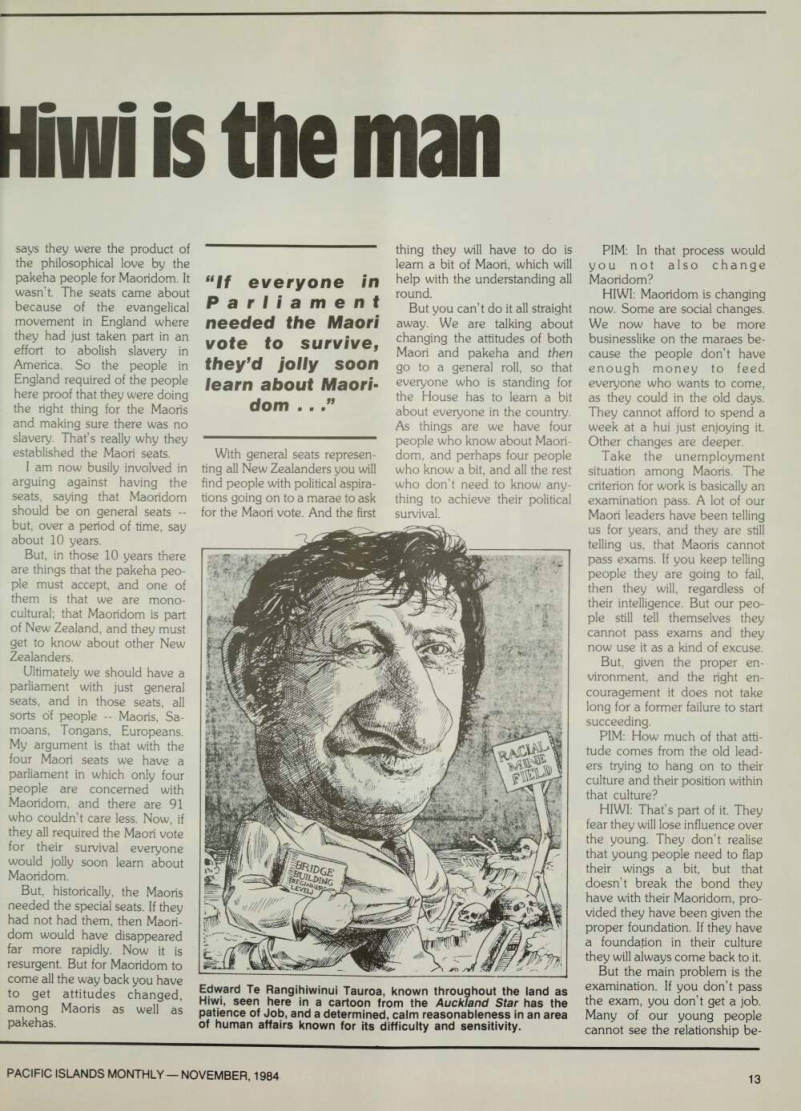
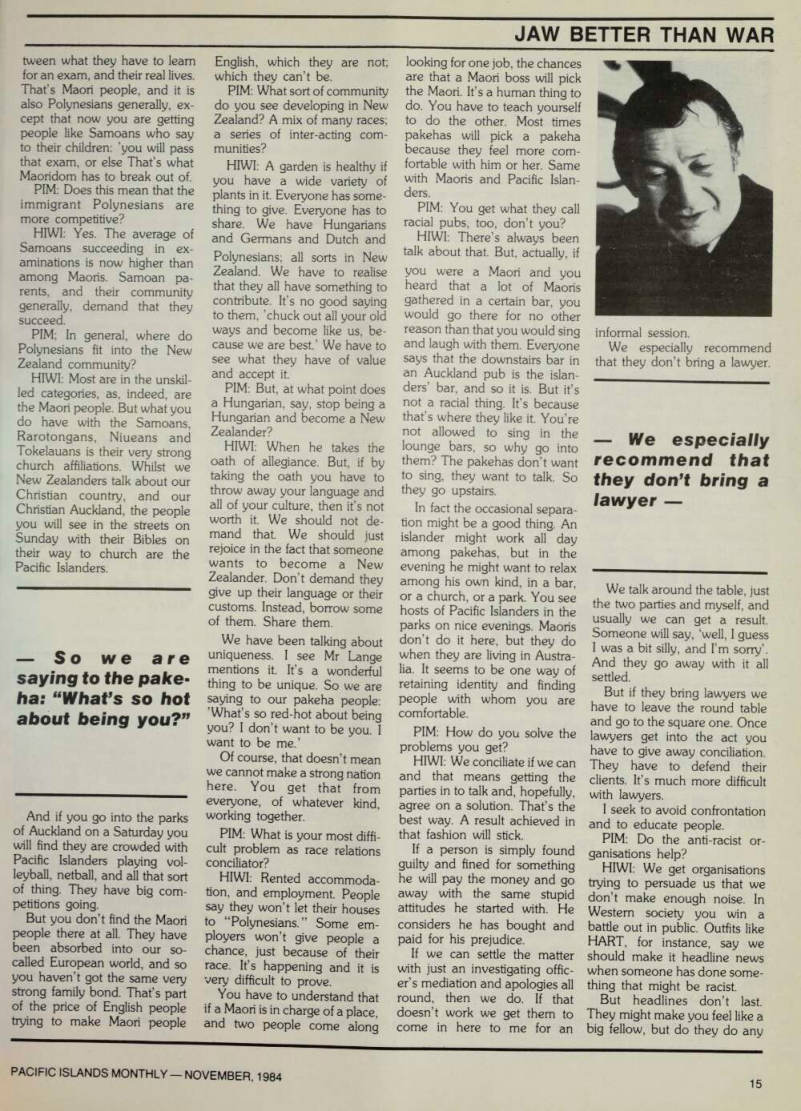
Edward Te Rangihiwinui Tauroa, known throughout the land as Hiwi, seen here in a cartoon from the Auckland Star has the patience of Job, and a determined, calm reasonableness in an area of human affairs known for its difficulty and sensitivity.
tween what they have to leam for an exam, and their real lives.
That’s Maori people, and it is also Polynesians generally, ex cept that now you are getting people like Samoans who say to their children: ’you will pass that exam, or else That’s what Maoridom has to break out of.
PIM: Does this mean that the immigrant Polynesians are more competitive?
HIWI: Yes. The average of Samoans succeeding in ex aminations is now higher than among Maoris. Samoan pa rents, and their community generally, demand that they succeed.
PIM; In general, where do Polynesians fit into the New Zealand community?
HIWI: Most are in the unskil led categories, as, indeed, are the Maori people. But what you do have with the Samoans, Rarotongans, Niueans and Tokelauans is their very strong church affiliations. Whilst we New Zealanders talk about our Christian country, and our Christian Auckland, the people you will see in the streets on Sunday with their Bibles on their way to church are the Pacific Islanders.
So we are saying to the pake ha; “ What’s so hot about being you?”
And if you go into the parks of Auckland on a Saturday you will find they are crowded with Pacific Islanders playing vol leyball, netball, and all that sort of thing. They have big com petitions going.
But you don’t find the Maori people there at all. They have been absorbed into our so called European world, and so you haven’t got the same very strong family bond. That’s part of the price of English people trying to make Maori people
English, which they are not; which they can’t be.
PIM; What sort of community do you see developing in New Zealand? A mix of many races; a series of inter-acting com munities?
HIWI; A garden is healthy if you have a wide variety of plants in it. Everyone has some thing to give. Everyone has to share. We have Hungarians and Germans and Dutch and Polynesians; all sorts in New Zealand. We have to realise that they all have something to contribute. It’s no good saying to them, ’chuck out all your old ways and become like us, be cause we are best.’ We have to see what they have of value and accept it.
PIM; But, at what point does a Hungarian, say, stop being a Hungarian and become a New Zealander?
HIWI: When he takes the oath of allegiance. But, if by taking the oath you have to throw away your language and all of your culture, then it’s not worth it. We should not de mand that. We should just rejoice in the fact that someone wants to become a New Zealander. Don’t demand they give up their language or their customs. Instead, borrow some of them. Share them.
We have been talking about uniqueness. I see Mr Lange mentions it. It’s a wonderful thing to be unique. So we are saying to our pakeha people: ’What’s so red-hot about being you? I don’t want to be you. I want to be me.’
Of course, that doesn’t mean we cannot make a strong nation here. You get that from everyone, of whatever kind, working together.
PIM: What is your most diffi cult problem as race relations conciliator?
HIWI: Rented accommoda tion, and employment. People say they won’t let their houses to “Polynesians.” Some em ployers won’t give people a chance, just because of their race. It’s happening and it is very difficult to prove.
You have to understand that if a Maori is in charge of a place, and two people come along
looking for one job, the chances are that a Maori boss will pick the Maori. It’s a human thing to do. You have to teach yourself to do the other. Most times pakehas will pick a pakeha because they feel more com fortable with him or her. Same with Maoris and Pacific Islan ders.
PIM: You get what they call racial pubs, too, don’t you?
HIWI: There’s always been talk about that. But, actually, if you were a Maori and you heard that a lot of Maoris gathered in a certain bar, you would go there for no other reason than that you would sing and laugh with them. Everyone says that the downstairs bar in an Auckland pub is the islan ders’ bar, and so it is. But it’s not a racial thing. It’s because that’s where they like it. You’re not allowed to sing in the lounge bars, so why go into them? The pakehas don’t want to sing, they want to talk. So they go upstairs.
In fact the occasional separa tion might be a good thing. An islander might work all day among pakehas, but in the evening he might want to relax among his own kind, in a bar, or a church, or a park. You see hosts of Pacific Islanders in the parks on nice evenings. Maoris don’t do it here, but they do when they are living in Austra lia. It seems to be one way of retaining identity and finding people with whom you are comfortable.
PIM; How do you solve the problems you get?
HIWI: We conciliate if we can and that means getting the parties in to talk and, hopefully, agree on a solution. That’s the best way. A result achieved in that fashion will stick.
If a person is simply found guilty and fined for something he will pay the money and go away with the same stupid attitudes he started with. He considers he has bought and paid for his prejudice.
If we can settle the matter with just an investigating offic er’s mediation and apologies all round, then we do. If that doesn’t work we get them to come in here to me for an
informal session.
We especially recommend that they don’t bring a lawyer.
IVe especially recommend that they don’t bring a lawyer
We talk around the table, just the two parties and myself, and usually we can get a result.
Someone will say, ‘well, I guess I was a bit silly, and I’m sorry’.
And they go away with it all settled.
But if they bring lawyers we have to leave the round table and go to the square one. Once lawyers get into the act you have to give away conciliation.
They have to defend their clients. It’s much more difficult
with lawyers.
I seek to avoid confrontation and to educate people.
PIM: Do the anti-racist or ganisations help?
HIWI: We get organisations trying to persuade us that we don’t make enough noise. In Western society you win a battle out in public. Outfits like HART, for instance, say we should make it headline news when someone has done some thing that might be racist.
But headlines don’t last.
They might make you feel like a big fellow, but do they do any
lasting good?
PIM: How healthy are the grassroots race relations in New Zealand?
HIWI: We have one of the healthiest atmospheres in the world, without doubt. You know, I heard about the wonderful things done for the American Indian, and then I went there. Goodness me, if we have some educated, intelligent Maoris coming back praising what is happening to the In dians in America, something has gone wrong with what they saw. And when we talk about Australia you couldn’t even begin to compare Maoridom with the aboriginals. I don’t think you can relate the two.
But some people are trying.
PIM: You get yourself into hot water from time to time.
The All Blacks’ proposed 1985 South African rugby tour for instance?
IVe are trying to teach the whole of our society that each is responsi ble to his neighbor
HIWI; Oh yes. They’re all seeking publicity. They want me to run down all sorts of rugby leaders and tell them where they get off. But I find that if you run people down they get their backs up and won’t change. What we really seek is change. You want bad things not to be repeated be
cause the person who commit ted them realises they were bad.
It’s like coaching rugby.
There’s not much point in blas ting a player who makes a mistake. If there is one person on the field who knows who made the mistake, it’s the bloke who made it. He feels responsi ble.
We are trying to teach the whole of our society that each is responsible to his neighbor.
That’s the ethic the pakeha came over here preaching out of the Good Book love thy neighbor as thyself but, by Jove, I think some of it has fallen flat.
But there are changes. Many pakeha people now support Maoridom.
PIM; Does the Maori have the same ethic?
HIWI: Yes. But it is more practised in Maoridom. In fact it gets the Maori into trouble. In a European society you are not supposed to love a criminal.
But these so-called criminals in the Maori community the blokes who have been involved in punch-ups or some petty theft -are promptly invited on to the maraes and into the homes. So society tends to dismiss them all as a bunch of criminals. But it happens be cause they are showing concern for one of their friends in trouble.
The same happens among the Pacific Islanders. It is an expression of familyness, which is a very valuable thing when you have little work, and very little money. It’s familyness that holds you together.
PIM; Returning to the South African question: Do you think your view is prevailing?
HIWI: I am not sure what my view is. When 1 came back from South Africa I think we had a wonderful opportunity to do something for the blacks there.
New Zealand should have sim ply said to the South African government: ’You prove that you are going to change the laws and then, a year from now, we will play you.’
But we lost that opportunity.
I can understand how we gave it away because by then we had
various groups saying to New Zealanders: Tf you do not do so-and-so, we will do some thing else.’ And what New Zealanders respond to best is a threat. It doesn’t matter from whom. You threaten us, and watch out.
So, by the time we got back from that visit our anti-South African organisations had de livered some ultimatums to the community, and a lot of backs were up. We lost a wonderful opportunity simply because of the confrontation and the vio lence over the Springbok tour of New Zealand , but none of it actually affected any black in South Africa. They may not even have heard of it.
But what it did do was show the average New Zealander that the people could get worked up and that we weren’t necessarily the staid, stable lot we all thought we were. We had fami lies fighting one another. But it was a lesson and I think it helped race relations in the country. It showed us the dan ger. But I don’t think it changed one single thing in South Africa.
If the purpose of all this protest is to effect change in South Africa, then let us do something really towards that end.
That’s really why I don’t wholly agree with the closing of the consulate in Wellington. I don’t see how that is going to affect black people in Johan nesburg, or anywhere else.
It might ease our conscience to be able to say to other nations: ’look what we have done.’ But what we ought to be doing is things that are going to effect change for the 23 million blacks in South Africa, not drive the South African government further into the corner from where all they can do is fight.
So, when it comes to the proposed 1985 All Black tour of South Africa, perhaps we should think about that angle.
I was at a conference of psychiatrists the other day; very eminent people. Among them was a colored doctor of psychiatry from South Africa who spoke of the changes which have been occurring in the South Africa. His main
point was that he considered the sporting boycott probably would not work. He said that as a psychiatrist he knew that the way to change a person’s view was to communicate with him; give him knowledge, but do not reject him. Emotionally, he said, he felt that if the boycott were kept up long enough, one day it had to work. But intellec tually he did not think it would.
That’s saying to us, push the boycott for all you’re worth, but it’s probably not going to work.
Now, to me,that’s poor reason ing.
I know that in our office we are achieving change because we are going out, and getting people together, not separating them or threatening them.
If I thought that by us not going to South Africa it would create change for the blacks, I would agree with the ban. But I am not sure ...
PIM; Do you agree that racial tensions arise because of fear?
H1WI: Yes. The South Afri can attitude towards blacks is based on fear. Equally, the pakeha attitude towards the marae is based on fear, and the Maori attitude to the pakeha board meeting is based on fear ... fear of the unknown. So the only way to get anywhere is to remove the unknown and clear away the fear.
So I am still not sure about the South African tour. If I thought that by us not going it would create change for the blacks I would agree with the ban. But I am not sure.
And, after listening to this doctor of psychiatry, and know ing that Scotland is going, and England is going, and Wales have been, and France is going
... that isn’t a boycott. That is a whole lot of national teams going, except New Zealand.
And where does that fit into a boycott?
The other objection I have is that the boycott seems to affect only sport. We are told to have a sports boycott, but to keep up the trade because that affects money. We’re a bunch of hypocrites in some of the things we do and say.
I am very undecided about this tour and I have not come out for or against it. So far as rugby is concerned we seem to be a boycott of one. New Zealand is a small country and can be greatly affected by small groups. But the big countries are linking up again, the beg gars, which means that the boycott is finished.
If we are going to have change, let’s be very sure it is for the benefit of the black people, and not just aimed at satisfying our own little consci ences. That’s pointless.
PIM: Will you stay on as conciliator?
HIWI: No. I will finish this term; I have another two years to go. Then someone else can have a go.
PIM: And then what?
HIWI: I don’t know. Being a high school principal was good.
This has been good. Challen ging. But I don’t think I will go back to teaching and I don’t like the idea of board rooms.
There have been tremendous changes in New Zealand in the last few years.
Things here can be good, if we don’t muck them up.
We have now got pressure groups - much-publicised like the National Workers’
Association who have lately come out with some very strong pamphlets demanding that the Pacific Islanders be sent home because they are taking jobs here.
That group just had to do that. Three years ago they were doing it in Wellington. There
were complaints. I called in the complainants, one of whom was a member of parliament, and told them that it was a small group trying to grow big through publicity. I asked them to keep quiet and let us keep an eye on the group, but we won’t give them any publicity by making speeches about them.
The noise died down. That was three years ago. They ran a candidate in the election, and I think he got a total of 23 votes.
We held them.
Now they’re distributing pamphlets again and the media is giving them the publicity they seek. So, because they have the eye of the media we will have to answer them, and the islanders will become in creasingly nervous and a situa tion will have been created where, in fact, nothing much of real consequence was happen ing.
One of the realities of the Polynesian situation, which in cludes Maoridom, is that they
feel they cannot match the English verbally. So they take them on physically with their fists, because the islanders get frustrated and angry. That makes a police situation, which is what this group would like, because it supports their claims.
If we could get everyone on to the maraes. If we could get everyone talking instead of fir ing at each other then we would get somewhere.
Advertisements & other items, p. 14 (1 item)
Cured Meats For The Pacific!
Meatex (N.Z.) Ltd. and Melville Developments Ltd. Auckland, New Zealand
introduce a new range of
fai
meatex
MEATEX
•HIGH IN PROTEIN AND NUTRITIONAL VALUE
•NO REFRIGERA TION REQUIRED
Our product has been developed using the latest technology available for curing meats. Our cured meats with no refrigeration and with correct handling have an effective shelf life of 4 months from date of production.
Lean mutton pieces or prime beef cuts prepared into convenient size portions providing cheaper freight costs, cheaper handling, storage and display costs.
fishing vessel
PNG gets second fishing vessel
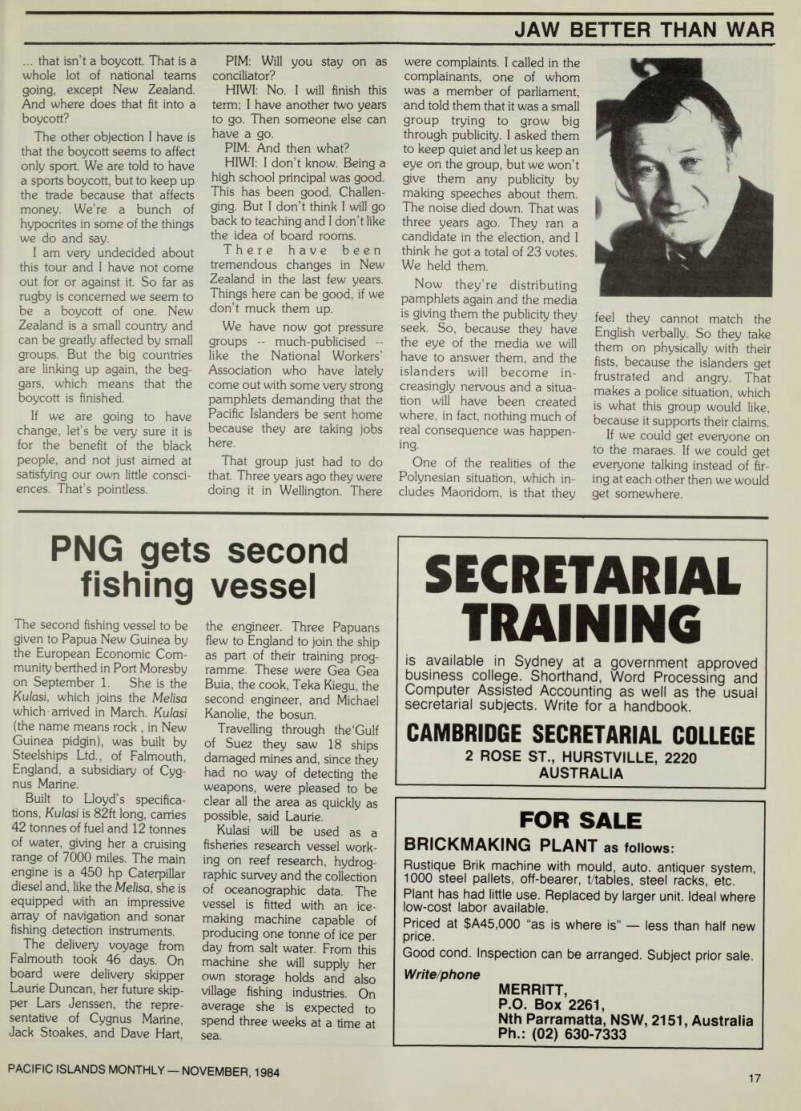
The second fishing vessel to be given to Papua New Guinea by the European Economic Com munity berthed in Port Moresby on September 1. She is the Kulasi, which joins the Melisa which-arrived in March. Kulasi (the name means rock , in New Guinea pidgin), was built by Steelships Ltd., of Falmouth, England, a subsidiary of Cyg nus Marine.
Built to Lloyd’s specifica tions, Kulasi is 82ft long, carries 42 tonnes of fuel and 12 tonnes of water, giving her a cruising range of 7000 miles. The main engine is a 450 hp Caterpillar diesel and, like the Melisa, she is equipped with an impressive array of navigation and sonar fishing detection instruments.
The delivery voyage from Falmouth took 46 days. On board were delivery skipper Laurie Duncan, her future skip per Lars Jenssen, the repre sentative of Cygnus Marine, Jack Stoakes, and Dave Hart,
the engineer. Three Papuans flew to England to join the ship as part of their training prog ramme. These were Gea Gea Buia, the cook, Teka Kiegu, the second engineer, and Michael Kanolie, the bosun.
Travelling through the‘Gulf of Suez they saw 18 ships damaged mines and, since they had no way of detecting the weapons, were pleased to be clear all the area as quickly as possible, said Laurie.
Kulasi will be used as a fisheries research vessel work ing on reef research, hydrog raphic survey and the collection of oceanographic data. The vessel is fitted with an ice making machine capable of producing one tonne of ice per day from salt water. From this machine she will supply her own storage holds and also village fishing industries. On average she is expected to spend three weeks at a time at sea.
Advertisements & other items, p. 17 (1 item)
Training
SECRETARIAL
is available in Sydney at a government approved business college. Shorthand, Word Processing and Computer Assisted Accounting as well as the usual secretarial subjects. Write for a handbook.
CAMBRIDGE SECRETARIAL COLLEGE
2 ROSE ST., HURSTVILLE, 2220
AUSTRALIA
FOR SALE
BRICKMAKING PLANT as follows: Rustique Brik machine with mould, auto, antiquer system, 1000 steel pallets, off-bearer, t/tables, steel racks, etc.
Plant has had little use. Replaced by larger unit. Ideal where low-cost labor available.
Priced at $A45,000 “as is where is” less than half new price.
Good cond. Inspection can be arranged. Subject prior sale.
Write/phone
MERRITT,
P.O. Box 2261, Nth Parramatta, NSW, 2151, Australia Ph.: (02) 630-7333
Pacific stamp box
Many Pacific countries are very depen dent upon the sale of stamps and in some cases their economies are virtual ly supported by the revenues of their philatelic bureaus. Stamps are the largest revenue earners for Pitcairn Island and Niuafo’ou, to name jtst two.
Stamps have also been the cause of government embarrassment as in the case of the 1978 Cook Islands elections when there was a scandal over use of Philatelic Bureau money for election purposes. Indeed, stamp policies have been the subject of frequent and often heated debate in several Pacific coun tries. I intend to cover this area in a later feature ... what you might call the politics of stamps.
Philatelists have always been attracted by Pacific stamps. A recent survey conducted by Australia Post asked collectors to nominate those countries whose stamps they collected.
From that survey the following order of popularity emerged. The percentage of respondents interested in each country is also shown. In brackets is the
*1 Australia 98% (94%) *2 Australian Antarctic Territory 57% (52%) 3 New Zealand 45% (29%) 4 United Kingdom 43% (26%) *5 Papua New Guinea 39% (34%) 6 United States 34% (16%) 7 Canada 29% (13%) *8 Norfolk Island 26% (27%) *9 Christmas Island 24% (27%) *lO Cocos (Keeling) Islands 24% (28%) *ll Fiji 24% (17%) 12 France 24% (9%) 13 Italy 22% (-) 14 West Germany 21% (10%) 15 Japan 20% (9%) 16 Greece 18% (-) *l7 Nauru 14% (15%) 18 China 14% (-) 19 Irish Republic 13% (-) *2O Pitcairn Islands 12% (10%) 21 Cook Islands 12% (7%) 22 Israel 11% (7%) 23 Solomons Islands 11% (6%) 24 United Nations 11% (7%) 25 Tonga 10% (5%) *26 Western Samoa 10% (11%) 27 New Caledonia 9% (4%) 28 Vanuatu 8% (4%) 29 Niue 6% (3%) 30 Vatican City State 6% (-) 31 Kiribati 4% (3%) 32 Tuvalu 4% (2%)
percentage indicated in the 1979 sur vey. Those countries whose stamps are sold at the Australian Philatelic Sales Centres are indicated by asterisks.
The top Pacific countries after Aus tralia and New Zeaqland are Papua New Guinea, Norfolk Island, Christmas Island and Fiji. These results reflect stamp issuing policies and I shall discuss this fascinating topic in a future feature.
International Stamp Dis
Play
Of great significance to the Pacific stamp scene has been the Australian Philatelic Exhibition, Ausipex. It was the first international stamp exhibition ever held in the Pacific region and was staged at the Melbourne Exhibition Building from September 21 to 30.
Some of the world’s best stamp exhibitions were on display and stamp dealers and bureaus from all over the world were represented, selling stamps and doing promotional work.
Most of the Pacific regions were represented and it was good to see them doing a brisk trade. A highlight of the show was surely the magnificent philatelic pieces from the collection of the British Royals by special, personal, permission of the Queen.
More than 40 countries (including most Pacific countries), issued special Ausipex stamps, special postmarks or souvenir cards. For the Pacific it was a particularly important event. It encour aged people to begin collecting, to share with each other, to leam more about their hobby from visiting experts,
to see stamps which had never before been shown in this part of the world, and it promoted sales of the stamps of this region.
Someone calculated that to see the half million stamps on display the keen visitor would have to walk 2.5 kilometres along the wide aisles set up at the Exhibition Building. And if that same keen visitor had spent 10 seconds on every stamp he would have been there from noon to 10 pm for 10 days.
It was a wonderfully-well organised show, with plenty of room around the stalls, and an enormous amount of information available. Not even the most ardent anti-philatelist could have remained uninterested in the multitude of ways one may go about stamp collecting. One of the most successful promotions at the exhibition had to be the “souvenir folder.” People of all ages, but especially children, could be seen running from one postal adminis tration stand to the other having a stamp stuck on the appropriate page and then marked with the country’s
special Ausipex postmark. With 63 countries represented in the show, that alone made for a very busy day of stamp visiting.
The atmosphere at Ausipex was great. Everyone was friendly and keen to help, even though a stamp sale might not have been involved every time, and the universality of the hobby was well demonstrated.
New Issues
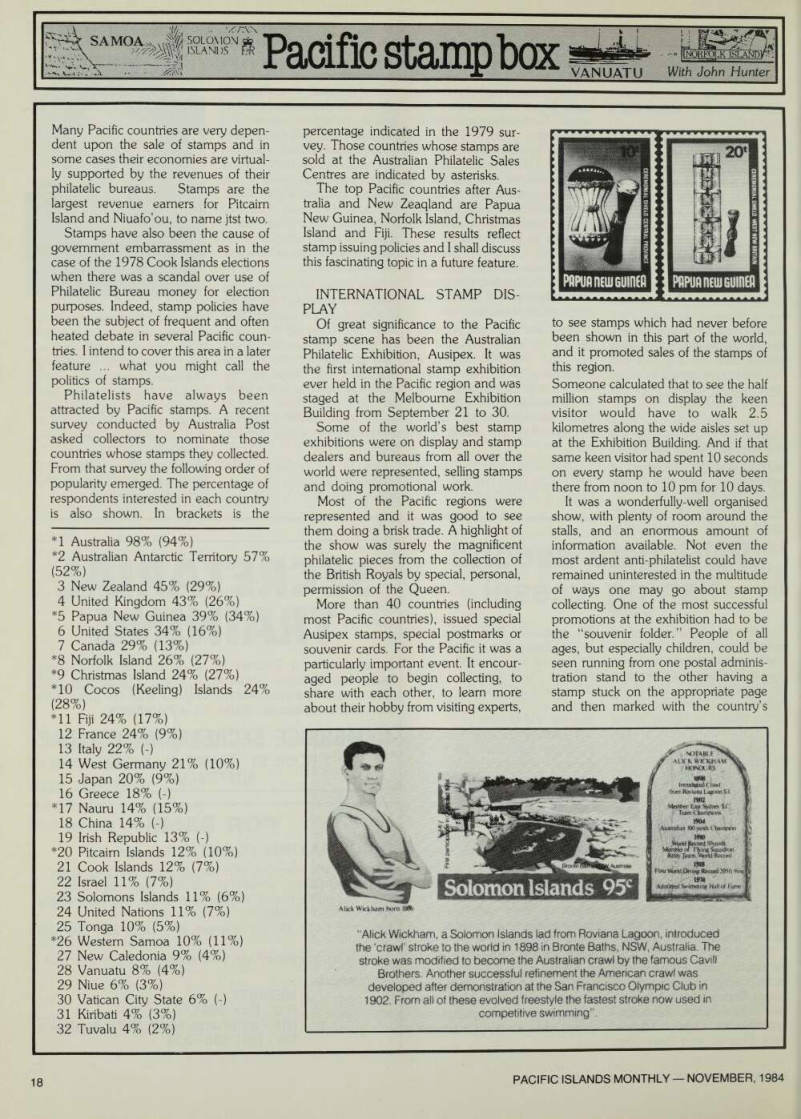
Republic of Nauru Four stamps were released on July 24, 1984 in 25, 30 and 50 cent denominations. They featured the only two species of butter fly found on Nauru. Papua New Guinea; a lOt stamp was issued on August 9 to commemorate the opening of the parliament house. On the same day a 5 kina stamp was issued featuring the bird of paradise. On September 21 four stamps were issued depicting ceremonial shields and drums.
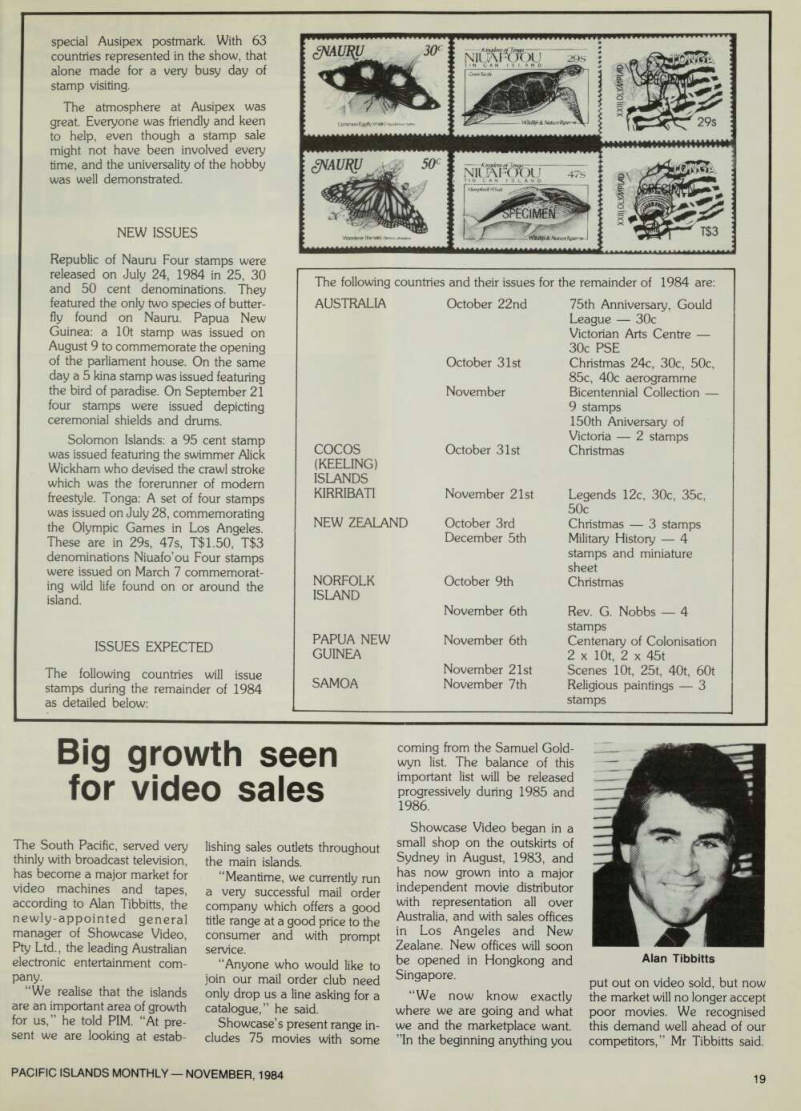
Solomon Islands: a 95 cent stamp was issued featuring the swimmer Alick Wickham who devised the crawl stroke which was the forerunner of modem freestyle. Tonga: A set of four stamps was issued on July 28, commemorating the Olympic Games in Los Angeles.
These are in 295, 475, T 51.50, Ts 3 denominations Niuafo’ou Four stamps were issued on March 7 commemorat ing wild life found on or around the island.
Issues Expected
The following countries will issue stamps during the remainder of 1984 as detailed below:
The following countries and their issues for the remainder of 1984 are: AUSTRALIA October 22nd 75th Anniversary, Gould League — 30c Victorian Arts Centre —
30C Pse
October 31st Christmas 24c, 30c, 50c, 85c, 40c aerogramme November Bicentennial Collection — 9 stamps 150th Aniversary of Victoria — 2 stamps COCOS October 31st Christmas
(Keeling)
Islands
KIRRIBATI November 21st Legends 12c, 30c, 35c, 50c NEW ZEALAND October 3rd Christmas — 3 stamps December 5th Military History — 4 stamps and miniature sheet NORFOLK October 9th Christmas
Island
November 6th Rev. G. Nobbs — 4 stamps PAPUA NEW November 6th Centenary of Colonisation GUINEA 2 x lOt, 2 x 45t November 21st Scenes lOt, 25t, 40t, 60t SAMOA November 7th Religious paintings — 3 stamps
Advertisements & other items, p. 18 (1 item)
Solomon Islands 95 c
$3
Alicfe W'itkhajn bom “Allck Wickham, a Soiomon Islands lad from Roviana Lagoon, introduced the ‘crawl’ stroke to the world in 1898 in Bronte Baths, NSW, Australia. The stroke was modified to become the Australian crawl by the famous Cavill Brothers. Another successful refinement the American crawl was developed after demonstration at the San Francisco Olympic Club in 1902. From all of these evolved freestyle the fastest stroke now used in competitive swimming”.
Big growth seen
for video sales
The South Pacific, served very thinly with broadcast television, has become a major market for video machines and tapes, according to Alan Tibbitts, the newly-appointed general manager of Showcase Video, Pty Ltd., the leading Australian electronic entertainment com pany.
“We realise that the islands are an important area of growth for us,” he told PIM. “At pre sent we are looking at estab
lishing sales outlets throughout the main islands, “Meantime, we currently run a very successful mail order company which offers a good title range at a good price to the consumer and with prompt service, “Anyone who would like to join our mail order club need only drop us a line asking for a catalogue, ” he said, Showcase’s present range in eludes 75 movies with some
coming from the Samuel Gold wyn list. The balance of this important list will be released progressively during 1985 and 1986.
Showcase Video began in a small shop on the outskirts of Sydney in August, 1983, and has now grown into a major independent movie distributor with representation all over Australia, and with sales offices in Los Angeles and New Zealane. New offices will soon be opened in Hongkong and Singapore.
“We now know exactly where we are going and what we and the marketplace want. ”In the beginning anything you
put out on video sold, but now the market will no longer accept poor movies. We recognised this demand well ahead of our competitors,” Mr Tibbitts said.
Alan Tibbitts
The Fourth South Pacific Festival of Arts
When the South Pacific Festival of Arts was first held in 1972, in Suva, Fiji, it was intended as the opening of a grand, quadrennial exhibi tion of the rich community of cultures which populate the region. It was a splendid occasion.
Much the same atmosphere surrounded the second and third festivals in Rotorua and Port Moresby. National pride was involved, but politics were kept out.
But the fourth festival, to be held in Noumea next month is threatened by some of the militants passionately bound up in the in creasingly tense argument over the manner in which France will grant independence to New Caledonia and the pace at which that process shall proceed.
PlM’s correspondent in Noumea Helen Fras er, here reports on all the attitudes.
The politics of it all
By the first week in October, opinion in New Caledonia’s political circles was split at least three ways on what to do about the Fourth South Pacific Festi val of Arts, due to be held there in December.
Four parties of the former Independence Front, the UC, UMP, FULK, and PSC, which had just formed themselves into the FLNKS - the Kanak Social
ist National Liberation Front (see The Month, this issuer announced that they intended to take part in the festival, but to politicise it.
FLNKS spokesman, Eloi Machoro, told newsmen that the South Pacific Festival of Arts would be a cultural event, but also ”a political tribune for the independence struggle of the Kanak people.”
New Caledonia . . . traditional regalia.
He said several meetings had been held with the organising committee of the festival, and they had decided that the political struggle should be integrated into the festival activities,
‘A political tribune for the independence struggle of the Kanak people'
Mr Machoro said the 27 foreign delegations attending the festival would be welcomed by either the FLNKS, or the provisional government plan ned to be set up by December 1. He said the (new national) Kanaky flag would fly during the festival and that one day would be set aside for a political forum at which the peoples of the Pacific could inform each other of their political situations.
However, a spokesman for the Liberation Kanake Socialiste (LKS) party, Henri Bailly, told a news conference that to use the arts festival as a political tribune was to ’’folklo rise” or trivialise the claims of the Kanak people. Bailly said
that after the festival Kanaks would just return to their homes, and nothing would be changed for them.
The LKS recently split away from the other four parties of the former Independence Front largely due to the latter’s deci sion to withdraw from official territorial institutions, particu larly the Territorial Assembly.
Mr Bailly accused the FLNKS of being a ’’front” for the leaders in the same way that the IF had been, and said the most pressing question was to elabo rate the content of a viable independence.
The LKS stressed that although they had quit the IF, they had not moved towards the centre - that is, between the FLNKS and the major anti independence force, the RPCR - but were part of the move ment for Kanak socialist inde pendence.
'Using the festival festival politically Kanak Claims’
Mr Bailly said support com mittees for the LKS position
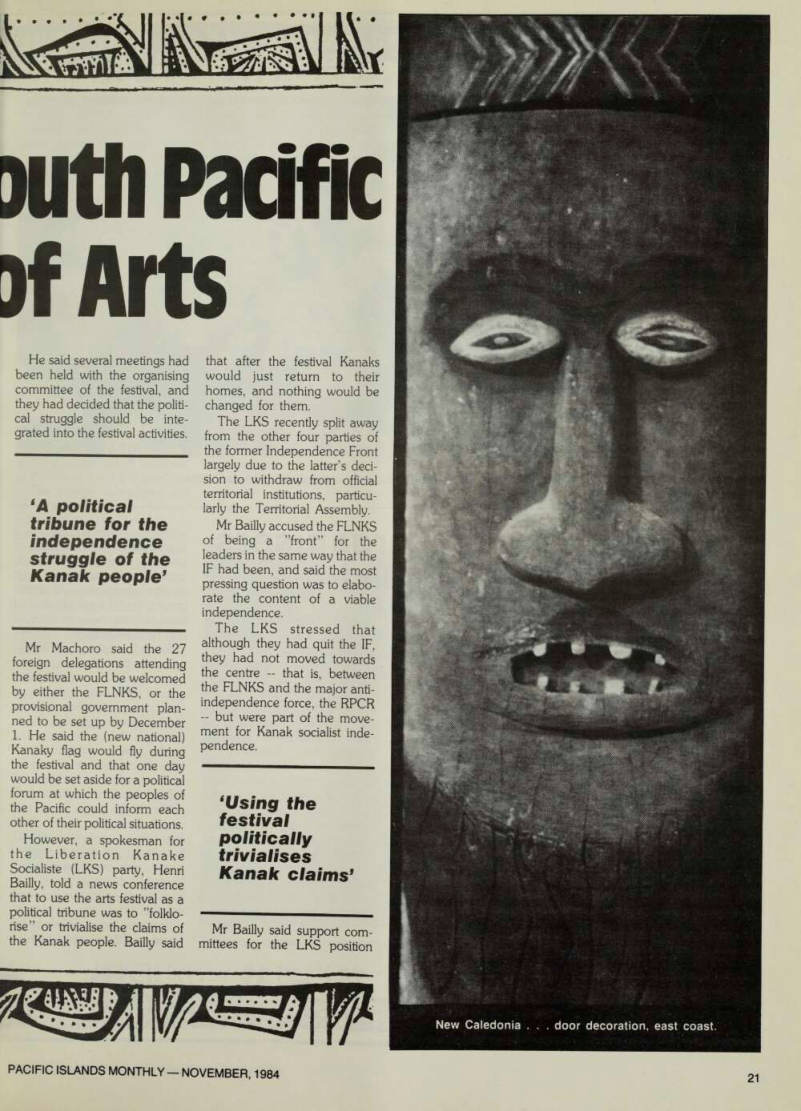
New Caledonia . . . door decoration, east coast.
had been formed in Canala, Yate, Ouvea, anf the SLN (nickel) works. The committees included people from all the independence parties who pre ferred a policy of staying inside the official institutions.
“drop it - avoid any problems”
The major anti-independ ence party, the RPCR, had in the past threatened to disrupt the arts festival if the Territorial Assembly elections were de layed. But now that they feel confident that elections will be held in late November, they have not repeated the threat.
However, RPCR leader, Jac ques Lafleur, said that the festi val should be cancelled, be cause, he believes, it ’’would be a source of problems. ”
Helen Fraser
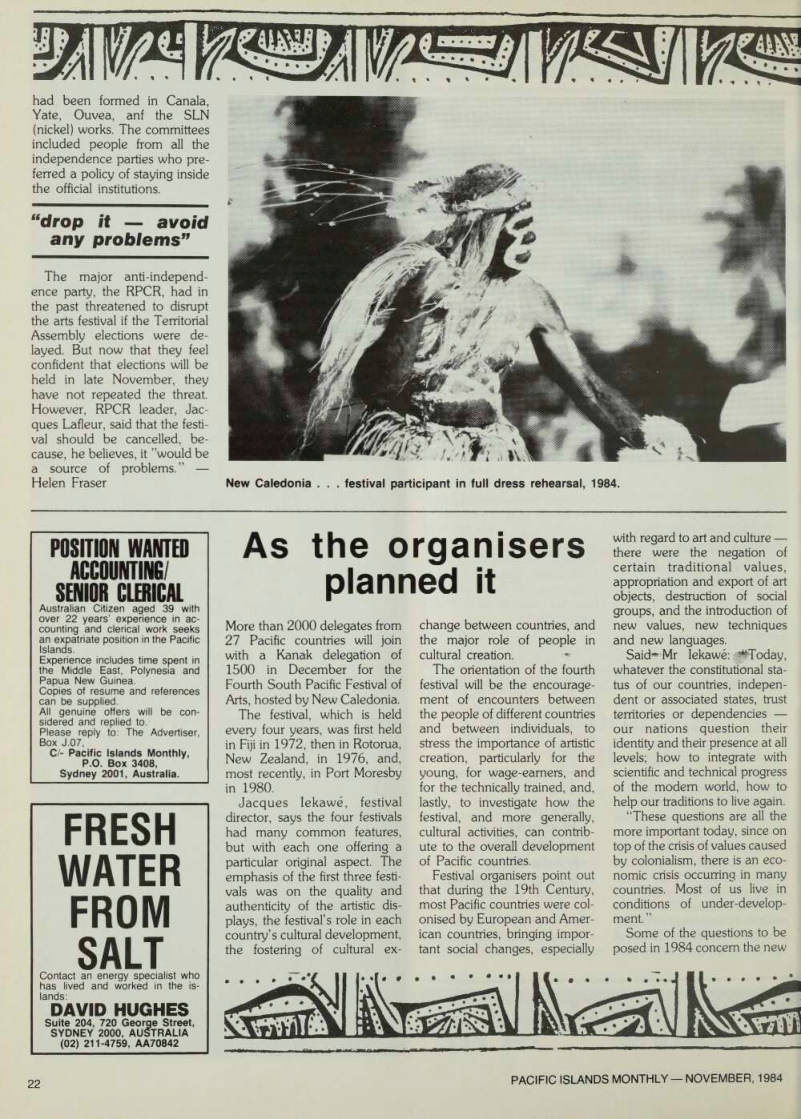
New Caledonia . . . festival participant in full dress rehearsal, 1984.
Advertisements & other items, p. 21 (1 item)
outh Pacific
of Arts
planned it
As the organisers planned it
More than 2000 delegates from 27 Pacific countries will join with a Kanak delegation of 1500 in December for the Fourth South Pacific Festival of Arts, hosted by New Caledonia.
The festival, which is held every four years, was first held in Fiji in 1972, then in Rotorua, New Zealand, in 1976, and, most recently, in Port Moresby in 1980.
Jacques lekawe, festival director, says the four festivals had many common features, but with each one offering a particular original aspect. The emphasis of the first three festi vals was on the quality and authenticity of the artistic dis plays, the festival’s role in each country’s cultural development, the fostering of cultural ex
change between countries, and the major role of people in cultural creation. •* The orientation of the fourth festival will be the encourage ment of encounters between the people of different countries and between individuals, to stress the importance of artistic creation, particularly for the young, for wage-earners, and for the technically trained, and, lastly, to investigate how the festival, and more generally, cultural activities, can contrib ute to the overall development of Pacific countries.
Festival organisers point out that during the 19th Century, most Pacific countries were col onised by European and Amer ican countries, bringing impor tant social changes, especially
with regard to art and culture there were the negation of certain traditional values, appropriation and export of art objects, destruction of social groups, and the introduction of new values, new techniques and new languages.
Said** Mr lekawe; whatever the constitutional sta tus of our countries, indepen dent or associated states, trust territories or dependencies our nations question their identity and their presence at all levels; how to integrate with scientific and technical progress of the modem world, how to help our traditions to live again.
“These questions are all the more important today, since on top of the crisis of values caused by colonialism, there is an eco nomic crisis occurring in many countries. Most of us live in conditions of under-develop ment. ”
Some of the questions to be posed in 1984 concern the new
economic conditions of artistic activity, artistic rights, new cultural means (such as musical instruments), the role of radio and TV, the effects of indus trialisation and urbanisation, new cultural needs such as in architecture, and the recogni tion of cultural rights for example, in the workplace.
The fourth festival has three phases.
The first is the welcome, and the installation of the delega tions, with Custom and open ceremonies.
The second phase is of 10 days of spectacle and various demonstrations.
The third is two or three days duration during which the festi val will be welcomed in eight Kanak regions outside Noumea. The regions represent songs, dances, craftwork, traditional sports, and tradition al means of food preparation.
The foreign delegations will offer traditional dances, theatre, music and singing, craft demon strations painting, sculpture, weaving, basket-making and displays on various aspects of their local cultural life.
The festival committee is also responsible for organising seve ral exhibitions the Imaginary Museum of the Pacific, with pieces brought especially from various parts of the world; and the Inventory of Kanak Herit age. There will also be a sym posium on monumental sculp tures, and contemporary plastic arts.
Other planned features will deal with a Kanak Historical Re-enactment, Scientific and Technical Exchange, an Exhibi tion and Sale of Oceanic Books, a Day of Oceanic Films, Traditional Sports, a Children’s Village, and, lastly, Traditional Food Preparation.
In relation to scientific and technical exchange, the festival organisers have decided to set up a dialogue between scien tists and the Oceanic peoples
on subjects of common interest.
The dialogue will cover the scientific content and tech niques of traditional cultures, the need to adapt science to the specific realities of Oceania, and the utility of science in the evolution of cultures.
Seminars will be held on four themes; • Pacific Arts conserva tion, change, possibilities. This will cover influences on traditional arts, techniques and problems of preservation and transmission, and technology in the service of arts promotion. • Architecture private dwellings as a reflection of culture, the traditional Kanak case and modem technology, and the problems of moving towards a contemporary Oceanic architecture. • Traditional cultures and the environment science in sorcery, traditional agriculture and development, and know ledge of plants. • The sea and its resources
marine technology pirogues and fishing, knowledge and traditional management of
fishing, and development of marine resources, especially by handicraft means.
Sarguma: A band of “magic men” from Papua New Guinea. - Caroline Yacoe picture.
Advertisements & other items, pp. 22-23 (2 items)
From
POSITION WANTED
ACCOUNTING/
SENIOR CLERICAL
Australian Citizen aged 39 with over 22 years’ experience in accounting and clerical work seeks an expatriate position in the Pacific Islands.
Experience includes time spent in the Middle East, Polynesia and Papua New Guinea.
Copies of resume and references can be supplied.
All genuine offers will be considered and replied to.
Please reply to: The Advertiser, Box J. 07, Cl- Pacific Islands Monthly, P.O. Box 3408, Sydney 2001, Australia.
FRESH
WATER
FROM
SALT
Contact an energy specialist who has lived and worked in the islands:
DAVID HUGHES
Suite 204, 720 George Street,
SYDNEY 2000, AUSTRALIA
(02) 211-4759, AA70842
The program
Each day of the festival will have one activity specially emphasised, so from December 8 to December 22, these will be: • Customary Welcome Opening Ceremony. • Audio-visual/lmaginary Museum. • Kanak Historical Re-enactment. • Craftwork/Sculpture. • Science, Technology /Books. • Contemporary Arts. • Non-Oceanic Delegations. • Food Preparation. • Pirogues (Outrigger Canoes). • Traditional Sports. • Rock/Reggae. • Childhood. • Closing Ceremonies. • Departure.
insuring the Pacific: A
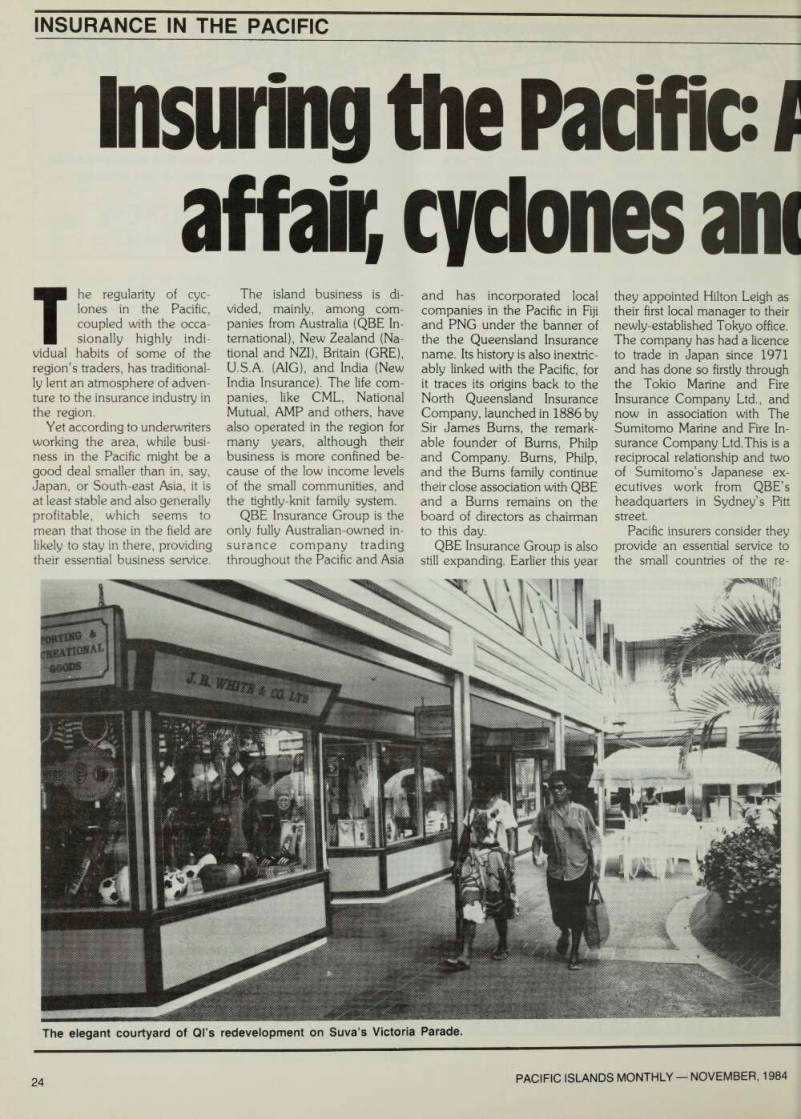

INSURANCE IN THE PACIFIC: Aprofitable
insuring the Pacific: A affair; cyclones ancall
The regularity of eyelones in the Pacific, coupled with the occasionally highly individual habits of some of the region’s traders, has traditionally lent an atmosphere of adventure to the insurance industry in the region.
Yet according to underwriters working the area, while business in the Pacific might be a good deal smaller than in, say, Japan, or South-east Asia, it is at least stable and also generally profitable, which seems to mean that those in the field are likely to stay in there, providing their essential business service,
The island business is di vided, mainly, among corn panies from Australia (QBE In ternational), New Zealand (Na tional and NZI), Britain (GRE), U.S.A. (AIG), and India (New India Insurance). The life confi panies, like CML, National Mutual, AMP and others, have also operated in the region for many years, although their business is more confined be cause of the low income levels of the small communities, and the tightly-knit family system, QBE Insurance Group is the only fully Australian-owned in surance company trading throughout the Pacific and Asia
and has incorporated local companies in the Pacific in Fiji and PNG under the banner of the the Queensland Insurance name. Its history is also inextric ably linked with the Pacific, for it traces its origins back to the North Queensland Insurance Company, launched in 1886 by Sir James Bums, the remark able founder of Burns, Philp and Company. Bums, Philp, and the Bums family continue their close association with QBE and a Burns remains on the board of directors as chairman to this day.
QBE Insurance Group is also still expanding. Earlier this year
they appointed Hilton Leigh as their first local manager to their newly-established Tokyo office.
The company has had a licence to trade in Japan since 1971 and has done so firstly through the Tokio Marine and Fire Insurance Company Ltd., and now in association with The Sumitomo Marine and Fire In surance Company Ltd. This is a reciprocal relationship and two of Sumitomo’s Japanese ex ecutives work from QBE’s headquarters in Sydney’s Pitt street.
Pacific insurers consider they provide an essential service to the small countries of the re-
The elegant courtyard of QI’s redevelopment on Suva’s Victoria Parade.
gion, enhancing investment by removing at least some of the risks of operating in fairly re mote, or cyclone-prone areas.
Shipping, so vital to island countries, could not operate properly without them.
But, if the Pacific islands are a small market, that in Asia is huge, and still growing. In Japan, for instance, the annual premiums paid for fire and general insurance exceed $22 billion and, as industrialisation continues to grow in countries like Singapore and Malaysia, so the insurance industry will grow with it.
One of the other companies early in the area was GRE, then known as the ’’Guardian,” who extended from their London headquarters to Australia in 1879. They had earlier (1835) established an office in China through the Union Insurance Society of Canton. That or ganisation is now headquar tered in Hong Kong and oper ates throughout Asia and South-east Asia.
The Pacific arm, trading as GRE Pacific Insurances Ltd., operates in Papua New Guinea, where they hold about 18% of the country’s business in their offices in Lae, Rabaul and Port Moresby. The company traces its origins back to the fifties when Atlas, Royal Exchange Assurance, and Guardian were all writing general business in what was then an Australian administered U.N. Trust Terri tory. Royal Exchange and Guardian also operated in the Solomon Islands.
In Fiji the Pacific Insurance Company, Ltd., began in 1919 and became a subsidiary of Atlas Insurance in 1928. In
1962 control passed to the Australian arm of the firm and, since 1974, all their Fiji business has been done by GRE Insur ance, Ltd.
QBE Insurance Group, has always had very close links with the Pacific, although today its operations are world-wide, with offices and agencies in 21 coun tries, QBE Insurance Group In ternational Operations is di vided into three main regions, Asia, Pacific and U.K./Europe, under international manager Brian Cotterill. John Laidlaw, who was for some time in Fiji with now-retired Lloyd Liddell, heads the Pacific region, and the Asian region is run by Neil Seddon.
In Fiji the company operates as Queensland Insurance (Fiji) Ltd., the name Queensland In surance being a shortened form of the original North Queens land Insurance Company, founded by Sir James Bums.
The Fiji operation has been running for 65 years, and now employs 32 staff, and has offices in Suva, Lautoka and Labasa. In PNG the staff num bers 63, and trades under the name Queensland Insurance (PNG) Ltd, with offices in Port Moresby, Arawa, Lae, Madang, Mt Hagen, and Rabaul.
Altogether QBE Insurance operates in 10 Pacific countries, ranging from their larger opera tions in PNG, Fiji, Vanuatu, New Caledonia, and Tahiti, to Niue and Norfolk Island.
But, perhaps curiously, QBE has traded longest in the Pacific not in an Australian-linked terri tory, but a French one. They trace their origins in Noumea back for almost 100 years.
Advertisements & other items, p. 25 (1 item)
Pitco
mil
GRE Pacific Insurance Pty Ltd (Incorporated in Papua New Guinea)
FOR ALL YOUR
INSURANCE
REQUIREMENTS
Members of the world-wide Guardian Royal Exchange Assurance Group
• INSURERS OVERSEAS
SINCE 1720
• WORLD-WIDE ASSETS EXCEED
AUD $8,000,000,000
• REPRESENTED IN OVER 125
COUNTRIES
INSURANCE WITH SECURITY
PITCO
PACIFIC INTERNATIONAL TRUST COMPANY
LIMITED
INTERNATIONAL COMPANY
ADMINISTRATION
DISCRETIONARY TRUSTS
P.O. BOX 45, PORT VILA, VANUATU
PHONE (678) 2957,
TELEX (771) 1022 PITCO NH
political currents
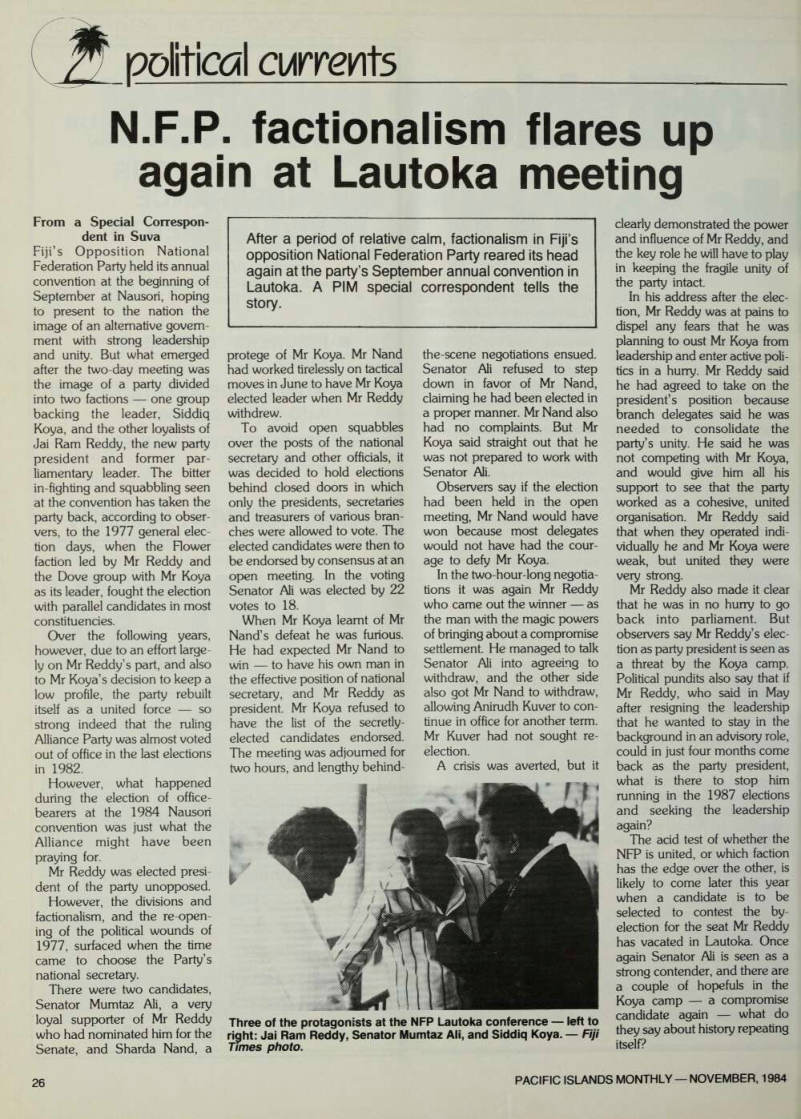
N.F.P. factionalism flares up again at Lautoka meeting
From a Special Correspon dent in Suva Fiji’s Opposition National Federation Party held its annual convention at the beginning of September at Nausori, hoping to present to the nation the image of an alternative govern ment with strong leadership and unity. But what emerged after the two-day meeting was the image of a party divided into two factions one group backing the leader, Siddiq Koya, and the other loyalists of Jai Ram Reddy, the new party president and former par liamentary leader. The bitter in fighting and squabbling seen at the convention has taken the party back, according to obser vers, to the 1977 general elec tion days, when the Rower faction led by Mr Reddy and the Dove group with Mr Koya as its leader, fought the election with parallel candidates in most constituencies.
Over the following years, however, due to an effort large ly on Mr Reddy’s part, and also to Mr Koya’s decision to keep a low profile, the party rebuilt itself as a united force so strong indeed that the ruling Alliance Party was almost voted out of office in the last elections in 1982.
However, what happened during the election of office bearers at the 1984 Nausori convention was just what the Alliance might have been praying for.
Mr Reddy was elected presi dent of the party unopposed.
However, the divisions and factionalism, and the re-open ing of the political wounds of 1977, surfaced when the time came to choose the Party’s national secretary.
There were two candidates, Senator Mumtaz Ali, a very loyal supporter of Mr Reddy who had nominated him for the Senate, and Sharda Nand, a
After a period of relative calm, factionalism in Fiji’s opposition National Federation Party reared its head again at the party’s September annual convention in Lautoka. A PIM special correspondent tells the story.
protege of Mr Koya. Mr Nand had worked tirelessly on tactical moves in June to have Mr Koya elected leader when Mr Reddy withdrew.
To avoid open squabbles over the posts of the national secretary and other officials, it was decided to hold elections behind closed doors in which only the presidents, secretaries and treasurers of various bran ches were allowed to vote. The elected candidates were then to be endorsed by consensus at an open meeting. In the voting Senator Ali was elected by 22 votes to 18.
When Mr Koya leamt of Mr Nand’s defeat he was furious.
He had expected Mr Nand to win to have his own man in the effective position of national secretary, and Mr Reddy as president. Mr Koya refused to have the list of the secretly elected candidates endorsed.
The meeting was adjourned for two hours, and lengthy behind
the-scene negotiations ensued.
Senator Ali refused to step down in favor of Mr Nand, claiming he had been elected in a proper manner. Mr Nand also had no complaints. But Mr Koya said straight out that he was not prepared to work with Senator Ali.
Observers say if the election had been held in the open meeting, Mr Nand would have won because most delegates would not have had the cour age to defy Mr Koya.
In the two-hour-long negotia tions it was again Mr Reddy who came out the winner as the man with the magic powers of bringing about a compromise settlement. He managed to talk Senator Ali into agreeing to withdraw, and the other side also got Mr Nand to withdraw, allowing Anirudh Kuver to con tinue in office for another term.
Mr Kuver had not sought re election.
A crisis was averted, but it
clearly demonstrated the power and influence of Mr Reddy, and the key role he will have to play in keeping the fragile unity of the party intact.
In his address after the elec tion, Mr Reddy was at pains to dispel any fears that he was planning to oust Mr Koya from leadership and enter active poli tics in a hurry. Mr Reddy said he had agreed to take on the president’s position because branch delegates said he was needed to consolidate the party’s unity. He said he was not competing with Mr Koya, and would give him all his support to see that the party worked as a cohesive, united organisation. Mr Reddy said that when they operated indi vidually he and Mr Koya were weak, but united they were very strong.
Mr Reddy also made it clear that he was in no hurry to go back into parliament. But observers say Mr Reddy’s elec tion as party president is seen as a threat by the Koya camp.
Political pundits also say that if Mr Reddy, who said in May after resigning the leadership that he wanted to stay in the background in an advisory role, could in just four months come back as the party president, what is there to stop him running in the 1987 elections and seeking the leadership again?
The acid test of whether the NFP is united, or which faction has the edge over the other, is likely to come later this year when a candidate is to be selected to contest the by election for the seat Mr Reddy has vacated in Lautoka. Once again Senator Ali is seen as a strong contender, and there are a couple of hopefuls in the Koya camp a compromise candidate again what do they say about history repeating itself?
Three of the protagonists at the NFP Lautoka conference - left to right: Jai Ram Reddy, Senator Mumtaz Ali, and Siddiq Koya. - Fiji Times photo.
Advertisements & other items, p. 27 (1 item)
A-Digi
Multifunctlonallsm is the
watchword for timepieces
in this information age.
Citizen technology meets
the challenge with two
revolutionary ideas in
watches.
EWAfTO
V n N. / ' € ♦ & •v \ kI % % . < v t >/ /
AMA-DIBI
TEMP
Citizen Quartz Ana-Digi Temp. 59.9° to 9.9°C temperature readout, one-touch Fahrenheit conversion, Analog/Digital time indication with automatic calendar and dual (one other time zone) time. 24-hour alarm, hourly chime. 1/1000-sec, accurate stopwatch.
AMA-0181
BonboFl
Citizen Quartz Ana-Digi Combo FI.
Analog/Digital time indication with 1-sec. and 10-sec. increment LCD trackers. Permanently adjusted monthday-date calendar. 24-hour alarm, 12-hour countdown timer; hourly chime. Dual time. And a 1/100-sec. counter lap- timing stopwatch.
CITIZEN
AHEAD OF THEIR TIME
the month
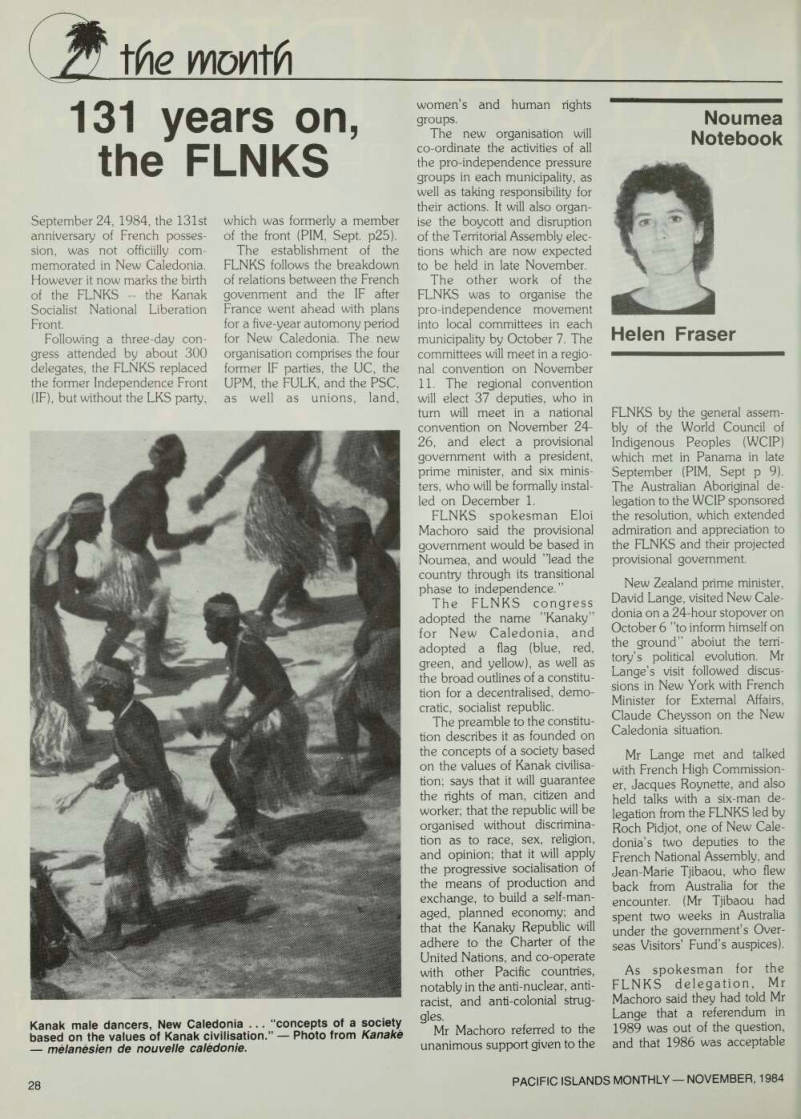
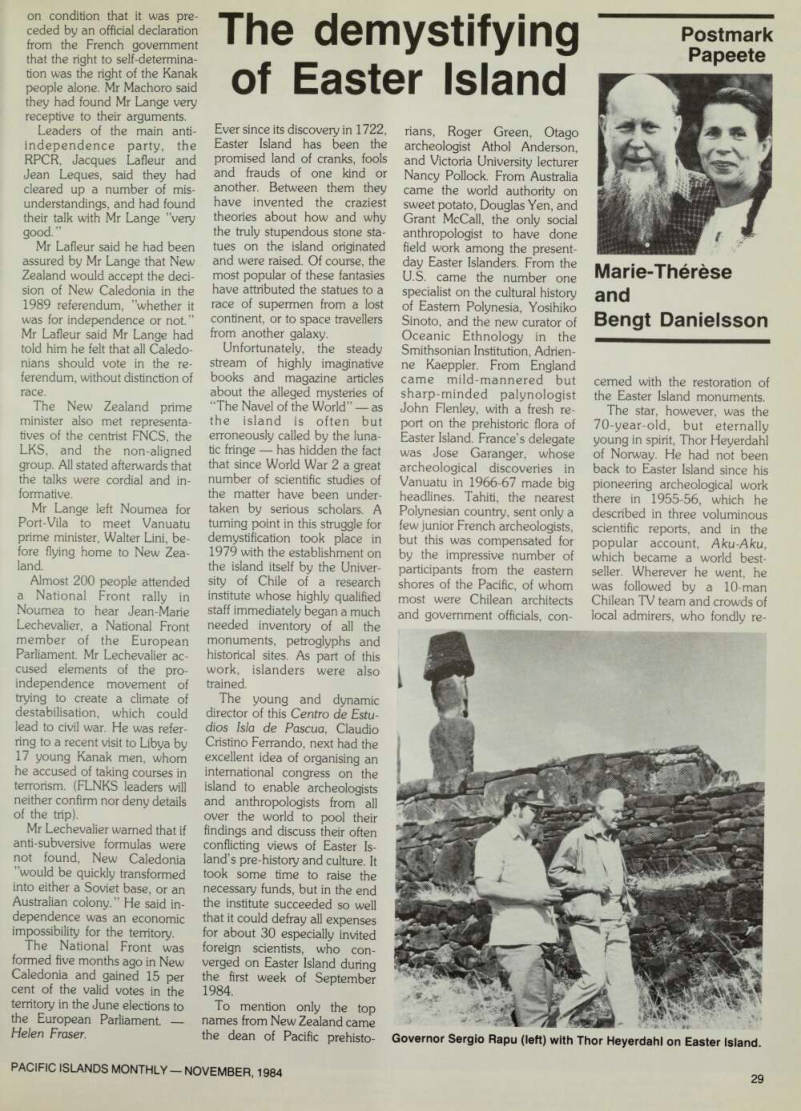
131 years on, the FLNKS
September 24, 1984, the 131st anniversary of French posses sion, was not officiilly com memorated in New Caledonia.
However it now marks the birth of the FLNKS - the Kanak Socialist National Liberation Front.
Following a three-day con gress attended by about 300 delegates, the FLNKS replaced the former Independence Front (IF), but without the LKS party,
which was formerly a member of the front (PIM, Sept. p 25).
The establishment of the FLNKS follows the breakdown of relations between the French govenment and the IF after France went ahead with plans for a five-year automony period for New Caledonia. The new organisation comprises the four former IF parties, the UC, the UPM, the FULK, and the PSC, as well as unions, land,
women’s and human rights groups.
The new organisation will co-ordinate the activities of all the pro-independence pressure groups in each municipality, as well as taking responsibility for their actions. It will also organ ise the boycott and disruption of the Territorial Assembly elec tions which are now expected to be held in late November.
The other work of the FLNKS was to organise the pro-independence movement into local committees in each municipality by October 7. The committees will meet in a regio nal convention on November 11. The regional convention will elect 37 deputies, who in turn will meet in a national convention on November 24- 26, and elect a provisional government with a president, prime minister, and six minis ters, who will be formally instal led on December 1.
FLNKS spokesman Eloi Machoro said the provisional government would be based in Noumea, and would ’’lead the country through its transitional phase to independence.”
The FLNKS congress adopted the name ’’Kanaky” for New Caledonia, and adopted a flag (blue, red, green, and yellow), as well as the broad outlines of a constitu tion for a decentralised, demo cratic, socialist republic.
The preamble to the constitu tion describes it as founded on the concepts of a society based on the values of Kanak civilisa tion; says that it will guarantee the rights of man, citizen and worker; that the republic will be organised without discrimina tion as to race, sex, religion, and opinion; that it will apply the progressive socialisation of the means of production and exchange, to build a self-man aged, planned economy; and that the Kanaky Republic will adhere to the Charter of the United Nations, and co-operate with other Pacific countries, notably in the anti-nuclear, anti racist, and anti-colonial strug gles.
Mr Machoro referred to the unanimous support given to the
FLNKS by the general assem bly of the World Council of Indigenous Peoples (WCIP) which met in Panama in late September (PIM, Sept p 9).
The Australian Aboriginal de legation to the WCIP sponsored the resolution, which extended admiration and appreciation to the FLNKS and their projected provisional government.
New Zealand prime minister, David Lange, visited New Cale donia on a 24-hour stopover on October 6 ”to inform himself on the ground” aboiut the terri tory’s political evolution. Mr Lange’s visit followed discus sions in New York with French Minister for External Affairs, Claude Cheysson on the New Caledonia situation.
Mr Lange met and talked with French High Commission er, Jacques Roynette, and also held talks with a six-man de legation from the FLNKS led by Roch Pidjot, one of New Cale donia’s two deputies to the French National Assembly, and Jean-Marie Tjibaou, who flew back from Australia for the encounter. (Mr Tjibaou had spent two weeks in Australia under the government’s Over seas Visitors’ Fund’s auspices).
As spokesman for the FLNKS delegation, Mr Machoro said they had told Mr Lange that a referendum in 1989 was out of the question, and that 1986 was acceptable
Kanak male dancers, New Caledonia ... “concepts of a society based on the values of Kanak civilisation.” - Photo from Kanaka -melanesien de nouvelle caledonie.
Noumea Notebook
Helen Fraser
on condition that it was pre ceded by an official declaration from the French government that the right to self-determina tion was the right of the Kanak people alone. Mr Machoro said they had found Mr Lange very receptive to their arguments.
Leaders of the main anti independence party, the RPCR, Jacques Lafleur and Jean Leques, said they had cleared up a number of mis understandings, and had found their talk with Mr Lange ’’very good. ”
Mr Lafleur said he had been assured by Mr Lange that New Zealand would accept the deci sion of New Caledonia in the 1989 referendum, ’’whether it was for independence or not. ”
Mr Lafleur said Mr Lange had told him he felt that all Caledo nians should vote in the re ferendum, without distinction of race.
The New Zealand prime minister also met representa tives of the centrist FNCS, the LKS, and the non-aligned group. All stated afterwards that the talks were cordial and in formative.
Mr Lange left Noumea for Port-Vila to meet Vanuatu prime minister, Walter Lini, be fore flying home to New Zea land.
Almost 200 people attended a National Front rally in Noumea to hear Jean-Marie Lechevalier, a National Front member of the European Parliament. Mr Lechevalier ac cused elements of the pro independence movement of trying to create a climate of destabilisation, which could lead to civil war. He was refer ring to a recent visit to Libya by 17 young Kanak men, whom he accused of taking courses in terrorism. (FLNKS leaders will neither confirm nor deny details of the trip).
Mr Lechevalier warned that if anti-subversive formulas were not found, New Caledonia ’’would be quickly transformed into either a Soviet base, or an Australian colony. ” He said in dependence was an economic impossibility for the territory.
The National Front was formed five months ago in New Caledonia and gained 15 per cent of the valid votes in the territory in the June elections to the European Parliament.
Helen Fraser.
The demystifying

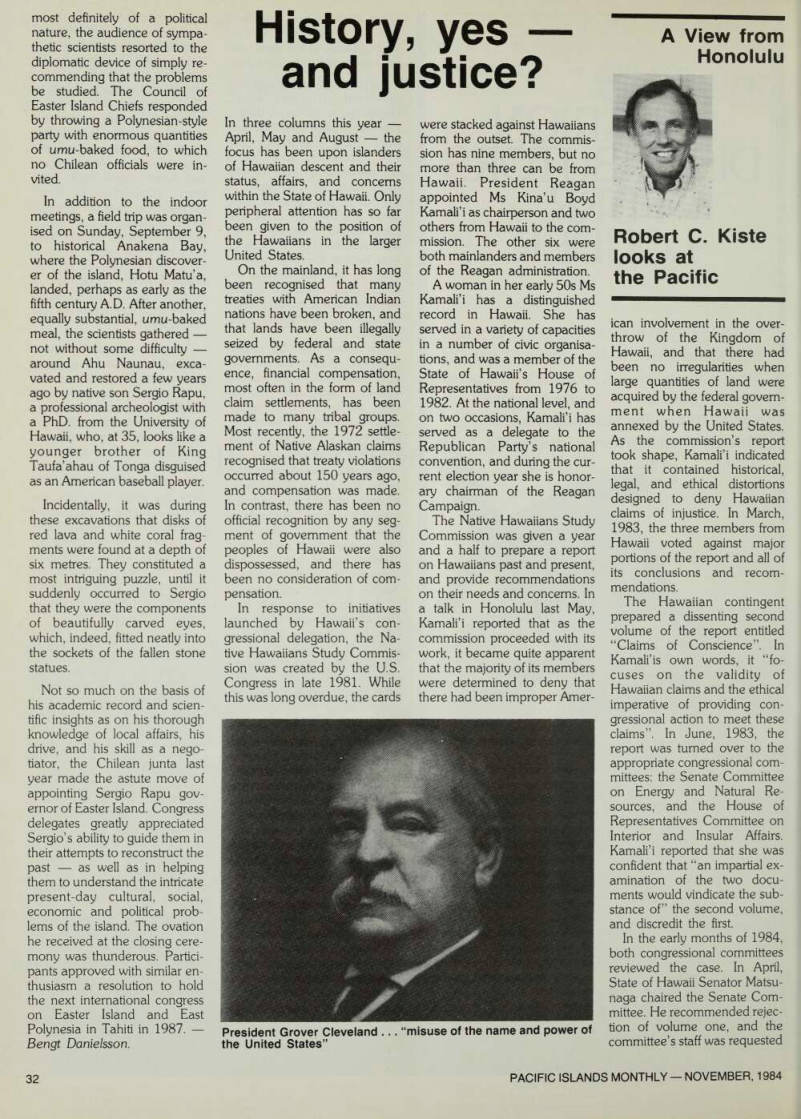
of Easter Island
Ever since its discovery in 1722, Easter Island has been the promised land of cranks, fools and frauds of one kind or another. Between them they have invented the craziest theories about how and why the truly stupendous stone sta tues on the island originated and were raised. Of course, the most popular of these fantasies have attributed the statues to a race of supermen from a lost continent, or to space travellers from another galaxy.
Unfortunately, the steady stream of highly imaginative books and magazine articles about the alleged mysteries of “The Navel of the World” as the island is often but erroneously called by the luna tic fringe has hidden the fact that since World War 2 a great number of scientific studies of the matter have been under taken by serious scholars. A turning point in this struggle for demystification took place in 1979 with the establishment on the island itself by the Univer sity of Chile of a research institute whose highly qualified staff immediately began a much needed inventory of all the monuments, petroglyphs and historical sites. As part of this work, islanders were also trained.
The young and dynamic director of this Centro de Estu dios Is/a de Pascua, Claudio Cristino Fernando, next had the excellent idea of organising an international congress on the island to enable archeologists and anthropologists from all over the world to pool their findings and discuss their often conflicting views of Easter Is land’s pre-history and culture. It took some time to raise the necessary funds, but in the end the institute succeeded so well that it could defray all expenses for about 30 especially invited foreign scientists, who con verged on Easter Island during the first week of September 1984.
To mention only the top names from New Zealand came the dean of Pacific prehisto
rians, Roger Green, Otago archeologist Athol Anderson, and Victoria University lecturer Nancy Pollock. From Australia came the world authority on sweet potato, Douglas Yen, and Grant McCall, the only social anthropologist to have done field work among the present day Easter Islanders. From the U.S. came the number one specialist on the cultural history of Eastern Polynesia, Yosihiko Sinoto, and the new curator of Oceanic Ethnology in the Smithsonian Institution, Adrien ne Kaeppler. From England came mild-mannered but sharp-minded palynologist John Flenley, with a fresh re port on the prehistoric flora of Easter Island. France’s delegate was Jose Garanger, whose archeological discoveries in Vanuatu in 1966-67 made big headlines. Tahiti, the nearest Polynesian country, sent only a few junior French archeologists, but this was compensated for by the impressive number of participants from the eastern shores of the Pacific, of whom most were Chilean architects and government officials, con-
cerned with the restoration of the Easter Island monuments.
The star, however, was the 70-year-old, but eternally young in spirit, Thor Heyerdahl of Norway. He had not been back to Easter Island since his pioneering archeological work there in 1955-56, which he described in three voluminous scientific reports, and in the popular account, Aku-Aku, which became a world best seller. Wherever he went, he was followed by a 10-man Chilean TV team and crowds of local admirers, who fondly re-
Governor Sergio Rapu (left) with Thor Heyerdahl on Easter Island.
Postmark Papeete
Marie-Thèrèse and Bengt Danielsson
called his boundless generosity at a time when there were no trading stores on the island, and only one supply vessel per year.
Although the capital and only settlement on Easter Island, Hangaroa, is no more than a sprawling village inhabited by a mere 1600 Polynesians and 700 Chileans, high class accommodation was plentiful as a result of the boom in tourism in pre-Pinochet days, when a 120-room hotel and many small boarding-houses were built. Most of the meetings were held in the huge hotel even in the discotheque which once again for a brief week became a bustling place, besieged by numerous curio vendors.
The more than 50 papers presented during the six 10hour daily sessions fell into the following categories: pre-his tory, ethno-history, petro glyphs, artefacts, preservation, restoration, social anthropology and culture change.
The most interesting findings in the field of pre-history were all based on the exact, and now extensively used, methods of dating of carbon or other orga nic material, plant pollen, and obsidian spear points. They concurred in the most satisfying manner to show that the period of gigantic ahu platform buil ding and large-scale stone car ving fell between 1100 and 1700 A.D.
It was particularly interesting to leam from Professor Hen ley’s pollen studies that at the beginning of this period the island had a forest cover of Sophora toromiro trees and palms belonging to a now ex tinct species of a family repre sented otherwise only in South America. Since timber was needed not only as a fuel and a house-building material, but also and above all for the transport and erection of the giant statues, the subsequent deforestation recorded in Hen ley’s pollen samples can be understood.
The most original paper, however, came not from an earth-digger but from a sky gazer, Malcolm Clark of Califor nia. He boldly and quite con vincingly suggested that the Polynesians might have under taken most of their long sea voyages as a result of the
sudden appearance in the sky of stellar novae and supemovae of such brilliance that they were clearly visible during the day for periods varying between two months and two years. Malcolm Clark summarised his paper as follows: “The data suggest that an early migration from Samoa to the Marquesas and the initial occupations of New Zealand and Easter Island could have been stimulated by such astronomical events. There is some evidence for a similar possible influence on the migra tions to the Hawaiian Islands. A very early occupation of New Zealand from Tonga and a direct settlement of Chatham Islands from Rarotonga are also possibilities. ”
As for the sessions devoted to restoration problems, it was a great relief to discover that most participants agreed with ICCROM represenative Stan ley-Price that no such work should be done on an historical monument until it had been described and studied in the greatest detail. As he observed, there are today too many ex amples scattered across the five continents of restorations hasti ly conceived and executed, embedding terrible mistakes which can never be corrected, since nobody knows for sure the original shape of the monu ment.
The social anthropologists were agreeably surprised by the great number of islanders who from the beginning took a keen interest in their debates. Indeed they asked for and were given permission to present their own views on two burning local issues.
The first was the lack of popular political representation on the island, which they have tried to remedy by forming a council of the 35 family heads.
Unfortunately, the Chilean Government has so far refused to recognise it. On the second issue they put forward the apparently very reasonable de mand that they should become legal owners of their island, of which they were dispossessed around the turn of the century when a Scottish firm trans formed it into a sheep run, leaving only the village of Han garoa to the islanders.
Since these demands were
most definitely of a political nature, the audience of sympa thetic scientists resorted to the diplomatic device of simply re commending that the problems be studied. The Council of Easter Island Chiefs responded by throwing a Polynesian-style party with enormous quantities of umu-baked food, to which no Chilean officials were in vited.
In addition to the indoor meetings, a field trip was organ ised on Sunday, September 9, to historical Anakena Bay, where the Polynesian discover er of the island, Hotu Matu’a, landed, perhaps as early as the fifth century A.D. After another, equally substantial, umu-baked meal, the scientists gathered not without some difficulty around Ahu Naunau, exca vated and restored a few years ago by native son Sergio Rapu, a professional archeologist with a PhD. from the University of Hawaii, who, at 35, looks like a younger brother of King Taufa’ahau of Tonga disguised as an American baseball player.
Incidentally, it was during these excavations that disks of red lava and white coral frag ments were found at a depth of six metres. They constituted a most intriguing puzzle, until it suddenly occurred to Sergio that they were the components of beautifully carved eyes, which, indeed, fitted neatly into the sockets of the fallen stone statues.
Not so much on the basis of his academic record and scien tific insights as on his thorough knowledge of local affairs, his drive, and his skill as a nego tiator, the Chilean junta last year made the astute move of appointing Sergio Rapu gov ernor of Easter Island. Congress delegates greatly appreciated Sergio’s ability to guide them in their attempts to reconstruct the past as well as in helping them to understand the intricate present-day cultural, social, economic and political prob lems of the island. The ovation he received at the closing cere mony was thunderous. Partici pants approved with similar en thusiasm a resolution to hold the next international congress on Easter Island and East Polynesia in Tahiti in 1987.
Bengt Danielsson.
Advertisements & other items, pp. 30-31 (1 item)
The Search Is Over
>u were looking for the perfect fit. U ncompromising sound quality. As beautiful to look at as it is to ten to. Advanced electronics. A choice of sophisticated features that are easy to use. Reliability at’s no fairy tale. Clarion makes a wide selection of models, with one I * at's just your size. Clarion Car Stereo. Listen, and drive happily ever after. Ij^LflrtllOn
°_ n^9!-#-fader
LB nnicner
model 900 E
in n Q
IU
IXI MTL
LD APC Q
urther information - Australia: Amalgamated Wireless (Australasia) Ltd., 554 Parramatta Road, Asdfield, NSW., 2131 / New Zealand: AWA New Zealand Limited, PO, Box 50-248 Ponrua / Fiji islan^'- Br 'i> & Co ; ! L ' d j Suva i Tahiti- HI-FI Shangnla B P 200 Papeete I New Caledonia: Caldis, B.P.M’ Noumea Cedex / Guam: Micropac Audio Inc., PO Box 3478, Agana, Guam 96910, d.S.A Tel 472-8091 Cable Code HIFI AUDIO G Vanuatu: The Sound Centre, PO Box 434, Vila / Cook islands: South Seas International Ltd., P.O Box 49, Rarotonga / Papua New Guinea: Hagemeyer (PN.G.) Pty. Ltd., PO Box 1428, Boroko, Port Moresby.
Clarion
DISTRIBUTORS
PURR
LOUDER.
Smart distributors know that better products mean better business. And we think Clarion Car Stereos are the best. A lot of customers seem to agree. Customers in; Nauru/Western Samoa/Tonga/the Solomon Islands/ • • % * • /FW . w* • . * « _—_ Is If you’re interested in becoming the exclusive Clarion distributor in any of these purrrofitable markets, contact us right away. We'll send you complete information immediately.
Clarion Co., Ltd. 3 Kojimachi 5-chome, Chiyoda-ku, Tokyo 102, Japan Telephone: 03-265-2931
Telex: J22908/J22152 CLARISHO
® Clarion
History, yes -
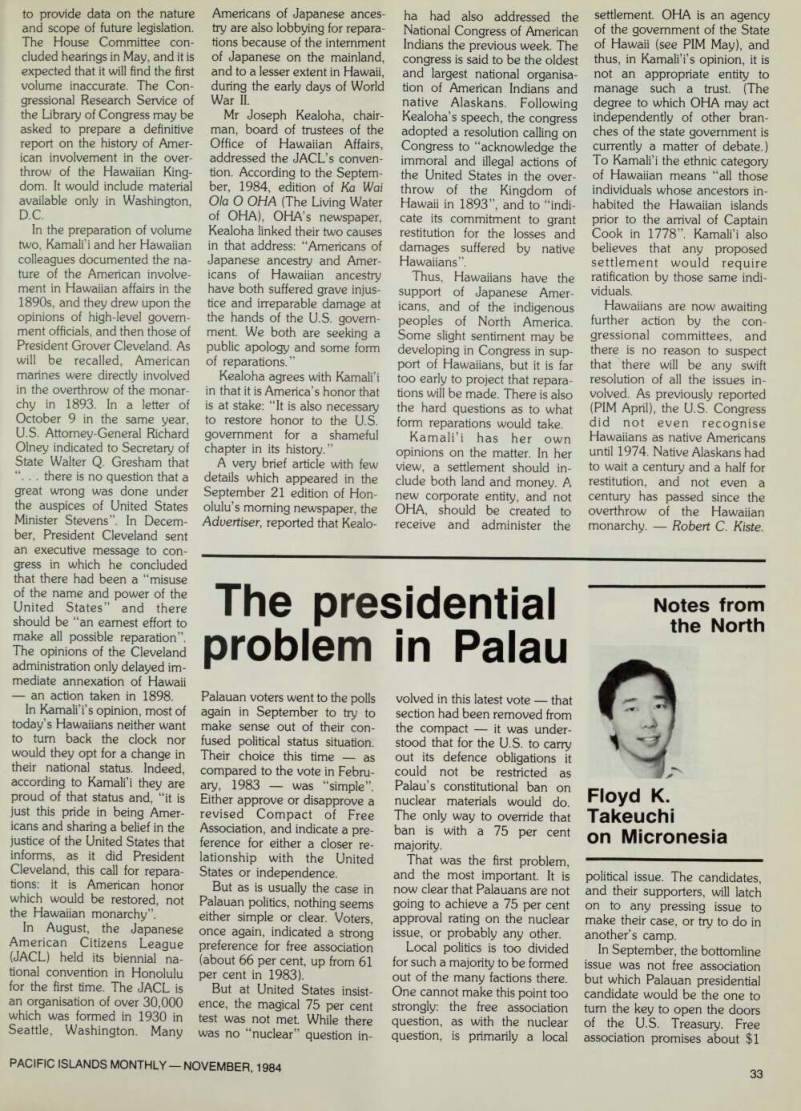
History, yes and justice?
In three columns this year April, May and August the focus has been upon islanders of Hawaiian descent and their status, affairs, and concerns within the State of Hawaii. Only peripheral attention has so far been given to the position of the Hawaiians in the larger United States.
On the mainland, it has long been recognised that many treaties with American Indian nations have been broken, and that lands have been illegally seized by federal and state governments. As a consequ ence, financial compensation, most often in the form of land claim settlements, has been made to many tribal groups.
Most recently, the 1972 settle ment of Native Alaskan claims recognised that treaty violations occurred about 150 years ago, and compensation was made.
In contrast, there has been no official recognition by any seg ment of government that the peoples of Hawaii were also dispossessed, and there has been no consideration of com pensation.
In response to initiatives launched by Hawaii’s con gressional delegation, the Na tive Hawaiians Study Commis sion was created by the U.S.
Congress in late 1981. While this was long overdue, the cards
were stacked against Hawaiians from the outset. The commis sion has nine members, but no more than three can be from Hawaii. President Reagan appointed Ms Kina’u Boyd Kamali’i as chairperson and two others from Hawaii to the com mission. The other six were both mainlanders and members of the Reagan administration.
A woman in her early 50s Ms Kamali’i has a distinguished record in Hawaii. She has served in a variety of capacities in a number of civic organisa tions, and was a member of the State of Hawaii’s House of Representatives from 1976 to 1982. At the national level, and on two occasions, Kamali’i has served as a delegate to the Republican Party’s national convention, and during the cur rent election year she is honor ary chairman of the Reagan Campaign.
The Native Hawaiians Study Commission was given a year and a half to prepare a report on Hawaiians past and present, and provide recommendations on their needs and concerns. In a talk in Honolulu last May, Kamali’i reported that as the commission proceeded with its work, it became quite apparent that the majority of its members were determined to deny that there had been improper Amer-
ican involvement in the over throw of the Kingdom of Hawaii, and that there had been no irregularities when large quantities of land were acquired by the federal govem ment when Hawaii was annexed by the United States.
As the commission’s report took shape, Kamali’i indicated that it contained historical, legal, and ethical distortions designed to deny Hawaiian claims of injustice. In March, 1983, the three members from Hawaii voted against major portions of the report and all of its conclusions and recom mendations.
The Hawaiian contingent prepared a dissenting second volume of the report entitled “Claims of Conscience”. In Kamali’is own words, it “fo cuses on the validity of Hawaiian claims and the ethical imperative of providing con gressional action to meet these claims”. In June, 1983, the report was turned over to the appropriate congressional com mittees: the Senate Committee on Energy and Natural Re sources, and the House of Representatives Committee on Interior and Insular Affairs.
Kamali’i reported that she was confident that “an impartial ex amination of the two docu ments would vindicate the sub stance of” the second volume, and discredit the first.
In the early months of 1984, both congressional committees reviewed the case. In April, State of Hawaii Senator Matsu naga chaired the Senate Com mittee. He recommended rejec tion of volume one, and the committee’s staff was requested
President Grover Cleveland . . . “misuse of the name and power of the United States”
A View from Honolulu
Robert C. Kiste looks at the Pacific
to provide data on the nature and scope of future legislation.
The House Committee con cluded hearings in May, and it is expected that it will find the first volume inaccurate. The Con gressional Research Service of the Library of Congress may be asked to prepare a definitive report on the history of Amer ican involvement in the over throw of the Hawaiian King dom. It would include material available only in Washington, D.C.
In the preparation of volume two, Kamali’i and her Hawaiian colleagues documented the na ture of the American involve ment in Hawaiian affairs in the 1890 s, and they drew upon the opinions of high-level govern ment officials, and then those of President Grover Cleveland. As will be recalled, American marines were directly involved in the overthrow of the monar chy in 1893. In a letter of October 9 in the same year, U.S. Attorney-General Richard Olney indicated to Secretary of State Walter Q. Gresham that • • there is no question that a great wrong was done under the auspices of United States Minister Stevens”. In Decem ber, President Cleveland sent an executive message to con gress in which he concluded that there had been a “misuse of the name and power of the United States” and there should be “an earnest effort to make all possible reparation”.
The opinions of the Cleveland administration only delayed im mediate annexation of Hawaii an action taken in 1898.
In Kamali’i’s opinion, most of today’s Hawaiians neither want to turn back the clock nor would they opt for a change in their national status. Indeed, according to Kamali’i they are proud of that status and, “it is just this pride in being Amer icans and sharing a belief in the justice of the United States that informs, as it did President Cleveland, this call for repara tions: it is American honor which would be restored, not the Hawaiian monarchy”.
In August, the Japanese American Citizens League (JACL) held its biennial na tional convention in Honolulu for the first time. The JACL is an organisation of over 30,000 which was formed in 1930 in Seattle, Washington. Many
Americans of Japanese ances try are also lobbying for repara tions because of the internment of Japanese on the mainland, and to a lesser extent in Hawaii, during the early days of World War 11.
Mr Joseph Kealoha, chair man, board of trustees of the Office of Hawaiian Affairs, addressed the JACL’s conven tion. According to the Septem ber, 1984, edition of Ka Wai Ola O OHA (The Living Water of OHA), OHA’s newspaper, Kealoha linked their two causes in that address: “Americans of Japanese ancestry and Amer icans of Hawaiian ancestry have both suffered grave injus tice and irreparable damage at the hands of the U.S. govern ment. We both are seeking a public apology and some form of reparations.”
Kealoha agrees with Kamali’i in that it is America’s honor that is at stake: “It is also necessary to restore honor to the U.S. government for a shameful chapter in its history.”
A very brief article with few details which appeared in the September 21 edition of Hon olulu’s morning newspaper, the Advertiser, reported that Kealo
ha had also addressed the National Congress of American Indians the previous week. The congress is said to be the oldest and largest national organisation of American Indians and native Alaskans. Following Kealoha’s speech, the congress adopted a resolution calling on Congress to “acknowledge the immoral and illegal actions of the United States in the overthrow of the Kingdom of Hawaii in 1893”, and to “indicate its commitment to grant restitution for the losses and damages suffered by native Hawaiians”.
Thus, Hawaiians have the support of Japanese Americans, and of the indigenous peoples of North America, Some slight sentiment may be developing in Congress in support of Hawaiians, but it is far too early to project that reparations will be made. There is also the hard questions as to what form reparations would take.
Kamali’i has her own opinions on the matter. In her view, a settlement should inelude both land and money. A new corporate entity, and not OHA, should be created to receive and administer the
settlement. OHA is an agency of the government of the State of Hawaii (see PIM May), and thus, in Kamali’i’s opinion, it is not an appropriate entity to manage such a trust. (The degree to which OHA may act independently of other bran ches of the state government is currently a matter of debate.) To Kamali’i the ethnic category of Hawaiian means “all those individuals whose ancestors in habited the Hawaiian islands prior to the arrival of Captain Cook in 1778”. Kamali’i also believes that any proposed settlement would require ratification by those same indi viduals.
Hawaiians are now awaiting further action by the con gressional committees, and there is no reason to suspect that there will be any swift resolution of all the issues in volved. As previously reported (PIM April), the U.S. Congress did not even recognise Hawaiians as native Americans until 1974. Native Alaskans had to wait a century and a half for restitution, and not even a century has passed since the overthrow of the Hawaiian
monarchy.
Robert C. Kiste.
The presidential
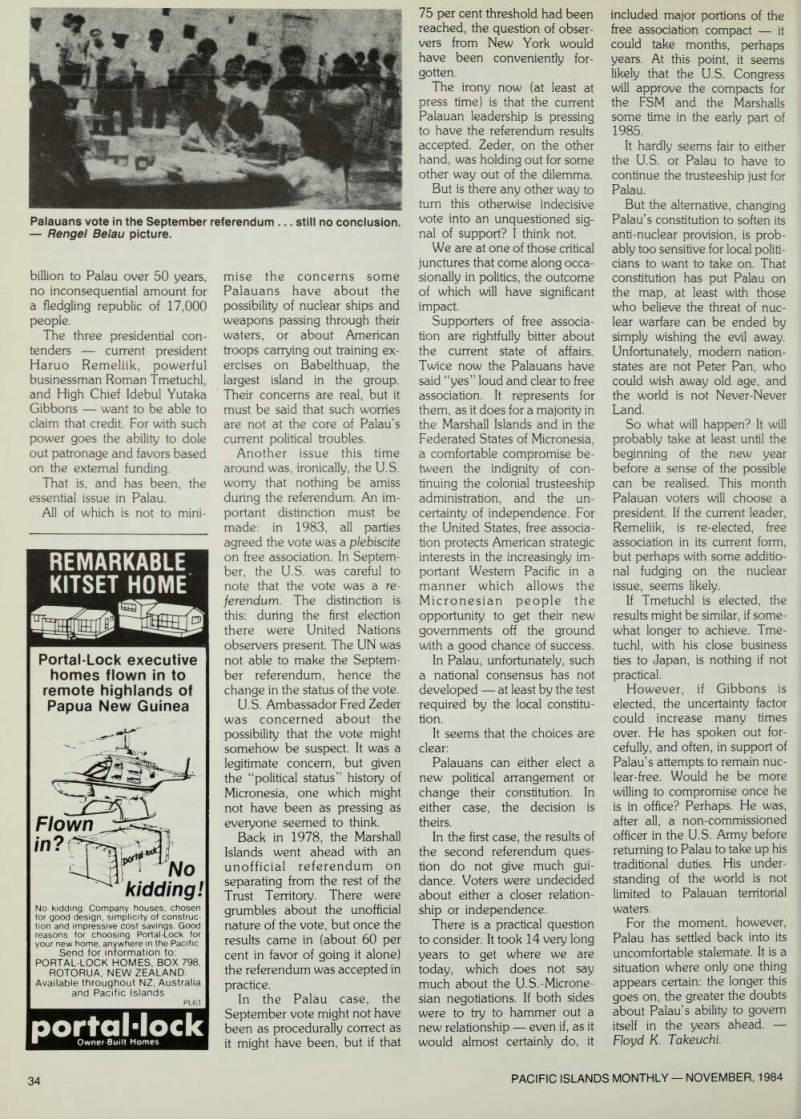
problem in Palau
Palauan voters went to the polls again in September to try to make sense out of their con fused political status situation.
Their choice this time as compared to the vote in Febru ary, 1983 was “simple”.
Either approve or disapprove a revised Compact of Free Association, and indicate a pre ference for either a closer re lationship with the United States or independence.
But as is usually the case in Palauan politics, nothing seems either simple or clear. Voters, once again, indicated a strong preference for free association (about 66 per cent, up from 61 per cent in 1983).
But at United States insist ence, the magical 75 per cent test was not met. While there was no “nuclear” question in
volved in this latest vote that section had been removed from the compact it was under stood that for the U.S. to carry out its defence obligations it could not be restricted as Palau’s constitutional ban on nuclear materials would do.
The only way to override that ban is with a 75 per cent majority.
That was the first problem, and the most important. It is now clear that Palauans are not going to achieve a 75 per cent approval rating on the nuclear issue, or probably any other.
Local politics is too divided for such a majority to be formed out of the many factions there.
One cannot make this point too strongly: the free association question, as with the nuclear question, is primarily a local
political issue. The candidates, and their supporters, will latch on to any pressing issue to make their case, or try to do in another’s camp.
In September, the bottomline issue was not free association but which Palauan presidential candidate would be the one to turn the key to open the doors of the U.S. Treasury. Free association promises about $1
Notes from the North
Floyd K.
Takeuchi on Micronesia
billion to Palau over 50 years, no inconsequential amount for a fledgling republic of 17,000 people.
The three presidential con tenders current president Haruo Remeliik, powerful businessman Roman Tmetuchl, and High Chief Idebul Yutaka Gibbons want to be able to claim that credit. For with such power goes the ability to dole out patronage and favors based on the external funding.
That is, and has been, the essential issue in Palau.
All of which is not to mini
mise the concerns some Palauans have about the possibility of nuclear ships and weapons passing through their waters, or about American troops carrying out training ex ercises on Babelthuap, the largest island in the group.
Their concerns are real, but it must be said that such worries are not at the core of Palau’s current political troubles.
Another issue this time around was, ironically, the U.S. worry that nothing be amiss during the referendum. An im portant distinction must be made; in 1983, all parties agreed the vote was a plebiscite on free association. In Septem ber, the U.S. was careful to note that the vote was a re ferendum. The distinction is this: during the first election there were United Nations observers present. The UN was not able to make the Septem ber referendum, hence the change in the status of the vote.
U.S. Ambassador Fred Zeder was concerned about the possibility that the vote might somehow be suspect. It was a legitimate concern, but given the “political status” history of Micronesia, one which might not have been as pressing as everyone seemed to think.
Back in 1978, the Marshall Islands went ahead with an unofficial referendum on separating from the rest of the Trust Territory. There were grumbles about the unofficial nature of the vote, but once the results came in (about 60 per cent in favor of going it alone) the referendum was accepted in practice.
In the Palau case, the September vote might not have been as procedurally correct as it might have been, but if that
75 per cent threshold had been reached, the question of obser vers from New York would have been conveniently for gotten.
The irony now (at least at press time) is that the current Palauan leadership is pressing to have the referendum results accepted. Zeder, on the other hand, was holding out for some other way out of the dilemma.
But is there any other way to turn this otherwise indecisive vote into an unquestioned sig nal of support? I think not.
We are at one of those critical junctures that come along occa sionally in politics, the outcome of which will have significant impact.
Supporters of free associa tion are rightfully bitter about the current state of affairs.
Twice now the Palauans have said “yes” loud and clear to free association. It represents for them, as it does for a majority in the Marshall Islands and in the Federated States of Micronesia, a comfortable compromise be tween the indignity of con tinuing the colonial trusteeship administration, and the un certainty of independence. For the United States, free associa tion protects American strategic interests in the increasingly im portant Western Pacific in a manner which allows the Micronesian people the opportunity to get their new governments off the ground with a good chance of success.
In Palau, unfortunately, such a national consensus has not developed at least by the test required by the local constitu tion.
It seems that the choices are clear: Palauans can either elect a new political arrangement or change their constitution. In either case, the decision is theirs.
In the first case, the results of the second referendum ques tion do not give much gui dance. Voters were undecided about either a closer relation ship or independence.
There is a practical question to consider. It took 14 very long years to get where we are today, which does not say much about the U.S.-Microne sian negotiations. If both sides were to try to hammer out a new relationship even if, as it would almost certainly do, it
included major portions of the free association compact it could take months, perhaps years. At this point, it seems likely that the U.S. Congress will approve the compacts for the FSM and the Marshalls some time in the early part of 1985.
It hardly seems fair to either the U.S. or Palau to have to continue the trusteeship just for Palau.
But the alternative, changing Palau’s constitution to soften its anti-nuclear provision, is prob ably too sensitive for local politi cians to want to take on. That constitution has put Palau on the map, at least with those who believe the threat of nuc lear warfare can be ended by simply wishing the evil away.
Unfortunately, modern nation states are not Peter Pan, who could wish away old age, and the world is not Never-Never Land.
So what will happen? It will probably take at least until the beginning of the new year before a sense of the possible can be realised. This month Palauan voters will choose a president. If the current leader, Remeliik, is re-elected, free association in its current form, but perhaps with some additio nal fudging on the nuclear issue, seems likely.
If Tmetuchl is elected, the results might be similar, if some what longer to achieve. Tme tuchl, with his close business ties to Japan, is nothing if not practical.
However, if Gibbons is elected, the uncertainty factor could increase many times over. He has spoken out for cefully, and often, in support of Palau’s attempts to remain nuc lear-free. Would he be more willing to compromise once he is in office? Perhaps. He was, after all, a non-commissioned officer in the U.S. Army before returning to Palau to take up his traditional duties. His under standing of the world is not limited to Palauan territorial waters.
For the moment, however, Palau has settled back into its uncomfortable stalemate. It is a situation where only one thing appears certain: the longer this goes on, the greater the doubts about Palau’s ability to govern itself in the years ahead.
Floyd K. Takeuchi.
Palauans vote In the September referendum ... still no conclusion. -Rengel Belau picture.
Advertisements & other items, p. 34 (1 item)
portal-lock
REMARKABLE
KITSET HOME
53
Portal-Lock executive
homes flown in to
remote highlands of
Papua New Guinea
s
Flown
in?
No
kidding!
No kidding. Company houses, chosen for good design, simplicity of construction and impressive cost savings. Good reasons for choosing Portal-Lock for your new home, anywhere in the Pacific.
Send for information to:
PORTAL-LOCK HOMES, BOX 798,
ROTORUA, NEW ZEALAND.
Available throughout NZ, Australia and Pacific Islands PL63
portal-lock
Owner Built Homes
and tougher” - Turnbull
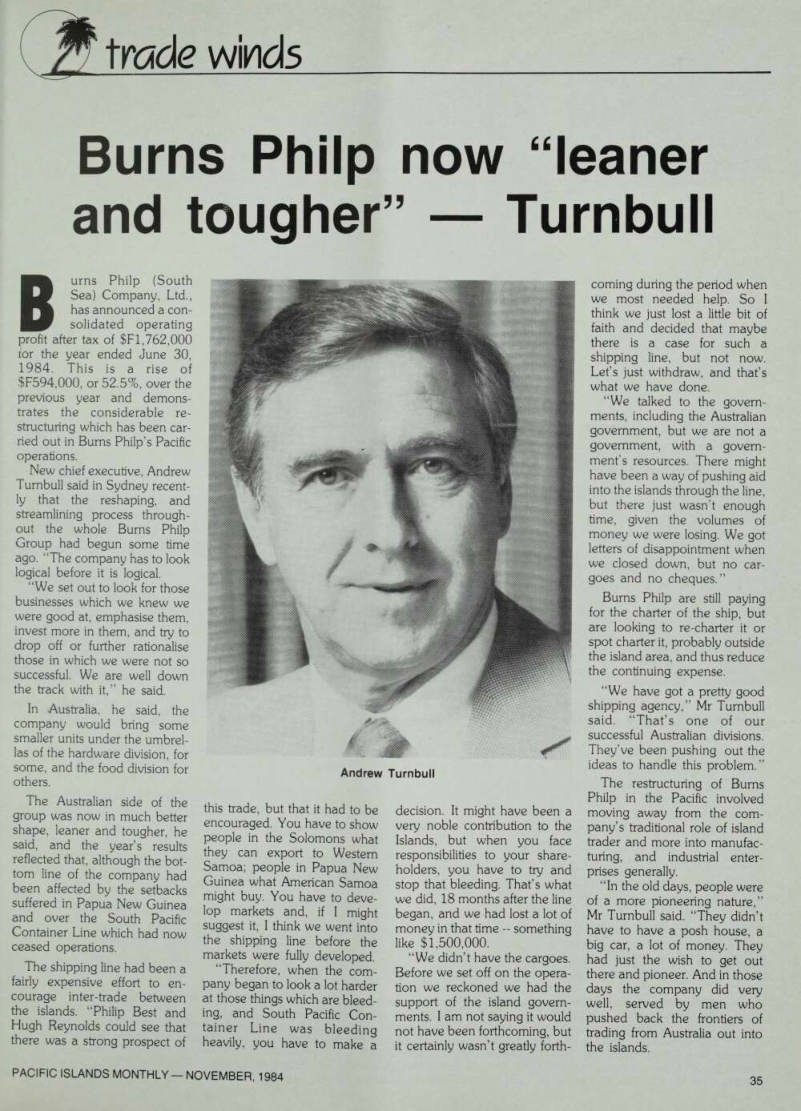

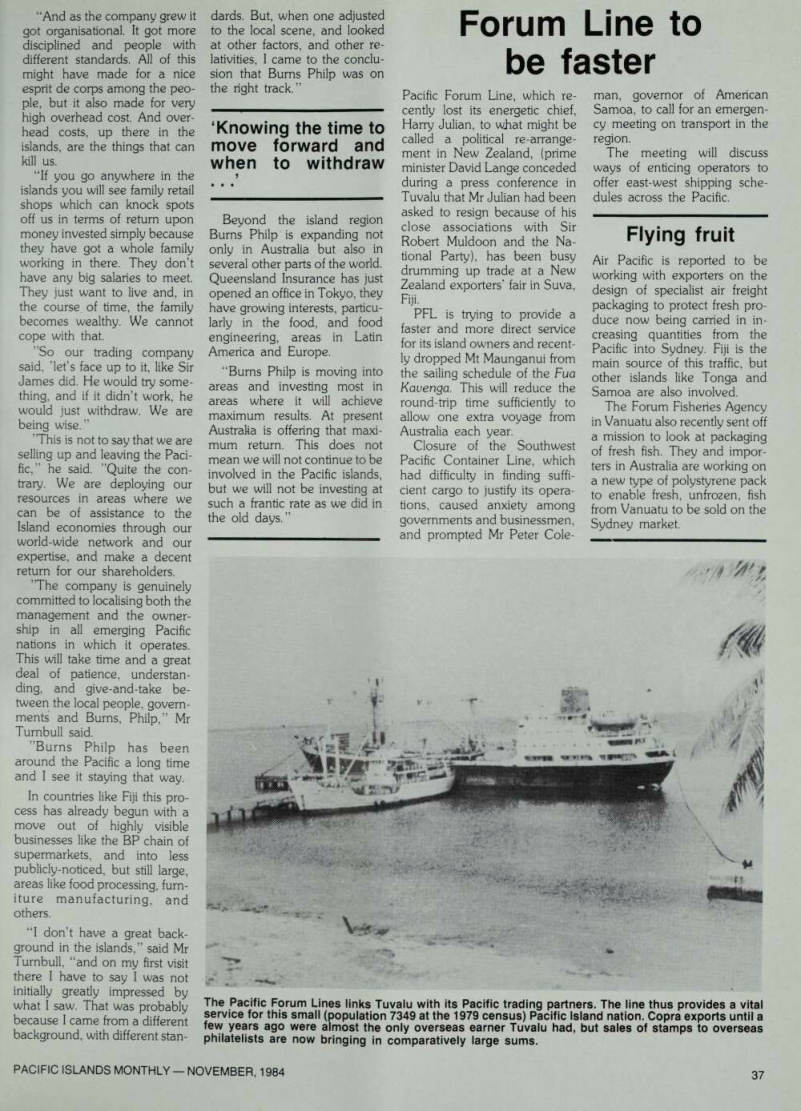
trade winds
Burns Philp now “leaner and tougher” - Turnbull
Burns Philp (South Sea) Company, Ltd., has announced a con solidated operating profit after tax of $F1,762,000 ror the year ended June 30, 1984. This is a rise of $F594,000, or 52.5%, over the previous year and demons trates the considerable re structuring which has been car ried out in Burns Philp’s Pacific operations.
New chief executive, Andrew Turnbull said in Sydney recent ly that the reshaping, and streamlining process through out the whole Burns Philp Group had begun some time ago. “The company has to look logical before it is logical.
“We set out to look for those businesses which we knew we were good at, emphasise them, invest more in them, and try to drop off or further rationalise those in which we were not so successful. We are well down the track with it,” he said.
In Australia, he said, the company would bring some smaller units under the umbrel las of the hardware division, for some, and the food division for others.
The Australian side of the group was now in much better shape, leaner and tougher, he said, and the year’s results reflected that, although the bot tom line of the company had been affected by the setbacks suffered in Papua New Guinea and over the South Pacific Container Line which had now ceased operations.
The shipping line had been a fairly expensive effort to en courage inter-trade between the islands. “Philip Best and Hugh Reynolds could see that there was a strong prospect of
this trade, but that it had to be encouraged. You have to show people in the Solomons what they can export to Western Samoa; people in Papua New Guinea what American Samoa might buy. You have to deve lop markets and, if I might suggest it, I think we went into the shipping line before the markets were fully developed.
“Therefore, when the com pany began to look a lot harder at those things which are bleed ing, and South Pacific Con tainer Line was bleeding heavily, you have to make a
decision. It might have been a very noble contribution to the Islands, but when you face responsibilities to your share holders, you have to try and stop that bleeding. That’s what we did, 18 months after the line began, and we had lost a lot of money in that time - something like $1,500,000.
“We didn’t have the cargoes.
Before we set off on the opera tion we reckoned we had the support of the island govern ments. I am not saying it would not have been forthcoming, but it certainly wasn’t greatly forth
coming during the period when we most needed help. So I think we just lost a little bit of faith and decided that maybe there is a case for such a shipping line, but not now.
Let’s just withdraw, and that’s what we have done.
“We talked to the govern ments, including the Australian government, but we are not a government, with a govern ment’s resources. There might have been a way of pushing aid into the islands through the line, but there just wasn’t enough time, given the volumes of money we were losing. We got letters of disappointment when we closed down, but no car goes and no cheques.”
Burns Philp are still paying for the charter of the ship, but are looking to re-charter it or spot charter it, probably outside the island area, and thus reduce the continuing expense.
“We have got a pretty good shipping agency,” Mr Turnbull said. “That’s one of our successful Australian divisions.
They’ve been pushing out the ideas to handle this problem.”
The restructuring of Burns Philp in the Pacific involved moving away from the com pany’s traditional role of island trader and more into manufac turing, and industrial enter prises generally.
“In the old days, people were of a more pioneering nature,”
Mr Turnbull said. “They didn’t have to have a posh house, a big car, a lot of money. They had just the wish to get out there and pioneer. And in those days the company did very well, served by men who pushed back the frontiers of trading from Australia out into the islands.
Andrew Turnbull
“And as the company grew it got organisational. It got more disciplined and people with different standards. All of this might have made for a nice esprit de corps among the peo ple, but it also made for very high overhead cost. And over head costs, up there in the islands, are the things that can kill us.
“If you go anywhere in the islands you will see family retail shops which can knock spots off us in terms of return upon money invested simply because they have got a whole family working in there. They don’t have any big salaries to meet.
They just want to live and, in the course, of time, the family becomes wealthy. We cannot cope with that. ”So our trading company said, ’let’s face up to it, like Sir James did. He would try some thing, and if it didn’t work, he would just withdraw. We are being wise.” ’’This is not to say that we are selling up and leaving the Paci fic,” he said. ’’Quite the con trary. We are deploying our resources in areas where we can be of assistance to the Island economies through our world-wide network and our expertise, and make a decent return for our shareholders. ’’The company is genuinely committed to localising both the management and the owner ship in all emerging Pacific nations in which it operates.
This will take time and a great deal of patience, understan ding, and give-and-take be tween the local people, govern ments and Burns, Philp,” Mr Turnbull said. ’’Burns Philp has been around the Pacific a long time and I see it staying that way.
In countries like Fiji this pro cess has already begun with a move out of highly visible businesses like the BP chain of supermarkets, and into less publicly-noticed, but still large, areas like food processing, furn iture manufacturing, and others.
“I don’t have a great back ground in the islands,” said Mr Turnbull, “and on my first visit there I have to say I was not initially greatly impressed by what I saw. That was probably because I came from a different background, with different stan
dards. But, when one adjusted to the local scene, and looked at other factors, and other re lativities, I came to the conclu sion that Burns Philp was on the right track. ”
‘Knowing the time to move forward and when to withdraw ...'
Beyond the island region Burns Philp is expanding not only in Australia but also in several other parts of the world.
Queensland Insurance has just opened an office in Tokyo, they have growing interests, particu larly in the food, and food engineering, areas in Latin America and Europe.
“Bums Philp is moving into areas and investing most in areas where it will achieve maximum results. At present Australia is offering that maxi mum return. This does not mean we will not continue to be involved in the Pacific islands, but we will not be investing at such a frantic rate as we did in the old days.”
Advertisements & other items, p. 36 (1 item)
Aiwa*
* • in With infrar remote control The Million Dollar Look in Stylish Sound This year’s top-of-the-line AIWA system is designed to stay in style next year, and the year after too. With high-power component separates designed to be “Digital ready”.
In fact, with such features as a dedicated CD function selector and Dolby HX Professional* equipped auto-reverse cassette deck, the V-1100 is an 85 watt-per-channel system ready to deliver better performance from any music source—digital or analog.
Want to put your records onto tape? AIWA makes it easier than you ever believed. A microprocessorcontrolled “Auto Editing” facility lets you dub automatically from the programmable turntable to the cassette deck, even in random track order.
V-1100—Sophisticated separates with totally automated integration. It’s AlWA’s new concept in audio that sets the trend for sound in the 80s! * Dolby and the double-D symbol are trademarks of Dolby Laboratories Licensing Corporation. *HX PROFESSIONAL ORIGINATED BY BANG & OLUFSEN
AIWA*
AIWA Australia Pty., Ltd 14 Gertrude St., Arnoliffe, N.S.W. Australia 2205 AUSTRALIA PHONE; (597) 2388/Oceania Indent Agency (P.N.G.) Pty., Ltd Ago St., Gordon Box 5518, Boroko, Papua New Guinea PHONE; 256411/The Sound Centre Ltd P.O. Box 434 Port Vila, Vanuatu PHONE; 2035/P. Hargovind Bros 190 Renwick Road P.O. Box 490 Suva Fiji PHONE; 24350/Makanjee & Sons Limited P.O. Box 91 Sigatoka Fiji PHONE; 50158/Milaw Trading Co., Ltd 36 Airedale St. Auckland, New Zealand PHONE; (09) 399175/hifivox 79, rue de Sebastopol, Noumea, New Caledonia PHONE; 27.24.66/Harvest Pacific Limited P.O. Box 517, Honiara, Solomon Islands PHONE; 131/Fare Hi-Fi Stereo Rue du Marechal Foch, Papeete, Tahiti PHONE; 2-4814/Micropac Audio, Inc. Agana, Guam 96910 PHONE; 472-8091/Cook Island Trading Corp Ltd P.O. Box 92, Rarotonga, Cook Island/Nauru Co-Operative Society Republic of Nauru
Forum Line to be faster
be faster
Pacific Forum Line, which re cently lost its energetic chief, Harry Julian, to what might be called a political re-arrange ment in New Zealand, (prime minister David Lange conceded during a press conference in Tuvalu that Mr Julian had been asked to resign because of his close associations with Sir Robert Muldoon and the Na tional Party), has been busy drumming up trade at a New Zealand exporters’ fair in Suva, Fiji.
PFL is trying to provide a faster and more direct service for its island owners and recent ly dropped Mt Maunganui from the sailing schedule of the Fua Kavenga. This will reduce the round-trip time sufficiently to allow one extra voyage from Australia each year.
Closure of the Southwest Pacific Container Line, which had difficulty in finding suffi cient cargo to justify its opera tions, caused anxiety among governments and businessmen, and prompted Mr Peter Cole-
man, governor of American Samoa, to call for an emergen cy meeting on transport in the region.
The meeting will discuss ways of enticing operators to offer east-west shipping sche dules across the Pacific.
The Pacific Forum Lines links Tuvalu with its Pacific trading partners. The line thus provides a vital service for this small (population 7349 at the 1979 census) Pacific Island nation. Copra exports until a few years ago were almost the only overseas earner Tuvalu had, but sales of stamps to overseas philatelists are now bringing in comparatively large sums.
Flying fruit
Air Pacific is reported to be working with exporters on the design of specialist air freight packaging to protect fresh pro duce now being carried in in creasing quantities from the Pacific into Sydney. Fiji is the main source of this traffic, but other islands like Tonga and Samoa are also involved.
The Forum Fisheries Agency in Vanuatu also recently sent off a mission to look at packaging of fresh fish. They and impor ters in Australia are working on a new type of polystyrene pack to enable fresh, unfrozen, fish from Vanuatu to be sold on the Sydney market.
Advertisements & other items, pp. 38-39 (1 item)
Introducing Perfoi
NEW’B4 TOYOTA HUD
Performance plus comfort.
Performance plus durability.
Performance plus variety.
Advanced, powerful new engines put you in command with higher torque, better efficiency. Inside, more driving comfort than ever before with a roomier cabin, bigger windscreens, and lean, clean instrumentation. Newly designed suspension gives you big carrying capability, yet carries you in comfort. HILUX is one tough truck with a suspension you can cr-jnt on. Choose from a wide variety, including 4WD regular or double cab - and two new additions - 2WD extra cab and flatdeck. The all-new Toyota HILUX. Add it all up, and you have performance plus! m:
TOYOTA
QUALITY SERVICE
J
AMERICAN SAMOA: BURNS PHILP (SOUTH SEA)
CO., LTD., P.O. Box 129, Pago Pago.
COOK ISLANDS: COOK ISLANDS TRADING
CORPORATION LTD., Private Bag, Rarotonga.
FIJI: AUTOMOTIVE SUPPLIES COMPANY, G.P.O.
Box 355, Suva.
GUAM & MICRONESIA: ATKINS, KROLL (GUAM) LTD., 443 South Marine Drive, Tamuning.
KIRIBATI: TARAWA MOTORS, P.O. Box 36, Bairiki, Tarawa, Kiribati.
NAURU: NAURU COOPERATIVE SOCIETY.
NEW CALEDONIA: SERVICE IMPORTATION
AUTOMOBILE DU PACIFIQUE, Rond-Point du Pacifiqui (Station Total) B.P. 438, Noumea.
MANGE PLUS'
4 $ 4WD Double Cab * )RFOLK ISLAND: SORRY’S LIMITED, P.O. Box 169 PUA NEW GUINEA: ELA MOTORS, A Division of ms Philp (PNG) Ltd., P.O. Box 75, Port Moresby
IRAN: MICROL CORPORATION, P.O. Box 267,
ipan.
►LOMON; MENDANA ENTERPRISES (5.1.) LTD.,
*■o. Box 174, Honiara.
TAHITI: NIPPON AUTOMOTO, P.O. Box 342, Papeete.
TONGA: BURNS PHILP (SOUTH SEA) CO., LTD., P.O. Box 55, Nukualofa.
VANUATU: VANUATU MOTORS, P.O. Box 18,
Port Vila.
WESTERN SAMOA: BURNS PHILP (SOUTH SEA)
CO., LTD., P.O. Box 188, Apia.
TOYOTA
of origin” coming?

SPARTECA: Easier “rules of origin” coming?
One of the most confusing, also most important, aspects of ex port trade for island producers is that highly technical, and sometimes controversial busi ness found under the heading, ’’Rules of Origin. ” As a result of discussions at SPEC and in Australia they are being re assessed for island producers.
For a Forum country to gain preferential access to Australia or New Zealand under SPAR TECA, it is currently required that fifty per cent of the product should be manufactured in the island nation, or in the island country, plus Australia (for ac cess to Australia), or New Zea land (if exported there). It is a general rule applied under most international trade agreements, says South Pacific Trade Com missioner, Bill McCabe, and is designed to see that the benefits go to the countries for which they are intended, and not to a
third country which is just using the island country as a way station in its marketing plan. ”It is important that we maxi mise the benefit to the Forum island country,” Mr McCabe said. ”1 think there is a case for reducing that requirement for certain items, where it is not possible to get quite fifty per cent, or where a major compo nent simply is not manufac tured in the island, or in Austra lia or New Zealand.”
Australia and New Zealand now also have a trade agree ment (the C.E.R.) which should see increasingly free trade be tween them. (This is under review in Australia as a result of the recent 20 per cent New Zealand currency devaluation, but its basics are unlikely to be changed by that).
“There is a thought that some products manufactured in either country should be acceptable under the rules of origin for SPARTECA when the goods are sold to the other,” Mr McCabe said. “Government representatives from Australia and New Zealand have been talking about ways in which
Bill McCabe
ease the requirements for Forum island countries, particu larly in respect of goods from Australia and New Zealand.”
This touches very much upon joint venture business and both Fiji and Papua New Guinea are continuing with efforts to attract investors. Both countries are continuing to send investment missions to Australia and New Zealand. Additionally, the United Nations Industrial Development Organisation (UNIDO), has arranged for an investment meeting in Fiji in November.
The two big Forum island members, Fiji and PNG, have been quite successful, both in selling their products and in attracting joint venture capital, but the smaller countries, with the exception of Tonga, have
not done so well. Indeed, according to recent statistics, while exports into Australia and New Zealand from the Forum overall have increased in the last 12 months, those from some of the smaller countries have actually decreased.
“I would like to urge particu larly the smaller Forum coun tries to let me know when they have a senior executive, or a senior public servant, or even a government minister coming to Australia,” said Mr McCabe.“The South Pacific Trade Commission can arrange a one-day investment seminar to which we could invite in terested manufacturers to hear what the country has to offer, what assistance it will provide to investors and why the invest ment should be made.”
Advertisements & other items, p. 40 (1 item)
Longlife Products
■ r
MMUHUJf/
AND FRESH DAIRY FOODS,
QUALITY YOU CAN TRUST
QUF Industries Ltd. offers an export award winning range of Longlife products as well as a complete range of quality fresh dairy foods.
With 15 years' experience in export markets, QUF has the product knowledge and expertise to provide you with outstanding service in the 1980’s. • Pauls Longlife UHT Milk is natural liquid cow's milk with no preservatives or additives and is available in the 250m1, 500 ml and 1 litre sizes. • Shake Longlife flavoured milk is offered in delicious Chocolate, Malted, Caramel and Strawberry flavours. • Pauls Longlife Thickened Cream is ideal for whipping or pouring. • Popper 100% Fruit Juice is available in seven flavours in a wide range of Longlife pack sizes. • Pauls fresh Dairy Products including Milk, Cream, Yoghurt and Cottage Cheese are available in an extensive range of flavours and sizes.
TRADE ENQUIRIES:
QUF Industries Ltd., P.O. Box 12, South Brisbane, Queensland, 4101 Australia Telephone: (07) 44-0151 Telex: AA 40614 i a j ■ ■
ORANU
Diickeiied Cream • 3 6Wm ww I -rmiLK
miiK
u inn II
3HSJ
miLK
& r
Forum traders told
to “get in now”
South Pacific Trade Commmissioner, Bill McCabe, has advised any South Pacific island manufacturer who seeks markets in Australia, New Zealand or third countries under new arrangements now being worked out among governments to contact his office in Sydney “right now.”
Despite heavy concentration among the political leaders at the South Pacific Forum meeting on issues like the nuclearfree zone, a good deal of constructive work was done on trying to advance trading prosjects for the small island nations. Substantial agreement was reached on steps which should be taken to improve access still further from Forum Island country manufacturers to the markets of Australia and New Zealand.
One of the decisions taken at the pre-Forum meeting of the committee of the South Pacific Bureau for Economic Cooperation was to extend the quota for access of clothing to the Australian market for 1985. Officials recognised that more positive action was needed to enable manufacturers to gain access to the broader market.
“One of the most significant steps taken, ” said Mr McCabe, was to, first, make a review of
the industries in the Forum Island countries which manu facture clothing and then hold a meeting in Sydney of a manu facturers’ representative, and a government ‘official from each country, with representatives of Australia, to review the market in Australia and devise the best approach to improving sales.
The third phase will involve us in the Trade Commission work ing with each manufacturer as he sells. ’’The importance of this is that it could give us a blueprint for the marketing of all pro ducts. I would hope that in six months from now we will be able to discuss some results, and also, perhaps, talk about its applicability to the marketing of food stuffs, processed foods and other products from the region.”
The Trade Commission this year started to operate retail selling promotions where pro ducts are sold from promotions and exhibitions directly to con sumers. One was run in September for Vanuatu and another in October, at the In doorapilly shopping centre, Brisbane, for the Solomons.
Fiji had a marketing mission to New Zealand in October in which about ten firms took part.
New Zealand also offered
assistance to food processors in three island countries by show ing them aspects of N.Z. food production with the aim of improving their quality control and productivity, both vital to successful marketing.
Vanuatu soap
maker on stream
Vanuatu’s first-ever detergent, shampoo and suntan oil manu facturer went into production in August.
Vanity Cosmetics Ltd., lo cated in Port-Vila, has been established to utilise local coco nut oil in the manufacture of a wide range of soap-related pro ducts. Its first objective is to supply local market needs with a high quality pure coconut oil laundry soap. The company believes that Vanuatu is now in a position to export locally produced detergent products throughout the Pacific.
The company has already received expressions of interest in its products from the United States, the United Kingdom, and New Zealand.
It is anticipated that, over the months ahead, the company will introduce additional technology to further extend its range of products.
Springford
for Niue
Mr John Springford has been appointed New Zealand repre sentative in Niue. He took up his appointment on September 22, replacing Mr Malcolm McNamara.
Mr Springford, 59, has been a New Zealand Foreign Affairs officer since 1975, joining the department from his post as head of the Islands Division of the then Maori and Island Affairs Department. He was N.Z. representative in Niue from 1975 to 1976 and then served in Papua New Guinea, Western Samoa, the Cook Is lands and Fiji, in the latter as deputy high commissioner.
Making the announcement the New Zealand prime minis ter, and foreign minister, Mr David Lange, said: “New Zea land places great importance on its relationship with Niue. Since self-government in 1974, the close historical and strong personal links between our two countries have been given added substance by co-opera tion in trade, economic, and social development in regional affairs.”
Advertisements & other items, pp. 41-42 (2 items)
Record profit
for BP’s group
Overall, Bums Philp Group turned in a record profit of $20,900,000 for the year ended June 30, 1984, a rise of 295 per cent. This allowed directors to recommend a final dividend of 7.5 cents, taking the annual payout to 15 cents, the same as last year.
Pre-tax earnings were up from $23,650,000 to $34,490,000 on revenue of $ll7l million, down from 1983’s $llBB million.
Improved results from the group’s Australian divisions, the recovery of Hanimex and the elimination of loss-making business, all contributed to the record return. Offsetting this, however, were losses incurred by Burns Philp (PNG) Ltd, the Southwest Pacific Container Line, and some units of the building materials division.
Income tax dropped from $16,300,000 to $10,250,000 mainly due to the recovery of previous years’ tax losses. Net interest paid was down 34 per cent to $18,930,000.
Additionally, $70,000,000 came from sale of what the company terms non-strategic, or low income producing assets.
Tackle
the toughest beards
with GII
o A 4 14 A> o 0- © £l& V? n & a t? £ Gillette first ins system OO The numbe blade t< * *** The first blade shaves you close The second blade even closer still.
Gillette GII, the world s first and number one twin blade shaving system takes care of the toughest beards!
For a really close daily shave, insist on Gillette GII cartridges in either 5 or 10 packs.
Available throughout the Pacific from stores and supermarkets. try
GilletteGl
Shaving system
99*i ©
DA473SPIM
us) there’s “no place to hide”
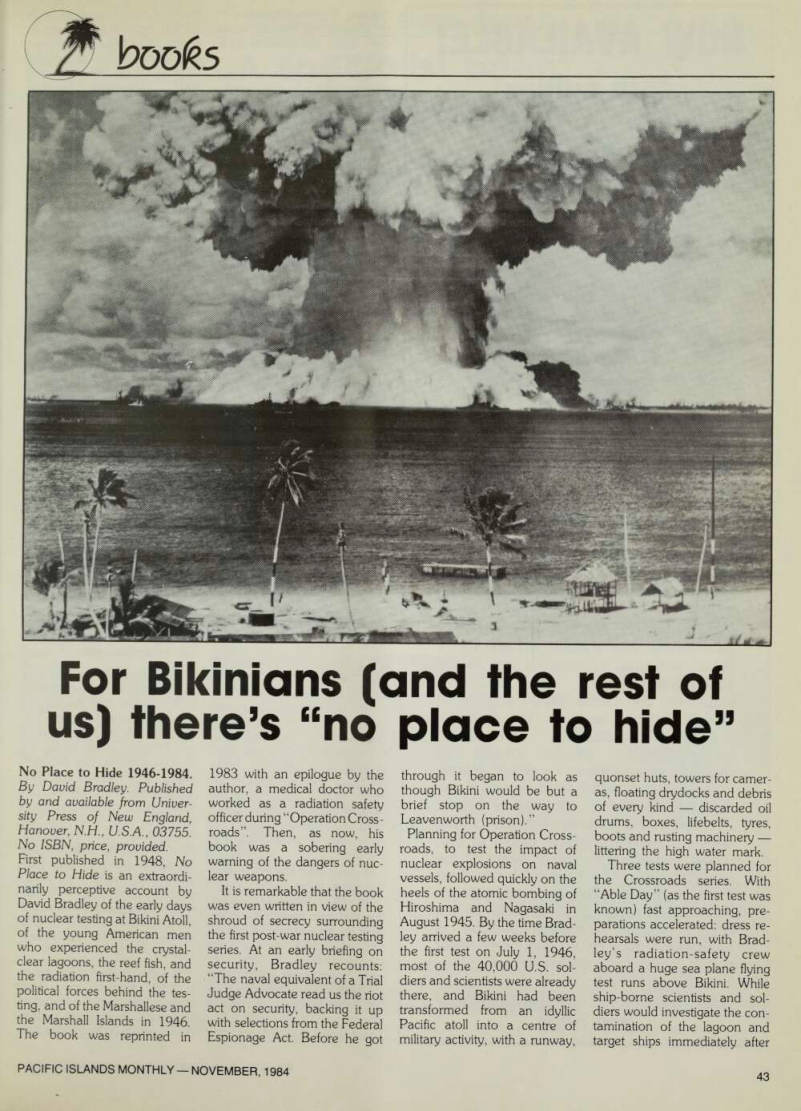
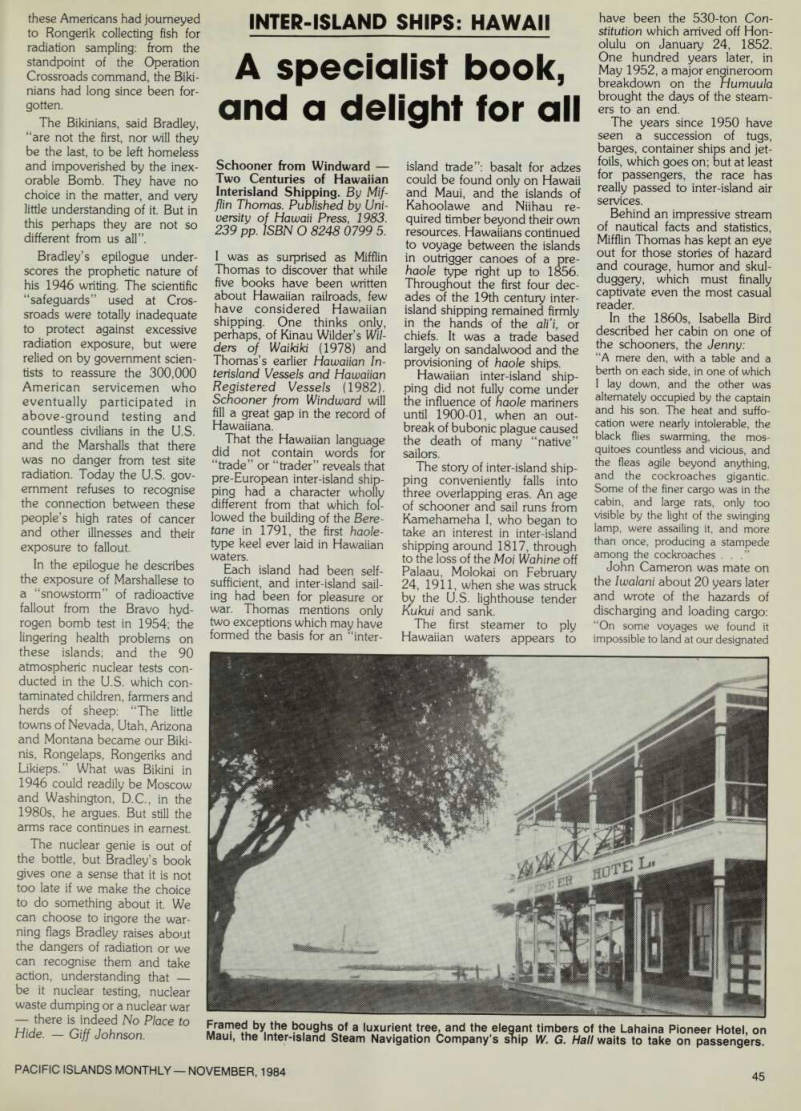
books
For Bikinians (and the rest of us) there’s “no place to hide”
No Place to Hide 1946-1984.
By Dauid Bradley. Published by and available from Univer sity Press of New England, Hanover, N.H., U.S.A., 03755.
No ISBN, price, provided.
First published in 1948, No Place to Hide is an extraordi narily perceptive account by David Bradley of the early days of nuclear testing at Bikini Atoll, of the young American men who experienced the crystal clear lagoons, the reef fish, and the radiation first-hand, of the political forces behind the tes ting, and of the Marshallese and the Marshall Islands in 1946.
The book was reprinted in
1983 with an epilogue by the author, a medical doctor who worked as a radiation safety officer during “Operation Cross roads”. Then, as now, his book was a sobering early warning of the dangers of nuc lear weapons.
It is remarkable that the book was even written in view of the shroud of secrecy surrounding the first post-war nuclear testing series. At an early briefing on security, Bradley recounts: “The naval equivalent of a Trial Judge Advocate read us the riot act on security, backing it up with selections from the Federal Espionage Act. Before he got
through it began to look as though Bikini would be but a brief stop on the way to Leavenworth (prison).”
Planning for Operation Crossroads, to test the impact of nuclear explosions on naval vessels, followed quickly on the heels of the atomic bombing of Hiroshima and Nagasaki in August 1945. By the time Bradley arrived a few weeks before the first test on July 1, 1946, most of the 40,000 U.S. soldiers and scientists were already there, and Bikini had been transformed from an idyllic Pacific atoll into a centre of military activity, with a runway,
quonset huts, towers for camer as, floating drydocks and debris of every kind discarded oil drums, boxes, lifebelts, tyres, boots and rusting machinery littering the high water mark, Three tests were planned for the Crossroads series. With “Able Day” (as the first test was known) fast approaching, pre parations accelerated; dress re hearsals were run, with Brad ley’s radiation-safety crew aboard a huge sea plane flying test runs above Bikini. While ship-borne scientists and sol diers would investigate the con tamination of the lagoon and target ships immediately after
the shot, Bradley’s crew was to fly through the nuclear cloud over Bikini and measure radi tion levels.
Standing at “ground zero” minutes after a nuclear explo sion is an unappealing task, particularly in light of what is known today about the dangers of radiation. Nevertheless, that was their job at Crossroads, and while Bradley and his rad-safe team appear to have taken numerous precautions, the au thor makes it only too clear that nobody really knew how much radiation they were getting.
The first bomb was dropped from an aircraft which had been practising bombing runs over Bikini for weeks. About the size of the Hiroshima bomb, Able was detonated in the air over the target fleet of old American, German and Japanese ships and submarines. Within mi nutes of the blast, as the mushroom cloud rose tens of thousands of feet high and was sheared apart by winds, Brad ley’s plane began its first run over Bikini. After three traverses at varying altitudes with no register of radiation, they decided against using their gas masks. Then, as they approached the centre of the target area again, the Geiger counter started to hop on the scale, beeping frantically.
Suddenly radiation levels were a hundred times stronger.
Should we pull out, asked the pilot nervously? “No,” came the reply. “It’s not too bad yet.
You could stick around here for several days if you had to.”
For 12 hours Bradley’s crew continued their patrol over Biki ni. The same procedure was followed after the second shot, an underwater test. The “Bak er” cloud, however, did not rise nearly as high, and the millions of tons of ocean water, coral, sand and radiation began to settle back over the ships and the atoll.
A week after the Baker test, the target ships in the lagoon were still so intensely radioac tive that men could remain on deck for a maximum of just 20 minutes to an hour. Yet Navy men in continuously alternating shifts spent hours hosing and scrubbing down the decks of the ships in an unsuccessful attempt to rid them of radiation.
These men were repeatedly
exposed as they worked, only to find that “fission products, having fallen like a coat of paint over these ships, cannot be washed off by salt water and suds . . . The magic formula of a ‘clean sweep down fore and aft’ is out of date in the atomic age,” noted Bradley.
What’s more, in the haste to make scientific observations im mediately following the Baker test, many safety precuations were thrown out the window, despite the fact that Bikini was so heavily contaminated that the Navy was forced to cancel the third test. Paradoxically, he notes that more safety precau tions were taken a month and a half after the Baker test than within the first 10 days when radiation was at its peak. Such precautions against radiation exposure only allowing men on board ship for a few minutes at a time, with heavy protective gear and gas masks would have delayed or prevented the hurried activity needed to carry out the experiments. It is little wonder that today many of these servicemen have con tracted rare forms of cancer and other diseases.
Bradley constantly describes the difficulties in obtaining reli able information about radia tion exposures and their pos sible effects thoroughly undermining the U.S. govern ment’s current contention that servicemen received “no radia tion of significance”.
The struggle of the Bikinians to survive in exile is well known in the Pacific. But Bradley re cords an intensely personal en counter with the Bikini people on Rongerik Atoll about six months after their first displace ment. By this time, the Biki nians were subsisting on fish alone, as the meagre supply of coconuts and breadfruit on Rongerik had been exhausted.
After meeting the Bikinians, the captain of Bradley’s ship pro vided them with some flour, sugar, cigarettes and fish hooks, which were greeted with much enthusiasm and numerous gifts of handicrafts for the Amer icans.
But the incident illustrates in a brief, dramatic way, how close to starvation the Bikinians had come in so short a time.
And it was quite by chance that
these Americans had journeyed to Rongerik collecting fish for radiation sampling: from the standpoint of the Operation Crossroads command, the Biki nians had long since been for gotten.
The Bikinians, said Bradley, “are not the first, nor will they be the last, to be left homeless and impoverished by the inex orable Bomb. They have no choice in the matter, and very little understanding of it. But in this perhaps they are not so different from us all”.
Bradley’s epilogue under scores the prophetic nature of his 1946 writing. The scientific “safeguards” used at Cros sroads were totally inadequate to protect against excessive radiation exposure, but were relied on by government scien tists to reassure the 300,000 American servicemen who eventually participated in above-ground testing and countless civilians in the U.S. and the Marshalls that there was no danger from test site radiation. Today the U.S. gov ernment refuses to recognise the connection between these people’s high rates of cancer and other illnesses and their exposure to fallout.
In the epilogue he describes the exposure of Marshallese to a “snowstorm” of radioactive fallout from the Bravo hyd rogen bomb test in 1954; the lingering health problems on these islands; and the 90 atmospheric nuclear tests con ducted in the U.S. which con taminated children, farmers and herds of sheep: “The little towns of Nevada, Utah, Arizona and Montana became our Biki nis, Rongelaps, Rongeriks and Likieps.” What was Bikini in 1946 could readily be Moscow and Washington, D.C., in the 1980s, he argues. But still the arms race continues in earnest.
The nuclear genie is out of the bottle, but Bradley’s book gives one a sense that it is not too late if we make the choice to do something about it. We can choose to ingore the war ning flags Bradley raises about the dangers of radiation or we can recognise them and take action, understanding that — be it nuclear testing, nuclear waste dumping or a nuclear war — there is indeed No Place to
Hide.
Giff Johnson.
Advertisements & other items, p. 44 (1 item)
Now Available!
15th edition
The standard reference
book on all the islands
of the Pacific.
15th edition Pacific Islands Year Book contains over 550 pages crammed with all the facts you want on Island groups of the Pacific their history, geography, people and lifestyle, population figures, system of government, lists of politicians and senior public servants, educational and health institutions, primary and secondary industries, commerce, import and export figures, annual budgets, tax systems, financial institutions, transport, communications, special articles on regional organisations South Pacific Commission, South Pacific Forum, Asian Development Bank, etc. And of course travellers are additionally catered for with details of entry formalities, places to see, hotels and street maps of some of the major centres. The Pacific Islands Year Book includes long and authoritative histories, brought up to date, of all the island groups. The 15th edition is handsomely hard bound with heavy clear plastic jacket for extra protection.
See insert for further details
and price.
A specialist book,
Inter-Island Ships: Hawaii
A specialist book, and a delight for all
Schooner from Windward Two Centuries of Hawaiian Interisland Shipping. By Mifflin Thomas. Published by Uniuersity of Hawaii Press, 1983. 239 pp. ISBN O 8248 0799 5.
I was as surprised as Mifflin Thomas to discover that while five books have been written about Hawaiian railroads, few have considered Hawaiian shipping. One thinks only, perhaps, of Kinau Wilder’s Wilders of Waikiki (1978) and Thomas’s earlier Hawaiian Interisland Vessels and Hawaiian Registered Vessels (1982).
Schooner from Windward will fill a great gap in the record of Hawaiiana.
That the Hawaiian language did not contain words for “trade” or “trader” reveals that pre-European inter-island shipping had a character wholly different from that which followed the building of the Beretone in 1791, the first haoletype keel ever laid in Hawaiian waters.
Each island had been selfsufficient, and inter-island sailing had been for pleasure or war. Thomas mentions only two exceptions which may have formed the basis for an inter-
island trade”: basalt for adzes could be found only on Hawaii and Maui, and the islands of Kahoolawe and Niihau re quired timber beyond their own resources. HawaKans continued to voyage between the islands in outrigger canoes of a pre haole type right up to 1856.
Throughout the first four dec ades of the 19th century inter island shipping remained firmly in the hands of the ali’i, or chiefs. It was a trade based largely on sandalwood and the provisioning of haole ships.
Hawaiian inter-island ship ping did not fully come under the influence of haole mariners until 1900-01, when an out break of bubonic plague caused the death of many “native” sailors The story of inter-island ship ping conveniently falls into three overlapping eras. An age of schooner and sail runs from Kamehameha I, who began to take an interest in inter-island shipping around 1817, through to the loss of the Moi Wahine off Palaau, Molokai on February 24, 1911, when she was struck by the U.S. lighthouse tender Kukui and sank.
The first steamer to ply Hawaiian waters appears to
have been the 530-ton Con stitution which arrived off Hon olulu on January 24, 1852.
One hundred years later, in May 1952, a major engineroom breakdown on the Humuula brought the days of the steam ers to an end.
The years since 1950 have seen a succession of tugs, barges, container ships and jet foils, which goes on; but at least for passengers, the race has really passed to inter-island air services.
Behind an impressive stream of nautical facts and statistics, Mifflin Thomas has kept an eye out for those stories of hazard and courage, humor and skul duggery, which must finally captivate even the most casual reader.
In the 1860 s, Isabella Bird described her cabin on one of the schooners, the Jenny; “A mere den, with a table and a berth on each side, in one of which I lay down, and the other was alternately occupied by the captain and his son. The heat and suffo cation were nearly intolerable, the black flies swarming, the mos quitoes countless and vicious, and the fleas agile beyond anything, and the cockroaches gigantic.
Some of the finer cargo was in the cabin, and large rats, only too visible by the light of the swinging lamp, were assailing it, and more than once, producing a stampede among the cockroaches ...”
John Cameron was mate on the hualani about 20 years later and wrote of the hazards of discharging and loading cargo: “On some voyages we found it impossible to land at our designated
Framed by the boughs of a luxurient tree, and the elegant timbers of the Lahaina Pioneer Hotel, on Maui, the Inter-island Steam Navigation Company’s ship W. G. Hall waits to take on passengers.
ports, especially on Niihau during winter months, when I have seen heavy seas roll in from the far North, perhaps from Alaska, and break in eight fathoms or forty-eight feet of water. This may not mean much to landsmen, or to those seamen who speak glibly and irresponsibly of hundred-foot waves; however, I assure the reader that those breakers of Niihau were truly gigantic. At such times all we could do was send a boat as close as possible to land and then dis patch a Hawaiian sailor through the surf with a message in a bottle tied around his neck, to arrange a call at a leeward port.”
Volney Howard went steer age on the Humuula and re membered taking on passen gers at Lahaina: “The launch came back with new passengers. The crew formed line down the ladder to hand the passengers up as they were shuttled from the bobbing launch at each opportune moment. Nine laughing elderly women came up the ladder, so jolly and full of good spirit that I began to think they might have been tippling a bit. But they were well mannered and lady-like in their laughter and I concluded that they were enjoying themselves without the need of accelerators. They came in billowing holokus, gay bandanas and lauhala hats, with ukuleles, guitars, leather gourds and mats. They spread their mats in a row and seated themselves facing the shore ... As the ship got under way and slid along the shoreline, the women took up their ukuleles and guitars and began to sing. That music was the most beautiful I had ever heard.”
Within 20 years she had been cut down to a barge in Miami.
Schooner from Windward is that happiest of books; a volume for the specialist, which will delight all those who stray
into it.
D. S. Long.
is published
PIM index ’45-’55 is published
19th-century
whalers, too
Two new indexes which pro vide keys to a large amount of historical information on the Pacific islands have recently been published by the Pacific Manuscripts Bureau (PMB), Canberra. They are: Cumulative Index to Pacific Islands Monthly, volumes 16 to 25. (August 1945-July 1955).
(Isbn 0 86784 474 4.)
Where the Whalers Went: An Index to the Pacific Ports and Islands visited by American Whalers (and some other ships) in the 19th Century) (ISBN 0 86784 471 X).
The new index to PIM is a successor to one covering volumes 1 to 15 (August 1930- July 1945) published by Pacific Publications in 1968. The new index contains 344 pages, is printed on heavy, durable paper, and is bound in black cloth. It is divided into five sections; biographical entries (175 pp.), companies (12 pp.), contributors (16 pp.), ships (28 pp.) and territories (102 pp.). A four-page index to place names completes the volume.
The compilation of the index was sponsored by 18 State and university libraries in Australia, New Zealand and the Pacific islands. The compilers were Mrs Margaret Woodhouse, of Syd ney, compiler of the first 15year index, and Mrs Gaye Tryon of Canberra.
The project was organised, co-ordinated and ultimately edited by Robert Langdon, ex ecutive officer of the PMB, and a former assistant editor of PIM.
Langdon was also the editor of Where the Whalers Went.
This index provides a key to the activities of more than 2100 American whaling, trading and naval ships whose logbooks are held in more than 40 institu tions and private collections in New England, USA.
Copies of the logbooks are available on microfilm in the principal Australian libraries, in the Alexander Turnbull Library,
Wellington, New Zealand, and in the library of the University of Hawaii at Manoa, Honolulu.
The microfilms were obtained under two New England micro filming projects organised by the PMB in 1970 and 1976.
Where the Whalers Went su persedes in that it greatly augments and occasionally cor rects an index published under the title Thar She Went: An Interim Index to the Pacific Ports and Islands visited by American Whalers and Traders in the 19th Century (Robert Langdon, ed.) Canberra, 1979.
The new index contains 318 pages, 140 more than its prede cessor. It is case bound in blue cloth.
The index provides a quick chronological key to much of the maritime history of the Pacific in the 19th century. It indicates the precise dates on which the ships indexed were at any particular port or island in Australia, New Zealand, Melanesia, Micronesia, Polynesia, Lord Howe Island, Norfolk Island and Pitcairn Is land as well as the Bonin, Galapagos, Juan Fernandez, Kermadec, Line and Phoenix Groups, which were not in cluded in the previous index.
A researcher interested in the island of Rotuma, for example, will find references to 109 visits by American whalers and other vessels between 1825 and 1894 19 more than in Thar She Went. The index also pro vides the numbers of the films on which the ships’ logs appear, so that the references may be found on consulting the films in a matter of minutes.
Copies of both indexes are available from the PMB. The cost of Where the Whalers Went, including surface post age, is SA3S in Australia, New Zealand and the Pacific islands, and SUS4O posted to the USA and elsewhere. The PIM index is $5 dearer in both currencies.
Full postal address is; Pacific Manuscripts Bureauh, Research School of Pacific Studies, Aus tralian National University, Canberra, 2601.
Advertisements & other items, pp. 46-47 (2 items)
Pacific
YIELD NOT TO THE WIND
by Margaret Clarence This is an easy book to read.
Once you pick it up you will not put it down. It describes the life and times of a pioneering family in the Solomons and New Guinea.
The life story of Kathleen and Charles Bignell.
Price $10.50 Incl. Postage.
Available from: M. Clarence, 3/18 Ramsay St., Collaroy,
2097, NSW, AUSTRALIA.
Also available from PI M’S
MAIL ORDER BOOKSHOP.
PACIFIC
BOOKS
The best and most extensive range of Pacific books is published by the Institute of Pacific Studies, University of the South Pacific, Box 1168, Suva, Fiji.
Over 150 titles available on politics, economics, history, biography, land tenure, social and cultural topics.
Books about Cook Islands, Fiji, Kiribati, Nauru, New Caledonia, Niue, Norfolk Island, Papua New Guinea, Samoa (American and Western), Solomon Islands, Tahiti, Tonga, Tuvalu, Vanuatu and the Pacific generally. Recent titles include Politics in Micronesia 180 pages SAB (similar books for Melanesia and Polynesia); Politics in Solomon Islands 297 pages SAB (similar books for various countries); Pacific Economies $A10; Land Tenure in Vanuatu 87 pages SAS (similar books for various countries); Constitutions of Polynesia (all countries and territories including Hawaii and New Zealand) SAIS; History of Tuvalu 208 pages SAIO (similar books on various countries); The Fijian Way of Life 130 pages SA7 (similar books on various countries); Pacific Tourism: As Islanders See It, 175 pages SA7 and over 100 other titles. All plus SAI per book surface postage and packing.
Free list supplied airmail.
Several new books published each month.
range of video movies
wm ••
VIDEO
We have the greatest
range of video movies
to offer you!
DRAMA ACTION HORROR
Charles Bronson • Uv Uliman James Mason
EdlDz,^
ADULTS
"sr m * 4 / i v -rh i m Vj f
We have the titles for you!
nn YES 1 would like more information on your latest release video movies 1 am a □ Video Dealer □ Video Watcher (Please tick appropriate box.) Name...
Address Postcode (Please print clearly) CLIP AND POST TO: Showcase Video Pty. ltd., Units 8-9,106 Canterbury Road,
BANKSTOWN, N.S.W. 2200 AUSTRALIA.
SCO3O
Water Project
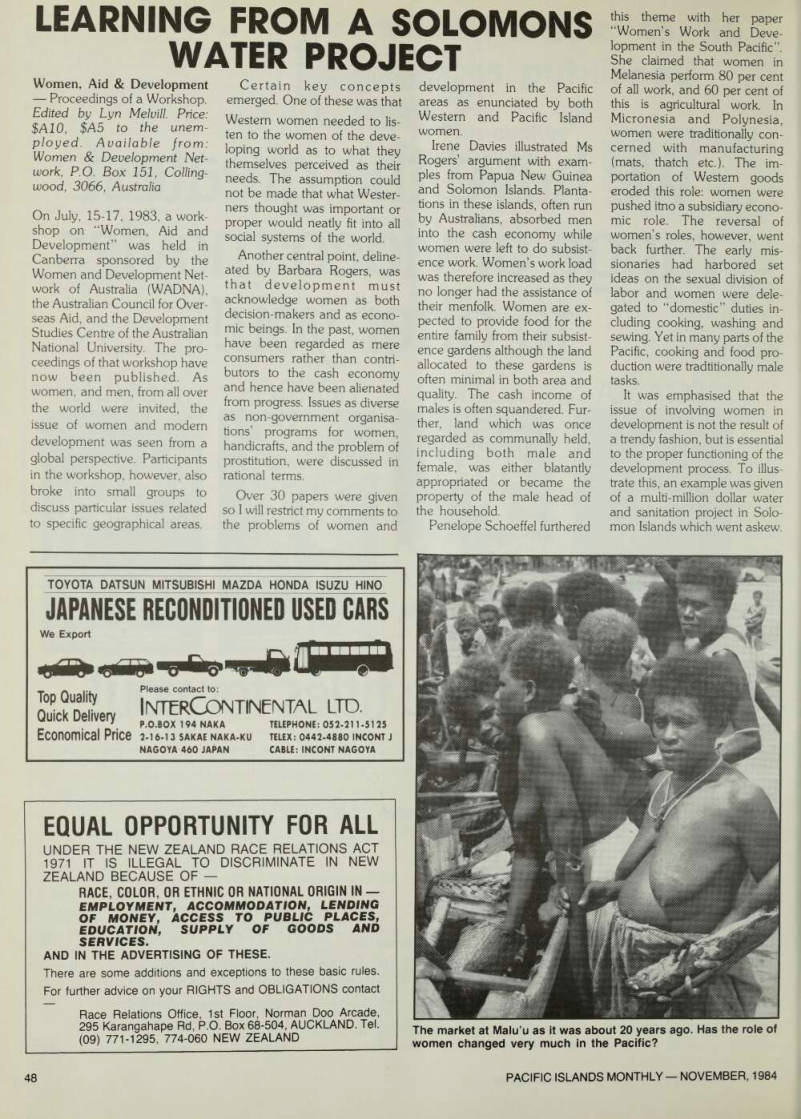
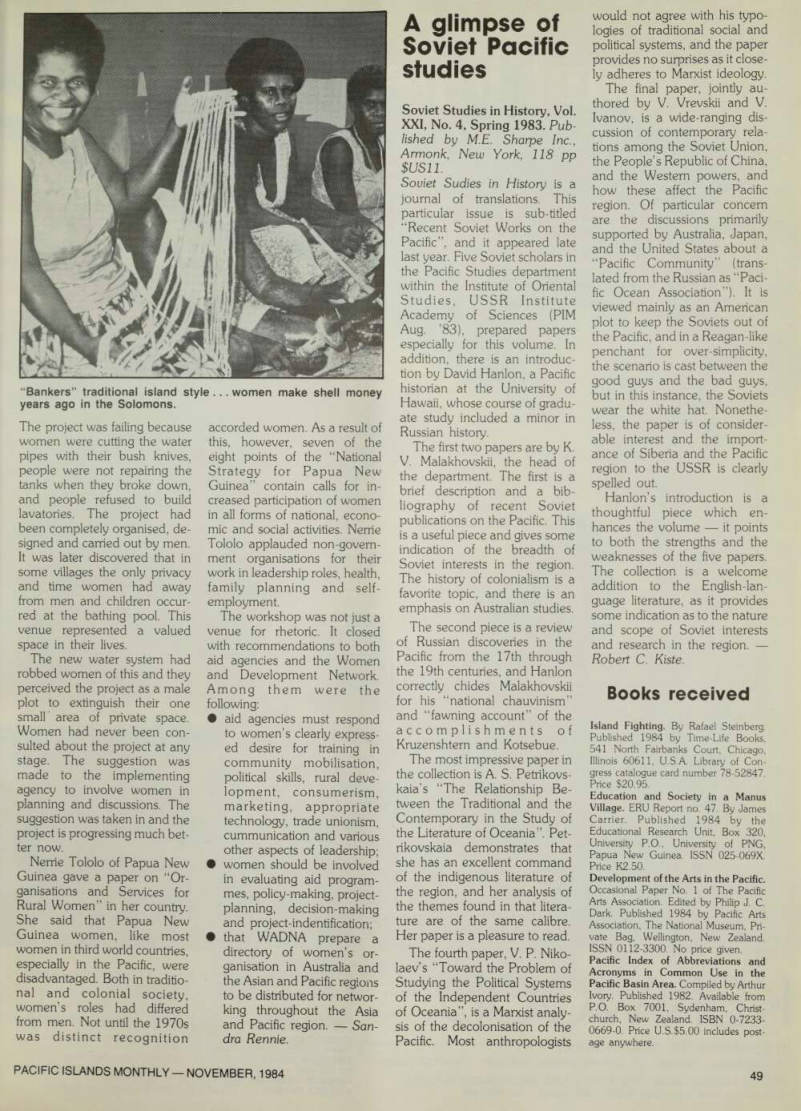
Learning From A Solomons
Women, Aid & Development Proceedings of a Workshop.
Edited by Lyn Mehill. Price: SAIO, SAS to the unem ployed. Available from: Women & Development Net work, P.O. Box 151, Colling wood, 3066, Australia On July, 15-17, 1983, a work shop on “Women, Aid and Development” was held in Canberra sponsored by the Women and Development Net work of Australia (WADNA), the Australian Council for Over seas Aid, and the Development Studies Centre of the Australian National University. The pro ceedings of that workshop have now been published. As women, and men, from all over the world were invited, the issue of women and modern development was seen from a global perspective. Participants in the workshop, however, also broke into small groups to discuss particular issues related to specific geographical areas.
Certain key concepts emerged. One of these was that Western women needed to lis ten to the women of the deve loping world as to what they themselves perceived as their needs. The assumption could not be made that what Wester ners thought was important or proper would neatly fit into all social systems of the world.
Another central point, deline ated by Barbara Rogers, was that development must acknowledge women as both decision-makers and as econo mic beings. In the past, women have been regarded as mere consumers rather than contri butors to the cash economy and hence have been alienated from progress. Issues as diverse as non-government organisa tions’ programs for women, handicrafts, and the problem of prostitution, were discussed in rational terms.
Over 30 papers were given so I will restrict my comments to the problems of women and
development in the Pacific areas as enunciated by both Western and Pacific Island women.
Irene Davies illustrated Ms Rogers’ argument with exam ples from Papua New Guinea and Solomon Islands. Planta tions in these islands, often run by Australians, absorbed men into the cash economy while women were left to do subsist ence work. Women’s work load was therefore increased as they no longer had the assistance of their menfolk. Women are ex pected to provide food for the entire family from their subsist ence gardens although the land allocated to these gardens is often minimal in both area and quality. The cash income of males is often squandered. Fur ther, land which was once regarded as communally held, including both male and female, was either blatantly appropriated or became the property of the male head of the household.
Penelope Schoeffel furthered
this theme with her paper “Women’s Work and Deve lopment in the South Pacific”.
She claimed that women in Melanesia perform 80 per cent of all work, and 60 per cent of this is agricultural work. In Micronesia and Polynesia, women were traditionally con cerned with manufacturing (mats, thatch etc.). The im portation of Western goods eroded this role: women were pushed itno a subsidiary econo mic role. The reversal of women’s roles, however, went back further. The early mis sionaries had harbored set ideas on the sexual division of labor and women were dele gated to “domestic” duties in cluding cooking, washing and sewing. Yet in many parts of the Pacific, cooking and food pro duction were tradtitionally male tasks.
It was emphasised that the issue of involving women in development is not the result of a trendy fashion, but is essential to the proper functioning of the development process. To illus trate this, an example was given of a multi-million dollar water and sanitation project in Solo mon Islands which went askew.
The market at Malu’u as it was about 20 years ago. Has the role of women changed very much in the Pacific?
The project was failing because women were cutting the water pipes with their bush knives, people were not repairing the tanks when they broke down, and people refused to build lavatories. The project had been completely organised, de signed and carried out by men.
It was later discovered that in some villages the only privacy and time women had away from men and children occur red at the bathing pool. This venue represented a valued space in their lives.
The new water system had robbed women of this and they perceived the project as a male plot to extinguish their one small' area of private space.
Women had never been con sulted about the project at any stage. The suggestion was made to the implementing agency to involve women in planning and discussions. The suggestion was taken in and the project is progressing much bet ter now.
Nerrie Tololo of Papua New Guinea gave a paper on “Or ganisations and Services for Rural Women” in her country.
She said that Papua New Guinea women, like most women in third world countries, especially in the Pacific, were disadvantaged. Both in traditio nal and colonial society, women’s roles had differed from men. Not until the 1970 s was distinct recognition
accorded women. As a result of this, however, seven of the eight points of the “National Strategy for Papua New Guinea” contain calls for in creased participation of women in all forms of national, econo mic and social activities. Nerrie Tololo applauded non-govern ment organisations for their work in leadership roles, health, family planning and self employment.
The workshop was not just a venue for rhetoric. It closed with recommendations to both aid agencies and the Women and Development Network.
Among them were the following: • aid agencies must respond to women’s clearly express ed desire for training in community mobilisation, political skills, rural deve lopment, consumerism, marketing, appropriate technology, trade unionism, cummunication and various other aspects of leadership; • women should be involved in evaluating aid program mes, policy-making, project
planning, decision-making
and project-indentification; • that WADNA prepare a directory of women’s or ganisation in Australia and the Asian and Pacific regions to be distributed for networ king throughout the Asia
and Pacific region.
San-
dra Rennie.
“Bankers” traditional island style . . . women make shell money years ago in the Solomons.
Advertisements & other items, p. 48 (1 item)
■uififr KjSti* JBi fIBBP
TOYOTA DATSUN MITSUBISHI MAZDA HONDA ISUZU HINO
JAPANESE RECONDITIONED USED CARS
We Export
■uififr KjSti* JBi fIBBP
Top Quality
Quick Delivery
Please contact to:
I INTERCONTINENTAL LTD.
P.0.80X 194 NAKA
Economical Price 2-16-13 sakae naka-ku
NAGOYA 460 JAPAN
TELEPHONE: 052-211-5125
TELEX: 0442-4880 INCONT J
CABLE: INCONT NAGOYA
EQUAL OPPORTUNITY FOR ALL
UNDER THE NEW ZEALAND RACE RELATIONS ACT 1971 IT IS ILLEGAL TO DISCRIMINATE IN NEW
ZEALAND BECAUSE OF
RACE, COLOR, OR ETHNIC OR NATIONAL ORIGIN IN
EMPLOYMENT, ACCOMMODATION, LENDING
OF MONEY, ACCESS TO PUBLIC PLACES,
EDUCATION, SUPPLY OF GOODS AND
SERVICES.
AND IN THE ADVERTISING OF THESE.
There are some additions and exceptions to these basic rules.
For further advice on your RIGHTS and OBLIGATIONS contact Race Relations Office, Ist Floor, Norman Doo Arcade, 295 Karangahape Rd, P.O. Box 68-504, AUCKLAND. Tel.
(09) 771-1295, 774-060 NEW ZEALAND
Soviet Pacific
A glimpse of Soviet Pacific studies
Soviet Studies in History, Vol.
XXI, No. 4, Spring 1983. Pub lished by M.E. Sharpe Inc., Armonk, New York, 118 pp
Susii.
Soviet Sudies in History is a journal of translations. This particular issue is sub-titled “Recent Soviet Works on the Pacific”, and it appeared late last year. Five Soviet scholars in the Pacific Studies department within the Institute of Oriental Studies, USSR Institute Academy of Sciences (PIM Aug. ’B3), prepared papers especially for this volume. In addition, there is an introduc tion by David Hanlon, a Pacific historian at the University of Hawaii, whose course of gradu ate study included a minor in Russian history.
The first two papers are by K.
V. Malakhovskii, the head of the department. The first is a brief description and a bib liography of recent Soviet publications on the Pacific. This is a useful piece and gives some indication of the breadth of Soviet interests in the region.
The history of colonialism is a favorite topic, and there is an emphasis on Australian studies.
The second piece is a review of Russian discoveries in the Pacific from the 17th through the 19th centuries, and Hanlon correctly chides Malakhovskii for his “national chauvinism” and “fawning account” of the accomplishments of Kruzenshtern and Kotsebue.
The most impressive paper in the collection is A. S. Petrikovs kaia’s “The Relationship Be tween the Traditional and the Contemporary in the Study of the Literature of Oceania”. Pet rikovskaia demonstrates that she has an excellent command of the indigenous literature of the region, and her analysis of the themes found in that litera ture are of the same calibre.
Her paper is a pleasure to read.
The fourth paper, V. P. Niko laev’s “Toward the Problem of Studying the Political Systems of the Independent Countries of Oceania”, is a Marxist analy sis of the decolonisation of the Pacific. Most anthropologists
would not agree with his typo logies of traditional social and political systems, and the paper provides no surprises as it close ly adheres to Marxist ideology.
The final paper, jointly au thored by V. Vrevskii and V.
Ivanov, is a wide-ranging dis cussion of contemporary rela tions among the Soviet Union, the People’s Republic of China, and the Western powers, and how these affect the Pacific region. Of particular concern are the discussions primarily supported by Australia, Japan, and the United States about a “Pacific Community” (trans lated from the Russian as “Paci fic Ocean Association”). It is viewed mainly as an American plot to keep the Soviets out of the Pacific, and in a Reagan-like penchant for over-simplicity, the scenario is cast between the good guys and the bad guys, but in this instance, the Soviets wear the white hat. Nonethe less, the paper is of consider able interest and the import ance of Siberia and the Pacific region to the USSR is clearly spelled out.
Hanlon’s introduction is a thoughtful piece which en hances the volume it points to both the strengths and the weaknesses of the five papers.
The collection is a welcome addition to the English-lan guage literature, as it provides some indication as to the nature and scope of Soviet interests and research in the region.
Robert C. Kiste.
Books received
Island Fighting. By Rafael Steinberg.
Published 1984 by Time-Life Books, 541 North Fairbanks Court, Chicago, Illinois 60611, U.S.A. Library of Con gress catalogue card number 78-52847.
Price $20.95.
Education and Society in a Manus Village. ERU Report no. 47. By James Carrier. Published 1984 by the Educational Research Unit, Box 320, University P. 0., University of PNG, Papua New Guinea. ISSN 025-069 X.
Price K 2.50.
Development of the Arts in the Pacific.
Occasional Paper No. 1 of The Pacific Arts Association. Edited by Philip J. C.
Dark. Published 1984 by Pacific Arts Association, The National Museum, Pri vate Bag, Wellington, New Zealand.
ISSN 0112-3300. No price given.
Pacific Index of Abbreviations and Acronyms in Common Use in the Pacific Basin Area. Compiled by Arthur Ivory. Published 1982. Available from P.O. Box 7001, Sydenham, Christ church, New Zealand. ISBN 0-7233- 0669-0. Price U. 5.55.00 includes post age anywhere.
Advertisements & other items, p. 50 (1 item)
Kenwood
Here’s one way to improve the quality of your life. Listen just once to some familiar music from a Spectrum stereo system.
You’ll hear rich, dynamic and “pure” music like you’ve never heard at home before!
Spectrum systems also offer a whole array of helpful functions—electronic and
computerized. Plus plenty of fingertip-ready
operating convenience.
Spectrum stereo component systems.
Engineered for you by world-leading
audio specialists.
r 1 L H A 111 SI H ■ ; Top Features of Spectrum 72 Shown ■29 OW Dynamic Power Output (4 ohms) ■Advanced parametric tone controls ■ Computer-guided tuning and 10-station random memory Double cassette deck with doublespeed dubbing Computerized tape music search/ repeat system g| I HR
KENWOOD
TRIO-KENWOOD CORPORATION
Shionogi Shibuya Building, 17-5, 2-chome Shibuya, Shibuya-ku, Tokyo 150, Japan TRIO-KENWOOD (AUSTRALIA) PTY. LTD. (INCORPORATED IN N S W.) 4E Woodcock Place, Lane Cove, N.S.W. 2066, Australia. Tel: 428-1455 NEW ZEALAND JOHN GILBERT & CO., LTD. Auckland Tel. 0011-64-9-30839 FIJI PEPE’S DUTY FREE CENTRE LTD. Tel. 25496, 25497 PAPUA NEW GUINEA S.O. SVENSSON (N.G.) LTD, Port Moresby Tel. 212158, 212111 SOLOMON ISLANDS TECHNIQUE RADIOS CENTRE LTD. Honiara Tel. 416 NEW CALEDONIA HI-FI VOX Noumea Tel. 27-2466, 28-2931 VANUATU FUNG CHOI LUEN. Port-Vila Tel. 2556
TAHITI MAISON AURORE Papeete Tel. 29703
AMERICAN SAMOA ISLAND PACIFIC AGENCIES, INC. Pago Pago Tel. 633-4687
REPUBLIC OF NAURU NAURU CO-OPERATIVE SOCIETY
MARIANA ISLANDS J.C. TENORIO ENTERPRISES Saipan Tel. 6445
as they do in Rome . . .
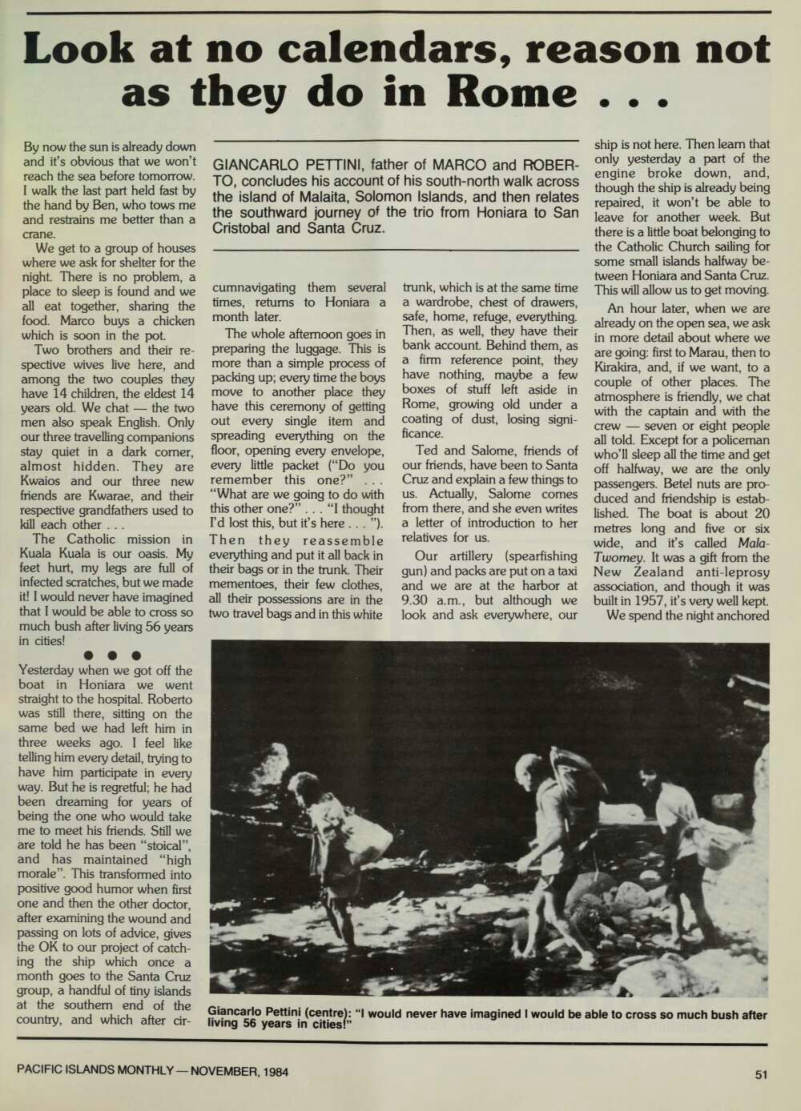

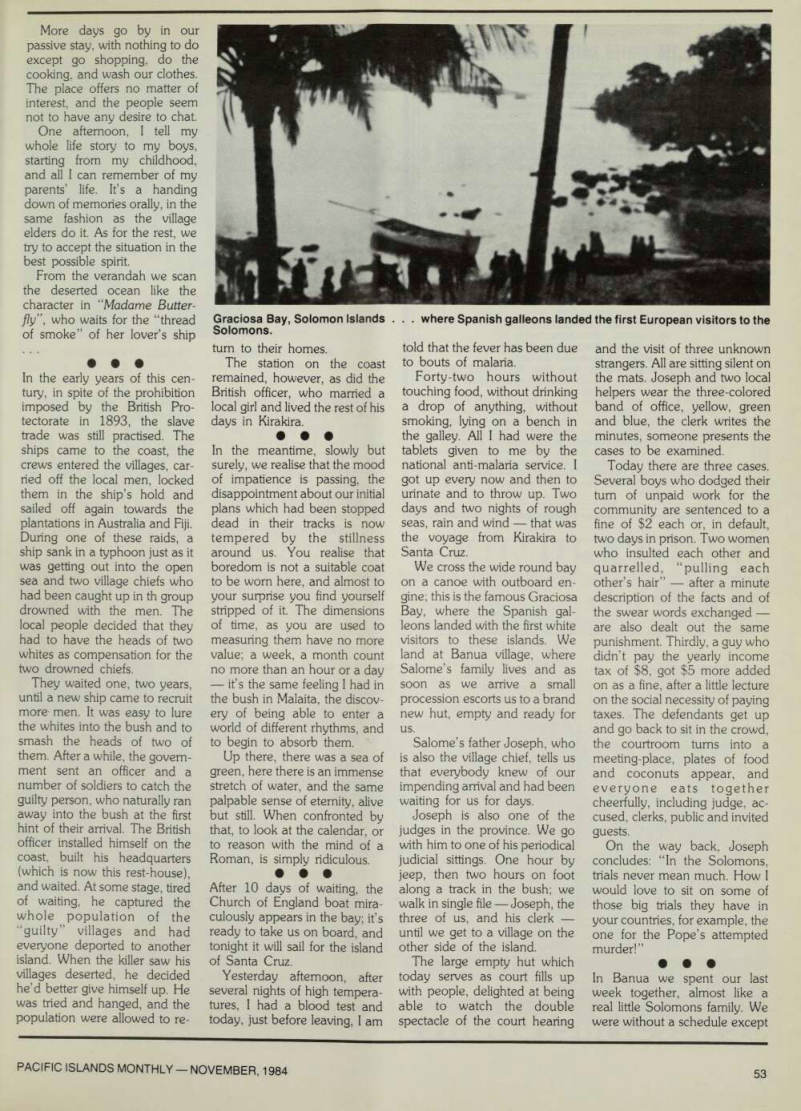
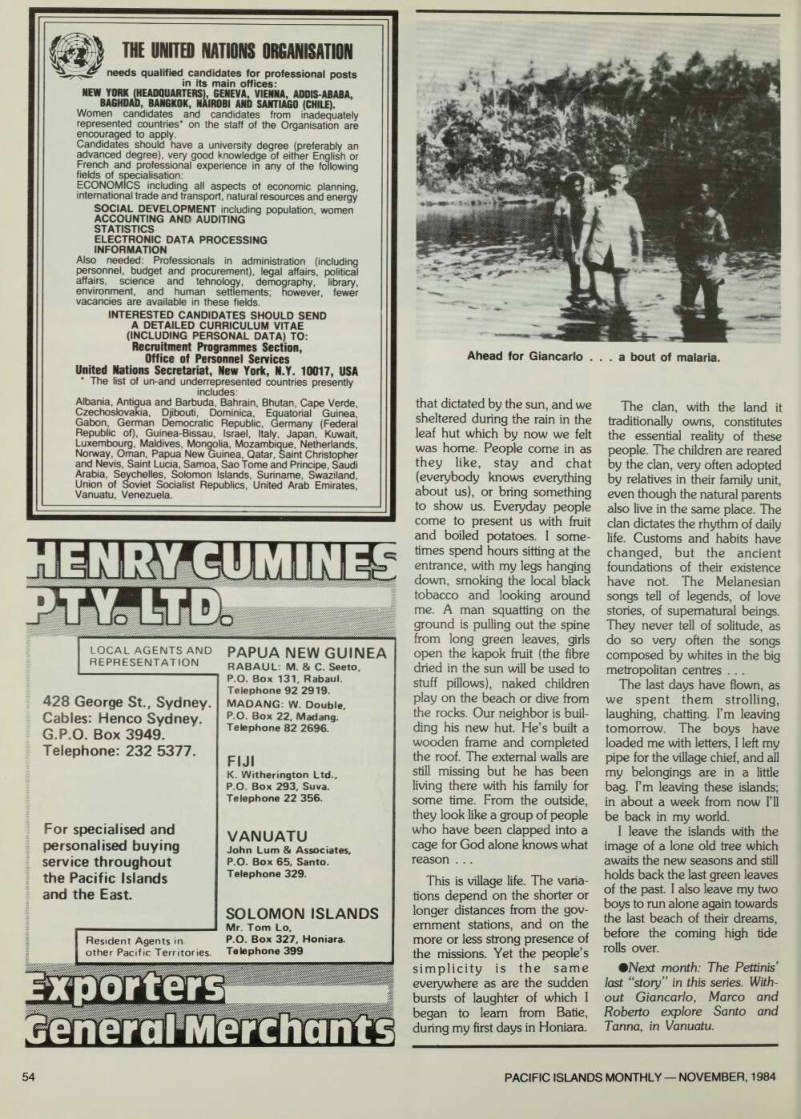
Look at no calendars, reason not as they do in Rome . . .
By now the sun is already down and it’s obvious that we won’t reach the sea before tomorrow.
I walk the last part held fast by the hand by Ben, who tows me and restrains me better than a crane.
We get to a group of houses where we ask for shelter for the night There is no problem, a place to sleep is found and we all eat together, sharing the food. Marco buys a chicken which is soon in the pot Two brothers and their re spective wives live here, and among the two couples they have 14 children, the eldest 14 years old. We chat the two men also speak English. Only our three travelling companions stay quiet in a dark comer, almost hidden. They are Kwaios and our three new friends are Kwarae, and their respective grandfathers used to kill each other . . .
The Catholic mission in Kuala Kuala is our oasis. My feet hurt, my legs are full of infected scratches, but we made it! I would never have imagined that I would be able to cross so much bush after living 56 years in cities! • • • Yesterday when we got off the boat in Honiara we went straight to the hospital. Roberto was still there, sitting on the same bed we had left him in three weeks ago. I feel like telling him every detail, trying to have him participate in every way. But he is regretful; he had been dreaming for years of being the one who would take me to meet his friends. Still we are told he has been “stoical”, and has maintained “high morale”. This transformed into positive good humor when first one and then the other doctor, after examining the wound and passing on lots of advice, gives the OK to our project of catch ing the ship which once a month goes to the Santa Cruz group, a handful of tiny islands at the southern end of the country, and which after dr-
GIANCARLO PETTINI, father of MARCO and ROBER TO, concludes his account of his south-north walk across the island of Malaita, Solomon Islands, and then relates the southward journey of the trio from Honiara to San Cristobal and Santa Cruz.
cumnavigating them several times, returns to Honiara a month later.
The whole afternoon goes in preparing the luggage. This is more than a simple process of packing up; every time the boys move to another place they have this ceremony of getting out every single item and spreading everything on the floor, opening every envelope, every little packet (“Do you remember this one?” . . .
“What are we going to do with this other one?” ... “I thought I’d lost this, but it’s here . . . ”).
Then they reassemble everything and put it all back in their bags or in the trunk. Their mementoes, their few clothes, all their possessions are in the two travel bags and in this white
trunk, which is at the same time a wardrobe, chest of drawers. safe, home, refuge, everything.
Then, as weU, they have their bank account. Behind them, as r. , . . ,■* a firm reference point, they , ... u x ave no mg may e a ew boxes of stuff left aside in D , Rome, growing old under a coating of dust, losing signicance ' Ted and Salome, friends of our friends, have been to Santa Cruz and explain a few things to us. Actually, Salome comes from there and she even writes a letter of introduction to her relatives for us.
Our artillery (spearfishing gun) and packs are put on a taxi and we are at the harbor at 9.30 a.m., but although we look and ask everywhere, our
ship is not here. Then leam that only yesterday a part of the engine broke down, and, though the ship is already being repaired, it won’t be able to leave for another week. But there is a little boat belonging to the Catholic Church sailing for some small islands halfway be tween Honiara and Santa Cruz.
This will allow us to get moving.
An hour later, when we are already on the open sea, we ask in more detail about where we are going: first to Marau, then to Kirakira, and, if we want, to a couple of other places. The atmosphere is friendly, we chat with the captain and with the crew seven or eight people all told. Except for a policeman who’ll sleep all the time and get off halfway, we are the only passengers. Betel nuts are pro duced and friendship is estab lished. The boat is about 20 metres long and five or six wide, and it’s called Mala- Twomey. It was a gift from the New Zealand anti-leprosy association, and though it was built in 1957, it’s very well kept We spend the night anchored
Giancarlo Pettini (centre): “I would never have imagined I would be able to cross so much bush after living 56 years in cities!”
in the little bay of Here, and at dawn the boat penetrates a small group of islands, some of them quite tiny, in a sea as flat as a board. The tiny islands are green specks, with thick vegeta tion up to the point where the water starts, and short beaches of light-colored sand a few metres from the palms.
The big clouds are the color of lead, the sea is dark; in the early morning silence we can hear only the toof-toof of our motor (cruising speed 7.5 knots). After about two and half hours we are on Marau. At a short distance from the station, at the head of a placid bay, there is Makina Catholic Mis sion.
The priest is not there. He’s gone to Marau where a sports meeting starts today involving all the schools in the province, with competitions and so on . . . apparently a very important event.
As it happened, Father Da mian Everwin, called Tony, a German from the north, left everything and returned in a hurry as soon as he learned of
our arrival. He’s obviously happy to see us here, and overwhelms us with kindness, stuffing us with good things to eat. The nun “in charge” is a large Solomon Islander lady, with big lips and large round eyes. She is “as good as the bread” and has always been the housekeeper in charge of everything. She’s an exact copy of the “Mammy” from the American Deep South of the 1800 s, including the baritone voice. She always marches at the head of the single file of her three helpers, young girls who follow her in order of size, carrying on their heads trays with plates and food. The pro cession is repeated at breakfast, lunch and dinner: three times up, and three times down with empty plates. • • • Thirteen hours of navigation to get from Marau to Kirakira, San Cristobal Island, 13 hours of sea-sickness. As soon as it’s outside the lagoon, the boat starts pitching up and down, painfully, and in less than an hour the whole breakfast Father
Tony had lovingly prepared for us while it was still dark fried eggs, bread and butter, cake and coffee and milk ends up among the fish. It is already night when we arrive. In the dark, the dinghy breaks off from the boat and takes us and our luggage to the shore . . .
We are still in Kirakira, waiting for a boat to take us to Santa Cruz, and we don’t know when one will come the information we get is very vague.
Kirakira is the chief town of one of the eight provinces that make up the State of Solomon Islands. It’s an administrative centre rather than a small town, and you see around a few officials and clerks, in shirts and trousers, and very few children, Yet we feel cut off from the rest of the world; the island of San Cristobal is large but half deserted, there are no roads except a short stretch to some nearby village, and so there is practically no means of transport at all.
We spend much of our time in the rest-house, a large,
wooden, colonial style building, the only one in the station built in this manner. According to notes left by previous visitors in the faded visitors’ book, the ghost of a girl should be around. But up to now she has given no sign of her presence. A bald, toothless old man watches affectionately over all guests, He’s energetic and full of initia tive. His name is Andrew and on request he is porter-waiter manager-watchman-cook, re sponsible for everything. Al ways cheerful and ready, you can pass him a hundred times, and each time he’ll greet you in a loud voice, With his long arms, his hands look like canoe paddles, There’s a lighted pipe always in his mouth, and he always has something to do. If he’s not busy in the kitchen, there he is, energetically sweeping the hall, using the same big broom indis criminately first on the floor, then on the lounges, on the dining table, then on the walls and, finally, completing his rotating movement, on the ceiling.
More days go by in our passive stay, with nothing to do except go shopping, do the cooking, and wash our clothes.
The place offers no matter of interest, and the people seem not to have any desire to chat.
One afternoon, I tell my whole life story to my boys, starting from my childhood, and all I can remember of my parents’ life. It’s a handing down of memories orally, in the same fashion as the village elders do it. As for the rest, we try to accept the situation in the best possible spirit.
From the verandah we scan the deserted ocean like the character in “Madame Butter fly”, who waits for the “thread of smoke” of her lover’s ship • • • In the early years of this cen tury, in spite of the prohibition imposed by the British Pro tectorate in 1893, the slave trade was still practised. The ships came to the coast, the crews entered the villages, car ried off the local men, locked them in the ship’s hold and sailed off again towards the plantations in Australia and Fiji.
During one of these raids, a ship sank in a typhoon just as it was getting out into the open sea and two village chiefs who had been caught up in th group drowned with the men. The local people decided that they had to have the heads of two whites as compensation for the two drowned chiefs.
They waited one, two years, until a new ship came to recruit more- men. It was easy to lure the whites into the bush and to smash the heads of two of them. After a while, the govern ment sent an officer and a number of soldiers to catch the guilty person, who naturally ran away into the bush at the first hint of their arrival. The British officer installed himself on the coast, built his headquarters (which is now this rest-house), and waited. At some stage, tired of waiting, he captured the whole population of the “guilty” villages and had everyone deported to another island. When the killer saw his villages deserted, he decided he’d better give himself up. He was tried and hanged, and the population were allowed to re-
turn to their homes.
The station on the coast remained, however, as did the British officer, who married a local girl and lived the rest of his days in Kirakira. • • • In the meantime, slowly but surely, we realise that the mood of impatience is passing, the disappointment about our initial plans which had been stopped dead in their tracks is now tempered by the stillness around us. You realise that boredom is not a suitable coat to be worn here, and almost to your surprise you find yourself stripped of it. The dimensions of time, as you are used to measuring them have no more value; a week, a month count no more than an hour or a day it’s the same feeling I had in the bush in Malaita, the discov ery of being able to enter a world of different rhythms, and to begin to absorb them.
Up there, there was a sea of green, here there is an immense stretch of water, and the same palpable sense of eternity, alive but still. When confronted by that, to look at the calendar, or to reason with the mind of a Roman, is simply ridiculous. • • • After 10 days of waiting, the Church of England boat mira culously appears in the bay; it’s ready to take us on board, and tonight it will sail for the island of Santa Cruz.
Yesterday afternoon, after several nights of high tempera tures, I had a blood test and today, just before leaving, I am
told that the fever has been due to bouts of malaria.
Forty-two hours without touching food, without drinking a drop of anything, without smoking, lying on a bench in the galley. All I had were the tablets given to me by the national anti-malaria service. I got up every now and then to urinate and to throw up. Two days and two nights of rough seas, rain and wind that was the voyage from Kirakira to Santa Cruz.
We cross the wide round bay on a canoe with outboard en gine; this is the famous Graciosa Bay, where the Spanish gal leons landed with the first white visitors to these islands. We land at Banua village, where Salome’s family lives and as soon as we arrive a small procession escorts us to a brand new hut, empty and ready for us.
Salome’s father Joseph, who is also the village chief, tells us that everybody knew of our impending arrival and had been waiting for us for days.
Joseph is also one of the judges in the province. We go with him to one of his periodical judicial sittings. One hour by jeep, then two hours on foot along a track in the bush; we walk in single file Joseph, the three of us, and his clerk until we get to a village on the other side of the island.
The large empty hut which today serves as court fills up with people, delighted at being able to watch the double spectacle of the court hearing
and the visit of three unknown strangers. All are sitting silent on the mats. Joseph and two local helpers wear the three-colored band of office, yellow, green and blue, the clerk writes the minutes, someone presents the cases to be examined.
Today there are three cases.
Several boys who dodged their turn of unpaid work for the community are sentenced to a fine of $2 each or, in default, two days in prison. Two women who insulted each other and quarrelled, “pulling each other’s hair” after a minute description of the facts and of the swear words exchanged are also dealt out the same punishment. Thirdly, a guy who didn’t pay the yearly income tax of $B, got $5 more added on as a fine, after a little lecture on the social necessity of paying taxes. The defendants get up and go back to sit in the crowd, the courtroom turns into a meeting-place, plates of food and coconuts appear, and everyone eats together cheerfully, including judge, ac cused, clerks, public and invited guests.
On the way back, Joseph concludes: “In the Solomons, trials never mean much. How I would love to sit on some of those big trials they have in your countries, for example, the one for the Pope’s attempted murder!” • • • In Banua we spent our last week together, almost like a real little Solomons family. We were without a schedule except
Graciosa Bay, Solomon Islands . . . where Spanish galleons landed the first European visitors to the Solomons.
that dictated by the sun, and we sheltered during the rain in the leaf hut which by now we felt was home. People come in as they like, stay and chat (everybody knows everything about us), or bring something to show us. Everyday people come to present us with fruit and boiled potatoes. I some times spend hours sitting at the entrance, with my legs hanging down, smoking the local black tobacco and looking around me. A man squatting on the ground is pulling out the spine from long green leaves, girls open the kapok fruit (the fibre dried in the sun will be used to stuff pillows), naked children play on the beach or dive from the rocks. Our neighbor is buil ding his new hut. He’s built a wooden frame and completed the roof. The external walls are still missing but he has been living there with his family for some time. From the outside, they look like a group of people who have been clapped into a cage for God alone knows what reason . . .
This is village life. The varia tions depend on the shorter or longer distances from the gov ernment stations, and on the more or less strong presence of the missions. Yet the people’s simplicity is the same everywhere as are the sudden bursts of laughter of which I began to learn from Batie, during my first days in Honiara.
The clan, with the land it traditionally owns, constitutes the essential reality of these people. The children are reared by the clan, very often adopted by relatives in their family unit, even though the natural parents also live in the same place. The clan dictates the rhythm of daily life. Customs and habits have changed, but the ancient foundations of their existence have not. The Melanesian songs tell of legends, of love stories, of supernatural beings.
They never tell of solitude, as do so very often the songs composed by whites in the big metropolitan centres . . .
The last days have flown, as we spent them strolling, laughing, chatting. I’m leaving tomorrow. The boys have loaded me with letters, I left my pipe for the village chief, and all my belongings are in a little bag. I’m leaving these islands; in about a week from now I’ll be back in my world.
I leave the islands with the image of a lone old tree which awaits the new seasons and still holds back the last green leaves of the past. I also leave my two boys to run alone again towards the last beach of their dreams, before the coming high tide rolls over. •Next month: The Pettinis’ last “story” in this series. With out Giancarlo, Marco and Roberto explore Santo and Tanna, in Vanuatu.
Ahead for Giancarlo ... a bout of malaria.
Advertisements & other items, pp. 52-54 (1 item)
\&Cific
WCIFIC
CONSTRUCTION EQUIPMENT CO
introducing me Dynamic New Range of
Vibrating s Pneumatic igred Rollers
\&CIFIC
THE RANGE
• Pacific Self-Propelled Vibrating Rollers • Single and Double Drum Types • 1.5 tonne to 16 tonne • Pacific Self-Propelled Pneumatic Type Compactors • 3 Models 16. 21. 38 tonne Ballast Weights • Pacific Landfill and Sanitary Landfill Compactors • Pacific Pneumatic Earth Borers • Pacific Road Brooms • Pacific Railway Maintenance Vehicles Construction Equipment Co.
DISTRIBUTORS REQUIRED
THROUGHOUT THE PACIFIC
24 Salisbury Road, Hornsby NSW 2077, Australia. Phone (02) 476 2666
SAL
FLSTS9S
THE UNITED NATIONS ORGANISATION
needs qualified candidates for professional posts in its main offices:
NEW YORK (HEADQUARTERS), GENEVA, VIENNA, ADDIS-ABABA,
BAGHDAD, BANGKOK, NAIROBI AND SANTIAGO (CHILE).
Women candidates and candidates from inadequately represented countries* on the staff of the Organisation are encouraged to apply.
Candidates should have a university degree (preferably an advanced degree), very good knowledge of either English or French and professional experience in any of the following fields of specialisation: ECONOMICS including all aspects of economic planning, international trade and transport, natural resources and energy SOCIAL DEVELOPMENT including population, women
ACCOUNTING AND AUDITING
STATISTICS
ELECTRONIC DATA PROCESSING
INFORMATION
Also needed: Professionals in administration (including personnel, budget and procurement), legal affairs, political affairs, science and tehnology, demography, library, environment, and human settlements; however, fewer vacancies are available in these fields.
INTERESTED CANDIDATES SHOULD SEND
A DETAILED CURRICULUM VITAE
(INCLUDING PERSONAL DATA) TO:
Recruitment Programmes Section,
Office of Personnel Services United Nations Secretariat, New York, N.Y. 10017, USA The list of un-and underrepresented countries presently includes: Albania, Antigua and Barbuda, Bahrain, Bhutan, Cape Verde, Czechoslovakia, Djibouti, Dominica, Equatorial Guinea, Gabon, German Democratic Republic, Germany (Federal Republic of), Guinea-Bissau, Israel, Italy, Japan, Kuwait, Luxembourg, Maldives, Mongolia, Mozambique, Netherlands, Norway, Oman, Papua New Guinea, Qatar, Saint Christopher and Nevis, Saint Lucia, Samoa, Sao Tome and Principe, Saudi Arabia, Seychelles, Solomon Islands, Suriname, Swaziland, Union of Soviet Socialist Republics, United Arab Emirates, Vanuatu, Venezuela.
JVuSSKIL
LOCAL AGENTS AND
REPRESENTATION
428 George St., Sydney.
Cables: Henco Sydney.
G.P.O. Box 3949.
Telephone: 232 5377.
For specialised and
personalised buying
service throughout
the Pacific Islands
and the East.
Resident Agents in other Pacific Territories.
PAPUA NEW GUINEA
RABAUL: M. & C. Seeto, P.O. Box 131, Rabaul.
Telephone 92 2919.
MADANG: W. Double, P.O. Box 22, Madang.
Telephone 82 2696.
FIJI
K. Witherington Ltd., P.O. Box 293, Suva.
Telephone 22 356.
VANUATU
John Lum & Associates, P.O. Box 65, Santo.
Telephone 329.
SOLOMON ISLANDS
Mr. Tom Lo, P.O. Box 327, Honiara.
Telephone 399 "3
xporters
Santo Town Sunday
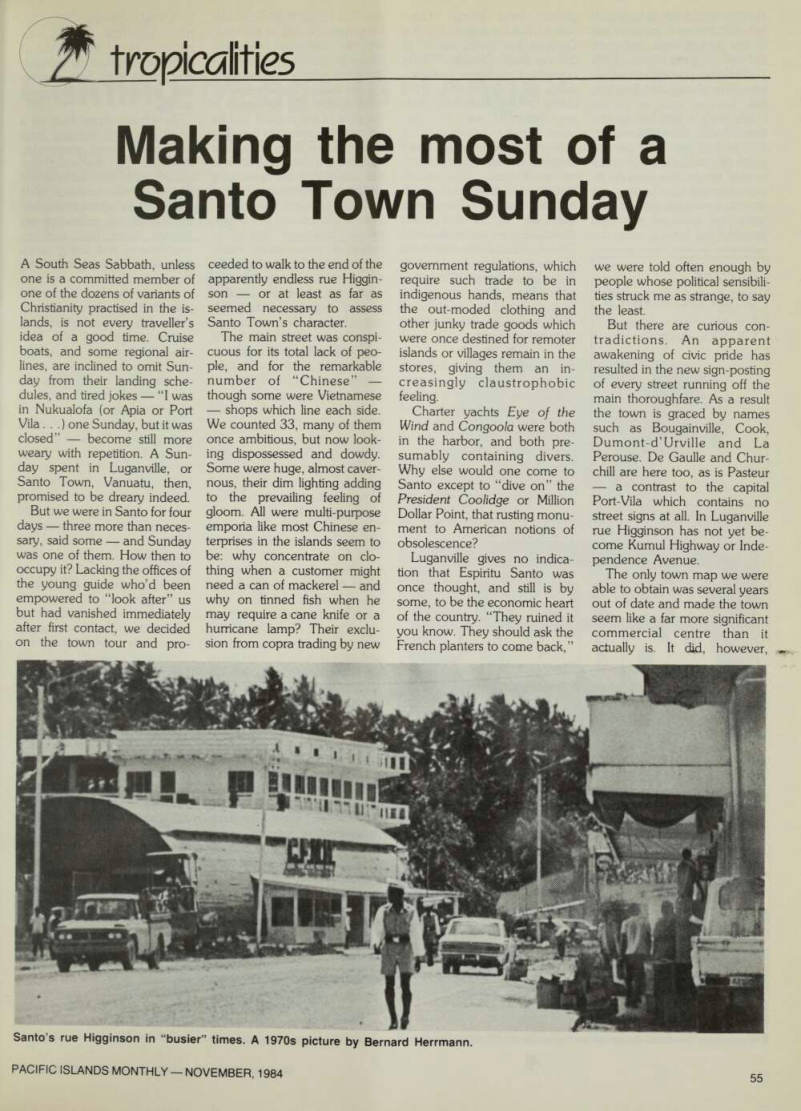

tropicalities
Making the most of a Santo Town Sunday
A South Seas Sabbath, unless one is a committed member of one of the dozens of variants of Christianity practised in the is lands, is not every traveller’s idea of a good time. Cruise boats, and some regional air lines, are inclined to omit Sun day from their landing sche dules, and tired jokes “I was in Nukualofa (or Apia or Port Vila. . .) one Sunday, but it was closed” become still more weary with repetition. A Sun day spent in Luganville, or Santo Town, Vanuatu, then, promised to be dreary indeed.
But we were in Santo for four days three more than neces sary, said some and Sunday was one of them. How then to occupy it? Lacking the offices of the young guide who’d been empowered to “look after” us but had vanished immediately after first contact, we decided on the town tour and pro
ceeded to walk to the end of the apparently endless rue Higgin son or at least as far as seemed necessary to assess Santo Town’s character.
The main street was conspi cuous for its total lack of peo ple, and for the remarkable number of “Chinese” though some were Vietnamese shops which line each side.
We counted 33, many of them once ambitious, but now look ing dispossessed and dowdy.
Some were huge, almost caver nous, their dim lighting adding to the prevailing feeling of gloom. All were multi-purpose emporia like most Chinese en terprises in the islands seem to be: why concentrate on clo thing when a customer might need a can of mackerel and why on tinned fish when he may require a cane knife or a hurricane lamp? Their exclu sion from copra trading by new
government regulations, which require such trade to be in indigenous hands, means that the out-moded clothing and other junky trade goods which were once destined for remoter islands or villages remain in the stores, giving them an increasingly claustrophobic feeling.
Charter yachts Eye of the Wind and Congoola were both in the harbor, and both presumably containing divers.
Why else would one come to Santo except to “dive on” the President Coolidge or Million Dollar Point, that rusting monument to American notions of obsolescence?
Luganville gives no indication that Espiritu Santo was once thought, and still is by some, to be the economic heart of the country. “They ruined it you know. They should ask the French planters to come back,”
we were told often enough by people whose political sensibili ties struck me as strange, to say the least, But there are curious con tradictions. An apparent awakening of civic pride has resulted in the new sign-posting of every street running off the main thoroughfare. As a result the town is graced by names such as Bougainville, Cook, Dumont-d’Urville and La Perouse. De Gaulle and Chur chill are here too, as is Pasteur a contrast to the capital Port-Vila which contains no street signs at all. In Luganville rue Higginson has not yet be come Kumul Highway or Inde pendence Avenue, The only town map we were able to obtain was several years out of date and made the town seem like a far more significant commercial centre than it actually is. It did, however,
Santo’s rue Higginson in “busier” times. A 1970 s picture by Bernard Herrmann.
indicate that most of Luganvil le’s churches were more or less in one part of town, and there seemed no good reason, 1980 “rebellion” notwithstanding, why they should not be there still.
We were a day late for the Seventh-day Adventist service, and at least an hour late for some others. But there were still people around the large Angli can complex, chatting in groups, seemingly reluctant to leave and break off what was possibly the week’s most im
portant social contact. There was a small congregation in the Quonset hut which serves as the Apostolic Church. “Thirty committed members and hun dreds of nominal ones,” the chatty young Australian “hel per” informed me. Two mi nutes into the conversation he delivered his testimony like a Mormon missionary or a Jeho vah’s Witness. The older “traditional” churches, he said, had lost touch with the people, but God was now speaking directly to them in the Apostolic Church through his son Jesus Christ. (And how long before that church became “traditio nal”?) But I didn’t ask, feeling that it would never be big enough to settle into comfort able orthodoxy. • • • So many uses for Quonset huts in Santo. Beside the small one, which now began to reverber ate to an amplified guitar and some desultory hymn-singing, was one four times the size, a Burns Philp warehouse, or “dock” as it is often called here.
Around the comer another large Quonset hut served as
premises for the French printery Imprimerie Socom at one end, and the Holiness Fellowship Church at the other storefront religion indeed. One toddler among the overflowing congregation was so startled at the sight of my camera that he fell over attempting to flee. The small children, dragged by their mothers as a matter of course to the often long services, play outside or crawl restlessly about the aisle. They are always dres sed in flamboyantly bright, almost iridescent clothes of nylon or some other totally inappropriate Taiwanese synth etic. (In India last year we had decided that the Indian children in their brightly striped jump suits looked like humbugs.
Here, less co-ordinated, the kids looked like jelly beans, or perhaps like liquorice allsorts multi-colored in the centre and black at the extremities.) Further up the road the Catholic church was large of size but dull of service. The Assembly of God was open, but devoid of people. They were having a street meeting at 4 p.m., said the pastor, a tall, very black, fine-featured man who shook my wife’s hand and hoped God would bless her.
At 4 p.m. we went down to the designated place for the street meeting outside the Burns Philp store! This was surely the definitive South Seas encounter of God and Mam mon. The Assembly arrived and set up at 4.30. Two teen age boys played guitars through wildly distorted amplifiers, and a reverb switch made the two or three singing voices sound like a large congregation in a rail way tunnel. The effect, far from being pathetic was strangely moving, and made even more so by the fact that the two of us were the only audience in Luganville’s wide, limitless, main street.
The preaching and singing was, of course, in Bislama, and what an ideal language it is for this kind of exercise: simple, repetitive and containing the occasional illustrative phrase that turns it into rudimentary poetry. Converts from Rente cost!!) and Malakula spoke fervently and at length about their conversions; the former, Solomon, dressed rather like a color blind country and western singer, the latter a conservative
ly attired policeman who de nounced the power and authority of civil law in order to affirm the might of the spiritual, and broke into both English and French to get his point across.
To whom? Apart from us a small group of teenage boys had now gathered, presumably attracted by the electronic rather than the ecclesiastical quality of the occasion, and appeared considerably discom fited when the policeman in formed them that drinking, womanising and string bands were not the stuff of which life should consist.
Across the road, under the Asia Club Disco sign, a group of Gilbertese girls looked amused at the spectacle of us in such close proximity to the Assem bly. They were even more amused when we began to clap our hands in time to the Assem bly’s revivalist hymns.
Three untidy female tourists with grubby shorts and small backpacks glued to their spines wandered by, looked at the faithful and then at us, took a picture and departed. By this time I myself had taken several.
The brilliant white backdrop of BP’s roller doors seemed like the perfect setting for a black skinned and colorfully attired religious group. Had they chosen the location because it was central? Or because its shinier-than-pure whiteness turned the performance into such good theatre?
An hour after it began, it was over and after a short, silent prayer among themselves, the Assembly dispersed. The females withdrew to their chil dren, but the males in the group pastor, testifiers and musi cians came over and shook our hands, addressing us as “brother” and “sister. ” I offered the pastor a donation: “Mi givem smol moni long church blong yu. “That’s very kind of you,” he replied, in English far better articulated than my Bisla ma, and assured us that they had been delighted to see us there.
Not nearly as delighted as we had been, I thought . . . We walked off into the late afternoon, reflecting on the fact that, after all, a Sunday in the South Seas can still provide experiences of considerable in
terest.
Norman Douglas.
Advertisements & other items, p. 56 (1 item)
Houses’
BAGOT
BELLFOUNDRIES
Box 421, North Adelaide, S.A. 5006. Australia Tel: +61 8 267 1306 - Beautiful tuned bells for churches and missions
INSTANT
HOUSES’
and Commercial Buildings with Therma-Panel, B the
fully insulated inter-locking
Building System
Cyclone rated George Hudson Homes (Aust.) pty. Ltd 186 Hume Highway Cabramatta NSW 2166 Australia. Tel: (02) 727 9066. Telex: AA25800 Post coupon for details and prices.
Tel:.
Coming of age in Tonga?
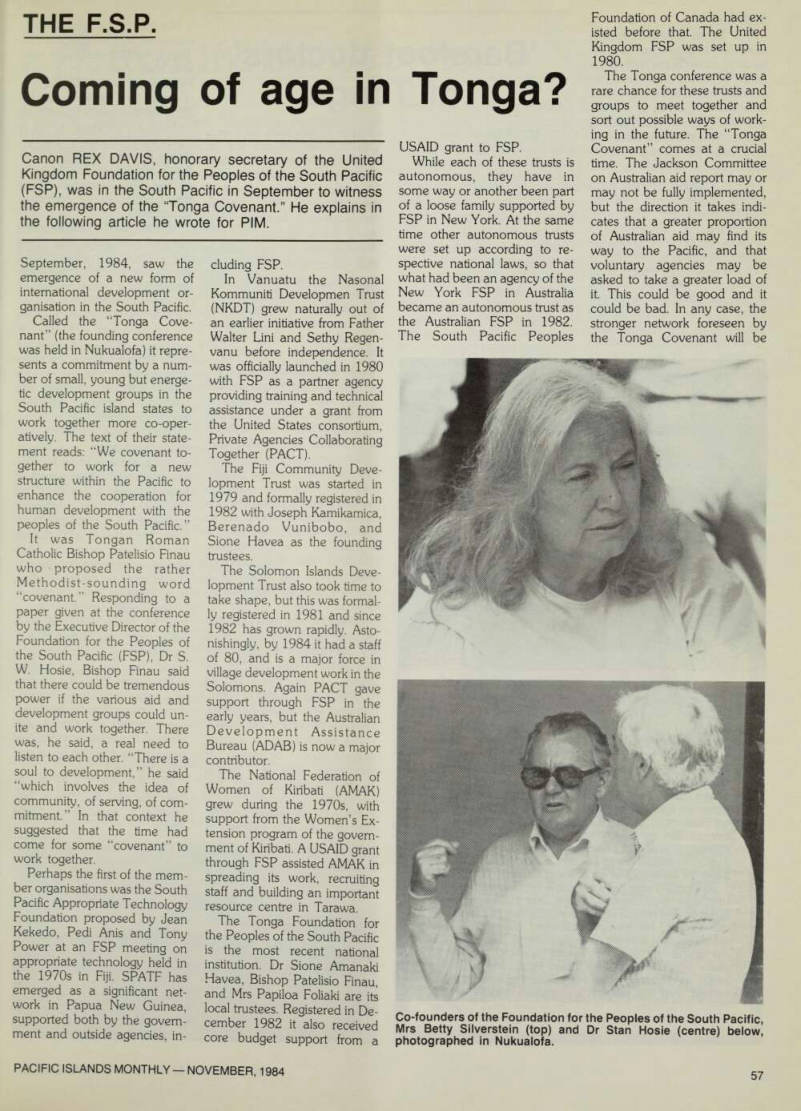
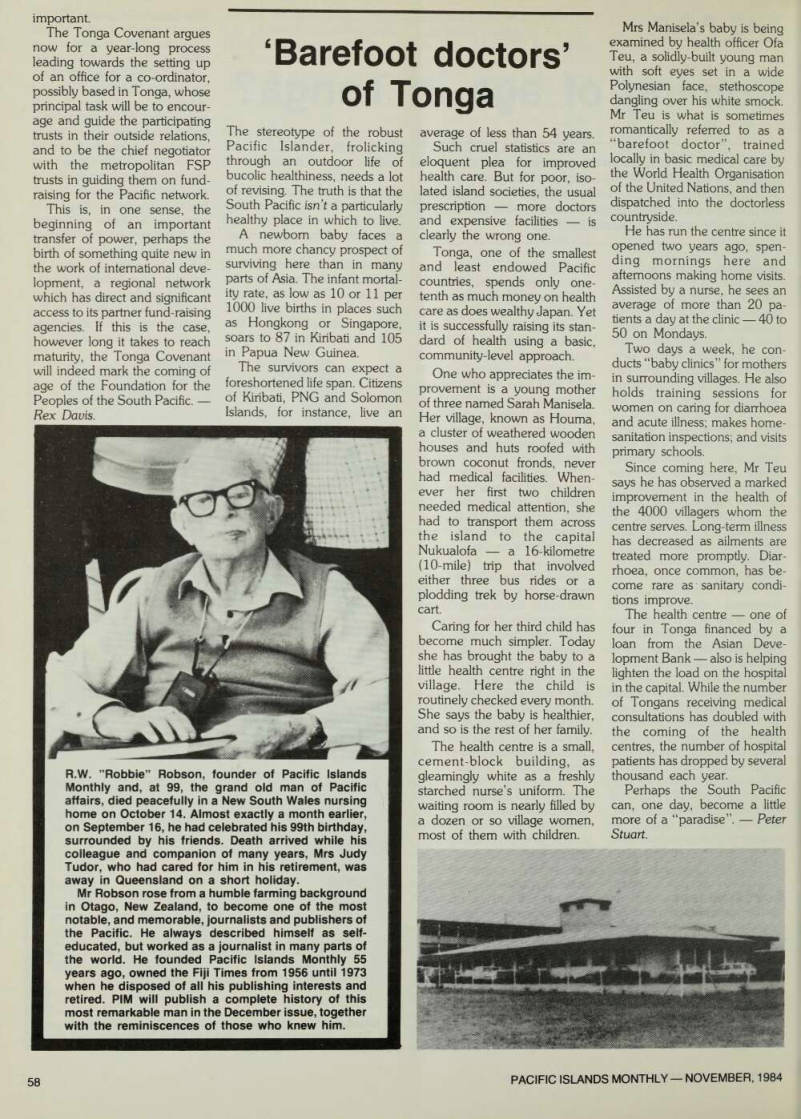
The F.S.P.
Canon REX DAVIS, honorary secretary of the United Kingdom Foundation for the Peoples of the South Pacific (FSP), was in the South Pacific in September to witness the emergence of the “Tonga Covenant.” He explains in the following article he wrote for PIM.
September, 1984, saw the emergence of a new form of international development or ganisation in the South Pacific.
Called the “Tonga Cove nant” (the founding conference was held in Nukualofa) it repre sents a commitment by a num ber of small, young but energe tic development groups in the South Pacific island states to work together more co-oper atively. The text of their state ment reads; “We covenant to gether to work for a new structure within the Pacific to enhance the cooperation for human development with the peoples of the South Pacific.”
It was Tongan Roman Catholic Bishop Patelisio Finau who proposed the rather
Methodist-sounding word
“covenant.” Responding to a paper given at the conference by the Executive Director of the Foundation for the Peoples of the South Pacific (FSP), Dr S.
W. Hosie, Bishop Finau said that there could be tremendous power if the various aid and development groups could un ite and work together. There was, he said, a real need to listen to each other. “There is a soul to development,” he said “which involves the idea of community, of serving, of com mitment.” In that context he suggested that the time had come for some “covenant” to work together.
Perhaps the first of the mem ber organisations was the South Pacific Appropriate Technology Foundation proposed by Jean Kekedo, Pedi Anis and Tony Power at an FSP meeting on appropriate technology held in the 1970 s in Fiji. SPATF has emerged as a significant net work in Papua New Guinea, supported both by the govern ment and outside agencies, in
eluding FSP.
In Vanuatu the Nasonal Kommuniti Developmen Trust (NKDT) grew naturally out of an earlier initiative from Father Walter Lini and Sethy Regen vanu before independence. It was officially launched in 1980 with FSP as a partner agency providing training and technical assistance under a grant from the United States consortium, Private Agencies Collaborating Together (PACT).
The Fiji Community Deve lopment Trust was started in 1979 and formally registered in 1982 with Joseph Kamikamica, Serenade Vunibobo, and Sione Havea as the founding trustees.
The Solomon Islands Deve lopment Trust also took time to take shape, but this was formal ly registered in 1981 and since 1982 has grown rapidly. Asto nishingly, by 1984 it had a staff of 80, and is a major force in village development work in the Solomons. Again PACT gave support through FSP in the early years, but the Australian Development Assistance Bureau (ADAB) is now a major contributor.
The National Federation of Women of Kiribati (AMAK) grew during the 19705, with support from the Women’s Ex tension program of the govern ment of Kiribati. A USAID grant through FSP assisted AMAK in spreading its work, recruiting staff and building an important resource centre in Tarawa.
The Tonga Foundation for the Peoples of the South Pacific is the most recent national institution. Dr Sione Amanaki Havea, Bishop Patelisio Finau, and Mrs Papiloa Foliaki are its local trustees. Registered in De cember 1982 it also received core budget support from a
USAID grant to FSP.
While each of these trusts is autonomous, they have in some way or another been part of a loose family supported by FSP in New York. At the same time other autonomous trusts were set up according to re spective national laws, so that what had been an agency of the New York FSP in Australia became an autonomous trust as the Australian FSP in 1982.
The South Pacific Peoples
Foundation of Canada had ex isted before that. The United Kingdom FSP was set up in 1980.
The Tonga conference was a rare chance for these trusts and groups to meet together and sort out possible ways of work ing in the future. The “Tonga Covenant” comes at a crucial time. The Jackson Committee on Australian aid report may or may not be fully implemented, but the direction it takes indi cates that a greater proportion of Australian aid may find its way to the Pacific, and that voluntary agencies may be asked to take a greater load of it. This could be good and it could be bad. In any case, the stronger network foreseen by the Tonga Covenant will be
Co-founders of the Foundation for the Peoples of the South Pacific, Mrs Betty Silverstein (top) and Dr Stan Hosie (centre) below, photographed in Nukualofa.
important.
The Tonga Covenant argues now for a year-long process leading towards the setting up of an office for a co-ordinator, possibly based in Tonga, whose principal task will be to encour age and guide the participating trusts in their outside relations, and to be the chief negotiator with the metropolitan FSP trusts in guiding them on fund raising for the Pacific network.
This is, in one sense, the beginning of an important transfer of power, perhaps the birth of something quite new in the work of international deve lopment, a regional network which has direct and significant access to its partner fund-raising agencies. If this is the case, however long it takes to reach maturity, the Tonga Covenant will indeed mark the coming of age of the Foundation for the Peoples of the South Pacific.
Rex Davis.
R.W. ’’Robbie” Robson, founder of Pacific Islands Monthly and, at 99, the grand old man of Pacific affairs, died peacefully in a New South Wales nursing home on October 14. Almost exactly a month earlier, on September 16, he had celebrated his 99th birthday, surrounded by his friends. Death arrived while his colleague and companion of many years, Mrs Judy Tudor, who had cared for him in his retirement, was away in Queensland on a short holiday.
Mr Robson rose from a humble farming background in Otago, New Zealand, to become one of the most notable, and memorable, journalists and publishers of the Pacific. He always described himself as self educated, but worked as a journalist in many parts of the world. He founded Pacific Islands Monthly 55 years ago, owned the Fiji Times from 1956 until 1973 when he disposed of all his publishing interests and retired. PIM will publish a complete history of this most remarkable man in the December issue, together with the reminiscences of those who knew him.
of Tonga
‘Barefoot doctors’ of Tonga
The stereotype of the robust Pacific Islander, frolicking through an outdoor life of bucolic healthiness, needs a lot of revising. The truth is that the South Pacific isn’t a particularly healthy place in which to live.
A newborn baby faces a much more chancy prospect of surviving here than in many parts of Asia. The infant mortal ity rate, as low as 10 or 11 per 1000 live births in places such as Hongkong or Singapore, soars to 87 in Kiribati and 105 in Papua New Guinea.
The survivors can expect a foreshortened life span. Citizens of Kiribati, PNG and Solomon Islands, for instance, live an
average of less than 54 years.
Such cruel statistics are an eloquent plea for improved health care. But for poor, iso lated island societies, the usual prescription more doctors and expensive facilities is clearly the wrong one.
Tonga, one of the smallest and least endowed Pacific countries, spends only one tenth as much money on health care as does wealthy Japan. Yet it is successfully raising its stan dard of health using a basic, community-level approach.
One who appreciates the im provement is a young mother of three named Sarah Manisela.
Her village, known as Houma, a cluster of weathered wooden houses and huts roofed with brown coconut fronds, never had medical facilities. When ever her first two children needed medical attention, she had to transport them across the island to the capital Nukualofa a 16-kilometre (10-mile) trip that involved either three bus rides or a plodding trek by horse-drawn cart.
Caring for her third child has become much simpler. Today she has brought the baby to a little health centre right in the village. Here the child is routinely checked every month.
She says the baby is healthier, and so is the rest of her family.
The health centre is a small, cement-block building, as gleamingly white as a freshly starched nurse’s uniform. The waiting room is nearly filled by a dozen or so village women, most of them with children.
Mrs Manisela’s baby is being examined by health officer Ofa Teu, a solidly-built young man with soft eyes set in a wide Polynesian face, stethoscope dangling over his white smock.
Mr Teu is what is sometimes romantically referred to as a “barefoot doctor”, trained locally in basic medical care by the World Health Organisation of the United Nations, and then dispatched into the doctorless countryside.
He has run the centre since it opened two years ago, spen ding mornings here and afternoons making home visits.
Assisted by a nurse, he sees an average of more than 20 pa tients a day at the clinic 40 to 50 on Mondays.
Two days a week, he con ducts “baby clinics” for mothers in surrounding villages. He also holds training sessions for women on caring for diarrhoea and acute illness; makes home sanitation inspections; and visits primary schools.
Since coming here, Mr Teu says he has observed a marked improvement in the health of the 4000 villagers whom the centre serves. Long-term illness has decreased as ailments are treated more promptly. Diar rhoea, once common, has be come rare as sanitary condi tions improve.
The health centre one of four in Tonga financed by a loan from the Asian Deve lopment Bank also is helping lighten the load on the hospital in the capital. While the number of Tongans receiving medical consultations has doubled with the coming of the health centres, the number of hospital patients has dropped by several thousand each year.
Perhaps the South Pacific can, one day, become a little
more of a “paradise”.
Peter
Stuart.
from the islands press
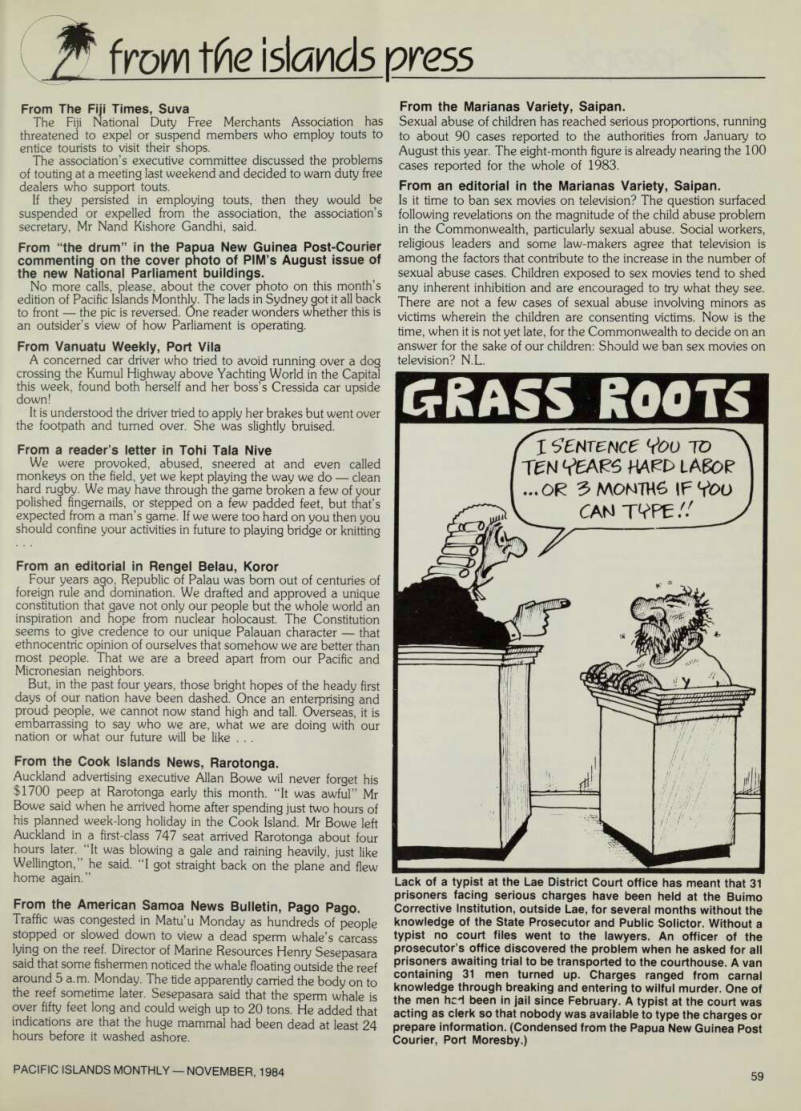
From The Fiji Times, Suva The Fiji National Duty Free Merchants Association has threatened to expel or suspend members who employ touts to entice tourists to visit their shops.
The association’s executive committee discussed the problems of touting at a meeting last weekend and decided to warn duty free dealers who support touts.
If they persisted in employing touts, then they would be suspended or expelled from the association, the association’s secretary, Mr Nand Kishore Gandhi, said.
From “the drum” in the Papua New Guinea Post-Courier commenting on the cover photo of PlM’s August issue of the new National Parliament buildings.
No more calls, please, about the cover photo on this month’s edition of Pacific Islands Monthly. The lads in Sydney got it all back to front the pic is reversed. One reader wonders whether this is an outsider’s view of how Parliament is operating.
From Vanuatu Weekly, Port Vila A concerned car driver who tried to avoid running over a dog crossing the Kumul Highway above Yachting World in the Capital this week, found both herself and her boss’s Cressida car upside down!
It is understood the driver tried to apply her brakes but went over the footpath and turned over. She was slightly bruised.
From a reader’s letter in Tohi Tala Nive We were provoked, abused, sneered at and even called monkeys on the field, yet we kept playing the way we do clean hard rugby. We may have through the game broken a few of your polished fingernails, or stepped on a few padded feet, but that’s expected from a man’s game. If we were too hard on you then you should confine your activities in future to playing bridge or knitting From an editorial in Rengel Belau, Koror Four years ago, Republic of Palau was born out of centuries of foreign rule and domination. We drafted and approved a unique constitution that gave not only our people but the whole world an inspiration and hope from nuclear holocaust. The Constitution seems to give credence to our unique Palauan character that ethnocentric opinion of ourselves that somehow we are better than most people. That we are a breed apart from our Pacific and Micronesian neighbors.
But, in the past four years, those bright hopes of the heady first days of our nation have been dashed. Once an enterprising and proud people, we cannot now stand high and tall. Overseas, it is embarrassing to say who we are, what we are doing with our nation or what our future will be like . . .
From the Cook Islands News, Rarotonga.
Auckland advertising executive Allan Bowe wil never forget his $l7OO peep at Rarotonga early this month. “It was awful” Mr Bowe said when he arrived home after spending just two hours of his planned week-long holiday in the Cook Island. Mr Bowe left Auckland in a first-class 747 seat arrived Rarotonga about four hours “lt was blowing a gale and raining heavily, just like Wellington,” he said. “I got straight back on the plane and flew home again. ”
From the American Samoa News Bulletin, Pago Pago.
Traffic was congested in Matu’u Monday as hundreds of people stopped or slowed down to view a dead sperm whale’s carcass lying on the reef. Director of Marine Resources Henry Sesepasara said that some fishermen noticed the whale floating outside the reef around 5 a.m. Monday. The tide apparently carried the body on to the reef sometime later. Sesepasara said that the sperm whale is over fifty feet long and could weigh up to 20 tons. He added that indications are that the huge mammal had been dead at least 24 hours before it washed ashore.
From the Marianas Variety, Saipan.
Sexual abuse of children has reached serious proportions, running to about 90 cases reported to the authorities from January to August this year. The eight-month figure is already nearing the 100 cases reported for the whole of 1983.
From an editorial in the Marianas Variety, Saipan.
Is it time to ban sex movies on television? The question surfaced following revelations on the magnitude of the child abuse problem in the Commonwealth, particularly sexual abuse. Social workers, religious leaders and some law-makers agree that television is among the factors that contribute to the increase in the number of sexual abuse cases. Children exposed to sex movies tend to shed any inherent inhibition and are encouraged to try what they see.
There are not a few cases of sexual abuse involving minors as victims wherein the children are consenting victims. Now is the time, when it is not yet late, for the Commonwealth to decide on an answer for the sake of our children: Should we ban sex movies on television? N.L.
Lack of a typist at the Lae District Court office has meant that 31 prisoners facing serious charges have been held at the Buimo Corrective Institution, outside Lae, for several months without the knowledge of the State Prosecutor and Public Solictor. Without a typist no court files went to the lawyers. An officer of the prosecutor’s office discovered the problem when he asked for all prisoners awaiting trial to be transported to the courthouse. A van containing 31 men turned up. Charges ranged from carnal knowledge through breaking and entering to wilful murder. One of the men hed been in jail since February. A typist at the court was acting as clerk so that nobody was available to type the charges or prepare information. (Condensed from the Papua New Guinea Post Courier, Port Moresby.)
people
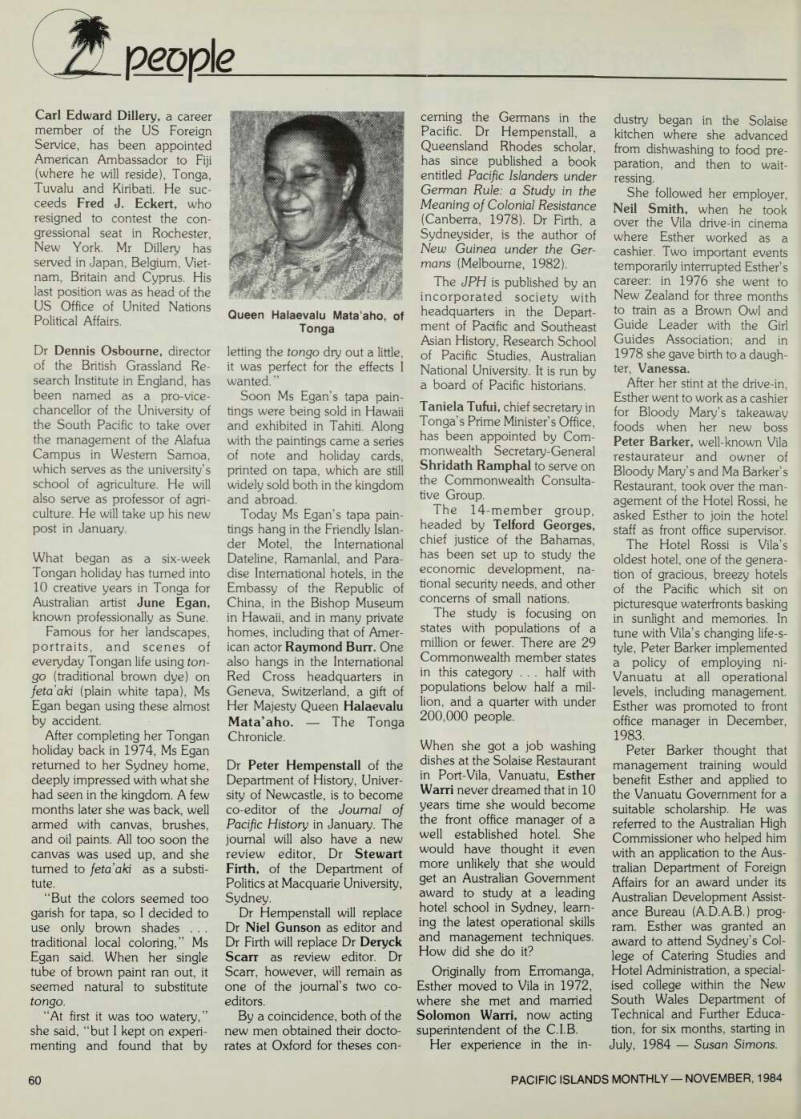
Carl Edward Dillery, a career member of the US Foreign Service, has been appointed American Ambassador to Fiji (where he will reside), Tonga, Tuvalu and Kiribati. He suc ceeds Fred J. Eckert, who resigned to contest the con gressional seat in Rochester, New York. Mr Dillery has served in Japan, Belgium, Viet nam, Britain and Cyprus. His last position was as head of the US Office of United Nations Political Affairs.
Dr Dennis Osbourne, director of the British Grassland Re search Institute in England, has been named as a pro-vice chancellor of the University of the South Pacific to take over the management of the Alafua Campus in Western Samoa, which serves as the university’s school of agriculture. He will also serve as professor of agri culture. He will take up his new post in January.
What began as a six-week Tongan holiday has turned into 10 creative years in Tonga for Australian artist June Egan, known professionally as Sune.
Famous for her landscapes, portraits, and scenes of everyday Tongan life using ton go (traditional brown dye) on feta’aki (plain white tapa), Ms Egan began using these almost by accident.
After completing her Tongan holiday back in 1974, Ms Egan returned to her Sydney home, deeply impressed with what she had seen in the kingdom. A few months later she was back, well armed with canvas, brushes, and oil paints. All too soon the canvas was used up, and she turned to feta’aki as a substi tute.
“But the colors seemed too garish for tapa, so I decided to use only brown shades . . . traditional local coloring,” Ms Egan said. When her single tube of brown paint ran out, it seemed natural to substitute tongo.
“At first it was too watery,” she said, “but I kept on experi menting and found that by
letting the tongo dry out a little, it was perfect for the effects I wanted. ”
Soon Ms Egan’s tapa pain tings were being sold in Hawaii and exhibited in Tahiti. Along with the paintings came a series of note and holiday cards, printed on tapa, which are still widely sold both in the kingdom and abroad.
Today Ms Egan’s tapa pain tings hang in the Friendly Islan der Motel, the International Dateline, Ramanlal, and Para dise International hotels, in the Embassy of the Republic of China, in the Bishop Museum in Hawaii, and in many private homes, including that of Amer ican actor Raymond Burr. One also hangs in the International Red Cross headquarters in Geneva, Switzerland, a gift of Her Majesty Queen Halaevalu Mata’aho. The Tonga Chronicle.
Dr Peter Hempenstall of the Department of History, Univer sity of Newcastle, is to become co-editor of the Journal of Pacific History in January. The journal will also have a new review editor, Dr Stewart Firth, of the Department of Politics at Macquarie University, Sydney.
Dr Hempenstall will replace Dr Niel Gunson as editor and Dr Firth will replace Dr Deryck Scarr as review editor. Dr Scarr, however, will remain as one of the journal’s two co editors.
By a coincidence, both of the new men obtained their docto rates at Oxford for theses con
cerning the Germans in the Pacific. Dr Hempenstall, a Queensland Rhodes scholar, has since published a book entitled Pacific Islanders under German Rule: a Studi; in the Meaning of Colonial Resistance (Canberra, 1978). Dr Firth, a Sydneysider, is the author of New Guinea under the Ger mans (Melbourne, 1982).
The JPH is published by an incorporated society with headquarters in the Depart ment of Pacific and Southeast Asian History, Research School of Pacific Studies, Australian National University. It is run by a board of Pacific historians.
Taniela Tufui, chief secretary in Tonga’s Prime Minister’s Office, has been appointed by Com
monwealth Secretary-General
Shridath Ramphal to serve on the Commonwealth Consulta tive Group.
The 14-member group, headed by Telford Georges, chief justice of the Bahamas, has been set up to study the economic development, na tional security needs, and other concerns of small nations.
The study is focusing on states with populations of a million or fewer. There are 29 Commonwealth member states in this category . . . half with populations below half a mil lion, and a quarter with under 200,000 people.
When she got a job washing dishes at the Solaise Restaurant in Port-Vila, Vanuatu, Esther Warri never dreamed that in 10 years time she would become the front office manager of a well established hotel. She would have thought it even more unlikely that she would get an Australian Government award to study at a leading hotel school in Sydney, learn ing the latest operational skills and management techniques.
How did she do it?
Originally from Erromanga, Esther moved to Vila in 1972, where she met and married Solomon Warri, now acting superintendent of the C. 1.8.
Her experience in the in
dustry began in the Solaise kitchen where she advanced from dishwashing to food pre paration, and then to wait ressing.
She followed her employer, Neil Smith, when he took over the Vila drive-in cinema where Esther worked as a cashier. Two important events temporarily interrupted Esther’s career: in 1976 she went to New Zealand for three months to train as a Brown Owl and Guide Leader with the Girl Guides Association; and in 1978 she gave birth to a daugh ter, Vanessa.
After her stint at the drive-in, Esther went to work as a cashier for Bloody Mary’s takeaway foods when her new boss Peter Barker, well-known Vila restaurateur and owner of Bloody Mary’s and Ma Barker’s Restaurant, took over the man agement of the Hotel Rossi, he asked Esther to join the hotel staff as front office supervisor.
The Hotel Rossi is Vila’s oldest hotel, one of the genera tion of gracious, breezy hotels of the Pacific which sit on picturesque waterfronts basking in sunlight and memories. In tune with Vila’s changing life-s -tyle, Peter Barker implemented a policy of employing ni- Vanuatu at all operational levels, including management.
Esther was promoted to front office manager in December, 1983.
Peter Barker thought that management training would benefit Esther and applied to the Vanuatu Government for a suitable scholarship. He was referred to the Australian High Commissioner who helped him with an application to the Aus tralian Department of Foreign Affairs for an award under its Australian Development Assist ance Bureau (A.DAB.) prog ram. Esther was granted an award to attend Sydney’s Col lege of Catering Studies and Hotel Administration, a special ised college within the New South Wales Department of Technical and Further Educa tion, for six months, starting in July, 1984 Susan Simons.
Queen Halaevalu Mata’aho, of Tonga
yachts
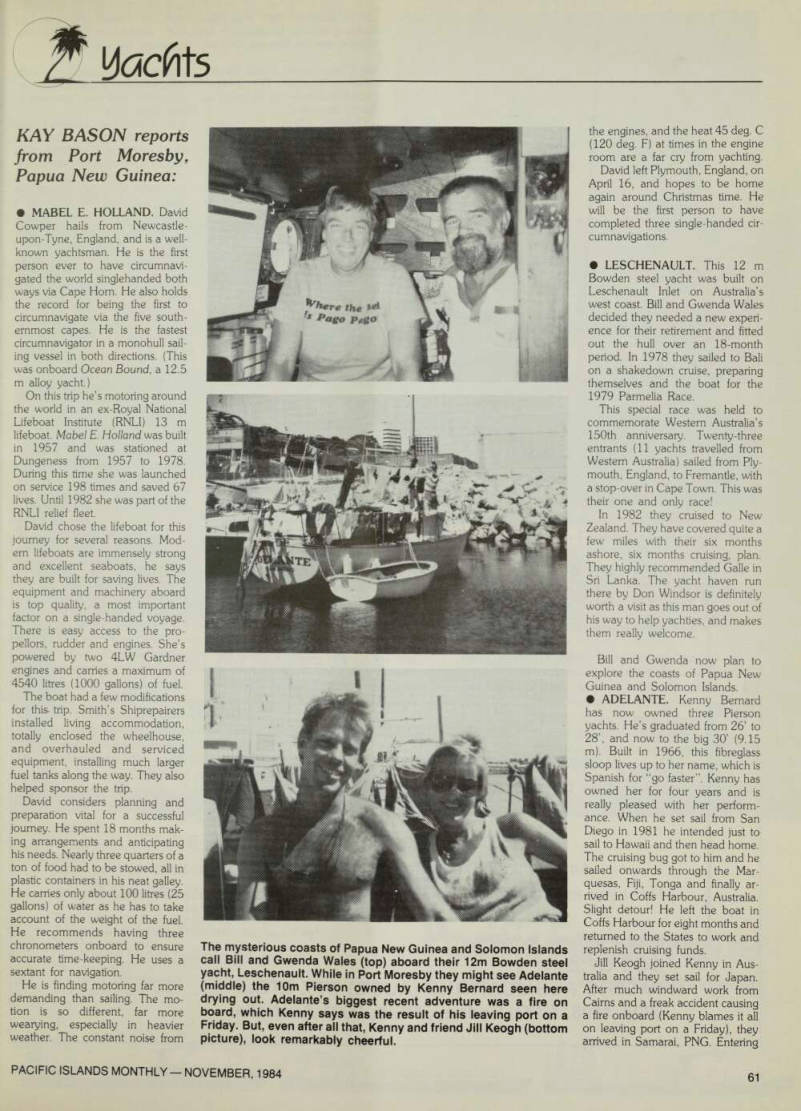
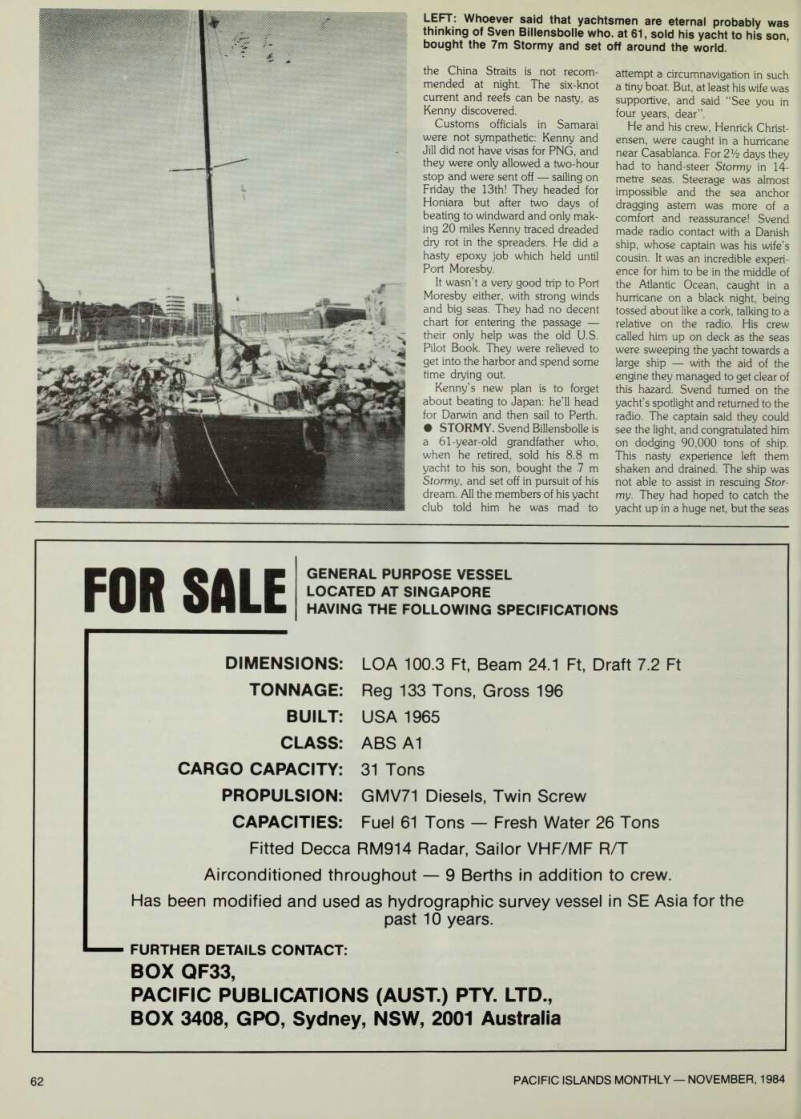
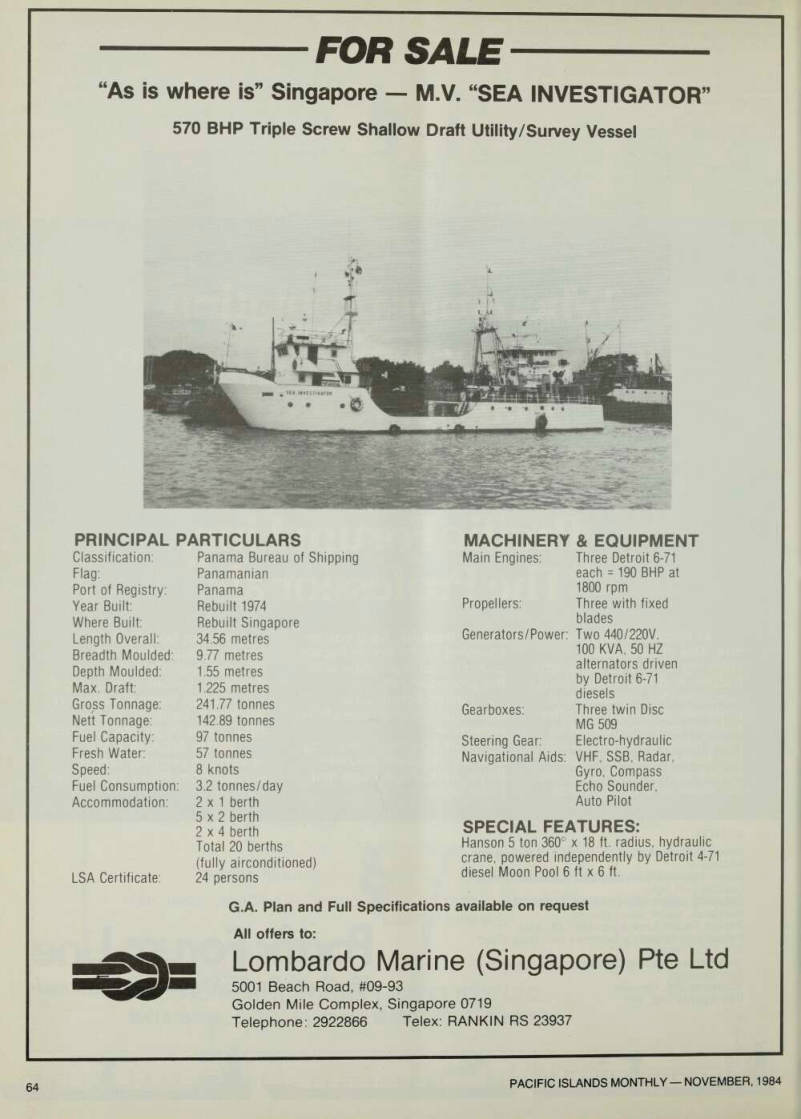
KAY BASON reports from Port Moresby, Papua New Guinea:
• Mabel E. Holland. David
Cowper hails from Newcastle upon-Tyne, England, and is a well known yachtsman. He is the first person ever to have circumnavi gated the world singlehanded both ways via Cape Horn. He also holds the record for being the first to circumnavigate via the five south ernmost capes. He is the fastest circumnavigator in a monohull sail ing vessel in both directions. (This was onboard Ocean Bound , a 12.5 m alloy yacht.) On this trip he’s motoring around the world in an ex-Royal National Lifeboat Institute (RNLI) 13 m lifeboat. Mabel E. Holland was built in 1957 and was stationed at Dungeness from 1957 to 1978.
During this time she was launched on service 198 times and saved 67 lives. Until 1982 she was part of the RNLI relief fleet.
David chose the lifeboat for this journey for several reasons. Mod ern lifeboats are immensely strong and excellent seaboats, he says they are built for saving lives. The equipment and machinery aboard is top quality, a most important factor on a single-handed voyage.
There is easy access to the pro pellers, rudder and engines. She’s powered by two 4LW Gardner engines and carries a maximum of 4540 litres (1000 gallons) of fuel.
The boat had a few modifications for this trip. Smith’s Shiprepairers installed living accommodation, totally enclosed the wheelhouse, and overhauled and serviced equipment, installing much larger fuel tanks along the way. They also helped sponsor the trip.
David considers planning and preparation vital for a successful journey. He spent 18 months mak ing arrangements and anticipating his needs. Nearly three quarters of a ton of food had to be stowed, all in plastic containers in his neat galley.
He carries only about 100 litres (25 gallons) of water as he has to take account of the weight of the fuel.
He recommends having three chronometers onboard to ensure accurate time-keeping. He uses a sextant for navigation.
He is finding motoring far more demanding than sailing. The mo tion is so different, far more wearying, especially in heavier weather. The constant noise from
the engines, and the heat 45 deg. C (120 deg. F) at times in the engine room are a far cry from yachting.
David left Plymouth, England, on April 16, and hopes to be home again around Christmas time. He will be the first person to have completed three single-handed cir cumnavigations.
• Leschenault. This 12 M
Bowden steel yacht was built on Leschenault Inlet on Australia’s west coast. Bill and Gwenda Wales decided they needed a new experi ence for their retirement and fitted out the hull over an 18-month period. In 1978 they sailed to Bali on a shakedown cruise, preparing themselves and the boat for the 1979 Parmelia Race.
This special race was held to commemorate Western Australia’s 150th anniversary. Twenty-three entrants (11 yachts travelled from Western Australia) sailed from Ply mouth, England, to Fremantle, with a stop-over in Cape Town. This was their one and only race!
In 1982 they cruised to New Zealand. They have covered quite a few miles with their six months ashore, six months cruising, plan.
They highly recommended Galle in Sri Lanka. The yacht haven run there by Don Windsor is definitely worth a visit as this man goes out of his way to help yachties, and makes them really welcome.
Bill and Gwenda now plan to explore the coasts of Papua New Guinea and Solomon Islands. • ADELANTE. Kenny Bernard has now owned three Pierson yachts. He’s graduated from 26’ to 28’, and now to the big 30’ (9.15 m). Built in 1966, this fibreglass sloop lives up to her name, which is Spanish for “go faster”. Kenny has owned her for four years and is really pleased with her perform ance. When he set sail from San Diego in 1981 he intended just to sail to Hawaii and then head home.
The cruising bug got to him and he sailed onwards through the Mar quesas, Fiji, Tonga and finally ar rived in Coffs Harbour, Australia.
Slight detour! He left the boat in Coffs Harbour for eight months and returned to the States to work and replenish cruising funds.
Jill Keogh joined Kenny in Aus tralia and they set sail for Japan.
After much windward work from Cairns and a freak accident causing a fire onboard (Kenny blames it all on leaving port on a Friday), they arrived in Samarai, PNG. Entering
The mysterious coasts of Papua New Guinea and Solomon Islands call Bill and Gwenda Wales (top) aboard their 12m Bowden steel yacht, Leschenault. While in Port Moresby they might see Adelante (middle) the 10m Pierson owned by Kenny Bernard seen here drying out. Adelante’s biggest recent adventure was a fire on board, which Kenny says was the result of his leaving port on a Friday. But, even after all that, Kenny and friend Jill Keogh (bottom picture), look remarkably cheerful.
the China Straits is not recom mended at night. The six-knot current and reefs can be nasty, as Kenny discovered.
Customs officials in Samarai were not sympathetic: Kenny and Jill did not have visas for PNG, and they were only allowed a two-hour stop and were sent off sailing on Friday the 13th! They headed for Honiara but after two days of beating to windward and only mak ing 20 miles Kenny traced dreaded dry rot in the spreaders. He did a hasty epoxy job which held until
Port Moresby.
It wasn’t a very good trip to Port Moresby either, with strong winds and big seas. They had no decent chart for entering the passage their only help was the old U.S.
Pilot Book. They were relieved to get into the harbor and spend some time drying out.
Kenny’s new plan is to forget about beating to Japan: he’ll head for Darwin and then sail to Perth. • STORMY. Svend Billensbolle is a 61-year-old grandfather who, when he retired, sold his 8.8 m yacht to his son, bought the 7 m Stormy, and set off in pursuit of his dream. All the members of his yacht club told him he was mad to
attempt a circumnavigation in such a tiny boat. But, at least his wife was supportive, and said “See you in four years, dear”.
He and his crew, Henrick Christ ensen, were caught in a hurricane near Casablanca. For 2V£> days they had to hand-steer Stormy in 14metre seas. Steerage was almost impossible and the sea anchor dragging astern was more of a comfort and reassurance! Svend made radio contact with a Danish ship, whose captain was his wife’s cousin. It was an incredible experi ence for him to be in the middle of the Atlantic Ocean, caught in a hurricane on a black night, being tossed about like a cork, talking to a relative on the radio. His crew called him up on deck as the seas were sweeping the yacht towards a large ship with the aid of the engine they managed to get clear of this hazard. Svend turned on the yacht’s spotlight and returned to the radio. The captain said they could see the light, and congratulated him on dodging 90,000 tons of ship.
This nasty experience left them shaken and drained. The ship was not able to assist in rescuing Stor my. They had hoped to catch the yacht up in a huge net, but the seas
LEFT: Whoever said that yachtsmen are eternal probably was thinking of Sven Billensbolle who. at 61, sold his yacht to his son, bought the 7m Stormy and set off around the world.
were too big to attempt such a delicate manoeuvre.
Svend’s wife related in a letter that an hour later the same ship managed to rescue six Moroccan fisherman in a liferaft whose boat had gone down. In this dreadful weather Svend suffered a severe injury to his arm which took more than a year to heal. He and his crew arrived back in Casablanca in very poor health and suffering from shock. The crew gave up sailing from that day.
Svend considers he owes his life to his safety harness. He was apprehensive about setting sail again but friends assured him that he couldn’t possibly encounter such a terrible thing again. Two days out from Casablanca he was hit by another huge storm, which luckily pushed him southwards. He cruised in the West Indies and entered the spirit of racing in Antigua.
Little Stormy, the smallest yacht in her class, came home fourth out of 21 yachts. He’s rather proud of that.
In Grenada, Svend met his pre sent crew Winston, a student who couldn’t find work. Although Win ston had never done any sailing and still gets seasick, he’s strong and helpful, and is enjoying seeing the world.
From Grenada they sailed to Panama, but the next leg of the trip was frustrating. It took 65 days to reach the Marquesas, and they missed out on the Galapagos Is lands because there was no wind.
Svend can provision his small yacht with stores and water for 70 days, and he was relieved to arrive in Tahiti before he ran out of food.
Stormy sailed directly from West ern Samoa to Port Moresby, com pleting this passage in one month.
The winds were good, but his mainsail blew out and he had to improvise with a job up the mast.
Svend is looking forward to visit ing Australia and cruising the coast.
He has two more years travelling before returning home to his wife, five children, and two grandchil dren who have arrived since he’s been away.
He has much confidence in and love for his little yacht, hopes that he’s seen the worst of the weather and that the rest of his trip will be just “plain sailing”. • PUSTEBLUME. Built in Taiwan, this Uwe Bartels 12 m ketch is one of the finest yachts I’ve been onboard. Gunther and Heide Voigt designed the interior layout which uses the 3.8 m beam to full advantage. Gunther flew from Ger many to Taiwan several times dur ing the building to supervise and deliver European equipment. He considers this was a good move, as spare parts are easily obtained from Europe. The boat was finally fitted
out with her beautiful teak interior and shipped to Germany in a container.
After the yacht was launched in 1978, the Voigts spent six weeks working on technical repairs. The steering and gears had let them down badly on “splashdown” day.
In front of a large crowd of well wishers, the yacht steered the op posite to Gunther’s wishes.
Although he laughs about it now, it wasn’t funny at the time as there was a strong current running across a choppy sea.
A year later Gunther and Heide sailed to Bergen in Norway. This was a cold, hard trip and sea trials proved they had to do still more work on the boat. One thing they hadn’t expected was the leaks, not on a new boat!
In July 1979 they began the cruise they had planned when they had sailed a small 8.5 m yacht. A few months in the Mediterranean, a visit to the Canary Islands, West Indies and the Caribbean. From Grenada they sailed to Venezuela.
They were worried about pirates on the Colombian coast so kept well out to sea. They had heard stories that pirates seize yachts to use for drug running the pirates board at night, and yacht crews are never seen again.
Heading for the Galapagos Is lands, Pusteblume met up with another yacht returning from an Antarctic cruise. With help from their ham radios and sat. nav. systems the yachts rubbed fenders, on a calm night, while the crews had a feast to celebrate. Heide had caught a large fish that day and the visitors brought wine. They said it was quite an experience.
The sailing was great through to the Marquesas where they stayed for 10 days. It was too short a visit in their opinion. They still remem ber the huge, sweet grapefruit.
Pusteblume sat out the hurricane
season in Tahiti. They narrowly missed a hurricane which struck three days after their departure to the Tuamotu Islands. These islands enchanted them on their sail to Tahiti, and they returned for two glorious months. In the Cook Is lands they enjoyed trading for local pearls. Heide had an abundance of perfume samples, which she said were a terrific trading item.
They got a warm welcome in Western Samoa. The Voigts ap
plied for a permit in Suva to cruise the Lau group of islands. They said the 200-mile beat is worth the effort, as the islands are totally unspoilt.
Onwards they cruised through Vanuatu, Solomon Islands, Bris bane, to Coffs Harbour. This sea son they explored the Barrier Reef to Cairns and then headed for Samarai.
The Kula Ring is an old PNG traditional trading-sailing route through the Louisiade Archipelago.
This includes Budi Budi in the Laughlan Islands. Gunther re marked on the beauty of the islands and people in PNG. They were very impressed with the scenery, high mountains and low atolls, jungle, and hot springs such a variety of beauty. Not another yacht hove in sight in the seven week cruise. They thought it was wonderful.
From Port Moresby, Gunther and Heide plan to cross the Indian Ocean to Durban. They will sail north for the eastern edge of South America and return to Germany via the Caribbean, Azores, and Eng land.
Sadly, four years just wasn’t enough time, and they need more money. They believe that you need endless years to explore the South Pacific, and they certainly hope to return.
Gunther and Heide Voight have one of the finest yachts in the Pacific at the monent. A 12m Uwe Bartels design, it was built in Taiwan under Gunther’s close personal supervision.
• NINA. Zantmire built this 11.2 m aluminium yacht in Germany.
Built with a wider bow and stem, allowing more stowage, she’s a handicapped one ton cup candi date. Her gross weight is eight tonnes. A fast, safe yacht to cruise in.
Erik and Christina Jom, with the help of their four children, fitted out the hull themselves. After a shakedown cruise in Europe they felt confident to circumnavigate in Nina.
Eleven years ago Erik and Christ ina began a circumnavigation in Casiopeia, their 8.3 m yacht. Katar ina, their eldest daughter, was then only three. Unfortunately, they ran out of time. They sold Casiopeia in Noumea and had to return to work.
Christina is an architect and Erik a design engineer who was involved in the Airbus project.
Now, with their four children, Katarina, 13, Paul, 10, Joana, seven, and young Jacob, four, they are completing their dream. Christ ina regrets that there are no correspondence schools in Ger many. She buys the textbooks and conducts her own teaching pro gram which she admits makes a lot more work for her.
Erik and Christina agreed that travelling with four children can be difficult at times. When the weather
is bad and everybody is below the boat feels very crowded. If it’s fine, everybody is a lot happier. They hope it will be a good experience for their children.
Nina sailed from Vanuatu directly to Port Moresby. They had hoped to spend more time in PNG but time is running out if they are to be ahead of the cyclones. The Joms had planned to sail through the Red Sea, but the worry of the political situation in the area, and stray mines, are not appealing. They will now sail to Durban.
Don Travers Re
ports from Tubuai ,
Austral Islands ,
French Polynesia:
• INSATIABLE. A Duncason 11 m centre-cockpit ketch, registered in Sydney, arrived at Tubuai from Auckland after a 23-day voyage.
Insatiable is a fibreglass construc tion, built from a bare hull by her owner, Glenn Ferris. Cruising with Glenn were crew Lorraine Firth and Guy Holloway. All three are from- Sydney where the cruise began in December last year. The crew tho roughly enjoyed the Bastille Day celebrations which last through 10
days here in Tubuai during July.
Insatiable left for Raivavae and then Moorea, Tahiti, and other Society Islands.
Return to Australia is projected for the end of 1985. • PINOCCHIO. This is prototype of a 12.5 m sloop constructed in France in 1980 in wood, using the West system. The model is now in general production.
Pinocchio arrived at Tubuai from
Tahiti with Frederic Camilleri and Patricia Gambier, both of France.
They sailed from Raivavae where they will spend two years. Frederic is a male nurse who will be in charge of the infirmary on that island.
Their cruising began from Anti bes, France, and took them to the West Indies (via North Africa), Panama, Galapagos, Marquesas, Tuamotus and Tahiti.
The Jorn family of the yacht Nina, an 11.2 m alloy yacht from Germany, visiting PNG.
LEFT: Insatiable at anchor at Tubuai after her voyage from Auckland. ABOVE: Prototype of what is now a popular French design, Pinocchio, rests after her long voyage from Antibes.
Advertisements & other items, pp. 62-68 (1 item)
For Sale
GENERAL PURPOSE VESSEL
LOCATED AT SINGAPORE
HAVING THE FOLLOWING SPECIFICATIONS
DIMENSIONS
TONNAGE
BUILT
CLASS
CARGO CAPACITY
PROPULSION
CAPACITIES
LOA 100.3 Ft, Beam 24.1 Ft, Draft 7.2 Ft Reg 133 Tons, Gross 196
USA 1965
ABS A 1
31 Tons GMV7I Diesels, Twin Screw Fuel 61 Tons Fresh Water 26 Tons Fitted Decca RM9I4 Radar, Sailor VHF/MF R/T Airconditioned throughout 9 Berths in addition to crew.
Has been modified and used as hydrographic survey vessel in SE Asia for the past 10 years.
FURTHER DETAILS CONTACT:
BOX QF33,
PACIFIC PUBLICATIONS (AUST.) PTY. LTD.,
BOX 3408, GPO, Sydney, NSW, 2001 Australia
r J a» s m r C ... on - *■? •' -'•
Whpr»v7Al»
'AjiWffr o '' *>*& ” r * 3»'J% '--• ■ " - "V*
Pacific Forum Line.
“The Professionals.”
At Pacific Forum Line we offer the professional shipping service to the South Pacific. And that means your reputation for reliability is in professional hands. We offer efficient containerisation to more ports, more often, with fast turnaround. With our knowledge of the Pacific, we can even help you develop export markets. So if you’re shipping to the South Pacific, protect your reputation with the professionals.
Pacific Forum Line operates three self-sustaining vessels -
“Fua Kavenga” servicing
Sydney, Noumea, Lautoka, Suva, Apia, Pago Pago and Nukualofa.
“Forum New Zealand” servicing Auckland, Vila, Honiara, Lae, Port Moresby,
Brisbane, Lyttelton and Napier.
“Forum Samoa” servicing Auckland, Lautoka, Suva, Apia, Pago Pago and Nukualofa.
Note: MOANA RAOI’
operates a monthly feeder service from Fiji to Tuvalu and Kiribati.
AGENTS
Union Bulkships Pty Ltd, Sydney, Brisbane and Melbourne Union Maritime Services Ltd, Auckland, Tonga, Lautoka and Suva Shipping Corporation of New Zealand Ltd, Auckland, Napier and Lyttelton Pacific Forum Line Agencies Ltd, Apia Polynesian Shipping Services Inc, Pago Pago 5.A.T.0., Noumea Steamships Trading Company Ltd, Lae and Port Moresby Sullivans Ltd, Honiara Vila Agents Ltd, Vila
Pacific Forum Line
The South Pacific Shipping Professionals
be dEE
FOR SALE
“As is where is” Singapore M.V. “SEA INVESTIGATOR” 570 BHP Triple Screw Shallow Draft Utility/Survey Vessel * mottmmn • • • HN
SIS
MACHINERY
Main Engines: Propellers: Generators/Power: Gearboxes: Steering Gear: Navigational Aids:
& EQUIPMENT
Three Detroit 6-71 each = 190 BHP at 1800 rpm Three with fixed blades Two 440/220V.
100 KVA, 50 HZ
alternators driven by Detroit 6-71 diesels Three twin Disc MG 509 Electro-hydraulic VHP, SSB, Radar, Gyro, Compass Echo Sounder, Auto Pilot
SPECIAL FEATURES:
Hanson 5 ton 360° x 18 ft. radius, hydraulic crane, powered independently by Detroit 4-71 diesel Moon Pool 6 ft x 6 ft.
All offers to:
Lombardo Marine (Singapore) Pte Ltd
5001 Beach Road, #O9-93 Golden Mile Complex, Singapore 0719 Telephone: 2922866 Telex: RANKIN RS 23937
FOR IMMEDIATE SALE
BY TENDER
£ u Length Overall.
GENERAL DESCRIPTION
53.84m Length B.P 49.00 m Breadth Mid 8.40 m Depth Mid 3 45m Draught Summer 3.18 m Deadweight 550 Tons Grain Capacity 27,160 cu. ft. Bale Capacity 25,350 cu ft Nett Tonnage 269.87 R.T. Service Speed... About 10.5 knots WRITTEN OFFERS are invited for the purchase of Motor Vessel "TAONIU".
Highest or any tender will not necessarily be accepted.
Finance may be available to approved party.
Tenders should be addressed to the undersigned.
For additional and detailed particulars and inspection contact M/S Parshotam & Co. Attention Mr Satish Parshotam Solicitors, Telephone 31-4844 GPO Box 131, Telex 2265 PARSHOTAM FJ
SUVA, FIJI.
€ii® 1
HA!ICH4
STOP
0630®2 1.0*5 15TH
rOP?i
iv^BlVlgg
to
kgds
SS*5?
STOP
888T222
I^pTBK
EUROPE-SOUTH PACIFIC JOINT SERVICE
The South Pacific Specialists offer facilities for shipment of: Containers (FCL/LCL) and Breakbulk Cargo plus reefer space and deeptanks for carriage of vegetable oils and other liquid bulk cargo.
Carriers also accept heavy lifts, overlength and cumbersome parcels.
Ports of Service: Please contact our regional offices for Loading: Papeete, Apia, Suva, further information: Lautoka, Noumea, Port Vila, Santo, The Bank Line (Australasia) Pty. Ltd.
Honiara, Port Moresby, Lae, Madang, Suite 801,51 Pitt Street Kimbe, Rabaul, Kieta, Darwin. Sydney N. SW. 2000 For: Rotterdam, Antwerp, Phone: 27 2041 Telex: 24063 Hamburg, Hull, Dunkirk, Le Havre.
Additional ports on enquiry.
- ROUND THE WORLD SERVICE
Columbus Line Reederei GmbH
VA P.O. Box 1667
I 4-4 Lae/Papua New Guinea Phone: 42 3466/42 3287.5 A.H. 42 2481 Telex: Colline NE 44 171
THE BANK LINE LTD LONDON
COLUMBUS LINE REEDEREI GMBH HAMBURG
C0L1433
ATTENTION
TO ALL
YACHTS
Due to harbour development, yachts cannot be accommodated in Rarotonga Harbour, Cook Islands.
Despite previous advice, a small percentage of yachts continue to flout warnings to the detriment of all others cruising in this area.
Yachts will be advised through this publication when it is safe to enter Rarotonga Harbour. However, this is not expected to be until some time next year.
HARBOURMASTER,
RAROTONGA,
COOK ISLANDS
FOR SALE
TWO CATAMARAN PASSENGER VESSELS
% m 4 . % I 1 Above two vessels have very good sea-keeping ability. In view of their high speed and passenger-carrying capacity, they are ideal vehicles for inter-island runs.
OFFSHORE CHARTERS PTE. LTD
140 ROBINSON ROAD, #O4-04 CHOW HOUSE, SINGAPORE 0106.
TEL; 2222696, 2239144 TELEX: RS 26599 "OFSHOR"
shipping schedules
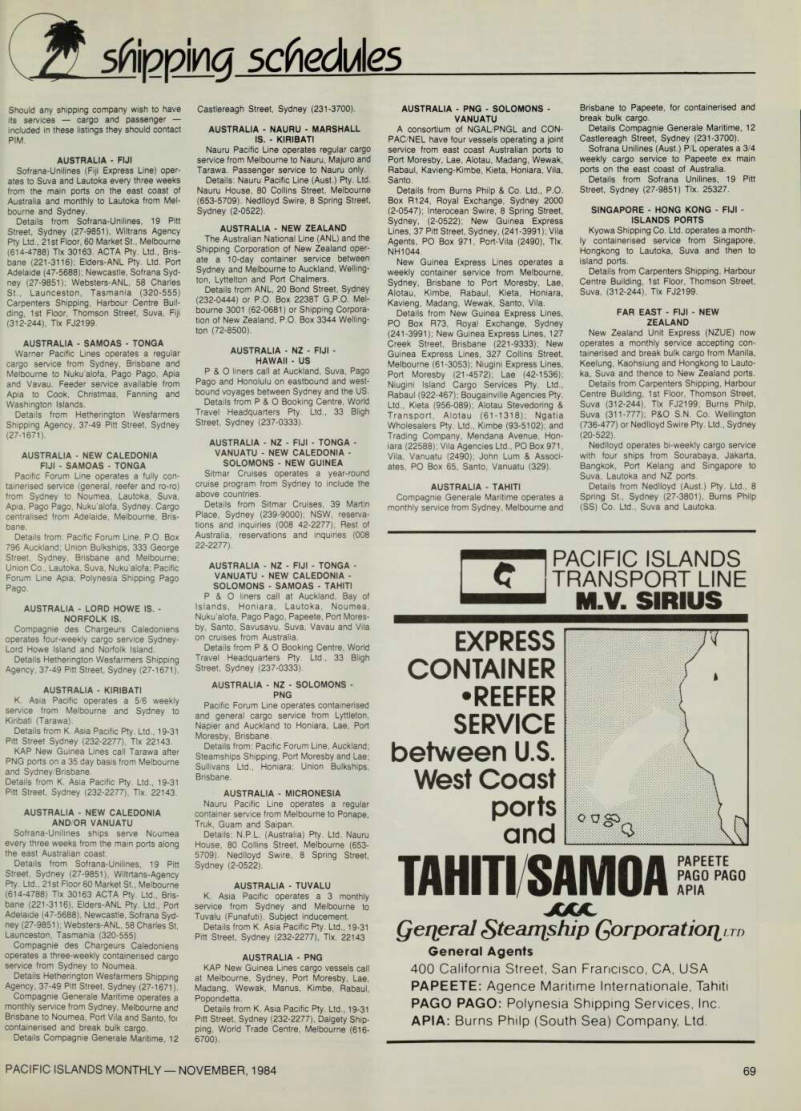
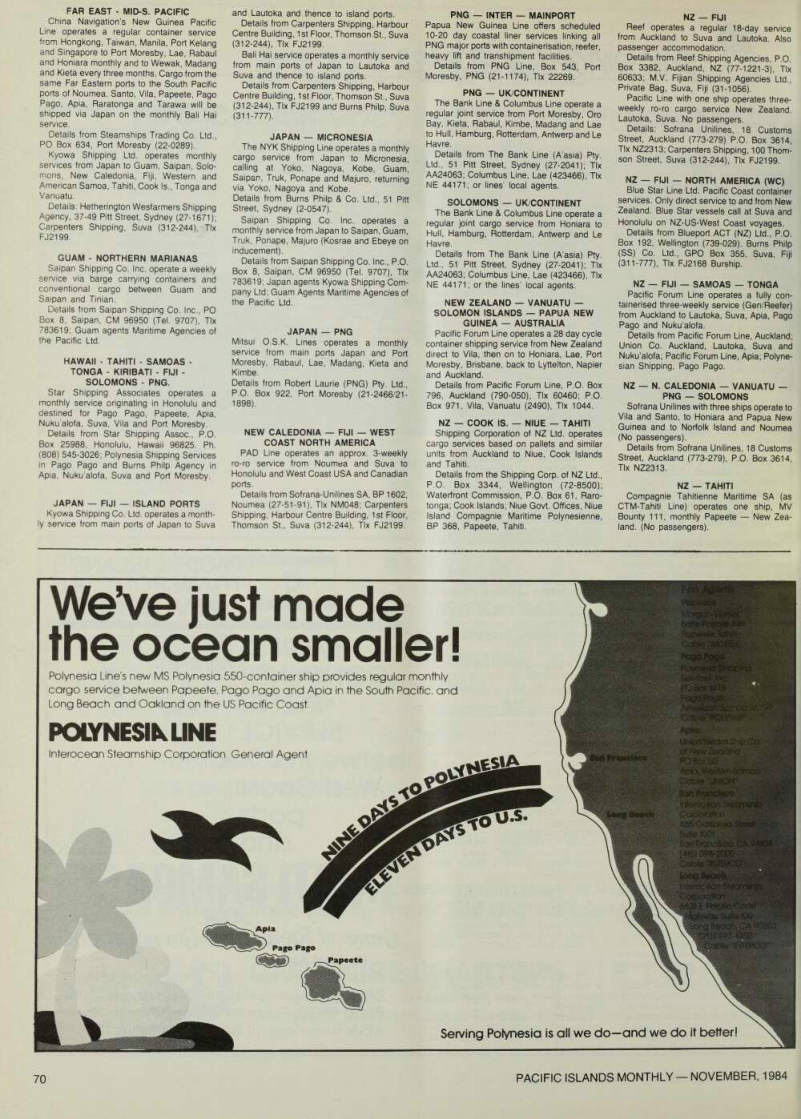
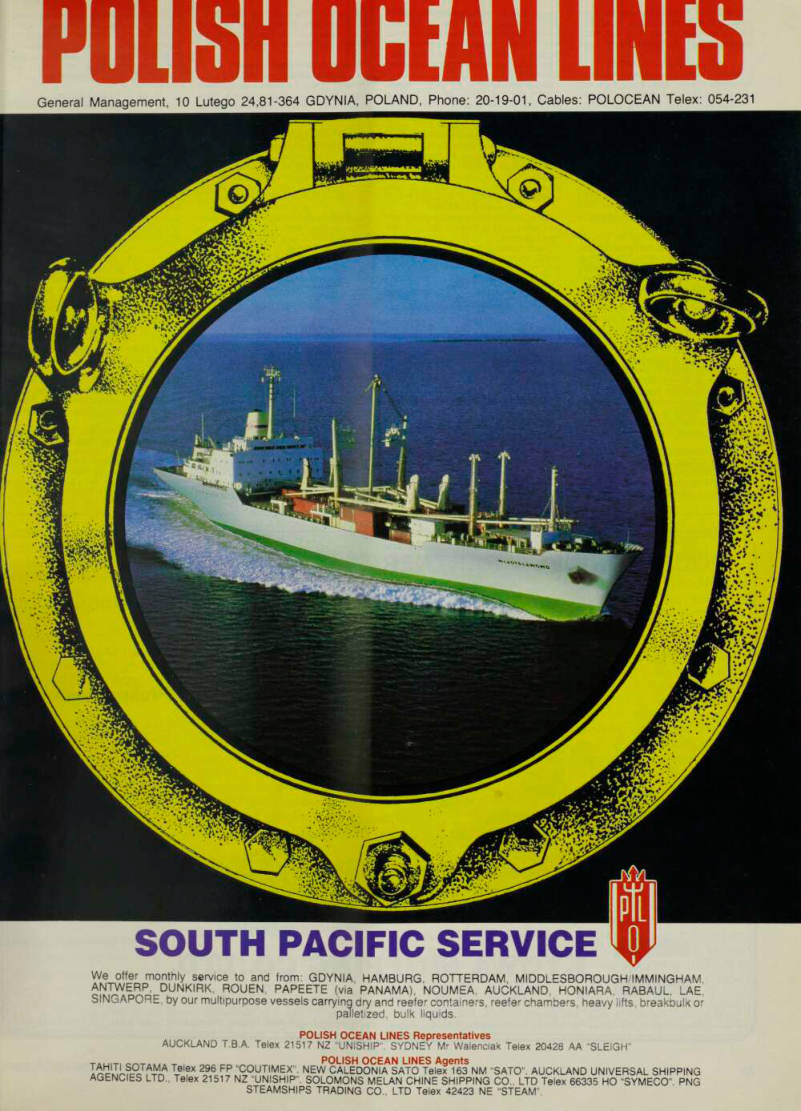
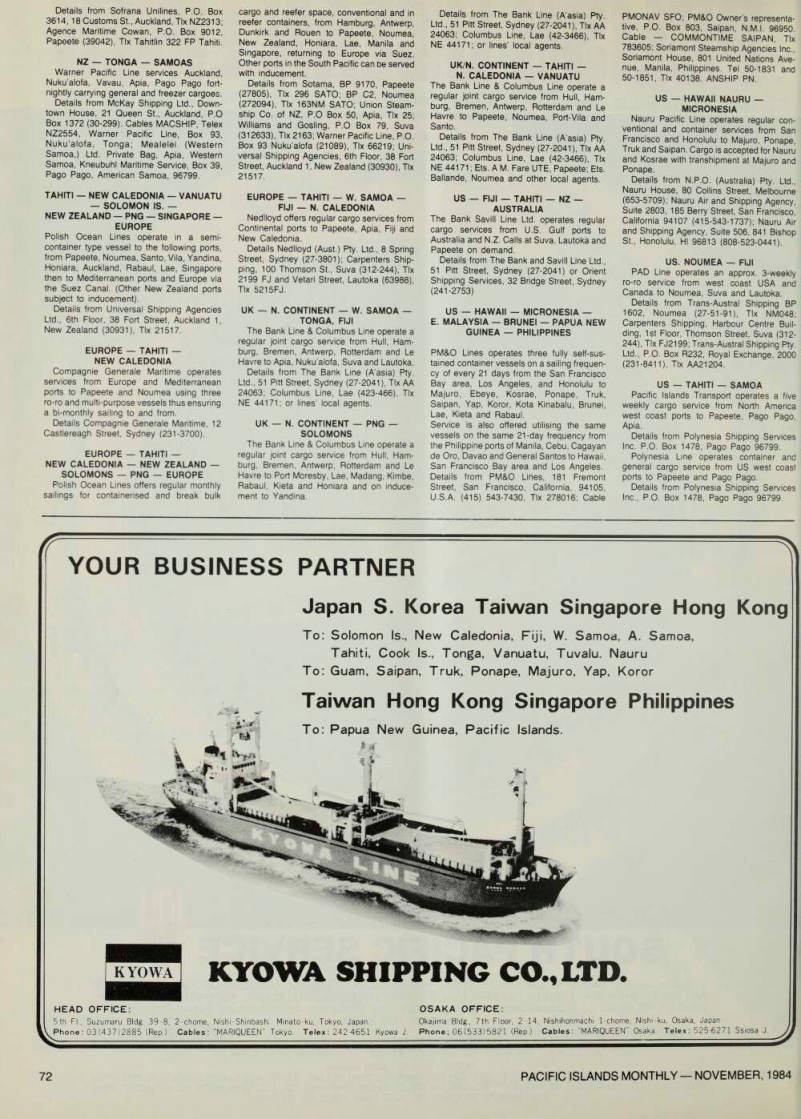
Should any shipping company wish to have its services cargo and passenger included in these listings they should contact
Pim.
Australia - Fiji
Sofrana-Unilines (Fiji Express Line) oper ates to Suva and Lautoka every three weeks from the main ports on the east coast of Australia and monthly to Lautoka from Mel bourne and Sydney.
Details from Sofrana-Unilines, 19 Pitt Street, Sydney (27-9851), Wiltrans Agency Pty Ltd., 21st Floor, 60 Market St., Melbourne (614-4788) Tlx 30163. ACTA Pty. Ltd., Bris bane (221-3116); Elders-ANL Pty. Ltd. Port Adelaide (47-5688); Newcastle, Sofrana Syd ney (27-9851); Websters-ANL, 58 Charles St., Launceston, Tasmania (320-555) Carpenters Shipping, Harbour Centre Buil ding, Ist Floor, Thomson Street, Suva, Fiji (312-244), Tlx FJ2199.
Australia - Samoas - Tonga
Warner Pacific Lines operates a regular cargo service from Sydney, Brisbane and Melbourne to Nuku'atofa, Pago Pago, Apia and Vavau. Feeder service available from Apia to Cook, Christmas, Fanning and Washington Islands.
Details from Hetherington Wesfarmers Shipping Agency, 37-49 Pitt Street, Sydney (27-1671).
Australia - New Caledonia
Fiji - Samoas - Tonga
Pacific Forum Line operates a fully con tainerised service (general, reefer and ro-ro) from Sydney to Noumea, Lautoka, Suva, Apia, Pago Pago, Nukualofa, Sydney. Cargo centralised from Adelaide, Melbourne, Bris bane.
Details from: Pacific Forum Line, P.O. Box 796 Auckland; Union Bulkships, 333 George Street, Sydney, Brisbane and Melbourne; Union Co., Lautoka, Suva, Nukualofa; Pacific Forum Line Apia; Polynesia Shipping Pago Pago.
Australia - Lord Howe Is. -
Norfolk Is.
Compagnie des Chargeurs Caledoniens operates four-weekly cargo service Sydney- Lord Howe Island and Norfolk Island.
Details Hetherington Wesfarmers Shipping Agency, 37-49 Pitt Street, Sydney (27-1671).
Australia - Kiribati
K. Asia Pacific operates a 5/6 weekly service from Melbourne and Sydney to Kiribati (Tarawa).
Details from K. Asia Pacific Pty. Ltd., 19-31 Pitt Street Sydney (232-2277), Tlx 22143.
KAP New Guinea Lines call Tarawa after PNG ports on a 35 day basis from Melbourne
and Sydney/Brisbane.
Details from K. Asia Pacific Pty. Ltd., 19-31 Pitt Street, Sydney (232-2277), Tlx. 22143.
Australia - New Caledonia
And/Or Vanuatu
Sofrana-Unilines ships serve Noumea every three weeks from the main ports along the east Australian coast.
Details from Sofrana-Unilines, 19 Pitt
Street, Sydney (27-9851), Wiltrtans-Agency
Pty. Ltd., 21st Floor 60 Market St., Melbourne (614-4788) Tlx 30163 ACTA Pty. Ltd., Bris bane (221-3116), Elders-ANL Pty. Ltd., Port Adelaide (47-5688), Newcastle, Sofrana Syd ney (27-9851); Websters-ANL, 58 Charles St, Launceston, Tasmania (320-555)
Compagnie des Chargeurs Caledoniens
operates a three-weekly containerised cargo service from Sydney to Noumea.
Details Hetherington Wesfarmers Shipping Agency, 37-49 Pitt Street, Sydney (27-1671).
Compagnie Generate Maritime operates a monthly service from Sydney, Melbourne and Brisbane to Noumea, Port Vila and Santo, foi containerised and break bulk cargo.
Details Compagnie Generate Maritime, 12
Castlereagh Street, Sydney (231-3700).
Australia - Nauru - Marshall
Is. - Kiribati
Nauru Pacific Line operates regular cargo service from Melbourne to Nauru, Majuro and Tarawa. Passenger service to Nauru only.
Details: Nauru Pacific Line (Aust.) Pty. Ltd.
Nauru House, 80 Collins Street, Melbourne (653-5709). Nedlloyd Swire, 8 Spring Street, Sydney (2-0522).
Australia - New Zealand
The Australian National Line (ANL) and the Shipping Corporation of New Zealand oper ate a 10-day container service between Sydney and Melbourne to Auckland, Welling ton, Lyttelton and Port Chalmers.
Details from ANL, 20 Bond Street, Sydney (232-0444) or P.O. Box 2238 T G.P.O. Mel bourne 3001 (62-0681) or Shipping Corpora tion of New Zealand, P.O. Box 3344 Welling ton (72-8500).
Australia - Nz - Fiji -
Hawaii - Us
P&O liners call at Auckland, Suva, Pago Pago and Honolulu on eastbound and west bound voyages between Sydney and the US.
Details from P&O Booking Centre, World Travel Headquarters Pty. Ltd., 33 Bligh Street, Sydney (237-0333).
AUSTRALIA - NZ - FIJI - TONGA -
Vanuatu - New Caledonia -
Solomons - New Guinea
Sitmar Cruises operates a year-round cruise program from Sydney to include the above countries.
Details from Sitmar Cruises, 39 Martin Place, Sydney (239-9000); NSW, reserva tions and inquiries (008 42-2277); Rest of Australia, reservations and inquiries (008 22-2277).
AUSTRALIA - NZ - FIJI - TONGA -
Vanuatu - New Caledonia -
Solomons - Samoas - Tahiti
P&O liners call at Auckland, Bay of Islands, Honiara, Lautoka, Noumea, Nukualofa, Pago Pago, Papeete, Port Mores by, Santo, Savusavu, Suva, Vavau and Vila on cruises from Australia.
Details from P&O Booking Centre, World Travel Headquarters Pty. Ltd., 33 Bligh Street, Sydney (237-0333).
Australia - Nz - Solomons -
Png
Pacific Forum Line operates containerised and general cargo service from Lyttleton, Napier and Auckland to Honiara, Lae, Port Moresby, Brisbane.
Details from: Pacific Forum Line, Auckland; Steamships Shipping, Port Moresby and Lae; Sullivans Ltd., Honiara; Union Bulkships, Brisbane.
Australia - Micronesia
Nauru Pacific Line operates a regular container service from Melbourne to Ponape, Truk, Guam and Saipan.
Details: N.P.L. (Australia) Pty. Ltd. Nauru House, 80 Collins Street, Melbourne (653- 5709). Nedlloyd Swire, 8 Spring Street,
Sydney (2-0522).
Australia - Tuvalu
K. Asia Pacific operates a 3 monthly service from Sydney and Melbourne to Tuvalu (Funafuti). Subject inducement.
Details from K. Asia Pacific Pty. Ltd., 19-31 Pitt Street, Sydney (232-2277), Tlx. 22143
Australia - Png
KAP New Guinea Lines cargo vessels call at Melbourne, Sydney, Port Moresby, Lae, Madang, Wewak, Manus, Kimbe, Rabaul, Popondetta.
Details from K. Asia Pacific Pty. Ltd., 19-31 Pitt Street, Sydney (232-2277), Dalgety Ship ping, World Trade Centre, Melbourne (616- 6700).
Australia - Png - Solomons -
Vanuatu
A consortium of NGAL7PNGL and CON PAC/NEL have four vessels operating a joint service from east coast Australian ports to Port Moresby, Lae, Alotau, Madang, Wewak, Rabaul, Kavieng-Kimbe, Kieta, Honiara, Vila, Santo.
Details from Burns Philp & Co. Ltd., P.O.
Box R 124, Royal Exchange, Sydney 2000 (2-0547); Interocean Swire, 8 Spring Street, Sydney, (2-0522); New Guinea Express Lines, 37 Pitt Street, Sydney, (241-3991); Vila Agents, PO Box 971, Port-Vila (2490), Tlx.
NH1044.
New Guinea Express Lines operates a weekly container service from Melbourne, Sydney, Brisbane to Port Moresby, Lae, Alotau, Kimbe, Rabaul, Kieta, Honiara, Kavieng, Madang, Wewak, Santo, Vila.
Details from New Guinea Express Lines, PO Box R 73, Royal Exchange, Sydney (241-3991); New Guinea Express Lines, 127 Creek Street, Brisbane (221-9333); New Guinea Express Lines, 327 Collins Street, Melbourne (61-3053); Niugini Express Lines, Pori Moresby (21-4572); Lae (42-1536); Niugini Island Cargo Services Pty. Ltd., Rabaul (922-467); Bougainville Agencies Pty.
Ltd., Kieta (956-089); Alotau Stevedoring & Transport, Alotau (61-1318); Ngatia Wholesalers Pty. Ltd., Kimbe (93-5102); and Trading Company, Mendana Avenue, Hon iara (22588); Vila Agencies Ltd., PO Box 971, Vila, Vanuatu (2490); John Lum & Associ ates, PO Box 65, Santo, Vanuatu (329).
Australia - Tahiti
Compagnie Generate Maritime operates a monthly service from Sydney, Melbourne and
Brisbane to Papeete, for containerised and break bulk cargo.
Details Compagnie Generate Maritime, 12 Castlereagh Street, Sydney (231-3700).
Sofrana Unilines (Aust.) P/L operates a 3/4 weekly cargo service to Papeete ex main ports on the east coast of Australia.
Details from Sofrana Unilines, 19 Pitt Street, Sydney (27-9851) Tlx. 25327.
SINGAPORE - HONG KONG - FIJI -
Islands Ports
Kyowa Shipping Co. Ltd. operates a month ly containerised service from Singapore, Hongkong to Lautoka, Suva and then to island ports.
Details from Carpenters Shipping, Harbour Centre Building, Ist Floor, Thomson Street, Suva, (312-244), Tlx FJ2199.
Far East - Fiji - New
Zealand
New Zealand Unit Express (NZUE) now operates a monthly service accepting con tainerised and break bulk cargo from Manila, Keelung, Kaohsiung and Hongkong to Lauto ka, Suva and thence to New Zealand ports.
Details from Carpenters Shipping, Harbour Centre Building, Ist Floor, Thomson Street, Suva (312-244), Tlx FJ2199; Burns Philp.
Suva (311-777); P&O S.N. Co. Wellington (736-477) or Nedlloyd Swire Pty. Ltd., Sydney (20-522).
Nedlloyd operates bi-weekly cargo service with four ships from Sourabaya, Jakarta, Bangkok, Port Kelang and Singapore to Suva, Lautoka and NZ ports.
Details from Nedlloyd (Aust.) Pty. Ltd., 8 Spring St., Sydney (27-3801), Burns Philp (SS) Co. Ltd., Suva and Lautoka.
Far East - Mid-S. Pacific
China Navigation’s New Guinea Pacific Line operates a regular container service from Hongkong, Taiwan, Manila, Port Kelang and Singapore to Port Moresby, Lae, Rabaul and Honiara monthly and to Wewak, Madang and Kieta every three months. Cargo from the same Far Eastern ports to the South Pacific ports of Noumea, Santo, Vila, Papeete, Pago Pago, Apia, Raratonga and Tarawa will be shipped via Japan on the monthly Bali Hai service.
Details from Steamships Trading Co. Ltd., PO Box 634, Port Moresby (22-0289).
Kyowa Shipping Ltd. operates monthly services from Japan to Guam, Saipan, Solo mons, New Caledonia, Fiji, Western and American Samoa, Tahiti, Cook Is., Tonga and Vanuatu.
Details: Hetherington Wesfarmers Shipping
Agency, 37-49 Pitt Street, Sydney (27-1671); Carpenters Shipping, Suva (312-244), Tlx FJ2199.
Guam - Northern Marianas
Saipan Shipping Co. Inc. operate a weekly service via barge carrying containers and conventional cargo between Guam and Saipan and Tinian.
Details from Saipan Shipping Co. Inc., PO Box 8, Saipan, CM 96950 (Tel. 9707), Tlx 783619; Guam agents Maritime Agencies of the Pacific Ltd.
Hawaii - Tahiti - Samoas -
Tonga - Kiribati - Fiji -
Solomons - Png.
Star Shipping Associates operates a monthly service originating in Honolulu and destined for Pago Pago, Papeete, Apia, Nukualofa, Suva, Vila and Port Moresby.
Details from Star Shipping Assoc., P.O.
Box 25988, Honolulu, Hawaii 96825. Ph. (808) 545-3026; Polynesia Shipping Services in Pago Pago and Burns Philp Agency in Apia, Nukualofa, Suva and Port Moresby.
Japan Fiji Island Ports
Kyowa Shipping Co. Ltd. operates a month ly service from main ports of Japan to Suva
and Lautoka and thence to island ports.
Details from Carpenters Shipping, Harbour Centre Building, Ist Floor, Thomson St., Suva (312-244), Tlx FJ2199.
Bali Hai service operates a monthly service from main ports of Japan to Lautoka and Suva and thence to island ports.
Details from Carpenters Shipping, Harbour Centre Building, Ist Floor, Thomson St., Suva (312-244), Tlx FJ2199 and Burns Philp, Suva (311-777).
Japan Micronesia
The NYK Shipping Line operates a monthly cargo service from Japan to Micronesia, calling at Yoko, Nagoya, Kobe, Guam, Saipan, Truk, Ponape and Majuro, returning via Yoko, Nagoya and Kobe.
Details from Burns Philp & Co. Ltd., 51 Pitt Street. Sydney (2-0547).
Saipan Shipping Co. Inc. operates a monthly service from Japan to Saipan, Guam, Truk, Ponape, Majuro (Kosrae and Ebeye on inducement).
Details from Saipan Shipping Co. Inc., P.O.
Box 8, Saipan, CM 96950 (Tel. 9707), Tlx 783619; Japan agents Kyowa Shipping Com pany Ltd; Guam Agents Maritime Agencies of the Pacific Ltd.
Japan Png
Mitsui O.S.K. Lines operates a monthly service from main ports Japan and Port Moresby, Rabaul, Lae, Madang, Kieta and Kimbe.
Details from Robert Laurie (PNG) Pty. Ltd., P.O. Box 922, Port Moresby (21-2466/21- 1898).
New Caledonia Fiji West
Coast North America
PAD Line operates an approx. 3-weekly ro-ro service from Noumea and Suva to Honolulu and West Coast USA and Canadian ports.
Details from Sofrana-Unilines SA, BP 1602, Noumea (27-51-91), Tlx NMO4B; Carpenters Shipping, Harbour Centre Building, Ist Floor, Thomson St., Suva (312-244), Tlx FJ2199.
Png Inter Mainport
Papua New Guinea Line offers scheduled 10-20 day coastal liner services linking all PNG major ports with containerisation, reefer, heavy lift and transhipment facilities.
Details from PNG Line, Box 543, Port Moresby, PNG (21-1174), Tlx 22269.
Png Uk/Continent
The Bank Line & Columbus Line operate a regular joint service from Port Moresby, Oro Bay, Kieta, Rabaul, Kimbe, Madang and Lae to Hull, Hamburg, Rotterdam, Antwerp and Le Havre.
Details from The Bank Line (A’asia) Pty.
Ltd., 51 Pitt Street, Sydney (27-2041); Tlx AA24063; Columbus Line, Lae (423466), Tlx NE 44171; or lines’ local agents.
Solomons Uk7Continent
The Bank Line & Columbus Line operate a regular joint cargo service from Honiara to Hull, Hamburg, Rotterdam, Antwerp and Le Havre.
Details from The Bank Line (A’asia) Pty.
Ltd., 51 Pitt Street, Sydney (27-2041); Tlx AA24063; Columbus Line, Lae (423466), Tlx NE 44171; or the lines’ local agents.
New Zealand Vanuatu
Solomon Islands Papua New
Guinea Australia
Pacific Forum Line operates a 28 day cycle container shipping service from New Zealand direct to Vila, then on to Honiara, Lae, Port Moresby, Brisbane, back to Lyttelton, Napier and Auckland.
Details from Pacific Forum Line, P.O. Box 796, Auckland (790-050), Tlx 60460; P.O.
Box 971, Vila, Vanuatu (2490), Tlx 1044.
Nz Cook Is. Niue - Tahiti
Shipping Corporation of NZ Ltd. operates cargo services based on pallets and similar units from Auckland to Niue, Cook Islands and Tahiti.
Details from the Shipping Corp. of NZ Ltd., P.O. Box 3344, Wellington (72-8500); Waterfront Commission, P.O. Box 61, Raro tonga; Cook Islands; Niue Govt. Offices, Niue Island Compagnie Maritime Polynesienne, BP 368, Papeete, Tahiti.
Nz Fiji
Reef operates a regular 18-day service from Auckland to Suva and Lautoka. Also passenger accommodation.
Details from Reef Shipping Agencies, P.O.
Box 3382, Auckland, NZ (77-1221-3), Tlx 60633; M.V. Fijian Shipping Agencies Ltd., Private Bag, Suva, Fiji (31-1056).
Pacific Line with one ship operates three weekly ro-ro cargo service New Zealand.
Lautoka, Suva. No passengers.
Details; Sofrana Unilines, 18 Customs Street, Auckland (773-279) P.O. Box 3614, Tlx NZ2313; Carpenters Shipping, 100 Thom son Street, Suva (312-244), Tlx FJ2199.
Nz Fiji North America (Wc)
Blue Star Line Ltd. Pacific Coast container services. Only direct service to and from New Zealand. Blue Star vessels call at Suva and Honolulu on NZ-US-West Coast voyages.
Details from Blueport ACT (NZ) Ltd., P.O.
Box 192, Wellington (739-029). Burns Philp (SS) Co. Ltd., GPO Box 355, Suva, Fiji (311-777), Tlx FJ2168 Burship.
Nz Fiji Samoas Tonga
Pacific Forum Line operates a fully con tainerised three-weekly service (Gen/Reefer) from Auckland to Lautoka, Suva, Apia, Pago Pago and Nukualofa.
Details from Pacific Forum Line, Auckland; Union Co. Auckland, Lautoka, Suva and Nukualofa; Pacific Forum Line, Apia; Polyne sian Shipping, Pago Pago.
Nz N. Caledonia Vanuatu
Png Solomons
Sofrana Unilines with three ships operate to Vila and Santo, to Honiara and Papua New Guinea and to Norfolk Island and Noumea (No passengers).
Details from Sofrana Unilines, 18 Customs Street, Auckland (773-279), P.O. Box 3614, Tlx NZ2313.
Nz Tahiti
Compagnie Tahitienne Maritime SA (as CTM-Tahiti Line) operates one ship, MV Bounty 111, monthly Papeete New Zea land. (No passengers).
Details from Sofrana Unilines, P.O. Box 3614,18 Customs St., Auckland, Tlx NZ2313; Agence Maritime Cowan, P.O. Box 9012, Papeete (39042), Tlx Tahitlin 322 FP Tahiti.
Nz Tonga Samoas
Warner Pacific Line services Auckland, Nukualofa, Vavau, Apia, Pago Pago fort nightly carrying general and freezer cargoes.
Details from McKay Shipping Ltd., Down town House, 21 Queen St., Auckland, P.O Box 1372 (30-299). Cables MACSHIP, Telex NZ2554, Warner Pacific Line, Box 93, Nukualofa, Tonga; Mealelei (Western Samoa,) Ltd. Private Bag, Apia, Western Samoa, Kneubuhl Maritime Service, Box 39, Pago Pago, American Samoa, 96799.
Tahiti New Caledonia Vanuatu
Solomon Is.
New Zealand Png Singapore
Europe
Polish Ocean Lines operate in a semi container type vessel to the following ports, from Papeete, Noumea, Santo, Vila, Yandina, Honiara, Auckland, Rabaul, Lae, Singapore then to Mediterranean ports and Europe via the Suez Canal. (Other New Zealand ports subject to inducement).
Details from Universal Shipping Agencies Ltd., 6th Floor, 38 Fort Street, Auckland 1, New Zealand (30931), Tlx 21517.
Europe Tahiti
New Caledonia
Compagnie Generale Maritime operates services from Europe and Mediterranean ports to Papeete and Noumea using three ro-ro and multi-purpose vessels thus ensuring a bi-monthly sailing to and from.
Details Compagnie Generale Maritime, 12
Castlereagh Street, Sydney (231-3700).
Europe Tahiti
New Caledonia New Zealand
Solomons Png Europe
Polish Ocean Lines offers regular monthly sailings for containerised and break bulk
cargo and reefer space, conventional and in reefer containers, from Hamburg, Antwerp, Dunkirk and Rouen to Papeete, Noumea, New Zealand, Honiara, Lae, Manila and Singapore, returning to Europe via Suez.
Other ports in the South Pacific can oe served with inducement.
Details from Sotama, BP 9170, Papeete (27805), Tlx 296 SATO; BP C 2, Noumea (272094), Tlx 163 NM SATO; Union Steam ship Co. of NZ, P.O Box 50, Apia, Tlx 25; Williams and Gosling, P.O Box 79, Suva (312633), Tlx 2163; Warner Pacific Line, P.O.
Box 93 Nukualofa (21089), Tlx 66219; Uni versal Shipping Agencies, 6th Floor, 38 Fort Street, Auckland 1, New Zealand (30930), Tlx 21517.
Europe Tahiti W. Samoa
Fiji N. Caledonia
Nedlloyd offers regular cargo services from Continental ports to Papeete, Apia, Fiji and New Caledonia.
Details Nedlloyd (Aust.) Pty. Ltd., 8 Spring
Street, Sydney (27-3801); Carpenters Ship
ping, 100 Thomson St., Suva (312-244), Tlx 2199 FJ and Vetari Street, Lautoka (63988), Tlx 5215FJ.
Uk N. Continent W. Samoa -
Tonga, Fiji
The Bank Line & Columbus Line operate a regular joint cargo service from Hull, Ham burg, Bremen, Antwerp, Rotterdam and Le Havre to Apia, Nukualofa, Suva and Lautoka.
Details from The Bank Line (A'asia) Pty.
Ltd., 51 Pitt Street, Sydney (27-2041), Tlx AA 24063; Columbus Line, Lae (423-466), Tlx NE 44171; or lines’ local agents.
Uk N. Continent Png
Solomons
The Bank Line & Columbus Line operate a regular joint cargo service from Hull, Ham burg, Bremen, Antwerp, Rotterdam and Le Havre to Port Moresby, Lae, Madang, Kimbe, Rabaul, Kieta and Honiara and on induce ment to Yandina.
Details from The Bank Line (A’asia) Pty.
Ltd., 51 Pitt Street, Sydney (27-2041), Tlx AA 24063; Columbus Line, Lae (42-3466), Tlx NE 44171; or lines’ local agents.
Uk/N. Continent Tahiti
N. Caledonia Vanuatu
The Bank Line & Columbus Line operate a regular joint cargo service from Hull, Ham burg, Bremen, Antwerp, Rotterdam and Le Havre to Papeete, Noumea, Port-Vila and Santo.
Details from The Bank Line (A'asia) Pty.
Ltd., 51 Pitt Street, Sydney (27-2041), Tlx AA 24063; Columbus Line, Lae (42-3466), Tlx NE 44171; Ets. A M. Fare UTE, Papeete; Ets.
Ballande, Noumea and other local agents.
Us Fiji Tahiti Nz
Australia
The Bank Savill Line Ltd. operates regular cargo services from U.S. Gulf ports to Australia and N.Z. Calls at Suva, Lautoka and Papeete on demand.
Details from The Bank and Savill Line Ltd., 51 Pitt Street, Sydney (27-2041) or Orient Shipping Services, 32 Bridge Street, Sydney (241-2753)
Us Hawaii Micronesia
E. Malaysia Brunei Papua New
Guinea Philippines
PM&O Lines operates three fully self-sus tained container vessels on a sailing frequen cy of every 21 days from the San Francisco Bay area, Los Angeles, and Honolulu to Majuro, Ebeye, Kosrae, Ponape, Truk, Saipan, Yap, Koror, Kota Kinabalu, Brunei, Lae, Kieta and Rabaul.
Service is also offered utilising the same vessels on the same 21-day frequency from the Philippine ports of Manila, Cebu, Cagayan de Oro, Davao and General Santos to Hawaii, San Francisco Bay area and Los Angeles.
Details from PM&O Lines, 181 Fremont Street, San Francisco, California, 94105, U.S.A. (415) 543-7430, Tlx 278016; Cable
PMONAV SFO; PM&O Owner's representa tive, P.O. Box 803, Saipan, N.M.I. 96950.
Cable Commontime Saipan, Tlx
783605; Soriamont Steamship Agencies Inc., Soriamont House, 801 United Nations Ave nue, Manila, Philippines. Tel 50-1831 and
50-1851, Tlx 40138. Anship Pn.
Us Hawaii Nauru
Micronesia
Nauru Pacific Line operates regular con ventional and container services from San Francisco and Honolulu to Majuro, Ponape, Truk and Saipan. Cargo is accepted for Nauru and Kosrae with transhipment at Majuro and Ponape.
Details from N.P.O. (Australia) Pty. Ltd., Nauru House, 80 Collins Street, Melbourne (653-5709); Nauru Air and Shipping Agency, Suite 2803, 185 Berry Street, San Francisco, California 94107 (415-543-1737); Nauru Air and Shipping Agency, Suite 506, 841 Bishop St„ Honolulu, HI 96813 (808-523-0441).
Us. Noumea Fiji
PAD Line operates an approx. 3-weekly ro-ro service from west coast USA and Canada to Noumea, Suva and Lautoka.
Details from Trans-Austral Shipping BP 1602, Noumea (27-51-91), Tlx NMO4B; Carpenters Shipping, Harbour Centre Buil ding, Ist Floor, Thomson Street, Suva (312- 244), Tlx FJ2199; Trans-Austral Shipping Pty.
Ltd., P.O. Box R 232, Royal Exchange, 2000 (231-8411), Tlx AA21204.
Us Tahiti Samoa
Pacific Islands Transport operates a five weekly cargo service from North America west coast ports to Papeete, Pago Pago, Apia.
Details from Polynesia Shipping Services Inc. P.O. Box 1478, Pago Pago 96799.
Polynesia Line operates container and general cargo service from US west coast ports to Papeete and Pago Pago.
Details from Polynesia Shipping Services Inc., P.O. Box 1478, Pago Pago 96799.
Advertisements & other items, pp. 69-72 (1 item)
Tahitisamoa S~
PACIFIC ISLANDS
TRANSPORT LINE
M.V. SIRIUS
TAHITISAMOA S~
xoc
Qeqeral Stearqship Qorporatioq^un
General Agents 400 California Street, San Francisco, CA. USA PAPEETE: Agence Maritime Internationale, Tahiti PAGO PAGO: Polynesia Shipping Services, Inc.
APIA: Burns Philp (South Sea) Company, Ltd.
We’ve just made
the ocean smaller!
Polynesia Line's new MS Polynesia 550-container ship provides regular monthly cargo service between Papeete, Pago Pago and Apia in the South Pacific, and Long Beach and Oakland on the US Pacific Coast.
POLYNESIA LINE
Interocean Steamship Corporation General Agent oQa & & 3 5* V Pago Pago Serving Polynesia is all we do—and we do it better!
zr.*:
POLISH OCEAN LINES
General Management, 10 Lutego 24,81-364 GDYNIA, POLAND, Phone: 20-19-01, Cables: POLOCEAN Telex: 054-231 © © Ta mm - -T ?y - IV .
•iVi
JjS, . i - > .. w*.l ••• v ; •. ... iVTv O' r .'-y>V.V • - V : .. • \ v: .■ V v:: K W* *2 rm Vi
SOUTH PACIFIC SERVICE I
We offer monthly service to and from: GDYNIA, HAMBURG. ROTTERDAM, MIDDLESBOROUGH IMMINGHAM o^l^ P H [ - DUNKIRK - ROUEN PAPEETE (via PANAMA), NOUMEA AUCKLAND, HONIARA, RABAUL, LAE SINoAPORE, by our multipurpose vessels carrying dry and reefer containers, reefer chambers, heavy lifts, breakbulk or
palletized, bulk liquids.
POLISH OCEAN LINES Representatives AUCKLAND T.B.A. Telex 21517 NZ “UNISHIP”. SYDNEY Mr Walenciak Telex 20428 AA “SLEIGH" tauiti OAT*..* T . ™ POLISH OCEAN LINES Agents L elex 296 FP “COUTIMEX". NEW CALEDONIA SATO Telex 163 NM “SATO”. AUCKLAND UNIVERSAL SHIPPING AGENCIES LTD., Telex 21517 NZ “UNISHIP”. SOLOMONS MELAN CHINE SHIPPING CO., LTD Telex 66335 HO “SYMECO" PNG STEAMSHIPS TRADING CO.. LTD Telex 42423 NE “STEAM’
YOUR BUSINESS PARTNER
IV Japan S. Korea Taiwan Singapore Hong Kong To: Solomon Is., New Caledonia, Fiji, W. Samoa, A. Samoa, Tahiti, Cook Is., Tonga, Vanuatu, Tuvalu. Nauru To: Guam, Saipan, Truk, Ponape, Majuro, Yap, Koror
Taiwan Hong Kong Singapore Philippines
To: Papua New Guinea, Pacific Islands. p g if* ft-' i * r A
KYOWA
KYOWA SHIPPING CO., LTD.
HEAD OFFICE: OSAKA OFFICE:
sth FI., Suzumaru Bldg. 39-8, 2-chome, Nishi-Shinbash; Minato-ku, Tokyo, Japan. Okajima Bldg., 7th Floor, 2-14, Nishihonmachi 1-chome, Nishi-ku, Osaka, Japan Phone: 03(437)2885 (Rep ) Cables : ■MARIQUEEN" Tokyo. Telex : 242-4651 Kyowa J. Phone; 06(533)5821 (Rep.) Cables: "MARIQUEEN” Osaka Telex : 525-6271 Ssiosa J
deaths
Poko Ingram At Nikao, Cook Islands, on September 14, aged 65.
Poko Ingram was born at Maraerenga, the daughter of William and Takiora Kelly (Tongareva Rangatira from Ngati Makea).
Mrs Ingram toured New Zea land in 1934 as a member of the Cook Islands Arikis delega tion to the celebrations of the century of the Treaty of Waitangi.
In 1935 she was awarded the Sir Maui Pomare medal as the outstanding pupil of Avarua School, which was presented to her by William Forbes, Prime Minister of New Zealand.
She married Jim Ingram at the Avarua church in 1939. The minister was the head of the London Missionary Society, Rev. R. L. Challis (Tiare Orometua). A principal guest was Judge H. F. Ayson, who was resident commissioner in Rarotonga for 25 years.
Mrs Ingram and her husband went into business as J.P.I. She can be said to be the forerunner of many Cook Islands business women today.
The general election of 1961 saw Mrs Ingram elected to the Legislative Assembly for the district of Te-Au-O-Tonga. It was this Assembly which had to debate and finally approve the first Constitution of the Cook Islands..
She represented the Cook Islands at a South Pacific Com mission meeting in American Samoa and in 1977 led the Cook Islands delgation to the Conference on Women’s Rights at Suva. She continued her work in this field until her death.
Her work for the ad vancement of women will en dure not only in the Cook Islands but throughout the South Pacific Island countries.
Charles Townsend Halstead In England earlier this year.
Charles Halstead was a for mer Fiji cricketing personality, and manager of Cable and Wireless (Fiji) Ltd., during the 19305.
According to a letter from the Fiji High Commissioner in Lon don, Ratu Josua Toganivalu.
“He appears in Philip Snow’s book Cricket in Fiji and was a member of the Fiji team which played the Maorilanders in 1936.”
That particular national team was captained by the late Ratu Sir Edward Cakobau, Ratu Josua added.
Fr Marion Ganey In Suva on September 23, aged 80.
Fr Ganey, American-born and a member of the Jesuit order, first went to Fiji in 1954 on an invitation of the colonial governor, Sir Ronald Garvey.
His work in establishing the credit union movement in the British Honduras had impress ed Sir Ronald, who was pre viously governor in that British colony, known today as Belize.
Arrangements were made to have Fr Ganey attached in Fiji for six months to set up a credit union system.
Fr Ganey stayed longer and was directly responsible for the establishment of 114 active credit unions, which collectively hold a membership of 23,500.
Fr Ganey first worked in Nadroga together with Mr Jone Naisara (now Minister for Natu ral Resources) and Ratu Sir Lala Sukuna to start introduc ing the basic concepts of the credit union movement.
In 1970, Fr Ganey built a school in Suva with finance from the widow of Roy Bergen gren, a leading figure in the movement in America.
Bergengren House became the training institute for credit unions.
Fano Shimasaki At Pago Pago on September 13, aged 71.
Former Senator Fano Shima saki of Fagaalu served in the Senate for the Ma’oputasi Dis trict for two terms from 1969- 1972. He was also a deacon of the Faga’alu Christian Con gregational Church of Amer ican Samoa for several years.
He began serving the Amer ican Samoa Government in
1937 as a bus driver and was promoted to be the head mechanic for the motor pool.
After two years with the Pearl Harbor Shipyard, he returned to work for ASG as manager of the motor pool until he retired at age 62 in 1975.
He was awarded the title “Fano” in 1947.
Raghubar Singh At Lautoka, Fiji, on September 21, aged 50.
Mr Singh was chairman of Lautoka’s general advisory council, the rural local authority, and the board of visitors of Lautoka Hospital.
He represented the Lautoka/ Yasawa district in the Education Forum for many years and was a member of the board of governors of Natabua High School as well as a committee member of many schools in the district.
Mr Prasad was a member of the divisional development committee and the first Fiji scouts jamboree.
He was a former proprietor of the cartage contractors, Western Haulage, the manag ing director of Chanan Singh and Co. and a partner in Lautoka Motor Parts.
Mr Prasad was made a Jus tice of Peace in January, 1978 and was awarded the British Empire Medal in December, 1980.
Quentin Quentin Baxter In Wellington on September 24, aged 62.
Professor Baxter was New Zealand’s foremost authority on international and constitutional law.
He was a former chairman of the United Nations Commission on Human Rights and had been a member of the In ternational Law Commission for 13 years.
He helped New Zealand fight a test case on French nuclear testing in the Pacific in the International Court of Justice in 1973-74 and had recently been investigating the possibility of drafting a New Zealand Bill of Rights.
He served as an adviser to a number of island governments in the drafting of their constitu tions.
Richard Lobendahn At Goroka, Papua New Guinea, in August, aged 63, was one of the most skilled printers in Fiji and was for many years production manager of the Fiji Times and Herald Ltd.
He and his wife Meifatu were visiting their second son Dan when the fatal heart attack occurred.
Dick Lobendahn belonged to a printing family which, so far,has spanned three genera tions of service to the industry in Fiji. His father Vincent, of Sri Lankan Dutch burgher ances try, came to Fiji at the end of last century to work in the government Printery. Dick was educated at Marist Brothers and then joined The Fiji Times as a linotype operator. He was later joined by his brother Harry and half-brother Paul. He also trained his son Richard who is now production manager for the Fiji Sun.
“Dick was a splendid crafts man; a stickler for quality who did a very great deal for the industry in Fiji,” said Pacific Publications publisher and ex general manager of the Fiji Times, Garry Barker. ”He, and the present production mana ger, Magnus Mitchell, took the Times printery to its present pre-eminent place in the Paci fic. They demanded, and got, international quality.”
“I remember a particularly difficult machine we had bought-a collator-stitcher-trim mer by Martini-Mueller. The Australian installing engineers had not been able to make it work properly, ” Mr Barker said. ”1 asked Dick to help and, very quietly, and although he had not seen such a machine be fore, he had it up and running properly. He remained with us, as a consultant, under Magnus Mitchell until last year. Then he suffered his first heart attack and decided to take it a bit easier. His is a very sad loss, not only to the industry, but to the Suva community.”
Advertising
Aggie Grey 74
Aiwa 36 Bagot Bellfoundries 56 Bank Line 66 Cambridge Secretarial Col 17 Chicago Company 17 Citizen 27 Clarion 30,31 Columbus Line 66 Henry Cumines 54 Dept, of Trade 4 General Steamships 69 Gillette 42 Govt, of Cook Islands 67 GRE Insurance 25 Hitachi 2 Hudson Homes 56 David Hughes 22 Intercontinental 48 Jensen Machinery 74 Kyowa 72 Lombardo Marine 64 Matsushita 6 Meatex NZ Ltd 14 Offshore Charters 68 Pacific Books 46 Pacific Forum Line 63 Papua Hotel 74 M S Parshotam 65 Pauls Milk 40 Pioneer 11 Pitco 25 Polish Shipping Lines 71 Polynesia Lines 20 Portal-Lock Homes 34 Positions Wanted 22 Quelo Holdings 74 Racal Survey 62 Race Relations 48 Sansui 75 Showcase Video 47 Solarex 8 Toyota 38,39,76 Trio-Kenwood 50
Tutt-Bryant 52
United Nations 54 Wanted 74
Advertisements & other items, pp. 74-76 (2 items)
Oeoj^Ed
SERVICE PAGE
MdMMmr
AUSTRALIA: Distribution: The Herald and Weekly Times Ltd., 44-74 Flinders St., Melbourne, Vic., 3000. Advertising Reps Brisbane D. Wood, Anday Agency, CCA Centre. Daytxxo Road, Ctosebum 4520, Box 1918, GPO Brisbane, 4001; telephone (07) 289-4128. Adelaide Hastwell Williamson Rouse Pty. Ltd., PO Box 419, Norwood, SA, 5067; 59 Kensington Road. Norwood; telephone (08) 332-3322, telex 87113; Perth Allen & Associates, Suite 2, 284 Stirling St.. D erth, WA, 6000, telephone (09) 328-9593 or (09) 328-93- 3.
FUI: Distribution and subscriptions Desai Bookshops, P.O. Box 160, Suva, Fiji, telephone Suva 23036.
Advertising Fiji Times & Herald Ltd., 20 Gordon St., Suva, telephone 31-4111, telex FJ2124.
FRENCH POLYNESIA; Distribution Hachette Padfique, 10 Ave Bruat, Papeete, telephone 25610 HAWAII, UNiTED STATES: Distribution PIM, Hawaii.
PO Box 22250, Honolulu. Hawaii, 96822 Advertising Brian C. Asgill, Apt. 1308, 1676 Ala Moana Blvd., Honolulu.
Hawaii, 96815, telephone (808) 956-9718.
JAPAN: Advertising and subscriptions Universal Media Corporation. GPO Box 46, Tokyo, telephone 666- 3036, cables UNIMEDIA Tokyo, telex 2524665 KOREA: Advertising and subscriptions World Marketing, Inc, Box 4010, Seoul: phone 776-5291-3, telex K 23232.
MALAYSIA: Advertising and subscriptions Worldwide Media Services, 57-B Komplex Damai, Jin Dato Haji Eusoff, Kuala Lumpur, telephone 63-9340, cables WORLDMEDIA Kuala Lumpur, telex 31533 VANUATU: Distribution Maropa Bookshop. HQ Box 210. Port Vila Advertising Bill Penthand. Norman Bros Bookshop, Port Vila, telephone 2232.
NEW CALEDONIA: Distribution Depot Centre de Presse Michel Pentecost, CBP2, Noumea, telephone 27- 2434, 27-4729.
NEW ZEALAND: Distribution Gordon & Gotch, PO Box 584, 2 Carr Road, Mt. Roskill, Auckland 4 Advertising International Media Representatives Ltd., PO Box 10259.
Balmoral, Auckland 4, telephone 605-909, 792-370, telex NZ21404
PAPUA NEW GUINEA: Distribution Gordon & Qoteh, PO Box 3395, Port Moresby, telephone 25-4551,25-4855.
Advertising Ken Head, PNG Post-Courier, PO Box 85, Port Moresby, telephone 21-2577, telex 22120.
SOLOMON ISLANDS: Distribution and Advertising The Bookshop. (Norman Bros.) PO Box 503, Honiara.
PHILIPPINES: Advertising The GF Group, 12 San Ignacio St , Uroaneta Village. Makati. Metro Manila, telephone 817-7299. telex 45960 and 4233.
UNITED KINGDOM: The Herald & Weekly Times Ltd., No 1 Maitravers Street,London WC2R 3DZ, England, telephone 01 836 5162, telex London 21989.
UNITED STATES MAINLAND: Advertising Joshua B.
Powers Jr., Powers International Inc., 551 Fifth Ave., New York, New York 10 017, telephone 867-9580, telex 236514.
Subscriptions PIM, Hawaii, PO Box 22250, Honolulu.
Hawaii. 96822.
SUBSCRIPTIONS
Local Aust.
American Samoa SUS2I $lB Australia SAIB $lB Canada SUS 27 $25 Cook Islands $l9 Fiji $lB French Polynesia $22 Guam SUS 23 $2O Hawaii SUS 23 $2O Japan $2O Kiribati $l9 Micronesia SUS 23 $2O Nauru $2l New Caledonia $22 New Zealand SNZ27 $lB Niue $l9 Norfolk Island $l5 Northern Marianas SUS 23 $2O Papua New Guinea $23 Solomon Islands $l9 Tonga $l9 Tuvalu $l9 United Kingdom Stg 15 $25 U.S. Mainland SUS 27 $25 Vanuatu $l9 Western Samoa $lB Elsewhere SA2S Payments by personal cheque are only acceptable in Australian (from a branch in Australia), U.S. and New Zealand currency. For all other remittances please send an international bank draft in Australian dollars.
Published monthly by Pacific Publications (Aust.) Pty.
Ltd. and printed in Australia by Quadricolor Industries Pty. Ltd., Mulgrave, Vic.
NOW AVAILABLE! 15th Edition
PACIFIC ISLANDS YEAR BOOK
Contains over 550 pages crammed with all the facts you want to know on all the island groups of the Pacific.
See insert for further details and price.
GENERATORS
2 KVA 1500 KVA
Sets Ex Stock or Built to Spec from
JENSEN
MACHINERY
25 HOPE ST.,
BRISBANE, 4101,
AUSTRALIA
PHONE: BUS. (07) 44-4511
A.H.: (07) 207-8165
AH roofs airconditioned , • Restaurant • Bars • Banquet hall
H. E. BERGHUSER
General Manager Phone 21 2622 Cable: PARTED Telex: NE22353 PAPTEL
MARINE. ANTENNAS
AND ASSOCIATED
EQUIPMENT
DISTRIBUTORS
WANTED
For all Pacific areas.
Write with details of your business etc. to:
QUELO HOLDINGS
PTY. LTD.
12 Wattle St., Pyrmont NSW 2009 Australia
Share In Business
WANTED
A small but rapidly expanding Australian company wishes to acquire major or controlling interest in selected local trading organisations in Pacific area.
Reply with details of business, etc., to: The Advertiser, P.O. Box 103, Watsons Bay, NSW, 2030 Australia All letters will be promptly answered
Stay at Aggie Grey’s . . . the South Pacific’s
legendary hotel.
Situated right in the heart of Western Samoa. Enjoy Polynesian style friendliness and service, in cool surroundings, superb entertainment and food.
Magnificent white sand beaches only a short drive away. Airconditioned rooms, swimming pool and full bar facilities. hookings through Union Steam ship Company of NZ. Pan Am, Air New Zealand or direct to Aggie Urey’s, Apia. Western Samoa. Cables: AGGIES' Apia.
Now.
cornP 0 m 0
O.OS
80
O.AB
0.Q2
wmm
mo AT-210 You're in control. Tap PHONO on the amp's Master Control Panel; the turntable automatically start playing.
Tap TUNER on the same panel; the turntable turns off and the tuner comes on. Master Control Panels of all components amp, tuner, turntable and deck work in the same manner. We call this feature the Compu-Selector System.
Other microcomputer-controlled features include: a turntable that play’s selections in any order, and a deck that automatically dubs records and tapes.
While features may vary from system to system, all new Sansui Intelligent Super Compo systems give you super hi-fi sound our top digital-ready system, for instance, offers a massive 150 watts per channel music power (300 watts total)!
Sansui we make you the master of your music.
qdmpo
SYSTEM IS-110
GX-910 Audio Cabinet
SosistlL
Also available in silver finish, except the PC- V5OO.
SANSUI ELECTRIC CO., LTD. 14-1, Izumi 2-chome, Suginami-ku, Tokyo 168 Japan For further information please contact: • Australia VANFI (Aust.) PTY. LTD. 297, City Road, South Melbourne, Victoria 3205, Australia Phone: 690-6200/283 Alfred Place, North Sydney, N.S.W. 2060, Australia Phone: 929-0293 • Fi,i PRABHU BROTHERS LTD. PO. Box 183, Nadi Phone: 71122 • Papua New Guinea OCEANIA INDENT AGENCY (P.N.G.) PTY. LTD. PO Box 5518, Boroko, Port Moresby Phone: 256411 • New Zealand DAVID REID ELECTRONICS LTD. PO. Box 2630, Auckland, Phone: 488-049 • New Caledonia HI-FI VICTOIRE, ETS. M. MERCIER B P 1] 23, Noumea Phone: 27.59.11 • Central Pacific NAURU CO-OPERATIVE SOCIETY Republic of Nauru • Vanuatu THE SOUND CENTRE LTD. PO. Box 434, Vila Phone: 2035 • Tahiti DIMECO SIMEL B.P Box 3338 Papeete Phone: 26979
TOYOTA
ENGKEREO TO BE BEST p
VC-Vs>«
TECHNOLOGY Toyota Forklifts are built to last over the long haul, utilizing a Central Hydraulic Power System (C.H.P.S.) that not only speeds maintenance but also increases operator efficiency through. powe? assistance. Only Toyota offers C.H.P.S. in the 1-3 ton range. HUMAN ENGINEERING Down the road, Toyotas stdy reliable as ever because they're built solid. A standard reinforced Wide Visible mast for both durability and safety is just one example. 1 Toyota's desicjn thinks beyond the machine itself to the operator for morepomfort We also take your individual business into account with a wide selection of models, options aqd attachnjems to suit you best.
This kind of Tpyota forklifts the choice of more businesses around the world than any other forklift. Because, if you're thinking ahead,
TOYOTA Q
you're thinking Toyota.
Take the lead with
1,000-3,000 kg SERIES PNEUMATIC-TYRED/ENGINE-POWERED
TOYOTA
AMERICAN SAMOA: BURNS PHILP (S.S.) CO., LTD. TEL: 633-4281 AUSTRALIA: THIESS TOYOTA PTY, LTD. TEL: 526-0333
FIJI: AUTOMOTIVE SUPPLIES CO.,
A DIVISION OF BURNS PHILP (S.S.) CO., LTD. TEL: 383444 GUAM: ATKINS, KROLL (GUAM) LTD. TEL: 646-1876 i NEW CALEDONIA: SERVICE IMPORTATION AUTOMOBILE DU PACIFIQUE
TEL; 27-41-44
NEW ZEALAND: ANDREWS & BEAVEN INDUSTRIAL EQUIPMENT LTD. TEL: 2780940
PAPUA NEW GUINEA: ELA MOTORS,
A DIVISION OF BURNS PHILP (P.N.G.), LTD. TEL: 217036 VANUATU: VANUATU MOTORS, A DIVISION OF BURNS PHILP (VANUATU) LTD.
TEL: VILA 2341
WESTERN SAMOA: BURNS PHILP (S.S.) CO'., LTD. TEL: 22611 And distributors around the world.