Pacific
Islands
Monthly
g
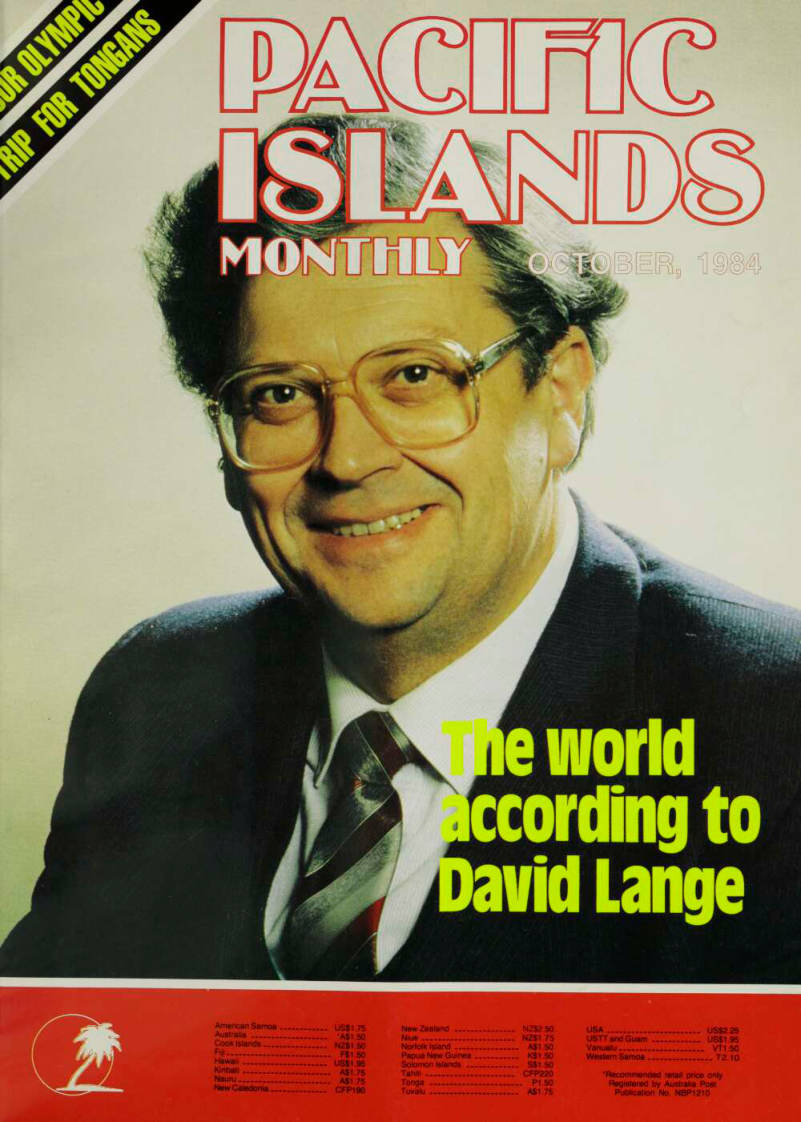
pe world Recording to David Lange
American Samoa US$l 75 Australia *A$l,5O Cook Islands NZ$l.5O Fi )' F 51.50 H aw a'' US$l.95 Kmbati A 51.75 Nauru A 51.75 New Caledonia CFPI9O
New Zealand NZ$2 50 Niue NZ$l.75 Norfolk Island A 51.50 Papua New Guinea K 51.50 Solomon Islands Ssl 50 Tahiti CFP22O Tonga Pi .50 Tuvalu A 51.75
Usa U 552,25
USTT and Guam US$l.95 Vanuatu VTI 50 Western Samoa T 2.10 'Recommended retail price only Registered by Australia Post Publication No. NBPI2IO
The Cover
The new-style, diet-reduced David Lange, prime minister of New Zealand, who de spite his relative newness to politics has shot straight into the international spot light. His exclusive inter view with PIM starts on page 12.
Advertisements & other items, pp. 2-3 (2 items)
ti-purpose
/ 'B6-64 CAR OF THE YEAR
*64 IMPORT CAR OF TOE YEAR I Honda Civic—voted "83—'84 Japanese Car of the Yepr by leading figures in the Japanese automotive world# W and "84 Import Car of the Year by “Motor Trend” m^azine
a r ■* .'I r%; ! ■ i B
Hatchback/4-door Sedan/5-door Hatchback
® AUSTRALIA: Honda Australia Ply.. Ltd. Lot 95 Sharps Road. Tullamarme. Victoria 3043, Bennett Honda Pty., Ltd. 250 Victoria Road, Wetherill Park, N S W 2164 _NEW * AWAV - - - ± Limited Manners Plaza. 57-65 Manners St, Wellington/PAPUA NEW GUINEA: Toba Pty, Ltd. PO Box 503, Port Moresby/TAHITI: Honda D.str.but.on B P chßb KIRIBATI: Atoll Motor ft Marino Services PO Box 49, Ba.riki Tarawa, Republic of Kiribati/U.S TRUST TERRITORY: United M.crones.a Saipan CM 96950/COOK ISLANDS: Cook Islands Motor Centre Ltd. PO, Box 74, Rarotonga/GUAM: Mark s Motor Co.. Inc. PO Box DV, WESTERN S rP Q 7 (Samoa) Ltd. PO Box 576, Apia SOLOMON ISLANDS: Guadalcanal Garage Limited PO Box 537. Honiara/ NEW CALEDONIA: Sociele Du Chalandage 8, Noumea/NAURU: Nauru Cooperation Republic of Nauru/ FIJI: Carpenters Motors Private Mail Bag, Suva, Fiji ame RICAN SAMOA, Hohday Motors, and S Miik^°0 ® To^faa
Pacific
ISLANDS
MONTHLY
Vol. 55 No. 10 October 1984
Australia’s PM Hawke 18
Dr Tomasi Puapua 21
Aqua City’s Sails 37
Young Vivian 61
In This Issue
DAVID LANGE, New Zealand’s prime minister, talks to 1 O Garry Barker about his government’s policies, includ ing the controversial ban on visits by nuclear-armed or nuclear-powered ships ON HIS WAY HOME from the South Pacific Forum 1 Q meeting in Tuvalu, Australian PM Bob Hawke made a wide-ranging speech on regional affairs in Suva A ROUND-UP of decisions of the 15th South Pacific 21 Forum meeting in Tuvalu on August 27-28 begins on page
AQUA CITY is a revolutionary new Japanese-built 37 cargo vessel displacing 31,000 t, and using sails to supplement her diesel propulsion. Alan Merridrew reports from Vancouver A TRIP TO LOS ANGELES for the Olympic Games by 55 a group of about 80 Tongans turned sour when they were arrested on suspicion of intending to overstay their six-month tourist visas NIUEAN POLITICAL leader Young Vivian laments the gl effects on his country of the decolonisation process
Contents
Australia 18 Books 43 Canada 37 China 35 Cook Islands 60 Deaths 73 Fiji 35,56,58 French Polynesia 29,41 Hawaii 33 Islands Press 59 Letters 10 Micronesia 28 New Caledonia 26 New Zealand 12,43 Nive 61 Norfolk Island... 58 Olympic Games 23,55
Pacific Report 7 Papua New Guinea 37
People 62
Pettini Diary 50 PIM Opinion 5 Political Currents 60 Service Page 74 Shipping Schedules 69 Solomon Islands 50 South Pacific Forum 21 Tonga 55 Tradewinds 35 Ttopicalities... 55 Tuvalu 25 U.S 55 Vanuatu 37, 57 Western Samoa 43
Yachts 65
p^! ral '®" °°y er p k r , lce is recommended retail only. Registered by Australia Post, publication No. NBPI2IO. Second class postage paid at Honolulu Hawa". Gopyright Pacific Publications (Aust.) Pty. Ltd. Postmaster Hon olulu. Send address changes to PIM Hawaii, PO Box 22250, Honolulu, n3W311, 96822.
Advertisements & other items, pp. 3-4 (2 items)
Pacific Islands Monthly— October, 1984
3
Founded 1930 by R. W. Robson
(USPS 952480)
Editor and Publisher Garry Barker Associate Editor Malcolm Salmon Layout & Design Barry Badger Editorial Adviser John Carter A Pacific Publications production 76 Clarence Street, Sydney, 2000, GPO Box 3408, Sydney. 2001.
Cables: PACPUB Sydney.
Telex; 21242 (answers INTARAD).
Telephone: Sydney 20-231. Melbourne 63-0211.
Manager: John Berry (03) 63-0211 Ext. 1860.
30 days. US$999.
A chauffeur for
Should you be Hying to and around the Pacific islands on business this year, Polynesian Airlines have an attractive business proposition tor you.
We call it Polypass. It gives you 30 days of unlimited travel to any or all ot 13 destinations in the 10 countries Polynesian Airlines visit.
All for only US$999.
Our destinations include all the major South Pacific business centres: Western Samoa, Fiji, New Zealand, American Samoa, ® Tonga, Tahiti, The Cook Islands, New Caledonia and Sydney. ...
It you find the idea of chauffeur for 30 days att/Tactlve we suggest you T^ 1 ' > contact your agent or Polynesian Airlines now on (02) 268 14370 Elizabeth Street, Sydney or (03) 342 1277, 330/^Collins Street, Melbourne. (The Polypass is not for sale in New Zealand or French Pacific Territories.)
©POLYNESIAN AIRLINES
The far away places are calling
. • C&SSi
/ 3.3 tsU“ m - Slowart Koni-hc Watson I‘ALOJWf <
Pim Opinion
The Fifteenth South Pacific Forum, held in Tuvalu, was highly successful and vindicated the views of those who have been calling for a return to the relaxed, intimate Pacific environment so conducive to understanding among the quite widely-different countries of the region.
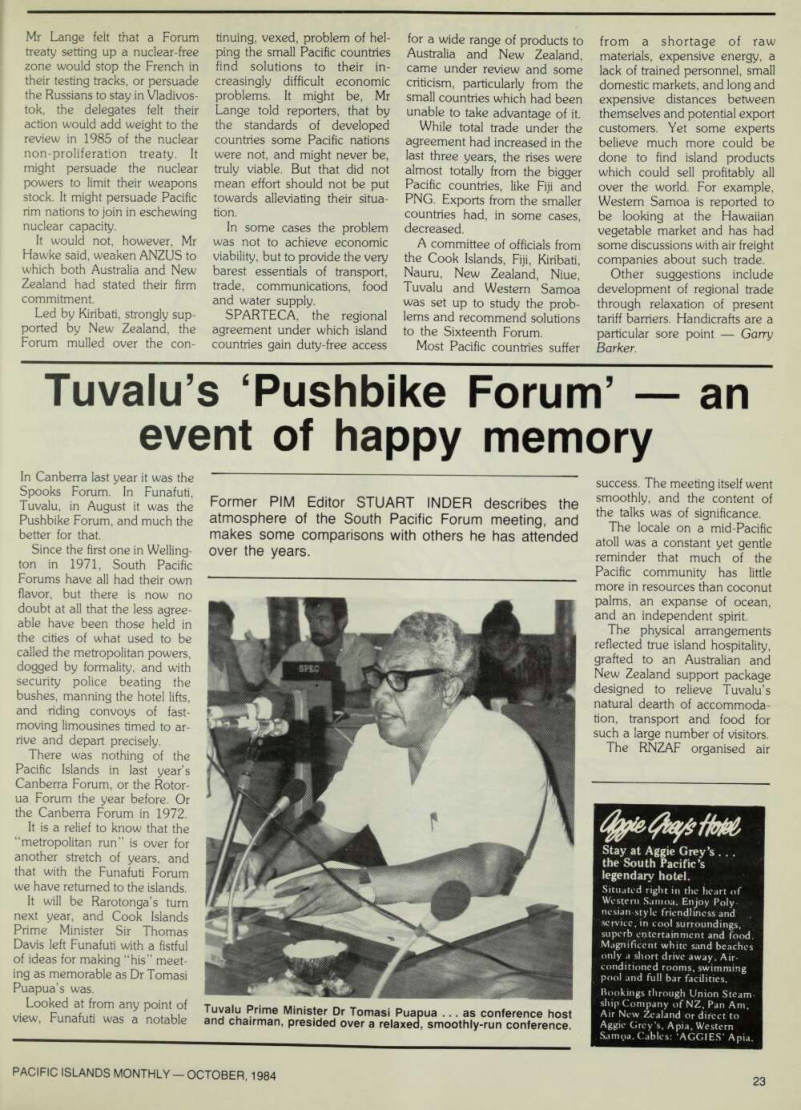
Tuvalu, one of the tiniest of the island nations, excelled itself and is to be warmly congratulated for the excellence of the hosting, the great generosity of the hospitality, and the smooth running of the conference. Everyone in Tuvalu contributed to what was probably the biggest occasion ever held in their country, and yet no-one was over-awed. Everyone was friendly and natural. There was, in particular, no sign of security men anxiously building walls around the leaders; no big cars with sirens and motorcycle outriders; no display of wealth or strength calculated to establish a power pecking order, or cause the less well-endowed to feel put down; no posturing or trappings to make the leaders look like supermen standing high above ordinary mortals. Even the bureaucrats came out of their ivory towers and assumed human shape and habit.
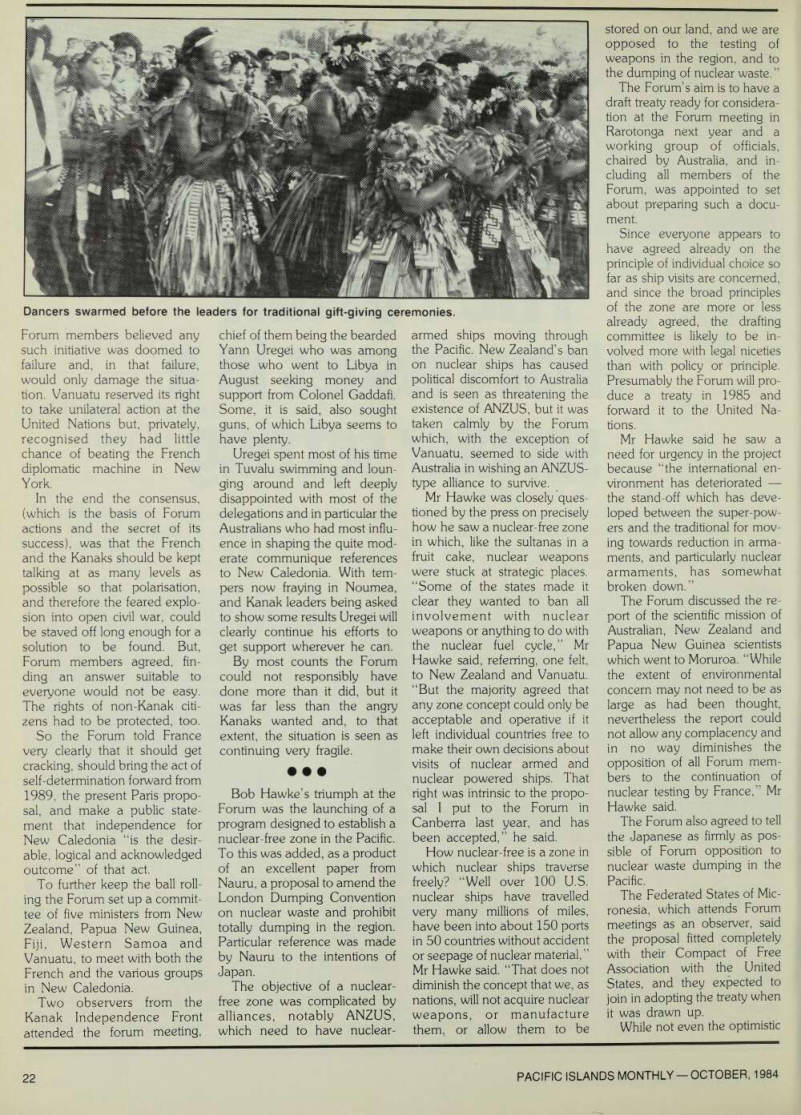
Bob Hawke and David Lange cheerfully wrapped grass skirts around themselves at the wonderfully colorful Tuvaluan gift-giving ceremony. Prime ministers sat on benches, swinging their legs and talking while chickens scrounged in the grass below them. The international press trundled around the dusty roads among the village houses on hard-framed bicycles, which did their egos, as well as their leg muscles, quite a bit of good.
Some of the Canberra press corps who must spend their spare time seeking seething intrigue in cemeteries tried to promote the idea that Mr Hawke was at daggers drawn with Mr David Lange, a very liberal Labor man in whom the scribes saw more similarity with Gough Whitlam than the present Australian leader. They claimed Hawke was enraged by Lange’s unbending attitude on the nuclear ships, and the unnecessary risk it caused not only to the ANZUS treaty but to alignments within the Australian Labor Party.
We could all look forward to icebergs in the Tasman, and a field day for the pro-Hayden, anti-Hawke conspirators in Canberra, they reckoned.
In fact the two men seem to have got on tolerably well. They are vastly different characters. Hawke, the hard-nosed political dynamo with the voice like a grinding wheel, bored by all but the most substantial of the issues, does not suffer much argument from anyone. He was spokesman for the Forum and handled the press briefings with his lash clearly in view. ’’Well, at least we know who took over Piggy Muldoon’s mantle of press management,” groused one journalist after being told his question was stupid and that the spokesman wasn’t there to debate with him. But more experienced Canberra hands thought Mr Hawke milder than on most occasions, so perhaps the Pacific magic was working on him, too.
Mr Lange is much more expansive, and not only in his girth. Still with much to learn about the intricacies of government and international affairs, he is fond of the ringing phrase, gives the impression that he is strong on idealism, but nonetheless made a
very good impression at the Forum and got at least as much as he had genuinely hoped for.
He and Mr Hawke, plus their officials, played a very nicely balanced game in Funafuti. Their governments might have paid for most of the show, but they were careful not to hog the limelight; everyone looked equal and the harmony was pleasantly preserved.
Thus the communique, something of a diplomatic draftsman’s masterpiece, conveyed a nice mix of Pacific attitudes, with due and delicate allowance made for individual preferences on invitations to nuclear ships, apprehending American purse seine boats, and the ultimate interests of non-Melanesians in New Caledonia.
Undoubtedly, the creation of a Pacific Nuclear-Free Zone was brought usefully closer by Mr Hawke’s initiative which appears to have been thoroughly supported by Mr Lange and the other governments. The French can now be in even less doubt than before about the region’s view of its testing program.
On the banning of ships, everyone agreed to recognise the justice of the other man’s view, and that in itself has taken much of the heat out of the issue ... until, of course, the Americans come to discuss the question directly with the New Zealanders some time next year. Meantime the relevant paragraphs of the Forum communique provide a useful show of regional solidarity against the spread of nuclear power and technology and a basis upon which to work towards a devoutly desired, but elusive, goal.
The Solomons was deeply disappointed at the rejection of its rather wild theories on retaliations against American fishing boats, but they also were talked around a little and returned to Honiara perhaps less heated than they had come.
Unfortunately it is less easy to be optimistic about the Forum’s effect upon the vexed and complicated matter of independence for New Caledonia. The Forum’s message was aimed as much at the militants of the Kanak independence movement as at the French and rang truly of reason and sense. If the Kanaks wish it they will see support for their campaign in the words; sadly, events on the ground may have proceeded beyond that point.
These were the high-flown issues but in terms of Pacific realities the Kiribati paper, strongly supported by New Zealand, on economic development for the small island nations was much more important. Out of it, with the help of the bigger countries, may come some hope of a better future for the little economies where a cupful of aid can often produce a tankful of improvement in the standard of life.
Some very concrete proposals were aired, among them the widening of SPARTECA categories to allow, for example, bigger quotas of clothing exports to Australia, and duty-free entry of small-country handicrafts to the bigger, tourist-oriented island nations, like Fiji.
In short it was a very good Forum, in the best traditions of the organisation, and our region is likely to be a little better for its happening.
Advertisements & other items, p. 6 (1 item)
The Ultimate XO
rAUIw *iv xa 1 ' * 9* tl ~'- Wghti Ik:fc /
CUNTAURh Avj
REMY MARTIN
COGNAC
REMY MARTIN
FINE CHAMPAGNE COGNAC, SINCE 1724.
REMY MARTIN CENTAURE XO
Pacific Report
U.S. Gets Tough In Solomons Row
The U.S. Government moved swiftly in September to signal its seriousness in the row with the Solomon Islands Government over the seizure in Solomons waters in June of the U.S. fishing vessel Jeanette Diana (PIM Sep. p4l). The Solomons Government has called for tenders for purchase of the ship. A subsequent U.S. State Department release firmly reiterated U.S. policy that it does not “recognise that coastal states may unilaterally control fisheries for highly migratory species, such as tuna, within the 12-200-mile zone.” It added; “The U.S. Government considers that if the Solomon Islands Government attempts either to use the vessel, or to sell the vessel to another party, potential buyers should be aware of the cloud on the title.” However, it also pointed to the “co-operative and close relations existing between the two countries, ” and voiced the hope that “this problem can be resolved amicably.” Then a notice was published in Australian and other Southwest Pacific newspapers on the weekend of September 8-9 giving chapter and verse on the U.S. legal position. It said: “This is to place all prospective purchasers on notice that Security Pacific National Bank, a national banking association in the United States, is the holder of a U.S. first preferred mortgage on the Jeanette Diana dated December 28, 1978, as amended by a first amendment to first preferred mortgage dated February 18, 1983.
The mortgage, as amended, is in the sum of $U53,133,333. The bank’s preferred mortgage lien against the vessel is protected in event of forfeiture. A purchaser will take the vessel subject to the bank’s mortgage lien, and clear title cannot therefore be transferred by the Government of the Solomon Islands”. Earlier, the U.S. had banned imports of Solomons tuna. In other developments, the South Pacific Forum meeting in Tuvalu on August 27-28 refused to act upon a Solomons appeal for support in its quarrel with the U.S., saying it was for the two parties alone to settle it (see separate reports this issue). Smarting under the Forum’s rebuff, the Solomons Government hinted broadly that it might lift its ban on Russian ships visiting Solomons ports. The Ministry for Foreign Affairs and International Trade announced that it was approached by the Soviet Union earlier this year about a licence to fish in Solomons’ waters. Said the ministry: “In the light of Solomon Islands’ policy banning Soviet vessels from Solomon Islands’ ports, the government was reluctant to consider Russian approaches, but now the Solomon Islands has a changed situation as regards fisheries. ”
Air Pacific Board Resigns En Masse
The Air Pacific saga continues with the mass resignation of what might be called the “John Hill” board of directors, and the appointment, by Civil Aviation Minister Jonati Mavoa, of a new and smaller board under lan Thomson. Mr Thomson, highly respected as a government administrator, and as Independent Chairman of the Fiji Sugar Industry, from which post he retired earlier this year, has no previous experience of airline management and says he is well aware of the huge problems ahead of him Air Pacific is said to be in debt to the tune of $29 million and continuing to lose money at the rate of $500,000 a month Of this figure more than $160,000 is said to be going to Ansett Transport Industries of Australia for the wet lease of a Fokker F 27 Friendship airliner needed to keep Air Pacific’s domestic services running Ansett has said nothing publicly, but aviation industry sources consider them to be “breaking their necks” to conclude a joint venture deal with Air Pacific along the lines of their successful regional arrangements with Polynesian Airlines, of Western Samoa, and Air Vanuatu. For Ansett the attraction is obvious If they had Air Pacific’s very considerable list of landing rights they could become, virtually overnight, Australia’s second international airline. Air Pacific has landing rights in all Pacific Island countries, in the U.S., Canada, New Zealand and probably also further afield.
Ihose, say industry observers, could be of enormous value to Ansett. Ansett also has a fleet of Boeing 767 airliners similar to those Air New Zealand and Qantas have ordered to handle their snorter-haul routes. Air Pacific’s board resigned while chairman John Hill was on leave in England. According to Suva reports he
had no knowledge of the mass resignation until he was telephoned by Mahendra Patel, the deputy chairman, and told of the decision, which he was expected to support. He did so. The new board, though smaller by four members than the old 11-man team, has only two new faces, Mr Thomson, and Lautoka businessman, Hari Punja. Mr Hill is not among those continuing to serve. Other members of the board are Adam Dickson, Suva chartered accountant and the company secretary, the secretary for civil aviation, Jioji Kotobalavu, the secretary of the Public Service Commission, Winston Thompson, and a representative of the Tongan Government, Dr Langi Kavaliku. Mahendra Patel con tinues as deputy chairman. Special correspondent in Suva. See also “People”.
Indonesia -Png Agree On Repatriations
Indonesia has approved an agreement with Papua New Guinea for repatriation of thousands of refugees from the Indonesian province of Irian Jaya. The Indonesian Foreign Minister, Dr Mochtar, said he had given final approval to a letter of exchange setting out an agreement on repatriations. The agreement had been reached the week before by the Indonesia-Papua New Guinea border liaison committee. Australian Associated Press said the letter of exchange now requires the approval of PNG Foreign Minister, Rabbie Namaliu. AAP said it gave September 17 as the tentative date for starting the repatriations and asked for assurances on the safety of the refugees, once they have returned. Dr Mochtar told a news conference in Jakarta that he had gladly given such assurances.
However, he warned earlier that army deserters and criminals would be subject to discipline. Meanwhile, medical reports say most of the Irian Javan children in refugee camps in Papua New Guinea’s Western Province have been without food for so long that their growth has been stunted. The reports, given to the Papua New Guinea Government, show that the problem existed before they crossed from Irian Jaya. PNG’s Provincial Affairs Minister, Mr Nilkare, said that while the people had not been fed properly before they arrived in PNG it did not excuse mistakes made by the Government. He said the condition of the refugees explained how they caught diseases easily. Three reports have been given to the Government . . . one from the Ok Tedi mining company’s nutritional team, another from the medical officer from the North Fly area, and a third from the superintendent of the Port Moresby General Hospital. The parliament in PNG has been told that 93 refugees mostly old people or children have died from starvation-related diseases since they crossed into the country.
Coleman's Bid For Third Term Contested
In American Samoa a bid by the current governor to stand for a third term is being contested. The territory’s first election for a governor was held in 1977, but the election was only for a three-year term to permit synchronisation with the American elections in 1980. Governor Peter Tali Coleman has announced his candidacy for a third term, arguing that his first three-year tenure of office was not a full term. However, a petition by American Samoa’s chief election officer to have the High Court determine if Governor Coleman is eligible to run for a third term has been denied. Chief Justice Robert Gardner ruled that the election officer had first to make a decision on Coleman’s eligibility before anyone could bring the matter before the court.
Kiribati Improves Its Japan Fish Deal
Kiribati has signed a new fishing agreement with Japan under which Kiribati will get a 50 per cent increase in payments. Under the new deal, Kiribati will get $1.5 million for the one-year period, plus $167,000 in aid to pay for fishing gear used by local fishermen. Under the previous agreement, Kiribati was paid a lump sum of $1 million, plus some aid for its own fishing industry.
Kiribati Minister for Natural Resources Development, Babera Kirata, said Japanese boats fishing in Kiribati waters would now pay a charge rate of just over four per cent of the catch value, plus the registration fee. The Japanese Fishing Association will collect the charge rate and the fee for Kiribati.
New Caledonia: Uregei Replies To Hawke
The Australian Prime Minister, Mr Hawke, says his government would condemn any attempts by New Caledonia’s independence movement to raise outside support if this involved the use or threat of violence or terrorism. Mr Hawke told Parliament in Canberra that he was disturbed to learn of indications that some elements of the French territory’s independence movement were considering seeking outside support. He said Australia was anxious to see independence in New Caledonia as soon as it was realistically possible, but was concerned that the transition should be smooth and peaceful. The Prime Minister was making a statement to Parliament on the August meeting of the South Pacific Forum in Tuvalu which he attended. Among other things, the Forum decided to condemn moves by elements of the New Caledonia Independence Front to seek support from forces outside the region that advocated terrorism. In his statement to Parliament, Mr Hawke also announced that Australia’s Governor-General, Sir Ninian Stephen, would make an extensive official tour of South Pacific countries later this month. In a comment on Mr Hawke’s parliamentary statement, Yann Uregei, one of two leaders of New Caledonia’s Independence Front who visited Libya in August, said: “Mr Hawke should look at the real threat of violence in New Caledonia. This source lies in colonialism, not in the movement for independence.”
Oz Stolen Cars In Islands?
Australian detectives working for 18 months in strict secrecy have uncovered a stolen car racket which has been netting Australian criminals as much as SAIOO million a year. The wealth of the car thieves is said to rival that of the country’s drug, gaming and vice kings. According to one press report, the stolen cars with their new “identities of changed registration and compliance plates “are spirited both interstate within Australia and overseas to Papua New Guinea and the Pacific Islands”.
Flosse To Urge N Tests Referendum
Gaston Flosse announced at the recent congress of his Tahoeraa Huiraatira party that he would be calling upon the French Government to organise a referendum in French Polynesia on whether the nuclear-testing agency CEP should or should not remain in the territory. The vice-president of the Government Council said he would accompany this move with a study of the economic and social measures to be taken in the event of the CEP’s withdrawal. French Government military expenditure in the territory in 1983 was the equivalent of SAI3S million, or about 15 per cent of total expenditure of $825 million.
10 Die In Png Air Crash
A nine-year-old girl lay with both her legs broken in the wreckage of a plane for nearly 15 hours before rescuers found her alive among nine bodies on a remote mountain in Papua New Guinea on September 7. Another child who kept her company during the long, wet night died in the rescue helicopter only minutes from the safety of the health centre at the Ok Tedi gold mine. Of the 11 people who boarded the Talair Britten Norman Islander at Tabubil on their way to Telefomin, the girl was the only survivor Two Australians were among the dead, the pilot and his wife. The girl who was in a serious but stable condition with the broken legs and a broken finger, lost her whole family. Her father, a policeman had been taking his wife and five children on holiday. The other two passengers were reported to be a policeman and the prisoner he was escorting. PNG’s Director of Civil Aviation, Joe Wal, said the Islander went down about 3 p.m. on September 6, 26 km east of labubil, the Ok Tedi mine town.
Fiji: Unionist Warns On Corruption
A leading trade unionist in Fiji has warned that corruption is increasing in the government and public bodies. The general secretary of the Fiji Public Service Association, Mahendra Chaudhry. told the annual convention of the National Federation Party in Suva that corruption had become like a cancer in Fiji. He said corruption could be clearly seen in the awarding of government contracts, and in the appointment of members of government-run organisations. Mr Chaudhry said this corruption was spreading because it was passively accepted by the people of Hji. He said people in high office in Fiji were flouting the laws they were supposed to be administering
PUTS KOYA CALLS FOR NEW FOREIGN POLICY Fiji’s Opposition Leader, Siddiq Koya, has called for a reappraisal of the country’s foreign policy. Speaking at the annual convention of the oppostion National Federation Party, Mr Koya said Fiji's foreign policy had been developed piecemeal and there was a need for the country to take new directions. Mr Koya said the NFP, as the alternative government, would have to make clear its opposition to French nuclear testing in the South Pacific and the dumping of nuclear wastes there. He said that if the NFP was to govern, it had to have a clear understanding of foreign policy.
Tenders Called For Fisheries Patrol Boat
The Australian Government has formally called for tenders to build the vessel to be used in the Pacific Patrol Boat Project. The project involves a special boat for coastal surveillance of Pacific Island countries to prevent foreign fishing boats and other vessels from intruding into their exclusive economic zones. Five countries Papua New Guinea, Solomon Islands, Tonga, Vanuatu and Western Samoa have decided to take part in the project.
Announcing the tender, Australian Defence Minister Gordon Scholes said the aim was to build a boat that was easy to operate, simple to maintain, and cheap to run. Mr Scholes said his government also was considering modernising a number of Attack class navy patrol boats for the project.
Solomons To The Polls
The four years life of the Solomon Islands Parliament has ended and Parliament has been dissolved. General elections will be held towards the end of October.
Niue: Sir Robert Rex Returned
Niue’s recent general elections ended with Sir Robert Rex, aged 75, retaining the Premiership and reappointing his Cabinet son Robert Rex jr, Dr Enetama Lipitoa and Frank Lui but some portfolios were re-shuffled.
Compensation Flows For Santo Victims
The Vanuatu Government has begun payments of compensation for damages suffered in the 1980 revolt on Santo, Malakula and Tanna just before independence. The government announced that claimants would be paid only two-thirds of their total claims because the French Government had not indicated that it would pay a third of the total claims as requested. Britain and Vanuatu are each paying out about SAI2 million.
BIDDING RE OPENED ON PNG TIMBER PROJECT Papua New Guinea’s Office of Forests has invited Bunning Brothers Pty Ltd, of Western Australia, to re-submit development plans for the 280,000-ha timber project at Vanimo in West Sepik Province. The PNG Government gave sole negotiating rights to Halla Resources, of South Korea, which was in competition with Bunning Brothers, but rejected Halla’s final development pro posals.
Ham Network Serves Again
Ham radio operators from Pitcairn Island, Tahiti, Honolulu and New Zealand pooled their efforts in early September to raise the alarm about the plight of a 56-year-old Pitcairn woman urgently in need of surgery for appendicitis. A German freighter, Pieter Altmann, changed course for Pitcairn, and after fighting heavy seas for several hours managed to get the patient on board. It then set sail for Mangareva where a French naval aircraft was waiting to fly her to Tahiti for surgery. Final outcome of the drama was not yet known at press time.
Png Business Show Success In Sydney
Thirteen Papua New Guinea companies displayed their wares in a three-day trade exhibition organised by the PNG Department of Foreign Affairs and Trade at the Australian International Trade Development Centre in Sydney September 4-6. On show were wearing apparel, paintings and artifacts, timber, furniture, jewel lery, seafood, coffee, biscuits, sweets and beer. The project was financed by the Australian Development Assistance Bureau under the Australian Aid Program. Preliminary estimates of orders received were $103,000 firm, and $lBO,OOO still subject to negotiation. It is hoped that over the coming 12 months, the exhibition will generate business worth $1 million.
Advertisements & other items, p. 8 (1 item)
13
20 "W on w Hedges
WARNING
SMOKING IS A HEALTH
HAZARD
letters
Saving with energy efficient buildings
Your articles on alternative energy (PIM Jul) provided some valuable information about energy sources available in the Pacific. As the authors pointed out, wind, solar, bio mass, and hydro-electric power systems can make great con tributions to the overall energy requirements of the Pacific Basin, helping to diminish the historic dependency on expen sive, imported petroleum.
Although it was outside the scope of these articles, there is another factor which can contri bute substantially to reducing this dependency on oil: energy conservation. As architects specialising in energy-efficient buildings, we can testify to the fact that major improvements can be made in the efficiency of operation of virtually any ex isting building, and in the de sign of most new ones as well.
Such elements as solar shad
ing, natural daylighting, natural ventilation, appropriate use of glass and other materials, and effective use of building insula tion can decrease the energy requirements of buildings by one-third to one-half. Since the built environment contributes heavily to the energy consump tion of any developing com munity, designing that built en vironment to conserve energy to the greatest degree possible is a major step in the right direction.
We would enjoy reading of the experiences of others work ing in this field in the Pacific, and we would be happy to share with anyone who is in terested the information we have learned through our re search and practice.
Cliff Terry A.I.A.
TRB/Hawaii Ltd Honolulu Hawaii
Sports
coverage:
A plea
I would like to commend you on most of your reporting in PIM concerning economic, political and cultural affairs, although the lack of in-depth analysis of the recent Australian and New Zealand elections was disappointing. I enjoy PIM very much, and feel it does the best job of any publication from the Pacific I have seen.
However, a very large area of interest to many readers is either not reported at all or only very sketchily: sports. The re cent Commonwealth and South Pacific Games were barely given any comment, with no list of participants, medals awarded, etc. This has
continued with total lack of coverage of the South Pacific nations’ participation in the XXIIIrd Summer Olympics in Los Angeles. Many of the smal ler countries are extremely proud to have sent a team to L.A., at great sacrifice to athletes, organisers and fund raisers. Many would agree that international sports events are one of the few times where national differences are set aside in a true spirit of brother hood. Also many readers in the Pacific have no access to the instant satellite television cover age others may enjoy and rely on the print media such as PIM to inform them, serving to rein force national pride and this striving of the human spirit for excellence.
I feel it is important to convey not only the facts of the event (this surely is the bare mini
mum) but also the spirit in volved. The performances of all athletes may not be spectacu lar, but after all winning or losing is not the complete end in and of itself participation is the goal. Please increase the reporting of this participation as it is an important part of life in the South Pacific.
Thomas L. Jorris
(Returned U.S. Peace Corps Volunteer, Fiji 1973-75.) Georgetown University Washington D.C.
U.S.A.
Point taken and we’re working on it. PIM.
Thumbs down
on PNG building
I agree completely with Mr Bendumb, Papua New Guinea’s Transport Minister (PIM Aug), who said he thought it was too early for PNG to have a building “as big as this” for parliament.
Personally, after 20 years in PNG, married to a national lady, and since I retired having kept in constant contact with the island, I was absolutely stunned by the PIM photo graphs of the new parliament recently opened by “pikanini nambawan bilong misis kwin”.
You published in the same issue details of the “Jackson Report” about Australian aid to the Pacific, and especially to
Png.
I do not think that a sum of $26 million paid by Australia for an extravagant piece of political architecture was very necessary in order to boost PNG’s eco nomy.
A friend who is a specialist on Africa told me years ago how scandalised he had been by the $25 million palace of the Libe rian president in the midst of the slums of Monrovia.
In fact, the Port Moresby parliament surpasses our own in Canberra in luxury and by the way, once again, “old hands” like myself are amused
(as we were by the style of Port Moresby cathedral) by the architectural inspiration from Sepik Haustambaran, a well known phallic symbol.
On another point: taking a lesson from prosperous and peaceful Costa Rica (the only such country in Central Amer ica) which has no army, I am convinced that PNG could very well do without its 3000 men under arms. Perhaps instead they could increase the police force.
Anyway, without artillery, tanks or even decent air sup port, the national soldiers could not do much for instance against an Indonesian invasion based on a total military strength of half a million.
It was all right a few years ago to fight the bows and arrows of the poor Vanuatau rebels (as illegally as the Russians invad ing Afghanistan . . .). But in future I only see the PNG armed forces as a danger in the hands of an ambitious officer, in the South American or African style. His first act after seizing power would of course be to transform the fancy parliament into a museum or maybe his personal palace.
J. Huon De Navrancourt
Atherton, Qld.
Australia.
When will
Nauru act?
In response to praise by Anthony Detsimea of Nauru President Hammer Deßoburt (PIM Aug); When is the Nauru Govern ment going to solve its biggest problem finding a perma nent home for the people after the phosphates and easy money disappear?
The Banaban people bought and settled Rabi Island in Fiji.
What will Nauru do? And when?
Time is running out.
G. Maxwell,
Sydney. N.S.W, Australia.
Advertisements & other items, p. 11 (1 item)
i National
:3 II • 3
JSsU
sglsgg
EJECT
m gMglTFf] nTErnfongfl !Ul • ■_ ?t N
™£s?£ SLEW TBACWNG hoW^TTSemOTS
- TAPE SELECT CAMERA SELECT
VTR
REMOTE
Orr I iON It’s Nationals NV-180, an ultra-compact VTR that packs a ton of technology and function into just 2.3 kg (without battery).
It’s the ultimate VTR for quality indoor/outdoor performance.
Take it with you. The NV-180 can record your good times with clarity and precision for up to four hours* Combine it with a compatible video camera— like National’s equally-compact WVP-A2, with a super-sensitive 1/2" NEWVICON tube and a 6:1 Direct Image Auto Focus lens— and you’ve got a portable system that won’t tie you down or tire you out.
Keep it at home. The NV-180 can playback your prerecorded tapes with noiseless, jitter-free beauty—in Super-Still, Super-Still-Advance, and Super- Fine-Slow modes. Use it to record from TV in tandem with our VW-ETIBO video tuner/timer
adaptor. Together, the NV-180
and VW-ETIBO measure just 430 mm wide by 69mm high to form an elegantly trim system that fits in anywhere.
What makes so small a VTR so big on quality? Advanced technology. As in an extra-thin, onepiece chassis made of durable aluminium, a specially-flattened direct-drive cylinder with 99.999% rotational accuracy, and our newlydeveloped Two Double Video Head system that makes our special playback effects so steady and crisp.
The NV-180. It can go anywhere—or nowhere beautifully.
VMS
Your attention is drawn to the fact that recording pre-recorded tapes or discs or other puWished or broadcast material may infringe copyright taws » With an NV-E240 cassette and battery changes.
i National
National, Panasonic and Technics are the brandnames of Matsushita Electric.
'N-policy is not anti-

Nz Pm Talks To Pim
'N-policy is not anti- American, its anti nuclear'
Few people, and probably least of all the redoubt able Sir Robert Muldoon himself, were surprised when David Lange and his Labor Party won New Zealand’s recent general election. But Mr Lange was not even installed in office before he had become the centre of a considerable international upset involving the future of the ANZUS defence alliance between N.Z., Australia and the United States. It arose through Mr Lange’s manful adher ence to his party’s long-standing opposition to visits by nuclear-powered and armed warships. Mr Lange is known himself not to favor the total blanket ban with which Labor Party policy has saddled him. But neither that, nor considerable pressure exerted by the Americans and the Australians, has changed his tune. He does not wish to walk out of ANZUS, nor yet have ANZUS walk away from him. He says he thinks it can all be talked through to a jointly satisfactory conclusion. Most observers have so far had difficulty in seeing quite how this might be done.
At the same time he has shown great willingness to cooperate with Australia in its anti-nuclear proliferation strategy, and in urging steady, careful, progress on the achievement of independence for New Caledonia.
If they currently, publicly, disagree on ANZUS matters, Lange and Australia’s prime minister Bob Hawke look like firm and closely-cooperative allies on most matters of moment to the Pacific, a point which has given the leaders of South Pacific Forum countries a deal of relief and satisfaction.
In this exclusive interview, conducted with Pacific Islands Monthly publisher, Garry Barker, on the eve of the Forum meeting in Tuvalu, Mr Lange explains his policies and sets out his goals for his own country and for the island nations of the Pacific. In it he foreshadowed much which, later, was embodied in the Forum’s communique.
PIM: You hurled yourself on to the world political stage within hours of your election by firmly stating your government’s deci sion not to allow nuclear-po wered or armed ships to enter New Zealand ports. Given the pressure which the Americans and the Australians then appeared to bring upon you, many people expected you to temporise a bit. But you did not, despite clear notice that implementation of the policy could endanger the ANZUS alliance. You have continued this stand. Why?
MR LANGE; The fact is that it is not an argument of the hard left. It is an argument of the centre and the centre right and left. So that you have a very main stream of concern in New Zealand against nuclear arma ments. It is compounded by our unique position as a country where we have an abundance of renewable energy resources.
So we do not have to go into that generation of technology where nuclear energy is the power source. So, therefore, there is a concern that we don’t touch it at all. And that is the argument against nuclear prop ulsion.
With respect to nuclear arma ments there is a long-held view that New Zealand ought not to give itself the status of target, and there is a different structure to our defence arrangements to other countries.
I can well understand the
Australian position because it has an infrastructure of defence bases, strategic minerals, and in fact a totally different back ground in terms of visits.
I can understand the Amer ican position. The U.S. is perfectly entitled to say that if you want in the end to be rescued by the cavalry you should be prepared to see the horses from time to time.
But that is the background against which we go further with our policy and I have been amazed at the number of peo ple who have such a debased view of politicians that they expect them to completely re verse their policies after elec tion. We are on course with our policies after the election, and that apparently creates some sort of a world record. I am happy about that.
PIM: Did you expect the Americans to be tough on
Anzus?
LANGE: I think the Amer icans have been quite reason able in what they have said.
They have not engaged in any form of open unfair or political ly-slanted pressure at all. I have an admiration for the United States which I hope will persist, and be enhanced, given their handling of the situation.
PIM; Do you think your ban on the ships has contributed to a nuclear-free Pacific? Do you think a nuclear-free Pacific is possible?
LANGE: I don’t think it is
possible. We are going to work to see that it becomes so. That is part of a four-pronged strategy on nuclear matters which we in the Labor Party have as policy.
First is to see an end to the French testing in the South Pacific.
Second is to see that a regime of nuclear waste dum ping is never started in the Pacific.
Third is to see that there is a South Pacific nuclear weapons free zone.
Fourth is to have within our territories no presence of nuc lear weaponry.
Now, quite simply, to have a nuclear weapons free zone in the South Pacific is a credible goal because there is no nation that I know of in the South Pacific which seeks to embrace nuclear weapons technology.
The difficulties that arise are the standard ones of having an international acceptance of that regime so that the limitations are known, the rules of naviga tion and usage of the high seas respected...the common pledge not to instal, deploy, use or test on it, and then for each country to determine its own sovereign, territorial rules about the prin ciples of transit. That is an achievable goal.
PIM: You believe it is achiev able even given that the Pacific is used as a highway by the nuclear ships of the Americans and the Russians?
Lange; Yes
PIM: And also given that the Russians are still building up a nuclear navy and have in con struction an aircraft carrier at least as big as the USS Enter prise?
LANGE: Well, the policy is not anti-American. It is anti nuclear. And if it is to be pursued and won, then of course it will affect the Russians.
If the argument is that the Russians have now got the edge in armaments, then it will affect the Russians more than the Americans.
PIM: Are you getting support from the small Pacific nations?
Did you get any indication of that in the recent CHOGRM meeting in Port Moresby?
LANGE; There was a mea sure of support in Port Moresby
from principal speakers before and after the CHOGRM confer ence. But there are also, I should report, obviously state ments of concern from people who have not considered the position and have not had the opportunity of speaking to me; in particular, the prime minister of the Cook Islands who ex pressed some view in Auckland while I was at the CHOGRM conference the burden of which seemed to be that Sir Thomas Davis felt he was more than competent to decide, unaided by Mr Lange, which ships would be entertained in Cook Islands harbors. I will be speak ing to him about that.
RIM; Do you think ANZUS is threatened by your policy?
Lange: Anzus Is An
arrangement ... it is an honest expression of the naturalness of the defensive alliance between America, Australia and New Zealand. It is a third of a century old. It has worked in the past without New Zealand ports being involved, and it has con tinued and trade with the Un ited States has prospered.
I certainly won’t be declaring any withdrawal from ANZUS.
PIM: You expect the alliance to continue?
LANGE: I think you would have to work very hard indeed
to stop it from continuing.
PIM: Could we now talk about New Zealand’s position in the Pacific? Obviously over the years, and more in recent years, NZ has drifted away from its traditional links with the UK and Europe and is now seeking a more prominent, or positive, position in the Pacific. Where would you like to take NZ in relation to, first, the islands, and, further, the rim countries?
LANGE: Let’s start with the Pacific generally. Now, two thirds of our exports, 64 per cent of our imports, go to Pacific rim countries. Our major trading partners, save one, the EEC bloc, are in the Pacific.
Therefore, we have achieved a re-orientation; I think some times without realising it. And
that will continue. That will escalate. And we will lock into the growth economies of the region, and we will spin further back into Asia through the ASEAN grouping.
I am telegraphing New Zea land’s intention to position itself much more firmly with the developing countries and with emerging countries because in the last 15 years of this century we are going to see a further shift in wealth, and I want New Zealand to be in a position to be respected and able to move
into that which we now so patronisingly call the third world but which actually are stirring giants. So that we will have by our diplomacy in India and Africa a whole new raft of contacts and goodwill.
More immediately we have a very novel thing with respect to our foreign and trade affairs... I suppose Britain experienced it because of the migration which occurred to the UK from former colonial territories. But in New Zealand we have a rare thing ... we have foreign affairs actually becoming part of the domestic political currency, if you like. So that, because of the large com munities of people from the Pacific in our New Zealand electorates ... and in particular my electorate, where there is a substantial Samoan, Cook Is land, Niuean and Tongan rep resentation... we will inevitably have the immediate forward stance of our foreign policy in the near Pacific, the Southwest Pacific. It will be heavily oriented towards those coun tries with which we have direct population links, and that means Niue, Fiji, Samoa, Ton ga, the Cooks. We still have the dependency of the Tokelaus and then, in broader trade terms, we will be moving beyond that because Melanesia is a growth economy area. We have a distinctive relationship with people from Kiribati and Tuvalu which we must expand because they ought to be very much higher in our thoughts, I believe, than they are now, and the Tokelaus will continue to be a part of the world moving at its pace, unfettered by the strident claims of those who would seek to have some artificial sovereignty imposed but it is our intention to respect their pace and their style as much as we can.
We will undoubtedly be re viewing, and I read in the newspapers, but not directly, the proposals in the Cook Is lands for further changes. We will await them with some in terest.
New Zealand has enjoyed very close relations with Papua New Guinea, and those were cemented further by the visit there for the opening of their parliament house, and the
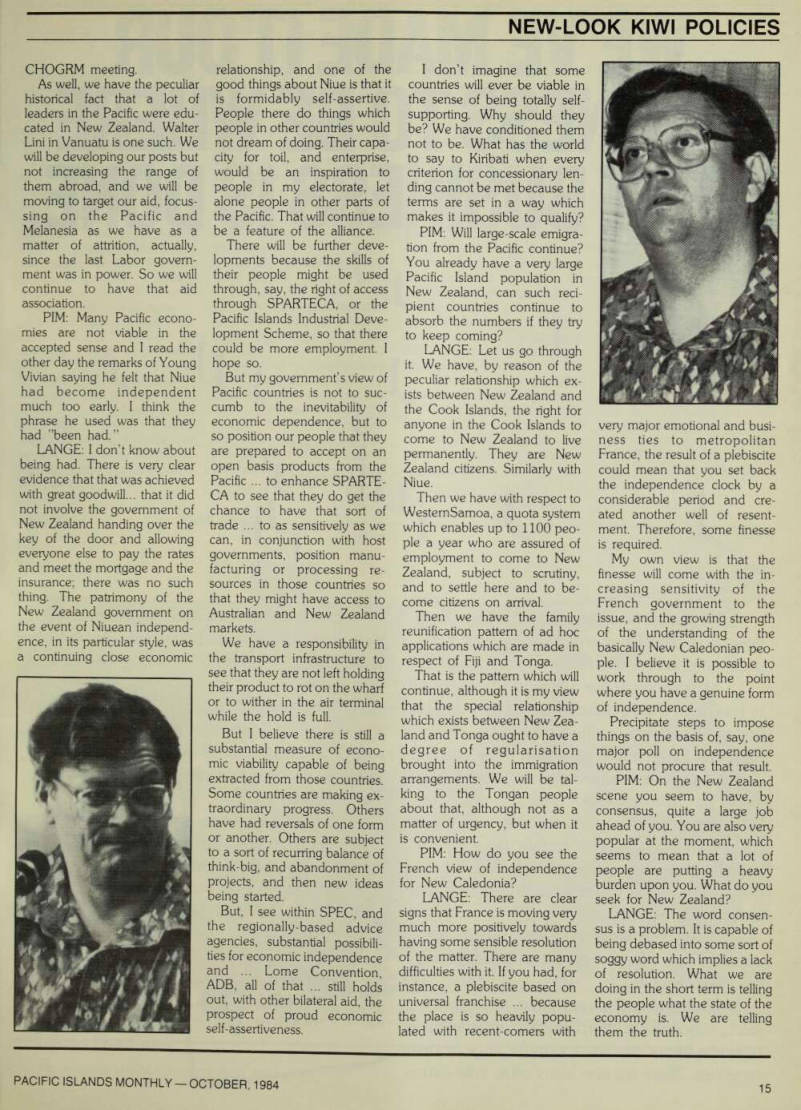
David Lange, - Fiji Times photos.
CHOGRM meeting.
As well, we have the peculiar historical fact that a lot of leaders in the Pacific were edu cated in New Zealand. Walter Lini in Vanuatu is one such. We will be developing our posts but not increasing the range of them abroad, and we will be moving to target our aid, focus sing on the Pacific and Melanesia as we have as a matter of attrition, actually, since the last Labor govern ment was in power. So we will continue to have that aid association.
PIM: Many Pacific econo mies are not viable in the accepted sense and I read the other day the remarks of Young Vivian saying he felt that Niue had become independent much too early. I think the phrase he used was that they had ’’been had.”
LANGE: I don’t know about being had. There is very clear evidence that that was achieved with great goodwill... that it did not involve the government of New Zealand handing over the key of the door and allowing everyone else to pay the rates and meet the mortgage and the insurance; there was no such thing. The patrimony of the New Zealand government on the event of Niuean independ ence, in its particular style, was a continuing close economic
relationship, and one of the good things about Niue is that it is formidably self-assertive.
People there do things which people in other countries would not dream of doing. Their capa city for toil, and enterprise, would be an inspiration to people in my electorate, let alone people in other parts of the Pacific. That will continue to be a feature of the alliance.
There will be further deve lopments because the skills of their people might be used through, say, the right of access through SPARTECA, or the Pacific Islands Industrial Deve lopment Scheme, so that there could be more employment. I hope so.
But my government’s view of Pacific countries is not to suc cumb to the inevitability of economic dependence, but to so position our people that they are prepared to accept on an open basis products from the Pacific ... to enhance SPARTE CA to see that they do get the chance to have that sort of trade ... to as sensitively as we can, in conjunction with host governments, position manu facturing or processing re sources in those countries so that they might have access to Australian and New Zealand markets.
We have a responsibility in the transport infrastructure to see that they are not left holding their product to rot on the wharf or to wither in the air terminal while the hold is full.
But I believe there is still a substantial measure of econo mic viability capable of being extracted from those countries.
Some countries are making ex traordinary progress. Others have had reversals of one form or another. Others are subject to a sort of recurring balance of think-big, and abandonment of projects, and then new ideas being started.
But, I see within SPEC, and the regionally-based advice agencies, substantial possibili ties for economic independence and ... Lome Convention, ADB, all of that ... still holds out, with other bilateral aid, the prospect of proud economic self-assertiveness.
I don’t imagine that some countries will ever be viable in the sense of being totally self supporting. Why should they be? We have conditioned them not to be. What has the world to say to Kiribati when every criterion for concessionary len ding cannot be met because the terms are set in a way which makes it impossible to qualify?
PIM; Will large-scale emigra tion from the Pacific continue?
You already have a very large Pacific Island population in New Zealand, can such reci pient countries continue to absorb the numbers if they try to keep coming?
LANGE; Let us go through it. We have, by reason of the peculiar relationship which ex ists between New Zealand and the Cook Islands, the right for anyone in the Cook Islands to come to New Zealand to live permanently. They are New Zealand citizens. Similarly with Niue.
Then we have with respect to Western Samoa, a quota system which enables up to 1100 peo ple a year who are assured of employment to come to New Zealand, subject to scrutiny, and to settle here and to be come citizens on arrival.
Then we have the family reunification pattern of ad hoc applications which are made in respect of Fiji and Tonga.
That is the pattern which will continue, although it is my view that the special relationship which exists between New Zea land and Tonga ought to have a degree of regularisation brought into the immigration arrangements. We will be tal king to the Tongan people about that, although not as a matter of urgency, but when it is convenient.
PIM: How do you see the French view of independence for New Caledonia?
LANGE: There are clear signs that France is moving very much more positively towards having some sensible resolution of the matter. There are many difficulties with it. If you had, for instance, a plebiscite based on universal franchise ... because the place is so heavily popu lated with recent-comers with
very major emotional and busi ness ties to metropolitan France, the result of a plebiscite could mean that you set back the independence clock by a considerable period and cre ated another well of resent ment. Therefore, some finesse is required.
My own view is that the finesse will come with the in creasing sensitivity of the French government to the issue, and the growing strength of the understanding of the basically New Caledonian peo ple. I believe it is possible to work through to the point where you have a genuine form of independence.
Precipitate steps to impose things on the basis of, say, one major poll on independence would not procure that result.
PIM: On the New Zealand scene you seem to have, by consensus, quite a large job ahead of you. You are also very popular at the moment, which seems to mean that a lot of people are putting a heavy burden upon you. What do you seek for New Zealand?
LANGE; The word consen sus is a problem. It is capable of being debased into some sort of soggy word which implies a lack of resolution. What we are doing in the short term is telling the people what the state of the economy is. We are telling them the truth.
[A few days later Mr Lange produced a sheaf of very som bre documents from the New Zealand Treasury and Reserve Bank, providing figures indicat ing great damage to the coun try’s economy. He said then that a period of considerable austerity, perhaps as long as five years, lay before New Zea land. The documents, which had been given to Sir Robert Muldoon’s government before the recent election, included recommendation of a floating exchange rate and of reduction of wage rates in real terms.] We are saying to the New Zealand people: “These are our objectives. Now let us, as a matter of consensus, work out the steps which will be required from you ... the sacrifices which will be needed from whomsoever, and let us then work out how the objective is to be reached, and then help us to determine how the gains are to be shared.”
Consensus in that sense is not an easy word ... it is not a lowest common denominator word. It is a word which says: “Look we are really facing a crunch and we want to make sure that we come through from this present pit into some sort of good economic shape, and then, in the medium-long, three to five years, term see some prospect of some prosperity.”
And so, for the short term what we are going to do is make sure that those people who have been screwed to the floor and haven’t had a chance to really go ahead, do get that chance.
One of the crazy things about this country is that the wage freeze has been on so long that there are some people who actually work for a living who are now falling behind the income social welfare benefits which have been subject to inflation adjustment over the
last three years. I don’t know of any civilised country in the world where that actually hap pens, but it is happening right here. We have to redress that.
We have to transfer some of the moneys which the state traditionally used to subsidise the productive, or formerly pro ductive, and entrepreneurial classes, and we have to shift that to the people who really need it. And that is the lower income family. That is our immediate, first-term, goal. To put ourselves in shape to fight, to stop taking the pain-killers, to reptile the house and then, after that, set about recognising that this is a country which has to have growth.
PIM; Growth where? Still agriculture and primary indust rial products, or into high
technology?
LANGE: We have to stop being the quarry which exploits only the basic material. The farm-quarry approach has
taken New Zealand through now about 120 years. It’s when we stop selling a carcass and sell a chop ... stop selling trees and sell a match stick ... that’s when this country will make a few bob.
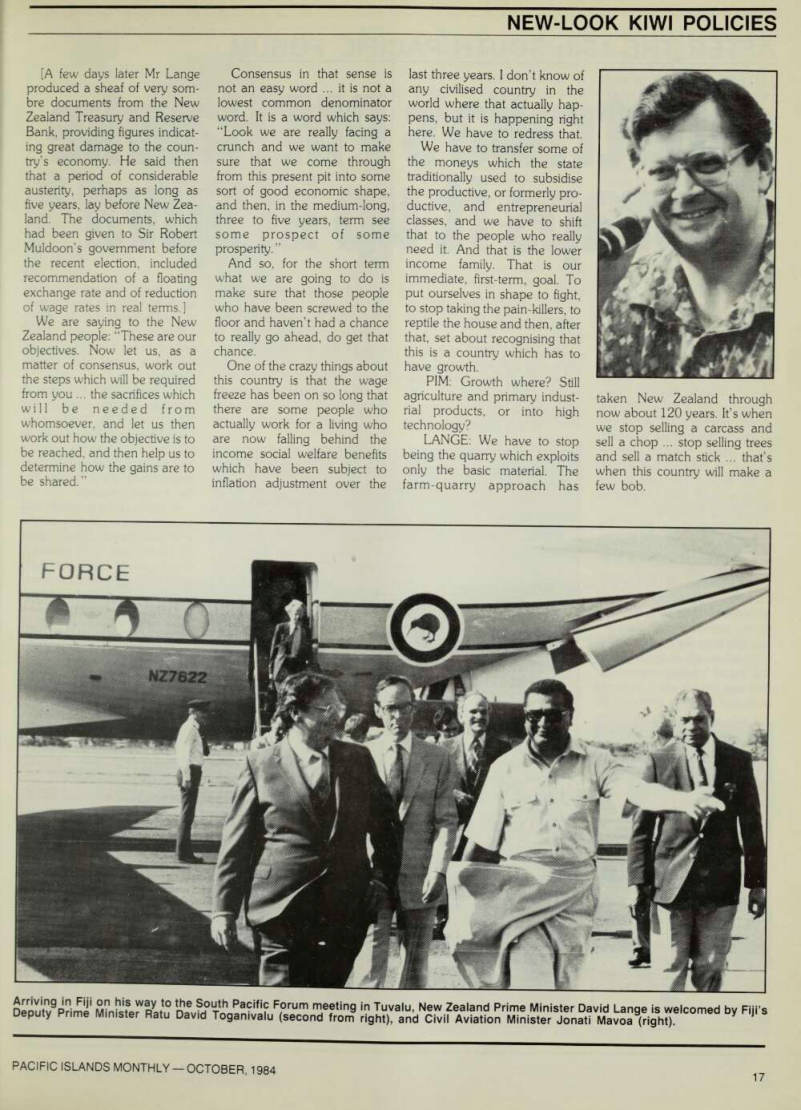
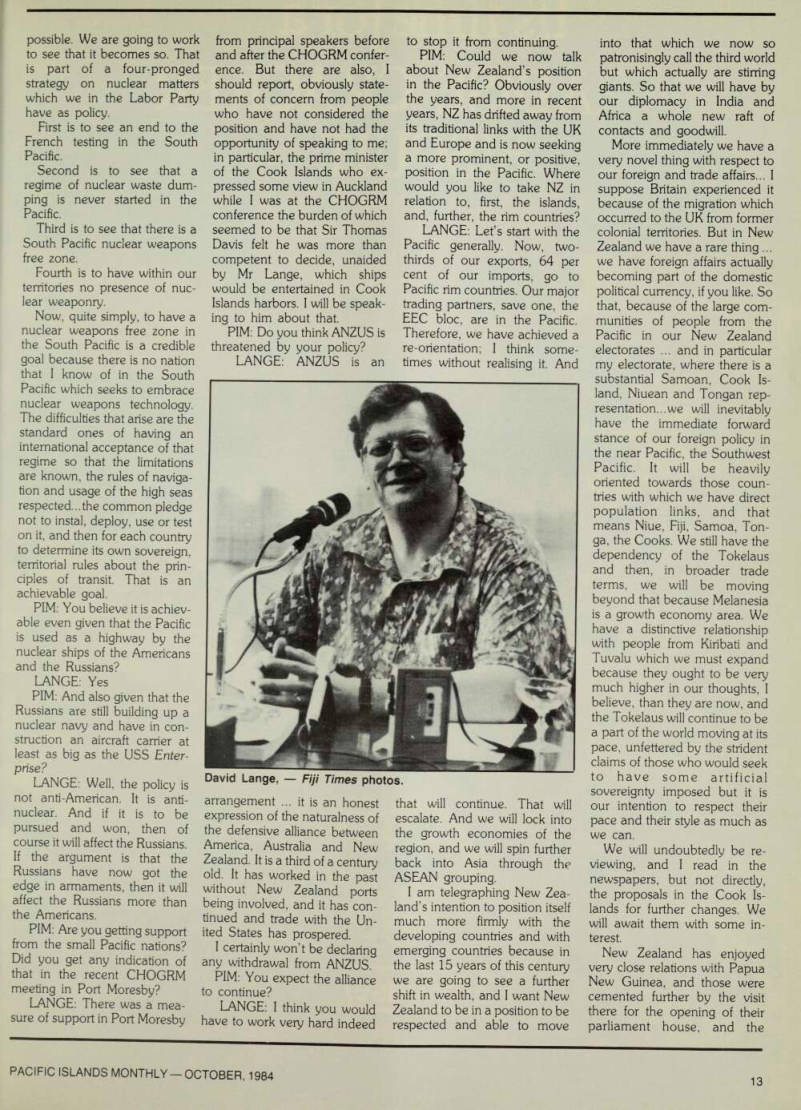
Arriving in Fiji on his way to the South Pacific Forum meeting in Tuvalu, New Zealand Prime Minister David La nge is welcomed by Fiji's Deputy Prime Minister Ratu David Toganivalu (second from right), and Civil Aviation Minister Jonati Mavoa (right).
Advertisements & other items, pp. 14-16 (1 item)
Paradise Cracker
BISCUIT
<• * \°^r •- • •f- -■ 0 £ % h 4 m
\Ra , adise/
mu a
PORT MORESBY
KH
WE’VE MADE IT OUR
BUSINESS TO BE WHERE
MOST BUSINESS IS DONE
i
RABAUL
PORT MORESBY
DARWIN
PERTH
ADELAIDE
I i
SUVA
J
AUCKLAND
ROTORUA
WELLINGTON
S? CHRISTCHURCH
I
QUEENSTOWN
No matter how comfortable a hotel is and how good its facilities are, it’s to no avail if that same hotel isn’t near where you want it to be.
At Travelodge our aim is to attract people in business, which, quite simply, is why you can find us in so many business centres.
Not surprisingly, more and more people, particularly with business to transact, are choosing to stay at Travelodge.
The one hotel group that offers excellent service and facilities at a realistic price. Plus the distinct advantage of being ideally located in or near the business centre of major metropolitan and provincial cities.
Since your hotel often has to serve as an office too, we provide you with first class business facilities.
Dictation and transcription, photocopying, telex, national and international courier services, business breakfasts and rooms for large or small meetings. There are also many other little extras.
Like a newspaper every morning and fresh fruit in your room on arrival. There’s also complimentary coffee in the lobby for you and your guests.
Another thing that won’t go unnoticed is the millions of dollars spent on the facilities today’s businessmen and women demand. Large, tastefully decorated rooms, excellent restaurants and intimate bars.
Stay at Travelodge. You’ll not only find us conveniently located, you’ll also find that a warm reception is just the beginning.
For reservations world-wide please phone Sydney (02) 267 2144. Melbourne (03)6906111.
Brisbane (07) 2218586.
Adelaide (08)
223 6288. Canberra (062) 491424. Perth (09) 3253811. Or your travel agent.
MN&C/TVL 4742
a
CLASS
Australia's PM Hawke
After The 15Th South Pacific Forum
Australia's PM Hawke wraps it up in Suva
Australia has given notice that it will sup port a new round of multilateral trade negotiations “only if it seriously and effectively addresses” the special concerns of the Pacific region. Trends towards trade protectionism, a product of the recent international economic recession, had to be reversed, said prime minister Robert Hawke, in the principal speech of his recent state visit to Fiji.
That, he said, was a matter of the utmost importance.
He proposed, in effect, the formation of a regional bloc in dealing with the world’s chief trading nations; “As a new round of multilate ral trade negotiations might be started before much longer, we in the region should be con sidering how we might register most effectively in the minds of the major trading nations the interests which we share as countries of the region,” he
said.
“Too often in the past our concerns have been pushed aside.
“We need to press for a more open and equitable internatio nal trading system in which the major trading countries will allow us less restricted access to their markets, particularly in the
area of agricultural commod ities.
“In this area, particularly, Australia, and New Zealand, as well as the smaller countries, have problems in the E.E.C. with the effects of protection ism, and over-production (which has led to dumping of food products in the Pacific and
the Pacific’s traditional mar kets), and also, to some extent in the United States. The U.S., however, has recently been helpful to Fiji in sales of sugar, despite a world glut of the product.
"I know that Fiji has a particular interest here in the sugar trade,” Mr Hawke said, “and I am sure that for you, as for us, the collapse of the International Sugar Agreement negotiations some weeks ago has caused concern.”
Australia had a particular role to play in contributing to the economic growth of the region, Mr Hawke said. “As a partner in development we can help stimulate economic growth, en hance trade prospects and en courage social development within the region “To this end we have given the region the highest priority in our overseas development assistance program. We are committed to providing $3OO million in aid to the South Pacific in the five year period to 1987/88. Individual country programs are being developed according to priorities set by respective national govern ments and administered with the greatest possible flexibility.”
Australia believed its future lay within the Asia/Pacific re gion. Mr Hawke said. “It is very much in the interests of all of us within the region that we con solidate the conditions of effec tive regional cooperation. The task of identifying regional solu tions to regional problems is among our most important re sponsibilities,” he said.
Mr Hawke said he felt the Forum meeting in Tuvalu had done much to improve under-
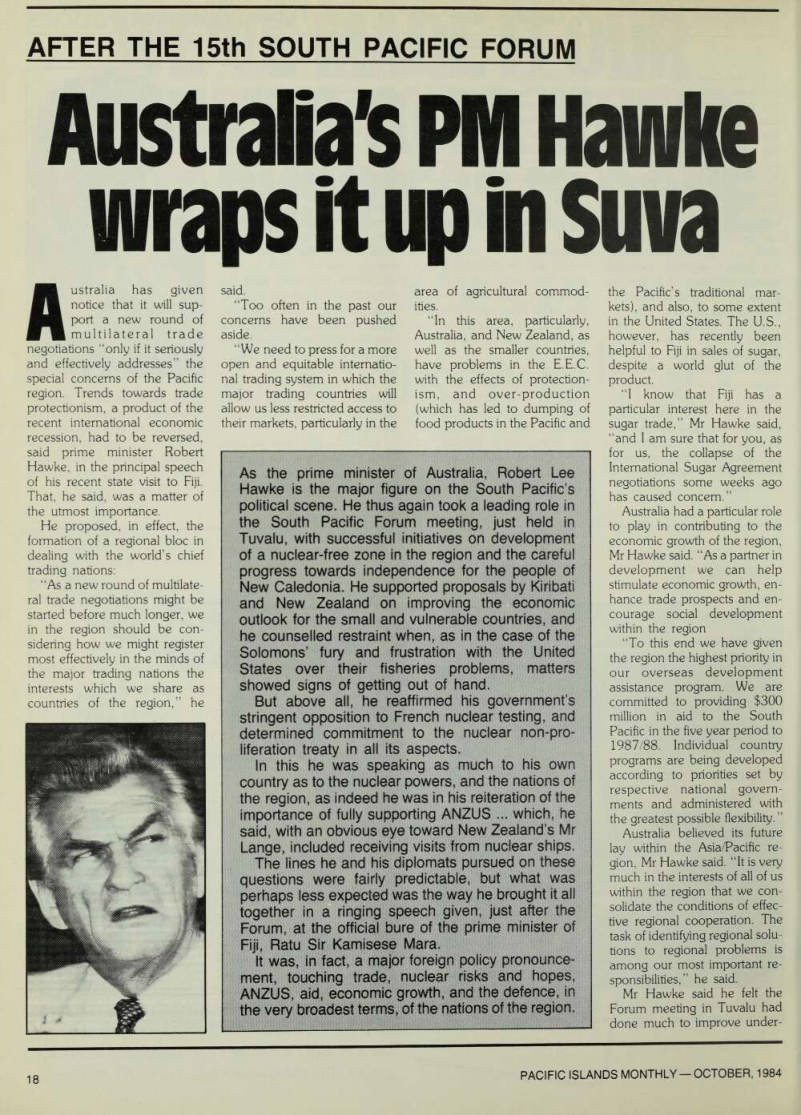
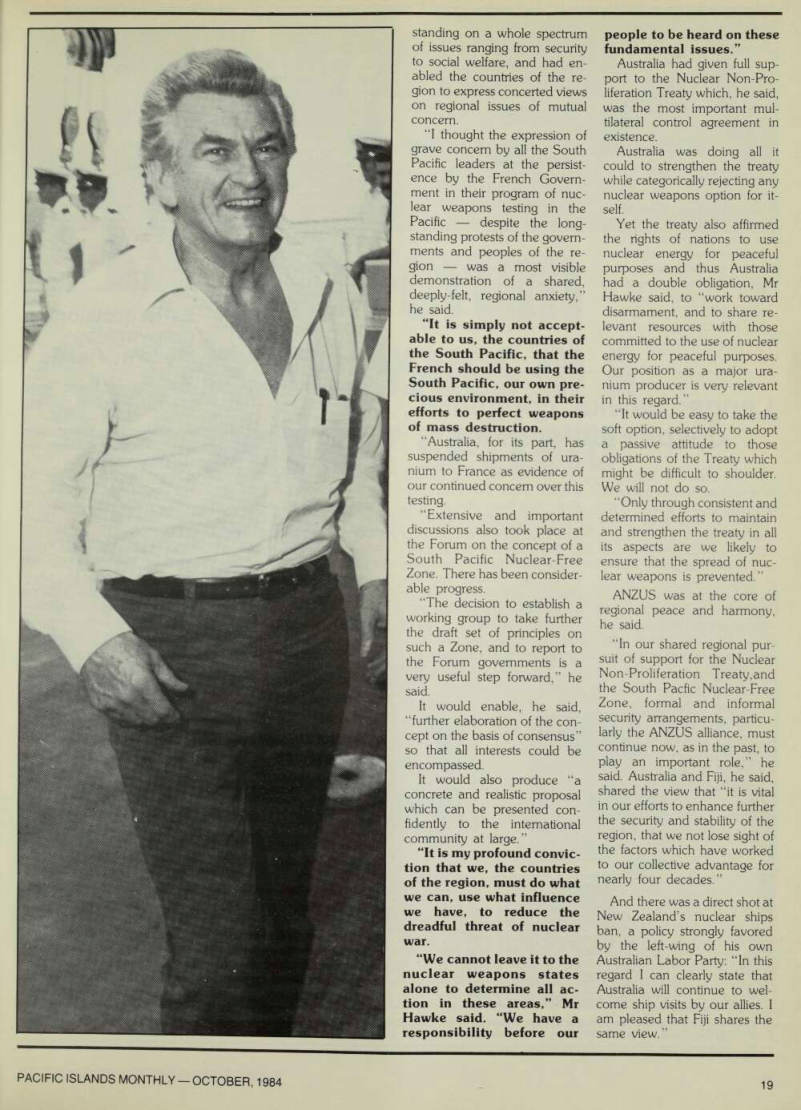
As the prime minister of Australia, Robert Lee Hawke is the major figure on the South Pacific’s political scene. He thus again took a leading role in the South Pacific Forum meeting, just held in Tuvalu, with successful initiatives on development of a nuclear-free zone in the region and the careful progress towards independence for the people of New Caledonia. He supported proposals by Kiribati and New Zealand on improving the economic outlook for the small and vulnerable countries, and he counselled restraint when, as in the case of the Solomons’ fury and frustration with the United States over their fisheries problems, matters showed signs of getting out of hand.
But above all, he reaffirmed his government’s stringent opposition to French nuclear testing, and determined commitment to the nuclear non-pro liferation treaty in all its aspects.
In this he was speaking as much to his own country as to the nuclear powers, and the nations of the region, as indeed he was in his reiteration of the importance of fully supporting ANZUS ... which, he said, with an obvious eye toward New Zealand’s Mr Lange, included receiving visits from nuclear ships.
The lines he and his diplomats pursued on these questions were fairly predictable, but what was perhaps less expected was the way he brought it all together in a ringing speech given, just after the Forum, at the official bure of the prime minister of Fiji, Ratu Sir Kamisese Mara.
It was, in fact, a major foreign policy pronounce ment, touching trade, nuclear risks and hopes, ANZUS, aid, economic growth, and the defence, in the very broadest terms, of the nations of the region.
standing on a whole spectrum of issues ranging from security to social welfare, and had en abled the countries of the re gion to express concerted views on regional issues of mutual concern.
“I thought the expression of grave concern by all the South Pacific leaders at the persist ence by the French Govern ment in their program of nuc lear weapons testing in the Pacific despite the long standing protests of the govern ments and peoples of the re gion was a most visible demonstration of a shared,
deeply-felt, regional anxiety,”
he said.
“It is simply not accept able to us, the countries of the South Pacific, that the French should be using the South Pacific, our own pre cious environment, in their efforts to perfect weapons of mass destruction.
“Australia, for its part, has suspended shipments of ura nium to France as evidence of our continued concern over this testing.
“Extensive and important discussions also took place at the Forum on the concept of a South Pacific Nuclear-Free Zone. There has been consider able progress.
“The decision to establish a working group to take further the draft set of principles on such a Zone, and to report to the Forum governments is a very useful step forward,” he said.
It would enable, he said, “further elaboration of the con cept on the basis of consensus” so that all interests could be encompassed.
It would also produce “a concrete and realistic proposal which can be presented con fidently to the international community at large.”
“It is my profound convic tion that we, the countries of the region, must do what we can, use what influence we have, to reduce the dreadful threat of nuclear war.
“We cannot leave it to the nuclear weapons states alone to determine all ac tion in these areas,” Mr Hawke said. “We have a responsibility before our
people to be heard on these fundamental issues.”
Australia had given full sup port to the Nuclear Non-Pro liferation Treaty which, he said, was the most important mul tilateral control agreement in existence.
Australia was doing all it could to strengthen the treaty while categorically rejecting any nuclear weapons option for it self.
Yet the treaty also affirmed the rights of nations to use nuclear energy for peaceful purposes and thus Australia had a double obligation, Mr Hawke said, to “work toward disarmament, and to share re levant resources with those committed to the use of nuclear energy for peaceful purposes.
Our position as a major ura nium producer is very relevant in this regard.”
“It would be easy to take the soft option, selectively to adopt a passive attitude to those obligations of the Treaty which might be difficult to shoulder.
We will not do so.
“Only through consistent and determined efforts to maintain and strengthen the treaty in all its aspects are we likely to ensure that the spread of nuc lear weapons is prevented.”
ANZUS was at the core of regional peace and harmony, he said.
“In our shared regional pur suit of support for the Nuclear Non-Proliferation Treaty,and the South Pacfic Nuclear-Free Zone, formal and informal security arrangements, particu larly the ANZUS alliance, must continue now, as in the past, to play an important role,” he said. Australia and Fiji, he said, shared the view that “it is vital in our efforts to enhance further the security and stability of the region, that we not lose sight of the factors which have worked to our collective advantage for nearly four decades.”
And there was a direct shot at New Zealand’s nuclear ships ban, a policy strongly favored by the left-wing of his own Australian Labor Party: “In this regard I can clearly state that Australia will continue to wel come ship visits by our allies. I am pleased that Fiji shares the same view.”
Although nuclear matters occupied a good deal of the Forum meeting’s time and anxieties, in fact the greatest concern of the small countries was economic, and Mr Hawke paid great attention to these questions in his speech.
“We are aware that some countries, including Fiji, are not happy with aspects of the operation of the SPARTECA Trade Agreement, especially in the rules of origin provisions and also with apparel,” he said.
“We have therefore established working groups aimed at resolving these difficulties, and will extend for a further year the ’seed’ quota for apparel. ”
He touched upon the imbalance of trade between Fiji and
Australia, caused in large part by Fiji’s imports of energy.
Australia shared the problem, he said, and at the same time, through tourism, contributed a great deal to Fiji’s invisibles account, . between Q anta f and Ar Pac,flc was ° ne tangible expression of how “operation could benefit both ““nines, he sa ‘ d “We are both part of a region which we wish to see continue as an area of peace, prosperity, and political stability. We have a partnership based on mutual respect and understanding, which can develop only to our mutual advantage, and that of our region.”
Lange: Hawke ‘congenial’,
despite differences
The New Zealand N-ships policy is not new. Indeed it is rather old-established Labor Party dogma on both sides of the Tasman Sea. That, in fact, is part of the rub on the tender and sometimes prickly hide of Mr Bob Hawke, the Australian leader, who sees in Lange’s cheerful adamancy, aid and comfort for the Australian leftwing which continues to worry
him on the eve of a general election. More than that, how ever, has been the growing realisation that the Lange line is supported in New Zealand by a far larger segment of the popu lation than those who wear cheesecloth dresses and eat organic foods. A large part of the New Zealand middle-class is in an isolationist, neutralist mood. People do seriously
propose that New Zealand could be turned into a South Seas Switzerland. It is partly the effect of what has become fashionable thinking, and partly a realisation of their own very serious economic problems, and the awesome effort that will be required to overcome them.
There is reason to believe that Mr Lange himself does not personally support the party policy banning nuclear ship visits which he considers him self bound to advance. He has sought understanding from both the Australians and the Americans. The ANZUS prob lem has not gone away and they are not letting him off the hook, but he appears to have won time.
At the South Pacific Forum meeting in Tuvalu in August New Zealand took a major part in supporting the Australian in itiative towards creation of a nuclear-free zone. Lange announced himself “very happy” with the outcome of meetings in which he had found Mr Hawke very congenial and understanding, he said.
Mr Hawke, for his part, re fused to offer the slightest critic ism of his trans-Tasman col league, although he sharply reiterated his own firm belief in the importance of ANZUS and the need to play host to the horses if one wished the protec tion of the cavalry.
Australia would shortly make new and far-reaching, decisions on the manner in which it would accept overseas students into its schools and universities, said prime minister Bob Hawke during a speech made at the opening of the Australian aid built Technology Buildings at the University of the South Pacific in Suva, Fiji.
Mr Hawke said that a “small minority” in Australia had ques tioned the continued access of students from Asia and the Pacific to Australian educational institutions but “my govern ment is determined that Austra lia should continue to respond to this regional demand”.
“This commitment will be maintained no matter which system that recommended by Professor Goldring in his study, that of the Jackson Com mittee, or any other approach may be chosen by the government,” he said.
Australia would also remain willing to continue to assist the U.S.P. in meeting its priorities in the fields of curriculum deve lopment, staffing and all the other needs of the 11 subscrib ing nations. In the five years up to June, 1988, Australia would have given U.S.P. a total of $lB million and in 1983/84 pro vided $2.62 million for staffing, academic and program deve lopment, campus upgrading and capital works. The new technology buildings were an aspect of that commitment, he said.
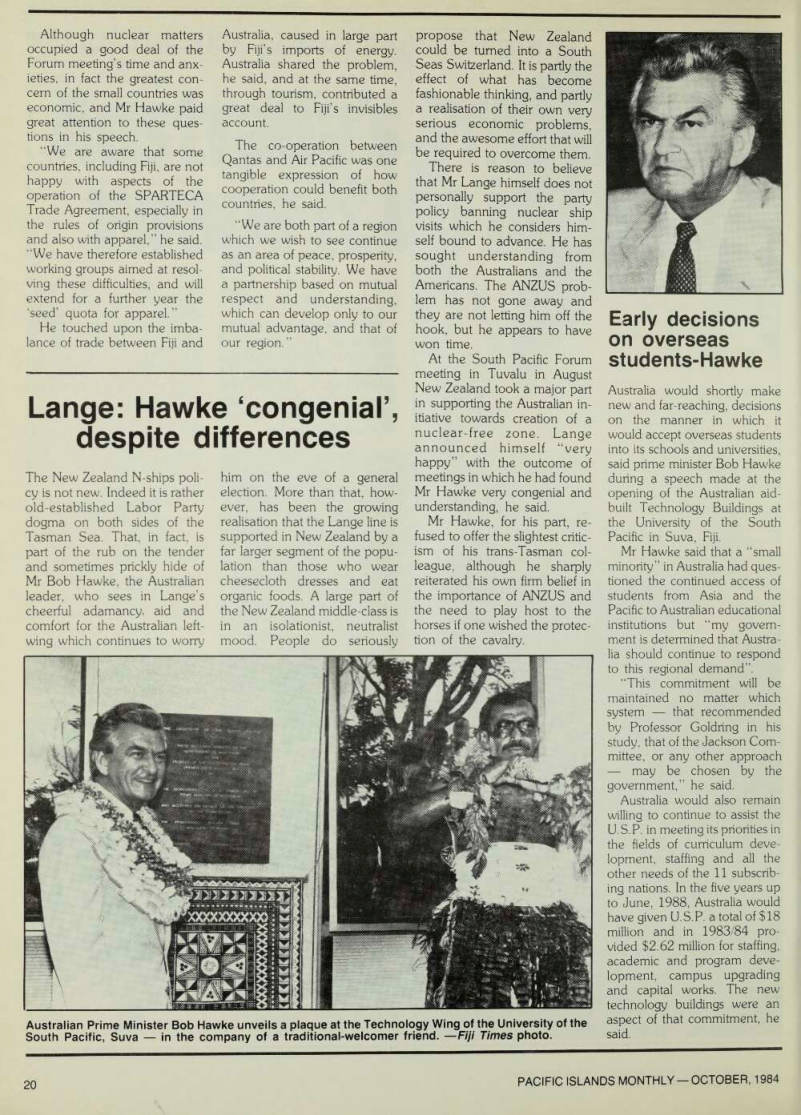
Australian Prime Minister Bob Hawke unveils a plaque at the Technology Wing of the University of the South Pacific, Suva —in the company of a traditional-welcomer friend. —Fiji Times photo.
Early decisions on overseas students-Hawke
The Forum
Heavy issues in a simpler setting
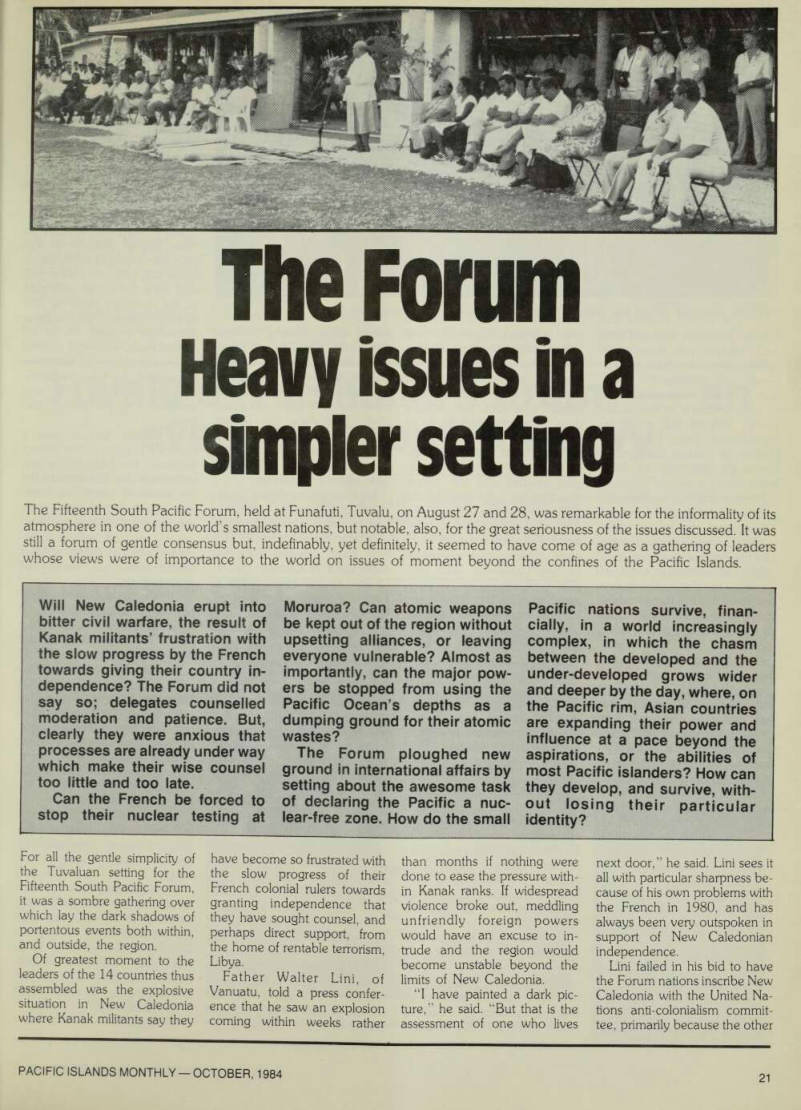
The Fifteenth South Pacific Forum, held at Funafuti, Tuvalu, on August 27 and 28, was remarkable for the informality of its atmosphere in one of the world’s smallest nations, but notable, also, for the great seriousness of the issues discussed. It was still a forum of gentle consensus but, indefinably, yet definitely, it seemed to have come of age as a gathering of leaders whose views were of importance to the world on issues of moment beyond the confines of the Pacific Islands.
Will New Caledonia erupt into bitter civil warfare, the result of Kanak militants’ frustration with the slow progress by the French towards giving their country independence? The Forum did not say so; delegates counselled moderation and patience. But, clearly they were anxious that processes are already underway which make their wise counsel too little and too late.
Can the French be forced to stop their nuclear testing at
Moruroa? Can atomic weapons be kept out of the region without upsetting alliances, or leaving everyone vulnerable? Almost as importantly, can the major pow ers be stopped from using the Pacific Ocean’s depths as a dumping ground for their atomic wastes?
The Forum ploughed new ground in international affairs by setting about the awesome task of declaring the Pacific a nuc lear-free zone. How do the small
Pacific nations survive, finan cially, in a world increasingly complex, in which the chasm between the developed and the under-developed grows wider and deeper by the day, where, on the Pacific rim, Asian countries are expanding their power and influence at a pace beyond the aspirations, or the abilities of most Pacific islanders? How can they develop, and survive, with out losing their particular
identity?
For all the gentle simplicity of the Tuvaluan setting for the Fifteenth South Pacific Forum, it was a sombre gathering over which lay the dark shadows of portentous events both within, and outside, the region.
Of greatest moment to the leaders of the 14 countries thus assembled was the explosive situation in New Caledonia where Kanak militants say they
have become so frustrated with the slow progress of their French colonial rulers towards granting independence that they have sought counsel, and perhaps direct support, from the home of rentable terrorism, Libya.
Father Walter Lini, of Vanuatu, told a press confer ence that he saw an explosion coming within weeks rather
than months if nothing were done to ease the pressure with in Kanak ranks. If widespread violence broke out, meddling unfriendly foreign powers would have an excuse to in trude and the region would become unstable beyond the limits of New Caledonia.
“I have painted a dark pic ture,” he said. “But that is the assessment of one who lives
next door,” he said. Lini sees it all with particular sharpness be cause of his own problems with the French in 1980, and has always been very outspoken in support of New Caledonian independence.
Lini failed in his bid to have the Forum nations inscribe New Caledonia with the United Na tions anti-colonialism commit tee, primarily because the other
Forum members believed any such initiative was doomed to failure and, in that failure, would only damage the situa tion. Vanuatu reserved its right to take unilateral action at the United Nations but, privately, recognised they had little chance of beating the French diplomatic machine in New York.
In the end the consensus, (which is the basis of Forum actions and the secret of its success), was that the French and the Kanaks should be kept talking at as many levels as possible so that polarisation, and therefore the feared explo sion into open civil war, could be staved off long enough for a solution to be found. But, Forum members agreed, fin ding an answer suitable to everyone would not be easy.
The rights of non-Kanak citi zens had to be protected, too.
So the Forum told France very clearly that it should get cracking, should bring the act of self-determination forward from 1989, the present Paris propo sal, and make a public state ment that independence for New Caledonia “is the desir able, logical and acknowledged outcome” of that act.
To further keep the ball roll ing the Forum set up a commit tee of five ministers from New Zealand, Papua New Guinea, Fiji, Western Samoa and Vanuatu, to meet with both the French and the various groups in New Caledonia.
Two observers from the Kanak Independence Front attended the forum meeting,
chief of them being the bearded Yann Uregei who was among those who went to Libya in August seeking money and support from Colonel Gaddafi.
Some, it is said, also sought guns, of which Libya seems to have plenty.
Uregei spent most of his time in Tuvalu swimming and loun ging around and left deeply disappointed with most of the delegations and in particular the Australians who had most influ ence in shaping the quite mod erate communique references to New Caledonia. With tem pers now fraying in Noumea, and Kanak leaders being asked to show some results Uregei will clearly continue his efforts to get support wherever he can.
By most counts the Forum could not responsibly have done more than it did, but it was far less than the angry Kanaks wanted and, to that extent, the situation is seen as continuing very fragile. • • • Bob Hawke’s triumph at the Forum was the launching of a program designed to establish a nuclear-free zone in the Pacific.
To this was added, as a product of an excellent paper from Nauru, a proposal to amend the London Dumping Convention on nuclear waste and prohibit totally dumping in the region.
Particular reference was made by Nauru to the intentions of Japan.
The objective of a nuclear free zone was complicated by alliances, notably ANZUS, which need to have nuclear
armed ships moving through the Pacific. New Zealand’s ban on nuclear ships has caused political discomfort to Australia and is seen as threatening the existence of ANZUS, but it was taken calmly by the Forum which, with the exception of Vanuatu, seemed to side with Australia in wishing an ANZUS type alliance to survive.
Mr Hawke was closely ques tioned by the press on precisely how he saw a nuclear-free zone in which, like the sultanas in a fruit cake, nuclear weapons were stuck at strategic places.
“Some of the states made it clear they wanted to ban all involvement with nuclear weapons or anything to do with the nuclear fuel cycle,” Mr Hawke said, referring, one felt, to New Zealand and Vanuatu.
“But the majority agreed that any zone concept could only be acceptable and operative if it left individual countries free to make their own decisions about visits of nuclear armed and nuclear powered ships. That right was intrinsic to the propo sal I put to the Forum in Canberra last year, and has been accepted,” he said.
How nuclear-free is a zone in which nuclear ships traverse freely? “Well over 100 U.S. nuclear ships have travelled very many millions of miles, have been into about 150 ports in 50 countries without accident or seepage of nuclear material, ”
Mr Hawke said. “That does not diminish the concept that we, as nations, will not acquire nuclear weapons, or manufacture them, or allow them to be
stored on our land, and we are opposed to the testing of weapons in the region, and to the dumping of nuclear waste. ”
The Forum’s aim is to have a draft treaty ready for considera tion at the Forum meeting in Rarotonga next year and a working group of officials, chaired by Australia, and in cluding all members of the Forum, was appointed to set about preparing such a docu ment.
Since everyone appears to have agreed already on the principle of individual choice so far as ship visits are concerned, and since the broad principles of the zone are more or less already agreed, the drafting committee is likely to be in volved more with legal niceties than with policy or principle.
Presumably the Forum will pro duce a treaty in 1985 and forward it to the United Na tions.
Mr Hawke said he saw a need for urgency in the project because “the international en vironment has deteriorated the stand-off which has deve loped between the super-pow ers and the traditional for mov ing towards reduction in arma ments, and particularly nuclear armaments, has somewhat broken down.”
The Forum discussed the re port of the scientific mission of Australian, New Zealand and Papua New Guinea scientists which went to Moruroa. “While the extent of environmental concern may not need to be as large as had been thought, nevertheless the report could not allow any complacency and in no way diminishes the opposition of all Forum mem bers to the continuation of nuclear testing by France,” Mr Hawke said.
The Forum also agreed to tell the Japanese as firmly as pos sible of Forum opposition to nuclear waste dumping in the Pacific.
The Federated States of Mic ronesia, which attends Forum meetings as an observer, said the proposal fitted completely with their Compact of Free Association with the United States, and they expected to join in adopting the treaty when it was drawn up.
While not even the optimistic
Dancers swarmed before the leaders for traditional gift-giving ceremonies.
Mr Lange felt that a Forum treaty setting up a nuclear-free zone would stop the French in their testing tracks, or persuade the Russians to stay in Vladivos tok, the delegates felt their action would add weight to the review in 1985 of the nuclear non-proliferation treaty. It might persuade the nuclear powers to limit their weapons stock. It might persuade Pacific rim nations to join in eschewing nuclear capacity.
It would not, however, Mr Hawke said, weaken ANZUS to which both Australia and New Zealand had stated their firm commitment.
Led by Kiribati, strongly sup ported by New Zealand, the Forum mulled over the con
tinuing, vexed, problem of hel ping the small Pacific countries find solutions to their in creasingly difficult economic problems. It might be, Mr Lange told reporters, that by the standards of developed countries some Pacific nations were not, and might never be, truly viable. But that did not mean effort should not be put towards alleviating their situa tion.
In some cases the problem was not to achieve economic viability, but to provide the very barest essentials of transport, trade, communications, food and water supply.
SPARTECA, the regional agreement under which island countries gain duty-free access
for a wide range of products to Australia and New Zealand, came under review and some criticism, particularly from the small countries which had been unable to take advantage of it.
While total trade under the agreement had increased in the last three years, the rises were almost totally from the bigger Pacific countries, like Fiji and PNG. Exports from the smaller countries had, in some cases, decreased.
A committee of officials from the Cook Islands, Fiji, Kiribati, Nauru, New Zealand, Niue, Tuvalu and Western Samoa was set up to study the prob lems and recommend solutions to the Sixteenth Forum.
Most Pacific countries suffer
from a shortage of raw materials, expensive energy, a lack of trained personnel, small domestic markets, and long and expensive distances between themselves and potential export customers. Yet some experts believe much more could be done to find island products which could sell profitably all over the world. For example, Western Samoa is reported to be looking at the Hawaiian vegetable market and has had some discussions with air freight companies about such trade.
Other suggestions include development of regional trade through relaxation of present tariff barriers. Handicrafts are a particular sore point Garry Barker.
Tuvalu’s ‘Pushbike Forum’ - an event

event of happy memory
Former RIM Editor STUART INDER describes the atmosphere of the South Pacific Forum meeting, and makes some comparisons with others he has attended over the years.
In Canberra last year it was the Spooks Forum. In Funafuti, Tuvalu, in August it was the Pushbike Forum, and much the better for that.
Since the first one in Welling ton in 1971, South Pacific Forums have all had their own flavor, but there is now no doubt at all that the less agree able have been those held in the cities of what used to be called the metropolitan powers, dogged by formality, and with security police beating the bushes, manning the hotel lifts, and riding convoys of fast moving limousines timed to ar rive and depart precisely.
There was nothing of the Pacific Islands in last year’s Canberra Forum, or the Rotor ua Forum the year before. Or the Canberra Forum in 1972.
It is a relief to know that the “metropolitan run” is over for another stretch of years, and that with the Funafuti Forum we have returned to the islands.
It will be Rarotonga’s turn next year, and Cook Islands Prime Minister Sir Thomas Davis left Funafuti with a fistful of ideas for making “his” meet ing as memorable as Dr Tomasi Puapua’s was.
Looked at from any point of view, Funafuti was a notable
success. The meeting itself went smoothly, and the content of the talks was of significance.
The locale on a mid-Pacific atoll was a constant yet gentle reminder that much of the Pacific community has little more in resources than coconut palms, an expanse of ocean, and an independent spirit.
The physical arrangements reflected true island hospitality, grafted to an Australian and New Zealand support package designed to relieve Tuvalu’s natural dearth of accommoda tion, transport and food for such a large number of visitors.
The RNZAF organised air
Tuvalu Prime Minister Dr Tomasi Puapua ... as conference host and chairman, presided over a relaxed, smoothly-run conference.
traffic control as Hercules, Andovers and 748’s shuttled between Fiji and Funafuti’s 5000 m coral and grass airstrip which takes up most of the main island. The RNZN survey ship HMNZS Monowai and RAN assault landing craft HMAS Tobruk , anchored in the lagoon, provided accommoda tion and logistical support, NZ Army caterers provided food for VIPs, Australia brought a small fleet of cars and mini buses and built three houses, other aid came in the form of communications and hotel im provements, hospital support, food airlifts, and cash.
The bicycles, 30 of them, were a practical gift from New Zealand, brought aboard the Monowai and distributed among the big media corps in the first instance, but remaining behind for Public Works De
partment use. On Funafuti’s flat, dirt, palm-fringed roads, they got the press around in great style, despite the lack of lamps which made night pedal ling a danger to life and limb, and, since it is illegal to ride without a light at night, a special trial to Tuvalu’s good-natured if long-suffering police.
It is doubtful if any of the bicycles issued got returned to the PWD by the people they were issued to, because bike napping became a fact of life on Funafuti that week,with the boys from Tobruk suspected as being among the more en thusiastic “nappers” for late night dashes back to the ship after drinking or “twisting” ses sions (as the local dances are called).
NZ Prime Minister David Lange was seen early one mor ning pedalling along the airstrip
road at a fairly snappy rate, although there is no PWD record that he was actually issued with one of his own gifts.
Those pushbikes set the style for the Forum. The white Australian Fairlanes merely managed to look out of place on an atoll designed for walking, for before the Forum, Funafuti s total vehicular population was Forum pace was never in the fast lane. It was pedestrian, relaxed, friendly, with time to meet and talk, even time to fish (PNG Prime Minister Somare and a member of his delegation, John Kaputin, MP, reported some good catches in the lagoon off their quarters). 3 M 7 Two island feasts on successive nights at the Seimeana maneapa, with magnificent traditional dancing, were the
culmination of weeks of work and planning by the Tuvalu community, All 'p uva j u h ac i to wor k f or months to make the visitors feel welcome, with Government Secretary lonatana (John) lonatana appearing to be everywhere at once during Forum week as he juggled with thousands of details; and Depu ty Prime Minister Henry Naisali beaming goodwill and enthu siasm as lieutenant to Forum chairman and host, Prime Minister Puapua, as they both worked to make the conference itself run as smoothly as the SPEC staff under director Mahe Tupouniua had planned.
Tlll i. > c luvalus Forum was a memorable example of what that first, small, group of inde pendent leaders were aiming for back in 1971.
Advertisements & other items, pp. 23-24 (1 item)
Stay at Aggie Grey’s . . .
the South Pacific’s
legendary hotel.
Situated right in the heart of Western Samoa. Enjoy Poly nesian-style friendliness and service, in cool surroundings, superb entertainment and food.
Magnificent white sand beaches only a short drive away. Airconditioned rooms, swimming pool and full bar facilities.
Bookings through Union Steamship Company of NZ, Pan Am, Air New Zealand or direct to Aggie Grey’s, Apia, Western Sarnia.Cables: ‘AGGIES’ Apia.
From fast food outlet
to factory production line
Australian fooo processing equipment
makes you proxit
\ zj ON m • •
OFF
6 % 4 o % x> Australia is one of the world's largest food-producing countries. So it is logical that Australian engineers have developed a wide range of advanced equipment for the food-processing industry. Equipment of almost any type, concept and application. Fora multitude of functions such as cooking, baking, heating, boiling, refrigerating, mechanical handling, bottling, canning, packaging. Forthe processing of a variety of foods such as dairy products, meat, cereals, edible oils, confectionery and beverages.
Australian food-processing equipment has proved efficient, reliaole and competitive in many countries throughout the world.
Find out how Australia can satisfy your particular requirements.
Ask the expert who knows Australia.
For detailsof suppliers phone or telex the Australian Trade Commissioner at: FIJI, P.O. Box 1252, Suva Phone: 31 2844 Telex: FJ2126
PAPUA NEWGUINEA
P.O. Box 9129, Hohola Phone: 25 9333 Telex: NE22109
NEW CALEDONIA
P.O. Box 22, Noumea Phone: 27 2414 Telex: 087 HAWAII, Australian Consulate 1000 Bishop Street, Hawaii, 96813, USA Phone: (808) 524 5050 Telex: 633128 Ask the Australian Trade Commissioner
curate’s egg
L.A. Olympics a curate’s egg
Olympic fever has not exactly gripped the Pacific Islands in the wake of their perform ances in the Los Angeles Games and in at least two countries .. Fiji and PNG ... public questions have been asked about the value of the expenditure involved in sen ding teams to such events.
Nobody won any gold me dals, nor were expected to. lamo Launa, of PNG, threw the javelin 46.5 m to come second in that section of the heptathlon and record the best perform ance of any Pacific Islanders at Los Angeles. Swimmers War ren Sorby and Samu Tupou, of Fiji, broke national records, and the Suva yachties did well by their standards. Young Tony Philp, only 14 years old, was one of the youngest of all the competitors, and managed well on the unfamiliar, and less than popular, wind-glider. ’lt’s an irony of the Games,” said Fiji sailor, David Ashby, ’’that they chose the unpopular wind-glider, which is now out of production, because the Rus
sians were so insistent on it, and then the Russians didn’t come. ” ’’Young Tony did the best of all of us. Tony Philp, senior, and Bruce Hewitt, in the Torna do catamaran, finished second to last in a field of 14, re-sailing the battle of Anzac, as they put it, because the only team they beat was the Turks. I came third to last in the Finn class.”
Brian Wightman, manager of the Fiji team, defended the decision to send his country’s biggest ever team to the L.A. games on two grounds, the experience, and the exposure. ”We dressed our flag-carrier in traditional Fijian warrior cos tume and got 30 seconds of prime time television in front of two billion people. That alone was worth half a million dollars to our tourist industry.”
Ashby also thinks the exer cise will benefit Fiji directly as Australian and New Zealand yachtsmen are attracted to wards projected ocean sailing races in the archipelago. ”1 have donated my Finn yacht to the Sea Scouts in Fiji, and we
will find international money to push sailing training here, so it’s all good for the future,” he told
Pim.
"My problem was that I was not big enough or heavy enough. You need to be six feet and over 200 lb in a Finn. You are strapped in by your ankles and you lean over the side for two hours at a time. It’s known as the masochist s class, But if we could train a big Fijian boy to the standard required, we’d probably have something in the future,” Ashby said.
It was the first time since the Melbourne games of 1956 that Fiji had sent a yachting team to
an Olympic Games and ”it was very good for the sport. We have since had a lot of interest in holding three classes of oceanic races in Fiji waters, and it could turn into quite some thing for us”, ’’We’ve also discovered that there is all sorts of money available around the world for supporting and promoting Olympic competitors. I was sent to a training program in Ontario and I have brought back a great deal of knowledge. That’s going to be my best contribution ... towards the future,” Ashby said.
Advertisements & other items, p. 25 (1 item)
Sports Uniforms
AUSTRALIAN MADE
FOOTBALL - AUSSIE RULES - SOCCER
HOCKEY - SOFTBALL - BASEBALL - BOWLS WEAR
CRICKET WEAR - NETBALL
ALSO SPORTING EQUIPMENT FOR THE
ABOVE SPORTS AVAILABLE
Enquiries welcome from clubs or sporting organisations I Write for further information to
CHAELA MAIL ORDERS
P-O. BOX 83, WELLINGTON, 2820 N.S.W., AUSTRALIA -
the month
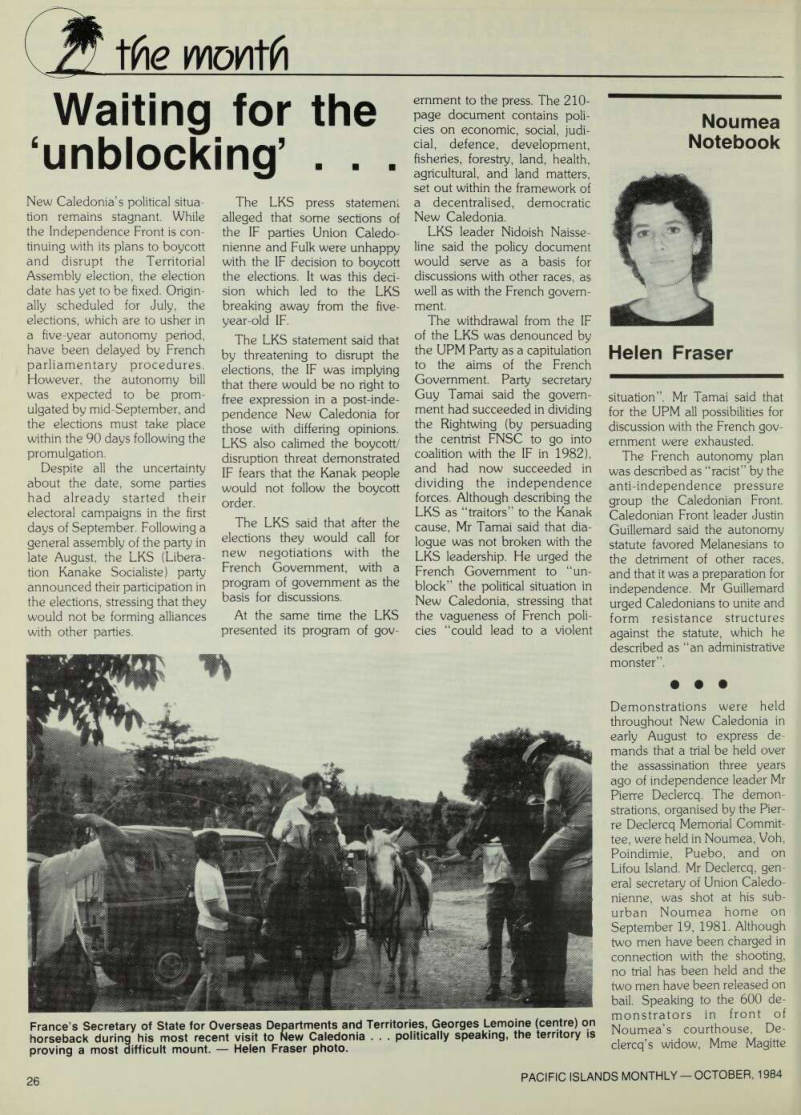

Waiting for the ‘unblocking’ . . .
New Caledonia’s political situa tion remains stagnant. While the Independence Front is con tinuing with its plans to boycott and disrupt the Territorial Assembly election, the election date has yet to be fixed. Origin ally scheduled for July, the elections, which are to usher in a five-year autonomy period, have been delayed by French parliamentary procedures.
However, the autonomy bill was expected to be prom ulgated by mid-September, and the elections must take place within the 90 days following the promulgation.
Despite all the uncertainty about the date, some parties had already started their electoral campaigns in the first days of September. Following a general assembly of the party in late August, the LKS (Libera tion Kanake Socialiste) party announced their participation in the elections, stressing that they would not be forming alliances with other parties.
The LKS press statement alleged that some sections of the IF parties Union Caledo nienne and Fulk were unhappy with the IF decision to boycott the elections. It was this deci sion which led to the LKS breaking away from the five year-old IF.
The LKS statement said that by threatening to disrupt the elections, the IF was implying that there would be no right to free expression in a post-inde pendence New Caledonia for those with differing opinions.
LKS also calimed the boycott/ disruption threat demonstrated IF fears that the Kanak people would not follow the boycott order.
The LKS said that after the elections they would call for new negotiations with the French Government, with a program of government as the basis for discussions.
At the same time the LKS presented its program of gov
ernment to the press. The 210page document contains poli cies on economic, social, judi cial, defence, development, fisheries, forestry, land, health, agricultural, and land matters, set out within the framework of a decentralised, democratic New Caledonia.
LKS leader Nidoish Naisse line said the policy document would serve as a basis for discussions with other races, as well as with the French govern ment.
The withdrawal from the IF of the LKS was denounced by the UPM Party as a capitulation to the aims of the French Government. Party secretary Guy Tamai said the govern ment had succeeded in dividing the Rightwing (by persuading the centrist FNSC to go into coalition with the IF in 1982), and had now succeeded in dividing the independence forces. Although describing the LKS as “traitors” to the Kanak cause, Mr Tamai said that dia logue was not broken with the LKS leadership. He urged the French Government to “un block” the political situation in New Caledonia, stressing that the vagueness of French poli cies “could lead to a violent
situation”. Mr Tamai said that for the UPM all possibilities for discussion with the French gov ernment were exhausted.
The French autonomy plan was described as “racist” by the anti-independence pressure group the Caledonian Front.
Caledonian Front leader Justin Guillemard said the autonomy statute favored Melanesians to the detriment of other races, and that it was a preparation for independence. Mr Guillemard urged Caledonians to unite and form resistance structures against the statute, which he described as “an administrative monster”. • • • Demonstrations were held throughout New Caledonia in early August to express de mands that a trial be held over the assassination three years ago of independence leader Mr Pierre Declercq. The demon strations, organised by the Pier re Declercq Memorial Commit tee, were held in Noumea, Voh, Poindimie, Puebo, and on Lifou Island. Mr Declercq, gen eral secretary of Union Caledo nienne, was shot at his sub urban Noumea home on September 19, 1981. Although two men have been charged in connection with the shooting, no trial has been held and the two men have been released on bail. Speaking to the 600 de monstrators in front of Noumea’s courthouse, De clercq’s widow, Mme Magitte
France’s Secretary of State for Overseas Departments and Territories, Georges Lemoine (centre) on horseback during his most recent visit to New Caledonia . . . politically speaking, the territory is proving a most difficult mount. - Helen Fraser photo.
Noumea Notebook
Helen Fraser
Declercq. accused the prosecu tion and the gendarmes of causing excessive delays and deliberately obstructing the in quiry into her husband’s death.
Mme Declercq said the French administration was afraid politi cal problems would result from the trial.
Pro-independence groups also denounced delays in the judicial process concerning the shooting of two French gen darmes in January last year.
The IF, the LKS and the Kanak and Exploited Workers’ Union (STKE) issued statements de nouncing the continued deten tion of four men from the Koinde tribe, 130 km north of Noumea. On January 10, 1983, the two gendarmes were killed and four others wounded during an operation mounted by the gendarmes to recover the equipment of a sawmill owner involved in a dispute with the villagers. Eighteen peo ple from Koinde were arrested following the incident, and four are still in prison.
A group from the Kanak and Exploited Women’s Organisa tion, GFKL, picketed in front of
the French High Commission to publicise the issue. • • • The IF party FULK held its central committee meeting after the South Pacific Forum at the end of August. FULK leader Yann Uregei said the IF was to meet at a special congress on September 22-24 to discuss the constitution, charter, and poli cies of the National Kanak Socialist Liberation Front
(Fnlks).
Mr Uregei, who attended the South Pacific Forum as an observer, said that despite the decision not to call for New Caledonia’s listing with the UN Decolonisation Committee the Forum was positive for the IF each country/ is now free to take up the matter individually with the UN; the Forum called for the referendum date to be brought forward from 1989; the Forum had called on France to make a clear declaration in favor of independence, and a five member committee of the Forum is to come to New Caledonia for talks with France
and with the IF.
Helen
Fraser.
Advertisements & other items, pp. 27-28 (1 item)
Kenwood
Here’s one way to improve the quality of your life. Listen just once to some familiar music from a Spectrum stereo system.
You’ll hear rich, dynamic and like you’ve never heard at home before!
Spectrum systems also offer a whole array of helpful functions—electronic and
computerized. Plus plenty of fingertip-ready
operating convenience.
Spectrum stereo component systems.
Engineered -lor you by world-leading f
audio specialists.
mm
“pure” music
m Top Features of Spectrum 72 Shown ■29 OW Dynamic Power Output (4 ohms) ■Advanced parametric tone controls ■Computer-guided tuning and 10-station random memory (Double cassette deck with doublespeed dubbing (Computerized tape music search/ repeat system ri m
Spectrum
11199 E jseries
KENWOOD
TRIO-KENWOOD CORPORATION
Shionogi Shibuya Building, 17-5, 2-chome Shibuya, Shibuya-ku, Tokyo 150, Japan TRIO-KENWOOD (AUSTRALIA) PTY. LTD, (INCORPORATED IN NSW) 4E Woodcock Place, Lane Cove, N.S.W. 2066, Australia. Tel: 428-1455 NEW ZEALAND JOHN GILBERT & CO., LTD. Auckland Tel. 0011-64-9-30839 FIJI PEPE’S DUTY FREE CENTRE LTD. Tel. 25496, 25497 PAPUA NEW GUINEA S.O. SVENSSON (N.G.) LTD. Port Moresby Tel. 212158, 212111 SOLOMON ISLANDS TECHNIQUE RADIOS CENTRE LTD. Honiara Tel 416 NEW CALEDONIA HI-FI VOX Noumea Tel. 27-2466, 28-2931 VANUATU FUNG CHOI LUEN. Port-Vila Tel. 2556
TAHITI MAISON AURORE Papeete Tel. 29703
AMERICAN SAMOA ISLAND PACIFIC AGENCIES, INC Pago Pago Tel. 633-4687
REPUBLIC OF NAURU NAURU CO-OPERATIVE SOCIETY
MARIANA ISLANDS J.C. TENORIO ENTERPRISES Saipan Tel. 6445
EQUAL OPPORTUNITY FOR ALL
UNDER THE NEW ZEALAND RACE RELATIONS ACT 1971 IT IS ILLEGAL TO DISCRIMINATE IN NEW
ZEALAND BECAUSE OF
RACE, COLOR, OR ETHNIC OR NATIONAL ORIGIN IN
EMPLOYMENT, ACCOMMODATION, LENDING
OF MONEY, ACCESS TO PUBLIC PLACES,
EDUCATION, SUPPLY OF GOODS AND
SERVICES.
AND IN THE ADVERTISING OF THESE.
There are some additions and exceptions to these basic rules.
For further advice on your RIGHTS and OBLIGATIONS contact Race Relations Office, Ist Floor, Norman Doo Arcade, 295 Karangahape Rd, P.O. Box 68-504, AUCKLAND. Tel.
(09) 771-1295, 774-060 NEW ZEALAND
DISTRIBUTORS WANTED
FOR ALL PACIFIC AREAS
for
ALUMINIUM BOATS
FLAT BOTTOM B’-30’
TENDERS AND RUNABOUTS B’-16’
Some available in kit form.
If interested please write to us with details of your business etc.
QUELO HOLDINGS PTY. LTD.
12 Wattle St., Pyrmont NSW 2009 Australia
IS YOUR DRINKING WATER CONTAMINATED?
Examples: Chlorine
THM’s
Toxic Waste
DDT
Too Salty Insecticide Lead Fluoride
PCB’s
Iron Dioxins Sodium Chloride Hardness Resin Organic waste Sediment Arsenic Super Phosphate Copper Bacteria Hydrocarbons Agricultural Spray River Water Calcium Chloride Asbestos from Pipes Industrial waste Tree Leaves Animal Droppings
THEN YOU NEED DISTIL-CLEAR
Did you know that at municipal water treatment depots all over Australia chemical additives such as fluoride and chlorine are added to your drinking water? Under certain conditions Chlorine combines and produces deadly THM’s and PCB’s well documented cancer causing agents.
Is your well water safe? Have deadly agricultural sprays contaminated the aquifiers? What about bacteria from sewage systems reaching your drinking water? Or is your drinking water drawn from a river and it’s just plain dirty? Is your bore water hard and will not lather? Are you getting lime scale build up and Iron stains in your electric jug? Does your coffee have a peculiar odour? Do your ice cubes taste odd?
All these contaminates are removed with Distil-Clear. Distil-Clear, the water purifier that will remove all the contaminates above and produce pure, clean, healthy, drinking water.
Distil-Clear will provide enough drinking water per day from any source of water for a typical Australian family for only cents per day. Distil-Clear is portable, take one in your caravan to ensure safe water anywhere.
If you would like to know more about the benefits of Distil-Clear, phone or write for our consumer pack today.
Distil-Clear Pure Water System, P.O. Box 3, Lemon Tree Passage, N.S.W. 2301 AUSTRALIA Please rush me your consumer pack.
Name Address Phone (049) 82-4409, (049) 69-6829 Phone City Code If you would like to join the Distil-Clear dealer team find out now about this amazing product and business potential for you. Come to our one day training seminar, learn how to test water, demonstrate the Distil-Clear unit, and start your own healthy business.
Micronesia after November
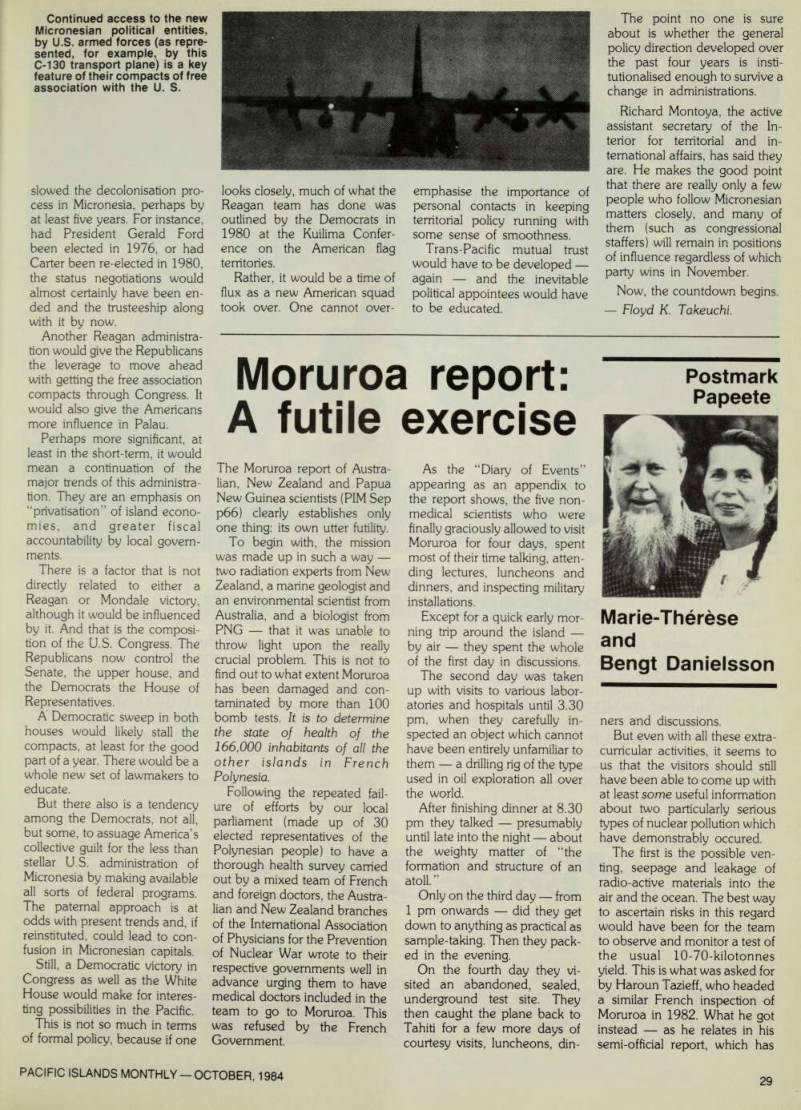
November
In just a month the American electorate will go to the polls to choose a president. At this point, it would be an upset of the greatest magnitude if Ronald Reagan and George Bush were not re-elected.
Still, even with the odds so heavily in the Republicans’ favor, it is worth considering what impact this election will have on Micronesia. For even if the islands of the Trust Territory are of negligible concern to American decision-makers, what happens in Washington, D.C., has tremendous impact in the Pacific.
First, what can Micronesia expect in a second Reagan administration?
American national politics aside, a second term would be a considerable boon to the islands. As in all administra tions, a small but active cadre of self-styled “Micronesia hands” has formed. Their knowledge of
and exposure to island con cerns may not qualify them as experts, but they are the closest thing the Micronesians have.
Indeed, the case can be made that the changing of the guard in Washington has
Notes from the North
Floyd K.
Takeuchi on Micronesia
slowed the decolonisation pro cess in Micronesia, perhaps by at least five years. For instance, had President Gerald Ford been elected in 1976, or had Carter been re-elected in 1980, the status negotiations would almost certainly have been en ded and the trusteeship along with it by now.
Another Reagan administra tion would give the Republicans the leverage to move ahead with getting the free association compacts through Congress. It would also give the Americans more influence in Palau.
Perhaps more significant, at least in the short-term, it would mean a continuation of the major trends of this administra tion. They are an emphasis on “privatisation” of island econo mies, and greater fiscal accountability by local govern ments.
There is a factor that is not directly related to either a Reagan or Mondale victory, although it would be influenced by it. And that is the composi tion of the U.S. Congress. The Republicans now control the Senate, the upper house, and the Democrats the House of Representatives.
A Democratic sweep in both houses would likely stall the compacts, at least for the good part of a year. There would be a whole new set of lawmakers to educate.
But there also is a tendency among the Democrats, not all, but some, to assuage America’s collective guilt for the less than stellar U.S. administration of Micronesia by making available all sorts of federal programs.
The paternal approach is at odds with present trends and, if reinstituted, could lead to con fusion in Micronesian capitals.
Still, a Democratic victory in Congress as well as the White House would make for interes ting possibilities in the Pacific.
This is not so much in terms of formal policy, because if one
looks closely, much of what the Reagan team has done was outlined by the Democrats in 1980 at the Kuilima Confer ence on the American flag territories.
Rather, it would be a time of flux as a new American squad took over. One cannot over
emphasise the importance of personal contacts in keeping territorial policy running with some sense of smoothness.
Trans-Pacific mutual trust would have to be developed again and the inevitable political appointees would have to be educated.
The point no one is sure about is whether the general policy direction developed over the past four years is insti tutionalised enough to survive a change in administrations.
Richard Montoya, the active assistant secretary of the In terior for territorial and in ternational affairs, has said they are. He makes the good point that there are really only a few people who follow Micronesian matters closely, and many of them (such as congressional staffers) will remain in positions of influence regardless of which party wins in November.
Now, the countdown begins.
Floyd K. Takeuchi.
Continued access to the new Micronesian political entities, by U.S. armed forces (as repre sented, for example, by this C-130 transport plane) is a key feature of their compacts of free association with the U. S.
Moruroa report:
A futile exercise
The Moruroa report of Austra lian, New Zealand and Papua New Guinea scientists (PIM Sep p 66) clearly establishes only one thing; its own utter futility.
To begin with, the mission was made up in such a way two radiation experts from New Zealand, a marine geologist and an environmental scientist from Australia, and a biologist from PNG that it was unable to throw light upon the really crucial problem. This is not to find out to what extent Moruroa has been damaged and con taminated by more than 100 bomb tests. It is to determine the state of health of the 166,000 inhabitants of all the other islands in French Polynesia.
Following the repeated fail ure of efforts by our local parliament (made up of 30 elected representatives of the Polynesian people) to have a thorough health survey carried out by a mixed team of French and foreign doctors, the Austra lian and New Zealand branches of the International Association of Physicians for the Prevention of Nuclear War wrote to their respective governments well in advance urging them to have medical doctors included in the team to go to Moruroa. This was refused by the French Government.
As the “Diary of Events” appearing as an appendix to the report shows, the five non medical scientists who were finally graciously allowed to visit Moruroa for four days, spent most of their time talking, atten ding lectures, luncheons and dinners, and inspecting military installations.
Except for a quick early mor ning trip around the island by air they spent the whole of the first day in discussions.
The second day was taken up with visits to various labor atories and hospitals until 3.30 pm, when they carefully in spected an object which cannot have been entirely unfamiliar to them a drilling rig of the type used in oil exploration all over the world.
After finishing dinner at 8.30 pm they talked presumably until late into the night about the weighty matter of “the formation and structure of an atoll.”
Only on the third day from 1 pm onwards did they get down to anything as practical as sample-taking. Then they pack ed in the evening.
On the fourth day they vi sited an abandoned, sealed, underground test site. They then caught the plane back to Tahiti for a few more days of courtesy visits, luncheons, din-
ners and discussions.
But even with all these extra curricular activities, it seems to us that the visitors should still have been able to come up with at least some useful information about two particularly serious types of nuclear pollution which have demonstrably occured.
The first is the possible ven ting, seepage and leakage of radio-active materials into the air and the ocean. The best way to ascertain risks in this regard would have been for the team to observe and monitor a test of the usual 10-70-kilotonnes yield. This is what was asked for by Haroun Tazieff, who headed a similar French inspection of Moruroa in 1982. What he got instead as he relates in his semi-official report, which has
Postmark Papeete
Marie-Thérèse and Bengt Danielsson
had only a restricted circulation was a test with a yield of less than one kilotonne the smal lest ever, and so small as to exclude any meaningful observations. Tazieff also re gretted that the French navy did not supply a submarine from which he could inspect the holes tom out by nuclear blasts in the outer wall of the atoll at a depth of 600-700 metres.
One of these blasts prised loose about a million cubic metres of coral and rock, accor ding to his own estimate.
The recent report does not say whether the team had asked their hosts in advance to blow up a bomb for their benefit. But the fact is it wasn’t done. Nor was any submarine made available to them, although one well equipped for this type of research was cruis ing in Pacific waters at the time (PIM Mar p 24).
So nothing could be learned about possible venting, seep age, and leakage. The three chapters devoted to these prob lems are therefore purely speculative.
The second pollution prob lem is easier to localise and study because it figured prom inently in newspapers and magazines throughout the world, including PIM (Jan ’B2 p2O), during the months follow ing the Socialists’ win in the May, 1981 French elections.
At the heart of the fuss was a complaint about lax safety stan dards at Moruroa by French technicians employed by the army to prepare the tests.
When the new Defence Minister Charles Hernu took no action, the technicians leaked their story to the press. Their main revelations were that through criminal negligence huge amounts of radio-active waste, including between 10 and 20 kilograms of lethal plu tonium, had simply been dumped and left on the reef, in the area between the pass and the airstrip, on the north coast of Moruroa. When the island was washed over by big waves stirred up by the two cyclones of November 28, 1980, and March 11, 1981, much was spread over Moruroa, or carried off to distant shores. Under heavy pressure from the French Parliament, Hernu eventually admitted the accuracy of the report.
It should have been easy for the Australian-NZ-PNG team to check how serious the remaining pollution in this area was at the end of 1983. All they needed to do was to make the 15-minute trip from their living quarters to the so-called “safety trial area” on the north coast, They were not permitted to do this. They were not even allowed to collect coral specimens from the lagoon which occupies 90 per cent of the atoll area. In the published report
this major restriction was dismissed in the following, apparently unconcerned manner: “As the Mission was not permitted to sample sediments from the lagoon nor take any types of sample from the safety trial area, this avenue of verification was denied.”
Instead of protesting in the strongest possible way by flying straight back home, the visitors spent the day meekly taking surface samples of ocean water.
Sure enough, it was not badly
contaminated, as the last, small, bomb blast had taken place three months before at a depth of 800 metres, If the team members had limited their remarks to such subjects as radiation, venting, leakage and waste disposal, on which they were more or less expert, our only criticism would be that they have not contri buted any new information or insight.
Marie-Thérèse and Bengt Danielsson.
Advertisements & other items, p. 30 (1 item)
/vi cpo/v/vd-iTo
THE MD-80.
PREFERRED YEAR AFTER YEAR
Austrian Airlines survey finds passengers favor the new McDonnell Douglas twin-jet over 727 s and 737 s by margins up to 4-to-l.
For 1,900 Austrian Airlines passengers surveyed, the MD-80 was a pleasure to fly on.
They loved its comfort, quiet, and smooth ride. Its colorful decor, wider seats and aisle, and extra roomy carry-on luggage space were greatly appreciated. On every point of comparison, they clearly preferred the MD-80.
All around the world, the MD-80 has consistently pleased passengers since it began service. Passengers surveyed in the United States and South America were as enthusiastic as those polled in the Middle East and Europe for the Austrian survey.
Seldom if ever has any new airplane received such a warm welcome.
We’re not surprised at these results.
After all, we’ve seen the same results time after time.
/vi cpo/v/vd-iTo
DOUGLAS
363P4022 r > «feT ' "V *£> * ' M/- * 4 V s s 34
N.Z. into isolation?
The isolation of New Zealand on its decision to ban visits to its ports of nuclear-powered or armed naval vessels was just about complete by mid- September when the N.Z.La bor Party held its annual and, this year, somewhat remarkable annual conference.
There, not only was the ban on ship visits vociferously approved, but delegates went far further in a variety of directions which showed the party militants to be not only at odds with most governments of the region, but also with their own government.
David Lange was clearly embarrassed by some of the motions enthusiastically carried, and his own deputy foreign affairs minister, Mr O’Flynn, left the meeting visibly upset and angry.
Mr O’Flynn’s particular prob lem was made more pointed when, in an effort to hush public debate about some of the more controversial issues, the conference for a time closed its doors to the press. Mr O’Flynn is about to make a tour of the ASEAN countries and among the off-record subjects discussed was a motion calling on the government to withdraw its military attaches from all ASEAN nations and turn to developing closer economic, cultural and diplomatic ties with Vietnam.
They also proposed that the N.Z. infantry battalion be pulled out of Singapore within a year, and that all N.Z. forces de ployed outside the Pacific be recalled, unless they were under U.N. sponsorship.
The left-wingers, by now in full cry, then passed a motion
demanding the Lange govern
ment withdraw from all alliances with nuclear powers which, said one delegate pointedly, “means ANZUS.”
Another motion from the same group urged the closing of the U.S.Air Force’s Operation Deep Freeze base in Christ church, which has been the centre of Antarctic research for about 30 years. Appended to that was a call for a full public inquiry into two U.S. manned communications bases in other parts of New Zealand.
Beyond that there was a pot-pourri of other recom mendations such as would have the welkins ringing at any Sat urday night undergraduate beer and bunfest. They didn’t like the Rapid Deployment Force, and they felt that N.Z. armed forces should be used only for disaster relief and U.N. peace keeping duties. They wanted recognition withdrawn from the Pol Pot regime and diplomatic links with the Philippines re viewed. They thought it would be a good idea to end military links with Manila and Jakarta.
They declared their support for the Sandinista government of Nicaragua and demanded rec ognition of the FRD/FMLN as “a legitimate voice of the Salva doran people.”
In short, they had a lovely time and in the process demon strated how far away from their own Cabinet, government, and country they were.
But they also supported Aus tralia’s stand on observance, or the lack of it, of the Nuclear Non-Proliferation Treaty, and called on France to refrain from using the Kerguelen or Croset islands as nuclear test sites when, or if, they withdrew from Polynesia.
In the end, their highly popular leader, Mr Lange, who withstood the onslaught with remarkable cheerfulness, felt constrained to warn the dele gates against providing a cata logue of quotes that would damage the government’s popularity.
And he was careful to note when talking with correspon dents outside the conference hall that none of the motions were binding on his govern ment.
Of course, on nuclear matters generally, the ship issue aside, New Zealand is thoroughly aligned with current Pacific thinking and took a leading part in supporting the Australian in itiative on a regional nuclear free zone. But this does not get it off the horns of the ship-visit dilemma where Mr Lange re mains personally hung by his party’s long-standing dogma.
The N.Z. Labor Party confer ence last month went through the brave exercise of con gratulating itself on public approval of its assorted wis doms, but was left in no doubt about the size of the national reconstruction job ahead, and the strength of the forces with which they had to deal. The nuclear ship visit policy was seen by some as disadvantag ing the more important econo mic situation.
The N.Z. business commun ity, particuarly, worried that at a time when New Zealand needed every fat greenback it could scrape up in a cruel and callous world, the government was upsetting both the Austra lians and the Americans on a matter of little practical or im mediate value.
Advertisements & other items, p. 32 (1 item)
Your Energy Equipment,
With PRI Supplying
The Best Is Yet To Come.
m Tower
MJMHRI - 1
SiCrV ED "'•.I, •am ■f:al 'l' - Many wholesale energy equipment suppliers offer you a good variety of products.
But can they offer you a history of proven performance and the guarantee of service tomorrow?
PRl's Energy Products Division can.
We're a part of Pacific Resources, Inc., an independent energy company based in Hawaii.
With PRI behind your energy equipment, the best is yet to come.
In variety of products.
In value.
In parts and service support.
And in availability and inventory.
And when it comes to water heating equipment, the PRI Energy Products Division has the backing of PRl's 80 years of water heating experience.
We're the most knowledgeable company in the Pacific Basin when it comes to water heating needs.
Talk to PRl's Energy Products Division about any of your energy equipment needs.
For information call (808) 547-3522 or write PO. Box 3379, Honolulu, Hawaii 96842, USA.
We've got it all. • Hardwick gas ranges, electric ranges and microwaves • Roper gas ranges, electric ranges and microwaves • State gas and electric residential and commercial water heaters • Jetglass commercial gas water heaters • E-Tech heat pumps, heat recovery units and swimming pool heaters • Customized commercial heat pumps • Photovoltaic equipment • PRI solar products • Luau torches • Manchester propane tanks The Best Is Yet To Come. T Energy Products Division
© PRI 1984
PRI Energy Systems, Inc.
A PRI Company
digital world
Ptc ’85
Towards a digital world
As mentioned here earlier (PIM May, ’B3), the Honolulu-based Pacific Telecommunications Council was founded in early 1980. It is an international, non-government and non-pro fit organisation which promotes the development and beneficial use of telecommunications throughout the entire “Pacific Hemisphere. ” This is defined as North, Central and South America; Northeast, South and Southeast Asia; and Oceania: Australia, New Zealand, Melanesia, Micronesia and Polynesia.
PTC members include users and providers of telecommuni cations services, educational in stitutions, government agencies and individuals such as academics, engineers, broadcasters, and other tele communication specialists. An annual conference in January of each year brings together these diverse interests in Hon olulu, and mid-year seminars are held in different locations.
To date, seminars have been held in Tokyo, Washington, D.C., Manila, Wellington and Mexico City.
Richard J. Barber, PTC’s ex ecutive director, was in strumental in the creation of the organisation, and remains at its helm'. Barber reports that PTC’s membership now stands at 165, a gain of a dozen during the past year. The membership comes from 21 countries, Paci fic members being from Austra lia, the Cook Islands, Fiji, French Polynesia, Hawaii, New Caledonia, and New Zealand.
The seventh annual confer ence, PTC ’B5, is scheduled for January 13-16 of next year at the Sheraton-Waikiki Hotel.
According to Barber’s tally, over the first six conferences, more than 65 papers were presented which were speci fically oriented to the interests of Pacific Island nations and territories.
About the agenda for PTC ’B5, Barber indicates that it will focus on the introduction and
use of digital technology for communication. Digital systems allow for flexible and multiple uses of systems primarily for telephone and computer com munication. Integrated digital systems are being installed worldwide, and many people look to a fully integrated worldwide network in the not too distant future. These deve lopments result from the mar riage of computers and com munication. As NEC (Nippon Electric Company) puts it, “C and C For Everyone.” At PTC ’B5, experts will explore several aspects of this move to a digital world, from the point of view of engineers, economists, policy analysts and businessmen.
A number of papers and sessions should be of interest to those in the Pacific. The South Pacific Telecom munications Development Program will be discussed by Jim Wilkinson, Program Coor dinator of SPEC’s decade-long
project which is expected to cost about $lOO million. This program clearly recognised the need for basic and reliable telecommunications for econo mic and social development, especially the need to link rural with urban areas. Mr Wilkinson is expected to relate these fac tors to the introduction of new digital technology to meet cur rent and future needs. In such a process the difficulty of plan ning in a time of rapid tech nological and policy changes becomes quite evident. Case studies of countrywide telecom munication developments will be presented in a visual, printed and oral format. • A thorough description of New Zealand’s transition to di gital telecommunications is being prepared jointly by the New Zealand Post Office and the New Zealand Communica tions Advisory Council. New Zealand’s application of digital technology to both urban and sparsely populated rural areas should prove instructive. The case study will cover network descriptions and social impacts as well as the planning and implementation process. • A second case study will be presented by the Office of Posts and Telecommunications of New Caledonia. Officials from Noumea will provide an over view of current telecommunica tion systems, uses, and policies as well as a look forward to planned changes and antici pated issues arising from such change. • Of particular concern to Is land countries is the availability, reliability and cost of using small earth stations for satellite communications. In a session organised by M. Lopianowski of Cantel Engineering in British Columbia, engineers from IN TELSAT, NASA, Japan and Canada will discuss the pros and cons of Digital vs. Analog for thin route service applica tions via the INTELSAT system.
PTC ’B5 will feature speakers, panels, working groups and papers concerning many topics related to telecom munications development such as: International Standards De velopments; Financing Tele communication Infrastructure; Information Developments; User Requirements; Regulatory Issues; Choosing Technology for Domestic Systems; and
Training and Human Re sources.
One afternoon will be de voted to informal discussions in the form of working groups which will focus on topics in cluding health information net works, education, teleconferen cing, etc. Some 35 exhibitors including Hughes, GTE (Hawaiian Telephone), AT&T (American Telephone and Telegraph), Alascom (Alaska’s telephone and satellite system), NEC, will show products and share information regarding their latest equipment and service offerings an educa tion in itself.
Immediately following the FTC ’B5 the PTC and East- West Center will jointly offer a two-day telecommunication skills workshop designed for managerial professionals who do not have an extensive technical background in tele communications. Topics will in clude: digital tutorial, office automation, fibre optic technol ogy, teleconferencing systems and infonets, understanding UNIX and teleports.
A number of representatives from Pacific Islands participated in PTC ’B4, with several being supported by PTC through a grant from the U.S. Information Agency. It is expected that funds will be awarded again for
Ptc ’B5.
For more details about PTC ’B5 and its following workshop, one may contact Richard J.
Barber, PTC Executive Director, 1110 University Ave nue, Suite 308, Honolulu, HI 96826; Telephone (808) 941- 3789; Telex 7430550 PTC. -
Robert C. Kiste.
The annual PTC conferences are among the best promoted in the region.
A View from Honolulu
Robert C. Kiste looks at the Pacific
Advertisements & other items, p. 34 (1 item)
Starting & Staying
¥ER . r
AMP
POWER
V X os?
If f DGEPCyCLEBATTBr*
unnD
MARINE
stow
Amy
/'ISSSPi&f
CH3D
BS&
Power Boats Need Different Batteries
There is a big difference between a car battery and a marine battery.
A car battery, for example, is never really discharged, as it is only used for a few seconds each day and promptly re-charged. Not so your cruiser or sportsfishemnan.
Starting the engine is only the beginning. During the day, weekend or cruise, how often will you run the live bait tank, the depth sounder, the nav. lights or maintain a listening watch on your radio transceiver?
As well as cranking power, boats need staying power. Boats need Besco's Marine Batteries, deep cycle, heavy duty marine batteries.
If your boat is getting a little flat in the electrics department, write or phone BESCO today and ask for more information, more facts about
BESCO MARINE BATTERIES.
BESCO
I Batteries Division Of Sims Products Pty. Ltd. j_ / A Peko Wall send Group Member Papua New Guinea: Lae, Automarine Industries, P.O. Box 785, Ph. 42-1125; Rabaul, Automarine Industries, P.O. Box 248, Ph. 92-2574; Port Moresby, Par Sales, P.O. Box 1680, Boroko, Ph. 25-6266. Fiji: Suva, Fiji Bandag, 23 Sinoma Street, Walu Bay, Ph. 31-1200. New Caledonia: Noumea, Andre Thuilier, BP 889, Ph. 27-4906. Solomon Islands: Honiara, Guadalcanal Electrics Ltd., P.O. Box 521. Hongkong: Kowloon, T. L. Knight & Co. PO. Box 95585 TST, Ph. 366-5341. New Zealand: Auckland, Bartery Services (Ind.) Ltd., P.O. Box 27- 375, Ph. 69-4111; Wellington, Gould Batteries, 58 Hautana Street, Lower Hutt, TLX NZ3714 Australia: Sydney, Besco Batteries, P.O. Box 1, Villawood, Ph. 632-0251, TLX 21886, Jarwil International Pty. Ltd., 410 Kent Street, Sydney, Ph. 264-3477, TLX 72102.
LEADERS IN BATTERY
of $65m Fiji hotel project
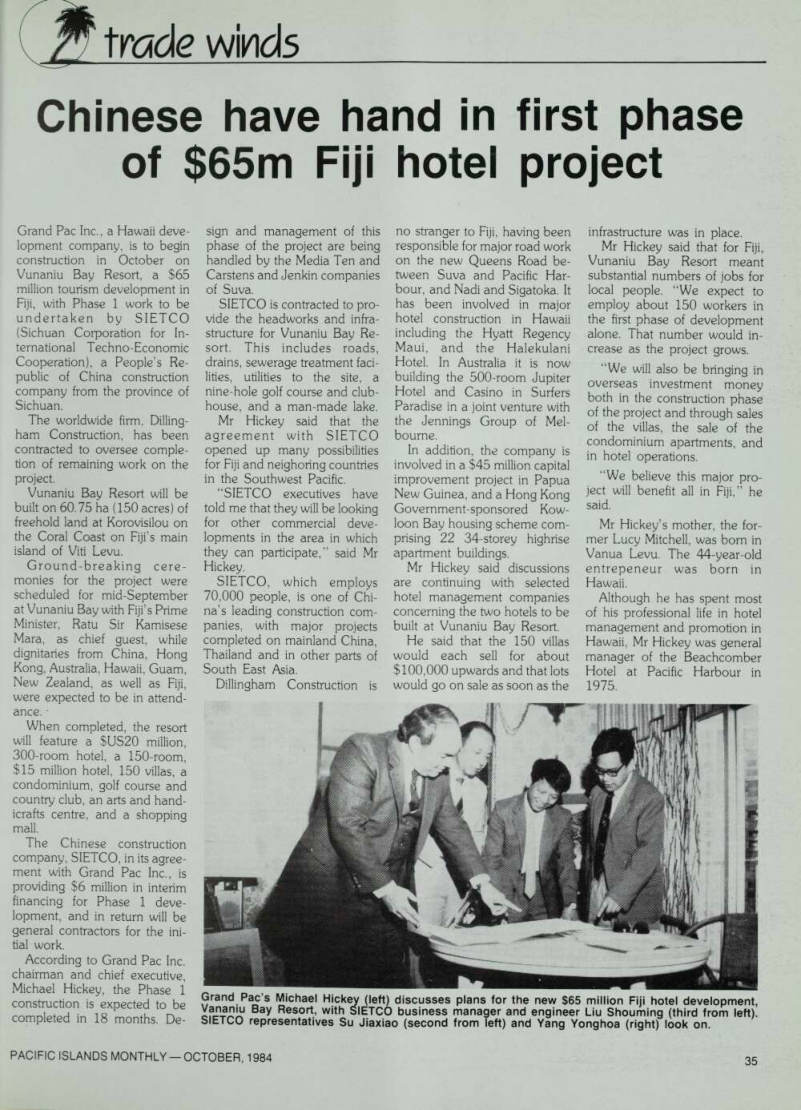
trade winds
Chinese have hand in first phase of $65m Fiji hotel project
Grand Pac Inc., a Hawaii deve lopment company, is to begin construction in October on Vunaniu Bay Resort, a $65 million tourism development in Fiji, with Phase 1 work to be undertaken by SIETCO (Sichuan Corporation for In ternational Techno-Economic Cooperation), a People’s Re public of China construction company from the province of Sichuan.
The worldwide firm, Dilling ham Construction, has been contracted to oversee comple tion of remaining work on the project.
Vunaniu Bay Resort will be built on 60.75 ha (150 acres) of freehold land at Korovisilou on the Coral Coast on Fiji’s main island of Viti Levu.
Ground-breaking cere monies for the project were scheduled for mid-September at Vunaniu Bay with Fiji’s Prime Minister, Ratu Sir Kamisese Mara, as chief guest, while dignitaries from China, Hong Kong, Australia, Hawaii, Guam, New Zealand, as well as Fiji, were expected to be in attend ance. ■ When completed, the resort will feature a SUS2O million, 300-room hotel, a 150-room, $l5 million hotel, 150 villas, a condominium, golf course and country club, an arts and hand icrafts centre, and a shopping mall.
The Chinese construction company, SIETCO, in its agree ment with Grand Pac Inc., is providing $6 million in interim financing for Phase 1 deve lopment, and in return will be general contractors for the ini tial work.
According to Grand Pac Inc. chairman and chief executive, Michael Hickey, the Phase 1 construction is expected to be completed in 18 months. De
sign and management of this phase of the project are being handled by the Media Ten and Carstens and Jenkin companies of Suva.
SIETCO is contracted to pro vide the headworks and infra structure for Vunaniu Bay Re sort. This includes roads, drains, sewerage treatment faci lities, utilities to the site, a nine-hole golf course and club house, and a man-made lake.
Mr Hickey said that the agreement with SIETCO opened up many possibilities for Fiji and neighoring countries in the Southwest Pacific.
“SIETCO executives have told me that they will be looking for other commercial deve lopments in the area in which they can participate,” said Mr Hickey.
SIETCO, which employs 70,000 people, is one of Chi na’s leading construction com panies, with major projects completed on mainland China, Thailand and in other parts of South East Asia.
Dillingham Construction is
no stranger to Fiji, having been responsible for major road work on the new Queens Road be tween Suva and Pacific Har bour, and Nadi and Sigatoka. It has been involved in major hotel construction in Hawaii including the Hyatt Regency Maui, and the Halekulani Hotel. In Australia it is now building the 500-room Jupiter Hotel and Casino in Surfers Paradise in a joint venture with the Jennings Group of Mel bourne.
In addition, the company is involved in a $45 million capital improvement project in Papua New Guinea, and a Hong Kong Government-sponsored Kow loon Bay housing scheme com prising 22 34-storey highrise apartment buildings.
Mr Hickey said discussions are continuing with selected hotel management companies concerning the two hotels to be built at Vunaniu Bay Resort.
He said that the 150 villas would each sell for about $lOO,OOO upwards and that lots would go on sale as soon as the
infrastructure was in place.
Mr Hickey said that for Fiji, Vunaniu Bay Resort meant substantial numbers of jobs for local people. “We expect to employ about 150 workers in the first phase of development alone. That number would in crease as the project grows.
“We will also be bringing in overseas investment money both in the construction phase of the project and through sales of the villas, the sale of the condominium apartments, and in hotel operations.
“We believe this major pro ject will benefit all in Fiji,” he said.
Mr Hickey’s mother, the for mer Lucy Mitchell, was born in Vanua Levu. The 44-year-old entrepeneur was born in Hawaii.
Although he has spent most of his professional life in hotel management and promotion in Hawaii, Mr Hickey was general manager of the Beachcomber Hotel at Pacific Harbour in 1975.
Grand Pacs Michael Hickey (left) discusses plans for the new $65 million Fiji hotel development, Vananiu Bay Resort with SIETCO business manager and engineer Liu Shouming (third from left).
SIETCO representatives Su Jiaxiao (second from left) and Yang Yonghoa (right) look on.
Advertisements & other items, p. 36 (1 item)
The 2-Sided Miracle!
1 lij. »•* s> v
/i... \\\ ■ I Now you’ll never have to get up and turn over records anymore! Sansui’s technological expertise gives you instant access to both record sides. You can program up to 16 selections on either side in any order. No other turntable in the world offers so much freedom and flexibility.
In fact, this entire system gives you the freedom of flexibility. High-speed dubbing with the double cassette deck!
Compu Edit,- a Sansui exclusive for flawless record-to-tape editing! High power amplifier (100 W x 2 music power) with built-in 5-band graphic equalizer! And an advanced quartz PLL synthesizer FM/AM tuner completes the Midi System M9OOB the miraculous system for the highest quality with the greatest ease! Ay-Pi Programmable Audio Timer (optional). *** r r r - Midi System
Sajtsui-
SANSUI ELECTRIC CO., LTD. 14-1, Izumi 2-chome, Suginami-ku, Tokyo 11 For further information please contact: • Australia VANFI (Aust.) PTY. LTD . 297, City Road, South Melbourne, Victoria 3205, Australia Phone; 690-6200/283 Alfred Place, North Sydney, N.S.W. 2060, Australia Phone 929-0293# Fiji PRABHU BROTHERS LTD. P.O. Box 183, Nadi Phone: 71122* Papua New Guinea OCEANIA INDENT AGENCY (P N G.) PTY.
LTD. P.O. Box 5518. Boroko, Port Moresby Phone; 256411 • New Zealand DAVID REID ELECTRONICS LTD. P.O. Box 2630, Auckland, Phone: 488-049« New Caledonia HI-FI VICTOIRE, ETS. M. MERCIER B.P. 1123, Noumea Phone. 27.59.11 *Central Pacific NAURU CO-OPERATIVE SOCIETY Republic of Nauru •Vanuatu THE SOUND CENTRE LTD. P.O. Box 434, Vila Phone: 2035• Tahiti DIMECO SIMEL B.P. Box 3338 Papeete Phone: 26979
Meet the ‘Aqua City’
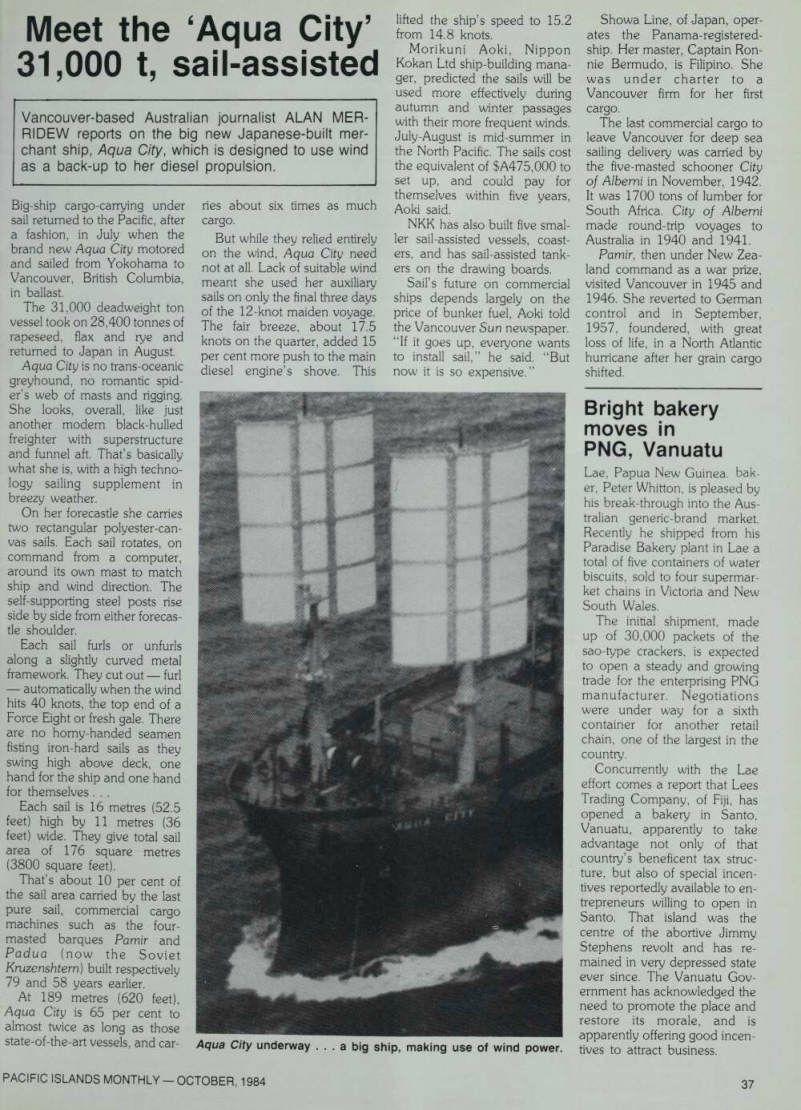
31,000 t, sail-assisted
Vancouver-based Australian journalist ALAN MER RIDEW reports on the big new Japanese-built mer chant ship, Aqua City, which is designed to use wind as a back-up to her diesel propulsion.
Big-ship cargo-carrying under sail returned to the Pacific, after a fashion, in July when the brand new Aqua City motored and sailed from Yokohama to Vancouver, British Columbia, in ballast.
The 31,000 deadweight ton vessel took on 28,400 tonnes of rapeseed, flax and rye and returned to Japan in August.
Aqua City is no trans-oceanic greyhound, no romantic spid er’s web of masts and rigging.
She looks, overall, like just another modern black-hulled freighter with superstructure and funnel aft. That’s basically what she is, with a high techno logy sailing supplement in breezy weather.
On her forecastle she carries two rectangular polyester-can vas sails. Each sail rotates, on command from a computer, around its own mast to match ship and wind direction. The self-supporting steel posts rise side by side from either forecas tle shoulder.
Each sail furls or unfurls along a slightly curved metal framework. They cut out furl automatically when the wind hits 40 knots, the top end of a Force Eight or fresh gale. There are no horny-handed seamen fisting iron-hard sails as they swing high above deck, one hand for the ship and one hand for themselves . . .
Each sail is 16 metres (52.5 feet) high by 11 metres (36 feet) wide. They give total sail area of 176 square metres (3800 square feet).
That’s about 10 per cent of the sail area carried by the last pure sail, commercial cargo machines such as the four masted barques Pamir and Padua (now the Soviet Kruzenshtem ) built respectively 79 and 58 years earlier.
At 189 metres (620 feet), Aqua City is 65 per cent to almost twice as long as those state-of-the-art vessels, and car
ries about six times as much cargo.
But while they relied entirely on the wind, Aqua City need not at all. Lack of suitable wind meant she used her auxiliary sails on only the final three days of the 12-knot maiden voyage.
The fair breeze, about 17.5 knots on the quarter, added 15 per cent more push to the main diesel engine’s shove. This
lifted the ship’s speed to 15.2 from 14.8 knots.
Morikuni Aoki, Nippon Kokan Ltd ship-building mana ger, predicted the sails will be used more effectively during autumn and winter passages with their more frequent winds.
July-August is mid-summer in the North Pacific. The sails cost the equivalent of $A475,000 to set up, and could pay for themselves within five years, Aoki said.
NKK has also built five smal ler sail-assisted vessels, coast ers, and has sail-assisted tank ers on the drawing boards.
Sail’s future on commercial ships depends largely on the price of bunker fuel, Aoki told the Vancouver Sun newspaper.
“If it goes up, everyone wants to install sail,” he said. “But now it is so expensive.”
Showa Line, of Japan, oper ates the Panama-registered ship. Her master, Captain Ron nie Bermudo, is Filipino. She was under charter to a Vancouver firm for her first cargo.
The last commercial cargo to leave Vancouver for deep sea sailing delivery was carried by the five-masted schooner City of Alberni in November, 1942.
It was 1700 tons of lumber for South Africa. City of Alberni made round-trip voyages to Australia in 1940 and 1941.
Pamir, then under New Zea land command as a war prize, visited Vancouver in 1945 and 1946. She reverted to German control and in September, 1957, foundered, with great loss of life, in a North Atlantic hurricane after her grain cargo shifted.
Aqua City underway ... a big ship, making use of wind power.
Bright bakery
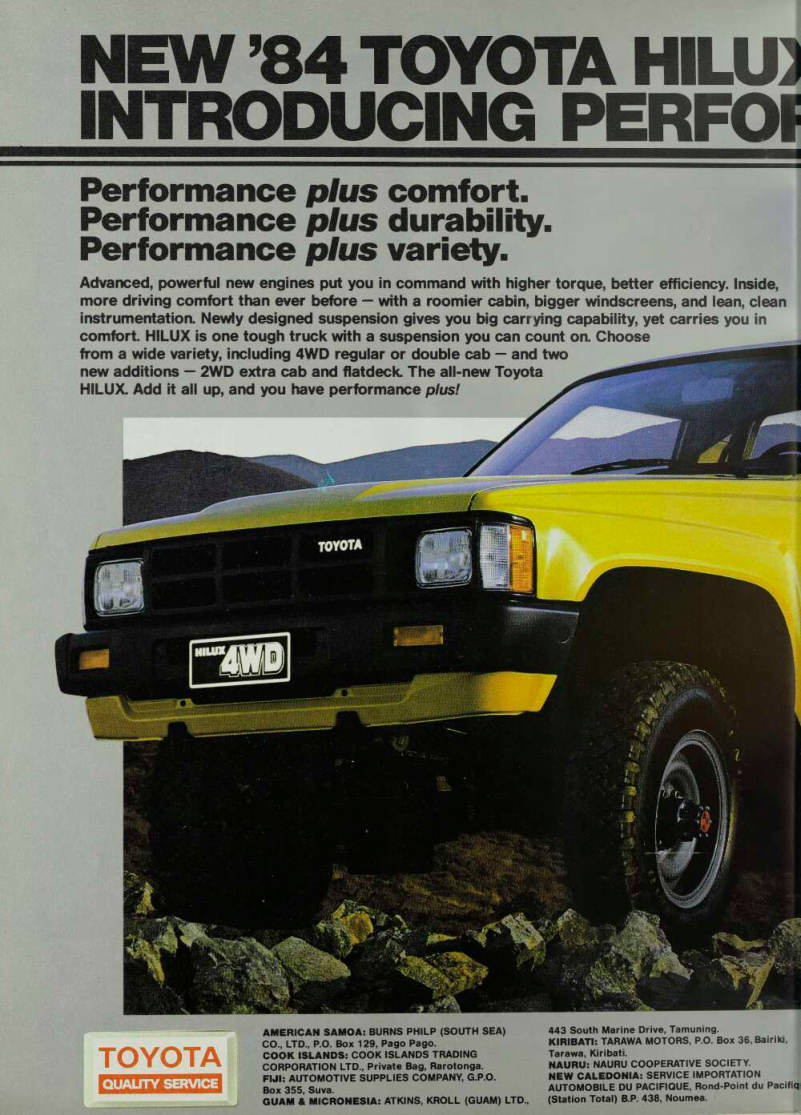


moves in PNG, Vanuatu
Lae, Papua New Guinea, bak er, Peter Whitton, is pleased by his break-through into the Aus tralian generic-brand market.
Recently he shipped from his Paradise Bakery plant in Lae a total of five containers of water biscuits, sold to four supermar ket chains in Victoria and New South Wales.
The initial shipment, made up of 30,000 packets of the sao-type crackers, is expected to open a steady and growing trade for the enterprising PNG manufacturer. Negotiations were under way for a sixth container for another retail chain, one of the largest in the country.
Concurrently with the Lae effort comes a report that Lees Trading Company, of Fiji, has opened a bakery in Santo, Vanuatu, apparently to take advantage not only of that country’s beneficent tax struc ture, but also of special incen tives reportedly available to en trepreneurs willing to open in Santo. That island was the centre of the abortive Jimmy Stephens revolt and has re mained in very depressed state ever since. The Vanuatu Gov ernment has acknowledged the need to promote the place and restore its morale, and is apparently offering good incen tives to attract business.
Model of a new hotel to be built on the island of Moorea, French Polynesia, by the IBIS international hotel chain. IBIS is part of Accor, which is the world’s seventh largest international hotel group. IBIS is also building hotels in Papeete and on Raiatea. he first sod was turned for the building of the group’s 72-room Prince Hinoi Hotel in Papeete on August 21. Representatives of the group say that their Papeete hotel will have as its particular target Australian and New Zealand travellers - “people who usually go to Fiji or the Cook Islands without ever thinking of coming on to French Polynesia.”
Daniel da Rin, new Qantas chief in Papeete, Tahiti, tries out the executive chair while his predecessor, Tim Swann, looks not at all displeased that he is headed for retirement in New Zealand.
Mr Swann had run the Australian airline’s local office since 1981 when Qantas re-entered the Tahiti market with its six weekly flights Sydney-Papeete-Los Angeles and return.
The airline now carries more passengers from the U.S.A. to Tahiti than any other - 39 per cent of the total, compared with UTA 29 per cent, and Air New Zealand 29 per cent — La Depeche photo.
The ATR42 prototype fires its engines for the first time after roll-out. The 46-seat passenger aircraft, a joint Franco-Italian production, has already been ordered by New Caledonia's domestic airline, and is being sought by its counterpart in French Polynesia .-Aircraft photo.
Advertisements & other items, pp. 38-42 (1 item)
Introducing Perfof
NEW *B4 TOYOTA HILU)
Performance p comfort.
Performance plus durability.
Performance plus variety.
Advanced, powerful new engines put you in command with higher torque, better efficiency. Inside, more driving comfort than ever before with a roomier cabin, bigger windscreens, and lean, clean instrumentation. Newly designed suspension gives you big carrying capability, yet carries you in comfort. HILUX is one tough truck with a suspension you can count on. Choose from a wide variety, including 4WD regular or double cab and two new additions 2WD extra cab and flatdeck. The all-new Toyota HILUX. Add it all up, and you have performance plus! m UJ
TOYOTA
QUALITY SERVICE
AMERICAN SAMOA: BURNS PHILP (SOUTH SEA)
CO., LTD., P.O. Box 129, Pago Pago.
COOK ISLANDS: COOK ISLANDS TRADING
CORPORATION LTD., Private Bag, Rarotonga.
FIJI: AUTOMOTIVE SUPPLIES COMPANY, G.P.O.
Box 355, Suva.
GUAM & MICRONESIA: ATKINS, KROLL (GUAM) LTD., 443 South Marine Drive, Tamuning.
KIRIBATI: TARAWA MOTORS, P.O. Box 36, Bairiki, Tarawa, Kiribati.
NAURU: NAURU COOPERATIVE SOCIETY.
NEW CALEDONIA: SERVICE IMPORTATION
AUTOMOBILE DU PACIFIQUE, Rond-Point du Pacifiqi (Station Total) B.P. 438, Noumea.
MANGE PLUS!
..A 4WD Double Cab i NORFOLK ISLAND: SORRY’S LIMITED, P.O. Box 169 >APUA NEW GUINEA: ELA MOTORS, A Division of Jurns Philp (PNG) Ltd., P.O. Box 75, Port Moresby
>AIPAN: MICROL CORPORATION, P.O. Box 267,
Saipan.
SOLOMON: MENDANA ENTERPRISES (5.1.) LTD.,
3.P.0. Box 174, Honiara.
TAHITI: NIPPON AUTOMOTO, P.O. Box 342, Papeete.
TONGA: BURNS PHILP (SOUTH SEA) CO., LTD., P.O. Box 55, Nuku’alofa.
VANUATU: VANUATU MOTORS, P.O. Box 18,
Port Vila.
WESTERN SAMOA: BURNS PHILP (SOUTH SEA)
CO., LTD., P.O. Box 188, Apia.
TOYOTA
Listen to what these experts
say about Hitachi's VT-20E
0 ta P e recor( teil
“Great sound’.’
“Incredibly true to life.”
“Even talk shows sound better.”
The secret is stereo sound.
You see, the new VT-20E was designed to get the most out of the new stereo broadcasts, as well as prerecorded stereo tapes. And that means video that’s as easy to listen to as it is to watch.
Of course, the VT-20E also delivers
a superb picture.
And boasts features like 4 heads. 8-hour record ing. 8X Visual Search. A 5-programme/ 14-day timer. Front loading. And a 13function wireless remote control.
So take a look at Hitachi’s VT-20E.
If what you see doesn’t convince you, the experts surely will.
HEAD
D CD D i~i- n n JU
I C • L) U _J_/
crtereo
1 SOUND
j « j >► f @ ®
©HITACHI
AUTO TUNING SYSTEM
VIDEO DECK VT-20E
0 HITACHI
AUSTRALIA: Hitachi Sales Australia Pty., Ltd., 153 Keys Road, Moorabbin, Victoria 3189; Phone: (555) 8722 • NEW ZEALAND: AWA New Zealand Limited, Wi-neera Drive, P.O. Box 50- 8, Porirua; Phone: PRO 75-069 • PAPUA NEW GUINEA; S.O. Svensson (N.G.) Ltd., P.O. Box 705, Port Moresby; Phone; 21-2111 • FIJI ISLANDS: AWA New Zealand Limited 47 Foster ad (P.O. Box 858), Suva, Fiji; Phone; 312070 • NEW CALEDONIA: Caldis, B.P. Ml, Noumea; Phone; 26. 23. 50 • TAHITI; Ets Chene Alain, P.O. Box 272, Papeete; Phone: 2. 88. 68 lOLOMON ISLANDS: Technique Radios Centre Ltd., P.O. Box 465, Honiara; Phone: 416
r \ mm . vmmrn.
I 'I r* ■m m \ Komatsu has the right pieces of equipment
to solve your construction problem
if you have a construction problem, we have an all-Komatsu solution.
That means we produce a full line and a wide range of machines to perfectly match job requirements from bulldozers, motor graders and motor scrapers, to dump trucks, wheel loaders and hydraulic excavators. It also means we’ll back up all Komatsu machines with our reliable worldwide network of service and sales. Keeping the customer fully satisfied is and always will be the primary concern at every level of our management...
Feedback from users and imaginative research and development based on our Total Quality Control system result in a full line of machines noteworthy for their excellent fuel economy, outstanding operator comfort and exceptional reliability...
The all-Komatsu solution. Make it a part of your construction picture.
THE QUALITY IS STANDARD
•H KOMATSU
Bumblers, yes - but were they
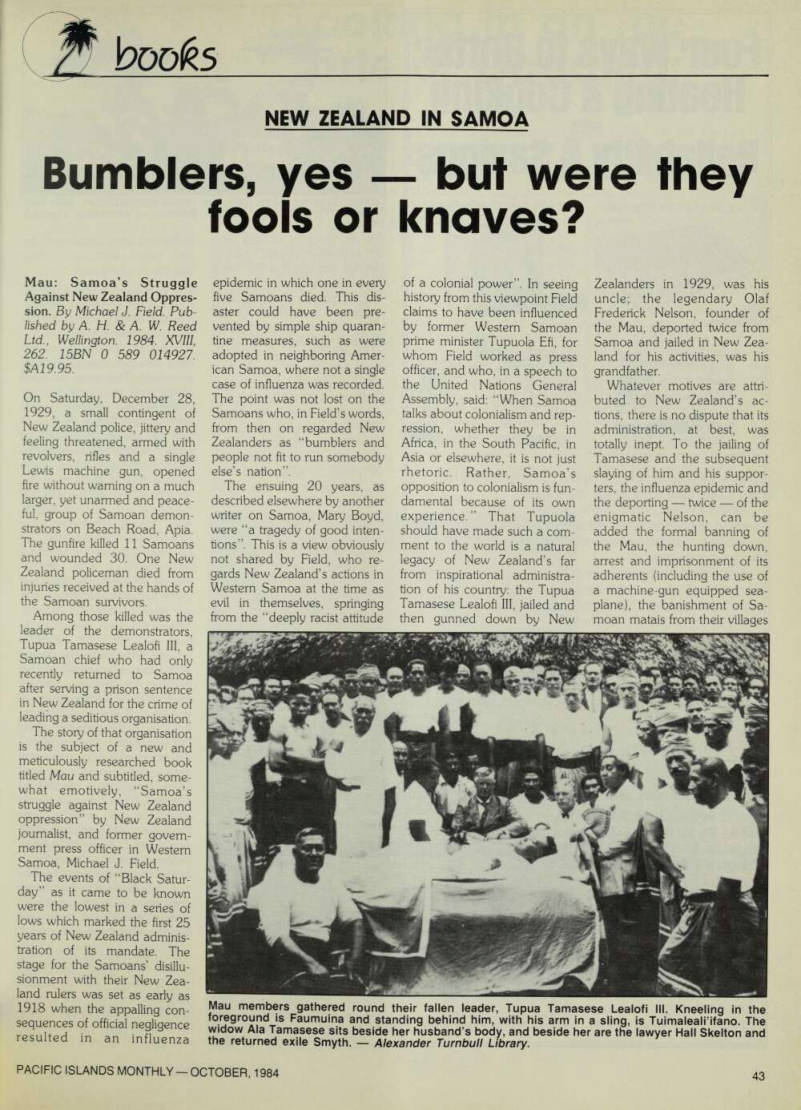
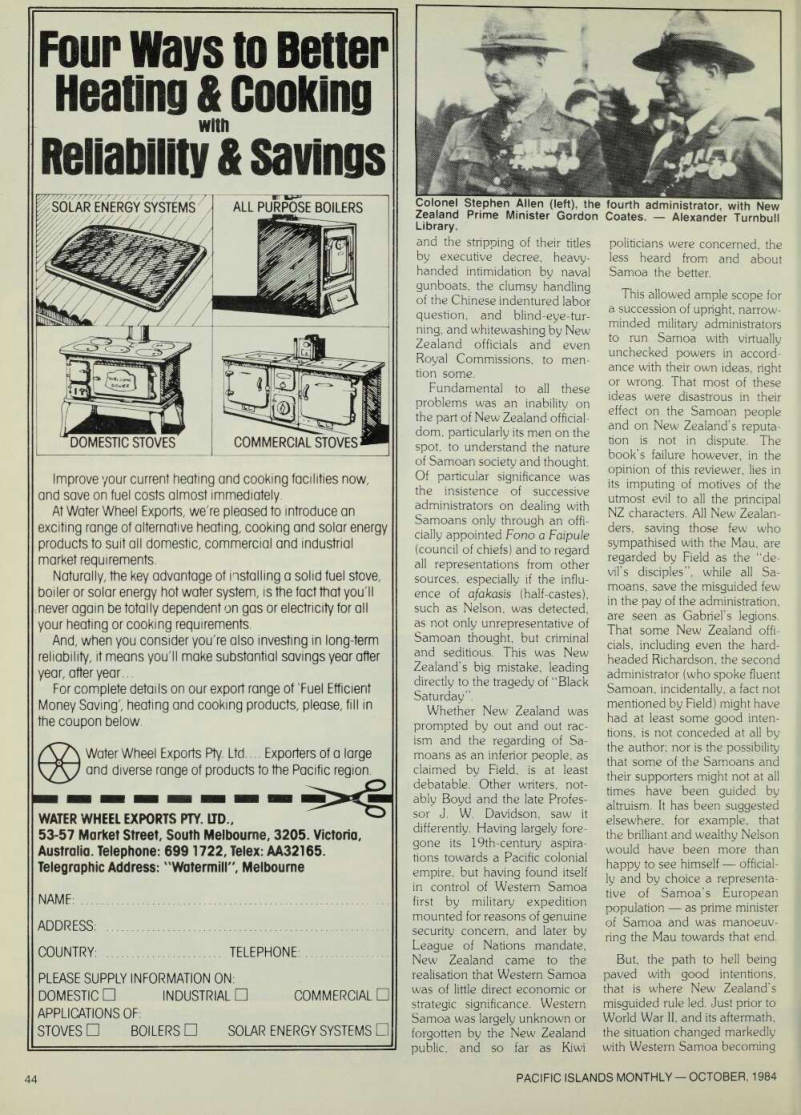
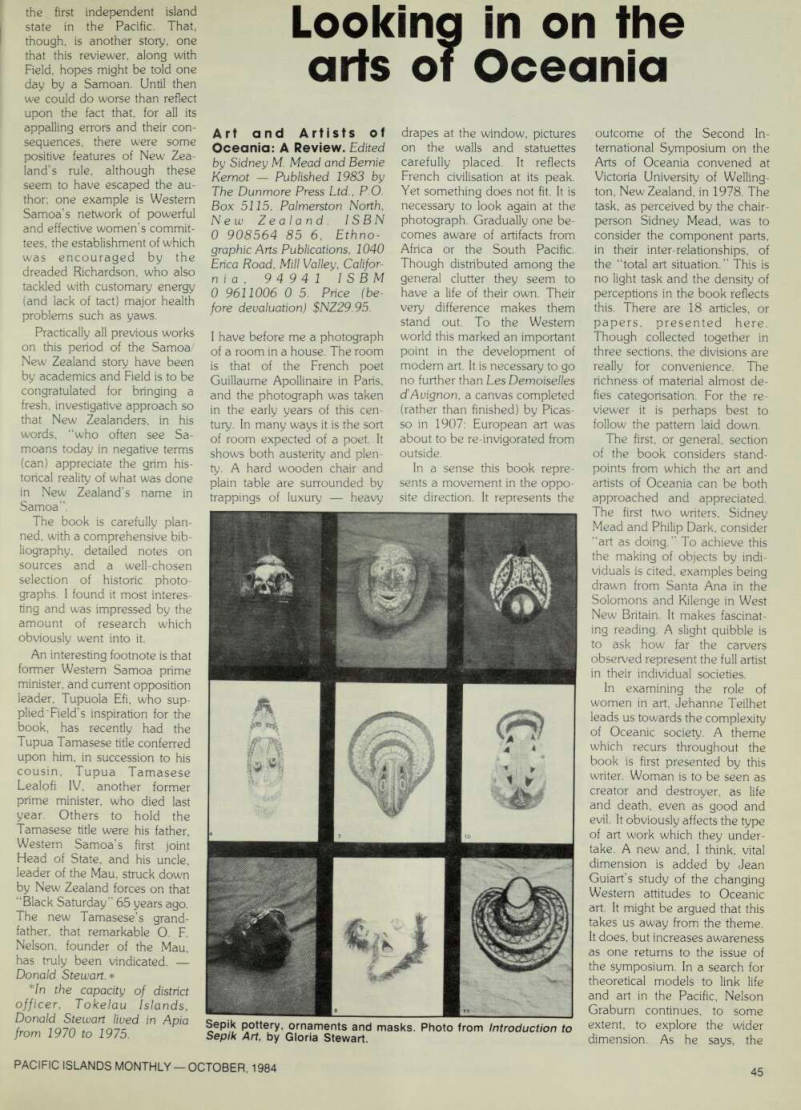
books
New Zealand In Samoa
Bumblers, yes - but were they fools or knaves?
Mau: Samoa’s Struggle Against New Zealand Oppres sion. By Michael J. Field. Pub lished by A. H. & A. W. Reed Ltd., Wellington. 1984. XVIII, 262. 15BN 0 589 014927. $A19.95.
On Saturday, December 28, 1929, a small contingent of New Zealand police, jittery and feeling threatened, armed with revolvers, rifles and a single Lewis machine gun, opened fire without warning on a much larger, yet unarmed and peace ful, group of Samoan demon strators on Beach Road, Apia.
The gunfire killed 11 Samoans and wounded 30. One New Zealand policeman died from injuries received at the hands of the Samoan survivors.
Among those killed was the leader of the demonstrators, Tupua Tamasese Lealofi 111, a Samoan chief who had only recently returned to Samoa after serving a prison sentence in New Zealand for the crime of leading a seditious organisation.
The story of that organisation is the subject of a new and meticulously researched book titled Mau and subtitled, some what emotively, “Samoa’s struggle against New Zealand oppression” by New Zealand journalist, and former govern ment press officer in Western Samoa, Michael J. Field.
The events of “Black Satur day” as it came to be known were the lowest in a series of lows which marked the first 25 years of New Zealand adminis tration of its mandate. The stage for the Samoans’ disillu sionment with their New Zea land rulers was set as early as 1918 when the appalling con sequences of official negligence resulted in an influenza
epidemic in which one in every five Samoans died. This dis aster could have been pre vented by simple ship quaran tine measures, such as were adopted in neighboring Amer ican Samoa, where not a single case of influenza was recorded.
The point was not lost on the Samoans who, in Field’s words, from then on regarded New Zealanders as “bumblers and people not fit to run somebody else’s nation”.
The ensuing 20 years, as described elsewhere by another writer on Samoa, Mary Boyd, were “a tragedy of good inten tions”. This is a view obviously not shared by Field, who re gards New Zealand’s actions in Western Samoa at the time as evil in themselves, springing from the “deeply racist attitude
of a colonial power”. In seeing history from this viewpoint Field claims to have been influenced by former Western Samoan prime minister Tupuola Efi, for whom Field worked as press officer, and who, in a speech to the United Nations General Assembly, said: “When Samoa talks about colonialism and rep ression, whether they be in Africa, in the South Pacific, in Asia or elsewhere, it is not just rhetoric. Rather, Samoa’s opposition to colonialism is fun damental because of its own experience.” That Tupuola should have made such a com ment to the world is a natural legacy of New Zealand’s far from inspirational administra tion of his country: the Tupua Tamasese Lealofi 111, jailed and then gunned down by New
Zealanders in 1929, was his uncle; the legendary Olaf Frederick Nelson, founder of the Mau, deported twice from Samoa and jailed in New Zea land for his activities, was his grandfather.
Whatever motives are attri buted to New Zealand’s ac tions, there is no dispute that its administration, at best, was totally inept. To the jailing of Tamasese and the subsequent slaying of him and his suppor ters, the influenza epidemic and the deporting twice of the enigmatic Nelson, can be added the formal banning of the Mau, the hunting down, arrest and imprisonment of its adherents (including the use of a machine-gun equipped sea plane), the banishment of Sa moan matais from their villages
Mau members gathered round their fallen leader, Tupua Tamasese Lealofi III. Kneeling in the foreground is Faumuina and standing behind him, with his arm in a sling, is Tuimaleali'ifano. The widow Ala Tamasese sits beside her husband’s body, and beside her are the lawyer Hall Skelton and the returned exile Smyth. - Alexander Turnbull Library.
and the stripping of their titles by executive decree, heavy handed intimidation by naval gunboats, the clumsy handling of the Chinese indentured labor question, and blind-eye-tur ning. and whitewashing by New Zealand officials and even Royal Commissions, to men tion some.
Fundamental to all these problems was an inability on the part of New Zealand official dom. particularly its men on the spot, to understand the nature of Samoan society and thought.
Of particular significance was the insistence of successive administrators on dealing with Samoans only through an offi cially appointed Fono a Faipule (council of chiefs) and to regard all representations from other sources, especially if the influ ence of afakasis (half-castes), such as Nelson, was detected, as not only unrepresentative of Samoan thought, but criminal and seditious. This was New Zealand’s big mistake, leading directly to the tragedy of “Black Saturday".
Whether New Zealand was prompted by out and out rac ism and the regarding of Sa moans as an inferior people, as claimed by Field, is at least debatable. Other writers, not ably Boyd and the late Profes sor J. W. Davidson, saw it differently. Having largely fore gone its 19th-century aspira tions towards a Pacific colonial empire, but having found itself in control of Western Samoa first by military expedition mounted for reasons of genuine security concern, and later by League of Nations mandate.
New Zealand came to the realisation that Western Samoa was of little direct economic or strategic significance. Western Samoa was largely unknown or forgotten by the New Zealand public, and so far as Kiwi
politicians were concerned, the less heard from and about Samoa the better.
This allowed ample scope for a succession of upright, narrow minded military administrators to run Samoa with virtually unchecked powers in accord ance with their own ideas, right or wrong. That most of these ideas were disastrous in their effect on the Samoan people and on New Zealand’s reputa tion is not in dispute. The book’s failure however, in the opinion of this reviewer, lies in its imputing of motives of the utmost evil to all the principal NZ characters. All New Zealan ders, saving those few who sympathised with the Mau, are regarded by Field as the “de vil’s disciples”, while all Sa moans, save the misguided few in the pay of the administration, are seen as Gabriel’s legions.
That some New Zealand offi cials. including even the hard headed Richardson, the second administrator (who spoke fluent Samoan, incidentally, a fact not mentioned by Field) might have had at least some good inten tions, is not conceded at all by the author; nor is the possibility that some of the Samoans and their supporters might not at all times have been guided by altruism. It has been suggested elsewhere, for example, that the brilliant and wealthy Nelson would have been more than happy to see himself official ly and by choice a representa tive of Samoa’s European population —• as prime minister of Samoa and was manoeuv ring the Mau towards that end.
But. the path to hell being paved with good intentions, that is where New Zealand's misguided rule led. Just prior to World War 11. and its aftermath, the situation changed markedly with Western Samoa becoming
Colonel Stephen Allen (left), the fourth administrator, with New Zealand Prime Minister Gordon Coates. - Alexander Turnbull Library.
the first independent island state in the Pacific. That, though, is another story, one that this reviewer, along with Field, hopes might be told one day by a Samoan. Until then we could do worse than reflect upon the fact that, for all its appalling errors and their con sequences, there were some positive features of New Zea land's rule, although these seem to have escaped the au thor: one example is Western Samoa’s network of powerful and effective women’s commit tees, the establishment of which was encouraged by the dreaded Richardson, who also tackled with customary energy (and lack of tact) major health problems such as yaws.
Practically all previous works on this period of the Samoa/ New Zealand story have been by academics and Field is to be congratulated for bringing a fresh, investigative approach so that New Zealanders, in his words, “who often see Sa moans today in negative terms (can) appreciate the grim his torical reality of what was done in New Zealand's name in Samoa”.
The book is carefully plan ned, with a comprehensive bib liography, detailed notes on sources and a well-chosen selection of historic photo graphs. I found it most interes ting and was impressed by the amount of research which obviously went into it.
An interesting footnote is that former Western Samoa prime minister, and current opposition leader, Tupuola Efi, who sup plied Field’s inspiration for the book, has recently had the Tupua Tamasese title conferred upon him, in succession to his cousin, Tupua Tamasese Lealofi IV, another former prime minister, who died last year. Others to hold the Tamasese title were his father, Western Samoa’s first joint Head of State, and his uncle, leader of the Mau, struck down by New Zealand forces on that “Black Saturday” 65 years ago.
The new Tamasese’s grand father, that remarkable O. F.
Nelson, founder of the Mau, has truly been vindicated.
Donald Stewart.
*/n the capacity of district officer, Tokelau Islands, Donald Stewart lived in Apia from 1970 to 1975.
Advertisements & other items, p. 44 (1 item)
Heating & cooking
Four Ways to Better
with
Reliability & Savings
SOLAR ENERGY SYSTEMS
ALL PURPOSE BOILERS
3
DOMESTIC STOVES
COMMERCIAL STOVES
Improve your current heating and cooking facilities now, and save on fuel costs almost immediately, At Water Wheel Exports, we're pleased to introduce an exciting range of alternative heating, cooking and solar energy products to suit all domestic, commercial and industrial market requirements.
Naturally, the key advantage of installing a solid fuel stove, boiler or solar energy hot water system, is the fact that you'll never again be totally dependent on gas or electricity for all your heating or cooking requirements.
And, when you consider you're also investing in long-term reliability, it means you'll make substantial savings year after year, after year...
For complete details on our export range of 'Fuel Efficient Money Saving', heating and cooking products, please, fill in the coupon below.
Water Wheel Exports Fly. Ltd. Exporters of a large and diverse range of products to the Pacific region.
WATER WHEEL EXPORTS PTY. LTD.,
53-57 Market Street, South Melbourne, 3205. Victoria, Australia. Telephone: 699 1722, Telex: AA32165.
Telegraphic Address: "Watermill", Melbourne
NAME: ...
ADDRESS:
COUNTRY:
TELEPHONE:
PLEASE SUPPLY INFORMATION ON:
DOMESTIC □ INDUSTRIAL □ COMMERCIAL □
APPLICATIONS OF:
STOVES □ BOILERS □ ENERGY SYSTEMS □
arts of Oceania
Looking in on the arts of Oceania
Art and Artists of Oceania: A Review. Edited by Sidney M. Mead and Bernie Kernot Published 1983 by The Dunmore Press Ltd.. P.O.
Box 5115. Palmerston North.
New Zealand. ISBN 0 908564 85 6, Ethno graphic Arts Publications. 1040 Erica Road. Mill Valley. Calijor ni a. 949 4 1 ISBM 0 9611006 0 5. Price (be fore devaluation) $NZ29.95. 1 have before me a photograph of a room in a house. The room is that of the French poet Guillaume Apollinaire in Paris, and the photograph was taken in the early years of this cen tury. In many ways it is the sort of room expected of a poet. It shows both austerity and plen ty. A hard wooden chair and plain table are surrounded by trappings of luxury heavy
drapes at the window, pictures on the walls and statuettes carefully placed. It reflects French civilisation at its peak.
Yet something does not fit. It is necessary to look again at the photograph. Gradually one be comes aware of artifacts from Africa or the South Pacific.
Though distributed among the general clutter they seem to have a life of their own. Their very difference makes them stand out. To the Western world this marked an important point in the development of modern art. It is necessary to go no further than Les Demoiselles dAvignon, a canvas completed (rather than finished) by Picas so in 1907: European art was about to be re-invigorated from outside.
In a sense this book repre sents a movement in the oppo site direction. It represents the
outcome of the Second In ternational Symposium on the Arts of Oceania convened at Victoria University of Welling ton. New Zealand, in 1978. The task, as perceived by the chair person Sidney Mead, was to consider the component parts, in their inter-relationships, of the “total art situation.” This is no light task and the density of perceptions in the book reflects this. There are 18 articles, or papers, presented here.
Though collected together in three sections, the divisions are really for convenience. The richness of material almost de fies categorisation. For the re viewer it is perhaps best to follow the pattern laid down.
The first, or general, section of the book considers stand points from which the art and artists of Oceania can be both approached and appreciated.
The first two writers, Sidney Mead and Philip Dark, consider “art as doing.” To achieve this the making of objects by indi viduals is cited, examples being drawn from Santa Ana in the Solomons and Kilenge in West New Britain. It makes fascinat ing reading. A slight quibble is to ask how far the carvers observed represent the full artist in their individual societies.
In examining the role of women in art. Jehanne Teilhet leads us towards the complexity of Oceanic society. A theme which recurs throughout the book is first presented by this writer. Woman is to be seen as creator and destroyer, as life and death, even as good and evil. It obviously affects the type of art work which they under take. A new and. I think, vital dimension is added by Jean Guiart’s study of the changing Western attitudes to Oceanic art. It might be argued that this takes us away from the theme.
It does, but increases awareness as one returns to the issue of the symposium. In a search for theoretical models to link life and art in the Pacific, Nelson Graburn continues, to some extent, to explore the wider dimension. As he says, the
Sepik pottery, ornaments and masks. Photo from Introduction to Sepik Art, by Gloria Stewart.
LUUIISL LU WCeCU HCI LU 1111 U the “simple truth” and the “moral other” as exemplified by the peoples living there. The need of the Westerner is to help himself, not to help others. The section ends on an open note with Katarina Mataira attemp ting to see the art from within and without, in terms of negative and positive influ ences.
Melanesia and Micronesia
cue ueau wun logeiner in one section. The emphasis now be comes one of deepening under standing by presenting the fin dings of detailed field study, somewhat after the style of Codrington. Deborah Waite examines the making and use of war shields ornamented with shell inlay in the Solomon Is lands. Shields feature again in the article by Dirk Smidt, which examines Middle Ramu art in
rapua iNew Uuinea. Ihe com munity houses (bai) in the Palauan Islands of Microniesia are described by David Robin son in considerable detail.
Throughout one gains more than a description. Referring to the making of Kominimung shields Smidt observes that the carvers accepted their chil dren's immediacy even when a child went so far as to sit on the shield his father was working on. The other two articles in the section are special unto them selves. De’Ath concerns himself with a pottery clay dispute in the Trans-Gogol of Papua New Guinea. At first sight the inci dent may seem to have little direct relationship to art. In fact it contributes much towards the total art situation. The last (though first in the book) ex plores. through a person, Bagou, in West New Britain, the development and variety of clan designs. An unusual level of insight results. Where faces are painted they are often refer red to in natural terms what they resemble. An example, presented by Ann Chowning, is that of “the testicles of the butterfly”.
The final section of the book, slightly longer than the other two. is more diverse. It serves to remind us of the span of the region as well as of its variety.
The title given to it is Polynesia.
Three of the articles are con cerned in some way with Maori carving in New Zealand. Bernie Kernot and Roger Neich both indicate the conflict between the old and the new. Kernot follows the building of a Meet ing House in the Horowhenua- Rangitikei district. The builders split into two groups. The tra ditionalists want food and women to be prohibited in the unfinished house. The others felt that it would delay comple tion. At a later stage the needs of genealogy had to be recon ciled with Christianity.
Neich studies the effect of white patronage on Maori art around the turn of the century.
It would seem here, as with tourism, that roles are changed about. Maori craftsmen seek innovation, while their patrons wish to imitate museum pieces.
Allan Hanson’s article, though specifically relating to Maori art, is similar to that of Graburn in the first section of the book. He is interested in the relationship
between art form and society.
Symmetry, though not always exact, is seen to replicate social organisation male and female, union and separation, and so on. My only doubt is to how far this is particular to the Maori.
Many of the voices so far have been of those looking into Oceania. To mix a metaphor somewhat. Albert Wendt is doubly a writer looking out. He seeks to correct the passivity and lack of self-respect intro duced by the papalagi. His is a study of contemporary art in Oceania. Judith Huntsman examines the social aspects of food preparation in the Tokelau Islands. Finally a lost cult, using post images, is brought to light by Roger Rose in Hawaii.
As suggested earlier the form of the book dictates, to some extent, the way in which a reviewer might approach it. The offerings are so rich and varied that each demands mention.
The presentation and use of photographs is excellent. As in the Tokelaus. one has the right to ask what are the social implications of the feast. Feeling replete is not enough. The intention laid down by Sidney Mead at the very beginning was to look at art in Oceania in a total sense. To achieve this he saw the roles of analyser and artist complementing one an other.
To quote him: My main plea was to gather a maximum of evidence before plun ging into the domain of interpreta tion. I asked also that we take the artists into our confidence and exchange information more freely with them, that we develop a sense of problem so as to bring more excitement into studies of Oceanic art. that we raise our standards of observation, interpretation and re porting. that we entice more Pacific Islanders into our field of study, that we find alternative ways of training them, and that we co-operate in defining new problems and seeking solutions to them. (P. 24.) How far this intention is realised in the book is for the reader to decide. In a wider sense I wonder what the gain to the Oceanic artist is. Is he able to take Western artifacts to re-invigorate his culture from the outside, or are we simply putting Apollinaire’s masks and figures back into an ethnog raphic museum, albeit living?
Bob Wild.
Advertisements & other items, pp. 46-48 (1 item)
Correspondence
f DARWIN COMMUNITY COLLEGE
SCHOOL OF EXTENSION SERVICES
HOME
CORRESPONDENCE
COURSES
These courses are open to anyone. Fees range from $4O to $95 Study at home, at your own pace, with no classes or examinations, using self-instructional materials prepared by college staff and consultants.
Courses in this series are;
ABOUT CHILDREN LANGUAGES
1. Books and Children 25. Indonesian! 2. Child Development 26. Indonesian II 3. Educational Provisions for 27. Indonesian 111 the Gifted 28. Indonesian IV 4 Getting Started Parents Guide to Preparing Your pnuD " T ' up Child for School 5. The Young Handicapped Child
DRIVING
6. Advanced Driving
ENVIRONMENT,
TECHNOLOGY
7 Experimental Electronics 8. Solar Enemy 9. Desk Top Calculators for Surveyors 10. Digital Systems 11. Mineralogy and Petrology 12. Soil Conservation
ACCOUNTING,
BUSINESS
13. Accounting! 14. Accounting II 15. Accounting for Charities 16. A Guide to Marketing Techniques 17. Sales Management 18. Understanding Economics 23. Australian Political 19. Planning and Starting a Systems New Business 24. Social and Political 20. Planning and Starting a Themes in Modern Small Business Literature For further information about courses, fees and enrolment, fill in the coupon and return to: Co-ordinator, Home Correspondence Courses, Darwin Community College, P.O. 80x40146,
CASUARINA, N T. 5792, AUSTRALIA.
MATHEMATICS,
STATISTICS
37. An Introduction to Computing 29. Elementary Computer Programming 30. Programming and Flowcharting 31. Bridging Mathematics 32. Applied Statistics 33. Introductory Statistics
HOBBY COURSES
34. Modern Batik Art & Craft 35. Hydroponics 36. Wonderful World of Herbs
PERSONAL,
SOCIAL,
POLITICAL
21. Stress and Personal Development 22. Women in Australian Society Please send me; • Home Correspondence Brochure: □ • Information on course numbers: □□□ I
NAME
ADDRESS
I I I I 31 L
4 9*
|A c OH
o
To most people it’s a puzzle
...to us it’s childs play.
Stowage factor, tween decks, union purchase, McGregor hatches confusing language unless you really know the shipping and stevedoring industry. We have been operating as ships agents and stevedores for over 20 years throughout Papua New Guinea and have offices in all major ports.
Whatever the type of vessel or cargo, from container ships to tankers, LCT’s to barges, coffee to copra, rice to rubber, we welcome the opportunity to be of service.
Robert Laurie-Carpenters Pty. Ltd.
PO Box 922, Port Moresby, Papua New Guinea Telephone: 21 7324 Telex: NE22107 Branches throughout Papua New Guinea TCA4S9
NOTICE TRADE MARK:
Notice is hereby given that Aiwa Co., Ltd., a corporation duly organised and existing under the laws of Japan of 9 Kandasudacho 2-chome, Chiyodaku, Tokyo, Japan, is the sole proprietor in Papua New Guinea and Nauru and elsewhere of the following Trade Mark:
AIWA
Used in respect of the following: Radio and television equipments; sound amplifying apparatus and instruments and parts thereof; microphones, loud-speakers, tuners, record players, turntables, pickups, tape recorders, video recorders, phonograph records, tapes and other sound and/or image recording and/or reproducing apparatus, articles and implements; cassette tape recorders, combined radio receivers and cassette tape recorders, phonomotors; parts and accessories of foregoing goods.
The Proprietor claims all rights in respect of the above Trade Mark and will take all necessary legal steps against any person or company infringing those rights.
F. B. RICE & CO.
Patent Attorneys, Sydney, Australia.
‘MSTANT
HOUSES’
and Commercial Buildings with Therma-Panel, R the
fully insulated inter-locking
Building System
Cyclone rated George Hudson Homes (Aust) pty. Ltd 186 Hume Highway Cabramatta NSW 2166 Australia. Tel: (02) 727 9066. Telex: AA25800 Post coupon for details and prices.
Tel:.
A dinosaur of Melanesian studies
Melanesian studies
Melanesia Beyond Diversity, Edited by R. J. May and Hank Nelson. Published by the Re search School of Pacific Stu dies, Australian National Uni versity, Canberra, 1982. Two volumes, 690 pp. $A20.00.
In 1980 the Research School of Pacific Studies organised a marathon of Melanesian semi nars. Fifty papers were pre sented over a period of four weeks. Forty-six of these (amounting to nearly half a million words) are now pre sented in two volumes of close typescript. No single person could possibly want to read all the papers, but almost any reader will find something of interest, and each paper will command a loyal following.
The reader who does stumble upon a nugget of illumination should mark the page carefully, because the volumes have no index, and an item of informa tion, once lost, is not easily recovered.
This is not so much a cohe rent publication, as a showcase of the information available in, or near, the research school. In a brief preface, the editors make no attempt to explain the title, nor do they hint at what may lie beyond the diversity evident in the papers them selves. The linguistic and cultu ral variety of Melanesia is now matched by the range of scholarly disciplines and approaches which attempt to explain conditions. A synthesis of this evidence would require much more than an editorial comment. Wisely then, the edi tors refrain from reaching any general conclusion frustra tingly, many of the contributors do the same. Collectors and librarians should certainly purchase these volumes: they contain a wealth of up-to-date research information, and it is not likely that we shall see another production of this kind again.
Volumes generated in this fashion cannot achieve com prehensiveness. There are some surprising areas of incom pleteness, despite the scale of the whole enterprise. Only
Peter Hastings addresses Irian Jaya at any length; only Linda Latham and Alan Ward consid er New Caledonia. The emph asis is upon Papua New Guinea, Vanuatu, the Solomon Islands, and Fiji (in that order).
Some sections (The Colonial Mastas, and Colonial and Post- Colonial Politics) attempt a thorough coverage of most of Melanesia. More often, the papers reflect the research in terests which scholars hap pened to be pursuing in and around Canberra at the time.
One paper is written by a Melanesian (John Waiko) and another by an ex-prime minis ter (E. G. Whitlam), both of whom happened to be in the school. Otherwise most of the contributors are conventional Australian scholars, with a sprinkling of academic journal ists, writing within their chosen disciplines and reviewing their favorite topics.
The research school was established in 1947, when the Australian Commonwealth Government was anxious for advice about its island neigh bors, whose significance had been demonstrated by the Paci fic War. The school has changed in several interesting ways since those urgent days, and the consequences are clear in the volumes under review.
Since the 19605, Australian in terest in Southeast Asia, and in super-power conflicts, has di luted the school’s Pacific in terests, although it remains the largest concentration in the world of Pacific-oriented scholarship.
With the passage of time and the growth of the research school, academic departments and disciplines have deflected scholars away from an inter disciplinary enthusiasm, and they are mainly caught up in the particular debates of each discipline. Linguists now write for other linguists, historians for other historians, and so on. The policy-advising role has also become much less evident.
Most of the studies presented here are either historical or else descriptive; they are usually
phrased to be understood by other scholars, rather than politicians or bureaucrats.
Those academics who do advise governments on econo mic, strategic, or social matters, are mainly absent from these pages.
At the time of the seminar, some scholars were already seeking other forms of express ion. On one hand, economists and political scientists and strategists were getting along side politicians privately (and former members of the re search school are quite well represented among advisers to the Labor Government in Aus tralia, as well as in the bureauc racies of island governments).
On the other hand there has been a search for access to a wider public.
One of the editors, Hank Nelson, was involved in the immensely successful ABC radio series, Taim Belong Mas ta, and the equally popular
documentary film Angels of War. These ventures have in spired other experiments in radio, film and television. The documentary film First Contact, for instance, not only competed for an Oscar, but also provoked a more lively discussion in the pages of PIM than any academic book could achieve.
Willingly or not, the rest of us will have to follow these paths, since the ANU Press has been discontinued. Many detailed studies, which do not lend themselves to radio or televi sion production, will continue to appear in learned journals; but block-busting monuments to scholarship are not likely to be repeated. If scholarship of this calibre can be presented to a wider (and not necessarily literate) audience, that is surely to everyone’s advantage.
Melanesia Beyond Diversity is an academic dinosaur: over specialised, bulky, clumsy (and nutritious), but now obsolete.
Donald Denoon.
Militarism, aid, and
the Third World
Wealth, Poverty and Survi val: Australia in the World.
Edited by John Langmore and David Peetz. Published by George Allen & Unwin in association with the Australian Labor Party, Sydney, 1983.
XIV, 224. ISBN 0 86861 149 2 (pbk.), $A9.95.
This book grew out of the 1981 national conference of Austra lian Labor Party (ALP), economists, and concentrates on development in the Third World, and the role of deve loped countries, particularly Australia, in that development.
Among the contributors are several with strong South Paci fic connections Harold Brookfield, Ross Garnaut, Helen Hill and John Langmore and some prominent ALP personalities, especially Bill Hayden and Gough Whitlam.
This is insufficient, of course, to recommend a book so be fore the more conservative readers turn the page I will point out its main virtue: it brings together a number of
thoughtful articles on most of the big issues facing every country, including the South Pacific nations. Whilst written from a socialist perspective, the average degree of leftism amongst the contributors seems fairly close to the centre. I would be surprised if many conservatives could not find much to agree with in the book.
The book is very wide in scope, and this review concentrates on only two aspects militarism and foreign aid.
Andrew Mack’s chapter on militarism and development commences by quoting the Brandt Report’s comment that “More arms do not make man kind safer, only poorer”. Some would dispute the first part (i.e. they would hold that imbalance in the armed strengths of coun tries makes war likelier), but few can deny the second: if govern ments spend more on defence, they necessarily spend less else where. In the early 1980 s, the low income countries (those with less than SUS4OO GNP per head per annum) allocated
around 17 per cent of central government expenditures to military purposes.
A large proportion of this perhaps half went on im ported equipment, willingly sold by the developed coun tries, especially the United States, the USSR and France.
They are being joined by deve loping countries, particularly In dia, which have developed their own military industry. I can only hope that the South Pacific nations refuse to be sucked into the costly and dangerous exer cise of war games, and continue to oppose any foreign military presence in the region.
Mack points out a second formidable cost: an emphasis on the military is commonly associated with a loss of human rights and internal oppression.
This is understandable: soldiers are taught to obey their super iors, and to override anything their hearts may be telling them. The message for the South Pacific is clear: if a defence force is deemed neces sary, keep it small and simple, and keep it under tight civilian control.
Harold Brookfield’s very readable chapter on aid is based on his experience in an unamed Caribbean nation. He discusses the longstanding dif ficulty of finding the form of aid which has both “sex appeal” to the donors (who usually want their aid to be spent on some conspicuous urban project), and to the recipients (who want to make their own decisions and therefore prefer a direct budgetary contribution). One should not overemphasise this problem: most developing countries now build-in ex pected aid receipts to their budgets and prepare a shop ping list of projects which are both consistent with their objec tives and would appeal to the donors.
A related issue, discussed by Mack (p 62), is the extent to which aid should take note of the human rights and re distributive policies of the re ceiving government. It is, after all, governments which receive aid money, and only indirectly, if at all, does it reach the people. Brookfield has some interesting remarks about technical assistance (p 95-96), including the secondment of staff to developing countries
(the reviewer is currently en gaged in such a position), and points out that lack of continuity is a major difficulty. Is this an area where government bodies in developed countries could help by agreeing to second staff for five or 10 years rather than one or two?
Brookfield’s main recom mendation is important that regional , locally-staffed institu tions be built up which, with collective local wisdom, can “harmonise national programs with real regional development needs” (plOl).
I am in sympathy with the aims and orientation of this book. It is a good example of the marriage of warm hearts and cool heads, both of which are needed to address major global problems. It is readable, it will expand minds, and it deserves to be added to many libraries, both personal and in
stitutional.
Geoff Harris.
Books received
Black Coconuts, Brown Magic. By Joseph Theroux. Published 1983 by The Dial Press, Doubleday & Company, Inc., 245 Park Avenue, New York. 10167 USA. ISBN 0 385 27947 7. Price $U513.95.
Politics in New Caledonia. By Myriam Dornoy. Published 1984 by Sydney University Press, Sydney University, NSW 2006. ISBN 0 420 0101 2 Price $A42.50.
The Prehistoric Archaeology of Nor folk Island. Pacific Anthropological Re cords No. 34. By Jim Specht. Published by Department of Anthropology, Ber nice P. Bishop Museum, P.O. Box 19000-A, Honolulu, Hawaii 96817 ISBN 0 910240 95 7. No price.
Na Pule Kahiko. Ancient Hawaiian Prayers. By Jane Gutmanis. Published 1983 by Editions Limited, 1123 Kapa hulu Avenue, Honolulu, Hawaii 96816 ISBN 0 9607938 6 0. No price.
Advertisements & other items, p. 49 (1 item)
Wealth
POVERTY
& SURVIVAL
Edited bv
JOHN I ANGVK.M DAVID rtFTZ
Giancarlo’s story: From Rome

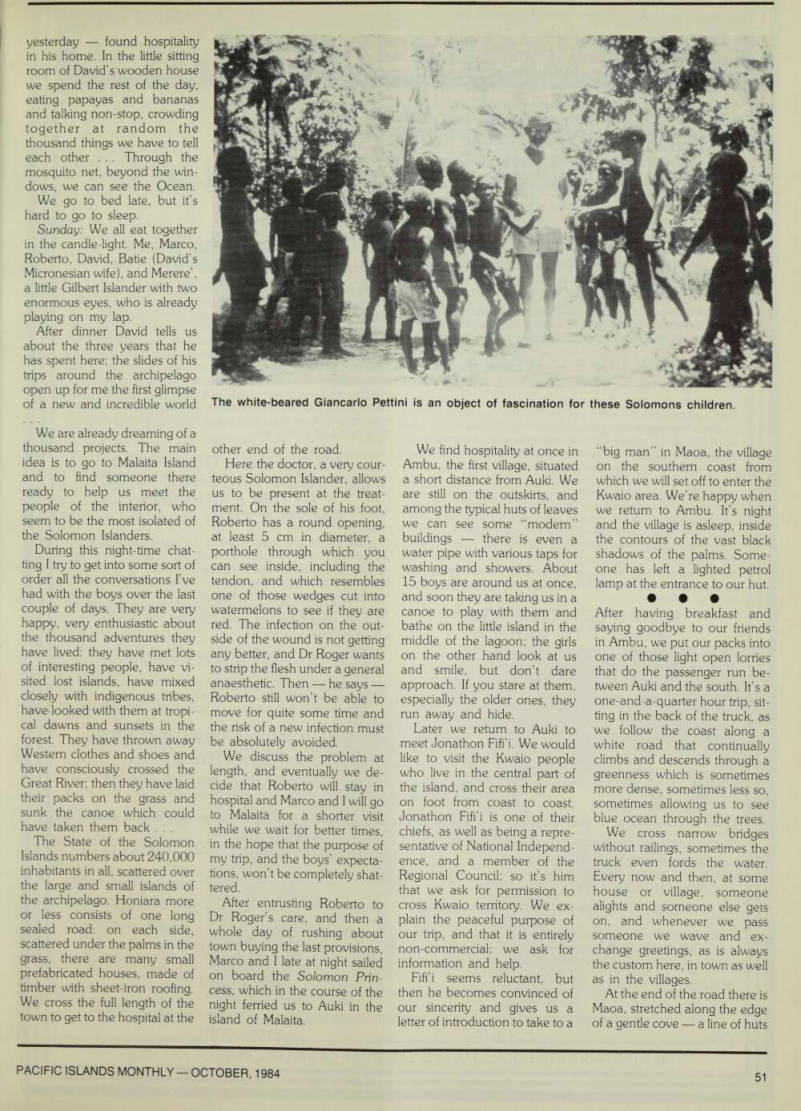

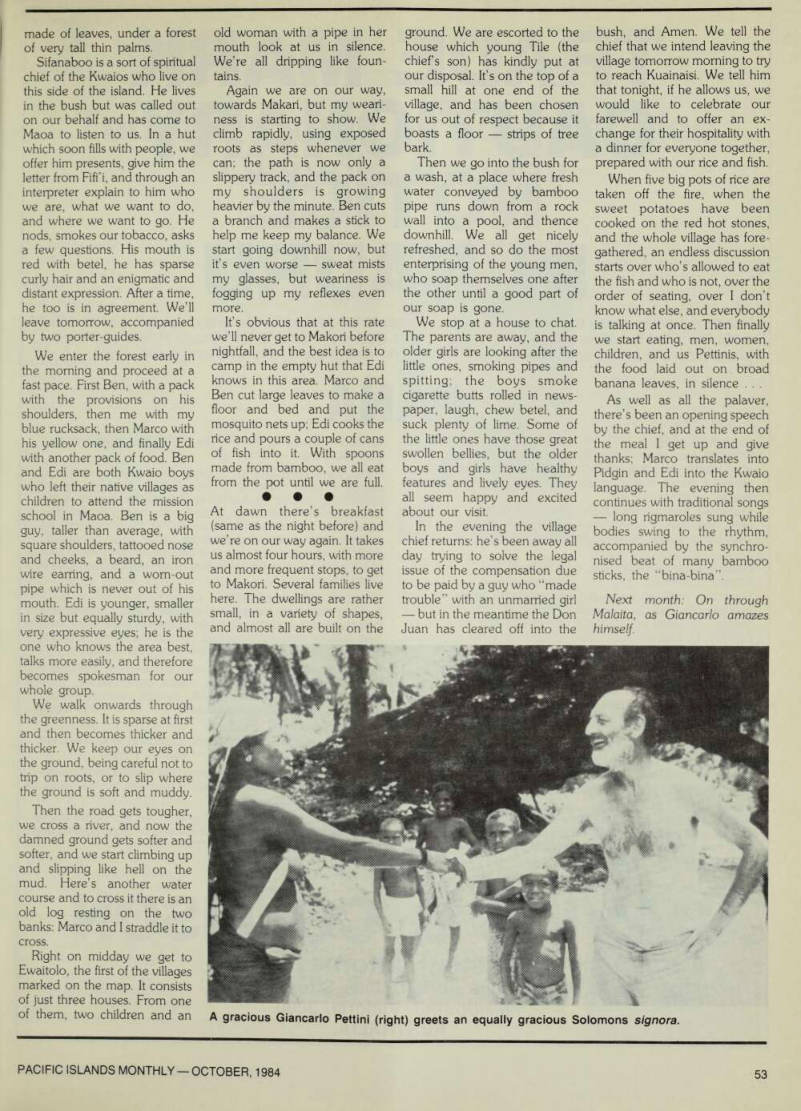
to Malaita Island
It’s already a whole year since we arrived in Papua New Guinea. It has taken us 12 months to learn “lik lik 4asol” (just a little) about the people and their way of life in some of the hundreds of inhabited is lands in this extraordinary na tion. Heaven alone knows how long it will take us altogether to go right across the Pacific.
However, we can’t stay here any longer and also ... we now feel even more fascinated by, and also more prepared for, the idea of continuing slowly to wards other groups of islands and discovering more similar ities, more differences, between them.
We also feel that the time has come for us to realise one of our fondest dreams; to share part of this journey with Gian carlo, our father. We phone
A dream comes true for PETTINI brothers, ROBERTO and MARCO, as their father GIANCARLO flies out from Rome to join them in a new voyage of discovery on the island of Malaita, Solomon Islands.
him in Rome from Port Mores by. After a few days he rings back to tell us the exact date of his arrival in Honiara, the capi tal of Solomon Islands. None of us knows anything about this country, so we are all the more fascinated by the fact that the next will be a “story” which all three of us will start together.
We are beside ourselves with delight, we can’t talk about anything else, and we count the days, which pass so slowly.
Then, only a few days before our rendezvous, disaster strikes:
as we are swimming in Idlas Bay, a stretch of coral reef half an hour’s drive from Port Moresby, I, Roberto, get stung by a very poisonous stone fish.
We rush to the hospital and only 12 hours before the depar ture of our plane for Honiara, and 36 before Giancarlo’s arri val in the Solomons 1 am operated on to clear out the infection that has caused my foot to swell up like a balloon.
The doctors can’t tell me when I’ll be able to walk again, Giancarlo has already left
Rome, and we can’t postpone our meeting him. So I hop on the plane on one foot, hoping against hope that fate won’t compromise this dream which has almost come true.
Giancarlo, too, wrote a diary during the two months he spent with us. This time it will be up to him to tell the story, until he takes off for Europe again. • • • A total of 32 hours of flying, and here we are in Honiara.
Marco and Roberto are at the airport to meet me, and I can hardly believe it. Cries of joy and hugs . . .
We go to David’s house. He is a young English archeologist, working for Honiara’s museum, and God only knows how the two boys who arrived know ing no one the day before
yesterday found hospitality in his home. In the little sitting room of David’s wooden house we spend the rest of the day, eating papayas and bananas and talking non-stop, crowding together at random the thousand things we have to tell each other . . . Through the mosquito net, beyond the win dows, we can see the Ocean.
We go to bed late, but it’s hard to go to sleep.
Sunday: We all eat together in the candle-light. Me, Marco, Roberto, David, Batie (David’s Micronesian wife), and Merere’, a little Gilbert Islander with two enormous eyes, who is already playing on my lap.
After dinner David tells us about the three years that he has spent here; the slides of his trips around the archipelago open up for me the first glimpse of a new and incredible world We are already dreaming of a thousand projects. The main idea is to go to Malaita Island and to find someone there ready to help us meet the people of the interior, who seem to be the most isolated of the Solomon Islanders.
During this night-time chat ting I try to get into some sort of order all the conversations I’ve had with the boys over the last couple of days. They are very happy, very enthusiastic about the thousand adventures they have lived; they have met lots of interesting people, have vi sited lost islands, have mixed closely with indigenous tribes, have-looked with them at tropi cal dawns and sunsets in the forest. They have thrown away Western clothes and shoes and have consciously crossed the Great River; then they have laid their packs on the grass and sunk the canoe which could have taken them back . . .
The State of the Solomon Islands numbers about 240,000 inhabitants in all, scattered over the large and small islands of the archipelago. Honiara more or less consists of one long sealed road; on each side, scattered under the palms in the grass, there are many small prefabricated houses, made of timber with sheet-iron roofing.
We cross the full length of the town to get to the hospital at the
other end of the road.
Here the doctor, a very cour teous Solomon Islander, allows us to be present at the treat ment. On the sole of his foot, Roberto has a round opening, at least 5 cm in diameter, a porthole through which you can see inside, including the tendon, and which resembles one of those wedges cut into watermelons to see if they are red. The infection on the out side of the wound is not getting any better, and Dr Roger wants to strip the flesh under a general anaesthetic. Then he says Roberto still won’t be able to move for quite some time and the risk of a new infection must be absolutely avoided.
We discuss the problem at length, and eventually we de cide that Roberto will stay in hospital and Marco and I will go to Malaita for a shorter visit while we wait for better times, in the hope that the purpose of my trip, and the boys’ expecta tions, won’t be completely shat tered.
After entrusting Roberto to Dr Roger’s care, and then a whole day of rushing about town buying the last provisions, Marco and I late at night sailed on board the Solomon Prin cess, which in the course of the night ferried us to Auki in the island of Malaita.
We find hospitality at once in Ambu, the first village, situated a short distance from Auki. We are still on the outskirts, and among the typical huts of leaves we can see some “modern’’ buildings there is even a water pipe with various taps for washing and showers. About 15 boys are around us at once, and soon they are taking us in a canoe to play with them and bathe on the little island in the middle of the lagoon; the girls on the other hand look at us and smile, but don’t dare approach. If you stare at them. especially the older ones, they run away and hide.
Later we return to Auki to meet Jonathon Fifi’i. We would like to visit the Kwaio people who live in the central part of the island, and cross their area on foot from coast to coast.
Jonathon Fifi’i is one of their chiefs, as well as being a representative of National Independence, and a member of the Regional Council; so it’s him that we ask for permission to cross Kwaio territory. We explain the peaceful purpose of our trip, and that it is entirely non-commercial: we ask for information and help.
Fifi’i seems reluctant, but then he becomes convinced of our sincerity and gives us a letter of introduction to take to a
“big man” in Maoa, the village on the southern coast from which we will set off to enter the Kwaio area. We’re happy when we return to Ambu. It’s night and the village is asleep, inside the contours of the vast black shadows of the palms. Some one has left a lighted petrol lamp at the entrance to our hut. • • • After having breakfast and saying goodbye to our friends in Ambu, we put our packs into one of those light open lorries that do the passenger run be tween Auki and the south. It’s a one-and-a-quarter hour trip, sit ting in the back of the truck, as we follow the coast along a white road that continually climbs and descends through a greenness which is sometimes more dense, sometimes less so, sometimes allowing us to see blue ocean through the trees, We cross narrow bridges without railings, sometimes the truck even fords the water.
Every now and then, at some house or village, someone alights and someone else gets on, and whenever we pass someone we wave and ex change greetings, as is always the custom here, in town as well as in the villages, At the end of the road there is Maoa, stretched along the edge of a gentle cove a line of huts
The white-beared Giancarlo Pettini is an object of fascination for these Solomons children.
made of leaves, under a forest of very tall thin palms.
Sifanaboo is a sort of spiritual chief of the Kwaios who live on this side of the island. He lives in the bush but was called out on our behalf and has come to Maoa to listen to us. In a hut which soon fills with people, we offer him presents, give him the letter from Fifi’i, and through an interpreter explain to him who we are, what we want to do, and where we want to go. He nods, smokes our tobacco, asks a few questions. His mouth is red with betel, he has sparse curly hair and an enigmatic and distant expression. After a time, he too is in agreement. We’ll leave tomorrow, accompanied by two porter-guides.
We enter the forest early in the morning and proceed at a fast pace. First Ben, with a pack with the provisions on his shoulders, then me with my blue rucksack, then Marco with his yellow one, and finally Edi with another pack of food. Ben and Edi are both Kwaio boys who left their native villages as children to attend the mission school in Maoa. Ben is a big guy, taller than average, with square shoulders, tattooed nose and cheeks, a beard, an iron wire earring, and a worn-out pipe which is never out of his mouth. Edi is younger, smaller in size but equally sturdy, with very expressive eyes; he is the one who knows the area best, talks more easily, and therefore becomes spokesman for our whole group.
We walk onwards through the greenness. It is sparse at first and then becomes thicker and thicker. We keep our eyes on the ground, being careful not to trip on roots, or to slip where the ground is soft and muddy.
Then the road gets tougher, we cross a river, and now the damned ground gets softer and softer, and we start climbing up and slipping like hell on the mud. Here’s another water course and to cross it there is an old log resting on the two banks: Marco and I straddle it to cross.
Right on midday we get to Ewaitolo, the first of the villages marked on the map. It consists of just three houses. From one of them, two children and an
old woman with a pipe in her mouth look at us in silence.
We’re all dripping like foun tains.
Again we are on our way, towards Makari, but my weari ness is starting to show. We climb rapidly, using exposed roots as steps whenever we can; the path is now only a slippery track, and the pack on my shoulders is growing heavier by the minute. Ben cuts a branch and makes a stick to help me keep my balance. We start going downhill now, but it’s even worse sweat mists my glasses, but weariness is fogging up my reflexes even more.
It’s obvious that at this rate we’ll never get to Makori before nightfall, and the best idea is to camp in the empty hut that Edi knows in this area. Marco and Ben cut large leaves to make a floor and bed and put the mosquito nets up; Edi cooks the rice and pours a couple of cans of fish into it. With spoons made from bamboo, we all eat from the pot until we are full. • • • At dawn there’s breakfast (same as the night before) and we’re on our way again. It takes us almost four hours, with more and more frequent stops, to get to Makori. Several families live here. The dwellings are rather small, in a variety of shapes, and almost all are built on the
ground. We are escorted to the house which young Tile (the chief’s son) has kindly put at our disposal. It’s on the top of a small hill at one end of the village, and has been chosen for us out of respect because it boasts a floor strips of tree bark.
Then we go into the bush for a wash, at a place where fresh water conveyed by bamboo pipe runs down from a rock wall into a pool, and thence downhill. We all get nicely refreshed, and so do the most enterprising of the young men, who soap themselves one after the other until a good part of our soap is gone.
We stop at a house to chat.
The parents are away, and the older girls are looking after the little ones, smoking pipes and spitting; the boys smoke cigarette butts rolled in news paper, laugh, chew betel, and suck plenty of lime. Some of the little ones have those great swollen bellies, but the older boys and girls have healthy features and lively eyes. They all seem happy and excited about our visit.
In the evening the village chief returns: he’s been away all day trying to solve the legal issue of the compensation due to be paid by a guy who “made trouble’’ with an unmarried girl but in the meantime the Don Juan has cleared off into the
bush, and Amen. We tell the chief that we intend leaving the village tomorrow morning to try to reach Kuainaisi. We tell him that tonight, if he allows us, we would like to celebrate our farewell and to offer an ex change for their hospitality with a dinner for everyone together, prepared with our rice and fish.
When five big pots of rice are taken off the fire, when the sweet potatoes have been cooked on the red hot stones, and the whole village has fore gathered, an endless discussion starts over who’s allowed to eat the fish and who is not, over the order of seating, over I don’t know what else, and everybody is talking at once. Then finally we start eating, men, women, children, and us Pettinis, with the food laid out on broad banana leaves, in silence . . .
As well as all the palaver, there’s been an opening speech by the chief, and at the end of the meal I get up and give thanks; Marco translates into Pidgin and Edi into the Kwaio language. The evening then continues with traditional songs long rigmaroles sung while bodies swing to the rhythm, accompanied by the synchro nised beat of many bamboo sticks, the “bina-bina”.
Next month: On through Malaita, as Giancarlo amazes himself.
A gracious Giancarlo Pettini (right) greets an equally gracious Solomons signora.
Advertisements & other items, pp. 50-54 (1 item)
Longlife Products
'll
AND FRESH DAIRY FOODS,
QUALITY YOU CAN TRUST
QUF Industries Ltd. offers an export award winning range of Longlife products as well as a complete range of quality fresh dairy foods.
With 15 years’ experience in export markets, QUF has the product knowledge and expertise to provide you with outstanding service in the 1980’s. • Pauls Longlife UHT Milk is natural liquid cow's milk with no preservatives or additives and is available in the 250m1, 500 ml and 1 litre sizes. • Shake Longlife flavoured milk is offered in delicious Chocolate, Malted, Caramel and Strawberry flavours. • Pauls Longlife Thickened Cream is ideal for whipping or pouring. • Popper 100% Fruit Juice is available in seven flavours in a wide range of Longlife pack sizes. • Pauls fresh Dairy Products including Milk, Cream, Yoghurt and Cottage Cheese are available in an extensive range of flavours and sizes.
TRADE ENQUIRIES:
QUF Industries Ltd., P.O. Box 12, South Brisbane, Queensland, 4101 Australia Telephone: (07) 44-0151 Telex: A A 40614 ■I J LIR-Ul.l Thickened 6w (ream Htvy
mux
miLK
ILMHh
■;4
miiK
HOMEWORKERS WANTED
WOULD YOU ADDRESS
1,000 ENVELOPES FOR $750 US-DOLLARS?
US $2,000 MONTHLY POSSIBLE
IN YOUR SPARE TIME
WORKING AT HOME.
Does this idea interest you ? If you are looking for easy, extra income in these days of rising living costs, you owe it to yourself to investigate our offer.
HOW DOES IT WORK?
You simply follow the simple instructions as outlined in our extra earnings instruction manual. No postage is required on your part. We pay you for the materials to be stuffed. No typewriter required. You receive as much as US $750.00 for every 1,000 envelopes you address. You keep all the money and send us only the ready envelopes.
We pay for your postage. Our system works very well because it enables you to receive your pay in advance, and to have complete control over your earnings and we get the circulation of our business program into the hands of people who have requested them. We are currently expanding our mailing program and we don’t have the necessary space to hire more inside employees.
By recruiting agents like yourself we save money: it simplifies our bookkeeping system and we don’t have to take out insurance for larger buildings and more employees.
HOW MUCH CAN YOU
EXPECT TO EARN ?
Ours is a proven format and the returns that we are receiving RIGHT NOW indicate that you will receive $750.00 for every 1,000 envelopes that you address for us according to our instructions. NO EXPERIENCE NEEDED: JUST THINK, STUFF 200 ENVELOPES-US $150.00 or 1,000 ENVELOPES - US $750.00 EVERY WEEK. AN AVALANCHE OF MONEY IN YOUR MAIL-BOX EVERY
WEEK. BE YOUR OWN BOSS.
VP Send cash, money order or travellers cheque to:
UP INTERNATIONAL ADVERTISING
8306 WILSHIRE BLVD., SUITE 527
BEVERLY HILLS, CA 90211, U.S.A.
TELEPHONE: (714) 946-2471 TELEX: 384026
ALL THE HARD WORK
HAS BEEN DONE FOR YOU !
There is no guess work, as our mailing program has been thoroughly market tested in 88 countries and brings in the results that we have stated. We pay for the materials you need to get started RIGHT AWAY! Our instructions are clear enough for anyone to understand so you’ll have no trouble at all getting started making this kind of money from the first day you receive our kit. You work in the complete comfort of your home; put in the hours of your choice and your earnings are UNLIMITED. All your dealings are entirely by mail, so you can move any time you want without disrupting your income. No lost time for pick ups and deliveries.
WE OFFER A COMPLETE
BUSINESS PROGRAM IN OUR
EXTRA EARNINGS
INSTRUCTION MANUAL
We welcome the opportunity to have you become associated with us as one of our mailers. However, we require a small one time registration fee of $20.00 to become a permanent member in our association. This is indeed a unique opportunity that you cannont afford to pass up. DON’T WAIT UNTIL THIS OFFER ISTAKEN UP
BY TOO MANY AND IS WITHDRAWN.
ORDER RIGHT NOW!!!
PAYMENT TO YOU
Your paychecks leave our office every Friday in the form of International money orders or bank drafts, so you can cash them immediately at any bank around the world.
YOUR REGISTRATION FEE
REFUNDED!
We will refund your $20.00 registration fee when you send us your first 100 envelopes.
Charge to my charge card: □ VISA/MASTER CARD/ AMERICAN EXPRESS (circle one) Card Expiration Date Foreign orders welcome. Send the equivalent notes to US $20.00 in your currency (registered). □ Enclosed is $20.00. Send my complete Starter’s Kit and register me into your program as outlined abovefor earning 75 cents foreach envelope I address. I understand I am not an employee of your corporation, no taxes will be withheld from my paycheck.
NAME
ADDRESS
CITY COUNTRY POSTAL CODE
ALL INSTRUCTION BOOKS MAILED SAME DAY ORDER RECEIVED AIR MAIL
TRADE MARK
CAUTIONARY
NOTICE
IN NAURU
Notice is hereby given that Matsushita Electric Industrial Co. Ltd, a corporation duly organised and existing under the laws of Japan, of 1006 Ohaza Kadoma, Kadoma-shi, Osaka Prefecture, Japan, Manufacturers, is the sole proprietor in Nauru and elsewhere of the following trade mark:
PANA
used in respect of: Catalyst, oxidation catalyst, catalyst for exhaust gas purification, plastic moulding materials, ceramic materials, rodent repellent, toner, developer for copier, absorbent Class 1.
Ferrite Class 6.
Machines and machine tools; motors (except for land vehicles): machine couplings and belting (except for land vehicles): large size agricultural implements; incubators Class 7.
Hand tools and instruments; cutlery, forks and spoons; side arms Class 8.
Scientific, nautical, surveying and electrical apparatus and instruments (including wireless), weighing, measuring, signalling, checking (supervision), life-saving and teaching apparatus and instruments; coin or counter-freed apparatus; talking machines: cash registers; calculating machines; fireextinguishing apparatus, but excluding optical, photographic and cinematographic apparatus and instruments, their parts and accessories Class 9.
Surgical, medical, dental and veterinary instruments and apparatus (including artificial limbs, eyes and teeth) Class 10.
Installations for lighting, heating, steam generating, cooking, refrigerating, drying, ventillating, water supply and sanitary purposes Class 11.
Vehicles; apparatus for locomotion by land, air or water Class 12.
Precious metals and their alloys and goods in precious metals or coated therewith (except cutlery, forks and spoons) jewellery, precious stones, horological and other chronometric instruments Class 14.
Musical instruments (other than talking machines and wireless apparatus) Class 15.
Paper, cardboard articles of paper or of cardboard (not included in other classes); printed matter, newspapers and periodicals, books; book-binding material; stationery, adhesive materials (stationery); artists’ materials; paint brushes typewriters and office requisites (other than furniture): instructional and teaching material (other than apparatus) playing cards; printers’ type and cliches (stereotype), but excluding optical, photographic and cinematographic paper Class 16.
Plastic moulding materials Class 17.
Building materials, natural and artificial stone, cement, lime mortar, plaster and gravel; pipes of earthenware or cement road-making materials; asphalt, pitch and bitumen; portable buildings: stone monuments; chimney pots Class 19.
Furniture, mirrors, picture frames; articles (not included in other classes) of wood, cork, reeds, cane, wicker, horn bone, ivory, whalebone, shell, amber, mother-of-pearl meerschaum, celluloid, substitutes for all these materials, or of plastics Class 20.
Mail boxes (letter boxes), audio cleaners, cloth cleaners, dress brushes, bath brushes Class 21.
Games and playthings; gymnastic and sporting articles (except clothing); ornaments and decorations for Christmas trees Class 28.
The said proprietor claims all rights in respect of the above trade mark and will take all necessary legal steps against any person or company infringing their said rights.
DAVIES & COLLISON
Patent Attorneys
One Little Collins Street,
Melbourne, Victoria. 3000.
AUSTRALIA.
Olympic tragedy
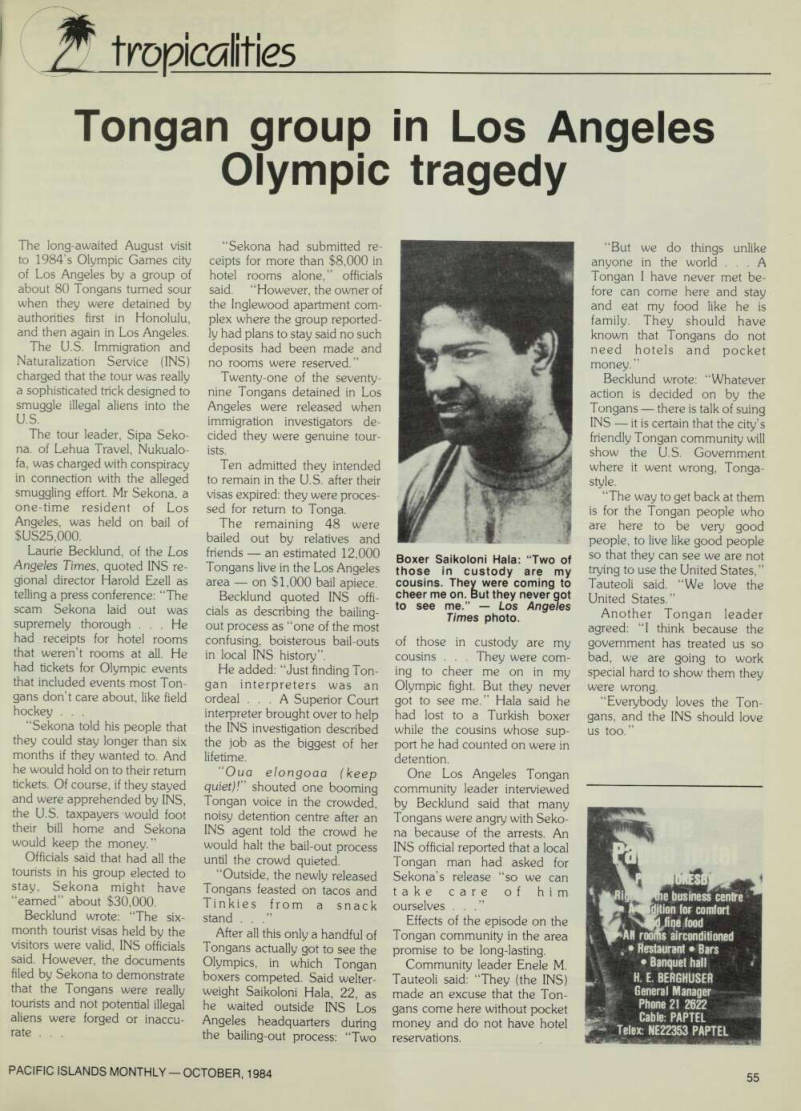
tropicalities
Tongan group in Los Angeles Olympic tragedy
The long-awaited August visit to 1984’s Olympic Games city of Los Angeles by a group of about 80 Tongans turned sour when they were detained by authorities first in Honolulu, and then again in Los Angeles.
The U.S. Immigration and Naturalization Service (INS) charged that the tour was really a sophisticated trick designed to smuggle illegal aliens into the U.S.
The tour leader, Sipa Seko na. of Lehua Travel, Nukualo fa, was charged with conspiracy in connection with the alleged smuggling effort. Mr Sekona, a one-time resident of Los Angeles, was held on bail of $U525,000.
Laurie Becklund, of the Los Angeles Times , quoted INS re gional director Harold Ezell as telling a press conference: “The scam Sekona laid out was supremely thorough ... He had receipts for hotel rooms that weren’t rooms at all. He had tickets for Olympic events that included events most Ton gans don’t care about, like field hockey . . .
“Sekona told his people that they could stay longer than six months if they wanted to. And he would hold on to their return tickets. Of course, if they stayed and were apprehended by INS, the U.S. taxpayers would foot their bill home and Sekona would keep the money.”
Officials said that had all the tourists in his group elected to stay, Sekona might have “earned” about $30,000.
Becklund wrote: “The six month tourist visas held by the visitors were valid, INS officials said. However, the documents filed by Sekona to demonstrate that the Tongans were really tourists and not potential illegal aliens were forged or inaccu rate . . .
“Sekona had submitted re ceipts for more than $B,OOO in hotel rooms alone,” officials said. “However, the owner of the Inglewood apartment com plex where the group reported ly had plans to stay said no such deposits had been made and no rooms were reserved.”
Twenty-one of the seventy nine Tongans detained in Los Angeles were released when immigration investigators de cided they were genuine tour ists.
Ten admitted they intended to remain in the U.S. after their visas expired; they were proces sed for return to Tonga.
The remaining 48 were bailed out by relatives and friends an estimated 12,000 Tongans live in the Los Angeles area on $l,OOO bail apiece.
Becklund quoted INS offi cials as describing the bailing out process as “one of the most confusing, boisterous bail-outs in local INS history”.
He added: “Just finding Ton gan interpreters was an ordeal ... A Superior Court interpreter brought over to help the INS investigation described the job as the biggest of her lifetime.
“Oua elongoaa (keep quiet)!” shouted one booming Tongan voice in the crowded, noisy detention centre after an INS agent told the crowd he would halt the bail-out process until the crowd quieted.
“Outside, the newly released Tongans feasted on tacos and Tinkies from a snack stand ...”
After all this only a handful of Tongans actually got to see the Olympics, in which Tongan boxers competed. Said welter weight Saikoloni Hala, 22, as he waited outside INS Los Angeles headquarters during the bailing-out process: “Two
of those in custody are my cousins . . . They were com ing to cheer me on in my Olympic fight. But they never got to see me.” Hala said he had lost to a Turkish boxer while the cousins whose sup port he had counted on were in detention.
One Los Angeles Tongan community leader interviewed by Becklund said that many Tongans were angry with Seko na because of the arrests. An INS official reported that a local Tongan man had asked for Sekona’s release “so we can take care of him ourselves ...”
Effects of the episode on the Tongan community in the area promise to be long-lasting.
Community leader Enele M.
Tauteoli said: “They (the INS) made an excuse that the Ton gans come here without pocket money and do not have hotel reservations.
“But we do things unlike anyone in the world ... A Tongan I have never met be fore can come here and stay and eat my food like he is family. They should have known that Tongans do not need hotels and pocket money. ”
Becklund wrote: “Whatever action is decided on by the Tongans there is talk of suing INS it is certain that the city’s friendly Tongan community will show the U.S. Government where it went wrong, Tonga style.
“The way to get back at them is for the Tongan people who are here to be very good people, to live like good people so that they can see we are not trying to use the United States,”
Tauteoli said. “We love the United States.”
Another Tongan leader agreed: “I think because the government has treated us so bad, we are going to work special hard to show them they were wrong.
“Everybody loves the Ton gans, and the INS should love us too.”
Boxer Saikoloni Hala: “Two of those in custody are my cousins. They were coming to cheer me on. but they never got to see me.” - Los Angeles Times photo.
Advertisements & other items, p. 55 (1 item)
business centre
for comfort food ioned *Restaurant • Bars ♦ Banquet hat)
H. E. BERGHUSER
Genera) Manager Phone 21 2822 Cable: PAPTEI
NE22353 PAPTEI
“So chimes a good

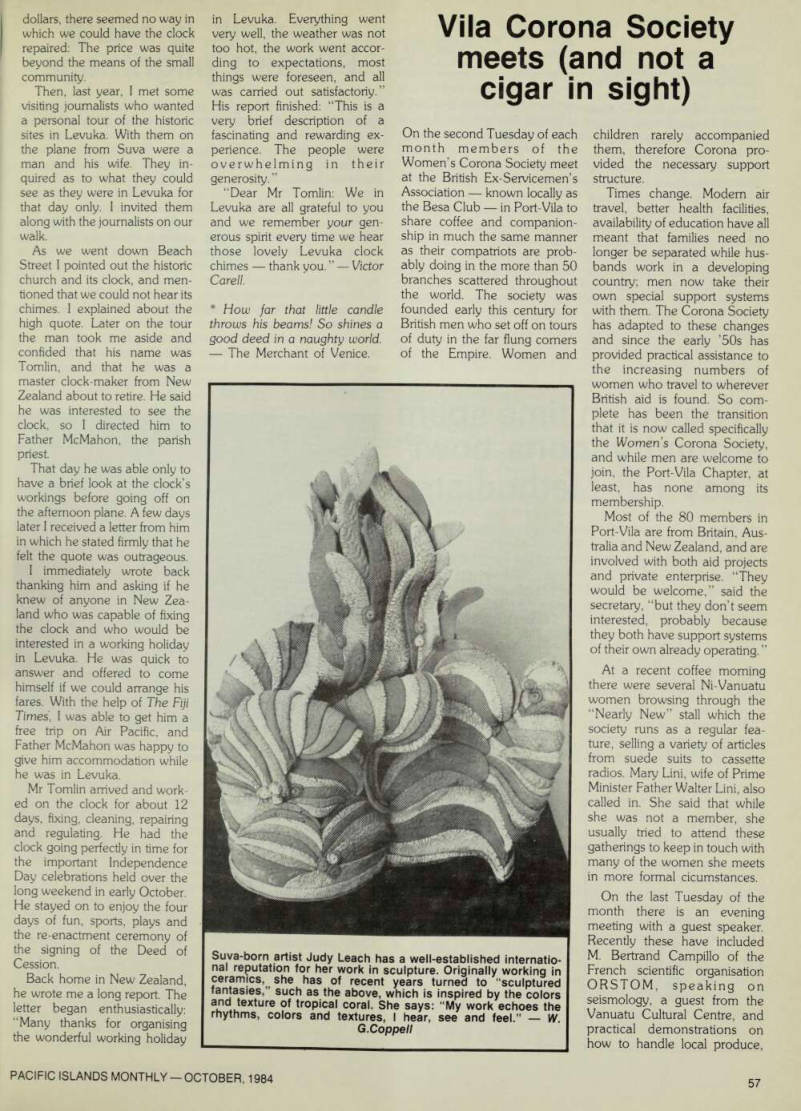
deed in a naughty world ..."
(With apologies to
Wm. Shakespeare*)
Last night I heard the old Levuka clock chime 12 mid night. I waited and sure enough a minute later it struck 12 again.
I was really delighted the town’s famous clock is back in action.
The Levuka clock is in the tower of the Sacred Heart Catholic church in the centre of historic Beach Street. Inside the tower is fixed a plaque. It reads: “The clock was placed in this tower by the people of Fiji in memory of the late Rev. Father Breheret. ”
Father Breheret was the pioneer French Marist mission ary who first landed in Levuka.
It was he who established the Catholic missions in Fiji. Be
cause of all this, it was thought that the clock must be of French origin. But other evidence now seems to point to England as its home.
However, it is possibly the only surviving example of the dual striking clock still function ing. Its unusual feature is that it repeats the hour striking once and then again a minute later so that if any of the townspeople did not count the chimes the first time around, they could verify the hour when it was repeated.
For a number of years the clock had been ailing, and its voice was mute. The members of the Levuka Historical and Cultural Society, of which I was one, were particularly sad at its demise. We contacted a clock specialist. When he quoted a price of some thousands of
Sacred Heart Church, Levuka, with its much-loved clock.
dollars, there seemed no way in which we could have the clock repaired: The price was quite beyond the means of the small community.
Then, last year, I met some visiting journalists who wanted a personal tour of the historic sites in Levuka. With them on the plane from Suva were a man and his wife. They in quired as to what they could see as they were in Levuka for that day only. I invited them along with the journalists on our walk.
As we went down Beach Street I pointed out the historic church and its clock, and men tioned that we could not hear its chimes. I explained about the high quote. Later on the tour the man took me aside and confided that his name was Tomlin, and that he was a master clock-maker from New Zealand about to retire. He said he was interested to see the clock, so I directed him to Father McMahon, the parish priest.
That day he was able only to have a brief look at the clock’s workings before going off on the afternoon plane. A few days later I received a letter from him in which he stated firmly that he felt the quote was outrageous.
I immediately wrote back thanking him and asking if he knew of anyone in New Zea land who was capable of fixing the clock and who would be interested in a working holiday in Levuka. He was quick to answer and offered to come himself if we could arrange his fares. With the help of The Fiji Times, I was able to get him a free trip on Air Pacific, and Father McMahon was happy to give him accommodation while he was in Levuka.
Mr Tomlin arrived and work ed on the clock for about 12 days, fixing, cleaning, repairing and regulating. He had the clock going perfectly in time for the important Independence Day celebrations held over the long weekend in early October.
He stayed on to enjoy the four days of fun, sports, plays and the re-enactment ceremony of the signing of the Deed of Cession.
Back home in New Zealand, he wrote me a long report. The letter began enthusiastically; “Many thanks for organising the wonderful working holiday
in Levuka. Everything went very well, the weather was not too hot, the work went accor ding to expectations, most things were foreseen, and all was carried out satisfactoriy. ”
His report finished: “This is a very brief description of a fascinating and rewarding ex perience. The people were overwhelming in their generosity.”
“Dear Mr Tomlin: We in Levuka are all grateful to you and we remember your gen erous spirit every time we hear those lovely Levuka clock
chimes thank you. ”
Victor
Carell.
* How far that little candle throws his beams! So shines a good deed in a naughty world. — The Merchant of Venice.
Suva-born artist Judy Leach has a well-established internatio nal reputation for her work in sculpture. Originally working in ceramics, she has of recent years turned to “sculptured fantasies,” such as the above, which is inspired by the colors and texture of tropical coral. She says: “My work echoes the rhythms, colors and textures, I hear, see and feel.” - W.
G.Coppell
Advertisements & other items, p. 56 (1 item)
Wcific
CONSTRUCTION EQUIPMENT CQ
introducing the Dynamic new Range of
' Vibrating 8 Pneumatic Tyred Rollers
THE RANGE
• Pacific Self-Propelled Vibrating Rollers • Single and Double Drum Types • 1.5 tonne to 16 tonne • Pacific Self-Propelled Pneumatic Type Compactors • 3 Models 16. 21. 38 tonne Ballast Weights • Pacific Landfill and Sanitary Landfill Compactors • Pacific Pneumatic Earth Borers • Pacific Road Brooms • Pacific Railway Maintenance Vehicles
DISTRIBUTORS REQUIRED
THROUGHOUT THE PACIFIC
Construction Equipment Co. 24 Salisbury Road, Hornsby NSW 2077, Australia. Phone (02) 476 2666
SAL
S-LiTSSE
cigar in sight)
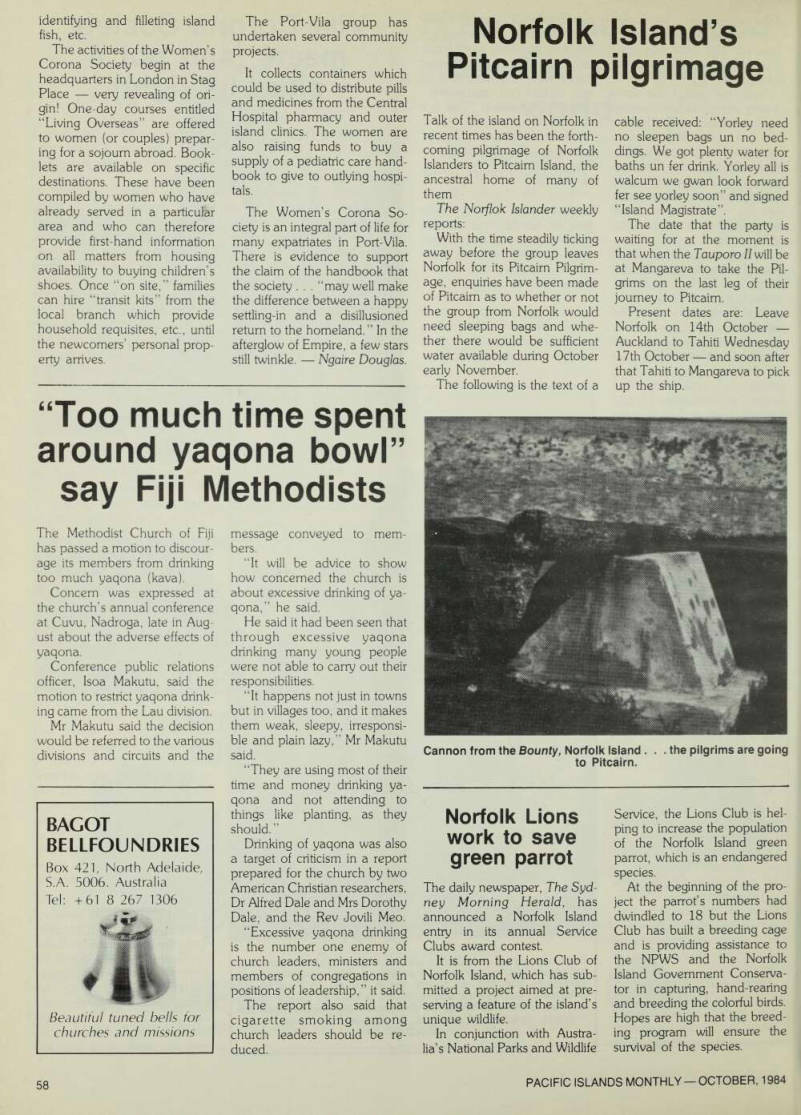
Vila Corona Society meets (and not a cigar in sight)
On the second Tuesday of each month members of the Women’s Corona Society meet at the British Ex-Servicemen’s Association known locally as the Besa Club in Fort-Vila to share coffee and companion ship in much the same manner as their compatriots are prob ably doing in the more than 50 branches scattered throughout the world. The society was founded early this century for British men who set off on tours of duty in the far flung comers of the Empire. Women and
children rarely accompanied them, therefore Corona pro vided the necessary support structure.
Times change. Modern air travel, better health facilities, availability of education have all meant that families need no longer be separated while hus bands work in a developing country; men now take their own special support systems with them. The Corona Society has adapted to these changes and since the early ’sos has provided practical assistance to the increasing numbers of women who travel to wherever British aid is found. So com plete has been the transition that it is now called specifically the Women’s Corona Society, and while men are welcome to join, the Fort-Vila Chapter, at least, has none among its membership.
Most of the 80 members in Fort-Vila are from Britain, Aus tralia and New Zealand, and are involved with both aid projects and private enterprise. “They would be welcome,” said the secretary, “but they don’t seem interested, probably because they both have support systems of their own already operating. ”
At a recent coffee morning there were several Ni-Vanuatu women browsing through the “Nearly New” stall which the society runs as a regular fea ture, selling a variety of articles from suede suits to cassette radios. Mary Lini, wife of Prime Minister Father Walter Lini, also called in. She said that while she was not a member, she usually tried to attend these gatherings to keep in touch with many of the women she meets in more formal cicumstances.
On the last Tuesday of the month there is an evening meeting with a guest speaker.
Recently these have included M. Bertrand Campillo of the French scientific organisation ORSTOM, speaking on seismology, a guest from the Vanuatu Cultural Centre, and practical demonstrations on how to handle local produce,
identifying and filleting island fish, etc.
The activities of the Women’s Corona Society begin at the headquarters in London in Stag Place very revealing of ori gin! One-day courses entitled “Living Overseas” are offered to women (or couples) prepar ing for a sojourn abroad. Book lets are available on specific destinations. These have been compiled by women who have already served in a particular area and who can therefore provide first-hand information on all matters from housing availability to buying children’s shoes. Once “on site,” families can hire “transit kits” from the local branch which provide household requisites, etc., until the newcomers’ personal prop erty arrives.
The Port-Vila group has undertaken several community projects.
It collects containers which could be used to distribute pills and medicines from the Central Hospital pharmacy and outer island clinics. The women are also raising funds to buy a supply of a pediatric care hand book to give to outlying hospi tals.
The Women’s Corona So ciety is an integral part of life for many expatriates in Port-Vila.
There is evidence to support the claim of the handbook that the society . . . “may well make the difference between a happy settling-in and a disillusioned return to the homeland.” In the afterglow of Empire, a few stars still twinkle. Ngaire Douglas.
say Fiji Methodists
“Too much time spent around yaqona bowl” say Fiji Methodists
The Methodist Church of Fiji has passed a motion to discour age its members from drinking too much yaqona (kava).
Concern was expressed at the church’s annual conference at Cuvu, Nadroga, late in Aug ust about the adverse effects of yaqona.
Conference public relations officer, Isoa Makutu, said the motion to restrict yaqona drink ing came from the Lau division.
Mr Makutu said the decision would be referred to the various divisions and circuits and the
message conveyed to mem bers.
“It will be advice to show how concerned the church is about excessive drinking of ya qona,” he said.
He said it had been seen that through excessive yaqona drinking many young people were not able to carry out their responsibilities.
“It happens not just in towns but in villages too, and it makes them weak, sleepy, irresponsi ble and plain lazy,” Mr Makutu said.
“They are using most of their time and money drinking ya qona and not attending to things like planting, as they should.”
Drinking of yaqona was also a target of criticism in a report prepared for the church by two American Christian researchers, Dr Alfred Dale and Mrs Dorothy Dale, and the Rev Jovili Meo.
“Excessive yaqona drinking is the number one enemy of church leaders, ministers and members of congregations in positions of leadership,” it said.
The report also said that cigarette smoking among church leaders should be re duced.
Pitcairn pilgrimage
Norfolk Island’s Pitcairn pilgrimage
Talk of the island on Norfolk in recent times has been the forthcoming pilgrimage of Norfolk Islanders to Pitcairn Island, the ancestral home of many of them The Norflok Islander weekly reports: With the time steadily ticking away before the group leaves Norfolk for its Pitcairn Pilgrimage, enquiries have been made of Pitcairn as to whether or not the group from Norfolk would need sleeping bags and whether there would be sufficient water available during October early November.
The following is the text of a
cable received: “Yorley need no sleepen bags un no bed dings. We got plenty water for baths un fer drink. Yorley all is walcum we gwan look forward fer see yorley soon” and signed “Island Magistrate”, The date that the party is waiting for at the moment is that when the Tauporoll will be at Mangareva to take the Pil grims on the last leg of their journey to Pitcairn, Present dates are: Leave Norfolk on 14th October Auckland to Tahiti Wednesday 17th October and soon after that Tahiti to Mangareva to pick up the ship.
Cannon from the Bounty, Norfolk Island . . .the pilgrims are going to Pitcairn.
green parrot
Norfolk Lions work to save green parrot
The daily newspaper, The Syd ney Morning Herald, has announced a Norfolk Island entry in its annual Service Clubs award contest.
It is from the Lions Club of Norfolk Island, which has sub mitted a project aimed at pre serving a feature of the island’s unique wildlife.
In conjunction with Austra lia’s National Parks and Wildlife
Service, the Lions Club is hel ping to increase the population of the Norfolk Island green parrot, which is an endangered species.
At the beginning of the pro ject the parrot’s numbers had dwindled to 18 but the Lions Club has built a breeding cage and is providing assistance to the NPWS and the Norfolk Island Government Conserva tor in capturing, hand-rearing and breeding the colorful birds.
Hopes are high that the breed ing program will ensure the survival of the species.
Advertisements & other items, p. 58 (1 item)
Bagot
BELLFOUNDRIES
Box 421, North Adelaide, S.A. 5006. Australia Tel: +6l 8 267 1306 <ir Beautiful tuned bells for churches and missions
from the islands press
From a report in the Rengel Belau, Koror, of a Senate resolution to include the teaching of Japanese in the school curriculum.
But as can be gathered from schoolteachers it seems that they are not so hot on the idea. They opine that the inclusion of Japanese in elementary schools would be too taxing and burdensome to the students as they also have to learn English and Palauan grammar.
One said that the idea would have possibilities if it were taught to high schoolers and not to the younger ones. Another pointed out that the English alphabet has only 26 letters, “just imagine imposing Japanese which has more than 1000 characters on the young minds,” he lamented.
From The Fiji Times, Suva Suva magistrate Mr Kenneth Moore said yesterday that experi enced offenders always told the court they would turn over a new leaf and could bring their religious ministers to speak on their behalf. “But, as soon as they are out they start planning their next crime and forget about their vows and promises,” said Mr Moore.
He was sentencing Pauliasi Bose and Kaliova Uluiviti after they admitted breaking into a shop and stealing items worth $2500. If a religious minister stuck with a person like Bose, the minister would probably end up in prison also, Mr Moore said.
From the American Samoa News Bulletin, Pago Pago AGANA(UPI) An inmate on Guam shot in the head and supper body during a prison shooting spree has been evacuated to Honolulu for surgery. The critically-injured inmate, 38-year-old Antonio Marquez, was to be flown to Queen’s Hospital Wednesday but an air carrier refused to board the stretcher-bound prisoner because officials did not provide a guard for the flight.
Two prisoners were killed and two critically injured in a shooting spree involving five convicted murderers and a convicted rapist in the maximum security unit of a Guam prison Tuesday. Authorities were holding two of the inmates as suspects in the shooting.
Officials said they did not know how two 25-calibre semi-automatic pistols were smuggled into the facility.
From The Cook Islands News, Rarotonga “No need to worry,” was the Police Department’s assurance to members of the public who had expressed concern at seeing armed French militia at Saturday’s Commemoration Day func tions. “It was purely a ceremonial display in keeping with normal arrangements,” said a police department official. “We were surprised to see them but we checked. We inspected their machine gun magazines to make sure the guns were not loaded.”
From an editorial in The Marshall Islands Journal, Majuro.
Plastic diapers by the thousands are washing up on the lagoon beaches stretching from new dump all the way to Laura and some Majuro residents are getting upset by the blight, feeling, perhaps justifiably, that their land is being destroyed and the natural beauty of their home island undermined by Marshallese women from outer islands who come here, have children, and then carelessly throw their disposable diapers into the lagoon . . .
The only entity at all that ever does anything about the plastic disposable diapers is this publication, the Journal, but so far the Journal has only talked, no real action.
This is now changed.
The Marshall Islands Journal will made a $5OO cash donation to the re-election campaign of the first Senator in the Nitijela to introduce and have passed legislation that either curbs, additionally taxes, or outright outlaws the importation of plastic disposable diapers into the Republic. If more than one Senator introduces the bill, then the $5OO will be divided equally between them.
From a letter by Len Tari (Malapoa College) in the Vanuatu Weekly, Vila, complaining at the casual attitude of people during the playing of the National Anthem at a flag-raising ceremony.
We all know that the National Anthem is the country’s official song which expresses patriotic sentiments and is governmentally authorised as an official national hymn: therefore we should be proud of it and show our respect for it by “standing at attention”, whenever it is played or sung, especially on important ceremonious occasions or public gatherings. The song also expresses the ideas that our country stands for, and is used to stimulate patriotism and loyalty to our country. (In such countries as Britain, you could be kicked on your bottom by others behind you if you didn’t “stand at attention” when the hymn was played). I hope also that we can all memorise our national anthem!
From a letter by the Rector of St. John’s Church, Port Moresby, in the Papua New Guinea Post-Courier.
Would the person who stole the 19 fold up chairs from our church in Mary Street please note that these chairs were given to our church by someone in memory of their dear mother who died in 1980.
If your own mother could know what you have done I am sure she will be as sad as the donor of these chairs.
If you have any idea of the things of God then maybe you will return them and we will all be happy again.
A letter by Jan Howard, Lautoka, in The Fiji Times, Suva.
I read with interest the article concerning what to call white Fiji citizens. I think the term “Palefaces” is too reminiscent of “cowboys and Indians”, yet I believe that a word is needed other than “expatriate” for the white people here. As you may know, we whites all belong to the Caucasian race of humans, so I suggest naming us “Corks”, as Caucasian is a bit of a tongue-twister.
From the Police Action column in the Marshall Islands Journal, Majuro. 7/25 Grand Larceny The detective division at the police station reported someone secretly opened the combination lock on the cash box in the traffic division and an excessive amount of money was stolen. Detectives have been assigned and are conducting an investigation.
From The Fiji Times, Suva.
A resident of the Labasa Old People’s Home was injured yesterday while he was grazing cattle some distance from the home compound. The resident, known only as kalika, in his late 60s, was hit on the head by a brick which was tied to a length of rope to slow down a frolicking calf. Kalika was treated in the out-patients department of Labasa Hospital for a scalp injury and sent home.
From the American Samoa News Bulletin, Pago Pago.
Commissioner of Public Safety Te’o J. Fuavai has issued the following press release: “The safety of police officers while discharging their duties as called for by the people of American Samoa has been a continuous concern of mine. On July 25, at about 9.30 p.m., Police Sergeant Veu received a broken jaw when he was hit by a rock thrown from someone in the village of Leone.
The officer was admitted to the hospital and now awaits an operation. In other incidents, Police Officer Valoia was disabled and Police Officer Fasi Ta’ase lost his life in the line of duty. There have been a number of police units damaged when, people threw rocks at officers responding to calls from those who needed assistance. I never dreamt that these types of behavior would affect the people of American Samoa.
political CMrrgflts
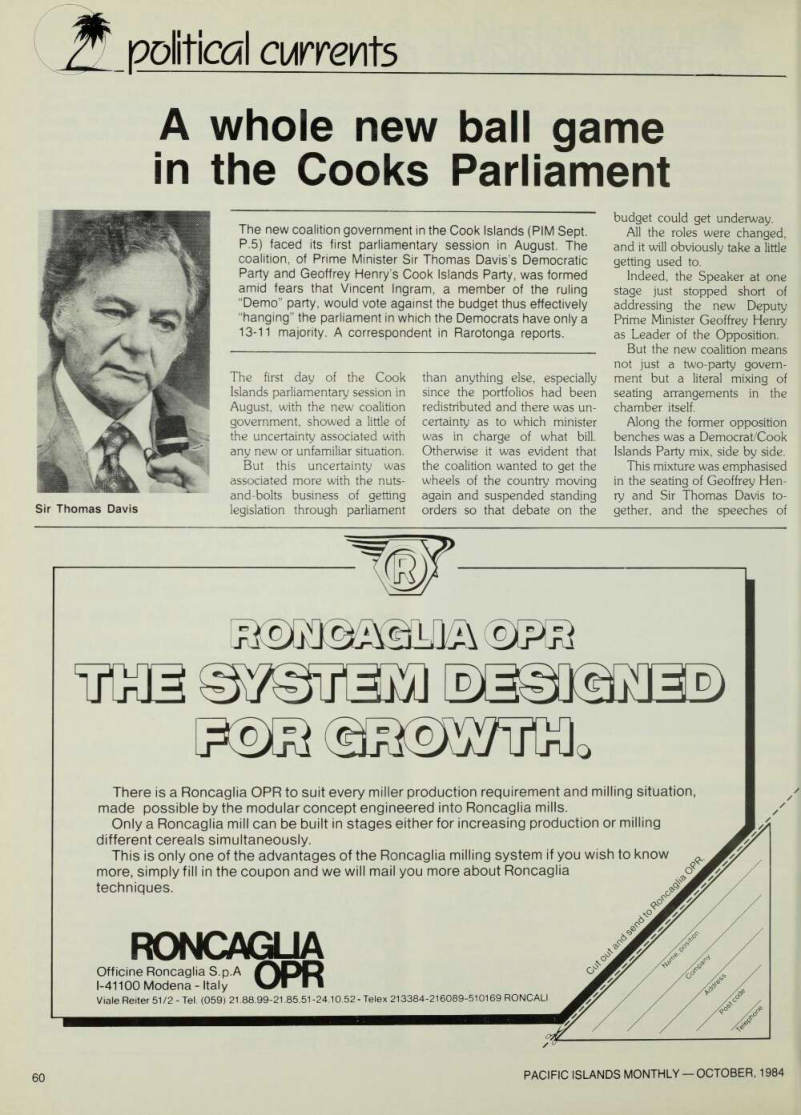
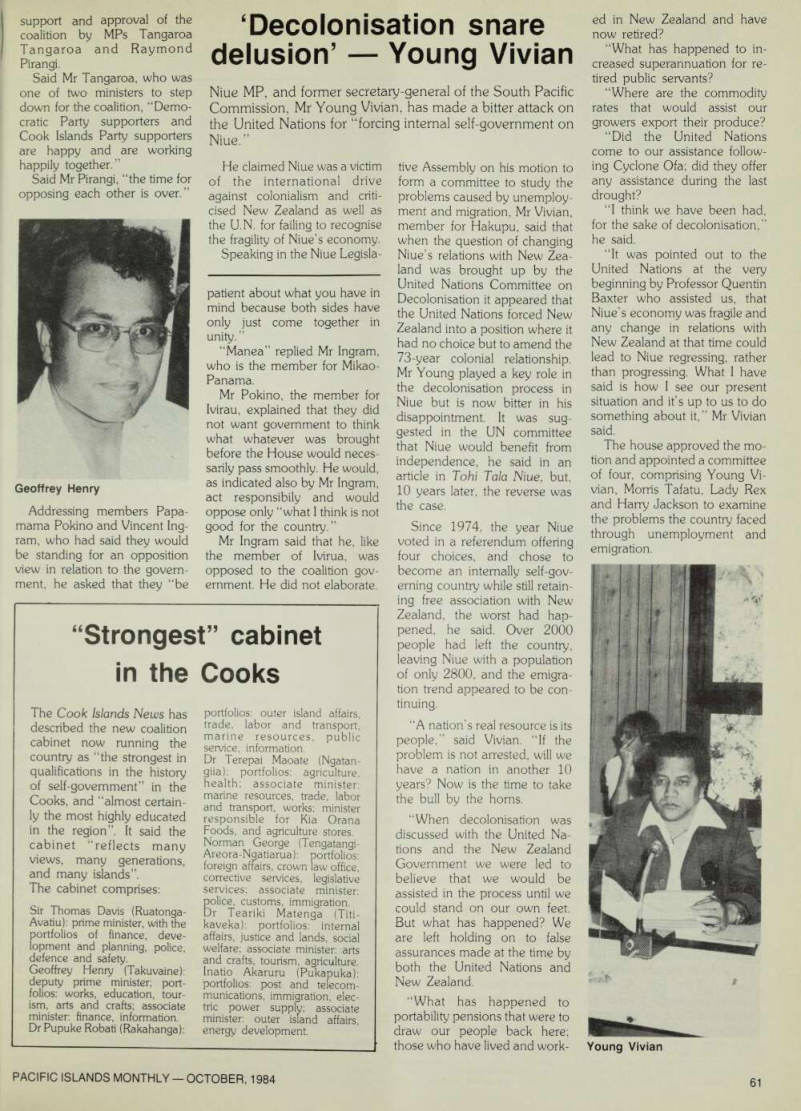
A whole new ball game in the Cooks Parliament
The new coalition government in the Cook Islands (PIM Sept.
P. 5) faced its first parliamentary session in August. The coalition, of Prime Minister Sir Thomas Davis’s Democratic Party and Geoffrey Henry’s Cook Islands Party, was formed amid fears that Vincent Ingram, a member of the ruling “Demo” party, would vote against the budget thus effectively “hanging” the parliament in which the Democrats have only a 13-11 majority. A correspondent in Rarotonga reports.
The first day of the Cook Islands parliamentary session in August, with the new coalition government, showed a little of the uncertainty associated with any new or unfamiliar situation.
But this uncertainty was associated more with the nuts and-bolts business of getting legislation through parliament
than anything else, especially since the portfolios had been redistributed and there was un certainty as to which minister was in charge of what bill.
Otherwise it was evident that the coalition wanted to get the wheels of the country moving again and suspended standing orders so that debate on the
budget could get underway.
All the roles were changed, and it will obviously take a little getting used to.
Indeed, the Speaker at one stage just stopped short of addressing the new Deputy Prime Minister Geoffrey Henry as Leader of the Opposition.
But the new coalition means not just a two-party govern ment but a literal mixing of seating arrangements in the chamber itself.
Along the former opposition benches was a Democrat/Cook Islands Party mix, side by side.
This mixture was emphasised in the seating of Geoffrey Hen ry and Sir Thomas Davis to gether, and the speeches of
Sir Thomas Davis
support and approval of the coalition by MPs Tangaroa Tangaroa and Raymond Pirangi.
Said Mr Tangaroa, who was one of two ministers to step down for the coalition, “Demo cratic Party supporters and Cook Islands Party supporters are happy and are working happily together.”
Said Mr Pirangi, “the time for opposing each other is over.”
Addressing members Papa mama Pokino and Vincent Ing ram, who had said they would be standing for an opposition view in relation to the govern ment, he asked that they “be
patient about what you have in mind because both sides have only just come together in unity.’’
“Manea” replied Mr Ingram, who is the member for Mikao- Panama.
Mr Pokino, the member for Ivirau, explained that they did not want government to think what whatever was brought before the House would neces sarily pass smoothly. He would, as indicated also by Mr Ingram, act responsibily and would oppose only “what I think is not good for the country."
Mr Ingram said that he, like the member of Ivirua, was opposed to the coalition gov ernment. He did not elaborate.
Geoffrey Henry
Advertisements & other items, p. 60 (1 item)
r>J= -ay-sTAvi
6S3aaaama®if®
pu;: '.i;; c/V/j-j-j
There is a Roncaglia OPR to suit every miller production requirement and milling situation, made possible by the modular concept engineered into Roncaglia mills.
Only a Roncaglia mill can be built in stages either for increasing production or milling different cereals simultaneously.
This is only one of the advantages of the Roncaglia milling system if you wish to know more, simply fill in the coupon and we will mail you more about Roncaglia techniques. &
RONCAGLIA
OPR
Officine Roncaglia S.p.A 1-41100 Modena - Italy Viale Reiter 51 /2 - Tel. (059) 21.88.99-21.85.51 -24.10.52 - Telex 213384-216089-510169 RONCALI
“Strongest” cabinet
in the Cooks
The Cook Islands News has described the new coalition cabinet now running the country as “the strongest in qualifications in the history of self-government” in the Cooks, and “almost certain ly the most highly educated in the region”. It said the cabinet “reflects many views, many generations, and many islands”.
The cabinet comprises: Sir Thomas Davis (Ruatonga- Avatiu): prime minister, with the portfolios of finance, deve lopment and planning, police, defence and safety.
Geoffrey Henry (Takuvaine): deputy prime minister; port folios: works, education, tour ism, arts and crafts; associate minister; finance, information.
Dr Pupuke Robati (Rakahanga):
portfolios: outer island affairs, trade, labor and transport, marine resources, public service, information.
Dr Terepai Maoate (Ngatan giia): portfolios: agriculture, health; associate minister: marine resources, trade, labor and transport, works; minister responsible for Kia Orana Foods, and agriculture stores.
Norman George (Tengatangi- Areora-Ngatiarua): portfolios: foreign affairs, crown law office, corrective services, legislative services; associate minister: police, customs, immigration.
Dr Teariki Matenga (Titi kaveka): portfolios: internal affairs, justice and lands, social welfare; associate minister: arts and crafts, tourism, agriculture.
Inatio Akaruru (Pukapuka); portfolios: post and telecom munications, immigration, elec tric power supply; associate minister: outer island affairs, energy development.
delusion’ - Young Vivian
‘Decolonisation snare delusion’ - Young Vivian
Niue MP, and former secretary-general of the South Pacific Commission, Mr Young Vivian, has made a bitter attack on the United Nations for “forcing internal self-government on Niue.”
He claimed Niue was a victim of the international drive against colonialism and criti cised New Zealand as well as the U.N. for failing to recognise the fragility of Niue’s economy.
Speaking in the Niue Legisla
tive Assembly on his motion to form a committee to study the problems caused by unemploy ment and migration, Mr Vivian, member for Hakupu, said that when the question of changing Niue’s relations with New Zea land was brought up by the United Nations Committee on Decolonisation it appeared that the United Nations forced New Zealand into a position where it had no choice but to amend the 73-year colonial relationship.
Mr Young played a key role in the decolonisation process in Niue but is now bitter in his disappointment. It was sug gested in the UN committee that Niue would benefit from independence, he said in an article in Tohi Tala Niue, but, 10 years later, the reverse was the case.
Since 1974, the year Niue voted in a referendum offering four choices, and chose to become an internally self-gov erning country while still retain ing free association with New Zealand, the worst had hap pened, he said. Over 2000 people had left the country, leaving Niue with a population of only 2800, and the emigra tion trend appeared to be con tinuing.
“A nation’s real resource is its people," said Vivian. “If the problem is not arrested, will we have a nation in another 10 years? Now is the time to take the bull by the horns.
“When decolonisation was discussed with the United Na tions and the New Zealand Government we were led to believe that we would be assisted in the process until we could stand on our own feet.
But what has happened? We are left holding on to false assurances made at the time by both the United Nations and New Zealand.
“What has happened to portability pensions that were to draw our people back here; those who have lived and work
ed in New Zealand and have now retired?
“What has happened to in creased superannuation for re tired public servants?
“Where are the commodity rates that would assist our growers export their produce?
“Did the United Nations come to our assistance follow ing Cyclone Ofa; did they offer any assistance during the last drought?
“I think we have been had, for the sake of decolonisation," he said.
“It was pointed out to the United Nations at the very beginning by Professor Quentin Baxter who assisted us, that Niue’s economy was fragile and any change in relations with New Zealand at that time could lead to Niue regressing, rather than progressing. What I have said is how I see our present situation and it’s up to us to do something about it,’’ Mr Vivian said.
The house approved the mo tion and appointed a committee of four, comprising Young Vi vian, Morris Tafatu, Lady Rex and Harry Jackson to examine the problems the country faced through unemployment and emigration.
Young Vivian
people
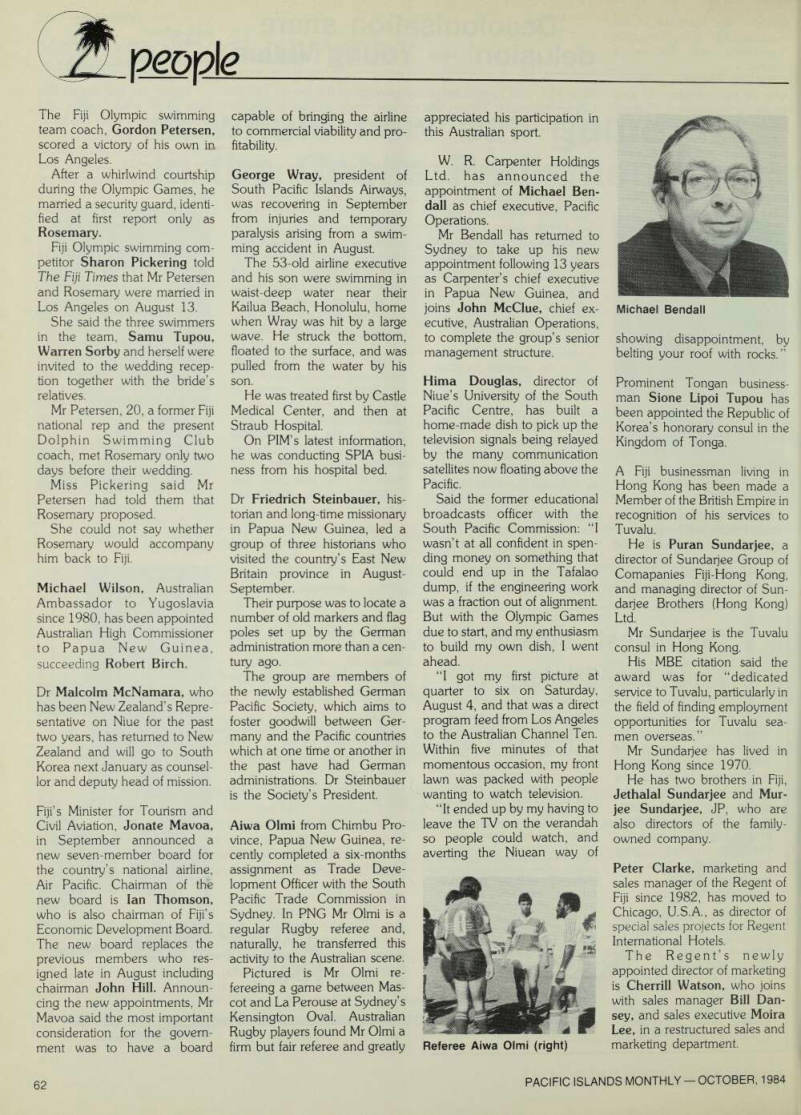
The Fiji Olympic swimming team coach, Gordon Petersen, scored a victory of his own in Los Angeles.
After a whirlwind courtship during the Olympic Games, he married a security guard, identi fied at first report only as Rosemary.
Fiji Olympic swimming com petitor Sharon Pickering told The Fiji Times that Mr Petersen and Rosemary were married in Los Angeles on August 13.
She said the three swimmers in the team, Samu Tupou, Warren Sorby and herself were invited to the wedding recep tion together with the bride’s relatives.
Mr Petersen, 20, a former Fiji national rep and the present Dolphin Swimming Club coach, met Rosemary only two days before their wedding.
Miss Pickering said Mr Petersen had told them that Rosemary proposed.
She could not say whether Rosemary would accompany him back to Fiji.
Michael Wilson, Australian Ambassador to Yugoslavia since 1980, has been appointed Australian High Commissioner to Papua New Guinea, succeeding Robert Birch.
Dr Malcolm McNamara, who has been New Zealand’s Repre sentative on Niue for the past two years, has returned to New Zealand and will go to South Korea next January as counsel lor and deputy head of mission.
Fiji’s Minister for Tourism and Civil Aviation, donate Mavoa, in September announced a new seven-member board for the country’s national airline, Air Pacific. Chairman of the new board is lan Thomson, who is also chairman of Fiji’s Economic Development Board.
The new board replaces the previous members who res igned late in August including chairman John Hill. Announ cing the new appointments, Mr Mavoa said the most important consideration for the govern ment was to have a board
capable of bringing the airline to commercial viability and pro fitability.
George Wray, president of South Pacific Islands Airways, was recovering in September from injuries and temporary paralysis arising from a swim ming accident in August.
The 53-old airline executive and his son were swimming in waist-deep water near their Kailua Beach, Honolulu, home when Wray was hit by a large wave. He struck the bottom, floated to the surface, and was pulled from the water by his son.
He was treated first by Castle Medical Center, and then at Straub Hospital.
On PlM’s latest information, he was conducting SPIA busi ness from his hospital bed.
Dr Friedrich Steinbauer, his torian and long-time missionary in Papua New Guinea, led a group of three historians who visited the country’s East New Britain province in August- September.
Their purpose was to locate a number of old markers and flag poles set up by the German administration more than a cen tury ago.
The group are members of the newly established German Pacific Society, which aims to foster goodwill between Ger many and the Pacific countries which at one time or another in the past have had German administrations. Dr Steinbauer is the Society’s President.
Aiwa Olmi from Chimbu Pro vince, Papua New Guinea, re cently completed a six-months assignment as Trade Deve lopment Officer with the South Pacific Trade Commission in Sydney. In PNG Mr Olmi is a regular Rugby referee and, naturally, he transferred this activity to the Australian scene.
Pictured is Mr Olmi re fereeing a game between Mas cot and La Perouse at Sydney’s Kensington Oval. Australian Rugby players found Mr Olmi a firm but fair referee and greatly
appreciated his participation in this Australian sport.
W. R. Carpenter Holdings Ltd. has announced the appointment of Michael Ben dall as chief executive, Pacific Operations.
Mr Bendall has returned to Sydney to take up his new appointment following 13 years as Carpenter’s chief executive in Papua New Guinea, and joins John McClue, chief ex ecutive, Australian Operations, to complete the group’s senior management structure.
Hima Douglas, director of Niue’s University of the South Pacific Centre, has built a home-made dish to pick up the television signals being relayed by the many communication satellites now floating above the Pacific.
Said the former educational broadcasts officer with the South Pacific Commission: “I wasn’t at all confident in spen ding money on something that could end up in the Tafalao dump, if the engineering work was a fraction out of alignment.
But with the Olympic Games due to start, and my enthusiasm to build my own dish, I went ahead.
“I got my first picture at quarter to six on Saturday, August 4, and that was a direct program feed from Los Angeles to the Australian Channel Ten.
Within five minutes of that momentous occasion, my front lawn was packed with people wanting to watch television.
“It ended up by my having to leave the TV on the verandah so people could watch, and averting the Niuean way of
showing disappointment, by belting your roof with rocks.”
Prominent Tongan business man Sione Lipoi Tupou has been appointed the Republic of Korea’s honorary consul in the Kingdom of Tonga.
A Fiji businessman living in Hong Kong has been made a Member of the British Empire in recognition of his services to Tuvalu.
He is Puran Sundarjee, a director of Sundarjee Group of Comapanies Fiji-Hong Kong, and managing director of Sun darjee Brothers (Hong Kong) Ltd.
Mr Sundarjee is the Tuvalu consul in Hong Kong.
His MBE citation said the award was for “dedicated service to Tuvalu, particularly in the field of finding employment opportunities for Tuvalu sea men overseas.”
Mr Sundarjee has lived in Hong Kong since 1970.
He has two brothers in Fiji, Jethalal Sundarjee and Mur jee Sundarjee, JP, who are also directors of the family owned company.
Peter Clarke, marketing and sales manager of the Regent of Fiji since 1982, has moved to Chicago, U.S.A., as director of special sales projects for Regent International Hotels.
The Regent’s newly appointed director of marketing is Cherrill Watson, who joins with sales manager Bill Dan sey, and sales executive Moira Lee, in a restructured sales and marketing department.
Referee Aiwa Olmi (right)
Michael Bendall
Advertisements & other items, pp. 63-64 (1 item)
Ci!) Pioneer
.. .the magic of elegant sound.
Avante component systems and the magic of Pioneer technology.
Together they bring you the miracle of your favourite music re-created with all the bewitching excitement and natural dynamism of the original performance. The secret of the Avante A9DX lies in the basic concept of the Avante series... advanced components created together to perform together.
The amplifier alone is amazing Dynamic Power Non-Switching*, plus 265 watts/channel of music power! Other components include a Quartz-PLL FM/AM tuner, fully automatic turntable and a double cassette deck, plus 4-way speaker systems.
No mere trick, the new Avante A9DX is the product of elegant design and audio expertise. That’s Pioneer’s unique brand of magic.
Ci!) PIONEER
Options shown: graphic equalizer and digital timer. ‘Non-Switching is a trademark of Pioneer. r D nT IT cont r act: ■ Australia: Pioneer Electronics Australia Pty Ltd (Incorporated in Victoria). P.O Box 295, Mordialloc,Victoria, 3195 Tel: 580-9911 ■ Fiji Islands; Bnjlal & D362 J^ a - Fl)l lslands Tel: 22 258 ■ New Zealand: Monaco Distributors Ltd . 2 Poland Road, Glenfield, Auckland. New Zealand Tel (09) 444-9144 ■ Norfolk Island: Burns Philp aza p^r^ n rk, ■°ki ßt>X^ 21 .' j or . olk lsland * Vanuatu; Burns Philp (Vanuatu) Ltd,, Vila, Vanuatu ■ Nauru Island: Jacob Enterprises, PO Box No 4, Republic of Nauru ■ Tahiti: Tahiti Hi-Fi PO Box 848, Papeete Tahiti ■ New Caledonia: Menard Pacifique Sari, BP. 3899, Noumea, New Caledonia Tel 27-62.23 96799 Tel 633-5224 ■ Rarotonga: South Seas International Ltd., P.O. Box 49, Rarotonga, Cook Islands Tel: 2327 ■ ■ American Samoa: Transpac Corporation, P.O. Box 1477, Pago Pago, American Samoa Papua New Guinea: Bali Merchants Pty Ltd , PO. Box 6103 Boroko Tel: 254887
FOR SALE
TWO CATAMARAN PASSENGER VESSELS
X mH mm. <4 .
Above two vessels have very good sea-keeping ability. In view of their high speed and passenger-carrying capacity, they are ideal vehicles for inter-island runs.
OFFSHORE CHARTERS PTE. LTD
140 ROBINSON ROAD, #O4-04 CHOW HOUSE, SINGAPORE 0106.
TEL: 2222696, 2239144 TELEX; RS 26599 "OFSHOR"
yachts
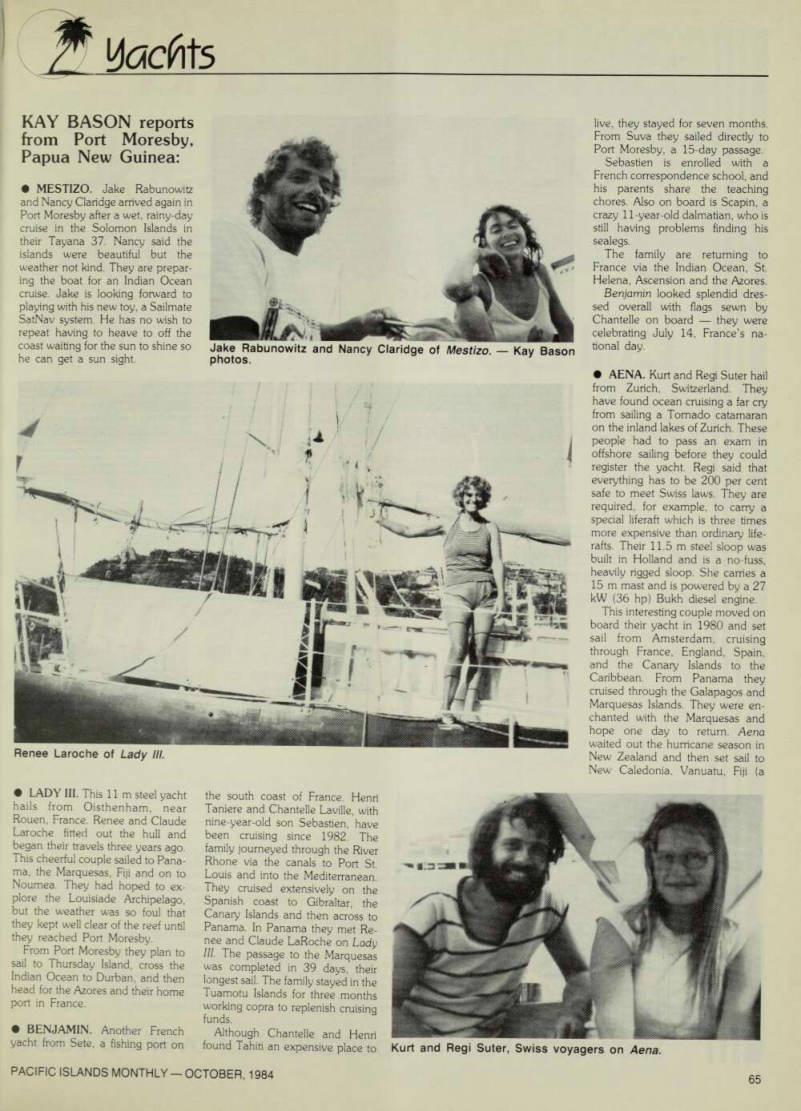

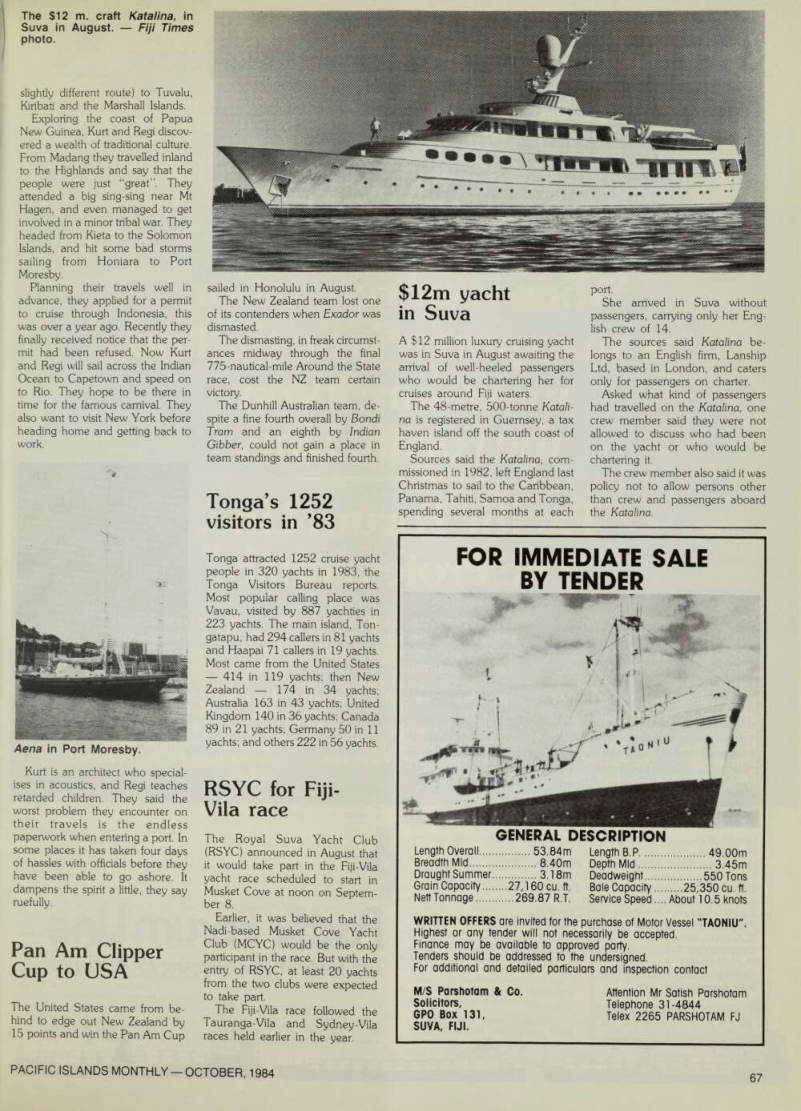
KAY BASON reports
from Fort Moresby,
Papua New Guinea:
• MESTIZO. Jake Rabunowitz and Nancy Claridge arrived again in Port Moresby after a wet, rainy-day cruise in the Solomon Islands in their Tayana 37. Nancy said the islands were beautiful but the weather not kind. They are prepar ing the boat for an Indian Ocean cruise. Jake is looking forward to playing with his new toy. a Sailmate SatNav system. He has no wish to repeat having to heave to off the coast waiting for the sun to shine so he can get a sun sight.
• LADY 111. This 11 m steel yacht hails from Oisthenham, near Rouen. France. Renee and Claude Laroche fitted out the hull and began their travels three years ago.
This cheerful couple sailed to Panama, the Marquesas. Fiji and on to Noumea. They had hoped to ex- Plore the Louisiade Archipelago. but the weather was so foul that they kept well clear of the reef until they reached Port Moresby.
From Port Moresby they plan to sail to Thursday Island, cross the Indian Ocean to Durban, and then head for the Azores and their home port in France. • BENJAMIN. Another French yacht from Sete. a fishing port on
the south coast of France. Henri Taniere and Chantelle Laville, with nine-year-old son Sebastien. have been cruising since 1982. The family journeyed through the River Rhone via the canals to Port St Louis and into the Mediterranean.
They cruised extensively on the Spanish coast to Gibraltar the Canary Islands and then across to Panama. In Panama they met Re nee and Claude Laßoche on Lady 111. The passage to the Marquesas was completed in 39 days their longest sail. The family stayed in the Tuamotu Islands for three months working copra to replenish cruising funds.
Although Chantelle and Henri found Tahiti an expensive place to
live, they stayed for seven months.
From Suva they sailed directly to Port Moresby, a 15-day passage.
Sebastien is enrolled with a French correspondence school, and his parents share the teaching chores. Also on board is Scapin, a crazy 11-year-old dalmatian, who is still having problems finding his sealegs.
The family are returning to France via the Indian Ocean, St.
Helena, Ascension and the Azores.
Benjamin looked splendid dres sed overall with flags sewn by Chantelle on board they were celebrating July 14, France’s na tional day. • AENA. Kurt and Regi Suter hail from Zurich, Switzerland. They have found ocean cruising a far cry from sailing a Tornado catamaran on the inland lakes of Zurich. These people had to pass an exam in offshore sailing before they could register the yacht. Regi said that everything has to be 200 per cent safe to meet Swiss laws. They are required, for example, to carry a special liferaft which is three times more expensive than ordinary life rafts. Their 11.5 m steel sloop was built in Holland and is a no-fuss, heavily rigged sloop. She carries a 15 m mast and is powered by a 27 kW (36 hp) Bukh diesel engine.
This interesting couple moved on board their yacht in 1980 and set sail from Amsterdam, cruising through France, England, Spain, and the Canary Islands to the Caribbean. From Panama they cruised through the Galapagos and Marquesas Islands. They were en chanted with the Marquesas and hope one day to return. Aena waited out the hurricane season in New Zealand and then set sail to New Caledonia. Vanuatu, Fiji (a
Renee Laroche of Lady III.
Jake Rabunowitz and Nancy Claridge of Mestizo. - Kay Bason photos.
Kurt and Regi Suter, Swiss voyagers on Aena.
slightly different route) to Tuvalu, Kiribati and the Marshall Islands.
Exploring the coast of Papua New Guinea, Kurt and Regi discov ered a wealth of traditional culture.
From Madang they travelled inland to the Highlands and say that the people were just “great”. They attended a big sing-sing near Mt Hagen, and even managed to get involved in a minor tribal war. They headed from Kieta to the Solomon Islands, and hit some bad storms sailing from Honiara to Port Moresby.
Planning their travels well in advance, they applied for a permit to cruise through Indonesia, this was over a year ago. Recently they finally received notice that the per mit had been refused. Now Kurt and Regi will sail across the Indian Ocean to Capetown and speed on to Rio. They hope to be there in time for the famous carnival. They also want to visit New York before heading home and getting back to work.
Kurt is an architect who special ises in acoustics, and Regi teaches retarded children. They said the worst problem they encounter on their travels is the endless paperwork when entering a port. In some places it has taken four days of hassles with officials before they have been able to go ashore. It dampens the spirit a little, they say ruefully.
Pan Am Clipper
Cup to USA
The United States came from be hind to edge out New Zealand by 15 points and win the Pan Am Cup
sailed in Honolulu in August.
The New Zealand team lost one of its contenders when Exador was dismasted.
The dismasting, in freak circumst ances midway through the final 775-nautical-mile Around the State race, cost the NZ team certain victory.
The Dunhill Australian team, de spite a fine fourth overall by Bondi Tram and an eighth by Indian Gibber, could not gain a place in team standings and finished fourth.
Tonga’s 1252
visitors in ’B3
Tonga attracted 1252 cruise yacht people in 320 yachts in 1983, the Tonga Visitors Bureau reports.
Most popular calling place was Vavau, visited by 887 yachties in 223 yachts. The main island, Ton gatapu, had 294 callers in 81 yachts and Haapai 71 callers in 19 yachts.
Most came from the United States 414 in 119 yachts; then New Zealand 174 in 34 yachts; Australia 163 in 43 yachts; United Kingdom 140 in 36 yachts; Canada 89 in 21 yachts; Germany 50 in 11 yachts; and others 222 in 56 yachts.
RSYC for Fiji-
Vila race
The Royal Suva Yacht Club (RSYC) announced in August that it would take part in the Fiji-Vila yacht race scheduled to start in Musket Cove at noon on Septem ber 8.
Earlier, it was believed that the Nadi-based Musket Cove Yacht Club (MCYC) would be the only participant in the race. But with the entry of RSYC, at least 20 yachts from the two clubs were expected to take part.
The Fiji-Vila race followed the
Tauranga-Vila and Sydney-Vila
races held earlier in the year.
sl2m yacht
in Suva
A $l2 million luxury cruising yacht was in Suva in August awaiting the arrival of well-heeled passengers who would be chartering her for cruises around Fiji waters.
The 48-metre, 500-tonne Katali na is registered in Guernsey, a tax haven island off the south coast of England.
Sources said the Katalina, com missioned in 1982, left England last Christmas to sail to the Caribbean, Panama, Tahiti, Samoa and Tonga, spending several months at each
port.
She arrived in Suva without passengers, carrying only her Eng lish crew of 14.
The sources said Katalina be longs to an English firm, Lanship Ltd, based in London, and caters only for passengers on charter.
Asked what kind of passengers had travelled on the Katalina, one crew member said they were not allowed to discuss who had been on the yacht or who would be chartering it.
The crew member also said it was policy not to allow persons other than crew and passengers aboard the Katalina.
The $l2 m. craft Katalina, in Suva in August. - Fiji Times photo.
Aena in Port Moresby.
Advertisements & other items, pp. 66-68 (1 item)
Europe.
BANK LINE and
COLUMBUS LINE
24 day service to
Europe.
Need we say more...
D G The Joint Service Partners offer facilities for shipment of: Containers (FCL/LCL) and Break-bulk Cargo plus reefer space and deeptanks for carriage of vegetable oils and other liquid bulk cargo.
Carriers also accept heavy lifts, overlength and cumbersome parcels.
Ports of Service: Loading; Papeete, Apia, Suva, Lautoka, Noumea, Port Vila, Santo, Honiara, Port Moresby, Lae, Madang, Kimbe, Rabaul, Kieta, Darwin. For: Rotterdam, Antwerp, Hamburg, Hull, Dunkirk, Le Havre.
Additional ports on enquiry.
Please contact our regional offices for further information: The Bank Line (Australasia) Pty Ltd Columbus Line Reederei GmbH Suite 801, 51 Pitt St, P.O. Box 1 667, Lae/Papua New Guinea.
Sydney, NSW, Australia 2000 Phone: 423466/423487/AH. 422481 Phone 27 2041 Telex 24063 Telex: Colline NE 441 71 The South Pacific Specialists for over 75 years
FOR IMMEDIATE SALE
BY TENDER
* ! U ; '
GENERAL DESCRIPTION
Length Overall 53.84 m Length B.P 49.00 m Breadth Mid 8,40 m Depth Mid 3.45 m Draught Summer 3.18 m Deadweight 550 Tons Grain Capacity 27,160 cu. ft. Bale Capacity 25,350 cu ft Nett Tonnage 269.87 R.T. Service Speed... About 10.5 knots WRITTEN OFFERS are invited for the purchase of Motor Vessel "TAONIU".
Highest or any tender will not necessarily be accepted.
Finance may be available to approved party.
Tenders should be addressed to the undersigned.
For additional and detailed particulars and inspection contact M/S Parshotam & Co. Attention Mr Satish Parshotam Solicitors, Telephone 31-4844 GPO Box 131, Telex 2265 PARSHOTAM FJ
SUVA, FIJI.
> -J^Waic
our
S* :
dij
Pacific Forum Line.
“The Professionals.”
At Pacific Forum Line we offer the professional shipping service to the South Pacific. And that means your reputation for reliability is in professional hands. We offer efficient containerisation to more ports, more often, with fast turnaround. With our knowledge of the Pacific, we can even help you develop export markets. So if you’re shipping to the South Pacific, protect your reputation with
the professionals.
Pacific Forum Line operates three self-sustaining vessels - “Fua Kavenga” servicing Sydney, Noumea, Lautoka, Suva, Apia, Pago Pago and Nukualofa.
“Forum New Zealand” servicing Auckland, Vila, Honiara, Lae, Port Moresby, Brisbane, Lyttelton and Napier.
“Forum Samoa” servicing Auckland, Lautoka, Suva, Apia, Pago Pago and Nukualofa.
Note: ‘MOANA RAOI’
operates a monthly feeder service from Fiji to Tuvalu and Kiribati.
AGENTS
Union Bulkships Pty Ltd, Sydney, Brisbane and Melbourne Union Maritime Services Ltd, Auckland, Tonga, Lautoka and Suva Shipping Corporation of New Zealand Ltd, Auckland, Napier and Lyttelton Pacific Forum Line Agencies Ltd, Apia Polynesian Shipping Services Inc, Pago Pago 5.A.T.0., Noumea Steamships Trading Company Ltd, Lae and Port Moresby Sullivans Ltd, Honiara Vila Agents Ltd, Vila
Pacific Forum Line
The South Pacific Shipping Professionals
Shipping schedules
Should any shipping company wish to have its services cargo and passenger included in these listings they should contact
Pim.
Australia - Fiji
Sofrana-Unilines (Fiji Express Line) oper ates to Suva and Lautoka every three weeks from the main ports on the east coast of Australia and monthly to Lautoka from Mel bourne and Sydney.
Details from Sofrana-Unilines, 19 Pitt Street, Sydney (27-9851), Trans-Austral Shipping Pty. Ltd. 570 Bourke Street, Mel bourne (67-9162); ACTA Pty. Ltd., Brisbane (221-3116); Elders-ANL Pty. Ltd. Port Adelaide (47-5688); Newcastle, Sofrana Syd ney (27-9851); Clements and Marshall, Lauceston, Tasmania (31-6722), Carpenters Shipping. Harbour Centre Building, Ist Floor, Thomson Street, Suva, Fiji (312-244), Tlx FJ2199.
Australia - Samoas - Tonga
Warner Pacific Lines operates a regular cargo service from Sydney, Brisbane and Melbourne to Nukualofa, Pago Pago, Apia and Vavau. Feeder service available from Apia to Cook, Christmas, Fanning and Washington Islands.
Details from Hetherington Wesfarmers Shipping Agency, 37-49 Pitt Street, Sydney (27-1671).
Australia - New Caledonia -
Fiji - Samoas - Tonga
Pacific Forum Line operates a fully con tainerised service (general, reefer and ro-ro) from Sydney to Noumea, Lautoka, Suva, Apia, Pago Pago, Nuku'alofa, Sydney. Cargo centralised from Adelaide, Melbourne, Bris bane.
Details from: Pacific Forum Line, P.O. Box 796 Auckland; Union Bulkships, 333 George Street, Sydney, Brisbane and Melbourne; Union Co., Lautoka, Suva, Nukualofa; Pacific Forum Line Apia; Polynesia Shipping Pago Pago.
Australia - Lord Howe Is. -
Norfolk Is.
Compagnie des Chargeurs Caledonians
operates four-weekly cargo service Sydney- Lord Howe Island and Norfolk Island.
Details Hetherington Wesfarmers Shipping
Agency, 37-49 Pitt Street, Sydney (27-1671).
Australia - Kiribati
K. Asia Pacific operates a 5/6 weekly service from Melbourne and Sydney to Kiribati (Tarawa).
Details from K. Asia Pacific Pty. Ltd., 19-31 Pitt Street Sydney (232-2277), Tlx 22143.
KAP New Guinea Lines call Tarawa after PNG ports on a 35 day basis from Melbourne and Sydney/Brisbane.
Details from K. Asia Pacific Pty. Ltd., 19-31 Pitt Street, Sydney (232-2277), Tlx. 22143.
Australia - New Caledonia
And/Or Vanuatu
Sofrana-Unilines ships serve Noumea every three weeks from the main ports along the east Australian coast.
Details from Sofrana-Unilines, 19 Pitt Street. Sydney (27-9851), Trans-Austral Shipping Pty, Ltd., 570 Bourke Street, Mel bourne (67-9162), ACTA Pty. Ltd., Brisbane (221-3116), Elders-ANL Pty. Ltd., Port Adelaide (47-5688), Newcastle, Sofrana Syd ney (27-9851); Clements & Marshall, Burnie, Tasmania (31-1833).
Compagnie des Chargeurs Caledoniens
operates a three-weekly containerised cargo service from Sydney to Noumea.
Details Hetherington Wesfarmers Shipping Agency, 37-49 Pitt Street, Sydney (27-1671).
Compagnie Generate Maritime operates a monthly service from Sydney, Melbourne and Brisbane to Noumea, Port Vila and Santo, for
containerised and break bulk cargo.
Details Compagnie Generate Maritime, 12 Castlereagh Street, Sydney (231-3700).
Australia - Nauru - Marshall
Is. - Kiribati
Nauru Pacific Line operates regular cargo service from Melbourne to Nauru, Majuro and Tarawa. Passenger service to Nauru only.
Details: Nauru Pacific Line (Aust.) Pty. Ltd.
Nauru House, 80 Collins Street, Melbourne (653-5709). Nedlloyd Swire, 8 Spring Street, Sydney (2-0522).
Australia - New Zealand
The Australian National Line (ANL) and the Shipping Corporation of New Zealand oper ate a 10-day container service between Sydney and Melbourne to Auckland, Welling ton, Lyttelton and Port Chalmers.
Details from ANL, 20 Bond Street, Sydney (232-0444) or P.O. Box 2238 T G.P.O. Mel bourne 3001 (62-0681) or Shipping Corpora tion of New Zealand, P.O. Box 3344 Welling ton (72-8500).
Australia - Nz - Fiji -
Hawaii - Us
P&O liners call at Auckland, Suva, Pago Pago and Honolulu on eastbound and west bound voyages between Sydney and the US.
Details from P&O Booking Centre, World Travel Headquarters Pty. Ltd., 33 Bligh Street, Sydney (237-0333).
AUSTRALIA - NZ - FIJI - TONGA -
Vanuatu - New Caledonia -
Solomons - New Guinea
Sitmar Cruises operates a year-round cruise program from Sydney to include the above countries.
Details from Sitmar Cruises, 39 Martin Place, Sydney (239-9000); NSW. reserva tions and inquiries (008 42-2277); Rest of Australia, reservations and inquiries (008 22-2277), AUSTRALIA - NZ - FIJI - TONGA -
Vanuatu - New Caledonia -
Solomons - Samoas - Tahiti
P&O liners call at Auckland, Bay of Islands, Honiara, Lautoka, Noumea, Nukualofa, Pago Pago, Papeete, Port Mores by, Santo, Savusavu, Suva, Vavau and Vila on cruises from Australia.
Details from P&O Booking Centre, World Travel Headquarters Pty. Ltd., 33 Bligh Street, Sydney (237-0333).
Australia - Nz - Solomons -
Png
Pacific Forum Line operates containerised and general cargo service from Lyttleton, Napier and Auckland to Honiara, Lae, Port
Moresby, Brisbane.
Details from: Pacific Forum Line. Auckland; Steamships Shipping, Port Moresby and Lae; Sullivans Ltd., Honiara; Union Bulkships, Brisbane.
Australia - Micronesia
Nauru Pacific Line operates a regular container service from Melbourne to Ponape, Truk, Guam and Saipan.
Details: N.P.L. (Australia) Pty. Ltd. Nauru House, 80 Collins Street, Melbourne (653- 5709). Nedlloyd Swire, 8 Spring Street
Sydney (2-0522).
Australia - Tuvalu
K. Asia Pacific operates a 3 monthly service from Sydney and Melbourne to Tuvalu (Funafuti). Subject inducement.
Details from K. Asia Pacific Pty. Ltd., 19-31 Pitt Street, Sydney (232-2277), Tlx. 22143
Australia - Png
KAP New Guinea Lines cargo vessels call at Melbourne, Sydney, Port Moresby, Lae, Madang, Wewak, Manus, Kimbe. Rabaul!
Popondetta.
Details from K. Asia Pacific Pty. Ltd., 19-31 Pitt Street, Sydney (232-2277), Dalgety Ship ping, World Trade Centre, Melbourne (616- 6700).
Australia - Png - Solomons -
Vanuatu
A consortium of NGAUPNGL and CON PAC/NEL have four vessels operating a joint service from east coast Australian ports to Port Moresby, Lae. Alotau, Madang, Wewak, Rabaul, Kavieng-Kimbe, Kieta, Honiara, Vila, Santo.
Details from Burns Philp & Co. Ltd., P.O.
Box R 124, Royal Exchange, Sydney 2000 (2-0547); Interocean Swire, 8 Spring Street, Sydney, (2-0522); New Guinea Express Lines, 37 Pitt Street, Sydney, (241 -3991); Vila Agents, PO Box 971, Port-Vila (2490), Tlx.
NH1044.
New Guinea Express Lines operates a weekly container service from Melbourne, Sydney, Brisbane to Port Moresby, Lae, Alotau. Kimbe, Rabaul. Kieta, Honiara, Kavieng, Madang. Wewak, Santo, Vila, Details from New Guinea Express Lines, PO Box R 73, Royal Exchange, Sydney (241-3991); New Guinea Express Lines, 127 Creek Street, Brisbane (221-9333); New Guinea Express Lines, 327 Collins Street, Melbourne (61-3053); Niugini Express Lines, Port Moresby (21-4572); Lae (42-1536): Niugini Island Cargo Services Pty. Ltd., Rabaul (922-467); Bougainville Agencies Pty.
Ltd., Kieta (956-089); Alotau Stevedoring & Transport, Alotau (61-1318); Ngatia Wholesalers Pty. Ltd., Kimbe (93-5102); and Trading Company, Mendana Avenue, Hon iara (22588); Vila Agencies Ltd., PO Box 971, Vila, Vanuatu (2490); John Lum & Associ ates, PO Box 65, Santo, Vanuatu (329).
Australia - Tahiti
Compagnie Generate Maritime operates a monthly service from Sydney, Melbourne and Brisbane to Papeete, for containerised and break bulk cargo.
Details Compagnie Generate Maritime, 12 Castlereagh Street, Sydney (231-3700).
Sofrana Unilines (Aust.) P/L operates a 3/4 weekly cargo service to Papeete ex main ports on the east coast of Australia.
Details from Sofrana Unilines, 19 Pitt Street, Sydney (27-9851) Tlx. 25327, SINGAPORE - HONG KONG - FIJI -
Islands Ports
Kyowa Shipping Co. Ltd. operates a month ly containerised service from Singapore, Hongkong to Lautoka, Suva and then to island ports.
Details from Carpenters Shipping. Harbour Centre Building, Ist Floor, Thomson Street, Suva, (312-244), Tlx FJ2199.
Far East - Fiji - New
Zealand
New Zealand Unit Express (NZUE) now operates a monthly service accepting con tainerised and break bulk cargo from Manila, Keelung, Kaohsiung and Hongkong to Lauto ka, Suva and thence to New Zealand ports.
Details from Carpenters Shipping, Harbour Centre Building, Ist Floor, Thomson Street, Suva (312-244), Tlx FJ2199; Burns Philp, Suva (311-777); P&O S.N. Co. Wellington (736-477) or Nedlloyd Swire Pty. Ltd., Sydney (20-522).
Nedlloyd operates bi-weekly cargo service with four ships from Sourabaya, Jakarta, Bangkok, Port Kelang and Singapore to Suva, Lautoka and NZ ports.
Details from Nedlloyd (Aust.) Pty. Ltd., 8 Spring St., Sydney (27-3801), Burns Philp (SS) Co. Ltd., Suva and Lautoka.
Far East - Mid-S. Pacific
China Navigation's New Guinea Pacific Line operates a regular container service
from Hongkong, Taiwan, Manila, Port Kelang and Singapore to Port Moresby, Lae, Rabaul and Honiara monthly and to Wewak, Madang and Kieta every three months. Cargo from the same Far Eastern ports to the South Pacific ports of Noumea, Santo, Vila. Papeete, Pago Pago, Apia, Raratonga and Tarawa will be shipped via Japan on the monthly Bali Hai service.
Details from Steamships Trading Co. Ltd., PO Box 634, Port Moresby (22-0289).
Kyowa Shipping Ltd. operates monthly services from Japan to Guam, Saipan, Solo mons. New Caledonia, Fiji, Western and American Samoa, Tahiti, Cook Is., Tonga and Vanuatu.
Details: Hetherington Wesfarmers Shipping Agency, 37-49 Pitt Street, Sydney (27-1671); Carpenters Shipping, Suva (312-244), Tlx FJ2199.
Guam - Northern Marianas
Saipan Shipping Co. Inc. operate a weekly service via barge carrying containers and conventional cargo between Guam and Saipan and Tinian.
Details from Saipan Shipping Co. Inc., PO Box 8, Saipan, CM 96950 (Tel. 9707), Tlx 783619; Guam agents Maritime Agencies of the Pacific Ltd.
Hawaii - Tahiti - Samoas -
Tonga - Kiribati - Fiji -
Solomons - Png.
Star Shipping Associates operates a monthly service originating in Honolulu and destined for Pago Pago, Papeete, Apia.
Nukualofa, Suva. Vila and Port Moresby, Details from Star Shipping Assoc., P.O.
Box 25988, Honolulu, Hawaii 96825. Ph. (808) 545-3026; Polynesia Shipping Services in Pago Pago and Burns Philp Agency in Apia, Nuku'alofa, Suva and Port Moresby.
Japan Fiji Island Ports
Kyowa Shipping Co. Ltd. operates a month ly service from main ports of Japan to Suva and Lautoka and thence to island ports.
Details from Carpenters Shipping, Harbour Centre Building, Ist Floor, Thomson St.. Suva (312-244), Tlx FJ2199.
Bali Hai service operates a monthly service from main ports of Japan to Lautoka and Suva and thence to island ports.
Details from Carpenters Shipping, Harbour Centre Building, Ist Floor, Thomson St., Suva (312-244), Tlx FJ2199 and Burns Philp, Suva (311-777).
Japan Micronesia
The NYK Shipping Line operates a monthly cargo service from Japan to Micronesia, calling at Yoko, Nagoya, Kobe, Guam, Saipan, Truk, Ponape and Majuro, returning via Yoko, Nagoya and Kobe.
Details from Burns Philp & Co. Ltd., 51 Pitt Street, Sydney (2-0547).
Saipan Shipping Co. Inc. operates a monthly service from Japan to Saipan, Guam, Truk, Ponape, Majuro (Kosrae and Ebeye on inducement).
Details from Saipan Shipping Co. Inc., P.O.
Box 8, Saipan, CM 96950 (Tel. 9707). Tlx 783619; Japan agents Kyowa Shipping Com pany Ltd; Guam Agents Maritime Agencies of the Pacific Ltd.
Japan Png
Mitsui O.S.K. Lines operates a monthly service from main ports Japan and Port Moresby, Rabaul, Lae, Madang, Kieta and Kimbe.
Details from Robert Laurie (PNG) Pty. Ltd., P.O. Box 922, Port Moresby (21-2466/21- 1898).
New Caledonia Fiji West
Coast North America
PAD Line operates an approx. 3-weekly ro-ro service from Noumea and Suva to Honolulu and West Coast USA and Canadian ports.
Details from Sofrana-Unilines SA, BP 1602, Noumea (27-51-91), Tlx NMO4B; Carpenters Shipping, Harbour Centre Building, Ist Floor, Thomson St., Suva (312-244), Tlx FJ2199.
Png Inter Mainport
Papua New Guinea Line offers scheduled 10-20 day coastal liner services linking all PNG major ports with containerisation, reefer, heavy lift and transhipment facilities.
Details from PNG Line, Box 543, Port Moresby, PNG (21-1174), Tlx 22269.
Png Uk Continent
The Bank Line & Columbus Line operate a regular joint service from Port Moresby, Oro Bay, Kieta, Rabaul, Kimbe, Madang and Lae to Hull, Hamburg, Rotterdam, Antwerp and Le Havre.
Details from The Bank Line (A'asia) Pty.
Ltd., 51 Pitt Street, Sydney (27-2041); Tlx AA24063; Columbus Line, Lae (423466), Tlx NE 44171; or lines' local agents.
Solomons Uk/Continent
The Bank Line & Columbus Line operate a regular joint cargo service from Honiara to Hull, Hamburg, Rotterdam, Antwerp and Le Havre.
Details from The Bank Line (A'asia) Pty.
Ltd., 51 Pitt Street, Sydney (27-2041); Tlx AA24063: Columbus Line, Lae (423466), Tlx NE 44171; or the lines' local agents.
New Zealand Vanuatu
Solomon Islands Papua New
Guinea Australia
Pacific Forum Line operates a 28 day cycle container shipping service from New Zealand direct to Vila, then on to Honiara, Lae, Port Moresby, Brisbane, back to Lyttelton, Napier and Auckland.
Details from Pacific Forum Line, P.O. Box
796, Auckland (790-050), Tlx 60460; P.O.
Box 971, Vila, Vanuatu (2490), Tlx 1044,
Nz Cook Is. Niue Tahiti
Shipping Corporation of NZ Ltd. operates cargo services based on pallets and similar units from Auckland to Niue, Cook Islands and Tahiti.
Details from the Shipping Corp. of NZ Ltd., P.O. Box 3344, Wellington (72-8500); Waterfront Commission, P.O. Box 61, Raro tonga; Cook Islands; Niue Govt. Offices, Niue Island Compagnie Maritime Polynesienne, BP 368, Papeete, Tahiti,
Nz Fiji
Reef operates a regular 18-day service from Auckland to Suva and Lautoka. Also passenger accommodation.
Details from Reef Shipping Agencies, P.O.
Box 3382, Auckland, NZ (77-1221-3), Tlx 60633; M.V. Fijian Shipping Agencies Ltd., Private Bag, Suva, Fiji (31-1056).
Pacific Line with one ship operates three weekly ro-ro cargo service New Zealand.
Lautoka, Suva. No passengers.
Details: Sofrana Unilines, 18 Customs Street, Auckland (773-279) P.O. Box 3614, Tlx NZ2313; Carpenters Shipping, 100 Thom son Street, Suva (312-244), Tlx FJ2199.
Nz Fiji North America (Wc)
Blue Star Line Ltd. Pacific Coast container services. Only direct service to and from New Zealand. Blue Star vessels call at Suva and Honolulu on NZ-US-West Coast voyages.
Details from Blueport ACT (NZ) Ltd., P.O.
Box 192, Wellington (739-029). Burns Philp (SS) Co. Ltd,, GPO Box 355, Suva, Fiji (311-777), Tlx FJ2168 Burship.
Nz Fiji Samoas Tonga
Pacific Forum Line operates a fully con tainerised three-weekly service (Gen/Reefer) from Auckland to Lautoka, Suva, Apia, Pago Pago and Nuku'alofa.
Details from Pacific Forum Line, Auckland; Union Co. Auckland, Lautoka, Suva and Nuku'alofa; Pacific Forum Line, Apia; Polyne sian Shipping, Pago Pago.
Nz N. Caledonia Vanuatu
Png Solomons
Sofrana Unilines with three ships operate to Vila and Santo, to Honiara and Papua New Guinea and to Norfolk Island and Noumea (No passengers).
Details from Sofrana Unilines, 18 Customs Street, Auckland (773-279), P.O. Box 3614, Tlx NZ2313.
Nz Tahiti
Compagnie Tahitienne Maritime SA (as CTM-Tahiti Line) operates one ship, MV Bounty 111, monthly Papeete New Zea land. (No passengers).
Details from Sofrana Unilines, P.O. Box 3614,18 Customs St., Auckland, Tlx NZ2313; Agence Maritime Cowan, P.O. Box 9012, Papeete (39042), Tlx Tahitlin 322 FP Tahiti.
Nz Tonga Samoas
Warner Pacific Line services Auckland, Nukualofa, Vavau, Apia, Pago Pago fort nightly carrying general and freezer cargoes.
Details from McKay Shipping Ltd., Down town House, 21 Queen St., Auckland, P.O Box 1372 (30-299). Cables MACSHIP, Telex NZ2554, Warner Pacific Line, Box 93, Nuku'alofa, Tonga; Mealelei (Western Samoa,) Ltd. Private Bag, Apia, Western Samoa, Kneubuhl Maritime Service, Box 39, Pago Pago, American Samoa, 96799.
Nz New Caledonia
CP Line operates a monthly cargo service from Auckland, Napier and Mt. Maunganui to Noumea, Details from McKay Shipping Ltd., P.O Box 1372, Auckland (9-30229); Tlx 2554 NZ.
Tahiti New Caledonia Vanuatu
Solomon Is.
New Zealand Png Singapore
Europe
Polish Ocean Lines operate in a semi container type vessel to the following ports, from Papeete, Noumea, Santo, Vila, Yandina, Honiara, Auckland, Rabaul, Lae, Singapore then to Mediterranean ports and Europe via
the Suez Canal. (Other New Zealand ports subject to inducement).
Details from Universal Shipping Agencies Ltd., 6th Floor, 38 Fort Street, Auckland 1, New Zealand (30931), Tlx 21517.
Europe Tahiti
New Caledonia
Compagnie Generale Maritime operates services from Europe and Mediterranean ports to Papeete and Noumea using three ro-ro and multi-purpose vessels thus ensuring a bi-monthly sailing to and from.
Details Compagnie Generale Maritime, 12 Castlereagh Street, Sydney (231-3700).
Europe Tahiti
New Caledonia New Zealand
Solomons Png Europe
Polish Ocean Lines offers regular monthly sailings for containerised and break bulk cargo and reefer space, conventional and in reefer containers, from Hamburg, Antwerp, Dunkirk and Rouen to Papeete, Noumea.
New Zealand. Honiara, Lae, Manila and Singapore, returning to Europe via Suez.
Other ports in the South Pacific can be served with inducement.
Details from Sotama, BP 9170, Papeete (27805), Tlx 296 SATO, BP C 2. Noumea (272094), Tlx 163 NM SATO; Union Steam ship Co. of NZ. P.O Box 50, Apia. Tlx 25;
Williams and Gosling, P.O Box 79, Suva (312633), Tlx 2163; Warner Pacific Line, P.O.
Box 93 Nukualofa (21089), Tlx 66219; Uni versal Shipping Agencies, 6th Floor, 38 Fort Street, Auckland 1, New Zealand (30930), Tlx 21517.
Europe Tahiti W. Samoa
Fiji N. Caledonia
Nedlloyd offers regular cargo services from Continental ports to Papeete. Apia, Fiji and New Caledonia.
Details Nedlloyd (Aust.) Pty. Ltd., 8 Spring Street, Sydney (27-3801); Carpenters Ship ping, 100 Thomson St., Suva (312-244), Tlx 2199 FJ and Vetari Street, Lautoka (63988), Tlx 5215FJ.
Uk N. Continent W. Samoa
Tonga, Fiji
The Bank Line & Columbus Line operate a regular joint cargo service from Hull, Ham burg, Bremen, Antwerp, Rotterdam and Le Havre to Apia, Nukualofa, Suva and Lautoka.
Details from The Bank Line (A'asia) Pty.
Ltd , 51 Pitt Street, Sydney (27-2041), Tlx AA 24063; Columbus Line, Lae (423-466), Tlx NE 44171; or lines' local agents.
Uk N. Continent Png
Solomons
The Bank Line & Columbus Line operate a
regular joint cargo service from Hull, Ham burg, Bremen, Antwerp, Rotterdam and Le Havre to Port Moresby, Lae, Madang, Kimbe, Rabaul, Kieta and Honiara and on induce ment to Yandina.
Details from The Bank Line (A'asia) Pty.
Ltd., 51 Pitt Street, Sydney (27-2041), Tlx AA 24063; Columbus Line, Lae (42-3466), Tlx NE 44171; or lines' local agents.
Uk/N. Continent Tahiti
N. Caledonia Vanuatu
The Bank Line & Columbus Line operate a regular joint cargo service from Hull, Ham burg, Bremen, Antwerp. Rotterdam and Le Havre to Papeete, Noumea, Port-Vila and Santo.
Details from The Bank Line (A’asia) Pty.
Ltd., 51 Pitt Street. Sydney (27-2041), Tlx AA 24063; Columbus Line, Lae (42-3466), Tlx NE 44171; Ets. AM. Fare UTE, Papeete: Ets.
Ballande, Noumea and other local agents.
Us Fiji Tahiti Nz
Australia
The Bank Savill Line Ltd. operates regular cargo services from U.S. Gulf ports to Australia and N.Z. Calls at Suva, Lautoka and Papeete on demand.
Details from The Bank and Savill Line Ltd., 51 Pitt Street, Sydney (27-2041) or Orient Shipping Services, 32 Bridge Street, Sydney (241-2753)
Us Hawaii Micronesia
E. Malaysia Brunei Papua New
Guinea Philippines
PM&O Lines operates three fully self-sus tained container vessels on a sailing frequen cy of every 21 days from the San Francisco Bay area, Los Angeles, and Honolulu to Majuro, Ebeye, Kosrae, Ponape, Truk, Saipan, Yap, Koror, Kota Kinabalu, Brunei, Lae, Port Moresby, Kieta and Rabaul.
Service is also offered utilising the same vessels on the same 21-day frequency from the Philippine ports of Manila, Cebu, Cagayan de Oro, Davao and General Santos to Hawaii, San Francisco Bay area and Los Angeles.
Details from PM&O Lines, 181 Fremont Street, San Francisco, California, 94105, U.S.A. (415) 543-7430, Tlx 278016; Cable PMONAV SFO; PM&O Owners representa tive, P.O. Box 803, Saipan, N.M.I. 96950
Cable Commontime Saipan, Tlx
783605; Soriamont Steamship Agencies Inc., Soriamont House, 801 United Nations Ave nue, Manila. Philippines. Tel 50-1831 and
50-1851, Tlx 40138. Anship Pn.
Us Hawaii Nauru
Micronesia
Nauru Pacific Line operates regular con ventional and container services from San Francisco and Honolulu to Majuro, Ponape, Truk and Saipan. Cargo is accepted for Nauru and Kosrae with transhipment at Majuro and Ponape.
Details from N.P.O. (Australia) Pty. Ltd., Nauru House, 80 Collins Street, Melbourne (653-5709); Nauru Air and Shipping Agency, Suite 2803, 185 Berry Street, San Francisco, California 94107 (415-543-1737); Nauru Air and Shipping Agency, Suite 506, 841 Bishop St., Honolulu, HI 96813 (808-523-0441).
Us. Noumea Fiji
PAD Line operates an approx. 3-weekly ro-ro service from west coast USA and Canada to Noumea. Suva and Lautoka.
Details from Trans-Austral Shipping BP 1602, Noumea (27-51-91), Tlx NMO4B; Carpenters Shipping, Harbour Centre Buil ding, Ist Floor, Thomson Street, Suva (312- 244), Tlx FJ2199; Trans-Austral Shipping Pty.
Ltd., P.O. Box R 232, Royal Exchange, 2000 (231-8411), Tlx AA21204.
Us Tahiti Samoa
Pacific Islands Transport operates a five weekly cargo service from North America west coast ports to Papeete, Pago Pago, Apia.
Details from Polynesia Shipping Services Inc. P.O. Box 1478, Pago Pago 96799.
Polynesia Line operates container and general cargo service from US west coast ports to Papeete and Pago Pago.
Details from Polynesia Shipping Services Inc., P.O. Box 1478, Pago Pago 96799.
Advertisements & other items, pp. 69-72 (1 item)
portal-lock
REMARKABLE
KITSET HOME
Portal-Lock executive homes flown in to remote highlands of Papua New Guinea
port*
No
Flown
in?
kidding!
No kidding. Company houses, chosen for good design, simplicity of construction and impressive cost savings. Good reasons for choosing Portal-Lock for your new home, anywhere in the Pacific.
Send for information to:
PORTAL-LOCK HOMES, BOX 798,
ROTORUA, NEW ZEALAND.
Available throughout NZ, Australia and Pacific Islands PL63
portal-lock
Owner Built Homes
iWUulil
PAPUA NEW GUINEA
RABAUL: M. & C. Seeto, P.O. Box 131, Rabaul.
Telephone 92 2919.
MADANG: W. Double, P.O. Box 22, Madang.
Telephone 82 2696.
FIJI
K. Witherington Ltd., P.O. Box 293, Suva.
Telephone 22 356.
VANUATU
John Lum & Associates, P.O. Box 65, Santo.
Telephone 329.
SOLOMON ISLANDS
Mr. Tom Lo, P.O. Box 327, Honiara.
Telephone 399
saiEaQaE
LOCAL AGENTS AND
REPRESENTATION
428 George St., Sydney.
Cables: Henco Sydney.
G.P.O. Box 3949.
Telephone: 232 5377.
For specialised and
personalised buying
service throughout
the Pacific Islands and the East.
Resident Agents in other Pacific Territories.
PACIFIC ISLANDS
TRANSPORT LINE
M.V. SIRIUS
EXPRESS
CONTAINER
•REEFER
SERVICE
between U.S.
West Coast ports and 00^
TAHITI SAMOA =-
JUUL
Qeqeral Stean]ship (Corporation i m General Agents 400 California Street, San Francisco, CA, USA PAPEETE: Agence Maritime Internationale, Tahiti PAGO PAGO: Polynesia Shipping Services, Inc.
APIA: Burns Philp (South Sea) Company, Ltd.
POLISH OCEAN IMS
General Management, 10 Lutego 24,81-364 GDYNIA. POLAND, Phone: 20-19-01, Cables: POLOCEAN Telex: 054-231 © © *>.• Ti % ax k » »: *> KW. m
SOUTH PACIFIC SERVICE
* rom: GDYNIA ' HAMBURG, ROTTERDAM, MIDDLESBOROUGH/IMMINGHAM, sn!jr^lriDc D i y NK RK ', ROUEN ' PAPEETE (via PANAMA), NOUMEA, AUCKLAND, HONIARA, RABAUL, LAE, oiiNoArUnh, Dy our multipurpose vessels carrying dry and reefer containers, reefer chambers, heavy lifts, breakbulk or palletized, bulk liquids. a i... POLISH OCEAN LINES Representatives AUCKLAND T.B.A. Telex 21517 NZ “UNISHIP”. SYDNEY Mr Walenciak Telex 20428 AA “SLEIGH” tauiti T . POLISH OCEAN LINES Agents SmIS NEW CALEDONIA SATO Telex 163 NM “SATO”. AUCKLAND UNIVERSAL SHIPPING AbbNCIES LTD., Telex 21517 NZ “UNISHIP". SOLOMONS MELAN CHINE SHIPPING CO STEAMSHIPS TRADING CO., LTD Telex 42423 NE
LTD Telex 66335 HO “SYMECO”. PNG
STEAM”.
TOYOTA DATSUN MITSUBISHI MAZDA HONDA ISUZU HINO
JAPANESE RECONDITIONED USED CARS
We Export
Top Quality
Quick Delivery
Economical Price
Please contact to:
Inter Continental ltd.
P.0.80X 194 NAKA
2-16-13 SAKAE NAKA-KU
NAGOYA 460 JAPAN
TELEPHONE: 052-211-5125
TELEX: 0442-4880 INCONT J
CABLE; INCONT NAGOYA
We’ve just made
the ocean smaller!
Polynesia Line's new MS Polynesia 550-container ship provides regular monthly cargo service between Papeete, Pago Pago and Apia in the South Pacific, and Long Beach and Oakland on the US Pacific Coast.
POLYNESIMINE
Interocean Steamship Corporation General Agent <2 & £ 5* xS 5* Pago Pago Serving Polynesia is all we do—and we do it better!
deaths
Ratu Sir Jone Latianara Kikau In Suva on August 3, aged 75.
Ratu Sir Jone, a former Senator, and originally from Bau, entered government service in 1936 as a Provincial Scribe. In 1949 he was prom oted to the position of a Fijian magistrate and a provincial Roko.
From 1952 until his retire ment from government service in 1967, Ratu Sir Jone served as Roko Tui in the provinces of Ra, Lomaiviti and Tailevu.
In 1980 he was appointed to the Senate as a nominee of the Great Council of Chiefs.
He has been a member of the Native Land Trust Board and served on numerous fund raising, charitable and other committees. Even in retirement he took an active interest in the welfare of his people.
Ratu Sir Jone was made a Member of the British Empire in 1967 and in 1980 was made a Knight of the British Empire “for long and loyal service to the government and in particu lar to the provinces he had served”.
Ratu Sir Jone’s wife, Adi Saiki Kikau, died earlier this year (PIM Mar. p 65).
Adi Kelera Faioso In Bau, Fiji, in June, aged 82.
Adi Kelera was a great granddaughter of Ratu Seru Cakobau and direct descendant of the Tamasese and Leutele families of Western Samoa.
Adi Kelera’s father, Ratu Etu ate Wainiu, was one of the twin sons of Ratu Cakobau’s eldest son, Ratu Epeli Nailatikau Leutele.
The Samoa Times, Apia, wrote in an obituary: “While she may not be as well-known here as she should be because of her age and her long absence from Samoa a very select group that includes Rev. Faatauvaa Tapuai, presi dent of the Methodist Church, Rev. Father Talalelei Tapu, vicar of the Anglican Church, Rev. Sione Tamalii, secretary of the Methodist Church, and
others have very fond mem ories of her.
“According to Rev. Father Talalelei the late Adi Kelera was mother, friend and counsellor to most of the former students of the Pacific Theological Col lege in Suva”.
Adi Kelera was married to the Rev. Saua Pouvi, who died several years ago.
Fr Bernand Franke At St Vincent’s Hospital, Syd ney, on August 13, aged 81.
Fr Franke was a pioneer Catholic priest who spent more than 56 years as a missionary in East and West New Britain.
Fr Franke joined the mis sionaries of the Sacred Heart of Jesus in 1922 and was ordained a priest in 1927.
Fr Franke came to PNG in 1928 and worked as a mission ary at Valoka, Vitokare and Bariai in West New Britain, before being transferred to East New Britain.
He served the Rabaul parish, including Matupit Island and nearby villages.
During World War 11 he was among hundreds of prisoners of war at Ramale village, near Kokopo.
In 1978, Fr Franke was awarded a CBE by the Queen for services to the Church and the community.
In 1983 the Church tried to persuade Fr Franke to retire from active duties and return to Germany, but he refused and asked for “semi-retirement” in stead and was assigned to light er duties.
East New Britain Premier, Ronald ToVue, said Fr Franke was “liked and loved” by the people of East New Britain because of his friendly and sincere personality.
“He dedicated his whole life to serving the people of this province.”
Papa Raitia Tepuretu At Tupapa, Rarotonga, Cook Islands, on June 12, aged 92.
Papa Raitia was bom in Rarotonga on March 8, 1892.
He was educated at the Lon
don Missionary Society School, St. Joseph’s, and then at Tereora College 1904-07.
A veteran of the two World Wars, he served with the New Zealand armed forces in Egypt and France in World War 11.
He was wounded in France.
He was a life member of the Cook Islands Returned Service men, having been its president for 26 years. He was also president at times of the Raro tonga Sports Association (12 years), Tupapa Maraerenga Youth Club and the Cook Islands National Arts Theatre.
He also served the Cook Is lands Christian Church in many spheres.
He was made an MBE in 1965.
Paying tribute in parliament, Prime Minister Sir Thomas Davis, a stepson of the de ceased, said: “We are consoled that Papa Raitia has lived a long and successful life with signifi cant contributions to the coun try, the commonwealth, and the whole world. He was a good father to us all.”
The then Leader of the Opposition, Geoffrey Henry, extended deepest commisera tions on behalf of himself, opposition members, and Cook Islands Party supporters.
Papa Raitia had been a pat ron of the Cook Islands Party since its formation.
“People like Papa Raitia are signposts in the history of our country. He represents a very important generation of people in the Cook Islands,” said Mr Henry.
John Lennon In Rabaul on June 10, aged 64.
Mr Lennon was in charge of Rabaul’s coastal radio service at the time of his death.
A spokesman for the service said Mr Lennon was believed to have died from a rare form of leukaemia.
John Lennon was renown bed for his positive outlook on life and his bustling manner.
This reporter knew him a little in his recent years in Rabaul.
John had a pot-belly but it
belied his general pursuit of fitness. He swam several kilometres every day and play ed social and competitive tennis frequently.
He went to Apia, Western Samoa, as an official of the PNG tennis team which com peted in the South Pacific Games there last year.
John Lennon began his working life in 1934 as a tele graph messenger in Sydney and first came to PNG as a radio operator on a British merchant navy ship in 1945.
In later years, he served in Australia, PNG, Fiji, the Fan ning Islands and the Cocos Keeling group.
He was on secondment from OTC Australia while stationed in Rabaul. Noel Pascoe in Papua New Guinea Post- Courier.
Francis George Forster In Suva in July, aged 88.
Fiji-born Frank Forster joined the Australian Imperial Forces (AIF) in 1914, and saw action at Gallipoli in 1915.
He joined the Fiji Defence Force when he returned after the war.
He left service in 1942 as a lieutenant-colonel and became District Commissioner for Rotuma.
He retired from the Civil Service in 1968 as a deputy registrar and joined the law firm of Munro Leys.
Advertisements & other items, pp. 73-74 (1 item)
All The News
IN A FLASH
THE SOUTH SEA DIGEST
See insert for Subscription details
POSITION WANTED
Scotsman, over 30 years experience logging, Australia, New Guinea.
Seeks employment.
D. BEATTIE,
P.O. Ravenshoe, N. Queensland, Australia, 4872.
SERVICE PAGE
D mm [L&H
WrWDTnEir
AUSTRALIA: Distribution: The Herald and Weekly Times Ltd., 44-74 Flinders St., Melbourne, Vic.. 3000. Advertising Repe Brisbane D. Wood, Anday Agency. CCA Centre, Dayboro Road, Closebum 4520; Box 1918, GPO Brisbane, 4001; telephone (07) 289-4128. Adelaide Hastweil Williamson Rouse Pty Ltd., PO Box 419, Norwood, SA, 5067; 59 Kensington Road, Norwood; telephone (08) 332-3322, telex 87113; Perth Allen & Associates.
Suite 2. 284 Stirling St., Perth, WA. 6000, telephone (09) 328-9593 or (09) 328-9363 FVJI: Distribution and subscriptions Desai Bookshops, P.O. Box 160, Suva, Fiji, telephone Suva 23036.
Advertising Fiji Times & Herald Ltd., 20 Gordon St., Suva, telephone 31-4111, telex FJ2124.
FRENCH POLYNESIA: Distribution Hachette Padfique, 10 Ave Bruat, Papeete, telephone 25610.
HAWAII, UNITED STATES: Distribution - PIM, Hawaii.
PO Box 22250, Honolulu, Hawaii, 96822 Advertising Brian C. Asgill, Apt. 1308, 1676 Ala Moana Blvd., Honolulu, Hawaii, 96815, telephone (808) 955-9718.
JAPAN: Advertising and subscriptions Universal Media Corporation, GPO Box 46, Tokyo, telephone 666- 3036, cables UNIMEDIA Tokyo, telex 2524665 KOREA; Advertising and subscriptions World Marketing, Inc, Box 4010, Seoul; phone 776-5291-3, telex K 23232.
MALAYSIA: Advertising and subscriptions Worldwide Media Services, 57-B Komplex Damai, Jin Date Haji Eusoft, Kuala Lumpur, telephone 63-9340, cables WORLDMEDIA Kuala Lumpur, telex 31533.
VANUATU: Distribution Maropa Bookshop, HQ Box 210, Port Vila Advertising Bill Penthand, Norman Bros Bookshop, Port Vila, telephone 2232 NEW CALEDONIA; Distribution Depot Centre de Presse Michel Pentecost, CBP2, Noumea, telephone 27- 2434, 27-4729.
NEW ZEALAND: Distribution Gordon & Gotch, PO Box 584, 2 Carr Road, Mt. Roskill, Auckland 4 Advertising International Media Representatives Ltd., PO Box 10259, Balmoral, Auckland 4, telephone 605-909, 792-370, telex NZ21404.
PAPUA NEW GUINEA: Distribution Gordon & Gotch, PO Box 3396. Port Moresby, telephone 25-4551, 25-4865.
Advertising Ken Head, PNG Post-Courier, PO Box 85, Port Moresby, telephone 21-2577, telex 22120.
SOLOMON ISLANDS; Distribution and Advertising The Bookshop, (Norman Bros.) PO Box 503, Honiara.
PHILIPPINES: Advertising The GF Group, 12 San Ignacio St.. Uroaneta Village. Makati, Metro Manila, telephone 817-7299. telex 45950 and 4233.
UNITED KINGDOM: The Herald & Weekly Times Ltd., No 1 Martravers Street,London WC2R 3DZ, England, telephone 01 836 5162, telex London 21989.
UNITED STATES MAINLAND: Advertising Joshua B Powers Jr., Powers International Inc., 551 Fifth Ave., New York, New York 10 017, telephone 867-9580, telex 236514.
Subscriptions PIM, Hawaii. PO Box 22250, Honolulu.
Hawaii, 96822
SUBSCRIPTIONS
Payments by personal cheque are only acceptable in Australian (from a branch in Australia), U.S. and New Zealand currency. For all other remittances please send an international bank draft in Australian dollars.
Published monthly by Pacific Publications (Aust.) Pty.
Ltd. and printed in Australia by Quadhcolor Industries Pty. Ltd., Mukjrave, Vic.
NOW AVAILABLE! 15th Edition
PACIFIC ISLANDS YEAR BOOK
Contains over 550 pages crammed with all the facts you want to know on all the island groups of the Pacific.
See insert for further details and price.
GENERATORS
2 KVA 1500 KVA
Sets Ex Stock or Built to Spec from
JENSEN
MACHINERY
25 HOPE ST.,
BRISBANE, 4101,
AUSTRALIA
PHONE: BUS. (07) 44-4511
A.H.: (07) 207-8165
CHEF EXTRAORDINAIRE
To solve your Christmas/New Year problems Penny Hlavaty, chef/proprietor of successful, innovative French restaurants in Sydney will be available from mid-December to Ist week February, 1985. Her specialities have been publicised in Gourmet, Epicurean and Vogue Living magazines and appreciated by the Wine and Food Societies in Australia. Penny has an island background and is willing to teach her techniques and recipes to your staff and/or replace a chef on holidays. Terms negotiable, but must include fares and accommodation.
Please reply to
LE RELAIS FLEURI RESTAURANT
Hume Highway, Welby, N.S.W. 2575, Australia
MARINE ANTENNAS
AND ASSOCIATED
EQUIPMENT
DISTRIBUTORS
WANTED
For all Pacific areas.
Write with details of your business etc. to:
QIJELO HOLDINGS
PTY, LTD.
12 Wattle St., Pyrmont NSW 2009 Australia
Advertising
Aggie Grey 23 Amatil 8 Bagot Bellfoundries 58 Bank Line 66 Beattie 73 Besco Batteries 34 R. L. Carpenter 47 Chaela Mail Order 25 Clarion 75 Columbus Line 66 Henry Cumines 70 Darwin Community College 46 Davies & Collison 54 Dept, of Trade 24 Distil-Clear Water System 28 For Sale 74 General Steamships 70 Peter Goerman 74 Hitachi 40 Honda 2 Hudson Homes 48 Intercontinental 72 International Film Works 52 Jensen Machinery 74 Komatsu 42 Matsushita 11 McDonnell Douglas 30 Offshore Charters 64 Pacific Forum Line 68 Pacific Resources 32 Papua Hotel 55 Paradise Biscuits 14 M S Parshotam 67 Pauls Milk 50 Pioneer 63 Polish Shipping Lines 71 Polynesia Lines i 72 Polynesian Airlines 4 Portal-Lock 69 Position Wanted 74 Quelo Holdings 74,28 Race Relations 28 Remy Martin 6 F. B. Rice 48
Roncaglia 60
Sansui 36 Southern Pacific Hotels 16 Toyota 38,39,76 Trio-Kenwood 27 Tutt Bryant 56 Waterwheel 44
Advertisements & other items, pp. 74-76 (1 item)
Sale
POSITION WANTED
ACCOUNTANT/
ADMINISTRATOR
(39) with 15 years overseas experience in banking, construction, mining, merchandising, shipping, commodity trading seeks interesting managerial position in Islands.
PETER GOERMAN,
Box 42, Duffy, A.C.T. 2611. Australia.
FOR
SALE
Gardner 6LW marine diesel with gearbox.
Completely rebuilt by qualified Gardner mechanic. Approx.
K 5,000.00 spare parts alone all receipts ready for installation K 1 3,500.00 crated F. 0.8. lae. Phone: 42- 2014. oox 24, Lae.
You were looking for the perfect fit. Uncompromising sound quality. As beautiful to look at as it is tc listen to. Advanced electronics. A choice of sophisticated features that are easy to use. Reliability that’s no fairy tale. Clarion makes a wide selection of models, with one ✓xi • that’s just your size. Clarion Car Stereo. Listen, and drive happily ever after. IcJ 11011
THE SEARCH IS OVER
a ■: rr.v.Tttmn M 7 Arc s.
For further information Australia: Amalgamated Wireless (Australasia) Ltd, 554 Parramatta Road, Ashfield, N.S.W., 2131 / New Zealand: AWA New Zealand Limited, P.O. Box 50-248, Porirua / Fiji Islands: Bnjlal & Co., Ltd., G.P.O. Box 36: Suva / Tah ' ,i: H| FI Shangnla, B.P. 200, Papeete / New Caledonia: Caldis, B.P.M 1, Noumea Cedex / Guam: Micropac Audio Inc., P.O. Box 3478, Agana, Guam 96910, U.S.A. Tel: 472-8091, Cable Code: HIFI AUDIO AGAN Vanuatu: The Sound Centre, P.O. Box 434, Vila / Cook Islands: South Seas International Ltd., P.O. Box 49, Rarotonga / Papua New Guinea: Hagemeyer (PN G.) Pty. Ltd., P.O. Box 1428, Boroko, Port Moresb
ENGMEERED TO BE BEST
TOYOTA
Ob v-*; o o TECHNOLOGY Toyota Forklifts are built to last over the long haul, utilizing a Central ] ydraulic ower System (C.H.P.S.) that not only speeds maintenance but also increases operator efficiency through power assistance. Only Toyota offers C.H.P.S. in the 1-3 ton range. HUMAN ENGINEERING Down the road, Toyotas stay as reliable as ever because they're built solid. A standard reinforced Wide Visible mast for both durability and safety is just one example. Toyota's design thinks beyond the machine itself to the operator for more comfort with a lower noise level, assist grips and bucket seat.
THE CHOICE We also take your individual business into account with a wide selection of models, options and attachments to suit you best.
This kind of thinking has made Toyota forklifts the choice of more businesses around the world than any other forklift. Because, if you're thinking ahead, you're thinking Toyota. . . B - ,_.
Take the lead with
TOYOTA
1,000-3,000 kg SERIES PNEUMATIC-TYRED/ENGINE-POWERED
TOYOTA
AMERICAN SAMOA: BURNS PHILP (S.S.) CO., LTD. TEL: 633-4281 i AUSTRALIA: THIESS TOYOTA PTY, LTD. TEL: 526-0333
FIJI: AUTOMOTIVE SUPPLIES CO.,
A DIVISION OF BURNS PHILP (S.S.) CO., LTD. TEL: 383444 i GUAM: ATKINS, KROLL, INC. TEL: 646-1876 1 NEW CALEDONIA: SERVICE IMPORTATION AUTOMOBILE DU PACIFIQUE
TEL: 27-41-44
• NEW ZEALAND: ANDREWS & BEAVEN INDUSTRIAL EQUIPMENT LTD. TEL; 2780940
I PAPUA NEW GUINEA: ELA MOTORS,
BURNS PHILP (P.N.G.), LTD. AUTOMOTIVE DIVISION TEL: 217036 I VANUATU: VANUATU MOTORS, A DIVISION OF BURNS PHILP (VANUATU) LTD.
TEL: VILA 2341
• WESTERN SAMOA: BURNS PHILP (S.S.) CO., LTD. TEL: 22611 And distributors around the world.