Pacific


Islands
Monthly September, 1984
September, 1984
Malaria*
IlKmonster
American Samoa US$l.75 Australia ’ASI 50 Cook Islands NZ$l 50 F 'i' F 51.50 Hawaii USSI 95 Kiribati , A 51.75 Nauru - A 51.75 , New Caledonia CFPiDe-/
New Zealand MZS2 50 Niue NZSI 75 Norfolk Island A 51.50 Papua New Guinea KSI 50 Solomon Islands SSI .50 Tahiti CFP22O Tonga Pi 50 Tuvalu Asl 75
Usa U 552.25
USTT and Guam US$l.95 Vanuatu VT1.50 Western Samoa ... T 2.10 ■Recommended retail price only Registered by Australia Post Publication No. NBPI2IO
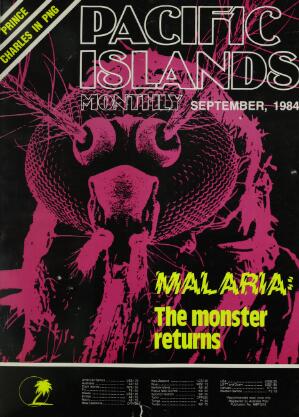
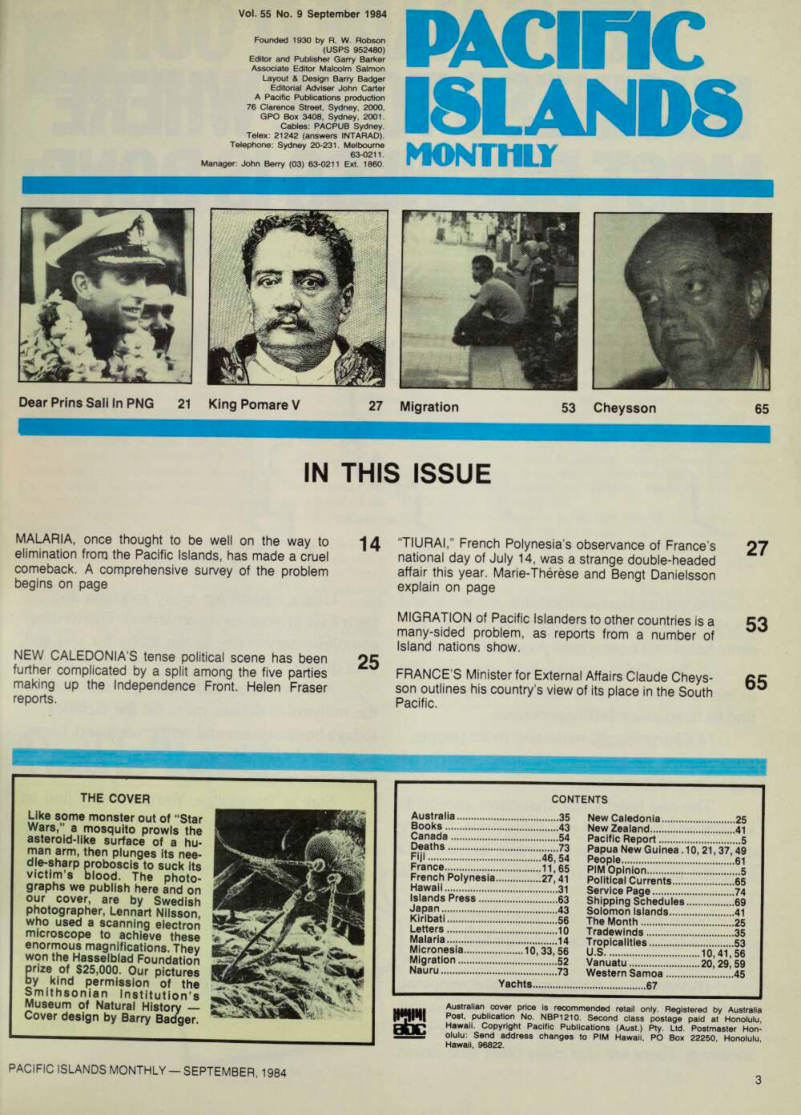
The Cover
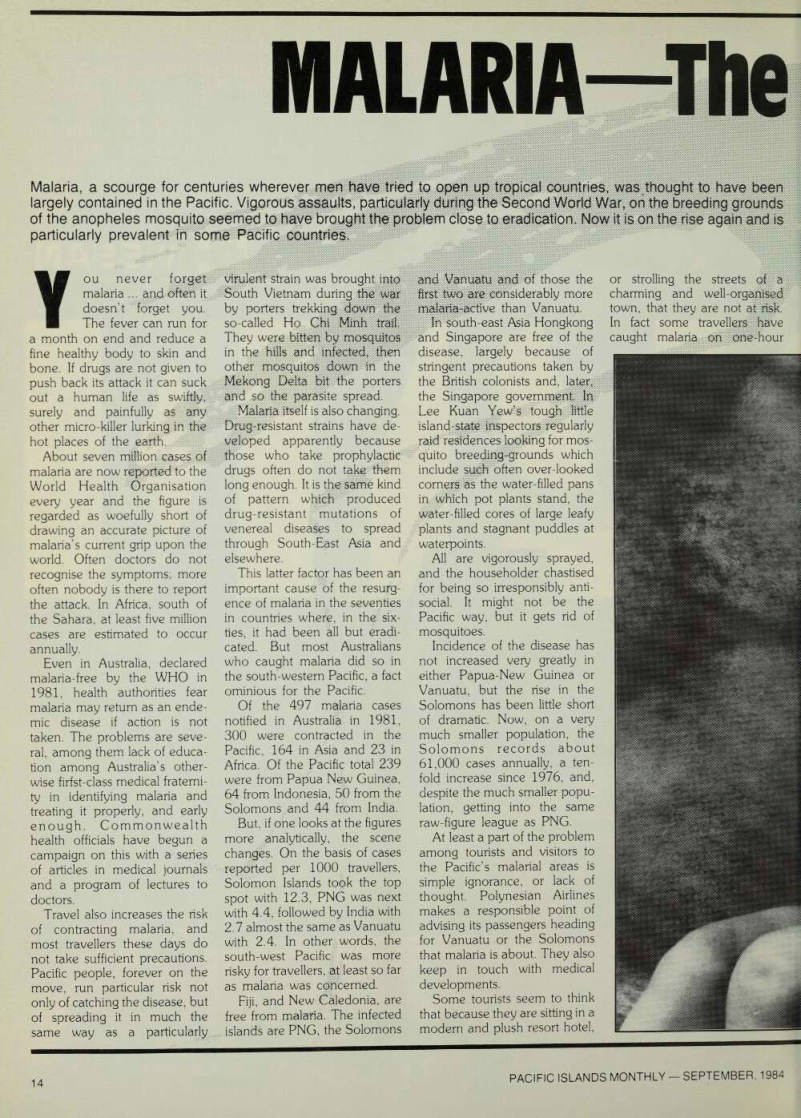
Like some monster out of “Star Wars,” a mosquito prowls the asteroid-like surface of a hu man arm, then plunges its nee dle-sharp proboscis to suck its victim’s blood. The photo graphs we publish here and on our cover, are by Swedish photographer, Lennart Nilsson, who used a scanning electron microscope to achieve these enormous magnifications. They won the Hasselblad Foundation prize of $25,000. Our pictures by kind permission of the Smithsonian Institution’s Museum of Natural History Cover design by Barry Badger.
Advertisements & other items, pp. 2-3 (2 items)
©Hitachi
Listen to what these experts
say about Hitachi’s VT-20E
0 ta P e recor^e ) L
“Great sound’.’
“Incredibly true to life.”
“Even talk shows sound better.”
The secret is stereo sound.
You see, the new VT-20E was designed to get the most out of the new stereo broadcasts, as well as prerecorded stereo tapes. And that means video that’s as easy to listen to as it is to watch.
Of course, the VT-20E also delivers a superb picture.
And boasts features like 4 heads. 8-hour ing. 8X Visual Search. A 5-programme/ 14-day timer. Front loading. And a 13function wireless remote control.
So take a look at Hitachi’s VT-20E.
If what you see doesn’t convince you, the experts surely will.
PROMT tOAD'NG/cONG PLAY RECORDING
/p• n n 270 i c - u U -l-l
STEREO BILINGUAL
jCHI+CH
crtereo
—J SOUND
fyii DC-BV SYSTM I
auto tuning system ■
CUD ®
©HITACHI
<|S)CaSEXHSI]
wm
©HITACHI
. AUSTRALIA: Hitachi Sales Australia Pty., Ltd. 163 Keys Road. Moorabbin, Victoria 3189; Phone; (555) 8722 » ZEA^ N * AWA 248, Porirua; Phone: PRO 75-069 • PAPUA NEW GUINEA: S.O. Svensson (N.G.) Ltd., P.O. Bo> 705, Port Moresby; Phone: 21-2111 • FIJ ' ® L pn f oxW Pa oeete Phone- 288 68 Road (P.O. Box 858), Suva, Fiji; Phone: 312070 • NEW CALEDONIA: Caldis, B.P. Ml. Noumea Phone: 26. 23. 50 • TAHITI: Ets Chene Alain, P.O. Box 272, Papeete, Phone. 2. 88. • SOLOMON ISLANDS: Technique Radios Centre Ltd., P.O. Box 465, Honiara; Phone: 416
Pacific
ISLANDS
MONTHLY
Vol. 55 No. 9 September 1984
Dear Prins Sail In PNG 21
King Pomare V 27
Migration 53
Cheysson 65
In This Issue
MALARIA, once thought to be well on the way to 14 elimination from the Pacific Islands, has made a cruel comeback. A comprehensive survey of the problem begins on page NEW CALEDONIA’S tense political scene has been 25 further complicated by a split among the five parties making up the Independence Front. Helen Fraser reports.
“TIURAI,” French Polynesia’s observance of France’s 07 national day of July 14, was a strange double-headed affair this year. Marie-Therese and Bengt Danielsson explain on page MIGRATION of Pacific Islanders to other countries is a 53 many-sided problem, as reports from a number of Island nations show.
FRANCE’S Minister for External Affairs Claude Cheys- cc son outlines his country’s view of its place in the South Pacific.
Contents
Australia 35 Books 43 Canada 54 Deaths 73 Fiji 46,54 France 11,65 French Polynesia 27,41 Hawaii 31 Islands Press 63 Japan 43 Kiribati 55 Letters 10 Malaria 14 Micronesia 10,33, 56 Migration 52 Nauru 73
New Caledonia 25 New Zealand 41 Pacific Report 5 Papua New Guinea .10,21,37, 49 People 61 PIM Opinion 5 Political Currents 65 Service Page 74 Shipping Schedules 69 Solomon Islands 41 The Month 25 Tradewinds 35 Tropicalities 53 U.S 10,41,56 Vanuatu 20,29,59 Western Samoa 45
Yachts 67
Australian cover price is recommended retail only. Registered by Australia Post, publication No. NBPI2IO. Second class postage paid at Honolulu Hawaii. Copyright Pacific Publications (Aust.) Pty, Ltd. Postmaster Hon olulu: Sen d address changes to PIM Hawaii, PO Box 22250. Honolulu, Hawaii, 96822.
Advertisements & other items, pp. 3-4 (2 items)
Pacific Islands Monthly —September, 1984
3
Founded 1930 by R. W. Robson
(USPS 952480)
Editor and Publisher Garry Barker Associate Editor Malcolm Salmon Layout & Design Barry Badger Editorial Adviser John Carter A Pacific Publications production 76 Clarence Street, Sydney, 2000, GPO Box 3408, Sydney, 2001.
Cables: PACPUB Sydney.
Telex: 21242 (answers INTARAD).
Telephone: Sydney 20-231. Melbourne 63-0211.
Manager: John Berry (03) 63-0211 Ext. 1860.
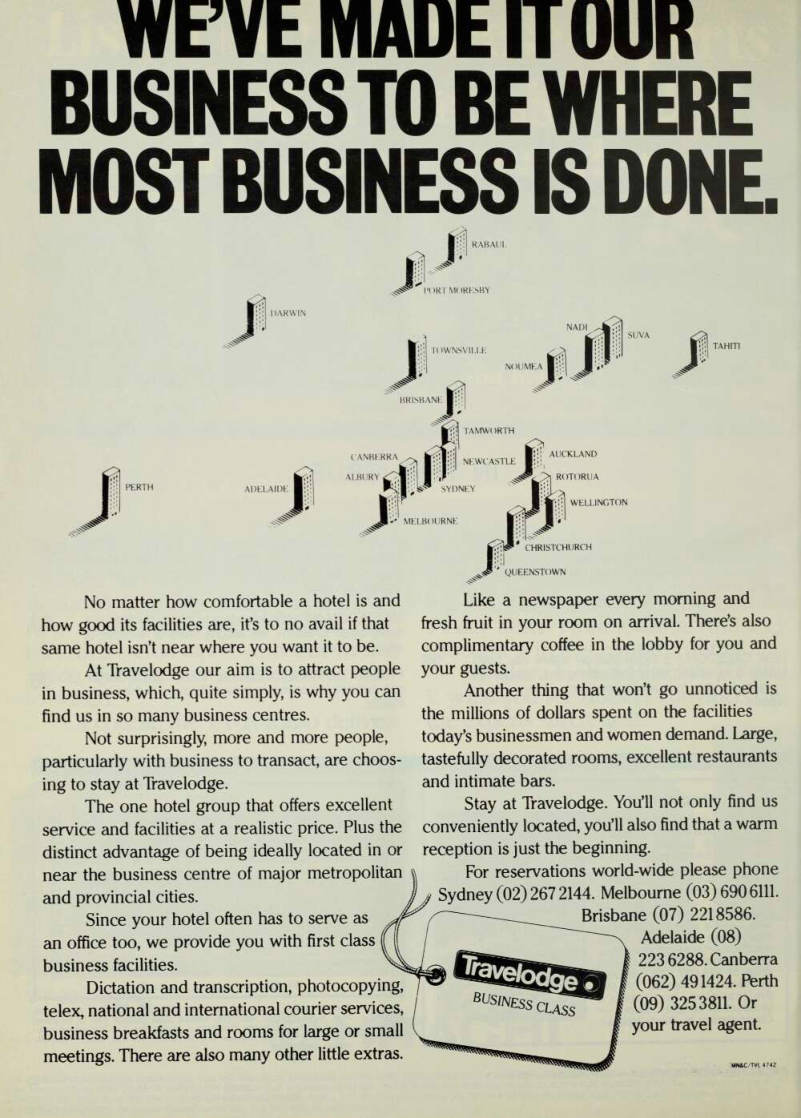
Business To Be Where
Wc VE MADE IT OUR
MOST BUSINESS IS DONE
i * n
RABAUI.
PORT M( )RKSBY
PERTH
ADELAIDE
I
ALBURY
J
SUVA
TAHITI
CANBERRA
WELLINGTON
CHRISTCHURCH
QUEENSTOWN
No matter how comfortable a hotel is and how good its facilities are, it’s to no avail if that same hotel isn’t near where you want it to be.
At Travelodge our aim is to attract people in business, which, quite simply, is why you can find us in so many business centres.
Not surprisingly, more and more people, particularly with business to transact, are choosing to stay at Travelodge.
The one hotel group that offers excellent service and facilities at a realistic price. Plus the distinct advantage of being ideally located in or near the business centre of major metropolitan and provincial cities.
Since your hotel often has to serve as an office too, we provide you with first class business facilities.
Dictation and transcription, photocopying, telex, national and international courier services, business breakfasts and rooms for large or small meetings. There are also many other little extras.
Like a newspaper every morning and fresh fruit in your room on arrival. There’s also complimentary coffee in the lobby for you and your guests.
Another thing that won’t go unnoticed is the millions of dollars spent on the facilities today’s businessmen and women demand. Large, tastefully decorated rooms, excellent restaurants and intimate bars.
Stay at Travelodge. You’ll not only find us conveniently located, you’ll also find that a warm reception is just the beginning.
For reservations world-wide please phone Sydney (02) 267 2144. Melbourne (03) 690 6111.
Brisbane (07) 2218586.
Adelaide (08)
CLASS
223 6288. Canberra (062) 491424. Perth (09) 3253811. Or your travel agent.
MNAC/TVt 4742
Pim Opinion
Between them the new prime minister of New Zealand, Mr David Lange, and the left wing of the Australian Labor Party have put white ants into the ANZUS Treaty, which has been a cornerstone of the security of the Pacific Region for 30 years.
By announcing in virtually his first breath as prime minister that nuclear-powered, and nuclear-armed ships would be banned from New Zealand ports Mr Lange threw a spanner into world defence thinking.
What New Zealand itself does about visiting ships is not really important. The effect of Mr Lange’s clearly-stated policy is upon Australia, the ANZUS alliance, and the willingness of the United States to continue carrying the major burden of everyone’s security.
It is more than possible to accept that everyone is acting with the noblest of intentions. It is not possible to believe that Mr Lange has weighed the hard realities of world affairs. If they understand that the future of ANZUS is at risk, what do they suggest should come in its place?
Mr Lange seems to think that ANZUS could continue as an alliance, based on conventional weapons. At that level, New Zealand, he says, will demonstrate it is a good partner. But given that we are in the nuclear age, what sort of a deterrent is a rifle?
Forty per cent of the U.S. fleet is now nuclear-powered, and, as the Americans have made clear, it isn’t possible to have the strawberries without the pips.
The nobility of Mr Lange’s stand is the desire to have the Pacific kept free of nuclear weapons, testing, and all other aspects of the doomsday technology. In this he is joined by a majority of Pacific leaders. The hard fact is that a unilateral nuclear ban not only does nothing to remove the spectre from the scene, but it renders everything vulnerable to those powers to whom public opinion is unimportant and brute strength is everything. Kampuchea, Afghanistan, and Czechoslovakia ought to have been worth something as examples.
It is significant that the Soviet Union has been expanding its forces patrolling the Ocean and that they are in process of building a nuclear-powered aircraft carrier as big as the USS Enterprise.
New Zealand, Australian states, PNG, or anyone else may ban nuclear forces from their ports, and the Americans would observe those bans. That would make life harder for the crews of ships maintained by an ally, without in the slightest way limiting the existence of nuclear arms, or making the world any safer. Rather, the reverse might be the case. Mr Lange, who has given every sign of being a tough-minded and determined leader may ultimately bend, if only a little, to pleas and persuasion.
The real problem is the application of a blanket ban. If it were to be amended to something less rigid, based, perhaps upon a right of passage, the political tangle into which Mr Lange has thrown ANZUS would be more easily straightened.
Meantime, in Geneva, Australian Foreign Minister, Bill Hayden, threw another cat into the fight by telling the international conference on disarmament that Australians would tolerate the continued presence of American bases on their soil only if the major world powers agreed to negotiate on disarmament.
Mr Hayden’s statement in Geneva, which obviously added to Washington’s growing uncertainty about its South Pacific allies, was quickly “re-interpreted” by Mr Hawke. He said it “was putting the emphasis the wrong way.”
If the Americans have a public fight with Mr Lange they would make him a hero of the Australian Left, give anti-American sentiment a boost, and embarrass Mr Hawke. But if they let the ban go unanswered their own position, and not only with ANZUS, would be weakened.
The hope left was that Mr Hawke was correct in forecasting that involved political processes had to be worked out in New Zealand.
The euphoria of sweet victory over Sir Robert, “Tiger of the South” Muldoon had to evaporate and a workable, practical,solu tion found by patience, understanding and recognition of some hard facts.
Pacific Report

Coalition Government In The Cooks
Cook Islands Prime Minister Sir Thomas Davis and Opposition Leader Geoffrey Henry have announced the formation of a coalition government. They said in a joint radio broadcast in early August that the coalition cabinet would comprise four members of Sir Thomas’ Democratic Party, and three from Mr Henry’s Cook Islands party. A correspondent of the New Zealand Press Association in Rarotonga reports that although he was not mentioned in the broadcast, a prominent Democratic Party member, Vincent Ingram, is believed to have precipitated the move. The NZPA report says that the government feared that Mr Ingram might not support the budget due to be brought down later in the month as he was not included in the cabinet named after the party won last November’s election by 13 seats to 11. The coalition had been formed to head off the crisis that would follow any such action by Mr Ingram. y
Paris: Final Vote On Jv.C. Statute
The French National Assembly on July 31 gave a final reading and passed into law a new statute for France’s overseas territory ofNew Caledonia, giving it internal autonomy leading to a referendum on its future in 1989. The bill was passed by 321 votes (the Socialists and Communists) to 151 against, from the various Opposition parties. The final text was the same as that passed in the second reading in the lower house, the Opposition-controlled Senate having refused to debate it and a joint Senate-Assembly commission having failed to reach agreement on a compromise text. The Senate has no further blocking power. The law gives a broad measure of self-government to the inhabitants of the island, and recognises the legitimacy of the customary law of the Melanesian 43 per cent of the population. Roch Pidjot, the independent deputy from New Caledonia who is president of the island’s Independence Front, abstained in the first two votes but
voted against the bill in the final reading. He charged that the law “sweeps aside the rights of the Kanak people,” and “plays into the hands of the most reactionary forces in New Caledonia. ” Georges Lemoine, Secretary of State (junior minister) for Overseas Departments and Territories, appealed to the IF to reconsider its decision to boycott the forthcoming elections for the Territorial Assembly. He said the IF’s position risked leading New Caledonia “towards a zone of uncertainty which no one would know how to control.” He said the date of the election would be fixed in the coming weeks. Opposition spokesman Jacques Toubon of the neo-Gaullist Rally for the Republic (RPR) also appealed to the IF to “come back to reason and consider that there is no future for the inhabitants of New Caledonia outside France.”
Png Plans Repatriations To Irian Java
Papua New Guinea announced at the beginning of August that it would start repatriating within two weeks more than 9000 Irianese who have crossed the border from Indonesia’s Irian Jaya province in the past few months. The announcement was made by the secretary of PNG’s foreign affairs department, Paulias Matane. He had just returned to Port Moresby from a meeting of the joint border committee with Indonesian officials in the Javanese city of Surabaya. Mr Matane said the Indonesians had assured PNG in writing that no harm would come to the people who were returned to Irian Jaya. PNG diplomats based in Jakarta would be able to witness the return of the Irianese, and would be able to check on them in their villages later on. A limited number of the Irianese will not be obliged to return to Irian Jaya, but will be allowed to seek political asylum in Third World countries.
Political Ploys In Fiji Airport Strike
More than 2000 overseas passengers were stranded in Fiji late in June by a strike of civil aviation workers, members of the powerful Fiji Public Service Association which is headed by the politically ambitious Mahendra Chaudry. The strike went on for four days, closing all the country’s airports including the big international gateway at Nadi, and the smaller Suva airport of Nausori. The affair was very much a confrontation between Chaudry’s union and the government, and ended only after Prime Minister Ratu Sir Kamisese Mara issued a stiff ultimatum, threatening to jail ringleaders and take other punitive action against the public servants. Ostensibly the strike was over the sacking of an airport fireman who had been declared medically unfit. But, in fact, it seems to have much deeper roots, touching not only the PSA’s grip on national affairs (about 60 per cent of the Fiji work force is on the government payroll), but also the rivalry between Chaudry and the secretary-general of the Fiji Trade Union Council, James Raman, who holds a position to which, it is said, Mr Chaudry aspires. The strike was declared illegal, but this was challenged by the union which attempted to take the issue into the Supreme Court thus by-passing the available arbitration machinery.
Chaudry s interest in wider arenas seemed to be indicated by a statement that he wanted “the whole Civil Aviation Authority cleaned up, and an inquiry into the perks allowed to manage ment. He said he wanted workers’ representatives on the CAAF board. Another of Mr Chaudry s associates in the union leadership business in Fiji, Dansuklal Moraji, won a very bitter battle with Qantas three years ago and now sits as general manager of Airport terminal Services, a union-run co-operative which took over operation of Nadi Aiiport from Qantas. ATS also runs all other airport services in Fiji. Mr Chaudry’s demand for worker representation on the CAAF has led to speculation that he is seeking to emulate Mr Moraji. However, faced with the full majesty of Katu Mara, and the prospect of losing what support he had throughout the country, Mr Chaudry agreed to send his members back to work and to take part in arbitration proceedings in Suva Meantime, Fiji is estimated to have lost about $2 million in tourist revenue because of the four-day stoppage.
Malaysia-Png Accord Signed
Malaysia and Papua New Guinea signed a technical co-operation agreement in Fort Moresby on August 7. The agreement was sig ned by the respective prime ministers, Dr Mahathir for Malaysia and Mr Somare for PNG. Dr Mahathir was in Port Moresby to attend the Commonwealth Heads of Government Regional Meeting. A Malaysian Government spokesman said that under the agreement, Malaysia would provide training to Papua New Guineans in tropical agriculture and medicine, local government and land telecommunications. Radio Australia’s Kuala Lumpur
correspondent reports that under Dr Mahathir’s leadership, Malaysia has set up its own technical development program. It seeks to share Malaysia’s development knowledge with less developed countries, particularly those in the South Pacific and Indian Oceans.
Png, Solomons, In Border Talks
Government officials from Papua New Guinea and Solomon Islands met in Kieta on Bougainville in early August. Bougainville is the main island in Papua New Guinea’s North Solomons Province and neighbors the Shortland Islands, which are part of the Solomons Western Islands province. At present most trade and movement across the border is unregulated. In April this year, Papua New Guinea’s Prime Minister Michael Somare made an official visit to Solomon Islands, and the common border was one of the main topics he discussed with Solomon Islands PM Solomon Mamaloni. Both leaders agreed talks on border arrangements should be held quickly. PNG Foreign Minister Rabbie Namaliu said the August talks covered technical matters only, but further talks would follow. There are family ties between many of the Bougainvilleans and the Shortland islanders, and in their daily lives the border has no reality. In the past, some Shortlanders, when discussing borders, have expressed preference for PNG nationality.
T.V. Door Still Open, Says Stack
National broadcast television will be established in Papua New Guinea in about two years, and possibly within one year, using the Aussat satellite system. AJready several production companies, mostly Australian, have lodged proposals with the PNG govern ment for this introduction of commercially-financed public television, but no decision has yet been made in Port Moresby.
Indeed, according to PNG minister for industrial development, Karl Stack, the door is still open for other television hopefuls to advance their investment proposals. In forecasting introduction of television in less than 24 months Mr Stack appears to be at odds with the government committee set up to study the problem. While they are expected to tell Cabinet that a 30-month period could be contemplated, they are understood to favor something more like five years. By any standards it will be an expensive undertaking.
Running the stations will cost about SA2B million annually while hiring a transponder on the satellite will involve rental fees of SA3 million a year. However, as in Fiji and other islands of the Pacific, television sets are now commonplace in PNG, attached to video recorders and served by sophisticated networks of cassette libraries.
PLEBISCITE ON VOTING RIGHTS IN W. SAMOA Western Samoans will be asked next year to decide by plebiscite whether or not to extend the right to vote to non-matais, and whether only matais should be allowed as MPs. The pledge was made in July by both Prime Minister Tofilau Eti and Opposition Leader Tupuloa Efi. Parliament was debating a motion by Matatumua Maimoaga, the only woman in the House. In support of her motion that only matais should be candidates in elections, and that the vote be given to all persons 25 years or older who do not vote now, and who have been approved by the chiefs and orators of their constituency, Matatumua said that the sole purpose of the motion was the protection of Samoan customs. She said that at present hundreds of matais were being created just to give them the vote. Some were not even made matais at the villages they belong to, or with the proper ceremonies of Saofai. This development was directly against Samoan customs, and would inevitably end in the death of the cherished customs and traditions, she said. Her motion was lost on the voices. Western Samoans go to the polls in February, 1985, and the plebiscite will be held later in the year.
A New “Panama” Canal?
The Panama Canal is choking, with 15,000 vessels passing through it annually, and the number increasing every year, writes the French-language monthly, 30 Jours. The magazine reports that an idea has been conceived to cut a new canal across Mexico’s Tehuantepec Isthmus, at an estimated cost of SUS4SO million. The Panama Canal was opened in August 1914. Its construction was begun in 1880, cost the lives of 5000 workers, bankrupted the original company, and was only completed following a US-backed uprising against the government of Colombia, and the creation of the Republic of Panama in 1903.
Tahiti: Boris Leontteff Resigns
French Polynesia’s Government Council member Boris Leontieff resigned in July following differences with his party leader, and council Vice-president, Gaston Flosse. Mr Leontieff, who had responsibility for public works and territorial development, wanted the territorial government to stand guarantor for a loan to the highly successful Marama Nui company, which has been a trail-blazer in the development of hydro-electricity in Tahiti. Mr Flosse favored a more cautious approach. There were also differences between the two over tne phosphate development E reject on the island of Mataiva. In his letter of resignation, Mr eontieff, who had been the youngest member of tne council, accused Mr Flosse of lacking ‘Vision” for the economic development of the territory.
South Pacific Joins The W.Cjj>.
The South Pacific will be officially represented for the first time when the World Council of Indigenous Peoples (WCIP) holds its fourth plenary meeting in Panama late in September. WCIP membership is limited to indigenous peoples who are not sovereign in their own countries. The eight delegations making up the South Pacific “regional” of the WCIP will come from East Timor, New Caledonia, French Polynesia, West Papua, Hawaii, Micronesia, New Zealand, and Australia. The body was formed at a mid-year meeting in Canberra hosted by Australia’s National Aboriginal Council. It is the fourth regional to adhere to the WCIP.
The other three are from North, Central, and South America. The establishment of the South Pacific regional has the active support of the Australian Government, including Minister of Aboriginal Affairs, Clyde Holding, and the secretary of the Australian Department of Aboriginal Affairs, Charles Perkins. The active entry of the Department of Aboriginal Affairs into the Pacific region through its sponsorship of the National Aboriginal Council will provide another and probably more sensitive dimension to Australia’s relations with indigenous peoples of the Pacific. —Bony Shineberg in Canberra.
Conference On Png Development
A major two-day conference will be held in Canberra this month to examine how Papua New Guinea’s emergence from its colonial past has affected internal development and foreign relations, particularly with Australia. The keynote address will be given by PNG’s minister for foreign affairs and trade, Mr Rabbie Namaliu.
Tony Bais, minister for justice, will also speak on law and order, one of the most vexed of public questions in PNG. Most speakers will come from PNG and will include politicians, academics and businessmen. Other speakers will include Professor Helen Hughes, who was a member of the Jackson Committee which reviewed Australian aid, Don Vernon, chairman of Bougainville Copper, and Paul Isherwood, chairman of the Australia-PNG Business Co operation Committee. Main themes to be addressed will be: development issues, education and culture, women in PNG, foreign policy and defence issues, economic relations, and Australian development assistance. The conference is organised by the Centre for Continuing Education at the Australian National University, assisted by the Australian Foundation for the Peoples of the South Pacific, and will run at University House, A.N U on September 13 and 14.
Png Into Asean Call By Indonesian
A senior Indonesian policy adviser has proposed that Papua New Guinea be admitted to full membership of the Association of South-east Asian nations (ASEAN), Jusuf Wanandi, executive director of Indonesia’s Centre for Strategic and International Studies, made the call during the third Australia-Indonesia seminar in Brisbane in July. He suggested that ASEAN membership could help alleviate Papaua New Guinea’s sense of insecurity and prevent further trouble along its border with Irian Jaya Commenting on the trans-migration of Javanese settlers to Irian Java Mr Wanandi said it was a sensitive political and anthropologi cal task and not simply a matter of economic policy. He said that until recently, Indonesia had lacked the resources and time to concentrate on the development of the eastern end of its archipelago.
RATU MARA WINS LIBEL SUIT ON APPEAL Fiji’s Prime Minister Ratu Sir Kamisese Mara has succeeded in a libel suit against the country’s leading newspaper, The Fiji Times.
He at first lost in the Supreme Court, but then won in the Court of Appeal. A retrial has been ordered in the Supreme Court to assess damages. The suit arose from publication by the Times of a letter to the editor criticising Senator Inoke Tabua who had called for the deportation of certain Indian leaders. It was sad, said the correspondent, that the prime minister had not rebuked the senator, for he was Ratu Mara’s nominee in the Senate. In fact the senator is a nominee of the Great Council of Chiefs, of which Ratu Mara is a member, and the Times next day corrected the assertion.
However, Ratu Mara sued, judging the matter to be of considerable political importance to him. Judge Rooney, in the Supreme Court, found there was no libel. Mr Justice o‘Kegan, in the Appeal Court, decided that words in the letter inferred that the prime minister would be pleased by the senator’s words to the extent that he would renew the senator’s nomination. That inference was defamatory, said the court.
Air Polynesie Issues Ultimatum
French Polynesia’s inter-island carrier Air Polynesie will go out of business at the end of this year unless it gets a clear statement of support by September 30 from the territorial government on its plans to purchase new aircraft. September 30 is the date of expiry of the company’s option to buy four ATR42 aircraft. The 46-seater Franco-Italian plane is seen by the company as the key to its future profitable operation. It is seeking to raise CFPS billion (about $5O million) for the purchase. The French airline UTA is the largest single shareholder in Air Polynesie. A statement by the local company’s board of directors said that if the territoral government was unwilling to guarantee the loan, or preferred another partner in operating inter-island services, the company would have no alternative but to wind up its affairs by December 31, 1984.
President Deroburts “First" In Noumea
President Hammer Deßoburt of Nauru became the first foreign head of state ever received at Noumea’s Town Hall when he visited it on July 25. President Deßoburt, who was on a four-day official visit to New Caledonia, also met High Commissioner Jacques Roynette, and leaders of the main political groupings in the territory. In discussion with Vice-President of the Government Council Jean-Marie Tjibaou, President Deßoburt made it clear that because of difficulties encountered in collaboration between Air Nauru and Air Caledonie International, the Nauruan airline planned either to cease making seats on its flights available to Aircalin, or to charge more for them.
VILA S “ROBIN HOOD“ GETS 27 MONTHS Described by Vanuatu’s Acting Chief Justice Michael Oakley as “a modern Robin Hood”, the former acting manager of Port-Vila’s Besa Club, Joel Hango, was sentenced to 27 months jail in late July for theft of a total of 2,646,000 Vatu (about $A26,460) from the club. The money was taken from the club’s poker machines.
Mr Hango, from Pentecost, stole the money over a period of three months, until his dismissal in December, 1983. The court hearing revealed that while he kept some of the money for himself, he gave the rest away to relatives and friends.
Truk: Sailors' Remains Recovered
Japan has recovered the remains of 379 sailors from five of the Imperial Navy ships sunk in the Truk Lagoon by American aircraft in 1944. The bodies were cremated in Truk on July 30 and the ashes returned to Japan on August 1. Japan only recently received permission to recover the bodies.
Meet The Kirivalu Australia Association
The Kirivalu-Australia Association has been formally established in Melbourne. The association, which draws together Gilbertese and Tuvaluans resident in Australia, and Australians with an interest in Kiribati and/or Tuvalu, has a membership of “approximately, 40 families and six singles, most of whom are from Melbourne” according to a report oy Teweiariki Tebano in the Tarawa paper Te Uekero. The report quotes the 1984 KAA president, Don Kennedy, as saying that formation of the new body would not change ‘‘the casual nature of the association’s social gatherings.”
He said: “The moves place us in a more favorable position should legal or financial difficulties arise.” He added that “in case of internal turmoil, members can fall back on the by-laws of the association to smooth things out.”
Advertisements & other items, pp. 6-8 (1 item)
. Ul Bmsoxaj
■ m m W pSP m
HPPI
20 I
. Ul Bmsoxaj
wl liW ‘» >S A HEALTH HAZARD 111 * *1
'yyurpfv/fcpipe&m^.
AUSTRALIAN PLUMBING
and BUILDING MATERIALS
*O. m m n % G «!
ssss
fa'M
Or, Australia has developed a very extensive range of plumbing and building items and equipment - Solar, gas and electric hot water systems. PVC pipes and fittings. Bathroomware. Stainless steel sinks and laundry tubs.
Taps and fittings. Brassware. Copper tubing.
Soldering and welding equipment. Hand tools.
Adhesives, sealants, putties. Prefab buildings.
Insulation. Door and cabinet hardware. Roll-up doors. Lighting. Fasteners. General hardware.
And many more.
Australia can supply competitively-priced, high quality products for all industrial, commercial and domestic construction work.
Used in situations ranging from big city projects to the harsh conditions of Australia’s remote areas, they’ve proven efficient, reliable and long-lasting. And don’t forget, with Australia being a close major supplier you get quick delivery and service. Contact the Australian Trade Commissioner for further information.
Ask the expert who knows Australia.
For details of suppliers, phone or telex the Australian Trade Commissioner at:
FIJI
P.O. Box 1252, Suva Phone: 312844 Telex: FJ2126
PAPUA NEW GUINEA
P.O. Box 9129, Hohola Phone: 25 9333 Telex: NE22109
NEW CALEDONIA
P.O. Box 22, Noumea Phone: 272414 Telex: 087
HAWAII
Australian Consulate 1000 Bishop Street Hawaii, 96813, USA Phone: (808) 524 5050 Telex: 633128
letters
Flying USA-PNG: The facts on fares
1 refer to Mr Roger Sykes’ letter in PIM April ’B4.
I do believe if Mr Sykes would have checked with the airline or his travel agent, he would have found an agreeable airfare. There are also 30 U.S. tour operators who have on going scheduled tour programs to suit all interests whether it be diving, voyaging, four-wheel drive adventures or as a general tourist, at various price levels.
Papua New Guinea offers much to the world traveller. It is one of the few remaining areas of the world for those seeking a unique travel experience. Air Niugini is available to help any person who would like to visit.
Air Niugini just received, at the International PATA conference, the Gold Award for its four color Adventure Country In formation Brochures on Papua New Guinea, and special men tion for its in-flight magazine Paradise.
The following airfares are available from the USA to Port Moresby. Some restrictions ap ply as is normal of promotional airfares to other world destina tions. Basically, they follow the APEX rules. All are under the lowest price of SUSIBOO Mr Sykes quotes. 1. California to Caims; high $1530, shoulder $l3BO, low $llOO plus $A266 Caims to Port Moresby. 2. California to Port Mores-
by via Brisbane or Sydney: high $1530, shoulder $l3BO, low $1353. 3. California to Nadi to Port Moresby; year round $1350. 4. California to Nadi to Auckland to Port Moresby and choice of either Hong Kong or Singapore at $l2OO one way. 5. Pending approval Califor nia to Auckland to Port Mores by at $1530 high, $l3BO shoul der, low $1353. 6. Honolulu to Port Moresby
for round trip approximately $llOO.
Air Nuigini and the newly established tourist office have a great interest in the promotion of Papua New Guinea. Our office is continually promoting through films, mailings, advertising and workshops for travel agents and the general public. Hopefully the next visit Mr Sykes makes to Papua New Guinea, he will contact our office for update information.
Kerry A. Byrd
(Regional Manager North America) Air Niugini Newport Beach, Calif.,
Usa.
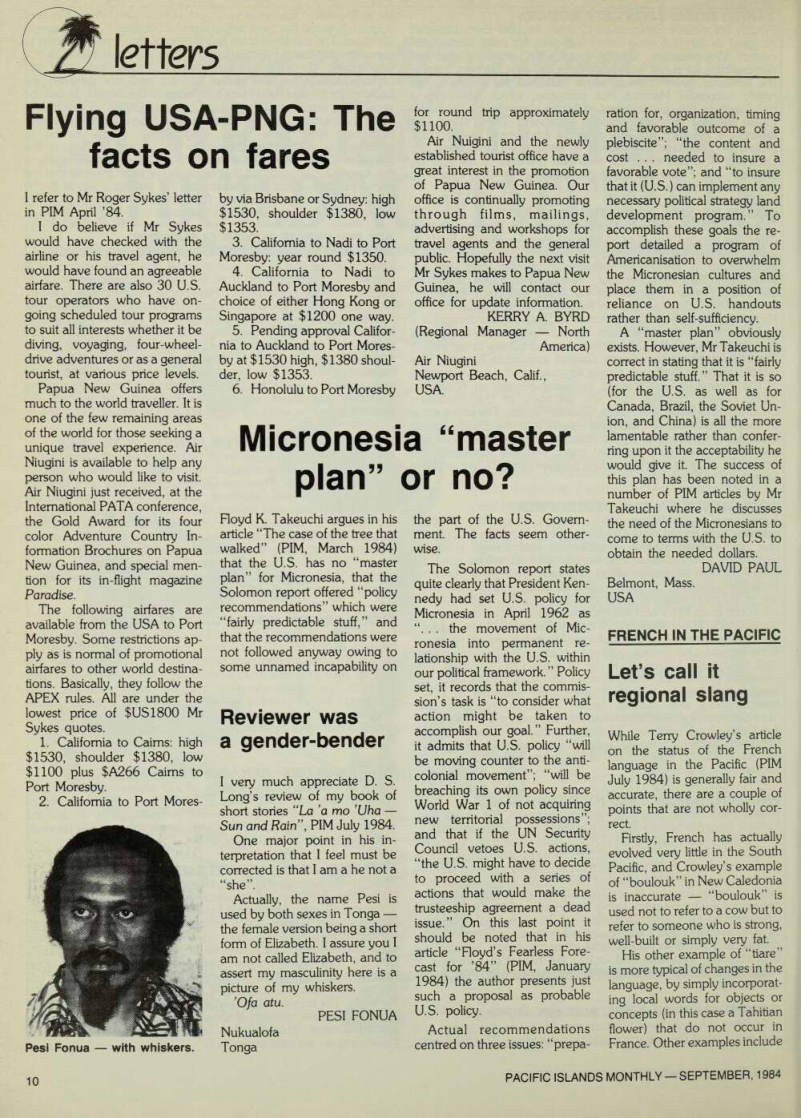
Pesi Fonua - with whiskers.
Micronesia “master
plan” or no?
Floyd K. Takeuchi argues in his article “The case of the tree that walked” (PIM, March 1984) that the U.S. has no “master plan” for Micronesia, that the Solomon report offered “policy recommendations” which were “fairly predictable stuff,” and that the recommendations were not followed anyway owing to some unnamed incapability on
Reviewer was
a gender-bender
I very much appreciate D. S.
Long’s review of my book of short stories “La ’a mo Vha Sun and Rain”, PIM July 1984.
One major point in his in terpretation that I feel must be corrected is that I am a he not a “she”.
Actually, the name Pesi is used by both sexes in Tonga the female version being a short form of Elizabeth. I assure you 1 am not called Elizabeth, and to assert my masculinity here is a picture of my whiskers. ’Ofa atu.
Pesi Fonua
Nukualofa Tonga
the part of the U.S. Govern ment. The facts seem other wise.
The Solomon report states quite clearly that President Ken nedy had set U.S. policy for Micronesia in April 1962 as . . the movement of Mic ronesia into permanent re lationship with the U.S. within our political framework. ” Policy set, it records that the commis sion’s task is “to consider what action might be taken to accomplish our goal.” Further, it admits that U.S. policy “will be moving counter to the anti colonial movement”; “will be breaching its own policy since World War 1 of not acquiring new territorial possessions”; and that if the UN Security Council vetoes U.S. actions, “the U.S. might have to decide to proceed with a series of actions that would make the trusteeship agreement a dead issue.” On this last point it should be noted that in his article “Floyd’s Fearless Fore cast for ’B4” (PIM, January 1984) the author presents just such a proposal as probable U.S. policy.
Actual recommendations centred on three issues: “prepa
ration for, organization, timing and favorable outcome of a plebiscite”; “the content and cost . . . needed to insure a favorable vote”; and “to insure that it (U.S.) can implement any necessary political strategy land development program.” To accomplish these goals the re port detailed a program of Americanisation to overwhelm the Micronesian cultures and place them in a position of reliance on U.S. handouts rather than self-sufficiency.
A “master plan” obviously exists. However, Mr Takeuchi is correct in stating that it is “fairly predictable stuff.” That it is so (for the U.S. as well as for Canada, Brazil, the Soviet Un ion, and China) is all the more lamentable rather than confer ring upon it the acceptability he would give it. The success of this plan has been noted in a number of PIM articles by Mr Takeuchi where he discusses the need of the Micronesians to come to terms with the U.S. to obtain the needed dollars.
David Paul
Belmont, Mass.
Usa
French In The Pacific
Let’s call it
regional slang
While Terry Crowley’s article on the status of the French language in the Pacific (PIM July 1984) is generally fair and accurate, there are a couple of points that are not wholly cor rect.
Firstly, French has actually evolved very little in the South Pacific, and Crowley’s example of “boulouk” in New Caledonia is inaccurate “boulouk” is used not to refer to a cow but to refer to someone who is strong, well-built or simply very fat.
His other example of “tiare” is more typical of changes in the language, by simply incorporat ing local words for objects or concepts (in this case a Tahitian flower) that do not occur in France. Other examples include
“bougna” and “niaouli”.
Almost all the distinctive French words and expressions used in New Caledonia (see, for examples, K. J. Hollyman, Mille et un Mots Caledonians, Noumea, 1983) are better viewed simply as regional slang rather than Pacific transforma tions.
In this respect French has not evolved or indigenised any more than English which has done much the same, in corporating words and con cepts such as “going finish”.
Moreover there is no “Pidgin
French” and French has made little contribution to Bislama.
Secondly, it is not surprising that French is the medium of instruction and administration in Wallis and Futuna, since the island of Futuna also has its own language, Futunan, which is quite different from Wallisian (Uvean). French thus serves as a lingua franca in a rather similar way to its role in New Caledonia.
John Connell
(University of Sydney) Sydney NSW Australia
Jousting with French
nuclear admiral
Venturing out on the uncharted seas of the foreign press, Admiral Montpellier, who has been running the show for the last dozen or so nuclear tests at Moruroa, has gone off course in his complaint about our article in The Bulletin of Australia. We are nevertheless glad to cross swords with him ... 1. The admiral admits that Moruroa s satellite Fangataufa was heavily contaminated by the explosion in 1968 of a 2.5 megatonne hydrogen bomb, but argues that this is no longer the case. The only proof he offers, however, is his own bland assurance that “if we send workers to Fangataufa, there is nothing to worry about. This of course, is not a proof. It is rather an expression of callous disregard for human lives. If by some unexplained miracle the atoll is now safe, why was the Australian-NZ- PNG team which spent four days on Moruroa in October 1983 not allowed to visit Fangataufa with their instruments to study this amazing and hitherto unknown scientific phenomenon of rapidly self-
destroying radioactivity?
2. The admiral tells us that the tests will not go on “indefinitely”, but only “as long as necessary”. We have a feeling that this nice distinction will be completely lost on the governments, peoples, churches and citizens’ organisations in the South Pacific opposed to the continued French testing at Moruroa. 3. The admiral dismisses the
often advanced idea of making the tests in France, on the ground that it is utterly impossi ble to find an area “where there is a 20 km radius from the testing site free of any popula tion”. The admiral must have been too long at sea, for if he had done a little more travelling in his native country he would know that there are many such sites all over France, and espe cially in the Massif Central. The French army does not even have to expropriate land for this purpose, since it already owns at least a dozen suitable military training grounds, varying in size from 10,000 to 35,000 hec tares, and totally free of any population. We recommend especially the Canjuers, Suip pes, Mailly and Mourmelon military reserves which are all much bigger than Moruroa, where, incidentally, 3000 men and 12 women live per manently. 4. The admiral emphatically denies that the outer wall of Moruroa atoll has been breached by underground (or rather underwater) tests. We recommend that he read the official 1983 report by the French Government Commis sioner for Natural Disasters, Ha roun Tazieff, who has made two (on-site) inspections, and who definitely states that seve ral accidents of this type have occurred and estimates that on one occasion no less than a million cubic metres of coral and rock were prised lose. 5. The admiral insists that all waves produced by the more
than 100 blasts at Moruroa are extremely well-behaved and highly disciplined, and simply never travel farther from the atoll than 500 metres! Does the admiral really not know what happened for instance on July 25, 1979 (PIM Oct. 79, p. 23), when huge ocean waves, which definitely originated at Morur oa, severly damaged the pearl farm at Marutea 200 nautical miles away? 6. The admiral thinks that it is quite “crazy” to suggest that radioactive material has been stored and spilled on the north coast of Moruroa and subse quently dispersed over the ocean by storms and cyclones.
If so, the French technicians in charge of the testing program at Muroroa must be the craziest people on earth, for it was they who on October 19, 1981, distributed a report to the French and foreign press re vealing for the first time the full extent to which radioactive waste and plutonium, through criminal neglect, had been allowed to accumulate on the north coast of Moruroa since the 19605. (See for instance The National Times, 22-28 November, 1981, and The Sydney Morning Herald 14 De cember 1981). The veracity of the allegations made in this report was confirmed in the French parliament, on Decem ber 9, 1981, by none other than Minister for Defence Charles Hernu himself.
Let us only add that the admiral has, as usual, avoided saying anything about the most serious of all the problems caused by the tests. This is not what has happened to the poor devils engineers, technicians, army and navy officers, foreign legionnaires and Polynesians who live and work on Moruroa, but the extent to which the civilian population in French Polynesia as a whole has been contaminated. Again and again,
the little local parliament (Assemblee Territorial), made up of 30 elected representatives of the Polynesian people, has tried to set up a commission of inquiry to ascertain these health hazards only to be blocked each time by the French authorities.
Marie-Therese And Bengt
Danielsson
Papehue Tahiti
Idiots of the
world, unite!
I am really fed up about your narrow-minded, ill-informed, francophobic comments of your magazine.
Your francophobic attitude is disgusting for all normal intelli gent human being.
I have been living in the Pacific Islands for 20 years (including New Caledonia and French Polynesia, which I en joyed the most) and I can say, at least 95 per cent of all your comments are unfair and ridicu lous.
I have been travelling all over the world for 30 years in over 70 countries and I can say English people are the most racist and hypocrite people in the world, but above all, the most ignorant about foreign cultures. Their inability to leam languages is famous the world over, so bad they are becoming the idiots of the world.
I remember being in Canada in 1976 (Vancouver). A Cana dian woman wrote a book about Chinese culture after spending only four weeks in China and, of course, not speaking any Chinese at all!!!
That’s typically English!!!
I am bilingual, I read both PIM and 30 Jours and I can tell you the French one is much more balanced, deeper, fair and interesting.
It’s time to grow up, PIM, if you want to catch up!
John Parkison
Townsville, Qld Australia We trust the excitable Mr Parti san was in a calm enough state of mind to note in our Ju/y issue (P6l) an article in the French language by Jacques- Maurice Cler of Le Figaro. We also hope he found Mr Cler’s comments on decolonisation in the Pacific “balanced, deep,
fair and interesting/’
Pim
Admiral Montpellier
Advertisements & other items, pp. 12-13 (1 item)
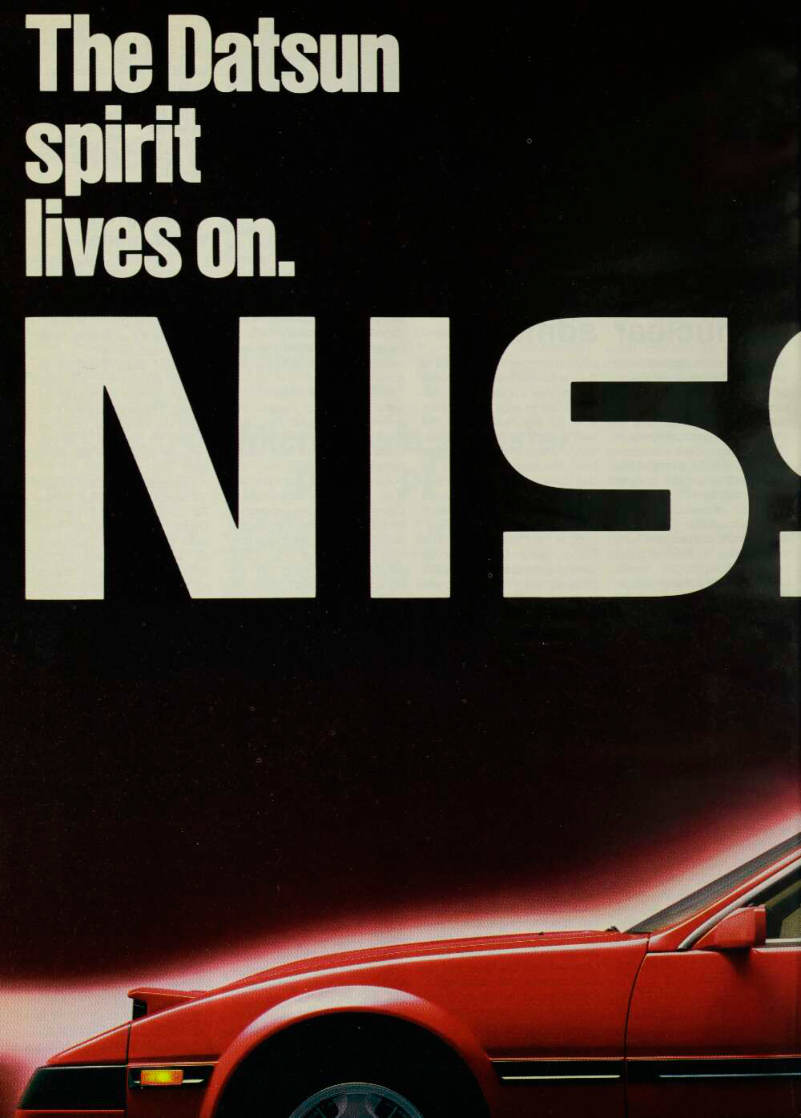
The Datsun
spirit lives on.
000&
'■WSHSS&
Car of thefuture: f ■ ■ m .
Production line with welding robots I ft* M r m m ■ % Perhaps you’ve noticed. Datsun is changing ' its name. But the spirit that made Datsun , a symbol for advanced automotive technology throughout the world will never disappear. Because now Datsun is Nissan.
Fact is, the two have always been one and the same. Nissan has been Datsun’s corporate name for over 50 years. The only change we’ve really made is to give our products their proper name.
So if you’ve begun to miss the name Datsun, rest easy.
The spirit that made Datsun i W& IC for computerized cars so great is alive and well and living inside every Nissan.
NISSANI
NISSAN
I
MALARIA—The scourge resurgent
Malaria, a scourge for centuries wherever men have tried to open up tropical countries, was thought to have been largely contained in the Pacific. Vigorous assaults, particularly during the Second World War, on the breeding grourtds of the anopheles mosquito seemed to have brought the problem close to eradication. Now it is on the rise again and is particularly prevalent in some Pacific countries.
You never forget malaria ... and often it doesn’t forget you.
The fever can run for a month on end and reduce a fine healthy body to skin and bone. If drugs are not given to push back its attack it can suck out a human life as swiftly, surely and painfully as any other micro-killer lurking in the hot places of the earth.
About seven million cases of malaria are now reported to the World Health Organisation every year and the figure is regarded as woefully short of drawing an accurate picture of malaria’s current grip upon the world. Often doctors do not recognise the symptoms; more often nobody is there to report the attack. In Africa, south of the Sahara, at least five million cases are estimated to occur annually.
Even in Australia, declared malaria-free by the WHO in 1981, health authorities fear malaria may return as an ende mic disease if action is not taken. The problems are seve ral, among them lack of educa tion among Australia’s other wise firfst-class medical fraterni ty in identifying malaria and treating it properly, and early enough. Commonwealth health officials have begun a campaign on this with a series of articles in medical journals and a program of lectures to doctors.
Travel also increases the risk of contracting malaria, and most travellers these days do not take sufficient precautions.
Pacific people, forever on the move, run particular risk not only of catching the disease, but of spreading it in much the same way as a particularly
virulent strain was brought into South Vietnam during the war by porters trekking down the so-called Ho Chi Minh trail.
They were bitten by mosquitos in the hills and infected, then other mosquitos down in the Mekong Delta bit the porters and so the parasite spread.
Malaria itself is also changing.
Drug-resistant strains have de veloped apparently because those who take prophylactic drugs often do not take them long enough. It is the same kind of pattern which produced drug-resistant mutations of venereal diseases to spread through South-East Asia and elsewhere.
This latter factor has been an important cause Of the resurg ence of malaria in the seventies in countries where, in the six ties, it had been all but eradi cated. But most Australians who caught malaria did so in the south-western Pacific, a fact ominious for the Pacific.
Of the 497 malaria cases notified in Australia in 1981, 300 were contracted in the Pacific, 164 in Asia and 23 in Africa. Of the Pacific total 239 were from Papua New Guinea, 64 from Indonesia, 50 from the Solomons and 44 from India.
But, if one looks at the figures more analytically, the scene changes. On the basis of cases reported per 1000 travellers, Solomon Islands took the top spot with 12.3, PNG was next with 4.4, followed by India with 2.7 almost the same as Vanuatu with 2.4. In other words, the south-west Pacific was more risky for travellers, at least so far as malaria was concerned.
Fiji, and New Caledonia, are free from malaria. The infected islands are PNG, the Solomons
and Vanuatu and of those the first two are considerably more malaria-active than Vanuatu. in south-east Asia Hongkong and Singapore are free of the disease, largely because of stringent precautions taken by the British colonists and, later, the Singapore government In Lee Kuan Yew’s tough little island-state inspectors regularly raid residences looking for mos quito breeding-grounds which include such often over-looked corners as the water-filled pans in which pot plants stand, the water-filled cores of large leafy plants and stagnant puddles at waterpoints.
All are vigorously sprayed, and the householder chastised for being so irresponsibly anti social. It might not be the Pacific way, but it gets rid of mosquitoes.
Incidence of the disease has not increased very greatly in either Papua-New Guinea or Vanuatu, but the rise in the Solomons has been little short of dramatic. Now, on a very much smaller population, the Solomons records about 61,000 cases annually, a ten fold increase since 1976, and, despite the much smaller popu lation, getting into the same raw-figure league as PNG.
At least a part of the problem among tourists and visitors to the Pacific’s malarial areas is simple ignorance, or lack of thought. Polynesian Airlines makes a responsible point of advising its passengers heading for Vanuatu or the Solomons that malaria is about. They also keep in touch with medical developments.
Some tourists seem to think that because they are sitting in a modern and plush resort hotel,
or strolling the streets of a charming and well-organised town, that they are not at risk.
In fact some travellers have caught malaria on one-hour
stopovers in airport transit lounges.
The female anopheles mosquito which carries the malaria infection feeds mostly in the early evening. In drinking the blood of its victim it transfers the malaria parasite and, from then on, unless the bitten one has taken a precautionary drug, he is pretty well certain to go
down with symptoms which, in their mild form resemble those of a heavy cold or the ’flu, About the only way to be certain is to have a blood test done and even then, according to some recent reports, if a course of drugs is being taken to treat one form of the disease, one cannot always be certain of identifying all strains involved in
the infection.
While the only certain way of reducing, or eradicating, the malarial parasite is to attack the anopheles mosquito in its breeding grounds, this does very little to help those suffering from the disease, or likely to catch it in the foreseeable fu ture. For them drugs are the only way and despite a great deal of research over many years there are problems. Worst of these is the fact that malaria has become resistant to chloro quine (Nivaquine is one of the most popular proprietary ver sions) and the mutant strains are spreading. PNG, Solomon Islands and Vanuatu all have the resistant strains.
This seems to mean that doctors can no longer recom mend one drug as a catch-all.
Doctors require information on where a traveller intends to go, and then possibly also find out
the latest knowledge on the area.
Maloprim and Fansidar are among more recent additions to anti-malarial weaponry, but they are more difficult to use than chloroquine which built a reputation for being one of the safest and most effective drugs on the market. Nor are they alternatives for chloroquine, or it for they. Some of the new malaria strains thrive on a diet of chloroquine while in other areas it remains effective. Nor can Maloprim or Fansidar be prescribed automatically for in fants or pregnant mothers. In a few cases there are side-effects, including nausea.
Most recently a drug called Mefloquine has been deve loped, but it is still undergoing field tests as is artemisine a modern derivative of an old Chinese herbal medicine.
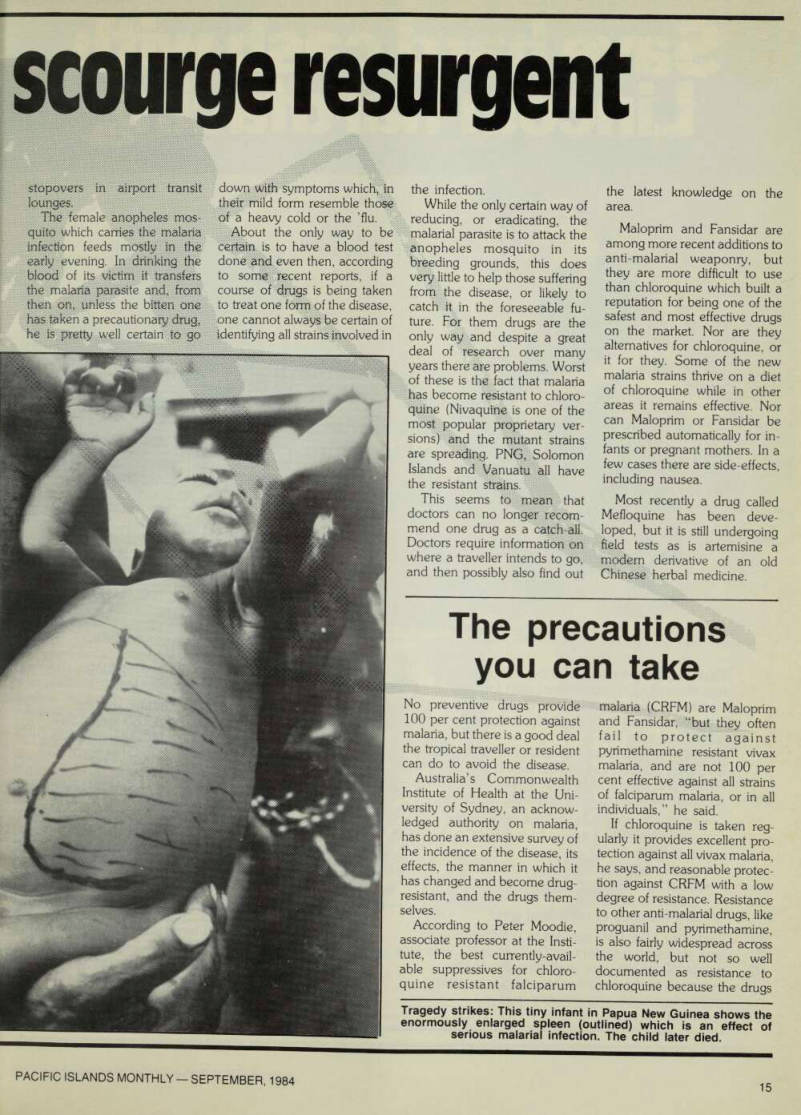
Tragedy strikes: This tiny infant in Papua New Guinea shows the enormously enlarged spleen (outlined) which is an effect of serious malarial infection. The child later died.
The precautions

you can take
No preventive drugs provide 100 per cent protection against malaria, but there is a good deal the tropical traveller or resident can do to avoid the disease.
Australia’s Commonwealth Institute of Health at the University of Sydney, an acknowledged authority on malaria, has done an extensive survey of the incidence of the disease, its effects, the manner in which it has changed and become drugresistant, and the drugs themselves - According to Peter Moodie, associate professor at the Institute, the best currently-available suppressives for chloroquine resistant falciparum
malaria (CRFM) are Maloprim and Fansidar, “but they often fail to protect against pyrimethamine resistant vivax malaria, and are not 100 per cent effective against all strains of falciparum malaria, or in all individuals,” he said, If chloroquine is taken reg ularly it provides excellent pro tection against all vivax malaria, he says, and reasonable protec tion against CRFM with a low degree of resistance. Resistance to other anti-malarial drugs, like proguanil and pyrimethamine, is also fairly widespread across the world, but not so well documented as resistance to chloroquine because the drugs
are not used for the treatment of attacks of malaria.
“Pyrimethamine alone is not recommended anywhere as a preventive drug, but proguanil is still useful.
“Amodiaquine appears to be a marginally better drug than chloroquine, and may be effec tive when chloroquine resist ance first appears,” Dr Moody said.
“Except in some parts of Thailand and Indochina, quinine is still an efficient drug for achieving rapid clinical cure in falciparum malaria, but is unsuitable for prophylaxis be cause an effective preventive dose causes side effects. In adequate, or irregular, preven tive doses are believed to be largely responsible for the occurrence of blackwater fever. ”
Dr Moodie and the Institute recommend precautions as fol lows; **Adult travellers to all malarious areas should take chloroquine or amodiaquine, 2 tablets weekly, if there is any risk at all of exposure to malar ia. Children’s doses should be the nearest practical fraction above 5 mg per kg. Chloro quine is also available as a syrup for children. quine or amodiaquine should be started 2 weeks before arri val in the malaria zone, and should continue for four weeks after leaving it. ** Those ex posed to chloroquine-resistant falciparum malaria should take one tablet of Maloprim or Fan sidar in addition to chloroquine, starting at the beginning of exposure, and continuing for four weeks after the risk is over. ** People, including long-term residents, exposed to malaria, but only intermittently exposed to CRFM should take chloro quine continuously, but add Maloprim or Fansidar during and for four weeks after CRFM exposure. ** Anyone taking Maloprim or Fansidar for more than eight weeks on end should have a full blood count six to eight weeks after commencing these drugs. Both drugs have some side-effects which, although rarely found, are se rious, Dr Moodie says.
Non-life-threatening side
effects, such as nausea and headaches, were moderately common with both Maloprim
and Fansidar. but in rare cases the drugs had caused aplastic anaemia and agranulocytosis.
“The incidence of such se rious-side effects is very low if recommended doses are not exceeded and do not outweigh the risks of malaria morbidity or mortality, even in pregnancy and early infancy, where chlor oquine resistance is a known hazard.
“Individuals have been known to develop severe agra
nulocytosis as early as after five weekly single tablets of Malop rinry and the same probably applies to Fansidar,” he said.
“Travelers on short trips into CRFM regions, for whom Maloprim or Fansidar is indi cated because of their expo sure. should not, and need not, commence these drugs until immediately before departure.
They should seek advice in the event of an unexplained infec tion, particularly a sore throat.”
Everyone in malarial areas should take precautions against mosquito bites, particularly after dusk. Nets, mosquito re pellants, coils and other methods should all be used. No preventive drug provides 100 per cent protection. A doctor’s advice should be sought for any course of protection or treat ment, and if the doctor is not sure, he can always ask the Commonwealth Institute of Health.
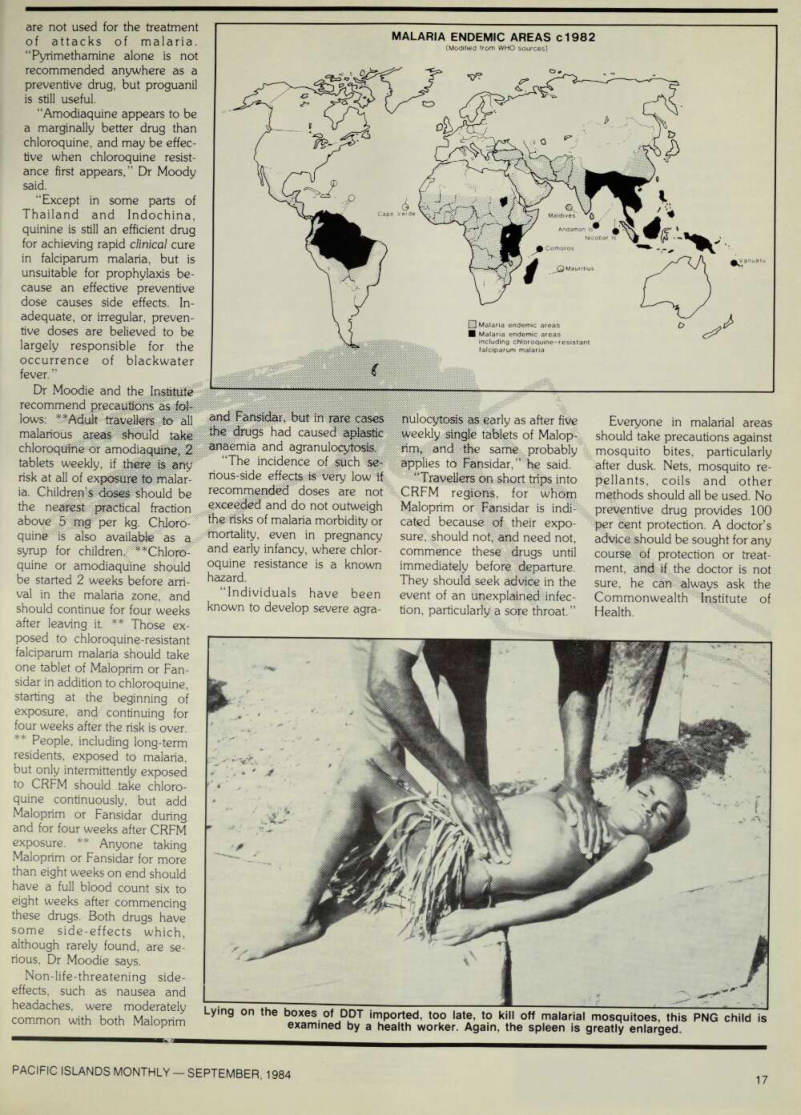
Malaria Endemic Areas C 1982
(Modified from WHO sources)
Lying on the boxes of DDT imported, too late, to kill off malarial mosquitoes, this PNG child is examined by a health worker. Again, the spleen is greatly enlarged.
Advertisements & other items, p. 16 (1 item)
Lincoln hardfacing
Save hard cash with
mm ft' ■?* ■ - •V . mm A ■ •r Vr's!'- . r-;A mm * ■ Save real money by repairing, rebuilding, or resurfacing worn equipment with Lincoln continuous wire hardfacing. Or by hardfacing new equipment before use for extra wear and longer working life.
Beat the high cost of replacement parts, labour, and unnecessary downtime with a LINCRAC wire feeder and petrol, diesel, or PTO-driven power source. Handle big jobs or small, including: • tines of any sowing/tillage equipment • crawler/tractor parts • cutting tools • posthole diggers • steel sprockets and gears • machine parts • any linkages or parts that wear Use your LINCPAC system to build up impactand abrasion-resistant surfaces quickly, with less waste. Slashing your maintenance costs.
Increase parts’ wear resistance. Overcoming parts shortages and delivery delays.
Substantially increasing equipment working life. And ensuring maximum productivity.
The LINCPAC continuous wire system. It’s like welding with 180 sticks - without 180 stops. See your nearest Lincoln dealer now for the hard facts about saving hard cash with LINCPAC hardfacing.
ELA MOTORS - Port Moresby.
CARPENTER MOTORS LTD. - Suva.
ISLAND ENTERPRISES - Honiara.
S.A.T.M.A. - Noumea.
LINCOLN
[ ARC WELDING
The Lincoln Electric Company (Australia) Pty. Limited, 35 Bryant Street, Padstow, N.SW. 2211 Telephone (02) 7727222. Telex AA22792
NEW ZEALAND
152 St. Georges Road, Auckland Telephone 885180. Telex 21803
LE151.25/18.S&P
The great hope:

a malaria vaccine
Treatment of malaria has so far been mainly with suppressants which, in the case of drugs like Fansidar, prohibit the breeding of the malaria parasite in a victim’s system until the infec tion dies out, literally of old age and lack of new population. But a vaccine to prevent the out break in the first place has so far eluded science Now, however, there is hope of a breakthrough. Scientists at the PNG Institute of Medical Research in Madang are cautiously optimistic. They have much work yet to do, and many tests before a workable vaccine is produced. But if they do manage to produce the means of immunising whole *Pneumonia and other respira tory diseases such as TB, are top of the killer HsU with the various forms of diarrhoea second.
populations their success will rank with the conquest of small pox and polio as a service to mankind.
For decades malaria has been one of the three* major killer diseases in Papua New Guinea. Today it remains in that position, despite a massive control program culminating in the spending of millions of kina, and the deploying of hundreds of spraymen since the late sixties. The battle is still on, but it is not being won.
Health authorities in Port Moresby have admitted that as time goes by it is becoming more and more difficult to combat malaria. Drastic cuts have been ordered by govern ment in malaria control funding and staffing, leaving only a skeleton staff to carry out spraying programs.
But, despite this sort of gloom, hopes are high among
staff of the PNG Institute of Medical Research branch at the northern town of Madang.
They think they may be on the track of an anti-malarial vac cine.
Staff of the Madang branch , in collaboration with experts from five Australian institutes have been working on deve lopment of a vaccine for some time and hope they can start field testimg by 1989. The genetic engineering research is headed by Dr Michael Alpers.
Live malaria parasites are obtained from blood taken from affected humans. These are then multiplied in flasks in Madang and also sent to labor atories in Australia for extrac tion of the genetic material needed to produce antigenes.
The scientists now have isolated and grown more than 200 types of malarial antigenes and have begun testing them for suitability in the production of an anti-malarial vaccine. The final decision on which vaccine will be used will be made at an international level. ”We still have not decided which antigenes to use, but we are encouraged by the results so far,” said Dr Alpers. ”We are continuing to evaluate the re sults, and already there are signs of potentially suitable anti genes.”
If a suitable vaccine is found the second stage of the project will begin with massive field testing. Dr Alpers explained that such trials would require huge amounts of money, staff and, of course, volunteers to take the vaccine and then expose them selves to malarial infection. In the initial stages humans would not be used. This stage of the testing would be entered only after a vaccine had been pro duced which satisfied the stan dard requirements for safety.
Similar work is now in train in the United States, said Dr Alpers and, if the Madang unit, with its Australian associates, managed to produce a vaccine it would be sent all over the
world for further evaluation.
But, until this still hopeful project succeeds, malaria will continue as a major problem for the people of Papua New Guinea. This year the govern ment set aside 3 million to combat the disease. As a sum of money it is reasonably large, but it represents less than one kina for every member of the PNG population, and is one million kina less than the pre vious year’s budget.
Health authorities say bluntly that malaria is “now not to be regarded lightly.” Despite the chopping of their funds they remain keen to get their eradication program on to a better footing, and extend it beyond the one-third of the total population area which is all that could be treated last year.
Not all the trouble was shor tage of funds or staff. Last year 400,000 people received only one cycle of spraying while many missed out all together because land owners refused to cooperate.
Government figures say that in 1982 a total of 109,306 cases of malaria were identified all over PNG. In 1983 there was an increase of nearly 18,000 in that figure. No reliable figures are available of the number of deaths resulting from these in fections, but they were prob ably considerable. Nor do these figures purport to cover the entire population, for many of the more remote areas were not checked at all. The north coast of the country is more mala rious than the rest of the coun try but, fortunately is somewhat easier to reach.
Last year a study team from the World Health Organisation visited PNG to survey anti malaria efforts and, since then, the program has been under the joint control of the health and the finance departments.
The WHO experts recom mended then that the spraying of DDT be stopped, partly because mosquitos were ex hibiting immunity to it, and also because of the long-term re sidual effect of the insecticide.
In other words, it is a full scale war, and nobody yet can be certain that in PNG it is being won -Alfred Sasako in PNG and PIM staff.
Spraying of DDT is the standard method . . . but WHO officials are recommending against it.
Advertisements & other items, p. 19 (1 item)
Hotel Shilla:
A Memorable Exception
In the heart of Seoul, the Hotel Shilla. surrounded by beautiful wooded gardens, renders a traditional Korean ambience
inspired by (he renowned Shilla Dynasty.
A free shuttle bus runs around town every 15 minutes and to the airport 5 times daily With 738 suites and rooms. 16 banquet rooms and international restaurants, we offer services tailored to the needs of guests who wish to enjoy a unique and charming experience.
For Reservation: •Hotel Shilla Representative Office *New York: (201) 592- 6027 (collect) »Tokyo: (03) 586-7571 -Osaka: (06) 271- 7571 Odner Hotels Representative Office *Hong Kong: (5) 262251 -Taipei: 5515933 -Singapore: 2353474 -Bangkok: 2521181 HRI Office -U.S.A. (except N.Y. State); 800-223- 6800 (toll free) -N.Y. State: (212) 838-3110 (collect) -London: (01) 583-3050 -Paris: (6) 079-0000 -Frankfurt: (0611) 283345 -Riyadh: (01) 464-8411 •Sydney: 233-8422 -Sao Paulo: (11) 251-5021 Seoul, Korea 202, 2-Ca, Jangchung-Dong, Chung-Ku, Seoul, Korea Tel: 295-3111, 3121, 3131, 3141, Cable HOTELSHILLA C.RO. Box: 7000 Telex: SHILLA K 24257, 24160 ' °' C ft*?lsadinjfHo(cls of the World Recnsaented by
A JAL HOTU SySTBM
JOtttt ». TITLE▼ CO.. INC.
Crux International Association Odnar Hotel Representative* Ltd (O H R ) ?!
rural Vanuatu
“Killer” strains in rural Vanuatu
Malaria, which was once taken as part of normal living in Vanuatu, causing widespread anaemia and general poor re sistance to disease, has in re cent years become something more immediately threatening.
The upsurge of the ’’killer” variety of the disease, Plasmo dium falciparum, which is resis tant to chloroquin, has tight ened its grip on the country.
This fact was highlighted by the death earlier this year of Celestine Tamata, a politician and community leader well known throughout Vanuatu, but deaths generally through out the population seem to have increased.
Falciparum strains formerly had a reported incidence of 20 per cent while the less lethal Plasmodium vivax accounted for the remaining 80 per cent of cases. The proportions now seem to be reversed. Whereas vivax does not cause death, though it weakens resistance to other complications, falciparum can cause epileptic-type fits, abortion, coma and death.
Moreover, the actual number of reported cases is rising. In 1982, 11,197 cases of malaria of all types were reported; in 1983 the figure was over 19,000. Although this is part of a general regional rise in the incidence of malaria, and does
not come near the virtually epidemic proportions reached in the Solomons, nor the large numbers in PNG’s much bigger population, the rise is very serious. Not only is it a major health problem (to use the words of the Ministry of Health’s malaria unit), but it poses an economic threat be cause of its psychological effect upon potential tourists.
However, this grim picture needs to be modified by noting that malaria in Vanuatu is, generally speaking, confined to certain areas mostly dictated by topography and rainfall pat terns. o Some islands, such as Ton gariki, are almost completely free of the scourge. Others have small known pockets of malar ia. On Efate, for example, Port Vila is free of both vivax and falciparum, although the vil lages of Mele and Maat, only 10 kilometres away, and Tagabe and Blacksands on the outskirts of Vila, are some of the worst affected areas of the country.
The counter-attack, under the general auspices of the department of preventative medicine, combines laboratory services, public education and spraying with DDT. Mass drug administration is also being considered. The malaria control
program has received wide sup port Overseas aid, in particular from the World Health Or ganisation, has provided per sonnel working in both research and active control. Government departments, other than Pre ventative Medicine, have also been pressed into service; the Vanuatu Mobile Force, for ex ample, assisted in carrying out the spraying program.
Support has also come from the general community. Vila’s Rotary and Kiwanis clubs have given money for supply and repair of spraying equipment, and village communities have been mobilised by chiefs and other leaders to cut under growth and clear larva-harbor ing rubbish and puddles.
Campaigns have been directed at specific areas targets for 1984 are Maevo, Ambae, South Pentecost, Ambrym, Malo, Epi, Banks and Torres, and, on Efate, Mele, Maat and Blacksands. In addi tion the Vila campaign is about to intensify.
It is a very long-term struggle, and in the short term the aim must be simply to control malaria, not try to eradicate it.
However, acting malaria super visor, James Yaviong, says that progress is being made, albeit slowly. ”We are cleaning up the Tagabe river and working to gether with the Vila municipal ity, we are extending spraying operations which we hope, should be completed by the end of this year, before the start of another peak transmission season. ” Julie-Ann Ellis.
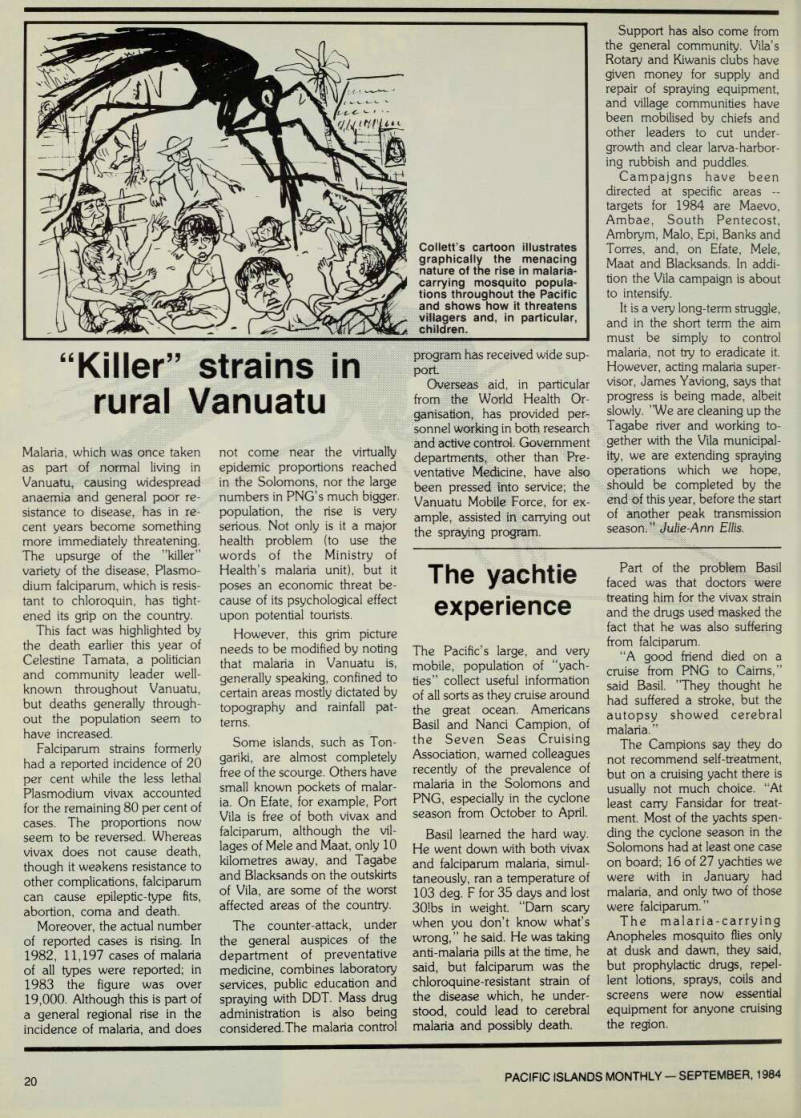
Collett’s cartoon illustrates graphically the menacing nature of the rise in malaria carrying mosquito popula tions throughout the Pacific and shows how it threatens villagers and, in particular, children.
experience

The yachtie experience
The Pacific’s large, and very mobile, population of “yach ties” collect useful information of all sorts as they cruise around the great ocean. Americans Basil and Nanci Campion, of the Seven Seas Cruising Association, warned colleagues recently of the prevalence of malaria in the Solomons and PNG, especially in the cyclone season from October to April.
Basil learned the hard way.
He went down with both vivax and falciparum malaria, simul taneously, ran a temperature of 103 deg. F for 35 days and lost 30!bs in weight. “Dam scary when you don’t know what’s wrong,” he said. He was taking anti-malaria pills at the time, he said, but falciparum was the chloroquine-resistant strain of the disease which, he under stood, could lead to cerebral malaria and possibly death.
Part of the problem Basil faced was that doctors were treating him for the vivax strain and the drugs used masked the fact that he was also suffering from falciparum.
“A good friend died on a cruise from PNG to Cairns,” said Basil. ’They thought he had suffered a stroke, but the autopsy showed cerebral malaria. ”
The Campions say they do not recommend self-treatment, but on a cruising yacht there is usually not much choice. “At least carry Fansidar for treat ment. Most of the yachts spen ding the cyclone season in the Solomons had at least one case on board; 16 of 27 yachties we were with in January had malaria, and only two of those were falciparum.”
The malaria-carrying Anopheles mosquito flies only at dusk and dawn, they said, but prophylactic drugs, repel lent lotions, sprays, coils and screens were now essential equipment for anyone cruising the region.
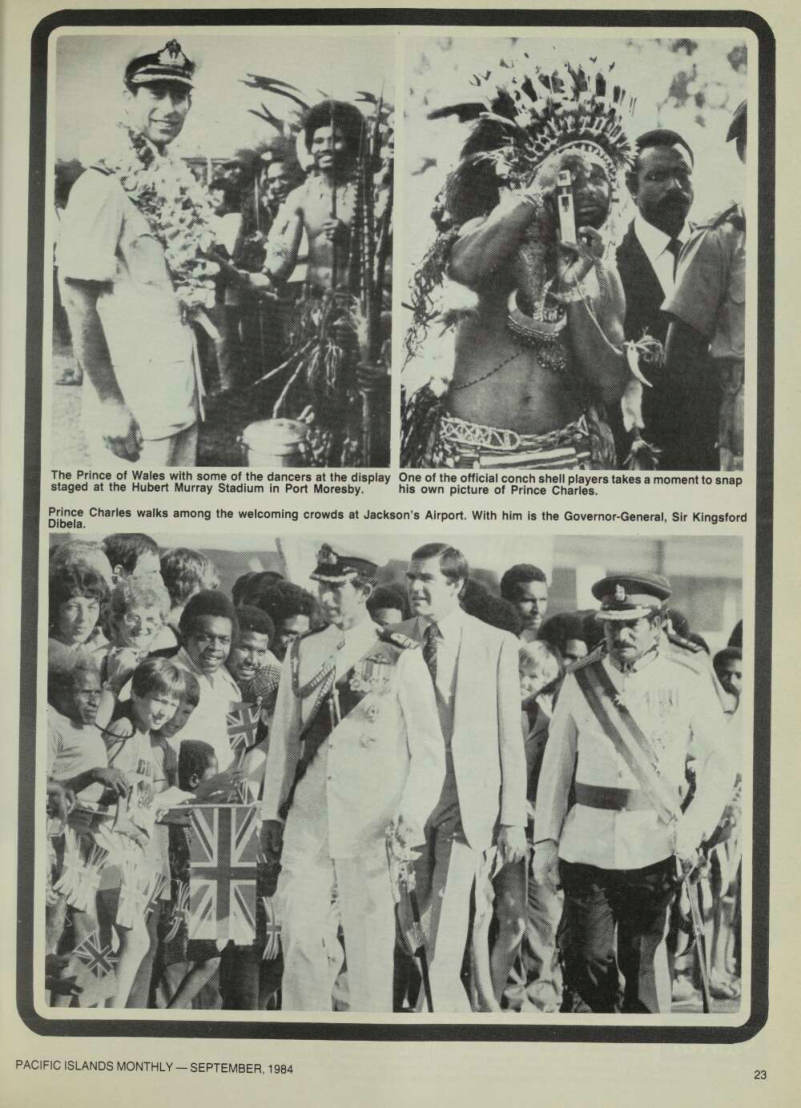
The Prince of Wales with some of the dancers at the display One of the official conch shell players takes a moment to snap staged at the Hubert Murray Stadium in Port Moresby. his own picture of Prince Charles.
Dibela Charies Walks among the welcoming crowds at Jackson’s Airport. With him is the Governor-General, Sir Kingsford
Advertisements & other items, pp. 21-24 (1 item)
opens png
Prince Charles
Parliament
!/ Prince Charles opened the splendid new Parliament House in Port Moresby on August 7, before a crowd of thousands and leaders and dignitaries from more than 20 Asian and Pacific countries. The parliament building cost $3O million, most of it from Australia, and was built by a firm of New Zealand construction engineers.
The prince, clad in a glisteningly white Royal Navy uniform, praised PNG for evolving what he called an effective and robustly democratic system of government.
Prime Minister Michael Somare said it was good that PNG was known as a young nation born in peace, and not out of strife or upheaval. The new Parliament House was a commitment by the PNG people to the democratic system.
Later, Prince Charles was made colonel-in-chief of the Royal Pacific Islands Regiment, based in Wewak, and before a crowd of 10,000 presented the regiment with its new royal colors.
Then, in a colorful ceremony on Manus Island, he was made a traditional chief and carried on a ceremonial bed from an outrigger canoe to the beach where he was greeted by 100 young women, given a spear, some betel nut and a gourd.
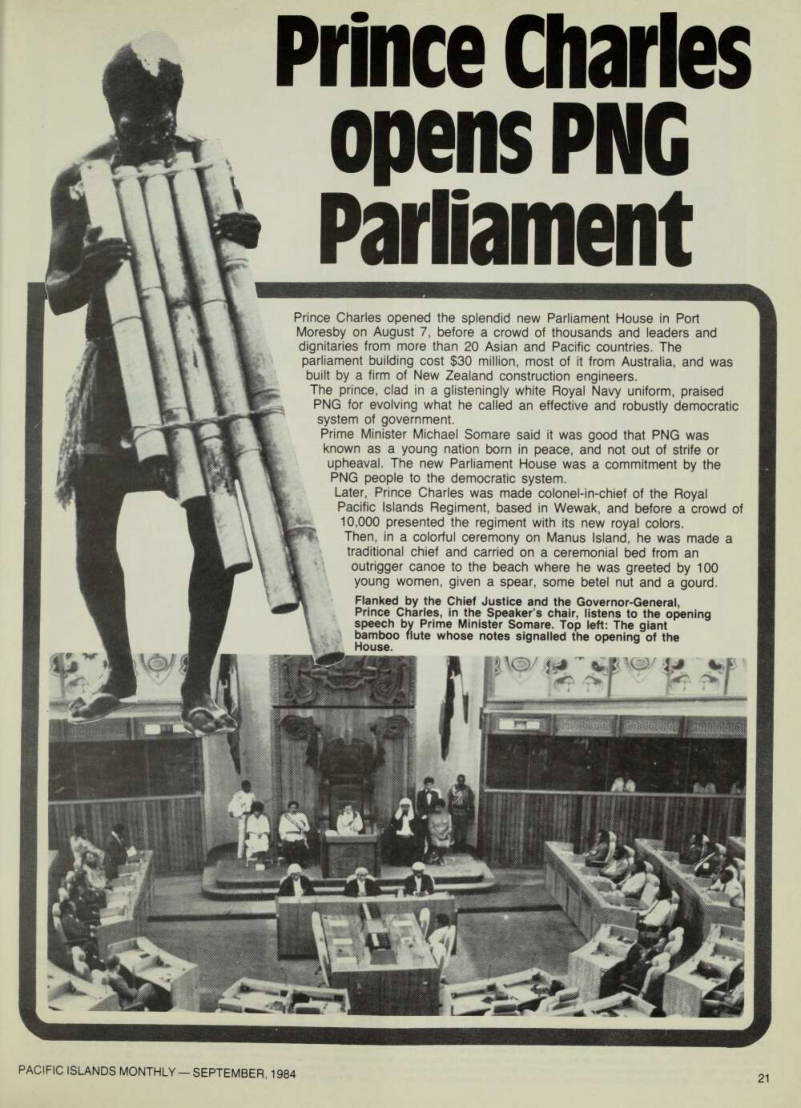
Flanked by the Chief Justice and the Governor-General, Prince Charles, in the Speaker’s chair, listens to the opening speech by Prime Minister Somare. Top left: The giant bamboo flute whose notes signalled the opening of the % \ House. * .a* K \ ; I U
yi/ontcA9DX
.. .the magic of elegant sound.
Avante component systems and the magic of Pioneer technology.
Together they bring you the miracle of your favourite music re-created with all the bewitching excitement and natural dynamism of the original performance. The secret of the Avante A9DX lies in the basic concept of the Avante series... advanced components created together to perform together.
The amplifier alone is amazing —Dynamic Power Non-Switching*, plus 265 watts/channel of music power! Other components include a Quartz-PLL FM/AM tuner, fully automatic turntable and a double cassette deck, plus 4-way speaker systems.
No mere trick, the new Avante A9DX is the product of elegant design and audio expertise. That’s Pioneer’s unique brand of magic.
CU> PIONEER
Options shown: graphic equalizer and digital timer. * Non-Switching is a trademark of Pioneer.
For further information, please contact: ■ Australia: Pioneer Electronics Australia Pty Ltd (Incorporated in Victoria), PO Box 295, Mordialloc,Victoria 3195 Tel. 580-99tl ■ Fij • J Company G PO Box No 362. Suva. Fiji Islands Tel: 22258 ■ New Zealand: Monaco Distributors Ltd , 2 Poland Road, Glenfield, Auckland, New Zealand Tel: (09) ■ NwMk Is PhHp (Norfolk Island) Ltd . PO. Box 21, Norfolk Island ■ Vanuatu: Burns Philp (Vanuatu) Ltd .Vila, Vanuatu ■ Nauru Island: Jacob Enterprises P.O. Box No. 4, Republic of f Jauru ■I TahrtiJahJ Pa Box 848, Papeete, Tahiti ■ New Caledonia: Menard Pacitique Sari, BP 3899, Noumea. New Caledonia Tel: 27.62*23 ■ Amencan Samoa: Transpac Corporation.P.O Box 1477 Pago Samoa 96799 Tel 633-5224 ■ Rarotonga: South Seas International Ltd , P.O. Box 49. Rarotonga, Cook Islands Tel: 2327 ■ Papua New Guinea: Bali Merchants Pty. Ltd., P.O. Box 6103 Boroko Tel. 254H87
5* M >* »*•*» V* j'&P*
The 2-Sided Miracle!
s' i Now you’ll never have to get up and turn over records anymore! Sansui’s technological expertise gives you instant access to both record sides. You can program up to 16 selections on either side in any order. No other turntable in the world offers so much freedom and flexibility.
In fact, this entire system gives you the freedom of flexibility. High-speed dubbing with the double cassette deck!
Compu Edit,- a Sansui exclusive for flawless record-to-tape editing! High power amplifier (100 W x 2 music power) with built-in 5-band graphic equalizer! And an advanced quartz PLL synthesizer FM/AM tuner completes the Midi System M9OOB the miraculous system for the highest quality with the greatest ®^Se! AT-F 1 Programmable Audio Timer (optional). :il
- min
-: y' I
CL; 'r
mm n n i
Midi System
SANSUI ELECTRIC CO., LTD. 14-1, Izumi 2-chome, Suginami-ku, Tokyo 168 Japan City Road, South Melbourne. Victoria 3205, Australia Phone: Caledonia HI-FI VICTOIRE ETS. M. MERCIER B P 1123, Noumea Phone; 27.59.11 •Central Pacific NAURU CO-OPERATIVE SOCIETY Republic of Nauru CENTRE LTD. P.O. Box 434, Vila Phone: 2035*Tahiti DIMECO SIMEL B.P. Box 3338 Papeete Phone; 26979
SojvstlL
the month

I. F. splits: To boycott or not?
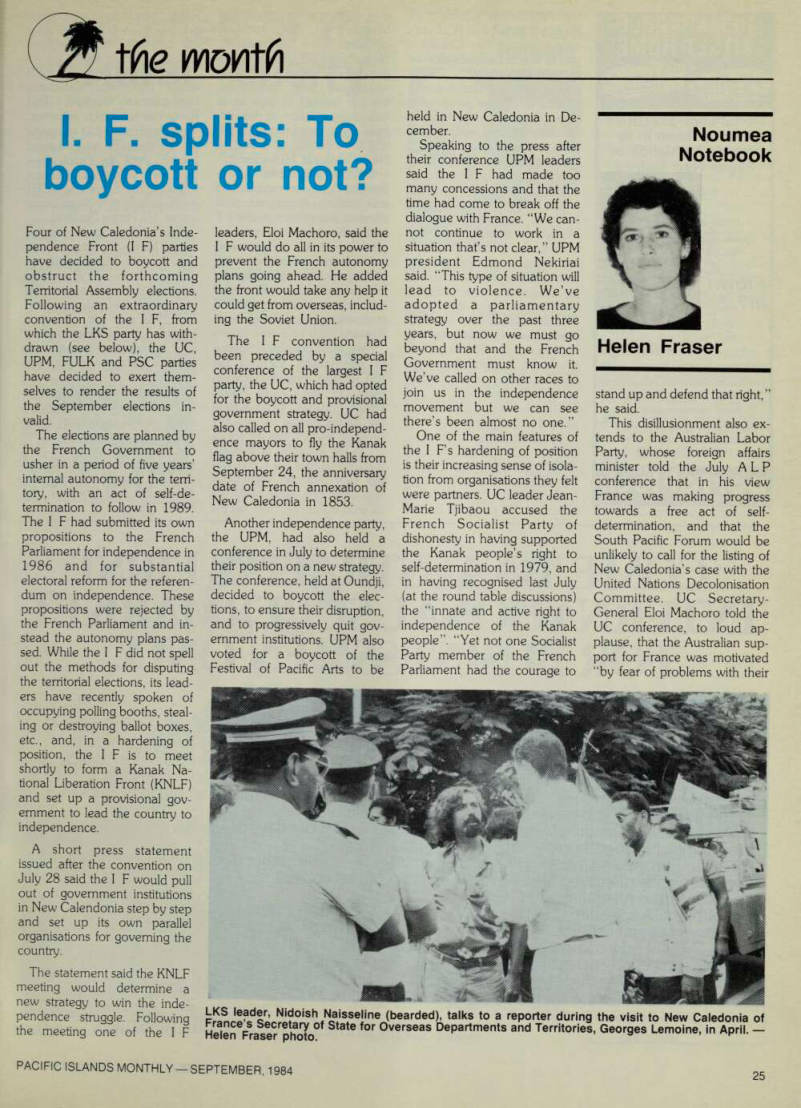
Four of New Caledonia’s Inde pendence Front (I F) parties have decided to boycott and obstruct the forthcoming Territorial Assembly elections.
Following an extraordinary convention of the I F, from which the LKS party has with drawn (see below), the UC, UPM, FULK and PSC parties have decided to exert them selves to render the results of the September elections in valid.
The elections are planned by the French Government to usher in a period of five years’ internal autonomy for the terri tory, with an act of self-de termination to follow in 1989.
The I F had submitted its own propositions to the French Parliament for independence in 1986 and for substantial electoral reform for the referen dum on independence. These propositions were rejected by the French Parliament and in stead the autonomy plans pas sed. While the I F did not spell out the methods for disputing the territorial elections, its lead ers have recently spoken of occupying polling booths, steal ing or destroying ballot boxes, etc., and, in a hardening of position, the I F is to meet shortly to form a Kanak Na tional Liberation Front (KNLF) and set up a provisional gov ernment to lead the country to independence.
A short press statement issued after the convention on July 28 said the I F would pull out of government institutions in New Calendonia step by step and set up its own parallel organisations for governing the country.
The statement said the KNLF meeting would determine a new strategy to win the inde pendence struggle. Following the meeting one of the I F
held in New Caledonia in De cember.
Speaking to the press after their conference UPM leaders said the I F had made too many concessions and that the time had come to break off the dialogue with France. “We can not continue to work in a situation that’s not clear,” UPM president Edmond Nekiriai said. “This type of situation will lead to violence. We’ve adopted a parliamentary strategy over the past three years, but now we must go beyond that and the French Government must know it.
We’ve called on other races to join us in the independence movement but we can see there’s been almost no one.”
One of the main features of the I F’s hardening of position is their increasing sense of isola tion from organisations they felt were partners. UC leader Jean- Marie Tjibaou accused the French Socialist Party of dishonesty in having supported the Kanak people’s right to self-determination in 1979, and in having recognised last July (at the round table discussions) the “innate and active right to independence of the Kanak people”. “Yet not one Socialist Party member of the French Parliament had the courage to
leaders, Eloi Machoro, said the I F would do all in its power to prevent the French autonomy plans going ahead. He added the front would take any help it could get from overseas, includ ing the Soviet Union.
The I F convention had been preceded by a special conference of the largest I F party, the UC, which had opted for the boycott and provisional government strategy. UC had also called on all pro-independ ence mayors to fly the Kanak flag above their town halls from September 24, the anniversary date of French annexation of New Caledonia in 1853.
Another independence party, the UPM, had also held a conference in July to determine their position on a new strategy.
The conference, held at Oundji, decided to boycott the elec tions, to ensure their disruption, and to progressively quit gov ernment institutions. UPM also voted for a boycott of the Festival of Pacific Arts to be
Noumea Notebook
stand up and defend that right, ” he said.
This disillusionment also ex tends to the Australian Labor Party, whose foreign affairs minister told the July ALP conference that in his view France was making progress towards a free act of self determination, and that the South Pacific Forum would be unlikely to call for the listing of New Caledonia’s case with the United Nations Decolonisation Committee. UC Secretary- General Eloi Machoro told the UC conference, to loud ap plause, that the Australian sup port for France was motivated “by fear of problems with their
LKS leader, Nidoish Naisseline ( bearded ), talk s a reporter during the visit to New Caledonia of France's Secretary of State for Overseas Departments and Territories, Georges Lemoine, in April.- Helen Fraser photo.
Helen Fraser
own indigenous people.” Mr Machoro added that Australia’s only interest in New Caledonia was its fear of destabilisation on its doorstep.
Machoro said after the con ference that if the senior part ners of the Forum, Australia and New Zealand, continued to support France the I F would seek support elsewhere, such as at the summit of non-aligned countries, or Cuba.
The feeling of isolation of the I F was summed up by Mr Machoro at a political rally held on French National Day, July 14. Speaking beneath the Kanak flag at the tribal area of La Conception near Noumea, Mr Machoro said that if the French Government was not prepared to decolonise New Caledonia, the Kanak people would do it themselves. “We can count only on ourselves,” he told the meeting.
The decision of LKS, the second largest party in the I F, to leave after the I F conven tion of July 28 has brought many questions and internal I F matters to the surface. LKS leader Nidoish Naisseline told newsmen his party left the I F
over differences on strategy and because too many internal problems were not resolved.
He said the LKS felt that before going ahead with a boycott and withdrawal from institutions, the I F needed to look at its lack of organisation, its depend ence on finance from overseas, and the influence on it held by New Caledonia businessmen.
On the first point Mr Naisse line said the lack of organisation was evident in that since its creation five years ago the I F had not elaborated a common platform, had no common strategy, had created no com mon grass roots sections, and that basically the I F existed only as a product for export and in situations where there are no Kanaks.
“We exist only by reference to non-Kanaks, such as the RPCR, the French Govern ment, or the South Pacific Forum,” he said. “In the eyes of the Kanak people we are five separate parties, not an I F.”
On the question of finance, the LKS alleges the I F is 100 per cent financed from over seas, although each party has its own resources. “We tell the
Kanak people they must count on themselves but we don’t set the example,” Mr Naisseline said.
On the third point the LKS allege that New Caledonia businessmen Gaspard (Bill) Ravel has too much influence.
Mr Naisseline cited as an exam ple the blockade set up against French ships by Papua New Guinean waterside workers following the September 1981 assassination of independence leader Mr Pierre Declercq.
The PNG blockade against two of Mr Ravel’s Sofrana Line ships was lifted after a telegram was sent from an I F member acting at Mr Ravel’s request, Mr Naissseline said. He summed up: “We are not against a boycott of the elections, so long as it is well prepared, and we are sure we have no more cards to play.”
Meanwhile uncertainty exists in Noumea as to whether the elections will be held as sche duled in September, or whether the French Government will postpone them until 1985 and use the time to try and sort things out with the I F.
Helen Fraser.
Advertisements & other items, p. 26 (1 item)
International Supermarket
REMARKABLE
KITSET HOME
Portal-Lock executive homes flown in to remote highlands of Papua New Guinea £
Flown
in?
No
kidding!
No kidding. Company houses, chosen for good design, simplicity of construction and impressive cost savings. Good reasons for choosing Portal-Lock for your new home, anywhere in the Pacific.
Send for information to:
PORTAL-LOCK HOMES, BOX 798,
ROTORUA. NEW ZEALAND.
Available throughout NZ, Australia and Pacific Islands PL63
portal-lock
Owner-Built Homes
COME TO AUSTRALIA FIRST
INTERNATIONAL SUPERMARKET
FOR BUSINESSMEN ONLY.
When you are in the food or drink business, you constantly have to keep up with new food trends, products and ideas.
Unfortunately that can cost your company a lot of time and money.
That's why the clever businessman wouldnt dare miss the chance to see food and drink products from Australia, the South Pacific. Europe and the rest of the world, conveniently displayed under one roof.
It's the Australian International Food Exhibition. A specialised trade only event that gives you a giant choice of business ideas.
Right now companies from all over the world are gearing up to attend.
Not only to display their products, but also seek out new trade opportunities, and meet new suppliers.
Trade only. ihe And if you're as hungry to do business as these companies are, you'll be there too.
The show will be held in Melbourne Australia, from 20-23 October 1984.
The Australian International Food Exhibition.
Four days of shopping you'll never forget.
For further details and an invitation ticket contact: Noel Gray Australian Exhibition Services Pty Ltd Suite 3.2 llloura Plaza 424 St Kilda Road Melbourne Vic 3004 Australia .
Phone: (03)267 4500 M Telex: 39329 T 5104 Show for hungry Businessmen.
“Tiurai” cherry
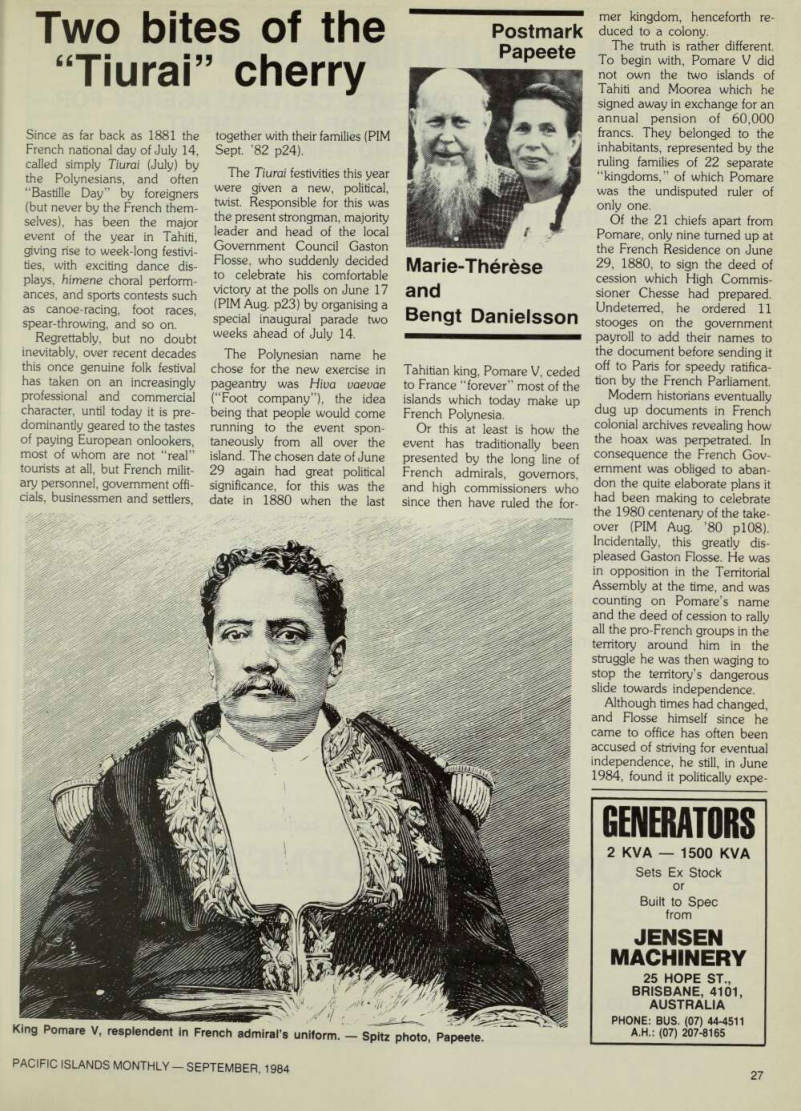
Two bites of the “Tiurai” cherry
Since as far back as 1881 the French national day of July 14, called simply Tiurai (July) by the Polynesians, and often “Bastille Day” by foreigners (but never by the French themselves), has been the major event of the year in Tahiti, giving rise to week-long festivities, with exciting dance displays, himene choral performances, and sports contests such as canoe-racing, foot races, spear-throwing, and so on.
Regrettably, but no doubt inevitably, over recent decades this once genuine folk festival has taken on an increasingly professional and commercial character, until today it is predominantly geared to the tastes of paying European onlookers, most of whom are not “real” tourists at all, but French military personnel, government officials, businessmen and settlers,
together with their families (PIM Sept. ’B2 p 24). . .
The Tiurai festivities this year were 9> ven ane '"’ Political st Responsible for this was the present strongman, majority ader and head of the local government Council Gaston Flosse ; ) vho s V ddenl P decided to celebra ‘ e his comfortable '1 C ‘° I V at th « P°' ls on June 17 (PIM Aug. p 23) by organising a spec , ial i l nau 9 ural parade two weeks ahead of Jul P 14 The Polynesian name he chose for the new exercise in pageantry was Hiva vaeuae (“Foot company”), the idea being that people would come running to the event spon taneously from all over the island. The chosen date of June 29 again had great political significance, for this was the date in 1880 when the last
Postmark Papeete
Tahitian king, Pomare V, ceded to France “forever” most of the islands which today make up French Polynesia.
Or this at least is how the event has traditionally been presented by the long line of French admirals, governors, and high commissioners who since then have ruled the for-
mer kingdom, henceforth re duced to a colony.
The truth is rather different.
To begin with, Pomare V did not own the two islands of Tahiti and Moorea which he signed away in exchange for an annual pension of 60,000 francs. They belonged to the inhabitants, represented by the ruling families of 22 separate “kingdoms,” of which Pomare was the undisputed ruler of only one.
Of the 21 chiefs apart from Pomare, only nine turned up at the French Residence on June 29, 1880, to sign the deed of cession which High Commis sioner Chesse had prepared.
Undeterred, he ordered 11 stooges on the government payroll to add their names to the document before sending it off to Paris for speedy ratifica tion by the French Parliament.
Modem historians eventually dug up documents in French colonial archives revealing how the hoax was perpetrated. In consequence the French Gov ernment was obliged to aban don the quite elaborate plans it had been making to celebrate the 1980 centenary of the take over (PIM Aug. ’BO pi 08).
Incidentally, this greatly dis pleased Gaston Flosse. He was in opposition in the Territorial Assembly at the time, and was counting on Pomare’s name and the deed of cession to rally all the pro-French groups in the territory around him in the struggle he was then waging to stop the territory’s dangerous slide towards independence.
Although times had changed, and Flosse himself since he came to office has often been accused of striving for eventual independence, he still, in June 1984, found it politically expe
King Pomare V, resplendent in French admiral’s uniform. - Spitz photo, Papeete.
Marie-Therese and Bengt Danielsson
dient to cling to King Pomare and his aura.
What a mistaken move it was became clear not long after June 29 dawned; the early morning “thanksgiving” cere mony at Pomare’s tower-like mausoleum outside Papeete described by the French painter Paul Gauguin, who attended the funeral in 1891, as “an affront to the natural beauty of the site” attracted no more than 20 people, practically all of them descendants of the king.
The most “conspicuous” absentee was Gaston Flosse himself, who a few days before had felt it imperative that he fly off to Paris on the thankless mission of trying to persuade the French Government to grant him a little more power, at least in economic matters (PIM Jun. p 32).
When the royal victory par ade got under way a few hours later along Avenue General de Gaulle in central Papeete, an even more important defection from the “Foot company” be came apparent: there was no beauty queen to preside over the affair, as happens at all Tiurai pageants. The reason was simple: the ’B4 Miss Tahiti had not yet been elected, so the spectacle had all the savor of a salad without dressing.
An even more important blow to the proceedings was the flat refusal of the Protestant and Catholic churches, to which 90 per cent of Polynesian belong, to allow contingents of their faithful to take part in the parade, because it smacked too much of party politicking.
The French military could not take part in the affair instead of, or in addition to, the national day parade a fortnight later. So, the only folk left to march to the greater glory of the dead king, and the very much alive Vice- President Gaston Flosse, were the members of the territory’s numerous sports, cultural, and handicrafts groups, which reg ularly receive generous sub sidies from the local Govern ment Council (this year’s figure was a whopping CFP6OO mil lion, or aobut SAS million). In fact, this policy of handouts to political groups was initiated by local politicians long before Gaston Flosse came to power.
But whatever the official jus tifications offered for the policy, there is no doubt that those
who receive the subsidies tend to show their gratitude at the polls.
July 14, the day of the real Tiurai parade, dawned wet and gloomy and, as in metropolitan France, the parade in Papeete was fundamentally dedicated to the glory of the French armed forces. Although 800 uni formed men took part 10 per cent of the total number in the territory and the foreign legionnaires employed their usual slow 80-steps-a-minute marching style, it took the few units only about a quarter of an hour to march past, and smartly salute, the nuclear-tests admiral from the CEP, the high com missioner, and the returned Vice-President Gaston Flosse, who sat side by side on the reviewing stand.
What saved the day for the wretched spectators was the colorful “tail” of carnival-type floats, plus a charming Miss Tahiti in a trilby, which brought proceedings to a close.
The seven participating cultu ral groups had chosen apparently widely varying themes, but in fact they had the common denominator of reflec ting contemporary everyday concerns of the inhabitants of these islands.
The first group consisted of recent forlorn immigrants from the Tuamotus they likened themselves to wandering sandpipers, with no nests of their own in Tahiti.
A large float carried a dozen elderly women, demonstrating various traditional handicrafts which today in many instances represent their sole means of survival in a harsh, European style economic environment.
Yet another float showed a touching scene of young Vahines initiating a newly ar rived Frenchwoman into the secrets of the way of life in this earthly paradise of Tahiti.
Last but not least was a huge float filled with Tahitian revel lers, singing, dancing, eating
and drinking, totally forgetful of their daily miseries and prob lems.
When the fun was over and the balance sheet drawn up, Flosse’s decision to split the traditional Tiurai parade in two seemed less justified than ever.
The real Pomare parade was not the first, but the second.
Not only because the last king of Tahiti was an honorary admi ral in the French navy, and loved to show up on occasions like this in his gold-braided naval uniform especially if he could hobnob with some real French admirals. But also be cause he was such a merry monarch, who spent most of his short life (he died at 52) in a sort of perpetual Tiurai revelry.
Perhaps even more so after he was awarded his truly royal pension in 1880, a well-earned reward for his ready co-opera tion in establishing the tight colonial rule which, in all its essential respects, is still in force
today.
Marie-Therese and
Bengt Danielsson.
Advertisements & other items, pp. 27-28 (1 item)
Generators
2 KVA 1500 KVA
Sets Ex Stock or Built to Spec from
JENSEN
MACHINERY
25 HOPE ST.,
BRISBANE, 4101,
AUSTRALIA
PHONE: BUS. (07) 44-4511
A.H.: (07) 207-8165
FIJI - THE LOCATION FOR YOUR INVESTMENT
EDB GOVERNMENT S CENTRAL AGENCY FOR
PROMOTION OF INVESTMENT
AND TRADE
Fiji offers the investor
A stable political and business environment Generous investment incentives Government encouragement to overseas investors Cost effective, adaptable, skilled and English speaking workforce Ease of repatriation of profits and capital Attractive trade agreements with major markets Excellent air and sea links to all continents Urbanised land and infrastructure facilities Expanding forestry, mining, agricultural and fisheries resources Beautiful environment to live and work
EDB Project Service
To smooth the investor’s path, EDB prides itself on offering a personalised service which will enable project establishment with the minimum delay.
This service includes; Advice on incentives/concessions Prefeasibility and market surveys Appraisal of projects for incentives Advice on industrial sites Advice on areas for potential equity participation Extension services Trade publicity on Fiji export products Information and research as requested by the investors on all aspects of a particular project
FIJI NEEDS:
Productive investment Technology and know-how Management Markets overseas For further information contact:
ECONOMIC DEVELOPMENT BOARD
OF FIJI
Ist Floor, Velop House, 371 Victoria Parade.
P.O. Box 2303, Government Buildings, Suva, Fiji.
Telex: 2355 EDB FJ Telephone: 31-3062, 31-3121 31-3468, 31-5988
The changed face

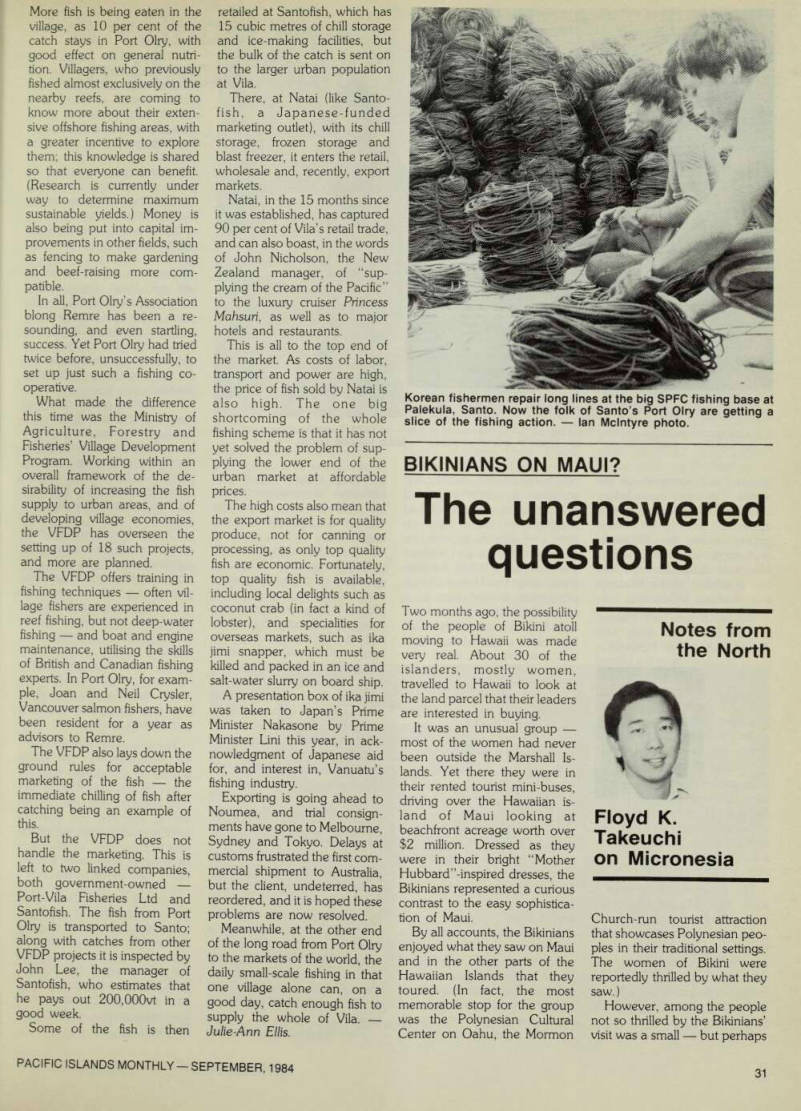
Fisheries
The changed face of Port Olry
Port Olry is a large, rambling village on the north-east coast of Santo, which has seen much turmoil and depression. Its population is split between 20 per cent “man pies” and 80 per cent immigrants from Big Bay, on Santo’s north coast. Many of the local people were involved in the 1980 troubles, leaving a legacy of resentment from neighboring villages. The defeat then of the Nagriamel separatist movement left the village in a backwater, politically; its geog raphic position, 50 kilometres from the port of Luganville, and far from any booming deve lopment, left it in a backwater, economically.
This has changed over the past 18 months, with the estab lishment of the village fishing co-operative, Association blong Remre.
The village now has a fleet of 12 small speedboats, being purchased on loan by indi
vidual workers in the village with money earned from their own fishing. On the boats, each employing two crew, in addi tion to the owner-captain, the fish are gutted and put on ice immediately after catching. In the village, some are kept for family use, some are sold pri vately, but most of the fish are sold to the co-op. There, they are cleaned thoroughly and stored in the coolroom, which Remre Association purchased with a 10 per cent cash pay ment, a 40 per cent bank loan and a 50 per cent aid grant.
Earnings from the fishing en terprise have been so impress ive that this loan could be repaid now, though a meeting decided that as this would leave the co-op with very little capital, only two-thirds should be re paid, leaving the remainder for another two years.
The volume of the catch is also impressive; in the first nine
Report from Vanuatu
months of operation the co operative produced 15,624 kilos of fish, worth nearly two million vatu. The reselling of the fish, and management of the books, is undertaken through Remre’s manager, Petro Rite; the profits are distributed to the 100 share-holders in the village, including children, The direct cash flow is au gmented by indirect earnings associated with the co-op, such as those of the truck owners who transport the fish to Luganville, and increased pro fits at the village store.
But economic gain is not the only benefit of the co-operative.
Julie-Ann Ellis
More fish is being eaten in the village, as 10 per cent of the catch stays in Port Olry, with good effect on general nutri tion. Villagers, who previously fished almost exclusively on the nearby reefs, are coming to know more about their exten sive offshore fishing areas, with a greater incentive to explore them; this knowledge is shared so that everyone can benefit. (Research is currently under way to determine maximum sustainable yields.) Money is also being put into capital im provements in other fields, such as fencing to make gardening and beef-raising more com patible.
In all, Port Olry’s Association blong Remre has been a re sounding, and even startling, success. Yet Port Olry had tried twice before, unsuccessfully, to set up just such a fishing co operative.
What made the difference this time was the Ministry of Agriculture, Forestry and Fisheries’ Village Development Program. Working within an overall framework of the de sirability of increasing the fish supply to urban areas, and of developing village economies, the VFDP has overseen the setting up of 18 such projects, and more are planned.
The VFDP offers training in fishing techniques often vil lage fishers are experienced in reef fishing, but not deep-water fishing and boat and engine maintenance, utilising the skills of British and Canadian fishing experts. In Port Olry, for exam ple, Joan and Neil Crysler, Vancouver salmon fishers, have been resident for a year as advisors to Remre.
The VFDP also lays down the ground rules for acceptable marketing of the fish the immediate chilling of fish after catching being an example of this.
But the VFDP does not handle the marketing. This is left to two linked companies, both government-owned Port-Vila Fisheries Ltd and Santofish. The fish from Port Olry is transported to Santo; along with catches from other VFDP projects it is inspected by John Lee, the manager of Santofish, who estimates that he pays out 200,000vt in a good week.
Some of the fish is then
retailed at Santofish, which has 15 cubic metres of chill storage and ice-making facilities, but the bulk of the catch is sent on to the larger urban population at Vila.
There, at Natai (like Santo fish, a Japanese-funded marketing outlet), with its chill storage, frozen storage and blast freezer, it enters the retail, wholesale and, recently, export markets.
Natai, in the 15 months since it was established, has captured 90 per cent of Vila’s retail trade, and can also boast, in the words of John Nicholson, the New Zealand manager, of “sup plying the cream of the Pacific” to the luxury cruiser Princess Mahsuri, as well as to major hotels and restaurants.
This is all to the top end of the market. As costs of labor, transport and power are high, the price of fish sold by Natai is also high. The one big shortcoming of the whole fishing scheme is that it has not yet solved the problem of sup plying the lower end of the urban market at affordable prices.
The high costs also mean that the export market is for quality produce, not for canning or processing, as only top quality fish are economic. Fortunately, top quality fish is available, including local delights such as coconut crab (in fact a kind of lobster), and specialities for overseas markets, such as ika jimi snapper, which must be killed and packed in an ice and salt-water slurry on board ship.
A presentation box of ika jimi was taken to Japan’s Prime Minister Nakasone by Prime Minister Lini this year, in ack nowledgment of Japanese aid for, and interest in, Vanuatu’s fishing industry.
Exporting is going ahead to Noumea, and trial consign ments have gone to Melbourne, Sydney and Tokyo. Delays at customs frustrated the first com mercial shipment to Australia, but the client, undeterred, has reordered, and it is hoped these problems are now resolved.
Meanwhile, at the other end of the long road from Port Olry to the markets of the world, the daily small-scale fishing in that one village alone can, on a good day, catch enough fish to supply the whole of Vila.
Julie-Ann Ellis.
Korean fishermen repair long lines at the big SPFC fishing base at Palekula, Santo. Now the folk of Santo’s Port Olry are getting a slice of the fishing action. - Ian Mclntyre photo.
Advertisements & other items, p. 30 (1 item)
Starting & Staying
pmm
w \ < V ' ► r
AMP
POWER
/ CONTINUOUS use
71 r oeepcecLe BArmey unnn m '
f ItI^STBR
lV *r~. x r.M
WflSf
As ssKE&a
GZS7
CSS?
Power Boats Need Different Batteries
There is a big difference between a car battery and a marine battery.
A car battery, for example, is never really discharged, as it is only used for a few seconds each day a nd promptly re-charged. Not so your cruiser or sportsfisherman.
Starting the engine is only the beginning. During the day, weekend or cruise, how often will you run the live bait tank, the depth sounder, the nav. lights or maintain a listening watch on your radio transceiver?
As well as cranking power, boats need staying power. Boats need Besco's Marine Batteries, deep cycle, heavy duty marine batteries.
If your boat is getting a little flat in the electrics department, write or phone BESCO today and ask for more information, more facts about
BESCO MARINE BATTERIES.
Papua New Guinea: Lae, Automarine Industries, P.O. Box 785, Ph. 42-1125, Rabaul, Automarine Industries, P.O. Box 248, Ph. 92-2574; Port Moresby, Par Sales .P.O. Box 1680, Boroko, Ph. 25-6266. Fiji: Suva, Fiji Bandag, 23 Sinoma Street, Walu Bay, Ph. 31-1200. New Caledonia: Noumea, Andre Thuilier, BP 889, Ph. 27-4906. Solomon Islands: Honiara, Guadalcanal Electrics Ltd., P.O. Box 521. Hongkong; Kowloon, T. L. Knight &Co PC, Box 95585 TST, Ph. 366-5341. New Zealand: Auckland, Battery Services (Ind.) Ltd., P.O. Box 27- 375 Ph. 69-4111; Wellington, Gould Batteries, 58 Hautana Street, Lower Hutt, TLX NZ3714 Australia: Sydney, Besco Batteries, P.O. Box 1, Villawood, Ph. 632-0251, TLX 21886; Jarwil International Pty. Ltd., 410 Kent Street, Sydney, Ph. 264-3477, TLX 72102.
BESCO
Batteries Division Of Sims Products Pry Ltd j_ A Peko Wallsend Group Member
LEADERS IN BATTERY TECHNOLOGY
questions
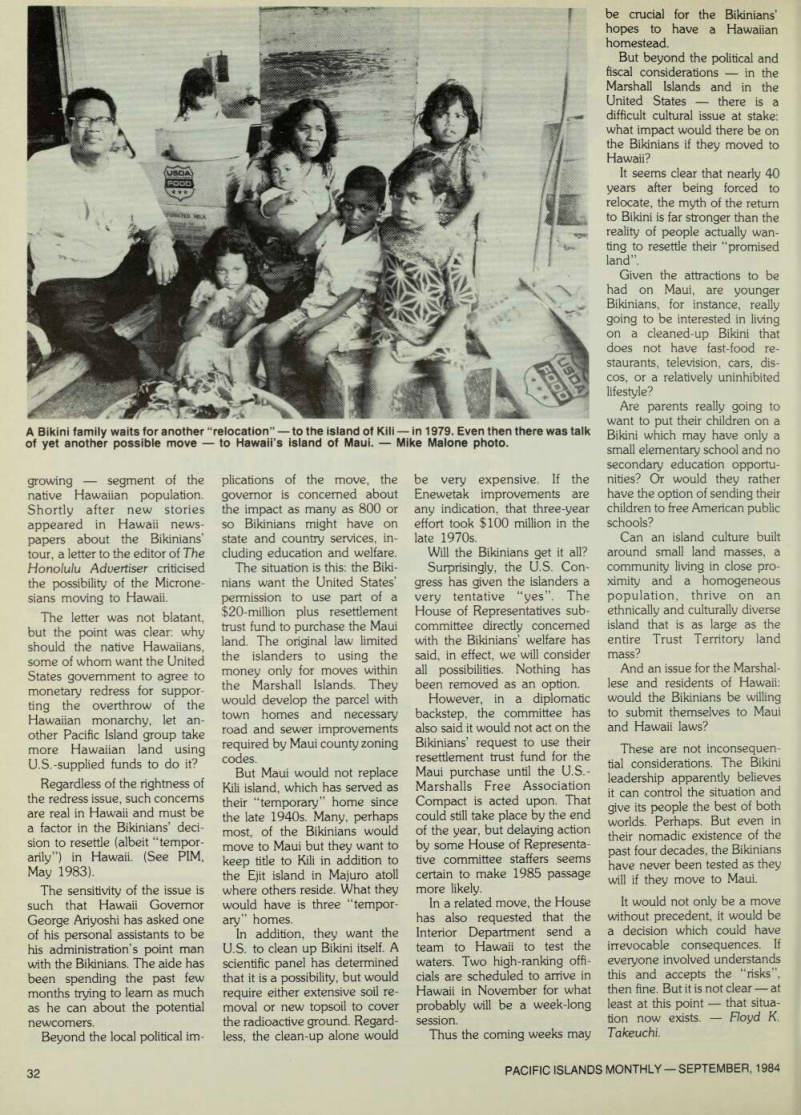
Bikinians On Maui?
The unanswered questions
Two months ago, the possibility of the people of Bikini atoll moving to Hawaii was made very real. About 30 of the islanders, mostly women, travelled to Hawaii to look at the land parcel that their leaders are interested in buying.
It was an unusual group most of the women had never been outside the Marshall Is lands. Yet there they were in their rented tourist mini-buses, driving over the Hawaiian is land of Maui looking at beachfront acreage worth over $2 million. Dressed as they were in their bright “Mother Hubbard’’-inspired dresses, the Bikinians represented a curious contrast to the easy sophistica tion of Maui.
By all accounts, the Bikinians enjoyed what they saw on Maui and in the other parts of the Hawaiian Islands that they toured. (In fact, the most memorable stop for the group was the Polynesian Cultural Center on Oahu, the Mormon
Notes from the North
Church-run tourist attraction that showcases Polynesian peo ples in their traditional settings.
The women of Bikini were reportedly thrilled by what they saw.) However, among the people not so thrilled by the Bikinians’ visit was a small but perhaps
Floyd K.
Takeuchi on Micronesia
growing segment of the native Hawaiian population.
Shortly after new stories appeared in Hawaii news papers about the Bikinians’ tour, a letter to the editor of The Honolulu Advertiser criticised the possibility of the Microne sians moving to Hawaii.
The letter was not blatant, but the point was clear: why should the native Hawaiians, some of whom want the United States government to agree to monetary redress for suppor ting the overthrow of the Hawaiian monarchy, let an other Pacific Island group take more Hawaiian land using U.S.-supplied funds to do it?
Regardless of the rightness of the redress issue, such concerns are real in Hawaii and must be a factor in the Bikinians’ deci sion to resettle (albeit “tempor arily”) in Hawaii. (See PIM, May 1983).
The sensitivity of the issue is such that Hawaii Governor George Ariyoshi has asked one of his personal assistants to be his administration’s point man with the Bikinians. The aide has been spending the past few months trying to leam as much as he can about the potential newcomers.
Beyond the local political im
plications of the move, the governor is concerned about the impact as many as 800 or so Bikinians might have on state and country services, in cluding education and welfare.
The situation is this: the Biki nians want the United States’ permission to use part of a $2O-million plus resettlement trust fund to purchase the Maui land. The original law limited the islanders to using the money only for moves within the Marshall Islands. They would develop the parcel with town homes and necessary road and sewer improvements required by Maui county zoning codes.
But Maui would not replace Kili island, which has served as their “temporary” home since the late 19405. Many, perhaps most, of the Bikinians would move to Maui but they want to keep title to Kili in addition to the Ejit island in Majuro atoll where others reside. What they would have is three “tempor ary” homes.
In addition, they want the U.S. to clean up Bikini itself. A scientific panel has determined that it is a possibility, but would require either extensive soil re moval or new topsoil to cover the radioactive ground. Regard less, the clean-up alone would
be very expensive. If the Enewetak improvements are any indication, that three-year effort took $lOO million in the late 19705.
Will the Bikinians get it all?
Surprisingly, the U.S. Con gress has given the islanders a very tentative “yes”. The House of Representatives sub committee directly concerned with the Bikinians’ welfare has said, in effect, we will consider all possibilities. Nothing has been removed as an option.
However, in a diplomatic backstep, the committee has also said it would not act on the Bikinians’ request to use their resettlement trust fund for the Maui purchase until the U.S.- Marshalls Free Association Compact is acted upon. That could still take place by the end of the year, but delaying action by some House of Representa tive committee staffers seems certain to make 1985 passage more likely.
In a related move, the House has also requested that the Interior Department send a team to Hawaii to test the waters. Two high-ranking offi cials are scheduled to arrive in Hawaii in November for what probably will be a week-long session.
Thus the coming weeks may
be crucial for the Bikinians’ hopes to have a Hawaiian homestead.
But beyond the political and fiscal considerations in the Marshall Islands and in the United States there is a difficult cultural issue at stake; what impact would there be on the Bikinians if they moved to Hawaii?
It seems clear that nearly 40 years after being forced to relocate, the myth of the return to Bikini is far stronger than the reality of people actually wan ting to resettle their “promised land”.
Given the attractions to be had on Maui, are younger Bikinians, for instance, really going to be interested in living on a cleaned-up Bikini that does not have fast-food re staurants, television, cars, dis cos, or a relatively uninhibited lifestyle?
Are parents really going to want to put their children on a Bikini which may have only a small elementary school and no secondary education opportu nities? Or would they rather have the option of sending their children to free American public schools?
Can an island culture built around small land masses, a community living in close pro ximity and a homogeneous population, thrive on an ethnically and culturally diverse island that is as large as the entire Trust Territory land mass?
And an issue for the Marshal lese and residents of Hawaii: would the Bikinians be willing to submit themselves to Maui and Hawaii laws?
These are not inconsequen tial considerations. The Bikini leadership apparently believes it can control the situation and give its people the best of both worlds. Perhaps. But even in their nomadic existence of the past four decades, the Bikinians have never been tested as they will if they move to Maui.
It would not only be a move without precedent, it would be a decision which could have irrevocable consequences. If everyone involved understands this and accepts the “risks”, then fine. But it is not clear at least at this point that situa tion now exists. Hoyd K.
Takeuchi.
A Bikini family waits for another “relocation” - to the island of Kili - in 1979. Even then there was talk of yet another possible move - to Hawaii’s island of Maui. - Mike Malone photo.
on Uncle Sam
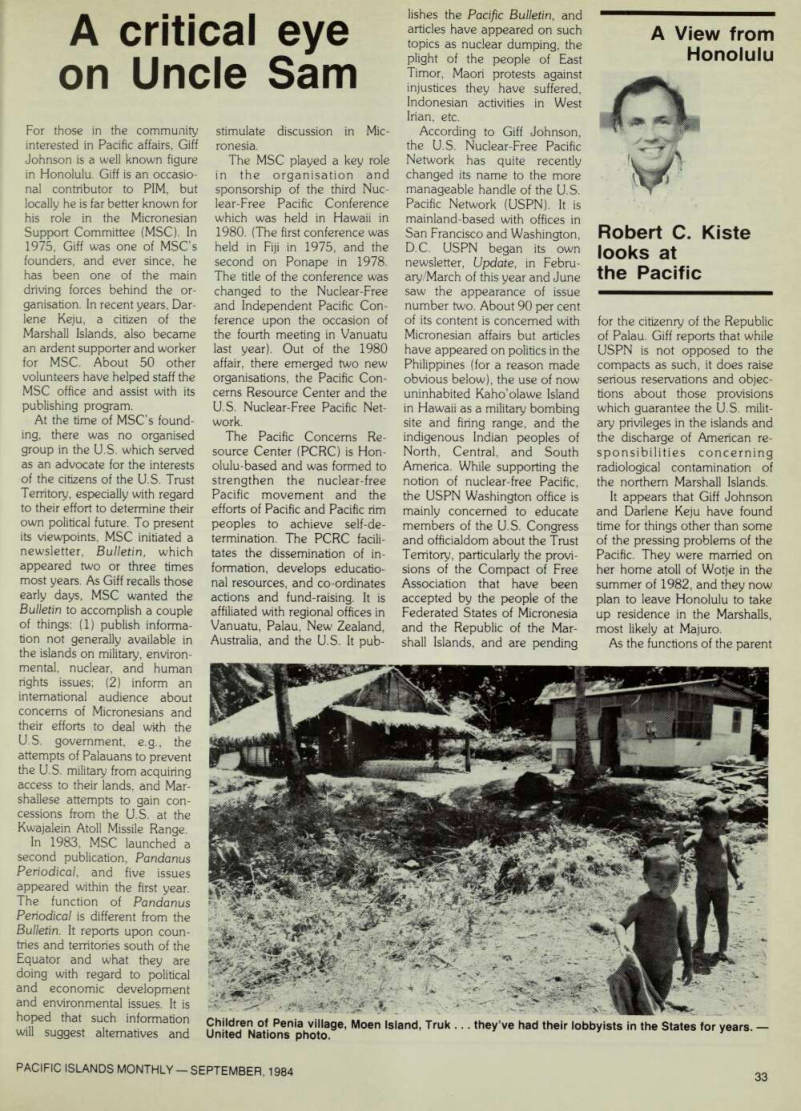
A critical eye on Uncle Sam
For those in the community interested in Pacific affairs, Giff Johnson is a well known figure in Honolulu. Giff is an occasio nal contributor to PIM, but locally he is far better known for his role in the Micronesian Support Committee (MSC). In 1975, Giff was one of MSC’s founders, and ever since, he has been one of the main driving forces behind the or ganisation. In recent years, Dar lene Keju, a citizen of the Marshall Islands, also became an ardent supporter and worker for MSC. About 50 other volunteers have helped staff the MSC office and assist with its publishing program.
At the time of MSC’s found ing, there was no organised group in the U.S. which served as an advocate for the interests of the citizens of the U.S. Trust Territory, especially with regard to their effort to determine their own political future. To present its viewpoints, MSC initiated a newsletter, Bulletin, which appeared two or three times most years. As Giff recalls those early days, MSC wanted the Bulletin to accomplish a couple of things: (1) publish informa tion not generally available in the islands on military, environ mental, nuclear, and human rights issues; (2) inform an international audience about concerns of Micronesians and their efforts to deal wkh the U.S. government, e.g., the attempts of Palauans to prevent the U.S. military from acquiring access to their lands, and Mar shallese attempts to gain con cessions from the U.S. at the Kwajalein Atoll Missile Range.
In 1983, MSC launched a second publication, Pandanus Periodical, and five issues appeared within the first year.
The function of Pandanus Periodical is different from the Bulletin. It reports upon coun tries and territories south of the Equator and what they are doing with regard to political and economic development and environmental issues. It is hoped that such information will suggest alternatives and
stimulate discussion in Mic ronesia.
The MSC played a key role in the organisation and sponsorship of the third Nuc lear-Free Pacific Conference which was held in Hawaii in 1980. (The first conference was held in Fiji in 1975, and the second on Ponape in 1978.
The title of the conference was changed to the Nuclear-Free and Independent Pacific Con ference upon the occasion of the fourth meeting in Vanuatu last year). Out of the 1980 affair, there emerged two new organisations, the Pacific Con cerns Resource Center and the U.S. Nuclear-Free Pacific Net work.
The Pacific Concerns Re source Center (PCRC) is Hon olulu-based and was formed to strengthen the nuclear-free Pacific movement and the efforts of Pacific and Pacific rim peoples to achieve self-de termination. The PCRC facili tates the dissemination of in formation, develops educatio nal resources, and co-ordinates actions and fund-raising. It is affiliated with regional offices in Vanuatu, Palau, New Zealand, Australia, and the U.S. It pub
lishes the Pacific Bulletin, and articles have appeared on such topics as nuclear dumping, the plight of the people of East Timor, Maori protests against injustices they have suffered, Indonesian activities in West Irian, etc.
According to Giff Johnson, the U.S. Nuclear-Free Pacific Network has quite recently changed its name to the more manageable handle of the U.S.
Pacific Network (USPN). It is mainland-based with offices in San Francisco and Washington, D.C. USPN began its own newsletter, Update, in Febru ary/March of this year and June saw the appearance of issue number two. About 90 per cent of its content is concerned with Micronesian affairs but articles have appeared on politics in the Philippines (for a reason made obvious below), the use of now uninhabited Kaho’olawe Island in Hawaii as a military bombing site and firing range, and the indigenous Indian peoples of North, Central, and South America. While supporting the notion of nuclear-free Pacific, the USPN Washington office is mainly concerned to educate members of the U.S. Congress and officialdom about the Trust Territory, particularly the provi sions of the Compact of Free Association that have been accepted by the people of the Federated States of Micronesia and the Republic of the Mar shall Islands, and are pending
A View from Honolulu
for the citizenry of the Republic of Palau. Giff reports that while USPN is not opposed to the compacts as such, it does raise serious reservations and objec tions about those provisions which guarantee the U.S. milit ary privileges in the islands and the discharge of American re sponsibilities concerning radiological contamination of the northern Marshall Islands.
It appears that Giff Johnson and Darlene Keju have found time for things other than some of the pressing problems of the Pacific. They were married on her home atoll of Wotje in the summer of 1982, and they now plan to leave Honolulu to take up residence in the Marshalls, most likely at Majuro.
As the functions of the parent
Robert C. Kiste looks at the Pacific
Children of Penia village, Moen Island, Truk . . . they’ve had their lobbyists in the States for years.
United Nations photo.
MSC and its offspring PCRC and USPN have began to over lap, and as the Johnsons have recently announced their de parture from the local scene, MSC will fade into history and be allowed to join the ranks of the dinosaurs. The Bulletin will also become extinct, but the relatively new Pandanus Periodical will be taken over by the PCRC. Its Pacific Bulletin will be continued, and thus PCRC will have two publica tions. MSC files, resource materials, slide presentations, and other information have been turned over to the two younger bodies.
The PCRC and the USPN are now the two main organisa tions in the U.S. that are pri marily self-appointed advocate groups concerned with the wel fare and future of American Micronesia, nuclear issues in the Pacific, and to some extent other contemporary issues in the region. A brief look at the staffs of the two is informative.
In Hawaii, the PCRC office has four main players. Sister Sanday Galazin of the Mary knoll order has been with
PCRC since its founding. Mr Kalama Akamine and Ms.
Puanani Fernadez are of Hawaiian descent and both have been active in a campaign to halt the abuse of Kaho’olawe. Carol Emaurois, a citizen of Palau, is currently a graduate student in public health at the Univesity of Hawaii. PCRC’s address is P.O.
Box 27692, Honolulu, Hawaii, 96827.
USPN’s San Francisco office also has four staffers who seem to be the most active. Ingrid Kircher is an Austrian citizen who got involved in the nuclear free movement in Vanuatu in 1983. Cindy (Cynthia Z.) Bid dlecomb served as a Methodist intern with the Pacific Confer ence of Churches in Suva in the early 1980 s. She travelled widely and Lotu Pasifika Pro ductions published her study Pacific Tourism: Contrasts in Values and Expectations. Bryan McKown is a law student work ing for a local San Francisco firm. Chad Myers is a member of PCRC’s international steer ing committee and was in volved in the 1980 and 1983
nuclear-free confrences.
The USPN office in Washing ton, D.C. looks espcially in teresting, and it is apparently composed of two people.
Glenn Alcalay is a former Peace Corps Volunteer who served on Utirik Atoll. The people of Utirik were one of two Marshallese communities exposed to radiological fallout from a 1954 nuclear test at Bikini Atoll.
Alcalay returned to Utirik for his Ph.D. research in anthropolo gy, and he is much concerned to see that the U.S. takes full responsibility for the consequ ences of its nuclear test prog ram in the Marshalls. Walden Bello is a Filipino citizen with a Ph.D. in sociology from Prince ton University. Bello is also director of the Washington based Congress Task Force of the Philippine Solidarity Net work, and he is co-author of Logistics of Repression and De velopment Debacle: The World Bank in the Philippines.
USPN’s address is: 942 Market Street, Room 711, San Francis co, California, 94102.
MSC was and PCRC and USPN are now concerned with,
write about, and seek to publicise issues that are sensi tive, and, in some cases, embarrassing (rightfully so) to the U.S. Obviously, they are critics of U.S. policies and ac tions in the Pacific. The stances that they take are somewhat predictable given their value orientations, but their criticisms are relatively mild. They could come on much stronger when they address such problems as the radiological contamination in the Marshalls and the living conditions of Marshallese work ers at the Kwajalein Atoll missile range. At least some U.S. offi cials find the organisations ex tremely irritating, and they charge that their staffers are so committed to island causes that there is a loss of some objectiv ity. Be this as it may, it is an understatement to say that the PCRC and USPN have a very great uphill battle. Many of the issues they raise should be brought to the attention of the public, but for most Americans events in the Pacific are not burning issues, and there is no reason to suggest that they ever
will be.
Robert C. Kiste.
Advertisements & other items, p. 34 (1 item)
Boats For Sale
International Brokering Services, one of Australia’s leading Yacht & Ship Brokers always has a wide range of ferries, game boats, dive boats and pleasure cruisers available.
PEOPLE MOVERS
Seven timber ferries all in current survey, length from 53 ft to 112 ft, to carry up to 200 passengers. Price range $A87,500 to $A275,000.
One steel and aluminium fast ferry carrying up to 140 passengers. $A275,000 neg.
The current list includes:
GAME BOATS
From 36ft to 63ft with coastal & international survey. $A50,000 to $A525,000.
Dive Boats Several available including a superb 67ft x 30ft steel catamaran with all gear and overnight berths for 35. Great buying at $A375,000.
CRUISERS
From 33ft to 87ft in timber, glass and aluminium price range $A28,000 to SA2 million.
New displacement and semi displacement cruisers available on direct indent from Taiwan at very favourable prices. From 35ft to 62ft.
For details of these boats or to list boats for sale phone, write or telex:
International Brokering Services, Yacht
& Ship Brokers
P.O. Box 460, Southport. Q. 4215 Telephone: (075) 32-4744 Telex: A 542194
trade winds
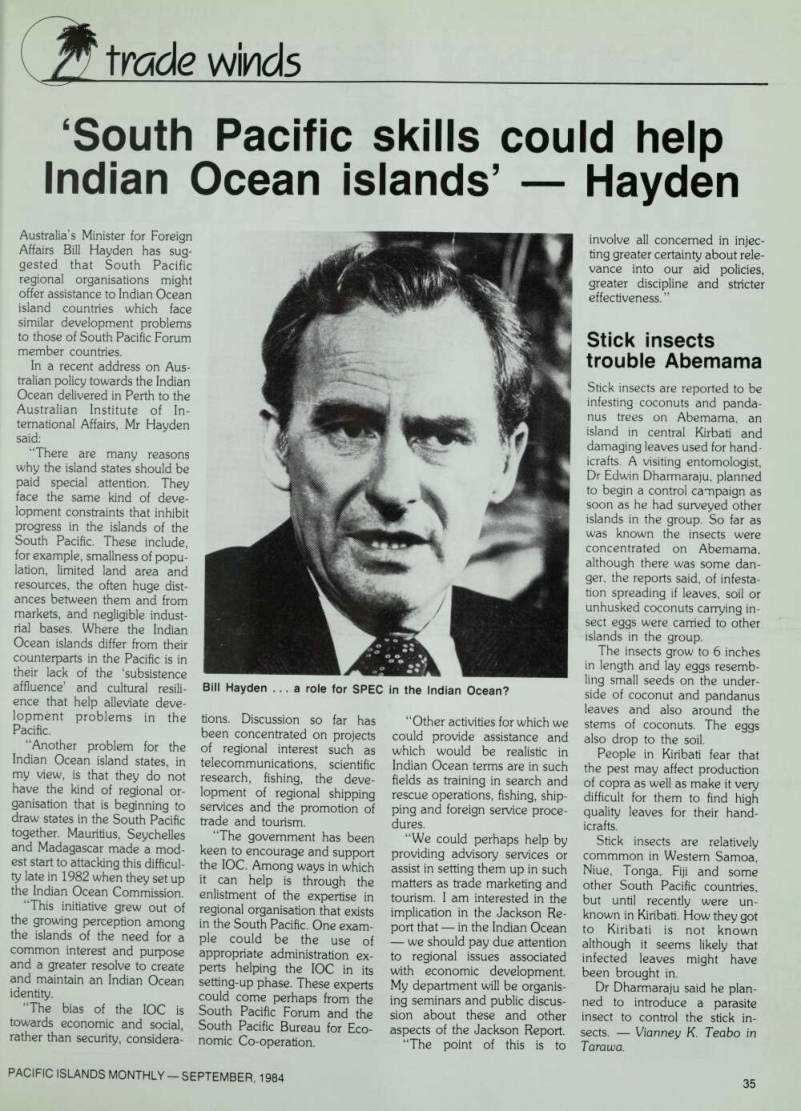
‘South Pacific skills could help Indian Ocean islands’ - Hayden
Australia’s Minister for Foreign Affairs Bill Hayden has sug gested that South Pacific regional organisations might offer assistance to Indian Ocean island countries which face similar development problems to those of South Pacific Forum member countries.
In a recent address on Aus tralian policy towards the Indian Ocean delivered in Perth to the Australian Institute of In ternational Affairs, Mr Hayden said; “There are many reasons why the island states should be paid special attention. They face the same kind of deve lopment constraints that inhibit progress in the islands of the South Pacific. These include, for example, smallness of popu lation, limited land area and resources, the often huge dist ances between them and from markets, and negligible indust rial bases. Where the Indian Ocean islands differ from their counterparts in the Pacific is in their lack of the ‘subsistence affluence’ and cultural resili ence that help alleviate deve lopment problems in the Pacific.
“Another problem for the Indian Ocean island states, in my view, is that they do not have the kind of regional or ganisation that is beginning to draw states in the South Pacific together. Mauritius, Seychelles and Madagascar made a mod est start to attacking this difficul ty late in 1982 when they set up the Indian Ocean Commission.
“This initiative grew out of the growing perception among the islands of the need for a common interest and purpose and a greater resolve to create and maintain an Indian Ocean identity.
“The bias of the lOC is towards economic and social, rather than security, considera-
tions. Discussion so far has been concentrated on projects of regional interest such as telecommunications, scientific research, fishing, the deve lopment of regional shipping services and the promotion of trade and tourism.
“The government has been keen to encourage and support the lOC. Among ways in which it can help is through the enlistment of the expertise in regional organisation that exists in the South Pacific. One exam ple could be the use of appropriate administration ex perts helping the lOC in its setting-up phase. These experts could come perhaps from the South Pacific Forum and the South Pacific Bureau for Eco nomic Co-operation.
“Other activities for which we could provide assistance and which would be realistic in Indian Ocean terms are in such fields as training in search and rescue operations, fishing, ship ping and foreign service proce dures.
“We could perhaps help by providing advisory services or assist in setting them up in such matters as trade marketing and tourism. I am interested in the implication in the Jackson Re port that in the Indian Ocean we should pay due attention to regional issues associated with economic development.
My department will be organis ing seminars and public discus sion about these and other aspects of the Jackson Report.
“The point of this is to
involve all concerned in injec ting greater certainty about rele vance into our aid policies, greater discipline and stricter effectiveness. ”
Stick insects
trouble Abemama
Stick insects are reported to be infesting coconuts and panda nus trees on Abemama, an island in central Kirbati and damaging leaves used for hand icrafts. A visiting entomologist, Dr Edwin Dharmaraju, planned to begin a control campaign as soon as he had surveyed other islands in the group. So far as was known the insects were concentrated on Abemama, although there was some dan ger, the reports said, of infesta tion spreading if leaves, soil or unhusked coconuts carrying in sect eggs were carried to other islands in the group.
The insects grow to 6 inches in length and lay eggs resemb ling small seeds on the under side of coconut and pandanus leaves and also around the stems of coconuts. The eggs also drop to the soil.
People in Kiribati fear that the pest may affect production of copra as well as make it very difficult for them to find high quality leaves for their hand icrafts.
Stick insects are relatively commmon in Western Samoa, Niue, Tonga, Fiji and some other South Pacific countries, but until recently were un known in Kiribati. How they got to Kiribati is not known although it seems likely that infected leaves might have been brought in.
Dr Dharmaraju said he plan ned to introduce a parasite insect to control the stick in
sects.
Vianney K. Teabo in
Tarawa.
Bill Hayden . . . a role for SPEC in the Indian Ocean?
Advertisements & other items, p. 36 (1 item)
tofly for Air Niugini,
Some of the worlds
best pilots leave home
It doesn’t take visitors long to find out why Air Niugini employs over a hundred pilots.
Because Papua New Guinea is such an incredibly mountainous country, flying is often the only way to get around, and the national airline covers a staggen ing schedule of domestic flights as well as international ones.
Only about 20% of Air Niugini’s pilots fly on international routesand then only after logging four to five years flying in PNG! « n*.
Jk Relax. You’re with experts.
When you consider that Air Niugini hires only experienced pilots, and that every single one of them serves several years on the domestic network before becoming eligible for promotion to international routes, it’s hardly surprising that Air Niugini’s Boeing pilots are regarded as some of the world’s most experienced flyers. Each of them has logged between 9,000 and 14,000 flying hours.
We can afford to be choosy Papua New Guinea has always held a special fascination for flyers, and jobs with the national airline are keenly sought by pilots who have already gained commercial experience in Australia, New Zealand and the UK. 21 ports at home, 10 overseas Whether you’re travelling for m * business or pleasure, Air Niugini can fly you to Papua New Guinea and show you around. For further information contact your Travel Agent or nearest Air Niugini Sales Office.
Moresby Fbrt
MR NIUGINI*
THE NA TIONAL AIRLINE OF PAPUA NEW GUINEA
Sepik project helps dam
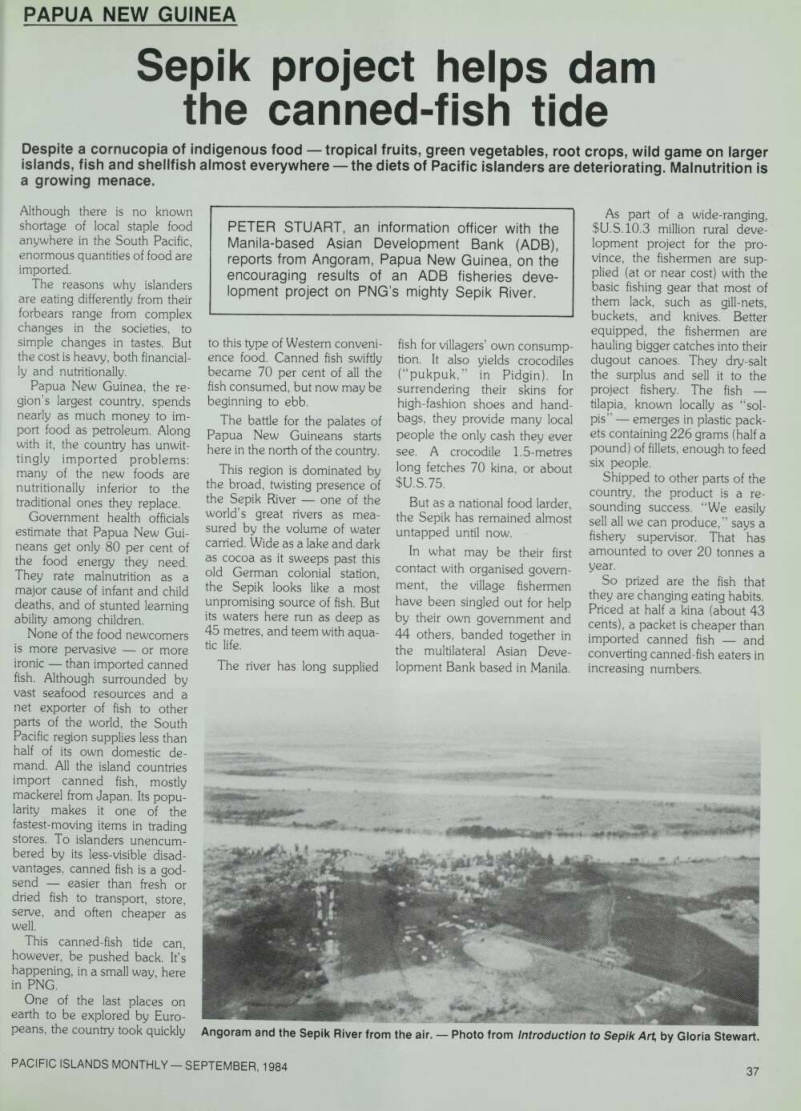
Papua New Guinea
Sepik project helps dam the canned-fish tide
Despite a cornucopia of indigenous food tropical fruits, green vegetables, root crops, wild game on larger islands, fish and shellfish almost everywhere the diets of Pacific islanders are deteriorating. Malnutrition is a growing menace.
Although there is no known shortage of local staple food anywhere in the South Pacific, enormous quantities of food are imported.
The reasons why islanders are eating differently from their forbears range from complex changes in the societies, to simple changes in tastes. But the cost is heavy, both financial ly and nutritionally.
Papua New Guinea, the re gion’s largest country, spends nearly as much money to im port food as petroleum. Along with it, the country has unwit tingly imported problems: many of the new foods are nutritionally inferior to the traditional ones they replace.
Government health officials estimate that Papua New Gui neans get only 80 per cent of the food energy they need.
They rate malnutrition as a major cause of infant and child deaths, and of stunted learning ability among children.
None of the food newcomers is more pervasive or more ironic than imported canned fish. Although surrounded by vast seafood resources and a net exporter of fish to other parts of the world, the South Pacific region supplies less than half of its own domestic de mand. All the island countries import canned fish, mostly mackerel from Japan. Its popu larity makes it one of the fastest-moving items in trading stores. To islanders unencum bered by its less-visible disad vantages, canned fish is a god send easier than fresh or dried fish to transport, store, serve, and often cheaper as well.
This canned-fish tide can, however, be pushed back. It’s happening, in a small way, here in PNG.
One of the last places on earth to be explored by Euro peans, the country took quickly
PETER STUART, an information officer with the Manila-based Asian Development Bank (ADB), reports from Angoram, Papua New Guinea, on the encouraging results of an ADB fisheries deve lopment project on PNG’s mighty Sepik River.
to this type of Western conveni ence food. Canned fish swiftly became 70 per cent of all the fish consumed, but now may be beginning to ebb.
The battle for the palates of Papua New Guineans starts here in the north of the country.
This region is dominated by the broad, twisting presence of the Sepik River one of the world’s great rivers as mea sured by the volume of water carried. Wide as a lake and dark as cocoa as it sweeps past this old German colonial station, the Sepik looks like a most unpromising source of fish. But its waters here run as deep as 45 metres, and teem with aqua tic life.
The river has long supplied
fish for villagers’ own consump tion. It also yields crocodiles (“pukpuk,” in Pidgin). In surrendering their skins for high-fashion shoes and hand bags, they provide many local people the only cash they ever see. A crocodile 1.5-metres long fetches 70 kina, or about 5U.5.75.
But as a national food larder, the Sepik has remained almost untapped until now.
In what may be their first contact with organised govern ment, the village fishermen have been singled out for help by their own government and 44 others, banded together in the multilateral Asian Deve lopment Bank based in Manila.
As part of a wide-ranging, $U.5.10.3 million rural deve lopment project for the pro vince, the fishermen are sup plied (at or near cost) with the basic fishing gear that most of them lack, such as gill-nets, buckets, and knives. Better equipped, the fishermen are hauling bigger catches into their dugout canoes. They dry-salt the surplus and sell it to the project fishery. The fish tilapia, known locally as “sol pis” emerges in plastic pack ets containing 226 grams (half a pound) of fillets, enough to feed six people.
Shipped to other parts of the country, the product is a re sounding success. “We easily sell all we can produce,” says a fishery supervisor. That has amounted to over 20 tonnes a year.
So prized are the fish that they are changing eating habits.
Priced at half a kina (about 43 cents), a packet is cheaper than imported canned fish and converting canned-fish eaters in increasing numbers.
Angoram and the Sepik River from the air. - Photo from Introduction to Sepik Art, by Gloria Stewart.
Advertisements & other items, pp. 38-40 (1 item)
New ’B4 Toyota Knlu)
INTRODUCING PERFOF
Performance p comfort.
Performance plus durability.
Performance plus variety.
Advanced, powerful new engines put you in command with higher torque, better efficiency. Inside, more driving comfort than ever before with a roomier cabin, bigger windscreens, and lean, clean instrumentation. Newly designed suspension gives you big carrying capability, yet carries you in comfort. HILUX is one tough truck with a suspension you can count on. Choose from a wide variety, including 4WD regular or double cab and two new additions 2WD extra cab and flatdeck. The all-new Toyota HILUX. Add it all up, and you have performance plus!
TOYOTA
QUALITY SERVICE
AMERICAN SAMOA: BURNS PHILP (SOUTH SEA)
CO., LTD., P.O. Box 129, Pago Pago.
COOK ISLANDS: COOK ISLANDS TRADING
CORPORATION LTD., Private Bag, Rarotonga.
FIJI: AUTOMOTIVE SUPPLIES COMPANY, G.P.O.
Box 355, Suva.
GUAM & MICRONESIA: ATKINS, KROLL (GUAM) LTD., 443 South Marine Drive, Tamuning.
KIRIBATI: TARAWA MOTORS, P.O. Box 36, Bairiki Tarawa, Kiribati.
NAURU: NAURU COOPERATIVE SOCIETY.
NEW CALEDONIA: SERVICE IMPORTATION
AUTOMOBILE DU PACIFIQUE, Rond-Point du Pacifiqu (Station Total) B.P. 438, Noumea.
MANGE PLUS!
Wj s M 4WD Double Cab v ORFOLK ISLAND: SORRY’S LIMITED, P.O. Box 169 APUA NEW GUINEA: ELA MOTORS, A Division of urns Philp (PNG) Ltd., P.O. Box 75, Port Moresby
AIPAN: MICROL CORPORATION, P.O. Box 267,
aipan.
OLOMON: MENDANA ENTERPRISES (S I) LTD
•P.O. Box 174, Honiara.
TAHITI: NIPPON AUTOMOTO, P.O. Box 342, Papeete.
TONGA: BURNS PHILP (SOUTH SEA) CO., LTD., P.O. Box 55, Nuku’alofa.
VANUATU: VANUATU MOTORS, P.O. Box 18,
Port Vila.
WESTERN SAMOA: BURNS PHILP (SOUTH SEA)
CO., LTD., P.O. Box 188, Apia.
fr ofl 1 * UP
|3UF n
out on-;,or
M .vou’r® , S K<>"* Wh ethe Je n ,o P ush , fierV- ~h at theV everV ling f 9 gas a ° d rU ° N X ► ■a. \ w, % m -« HMflHfl tfcg V* •II »*5 M
■YAMAHA
-b- I' i * m i
Paribas sets up shop
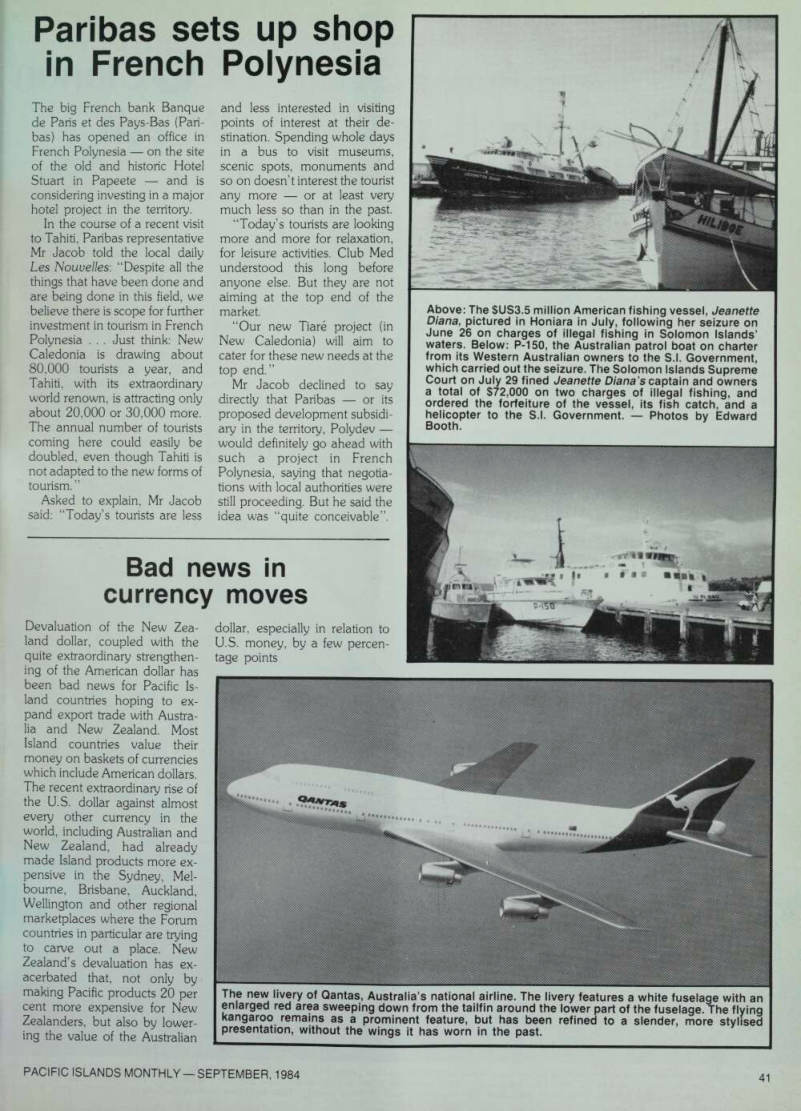
in French Polynesia
The big French bank Banque de Paris et des Pays-Bas (Pari bas) has opened an office in French Polynesia on the site of the old and historic Hotel Stuart in Papeete and is considering investing in a major hotel project in the territory.
In the course of a recent visit to Tahiti, Paribas representative Mr Jacob told the local daily Les Nouuelles: “Despite all the things that have been done and are being done in this field, we believe there is scope for further investment in tourism in French Polynesia . . . Just think: New Caledonia is drawing about 80,000 tourists a year, and Tahiti, with its extraordinary world renown, is attracting only about 20,000 or 30,000 more.
The annual number of tourists coming here could easily be doubled, even though Tahiti is not adapted to the new forms of tourism.”
Asked to explain, Mr Jacob said: “Today’s tourists are less
and less interested in visiting points of interest at their de stination. Spending whole days in a bus to visit museums, scenic spots, monuments and so on doesn’t interest the tourist any more or at least very much less so than in the past.
“Today’s tourists are looking more and more for relaxation, for leisure activities. Club Med understood this long before anyone else. But they are not aiming at the top end of the market.
“Our new Tiare project (in New Caledonia) will aim to cater for these new needs at the top end.”
Mr Jacob declined to say directly that Paribas or its proposed development subsidi ary in the territory, Polydev would definitely go ahead with such a project in French Polynesia, saying that negotia tions with local authorities were still proceeding. But he said the idea was “quite conceivable”.
Above: The $US3.5 million American fishing vessel, Jeanette Diana, pictured in Honiara in July, following her seizure on June 26 on charges of illegal fishing in Solomon Islands’ waters. Below: P-150, the Australian patrol boat on charter from its Western Australian owners to the S.l. Government, which carried out the seizure. The Solomon Islands Supreme Court on July 29 fined Jeanette Diana's captain and owners a total of $72,000 on two charges of illegal fishing, and ordered the forfeiture of the vessel, its fish catch, and a helicopter to the S.I. Government. - Photos by Edward Booth.
currency moves
Bad news in currency moves
Devaluation of the New Zea land dollar, coupled with the quite extraordinary strengthen ing of the American dollar has been bad news for Pacific Is land countries hoping to ex pand export trade with Austra lia and New Zealand. Most Island countries value their money on baskets of currencies which include American dollars.
The recent extraordinary rise of the U.S. dollar against almost every other currency in the world, including Australian and New Zealand, had already made Island products more ex pensive in the Sydney, Mel bourne, Brisbane, Auckland, Wellington and other regional marketplaces where the Forum countries in particular are trying to carve out a place. New Zealand’s devaluation has ex acerbated that, not only by making Pacific products 20 per cent more expensive for New Zealanders, but also by lower ing the value of the Australian
dollar, especially in relation to U.S. money, by a few percen tage points
The new livery of Qantas, Australia’s national airline. The livery features a white fuselage with an enlarged red area sweeping down from the tailfin around the lower part of the fuselage. The flying kangaroo remains as a prominent feature, but has been refined to a slender, more stylised presentation, without the wings it has worn in the past.
Advertisements & other items, p. 42 (1 item)
The Search Is Over
You were looking for the perfect fit. U ncompromising sound quality. As beautiful to look at as it is to listen to. Advanced electronics. A choice of sophisticated features that are easy to use. Reliability that's no fairy tale. Clarion makes a wide selection of models, with one • that's just your size. Clarion Car Stereo. Listen, and drive happily ever after. Vs 1011011
& m S 3 900 E fy □D Mu. i n n I u I
LD .Pi
For further information - Australia: Amalgamated Wireless (Australasia) Ltd, 554 Parramatta Road, Ashfield, N.S.W., 2131 / New Zealand: AWA New Zealand Limited RO. Eo x 5 0-2 4 8 .For ru a/ F U' l p J * ’ L fj ni a, G ANA Suva / Tahiti: HI FI Shangrila, B.P. 200, Papeete / New Caledonia: Caldis, 8.P.M1, Noumea Cedex / Guam: M.cropac Audio Inc PO. Box 3478. Agana Guam 969 0 1Te1:472-8091■ Co*-»«2 Po Mo es v Vanuatu: The Sound Centre, RO. Box 434, Vila / Cook Islands: South Seas International Ltd., P.O. Box 49, Rarotonga / Papua New Guinea: Hagemeyer (P.N.G.) Pty. Ltd., P.O. Box 1428, Boroko, Port Moresby.
books
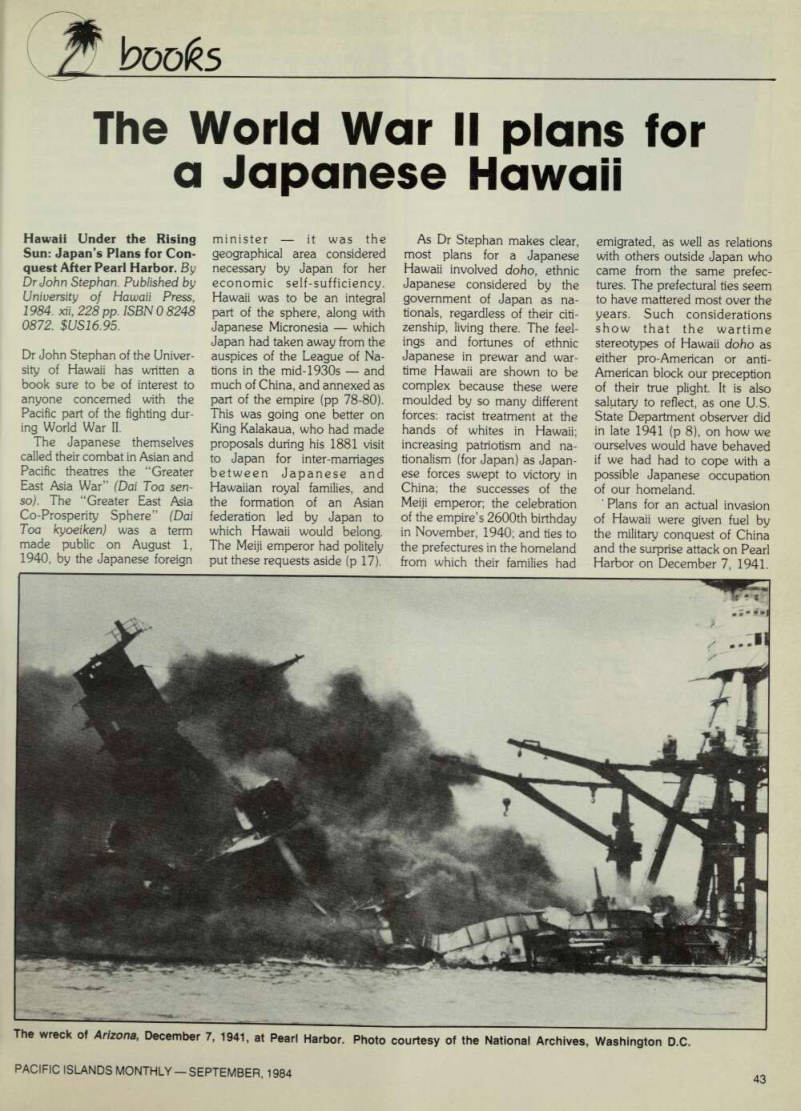
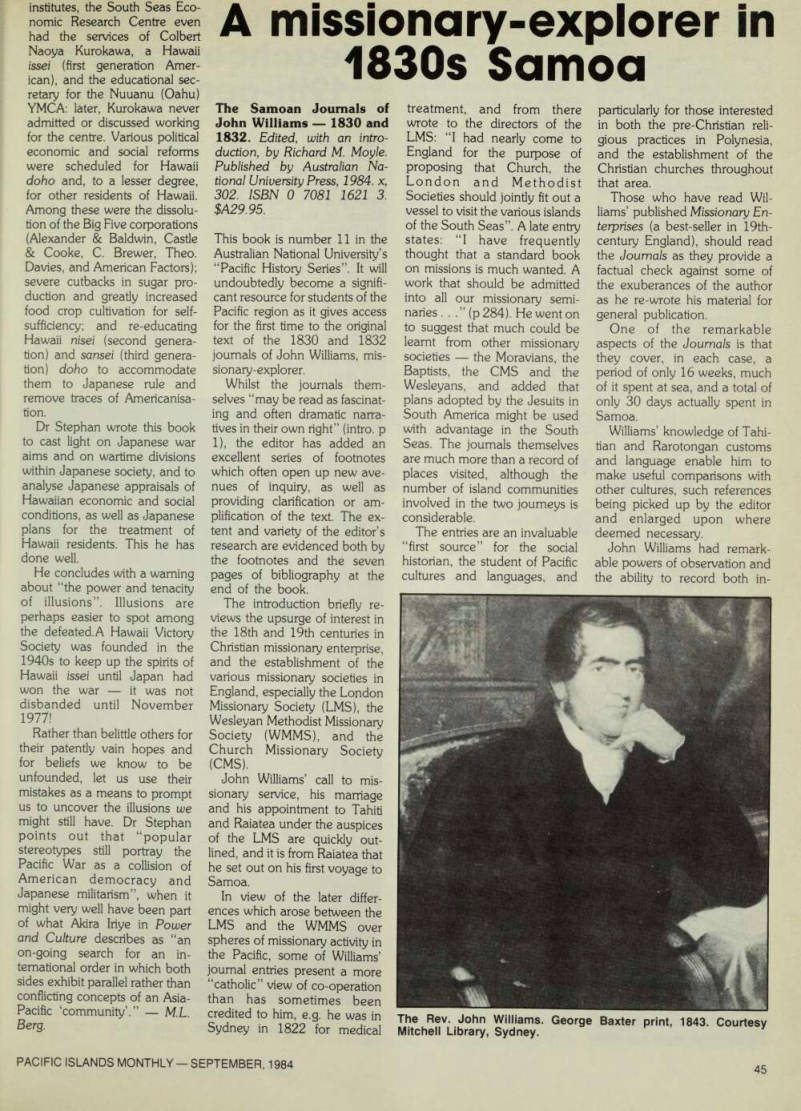
The World War II plans for a Japanese Hawaii
Hawaii Under the Rising Sun: Japan’s Plans for Con quest After Pearl Harbor. By Dr John Stephan. Published by University of Hawaii Press, 1984. xii, 228 pp. ISBN 0 8248 0872. $U516.95.
Dr John Stephan of the Univer sity of Hawaii has written a book sure to be of interest to anyone concerned with the Pacific part of the fighting dur ing World War 11.
The Japanese themselves called their combat in Asian and Pacific theatres the “Greater East Asia War” (Dai Toa sen so). The “Greater East Asia Co-Prosperity Sphere” (Dai Toa kyoeiken) was a term made public on August 1, 1940, by the Japanese foreign
minister it was the geographical area considered necessary by Japan for her economic self-sufficiency.
Hawaii was to be an integral part of the sphere, along with Japanese Micronesia which Japan had taken away from the auspices of the League of Na tions in the mid-1930s and much of China, and annexed as part of the empire (pp 78-80).
This was going one better on King Kalakaua, who had made proposals during his 1881 visit to Japan for inter-marriages between Japanese and Hawaiian royal families, and the formation of an Asian federation led by Japan to which Hawaii would belong.
The Meiji emperor had politely put these requests aside (p 17).
As Dr Stephan makes clear, most plans for a Japanese Hawaii involved doho, ethnic Japanese considered by the government of Japan as nationals, regardless of their citizenship, living there. The feelings and fortunes of ethnic Japanese in prewar and wartime Hawaii are shown to be complex because these were moulded by so many different forces: racist treatment at the hands of whites in Hawaii; increasing patriotism and nationalism (for Japan) as Japanese forces swept to victory in China; the successes of the Meiji emperor; the celebration of the empire’s 2600th birthday in November, 1940; and ties to the prefectures in the homeland from which their families had
emigrated, as well as relations with others outside Japan who came from the same prefec tures. The prefectural ties seem to have mattered most over the years. Such considerations show that the wartime stereotypes of Hawaii doho as either pro-American or anti- American block our preception of their true plight. It is also salutary to reflect, as one U.S.
State Department observer did in late 1941 (p 8), on how we ourselves would have behaved if we had had to cope with a possible Japanese occupation of our homeland. ‘ Flans for an actual invasion of Hawaii were given fuel by the military conquest of China and the surprise attack on Pearl Harbor on December 7, 1941.
The wreck of Arizona, December 7, 1941, at Pearl Harbor. Photo courtesy of the National Archives, Washington D.C.
Yet, well before this had hap pened, a number of American and Japanese authors consi dered invasion scenarios, though most of these were uninformed by any considera tions based on reliable know ledge of military capabilities.
Some of these envisaged com bat in Montana, or the destruc tion of the Brooklyn Bridge and dirigibles landing Japanese troops atop the Woolworth
Building. Reading these accounts gives us the pleasure of studying authentic period literature, even if it is also racist in nature. All in all, four Amer ican and nine Japanese authors are presented by Dr Stephan in the chapter concerned.
Amazingly, as late as 1944, a few people were still working out invasion plans for Hawaii, although the U.S. Pacific fleet was by then taking over Japan
ese Micronesia. This was par tially due to censorship of war news, and in some cases to deliberate lying about the out come of battles. But it was also testimony to the unbridled, almost autonomous, self-confi dence called “victory disease” (senshobyo) .
In order to have a chance at invading Hawaii, the Japanese military had first to master the U.S. Pacific fleet. As far back as 1924, Admiral Seijiro Kawashi ma had advised the destruction of the U.S. Pacific fleet first, then an invasion of Hawaii. But this was something that they could never accomplish. In Miracle at Midway, which make* a nice supplement in places to Dr Stephan’s book, the late Gordon Prange examines in detail Japanese plans for the Battle of Midway, which lies in the Hawaiian chain. He reaches the conclusion in his analysis of Japanese war strategy that the Japanese navy never really made up its mind whether its objective at Midway was the destruction of the U.S. Pacific fleet, or the conquest of the atoll. Their failure to make that
basic decision resulted in poor disposition of naval forces and the loss of four aircraft carriers, which were sailing together in stead of apart, a loss from which the Japanese navy never recovered. (Prange adds that, even if Midway had been won by the Japanese, their next objective would have been to sortie against Australia, not Hawaii.) Dr Stephan shows that the Midway operation itself was an inter-service compromise be tween the Japanese army and navy, agreed upon in lieu of an invasion of Hawaii, called the “Eastern Operation”. As a rule, however, the two services did not get along well, which fur ther reduced their effectiveness against U.S. forces.
Planning for the occupation of Hawaii suffered from the same lack of agency co-opera tion and of central co-ordina tion which afflicted the Japan ese military. Overall planning was not done by a central agency, but taken up piecemeal by a number of agencies and research institutes. One of these
Dustjacket of Hawaii Under the Rising Sun
institutes, the South Seas Eco nomic Research Centre even had the services of Colbert Naoya Kurokawa, a Hawaii issei (first generation Amer ican), and the educational sec retary for the Nuuanu (Oahu) YMCA: later, Kurokawa never admitted or discussed working for the centre. Various political economic and social reforms were scheduled for Hawaii doho and, to a lesser degree, for other residents of Hawaii.
Among these were the dissolu tion of the Big Five corporations (Alexander & Baldwin, Castle & Cooke, C. Brewer, Theo.
Davies, and American Factors); severe cutbacks in sugar pro duction and greatly increased food crop cultivation for self sufficiency; and re-educating Hawaii nisei (second genera tion) and sansei (third genera tion) doho to accommodate them to Japanese rule and remove traces of Americanisa tion.
Dr Stephan wrote this book to cast light on Japanese war aims and on wartime divisions within Japanese society, and to analyse Japanese appraisals of Hawaiian economic and social conditions, as well as Japanese plans for the treatment of Hawaii residents. This he has done well.
He concludes with a warning about “the power and tenacity of illusions”. Illusions are perhaps easier to spot among the defeated.A Hawaii Victory Society was founded in the 1940 s to keep up the spirits of Hawaii issei until Japan had won the war it was not disbanded until November 1977!
Rather than belittle others for their patently vain hopes and for beliefs we know to be unfounded, let us use their mistakes as a means to prompt us to uncover the illusions we might still have. Dr Stephan points out that “popular stereotypes still portray the Pacific War as a collision of American democracy and Japanese militarism”, when it might very well have been part of what Akira Iriye in Power and Culture describes as “an on-going search for an in ternational order in which both sides exhibit parallel rather than conflicting concepts of an Asia-
Pacific ‘community’.”
ML
Berg.
Advertisements & other items, p. 44 (1 item)
PSK ■'j'jtfr\.
■ms
There is a Roncaglia OPR to suit every miller production requirement and milling situation, made possible by the modular concept engineered into Roncaglia mills.
Only a Roncaglia mill can be built in stages either for increasing production or milling different cereals simultaneously.
This is only one of the advantages of the Roncaglia milling system if you wish to know more, simply fill in the coupon and we will mail you more about Roncaglia techniques.
RONCAGLIA
OPR
Officine Roncaglia S.p.A 1-41100 Modena - Italy Viale Reiter 51/2 -Tet. (059) 21.88.99-21.85.51-24.10.52-Telex 213384-216089-510169 RONCALI
1830s Samoa
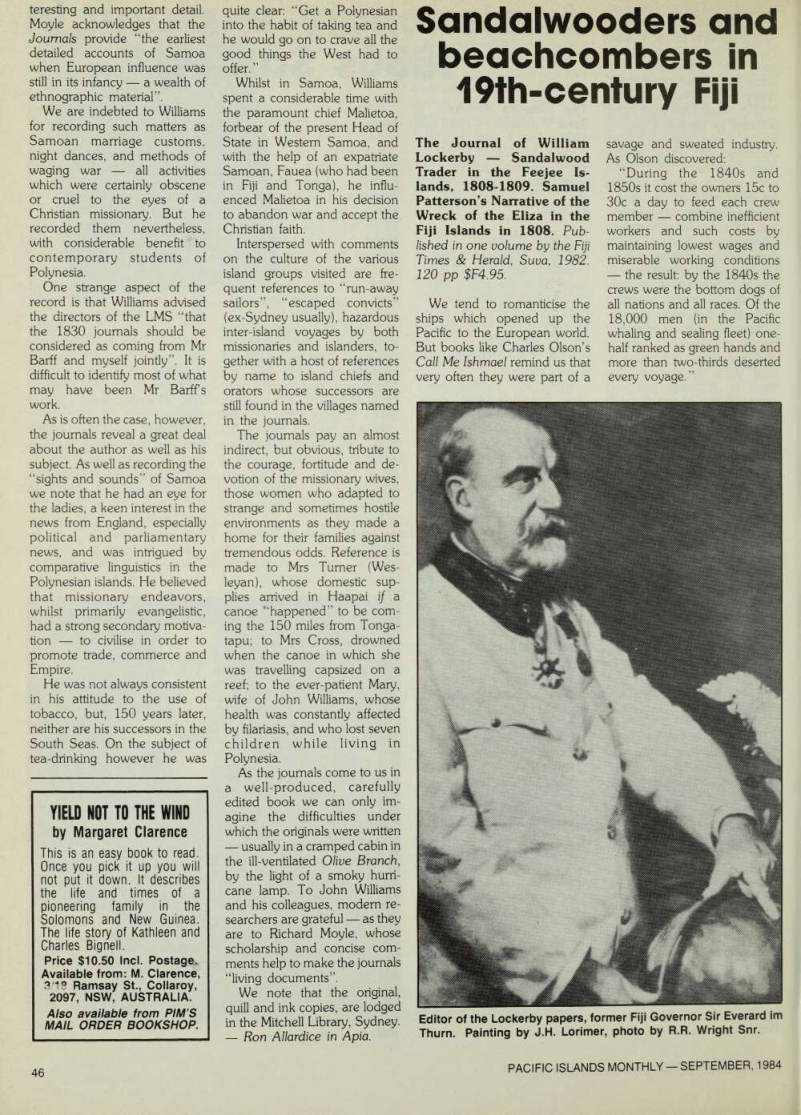
A missionary-explorer in 1830s Samoa
The Samoan Journals of John Williams 1830 and 1832. Edited, with an intro duction, by Richard M. Moyle.
Published by Australian Na tional University Press, 1984. x,
302. Isbn 0 7081 1621 3.
$A29.95.
This book is number 11 in the Australian National University’s “Pacific History Series”. It will undoubtedly become a signifi cant resource for students of the Pacific region as it gives access for the first time to the original text of the 1830 and 1832 journals of John Williams, mis sionary-explorer.
Whilst the journals them selves “may be read as fascinat ing and often dramatic narra tives in their own right” (intro, p 1), the editor has added an excellent series of footnotes which often open up new ave nues of inquiry, as well as providing clarification or am plification of the text. The ex tent and variety of the editor’s research are evidenced both by the footnotes and the seven pages of bibliography at the end of the book.
The introduction briefly re views the upsurge of interest in the 18th and 19th centuries in Christian missionary enterprise, and the establishment of the various missionary societies in England, especially the London Missionary Society (LMS), the Wesleyan Methodist Missionary Society (WMMS), and the Church Missionary Society
(Cms).
John Williams’ call to mis sionary service, his marriage and his appointment to Tahiti and Raiatea under the auspices of the LMS are quickly out lined, and it is from Raiatea that he set out on his first voyage to Samoa.
In view of the later differ ences which arose between the LMS and the WMMS over spheres of missionary activity in the Pacific, some of Williams’ journal entries present a more “catholic” view of co-operation than has sometimes been credited to him, e.g. he was in Sydney in 1822 for medical
treatment, and from there wrote to the directors of the LMS: “I had nearly come to England for the purpose of proposing that Church, the London and Methodist Societies should jointly fit out a vessel to visit the various islands of the South Seas”. A late entry states: “I have frequently thought that a standard book on missions is much wanted. A work that should be admitted into all our missionary seminaries . . . ” (p 284). He went on to suggest that much could be learnt from other missionary societies the Moravians, the Baptists, the CMS and the Wesleyans, and added that plans adopted by the Jesuits in South America might be used with advantage in the South Seas. The journals themselves are much more than a record of places visited, although the number of island communities involved in the two journeys is considerable.
The entries are an invaluable “first source” for the social historian, the student of Pacific cultures and languages, and
particularly for those interested in both the pre-Christian reli gious practices in Polynesia, and the establishment of the Christian churches throughout that area.
Those who have read Wil- Hams’ published Missionary En terprises (a best-seller in 19th century England), should read the Journals as they provide a factual check against some of the exuberances of the author as he re-wrote his material for general publication, One of the remarkable aspects of the Journals is that they cover, in each case, a period of only 16 weeks, much of it spent at sea, and a total of only 30 days actually spent in Samoa, Williams’ knowledge of Tahi tian and Rarotongan customs and language enable him to make useful comparisons with other cultures, such references being picked up by the editor and enlarged upon where deemed necessary.
John Williams had remark able powers of observation and the ability to record both in-
The Rev. John Williams. George Baxter print, 1843. Courtesy Mitchell Library, Sydney.
teresting and important detail.
Moyle acknowledges that the Journals provide “the earliest detailed accounts of Samoa when European influence was still in its infancy a wealth of ethnographic material”.
We are indebted to Williams for recording such matters as Samoan marriage customs, night dances, and methods of waging war all activities which were certainly obscene or cruel to the eyes of a Christian missionary. But he recorded them nevertheless, with considerable benefit to contemporary students of Polynesia.
One strange aspect of the record is that Williams advised the directors of the LMS “that the 1830 journals should be considered as coming from Mr Barff and myself jointly”. It is difficult to identify most of what may have been Mr Barff s work.
As is often the case, however, the journals reveal a great deal about the author as well as his subject. As well as recording the “sights and sounds” of Samoa we note that he had an eye for the ladies, a keen interest in the news from England, especially political and parliamentary news, and was intrigued by comparative linguistics in the Polynesian islands. He believed that missionary endeavors, whilst primarily evangelistic, had a strong secondary motiva tion to civilise in order to promote trade, commerce and Empire.
He was not always consistent in his attitude to the use of tobacco, but, 150 years later, neither are his successors in the South Seas. On the subject of tea-drinking however he was
quite clear; “Get a Polynesian into the habit of taking tea and he would go on to crave all the good things the West had to offer. ”
Whilst in Samoa, Williams spent a considerable time with the paramount chief Malietoa, forbear of the present Head of State in Western Samoa, and with the help of an expatriate Samoan, Fauea (who had been in Fiji and Tonga), he influ enced Malietoa in his decision to abandon war and accept the Christian faith.
Interspersed with comments on the culture of the various island groups visited are fre quent references to “run-away sailors”, “escaped convicts” (ex-Sydney usually), hazardous inter-island voyages by both missionaries and islanders, to gether with a host of references by name to island chiefs and orators whose successors are still found in the villages named in the journals.
The journals pay an almost indirect, but obvious, tribute to the courage, fortitude and de votion of the missionary wives, those women who adapted to strange and sometimes hostile environments as they made a home for their families against tremendous odds. Reference is made to Mrs Turner (Wes leyan), whose domestic sup plies arrived in Haapai if a canoe “happened” to be com ing the 150 miles from Tonga tapu; to Mrs Cross, drowned when the canoe in which she was travelling capsized on a reef; to the ever-patient Mary, wife of John Williams, whose health was constantly affected by filariasis, and who lost seven children while living in Polynesia.
As the journals come to us in a well-produced, carefully edited book we can only im agine the difficulties under which the originals were written usually in a cramped cabin in the ill-ventilated Olive Branch, by the light of a smoky hurri cane lamp. To John Williams and his colleagues, modern re searchers are grateful as they are to Richard Moyle, whose scholarship and concise com ments help to make the journals “living documents”.
We note that the original, quill and ink copies, are lodged in the Mitchell Library, Sydney.
Ron Allardice in Apia.
19th-century Fiji
Sandalwooders and beachcombers in 19th-century Fiji
The Journal of William Lockcrby Sandalwood Trader in the Fccjee Is lands, 1808-1809. Samuel Patterson’s Narrative of the Wreck of the Eliza in the Fiji Islands in 1808. Pub lished in one volume by the Fiji Times & Herald, Suva, 1982. 120 pp $F4.95.
We tend to romanticise the ships which opened up the Pacific to the European world.
But books like Charles Olson’s Call Me Ishmael remind us that very often they were part of a
savage and sweated industry.
As Olson discovered: “During the 1840 s and 1850 s it cost the owners 15c to 30c a day to feed each crew member combine inefficient workers and such costs by maintaining lowest wages and miserable working conditions the result: by the 1840 s the crews were the bottom dogs of all nations and all races. Of the 18,000 men (in the Pacific whaling and sealing fleet) one half ranked as green hands and more than two-thirds deserted every voyage.”
Editor of the Lockerby papers, former Fiji Governor Sir Everard im Thurn. Painting by J.H. Lorimer, photo by R.R. Wright Snr.
Lockerby and Patterson were two such “bottom dogs” who “lived to tell the tale”. Like Alexander Selkirk, Lockerby was marooned and Patterson became a “beachcomber” through shipwreck. When Sel kirk returned to London after his four years and four months on Juan Fernandez Island he drew crowds of curiosity seek ers to hear his account, includ ing, of course, the novelist Daniel Defoe, who immortal ised him as Robinson Crusoe, further firing the romantic myth.
But when Lockerby returned to Liverpool his family, under the influence of old-fashioned prudery, suppressed his narra tive. Patterson published his account in 1817 on his return to New England “with a design of enabling the subject of this Narrative to obtain some alleviation of his misfortunes from a generous publick.” He bought a wagon and a $4O horse and set out to hawk his book. The horse died in a snow drift in the Alleghenies and his narrative sank into the category of “rare book” and was almost forgotten. Around 1915, a great-grandchild of Lockerby’s eventually gave a former gov ernor of Fiji, Sir Everard im Thum, access to the Lockerby manuscript, Sir Everard subse quently edited it for the Hakluyt Society.
The Fiji Times & Herald, by reprinting these two early accounts of European contact with Fiji, is rendering a great service to a wider public who would otherwise find them almost inaccessible, for here is the reality of those early years, set down in all their grim and fascinating detail.
Samuel Patterson was born in Rhode Island in 1785. After two trips to Algiers on the United States frigate George Washington he signed on as a Guineaman engaged in the West African slave trade. In 1804 he sailed on the Boston ship Juno to collect furs in the north-west Pacific for the China market. She ran aground near Sitka the following year. By 1808 Patterson was onboard the Providence brig Eliza when she was wrecked on Mothea reef (now often called Eliza Reef) in the southern portion of the barrier reef which surrounds Nairai, Fiji.
An article in Pacific Islands
Monthly of March, 1935, recalls how Lockerby mysteriously dis appeared from Liverpool, his family thinking he had been press-ganged. Suffice it to say he went aboard the Boston ship Jenny as first officer around May 1807 and the Jenny was soon away from that port for Port Jackson and China on a sealing voyage.
Their plans changed at Port Jackson for when they arrived they found the port seething with news of the sandalwood trade. As it turned out, the period 1808-1809 was to mark the peak of the boom. The Jenny’s captain Dorr could hardly have guessed how pro fitable this change of course would prove. The Jenny de parted Fiji with 250 tons got for goods worth 50 pounds, and fetched something like 20,000
pounds for her cargo in China.
By 1840, when Wilkes’ American exploring expedition visited the Fijian Islands, his scientists had trouble even finding a specimen for their collection.
Doug Monro in Fijian Sandalwood and Beche-de-Mer (1973) called Lockerby’s journal “the major primary source for the Fijian sandalwood trade”. I would wish only that the Fiji Times & Herald had incorporated the Lockerby manuscript in the Peabody Museum in Salem. In that document Lockerby gives sailing directions for Bua Bay, information about weather and a “vocaboulary of (the Fijian) Tongue sufficient to purchase Sandle Wood and an Acct. of the Different Native Chiefs of the Fejee Isds with whom you have to do in procuring Sandle
Wood particularly those of Tokenroba (Vanua Levu)”.
While neither man was an anthropologist, Lockerby’s and Patterson’s accounts are of great value. Lockerby espedal ly had a great eye for the details of life as he found it at Bua.
Many men with more education have recorded less. He records acts of treachery and kindness on both sides and does not try to hide his own misdeeds among his numerous adven tures. His is, in fact, a reason ably honest account of the times, with little moralising to obscure the truth. We have every reason to welcome the republishing of such narratives by the “bottom dogs” of the last century. We need to set their “truths” beside the romanti cised myths which have re
placed them.
D. S. Long.
Advertisements & other items, p. 46 (1 item)
Yield Not To The Wind
by Margaret Clarence This is an easy book to read.
Once you pick it up you will not put it down. It describes the life and times of a pioneering family in the Solomons and New Guinea.
The life story of Kathleen and Charles Bignell.
Price $10.50 Incl. Postage.
Available from: M. Clarence, 3/19 Ramsay St., Collaroy,
2097, NSW, AUSTRALIA.
Also available from PI M’S
MAIL ORDER BOOKSHOP.
impact’ view

Europeans In The Pacific
Revising the ‘fatal impact’ view
Where the Waves Fall: A New South Sea Islands His tory from First Settlement to Colonial Rule. By K.R.
Howe. Published by University of Hawaii Press, 1984. ISBN 0 8248 0921 1. $U529.95.
The effects of European contact and activities upon the historical experience of Pacific Islanders have been the subject of con siderable rethinking by Pacific historians over recent years.
Kerry Howe’s most recent work is “an attempt to survey the detailed findings of modern Pacific historians and present them to the layman in a less obscure and inaccessible form” than they now have. Although the book is sub-titled A New South Sea Islands History, the author makes no claim to com prehensiveness. But he says that the work is “more than just a compilation of this research”, describing it as “an endeavor to provide a synoptic overview, to take the detailed and self contained studies and place them in a wider thematic framework”. It is in essence
“one interpretation of the state of the art of modern Pacific history”.
Howe’s primary geographical focus is on the major island groups of Polynesia, specifically Tahiti, Hawaii, Samoa, Tonga, and New Zealand. Other chap ters discuss the islands of Melanesia, but in lesser depth, though the section on Fiji is probably the best of all.
One of the major themes which emerges is the various circumstances and conditions which gave rise to the unified kingdoms in Tahiti, Hawaii, and Tonga under the Pomares, Kamehameha, and Taufa’ahau Tupou respectively. The influ ences of native politics and sectional alliances, collabora tion with Europeans, and Christian missionaries are tre ated comparatively. Within such contexts, Howe makes several arguments. He claims, for example, that the introduc tion and use of firearms in native warfare has been ex aggerated in previous historical accounts, Rather, the posses sion of muskets gave a
psychological advantage to the natives not because of their noise and strangeness, but be cause such weapons symbol ised their association with Euro peans. The tribal wars of the 1830 s in New Zealand, Fiji, and Samoa are cited as examples.
Indeed, Howe argues, islander relations with Europeans should be viewed in terms of the recognition conferred by such contacts on native chiefs, “which in turn increased the prestige of these leaders in the
eyes of their followers”. Hence, transactions which followed from cultural contact situations should be seen not so much in terms of the influence of introduced technology, but rather “more in terms of customary political ambitions and strategies”.
The centralised governments created in Polynesia were admittedly unprecedented, but were developments “within the bounds of legitimate and accepted behavior”. While it is not to be denied that European assistance to ambitious chiefs was useful, and in some cases critical, the major thrust of European intervention in island affairs became more pronounced after some degree of political centralisation had been achieved. Political consolidation, reorganisation, and legitimation acceptable to native and foreigner alike became the major business of Europeans in Tahiti, Hawaii, and Tonga. The successes in these areas may be largely attributed to the highly stratified nature of their respective societies in sharp contrast to New Zealand,
where no such phenomenon occurred, The influence of Christianity likewise had multiple effects, While the Protestant missionar ies enjoyed an evangelical monopoly for a time in Polynesia, the nature of conver sion varied considerably. While mass conversion could be man ipulated by missionaries through the assistance of a single paramount chief as in Tahiti, Tonga, and Hawaii, it seems that the reverse was the case in New Zealand and Samoa. There the dispersed nature of native settlements, and the frequent rivalry and warfare between them, inhi bited rapid conversion of the islanders. Instead of coming from the top, it seems that the conversion of ordinary indi viduals in increasing numbers eventually prevailed over their ruling elites, Howe also takes issue with the notion that European trad ing strategies were “steeped in human blood and indescribable vice”. Closer examination of primary economic relationships between native and foreigner
suggests that “no one side had the monopoly of virtue and fair play”. The changing demands of natives, and their selectivity, reveal a growing sophistication on their part in the bargaining process. Conflict was most like ly to occur when one side attempted to obtain the better of the bargain in unacceptable terms.
Howe uses the comparative method in making his points.
His work therefore lacks the parochialism of some con temporary Pacific historiogra phy. His method, moreover, contributes to a relative even ness in his chapters, and a sense of transition and con tinuity.
In his epilogue, Howe argues that the “fatal impact” view should be rejected, or substan tially modified. To the contrary, islanders were “quite capable of taking their own initiative and rather than passively accepting Europeans and their ways, either rejected or deliberately exploited the newcomers for their own reasons”. Current scholarship has been less ethnocentric in its judgments
than that of earlier generations.
To return to the author’s prefacing statements in which it is readily admitted that one of the work’s shortcomings is that it is in the main a product of Australasian scholarship. It seems relevant to remark that perhaps this work is a few years premature. The omission of almost all of Micronesia, and of German activities, from discus sion cannot be lightly disre garded. Recent works on these two subjects for example may support or invalidate some of the author’s arguments. Some discussion on the age of ex ploration in the Pacific, and its philosophical and technological impact on Europe, would have been in order. The evolving perceptions of “noble” to “ignoble” savage in relation to Pacific societies are important considerations in any historical treatment of the Pacific.
Nonetheless, for those who have been eager for a gen eralised treatment of Pacific his tory Where the Waves Fall is a welcome addition to Pacific his
toriography.
William
Tagupa.
Advertisements & other items, pp. 47-48 (1 item)
■i
e business centre for comfort ine food rooffis airconditioned • Restaurant • Bars • Banquet hall
H. E. BER6HUSER
General Manager Phone 21 2622 Cable: PAPTEL Telex: NE22353 PAPTEt
WCIFIC
CONSTRUCTION EQUIPMENT CO
introducing the Dynamic Hew Range ot
vibrating 8 Pneumatic Tyred Rollers
K&cific
THE RANGE
• Pacific Self-Propelled Vibrating Rollers • Single and Double Drum Types • 1.5 tonne to 16 tonne • Pacific Self-Propelled Pneumatic Type Compactors • 3 Models 16. 21. 38 tonne Ballast Weights • Pacific Landfill and Sanitary Landfill Compactors • Pacific Pneumatic Earth Borers • Pacific Road Brooms • Pacific Railway Maintenance Vehicles Construction Equipment Co.
DISTRIBUTORS REQUIRED
THROUGHOUT THE PACIFIC
24 Salisbury Road, Hornsby NSW 2077, Australia. Phone (02) 476 2666
SAL
Nukumanu: Home of mosquitoes,
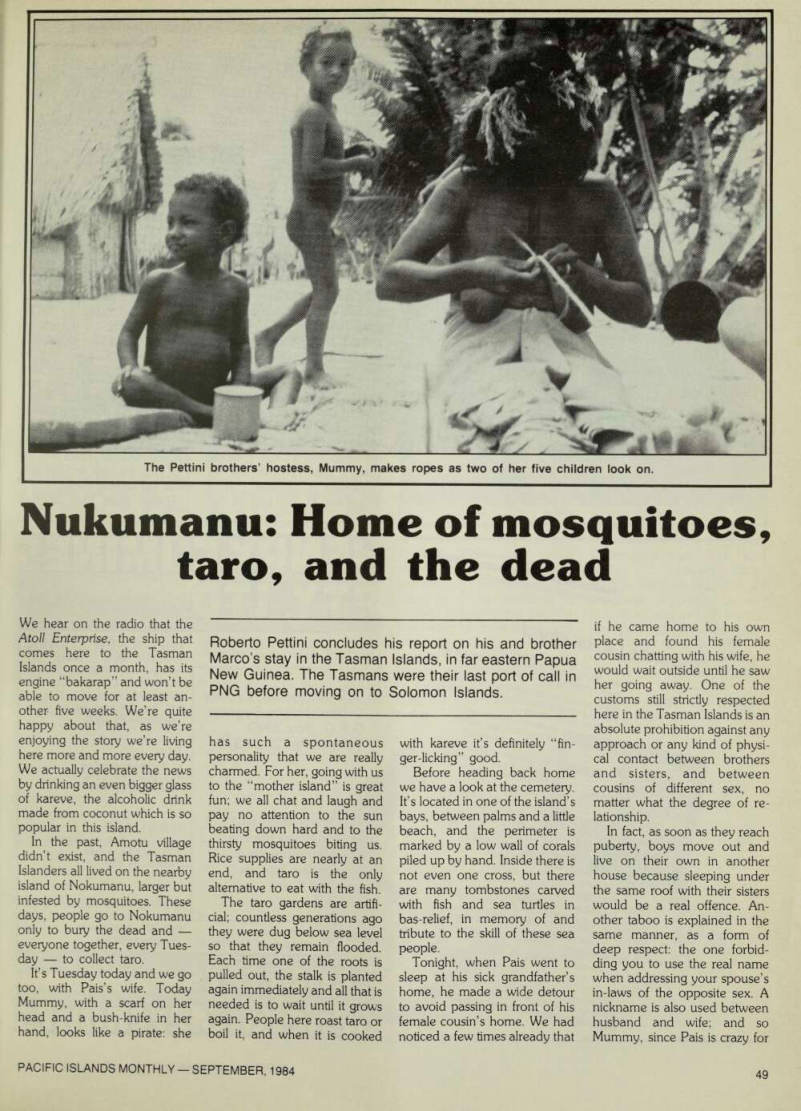
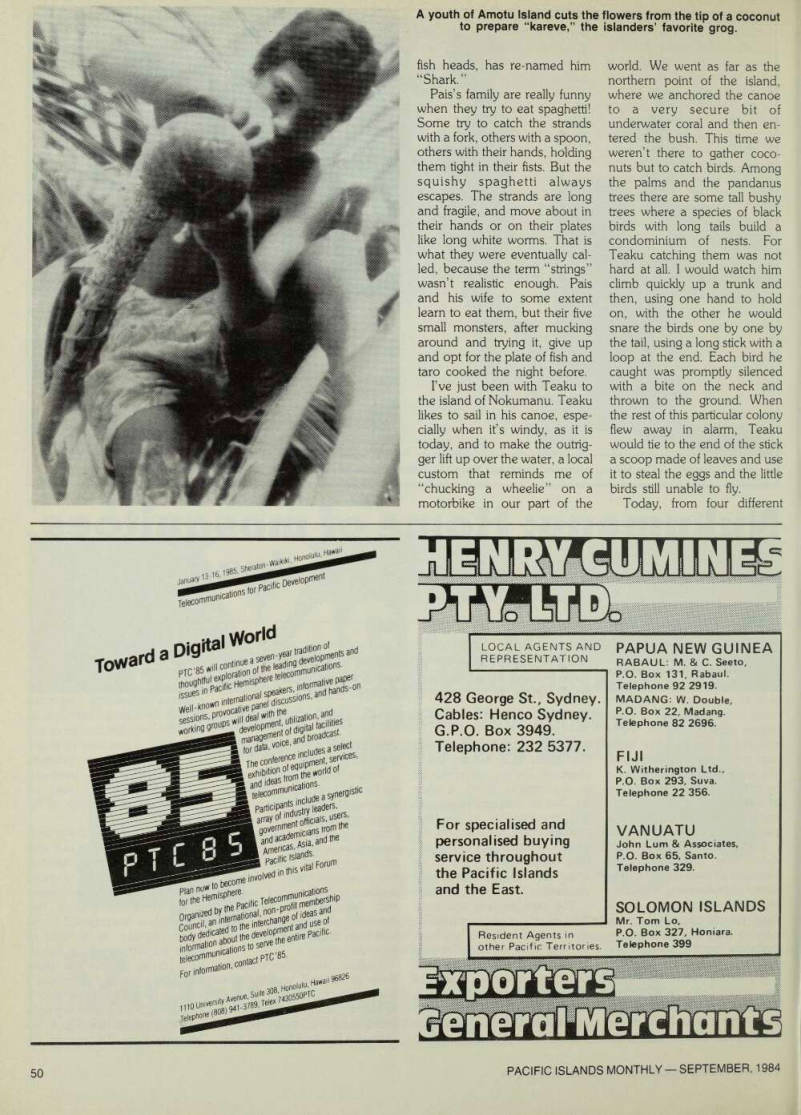
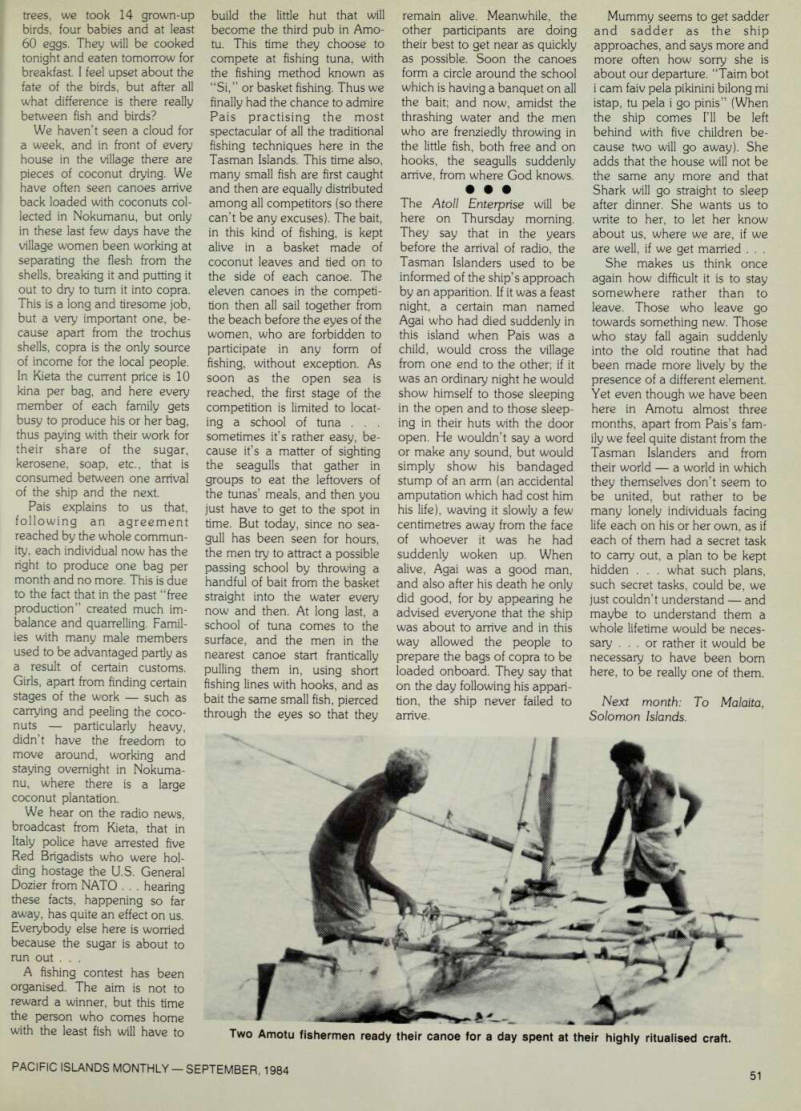
taro, and the dead
We hear on the radio that the Atoll Enterprise, the ship that comes here to the Tasman Islands once a month, has its engine “bakarap” and won’t be able to move for at least an other five weeks. We’re quite happy about that, as we’re enjoying the story we’re living here more and more every day.
We actually celebrate the news by drinking an even bigger glass of kareve, the alcoholic drink made from coconut which is so popular in this island.
In the past, Amotu village didn’t exist, and the Tasman Islanders all lived on the nearby island of Nokumanu, larger but infested by mosquitoes. These days, people go to Nokumanu only to bury the dead and everyone together, every Tues day to collect taro.
It’s Tuesday today and we go too, with Pais’s wife. Today Mummy, with a scarf on her head and a bush-knife in her hand, looks like a pirate: she
Roberto Pettini concludes his report on his and brother Marco’s stay in the Tasman Islands, in far eastern Papua New Guinea. The Tasmans were their last port of call in PNG before moving on to Solomon Islands.
has such a spontaneous personality that we are really charmed. For her, going with us to the “mother island” is great fun; we all chat and laugh and pay no attention to the sun beating down hard and to the thirsty mosquitoes biting us.
Rice supplies are nearly at an end, and taro is the only alternative to eat with the fish.
The taro gardens are artifi cial; countless generations ago they were dug below sea level so that they remain flooded.
Each time one of the roots is pulled out, the stalk is planted again immediately and all that is needed is to wait until it grows again. People here roast taro or boil it, and when it is cooked
with kareve it’s definitely “fin ger-licking” good.
Before heading back home we have a look at the cemetery.
It’s located in one of the island’s bays, between palms and a little beach, and the perimeter is marked by a low wall of corals piled up by hand. Inside there is not even one cross, but there are many tombstones carved with fish and sea turtles in bas-relief, in memory of and tribute to the skill of these sea people.
Tonight, when Pais went to sleep at his sick grandfather’s home, he made a wide detour to avoid passing in front of his female cousin’s home. We had noticed a few times already that
if he came home to his own place and found his female cousin chatting with his wife, he would wait outside until he saw her going away. One of the customs still strictly respected here in the Tasman Islands is an absolute prohibition against any approach or any kind of physi cal contact between brothers and sisters, and between cousins of different sex, no matter what the degree of re lationship.
In fact, as soon as they reach puberty, boys move out and live on their own in another house because sleeping under the same roof with their sisters would be a real offence. An other taboo is explained in the same manner, as a form of deep respect: the one forbid ding you to use the real name when addressing your spouse’s in-laws of the opposite sex. A nickname is also used between husband and wife; and so Mummy, since Pais is crazy for
The Pettinl brothers’ hostess, Mummy, makes ropes as two of her five children look on.
fish heads, has re-named him “Shark.”
Pais’s family are really funny when they try to eat spaghetti!
Some try to catch the strands with a fork, others with a spoon, others with their hands, holding them tight in their fists. But the squishy spaghetti always escapes. The strands are long and fragile, and move about in their hands or on their plates like long white worms. That is what they were eventually called, because the term “strings” wasn’t realistic enough. Pais and his wife to some extent learn to eat them, but their five small monsters, after mucking around and trying it, give up and opt for the plate of fish and taro cooked the night before.
I’ve just been with Teaku to the island of Nokumanu. Teaku likes to sail in his canoe, espedally when it’s windy, as it is today, and to make the outrigger lift up over the water, a local custom that reminds me of “chucking a wheelie” on a motorbike in our part of the
world. We went as far as the northern point of the island, where we anchored the canoe to a very secure bit of underwater coral and then en tered the bush. This time we weren’t there to gather coco nuts but to catch birds. Among the palms and the pandanus trees there are some tall bushy trees where a species of black birds with long tails build a condominium of nests. For Teaku catching them was not hard at all. I would watch him climb quickly up a trunk and then, using one hand to hold on, with the other he would snare the birds one by one by the tail, using a long stick with a loop at the end. Each bird he caught was promptly silenced with a bite on the neck and thrown to the ground. When the rest of this particular colony flew away in alarm, Teaku would tie to the end of the stick a scoop made of leaves and use it to steal the eggs and the little birds still unable to fly.
Today, from four different
A youth of Amotu Island cuts the flowers from the tip of a coconut to prepare “kareve,” the islanders’ favorite grog.
trees, we took 14 grown-up birds, four babies and at least 60 eggs. They will be cooked tonight and eaten tomorrow for breakfast. I feel upset about the fate of the birds, but after all what difference is there really between fish and birds?
We haven’t seen a cloud for a week, and in front of every house in the village there are pieces of coconut drying. We have often seen canoes arrive back loaded with coconuts col lected in Nokumanu, but only in these last few days have the village women been working at separating the flesh from the shells, breaking it and putting it out to dry to turn it into copra.
This is a long and tiresome job, but a very important one, be cause apart from the trochus shells, copra is the only source of income for the local people.
In Kieta the current price is 10 kina per bag, and here every member of each family gets busy to produce his or her bag, thus paying with their work for their share of the sugar, kerosene, soap, etc., that is consumed between one arrival of the ship and the next.
Pais explains to us that, following an agreement reached by the whole commun ity, each individual now has the right to produce one bag per month and no more. This is due to the fact that in the past “free production” created much im balance and quarrelling. Famil ies with many male members used to be advantaged partly as a result of certain customs.
Girls, apart from finding certain stages of the work such as carrying and peeling the coco nuts particularly heavy, didn’t have the freedom to move around, working and staying overnight in Nokuma nu, where there is a large coconut plantation.
We hear on the radio news, broadcast from Kieta, that in Italy police have arrested five Red Brigadists who were hol ding hostage the U.S. General Dozier from NATO . . . hearing these facts, happening so far away, has quite an effect on us.
Everybody else here is worried because the sugar is about to run out . . .
A fishing contest has been organised. The aim is not to reward a winner, but this time the person who comes home with the least fish will have to
build the little hut that will become the third pub in Amo tu. This time they choose to compete at fishing tuna, with the fishing method known as “Si,” or basket fishing. Thus we finally had the chance to admire Pais practising the most spectacular of all the traditional fishing techniques here in the Tasman Islands. This time also, many small fish are first caught and then are equally distributed among all competitors (so there can’t be any excuses). The bait, in this kind of fishing, is kept alive in a basket made of coconut leaves and tied on to the side of each canoe. The eleven canoes in the competi tion then all sail together from the beach before the eyes of the women, who are forbidden to participate in any form of fishing, without exception. As soon as the open sea is reached, the first stage of the competition is limited to locat ing a school of tuna . . . sometimes it’s rather easy, be cause it’s a matter of sighting the seagulls that gather in groups to eat the leftovers of the tunas’ meals, and then you just have to get to the spot in time. But today, since no sea gull has been seen for hours, the men try to attract a possible passing school by throwing a handful of bait from the basket straight into the water every now and then. At long last, a school of tuna comes to the surface, and the men in the nearest canoe start frantically pulling them in, using short fishing lines with hooks, and as bait the same small fish, pierced through the eyes so that they
remain alive. Meanwhile, the other participants are doing their best to get near as quickly as possible. Soon the canoes form a circle around the school which is having a banquet on all the bait; and now, amidst the thrashing water and the men who are frenziedly throwing in the little fish, both free and on hooks, the seagulls suddenly arrive, from where God knows. • • • The Atoll Enterprise will be here on Thursday morning.
They say that in the years before the arrival of radio, the Tasman Islanders used to be informed of the ship’s approach by an apparition. If it was a feast night, a certain man named Agai who had died suddenly in this island when Pais was a child, would cross the village from one end to the other; if it was an ordinary night he would show himself to those sleeping in the open and to those sleep ing in their huts with the door open. He wouldn’t say a word or make any sound, but would simply show his bandaged stump of an arm (an accidental amputation which had cost him his life), waving it slowly a few centimetres away from the face of whoever it was he had suddenly woken up. When alive, Agai was a good man, and also after his death he only did good, for by appearing he advised everyone that the ship was about to arrive and in this way allowed the people to prepare the bags of copra to be loaded onboard. They say that on the day following his appari tion, the ship never failed to arrive.
Mummy seems to get sadder and sadder as the ship approaches, and says more and more often how sorry she is about our departure. “Taim hot i cam faiv pela pikinini bilong mi istap, tu pela i go pinis” (When the ship comes I’ll be left behind with five children be cause two will go away). She adds that the house will not be the same any more and that Shark will go straight to sleep after dinner. She wants us to write to her, to let her know about us, where we are, if we are well, if we get married . . .
She makes us think once again how difficult it is to stay somewhere rather than to leave. Those who leave go towards something new. Those who stay fall again suddenly into the old routine that had been made more lively by the presence of a different element.
Yet even though we have been here in Amotu almost three months, apart from Rais’s fam ily we feel quite distant from the Tasman Islanders and from their world a world in which they themselves don’t seem to be united, but rather to be many lonely individuals facing life each on his or her own, as if each of them had a secret task to carry out, a plan to be kept hidden . . . what such plans, such secret tasks, could be, we just couldn’t understand and maybe to understand them a whole lifetime would be neces sary ... or rather it would be necessary to have been bom here, to be really one of them.
Next month: To Malaita, Solomon Islands.
Two Amotu fishermen ready their canoe for a day spent at their highly ritualised craft.
Advertisements & other items, pp. 50-52 (1 item)
Ssssss&Z ,
LOCAL AGENTS AND
REPRESENTATION
428 George St., Sydney.
Cables: Henco Sydney.
G.P.O. Box 3949.
Telephone: 232 5377.
PAPUA NEW GUINEA
RABAUL; M. & C. Seeto, P.O. Box 131, Rabaul.
Telephone 92 2919.
MADANG; W. Double, P.O. Box 22, Madang.
Telephone 82 2696.
FIJI
K. Witherington Ltd., P.O. Box 293, Suva.
Telephone 22 356.
For specialised and
personalised buying
service throughout
the Pacific Islands
and the East.
VANUATU
John Lum & Associates, P.O. Box 65, Santo.
Telephone 329.
SOLOMON ISLANDS
Mr. Tom Lo, Resident Agents in P-O. Box 327, Honiara. other Pacific Territories. Telephone 399
January 3-16.1985 Sheraton yyaikik' Honolutu Hawaii Telecornmun ications , 0 r Pacific Devel loprnent
Toward
a
Digital
World
S3S? issues in Pacific Hei Well -known internal' •gS*** 01 "*
SsSSSS&Z ,
--SSSi—
partic'Pff 1 Ijctry leaders.
anW°TjJfofficials.^’
g ° vernm lm icians from fne and and the forthe HernlsP u h ®p acific Teleco^f^rshiP and mm
ELECTRICITY FROM SUNLIGHT
SOLAREX
Fly. Limited 5 Bellona Ave.. Regents Park 2143 N.S.W., Australia
(02) 644-5055 TLX AA21975
• VILLAGE POWER
• HOUSE LIGHTING
• REFRIGERATION
• WATER PUMPING
• COMMUNICATIONS
• MILITARY
• MARINE
The promise, the challenge
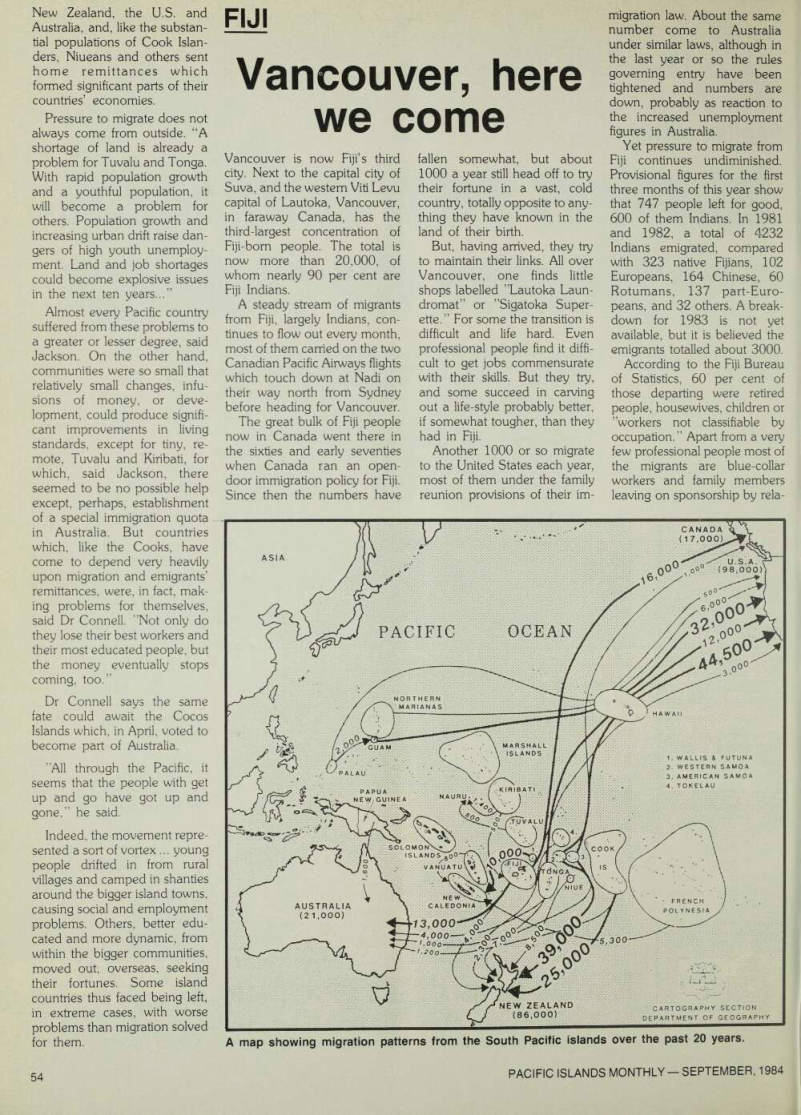
tropicalities
Pacific Migration
Islanders away from home: The promise, the challenge
Migration is now almost the biggest growth industry in the Pacific Islands. So many people are leaving the smaller communities that the expatriate communities they form in Australia, New Zealand, and the United States sometimes exceed the populations left at home.
Nearly three times more Niueans now live in New Zealand than now inhabit Niue. Samoans and Cook Islanders are very close to achieving the same doubtful distinction and, at the same time, causing urban problems for themselves and their countries by their visibility within the now hard-pressed New Zealand economy.
According to Dr John Connell, an Australian who is involved with Pacific Islands development programs, more than 10 per cent of Pacific Islanders, with the exception of Papua New Guineans, now live in a metropolitan country, that is, in Australia, New Zealand, Canada or the United States.
In many cases, Samoa, the Cooks and Niue being prime examples, the money expatriated islanders send home to support their families has become a significant item on island foreign exchange “earnings.”
Is the Pacific in danger of being told: “Would the last man out please turn off the light” and what are the effects on island economies of this drainage of people? Do they go home, and if they do, how do they fit back into the simpler and slower scheme of island things?
In the next pages PIM writers examine some aspects of the situation.
Perhaps because of their sea-faring herit age, Pacific peoples are among the most mobile in the world. They move from island to island with great regularity and utter aplomb.
But the drift of population away from the islands towards the brighter lights and bigger jobs of industrial countries is a relatively new phenomenon. In many cases the travellers do not initially intend to completely sever links with their families and villages, but often that is what happens. In their adopted countries they frequently, and naturally enough, form social clusters ... not quite ghettos, but bordering on that unfortunate form ... which sometimes pro duce friction with indigenous groups. Karangahape road in Auckland, Newtown in Sydney, and the down-trodden area of Honolulu between Waikiki and the city are examples of this type of island community.
In doing this islanders are in no way different from the Ita lians who migrated to Mel bourne and gathered in Carl ton, or the Pakistanis and West Indians who went to London and clustered in Southall and Netting Hill. They, too, had to weather resentments which, as now, in times of high un employment and economic dif ficulty, can sometimes be very pointed and hurtful to new arrivals.
Time, and improved econo mic conditions solve these diffi culties by dissolving the ghettos; the denizens drift out to better living areas and lose their
identity in wider communities.
There are, therefore, a num ber of aspects of the migration process, some good, and some bad. Migration saps a small country’s strength by depriving it of the brains, the energy and the initiative it needs to deve lop. Even Britain complained of a ’’brain drain” as her scientists, doctors, and engineers went in droves to the U.S.A. after World War 11. Those who move overseas are generally the most ambitious in the community, for they take action where others
just dream of greener pastures.
On the other hand, some migrants are simply looking for pots of gold at the ends of rainbows, and can fare worse in their adopted countries because they cannot cope with the stiffer competition and higher work rates demanded in larger, in dustrial societies.
Yet, as many succeed in carving out good lives for them selves as fail, although in gen eral they do so at the cost of losing their island ways. Cultu ral clubs preserve a bit, but not
often into successive genera tions.
Pacific migration involves numbers which are much more significant to the populations remaining at home than the movement of almost any other people, with the exception, perhaps, of the Irish at the time of the potato famine. The com munities are not big enough to support the population growth most of them produce, but, at the same time, their deve lopment may be stunted by the loss of brains and numbers.
According to Dr John Con nell, who is a senior lecturer at Sydney University, many smal ler Pacific nations have no sensible development strategy and rely heavily on migration in that they are becoming more and more dependent upon money from overseas, sent in the form of aid, or remittances from emigrants. ’’Find Tuvalu on a map: it is so remote that if it had anything to market, which it doesn’t, it would be incredibly costly, so it relies on money sent home,” he said.
The Jackson Report, the ex cellent survey of Australian aid spending, is similarly gloomy: ’Tuvalu is so small that its agriculural resources can sup port only a tiny population at subsistence level. The Cook Islands and Niue have ten times Tuvalu’s area, but they would be similarly disadvantaged without New Zealand’s assist ance and the remittances of islanders working in New Zea land,” said Jackson. About 40,000 Tongans now lived in
New Zealand, the U.S. and Australia, and, like the substan tial populations of Cook Islan ders, Niueans and others sent home remittances which formed significant parts of their countries’ economies.
Pressure to migrate does not always come from outside. “A shortage of land is already a problem for Tuvalu and Tonga.
With rapid population growth and a youthful population, it will become a problem for others. Population growth and increasing urban drift raise dan gers of high youth unemploy ment. Land and job shortages could become explosive issues in the next ten years...”
Almost every Pacific country suffered from these problems to a greater or lesser degree, said Jackson. On the other hand, communities were so small that relatively small changes, infu sions of money, or deve lopment, could produce signifi cant improvements in living standards, except for tiny, re mote, Tuvalu and Kiribati, for which, said Jackson, there seemed to be no possible help except, perhaps, establishment of a special immigration quota in Australia. But countries which, like the Cooks, have come to depend very heavily upon migration and emigrants’ remittances, were, in fact, mak ing problems for themselves, said Dr Connell. ’’Not only do they lose their best workers and their most educated people, but the money eventually stops coming, too.”
Dr Connell says the same fate could await the Cocos Islands which, in April, voted to become part of Australia.
"All through the Pacific, it seems that the people with get up and go have got up and gone,” he said.
Indeed, the movement repre sented a sort of vortex ... young people drifted in from rural villages and camped in shanties around the bigger island towns, causing social and employment problems. Others, better edu cated and more dynamic, from within the bigger communities, moved out, overseas, seeking their fortunes. Some island countries thus faced being left, in extreme cases, with worse problems than migration solved for them.
Vancouver, here

Fiji
Vancouver, here we come
Vancouver is now Fiji’s third city. Next to the capital city of Suva, and the western Viti Levu capital of Lautoka, Vancouver, in faraway Canada, has the third-largest concentration of Fiji-born people. The total is now more than 20,000, of whom nearly 90 per cent are Fiji Indians.
A steady stream of migrants from Fiji, largely Indians, con tinues to flow out every month, most of them carried on the two Canadian Pacific Airways flights which touch down at Nadi on their way north from Sydney before heading for Vancouver.
The great bulk of Fiji people now in Canada went there in the sixties and early seventies when Canada ran an open door immigration policy for Fiji.
Since then the numbers have
fallen somewhat, but about 1000 a year still head off to try their fortune in a vast, cold country, totally opposite to any thing they have known in the land of their birth.
But, having arrived, they try to maintain their links. All over Vancouver, one finds little shops labelled ’’Lautoka Laun dromat” or ’’Sigatoka Super ette.” For some the transition is difficult and life hard. Even professional people find it diffi cult to get jobs commensurate with their skills. But they try, and some succeed in carving out a life-style probably better, if somewhat tougher, than they had in Fiji.
Another 1000 or so migrate to the United States each year, most of them under the family reunion provisions of their im
migration law. About the same number come to Australia under similar laws, although in the last year or so the rules governing entry have been tightened and numbers are down, probably as reaction to the increased unemployment figures in Australia.
Yet pressure to migrate from Fiji continues undiminished.
Provisional figures for the first three months of this year show that 747 people left for good, 600 of them Indians. In 1981 and 1982, a total of 4232 Indians emigrated, compared with 323 native Fijians, 102 Europeans, 164 Chinese, 60 Rotumans, 137 part-Euro peans, and 32 others. A break down for 1983 is not yet available, but it is believed the emigrants totalled about 3000.
According to the Fiji Bureau of Statistics, 60 per cent of those departing were retired people, housewives, children or ’’workers not classifiable by occupation.” Apart from a very few professional people most of the migrants are blue-collar workers and family members leaving on sponsorship by rela-
A map showing migration patterns from the South Pacific islands over the past 20 years.
fives already settled in their adoptive countries. From this it would appear that there is not a significant brain drain. Yet any loss of talent from a pool as small as Fiji’s gives cause for concern.
The departure of some high ly-qualified doctors has caused some anxiety. Most of them have gone off to follow further studies and research and it is thought likely some of them may return. Fiji has also lost a small but significant number of skilled workers, like motor
mechanics, electricians, prin ters, plumbers and carpenters, but the government’s training programs seem to be replacing these at more than generous rate.
Indians by far form the bulk of departures. It is not that they are by nature an adventurous community but rather that they see little prospect for their chil dren in a country where un employment, and under employment is a major prob lem.
Most of them are from rural
Indian stock and they tend to feel a deep, basic insecurity, they say, because they own very little land. Most Indian farmers are tenants, leasing their properties on 30-year, or shorter, tenures. Politically they have tended to support the opposition National Federation Party, which is probably doomed to remain in opposi tion because of the electoral system, and political alignments among the different races.
But the pastures outside Fiji are not always greener for the hopeful migrants. Many have to struggle to survive in an alien society where, often, there are deep-seated prejudices against foreign ’’interlopers.” In Can ada, for example, they were initially welcomed and they did well because the Canadian eco nomy was booming and jobs were plentiful. The migrants bought cars, houses, and other property, and sent for their relatives believing they had found nirvana.
But when the economic slump hit they were the first to be laid off. But for the Cana dian welfare system, many
would have been simply crushed.
However, fortune seems to have shone somewhat brighter on those who went to the United States. For one thing the recession was less bitter than it was in Canada and for another the American society is much larger.
Those who have gone to Australia have been mostly either professional people or highly-skilled workers, this being the basis upon which Australia accepts her migrants.
Some, a few, have been admit ted to join family members able to support them.
But, despite the tough rules and the hardships faced by many migrants, the number of people applying for resident visas in Canada, the US and Australia every year runs into thousands ... many more than can hope to get a place. The numbers are not expected to diminish, particularly among In dians who continue to look overseas for what they feel could be greater security and a brighter future for their chil
dren.
Vijendra Kumar.
The bright lights and the beautiful shops of Honolulu tempt many islanders to a culture vastly different, and harder, than their own.
Advertisements & other items, p. 55 (2 items)
55
3 ACIFIC ISLANDS MONTHLY —SEPTEMBER, 1984
X Longlife Products
AND FRESH DAIRY FOODS,
QUALITY YOU CAN TRUST
QUF Industries Ltd. offers an export award winning range of Longlife products as well as a complete range of quality fresh dairy foods.
With 15 years experience in export markets, QUF has the product knowledge and expertise to provide you with outstanding service in the 1980’s. • Pauls Longlife UHT Milk is natural liquid cow's milk with no preservatives or additives and is available in the 250m1 ( 500 ml and 1 litre sizes. • Shake Longlife flavoured milk is offered in delicious Chocolate, Malted, Caramel and Strawberry flavours. • Pauls Longlife Thickened Cream is ideal for whipping or pouring • Popper 100% Fruit Juice is available in seven flavours in a wide range of Longlife pack sizes. • Pauls fresh Dairy Products including Milk, Cream, Yoghurt and Cottage Cheese are available in an extensive range of flavours and sizes,
TRADE ENQUIRIES:
QUF Industries Ltd., P.O. Box 12, South Brisbane, Queensland, 4101 Australia Telephone: (07) 44-0151 Telex: AA 40614 m Ms* 7) J nu\u IhK
OPAGK
NFvV
ti T f L miiK 4
I LURE
If
miiK
A future exodus
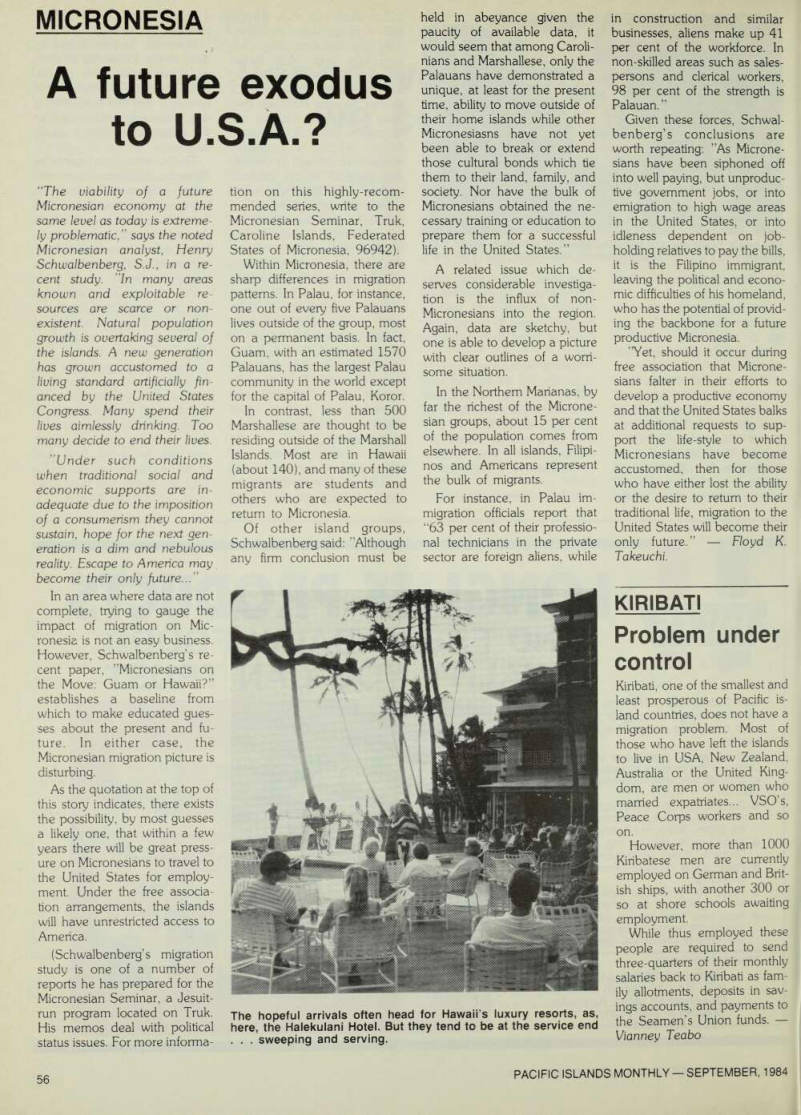
Micronesia
A future exodus to U.S.A.?
“The viability of a future Micronesian economy at the same level as today is extreme ly problematic,” says the noted Micronesian analyst, Henry Schwalbenberg, S.J., in a re cent study. ’’ln many areas known and exploitable re sources are scarce or non existent. Natural population growth is overtaking several of the islands. A new generation has grown accustomed to a living standard artificially fin anced by the United States Congress. Many spend their lives aimlessly drinking. Too many decide to end their lives. ’’Under such conditions when traditional social and economic supports are in adequate due to the imposition of a consumerism they cannot sustain, hope for the next gen eration is a dim and nebulous reality. Escape to America may become their only future...’’
In an area where data are not complete, trying to gauge the impact of migration on Mic ronesia is not an easy business.
However, Schwalbenberg’s re cent paper, ’’Micronesians on the Move: Guam or Hawaii?” establishes a baseline from which to make educated gues ses about the present and fu ture. In either case, the Micronesian migration picture is disturbing.
As the quotation at the top of this story indicates, there exists the possibility, by most guesses a likely one, that within a few years there will be great press ure on Micronesians to travel to the United States for employ ment. Under the free associa tion arrangements, the islands will have unrestricted access to America. (Schwalbenberg’s migration study is one of a number of reports he has prepared for the Micronesian Seminar, a Jesuit run program located on Truk.
His memos deal with political status issues. For more informa
tion on this highly-recom mended series, write to the Micronesian Seminar, Truk, Caroline Islands, Federated States of Micronesia, 96942).
Within Micronesia, there are sharp differences in migration patterns. In Palau, for instance, one out of every five Palauans lives outside of the group, most on a permanent basis. In fact, Guam, with an estimated 1570 Palauans, has the largest Palau community in the world except for the capital of Palau, Koror.
In contrast, less than 500 Marshallese are thought to be residing outside of the Marshall Islands. Most are in Hawaii (about 140), and many of these migrants are students and others who are expected to return to Micronesia.
Of other island groups, Schwalbenberg said; ’’Although any firm conclusion must be
held in abeyance given the paucity of available data, it would seem that among Caroli nians and Marshallese, only the Palauans have demonstrated a unique, at least for the present time, ability to move outside of their home islands while other Micronesiasns have not yet been able to break or extend those cultural bonds which tie them to their land, family, and society. Nor have the bulk of Micronesians obtained the ne cessary training or education to prepare them for a successful life in the United States.”
A related issue which de serves considerable investiga tion is the influx of non- Micronesians into the region.
Again, data are sketchy, but one is able to develop a picture with clear outlines of a worri some situation.
In the Northern Marianas, by far the richest of the Microne sian groups, about 15 per cent of the population comes from elsewhere. In all islands, Filipi nos and Americans represent the bulk of migrants.
For instance, in Palau im migration officials report that “63 per cent of their professio nal technicians in the private sector are foreign aliens, while
in construction and similar businesses, aliens make up 41 per cent of the workforce. In non-skilled areas such as sales persons and clerical workers, 98 per cent of the strength is Palauan. ”
Given these forces, Schwal benberg’s conclusions are worth repeating: ”As Microne sians have been siphoned off into well paying, but unproduc tive government jobs, or into emigration to high wage areas in the United States, or into idleness dependent on job holding relatives to pay the bills, it is the Filipino immigrant, leaving the political and econo mic difficulties of his homeland, who has the potential of provid ing the backbone for a future productive Micronesia. ”Yet, should it occur during free association that Microne sians falter in their efforts to develop a productive economy and that the United States balks at additional requests to sup port the life-style to which Micronesians have become accustomed, then for those who have either lost the ability or the desire to return to their traditional life, migration to the United States will become their
only future. ”
Floyd K.
Takeuchi.
Problem under
Kiribati
Problem under control
Kiribati, one of the smallest and least prosperous of Pacific is land countries, does not have a migration problem. Most of those who have left the islands to live in USA, New Zealand, Australia or the United King dom, are men or women who married expatriates... VSO’s, Peace Corps workers and so on.
However, more than 1000 Kiribatese men are currently employed on German and Brit ish ships, with another 300 or so at shore schools awaiting employment.
While thus employed these people are required to send three-quarters of their monthly salaries back to Kiribati as fam ily allotments, deposits in sav ings accounts, and payments to the Seamen’s Union funds.
Vianney Teabo
The hopeful arrivals often head for Hawaii’s luxury resorts, as, here, the Halekulani Hotel. But they tend to be at the service end . . . sweeping and serving.
“Plan your family,
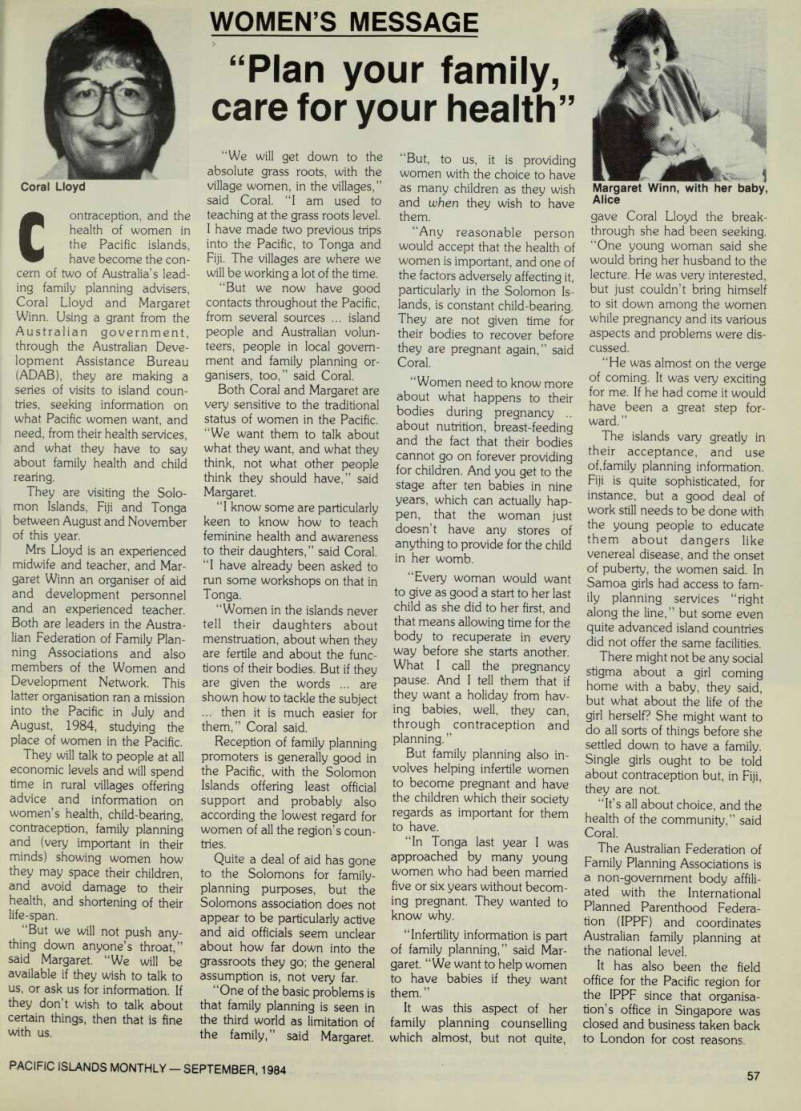
Women’S Message
“Plan your family, care for your health”
Contraception, and the health of women in the Pacific islands, have become the con cern of two of Australia’s lead ing family planning advisers, Coral Lloyd and Margaret Winn. Using a grant from the Australian government, through the Australian Deve lopment Assistance Bureau (ADAB), they are making a series of visits to island coun tries, seeking information on what Pacific women want, and need, from their health services, and what they have to say about family health and child rearing.
They are visiting the Solo mon Islands, Fiji and Tonga between August and November of this year.
Mrs Lloyd is an experienced midwife and teacher, and Mar garet Winn an organiser of aid and development personnel and an experienced teacher.
Both are leaders in the Austra lian Federation of Family Plan ning Associations and also members of the Women and Development Network. This latter organisation ran a mission into the Pacific in July and August, 1984, studying the place of women in the Pacific.
They will talk to people at all economic levels and will spend time in rural villages offering advice and information on women’s health, child-bearing,
contraception, family planning
and (very important in their minds) showing women how they may space their children, and avoid damage to their health, and shortening of their life-span.
“But we will not push any thing down anyone’s throat,” said Margaret. “We will be available if they wish to talk to us, or ask us for information. If they don’t wish to talk about certain things, then that is fine with us.
“We will get down to the absolute grass roots, with the village women, in the villages,” said Coral. “I am used to teaching at the grass roots level.
I have made two previous trips into the Pacific, to Tonga and Fiji. The villages are where we will be working a lot of the time.
“But we now have good contacts throughout the Pacific, from several sources ... island people and Australian volun teers, people in local govern ment and family planning or ganisers, too,” said Coral.
Both Coral and Margaret are very sensitive to the traditional status of women in the Pacific.
“We want them to talk about what they want, and what they think, not what other people think they should have,” said Margaret.
“I know some are particularly keen to know how to teach feminine health and awareness to their daughters,” said Coral.
“I have already been asked to run some workshops on that in Tonga.
“Women in the islands never tell their daughters about menstruation, about when they are fertile and about the func tions of their bodies. But if they are given the words ... are shown how to tackle the subject ... then it is much easier for them,” Coral said.
Reception of family planning promoters is generally good in the Pacific, with the Solomon Islands offering least official support and probably also according the lowest regard for women of all the region’s coun tries.
Quite a deal of aid has gone to the Solomons for family planning purposes, but the Solomons association does not appear to be particularly active and aid officials seem unclear about how far down into the grassroots they go; the general assumption is, not very far.
“One of the basic problems is that family planning is seen in the third world as limitation of the family,” said Margaret.
“But, to us, it is providing women with the choice to have as many children as they wish and when they wish to have them.
“Any reasonable person would accept that the health of women is important, and one of the factors adversely affecting it, particularly in the Solomon Is lands, is constant child-bearing.
They are not given time for their bodies to recover before they are pregnant again,” said Coral.
“Women need to know more about what happens to their bodies during pregnancy .. about nutrition, breast-feeding and the fact that their bodies cannot go on forever providing for children. And you get to the stage after ten babies in nine years, which can actually hap pen, that the woman just doesn’t have any stores of anything to provide for the child in her womb.
“Every woman would want to give as good a start to her last child as she did to her first, and that means allowing time for the body to recuperate in every way before she starts another.
What I call the pregnancy pause. And I tell them that if they want a holiday from hav ing babies, well, they can, through contraception and planning.”
But family planning also in volves helping infertile women to become pregnant and have the children which their society regards as important for them to have.
“In Tonga last year I was approached by many young women who had been married five or six years without becom ing pregnant. They wanted to know why.
“Infertility information is part of family planning,” said Mar garet. “We want to help women to have babies if they want them.”
It was this aspect of her family planning counselling which almost, but not quite,
gave Coral Lloyd the break through she had been seeking.
“One young woman said she would bring her husband to the lecture. He was very interested, but just couldn’t bring himself to sit down among the women while pregnancy and its various aspects and problems were dis cussed.
“He was almost on the verge of coming. It was very exciting for me. If he had come it would have been a great step for ward. ”
The islands vary greatly in their acceptance, and use of, family planning information.
Fiji is quite sophisticated, for instance, but a good deal of work still needs to be done with the young people to educate them about dangers like venereal disease, and the onset of puberty, the women said. In Samoa girls had access to fam ily planning services “right along the line,” but some even quite advanced island countries did not offer the same facilities.
There might not be any social stigma about a girl coming home with a baby, they said, but what about the life of the girl herself? She might want to do all sorts of things before she settled down to have a family.
Single girls ought to be told about contraception but, in Fiji, they are not.
“It’s all about choice, and the health of the community,” said Coral.
The Australian Federation of Family Planning Associations is a non-government body affili ated with the International Planned Parenthood Federa tion (IPPF) and coordinates Australian family planning at the national level.
It has also been the field office for the Pacific region for the IPPF since that organisa tion’s office in Singapore was closed and business taken back to London for cost reasons.
Coral Lloyd
Margaret Winn, with her baby, Alice
Advertisements & other items, p. 58 (1 item)
Aiwa*
■ -3 remote control Wth mfrar The Million Dollar Look in Stylish Sound This year’s top-of-the-line AIWA system is designed to stay in style next year, and the year after too. With high-power component separates designed to be
“Digital ready”.
In fact, with such features as a dedicated CD function selector and Dolby HX Professional* equipped auto-reverse cassette deck, the V-1100 is an 85 watt-per-channel system ready to deliver better performance from any music source—digital or analog.
Want to put your records onto tape? AIWA makes it easier than you ever believed. A microprocessorcontrolled “Auto Editing” facility lets you dub automatically from the programmable turntable to the cassette deck, even in random track order.
V-1100—Sophisticated separates with totally automated integration. It’s AlWA’s new concept in audio that sets the trend for sound in the 80s! * Dolby and the double-D symbol are trademarks of Dolby Laboratories Licensing Corporation. *HX PROFESSIONAL ORIGINATED BY BANG & OLUFSEN
AIWA*
AIWA Australia Pty., Ltd 14 Gertrude St., Arnoliffe, N.S.W. Australia 2205 AUSTRALIA PHONE; (597) 2388/Oceania Indent Agency (P.N.G.) Pty., Ltd Ago St., Gordon Box 5518, Boroko, Papua New Guinea PHONE; 256411/The Sound Centre Ltd P.O. Box 434 Port Vila, Vanuatu PHONE; 2035/P. Hargovind Bros 190 Renwick Road P.O. Box 490 Suva Fiji PHONE; 24350/Makanjee & Sons Limited P.O. Box 91 Sigatoka Fiji PHONE; 50158/Milaw Trading Co., Ltd 36 Airedale St. Auckland, New Zealand PHONE; (09) 399175/hifivox 79, rue de Sebastopol, Noumea, New Caledonia PHONE; 27.24.66/Harvest Pacific Limited P.O. Box 517, Honiara, Solomon Islands PHONE, 131 /rare Hi-Fi Stereo Rue du Marechal Foch, Papeete, Tahiti PHONE; 2-4814/Micropac Audio, Inc. Agana, Guam 96910 PHONE; 472-8091/Cook Island Trading Corp Ltd P.O. Box 92, Rarotonga, Cook Island/Naum Co-Operative Society Republic of Nauru
ADB opening boosts
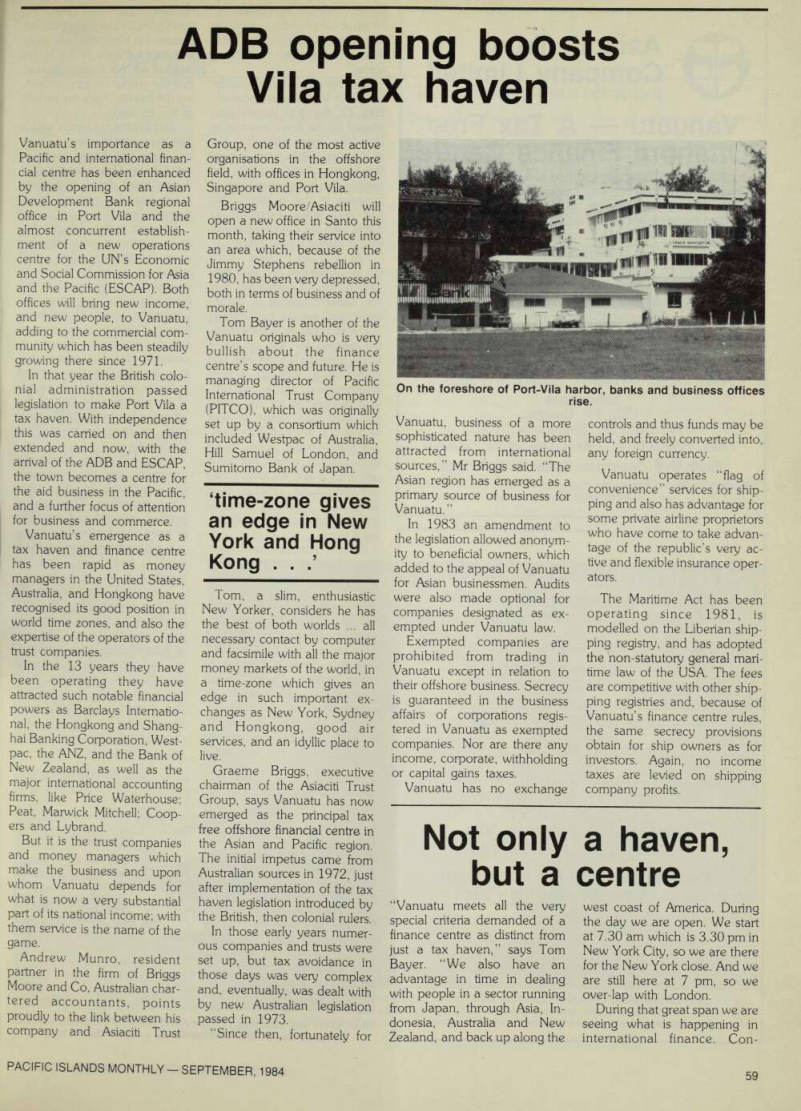
Vila tax haven
Vanuatu’s importance as a Pacific and international finan cial centre has been enhanced by the opening of an Asian Development Bank regional office in Port Vila and the almost concurrent establish ment of a new operations centre for the UN’s Economic and Social Commission for Asia and the Pacific (ESCAP). Both offices will bring new income, and new people, to Vanuatu, adding to the commercial com munity which has been steadily growing there since 1971.
In that year the British colo nial administration passed legislation to make Port Vila a tax haven. With independence this was carried on and then extended and now, with the arrival of the ADB and ESCAP, the town becomes a centre for the aid business in the Pacific, and a further focus of attention for business and commerce.
Vanuatu’s emergence as a tax haven and finance centre has been rapid as money managers in the United States, Australia, and Hongkong have recognised its good position in world time zones, and also the expertise of the operators of the trust companies.
In the 13 years they have been operating they have attracted such notable financial powers as Barclays Internatio nal, the Hongkong and Shang hai Banking Corporation, West pac, the ANZ, and the Bank of New Zealand, as well as the major international accounting firms, like Price Waterhouse; Peat, Marwick Mitchell; Coop ers and Lybrand.
But it is the trust companies and money managers which make the business and upon whom Vanuatu depends for what is now a very substantial part of its national income; with them service is the name of the game.
Andrew Munro, resident partner in the firm of Briggs Moore and Co, Australian char tered accountants, points proudly to the link between his company and Asiaciti Trust
Group, one of the most active organisations in the offshore field, with offices in Hongkong, Singapore and Port Vila.
Briggs Moore/Asiaciti will open a new office in Santo this month, taking their service into an area which, because of the Jimmy Stephens rebellion in 1980, has been very depressed, both in terms of business and of morale.
Tom Bayer is another of the Vanuatu originals who is very bullish about the finance centre’s scope and future. He is managing director of Pacific International Trust Company (PITCO), which was originally set up by a consortium which included Westpac of Australia, Hill Samuel of London, and Sumitomo Bank of Japan.
‘time-zone gives an edge in New York and Hong Kong . .
Tom, a slim, enthusiastic New Yorker, considers he has the best of both worlds ... all necessary contact by computer and facsimile with all the major money markets of the world, in a time-zone which gives an edge in such important ex changes as New York, Sydney and Hongkong, good air services, and an idyllic place to live.
Graeme Briggs, executive chairman of the Asiaciti Trust Group, says Vanuatu has now emerged as the principal tax free offshore financial centre in the Asian and Pacific region.
The initial impetus came from Australian sources in 1972, just after implementation of the tax haven legislation introduced by the British, then colonial rulers.
In those early years numer ous companies and trusts were set up, but tax avoidance in those days was very complex and, eventually, was dealt with by new Australian legislation passed in 1973.
“Since then, fortunately for
Vanuatu, business of a more sophisticated nature has been attracted from international sources,” Mr Briggs said. “The Asian region has emerged as a primary source of business for Vanuatu ”
In 1983 an amendment to the legislation allowed anonymity to beneficial owners, which added to the appeal of Vanuatu for Asian businessmen. Audits were also made optional for companies designated as exempted under Vanuatu law.
Exempted companies are prohibited from trading in Vanuatu except in relation to their offshore business. Secrecy is guaranteed in the business affairs of corporations registered in Vanuatu as exempted companies. Nor are there any income, corporate, withholding or capital gains taxes.
Vanuatu has no exchange
controls and thus funds may be held, and freely converted into, any foreign currency, w . 4 Vanuatu ? perates , fla 9 of c ? nven “ n f* menaces for ship- P in 9 ancl a5O * ias advantage for s ° me P rivate airline Proprietors f.t C ° me m advan ’ ! ase °' tbe ,ff >übllc s ver V and flexlble lnsurance °Per a ors ‘ The Maritime Act has been operating since 1981, is modelled on the Liberian ship ping registry, and has adopted the hon-statutory general mari time law of the USA. The fees are competitive with other ship ping registries and, because of Vanuatu’s finance centre rules, the same secrecy provisions obtain for ship owners as for investors. Again, no income taxes are levied on shipping company profits.
On the foreshore of Port-Vila harbor, banks and business offices rise.
Not only a haven,
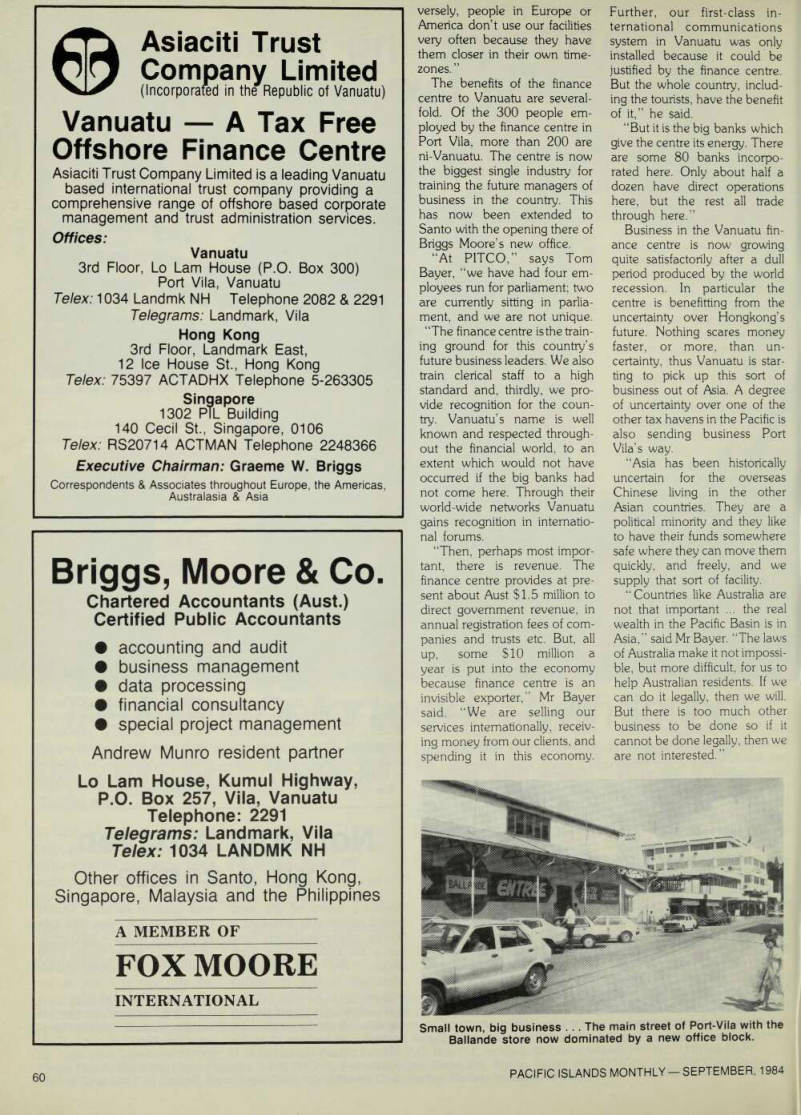
but a centre
“Vanuatu meets all the very special criteria demanded of a finance centre as distinct from just a tax haven,” says Tom Bayer. “We also have an advantage in time in dealing with people in a sector running from Japan, through Asia, Indonesia, Australia and New Zealand, and back up along the
west coast of America. During the day we are open. We start at 7.30 am which is 3.30 pm in New York City, so we are there for the New York close. And we are still here at 7 pm, so we over-lap with London, During that great span we are seeing what is happening in international finance. Con
versely, people in Europe or America don’t use our facilities very often because they have them closer in their own time zones. ”
The benefits of the finance centre to Vanuatu are several fold. Of the 300 people em ployed by the finance centre in Port Vila, more than 200 are ni-Vanuatu. The centre is now the biggest single industry for training the future managers of business in the country. This has now been extended to Santo with the opening there of Briggs Moore’s new office.
“At PITCO,” says Tom Bayer, “we have had four em ployees run for parliament; two are currently sitting in parlia ment, and we are not unique.
“The finance centre is the train ing ground for this country’s future business leaders. We also train clerical staff to a high standard and, thirdly, we pro vide recognition for the coun try. Vanuatu’s name is well known and respected through out the financial world, to an extent which would not have occurred if the big banks had not come here. Through their world-wide networks Vanuatu gains recognition in internatio nal forums.
“Then, perhaps most impor tant, there is revenue. The finance centre provides at pre sent about Aust $1.5 million to direct government revenue, in annual registration fees of com panies and trusts etc. But, all up, some $lO million a year is put into the economy because finance centre is an invisible exporter,” Mr Bayer said. “We are selling our services internationally, receiv ing money from our clients, and spending it in this economy.
Further, our first-class in ternational communications system in Vanuatu was only installed because it could be justified by the finance centre.
But the whole country, includ ing the tourists, have the benefit of it,” he said.
“But it is the big banks which give the centre its energy. There are some 80 banks incorpo rated here. Only about half a dozen have direct operations here, but the rest all trade through here.”
Business in the Vanuatu fin ance centre is now growing quite satisfactorily after a dull period produced by the world recession. In particular the centre is benefitting from the uncertainty over Hongkong’s future. Nothing scares money faster, or more, than un certainty, thus Vanuatu is star ting to pick up this sort of business out of Asia. A degree of uncertainty over one of the other tax havens in the Pacific is also sending business Port Vila’s way.
“Asia has been historically uncertain for the overseas Chinese living in the other Asian countries. They are a political minority and they like to have their funds somewhere safe where they can move them quickly, and freely, and we supply that sort of facility.
“Countries like Australia are not that important ... the real wealth in the Pacific Basin is in Asia,” said Mr Bayer. “The laws of Australia make it not impossi ble, but more difficult, for us to help Australian residents. If we can do it legally, then we will.
But there is too much other business to be done so if it cannot be done legally, then we are not interested.”
Small town, big business . . . The main street of Port-Vila with the Ballande store now dominated by a new office block.
Advertisements & other items, p. 60 (1 item)
Company Limited
Asiaciti Trust
(Incorporated in the Republic of Vanuatu
Vanuatu A Tax Free
Offshore Finance Centre
Asiaciti Trust Company Limited is a leading Vanuatu based international trust company providing a comprehensive range of offshore based corporate management and trust administration services.
Offices: Vanuatu 3rd Floor, Lo Lam House (P.O. Box 300) Port Vila, Vanuatu Telex: 1034 Landmk NH Telephone 2082 & 2291 Telegrams: Landmark, Vila Hong Kong 3rd Floor, Landmark East, 12 Ice House St., Hong Kong Telex: 75397 ACTADHX Telephone 5-263305
Singapore
1302 PIL Building 140 Cecil St., Singapore, 0106 Telex: R 520714 ACTMAN Telephone 2248366 Executive Chairman: Graeme W. Briggs Correspondents & Associates throughout Europe, the Americas, Australasia & Asia
Briggs, Moore & Co.
Chartered Accountants (Aust.) Certified Public Accountants • accounting and audit • business management • data processing • financial consultancy • special project management Andrew Munro resident partner Lo Lam House, Kumul Highway, P.O. Box 257, Vila, Vanuatu Telephone: 2291 Telegrams: Landmark, Vila Telex: 1034 LANDMK NH Other offices in Santo, Hong Kong, Singapore, Malaysia and the Philippines
A MEMBER OF
FOX MOORE
INTERNATIONAL
people
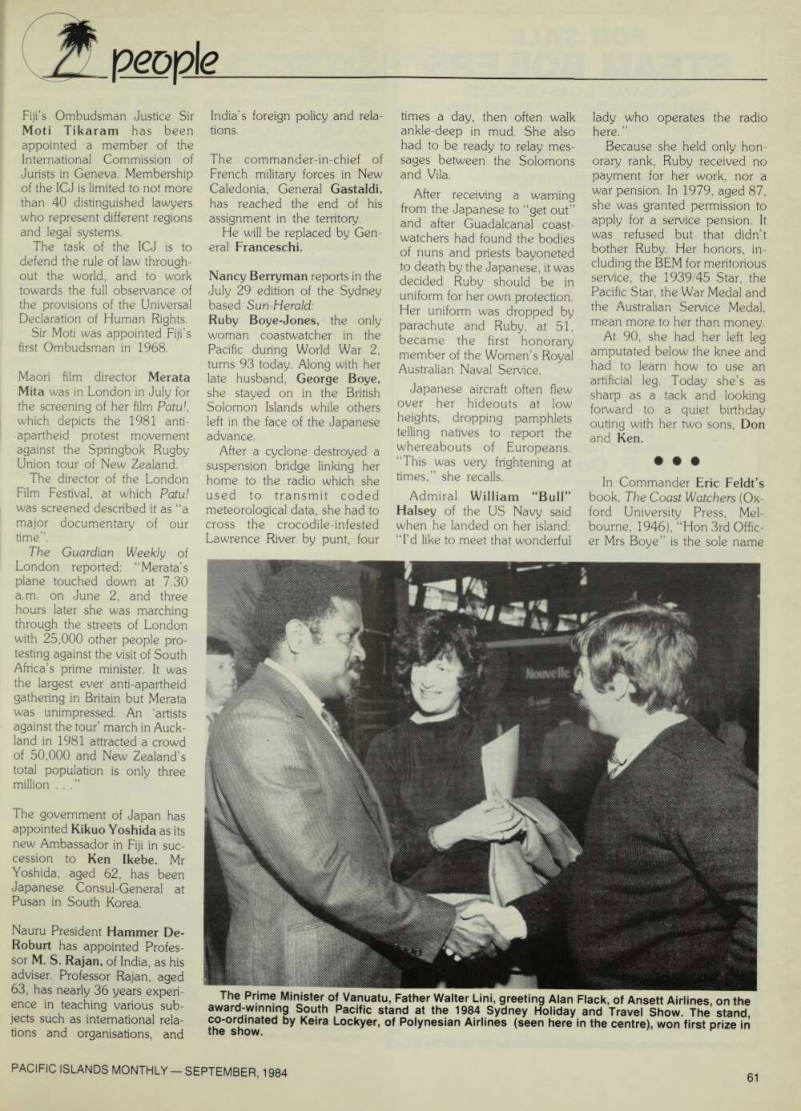

Fiji’s Ombudsman Justice Sir Moti Tikaram has been appointed a member of the International Commission of Jurists in Geneva. Membership of the ICJ is limited to not more than 40 distinguished lawyers who represent different regions and legal systems.
The task of the ICJ is to defend the rule of law through out the world, and to work towards the full observance of the provisions of the Universal Declaration of Human Rights.
Sir Moti was appointed Fiji’s first Ombudsman in 1968.
Maori film director Merata Mita was in London in July for the screening of her film Patu!, which depicts the 1981 anti apartheid protest movement against the Springbok Rugby Union tour of New Zealand.
The director of the London Film Festival, at which Patu! was screened described it as “a major documentary of our time”.
The Guardian Weekly of London reported: “Merata’s plane touched down at 7.30 a.m. on June 2, and three hours later she was marching through the streets of London with 25,000 other people pro testing against the visit of South Africa’s prime minister. It was the largest ever anti-apartheid gathering in Britain but Merata was unimpressed. An ‘artists against the tour’ march in Auck land in 1981 attracted a crowd of 50,000 and New Zealand’s total population is only three million ...”
The government of Japan has appointed Kikuo Yoshida as its new Ambassador in Fiji in suc cession to Ken Ikebe. Mr Yoshida, aged 62, has been Japanese Consul-General at Pusan in South Korea.
Nauru President Hammer De- Roburt has appointed Profes sor M. S. Rajan, of India, as his adviser. Professor Rajan, aged 63, has nearly 36 years experi ence in teaching various sub jects such as international rela tions and organisations, and
India’s foreign policy and rela tions.
The commander-in-chief of French military forces in New Caledonia, General Gastaldi, has reached the end of his assignment in the territory.
He will be replaced by Gen eral Franceschi.
Nancy Berryman reports in the July 29 edition of the Sydney based Sun-Herald: Ruby Boye-Jones, the only woman coastwatcher in the Pacific during World War 2, turns 93 today. Along with her late husband, George Boye, she stayed on in the British Solomon Islands while others left in the face of the Japanese advance.
After a cyclone destroyed a suspension bridge linking her home to the radio which she used to transmit coded meteorological data, she had to cross the crocodile-infested Lawrence River by punt, four
times a day, then often walk ankle-deep in mud. She also had to be ready to relay mes sages between the Solomons and Vila.
After receiving a warning from the Japanese to “get out” and after Guadalcanal coast watchers had found the bodies of nuns and priests bayoneted to death by the Japanese, it was decided Ruby should be in uniform for her own protection.
Her uniform was dropped by parachute and Ruby, at 51, became the first honorary member of the Women’s Royal Australian Naval Service.
Japanese aircraft often flew over her hideouts at low heights, dropping pamphlets telling natives to report the whereabouts of Europeans.
“This was very frightening at times,” she recalls.
Admiral William “Bull”
Halsey of the US Navy said when he landed on her island: “I’d like to meet that wonderful
lady who operates the radio here.”
Because she held only hon orary rank, Ruby received no payment for her work, nor a war pension. In 1979, aged 87, she was granted permission to apply for a service pension. It was refused but that didn’t bother Ruby. Her honors, in cluding the BEM for meritorious service, the 1939/45 Star, the Pacific Star, the War Medal and the Australian Service Medal, mean more to her than money.
At 90, she had her left leg amputated below the knee and had to learn how to use an artificial leg. Today she’s as sharp as a tack and looking forward to a quiet birthday outing with her two sons, Don and Ken. • • • In Commander Eric Feldt’s book, The Coast Watchers (Ox ford University Press, Mel bourne, 1946), “Hon 3rd Offic er Mrs Boye” is the sole name
The Prime Minister of Vanuatu, Father Walter Lini, greeting Alan Flack, of Ansett Airlines, on the award-winning South Pacific stand at the 1984 Sydney Holiday and Travel Show. The stand co-ordinated by Keira Lockyer, of Polynesian Airlines (seen here in the centre), won first prize in the show.
appearing in a listing of coast watchers from the Women’s Royal Australian Naval Service.
The entry records that she served at Vanikoro, Solomon Islands, from February 1942 to October 1944, and that she was awarded the BEM.
On page 108 of the book, Commander Feldt notes: “Vanikoro, three hundred miles east by south from Malaita, was in easy range.
When transmission to Vila be came difficult, this island acted as a link, the radio there being operated by Mrs Boye, wife of the manager of a timber com pany which operated there. Mrs Boye was unperturbed by the events in the Solomons and remained on Vanikoro. She was later, deservedly, appointed an Honorary Third Officer, W.R.A.N.S., and was awarded the British Empire Me dal.” PIM.
V. L. Bykova, Russia’s new non-resident Ambassador to Tonga, has presented his credentials to King Taufa’ahau Tupou IV. Mr Bykova is resi dent in Wellington as Ambassa dor to New Zealand.
Yasaburo Yamashita, 85, who designed the old Japanese hospital in Garapan, Northern Marianas, was back in Saipan in June to advise on the restora tion of the hospital.
Mr Yamashita, who still prac tices as an architect in Mie Prefecture, western Japan, said he was head architect at the pre-war Japanese government headquarters in Koror, Palau, when he was asked to design the Saipan hospital back in 1925.
It took him six months to design it, and another seven months to complete construc tion. It was designed for out patients, although a few beds were providewd for serious cases.
Mr Yamashita said after finishing the hospital job he went to Ponape to oversee construction of an agriculture building, which is still standing today.
Following an interview with the Commonwealth News Service, Mr Yamashita walked outside the public information office and counted the number of air conditioners in the main government complex. Shaking his head he said it would have been better to build “larger windows” to take advantage of the island’s tropical breezes.
“That would have saved money,” he said.
Scott Russell, deputy his toric preservation officer, said about $200,000 more was needed to complete restoration of the hospital, which could later be turned into a museum.
Dr Joaquin J. Gochoco, who has been appointed chief executive of the Asian Development Bank’s new South Pacific regional office in Port Vila.
Advertisements & other items, p. 62 (1 item)
‘Instant
FOR SALE
STEAM BOILERS
SOLID-WASTE-GAS-OIL-FUELS
18.000 Ib/h 150 psi Superior package waste-wood. 30.000 Ib/h 200 psi Babcock coal-waste 30.000 Ib/h 250 psi Babcock waste-coal. 45.000 Ib/h 425 psi Babcock coal-waste. 17.000 Ib/h 250 psi C’brook package oil-gas.
STEAM TURBO-GENERATORS up to 14000 kW
DIESEL GENERATORS
1750 kVa English Electric Skid 6.6 kV-440V Also smaller sets available K. A. GRAY & CO. Phone: 61(2) 871-8606 Box 88 P.O. BEECROFT, N.S.W. 2119. Australia TLX. AAIOIOI INTSY Attn. K. Gray Sydney
P. F. COLLIER INC.
A Subsidiary of Macmillan, Inc.
One of the world’s leading publishers is looking for a local distributor for its outstanding English language reference works:
24 Volume Collier’s Encyclopedia
20 Volume Merit Students Encyclopedia
Pre-school and children’s books also available for direct sales packages.
Interested parties should write
P. F. Collier Inc.
866 Third Avenue, New York, New York 10022
U.S.A.
ATT: R. J. QUINN
i
‘INSTANT
HOUSES’
and Commercial Buildings with Therma-Panel, R the fully insulated inter-locking Building System Cyclone rated i i George Hudson Homes (Aust.) pt y Ltd. I GH
from the islands press
From The Samoa Observer, Apia Pacific Island mothers are recording the lowest infant mortality rates of any racial grouping in West Auckland, a paper published in the New Zealand Medical Journal says.
Michael Field reports from Auckland that the paper says the reason for the low rate is that Pacific Islanders have the highest rates of breast feeding.
From “keroma’s corner” in The Times of Papua New Guinea, Boroko Outside the court house in Kundiawa last week infuriated relatives of a young girl nearly bashed her because of the manner in which she had answered questions put to her by a magistrate in court a little earlier. The girl had been the victim of a rape incident and her relatives had brought her to the authorities seeking justice. They were hoping that the culprit would be jailed and the girl and her relatives compensated for the offence. In the series of questions put to her the court asked how she felt at the time of the incident. She replied “Mi pilim swit” “felt good”.
From The Samoa Times, Apia Samoan customs will be suspended for candidates and their relatives for a period of some 45 days up to and including any election day if the Electoral Amendment Bill now before the House is passed into law. The proposed bill does not forbid dying during this period but if a close relative of a candidate should be unwise enough to end his days during these 45 days then the candidate must bury the dead relative without making any presentation of “food, beverage, money or other valuables. ”
From the Marshall Islands Journal, Majuro For the first time, 30 women from two tiny, isolated Pacific islands saw horses, cows and a river into which they ran their hands. They stayed in a condominium in Kihei on Maui, where for the first time they watched television, used a refrigerator and discovered running toilets. They rode an elevator for the first time. It carried them to the ninth floor office of the mayor. The brightly dressed women with garlands in their hair had never seen a building that tall. As with any housewife, the women from the 200 acre island of Kili in the Marshall Islands wanted to look at what may be their new home.‘lt was their first trip outside the Marshalls. . .
A letter signed by Lou Freek, Port Moresby, in the Papua New Guinea Post-Courier Can any executive of the Niugini Paper Corporation Pty Ltd, tell me why it is impossible to buy white toilet paper? Why is it only possible to buy colored toilet paper when the dye used in this paper is not bio-degradable and therefore causes pollution?
Please explain.
From “the drum” column in the Papua New Guinea Post-Courier, Port Moresby The Australian news magazine, the Bulletin, and one of its international cousins, Newsweek, are joining forces to produce one very fat weekly edition. A Port Moresby reader reckons it should be called Bullweek.
From a letter signed by Paul W. Black, Ukarumpa, in the Papua New Guinea Post-Courier, Port Moresby Quite a number of times I have seen the PNG flag and provincial flags being flown upside down. A good example of this was last year during the Western Highlands provincial day Also last April, when I was visiting two of my friends who live
near Wapenamanda. I saw the flag being used to clean the roof of the school.
From a letter signed by Charles Eaton in The Fiji Times, Suva Sir, I read with interest Ms Vasantika Patel’s call for more protection of battered wives (FT June 25). Ms Patel unfortunately has not gone far enough and has only exposed the feminine side of the problem. Would in fact the Women’s Crisis Centre cater for men who are subjected to constant verbal bashings, leading to mental anguish, depression and in some cases suicide? It is also recognised that women use a variety of dangerous and sometimes lethal missiles against husbands and lovers rather than fisticuffs normal in male to female aggression. We must welcome Ms Patel’s move for greater controls for domestic harmony. However, the problem is non-sexual: protection must be for all.
From a letter by “Manggi Madang”, Port Moresby in the Papua New Guinea Post-Courier Madang used to be a quiet and peaceful town in colonial days but not today. We, the people of Madang, are kind, peaceful and easygoing people and so is our beautiful town.
But some thick-headed hooligans from other places come to our town and make life harder for us. I therefore strongly support the Madang Provincial Government in their move to repatriate the vagrants of Sepik.
Grass Roots, in the Papua New Guinea Post-Courier, following announcement of relaxed Royal attitudes to souvenirs of Prince Charles’s August visit to PNG.
Advertisements & other items, p. 64 (1 item)
“The Professionals.”
I '■sl mi m / mI m ml re ***▼**▼ II ' ' i in 5 on ,■ ™i. **m ***
Pacific Forum Line.
At Pacific Forum Line we offer the professional shipping service to the South Pacific. And that means your reputation for reliability is in professional hands. We offer efficient containerisation to more ports, more often, with fast turnaround. With our knowledge of the Pacific, we can even help you develop export markets. So if you’re shipping to the South Pacific, protect your reputation with
the professionals.
Pacific Forum Line operates three self-sustaining vessels - “Fua Kavenga” servicing Sydney, Noumea, Lautoka, Suva, Apia, Pago Pago and Nukualofa.
“Forum New Zealand” servicing Auckland, Vila, Honiara, Lae, Port Moresby, Brisbane, Lyttelton and Napier.
“Forum Samoa” servicing Auckland, Lautoka, Suva, Apia, Pago Pago and Nukualofa.
Note: ‘MOANA RAOI’
operates a monthly feeder service from Fiji to Tuvalu and Kiribati.
AGENTS
Union Bulkships Pty Ltd, Sydney, Brisbane and Melbourne Union Maritime Services Ltd, Auckland, Tonga, Lautoka and Suva Shipping Corporation of New Zealand Ltd, Auckland, Napier and Lyttelton Pacific Forum Line Agencies Ltd, Apia Polynesian Shipping Services Inc, Pago Pago 5.A.T.0., Noumea Steamships Trading Company Ltd, Lae and Port Moresby Sullivans Ltd, Honiara Vila Agents Ltd, Vila
Pacific Forum Line
The South Pacific Shipping Professionals
FORUM LINE
FORUM LINE
political currents
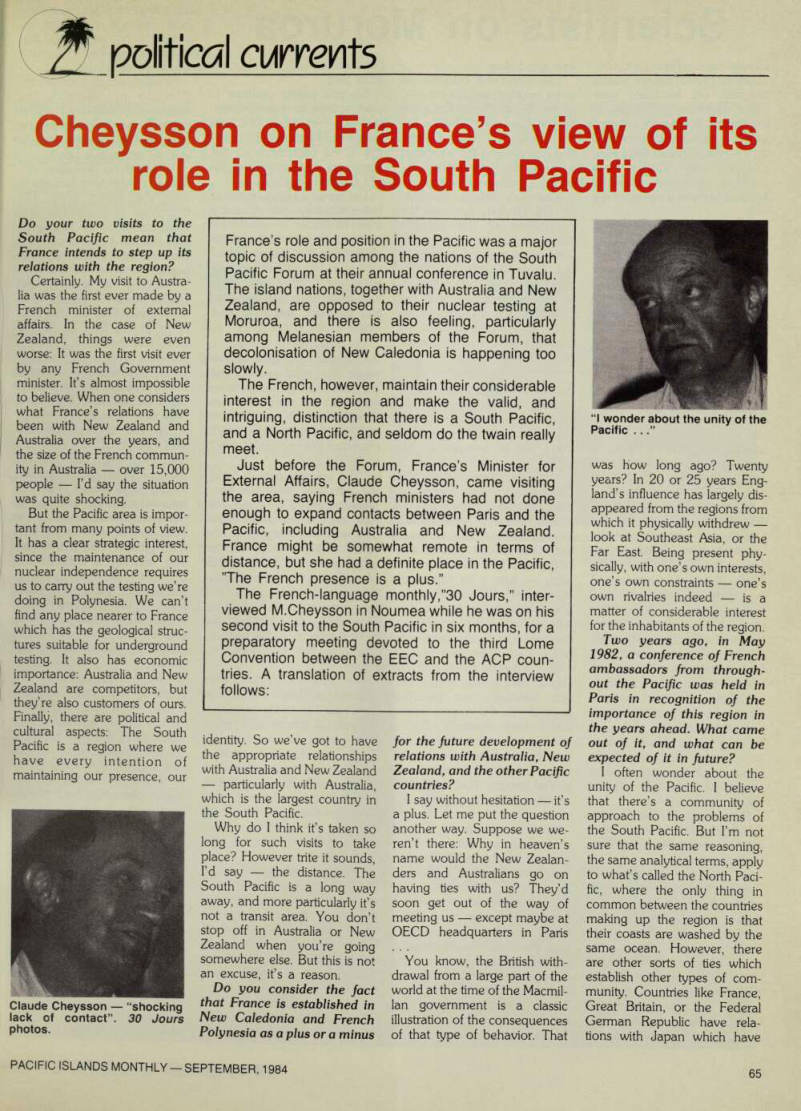
Cheysson on France’s view of its role in the South Pacific
France’s role and position in the Pacific was a major topic of discussion among the nations of the South Pacific Forum at their annual conference in Tuvalu.
The island nations, together with Australia and New Zealand, are opposed to their nuclear testing at Moruroa, and there is also feeling, particularly among Melanesian members of the Forum, that decolonisation of New Caledonia is happening too slowly.
The French, however, maintain their considerable interest in the region and make the valid, and intriguing, distinction that there is a South Pacific, and a North Pacific, and seldom do the twain really meet.
Just before the Forum, France’s Minister for External Affairs, Claude Cheysson, came visiting the area, saying French ministers had not done enough to expand contacts between Paris and the Pacific, including Australia and New Zealand.
France might be somewhat remote in terms of distance, but she had a definite place in the Pacific, ’The French presence is a plus.”
The French-language monthly,”3o Jours,” inter viewed M.Cheysson in Noumea while he was on his second visit to the South Pacific in six months, for a preparatory meeting devoted to the third Lome Convention between the EEC and the ACP coun tries. A translation of extracts from the interview follows;
Do your two visits to the South Pacific mean that France intends to step up its relations with the region?
Certainly. My visit to Austra lia was the first ever made by a French minister of external affairs. In the case of New Zealand, things were even worse: It was the first visit ever by any French Government minister. It’s almost impossible to believe. When one considers what France’s relations have been with New Zealand and Australia over the years, and the size of the French commun ity in Australia over 15,000 people I’d say the situation was quite shocking.
But the Pacific area is impor tant from many points of view.
It has a clear strategic interest, since the maintenance of our nuclear independence requires us to carry out the testing we’re doing in Polynesia. We can’t find any place nearer to France which has the geological struc tures suitable for underground testing. It also has economic importance: Australia and New Zealand are competitors, but they’re also customers of ours.
Finally, there are political and cultural aspects: The South Pacific is a region where we have every intention of maintaining our presence, our
identity. So we’ve got to have the appropriate relationships with Australia and New Zealand particularly with Australia, which is the largest country in the South Pacific.
Why do I think it’s taken so long for such visits to take place? However trite it sounds, I’d say the distance. The South Pacific is a long way away, and more particularly it’s not a transit area. You don’t stop off in Australia or New Zealand when you’re going somewhere else. But this is not an excuse, it’s a reason.
Do you consider the fact that France is established in New Caledonia and French Polynesia as a plus or a minus
for the future development of relations with Australia, New Zealand, and the other Pacific countries?
I say without hesitation it’s a plus. Let me put the question another way. Suppose we we ren’t there: Why in heaven’s name would the New Zealan ders and Australians go on having ties with us? They’d soon get out of the way of meeting us except maybe at OECD headquarters in Paris You know, the British with drawal from a large part of the world at the time of the Macmil lan government is a classic illustration of the consequences of that type of behavior. That
was How long ago? Twenty years? In 20 or 25 years Eng land’s influence has largely dis appeared from the regions from which it physically withdrew look at Southeast Asia, or the Far East. Being present phy sically, with one’s own interests, one’s own constraints one’s own rivalries indeed is a matter of considerable interest for the inhabitants of the region.
Two years ago, in May 1982, a conference of French ambassadors from through out the Pacific was held in Paris in recognition of the importance of this region in the years ahead. What came out of it, and what can be expected of it in future?
I often wonder about the unity of the Pacific. I believe that there’s a community of approach to the problems of the South Pacific. But I’m not sure that the same reasoning, the same analytical terms, apply to what’s called the North Paci fic, where the only thing in common between the countries making up the region is that their coasts are washed by the same ocean. However, there are other sorts of ties which establish other types of com munity. Countries like France, Great Britain, or the Federal German Republic have rela tions with Japan which have
Claude Cheysson - “shocking lack of contact”. 30 Jours photos.
“I wonder about the unity of the Pacific . . ."
nothing to do with the Pacific as such. They are concerned with world economic and political factors. We meet Japan at summit meetings of the in dustrialised countries, at the OECD, and sometimes at the United Nations. Relations be tween the two sides of the North Pacific Canada and the USA on one side, and Japan, Korea, and Asia on the other don’t affect the coun tries of the South Pacific at all.
So 1 hesitate to accept that France can have an overall Pacific policy, but I’m quite convinced it should have a South Pacific policy. That’s why we’re planning to have a meeting of all French repre sentatives in the South Pacific in autumn of this year. It will be concerned exclusively with the South Pacific . . .
Do you see the South Paci fic as being free of any tension arising from the East-West confrontation?
As we see things from Europe, there’s no sign of it, and I can’t see any elements in this region which might give rise to it. The Soviet Union has many problems, internal eco nomic problems, and plenty of military problems. I simply can’t see the Soviets jumping into any new adventures in this part of the world . . On their side the Americans are hyper-sensi
five to East-West tensions actually we think they’ve got some kind of allergy on the matter. But even the Americans don’t talk of tensions in this region.
I find the policy of the Fiji Government very intelligent; When Ratu Sir Kamisese Mara decided to join the group which negotiated the Lome' Conven tion, I asked him what he was doing getting involved in the affair was it for the sugar agreement? Perhaps, but he could have been part of that without joining the Lome Con vention. This is the case with India. Ratu Mara said to me; “What interests me is that Fiji should have several irons in the fire. Obviously our principal support in the region must come from Australia. But I don’t want to be entirely de pendent on Australia, however much confidence I might have in that country. This is why my relations with Europe are very important ...”
For countries like Fiji, France represents a complementary element which sustains them in their independence, and allows them to talk more easily with the big countries in the region.
Beyond the matter of maintain ing their identity, we seek to give the small Pacific states a stature sufficient for them to carry on dialogue with the very big countries of Asia without feeling scared. These are the key elements of our policy in the region . . .
Scientists on Moruroa
Despite the continuing and con troversial French nuclear testing program on Moruroa, near Tahiti, radiation in the area is well below the world average, says the report just published by the party of Australian, New Zealand and Papua New Guinea scientists recently allowed to make a survey of the atoll.
Critics of their report say they were shown only what the French felt like showing them and that their conclusions are therefore invalid. The report does say that various restric tions were placed on the in vestigation but, in general, faci lities were considered sufficient to provide the scientific team
with good data.
The report was discussed at some length during the meeting of the South Pacific Forum at Tuvalu last month. Pacific na tions generally oppose the tes ting and support the campaign to have the Pacific Basin de clared a nuclear- free zone.
Australia’s foreign minister, Mr Bill Hayden, has said the conclusions of the scientific team showed that the French were using proper safeguards, but Australia remained firmly opposed to the French testing.
Australia’s objection was not based upon any health hazard which might, or might not, be caused, but on grounds that the program contributed to the
continuation of the nuclear arms race.
Australia would continue to work actively for a comprehen sive test ban treaty and was committed to pursue this objec tive in the conference on dis armament in Geneva and the UN General Assembly.
The report is highly technical, but sufficiently clear to a lay man to show a number of criticisms of certain French claims. Yet the overall conclu sion seems to be that radiation levels are a good deal lower than might have been expected and generally less than else where in the world.
On longer-term damage to the volcanic rock under the atoll where the subterranean tests are conducted the report is less sanguine, but still of the view that leakage of contaminated materials from the detonation chambers will not occur for 500 to 1000 years.
“The volcanic core in which the tests take place has been severely altered in zones sur rounding the detonation cham bers and the integrity of the coral limestones which form the upper section of Moruroa has been impaired by Assuring, sub sidence and submarine slides,” the report said. But the balance of available data suggests the overall integrity of the volcanic structures has not been im paired.
Nor were the scientists able to detect sufficient radiation in the region to justify assertions by political groups and others that hazards to human health had been created. Indeed “maximum annual doses in Pacific islands from radioactive fallout from atmospheric tests have remained less than one tenth the world average annual natural radiation exposure,” the report says.
“Ambient radiation levels in the base accommodation area of Moruroa atoll are generally lower than they are elsewhere in the world, and traces of fallout from atmospheric tests are detectable only at levels far below those of health signi ficance.
“Radiation doses to the French Polynesian population from natural radiation, and fall
out radioactivity are lower than world average levels, and do not lead to any expectation that radiation-induced diseases would be detectable.
“Cancer statistics for the re gion do not support any suggestion of elevated rates for types of cancer which might be associated with excessive expo sure to radioactive fallout.
“There is no geological evi dence of short-term leakage to date,’’the report says. The hydrology of limestones and volcanics is such as to suggest that leakage could occur in a time period of 500 to 1000 years.
“Venting of gaseous and volatile fission products from the underground test sites does occur at the time of detona tion,” said the report. “There is evidence that the amount is greater than would be expected simply through the back-pack ing of the placement bore being ‘less than perfect.’
“At the underground test sites water is available for leaching the radio-active material (which can be equated to high-level waste). Mechan isms exist for the transport of this contaminated water to the biosphere at least in the long term (greater than 500 years).
The radiological consequence of this leakage depends markedly on the depth of place ment of the weapons tested, and on their relative placement, one test to another. Precise details of placement are not known.
“Waste management at Moruroa was poor,” said the report. “It is now very good.
Only small quantities of radioactivity are now routinely discharged and they are not radiologically significant.
“There is transfer of dis solved plutonium from the la goon to the ocean; it is of only minor radiological importance. ”
The scientific team spent two months examining the environ mental and health aspects of the testing, at the invitation of the French government.
The report will not change Pacific attitudes towards the testing, although it is expected to take some of the fire out of the anti-nuclear campaign by reason of the report’s conclu sions that cancer rates are not increased, and that public health is not at risk.
yachts
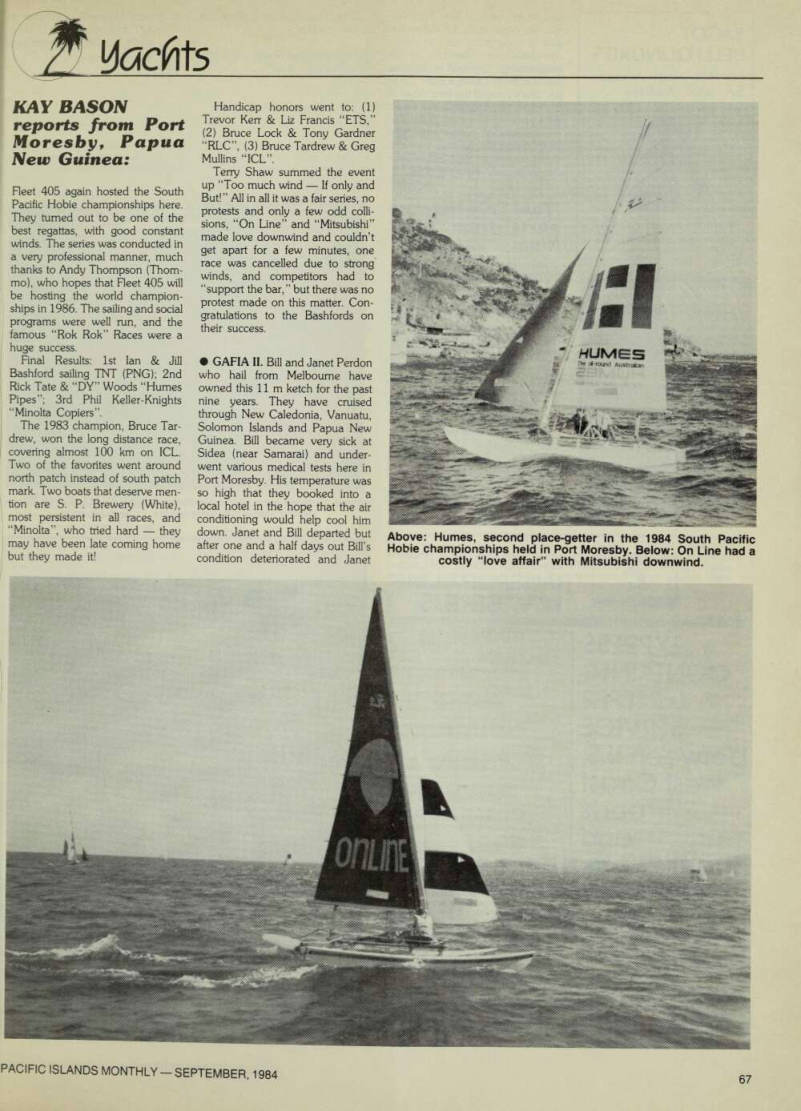
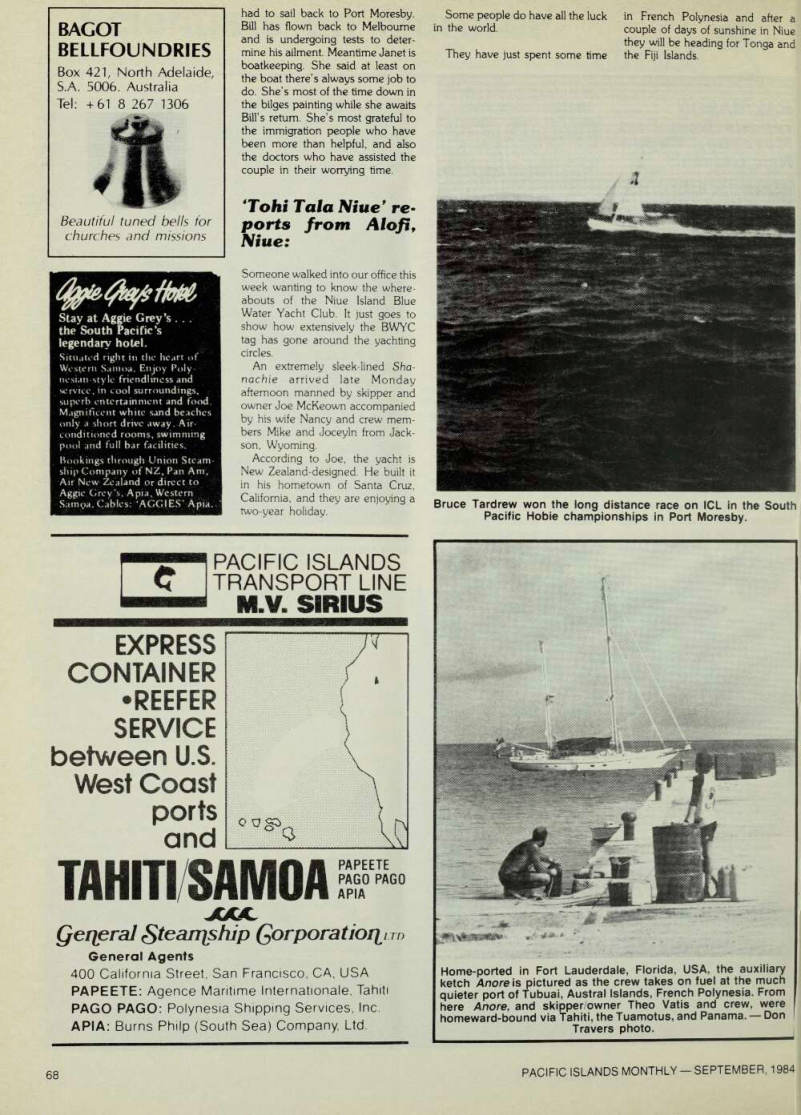
Kay Bason
reports from Port
Moresby, Papua
New Guinea:
Fleet 405 again hosted the South Pacific Hobie championships here.
They turned out to be one of the best regattas, with good constant winds. The series was conducted in a very professional manner, much thanks to Andy Thompson (Thom mo), who hopes that Heet 405 will be hosting the world champion ships in 1986. The sailing and social programs were well run, and the famous “Rok Rok” Races were a huge success.
Final Results: Ist lan & Jill Bashford sailing TNT (PNG); 2nd Rick Tate & “DY” Woods “Humes Pipes”; 3rd Phil Keller-Knights “Minolta Copiers”.
The 1983 champion, Bruce Tar drew, won the long distance race, covering almost 100 km on ICL.
Two of the favorites went around north patch instead of south patch mark. Two boats that deserve men tion are S. P. Brewery (White), most persistent in all races, and “Minolta”, who tried hard they may have been late coming home but they made it!
Handicap honors went to: (1) Trevor Kerr & Liz Francis “ETS,” (2) Bruce Lock & Tony Gardner “RLC”, (3) Bruce Tardrew & Greg Mullins “ICL”.
Terry Shaw summed the event up “Too much wind If only and But! ” All in all it was a fair series, no protests and only a few odd colli sions, “On Line” and “Mitsubishi” made love downwind and couldn’t get apart for a few minutes, one race was cancelled due to strong winds, and competitors had to “support the bar, ” but there was no protest made on this matter. Con gratulations to the Bashfords on their success. • GAFIA 11. Bill and Janet Perdon who hail from Melbourne have owned this 11m ketch for the past nine years. They have cruised through New Caledonia, Vanuatu, Solomon Islands and Papua New Guinea. Bill became very sick at Sidea (near Samarai) and under went various medical tests here in Port Moresby. His temperature was so high that they booked into a local hotel in the hope that the air conditioning would help cool him down. Janet and Bill departed but after one and a half days out Bill’s condition deteriorated and Janet
Above: Humes, second place-getter In the 1984 South Pacific Hobie championships held in Port Moresby. Below: On Line had a costly “love affair” with Mitsubishi downwind.
had to sail back to Port Moresby.
Bill has flown back to Melbourne and is undergoing tests to deter mine his ailment. Meantime Janet is boatkeeping. She said at least on the boat there’s always some job to do. She’s most of the time down in the bilges painting while she awaits Bill’s return. She’s most grateful to the immigration people who have been more than helpful, and also the doctors who have assisted the couple in their worrying time.
*Tohi Tala Niue 9 re
ports from Alofi ,
Niue:
Someone walked into our office this week wanting to know the where abouts of the Niue Island Blue Water Yacht Club. It just goes to show how extensively the BWYC tag has gone around the yachting circles.
An extremely sleek-lined Sha nachie arrived late Monday afternoon manned by skipper and owner Joe McKeown accompanied by his wife Nancy and crew mem bers Mike and Joceyln from Jack son. Wyoming.
According to Joe, the yacht is New Zealand-designed. He built it in his hometown of Santa Cruz, California, and they are enjoying a two-year holiday.
Some people do have all the luck in the world.
They have just spent some time
in French Polynesia and after a couple of days of sunshine in Niue they will be heading for Tonga and the Fiji Islands.
Bruce Tardrew won the long distance race on ICL in the South Pacific Hobie championships in Port Moresby.
Home-ported in Fort Lauderdale, Florida, USA, the auxiliary ketch Anore is pictured as the crew takes on fuel at the much quieter port of Tubuai, Austral Islands, French Polynesia. From here Anore , and skipper owner Theo Vatis and crew, were homeward-bound via Tahiti, the Tuamotus, and Panama. - Don Travers photo.
Advertisements & other items, p. 68 (1 item)
Tahitisamoa 5™
BAGOT
BELLFOUNDRIES
Box 421, North Adelaide, S.A. 5006. Australia Tel: +6l 8 267 1306 Beautiful tuned bells for churches and missions
Stay at Aggie Grey’s . . . the South Pacific’s legendary hotel.
Situated right in the heart of Western Samoa. Enjoy Poly nesian-style friendliness and service, in cool surroundings, superb entertainment and food.
Magnificent white sand beaches only a short drive away. Airconditioned rooms, swimming pool and full bar facilities. bookings through Union Steamship Company of NZ, Pan Am , Air New Zealand or direct to Aggie Grey’s, Apia, Western Samoa. Cables: “AGGIES' Apia.
c
PACIFIC ISLANDS
TRANSPORT LINE
M.V. SIRIUS
EXPRESS
CONTAINER
•REEFER
SERVICE
between U.S.
West Coast ports and
TAHITISAMOA 5™
JUUL
Qeqeral Steairfship (Corpora t un General Agents 400 California Street, San Francisco, CA, USA PAPEETE: Agence Maritime Internationale, Tahiti PAGO PAGO: Polynesia Shipping Services, Inc.
APIA: Burns Philp (South Sea) Company, Ltd.
shipping schedules
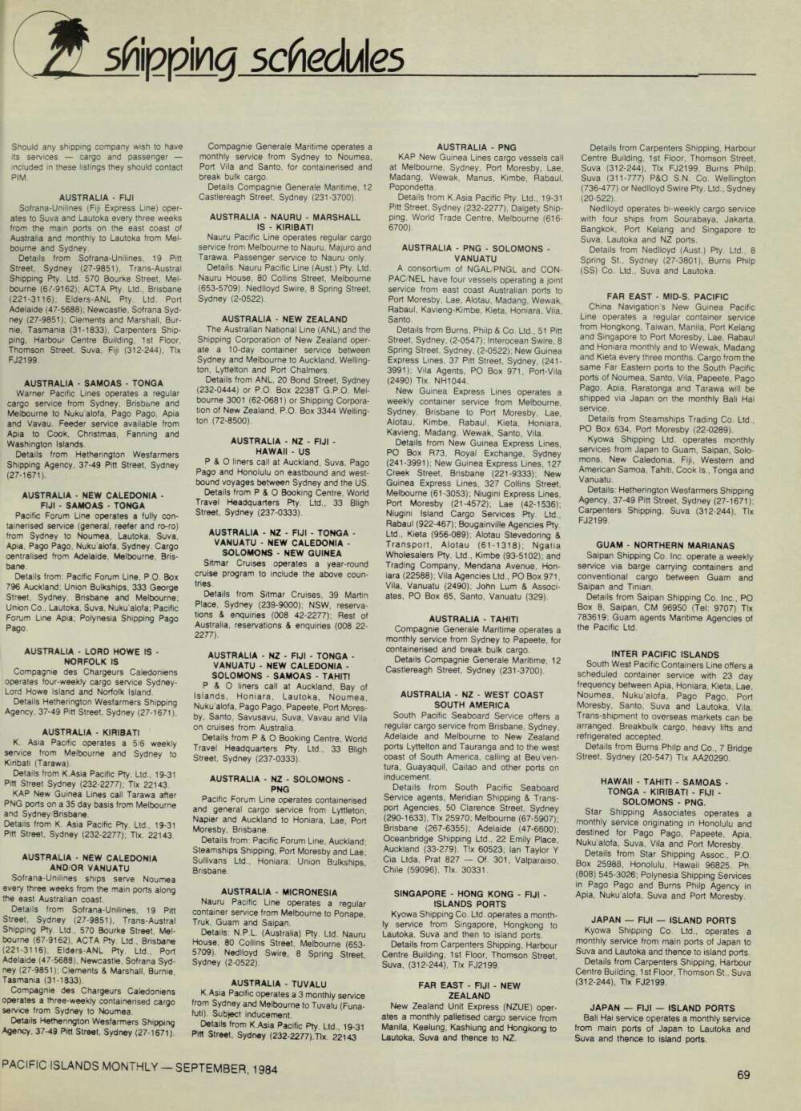
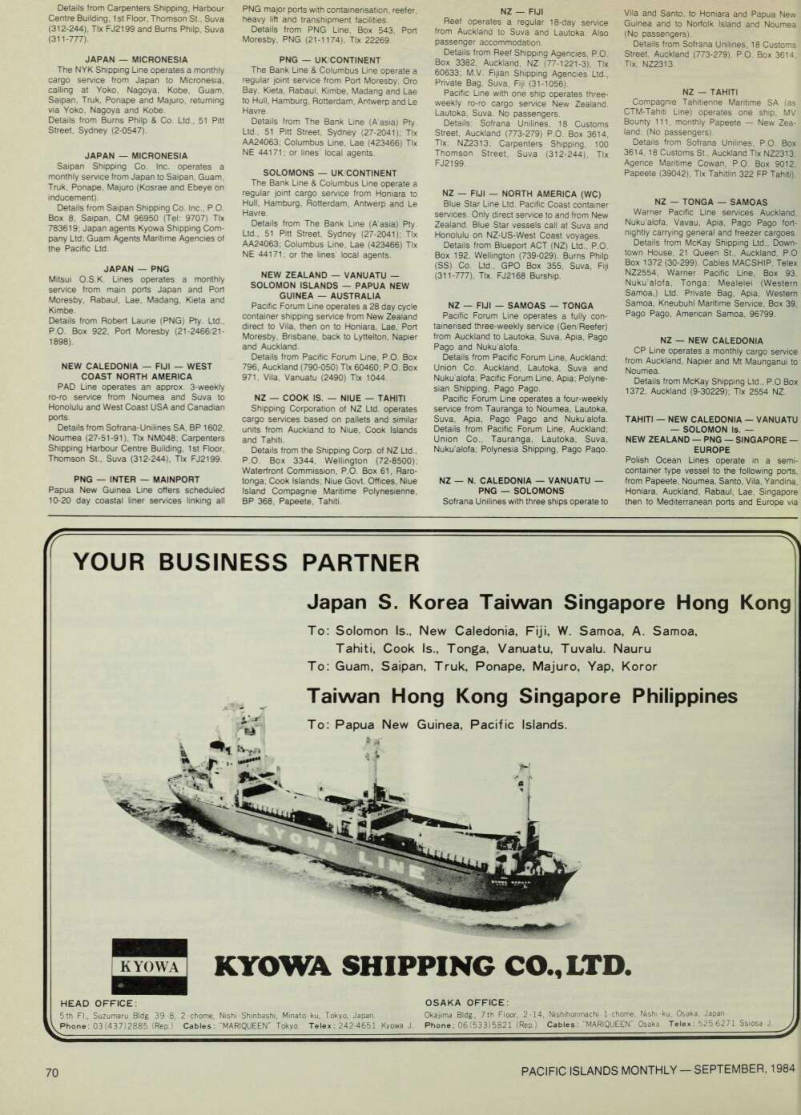
Should any shipping company wish to have its services cargo and passenger included in these listings they should contact
Pim.
Australia - Fiji
Sofrana-Unilines (Fiji Express Line) oper ates to Suva and Lautoka every three weeks from the main ports on the east coast of Australia and monthly to Lautoka from Mel bourne and Sydney.
Details from Sofrana-Unilines, 19 Pitt Street, Sydney (27-9851), Trans-Austral Shipping Pty. Ltd. 570 Bourke Street, Mel bourne (6/-9162); ACTA Pty. Ltd., Brisbane (221-3116): Elders-ANL Pty, Ltd. Port Adelaide (47-5688); Newcastle, Sofrana Syd ney (27-9851); Clements and Marshall, Bur nie, Tasmania (31-1833), Carpenters Ship ping, Harbour Centre Building, Ist Floor, Thomson Street, Suva, Fiji (312-244), Tlx FJ2199.
Australia - Samoas - Tonga
Warner Pacific Lines operates a regular cargo service from Sydney, Brisbane and Melbourne to Nukualofa, Pago Pago, Apia and Vavau. Feeder service available from Apia to Cook, Christmas, Fanning and Washington Islands.
Details from Hetherington Wesfarmers Shipping Agency, 37-49 Pitt Street, Sydney (27-1671).
Australia - New Caledonia •
Fiji - Samoas • Tonga
Pacific Forum Line operates a fully con tainerised service (general, reefer and ro-ro) from Sydney to Noumea, Lautoka, Suva, Apia, Pago Pago, Nukualofa, Sydney. Cargo centralised from Adelaide, Melbourne, Bris bane.
Details from; Pacific Forum Line, P.O. Box 796 Auckland; Union Bulkships, 333 George Street, Sydney, Brisbane and Melbourne; Union Co., Lautoka, Suva, Nukualofa; Pacific Forum Line Apia; Polynesia Shipping Pago Pago.
Australia - Lord Howe Is -
Norfolk Is
Compagnie des Chargeurs Caledonians operates four-weekly cargo service Sydney- Lord Howe Island and Norfolk Island.
Details Hetherington Wesfarmers Shipping Agency, 37-49 Pitt Street, Sydney (27-1671).
Australia - Kiribati
K. Asia Pacific operates a 5/6 weekly service from Melbourne and Sydney to Kiribati (Tarawa).
Details from K.Asia Pacific Pty. Ltd., 19-31 Pitt Street Sydney (232-2277); Tlx 22143.
KAP New Guinea Lines call Tarawa after PNG ports on a 35 day basis from Melbourne and Sydney Brisbane.
Details from K. Asia Pacific Pty. Ltd., 19-31 Pitt Street, Sydney (232-2277); Tlx. 22143.
Australia - New Caledonia
And Or Vanuatu
Sofrana-Unilines ships serve Noumea every three weeks from the main ports along the east Australian coast.
Details from Sofrana-Unilines, 19 Pitt Street, Sydney (27-9851), Trans-Austral Shipping Pty. Ltd., 570 Bourke Street. Mel bourne (67-9162), ACTA Pty, Ltd., Bnsbane (221-3116), Elders-ANL Pty. Ltd., Port Adelaide (47-5688), Newcastle, Sofrana Syd ney (27-9851); Clements 4 Marshall, Burnie, Tasmania (31-1833).
Compagnie des Chargeurs Caledoniens
operates a three-weekly containerised cargo service from Sydney to Noumea.
Details Hethenngton Wesfarmers Shipping Agency. 37-49 Pitt Street, Sydney (27-1671).
Compagnie Generate Maritime operates a monthly service from Sydney to Noumea, Port Vila and Santo, for containerised and break bulk cargo.
Details Compagnie Generate Maritime, 12 Castlereagh Street, Sydney (231-3700).
Australia - Nauru - Marshall
Is - Kiribati
Nauru Pacific Line operates regular cargo service from Melbourne to Nauru, Majuro and Tarawa. Passenger service to Nauru only.
Details: Nauru Pacific Line (Aust.) Pty. Ltd.
Nauru House, 80 Collins Street, Melbourne (653-5709). Nedlloyd Swire, 8 Spring Street, Sydney (2-0522).
Australia - New Zealand
The Australian National Line (ANL) and the Shipping Corporation of New Zealand oper ate a 10-day container service between Sydney and Melbourne to Auckland, Welling ton, Lyttelton and Port Chalmers.
Details from ANL, 20 Bond Street, Sydney (232-0444) or P.O. Box 2238 T G.P.O. Mel bourne 3001 (62-0681) or Shipping Corpora tion of New Zealand, P.O. Box 3344 Welling ton (72-8500).
Australia - Nz - Fiji -
Hawaii - Us
P 4 O liners call at Auckland, Suva. Pago Pago and Honolulu on eastbound and west bound voyages between Sydney and the US.
Details from P 4 O Booking Centre, World Travel Headquarters Pty. Ltd., 33 Bligh Street, Sydney (237-0333).
AUSTRALIA - NZ - FIJI - TONGA -
Vanuatu - New Caledonia -
Solomons - New Guinea
Sitmar Cruises operates a year-round cruise program to include the above coun tries.
Details from Sitmar Cruises, 39 Martin Place, Sydney (239-9000); NSW, reserva tions 4 enquiries (008 42-2277); Rest of Australia, reservations 4 enquiries (008 22- 2277).
AUSTRALIA - NZ - FIJI - TONGA -
Vanuatu - New Caledonia -
Solomons - Samoas - Tahiti
P 4 O liners call at Auckland, Bay of Islands, Honiara, Lautoka, Noumea, Nukualofa, Pago Pago, Papeete, Port Mores by, Santo, Savusavu, Suva, Vavau and Vila on cruises from Australia.
Details from P 4 O Booking Centre, World Travel Headquarters Pty. Ltd., 33 Bligh Street, Sydney (237-0333).
Australia - Nz - Solomons -
Png
Pacific Forum Line operates containerised and general cargo service from Lyttleton, Napier and Auckland to Honiara, Lae, Port Moresby, Brisbane.
Details from: Pacific Forum Line, Auckland: Steamships Shipping, Port Moresby and Lae; Sullivans Ltd., Honiara; Union Bulkships, Brisbane.
Australia - Micronesia
Nauru Pacific Line operates a regular container service from Melbourne to Ponape, Truk. Guam and Saipan.
Details: N.P.L. (Australia) Pty. Ltd. Nauru House, 80 Collins Street, Melbourne (653- 5709). Nedlloyd Swire, 8 Spring Street Sydney (2-0522).
Australia - Tuvalu
K.Asia Pacific operates a 3 monthly service from Sydney and Melbourne to Tuvalu (Funa futi). Subject inducement.
Details from K.Asia Pacific Pty. Ltd., 19-31 Pitt Street, Sydney (232-2277).T1x, 22143
Australia - Png
KAP New Guinea Lines cargo vessels call at Melbourne, Sydney, Port Moresby, Lae, Madang, Wewak, Manus, Kimbe, Rabaul, Popondetta.
Details from K.Asia Pacific Pty. Ltd., 19-31 Pitt Street, Sydney (232-2277), Dalgety Ship ping, World Trade Centre, Melbourne (616- 6700).
Australia - Png - Solomons -
Vanuatu
A consortium of NGAL/PNGL and CON PAC/NEL have four vessels operating a joint service from east coast Australian ports to Port Moresby, Lae, Alotau, Madang, Wewak, Rabaul, Kavieng-Kimbe, Kieta, Honiara, Vila, Santo.
Details from Burns, Philp & Co. Ltd., 51 Pitt Street, Sydney, (2-0547); Interocean Swire, 8 Spring Street, Sydney, (2-0522); New Guinea Express Lines, 37 Pitt Street, Sydney, (241- 3991); Vila Agents, PO Box 971, Port-Vila (2490) Tlx. NH1044.
New Guinea Express Lines operates a weekly container service from Melbourne, Sydney, Brisbane to Port Moresby, Lae, Alotau, Kimbe, Rabaul, Kieta, Honiara, Kavieng, Madang, Wewak. Santo, Vila.
Details from New Guinea Express Lines, PO Box R 73, Royal Exchange, Sydney (241-3991); New Guinea Express Lines, 127 Creek Street, Brisbane (221-9333): New Guinea Express Lines, 327 Collins Street, Melbourne (61-3053); Niugini Express Lines, Port Moresby (21-4572); Lae (42-1536): Niugini Island Cargo Services Pty. Ltd., Rabaul (922-467); Bougainville Agencies Pty Ltd., Kieta (956-089); Alotau Stevedoring & Transport. Alotau (61-1318), Ngatia Wholesalers Pty. Ltd., Kimbe (93-5102); and Trading Company. Mendana Avenue, Hon iara (22588); Vila Agencies Ltd., PO Box 971, Vila, Vanuatu (2490); John Lum & Associ ates, PO Box 65, Santo, Vanuatu (329)
Australia - Tahiti
Compagnie Generate Maritime operates a monthly service from Sydney to Papeete, for containerised and break bulk cargo.
Details Compagnie Generate Maritime, 12 Castlereagh Street, Sydney (231-3700),
Australia - Nz - West Coast
South America
South Pacific Seaboard Service offers a regular cargo service from Brisbane, Sydney, Adelaide and Melbourne to New Zealand ports Lyttelton and Tauranga and to the west coast of South America, calling at Beu’ven tura, Guayaquil, Cailao and other ports on inducement.
Details from South Pacific Seaboard Service agents, Meridian Shipping & Trans port Agencies, 50 Clarence Street, Sydney (290-1633), Tlx 25970; Melbourne (67-5907); Brisbane (267-6355); Adelaide (47-6600); Oceanbridge Shipping Ltd., 22 Emily Place, Auckland (33-279), Tlx 60523; lan Taylor V Cia Ltda, Prat 827 Of. 301, Valparaiso, Chile (59096), Tlx. 30331.
SINGAPORE - HONG KONG - FIJI -
Islands Ports
Kyowa Shipping Co. Ltd. operates a month ly service from Singapore, Hongkong to Lautoka, Suva and then to island ports.
Details from Carpenters Shipping, Harbour Centre Building, Ist Floor, Thomson Street, Suva, (312-244), Tlx FJ2199,
Far East - Fiji - New
Zealand
New Zealand Unit Express (NZUE) oper ates a monthly palletised cargo service from Manila, Keelung, Kashiung and Hongkong to Lautoka, Suva and thence to NZ.
Details from Carpenters Shipping, Harbour Centre Building, Ist Floor, Thomson Street, Suva (312-244), Tlx FJ2199, Burns Philp, Suva (311-777) P&O S.N. Co. Wellington (736-477) or Nedlloyd Swire Pty. Ltd., Sydney (20-522).
Nedlloyd operates bi-weekly cargo service with four ships from Sourabaya, Jakarta, Bangkok, Pori Kelang and Singapore to Suva, Lautoka and NZ ports.
Details from Nedlloyd (Aust.) Pty. Ltd., 8 Spring St., Sydney (27-3801), Burns Philp (SS) Co. Ltd., Suva and Lautoka.
Far East - Mid-S. Pacific
China Navigation's New Guinea Pacific Line operates a regular container service from Hongkong, Taiwan, Manila, Port Kelang and Singapore to Port Moresby, Lae, Rabaul and Honiara monthly and to Wewak, Madang and Kieta every three months. Cargo from the same Far Eastern ports to the South Pacific ports of Noumea, Santo, Vila, Papeete, Pago Pago, Apia, Raratonga and Tarawa will be shipped via Japan on the monthly Bali Hai service.
Details from Steamships Trading Co. Ltd..
PO Box 634, Port Moresby (22-0289).
Kyowa Shipping Ltd. operates monthly services from Japan to Guam, Saipan, Solo mons, New Caledonia, Fiji, Western and American Samoa, Tahiti, Cook Is., Tonga and Vanuatu.
Details: Hetherington Wesfarmers Shipping Agency, 37-49 Pitt Street, Sydney (27-1671); Carpenters Shipping, Suva (312-244), Tlx FJ2199.
Guam - Northern Marianas
Saipan Shipping Co. Inc. operate a weekly service via barge carrying containers and conventional cargo between Guam and Saipan and Tinian.
Details from Saipan Shipping Co. Inc., PO Box 8, Saipan, CM 96950 (Tel; 9707) Tlx 783619; Guam agents Maritime Agencies of the Pacific Ltd.
Inter Pacific Islands
South West Pacific Containers Line offers a scheduled container service with 23 day frequency between Apia, Honiara, Kieta, Lae, Noumea, Nukualofa, Pago Pago, Port Moresby, Santo, Suva and Lautoka, Vila.
Trans-shipment to overseas markets can be arranged. Breakbulk cargo, heavy lifts and refrigerated accepted.
Details from Burns Philp and Co., 7 Bridge Street, Sydney (20-547) Tlx AA20290.
Hawaii - Tahiti - Samoas -
Tonga - Kiribati - Fiji -
Solomons - Png.
Star Shipping Associates operates a monthly service originating in Honolulu and destined for Pago Pago, Papeete, Apia, Nukualofa, Suva, Vila and Port Moresby, Details from Star Shipping Assoc., P.O.
Box 25988, Honolulu, Hawaii 96825. Ph, (808) 545-3026; Polynesia Shipping Services in Pago Pago and Burns Philp Agency in Apia, Nukualofa, Suva and Port Moresby.
Japan Fiji Island Ports
Kyowa Shipping Co. Ltd., operates a monthly service from main ports of Japan to Suva and Lautoka and thence to island ports.
Details from Carpenters Shipping, Harbour Centre Building, Ist Floor, Thomson St., Suva (312-244), Tlx FJ2199.
Japan Fiji Island Ports
Bali Hai service operates a monthly service from main ports of Japan to Lautoka and Suva and thence to island ports.
Details from Carpenters Shipping, Harbour Centre Building, Ist Floor, Thomson St., Suva (312-244), Tlx FJ2199 and Burns Philp, Suva (311-777).
Japan Micronesia
The NYK Shipping Line operates a monthly cargo service from Japan to Micronesia, calling at Yoko, Nagoya, Kobe, Guam, Saipan, Truk, Ponape and Majuro, returning via Yoko, Nagoya and Kobe.
Details from Burns Philp & Co. Ltd., 51 Pitt Street, Sydney (2-0547).
Japan Micronesia
Saipan Shipping Co. Inc. operates a monthly service from Japan to Saipan, Guam, Truk, Ponape, Majuro (Kosrae and Ebeye on inducement).
Details from Saipan Shipping Co. Inc., P.O.
Box 8, Saipan, CM 96950 (Tel: 9707) Tlx 783619; Japan agents Kyowa Shipping Com pany Ltd; Guam Agents Maritime Agencies of the Pacific Ltd.
Japan Png
Mitsui O.S.K. Lines operates a monthly service from main ports Japan and Port Moresby, Rabaul, Lae, Madang, Kieta and Kimbe.
Details from Robert Laurie (PNG) Pty. Ltd., P.O. Box 922. Port Moresby (21-2466/21- 1898).
New Caledonia Fiji West
Coast North America
PAD Line operates an approx. 3-weekly ro-ro service from Noumea and Suva to Honolulu and West Coast USA and Canadian ports.
Details from Sofrana-Unilines SA, BP 1602, Noumea (27-51-91), Tlx NMO4B; Carpenters Shipping Harbour Centre Building, Ist Floor.
Thomson St., Suva (312-244), Tlx FJ2199.
Png Inter Mainport
Papua New Guinea Line offers scheduled 10-20 day coastal liner services linking all
PNG major ports with containerisation, reefer, heavy lift and transhipment facilities.
Details from PNG Line, Box 543, Port Moresby, PNG (21-1174), Tlx 22269,
Png Uk Continent
The Bank Line & Columbus Line operate a regular joint service from Port Moresby, Oro Bay, Kieta, Rabaul, Kimbe, Madang and Lae to Hull, Hamburg, Rotterdam, Antwerp and Le Havre.
Details from The Bank Line (A’asia) Pty.
Ltd., 51 Pitt Street, Sydney (27-2041); Tlx AA24063; Columbus Line, Lae (423466) Tlx NE 44171; or lines' local agents.
Solomons Uk Continent
The Bank Line & Columbus Line operate a regular joint cargo service from Honiara to Hull, Hamburg, Rotterdam, Antwerp and Le Havre.
Details from The Bank Line (A'asia) Pty.
Ltd., 51 Pitt Street, Sydney (27-2041); Tlx AA24063; Columbus Line, Lae (423466) Tlx NE 44171; or the lines' local agents.
New Zealand Vanuatu
Solomon Islands Papua New
Guinea Australia
Pacific Forum Line operates a 28 day cycle container shipping service from New Zealand direct to Vila, then on to Honiara, Lae, Port Moresby, Brisbane, back to Lyttelton, Napier and Auckland.
Details from Pacific Forum Line, P.O. Box 796, Auckland (790-050) Tlx 60460; P.O. Box 971, Vila, Vanuatu (2490) Tlx 1044.
Nz Cook Is. Niue Tahiti
Shipping Corporation of NZ Ltd. operates cargo services based on pallets and similar units from Auckland to Niue, Cook Islands and Tahiti.
Details from the Shipping Corp. of NZ Ltd., P.O. Box 3344, Wellington (72-8500); Waterfront Commission. P.O. Box 61, Raro tonga; Cook Islands; Niue Govt. Offices, Niue Island Compagnie Maritime Polynesienne, BP 368, Papeete. Tahiti.
Nz Fiji
Reef operates a regular 18-day service from Auckland to Suva and Lautoka. Also passenger accommodation.
Details from Reef Shipping Agencies, P.O.
Box 3382, Auckland, NZ (77-1221-3), Tlx 60633: M.V. Fijian Shipping Agencies Ltd., Private Bag. Suva, Fiji (31-1056).
Pacific Line with one ship operates three weekly ro-ro cargo service New Zealand.
Lautoka, Suva. No passengers.
Details: Sofrana Unilines, 18 Customs Street, Auckland (773-279) P.O. Box 3614, Tlx: NZ2313; Carpenters Shipping, 100 Thomson Street, Suva (312-244), Tlx FJ2199.
Nz Fiji North America (Wc)
Blue Star Line Ltd. Pacific Coast container services. Only direct service to and from New Zealand. Blue Star vessels call at Suva and Honolulu on NZ-US-West Coast voyages.
Details from Blueport ACT (NZ) Ltd.. P.O.
Box 192, Wellington (739-029). Burns Philp (SS) Co. Ltd., GPO Box 355, Suva, Fiji (311-777), Tlx. FJ2168 Burship.
Nz Fiji Samoas Tonga
Pacific Forum Line operates a fully con tainerised three-weekly service (Gen/Reefer) from Auckland to Lautoka, Suva, Apia, Pago Pago and Nuku'alofa.
Details from Pacific Forum Line, Auckland; Union Co. Auckland, Lautoka, Suva and Nuku'alofa; Pacific Forum Line, Apia; Polyne sian Shipping, Pago Pago.
Pacific Forum Line operates a four-weekly service from Tauranga to Noumea, Lautoka, Suva, Apia, Pago Pago and Nuku'alofa.
Details from Pacific Forum Line, Auckland; Union Co., Tauranga, Lautoka, Suva, Nuku’alofa; Polynesia Shipping, Pago Pago.
Nz N. Caledonia Vanuatu
Png Solomons
Sofrana Unilines with three ships operate to
Vila and Santo, to Honiara and Papua New Guinea and to Norfolk Island and Noumea (No passengers).
Details from Sofrana Unilines, 18 Customs Street, Auckland (773-279), P.O. Box 3614, Tlx. NZ2313.
Nz Tahiti
Compagnie Tahitienne Maritime SA (as CTM-Tahiti Line) operates one ship, MV Bounty 111, monthly Papeete New Zea land. (No passengers).
Details from Sofrana Unilines, P.O. Box 3614, 18 Customs St., Auckland Tlx NZ2313; Agence Maritime Cowan, P.O. Box 9012, Papeete (39042), Tlx Tahitlin 322 FP Tahiti).
Nz Tonga Samoas
Warner Pacific Line services Auckland, Nukualofa, Vavau, Apia, Pago Pago fort nightly carrying general and freezer cargoes.
Details from McKay Shipping Ltd., Down town House, 21 Queen St., Auckland, P.O Box 1372 (30-299). Cables MACSHIP, Telex NZ2554, Warner Pacific Line, Box 93, Nuku'alofa, Tonga; Mealelei (Western Samoa,) Ltd. Private Bag, Apia, Western Samoa, Kneubuhl Maritime Service, Box 39, Pago Pago, American Samoa, 96799.
Nz New Caledonia
CP Line operates a monthly cargo service from Auckland, Napier and Mt Maunganui to Noumea.
Details from McKay Shipping Ltd., P.O Box 1372, Auckland (9-30229); Tlx 2554 NZ.
Tahiti New Caledonia Vanuatu
Solomon Is.
New Zealand Png Singapore -
Europe
Polish Ocean Lines operate in a semi container type vessel to the following ports, from Papeete, Noumea, Santo, Vila, Yandina, Honiara, Auckland, Rabaul, Lae, Singapore then to Mediterranean ports and Europe via
the Suez Canal. (Other New Zealand ports subject to inducement).
Details from Universal Shipping Agencies Ltd., 85 Fort Street, Auckland, New Zealand (30931) Tlx. 21517.
Europe Tahiti
New Caledonia
Compagnie Generale Maritime operates services from Europe and Mediterranean ports to Papeete and Noumea using three ro-ro and multi-purpose vessels thus ensuring a bi-monthly sailing to and from.
Details Compagnie Generale Maritime, 12 Castlereagh Street, Sydney (231-3700).
Europe Tahiti
New Caledonia New Zealand
Solomons Png Europe
Polish Ocean Lines offers regular monthly sailings for containerised and breakbulk car go and reefer space, conventional and in reefer containers, from Hamburg, Antwerp, Dunkirk and Rouen to Papeete, Noumea, New Zealand, Honiara, Lae, Manila and Singapore, returning to Europe via Suez.
Other ports in the South Pacific can be served with inducement.
Details from Sotama, BP 9170, Papeete (27805), Tlx. 296: SATO, BP C 2, Noumea (272094), Tlx. 163 NM SATO: Union Steam ship Co of NZ, P.O Box 50, Apia, Tlx. 25;
Williams and Gosling, P.O Box 79, Suva (312633), Tlx. 2163; Warner Pacific Line, P.O. Box 93 Nukualofa (21089), Tlx. 66219; Universal Shipping Agencies, P.O Box 2282, Auckland (30930), Tlx. 21517.
Europe Tahiti W. Samoa
Fiji N. Caledonia
Nedlloyd offers regular cargo services from Northern Europe and U.K. to Papeete, Apia, Fiji and New Caledonia.
Details Nedlloyd (Aust.) Pty. Ltd., 8 Spring Street, Sydney (27-3801); Carpenters Ship ping, 100 Thomson St., Suva (312-244), Tlx. 2199 FJ and Vetari Street, Lautoka (63988), Tlx. 5215FJ.
Uk N. Continent W. Samoa
Tonga, Fiji
The Bank Line & Columbus Line operate a regular joint cargo service from Hull, Ham burg, Bremen, Antwerp, Rotterdam and le Havre to Apia, Nuku’alofa, Suva and Lautoka.
Detalis from The Bank Line (A’asia) Pty.
Ltd., 51 Pitt Street, Sydney (27-2041); Tlx AA 24063; Columbus Line, Lae (423-466) Tlx NE 44171; or lines' local agents.
Uk N. Continent Png
Solomons
The Bank Line & Columbus Line operate a
regular joint cargo service from Hull, Ham burg, Bremen, Antwerp, Rotterdam and Le Havre to Port Moresby, Lae, Madang, Kimbe, Rabaul, Kieta and Honiara and on induce ment to Vandina.
Details from The Bank Line (A'asia) Pty.
Ltd., 51 Pitt Street, Sydney (27-2041) Tlx AA 24063; Columbus Line, Lae (42-3466) Tlx NE 44171; or lines' local agents.
Uk/N. Continent Tahiti
N. Caledonia Vanuatu
The Bank Line & Columbus Line operate a regular joint cargo service from Hull, Ham burg, Bremen, Antwerp, Rotterdam and Le Havre to Papeete, Noumea, Port-Vila and Santo.
Details from The Bank Line (A'asia) Pty.
Ltd., 51 Pitt Street, Sydney (27-2041) Tlx AA 24063; Columbus Line, Lae (42-3466) Tlx NE 44171; Ets. A M. Fare UTE, Papeete; Ets.
Ballande, Noumea and other local agents.
Us Fiji Tahiti Nz
Australia
The Bank Savill Line Ltd. operates regular cargo services from U.S. Gulf ports to Australia and N.Z. Calls at Suva, Lautoka and Papeete on demand.
Details from The Bank and Savill Line Ltd., 51 Pitt Street, Sydney (27-2041) or Orient Shipping Services, 32 Bridge Street, Sydney (241-2753)
Us Hawaii Micronesia
E. Malaysia Brunei Papua New
Guinea Philippines
PM&O Lines operates three fully self-sus tained container vessels on a sailing frequen cy of every 21 days from the San Francisco Bay Area, Los Angeles, and Honolulu to Majuro, Ebeye, Kosrae, Ponape, Truk, Saipan, Yap, Koror, Kota Kinabalu, Brunei, Lae, Port Moresby, Kieta and Rabaul.
Service is also offered utilising the same vessels on the same 21-day frequency from the Philippine ports of Manila, Cebu, Cagayan de Oro, Davao and General Santos to Hawaii, San Francisco Bay Area and Los Angeles.
Details from PM&O Lines, 181 Fremont Street, San Francisco, California, 94105, U.S.A. (415) 543-7430, Tlx. 278016, Cable PMONAV SFO; PM&O Owner's representa tive, P.O, Box 803, Saipan, N.M.I. 96950.
Cable Commontime Saipan, Tlx.
783605; Soriamont Steamship Agencies Inc., Soriamont House, 801 United Nations Ave nue, Manila, Philippines. Tel 50-1831 and
50-1851, Tlx. 40138. Anship Pn.
Us Hawaii Nauru
Micronesia
Nauru Pacific Line operates regular con ventional and container services from San Francisco and Honolulu to Majuro, Ponape, Truk and Saipan. Cargo is accepted for Nauru and Kosrae with transhipment at Majuro and Ponape.
Details from N.P.O. (Australia) Pty. Ltd., Nauru House, 80 Collins Street, Melbourne (653-5709); Nauru Air and Shipping Agency, Suite 2803, 185 Berry Street, San Francisco, California 94107 (415-543-1737); Nauru Air and Shipping Agency, Suite 506, 841 Bishop St„ Honolulu, HI 96813 (808-523-0441).
Us. Noumea Fiji
PAD Line operates an approx. 3-weekly ro-ro service from West coast USA and Canada to Noumea, Suva and Lautoka.
Details from Trans-Austral Shipping BP 1602, Noumea (27-51-91), Tlx. NMO4B; Carpenters Shipping, Harbour Centre Buil ding, Ist Floor, Thomson Street, Suva (312- 244), Tlx. FJ2199; Trans-Austral Shipping Pty. Ltd., P.O. Box R 232, Royal Exchange, 2000 (231-8411), Tlx AA21204.
Us Tahiti Samoa
Pacific Islands Transport operates a five weekly cargo service from North America west coast ports to Papeete, Pago Pago, Apia.
Details from Polynesia Shipping Services Inc. P.O, Box 1478, Pago Pago 96799.
Polynesia Line operates container and general cargo service from US west coast ports to Papeete and Pago Pago.
Details from Polynesia Shipping Services Inc., P.O. Box 1478, Pago Pago 96799.
Advertisements & other items, pp. 70-72 (1 item)
Kyowa Shipping Co., Ltd.
YOUR BUSINESS PARTNER
Japan S. Korea Taiwan Singapore Hong Kong To: Solomon Is., New Caledonia, Fiji, W. Samoa, A. Samoa, Tahiti, Cook Is., Tonga, Vanuatu, Tuvalu. Nauru To: Guam, Saipan, Truk, Ponape, Majuro, Yap, Koror
Taiwan Hong Kong Singapore Philippines
-A.- To: Papua New Guinea, Pacific Islands. ,**• O A
KYOWA
KYOWA SHIPPING CO., LTD.
HEAD OFFICE
sth FI., Suzumam 39-8, 2-chome, Nishi-Shinbashi, Minato-ku. Tokyo, Japan
OSAKA OFFICE:
Okajima Bldg., 7th Floor, 2-14, Nishihonmachi 1-chome, Nishi-ku, Osaka, Japan
POLISH OCEAN LINES
General Management, 10 Lutego 24,81-364 GDYNIA, POLAND, Phone: 20-19-01, Cables: POLOCEAN Telex: 054-231 © Q * •.vi/r' <■
imm
r /:: .V CT i vV.v... **» » ♦
iyA
• :••• .. •..o* V 1 . ; m '• • : •• ?v-.W ps ... te #5? k 'V.Y/t'yii ■■ ■■mt ar , •>.
SOUTH PACIFIC SERVICE 1!
wJt^pbb™™^fl? iC |A?ilK n i d I r GP YN ' A . HAMBURG, ROTTERDAM, MIDDLESBOROUGH/IMMINGHAM, o^k-^Dnpc D iV NK RK ’, ROUEN ’ PAPEETE (via PANAMA), NOUMEA, AUCKLAND, HONIARA, RABAUL, LAE, giingahuhe, by our multipurpose vessels carrying dry and reefer containers, reefer chambers, heavy lifts, breakbulk or palletized, bulk liquids.
POLISH OCEAN LINES Representatives AUCKLAND T.B.A. Telex 21517 NZ “UNISHIP”. SYDNEY Mr Walenciak Telex 20428 AA "SLEIGH”
TAui-ri cat.u. . POLISH OCEAN LINES Agents AGENcfE^ T LTD A No^^!2ONIA2 0NIA SATO Telex 163 NM “ SATO ’’ AUCKLAND UNIVERSAL SHIPPING AGENCIES LTD., Telex 21517 NZ UNISHIP . SOLOMONS MELAN CHINE SHIPPING CO., LTD Telex 66335 HO “SYMECO” PNG STEAMSHIPS TRADING CO., LTD Telex 42423 NE “STEAM".
TOYOTA DATSUN MITSUBISHI MAZDA HONDA ISUZU HINO
JAPANESE RECONDITIONED USED CARS
We Export
Top Quality
Quick Delivery
Economical Price
Please contact to:
InterContinental LTD.
P.O.BOX 194 NAKA
2-16-13 SAKAE NAKA-KU
NAGOYA 460 JAPAN
TELEPHONE: 052-211-5125
TELEX: 0442-4880 INCONT J
CABLE; INCONT NAGOYA
We’ve just made
the ocean smaller!
Polynesia Line's new MS Polynesia 550-container ship provides regular monthly cargo service between Papeete, Pago Pago and Apia in the South Pacific, and Long Beach and Oakland on the US Pacific Coast.
POLYNESIMINE
Interocean Steamship Corporation General Agent
oOi
<5 V Serving Polynesia is all we do—and we do it better!
deaths
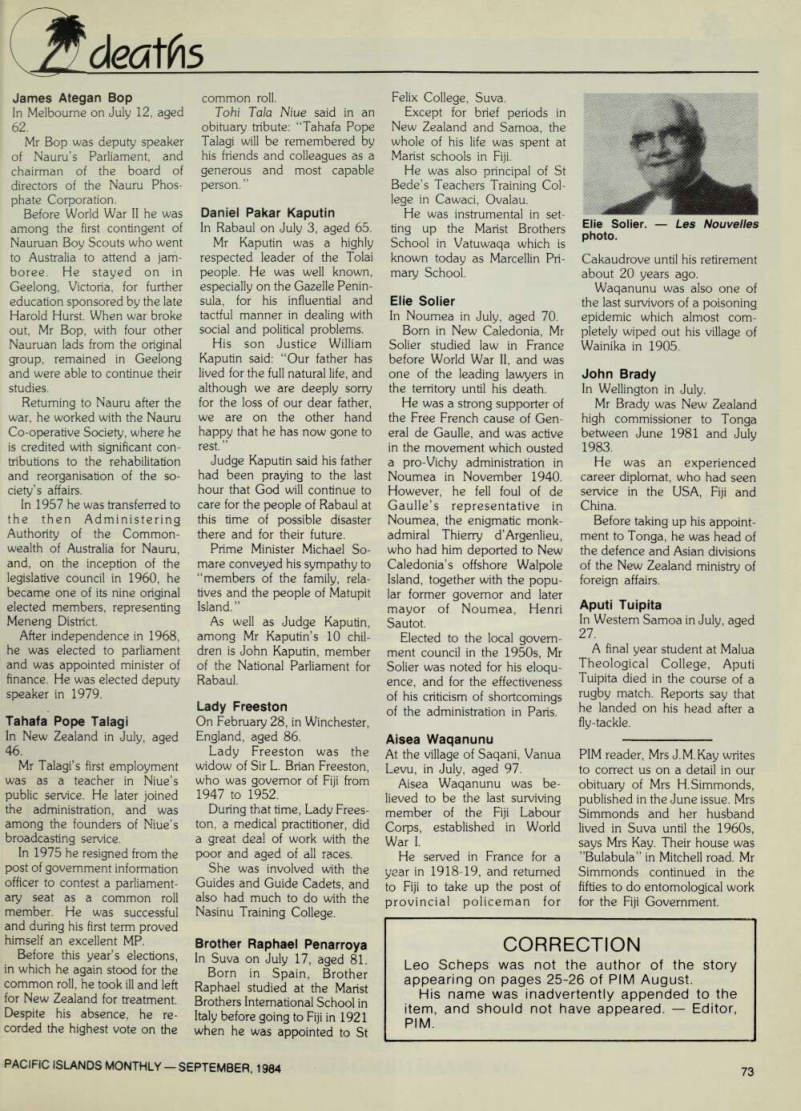
James Ategan Bop In Melbourne on July 12, aged 62.
Mr Bop was deputy speaker of Nauru’s Parliament, and chairman of the board of directors of the Nauru Phos phate Corporation.
Before World War II he was among the first contingent of Nauruan Boy Scouts who went to Australia to attend a jam boree. He stayed on in Geelong, Victoria, for further education sponsored by the late Harold Hurst. When war broke out, Mr Bop, with four other Nauruan lads from the original group, remained in Geelong and were able to continue their studies.
Returning to Nauru after the war, he worked with the Nauru Co-operative Society, where he is credited with significant con tributions to the rehabilitation and reorganisation of the so ciety’s affairs.
In 1957 he was transferred to the then Administering Authority of the Common wealth of Australia for Nauru, and, on the inception of the legislative council in 1960, he became one of its nine original elected members, representing Meneng District.
After independence in 1968, he was elected to parliament and was appointed minister of finance. He was elected deputy speaker in 1979.
Tahafa Pope Talagi In New Zealand in July, aged 46.
Mr Talagi’s first employment was as a teacher in Niue’s public service. He later joined the administration, and was among the founders of Niue’s broadcasting service.
In 1975 he resigned from the post of government information officer to contest a parliament ary seat as a common roll member. He was successful and during his first term proved himself an excellent MP.
Before this year’s elections, in which he again stood for the common roll, he took ill and left for New Zealand for treatment.
Despite his absence, he re corded the highest vote on the
common roll.
Tohi Tala Niue said in an obituary tribute: “Tahafa Pope Talagi will be remembered by his friends and colleagues as a generous and most capable person. ”
Daniel Pakar Kaputin In Rabaul on July 3, aged 65.
Mr Kaputin was a highly respected leader of the Tolai people. He was well known, especially on the Gazelle Penin sula, for his influential and tactful manner in dealing with social and political problems.
His son Justice William Kaputin said: “Our father has lived for the full natural life, and although we are deeply sorry for the loss of our dear father, we are on the other hand happy that he has now gone to rest. ”
Judge Kaputin said his father had been praying to the last hour that God will continue to care for the people of Rabaul at this time of possible disaster there and for their future.
Prime Minister Michael So mare conveyed his sympathy to “members of the family, rela tives and the people of Matupit Island.”
As well as Judge Kaputin, among Mr Kaputin’s 10 chil dren is John Kaputin, member of the National Parliament for Rabaul.
Lady Freeston On February 28, in Winchester, England, aged 86.
Lady Freeston was the widow of Sir L. Brian Freeston, who was governor of Fiji from 1947 to 1952.
During that time, Lady Frees ton, a medical practitioner, did a great deal of work with the poor and aged of all races.
She was involved with the Guides and Guide Cadets, and also had much to do with the Nasinu Training College.
Brother Raphael Penarroya In Suva on July 17, aged 81.
Born in Spain, Brother Raphael studied at the Marist Brothers International School in Italy before going to Fiji in 1921 when he was appointed to St
Felix College, Suva.
Except for brief periods in New Zealand and Samoa, the whole of his life was spent at Marist schools in Fiji.
He was also principal of St Bede’s Teachers Training Col lege in Cawaci, Ovalau.
He was instrumental in set ting up the Marist Brothers School in Vatuwaqa which is known today as Marcellin Pri mary School.
Elie Solier In Noumea in July, aged 70.
Born in New Caledonia, Mr Solier studied law in France before World War 11, and was one of the leading lawyers in the territory until his death.
He was a strong supporter of the Free French cause of Gen eral de Gaulle, and was active in the movement which ousted a pro-Vichy administration in Noumea in November 1940.
However, he fell foul of de Gaulle’s representative in Noumea, the enigmatic monk admiral Thierry d’Argenlieu, who had him deported to New Caledonia’s offshore Walpole Island, together with the popu lar former governor and later mayor of Noumea, Henri Sautot.
Elected to the local govern ment council in the 19505, Mr Solier was noted for his eloqu ence, and for the effectiveness of his criticism of shortcomings of the administration in Paris.
Aisea Waqanunu At the village of Saqani, Vanua Levu, in July, aged 97.
Aisea Waqanunu was be lieved to be the last surviving member of the Fiji Labour Corps, established in World War I.
He served in France for a year in 1918-19, and returned to Fiji to take up the post of provincial policeman for
Cakaudrove until his retirement about 20 years ago.
Waqanunu was also one of the last survivors of a poisoning epidemic which almost com pletely wiped out his village of Wainika in 1905.
John Brady In Wellington in July.
Mr Brady was New Zealand high commissioner to Tonga between June 1981 and July 1983.
He was an experienced career diplomat, who had seen service in the USA, Fiji and China.
Before taking up his appoint ment to Tonga, he was head of the defence and Asian divisions of the New Zealand ministry of foreign affairs.
Aputi Tuipita In Western Samoa in July, aged 27.
A final year student at Malua Theological College, Aputi Tuipita died in the course of a rugby match. Reports say that he landed on his head after a fly-tackle.
PIM reader, Mrs J.M.Kay writes to correct us on a detail in our obituary of Mrs H.Simmonds, published in the June issue. Mrs Simmonds and her husband lived in Suva until the 19605, says Mrs Kay. Their house was ’’Bulabula” in Mitchell road. Mr Simmonds continued in the fifties to do entomological work for the Fiji Government.
Elie Solier. - Les Nouvelles photo.
Advertisements & other items, pp. 73-74 (1 item)
Correction
Leo Scheps was not the author of the story appearing on pages 25-26 of PIM August.
His name was inadvertently appended to the item, and should not have appeared. — Editor,
PIM.
SERVICE PAGE
BLOTTO
DHUMEB
«JMT
AUSTRALIA: Distribution: The Herald and Weekly Times Ltd.. 44-74 Hinders St , Melbourne. Vic., 3000. Advising Reps Brisbane D. Wood. Anday Agency. CCA Centre, Dayboro Road. Closebum 4520; Box 1910, GPO Brisbane, 4001; telephone (07) 289-4128. Adelaide Hastwell Williamson Rouse Pty. Ltd., PO Box 419, Norwood. SA, 5067; 59 Kensington Road. Norwood; telephone (08) 332-3322. telex 87113; Perth Allen & Associates, Suite 2. 284 Stirling St.. Perth. WA. 6000. telephone (09) 328-9593 or (09) 328-9363 FIJI: Distribution and subscriptions Desai Bookshops. P.O. Box 160, Suva. Fiji, telephone Suva 23036.
Advertising Fiji Times & Herald Ltd., 20 Gordon St., Suva, telephone 31-4111, telex FJ2124.
FRENCH POLYNESIA: Distribution Hachette Padfique, 10 Ave Bruat, Papeete, telephone 25610.
HAWAII. UNITED STATES: Distribution PIM, Hawaii.
PO Box 22250, Honolulu. Hawaii. 96822 Advertising Brian C. Asgill. Apt. 1308, 1676 Ala Moana Btvd . Honolulu.
Hawaii. 96815, telephone (808) 955-9718.
JAPAN: Advertising and subscriptions Universal Media Corporation, GPO Box 46, Tokyo, telephone 666- 3036. cables UNIMEDIA Tokyo, telex 2524665.
KOREA: Advertising and subscriptions World Marketing. Inc, Box 4010, Seoul; phone 776-5291-3, telex K 23232.
MALAYSIA: Advertising and subscriptions Worldwide Media Services, 57-B Komplex Damai, Jin Oato Haji Eusoff, Kuala Lumpur, telephone 63-9340, cables WORLDMEDIA Kuala Lumpur, telex 31533.
VANUATU: Distribution Maropa Bookshop, HQ Box 210. Port Vila Advertising Bill Penthand, Norman Bros Bookshop. Pori Vila, telephone 2232.
NEW CALEDONIA: Distribution Depot Centre de Presse Michel Pentecost. CBP2, Noumea, telephone 27- 2434. 27-4729.
NEW ZEALAND; Distribution Gordon & Gotch, PO Box 584, 2 Carr Road. Mt. Roskill, Auckland 4 Advertising International Media Representatives Ltd., PO Box 10259, Balmoral, Auckland 4, telephone 605-909, 792-370. telex NZ21404
PAPUA NEW GUINEA: Distribution Gordon & Goto*, PO Box 3395, Port Moresby, telephone 25-4551.25-4865.
Advertising Ken Head, PNG Post-Courier, PO Box 85.
Port Moresby, telephone 21-2577, telex 22120.
SOLOMON ISLANDS: Distribution and Advertising The Bookshop, (Norman Bros.) PO Box 503, Honiara.
PHILIPPINES: Advertising The GF Group, 12 San Ignacio St., Uroaneta Village. Makati, Metro Manila, telephone 817-7299, telex 45950 and 4233.
UNITED KINGDOM: The Herald & Weekly Times Ltd., No 1 Maltravers Street,London WC2R 3DZ, England, telephone 01 836 5162, telex London 21989.
UNITED STATES MAINLAND: Advertising Joshua B Powers Jr., Powers International Inc., 551 Fifth Ave., New York, Now York 10 017, telephone 867-9580. telex 236514.
Subscriptions PIM, Hawaii, PO Box 22250. Honolulu.
Hawaii, 96822.
SUBSCRIPTIONS
Payments by personal cheque are only acceptable in Australian (from a branch in Australia), U.S. and New Zealand currency. For all other remittances please send an international bank draft in Australian dollars.
Published monthly by Pacific Publications (Aust.) Pty.
Ltd. and printed in Australia by Quadricolor Industries Pty. Ltd., Mulgrave, Vic.
NOW AVAILABLE! 15th Edition
PACIFIC ISLANDS YEAR BOOK
Contains over 550 pages crammed with all the facts you want to know on all the island groups of the Pacific.
See insert for further details and price.
THE UNIVERSITY OF SYDNEY
WALTER MERSH STRONG SCHOLARSHIPS
Opportunities are available for students from Papua New Guinea to study or train at the University of Sydney under the Walter Mersh Strong
Scholarships scheme.
Applicants may propose a formal postgraduate degree or diploma programme or a short study or training course of up to 12 months within any of the departments or schools of the University. The proposed short study or training courses may include refresher courses, training courses or snort research projects.
Each award is valued at $A10,500 per annum (pro rata for shorter periods). Travel and certain other allowances may apply.
Interested persons should write to the Registrar (Scholarships Office), University of Sydney, NSW, Australia, 2006, for information and application forms. Prospective applicants should indicate whether they are interested in pursuing a formal postgraduate degree programme or a short study course of up to 12 months’ duration.
Applications must be submitted to the Registrar by 31 October 1984.
Advertising
Aggie Grey 68 Air Niugini 36 Aiwa 58 Asiatic Trust Co 60 Aust. Exhibition Services 26 Bagot Bellfounderies , 68 Bank Line 75 Besco Batteries 30 Briggs & Moore 60 Clarence, M 46 Clarion 42 Collier, P. F 62 Columbus Line 75 Dept, of Trade 8 Fiji-EDB 28 General Steamships 68 K. A. Gray 62 Henry Cumines 50 Hitachi 2 Hudson Homes 62 Intercontinental 72 International Brokerage 34 Jensens Machinery 27 Kyowa 70 Lincoln Electric 16 Nissan Company 12,13,76 Pacific Forum Line 64 Pacific Telecommunications 50 Papua Hotel 47 Pauls Milk 55 Peter Goerman 74 Pioneer 22 Polish Shipping Lines 71 Polynesia Lines 72 Portal-Lock Homes 26 Race Relations 74 Roncaglia 44 Sansui 24 Shilla Hotel 19 Solarex 52 Southern Pacific Hotels 4 Toyota Motors 38,39 Tutt Bryant 48 University of Sydney 74 Yamaha 40
Advertisements & other items, pp. 74-76 (1 item)
Equal Opportunity For All
POSITION WANTED
ACCOUNTANT/
ADMINISTRATOR
(39) with 15 years overseas experience in banking, construction, mining, merchandising, shipping, commodity trading seeks interesting managerial position in Islands.
PETER GOERMAN,
Box 42, Duffy, A.C.T. 2611. Australia.
EQUAL OPPORTUNITY FOR ALL
UNDER THE NEW ZEALAND RACE RELATIONS ACT 1971 IT IS ILLEGAL TO DISCRIMINATE IN NEW
ZEALAND BECAUSE OF
RACE, COLOR, OR ETHNIC OR NATIONAL ORIGIN IN
EMPLOYMENT, ACCOMMODATION, LENDING
OF MONEY, ACCESS TO PUBLIC PLACES,
EDUCATION, SUPPLY OF GOODS AND
SERVICES.
AND IN THE ADVERTISING OF THESE.
There are some additions and exceptions to these basic rules.
For further advice on your RIGHTS and OBLIGATIONS contact Race Relations Office, Ist Floor, Norman Doo Arcade, 295 Karangahape Rd, P.O. Box 68-504, AUCKLAND. Tel.
(09) 771-1295, 774-060 NEW ZEALAND
>,«»«**> » 9f» it ft » * •!
JITil I if U » • y tofe# iJU’- •. a • •
-rna iuS-id
ajtee
EUROPE-SOUTH PACIFIC JOINT SERVICE
The South Pacific Specialists offer facilities for shipment of: Containers (FCL/LCL) and Breakbulk Cargo plus reefer space and deeptanks for carriage of vegetable oils and other liquid bulk cargo. „ Hamburg, Hull, earners also accept heavy lifts, Dunkirk, overlength and Le Havre, cumbersome parcels.
Additional ports on enquiry Ports of Service: Loading: Papeete, Apia, Suva, Lautoka, Noumea, Port Vila, Santo, Honiara, Port Moresby, Lae,Madang, Kimbe, Rabaul, Kieta, Darwin.
For: Rotterdam, Antwerp, Please contact our regional offices for further information: The Bank Line (Australasia) Pty. Ltd.
Suite 801,51 Pitt Street Sydney N.S.W. 2000 Phone: 27 2041 Telex: 24063 G\ D m P.O. Box 1667 Lae/Papua New Guinea Phone: 42 3466/42 3287.5 .H. 42 2481 ex; Colline NE 44 171
THE BANK LINE LTD LONDON
COLUMBUS LINE REEDEREI GMBH HAMBURG
Toughness.
- / s "
Nissan Cabstar Nissan Sunny V Nissan Vanette in n Nissan Urvan \J
■‘‘'-PATROL
Nissan Patrol Datsun Pickup 4WD That’s why Nissan means higher performance. Toughness is total. Every member of the widerange lineup has extra strength and durability built-in along with superior maneuverability. These high performers deliver penny-pinching fuel economy and tough reliability. Once you discover how great the ride and handling ease are, you will understand what makes ■■ ■“““■ mm Nissan commercial and passenger vehicles worldwide favorites.
There’s more to a Nissan than meets the eye.
F 3 NISSAN
American Samoa Max Haleck Inc., Pago Pago Cook Islands Cook Islands Motor Centre Ltd., Rarotonga Fiji Carpenters Motors, Suva Atoll Auto Stores, Bairiki Nauru Jacob Enterprises New Caledonia Agence Alma S.A., Noumea Norfolk Island Sirius Motors Papua New Gumea Boroko Motors, Port Moresby Solomon Islands United Enterprises Ltd., Honiara Tahiti Tahitibull S.A.R.L., Papeete Vanuatu Pentecost Vanua Trading Ltd.
Morris Hedstrom Samoa Ltd., Apia Port Vila Western Samoa