Islands

Pacific
Monthly
ru
stj
American Samoa USsl 78 Australia 'A51.50 Cook Islands NZ$l.5O Fi ji F 51.50 Hawaii USsl.9s Kiribati A 51.75 Nauru A 51,75 New Caledonia CFPI9O
New Zealand NZS2 25 Niue NZ$1.75 Norfolk Island AS1.50 Papua New Guinea K$1.50 Solomon Islands SSI .50 Tahiti CFP220 Tonga Pi .50 Tuvalu AS1.75
Usa U 552.25
USTT and Guam USsl.9s Vanuatu VT1.50 Western Samoa T 2.10 'Recommended retail price only Registered by Australia Post Publication No. NBPI2IO
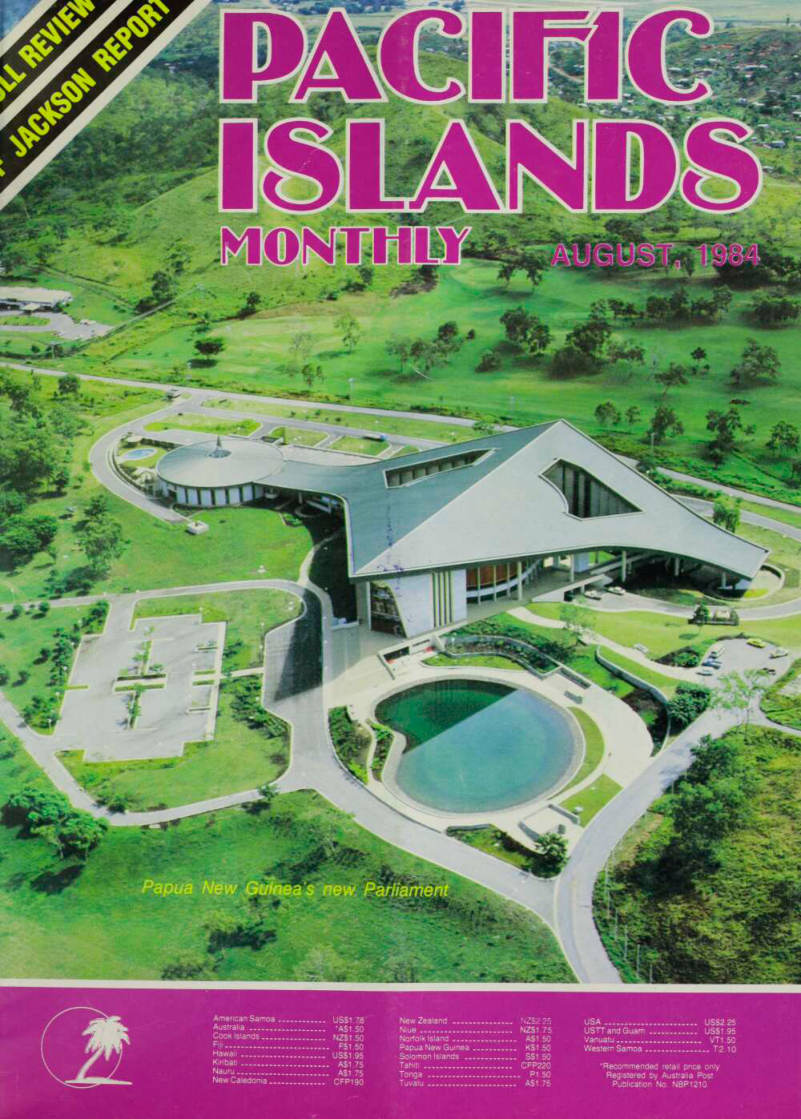
The Cover
PNG’s new Parliament house shows of its war mask roof Cover design by Barry Badger
Advertisements & other items, pp. 2-3 (2 items)
for you
JAWESE CAR OF THE YE
fctCAfcdFffHE YEAR -voted 'B3—'B4 Japanese Car of the
tine
st ti-
for you
• < r 5 KS*aa 8* 21 r- - The 1984 Honda Civic 5-door Hatchback: a truly unique and intelligent response to the needs of today’s active lifestyle. The long and high roof-line helps to create an incredibly spacious
interior, which features variable-arrangement
seating—a few minutes are all it takes to change of And that s not the seatm wm: course y 'mm*
For every lifestyle.
i? Experience
Honda created it just for you. ■ : • ■ -I .
iiIRH
Jifigr , 2-door Hatchback/4-door Sedan/5-door Hatchback AUSTRALIA: Honda Australia Pty., Ltd. Lot 95 Sharps Road. Tullamanne, Victona 3043; Bennett Honda Pty., Ltd. 250 Victoria R WethenM P ®f k N S f W 2^ R p E ffi^ N Papeete"
HOTVIJ A Limited Manners Plaza 57-65 Manners St. Wellington/PAPUA NEW GUINEA: Toba Pty Ltd. PO Box 503. Port Moresby/TAHITI: Honda ** HONDA MOTOR CO., LTD. TOKYO. JAPAN KIRIBATI: Atoll Motor & Marino Services PO Box 49. Bairiki Tarawa, Republic of Kiribati / U -S- ™UST SAMOA Motor Distributors Saipan CM 96950/COOK ISLANDS: Cook Islands Motor Centre Ltd. PO Box 74, Rarotonga GUAM: Mark s Motor Co. Ino PO Box DV. Agana/WESTERN I SAMOA, woto g? (Samoa) Ltd. PO Box 576. Apia SOLOMON ISLANDS: Guadalcanal Garage Limited PO Box 537. Honiara / NEW CALEDONIA. Societe Du Chalandage , pQ „ ggg Noumea/NAURU: Nauru Cooperation Republic of Nauru/FIJI: Carpenters Motors Private Mail Bag, Suva, Fiji AMER J?*N S A MOA - H°lid ay Motors P* rts ‘" Nukualofa Twfoa - ■ ,r.«n»erttri PO Box 1138 Paoo Paao. American Samoa 96799/TONGA: Tonga Industrial Traders PO. Box 1035. Nuku alota, longa
Islands
PACIFIC
MONTHLY
Vol. 55 No. 8 August 1984
Princely opener 7
Jackson judgment 10
Airline changes 19
New industry? 55
In This Issue
PAPUA NEW GUINEA’S new parliament house is the y most splendid edifice in the Pacific. Our report on its features, and a special color section, start on page.
AUSTRALIA’S aid to the Pacific has been reviewed by -1 -1 the Jackson committee set up by Foreign Minister Bill Hayden. Its many important and wide-ranging recom mendations are the subject of our report beginning on page.
NEW CALEDONIA’S Independence Front is re- oc examining its strategy following the adoption by the French Parliament of the government’s plan for the political evolution of the territory.
PORT-VILA’S TAX HAVEN status is bringing real 35 financial benefits to Vanuatu. Julie-Ann Ellis reports on the success of the country’s Finance Centre.
DAVID S. NORTH in Washington suggests a new and gg original line of Pacific Islands business open to an enterprising spirit.
THE HISTORIC OPENING in June of an air link g*| between Micronesia and Melanesia was marked by the Hawaii House of Representatives with a formal session honoring the man primarily responsible, George Wray, president of South Pacific Islands Airways.
Contents
American Samoa 51 Australia 10,21 Books 43 Deaths 73 Fiji 19,46 French Polynesia 23 Hawaii 29, 61 Islands Press 63 Letters 16 Nauru 16,37 New Caledonia 26, New Zealand 57,60 Pacific Report 5 Papua New Guinea... 7,48,51,62
People 53 PIM Opinion 5 Service page 74 Shipping schedules 69 Solomon Islands 45 The Month 23 Tonga 41,58 Tourism 41 Tradewinds 35 Tropicalities 55 Tuvalu 59 United States 61 Vanuatu 31,35 Western Samoa 58 Yachts 66
Australian cover price is recommended retail only. Registered by Australia Post, publication No. NBPI2IO. Second class postage paid at Honolulu, Hawaii. Copyright Pacific Publications (Aust.) Pty. Ltd. Postmaster Hon olulu: Send address changes to PIM Hawaii, PO Box 22250, Honolulu, Hawaii, 96822.
Advertisements & other items, pp. 3-4 (2 items)
Pacific Islands Monthly —August, 1984
3
Founded 1930 by R. W. Robson
(USPS 952480)
Editor and Publisher Garry Barker Associate Editor Malcolm Salmon Layout & Design Barry Badger Editorial Adviser John Carter A Pacific Publications production 76 Clarence Street, Sydney, 2000, GPO Box 3408, Sydney. 2001.
Cables: PACPUB Sydney.
Telex: 21242 (answers INTARAD).
Telephone: Sydney 20-231. Melbourne 63-0211.
Manager; John Berry (03) 63-0211 Ext. 1860.
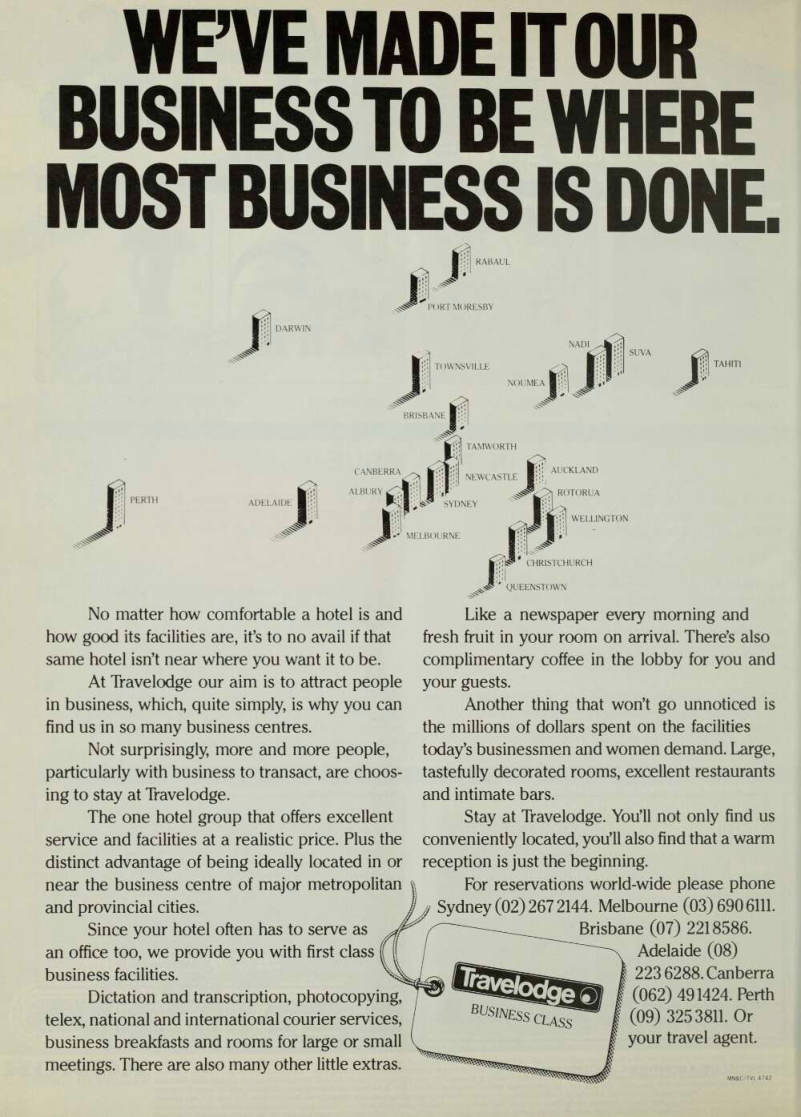
Most Business Is Done
WE’VE MADE HOUR
BUSINESS TO BE WHERE
l
PERTH
DARWIN
ADELAIDE I
I I
RABAUL
PORT MORESBY
TOWNSVILLE
SUVA
AUCKLAND
ROTORUA
WELLINGTON
CHRISTCHURCH
QUEENSTOWN
1 TAHITI
No matter how comfortable a hotel is and how good its facilities are, it’s to no avail if that same hotel isn’t near where you want it to be.
At Travelodge our aim is to attract people in business, which, quite simply, is why you can find us in so many business centres.
Not surprisingly, more and more people, particularly with business to transact, are choosing to stay at Travelodge.
The one hotel group that offers excellent service and facilities at a realistic price. Plus the distinct advantage of being ideally located in or near the business centre of major metropolitan and provincial cities.
Since your hotel often has to serve as an office too, we provide you with first class business facilities.
Dictation and transcription, photocopying, telex, national and international courier services, business breakfasts and rooms for large or small meetings. There are also many other little extras.
Like a newspaper every morning and fresh fruit in your room on arrival. There’s also complimentary coffee in the lobby for you and your guests.
Another thing that won’t go unnoticed is the millions of dollars spent on the facilities today’s businessmen and women demand. Large, tastefully decorated rooms, excellent restaurants and intimate bars.
Stay at Travelodge. You’ll not only find us conveniently located, you’ll also find that a warm reception is just the beginning.
For reservations world-wide please phone Sydney (02) 267 2144. Melbourne (03) 690 6111.
Brisbane (07) 2218586.
Adelaide (08)
223 6288. Canberra (062) 491424. Perth (09) 3253811. Or your travel agent.
Bu^esscl^
Pim Opinion
Foreign aid is given for humanitarian reasons, but it is not charity. It is designed to alleviate poverty through economic and social development and thus must be given, and used in conjunction with wise and constructive policies within the recipient nations. As the Jackson Report, covered in this issue, makes plain, aid is pointless, and may even be damaging, if it does not produce growth and development.
Over the 40 years or so in which aid has been given, a great deal of money has been wasted, and some has been used for their own support and pleasure by the rulers of a variety of rotten regimes (remember the gold bed of Ghana, among a plethora of examples?). Fortunately the Pacific generally enjoys rather nice and responsibile leaders to whom such excesses would be anathema.
Thus, in these days of cyclical recession and economic difficulty in industrialised donor countries, government expenditure comes under much closer scrutiny than was once the case. Reports, or even rumors, of waste produce outrage and questions designed to embarrass governments.
Aid must therefore be subject to review in the interests of its most efficient and effective use. This does not mean that a donor country has the right to pry into the affairs of a recipient, but rather that both governments must acknowledge, and abide by the principle that aid is intended for the good of people generally and must be treated with the same responsibility and care as any other form of revenue given into the hands of officialdom.
The report of the Jackson Committee is therefore to be
welcomed by all who work with, benefit from, or have an interest in the $BOO million or so which Australia pays every year in foreign aid.
It is an embracing and practical document intended to brief the Australian foreign minister and the tax-paying public of Australia on how aid money is spent, what its effectiveness has been, and should be. In the process of this review it has taken a sympathetic, but very businesslike, view of the Pacific island countries which, the committee says, must be the focus of the main thrust of Australian aid for the foreseeable future. Provided this scrutiny is received in the constructive way in which it was made, little but good can come of the report.
Early leakage of some less than exact early drafts of the report produced irritation among some leaders, notably those of Papua New Guinea, for whom the $3OO million given in budgetary support is vital, and likely to remain so for many years, Whether or not passages of the report were rewritten at the last-minute as a result of these sharply-expressed views does not matter and has not been made public. If they were amended, then the value of a free press, and a responsive committee, has been demonstrated.
Australian policy in the past has been to tie no strings, or at least very few, to its aid. If the Jackson Reprt is acted upon by the Australian government, and there is ample reason to expect that it will pretty much become Mr Hayden’s creed in the aid area, then accountability in the use of aid by donor countries, and scrutiny of the management of aid agencies in Australia are likely to become much more rigorous.
Pacific Report

Bp S Phil Best Resigns
Mr Philip Best, Fiji-born chief executive of Burns Philp, has resigned and his place at the helm of the large Pacific and Australian trading conglomerate will be taken by Mr Andrew Turnbull. Mr Turnbull, 53, joined BP, in 1981 as general manager of the company’s Australian operations and was appointed to the board in 1983. He is a chartered electrical engineer and was formerly assistant managing director of GEC (Australia) Ltd. Mr Best has resigned from Burns Philp and its affiliated companies after 31 years with the group. He said that after eight years at the top of BP he planned to take up new challenges. BP group profits increased 91 per cent in the six months to the end of 1983.
Museum's Islands Display In Sydney
Sydney’s Macleay Museum was the scene on June 29 of a gathering of more than 150 people for the opening of a display of Pacific Island artefacts. One of the largest private museums in Australia, the Macleay is noted for its Pacific Islands collection. The museum said in a press release that the display was aimed at deepening the appreciation of Australians of the cultures of those countries of the South Pacific which they so often visit as tourists.
The June 29 occasion was opened by C. B. Singh, vice-consul of Fiji in Sydney, and featured a lavish Islands feast, and dancing by the Fiji Cultural Group of New South Wales. The exhibition will remain open until mid-September.
Landowners Stall Big Fiji Hotel Project
Opposition from some local landowners in Fiji is reported to have put plans to build a multi-million dollar tourist resort in doubt. The
project, to be built near the international airport at Nadi, would include a hotel with 350 rooms, two smaller hotels and 700 villas.
The general manager of the Native Land Trust Board, Mr Kamikamica, said the opposition came from a group which claimed to represent the younger generation. He said village elders and leaders supported the plans. Mr Kamikamica said benefits to the landowners from the project would be immense. He said they would receive $1 million in rent, as well as opportunities to participate in tourist-oriented business. Because the land is native reserve, the consent of the majority of native owners is required for the project to proceed.
Queen Honors 55 In Fiji, Png
The independent chairman of the Fiji Sugar Industry, Gerald Barrack, trade unionist James Raman, and Colonial War Memorial Hospital surgeon Etika Vudiniabola were made Commanders of the British Empire (CBE) in the 1984 Queen’s Birthday Honors.
They headed a list of 21 Fiji citizens honored by the Queen. In Papua New Guinea, the highest of this year’s 34 awards went to the retired head of the Anglican Church of PNG, Bishop David Hand. He was made Knight Commander of the British Empire (KBE). Former Lands Minister Thomas Kavali was made a Knight Bachelor. CBEs went to Brigadier-General Ken Noga, head of the Papua New Guinea Defence Force, the Minister for Works and Supply Pato Kakarya and Mr Justice Norris Harry Pratt.
Village Burnt, Kidnapping, On Png Border
In the troubled border area of Papua New Guinea-Irian Jaya, about 50 unidentified armed men late in June entered a village
continued on page 64
about 500 metres inside PNG territory, and, according to a PNG Government protest note to Indonesia, set fire to huts, destroyed fruit and cash crop trees, carved their names on trees and left empty Indonesian army ration packs scattered around. Speaking in Jakarta, Indonesia’s Foreign Minister Dr Mochtar said he was treating the claims seriously and was seeking advice from military authorities in Irian Jaya. He said although it was too early to know the facts, the conspicuous way the men carved their names on trees and left the ration packs behind made him suspect they were O.P.M. rebels. In another development, a PNG schoolteacher, Damien Makal Aiyu, was abducted by O.P.M. rebels on June 28.
Mr Aiyu was walking in a remote area of West Sepik province when he was seized. Following an ultimatum from the PNG Government, he was released unharmed on July 3.
FRANCE S THIRD N TEST FOR 84 French scientists detonated a nuclear device on Moruroa Atoll on June 13, the third this year. Seismological observers at Rarotonga in the Cook Islands said the explosion was “quite a small one we estimate it to be 5 kilotons”. On May 8 a 20 kilotons explosion was recorded from the French atoll, followed by a 50 kilotons one on The largest explosion on Moruroa was about 140 kilotons
Tuvalu Gets Back U.S. Investment
Tuvalu Prime Minister Dr Tomasi Puapua has announced that information has reached the Tuvalu National Bank from the United States that Californian real estate dealer Sidney Gross had paid into the Tuvalu account $U5148,090.21, the balance of interest and the initial investment of $A550,380 paid to Mr Gross in 1979 by Tuvalu’s former Prime Minister, Mr Toaripi Lauti. The Church of Tuvalu has also announced that Mr Gross has returned to the church $3711.65 for land the church bought in Green Valley, Texas. Many parcels of land in Green Valley were sold to people in Tuvalu and Kiribati. It was alleged that the land was desert.
Fiji Opposition Returns To House
Under its new leader Mr Siddiq Koya, recently elected to replace Mr Jai Ram Reddy, the National Federation Party (NFP) Opposition in the Fiji Parliament, along with its coalition partner, the Western United Front members, returned to the House for the new session on June 4. ending its boycott imposed last December 15.
How Did Arnold Ap Die?
Yet another version of the manner in which Irian Jayan anthropologist Arnold Ap met his death in April has been given by Indonesian lawyet Mulya Lubis. Mr Lubis, president of the Legal Aid Institute, told a press conference in Jakarta on his return from a visit to Irian Jaya, that from various accounts he had heard, Mr Ap escaped from Jayapura Jail on April 22 with four other Irianese and a local policeman who helped them. A car waiting outside the jail took them to the coastal town of Pasir Enam near Jayapura from where they hoped to flee to neighboring Papua New Guinea, although “it was not a good place to escape”, Mr Lubis said. The account obtained by the institute said Mr Ap was found by police after three days and killed, and his body left in Pasir Enam. A second escapee, Eduard Mofu, was also killed and his body found at sea. Urging the government to set up a committee to investigate the case, Mr Lubis said; “The committee should consist not only of government people, police, the military and prosecutors, but also people from outside like lawyers and reporters, so the independent nature of the committee could be maintained. “There is a conspiracy of silence in Irian Jaya over this,” said Yap Hien, vice-president of the institute who accompanied Mr Lubis on his visit.
N.C.: HIGH ABSTENTION RATE CLAIMED IN POLL Pro-independence parties in New Caledonia have claimed that 60 per cent of eligible voters failed to vote in the June 17 poll for the European Parliament. New Caledonia, as an integral part of France, was entitled to take part in the election. The French newsagency AFP quoted the president of the five-party Independ
ence Front, Roch Pidjot, as saying that the Kanak people had responded decisively to he the front’s call for a boycott of the election. In a statement released in Paris, Mr Pidjot said the poll result had confirmed the extent of hidden racism in the territory.
The extreme Rightwing National Front had received 16 per cent of the territory vote, Mr Pidjot claimed the figure reached 24 per cent in Noumea.
Ennoblement Of Tupuola
Former Western Samoa Prime Minister and present Opposition Leader Tupuola Efi is now known as Tupua Tamasese as this title, one of the four highest in Samoa, has been conferred on him by the Aiga Sa Fenunuivao of Salani and Falefa. The four “Tama Aiga” are known as the Four Royal Sons. Tupua Tamasese succeeds his cousin and former Prime Minister Tupua Tamasese Lealofi IV who died last year.
Emergency Gear Flown To Rabaul
Emergency equipment from Australia for earthquake-threatened Rabaul, Papua New Guinea, has been distributed to the evacuation centre outside the town. The equipment, worth about $29,000, was provided by the Australian Development Assistance Burea, and was flown to Kabaul late in June by a Royal Australian Air Force plane, The equipment includes water pumps, chain saws, hurricane lamps, large tents, lighting, and other electrical items.
The new equipment will be used to help between 10,000 and 12,000 people who will be affected by an eruption of the Rabaul volcano.
W. Samoa Tug In Sea Rescue
A tug from Western Samoa in late June rescued two American Samoan residents who had spent five days adrift first on their disabled yacht, and then on a life-raft. A coastguard spokesman at Pago Pago said the two men were found suffering from dehydration and exposure, but otherwise well. The pair sailed their trimaran out of Pago Pago on June 21 bound for Apia, 128 km to the north-east, but failed to arrive. No more was heard of them until a Polynesian Airlines pilot picked up a signal from a distress beacon, and then another Polynesian airliner located the men’s life-raft the following day. Survival equipment was dropped to the men before they were rescued.
JAPAN, PNG AGREE ON CANNED FISH CHECKS Japan’s Canned Food Inspection Association has agreed to improve methods now used in canned fish factories in Japan. The decision is part of a preliminary agreement signed in Tokyo recently between Papua New Guinea and Japan. This follows recent reports alleging that worms had been found in Japanese canned mackerel sold in PNG. However, PNG health officials said that what had been found in the canned mackerel were not worms but anisakis larvae, which is a parasite of fish. The officials said the larvae were harmless after the canning process and could be eaten.
Tonga Digs Deep For Unicef
The Government of the Kingdom of Tonga has just concluded a contribution of $U55899.80 in support of the world-wide programs of the United Nations Children’s Fund UNICEF.
While global recession and changing ecnomic and political situations have led many major donors to make little if any increase in their support of international development, Tonga’s initial contribution was noted by UNICEF as an important reaffirmation of the goals of international co-operation in serving the welfare and development needs of children. In Tonga, UNICEF co-operates with the government in areas such as primary health care, child immunisation, rural water supply and sanitation (all in partnership with WHO), and in nutrition and pre-school education.
HUSH HUSH AS TONGAN RAPIST GETS 26 YEARS A 36-year-old rapist was sent quietly away for 26 years in Tonga’s Huatolitoli prison in May. It was one of the heaviest sentences imposed by the Supreme Court on an offender in Tonga in recent years. But the lengthy punishment was not made known to the community. Although the trial by judge alone followed normal procedures, the sentence was not broadcast. Nor was it printed in the government newspaper. As Radio Tonga’s news presenter, Miss Luseane Vaea explained, “It’s traditional for us not to discuss such things (sexual offences) in public.” The man, Vili Falamoe, who has been a prisoner since 1965, practically all his adult life, was found guilty on two charges of rape and indecent assault on
two young women. He has several previous convictions for sexual offences and it was not satisfactorily explained why Falamoe was free to commit further offences when he should still have been serving a 10-year prison sentence handed down in 1976. In April he lured an unsuspecting 14-year-old girl to a house. He denied raping her, but then broke down in court and asked for life imprisonment. The second charge involved a 20-year-old. Tonga’s Chief Justice Harwood said that Falamoe was a case for psychiatric treatment. Tonga has no facilities for psychiatric detainees so two prison terms for rape and two for indecent assault were imposed totalling 26 years. Mary Fonua in Nukualofa.
Former Palau Prosecutor Jailed
A former U.S. prosecutor on Palau, Roger Crobarger, has been sentenced to three years in prison by a U.S. judge in California for income tax offences, and marijuana growing. The offences took place in California. Crobarger had been arrested on these charges in Guam, but was tried and sentenced in San Diego. David S.
North in Washington.
Tufele U Amatua Honored In Hawaii
Hawaii’s House of Representatives has formally adopted a resolution honoring Tufele Li’a, lieutenant-governor of American Samoa as “a dedicated diligent administrator and dynamic leader who is willing to take decisive action on problems affecting his people, as well as an engaging and compassionate person and family man, whose lovely wife Tofiga is a prominent registered nurse who also serves her people at Lyndon B. Johnson Medical Center on the Island of Tutuila.
Congressional Dispute Snags Compact
A dispute on jurisdictional rights between the United States Interior and Foreign Affairs committees of the U.S. Congress makes it unlikely that the Congress will reach a decision on the Compact of Free Association between the US and the Federated States of Micronesia (FSM) before the early part of 1985. FSM President Tosiwo Nakayama said this at a meeting of the FSM Congress on his return from Washington after committee hearings on the compact, which, he said, had the support of key leaders in the US Congress. A US Political Statues Commission official was reported by the FSM Information Service as saying that the compact had not yet been introduced in Congress because of the dispute. He said Foreign Affairs would most likely have some jurisdiction. In Washington, President Nakayama told a Senate committee that the people of the FSM embraced the Compact of Free Association, and Ponape Governor Resio Moses said the time had come to terminate the UN Trusteeship and for Micronesians to set their own course for the future. “It is our wish that the course we set should include a close, long-term relationship with the United States,” he said.
Guam Government Wins On Foreign Workers
The Guam Territorial Government has won a years-long struggle with US Labor Department over temporary worker policy on Guam. The Labor Department had wanted to limit the number of foreign workers on the island (mostly recruited in the Philippines) and to raise their wages; its principal ally was the Mainland union of operating engineers. On the other side of the issue were island employers and the US Defense Department, both of which preferred the less expensive foreign workers. The government of Guam, which had lost control of the foreign worker program to the Department of Labor years ago, has now been restored to the driver’s seat. The U.S. Immigration Service, which has little interest in wage rates, continues to play a formal role in the program.
David S. North in Washington.
Big Polynesia Documentary Film In Works
Preparations are well underway in New Zealand for a major television documentary series, tracing the history of the peoples of Polynesia. Among project organisers will be a pan-Polynesian trust, to be established with the co-operation of authorities in Tonga, Fiji, Samoa and New Zealand. A Radio Australia correspondent in Auckland has reported that once details of the proposed trust are finished, it will probably be incorporated in Tonga, and have its headquarters in New Zealand. Initial episodes in the documentary series are expected to be narrative in style, following the spread of the Polynesian people from the Malay Peninsula through Fiji to Tonga, Samoa and New Zealand. Later episodes will deal with the
effects of the arrival of white missionaries, world wars and other influences on the Polynesian people. Filming is expected to begin later this year.
Second Marathon For Noumea In September
New Caledonia’s Second International Marathon will be held in Noumea on Sunday, September 9. There will be three different runs, all departing from and returning to the Anse Vata Racecourse. The Marathon Run is 42.195 km, and the Semi- Marathon Run is 21.098 km. each race having a maximum of 300 participants. For those who fancy themselves as distance runners, there is a Fun Run of only 7 km, with as many as 3000 participants.
Applicants for all races will be divided into categories of Junior, Senior and Veteran. Official registration must be made by August 31.
Aboriginals Visit New Caledonia
For the first time a delegation of Australian Aboriginals has visited New Caledonia. Led by Ossie Cruse of the National Aboriginal Conference, the delegation met representatives of all parties of the Independence Front the revolutionary socialist party, PALIKA and the Evangelical Church. The delegation also visited the trive of St Louis on Noumea’s outskirts. The delegation invited the Kanak people to join the World Council of Indigenous Peoples (WCIP), which was set up in the 1970 s to protect the political, economic, social and cultural rights of indigenous peoples in countries where they do not control the national government. Helen Fraser in Noumea.
NIUE TO SEND ONE PER CENT TO FESTIVAL Niue is to send a delegation of 30 to the South Pacific Festival of Arts in Noumea in December. This represents almost one in 100 of the island’s population, estimated at about 3500. Martial dances are expected to figure strongly in their presentation. Pitcairn Islanders have decided against sending delegates, and will instead present a small display on different aspects of their cultural production sculptures in Miro wood, woven pandanus items, postage stamps and photographs.
Ufou S First Marathon
Lifou Island, in New Caledonia’s Loyalty Group, held its first marathon race in June. In fact it was a semi-marathon of 21 km, from Hname (near Chepenehe) to Luecilia. The race was won by Jean-Michel Boulanger of Noumea, with two French servicemen, Angelo Petelo and Jacky Bidaut, coming second and third among the 54 participants. The marathon was one of the highlights of a three day “kermesse” organised by the Zavirob Folklore Associa tion to raise funds for Lifou dancers and singers to go to the South Pacific Festival of Arts in Noumea in December. Helen Fraser in Noumea.
Kiribati Ministers Visit Vostock
Four ministers of the Kiribati Government and six aides were in Papeete recently on their way to visit the uninhabited Kiribati islands of Vostock, Flint and Caroline, 600 km to the northeast of Tahiti. They travelled to the islands aboard the French navy corvette Doudart de Lagree to assess the prospects of establishing a copra industry on the islands.
Jackson Eyes On Fiji Island
Bekana Island off the north coast of Vanua Levu is believed to be the island that Jermaine Jackson, elder brother of superstar, Michael Jackson, is planning to buy. The island was put up for sale by its American owner William Hignett, last year for $§85,000.
According to an Australian Sunday newspaper, Jermaine Jackson was planning to buy the island for $1 million. It suggested that Michael Jackson might visit while his brother sets up home on the island.
PNG FINALLY FLOGS OFF ITS VIP JET The Papua New Guinea Government has sold its VIP Grumman Gulfstream executive jet to an American firm, Roby-Smith Company for about K 4 million (SAS million approx.). The aircraft, which has been on the market for nearly two years, was bought by the Chan government nearly four years ago for Kb million ($A7.5 million approx.), had few hours in the air and sat on the ground with maintenance costing the government about K 1.5 million a year. One of Prime Minister Michael Somare’s election promises before ousting Sir Julius Chan in 1982 was to sell the jet as soon as possible.
Tonga Is In The Olympics
Tonga for the first time is taking part in the Olympic games being helcT in Los Angeles. Five boxers and three officials are representing the island kingdom.
Advertisements & other items, p. 6 (1 item)
best plots leave home
Some of the world’s
to fly for Air Niugini.
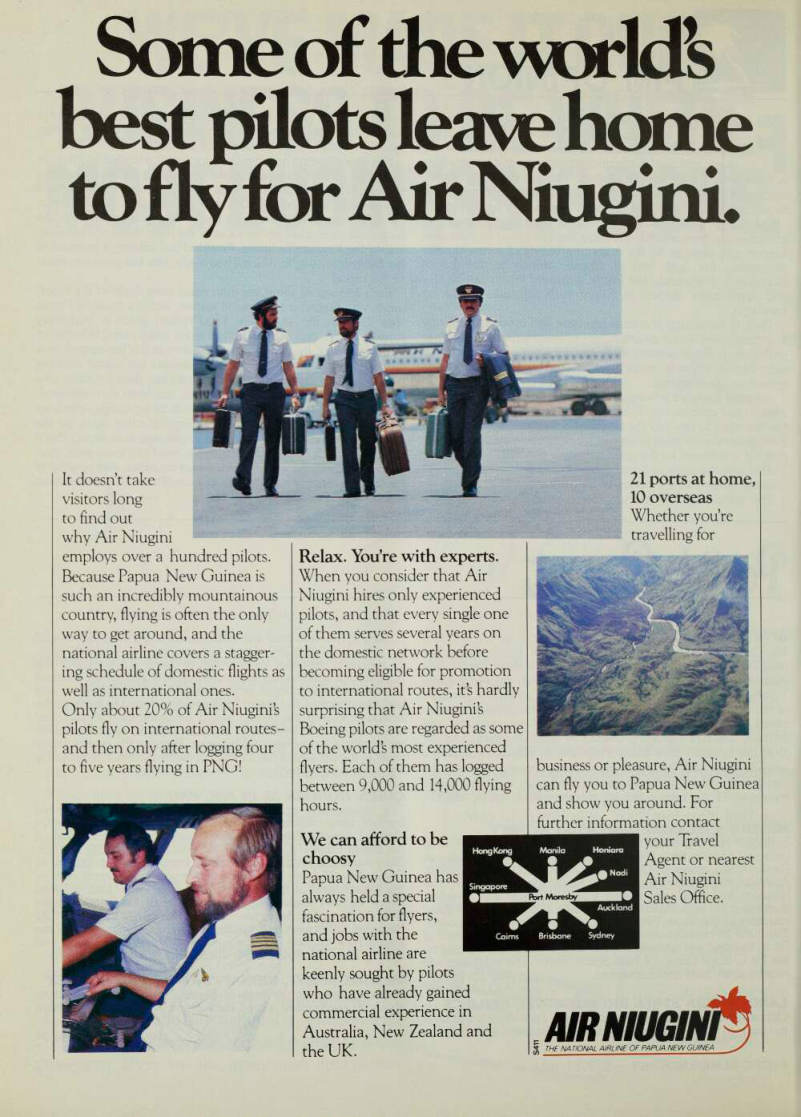
It doesn’t take visitors long to find out why Air Niugini employs over a hundred pilots.
Because Papua New Guinea is such an incredibly mountainous country, flying is often the only way to get around, and the national airline covers a staggering schedule of domestic flights as well as international ones.
Only about 20% of Air Niugini’s pilots fly on international routesand then only after logging four to five years flying in PNG! - P Relax. You’re with experts.
When you consider that Air Niugini hires only experienced pilots, and that every single one of them serves several years on the domestic network before becoming eligible for promotion to international routes, it’s hardly surprising that Air Niugini’s Boeing pilots are regarded as some of the world’s most experienced flyers. Each of them has logged between 9,000 and 14,000 flying hours.
We can afford to be choosy Papua New Guinea has always held a special fascination for flyers, and jobs with the national airline are keenly sought by pilots who have already gained commercial experience in Australia, New Zealand and the UK. 21 ports at home, 10 overseas Whether you’re travelling for /■ business or pleasure, Air Niugini can fly you to Papua New Guinea and show you around. For further information contact your Travel Agent or nearest Air Niugini Sales Office.
Moresby Port
omnium
5 the NA TtONAL AIRLINE OF PAPUA NEW GUINEA A -a y
risen in Waigani
PNG Parliament A splendid office risen in Waigani
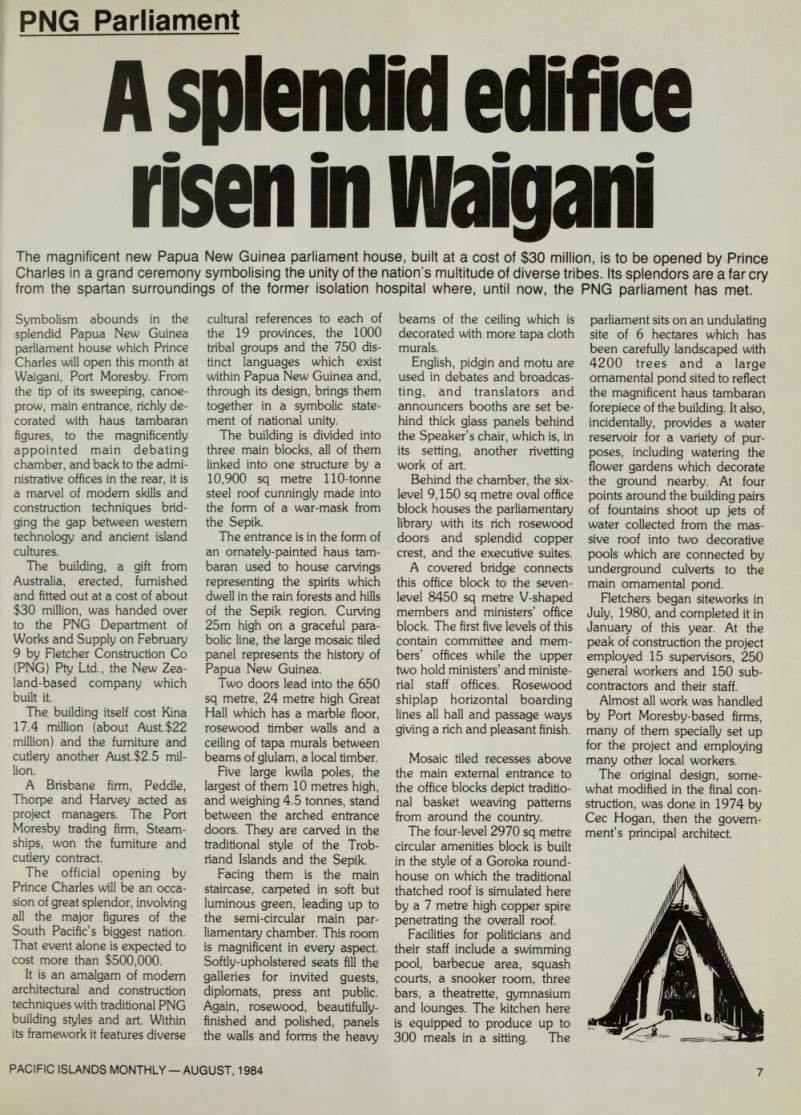
The magnificent new Papua New Guinea parliament house, built at a cost of $3O million, is to be opened by Prince Charles in a grand ceremony symbolising the unity of the nation’s multitude of diverse tribes. Its splendors are a far cry from the spartan surroundings of the former isolation hospital where, until now, the PNG parliament has met.
Symbolism abounds in the splendid Papua New Guinea parliament house which Prince Charles will open this month at Waigani, Port Moresby. From the tip of its sweeping, canoe prow, main entrance, richly de corated with haus tambaran figures, to the magnificently appointed main debating chamber, and back to the admi nistrative offices in the rear, it is a marvel of modem skills and construction techniques brid ging the gap between western technology and ancient island cultures.
The building, a gift from Australia, erected, furnished and fitted out at a cost of about $3O million, was handed over to the PNG Department of Works and Supply on February 9 by Fletcher Construction Co (PNG) Pty Ltd., the New Zea land-based company which built it.
The building itself cost Kina 17.4 million (about Aust.s22 million) and the furniture and cutlery another Aust.s2.s mil lion.
A Brisbane firm, Peddle, Thorpe and Harvey acted as project managers. The Port Moresby trading firm, Steam ships, won the furniture and cutlery contract.
The official opening by Prince Charles will be an occa sion of great splendor, involving all the major figures of the South Pacific’s biggest nation.
That event alone is expected to cost more than $500,000.
It is an amalgam of modem architectural and construction techniques with traditional PNG building styles and art. Within its framework it features diverse
cultural references to each of the 19 provinces, the 1000 tribal groups and the 750 dis tinct languages which exist within Papua New Guinea and, through its design, brings them together in a symbolic state ment of national unity.
The building is divided into three main blocks, all of them linked into one structure by a 10,900 sq metre 110-tonne steel roof cunningly made into the form of a war-mask from the Sepik.
The entrance is in the form of an ornately-painted haus tam baran used to house carvings representing the spirits which dwell in the rain forests and hills of the Sepik region. Curving 25m high on a graceful para bolic line, the large mosaic tiled panel represents the history of Papua New Guinea.
Two doors lead into the 650 sq metre, 24 metre high Great Hall which has a marble floor, rosewood timber walls and a ceiling of tapa murals between beams of glulam, a local timber.
Five large kwila poles, the largest of them 10 metres high, and weighing 4.5 tonnes, stand between the arched entrance doors. They are carved in the traditional style of the Trob riand Islands and the Sepik.
Facing them is the main staircase, carpeted in soft but luminous green, leading up to the semi-circular main par liamentary chamber. This room is magnificent in every aspect.
Softly-upholstered seats fill the galleries for invited guests, diplomats, press ant public.
Again, rosewood, beautifully finished and polished, panels the walls and forms the heavy
beams of the ceiling which is decorated with more tapa cloth murals.
English, pidgin and motu are used in debates and broadcas ting, and translators and announcers booths are set be hind thick glass panels behind the Speaker’s chair, which is, in its setting, another rivetting work of art.
Behind the chamber, the six level 9,150 sq metre oval office block houses the parliamentary library with its rich rosewood doors and splendid copper crest, and the executive suites.
A covered bridge connects this office block to the seven level 8450 sq metre V-shaped members and ministers’ office block. The first five levels of this contain committee and mem bers’ offices while the upper two hold ministers’ and ministe rial staff offices. Rosewood shiplap horizontal boarding lines all hall and passage ways giving a rich and pleasant finish.
Mosaic tiled recesses above the main external entrance to the office blocks depict traditio nal basket weaving patterns from around the country.
The four-level 2970 sq metre circular amenities block is built in the style of a Goroka round house on which the traditional thatched roof is simulated here by a 7 metre high copper spire penetrating the overall roof.
Facilities for politicians and their staff include a swimming pool, barbecue area, squash courts, a snooker room, three bars, a theatrette, gymnasium and lounges. The kitchen here is equipped to produce up to 300 meals in a sitting. The
parliament sits on an undulating site of 6 hectares which has been carefully landscaped with 4200 trees and a large ornamental pond sited to reflect the magnificent haus tambaran forepiece of the building. It also, incidentally, provides a water reservoir for a variety of pur poses, including watering the flower gardens which decorate the ground nearby. At four points around the building pairs of fountains shoot up jets of water collected from the mas sive roof into two decorative pools which are connected by underground culverts to the main ornamental pond.
Fletchers began siteworks in July, 1980, and completed it in January of this year. At the peak of construction the project employed 15 supervisors, 250 general workers and 150 sub contractors and their staff.
Almost all work was handled by Port Moresby-based firms, many of them specially set up for the project and employing many other local workers.
The original design, some what modified in the final con struction, was done in 1974 by Cec Hogan, then the govern ment’s principal architect.
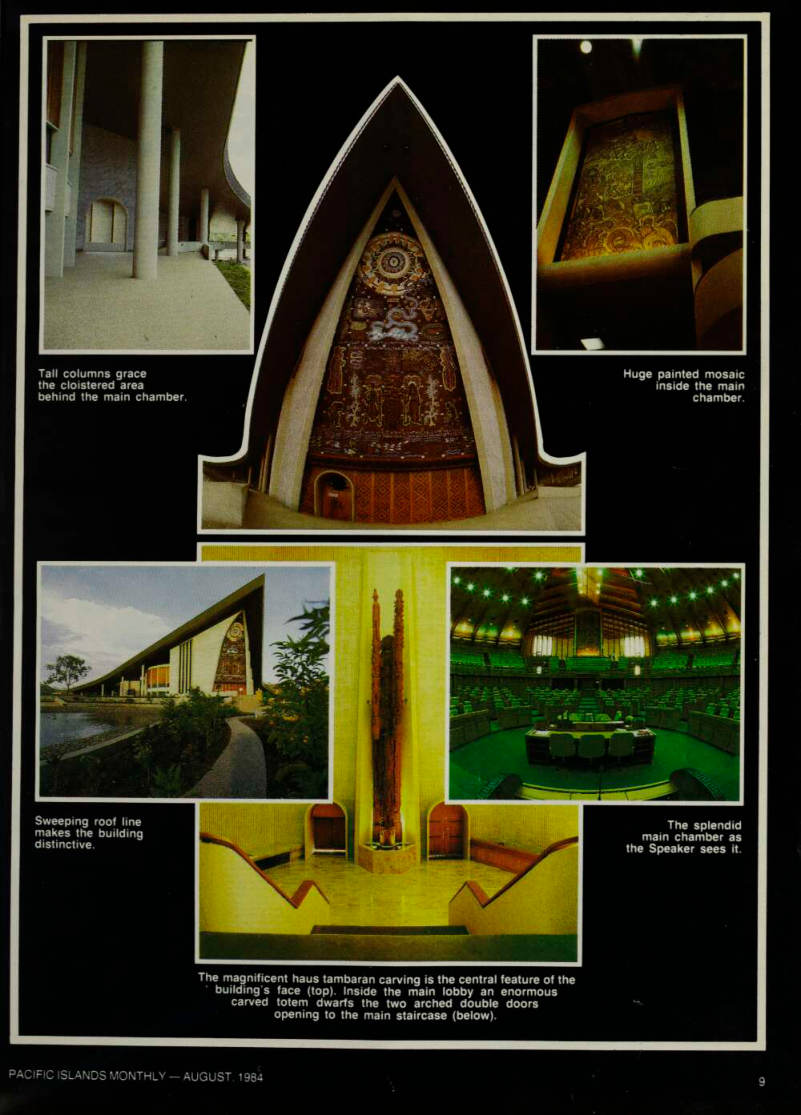
The magnificent haus tambaran carving is the central feature of the building's face (top). Inside the main lobby an enormous carved totem dwarfs the two arched double doors opening to the main staircase (below).
The splendid main chamber as the Speaker sees it.
Sweeping roof line makes the building distinctive.
Huge painted mosic inside the main chamber.
Tall coulumns grace the cloistered area behind the main chamber.
Advertisements & other items, pp. 8-9 (2 items)
Cid Pioneer*
Bring along, sing along and play along.
The greatest partner your party ever had Portable fun in the sun.
DISCO ROBO is your multi-talented, go-anywhere partner for sing-alongs, dance parties, guitar playing, or just great listening. It has a builtin FM tuner, a cassette player and mixer with inputs for mikes and guitar. And it’s portable, so it can always be where the action is.
Play with the super stars.
Mix up to five kinds of sound —Mike 1, Mike 2 (or guitar), FM (or a wireless mike), cassette tape and a line input (such as a keyboard instrument or rhythm box). Then, add echo if you like and play or sing along with your favourite music.
Disco time any time.
Any music from tape or played on a connected keyboard can be turned into exciting pulsating disco music. Big sound, hi-fi sound, the four highly efficient full-range speakers in DISCO ROBO pump out dynamic sound at disco decibels.
DISCO ROBO is all you need for a perfect party.
CiD PIONEER*
For further information, please contact; Australia: Pioneer Electronics Australia Pty. Ltd. (Incorporated in Victoria), P.O. Box 295, Mordialloc, Victoria. 3195 Tel: 580-9911 Fiji Islands: Brijlal & Company, G.P.O. Box No 362, Suva, Fiji Islands Tel: 22258 New Zealand: Monaco Distributors Ltd., 2 Poland Road, Glenfield, Auckland, New Zealand Tel: (09) 444-9144 Norfolk Island: Burns Philp (Norfolk Island) Ltd., P.O. Box 21, Norfolk Island Vanuatu: Burns Philp (Vanuatu) Ltd., Vila, Vanuatu Nauru Island: Jacob Enterprises, P.O. Box No. 4, Republic of Nauru Tahiti: Tahiti Hi-Fi, P.O. Box 848, Papeete, Tahiti New Caledonia: Menard Pacifique Sari, B.P. 3899, Noumea, New Caledonia Tel: 27*62.23 American Samoa: Transpac Corporation, P.O. Box 1477, Pago Pago, American Samoa 96799 Tel: 633-5224 Rarotonga: South Seas International Ltd., P.O. Box 49, Rarotonga, Cook Islands Tel: 2327 Papua New Guinea: Bali Merchants Pty. Ltd., P.O. Box 6103, Boroko Tel: 254887
9
ertiu
"Pacific to have lion's
The Jackson Report
"Pacific to have lion's share of Aust. aid"
The Pacific region should again become the main, almost exclusive, focus for Australian aid, says the Jackson Report. Aid administration should be made much more efficient. More and better staff should be employed so that full value was obtained from every dollar given.
Much more accountability should be involved. Untied, budgetary support should be gradually phased out in favor of integrated, planned, national and regional aid, on a project or program basis.
Total aid given by Australia should rise from the present 0.5 per cent to the international goal for industrialised countries of 0.7 per cent of national income, as the Australian eco nomy grew and domestic con ditions permitted. But there should be, the report says, a harder-headed approach to aid donation.
“The present program is spread over too many coun tries, with too many initiatives and activities implemented in too many different ways. The circle of recipients has been widened unrealistically and, as a result, the program has leant heavily on improvisation and post hoc rationalisation.
“Resources for program ming, implementation and evaluation are inadequate, and they are strained further by the range of aid attempted,” says the report. “Not enough has been done to identify and ex ploit Australia’s relative strengths so that aid delivery can take full advantage of com petitive Australian goods and services. The Australian aid program needs to be better
focused to achieve its objec tives.”
How this is done will ulti mately depend, of course, upon Cabinet and bureaucratic de cisions. Yet it seems clear that a new broom is in the halls of the aid administration and that while Australian aid, particularly to the Pacific countries, will not be reduced, and indeed may well be increased, changes of style and direction are now certain.
Five-year plans
The Jackson committee proposes development of aid strategies on a five-year basis, with much more attention given to the results achieved by each aid project. There should be better planning and more effec tive monitoring, they say. Pro jects and programs should be evaluated after completion to gauge their effectiveness, and to provide a growing fund of knowledge upon which to base decisions about future aid directions.
Aid is given primarily for humanitarian reasons to allevi ate poverty by fostering deve lopment, says the report. “It is the response of the wealthy industrial countries to the needs of hundreds of millions of peo ple who live harsh and materially meagre lives. Aid also complements strategic, economic and foreign policy interests...it provides economic opportunities for Australia by helping developing countries to grow. ”
Aid’s over-riding thrust was development, says the report, but if the majority of a popula tion did not benefit, then the
impetus for development was lost.
“To be effective, aid policy should be focused on helping countries achieve growth that alleviates poverty and improves income distribution...develop ment cannot be achieved sim ply by providing poor people with basic needs...it requires investment in people as well as in roads, dams and ports so that higher incomes may be achieved.
“At least 200 million people in the world still live under crushing poverty. Some coun tries have made dramatic prog ress, but it will be decades before most can achieve stan dards of living comparable to those of the industrial coun tries... even the relatively ad vanced countries still face se rious problems.
“Aid alone cannot achieve development,” says the report.
“Domestic policies of deve loping countries are the critical component of growth with equity. Natural resources and people’s abilities can be mobil ised only by growth-oriented policies...education, health and other social policies must also be marshalled to contribute to development.
“End untied aid”
“Population planning is essential if progress toward higher living standards is not to be eroded,” the report says.
“In the main,” it says, “Aus tralian aid funds and skills are most effective when applied to removing major constraints to development. This often in volves capital-intensive inputs. ”
Australia was one of the first countries to give aid after the Second World War and now spends about $B4O million annually on a wide variety of projects. This is 3 per cent of total world aid from industrial ised countries.
Papua New Guinea has al ways been the principal be neficiary of Australian aid. In the fifties PNG had more than 60 per cent of the total, but now gets 36 per cent, most of it in untied, non-accountable, budgetary support without which the national books would not balance..
The Jackson committee re commends that this kind of aid should in future be limited to PNG and, “in exceptional circumstances” the very small Pacific states. Even then it should be gradually phased out as, indeed, is already planned for PNG.
Because of their small size, the Pacific and Indian Ocean countries should be eligible for project aid “to any sectors within the framework of coun
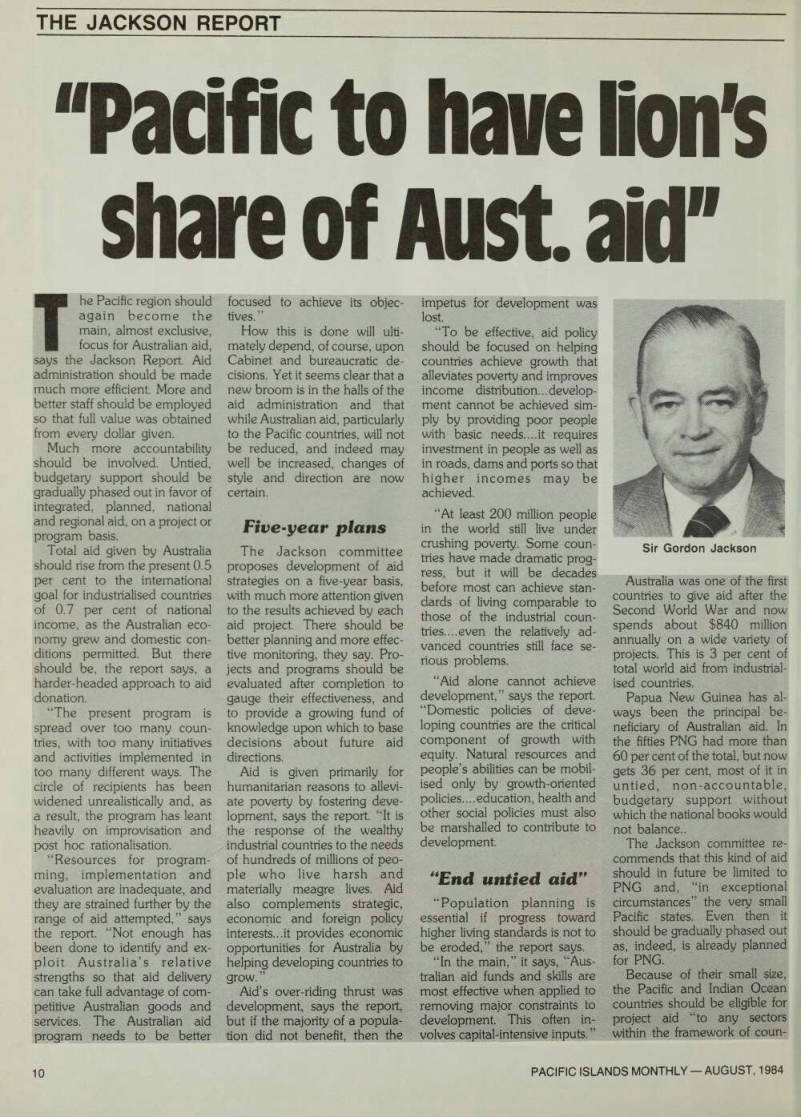
Sir Gordon Jackson
try and regional programming strategies. (This sort of bureaucratic buzz-wording has led to a degree of doubt in some Pacific minds about pre cisely what is intended, but it seems to indicate that overall planning should dictate what sort of aid projects and prog rams would be approved in the future. Projects would not only have to be good, but would have to “fit”).
No fast change
for PNG
The report goes on to say that as Australia’s relationships with some of its near neighbors move increasingly to a trading basis, the share of aid going to China and the South Asian countries could increase.
“A high level of aid should continue to flow to Papua New Guinea because of the special relationship with Australia,” says the report.
“There should be no major immediate change in the level and form of Australia’s aid to PNG, “ but, “consistently with the objectives of growing self reliance” aid should decline gradually, but predictably.
From the end of the current agreement in 1986 budget sup port should decline in real terms at the rate of 5 per cent a year.
This latter recommendation is in accord with the earlier Crawford report on aid to PNG and is broadly accepted by PNG itself. However, this re duction should be offset, says the committee, by gradual in troduction of extra assistance to give PNG more access to train ing, technical assistance, re search and support for volunt ary agencies.
“The overall decline in Aus tralia’s total aid should be, however, at least three per cent a year in real terms. In this way the aid relationship would be gradually normalised, although it would take 25 to 30 years for the balance of Australian aid to move from budget support to a normal bilateral country prog ram. ”
The Jackson report is quite critical of PNG’s growth and financial management. It con cedes that Australia was not a good colonial power in its ad
ministration of Papua New Guinea and that it left a legacy of serious problems. But, even allowing for that, the report says, “Papua New Guinea’s growth since independence has been somewhat disappointing.
Cohesion and stability have been achieved, but growth, particularly in the subsistence and other agricultural sectors, has been limited.
“Papua New Guinea’s growth in the seventies was only half way up the sub- Saharan Africa performance ladder and it lagged behind its ASEAN neighbors... it is now time for more debatable op tions that Papua New Guinea faces,” the report says.
“Australia should pay more attention to Papua New Guinea’s economic problems to maintain the close and harmo nious relationship between the two countries and to reassure Australian taxpayers that their money is being well spent.”
The report went on to recom mend that in-depth annual re views of the PNG economy should be undertaken by inde pendent professionals selected
by PNG and Australia. The findings of these professionals should be published, the report says.
“Bloody angry"
Critical references such as these led to some angry re
marks by prime minister, Michael Somare, during his visit to Sydney about three weeks before the report was pub lished. Mr Somare had received from person or persons uniden tified, but assumed to be very close to the committee, a draft of pages particularly affecting
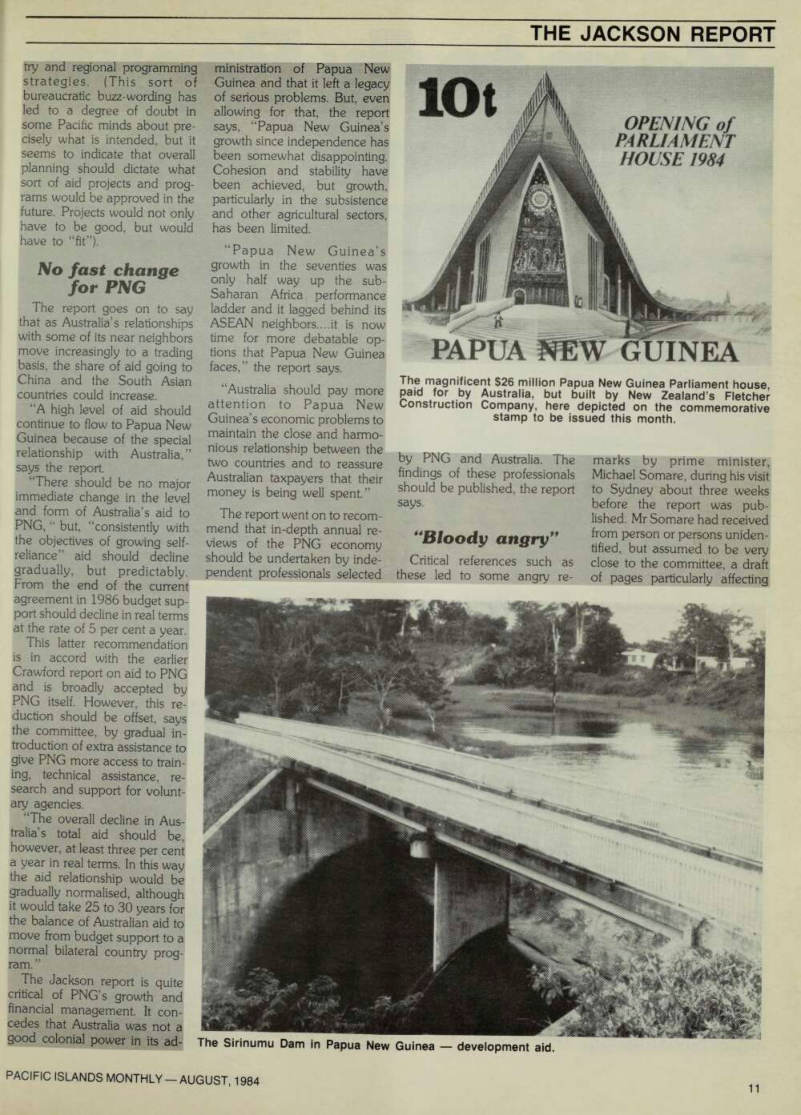
The magnificent $26 million Papua New Guinea Parliament house paid for by Australia, but built by New Zealand’s Fletcher Construction Company, here depicted on the commemorative stamp to be issued this month.
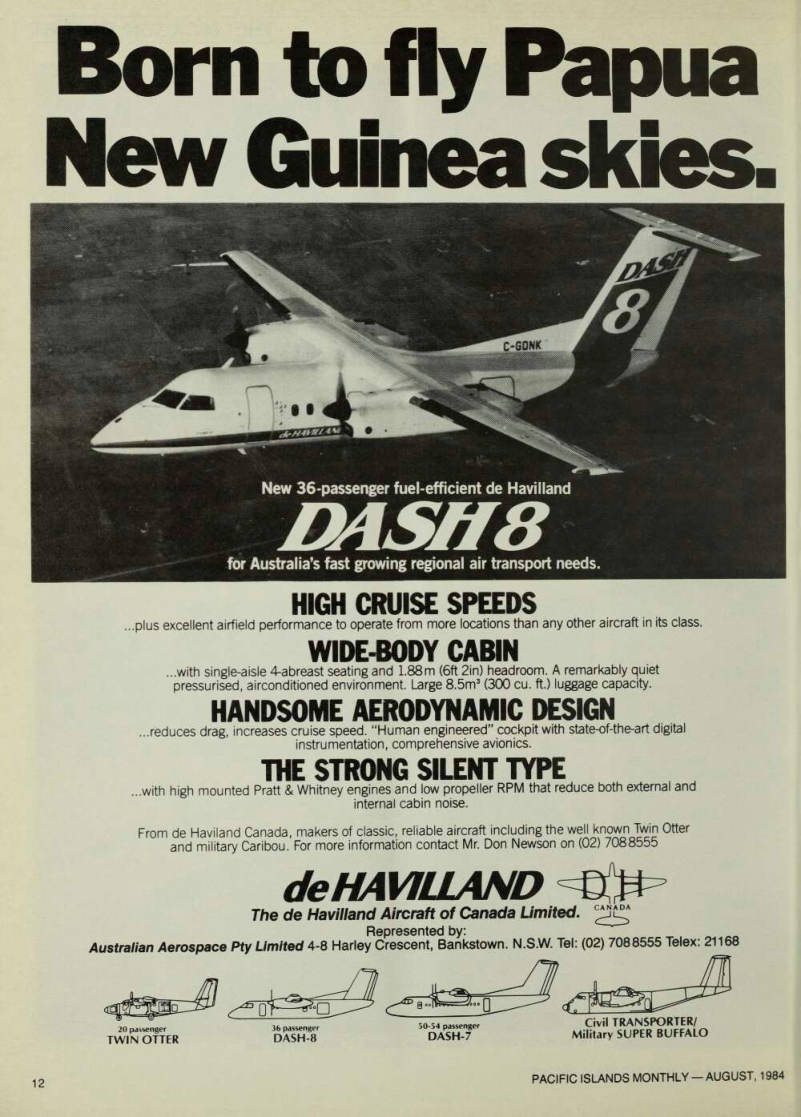
The Sirinumu Dam In Papua New Guinea development aid.
his country. This draft seemed to indicate that the committee would recommend an early end to budgetary support for PNG and led Mr Somare to say he was “bloody angry” about such a dire notion.
The report finally published was not nearly so blunt as the leaked pages suggested it was going to be. Whether this meant it had been rewritten at the last minute to take note of the PNG views has been kept a bureaucrats’ trade secret. Mr Somare has since sounded a good deal happier, although he remains less than charmed about some of the comparisons and assumptions made by the committee in its assessment of
Png.
In fact the report is at least as critical of Australia as it is of PNG or any other country.
Australia’s preparations for PNG independence were hasty, and ill-considered, the report says. Few PNG nationals had experience of public adminis tration. Departing officials hasti ly superimposed a few indi genous institutions on admi nistrative and legal framework
based upon inappropriate Australian models. It was all a very rushed job done for reasons more linked with Aus tralia’s regional and internatio nal image than the good future of PNG.
Papua New Guinea re mained dominated in its early independent years by Austra lian goods, services, standards and appetites. This tended to distort the economy in such areas as wages and divorce it from the local economy and culture, the report says.
Although it is large by South Pacific standards, PNG’s eco nomy is, in fact, very small.
Overall national income for 1982 is thought to have been about SA3 billion. By compari son, the Australian income in the same period was about SAISS billion. The monetised private sector in PNG is small.
High wages and rising job opportunities in the seventies had caused urban drift, which persisted to cause problems of law and order which, the report indicated, would have to be resolved if development was not to be impeded, and strains
not put upon the political system.
“National cohesion and stability have been achieved, but growth, particularly in the subsistence and other agricultu ral sectors, has been limited,” the report says.
Malnutrition Malnutrition was a problem in the community, said the report. This was not because of any food shortage, but due to “inappropriate dietary pat terns” caused by food taboos, neglect and lack of information and education. Children were particularly disadvantaged.
PNG could need an “invest ment in people” program, the report suggested.
Minister for Industrial Deve lopment, Karl Stack, who attended a lunch in Sydney last month at which the main speaker was Sir Gordon Jack son, admitted that the bulk of budgetary aid was spent on supporting a very large public service.
“But who left us a public service with 40,000 people?
Who left us a public service for which you must provide hous-
ing? You don’t have that in Australia,” said Mr Stack.
“There are not many deve loping countries which have that sort of burden. The cost to us of this accommodation is horrendous. 1 will repeat what my prime minister said. The report is very fair, but there is an element of buck-passing in it. If you talk literacy rates and compare them with Africa, you must remember PNG has been independent for only nine years, and we started with a few handicaps, including the beer you left us. And I would be interested to know what was the literacy rate when you handed over to us, and what it is today.
“Sir Gordon Jackson sug gests that Australian companies should have more of an advan tage in trading with PNG. I totally agree in many ways, but by the same token, if Australian industries were capable, the trade would be there today.
There isn’t much we can do about it. We have Toyotas and Nissans instead of Holdens. I notice you have them now, too,” he quipped.
“When we formulated our macro-economic policies at in dependence, we concentrated on the distribution of wealth. I have been informed by the report that per capita income has gone down. That fascinates me. I cannot challenge it, but it fascinates me,” said Mr Stack.
“The government of those days sacrificed growth in an effort to achieve better distribution of wealth. It is only since the formation of this latest govern ment, and the production of the White Paper on industrial deve lopment, that we are suddenly trying to swing the emphasis in PNG towards growth. But, if we had gone for growth from the outset we would have alienated huge sections of our commun ity.
“However, I totally agree with the idea of tied aid being replaced by project aid. Under the present agreement budget ary support from Australia is to decline at the rate of 5 per cent per annum. The committee re commends an increase in pro ject aid to reduce this decline to three per cent. It means we could get more, ” Mr Stack said.
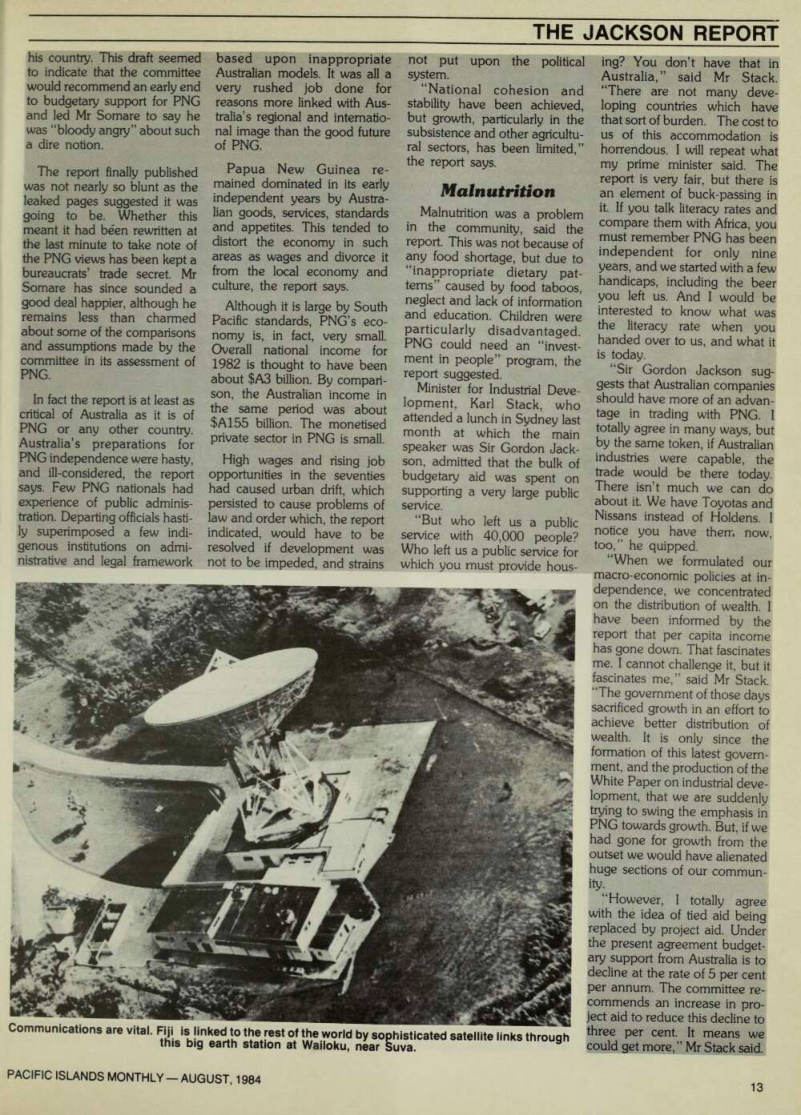
Communications are vital. Fiji is linked to the rest of the world by sophisticated satellite links through this big earth station at Wailoku, near Suva.
Advertisements & other items, p. 12 (1 item)
Born to fly Papua
New Guinea skies
New 36-passenger fuel-efficient de Havilland
DASHB
for Australia’s fast growing regional air transport needs.
HIGH CRUISE SPEEDS
...plus excellent airfield performance to operate from more locations than any other aircraft in its class.
WIDE-BODY CABIN
...with single-aisle 4-abreast seating and I.BBm (6ft 2in) headroom. A remarkably quiet pressurised, airconditioned environment. Large 8.5m 3 (300 cu. ft.) luggage capacity.
HANDSOME AERODYNAMIC DESIGN
...reduces drag, increases cruise speed. “Human engineered" cockpit with state-of-the-art digital instrumentation, comprehensive avionics.
IKE STRONG SILENT TYPE
...with high mounted Pratt & Whitney engines and low propeller RPM that reduce both external and internal cabin noise.
From de Haviland Canada, makers of classic, reliable aircraft including the well known Twin Otter and military Caribou. For more information contact Mr. Don Newson on (02) 7088555
de HAVILLAND
The de Havilland Aircraft of Canada Limited. a Represented by: T , Australian Aerospace Pty Limited 4-8 Harley Crescent, Bankstown. N.S.W. Tel: (02) 7088555 Telex: 21168 50-54 passenger 36 passenger
DASH-7
DASH-8
20 passenger
TWIN OTTER
Civil TRANSPORTER/
Military SUPER BUFFALO
major obstacle
Population growth a major obstacle
On a per capita basis the small island states of the Pacific re ceive more aid than anyone else on earth, says the Jackson Report. And yet, in deve lopment terms, the South Paci fic is a region of contradictions.
Compared with other areas the need for aid is marginal for, even where poverty exists in statistical terms the quality of life is high. Land areas are small, but sea areas and dist ances enormous. Populations are also small, but population growth is a major obstacle to development, the report says.
All of these factors must be taken into account by Austra lian aid managers, it says, be cause, despite the present real prosperity and quality of life available generally in the re gion, there is “a danger that ’subsistence affluence’ could become ’subsistence poverty,’ at least in some island coun tries.”
Economically, the islands are not of major importance, although they provide modest, but useful, trading opportuni ties. Strategically, however, their location gives them special significance.
Freer movement “In the longer term the is lands may also benefit from closer association, a freer movement of goods, capital and labor, and some rationalisation of resources on a regional basis,” says the report.
“Australian aid policy should take account of the special characteristics of its small island neighbors. The Australian De velopment Assistance Bureau (ADAB), through which aid is channelled, should develop special expertise in this area.”
Within the 8 million square kilometres making up the land and sea area of the South Pacific there live only 2 million people formed into nine inde pendent nation states and two
self-governing states in free association with New Zealand.
All face critical development problems in the next ten years, the report says, because their populations are increasing rapidly, their economic growth and opportunities are limited, and there is prospect of di minishing-aid from former colo nial powers.
The aid burden on Australia and New Zealand was not likely to diminish, and could increase, as it seemed likely they would be called on for additional assistance when the French and U.S, territories became inde pendent.
Uneven growth
While all the South Pacific island countries shared com mon problems of smallness and remoteness, they had major differences in peoples, re sources and levels of deve lopment. Economic growth had been uneven, reflecting varia tions in natural and human resource.
The report briefly summed up its views of the island na tions, putting them into three broad categories. Fiji was in a class of its own, being, the report said, the traditional trade entrepot for the region, having a well-established system of trade and a work-force both larger and more skilled than its regional colleagues. Yet, it had problems, among them its par tial dependence upon donor technical assistance, its difficul ties with successful export promotion, and a large bureaucracy. (About 60 per cent of the wage-earning popu lation is on the government payroll).
Solomon Islands, Vanuatu, Western Samoa, Tonga and Kiribati, in the next group, were more aid dependent, and had more limited economic capa city. They lacked sufficient ex pertise in business and govern ment and did not have the economies of scale to over come skill deficiencies, said the report.
“Of the remaining states,
Tuvalu has a unique combina tion of minute size, tiny popula tion and almost total lack of resources. It is a state without internal economic viability, and it will have to remain depen dent on remittances and aid.”
The Cook Islands and Niue, it said, were only slightly better off, but drew substantial sup port from New Zealand.
The Micronesian islands were roughly in the same category but were likely to maintain close economic ties with the United States. However, there might be some role in South Pacific affairs for them, particularly through the Federated States of Micronesia.
Narrow base
The two French territories were not really included in the survey, since , technically speaking they are part of France, but, “New Caledonia might be important to Australia in the future, particularly if political independence were to bring a withdrawal of French economic support,” the report said.
In the long term natural and human resources would influ ence the living standards attain able in the islands. Most coun tries had a narrow resource base.
The fact that the region was
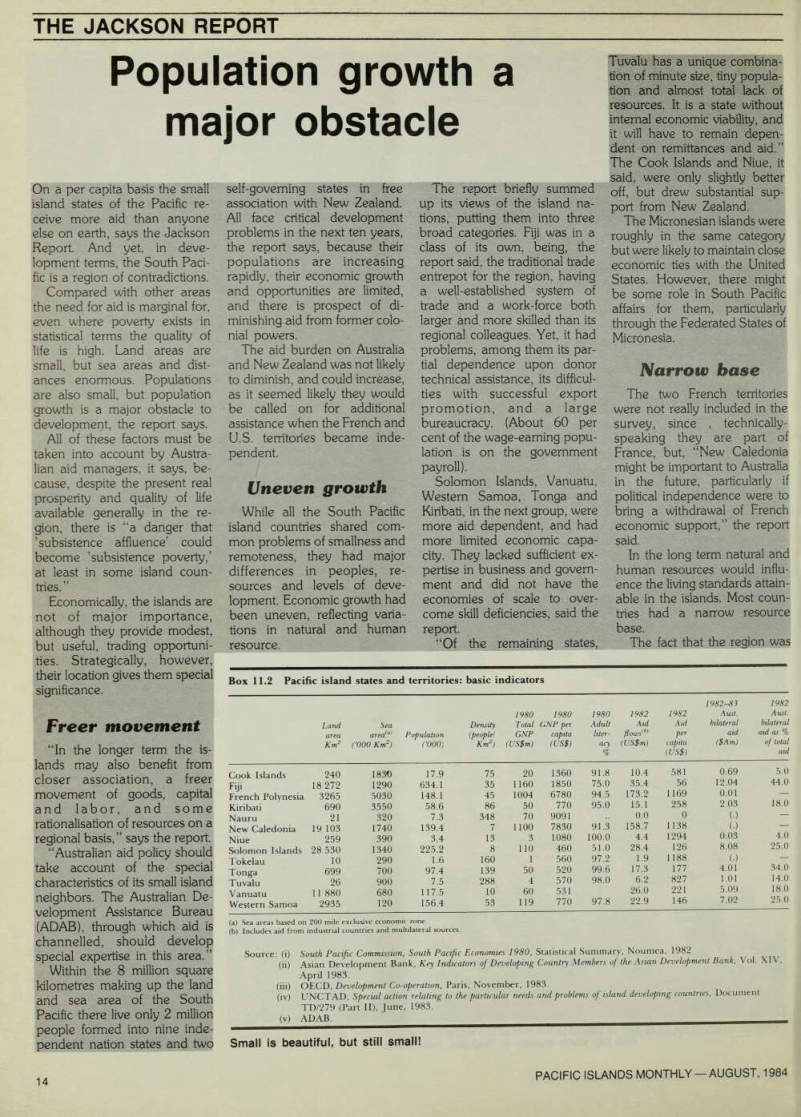
(a) Sea areas based on 200 mile exclusive economic zone. (b) Includes aid from industrial countries and multilateral sources.
Source: (i) South Pacific Commission, South Pacific Economies 1980, Statistical Summary, Noumea, 1982 (ii) Asian Development Bank, Key Indicators of Developing Country Members of the Asian Development Bank, Vol. XIV, April 1983. (iii) OECD, Development Co-operation, Paris, November, 1983. (iv) UNCTAD, Special action relating to the particular needs and problems of island developing countries. Document TD/279 (Part II), June, 1983.
(V) Adab.
Small is beautiful, but still small!
Box 11.2 Pacific island states and territories; basic indicators Land Sea area area ,a> Km 2 {'000 Km 2 ) Population ('000) Density
(people /
Km 2 ) 1980 1980 Total GNP per GNP capita (USfm) (US$) 1980 Adult literacy % 1982 Aid
flows""
<USfm) 1982 Aid Per capita (US$) 1982-83 Ausl. bilateral aid (SAm) 1982 Ausl. bilateral aid as % of total aid Cook Islands 240 1830 17.9 75 20 1360 91.8 10.4 581 0.69 5.0
Fiji
18 272 1290 634.1 35 1160 1850 75.0 35.4 56 12.04 44.0
French Polynesia
3265 5030 148.1 45 1004 6780 94.5 173.2 1169 0.01 — Kiribati 690 3550 58.6 86 50 770 95.0 15.1 258 2.03 18.0 Nauru 21 320 7.3 348 70 9091 0.0 0 (•) — New Caledonia 19 103 1740 139.4 7 1100 7830 91.3 158.7 1138 (•) — Niue 259 390 3.4 13 3 1080 100.0 4.4 1294 0.03 4.0 Solomon Islands 28 530 1340 225.2 8 110 460 51.0 28.4 126 8.08 25.0 Tokelau 10 290 1.6 160 1 560 97.2 1.9 1188 (•) —
Tonga
699 700 97.4 139 50 520 99.6 17.3 177 4.01 34.0 T uvalu 26 900 7.5 288 4 570 98.0 6.2 827 1.01 14.0 Vanuatu 11 880 680 117.5 10 60 531 26.0 221 5.09 18.0 Western Samoa 2935 120 156.4 53 119 770 97.8 22.9 146 7.02 25.0
divided into three distinct cultu ral groups, Melanesian, Micronesian and Polynesian, constrained development in a variety of ways, although each culture provided a degree of social cohesion. Yet each sys tem also held back such aspects of development as larger and more economic agriculture, as well as domestic and tourist investment because of custom ary land ownership and land transfer systems. Being small offered the islands some advan tages, among them the fact that only modest economic changes would be sufficient to solve some of the balance of pay ments, income and other prob lems. Traditional agriculture such as livestock, copra and fisheries, could be improved by
more economic holdings, small processing plants, better marketing and planning for bulk transport.
“Cash crops could increase export earnings, but careful planning is needed to obtain maximum returns in regional markets. Possibilities include coffee, cocoa, palm oil, tropical fruits, vegetables, pepper, vanil la and certain new crops such as tropical fruits and flowers,” the report said.
Tourism was underde veloped. Even Fiji had a long way to go in building up associ ated service industries such as local tours, handicrafts and lo cal foodstuffs.
“In some islands, recreational facilities are inadequate, and
small national airlines are com peting wastefully with each other,” said the report., “It is disappointing that Nauru with its significant financial resources has not done more to promote regional tourism.”
Artificial hopes
Many of the island communi ties suffered from artificially high expectations of standards of living, and public services.
Food consumption had be come heavily weighted towards processed foods, particularly canned fish. “Villagers often expect government to provide bridges and roads, when con struction is well within their own capability and local materials
are available.
“Colonial powers,and the major trading firms have en couraged the growth of high expectations which are now so firmly entrenched that it will be politically difficult to deny them.”
Australia also came in for some scrutiny in the report, at least so far as her image among the small island countries is concerned, and also the performance of her aid admi nistrators.
Both,the report concluded, needed some care and atten tion, largely because they had been allowed, like Topsy, just to grow without very much attention to their size, shape, education and general allure.
Main recommendations
for Pacific
The Jackson report has no status beyond that of a survey of the scene, and an expression of view to the Australian Gov ernment. And yet, because of the apparent need for change, and also because the people who sat on the committee were pretty much hand-picked by the Foreign Minister, Mr Hayden, their recommenda tions will carry great weight in Canberra.
Dealing with the small Pacific nations, for example, they say that Australia must adapt its assistance to the special circumstances of the island na tions, while being ’’sensitive to indigenous cultures.
“In particular Australia must identify the limits on deve lopment and learn from past mistakes. Some responses should go beyond traditional ideas of aid.”
Thus they made a series of proposals about the direction Australian aid could take in the future: • A special immigration quota should be established to help deal with the unique prob lems of Tuvalu and Kiribati.
“The numbers involved would be small as the total population of the two islands is only about
66,000 people. A special im migration scheme should be introduced gradually as part of a long-term strategy, based on training arrangements under the aid program.” • SPARTECA (the trade-aid system by which Pacific coun tries have duty-free access to Australia and New Zealand), should encourage island gov ernments and firms to foster promising export sectors, but should avoid encouraging the development of industries en tirely dependent upon duty-free access. Aid should encourage private sector development, particularly through joint ven
tures and development banks. • Existing aid levels should be maintained, but should re flect need, in terms of deve lopment potential and living standards, a decline in finance dependence, and quality of performance among recipients. • Aid levels should be suffi ciently firm to encourage long term planning. Ability of reci pients to usefully absorb a volume of aid should be realis tically monitored. • Country and regional prog ramming “are desirable to help with identification of priority sectors and to select forms of aid.” • Australia should respond readily to requests for technical assistance by way of experi enced personnel. • Training was essential, but
should not be based on large specialist bureaucracies and sophisticated services, but should be aimed at providing essential trade, technical and professional skills. • Training should be guided by the following considerations: curriculum development on a regional basis; more diversified and practice-oriented tertiary training using the facilities of the University of the South Pacific; courses in Australia and in the region to upgrade basic skills; urgent upgrading of trade train ing; courses to develop re gionally relevant technical skills, for example a tourism school; on the job training in Australia through exchanges of person nel; regional training to prepare islanders from the micro-states to work in more prosperous communities. • Head of Mission discretion ary aid should be increased, particularly as it was applied to remote villages and areas where larger scale projects had little impact. • Voluntary aid agencies should be supported and en couraged. • “Some projects in the South Pacific are large enough to justify co-financing with the Asian Development Bank. The funding of regional deve lopment banks is an example,” the report says.
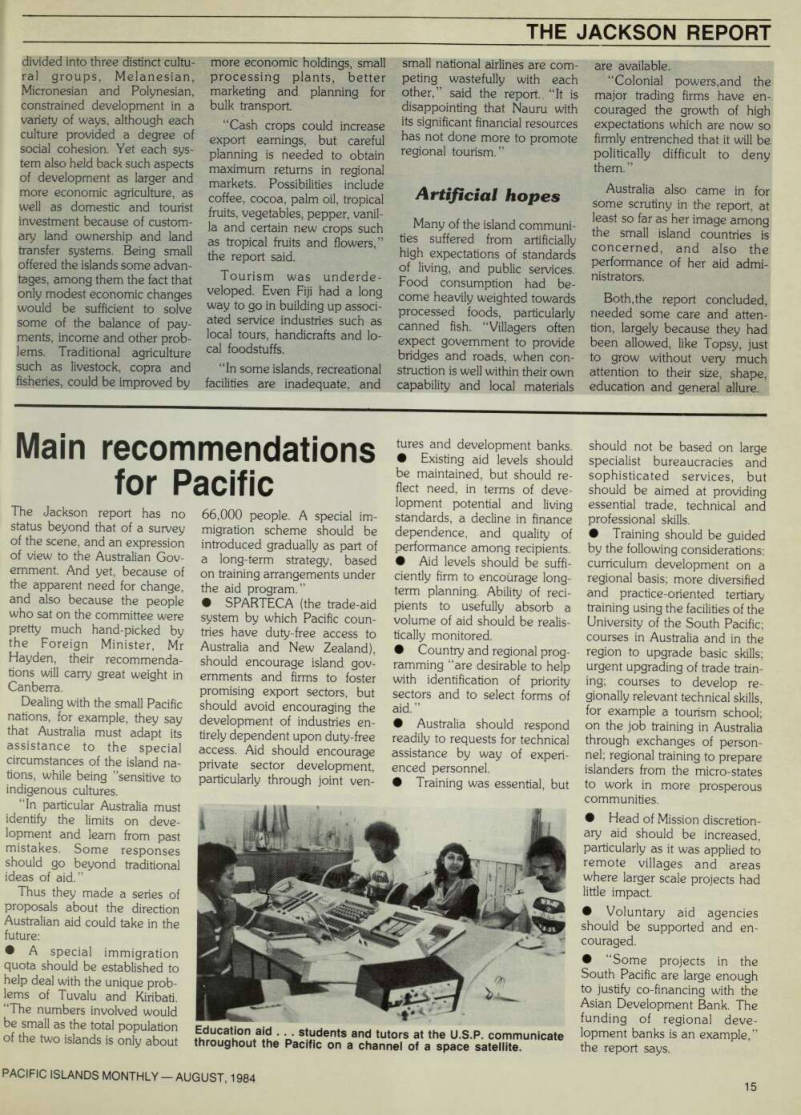
Education aid . . . students and tutors at the U.S.P. communicate throughout the Pacific on a channel of a space satellite.
relationship explained
letters
God and Nauru a special relationship explained
I would like to make some comments on the article that was dedicated to the unwar ranted frivolous criticisms of the Head of State of our country, Nauru. The criticisms, or to put it another way, the points of view, I’m referring to can be found on page 11 of the June issue, 1984 Pacific Islands Monthly.
In the first instance I must declare that I failed to under stand the reasons as to why the contents of those unsigned let ters received by the magazine, irrespective of their similarities in their criticisms, were pub lished at all.
However, as far as those points of view are concerned “President Hammer Deßoburt is a one man band, and he thinks he talks to God ” are, although very frivolous, in themselves very accurate.
It is true that he is a one man band and we like listening to him for he plays beautiful tunes.
He composes beautiful songs as well as singing them. We love his songs plus his style. The songs he sings by public de mand become golden hits.
Naturally, there are the minority that think otherwise. These are mainly expatriates with their own foreign taste, and not the Nauruan taste.
It is true to say that the President is a one man band.
He is the true servant of the Nauruan people and as a Nau ruan I wish to express the very genuine gratitude of every Nau ruan here on this small island of ours, plus those who are abroad, for having such a high powered calibre of leader in our midst. We are very fortunate for his presence in our midst and for that matter the Pacific itself Secondly, where the article stated that he (Hammer De- Roburt) thinks he talks to God it
is really the other way around, that is, God talks to him.
In short, if there is no con crete coverage that can be made then I ask your magazine to embark onto something that is more substantial than mere vexatious and childish in nature.
My country went for its inde pendence from Australia and its two other partners not because it wants to break away from the parent countries, but because of the fact that it sees its future not in these countries but in itself.
What prompted the act of independence was the treat ment that Nauru was receiving as a mandated territory very similar to the vivid situation of most developing countries with such high-rated resources as
Ours: “We Are Not Get
Ting The Best And The
Most Out Of Our Natu
Ral Resources.”
What we seek is the equal and fair opportunity of competi tion as a developing state. We are the only island state in the Pacific that does not receive foreign aid at all. That is, what we have here is an independ ence that at the original stage was our kind of independence.
We would like to maintain this without unnecessary publica tions such as your magazine has demonstrated.
Thank you.
Anthony Detsimea
“Yaren Lodge ”
Yaren District Republic of Nauru
Phosphates
and money
What we criticised in the article which so greatly pains Mr Ross felder (PIM July, pll) was mainly the very modest finan-
dal benefits the people of French Polynesia will derive from the proposed extraction of 10 million tonnes of phosphate from the atoll of Mataiva by his international consortium. The Polynesians still bear in mind the shameful deal they got when another international mining company, in the period between 1918 and 1965, ex tracted a similar amount of phosphate from the nearby is land of Makatea for the sole benefit of its foreign sharehol ders. The question they are asking (with no firm answer so far) is whether the same sort of large-scale exploitation which in other parts of the Pacific is a thing of the past, will be perpe trated again at Mataiva.
The fact that Mr Rossfelder
has nothing to say about the all-important financial aspect of the operation for which he is responsible is very strange. And the -pain he evidently experi enced on reading our article seems to us to be a sure sign that our probing knife touched a particularly sensitive part of his corporate anatomy. As for the present enthusiasm for the project shown by the inhabi tants of Mataiva as described by Mr Rossfelder it is, of course, due to recent generous hand outs of money and to their total inability to appreciate correctly the social and ecological dan gers involved.
Marie-Therese And Bengt
Danielsson
Papehue Tahiti French Polynesia
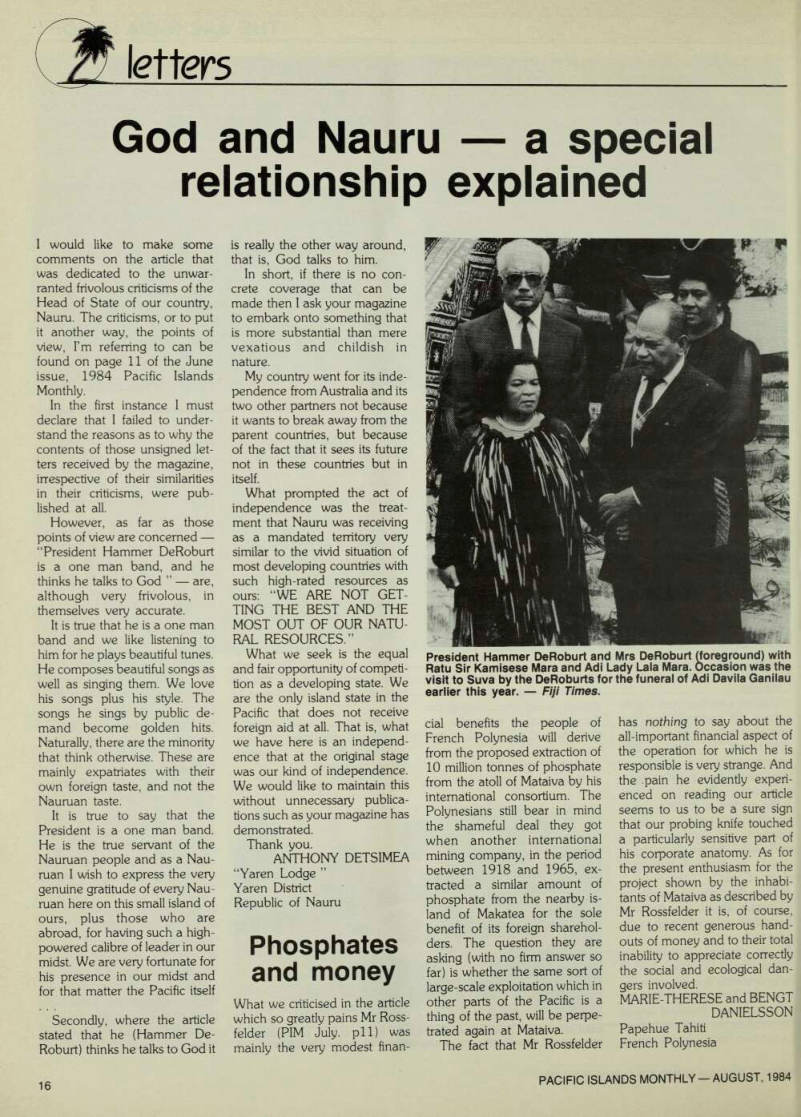
President Hammer DeRoburt and Mrs DeRoburt (foreground) with Ratu Sir Kamisese Mara and Adi Lady Lala Mara. Occasion was the visit to Suva by the DeRoburts for the funeral of Adi Davila Ganilau earlier this year. - Fiji Times.
help” Minister
Regional defence
“N.Z. seeks only to help” Minister
New Zealand’s minister of de fence, David Thomson, has re jected suggestions that, by for ming a ready reaction force, his country seeks to impose its presence on partner govern ments.
In a letter to Pacific Islands Monthly, he replies to Mr Noel Levi, MR for New Ireland, Papua New Guinea, who, in a letter published in PlM’s June, 1984, issue, suggested the New Zealand force smacked of gun boat diplomacy and colonial ism.
“I am disappointed that Mr Levi should harbor such mis conceptions about New Zea land policy and I should like to set the record straight,” Mr Thomson wrote.
“The New Zealand armed forces have, over the years, worked closely with the govern ments of our South Pacific partners in providing a wide range of assistance. These acti vities have included maritime zone surveillance, search and rescue, the construction of port facilities, the provision of fresh water supplies, public health and the wide range of help needed for disaster relief. Only a few months ago an RNZAF C-130 Hercules aircraft was operating (not far from Mr Levi’s own electorate) in sup port of the Papua New Guinea government’s efforts to prepare against the prospect of a major volcanic eruption in Rabaul.
There is not, and has never been, the slightest wish on our part to impose our presence on partner governments. Quite the reverse; such tasks as these are undertaken only at the express request of the governments concerned and in close con sultation with them. “So it would be with any combat role, should the need ever arise.
“Mr Levi seems to suggest that a Ready Reaction Force is something new. In fact the concept was first proposed in our 1978 Defence Review. The force now discussed more fully in the 1983 White Paper is no more than a core element around which the Army as a whole can be structured. Estab lishment of an operationally ready component in this case a battalion group is a
matter of Army organisation, NOT a mark of any intention to launch it against our friends and partners.
“The ability to make a quick response in any emergency is essential to any armed force. It does not imply a commitment to going on the offensive. I am sorry to say that Mr Levi makes a common mistake in confusing a force organised to deter aggression with aggression it self. A careful reading of the 1983 New Zealand Defence Review will show that a princi pal purpose in the establish ment and operation of our defence forces is the wish to head-off any threat to New land or its national interests by maintaining a demonstrable capacity to hit back. The emph asis is defensive, constructive and intended to benefit the whole region of the South Pacific.
“With a clearly defined operationally ready element in the army, and likewise in the other two services, New Zea land defence policies are shar pened and made more credi ble. Equipment and training priorities can thus be establish ed and implemented. Such a basis for development of the forces is integral to modem
defence planning. It is the way we try to tailor the allocations of scarce defence resources against an uncertain future. All armed forces must make such provisions. Operationally ready forces are not designed to be interventionist. They are simply designed to be ready, suitably equipped and trained, for any service the government may designate for them at home or abroad, in the Pacific or in support of international peace keeping in any part of the world.
“Mr Levi also appears to overlook the statutory re sponsibility we have for the defence of a number of island countries in the South Pacific namely the Cook Islands, Niue and Tokelau. Of course no action would, or could, be taken without their full coopera tion and at their request whether in disaster relief or response to armed aggression.
But we need to have a real capacity to assist our South Pacific neighbors if ever asked to do so and to be appropriately equipped, organised and trained for the purpose.
“In the same way the then Papua New Guinea govern ment of which Mr Levi was foreign minister, responded in
1980 to Vanuatu’s request for assistance in dealing with a secessionist rebellion on the island of Espiritu Santo. It was an admirable operation and certainly not aggressive or in terventionist. I must say that I cannot see any difference be tween that response by PNG and New Zealand taking steps to ensure that if called upon it too could react, promptly and efficiently. I might add that only a few weeks ago the PNG prime minister, Mr Somare, in response to a question from a PNG Opposition MP, stated that he had no doubt that in the event of serious threats to his country’s national security, Australia and New Zealand would come to PNG’s aid.
“I do not know whether our neighborhood will ever move towards the concept of a regio nal peacekeeping force put for ward by PNG while Mr Levi was foreign minister. In the meantime it appears appropri ate for all partner governments to be developing to the best of their ability their own capacity to contribute if needs be. The reconstruction of the opera tionally ready core of the army that was announced in the government’s Defence Review, published late last year, is one way in which the New Zealand government can make such a contribution to regional secur ity, should such support be requested. It is not, nor will it be, the basis of any wider ranging proposals to be placed before the South Pacific Forum.
“Since the publication of the Defence Review, my defence officials have visited a number of South Pacific nations ex plaining the thinking behind the Review and New Zealand’s wish to continue to play a constructive role in our region.
These officials were well re ceived by government ministers wherever they went. I am happy to say that the response showed that these governments including Papua New Guinea do not share Mr Levi’s misunderstandings of the role of the force.”
David Thomson, Minister of Defence, Parliament House, Wellington.
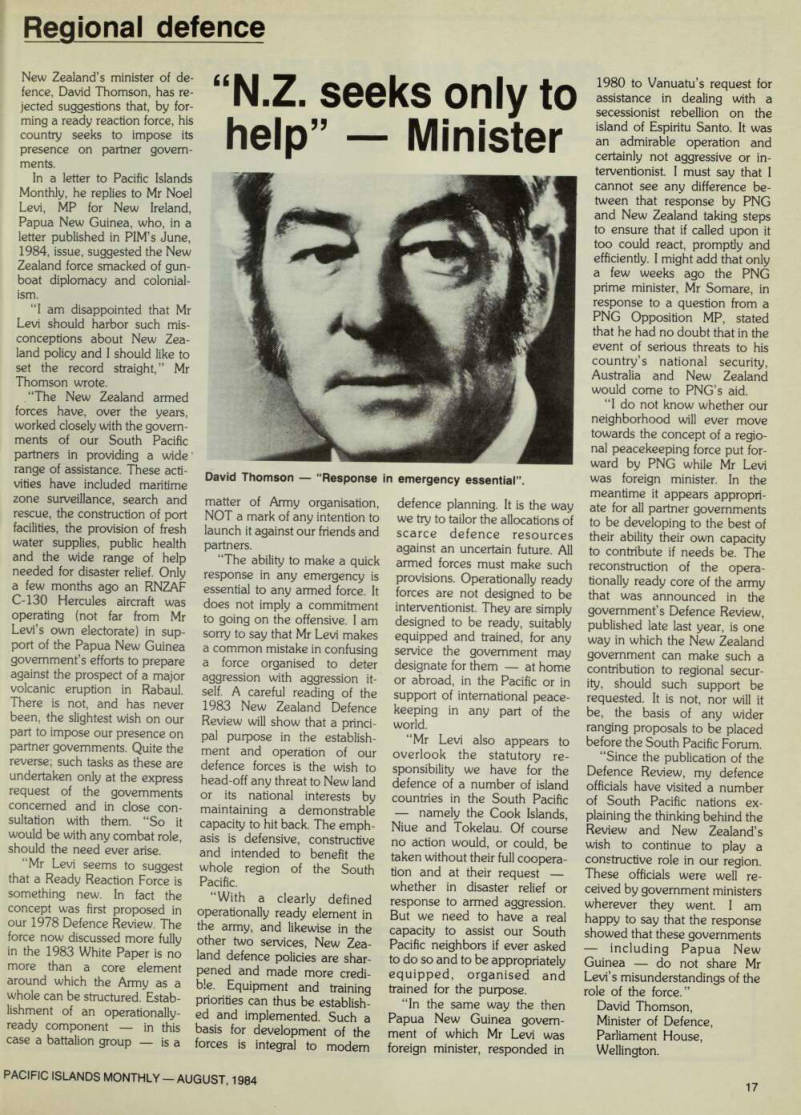
David Thomson - “Response In emergency essential”.
Advertisements & other items, p. 18 (1 item)
Rmdg Mini Brewery
The unique RMDG Mini Brewery is an integrated system designed to produce 16 hectolitres of high quality beer per brew from the basic brewing raw materials of water, malt & hops.
The Brewery is made up of modular units:
• BREWING TOWER
• FERMENTING/CONDITIONING
VESSELS
• FILTRATION EQUIPMENT
• BRIGHT BEER TANKS
• PACKAGING PLANT
• SERVICE PLANT
• CIP PLANT
Full design and consultation services are available within the S.E. Asia region. ■■ St n > m k ■ For further information contact: D. O’Neill 91 co-operative ltd 31/33A Egerton St., Lidcombe, NSW 2141, Australia Tel (02) 648 1084 Telex AA22230
Is There A Way Out
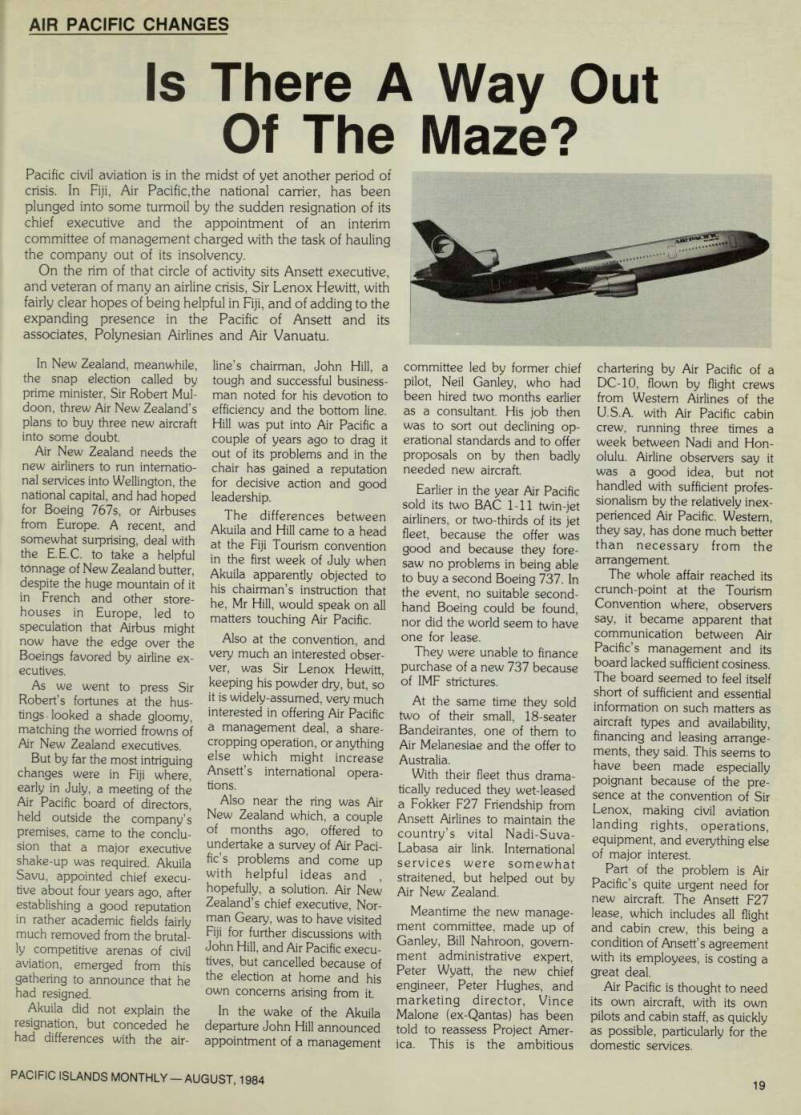
Air Pacific Changes
Is There A Way Out Of The Maze?
Pacific civil aviation is in the midst of yet another period of crisis. In Fiji, Air Pacific,the national carrier, has been plunged into some turmoil by the sudden resignation of its chief executive and the appointment of an interim committee of management charged with the task of hauling the company out of its insolvency.
On the rim of that circle of activity sits Ansett executive, and veteran of many an airline crisis, Sir Lenox Hewitt, with fairly clear hopes of being helpful in Fiji, and of adding to the expanding presence in the Pacific of Ansett and its associates, Polynesian Airlines and Air Vanuatu.
In New Zealand, meanwhile, the snap election called by prime minister, Sir Robert Mul doon, threw Air New Zealand’s plans to buy three new aircraft into some doubt.
Air New Zealand needs the new airliners to run internatio nal services into Wellington, the national capital, and had hoped for Boeing 7675, or Airbuses from Europe. A recent, and somewhat surprising, deal with the E.E.C. to take a helpful tonnage of New Zealand butter, despite the huge mountain of it in French and other store houses in Europe, led to speculation that Airbus might now have the edge over the Boeings favored by airline ex ecutives.
As we went to press Sir Robert’s fortunes at the hus tings-looked a shade gloomy, matching the worried frowns of Air New Zealand executives.
But by far the most intriguing changes were in Fiji where, early in July, a meeting of the Air Pacific board of directors, held outside the company’s premises, came to the conclu sion that a major executive shake-up was required. Akuila Savu, appointed chief execu tive about four years ago, after establishing a good reputation in rather academic fields fairly much removed from the brutal ly competitive arenas of civil aviation, emerged from this gathering to announce that he had resigned.
Akuila did not explain the resignation, but conceded he had differences with the air
line’s chairman, John Hill, a tough and successful business man noted for his devotion to efficiency and the bottom line.
Hill was put into Air Pacific a couple of years ago to drag it out of its problems and in the chair has gained a reputation for decisive action and good leadership.
The differences between Akuila and Hill came to a head at the Fiji Tourism convention in the first week of July when Akuila apparently objected to his chairman’s instruction that he, Mr Hill, would speak on all matters touching Air Pacific.
Also at the convention, and very much an interested obser ver, was Sir Lenox Hewitt, keeping his powder dry, but, so it is widely-assumed, very much interested in offering Air Pacific a management deal, a share cropping operation, or anything else which might increase Ansett’s international opera tions.
Also near the ring was Air New Zealand which, a couple of months ago, offered to undertake a survey of Air Paci fic’s problems and come up with helpful ideas and hopefully, a solution. Air New Zealand’s chief executive, Nor man Geary, was to have visited Fiji for further discussions with John Hill, and Air Pacific execu tives, but cancelled because of the election at home and his own concerns arising from it.
In the wake of the Akuila departure John Hill announced appointment of a management
committee led by former chief pilot, Neil Ganley, who had been hired two months earlier as a consultant. His job then was to sort out declining op erational standards and to offer proposals on by then badly needed new aircraft.
Earlier in the year Air Pacific sold its two BAG 1-11 twin-jet airliners, or two-thirds of its jet fleet, because the offer was good and because they fore saw no problems in being able to buy a second Boeing 737. In the event, no suitable second hand Boeing could be found, nor did the world seem to have one for lease.
They were unable to finance purchase of a new 737 because of IMF strictures.
At the same time they sold two of their small, 18-seater Bandeirantes, one of them to Air Melanesiae and the offer to Australia.
With their fleet thus drama tically reduced they wet-leased a Fokker F 27 Friendship from Ansett Airlines to maintain the country’s vital Nadi-Suva- Labasa air link. International services were somewhat straitened, but helped out by Air New Zealand.
Meantime the new manage ment committee, made up of Ganley, Bill Nahroon, govern ment administrative expert, Peter Wyatt, the new chief engineer, Peter Hughes, and marketing director, Vince Malone (ex-Qantas) has been told to reassess Project Amer ica. This is the ambitious
chartering by Air Pacific of a DC-10, flown by flight crews from Western Airlines of the U.S.A. with Air Pacific cabin crew, running three times a week between Nadi and Hon olulu. Airline observers say it was a good idea, but not handled with sufficient profes sionalism by the relatively inex perienced Air Pacific. Western, they say, has done much better than necessary from the arrangement.
The whole affair reached its crunch-point at the Tourism Convention where, observers say, it became apparent that communication between Air Pacific’s management and its board lacked sufficient cosiness.
The board seemed to feel itself short of sufficient and essential information on such matters as aircraft types and availability, financing and leasing arrange ments, they said. This seems to have been made especially poignant because of the pre sence at the convention of Sir Lenox, making civil aviation landing rights, operations, equipment, and everything else of major interest.
Part of the problem is Air Pacific’s quite urgent need for new aircraft. The Ansett F 27 lease, which includes all flight and cabin crew, this being a condition of Ansett’s agreement with its employees, is costing a great deal.
Air Pacific is thought to need its own aircraft, with its own pilots and cabin staff, as quickly as possible, particularly for the domestic services.
Advertisements & other items, p. 20 (1 item)
/Woooamv
THE PLANE THE WORLD'S AIRLINES ARE BUYING. * 'no. °0 »»» • • »• I* 1 I * % Recent orders for MD-80 transports from around the world offer clear evidence that airlines depend on McDonnell Douglas and the airliners we build.
They are choosing the MD-80 because they urgently need the fuel and operating efficiencies it offers. It is ideally sized for the 150-passenger needs of the airlines and it is popular with passengers too. The MD-80 is preferred by passengers by as much as 8-1 over ordinary airliners, according to independent travel studies.
The McDonnell Douglas reputation for dependable and profit-making airliners Ny started fifty years ago and has been demon- \ strated on more than 15,000 transports, \ 2,000 of them powered by jet engines.
That our airliners fly on for decades is proven by the venerable DC-3 Dakota.
More than 500 are still flying. Some of our DC-8 jetliners have logged more than eight years in the air.
Long after other designs outgrow their temporary appeal-after other manufacturers flash into business and out-airplanes bearing our name fly on. Other builders may introduce airliners well suited for specialized transportation needs. But none will ever match the decade-after-decade advancements that come from the laboratories and factories of McDonnell Douglas-the name and the planes you can trust.
/WOOOAMV
Australia losing out badly in
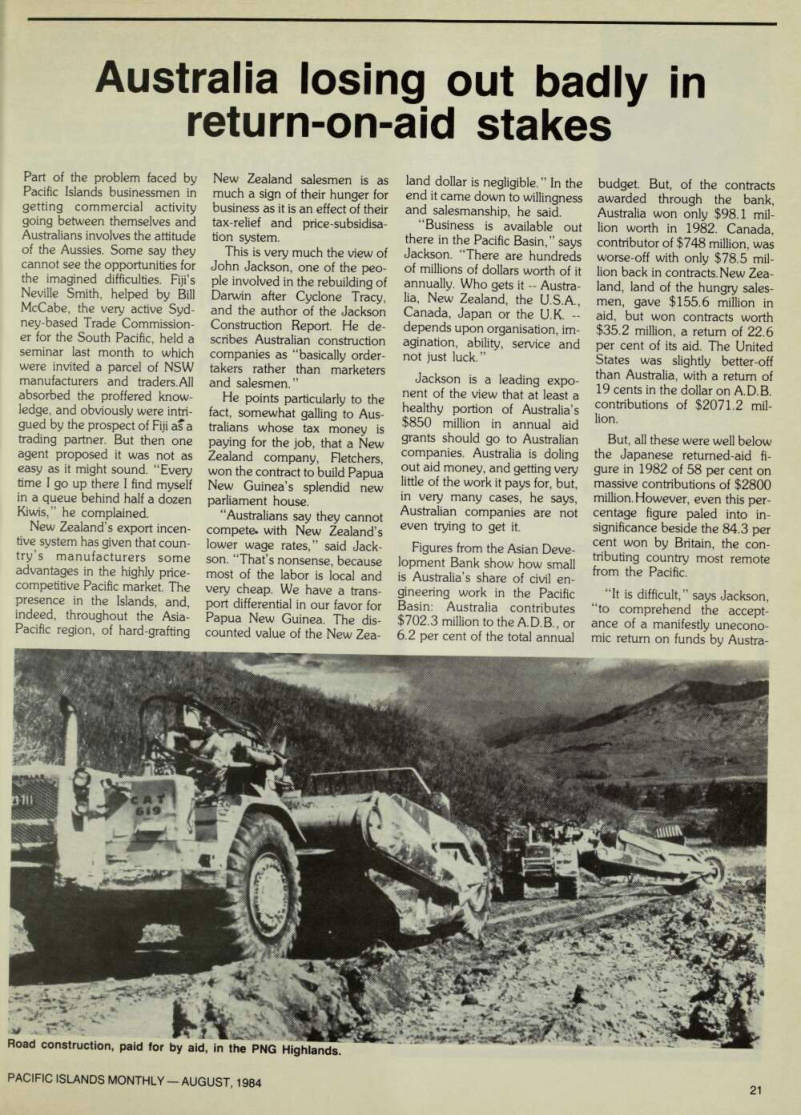
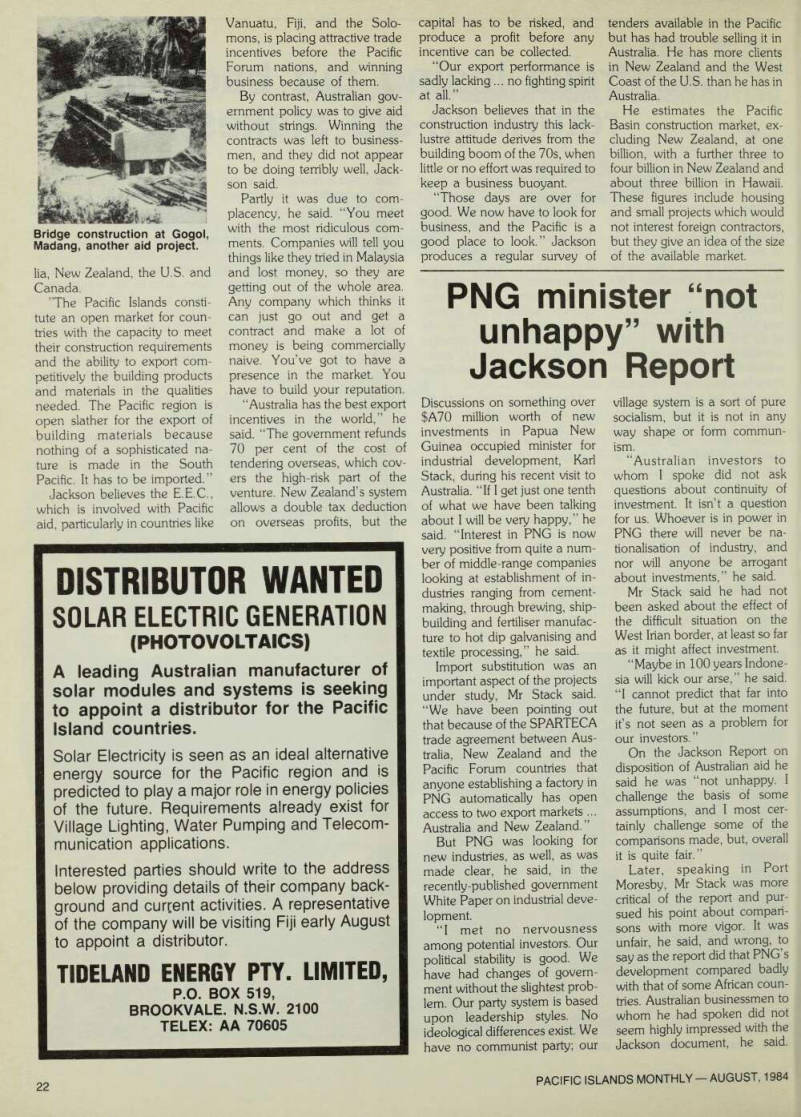
return-on-aid stakes
Part of the problem faced by Pacific Islands businessmen in getting commercial activity going between themselves and Australians involves the attitude of the Aussies. Some say they cannot see the opportunities for the imagined difficulties. Fiji’s Neville Smith, helped by Bill McCabe, the very active Syd ney-based Trade Commission er for the South Pacific, held a seminar last month to which were invited a parcel of NSW manufacturers and traders. All absorbed the proffered know ledge, and obviously were intri gued by the prospect of Fiji as a trading partner. But then one agent proposed it was not as easy as it might sound. “Every time I go up there I find myself in a queue behind half a dozen Kiwis,” he complained.
New Zealand’s export incen tive system has given that coun try’s manufacturers some advantages in the highly price competitive Pacific market. The presence in the Islands, and, indeed, throughout the Asia- Pacific region, of hard-grafting
New Zealand salesmen is as much a sign of their hunger for business as it is an effect of their tax-relief and price-subsidisa tion system.
This is very much the view of John Jackson, one of the peo ple involved in the rebuilding of Darwin after Cyclone Tracy, and the author of the Jackson Construction Report. He de scribes Australian construction companies as “basically order takers rather than marketers and salesmen.”
He points particularly to the fact, somewhat galling to Aus tralians whose tax money is paying for the job, that a New Zealand company, Fletchers, won the contract to build Papua New Guinea’s splendid new parliament house.
“Australians say they cannot compete, with New Zealand’s lower wage rates,” said Jack son. “That’s nonsense, because most of the labor is local and very cheap. We have a trans port differential in our favor for Papua New Guinea. The dis counted value of the New Zea
land dollar is negligible. ” In the end it came down to willingness and salesmanship, he said. business is available out there in the Pacific Basin,’ says Jackson. “There are hundreds of millions of dollars worth of it annually. Who gets it Australia, New Zealand, the U.S.A., Canada, Japan or the U.K. depends upon organisation, imagination, ability, service and not just luck. ”
Jackson is a leading exponent of the view that at least a healthy portion of Australia’s SBSO million in annual aid grants should go to Australian companies. Australia is doling out aid money, and getting very little of the work it pays for, but, in very many cases, he says, Australian companies are not even trying to get it.
Figures from the Asian Development Bank show how small is Australia’s share of civil engineering work in the Pacific Basin; Australia contributes $702.3 million to the A.D.8., or 6.2 per cent of the total annual
budget. But, of the contracts awarded through the bank, Australia won only $98.1 mil lion worth in 1982. Canada, contributor of $748 million, was worse-off with only $78.5 mil lion back in contracts. New Zea land, land of the hungry sales men, gave $155.6 million in aid, but won contracts worth $35.2 million, a return of 22.6 per cent of its aid. The United States was slightly better-off than Australia ’ with a return of 19 cents in the dollar on ADB contributions of $2071.2 mil on‘ But, all these were well below the Japanese returned-aid fl gure in 1982 of 58 per cent on massive contributions of S2BOO million. However, even this per centage figure paled into in significance beside the 84.3 per „ won by Britain ’ the con ‘ ™ utl " s most remote from ,he Paclflc “It is difficult,” says Jackson, “to comprehend the accept ance of a manifestly unecono mic return on funds by Austra-
Road construction, paid for by aid, in the PNG Highlands.
lia, New Zealand, the U.S. and Canada. ’The Pacific Islands consti tute an open market for coun tries with the capacity to meet their construction requirements and the ability to export com petitively the building products and materials in the qualities needed. The Pacific region is open slather for the export of building materials because nothing of a sophisticated na ture is made in the South Pacific. It has to be imported. ”
Jackson believes the E.E.C., which is involved with Pacific aid, particularly in countries like
Vanuatu, Fiji, and the Solo mons, is placing attractive trade incentives before the Pacific Forum nations, and winning business because of them.
By contrast, Australian gov ernment policy was to give aid without strings. Winning the contracts was left to business men, and they did not appear to be doing terribly well, Jack son said.
Partly it was due to com placency, he said. “You meet with the most ridiculous com ments. Companies will tell you things like they tried in Malaysia and lost money, so they are getting out of the whole area.
Any company which thinks it can just go out and get a contract and make a lot of money is being commercially naive. You’ve got to have a presence in the market. You have to build your reputation.
“Australia has the best export incentives in the world,” he said. “The government refunds 70 per cent of the cost of tendering overseas, which cov ers the high-risk part of the venture. New Zealand’s system allows a double tax deduction on overseas profits, but the
capital has to be risked, and produce a profit before any incentive can be collected.
“Our export performance is sadly lacking... no fighting spirit at all.”
Jackson believes that in the construction industry this lack lustre attitude derives from the building boom of the 70s, when little or no effort was required to keep a business buoyant.
“Those days are over for good. We now have to look for business, and the Pacific is a good place to look.” Jackson produces a regular survey of
tenders available in the Pacific but has had trouble selling it in Australia. He has more clients in New Zealand and the West Coast of the U.S. than he has in Australia.
He estimates the Pacific Basin construction market, ex cluding New Zealand, at one billion, with a further three to four billion in New Zealand and about three billion in Hawaii.
These figures include housing and small projects which would not interest foreign contractors, but they give an idea of the size of the available market.
Bridge construction at Gogol, Madang, another aid project.
unhappy” with
PNG minister “not unhappy” with Jackson Report
Discussions on something over SA7O million worth of new investments in Papua New Guinea occupied minister for industrial development, Karl Stack, during his recent visit to Australia. “If I get just one tenth of what we have been talking about I will be very happy,” he said. “Interest in PNG is now very positive from quite a num ber of middle-range companies looking at establishment of in dustries ranging from cement making, through brewing, ship building and fertiliser manufac ture to hot dip galvanising and textile processing,” he said.
Import substitution was an important aspect of the projects under study, Mr Stack said.
“We have been pointing out that because of the SPARTECA trade agreement between Aus tralia, New Zealand and the Pacific Forum countries that anyone establishing a factory in PNG automatically has open access to two export markets ...
Australia and New Zealand.”
But PNG was looking for new industries, as well, as was made clear, he said, in the
recently-published government
White Paper on industrial deve lopment.
“I met no nervousness among potential investors. Our political stability is good. We have had changes of govern ment without the slightest prob lem. Our party system is based upon leadership styles. No ideological differences exist. We have no communist party; our
village system is a sort of pure socialism, but it is not in any way shape or form commun ism.
“Australian investors to whom I spoke did not ask questions about continuity of investment. It isn’t a question for us. Whoever is in power in PNG there will never be na tionalisation of industry, and nor will anyone be arrogant about investments,” he said.
Mr Stack said he had not been asked about the effect of the difficult situation on the West Irian border, at least so far as it might affect investment.
“Maybe in 100 years Indone sia will kick our arse,” he said.
“I cannot predict that far into the future, but at the moment it’s not seen as a problem for our investors.”
On the Jackson Report on disposition of Australian aid he said he was “not unhappy. I challenge the basis of some assumptions, and I most cer tainly challenge some of the comparisons made, but, overall it is quite fair.”
Later, speaking in Port Moresby, Mr Stack was more critical of the report and pur sued his point about compari sons with more vigor. It was unfair, he said, and wrong, to say as the report did that PNG’s development compared badly with that of some African coun tries. Australian businessmen to whom he had spoken did not seem highly impressed with the Jackson document, he said.
Advertisements & other items, p. 22 (1 item)
Distributor Wanted
SOLAR ELECTRIC GENERATION
(PHOTOVOLTAICS)
A leading Australian manufacturer of solar modules and systems is seeking to appoint a distributor for the Pacific Island countries.
Solar Electricity is seen as an ideal alternative energy source for the Pacific region and is predicted to play a major role in energy policies of the future. Requirements already exist for Village Lighting, Water Pumping and Telecommunication applications.
Interested parties should write to the address below providing details of their company background and curcent activities. A representative of the company will be visiting Fiji early August to appoint a distributor.
TIDELAND ENERGY PTY. LIMITED,
P.O. BOX 519,
BROOKVALE. N.S.W. 2100
TELEX: AA 70605
French Polynesian
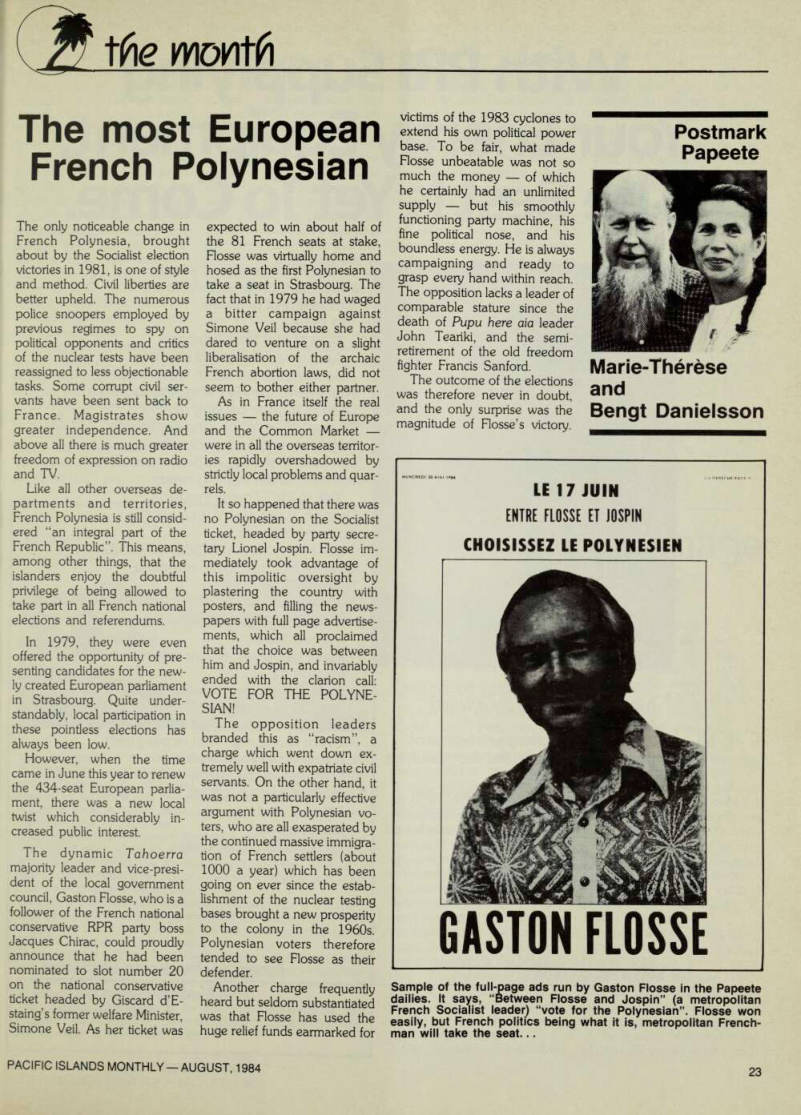

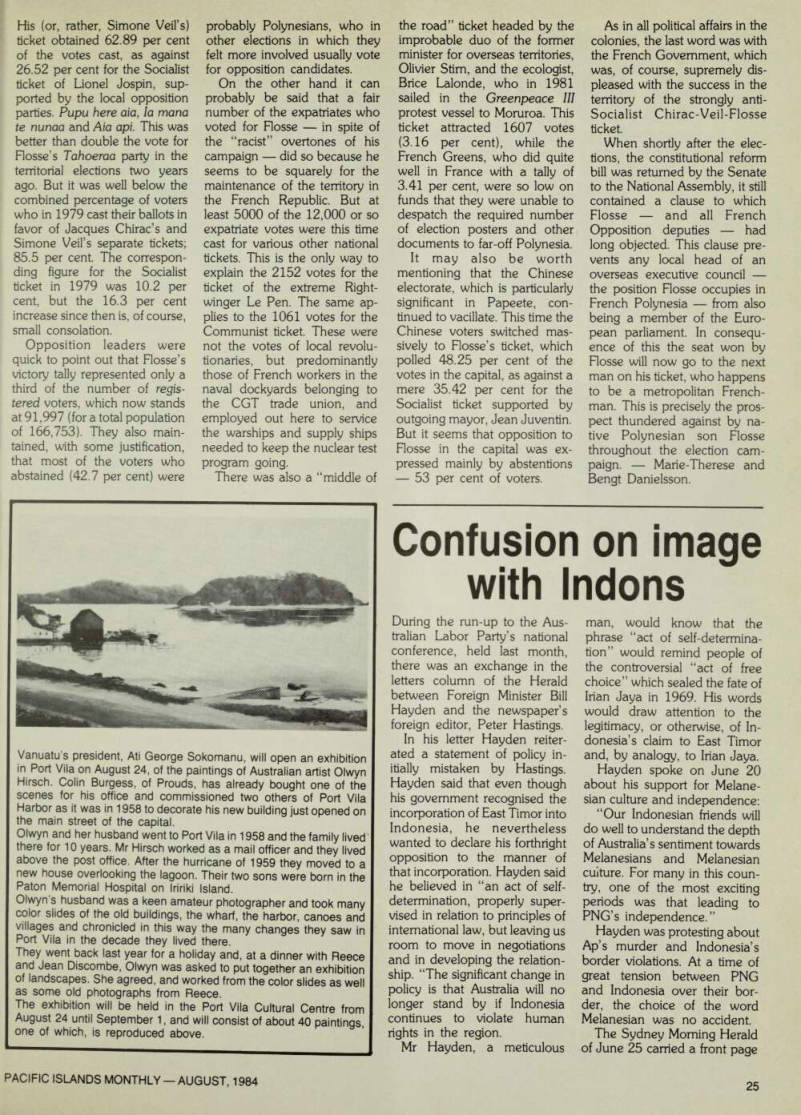
the month
The most European French Polynesian
The only noticeable change in French Polynesia, brought about by the Socialist election victories in 1981, is one of style and method. Civil liberties are better upheld. The numerous police snoopers employed by previous regimes to spy on political opponents and critics of the nuclear tests have been reassigned to less objectionable tasks. Some corrupt civil ser vants have been sent back to France. Magistrates show greater independence. And above all there is much greater freedom of expression on radio and TV.
Like all other overseas de partments and territories, French Polynesia is still consid ered “an integral part of the French Republic”. This means, among other things, that the islanders enjoy the doubtful privilege of being allowed to take part in all French national elections and referendums.
In 1979, they were even offered the opportunity of pre senting candidates for the new ly created European parliament in Strasbourg. Quite under standably, local participation in these pointless elections has always been low.
However, when the time came in June this year to renew the 434-seat European parlia ment, there was a new local twist which considerably in creased public interest.
The dynamic Tahoerra majority leader and vice-presi dent of the local government council, Gaston Flosse, who is a follower of the French national conservative RPR party boss Jacques Chirac, could proudly announce that he had been nominated to slot number 20 on the national conservative ticket headed by Giscard d’E staing’s former welfare Minister, Simone Veil. As her ticket was
expected to win about half of the 81 French seats at stake, Flosse was virtually home and hosed as the first Polynesian to take a seat in Strasbourg. The fact that in 1979 he had waged a bitter campaign against Simone Veil because she had dared to venture on a slight liberalisation of the archaic French abortion laws, did not seem to bother either partner.
As in France itself the real issues the future of Europe and the Common Market were in all the overseas territor ies rapidly overshadowed by strictly local problems and quar rels.
It so happened that there was no Polynesian on the Socialist ticket, headed by party secre tary Lionel Jospin. Flosse im mediately took advantage of this impolitic oversight by plastering the country with posters, and filling the news papers with full page advertise ments, which all proclaimed that the choice was between him and Jospin, and invariably ended with the clarion call:
Vote For The Polyne
Sian!
The opposition leaders branded this as “racism”, a charge which went down ex tremely well with expatriate civil servants. On the other hand, it was not a particularly effective argument with Polynesian vo ters, who are all exasperated by the continued massive immigra tion of French settlers (about 1000 a year) which has been going on ever since the estab lishment of the nuclear testing bases brought a new prosperity to the colony in the 19605.
Polynesian voters therefore tended to see Flosse as their defender.
Another charge frequently
heard but seldom substantiated was that Flosse has used the huge relief funds earmarked for
victims of the 1983 cyclones to extend his own political power base. To be fair, what made Flosse unbeatable was not so much the money of which he certainly had an unlimited supply but his smoothly functioning party machine, his fine political nose, and his boundless energy. He is always campaigning and ready to grasp every hand within reach.
The opposition lacks a leader of comparable stature since the death of Pupa here aia leader John Teariki, and the semi retirement of the old freedom fighter Francis Sanford.
The outcome of the elections was therefore never in doubt, and the only surprise was the magnitude of Flosse’s victory.
Postmark Papeete
Marie-Therese and Bengt Danielsson
His (or, rather, Simone Veil’s) ticket obtained 62.89 per cent of the votes cast, as against 26.52 per cent for the Socialist ticket of Lionel Jospin, sup ported by the local opposition parties. Pupa here aia, la mana te nunaa and Aia api. This was better than double the vote for Flosse’s Tahoeraa party in the territorial elections two years ago. But it was well below the combined percentage of voters who in 1979 cast their ballots in favor of Jacques Chirac’s and Simone Veil’s separate tickets; 85.5 per cent. The correspon ding figure for the Socialist ticket in 1979 was 10.2 per cent, but the 16.3 per cent increase since then is, of course, small consolation.
Opposition leaders were quick to point out that Flosse’s victory tally represented only a third of the number of regis tered voters, which now stands at 91,997 (for a total population of 166,753). They also main tained, with some justification, that most of the voters who abstained (42.7 per cent) were
probably Polynesians, who in other elections in which they felt more involved usually vote for opposition candidates.
On the other hand it can probably be said that a fair number of the expatriates who voted for Flosse in spite of the “racist” overtones of his campaign did so because he seems to be squarely for the maintenance of the territory in the French Republic. But at least 5000 of the 12,000 or so expatriate votes were this time cast for various other national tickets. This is the only way to explain the 2152 votes for the ticket of the extreme Right winger Le Pen. The same ap plies to the 1061 votes for the Communist ticket. These were not the votes of local revolu tionaries, but predominantly those of French workers in the naval dockyards belonging to the CGT trade union, and employed out here to service the warships and supply ships needed to keep the nuclear test program going.
There was also a “middle of
the road” ticket headed by the improbable duo of the former minister for overseas territories, Olivier Stim, and the ecologist, Brice Lalonde, who in 1981 sailed in the Greenpeace 111 protest vessel to Moruroa. This ticket attracted 1607 votes (3.16 per cent), while the French Greens, who did quite well in France with a tally of 3.41 per cent, were so low on funds that they were unable to despatch the required number of election posters and other documents to far-off Polynesia.
It may also be worth mentioning that the Chinese electorate, which is particularly significant in Papeete, con tinued to vacillate. This time the Chinese voters switched mas sively to Flosse’s ticket, which polled 48.25 per cent of the votes in the capital, as against a mere 35.42 per cent for the Socialist ticket supported by outgoing mayor, Jean Juventin.
But it seems that opposition to Flosse in the capital was ex pressed mainly by abstentions 53 per cent of voters.
As in all political affairs in the colonies, the last word was with the French Government, which was, of course, supremely dis pleased with the success in the territory of the strongly anti- Socialist Chirac-Veil-Flosse ticket.
When shortly after the elec tions, the constitutional reform bill was returned by the Senate to the National Assembly, it still contained a clause to which Flosse and all French Opposition deputies had long objected. This clause pre vents any local head of an overseas executive council the position Flosse occupies in French Polynesia from also being a member of the Euro pean parliament. In consequ ence of this the seat won by Flosse will now go to the next man on his ticket, who happens to be a metropolitan French man. This is precisely the pros pect thundered against by na tive Polynesian son Flosse throughout the election cam
paign.
Marie-Therese and
Bengt Danielsson.
Advertisements & other items, pp. 23-24 (1 item)
Gaston Flosse
cRCREOI 30 MAI |<>S4
LE 17 JUIN
ENTRE ELOSSE ET JOSPIN
CHOISISSIZ LE POLYNESIEN
s m
GASTON FLOSSE
Sample of the full-page ads run by Gaston Flosse In the Papeete dailies. It says, “Between Flosse and Jospin” (a metropolitan French Socialist “vote for the Polynesian”. Flosse won easily, but French politics being what it is, metropolitan Frenchman will take the seat...
With PRI Supplying
Your Energy Equipment,
The Best Is Yet To Come.
’’pMTiwer iillllllt ■llViMlilili til ft ii Many wholesale energy equipment suppliers offer you a good variety of products.
But can they offer you a history of proven performance and the guarantee of service tomorrow?
PRl's Energy Products Division can.
We re a part of Pacific Resources, Inc., an independent energy company based in Hawaii.
With PRI behind your energy equipment, the best is yet to come.
In variety of products.
In value.
In parts and service support.
And in availability and inventory.
And when it comes to water heating equipment, the PRI Energy Products Division has the backing of PRl's 80 years of water heating experience.
We're the most knowledgeable company in the Pacific Basin when it comes to water heating needs.
Talk to PRl's Energy Products Division about any of your energy equipment needs.
For information call (808) 547-3522 or write P.O. Box 3379, Honolulu, Hawaii 96842, USA.
We've got it all. • Hardwick gas ranges, electric ranges and microwaves • Roper gas ranges, electric ranges and microwaves • State gas and electric residential and commercial water heaters • Jetglass commercial gas water heaters • E-Tech heat pumps, heat recovery units and swimming pool heaters • Customized commercial heat pumps • Photovoltaic equipment • PRI solar products • Luau torches • Manchester propane tanks The Best Is Yet To Come.™
© PRI 1984
Energy Products Division PRI Energy Systems, Inc.
A PHI Company
Confusion on image
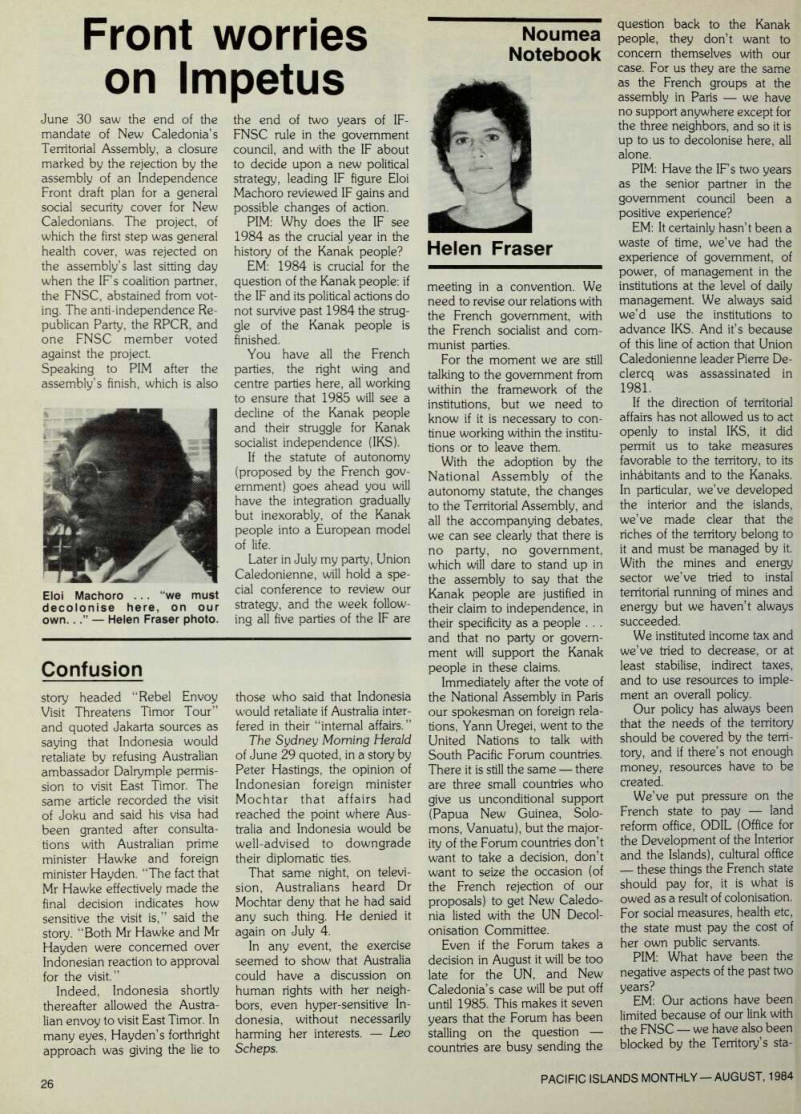
with Indons
Vanuatu's president, Ati George Sokomanu, will open an exhibition in Port Vila on August 24, of the paintings of Australian artist Olwyn Hirsch. Colin Burgess, of Prouds, has already bought one of the scenes for his office and commissioned two others of Port Vila Harbor as it was in 1958 to decorate his new building just opened on the main street of the capital.
Olwyn and her husband went to Port Vila in 1958 and the family lived there for 10 years. Mr Hirsch worked as a mail officer and they lived above the post office. After the hurricane of 1959 they moved to a new house overlooking the lagoon. Their two sons were born in the Paton Memorial Hospital on Iririki Island.
Olwyn’s husband was a keen amateur photographer and took many color slides of the old buildings, the wharf, the harbor, canoes and villages and chronicled in this way the many changes they saw in Port Vila in the decade they lived there.
They went back last year for a holiday and, at a dinner with Reece and Jean Discombe, Olwyn was asked to put together an exhibition of landscapes. She agreed, and worked from the color slides as well as some old photographs from Reece.
The exhibition will be held in the Port Vila Cultural Centre from August 24 until September 1, and will consist of about 40 paintings, one of which, is reproduced above.
During the run-up to the Aus tralian Labor Party’s national conference, held last month, there was an exchange in the letters column of the Herald between Foreign Minister Bill Hayden and the newspaper’s foreign editor, Peter Hastings.
In his letter Hayden reiter ated a statement of policy in itially mistaken by Hastings.
Hayden said that even though his government recognised the incorporation of East Timor into Indonesia, he nevertheless wanted to declare his forthright opposition to the manner of that incorporation. Hayden said he believed in “an act of self determination, properly super vised in relation to principles of international law, but leaving us room to move in negotiations and in developing the relation ship. “The significant change in policy is that Australia will no longer stand by if Indonesia continues to violate human rights in the region.
Mr Hayden, a meticulous
man, would know that the phrase “act of self-determina tion” would remind people of the controversial “act of free choice” which sealed the fate of Irian Jaya in 1969. His words would draw attention to the legitimacy, or otherwise, of In donesia’s claim to East Timor and, by analogy, to Irian Jaya.
Hayden spoke on June 20 about his support for Melane sian culture and independence: “Our Indonesian friends will do well to understand the depth of Australia’s sentiment towards Melanesians and Melanesian culture. For many in this coun try, one of the most exciting periods was that leading to PNG’s independence.”
Hayden was protesting about Ap’s murder and Indonesia’s border violations. At a time of great tension between PNG and Indonesia over their bor der, the choice of the word Melanesian was no accident.
The Sydney Morning Herald of June 25 carried a front page
Confusion
story headed “Rebel Envoy Visit Threatens Timor Tour” and quoted Jakarta sources as saying that Indonesia would retaliate by refusing Australian ambassador Dalrymple permis sion to visit East Timor. The same article recorded the visit of Joku and said his visa had been granted after consulta tions with Australian prime minister Hawke and foreign minister Hayden. “The fact that Mr Hawke effectively made the final decision indicates how sensitive the visit is,” said the story. “Both Mr Hawke and Mr Hayden were concerned over Indonesian reaction to approval for the visit.”
Indeed, Indonesia shortly thereafter allowed the Austra lian envoy to visit East Timor. In many eyes, Hayden’s forthright approach was giving the lie to
those who said that Indonesia would retaliate if Australia inter fered in their “internal affairs.”
The Sydney Morning Herald of June 29 quoted, in a story by Peter Hastings, the opinion of Indonesian foreign minister Mochtar that affairs had reached the point where Aus tralia and Indonesia would be well-advised to downgrade their diplomatic ties.
That same night, on televi sion, Australians heard Dr Mochtar deny that he had said any such thing. He denied it again on July 4.
In any event, the exercise seemed to show that Australia could have a discussion on human rights with her neigh bors, even hyper-sensitive In donesia, without necessarily
harming her interests.
Leo
Scheps.
on Impetus
Front worries on Impetus
June 30 saw the end of the mandate of New Caledonia’s Territorial Assembly, a closure marked by the rejection by the assembly of an Independence Front draft plan for a general social security cover for New Caledonians. The project, of which the first step was general health cover, was rejected on the assembly’s last sitting day when the IP’s coalition partner, the FNSC, abstained from vot ing. The anti-independence Re publican Party, the RPCR, and one FNSC member voted against the project.
Speaking to PIM after the assembly’s finish, which is also
the end of two years of IF FNSC rule in the government council, and with the IF about to decide upon a new political strategy, leading IF figure Eloi Machoro reviewed IF gains and possible changes of action.
PIM: Why does the IF see 1984 as the crucial year in the history of the Kanak people?
EM; 1984 is crucial for the question of the Kanak people: if the IF and its political actions do not survive past 1984 the strug gle of the Kanak people is finished.
You have all the French parties, the right wing and centre parties here, all working to ensure that 1985 will see a decline of the Kanak people and their struggle for Kanak socialist independence (IKS).
If the statute of autonomy (proposed by the French gov ernment) goes ahead you will have the integration gradually but inexorably, of the Kanak people into a European model of life.
Later in July my party, Union Caledonienne, will hold a spe cial conference to review our strategy, and the week follow ing all five parties of the IF are
Noumea Notebook
meeting in a convention. We need to revise our relations with the French government, with the French socialist and com munist parties.
For the moment we are still talking to the government from within the framework of the institutions, but we need to know if it is necessary to con tinue working within the institu tions or to leave them.
With the adoption by the National Assembly of the autonomy statute, the changes to the Territorial Assembly, and all the accompanying debates, we can see clearly that there is no party, no government, which will dare to stand up in the assembly to say that the Kanak people are justified in their claim to independence, in their specificity as a people . . . and that no party or govern ment will support the Kanak people in these claims.
Immediately after the vote of the National Assembly in Paris our spokesman on foreign rela tions, Yann Uregei, went to the United Nations to talk with South Pacific Forum countries.
There it is still the same there are three small countries who give us unconditional support (Papua New Guinea, Solo mons, Vanuatu), but the major ity of the Forum countries don’t want to take a decision, don’t want to seize the occasion (of the French rejection of our proposals) to get New Caledo nia listed with the UN Decol onisation Committee.
Even if the Forum takes a decision in August it will be too late for the UN, and New Caledonia’s case will be put off until 1985. This makes it seven years that the Forum has been stalling on the question countries are busy sending the
question back to the Kanak people, they don’t want to concern themselves with our case. For us they are the same as the French groups at the assembly in Paris we have no support anywhere except for the three neighbors, and so it is up to us to decolonise here, all alone.
PIM: Have the IP’s two years as the senior partner in the government council been a positive experience?
EM: It certainly hasn’t been a waste of time, we’ve had the experience of government, of power, of management in the institutions at the level of daily management. We always said we’d use the institutions to advance IKS. And it’s because of this line of action that Union Caledonienne leader Pierre De clercq was assassinated in 1981.
If the direction of territorial affairs has not allowed us to act openly to instal IKS, it did permit us to take measures favorable to the territory, to its inhabitants and to the Kanaks.
In particular, we’ve developed the interior and the islands, we’ve made clear that the riches of the territory belong to it and must be managed by it.
With the mines and energy sector we’ve tried to instal territorial running of mines and energy but we haven’t always succeeded.
We instituted income tax and we’ve tried to decrease, or at least stabilise, indirect taxes, and to use resources to imple ment an overall policy.
Our policy has always been that the needs of the territory should be covered by the terri tory, and if there’s not enough money, resources have to be created.
We’ve put pressure on the French state to pay land reform office, ODIL (Office for the Development of the Interior and the Islands), cultural office these things the French state should pay for, it is what is owed as a result of colonisation.
For social measures, health etc, the state must pay the cost of her own public servants.
PIM: What have been the negative aspects of the past two years?
EM: Our actions have been limited because of our link with the FNSC we have also been blocked by the Territory’s sta
Eloi Machoro ... “we must decolonise here, on our own..." — Helen Fraser photo.
Helen Fraser
tute which limits the framework within which we could work towards IKS. For example, we have not had power over im migration, external trade, mines and maritime resources.
Moreover, we’ve always had to submit to the tutelage and pressure of the French govern ment.
Another negative aspect has been a loss of momentum in the fight for IKS in its purely political sense in a way we abandoned this side in favor of management.
PIM: Is the recent call by LKS leader Nidoish Naisseline for the IF to establish a cohesive government program of all five IF parties before embarking on a boycott of political institutions a sign of problems within the IF?
EM: Not at all. . . LKS is one of the 5 parties in the IF and they have the right to question and propose, and, as Naisseline pointed out, the final decision rests with the front as a whole and will be made on July 28. I see LKS’ comments more as part of the debate and reflection that is going on inside the IF at the moment. We’re looking at our attitude should we stay inside the French institutions when France is clearly setting up this five year autonomy plan with the aim of suppressing our claims to IKS? For us it has been spelled out during the Paris assembly debate that the claims of the Kanak people are anti-constitutional and that to conform to the French con stitution the political future of New Caledonia must be de cided by all the population, which means all the immigrants who have caused the Kanak people to be outnumbered in their own land. We see this attitude of the French Govern ment as a negation of their duty to decolonise New Caledonia.
At the round-table discus sions last July France recog nised our right to Kanak inde pendence, but now by denying our claim to IKS they are refusing the exercise of this right.
It is in this context that we will be examining the question of withdrawing from the political institutions of the country, and of preventing the territorial assembly elections from taking place.
PIM: If the IF goes ahead
with this strategy how do you see the French government reacting?
EM: Well . . . France can’t allow a territorial assembly with only the right wing present. We, the IF, are the representatives of the Kanak people and they can’t allow an assembly with no representatives of the Kanak, even if they do have some right wing Kanaks present; neighbor ing countries are not fools and they know the IF has 80 to 90
per cent of the Kanak people behind it. So France will be obliged to come to a negotiat ing table with us they can’t leave New Caledonia without an assembly. If they were to rule the territory from Paris this would be a backward step, a renewal of colonisation.
If the situation deteriorates here, in many ways Australia and New Zealand will be re sponsible for this deterioration.
They’ve never taken the trou
ble to come here and see the situation for themselves, prefer ring to listen to France.
The two important factors that need to be taken into account are that France has shown clearly her desire to remain here, that this is what counts most for France, and that we, the IF, will apply our political strategy to achieve our independence we have the
strength to do it.
Helen
Fraser in Noumea.
Advertisements & other items, p. 27 (1 item)
Ana-Digi
GATEWAyTO
Multifunctlonalism Is the
watchword for timepieces
in this information age.
Citizen technology meets
the challenge,with two
revolutionary
watches.
& eas M a V to y-, \ ' / ,va \ w /
AMA-0161
(TEMP
Citizen Quartz Ana-Dlgl Temp. 59.9° to 9.9°C temperature readout, one-touch Fahrenheit conversion. Analog/Digital time indication with automatic calendar and dual (one other time zone) time. 24-hour alarm, hourly chime. 1/1000-sec. accurate stopwatch.
AMA-OIGI
ComboFl
Citizen Quartz Ana-Digi Combo FI.
Analog/Digital time indication with 1-sec. and 10-sec. increment LCD trackers. Permanently adjusted monthday-date calendar. 24-hour alarm, 12-hour countdown timer; hourly chime. Dual time. And a 1/100-sec. counter lap-timing stopwatch.
‘ CITIZEN
. . AHEAD OF THEIR TIME
;itizen Watches Australia Pty Ltd. 122 Old Putwater Rd. Brookvale. NSW 2100 Telephone 9397077'cab1e: Citizen Sydney Telex AA26633
Australia looks
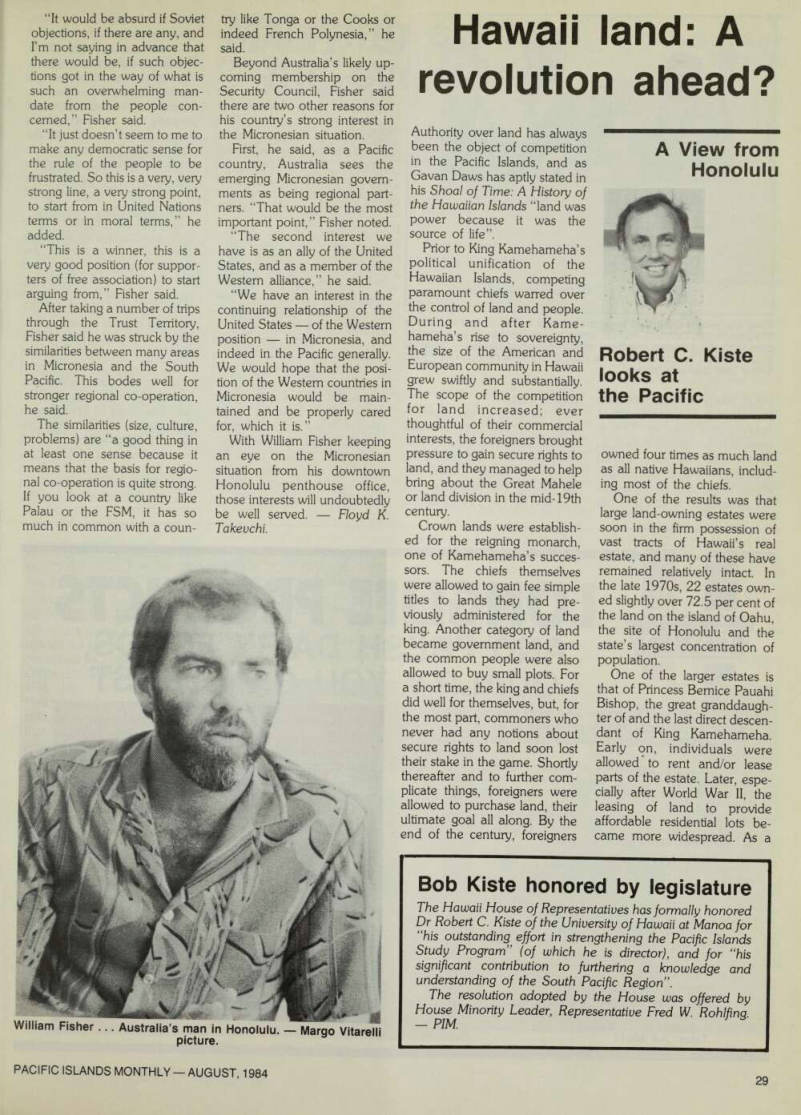
to the north
Since the end of World War 2, Micronesia has been the preserve of the United States.
Indeed, until the early 19605, it took a special security check for any outsider to enter the Trust Territory, including U.S. citi zens.
But the movement toward decolonisation over the past decade has given the Microne sian islands a higher regional and international profile, and, in the process, has increased interest by other countries in Trust Territory developments.
One of the most dramatic examples of this new-found interest is the loans made to the republics of Palau and the Marshall Islands by a British group so that the islands could purchase new electrical gen erating equipment. The fact that both Micronesian govern ments appear unable to make their payments without a con siderable American bail-out which may not be as forthcom ing as the Islanders and British might have hoped is indica tive of the risks outsiders take in rushing headlong into the Micronesian scene.
A more promising, and long lasting, relationship appears to be forming between the freely associated states (Palau, the Marshalls and the Federated States of Micronesia) and Aus tralia. Long a “South Pacific” country in outlook, Australia in the past year or so has begun to look seriously at establishing an active post-trusteeship relation
ship with the emerging states.
The best indication of Can berra’s new northward view was the appointment last year of diplomat William Fisher as Australia’s Honolulu-based consul-general. Not only is Fisher one of his country’s most astute observers of the con temporary Pacific, his mandate was to aggressively pursue an expanded relationship with the Micronesian governments.
Previously most of Australia’s official dealings with the Trust Territory were handled through its High Commission on Nauru.
Honolulu was for the most part out of the picture, although Fisher’s predecessor began to take an increasingly active in terest in Micronesian affairs shortly before being sent to the embassy in Paris.
In a recent interview with PIM, Fisher spoke of Australia’s attitude toward developments in Micronesia and what role his country might play as the final chapter of U.S. decolonisation is written.
Without hesitation, Fisher is strongly supportive of the free association agreements that the “lower three” (FSM, Palau and the Marshalls) have chosen.
“We look forward to the complete achievement” of de colonisation, Fisher said. “I think the outstanding thing one would have to say about the protracted negotiations which have gone on is that the prin ciple which has been kept up permost in the minds of the
Notes from the North
Micronesian countries and the United States is that the wishes of the local people have been kept to the forefront, the proof of this is in the substantial majorities that voted in favor of the (free association) compact.
That is something that when it comes to the United Nations our people are going to stress very particularly.”
By the end of this year, Australia “is virtually certain” to be a U.N. Security Council member. In that position, as Fisher noted, “if I might be a little immodest, 1 would say that we hope to be one of the best informed countries at the Security Council.”
In such a position, Australia, (like the United States) is almost surely going to face a hostile Soviet Union. The Russians cannot discuss Trust Territory events without reciting a long, and at this point, well-thumbed monologue about America’s supposed dastardly deeds. The complaints will add nothing to the debate, but they most likely will be made.
Floyd K.
Takeuchi on Micronesia
“It would be absurd if Soviet objections, if there are any, and I’m not saying in advance that there would be, if such objec tions got in the way of what is such an overwhelming man date from the people con cerned,” Fisher said.
“It just doesn’t seem to me to make any democratic sense for the rule of the people to be frustrated. So this is a very, very strong line, a very strong point, to start from in United Nations terms or in moral terms,” he added.
“This is a winner, this is a very good position (for suppor ters of free association) to start arguing from,” Fisher said.
After taking a number of trips through the Trust Territory, Fisher said he was struck by the similarities between many areas in Micronesia and the South Pacific. This bodes well for stronger regional co-operation, he said.
The similarities (size, culture, problems) are “a good thing in at least one sense because it means that the basis for regio nal co-operation is quite strong.
If you look at a country like Palau or the FSM, it has so much in common with a coun
try like Tonga or the Cooks or indeed French Polynesia,” he said.
Beyond Australia’s likely up coming membership on the Security Council, Fisher said there are two other reasons for his country’s strong interest in the Micronesian situation.
First, he said, as a Pacific country, Australia sees the emerging Micronesian govern ments as being regional part ners. “That would be the most important point,” Fisher noted.
“The second interest we have is as an ally of the United States, and as a member of the Western alliance,” he said.
“We have an interest in the continuing relationship of the United States of the Western position in Micronesia, and indeed in the Pacific generally.
We would hope that the posi tion of the Western countries in Micronesia would be main tained and be properly cared for, which it is.”
With William Fisher keeping an eye on the Micronesian situation from his downtown Honolulu penthouse office, those interests will undoubtedly
be well served.
Floyd K.
Takeuchi.
William Fisher ... Australia’s man in Honolulu. Margo Vitarelli picture.
Hawaii land: A revolution ahead?

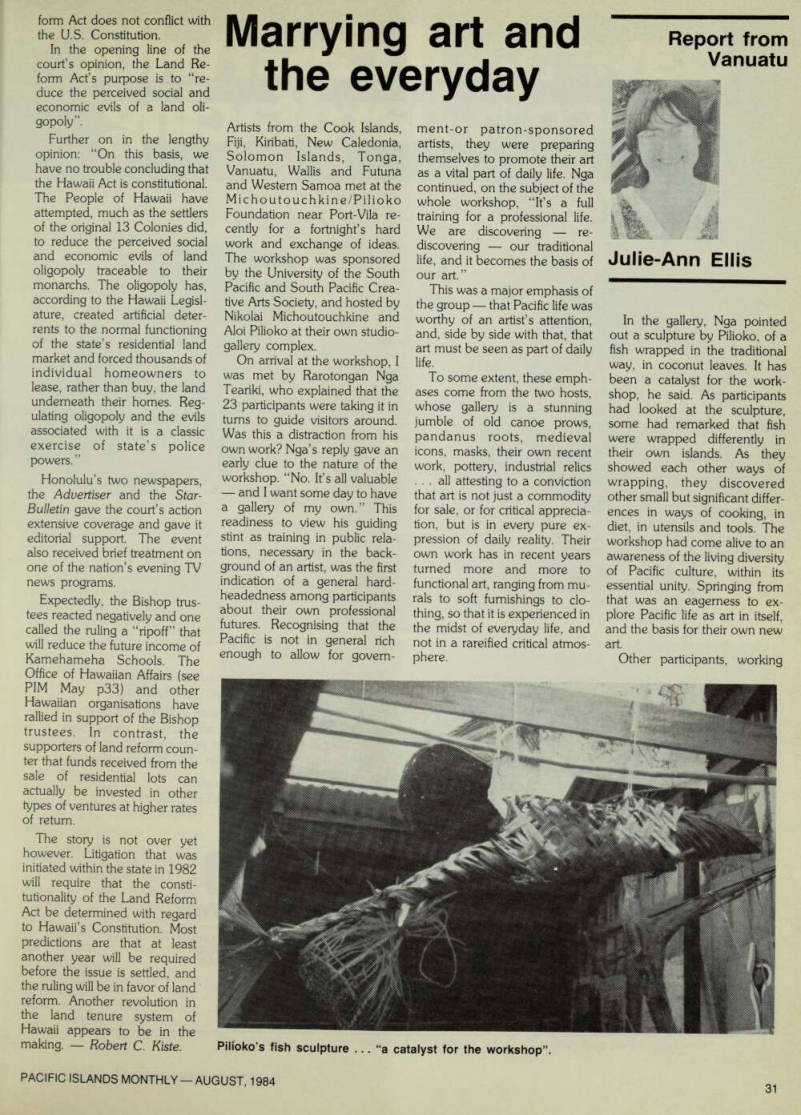
revolution ahead?
Authority over land has always been the object of competition in the Pacific Islands, and as Gavan Daws has aptly stated in his Shoal of Time: A History of the Hawaiian Islands “land was power because it was the source of life”.
Prior to King Kamehameha’s political unification of the Hawaiian Islands, competing paramount chiefs warred over the control of land and people.
During and after Kame hameha’s rise to sovereignty, the size of the American and European community in Hawaii grew swiftly and substantially.
The scope of the competition for land increased; ever thoughtful of their commercial interests, the foreigners brought pressure to gain secure rights to land, and they managed to help bring about the Great Mahele or land division in the mid- 19th century.
Crown lands were establish ed for the reigning monarch, one of Kamehameha’s succes sors. The chiefs themselves were allowed to gain fee simple titles to lands they had pre viously administered for the king. Another category of land became government land, and the common people were also allowed to buy small plots. For a short time, the king and chiefs did well for themselves, but, for the most part, commoners who never had any notions about secure rights to land soon lost their stake in the game. Shortly thereafter and to further com plicate things, foreigners were allowed to purchase land, their ultimate goal all along. By the end of the century, foreigners
A View from Honolulu
owned four times as much land as all native Hawaiians, includ ing most of the chiefs.
One of the results was that large land-owning estates were soon in the firm possession of vast tracts of Hawaii’s real estate, and many of these have remained relatively intact. In the late 19705, 22 estates own ed slightly over 72.5 per cent of the land on the island of Oahu, the site of Honolulu and the state’s largest concentration of population.
One of the larger estates is that of Princess Bernice Pauahi Bishop, the great granddaugh ter of and the last direct descen dant of King Kamehameha.
Early on, individuals were allowed to rent and/or lease parts of the estate. Later, espe cially after World War 11, the leasing of land to provide affordable residential lots be came more widespread. As a
Robert C. Kiste looks at the Pacific
result, many homeowners own their homes but not the land upon which they sit. This is quite counter to the American dream that everyone should own his own land and house, Many residences in Honolulu are located on holdings of the
Bishop Estate, At the time of her death in 1884, Princess Bernice willed that her lands and the proceeds from them be managed for the benefit of native Hawaiians, particularly the founding and support of the Kamehameha
Schools, one for boys and one for girls. Contrary to popular belief, the Bishop Museum named after Princess Bernice is not supported by the estate.
The holdings of the latter are managed by a five-member board of trustees, first appointed by Princess Bernice herself and later by the Hawaii Supreme Court. Today, the estate holds about 15 per cent of the land on Oahu and close to eight per cent of the land in the entire state.
Since World War 11, and especially since 1959 when statehood was achieved, home owners have brought consider able political pressure to bear for land reform and the break up of the large estates. On May 30 of this year, the United States Supreme Court issued a unanimous decision (eight to 0) which potentially has great con sequences for all the large estates and Hawaii’s home owners. A few points of history help illuminate that decision.
In 1967, Hawaii’s Land Re form Act was passed by the state legislature, and it allowed the state to use the power of
eminent domain to condemn leasehold residential lots and sell them to the actual residents.
The large estates immediately objected by arguing that the legislation would in effect re quire one private owner to sell property to another private owner, and that eminent do main can only be exercised in cases where it is clear that the action is in the overall public interest, e.g., the creation of parks, highways, etc.
In 1978, the Bishop Estate filed a suit against the state government questioning the constitutionality of the Land Reform Act. In the following year, the federal district court in Honolulu ruled that the 1967 Act was indeed constitutional.
The Bishop estate appealed the decision to a higher federal court. The U.S. 9th Circuit Court of Appeals judged the Land Reform Act unconstitutio nal. The State of Hawaii took the case to the U.S. Supreme Court in Washington, D.C. It was the outcome of that litiga tion that was announced on May 30 when the Supreme Court ruled that the Land Re
King Kamehameha II (left foreground) and his suite in 1824 at the Theatre Royal, London. He had come to ask George IV how best to deal with the growing numbers of Europeans in Hawaii - Original by J. W. Gear, reproduced in The People from the Horizon, by Philip Snow and Stefanie Waine.
form Act does not conflict with the U.S. Constitution.
In the opening line of the court’s opinion, the Land Re form Act’s purpose is to “re duce the perceived social and economic evils of a land oli gopoly”.
Further on in the lengthy opinion: “On this basis, we have no trouble concluding that the Hawaii Act is constitutional.
The People of Hawaii have attempted, much as the settlers of the original 13 Colonies did, to reduce the perceived social and economic evils of land oligopoly traceable to their monarchs. The oligopoly has, according to the Hawaii Legisl ature, created artificial deter rents to the normal functioning of the state’s residential land market and forced thousands of individual homeowners to lease, rather than buy, the land underneath their homes. Reg ulating oligopoly and the evils associated with it is a classic exercise of state’s police powers. ”
Honolulu’s two newspapers, the Advertiser and the Star- Bulletin gave the court’s action extensive coverage and gave it editorial support. The event also received brief treatment on one of the nation’s evening TV news programs.
Expectedly, the Bishop trus tees reacted negatively and one called the ruling a “ripoff” that will reduce the future income of Kamehameha Schools. The Office of Hawaiian Affairs (see PIM May p 33) and other Hawaiian organisations have rallied in support of the Bishop trustees. In contrast, the supporters of land reform coun ter that funds received from the sale of residential lots can actually be invested in other types of ventures at higher rates of return.
The story is not over yet however. Litigation that was initiated within the state in 1982 will require that the consti tutionality of the Land Reform Act be determined with regard to Hawaii’s Constitution. Most predictions are that at least another year will be required before the issue is settled, and the ruling will be in favor of land reform. Another revolution in the land tenure system of Hawaii appears to be in the
making.
Robert C. Kiste.
Bob Kiste honored by legislature
The Hawaii House of Representatives has formally honored Dr Robert C. Kiste of the University of Hawaii at Manoa for “his outstanding effort in strengthening the Pacific Islands Study Program” (of which he is director), and for “his significant contribution to furthering a knowledge and understanding of the South Pacific Region”.
The resolution adopted by the House was offered by House Minority Leader, Representative Fred W. Rohlfing.
Pim
Advertisements & other items, p. 30 (1 item)
Longlife Products
i r
MiftlHKf/
AND FRESH DAIRY FOODS,
QUALITY YOU CAN TRUST
QUF Industries Ltd. offers an export award winning range of Longlife products as well as a complete range of quality fresh dairy foods.
With 15 years’ experience in export markets, QUF has the product knowledge and expertise to provide you with outstanding service in the 1980’s. • Pauls Longlife UHT Milk is natural liquid cow's milk with no preservatives or additives and is available in the 250m1, 500 ml and 1 litre sizes. • Shake Longlife flavoured milk is ottered in delicious Chocolate, Malted, Caramel and Strawberry flavours. • Pauls Longlife Thickened Cream is ideal for whipping or pouring. • Popper 100% Fruit Juice is available in seven flavours in a wide range of Longlife pack sizes. • Pauls fresh Dairy Products including Milk, Cream, Yoghurt and Cottage Cheese are available in an extensive range of flavours and sizes.
TRADE ENQUIRIES:
QUF Industries Ltd., P.O. Box 12, South Brisbane, Queensland, 4101 Australia Telephone: (07) 44-0151 Telex: AA 40614 m V J hit tuned 6Mk new .%• ' V. u mm m ilk
L/THt
i
miLK
the everyday

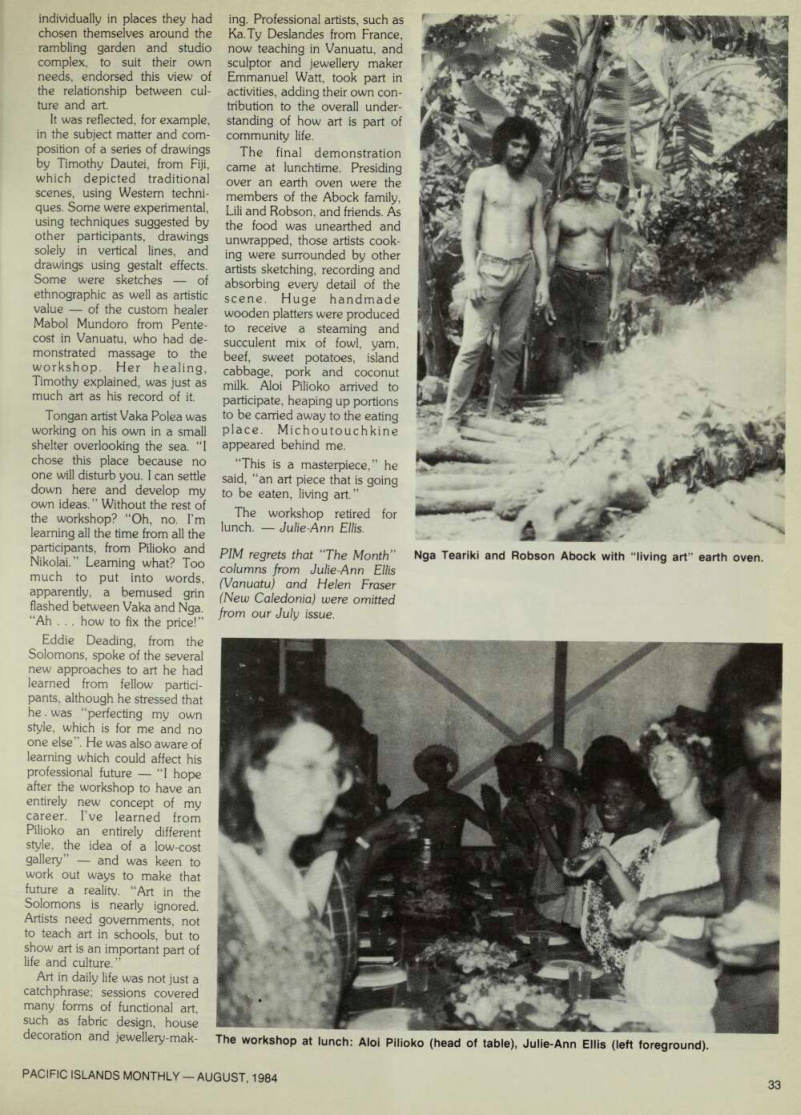
Marrying art and the everyday
Artists from the Cook Islands, Fiji, Kiribati, New Caledonia, Solomon Islands, Tonga, Vanuatu, Wallis and Futuna and Western Samoa met at the Michoutouchkine/Pilioko Foundation near Port-Vila re cently for a fortnight’s hard work and exchange of ideas.
The workshop was sponsored by the University of the South Pacific and South Pacific Crea tive Arts Society, and hosted by Nikolai Michoutouchkine and Aloi Pilioko at their own studio gallery complex.
On arrival at the workshop, I was met by Rarotongan Nga Teariki, who explained that the 23 participants were taking it in turns to guide visitors around.
Was this a distraction from his own work? Nga’s reply gave an early clue to the nature of the workshop. “No. It’s all valuable and I want some day to have a gallery of my own.” This readiness to view his guiding stint as training in public rela tions, necessary in the back ground of an artist, was the first indication of a general hard headedness among participants about their own professional futures. Recognising that the Pacific is not in general rich enough to allow for govem
ment-or patron-sponsored artists, they were preparing themselves to promote their art as a vital part of daily life. Nga continued, on the subject of the whole workshop, “It’s a full training for a professional life.
We are discovering re discovering our traditional life, and it becomes the basis of our art.”
This was a major emphasis of the group that Pacific life was worthy of an artist’s attention, and, side by side with that, that art must be seen as part of daily life.
To some extent, these emph ases come from the two hosts, whose gallery is a stunning jumble of old canoe prows, pandanus roots, medieval icons, masks, their own recent work, pottery, industrial relics ... all attesting to a conviction that art is not just a commodity for sale, or for critical apprecia tion, but is in every pure ex pression of daily reality. Their own work has in recent years turned more and more to functional art, ranging from mu rals to soft furnishings to clo thing, so that it is experienced in the midst of everyday life, and not in a rareified critical atmos phere.
Report from Vanuatu
In the gallery, Nga pointed out a sculpture by Pilioko, of a fish wrapped in the traditional way, in coconut leaves. It has been a catalyst for the work shop, he said. As participants had looked at the sculpture, some had remarked that fish were wrapped differently in their own islands. As they showed each other ways of wrapping, they discovered other small but significant differ ences in ways of cooking, in diet, in utensils and tools. The workshop had come alive to an awareness of the living diversity of Pacific culture, within its essential unity. Springing from that was an eagerness to ex plore Pacific life as art in itself, and the basis for their own new art.
Other participants, working
Julie-Ann Ellis
Pilioko’s fish sculpture ... “a catalyst for the workshop”.
individually in places they had chosen themselves around the rambling garden and studio complex, to suit their own needs, endorsed this view of the relationship between cul ture and art.
It was reflected, for example, in the subject matter and com position of a series of drawings by Timothy Dautei, from Fiji, which depicted traditional scenes, using Western techni ques. Some were experimental, using techniques suggested by other participants, drawings solely in vertical lines, and drawings using gestalt effects.
Some were sketches of ethnographic as well as artistic value of the custom healer Mabol Mundoro from Pente cost in Vanuatu, who had de monstrated massage to the workshop. Her healing, Timothy explained, was just as much art as his record of it.
Tongan artist Vaka Polea was working on his own in a small shelter overlooking the sea. “I chose this place because no one will disturb you. I can settle down here and develop my own ideas. ” Without the rest of the workshop? “Oh, no. I’m learning all the time from all the participants, from Pilioko and Nikolai.” Learning what? Too much to put into words, apparently, a bemused grin flashed between Vaka and Nga.
“Ah . . . how to fix the price!”
Eddie Deading, from the Solomons, spoke of the several new approaches to art he had learned from fellow partici pants, although he stressed that he. was “perfecting my own style, which is for me and no one else”. He was also aware of learning which could affect his professional future “I hope after the workshop to have an entirely new concept of my career. I’ve learned from Pilioko an entirely different style, the idea of a low-cost gallery” and was keen to work out ways to make that future a reality. “Art in the Solomons is nearly ignored.
Artists need governments, not to teach art in schools, but to show art is an important part of life and culture.”
Art in daily life was not just a catchphrase; sessions covered many forms of functional art, such as fabric design, house decoration and jewellery-mak
ing. Professional artists, such as Ka.Ty Deslandes from France, now teaching in Vanuatu, and sculptor and jewellery maker Emmanuel Watt, took part in activities, adding their own con tribution to the overall under standing of how art is part of community life.
The final demonstration came at lunchtime. Presiding over an earth oven were the members of the Abock family, Lili and Robson, and friends. As the food was unearthed and unwrapped, those artists cook ing were surrounded by other artists sketching, recording and absorbing every detail of the scene. Huge handmade wooden platters were produced to receive a steaming and succulent mix of fowl, yam, beef, sweet potatoes, island cabbage, pork and coconut milk. Aloi Pilioko arrived to participate, heaping up portions to be carried away to the eating place. Michoutouchkine appeared behind me.
“This is a masterpiece,” he said, “an art piece that is going to be eaten, living art.”
The workshop retired for
lunch.
Julie-Ann Ellis.
PIM regrets that ‘The Month” columns from Julie-Ann Ellis (Vanuatu) and Helen Fraser (New Caledonia) were omitted from our Ju/y issue.
Nga Teariki and Robson Abock with “living art” earth oven.
The workshop at lunch: Aloi Pilioko (head of table), Julie-Ann Ellis (left foreground).
Advertisements & other items, pp. 32-34 (1 item)
Lincoln hardfacing
Save hard cash with
I m 1 'M s . ; m Save real money by repairing, rebuilding, or resurfacing worn equipment with Lincoln continuous wire hardfacing. Or by hardfacing new equipment before use for extra wear and longer working life.
Beat the high cost of replacement parts, labour, and unnecessary downtime with a LINCRAC wire feeder and petrol, diesel, or PTO-driven power source. Handle big jobs or small, including: • tines of any sowing/tillage equipment • crawler/tractor parts • cutting tools • posthole diggers • steel sprockets and gears • machine parts • any linkages or parts that wear Use your LINCPAC system to build up impactand abrasion-resistant surfaces quickly, with less waste. Slashing your maintenance costs.
Increase parts’ wear resistance. Overcoming parts shortages and delivery delays.
Substantially increasing equipment working life. And ensuring maximum productivity.
The LINCPAC continuous wire system. It’s like welding with 180 sticks - without 180 stops. See your nearest Lincoln dealer now for the hard facts about saving hard cash with LINCPAC hardfacing.
ELA MOTORS - Port Moresby.
CARPENTER MOTORS LTD. - Suva.
ISLAND ENTERPRISES - Honiara.
S.A.T.M.A. - Noumea.
LINCOLN
\arc WELDING
The Lincoln Electric Company (Australia) Pty. Limited, 35 Bryant Street, Padstow, N.S.W. 2211 Telephone (02) 7727222. Telex AA22792
NEW ZEALAND
152 St. Georges Road, Auckland Telephone 885180. Telex 21803
LE151.25/18.S&P
Starting & Staying
¥ER fi
AMP
poy/MR
71 / p'
marine
yfpw
jt 4I W G2C7
GZ3Z327
Power Boats Need Different Batteries
There is a big difference between a car battery and a marine battery.
A car battery, for example, is never really discharged, as it is only used for a few seconds each day and promptly re-charged. Not so your cruiser or sportsfisherman.
Starting the engine is only the beginning. During the day, weekend or cruise, how often will you run the live bait tank, the depth sounder, the nav. lights or maintain a listening watch on your radio transceiver?
As well as cranking power, boats need staying power. Boats need Besco's Marine Batteries, deep cycle, heavy duty marine batteries. ’
If your boat is getting a little flat in the electrics department, write or phone BESCO today and ask for more information, more facts about
BESCO MARINE BATTERIES.
BESCO
Batteries Division Of Sims Products Pty Ltd.
A Peko Wall send Group Member Papua New Guinea: Lae, Automarine Industries, P.O. Box 785, Ph. 42-1125; Rabaul, Automarine Industries, P.O. Box 248, Ph. 92-2574; Port Moresby, Par Sales, P.O. Box 1680, Boroko, Ph. 25-6266. Fiji: Suva, Fiji Bandag, 23 Sinoma Street, Walu Bay, Ph. 31-1200. New Caledonia: Noumea, Andre Thuilier, BP 889, Ph. 27-4906. Solomon Islands: Honiara, Guadalcanal Electrics Ltd., P.O. Box 521. Hongkong: Kowloon, T. L. Knight & Co., P.O. Box 95585 IST, Ph. 366-5341. New Zealand: Auckland, Battery Services (Ind.) Ltd., P.O. Box 27- 375 Ph. 69-4111; Wellington, Gould Batteries, 58 Hautana Street, Lower Hutt, TLX NZ3714 Australia: Sydney, Besco Batteries, P.O. Box 1, Villawood, Ph. 632-0251, TLX 21886; Jarwil International Pty. Ltd., 410 Kent Street, Sydney, Ph. 264-3477, TLX 72102.
LEADERS IN BATTERY TECHNOLOGY —
trade winds
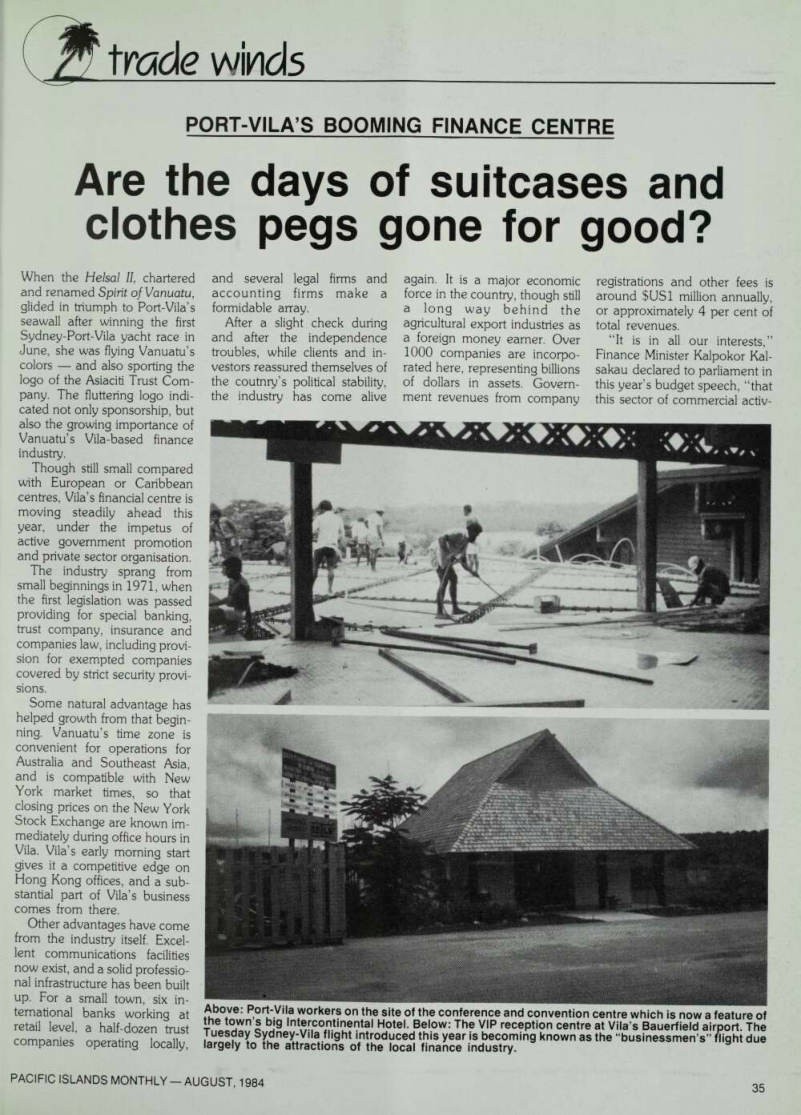
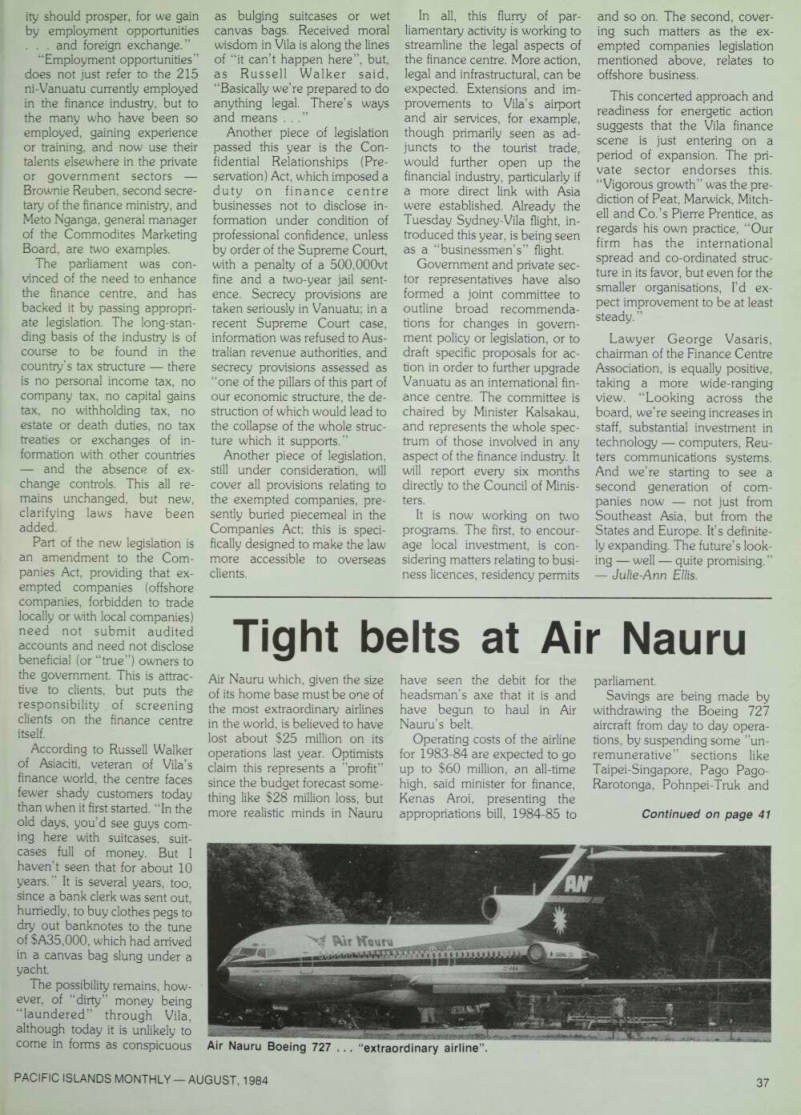
Port-Vila’S Booming Finance Centre
Are the days of suitcases and clothes pegs gone for good?
When the Helsal 11, chartered and renamed Spirit of Vanuatu, glided in triumph to Port-Vila’s seawall after winning the first Sydney-Port-Vila yacht race in June, she was flying Vanuatu’s colors and also sporting the logo of the Asiaciti Trust Com pany. The fluttering logo indi cated not only sponsorship, but also the growing importance of Vanuatu’s Vila-based finance industry.
Though still small compared with European or Caribbean centres, Vila’s financial centre is moving steadily ahead this year, under the impetus of active government promotion and private sector organisation.
The industry sprang from small beginnings in 1971, when the first legislation was passed providing for special banking, trust company, insurance and companies law, including provi sion for exempted companies covered by strict security provi sions.
Some natural advantage has helped growth from that begin ning. Vanuatu’s time zone is convenient for operations for Australia and Southeast Asia, and is compatible with New York market times, so that closing prices on the New York Stock Exchange are known im mediately during office hours in Vila. Vila’s early morning start gives it a competitive edge on Hong Kong offices, and a sub stantial part of Vila’s business comes from there.
Other advantages have come from the industry itself. Excel lent communications facilities now exist, and a solid professio nal infrastructure has been built up. For a small town, six in ternational banks working at retail level, a half-dozen trust companies operating locally,
and several legal firms and accounting firms make a formidable array.
After a slight check during and after the independence troubles, while clients and in vestors reassured themselves of the coutnry’s political stability, the industry has come alive
again. It is a major economic force in the country, though still a long way behind the agricultural export industries as a foreign money earner. Over 1000 companies are incorpo rated here, representing billions of dollars in assets. Govern ment revenues from company
registrations and other fees is around SUSI million annually, or approximately 4 per cent of total revenues.
“It is in all our interests,”
Finance Minister Kalpokor Kal sakau declared to parliament in this year’s budget speech, “that this sector of commercial activ-
Above: Port-Vila workers on the site of the conference and convention centre which is now a feature of the town s big Intercontinental Hotel. Below: The VIP reception centre at Vila’s Bauerfield airport. The T uesday Sydney-Vila flight introduced this year is becoming known as the “businessmen’s” flight due largely to the attractions of the local finance industry.
ity should prosper, for we gain by employment opportunities . . . and foreign exchange.”
“Employment opportunities” does not just refer to the 215 ni-Vanuatu currently employed in the finance industry, but to the many who have been so employed, gaining experience or training, and now use their talents elsewhere in the private or government sectors Brownie Reuben, second secre tary of the finance ministry, and Meto Nganga, general manager of the Commodites Marketing Board, are two examples.
The parliament was con vinced of the need to enhance the finance centre, and has backed it by passing appropri ate legislation. The long-stan ding basis of the industry is of course to be found in the country’s tax structure there is no personal income tax, no company tax, no capital gains tax, no withholding tax, no estate or death duties, no tax treaties or exchanges of in formation with other countries and the absence of ex change controls. This all re mains unchanged, but new, clarifying laws have been added.
Part of the new legislation is an amendment to the Com panies Act, providing that ex empted companies (offshore companies, forbidden to trade locally or with local companies) need not submit audited accounts and need not disclose beneficial (or “true”) owners to the government. This is attrac tive to clients, but puts the responsibility of screening clients on the finance centre itself.
According to Russell Walker of Asiaciti, veteran of Vila’s finance world, the centre faces fewer shady customers today than when it first started. “In the old days, you’d see guys com ing here with suitcases, suit cases full of money. But I haven’t seen that for about 10 years.” It is several years, too, since a bank clerk was sent out, hurriedly, to buy clothes pegs to dry out banknotes to the tune of $A35,000, which had arrived in a canvas bag slung under a yacht.
The possibility remains, how ever, of “dirty” money being “laundered” through Vila, although today it is unlikely to come in forms as conspicuous
as bulging suitcases or wet canvas bags. Received moral wisdom in Vila is along the lines of “it can’t happen here”, but, as Russell Walker said, “Basically we’re prepared to do anything legal. There’s ways and means ...”
Another piece of legislation passed this year is the Con fidential Relationships (Pre servation) Act, which imposed a duty on finance centre businesses not to disclose in formation under condition of professional confidence, unless by order of the Supreme Court, with a penalty of a 500,000vt fine and a two-year jail sent ence. Secrecy provisions are taken seriously in Vanuatu; in a recent Supreme Court case, information was refused to Aus tralian revenue authorities, and secrecy provisions assessed as “one of the pillars of this part of our economic structure, the de struction of which would lead to the collapse of the whole struc ture which it supports.”
Another piece of legislation, still under consideration, will cover all provisions relating to the exempted companies, pre sently buried piecemeal in the Companies Act; this is speci fically designed to make the law more accessible to overseas clients.
In all, this flurry of par liamentary activity is working to streamline the legal aspects of the finance centre. More action, legal and infrastructural, can be expected. Extensions and im provements to Vila’s airport and air services, for example, though primarily seen as ad juncts to the tourist trade, would further open up the financial industry, particularly if a more direct link with Asia were established. Already the Tuesday Sydney-Vila flight, in troduced this year, is being seen as a “businessmen’s” flight.
Government and private sec tor representatives have also formed a joint committee to outline broad recommenda tions for changes in govern ment policy or legislation, or to draft specific proposals for ac tion in order to further upgrade Vanuatu as an international fin ance centre. The committee is chaired by Minister Kalsakau, and represents the whole spec trum of those involved in any aspect of the finance industry. It will report every six months directly to the Council of Minis ters.
It is now working on two programs. The first, to encour age local investment, is con sidering matters relating to busi ness licences, residency permits
and so on. The second, cover ing such matters as the ex empted companies legislation mentioned above, relates to offshore business.
This concerted approach and readiness for energetic action suggests that the Vila finance scene is just entering on a period of expansion. The pri vate sector endorses this.
“Vigorous growth” was the pre diction of Peat, Marwick, Mitch ell and Co.’s Pierre Prentice, as regards his own practice, “Our firm has the international spread and co-ordinated struc ture in its favor, but even for the smaller organisations, I’d ex pect improvement to be at least steady. ”
Lawyer George Vasaris, chairman of the Finance Centre Association, is equally positive, taking a more wide-ranging view. “Looking across the board, we’re seeing increases in staff, substantial investment in technology computers, Reu ters communications systems.
And we’re starting to see a second generation of com panies now not just from Southeast Asia, but from the States and Europe. It’s definite ly expanding. The future’s look ing well quite promising. ”
Julie-Ann Ellis.
Advertisements & other items, p. 36 (1 item)
H
0 PH o **>. 20 P P v 'y/e as "W onmd Hedges
WARNING-SMOKING IS A HEALTH HAZARD
- i
NLY THE BEST WILL DO
The Benson and Hedges Company Ry. Ltd. 1983 CC1426 83 JWTOI6.P3S'
Tight belts at Air Nauru



Air Nauru which, given the size of its home base must be one of the most extraordinary airlines in the world, is believed to have lost about $25 million on its operations last year. Optimists claim this represents a ’’profit” since the budget forecast some thing like $2B million loss, but more realistic minds in Nauru
have seen the debit for the headsman’s axe that it is and have begun to haul in Air Nauru’s belt.
Operating costs of the airline for 1983-84 are expected to go up to $6O million, an all-time high, said minister for finance, Kenas Aroi, presenting the appropriations bill, 1984-85 to
parliament.
Savings are being made by withdrawing the Boeing 727 aircraft from day to day opera tions, by suspending some ”un remunerative” sections like Taipei-Singapore, Pago Pago- Rarotonga, Pohnpei-Truk and
Continued on page 41
Air Nauru Boeing 727 ... “extraordinary airline”.
Noumea-Tonga, and reducing the Nauru-Apia service to once a week. The government’s financial provision for Air Nauru has therefore been reduced to $45 million for 1984-85.
Nauru is in something of a bind over its airline. It feels it needs the services and, depen ding upon one’s view of priori ties, can afford the enormous losses incurred, and still have a surplus in the national budget.
Yet close observers of the enigmatic and idiosyncratic Nauruan scene say the coun try’s priorities are in process of being changed. The arrival of a more austere attitude at Air Nauru is taken as one sign of this.
The budget for 1984-85 pro vides for an estimated revenue of $88,273,000 with expendi ture of $88,130, leaving a sur plus of $142,000, one of the smallest in recent years.
Mr Aroi said that expenditure on overseas medical treatment had been increasing. Thus pro vision had been increased from $320,000 to $480,000 and, more importantly, he said, efforts were now in train to improve public health.
Diabetes, of which Nauru had the highest per capita inci dence in the world, would be a focus for particular effort. A total of $68,000 was provided for construction of a diabetic control clinic and extension of the operating theatre.
Other expenditure planned in 1984-85 includes $l.B mil lion (of an eventual total of $6.4 million) to begin extension of the airport runway by 1000 feet, plus 500 ft of over-run.
This two-year project will in volve strengthening the existing strip, building a seawall to pro tect the extension and realig ning the perimeter road. Airport facilities will also be improved.
The Budget also provided $843,200 for construction of houses, and another $155,000 for extensions to ex isting houses.
However, travel will become more expensive for people us ing Nauru’s “Islanders’ Palace” in Melbourne. Rent charges on suites have been raised from $5O to $75 and rooms have gone up from $lB to $3O.
Advertisements & other items, pp. 38-40 (1 item)
Introducing Perfof
NEW *B4 TOYOTA HltU>
Performance p comfort.
Performance plus durability.
Performance plus variety.
Advanced, powerful new engines put you in command with higher torque, better efficiency. Inside, more driving comfort than ever before with a roomier cabin, bigger windscreens, and lean, clean instrumentation. Newly designed suspension gives you big carrying capability, yet carries you in comfort. HILUX is one tough truck with a suspension you can count on. Choose from a wide variety, including 4WD regular or double cab and two new additions 2WD extra cab and flatdeck. The all-new Toyota HILUX. Add it all up, and you have performance plus! 4 e UJ.
TOYOTA
QUALITY SERVICE
AMERICAN SAMOA: BURNS PHILP (SOUTH SEA)
CO., LTD., P.O. Box 129, Pago Pago.
COOK ISLANDS: COOK ISLANDS TRADING
CORPORATION LTD., Private Bag, Rarotonga.
FIJI: AUTOMOTIVE SUPPLIES COMPANY, G.P.O.
Box 355, Suva.
GUAM & MICRONESIA: ATKINS, KROLL (GUAM) LTD., 443 South Marine Drive, Tamuning.
KIRIBATI: TARAWA MOTORS, P.O. Box 36, Bairiki, Tarawa, Kiribati.
NAURU: NAURU COOPERATIVE SOCIETY.
NEW CALEDONIA: SERVICE IMPORTATION
AUTOMOBILE DU PACIFIQUE, Rond-Point du Pacifique (Station Total) B.P. 438, Noumea.
MANGE PLUS!
... m. m m m § 4WD Double Cab ■«hb )RFOLK ISLAND: SORRY’S LIMITED, P.O. Box 169 PUA NEW GUINEA: ELA MOTORS, A Division of rns Philp (PNG) Ltd., P.O. Box 75, Port Moresby.
JPAN: MICROL CORPORATION, P.O. Box 267,
ipan.
'LOMON: MENDANA ENTERPRISES (5.1.) LTD.,
*•0. Box 174, Honiara.
TAHITI: NIPPON AUTOMOTO, P.O. Box 342, Papeete.
TONGA: BURNS PHILP (SOUTH SEA) CO., LTD., P.O. Box 55, Nuku’alofa.
VANUATU: VANUATU MOTORS, P.O. Box 18,
Port Vila.
WESTERN SAMOA: BURNS PHILP (SOUTH SEA)
CO., LTD., P.O. Box 188, Apia.
TOYOTA
Listen to what these experts
say about Hitachi’s VT-20E
recorde_
O
Great sound’.’
“Incredibly true to life.”
“Even talk shows sound better.”
The secret is stereo sound.
You see, the new VT-20E was designed to get the most out of the new stereo broadcasts, as well as prerecorded stereo tapes. And that means video that’s as easy to listen to as it is to watch.
Of course, the VT-20E also delivers a supero picture.
And boasts features like 4 heads. 8-hour recording. 8X Visual Search. A 5-programme/ 14-day timer. Front loading. And a 13function wireless remote control.
So take a look at Hitachi’s VT-20E.
If what you see doesn’t convince you, the experts surely will. mmmmmm M H|ii .
FRONT LOADING/LONG PLW HEGORDINB
ip■ n n mIQ I L • U LI J J surf hiw rr vni ► I ■ w I mut/no oui> wuiV
VT-20E
0 HITACHI
. AUSTRALIA: Hitachi Sales Auslralla Ply.. Ltd,. 153 Keys Road, Moorabbin. Victoria 3189; Phone: (555) 8722 » NE * AWA Lifted ° Tester' 248. Porirua; Phone: PRO 75-069 • PAPUA NEW GUINEA: SO. Svensson (N.G.) Ltd., P.O. Box 705, Port Moresby; Phone: 21-2111 ’ FIJ L® p n Rnx 272 N p^ oeete Phone 283 68 Road (P.O. Box 858), Suva, Fiji; Phone: 312070 • NEW CALEDONIA: Caldis, B.P. Ml, Noumea; Phone: 26. 23. 50 • TAHITI: Ets Chene Alain, P.O. Box 272, Papeete, Phone. . • SOLOMON ISLANDS: Technique Radios Centre Ltd., P.O. Box 465, Honiara; Phone: 416
a glittering prize
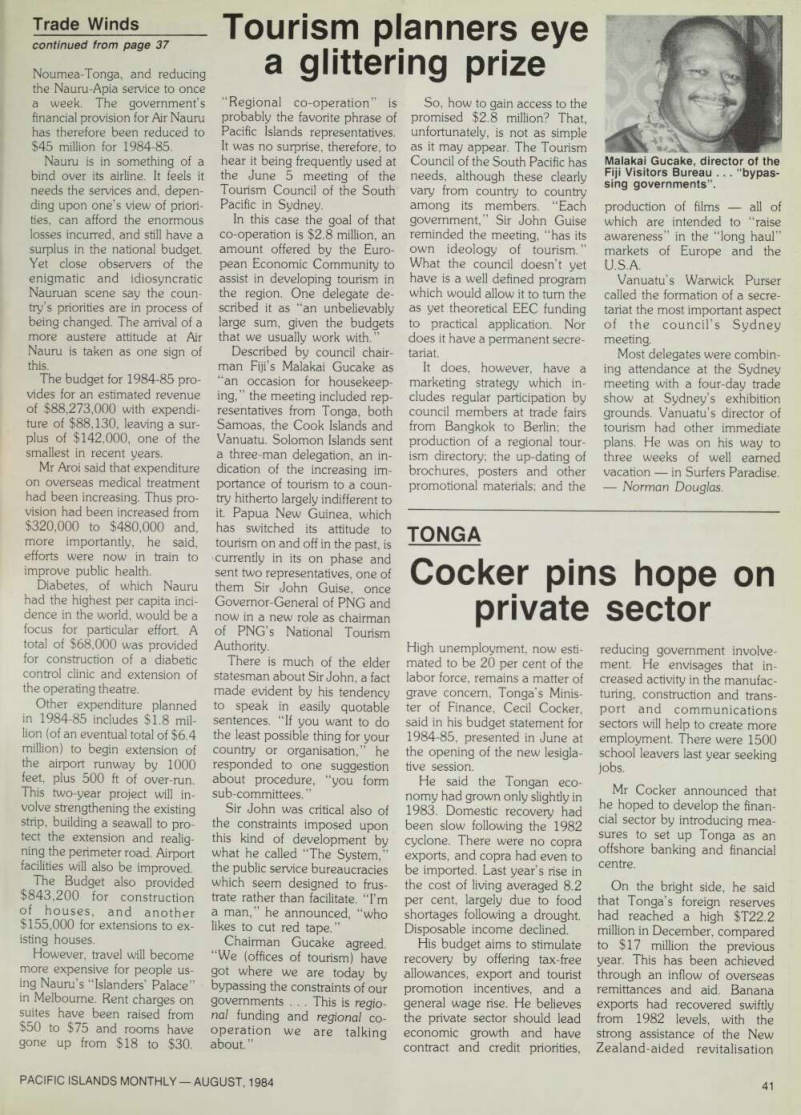
Tourism planners eye a glittering prize
“Regional co-operation” is probably the favorite phrase of Pacific Islands representatives.
It was no surprise, therefore, to hear it being frequently used at the June 5 meeting of the Tourism Council of the South Pacific in Sydney.
In this case the goal of that co-operation is $2.8 million, an amount offered by the Euro pean Economic Community to assist in developing tourism in the region. One delegate de scribed it as “an unbelievably large sum, given the budgets that we usually work with.”
Described by council chair man Fiji’s Malakai Gucake as “an occasion for housekeep ing,” the meeting included rep resentatives from Tonga, both Samoas, the Cook Islands and Vanuatu. Solomon Islands sent a three-man delegation, an in dication of the increasing im portance of tourism to a coun try hitherto largely indifferent to it. Papua New Guinea, which has switched its attitude to tourism on and off in the past, is ■currently in its on phase and sent two representatives, one of them Sir John Guise, once Governor-General of PNG and now in a new role as chairman of PNG’s National Tourism
Authority.
There is much of the elder statesman about Sir John, a fact made evident by his tendency to speak in easily quotable sentences. “If you want to do the least possible thing for your country or organisation,” he responded to one suggestion about procedure, “you form sub-committees. ”
Sir John was critical also of the constraints imposed upon this kind of development by what he called “The System,” the public service bureaucracies which seem designed to frus trate rather than facilitate. “I’m a man,” he announced, “who likes to cut red tape.”
Chairman Gucake agreed.
“We (offices of tourism) have got where we are today by bypassing the constraints of our governments . . . This is regio nal funding and regional co operation we are talking about. ”
So, how to gain access to the promised $2.8 million? That, unfortunately, is not as simple as it may appear. The Tourism Council of the South Pacific has needs, although these clearly vary from country to country among its members. “Each government,” Sir John Guise reminded the meeting, “has its own ideology of tourism. ”
What the council doesn’t yet have is a well defined program which would allow it to turn the as yet theoretical EEC funding to practical application. Nor does it have a permanent secre tariat.
It does, however, have a marketing strategy which in cludes regular participation by council members at trade fairs from Bangkok to Berlin; the production of a regional tour ism directory; the up-dating of brochures, posters and other promotional materials; and the
production of films all of which are intended to “raise awareness” in the “long haul” markets of Europe and the
U.S.A.
Vanuatu’s Warwick Purser called the formation of a secre tariat the most important aspect of the council’s Sydney meeting.
Most delegates were combin ing attendance at the Sydney meeting with a four-day trade show at Sydney’s exhibition grounds. Vanuatu’s director of tourism had other immediate plans. He was on his way to three weeks of well earned vacation in Surfers Paradise.
Norman Douglas.
Malakai Gucake, director of the Fiji Visitors Bureau ... “bypas sing governments”.
Cocker pins hope on
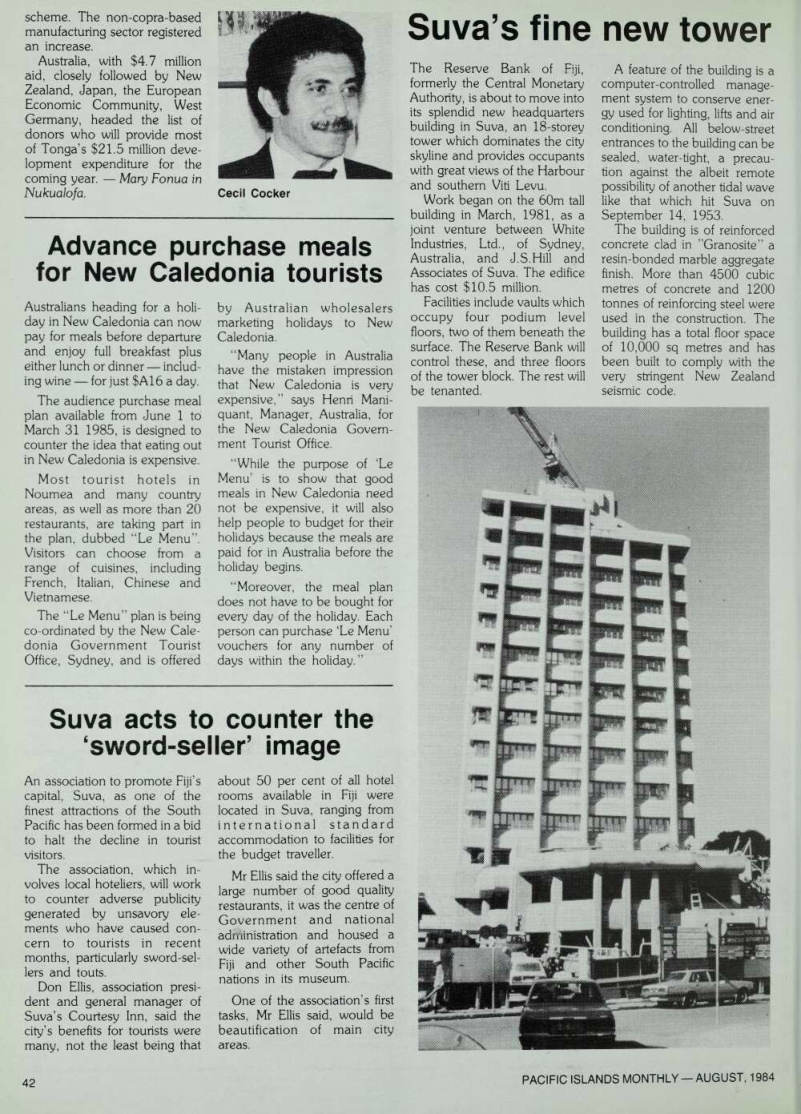
Tonga
Cocker pins hope on private sector
High unemployment, now estimated to be 20 per cent of the labor force, remains a matter of grave concern, Tonga’s Minister of Finance, Cecil Cocker, said in his budget statement for 1984-85, presented in June at the opening of the new lesiglative session.
He said the Tongan economy had grown only slightly in 1983. Domestic recovery had been slow following the 1982 cyclone. There were no copra exports, and copra had even to be imported. Last year’s rise in the cost of living averaged 8.2 per cent, largely due to food shortages following a drought, Disposable income declined.
His budget aims to stimulate recovery by offering tax-free allowances, export and tourist promotion incentives, and a general wage rise. He believes the private sector should lead economic growth and have contract and credit priorities,
reducing government involve ment. He envisages that in creased activity in the manufac turing, construction and trans port and communications sectors will help to create more employment. There were 1500 school leavers last year seeking jobs. u P , , , r C^ er , an n° un c e d that he , ho Pf d to develop the finan clal se ? or mtr ° ducin S mea . sl i r tf 0 ® et U P Tonga as an offshore bankln 3 and financial cen re ’
On the bright side, he said that Tonga’s foreign reserves had reached a high $T22.2 million in December, compared to $l7 million the previous year. This has been achieved through an inflow of overseas remittances and aid. Banana exports had recovered swiftly from 1982 levels, with the strong assistance of the New Zealand-aided revitalisation
scheme. The non-copra-based manufacturing sector registered an increase.
Australia, with $4.7 million aid, closely followed by New Zealand, Japan, the European Economic Community, West Germany, headed the list of donors who will provide most of Tonga’s $21.5 million deve lopment expenditure for the
coming year.
Mary Fonua in
Nukualofa.
Cecil Cocker
Advertisements & other items, p. 41 (1 item)
Trade Winds
continued from page 37
Advance purchase meals
for New Caledonia tourists
Australians heading for a holi day in New Caledonia can now pay for meals before departure and enjoy full breakfast plus either lunch or dinner includ ing wine for just SAI6 a day.
The audience purchase meal plan available from June 1 to March 31 1985, is designed to counter the idea that eating out in New Caledonia is expensive.
Most tourist hotels in Noumea and many country areas, as well as more than 20 restaurants, are taking part in the plan, dubbed “Le Menu”.
Visitors can choose from a range of cuisines, including French, Italian, Chinese and Vietnamese.
The “Le Menu” plan is being co-ordinated by the New Cale donia Government Tourist Office, Sydney, and is offered
by Australian wholesalers marketing holidays to New Caledonia.
“Many people in Australia have the mistaken impression that New Caledonia is very expensive,” says Henri Mani quant, Manager, Australia, for the New Caledonia Govern ment Tourist Office.
“While the purpose of ‘Le Menu’ is to show that good meals in New Caledonia need not be expensive, it will also help people to budget for their holidays because the meals are paid for in Australia before the holiday begins.
“Moreover, the meal plan does not have to be bought for every day of the holiday. Each person can purchase ‘Le Menu’ vouchers for any number of days within the holiday.”
‘sword-seller’ image
Suva acts to counter the ‘sword-seller’ image
An association to promote Fiji’s capital, Suva, as one of the finest attractions of the South Pacific has been formed in a bid to halt the decline in tourist visitors.
The association, which in volves local hoteliers, will work to counter adverse publicity generated by unsavory ele ments who have caused con cern to tourists in recent months, particularly sword-sel lers and touts.
Don Ellis, association presi dent and general manager of Suva’s Courtesy Inn, said the city’s benefits for tourists were many, not the least being that
about 50 per cent of all hotel rooms available in Fiji were located in Suva, ranging from international standard accommodation to facilities for the budget traveller.
Mr Ellis said the city offered a large number of good quality restaurants, it was the centre of Government and national administration and housed a wide variety of artefacts from Fiji and other South Pacific nations in its museum.
One of the association’s first tasks, Mr Ellis said, would be beautification of main city areas.
Suva’s fine new tower
The Reserve Bank of Fiji, formerly the Central Monetary Authority, is about to move into its splendid new headquarters building in Suva, an 18-storey tower which dominates the city skyline and provides occupants with great views of the Harbour and southern Viti Levu.
Work began on the 60m tall building in March, 1981, as a joint venture between White Industries, Ltd., of Sydney, Australia, and J.S.Hill and Associates of Suva. The edifice has cost $10.5 million.
Facilities include vaults which occupy four podium level floors, two of them beneath the surface. The Reserve Bank will control these, and three floors of the tower block. The rest will be tenanted.
A feature of the building is a computer-controlled manage ment system to conserve ener gy used for lighting, lifts and air conditioning. All below-street entrances to the building can be sealed, water-tight, a precau tion against the albeit remote possibility of another tidal wave like that which hit Suva on September 14, 1953.
The building is of reinforced concrete clad in ’’Granosite” a resin-bonded marble aggregate finish. More than 4500 cubic metres of concrete and 1200 tonnes of reinforcing steel were used in the construction. The building has a total floor space of 10,000 sq metres and has been built to comply with the very stringent New Zealand seismic code.
books
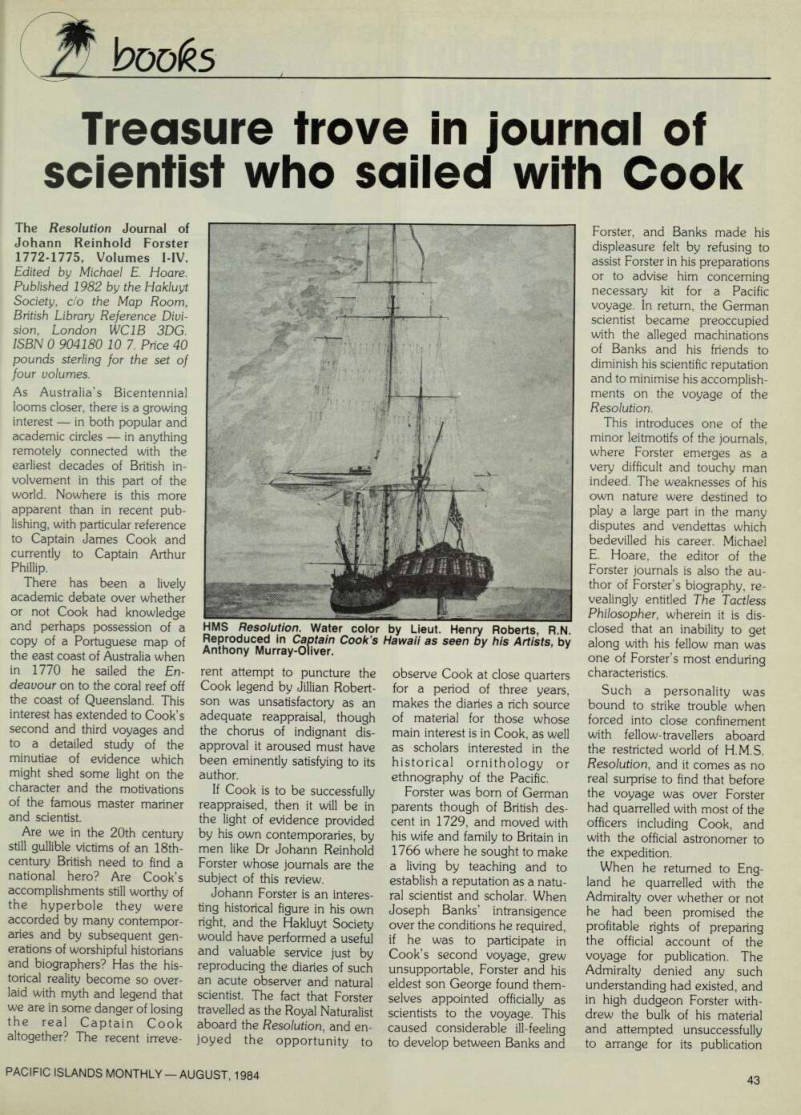

Treasure trove in journal of scientist who sailed with Cook
The Resolution Journal of Johann Reinhold Forster 1772-1775, Volumes I-IV.
Edited hy Michael E. Hoare.
Published 1982 by the Hakluyt Society, do the Map Room, British Library Reference Divi sion, London WCIB 3DG.
ISBN 0 904180 10 7. Price 40 pounds sterling for the set of four volumes.
As Australia’s Bicentennial looms closer, there is a growing interest in both popular and academic circles in anything remotely connected with the earliest decades of British in volvement in this part of the world. Nowhere is this more apparent than in recent pub lishing, with particular reference to Captain James Cook and currently to Captain Arthur Phillip.
There has been a lively academic debate over whether or not Cook had knowledge and perhaps possession of a copy of a Portuguese map of the east coast of Australia when in 1770 he sailed the En deavour on to the coral reef off the coast of Queensland. This interest has extended to Cook’s second and third voyages and to a detailed study of the minutiae of evidence which might shed some light on the character and the motivations of the famous master mariner and scientist.
Are we in the 20th century still gullible victims of an 18th century British need to find a national hero? Are Cook’s accomplishments still worthy of the hyperbole they were accorded by many contempor aries and by subsequent gen erations of worshipful historians and biographers? Has the his torical reality become so over laid with myth and legend that we are in some danger of losing the real Captain Cook altogether? The recent irreve-
rent attempt to puncture the Cook legend by Jillian Robert son was unsatisfactory as an adequate reappraisal, though the chorus of indignant dis approval it aroused must have been eminently satisfying to its author.
If Cook is to be successfully reappraised, then it will be in the light of evidence provided by his own contemporaries, by men like Dr Johann Reinhold Forster whose journals are the subject of this review.
Johann Forster is an interes ting historical figure in his own right, and the Hakluyt Society would have performed a useful and valuable service just by reproducing the diaries of such an acute observer and natural scientist. The fact that Forster travelled as the Royal Naturalist aboard the Resolution, and en joyed the opportunity to
observe Cook at close quarters for a period of three years, makes the diaries a rich source of material for those whose main interest is in Cook, as well as scholars interested in the historical ornithology or ethnography of the Pacific.
Forster was born of German parents though of British des cent in 1729, and moved with his wife and family to Britain in 1766 where he sought to make a living by teaching and to establish a reputation as a natu ral scientist and scholar. When Joseph Banks’ intransigence over the conditions he required, if he was to participate in Cook’s second voyage, grew unsupportable, Forster and his eldest son George found them selves appointed officially as scientists to the voyage. This caused considerable ill-feeling to develop between Banks and
Forster, and Banks made his displeasure felt by refusing to assist Forster in his preparations or to advise him concerning necessary kit for a Pacific voyage. In return, the German scientist became preoccupied with the alleged machinations of Banks and his friends to diminish his scientific reputation and to minimise his accomplish ments on the voyage of the Resolution.
This introduces one of the minor leitmotifs of the journals, where Forster emerges as a very difficult and touchy man indeed. The weaknesses of his own nature were destined to play a large part in the many disputes and vendettas which bedevilled his career. Michael E. Hoare, the editor of the Forster journals is also the au thor of Forster’s biography, re vealingly entitled The Tactless Philosopher, wherein it is dis closed that an inability to get along with his fellow man was one of Forster’s most enduring characteristics.
Such a personality was bound to strike trouble when forced into close confinement with fellow-travellers aboard the restricted world of H.M.S.
Resolution, and it comes as no real surprise to find that before the voyage was over Forster had quarrelled with most of the officers including Cook, and with the official astronomer to the expedition.
When he returned to Eng land he quarrelled with the Admiralty over whether or not he had been promised the profitable rights of preparing the official account of the voyage for publication. The Admiralty denied any such understanding had existed, and in high dudgeon Forster with drew the bulk of his material and attempted unsuccessfully to arrange for its publication
HMS Resolution. Water color by Lieut. Henry Roberts, R.N.
Reproduced In Captain Cook’s Hawaii as seen by his Artists, by Anthony Murray-Oliver.
himself. As a result, his reputa tion has always been over shadowed by that of his son George, who in 1777 at least produced a published account of the voyage.
This situation remained un changed until very recent times, because after Forster’s death in 1798 the great bulk of his books and manuscripts, includ ing the four volumes repro duced here, were sold to the Royal Library of the King of Prussia, later to become the Prussian State Library. There they remained undisturbed due to a combination of events involving Forster’s mediocre reputation amongst British scholars and a shoddy and inaccurate system of catalo guing.
Michael E. Hoare uncovered this treasure trove in resear ching for the biography of Johann Forster, and the Hak luyt Society has continued its services to scholarship by re producing the journals in a beautifully legible text and with an abundance of editorial com mentary in an introduction and footnotes provided by Michael Hoare.
The journals are absolutely fascinating coming as they do from a highly intelligent and cultivated scientist who had no experience of life at sea, and who responded to the chal lenge of this new environment by writing a detailed journal wherein he recorded not only his scientific discoveries and musings, but also many of his immediate reactions to events and the day-to-day happenings aboard ship which impressed themselves upon him. Conse quently, the four volumes of journals are an odd mixture of shrewd observation and start ling naivety, of scientific work
punctuated by amusing or irritating interludes inseparable from life in the Royal Navy at this time. Through it all, the figure of Cook dominates the human landscape, and even when Forster quarrels with Cook as he did with nearly everybody else on the voyage, his immense respect for the leader of the expedition quickly re-emerges.
Michael Hoare’s footnotes are succinct and very useful, especially his comments on the historiography of this area, as are his notations when the contemporary record is diffe rent in fact or interpretation from the secondary sources, particularly Beaglehole’s biography of Cook. The some what laborious task of tracing the origins of Forster’s frequent Latin quotations indicates the thoroughness with which the editor has approached his task; and the absolute mastery he displays of historical and scien tific materials necessary to put these journals into context fill this reviewer with respectful admiration.
As a piece of history in its own right, as a most illuminat ing commentary upon Cook by one of his contemporaries, and as a necessary adjunct to an understanding of the way in which 18th-century men of sci ence approached the races as well as the flora and fauna of the Pacific region, the publication by the Hakluyt So ciety of the four volumes com prising The Resolution Journal of Johann Reinhold Forster, 1112-1115 is an event worthy of the gratitude and thanks of all of us interested in the Pacific region and the impact eight eenth and nineteenth century Europeans had upon it.
F. G. Clarke.
Forepart of the wooden figurehead of HMS Resolution.
Advertisements & other items, p. 44 (1 item)
Heating & cooking
Four ways to Better
with
Reliability & savings
SOLAR ENERGY SYSTEMS ALL PURPOSE BOILERS
MS 5)
COMMERCIAL STOVES
DOMESTIC STOVES
Improve your current heating and cooking facilities now, and save on fuel costs almost immediately At Water Wheel Exports, we're pleased to introduce an exciting range of alternative heating, cooking and solar energy products to suit all domestic, commercial and industrial market requirements.
Naturally, the key advantage of installing a solid fuel stove, boiler or solar energy hot water system, is the fact that you'll never again be totally dependent on gas or electricity for all your heating or cooking requirements And, when you consider you're also investing in long-term reliability, it means you'll make substantial savings year after year, after year.
For complete details on our export range of 'Fuel Efficient Money Saving', heating and cooking products, please, fill in the coupon below.
Water Wheel Exports Ply. Ltd.. . Exporters of a large wW and diverse range of producfs to the Pacific region.
WATER WHEEL EXPORTS PTY. LID.,
53-57 Market Street, South Melbourne, 3205. Victoria, Australia. Telephone: 699 1722, Telex: AA32165.
Telegraphic Address: ''Watermill”, Melbourne
NAME: ...
ADDRESS:
COUNTRY:
TELEPHONE:
PLEASE SUPPLY INFORMATION ON:
DOMESTIC □ INDUSTRIAL □ COMMERCIAL □
APPLICATIONS OF:
STOVES □ BOILERS □ SOLAR ENERGY SYSTEMS □
Awareness, authenticity, in writings
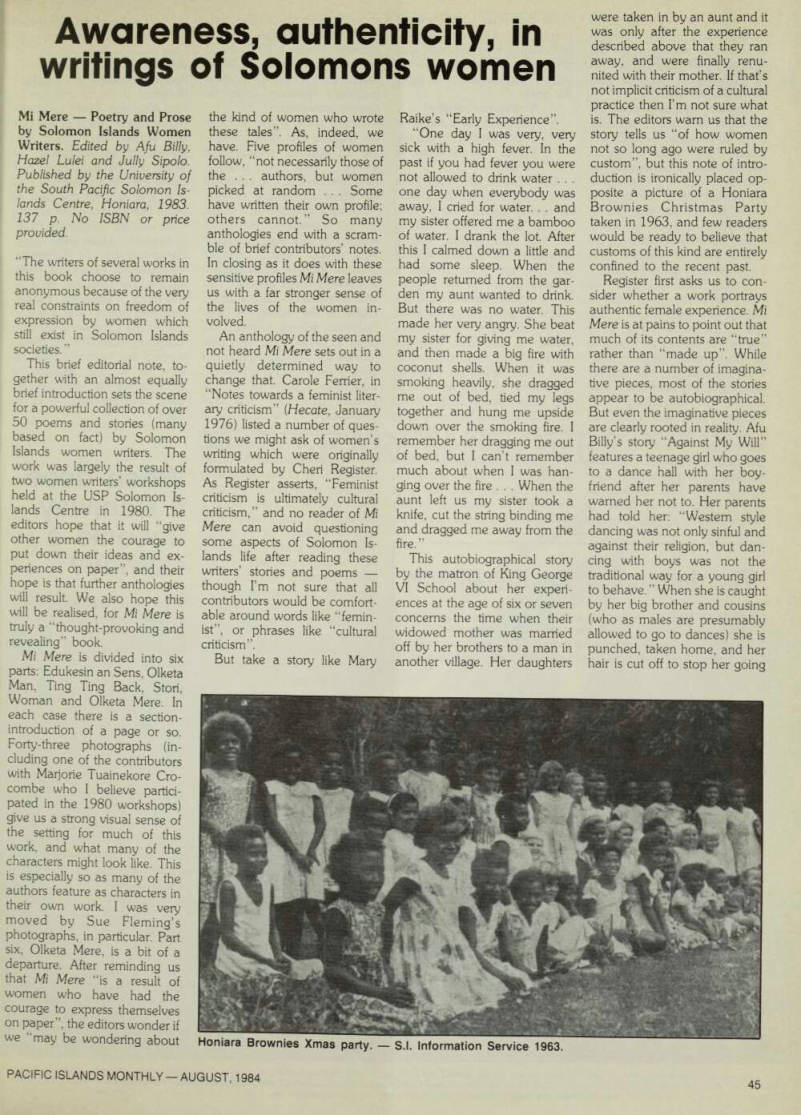
writings of Solomons women
Mi Mere Poetry and Prose by Solomon Islands Women Writers. Edited by Afu Billy, Hazel Lulei and Ju//y Sipolo.
Published by the University of the South Pacific Solomon Is lands Centre, Honiara, 1983. 137 p. No ISBN or price provided.
“The writers of several works in this book choose to remain anonymous because of the very real constraints on freedom of expression by women which still exist in Solomon Islands societies. ”
This brief editorial note, to gether with an almost equally brief introduction sets the scene for a powerful collection of over 50 poems and stories (many based on fact) by Solomon Islands women writers. The work was largely the result of two women writers’ workshops held at the USP Solomon Is lands Centre in 1980. The editors hope that it will “give other women the courage to put down their ideas and ex periences on paper”, and their hope is that further anthologies will result. We also hope this will be realised, for Mi Mere is truly a “thought-provoking and revealing” book.
Mi Mere is divided into six parts: Edukesin an Sens, Olketa Man, Ting Ting Back, Stori, Woman and Olketa Mere. In each ease there is a section introduction of a page or so.
Forty-three photographs (in cluding one of the contributors with Marjorie Tuainekore Cro combe who I believe partici pated in the 1980 workshops) give us a strong visual sense of the setting for much of this work, and what many of the characters might look like. This is especially so as many of the authors feature as characters in their own work. I was very moved by Sue Fleming’s photographs, in particular. Part six, Olketa Mere, is a bit of a departure. After reminding us that Mi Mere “is a result of women who have had the courage to express themselves on paper”, the editors wonder if we “may be wondering about
the kind of women who wrote these tales”. As, indeed, we have. Five profiles of women follow, “not necessarily those of the . . . authors, but women picked at random . . . Some have written their own profile; others cannot.” So many anthologies end with a scram ble of brief contributors’ notes.
In closing as it does with these sensitive profiles Mi Mere leaves us with a far stronger sense of the lives of the women in volved.
An anthology of the seen and not heard Mi Mere sets out in a quietly determined way to change that. Carole Ferrier, in “Notes towards a feminist liter ary criticism” ( Hecate, January 1976) listed a number of ques tions we might ask of women’s writing which were originally formulated by Cheri Register.
As Register asserts, “Feminist criticism is ultimately cultural criticism,” and no reader of Mi Mere can avoid questioning some aspects of Solomon Is lands life after reading these writers’ stories and poems though I’m not sure that all contributors would be comfort able around words like “femin ist”, or phrases like “cultural criticism”.
But take a story like Mary
Raike’s “Early Experience”.
“One day I was very, very sick with a high fever. In the past if you had fever you were not allowed to drink water . . . one day when everybody was away, I cried for water. . . and my sister offered me a bamboo of water. I drank the lot. After this I calmed down a little and had some sleep. When the people returned from the gar den my aunt wanted to drink.
But there was no water. This made her very angry. She beat my sister for giving me water, and then made a big fire with coconut shells. When it was smoking heavily, she dragged me out of bed, tied my legs together and hung me upside down over the smoking fire. I remember her dragging me out of bed, but I can’t remember much about when I was han ging over the fire . . . When the aunt left us my sister took a knife, cut the string binding me and dragged me away from the fire.”
This autobiographical story by the matron of King George VI School about her experi ences at the age of six or seven concerns the time when their widowed mother was married off by her brothers to a man in another village. Her daughters
were taken in by an aunt and it was only after the experience described above that they ran away, and were finally renu nited with their mother. If that’s not implicit criticism of a cultural practice then I’m not sure what is. The editors warn us that the story tells us “of how women not so long ago were ruled by custom”, but this note of intro duction is ironically placed op posite a picture of a Honiara Brownies Christmas Party taken in 1963, and few readers would be ready to believe that customs of this kind are entirely confined to the recent past.
Register first asks us to con sider whether a work portrays authentic female experience. Mi Mere is at pains to point out that much of its contents are “true” rather than “made up”. While there are a number of imagina tive pieces, most of the stories appear to be autobiographical.
But even the imaginative pieces are clearly rooted in reality. Afu Billy’s story “Against My Will” features a teenage girl who goes to a dance hall with her boy friend after her parents have warned her not to. Her parents had told her; “Western style dancing was not only sinful and against their religion, but dan cing with boys was not the traditional way for a young girl to behave. ” When she is caught by her big brother and cousins (who as males are presumably allowed to go to dances) she is punched, taken home, and her hair is cut off to stop her going
Honiara Brownies Xmas party. S.I. Information Service 1963.
out again. In the conflict of “village” and “town” values in a changing society it is the woman in the story who is seen to suffer both physical and psychological violence.
Register next asks does the portrayal of women’s sexuality relate to actuality? Section two, Olketa Man, again brings us back to actual experiences. The editors comment: “The stories are revealing and hold nothing back. Except for changes of characters’ names in some cases, this work comes from the bared souls of women who have dared to speak the truth”.
The story “Dad” examines “the times when my father used to ill-treat my poor mum”. She tells us of the time her father knifed her mother and went to prison, of his drinking and how: “On one occasion he strangled her, but luckily Mark and I were awake. So, screaming, tears running from our eyes, we pounced on Dad and loosened his hands.” The story has a poignant conclusion: “But one surprising thing about him: he is retired now and is back at home. Although he drinks at times, he’s changed. He has
never again beaten Mum up. I thank God for that. They’re both happy together now, get ting older every day.” And a poem, “My Husband” includes the lines: You’re not satisfied You beat me ill treat me There are days in our life When not a word is spoken Do women find their own experience mirrored in the liter ature they read or society’s idea of how “female culture” should be, next asks Register? I am a teacher in New Zealand schools and we are going through a difficult period as the Depart ment of Education is making a real attempt to change the kinds of models of female behavior shown in textbooks. They are thwarted by an economic situa tion which keeps an outdated generation of sexist textooks in our classrooms. It costs money to change, and the economic priorities are seen to lie else where. Seen by whom being a not unrelated question. Mi Mere is a first anthology by women in anew literature and maybe its presence in Solomon Islands will give it an impact which an
anthology like Private Gardens: An Anthology of New Zealand Women Poets (1977) could never hope to have. In larger literatures it is hard to see how Register’s question could be quickly answered.
Finally there is the problem (as Register sets it) of combin ing an accurate reflection of women’s lives with positive, new role models. The editors of Mi Mere are aware of this.
“Change,” they tell us, “seems to be inevitable. As more women go to school they leam new ideas,” but, “changes brought about by education are not always to our benefit. ” The women writers in this anthology seem to be telling us that Solomon Islands women will need to create their own new models for themselves and not leave it up to a largely Western education system or to the present patriarchy. The final photograph in the collection is of Lily Poznanski, “who was the first, and so far the only, woman politician” in Solomon Islands. One of the concluding portraits of women, for inst ance, is of Alice Ture. She is a 50-year-old mother of 10 chil den who lives in Hopongo village. She entered a mission school when she was 17 and left at Standard Two. She has a daughter at King George VI School and another at Honiara Technical College. She does not agree with arranged mar riages, and has allowed one daughter to marry a man of her own choice.
Alice Ture recently attended a workshop in Honiara on the Promotion and Training of Women in Income-raising Acti vities organised by the Women’s Training Centre of the Ministry of Youth and Cultural Affairs. She herself has opened a bank account in the nearby market centre of Munda and now has her own market gardening business. It is in characters like Alice Ture both real and imagined that Mi Mere holds up a promise of a new kind of future for women in the Solomon Islands. Rarely has an anthology of women’s writing so clearly fulfilled the principles of feminist literature.
Its consciousness and au thenticity must leave any reader with a deep respect for women’s writing in Solomon Islands.
I do not know pre-European Solomon Islands literature well. 1 am more familiar with that of the Maori, but I know that Pacific literatures held much in common. In his introduction to Nga Moteatea (Part II) Apirana Ngata makes much of the fact that women as a group pre dominated as composers of Maori oral literature. From one canoe area to another this was true and he cites the case of Ngati Porou who count among their women composers Hine ki-tawhiti, Hine-wahi-rangi, Rangi-apakura, Te Rangipaia, Wharerakau, Tangikuku, Hine kaukia, Turi-whewhe, Hine-ta whi-rangi, Paiatehau, Hineki mua and others. Was it not so before the Europeans came to Solomons Islands? In Mi Mere I suspect that women writers re turn us to that tradition, a tradition we can only be glad
they have restored.
D. S.
Long.
railway?

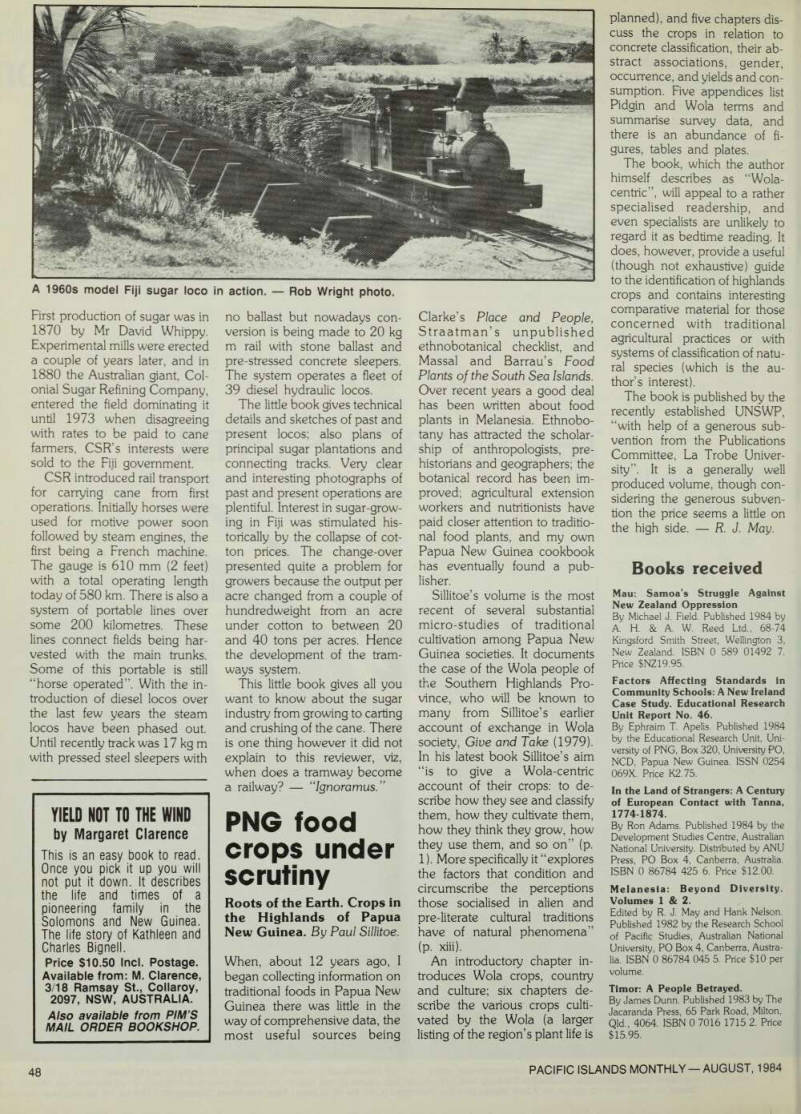
When does a tramway become a railway?
Fiji’s Sugar Tramways, 1882- 1982. Compiled by Bob McKil lop and Peter Dyer. Published by the Light Railway Reserch Society of Australia, P.O. Box 21, Surrey Hills, Vic., Australia, 3127, ISBN 0 909340 18 8. No price provided.
In the so-called “metropolitan” countries there is often a certain bitterness associated with their railway systems caused often enough by rail-workers’ strikes or by rip-off fare increases. So it is of some comfort to know that in the Pacific there is at least one rail system which gives off a sweet odor or at least its freight does.
This impression is given by the small publication, Fiji’s Sugar Tramways 1882-1982.
Into only 36 pages printed on semigloss stiff paper there is packed a wealth of information on the history of the Fiji sugar industry and the application of modern (even from the start) transport for carriage of the sugarcane from fields to mills.
First production of sugar was in 1870 by Mr David Whippy.
Experimental mills were erected a couple of years later, and in 1880 the Australian giant, Col onial Sugar Refining Company, entered the field dominating it until 1973 when disagreeing with rates to be paid to cane farmers, CSR’s interests were sold to the Fiji government.
CSR introduced rail transport for carrying cane from first operations. Initially horses were used for motive power soon followed by steam engines, the first being a French machine.
The gauge is 610 mm (2 feet) with a total operating length today of 580 km. There is also a system of portable lines over some 200 kilometres. These lines connect fields being har vested with the main trunks.
Some of this portable is still “horse operated”. With the in troduction of diesel locos over the last few years the steam locos have been phased out.
Until recently track was 17 kg m with pressed steel sleepers with
no ballast but nowadays con version is being made to 20 kg m rail with stone ballast and pre-stressed concrete sleepers.
The system operates a fleet of 39 diesel hydraulic locos.
The little book gives technical details and sketches of past and present locos; also plans of principal sugar plantations and connecting tracks. Very clear and interesting photographs of past and present operations are plentiful. Interest in sugar-grow ing in Fiji was stimulated his torically by the collapse of cot ton prices. The change-over presented quite a problem for growers because the output per acre changed from a couple of hundredweight from an acre under cotton to between 20 and 40 tons per acres. Hence the development of the tram ways system.
This little book gives all you want to know about the sugar industry from growing to carting and crushing of the cane. There is one thing however it did not explain to this reviewer, viz, when does a tramway become a railway? “ Ignoramus
A 1960s model Fiji sugar loco in action. Rob Wright photo.
Advertisements & other items, pp. 46-48 (2 items)
Jph Publications:
The Journal of Pacific History
Vol. XIX 1984 1-2: articles on early political hierarchies in Fiji, the maka’ainana in 18C-19C Hawaii; the Micronesian Mission on Ponape; New Caledonia’s mining industry: U.S. intelligence in the Japanese mandates: current developments in New Caledonia and Vanuatu. 3-4: a special issue on the peopling of the Pacific PLUS Pacific History Bibliography and Comment.
SAI6 (SUS2O) annually from The Journal of Pacific History, Department of Pacific and South-East Asian History, ANU, GPO Box 4, Canberra, ACT, 2601, Australia.
JPH PUBLICATIONS:
Girmitiyas: the origins of the Fiji Indians by Brij V. Lai.
Detailed examination of the social and economic background in India of indentured migrants to Fiji, revealing the complexity of the forces involved, viii, 152 pp $A9.75 pi. $A1.75 p&p (SUSII pi. 2) From The Journal of Pacific History (available in Fiji from
Desai Bookshops).
The Cross of Lorraine in the South Pacific: Australia and the Free French Movement 1940-42 by John Lawrey.
Study of the post-contact history of New Caledonia leading up to the overthrow of the local Vichy administration that paved the way for the Allied counter-offensive in the Pacific War. viii, 142 pp $A8.50
(SUSII.SO).
From The Journal of Pacific History
The Search Is Over
You were looking for the perfect fit. Uncompromising sound quality. As beautiful to look at as it is t< listen to. Advanced electronics. A choice of sophisticated features that are easy to use. Reliabilit that’s no fairy tale. Clarion makes a wide selection of models, with one • that’s just your size. Clarion Car Stereo. Listen, and drive happily ever after. IIOI
900 E
111 MIL
UD ARC
t nno
i u 1.-l < > For further information - Australia: Amalgamated Wireless (Australasia) Ltd., 554 Parramatta Road, Ashfield, N.S.W., 2131 / New Zealand; AWA New Zealand Limited, P.O. Box 50-248, Porirua / Fiji Islands: Bnjlal & Co., Ltd., G.P.O. Box 36 Suva / Tahiti: HI-FI Shangrila, B.P. 200, Papeete / New Caledonia: Caldis, 8.P.M1, Noumea Cedex / Guam: Micropac Audio lnc„ P.O. Box 3478, Agana, Guam 96910, U.S.A. Tel: 472-8091, Cable Code: HIFI AUDIO AGAf Vanuatu: The Sound Centre, P.O. Box 434, Vila / Cook Islands: South Seas International Ltd., P.O. Box 49, Rarotonga / Papua New Guinea; Hagemeyer (PN G.) Pty. Ltd., P.O. Box 1428, Boroko, Port Merest
YIELD NOT TO THE WIND
by Margaret Clarence This is an easy book to read.
Once you pick it up you will not put it down. It describes the life and times of a pioneering family in the Solomons and New Guinea.
The life story of Kathleen and Charles Bignell.
Price $10.50 Incl. Postage.
Available from: M. Clarence, 3/18 Ramsay St., Collaroy,
2097, NSW, AUSTRALIA.
Also available from PI M’S
MAIL ORDER BOOKSHOP.
scrutiny
PNG food crops under scrutiny
Roots of the Earth. Crops in the Highlands of Papua New Guinea. By Paul Sillitoe.
When, about 12 years ago, I began collecting information on traditional foods in Papua New Guinea there was little in the way of comprehensive data, the most useful sources being
Clarke’s Place and People, Straatman’s unpublished ethnobotanical checklist, and Massal and Barrau’s Food Plants of the South Sea Islands.
Over recent years a good deal has been written about food plants in Melanesia. Ethnobo tany has attracted the scholar ship of anthropologists, pre historians and geographers; the botanical record has been im proved; agricultural extension workers and nutritionists have paid closer attention to traditio nal food plants, and my own Papua New Guinea cookbook has eventually found a pub lisher.
Sillitoe’s volume is the most recent of several substantial micro-studies of traditional cultivation among Papua New Guinea societies. It documents the case of the Wola people of the Southern Highlands Pro vince, who will be known to many from Sillitoe’s earlier account of exchange in Wola society, Give and Take (1979).
In his latest book Sillitoe’s aim “is to give a Wola-centric account of their crops: to de scribe how they see and classify them, how they cultivate them, how they think they grow, how they use them, and so on” (p. 1). More specifically it “explores the factors that condition and circumscribe the perceptions those socialised in alien and pre-literate cultural traditions have of natural phenomena” (p. xiii).
An introductory chapter in troduces Wola crops, country and culture; six chapters de scribe the various crops culti vated by the Wola (a larger listing of the region’s plant life is
planned), and five chapters dis cuss the crops in relation to concrete classification, their ab stract associations, gender, occurrence, and yields and con sumption. Five appendices list Pidgin and Wola terms and summarise survey data, and there is an abundance of fi gures, tables and plates.
The book, which the author himself describes as “Wola centric”, will appeal to a rather specialised readership, and even specialists are unlikely to regard it as bedtime reading. It does, however, provide a useful (though not exhaustive) guide to the identification of highlands crops and contains interesting comparative material for those concerned with traditional agricultural practices or with systems of classification of natu ral species (which is the au thor’s interest).
The book is published by the recently established UNSWP, “with help of a generous sub vention from the Publications Committee, La Trobe Univer sity”. It is a generally well produced volume, though con sidering the generous subven tion the price seems a little on
the high side.
R. J. May.
Books received
Mau: Samoa’s Struggle Against New Zealand Oppression By Michael J. Field. Published 1984 by A. H. & A. W. Reed Ltd., 68-74 Kingsford Smith Street, Wellington 3, New Zealand. ISBN 0 589 01492 7.
Price 5NZ19.95.
Factors Affecting Standards in Community Schools: A New Ireland Case Study. Educational Research Unit Report No. 46.
By Ephraim T. Apelis. Published 1984 by the Educational Research Unit, Uni versity of PNG, Box 320, University PO, NCD, Papua New Guinea. ISSN 0254 069 X. Price K 2.75.
In the Land of Strangers: A Century of European Contact with Tanna, 1774-1874.
By Ron Adams. Published 1984 by the Development Studies Centre, Australian National University. Distributed by ANU Press, PO Box 4, Canberra, Australia.
ISBN 0 86784 425 6. Price $12.00.
Melanesia: Beyond Diversity.
Volumes 1 & 2.
Edited by R. J. May and Hank Nelson.
Published 1982 by the Research School of Pacific Studies, Australian National University, PO Box 4, Canberra, Austra lia. ISBN 0 86784 045 5. Price $lO per volume.
Timor: A People Betrayed.
By James Dunn. Published 1983 by The Jacaranda Press, 65 Park Road, Milton, Qld., 4064. ISBN 0 7016 1715 2. Price $15.95.
A perfect day for a sail
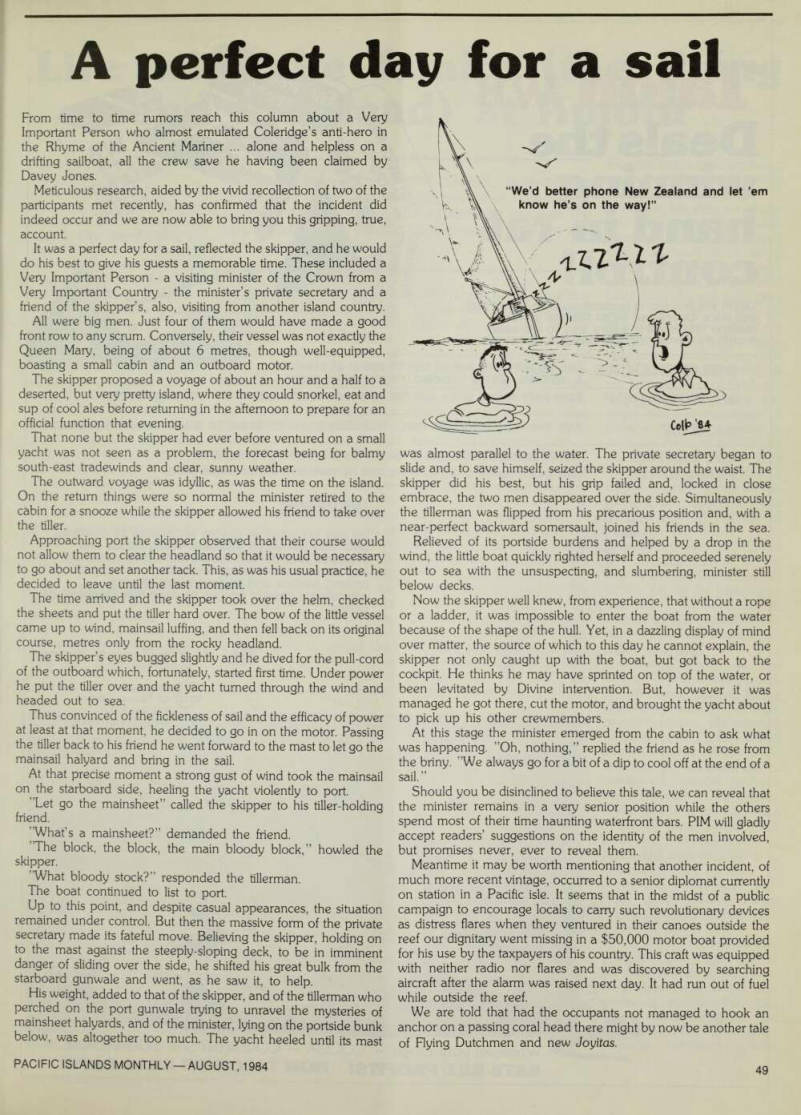
From time to time rumors reach this column about a Very Important Person who almost emulated Coleridge’s anti-hero in the Rhyme of the Ancient Mariner ... alone and helpless on a drifting sailboat, all the crew save he having been claimed by Davey Jones.
Meticulous research, aided by the vivid recollection of two of the participants met recently, has confirmed that the incident did indeed occur and we are now able to bring you this gripping, true, account.
It was a perfect day for a sail, reflected the skipper, and he would do his best to give his guests a memorable time. These included a Very Important Person - a visiting minister of the Crown from a Very Important Country - the minister’s private secretary and a friend of the skipper’s, also, visiting from another island country.
All were big men. Just four of them would have made a good front row to any scrum. Conversely, their vessel was not exactly the Queen Mary, being of about 6 metres, though well-equipped, boasting a small cabin and an outboard motor.
The skipper proposed a voyage of about an hour and a half to a deserted, but very pretty island, where they could snorkel, eat and sup of cool ales before returning in the afternoon to prepare for an official function that evening.
That none but the skipper had ever before ventured on a small yacht was not seen as a problem, the forecast being for balmy south-east tradewinds and clear, sunny weather.
The outward voyage was idyllic, as was the time on the island.
On the return things were so normal the minister retired to the cabin for a snooze while the skipper allowed his friend to take over the tiller.
Approaching port the skipper observed that their course would not allow them to clear the headland so that it would be necessary to go about and set another tack. This, as was his usual practice, he decided to leave until the last moment.
The time arrived and the skipper took over the helm, checked the sheets and put the tiller hard over. The bow of the little vessel came up to wind, mainsail luffing, and then fell back on its original course, metres only from the rocky headland.
The skipper’s eyes bugged slightly and he dived for the pull-cord of the outboard which, fortunately, started first time. Under power he put the tiller over and the yacht turned through the wind and headed out to sea.
Thus convinced of the fickleness of sail and the efficacy of power at least at that moment, he decided to go in on the motor. Passing the tiller back to his friend he went forward to the mast to let go the mainsail halyard and bring in the sail.
At that precise moment a strong gust of wind took the mainsail on the starboard side, heeling the yacht violently to port. ’’Let go the mainsheet” called the skipper to his tiller-holding friend. ’’What’s a mainsheet?” demanded the friend. ’The block, the block, the main bloody block,” howled the skipper. ’’What bloody stock?” responded the tillerman.
The boat continued to list to port.
Up to this point, and despite casual appearances, the situation remained under control. But then the massive form of the private secretary made its fateful move. Believing the skipper, holding on to the mast against the steeply-sloping deck, to be in imminent danger of sliding over the side, he shifted his great bulk from the starboard gunwale and went, as he saw it, to help.
His weight, added to that of the skipper, and of the tillerman who perched on the port gunwale trying to unravel the mysteries of mainsheet halyards, and of the minister, lying on the portside bunk below, was altogether too much. The yacht heeled until its mast
was almost parallel to the water. The private secretary began to slide and, to save himself, seized the skipper around the waist. The skipper did his best, but his grip failed and, locked in close embrace, the two men disappeared over the side. Simultaneously the tillerman was flipped from his precarious position and, with a near-perfect backward somersault, joined his friends in the sea.
Relieved of its portside burdens and helped by a drop in the wind, the little boat quickly righted herself and proceeded serenely out to sea with the unsuspecting, and slumbering, minister still below decks.
Now the skipper well knew, from experience, that without a rope or a ladder, it was impossible to enter the boat from the water because of the shape of the hull. Yet, in a dazzling display of mind over matter, the source of which to this day he cannot explain, the skipper not only caught up with the boat, but got back to the cockpit. He thinks he may have sprinted on top of the water, or been levitated by Divine intervention. But, however it was managed he got there, cut the motor, and brought the yacht about to pick up his other crewmembers.
At this stage the minister emerged from the cabin to ask what was happening. ”Oh, nothing,” replied the friend as he rose from the briny. ”We always go for a bit of a dip to cool off at the end of a sail.”
Should you be disinclined to believe this tale, we can reveal that the minister remains in a very senior position while the others spend most of their time haunting waterfront bars. PIM will gladly accept readers’ suggestions on the identity of the men involved, but promises never, ever to reveal them.
Meantime it may be worth mentioning that another incident, of much more recent vintage, occurred to a senior diplomat currently on station in a Pacific isle. It seems that in the midst of a public campaign to encourage locals to carry such revolutionary devices as distress flares when they ventured in their canoes outside the reef our dignitary went missing in a $50,000 motor boat provided for his use by the taxpayers of his country. This craft was equipped with neither radio nor flares and was discovered by searching aircraft after the alarm was raised next day. It had run out of fuel while outside the reef.
We are told that had the occupants not managed to hook an anchor on a passing coral head there might by now be another tale of Flying Dutchmen and new Joyitas.
“We’d better phone New Zealand and let ’em know he’s on the way!”
Advertisements & other items, p. 50 (1 item)
Tdon wb
Deals the
winning
hand In rat
control!
TALON WB is a world breakthrough In killing rats and mice. Developed by ICI Tasman In New Zealand talon wb is a sure way to Increase profits by eliminating RAT DAMAGE TO CROPS!
S/ $ £ K/ Ll 4 a<m fto ■€ SOLID BLOCKS Can be wired or nailed out of reach of children & animals. Easily handled - won t blow away.
WATERPROOF Safe year round use - will not dissolve, resists mould for extended periods.
DEADLY
Kills even the toughest rats - Including those resistant to warfarin based poisons.
EFFECTIVE
POWERFUL
Highly attractive to rats & mice - no pre-baltlng Is required.
Kills more rats - a lethal dose can be consumed In a single feed. 44 ' \ m
WARNING
) \ Do not lay baits In places accessible to children, pets and domestic animals, wash hands and exposed skin before meals and after work. Do not store near food or feed. Bum or bury all .'Mf N.
“4 4 \. / i i rodent bodies and uneaten bait. Empty it dl containers should not be re-used but disposed of safely.
lakm wb
i ft. \ / / / / ICA A Product ot ICI Tasman Limited P.O. Box 900, Auckland, New Zealand / / \ \ <CCu £ Whatever your crops COCOA COCO PH CITS SUGARCANE.
RATS KILL PROFITS! NOW TALON WB KILLS RATS!
Life with the family (the living
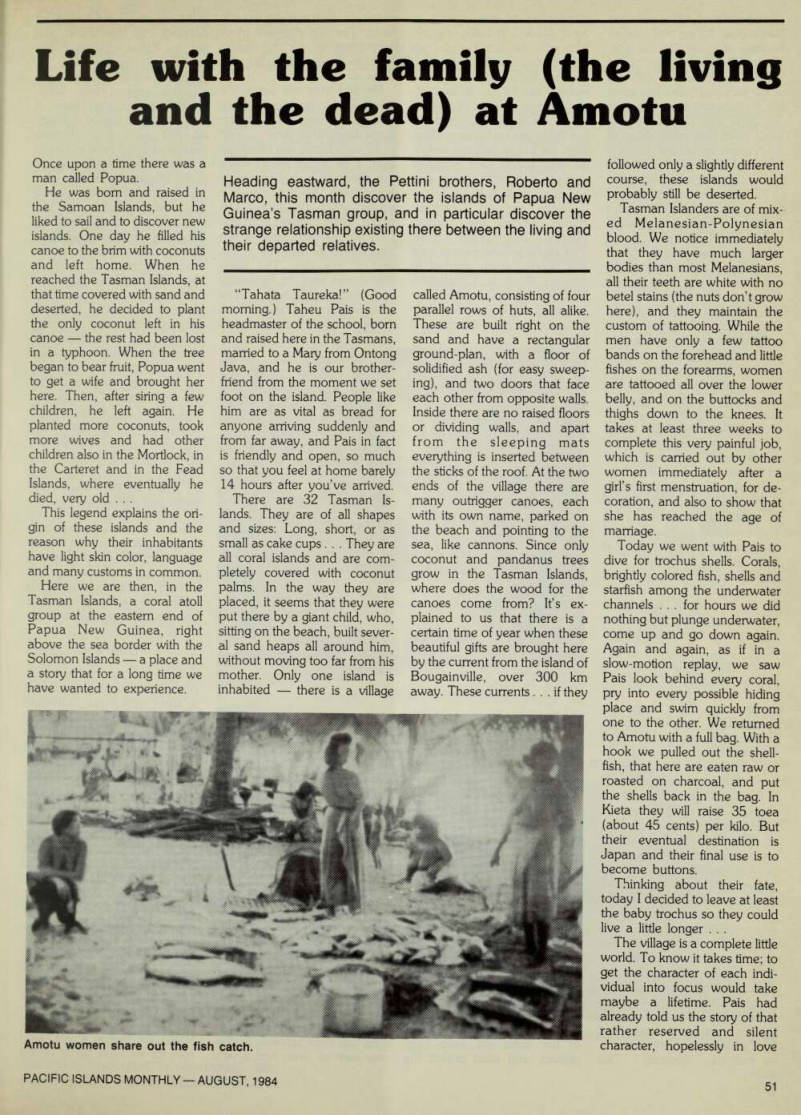
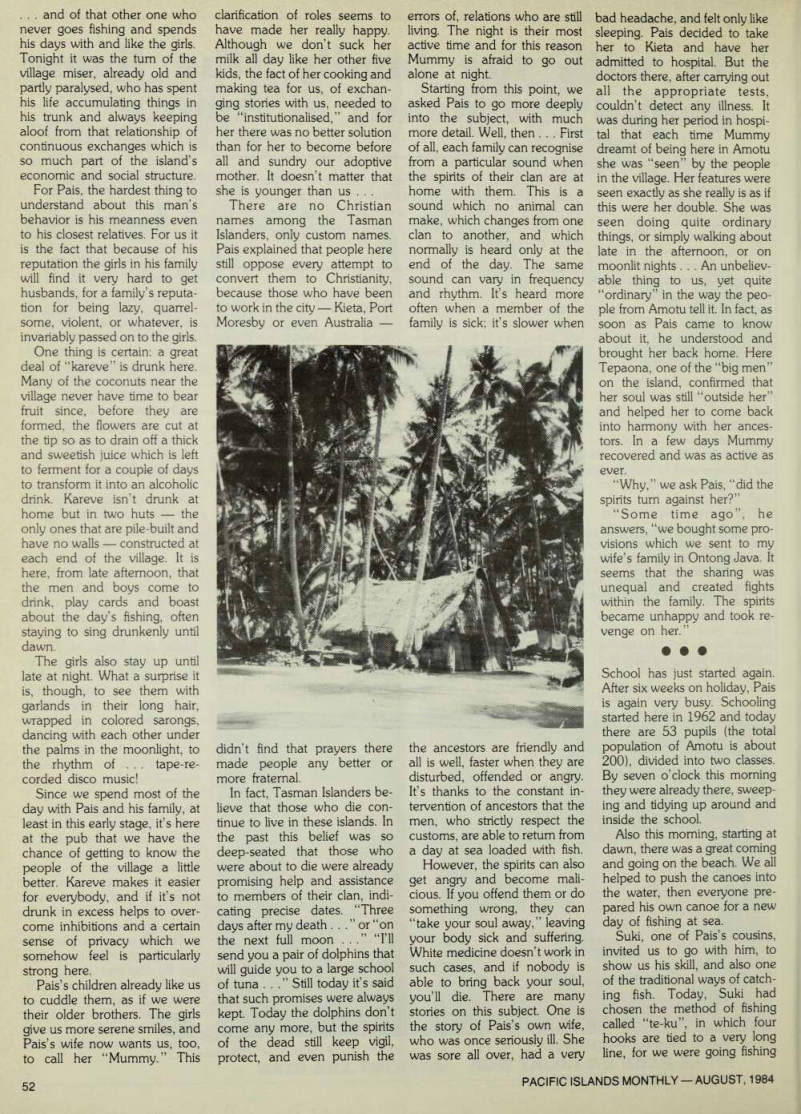
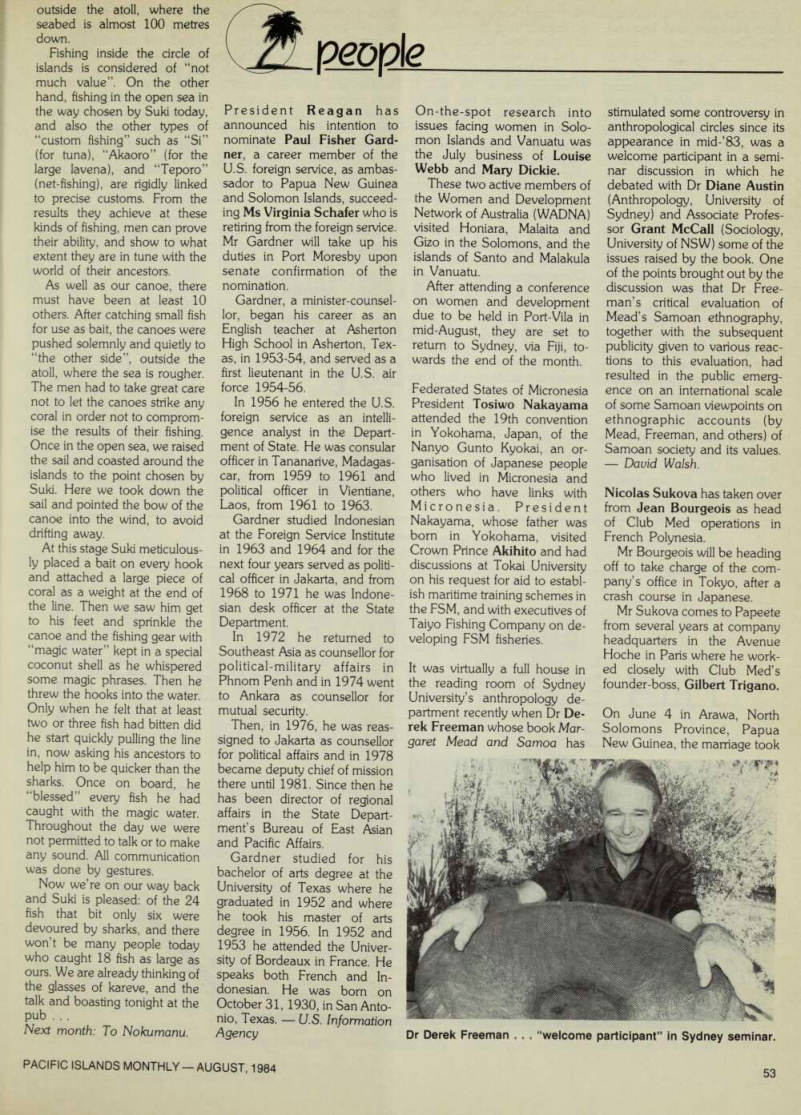
and the dead) at Amotu
Heading eastward, the Pettini brothers, Roberto and M arCo) this month discover the islands of Papua New ° t uinea ' S aSma ". 9 roa P; and in particular discover the stran 9 e relationship existing there between the living and their departed relatives.
Once upon a time there was a man called Popua.
He was bom and raised in the Samoan Islands, but he liked to sail and to discover new islands. One day he filled his canoe to the brim with coconuts and left home. When he reached the Tasman Islands, at that time covered with sand and deserted, he decided to plant the only coconut left in his canoe the rest had been lost in a typhoon. When the tree began to bear fruit, Popua went to get a wife and brought her here. Then, after siring a few children, he left again. He planted more coconuts, took more wives and had other children also in the Mortlock, in the Carteret and in the Fead Islands, where eventually he died, very old . . .
This legend explains the ori gin of these islands and the reason why their inhabitants have light skin color, language and many customs in common.
Here we are then, in the Tasman Islands, a coral atoll group at the eastern end of Papua New Guinea, right above the sea border with the Solomon Islands a place and a story that for a long time we have wanted to experience.
“Tahata Taureka!” (Good morning.) Taheu Pais is the headmaster of the school, born and raised here in the Tasmans, married to a Mary from Ontong Java, and he is our brother friend from the moment we set foot on the island. People like him are as vital as bread for anyone arriving suddenly and from far away, and Pais in fact is friendly and open, so much so that you feel at home barely 14 hours after you’ve arrived, There are 32 Tasman Is lands. They are of all shapes and sizes: Long, short, or as small as cake cups. . . They are all coral islands and are com pletely covered with coconut palms. In the way they are placed, it seems that they were put there by a giant child, who, sitting on the beach, built sever al sand heaps all around him, without moving too far from his mother. Only one island is inhabited there is a village
called Amotu, consisting of four parallel rows of huts, all alike.
These are built right on the sand and have a rectangular ground-plan, with a floor of solidified ash (for easy sweep ing), and two doors that face each other from opposite walls.
Inside there are no raised floors or dividing walls, and apart from the sleeping mats everything is inserted between the sticks of the roof. At the two ends of the village there are many outrigger canoes, each with its own name, parked on the beach and pointing to the sea, like cannons. Since only coconut and pandanus trees grow in the Tasman Islands, where does the wood for the canoes come from? It’s ex plained to us that there is a certain time of year when these beautiful gifts are brought here by the current from the island of Bougainville, over 300 km away. These currents... if they
followed only a slightly different course, these islands would probably still be deserted.
Tasman Islanders are of mix
ed Melanesian-Folynesian
blood. We notice immediately that they have much larger bodies than most Melanesians, all their teeth are white with no betel stains (the nuts don’t grow here), and they maintain the custom of tattooing. While the men have only a few tattoo bands on the forehead and little fishes on the forearms, women are tattooed all over the lower belly, and on the buttocks and thighs down to the knees. It takes at least three weeks to complete this very painful job, which is carried out by other women immediately after a girl’s first menstruation, for de coration, and also to show that she has reached the age of marriage.
Today we went with Pais to dive for trochus shells. Corals, brightly colored fish, shells and starfish among the underwater channels ... for hours we did nothing but plunge underwater, come up and go down again.
Again and again, as if in a slow-motion replay, we saw Pais look behind every coral, pry into every possible hiding place and swim quickly from one to the other. We returned to Amotu with a full bag. With a hook we pulled out the shell fish, that here are eaten raw or roasted on charcoal, and put the shells back in the bag. In Kieta they will raise 35 toea (about 45 cents) per kilo. But their eventual destination is Japan and their final use is to become buttons.
Thinking about their fate, today I decided to leave at least the baby trochus so they could live a little longer . . .
The village is a complete little world. To know it takes time; to get the character of each indi vidual into focus would take maybe a lifetime. Pais had already told us the story of that rather reserved and silent character, hopelessly in love
Amotu women share out the fish catch.
. . . and of that other one who never goes fishing and spends his days with and like the girls.
Tonight it was the turn of the village miser, already old and partly paralysed, who has spent his life accumulating things in his trunk and always keeping aloof from that relationship of continuous exchanges which is so much part of the island’s economic and social structure.
For Pais, the hardest thing to understand about this man’s behavior is his meanness even to his closest relatives. For us it is the fact that because of his reputation the girls in his family will find it very hard to get husbands, for a family’s reputa tion for being lazy, quarrel some, violent, or whatever, is invariably passed on to the girls.
One thing is certain: a great deal of “kareve” is drunk here.
Many of the coconuts near the village never have time to bear fruit since, before they are formed, the flowers are cut at the tip so as to drain off a thick and sweetish juice which is left to ferment for a couple of days to transform it into an alcoholic drink. Kareve isn’t drunk at home but in two huts the only ones that are pile-built and have no walls constructed at each end of the village. It is here, from late afternoon, that the men and boys come to drink, play cards and boast about the day’s fishing, often staying to sing drunkenly until dawn.
The girls also stay up until late at night. What a surprise it is, though, to see them with garlands in their long hair, wrapped in colored sarongs, dancing with each other under the palms in the moonlight, to the rhythm of ... tape-re corded disco music!
Since we spend most of the day with Pais and his family, at least in this early stage, it’s here at the pub that we have the chance of getting to know the people of the village a little better. Kareve makes it easier for everybody, and if it’s not drunk in excess helps to over come inhibitions and a certain sense of privacy which we somehow feel is particularly strong here.
Pais’s children already like us to cuddle them, as if we were their older brothers. The girls give us more serene smiles, and Pais’s wife now wants us, too, to call her “Mummy.” This
clarification of roles seems to have made her really happy.
Although we don’t suck her milk all day like her other five kids, the fact of her cooking and making tea for us, of exchan ging stories with us, needed to be “institutionalised,” and for her there was no better solution than for her to become before all and sundry our adoptive mother. It doesn’t matter that she is younger than us . . .
There are no Christian names among the Tasman Islanders, only custom names.
Pais explained that people here still oppose every attempt to convert them to Christianity, because those who have been to work in the city Kieta, Port Moresby or even Australia
didn’t find that prayers there made people any better or more fraternal.
In fact, Tasman Islanders be lieve that those who die con tinue to live in these islands. In the past this belief was so deep-seated that those who were about to die were already promising help and assistance to members of their clan, indi cating precise dates. “Three days after my death . . . ” or “on the next full moon ...” “I’ll send you a pair of dolphins that will guide you to a large school of tuna ...” Still today it’s said that such promises were always kept. Today the dolphins don’t come any more, but the spirits of the dead still keep vigil, protect, and even punish the
errors of, relations who are still living. The night is their most active time and for this reason Mummy is afraid to go out alone at night.
Starting from this point, we asked Pais to go more deeply into the subject, with much more detail. Well, then . . . First of all, each family can recognise from a particular sound when the spirits of their clan are at home with them. This is a sound which no animal can make, which changes from one clan to another, and which normally is heard only at the end of the day. The same sound can vary in frequency and rhythm. It’s heard more often when a member of the family is sick; it’s slower when
the ancestors are friendly and all is well, faster when they are disturbed, offended or angry.
It’s thanks to the constant in tervention of ancestors that the men, who strictly respect the customs, are able to return from a day at sea loaded with fish.
However, the spirits can also get angry and become mali cious. If you offend them or do something wrong, they can “take your soul away,” leaving your body sick and suffering.
White medicine doesn’t work in such cases, and if nobody is able to bring back your soul, you’ll die. There are many stories on this subject. One is the story of Pais’s own wife, who was once seriously ill. She was sore all over, had a very
bad headache, and felt only like sleeping. Pais decided to take her to Kieta and have her admitted to hospital. But the doctors there, after carrying out all the appropriate tests, couldn’t detect any illness. It was during her period in hospi tal that each time Mummy dreamt of being here in Amotu she was “seen” by the people in the village. Her features were seen exactly as she really is as if this were her double. She was seen doing quite ordinary things, or simply walking about late in the afternoon, or on moonlit nights ... An unbeliev able thing to us, yet quite “ordinary” in the way the peo ple from Amotu tell it. In fact, as soon as Pais came to know about it, he understood and brought her back home. Here Tepaona, one of the “big men” on the island, confirmed that her soul was still “outside her” and helped her to come back into harmony with her ances tors. In a few days Mummy recovered and was as active as ever.
“Why,” we ask Pais, “did the spirits turn against her?”
“Some time ago”, he answers, “we bought some pro visions which we sent to my wife’s family in Ontong Java. It seems that the sharing was unequal and created fights within the family. The spirits became unhappy and took re venge on her.” • • • School has just started again.
After six weeks on holiday, Pais is again very busy. Schooling started here in 1962 and today there are 53 pupils (the total population of Amotu is about 200), divided into two classes.
By seven o’clock this morning they were already there, sweep ing and tidying up around and inside the school.
Also this morning, starting at dawn, there was a great coming and going on the beach. We all helped to push the canoes into the water, then everyone pre pared his own canoe for a new day of fishing at sea.
Suki, one of Pais’s cousins, invited us to go with him, to show us his skill, and also one of the traditional ways of catch ing fish. Today, Suki had chosen the method of fishing called “te-ku”, in which four hooks are tied to a very long line, for we were going fishing
outside the atoll, where the seabed is almost 100 metres down.
Fishing inside the circle of islands is considered of “not much value”. On the other hand, fishing in the open sea in the way chosen by Suki today, and also the other types of “custom fishing” such as “Si” (for tuna), “Akaoro” (for the large lavena), and “Teporo” (net-fishing), are rigidly linked to precise customs. From the results they achieve at these kinds of fishing, men can prove their ability, and show to what extent they are in tune with the world of their ancestors.
As well as our canoe, there must have been at least 10 others. After catching small fish for use as bait, the canoes were pushed solemnly and quietly to “the other side”, outside the atoll, where the sea is rougher.
The men had to take great care not to let the canoes strike any coral in order not to comprom ise the results of their fishing.
Once in the open sea, we raised the sail and coasted around the islands to the point chosen by Suki. Here we took down the sail and pointed the bow of the canoe into the wind, to avoid drifting away.
At this stage Suki meticulous ly placed a bait on every hook and attached a large piece of coral as a weight at the end of the line. Then we saw him get to his feet and sprinkle the canoe and the fishing gear with “magic water” kept in a special coconut shell as he whispered some magic phrases. Then he threw the hooks into the water.
Only when he felt that at least two or three fish had bitten did he start quickly pulling the line in, now asking his ancestors to help him to be quicker than the sharks. Once on board, he “blessed” every fish he had caught with the magic water.
Throughout the day we were not permitted to talk or to make any sound. All communication was done by gestures.
Now we’re on our way back and Suki is pleased: of the 24 fish that bit only six were devoured by sharks, and there won’t be many people today who caught 18 fish as large as ours. We are already thinking of the glasses of kareve, and the talk and boasting tonight at the pub . . .
Next month: To Nokumanu.
people
President Reagan has announced his intention to nominate Paul Fisher Gard ner, a career member of the U.S. foreign service, as ambas sador to Papua New Guinea and Solomon Islands, succeed ing Ms Virginia Schafer who is retiring from the foreign service.
Mr Gardner will take up his duties in Port Moresby upon senate confirmation of the nomination.
Gardner, a minister-counsel lor, began his career as an English teacher at Asherton High School in Asherton, Tex as, in 1953-54, and served as a first lieutenant in the U.S. air force 1954-56.
In 1956 he entered the U.S. foreign service as an intelli gence analyst in the Depart ment of State. He was consular officer in Tananarive, Madagas car, from 1959 to 1961 and political officer in Vientiane, Laos, from 1961 to 1963.
Gardner studied Indonesian at the Foreign Service Institute in 1963 and 1964 and for the next four years served as politi cal officer in Jakarta, and from 1968 to 1971 he was Indone sian desk officer at the State Department.
In 1972 he returned to Southeast Asia as counsellor for political-military affairs in Phnom Penh and in 1974 went to Ankara as counsellor for mutual security.
Then, in 1976, he was reas signed to Jakarta as counsellor for political affairs and in 1978 became deputy chief of mission there until 1981. Since then he has been director of regional affairs in the State Depart ment’s Bureau of East Asian and Pacific Affairs.
Gardner studied for his bachelor of arts degree at the University of Texas where he graduated in 1952 and where he took his master of arts degree in 1956. In 1952 and 1953 he attended the Univer sity of Bordeaux in France. He speaks both French and In donesian. He was born on October 31, 1930, in San Anto nio, Texas. U.S. Information Agency
On-the-spot research into issues facing women in Solo mon Islands and Vanuatu was the July business of Louise Webb and Mary Dickie.
These two active members of the Women and Development Network of Australia (WADNA) visited Honiara, Malaita and Gizo in the Solomons, and the islands of Santo and Malakula in Vanuatu.
After attending a conference on women and development due to be held in Port-Vila in mid-August, they are set to return to Sydney, via Fiji, to wards the end of the month.
Federated States of Micronesia President Tosiwo Nakayama attended the 19th convention in Yokohama, Japan, of the Nanyo Gunto Kyokai, an or ganisation of Japanese people who lived in Micronesia and others who have links with Micronesia. President Nakayama, whose father was born in Yokohama, visited Crown Prince Akihito and had discussions at Tokai University on his request for aid to establ ish maritime training schemes in the FSM, and with executives of Taiyo Fishing Company on de veloping FSM fisheries.
It was virtually a full house in the reading room of Sydney University’s anthropology de partment recently when Dr De rek Freeman whose book Mar garet Mead and Samoa has
stimulated some controversy in anthropological circles since its appearance in mid-’B3, was a welcome participant in a semi nar discussion in which he debated with Dr Diane Austin (Anthropology, University of Sydney) and Associate Profes sor Grant McCall (Sociology, University of NSW) some of the issues raised by the book. One of the points brought out by the discussion was that Dr Free man’s critical evaluation of Mead’s Samoan ethnography, together with the subsequent publicity given to various reac tions to this evaluation, had resulted in the public emerg ence on an international scale of some Samoan viewpoints on ethnographic accounts (by Mead, Freeman, and others) of Samoan society and its values.
David Walsh.
Nicolas Sukova has taken over from Jean Bourgeois as head of Club Med operations in French Polynesia.
Mr Bourgeois will be heading off to take charge of the com pany’s office in Tokyo, after a crash course in Japanese.
Mr Sukova comes to Papeete from several years at company headquarters in the Avenue Hoche in Paris where he work ed closely with Club Med’s founder-boss, Gilbert Trigano.
On June 4 in Arawa, North Solomons Province, Papua New Guinea, the marriage took
Dr Derek Freeman . . . “welcome participant” in Sydney seminar.
place of Ruth Vatoa Saovana (also known as Ruth Kovoho), Viles Tok Pies Skul Co-ordina tor for the North Solomons Province Education Depart ment, who recently returned from the East West Center in Hawaii, and Dr Matthew Spriggs, assistant professor of anthropology at the University of Hawaii. Best man was North Solomons Provincial Premier, Leo Hannett, K.C.M.G.
Rumor around the North Paci fic has it that Mayor Jacklick of Ebeye spent a night in the cooler not so long ago after police stopped him driving fast around the island. They alleged he had been drinking. The Mayor is said to have com mended the police next day, saying he was just testing them.
They passed the test, he said.
Air Niugini’s new general manager is Masket langalio.
He succeeds J. J. Tauvasa who has taken up a senior post with the Shell Company.
Mr langalio, 35, was bom in Wapenamanda, Enga Pro
vince, and holds a degree in economics from the University of Papua New Guinea.
For 13 years he served with the P.N.G. Development Bank where he rose to the rank of managing director and deputy chairman before he resigned in 1981.
Among his other duties Mr langalio has served several years on the boards of the P.N.G. National Broadcasting Commission, the National In vestment Development Authority, and the P.N.G. In vestment Authority. He was a member of the National Airline Commission, equivalent to the board of directors of Air Niugi ni, between 1978 and 1980.
Robert C. Braun, of Pullman, Washington State in the U.S.A., is concerned about the lack of veterinary facilities in the Paci fic. Some countries are well served and others very poorly.
In industrialised countries, says Braun, there is also a problem simply because mod em vets seem to gravitate to the cities where looking after pets and small animals is easier, and
more profitable, than tramping around farmyards and fields.
Braun is in the throes of producing a survey of Pacific veterinarian needs and re sources and asks that anyone with information, and views on the subject contact him at: B-2 Valley Crest Village, Pullman, Washington, WA 99-163.
Anyone who feels very strongly about it all might like to telephone him in the U.S. at (509) 334-230.
Satellites hang over the Pacific linking its islands with the rest of the world through space age technology, and yet the ancient methods of communication re main very much in use. Captain Chris Coy, who recently retired after 23 years of service with the China Navigation Com pany, a Swire Group company out of Hong Kong, spent many years working with crews re cruited from Papua New Guinea. His last ship was the MS Papuan Chief, trading be tween Australia and PNG. Few of his men came from the main towns, having their homes in the villages along the shores of
the China Strait, the Trobriand Islands and around Cape Vogel. The ship did not call in these areas, but the crewmen, using basic methods, still man aged to say “hello” to their families and friends.
“As we approached and tran sited the straits and reefs we would blow a long blast on the ship’s whistle,” wrote Captain Coy. “Within minutes the coast would come alive with flashing lights. In daytime mirrors are hastily taken on deck by the men to catch the sun’s rays and return greetings in the same manner as they were sent. At night there were a few torches and the odd lamp swinging on the foreshore.
“In a rather isolated part of the reef-studded water to the east of the Papuan mainland is a passage called the Raven Channel. A lone canoe always waited there for us to receive a letter from one of our sailors to his brother ashore . . . dropped in a plastic bag as we slipped through. I don’t know how long the canoe waited if ever we failed to keep our four-week schedule. ”
Advertisements & other items, p. 54 (1 item)
Roncagua
\R D There is a Roncaglia OPR to suit every miller production requirement and milling situation, made possible by the modular concept engineered into Roncaglia mills.
Only a Roncaglia mill can be built in stages either for increasing production or milling different cereals simultaneously.
This is only one of the advantages of the Roncaglia milling system if you wish to know more, simply fill in the coupon and we will mail you more about Roncaglia techniques.
RONCAGUA
Officine Roncaglia S.p.A 1-41100 Modena - Italy ■ ■ Viale Reiter 51 /2 - Tel. (059) 21.88.99-21.85.51 -24.10.52 - Telex 213384-216089-510169 RONCALI
tropicalities
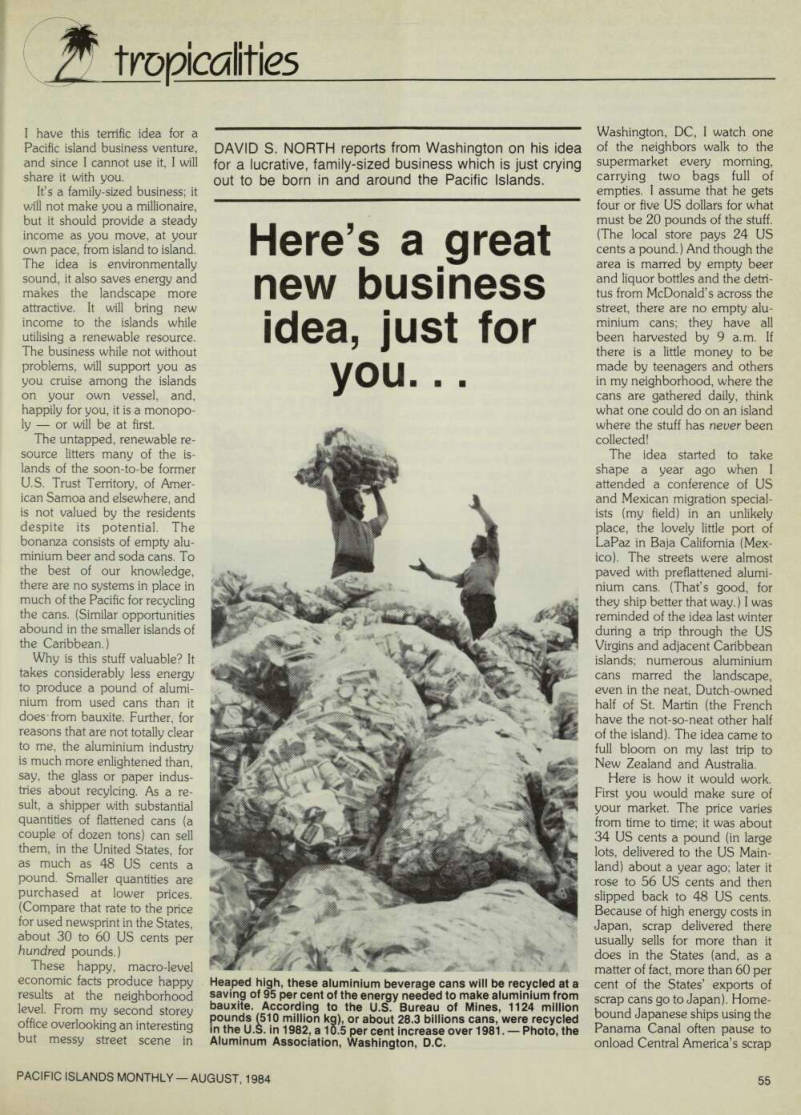

I have this terrific idea for a Pacific island business venture, and since I cannot use it, I will share it with you.
It’s a family-sized business; it will not make you a millionaire, but it should provide a steady income as you move, at your own pace, from island to island.
The idea is environmentally sound, it also saves energy and makes the landscape more attractive. It will bring new income to the islands while utilising a renewable resource.
The business while not without problems, will support you as you cruise among the islands on your own vessel, and, happily for you, it is a monopo ly or will be at first.
The untapped, renewable re source litters many of the is lands of the soon-to-be former U.S. Trust Territory, of Amer ican Samoa and elsewhere, and is not valued by the residents despite its potential. The bonanza consists of empty alu minium beer and soda cans. To the best of our knowledge, there are no systems in place in much of the Pacific for recycling the cans. (Similar opportunities abound in the smaller islands of the Caribbean.) Why is this stuff valuable? It takes considerably less energy to produce a pound of alumi nium from used cans than it does from bauxite. Further, for reasons that are not totally clear to me, the aluminium industry is much more enlightened than, say, the glass or paper indus tries about recylcing. As a re sult, a shipper with substantial quantities of flattened cans (a couple of dozen tons) can sell them, in the United States, for as much as 48 US cents a pound. Smaller quantities are purchased at lower prices. (Compare that rate to the price for used newsprint in the States, about 30 to 60 US cents per hundred pounds.) These happy, macro-level economic facts produce happy results at the neighborhood level. From my second storey office overlooking an interesting but messy street scene in
DAVID S. NORTH reports from Washington on his idea for a lucrative, family-sized business which is just crying out to be born in and around the Pacific Islands.
Here’s a great new business idea, just for you...
Washington, DC, I watch one of the neighbors walk to the supermarket every morning, carrying two bags full of empties. I assume that he gets four or five US dollars for what must be 20 pounds of the stuff. (The local store pays 24 US cents a pound.) And though the area is marred by empty beer and liquor bottles and the detri tus from McDonald’s across the street, there are no empty alu minium cans; they have all been harvested by 9 a.m. If there is a little money to be made by teenagers and others in my neighborhood, where the cans are gathered daily, think what one could do on an island where the stuff has never been collected!
The idea started to take shape a year ago when I attended a conference of US and Mexican migration special ists (my field) in an unlikely place, the lovely little port of LaPaz in Baja California (Mex ico). The streets were almost paved with preflattened alumi nium cans. (That’s good, for they ship better that way.) I was reminded of the idea last winter during a trip through the US Virgins and adjacent Caribbean islands; numerous aluminium cans marred the landscape, even in the neat, Dutch-owned half of St. Martin (the French have the not-so-neat other half of the island). The idea came to full bloom on my last trip to New Zealand and Australia.
Here is how it would work.
First you would make sure of your market. The price varies from time to time; it was about 34 US cents a pound (in large lots, delivered to the US Main land) about a year ago; later it rose to 56 US cents and then slipped back to 48 US cents.
Because of high energy costs in Japan, scrap delivered there usually sells for more than it does in the States (and, as a matter of fact, more than 60 per cent of the States’ exports of scrap cans go to Japan). Home bound Japanese ships using the Panama Canal often pause to onload Central America’s scrap
Heaped high, these aluminium beverage cans will be recycled at a saving of 95 per cent of the energy needed to make aluminium from bauxite. According to the U.S. Bureau of Mines, 1124 million pounds (510 million kg), or about 28.3 billions cans, were recycled in the U.S. in 1982, a 10.5 per cent increase over 1981. - Photo, the Aluminum Association, Washington, D.C.
aluminium and similar trans shipping opportunities must ex ist elsewhere in the Pacific.
Other markets can be found at the Reynolds aluminium recyc ling plants in Hawaii as well as in Australia’s aluminium in dustry. As you make your plans remember that empties weigh about two-thirds of an ounce each and that 20 crushed cans occupy about as much space as a paperback novel.
Next you would need to buy or lease the right kind of ship, one at least 65 to 80 feet in length. It should be large enough to sail from island to island, have quarters for you and your family, and contain enough cargo space (it does not have to be rectangular) to take at least 25 tons of squashed cans. You would also need at least primitive cargo-moving equipment and a small shred der, a piece of machinery about the size of a small car. The shredder converts the cans into a compact mass of aluminium scrap. (With these cans you worry more about space than weight.) Further, and this would
let me out, you would have to know how to handle such a vessel in the Pacific, and enjoy that kind of life. I am told that a schooner would be a particu larly good choice, because windpower could be get from island to island, usifsg the auxiliary motor only in port. (After all, there is no rush.) A third (and optional) step can be handled in Sydney, Canberra, New York or here in Washington. You may want to look around for a source of seed money or, better, a con tinuing subsidy. The US or Australian overseas aid agen cies, or one of the major found ations (e.g. Ford or Rockefel ler), might be intrigued with a clean, non-exploitive source of additional revenue for these Third World islands. If you are, or have, a talented tax lawyer perhaps you can find a loophole in the Australian or US tax laws. The US Govern ment gives tax breaks to strip miners who butcher the hills of Appalachia for coal why not to you for your energy-saving, beautifying business? At least
there should be a fast write-off to depreciate the ship.
With these preparations be hind you, you fly ahead to the first island, convince the gov ernment that what you are doing is a good thing, and perhaps to give you a cent or two per pound for removing the debris. You will need to publicise what you are doing and build an appropriate image for the activity. Clearly you will want to stress the island’s pride in its beauty and not the notion of scavenging.
Once the collections have started, you bring in the ship, work out a technique for the fast screening of cans, because neither you nor the recycling plant want steel cans (what the British so accurately call tin cans). You must also set an appropriate price for the cans.
Then you proceed from island to island, at your leisure, absor bing the sunshine as you fill your veseel. Then it is the long haul to Hawaii, Japan or Aus tralia (or a shorter trip to some trans-shipment point where you
will be paid US $24,000 for your 25 tons of scrap if the price is 48 US cents a pound; if you trans-ship it would be less).
You might want to work out a sideline, such as carrying a hull full of soda or beer (in aluminium cans, of course) as you sail to Samoa, Fiji or Tonga. In this way you carry cargo both ways and renew the supply of potential empties for your next trip.
We do not have hard data on the rate at which these cans are used in the islands, but if each of the 32,000 residents of American Samoa, for example, consumes only a couple of cans a week (ignoring the thirsty tourists, for the moment) that adds up to 115,000 cans a month, or two and half tons of empties. What we have in mind could be a nice life’s work.
David S. North.
Mr North, an avid non-sailor, is director of the Center for Labor and Migration Studies of the New Trans Century Founda tion, Washington, D.C.
Advertisements & other items, p. 56 (1 item)
Wcific
CONSTRUCTION EQUIPMENT CO
Introducing the Dvnamlc Hew Range ot
gibrating t Pneumatic Tgred Rollers
THE RANGE
• Pacific Self-Propelled Vibrating Rollers • Single and Double Drum Types • 1.5 tonne to 16 tonne • Pacific Self-Propelled Pneumatic Type Compactors • 3 Models 16. 21. 38 tonne Ballast Weights • Pacific Landfill and Sanitary Landfill Compactors • Pacific Pneumatic Earth Borers • Pacific Road Brooms • Pacific Railway Maintenance Vehicles Construction Equipment Co. 24 Salisbury Road, Hornsby NSW 2077, Australia. Phone (02) 476 2666
DISTRIBUTORS REQUIRED
THROUGHOUT THE PACIFIC
SAL
!d-LiTS9E
Maoris in the Klondike gold rush
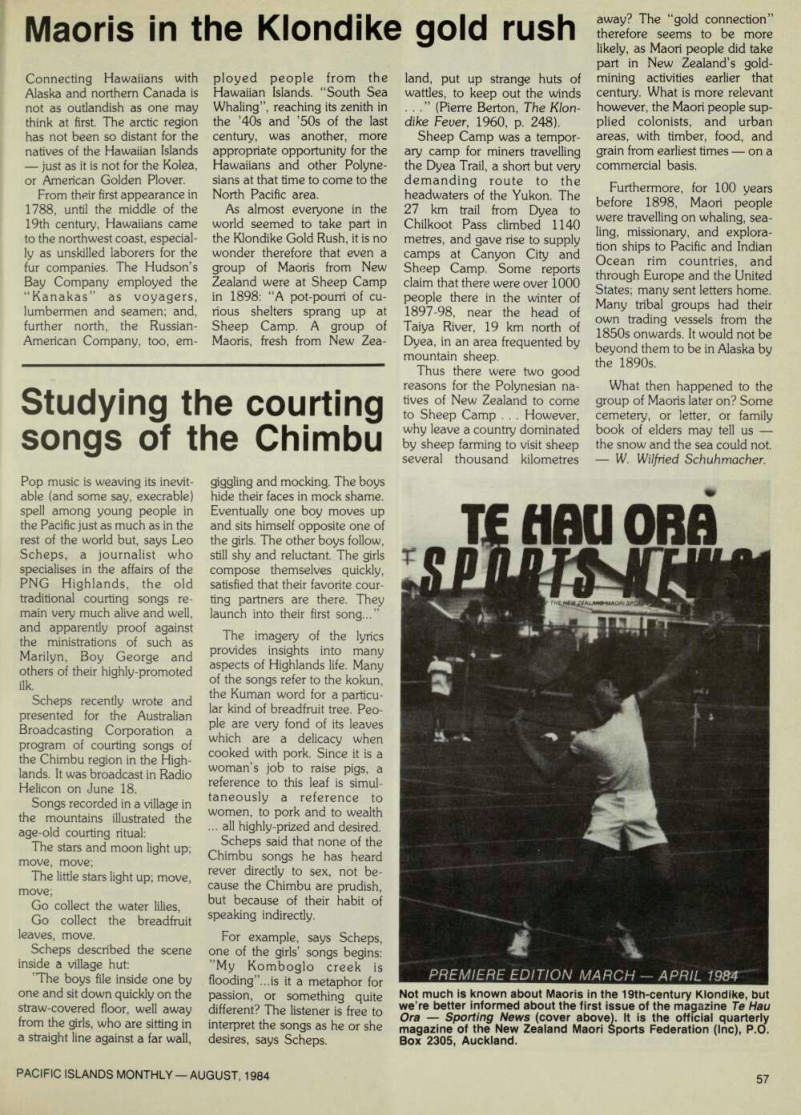
Connecting Hawaiians with Alaska and northern Canada is not as outlandish as one may think at first. The arctic region has not been so distant for the natives of the Hawaiian Islands just as it is not for the Kolea, or American Golden Plover.
From their first appearance in 1788, until the middle of the 19th century, Hawaiians came to the northwest coast, especial ly as unskilled laborers for the fur companies. The Hudson’s Bay Company employed the “Kanakas” as voyagers, lumbermen and seamen; and, further north, the Russian- American Company, too, em
ployed people from the Hawaiian Islands. “South Sea Whaling”, reaching its zenith in the ’4os and ’sos of the last century, was another, more appropriate opportunity for the Hawaiians and other Polyne sians at that time to come to the North Pacific area.
As almost everyone in the world seemed to take part in the Klondike Gold Rush, it is no wonder therefore that even a group of Maoris from New Zealand were at Sheep Camp in 1898: “A pot-pourri of cu rious shelters sprang up at Sheep Camp. A group of Maoris, fresh from New Zea
land, put up strange huts of wattles, to keep out the winds ...” (Pierre Berton, The Klon dike Fever, 1960, p. 248).
Sheep Camp was a tempor ary camp for miners travelling the Dyea Trail, a short but very demanding route to the headwaters of the Yukon. The 27 km trail from Dyea to Chilkoot Pass climbed 1140 metres, and gave rise to supply camps at Canyon City and Sheep Camp. Some reports claim that there were over 1000 people there in the winter of 1897-98, near the head of Taiya River, 19 km north of Dyea, in an area frequented by mountain sheep.
Thus there were two good reasons for the Polynesian na tives of New Zealand to come to Sheep Camp . . . However, why leave a country dominated by sheep farming to visit sheep several thousand kilometres
away? The “gold connection” therefore seems to be more likely, as Maori people did take part in New Zealand’s gold mining activities earlier that century. What is more relevant however, the Maori people sup plied colonists, and urban areas, with timber, food, and grain from earliest times on a commercial basis.
Furthermore, for 100 years before 1898, Maori people were travelling on whaling, sea ling, missionary, and explora tion ships to Pacific and Indian Ocean rim countries, and through Europe and the United States; many sent letters home.
Many tribal groups had their own trading vessels from the 1850 s onwards. It would not be beyond them to be in Alaska by the 1890 s.
What then happened to the group of Maoris later on? Some cemetery, or letter, or family book of elders may tell us the snow and the sea could not.
W. Wilfried Schuhmacher.
Not much is known about Maoris in the 19th-century Klondike, but we’re better informed about the first issue of the magazine Te Hau Ora Sporting News (cover above). It is the official quarterly magazine of the New Zealand Maori Sports Federation (Inc), P.O.
Box 2305, Auckland.
Studying the courting
songs of the Chimbu
Pop music is weaving its inevit able (and some say, execrable) spell among young people in the Pacific just as much as in the rest of the world but, says Leo Scheps, a journalist who specialises in the affairs of the PNG Highlands, the old traditional courting songs re main very much alive and well, and apparently proof against the ministrations of such as Marilyn, Boy George and others of their highly-promoted ilk.
Scheps recently wrote and presented for the Australian Broadcasting Corporation a program of courting songs of the Chimbu region in the High lands. It was broadcast in Radio Helicon on June 18.
Songs recorded in a village in the mountains illustrated the age-old courting ritual: The stars and moon light up; move, move; The little stars light up; move, move; Go collect the water lilies, Go collect the breadfruit leaves, move.
Scheps described the scene inside a village hut: ’’The boys file inside one by one and sit down quickly on the straw-covered floor, well away from the girls, who are sitting in a straight line against a far wall,
giggling and mocking. The boys hide their faces in mock shame.
Eventually one boy moves up and sits himself opposite one of the girls. The other boys follow, still shy and reluctant. The girls compose themselves quickly, satisfied that their favorite cour ting partners are there. They launch into their first song...”
The imagery of the lyrics provides insights into many aspects of Highlands life. Many of the songs refer to the kokun, the Kuman word for a particu lar kind of breadfruit tree. Peo ple are very fond of its leaves which are a delicacy when cooked with pork. Since it is a woman’s job to raise pigs, a reference to this leaf is simul taneously a reference to women, to pork and to wealth ...all highly-prized and desired.
Scheps said that none of the Chimbu songs he has heard rever directly to sex, not be cause the Chimbu are prudish, but because of their habit of speaking indirectly.
For example, says Scheps, one of the girls’ songs begins: ”My Komboglo creek is flooding”...is it a metaphor for passion, or something quite different? The listener is free to interpret the songs as he or she desires, says Scheps.
Oz travel writers
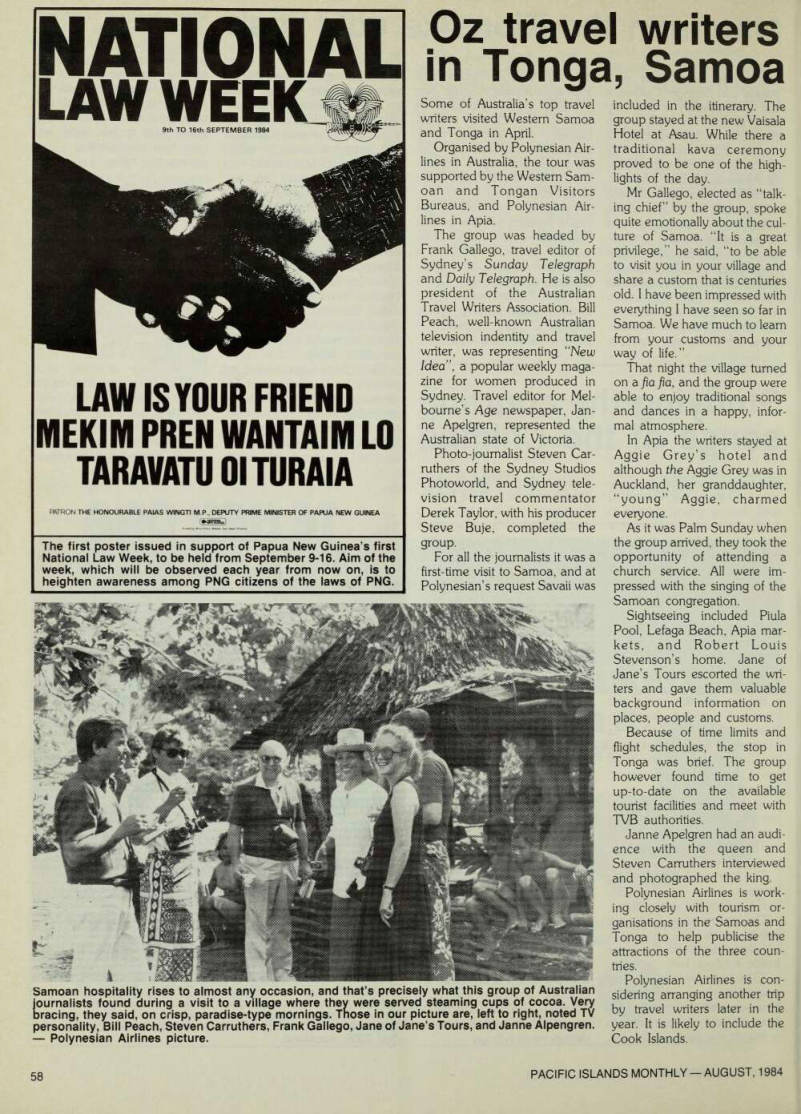
in Tonga, Samoa
Some of Australia’s top travel writers visited Western Samoa and Tonga in April.
Organised by Polynesian Air lines in Australia, the tour was supported by the Western Sam oan and Tongan Visitors Bureaus, and Polynesian Air lines in Apia.
The group was headed by Frank Gallego, travel editor of Sydney’s Sunday Telegraph and Daily Telegraph. He is also president of the Australian Travel Writers Association. Bill Peach, well-known Australian television indentity and travel writer, was representing “New Idea ’, a popular weekly maga zine for women produced in Sydney. Travel editor for Mel bourne’s Age newspaper, Jan ne Apelgren, represented the Australian state of Victoria.
Photo-joumalist Steven Car ruthers of the Sydney Studios Photoworld, and Sydney tele vision travel commentator Derek Taylor, with his producer Steve Buje, completed the group.
For all the journalists it was a first-time visit to Samoa, and at Polynesian’s request Savaii was
included in the itinerary. The group stayed at the new Vaisala Hotel at Asau. While there a traditional kava ceremony proved to be one of the high lights of the day.
Mr Gallego, elected as “talk ing chief” by the group, spoke quite emotionally about the cul ture of Samoa. “It is a great privilege,” he said, “to be able to visit you in your village and share a custom that is centuries old. I have been impressed with everything I have seen so far in Samoa. We have much to learn from your customs and your way of life.”
That night the village turned on a fia fia, and the group were able to enjoy traditional songs and dances in a happy, infor mal atmosphere.
In Apia the writers stayed at Aggie Grey’s hotel and although the Aggie Grey was in Auckland, her granddaughter, “young” Aggie, charmed everyone.
As it was Palm Sunday when the group arrived, they took the opportunity of attending a church service. All were im pressed with the singing of the Samoan congregation.
Sightseeing included Piula Pool, Lefaga Beach, Apia mar kets, and Robert Louis Stevenson’s home. Jane of Jane’s Tours escorted the wri ters and gave them valuable background information on places, people and customs.
Because of time limits and flight schedules, the stop in Tonga was brief. The group however found time to get up-to-date on the available tourist facilities and meet with TVB authorities.
Janne Apelgren had an audi ence with the queen and Steven Carruthers interviewed and photographed the king.
Polynesian Airlines is work ing closely with tourism or ganisations in the Samoas and Tonga to help publicise the attractions of the three coun tries.
Polynesian Airlines is con sidering arranging another trip by travel writers later in the year. It is likely to include the Cook Islands.
Samoan hospitality rises to almost any occasion, and that’s precisely what this group of Australian journalists found during a visit to a village where they were served steaming cups of cocoa. Very bracing, they said, on crisp, paradise-type mornings. Those in our picture are, left to right, noted TV personality, Bill Peach, Steven Carruthers, Frank Gallego, Jane of Jane’s Tours, and Janne Alpengren. - Polynesian Airlines picture.
Advertisements & other items, p. 58 (1 item)
National
LAW WEEKH
9th TO 16th SEPTEMBER 1984
LAW IS YOUR FRIEND
MEKIffl PREN WANTAIM LO
TARAVATU OITURAIA
PATRON THE HONOURABLE PAIAS WHMGTI MP, DEPUTY PRIME MINISTER OE PAPUA NEW GUINEA The first poster issued in support of Papua New Guinea’s first National Law Week, to be held from September 9-16. Aim of the week, which will be observed each year from now on, is to heighten awareness among PNG citizens of the laws of PNG.
Islands stamps issues
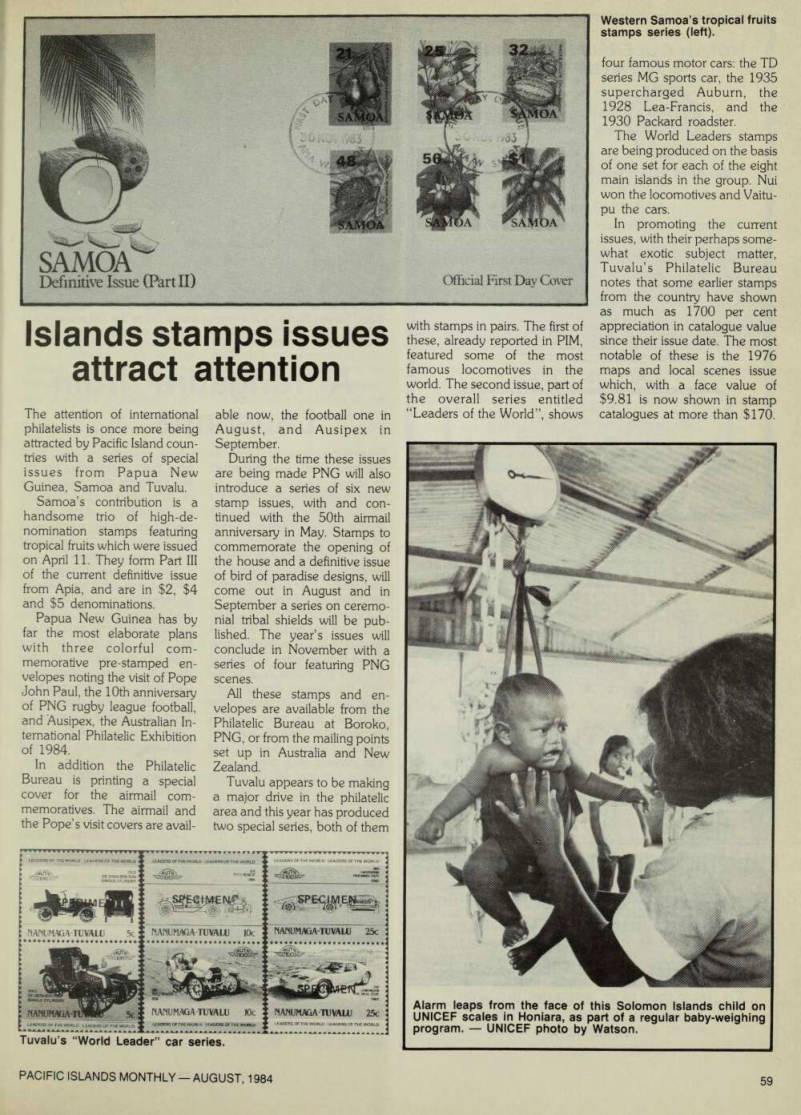
attract attention
The attention of international philatelists is once more being attracted by Pacific Island coun tries with a series of special issues from Papua New Guinea, Samoa and Tuvalu.
Samoa’s contribution is a handsome trio of high-de nomination stamps featuring tropical fruits which were issued on April 11. They form Part 111 of the current definitive issue from Apia, and are in $2, $4 and $5 denominations.
Papua New Guinea has by far the most elaborate plans with three colorful com memorative pre-stamped en velopes noting the visit of Pope John Paul, the 10th anniversary of PNG rugby league football, and Ausipex, the Australian In ternational Philatelic Exhibition of 1984.
In addition the Philatelic Bureau is printing a special cover for the airmail com memoratives. The airmail and the Pope’s visit covers are avail
able now, the football one in August, and Ausipex in September.
During the time these issues are being made PNG will also introduce a series of six new stamp issues, with and con tinued with the 50th airmail anniversary in May. Stamps to commemorate the opening of the house and a definitive issue of bird of paradise designs, will come out in August and in September a series on ceremo nial tribal shields will be pub lished. The year’s issues will conclude in November with a series of four featuring PNG scenes.
All these stamps and en velopes are available from the Philatelic Bureau at Boroko, PNG, or from the mailing points set up in Australia and New Zealand.
Tuvalu appears to be making a major drive in the philatelic area and this year has produced two special series, both of them
with stamps in pairs. The first of these, already reported in PIM, featured some of the most famous locomotives in the world. The second issue, part of the overall series entitled “Leaders of the World”, shows
four famous motor cars: the TD series MG sports car, the 1935 supercharged Auburn, the 1928 Lea-Francis, and the 1930 Packard roadster.
The World Leaders stamps are being produced on the basis of one set for each of the eight main islands in the group. Nui won the locomotives and Vaitu pu the cars.
In promoting the current issues, with their perhaps some what exotic subject matter, Tuvalu’s Philatelic Bureau notes that some earlier stamps from the country have shown as much as 1700 per cent appreciation in catalogue value since their issue date. The most notable of these is the 1976 maps and local scenes issue which, with a face value of $9.81 is now shown in stamp catalogues at more than $l7O.
Tuvalu’s “World Leader” car series.
Western Samoa’s tropical fruits stamps series (left).
Alarm leaps from the face of this Solomon Islands child on UNICEF scales in Honiara, as part of a regular baby-weighing program. UNICEF photo by Watson.
A ‘rangatira’ from Lausanne
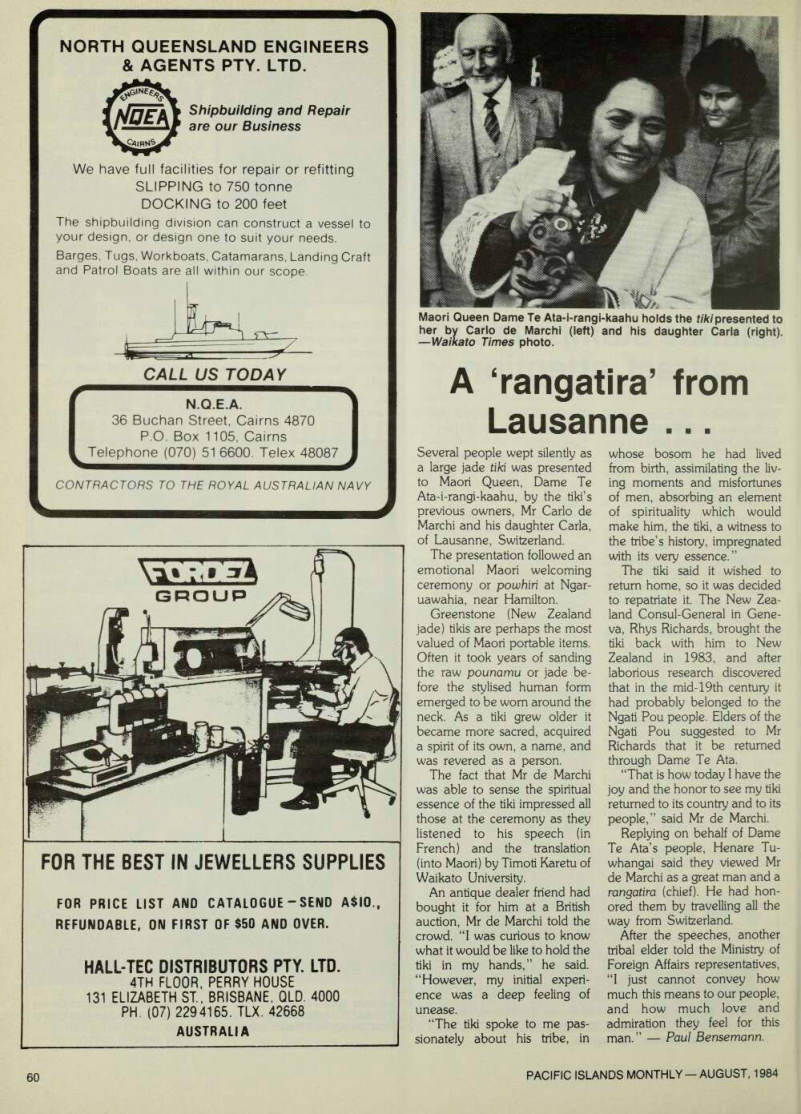
Lausanne ...
Several people wept silently as a large jade tiki was presented to Maori Queen, Dame Te Ata-i-rangi-kaahu, by the tiki’s previous owners, Mr Carlo de Marchi and his daughter Carla, of Lausanne, Switzerland.
The presentation followed an emotional Maori welcoming ceremony or powhiri at Ngar uawahia, near Hamilton.
Greenstone (New Zealand jade) tikis are perhaps the most valued of Maori portable items.
Often it took years of sanding the raw pounamu or jade be fore the stylised human form emerged to be worn around the neck. As a tiki grew older it became more sacred, acquired a spirit of its own, a name, and was revered as a person.
The fact that Mr de Marchi was able to sense the spiritual essence of the tiki impressed all those at the ceremony as they listened to his speech (in French) and the translation (into Maori) by Timoti Karetu of Waikato University.
An antique dealer friend had bought it for him at a British auction, Mr de Marchi told the crowd. “I was curious to know what it would be like to hold the tiki in my hands,” he said.
“However, my initial experi ence was a deep feeling of unease.
“The tiki spoke to me pas sionately about his tribe, in
whose bosom he had lived from birth, assimilating the liv ing moments and misfortunes of men, absorbing an element of spirituality which would make him, the tiki, a witness to the tribe’s history, impregnated with its very essence.”
The tiki said it wished to return home, so it was decided to repatriate it. The New Zea land Consul-General in Gene va, Rhys Richards, brought the tiki back with him to New Zealand in 1983, and after laborious research discovered that in the mid-19th century it had probably belonged to the Ngati Pou people. Elders of the Ngati Pou suggested to Mr Richards that it be returned through Dame Te Ata.
“That is how today I have the joy and the honor to see my tiki returned to its country and to its people,” said Mr de Marchi.
Replying on behalf of Dame Te Ata’s people, Henare Tu whangai said they viewed Mr de Marchi as a great man and a rangatira (chief). He had hon ored them by travelling all the way from Switzerland.
After the speeches, another tribal elder told the Ministry of Foreign Affairs representatives, “I just cannot convey how much this means to our people, and how much love and admiration they feel for this
man. ”
Paul Bensemann.
Maori Queen Dame Te Ata-i-rangi-kaahu holds the tiki presented to her by Carlo de Marchi (left) and his daughter Carla (right). —Waikato Times photo.
Advertisements & other items, p. 60 (1 item)
For The Best In Jewellers Supplies
NORTH QUEENSLAND ENGINEERS
& AGENTS PTY. LTD.
\tMK,
Shipbuilding and Repair are our Business We have full facilities for repair or refitting SLIPPING to 750 tonne DOCKING to 200 feet The shipbuilding division can construct a vessel to your design, or design one to suit your needs.
Barges, Tugs, Workboats, Catamarans, Landing Craft and Patrol Boats are all within our scope.
CALL US TODAY
N.Q.E.A.
36 Buchan Street, Cairns 4870 P.O. Box 1105, Cairns Telephone (070) 51 6600. Telex 48087 ]
CONTRACTORS TO THE ROYAL AUSTRALIAN NAVY
n r—f \a*i
GROUP
FOR THE BEST IN JEWELLERS SUPPLIES
FOR PRICE LIST AND CATALOGUE - SEND ASIO., REFUNDABLE, ON FIRST OF $5O AND OVER.
HALL-TEC DISTRIBUTORS PTY. LTD.
4TH FLOOR. PERRY HOUSE
131 ELIZABETH ST, BRISBANE, OLD. 4000
PH. (07) 2294165. TLX, 42668
AUSTRALIA
political currents
Micronesia-Melanesia Air Link
George Wray of SPIA honored in Hawaii
George Wray, president of South Pacific Islands Airways, has been formally congratu lated by the House of Repre sentatives of the State of Hawaii.
Occasion was the inaugura tion in June of SPIA services between Honolulu and Port Moresby via Guam, thus estab lishing what the resolution cal led “a long desired North- South route between Mic ronesia and Melanesia.”
Speaking to the resolution in the House, Representative Fred W. Rohlfing, House Minority Leader, said: “Mr Speaker, it is an honor for me today, to offer this resolution and I appreciate the support of this body.
“I first met our honoree when I went to American Samoa in 1978, and at that time, he was still trying to practise law at the same time that he was running and building this airline. Didn’t take long before he figured out that practising law was really kind of dumb and that he would have a lot more fun being an airline executive. So that’s what he did, and I think that the results have shown that that is certainly his calling.
“The airline started as early as 1973; at that time, he had eight employees. Now, 1984, SPIA (South Pacific Island Air ways) has 225 employees.
They had one aircraft in 1973; that was an Islander, one of those little jobbers. Now they’ve got four 7075, four Twin-Otters, and an Islander. I don’t know if that’s the same Islander that you had before, George, but I hope not.
“Now there are 19 stations, whereas, in 1973, there was one and they’re all over the Pacific. Last year, 1983, SPIA carried 250,000 passengers; in 1973, 6000 passengers, and
they’ve travelled over, last year, 240 million miles.
“So, I think it’s significant that what has happened here is a growth of an indigenous island based, island owned, operated airline. And I think that this is an example of what we in Hawaii, and people of the American colonies, so to speak, the American territories of the Pacific, can do and I really think that George has done a terrific job.”
Representative Rohlfing then introduced George Wray to the members of the House. Representative Marumoto presented Mr Wray with a lei and Representative Rohlfing presented
the certified copy of the resolu tion.
The House then adjourned for 10 minutes for the purpose of extending the Aloha of House members to Mr Wray.
help Reagan
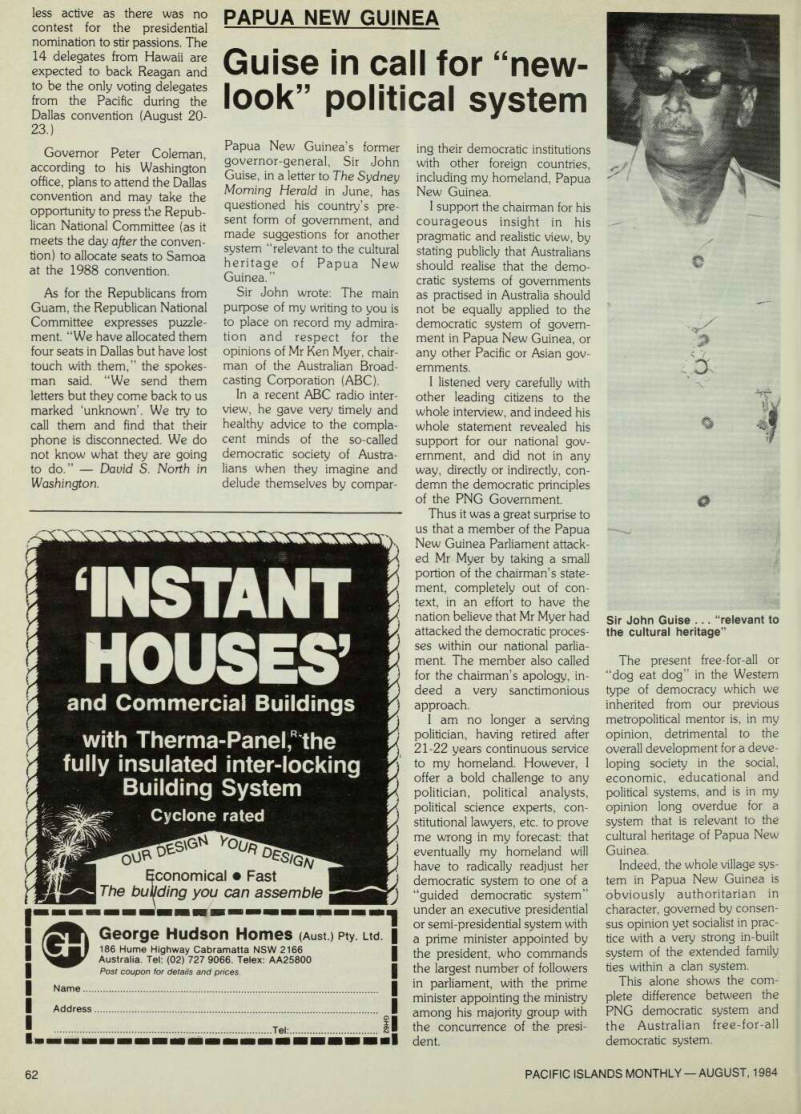
November Presidential Poll
U.S. Pacific territories won’t help Reagan
If Ronald Reagan is re-elected President of the United States in November it will not be because of support in the US Pacific Islands. This prediction is based on both expected Republican and Democratic participation in the summer conventions, and on the array of elected officials in the islands.
While only Hawaii actually casts electoral votes in Novem ber (it has four of the nation wide total of 538) traditionally Guam (as well as Puerto Rico and the US Virgin Islands) have also been represented in the party conventions which choose the candidate for Presi dent and Vice-President.
The political situation in the US Pacific as 1984 dawned was as follows: • Hawaii was in 1980 one of a handful of states to support Jimmy Carter and Walter Mon dale against Ronald Reagan
and George Bush and, in fact, was the only state west of Mondale’s homestate of Minnesota to do so. • Hawaii’s two senators, two congressmen, its governor and large majorities of both houses of the legislature were Democrats. • Both Guam and American Samoa were represented in the US House of Representatives here by non-voting delegates sitting with the Democrats, Guam also had a Democratic governor while Samoa (which does not have partisan elections) had chosen a Republican one, Peter Tali Coleman. The Northern Marianas also had a Republican governor.
As the jockeying for the Democratic nomination got underway the Pacific Democrats swung into action. With a total of 3933 delegates due to meet in San Francisco on July 16-19 the Democrats allocated
27 seats to Hawaii, seven to Guam and six to American Samoa, or a little over 1.0 per cent of the total. The Republi cans gave 14 seats to Hawaii and four to Guam, or about 0.8 per cent of their total.
Congressman Fofo I.F.
Sunia, the delegate from Amer iacn Samoa, helped organise a National Democratic Party in the territory, secured an alloca tion (for the first time) of the delegates’ seats, and partipated in the party caucus which gave all six votes to the Mondale forces.
Similarly in Hawaii the Democrats voted all of their 27 delegates to Mondale while the Guam Democrats split their votes IV2 to Hart and SVz to Mondale. (Some delegates cast fractional votes; Guam got one more vote than Samoa because it has a Democratic Governor and Samoa does not.) The Republicans have been
American Samoa’s Governor Peter Tali Coleman ... a Reagan ally?
less active as there was no contest for the presidential nomination to stir passions. The 14 delegates from Hawaii are expected to back Reagan and to be the only voting delegates from the Pacific during the Dallas convention (August 20- 23.) Governor Peter Coleman, according to his Washington office, plans to attend the Dallas convention and may take the opportunity to press the Repub lican National Committee (as it meets the day after the conven tion) to allocate seats to Samoa at the 1988 convention.
As for the Republicans from Guam, the Republican National Committee expresses puzzle ment. “We have allocated them four seats in Dallas but have lost touch with them,” the spokes man said. “We send them letters but they come back to us marked ‘unknown’. We try to call them and find that their phone is disconnected. We do not know what they are going
to do.”
David S. North in
Washington.
look” political system
Papua New Guinea
Guise in call for “new look” political system
Papua New Guinea’s former governor-general, Sir John Guise, in a letter to The Sydney Morning Herald in June, has questioned his country’s pre sent form of government, and made suggestions for another system “relevant to the cultural heritage of Papua New Guinea.”
Sir John wrote: The main purpose of my writing to you is to place on record my admira tion and respect for the opinions of Mr Ken Myer, chair man of the Australian Broad casting Corporation (ABC).
In a recent ABC radio inter view, he gave very timely and healthy advice to the compla cent minds of the so-called democratic society of Austra lians when they imagine and delude themselves by compar
ing their democratic institutions with other foreign countries, including my homeland, Papua New Guinea.
I support the chairman for his courageous insight in his pragmatic and realistic view, by stating publicly that Australians should realise that the demo cratic systems of governments as practised in Australia should not be equally applied to the democratic system of govern ment in Papua New Guinea, or any other Pacific or Asian gov ernments.
I listened very carefully with other leading citizens to the whole interview, and indeed his whole statement revealed his support for our national gov ernment, and did not in any way, directly or indirectly, con demn the democratic principles of the PNG Government.
Thus it was a great surprise to us that a member of the Papua New Guinea Parliament attack ed Mr Myer by taking a small portion of the chairman’s state ment, completely out of con text, in an effort to have the nation believe that Mr Myer had attacked the democratic proces ses within our national parlia ment. The member also called for the chairman’s apology, in deed a very sanctimonious approach.
I am no longer a serving politician, having retired after 21-22 years continuous service to my homeland. However, I offer a bold challenge to any politician, political analysts, political science experts, con stitutional lawyers, etc. to prove me wrong in my forecast; that eventually my homeland will have to radically readjust her democratic system to one of a “guided democratic system” under an executive presidential or semi-presidential system with a prime minister appointed by the president, who commands the largest number of followers in parliament, with the prime minister appointing the ministry among his majority group with the concurrence of the presi dent.
The present free-for-all or “dog eat dog” in the Western type of democracy which we inherited from our previous metropolitical mentor is, in my opinion, detrimental to the overall development for a deve loping society in the social, economic, educational and political systems, and is in my opinion long overdue for a system that is relevant to the cultural heritage of Papua New Guinea.
Indeed, the whole village sys tem in Papua New Guinea is obviously authoritarian in character, governed by consen sus opinion yet socialist in prac tice with a very strong in-built system of the extended family ties within a clan system.
This alone shows the com plete difference between the PNG democratic system and the Australian free-for-all democratic system.
Sir John Guise ... “relevant to the cultural heritage”
Advertisements & other items, p. 62 (1 item)
Instant
HOUSES’
and Commercial Buildings with Therma-Panel, R the fully insulated inter-locking Building System Cyclone rated * i I I I i U p* 2 ? p-n George Hudson Homes (Aust.) pty ua 186 Hume Highway Cabramatta NSW 2166 Australia. Tel: (02) 727 9066. Telex: AA25800 Post coupon for details and prices. .Tel:
from the islands press
From the American Samoa News Bulletin Lt. jg Richard Boy of the National Oceanic Atmospheric Administration Data Buoy Centre in Mississippi left the territory Wednesday at the end of a one week assignment with the Office of Marine Resources (OMR). Lt. Boy was here to provide technical assistance to Marine Resources staff in the design, fabrication and mooring of fish aggregation devices on fishing buoys.
From The Coconut Telegraph of Vanua Levu, Fiji Interesting to hear that aboriginal Australians are acquiring a taste for yaqona (kava), Fiji’s national beverage. Admittedly, there is a growing export trade for it, including to Fiji’s forces in the Sinai and Lebanon.
From the American Samoa News Bulletin Ambassador Fred Eckert, U.S. envoy to several Pacific nations, says many governments in the region are no longer opposed to visiting American warships and planes that may be carrying nuclear materials. Eckert is on his way home to New York to pursue good Pacific policy in a different role, that of U.S. Congressman. He said the change in the islanders’ attitudes towards the U.S. military is due to an effort to tell Pacific island leaders more about the balance of power in the world and how it affects their own freedom. Eckert said the United States has given them a chance to see in person how the military runs its operations. He added that the United States must keep helping the islanders respond to their economic needs if it wants to earn their respect and the Japanese are working harder at this than we are.
From the Papua New Guinea Post-Courier The use of marijuana is increasing at an alarming rate in some Highlands areas, a parliamentarian said yesterday.
Villagers were smoking it like ordinary cigarettes and some even drink it, the member for Sina-Sina Yonggamugl, Mr John Numi, said.
Mr Numi said the plant was growing wild in bushes, coffee and food gardens and near houses.
Last Friday in Parliament, Mr Numi called for a nationwide educational campaign to tell the people about the harmful effects of marijuana.
From a letter by “Anti-pay rise, Port Moresby” in the Papua New Guinea Post-Courier I would like to comment on the proposed salary rises for parliamentarians. I am convinced by this proposal that the present parliamentarians are a bunch of hypocrites. First they want public servants to give them luxury cars to drive in, now they want more pay. God knows what they’ll want next, perhaps the public to bow every time they pass.
From the Papua New Guinea Post-Courier, Port Moresby “This Parliament is too big” an annoyed Transport Minister, Mr Bendumb said soon after Parliament adjourned early on Friday afternoon due to lack of quorum ... He was concerned at the poor attendance by members from both sides of the House. He said he felt the entertainment facilities, like bars, attracted the members, especially on a Friday, when the weekend was coming up. He said the bars and other facilities should be closed down to enable members to devote more time to parliamentary duties. Mr Bendumb said he thought it was too early for PNG to have a building “as big as this”.
From the police report in the Marshall Islands Journal, Majuro.
Henchi Luther M-27 of Uliga was booked and detained for assault and battery. A restraining order is in effect to keep him away from Mela Tira’s house where he reportedly kicks his sons when he’s drunk.
From Tam-Tam, Port Vila A well-known Primary School teacher in East Ambae in the Northern District, Mr Nelson Tari, reckoned Western Education and Local Traditions could go hand-in-hand, and proved it on May 21 in his Nahala Village, by introducing his son Reginald and daughter Caroline into the Pig Killing Graded Society, of which he is an entitled member. A report from Mr James Boe said, over 100 spectators witnessed the ceremony during which he ritually killed ten tusked pigs and achieved the “Sese”
Grade, and his children killed one each and achieved the “Moli” Grade (the first grade). Feasting, custom dancing and kava drinking, continued to dawn.
From The Samoa Observer, Apia What an awful sight walking down the streets of Apia on week-end nights. Scattered from the bus shelters at the Market Place to the Courthouse are chewed sugar cane and various forms of rubbish left by what can only be called the most inconsiderate people there are.
From the Marianas Variety News & Views, Saipan People have been dancing in these islands ever since one can remember. The styles have varied and so has the music.
The newest form of dance that seems to have hit Saipan like a storm is called popping.
Youngsters in particular are interested in this dance which has several variations. We are told one can either pop dance, strut or do the boogooloo: which means jerking the body in an awkward motion, waving it, or doing some kind of an awkward walk in rhythm with the accompanying music.
From The Fiji Times, Suva Legislation should be introduced in Fiji to protect women from being battered by their husbands, said a woman lawyer at Lautoka on Saturday.
Miss Vasantika Patel, of Nadi, was speaking on the women’s view of law and order and security at the Rotary Youth Leadership Award Seminar held at the Lautoka Teachers College. It was attended by about 60 people from Fiji and other South Pacific island countries.
From an editorial in the Marshall Islands Journal, Majuro With just about everyone and their uncle mouthing words of congratulations to the multitude of graduates issuing forth this , early June 1984 the Journal would like to dispense with this trite and overworn tradition of extending cordialities and instead issue a warning. Some of you hot shots picking up your degrees these present weeks know very well that you breezed through the education process and barely had to wrinkle so much as an eyebrow to qualify for that piece of paper you are clutching. Well, if you are going off to further your education you may find that the easy sliding you have experienced so far is not unlimited, and that some pretty rough sandpaper is coming up abrasive stuff that might have you looking for a pillow to hide under, or a bottle to hide in. The only way you will make it is by being a little bit afraid, and willing to do more than you are asked . . .
Advertisements & other items, p. 64 (1 item)
Pacific Report
64
PACIFIC ISLANDS MONTHLY —AUGUST, 1984
Pacific Report continued from page 5
Yachts
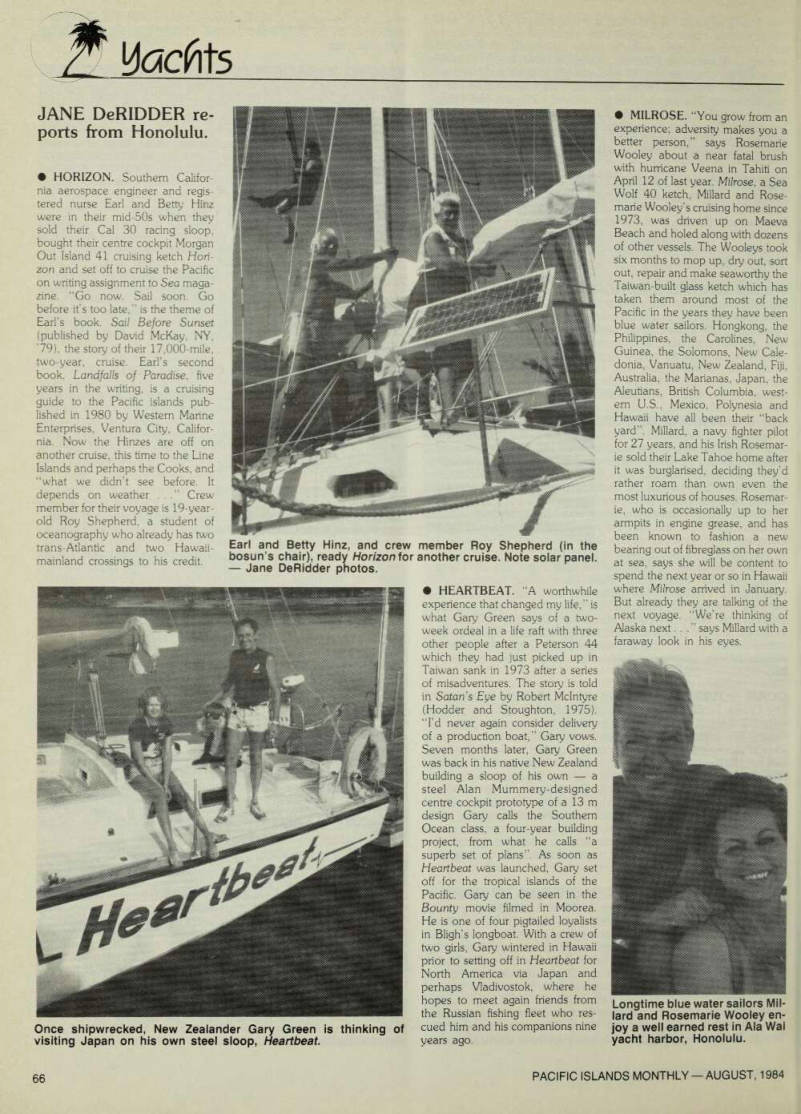
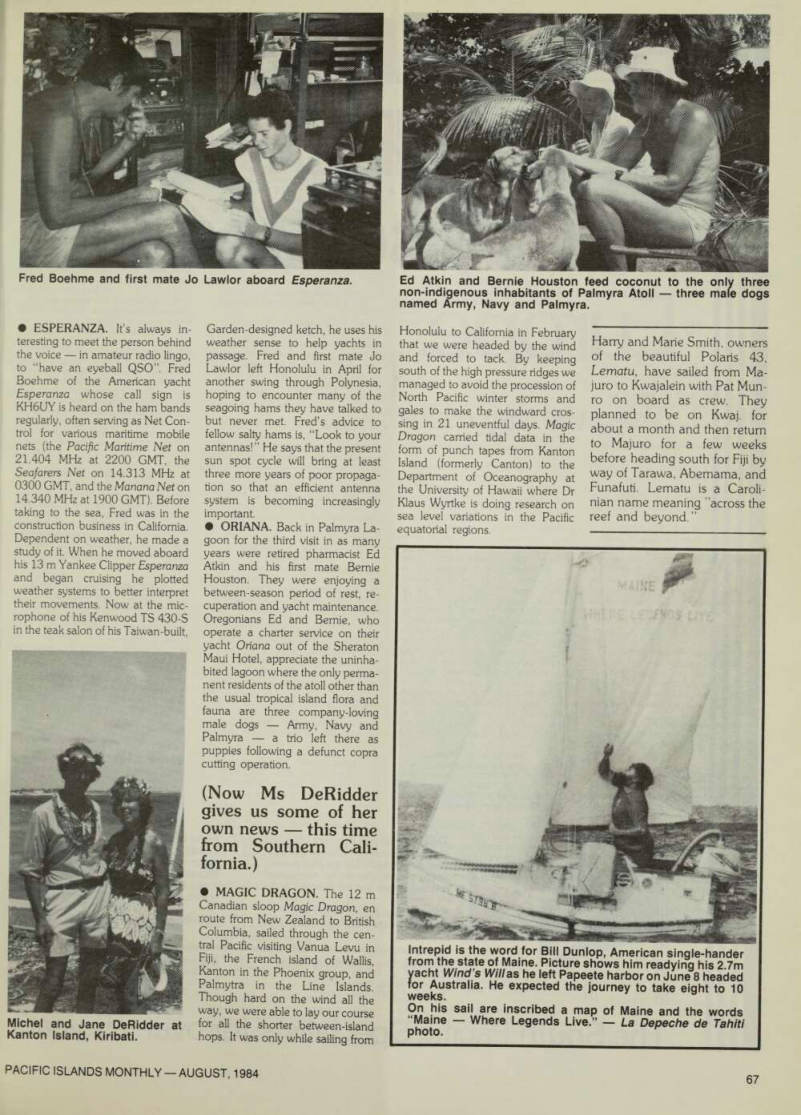
Jane Deridder Re
ports from Honolulu.
• HORIZON. Southern Califor nia aerospace engineer and regis tered nurse Earl and Betty Hinz were in their mid-50s when they sold their Cal 30 racing sloop, bought their centre cockpit Morgan Out Island 41 cruising ketch Hori zon and set off to cruise the Pacific on writing assignment to Sea maga zine. “Go now. Sail soon. Go before it’s too late,” is the theme of Earl’s book. Sail Before Sunset (published by David McKay, NY, ’79), the story of their 17,000-mile, two-year, cruise. Earl’s second book. Landfalls of Paradise, five years in the writing, is a cruising guide to the Pacific islands pub lished in 1980 by Western Marine Enterprises, Ventura City, Califor nia. Now the Hinzes are off on another cruise, this time to the Line Islands and perhaps the Cooks, and “what we didn’t see before. It depends on weather ...” Crew member for their voyage is 19-year old Roy Shepherd, a student of oceanography who already has two trans-Atlantic and two Hawaii mainland crossings to his credit.
• HEARTBEAT. “A worthwhile experience that changed my life,” is what Gary Green says of a two week ordeal in a life raft with three other people after a Peterson 44 which they had just picked up in Taiwan sank in 1973 after a series of misadventures. The story is told in Satan’s Eye by Robert Mclntyre (Hodder and Stoughton, 1975).
“I’d never again consider delivery of a production boat,” Gary vows.
Seven months later, Gary Green was back in his native New Zealand building a sloop of his own a steel Alan Mummery-designed centre cockpit prototype of a 13 m design Gary calls the Southern Ocean class, a four-year building project, from what he calls “a superb set of plans”. As soon as Heartbeat was launched, Gary set off for the tropical islands of the Pacific. Gary can be seen in the Bounty movie filmed in Moorea.
He is one of four pigtailed loyalists in Bligh’s longboat. With a crew of two girls, Gary wintered in Hawaii prior to setting off in Heartbeat for North America via Japan and perhaps Vladivostok, where he hopes to meet again friends from the Russian fishing fleet who res cued him and his companions nine years ago.
• MILROSE. “You grow from an experience; adversity makes you a better person,” says Rosemarie Wooley about a near fatal brush with hurricane Veena in Tahiti on April 12 of last year. Milrose, a Sea Wolf 40 ketch, Millard and Rose marie Wooley’s cruising home since 1973, was driven up on Maeva Beach and holed along with dozens of other vessels. The Wooleys took six months to mop up, dry out, sort out, repair and make seaworthy the Taiwan-built glass ketch which has taken them around most of the Pacific in the years they have been blue water sailors. Hongkong, the Philippines, the Carolines, New Guinea, the Solomons, New Cale donia, Vanuatu, New Zealand, Fiji, Australia, the Marianas, Japan, the Aleutians, British Columbia, west ern U.S., Mexico, Polynesia and Hawaii have all been their “back yard”. Millard, a navy fighter pilot for 27 years, and his Irish Rosemar ie sold their Lake Tahoe home after it was burglarised, deciding they’d rather roam than own even the most luxurious of houses. Rosemar ie, who is occasionally up to her armpits in engine grease, and has been known to fashion a new bearing out of fibreglass on her own at sea, says she will be content to spend the next year or so in Hawaii where Milrose arrived in January.
But already they are talking of the next voyage. “We’re thinking of Alaska next...” says Millard with a faraway look in his eyes.
Once shipwrecked, New Zealander Gary Green is thinking of visiting Japan on his own steel sloop, Heartbeat.
Earl and Betty Hinz, and crew member Roy Shepherd (in the bosun’s chair), ready Horizon for another cruise. Note solar panel. - Jane DeRidder photos.
Longtime blue water sailors Mil lard and Rosemarie Wooley en joy a well earned rest in Ala Wai yacht harbor, Honolulu.
• ESPERANZA. It’s always in teresting to meet the person behind the voice in amateur radio lingo, to “have an eyeball QSO”. Fred Boehme of the American yacht Esperanza whose call sign is KH6UY is heard on the ham bands regularly, often serving as Net Con trol for various maritime mobile nets (the Pacific Maritime Net on 21.404 MHz at 2200 GMT, the Seafarers Net on 14.313 MHz at 0300 GMT, and the Manana Net on 14.340 MHz at 1900 GMT). Before taking to the sea, Fred was in the construction business in California.
Dependent on weather, he made a study of it. When he moved aboard his 13 m Yankee Clipper Esperanza and began cruising he plotted weather systems to better interpret their movements. Now at the mic rophone of his Kenwood TS 430-S in the teak salon of his Taiwan-built,
Garden-designed ketch, he uses his weather sense to help yachts in passage. Fred and first mate Jo Lawlor left Honolulu in April for another swing through Polynesia, hoping to encounter many of the seagoing hams they have talked to but never met. Fred’s advice to fellow salty hams is, “Look to your antennas!” He says that the present sun spot cycle will bring at least three more years of poor propaga tion so that an efficient antenna system is becoming increasingly important. • ORIANA. Back in Palmyra La goon for the third visit in as many years were retired pharmacist Ed Atkin and his first mate Bernie Houston. They were enjoying a between-season period of rest, re cuperation and yacht maintenance.
Oregonians Ed and Bernie, who operate a charter service on their yacht Oriana out of the Sheraton Maui Hotel, appreciate the uninha bited lagoon where the only perma nent residents of the atoll other than the usual tropical island flora and fauna are three company-loving male dogs Army, Navy and Palmyra a trio left there as puppies following a defunct copra cutting operation.
(Now Ms Deßidder
gives us some of her
own news this time
from Southern Cali
fornia.)
• Magic Dragon. The 12 M
Canadian sloop Magic Dragon, en route from New Zealand to British Columbia, sailed through the cen tral Pacific visiting Vanua Levu in Fiji, the French island of Wallis, Kanton in the Phoenix group, and Palmytra in the Line Islands.
Though hard on the wind all the way, we were able to lay our course for all the shorter between-island hops. It was only while sailing from
Honolulu to California in February that we were headed by the wind and forced to tack. By keeping south of the high pressure ridges we managed to avoid the procession of North Pacific winter storms and gales to make the windward cros sing in 21 uneventful days. Magic Dragon carried tidal data in the form of punch tapes from Kanton Island (formerly Canton) to the Department of Oceanography at the University of Hawaii where Dr Klaus Wyrtke is doing research on sea level variations in the Pacific equatorial regions.
Harry and Marie Smith, owners of the beautiful Polaris 43, Lematu, have sailed from Ma juro to Kwajalein with Pat Mun ro on board as crew. They planned to be on Kwaj. for about a month and then return to Majuro for a few weeks before heading south for Fiji by way of Tarawa, Abemama, and Funafuti. Lematu is a Caroli nian name meaning "across the reef and beyond."
Fred Boehme and first mate Jo Lawlor aboard Esperanza.
Michel and Jane DeRidder at Kanton Island, Kiribati.
Ed Atkin and Bernie Houston feed coconut to the only three non-indigenous inhabitants of Palmyra Atoll three male dogs named Army, Navy and Palmyra.
Intrepid is the word for Bill Dunlop, American single-hander from the state of Maine. Picture shows him readying his 2.7m yacht Wind’s Will as he left Papeete harbor on June 8 headed for Australia. He expected the journey to take eight to 10 weeks.
On his sail are inscribed a map of Maine and the words “Maine - Where Legends Live.” - La Depeche de Tahiti photo.
Advertisements & other items, p. 68 (1 item)
Europe.
BANK LINE and
COLUMBUS LINE
24 day service to
Europe.
Need we say more...
D Q The Joint Service Partners offer facilities for shipment of: Containers (FCL/LCL) and Break-bulk Cargo plus reefer space and deeptanks for carriage of vegetable oils and other liquid bulk cargo.
Carriers also accept heavy lifts, overlength and cumbersome parcels.
Ports of Service: Loading: Papeete, Apia, Suva, Lautoka, Noumea, Port Vila, Santo, Honiara, Port Moresby, Lae, Madang, Kimbe, Rabaul, Kieta, Darwin. For: Rotterdam, Antwerp, Hamburg, Hull, Dunkirk, Le Havre.
Additional ports on enquiry.
Please contact our regional offices for further information: The Bank Line (Australasia) Pty Ltd Columbus Line Reederei GmbH -ort* ci n:** e* PO. Box 1 667, Lae/Papua New Guinea.
Phone: 423466/423487/AH. 422481 Telex: Colline NE 441 71 Suite 801, 51 Pitt St, Sydney, NSW, Australia 2000 Phone 27 2041 Telex 24063 The South Pacific Specialists for over 75 years
shipping schedules
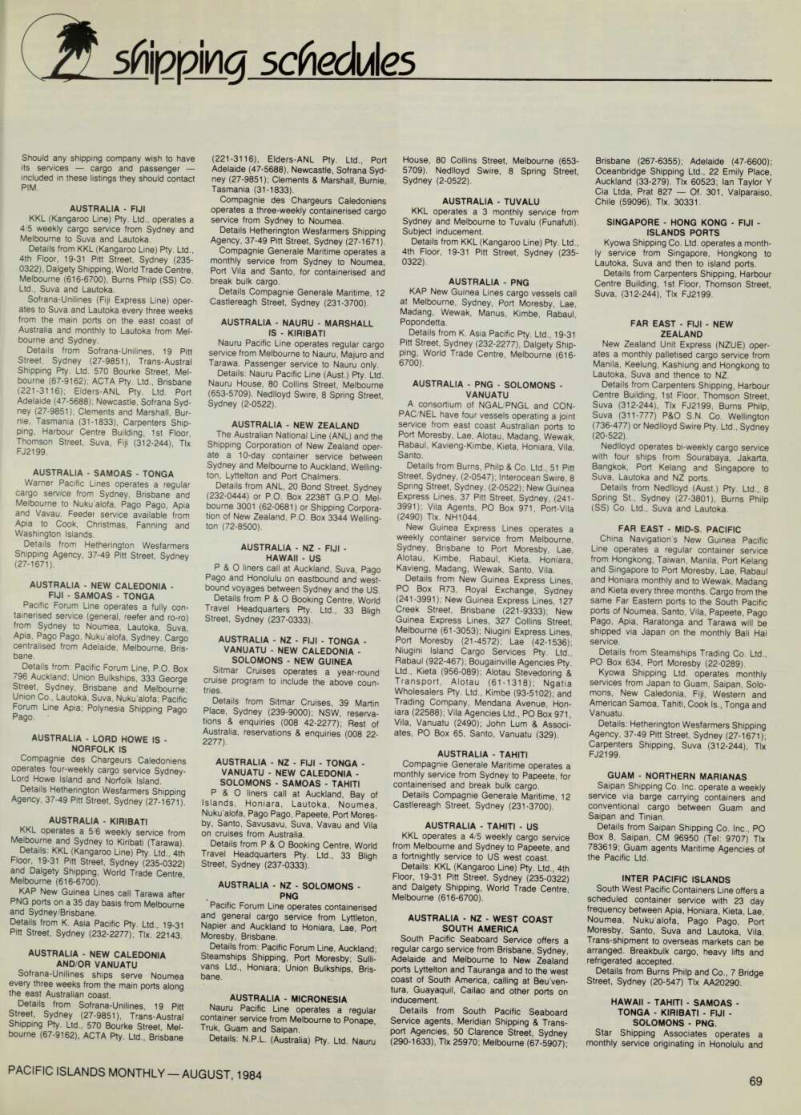
Should any shipping company wish to have its services cargo and passenger included in these listings they should contact
Pim.
Australia - Fiji
KKL (Kangaroo Line) Pty. Ltd., operates a 4/5 weekly cargo service from Sydney and Melbourne to Suva and Lautoka.
Details from KKL (Kangaroo Line) Pty. Ltd., 4th Floor, 19-31 Pitt Street, Sydney (235- 0322), Dalgety Shipping, World Trade Centre, Melbourne (616-6700), Burns Philp (SS) Cos.
Ltd., Suva and Lautoka.
Sofrana-Unilines (Fiji Express Line) oper ates to Suva and Lautoka every three weeks from the main ports on the east coast of Australia and monthly to Lautoka from Mel bourne and Sydney.
Details from Sofrana-Unilines, 19 Pitt Street, Sydney (27-9851), Trans-Austral Shipping Pty. Ltd. 570 Bourke Street, Mel bourne (67-9162); ACTA Pty. Ltd., Brisbane (221-3116); Elders-ANL Pty. Ltd. Port Adelaide (47-5688); Newcastle, Sofrana Syd ney (27-9851); Clements and Marshall, Bur nie, Tasmania (31-1833), Carpenters Ship ping, Harbour Centre Building, Ist Floor, Thomson Street, Suva, Fiji (312-244), Tlx FJ2199.
Australia - Samoas - Tonga
Warner Pacific Lines operates a regular cargo service from Sydney, Brisbane and Melbourne to Nukualofa, Pago Pago, Apia and Vavau. Feeder service available from Apia to Cook, Christmas, Fanning and Washington Islands.
Details from Hetherington Wesfarmers Shipping Agency, 37-49 Pitt Street, Sydney (27-1671).
Australia - New Caledonia -
Fiji - Samoas - Tonga
Pacific Forum Line operates a fully con tainerised service (general, reefer and ro-ro) from Sydney to Noumea, Lautoka, Suva, Apia, Pago Pago, Nukualofa, Sydney. Cargo centralised from Adelaide, Melbourne, Bris bane.
Details from: Pacific Forum Line, P.O. Box 796 Auckland; Union Bulkships, 333 George Street, Sydney, Brisbane and Melbourne: Union Cos., Lautoka, Suva, Nukualofa; Pacific Forum Line Apia; Polynesia Shipping Pago Pago.
Australia - Lord Howe Is -
Norfolk Is
Compagnie des Chargeurs Caledoniens operates four-weekly cargo service Sydney- Lord Howe Island and Norfolk Island.
Details Hetherington Wesfarmers Shipping Agency, 37-49 Pitt Street, Sydney (27-1671).
Australia - Kiribati
KKL operates a 5/6 weekly service from Melbourne and Sydney to Kiribati (Tarawa).
Details: KKL (Kangaroo Line) Pty. Ltd., 4th Floor, 19-31 Pitt Street, Sydney (235-0322) and Dalgety Shipping, World Trade Centre Melbourne (616-6700).
KAP New Guinea Lines call Tarawa after PNG ports on a 35 day basis from Melbourne and Sydney/Brisbane.
Details from K. Asia Pacific Pty. Ltd,, 19-31 Pitt Street, Sydney (232-2277); Tlx. 22143.
Australia - New Caledonia
And/Or Vanuatu
Sofrana-Unilines ships serve Noumea every three weeks from the main ports along the east Australian coast.
Details from Sofrana-Unilines, 19 Pitt Street, Sydney (27-9851), Trans-Austral Shipping Pty. Ltd., 570 Bourke Street, Mel bourne (67-9162), ACTA Pty. Ltd., Brisbane
(221-3116), Elders-ANL Pty. Ltd., Port Adelaide (47-5688), Newcastle, Sofrana Syd ney (27-9851); Clements & Marshall, Burnie, Tasmania (31-1833).
Compagnie des Chargeurs Caledoniens operates a three-weekly containerised cargo service from Sydney to Noumea.
Details Hetherington Wesfarmers Shipping Agency, 37-49 Pitt Street, Sydney (27-1671).
Compagnie Generale Maritime operates a monthly service from Sydney to Noumea, Port Vila and Santo, for containerised and break bulk cargo.
Details Compagnie Generale Maritime, 12 Castlereagh Street, Sydney (231-3700).
Australia - Nauru - Marshall
Is - Kiribati
Nauru Pacific Line operates regular cargo service from Melbourne to Nauru, Majuro and Tarawa. Passenger service to Nauru only.
Details: Nauru Pacific Line (Aust.) Pty, Ltd.
Nauru House, 80 Collins Street, Melbourne (653-5709). Nedlloyd Swire, 8 Spring Street Sydney (2-0522).
Australia - New Zealand
The Australian National Line (ANL) and the Shipping Corporation of New Zealand oper ate a 10-day container service between Sydney and Melbourne to Auckland, Welling ton, Lyttelton and Port Chalmers.
Details from ANL, 20 Bond Street, Sydney (232-0444) or P.O, Box 2238 T G.P.O. Mel bourne 3001 (62-0681) or Shipping Corpora tion of New Zealand, P.O. Box 3344 Welling ton (72-8500).
Australia - Nz - Fiji -
Hawaii - Us
P&O liners call at Auckland, Suva, Pago Pago and Honolulu on eastbound and west bound voyages between Sydney and the US.
Details from P&O Booking Centre, World Travel Headquarters Pty. Ltd., 33 Bligh Street, Sydney (237-0333).
AUSTRALIA - NZ - FIJI - TONGA -
Vanuatu - New Caledonia -
Solomons - New Guinea
Sitmar Cruises operates a year-round cruise program to include the above coun tries.
Details from Sitmar Cruises, 39 Martin Place, Sydney (239-9000); NSW, reserva tions & enquiries (008 42-2277); Rest of Australia, reservations & enquiries (008 22- 2277).
AUSTRALIA - NZ - FIJI - TONGA -
Vanuatu - New Caledonia -
Solomons - Samoas - Tahiti
P&O liners call at Auckland, Bay of Islands, Honiara, Lautoka, Noumea, Nukualofa, Pago Pago, Papeete, Port Mores by, Santo, Savusavu, Suva, Vavau and Vila on cruises from Australia.
Details from P&O Booking Centre, World Travel Headquarters Pty. Ltd., 33 Bligh Street. Sydney (237-0333).
Australia - Nz - Solomons -
Png
Pacific Forum Line operates containerised and general cargo service from Lyttleton, Napier and Auckland to Honiara, Lae, Port Moresby, Brisbane.
Details from: Pacific Forum Line, Auckland; Steamships Shipping, Port Moresby; Sulli vans Ltd., Honiara; Union Bulkships, Bris bane.
Australia - Micronesia
Nauru Pacific Line operates a regular container service from Melbourne to Ponape, Truk, Guam and Saipan, Details: N.P.L. (Australia) Pty. Ltd. Nauru
House, 80 Collins Street, Melbourne (653- 5709). Nedlloyd Swire, 8 Spring Street, Sydney (2-0522).
Australia - Tuvalu
KKL operates a 3 monthly service from Sydney and Melbourne to Tuvalu (Funafuti).
Subject inducement.
Details from KKL (Kangaroo Line) Pty. Ltd., 4th Floor, 19-31 Pitt Street, Sydney (235- 0322).
Australia - Png
KAP New Guinea Lines cargo vessels call at Melbourne, Sydney, Port Moresby, Lae, Madang, Wewak, Manus, Kimbe, Rabaul, Popondetta.
Details from K. Asia Pacific Pty. Ltd., 19-31 Pitt Street, Sydney (232-2277), Dalgety Ship ping. World Trade Centre, Melbourne (616- 6700).
Australia - Png - Solomons -
Vanuatu
A consortium of NGAL/PNGL and CON PAC/NEL have four vessels operating a joint service from east coast Australian ports to Port Moresby, Lae, Alotau, Madang, Wewak, Rabaul, Kavieng-Kimbe, Kieta, Honiara, Vila, Santo.
Details from Burns, Philp & Cos. Ltd., 51 Pitt Street, Sydney, (2-0547); Interocean Swire, 8 Spring Street, Sydney, (2-0522); New Guinea Express Lines, 37 Pitt Street, Sydney, (241- 3991); Vila Agents, PO Box 971, Port-Vila (2490) Tlx. NH1044.
New Guinea Express Lines operates a weekly container service from Melbourne, Sydney, Brisbane to Port Moresby, Lae!
Alotau, Kimbe, Rabaul, Kieta, Honiara, Kavieng, Madang, Wewak, Santo, Vila.
Details from New Guinea Express Lines, PO Box R 73, Royal Exchange, Sydney (241-3991); New Guinea Express Lines, 127 Creek Street, Brisbane (221-9333); New Guinea Express Lines, 327 Collins Street, Melbourne (61-3053); Niugini Express Lines, Port Moresby (21-4572); Lae (42-1536); Niugini Island Cargo Services Pty. Ltd., Rabaul (922-467); Bougainville Agencies Pty.
Ltd., Kieta (956-089); Alotau Stevedoring & Transport, Alotau (61-1318); Ngatia Wholesalers Pty. Ltd., Kimbe (93-5102); and Trading Company, Mendana Avenue, Hon iara (22588); Vila Agencies Ltd., PO Box 971, Vila, Vanuatu (2490); John Lum & Associ ates, PO Box 65, Santo, Vanuatu (329).
Australia - Tahiti
Compagnie Generale Maritime operates a monthly service from Sydney to Papeete, for containerised and break bulk cargo.
Details Compagnie Generale Maritime, 12 Castlereagh Street, Sydney (231-3700).
Australia - Tahiti - Us
KKL operates a 4/5 weekly cargo service from Melbourne and Sydney to Papeete, and a fortnightly service to US west coast.
Details: KKL (Kangaroo Line) Pty. Ltd., 4th Floor. 19-31 Pitt Street, Sydney (235-0322) and Dalgety Shipping, World Trade Centre Melbourne (616-6700).
Australia - Nz - West Coast
South America
South Pacific Seaboard Service offers a regular cargo service from Brisbane, Sydney, Adelaide and Melbourne to New Zealand ports Lyttelton and Tauranga and to the west coast of South America, calling at Beu'ven tura, Guayaquil, Cailao and other ports on inducement.
Details from South Pacific Seaboard Service agents, Meridian Shipping & Trans port Agencies, 50 Clarence Street, Sydney (290-1633), Tlx 25970; Melbourne (67-5907);
Brisbane (267-6355); Adelaide (47-6600); Oceanbridge Shipping Ltd., 22 Emily Place, Auckland (33-279). Tlx 60523; Ian Taylor Y Cia Ltda, Prat 827 — Of. 301, Valparaiso, Chile (59096), Tlx. 30331.
SINGAPORE - HONG KONG - FIJI -
Islands Ports
Kyowa Shipping Co. Ltd. operates a month ly service from Singapore, Hongkong to Lautoka, Suva and then to island ports.
Details from Carpenters Shipping, Harbour Centre Building, 1st Floor, Thomson Street, Suva, (312-244), Tlx FJ2199,
Far East - Fiji - New
Zealand
New Zealand Unit Express (NZUE) oper ates a monthly palletised cargo service from Manila, Keelung, Kashiung and Hongkong to Lautoka, Suva and thence to NZ.
Details from Carpenters Shipping, Harbour Centre Building, 1st Floor, Thomson Street, Suva (312-244), Tlx FJ2199, Burns Philp, Suva (311-777) P&O S.N. Co. Wellington (736-477) or Nedlloyd Swire Pty. Ltd., Sydney (20-522).
Nedlloyd operates bi-weekly cargo service with four ships from Sourabaya, Jakarta, Bangkok, Port Kelang and Singapore to Suva, Lautoka and NZ ports.
Details from Nedlloyd (Aust.) Pty. Ltd., 8 Spring St., Sydney (27-3801), Burns Philp (SS) Co. Ltd,, Suva and Lautoka.
Far East - Mid-S. Pacific
China Navigation's New Guinea Pacific Line operates a regular container service from Hongkong, Taiwan, Manila, Port Kelang and Singapore to Port Moresby, Lae, Rabaul and Honiara monthly and to Wewak, Madang and Kieta every three months. Cargo from the same Far Eastern ports to the South Pacific ports of Noumea, Santo, Vila, Papeete, Pago Pago, Apia, Raratonga and Tarawa will be shipped via Japan on the monthly Bali Hai service.
Details from Steamships Trading Co. Ltd., PO Box 634, Port Moresby (22-0289).
Kyowa Shipping Ltd. operates monthly services from Japan to Guam, Saipan, Solo mons, New Caledonia, Fiji, Western and American Samoa, Tahiti, Cook Is., Tonga and Vanuatu.
Details: Hetherington Wesfarmers Shipping Agency, 37-49 Pitt Street, Sydney (27-1671); Carpenters Shipping, Suva (312-244), Tlx FJ2199.
Guam - Northern Marianas
Saipan Shipping Co. Inc. operate a weekly service via barge carrying containers and conventional cargo between Guam and Saipan and Tinian.
Details from Saipan Shipping Co. Inc., PO Box 8, Saipan, CM 96950 (Tel: 9707) Tlx 783619; Guam agents Maritime Agencies of the Pacific Ltd.
Inter Pacific Islands
South West Pacific Containers Line offers a scheduled container service with 23 day frequency between Apia, Honiara, Kieta, Lae, Noumea, Nukualofa, Pago Pago, Port Moresby, Santo, Suva and Lautoka, Vila.
Trans-shipment to overseas markets can be arranged. Breakbulk cargo, heavy lifts and refrigerated accepted.
Details from Burns Philp and Co., 7 Bridge Street, Sydney (20-547) Tlx AA20290.
Hawaii - Tahiti - Samoas -
Tonga - Kiribati - Fiji -
Solomons - Png.
Star Shipping Associates operates a monthly service originating in Honolulu and
destined for Pago Pago, Papeete, Apia, Nuku’alofa, Suva, Vila and Port Moresby.
Details from Star Shipping Assoc., P.O.
Box 25988, Honolulu, Hawaii 96825. Ph. (808) 545-3026; Polynesia Shipping Services in Pago Pago and Burns Philp Agency in Apia, Nuku'alofa, Suva and Port Moresby.
Japan Fiji Island Ports
Kyowa Shipping Cos. Ltd., operates a monthly service from main ports of Japan to Suva and Lautoka and thence to island ports.
Details from Carpenters Shipping, Harbour Centre Building, Ist Floor, Thomson St., Suva (312-244), Tlx FJ2199.
Japan Fiji Island Ports
Bali Hai service operates a monthly service from main ports of Japan to Lautoka and Suva and thence to island ports.
Details from Carpenters Shipping, Harbour Centre Building, Ist Floor, Thomson St., Suva (312-244), Tlx FJ2199 and Burns Philp, Suva (311-777).
Japan Micronesia
The NYK Shipping Line operates a monthly cargo service from Japan to Micronesia, calling at Yoko, Nagoya, Kobe, Guam, Saipan, Truk, Ponape and Majuro, returning via Yoko, Nagoya and Kobe.
Details from Burns Philp & Cos. Ltd., 51 Pitt Street, Sydney (2-0547).
Japan Micronesia
Saipan Shipping Cos. Inc. operates a monthly service from Japan to Saipan, Guam, Truk, Ponape, Majuro (Kosrae and Ebeye on inducement).
Details from Saipan Shipping Cos. Inc., P.O.
Box 8, Saipan, CM 96950 (Tel: 9707) Tlx 783619; Japan agents Kyowa Shipping Com pany Ltd; Guam Agents Maritime Agencies of the Pacific Ltd.
Japan Png
Mitsui O.S.K. Lines operates a monthly service from main ports Japan and Port
Moresby, Rabaul, Lae, Madang, Kieta and Kimbe.
Details from Robert Laurie (PNG) Pty. Ltd., P.O. Box 922, Port Moresby (21-2466/21- 1898).
New Caledonia Fiji West
Coast North America
PAD Line operates an approx. 3-weekly ro-ro service from Noumea and Suva to Honolulu and West Coast USA and Canadian ports.
Details from Sofrana-Unilines SA, BP 1602, Noumea (27-51-91), Tlx NMO4B; Carpenters Shipping Harbour Centre Building, Ist Floor, Thomson St., Suva (312-244), Tlx FJ2199.
Png Inter Mainport
Papua New Guinea Line offers scheduled 10-20 day coastal liner services linking all PNG major ports with containerisation, reefer, heavy lift and transhipment facilities.
Details from PNG Line, Box 543, Port Moresby, PNG (21-1174), Tlx 22269.
Png Uk/Continent
The Bank Line & Columbus Line operate a regular joint service from Port Moresby, Oro Bay, Kieta, Rabaul, Kimbe, Madang and Lae to Hull, Hamburg, Rotterdam, Antwerp and Le Havre.
Details from The Bank Line (A’asia) Pty.
Ltd., 51 Pitt Street, Sydney (27-2041); Tlx AA24063; Columbus Line, Lae (423466) Tlx NE 44171; or lines' local agents.
Solomons Uk/Continent
The Bank Line & Columbus Line operate a regular joint cargo service from Honiara to Hull, Hamburg, Rotterdam, Antwerp and Le Havre.
Details from The Bank Line (A'asia) Pty.
Ltd., 51 Pitt Street, Sydney (27-2041); Tlx AA24063; Columbus Line, Lae (423466) Tlx NE 44171; or the lines' local agents.
New Zealand Vanuatu
Solomon Islands Papua New
Guinea Australia
Pacific Forum Line operates a 28 day cycle container shipping service from New Zealand direct to Vila, then on to Honiara, Lae, Port Moresby, Brisbane, back to Lyttelton, Napier and Auckland.
Details from Pacific Forum Line, P.O. Box 796, Auckland (790-050) Tlx 60460; P.O. Box 971, Vila, Vanuatu (2490) Tlx 1044.
Nz Cook Is. Niue Tahiti
Shipping Corporation of NZ Ltd. operates cargo services based on pallets and similar units from Auckland to Niue, Cook Islands and Tahiti.
Details from the Shipping Corp. of NZ Ltd., P.O. Box 3344, Wellington (72-8500); Waterfront Commission, P.O. Box 61, Raro tonga; Cook Islands; Niue Govt. Offices, Niue Island Compagnie Maritime Polynesienne, BP 368, Papeete, Tahiti.
Nz Fiji
Reef operates a regular 18-day service from Auckland to Suva and Lautoka.
Details from Reef Shipping Agencies, P.O.
Box 3382, Auckland, NZ (77-1221-3), Tlx 60633; M.V. Fijian Shipping Agencies Ltd., Private Bag, Suva, Fiji (31-1056).
Pacific Line with one ship operates three weekly ro-ro cargo service New Zealand.
Lautoka, Suva. No passengers.
Details: Sofrana Unilines, 18 Customs Street, Auckland (773-279) P.O. Box 3614, Tlx: NZ2313; Carpenters Shipping, 100 Thomson Street, Suva (312-244), Tlx FJ2199.
Nz Fiji North America (Wc)
Blue Star Line Ltd. Pacific Coast container services. Only direct service to and from New Zealand. Blue Star vessels call at Suva and Honolulu on NZ-US-West Coast voyages.
Details from Blueport ACT (NZ) Ltd., P.O.
Box 192, Wellington (739-029). Burns Philp (SS) Cos. Ltd., GPO Box 355, Suva, Fiji (311-777), Tlx. FJ2168 Burship.
Nz Fiji Samoas Tonga
Pacific Forum Line operates a fully con
tainerised three-weekly service (Gen/Reefer) from Auckland to Lautoka, Suva, Apia, Pago Pago and Nukualofa.
Details from Pacific Forum Line, Auckland; Union Cos. Auckland, Lautoka, Suva and Nukualofa; Pacific Forum Line, Apia.
Pacific Forum Line operates a four-weekly service from Tauranga to Noumea, Lautoka, Suva, Apia, Pago Pago and Nukualofa.
Details from Pacific Forum Line, Auckland; Union Cos., Tauranga, Lautoka, Suva, Nuku'alofa; Polynesia Shipping, Pago Pago.
Nz N. Caledonia Vanuatu
Png Solomons
Sofrana Unilines with three ships operate to Vila and Santo, to Honiara and Papua New Guinea and to Norfolk Island and Noumea (No passengers).
Details from Sofrana Unilines, 18 Customs Street, Auckland (773-279), P.O. Box 3614, Tlx. NZ2313.
Nz Tahiti
Compagnie Tahitienne Maritime SA (as CTM-Tahiti Line) operates one ship, MV Bounty 111, monthly Papeete New Zea land. (No passengers).
Details from Sofrana Unilines, P.O. Box 3614,18 Customs St., Auckland Tlx NZ2313; Agence Maritime Cowan, P.O. Box 9012, Papeete (39042), Tlx Tahitlin 322 FP Tahiti).
Nz Tonga Samoas
Warner Pacific Line services Auckland, Nuku’alofa, Vavau, Apia, Pago Pago fort nightly carrying general and freezer cargoes.
Details from McKay Shipping Ltd., Down town House, 21 Queen St., Auckland, P.O Box 1372 (30-299). Cables MACSHIP, Telex NZ2554, Warner Pacific Line, Box 93, Nuku’alofa, Tonga; Mealelei (Western Samoa,) Ltd. Private Bag, Apia, Western Samoa, Kneubuhl Maritime Service, Box 39, Pago Pago, American Samoa, 96799.
Nz New Caledonia
CP Line operates a monthly cargo service
from Auckland, Napier and Mt Maunganui to Noumea.
Details from McKay Shipping Ltd., P.O Box 1372, Auckland (9-30229); Tlx 2554 NZ.
Europe Tahiti
New Caledonia
Compagnie Generate Maritime operates services from Europe and Mediterranean ports to Papeete and Noumea using three ro-ro and multi-purpose vessels thus ensuring a bi-monthly sailing to and from.
Details Compagnie Generate Maritime, 12 Castlereagh Street, Sydney (231-3700).
Europe Tahiti
New Caledonia New Zealand
Solomons Png Europe
Polish Ocean Lines offers regular monthly sailings for containerised and breakbulk car go and reefer space, conventional and in reefer containers, from Hamburg. Antwerp, Dunkirk and Rouen to Papeete, Noumea, New Zealand, Honiara, Lae, Manila and Singapore, returning to Europe via Suez.
Other ports in the South Pacific can be served with inducement.
Details from Sotama, BP 9170, Papeete (27805), Tlx. 296; SATO, BP C 2, Noumea (272094), Tlx. 163 NM SATO: Union Steam ship Cos of NZ, P.O Box 50, Apia, Tlx. 25;
Williams and Gosling, P.O Box 79, Suva (312633), Tlx. 2163; Warner Pacific Line, P.O. Box 93 Nukualofa (21089), Tlx. 66219; Universal Shipping Agencies, P.O Box 2282, Auckland (30930), Tlx. 21517.
Europe Tahiti W. Samoa
Fiji N. Caledonia
Nedlloyd offers regular cargo services from Northern Europe and U.K. to Papeete, Apia, Fiji and New Caledonia.
Details Nedlloyd (Aust.) Pty. Ltd., 8 Spring Street, Sydney (27-3801): Carpenters Ship ping, 100 Thomson St., Suva (312-244), Tlx. 2199 FJ and Vetari Street, Lautoka (63988), Tlx. 5215FJ.
Uk N. Continent W. Samoa
Tonga, Fiji
The Bank Line & Columbus Line operate a regular joint cargo service from Hull, Ham burg, Bremen, Antwerp, Rotterdam and le Havre to Apia, Nukualofa, Suva and Lautoka.
Details from The Bank Line (A'asia) Pty.
Ltd., 51 Pitt Street, Sydney (27-2041); Tlx AA 24063; Columbus Line, Lae (423-466) Tlx NE 44171; or lines' local agents.
Uk N. Continent Png
Solomons
The Bank Line & Columbus Line operate a
regular joint cargo service from Hull, Ham burg, Bremen, Antwerp, Rotterdam and Le Havre to Port Moresby, Lae, Madang, Kimbe, Rabaul, Kieta and Honiara and on induce ment to Vandina.
Details from The Bank Line (A’asia) Pty.
Ltd., 51 Pitt Street, Sydney (27-2041) Tlx AA 24063; Columbus Line, Lae (42-3466) Tlx NE 44171; or lines' local agents.
Uk/N. Continent Tahiti
N. Caledonia Vanuatu
The Bank Line & Columbus Line operate a regular joint cargo service from Hull, Ham burg, Bremen, Antwerp, Rotterdam and Le Havre to Papeete, Noumea, Port-Vila and Santo.
Details from The Bank Line (A'asia) Pty.
Ltd., 51 Pitt Street, Sydney (27-2041) Tlx AA 24063; Columbus Line, Lae (42-3466) Tlx NE 44171; Ets. A M. Fare UTE, Papeete; Ets.
Ballande, Noumea and other local agents.
Us Fiji Tahiti Nz
Australia
The Bank Savill Line Ltd. operates regular cargo services from U.S. Gulf ports to Australia and N.Z. Calls at Suva, Lautoka and Papeete on demand.
Details from The Bank and Savill Line Ltd., 51 Pitt Street, Sydney (27-2041) or Orient Shipping Services. 32 Bridge Street, Sydney (241-2753)
Us Hawaii Micronesia
E. Malaysia Brunei Papua New
Guinea Philippines
PM&O Lines operates three fully self-sus tained container vessels on a sailing frequen cy of every 21 days from the San Francisco Bay Area, Los Angeles, and Honolulu to Majuro, Ebeye, Kosrae, Ponape, Truk, Saipan, Yap, Koror, Kota Kinabalu, Brunei, Lae, Port Moresby, Kieta and Rabaul.
Service is also offered utilising the same vessels on the same 21-day frequency from the Philippine ports of Manila, Cebu, Cagayan de Oro, Davao and General Santos to Hawaii, San Francisco Bay Area and Los Angeles.
Details from PM&O Lines, 181 Fremont Street, San Francisco, California, 94105, U.S.A. (415) 543-7430, Tlx. 278016, Cable PMONAV SFO; PM&O Owner's representa tive, P.O. Box 803, Saipan. N.M.I. 96950.
Cable Commontime Saipan, Tlx.
783605; Soriamont Steamship Agencies Inc., Soriamont House, 801 United Nations Ave nue, Manila, Philippines. Tel 50-1831 and
50-1851, Tlx. 40138. Anship Pn.
Us Hawaii Nauru
Micronesia
Nauru Pacific Line operates regular con ventional and container services from San Francisco and Honolulu to Majuro, Ponape, Truk and Saipan. Cargo is accepted for Nauru and Kosrae with transhipment at Majuro and Ponape.
Details from N.P.O. (Australia) Pty. Ltd., Nauru House, 80 Collins Street, Melbourne (653-5709); Nauru Air and Shipping Agency, Suite 2803, 185 Berry Street, San Francisco, California 94107 (415-543-1737); Nauru Air and Shipping Agency, Suite 506, 841 Bishop St., Honolulu, HI 96813 (808-523-0441).
Us. Noumea Fiji
PAD Line operates an approx. 3-weekly ro-ro service from West coast USA and Canada to Noumea, Suva and Lautoka.
Details from Trans-Austral Shipping BP 1602, Noumea (27-51-91), Tlx. NMO4B; Carpenters Shipping, Harbour Centre Buil ding, Ist Floor, Thomson Street, Suva (312- 244), Tlx. FJ2199; Trans-Austral Shipping Pty. Ltd., P.O. Box R 232, Royal Exchange, 2000 (231-8411), Tlx AA21204.
Us Tahiti Samoa
Pacific Islands Transport operates a five weekly cargo service from North America west coast ports to Papeete, Pago Pago, Apia.
Details from Polynesia Shipping Services Inc. P.O. Box 1478, Pago Pago 96799.
Polynesia Line operates container and general cargo service from US west coast ports to Papeete and Pago Pago.
Details from Polynesia Shipping Services Inc., P.O. Box 1478, Pago Pago 96799.
Advertisements & other items, pp. 70-72 (1 item)
Tahitisamoa S-
LOCAL AGENTS AND PAPUA NEW GUINEA
REPRESENTATION RABAUL: M. & C. Seeto,
P.O. Box 131, Rabaul.
Telephone 92 2919.
MADANG: W. Double, P.O. Box 22, Madang.
Telephone 82 2696.
FIJI
K. Witherington Ltd., P.O. Box 293, Suva.
Telephone 22 356.
428 George St., Sydney.
Cables: Henco Sydney.
G.P.O. Box 3949.
Telephone: 232 5377. For specialised and
personalised buying
service throughout
the Pacific Islands and the East.
VANUATU
John Lum & Associates, P.O. Box 65, Santo.
Telephone 329.
SOLOMON ISLANDS
_J Mr. Tom Lo, Resident Agents in P-O- Box 327, Honiara. other Pacific Territories. Telephone 399
laseoMß
Ifrtfrrirafrf^^
PACIFIC ISLANDS
TRANSPORT LINE
M.V. SIRIUS
EXPRESS
CONTAINER
•REEFER
SERVICE
between U.S.
West Coast ports and
TAHITISAMOA S-
xcc Qeqeral Steanyship Qorporatiori ltd General Agents 400 California Street, San Francisco, CA. USA PAPEETE: Agence Maritime Internationale, Tahiti PAGO PAGO: Polynesia Shipping Services, Inc.
APIA: Burns Philp (South Sea) Company, Ltd.
POLISH OCEAN LINES
General Management, 10 Lutego 24,81-364 GDYNIA, POLAND, Phone: 20-19-01, Cables; POLOCEAN Telex: 054-231 Q 0 7T •voxf/ r’Y? & I v< 15ft
SOUTH PACIFIC SERVICE
agaaaagigm
bAPORE, by our multipurpose vessels carrying dry and reefer containers, reefer chambers, heavy lifts, breakbulk or palletized, bulk liquids.
AI ir-u'i AMP, X D A -r , POLISH OCEAN LINES Representatives AUCKLAND T.B.A. Telex 21517 NZ “UNISHIP”. SYDNEY Mr Walenciak Telex 20428 AA “SLEIGH"
STEAMSHIPS TRADING CO., LTD Telex 42423 NE “STEAM".
rtu
We’ve just made
the ocean smaller!
Polynesia Line's new MS Polynesia 550-container ship provides regular monthly cargo service between Papeete, Pago Pago and Apia in the South Pacific, and Long Beach and Oakland on the US Pacific Coast.
POLYNESIMINE
Interocean Steamship Corporation General Agent Apia Pod Agents Mojgon-vsrn©x Bo»e Postal© 449 Cable ~MORBT Polynesia SNDpmg Series, tnc.
PO Box 1478 it Pago Pago.
Amescon Samoa 96799 Cooie ' PC&YSHiP'' Apk* Union Steam Ship Co. of New Zealand
POBoxSO
Apia we«l©fnsarr»oa CaWe'WT San Francisco snre^ean^sarns^p Corporation 465 California Street SoHolOOl
asss o”** 0 ”**
Cable INIBKXT tong Soach
'ti*£2a
Qis
9 o. & a 5* ,v Pago Pago Serving Polynesia is all we do—and we do it better!
deaths
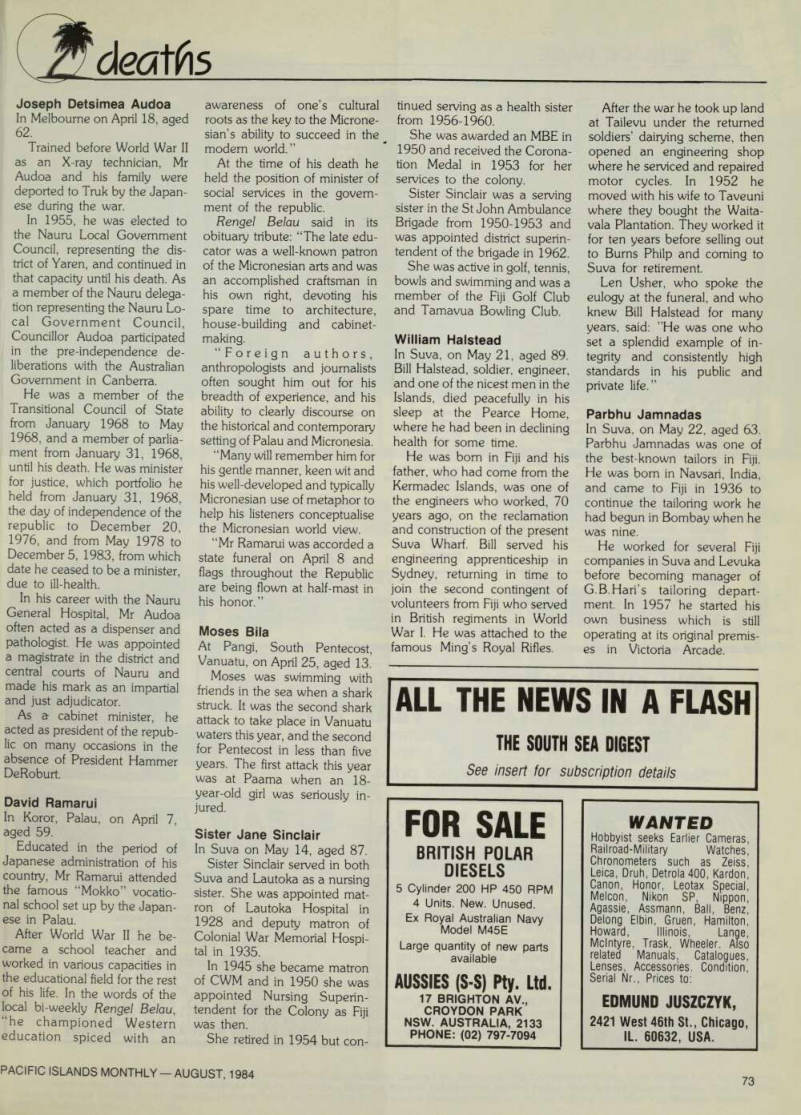
Joseph Detsimea Audoa In Melbourne on April 18, aged 62.
Trained before World War II as an X-ray technician, Mr Audoa and his family were deported to Truk by the Japan ese during the war.
In 1955, he was elected to the Nauru Local Government Council, representing the dis trict of Yaren, and continued in that capacity until his death. As a member of the Nauru delega tion representing the Nauru Lo cal Government Council, Councillor Audoa participated in the pre-independence de liberations with the Australian Government in Canberra.
He was a member of the Transitional Council of State from January 1968 to May 1968, and a member of parlia ment from January 31, 1968, until his death. He was minister for justice, which portfolio he held from January 31, 1968, the day of independence of the republic to December 20, 1976, and from May 1978 to December 5, 1983, from which date he ceased to be a minister, due to ill-health.
In his career with the Nauru General Hospital, Mr Audoa often acted as a dispenser and pathologist. He was appointed a magistrate in the district and central courts of Nauru and made his mark as an impartial and just adjudicator.
As a cabinet minister, he acted as president of the repub lic on many occasions in the absence of President Hammer Deßoburt.
David Ramarui In Koror, Palau, on April 7, aged 59.
Educated in the period of Japanese administration of his country, Mr Ramarui attended the famous “Mokko” vocatio nal school set up by the Japan ese in Palau.
After World War II he be came a school teacher and worked in various capacities in the educational field for the rest of his life. In the words of the local bi-weekly Rengel Belau, “he championed Western education spiced with an
awareness of one’s cultural roots as the key to the Microne sian’s ability to succeed in the modem world.”
At the time of his death he held the position of minister of social services in the govern ment of the republic.
Rengel Belau said in its obituary tribute: “The late edu cator was a well-known patron of the Micronesian arts and was an accomplished craftsman in his own right, devoting his spare time to architecture, house-building and cabinet making.
“Foreign authors, anthropologists and journalists often sought him out for his breadth of experience, and his ability to clearly discourse on the historical and contemporary setting of Palau and Micronesia.
“Many will remember him for his gentle manner, keen wit and his well-developed and typically Micronesian use of metaphor to help his listeners conceptualise the Micronesian world view.
“Mr Ramarui was accorded a state funeral on April 8 and flags throughout the Republic are being flown at half-mast in his honor.”
Moses Bila At Pangi, South Pentecost, Vanuatu, on April 25, aged 13.
Moses was swimming with friends in the sea when a shark struck. It was the second shark attack to take place in Vanuatu waters this year, and the second for Pentecost in less than five years. The first attack this year was at Paama when an 18year-old girl was seriously in jured.
Sister Jane Sinclair In Suva on May 14, aged 87.
Sister Sinclair served in both Suva and Lautoka as a nursing sister. She was appointed mat ron of Lautoka Hospital in 1928 and deputy matron of Colonial War Memorial Hospi tal in 1935.
In 1945 she became matron of CWM and in 1950 she was appointed Nursing Superin tendent for the Colony as Fiji was then.
She retired in 1954 but con
tinued serving as a health sister from 1956-1960.
She was awarded an MBE in 1950 and received the Corona tion Medal in 1953 for her services to the colony.
Sister Sinclair was a serving sister in the St John Ambulance Brigade from 1950-1953 and was appointed district superin tendent of the brigade in 1962.
She was active in golf, tennis, bowls and swimming and was a member of the Fiji Golf Club and Tamavua Bowling Club.
William Halstead In Suva, on May 21, aged 89.
Bill Halstead, soldier, engineer, and one of the nicest men in the Islands, died peacefully in his sleep at the Pearce Home, where he had been in declining health for some time.
He was bom in Fiji and his father, who had come from the Kermadec Islands, was one of the engineers who worked, 70 years ago, on the reclamation and construction of the present Suva Wharf. Bill served his engineering apprenticeship in Sydney, returning in time to join the second contingent of volunteers from Fiji who served in British regiments in World War I. He was attached to the famous Ming’s Royal Rifles.
After the war he took up land at Tailevu under the returned soldiers’ dairying scheme, then opened an engineering shop where he serviced and repaired motor cycles. In 1952 he moved with his wife to Taveuni where they bought the Waita vala Plantation. They worked it for ten years before selling out to Burns Philp and coming to Suva for retirement.
Len Usher, who spoke the eulogy at the funeral, and who knew Bill Halstead for many years, said: ”He was one who set a splendid example of in tegrity and consistently high standards in his public and private life.”
Parbhu Jamnadas In Suva, on May 22, aged 63.
Parbhu Jamnadas was one of the best-known tailors in Fiji.
He was born in Navsari, India, and came to Fiji in 1936 to continue the tailoring work he had begun in Bombay when he was nine.
He worked for several Fiji companies in Suva and Levuka before becoming manager of G.B.Hari’s tailoring depart ment. In 1957 he started his own business which is still operating at its original premis es in Victoria Arcade.
Advertisements & other items, pp. 73-74 (2 items)
73
ACIFIC ISLANDS MONTHLY —AUGUST, 1984
For Sale
ALL THE NEWS IN A FLASH
THE SOUTH SEA DIGEST
See insert for subscription details
FOR SALE
BRITISH POLAR
DIESELS
5 Cylinder 200 HP 450 RPM 4 Units. New. Unused.
Ex Royal Australian Navy Model M4SE Large quantity of new parts available
AUSSIES (S-S) Pty. Ltd.
17 BRIGHTON AV.,
CROYDON PARK
NSW. AUSTRALIA, 2133
PHONE: (02) 797-7094
WANTED
Hobbyist seeks Earlier Cameras, Railroad-Military Watches, Chronometers such as Zeiss, Leica, Druh, Detrola 400, Kardon, Canon, Honor, Leotax Special, Melcon, Nikon SR, Nippon, Agassie, Assmann, Ball, Benz, Delong Elbin, Gruen, Hamilton, Howard, Illinois, Lange, Mclntyre, Trask, Wheeler, Also related Manuals, Catalogues, Lenses, Accessories. Condition, Serial Nr., Prices to:
EDMUND JUSZCZYK,
2421 West 46th St., Chicago,
IL. 60632, USA.
a.
SERVICE PAGE
PAPUA NEW QUMEA: Distribution Gordon & Qotch, PO Box 3396. Port Moresby, telephone 25-4551. 25-4855.
Advertising Ken Head. PNG Post-Courier, PO Box 85, Port Moresby, telephone 21-2577, telex 22120.
SOLOMON ISLANDS: Distribution and Advertising The Bookshop, (Norman Bros.) PO Box 503, Honiara.
PHILIPPINES: Advertising The GF Group, 12 San Ignacio St., Uroaneta Village, Makati, Metro Manila, telephone 817-7299, telex 45950 and 4233.
UNITED KINGDOM: The Herald & Weekly Times Ltd., No 1 Maltravers Street,London WC2R 3DZ, England, telephone 01 836 5162, telex London 21989.
UNITED STATES MAINLAND: Advertising Joshua B.
Powers Jr., Powers International Inc., 551 Fifth Ave., New York, New YorV 10 017, telephone 867-9580, telex 236514.
Subscriptions PIM, Hawaii, PO Box 22250, Honolulu.
Hawaii. 96822.
SUBSCRIPTIONS
Payments by personal cheque are only acceptable in Australian (from a branch in Australia), U.S. and New Zealand currency. For all other remittances please send an international bank draft in Australian dollars.
Published monthly by Pacific Publications (Aust.) Pty.
Ltd. and printed in Australia by Quadricolor Industries Pty. Ltd., Mukjrave, Vic.
mrc
DSOAW
AUSTRALIA: Distribution: The HerakJ and Weekly Times Ltd., 44-74 Flinders St., Mel boo me, Vic., 3000. Advertising Rsps Brisbane D. Wood. Anday Agency, CCA Centre, Dayboro Road, Closebum 4520; Box 1918, GPO Brisbane, 4001; telephone (07) 289-4128 Adelaide Hastwell Williamson Rouse Pty. Ltd., PO Box 419, Norwood. SA, 5067; 59 Kensington Road, Norwood; telephone (08) 332-3322, telex 87113; Perth Allen & Associates, Suite 2, 284 Stirling St.. Perth. WA, 6000, telephone (09) 328-9593 or (09) 328-9363.
FUI: Distribution snd subscriptions Desai Bookshops, P.O Box 160, Suva, Fiji, telephone Suva 23036.
Advertising Fiji Times & Herald Ltd., 20 Gordon St., Suva, telephone 31-4111, telex FJ2124.
FRENCH POLYNESIA: Distribution Hachette Padfique, 10 Ave Bruat, Papeete, telephone 25610.
HAWAII. UNITED STATES: Distribution PIM, Hawaii.
PO Box 22250, Honolulu, Hawaii. 96822 Advertising Brian C. Asgill, Apt. 1308, 1676 Ala Moana Blvd., Honolulu.
Hawaii, 96815, telephone (808) 955-9718.
JAPAN: Advertising and subscriptions Universal Media Corporation. GPO Box 46. Tokyo, telephone 666- 3036, cables UNIMEDIA Tokyo, telex 2524665.
KOREA: Advertising and subscriptions World Marketing, Inc, Box 4010, Seoul; phone 776-5291-3. telex K 23232.
MALAYSIA: Advertising and subscriptions Worldwide Media Services, 57-B Komplex Damai, Jin Date Haji Eusoff, Kuala Lumpur, telephone 63-9340, cables WORLDMEDIA Kuala Lumpur, telex 31533.
VANUATU: Distribution Maropa Bookshop, HQ Box 210, Port Vila Advertising Bill Penthand, Norman Bros Bookshop, Port Vila, telephone 2232.
NEW CALEDONIA: Distribution Depot Centre de Presse Michel Pentecost. CBP2, Noumea, telephone 27- 2434, 27-4729.
NEW ZEALAND; Distribution Gordon & Gotch, PO Box 584, 2 Carr Road, Ml. Roskill, Auckland 4 Advertising International Media Representatives Ltd., PO Box 10259, Balmoral, Auckland 4, telephone 605-909, 792-370. telex NZ21404.
NOW AVAILABLE! 15th Edition
PACIFIC ISLANDS YEAR BOOK
Contains over 550 pages crammed with all the facts you want to know on all the island groups of the Pacific.
See insert for further details and price.
Stay at Aggie Grey’s . . . the South Pacific’s
legendary hotel.
Situated right in the heart of = Western Samoa. Enjoy Polynesian-style friendliness and service, in cool surroundings, superb entertainment and food.
Magnificent white sand beaches only a short drive away. Airconditioned rooms, swimming pool and full bar facilities.
Bookings through Union Steamship Company of NZ, Pan Am, Air New Zealand or direct to Aggie Grey’s, Apia, Western Samoa. Cables: ‘AGGIES' Apia.
POSITION WANTED
ACCOUNTANT/
ADMINISTRATOR
(39) with 15 years overseas experience in banking, construction, mining, merchandising, shipping, commodity trading seeks interesting managerial position in Islands.
PETER GOERMAN,
Box 42, Duffy, A.C.T. 2611. Australia.
Advertising
Aggie Grey 74 Air Niugini 6 Amatil 36 Anderson Equipment 18 Aussies 73 Aust. Aero Space 12 Bankline 68 Besco Batteries 34 Citizen 27 Clarence, M 48 Clarion 47 Columbus Line 68 General Steamships 70 Peter Goerman 74 K. A. Gray 74 Hall-Tec Dist P/L 60 Henry Cumines 70 Hitachi Ltd 40 Honda 2 Hudson Homes 62 ICI-Tasman 50 Intercontinental 72 Journal of Pacific History 46 Edmund Juszczyk 73 Lincoln Electric 32 McDonnell Douglas 20 Nissan Company 75
N.E.Q.A 60
Pacific Resources 24 Papua Hotel 74 Pauls Milk 30 Pioneer Electrics 8 Polish Shipping Lines 71 Polynesian Lines 72 Remy Martin 76 Roncaglia 54 Southern Pacific Hotels 4 Tideland Energy 22 Toyota Motors 38,39 Tutt Bryant 56 Waterwheel 44
Advertisements & other items, pp. 74-76 (1 item)
For Sale
s business centre lltion for comfort fine food *AH roofs airconditioned > Restaurant • Bars • Banquet hail
H. E. BERGHUSER
General Manager Phone 21 2622 Cable: PAPTEL Telex; NE22353 PAPTEL
STEAM BOILERS
FOR SALE
SOLID-WASTE-GAS-OIL-FUELS
18.000 Ib/h 150 psi Superior package waste-wood. 30i000 Ib/h 200 psi Babcock coal-waste. 30.000 Ib/h 250 psi Babcock waste-coal. 45.000 Ib/h 425 psi Babcock coal-waste. 17.000 Ib/h 250 psi C’brook package oil-gas.
DIESEL GENERATORS
1750 kVa English Electric Skid 6.6 kV-440V Also smaller sets available K. A. GRAY & CO. 61(2) 871-8606 Box 88 P.O. BEECROFT, N.S.W. 2119. Australia TLX. AAIOIOI INTSY Attn. K. Gray Sydney
'1 a. ♦ -V t* r-
Toughness.
.A Nissan Cabstar Nissan Sunny Nissan Vanette Nissan Urvan !!!?(]
NISSAN
PATROL
Nissan Patrol Datsun Pickup 4WD That’s why Nissan means higher performance. Toughness is total. Every member of the widerange lineup has extra strength and durability built-in along with superior maneuverability. These high performers deliver penny-pinching fuel economy and tough reliability. Once you discover how great the ride and handling ease are, you will understand what makes Nissan commercial and passenger vehicles worldwide favorites.
There’s more to a Nissan than meets the eye. i;iU-VTiV v l
NISSAN
MaM^I Tl uJ. M K a c H * ,nc i’ Pa 9° Pa 9° Cook Islands Cook Islands Motor Centre Ltd., Rarotonga Fiji Carpenters Motors, Suva Kiribati Atoll Auto Stores, 0 a |^l N n^nl C ? l b .i^ e ; Pr ; SeS NeW , ? a,e^ onia Agence Alma S.A., Noumea Norfolk Island Sirius Motors Papua New Guinea Boroko Motors, Port Moresby Morris Hedstrom Samoa LW^ l Apia 5 Ltd ’’ Honiara Tahiti Tahitibull S.A.R.L, Papeete Vanuatu Pentecost Vanua Trading Ltd., Port Vila Western Samoa
COGNAC
RENY MARTIN
FINE CHAMPAGNE COGNAC, SINCE 1724.
REMY MARTIN CENTAURE XO