Pacific

Islands
Nonthly
July, 1984
Vest man tension: Rebel Nyaro speaks
American Samoa US$1.75 Australia "A$1.50 Cook Islands NZ$1.50 Fiji F$1.50 Hawaii US$1.95 Kiribati A$1.75 Nauru A$1.75 New Caledonia CFP190
New Zealand NZ$2.00 Niue NZ$1,75 Norfolk Island A$1.50 Papua New Guinea K$1.50 Solomon Islands S$1.50 Tahiti CFP220 Tonga Pi .50 Tuvalu , A$1.75
Usa Us$2.25
USTT and Guam US$1.95 Vanuatu VT1.50 Western Samoa T2.10 ■Recommended retail price only Registered by Australia Post Publication No. NBP1210
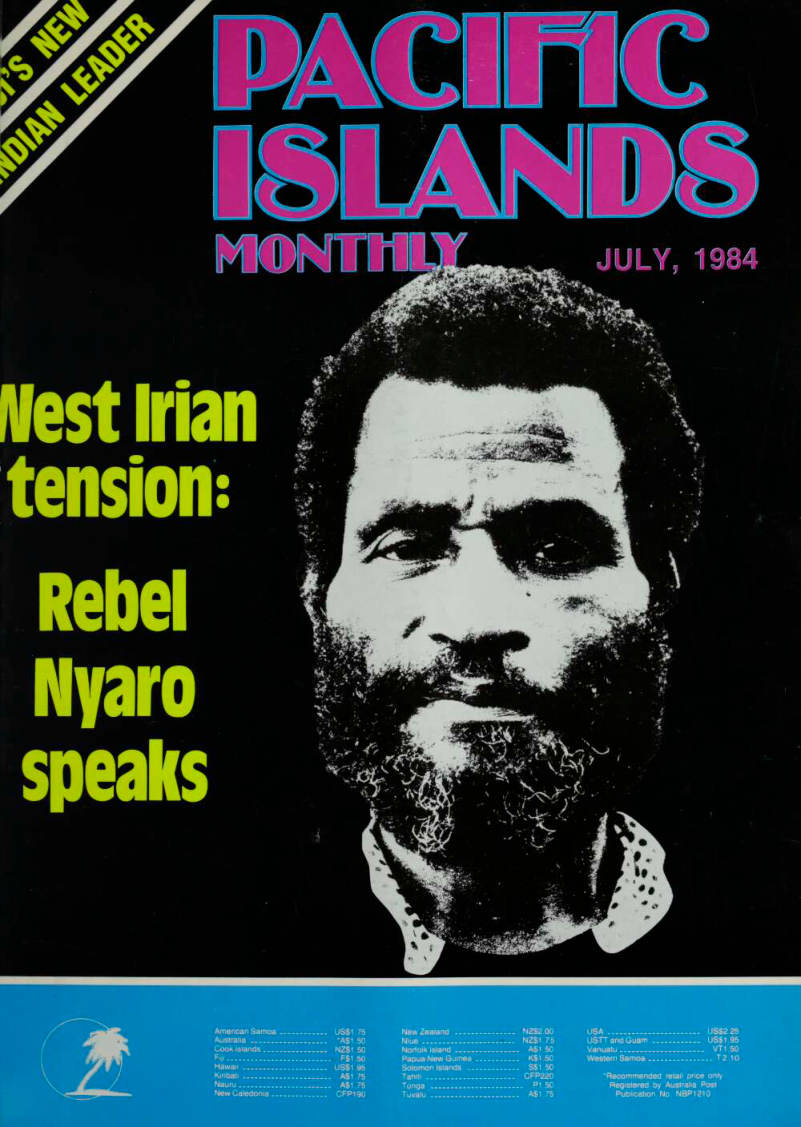
The Cover
James Nyaro, leader of the anti-Indonesian OPM in Irian Jaya Design by Barry Badger.
Advertisements & other items, pp. 2-3 (2 items)
0 Hitachi
Listen to what these experts
say about Hitachi’s VT-20E
recorde
“Great sound?
“Incredibly true to life.”
“Even talk shows sound better.”
The secret is stereo sound You see, the new VT-20E was designed to get the most out of the new stereo broadcasts, as well as prerecorded stereo tapes. And that means video that’s as easy to listen to as it is to watch.
Of course, the VT-20E also delivers mwrnm.
a superb picture.
And boasts features like 4 heads. 8-hour recor ing. 8X Visual Search. A 5-programme 7 14-day timer. Front loading. And a 13function wireless remote control.
So take a look at Hitachi’s VT-20E.
If what you see doesn’t convince you, the experts surely will.
D 1
STEREO BILINGUAL
® HITACHI
AUTO TUNING SYSTEM
VT-20E
0 HITACHI
AUSTRALIA: Hitachi Sales Australia Pty., Ltd., 153 Keys Road, Moorabbin, Victoria 3189; Phone: (555) 8722 • NEW ZEALAND: AWA New Zealand Limited, Wi-neera Drive, P.O. Box 50- 48, Porirua; Phone; PRO 75-069 • PAPUA NEW GUINEA: S.O. Svensson (N.G.) Ltd., P.O. Box 705, Port Moresby: Phone: 21-2111 • FIJI ISLANDS: AWA New Zealand Limited, 47 Foster load (P.O. Box 858), Suva, Fiji; Phone: 312070 • NEW CALEDONIA: Caldis, B.P. Ml, Noumea; Phone: 26. 23. 50 • TAHITI: Ets Chene Alain, P.O. Box 272, Papeete; Phone: 2. 88. 68 SOLOMON ISLANDS; Techniaue Radios Centre Ltd.. P.O. Box 465. Honiara: Phone: 416
Islands
PACIFIC
MONTHLY
Vol. 55 No. 7 July 1984
Fiji’s Koya 22
John Meier: The latest 25
Vanuatu: safe shipping? 58
Cler: Decolonisation 61
In This Issue
IRIAN JAYA-PAPUA NEW GUINEA Papua New -I A Guinean journalist Alfred Sasako talked for hours with James Nyaro, leader of the Operasi Papua Merdeka (OPM) which is fighting to free Irian Jaya from Indonesian control. His interview, a profile of James Nyaro, an account of the murder of Irianese intellectual Arnold Ap, and PIM editorial comment begin on page WHAT EVER HAPPENED TO JOHN MEIER? 25 Canadian journalist Alan Merridew reports exclusively for PIM from Vancouver on the latest vicissitudes to befall American John Meier, who six years ago was making headlines throughout the Pacific with his ill-starred, Nuku’alofa-based Bank of the South Pacific.
SOLAR POWER AND THE PACIFIC Experts argue the increasingly urgent case for the application of alternative energy sources in the Island countries and especially the most abundant of all, energy derived from the sun. An Alternative Energy feature begins on page VANUATU Julie-Ann Ellis in Port-Villa reports on a go government drive to ensure safer inter-island shipping a vital matter in this archipelagic country.
SUICIDE IN WESTERN SAMOA Dennis Oliver of 59 the YMCA reports on the remarkable success of a campaign against youth suicide in Western Samoa, and on his view of the reasons for its success.
Contents
Alternative energy 43 Books 49 Deaths of Islands people 73 Feather money 28 Fiji 22 France in the Pacific 31,55, 63 French Polynesia 31 Irian Jaya 14 Islands Press 63 Letters 10 Marine technology 26 New Zealand in the Pacific. 37, 53 Pacific Report 5
Papua New Guinea 14,46 People 65 Pettini brothers’ diary 45 PIM Opinion 5 Shipping schedules 67 Solomon Islands 28 Tonga 25 Traaewinds 37 Tropicalities 55 U.S. in the Pacific 29 Western Samoa 59 Yachts 67 PIM Subscriptions 74
Australian cover price is recommended retail only. Registered by Australia Post, publication No. NBPI2IO. Second class postage paid at Honolulu.
Hawaii. Copyright Pacific Publications (Aust.) Pty. Ltd. Postmaster Hon olulu: Send address changes to PIM Hawaii, PO Box 22250. Honolulu Hawaii. 96822.
Advertisements & other items, pp. 3-4 (2 items)
Pacific Islands Monthly July, 1984
3
Founded 1930 by R. W. Robson
(USPS 952480)
Editor and Publisher Garry Barker Associate Editor Malcolm Salmon Advertising Manager Stephen Brandon Layout & Design Barry Badger Editorial Adviser John Carter A Pacific Publications production 76 Clarence Street, Sydney, 2000, GPO Box 3408, Sydney, 2001.
Cables; PACPUB Sydney.
Telex: 21242 (answers INTARAD).
Telephone: Sydney 20-231. Melbourne 63-0211.
Manager: John Berry (03) 63-0211 Ext. 1860.
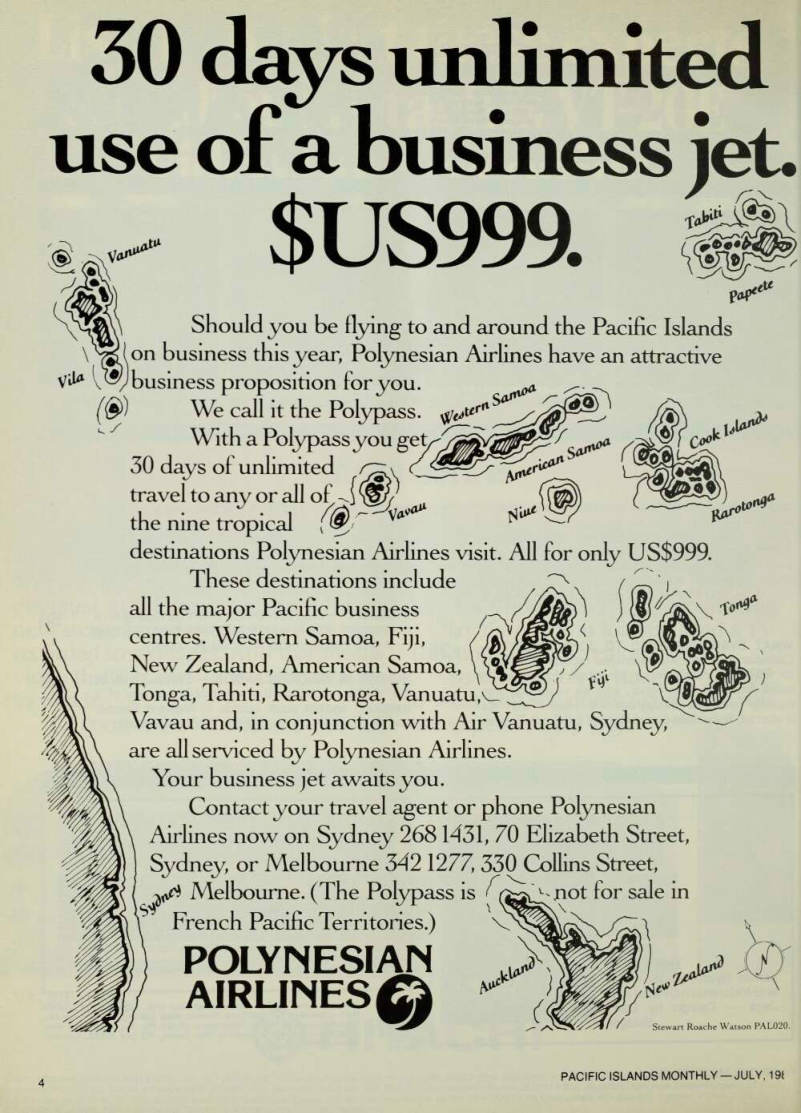
30 days unlimited
use of a business jet.
o 'nV m » VU
SUS 999.
raW s /a Should you be flying to and around the Pacific Islands on business this year, Polynesian Airlines have an attractive business proposition for you.
We call it the Polyp ass.
With a Polypass you get 30 days of unlimited travel to any or all of -A 1
the nine tropical (^
destinations Polynesian Airlines visit. All for only US$999.
These destinations Include 7^ all the major Pacific business centres. Western Samoa, Fiji, k l ' V C<x> Uc ri (P 1 Si** 6 «« m s'*** 1 0*9 Oli b aft % o New Zealand, American Samoa, Tonga, Tahiti, Rarotonga, Vanuatu, Vavau and, in conjunction with Air Vanuatu, Sydney, are all serviced by Polynesian Airlines.
Your business jet awaits you.
Contact your travel agent or phone Polynesian Airlines now on Sydney 2681431, 70 Elizabeth Street, Sydney, or Melbourne 342 1277, 330 Collins Street, yiT) Melbourne. (The Polypass is f not for sale in French Pacific Territories.)
POLYNESIAN
AIRLINES
A Y' A Stewart Roache Watson PALO2O.
Pim Opinion
Resistance to Indonesian rule in West Irian precedes the day the former Dutch colony was handed over to Jakarta by a consortium of foreign political interests. Despite very firm, even brutal, application of Indonesian control, this resistance is expected to continue for some time. It is also thought unlikely to make very much difference to Jakarta, although its effects will muddy the waters in other countries, in particular Papua New Guinea, where people have a strong filial feeling with such as Mr James Nyaro, self-styled president of the Free West Papua movement (OPM).
Melanesians represent the largest ethnic grouping in the Pacific Islands, and they have, mainly in Fiji and Papua New Guinea, the greatest economic, and therefore political, potential, although in absolute terms it is not yet very great. They see the West Irian question in an ethnic way which Jakarta, and the United Nations membership or, at least, those who think about it, find inconvenient.
The United Nations believes that the colonialism question in West Irian was decided in 1969 when the Indonesians took over the former Dutch East Indies territories. “The colonialism question has been resolved; it is no longer an issue,” they say.
But, as the result of what, at very least, must be accepted as a difference of opinion on that point, there are now at least 8000 West Irianese refugees camped in Papua New Guinea. This flood is the direct consequence of Indonesian army activity against supporters of the OPM.
It may be that this suits the Indonesians who have been annexing great tracts of Melanesian land, frequently it seems, without proper compensation, to give to Javanese and other immigrants under the transmigration program which has moved hundreds of thousands of people from the jam-packed acres of Islamic Indonesia and dumped them into the remote, and sparsely-populated jungles of largely Christian Melanesia.
There is a rebel movement of which Mr Nyaro claims to be the head, the “president of the government of Free West Papua.” He and his “defence minister” claim several thousand followers.
Others say their numbers are in hundreds at most. They have few weapons, they have been made nomadic because of Indonesian Army sweeps against them, and they say their lives are very much at risk; indeed that many of their number have been killed.
But if the Indonesian army continues to hunt down the OPM by beating up Melanesian villagers, as they have been doing, then
Melanesian resentment, and the OPM’s numbers will grow, as will the tide of refugees into PNG. Their greatest effect so far has been to gravely embarrass their leading cousin, Mr Michael Somare of Papua New Guinea, whose constituents cannot see why he does not do more to recognise and redress the wrongs done to their kin across that inconvenient and unnatural border.
Mr Nyaro, in a long interview published in this issue, concedes that his military strength is slight but says that he and his followers will continue to fight until they control their own country. As things stand in the world, and at the United Nations, Mr Nyaro is not likely to win much more than what interest he can stir in the media, and in the hearts of humanitarians. Even the U.N. High Commissioner for Refugees appears powerless to intervene. The refugees themselves say they dare not return to their side of the border for fear of dreadful reprisals by the Indonesians. Their fears are genuine, and probably well-enough based. The Indonesian government has asked for a list of names to be assembled. The refugees say this means Jakarta wants a hit-list but, more likely, it represents prevarication. Why buy back trouble? reasons Jakarta.
But Mr Somare must also be careful, for to appear to carelessly push his brother Melanesians back into the jaws of death or even lesser retribution, would bring a hornets’ nest down upon his head.
Thus, while PNG has said it will assemble the required list of names and assist the return to normal business in all directions, they so far have only one man detailed to discover and write down nearly 8000 names, many of which, on paper, will look pretty much like a lot of others.
It is the plight of these refugees which at once is the most poignant and the most politically difficult. So long as they remain on the border they offer an embarrassment to Mr Somare, but any move by him to push them back will cause even more trouble. In the end they may just have to stay where they are, on some sort of internationally-funded handout, until the heat of the situation cools and they gradually filter back to their own.
The main problem is that the Indonesians do not properly recognise the very particular place land has in Melanesian culture and, using their solidiers, are running roughshod over very sensitive and ages-old matters. If the administration in Jakarta and Jayapura were to be less dictatorial in their approach, and a great deal more sensitive, then, finally, a generation or two from now, the situation might resolve itself.
Pacific Report
New Caledonia Bill Adopted In Paris
A bill granting internal autonomy to the French territory of New Caledonia passed the critical first reading stage in the National Assembly in Paris on May 29. As passed, the bill had some modifications to the original, notably that the president of the New Caledonia government, elected by the Territorial Assembly will choose his own ministers. In the original, the ministry would have been elected by the assembly. With the socialists holding an absolute majority in the French Lower House, the bill passed on the votes of the Socialists and Communists. The opposition was divided, but opposed the measure. Jacques Toubon, spokesman for the neo-Gaullist RPR party, claimed the government wanted a Kanak, socialist New Caledonia. In fact, he added, the government was preparing “an Australian New Caledonia.” In reply, France’s
Minister of State for Overseas Departments and Territories, Georges Lemoine, said the RPR had failed to take into account the origins, history and values of the Kanak people. The bill then went to the Senate, but as pointed out in a report by the US agency, Associated Press, any modifications made there can, in practice, be over-ruled by the National Assembly. In the course of the debate three Kanak activists disrupted parliamentary proceedings by shouting pro-independence slogans and scattering leaflets. The demonstrators also shouted slogans directed against Mr Lemoine, before guards were called to remove them.
U.S., Palau Sign Revised Compact
A revised version of the Compact of Free Association has been signed by the United States and Palau, bringing termination of the
Trust Territory of the Pacific Islands a step nearer completion. The new version of the compact was signed in Washington on May 23 by Ambassador Fred M. Zeder, President Reagan’s personal representative for Micronesian political status negotiations and Ambassador Lazarus E. Salii, Ambassador for trade and political status negotiations for the Republic of Palau. Paul Malamud, US Information Agency staff writer, reports; “Under the provisions of the newly signed compact, and in order to conform with provisions in the Palau Constitution concerning hazardous substances, the voters of Palau must approve the compact by a 75 per cent majority for it to come into effect. Absent from the revised version is the section dealing with the storage and safety measures associated with nuclear materials, which had been inserted in the original version at the insistence of the government of Palau. Other changes include fewer specific claims by the United States to potential military training areas in Palau. The ballot will address approval of the compact and the issue of compatibility with the anti-nuclear provisions of the Palau Constitution in a single question. ” The new plebiscite will be preceded, like earlier ones, by a voter education campaign. The Federated States of Micronesia and the Marshall Islands have already certified the results of their plebiscites, and the compacts for those island groups are at present undergoing the process of legislative approval in the U.S.
Congress.
Rarotonga Papeete Ties Strengthened
The burgeoning “special relationship” between the Cook Islands and its eastern “cousins” in French Polynesia was further strengthened by the visit to Tahiti in mid-May of Cooks Prime Minister Sir Thomas Davis. In talks with Gaston Flosse, vice-president of the territoiy’s government council, the two leaders agreed that in future there should be regular twice-yearly meetings between the two sides. The first would be between experts from either side to discuss exchanges in the agricultural, technical and educational fields, and the second at a higher level, and held alternately in the Cooks and French Polynesia. Mr Flosse said as an immediate step he would be seeking French Government support for a scheme under which two French language teachers would be sent to the Cooks and two English language teachers would come from the Cooks to work in French Polynesia. Speaking on the broadening perspectives for French Polynesia’s relationships with Island countries, Mr Flosse said: “When our new statute is in place, we are seriously considering establishing relations with Fiji, and with countries even closer to us such as Tonga and the Samoas. As a first priority, we will strengthen our ties with the countries of the Polynesian triangle.
We already have ties with Vanuatu, from which we buy copra. ” Sir Thomas did not pass up the opportunity to point out that the Cook Islands and its relationship with New Zealand offered living proof that self-government need not necessarily lead to complete independence. Such remarks are music to the ears of the majority of French Polynesia’s politicians. The territory’s pro-independence, anti-bomb party, la mana te nunaa, introduced a certain piquancy to Sir- Thomas visit when one of its members in the Territorial Assembly asked him to state his attitude to French nuclear testing at Moruroa Atoll. Replying, Sir Thomas made a request to the French Government to stop its testing in the Pacific and move it to the , A S^ ntic - In a , P ress statement released later, la mana te nunaa ? ii- ' Ur P 3. 5 Territorial Assembly members were astounded that Vice-President Flosse did not immediately protest at this act of interference by the representative of a foreign country in the affairs of France.” The statement recalled that this was precisely Mr Flosse s reaction when Chris Schacht, a representative of the Australian Labor Party, made a similar statement in Tahiti some months ago.
Hawaii Bids For Place On S.P,C.
Hawaii’s Senate and House of Representatives have adopted resolutions calling on President Reagan to accord the State official status on the South Pacific Commission. The resolution, intro duced in the house jointly by Speaker Henry Peters and house minonty leader Frederick W. Rohlfing, notes that the South Pacific Conference on Saipan on October 4, 1983 “took an historic step and unanimously agreed to abolish the differential between the Committee of Representatives of Participating Governments and other members of the conference so that there are now 27 members of the South Pacific Conference with equal status including three American territories (Guam, American Samoa, and
the Commonwealth of the Northern Marianas), and the soon to be ‘former’ United Nations Trust Territory entities, which will be or are likely to be in the free association status with the United States. . . ”
It recommends: . that appropriate legislation be introduced and enacted by Congress to mandate that the President select at least one full-time resident from the State of Hawaii to the positions of US Representative and/or Alternate Representative on the South Pacific Commission, and that at least one of such persons selected by the President from Hawaii residents be additionally designated as the ‘State of Hawaii Representative on the South Pacific Commission,’ and charged with the duty of maintaining appropri ate liaison with Hawaii State governmental and private organisa tions with interests and involvement in the region over which the SPC exercises jurisdiction.”
“Keystone Hops” Affair In Meier Case
British Columbia, Canada, authorities have dropped 11 criminal charges against a prominent lawyer who represented John Herbert Meier, of Bank of the South Pacific, Nukualofa, fame. (See story p. 23.) Police charged the lawyer, Gordon Dowding, in December, 1983, with having conspired to subvert justice. Meier was named as an unindicted co-conspirator. Dowding was also charged with fabricating evidence, obstructing justice, trying to obtain false documents, influencing a criminal appeal, pretending to influence, offering a benefit to an official, and conspiracy involving false papers. But on May 14 in Vancouver, the Crown entered a “stay in proceedings.” Crown and defence lawyers said part of the reason was Dowding’s decision to retire from practising law. Dowding, aged 66, is a former Speaker of the provincial legislature. Dowding would not talk to reporters. His lawyer, William Deverell, said Dowding “went out on a short limb” for Meier, and “made some serious errors of judgment. ” Deverell called it “a Keystone Kops affair.” He said Dowding investigated people who “turned out to be undercover cops working on something else . . . people were stumbling over each other’s feet. It involves the CIA, an ex-PLO member, and a convicted drug trafficker. ” Deverell said Dowding might write a book about it. Meanwhile, observers wonder how so many serious charges came to be so airily dropped and what evidence Dowding obtained tape recordings, perhaps which authorities do not want revealed in the spotlight of an open court.
Alan Merridew in Vancouver.
KOYA BACK AS NEJ>. LEADER IN FIJI Veteran Fiji politician and former Leader of the National Federation Party (NFP) Opposition, S. M. Koya, has been elected party leader in succession to Jai Ram Reddy, who resigned as Opposition and party leader and also resigned his seat in the House of Representatives some time after leading his party out of the House when speaker Tomasi Vakatora ordered him out (PIM June p. 22). Mr Reddy’s resignations came because, he said, he did not want the Opposition coalition of the NFP and the Western United Party to be split over his decision to boycott parliament. Mr Koya succeeded the late Mr A D. Patel as party leader in 1969, but was ousted in September, 1977 by Mr Reddy, when the party, hopelessly split, lost heavily to the Alliance Party in the September general election. (See detailed report in this issue).
Pm’S Daughter In Tongan Royal Wedding
Tonga’s latest royal wedding took place on May 17 when HRH Princess Sinaitakala ‘Ofeina- ehe-Langi Tuku’aho was married to Kinikinilau Tutoatasi Fakafanua in Nukualofa’s Centenary Church of the Free Wesleyan Church of Tonga. The princess is the youngest daughter of Tonga’s Prime Minister, HRH Prince Fatafehi Tu’ipelahake, and Princess Melenaite. The groom is the eldest son of the governor of Haapai, the Hon. Fakafanua, and Kalolaine.
Among the distinguished foreign guests were Fiji’s Prime Minister Ratu Sir Kamisese Mara and his wife Adi Lala. A Fijian delegation of persons closely related to the Tongan royal family was also present. Adi Litia Cacobau Mara, daughter of Ratu Mara and Adi Lala, led the bridal procession to the traditional “fakalelea” ceremony on May 14. She also headed the bridesmaids at the wedding ceremony. Western Samoa was represented at the wedding by the Hon. Fuatanga, minister of lands, and his wife.
Wedding celebrations, which began on May 10, continued until May 21. The newly-weds left on May 22 for New Zealand, where Kinikinilau Tutoatasi is to continue law studies at the University of Otago.
W. SAMOA: OZ COMES GOOD ON FALEOLO Australia will foot most of the SAS million bill for Western Samoa’s Faleolo International Airport extensions which will open the airport to large jet aircraft and allow its international airline, Polynesian Airlines, to extend operations. Australian Prime Minister Bob Hawke has told Samoan Prime Minister Tofilau Eti that a grant of $4 million will be made through the Australian Development Assistance Bureau (ADAB), $500,000 to be made available immediately, and the balance of $3.5 million paid in the next financial year. The project includes extension of the runway by 1050 metres to 2700 metres. The Special Projects Development Corporation is supervisor in association with Cameral McNamara, of Australia, and E. T. Smith, of New Zealand.
I.Mjr. Praise For Png Economic Management
International Monetary Fund officials, who have been in Papua New Guinea studying its economy, have complimented PNG on effective management of its economy but have warned that its economic base is weak and it will have some long-term difficulties to overcome.
Troubles In Fiji’S Sugar Industry
In the face of Fiji canefarmers’ refusal to cut their cane unless they are given a firm assurance that the cutting season, just beginning, will not be interrupted by strikes by sugar mill workers, the Fiji Sugar Corporation, which operates the nationalised industry, has been ordered to give its mill workers a 6 per cent pay rise. The unions had rejected a package deal offered by the corporation of a 5 per cent pay rise which would be tied to an assurance by the workers of a strike-free season and no more pay claims. Talks between the unions and the corporation had become deadlocked, and more than 1000 farmers were refusing to cut their cane for the Penang mill, one of three on the main island of Viti Levu. The Fiji Sugar Marketing Co. has warned that, if crushing does not start soon, a shipment of sugar to Britain worth SF7 million could not be delivered. The Fiji Tripartite Forum’s Ability to Pay Committee ruled that the corporation could and should pay the 6 per cent wage increase, which would conform to the 1983 national pay guidelines. The corporation’s chief executive, Rasheed Ali, said the industry could not afford the pay rise as the corporation was facing its first loss, of $3.5 million, and would have to borrow $2 million to meet the pay rise. Later, the unions accepted a rise of up to 5 per cent and pledged there would be no disruption of crushing operations. In another hearing, an arbitrator has awarded canefarmers $9OOO compensation for loss of earnings caused by a mill workers’ strike which held up crushing operations. The sugar content of cane decreases rapidly if the cane is not crushed shortly after cutting. It was the first such award.
Png Cuts Power Charges
Reversing an almost universal trend, the Papua New Guinea Government late in May announced a reduction in rates charged consumers of electric power. Announcing the cuts, Minerals and Energy Minister, Francis Pusal, said the charge for the first 100 units had been cut from 12 toea a unit to 11.5 t, and the minimum charge from K 5 to K 4 for both general supply and domestic consumers. Mr Pusal said that an industrial tariff, for major consumers, would be introduced at a rate about 23 per cent lower than the reduced uniform tariff. Saying it was hoped the level of electricity tariffs would not change for the next 18 months, Mr Pusal attributed the reductions in charges to the commissioning of two medium sized hydro-electric schemes near Rabaul and Mt Hagen, completion of major rehabilitation work at Rouna and Ramu power stations, staff cutback of 500 employees by the power authority, and good rains which had raised the level of the Sirinumu dam.
Barge, Launch , For Niue
Niue s Public Works Department has completed construction at a cost of nearly $A15,000, of a barge and a launch financed by the Australian Development Assistance Bureau (ADAB). The launch has been named ADAB 1.
W. SAMOA: TAX ‘ KILLING ’ WINE INDUSTRY An excise tax imposed by the Western Samoa Government of WSZ on a 750 ml bottle of wine and $4 on a 750 ml bottle of liqueur produced locally is “literally killing the industry”, according
to Bob Rankin, managing director of Island Styles Ltd and maker of Talofa tropical fruit wines and liqueurs. He said he has lost about $BOOO on sales since the tax was imposed. Sales dropped from $lOOO a week pretax to $lOO a week and, at mid-May, sales were $42.60 a week. Mr Rankin said he had been to Fiji with the idea of moving his wine business there and they were delighted. They offered far better tax and export incentives and better still, had no excise tax on local wines.
Vanuatu: Party’S No’ To Kiribati Workers
The Vanuatu Independent Alliance Party and five trade unions have announced opposition to government approval of a plan to recruit workers from Kiribati for cocoa and coffee plantations and other planned agricultural projects. The unions said that a statement attributed to Vanuatu Finance Minister Kalpokor Kalsakau that there was a manpower shortage was untrue because there were many Vanuatu people unemployed. The scheme, approved after talks between the Vanuatu and Kiribati govern ments, will limit the employment of Kiribati workers to 200 on contracts of not more than two years. Employers will be able to employ Kiribati nationals already living in Vanuatu, of whom there are more than 300. Arrangements are being made to repatriate those who cannot afford to stay.
FIJI FARM PROBLEMS AIRED BY /X.O. MAN Some Fiji farmers still mix dangerous agricultural chemicals with their bare hands and harvest crops before the correct waiting period after spraying. The International Labor Organisation’s adviser on labor and population in the South Pacific, Rueben Dudley, said this situation still existed in Fiji despite the presence of agricultural field officers. Mr Dudley was speaking at the 54th annual conference of the Australian and New Zealand Association for the Advancement of Science (ANZAAS) in Canberra in May.
He said the officers’ advice was not having the desired effect.
Farmers often preferred short-cut methods the traditional attitude of using one’s own way to get quick results. Mr Dudley said there was a resentment over the authority of the field officers and the use of protective clothing in the hot climate. “Farmers in many situations are known to mix chemicals with their bare hands, spray fields without the proper use of protective gear, and are so profit-oriented that they refuse to wait until the recommended period after spraying their crops,” he said. Mr Dudley said the problems could be minimised through field officers giving more attention to individual farmers and by concentrating on specific problems.
Anti Malaria Battle Of Guadalcanal
A mass distribution of anti-malaria tablets is to be carried out on the island of Guadalcanal, Solomon Islands. The island is considered to be the most heavily malaria-infested area in the world. Statistics showed that last year, every man, woman and child on Guadalcanal suffered a malaria attack at least once. There were 45,000 cases reported, whereas the population of the island is about 40,000.
Scientist Downbeat On Seabed Minerals
An Australian scientist says recent investigations have shown that the extent of manganese nodules on the Pacific seabed suitable for economic exploitation is much smaller than previously thought. Dr Robert Burne, an Australian government research scientist, said that essentially, the deposits suitable for exploitation were confined to areas close to the equator. He said these were mainly in the economic zone of Kiribati and possibly in the northern Cook Islands. The nodules are rich in deposits of copper and nickel. Dr Burne also said areas adjacent to Kiribati and the Cook Islands offered good prospects for the discovery of cobalt deposits. He said cobalt, which is important to the defence industry, had already been found in areas adjacent to Micronesia. Dr Burne was speaking in Canberra at the 54th congress of the Australian and New Zealand Association for the Advancement of Science
Anzaas.
Correction
Our item about Papua New Guinea Highlands elections (PIM June p 7) suggested that former police commissioner, Henry Tokam, was interested in nominating. In fact it is his brother Joe who may have political ambitions. PIM regrets the confusion.
Advertisements & other items, pp. 6-8 (1 item)
best pilots leave home
Some of the workfs
to fly for Air Niugini
It doesn’t take visitors long to find out why Air Niugini employs over a hundred pilots.
Because Papua New Guinea is such an incredibly mountainous country, flying is often the only way to get around, and the national airline covers a staggering schedule of domestic flights as well as international ones.
Only about 20% of Air Niugini’s pilots fly on international routesand then only after logging four to five years flying in PNG! < #»% * t «■» * Relax. You’re with experts.
When you consider that Air Niugini hires only experienced pilots, and that every single one of them serves several years on the domestic network before becoming eligible for promotion to international routes, it’s hardly surprising that Air Niugini’s Boeing pilots are regarded as some of the world’s most experienced flyers. Each of them has logged between 9,000 and 14,000 flying hours.
We can afford to be choosy Papua New Guinea has always held a special fascination for flyers, and jobs with the national airline are keenly sought by pilots who have already gained commercial experience in Australia, New Zealand and the UK. 21 ports at home, 10 overseas Whether you’re travelling for business or pleasure, Air Niugini can fly you to Papua New Guinea and show you around. For further information contact your Travel Agent or nearest Air Niugini ** L* Sales Office.
AIR NIUGINi
5 THE NA TIONAL AIRLINE OF PAPUA NEW GUINEA * y
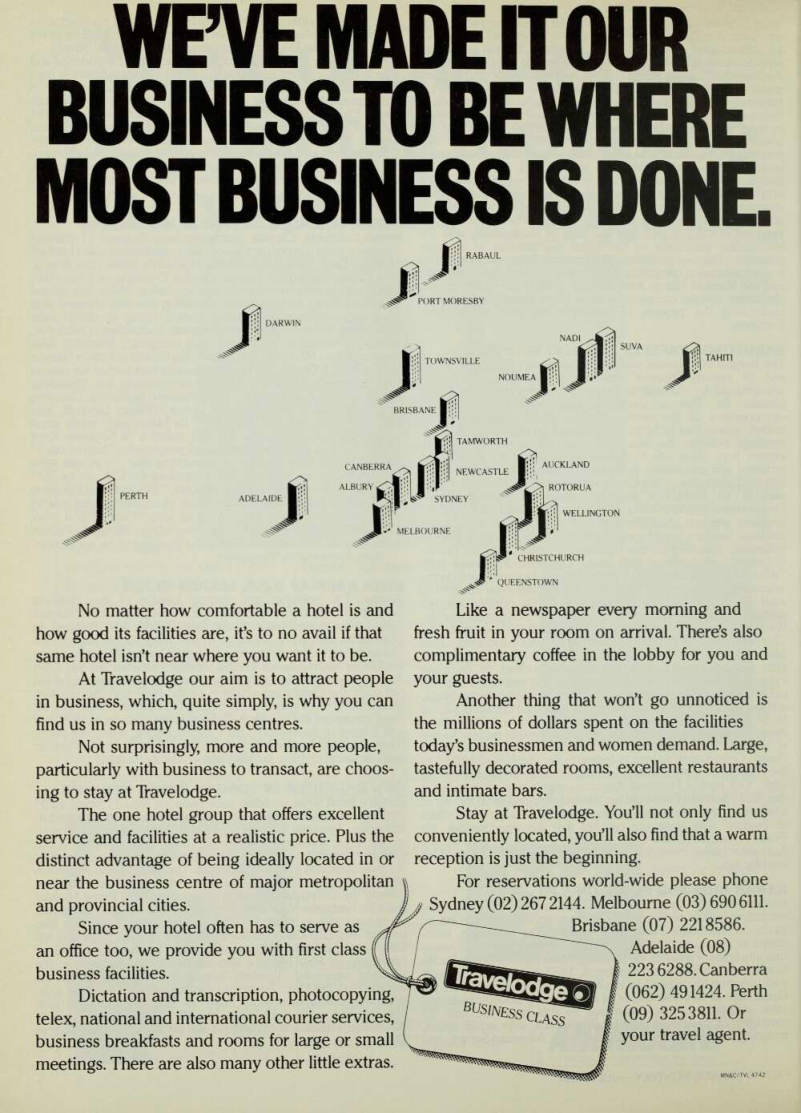
WE’VE MADE HOUR
BUSINESS TO BE WHERE
MOST BUSINESS IS DONE
j
RABAUL
I'/ 1
PORT MORESBY
DARWIN
TOWNSVILLE
NOUMEA
J
PERTH
ADELAIDE
I i
TAMWORTH
NADI
SUVA
J
TAHITI
AUCKLAND
ROTORUA
fil WELLINGTON
CHRISTCHURCH
QUEENSTOWN
No matter how comfortable a hotel is and how good its facilities are, it’s to no avail if that same hotel isn’t near where you want it to be.
At Travelodge our aim is to attract people in business, which, quite simply, is why you can find us in so many business centres.
Not surprisingly, more and more people, particularly with business to transact, are choosing to stay at Travelodge.
The one hotel group that offers excellent service and facilities at a realistic price. Plus the distinct advantage of being ideally located in or near the business centre of major metropolitan and provincial cities.
Since your hotel often has to serve as an office too, we provide you with first class business facilities.
Dictation and transcription, photocopying, telex, national and international courier services, business breakfasts and rooms for large or small meetings. There are also many other little extras.
Like a newspaper every morning and fresh fruit in your room on arrival. There’s also complimentary coffee in the lobby for you and your guests.
Another thing that won’t go unnoticed is the millions of dollars spent on the facilities today’s businessmen and women demand. Large, tastefully decorated rooms, excellent restaurants and intimate bars.
Stay at Travelodge. You’ll not only find us conveniently located, you’ll also find that a warm reception is just the beginning.
For reservations world-wide please phone Sydney (02) 267 2144. Melbourne (03) 690 6111.
Brisbane (07) 2218586.
Adelaide (08)
223 6288. Canberra (062) 491424. Perth (09) 3253811. Or your travel agent.
MN&C/TVL 4742
a
BUSINESS
UiASS
Letters
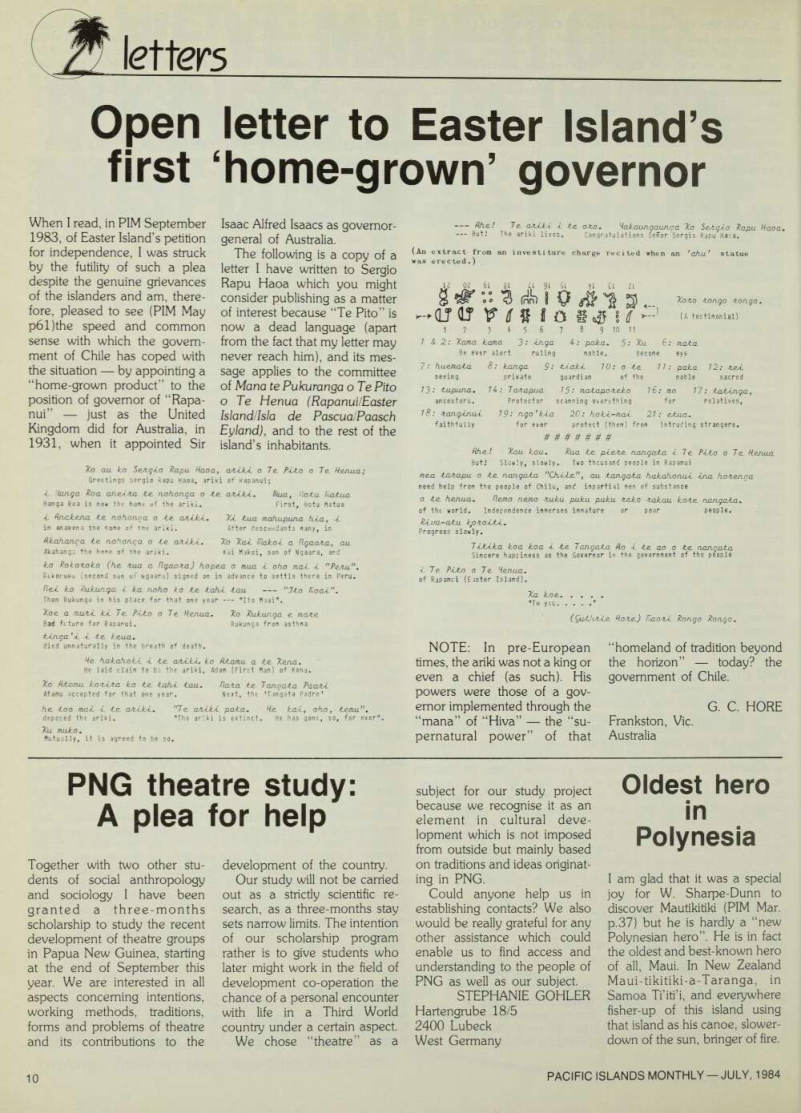
Open letter to Easter Island’s first ‘home-grown’ governor
When I read, in PIM September 1983, of Easter Island’s petition for independence, I was struck by the futility of such a plea despite the genuine grievances of the islanders and am, there fore, pleased to see (PIM May p6l)the speed and common sense with which the govern ment of Chile has coped with the situation by appointing a “home-grown product” to the position of governor of “Rapa nui” just as the United Kingdom did for Australia, in 1931, when it appointed Sir
Isaac Alfred Isaacs as governor general of Australia.
The following is a copy of a letter I have written to Sergio Rapu Haoa which you might consider publishing as a matter of interest because “Te Pito” is now a dead language (apart from the fact that my letter may never reach him), and its mes sage applies to the committee of Mana te Pukuranga o Te Pito o Te Henua (Rapanui/Easter Island/Isla de Pascua/Paasch Eyland), and to the rest of the island’s inhabitants.
NOTE: In pre-European times, the ariki was not a king or even a chief (as such). His powers were those of a gov ernor implemented through the “mana” of “Hiva” the “su pernatural power” of that
“homeland of tradition beyond the horizon” today? the government of Chile.
G. C. Hore
Frankston, Vic.
Australia
A plea for help
PNG theatre study: A plea for help
Together with two other students of social anthropology and sociology I have been granted a three-months scholarship to study the recent development of theatre groups in Papua New Guinea, starting at the end of September this year. We are interested in all aspects concerning intentions, working methods, traditions, forms and problems of theatre and its contributions to the
development of the country.
Our study will not be carried out as a strictly scientific re search, as a three-months stay sets narrow limits. The intention of our scholarship program rather is to give students who later might work in the field of development co-operation the chance of a personal encounter with life in a Third World country under a certain aspect.
We chose “theatre” as a
subject for our study project because we recognise it as an element in cultural deve lopment which is not imposed from outside but mainly based on traditions and ideas originat ing in PNG.
Could anyone help us in establishing contacts? We also would be really grateful for any other assistance which could enable us to find access and understanding to the people of PNG as well as our subject.
Stephanie Gohler
Hartengrube 18/5 2400 Lubeck West Germany
Polynesia
Oldest hero in Polynesia
I am glad that it was a special joy for W. Sharpe-Dunn to discover Mautikitiki (PIM Mar. p. 37) but he is hardly a “new Polynesian hero”. He is in fact the oldest and best-known hero of all, Maui. In New Zealand Maui-tikitiki-a-Taranga, in Samoa Ti’iti’i, and everywhere fisher-up of this island using that island as his canoe, slower down of the sun, bringer of fire.
Everywhere, his stories have their own special flavor. On Mungiki his battle with a crab, in which he marked the ani mal’s back (the mark is there to this day, which proves the story is true) has a light charm. In New Zealand, the story of his attempt to reverse death by entering the body of the Great Lady of Night, Hine-Nui-te-Po, his betrayal by the laughing
fantail, and his doom, has an awesome power.
But the constancy of the name and the main themes persisting across the oceans and the centuries point to a power in the oral tradition which we of the paper memory should have more respect for.
Hugh Young Momoke
Wellington New Zealand
Phosphates
and facts
Having been a reader of PIM for many years, I know that you share my belief that journalism cannot be made out of rumors and small-town polemics particularly in the delicate ba lance of the Pacific islands’ feelings and politics.
Yet I am shocked and appal led, as scientist, writer, and party to the subject-matter, by the lack of journalistic integrity and decency of the article of the Danielssons, “From Makatea to Mataiva” in PlM’s April issue.
Its unbroken string of errors and untruths could have been easily avoided by checking the public records or simply calling some of the concerned parties; the companies’ representatives, the administrative or government officers informed, the local service of mines, or myself.
What makes the thing worse is that your columnists built up their misrepresentations into some kind of plot and personal attack against the “French ty coon” Jean Breaud, of Tahiti, who, ironically, never assumed the possible existence of Mataiva; did not play any part in setting up the original Califor nia-based group of companies which initiated the prospecting; did not even ever attend any of the Raro Moana consortium meetings; has no active role and only a minority interest in my local company, Polymin, that he accepted to join as a friend of my family, with and for his son Olivier later assassin ated; and finally, has always spoken about the Mataiva pro ject more as an advocate of French Polynesia’s interests at large than of his own indirect and very modest interests in the venture.
The existence of Mataiva phosphates, or similar under water atollian deposits was nev er and nowhere hinted when I originated the idea in 1972 and started our explorations which took us, at some risk, during the last 10 years, across surfs, reefs, and storms, through some 75 Pacific atolls and 12 jurisdic tions. I frankly resent that the Danielssons deny me altogether the concept, the organisational effort and the discovery; that they take away my company from me: and that they don’t give me a phone call to check their facts!
The discovery of Mataiva occurred in 1976, not in 1978.
Pechiney is not a member of the consortium, having transfer red long ago its interests to BRGM, the French Govern ment mining agency. We did not make 400 “test pits” on Mataiva, but five. Your picture does not represent “one of the
phosphate prospecting sites” (one of the 400?!), but the site of the main dredge tests. The “monster dredge” is a small, scaled-down, semi-industrial testing unit. The 900 tons sent to the U.S. for industrial treat ment were 400 tons sent to New Zealand. And all this with the blessings of Francis San ford’s government council, well before Gaston Flosse got elected! How can the Daniels sons have misread so purposely their political calendar!
Should I continue? The minor outbreaks of ciguatera that many atolls experienced from the breakage and decay of some parts of the outer reef after the hurricanes were unre lated to the work done inside the lagoon. The minute phosphatised occurrences rec ognised in Pukapuka and Niau lagoons are a rather common event in our explorations and a far cry from the “important deposits of high-grade phos phate” suddenly discovered there by the Danielssons. There is no chance of any economic discovery in Pukapuka and not one in 10 in Niao. Someone indeed got phosphate fever!
Last, but not least, not only the majority of the inhabitants of Mataiva do not “protest” against Mataiva project, but im patiently ask for a go-ahead.
They undoubtedly sense that the time of the guano seekers, the Pacific Island Phosphate Company of Lord Stanmore and John Arundel, their related Compagnie des Phosphates de I’Oceanie, the British Phos phate Commissioners, Banaba,
Nauru, and all the Pacific phos phate lure, are gone; that we live in a global marketplace with the phosphates of Florida, Morocco, Jordan, and, tomor row, Mexico or Peru, at our doorsteps; and that in view of the uneasy techniques and the huge investment required, the deposit of Mataiva, minuscule by world standards, may well stay in the ground forever to the benefit of no-one, even if Mataiva Atoll were to become an independent nation!
Now, in all truth, we learnt here a lesson: that the next time we should be more careful about releasing timely informa tion about our endeavors, so that we don’t find ourselves, too late, hopping mad about their misrepresentation, wilful or not. (For your information, Geomarex is now operating in New Caledonia, through a sis ter company, Coralmin, SA, in joint venture with Union Oil’s minerals division; in New Zea land as Geomarex in joint ven ture with Todd Minerals and, again, Union’s minerals divi sion; and in Kiribati, solely, for the time being).
I would not have written this long letter, did I not appreciate PIM so much.
Andre Rossfelder,
President, Geomarex, Califor nia; Polymin, SA, Tahiti; Coral min, SA, Noumea. Author of “Clipperton, He Tragique”, Docteur es-Sciences (Marine geology).
La Jolla, Calif.,
Usa.
The old phosphate workings on Makatea, French Polynesia. Production ceased in 1966. Now, as reader Rossfelder writes, it’s “go” again for phosphate production in the territory, but at a new site W.A. Hornberg photo.
Advertisements & other items, pp. 12-13 (1 item)
The Datsun
spirit lives on.
ir H - Car of the future: aT I *7 • -r .. . .. « V ;• T».- • Perhaps you’ve noticed. Datsun is changing its name. But the spirit that made Datsun , a symbol for advanced automotive technology throughout the world will never disappear. Because now Datsun is Nissan.
Fact is, the two have always been one and the same. Nissan has been Datsun’s corporate name for over 50 years. The only change we’ve really made is to give our products their proper name.
So if you’ve begun to miss the name Datsun, rest easy.
The spirit that made Datsun Production line with welding robots so great is alive and well and living inside every Nissan. mmm
NISSAN
▲ WSf &£m
West Irian: suffering[?] uncertrainry,go on
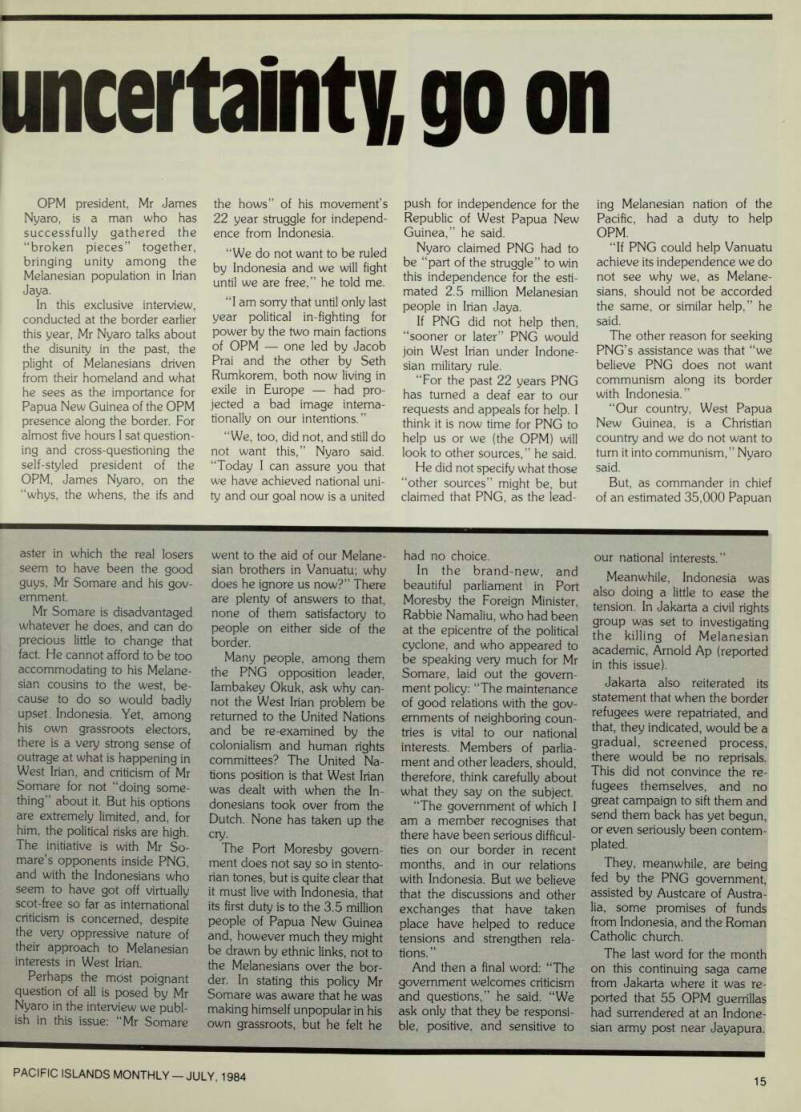
The Free West Papua Movement is seen by the Indonesians as a bunch of lawless rebels to be hunted down ruthlessly and removed from West Irian’s political scene as quickly as possible.
Papua New Guinea’s government is forced by the realities of international politics to put aside the ethnic links strongly felt by many PNG people at grassroots level. Port Moresby now finds the OPM a source of embarrassment at home, and in relations with Jakarta, and Canberra. Australia sought to stay out of the spotlight, but was dragged in when a row developed with Michael Somare’s government over an Australian-made television interview with OPM leader, James Nyaro. PIM has also interviewed Mr Nyaro, in considerably greater depth than the Australian Broadcasting Corporation, and in the following pages reports his perhaps simplistic, but undoubtedly sincere, views as told to Alfred Sasako.
The Free West Papua (OPM) movement was formed 22 years ago at Sorong and Manokwari in the southern section of the island Papua New Guinea shares with Indonesia.
It was started by leading Melanesian activists, including Abner Asmuruf and Permenasi Awom, whose brother, Joel, a major in the Indonesian para military mobile group main tained in Jayapura, was said to be involved in the planning of
the abortive uprising in Jayapura in February this year, Asmuruf and Permenasi were captured in 1967 and, according to some West Irianese living in Port Moresby, were later brutally murdered by Indonesian troops.
Asmuruf was the chairman of the fledgling movement back in 1962. Until 1982 the OPM suffered setbacks in its drive to draw international attention to its problem, due largely to political in-fighting over the movement’s leadership.
Nobody who cares for the peace and stability of the Pacific Islands can have taken the slightest comfort from the epi sodes of clumsiness, and mis fortune, which marked the lat est round in the continuing saga of the West Irian border. The outbreaks of foot-in-mouth dis ease spread from Port Moresby, through Sydney, and even to Melbourne. Only Jakarta re mained immune. The Indone sians who are, by some counts, the villains of the piece, but who are, of course, still the legal proprietors, kept their mouths shut and proceeded deter minedly in the direction of what they wanted: the crushing of the Irianese OPM rebels.
Meanwhile, in a row over where a television interview took place with West Irian guer rilla leader, James Nyaro, Papua New Guinea put clamps on the operations of foreign journalists in PNG, largely gag ged the Australian Broadcasting Corporation’s office in Port Moresby, and announced it would not renew the work
permit of Mr Sean Domey, the resident ABC man.
This in itself was seen, even by the ministers issuing the order, as entirely unfortunate.
Mr Dorney was the meat in the sandwich; the sacrificial goat in a dispute with the Australian media for which Mr Somare had no taste, but in which he saw for himself no other course.
At the heart of this row was the very different way in which Australian, and other western, international reporters see their rights and duties, as compared with the attitudes of the leaders of developing countries.
The offending program was ABC television’s Four Comers which, in the 1982 Fiji general elections, also ran foul of prime minister, Ratu Sir Kamisese Mara. As Mr Somare did last month, Ratu Mara accused them of failing to realise the values and the sensitivities of third world nations, and of sensationalising a very delicate and difficult situation for their own programming ends.
Papua New Guinea insisted that the Four Comers reporter,
Mr Allan Hogan, had been told not to entice Mr Nyaro on to PNG territory. Mr Hogan said he had not been so instructed.
Most likely he had been so advised, but not in terms that he, as pretty much a stranger to Melanesian courtesies, would fully recognise.
The other pity of the media mess over the issue was that the program, and the interview, probably were not worth all the fuss.
In Australia, however, it all assumed fairly large propor tions when the relatively new, “clean-up the image” chair man, of the ABC, millionaire retailer Mr Ken Myer, delivered himself of words seen as critical of working foreign correspon dents. He said, broadly, that they should accept what might be seen by them as censorship and refrain from embarrassing foreign governments. That caused a media uproar in Aus tralia, led to demands for Mr Myer’s resignation, for the “sor ting out” of ABC management, which seemed to have caused the upset in the first place by
agreeing to a reqest from Mr Somare not to screen the rather poor one-minute film of Mr Nyaro.
Mr Somare’s concern was that PNG would be seen by Indonesia as harboring and aid ing the rebel pretender. In the end, the film was screened, but so much fuss was generated that Jakarta saw honor as satis fied and congratulated PNG on its disciplining of the foreign media.
Then, somewhere in the mid dle of the storm, PNG bagged a visiting Indonesian journalist, more or less accused him of spying, but had to apologise publicly when he was proved to be innocent.
The whole affair had some of the aspects of a Wagnerian opera, complete with Valkyrian choruses of outraged journal ists, concerned members of the public, and bags of wounded, not least of them the board and management of the Australian Broadcasting Corporation.
As an opera it was totally absorbing. As an exercise in foreign relations it was a dis
OPM president, Mr James Nyaro, is a man who has successfully gathered the “broken pieces” together, bringing unity among the Melanesian population ,n Inan Jaya.
In this exclusive interview, conducted at the border earlier this year, Mr Nyaro talks about the disunity in the past, the plight of Melanesians driven from their homeland and what he sees as the importance for Papua New Guinea of the OPM presence along the border. For almost five hours I sat questioning and cross-questioning the self-styled president of the OPM, James Nyaro, on the “whys, the whens, the ifs and
the hows” of his movement’s 22 year struggle for independ ence from Indonesia. -‘ W e do not want to be ruled by Indonesia and we will fight w 0 afe „ he me “I am sorry that until only last V ear political in-fighting for Power by the two main factions °f OPM one led by Jacob P ra i an d the other by Seth Rumkorem, both now living in ex^e i n Europe had pro jected a bad image interna tionally on our intentions. ”
“We, too, did not, and still do not want this,” Nyaro said, “Today I can assure you that we have achieved national uni ty and our goal now is a united
push for independence for the Republic of West Papua New Guinea,” he said.
Nyaro claimed PNG had to be “part of the struggle” to win this independence for the esti mated 2.5 million Melanesian people in Irian Jaya.
If PNG did not help then, “sooner or later” PNG would join West Irian under Indone sian military rule.
“For the past 22 years PNG has turned a deaf ear to our requests and appeals for help. I think it is now time for PNG to help us or we (the OPM) will look to other sources,” he said.
Fie did not specify what those “other sources” might be, but claimed that PNG, as the lead
ing Melanesian nation of the Pacific, had a duty to help
Opm.
“If PNG could help Vanuatu achieve its independence we do not see why we, as Melane sians, should not be accorded the same, or similar help,” he said.
The other reason for seeking PNG’s assistance was that “we believe PNG does not want communism along its border with Indonesia.”
“Our country, West Papua New Guinea, is a Christian country and we do not want to turn it into communism, ” Nyaro said.
But, as commander in chief of an estimated 35,000 Papuan
aster in which the real losers seem to have been the good guys, Mr Somare and his gov ernment Mr Somare is disadvantaged whatever he does, and can do precious little to change that fact. He cannot afford to be too accommodating to his Melane sian cousins to the west, be cause to do so would badly upset. Indonesia. Yet, among his own grassroots electors, there is a very strong sense of outrage at what is happening in West Irian, and criticism of Mr Somare for not “doing some thing” about it. But his options are extremely limited, and, for him, the political risks are high.
The initiative is with Mr So mare’s opponents inside PNG, and with the Indonesians who seem to have got off virtually scot-free so far as international criticism is concerned, despite the very oppressive nature of their approach to Melanesian interests in West Irian.
Perhaps the most poignant question of all is posed by Mr Nyaro in the interview we publ ish in this issue: “Mr Somare
went to the aid of our Melane sian brothers in Vanuatu; why does he ignore us now?” There are plenty of answers to that, none of them satisfactory to people on either side of the border.
Many people, among them the PNG opposition leader, lambakey Okuk, ask why can not the West Irian problem be returned to the United Nations and be re-examined by the colonialism and human rights committees? The United Na tions position is that West Irian was dealt with when the In donesians took over from the Dutch. None has taken up the cry.
The Port Moresby govern ment does not say so in stento rian tones, but is quite clear that it must live with Indonesia, that its first duty is to the 3.5 million people of Papua New Guinea and, however much they might be drawn by ethnic links, not to the Melanesians over the bor der. In stating this policy Mr Somare was aware that he was making himself unpopular in his own grassroots, but he felt he
had no choice.
In the brand-new, and beautiful parliament in Port Moresby the Foreign Minister, Rabbie Namaliu, who had been at the epicentre of the political cyclone, and who appeared to be speaking very much for Mr Somare, laid out the govern ment policy: “The maintenance of good relations with the gov ernments of neighboring coun tries is vital to our national interests. Members of parlia ment and other leaders, should, therefore, think carefully about what they say on the subject.
“The government of which I am a member recognises that there have been serious difficul ties on our border in recent months, and in our relations with Indonesia. But we believe that the discussions and other exchanges that have taken place have helped to reduce tensions and strengthen rela tions.”
And then a final word: “The government welcomes criticism and questions,” he said. “We ask only that they be responsi ble, positive, and sensitive to
our national interests.”
Meanwhile, Indonesia was also doing a little to ease the tension. In Jakarta a civil rights group was set to investigating the killing of Melanesian academic, Arnold Ap (reported in this issue).
Jakarta also reiterated its statement that when the border refugees were repatriated, and that, they indicated, would be a gradual, screened process, there would be no reprisals.
This did not convince the re fugees themselves, and no great campaign to sift them and send them back has yet begun, or even seriously been contem plated.
They, meanwhile, are being fed by the PNG government, assisted by Austcare of Austra lia, some promises of funds from Indonesia, and the Roman Catholic church.
The last word for the month on this continuing saga came from Jakarta where it was re ported that 55 OPM guerrillas had surrendered at an Indone sian army post near Jayapura.
freedom fighters, he said, time was running out for him. “We may be left with little option.
That message to PNG is short and clear.”
Nyaro said any resort to the seeking of help from a com munist power would be “a last resort” and that he and his men were “prepared to fight to the last man until we have an answer from PNG.”
Nyaro blamed Australia for advising PNG against giving him any assistance.
But why Australia? 1 asked him. After all, PNG is an inde pendent, sovereign nation.
“PNG’s independence is only a rubber stamp from Aus tralia and even to this day everything is controlled by Can berra,” he retorted.
Despite the stem and very blunt nature of his words, Nyaro, a Dutch-educated agri culturalist who now styles him self “general,” speaks very quietly, almost in a monotone, but his conviction of the justice of his cause is strong and very clear. He looks older than his 42 years; grey flecks speckle his beard. His eyes look tired.
There is a depression on his left cheek, which might be the mark
of an old injury. He has the air of a man who feels himself to be at the centre of great events.
But surely, if PNG helped the OPM Indonesia would retaliate, I said.
“Well, now is the time for PNG to help us before security is tightened,” he said. “And even if Indonesia did learn about such help, and wanted to retaliate militarily, or otherwise, we would join forces to meet any threat,” he said. Nyaro might not have many guns, but he does not lack confidence.
“PNG must not forget that it is a member of the United Nations and the Common wealth, and I have no doubt in my mind that members of the Commonwealth would not just stand by and watch while one of its members was in difficul ty,” he said.
And then Nyaro repeated again what he seems to regard as his “message” for Port Moresby; “If PNG stands idly by now it will be swallowed whole by Indonesia later on.”
Nyaro said he was convinced Indonesia would one day in vade PNG. Far from being an embarrassment, he claimed, the OPM was in fact of benefit
James Nyaro, the man at the centre of an In* ternational political storm involving Papua New Guinea, Indonesia and Australia, is the fifth man to rise to leadership of the Oper* asi Papua Merdeka, the Free West Papua move* ment whose members are now being hunted down, and killed in hundreds, by Indone* sian troops in West Irian.
At 42 ’’General” Nyaro, as his followers call him, is one of the few Melanesians from Irian Jaya to have had the benefit of a college education. He was educated in Holland where he gradu ated with a diploma in agri culture and today he speaks English slowly, deliberately, and with a noticeable Dutch accent He regards himself as president of all Melanesians in West Irian, a group esti mated to number 2.5 million many (Nyaro claims most) of whom, now strenuously object to what they regard as the colonial rule imposed upon them from Java by the Indonesians. Nyaro worked briefly in East Java after his studies in Holland and be fore he was transferred to Jayapura, Irian Jaya’s capi tal, in 1981.
Like many of his race Nyaro is a small, nuggety man standing sft 6in tall, with a grizzled beard and tightly-fuzzed head of hair. He was for a time mar ried to a German girl who, with Nyaro, endured the unpleasantness of an In donesian jail because of their OPM activities. They are now divorced and Nyaro has married a local girl who lives with him in his mobile headquarters on the border.
As a public servant in Jayapura Nyaro had ser vants who attended to his routine in a large govern ment house which went with his job. He was then one of the few Melanesians in a senior administrative posi
tion within the Indonesian government But he fumed about what he saw as the subjugation of his race, and the gradual loss of Melanesian identity within their own land. In 1982 he slipped away from Jayapura to join the hundreds of others already in OPM’s jungle guerrilla encamp ments.
He soon rose into a posi tion of influence, but kept himself clear of the faction fighting and rivalry which for many years had diffused and weakened OPM’s posi tion. Now, with the two main faction-leaders, Jacob Prai and Seth Rumkorem, in exile overseas, Nyaro has come into his apparently undisputed own.
His rebel ’’government” comprises 27 ministers, in cluding a defence minister, Alex Deray who supervises training of the guerrilla bands which ambush, snipe at and generally harrass In donesian forces in Irian Jaya. Deray claims to have 35,000 men under his com mand, dividing them into seven provincial military groups of 5000 men each.
These are Biak, Merauke, Sorong, Fakfak, Jayapura, Manokwari and Wamena.
Deray says he was trained in guerrilla warfare in Hol land (although he does not say by whom) and came back to Irian Jaya five years ago to go into the jungle and pass on his knowledge.
Not all of the 27 ’’minis ters” are in Irian Jaya. Some live overseas but all are doing what they can to promote the cause of Melanesian freedom in Irian Jaya, Nyaro says.
Nyaro claims an extensive and sophisticated intelli gence system linking his jungle headquarters and en campments with agents in Jayapura, Jakarta, and cities all over the world.
Nyaro himself lives with a semi-nomadic jungle-based group which, he says, num bers 8000 including women and children.
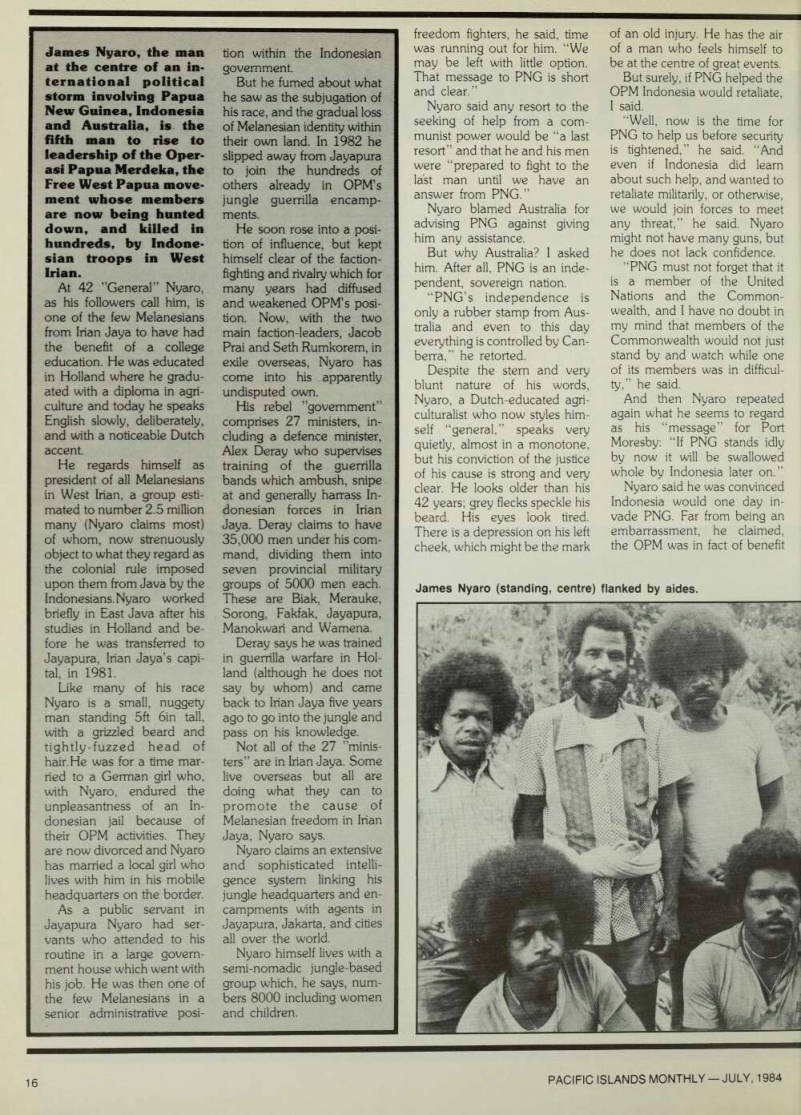
James Nyaro (standing, centre) flanked by aides.
to PNG. “Our presence helps keep the military regime of President Suharto from making any advances.
“But the time may be sooner than most people think when the Indonesians will come mar ching into PNG,” he said.
For many years, he said, the OPM had provided PNG with intelligence reports which, he claimed, “consistently pointed to Indonesia advancing east wards. ”
What form of help did he need from PNG?
“Our immediate problems are two-fold,” he replied. “We urgently need arms, including 2250 automatic rifles, machine guns, hand-grenades and other ammunition. Our other urgent request is that we be allowed exit through PNG so that I can take my people’s struggle for independence to international bodies, including the South Pacific Forum and the United Nations. ”
Nyaro conceded that at pre sent his men had few guns; those they carried were mostly gathered from Indonesian sol diers killed in jungle ambushes. (“Our Melanesian brothers have given their lives for the
arms we do have...”).
Some apparently reliable re ports say they have a few Israeli-made weapons, though nobody seems to know how many, or from whom they were obtained. But most OPM jungle fighters seem to use bows and arrows, spears and hatchets.
Food, medical care and shel ter seem to be of little concern to them. “We are living on soil, just like any other people, and food is the least of our worries,”
Nyaro said. “Even clothing is no problem.” Some of Nyaro’s men are deserters from the Indonesian forces and still wear the uniforms, and colorful red, bright blue and khaki berets of Indonesian regiments. Nyaro himself sometimes wears T shirts, and on other, perhaps more formal, occasions, dons a jungle green uniform without badges either of rank or identi ty- “ Medical care is our main problem. Because Indonesia is hostile to us, our sick children, women and men are just left to either recover without help, or die,” Nyaro said.
“In the past PNG was good to us, by allowing some of our sick people to be treated at
Vanimo (PNG’s most northern town on the 800 km long bor der), but this has been stopped by the Foreign Affairs Depart ment,” he said.
Could they not get treatment in Jayapura?
“Oh, no. We cannot go back to Jayapura. The Indonesians would just kill us, knowing that we are OPM members,” he said. Lately, however, he said, OPM had stopped sending its sick to Vanimo because the first batch, having been treated, was sent back to Jayapura. What had happened to them after that he did not know. Only the Indonesians knew, Nyaro said.
In the jungle the main killer diseases were cerebral malaria and diarrhoea.
Nyaro’s account of the Feb ruary clashes between OPM and Indonesian troops in Jayapura is somewhat different from official statements, and suggests much more activity, and considerably greater vio lence.
According to him about 150 Melanesian soldiers in the In donesian armed forces, includ ing the second-in-command of the para-military mobile bri gade (BRIMOB), Major Joel
Awom, held a meeting of dissi dents in Jayapura last Decem ber. They decided to activate OPM operations, firstly in Jayapura. Nyaro said a mes sage was relayed to him at OPM headquarters along the border that the troops were ready to strike on or about February 13.
He approved the plan, he said, but before it could be executed Indonesian intelli gence had intercepted it, for cing the planners to launch their attack four days early, on Feb ruary 9. (Other reports suggest the OPM adherents became over-excited by the prospect of an uprising and talked about their plans in the hearing of Indonesian agents or informers.
The Jayapura military com mander immediately began arresting known sympathisers.) Major Joel Awom, whose elder brother, Permenasi Awom, was one of the founders of OPM, moved out with those troops loyal to him, and broke into the army barracks in Jayapura. They seized a large quantity of guns and ammuni tion, said Nyaro, which enabled them to launch a series of hit-run attacks on Indonesian
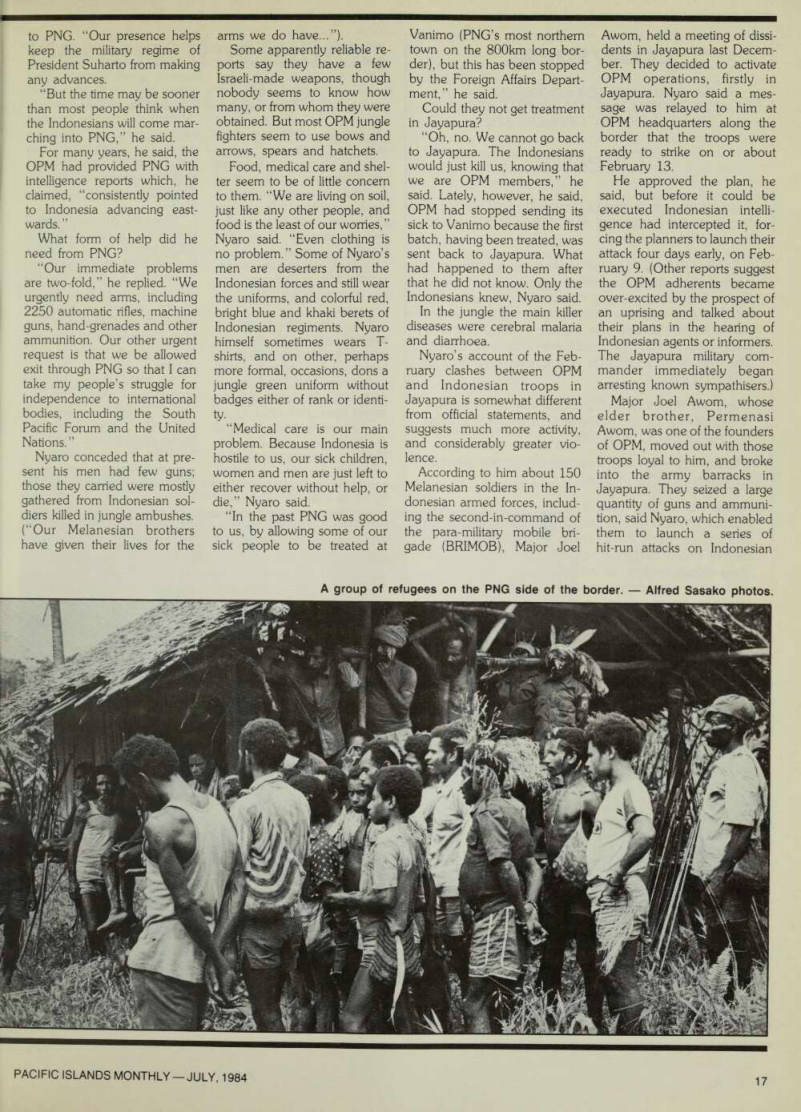
A group of refugees on the PNG side of the border. Alfred Sasako photos.
troops in and around Jayapura.
Other Melanesians in the In donesian forces deserted and joined the rebels. Some fled across the border and were among early groups of refugees collected at Vanimo and charged by PNG authorities with illegal entry.
Nyaro claims that Jayapura was blacked out totally as pow er and telecommunications were destroyed in violent clashes between OPM guerrillas and Indonesians. Two OPM members were shot dead as they tried to raise the move ment’s flag at the provincial parliament building in Jayapura.
The Indonesians began re taliatory attacks all over the town; the city’s residents, main ly women and children, began to flee into PNG. This flood has continued, as Indonesian re prisals have gone on.
They represent a grave embarrassment for the Port Moresby government which, undoubtedly, will be judged wrong , either by Indonesia, or by its own people, whatever it finally decides to do with the refugees.
For there can be no doubt that the refugees are very afraid about what could happen to them if they were pushed back over the border, and very little question but that their fears are well-grounded.
“We appeal to PNG to look after our children and women now in Vanimo and other bor der villages,” said Nyaro.
“Their lives are in great danger if they are returned to Jayapura. ”
On Indonesia’s transmigra tion policy Nyaro said that up to 1980 as many as 90,000 Javanese had been resettled along the PNG-Indonesian frontier.
“But don’t think these settlers are ordinary civilians,” he said.
“They are trained military per sonnel disguised as civilian set tlers,” he said. (This accords with other reports, some of them from Jakarta, which talk of Indonesian Army families being the “foundation” of new settlements along the road In donesia is building the length of the frontier).
As day dawned at the end of the interview, 1 asked Nyaro
what plans he had, if ever his people gained independence.
“Irian Jaya will retain the present seven districts (pro vinces) each under a comman ding militwry officer,” he said.
“Military rule will be imposed for two years after Indonesia grants our independence so that we can ensure proper and effective security against any clandestine operations by In donesia.
“When the 24-month period has elapsed, a national election will be held so that a democra tically-elected government can be installed. It will be up to the national parliament to decide on the number of provinces and whether West Papua New Guinea should have a president or a governor-general as head of state.
“All these things are en shrined in our constitution,” he said. “The fighting going on is indicative of how-soon we want to be independent from In
donesia. ”
Alfred Sasako.
Avebury’s call
Lord Avebury, chairman of the British Parliamentary Human Rights Group, wants Irian Jaya and East Timor discussed at a meeting at The Hague, Hol land, next month when an international aid consortium will consider a US$2.5 billion aid package for Indonesia.
Lord Avebury said his group, representing 100 Westminster parliamentarians, were con cerned about the border con flict and the alleged violation of human rights. A dossier on both territories had been delivered to the British Foreign Secretary and the London representatives of 17 other governments, in cluding Australia, who are members of the inter-govern ment group on Indonesia.
This body meets annually to decide levels of assistance and is due to discuss this month a World Bank proposal for the massive sum of aid. ”It is an ideal opportunity for getting some assurance from Indonesia that they will stop military operations near the border, put a halt to death squads and recognise the prob lem of the refugees in PNG,"
Lord Avebury said.
Advertisements & other items, p. 18 (1 item)
Director
CCOP/SOPAC
THE COMMITTEE FOR COORDINATION
OF JOINT PROSPECTING FOR MINERAL RESOURCES
IN SOUTH PACIFIC OFFSHORE AREAS
Director
Applications are invited for the position of Director of the Technical Secretariat of CCOP/SOPAC, located in Suva, Fiji.
CCOP/SOPAC is an inter-governmental organization composed of eleven countries* of the South Pacific. Its primary objective is to survey the inshore and offshore marine areas of its member countries to identify the marine mineral resource potentials within their Exclusive Economic Zones.
The Technical Secretariat is the executive arm of
CCOP/SOPAC.
The main duties of the Director will be to assume responsibility for the management of the Technical Secretariat of CCOP/SOPAC.
The post is restricted to nationals of the member countries of CCOP/SOPAC.
Applicants should have a degree in Science, with management/finandal experience in addition to technical experience in their area of expertise. A degree in one of the geosciences would be an asset.
They should be familiar with funding organizations, and have an understanding of the structure of member governments. A proven ability to work harmoniously with South Pacific Island Governments would be an advantage.
Salary and conditions of service are negotiable. The successful applicant may initially be appointed on a one-year probationary basis as Director-Designate and thereafter for two or more year periods.
Fully documented applications, including details of work experience and qualifications and the names of at least 3 references , should be forwarded to Director Application CCOP/SOPAC Technical Secretariat C/- Mineral Resources Department Private Mail Bag SUVA, Fiji.
Applications should reach the Technical Secretariat by 31 August 1984. * Member countries of CCOP/SOPAC are: Cook Islands. Fiji, Kiribati, Guam, New Zealand, Papua New Guinea.
Solomon Islands, Tonga. Tuvalu. Western Samoa and Vanuatu.
Behind the killing

of Arnold Ap
Arnold Ap, an Irianese intellec tual and academic, was mur dered in prison last April by an Indonesian goon squad. As a killing it was not untypical of Indonesian dealings in Irian Jaya, and has been condemned as such. But as a political decision, which it appears to have been, it was an act of stupidity. For Ap has become a martyr, identifiable not only inside Irian Jaya, but outside, in Australia, Holland, and the Un ited States. The Indonesian hierarchy has killed off a troublesome figure, but in so doing has lost many of its former supporters and apolog ists. Jakarta’s position in the present Irianese crisis is thereby now a deal more fragile and less popular.
Nobody knows how many Irianese have died over the last 20 years in prison, or in jungle skirmishes, as a result of In donesian reaction to the activi ties of the Operasi Papua Mer deka (Free Papua Movement).
The total may run into thousands, giving credence to angry claims that the Indone sian ’’colonial masters” of Irian Jaya aim at genocide and the destruction of Melanesian cul ture. But of all the killings none has stirred quite the reaction that greeted the death of Arnold Ap, a gentle, likeable man, who was curator of a little anthro pological museum attached to Cenderawasih University in Jayapura. Ap was popular and respected. He was careful and thoughtful; a scholar much
more than a typical ’’freedom fighter.” And, at the age of 36, defenceless and alone, he was shot dead in his solitary con finement cell in Jayapura prison by his Indonesian jailers .
Those who knew him say Ap, though a sympathiser, was not an OPM activist. He was, how ever, deeply dedicated to the preservation of Irianese culture and it was this, and his position as a leading Irianese intellec tual, which undoubtedly led to his murder at the end of April.
The Indonesian goon squad ’’murdered Arnold Ap in pre meditated fashion because he was an intellectual who personi fied Irianese culture, which some powerful figures in In donesia are not prepared to tolerate,” wrote Peter Hastings, foreign editor of The Sydney Morning Herald. ’’There are no prizes for guessing who they are. The people who murdered Ap are the people who excused ill thought-out policies in Irian
Jaya with the question ’do you want us to keep the place as a zoo?’” said Hastings. ’’Arnold Ap’s murder is inex cusable on humanitarian grounds. On political grounds it is sheer lunacy...lf the Indone sian government wants to double the number of Irianese refugees, now a record 4800 crossing into PNG; if it wants to go on senselessly alienating the Irianese, especially around Jayapura and the border; if it wants to entrench mounting PNG resentment; if it wants to indulge in the counter-produc tive exercise of generating Aus tralian anti-Indonesian feelings, then murdering (Arnold Ap) is the right way to go about it.”
The murder revealed ”an appalling Indonesian misjudg ment of feeling abroad,” Has tings said. ’’While the problem of nation-building in a huge disparate country of 150 million people of diverse religious, ethnic and cultural back grounds requires measures too easily criticised by societies more fortunately-placed, the fact remains that Indonesia’s New Order government in creasingly endangers its claims to be regarded as either just or civilised. ”How can it justify the extra judicial murder of some 4000 criminals, including many inno cents, by army hit squads?
Where are the police, the courts, the judges? Where is the
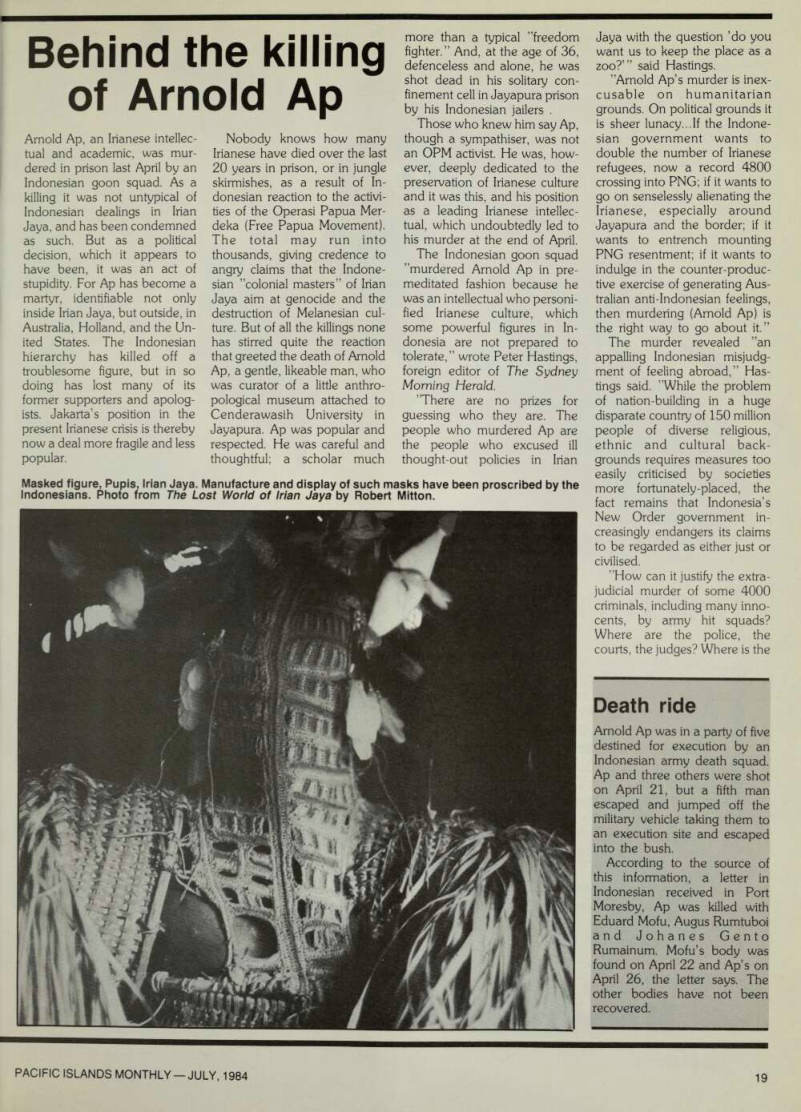
Masked figure, Pupis. Irian Jaya. Manufacture and display of such masks have been proscribed by the Indonesians. Photo from The Lost World of Irian Jaya by Robert Mitton.
rule of law?”
Arnold Ap was from Biak, a Protestant who went to school first under the Dutch and then the Indonesians. He was known among Pacific intellectuals as a man devoted to preservation of Melanesian culture, particularly its legends, songs and dance.
He sought to preserve Irianese ethnic identity in the face of Javanisation by the territory’s Muslim administrators.
He was fond of collecting songs and stories on tape, but was dismayed to discover that the Indonesian army had used some of these records to entice villagers out of the bush whence they had fled ahead of military sweeps against the
Opm.
Becoming increasingly out spoken and anti-Indonesian, Ap was finally arrested late in 1983 and held in Jayapura prison without charge or trial.
His family was not allowed to visit him.
According to some Indone sian sources reported in Sydney Ap and four others escaped from the prison on April 21.
They were recaptured but,
according to the report, Ap again attempted to escape... and was shot while making the attempt.
Few believe that. Most are convinced he was cold bloodedly murdered.
Murder or not, the shooting has rendered Indonesia’s posi tion in Irian Jaya vastly more difficult. And, that being so, the situation is now measurably more fragile. • • • Angry letters, condemning In donesia for the murder of Arnold Ap, hit the Australian press almost immediately.
Among them were some from leading academics previously noted for their support of In donesia’s viewpoint.
Four leading figures from the Research School of Pacific Stu dies; joined with Antony Forge, of the Australian National Uni versity, to write to the Sydney Morning Herald, which pub lished their letter under the heading, “Indonesian Repre ssion at its Worst.” J.A.Mackie, Peter McCawley, James Fox
snd Anthony Reid, with Forge, wrote: “Having noted with moun ting concern the heavy-handed methods of the Indonesian Government in dealing with dissidents in Irian Jaya and East Timor over the past year, we feel compelled to make some public protest about the shoot ing of Arnold Ap...This act of singular inhumanity is both politically senseless and morally indefensible.
“It is not least so because it occurred at the very time when Indonesian intellectuals, academics, and journalists were attempting to increase aware ness of Irianese culture through the medium of an Irian Jaya Festival.
“Those of us who count ourselves Indonesia’s staunch friends in Australia, and who have long been endeavoring to present the Indonesian side of the story to the Australian public on controversial issues, find it impossible to defend or condone this kind of be havior...”.
Four Sydney University academics also condemned the
killing which, they said, “tra gically illustrates a return to the cruder forms of officially sanc tioned repression that characte rised the treatment of dissidents in Indonesia in the late 1960 s and 19705. In the past few years there seemed to be signs that the Indonesian Govern ment was willing to adopt re latively more humane priorities in the treatment of its political opponents; now, however, in the wake of the murder of thousands of ‘criminals’ by Government-sponsored death squads, the increasingly repres sive action being taken by the Indonesian military against dissidents in East Timor and West Irian has once again con signed humanitarianism to the political wilderness in Indone sia.”
The four, Helen Jarvis, Carolyn van Langenberg, Michael van Langenberg, and Thea van Lennep, said they considered Indonesia’s recent policies in West Irian and East Timor had served to reinforce “a common public view in Australia,” that Indonesia was “an expansionist military state.”
Death ride
Arnold Ap was in a party of five destined for execution by an Indonesian army death squad.
Ap and three others were shot on April 21, but a fifth man escaped and jumped off the military vehicle taking them to an execution site and escaped into the bush.
According to the source of this information, a letter in Indonesian received in Port Moresby, Ap was killed with Eduard Mofu, Augus Rumtuboi and Johanes Gento Rumainum. Mofu’s body was found on April 22 and Ap’s on April 26, the letter says. The other bodies have not been recovered.
Advertisements & other items, pp. 20-21 (1 item)
S National
Listen to a Dream
Close your eyes and listen. You’ll hear music that is rich, full, and luxurious as a lazy morning— music like you’ve never heard before from a compact stereo radio cassette recorder. You’re not dreaming, you’re listening to National’s RX-F4F.
The RX-F4F features a preset equalizer that lets you color your own sound of music at the press of a button with low, middle, and high-frequency boosts and a high-frequency cut. Combine any or all four settings any way you like to bring out the best in cassette tapes or FM/MW/SWI/SW2 broadcasts.
A two-way, four-speaker system that handles 16W of power (P.M.P.0.) can provide some very wide-awake volume levels without distortion, while Ambience Stereo envelopes you in enhanced stereo imaging. There’s even a built-in AC transformer to keep things compact and tidy.
The RX-F4F. You couldn’t dream of a more beautiful sound.
S National
National. Panasonic and Technics are the brandnames of Matsushita Electric
aaoaaaina ®ij®
D There is a Roncaglia OPR to suit every miller production requirement and milling situation, made possible by the modular concept engineered into Roncaglia mills.
Only a Roncaglia mill can be built in stages either for increasing production or milling different cereals simultaneously.
This is only one of the advantages of the Roncaglia milling system if you wish to know more, simply fill in the coupon and we will mail you more about Roncaglia techniques.
RONCAGLIA
Officine Roncaglia S.p.A 1-41100 Modena - Italy It Viale Reiter 51 /2 - Tel. (059) 21.88.99-21.85.51 -24.10.52 - Telex 213384-216089-510169 RONCALI
Will Sid really run?
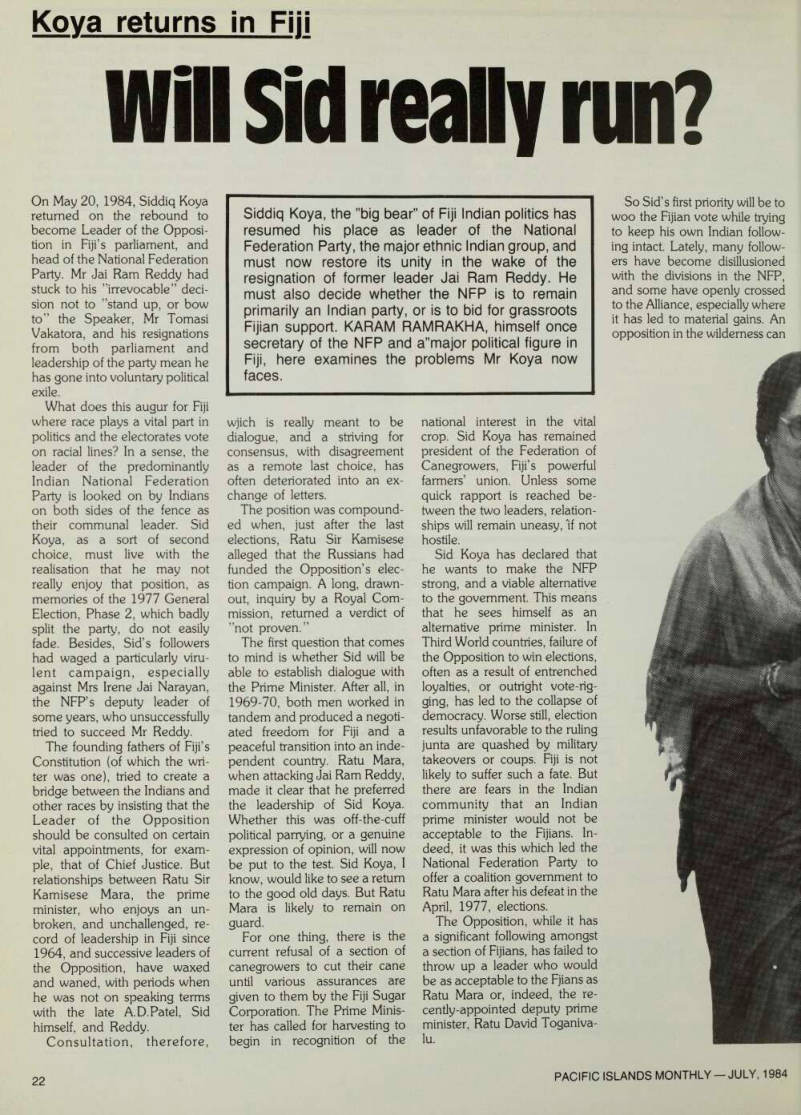
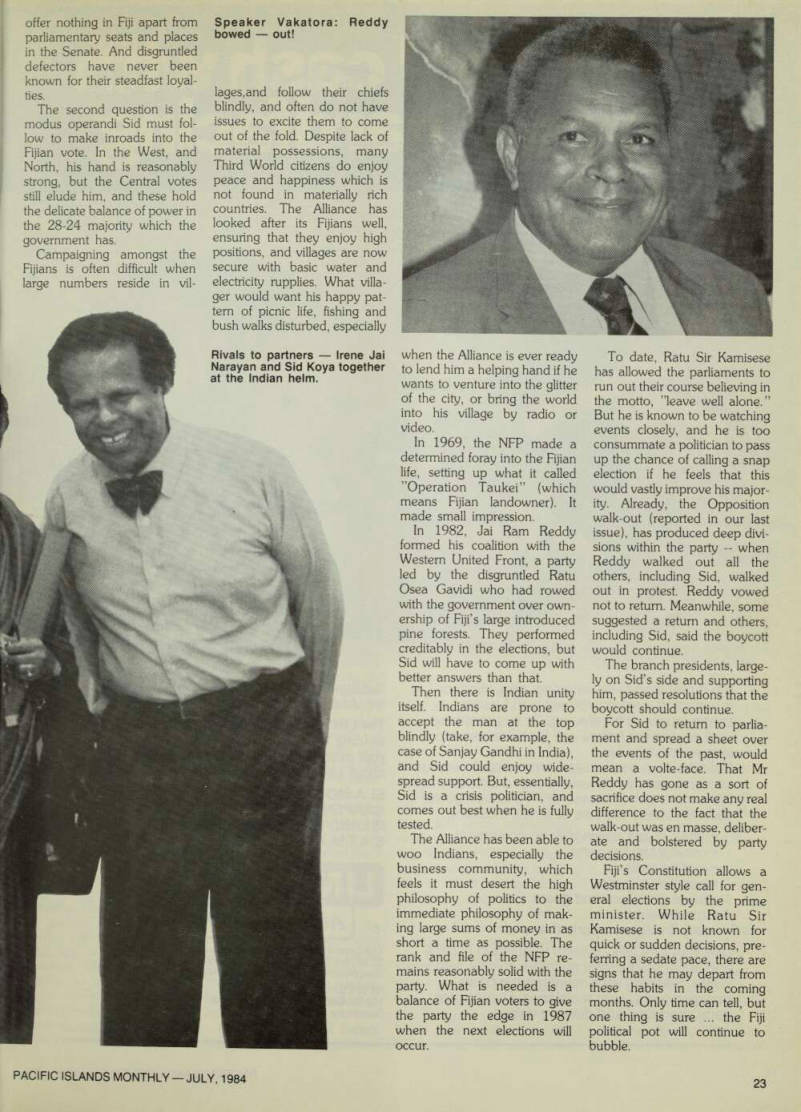
Kova returns in Fiji
Siddiq Koya, the ’’big bear” of Fiji Indian politics has resumed his place as leader of the National Federation Party, the major ethnic Indian group, and must now restore its unity in the wake of the resignation of former leader Jai Ram Reddy. He must also decide whether the NFP is to remain primarily an Indian party, or is to bid for grassroots Fijian support. KARAM RAMRAKHA, himself once secretary of the NFP and a”major political figure in Fiji, here examines the problems Mr Koya now faces.
On May 20, 1984, Siddiq Koya returned on the rebound to become Leader of the Opposi tion in Fiji’s parliament, and head of the National Federation Party. Mr Jai Ram Reddy had stuck to his ’’irrevocable” deci sion not to ’’stand up, or bow to” the Speaker, Mr Tomasi Vakatora, and his resignations from both parliament and leadership of the party mean he has gone into voluntary political exile.
What does this augur for Fiji where race plays a vital part in politics and the electorates vote on racial lines? In a sense, the leader of the predominantly Indian National Federation Party is looked on by Indians on both sides of the fence as their communal leader. Sid Koya, as a sort of second choice, must live with the realisation that he may not really enjoy that position, as memories of the 1977 General Election, Phase 2, which badly split the party, do not easily fade. Besides, Sid’s followers had waged a particularly viru lent campaign, especially against Mrs Irene Jai Narayan, the NFP’s deputy leader of some years, who unsuccessfully tried to succeed Mr Reddy.
The founding fathers of Fiji’s Constitution (of which the wri ter was one), tried to create a bridge between the Indians and other races by insisting that the Leader of the Opposition should be consulted on certain vital appointments, for exam ple, that of Chief Justice. But relationships between Ratu Sir Kamisese Mara, the prime minister, who enjoys an un broken, and unchallenged, re cord of leadership in Fiji since 1964, and successive leaders of the Opposition, have waxed and waned, with periods when he was not on speaking terms with the late A. D. Patel, Sid himself, and Reddy.
Consultation, therefore,
wjich is really meant to be dialogue, and a striving for consensus, with disagreement as a remote last choice, has often deteriorated into an ex change of letters.
The position was compound ed when, just after the last elections, Ratu Sir Kamisese alleged that the Russians had funded the Opposition’s elec tion campaign. A long, drawn out, inquiry by a Royal Com mission, returned a verdict of ’’not proven.”
The first question that comes to mind is whether Sid will be able to establish dialogue with the Prime Minister. After all, in 1969-70, both men worked in tandem and produced a negoti ated freedom for Fiji and a peaceful transition into an inde pendent country. Ratu Mara, when attacking Jai Ram Reddy, made it clear that he preferred the leadership of Sid Koya.
Whether this was off-the-cuff political parrying, or a genuine expression of opinion, will now be put to the test. Sid Koya, I know, would like to see a return to the good old days. But Ratu Mara is likely to remain on guard.
For one thing, there is the current refusal of a section of canegrowers to cut their cane until various assurances are given to them by the Fiji Sugar Corporation. The Prime Minis ter has called for harvesting to begin in recognition of the
national interest in the vital crop. Sid Koya has remained president of the Federation of Canegrowers, Fiji’s powerful farmers’ union. Unless some quick rapport is reached be tween the two leaders, relation ships will remain uneasy, 'if not hostile.
Sid Koya has declared that he wants to make the NFP strong, and a viable alternative to the government. This means that he sees himself as an alternative prime minister. In Third World countries, failure of the Opposition to win elections, often as a result of entrenched loyalties, or outright vote-rig ging, has led to the collapse of democracy. Worse still, election results unfavorable to the ruling junta are quashed by military takeovers or coups. Fiji is not likely to suffer such a fate. But there are fears in the Indian community that an Indian prime minister would not be acceptable to the Fijians. In deed, it was this which led the National Federation Party to offer a coalition government to Ratu Mara after his defeat in the April, 1977, elections.
The Opposition, while it has a significant following amongst a section of Fijians, has failed to throw up a leader who would be as acceptable to the Fjians as Ratu Mara or, indeed, the re cently-appointed deputy prime minister, Ratu David Toganiva lu.
So Sid’s first priority will be to woo the Fijian vote while trying to keep his own Indian follow ing intact. Lately, many follow ers have become disillusioned with the divisions in the NFP, and some have openly crossed to the Alliance, especially where it has led to material gains. An opposition in the wilderness can
offer nothing in Fiji apart from parliamentary seats and places in the Senate. And disgruntled defectors have never been known for their steadfast loyal ties.
The second question is the modus operandi Sid must fol low to make inroads into the Fijian vote. In the West, and North, his hand is reasonably strong, but the Central votes still elude him, and these hold the delicate balance of power in the 28-24 majority which the government has.
Campaigning amongst the Fijians is often difficult when large numbers reside in vil
lages,and follow their chiefs blindly, and often do not have issues to excite them to come out of the fold. Despite lack of material possessions, many Third World citizens do enjoy peace and happiness which is not found in materially rich countries. The Alliance has looked after its Fijians well, ensuring that they enjoy high positions, and villages are now secure with basic water and electricity rupplies. What villa ger would want his happy pat tern of picnic life, fishing and bush walks disturbed, especially
when the Alliance is ever ready to lend him a helping hand if he wants to venture into the glitter of the city, or bring the world into his village by radio or video.
In 1969, the NFP made a determined foray into the Fijian life, setting up what it called ’’Operation Taukei” (which means Fijian landowner). It made small impression.
In 1982, Jai Ram Reddy formed his coalition with the Western United Front, a party led by the disgruntled Ratu Osea Gavidi who had rowed with the government over own ership of Fiji’s large introduced pine forests. They performed creditably in the elections, but Sid will have to come up with better answers than that.
Then there is Indian unity itself. Indians are prone to accept the man at the top blindly (take, for example, the case of Sanjay Gandhi in India), and Sid could enjoy wide spread support. But, essentially, Sid is a crisis politician, and comes out best when he is fully tested.
The Alliance has been able to woo Indians, especially the business community, which feels it must desert the high philosophy of politics to the immediate philosophy of mak ing large sums of money in as short a time as possible. The rank and file of the NFP re mains reasonably solid with the party. What is needed is a balance of Fijian voters to give the party the edge in 1987 when the next elections will occur.
To date, Ratu Sir Kamisese has allowed the parliaments to run out their course believing in the motto, ’’leave well alone.”
But he is known to be watching events closely, and he is too consummate a politician to pass up the chance of calling a snap election if he feels that this would vastly improve his major ity. Already, the Opposition walk-out (reported in our last issue), has produced deep divi sions within the party when Reddy walked out all the others, including Sid, walked out in protest. Reddy vowed not to return. Meanwhile, some suggested a return and others, including Sid, said the boycott would continue.
The branch presidents, large ly on Sid’s side and supporting him, passed resolutions that the boycott should continue.
For Sid to return to parlia ment and spread a sheet over the events of the past, would mean a volte-face. That Mr Reddy has gone as a sort of sacrifice does not make any real difference to the fact that the walk-out was en masse, deliber ate and bolstered by party decisions.
Fiji’s Constitution allows a Westminster style call for gen eral elections by the prime minister. While Ratu Sir Kamisese is not known for quick or sudden decisions, pre ferring a sedate pace, there are signs that he may depart from these habits in the coming months. Only time can tell, but one thing is sure ... the Fiji political pot will continue to bubble.
Speaker Vakatora: Reddy bowed out!
Rivals to partners Irene Jai Narayan and Sid Koya together at the Indian helm.
Advertisements & other items, p. 24 (1 item)
Lincoln hardfacing
Save hard cash with
HSS •-■ S Sc 2 SS -■ : : -|p BH hi ifa 6 11 ft ■■ ' ,
f •* ;.'■ V V JC
/5 Wl| ' T; „ : ,■ ■ ■-■■-::■ ' ■: v; : : ;V. U■■ jggsgf-. ; -- s ; Save real money by repairing, rebuilding, or resurfacing worn equipment with Lincoln continuous wire hardfacing. Or by hardfacing new equipment before use for extra wear and longer working life.
Beat the high cost of replacement parts, labour, and unnecessary downtime with a LINCPAC wire feeder and petrol, diesel, or PTO-driven power source. Handle big jobs or small, including: • tines of any sowing/tillage equipment • crawler/tractor parts • cutting tools • posthole diggers • steel sprockets and gears • machine parts • any linkages or parts that wear Use your LINCPAC system to build up impactand abrasion-resistant surfaces quickly, with less waste. Slashing your maintenance costs.
Increase parts’ wear resistance. Overcoming parts shortages and delivery delays.
Substantially increasing equipment working life. And ensuring maximum productivity.
The LINCPAC continuous wire system. It’s like welding with 180 sticks - without 180 stops. See your nearest Lincoln dealer now for the hard facts about saving hard cash with LINCPAC hardfacing.
ELA MOTORS - Port Moresby.
CARPENTER MOTORS LTD. - Suva.
ISLAND ENTERPRISES - Honiara.
S.A.T.M.A. - Noumea.
LINCOLN
\arc welding]
The Lincoln Electric Company (Australia) Pty. Limited, 35 Bryant Street, Padstow, N.S.W. 2211 Telephone (02) 7727222. Telex AA22792
NEW ZEALAND
152 St. Georges Road, Auckland Telephone 885180. Telex 21803
LE151.25/18.S&P
End of the road for the Bank of
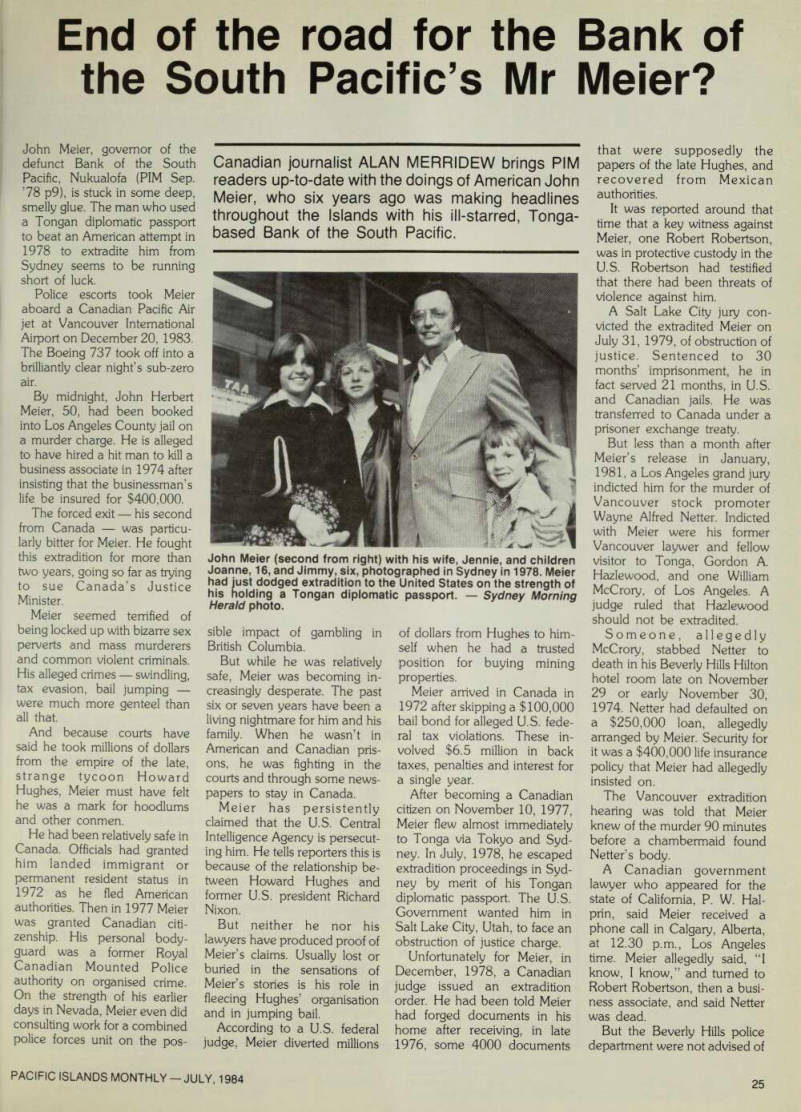
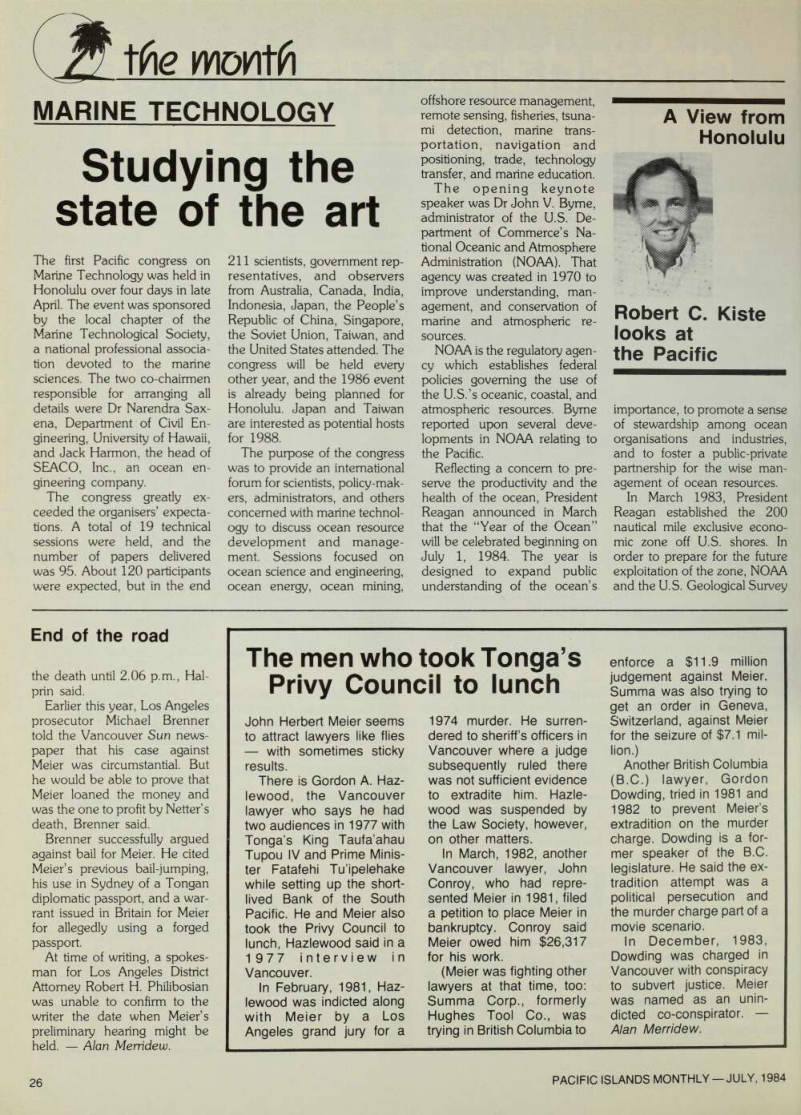
the South Pacific’s Mr Meier?
Canadian journalist ALAN MERRIDEW brings RIM readers up-to-date with the doings of American John Meier, who six years ago was making headlines throughout the Islands with his ill-starred, Tonga based Bank of the South Pacific.
John Meier, governor of the defunct Bank of the South Pacific, Nukualofa (PIM Sep. ’7B p 9), is stuck in some deep, smelly glue. The man who used a Tongan diplomatic passport to beat an American attempt in 1978 to extradite him from Sydney seems to be running short of luck.
Police escorts took Meier aboard a Canadian Pacific Air jet at Vancouver International Airport on December 20, 1983.
The Boeing 737 took off into a brilliantly clear night’s sub-zero air.
By midnight, John Herbert Meier, 50, had been booked into Los Angeles County jail on a murder charge. He is alleged to have hired a hit man to kill a business associate in 1974 after insisting that the businessman’s life be insured for $400,000.
The forced exit his second from Canada was particu larly bitter for Meier. He fought this extradition for more than two years, going so far as trying to sue Canada’s Justice Minister.
Meier seemed terrified of being locked up with bizarre sex perverts and mass murderers and common violent criminals.
His alleged crimes swindling, tax evasion, bail jumping were much more genteel than all that.
And because courts have said he took millions of dollars from the empire of the late, strange tycoon Howard Hughes, Meier must have felt he was a mark for hoodlums and other conmen.
He had been relatively safe in Canada. Officials had granted him landed immigrant or permanent resident status in 1972 as he fled American authorities. Then in 1977 Meier was granted Canadian citi zenship. His personal body guard was a former Royal Canadian Mounted Police authority on organised crime.
On the strength of his earlier days in Nevada, Meier even did consulting work for a combined police forces unit on the pos-
sible impact of gambling in British Columbia.
But while he was relatively safe, Meier was becoming in creasingly desperate. The past six or seven years have been a living nightmare for him and his family. When he wasn’t in American and Canadian pris ons, he was fighting in the courts and through some news papers to stay in Canada.
Meier has persistently claimed that the U.S. Central Intelligence Agency is persecut ing him. He tells reporters this is because of the relationship be tween Howard Hughes and former U.S. president Richard Nixon.
But neither he nor his lawyers have produced proof of Meier’s claims. Usually lost or buried in the sensations of Meier’s stories is his role in fleecing Hughes’ organisation and in jumping bail.
According to a U.S. federal judge, Meier diverted millions
of dollars from Hughes to him self when he had a trusted position for buying mining properties.
Meier arrived in Canada in 1972 after skipping a $lOO,OOO bail bond for alleged U.S. fede ral tax violations. These in volved $6.5 million in back taxes, penalties and interest for a single year.
After becoming a Canadian citizen on November 10, 1977, Meier flew almost immediately to Tonga via Tokyo and Syd ney. In July, 1978, he escaped extradition proceedings in Syd ney by merit of his Tongan diplomatic passport. The U.S.
Government wanted him in Salt Lake City, Utah, to face an obstruction of justice charge.
Unfortunately for Meier, in December, 1978, a Canadian judge issued an extradition order. He had been told Meier had forged documents in his home after receiving, in late 1976, some 4000 documents
that were supposedly the papers of the late Hughes, and recovered from Mexican authorities.
It was reported around that time that a key witness against Meier, one Robert Robertson, was in protective custody in the U.S. Robertson had testified that there had been threats of violence against him.
A Salt Lake City jury con victed the extradited Meier on July 31, 1979, of obstruction of justice. Sentenced to 30 months’ imprisonment, he in fact served 21 months, in U.S. and Canadian jails. He was transferred to Canada under a prisoner exchange treaty.
But less than a month after Meier’s release in January, 1981, a Los Angeles grand jury indicted him for the murder of Vancouver stock promoter Wayne Alfred Netter. Indicted with Meier were his former Vancouver laywer and fellow visitor to Tonga, Gordon A.
Hazlewood, and one William McCrory, of Los Angeles. A judge ruled that Hazlewood should not be extradited.
Someone, allegedly McCrory, stabbed Netter to death in his Beverly Hills Hilton hotel room late on November 29 or early November 30, 1974. Netter had defaulted on a $250,000 loan, allegedly arranged by Meier. Security for it was a $400,000 life insurance policy that Meier had allegedly insisted on.
The Vancouver extradition hearing was told that Meier knew of the murder 90 minutes before a chambermaid found Netter’s body.
A Canadian government lawyer who appeared for the state of California, P. W. Hal prin, said Meier received a phone call in Calgary, Alberta, at 12.30 p.m., Los Angeles time. Meier allegedly said, “I know, I know,” and turned to Robert Robertson, then a busi ness associate, and said Netter was dead.
But the Beverly Hills police department were not advised of
John Meier (second from right) with his wife, Jennie, and children Joanne, 16, and Jimmy, six, photographed in Sydney in 1978. Meier had just dodged extradition to the United States on the strength of his holding a Tongan diplomatic passport. Sydney Morning Herald photo.
the death until 2.06 p.m., Hal prin said.
Earlier this year, Los Angeles prosecutor Michael Brenner told the Vancouver Sun news paper that his case against Meier was circumstantial. But he would be able to prove that Meier loaned the money and was the one to profit by Netter’s death, Brenner said.
Brenner successfully argued against bail for Meier. He cited Meier’s previous bail-jumping, his use in Sydney of a Tongan diplomatic passport, and a war rant issued in Britain for Meier for allegedly using a forged passport.
At time of writing, a spokes man for Los Angeles District Attorney Robert H. Philibosian was unable to confirm to the writer the date when Meier’s preliminary hearing might be
held.
Alan Merridew.
Studying the

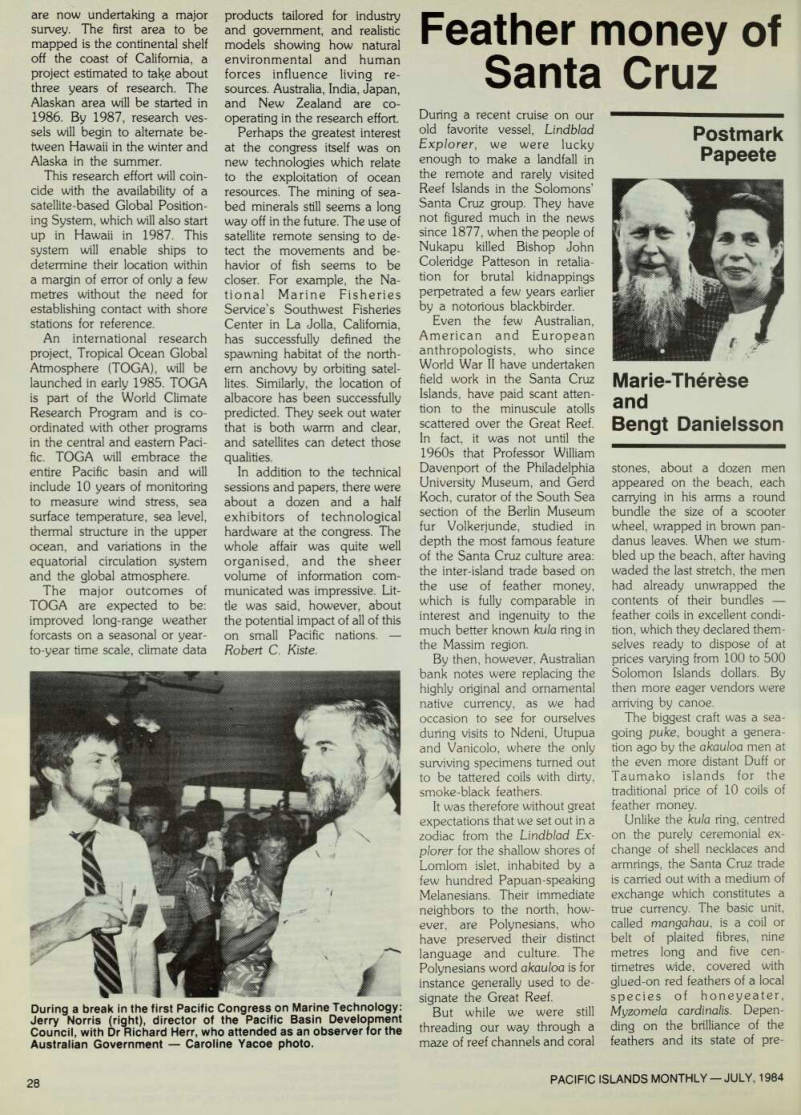
the month
Marine Technology
state of the art
The first Pacific congress on Maripe Technology was held in Honolulu over four days in late April. The event was sponsored by the local chapter of the Marine Technological Society, a national professional associa tion devoted to the marine sciences. The two co-chairmen responsible for arranging all details were Dr Narendra Sax ena, Department of Civil En gineering, University of Hawaii, and Jack Harmon, the head of SEACO, Inc., an ocean en gineering company.
The congress greatly ex ceeded the organisers’ expecta tions. A total of 19 technical sessions were held, and the number of papers delivered was 95. About 120 participants were expected, but in the end
211 scientists, government rep resentatives, and observers from Australia, Canada, India, Indonesia, Japan, the People’s Republic of China, Singapore, the Soviet Union, Taiwan, and the United States attended. The congress will be held every other year, and the 1986 event is already being planned for Honolulu. Japan and Taiwan are interested as potential hosts for 1988.
The purpose of the congress was to provide an international forum for scientists, policy-mak ers, administrators, and others concerned with marine technol ogy to discuss ocean resource development and manage ment. Sessions focused on ocean science and engineering, ocean energy, ocean mining,
offshore resource management, remote sensing, fisheries, tsuna mi detection, marine trans portation, navigation and positioning, trade, technology transfer, and marine education.
The opening keynote speaker was Dr John V. Byme, administrator of the U.S. De partment of Commerce’s Na tional Oceanic and Atmosphere Administration (NOAA). That agency was created in 1970 to improve understanding, man agement, and conservation of marine and atmospheric re sources.
NOAA is the regulatory agen cy which establishes federal policies governing the use of the U.S.’s oceanic, coastal, and atmospheric resources. Byme reported upon several deve lopments in NOAA relating to the Pacific.
Reflecting a concern to pre serve the productivity and the health of the ocean, President Reagan announced in March that the “Year of the Ocean” will be celebrated beginning on July 1, 1984. The year is designed to expand public understanding of the ocean’s
importance, to promote a sense of stewardship among ocean organisations and industries, and to foster a public-private partnership for the wise man agement of ocean resources.
In March 1983, President Reagan established the 200 nautical mile exclusive econo mic zone off U.S. shores. In order to prepare for the future exploitation of the zone, NOAA and the U.S. Geological Survey
A View from Honolulu
Robert C. Kiste looks at the Pacific
are now undertaking a major survey. The first area to be mapped is the continental shelf off the coast of California, a project estimated to take about three years of research. The Alaskan area will be started in 1986. By 1987, research ves sels will begin to alternate be tween Hawaii in the winter and Alaska in the summer.
This research effort will coin cide with the availability of a satellite-based Global Position ing System, which will also start up in Hawaii in 1987. This system will enable ships to determine their location within a margin of error of only a few metres without the need for establishing contact with shore stations for reference.
An international research project, Tropical Ocean Global Atmosphere (TOGA), will be launched in early 1985. TOGA is part of the World Climate Research Program and is co ordinated with other programs in the central and eastern Paci fic. TOGA will embrace the entire Pacific basin and will include 10 years of monitoring to measure wind stress, sea surface temperature, sea level, thermal structure in the upper ocean, and variations in the equatorial circulation system and the global atmosphere.
The major outcomes of TOGA are expected to be: improved long-range weather forcasts on a seasonal or year to-year time scale, climate data
products tailored for industry and government, and realistic models showing how natural environmental and human forces influence living re sources. Australia, India, Japan, and New Zealand are co operating in the research effort.
Perhaps the greatest interest at the congress itself was on new technologies which relate to the exploitation of ocean resources. The mining of sea bed minerals still seems a long way off in the future. The use of satellite remote sensing to de tect the movements and be havior of fish seems to be closer. For example, the Na tional Marine Fisheries Service’s Southwest Fisheries Center in La Jolla, California, has successfully defined the spawning habitat of the north ern anchovy by orbiting satel lites. Similarly, the location of albacore has been successfully predicted. They seek out water that is both warm and clear, and satellites can detect those qualities.
In addition to the technical sessions and papers, there were about a dozen and a half exhibitors of technological hardware at the congress. The whole affair was quite well organised, and the sheer volume of information com municated was impressive. Lit tle was said, however, about the potential impact of all of this on small Pacific nations. —
Robert C. Kiste.
During a break in the first Pacific Congress on Marine Technology: Jerry Norris (right), director of the Pacific Basin Development Council, with Dr Richard Herr, who attended as an observer for the Australian Government Caroline Yacoe photo.
Privy Council to lunch
The men who took Tonga’s Privy Council to lunch
John Herbert Meier seems to attract lawyers like flies with sometimes sticky results.
There is Gordon A. Haz lewood, the Vancouver lawyer who says he had two audiences in 1977 with Tonga’s King Taufa’ahau Tupou IV and Prime Minis ter Fatafehi Tu’ipelehake while setting up the short lived Bank of the South Pacific. He and Meier also took the Privy Council to lunch, Hazlewood said in a 1977 interview in Vancouver.
In February, 1981, Haz lewood was indicted along with Meier by a Los Angeles grand jury for a
1974 murder. He surren dered to sheriff’s officers in Vancouver where a judge subsequently ruled there was not sufficient evidence to extradite him. Hazle wood was suspended by the Law Society, however, on other matters.
In March, 1982, another Vancouver lawyer, John Conroy, who had repre sented Meier in 1981, filed a petition to place Meier in bankruptcy. Conroy said Meier owed him $26,317 for his work. (Meier was fighting other lawyers at that time, too; Summa Corp., formerly Hughes Tool Co., was trying in British Columbia to
enforce a $11.9 million judgement against Meier.
Summa was also trying to get an order in Geneva, Switzerland, against Meier for the seizure of $7.1 mil lion.) Another British Columbia (8.C.) lawyer, Gordon Dowding, tried in 1981 and 1982 to prevent Meier’s extradition on the murder charge. Dowding is a for mer speaker of the B.C. legislature. He said the ex tradition attempt was a political persecution and the murder charge part of a movie scenario.
In December, 1983, Dowding was charged in Vancouver with conspiracy to subvert justice. Meier was named as an unin dicted co-conspirator.
Alan Merridew.
Advertisements & other items, p. 27 (1 item)
mass
COMPACT DISC PLAYER
C& 1 \ I Pioneer bring the miracle of Laser Disc ™ technology to the new P-D7O Compact Disc player.
Now, many of the revolutionary laser-optic and digital electronic techniques first developed for our sensational Laser Disc™ brand videodisc systems are yours to enjoy in the new P-D7O Compact Disc player. Your favourite music is permanently stored in digital form on a pocket-sized disc enabling the total beauty and excitement of a live performance to be re-created in your home.
Here’s how Pioneer does it: ■ 3-spot laser beam with three sophisticated servo systems. ■ Focus parallel drive servo to improve sensitivity and quick search. ■ High-quality audio-use components and a new LSI for better sound. ■ Convenient search and random access put the fun in hi-fi.
All this, plus the always high level of Pioneer design and product reliability. After all, who else looks that far ahead.
M J. m m
P-D7O
CD PIONEER
For further information, please contact: Australia: Pioneer Electronics Australia Pty. Ltd. (Incorporated in Victoria) P-O. Box 295, Mordialloc, Victoria, 3195 Tel: 580-9911 Fiji Islands: Brijlal & Company, G.P.O. Box No. 362, Suva, Fiji Islands Tel: 22258 New Zealand: Monaco Distributors Ltd., 2 Poland Road, Glenfield, Auckland New Zealand Tel: (09) 444-9144 Norfolk Island: Burns Philp (Norfolk Island) Ltd., P.O. Box 21, Norfolk Island Vanuatu: Burns Philp (Vanuatu) Ltd., Vila, Vanuatu Nauru Island: Jacob Enterprises, P.O. Box No. 4, Republic of Nauru Tahiti: Tahiti Hi-Fi, P.O. Box 848, Papeete, Tahiti New Caledonia: Menard Pacifique Sari, B.P. 3899, Noumea, New Caledonia Tel: 27.62*23 American Samoa: Transpac Corporation, P.O. Box 1477, Pago Pago, American Samoa 96799 Tel: 633-5224 Rarotonga: South Seas International Ltd., P.O. Box 49, Rarotonga, Cook Islands Tel: 2327 Papua New Guinea: Bali Merchants Pty. Ltd., P.O. Box 6103, Boroko Tel: 254887
Santa Cruz
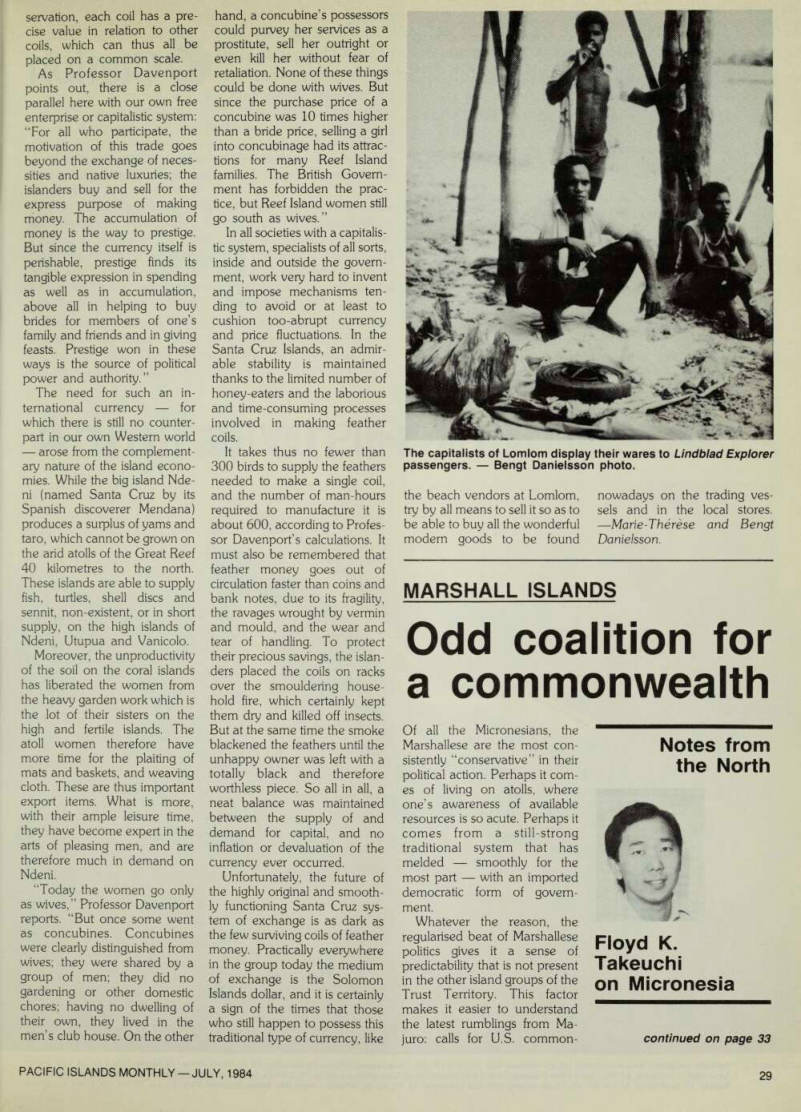
Feather money of Santa Cruz
During a recent cruise on our old favorite vessel, Lindblad Explorer, we were lucky enough to make a landfall in the remote and rarely visited Reef Islands in the Solomons’
Santa Cruz group. They have not figured much in the news since 1877, when the people of Nukapu killed Bishop John Coleridge Patteson in retalia tion for brutal kidnappings perpetrated a few years earlier by a notorious blackbirder.
Even the few Australian, American and European anthropologists, who since World War II have undertaken field work in the Santa Cruz Islands, have paid scant atten tion to the minuscule atolls scattered over the Great Reef.
In fact, it was not until the 1960 s that Professor William Davenport of the Philadelphia University Museum, and Gerd Koch, curator of the South Sea section of the Berlin Museum fur Volkerjunde, studied in depth the most famous feature of the Santa Cruz culture area: the inter-island trade based on the use of feather money, which is fully comparable in interest and ingenuity to the much better known kula ring in the Massim region.
By then, however, Australian bank notes were replacing the highly original and ornamental native currency, as we had occasion to see for ourselves during visits to Ndeni, Utupua and Vanicolo, where the only surviving specimens turned out to be tattered coils with dirty, smoke-black feathers.
It was therefore without great expectations that we set out in a zodiac from the Lindblad Ex plorer for the shallow shores of Lomlom islet, inhabited by a few hundred Papuan-speaking Melanesians. Their immediate neighbors to the north, how ever, are Polynesians, who have preserved their distinct language and culture. The Polynesians word akauloa is for instance generally used to de signate the Great Reef.
But while we were still threading our way through a maze of reef channels and coral
stones, about a dozen men appeared on the beach, each carrying in his arms a round bundle the size of a scooter wheel, wrapped in brown pan danus leaves. When we stum bled up the beach, after having waded the last stretch, the men had already unwrapped the contents of their bundles feather coils in excellent condi tion, which they declared them selves ready to dispose of at prices varying from 100 to 500 Solomon Islands dollars. By then more eager vendors were arriving by canoe.
The biggest craft was a sea going puke , bought a genera tion ago by the akauloa men at the even more distant Duff or Taumako islands for the traditional price of 10 coils of feather money.
Unlike the kula ring, centred on the purely ceremonial ex change of shell necklaces and armrings, the Santa Cruz trade is carried out with a medium of exchange which constitutes a true currency. The basic unit, called mangahau, is a coil or belt of plaited fibres, nine metres long and five cen timetres wide, covered with glued-on red feathers of a local species of honeyeater, Myzomela cardinalis. Depen ding on the brilliance of the feathers and its state of pre
Postmark Papeete
Marie-Therese and Bengt Danielsson
servation, each coil has a pre cise value in relation to other coils, which can thus all be placed on a common scale.
As Professor Davenport points out, there is a close parallel here with our own free enterprise or capitalistic system: “For all who participate, the motivation of this trade goes beyond the exchange of neces sities and native luxuries; the islanders buy and sell for the express purpose of making money. The accumulation of money is the way to prestige.
But since the currency itself is perishable, prestige finds its tangible expression in spending as well as in accumulation, above all in helping to buy brides for members of one’s family and friends and in giving feasts. Prestige won in these ways is the source of political power and authority.”
The need for such an in ternational currency for which there is still no counter part in our own Western world arose from the complement ary nature of the island econo mies. While the big island Nde ni (named Santa Cruz by its Spanish discoverer Mendana) produces a surplus of yams and taro, which cannot be grown on the arid atolls of the Great Reef 40 kilometres to the north.
These islands are able to supply fish, turtles, shell discs and sennit, non-existent, or in short supply, on the high islands of Ndeni, Utupua and Vanicolo.
Moreover, the unproductivity of the soil on the coral islands has liberated the women from the heavy garden work which is the lot of their sisters on the high and fertile islands. The atoll women therefore have more time for the plaiting of mats and baskets, and weaving cloth. These are thus important export items. What is more, with their ample leisure time, they have become expert in the arts of pleasing men, and are therefore much in demand on Ndeni.
“Today the women go only as wives,” Professor Davenport reports. “But once some went as concubines. Concubines were clearly distinguished from wives; they were shared by a group of men; they did no gardening or other domestic chores; having no dwelling of their own, they lived in the men’s club house. On the other
hand, a concubine’s possessors could purvey her services as a prostitute, sell her outright or even kill her without fear of retaliation. None of these things could be done with wives. But since the purchase price of a concubine was 10 times higher than a bride price, selling a girl into concubinage had its attrac tions for many Reef Island families. The British Govern ment has forbidden the prac tice, but Reef Island women still go south as wives.”
In all societies with a capitalis tic system, specialists of all sorts, inside and outside the govern ment, work very hard to invent and impose mechanisms ten ding to avoid or at least to cushion too-abrupt currency and price fluctuations. In the Santa Cruz Islands, an admir able stability is maintained thanks to the limited number of honey-eaters and the laborious and time-consuming processes involved in making feather coils.
It takes thus no fewer than 300 birds to supply the feathers needed to make a single coil, and the number of man-hours required to manufacture it is about 600, according to Profes sor Davenport’s calculations. It must also be remembered that feather money goes out of circulation faster than coins and bank notes, due to its fragility, the ravages wrought by vermin and mould, and the wear and tear of handling. To protect their precious savings, the islan ders placed the coils on racks over the smouldering house hold fire, which certainly kept them dry and killed off insects.
But at the same time the smoke blackened the feathers until the unhappy owner was left with a totally black and therefore worthless piece. So all in all, a neat balance was maintained between the supply of and demand for capital, and no inflation or devaluation of the currency ever occurred.
Unfortunately, the future of the highly original and smooth ly functioning Santa Cruz sys tem of exchange is as dark as the few surviving coils of feather money. Practically everywhere in the group today the medium of exchange is the Solomon Islands dollar, and it is certainly a sign of the times that those who still happen to possess this traditional type of currency, like
the beach vendors at Lomlom, try by all means to sell it so as to be able to buy all the wonderful modern goods to be found
nowadays on the trading ves sels and in the local stores, — Marie-Therese and Bengt Danielsson.
The capitalists of Lomlom display their wares to Lindblad Explorer passengers. Bengt Danielsson photo.
Odd coalition for

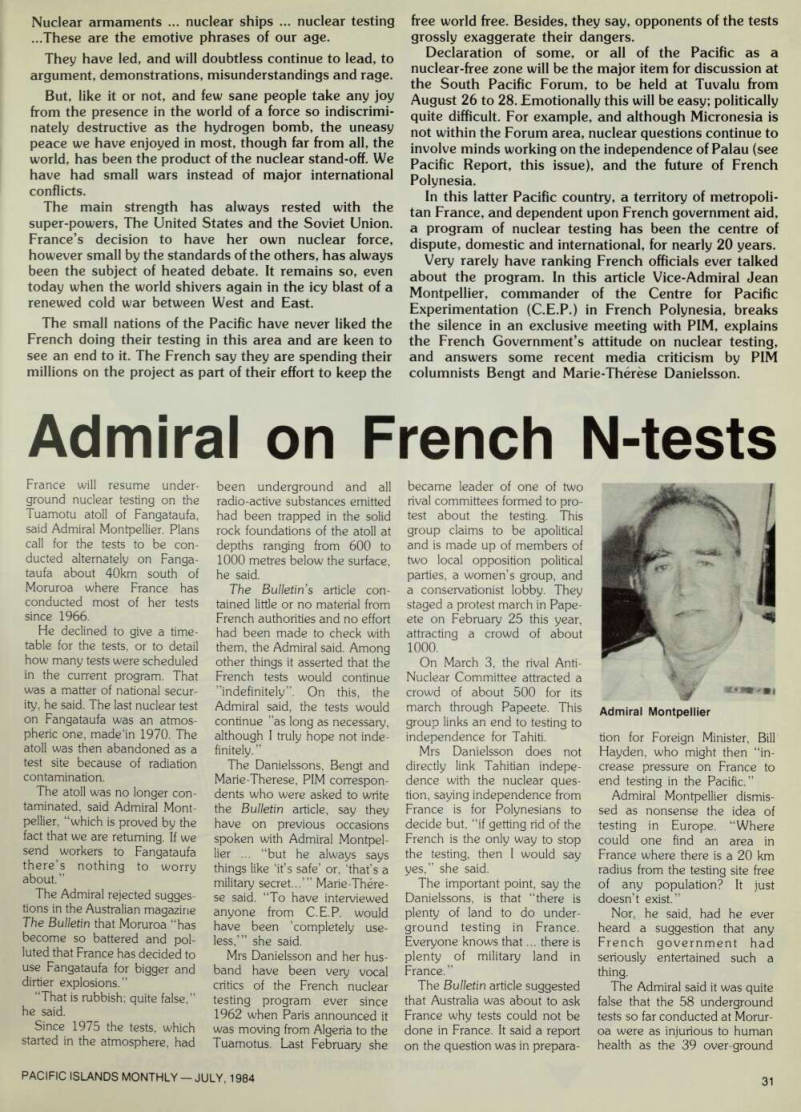

Marshall Islands
Odd coalition for a commonwealth
Of all the Micronesians, the Marshallese are the most con sistently “conservative” in their political action. Perhaps it com es of living on atolls, where one’s awareness of available resources is so acute. Perhaps it comes from a still-strong traditional system that has melded smoothly for the most part with an imported democratic form of govern ment.
Whatever the reason, the regularised beat of Marshallese politics gives it a sense of predictability that is not present in the other island groups of the Trust Territory. This factor makes it easier to understand the latest rumblings from Ma juro: calls for U.S. common-
continued on page 33
Notes from the North
Floyd K.
Takeuchi on Micronesia
wealth status instead of a free association status.
There is more, and less, to this than meets the eye. No doubt some of the backers of commonwealth truly believe the Marshall Islands would be better served by a more inti mate relationship with Washington, D.C.
But there is a broader based foundation for the common wealth calls. The theme is a rallying point for a number of disaffected Marshallese who want to stop the implementa tion of free association at almost any price.
The two notable factions are Kwajalein atoll landowners and islanders from atolls in the southern Marshalls. Each group has different reasons for advocating commonwealth, but their tactical objective is the same; delay, and scuttle if pos sible, the Free Association Compact in the U.S. Congress.
The Kwajalein people are represented by the Kwajalein Atoll Corporation. The KAC’s leadership notably Imada Kabua, a relative of the presi dent want to ensure a continued close relationship
with Washington and with that a higher degree of leverage than free association promises.
Their “bottom line” is the lease payments the United States makes for use of the atoll as a missile firing range.
One of the most perceptive analysts of Micronesian matters has been Henry Schwalben berg, a Jesuit brother who has been headquartered these past three years at the Micronesian Seminar on Truk. In his most recent memo on the politics of free association (No. 13 in a series put out by the seminar), Schwalbenberg looked at last year’s Marshallese plebiscite.
In the memo, Schwalben berg said: “Kwajalein’s con cerns would probably be best served by a continuation of the present interim use agreement (for the atoll) . . . The only way to maintain an interim use agreement system would ... be a continuation of a trusteeship like political status.”
Just below the surface of the KAC’s rhetoric in favor of com monwealth, one will find this lease system concern. And it does not take much scratching to discover the fact.
The situation with the south ern Marshallese is somewhat different. There has been con sistent opposition to Amata
Kabua on those atolls. Their support of commonwealth is but the latest manifestation of their traditional distrust of Kabua, and indeed control by the lineage he represents.
Schwalbenberg’s analysis notes: “The history of dissatis faction of the southern atolls toward the current Marshallese leadership extends to pre-colo nial times. In 1878 an iroij (chief) by the name of Kabua signed a treaty on behalf of the Marshall Islands with Germany.
This compact with Germany eventualy led to complete Ger man acquisition of the Marshall Islands in 1885. The German- Marshallese compact, besides granting the Germans numer ous trading rights, also confer red on Iroij Kabua foreign rec ognition as ‘king’ of the Mar shalls. This German conferral of authority on the iroij was challenged and never accepted by Iroij Loiak of Ebon (a south ern atoll). Hence, the first re corded opposition in the long and unsuccessful history of southern efforts to limit the power of the Kabua faction. An event not without a number of parallels to the present.”
Given the differences be tween the two groups the KAC is clearly interested mainly in using the movement to gain
leverage with the U.S. and against the national govern ment in Majuro, while the southern people are more in terested in carrying on their opposition to Kabua the odd coalition probably will not get very far.
Appealing in this fashion to the conscience of American lawmakers is coming too late, and (in the case of the KAC) the ulterior motives are evident. In fact, a call for commonwealth status seems sadly out of synchronisation with the times.
The United States proposed such a relationship in the late 19605, when the political negotiations were just getting underway. Micronesians re jected it outright (the exception being the Northern Marianas, of course).
A firm majority of Marshal lese support free association.
The opposition had its chance last September, but was not successful.
Those who oppose free association have, of course, every right to continue their struggle. And while the odds are heavily against the possibil ity, such tactics might even delay the approval of the com pact by the U.S. Congress.
Still, at this point in the political development of Mic ronesia, one cannot be faulted for asking if such delaying tac tics do more harm than good for the Marshallese. The alternative, it seems, is a seemingly unending stalemate or, worse yet, encouragement of divisive sentiments. Neither result would be a step forward for the Marshallese people.
Floyd K. Takeuchi.
Marshalls President Amata Kabua
Advertisements & other items, pp. 30-34 (1 item)
The Search Is Over
ou were loowng ror me perfect fit, U ncompromising sound quality. As beautiful to look at as it is to sten to. Advanced electronics. A choice of sophisticated features that are easy to use. Reliability rat's no fairy tale. Clarion makes a wide selection of models, with one • rat’s just your Clarion Car Stereo. Listen, and drive happily ever after. Vr 10 f 10(1
o*l .♦ FADER
model 900 E
AM ■ F
®in n o
ID ATO £» ILJ I. J
< > further information Australia: Amalgamated Wireless (Australasia) Ltd., 554 Parramatta Road, Ashfield, N.S.W., 2131 1 New Zealand: AWA New Zealand Limited, P.O. Box 50-248, Porirua I Fiji Islands: Brijlal & Co., Ltd., G.P.O. Box 362, Suva I Tahiti: HI-FI Shangrila, B.P. 200, Papeete I New Caledonia; Caldis, 8.P.M1, Noumea Cedex I Guam; Micropac Audio Inc., P.O. Box 3478, Agana, Guam 96910, U.S.A. Tel: 472-8091, Cable Code: HIFI AUDIO AGANA Vanuatu: The Sound Centre, P.O. Box 434, Vila / Cook Islands: South Seas International Ltd., P.O. Box 49, Rarotonga I Papua New Guinea: Hagemeyer (P.N.G.) Pty. Ltd., P.O. Box 1428, Boroko, Port Moresby.
m a LlLuUl
GOLD
CREST
lUik)i "u
''•Mi sjmH m m
SAUCE
edy to freeze ► » •
COLD \r^&
I m
CHEST
GOLD
CREST
ENGLISH
Teacake ,
* take mixj S»o n lopfimu I
GOLD
CREST
2&> m
FRUTT MCE CORDIAL 2 Lrtre
—ssßcsrETßnrwr-
-04 »M'CDWii» 'O KM« tAUM
|TI« OOW4CO LTD
>V D l
SOaNET'-'
*5B /0\ 7*
A selection of
Quality Australian Products
manufactured by R.M. Gow & Co Ltd 30 Gow Street, Moorooka, Queensland. Postal address: PO Box 111, Moorooka, Queensland 4105, Australia. Cables: GOWCO Telex GOWCO AA42839 Phone: (07) 48 5061 Order from your local wholesaler, export merchant or directly from R.M. Gow & Co Ltd.
TCAI97
Starting & Staying
¥ER ■ %S r,
AMP
POWER
*r/ avoir / continuous use *7 r Des'ctcuißAnßn msn n ••v „ *** 7V- ■ £33?
Power Boats Need Different Batteries
There is a big difference between a car battery and a marine battery.
A car battery, for example, is never really discharged, as it is only used for a few seconds each day and promptly re-charged. Not so your cruiser or sportsfisherman.
Starting the engine is only the beginning. During the day, weekend or cruise, how often will you run the live bait tank, the depth sounder, the nav. lights or maintain a listening watch on your radio transceiver?
As well as cranking power, boats need staying power. Boats need Besco's Marine Batteries, deep cycle, heavy duty marine batteries. ‘ If your boat is getting a little flat in the electrics department, write or phone BESCO today and ask for more information, more facts about
BESCO MARINE BA TTERIES.
BESCO
/ Batteries Division Of Sims Products hy. Ltd. J_ / A Peko Wall send Group Member Papua New Guinea: Lae, Automarine Industries, P.O. Box 785, Ph. 42-1125; Rabaul, Automarine Industries, P.O. Box 248, Ph. 92-2574; Port Moresby, Par Sales, P.O. Box 1680, Boroko Ph 25-6266. Fiji: Suva, Fiji Bandag, 23 Sinoma Street, Walu Bay, Ph. 31-1200. New Caledonia: Noumea, Andre Thuilier, BP 889, Ph. 27-4906. Solomon Islands: Honiara, Guadalcanal Electrics Ltd., P.O. Box 521. Hongkong: Kowloon, T. L. Knight & Co., P.O. Box 95585 TST, Ph. 366-5341. New Zealand: Auckland, Battery Services (Ind.) Ltd., P.O. Box 27- 375 Ph. 69-4111; Wellington, Gould Batteries, 58 Hautana Street, Lower Hurt, TLX NZ3714.
Australia: Sydney, Besco Batteries, P.O. Box 1, Villawood, Ph. 632-0251, TLX 21886; Jarwil International Pty. Ltd., 410 Kent Street, Sydney, Ph. 264-3477, TLX 72102.
LEADERS IN BATTERY TECHNOLOGY
Admiral on French N-tests
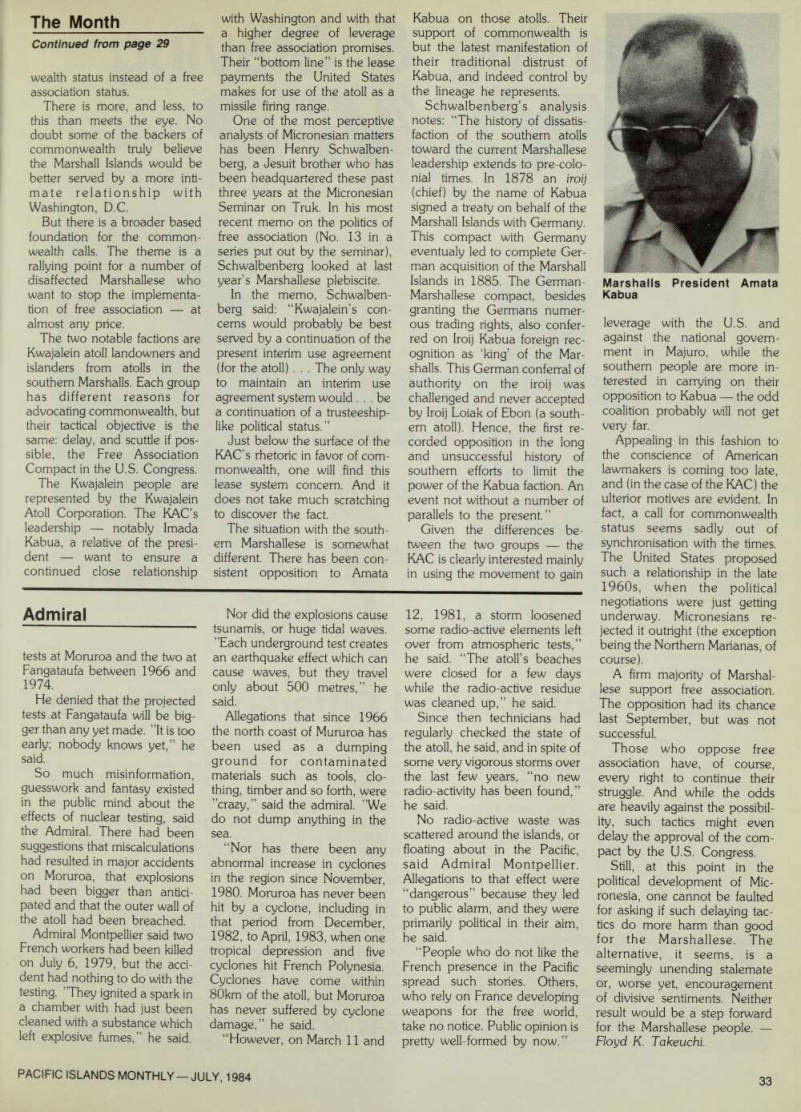
Nuclear armaments ... nuclear ships ... nuclear testing ...These are the emotive phrases of our age.
They have led, and will doubtless continue to lead, to argument, demonstrations, misunderstandings and rage.
But, like it or not, and few sane people take any joy from the presence in the world of a force so indiscrimi nately destructive as the hydrogen bomb, the uneasy peace we have enjoyed in most, though far from all, the world, has been the product of the nuclear stand-off. We have had small wars instead of major international conflicts.
The main strength has always rested with the super-powers, The United States and the Soviet Union.
France’s decision to have her own nuclear force, however small by the standards of the others, has always been the subject of heated debate. It remains so, even today when the world shivers again in the icy blast of a renewed cold war between West and East.
The small nations of the Pacific have never liked the French doing their testing in this area and are keen to see an end to it. The French say they are spending their millions on the project as part of their effort to keep the
free world free. Besides, they say, opponents of the tests grossly exaggerate their dangers.
Declaration of some, or all of the Pacific as a nuclear-free zone will be the major item for discussion at the South Pacific Forum, to be held at Tuvalu from August 26 to 28. Emotionally this will be easy; politically quite difficult. For example, and although Micronesia is not within the Forum area, nuclear questions continue to involve minds working on the independence of Palau (see Pacific Report, this issue), and the future of French Polynesia.
In this latter Pacific country, a territory of metropoli tan France, and dependent upon French government aid, a program of nuclear testing has been the centre of dispute, domestic and international, for nearly 20 years.
Very rarely have ranking French officials ever talked about the program. In this article Vice-Admiral Jean Montpellier, commander of the Centre for Pacific Experimentation (C.E.P.) in French Polynesia, breaks the silence in an exclusive meeting with PIM, explains the French Government’s attitude on nuclear testing, and answers some recent media criticism by PIM columnists Bengt and Marie-Therese Danielsson.
France will resume underground nuclear testing on the Tuamotu atoll of Fangataufa, said Admiral Montpellier. Plans call for the tests to be conducted alternately on Fangataufa about 40km south of Moruroa where France has conducted most of her tests since 1966.
He declined to give a timetable for the tests, or to detail how many tests were scheduled in the current program. That was a matter of national security, he said. The last nuclear test on Fangataufa was an atmospheric one, made‘in 1970. The atoll was then abandoned as a test site because of radiation contamination.
The atoll was no longer contaminated, said Admiral Montpellier, “which is proved by the fact that we are returning. If we send workers to Fangataufa there’s nothing to worry a^out The Admiral rejected suggestions in the Australian magazine The Bulletin that Moruroa “has become so battered and polluted that France has decided to use Fangataufa for bigger and dirtier explosions.”
That is rubbish; quite false,” h e sai d.
Since 1975 the tests, which started in the atmosphere, had
been underground and all radio-active substances emitted had been trapped in the solid rock foundations of the atoll at depths ranging from 600 to 1000 metres below the surface, he said.
The Bulletins article con tained little or no material from French authorities and no effort had been made to check with them, the Admiral said. Among other things it asserted that the French tests would continue ’’indefinitely”. On this, the Admiral said, the tests would continue ”as long as necessary, although I truly hope not inde finitely. ”
The Danielssons, Bengt and Marie-Therese, PIM correspon dents who were asked to write the Bulletin article, say they have on previous occasions spoken with Admiral Montpel lier ... “but he always says things like ‘it’s safe’ or, ‘that’s a military secret...’” Marie-There se said. “To have interviewed anyone from C.E.P. would have been ’completely use less,”’ she said.
Mrs Danielsson and her hus band have been very vocal critics of the French nuclear testing program ever since 1962 when Paris announced it was moving from Algeria to the Tuamotus. Last February she
became leader of one of two rival committees formed to pro test about the testing. This group claims to be apolitical and is made up of members of two local opposition political parties, a women’s group, and a conservationist lobby. They staged a protest march in Pape ete on February 25 this year, attracting a crowd of about 1000.
On March 3, the rival Anti- Nuclear Committee attracted a crowd of about 500 for its march through Papeete. This group links an end to testing to independence for Tahiti.
Mrs Danielsson does not directly link Tahitian indepe dence with the nuclear ques tion, saying independence from France is for Polynesians to decide but, “if getting rid of the French is the only way to stop the testing, then I would say yes,” she said.
The important point, say the Danielssons, is that “there is plenty of land to do under ground testing in France.
Everyone knows that... there is plenty of military land in France. ”
The Bulletin article suggested that Australia was about to ask France why tests could not be done in France. It said a report on the question was in prepara-
tion for Foreign Minister, Bill Hayden, who might then “in crease pressure on France to end testing in the Pacific.”
Admiral Montpellier dismis sed as nonsense the idea of testing in Europe. “Where could one find an area in France where there is a 20 km radius from the testing site free of any population? It just doesn’t exist.”
Nor, he said, had he ever heard a suggestion that any French government had seriously entertained such a thing.
The Admiral said it was quite false that the 58 underground tests so far conducted at Morur oa were as injurious to human health as the 39 over-ground
Admiral Montpellier
tests at Moruroa and the two at Fangataufa between 1966 and 1974.
He denied that the projected tests.at Fangataufa will be bigger than any yet made. ”It is too early; nobody knows yet,” he sai d- So much misinformation, guesswork and fantasy existed in the public mind about the effects of nuclear testing, said the Admiral. There had been Suggestions that miscalculations had resulted in major accidents on Moruroa, that explosions had been bigger than anticipated and that the outer wall of the atoll had been breached.
Admiral Montpellier said two French workers had been killed on July 6, 1979, but the accident had nothing to do with the testing. ’’They ignited a spark in a chamber with had just been cleaned with a substance which left explosive fumes,” he said.
Nor did the explosions cause tsunamis, or huge tidal waves. ’’Each underground test creates an earthquake effect which can cause waves, but they travel only about 500 metres,” he said.
Allegations that since 1966 the north coast of Mururoa has been used as a dumping ground for contaminated materials such as tools, clo thing, timber and so forth, were ’’crazy,” said the admiral. ”We do not dump anything in the sea.
“Nor has there been any abnormal increase in cyclones in the region since November, 1980. Moruroa has never been hit by a cyclone, including in that period from December, 1982, to April, 1983, when one tropical depression and five cyclones hit French Polynesia.
Cyclones have come within 80km of the atoll, but Moruroa has never suffered by cyclone damage,” he said.
“However, on March 11 and
12, 1981, a storm loosened some radio-active elements left over from atmospheric tests,” he said. “The atoll’s beaches were closed for a few days while the radio-active residue was cleaned up,” he said.
Since then technicians had regularly checked the state of the atoll, he said, and in spite of some very vigorous storms over the last few years, “no new radio-activity has been found,” he said.
No radio-active waste was scattered around the islands, or floating about in the Pacific, said Admiral Montpellier.
Allegations to that effect were “dangerous” because they led to public alarm, and they were primarily political in their aim, he said.
“People who do not like the French presence in the Pacific spread such stories. Others, who rely on France developing weapons for the free world, take no notice. Public opinion is pretty well-formed by now.”
Advertisements & other items, p. 33 (1 item)
Admiral
33
PACIFIC ISLANDS MONTHLY JULY, 1984
The Month Continued from page 29
trade winds
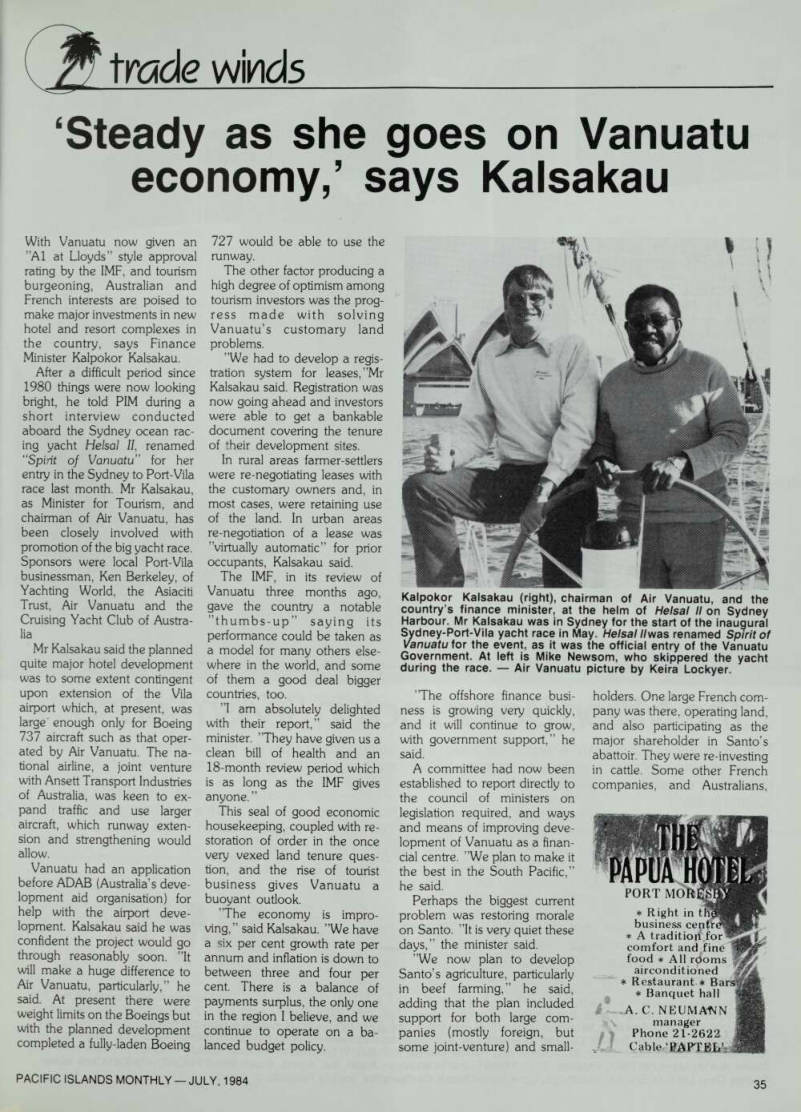

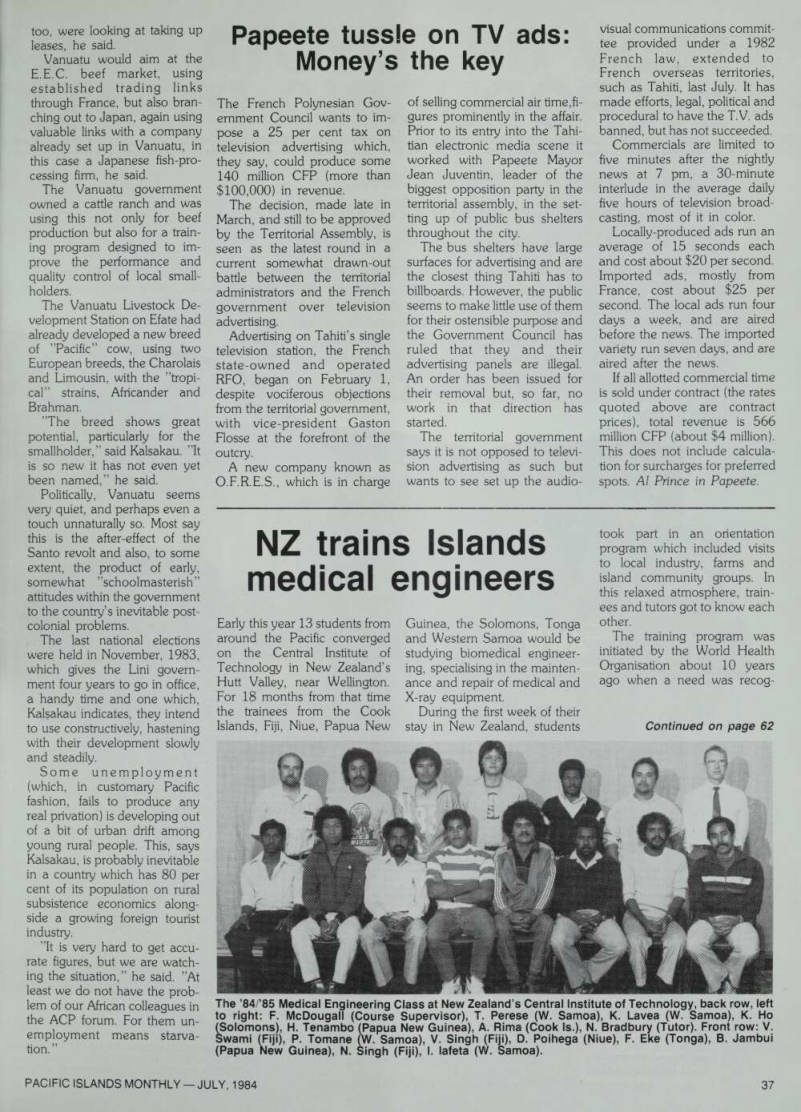
‘Steady as she goes on Vanuatu economy,’ says Kalsakau
With Vanuatu now given an ”A 1 at Lloyds” style approval rating by the IMF, and tourism burgeoning, Australian and French interests are poised to make major investments in new hotel and resort complexes in the country, says Finance Minister Kalpokor Kalsakau.
After a difficult period since 1980 things were now looking bright, he told PIM during a short interview conducted aboard the Sydney ocean rac ing yacht Helsal 11, renamed “Spirit of Vanuatu” for her entry in the Sydney to Port-Vila race last month. Mr Kalsakau, as Minister for Tourism, and chairman of Air Vanuatu, has been closely involved with promotion of the big yacht race.
Sponsors were local Port-Vila businessman, Ken Berkeley, of Yachting World, the Asiaciti Trust, Air Vanuatu and the Cruising Yacht Club of Austra lia Mr Kalsakau said the planned quite major hotel development was to some extent contingent upon extension of the Vila airport which, at present, was large’ enough only for Boeing 737 aircraft such as that oper ated by Air Vanuatu. The na tional airline, a joint venture with Ansett Transport Industries of Australia, was keen to ex pand traffic and use larger aircraft, which runway exten sion and strengthening would allow.
Vanuatu had an application before ADAB (Australia’s deve lopment aid organisation) for help with the airport deve lopment. Kalsakau said he was confident the project would go through reasonably soon. ”It will make a huge difference to Air Vanuatu, particularly,” he said. At present there were weight limits on the Boeings but with the planned development completed a fully-laden Boeing
727 would be able to use the runway.
The other factor producing a high degree of optimism among tourism investors was the prog ress made with solving Vanuatu’s customary land problems. ”We had to develop a regis tration system for leases, ”Mr Kalsakau said. Registration was now going ahead and investors were able to get a bankable document covering the tenure of their development sites.
In rural areas farmer-settlers were re-negotiating leases with the customary owners and, in most cases, were retaining use of the land. In urban areas re-negotiation of a lease was ’’virtually automatic” for prior occupants, Kalsakau said.
The IMF, in its review of Vanuatu three months ago, gave the country a notable ”thumbs-up” saying its performance could be taken as a model for many others else where in the world, and some of them a good deal bigger countries, too. ”1 am absolutely delighted with their report,” said the minister. ’’They have given us a clean bill of health and an 18-month review period which is as long as the IMF gives anyone. ”
This seal of good economic housekeeping, coupled with re storation of order in the once very vexed land tenure ques tion, and the rise of tourist business gives Vanuatu a buoyant outlook. ’’The economy is impro ving,” said Kalsakau. ”We have a six per cent growth rate per annum and inflation is down to between three and four per cent. There is a balance of payments surplus, the only one in the region I believe, and we continue to operate on a ba lanced budget policy.
’The offshore finance busi ness is growing very quickly, and it will continue to grow, with government support,” he said.
A committee had now been established to report directly to the council of ministers on legislation required, and ways and means of improving deve lopment of Vanuatu as a finan cial centre. ”We plan to make it the best in the South Pacific,” he said.
Perhaps the biggest current problem was restoring morale on Santo. ”It is very quiet these days,” the minister said. ”We now plan to develop Santo’s agriculture, particularly in beef farming,” he said, adding that the plan included support for both large com panies (mostly foreign, but some joint-venture) and small
holders. One large French com pany was there, operating land, and also participating as the major shareholder in Santo’s abattoir. They were re-investing in cattle. Some other French companies, and Australians,
Kalpokor Kalsakau (right), chairman of Air Vanuatu, and the country’s finance minister, at the helm of Helsal II on Sydney Harbour. Mr Kalsakau was in Sydney for the start of the inaugural Sydney-Port-Vila yacht race in May. Helsal il was renamed Spirit of Vanuatu for the event, as it was the official entry of the Vanuatu Government. At left is Mike Newsom, who skippered the yacht during the race. Air Vanuatu picture by Keira Lockyer.
too, were looking at taking up leases, he said.
Vanuatu would aim at the E.E.C. beef market, using established trading links through France, but also bran ching out to Japan, again using valuable links with a company already set up in Vanuatu, in this case a Japanese fish-pro cessing firm, he said.
The Vanuatu government owned a cattle ranch and was using this not only for beef production but also for a train ing program designed to im prove the performance and quality control of local small holders.
The Vanuatu Livestock De velopment Station on Efate had already developed a new breed of ’’Pacific” cow, using two European breeds, the Charolais and Limousin, with the ’’tropi cal” strains, Africander and Brahman. ’’The breed shows great potential, particularly for the smallholder, ” said Kalsakau. ”It is so new it has not even yet been named,” he said.
Politically, Vanuatu seems very quiet, and perhaps even a touch unnaturally so. Most say this is the after-effect of the Santo revolt and also, to some extent, the product of early, somewhat ’’schoolmasterish” attitudes within the government to the country’s inevitable post colonial problems.
The last national elections were held in November, 1983, which gives the Lini govern ment four years to go in office, a handy time and one which, Kalsakau indicates, they intend to use constructively, hastening with their development slowly and steadily.
Some unemployment (which, in customary Pacific fashion, fails to produce any real privation) is developing out of a bit of urban drift among young rural people. This, says Kalsakau, is probably inevitable in a country which has 80 per cent of its population on rural subsistence economics along side a growing foreign tourist industry. ”It is very hard to get accu rate figures, but we are watch ing the situation,” he said. ”At least we do not have the prob lem of our African colleagues in the AGP forum. For them un employment means starva tion.”
Advertisements & other items, pp. 35-36 (1 item)
p
PORT MOR
* Right in business cep, * A traditiojlfor comfort and iine food * All rdoms airconditioned * Restaurant * Ba * Banquet hall
*A. C. NEUMANN
manager Phone 21-2622 c^b\ § 4mnm
With Infrar remote control!
The Million Dollar Look in Stylish Sound This year’s top-of-the-line AIWA system is designed to stay in style next year, and the year after too. With high-power component separates designed to be “Digital ready”.
In fact, with such features as a dedicated CD function selector and Dolby HX Professional* equipped auto-reverse cassette deck, the V-1100 is an 85 watt-per-channel system ready to deliver better performance from any music source—digital or analog.
Want to put your records onto tape? AIWA makes it easier than you ever believed. A microprocessorcontrolled “Auto Editing” facility lets you dub automatically from the programmable turntable to the cassette deck, even in random track order.
V-1100—Sophisticated separates with totally automated integration. It’s AlWA’s new concept in audio that sets the trend for sound in the 80s! ‘Dolby and the double-D symbol are trademarks of Dolby Laboratories Licensing Corporation. *HX PROFESSIONAL ORIGINATED BY BANG & OLUFSEN
AIWA’
AIWA Australia Pty., Ltd 14 Gertrude St., Arnoliffe, N.S.W. Australia 2205 AUSTRALIA PHONE; (597) 2388/Oceania Indent Agency (P.N.G.) Pty., Ltd Ago St., Gordon Box 5518, Boroko, Papua New Guinea PHONE; 256411/The Sound Centre Ltd P.O. Box 434 Port Vila, Vanuatu PHONE; 2035/P. Hargovind Bros 190 Renwick Road P.O. Box 490 Suva Fiji PHONE; 24350/Makanjee & Sons Limited P.O. Box 91 Sigatoka Fiji PHONE; 50158/Milaw Trading Co., Ltd 36 Airedale St. Auckland, New Zealand PHONE; (09) 399175/hifivox 79, rue de Sebastopol, Noumea, New Caledonia PHONE; 27.24.66/Harvest Pacific Limited P.O. Box 517, Honiara, Solomon Islands PHONE; 131/Fare Hi-Fi Stereo Rue du Marechal Foch, Papeete, Tahiti PHONE; 2-4814/Micropac Audio, Inc. Agana, Guam 96910 PHONE; 472-8091/Cook Island Trading Corp Ltd P.O. Box 92, Rarotonga, Cook Island/Nauru Co-Operative Society Republic of Nauru
Money’s the key
Papeete tussle on TV ads: Money’s the key
The French Polynesian Gov ernment Council wants to im pose a 25 per cent tax on television advertising which, they say, could produce some 140 million CFP (more than $100,000) in revenue.
The decision, made late in March, and still to be approved by the Territorial Assembly, is seen as the latest round in a current somewhat drawn-out battle between the territorial administrators and the French government over television advertising.
Advertising on Tahiti’s single television station, the French state-owned and operated RFC, began on February 1, despite vociferous objections from the territorial government, with vice-president Gaston Flosse at the forefront of the outcry.
A new company known as 0.F.R.E.5., which is in charge
of selling commercial air time,fi gures prominently in the affair.
Prior to its entry into the Tahi tian electronic media scene it worked with Papeete Mayor Jean Juventin, leader of the biggest opposition party in the territorial assembly, in the set ting up of public bus shelters throughout the city.
The bus shelters have large surfaces for advertising and are the closest thing Tahiti has to billboards. However, the public seems to make little use of them for their ostensible purpose and the Government Council has ruled that they and their advertising panels are illegal.
An order has been issued for their removal but, so far, no work in that direction has started.
The territorial government says it is not opposed to televi sion advertising as such but wants to see set up the audio
visual communications commit tee provided under a 1982 French law, extended to French overseas territories, such as Tahiti, last July. It has made efforts, legal, political and procedural to have the T.V. ads banned, but has not succeeded.
Commercials are limited to five minutes after the nightly news at 7 pm, a 30-minute interlude in the average daily five hours of television broad casting, most of it in color.
Locally-produced ads run an average of 15 seconds each and cost about $2O per second.
Imported ads, mostly from France, cost about $25 per second. The local ads run four days a week, and are aired before the news. The imported variety run seven days, and are aired after the news.
If all allotted commercial time is sold under contract (the rates quoted above are contract prices), total revenue is 566 million CFP (about $4 million).
This does not include calcula tion for surcharges for preferred spots. AI Prince in Papeete.
medical engineers


NZ trains Islands medical engineers
Early this year 13 students from around the Pacific converged on the Central Institute of Technology in New Zealand’s Hutt Valley, near Wellington.
For 18 months from that time the trainees from the Cook Islands, Fiji, Niue, Papua New
took part in an orientation program which included visits to local industry, farms and island community groups. In this relaxed atmosphere, train ees and tutors got to know each other.
The training program was initiated by the World Health Organisation about 10 years ago when a need was recog-
Guinea, the Solomons, Tonga and Western Samoa would be studying biomedical engineer ing, specialising in the mainten ance and repair of medical and X-ray equipment.
During the first week of their stay in New Zealand, students
Continued on page 62
The ’84/’85 Medical Engineering Class at New Zealand’s Central Institute of Technology, back row, left to right: F. McDougall (Course Supervisor), T. Perese (W. Samoa), K. Lavea (W. Samoa), K. Ho (Solomons), H. Tenambo (Papua New Guinea), A. Rima (Cook Is.), N. Bradbury (Tutor). Front row: V.
Swami (Fiji), P. Tomane (W. Samoa), V. Singh (Fiji), D. Poihega (Niue), F. Eke (Tonga), B. Jambui (Papua New Guinea), N. Singh (Fiji), I. lafeta (W. Samoa).
nised for Western Pacific regional health departments to have trained local biomedical technicians on hand in order that advantage could be taken of modem technology. Follow ing visits by a team of W.H.O consultants to various countries in the region, recommendations were made that the training should be conducted in New Zealand because of that coun try’s close ties with the Pacific and its large Polynesian popu lation. The Central Institute of Technology was suggested as being an ideal venue, taking its facilities, which include campus accommodation for 500 stu dents, into account.
The New Zealand Govern ment and the institute were then approached, the result being the signing of a four-year joint project agreement be tween NZ and W.H.O. In 1977 the course supervisor, Fraser McDougall, was appointed to the CIT and he, along with a second W.H.O consultant from Australia, Graham Engisch, were commissioned to under take visits to participating na tions to determine individual requirements and to interview prospective candidates for training.
By the end of the four-year project in December 1982, two 18-month courses, specifically tailored to meet the needs of Pacific nations, had been con ducted. Twenty-five students from 13 nations received train ing, thus providing a nucleus of expertise from which future technicians would evolve.
On completion of the project, the course supervisor under took a four-month follow-up assignment for the NZ Ministry of Foreign Affairs to visit some participating nations to assist in the establishment of hospital maintenance programs to assess future training needs and to report on the overall effect iveness of the project. Findings of the visits, which took in Tonga, Western Samoa, the Cook Islands, Fiji, Kiribati and Solomon Islands were encour aging in that CIT trainees were playing an active and significant role within their respective health departments, including attending to equipment maint enance and repair.
With the main aim of the project being the establishment of effective biomedical sections in Pacific base hospitals, the provision of trained personnel, although a major factor, is by itself insufficient. To achieve the aim more rapidly, each tech nician is provided with a com prehensive tool kit and basic test equipment. In some cases a kit of electronic components and spares is also provided.
Also, technical backup and en couragement is available until such time as technicians be come fully confident.
At the outset, funding was provided for the establishment of specially equipped laborator ies, thus providing “hands-on” experience for trainees. Recent ly a number of manufacturers were approached regarding sponsorship of the project. This resulted in a number of very generous donations of equip ment from companies such as Philips, Roche, S & W Medica Teknik and 8.0. C. Medishield.
Such assistance is invaluable, since it enables technicians to be trained in the latest technology.
It is hoped that health depart ments in Pacific Island nations can now view the future with more certainty and be able to expand and improve their services by acquiring more modern equipment. Trained technicians will be on hand locally to ensure its continuing operation, without the prohib itively expensive presence of overseas experts. From a correspondent in Wellington. • • • Eel skin, tanned, dyed and stitched into sheets to make wallets, handbags, shoes and even briefcases, is becoming popular in many parts of the fashionable world and may pro vide Western Samoa with a handy export industry. Samoan eels are large and have beautifully decorated skins.
Tanned into leather they are stronger, lighter and more scratch-resistant than cowhide.
Paul Hartogh, a lecturer at the University of Samoa has been tanning the skins of both sea and fresh water eels and is in process of sending samples to a tannery in New Zealand for evaluation. He sees a good market for the skins in Australia, New Zealand and Hawaii.
Advertisements & other items, pp. 38-40 (1 item)
Introducing Perfof
NEW ’B4 TOYOTA HILU>
Performance plus comfort.
Performance plus durability.
Performance plus variety.
Advanced, powerful new engines put you in command with higher torque, better efficiency. Inside, more driving comfort than ever before with a roomier cabin, bigger windscreens, and lean, clean instrumentation. Newly designed suspension gives you big carrying capability, yet carries you in comfort. HILUX is one tough truck with a suspension you can count on. Choose from a wide variety, including 4WD regular or double cab and two new additions - 2WD extra cab and flatdeck. The all-new Toyota HILUX. Add it all up, and you have performance plus!
TOYOTA
QUALITY SERVICE
AMERICAN SAMOA: BURNS PHILP (SOUTH SEA)
CO., LTD., P.O. Box 129, Pago Pago.
COOK ISLANDS: COOK ISLANDS TRADING
CORPORATION LTD., Private Bag, Rarotonga.
FIJI: AUTOMOTIVE SUPPLIES COMPANY, G.P.O.
Box 355, Suva.
GUAM & MICRONESIA: ATKINS, KROLL (GUAM) LTD., 443 South Marine Drive, Tamuning.
KIRIBATI: TARAWA MOTORS, P.O. Box 36, Bair;*!, Tarawa, Kiribati.
NAURU: NAURU COOPERATIVE SOCIETY.
NEW CALEDONIA: SERVICE IMPORTATION
AUTOMOBILE DU PACIFIQUE, Rond-Point du Pacifique (Station Total) B.P. 438, Noumea.
MANGE PLUS!
I ' ' i ■■ -i * ROOmier cabin 4WD Double Cab ORFCLK ISLAND: SORRY’S LIMITED, P.O. Box 169. *PUA NEW GUINEA: ELA MOTORS, A Division of jrns Philp (PNG) Ltd., P.O. Box 75, Port Moresby.
MPAN: MICROL CORPORATION, P.O. Box 267,
lipan.
DLOMON: MENDANA ENTERPRISES (5.1.) LTD.,
P.O. Box 174, Honiara.
TAHITI: NIPPON AUTOMOTO, P.O. Box 342, Papeete.
TONGA: BURNS PHILP (SOUTH SEA) CO., LTD., P.O. Box 55, Nuku’alofa.
VANUATU: VANUATU MOTORS, P.O. Box 18,
Port Vila.
WESTERN SAMOA: BURNS PHILP (SOUTH SEA)
CO., LTD., P.O. Box 188, Apia.
TOYOTA
ELECTRICITY FROM SUNLIGHT
SOLAREX
Ply. Limited 5 Beliona Ave.. Regents Park 2143 N.S.VN.. Australia
(02)644-5055 TLX AA21975
• VILLAGE POWER
• HOUSE LIGHTING
• REFRIGERATION
• WATER PUMPING
• COMMUNICATIONS
• MILITARY
• MARINE
Energy—

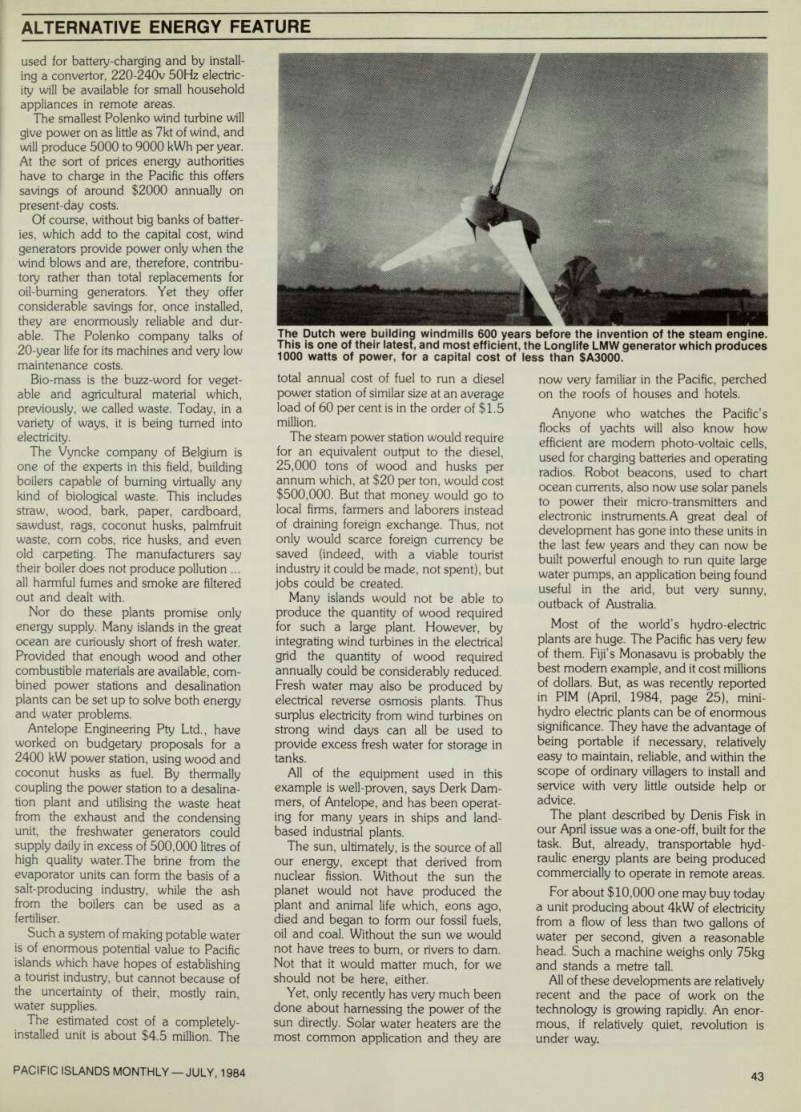
Alternative Energy Feature
not just an Arab preserve
The Pacific has abundant supplies of the World’s most essential commodity it just has to be harnessed.
ENERGY is our greatest single asset. Without it very little in the modern world would be possible. But, for much of industrial history man has wasted energy. Only now is there concern that our planet may run out of energy, bringing to a halt the developments, the comforts and the enterprises so many admire.
And yet the irony is that energy continues to fall upon us in virtually limitless quantities. Our problem is the harnessing of it. The hope of our future thus lies with the engineers who seek the keys to exploitation of alternative energy sources of which the vast and sunny Pacific possesses an abundance.
One might even dream that in the distant future the Pacific could become a major industrial region powered by the abundant sun, the great oceanic swells and the tides.
Wind, water, sunshine and trees are energy sources constantly renewed and fortunately not radio-active or, in most cases, damaging to the environment. In many parts of the world engineers and scientists already have projects well under way to use these great natural benefits.
In the following article, written with the help of Derk Dammers and David Hughes, of Antelope Engineering, of Neutral Bay, Sydney, we examine some of the alternative energy sources which come within the scope of the Pacific’s smaller island countries.
Pacific mythology is rich with stories of the gods of wind, sea and sun, and as things stand for our area as it speeds into the ever changing 21st Century, those gods, or at least their elements, could provide prosperity in a world only now bringing a proper enthusiasm to the search for energy after oil becomes too expensive, and then runs out.
Much of research so far has been in the rich, industrial, countries which are seek ing energy in vast quantities ... sufficient to power big cities. For them, probably, nuclear energy must be one of the essential options. Many of them also have access to vast supplies of coal which, in modern furnaces, may be burned without too greatly polluting the environment. The world’s coal reserves may last several centuries yet. The efficiency of exploitation methods for coal is growing rapidly not only in the design of furnaces and gasifiers, but also in the means of converting coal to liquid petroleum-type fuel.
But Pacific countries cannot afford immensively expensive nuclear power stations, and they have no coal.
So, price, size and resource are impor tant. Machines must be smaller than fully-industrialised countries require, they must be cheap, efficient, reliable and use what is available nearby as their fuel. For the Pacific, with its vast distances and high transportation costs, there is no point in an alternative energy system
which requires imported supplies. The machinery itself will probably need to be imported , although already much may be done in a simple way with what is locally available... but development is expensive, and why pay the price when overseas expertise supported on a much wider market can be imported?...unless, of course, one has the prospect of export sales. But the fuel, the consumables, must be locally-supplied.
Wind and water offer great opportuni ties. The trade winds blow steadily for long months of the year in most areas of the Pacific. Many more mountainous islands have streams which can be dammed for small hydro-electric plants.
There is abundant vegetation. A good deal of practical knowledge already has been gathered and applied.
The Fiji Sugar Corporation has for years generated and sold electricity using the bagasse which is the ’’waste” product of sugar cane crushing. This is, of course, a fairly large operation and not one most Pacific Islands could presently contem plate.
But there are plenty of small steam generating plants available which could be adapted to burn coconut husks, wood chips from sawmills, and other material probably now thrown aside and wasted.
Also in Fiji, a chicken-raising and proces sing company has set up a bio-mass plant which uses all waste material, including the manure from the chicken yards, in
various energy and money-saving ways.
The Fiji cement factory, which once used enormous quantities of oil, is now burning coal dust and may soon move to wood chips for at least a large percentage of its fuel needs, Fiji now being on the brink of exploiting its large introduced pine forests.
And, in Vanuatu the cement works is using waste wood to provide low press ure steam for an autoclave.
In a conventional, but also very cost effective way, wind is now being used in many parts of the world to generate electricity directly.
The most advanced plants are huge, with blades up to 100 metres in diameter, mounted on towers which threaten to rival the Eiffel. They are also very expensive, but down the scale are wind generators suitable for villages, small factories, and even individual houses.
A Dutch company, Polenko, builds a line of wind turbines which cost less than Aust.sBooo for 3.5 kW of generating capacity. Bigger machines, pushing out up to 100 kW cost $lOO,OOO and turbines three times that size cost about three times as much.
A small 1 kW unit is marketed under the name LMW2.S (2.5 metre diameter blades) and this unit costs SA3OOO, landed in the Pacific. This excludes the tower, as in view of the transport costs involved, a locally-built tower makes more sense. These small units can be
used for battery-charging and by install ing a convertor, 220-240 v 50Hz electric ity will be available for small household appliances in remote areas.
The smallest Polenko wind turbine will give power on as little as 7kt of wind, and will produce 5000 to 9000 kWh per year.
At the sort of prices energy authorities have to charge in the Pacific this offers savings of around $2OOO annually on present-day costs.
Of course, without big banks of batter ies, which add to the capital cost, wind generators provide power only when the wind blows and are, therefore, contribu tory rather than total replacements for oil-burning generators. Yet they offer considerable savings for, once installed, they are enormously reliable and dur able. The Polenko company talks of 20-year life for its machines and very low maintenance costs.
Bio-mass is the buzz-word for veget able and agricultural material which, previously, we called waste. Today, in a variety of ways, it is being turned into electricity.
The Vyncke company of Belgium is one of the experts in this field, building boilers capable of burning virtually any kind of biological waste. This includes straw, wood, bark, paper, cardboard, sawdust, rags, coconut husks, palmfruit waste, corn cobs, rice husks, and even old carpeting. The manufacturers say their boiler does not produce pollution ... all harmful fumes and smoke are filtered out and dealt with.
Nor do these plants promise only energy supply. Many islands in the great ocean are curiously short of fresh water.
Provided that enough wood and other combustible materials are available, com bined power stations and desalination plants can be set up to solve both energy and water problems.
Antelope Engineering Pty Ltd., have worked on budgetary proposals for a 2400 kW power station, using wood and coconut husks as fuel. By thermally coupling the power station to a desalina tion plant and utilising the waste heat from the exhaust and the condensing unit, the freshwater generators could supply daily in excess of 500,000 litres of high quality water. The brine from the evaporator units can form the basis of a salt-producing industry, while the ash from the boilers can be used as a fertiliser.
Such a system of making potable water is of enormous potential value to Pacific islands which have hopes of establishing a tourist industry, but cannot because of the uncertainty of their, mostly rain, water supplies.
The estimated cost of a completely installed unit is about $4.5 million. The
total annual cost of fuel to run a diesel power station of similar size at an average load of 60 per cent is in the order of $1.5 million.
The steam power station would require for an equivalent output to the diesel, 25,000 tons of wood and husks per annum which, at $2O per ton, would cost $500,000. But that money would go to local firms, farmers and laborers instead of draining foreign exchange. Thus, not only would scarce foreign currency be saved (indeed, with a viable tourist industry it could be made, not spent), but jobs could be created.
Many islands would not be able to produce the quantity of wood required for such a large plant. However, by integrating wind turbines in the electrical grid the quantity of wood required annually could be considerably reduced.
Fresh water may also be produced by electrical reverse osmosis plants. Thus surplus electricity from wind turbines on strong wind days can all be used to provide excess fresh water for storage in tanks.
All of the equipment used in this example is well-proven, says Derk Dam mers, of Antelope, and has been operat ing for many years in ships and land based industrial plants.
The sun, ultimately, is the source of all our energy, except that derived from nuclear fission. Without the sun the planet would not have produced the plant and animal life which, eons ago, died and began to form our fossil fuels, oil and coal. Without the sun we would not have trees to burn, or rivers to dam.
Not that it would matter much, for we should not be here, either.
Yet, only recently has very much been done about harnessing the power of the sun directly. Solar water heaters are the most common application and they are
now very familiar in the Pacific, perched on the roofs of houses and hotels.
Anyone who watches the Pacific’s flocks of yachts will also know how efficient are modem photo-voltaic cells, used for charging batteries and operating radios. Robot beacons, used to chart ocean currents, also now use solar panels to power their micro-transmitters and electronic instruments. A great deal of development has gone into these units in the last few years and they can now be built powerful enough to run quite large water pumps, an application being found useful in the arid, but very sunny, outback of Australia.
Most of the world’s hydro-electric plants are huge. The Pacific has very few of them. Fiji’s Monasavu is probably the best modem example, and it cost millions of dollars. But, as was recently reported in PIM (April, 1984, page 25), mini hydro electric plants can be of enormous significance. They have the advantage of being portable if necessary, relatively easy to maintain, reliable, and within the scope of ordinary villagers to install and service with very little outside help or advice.
The plant described by Denis Fisk in our April issue was a one-off, built for the task. But, already, transportable hyd raulic energy plants are being produced commercially to operate in remote areas.
For about $lO,OOO one may buy today a unit producing about 4kW of electricity from a flow of less than two gallons of water per second, given a reasonable head. Such a machine weighs only 75kg and stands a metre tall.
All of these developments are relatively recent and the pace of work on the technology is growing rapidly. An enor mous, if relatively quiet, revolution is under way.
The Dutch were building windmills 600 years before the invention of the steam engine.
This is one of their latest, and most efficient, the Longlife LMW generator which produces 1000 watts of power, for a capital cost of less than $A3000.
Advertisements & other items, p. 42 (1 item)
Your Energy Equipment,
With PRI Supplying
The Best Is Yet To Come.
PRI Tower Ml| Many wholesale energy equipment suppliers offer you a good variety of products.
But can they offer you a history of proven performance and the guarantee of service tomorrow?
PRl's Energy Products Division can.
We're a part of Pacific Resources, Inc., an independent energy company based in Hawaii.
With PRI behind your energy equipment, the best is yet to come.
In variety of products.
In value.
In parts and service support.
And in availability and inventory.
And when it comes to water heating equipment, the PRI Energy Products Division has the backing of PRl's 80 years of water heating experience.
We're the most knowledgeable company in the Pacific Basin when it comes to water heating needs.
Talk to PRl's Energy Products Division about any of your energy
equipment needs.
For information call (808) 547-3522 or write PO. Box 3379, Honolulu, Hawaii 96842, USA.
We've got it all. • Hardwick gas ranges, electric ranges and microwaves • Roper gas ranges, electric ranges and microwaves • State gas and electric residential and commercial water heaters • Jetglass commercial gas water heaters • E-Tech heat pumps, heat recovery units and swimming pool heaters • Customized commercial heat pumps • Photovoltaic equipment • PRI solar products • Luau torches • Manchester propane tanks The Best is Yet To Come.™ Energy Products Division PRI Energy Systems, Inc.
A PRI Company
PRI 1984
A solar Pacific

Direct generation of electricity from the sun has excited scientists for about a century, but has been a practical, almost household, technique only since 1974.
We owe the technology to the Americans, and the space race, for it was the Bell Telephone Laboratories which, in 1941, first developed the silicon cell that turned sunshine into electricity in one step. Twelve years later that laboratory
experiment was a practical de vice; the need to power space satellites gave the money and the impetus for the research, Twenty more years of work, and the world had a practical solar module within the reach of average buyers, Already photo-voltaic cells,as engineers call solar power units, are all around us...on calcula tors, wrist watches, yachts, houses,farms, and even cars, although these latter units are
still very experimental. But, already, units have been linked to generate several megawatts of power.
With the sun right overhead, in a clear sky, about one kilo watt of energy falls on every square metre of exposed ground. Present-day photo-vol taic cells can convert this into about 100 watts of electricity.
Solarex Pty Ltd., of Regents Park, NSW, is Australia’s oldest and largest company in this field, and, backed by Standard Oil Company of Indiana, has developed a great many applications for solar cells. Mark Fleming, one of their engineers,
says modem technology has made the cells ultra-reliable, strong, and durable. ’They need almost no main tenance,” he says. ”At most, in harsh environments, they will need occasional scrubbing with soapy water to clean their toughened glass covering. To prevent over-charging it is bet ter to connect the batteries which allow solar energy to be used even at night through a voltage regulator and, of course, the storage batteries need periodic checking ... but that’s about all. It’s very simple, and it’s financially viable, parti cularly where conventional energy is expensive, as it is in the Pacific. ’’Anticipated life of the solar modules is well in excess of 20 years. Battery life can range from five to 15 years, depen ding upon environment and use,” he said. ’’The modules are protected against things like hail storms and our Solarex units have withstood winds over 160 km per hour. ”How expensive are they? It depends on many factors, but payback periods can be as short as five years,” he said.
For the Pacific, troubled by great distances and high freight costs, or infrequent service to small islands, solar modules can be a godsend, dramatically im proving the life-style of people whose alternatives are either no power, or power at prohibitive cost. ”It means they do not have to stop activity at night,” says Mr Fleming. ’’They can have power for their radios, hi-fi systems, video sets, and water pumps... all without any effort beyond the initial installation. ’’Solarex even has a solar powered refrigerator, with 127 mm insulation and a top-open ing door, especially designed to use minimum energy and keep food in good condition in the most remote and difficult condi tions. So we can even make the hot sun cool your beer. ’’We’ve been at this since 1977,” said Mr Fleming. ’’The knowledge and the equipment are now available to open the way to a whole new way of life for people everywhere in the Pacific.”
Advertisements & other items, p. 44 (1 item)
Alternative Energy &
FUEL SAVING INSTALLATIONS
WIND TURBINES
1-1000 KW Grid connected Independent operation AC 50/60 Hz and DC
STEAM POWER STATIONS
100-10000 KW Burning Plantation Waste
HYDRO POWER
10-15000 KW Heads of 1-1000 m 55 KW Wind Turbine V -K r v I A L Eight cylinder steam motor set 2000 k VA
HEAT RECOVERY
Hot Water Process Steam Fresh Water
SOLAR WATER HEATERS
Domestic Industrial
PHOTOVOLTAIC PANELS
Lighting Solar Pumps Feasibility Studies Turn Key Projects Engineering Pty. Ltd.
Maintenance Contracts /T p.o. Box 271, milsons POINT 2061 Leasing Contracts Australia Phone: 909 2199 Telex: 24432
Trobriands — and the sweet
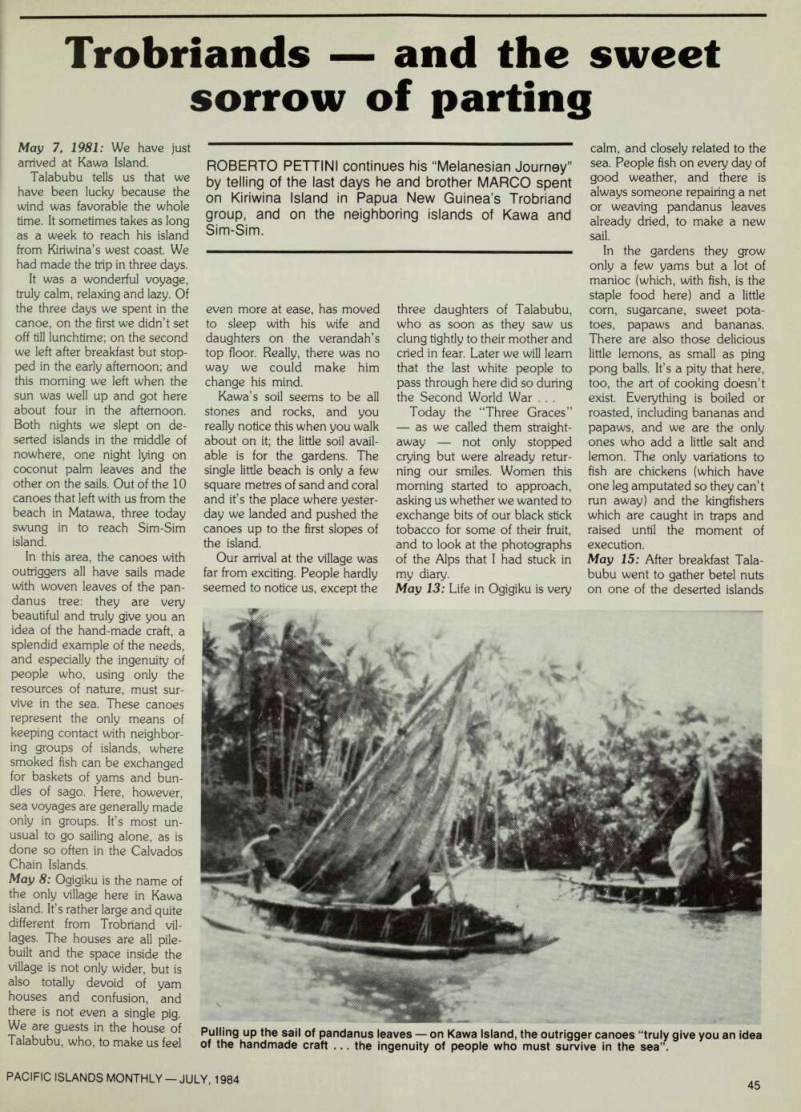
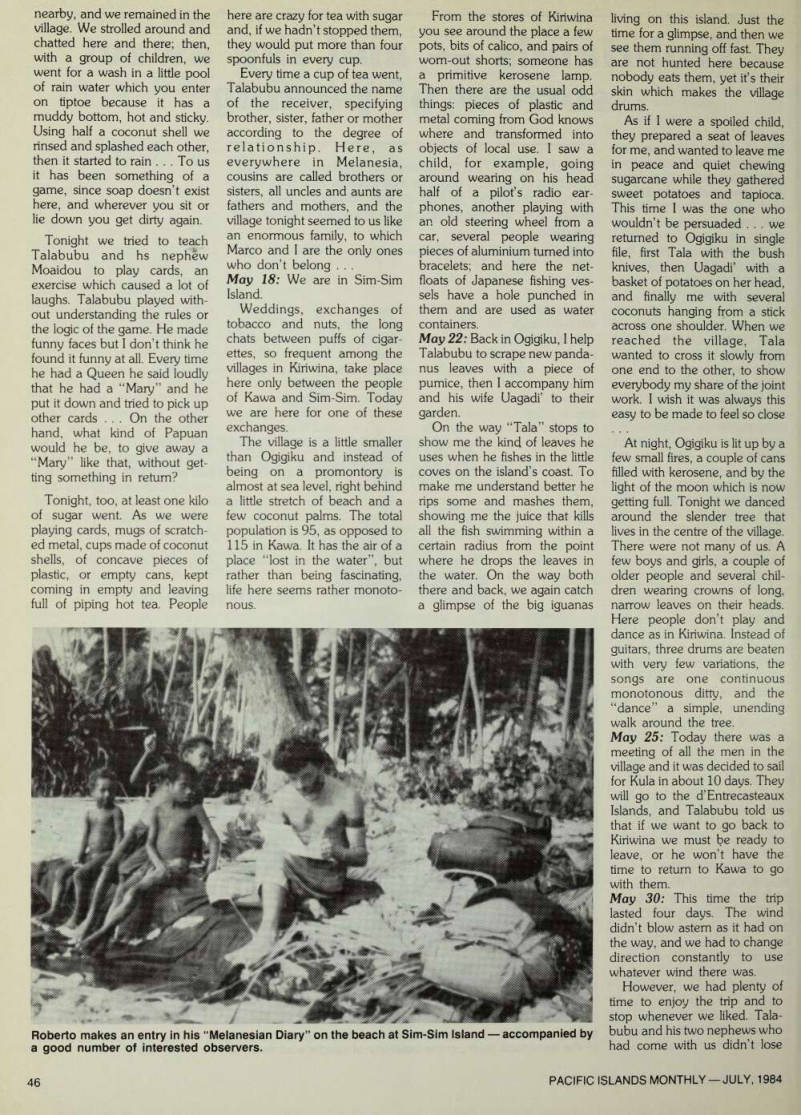


sorrow of parting
ROBERTO PETTINI continues his “Melanesian Journey” by telling of the last days he and brother MARCO spent on Kiriwina Island in Papua New Guinea’s Trobriand group, and on the neighboring islands of Kawa and Sim-Sim.
May 7, 1981: We have just arrived at Kawa Island.
Talabubu tells us that we have been lucky because the wind was favorable the whole time. It sometimes takes as long as a week to reach his island from Kiriwina’s west coast. We had made the trip in three days.
It was a wonderful voyage, truly calm, relaxing and lazy. Of the three days we spent in the canoe, on the first we didn’t set off till lunchtime; on the second we left after breakfast but stop ped in the early afternoon; and this morning we left when the sun was well up and got here about four in the afternoon.
Both nights we slept on de serted islands in the middle of nowhere, one night lying on coconut palm leaves and the other on the sails. Out of the 10 canoes that left with us from the beach in Matawa, three today swung in to reach Sim-Sim island.
In this area, the canoes with outriggers all have sails made with woven leaves of the pan danus tree: they are very beautiful and truly give you an idea of the hand-made craft, a splendid example of the needs, and especially the ingenuity of people who, using only the resources of nature, must sur vive in the sea. These canoes represent the only means of keeping contact with neighbor ing groups of islands, where smoked fish can be exchanged for baskets of yams and bun dles of sago. Here, however, sea voyages are generally made only in groups. It’s most un usual to go sailing alone, as is done so often in the Calvados Chain Islands.
May 8: Ogigiku is the name of the only village here in Kawa island. It’s rather large and quite different from Trobriand vil lages. The houses are all pile built and the space inside the village is not only wider, but is also totally devoid of yam houses and confusion, and there is not even a single pig.
We are guests in the house of Talabubu, who, to make us feel
even more at ease, has moved to sleep with his wife and daughters on the verandah’s top floor. Really, there was no way we could make him change his mind.
Kawa’s soil seems to be all stones and rocks, and you really notice this when you walk about on it; the little soil avail able is for the gardens. The single little beach is only a few square metres of sand and coral and it’s the place where yester day we landed and pushed the canoes up to the first slopes of the island.
Our arrival at the village was far from exciting. People hardly seemed to notice us, except the
three daughters of Talabubu, who as soon as they saw us clung tightly to their mother and cried in fear. Later we will learn that the last white people to pass through here did so during the Second World War . . .
Today the “Three Graces” as we called them straight away not only stopped crying but were already retur ning our smiles. Women this morning started to approach, asking us whether we wanted to exchange bits of our black stick tobacco for some of their fruit, and to look at the photographs of the Alps that I had stuck in my diary.
May 13: Life in Ogigiku is very
calm, and closely related to the sea. People fish on every day of good weather, and there is always someone repairing a net or weaving pandanus leaves already dried, to make a new sail.
In the gardens they grow only a few yams but a lot of manioc (which, with fish, is the staple food here) and a little corn, sugarcane, sweet pota toes, papaws and bananas.
There are also those delicious little lemons, as small as ping pong balls. It’s a pity that here, too, the art of cooking doesn’t exist. Everything is boiled or roasted, including bananas and papaws, and we are the only ones who add a little salt and lemon. The only variations to fish are chickens (which have one leg amputated so they can’t run away) and the kingfishers which are caught in traps and raised until the moment of execution.
May 15: After breakfast Tala bubu went to gather betel nuts on one of the deserted islands
Pulling up the sail of pandanus leaves on Kawa Island, the outrigger canoes “truly give you an idea of the handmade craft ... the ingenuity of people who must survive in the sea”.
nearby, and we remained in the village. We strolled around and chatted here and there; then, with a group of children, we went for a wash in a little pool of rain water which you enter on tiptoe because it has a muddy bottom, hot and sticky.
Using half a coconut shell we rinsed and splashed each other, then it started to rain ... To us it has been something of a game, since soap doesn’t exist here, and wherever you sit or lie down you get dirty again.
Tonight we tried to teach Talabubu and hs nephew Moaidou to play cards, an exercise which caused a lot of laughs. Talabubu played with out understanding the rules or the logic of the game. He made funny faces but I don’t think he found it funny at all. Every time he had a Queen he said loudly that he had a “Mary” and he put it down and tried to pick up other cards ... On the other hand, what kind of Papuan would he be, to give away a “Mary” like that, without get ting something in return?
Tonight, too, at least one kilo of sugar went. As we were playing cards, mugs of scratch ed metal, cups made of coconut shells, of concave pieces of plastic, or empty cans, kept coming in empty and leaving full of piping hot tea. People
here are crazy for tea with sugar and, if we hadn’t stopped them, they would put more than four spoonfuls in every cup.
Every time a cup of tea went, Talabubu announced the name of the receiver, specifying brother, sister, father or mother according to the degree of relationship. Here, as everywhere in Melanesia, cousins are called brothers or sisters, all uncles and aunts are fathers and mothers, and the village tonight seemed to us like an enormous family, to which Marco and I are the only ones who don’t belong . . .
May 18: We are in Sim-Sim Island.
Weddings, exchanges of tobacco and nuts, the long chats between puffs of cigar ettes, so frequent among the villages in Kiriwina, take place here only between the people of Kawa and Sim-Sim. Today we are here for one of these exchanges.
The village is a little smaller than Ogigiku and instead of being on a promontory is almost at sea level, right behind a little stretch of beach and a few coconut palms. The total population is 95, as opposed to 115 in Kawa. It has the air of a place “lost in the water”, but rather than being fascinating, life here seems rather monoto nous.
From the stores of Kiriwina you see around the place a few pots, bits of calico, and pairs of wom-out shorts; someone has a primitive kerosene lamp.
Then there are the usual odd things: pieces of plastic and metal coming from God knows where and transformed into objects of local use. I saw a child, for example, going around wearing on his head half of a pilot’s radio ear phones, another playing with an old steering wheel from a car, several people wearing pieces of aluminium turned into bracelets; and here the net floats of Japanese fishing ves sels have a hole punched in them and are used as water containers.
May 22: Back in Ogigiku, I help Talabubu to scrape new panda nus leaves with a piece of pumice, then I accompany him and his wife Uagadi’ to their garden.
On the way “Tala” stops to show me the kind of leaves he uses when he fishes in the little coves on the island’s coast. To make me understand better he rips some and mashes them, showing me the juice that kills all the fish swimming within a certain radius from the point where he drops the leaves in the water. On the way both there and back, we again catch a glimpse of the big iguanas
living on this island. Just the time for a glimpse, and then we see them running off fast. They are not hunted here because nobody eats them, yet it’s their skin which makes the village drums.
As if I were a spoiled child, they prepared a seat of leaves for me, and wanted to leave me in peace and quiet chewing sugarcane while they gathered sweet potatoes and tapioca.
This time I was the one who wouldn’t be persuaded ... we returned to Ogigiku in single file, first Tala with the bush knives, then Uagadi’ with a basket of potatoes on her head, and finally me with several coconuts hanging from a stick across one shoulder. When we reached the village, Tala wanted to cross it slowly from one end to the other, to show everybody my share of the joint work. I wish it was always this easy to be made to feel so close At night, Ogigiku is lit up by a few small fires, a couple of cans filled with kerosene, and by the light of the moon which is now getting full. Tonight we danced around the slender tree that lives in the centre of the village.
There were not many of us. A few boys and girls, a couple of older people and several chil dren wearing crowns of long, narrow leaves on their heads.
Here people don’t play and dance as in Kiriwina. Instead of guitars, three drums are beaten with very few variations, the songs are one continuous monotonous ditty, and the “dance” a simple, unending walk around the tree.
May 25: Today there was a meeting of all the men in the village and it was decided to sail for Kula in about 10 days. They will go to the d’Entrecasteaux Islands, and Talabubu told us that if we want to go back to Kiriwina we must be ready to leave, or he won’t have the time to return to Kawa to go with them.
May 30: This time the trip lasted four days. The wind didn’t blow astern as it had on the way, and we had to change direction constantly to use whatever wind there was.
However, we had plenty of time to enjoy the trip and to stop whenever we liked. Tala bubu and his two nephews who had come with us didn’t lose
Roberto makes an entry in his “Melanesian Diary” on the beach at Sim-Sim Island accompanied by a good number of interested observers.
any chance to provide us all with food. When we stopped on a large rock covered only by grass and by birds, we saw them running and grabbing dozens of small eggs, and they cooked enormous omelettes on site. Dragging a line behind us, we were very lucky, too, with the fish. Needless to say, they often got cooked immediately on the canoe. One morning, as we were on a coral bank, Talabubu, sitting at the rudder, even managed to catch a lobs ter that was swimming past.
And we weren’t lacking for surprises; at one place in the middle of the sea the water was so shallow that we all had to get out and push the canoe walking for two hours in water that only came above our ank les. On this flooded coral reef, Talabubu took us to see the rusty wreck of an American four-engine plane from the Second World War. Before saying good-bye and separat ing, before we went on our way to Morobubuna’s village, Tala bubu took us aside and gave each of us a little bottle of magic fluid. “Spread just one drop on
a betel nut and give it to the girl you want to fall in love with you: she won’t be able to resist ... I keep using mine every time I go away from Ogigiku.”
We were really moved: our friend Tala had given us the most precious thing he had . . .
We wanted to surprise Obu labula by our sudden return and we succeeded. In a flash we found ourselves among lots of shouting, among so many hands, and once again covered by flowers.
It was very beautiful beautiful again to be among people who like to laugh, to joke and to have you with them. For the rest of the day, and for a few more days after that, we did nothing but answer the same questions: how many “vivilas” (girls) are there in Kawa and Sim-Sim, how are they, and did we sleep “under the same mosquito net” with them? It seemed as if everbody was asking us, including the women, the old people and the children.
Life in Obulabula is very pleasant again, but after being there for three more weeks we
again feel the urge to move on.
It’s funny, but at a certain point you realise that you don’t have any valid reason to stay on, unless you want to become somehow an active part of a system to which you’ll never really be able to belong. We truly don’t want to spoil our Trobriand story the first that has magically made us feel like children again, giving us the chance to enjoy this care-free part of ourselves, with no con tradiction with the fact that we are in reality young men.
June 19: Yesterday the news that we are leaving on Monday spread like wildfire, generating a procession of people coming to ask if it was really true, and to show their sadness with many “sorrys ...” and by rubbing their eyes.
Morobubuna went especially to get an extra ration of yams to cook the “mona”, the food traditionally prepared especially for this kind of occasion, when someone leaves the island, vil lage and relatives . . .
June 21: Our departure was another excuse for a big gather ing. A good part of Obulabula’s
population this morning came with us to the landing strip. For the last time we were covered with flowers; in our hair, tucked into the bracelets on our wrists.
Then, under the burning sun, we wait for the plane to arrive, all together, chewing the last betel nuts, and passing cigar ettes from one mouth to the other, as we’ve been doing all the time during the last three months . . .
This time it’s hard to be leaving, more so than we could possibly have imagined. Isoba has tears in her eyes, she wants us to sit next to her. “Martin has gone away and now you go too . . . will I see you again?” Then suddenly everybody stands up excitedly. Up there in the sky a small dot is getting steadily larger and noisier. There are a few quick glances, the last half words, then we find ourselves with seat belts fastened.
Everybody in the plane seems to be looking at us in surprise . . Our kalekos and our painted faces already seem out of place . . .
Next month: Tasman Islands.
Advertisements & other items, pp. 47-48 (1 item)
couins
6
OLTOPIC
The Stationery and Diary People.
SYSTEM
S&SSL
CARDS
HS
umM I
Commercial, School, Household
Stationery and Diaries.
Fast and efficient export service.
COLLINS OLYMPIC LIMITED
/V\T T TNT C P 0 - BOX 476 ’ AUCKLAND, 1
LULLIII 1 NEW ZEALAND.
ATVMm/i PHONE: < 9 ) 484 ' 009 111 Y n Dir TELEX: N.Z. 21293 (EDUNLOP)
CABLES: GRAPHICOL
V4CIFIC
CONSTRUCTION EQUIPMENT CO
introducing the Dynamic new Range of
vibrating & Pneumatic Tyred Rollers
THE RANGE
• Pacific Self-Propelled Vibrating Rollers • Single and Double Drum Types • 1.5 tonne to 16 tonne • Pacific Self-Propelled Pneumatic Type Compactors • 3 Models 16. 21. 38 tonne Ballast Weights • Pacific Landfill and Sanitary Landfill Compactors • Pacific Pneumatic Earth Borers • Pacific Road Brooms • Pacific Railway Maintenance Vehicles ***
K&cific
DISTRIBUTORS REQUIRED
THROUGHOUT THE PACIFIC
Construction Equipment Co. 24 Salisbury Road, Hornsby NSW 2077, Australia. Phone (02) 476 2666
SHL
SPLiTSSE
books
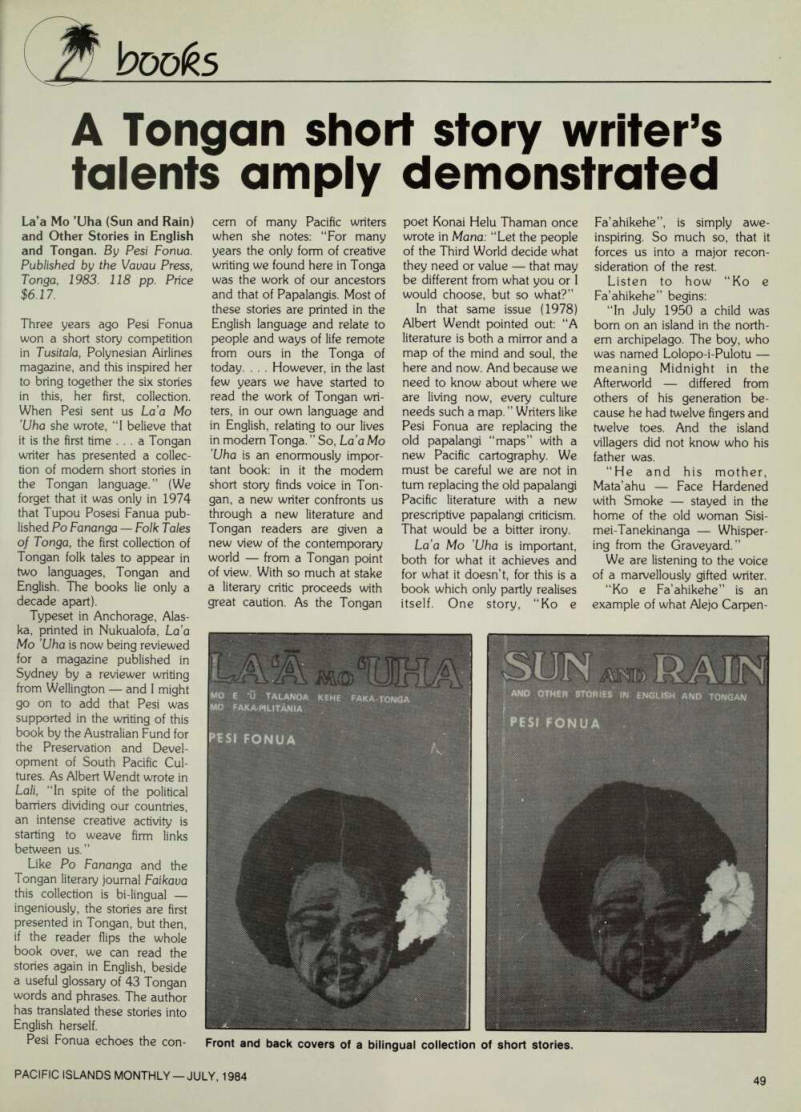
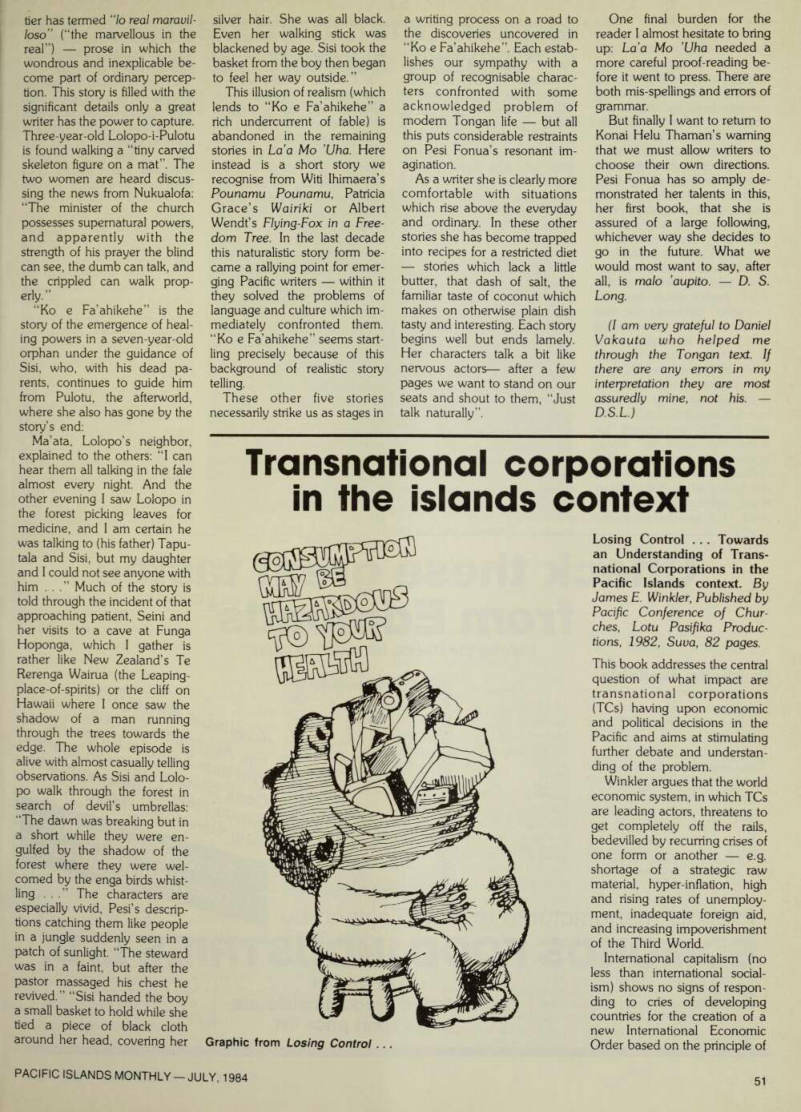
A Tongan short story writer’s talents amply demonstrated
La’a Mo ’Uha (Sun and Rain) and Other Stories in English and Tongan. By Pesi Fonua.
Published by the Vauau Press, Tonga, 1983. 118 pp. Price $6.17.
Three years ago Pesi Fonua won a short story competition in Tusitala, Polynesian Airlines magazine, and this inspired her to bring together the six stories in this, her first, collection.
When Pesi sent us La’a Mo Vha she wrote, “I believe that it is the first time ... a Tongan writer has presented a collec tion of modem short stories in the Tongan language.” (We forget that it was only in 1974 that Tupou Posesi Fanua pub lished Po Fananga Folk Tales of Tonga, the first collection of Tongan folk tales to appear in two languages, Tongan and English. The books lie only a decade apart).
Typeset in Anchorage, Alas ka, printed in Nukualofa, La’a Mo Vha is now being reviewed for a magazine published in Sydney by a reviewer writing from Wellington and I might go on to add that Pesi was supported in the writing of this book by the Australian Fund for the Preservation and Devel opment of South Pacific Cul tures. As Albert Wendt wrote in Lali, “In spite of the political barriers dividing our countries, an intense creative activity is starting to weave firm links between us.”
Like Po Fananga and the Tongan literary journal Faikaua this collection is bi-lingual ingeniously, the stories are first presented in Tongan, but then, if the reader flips the whole book over, we can read the stories again in English, beside a useful glossary of 43 Tongan words and phrases. The author has translated these stories into English herself.
Pesi Fonua echoes the con
cern of many Pacific writers when she notes: “For many years the only form of creative writing we found here in Tonga was the work of our ancestors and that of Papalangis. Most of these stories are printed in the English language and relate to people and ways of life remote from ours in the Tonga of today. . . . However, in the last few years we have started to read the work of Tongan wri ters, in our own language and in English, relating to our lives in modem Tonga. ” So, La’a Mo ’Uha is an enormously impor tant book: in it the modem short story finds voice in Ton gan, a new writer confronts us through a new literature and Tongan readers are given a new view of the contemporary world from a Tongan point of view. With so much at stake a literary critic proceeds with great caution. As the Tongan
poet Konai Helu Thaman once wrote in Mana: “Let the people of the Third World decide what they need or value that may be different from what you or I would choose, but so what?”
In that same issue (1978) Albert Wendt pointed out: “A literature is both a mirror and a map of the mind and soul, the here and now. And because we need to know about where we are living now, every culture needs such a map. ” Writers like Pesi Fonua are replacing the old papalangi “maps” with a new Pacific cartography. We must be careful we are not in turn replacing the old papalangi Pacific literature with a new prescriptive papalangi criticism.
That would be a bitter irony.
La’a Mo Vha is important, both for what it achieves and for what it doesn’t, for this is a book which only partly realises itself. One story, “Ko e
Fa’ahikehe”, is simply awe inspiring. So much so, that it forces us into a major recon sideration of the rest.
Listen to how “Ko e Fa’ahikehe” begins: “In July 1950 a child was bom on an island in the north ern archipelago. The boy, who was named Lolopo-i-Pulotu meaning Midnight in the Afterworld differed from others of his generation be cause he had twelve fingers and twelve toes. And the island villagers did not know who his father was.
“He and his mother, Mata’ahu Face Hardened with Smoke stayed in the home of the old woman Sisi mei-Tanekinanga Whisper ing from the Graveyard.”
We are listening to the voice of a marvellously gifted writer.
“Ko e Fa’ahikehe” is an example of what Alejo Carpen-
Front and back covers of a bilingual collection of short stories.
tier has termed “/o real marauil loso” (“the marvellous in the real”) prose in which the wondrous and inexplicable be come part of ordinary percep tion. This story is filled with the significant details only a great writer has the power to capture.
Three-year-old Lolopo-i-Pulotu is found walking a “tiny carved skeleton figure on a mat”. The two women are heard discus sing the news from Nukualofa: “The minister of the church possesses supernatural powers, and apparently with the strength of his prayer the blind can see, the dumb can talk, and the crippled can walk prop erly.”
“Ko e Fa’ahikehe” is the story of the emergence of heal ing powers in a seven-year-old orphan under the guidance of Sisi, who, with his dead pa rents, continues to guide him from Fulotu, the afterworld, where she also has gone by the story’s end: Ma’ata, Lolopo’s neighbor, explained to the others; “I can hear them all talking in the fale almost every night. And the other evening I saw Lolopo in the forest picking leaves for medicine, and I am certain he was talking to (his father) Tapu tala and Sisi, but my daughter and I could not see anyone with him ...” Much of the story is told through the incident of that approaching patient, Seini and her visits to a cave at Funga Hoponga, which I gather is rather like New Zealand’s Te Rerenga Wairua (the Leaping place-of-spirits) or the cliff on Hawaii where I once saw the shadow of a man running through the trees towards the edge. The whole episode is alive with almost casually telling observations. As Sisi and Lolo po walk through the forest in search of devil’s umbrellas: “The dawn was breaking but in a short while they were en gulfed by the shadow of the forest where they were wel comed by the enga birds whist ling ...” The characters are especially vivid, Pesi’s descrip tions catching them like people in a jungle suddenly seen in a patch of sunlight. “The steward was in a faint, but after the pastor massaged his chest he revived.” “Sisi handed the boy a small basket to hold while she tied a piece of black cloth around her head, covering her
silver hair. She was all black.
Even her walking stick was blackened by age. Sisi took the basket from the boy then began to feel her way outside.”
This illusion of realism (which lends to “Ko e Fa’ahikehe” a rich undercurrent of fable) is abandoned in the remaining stories in La’a Mo ’Uha. Here instead is a short story we recognise from Witi Ihimaera’s Pounamu Pounamu, Patricia Grace’s Wairiki or Albert Wendt’s Flying-Fox in a Free dom Tree. In the last decade this naturalistic story form be came a rallying point for emer ging Pacific writers within it they solved the problems of language and culture which im mediately confronted them.
“Ko e Fa’ahikehe” seems start ling precisely because of this background of realistic story telling.
These other five stories necessarily strike us as stages in
a writing process on a road to the discoveries uncovered in “Ko e Fa’ahikehe”. Each estab lishes our sympathy with a group of recognisable charac ters confronted with some acknowledged problem of modem Tongan life but all this puts considerable restraints on Pesi Fonua’s resonant im agination.
Asa writer she is clearly more comfortable with situations which rise above the everyday and ordinary. In these other stories she has become trapped into recipes for a restricted diet stories which lack a little butter, that dash of salt, the familiar taste of coconut which makes on otherwise plain dish tasty and interesting. Each story begins well but ends lamely.
Her characters talk a bit like nervous actors— after a few pages we want to stand on our seats and shout to them, “Just talk naturally”.
One final burden for the reader I almost hesitate to bring up: La’a Mo ’Uha needed a more careful proof-reading be fore it went to press. There arc both mis-spellings and errors of grammar.
But finally I want to return to Konai Helu Thaman’s warning that we must allow writers to choose their own directions.
Pesi Fonua has so amply de monstrated her talents in this, her first book, that she is assured of a large following, whichever way she decides to go in the future. What we would most want to say, after
all, is malo ’aupito.
D. S.
Long.
(I am aery grateful to Daniel Vakauta who helped me through the Tongan text. If there are any errors in my interpretation they are most assuredly mine, not his. —
D.S.L)
Advertisements & other items, p. 50 (1 item)
Bens on w Hedges
L B traditionally the name
ASSOCIATED WITH PERFECTION
IN CIGARETTES
BENSON & HEDGES
20 .
Bens on w Hedges
WARNING
SMOKING IS A HEALTH
HAZARD
, r
ONLY THE BEST WILL DO.
Transnational corporations

in the islands context
Losing Control . . . Towards an Understanding of Trans national Corporations in the Pacific Islands context. By James E. Winkler, Published by Pacific Conference of Chur ches, Lotu Pasifika Produc tions, 1982, Suva, 82 pages.
This book addresses the central question of what impact are transnational corporations (TCs) having upon economic and political decisions in the Pacific and aims at stimulating further debate and understan ding of the problem.
Winkler argues that the world economic system, in which TCs are leading actors, threatens to get completely off the rails, bedevilled by recurring crises of one form or another e.g. shortage of a strategic raw material, hyper-inflation, high and rising rates of unemploy ment, inadequate foreign aid, and increasing impoverishment of the Third World.
International capitalism (no less than international social ism) shows no signs of respon ding to cries of developing countries for the creation of a new International Economic Order based on the principle of
Graphic from Losing Control .. .
social justice. Pacific Island countries, many of which have only recently won political inde pendence, are losing control over the key aspects of their economic life under continuing pressure from the volatile and impersonal international eco nomy. There is little hope for them unless national leaders begin to open their eyes and re-examine some of the basic assumptions underlying current development policies and prog rams as part of a process of developing more appropriate formulas for development.
Such is the principal theme developed by Winkler in this small book which has the distinction of being the first book to come out devoted specifically to the subject of TCs in the South Pacific context.
The work is timely, for TCs and their impact on the region are receiving increasing attention from Pacific Island leaders who see in TCs a potential for promoting economic deve lopment on one hand, and a capacity for exploiting them on the other. Yet, as Bishop Jabez Bryce points out in the fore word. ”... many of us do not
quite understand the structure and complexity of this whole phenomenon” (i.e. TCs in the Pacific Islands). A ministerial round table conference recently held in Apia on the subject of TCs and the developing Pacific Island countries, organised by ESCAP and UNCTC, is evi dence of attempts to come to grips with such issues. (And it might be noted that the Pacific islands Development Program, East-West Center, Honolulu, is researching in this field under mandate from a group of Paci fic Island leaders.) Winkler deals with his subject in a lively, simple and popular style which makes for easy reading. A great deal of ground is covered both global and regional and his perspective is that of a concerned human being I was going to say “churchperson” troubled by the injustices and imperfections of the world economic system and their moral and humanita rian consequences. It is not, however, a balanced account of the subject. For example, Wink ler does not discuss the reasons why TCs have risen to such prominence over time, or
examine their positive contribu tions if any. The latter issue is touched upon in passing in only a single paragraph on page 21.
In Chapter 1 (there are only four chapters), Winkler deals with the TC as a modern phenomenon, focusing on the characteristics behind its rapid global expansion. These char acteristics are well-known, but two in particular are somewhat alarming: their important part in a larger global trend towards a greater concentration of wealth and power, and (prepare to go into a cold sweat!) their tenden cy to align themselves with local elites; politicians, civil servants, intellectuals, property owners, businessmen who see in TCs a powerful vehicle for promot ing their own positions and influence.
Hardly less disturbing is the claim that the position of TCs is constantly being reinforced by advertising and media flows and even foreign aid thus enabling them to extend their influence throughout the whole fabric of local societies. All part of “losing control” not only economically but socially, given the part they play in creating
such social ills as rapid urbanisation, crime, unemploy ment and disintegration of fam ily life.
Closer to home, Winkler, in Chapter 2, is concerned with the Pacific as an area of interest for the great powers econo mically, strategically and mili tarily and then discusses particular fields where TCs have been prominent. I found the sections on the two Pacific trading giants Burns Philp W. R. Carpenter of most interest, especially the outline of the way local subsidiaries of the former have recently been ac tive in extending their range of activities by takeovers. By vir tue of size and the diversity of services provided, these two companies are powerfully placed to influence all facets of island life.
The natural wealth of the South Pacific region is the sub ject of Chapter 3 wealth in form of on-shore mining., fisheries, forestries, tropical agriculture and seabed mine rals, and, on the darker side, as a “dumping ground for mediocre products as well as a nuclear and tourist playground”
Advertisements & other items, p. 52 (1 item)
Ava^anS 3^
Check these great tastes
from Edmonds*
Products Available
Serving the Pacific for over 100 years Our Famous Brands Betty Crocker Sunshine St Clements (peel ginger cherries and mixed fruit) Chellies (artificial cherries) Country Kitchen Sure to Rise Acto Edmonds Colonial Lite Lunch Sun-up Oxo Mansells
DYC
ut
Tong3 : , and s.
hie t hr ° U ?Toa
Ava^anS 3^
CO o5a IS NeV G -"r ahi,i
u atU'
ledo^' 3
Proudly manufactured in New Zealand by
EDMONDS FOOD INDUSTRIES LTD.
*Ask for our
Illustrated product catalogue
and export price list.
PO Box 27-249 Mt Roskill
AUCKLAND NZ
Telephone 698-167 Cable Address Sunshine Telex Address 21690 Brochure Factory 83 Bankers National Bank Year Established 1881 Export Manager Tony Babbage incl W F Tucker & Company Limited
NZ: “Blessed by nature, deeply
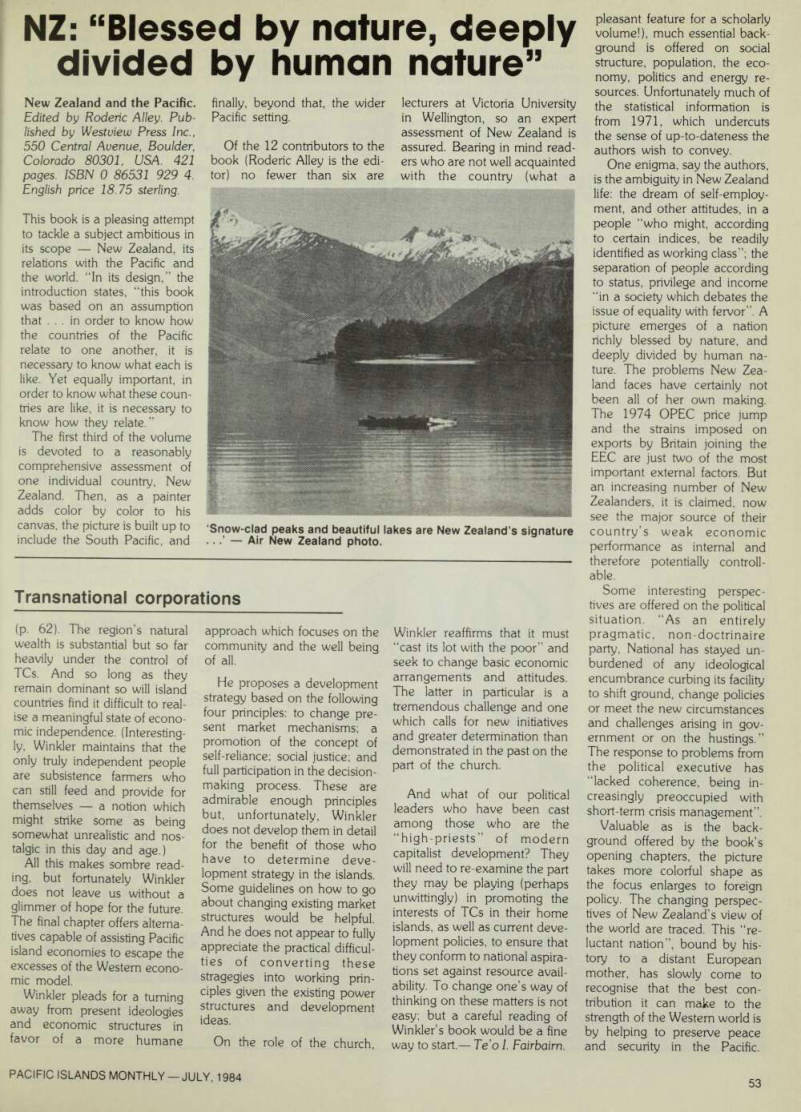

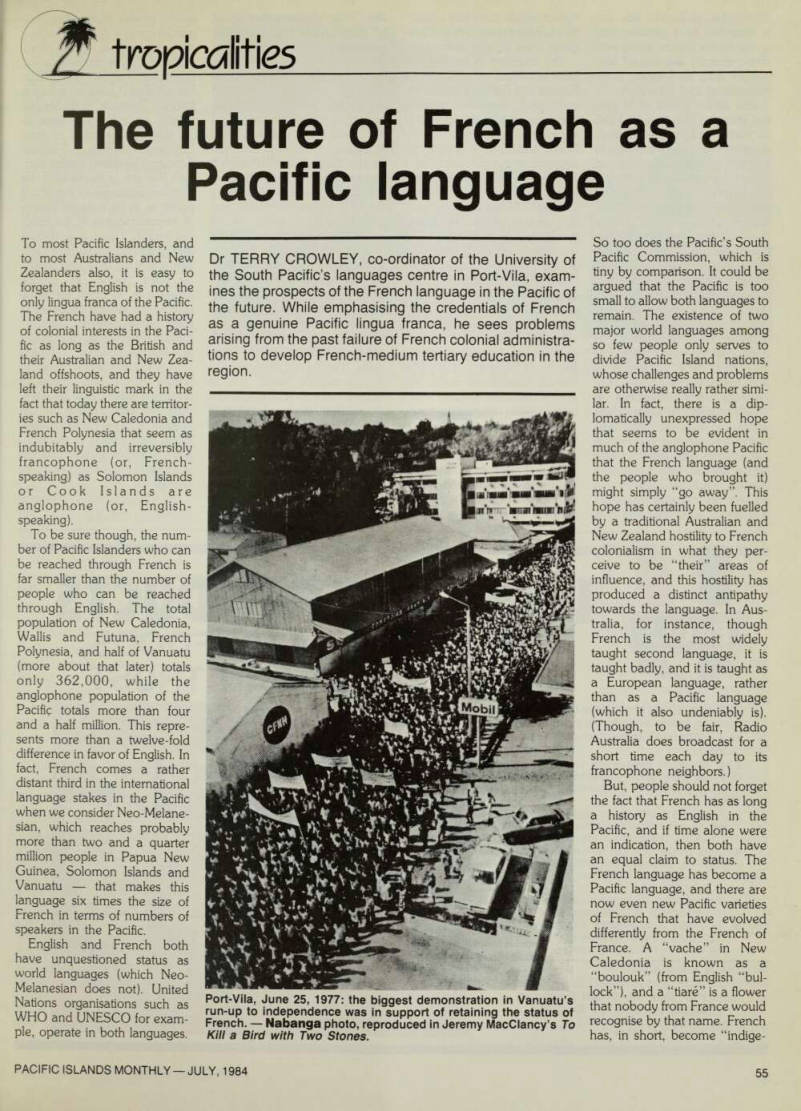

divided by human nature”
New Zealand and the Pacific.
Edited by Roderic Alley. Pub lished by Westview Press Inc., 550 Central Avenue, Boulder, Colorado 80301, USA. 421 pages. ISBN 0 86531 929 4.
English price 18.75 sterling.
This book is a pleasing attempt to tackle a subject ambitious in its scope New Zealand, its relations with the Pacific and the world. “In its design,” the introduction states, “this book was based on an assumption that ... in order to know how the countries of the Pacific relate to one another, it is necessary to know what each is like. Yet equally important, in order to know what these coun tries are like, it is necessary to know how they relate.”
The first third of the volume is devoted to a reasonably comprehensive assessment of one individual country, New Zealand. Then, as a painter adds color by color to his canvas, the picture is built up to include the South Pacific, and
finally, beyond that, the wider Pacific setting.
Of the 12 contributors to the book (Roderic Alley is the edi tor) no fewer than six are
lecturers at Victoria University in Wellington, so an expert assessment of New Zealand is assured. Bearing in mind read ers who are not well acquainted with the country (what a
pleasant feature for a scholarly volume!), much essential back ground is offered on social structure, population, the eco nomy, politics and energy re sources. Unfortunately much of the statistical information is from 1971, which undercuts the sense of up-to-dateness the authors wish to convey.
One enigma, say the authors, is the ambiguity in New Zealand life: the dream of self-employ ment, and other attitudes, in a people “who might, according to certain indices, be readily identified as working class”; the separation of people according to status, privilege and income “in a society which debates the issue of equality with fervor". A picture emerges of a nation richly blessed by nature, and deeply divided by human na ture. The problems New Zea land faces have certainly not been all of her own making.
The 1974 OPEC price jump and the strains imposed on exports by Britain joining the EEC are just two of the most important external factors. But an increasing number of New Zealanders, it is claimed, now see the major source of their country’s weak economic performance as internal and therefore potentially controll able.
Some interesting perspec tives are offered on the political situation. “As an entirely pragmatic, non-doctrinaire party. National has stayed un burdened of any ideological encumbrance curbing its facility to shift ground, change policies or meet the new circumstances and challenges arising in gov ernment or on the hustings.”
The response to problems from the political executive has “lacked coherence, being in creasingly preoccupied with short-term crisis management”.
Valuable as is the back ground offered by the book’s opening chapters, the picture takes more colorful shape as the focus enlarges to foreign policy. The changing perspec tives of New Zealand’s view of the world are traced. This “re luctant nation”, bound by his tory to a distant European mother, has slowly come to recognise that the best con tribution it can make to the strength of the Western world is by helping to preserve peace and security in the Pacific.
Snow-clad peaks and beautiful lakes are New Zealand’s signature .. .'— Air New Zealand photo.
Under Norman Kirk’s leader ship, “a conscious effort was made to improve New Zea land’s relations with its South Pacific neighbors. Kirk helped foster a new New Zealand identity as a Pacific Island state.” The National Party, hard-headed realists though they are (“Foreign policy is trade,” Muldoon has said), have broadly continued this trend. Furthermore, the grow ing Polynesian nature of New Zealand society provides both a severe test and an exciting opportunity: “If New Zealan ders cannot live in harmony at home, their country is unlikely to develop harmonious rela tions with the rest of the world. ”
New Zealand has found a new assertiveness which “need not be belligerent . . . New Zealand’s stature abroad can be enhanced by the assertion of an independent voice in world affairs.” Her Pacific identity is acceptable and comprehensible to the international community, as well as something with which all New Zealanders can identify.
The second third of the book deals with New Zealand’s rela
tions with the South Pacific. A sketch of the background of New Zealand rule in the region (a rule characterised by periods of “benign neglect”) leads swift ly to an in-depth survey of New Zealand’s role in the 1980 s.
Concentration is given to deve lopment assistance (60 per cent is allocated to the South Paci fic); the issue of nuclear weapons; migration; the law of the Sea; economic deve lopment and resource manage ment; trade and transport; de colonisation; and regional co operation. A whole chapter is devoted to organisations and issues in South Pacific regional ism, an admirable hitch-hiker’s guide to the galaxy of the region’s 10 main organisations.
The economies of scale vital to economic development are emphasised as the primary rationale for regional co-opera tion.
The role of the South Pacific Commission (SPC) as “a non political organisation” is en couraged. But, “despite its apparent robust health”, organ ised regionalism is not without substantial stresses. “The unit
ing effect of decolonisation may not survive the 1980 s as the basis for regional camaraderie. ”
The goal of economic deve lopment is providing a substan tial alternative motivation for working together. The deve lopment of the South Pacific Bureau for Economic Co operation (SPEC) is detailed in an illuminating chapter which covers the chief economic issues in the region.
There is the constant dilem ma of weighing a cost, in monetary terms, against a benefit which may not be quantifiable. Visions become replaced with “concern for secondary or peripheral issues”. Developments in the global arena dictate that the Pacific must “learn to ‘sprint’ before it can ‘walk’.” The re gion has “its share of experts who forget that ... the aspira tions and destiny of the region are not theirs”. And, the writer asserts, “further progress re quires that one fundamental question be answered with commitment: What is the de stiny of the peoples'and there fore countries of this region?”
New Zealand’s development assistance to the Pacific (and the quality versus quantity de bate) gets lengthy treatment. So too, as wider international rela tions come centre stage in the book’s closing chapters, does the Pacific’s links with the Euro pean Community. Lome I and II (“they have established an exemplary relationship be tween the EC and a group of developing countries”) receive detailed analysis. Pacific-wide trade and inter-relations are scrutinised, nation by nation. It all makes stimulating reading.
The penultimate chapter is devoted to the “Politics of Paci fic Security”. The lack of ade quate resources on the part of individual nations, and general vulnerability, make some kind of common defence agreement needful as well as desirable.
“Australia and New Zealand have sought (not without some despair) to steer the United States towards the recognition of the permanence of its in terests in the Pacific. The Amer icans have been unwilling
continued on page 66
pupils, in part because of an historic ambivalence towards paricipation in international activities which continues to influence both public and poli cy-maker alike. ” The imbalance of the ANZUS relationship and of that between Australia and New Zealand (“unavoid ably unequal”) adds to the strain imposed on the search for adequate co-operation in the field of security. America sees Micronesia as more important strategically than the South Pacific. “Unresolved doubts about the wisdom of reliance upon the American nuclear umbrella” will be increased dur ing the 1980 s by “an intensify ing concern amongst Pacific Islanders over the environmen tal and social consequences of nuclear programs more gener ally”. Furthermore, suggests the author, the most important security problems faced by the new states of the Pacific may be internal. But whatever differ ences there may be in their relationships with each other and on other issues, “over questions threatening the health, peace and security of the Pacific region these nations may be expected to work to gether in increasingly vocal ways”.
The final chapter, which completes the survey of in ternational relationships, is re ndered in parts almost incom prehensible by the liberal use of jargon, from which the rest of the book is mercifully free. (Who really understands the meaning of this: “A change in regime locale normally involves a different matrix of internatio nal interaction”?) But helpful angles are added by the high lighting of Japan’s growing might and the entry of China onto the Pacific stage. Japan’s ambitious proposal for an Asian/Pacific Community (a variation of Ratu Mara’s “Paci fic Way” concept?) is also dis cussed.
For those interested in the Pacific, this is an admirable book which can be highly re commended. It achieves its goal of giving a broad picture of the interlocking relationships in the region in a way which is re markably readable for a book
of this depth. The authors strive to remain objective and broadly speaking they succeed. The text is accompanied by a good number of maps. There are 30 pages of appendices full of invaluable statistical informa tion, and a remarkable bib liography running to 34 pages.
The authors are united in the conviction that New Zealand has a vital role to play in the Pacific region, a role which “stems from the totality of its economic and political relations with the countries of the region, from its expanding resource base, and from its close and well-established links within the Southwest Pacific and Aus tralia”.
This volume offers much hope for the future. There are hard decisions to be made, but the possibilities are enormous.
As in most things, it all comes down in the end to the quality of people’s lives, aims and motives. One is reminded of an old Tongan proverb; “Ke me tatau ho ngutu mo ho tuhu” (“If only our hands were as efficient as our mouths”).
Edward Peters.
Books received
Mau: Samoa’s Struggle Against New Zealand Oppression By Michael J. Field. Published 1984 by A, H. & A. W. Reed Ltd.. 68-74 Kingsford Smith Street. Wellington 3.
New Zealand. ISBN 0 589 01492 7.
Price $NZ19.95.
Factors Affecting Standards in Community Schools: A New Ireland Case Study. Educational Research Unit Report No. 46.
By Ephraim T. Apelis. Published 1984 by the Educational Research Unit. Uni versity of PNG, Box 320, University PO, NCD. Papua New Guinea. ISSN 0254 069 X. Price K 2.75.
In the Land of Strangers: A Century of European Contact with Tanna, 1774-1874.
By Ron Adams. Published 1984 by the Development Studies Centre. Australian National University. Distributed by ANU Press. PO Box 4. Canberra. Australia.
ISBN 0 86784 425 6. Price $12.00.
Melanesia: Beyond Diversity.
Volumes 1 & 2.
Edited by R. J. May and Hank Nelson.
Published 1982 by the Research School of Pacific Studies. Australian National University. PO Box 4, Canberra, Austra lia. ISBN 0 86784 045 5. Price $lO per volume.
Timor: A People Betrayed.
By James Dunn. Published 1983 by The Jacaranda Press. 65 Park Road, Milton.
Qld. 4064. ISBN 0 7016 1715 2. Price $15.95.
Transnational corporations
(p. 62). The region’s natural wealth is substantial but so far heavily under the control of TCs. And so long as they remain dominant so will island countries find it difficult to real ise a meaningful state of econo mic independence. (Interesting ly, Winkler maintains that the only truly independent people are subsistence farmers who can still feed and provide for themselves a notion which might strike some as being somewhat unrealistic and nos talgic in this day and age.) All this makes sombre read ing. but fortunately Winkler does not leave us without a glimmer of hope for the future.
The final chapter offers alterna tives capable of assisting Pacific island economies to escape the excesses of the Western econo mic model.
Winkler pleads for a turning away from present ideologies and economic structures in favor of a more humane
approach which focuses on the community and the well being of all.
He proposes a development strategy based on the following four principles: to change pre sent market mechanisms; a promotion of the concept of self-reliance; social justice; and full participation in the decision making process. These are admirable enough principles but, unfortunately, Winkler does not develop them in detail for the benefit of those who have to determine deve lopment strategy in the islands.
Some guidelines on how to go about changing existing market structures would be helpful.
And he does not appear to fully appreciate the practical difficul ties of converting these stragegies into working prin ciples given the existing power structures and development ideas.
On the role of the church,
Winkler reaffirms that it must “cast its lot with the poor” and seek to change basic economic arrangements and attitudes.
The latter in particular is a tremendous challenge and one which calls for new initiatives and greater determination than demonstrated in the past on the part of the church.
And what of our political leaders who have been cast among those who are the “high-priests” of modern capitalist development? They will need to re-examine the part they may be playing (perhaps unwittingly) in promoting the interests of TCs in their home islands, as well as current deve lopment policies, to ensure that they conform to national aspira tions set against resource avail ability. To change one’s way of thinking on these matters is not easy; but a careful reading of Winkler’s book would be a fine
way to start.
Te’o /. Fairbaim.
Advertisements & other items, p. 54 (1 item)
Suppliers of top quality handtools
top quality handtools to the world market for 50 years m © 50 o 933 Nr. Farimagsgade 65-67 DK-1364 Copenhagen K Denmark Telephone4s-1-13 70 50Telex 151 lOdkTelegramsTOOLS
Pacific language
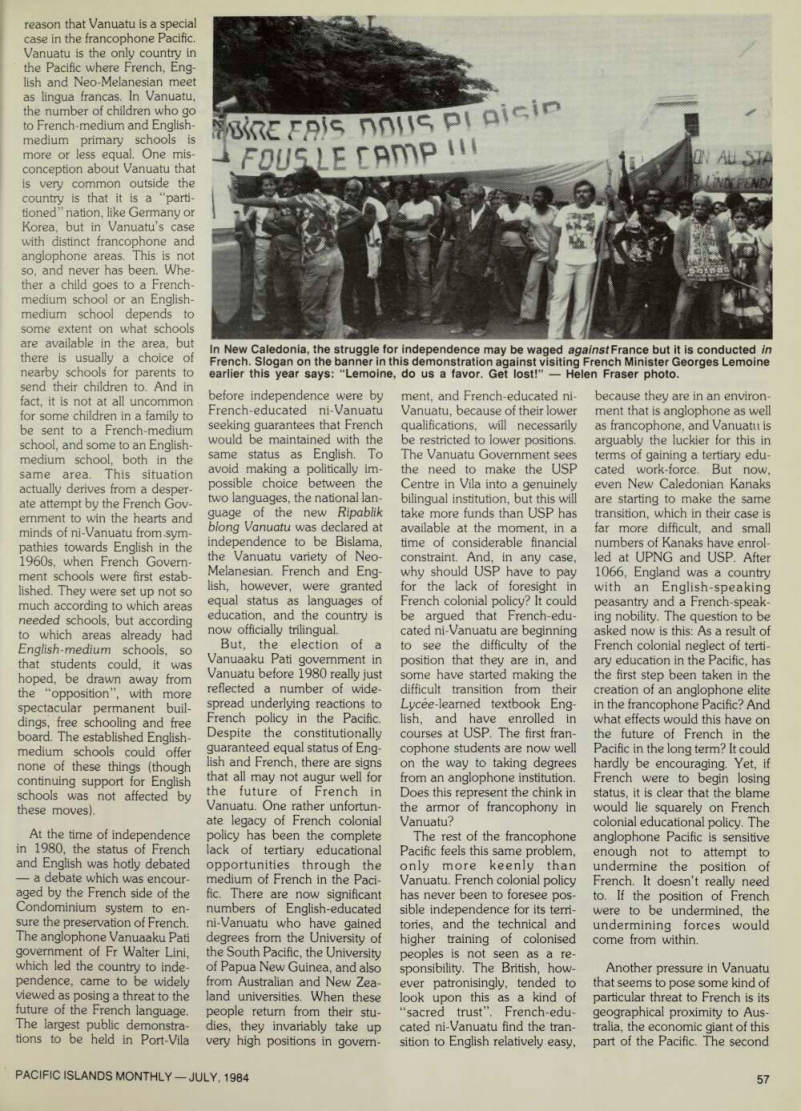
tropicalities
The future of French as a Pacific language
Dr TERRY CROWLEY, co-ordinator of the University of the South Pacific’s languages centre in Port-Vila, exam ines the prospects of the French language in the Pacific of the future. While emphasising the credentials of French as a genuine Pacific lingua franca, he sees problems arising from the past failure of French colonial administra tions to develop French-medium tertiary education in the region.
To most Pacific Islanders, and to most Australians and New Zealanders also, it is easy to forget that English is not the only lingua franca of the Pacific.
The French have had a history of colonial interests in the Paci fic as long as the British and their Australian and New Zea land offshoots, and they have left their linguistic mark in the fact that today there are territor ies such as New Caledonia and French Polynesia that seem as indubitably and irreversibly francophone (or, French speaking) as Solomon Islands or Cook Islands are anglophone (or, English speaking).
To be sure though, the num ber of Pacific Islanders who can be reached through French is far smaller than the number of people who can be reached through English. The total population of New Caledonia, Wallis and Futuna, French Polynesia, and half of Vanuatu (more about that later) totals only 362,000, while the anglophone population of the Pacific totals more than four and a half million. This repre sents more than a twelve-fold difference in favor of English. In fact, French comes a rather distant third in the international language stakes in the Pacific when we consider Neo-Melane sian, which reaches probably more than two and a quarter million people in Papua New Guinea, Solomon Islands and Vanuatu that makes this language six times the size of French in terms of numbers of speakers in the Pacific.
English and French both have unquestioned status as world languages (which Neo- Melanesian does not). United Nations organisations such as WHO and UNESCO for exam ple, operate in both languages.
So too does the Pacific’s South Pacific Commission, which is tiny by comparison. It could be argued that the Pacific is too small to allow both languages to remain. The existence of two major world languages among so few people only serves to divide Pacific Island nations, whose challenges and problems are otherwise really rather simi lar. In fact, there is a dip lomatically unexpressed hope that seems to be evident in much of the anglophone Pacific that the French language (and the people who brought it) might simply “go away”. This hope has certainly been fuelled by a traditional Australian and New Zealand hostility to French colonialism in what they per ceive to be “their” areas of influence, and this hostility has produced a distinct antipathy towards the language. In Aus tralia, for instance, though French is the most widely taught second language, it is taught badly, and it is taught as a European language, rather than as a Pacific language (which it also undeniably is). (Though, to be fair, Radio Australia does broadcast for a short time each day to its francophone neighbors.) But, people should not forget the fact that French has as long a history as English in the Pacific, and if time alone were an indication, then both have an equal claim to status. The French language has become a Pacific language, and there are now even new Pacific varieties of French that have evolved differently from the French of France. A “vache” in New Caledonia is known as a “boulouk” (from English “bul lock”), and a “tiare” is a flower that nobody from France would recognise by that name. French has, in short, become “indige
Port-Vila, June 25, 1977: the biggest demonstration in Vanuatu’s run-up to independence was in support of retaining the status of French. Nabanga photo, reproduced in Jeremy MacClancy’s To Kill a Bird with Two Stones.
nised”, just as English has, and is regarded as a genuine language of the Pacific, along with other recently introduced languages such as English, Neo- Melanesian and Fiji Hindi.
Just as the status of English has changed little vis-a-vis Pacific vernaculars after independence, so too could we expect to see little change in the status of French in relation to vemaculars in any French territory that might gain independence from France in the future. Despite the high level of hostility between Kanaks in New Caledonia and the ethnic European “Caldoches”, French is the only language that links the Melanesian speakers of the 28 indigenous Kanak languages. The struggle for independence is conducted against France, but in French. It is interesting to note that at the time that France annexed New Caledonia in 1853, a variety of Bislama was widely spoken, but this was quickly eliminated by French missionaries and replaced as a lingua franca with French. If Bislama had survived to the present (as it has in Vanuatu), then it is quite possible that
French would have had a much less certain future in New Cale donia than it does today, The situation in the Polyne sian territories of Wallis and Futuna and French Polynesia is somewhat different, in that there are practical indigenous alternatives to French. In tiny Wallis and Futuna, where the question of independence nev er seems to be raised, French policy has been to use French as the only language of educa tion (as is true also in the rest of the francophone Pacific). This has produced a younger gen eration that is quite fluent in French, though this is to the disquiet of some of the older people who see in this a danger to the future of the Wallisian language. The danger is not seen as the French language alone however. Colonial French educational policy has always been to teach French culture along with the language, and it seems that this policy has been quite successfully im plemented in Polynesia. The danger, therefore, is that French educational policy aims to produce French men and women, who happen to look
like Pacific Islanders. As a result of the disquiet that has been expressed about the success of this policy in Wallis and Futuna, there has been a resurgence recently in loyalty to the vernacular, and now, Wallisian has equal status with French on the local radio station, and Wallisian is taught as a subject in junior high school (though it is not used as a medium of instruction, even in primary school). Wallisians living in New Caledonia (who number rather more than their compatriots in Wallis and Futuna itself) have even started their own vernacu lar community newspaper. De spite this resurgence in vernacular pride, however, there is no questioning of the wider importance of French among Wallisians and Futu nans. It is seen as the only door to the outside world, and to money-earning jobs in an eco nomy that has become totally dependent on France.
In French Polynesia, French does not have the sole claim to lingua franca status in the terri tory. Apart from Tahitian, which claims about 100,000 speakers, there are six other
much smaller Polynesian lan guages spoken. Among Polyne sians who speak these seven different Polynesian languages, it is in fact Tahitian rather than French that is used as a lingua franca. There is considerable loyalty among Polynesians to Tahitian as a symbol of their Polynesian identity. A Tahitian Academy has been established, with the aim of developing the Tahitian language so that it will continue to be a useful means of communicating in the mod ern world. There is a distinct feeling among speakers of Tahi tian that their language should be kept “pure” of French borrowings, in much the same way as the French Academy in Paris battles against “impure”
English borrowings. As in Wallis and Futuna, however, Tahitians still see the learning of French in school as the only means of acquiring good jobs in town.
Just as with English in the remainder of the Pacific, money easily buys loyalty to an origin ally colonial language, and this is a loyalty that cannot easily be shaken off.
So far, I have ignored Vanuatu, and this is for the
reason that Vanuatu is a special case in the francophone Pacific.
Vanuatu is the only country in the Pacific where French, Eng lish and Neo-Melanesian meet as lingua francas. In Vanuatu, the number of children who go to French-medium and English medium primary schools is more or less equal. One mis conception about Vanuatu that is very common outside the country is that it is a “parti tioned” nation, like Germany or Korea, but in Vanuatu’s case with distinct francophone and anglophone areas. This is not so, and never has been. Whe ther a child goes to a French medium school or an English medium school depends to some extent on what schools are available in the area, but there is usually a choice of nearby schools for parents to send their children to. And in fact, it is not at all uncommon for some children in a family to be sent to a French-medium school, and some to an English medium school, both in the same area. This situation actually derives from a desper ate attempt by the French Gov ernment to win the hearts and minds of ni-Vanuatu from .sym pathies towards English in the 19605, when French Govern ment schools were first estab lished. They were set up not so much according to which areas needed schools, but according to which areas already had English-medium schools, so that students could, it was hoped, be drawn away from the “opposition”, with more spectacular permanent buil dings, free schooling and free board. The established English medium schools could offer none of these things (though continuing support for English schools was not affected by these moves).
At the time of independence in 1980, the status of French and English was hotly debated a debate which was encour aged by the French side of the Condominium system to en sure the preservation of French.
The anglophone Vanuaaku Pati government of Fr Walter Lini, which led the country to inde pendence, came to be widely viewed as posing a threat to the future of the French language.
The largest public demonstra tions to be held in Port-Vila
before independence were by French-educated ni-Vanuatu seeking guarantees that French would be maintained with the same status as English. To avoid making a politically im possible choice between the two languages, the national lan guage of the new Ripablik blong Vanuatu was declared at independence to be Bislama, the Vanuatu variety of Neo- Melanesian. French and Eng lish, however, were granted equal status as languages of education, and the country is now officially trilingual.
But, the election of a Vanuaaku Pati government in Vanuatu before 1980 really just reflected a number of wide spread underlying reactions to French policy in the Pacific.
Despite the constitutionally guaranteed equal status of Eng lish and French, there are signs that all may not augur well for the future of French in Vanuatu. One rather unfortun ate legacy of French colonial policy has been the complete lack of tertiary educational opportunities through the medium of French in the Paci fic. There are now significant numbers of English-educated ni-Vanuatu who have gained degrees from the University of the South Pacific, the University of Papua New Guinea, and also from Australian and New Zea land universities. When these people return from their stu dies, they invariably take up very high positions in govem
ment, and French-educated ni- Vanuatu, because of their lower qualifications, will necessarily be restricted to lower positions.
The Vanuatu Government sees the need to make the USP Centre in Vila into a genuinely bilingual institution, but this will take more funds than USP has available at the moment, in a time of considerable financial constraint. And, in any case, why should USP have to pay for the lack of foresight in French colonial policy? It could be argued that French-edu cated ni-Vanuatu are beginning to see the difficulty of the position that they are in, and some have started making the difficult transition from their Lycee-learned textbook Eng lish, and have enrolled in courses at USP. The first fran cophone students are now well on the way to taking degrees from an anglophone institution.
Does this represent the chink in the armor of francophony in Vanuatu?
The rest of the francophone Pacific feels this same problem, only more keenly than Vanuatu. French colonial policy has never been to foresee pos sible independence for its terri tories, and the technical and higher training of colonised peoples is not seen as a re sponsibility. The British, how ever patronisingly, tended to look upon this as a kind of “sacred trust”. French-edu cated ni-Vanuatu find the tran sition to English relatively easy,
because they are in an environ ment that is anglophone as well as francophone, and Vanuatu is arguably the luckier for this in terms of gaining a tertiary edu cated work-force. But now, even New Caledonian Kanaks are starting to make the same transition, which in their case is far more difficult, and small numbers of Kanaks have enrol led at UPNG and USF. After 1066, England was a country with an English-speaking peasantry and a French-speak ing nobility. The question to be asked now is this: Asa result of French colonial neglect of terti ary education in the Pacific, has the first step been taken in the creation of an anglophone elite in the francophone Pacific? And what effects would this have on the future of French in the Pacific in the long term? It could hardly be encouraging. Yet, if French were to begin losing status, it is clear that the blame would lie squarely on French colonial educational policy. The anglophone Pacific is sensitive enough not to attempt to undermine the position of French. It doesn’t really need to. If the position of French were to be undermined, the undermining forces would come from within.
Another pressure in Vanuatu that seems to pose some kind of particular threat to French is its geographical proximity to Aus tralia, the economic giant of this part of the Pacific. The second
In New Caledonia, the struggle for independence may be waged against France but it is conducted in French. Slogan on the banner in this demonstration against visiting French Minister Georges Lemoine earlier this year says: “Lemoine, do us a favor. Get lost!” Helen Fraser photo.
foreign exchange earner in Vanuatu is tourism, and of the tourist arrivals in 1983, 91 per cent were English-speakers, mostly on ships and package tours from near-by Australia.
The remaining nine per cent were French-speaking holiday makers from New Caledonia, with a few tourists also from Japan. This has meant that the tourist industry is going to pre fer to employ people who speak English rather than French. (The same pressures from tourism are evident in New Caledonia and French Polynesia also of course, though there is not the alterna tive pool of English-educated people to draw from for employment.) A check of shop windows in the main street of Vila, Kumul Highway (formerly known in Condominium days rather cleverly as Rue Higgin son) shows that while 60 per cent of public notices are in English only, a mere 10 per cent are in French only. Of the remainder, about 20 per cent are genuinely bilingual (or, tri lingual, especially in the case of government notices), and the remaining 10 per cent are in
Bislama or Japanese. Such then has been the effect of the pull of the tourist dollar in Vanuatu.
One only wonders now whe ther the population as a whole in Vanuatu is going to perceive the need for English rather than French for jobs. For the first time in Vanuatu, jobs are be coming difficult to find, and one occasionally hears young job seekers in Vila today muttering “Why did Igo to school in French?”. Could any govern ment in Vanuatu in the future act to maintain a genuinely equal status for the two lan guages given these kinds of pressures?
But, the same considerations do not apply in the same way in New Caledonia, Wallis and Futuna, or French Polynesia.
Despite the secret hankerings of a largely anglophone Pacific, French is, and for a long time will continue to be, a Pacific language. But one wonders at the same time whether French colonial policy is capable of producing an independent fran cophone Pacific country that is entirely happy with its linguistic
legacy.
Terry Crowley.
Advertisements & other items, pp. 56-58 (1 item)
Longlife Products
i r
\lift\lllUf/
AND FRESH DAIRY FOODS,
QUALITY YOU CAN TRUST
QUF Industries Ltd. offers an export award winning range of Longlife products as well as a complete range of quality fresh dairy foods.
With 15 years’ experience in export markets, QUF has the product knowledge and expertise to provide you with outstanding service in the 1980’s. • Pauls Longlife UHT Milk is natural liquid cow's milk with no preservatives or additives and is available in the 250m1, 500 ml and 1 litre sizes. • Shake Longlife flavoured milk is offered in delicious Chocolate, Malted, Caramel and Strawberry flavours. • Pauls Longlife Thickened Cream is ideal for whipping or pouring. • Popper 100% Fruit Juice is available in seven flavours in a wide range of Longlife pack sizes. • Pauls fresh Dairy Products including Milk, Cream, Yoghurt and Cottage Cheese are available in an extensive range of flavours and sizes.
TRADE ENQUIRIES:
QUF Industries Ltd., P.O. Box 12, South Brisbane, Queensland, 4101 Australia Telephone: (07) 44-0151 Telex: AA 40614 sr y) j
DRANK
Thickened
SbEgk
(n-am
SEW
£=3
miiK
meuf
1 LITRE
mux
n r—i i
GROUP
FOR THE BEST IN JEWELLERS SUPPLIES
FOR PRICE USX AND CATALOGUE - SEND ASIO., REFUNDABLE, ON FIRST OF $5O AND OVER.
HALL-TEC DISTRIBUTORS PTY. LTD.
4TH FLOOR. PERRY HOUSE
131 ELIZABETH ST, BRISBANE, OLD. 4000
PH (07) 2294165. TLX. 42668
AUSTRALIA
safety
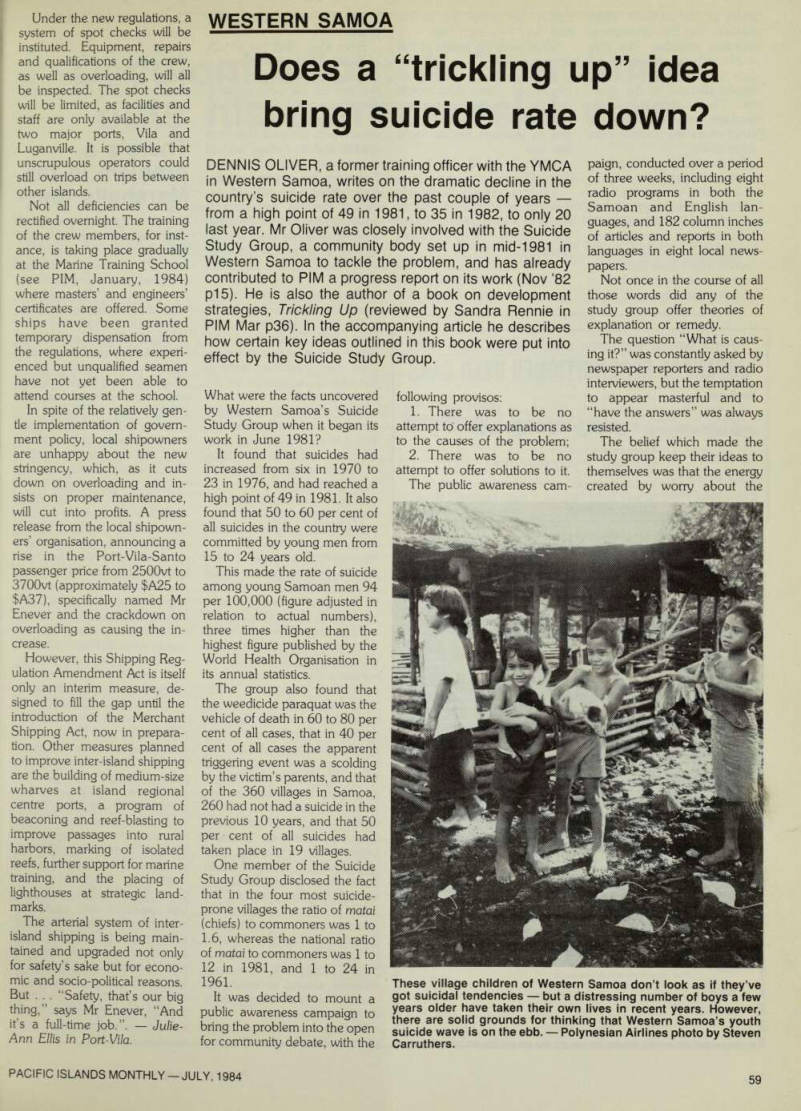
Vanuatu
Govt. strives for inter-island shipping safety
On Tuesday, February 7, the inter-island vessel MV Lebon chugged into Port-Vila harbor loaded or, overloaded with 324 passengers, 229 over her legal limit. Many of them were schoolchildren, returning to start the first term of the new school year. If the overload had led to any mishap there would have been previous little to help these children MV Lebon carried precisely 95 lifejackets.
However, waiting at the wharf that day were Har bormaster D. J. Enever, and Director of Ports and Marine, Captain Walls, accompanied by several policemen to help count the disembarking passengers.
In this way the government signalled that the bad old days of lax safety standards on inter island travel in Vanuatu are over. The company which owns MV Lebon faces court action and suspension of the ship’s safety survey certificate, under the Shipping Regulations Amendment Act, passed last July.
Of course, there were ship ping regulations, based on Brit ish safety standards, under the condominium, and up until the passing of the July act. But they were not enforceable, and had the status of recommendations rather than laws. Safety-con scious harbormasters at Vila and Luganville have told some shipowners that repairs to their
vessels were necessary, or that their crews were insufficiently trained. But they have had to watch helplessly as the ships continued trading unchanged.
Accidents occurred which were in part, at least, attributable to poor marine safety.
Inter-island shipping is the arterial system of archipelagic Vanuatu, carrying copra from, and imported goods to, the 90 per cent of the population who live away from the two major port towns. Before independ ence the trade was dominated by Co-operative ships and in ternationally owned ships, which enforced safety stan dards voluntarily, with only a few locally owned ships operat ing. However, since independ ence more locally owned com panies have been entering the trade. It is in part the competi tion between these ships for cargo that has sent some of them in search of higher profits through overloading.
But the introduction of en forceable standards is not easy.
“The situation’s always been there ... it’s been going on so long people take it to be the norm,” Mr Enever said. “It’s a question of education.” Mr Enever also pointed out that pleasure craft, still exclusively expatriate-owned, will also be facing a crackdown under the new regulations, especially re garding certification of seamen.
Port-Vila waterfront ... the government is working for more, and safer, arrivals. Air Vanuatu photo.
Under the new regulations, a system of spot checks will be instituted. Equipment, repairs and qualifications of the crew, as well as overloading, will all be inspected. The spot checks will be limited, as facilities and staff are only available at the two major ports, Vila and Luganville. It is possible that unscrupulous operators could still overload on trips between other islands.
Not all deficiencies can be rectified overnight. The training of the crew members, for inst ance, is taking place gradually at the Marine Training School (see PIM, January, 1984) where masters’ and engineers’ certificates are offered. Some ships have been granted temporary dispensation from the regulations, where experi enced but unqualified seamen have not yet been able to attend courses at the school.
In spite of the relatively gen tle implementation of govern ment policy, local shipowners are unhappy about the new stringency, which, as it cuts down on overloading and in sists on proper maintenance, will cut into profits. A press release from the local shipown ers’ organisation, announcing a rise in the Port-Vila-Santo passenger price from 2500vt to 3700vt (approximately $A25 to $A37), specifically named Mr Enever and the crackdown on overloading as causing the in crease.
However, this Shipping Reg ulation Amendment Act is itself only an interim measure, de signed to fill the gap until the introduction of the Merchant Shipping Act, now in prepara tion. Other measures planned to improve inter-island shipping are the building of medium-size wharves at island regional centre ports, a program of beaconing and reef-blasting to improve passages into rural harbors, marking of isolated reefs, further support for marine training, and the placing of lighthouses at strategic land marks.
The arterial system of inter island shipping is being main tained and upgraded not only for safety’s sake but for econo mic and socio-political reasons.
But . . . “Safety, that’s our big thing,” says Mr Enever, “And
it’s a full-time job.”.
Julie-
Ann Ellis in Port-VUa.
bring suicide rate down?

Western Samoa
Does a “trickling up” idea bring suicide rate down?
DENNIS OLIVER, a former training officer with the YMCA in Western Samoa, writes on the dramatic decline in the country’s suicide rate over the past couple of years from a high point of 49 in 1981, to 35 in 1982, to only 20 last year. Mr Oliver was closely involved with the Suicide Study Group, a community body set up in mid-1981 in Western Samoa to tackle the problem, and has already contributed to RIM a progress report on its work (Nov ’B2 pl 5). He is also the author of a book on development strategies, Trickling Up (reviewed by Sandra Rennie in RIM Mar p 36). In the accompanying article he describes how certain key ideas outlined in this book were put into effect by the Suicide Study Group.
What were the facts uncovered by Western Samoa’s Suicide Study Group when it began its work in June 1981?
It found that suicides had increased from six in 1970 to 23 in 1976, and had reached a high point of 49 in 1981. It also found that 50 to 60 per cent of all suicides in the country were committed by young men from 15 to 24 years old.
This made the rate of suicide among young Samoan men 94 per 100,000 (figure adjusted in relation to actual numbers), three times higher than the highest figure published by the World Health Organisation in its annual statistics.
The group also found that the weedicide paraquat was the vehicle of death in 60 to 80 per cent of all cases, that in 40 per cent of all cases the apparent triggering event was a scolding by the victim’s parents, and that of the 360 villages in Samoa, 260 had not had a suicide in the previous 10 years, and that 50 per cent of all suicides had taken place in 19 villages.
One member of the Suicide Study Group disclosed the fact that in the four most suicide prone villages the ratio of matai (chiefs) to commoners was 1 to 1.6, whereas the national ratio of matai to commoners was 1 to 12 in 1981, and 1 to 24 in 1961.
It was decided to mount a public awareness campaign to bring the problem into the open for community debate, with the
following provisos; 1. There was to be no attempt to offer explanations as to the causes of the problem; 2. There was to be no attempt to offer solutions to it.
The public awareness cam
paign, conducted over a period of three weeks, including eight radio programs in both the Samoan and English lan guages, and 182 column inches of articles and reports in both languages in eight local news papers.
Not once in the course of all those words did any of the study group offer theories of explanation or remedy.
The question “What is caus ing it?” was constantly asked by newspaper reporters and radio interviewers, but the temptation to appear masterful and to “have the answers” was always resisted.
The belief which made the study group keep their ideas to themselves was that the energy created by worry about the
These village children of Western Samoa don’t look as if they’ve got suicidal tendencies but a distressing number of boys a few years older have taken their own lives in recent years. However, there are solid grounds for thinking that Western Samoa’s youth suicide wave is on the ebb. Polynesian Airlines photo by Steven Carruthers.
causes of the problem would translate itself into attempts to formulate remedies. The only people with the power to ex ecute remedies were the people directly affected by the prob lem. These included family members and village leaders in places where -the suicides were taking place.
Put another way, if the study group attempted to put up explanations, analysis and pre scriptions and the group had some expertise in psychiatry and sociology no matter how scientifically brilliant their theories might have been, they had no power over the lives of the village people which could
match the power the people had over their own lives.
What were the results of this strategy?
Dividing each year into blocks of three four-month periods, the pattern of number of suicides for 1981-83 inclu sive in Western Samoa looks like this: 1981: 1, 14; 2, 19; 3, 16.
Total 49. 1982: 1, 14; 2,6; 3, 15.
Total 35. (The second third of this year covered the period of the Suicide Study Group’s campaign.) 1983: 1, 12; 2,5; 3, 3. Total 20. (The second third of this year saw the introduction of a
YMCA community worker. See below.) From May 1983 the YMCA of Western Samoa employed a community worker who spent the rest of the year initiating discussions in 26 villages aimed at encouraging the people to wrestle with the local history of suicide and its causes, and to design remedies for the future.
Following the example of the study group, he did not ex pound theories or prescribe solutions. But nor did he allow simplistic theories to go unchal lenged, or let people get away with placing all the blame on others.
Most often the plans made were not written down with goals and deadlines. Nor is there any documentary evi dence to prove that the solu tions they prescribed were in fact directly responsible for the dramatic “cure”.
What is known is that sales of paraquat declined dramatically, and that in all likelihood para quat held in stock in the villages is now more carefully locked away than before.
It is worth noting that the study group strategy was based on two value positions outlined in my book Trickling Up A Strategy for Deulopment Where the People at the Bottom Matter Most (published by Lotu Pasifi ka Productions, and reviewed in PIM March 1984, p 36).
These were: “We believe that the community people know their problems and know the solutions that will work better than others know them. ” And: “We believe that the main actors that make the plan and work the action should be the people with the problem.”
If the Suicide Study Group had adopted a “Trickle Down” approach, they would have ap plied for a grant from W.H.O. which would in all probability have appointed an overseas expert or two in sociology and/ or psychiatry. The expert would have written several amazingly scientific papers to explain the subtle causation factors and the prescription of integrated multi disciplinary strategies required to “cure” the problem. But the people would not have been involved, except as spectators or reviewers of somebody else’s thought processes.
Perhaps one other value position described in Trickling
Up highlights the difference be tween the two strategies: “We believe that too much help is a bad thing, and that people should only be helped to be come more self-reliant.” De nnis Oliver.
There’s a
problem in the
Marshalls too
Suicide is the leading cause of death among Marshall Island males between the ages of 15 and 24, according to statistics compiled by a recent workshop on the subject About 80 per cent of the victims are unmar ried, most had jobs or were students. Their educational level also seemed reasonably high. About 90 per cent went at least to the sixth grade in school and 25 per cent finished high school.
About half the suicides gave some indication of their inten tion, and 20 per cent had at least one prior attempt on their records, the report said.
In 25 per cent of cases recorded since 1979 in the Marshall Islands, suicide victims had at least one family member or close friend who had also committed suicide. Almost all of them drank alcohol, but very few were found to have had a history of serious alcohol abuse.
Much more significant, said the report, were quarrels with elder members of the family or prob lems related to girl friends.
Speaking during the work shop Alfred Capelle said there was no word for suicide in Marshallese until the Japanese introduced the term ’’kilaba.”
Dr Neil Palafox agreed with other speakers that parental guidance in teenage years, and a careful adherence to family and cultural traditions, were important in preventing the sort of condition which led to suicide. Personality disorders leading to acute depression were blamed for many Marshal lese suicides and could be noticed by associates of poten tial victims through such signs as loss of appetite, refusal to talk, insomnia, or continual re ferences to going on a long trip.
All seemed to be disguised appeals for attention from those around the victim, said the speakers.
Advertisements & other items, pp. 60-62 (1 item)
Japanese Reconditioned Used Cars
TOYOTA DATSUN MITSUBISHI MAZDA HONDA ISUZU HINO
We Export
inSfr njßu*
Top Quality Quick Delivery Economical Price Please contact to:
livterContinental ltd.
P.0.80X 194 NAKA TELEPHONE: 052-211-5125
2-16-1 3 SAKAE NAKA-KU TELEX: 0442-4880 INCONT J
NAGOYA 460 JAPAN CABLE: INCONT NAGOYA
k
and Commercial Buildings
with Therma-Panel, R the
fully insulated inter-locking
Building System
E Cyclone rated Economical • Fast The building you can assemble (0i George Hudson Homes (Aust.) pt y . Ltd 186 Hume Highway Cabramatta NSW 2166 Australia. Tel: (02) 727 9066. Telex: AA25800 Post coupon for details and prices.
Name Address Tel:.
GH62 g
u j i a re?
Mam
LOCAL AGENTS AND
REPRESENTATION
428 George St., Sydney
Cables: Henco Sydney.
G.P.O. Box 3949.
Telephone: 232 5377.
PAPUA NEW GUINEA
RABAUL: M. & C. Seeto, P.O. Box 131, Rabaul.
Telephone 92 2919.
MADANG: W. Double, P.O. Box 22, Madang.
Telephone 82 2696.
FIJI
K. Witherington Ltd., P.O. Box 293, Suva.
Telephone 22 356.
For specialised and
personalised buying
service throughout
the Pacific Islands and the East.
Resident Agents in other Pacific Territories.
VANUATU
John Lum & Associates, P.O. Box 65, Santo.
Telephone 329.
SOLOMON ISLANDS
Mr. Tom Lo, P.O. Box 327, Honiara.
Telephone 399 *3
xporters
FOR SALE
STEEL BUILDING ON LARGE
FREEHOLD BLOCK
RANADI INDUSTRIAL ESTATE,
HONIARA
DESCRIPTION: BUILDING 120’ x 30’ x 12’.
AREA: 3600 sq.ft.
BUILT December, 1981.
Extensive Office and Shelf Accommodation with Air Conditioning, Telephone and Fluorescent Lighting.
Shower and Toilet Block 12’ x 10’ and Timber Storage Shed 15’ x 12’.
LAND AREA 0.1524
hectares.
PRICE Slsloo,ooo Bank Finance available to approved purchasers.
Contact The Director,
W.S.T.C.
P.O. Box 528
HONIARA
puts his controversial view
Decolonisation: A Frenchman puts his controversial view
The French view of the Pacific is somewhat different from that taken by others in the area. This month we publish an article by Jacques-Maurice Cler, correspondent in Noumea for the Paris newspaper, Le Figaro.
In it he considers the approaching greater autonomy of the French territories, leading to independence, at least for New Caledonia. He suggests that a French withdrawal from the Pacific would weaken the area’s security, and place much greater burden upon Australia and New Zealand, which are not well-equipped for such onerous duties. ’’Already, Indonesia is flexing her muscles,” he writes. ’’Disarmed and weakened by pacifist and anti-nuclear propaganda, Australia relies upon allies to protect her. But what if Indonesia achieves nuclear power? Their interest in it is significant.”
Les territoires frangais de 1'Ocean ie, et plus particulierement la Nouvelle-Caledonie et la Polynesie Frangaise, connaissent actuellement une evolution de leur statut dans le sens d'une plus grande autonomie.
Les projets de loi portant sur les formes des statuts de la Nouvelle- Caledonie et la Polynesie Frangaise etaient presentes au parlement fin mai. Auparavant, les projets avaient ete soumis a 1'Assemblee Territori ale de chacun de ces territoires.
La Polynesie s'est pronongee le 12 avril par 17 voix contre quatre, et six abstentions, en faveur du projet gouvernemental. La majorite territoriale conduite par Gaston Flosse, RPR (Rassemble ment Pour la Republique, parti d'op position nationale dirige par Jacques Chirac), a tenu a rappeler son opposition a tout glissement
vers 1' independance. L'opposition
locale, cependant, s'etait efforgee sans succes d'obtenir au prealable "la reconnaissance de la legitimite d'une eventuelle aspiration ulteri eure du peugle polynesien a la souverainete nationale". On observ era 1'extreme prudence dans la form ulation d'une revendication d'inde pendance a terme.
Vers L'independance
Contrairement a la Polynesie, en Nouvelle-Caledonie l'idee d'une evolution ineluctable vers"1*inde pendence Kanak socialiste" prend force. Tel est 1'enseignement maj eur du recent sejour sur le territ oire de Georges Lemoine, secretaire d'etat aux departements et territ oires d'outre-mer.
M. Lemoine a pu notamment declar er, sans provoquer de reactions vives de la part des anti-independ antistes: "Nous pensons que nous devons, avec vous, construire la case de la Nouvelle-Caledonie de de main* Une case qui sera celle du peuple Kanak, et celle de tous ceux que le peuple Kanak acceuillera dans sa case."
L'incertitude du devenir politique pese sur le developpement economique du territoire. Le marasme qui affec ts depuis ces dernieres annees s'est encore ag grave en 1983, non seulement en raison de la diminution des activit es liees au^nickel, mais aussi a cause des resultats decevants de de 1'elevage, de la peche. Seul le tourisme enregistre des resultats satisfaisants.
Cette deterioration de la situat ion economique entraine necessaire-
ment une aide financiere croissante de la metropole, progressant en moy enne de 18% par an, et atteignant actuellement pres de CFP40 milliards (environ 300 millions de dollars) par an, soit CFP250,000 par habit ant.
Le produit interieur brut Caled onian par habitant, bien qu'en re gression, se situe encore a un niv eau relativement eleve. A titre com paratif, en 1981 le PIB par habitant etait de CFP678,197, proche de cel ui de la Nouvelle Zelande (CFP 786,331). II etait en Australia de CFP1,063,583, et en Papouasie Nouv elle Guinea de CFP66,000. (Chiffre de 1980 pour ce dernier pays.) Cette richess relative, bien qu'inegalement repartie, et la faible densite de ses populations, rend ent la Nouvelle-Caledonie particul ierement attractive. Il ne fait aucun doute qu'a terme, et plus vite qu'on ne le pense, des pays sur peuples de la region tels que 1'In donesia (activee par 1 1 Islam re
volutionnaire) s'efforgeront d'y
penetrer. En Nouvelle-Caledonie il y a environ 6000 Indonesians dont la plupart resident en brousse, et principalement sur la Cote Est.
Cette region en voie d'etre de sertee par les blancs, laisse les Indonesiens seuls face a certains extremistes melanesiens qui pratiq uent la terreur. Le cas de la fam ille Yosho Kono, Indonesian, est significatif a cet egard. Recem ment victimes de coups et bless ures, de degradations materielles, d'abattage d'animaux, Yosho Kono et son epouse melanesienne, ont ete sans defense aux exactions commises par des individus irresponsables, 1 a d'ailleurs pro voque 1'indignation de la populat ion aborigene locale qui a con traint les coupables a se livrer a la gendarmerie pour echapper a la sanction coutumiere.
Dans la perspective d'un relache ment de la souverainete de la France en Nouvelle-Caledonie, de telles exactions (qui pourraient d'ailleurs etre provoquees) servir aient de pretexte a intervention etrangere. Il serait alors diffic ile d'y mettre un terme d'autant que cette action se situerait vrai semblablement dans une periode fav orable (tension internationale, en gagement des forces regionales sur
theatre d'operations,
greves, terrorisme).
Le Commencement De La Fin
L'Australie riche et sous-peuplee
est de toute evidence un objectif a terme de pays voisins demunis et sur-peuples. L'idee que son insularite la protege d'une in vasion est un concept confortable mais depasse. L'Australie qui se prive deliberement d'une capacite de dissuasion nucleaire devra develop per des forces conventionnelles con siderables pour assurer la defense immediate et rapprochee de son ter ritoire, et assumer ses responsabil ites de securite dans le Pacifique Sud. (II y a gros a parier que 1' In donesie sera dotee de 1'arme nucle aire avant 1'Australie.) Dans cette situation de non-de fense, La Nouvelle-Caledonie livree a elle-meme sera une proie facile pour des pays animes par des ideol ogies ou des religions en mal d'ex pansion. Pour 1'Islam revolution naire la penetration du Pacifique se fera par 1'Indonesia, et pour 1'In donesia le chemin de Sydney passe par Noumea.
Le vide cree par le depart de la France ne manquera pas de susciter les convoitises. La Nouvelle-Caled onie independante deviendra un pist olet braque au coeur de 1'Australia.
Ce sera le commencement de la fin de la presence Europeenne dans le Pacifique, millions de blancs desarmes, inhibes par le lax isme et le bien-etre materiel, ser ont bientot liquides, ou reduits a I'etat d'aborigenes de deuxieme type.
Mais, nous n 1 en sommes pas encore la. Les aborigenes, qu 1 -
ils soient Australians, Caledonians,
ou autres, beneficient de la pro tection de leurs tuteurs tradition nels. Bien sur, leur statut peut etre ameliore, dans le sens de 1'egalisation des chances. Mais actuellement ils vivent dans la paix. Dans ce monde d'affrontements ou les situations de guerres civ iles et militaires se multiplient, il est dementiel de susciter la de stabilisation par le racisme et 1'ideologic marxiste revolution naire dans des comme la Nouv elle-Caledonie, ou la coexistence pacifique de communautes ethniques et de civilisations differentes
est exemplaire.
L’argument de la decolonisation est depasse. II date de plus d'un demi-siecle. Entretemps, I'histoire a montre que pour les petits peup les la "decolonisation" fait plus de mal que de bien. Elle se traduit toujours par une oppression, et trop souvent par le genocide. --
Jacques-Maurice Cler.
Advertisements & other items, p. 62 (1 item)
Trade Winds
continued from page 37
from the islands press
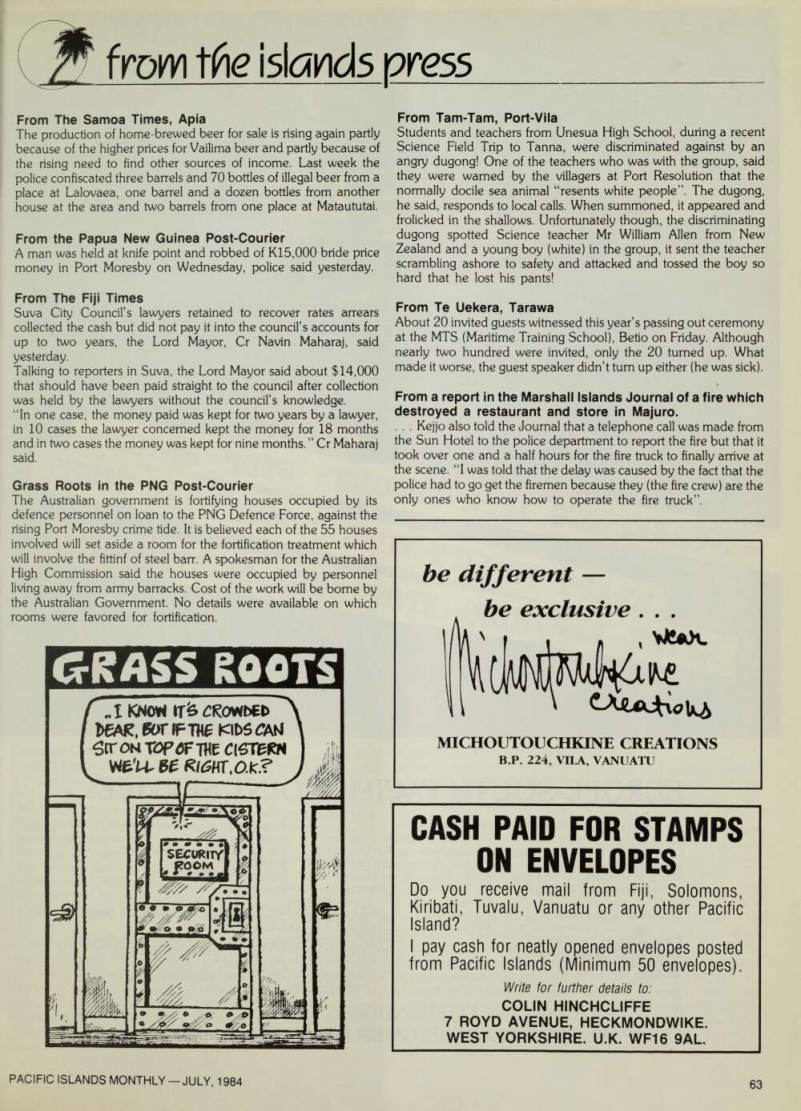
From The Samoa Times, Apia The production of home-brewed beer for sale is rising again partly because of the higher prices for Vailima beer and partly because of the rising need to find other sources of income. Last week the police confiscated three barrels and 70 bottles of illegal beer from a place at Lalovaea, one barrel and a dozen bottles from another house at the area and two barrels from one place at Mataututai.
From the Papua New Guinea Post-Courier A man was held at knife point and robbed of K 15,000 bride price money in Port Moresby on Wednesday, police said yesterday.
From The Fiji Times Suva City Council’s lawyers retained to recover rates arrears collected the cash but did not pay it into the council’s accounts for up to two years, the Lord Mayor, Cr Navin Maharaj, said yesterday.
Talking to reporters in Suva, the Lord Mayor said about $14,000 that should have been paid straight to the council after collection was held by the lawyers without the council’s knowledge.
“In one case, the money paid was kept for two years by a lawyer, in 10 cases the lawyer concerned kept the money for 18 months and in two cases the money was kept for nine months. ” Cr Maharaj said.
Grass Roots in the PNG Post-Courier The Australian government is fortifying houses occupied by its defence personnel on loan to the PNG Defence Force, against the rising Port Moresby crime tide. It is believed each of the 55 houses involved will set aside a room for the fortification treatment which will involve the fittinf of steel barr. A spokesman for the Australian High Commission said the houses were occupied by personnel living away from army barracks. Cost of the work will be borne by the Australian Government. No details were available on which rooms were favored for fortification.
From Tam-Tam, Port-Vila Students and teachers from Unesua High School, during a recent Science Field Trip to Tanna, were discriminated against by an angry dugong! One of the teachers who was with the group, said they were warned by the villagers at Port Resolution that the normally docile sea animal “resents white people”. The dugong, he said, responds to local calls. When summoned, it appeared and frolicked in the shallows. Unfortunately though, the discriminating dugong spotted Science teacher Mr William Allen from New Zealand and a young boy (white) in the group, it sent the teacher scrambling ashore to safety and attacked and tossed the boy so hard that he lost his pants!
From Te Uekera, Tarawa About 20 invited guests witnessed this year’s passing out ceremony at the MTS (Maritime Training School), Betio on Friday. Although nearly two hundred were invited, only the 20 turned up. What made it worse, the guest speaker didn’t turn up either (he was sick).
From a report in the Marshall Islands Journal of a fire which destroyed a restaurant and store in Majuro. . . . Kejjo also told the Journal that a telephone call was made from the Sun Hotel to the police department to report the fire but that it took over one and a half hours for the fire truck to finally arrive at the scene. “I was told that the delay was caused by the fact that the police had to go get the firemen because they (the fire crew) are the only ones who know how to operate the fire truck”.
Advertisements & other items, pp. 63-64 (1 item)
(tRASS roots
be different
he exclusive . . .
MICHOUTOUCHKINE CREATIONS
B.P. 224, VILA, VANUATU
(tRASS roots
„X KNOW tT& £KOWbED
&6AK, R>r F THE Wt>s £AM
-otrou topping CISTERN wfcU- ee Rim,ox? ■pTSft* ° security *
ROOM
s %
CASH PAID FOR STAMPS
ON ENVELOPES
Do you receive mail from Fiji, Solomons, Kiribati, Tuvalu, Vanuatu or any other Pacific Island?
I pay cash for neatly opened envelopes posted from Pacific Islands (Minimum 50 envelopes).
Write for further details to:
COLIN HINCHCLIFFE
7 ROYD AVENUE, HECKMONDWIKE.
WEST YORKSHIRE. U.K. WFI6 9AL.
it I I. »« » I t jjt I •• " '" .it 11 i in • • i - 1 • •«
EUROPE-SOUTH PACIFIC JOINT SERVICE
The South Pacific Specialists offer facilities for shipment of: Containers (FCL/LCL) and Breakbulk Cargo plus reefer space and deeptanks for carriage of vegetable oils and other liquid bulk cargo.
Carriers also accept heavy lifts, overlength and cumbersome parcels.
Ports of Service: Loading: Papeete, Apia, Suva, Lautoka, Noumea, Port Vila, Santo, Honiara, Port Moresby, Lae,Madang, Kimbe, Rabaul, Kieta, Darwin.
For: Rotterdam, Antwerp, Hamburg, Hull, Dunkirk, Le Havre.
Additional ports on enquiry.
ROUND THE WORLD SERVICE
Please contact our regional offices for further information: The Bank Line (Australasia) Pty. Ltd.
Suite 801,51 Pitt Street Sydney N.SW. 2000 Phone: 272041 Telex; 24063 Columbus Line Reederei GmbH P.O. Box 1667 Lae/Papua New Guinea Phone: 42 3466/42 3287.5 A.H. 42 2481 Telex: Colline NE 44 171
THE BANK LINE LTD LONDON
COLUMBUS LINE REEDEREI GMBH HAMBURG
people
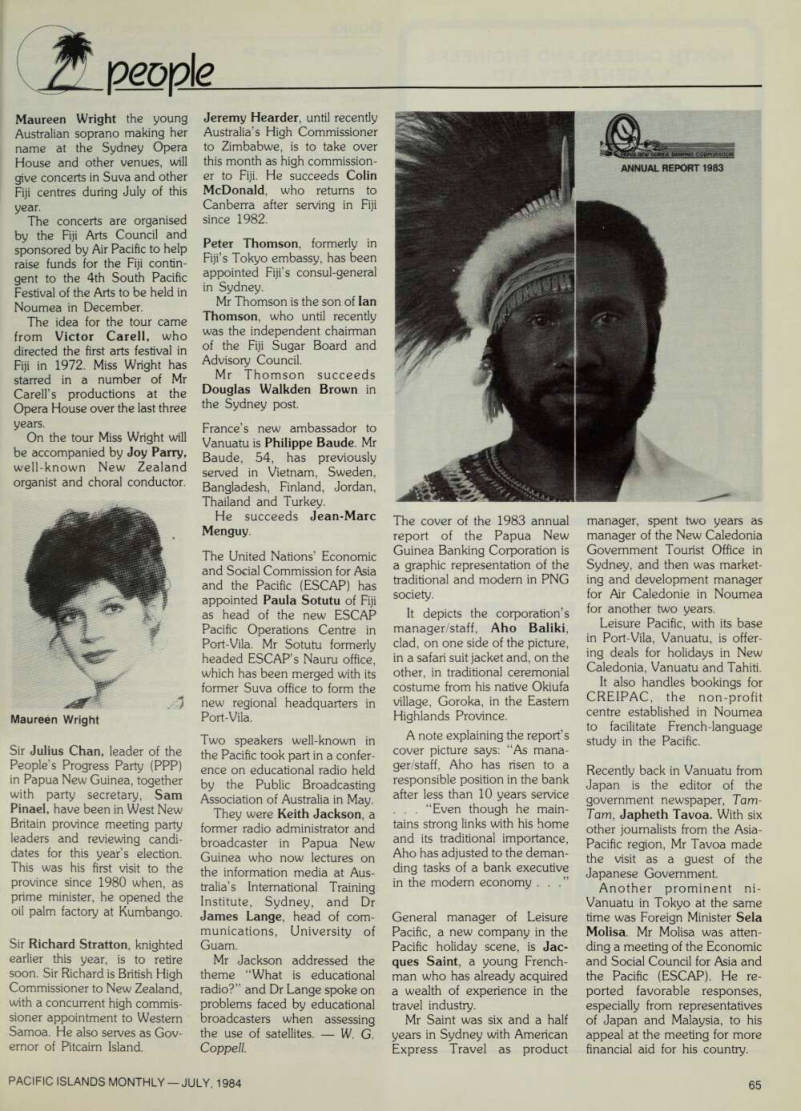
Maureen Wright the young Australian soprano making her name at the Sydney Opera House and other venues, will give concerts in Suva and other Fiji centres during July of this year.
The concerts are organised by the Fiji Arts Council and sponsored by Air Pacific to help raise funds for the Fiji contin gent to the 4th South Pacific Festival of the Arts to be held in Noumea in December.
The idea for the tour came from Victor Carell, who directed the first arts festival in Fiji in 1972. Miss Wright has starred in a number of Mr Carell’s productions at the Opera House over the last three years.
On the tour Miss Wright will be accompanied by Joy Parry, well-known New Zealand organist and choral conductor.
Sir Julius Chan, leader of the People’s Progress Party (PPP) in Papua New Guinea, together with party secretary, Sam Pinael, have been in West New Britain province meeting party leaders and reviewing candi dates for this year’s election.
This was his first visit to the province since 1980 when, as prime minister, he opened the oil palm factory at Kumbango.
Sir Richard Stratton, knighted earlier this year, is to retire soon. Sir Richard is British High Commissioner to New Zealand, with a concurrent high commis sioner appointment to Western Samoa. He also serves as Gov ernor of Pitcairn Island.
Jeremy Hearder, until recently Australia’s High Commissioner to Zimbabwe, is to take over this month as high commission er to Fiji. He succeeds Colin McDonald, who returns to Canberra after serving in Fiji since 1982.
Peter Thomson, formerly in Fiji’s Tokyo embassy, has been appointed Fiji’s consul-general in Sydney.
Mr Thomson is the son of lan Thomson, who until recently was the independent chairman of the Fiji Sugar Board and Advisory Council.
Mr Thomson succeeds Douglas Walkden Brown in the Sydney post.
France’s new ambassador to Vanuatu is Philippe Baude. Mr Baude, 54, has previously served in Vietnam, Sweden, Bangladesh, Finland, Jordan, Thailand and Turkey.
He succeeds Jean-Marc Menguy.
The United Nations’ Economic and Social Commission for Asia and the Pacific (ESCAP) has appointed Paula Sotutu of Fiji as head of the new ESCAP Pacific Operations Centre in Port-Vila. Mr Sotutu formerly headed ESCAP’s Nauru office, which has been merged with its former Suva office to form the new regional headquarters in Port-Vila.
Two speakers well-known in the Pacific took part in a confer ence on educational radio held by the Public Broadcasting Association of Australia in May.
They were Keith Jackson, a former radio administrator and broadcaster in Papua New Guinea who now lectures on the information media at Aus tralia’s International Training Institute, Sydney, and Dr James Lange, head of com munications, University of Guam.
Mr Jackson addressed the theme “What is educational radio?” and Dr Lange spoke on problems faced by educational broadcasters when assessing
the use of satellites.
W. G.
Coppell.
The cover of the 1983 annual report of the Papua New Guinea Banking Corporation is a graphic representation of the traditional and modern in PNG society.
It depicts the corporation’s manager/staff, Aho Baliki. clad, on one side of the picture, in a safari suit jacket and, on the other, in traditional ceremonial costume from his native Okiufa village, Goroka, in the Eastern Highlands Province.
A note explaining the report’s cover picture says: “As mana ger/staff, Aho has risen to a responsible position in the bank after less than 10 years service . . . “Even though he main tains strong links with his home and its traditional importance, Aho has adjusted to the deman ding tasks of a bank executive in the modern economy . . .”
General manager of Leisure Pacific, a new company in the Pacific holiday scene, is Jac ques Saint, a young French man who has already acquired a wealth of experience in the travel industry.
Mr Saint was six and a half years in Sydney with American Express Travel as product
manager, spent two years as manager of the New Caledonia Government Tourist Office in Sydney, and then was market ing and development manager for Air Caledonie in Noumea for another two years.
Leisure Pacific, with its base in Port-Vila, Vanuatu, is offer ing deals for holidays in New Caledonia, Vanuatu and Tahiti.
It also handles bookings for CREIPAC, the non-profit centre established in Noumea to facilitate French-language study in the Pacific.
Recently back in Vanuatu from Japan is the editor of the government newspaper, Tam- Tam, Japheth Tavoa. With six other journalists from the Asia- Pacific region, Mr Tavoa made the visit as a guest of the Japanese Government.
Another prominent ni- Vanuatu in Tokyo at the same time was Foreign Minister Sela Molisa. Mr Molisa was atten ding a meeting of the Economic and Social Council for Asia and the Pacific (ESCAP). He re ported favorable responses, especially from representatives of Japan and Malaysia, to his appeal at the meeting for more financial aid for his country.
Maureen Wright
Advertisements & other items, p. 66 (2 items)
Books
Continued from page 54
Tahiti Samoa Sr-
NORTH QUEENSLAND ENGINEERS
& AGENTS PTY. LTD.
EineS
[Ham
Shipbuilding and Repair are our Business We have full facilities for repair or refitting SLIPPING to 750 tonne DOCKING to 200 feet The shipbuilding division can construct a vessel to your design, or design one to suit your needs.
Barges, Tugs, Workboats, Catamarans, Landing Craft and Patrol Boats are all within our scope. rtn.
CALL US TODAY
N.Q.E.A.
36 Buchan Street, Cairns 4870 P.O. Box 1105, Cairns Telephone (070) 51 6600. Telex 48087 )
CONTRACTORS TO THE ROYAL AUSTRALIAN NAVY
PACIFIC ISLANDS
TRANSPORT LINE
M.V. SIRIUS
andi 00 ** vq
TAHITI SAMOA Sr-
xoc Qeqeral Stearqship Qorpora tiop ; m General Agents 400 California Street, San Francisco, CA, USA PAPEETE; Agence Maritime Internationale, Tahiti PAGO PAGO: Polynesia Shipping Services, Inc.
APIA: Burns Philp (South Sea) Company, Ltd.
yac hts
Has “Jaws” moved to Pentecost?
Has “Jaws” moved out of Holly wood and into the South Pacific?
Julian Putley, of the yacht Starry Night, now at Honiara, isn’t sure, but thinks there’s a chance the sea monster might have called through.
Julian writes to PIM: “One normally associates vicious shark attacks on humans with sensational Hollywood movies, but recently, while cruising through Vanuatu, I heard from a reliable source, a true story that chilled me to the bone.
“I was anchored on the west side of Pentecost Island at Hohio Bay (in order to see the spectacular land diving held every autumn) and, as usual when anchoring in a new bay I dived in to check the anchor, swimming in a large circle around the vessel to ensure no coral heads were present.
“When I regained the yacht I noticed a large crowd on the beach staring and pointing at me, but I paid no real attention. Later, the same day the headmaster of the primary school there told me that two weeks previously, about April 25, a 13 year old boy had been completely devoured just yards from where my boat was anchored.
The boy was standing in the water, up to his chest, when a large shark attacked him.
Observers said the shark made three or four quick strikes and before assistance could be rendered there was nothing but a red stain in the water. No remains were found.
They told me it was the second such attack in five years.
“The teacher said that sharks are prevalent in the rainy season, com ing close in to shore to forage amongst the debris from swollen rivers. At this time the sea is very murky and swimming or even wad ing in it is most inadvisable,” concluded Mr Putley.
Even experts differ on what makes sharks attack humans. Most attacks, at least in the Pacific, appear to occur in shallow water rather than out at sea or on the face of a major reef. In Fiji, for example, all recent attacks have been made on men or women fishing while standing hip-deep in the sea, often with a string of dead, and frequently bleeding, fish floating around their waists. The curiosity, in fact, is that given the great number of people
fishing in this time-honored fashion, shark attacks are not more preva lent; indeed, they are quite rare, or so it would seem from the available reports. There are many sharks in the Pacific. In half a decade of scuba diving we have seen many sharks, some closer than others, but shark attacks upon divers are almost totally unknown, not that many divers (aside from Ben Cropp and the Taylors), hang about while
“munchies” are in the vicinity. In Fiji, where the local branch of the British Sub Aqua Club has about 100 active divers, sharks are seen constantly. Very rarely, a diver is “bumped” by a shark, it being of a territorially-possessive ilk, but in many years of sport diving not one attack has occurred. No diver, however experienced, takes sharks and their tempers for granted. Yet many people with long experience of the sea consider them to be creatures much-maligned by the media and the human race. One must presume, of course, that no one leaping to the defence of sharks in general has met them head-on, so to speak. Editor.
A sister’s appeal
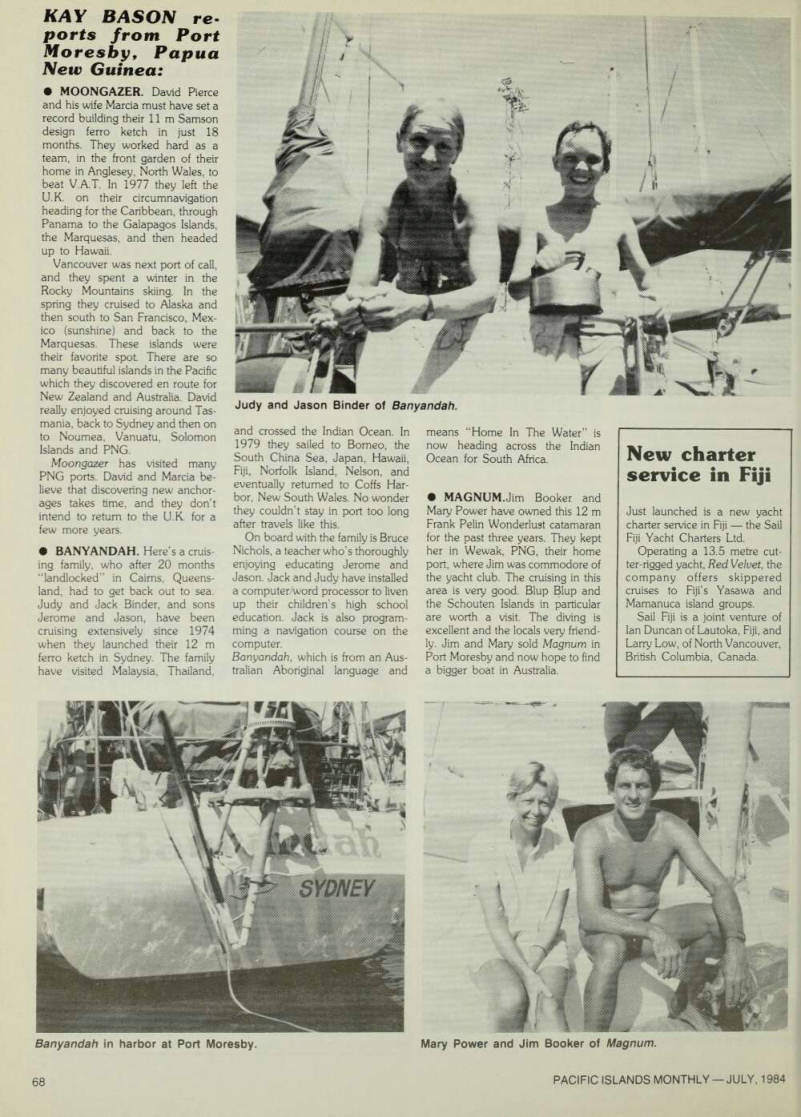
Missing Yacht
The following letter appeared in the May 4, 1984, edition of the Papua New Guinea Post-Courier, Port Moresby.
I am writing to you in the hope that one of your readers may be able to give some information con cerning the disappearance in Feb ruary of my brother and his family on their yacht, the “Rosl”.
My brother, Michel Petit, his wife Joelle and their three children (aged 18, 14 and eight) were to spend the school holidays sailing around the Loyalty Islands, off New Caledo nia’s east coast.
The family left Noumea on Janu ary 25 and were to return on February 18 for work and schooling.
They were seen for the last time at Ouvea Island on February 4.
The “Rosl” is a steel-hulled yacht, 13 metres long and weighing 13 tons, with two masts and in perfect condition. The boat was equipped with motor, radio, solar batteries, etc. and Michel had com pleted a navigation diploma.
Despite aerial searches by New Caledonia authorities of the zone 350/400 km around New Caledo nia and the islands, appeals to the Solomon Islands, Vanuatu, Hawaii, Australia and New Zealand, there has been no trace.
An international appeal con tinues several times a day to planes and boats.
I still hope that my brother and his family might be found on an uninhabited Pacific island and I
hope that one of your sea-going readers may be able to help me.
The letter was signed: Mrs Claudine Marchive-Petit, P.O. Box 1419, Noumea, New Caledonia.
Don Travers Re
ports from Tubuai ,
Austral lslands 9
French Polynesia:
• ANORE.A recent yacht arrival at Tubuai was Anore, a 22 m auxiliary ketch built in 1976 in Florida. With mahogany ship plank ing, fibreglassed, and double centreboards, Anore arrived from Raivavae with skipper/owner Theo Vatis of New York, and crew Kathy Flynn, Peter Lavoie (both U.SA), and Jon Phillips (New Zealand).
The cruise of Anore began from her home port of Fort Lauderdale, Florida, in January 1983. She went to the Bahamas, Panama, Galapa gos, Marquesas, Tuamotus, Society Islands, Cook Islands, Tonga, Fiji, New Caledonia, arriving in Sydney, November 1983.
Leaving Sydney in January 1984, they sailed to Lord Howe Island, then to Auckland, and to Raivavae in 15 days.
They brought a sick infant with her parents from Raivavae to the hospital here at Tubuai.
Leaving for Tahiti, they planned to return to Fort Lauderdale by July via the Tuamotus and Panama.
Kay Bason Re
ports from Port
Moresby, Papua
New Guinea:
• MOONGAZER. David Pierce and his wife Marcia must have set a record building their 11m Samson design ferro ketch in just 18 months. They worked hard as a team, in the front garden of their home in Anglesey, North Wales, to beat V.A.T. In 1977 they left the U.K. on their circumnavigation heading for the Caribbean, through Panama to the Galapagos Islands, the Marquesas, and then headed up to Hawaii.
Vancouver was next port of call, and they spent a winter in the Rocky Mountains skiing. In the spring they cruised to Alaska and then south to San Francisco, Mex ico (sunshine) and back to the Marquesas. These islands were their favorite spot There are so many beautiful islands in the Pacific which they discovered en route for New Zealand and Australia. David really enjoyed cruising around Tas mania, back to Sydney and then on to Noumea, Vanuatu, Solomon Islands and PNG.
Moongazer has visited many PNG ports. David and Marcia be lieve that discovering new anchor ages takes time, and they don’t intend to return to the U.K. for a few more years. • BANYANDAH. Here’s a cruis ing family, who after 20 months “landlocked” in Cairns, Queens land, had to get back out to sea.
Judy and Jack Binder, and sons Jerome and Jason, have been cruising extensively since 1974 when they launched their 12 m ferro ketch in Sydney. The family have visited Malaysia, Thailand,
and crossed the Indian Ocean. In 1979 they sailed to Borneo, the South China Sea, Japan, Hawaii, Fiji, Norfolk Island, Nelson, and eventually returned to Coffs Har bor, New South Wales. No wonder they couldn’t stay in port too long after travels like this.
On board with the family is Bruce Nichols, a teacher who’s thoroughly enjoying educating Jerome and Jason. Jack and Judy have installed a computer/word processor to liven up their children’s high school education. Jack is also program ming a navigation course on the computer.
Banyandah, which is from an Aus tralian Aboriginal language and
means “Home In The Water” is now heading across the Indian Ocean for South Africa. • MAGNUM. Jim Booker and Mary Power have owned this 12 m Frank Pelin Wonderlust catamaran for the past three years. They kept her in Wewak, PNG, their home port, where Jim was commodore of the yacht club. The cruising in this area is very good. Blup Blup and the Schouten Islands in particular are worth a visit. The diving is excellent and the locals very friend ly. Jim and Mary sold Magnum in Port Moresby and now hope to find a bigger boat in Australia.
Banyandah in harbor at Port Moresby.
Judy and Jason Binder of Banyandah.
Mary Power and Jim Booker of Magnum.
Moresby’s RPYC
is to move house
Port Moresby’s Royal Papua Yacht’
Club is almost certain to move to new premises.
The club’s commodore, Dr Phil lip Spradberry, said in May the club had plans to build an aquatic sporting complex at Gabutu, near Koki, at an estimated cost of K 1 million.
This meant shifting the club from the city’s harbor area to an open shoreline.
The clubhouse and its mooring area are located in a downtown city area, sandwiched between the busy wharf area and the Defence Force naval base.
“One of the main reasons why we plan to move to Gabutu is because of the expanding container wharf,” Dr Spradberry said.
He said the container wharf could occupy the club’s entire waterfront in about five years.
“Losing the waterfront would mean losing one of our major facilities,” he said.
He said the wharf re-devel opment was at stage one and when it reached stage two would occupy the whole waterfront, from the wharf to the naval base.
“The other reason we have to move is because of the busy Stan ley Parade which runs in front of the clubhouse, separating it from the waterfront.
“The road gets quite busy and becomes very dangerous for the club members and customers.”
Dr Spradberry said the Gabutu area had more space and water area, an advantage for aquatic sports such as fishing, skiing and scuba diving.
Dr Spradberry said it was hoped the Gabutu aquatic complex, when built, would become “the finest in the Pacific”.
New charter
service in Fiji
Just launched is a new yacht charter service in Fiji the Sail Fiji Yacht Charters Ltd.
Operating a 13.5 metre cut ter-rigged yacht, Red Velvet, the company offers skippered cruises to Fiji’s Yasawa and Mamanuca island groups.
Sail Fiji is a joint venture of lan Duncan of Lautoka, Fiji, and Larry Low, of North Vancouver, British Columbia, Canada.
shipping schedules
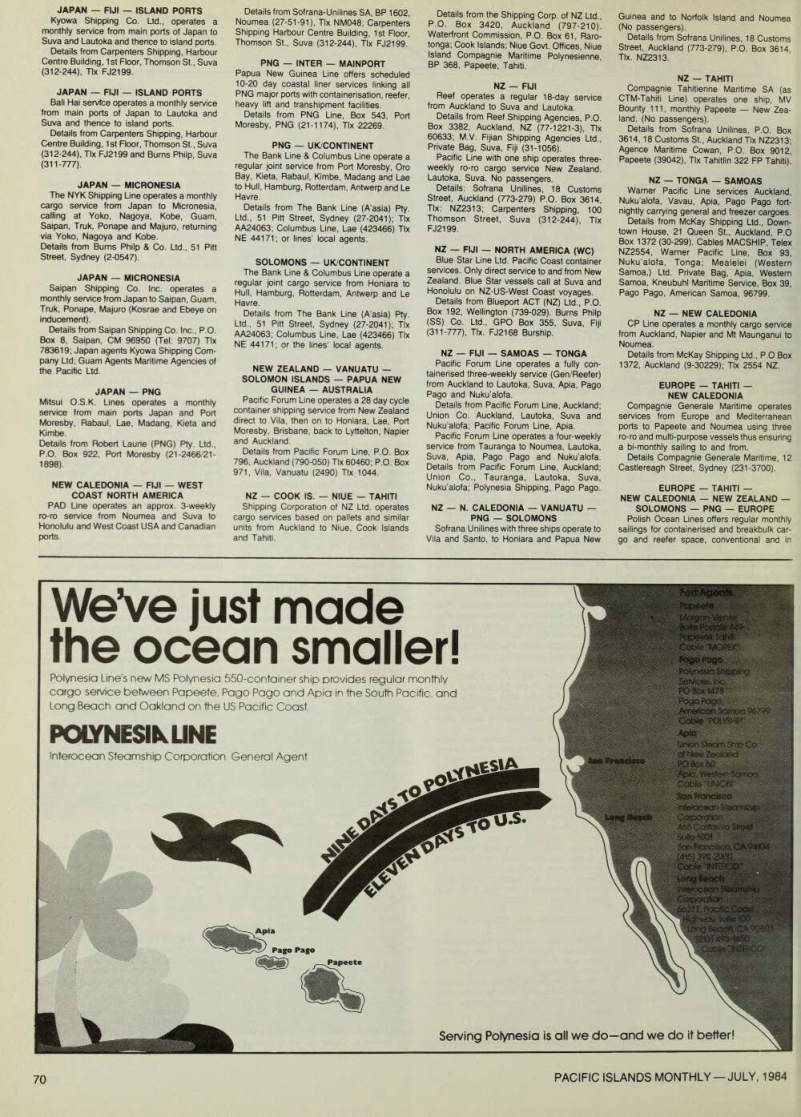
Should any shipping company wish to have its services cargo and passenger included in these listings they should contact
Pim.
Australia - Fiji
KKL (Kangaroo Line) Pty. Ltd., operates a 4/5 weekly cargo service from Sydney and Melbourne to Suva and Lautoka.
Details from KKL (Kangaroo Line) Pty. Ltd., 4th Floor, 19-31 Pitt Street, Sydney (235- 0322), Dalgety Shipping, World Trade Centre.
Melbourne (616-6700), Burns Philp (SS) Co.
Ltd., Suva and Lautoka.
Sofrana-Unilines (Fiji Express Line) oper ates to Suva and Lautoka every three weeks from the main ports on the east coast of Australia and monthly to Lautoka from Mel bourne and Sydney.
Details from Sofrana-Unilines, 19 Pitt Street, Sydney (27-9851), Trans-Austral Shipping Pty. Ltd. 570 Bourke Street, Mel bourne (67-9162); ACTA Pty. Ltd., Brisbane (221-3116); Elders-ANL Pty. Ltd. Port Adelaide (47-5688); Newcastle, Sofrana Syd ney (27-9851); Clements and Marshall, Bur nie, Tasmania (31-1833), Carpenters Ship ping, Harbour Centre Building, Ist Floor, Thomson Street, Suva. Fiji (312-244), Tlx FJ2199.
Australia - Samoas - Tonga
Warner Pacific Lines operates a regular cargo service from Sydney, Brisbane and Melbourne to Nukualofa, Pago Pago, Apia and Vavau. Feeder service available from Apia to Cook, Christmas, Fanning and Washington Islands.
Details from Hetherington Wesfarmers Shipping Agency, 37-49 Pitt Street, Sydney (27-1671).
Australia - New Caledonia -
Fiji - Samoas - Tonga
Pacific Forum Line operates a fully con tainerised service (general, reefer and ro-ro) from Sydney to Noumea, Lautoka, Suva, Apia, Pago Pago, Nukualofa, Sydney. Cargo centralised from Adelaide, Melbourne, Bris bane.
Details from: Pacific Forum Line, P.O. Box 796 Auckland; Union Bulkships, 333 George Street, Sydney, Brisbane and Melbourne; Union Co., Lautoka, Suva, Nukualofa; Pacific Forum Line Apia; Polynesia Shipping Pago Pago.
Australia - Lord Howe Is -
Norfolk Is
Compagnie des Chargeurs Caledoniens operates four-weekly cargo service Sydney- Lord Howe Island and Norfolk Island.
Details Hetherington Wesfarmers Shipping Agency, 37-49 Pitt Street, Sydney (27-1671).
Australia - Kiribati
KKL operates a 5/6 weekly service from Melbourne and Sydney to Kiribati (Tarawa).
Details: KKL (Kangaroo Line) Pty. Ltd., 4th Floor. 19-31 Pitt Street, Sydney (235-0322) and Dalgety Shipping, World Trade Centre, Melbourne (616-6700).
KAP New Guinea Lines call Tarawa after 3 NG ports on a 35 day basis from Melbourne and Sydney/Brisbane.
Details from K. Asia Pacific Pty. Ltd., 19-31 3 itt Street, Sydney (232-2277); Tlx. 22143.
Australia - New Caledonia
And Or Vanuatu
Sofrana-Unilines ships serve Noumea ;very three weeks from the main ports along he east Australian coast.
Details from Sofrana-Unilines, 19 Pitt Street, Sydney (27-9851), Trans-Austral
Shipping Pty, Ltd., 570 Bourke Street, Mel bourne (67-9162), ACTA Pty. Ltd., Brisbane (221-3116), Elders-ANL Pty. Ltd., Port Adelaide (47-5688), Newcastle, Sofrana Syd ney (27-9851); Clements & Marshall, Burnie, Tasmania (31-1833).
Compagnie des Chargeurs Caledoniens operates a three-weekly containerised cargo service from Sydney to Noumea.
Details Hetherington Wesfarmers Shipping Agency, 37-49 Pitt Street, Sydney (27-1671).
Compagnie Generale Maritime operates a monthly service from Sydney to Noumea, Port Vila and Santo, for containerised and break bulk cargo.
Details Compagnie Generale Maritime, 12
Castlereagh Street, Sydney (231-3700).
Australia - Nauru - Marshall
Is - Kiribati
Nauru Pacific Line operates regular cargo service from Melbourne to Nauru, Majuro and Tarawa. Passenger service to Nauru only.
Details: Nauru Pacific Line (Aust.) Pty. Ltd.
Nauru House, 80 Collins Street, Melbourne (653-5709). Nedlloyd Swire, 8 Spring Street, Sydney (2-0522).
Australia - New Zealand
The Australian National Line (ANL) and the Shipping Corporation of New Zealand oper ate a 10-day container service between Sydney and Melbourne to Auckland, Welling ton, Lyttelton and Port Chalmers.
Details from ANL, 20 Bond Street, Sydney (232-0444) or P O. Box 2238 T G.P.O. Mel bourne 3001 (62-0681) or Shipping Corpora tion of New Zealand, P.O. Box 3344 Welling ton (72-8500).
Australia - Nz - Fiji -
Hawaii - Us
P&O liners call at Auckland, Suva, Pago Pago and Honolulu on eastbound and west bound voyages between Sydney and the US.
Details from P&O Booking Centre, World Travel Headquarters Pty. Ltd., 33 Bligh Street, Sydney (237-0333).
AUSTRALIA - NZ - FIJI - TONGA -
Vanuatu - New Caledonia -
Solomons - New Guinea
Sitmar Cruises operates a year-round cruise program to include the above coun tries.
Details from Sitmar Cruises, 39 Martin Place, Sydney (239-9000); NSW, reserva tions & enquiries (008 42-2277); Rest of Australia, reservations & enquiries (008 22- 2277).
AUSTRALIA - NZ - FIJI - TONGA -
Vanuatu - New Caledonia -
Solomons - Samoas - Tahiti
P&O liners call at Auckland, Bay of Islands, Honiara, Lautoka, Noumea, Nukualofa, Pago Pago, Papeete, Port Mores by, Santo, Savusavu, Suva, Vavau and Vila on cruises from Australia.
Details from P&O Booking Centre, World Travel Headquarters Pty. Ltd., 33 Bligh Street, Sydney (237-0333).
Australia - Nz - Solomons -
Png
Pacific Forum Line operates containerised and general cargo service from Lyttleton, Napier and Auckland to Honiara, Lae, Port
Moresby, Brisbane.
Details from: Pacific Forum Line, Auckland;
Steamships Shipping, Port Moresby; Sulli
vans Ltd., Honiara; Union Bulkships, Bris bane.
Australia - Micronesia
Nauru Pacific Line operates a regular
container service from Melbourne to Ponape, Truk, Guam and Saipan.
Details: N.P.L. (Australia) Pty. Ltd. Nauru House, 80 Collins Street, Melbourne (653- 5709). Nedlloyd Swire, 8 Spring Street, Sydney (2-0522).
Australia - Tuvalu
KKL operates a 3 monthly service from Sydney and Melbourne to Tuvalu (Funafuti).
Subject inducement.
Details from KKL (Kangaroo Line) Pty. Ltd., 4th Floor, 19-31 Pitt Street, Sydney (235- 0322).
Australia - Png
KAP New Guinea Lines cargo vessels call at Melbourne, Sydney, Port Moresby, Lae, Madang, Wewak, Manus, Kimbe, Rabaul, Popondetta.
Details from K. Asia Pacific Pty. Ltd., 19-31 Pitt Street. Sydney (232-2277), Dalgety Ship ping, World Trade Centre, Melbourne (616- 6700).
Australia - Png - Solomons -
Vanuatu
A consortium of NGAUPNGL and CON PAC/NEL have four vessels operating a joint service from east coast Australian ports to Port Moresby, Lae, Alotau, Madang, Wewak, Rabaul, Kavieng-Kimbe, Kieta, Honiara. Vila, Santo.
Details from Burns. Philp & Co. Ltd., 51 Pitt Street, Sydney, (2-0547); Interocean Swire, 8 Spring Street, Sydney, (2-0522); New Guinea Express Lines, 37 Pitt Street, Sydney, (241- 3991); Vila Agents, PO Box 971, Port-Vila (2490) Tlx. NH1044.
New Guinea Express Lines operates a weekly container service from Melbourne, Sydney, Brisbane to Port Moresby, Lae, Alotau, Kimbe, Rabaul, Kieta, Honiara, Kavieng, Madang, Wewak, Santo, Vila.
Details from New Guinea Express Lines, PO Box R 73, Royal Exchange, Sydney (241-3991); New Guinea Express Lines, 127 Creek Street, Brisbane (221-9333); New Guinea Express Lines, 327 Collins Street, Melbourne (61-3053); Niugini Express Lines, Port Moresby (21-4572); Lae (42-1536); Niugini Island Cargo Services Pty. Ltd., Rabaul (922-467); Bougainville Agencies Pty.
Ltd., Kieta (956-089); Alotau Stevedoring & Transport, Alotau (61-1318); Ngatia Wholesalers Pty. Ltd., Kimbe (93-5102); and Trading Company, Mendana Avenue, Hon iara (22588); Vila Agencies Ltd., PO Box 971, Vila, Vanuatu (2490); John Lum & Associ ates, PO Box 65, Santo. Vanuatu (329).
Australia - Tahiti
Compagnie Generale Maritime operates a monthly service from Sydney to Papeete, for containerised and break bulk cargo.
Details Compagnie Generale Maritime, 12 Castlereagh Street, Sydney (231-3700).
Australia - Tahiti - Us
KKL operates a 4/5 weekly cargo service from Melbourne and Sydney to Papeete, and a fortnightly service to US west coast.
Details: KKL (Kangaroo Line) Pty. Ltd., 4th Floor, 19-31 Pitt Street, Sydney (235-0322) and Dalgety Shipping, World Trade Centre, Melbourne (616-6700).
Australia - Nz - West Coast
South America
South Pacific Seaboard Service offers a regular cargo service from Brisbane, Sydney, Adelaide and Melbourne to New Zealand ports Lyttelton and Tauranga and to the west coast of South America, calling at Beu’ven tura, Guayaquil, Cailao and other ports on
inducement.
Details from South Pacific Seaboard Service agents, Meridian Shipping & Trans port Agencies, 50 Clarence Street, Sydney (290-1633), Tlx 25970; Melbourne (67-5907); Brisbane (267-6355); Adelaide (47-6600); Oceanbridge Shipping Ltd., 22 Emily Place, Auckland (33-279). Tlx 60523; lan Taylor Y Cia Ltda, Prat 827 Of. 301, Valparaiso, Chile (59096), Tlx. 30331.
SINGAPORE - HONG KONG - FIJI -
Islands Ports
Kyowa Shipping Co. Ltd. operates a month ly service from Singapore. Hongkong to Lautoka, Suva and then to island ports.
Details from Carpenters Shipping, Harbour Centre Building, Ist Floor, Thomson Street, Suva. (312-244), Tlx FJ2199.
Far East - Fiji - New
Zealand
New Zealand Unit Express (NZUE) oper ates a monthly palletised cargo service from Manila, Keelung, Kashiung and Hongkong to Lautoka, Suva and thence to NZ.
Details from Carpenters Shipping, Harbour Centre Building, Ist Floor, Thomson Street, Suva (312-244), Tlx FJ2199, Burns Philp, Suva (311-777) P&O S.N. Co. Wellington (736-477) or Nedlloyd Swire Pty. Ltd., Sydney (20-522).
Nedlloyd operates bi-weekly cargo service with four ships from Sourabaya, Jakarta, Bangkok, Port Kelang and Singapore to Suva, Lautoka and NZ ports.
Details from Nedlloyd (Aust.) Pty. Ltd., 8 Spring St., Sydney (27-3801), Burns Philp (SS) Co. Ltd., Suva and Lautoka.
Far East - Mid-S. Pacific
China Navigations New Guinea Pacific Line operates a regular container service from Hongkong, Taiwan, Manila, Port Kelang and Singapore to Port Moresby, Lae, Rabaul and Honiara monthly and to Wewak, Madang and Kieta every three months. Cargo from the same Far Eastern ports to the South Pacific ports of Noumea, Santo, Vila, Papeete, Pago Pago, Apia, Raratonga and Tarawa will be shipped via Japan on the monthly Bali Hai service.
Details from Steamships Trading Co. Ltd., PO Box 1, Port Moresby (22-0222).
Kyowa Shipping Ltd. operates monthly services from Japan to Guam, Saipan, Solo mons, New Caledonia, Fiji, Western and American Samoa, Tahiti, Cook Is., Tonga and Vanuatu.
Details: Hetherington Wesfarmers Shipping Agency, 37-49 Pitt Street, Sydney (27-1671); Carpenters Shipping, Suva (312-244), Tlx FJ2199.
Guam - Northern Marianas
Saipan Shipping Co. Inc. operate a weekly service via barge carrying containers and conventional cargo between Guam and Saipan and Tinian.
Details from Saipan Shipping Co. Inc., PO Box 8, Saipan, CM 96950 (Tel: 9707) Tlx 783619; Guam agents Maritime Agencies of the Pacific Ltd.
Inter Pacific Islands
South West Pacific Containers Line offers a scheduled container service with 23 day frequency between Apia, Honiara, Kieta, Lae, Noumea, Nukualofa, Pago Pago, Port Moresby, Santo, Suva and Lautoka, Vila.
Trans-shipment to overseas markets can be arranged. Breakbulk cargo, heavy lifts and refrigerated accepted.
Details from Burns Philp and Co., 7 Bridge Street, Sydney (20-547) Tlx AA20290.
Japan Fiji Island Ports
Kyowa Shipping Co. Ltd., operates a monthly service from main ports of Japan to Suva and Lautoka and thence to island ports.
Details from Carpenters Shipping, Harbour Centre Building, Ist Floor, Thomson St., Suva (312-244), Tlx FJ2199.
Japan Fiji Island Ports
Bali Hai servtee operates a monthly service from main ports of Japan to Lautoka and Suva and thence to island ports.
Details from Carpenters Shipping, Harbour Centre Building, Ist Floor, Thomson St., Suva (312-244), Tlx FJ2199 and Burns Philp, Suva (311-777).
Japan Micronesia
The NYK Shipping Line operates a monthly cargo service from Japan to Micronesia, calling at Yoko, Nagoya, Kobe, Guam, Saipan, Truk, Ponape and Majuro, returning via Yoko, Nagoya and Kobe.
Details from Burns Philp & Co. Ltd., 51 Pitt Street. Sydney (2-0547).
Japan Micronesia
Saipan Shipping Co. Inc. operates a monthly service from Japan to Saipan, Guam, Truk, Ponape, Majuro (Kosrae and Ebeye on inducement).
Details from Saipan Shipping Co. Inc., P.O.
Box 8. Saipan, CM 96950 (Tel: 9707) Tlx 783619; Japan agents Kyowa Shipping Com pany Ltd; Guam Agents Maritime Agencies of the Pacific Ltd.
Japan Png
Mitsui O.S.K. Lines operates a monthly service from main ports Japan and Port Moresby, Rabaul, Lae. Madang, Kieta and Kimbe.
Details from Robert Laurie (PNG) Pty. Ltd., P.O. Box 922, Port Moresby (21-2466/21- 1898).
New Caledonia Fiji West
Coast North America
PAD Line operates an approx. 3-weekly ro-ro service from Noumea and Suva to Honolulu and West Coast USA and Canadian ports.
Details from Sofrana-Unilines SA, BP 1602, Noumea (27-51-91), Tlx NMO4B; Carpenters Shipping Harbour Centre Building, Ist Floor, Thomson St., Suva (312-244), Tlx FJ2199.
Png Inter Mainport
Papua New Guinea Line offers scheduled 10-20 day coastal liner services linking all PNG major ports with containerisation, reefer, heavy lift and transhipment facilities.
Details from PNG Line, Box 543, Port Moresby, PNG (21-1174), Tlx-22269.
Png Uk/Continent
The Bank Line & Columbus Line operate a regular joint service from Port Moresby, Oro Bay, Kieta, Rabaul, Kimbe, Madang and Lae to Hull, Hamburg, Rotterdam, Antwerp and Le Havre.
Details from The Bank Line (A’asia) Pty.
Ltd., 51 Pitt Street. Sydney (27-2041); Tlx AA24063; Columbus Line, Lae (423466) Tlx NE 44171; or lines’ local agents.
Solomons Uk/Continent
The Bank Line & Columbus Line operate a regular joint cargo service from Honiara to Hull, Hamburg, Rotterdam, Antwerp and Le Havre.
Details from The Bank Line (A’asia) Pty, Ltd.. 51 Pitt Street, Sydney (27-2041); Tlx AA24063; Columbus Line, Lae (423466) Tlx NE 44171; or the lines’ local agents.
New Zealand Vanuatu
Solomon Islands Papua New
Guinea Australia
Pacific Forum Line operates a 28 day cycle container shipping service from New Zealand direct to Vila, then on to Honiara, Lae, Port Moresby, Brisbane, back to Lyttelton, Napier and Auckland.
Details from Pacific Forum Line, P.O. Box 796, Auckland (790-050) Tlx 60460; P.O. Box 971, Vila, Vanuatu (2490) Tlx. 1044.
Nz Cook Is. Niue Tahiti
Shipping Corporation of NZ Ltd. operates cargo services based on pallets and similar units from Auckland to Niue, Cook Islands and Tahiti.
Details from the Shipping Corp. of NZ Ltd., P.O. Box 3420, Auckland (797-210).
Waterfront Commission, P.O. Box 61, Raro tonga; Cook Islands: Niue Govt. Offices, Niue Island Compagnie Maritime Polynesienne, BP 368, Papeete, Tahiti.
Nz Fiji
Reef operates a regular 18-day service from Auckland to Suva and Lautoka.
Details from Reef Shipping Agencies, P.O.
Box 3382, Auckland, NZ (77-1221-3), Tlx 60633; M.V. Fijian Shipping Agencies Ltd., Private Bag, Suva, Fiji (31-1056).
Pacific Line with one ship operates three weekly ro-ro cargo service New Zealand.
Lautoka, Suva. No passengers.
Details; Sofrana Unilines, 18 Customs Street, Auckland (773-279) P.O. Box 3614, Tlx: NZ2313; Carpenters Shipping, 100 Thomson Street, Suva (312-244), Tlx FJ2199.
Nz Fiji North America (Wc)
Blue Star Line Ltd. Pacific Coast container services. Only direct service to and from New Zealand. Blue Star vessels call at Suva and Honolulu on NZ-US-West Coast voyages.
Details from Blueport ACT (NZ) Ltd., P.O.
Box 192, Wellington (739-029). Burns Philp (SS) Co. Ltd., GPO Box 355, Suva, Fiji (311-777), Tlx. FJ2168 Burship.
Nz Fiji Samoas Tonga
Pacific Forum Line operates a fully con tainerised three-weekly service (Gen/Reefer) from Auckland to Lautoka, Suva, Apia, Pago Pago and Nuku’alofa.
Details from Pacific Forum Line, Auckland; Union Co. Auckland, Lautoka, Suva and Nuku’alofa; Pacific Forum Line, Apia.
Pacific Forum Line operates a four-weekly service from Tauranga to Noumea, Lautoka, Suva, Apia, Pago Pago and Nukualofa.
Details from Pacific Forum Line, Auckland: Union Co., Tauranga, Lautoka, Suva, Nuku’alofa; Polynesia Shipping, Pago Pago.
Nz N. Caledonia Vanuatu
Png Solomons
Sofrana Unilines with three ships operate to Vila and Santo, to Honiara and Papua New
Guinea and to Norfolk Island and Noumea (No passengers).
Details from Sofrana Unilines, 18 Customs Street, Auckland (773-279), P.O. Box 3614 Tlx. NZ2313.
Nz Tahiti
Compagnie Tahitienne Maritime SA (as CTM-Tahiti Line) operates one ship, MV Bounty 111, monthly Papeete New Zea land. (No passengers).
Details from Sofrana Unilines, P.O. Box 3614,18 Customs St., Auckland Tlx NZ2313; Agence Maritime Cowan, P.O. Box 9012, Papeete (39042), Tlx Tahitlin 322 FP Tahiti).
Nz Tonga Samoas
Warner Pacific Line services Auckland, Nukualofa, Vavau, Apia, Pago Pago fort nightly carrying general and freezer cargoes.
Details from McKay Shipping Ltd., Down town House. 21 Queen St., Auckland, P.O Box 1372 (30-299). Cables MACSHIP, Telex NZ2554, Warner Pacific Line, Box 93, Nuku’alofa, Tonga; Mealelei (Western Samoa,) Ltd. Private Bag, Apia, Western Samoa, Kneubuhl Maritime Service, Box 39, Pago Pago, American Samoa, 96799.
Nz New Caledonia
CP Line operates a monthly cargo service from Auckland, Napier and Mt Maunganui to Noumea.
Details from McKay Shipping Ltd., P.O Box 1372, Auckland (9-30229); Tlx 2554 NZ.
Europe Tahiti
New Caledonia
Compagnie Generate Maritime operates services from Europe and Mediterranean ports to Papeete and Noumea using three ro-ro and multi-purpose vessels thus ensuring a bi-monthly sailing to and from.
Details Compagnie Generate Maritime, 12
Castlereagh Street, Sydney (231-3700).
Europe Tahiti
New Caledonia New Zealand
Solomons Png Europe
Polish Ocean Lines offers regular monthly sailings for containerised and breakbulk car go and reefer space, conventional and in
reefer containers, from Hamburg, Antwerp, Dunkirk and Rouen to Papeete, Noumea, New Zealand, Honiara, Lae, Manila and Singapore, returning to Europe via Suez.
Other ports in the South Pacific can be served with inducement.
Details from Sotama, BP 9170, Papeete (27805), Tlx. 296: SATO, BP C 2, Noumea (272094), Tlx. 163 NM SATO: Union Steam ship Co of NZ. P.O Box 50, Apia, Tlx. 25; Williams and Gosling, P.O Box 79, Suva (312633), Tlx. 2163; Warner Pacific Line, P.O. Box 93 Nukualofa (21089), Tlx. 66219; Universal Shipping Agencies, P.O Box 2282, Auckland (30930), Tlx. 21517.
Europe Tahiti —W. Samoa
Fiji N. Caledonia
Nedlloyd offers regular cargo services from Northern Europe and U.K. to Papeete, Apia, Fiji and New Caledonia.
Details Nedlloyd (Aust.) Pty. Ltd., 8 Spring Street, Sydney (27-3801); Carpenters Ship ping, 100 Thomson St., Suva (312-244), Tlx. 2199 FJ and Vetari Street, Lautoka (63988), Tlx. 5215FJ.
Uk N. Continent W. Samoa
Tonga, Fiji
The Bank Line & Columbus Line operate a regular joint cargo service from Hull, Ham burg, Bremen, Antwerp, Rotterdam and le Havre to Apia, Nukualofa, Suva and Lautoka.
Detalis from The Bank Line (A’asia) Pty.
Ltd., 51 Pitt Street, Sydney (27-2041); Tlx AA 24063; Columbus Line. Lae (423-466) Tlx NE 44171; or lines’ local agents.
Uk N. Continent Png
Solomons
The Bank Line & Columbus Line operate a regular joint cargo service from Hull, Ham burg, Bremen, Antwerp, Rotterdam and Le Havre to Port Moresby, Lae, Madang, Kimbe, Rabaul, Kieta and Honiara and on induce ment to Yandina.
Details from The Bank Line (A’asia) Pty.
Ltd., 51 Pitt Street, Sydney (27-2041) Tlx AA 24063; Columbus Line, Lae (42-3466) Tlx NE 44171; or lines’ local agents.
Uk/N. Continent Tahiti
N. Caledonia Vanuatu
The Bank Line & Columbus Line operate a regular joint cargo service from Hull, Ham burg, Bremen, Antwerp, Rotterdam and Le Havre to Papeete, Noumea, Port-Vila and Santo.
Details from The Bank Line (A’asia) Pty, Ltd., 51 Pitt Street, Sydney (27-2041) Tlx AA 24063; Columbus Line, Lae (42-3466) Tlx NE 44171; Ets. A M. Fare UTE, Papeete; Ets.
Ballande, Noumea and other local agents.
Us Fiji Tahiti Nz
Australia
The Bank Savill Line Ltd. operates regular cargo services from U.S. Gulf ports to Australia and N.Z. Calls at Suva, Lautoka and Papeete on demand.
Details from The Bank and Savill Line Ltd., 51 Pitt Street, Sydney (27-2041) or Orient Shipping Services, 32 Bridge Street, Sydney (241-2753)
Us Hawaii Micronesia
E. Malaysia Brunei - Papua New
Guinea Philippines
PM&O Lines operates three fully self-sus tained container vessels on a sailing frequen cy of every 21 days from the San Francisco Bay Area, Los Angeles, and Honolulu to Majuro, Ebeye, Kosrae, Ponape, Truk, Saipan, Yap, Koror, Kota Kinabalu, Brunei, Lae, Port Moresby, Kieta and Rabaul.
Service is also offered utilising the same vessels on the same 21-day frequency from the Philippine ports of Manila, Cebu, Cagayan de Oro, Davao and General Santos to Hawaii, San Francisco Bay Area and Los Angeles.
Details from PM&O Lines, 181 Fremont Street, San Francisco, California, 94105, U.S.A. (415) 543-7430, Tlx. 278016, Cable PMONAV SFO; PM&O Owner’s representa tive. P.O. Box 803, Saipan, N.M.I. 96950.
Cable Commontime Saipan. Tlx.
783605; Soriamont Steamship Agencies Inc., Soriamont House, 801 United Nations Ave nue, Manila, Philippines. Tel 50-1831 and
50-1851, Tlx. 40138. Anship Pn.
Us Hawaii Nauru
Micronesia
Nauru Pacific Line operates regular con ventional and container services from San Francisco and Honolulu to Majuro, Ponape, Truk and Saipan. Cargo is accepted for Nauru and Kosrae with transhipment at Majuro and Ponape.
Details from N.P.O. (Australia) Pty. Ltd., Nauru House, 80 Collins Street, Melbourne (653-5709); Nauru Air and Shipping Agency.
Suite 2803, 185 Berry Street, San Francisco, California 94107 (415-543-1737); Nauru Air and Shipping Agency, Suite 506, 841 Bishop St., Honolulu, HI 96813 (808-523-0441).
Hawaii Tahitii Samoas
Marshall Islands Maritime Co-operates a service every 32 days between Honolulu, Papeete, Pago Pago and Apia.
Details from the Maritime Co. of the Pacific, 567 South King Street, Suite 310, Honolulu, Hawaii, Morris Hedstrom, Box 189, Apia, Western Samoa and the Marshall Islands Maritime Co., Box 679, Majuro, Marshall Islands.
Us. Noumea Fiji
PAD Line operates an approx. 3-weekly ro-ro service from West coast USA and Canada to Noumea, Suva and Lautoka.
Details from Trans-Austral Shipping BP 1602, Noumea (27-51-91), Tlx. NMO4B; Carpenters Shipping, Harbour Centre Buil ding, Ist Floor, Thomson Street, Suva (312- 244), Tlx. FJ2199; Trans-Austral Shipping Pty. Ltd., P.O. Box R 232, Royal Exchange, 2000 (231-8411), Tlx AA21204.
Us Tahiti Samoa
Pacific Islands Transport operates a five weekly cargo service from North America west coast ports to Papeete, Pago Pago, Apia.
Details from Polynesia Shipping Services Inc. P.O. Box 1478, Pago Pago 96799.
Polynesia Line operates container and general cargo service from US west coast ports to Papeete and Pago Pago.
Details from Polynesia Shipping Services Inc., P.O. Box 1478, Pago Pago 96799.
Advertisements & other items, pp. 70-72 (1 item)
We’ve just made
the ocean smaller!
Polynesia Line's new MS Polynesia 550-container ship provides regular monthly cargo service between Papeete, Pago Pago and Apia in the South Pacific, and Long Beach and Oakland on the US Pacific Coast.
POLYNESIA LINE
Interocean Steamship Corporation General Agent
oQJ|
*2 K o 5* v R Pago Page j~^Papeete Serving Polynesia is all we do—and we do it better!
POLISH OCEAN LHS
General Management, 10 Lutego 24,81-364 GDYNIA, POLAND, Phone: 20-19-01, Cables: POLOCEAN Telex: 054-231 Q mm rT'.'x jl 1 i iv v. •*»* ! a. .i • *. ... r ■i ii r . . i v:.
sae
ki* i I .V -* V|L>.
KvS
SOUTH PACIFIC SERVICE
We offer monthly service to and from: GDYNIA, HAMBURG, ROTTERDAM, MIDDLESBOROUGH/IMMINGHAM, ANTWERR, DUNKIRK, ROUEN, PAPEETE (via PANAMA), NOUMEA, AUCKLAND, HONIARA, RABAUL, LAE, SINGAPORE, by our multipurpose vessels carrying dry and reefer containers, reefer chambers, heavy lifts, breakbulk or
palletized, bulk liquids.
POLISH OCEAN LINES Representatives AUCKLAND T.B.A. Telex 21517 NZ “UNISHIP”. SYDNEY Mr Walenciak Telex 20428 AA “SLEIGH"
TA._i.-n -r , POLISH OCEAN LINES Agents SOTAMA Telex 296 FP “COUTIMEX". NEW CALEDONIA SATO Telex 163 NM “SATO”. AUCKLAND UNIVERSAL SHIPPING AGENCIES LTD., Telex 21517 NZ “UNISHIP”. SOLOMONS MELAN CHINE SHIPPING CO., LTD Telex 66335 HO “SYMECO”. PNG STEAMSHIPS TRADING CO., LTD Telex 42423 NE “STEAM".
ALL THE
NEWS
IN A
FLASH
The South Sea Digest tells you what you want to know about the Pacific Islands in a few words. All the leading firms and diplomatic missions read it. You can ’phone or write or call for a follow up.
See insert for subscription details:
THE SOUTH SEA DIGEST
YOUR BUSINESS PARTNER
Japan S. Korea Taiwan Singapore Hong Kong To: Solomon Is., New Caledonia, Fiji, W. Samoa, A. Samoa, Tahiti, Cook Is., Tonga, Vanuatu, Tuvalu. Nauru To: Guam, Saipan, Truk, Ponape, Majuro, Yap, Koror
Taiwan Hong Kong Singapore Philippines
To: Papua New Guinea, Pacific Islands.
If fl V.r u * r *
KYOWA
KYOWA SHIPPING CO., LTD.
HEAD OFFICE: OSAKA OFFICE:
sth FI., Suzumaru Bldg. 39-8, 2-chome, Nishi-Shinbashi, Mmato-ku, Tokyo, Japan. Okajima Bldg., 7th Floor, 2-14, Nishihonmachi 1-chome, Nishi-ku, Osaka, Japan Phone: 03(437)2885 (Rep.) Cables: “MARIQUEEN” Tokyo. Telex : 242-4651 Kyowa J. Phone; 06(533)5821 (Rep.) Cables: “MARIQUEEN" Osaka Telex : 525-6271 Ssiosa J
deaths
Prof. Harry Street.
In Windermere, England, on April 20, aged 64.
Professor Street served as chairman of the Royal Commis sion of Inquiry into the Fiji Electoral System in 1975 and 1976. He was professor of English Law at the University of Manchester from 1960. The report recommended the aboli tion of all 25 national cross voting seats in the Fiji parlia ment and their replacement with five large constituencies each of which would have five MPs elected on a common roll.
The government did not accept the recommendation.
Professor Street qualified as a solicitor in 1940, then served with the Royal Air Force in India, Burma and Sri Lanka.
After the war he taught at Columbia and Harvard Univer sities in the U.S. before going to the University of Nottingham and then Manchester. He was general editor of the Penguin Education Foundations of Law Series of textbooks, served on the British Committee on Racial Discrimination (1976), the Monopolies and Mergers Com mission (1973-80) and the re cent Bingham Committee on the workings of the Contempt Act in Britain.
“The Times,” said of him: “He was a quiet man whose interests ranged from a deep love of Shakespeare to the fortunes of Manchester United football team and the Lan cashire County Cricket Club.
Above all he loved walking in the hills of the Lake District,” which was what he was doing when he collapsed and died.
Justice Sir Trevor Gould.
In Auckland, on May 2, after a short illness, aged 78.
Sir Trevor was vice-president of the Fiji Court of Appeal, a position he had held for almost 20 years. Tributes were paid in the Supreme Court of Fiji by the Chief Justice Sir Timoci Tuivaga.
In 1938 Sir Trevor took up an appointment as Crown Counsel in Hong Kong and was there, serving as a member of the Volunteer Defence Force, when the Japanese invaded.
He spent four years as a prison er of war.
After the liberation of Hong Kong he was appointed to the High Court in that colony and later served as a Senior Puisne Judge and Acting Chief Justice.
He then joined the Court of Appeal for East Africa in 1958 and became its vice-president in 1963, a position he held for two years. He was knighted in 1961 for his services to the British legal system. He retired and returned to New Zealand in 1965 and was appointed to the Fiji Court of Appeal in the same year.
Prem Chandra Prasad In Suva on April 13, aged 45.
Dr Prasad was Reader in Geography in the School of Social and Economic Deve lopment of the University of the South Pacific. He was bom in Sigatoka, Fiji, and graduated with BSc in chemistry in 1964, and MSc (First Class Honors) in 1967, from Otago University, New Zealand. He then studied at the University of Hawaii where he obtained his PhD in 1971. He first joined USP as a lecturer in geography in 1971, was appointed senior lecturer in 1977 and this year was prom oted to the readership.
Baltazar Jerome Bordallo, Antonio Cruz Artero Two men one politically active, the other quietly heroic died on Guam in May.
Baltazar Jerome Bordallo, who led the effort to gain United States citizenship for the people of Guam, was laid to rest following a state funeral.
Antonio Cruz Artero, who re ceived the Medal of Freedom for hiding a U.S. serviceman during the Japanese occupation of Guam in World War 11, was buried with full military honors.
The efforts of Bordallo and Artero are connected with half a century of political and land rights issues on Guam.
Shortly after the U.S. took Guam from Spain in 1898, it set up a naval administration to govern the island. In 1936, Baltazar Bordallo, newly elected president of the Second
Guam Congress, and F. B.
Leon Guerrero, a fellow con gressman, went to Washington, D. C, to seek civilian govern ment for Guam and U.S. citi zenship for Guamanians.
The story goes that when Bordallo and Leon Guerrero met with President Franklin D.
Roosevelt, they talked mostly about fishing. Finally the presi dent, reminded by his staff of other appointments, asked the two Guam congressmen what they wanted. Bordallo said, “We’re here to get citizenship for Guam.” Roosevelt replied, “Well, I hope you get it. ” They did, finally, in 1950, with the passage of the Organic Act of Guam, which gave the island territory self-government and its residents U.S. citizenship.
Antonio Artero was a private, deeply religious man, devoted to his family and content with working his land. It was there on his property in northern Guam that he sheltered and fed George Tweed, a U.S. Navy radioman, during the Japanese occupation. Tweed, hidden and cared for by many Guamanians some of whom were killed by the Japanese for refusing to reveal his whereabouts eluded the Japanese for more than two years. His last haven was on the Artero land, from where he was rescued by a U.S. military vessel in 1944.
Artero received the Medal of Freedom, America’s highest civilian award, for supplying information about the occupa tion forces and for sheltering Tweed at the risk of death to himself and his family.
Following World War II the Artero land, where Tweed had found security, was deemed necessary to U.S. military security. An air force base and a naval communication station now almost completely sur round the Artero family’s re maining property, entry to which is by permission of the military.
Unable to develop their beach property because of ac cess restrictions, the Arteros hosted a widely publicised and well-attended picnic on their land earlier this year to call
attention to their plight. A fam ily member travelled to Washington, D.C., where he presented the Arteros’ story to officials and displayed the Me dal of Freedom, saying in effect that while Antonio Artero was proud of the medal, he would rather have the use of his land for his children and grandchil dren in recognition of his services to America.
The legacy of Baltazar Bor dallo and Antonio Artero con tinues in two areas of vital importance to the people of Guam. Bordallo laid the groundwork for political rights for Guamanians, a movement that is still in process as Guam works towards a possible com monwealth relationship with U.S. His son Ricardo Jerome Bordallo, governor of Guam, serves as chairman of the com mission on self-determination which is drafting the document for this proposed political status.
Artero can perhaps be re garded as symbolic of Guama nians who lost their land to U.S. military requirements. The rec ognition he gained as a reci pient of the Medal of Freedom who was denied the right to develop his property focuses attention on the efforts of other former landowners. This com plex land claims issue is now moving towards a climax as Guamanians seek fair monetary compensation in court for their property.
Neither Baltazar Bordallo nor Antonio Artero could have known of the ramifications of what they did back in the 1930 s and 19405. They just did what they knew was right. Phyllis Koontz on Guam.
Brother Leonard Baillie In Townsville, Australia, on Good Friday, April 20, aged 64.
Br. Baillie taught in Christian Brothers schools in Papua New Guinea for 20 years.
He arrived in 1962 and started teaching at Vuvu, East New Britain, Mongop, New Ire land, and Tari in the Southern Highlands Province.
He became the director of the St Michael’s Formation centre in Vuvu in 1969.
Advertising
Acjgie Grey 74 Air Nuigim 6 Antelope Engineering 44 Amatil 50 Aussies 74 Aiwa 36 Bankline 64 Besco Batt 34 Clarion 30 Colins Olympic 42 Columbus Line 64 Edmonds 52 Fisher, Peter 74 General Steamships 66 R.M. Gow 32 Hall-Tec Dist P/L 58 Henry Cumines 62 Hinchcliffe, Colin 63 Hitachi Ltd 2 Hudson Homes 60 Intercontinental 60 Kyowa... 72 Lincoln Electric 24 Matsushita 20 Markwell Bros 74 Michoutouchkine Creations 63 Nicholas Pierce Mem 74 Nissan Company 12,13,76
N.Q.E.A 66
Pacific Resources 42 Papua Hotel 35 Pauls Milk 56 Pioneer Electronics 27 Polish Shipping Lines 71 Polynesian Airlines 4 Polynesian Line 70 Roncaglia 21 Schroder, Hans 54 Solarex 40 Sopac/Ccop 18 Southern Pacific Hotels 8 Toyota Motors 38,39 Tutt Bryant 48 Western Solomons Trading 62 Yamaha Motors 75
Advertisements & other items, pp. 74-76 (2 items)
D2Hawqd
SERVICE PAGE
WGDWMmr
AUSTRALIA; Distribution: The Herald and Weekly Times Lid., 44-74 Flinders St.. Melbourne, Vic., 3000. Advertising Reps Brisbane D. Wood, Anday Agency. CCA Centre. Dayboro Road, Ctosebum 4520; Box 1918, GPO Brisbane. 4001; telephone (07) 288-4128. Adelaide Hastwell Williamson Rouse Pty. Lid., PO Box 419, Norwood, SA, 5067; 59 Kensington Road. Norwood; telephone (08) 332-3322, telex 87113; Perth Allen & Associates, Suite 2, 284 Stirling St , Perth. WA, 6000, telephone (09) 328-9693 or (09) 328-9363.
RJI: Distribution and subscriptions Desai Bookshops, P.O. Box 160. Suva, Fiji, telephone Suva 23036.
Advertising Fiji Times & Herald Ltd., 20 Gordon St., Suva, telephone 31-4111, telex FJ2124.
FRENCH POLYNESIA: Distribution Hachette Padfique, 10 Ave Bruat, Papeete, telephone 25610.
HAWAII, UNITED STATES: Distribution PIM, Hawaii.
PO Box 22250, Honolulu. Hawaii, 96822 Advertising Brian C. Asgill, Apt 1308, 1676 Ala Moana Btvd., Honolulu, Hawaii, 96815, telephone (80S) 955-9718.
JAPAN: Advertising and subscriptions Universal Media Corporation. GPO Box 46. Tokyo, telephone 666- 3036, cables UNIMEDIA Tokyo, telex 2524665.
KOREA: Advertising and subscriptions World Marketing, Inc, Box 4010, Seoul; phone 776-5291-3, telex K 23232.
MALAYSIA; Advertising and subscriptions Worldwide Media Services, 57-B Komplex Damai. Jn Dato Haji Eusoff, Kuala Lumpur, telephone 63-9340, cables WORLDMEDIA Kuala telex 31533.
VANUATU: Distribution Maropa Bookshop. HQ Box 210, Port Vila Advertising Bill Penthand, Norman Bros Bookshop. Port Vila, telephone 2232 NEW CALEDONIA: Distribution Depot Centre de Presse Michel Pentecost, CBP2, Noumea, telephone 27- 2434, 27-4729.
NEW ZEALAND: Distribution Gordon & Gotch, PO Box 584, 2 Carr Road. Mt. Roskill, Auckland 4 Advertising International Media Representatives Ltd., PO Box 10259, Balmoral, Auckland 4, telephone 605-909, 792-370, telex NZ21404
PAPUA NEW OUMEA: Distribution - Gordon & Qoteh.
PO Box 3396, Port Moresby, telephone 26-4651, 25-4855.
Advertising Ken Head, PNG Post-Courier, PO Box 85, Port Moresby, telephone 21-2577, telex 22120.
SOLOMON ISLANDS: Distribution and Advertising - The Bookshop, (Norman Bros.) PO Box 503, Honiara.
PHMJPPP4EB: Advertising The GF Group, 12 San Ignacio St, Uroaneta VWage, Makati. (Metro Manila, telephone 817-7299, telex 45960 and 4233.
UNTIED KINGDOM: The Herald & Weekly Times Ltd., No 1 Martravers Street,London WC2R 302, England, telephone 01 836 5162, telex London 21989.
UNTIED STATES MAINLAND: Advertising Joshua B.
Powers Jr., Powers International Inc., 551 Fifth Ave„ New York, New York 10 017, telephone 867-9580, telex 236514.
Subscriptions PIM, Hawaii, PO Box 22250, Honolulu, Hawaii. 96822.
SUBSCRIPTIONS
Payments by personal cheque are only acceptable in Australian (from a branch in Australia). U S. and New Zealand currency. For ail other remittances please send an international bank draft in Australian dollars.
Published monthly by Pacific Publications (Aust.) Pty.
Ltd. and printed in Australia by Ouadricokx Industries Pty. Ltd., Mulgrave, Vic.
PETER FISHER TRADING PTY.LTD.
381 PITT STREET, SYDNEY, 2000, AUSTRALIA
Telephone: 264 5395
TELEX: AUSTAS AA20149 ATT. PETER FISHER
EXPORTERS TO THE PACIFIC ISLANDS
FOR SALE
BRITISH POLAR
DIESELS
5 Cylinder 200 HP 450 RPM 4 Units. New. Unused.
Ex Royal Australian Navy Model M4SE Large quantity of new parts available
AUSSIES (S-S) Pty. Ltd.
17 BRIGHTON AV.,
CROYDON PARK
NSW. AUSTRALIA, 2133
PHONE: (02) 797-7094
Nicholas Pierce Memorial Scholarship
to
Geelong Grammar School, Australia
Geelong Grammar School is a co-educational boarding school near Melbourne.
The Nicholas Pierce Memorial Scholarship will be awarded to an able secondary pupil. Preference will be given to candidates resident outside Australia. Under some circumstances it would could cover full fees and extra allowances. It will begin in 1985 and continue until the child leaves the school.
Enquiries are invited and should be addressed to the: Headmaster’s Secretary, Geelong Grammar School, Corio, 3214, Victoria, Australia.
Markwell Brothers"
V And Australia's largest stock of Yanmar spare parts - for current and older models.
11 McCONNEL ST., BULIMBA BRISBANE.
(07)399 1911.
TELEX: 42691.
Stay at Aggie Grey’s . . . the South Pacific’s
legendary hotel.
Situated right in the heart of Western Samoa. Enjoy Polynesian-stylc friendliness and service, in cool surroundings, superb entertainment and food.
Magnificent white sand beaches only a short drive away. Airconditioned rooms, swimming pool and full bar facilities.
Bookings through Union Steamship Company of NZ. Pan Am, Air New Zealand or direct to Aggie Grey’s, Apia, Western Samoa. Cables: ‘AGGIES'Apia.
0, .at ||“* a 0 u» ° n *ha <° r y °ong® r ..an" * •r, v o<J r ® “ Yan ,a f’\. o u str° na , V-» s L, r n nP Wfe‘ her w e JWjflo ha t *•* b a liv C one isjJJis < oil i ‘ >ut evfJ ,i 0 g s*9 aS an® or * JTv»ate f „ from j on ger. *ha*° r y°onge ran fand^ rtis wa«^
Sure * ey
run
* £ v 4 V / JT *ts • ■ U-f; 4c r m * a 39 -4 v V S4K \ %.
V >. *
BUM
v '• m
fIIHAHA
UE
PAPUA NEW GUINEA
ELA MOTORS
A DIVISION OF BURNS PHILP (PNG) LTD.
P. BOX 75, POST MORESBY TEL: 25 4058, 21 7036 EH!
AUTOMOTIVE SUPPLIES COMPANY
A DIVISION OF BURNS PHILP (SOUTH SEA) CO., LTD.
Q. BOX 355, SUVA TEL: 383444
TRUK
SUSUMU’S ENTERPRISES
P.O. BOX 100 TEL: 445
PONAPE
PONAPE ISLAND TRANSPORTATION CORP.
PO BOX 750, KOLONIA TEL: 400
SOLOMON
Y. SATO (ROVIANA) A CO. P.O. BOX 163, HONIARA
GUAM
PACIFIC CYCLE CO. ACAHA TEL: 477-1277
KIRIBATI
THE TEIKARAOI FISHING CO., LTD.
PO. BOX 450, BETIO, TARAWA TEL- 630 mtm
CIDA INTERNATIONAL TAHITI
P.O. BOX 154, PAPEETE TEL: 28210
NEW CALEDONIA
ROYAL MOTORS
B.P. 2548, NOUMEA TEL: 28, 50. 12
VANUATU
VANUATU MOTORS
A MEMBER OF THE BURNS PHILP GROUP P.O. BOX 18. PORT VILA TEL: 2341
AMERICAN SAMOA
BURNS PHILP (SOUTH SEA) CO., LTD.
P.O. BOX 1057, PAGO PAGO
WESTERN SAMOA
BURNS PHILP (SOUTH SEA) CO., LTD.
MOTOR DIVISION, Q.P.O. BOX 188, APIA TEL: 22611
KINGDOM OF TONGA
E.M. JONES LTD.
P.O. BOX 34, NUKU ALOFA TEL: 21-421, 21-422
REPUBLIC OF NAURU
JACOB ENTERPRISES P.O. BOX 4
PALAU
BEACH SAND COMPANY
P.O. BOX 12-KOROR
YAP
YAP FISHING AUTHORITY
P.O. BOX 338
* - Ml w* r W ■ IV*
Toughness.
Nissan Sunny MM ■ m Nissan Urvan
U-X2J
J ■
PATROL
Nissan Cabstar r* c //*V/ f .
Nissan Vanette
j|o " y JUi
Nissan Patrol Datsun Pickup 4WD That’s why Nissan means higher performance. Toughness is total. Every member of the widerange lineup has extra strength and durability built-in along with superior maneuverability. These high performers deliver penny-pinching fuel economy and tough reliability. Once you discover how great the ride and handling ease are, you will understand what makes “ Nissan commercial and passenger vehicles worldwide favorites.
There’s more to a Nissan than meets the eye.
NISSAN
American Samoa Max Haleck Inc., Pago Pago Cook Islands Cook Islands Motor Centre Ltd., Rarotonga Fiji Carpenters Motors, Suva Kiribati Atoll Auto Stores Bairiki Nauru Jacob Enterprises New Caledonia Agence Alma S.A., Noumea Norfolk Island Sirius Motors Papua New Guinea Boroko Motors Port Moresby Solomon Islands United Enterprises Ltd., Honiara Tahiti Tahitibull S.A.R.L, Papeete Vanuatu Pentecost Vanua Trading Ltd., Port Vila Western Samoa Morris Hedstrom Samoa Ltd., Apia