Today’s Pacific: Heroic overview
pp. 35-36 · Read in the full issue
books
Today’s Pacific: Heroic overview in the book of a TV series
The New Pacific. By Michael Macintyre. Published jointly by William Collins, 8 Grafton Street, London WIX SLA, and the British Broadcasting Corporation. ISBN 0 00 217348 4 (Collins). ISBN 0 563 20246 7 (BBC) 216 pp.
Price £15.00.
In The New Pacific, Michael Macintyre has set himself a task of awesome proportions. He is attempting an overview of the vast Pacific Basin, a region which is receiving growing in ternational recognition as the new centre of the world. The result is a triumph in perspec tive. That he should have made the attempt is courageous. To have in large measure suc ceeded is heroic.
The New Pacific makes use of an increasingly popular medium; a television series accompanied by a large-format book. The two combined form a powerful partnership.
The BBC’s budget for this production must have been largely made up of air fares, judging by the astonishing vari ety of places in which Michael Macintyre pops up. No remote control effort this, written from the armchair of a London office. Macintyre and his team have padded patiently from nation to nation, island to island.
It shows in the outstanding and extraordinarily diverse photographs which make up the bulk of the book. (The 32 pages of text, however, are no less important for the book’s message.) There are 221 photos in all, Macintyre has himself taken the lot, no small feat when you remember that his main job was as producer director of the television series.
Nor are the photos the glossy and superficial touristic efforts
one might have feared. They take you beneath the surface, under the make-up with which every nation likes to cover its face.
We see the joy and sorrow in the faces of mainland Chinese and island Polynesian. We see the bustle of Tokyo and the tranquillity of Upolu. We have contrasted for us the crystal clear seas of Ponape, a dazzling technicolor display of tropical marine life, and the industrial landscape of Fujiyama, Japan, smoke suspended above count less factories.
We gaze at a sunset on the Sepik River. The Great Wall of China stretches into the dist ance, but a few miles of its original length. We enter into the homes of Balinese and Micronesians. Massed ranks of Highlanders at the Goroka Highland Show vie for our attention with ordered rows of Confucian worshippers.
This is the Pacific, or, more accurately, the Pacific Basin. An
area of astonishing diversity, the countries which touch its shores (not counting the Amer icas) contain a third of the population of the globe. “In it,” as Macintyre writes, “are repre sented all the major races, every kind of society and social organisation, every stage of hu man development, and each of the world’s great religions Buddhism in Japan and South east Asia, Islam in Indonesia and Malaysia, Hinduism in Bali and Fiji, Christianity in Korea and throughout the South Paci fic. No other region in the world contains so great a diversity of language, culture and color of skin.”
Why should this book be of interest to readers of this maga zine, most of whom know the South Pacific intimately?
Firstly, because it helps to see ourselves as others see us.
Macintyre writes as an outsider, a European visitor trying to capture the significance of the Pacific for a primarily European audience. He offers insights
which may lie concealed to those who do not have the opportunity to stand back from the culture with which they are familiar.
Macintyrc had his first glimp se of the region in the late ’6os.
It seemed then as though the seeds of Western corruption were already embedded. Near ly 20 years later he was given the chance to return to see how exactly those seeds had germin ated. He feared that “the people of the Pacific would become dominated econo mically and culturally by the U.S., France and Japan.”
What surprised him most on his return was the resilience of the Pacific Basin peoples in the face of alien influences.
This resilience shows itself partly in the way that people of the developing nations have leamt to play those of the developed at their own game.
They are not afraid of harnes sing history for profit.
Equally, many have disco-
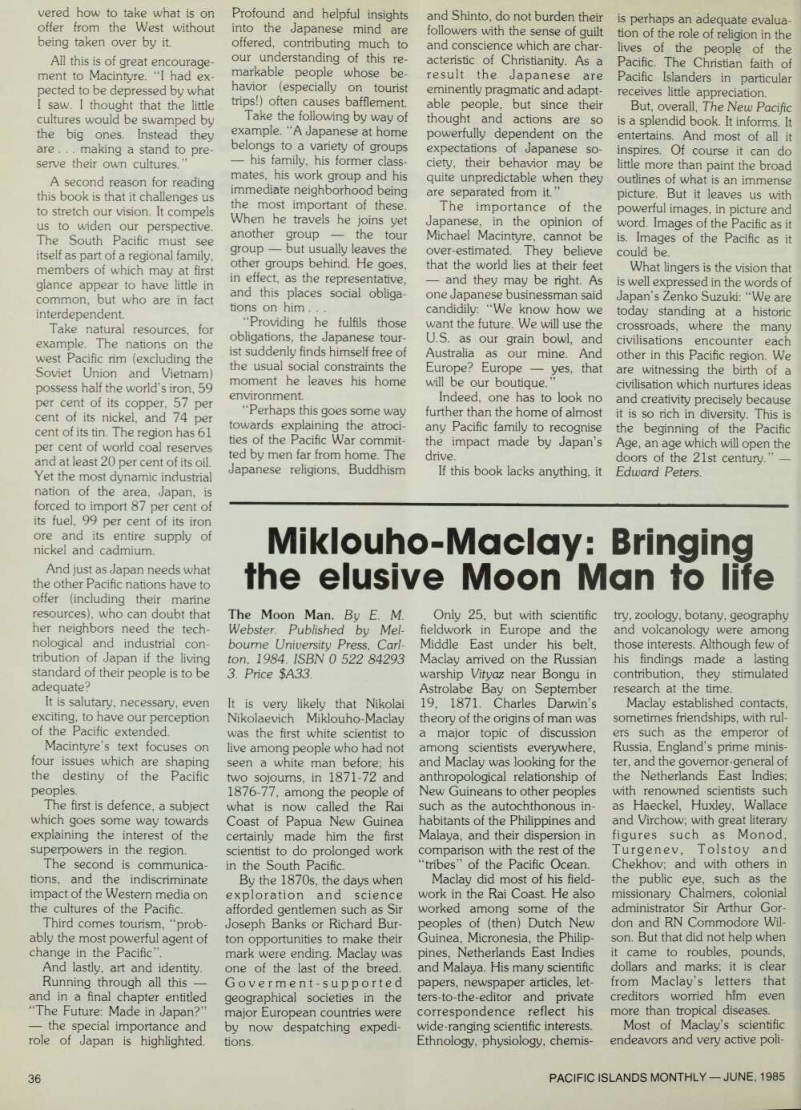
Tongan villagers carry a large expanse of tapa cloth in a royal wedding procession. Photo by Michael Macintyre from The New Pacific.
vered how to take what is on offer from the West without being taken over by it.
All this is of great encourage ment to Macintyre. “I had ex pected to be depressed by what I saw. I thought that the little cultures would be swamped by the big ones. Instead they are . . . making a stand to pre serve their own cultures.”
A second reason for reading this book is that it challenges us to stretch our vision. It compels us to widen our perspective.
The South Pacific must see itself as part of a regional family, members of which may at first glance appear to have little in common, but who are in fact interdependent.
Take natural resources, for example. The nations on the west Pacific rim (excluding the Soviet Union and Vietnam) possess half the world’s iron, 59 per cent of its copper, 57 per cent of its nickel, and 74 per cent of its tin. The region has 61 per cent of world coal reserves and at least 20 per cent of its oil.
Yet the most dynamic industrial nation of the area, Japan, is forced to import 87 per cent of its fuel, 99 per cent of its iron ore and its entire supply of nickel and cadmium.
And just as Japan needs what the other Pacific nations have to offer (including their marine resources), who can doubt that her neighbors need the tech nological and industrial con tribution of Japan if the living standard of their people is to be adequate?
It is salutary, necessary, even exciting, to have our perception of the Pacific extended.
Macintyre’s text focuses on four issues which are shaping the destiny of the Pacific peoples.
The first is defence, a subject which goes some way towards explaining the interest of the superpowers in the region.
The second is communica tions, and the indiscriminate impact of the Western media on the cultures of the Pacific.
Third comes tourism, “prob ably the most powerful agent of change in the Pacific”.
And lastly, art and identity.
Running through all this and in a final chapter entitled “The Future: Made in Japan?” the special importance and role of Japan is highlighted.
Profound and helpful insights into the Japanese mind are offered, contributing much to our understanding of this re markable people whose be havior (especially on tourist trips!) often causes bafflement Take the following by way of example. “A Japanese at home belongs to a variety of groups his family, his former class mates, his work group and his immediate neighborhood being the most important of these.
When he travels he joins yet another group the tour group but usually leaves the other groups behind. He goes, in effect, as the representative, and this places social obliga tions on him . . .
“Providing he fulfils those obligations, the Japanese tour ist suddenly finds himself free of the usual social constraints the moment he leaves his home environment.
“Perhaps this goes some way towards explaining the atroci ties of the Pacific War commit ted by men far from home. The Japanese religions, Buddhism
and Shinto, do not burden their followers with the sense of guilt and conscience which are char acteristic of Christianity. As a result the Japanese are eminently pragmatic and adapt able people, but since their thought and actions are so powerfully dependent on the expectations of Japanese so ciety, their behavior may be quite unpredictable when they are separated from it.”
The importance of the Japanese, in the opinion of Michael Maclntyre, cannot be over-estimated. They believe that the world lies at their feet and they may be right. As one Japanese businessman said candidily: “We know how we want the future. We will use the U.S. as our grain bowl, and Australia as our mine. And Europe? Europe yes, that will be our boutique.”
Indeed, one has to look no further than the home of almost any Pacific family to recognise the impact made by Japan’s drive.
If this book lacks anything, it
is perhaps an adequate evalua tion of the role of religion in the lives of the people of the Pacific. The Christian faith of Pacific Islanders in particular receives little appreciation.
But, overall, The New Pacific is a splendid book. It informs. It entertains. And most of all it inspires. Of course it can do little more than paint the broad outlines of what is an immense picture. But it leaves us with powerful images, in picture and word. Images of the Pacific as it is. Images of the Pacific as it could be.
What lingers is the vision that is well expressed in the words of Japan’s Zenko Suzuki: “We are today standing at a historic crossroads, where the many civilisations encounter each other in this Pacific region. We are witnessing the birth of a civilisation which nurtures ideas and creativity precisely because it is so rich in diversity. This is the beginning of the Pacific Age, an age which will open the doors of the 21st century.”
Edward Peters.