meeting in Nairobi
p. 33 · Read in the full issue
Pacific women for U.N. meeting in Nairobi
Pacific women would be ex pressing support for the strug gles for independence and “self-determination” of indi genous Pacific peoples, at the United Nations Decade for Women Forum in Nairobi, Kenya, this July.
In a recent eight-day meeting for women representatives of governments and non-gov ernmental organisations of the Pacific in Rarotonga, Cook Is lands, those of non-gov ernmental organisations in 14 (out of 16) Pacific countries represented identified the indi genous peoples of Western Papua (Irian Jaya), New Cale donia, Eastern Polynesia, and Palau as those ’’struggling for “independence and self-de termination. ”
The non-governmental or ganisations representing French Polynesia and American Samoa did not vote in support of the recommendation to put pressure on the “colonial pow ers” concerned, while New Caledonia’s government repre sentative insisted that “New Caledonians did not want inde pendence from France.”
The meeting also recom mended that governments in
the Pacific “be strongly urged to ensure rapid progress on peace issues such as the Nuclear-free Pacific Treaty and the Conven tion on the Protection and Development of the Natural Resources and Environment of the South Pacific Region.
Representatives of non-gov ernmental organisations chose four women to represent Pacific women at the meeting in Nairo bi, which would, among other things, review the United Na tions Decade for Women which ends this year.
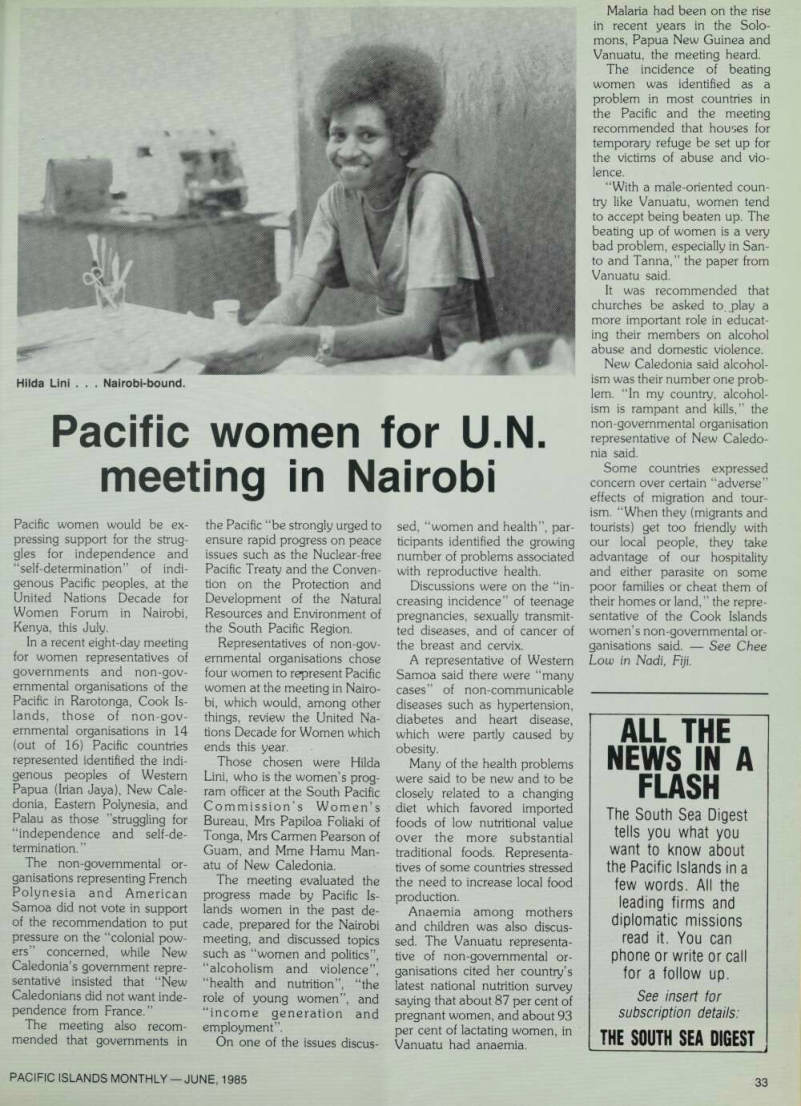
Those chosen were Hilda Lini, who is the women’s prog ram officer at the South Pacific Commission’s Women’s Bureau, Mrs Papiloa Foliaki of Tonga, Mrs Carmen Pearson of Guam, and Mme Hamu Man atu of New Caledonia.
The meeting evaluated the progress made by Pacific Is lands women in the past de cade, prepared for the Nairobi meeting, and discussed topics such as “women and politics”, “alcoholism and violence”, “health and nutrition”, “the role of young women”, and “income generation and employment”.
On one of the issues discus
sed, “women and health”, par ticipants identified the growing number of problems associated with reproductive health.
Discussions were on the “in creasing incidence” of teenage pregnancies, sexually transmit ted diseases, and of cancer of the breast and cervix.
A representative of Western Samoa said there were “many cases” of non-communicable diseases such as hypertension, diabetes and heart disease, which were partly caused by obesity.
Many of the health problems were said to be new and to be closely related to a changing diet which favored imported foods of low nutritional value over the more substantial traditional foods. Representa tives of some countries stressed the need to increase local food production.
Anaemia among mothers and children was also discus sed. The Vanuatu representa tive of non-governmental or ganisations cited her country’s latest national nutrition survey saying that about 87 per cent of pregnant women, and about 93 per cent of lactating women, in Vanuatu had anaemia.
Malaria had been on the rise in recent years in the Solo mons, Papua New Guinea and Vanuatu, the meeting heard.
The incidence of beating women was identified as a problem in most countries in the Pacific and the meeting recommended that houses for temporary refuge be set up for the victims of abuse and vio lence.
“With a male-oriented coun try like Vanuatu, women tend to accept being beaten up. The beating up of women is a very bad problem, especially in San to and Tanna,” the paper from Vanuatu said.
It was recommended that churches be asked to_play a more important role in educat ing their members on alcohol abuse and domestic violence.
New Caledonia said alcohol ism was their number one prob lem. “In my country, alcohol ism is rampant and kills,” the non-governmental organisation representative of New Caledo nia said.
Some countries expressed concern over certain “adverse” effects of migration and tour ism. “When they (migrants and tourists) get too friendly with our local people, they take advantage of our hospitality and either parasite on some poor families or cheat them of their homes or land,” the repre sentative of the Cook Islands women’s non-governmental or ganisations said. See Chee Low in Nadi, Fiji.
Hilda Lini . . . Nairobi-bound.