Pacific stamp box
p. 55 · Read in the full issue
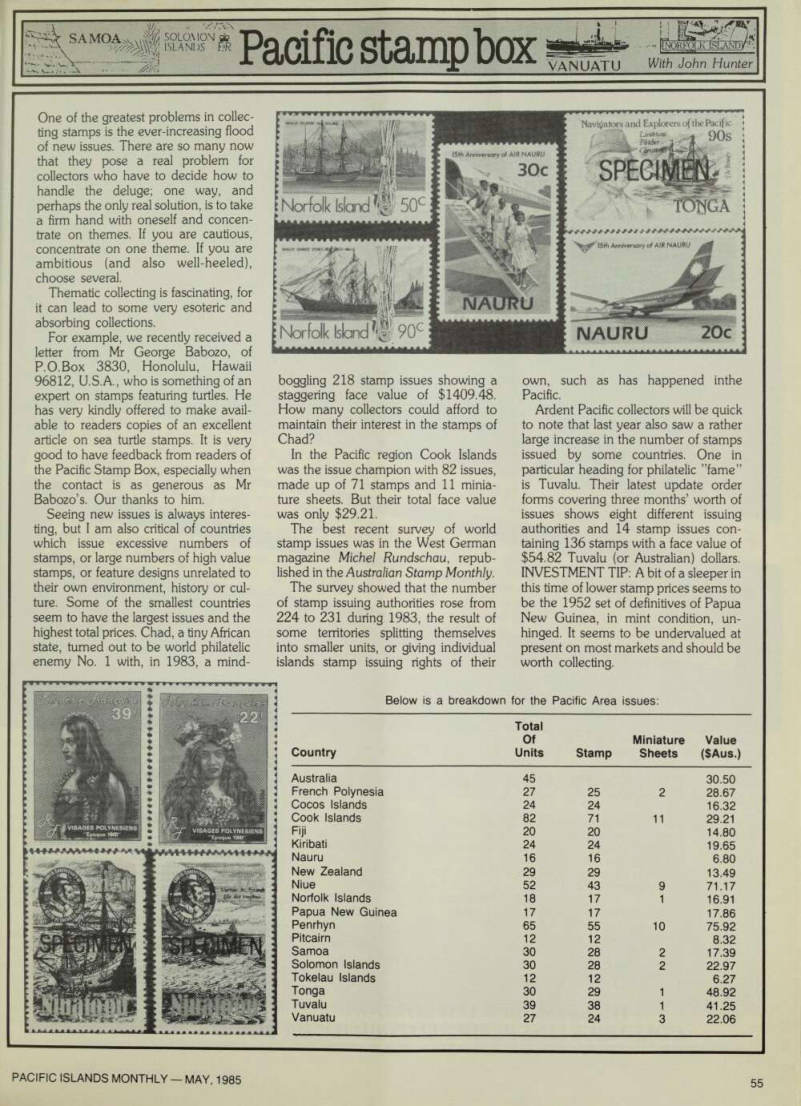
One of the greatest problems in collec ting stamps is the ever-increasing flood of new issues. There are so many now that they pose a real problem for collectors who have to decide how to handle the deluge; one way, and perhaps the only real solution, is to take a firm hand with oneself and concen trate on themes. If you are cautious, concentrate on one theme. If you are ambitious (and also well-heeled), choose several.
Thematic collecting is fascinating, for it can lead to some very esoteric and absorbing collections.
For example, we recently received a letter from Mr George Babozo, of P.0.80x 3830, Honolulu, Hawaii 96812, U.S.A., who is something of an expert on stamps featuring turtles. He has very kindly offered to make avail able to readers copies of an excellent article on sea turtle stamps. It is very good to have feedback from readers of the Pacific Stamp Box, especially when the contact is as generous as Mr Babozo’s. Our thanks to him.
Seeing new issues is always interes ting, but I am also critical of countries which issue excessive numbers of stamps, or large numbers of high value stamps, or feature designs unrelated to their own environment, history or cul ture. Some of the smallest countries seem to have the largest issues and the highest total prices. Chad, a tiny African state, turned out to be world philatelic enemy No. 1 with, in 1983, a mind-
boggling 218 stamp issues showing a staggering face value of $1409.48.
How many collectors could afford to maintain their interest in the stamps of Chad?
In the Pacific region Cook Islands was the issue champion with 82 issues, made up of 71 stamps and 11 minia ture sheets. But their total face value was only $29.21.
The best recent survey of world stamp issues was in the West German magazine Michel Rundschau, repub lished in the Australian Stamp Monthly.
The survey showed that the number of stamp issuing authorities rose from 224 to 231 during 1983, the result of some territories splitting themselves into smaller units, or giving individual islands stamp issuing rights of their
own, such as has happened inthe Pacific.
Ardent Pacific collectors will be quick to note that last year also saw a rather large increase in the number of stamps issued by some countries. One in particular heading for philatelic ’’fame” is Tuvalu. Their latest update order forms covering three months’ worth of issues shows eight different issuing authorities and 14 stamp issues con taining 136 stamps with a face value of $54.82 Tuvalu (or Australian) dollars.
INVESTMENT TIP: A bit of a sleeper in this time of lower stamp prices seems to be the 1952 set of definitives of Papua New Guinea, in mint condition, un hinged. It seems to be undervalued at present on most markets and should be worth collecting.
Below is a breakdown for the Pacific Area issues:
Country Total Of Units Stamp Miniature Sheets Value ($Aus.) Australia 45 30.50 French Polynesia 27 25 2 28.67 Cocos Islands 24 24 16.32 Cook Islands 82 71 11 29.21 Fiji 20 20 14.80 Kiribati 24 24 19.65 Nauru 16 16 6.80 New Zealand 29 29 13.49 Niue 52 43 9 71.17 Norfolk Islands 18 17 1 16.91 Papua New Guinea 17 17 17.86 Penrhyn 65 55 10 75.92 Pitcairn 12 12 8.32 Samoa 30 28 2 17.39 Solomon Islands 30 28 2 22.97 Tokelau Islands 12 12 6.27 Tonga 30 29 1 48.92 Tuvalu 39 38 1 41.25 Vanuatu 27 24 3 22.06