yach ts
pp. 59-60 · Read in the full issue
Lan G. Menzies Re
ports from Darwin,
Australia:
• BROWN PALACE. There are many reasons given why Brown Palace was so named. One is that she is named after “the unsinkable Molly Brown”, of Denver, Colorado, fame. But I guess the real reason is that it is the name of her owners Bob and Jane Brown and it is their “palatial” cruising home. Or could it be that all their friends on the “ham” radio network call them up and say, “is that the Browns’ palace?”
For whatever reason, Brown Palace is a yacht which not only reflects Bob’s pride in his 13 years of U.S. Navy service, but, more importantly, the close togetherness that exists between both Bob and Jane and their cruising home. Bob describes her as a “happy boat” and with 39 years of happy mar riage between her owners, it’s little wonder.
Bob and Jane bought Brown Palace in Tampa, Florida, in 1978 and registered her home port as Bolton Landing, New York. This is where the Browns have their sum mer home. The fact that it is a totally landlocked lake, and more than 50 km from the sea, is of little importance.
A CSY 44 (LOA 13.4 m), and originally designed for the Carib bean charter trade. Brown Palace carries a broad beam of 4.0 m, and has a shoal draught of 1.67 m. In this respect, she has proved ideal for Pacific cruising, where a shoal draft is quite an advantage when passage-making through reef strewn waters. She is of GRP construction and is cutter-rigged.
No newcomers to sailing Bob and Jane had previously cruised in their yacht Kareme in the early ’7os they nevertheless decided to take Brown Palace on a shakedown cruise along the Mex ican coastline in May, ’79. Though struck by lightning, all proved to be well, so the couple started their cruising in earnest via Panama.
Bob tells the story that while anchored off Panama City a “swim mer” cut the painter to their brand new Zodiac, started the outboard, and took off into the darkness.
Hearing the noise, Bob quickly buoyed his anchor and, under power, set off in hot pursuit. A police launch, hearing the commo tion, arrived on the scene and tried to interfere in the wild chase. Bob would have nothing of this, and finally convinced the police to fol-
searchlights, the Zodiac was spot ted, and surrendered. Days of red tape eventually restored the Zodiac to its rightful owners, together with all the diving gear that was in the dinghy at the time of its theft.
The sequel to this story is that Bob’s piece of advice on how to handle officialdom while cruising is to “be as nice as all hell to everybody you meet but let loose if you are goddam unhappy!”
The earlier part of the Browns’ cruise, therefore, was not without its traumas. Soon after, Jane fell seriously ill and they were forced to motor for three days. The couple were met off Balboa, where Jane was transported ashore and hospitalised. Sickness was again to strike when Bob went down with hepatitis while cruising the Mar quesas. I guess, at this point, most couples would have given up. They didn’t, and from then on they enjoyed superb cruising right across the Pacific.
From the Tuamotus, which they enjoyed the most of any of their Pacific stopovers, they moved on to Tahiti. Here, Brown Palace was chartered by Playboy International for a photographic session with the 1980 Playmate of the Year, Terri Welles. Bob says it was a most interesting charter.
It was then on to Rarotonga in the Cook Islands, Pago Pago in Samoa, and the Ha’apai Group in the Tongan Islands. They spent many weeks in the reefy waters of this group of tiny islands, receiving a warm welcome from the local villagers wherever they visited.
Then it was a series of fast passages through Fiji and on to New Zea land. Following a sojourn in the “land of the long white cloud”, they sailed north through the Solomons,
make their Australian landfall at Caims.
The Browns, instead of steering well clear of the Amhem Land coast, decided to day-sail the whole way from Gove to Darwin. They found it to be a fascinating coast line, with many secure overnight anchorages.
On the technical side, Bob Brown has been pleased with most of his equipment. This includes an Aries wind vane that has had no problems since it was installed five years ago.
A hefty Perkins diesel allows Bob to run a large cubic capacity deep freeze and refrigerator unit. Over four years ago Bob installed an oil filter by Refinco for which it was claimed that “you will never have to change your oil”. That statement has proved to be true Bob just tops up the engine oil whenever he changes the filter.
The interior of Brown Palace is spacious not too much “teak look” and has a very “homey” atmosphere. Evidence of their ex tensive Pacific cruising can be seen in the many curios and artifacts that have been used in tasteful decora tion of the interior. One particular feature that appealed to me was the completely separate shower with full standing headroom.
Following a brief flying holiday to Bali, Bob and Jane Brown have now sailed for Sri Lanka, with the intention of making passage through the Red Sea to cruise the Mediterranean. • SUZY Q. The influence of Colin Archer and the Norwegian “red ningskoites” is more than evident in the John Atkins-designed Suzy Q.
William and John Atkins (father and son), were both heavily influenced by the sea-keeping abilities of the
“skoite” rescue boats, and Archer’s interpretation of their characteris tics. William Atkins’ best known production model of this type was the extremely successful Westsail 32.
Suzy Q, with her marconi cutter rig, bears a marked similarity to Vixen, designed by the Atkins in 1950, and which later successfully circumnavigated. The 9.9 m Suzy Q, was launched in 1969 and is built of spotted gum below the waterline, Oregon for the top-sides, and has beech laid decks. With spars of Oregon, she is indeed a craft designed and built in the traditional style.
Purchased by Basil Davies in Brisbane in 1980, Suzy Q has been making leisurely passage up the Queensland coast with Graham Emmett and Denis Cook as crew. A working stopover in Yeppoon for seven months enabled them to replenish their cruising funds for the passage to Darwin.
Suzy Q then competed suc cessfully in the Darwin to Ambon Yacht Race, where she was placed seventh on handicap. Basil and his crew are now cruising Indonesian waters. • DIONYSUS. The “god of wine and ecstatic liberation” in Greek mythology, would have been pleased indeed at having such a vessel as this named after him.
Peter Balding, Dionysus’ builder, maintains that many casks of red wine were consumed during its construction, and that the launching was indeed a moment of “ecstatic liberation”.
After seven years in the building at Warrandyte, “in the bush” out side Melbourne, Dionysus was launched in July ’B2. An Alan Buchanan design, she is of round bilge steel construction, with a full keel and LOA of 11.3 m. Peter, with his young son Dyon, and first mate Helane Paizes, then lived on board for eight months while they completed the fitting-out.
Departing Melbourne in early ’B3 they sailed up the Australian east coast to Goffs Harbour, with a brief stay in Sydney en route. Clearing out of Goffs Harbour, they had intentions of making passage for New Caledonia, but heavy weather forced them to put about and seek the haven of Mooloolooba on Queensland’s south coast.
Eventually clearing out of Bris bane, they then cruised through New Caledonia and Vanuatu, northwards to the Banks and Torres Groups, where they spent almost two months. There they explored
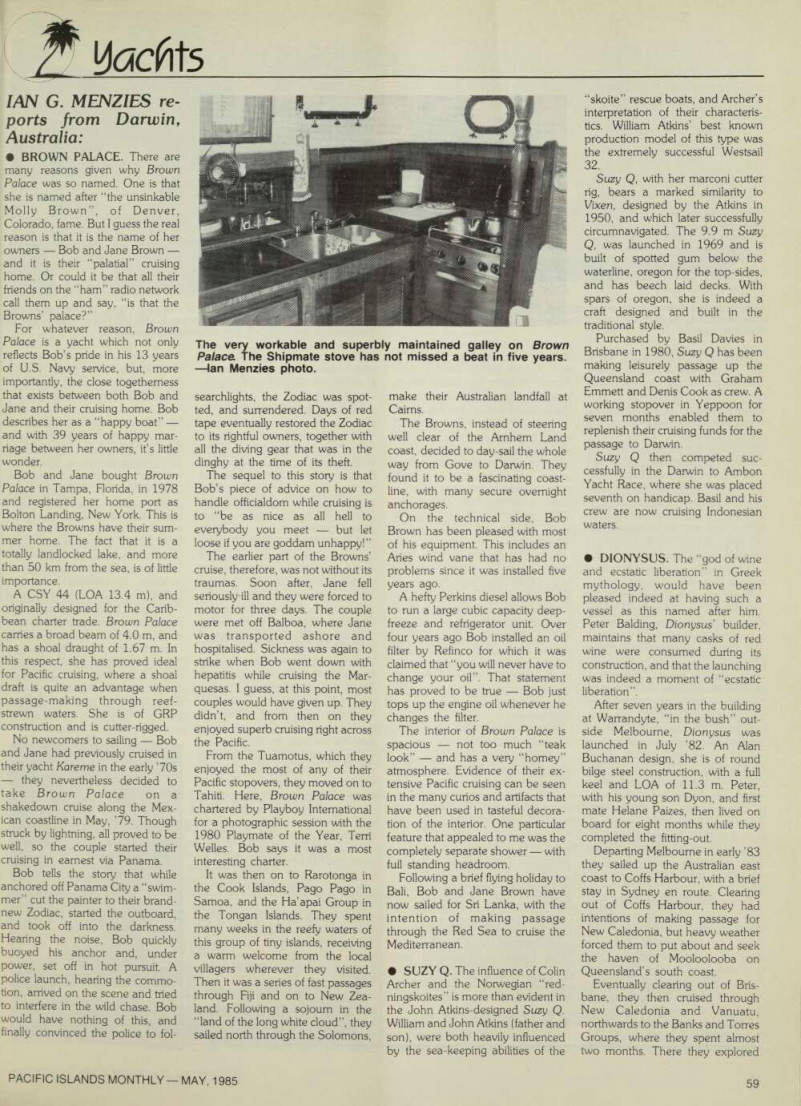
The very workable and superbly maintained galley on Brown Palace. The Shipmate stove has not missed a beat in five years. —lan Menzies photo.
Ureparara, a sunken volcanic island that has sometimes been called “the cloud factory of the South Pacific”. From its summit is pro duced a continual stream of clouds, which are then carried off on the prevailing winds.
A further two months was spent in Solomon Islands as they worked their way north to enter Papua New Guinea at Kieta on Bougainville.
Peter was able to secure some work there, so young Dyon spent a term in one of the local elementary schools. Dyon’s education is normally undertaken by both Peter and Helane a task at which they appear to be very successful.
Their cruise continued on to the d’Entrecasteaux Group off Milne Bay, where they found Gawa Island to be their favorite.
It is very obvious that the crew of Dionysus have developed a very deep affection for the Melanesian people. They would have loved to become even more immersed in the Melanesian culture, but time and funds did not permit. Despite the fact that they were sailing in a “high technology” vessel, many Melanesians in the more remote communities felt that these visitors did not know a thing. Activities such as spearing fish, weaving baskets, etc., were skills completely un known to Peter, Helane and Dyon.
They were delighted to be taught these new skills, so important to everyday living in island communi ties.
From Port Moresby Dionysus sailed through the Torres Strait to Weipa in the Gulf of Carpentaria.
Gove, on the remote northeast coast of Arnhem Land, was the next port of call. They found that both of these remote bauxite min ing communities offered warm hospitality to cruising yachties.
Dionysus is a vessel notable for some interesting innovations. The galley bulkhead has been built to
house the Decor range of square 1 and 2 litre plastic storage con tainers. A space that would other wise have proved fairly useless now holds useful storage for dry goods muesli, coffee, flour, etc. A separate locker has also been de signed for long-term vegetable stor age wire racks and netting ensure more than adequate ventila tion. Likewise, the space under the chart table conceals a standard filing drawer all paperwork is neatly tabbed and filed for ease of reference.
Peter is also an enthusiastic “ham” radio operator (call sign VK3 DGF), and has installed an Icom 720 A for this purpose. He has found it to be an extremely power ful and reliable communication tool. A mounted Seiko digital stop watch (cost about SASO), has proved to be an extremely accurate chronometer. A Seafarer 700 depth sounder (with alarm), is the only other electronic equipment carried by Dionysus.
Peter and Helane have kept very accurate records on the cost of cruising. Neither of them smokes, and they drink only occasionally.
This has meant that they have been able to limit their cruising costs for two adults and one child, and including fuel and maintenance, to $ll6 a week over the past two years. That is good budgeting.
Peter tries to work for at least three months of each year, and finds that this generates enough funds for the balance, without digging into the “emergency kitty”.
From Darwin, Dionysus sailed via Christmas Island to Sri Lanka.
Peter, Helane and Dyon then plan to cruise along India’s west coast, through the Red Sea to the Mediterranean.
• Falconera 111. Renzo
Favaro is one of those fortunate yachtsmen who have been able to
make the sea both their lifestyle and their livelihood: he is the proprietor of an Italian sailing school and yacht charter company.
Founded by Renzo about 11 years ago, the Club Vela d’Altura is headquartered in Venice, but main tains charter vessels in the Mediterranean, the Caribbean, French Polynesia, the Maldives and the Seychelles. The club’s sailing school also offers regular two-week practical sail-training courses, which Renzo maintains are extremely popular within the Italian sailing fraternity. Renzo is also the author of several books (in Italian of course) on meteorology, celestial navigation and general sailing skills.
Falconera 111, a 12.5 metre Oceanica 41, is a well-founded GRP sloop which is normally based in the Mediterranean. Designed by Migliari Lucio, she carries a 2-metre fin keel, has a skeg-supported rud der, and displaces about 10 tonnes when fully provisioned. Renzo has found her a joy to sail, with some fast but uneventful passage-making since he left Italy in ’B2.
The vessel is designed to carry four charter passengers in comfort, with a vast aft cabin as Renzo’s personal stateroom. This aft cabin is also equipped as an alternative steering station with the largest stainless steel destroyer wheel that I have yet seen on a yacht. As the cabin also has an astra-dome hatch, it provides total protection, yet adequate visibility, during heavy weather sailing.
With largely inexperienced crew and passengers joining him from Italy at each major port of call, Renzo has set up Falconera 111 for ease of handling, and also to facilitate instruction while on pas sage. Interesting innovations are a well-equipped workshop up for ward, anchor winch and all ground tackle located in a capacious below decks well and chain locker, and
substantial water-tight bulkheads to meet survey requirements. Above decks, all main and head-sail halyards, topping lifts, etc., are led back to the cockpit, underneath a false deck, to a series of winches located behind the spray dodger.
Though the cockpit can become a little congested with cordage, it sure makes for uncluttered deck space.
As Renzo is a licensed “ham” radio operator (EL2 RF), he has both an Ikom 720 and an Atlas transceiver on board. He also has a VHF by ITT to complete his com munications all have performed admirably. The Walker SatNav, however, has proved rather dis appointing. The unit broke down at Gibraltar and he did not receive it back from the manufacturers until he reached Tahiti. It was a matter of “back to basics” with the sextant.
From Darwin, Falconera 111 sailed to the Seychelles where she will be based for some months for charter work. Come the northern summer, Renzo will return to the Mediterra nean via the Red Sea.
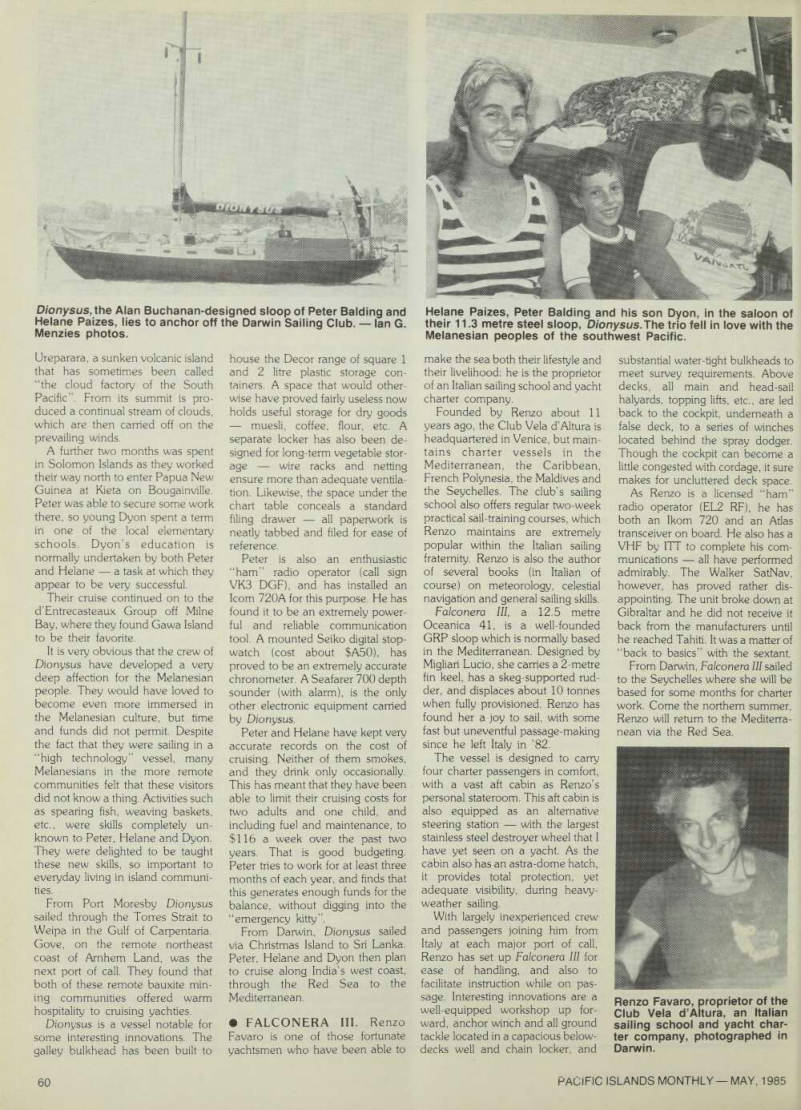
Dionysus, the Alan Buchanan-designed sloop of Peter Balding and Helane Paizes, lies to anchor off the Darwin Sailing Club.-lan G.
Menzies photos.
Helane Raizes, Peter Balding and his son Dyon, in the saloon of their 11.3 metre steel sloop, Dionysus. The trio fell in love with the Melanesian peoples of the southwest Pacific.
Renzo Favaro, proprietor of the Club Vela d’Altura, an Italian sailing school and yacht char ter company, photographed in Darwin.