political currents
pp. 52-54 · Read in the full issue
Tahitians stir to plight of New Caledonia’s Kanaks
Why are the Kanaks in revolt?
In attempting to answer this question, Gaston Flosse can only repeat what his Paris politi cal mentor Jacques Chirac has to say about it. In one of his recent speeches to the Territo rial Assembly, Flosse explained that the whole business was due to the activities of “a handful of agitators spurred on by personal ambition, and manipulated by Colonel Gad dafi and the Russians, who are out to destabilise the region and grab hold of New Caledonia”.
One must ask why it is that it is taking 6600 gendarmes, sol diers, and CRS riot police, armed with the most murder ous weapons, with armored vehicles and Puma helicopters, to get on top of this small band of “desperates” with their grass knives and hunting rifles . . .
But let’s leave all that aside for a moment and simply note that if there’s one man who’s trying to make use of New Caledonia to serve his political ambitions, it’s definitely our very own Gaston.
It’s also primarily for party political reasons because New Caledonia has blown up into a big issue between the parties in metropolitan France that Chirac and the other Grand Panjandrums of the opposition, Barre, Giscard, and Le Pen, are regaling us with this humbug. True, there’s an ele ment of bad conscience to their hypocrisy: for it is precisely these men from the former conservative French govern ments who bear personal re sponsibility for today’s Caledo nian drama.
The truth is, if our Kanak brothers are in revolt today: - it’s because colonialist France, without consulting them, took possession of their country; it’s because a whole sue-
To the delight of some, and the chagrin of others, the traditional “chorus of support” from the inhabitants of French Polysnesia for the battles of New Caledonia’s Kanaks has mostly consisted of a long and deafening silence. Despite the many parallels in their respective fates, the lines of development of the two French territories have for the most part been just that parallel, and never meeting.
But not any more.
Recent events in New Caledonia, the anti-independ ence “alliance” signed by French Polynesia’s Gaston Flosse and Caledonia’s Dick Ukewie (PIM Apr p2B), and the prominence assumed by the Caledonian issue in metropolitan French politics, have combined to place it for the first time high on the political agenda in Tahiti.
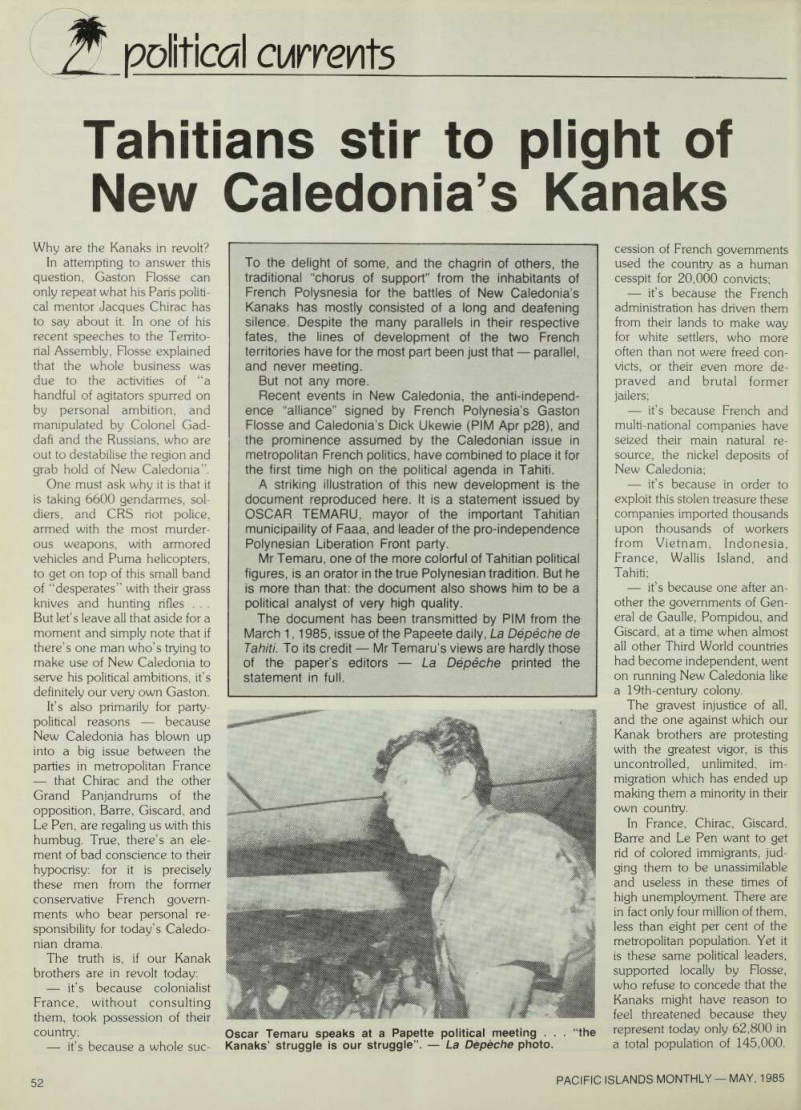
A striking illustration of this new development is the document reproduced here. It is a statement issued by OSCAR TEMARU, mayor of the important Tahitian municipaility of Faaa, and leader of the pro-independence Polynesian Liberation Front party.
Mr Temaru, one of the more colorful of Tahitian political figures, is an orator in the true Polynesian tradition. But he is more than that: the document also shows him to be a political analyst of very high quality.
The document has been transmitted by PIM from the March 1,1985, issue of the Papeete daily, La Depeche de Tahiti. To its credit Mr Temaru’s views are hardly those of the paper’s editors La Depeche printed the statement in full.
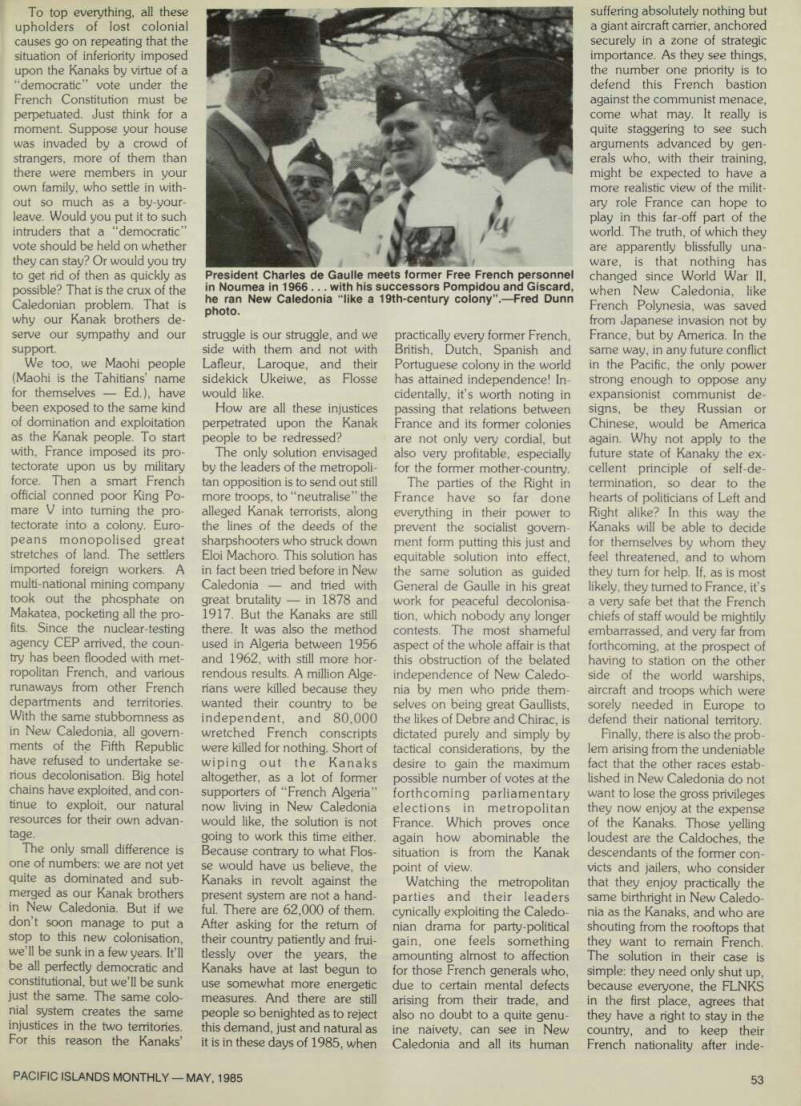
cession of French governments used the country as a human cesspit for 20,000 convicts; it’s because the French administration has driven them from their lands to make way for white settlers, who more often than not were freed con victs, or their even more de praved and brutal former jailers; it’s because French and multi-national companies have seized their main natural re source, the nickel deposits of New Caledonia; it’s because in order to exploit this stolen treasure these companies imported thousands upon thousands of workers from Vietnam, Indonesia, France, Wallis Island, and Tahiti; it’s because one after an other the governments of Gen eral de Gaulle, Pompidou, and Giscard, at a time when almost all other Third World countries had become independent, went on running New Caledonia like a 19th-century colony.
The gravest injustice of all, and the one against which our Kanak brothers are protesting with the greatest vigor, is this uncontrolled, unlimited, im migration which has ended up making them a minority in their own country.
In France, Chirac, Giscard, Barre and Le Pen want to get rid of colored immigrants, jud ging them to be unassimilable and useless in these times of high unemployment. There are in fact only four million of them, less than eight per cent of the metropolitan population. Yet it is these same political leaders, supported locally by Flosse, who refuse to concede that the Kanaks might have reason to feel threatened because they represent today only 62,800 in a total population of 145,000.
Oscar Temaru speaks at a Papette political meeting . . . “the Kanaks’ struggle is our struggle”. -La Dépêche photo.
To top everything, all these upholders of lost colonial causes go on repeating that the situation of inferiority imposed upon the Kanaks by virtue of a “democratic” vote under the French Constitution must be perpetuated. Just think for a moment. Suppose your house was invaded by a crowd of strangers, more of them than there were members in your own family, who settle in with out so much as a by-your leave. Would you put it to such intruders that a “democratic” vote should be held on whether they can stay? Or would you try to get rid of then as quickly as possible? That is the crux of the Caledonian problem. That is why our Kanak brothers de serve our sympathy and our support.
We too, we Maohi people (Maohi is the Tahitians’ name for themselves Ed.), have been exposed to the same kind of domination and exploitation as the Kanak people. To start with, France imposed its pro tectorate upon us by military force. Then a smart French official conned poor King Po mare V into turning the pro tectorate into a colony. Euro peans monopolised great stretches of land. The settlers imported foreign workers. A multi-national mining company took out the phosphate on Makatea, pocketing all the pro fits. Since the nuclear-testing agency CEP arrived, the coun try has been flooded with met ropolitan French, and various runaways from other French departments and territories.
With the same stubbornness as in New Caledonia, all govern ments of the Fifth Republic have refused to undertake se rious decolonisation. Big hotel chains have exploited, and con tinue to exploit, our natural resources for their own advan tage.
The only small difference is one of numbers; we are not yet quite as dominated and sub merged as our Kanak brothers in New Caledonia. But if we don’t soon manage to put a stop to this new colonisation, we’ll be sunk in a few years. It’ll be all perfectly democratic and constitutional, but we’ll be sunk just the same. The same colo nial system creates the same injustices in the two territories.
For this reason the Kanaks’
struggle is our struggle, and we side with them and not with Lafleur, Laroque, and their sidekick Ukeiwe, as Flosse would like.
How are all these injustices perpetrated upon the Kanak people to be redressed?
The only solution envisaged by the leaders of the metropoli tan opposition is to send out still more troops, to “neutralise” the alleged Kanak terrorists, along the lines of the deeds of the sharpshooters who struck down Eloi Machoro. This solution has in fact been tried before in New Caledonia and tried with great brutality in 1878 and 1917. But the Kanaks are still there. It was also the method used in Algeria between 1956 and 1962, with still more hor rendous results. A million Alge rians were killed because they wanted their country to be independent, and 80,000 wretched French conscripts were killed for nothing. Short of wiping out the Kanaks altogether, as a lot of former supporters of “French Algeria” now living in New Caledonia would like, the solution is not going to work this time either.
Because contrary to what Flos se would have us believe, the Kanaks in revolt against the present system are not a hand ful. There are 62,000 of them.
After asking for the return of their country patiently and frui tlessly over the years, the Kanaks have at last begun to use somewhat more energetic measures. And there are still people so benighted as to reject this demand, just and natural as it is in these days of 1985, when
practically every former French, British, Dutch, Spanish and Portuguese colony in the world has attained independence! In cidentally, it’s worth noting in passing that relations between France and its former colonies are not only very cordial, but also very profitable, especially for the former mother-country.
The parties of the Right in France have so far done everything in their power to prevent the socialist govern ment form putting this just and equitable solution into effect, the same solution as guided General de Gaulle in his great work for peaceful decolonisa tion, which nobody any longer contests. The most shameful aspect of the whole affair is that this obstruction of the belated independence of New Caledo nia by men who pride them selves on being great Gaullists, the likes of Debre and Chirac, is dictated purely and simply by tactical considerations, by the desire to gain the maximum possible number of votes at the forthcoming parliamentary elections in metropolitan France. Which proves once again how abominable the situation is from the Kanak point of view.
Watching the metropolitan parties and their leaders cynically exploiting the Caledo nian drama for party-political gain, one feels something amounting almost to affection for those French generals who, due to certain mental defects arising from their trade, and also no doubt to a quite genu ine naivety, can see in New Caledonia and all its human
suffering absolutely nothing but a giant aircraft carrier, anchored securely in a zone of strategic importance. As they see things, the number one priority is to defend this French bastion against the communist menace, come what may. It really is quite staggering to see such arguments advanced by gen erals who, with their training, might be expected to have a more realistic view of the milit ary role France can hope to play in this far-off part of the world. The truth, of which they are apparently blissfully una ware, is that nothing has changed since World War 11, when New Caledonia, like French Polynesia, was saved from Japanese invasion not by France, but by America. In the same way, in any future conflict in the Pacific, the only power strong enough to oppose any expansionist communist de signs, be they Russian or Chinese, would be America again. Why not apply to the future state of Kanaky the ex cellent principle of self-de termination, so dear to the hearts of politicians of Left and Right alike? In this way the Kanaks will be able to decide for themselves by whom they feel threatened, and to whom they turn for help. If, as is most likely, they turned to France, it’s a very safe bet that the French chiefs of staff would be mightily embarrassed, and very far from forthcoming, at the prospect of having to station on the other side of the world warships, aircraft and troops which were sorely needed in Europe to defend their national territory.
Finally, there is also the prob lem arising from the undeniable fact that the other races estab lished in New Caledonia do not want to lose the gross privileges they now enjoy at the expense of the Kanaks. Those yelling loudest are the Caldoches, the descendants of the former con victs and jailers, who consider that they enjoy practically the same birthright in New Caledo nia as the Kanaks, and who are shouting from the rooftops that they want to remain French.
The solution in their case is simple: they need only shut up, because everyone, the FLNKS in the first place, agrees that they have a right to stay in the country, and to keep their French nationality after inde-
President Charles de Gaulle meets former Free French personnel in Noumea in 1966 ... with his successors Pompidou and Giscard, he ran New Caledonia “like a 19th-century colony”. —Fred Dunn photo.
pendence if that is what they still want to do.
It would also be helpful here to expose a lie which is being repeated day in and day out by the mass media: the idea that there is only one category of Europeans in New Caledonia.
In truth there are not only the long-established Caldoches, but also metropolitan immig-
rants, the so-called “Zoreilles”, 20,000 to 25,000 of them, who have gone there over the last 20 years or so in search of work and fortune, and who have families and bank accounts in France. Let them go home (without stopping in Tahiti). If there’s any injustice involved, it would be the same as befell the former French colonists in In
dochina and Africa, who did very nicely thank you, being generously rewarded both with previously acquired profits, and post-repatriation indemnity payments.
But workers of other nationalities are quite significant in the scheme of things, and some say it wuld be quite unjust to push them out. Now this isn’t true either, because they have practically always sided with their bosses, and have routinely taken the place of Kanaks in the workplace. What would you think, dear compatriots, if tomorrow 5000 Kanaks, 12,000 Wallisians, 5000 Vietnamese and 5000 Javanese suddenly landed in Tahiti to live and work? Wouldn’t you think it the height of absurdity if these newcomers were able to take part in Polynesia’s elections, so that you would be in a minority in your own municipalities, as well as in the Territorial Assembly? Well, this is exactly the situation which has been imposed upon our Kanak brothers, and it is therefore little
wonder that their attitude to the Tahitians and the other immig rant groups is no longer all that warm. . .
It is possible, even probable, that in the new Republic of Kanaky all these immigrant workers will no longer have the same privileged status they’ve enjoyed in the past. But won’t it be sufficient for them to have the same rights as Kanaks?
It occurs to me that since national solidarity came so strongly into play at the time of another disaster the long series of cyclones in Polynesia early in 1983 why shouldn’t it do so again? Especially as responsibility for the misfor tunes now besetting New Cale donia belongs essentially to the metropolitan governments headed by de Gaulle, Pompi dou and Giscard, it would seem perfectly justified for a public levy to be struck in France, as it was at the time of the cyclones, for the benefit of people of various races forced out of New Caledonia by the present politi cal storms.
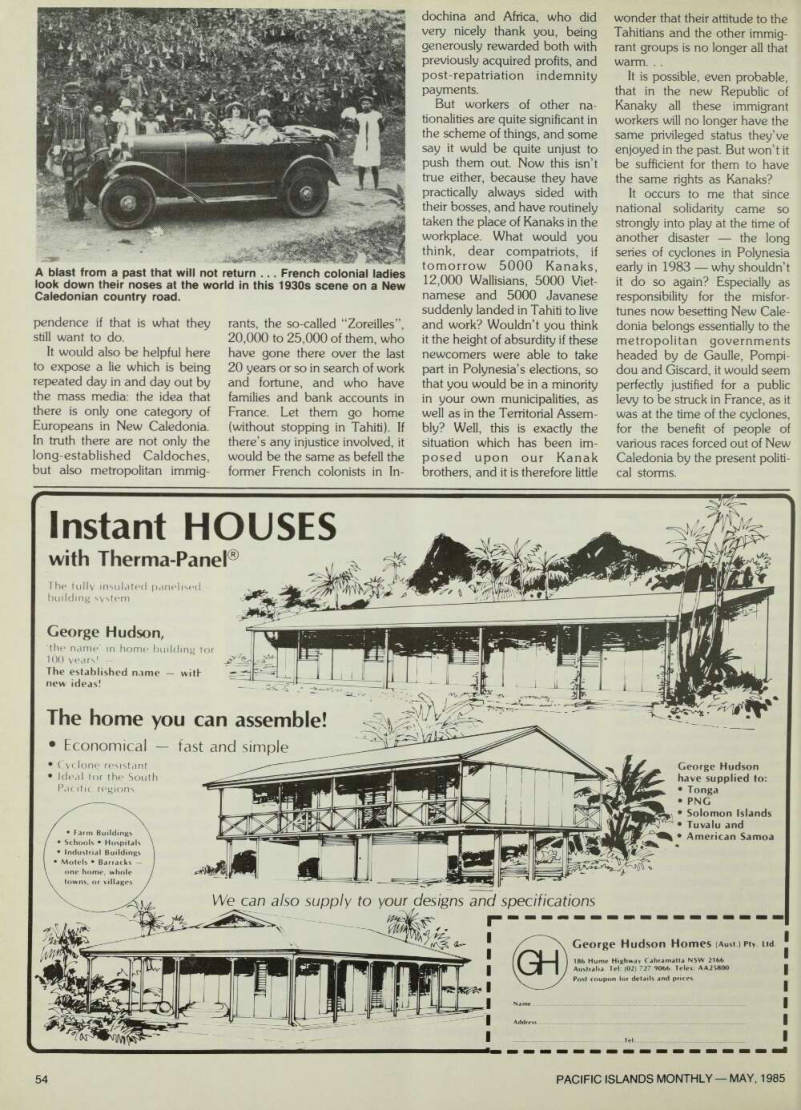
A blast from a past that will not return ... French colonial ladies look down their noses at the world in this 1930s scene on a New Caledonian country road.