W. Samoa’s high
pp. 22-24 · Read in the full issue

economic aims
Western Samoa, like many other small island nations, is at the crossroads of development.
It has been a politically inde pendent state for over 22 years, yet it has never been econo mically independent.
With the recent return of the government, the prime minis ter, Tofilau Eti Alesana, has said that the country will strive for economic self-reliance. He claimed that his party’s re election confirmed that the Sa moan people had confidence in the financial policy followed over the last two years by his government.
There are indications that the economy has improved during this period. In 1982 government loan payments were in arrears in excess of 20 million tala.
Virtually all these arrears have now been paid. Western Samoa now has a reserve of 22 million tala, compared to 5 million tala held at the end of 1982. The present rate of infla tion is 12 per cent, compared to a rate of 20 per cent at the end of 1983.
In March bank lending rates were reduced from the previous maximum rate of 20 per cent to a rate of 18 per cent. The present maximum lending rate is set at 15 per cent. This is the first reduction since February, 1983.
During the present govern
ment’s last two years of office a number of significant changes were made in the national financial management system.
A central bank was established which has the responsibility for controlling foreign exchange.
One of its earliest measures was to devalue the tala. The total devaluation, done in several steps, has amounted to nearly 30 per cent.
On March 1 this year West ern Samoa discontinued the fixed link it has had for years between the tala and the New Zealand dollar (which itself was floated on the same day) and the value of the tala is now
determined by reference to a basket of the currencies of its major trading partners, New Zealand, Australia, United States, Japan and West Ger many.
The government has per sisted in its efforts to extend the runway at the international air port to accommodate larger aircraft. This work is being partly funded by Australia. The longer runway will allow Polynesian Airlines to increase tourist traffic through the use of larger and more economic air craft, like the Boeing 727. More importantly, perhaps, it will give Western Samoa the chance to export perishable agricultural products.
The government has negoti ated a US$4 million loan from the Asian Development Bank, and a loan of US$2 million
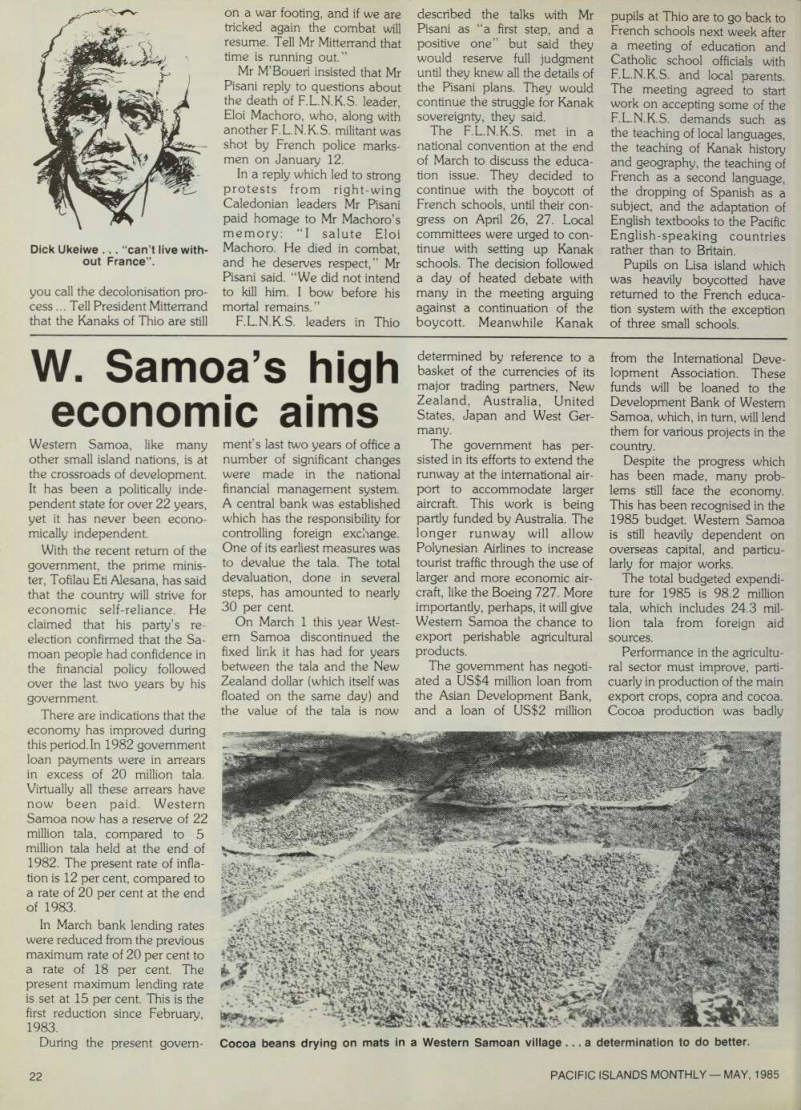
from the International Deve lopment Association. These funds will be loaned to the Development Bank of Western Samoa, which, in turn, will lend them for various projects in the country, Despite the progress which has been made, many prob lems still face the economy, This has been recognised in the 1985 budget. Western Samoa is still heavily dependent on overseas capital, and particu larly for major works, The total budgeted expendi ture for 1985 is 98.2 million tala, which includes 24.3 mil lion tala from foreign aid sources, Performance in the agricultu ral sector must improve, parti cuarly in production of the main export crops, copra and cocoa.
Cocoa production was badly
Cocoa beans drying on mats in a Western Samoan village ... a determination to do better.
affected by the 1983 drought.
To encourage the planting of cocoa the government is prom oting a suspensory loan scheme and farmers’ response has been encouraging. Problems with the export of bananas and taro could be overcome with the completion of the airport exten sion. .
During 1983 farmers were encouraged to plant passion fruit vines as a cash crop.
Unfortunately the first year’s production met a glut in the market, with depressed prices.
Some farmers are now thinking of returning to traditional crops, if new markets for passionfruit cannot be found.
The market for industrial pro ducts manufactured in Western Samoa, such as beer, soap and cigarettes, needs to be deve loped. One of the major im pediments to development of this trade are the levies imposed on exports. In addition there are high excise and customs duties on imported raw materials. Even though West ern Samoa’s labor costs are low, these factors inhibit large scale manufacture and export.
Western Samoa has a popula tion of only 160,000 and in dustrial growth will be limited until all of these problems are overcome.
The basic wage is now 55 sene an hour (Aussl approx imately equals 1.60 tala) and yet the cost of basic imported consumer goods, such as sugar, flour and rice is higher than in Australia or New Zealand.
The potential for tourism is great but Western Samoa lacks adequate facilities to cater to large numbers of tourists. Plans for an International hotel have been approved for over 10 years, but work has only just begun on the construction. This hotel, the Royal Samoan, has been given generous tax con cessions and released from cus toms and excise duties.
Total revenue for 1985 is estimated to be 73.5 million tala, compared with 59 million tala in the 1984 budget. If some of the difficulties now seen can be overcome then the govern ment’s aim of eventual econo mic independence may be realised. Certainly, if the de termination of the national leadership means anything, they will make it. Lee Ander son, in Apia.