Pisani: Choosing
pp. 21-22 · Read in the full issue
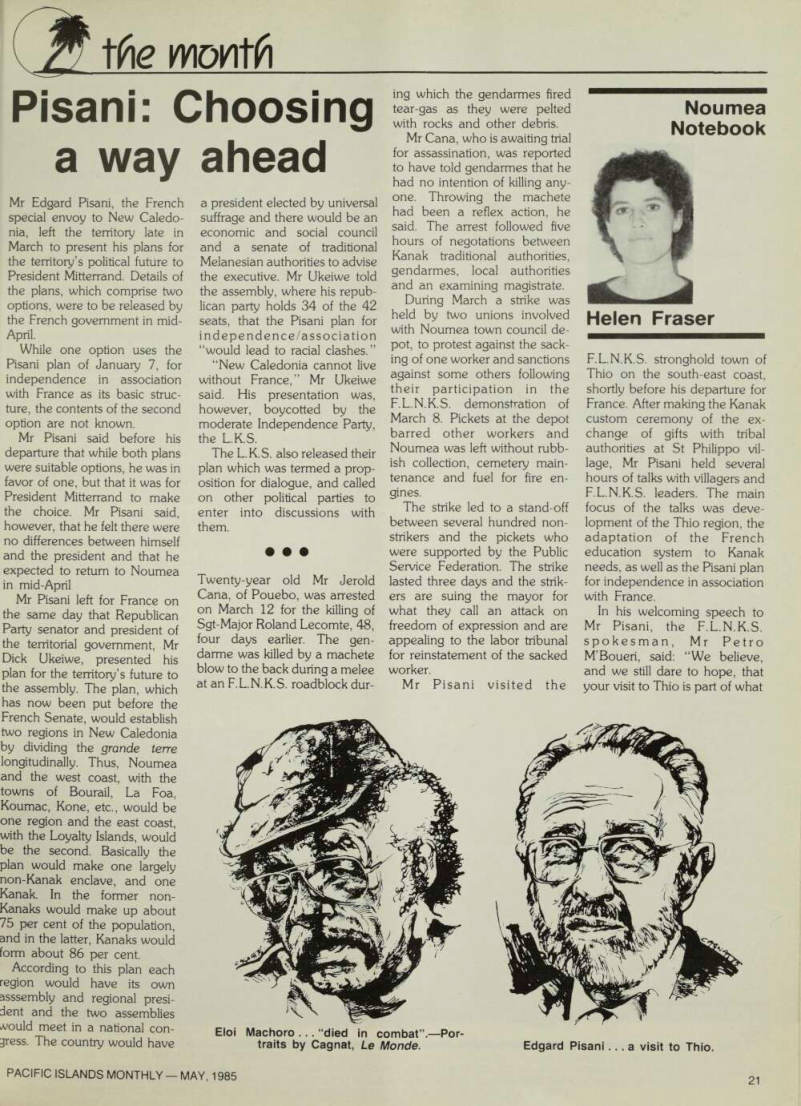
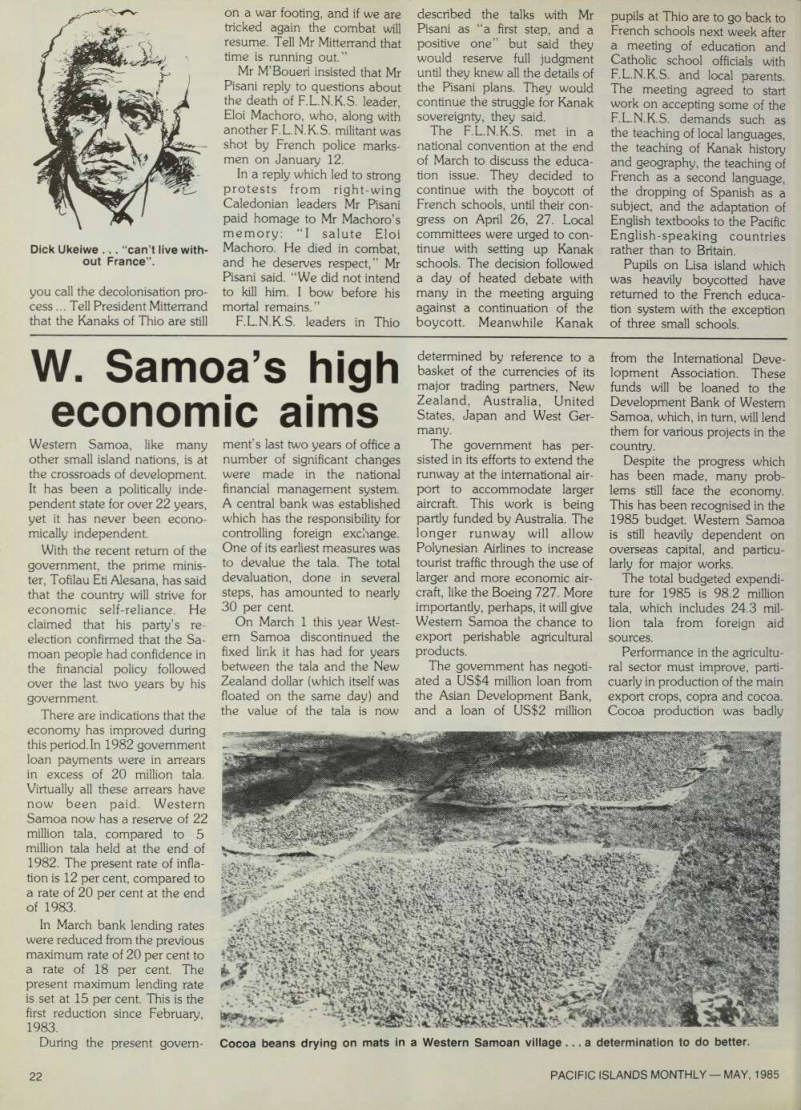
the month
Pisani: Choosing a way ahead
Mr Edgard Pisani, the French special envoy to New Caledo nia, left the territory late in March to present his plans for the territory’s political future to President Mitterrand. Details of the plans, which comprise two options, were to be released by the French government in mid- April.
While one option uses the Pisani plan of January 7, for independence in association with France as its basic struc ture, the contents of the second option are not known.
Mr Pisani said before his departure that while both plans were suitable options, he was in favor of one, but that it was for President Mitterrand to make the choice. Mr Pisani said, however, that he felt there were no differences between himself and the president and that he expected to return to Noumea in mid-April Mr Pisani left for France on the same day that Republican Party senator and president of the territorial government, Mr Dick Ukeiwe, presented his plan for the territory’s future to the assembly. The plan, which has now been put before the French Senate, would establish two regions in New Caledonia by dividing the grande terre longitudinally. Thus, Noumea and the west coast, with the towns of Bourail, La Foa, Koumac, Kone, etc., would be one region and the east coast, with the Loyalty Islands, would be the second. Basically the plan would make one largely non-Kanak enclave, and one Kanak. In the former non- Kanaks would make up about 75 per cent of the population, and in the latter, Kanaks would form about 86 per cent.
According to this plan each region would have its own asssembly and regional presi dent and the two assemblies A/ould meet in a national con gress. The country would have
a president elected by universal suffrage and there would be an economic and social council and a senate of traditional Melanesian authorities to advise the executive. Mr Ukeiwe told the assembly, where his repub lican party holds 34 of the 42 seats, that the Pisani plan for independence/association “would lead to racial clashes.”
“New Caledonia cannot live without France,” Mr Ukeiwe said. His presentation was, however, boycotted by the moderate Independence Party, the L.K.S.
The L.K.S. also released their plan which was termed a prop osition for dialogue, and called on other political parties to enter into discussions with them. • • • Twenty-year old Mr Jerold Cana, of Pouebo, was arrested on March 12 for the killing of Sgt-Major Roland Lecomte, 48, four days earlier. The gen darme was killed by a machete blow to the back during a melee at an F.L.N.K.S. roadblock dur
ing which the gendarmes fired tear-gas as they were pelted with rocks and other debris.
Mr Cana, who is awaiting trial for assassination, was reported to have told gendarmes that he had no intention of killing any one. Throwing the machete had been a reflex action, he said. The arrest followed five hours of negotations between Kanak traditional authorities, gendarmes, local authorities and an examining magistrate.
During March a strike was held by two unions involved with Noumea town council de pot, to protest against the sack ing of one worker and sanctions against some others following their participation in the F.L.N.K.S. demonstration of March 8. Pickets at the depot barred other workers and Noumea was left without rubb ish collection, cemetery main tenance and fuel for fire en gines.
The strike led to a stand-off between several hundred non strikers and the pickets who were supported by the Public Service Federation. The strike lasted three days and the strik ers are suing the mayor for what they call an attack on freedom of expression and are appealing to the labor tribunal for reinstatement of the sacked worker.
Mr Pisani visited the
Noumea Notebook
F.L.N.K.S. stronghold town of Thio on the south-east coast, shortly before his departure for France. After making the Kanak custom ceremony of the ex change of gifts with tribal authorities at St Philippo vil lage, Mr Pisani held several hours of talks with villagers and F.L.N.K.S. leaders. The main focus of the talks was deve lopment of the Thio region, the adaptation of the French education system to Kanak needs, as well as the Pisani plan for independence in association with France.
In his welcoming speech to Mr Pisani, the F.L.N.K.S. spokesman, Mr Petro M’Boueri, said: “We believe, and we still dare to hope, that your visit to Thio is part of what
Helen Fraser
Eloi Machoro ... “died in combat”.—Por traits by Cagnat, Le Monde.
Edgard Pisani... a visit to Thio.
you call the decolonisation pro cess ... Tell President Mitterrand that the Kanaks of Thio are still
on a war footing, and if we are tricked again the combat will resume. Tell Mr Mitterrand that time is running out.”
Mr M’Boueri insisted that Mr Pisani reply to questions about the death of F.L.N.K.S. leader, Eloi Machoro, who, along with another F.L.N.K.S. militant was shot by French police marks men on January 12.
In a reply which led to strong protests from right-wing Caledonian leaders Mr Pisani paid homage to Mr Machoro’s memory; “I salute Eloi Machoro. He died in combat, and he deserves respect,” Mr Pisani said. “We did not intend to kill him. I bow before his mortal remains.”
F.L.N.K.S. leaders in Thio
described the talks with Mr Pisani as “a first step, and a positive one” but said they would reserve full judgment until they knew all the details of the Pisani plans. They would continue the struggle for Kanak sovereignty, they said.
The F.L.N.K.S. met in a national convention at the end of March to discuss the educa tion issue. They decided to continue with the boycott of French schools, until their con gress on April 26, 27. Local committees were urged to con tinue with setting up Kanak schools. The decision followed a day of heated debate with many in the meeting arguing against a continuation of the boycott. Meanwhile Kanak
pupils at Thio are to go back to French schools next week after a meeting of education and Catholic school officials with F.L.N.K.S. and local parents.
The meeting agreed to start work on accepting some of the F.L.N.K.S. demands such as the teaching of local languages, the teaching of Kanak history and geography, the teaching of French as a second language, the dropping of Spanish as a subject, and the adaptation of English textbooks to the Pacific
English-speaking countries
rather than to Britain.
Pupils on Lisa island which was heavily boycotted have returned to the French educa tion system with the exception of three small schools.
Dick Ukeiwe ... “can’t live with out France”.