Irian Jaya: New
pp. 18-20 · Read in the full issue

crackdown on OPM?
Indonesia may be embarking on a new political campaign against the Free West Papua Movement (OPM) whose members currently provide embarrassment in relations between Jakarta and the government in Port Moresby.
The military commander of Irian Jaya, the Indonesian name for the western half of the island, has recently been quoted as saying that the guerrillas ’’and their sympathisers” still cherished dreams of pan- Melanesian nationalism. *
Lieut-General Kahpi Suriadiredja made the assertion in Bandung in March when he spoke to a seminar on regional affairs.
He said that notions of a free West Papua and a ’’Greater Melanesia” lingered in the minds of some Irian Jayans.
The western half of New Guinea became Irian Jaya when the Netherlands lost a political battle in the United Nations to keep it separate from the rest of their western Pacific colonies. Indonesia’s then president, Soekarno, had
claimed it on grounds that it was part of the Dutch East Indies and, therefore, legally part of Indonesia, despite the clear racial difference of the people. The Melanesian Christ ians who make up the popula tion of Irian Jaya had opposed their handing over to control from Jakarta, but their objec tions were over-ridden by the United Nations.
General Kahpi said there was some sympathy in official circles in Irian Jaya for the OPM, which is now outlawed in the territory and freely hunted by
Indonesian Army units operat ing particularly on the long and difficult border between Irian Jaya and Papua New Guinea.
This reference to ’’official support” caused a minor stir among Jakarta’s diplomats who, upon reflection, took it to be a reference to the number of civil servants who fled from Jayapura after the abortive up rising of February, 1984.
The OPM had also won a foothold among ’’student drop outs” in Jayapura, the territorial capital.
Neither Jakarta, nor Port
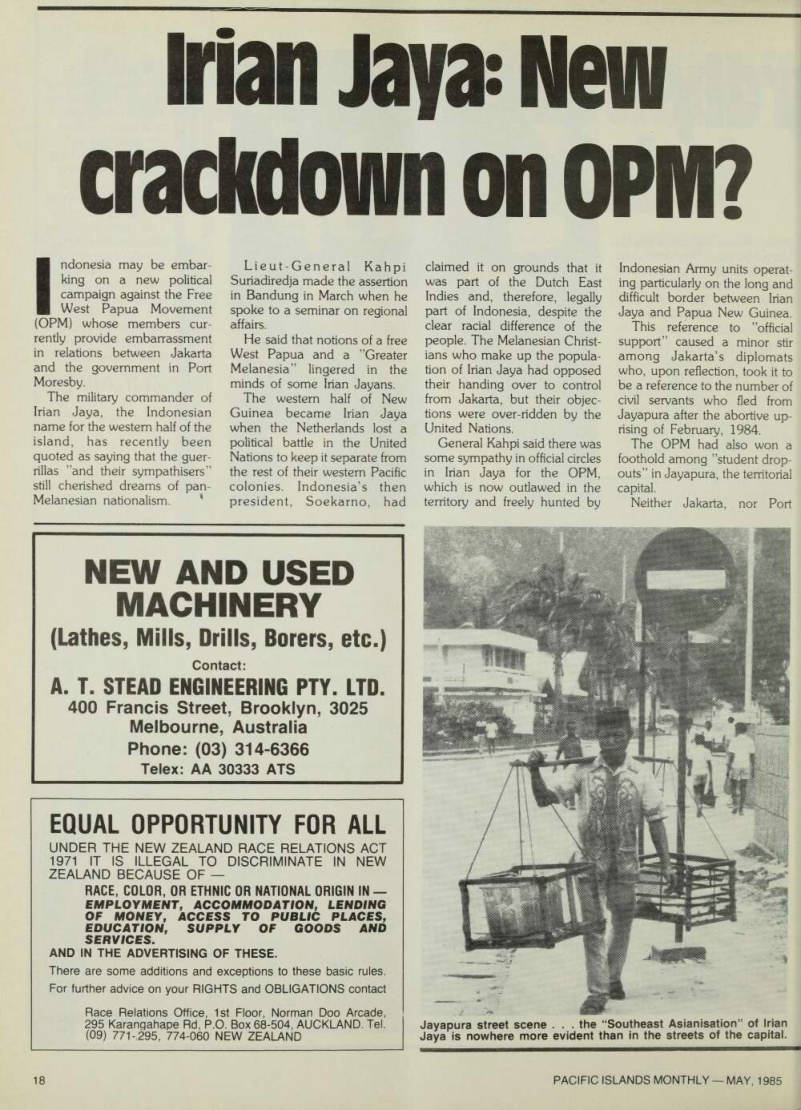
Jayapura street scene ... the “Southeast Asianisation” of Irian Jaya is nowhere more evident than in the streets of the capital.
Moresby, denies that the OFM has considerable influence among the 11,000 refugees now camped in PNG as a result of Indonesian military activity among border villagers.
Insiders claim (although neither government will admit publicly), that the refugee camps are used as occasional bases and refuges by OFM guerrillas operating against authority in Irian Jaya.
The question now raised by General Kahpi’s statement is whether the Indonesian gov ernment intends to embark on a new ’’purge” of OFM sym pathisers in Irian Jaya on grounds that they endanger national and regional security.
The reference to ’’Greater Melanesia” poses particular potential difficulties for the Port Moresby government. Large numbers of PNG citizens, and particularly those in the border provinces, exhibit great sym pathy for their cousins across the border. Treatment of the OFM is a major, if relatively unstated, public issue in PNG.
Prime Minister Somare’s gov ernment must therefore tread warily in handling the refugees.
At the same time, in order to preserve necessary good rela tions with Jakarta, they cannot appear to be supporting the OPM, particularly now that General Kahpi appears to have given public notice that to do so would be equivalent to suppor ting the idea of a ’’Greater Melanesia” which, in Jakarta’s terms, means an Irian Jaya wishing to be no longer within Indonesia, but (presumably), associated with PNG.
By any measure, that is in ternational tiger country, full of dangers for everyone.
Gen. Kahpi said that separat ists in Irian Jaya had been encouraged by the birth of several new countries in the Pacific,by sympathy for the OPM from some Australians, and by what he called the ’’Melanesia brotherhood solidarity movement.”
The major mystery of Gen.
Kahpi’s speech was, in fact, his several references to a Melane sian movement. While the Melanesian nations have a kind of common understanding or interest there is no formal
movement or organisation. In deed, quite the reverse. The Melanesian countries are mem bers of the South Pacific Forum which links Melanesians with Polynesians and Micronesians.
Gen. Kahpi, who is in charge of the defence command of Irian Jaya and the Moluccas, said he intended swiftly to im prove the standard of transport and the efficiency of administra tors in his territories so that
development could reach primitive tribes in the Irian highlands.
Something like 80 per cent of Irian Jaya’s population of 1.2 million live in the remote high lands where many tribes adhere to stone age culture and resist outside influence, particularly of non-Melanesian origin.
Gen. Kahpi was described by Antara, the official Indonesian news agency, as an officer who
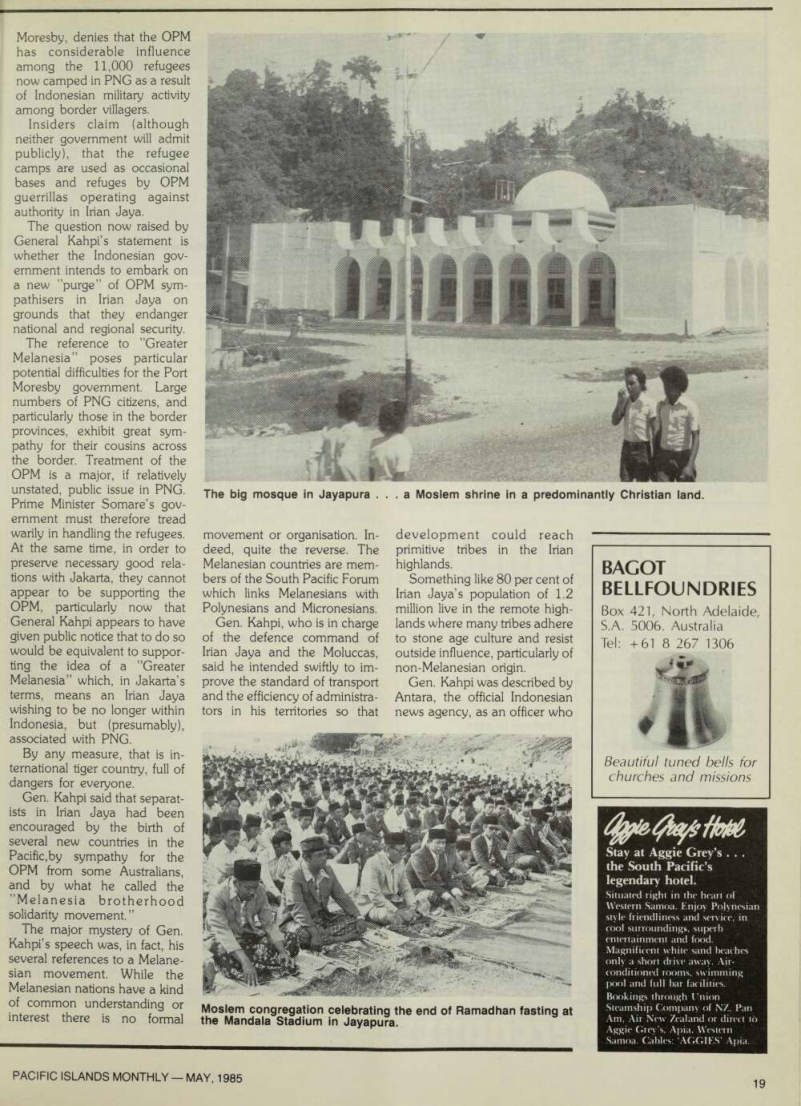
Moslem congregation celebrating the end of Ramadhan fasting at the Mandala Stadium in Jayapura.
The big mosque in Jayapura ... a Moslem shrine in a predominantly Christian land.
had been involved in crushing separatist movements in other parts of the Indonesian archipelago. He said, however, that he realised the United Nations was very sensitive to Irian Jaya. He said the Indonesian government would improve the quality and quantity of educators and transmigrants in the territory.
It is Jakarta’s program of transmigration which has exacerbated the sensitive Melanesian problem in Irian Jaya.
Many thousands of peasants, mostly Javanese, have been moved on to lands which, in Indonesian eyes, may seem to be unoccupied or under-utilised but which, to the tribes of the area, are traditional possessions of enormous importance.
By this means the Indonesian government has sought to reduce population pressure, particularly on Java which is one of the most densely-populated is-
lands on earth, and they have done it with what Melanesians generally consider to have been scant regard for indigenous traditions and feelings.
Various international human rights groups have warned that the Javanese could be seen to be promoting a new form of colonialism, much, perhaps, as the French are accused of hav- P er Petrated * n New Caledo nia’ and of over-running fragile societies, , ° ffers , otber Melanesian bnc l ubin S the then RNG °\ e '^ n ™ nis T ter ’ Rabbie Naroahu), to help Indonesians understand the ways of the nan tribesmen have not been received v f lL Jal^ arta ’ how : ever ’ has frequently promised to Y f s^ ect Melanesian customs and values, but has nonetheless proceeded with transmigration, particularly into the now sensi tive border areas. Staff Wri ter and Australian Associated Press.
President Soeharto (centre) with the Irian Java’s Persipura Soccer team in Jakarta.
Indonesian “triumphalism" expressed in a Jayapura monument.