of Little Rapa
pp. 24-27 · Read in the full issue
Meet the forts of Little Rapa
Up to the late 19605, Big Rapa, or Easter Island, was un doubtedly the most isolated and godforsaken place in Polynesia. But, with the con struction of an international air port there, this dubious distinc tion has devolved on Small Rapa, 700 nautical miles south of Tahiti, which is so rugged that there is no room even for the smallest airstrip.
Incidentally, and contrary to established usage, the original Rapa was in all likelihood this small volcanic island, belonging to the Austral Group in French Polynesia, and it was not until the 1870 s that Easter Island was named after it by native laborers brought there from Tahiti and the Austral Islands by the French-Tahitian trading firm of John Brander, who ruthlessly transformed this new and big ger Rapa into a sheep ranch.
The main reason must have been that it was, like the original Small Rapa, a barren and cold place.
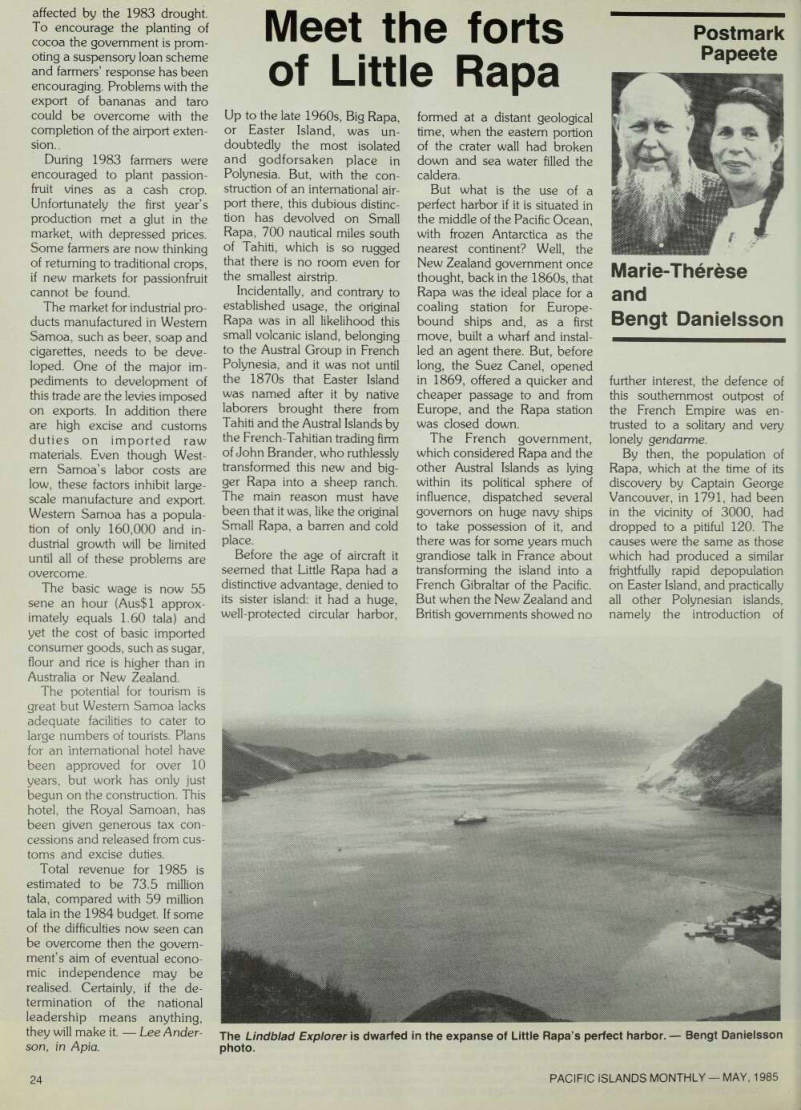
Before the age of aircraft it seemed that Little Rapa had a distinctive advantage, denied to its sister island; it had a huge, well-protected circular harbor,
formed at a distant geological time, when the eastern portion of the crater wall had broken down and sea water filled the caldera.
But what is the use of a perfect harbor if it is situated in the middle of the Pacific Ocean, with frozen Antarctica as the nearest continent? Well, the New Zealand government once thought, back in the 1860 s, that Rapa was the ideal place for a coaling station for Europe bound ships and, as a first move, built a wharf and instal led an agent there. But, before long, the Suez Canel, opened in 1869, offered a quicker and cheaper passage to and from Europe, and the Rapa station was closed down.
The French government, which considered Rapa and the other Austral Islands as lying within its political sphere of influence, dispatched several governors on huge navy ships to take possession of it, and there was for some years much grandiose talk in France about transforming the island into a French Gibraltar of the Pacific.
But when the New Zealand and British governments showed no
Postmark Papeete
further interest, the defence of this southernmost outpost of the French Empire was en trusted to a solitary and very lonely gendarme.
By then, the population of Rapa, which at the time of its discovery by Captain George Vancouver, in 1791, had been in the vicinity of 3000, had dropped to a pitiful 120. The causes were the same as those which had produced a similar frightfully rapid depopulation on Easter Island, and practically all other Polynesian islands, namely the introduction of
Marie-Therese and Bengt Danielsson
The Lindblad Explorer is dwarfed in the expanse of Little Rapa’s perfect harbor.-Bengt Danielsson photo.
European diseases, liquor and firearms. As the chiefs, priests and learned men died in droves, the old culture was also wiped out.
Their place was taken by native ministers, trained in the LMS schools in Tahiti, who condemned all heathen cus toms, imposed the stem grey laws of the Calvinist faith, and gathered the few survivors in two small villages on the shores of the bay. The fact that the island was situated in a temper ate zone, where no coconut palms grew and no copra, therefore, was produced, also meant that no trading vessels called there.
Thus it came about that what constituted the main achieve ment of the Rapa people of old was disdained and forgotten: the 15 huge stone forts, situated on the mountain ridges all around the caldera, at an alti tude of between 460 and 600 metres. Captain Vancouver, who did not land, observed them through his spy glass before making the following entry in his log; ’The tops of six of the highest hills bore the appear ance of fortified places, resemb ling redoubts; having a form of block house, in the shape of an English glass house, in the centre of each, with rows of pallisadoes a considerable way down the sides of the hills,
nearly at equal distances.
These, over-hanging, seemed intended for advanced works, and apparently capable of de fending the citadel by a few against a numerous host of assailants. On all of them, we noticed people, as if on duty, constantly moving about. What we considered as block houses, from their great similarity in appearance to that sort of buil ding, were sufficiently large to lodge a considerable number of persons, and were the only habitations we saw.”
It was not until 1956, how ever, that the first professional archaeologists reached Rapa and began uncovering the forts and their secrets. They were brought there by Thor Heyer dahl and came straight from Easter Island, where they had spent six months investigating the even more stupendous monuments built there by the Big Rapa people.
It was only with the greatest difficulty, however, that Thor Heyerdahl managed to hire enough islanders to free the greatest fort, Morongo Uta, from its thick layer of vegeta tion, mostly introduced guava shrubs. Barely started, the ex cavations were next held up by a labor dispute, the first and only one in the history of Rapa.
But, in the end, 5000 square metres of terraces were cleared, on which the fort dwellers had
lived and grown their taro.
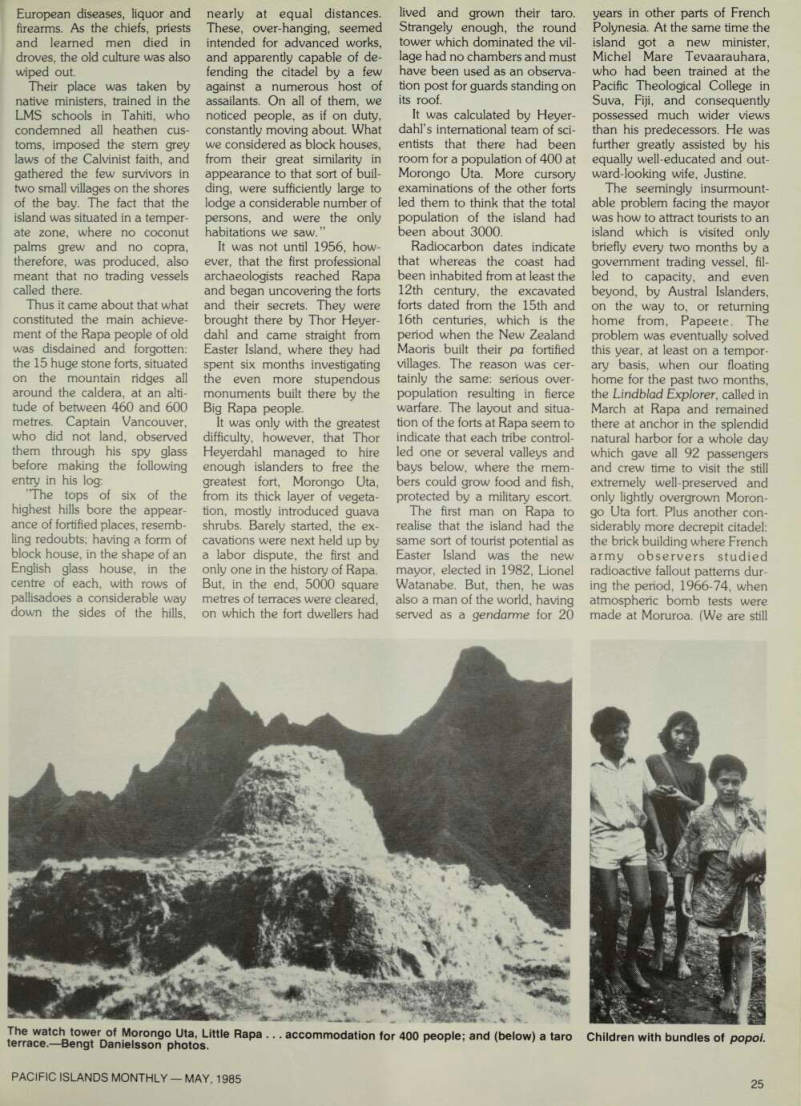
Strangely enough, the round tower which dominated the vil lage had no chambers and must have been used as an observa tion post for guards standing on its roof.
It was calculated by Heyer dahl’s international team of sci entists that there had been room for a population of 400 at Morongo Uta. More cursory examinations of the other forts led them to think that the total population of the island had been about 3000.
Radiocarbon dates indicate that whereas the coast had been inhabited from at least the 12th century, the excavated forts dated from the 15th and 16th centuries, which is the period when the New Zealand Maoris built their pa fortified villages. The reason was cer tainly the same: serious over population resulting in fierce warfare. The layout and situa tion of the forts at Rapa seem to indicate that each tribe control led one or several valleys and bays below, where the mem bers could grow food and fish, protected by a military escort.
The first man on Rapa to realise that the island had the same sort of tourist potential as Easter Island was the new mayor, elected in 1982, Lionel Watanabe. But, then, he was also a man of the world, having served as a gendarme for 20
years in other parts of French Polynesia. At the same time the island got a new minister, Michel Mare Tevaarauhara, who had been trained at the Pacific Theological College in Suva, Fiji, and consequently possessed much wider views than his predecessors. He was further greatly assisted by his equally well-educated and out ward-looking wife, Justine.
The seemingly insurmount able problem facing the mayor was how to attract tourists to an island which is visited only briefly every two months by a government trading vessel, fil led to capacity, and even beyond, by Austral Islanders, on the way to, or returning home from, Papeete. The problem was eventually solved this year, at least on a tempor ary basis, when our floating home for the past two months, the Lindblad Explorer , called in March at Rapa and remained there at anchor in the splendid natural harbor for a whole day which gave all 92 passengers and crew time to visit the still extremely well-preserved and only lightly overgrown Moron go Uta fort. Plus another con siderably more decrepit citadel: the brick building where French army observers studied radioactive fallout patterns dur ing the period, 1966-74, when atmospheric bomb tests were made at Moruroa. (We are still
The watch tower of Morongo Uta, Little Rapa ... accommodation for 400 people; and (below) a taro terrace.—Bengt Danielsson photos.
Children with bundles of popoi.
awaiting publication of the re sults).
On our return to Haurei village, three hours later, all 480 inhabitants had gathered to serve us a gargantuan meal of such Polynesian specialities as grilled lobster, fried fish, raw sea urchins, starch pudding and popoi, or taro paste.
Nowhere else in Polynesia is popoi prepared with such artis try and vigor as on Rapa, and since we are unable to match the wonderful chapter on popoi making found in the fine book Rapan Lifeways by the Amer ican anthropologist, F.Allan Hanson, we shall end by ser ving our readers this tasty bit of it; “A young, strong woman of the household seats herself on a small rock, takes a stone the size of a brick in one hand, a clean taro corm in the other, and begins to mash the taro on the table rock. She mashes corm after corm, until she has a rounded mass of sticky paste 18 inches to two feet in dia meter. Then she pokes her fingers into it and scoops water into the depression.
“She begins to knead the paste with her hands, hits it with her fists, and delivers crashing blows with her pound er from a full arm’s length.
During this process she adds a small lump of old popoi to aid the fermentation, and keeps splashing water until she has the desired consistency.
“Finally, she sets aside her pounder, wipes her brow, and confronts the grey, rubbery blob for a final time. Reaching over it she cuts into the far side about two inches from the edge with the sides of both hands, scoops it toward her and quick ly flips it back over. This pro cess, which takes much prac tice, traps an air bubble and thus aerates the popoi. ’’After about fifteen minutes of aeration, the popoi is trussed up in leaf bundles exactly the size and shape of punching bags. These are hung in a tree, to preserve them from hungry chickens and rats, while the popoi ferments”
Let us only add that such expertly prepared, well-sea soned Rapa popoi has the greyish appearance and sticky consistency of wall paper paste, but tastes much, much better.
Marie- Therese and Bengt Danielsson.