commercial"-Tabai
pp. 16-17 · Read in the full issue
Possible soviet deal “[?]rely commercial"-Tabai
Kiribati expects to reach agreement with the Soviet Union soon, giving Moscow fishing rights in a vast part of the south and central Pacific, according to Kiribati president leremia Tabai, who was recently in Wellington.
Tabai said negotiations were “very close to a conclusion” on a deal which would give the Russians rights to fish over an immense area of the Pacific.
“Kiribati, formerly the Gilbert islands, is made up of 33
islands, with a total land area of 719 square kilometres and a population of about 60,000.
But application of the 200-mile exclusive economic zone limits around the widely-spread is lands and atolls gives the coun try rights over more than five million square kilometres of the globe.
President Tabai, who was in New Zealand on a nine-day goodwill visit, claimed his coun try’s discussions with the U.S.S.R. were “simply a com mercial deal.”
However, New Zealand prime minister, David Lange, is reported to have counselled his guest against making what might be interpreted in any argument as an exclusive deal with the Russians. Mr Lange said that small island states were not able to protect their own interests against a super power.
A crucial point, in the view of Western nations, including several of the island nations, and particularly Fiji and Papua New Guinea, is whether the
agreement might lead to estab lishment of a Russian land base in Kiribati and, thus, the first permanent Soviet presence in the south-west Pacific.
President Tabai said the for mula so far discussed with Moscow’s agents did not in clude provision for a shore base or for a Russian staff on Kiribati territory. However, he declined to rule out the possibility of such occurring in any future expansion of the arrangement.
He told reporters in Welling ton that he had consulted Aus
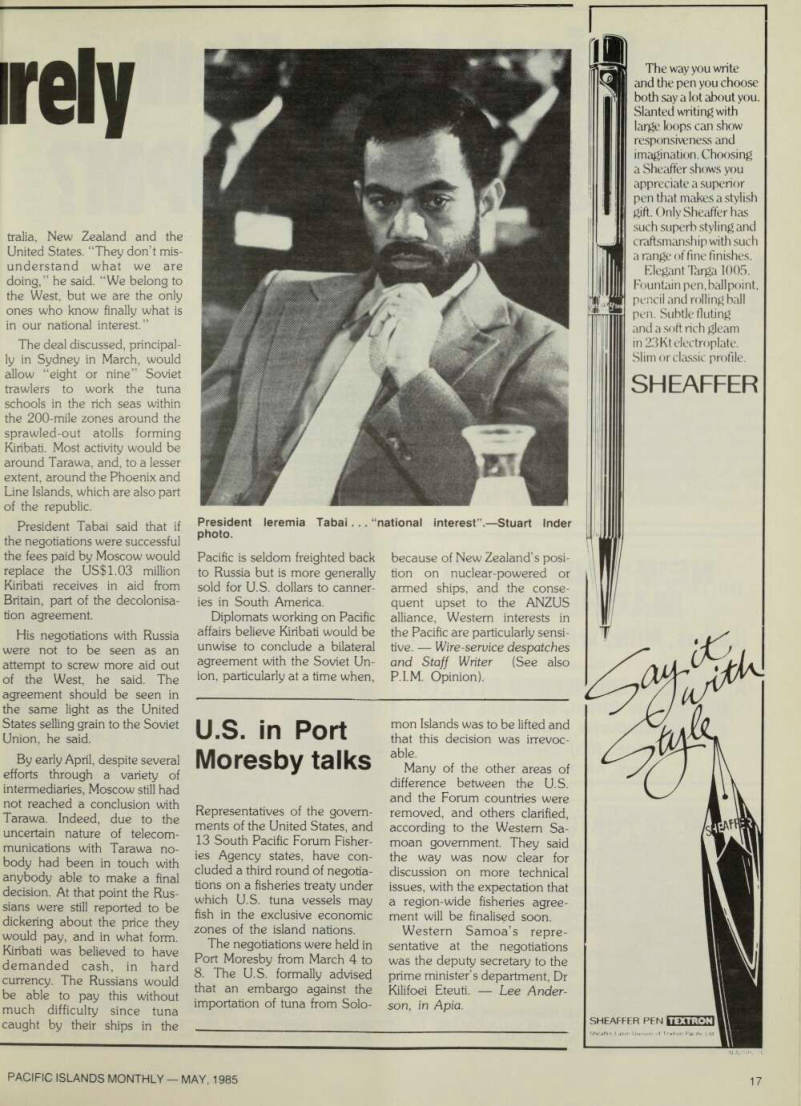
tralia, New Zealand and the United States. “They don’t mis understand what we are doing,” he said. “We belong to the West, but we are the only ones who know finally what is in our national interest.”
The deal discussed, principal ly in Sydney in March, would allow “eight or nine” Soviet trawlers to work the tuna schools in the rich seas within the 200-mile zones around the sprawled-out atolls forming Kiribati. Most activity would be around Tarawa, and, to a lesser extent, around the Phoenix and Line Islands, which are also part of the republic.
President Tabai said that if the negotiations were successful the fees paid by Moscow would replace the US$l.O3 million Kiribati receives in aid from Britain, part of the decolonisa tion agreement.
His negotiations with Russia were not to be seen as an attempt to screw more aid out of the West, he said. The agreement should be seen in the same light as the United States selling grain to the Soviet Union, he said.
By early April, despite several efforts through a variety of intermediaries, Moscow still had not reached a conclusion with Tarawa. Indeed, due to the uncertain nature of telecom munications with Tarawa no body had been in touch with anybody able to make a final decision. At that point the Rus sians were still reported to be dickering about the price they would pay, and in what form.
Kiribati was believed to have demanded cash, in hard currency. The Russians would be able to pay this without much difficulty since tuna caught by their ships in the
Pacific is seldom freighted back to Russia but is more generally sold for U.S. dollars to canner ies in South America.
Diplomats working on Pacific affairs believe Kiribati would be unwise to conclude a bilateral agreement with the Soviet Un ion, particularly at a time when,
because of New Zealand’s posi tion on nuclear-powered or armed ships, and the conse quent upset to the ANZUS alliance, Western interests in the Pacific are particularly sensi tive. Wire-service despatches and Staff Writer (See also P.I.M. Opinion).
President leremia Tabai... “national interest”. —Stuart Inder photo.