Not the Russians
p. 16 · Read in the full issue
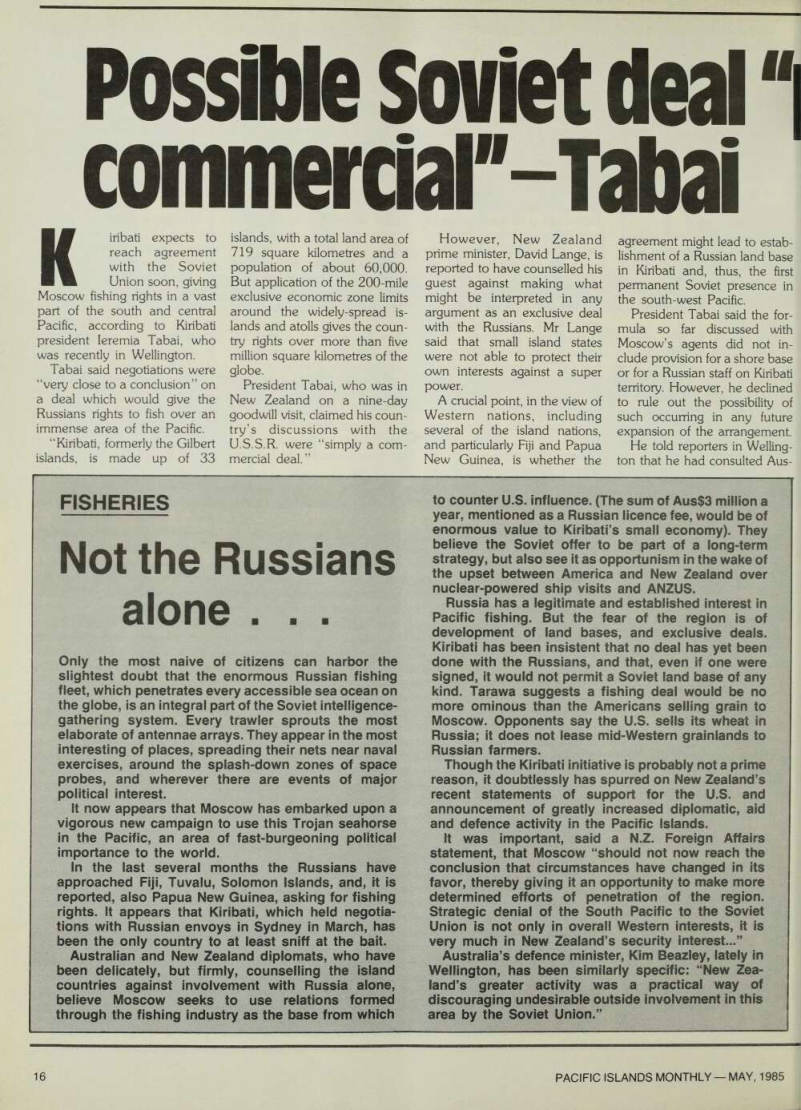
Fisheries
alone . . .
Only the most naive of citizens can harbor the slightest doubt that the enormous Russian fishing fleet, which penetrates every accessible sea ocean on the globe, is an integral part of the Soviet intelligence gathering system. Every trawler sprouts the most elaborate of antennae arrays. They appear in the most interesting of places, spreading their nets near naval exercises, around the splash-down zones of space probes, and wherever there are events of major political interest.
It now appears that Moscow has embarked upon a vigorous new campaign to use this Trojan seahorse in the Pacific, an area of fast-burgeoning political importance to the world.
In the last several months the Russians have approached Fiji, Tuvalu, Solomon Islands, and, it is reported, also Papua New Guinea, asking for fishing rights. It appears that Kiribati, which held negotia tions with Russian envoys In Sydney in March, has been the only country to at least sniff at the bait.
Australian and New Zealand diplomats, who have been delicately, but firmly, counselling the island countries against involvement with Russia alone, believe Moscow seeks to use relations formed through the fishing industry as the base from which
to counter U.S. influence. (The sum of Auss3 million a year, mentioned as a Russian licence fee, would be of enormous value to Kiribati’s small economy). They believe the Soviet offer to be part of a long-term strategy, but also see it as opportunism in the wake of the upset between America and New Zealand over nuclear-powered ship visits and ANZUS.
Russia has a legitimate and established interest in Pacific fishing. But the fear of the region is of development of land bases, and exclusive deals.
Kiribati has been insistent that no deal has yet been done with the Russians, and that, even if one were signed, it would not permit a Soviet land base of any kind. Tarawa suggests a fishing deal would be no more ominous than the Americans selling grain to Moscow. Opponents say the U.S. sells its wheat in Russia; it does not lease mid-Western grainlands to Russian farmers.
Though the Kiribati initiative is probably not a prime reason, it doubtlessly has spurred on New Zealand’s recent statements of support for the U.S. and announcement of greatly increased diplomatic, aid and defence activity in the Pacific Islands.
It was important, said a N.Z. Foreign Affairs statement, that Moscow “should not now reach the conclusion that circumstances have changed in its favor, thereby giving it an opportunity to make more determined efforts of penetration of the region.
Strategic denial of the South Pacific to the Soviet Union is not only in overall Western interests, it is very much in New Zealand’s security interest...”
Australia’s defence minister, Kim Beazley, lately in Wellington, has been similarly specific: “New Zea land’s greater activity was a practical way of discouraging undesirable outside involvement in this area by the Soviet Union.”