Fiji: A (recurring)
pp. 14-15 · Read in the full issue
insurance industry nightmare
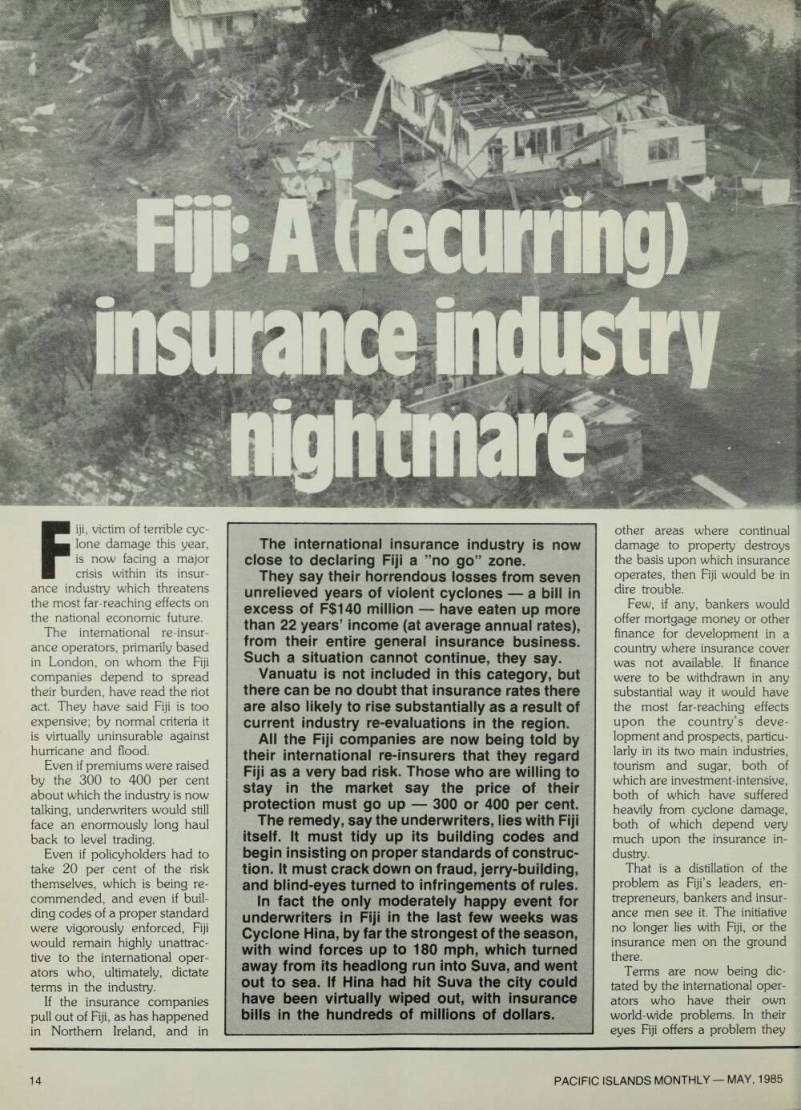
Fiji, victim of terrible cyc lone damage this year, is now facing a major crisis within its insur ance industry which threatens the most far-reaching effects on the national economic future.
The international reinsur ance operators, primarily based in London, on whom the Fiji companies depend to spread their burden, have read the riot act. They have said Fiji is too expensive; by normal criteria it is virtually uninsurable against hurricane and flood.
Even if premiums were raised by the 300 to 400 per cent about which the industry is now talking, underwriters would still face an enormously long haul back to level trading.
Even if policyholders had to take 20 per cent of the risk themselves, which is being re commended, and even if buil ding codes of a proper standard were vigorously enforced, Fiji would remain highly unattrac tive to the international oper ators who, ultimately, dictate terms in the industry.
If the insurance companies pull out of Fiji, as has happened in Northern Ireland, and in
The international insurance industry is now close to declaring Fiji a ”no go” zone.
They say their horrendous losses from seven unrelieved years of violent cyclones a bill in excess of Fsl4o million have eaten up more than 22 years’ income (at average annual rates), from their entire general insurance business.
Such a situation cannot continue, they say.
Vanuatu is not included in this category, but there can be no doubt that insurance rates there are also likely to rise substantially as a result of current industry re-evaluations in the region.
All the Fiji companies are now being told by their international re-insurers that they regard Fiji as a very bad risk. Those who are willing to stay in the market say the price of their protection must go up 300 or 400 per cent.
The remedy, say the underwriters, lies with Fiji itself. It must tidy up its building codes and begin insisting on proper standards of construc tion. It must crack down on fraud, jerry-building, and blind-eyes turned to infringements of rules.
In fact the only moderately happy event for underwriters in Fiji in the last few weeks was Cyclone Hina, by far the strongest of the season, with wind forces up to 180 mph, which turned away from its headlong run into Suva, and went out to sea. If Hina had hit Suva the city could have been virtually wiped out, with insurance bills in the hundreds of millions of dollars.
other areas where continual damage to property destroys the basis upon which insurance operates, then Fiji would be in dire trouble.
Few, if any, bankers would offer mortgage money or other finance for development in a country where insurance cover was not available. If finance were to be withdrawn in any substantial way it would have the most far-reaching effects upon the country’s deve lopment and prospects, particu larly in its two main industries, tourism and sugar, both of which are investment-intensive, both of which have suffered heavily from cyclone damage, both of which depend very much upon the insurance in dustry.
That is a distillation of the problem as Fiji’s leaders, en trepreneurs, bankers and insur ance men see it. The initiative no longer lies with Fiji, or the insurance men on the ground there.
Terms are now being dic tated by the international oper ators who have their own world-wide problems. In their eyes Fiji offers a problem they
are under only small constraint to continue handling unless conditions within the country show considerable change.
Whether the rank and file of politicians and small business men have yet hauled these unpleasant facts aboard, the insurance men seem to doubt.
So heavy have the losses become that some companies are now wondering, seriously, whether they can continue in the general insurance field in the Pacific.
Others, a little less gloomy, are forecasting rises in the price of premiums by perhaps 200 or 300 per cent, and of stringent new rules governing the exten sion of insurance cover to any one.
They want to see proper building codes laid down, and vigorously enforced. They want the insured to carry some of the risk through the introduction of deductibles . . . perhaps as high as 20 per cent of the loss ... to keep people somewhat more realistic about insurance . . . what most would call, more honest,and an incentive to low er the risk by strengthening the root attachment and by clean ing up potential debris.
They want public realisation that no insurance company can afford to stay in a business where losses run into tens of millions of dollars a year, seemingly every year.
In fact the problem has got worse over time because as Fiji has developed, factories have grown bigger and more numer ous, resort hotels more elabo rate, and private housing and furnishing more costly.
This has been reflected in a rise in premium income from F 54,314,000 in 1978, to F 58,939,400 in 1984. But los ses have outstripped income by a ratio of more than 300 per cent. (These figures are for all classes of property risk, not only cyclone damage).A decade or so ago a house could lose its roof and be repaired for a few hundred dollars. Today repairs might include replacement of a video and television, a hi-fi, and other expensive equipment.
Over the last five years nine major hurricanes have hit Fiji and have cost underwriters an estimated F 5140,000,000.
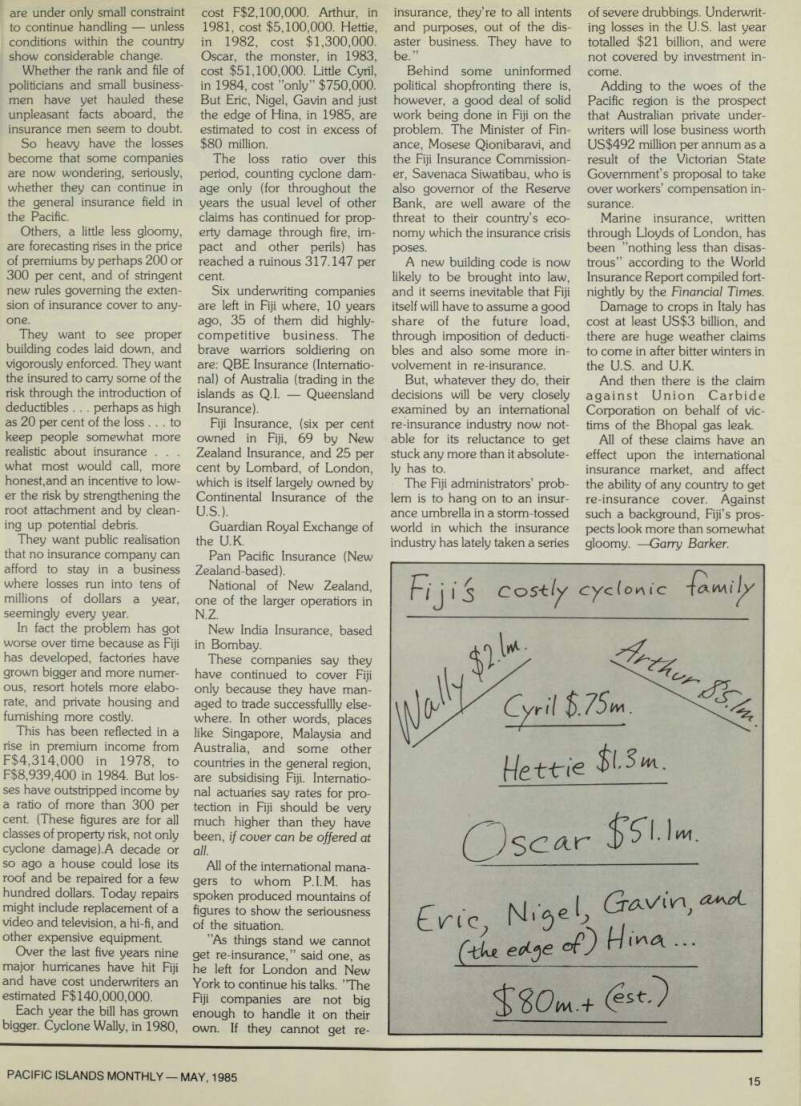
Each year the bill has grown bigger. Cyclone Wally, in 1980,
cost F 52,100,000. Arthur, in 1981, cost $5,100,000. Hettie, in 1982, cost $1,300,000.
Oscar, the monster, in 1983, cost $51,100,000. Little Cyril, in 1984, cost ’’only” $750,000.
But Eric, Nigel, Gavin and just the edge of Hina, in 1985, are estimated to cost in excess of $BO million.
The loss ratio over this period, counting cyclone dam age only (for throughout the years the usual level of other claims has continued for prop erty damage through fire, im pact and other perils) has reached a ruinous 317.147 per cent.
Six underwriting companies are left in Fiji where, 10 years ago, 35 of them did highly competitive business. The brave warriors soldiering on are: QBE Insurance (Internatio nal) of Australia (trading in the islands as Q.I. Queensland Insurance).
Fiji Insurance, (six per cent owned in Fiji, 69 by New Zealand Insurance, and 25 per cent by Lombard, of London, which is itself largely owned by Continental Insurance of the U.S.).
Guardian Royal Exchange of the U.K.
Fan Pacific Insurance (New Zealand-based).
National of New Zealand, one of the larger operatiors in N.Z.
New India Insurance, based in Bombay.
These companies say they have continued to cover Fiji only because they have man aged to trade successfully else where. In other words, places like Singapore, Malaysia and Australia, and some other countries in the general region, are subsidising Fiji. Internatio nal actuaries say rates for pro tection in Fiji should be very much higher than they have been, if cover can be offered at all All of the international mana gers to whom P.I.M. has spoken produced mountains of figures to show the seriousness of the situation. ”As things stand we cannot get re-insurance,” said one, as he left for London and New York to continue his talks. ’’The Fiji companies are not big enough to handle it on their own. If they cannot get re
insurance, they’re to all intents and purposes, out of the dis aster business. They have to be.”
Behind some uninformed political shopfronting there is, however, a good deal of solid work being done in Fiji on the problem. The Minister of Fin ance, Mosese Qionibaravi, and the Fiji Insurance Commission er, Savenaca Siwatibau, who is also governor of the Reserve Bank, are well aware of the threat to their country’s eco nomy which the insurance crisis poses.
A new building code is now likely to be brought into law, and it seems inevitable that Fiji itself will have to assume a good share of the future load, through imposition of deducti bles and also some more in volvement in re-insurance.
But, whatever they do, their decisions will be very closely examined by an international re-insurance industry now not able for its reluctance to get stuck any more than it absolute ly has to.
The Fiji administrators’ prob lem is to hang on to an insur ance umbrella in a storm-tossed world in which the insurance industry has lately taken a series
of severe drubbings. Underwrit ing losses in the U.S. last year totalled $2l billion, and were not covered by investment in come.
Adding to the woes of the Pacific region is the prospect that Australian private under writers will lose business worth US$492 million per annum as a result of the Victorian State Government’s proposal to take over workers’ compensation in surance.
Marine insurance, written through Lloyds of London, has been ’’nothing less than disas trous” according to the World Insurance Report compiled fort nightly by the Financial Times.
Damage to crops in Italy has cost at least US$3 billion, and there are huge weather claims to come in after bitter winters in the U.S. and U.K.
And then there is the claim against Union Carbide Corporation on behalf of vic tims of the Bhopal gas leak.
All of these claims have an effect upon the international insurance market, and affect the ability of any country to get re-insurance cover. Against such a background, Fiji’s pros pects look more than somewhat
gloomy.
Gany Barker.