in plenty
pp. 10-11 · Read in the full issue
Parliamentary Turmoil In Png
Question marks in plenty over a Pangu victory
April 1 may not have been an entirely in appropriate day for the announcement of Papua New Guinea’s new coalition ministry.
The antics of the par liamentarians in the last two weeks of March, as they fran tically jostled for ministries, led many a disgusted Papua New Guinean into making deroga tory comments about their be havior.
Lawyer, Bernard Narokobi, said the people were fed-up with their leaders “fighting like a bunch of wild dogs.” The Times of Papua New Guinea said the process confirmed “the public in its already perilously low regard for parliamenta rians.”
When Mr Somare announced the new ministry to the house on April 1 and then promptly wound up the sitting four days early the PNG parlia ment had not got around to passing any of the govern ment’s legislative program.
Still on the notice paper are bills introduced more than 12 months ago.
Amongst these is the vital constitutional amendment to remove the independence of the Public Services Commis sion this is seen by many as an anachronistic hangover from Australian colonialism that has inhibited government efforts to
Somare Survives, but Pangu Hurt . . . The prime minister of Papua New Guinea, Mr Michael Somare, survived a vote of no-confidence in the parliament in Port Moresby, late in March, by the comfortable margin of 68 to 19. To do it, though, he had to form a new coalition government.
NICHOLAS THORNTON, our commentator on PNG affairs, reports on the new coalition and on the price Mr Somare has paid to remain on top, a price which may prove fairly high.
trim the country’s bloated Aus tralian-style public service.
Also on the notice paper are two other proposed constitutio nal amendments that, if ever they were passed, would go a long way towards ridding the PNG political system of the constant de-stabilising motions of no-confidence.
One of these amendments would force a by-election in any seat held by a member of parliament who switched his party affiliation after being elected.
The other would enable the prime minister to call a national election if he lost the confidence of the parliament.
At present successful votes of no-confidence just remove the prime minister and replace him with whoever has been nomin ated as his alternative. This is what happened in 1980 when Sir Julius Chan replaced Mr Somare as prime minister. Both
amendments would solidify the party situation in PNG because members never want to go to election. In the past 50 per cent have lost their seats in such excursions, and every member is painfully aware of the casual ty rate.
Mr Somare’s Pangu Pati had these two amendments as part of its election platform at the 1982 elections.
But they have never got to a first reading because Mr So mare gave in to backbench pressure not to proceed with them.
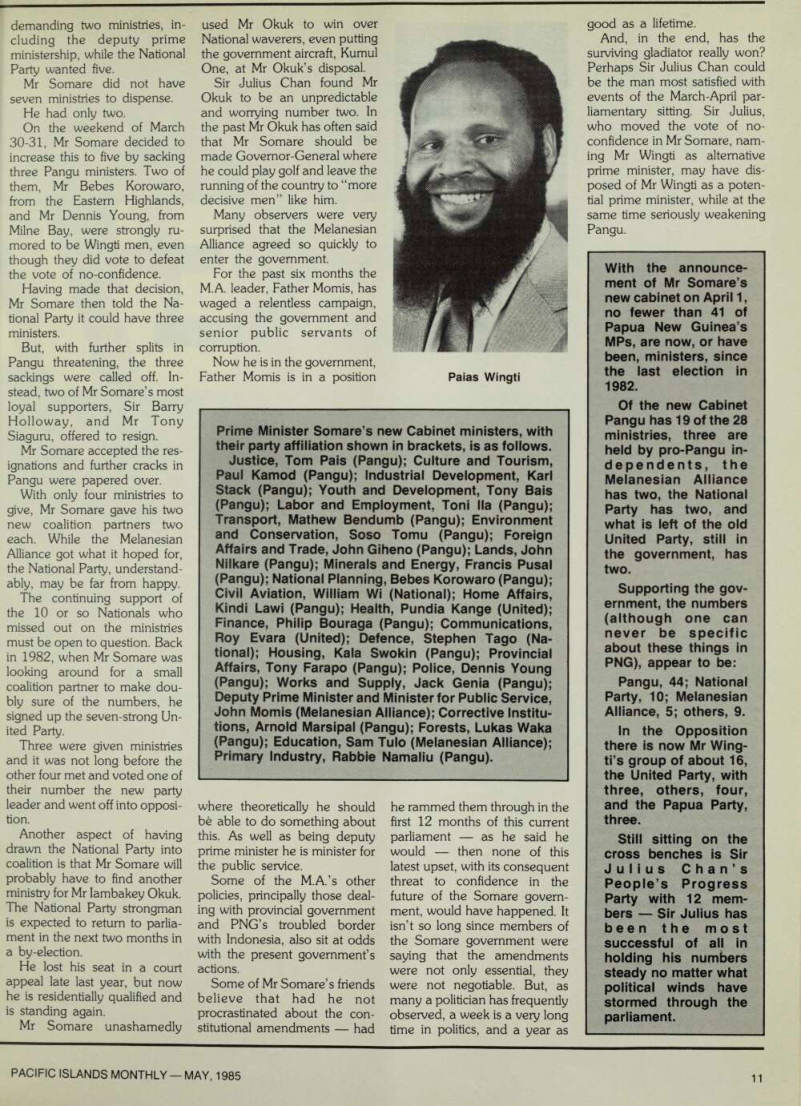
That Pangu backbench is looking decidedly thinner now that Pangu’s former deputy leader, Mr Paias Wingti, has defected leading 13 other Pan gu (or, rather ex-Pangu) mem bers into the Opposition.
Explaining his reasons for resigning and contesting the leadership of the country with Mr Somare,Mr Wingti said:
“The party I believed in from my school days the party that is supposed to represent the workers, students, villagers is no longer that party.
“The party’s concentration of power is in the hands of a few people and it is no longer the party of the masses.”
Ironically, the party which has been proclaiming itself as the real, new party of the masses, the Melanesian Alliance, decided that this was the time to join Mr Somare, not desert him.
The Melanesian Alliance leader, Father John Momis, be gan the March sitting as the leader of the Opposition, and emerged at the sitting’s end, on April 1, as deputy prime minis ter. Directly swapping positions, as it turned out, with Mr Wingti.
That these two men profess to hold almost similar political philosophy just indicates how little ideology has to do with real politics in PNG.
It is not an ideological game in Papua New Guinea. It is a numbers game (see box).
The fragility of the Pangu Pati was shown up most starkly when Mr Somare tried to sort out his new cabinet.
Having brought the Melane sian Alliance, and the National Party, over into his cabinet he had to share the spoils the ministries with them.
The Melanesian Alliance was
demanding two ministries, in cluding the deputy prime ministership, while the National Party wanted five.
Mr Somare did not have seven ministries to dispense.
He had only two.
On the weekend of March 30-31, Mr Somare decided to increase this to five by sacking three Pangu ministers. Two of them, Mr Bebes Korowaro, from the Eastern Highlands, and Mr Dennis Young, from Milne Bay, were strongly ru mored to be Wingti men, even though they did vote to defeat the vote of no-confidence.
Having made that decision, Mr Somare then told the Na tional Party it could have three ministers.
But, with further splits in Pangu threatening, the three sackings were called off. In stead, two of Mr Somare’s most loyal supporters, Sir Barry Holloway, and Mr Tony Siaguru, offered to resign.
Mr Somare accepted the res ignations and further cracks in Pangu were papered over.
With only four ministries to give, Mr Somare gave his two new coalition partners two each. While the Melanesian Alliance got what it hoped for, the National Party, understand ably, may be far from happy.
The continuing support of the 10 or so Nationals who missed out on the ministries must be open to question. Back in 1982, when Mr Somare was looking around for a small coalition partner to make dou bly sure of the numbers, he signed up the seven-strong Un ited Party.
Three were given ministries and it was not long before the other four met and voted one of their number the new party leader and went off into opposi tion.
Another aspect of having drawn the National Party into coalition is that Mr Somare will probably have to find another ministry for Mr lambakey Okuk.
The National Party strongman is expected to return to parlia ment in the next two months in a by-election.
He lost his seat in a court appeal late last year, but now he is qualified and is standing again.
Mr Somare unashamedly
used Mr Okuk to win over National waverers, even putting the government aircraft, Kumul One, at Mr Okuk’s disposal.
Sir Julius Chan found Mr Okuk to be an unpredictable and worrying number two. In the past Mr Okuk has often said that Mr Somare should be made Governor-General where he could play golf and leave the running of the country to “more decisive men” like him.
Many observers were very surprised that the Melanesian Alliance agreed so quickly to enter the government.
For the past six months the M.A. leader, Father Momis, has waged a relentless campaign, accusing the government and senior public servants of corruption.
Now he is in the government, Father Momis is in a position
Prime Minister Somare’s new Cabinet ministers, with their party affiliation shown in brackets, is as follows.
Justice, Tom Pais (Pangu); Culture and Tourism, Paul Kamod (Pangu); Industrial Development, Karl Stack (Pangu); Youth and Development, Tony Bais (Pangu); Labor and Employment, Toni lla (Pangu); Transport, Mathew Bendumb (Pangu); Environment and Conservation, Soso Tomu (Pangu); Foreign Affairs and Trade, John Giheno (Pangu); Lands, John Nilkare (Pangu); Minerals and Energy, Francis Pusal (Pangu); National Planning, Bebes Korowaro (Pangu); Civil Aviation, William Wi (National); Home Affairs, Kindi Lawi (Pangu); Health, Pundia Kange (United); Finance, Philip Bouraga (Pangu); Communications, Roy Evara (United); Defence, Stephen Tago (Na tional); Housing, Kala Swokin (Pangu); Provincial Affairs, Tony Farapo (Pangu); Police, Dennis Young (Pangu); Works and Supply, Jack Genia (Pangu); Deputy Prime Minister and Minister for Public Service, John Momis (Melanesian Alliance); Corrective Institu tions, Arnold Marsipal (Pangu); Forests, Lukas Waka (Pangu); Education, Sam Tulo (Melanesian Alliance); Primary Industry, Rabbie Namaliu (Pangu).
where theoretically he should be able to do something about this. As well as being deputy prime minister he is minister for the public service.
Some of the M.A.’s other policies, principally those deal ing with provincial government and PNG’s troubled border with Indonesia, also sit at odds with the present government’s actions.
Some of Mr Somare’s friends believe that had he not procrastinated about the con stitutional amendments had
he rammed them through in the first 12 months of this current parliament as he said he would then none of this latest upset, with its consequent threat to confidence in the future of the Somare govern ment, would have happened. It isn’t so long since members of the Somare government were saying that the amendments were not only essential, they were not negotiable. But, as many a politician has frequently observed, a week is a very long time in politics, and a year as
good as a lifetime.
And, in the end, has the surviving gladiator really won?
Perhaps Sir Julius Chan could be the man most satisfied with events of the March-April par liamentary sitting. Sir Julius, who moved the vote of no confidence in Mr Somare, nam ing Mr Wingti as alternative prime minister, may have dis posed of Mr Wingti as a poten tial prime minister, while at the same time seriously weakening Pangu.
With the announce ment of Mr Somare’s new cabinet on April 1, no fewer than 41 of Papua New Guinea’s MPs, are now, or have been, ministers, since the last election in 1982.
Of the new Cabinet Pangu has 19 of the 28 ministries, three are held by pro-Pangu in dependents, the Melanesian Alliance has two, the National Party has two, and what is left of the old United Party, still in the government, has two.
Supporting the gov ernment, the numbers (although one can never be specific about these things in PNG), appear to be: Pangu, 44; National Party, 10; Melanesian Alliance, 5; others, 9.
In the Opposition there is now Mr Wing ti’s group of about 16, the United Party, with three, others, four, and the Papua Party, three.
Still sitting on the cross benches is Sir Julius Chan’s People’s Progress Party with 12 mem bers Sir Julius has been the most successful of all in holding his numbers steady no matter what political winds have stormed through the parliament.
Paias Wingti