books
pp. 39-40 · Read in the full issue

Excellent photos, and a text between two stools?
Bundi: The Culture of a Papua New Guinea People. By David G. Fitz-Patrick and John Kim buna. Published 1983 by Roebuck Publications, 61 Price Street, Nerang, 4211, Australia,
Pp. X, 166, Isbn 0 9591786
00. $A24.95 plus postage.
Bundi is a coffee table book with an extensive enthnog raphic text. It contains a large number of color photographs taken by Fitz-Patrick, and 10 earlier black and white photo graphs by Gerard Guthrie. The Bundi live on the fringe of the Bismarck Ranges in the Madang Province some 100 kilometres northeast of Goroka at levels between 500 m and 1500 m.
Noting the rapid rate of social change in the Highlands and that much of the heritage has been recorded, the authors say: “This book is also an endeavor to record in both written and pictures form the customs and traditional lifestyle of a Papua New Guinea society.” Later they say that; “. . . it was decided to deal exclusively with the traditional culture as the basis of the book, in particular to begin with birth and its accompanying cere monies and trace the rites of passage from birth to death in a simple format.”
The first chapter sets the Bundi in their environmental, historical and social context.
Staple root crops, under a system of shifting cultivation, are sweet potatoes, yams and taro, and these are sup plemented by game and fruits gathered from the rain forest.
The forest also supplies much of the materials used in daily life. Bundi society consists of nine tribes, within which there are clans and subclans. (A
detailed tribal map besides the hard-to-find location map would have been useful.) In the past, men lived mainly in men’s houses clustered in hamlets.
Women lived with their pigs in houses built near their scattered gardens. The Bundi now live in tribal villages, and men’s houses have been abandoned with nuclear-family households.
Catholic missionaries were the first Europeans to enter the area in 1932. A mission station was opened in 1934 and a wide variety of European fruits and vegetables were introduced. As a result of mission efforts, an airstrip was finished in 1958.
A mission school was estab lished in 1956, and in time Bundi people achieved high
positions in government and business. A Bundi was ordained a Roman Catholic priest in 1976.
The Bundi are experiencing the social changes occurring throughout Papua New Guinea. Many leave their vil lages to settle in towns where often they marry women from other groups. Traditional leadership based on personal skills and traditional wealth has been usurped by educated men, businessmen, councillors and cash income earners. Pig festivals now involve the purch ase of beer and food for cash.
In spite of these changes, the people in the villages largely maintain their traditional way of life, but this may be shattered when a major road linking Madang to the Highlands goes through the Bundi area.
Chapter Two begins the se rious business of the book. The use of the present tense is somewhat disconcerting until one realises it is the historic present, and reference is to the past. Religion and sorcery are extremely important aspects of Bundi life and there follows a catalogue of the different spirits in which the Bundi believe.
Belief in them is seen as “the major source of social control”.
The next three chapters are concerned with birth, courtship and marriage, Married couples are not expected to produce children for two or three years until their bride-price obliga tions are settled, and through out their lives opportunities for sexual intercourse or any other kind of association are limited.
As in many Papua New Guinea societies, intercourse is thought to weaken a man and make him unfit for battle. The celebration of a birth enables
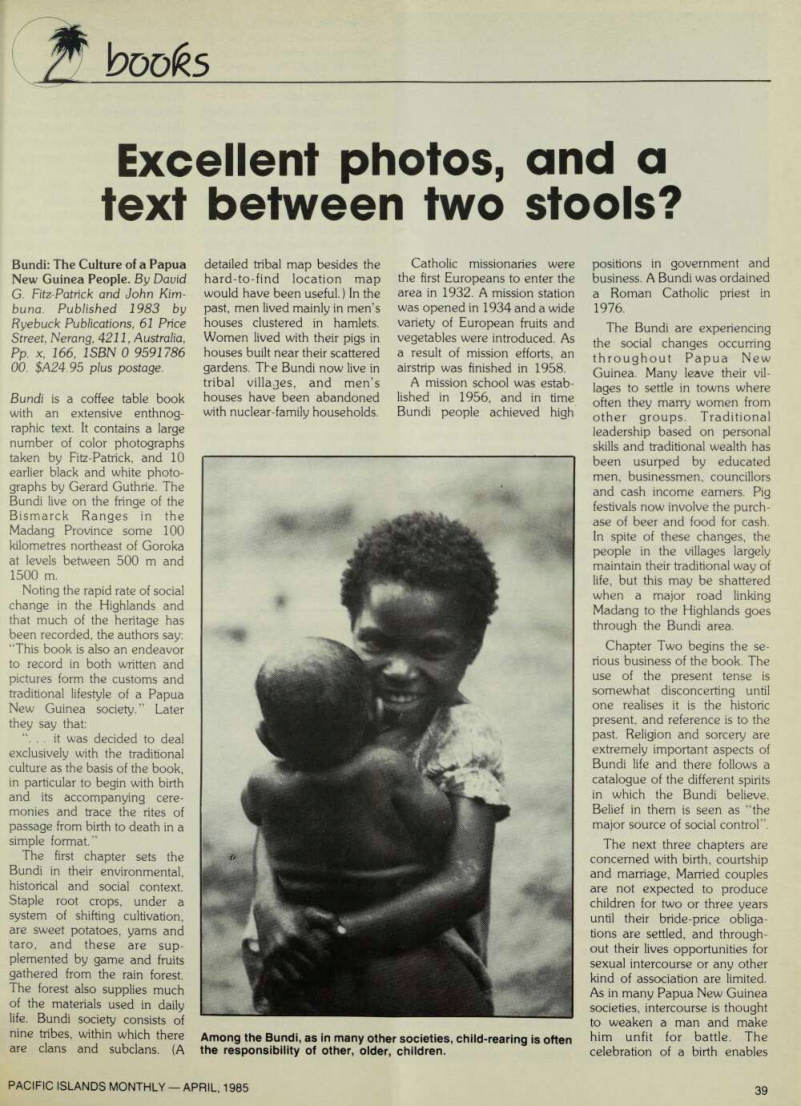
Among the Bundi, as In many other societies, child-rearing is often the responsibility of other, older, children.
the husband to gain recognition in the village by providing lavishly for the feast.
Children pass through a number of ceremonial stages as they are trained for a life of work and warfare and taught their rights and duties. Between the ages of 10 and 14 boys pass through a frightening and pain ful initiation ceremony. Finally, when they are physically ma ture, they spend 10 months hunting in the forest and they then undergo the painful pro cess of having their septums pierced.
Courtship takes place in publicly orchestrated meetings and young Bundi men visit as far as Chimbu for this purpose.
When a couple like each other, a young man may take a girl to his hamlet, where for three or four months she is on approval until the man’s family decide whether or not they should marry. If they do, a bride-price is ceremoniously presented and the bride and groom lectured separately on their responsibili ties. While divorce is infrequent, a woman may leave her hus band if he is greedy, cruel, or weak and lazy.
There follows an account of parties at which debts are paid, involving a complex calculation of obligations. “Knotted rope is used to measure the thickness of the (pig-belly) fat and is the yardstick of repayment.”
In Chapter Six, four kinds of sing sing are described: the first is in honor of ancestors; the second is held during pig festi vals and other festive gather ings; the third is provided by
women after young initiates come back from the forest; and the fourth, traded from the Madang area, is held on any festive occasion.
“War is the overriding social purpose” and is “dominated by a dynamic process of pay back ...” Stealing, murder and deal ings with women are the im mediate causes of warfare. It takes place only during the dry season, either in pitched battles or by ambush. Courageous warriors are highly honored at victory celebrations. As in other New Guinea societies, if rela tives or close friends were on opposite sides, they could sit out the battle to avoid injuring each other.
The last chapter is headed “Death”. It opens with a discus sion of the importance of sor cery. and there is mild confu sion between what happens and what is believed to happen: for example, “In other cases she may be killed by her vic tim’s spirit”. This section ends with the statement that “Most of the killing is believed to be performed by women sorcer ers,” who perform “many weird and unusual physical feats When a person dies, the possibility of sorcery is tested. A dead person immediately be
comes an ancestor, who may be malevolent. After two or three years, a final ceremony is held at which the number of pigs killed is related to the status of the deceased.
In conclusion, old men reflect that life in the past had a meaning, now lost, when there was “one religion, one set of rules and laws and a set way to gain prestige and dignity”.
The book is based on oral accounts collected by the au thors in 1978-79 and there are only two references to pub lished works, neither by the authors. At that time a number of people who were young adults at first contact in 1932 would have been alive.
The book is clearly written as a straightforward narrative in a way easy for lay people to understand, and if, as seems probable, informants disagreed, this is not mentioned. Other wise, the research seems careful and accurate. One wonders who the authors were. John Kimbuna is a Bundi, but my limited inquiries have revealed nothing about Fitz-Patrick.
While the latter may have been a post-graduate student, no academic affiliations are, men tioned.
The photographs are excel
lent. While a number of them are of decorated warriors (in cluding one of David Fitz- Patrick in full Bundi dress) and girls with scanty coverings, many either illustrate the cere monies described in the text, or illustrate social change by showing such innovations as schools, helicopters and trac tors.
David Hyndman, of the Uni versity of Queensland, de scribes the book as important.
“Their ethnography is truly a sensitive portrayal of traditional, pre-contact culture. ” One won ders, however, whether it may not fall between two stools.
While the authors achieve pre cisely what they have set out to do, the account of the life cycle seems somewhat abstracted from the noisy vigor, dirt, dis ease, violence and bloodshed of traditional Highland life. It may prove too ethnographic, for example, compared with James Sinclair’s admirable and more general The Highlanders.
Anthropologists, on the other hand, may regret the lack of analysis and more detailed in formation.
If these considerations are borne in mind, it is recom
mended reading.
Nigel
Oram.
A woman’s responsibility is to rear pigs. If a sow dies a woman will suckle the piglet.