over Oz Nomads
p. 37 · Read in the full issue
Legal battles loom over Oz Nomads
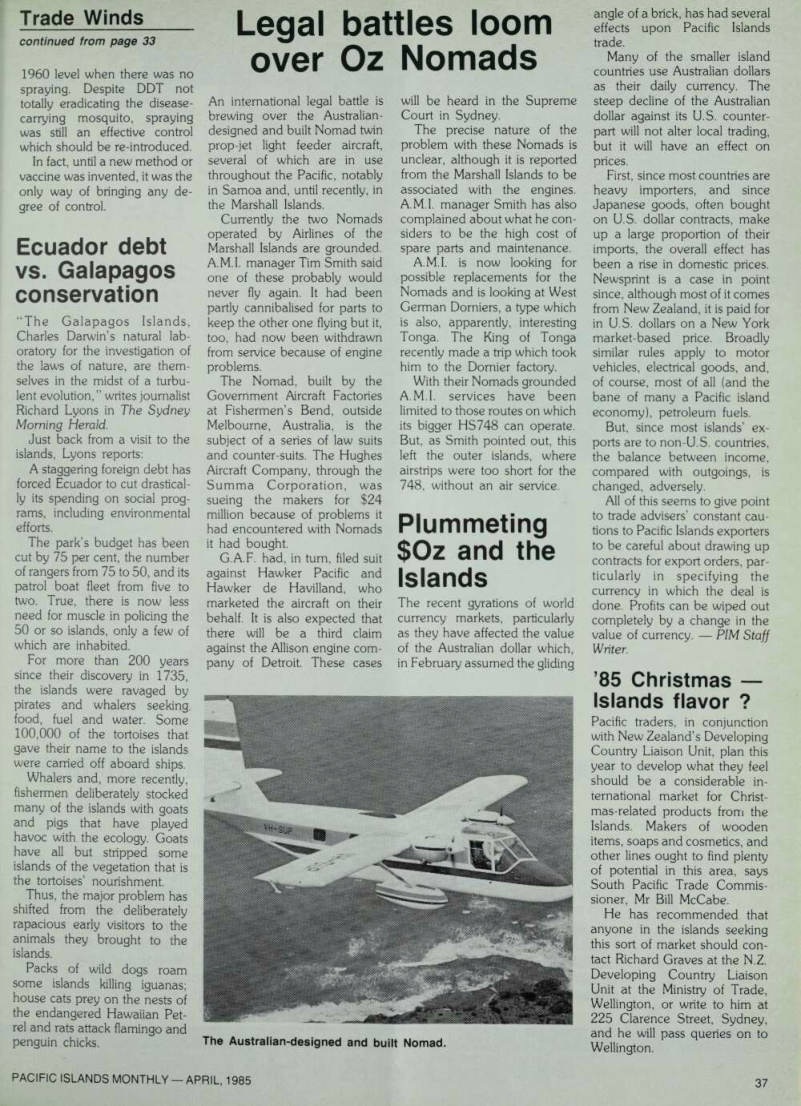
An international legal battle is brewing over the Australian designed and built Nomad twin prop-jet light feeder aircraft, several of which are in use throughout the Pacific, notably in Samoa and, until recently, in the Marshall Islands.
Currently the two Nomads operated by Airlines of the Marshall Islands are grounded.
A.M.I. manager Tim Smith said one of these probably would never fly again. It had been partly cannibalised for parts to keep the other one flying but it, too, had now been withdrawn from service because of engine problems.
The Nomad, built by the Government Aircraft Factories at Fishermen’s Bend, outside Melbourne, Australia, is the subject of a series of law suits and counter-suits. The Hughes Aircraft Company, through the Summa Corporation, was sueing the makers for $24 million because of problems it had encountered with Nomads it had bought.
G.A.F. had, in turn, filed suit against Hawker Pacific and Hawker de Havilland, who marketed the aircraft on their behalf. It is also expected that there will be a third claim against the Allison engine com pany of Detroit. These cases
will be heard in the Supreme Court in Sydney.
The precise nature of the problem with these Nomads is unclear, although it is reported from the Marshall Islands to be associated with the engines.
A.M.I. manager Smith has also complained about what he con siders to be the high cost of spare parts and maintenance.
A.M.I. is now looking for possible replacements for the Nomads and is looking at West German Dorniers, a type which is also, apparently, interesting Tonga. The King of Tonga recently made a trip which took him to the Dornier factory.
With their Nomads grounded A.M.I. services have been limited to those routes on which its bigger HS74B can operate.
But, as Smith pointed out, this left the outer islands, where airstrips were too short for the 748, without an air service.
Plummeting
sOz and the
Islands
The recent gyrations of world currency markets, particularly as they have affected the value of the Australian dollar which, in February assumed the gliding
angle of a brick, has had several effects upon Pacific Islands trade.
Many of the smaller island countries use Australian dollars as their daily currency. The steep decline of the Australian dollar against its U.S. counter part will not alter local trading, but it will have an effect on prices.
First, since most countries are heavy importers, and since Japanese goods, often bought on U.S. dollar contracts, make up a large proportion of their imports, the overall effect has been a rise in domestic prices.
Newsprint is a case in point since, although most of it comes from New Zealand, it is paid for in U.S. dollars on a New York market-based price. Broadly similar rules apply to motor vehicles, electrical goods, and, of course, most of all (and the bane of many a Pacific island economy), petroleum fuels.
But, since most islands’ ex ports are to non-U.S. countries, the balance between income, compared with outgoings, is changed, adversely.
All of this seems to give point to trade advisers’ constant cau tions to Pacific Islands exporters to be careful about drawing up contracts for export orders, par ticularly in specifying the currency in which the deal is done. Profits can be wiped out completely by a change in the value of currency. P/M Staff Writer.
’B5 Christmas
Islands flavor ?
Pacific traders, in conjunction with New Zealand’s Developing Country Liaison Unit, plan this year to develop what they feel should be a considerable in ternational market for Christ mas-related products from the Islands. Makers of wooden items, soaps and cosmetics, and other lines ought to find plenty of potential in this area, says South Pacific Trade Commis sioner, Mr Bill McCabe.
He has recommended that anyone in the islands seeking this sort of market should con tact Richard Graves at the N.Z.
Developing Country Liaison Unit at the Ministry of Trade, Wellington, or write to him at 225 Clarence Street, Sydney, and he will pass queries on to Wellington.
The Australian-designed and built Nomad.