One for the malocologists
pp. 40-41 · Read in the full issue
and for shell collectors as well
Shells: A Collector’s Colour Guide. By J. and R. Senders.
English translation by Lucia Wildt. Published 1984 by David and Charles . Newton Abbot London. ISBN 0 7153 8497 X. Price £Stg7.9s.
It is common for a newcomer to Pacific Islands beaches, lagoons and reefs to be enthralled by the beauty of the marine life. In particular, for many the multi tude of molluscs, with their varied and stunningly sculp tured and colored shells, have almost irresistible appeal.
There are two possible lines of behavior for the newly ar rived visitor in relation to mol luscs and their shells.
Either shells can be collected for the sole purpose of accumulating sundry reminders of days spent in the tropics, or the visitor can develop an in terest in the creatures them selves. and in their conserva tion.
Clearly the second line of action is to be preferred the offhand exploitation of certain small marine environments and their molluscs can sometimes lead to the extinction of a species.
But a problem arises in discovering vital information about the molluscs one comes across in one’s investigations.
What is it? To which family
does it belong? How common is it? Is it dangerous? Is it edible?
The question marks are endless Finding a happy medium be tween over-simplified texts on the subject, and over-compli cated specialist works, is no easy matter.
It is therefore a great pleasure to be able to say that the problem has been solved with style, clarity and a wealth of valuable but easily assimilated information by the publication in English of Shells: A Collec tor's Colour Guide by the Bel gian specialists, J. and R. Sen ders. The book was originally published in French, but its
translation has been impeccably done if you leave aside the translator’s inexplicable retention of a howler committed by the authors in their historical introduction, where they write (pl 5): “But the serious scientific explorations of the Pacific only started during the second half of the eighteenth century with Louis-Antoine de Bougainville and Captain Thomas Cook ..." Well, nobody can deny that Thomas Cook has been a big name in British travel for a long time, but he’s hardly in the same league as his kinsman James!
The book contains sections on the anatomy and habitats of molluscs, and, of course, on shell collecting. The authors provide warnings on illegal and improper collecting methods, saying that the attitude giving rise to such activity “is obviously due to ignorance, which it is the duty of all collectors to remedy”.
The authors point out that today there are over 100,000 known species of molluscs, but they prudently restrict themselves to dealing only with the major species. The book contains 144 color plates which reproduce clearly and sharply the patterns, forms, and peculiar characteristics of the shells concerned. In some cases, several variant species are shown. In others, both sides of the shells are depicted. Else-
where, emphasis is given to the opercula, the plates or flaps closing the shell’s aperture when the animal is retracted, Several of the plates are of particular interest as they show the molluscs as living creatures, This is particularly well done with some of the cowries, The book has one feature which gives it a charm and utility all its own. Each plate is accompanied by a box contain ing more than 100 small sec tions, each containing a symbol relating to the features of mol luscs the physical situations in which they are found, their structure, their patterns, particular whorls, shapes of apertures, whether or not they are edible, the water depths at which they are found, and so on. A series of stars from a rating of one to four also indicates the shell’s value in U.S. dollars. Sections relevant to the particular shell depicted are shaded yellow, and thus vital information is readily avai able. The whole set of symbols, with a key, is reproduced on a card accompanying the book, and if made waterproof in some way this would be a most useful “ready reckoner” to take on a shelling expedition, The Senders provide an in ternational list of shell-collec tors’ societies and their publica tions. Most notable is the Hawaiian Malacological Society “malacology” is the science
of molluscs of which the authors say; “In 40 years since its foundation, the membership of this club has risen to about 1600. It is the largest group of shell collectors in the world with members from over 70 coun-
tries.” There is also an exten sive bibliography, and a glos sary of malacological terms, Here is a shell collector’s book which deserves a place in the library of every Pacific bib
liophile.
W. G. Coppell.
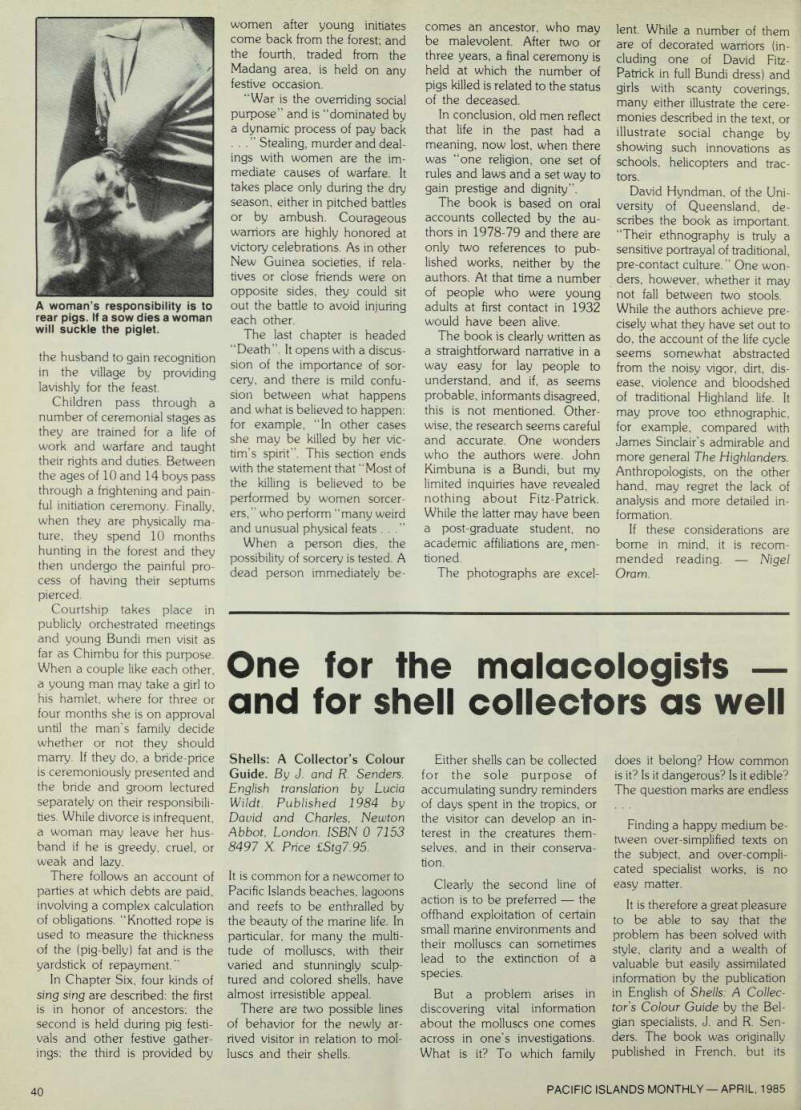
Cymbiola vespertilio Linnaeus 1758. Bat volute. There are over 200 known species of volutes. Most of them cam be found in shallow waters; others, the rarest, have been dredged from depths of up to 1000 m.
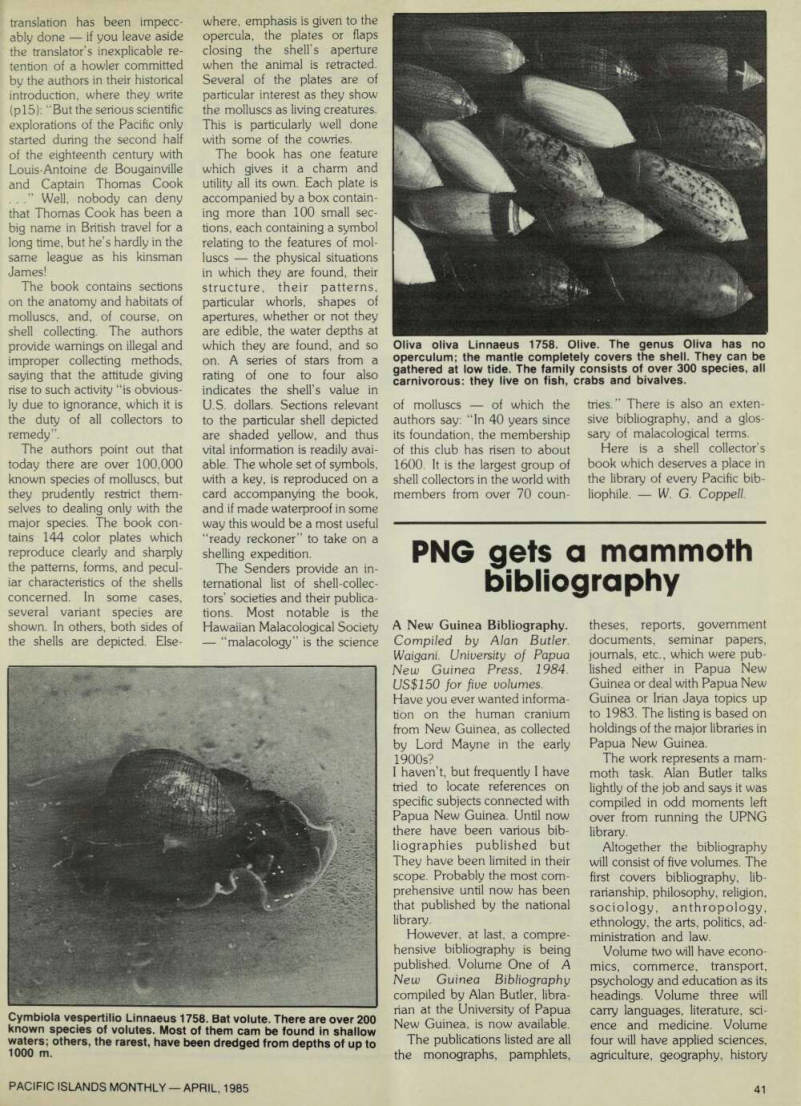
Oliva oliva Linnaeus 1758. Olive. The genus Oliva has no operculum; the mantle completely covers the shell. They can be gathered at low tide. The family consists of over 300 species, all carnivorous: they live on fish, crabs and bivalves.