State, Interior?
pp. 27-28 · Read in the full issue
In-fighting is on
The child’s fairy tale of the boy who cried wolf once too often has applicability to the Microne sian situation in early 1985. The Trust Territory administration was to have come to an end in the mid 1970 s Then it was the late seventies. Then the early ’Bos.
Now, as we enter the halfway point of this decade, 38 years after the United States formally took control of these islands under the auspices of the Un ited Nations, once again there are predictions of the end being in sight.
However, this time they have
more validity. The word from Washington, D.C., is that most if not all congressional hearings will be over by the end of this month. That could put the Congress in a position to vote on the compacts for the Feder ated States of Micronesia and the Marshall Islands before the mid-year recess. Even con gressional opponents of the compacts concede that appro val is likely.
But an issue has resurfaced that promises to add fireworks to what otherwise might be a routine process. That is the nature of the United States’ representation in the newly-
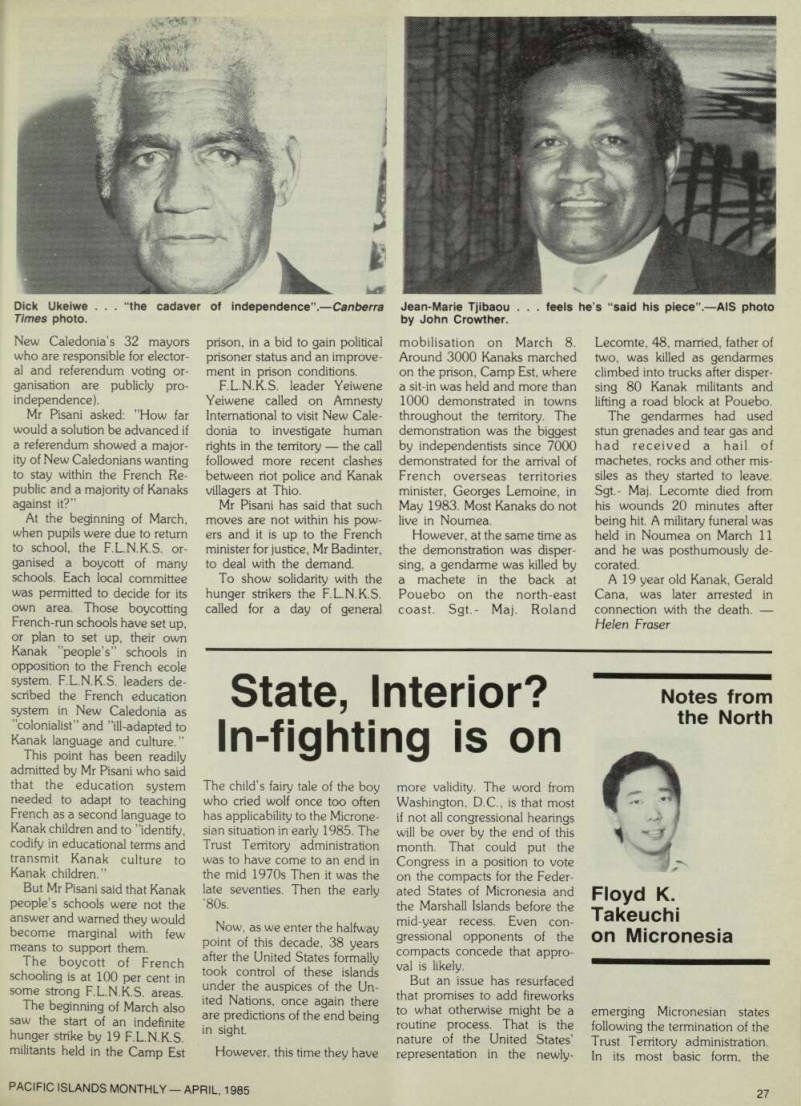
Notes from the North
emerging Micronesian states following the termination of the Trust Territory administration, In its most basic form, the
Floyd K.
Takeuchi on Micronesia
bureaucratic battle is over whe ther the State Department or Interior Department will be the lead federal agency for this watery domain.
Interior, of course, has had traditional oversight duties since the early 1950 s when it took
control from the U.S. Navy.
The Trust Territory became part of the department’s insular concerns, a responsibility that still includes Guam and the U.S. Virgin Islands in the Carib bean.
However. Interior's major re sponsibility is management of the United States’ natural re sources, primarily parks and wilderness areas. What grizzly bears, giant redwood trees, and running the affairs of far-away Micronesian islands have in common has never been made clear.
Now the State Department is making a bid to serve as the bridge between the islands and the United States. The two person State Department liaison office, which served as the eyes and ears for the U.S. negotiating team, has been the vehicle for State’s expansion into the Micronesian scene.
A Foreign Service officer, Mike Senko, has been based in the Marshall Islands since late
last year. Another career diplo mat. Michael Wygant. has just moved to Micronesia where his main duties will be with the FSM. All the while a third officer remains on Saipan. Should the Palauans work out their com pact-constitutional difficulties, a fourth officer no doubt would be attached to that govern ment.
The building tensions are in part due to the two depart ments' bureaucratic interests.
Interior has an established in terest in the region; to lose a part of its portfolio would be a tactical defeat. State has a small but increasingly active Pacific Islands office, of which ex panded responsibilities for the North Pacific would be a natu ral.
But another reason, perhaps the most important, is the con gressional interest in which de partment has primary re sponsibility for Micronesia. The Congress divides its work among committees and sub
committees. That is where the power lies. To have oversight for the multi-million dollar Micronesian arrangements via the various departments is added clout. Like the adminis tration bureaucrats, representa tives and senators do not like to give away chunks (albeit re latively small ones) of their empires. If institutional egos were not a consideration wishful thinking the State Department would be the ob vious choice. The governments of the Marshalls, FSM and Palau will be self-governing.
They will have the ability to deal with foreign governments almost as equals. Why should they have to deal with the United States through the same agency responsible for the colo nial administration in Mic ronesia?
On second thought, given the tortuous way government often works, perhaps the ques
tion is too obvious
Floyd K.
Takeuchi.
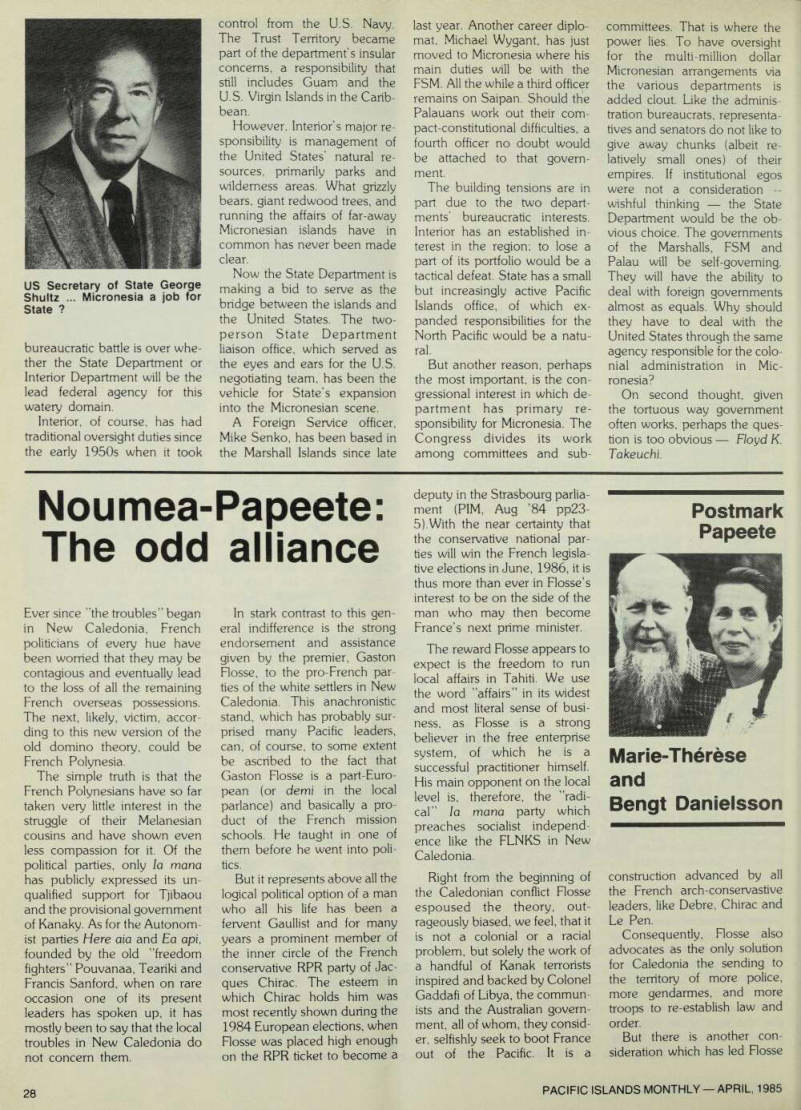
US Secretary of State George Shultz ... Micronesia a job for State ?