as strife continues
pp. 25-27 · Read in the full issue
the month
‘No speaks’ the rule as strife continues
New Caledonia’s political situa tion did not show much evolu tion in February, with both major political leaders refusing dialogue on the one hand, or avoiding contact on the other, with President Mitterrand’s spe cial envoy, Mr Edgard Pisani.
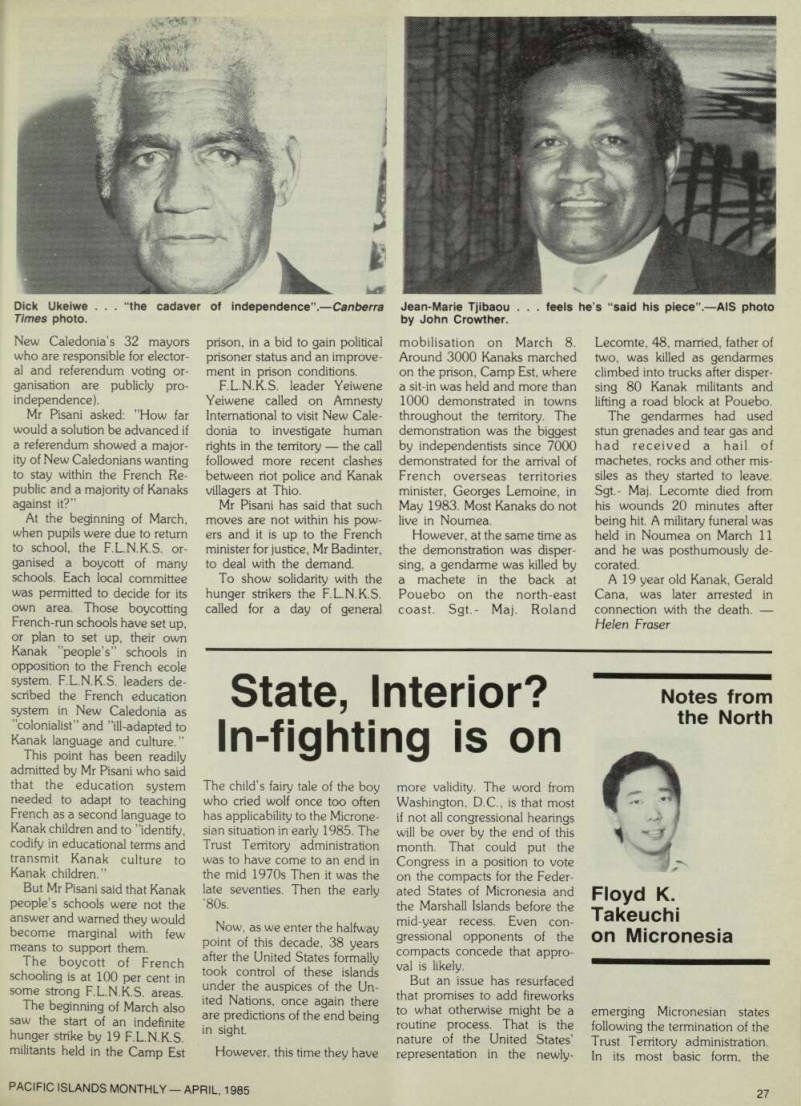
Mr Dick Ukeiwe, Republican Party senator and president of the territorial government, has not held talks with Mr Pisani since the release of the latter’s plan for independence/associa tion in early January. Since then Mr Ukeiwe has refused contact with Mr Pisani, accusing him of having taken the pro independence side, and has said he cannot talk with him while the ’’cadaver” of inde pendence is between them. Mr Ukeiwe has several times de manded the recall to Paris of Mr Pisani.
Following the clashes be tween riot police and Kanak villagers at Thio on the south east coast (see below), Mr Jean- Marie Tjibaou has been staying in his home village of Tienda nite, near Hienghene on the north-east coast. Mr Tjibaou and other F.L.N.K.S. leaders feel they have said their piece to Mr Pisani and now await the final report he will submit to President Mitterrand at the end of March.
Mr Pisani had described as ’’criminal behavior” the or ganisation of a ’’picnic” in mid- February by the extreme right wing Caledonian Front. The picnic, to the F.L.N.K.S. stron ghold town of Thio, was to show solidarity with the inhabi tants, the organisers said. How ever the event was banned by Mr Pisani under the state of emergency laws still in force in New Caledonia and Republican Party leaders called on their supporters not to take part.
A total of 190 cars carrying more than 400 people set off
on the Sunday picnic but found themselves blocked by riot police halfway towards Thio.
After several hours of negotia tion police allowed 70 cars through with about 170 people aboard, including the Caledo nian Front leaders. As the police-protected convoy approached the Kanak village of St Philippo, local F.L.N.K.S. leaders protested to riot police.
Police then charged the villa gers, firing tear gas and stun grenades, to chase them back into the St Philippo tribe.
Kanaks threw rocks, sticks and other missiles at the police. The result was 11 Kanaks wounded, four of them seriously. One of the aspects of this confronta tion, and some others held recently has been the growing prominence of women on the barricades from both Kanak, and non-Kanak sides. In some recent demonstrations they have been much more militant than the men. (After the Thio incident Kanak women warned that they would ’’now take the front line” in any future clashes be tween riot police and villagers.
Both women and children were very active in the Thio clash, throwing rocks at gendarmes.
At the same time, on the extreme right-wing side of the non-Kanaks it is also now the women who are becoming more often hysterical and mili tant, inciting their men to take extreme action. Ed.) But de spite the troubles, and after considerable delays, the picnic was eventually held under police protection.
F.L.N.K.S. spokesman, Mr Yeiwene Yeiwene, described the clashes as ’’extremely se rious,” and said a return to normal life at Thio was hand icapped by the violence.
At a press conference several
days later Mr Leopold Joredie, minister for security in the Kanaky government, called on all F.L.N.K.S. militants to mobilise for self-defence and said they had lost confidence in Mr Pisani. Mr Joredie was elected by the Kanak’s self proclaimed government after the death of Eloi Machoro (see P.1.M., March ’B5).
The picnic had come after several weeks of tentative effort to re-establish normal life at Thio workers at the nickel mining centre had started a gradual return to work, shops had re-opened and people were in the streets. But follow ing the renewed clashes tension
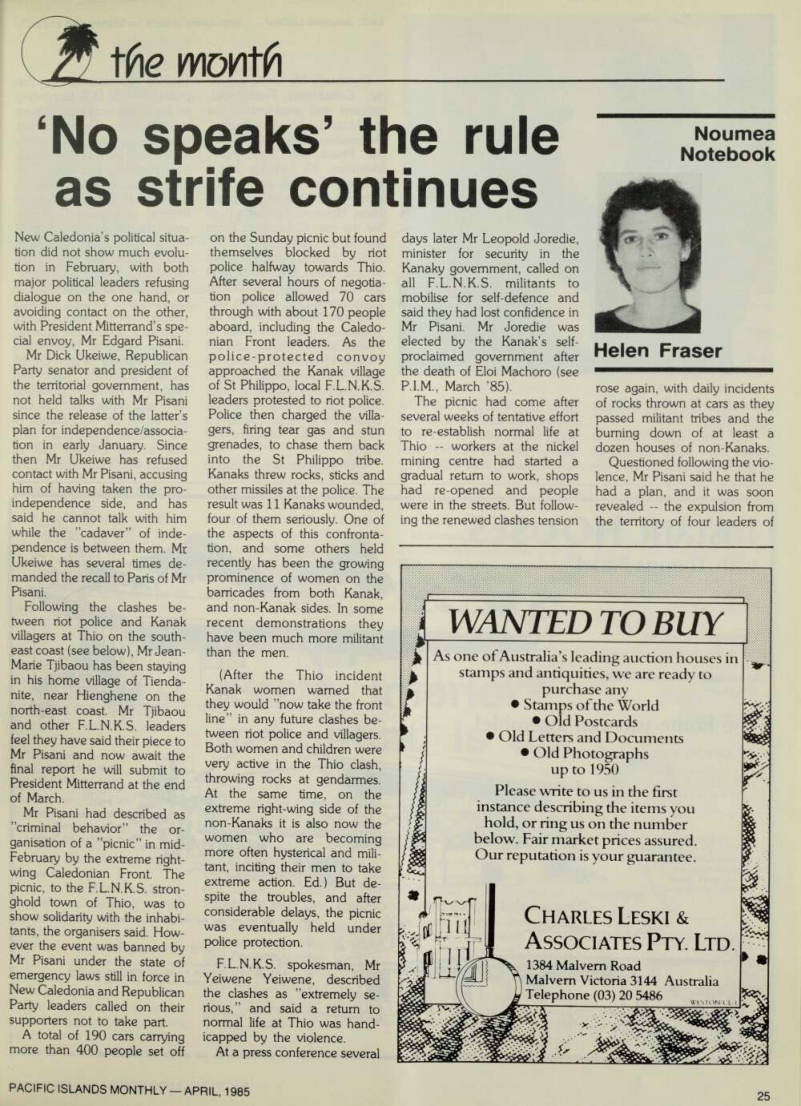
Noumea Notebook
rose again, with daily incidents of rocks thrown at cars as they passed militant tribes and the burning down of at least a dozen houses of non-Kanaks.
Questioned following the vio lence, Mr Pisani said he that he had a plan, and it was soon revealed - the expulsion from the territory of four leaders of
Helen Fraser
the Caledonian Front and one sympathiser.
The five, whose banning orders came under the powers of the state of emergency, were
given several days to leave the territory. All went underground and announced to a news agency that they had no inten tion of quitting New Caledonia.
Eventually Mr Emile Lebar gy, Caledonian Front sym pathiser and president of the local branch of the Parachutists’
Association, made contact with Mr Pisani and was shown clemency. Mr Lebargy has a sick wife and is allowed to stay, although under a form of prob ation. However the police hunt for the four Caledonian Front leaders is continuing.
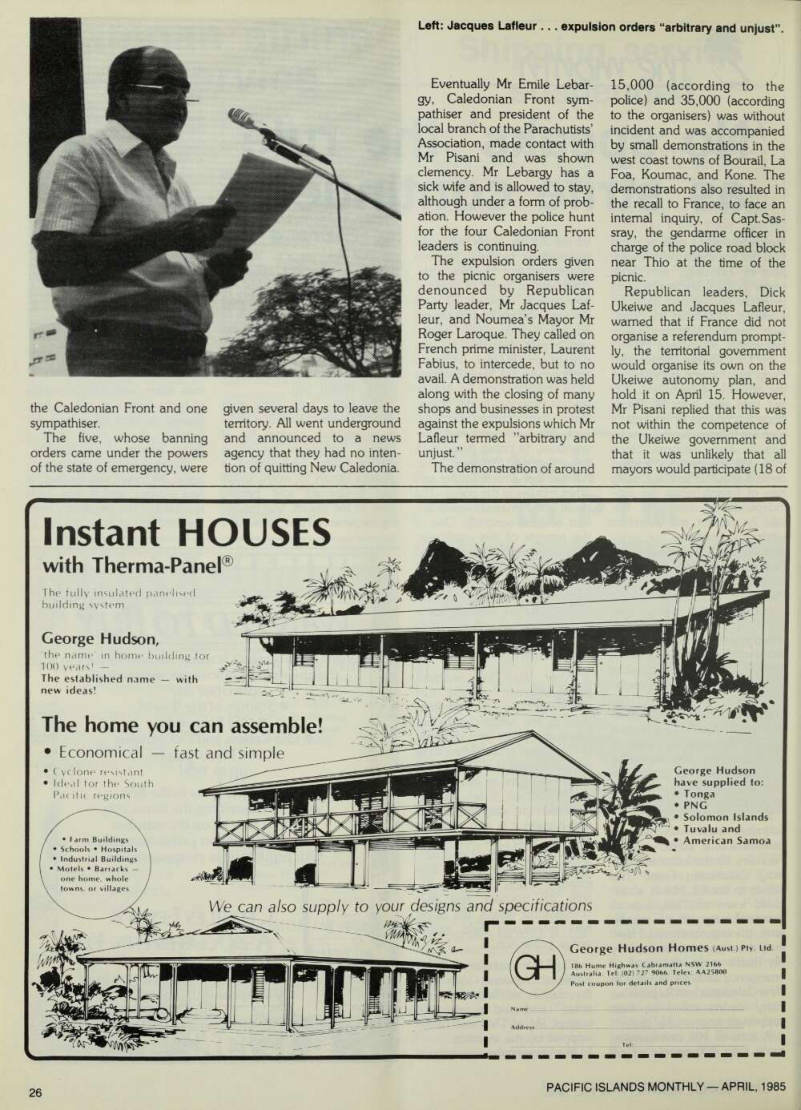
The expulsion orders given to the picnic organisers were denounced by Republican Party leader, Mr Jacques Laf leur, and Noumea’s Mayor Mr Roger Laroque. They called on French prime minister, Laurent Fabius, to intercede, but to no avail. A demonstration was held along with the closing of many shops and businesses in protest against the expulsions which Mr Lafleur termed ’’arbitrary and unjust. ”
The demonstration of around
15,000 (according to the police) and 35,000 (according to the organisers) was without incident and was accompanied by small demonstrations in the west coast towns of Bourail, La Foa, Koumac, and Kone. The demonstrations also resulted in the recall to France, to face an internal inquiry, of CaptSas sray, the gendarme officer in charge of the police road block near Thio at the time of the picnic.
Republican leaders, Dick Ukeiwe and Jacques Lafleur, warned that if France did not organise a referendum prompt ly, the territorial government would organise its own on the Ukeiwe autonomy plan, and hold it on April 15. However, Mr Pisani replied that this was not within the competence of the Ukeiwe government and that it was unlikely that all mayors would participate (18 of
Left: Jacques Lafleur. . . expulsion orders “arbitrary and unjust”.
New Caledonia’s 32 mayors who are responsible for elector al and referendum voting or ganisation are publicly pro independence).
Mr Pisani asked: ”How far would a solution be advanced if a referendum showed a major ity of New Caledonians wanting to stay within the French Re public and a majority of Kanaks against it?”
At the beginning of March, when pupils were due to return to school, the F.L.N.K.S. or ganised a boycott of many schools. Each local committee was permitted to decide for its own area. Those boycotting French-run schools have set up, or plan to set up, their own Kanak ’’people’s” schools in opposition to the French ecole system. F.L.N.K.S. leaders de scribed the French education system in New Caledonia as ’’colonialist” and ’’ill-adapted to Kanak language and culture.”
This point has been readily admitted by Mr Pisani who said that the education system needed to adapt to teaching French as a second language to Kanak children and to ’’identify, codify in educational terms and transmit Kanak culture to Kanak children.”
But Mr Pisani said that Kanak people’s schools were not the answer and warned they would become marginal with few means to support them.
The boycott of French schooling is at 100 per cent in some strong F.L.N.K.S. areas.
The beginning of March also saw the start of an indefinite hunger strike by 19 F.L.N.K.S. militants held in the Camp Est
prison, in a bid to gain political prisoner status and an improve ment in prison conditions.
F.L.N.K.S. leader Yeiwene Yeiwene called on Amnesty International to visit New Cale donia to investigate human rights in the territory the call followed more recent clashes between riot police and Kanak villagers at Thio.
Mr Pisani has said that such moves are not within his pow ers and it is up to the French minister for justice, Mr Badinter, to deal with the demand.
To show solidarity with the hunger strikers the F.L.N.K.S. called for a day of general
mobilisation on March 8.
Around 3000 Kanaks marched on the prison, Camp Est, where a sit-in was held and more than 1000 demonstrated in towns throughout the territory. The demonstration was the biggest by independentists since 7000 demonstrated for the arrival of French overseas territories minister, Georges Lemoine, in May 1983. Most Kanaks do not live in Noumea.
However, at the same time as the demonstration was disper sing, a gendarme was killed by a machete in the back at Pouebo on the north-east coast. Sgt.- Maj. Roland
Lecomte, 48, married, father of two, was killed as gendarmes climbed into trucks after disper sing 80 Kanak militants and lifting a road block at Pouebo.
The gendarmes had used stun grenades and tear gas and had received a hail of machetes, rocks and other mis siles as they started to leave.
Sgt.- Maj. Lecomte died from his wounds 20 minutes after being hit. A military funeral was held in Noumea on March 11 and he was posthumously de corated.
A 19 year old Kanak, Gerald Cana, was later arrested in connection with the death.
Helen Fraser
Dick Ukeiwe . . . “the cadaver of Independence’.—Canberra Times photo.
Jean-Marie Tjibaou . . . feels he’s “said his piece”.—AlS photo by John Crowther.