Noumea-Papeete:
pp. 28-29 · Read in the full issue
The odd alliance
Ever since ’’the troubles” began in New Caledonia, French politicians of every hue have been worried that they may be contagious and eventually lead to the loss of all the remaining French overseas possessions.
The next, likely, victim, accor ding to this new version of the old domino theory, could be French Polynesia.
The simple truth is that the French Polynesians have so far taken very little interest in the struggle of their Melanesian cousins and have shown even less compassion for it. Of the political parties, only la mana has publicly expressed its un qualified support for Tjibaou and the provisional government of Kanaky. As for the Autonom ist parties Here aio and Ea api, founded by the old ’’freedom fighters” Pouvanaa, Teariki and Francis Sanford, when on rare occasion one of its present leaders has spoken up, it has mostly been to say that the local troubles in New Caledonia do not concern them.
In stark contrast to this gen eral indifference is the strong endorsement and assistance given by the premier, Gaston Flosse, to the pro-French par ties of the white settlers in New Caledonia. This anachronistic stand, which has probably sur prised many Pacific leaders, can, of course, to some extent be ascribed to the fact that Gaston Flosse is a part-Euro pean (or demi in the local parlance) and basically a pro duct of the French mission schools. He taught in one of them before he went into poli tics.
But it represents above all the logical political option of a man who all his life has been a fervent Gaullist and for many years a prominent member of the inner circle of the French conservative RPR party of Jac ques Chirac. The esteem in which Chirac holds him was most recently shown during the 1984 European elections, when Flosse was placed high enough on the RPR ticket to become a
deputy in the Strasbourg parlia ment (PIM, Aug ’B4 pp 23s).With the near certainty that the conservative national par ties will win the French legisla tive elections in June, 1986, it is thus more than ever in Flosse’s interest to be on the side of the man who may then become France’s next prime minister.
The reward Flosse appears to expect is the freedom to run local affairs in Tahiti. We use the word ’’affairs” in its widest and most literal sense of busi ness, as Flosse is a strong believer in the free enterprise system, of which he is a successful practitioner himself.
His main opponent on the local level is, therefore, the ’’radi cal” la mono party which preaches socialist independ ence like the FLNKS in New Caledonia.
Right from the beginning of the Caledonian conflict Flosse espoused the theory, out rageously biased, we feel, that it is not a colonial or a racial problem, but solely the work of a handful of Kanak terrorists inspired and backed by Colonel Gaddafi of Libya, the commun ists and the Australian govern ment, all of whom, they consid er. selfishly seek to boot France out of the Pacific. It is a
Postmark Papeete
construction advanced by all the French arch-conservastive leaders, like Debre, Chirac and Le Pen.
Consequently, Flosse also advocates as the only solution for Caledonia the sending to the territory of more police, more gendarmes, and more troops to re-establish law and order.
But there is another con sideration which has led Flosse
Marie-Therese and Bengt Danielsson
to support the status quo and that is a genuine concern for the safety and the fate of the considerable community of Tahitian nickel mine workers and their families living in New Caledonia. They number about 5500 and, in the past, have consistently put themselves under the protection of their employers. It is therefore specu lated in Papeete that their fu ture might be clouded if, and when, the Kanaks manage to achieve independence.
The main aim of the several trips Flosse has made to New Caledonia, accompanied by several of his cabinet ministers, seems to have been to assure these ’’overseas” Tahitians of his moral and material support, regardless of whether they wish to remain and throw in their lot with the Caledoches, or even tually opt for a return to Tahiti.
Their final decision will doubt less depend on the outcome of the planned referendum, and who will be allowed to vote.
This stand was thus moti vated by both human and political considerations which everyone could understand and accept. On the other hand, eyebrows were lifted in Papeete when Flosse extended his welcoming arms to all ’’re fugees” wishing to start a new life in Tahiti, away from ’’the Kanak terror.” Among reac tions was that of the staunchly conservative Chamber of Com merce, which appeared to have no qualms about recommen ding that henceforth a ten-year residency be required of those seeking a shop licence. The editorial in the January issue of its bulletin was a warning from president Charles T.Poroi about the ’’invasion” of New Caledonian capital, estimated at more than five billion CFP last year. The Chamber’s mot to, by the way, is: ’’Together we shall achieve economic inde pendence.”
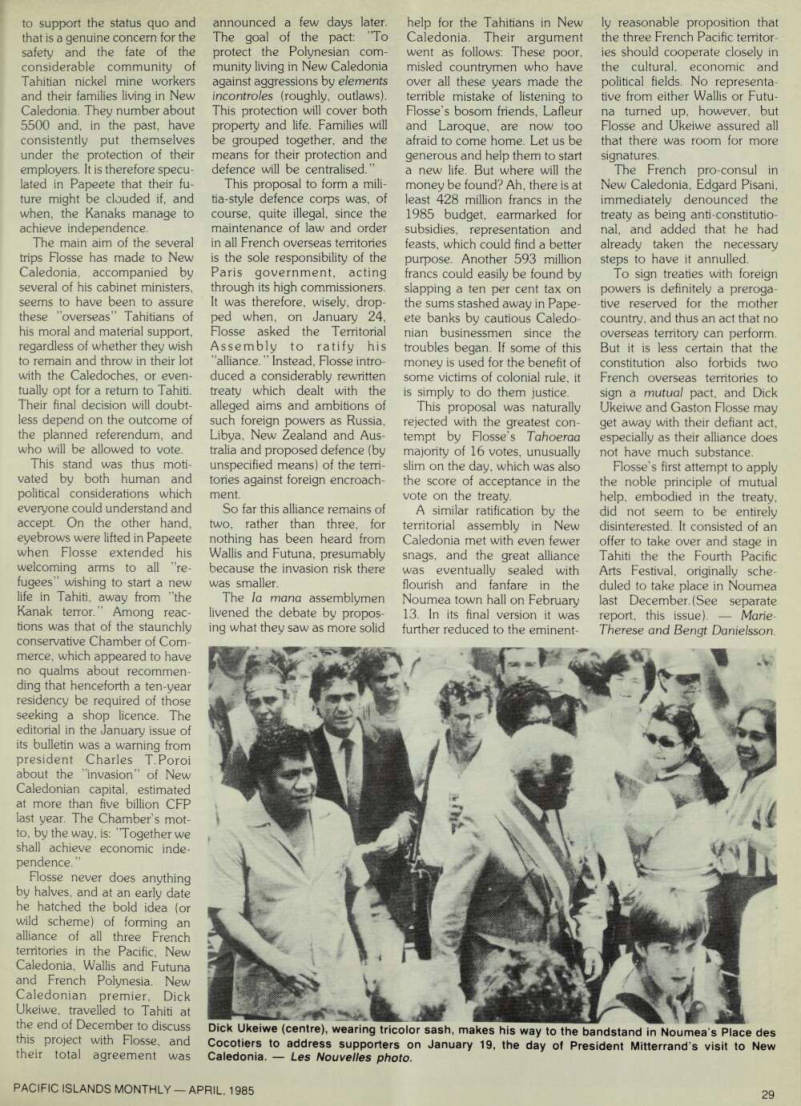
Flosse never does anything by halves, and at an early date he hatched the bold idea (or wild scheme) of forming an alliance of all three French territories in the Pacific, New Caledonia, Wallis and Futuna and French Polynesia. New Caledonian premier, Dick Ukeiwe, travelled to Tahiti at the end of December to discuss this project with Flosse, and their total agreement was
announced a few days later.
The goal of the pact: ”To protect the Polynesian com munity living in New Caledonia against aggressions by elements incontroles (roughly, outlaws).
This protection will cover both property and life. Families will be grouped together, and the means for their protection and defence will be centralised.”
This proposal to form a mili tia-style defence corps was, of course, quite illegal, since the maintenance of law and order in all French overseas territories is the sole responsibility of the Paris government, acting through its high commissioners.
It was therefore, wisely, drop ped when, on January 24, Flosse asked the Territorial Assembly to ratify his ’’alliance. ” Instead, Flosse intro duced a considerably rewritten treaty which dealt with the alleged aims and ambitions of such foreign powers as Russia, Libya, New Zealand and Aus tralia and proposed defence (by unspecified means) of the terri tories against foreign encroach ment.
So far this alliance remains of two, rather than three, for nothing has been heard from Wallis and Futuna, presumably because the invasion risk there was smaller.
The la mana assemblymen livened the debate by propos ing what they saw as more solid
help for the Tahitians in New Caledonia. Their argument went as follows: These poor, misled countrymen who have over all these years made the terrible mistake of listening to Flosse’s bosom friends, Lafleur and Laroque, are now too afraid to come home. Let us be generous and help them to start a new life. But where will the money be found? Ah, there is at least 428 million francs in the 1985 budget, earmarked for subsidies, representation and feasts, which could find a better purpose. Another 593 million francs could easily be found by slapping a ten per cent tax on the sums stashed away in Pape ete banks by cautious Caledo nian businessmen since the troubles began. If some of this money is used for the benefit of some victims of colonial rule, it is simply to do them justice.
This proposal was naturally rejected with the greatest con tempt by Flosse’s Tahoeraa majority of 16 votes, unusually slim on the day, which was also the score of acceptance in the vote on the treaty.
A similar ratification by the territorial assembly in New Caledonia met with even fewer snags, and the great alliance was eventually sealed with flourish and fanfare in the Noumea town hall on February 13. In its final version it was further reduced to the eminent
ly reasonable proposition that the three French Pacific territor ies should cooperate closely in the cultural, economic and political fields. No representa tive from either Wallis or Futu na turned up, however, but Flosse and Ukeiwe assured all that there was room for more signatures.
The French pro-consul in New Caledonia, Edgard Pisani, immediately denounced the treaty as being anti-constitutio nal, and added that he had already taken the necessary steps to have it annulled.
To sign treaties with foreign powers is definitely a preroga tive reserved for the mother country, and thus an act that no overseas territory can perform.
But it is less certain that the constitution also forbids two French overseas territories to sign a mutual pact, and Dick Ukeiwe and Gaston Flosse may get away with their defiant act, especially as their alliance does not have much substance.
Flosse’s first attempt to apply the noble principle of mutual help, embodied in the treaty, did not seem to be entirely disinterested. It consisted of an offer to take over and stage in Tahiti the the Fourth Pacific Arts Festival, originally sche duled to take place in Noumea last December. (See separate report, this issue). Marie- Therese and Bengt Danielsson.
Dick Ukeiwe (centre), wearing tricolor sash, makes his way to the bandstand in Noumea’s Place des Cocotiers to address supporters on January 19, the day of President Mitterrand’s visit to New Caledonia. Les Nouvelles photo.