to compact
pp. 19-21 · Read in the full issue
Remeliik Looks Ahead
Palau edges closer to compact
Like many Pacific lead ers, Haruo Remeliik, is out-going, articulate, and gentle. But he is also a consummate grass-roots politician who was recently re elected president of the Repub lic of Palau by what can only be described as an avalanche of popularity. It is his second term of office.
His primary task remains the handling of the Compact of Free Association with the Un ited States. Alone among the Micronesian states Palau has so far failed to ratify the instru ment, principally because it ”is considered by many to breach the Palauan constitutional de claration of the territory as a nuclear-free zone.”
Remeliik’s continuing strug gle to attain senate passage of the compact is not seen as getting any easier, despite fair indication that a raw majority of the population does not oppose the measure.
Activists, on the other hand, claim it is the unmaking of a nuclear-free Palau, and the par liamentary opposition steadfast ly opposes it.
Remeliik says, “the Compact is not dead, it is just sitting. ” But getting it moving in Palau seems to be easier said than done.
Haruo Remeliik was bom in 1933 at Peliv, an island south of Koror in the Palauan archipela go. He studied at the University of Hawaii and worked in the judicial system of the Trust Territory administration. He be came involved in local politics
and eventually rose to leader ship which culminated in his election in 1980 as Palau’s first president. ”1 am grateful to the people of Palau for the second time. I owe them a great deal and hope to accomplish much,” he told PIM in an exclusive inter view. “The people have been through all kinds of problems with me this time.” ”We have been working on the Compact for more than 14 years,” he said. The people have expressed their wish in our last plebiscite, on Septem
ber 4, 1984. A majority of the people voted for the Compact as it is written now. ’’The Compact is our key issue and the people felt I should continue working on it. ”
PIM: Shortly before the elec tion you appeared on television and said the only thing standing between the Compact and its passage was the senate which has repeatedly rejected it. Do you think these political ads were responsible for putting eleven of the senators out of office?
REMELIIK; It could have
been one of the criteria on which the people based their decision. We look at the Com pact as it is now, and it does not require 75 per cent approval because all those items which were contested were removed.
So now it simply requires a majority.
PIM: Ambassador Lazarus Salii has just won a senate seat.
Will he be running for senate president?
REMELIIK: It’s possible. If not, he will be one of the senators on whom I shall be relying to get this Compact through.
PIM: The new senate seems to have a majority in favor of the Compact. If they approve it in their first session, as many expect them to do, does that mean Palau will have to take another plebiscite?
REMELIIK: No. The Com pact itself is not dead. It is just sitting, waiting for senate appro val. When the senate approves it, then it’s ready for transmis sion to the U.S. for action.
PIM: The Opposition dis agrees with your interpretation of the majority required and claims the courts will block you.
They say the 68 per cent vote in parliament fails to meet the criterion laid down in the nuc lear-free provision of the Con stitution.
REMELIIK: No. It does not need 75 per cent approval.
Once it is approved by the senate it is ready for transmittal to Washington.
PIM: Do you think the courts will try to stop you again?
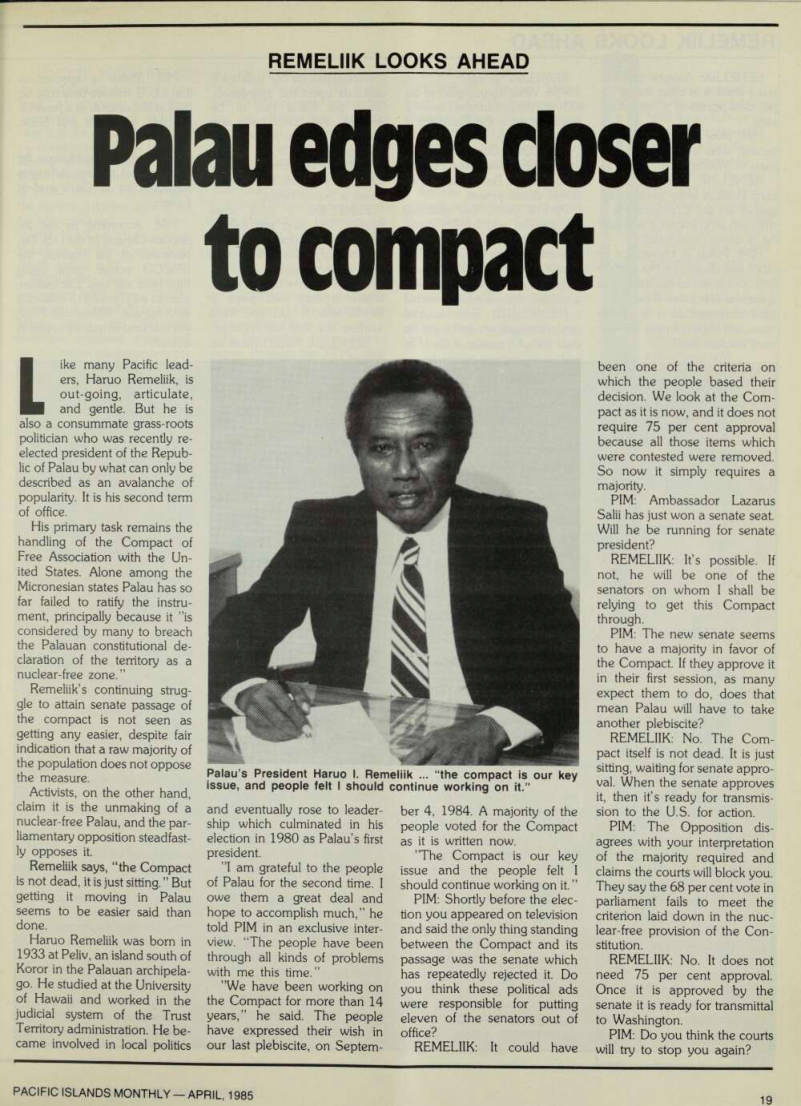
Palau’s President Haruo I. Remeliik ... “the compact is our key issue, and people felt I should continue working on it.”
REMELIIK: Anyone can try, but I think it is clear that a 75 per cent approval is not neces sary.
PIM: Now that Salii is in the senate, who will be your new man in Washington?
REMELIIK: Salii and Poly carp Basilius were working to gether on the Compact. He is the man who knows it well and he is being considered.
PIM; Palau is known for its Rock Islands and for the world’s first constitutional declaration of a nuclear-free zone. If the Com pact is passed as it is written now, will Palau remain 100 per cent nuclear-free?
REMELIIK: It will.
PIM; What do you plan to do with the American grant money available once the Compact is passed?
REMELIIK; Construct all the infrastructure we need, like a road around Babeldaob. Eco nomic development.
PIM: If Palau was militarily endangered, and the U.S. came to its aid, defence responsibility remains with the U.S. under the terms of the Compact, would Palau allow American nuclear powered ships into its waters?
REMELIIK; Those are circumstances we have yet to deal with. Of course, if the U.S.
is responsible for our defence,it depends upon the aggression.
What we utilise has to be decided. We don’t have any enemies. We are friends with everyone.
PIM: Do you think that the Compact with the U.S. makes Palau a Soviet target?
REMELIIK: It is a small peanut. The next war will be between the super-powers ... they can fly nuclear missiles into each other’s country.
PIM: You grew up in Peleliu, where fighting took place in World War 11. Do you think warfare like that will reoccur?
REMELIIK: I don’t think so.
PIM; There is speculation that a U.S. military base may be built at Babelldaob as a possible fail-back for Clark and Subic bases.
REMELIIK; Possibly one for training, but not for defensive purposes,like at Clark and in Guam.
PIM; According to the In spector-General of the U.S. De partment of the Interior, the IPSECO power plant being built here will cost $32 million, plus an additional $l5 million in debt service. Where will Palau get that kind of money to pay its debts?
Palau and the Marshall Islands, two tiny Micronesian countries with an aggregate popu lation of less than 50,000, owe more than US$67 million to various British and Australian lending institutions, prin cipally for power plants and fuel storage facilities installed by International Power Systems Ltd (IPSECO), of London.
The U.S.Government, which maintains a close administrative link with the Micronesian coun tries, says neither has the money to meet debt servicing on the outstan ding loans. They say the Marshalls owe Australian and British financial in terests $ll.B million for three aircraft bought to serve outer atolls.
IPSECO plants on Koror and Babeldaop (or Babelthuap by the old spelling), in Palau are due to be completed in 1986. Koror is the Palauan capital and Babeldaop is the largest of the eight inhabited is lands in the group which lies 1000 km east of the Philippines and 7250 km south-east of Hawaii.
The power plant at Ma juro, in the Marshalls, 3700 km south-east of Honolulu, has been op erational for about 18
months. The Marshalls are made up of 31 atolls and islands spread over about 800,000 sq km of the Central Pacific.
First payments on the IPSECO-related loans are to be made by the Marshalls this year and indications are that offi cials in Majuro are de pending upon U.S. grant-aid, under the Compact of Free Association, to meet their commitments.
In the interview in this issue of PIM, President Remeliik, of Palau, indi cates that his government hopes their plant will generate enough re venue from fuel sales to fishing boats to service their debt, but concedes that “some subsidisa tion” may be required from Compact money, the granting of which re mains conditional upon the Palau senate ratifying the agreement.
Information obtained by the American Associ ated Press from the U.S.
Department of the In terior’s inspector-general under the U.S. Freedom of Information Act shows that the Marshalls obtained two loans, totalling U 5524.9 million in February, 1981, for construction of a 12 megawatt power plant
and a six-million gallon fuel storage facility. Both loans came from the Mid land Bank, Ltd., of London.
In March, 1980, the Marshalls got three loans to buy aircraft to establish a government-run, subsi dised airline. Of these, one for $1.7 million came from the Export Finance and Insurance Corporation of Sydney, and another, of $1.5 mil lion, came from the Mid land Bank tocomplete payment for two Austra lian-made 19-seater, Nomad aircraft. The third loan, for $8.7 million, was with British Aero space, Pic, of London, for a HS74B turboprop airliner.
The AP report says the U.S.lnterior Department inspector-general’s re port complains that Palau ’’did not act responsibly” when, on February 2, 1982,it agreed to a $U527.5 million contract with IPSECO to build a 16 megawatt power plant and fuel storage facility in the republic. Altogether, says the report, Palau incurred $32.5 million in loan liability. The power transmission and distribution system be tween Koror and Babel daop will cost $5 million. ’’Both agreements
were contingent upon Palau securing financing to pay the contract price,” said the report.
Helped by IPSECO, Palau raised $24.3 mil lion from the National Westminster Bank of London and a further sB.2million from the County Bank, also of London, the report said.
According to the Associated Press, the in spector-general was sharply critical of the loan arrangements, saying that Palau had not prop erly assessed its power and fuel storage needs or projected likely revenues.
They said there was no market for either the electricity or the fuel.
Others, critical in re turn of the inspector general’s attitude, say the department was miffed that the two Micronesian countries, so recently de pendencies of the U.S., had not consulted Washington before pro ceeding to raise loans in London and Sydney. In fact, they say, the inspec tor-general under-rated the marketability of the fuel and, in common with American investors, failed to see the potential for development in Mic ronesia.
Remeliik: We Told Ipseco
right out that we don’t have that kind of money, and their economist came up with the idea that the plant will pay itself by constructing a fuel farm for storing fuel to be sold to fishing boats working around Palau.
IPSECO will pay for itself with the income it makes itself. It will be self-contained.
PIM: But wasn’t that concept based on the Van Camp plant which pulled out?
REMELIIK: We have an agreement with Japan Fishing Association. Over 400 boats are fishing within our 200 mile exclusive economic zone, and we can make arrangements for the boats to fuel here.
PIM: How many of those boats are Palauan?
REMELIIK: They are mostly Japanese and pay a fee for the fishing rights. It’s hard for Palauans to fish commercially because of the marketing prob lems. As for trade, we are still developing, so this is difficult.
We hope to attract some invest ments and businesses here with Compact money, so we can export, be duty-free, have in centives.
PIM: There is a probably scurrilous theory going around that IPSECO is really a plot to place Palau so deeply in debt that the Compact will have to be accepted. Then the military base will be built on Babeldaob where a power plant and fuell ing facility will be conveniently waiting for it. What do you think of that sort of rumor?
REMELIIK; That’s not our understanding at all. We have been short of power and we need a plant to meet our needs.
We might consider using Com pact money to subsidise it if necessary.
PIM: Is it true that Babeldaob has bauxite and phosphate?
REMELIIK: Yes. The owners of that land are looking into developing the resources, most ly negotiating with Japan for the mining.
PIM; What will be your poli cies for the next four years?
REMELIIK: We hope to have a better relationship with the national congress, so we can get more done. I hope this new congress will have a better
attitude toward things we are trying to develop. We would like to attract more investment for the construction industries and to develop our marine and economic resources.
PIM: What relations will Palau have with Japan in the next four years?
REMELIIK; We have a busi ness relationship between our businessmen and the Japanese, and we are also getting aid from Japan - about US$l.3 million.
This is not in actual cash, but mostly equipment for economic development. Our relationship is now friendly.
In September I travelled to Japan through the APPU with President Nakayama of the Federated States of Micronesia, and President Kabua of the Marshalls. It was an educational trip to make Japan more aware of the islands. We met with prime minister Nakasone, who said his government would con tinue to foster the relationship between Japan and Micronesia, economically and politically.
PIM: Having been brought up during the Japanese times, and the war, do you have any fears that the old “Greater East Asia Co-Prosperity Sphere” of Imperial Japan will try to take over Micronesia again?
REMELIIK: No. Japan is an economic giant and its interests now are mainly economic. This is something we welcome. The new luxury Palau Pacific Resort is a plus for our economy, for example.
Remeliik concedes that the Japanese developed Palau more than the Americans, but says their development in those (pre-war and wartime) days was for Japanese. America de veloped less, economically, but it was all for the Palauans. This was one of his reasons for supporting the Compact, he said.
PIM; Speaking of the Pacific Resort, how important is tour ism for Palau?
REMELIIK: It is one of the potentials we would like to develop. We see tourism as a major economic force in the islands.
PIM: With whom else, be sides the U.S. and Japan, would Palau like to develop a
close relationship?
REMELIIK: Taiwan, Hong kong and the Philippines have expressed interest in us, but our ties to the South Pacific are very important to us. Palau cooper ates fully with all Pacific Island nations. ‘ We are a new island nation and we are making every effort to impress our neighboring friends with our existence ant our willingness to cooperate in all areas of mutual interest.
Palau is not yet a member of either the Forum or of SPEC, because we have not yet attained Free Association status or independence, which are membership requirements. But we are very much members of the South Pacific Commission.
Palau has indeed received much technical assistance from SPC and it is through this association that we are making appreciable relationships with other member nations.
We feel through our active participation in the SPC that we are sending the message to our island friends that we are se rious and willing to work with our neighbors on mutually be neficial programs.
PIM: What is your view of the situation in New Caledonia?
REMELIIK: We were looking forward to the Festival of the Pacific Arts. It would have been our second participation. We feel defeated by its cancellation because the festival is some thing we need for our country, our culture, our identity. With out our culture we are not Palauan any more.
As for the political situation there now-I don’t know the details. The Kanaks want to claim their rights as natives of the islands. Things have been brewing for a long time and now it has surfaced. I think it is an internal matter between the Kanaks and the French New Caledonians.
PIM: What is your hope for the future?
REMELIIK: I would like to see Palau remain as Palau and become economically self-suffi cient and independent. But we have to build up Palau’s econo mic strength to achieve this
goal.
E.Rampell