Kolone resignation may
p. 23 · Read in the full issue
Western Samoa Leadership
Kolone resignation may upset Eti rule
On Thursday, March 7, at a meeting of the Human Rights Protec tion Party (H.R.P.P.) in Apia, one of the party’s most prominent members, Vaai Kolone, stunned party mem bers when he announced his resignation from the party.
Since the elections held on February 22, leadership of the party has been one of the main issues. Vaai Kolone has made several bids for leadership.
However the H.R.P.P. has de cided to give its support to Tofilau Eti Alesana, prime minister for the past two years.
In Vaai Kolone’s press state ment, issued on March 8, he said he had officially dissociated himself from the H.R.P.P. and claimed that he believed that the party is no longer conscious of its original ideals and objec tives. He added that he did not feel he could personally bring any effective influence to bear on the situation.
Tofilau Eti, interviewed the same day, said Kolone’s deci sion had come ”as a complete surprise.” The prime minister said he hoped to have another meeting with Kolone and try to bring him back into the party.
Vaai Kolone was one of the founders of the H.R.P.P. in 1976 and became prime minis ter for ten months in 1982. He lost his seat in September of that year through a court deci sion. Until then Tofilau Eti had been deputy prime minister and minister for finance, but at the fall of Vaai he became leader of the H.R.P.P. and prime minis ter.
The dissociation of Vaai Kolone from the H.R.P.P. under the leadership of Tofilau Eti is considered crucial in the coming election for prime minister to be held on March 19 when the legislative assembly will meet to hold a secret ballot for the country’s leadership. At present Vaai Kolone says he is
Not for the first time since their independence, the politics of Western Samoa are in a high state of flux. Despite his party’s clear election win, the leadership of Tofilau Eti fell into question because of movement among the engineers of influence within the legislative assembly. The catalyst was Vaai Kolone, one of the founders of the Human Rights Protection Party, now led by Tofilau Eti Alesana.
Kolone was prime minister for less than a year in 1982, but lost his seat after a court action. He remains a powerful figure in the land.
Western Samoa’s electoral system is unique in the Pacific for votes are not cast by the population generally but by the matai (clan and family leaders). In the previous election there were about 12,000 matai. This number was increased by appointment to about 16,000 for the most recent poll, a rise which has caused considerable debate in the country. Lee Anderson reports from Apia on the latest moves which appear to cast doubt on the future leadership of Tofilau Eti.
not affiliated with any party.
The H.R.P.P. in the elections on February 22 won with 31 seats to 16. The opposition, the Christian Democratic Party, would need to attract Vaai Kolone, his supporters, and possibly eight other members to its ranks before having any chance of holding a majority in the assembly.
It is possible that Vaai Kolone could become prime minister by working together with the Christian Democrats. If this
were the case the eight cabinet posts, including those of deputy prime minister and Speaker, could be split between repre-
sentatives of both groups.
The other major figure in this delicate political round, Tupuola Efi, said in an inter view after Kolone’s resignation that he did not rule out the possibility of a coalition govern ment. He said his policy now was to ’’fold my arms” and wait to see what happened.
Apia, and the rest of Western Samoa seethed with specula tion over the situation but Tupuola Efi said he had nothing positive to say; things were in flux.
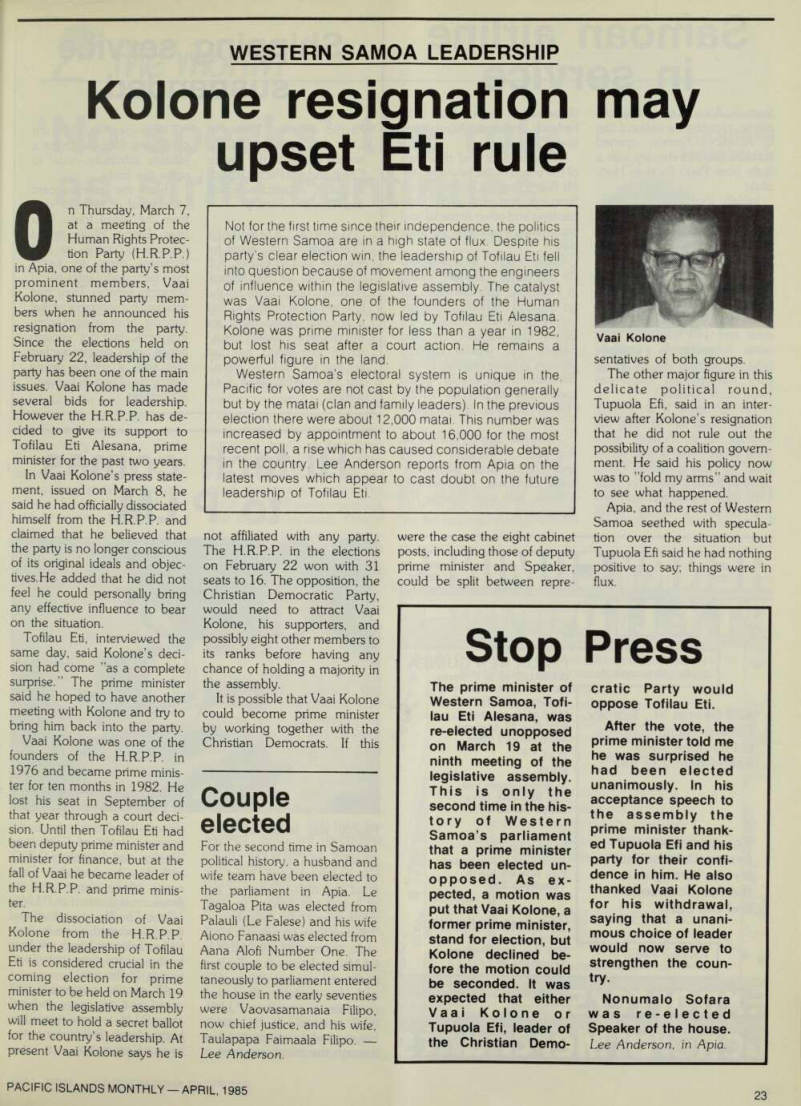
Vaai Kolone