New York expands
p. 17 · Read in the full issue
Pacific interest
Pacific people, often neg lected because of their re moteness and small popula tions, are being increasingly recognised in America for their distinctive cultural con tributions. A few years ago the Michael C. Rockefeller Wing of Primitive Art opened at the Metropolitan Museum in New York, featuring a large collection of art from Oceania.
New Yorkers, however, were apparently not satis fied. Beginning this year a new permanent exhibition on Pacific peoples opened at the American Museum of Natural History in New York City. The exhibition, named in memory of Margaret Mead, allows the visitor to explore in a far more inti mate way than before pos sible in the United States the immense richness of the many diverse Pacific cul tures.
Outside the entrance of the main hall are two ex hibits which introduce the visitor to Margaret Mead, the world figure and the anthropologist. Immediately inside the hall are several exhibits dealing with a num ber of cultural dynamics shared by Pacific islanders the effects of contact with western culture, the use of coconuts and betel nuts, and mediums of exchange to name but a few.
After exploring a number of cultural features held in common, what next strikes the visitor is the diversity of the Pacific region. The hall is divided into color-coded zones, each focusing on one of the six major cultural areas of the Pacific: Austra lia, Indonesia, the Philip pines, Melanesia, Micronesia and Polynesia.
In one section the visitor can explore the burial cus toms of the indigenous people of Australia. When done with Australia one can move on to Indonesia and
become fascinated by the finely-crafted puppets of Bali. Further on, the visitor will be able to explore the complexity of the various layers of cultures that form the modem day Filipino. Of particular interest, I thought, was a bamboo shoot from the Philippines, covered with Sanskrit writing.
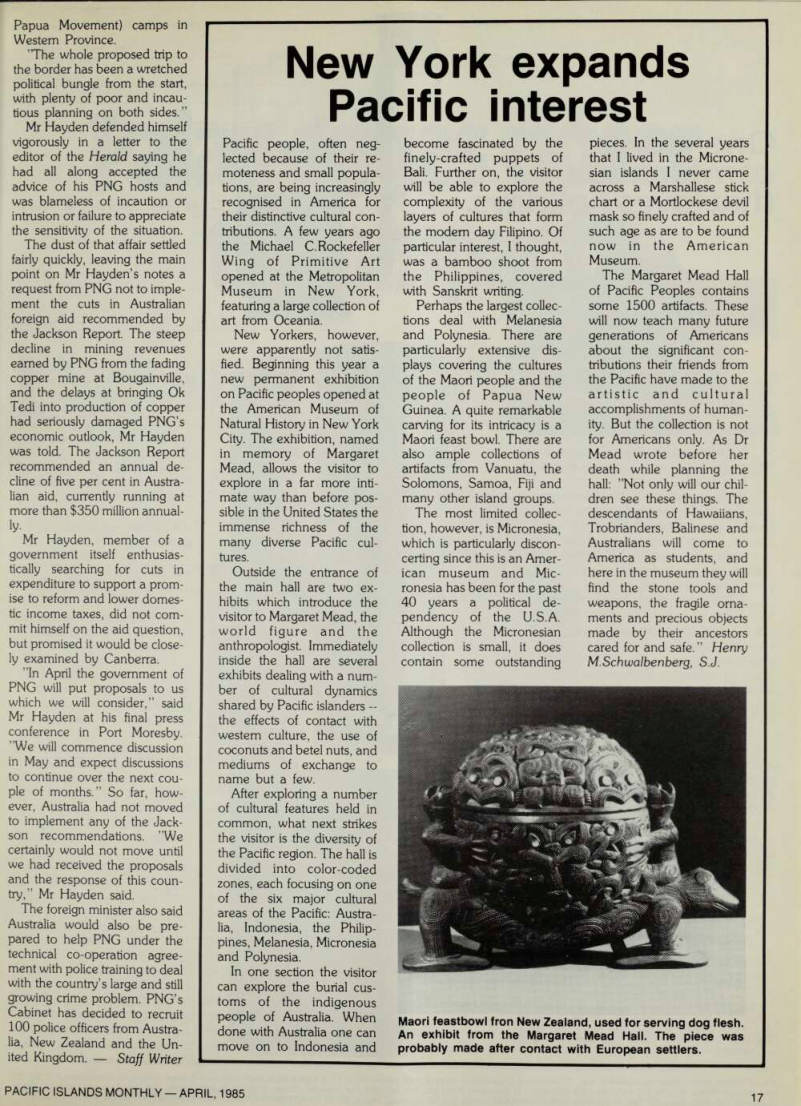
Perhaps the largest collec tions deal with Melanesia and Polynesia. There are particularly extensive dis plays covering the cultures of the Maori people and the people of Papua New Guinea. A quite remarkable carving for its intricacy is a Maori feast bowl. There are also ample collections of artifacts from Vanuatu, the Solomons, Samoa, Fiji and many other island groups.
The most limited collec tion, however, is Micronesia, which is particularly discon certing since this is an Amer ican museum and Mic ronesia has been for the past 40 years a political de pendency of the U.S.A.
Although the Micronesian collection is small, it does contain some outstanding
pieces. In the several years that I lived in the Microne sian islands I never came across a Marshallese stick chart or a Mortlockese devil mask so finely crafted and of such age as are to be found now in the American Museum.
The Margaret Mead Hall of Pacific Peoples contains some 1500 artifacts. These will now teach many future generations of Americans about the significant con tributions their friends from the Pacific have made to the artistic and cultural accomplishments of human ity. But the collection is not for Americans only. As Dr Mead wrote before her death while planning the hall; ’’Not only will our chil dren see these things. The descendants of Hawaiians, Trobrianders, Balinese and Australians will come to America as students, and here in the museum they will find the stone tools and weapons, the fragile orna ments and precious objects made by their ancestors cared for and safe. ” Henry
M.Schwalbenberg,
S.J.
Maori feastbowl fron New Zealand, used for serving dog flesh.
An exhibit from the Margaret Mead Hall. The piece was probably made after contact with European settlers.