for Hayden
pp. 16-17 · Read in the full issue
Png Regional Relations
Border-line welcome for Hayden
Australian aid, the West Irian border situation, and domestic crime rates were the domi nant subjects during the visit to Papua New Guinea mid-Febru ary of the Australian foreign minister, Mr Bill Hayden.
Through it all the Australians were at pains to be seen simply as very helpful friends and neighbors. ”It is important for Australia not to be seen as intrusive,” said Mr Hayden at the end of his four-day visit. ”If we domin ate your economy it could be misunderstood as neo-colonial ism. We want to avoid a long shadow of neo-colonialism in
this country.”
Hayden’s PNG opposite number, Mr Giheno, said the visit had reinforced the fact that Australia did not seek to inter fere. (Somewhat later, as if to reinforce PNG independence of thought and action, Mr Giheno delivered a sharp slap to the Americans for ’’bullying” New Zealand over the nuclear ship visit issue and ANZUS).
The most difficult aspect of the Hayden visit concerned the West Irian border. Mr Hayden had apparently expressed a de sire to visit a refugee camp along the border. Canberra offi cials suggested the visit, to Kungim camp, about 30 mi
nutes by air from Kiunga, would enable Mr Hayden to see for himself where Australian relief aid was being spent and perhaps also add to his perso nal knowledge of one of the most difficult political situations in the region.
The trip was cancelled by PNG foreign affairs secretary Paulias Matane, who expressed concern about Mr Hayden’s security.
Something of a furore deve loped over the cancellation, with Mr Hayden saying he wouldn’t do anything to embar rass PNG in any way, and people like former PNG De fence Force commander, Ted
Diro, now MP for Central, saying he would have made sure the visitors would have been safe.
A bigger storm broke in Aus tralia where Mr Hayden was sternly criticised by leading newspapers for having sought to go to the border and thereby risk his involvement, and thus the Australian government’s, in a sensitive matter between the Indonesians and PNG.
The Sydney Morning Herald said sharply in an editorial: ’There was no possible value to PNG, Australia or Indonesia in Mr Hayden being identified with what are OPM (Free West
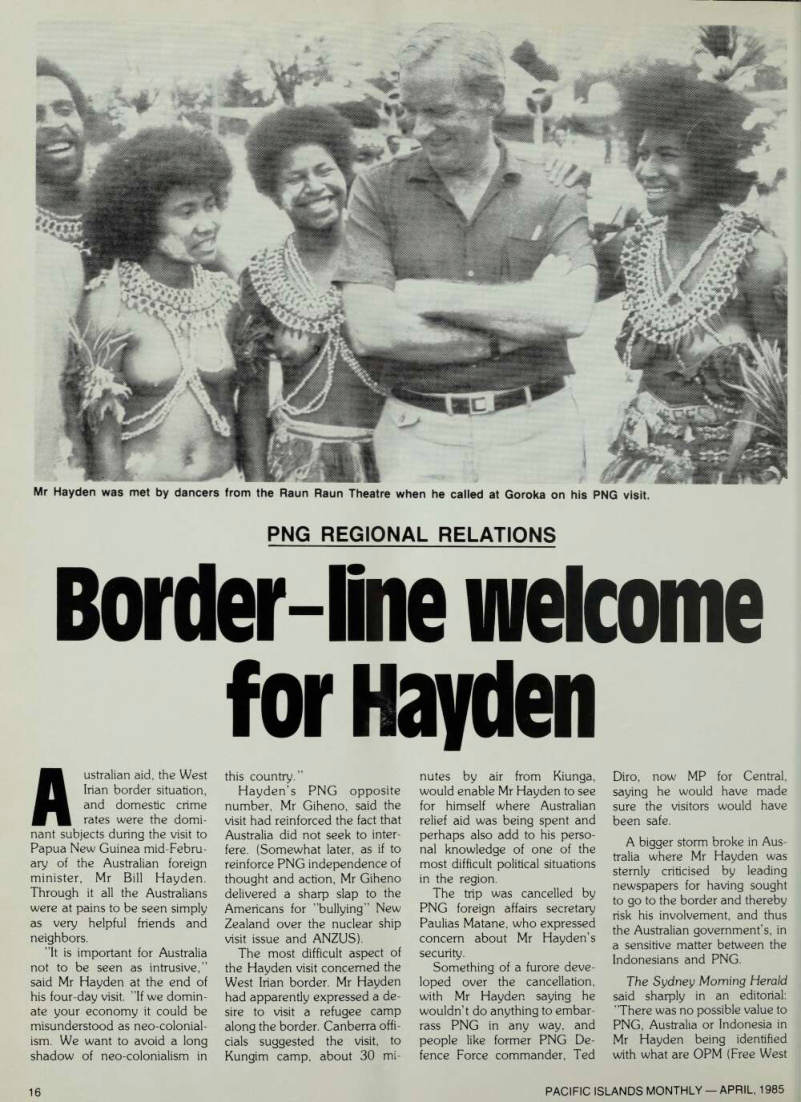
Mr Hayden was met by dancers from the Raun Raun Theatre when he called at Goroka on his PNG visit.
Papua Movement) camps in Western Province. ’The whole proposed trip to the border has been a wretched political bungle from the start, with plenty of poor and incau tious planning on both sides.”
Mr Hayden defended himself vigorously in a letter to the editor of the Herald saying he had all along accepted the advice of his PNG hosts and was blameless of incaution or intrusion or failure to appreciate the sensitivity of the situation.
The dust of that affair settled fairly quickly, leaving the main point on Mr Hayden’s notes a request from PNG not to imple ment the cuts in Australian foreign aid recommended by the Jackson Report. The steep decline in mining revenues earned by PNG from the fading copper mine at Bougainville, and the delays at bringing Ok Tedi into production of copper had seriously damaged PNG’s economic outlook, Mr Hayden was told. The Jackson Report recommended an annual de cline of five per cent in Austra lian aid, currently running at more than $350 million annual ly- Mr Hayden, member of a government itself enthusias tically searching for cuts in expenditure to support a prom ise to reform and lower domes tic income taxes, did not com mit himself on the aid question, but promised it would be close ly examined by Canberra. ”In April the government of PNG will put proposals to us which we will consider,” said Mr Hayden at his final press conference in Port Moresby. ”We will commence discussion in May and expect discussions to continue over the next cou ple of months.” So far, how ever, Australia had not moved to implement any of the Jack son recommendations. ”We certainly would not move until we had received the proposals and the response of this coun try,” Mr Hayden said.
The foreign minister also said Australia would also be pre pared to help PNG under the technical co-operation agree ment with police training to deal with the country’s large and still growing crime problem. PNG’s Cabinet has decided to recruit 100 police officers from Austra lia, New Zealand and the Un
ited Kingdom.
Staff Writer