New Gold In Png
pp. 12-14 · Read in the full issue
"The Midas alternative" to OK Tedi
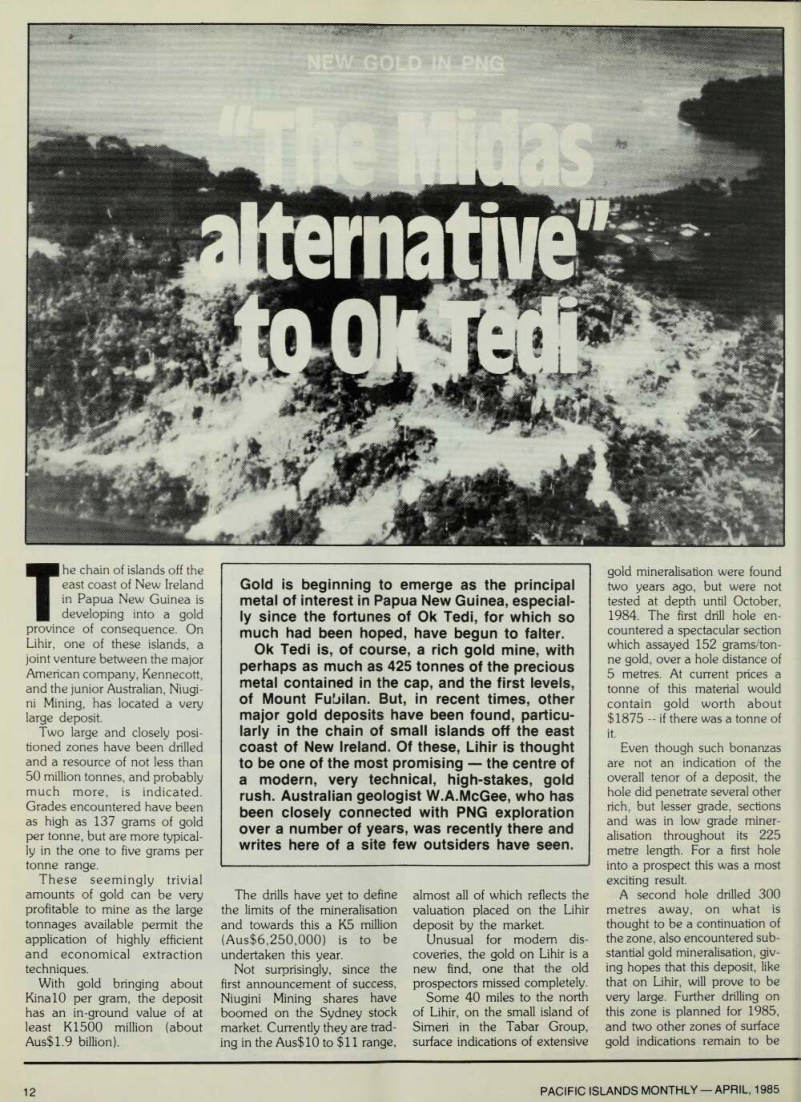
The chain of islands off the east coast of New Ireland in Papua New Guinea is developing into a gold province of consequence. On Lihir, one of these islands, a joint venture between the major American company, Kennecott, and the junior Australian, Niugi ni Mining, has located a very large deposit.
Two large and closely posi tioned zones have been drilled and a resource of not less than 50 million tonnes, and probably much more, is indicated.
Grades encountered have been as high as 137 grams of gold per tonne, but are more typical ly in the one to five grams per tonne range.
These seemingly trivial amounts of gold can be very profitable to mine as the large tonnages available permit the application of highly efficient and economical extraction techniques.
With gold bringing about KinalO per gram, the deposit has an in-ground value of at least Kl5OO million (about Aussl.9 billion).
Gold is beginning to emerge as the principal metal of interest in Papua New Guinea, especial ly since the fortunes of Ok Tedi, for which so much had been hoped, have begun to falter.
Ok Tedi is, of course, a rich gold mine, with perhaps as much as 425 tonnes of the precious metal contained in the cap, and the first levels, of Mount Fubilan. But, in recent times, other major gold deposits have been found, particu larly in the chain of small islands off the east coast of New Ireland. Of these, Lihir is thought to be one of the most promising the centre of a modern, very technical, high-stakes, gold rush. Australian geologist W.A.McGee, who has been closely connected with PNG exploration over a number of years, was recently there and writes here of a site few outsiders have seen.
The drills have yet to define the limits of the mineralisation and towards this a K 5 million (Au 556,250,000) is to be undertaken this year.
Not surprisingly, since the first announcement of success, Niugini Mining shares have boomed on the Sydney stock market. Currently they are trad ing in the Ausslo to $ll range,
almost all of which reflects the valuation placed on the Lihir deposit by the market.
Unusual for modem dis coveries, the gold on Lihir is a new find, one that the old prospectors missed completely.
Some 40 miles to the north of Lihir, on the small island of Simeri in the Tabar Group, surface indications of extensive
gold mineralisation were found two years ago, but were not tested at depth until October, 1984. The first drill hole en countered a spectacular section which assayed 152 grams/ton ne gold, over a hole distance of 5 metres. At current prices a tonne of this material would contain gold worth about $1875 if there was a tonne of it.
Even though such bonanzas are not an indication of the overall tenor of a deposit, the hole did penetrate several other rich, but lesser grade, sections and was in low grade miner alisation throughout its 225 metre length. For a first hole into a prospect this was a most exciting result.
A second hole drilled 300 metres away, on what is thought to be a continuation of the zone, also encountered sub stantial gold mineralisation, giv ing hopes that this deposit, like that on Lihir, will prove to be very large. Further drilling on this zone is planned for 1985, and two other zones of surface gold indications remain to be
tested at depth, one having samples averaging a respect able 9 grams/tonne.
The Tabar prospects are being explored by a consortium which comprises the same two companies as are on Lihir, that is, Kennecott and Niugini Min ing, but here also including a group of American interests led by Nord Resources, an Amer ican public company with in ternational mining interests.
The Tanga Islands, the group to the south-east of the Lihir Islands,are being prospected by Newmont, another substantial American mining company, but no public comment on results has been made. That they are persisting there suggests that some favorable results are being obtained.
Esso, and a company with the somewhat improbable name of City and Suburban Properties, exploring in the Feni Islands, the most southerly group in the chain, have also found gold. Some good values have been obtained from out crops sufficient to encourage them to embark on a detailed assessment of the occurrence.
Like the Lihir partnership, this joint venture is also be tween a major American and a small Australian. City and Sub urban Properties was acquired by a group of Australian entrep reneurs in 1984 and the Feni and other interests injected into it. Funds for exploration were then realised from the public by a successful share issue.
But the Tabar to Feni chain is not the only area where dis coveries are being made. Else where in Papua New Guinea there have been important de velopments on both recognised and newly-found prospects.
At Porgera in the highland province of Enga, recent drill intersections have instilled new life into what was a languishing project. The best section re ported, 39 grams/tonne gold over 86 metres, is a stupendous result, and it is understood that for calculation of the average some assays were reduced from figures so high that they read more like copper grades than gold.
These intersections are from holes on a new zone of miner alisation, adjacent to that which
has been under exploration from many years without the establishment of a resource sufficient to permit a commitmcnt to mining. The defined ore body comprises 59 million tonnes grading 3.5 grams/tonne gold and 14.4 grams/tonne silver. The new mineralisation should substantially improve on this.
Three major international companies, Placer Deve-
require appreciable investment, Even so, Porgera could well be the next mining project to be brought into production, Conzinc Riotinto of Australia (CRA) are rumored to have made a discovery of some importance at a prospect called Wafi Creek, located 70 km south-west of Lae. They have drilled there but have not re leased any details of the results, The scuttlebutt puts a size of
lopment, Mount Isa Mines, and Renison Goldfields, are in partnership on this project.
Placer Development, well known in Papua New Guinea for its historic Bulolo dredging operation and its consistent ex ploration programs, has recent ly indicated its confidence in the project by exercising a K 1 mil lion (about Aussl.2s million) option to secure its position.
Because of its remote location, development of this deposit will
around 20 million tonnes at 2 or 3 grams/tonne gold on this find. This would be a substan tial, but low-grade, resource, but it is possible that further work will improve these figures.
The Esso - City and Sub urban Properties joint venture is exploring several areas as well as the Feni Islands, notably in the D’Entrecasteaux Islands where several gold prospects have been discovered. Some drilling has been carried out on
two of these - the Unagala and Wapolu prospects on Fergus son Island, and several intersec tions of modest gold grades have been obtained.
Good gold values are also turning up in rocks from creeks on adjacent Normanby Island.
In the Highlands and on New Britain, other prospects are being investigated and some very encouraging values have been found in surface samples.
The exploration program is being accelerated to assess these discoveries.
On the older goldfields there is also considerable activity.
In 1982 Renison Goldfields took over the old New Guinea Goldfields operation at Wau as a base for exploration. Since then substantial investments have been made, improving production and efficiency. Re venues are being directed to an aggressive exploration program both at Wau and elsewhere in Papua New Guinea.
Exploration of the Umuna prospect on Misima Island, in progress now since the late seventies, has defined a large zone of gold mineralisation.
The joint venturers here, Placer and CRA, have disclosed a resource of 43 million tonnes grading 1.3 gram/tonne gold and 16 gram/tonne silver. This quite low average grade is complicated by exceedingly irregular distribution of the gold and so a thorough knowledge of the deposit will be required to generate sufficient confi dence for development.
Misima, of course, is one of the historic goldfields of Papua New Guinea, and the lode system now under investigation supported highly profitable mines before the Second World War.
Altogether there are a dozen large companies exploring for gold in the country at present.
Many areas throughout Papua New Guinea are being pros pected and new showings of gold have been found. Some of these prospects can be ex pected to move to the drilling stage within the next year, and a proportion may well develop into mineable deposits. The expenditure on exploration is itself a useful input to the Papua New Guinea economy, particu
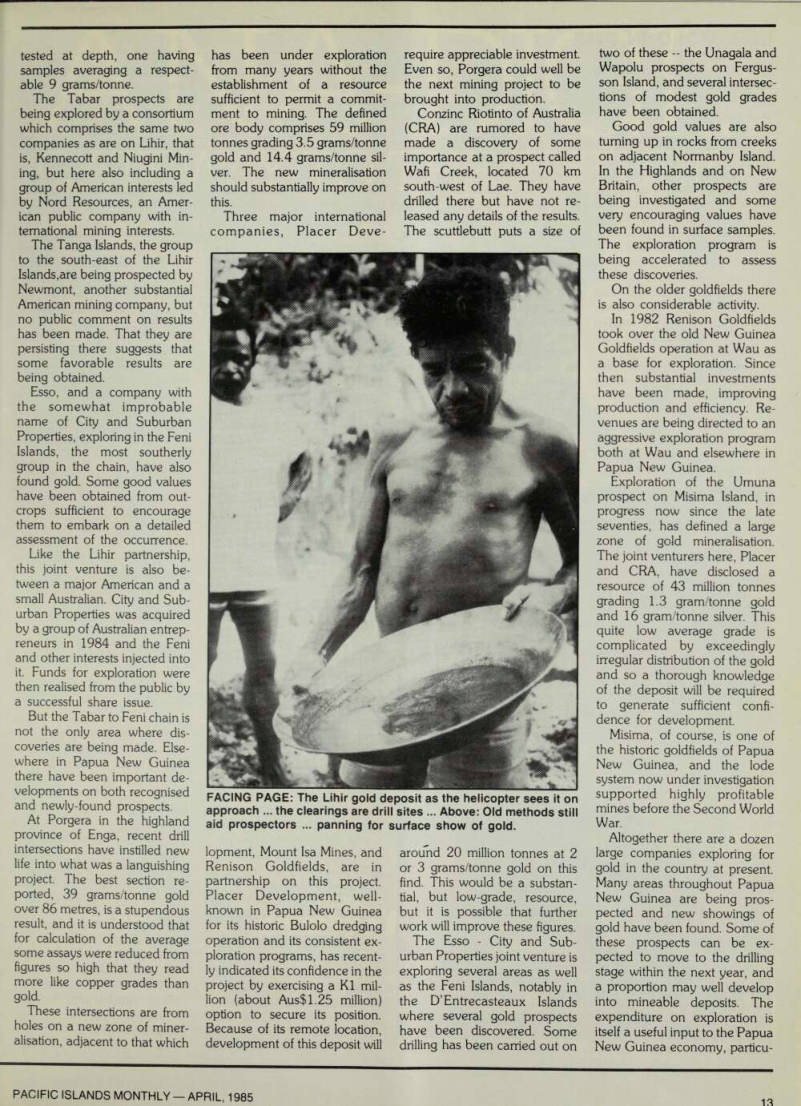
FACING PAGE: The Lihir gold deposit as the helicopter sees it on approach ... the clearings are drill sites ... Above: Old methods still aid prospectors ... panning for surface show of gold.
larly as much is directed to remote areas where there is little other opportunity for any cash income.
Also of importance is an airborne geophysical survey which has lately commenced on Bougainville Island. It is being carried out jointly by the West German government as an aid project, and the Papua New Guinea Geological Survey. Airborne geophysics is an indirect method of prospecting which is unlikely itself to result in immediate mineral discoveries, but the survey is expected to be able to suggest locations favorable for both gold and copper.
Bougainville Island was chosen for this survey because of the considerable interest in exploration there. Both the Bougainville Provincial government and the national government are very dependent on revenues generated by the Pan-
guna mine on Bougainville, but this has a limited life left and is already suffering from falling ore grades. Further, the mining company has a large invest ment in facilities, such as towns and the port, which it would like to see used beyond the exhaus tion of the Panguna reserves.
Because of opposition by the local people, arising from diffi culties in acquiring land for development of the Panguna mine, the island has been closed to exploration since the late sixties. In addition to the expected technical results, the initiation of this project is itself seen as a significant political breakthrough which could lead to opening of the island to general exploration. Bougain ville Island is viewed by geolog ists as one of the most promis ing areas in Papua New Guinea, if only because where there is one large ore body there are good chances of an-
other.
The gold discoveries come at a particularly favorable time for the Papua New Guinea govern ment. Other mining projects are not fulfilling expectations and much of the national planning has looked to future income from mining. Depressed metal prices and its lowered ore grades have reduced revenues from the Panguna mine which alone provides around a quar ter of the government’s funds.
The Ok Tedi project incurred large cost over-runs in construc tion and since commissioning has encountered several op erational difficulties. Gold is now being produced, but is not generating the revenues ex pected. The Papua New Guinea government, which took a 20 per cent equity share in the venture, has indicated it may not contribute further capi tal at this stage.
The operating company has also been forced to delay im plementation of further phases of the project, to introduce copper production, because at the prevailing low copper prices this would result in further losses. The gold zone now being mined has reserves for about three years only, by which time copper must be in production to sustain the pro ject.
During the protracted and complicated negotiations be tween the government and the Ok Tedi consortium, before and after the government’s order closing down operations, a large number of concessions and assurances were offered back and forth across the table.
The government and the min ing company moved positions considerably and several assur ances of further investment were given. But, at time of writing, Ok Tedi was still closed, mainly because the out look for copper prices re mained somewhere between terrible and mediocre... Ed.
It has become evident that, in the foreseeable future, there is little chance of establishing mines on either the Frieda or the Yanderra copper deposits, or on the Ramu nickel-cobalt deposit. Each of these projects had at some stage in the last
decade seemed close to deve lopment. Prices for the metals on which they would depend are exceedingly low and the markets show little prospect of recovery. Of all the common metals it is really only gold, a metal never in over-supply, which commands a sufficient market to attract investment in new projects.
Papua New Guinea at pre sent produces about two per cent of the world’s newly mined gold and ranks about eighth among the producers in the world, although much is exported in copper concen trates for recovery at overseas refineries.
Besides providing a sizeable boost to the domestic eco nomy, development of the new discoveries will improve the country’s trading position and significantly raise its standing as a source of gold for the in ternational market. The political aspects of the successes in gold exploration remain themselves to be explored.
The gold deposit on Lihir is the most significant mineral discovery in Papua New Guinea since Ok Tedi was found in the late sixties. Kenne cott, as is well known, also discovered Ok Tedi, but they failed to develop it due to disagreements with the Papua New Guinea government.
Perhaps, given Ok Tedi’s cur rent difficulties, Kennecott did not miss too much. The Lihir discovery was made within a year of Kennecott re-commen cing active exploration in Papua New Guinea after a 10-year absence. If nothing else, they have displayed an enviable skill as discoverers.
Geologists consider that all of the important gold deposits in Papua New Guinea have been formed by volcanic activity such as is characteristic of the Pacific rim. Similar deposits are pre sent in other Pacific countries - Japan and the Philippines parti cularly seem to be well en dowed, but not all of the region has been equally well pros pected. Notably, there are ex cellent opportunities for dis coveries in some of the little prospected countries of the south-western Pacific region.
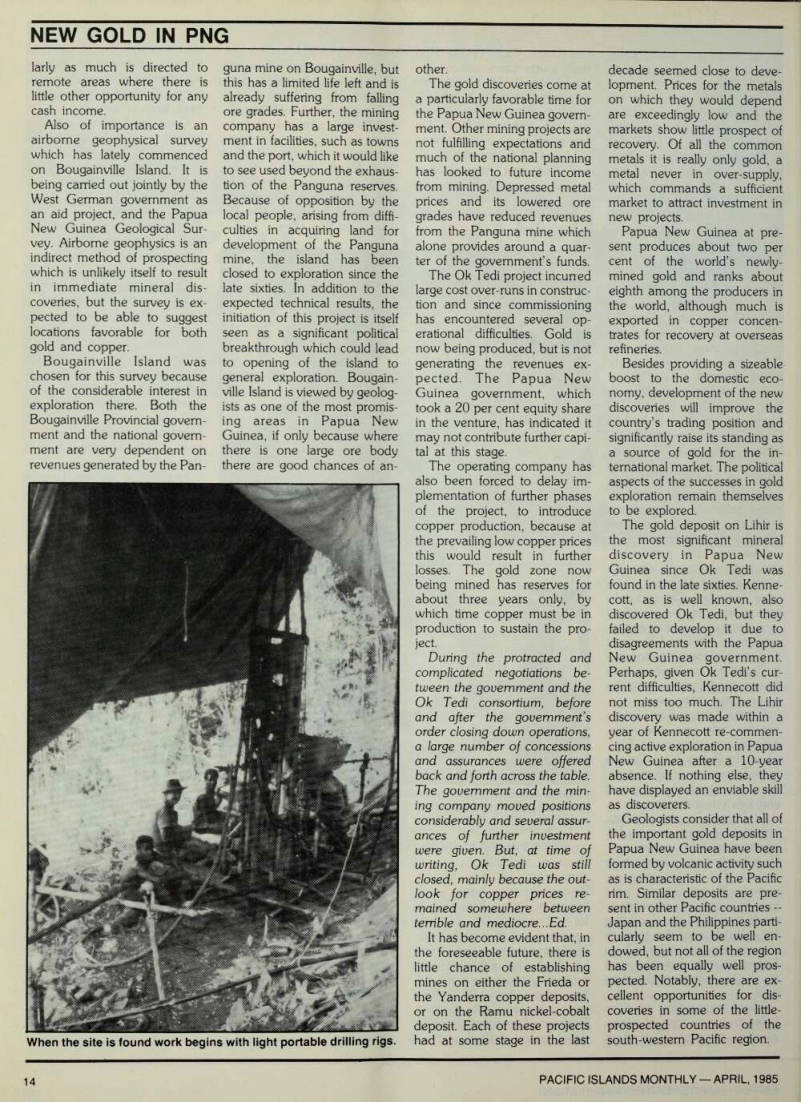
When the site is found work begins with light portable drilling rigs.