Pacific stamp box
p. 54 · Read in the full issue
For the last couple of months I have been offering tips on stamps possibly worth looking at as investments. There can be no guarantee of gain, of course, but it adds spice to the hobby. In response, some readers have asked what makes a stamp valuable. Is it age,face value, the quantity issued, or even the design? Also, which is more valuable, a stamp which has done its job and carried a letter through the mails, or one in mint condition?
No one factor dictates worth; many are involved. But one of the main factors is supply and demand. This was the force behind the investment “bub ble” in the stamp world in the late 1970’5. Almost everyone seemed in tent on getting into what they saw, or were told, was a boom. In fact, the demand made the boom, because stamp dealers were unable to keep up with demand and, inevitably, prices rose as dealers tried to buy back scarce stock to make further sales, thus feed ing the boom. But the time came when demand eased and investors started to unload stocks, just as they do on share markets. Prices fell and fingers were burned.
The boom days are now over and there is stability in the stamp world.
However, there is still, and always will be, investment potential in stamps. The greatest satisfaction comes from collec ting and from the study of stamps, but I can see nothing wrong with also mak ing a little money out of the hobby.
Careful buying can result in some modest profits, usually after a holding period of at least five years.
Age alone is not always an indicator of great value. A New South Wales one-shilling stamp of 1860, used, is worth about $4, whereas a used 1914 one-shilling Australian Occupied Ger man New Guinea stamp is valued at $lOOO. The difference may be summed up in one word - rarity.
Mint stamps are the most sought after by collectors. It is rare for a used stamp to be worth more than a mint example of the same issue, especially if the stamp has never even been hinged into an album, in other words, is pristine.
Australian and most Pacific Islands stamps are very popular with collectors all over the world. Therefore there is a steady, in fact a growing, demand for stamps of the region, particularly if they happen to be rare, and in mint condi-
tion. Early stamps of the Pacific Islands were not issued in great quantities and are therefore potential investments.
Of all the early Pacific stamps, those of Papua New Guinea are the most valuable and the best investment material. Current lower prices are ex pected to rise, reflecting improvement in the economies of some countries such as the U.S.
But, do not forget modern stamps.
There is potential here, too. My recent tips indicate some of these.
Modem stamps are usually produced in huge quantities and so investment material is in the area of stamps which are likely to be overlooked and in the future be” in short supply for collectors.
For example, the 1985 Australia Day stamps could have potential. These were printed in ’tete-beche,’ which means adjoining tennant stamps are inverted. One could hardly go wrong in collecting a block of at least eight of these stamps. A half-sheet could be well worth considering.
I also see the pre-stamped envelopes of Papua New Guinea as a good investment. These were issued in limited numbers and were generally overlooked by collectors at the time of their issue.
The world’s rarest, and therefore
most valuable, stamps now hardly ever come on to the market, and are, of course, well outside the reach of the ordinary, even fairly prosperous, collec tor. But, by following dealers’ valua tions, and reading stamp magazines (and, of course, PlM’s Stamp Box), profits are possible. I furnished my home with the gains I made during the seventies in coins and stamps. That was boom-time, but most experts in the field consider that now is a good time to buy. Prices are low and are expected to rise. You won’t become a millionaire, but you could both have fun, and make some money.
Have you got a favorite stamp design from among those issued in 1984? I’d like to hear your views. Meantime, my preference goes to the lOt PNG Open ing of Parliament House stamp which depicts that spectacular building well.
The whole design, the shape of the stamp, the printing and the lettering all combine to make it my choice for the year.
For the worst stamp my vote goes to the set issued by Tuvalu, showing the crowned heads of Europe. Indeed the whole series from Tuvalu of world leaders - kings and queens, cars, steam trains, and cricketers.
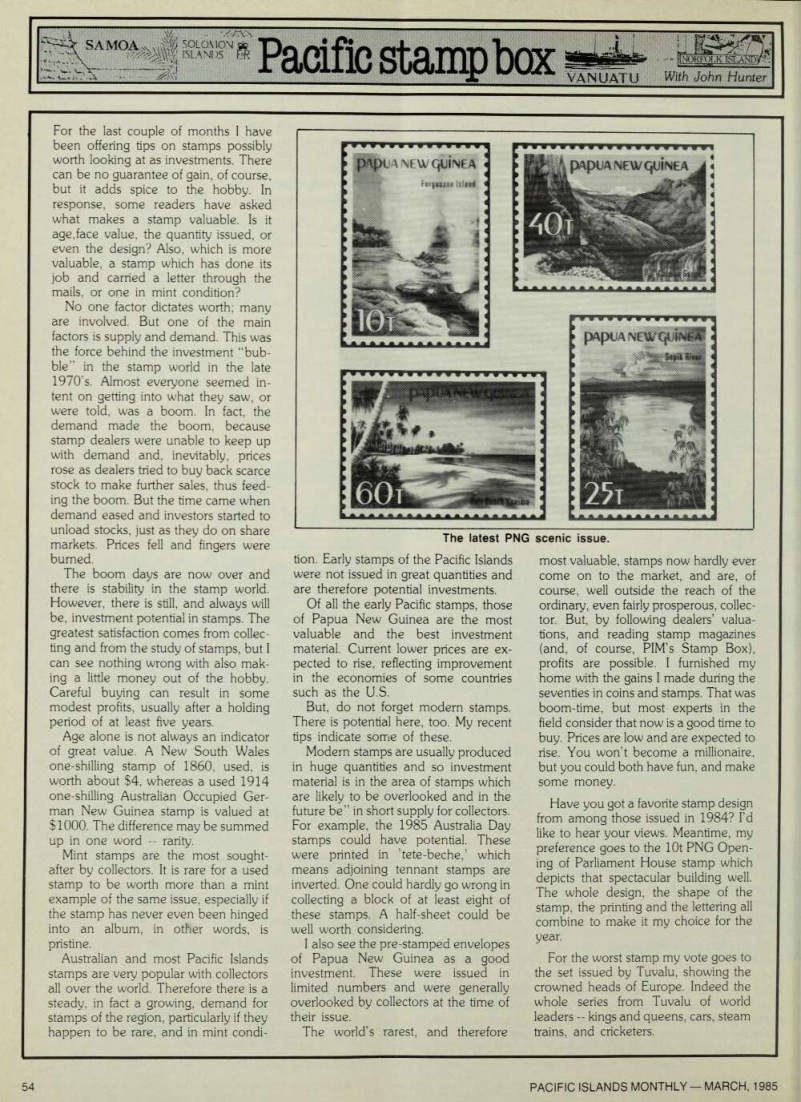
The latest PNG scenic issue.