political currents
pp. 55-56 · Read in the full issue
The rise and rise of French Polynesia’s Gaston Flosse
Constitutions tend to be ab stract and dry, to be consulted only in times of crisis. They do not usually truly reflect the interplay of political forces with in a country. Be that as it may, the new constitutional arrange ments “statutes” in the French Pacific territories of New Caledonia and French Polynesia, voted in by the French Parliament and prom ulgated in September 1984, aroused considerable interest.
As the world knows, im plementation of the New Cale donia statute pushed that terri tory to the brink of civil war. In Polynesia, on the other hand, where there is no deeply rooted and long-standing independ ence movement, the reception of a similar statute was entirely serene.
In Papeete, the capital of French Polynesia, the statute was widely interpreted as a triumph for Gaston Flosse, the leader of the ruling Tahoeraa Huiraatira Party, and close ally of the Right-wing French politi cal leader Jacques Chirac. It was a gift to him from his political enemies, the Mitter rand Socialist government, greatly enhancing his prestige as a politician.
For the governments of the South Pacific countries, the key question concerning the statute is the extent to which it repre sents progress towards self government. On the face of it, it represents a big advance.
According to Article 1 of the statute, Polynesia has been granted internal autonomy, to be freely administered by elected representatives to the Territorial Assembly, which is located in Papeete.
Under the old statute of 1977 the high commisioner, repre senting the French Republic, headed the administration of territorial as well as “state”
While the matter of new constitutional arrangements has led to strife and bloodshed in New Caledonia, in France’s other major Pacific territory, French Polynesia, the statute decreed by France has been put into effect without incident. A recent visitor to Tahiti, BARRY SHINEBERG, discusses the reasons for the different course of events in the two territories, and examines the question of how far the powers of the local government in French Polynesia have really been expanded under the new arrangements.
affairs (i.e. national affairs as they impinge on the territory).
As president of the local gov ernment council, he was head of the territorial public service and in charge of preparing the budget to be submitted to the Territorial Assembly. Territorial politicians such as Gaston Flos se could aspire to the vice presidency or membership of the government council, but the implementation of their policies depended entirely on the co
operation of the high commis sioner and the heads of public service departments.
Under the new statute this set-up is changed to give in creased powers to local politi cians. On September 8, 1984, the Territorial Assembly elected Gaston Flosse president of the council of ministers and a few days later approved the list of ministers which M. Flosse sub mitted. The ministry is in charge of all territorial affairs not speci
fied as lying within the compe tence of the state. It presides over its own public service and is responsible for drafting and presenting the territorial budget to the assembly. These changes have greatly upgraded the political status of Gaston Flosse and have permitted the high commissioner to adopt more of a background role, in the traditional manner of a French prefet.
However, in spite of the changes, the powers of the state remain supreme. The state con trols defence, justice, law and order, nationality, immigration, labor laws, treasury and curren cy matters, postal services, radio, television and telecom munications, upper secondary, tertiary and professional educa tion and the registration of births, deaths and marriages!
Metropolitan powers extend also to the administration of
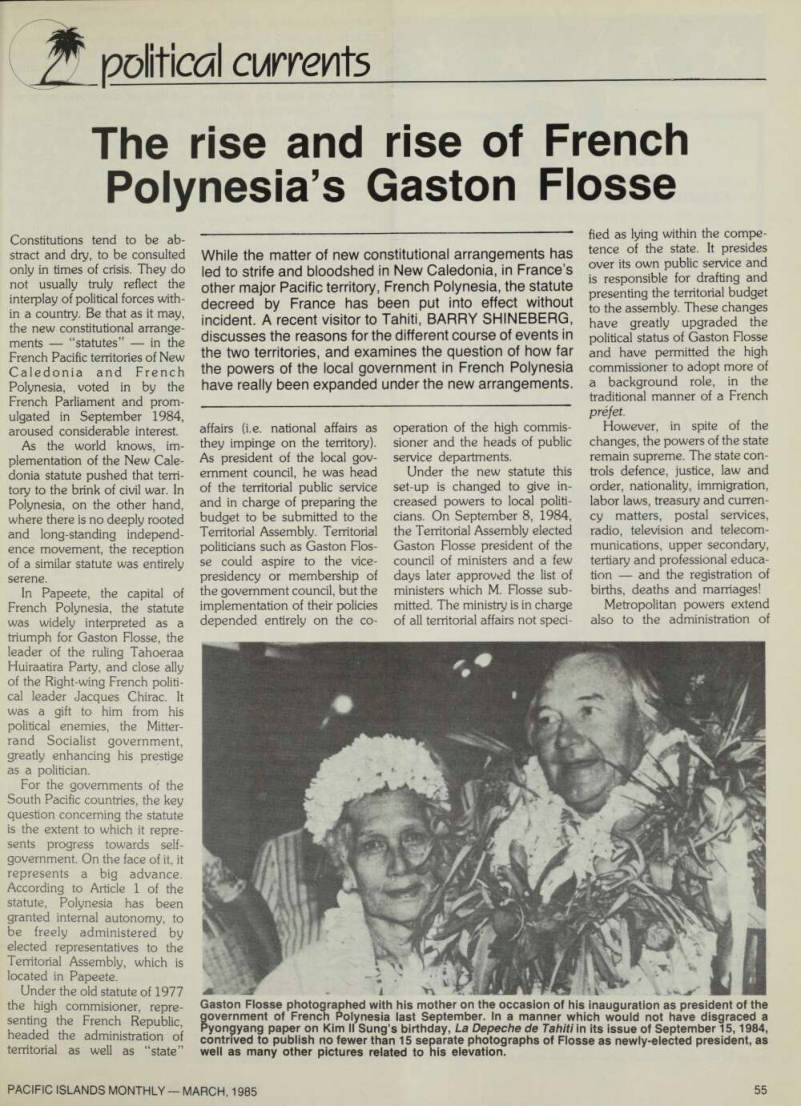
Gaston Flosse photographed with his mother on the occasion of his inauguration as president of the government of French Polynesia last September. In a manner which would not have disgraced a Pyongyang paper on Kim II Sung’s birthday, La Depeche de Tahiti in its issue of September 15,1984, contrived to publish no fewer than 15 separate photographs of Flosse as newly-elected president, as well as many other pictures related to his elevation.
municipal councils, which are closely supervised by the sous prefets or chefs-de-subdiui sions, who are responsible to the high commissioner. Munici pal budgets must be prepared under the guidance of these functionaries before they can be presented to local councils for debate.
Sandwiched in between these two areas of government under strict state control, the powers of the territorial govern ment are scarcely advanced.
They cover the territory budget, transport within the territory, the regulation of local com merce, tourism, health, social services, primary and lower secondary education. Special ised aspects of territory affairs, e.g. the implementation of labor laws, may be taken over from the metropolitan govern ment.
Moreover, the power of the high commissioner will still be great. His control over territory affairs will change from prior to retrospective control, as he may ask ministers and the Territorial Assembly to reconsider de cisions, and refer procedure and decisions with which he disagrees to an administrative tribunal especially set up for this purpose. It will be his function to ensure that the decisions of the Territorial Assembly are ar rived at by correct procedures, and he may dismiss the Territo rial Assembly and call a new election, after having gained approval from Paris, if he con siders the assembly to be un workable.
The limitations which the sta tute places on the powers of the territorial government are freely admitted by M. Flosse. He insists, however, on its “evolu tive” nature, as is stated in Article 1, the possibility being that the powers can be in creased at a later date. At the moment the president is happy that the territory can adopt “distinctive emblems of its re gional identity” a flag and an anthem, for example, which can be exhibited or played alongside the Tricolor and the Marseillaise on official occa sions.
An important aspect of the statute for him is that it permits the projection of M. Flosse as the chief political personality of the territory a result not
unwelcome to the French ad ministration who will be able to share responsibility with the president in the event of a crisis.
What can be said of the form of internal autonomy being set up in French Polynesia?
It cannot be equated with self-government as the term is usually applied in English speaking countries, as the gov ernment is entirely lacking in sovereign powers and cannot impose its authority without the co-operation of the state. In the absence of support from the French Government, the territorial government would be entirely impotent.
There is evidence that a lack of sovereignty encourages irres ponsible behavior in the territo rial government, at least to wards the assembly, if not to wards the electorate which put it into office.
No firm times appear to be set or at least observed for sessions of the assembly.
Opposition members just wait around in the chamber, some times for up to an hour, before the majority members appear, accompanied by assembly president Jacky Teuira.
Gaston Flosse, in spite of his being an elected officer of the assembly, is said to rarely attend sittings. I can testify to the truth of this after attending four sittings of the assembly during the 1984 budget session Flosse did not put in an appearance in all that time.
Consequently, questions con cerning government policy must be put to ministers in charge of particular portfolios rather than to the president.
If it never had any intention of introducing self-government, why has the French Govern ment brought in statutes of this kind? Georges Lemoine, minis ter responsible for overseas de partments and territories, ex plains that they are applications of the decentralisation legisla tion recently implemented throughout the departments of metropolitan France.
Commenting on the initial controversy aroused by the legislation, Mr Lemoine said: “Those who were least in favor of decentralisation would not today be willing for it to be taken away from them.”
President Gaston Flosse of French Polynesia must certainly be one of this number.