Kenilorea looks
pp. 51-53 · Read in the full issue

Optimism in Solomons
Kenilorea looks ahead
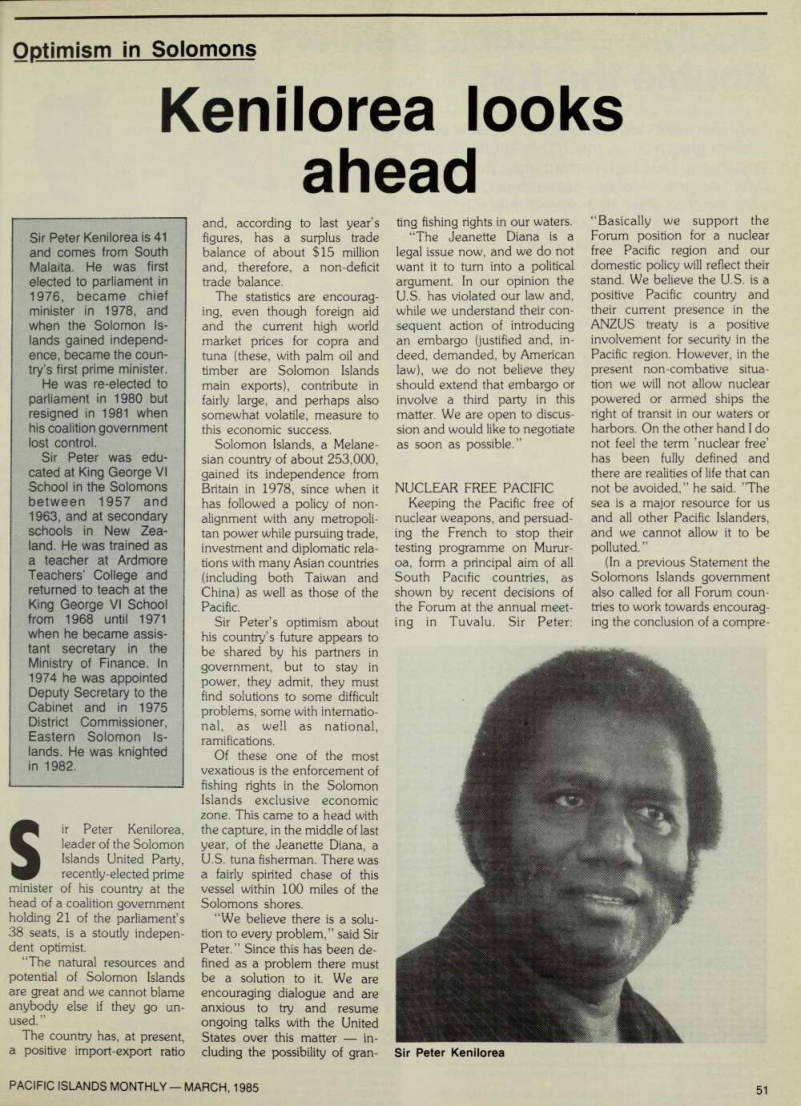
Sir Peter Kenilorea is 41 and comes from South Malaita. He was first elected to parliament in 1976, became chief minister in 1978, and when the Solomon Is lands gained independ ence, became the coun try’s first prime minister.
He was re-elected to parliament in 1980 but resigned in 1981 when his coalition government lost control.
Sir Peter was edu cated at King George VI School in the Solomons between 1957 and 1963, and at secondary schools in New Zea land. He was trained as a teacher at Ardmore Teachers’ College and returned to teach at the King George VI School from 1968 until 1971 when he became assis tant secretary in the Ministry of Finance. In 1974 he was appointed Deputy Secretary to the Cabinet and in 1975 District Commissioner, Eastern Solomon Is lands. He was knighted in 1982.
Sir Peter Kenilorea, leader of the Solomon Islands United Party, recently-elected prime minister of his country at the head of a coalition government holding 21 of the parliament’s 38 seats, is a stoudy indepen dent optimist.
“The natural resources and potential of Solomon Islands are great and we cannot blame anybody else if they go un used.”
The country has, at present, a positive import-export ratio
and, according to last year’s figures, has a surplus trade balance of about $l5 million and, therefore, a non-deficit trade balance.
The statistics are encourag ing, even though foreign aid and the current high world market prices for copra and tuna (these, with palm oil and timber are Solomon Islands main exports), contribute in fairly large, and perhaps also somewhat volatile, measure to this economic success.
Solomon Islands, a Melane sian country of about 253,000, gained its independence from Britain in 1978, since when it has followed a policy of non alignment with any metropoli tan power while pursuing trade, investment and diplomatic rela tions with many Asian countries (including both Taiwan and China) as well as those of the Pacific.
Sir Peter’s optimism about his country’s future appears to be shared by his partners in government, but to stay in power, they admit, they must find solutions to some difficult problems, some with internatio nal, as well as national, ramifications.
Of these one of the most vexatious is the enforcement of fishing rights in the Solomon Islands exclusive economic zone. This came to a head with the capture, in the middle of last year, of the Jeanette Diana, a U.S. tuna fisherman. There was a fairly spirited chase of this vessel within 100 miles of the Solomons shores.
“We believe there is a solu tion to every problem,” said Sir Peter.” Since this has been de fined as a problem there must be a solution to it. We are encouraging dialogue and are anxious to try and resume ongoing talks with the United States over this matter in cluding the possibility of gran
ting fishing rights in our waters.
“The Jeanette Diana is a legal issue now, and we do not want it to turn into a political argument. In our opinion the U.S. has violated our law and, while we understand their con sequent action of introducing an embargo (justified and, in deed, demanded, by American law), we do not believe they should extend that embargo or involve a third party in this matter. We are open to discus sion and would like to negotiate as soon as possible.”
Nuclear Free Pacific
Keeping the Pacific free of nuclear weapons, and persuad ing the French to stop their testing programme on Murur oa, form a principal aim of all South Pacific countries, as shown by recent decisions of the Forum at the annual meet ing in Tuvalu. Sir Peter:
“Basically we support the Forum position for a nuclear free Pacific region and our domestic policy will reflect their stand. We believe the U.S. is a positive Pacific country and their current presence in the ANZUS treaty is a positive involvement for security in the Pacific region. However, in the present non-combative situa tion we will not allow nuclear powered or armed ships the right of transit in our waters or harbors. On the other hand I do not feel the term ’nuclear free’ has been fully defined and there are realities of life that can not be avoided,” he said. ’’The sea is a major resource for us and all other Pacific Islanders, and we cannot allow it to be polluted. ” (In a previous Statement the Solomons Islands government also called for all Forum coun tries to work towards encourag ing the conclusion of a compre-
Sir Peter Kenilorea
hensive test ban treaty that would legally stop the dumping of radio-active wastes and other forms of nuclear waste de trimental to the growth and survival of marine resources in the island countries. This com munication also expressed strong opposition to pollution caused by testing of nuclear devices in the Pacific region).
Economic
Development
Sir Peter concedes that the Solomons economy is delicate and that it continues to depend upon foreign aid to balance the books. “We need foreign aid to help us help ourselves,” he said. While we have benefited this year by others’ misfortunes (the cyclones in the Philippines which damaged their copra crop resulting in high prices being paid to the remaining suppliers), we are very con scious of being an island coun try whose primary products (copra, tuna and palm oil), are at the mercy of world market prices.
“The waters around the Solomons are very rich fishing grounds and we have our own canneries, one in Tulagi in conjunction with a Japanese company, and another one just being built in the Western Pro vince. That is one more reason why we want to resolve the situation with the Jeanette Diana and utilise this natural resource to its best advantage.
“Approximately 85 per cent of the Solomon Islanders still live in villages and 92 per cent of the land is owned by custom ary practice. This could be a hindrance in some ways be cause it is very time-consuming to negotiate title to these lands for development purposes. But we are open and encourage free markets and welcome out side investors that meet our criteria and requirements.”
Sir Peter is quite firm about the criteria. Recently he halted a plan to establish a brewery in Honiara saying that the manu facture of beer was “not real development. ”
While, at the moment, the Solomon Islands enjoys a favorable balance of trade, Sir Peter is well aware of the possibility of cash profits from exports going primarily for the purchase of imported goods and is trying to introduce import
substitution in a number of areas.
Traditional Culture
Like many emergent coun tries, Solomon Islands has tribal or regional divisions. Of these perhaps the most difficult is that involving the Kwaio people of Malaita who have a strong traditional culture and who re cently refused to participate in the national elections. To emphasise their secessionist feelings they destroyed ballot boxes and forced the closure of a Seventh-day Adventist Hospital in the area (PIM, Jan. 1985). Sir Peter, who is himself from Malaita, although not the Kwaio area, puts a very high priority on achievement of national unity.
“Maintenance of traditional culture is an important aspect for orderly development. We must use past values for a foundation and basis for prog ress but we cannot live in today’s world with yesterday’s practices.
“As for the Kwaio; I think both parties are to blame. Also, outside parties, intentionally or not, created an unhealthy situa tion by encouraging the Kwaio people to think they can live in the past. Consequently they find it hard to go along with progress. The Solomon Islands must maintain its cultural identi ty but we cannot live in the past and this message must be put across to people from outside.”
Recently Sir Peter’s govern ment paid the Kwaio Fadanga $lOOO, described as compensa tion for a variety of problems raised by the election and the situation appears to be some what easier.
Melanesian Alliance
Some moves have been made in the region to have a more or less informal grouping of Melanesian nations through which common problems and interests could be discussed and acted upon. The idea is yet very tentative and is not expected to get very far, if only because the individual Melanesian nations themselves are made up of proudly distinct ethnic groups.
“I do not have details of the concept,” said Sir Peter. “In general, however, we do not believe in conclaves of ethnic groupings in the Pacific. This is counter to our stand on regio
nal cohesiveness and co-opera tion.”
New Caledonia
“We support the Forum stance, to do away with col onialism as soon as possible. I do not feel France is sincerely encouraging genuine political development and we encour age France to make arrange ments to administer the govern ment in the best interests of the New Caledonian people,” Sir Peter said.
“We support the move to place New Caledonia on the United Nations agenda for non self-goveming territories. ”
Vanuatu’s prime minister, Father Walter Lini, floated such an idea at the last Forum meeting in Funafuti, but could not get sufficient support. The feeling then appeared to be that the delicacy of the New Caledo nian situation would not be helped by what might turn out to be very clumsy United Na tions intervention, always assuming, they felt, that the Pacific countries were able to carry their proposal undam aged past the very efficient French diplomatic machine in the UN.
Sir Peter: “While we do not intend to interfere in the inter nal affairs of any state, I would be glad to do what I could to help; I was previously a mem ber of the Forum group set up to help New Caledonia negoti ate with France.”
General Policy
In general Sir Peter’s govern ment intends to maintain Solo mon Islands’ position as a full fledged member of the Pacific community. “We are particu larly concerned with the solidar ity of the Pacific, especially the South Pacific,” he said, “and we will take a firm stand to work towards the consolidation of those relationships.”
He said he would welcome “a more permanent presence” of American interests and was “very open-minded and avail able for discussions with all nations. ”We are small, but we value our traditions and our sovereignty. We do not wish to be fragmented or caught in any arguments of the big powers.
“I think the Solomon Islands have a bright future which only we, ourselves, can spoil.”