Fine novel of the human aftermath
p. 41 · Read in the full issue
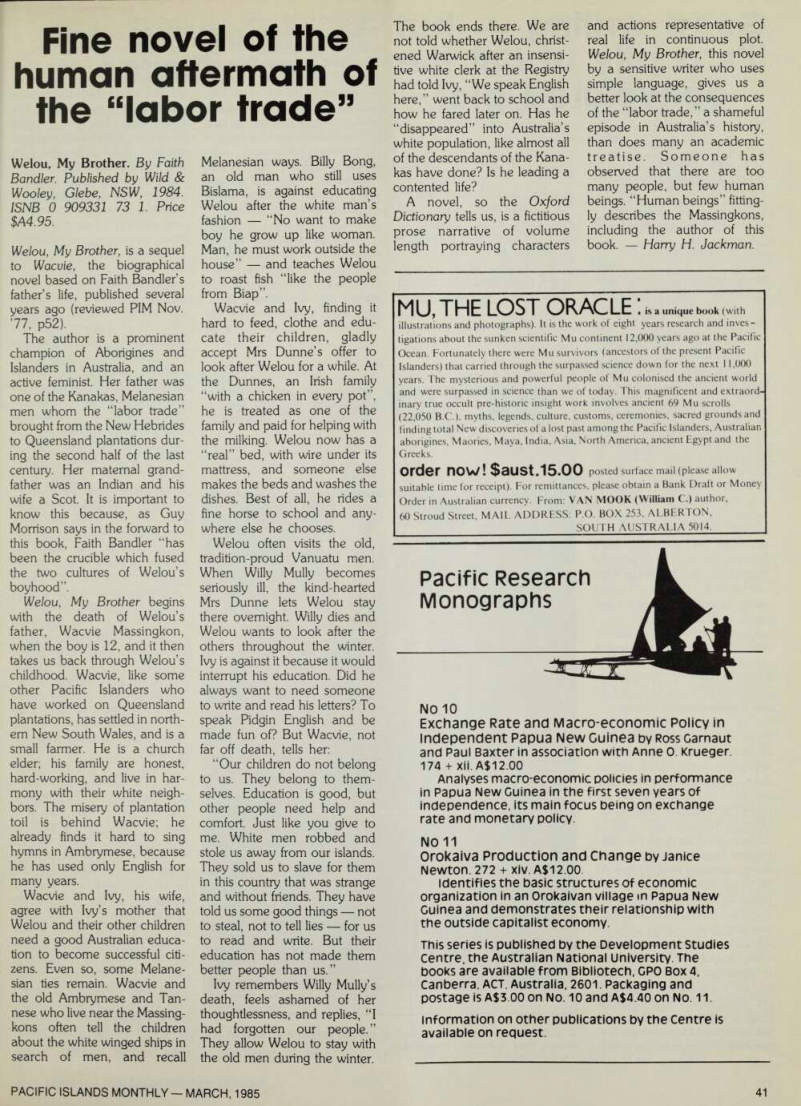
human aftermath of the “labor trade”
Welou, My Brother. By Faith Bandler. Published by Wild & Wooley, Glebe, NSW, 1984.
ISNB 0 909331 73 1. Price $A4.95.
Welou, My Brother, is a sequel to Wacvie, the biographical novel based on Faith Bandler’s father’s life, published several years ago (reviewed PIM Nov. 77, P 52).
The author is a prominent champion of Aborigines and Islanders in Australia, and an active feminist. Her father was one of the Kanakas, Melanesian men whom the “labor trade” brought from the New Hebrides to Queensland plantations dur ing the second half of the last century. Her maternal grand father was an Indian and his wife a Scot. It is important to know this because, as Guy Morrison says in the forward to this book, Faith Bandler “has been the crucible which fused the two cultures of Welou’s boyhood”.
Welou, My Brother begins with the death of Welou’s father, Wacvie Massingkon, when the boy is 12, and it then takes us back through Welou’s childhood. Wacvie, like some other Pacific Islanders who have worked on Queensland plantations, has settled in north ern New South Wales, and is a small farmer. He is a church elder; his family are honest, hard-working, and live in har mony with their white neigh bors. The misery of plantation toil is behind Wacvie; he already finds it hard to sing hymns in Ambrymese, because he has used only English for many years.
Wacvie and Ivy, his wife, agree with Ivy’s mother that Welou and their other children need a good Australian educa tion to become successful citi zens. Even so, some Melane sian ties remain. Wacvie and the old Ambrymese and Tan nese who live near the Massing kons often tell the children about the white winged ships in search of men, and recall
Melanesian ways. Billy Bong, an old man who still uses Bislama, is against educating Welou after the white man’s fashion “No want to make boy he grow up like woman.
Man, he must work outside the house” and teaches Welou to roast fish “like the people from Biap”.
Wacvie and Ivy, finding it hard to feed, clothe and edu cate their children, gladly accept Mrs Dunne’s offer to look after Welou for a while. At the Dunnes, an Irish family “with a chicken in every pot”, he is treated as one of the family and paid for helping with the milking. Welou now has a “real” bed, with wire under its mattress, and someone else makes the beds and washes the dishes. Best of all, he rides a fine horse to school and any where else he chooses.
Welou often visits the old, tradition-proud Vanuatu men.
When Willy Mully becomes seriously ill, the kind-hearted Mrs Dunne lets Welou stay there overnight. Willy dies and Welou wants to look after the others throughout the winter.
Ivy is against it because it would interrupt his education. Did he always want to need someone to write and read his letters? To speak Pidgin English and be made fun of? But Wacvie, not far off death, tells her: “Our children do not belong to us. They belong to them selves. Education is good, but other people need help and comfort. Just like you give to me. White men robbed and stole us away from our islands.
They sold us to slave for them in this country that was strange and without friends. They have told us some good things not to steal, not to tell lies for us to read and write. But their education has not made them better people than us.”
Ivy remembers Willy Mully’s death, feels ashamed of her thoughtlessness, and replies, “I had forgotten our people.”
They allow Welou to stay with the old men during the winter.
The book ends there. We are not told whether Welou, christ ened Warwick after an insensi tive white clerk at the Registry had told Ivy, “We speak English here,” went back to school and how he fared later on. Has he “disappeared” into Australia’s white population, like almost all of the descendants of the Kana kas have done? Is he leading a contented life?
A novel, so the Oxford Dictionary tells us, is a fictitious prose narrative of volume length portraying characters
and actions representative of real life in continuous plot.
Welou, My Brother, this novel by a sensitive writer who uses simple language, gives us a better look at the consequences of the “labor trade,” a shameful episode in Australia’s history, than does many an academic treatise. Someone has observed that there are too many people, but few human beings. “Human beings” fitting ly describes the Massingkons, including the author of this
book.
Harry H. Jackman.