convoluted plot
p. 42 · Read in the full issue
Good writing but it’s a pity about the convoluted plot
The Sky People. By John Emery. Published 1984 by Rig by Publishers, P.O. Box 60, Dee Why, NSW 2099. ISBN 0 7270 1889 1. Price $A515.95.
This is an ambitious, but ulti mately unconvincing, novel based largely on some well known incidents in the history of the Papua New Guinea Highlands, with a dash of cargo cult and 1937 Rabaul volcanic eruption thrown in.
I have found it a difficult book to review, on a number of counts. The story is unfolded through the mouths of a large cast of characters in a jumpy and abrupt fashion which sometimes makes it hard to follow. The characters them selves are a strange lot, particu larly the whites, and while it is certainly true that some ex tremely odd characters were attracted to the old New Guinea, most were average Australians, and a number were outstanding. You won’t meet many ordinary people in the pages of this book.
Fair enough this is a novel, not a historical treatise, and a novelist has a certain licence. I found it difficult, though, to recognise in this novel much of the Highlands that I knew.
The story principally con cerns a patrol officer, Edward Nicholls, and a newly appointed cadet, Don Harris.
Both are involved with local women. They are sent on the trail of a renegade prospector, Herman Ludwig, who leads a ruthless band through the New Guinea Highlands, looting, kill ing and raping as they go. All kinds of mayhem results. Old hands will clearly recognise the real-life Ludwig Schmitt, who was the first and only white man to be executed tin 1936) in pre-war New Guinea, for atrocities committed by him and his party against Highland ers and Sepik River people.
Early in the story, another pros pector is killed by tribesmen in precisely the manner in which
Bernard McGrath met his end in 1933. Nicholls himself is attacked, and although wearing home-made armor is wounded and loses a leg. Shades of Albert Nurton, who suffered a similar fate on the Rai Coast in 1936 also while wearing armor, made from a fifty-pound biscuit tin lined with cotton wool.
Real-life characters who are
mentioned in this book include Mick Leahy and Jim Taylor, and the Administrator of the Mandated Territory, Brigadier- General W. Ramsay McNicoll although his name is mis spelled as McNicol. The author, who was brought up in Lae, also acknowledges the help of “eye-witness informants,” John Black and Robert Emery. He had access to the unpublished diaries of the late Mick Leahy (which I have also studied).
The novel, then, has a strong historical underpinning, and it is obvious that the author knows the country and its people. His writing, too, is clean and effec tive. It is a pity that he has concocted such a lurid, convo
luted plot.
The theme of the novel, in the words of the jacket blurb, is “the clash of cultures in a primitive land ... the inevitable conflict when two civilisations collide.” It is in this area the book fails, for me. I must emphasise that this is a personal reaction; those unfamiliar with the Highlands and the High landers at an early stage of contact could doubtless find the author’s treatment convincing and exciting. I found the con stant emphasis on violence, bloodshed, sorcery, treachery and sexual shenanigans ulti mately tiresome, and unneces sary. Many patrol officers and prospectors formed liaisons with local women in New Guinea, but many more did not. Some female visitors to the Islands were ripe for sexual adventure, but by no means all.
There were normal, well-ad justed wives of white officials in New Guinea, although one would not think so from a reading of this novel. There is no light relief, no humor, in these pages, and life as I re member it on first-contact pat rols was frequently amusing, and often droll.
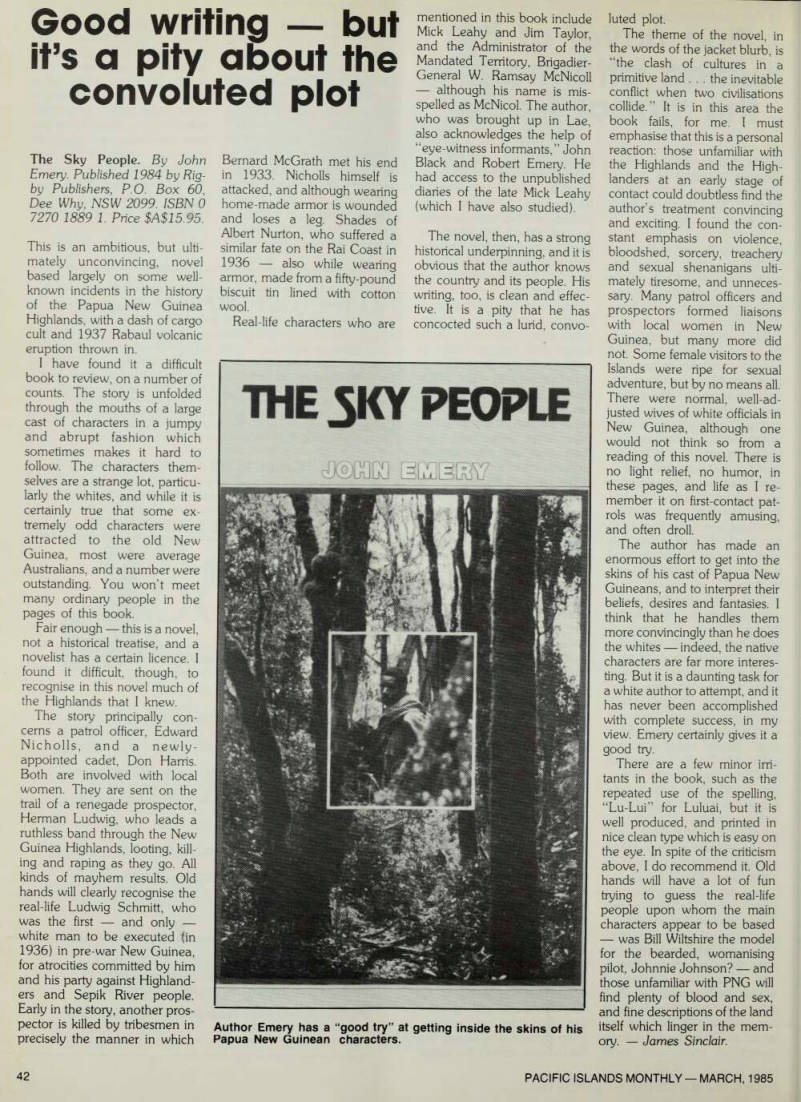
The author has made an enormous effort to get into the skins of his cast of Papua New Guineans, and to interpret their beliefs, desires and fantasies. I think that he handles them more convincingly than he does the whites — indeed, the native characters are far more interes ting. But it is a daunting task for a white author to attempt, and it has never been accomplished with complete success, in my view. Emery certainly gives it a good try.
There are a few minor irri tants in the book, such as the repeated use of the spelling, “Lu-Lui” for Luluai, but it is well produced, and printed in nice clean type which is easy on the eye. In spite of the criticism above, I do recommend it. Old hands will have a lot of fun trying to guess the real-life people upon whom the main characters appear to be based — was Bill Wiltshire the model for the bearded, womanising pilot, Johnnie Johnson? — and those unfamiliar with PNG will find plenty of blood and sex, and fine descriptions of the land itself which linger in the mem
ory.
James Sinclair.