backyard vegetable patch
pp. 39-40 · Read in the full issue
books
How two cultures meet in the backyard vegetable patch
1000 Years of Gardening in New Zealand. By Helen Leach. Published by A. H. &A.
IV. Reed Ltd., Wellington, 1984. 157 pp. ISBN 0 589 01488 9. Price $NZ29.95 Throughout the Pacific, and in countless suburban gardens in cities like Sydney, Auckland and Honolulu one can find a kind of kitchen garden which occurs nowhere else in the world. So widespread is its mixture of kumara and pump kins, rhubarb and passionfruit, that we forget its uniqueness. In 1000 Years of Gardening In New Zealand Helen Leach takes us on a journey through time which culminates in the multi-cultural New Zealand gar den of the late 20th century.
Helen Leach is a senior lecturer in pre-history in the department of anthropology at the University of Otago. In a sense, this book began with her archeological work in Palliser Bay between 1969 and 1972. It continued in 1980 and 1981 when she was a Rhodes Fellow at Oxford University resear ching the origins of the English kitchen garden. At New Zea land’s Palliser Bay Helen Leach excavated Maori gardens of the 13th to 16th centuries, and at Oxford she studied evidence of English gardening going back to Roman gardens of the first century, and even of the Early Iron Age gardens which the Romans may have seen ves tiges of in 43 A.D. This has enabled her to trace “a blend of two acient gardening traditions brought to (New Zealand) in the last 1000 years the first from the warm tropical islands of Polynesia, the second from the much cooler islands of Great Britain.”
Two broad pictures quickly
emerge. The Polynesian migrants to New Zealand ar rived between 700 and 800 A.D. “with a collection of veget ables and tree fruits which, with the exception of the sweet potato (of South American ori gin), had been domesticated in the tropical islands of the west ern Pacific and in Southeast Asia and progressively transfer red to islands further east. ” The European gardeners who reached New Zealand from the 1800 s brought fruits and veget ables which had been “domesticated in the Near East and around the shores of the
Mediterranean, and had later become acclimatised to the col der conditions of northern Europe. Added to these plants were certain ‘newcomers’ from the Americas, introduced to Europe mostly by Columbus and his successors.” To plant some taro beside a lettuce is to continue this mingling in your own garden today. Almost in passing, Helen Leach throws much light on the development of the Pacific side of this agricultural marriage, for she is intent on explaining the type of garden which reached New Zealand with its first human
occupants.
We know that the inhabitants of Highland New Guinea began cultivating gardens around 7000 B.C. The evidence comes from Kuk in the Waghi Valley.
Claims for early horticulture in Southeast Asia take us to caves in northwest Thailand and the Hoabinhian culture of 10,000 B.C. in present-day Vietnam.
By comparison, Near Eastern gardening has been traced to pieces of onion, garlic and Egyptian leek in a cave near the Dead Sea dated around 3500- 3000 B.C. The Peruvian Andes may have seen gardening as
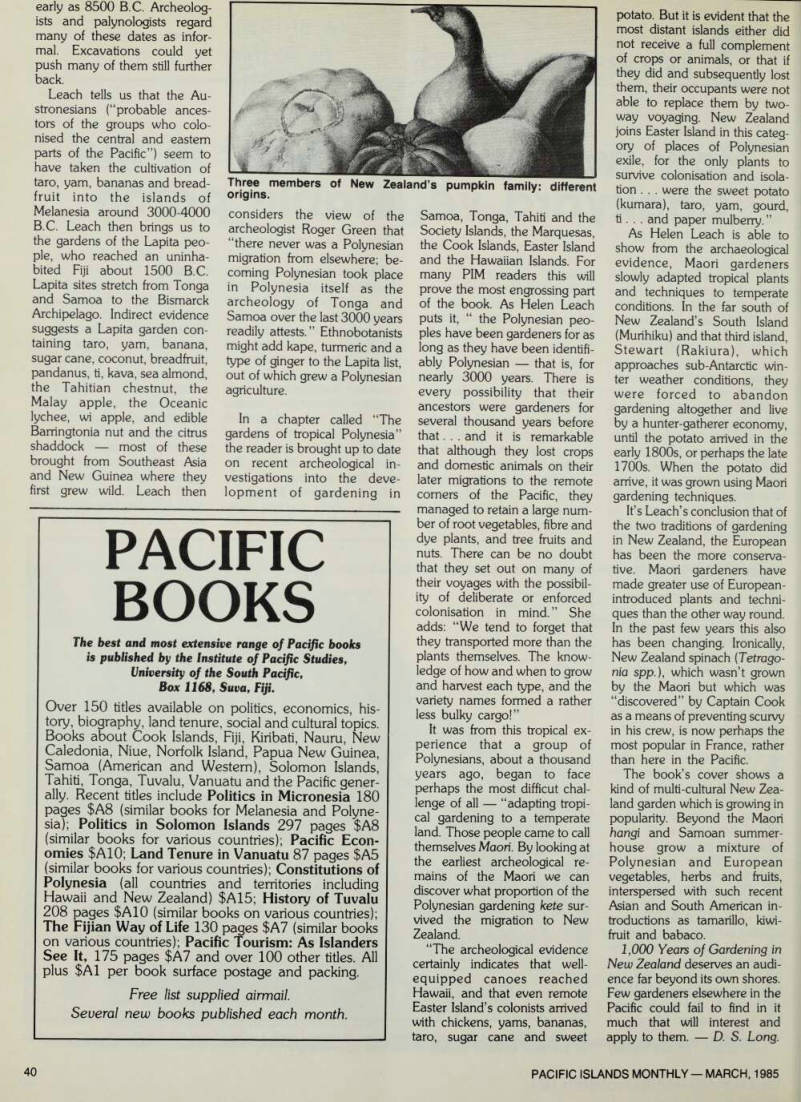
Nancy Tichborne’s drawing for the cover of Helen Leach’s book shows the “multi-cultural” character of the New Zealand garden of the late 20th century.
early as 8500 B.C. Archeolog ists and palynologists regard many of these dates as infor mal. Excavations could yet push many of them still further back.
Leach tells us that the Au stronesians (“probable ances tors of the groups who colo nised the central and eastern parts of the Pacific”) seem to have taken the cultivation of taro, yam, bananas and bread fruit into the islands of Melanesia around 3000-4000 B.C. Leach then brings us to the gardens of the Lapita peo ple, who reached an uninha bited Fiji about 1500 B.C.
Lapita sites stretch from Tonga and Samoa to the Bismarck Archipelago. Indirect evidence suggests a Lapita garden con taining taro, yam, banana, sugar cane, coconut, breadfruit, pandanus, ti, kava, sea almond, the Tahitian chestnut, the Malay apple, the Oceanic lychee, wi apple, and edible Barringtonia nut and the citrus shaddock most of these brought from Southeast Asia and New Guinea where they first grew wild. Leach then
considers the view of the archeologist Roger Green that “there never was a Polynesian migration from elsewhere; be coming Polynesian took place in Polynesia itself as the archeology of Tonga and Samoa over the last 3000 years readily attests.” Ethnobotanists might add kape, turmeric and a type of ginger to the Lapita list, out of which grew a Polynesian agriculture.
In a chapter called “The gardens of tropical Polynesia” the reader is brought up to date on recent archeological in vestigations into the deve lopment of gardening in
Samoa, Tonga, Tahiti and the Society Islands, the Marquesas, the Cook Islands, Easter Island and the Hawaiian Islands. For many PIM readers this will prove the most engrossing part of the book. As Helen Leach puts it, “ the Polynesian peo ples have been gardeners for as long as they have been identifi ably Polynesian that is, for nearly 3000 years. There is every possibility that their ancestors were gardeners for several thousand years before that. . . and it is remarkable that although they lost crops and domestic animals on their later migrations to the remote comers of the Pacific, they managed to retain a large num ber of root vegetables, fibre and dye plants, and tree fruits and nuts. There can be no doubt that they set out on many of their voyages with the possibil ity of deliberate or enforced colonisation in mind.” She adds: “We tend to forget that they transported more than the plants themselves. The know ledge of how and when to grow and harvest each type, and the variety names formed a rather less bulky cargo!”
It was from this tropical ex perience that a group of Polynesians, about a thousand years ago, began to face perhaps the most difficut chal lenge of all “adapting tropi cal gardening to a temperate land. Those people came to call themselves Maori. By looking at the earliest archeological re mains of the Maori we can discover what proportion of the Polynesian gardening kete sur vived the migration to New Zealand.
“The archeological evidence certainly indicates that well equipped canoes reached Hawaii, and that even remote Easter Island’s colonists arrived with chickens, yams, bananas, taro, sugar cane and sweet
potato. But it is evident that the most distant islands either did not receive a full complement of crops or animals, or that if they did and subsequently lost them, their occupants were not able to replace them by two way voyaging. New Zealand joins Easter Island in this categ ory of places of Polynesian exile, for the only plants to survive colonisation and isola tion . . . were the sweet potato (kumara), taro, yam, gourd, ti. . . and paper mulberry. ”
As Helen Leach is able to show from the archaeological evidence, Maori gardeners slowly adapted tropical plants and techniques to temperate conditions. In the far south of New Zealand’s South Island (Murihiku) and that third island, Stewart (Rakiura), which approaches sub-Antarctic win ter weather conditions, they were forced to abandon gardening altogether and live by a hunter-gatherer economy, until the potato arrived in the early 1800 s, or perhaps the late 1700 s. When the potato did arrive, it was grown using Maori gardening techniques.
It’s Leach’s conclusion that of the two traditions of gardening in New Zealand, the European has been the more conserva tive. Maori gardeners have made greater use of European introduced plants and techni ques than the other way round.
In the past few years this also has been changing. Ironically, New Zealand spinach (Tetrago nia spp.), which wasn’t grown by the Maori but which was “discovered” by Captain Cook as a means of preventing scurvy in his crew, is now perhaps the most popular in France, rather than here in the Pacific.
The book’s cover shows a kind of multi-cultural New Zea land garden which is growing in popularity. Beyond the Maori hangi and Samoan summer house grow a mixture of Polynesian and European vegetables, herbs and fruits, interspersed with such recent Asian and South American in troductions as tamarillo, kiwi fruit and babaco. 1,000 Years of Gardening in New Zealand deserves an audi ence far beyond its own shores.
Few gardeners elsewhere in the Pacific could fail to find in it much that will interest and
apply to them.
D. S. Long.
Three members of New Zealand’s pumpkin family: different origins.