Hawaii tourism
pp. 37-38 · Read in the full issue
boomed in ’84
Hawaii recorded a booming 1984 tourism year. An esti mated 4.7 million visitors came to Hawaii, a 9 per cent increase over 1983. The only better year in recent times was 1976, which recorded a 13.8 per cent in crease over the previous year.
The Hawaii Visitors Bureau re ported, for instance, that November 1984 showed a 15 per cent increase over the pre vious November. Some 380,430 tourists visited Hawaii, including 24,000 for a National Association of Realtors conven tion. The healthy state of Hawaii’s tourism industry, worth about $4 billion annually, is clearly evident in the airline picture. • United Air Lines, which carries about 50 per cent of all traffic to and from the U.S. mainland, was fully booked from mid-December through early January, traditionally one
of the busiest times. American Airlines, the No. 2 carrier, has been busily expanding its role in Hawaii. It will add a daily non-stop flight from Honolulu to Chicago in early May. That is in addition to its recently inau
gurated twice-daily service from Maui to the mainland. Amer ican also began a third daily flight between Honolulu and Los Angeles in early January.
When it begins its expanded service in May, American will have two daily departures from Maui and eight from Honolulu.
United has 21 flights a day to Hawaii, seven of them to the Neighbor Islands. Delta Air lines, the second largest in the United States, has also begun service to Hawaii from the U.S.
east coast through the booming Dallas-Fort Worth area in Texas.
HVB statistics for 1984 showed that the number of foreign tourists grew at a faster rate than from other U.S. loca tions. This follows increased promotional efforts by HVB in Canada, Europe and the Far East. In November, for exam ple, 299,760 tourists came from the mainland, Canada or Europe, up 18 per cent from
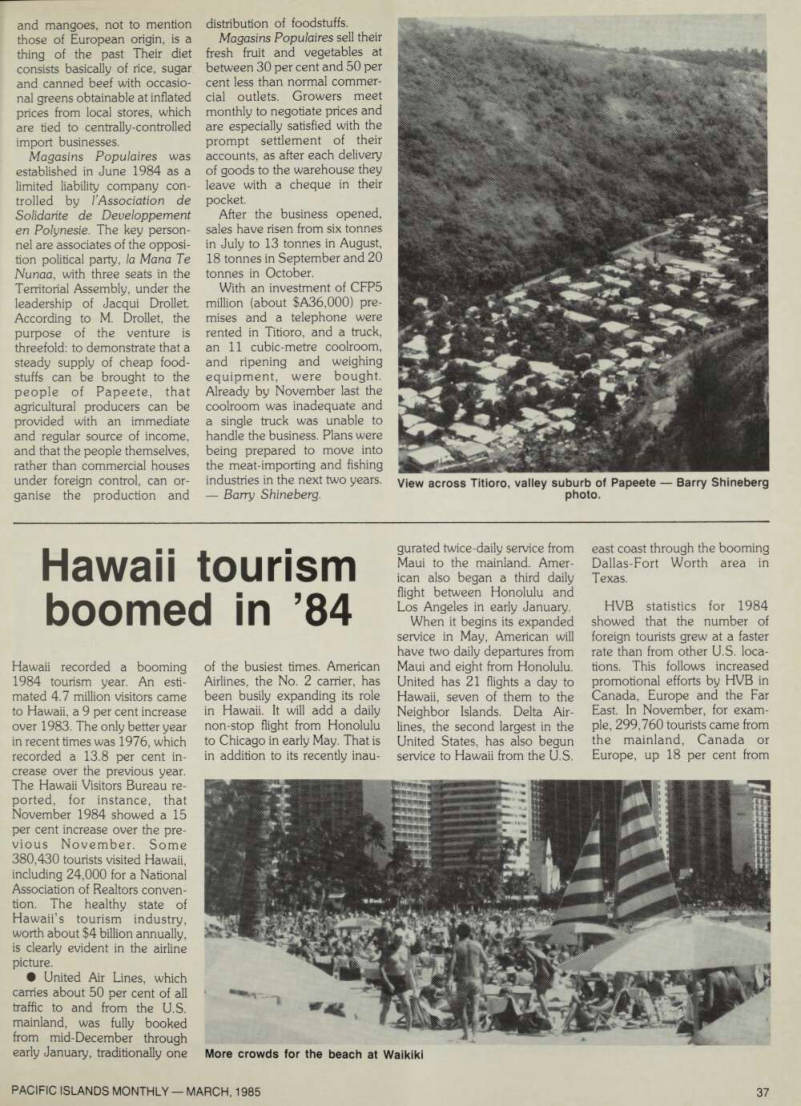
More crowds for the beach at Waikiki
the previous November. There were 80,670 visitors from Asia and Oceania, an increase of 7 per cent. Oahu, where Waikiki is located, is still drawing the most visitors with a November monthly total of 240,620, a 22 per cent increase. But popular Maui had 149,990 tourists, an increase of 16 per cent. The two other major islands, Kauai and Hawaii, registered between 60,000 and 65,000 visitor arri vals. • Fiji’s visitor intake rose by 23 per cent in the year to October, 1984. Visitors from Australia increased 15.8 per cent, from New Zealand 15.2 per cent, and from other coun tries 33.7 per cent. In the month of October a total of 21,729 visitors entered Fiji. • Over the 1984-85 holiday period, cancellations of New Caledonian tourist bookings by Australians were running at 20 per cent. Tourist industry sources said the cancellations, due to political unrest, would cost the French territory at least SAI million over the holiday period.
F/oyd K. Takeuchi in Honolulu.
Geomarex
active in
Kiribati
The U.S. -based exploration firm, Geomarex, has been granted a joint licence over the lagoons of Tabuaeran (formerly Fanning Island) and Kiritimati (formerly Christmas Island) for the market evaluation and pos sible development of their carbonate sands. The licence was granted by the Republic of Kiribati, the world’s largest archipelago, joining the Gilbert, Phoenix and Line Islands in the central Pacific.
Dr Andre Rossfelder, presi dent of Geomarex, announcing the approval, said the two large atolls were selected for their geographical location south of Hawaii, for their ready access to dredging and shipping, and for their huge resources of very high-grade carbonate sands already recognised by drilling.
Geomarex is a privately owned corporation which has been active through the Pacific Islands for a number of years
with two major discoveries to its credit - a phosphate deposit in French Polynesia now, accor ding to Dr Rossfelder, ready to be mined, and a chromite de posit in the south-west Pacific still under development.
Consortium
for
Stamps
For many of the smaller Pacific Islands countries stamps repre sent a major source of income.
The region’s colorful, and often unusual, stamp issues are eagerly sought by collectors all over the world and a brisk trade has developed. Some coun tries, however, have rather spoilt their chances by aiming too blatantly for the dollar and ignoring some of the basics of philately, one of which is that stamps ought to be relevant and desirable. A Pacific country which pushed out a bulky series depicting medieval knights ajousting, or historic Bavarian cuckoo clocks aticking, could
find itself accused of trying to rip off collectors.
Now there is an effort to improve the quality of island stamps, and extend their range.
It kicked off at Ausipex, the international stamp fair held in Melbourne last year when Paci fic stamp officials met to discuss issue of a Pacifica series invol ving all the ocean’s countries.
“We would aim to have a common theme in the stamps so that we can project the area as an entity,” said South Pacific Trade Commissioner, Bill McCabe, who was one of the organisers of the project. “This would be of value particularly in markets in North America, Japan and Europe.”
Seven countries committed themselves at that meeting and formed the Pacifica group to promote stamp sales. The idea is not only to push stamp sales, but to provide a vehicle for assisting smaller island coun tries by the more developed countries in the region. Stamps are not easy to promote, says Mr McCabe, but everyone is very hopeful about Pacifica.