off in Tahiti
pp. 36-37 · Read in the full issue
Mobile stores take off in Tahiti
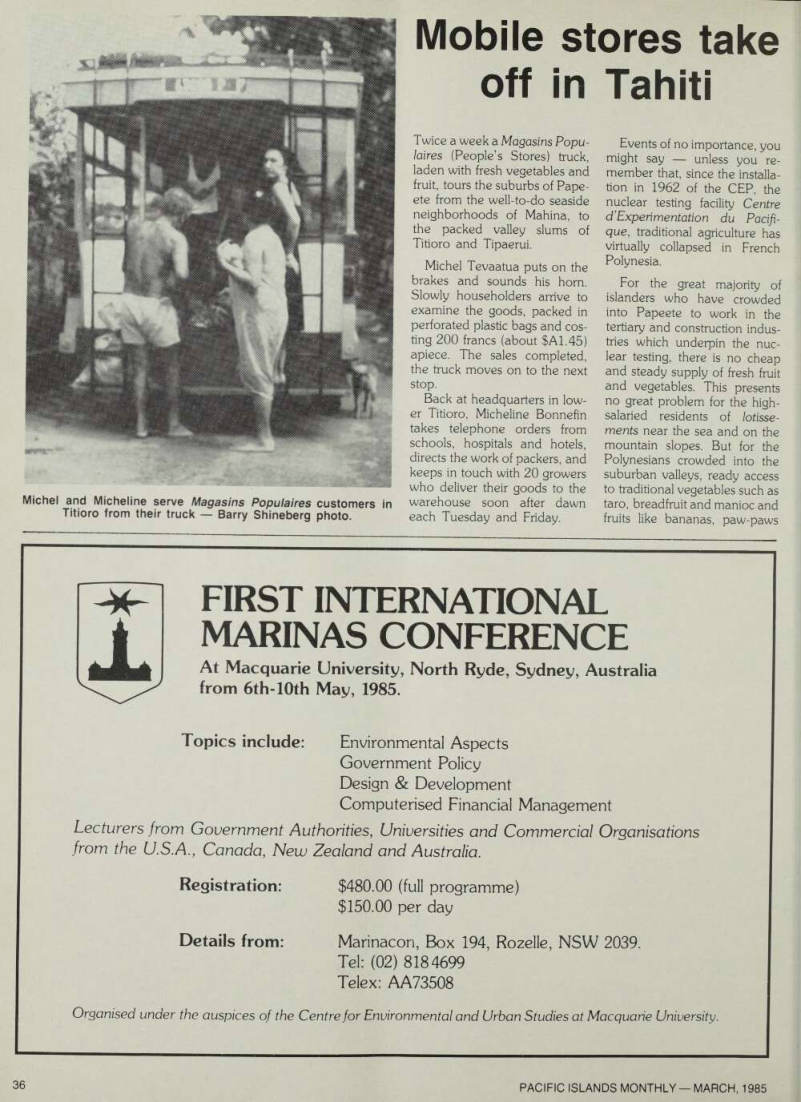
Twice a week a Magasins Popu lates (People’s Stores) truck, laden with fresh vegetables and fruit, tours the suburbs of Pape ete from the well-to-do seaside neighborhoods of Mahina, to the packed valley slums of Titioro and Tipaerui.
Michel Tevaatua puts on the brakes and sounds his horn.
Slowly householders arrive to examine the goods, packed in perforated plastic bags and cos ting 200 francs (about $A1.45) apiece. The sales completed, the truck moves on to the next stop.
Back at headquarters in low er Titioro, Micheline Bonnefin takes telephone orders from schools, hospitals and hotels, directs the work of packers, and keeps in touch with 20 growers who deliver their goods to the warehouse soon after dawn each Tuesday and Friday.
Events of no importance, you might say unless you re member that, since the installa tion in 1962 of the CEP, the nuclear testing facility Centre d’Experimentation du Pacifi que, traditional agriculture has virtually collapsed in French Polynesia.
For the great majority of islanders who have crowded into Papeete to work in the tertiary and construction indus tries which underpin the nuc lear testing, there is no cheap and steady supply of fresh fruit and vegetables. This presents no great problem for the high salaried residents of lotisse ments near the sea and on the mountain slopes. But for the Polynesians crowded into the suburban valleys, ready access to traditional vegetables such as taro, breadfruit and manioc and fruits like bananas, paw-paws
Michel and Micheline serve Magasins Populaires customers in Titioro from their truck Barry Shineberg photo.
and mangoes, not to mention those of European origin, is a thing of the past Their diet consists basically of rice, sugar and canned beef with occasio nal greens obtainable at inflated prices from local stores, which are tied to centrally-controlled import businesses.
Magasins Populaires was established in June 1984 as a limited liability company con trolled by I’Association de Solidarite de Developpement en Polynesia. The key person nel are associates of the opposi tion political party, la Mana Te Nunaa, with three seats in the Territorial Assembly, under the leadership of Jacqui Drollet.
According to M. Drollet, the purpose of the venture is threefold: to demonstrate that a steady supply of cheap food stuffs can be brought to the people of Papeete, that agricultural producers can be provided with an immediate and regular source of income, and that the people themselves, rather than commercial houses under foreign control, can or ganise the production and
distribution of foodstuffs.
Magasins Populaires sell their fresh fruit and vegetables at between 30 per cent and 50 per cent less than normal commer cial outlets. Growers meet monthly to negotiate prices and are especially satisfied with the prompt settlement of their accounts, as after each delivery of goods to the warehouse they leave with a cheque in their pocket.
After the business opened, sales have risen from six tonnes in July to 13 tonnes in August, 18 tonnes in September and 20 tonnes in October.
With an investment of CFPS million (about $A36,000) pre mises and a telephone were rented in Titioro, and a truck, an 11 cubic-metre coolroom, and ripening and weighing equipment, were bought.
Already by November last the coolroom was inadequate and a single truck was unable to handle the business. Plans were being prepared to move into the meat-importing and fishing industries in the next two years.
Barry Shineberg.
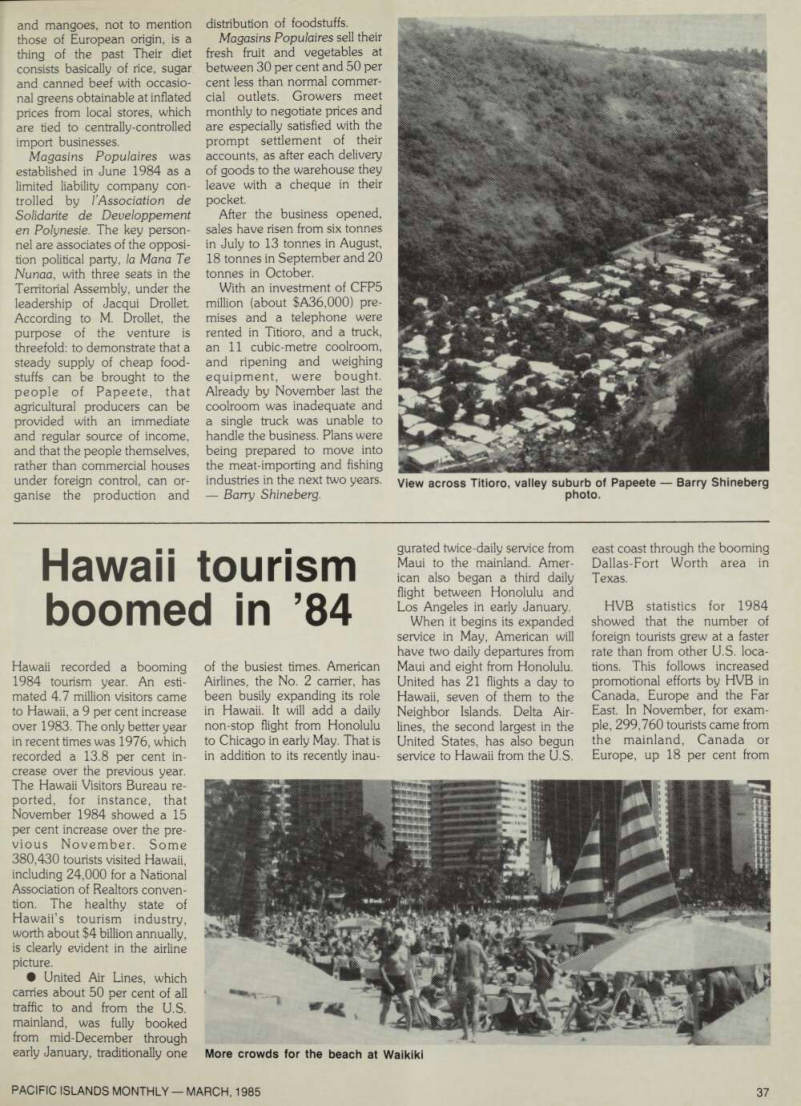
View across Titioro, valley suburb of Papeete Barry Shineberg photo.